


1 Preliminary Questions
The aim of this chapter is to study the reception in Spain of Italo Svevoâs La coscienza di Zeno [Zenoâs Conscience] from 1981 onwards, the publication date of the second translation of the work. The study follows on from a previous article published in 2017 (Aja 2017: 115â138), which undertakes an analysis of the first Spanish edition of this title, published in 1956 (Seix-Barral) and translated by José MarÃa Velloso. As is clear from the files consulted in the Spanish national archive holding the censorship records of the Franco regime (Aja 2017:112â126),1 in this censored version, those passages in which adultery was associated with the expression of sensuality or feeling were mutilated, as were those parts of the novel offering a glimpse of the authorâs agnosticism (Aja 2017: 126â130).
2 Objectives
Here the study of successive versions of the work is resumed, to trace its reception in the cultural space of the Iberian Peninsula as summarised in Table 12.1

Translations and editions of La coscienza di Zeno in Spain

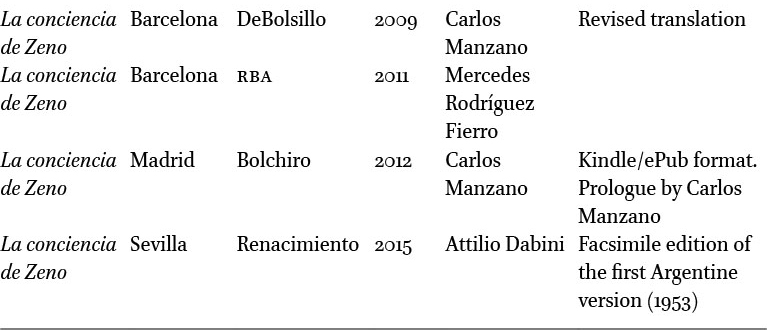
It follows from the above chronology that Carlos Manzanoâs translation is the next step in the reception of the work. This analysis therefore starts from the 1981 translation with the following objectives:
-
to confirm whether this version was revised in the subsequent editions â 1986, 2001, 2003, 2008 and 2012
-
to set up a contrastive study between these versions;
-
to approach Carlos Manzanoâs work from a broader perspective to establish the factors responsible for the appearance of different editions and their possible textual changes.
3 On the Concepts of Revision, Adaptation and Retranslation
The Carlos Manzano version published by Bruguera in 1981 is the first retranslation of the work in Spain. It owed its presence in the catalogue to an overriding need to offer readers an unexpurgated Spanish-language edition of this contemporary classic, not previously available given that the Seix-Barral version was censored. As many scholars of translation and reception point out (Monti 2011: 13, Berk Albachten and Tahir Gürçaglar 2019: 2), this is one of the most frequent reasons for retranslation: the publication of a first complete edition of a given work following the appearance of incomplete ones or versions that have been doctored by acts of censorship.
A review of the text, focusing above all on the sixth chapter of the novel, âWife and Mistressâ â already studied in depth in the previous article in view of the large number of deletions â confirmed that the 1981 version is indeed complete, as the censored passages have been translated.
The next step was to compare this 1981 version with subsequently translated editions, which yielded a significant number of textual variants. One of the first tasks undertaken was to evaluate the extent of those changes and their impact on the reading of the text, informed by Gambierâs notion that the study of retranslations of a particular literary text should not just focus on the different authorships, but also base itself on the premise that the revised or corrected text â whether explicitly so or not â is also a retranslation, be it by the same translator, a different translator, or an editor/reviser (Gambier 2011: 54).
The first doubt that arose in approaching the analysis revolved around the authorship of those said changes. Were they down to the translator? The proof-reader? The editor? Only the translator had the answers to these questions; and when approached for details on the editorial process for La coscienza di Zeno with each publisher, Carlos Manzano agreed to a telephone interview on 14 May 2019, to which this study refers at various points as it proved rather illuminating.
Efforts were also made to obtain some precise detail about the criteria adopted by enquiring directly to the publishers essentially Cátedra, Lumen and Gadir â though they did not always respond.
The second doubt is of a conceptual nature. Is a revision the same thing as an adaptation? Is there some limit that allows us to differentiate between them?
Enfin, en abordant les phénomènes de la retraduction, on ne peut manquer de sâinterroger sur les rapports à la révision et à lâadaptation, elles-mêmes problématiques quant à leur extension. [â¦] On aurait alors comme un continuum du moins vers le plus : de la révision (peu de modifications) vers lâadaptation (tant de modifications que lâoriginal peut être ressenti comme un prétexte à une rédaction autre).
Gambier 1994: 413
[Finally, in approaching the phenomenon of retranslation, we cannot avoid reflecting on its relationship to revision and adaptation, which are themselves problematic in terms of their scope. [â¦] So we would have a kind of a continuum, from less towards more: from revision (few modifications) towards adaptation (so many modifications that the original can be regarded as a pretext for writing another version)].
Gambier 1994: 413
Thus, there is no precise boundary that serves to define them. This conflict finds echo in Koskinen and Paloposki, who consider an exhaustive textual revision to already be a first step towards the retranslation of the text (Koskinen and Paloposki 2010: 294), though the boundaries between simple revision and adaptation are fuzzy. In any case, it is clear that Carlos Manzanoâs version is never listed as a revised version and there is no record of its having been reused in later editions under another imprint, a phenomenon that Koskinen and Paloposki have sometimes encountered. One of the tasks of this work will therefore be to establish the significance of the changes in the editions studied in order to determine whether or not the new version qualifies as a retranslation and the extent to which it approaches that category.
The working procedure in this work will involve comparing the different versions, taking the Italian original as a reference point. It closely follows the methods of analysis proposed by Anthony Pym in his work Method in Translation History, where he sets out three possible strategies for analysing translated texts: a comparison of the translations with the original, a comparison of the translated or adapted texts without reference to the original â though associating them with other contemporary works in the target culture â and finally, a comparison between the translations published in different historical periods (Pym 1998: 106â107). This last model is the one adopted, as it is particularly well suited to understanding the differences between the different Carlos Manzano versions selected for analysis: âA further possibility is to analyse successive draft versions of a single translation (its genesis within the work of the one translator)â (Pym 1998: 107).
The textual analysis will be developed using typical contrastive studies models and following equivalence school principles, as will become evident in the empirical part of this work.
4 On the Concept of Reception
However, textual analysis alone is not sufficient to meet the objectives set in the previous section. The textual reality is indissociable from the context in which it arises, and the coexistence of the translations cited with their respective variants throughout these decades requires a deeper response, which takes into account not so much what the translator translates as the factors that have led to textual revisions and new translations.
This analysis will have to closely follow the mechanisms of publishing activity that generate such textual transformations, a process that takes place after the translator has delivered their original. Lefevere alluded to this when he analysed the changes undergone by the early editions of the Diary of Ann Frank, where textual manipulation by the Dutch â and, later, the German â editor led to the discovery of different Ann Franks during the 1950s and 1960s depending on ethical and political criteria that decisively influenced the image readers gained of the character (Lefevere 1992: 59â72). Christiane Nord always insisted, from a functionalist perspective clearly related to her profession as translator, on the fundamental role exerted by the client/editor in the final result of a given translation (Nord 1991: 34). To quote her own words:
The initiator starts the process of intercultural communication because he wants a particular communicative instrument: the target text. This implies that the initiator wants the translation for a certain purpose [â¦]. It is this purpose that determines the requirements to be met by translation.
Nord 1991: 8
The development of this conceptual framework allowing us to reconstruct the reception of the work can be defined as a sociology of translation (Chesterman 2007: 172), in which there are a number of key factors such as the translatorâs decisions, their professional experience, the deadlines they work to, the publishing market and the rules governing the cultural industry â all factors providing essential information (Chesterman 2007: 173). This aspect of the analysis is related to the concept of habitus coined by Bourdieu, which describes the activity of those working in the cultural industry, particularly the publishing sector, as a strategy for a personalised approach to the translator and publishers of the work.
It focuses on what people [translators] do: how they work, how they organize their time, their workplace procedures, their interaction with other team members or experts, their use of resources, project management, quality control procedures and so on.
Chesterman 2007: 177
La coscienza di Zeno in Spain is the story of its Spanish translators and publishers, an anonymous and as yet unwritten account which, together with the translational analysis, will be reconstructed here as an indispensable element for understanding the reception of the work.
5 The Reception of La coscienza di Zeno in Spain from 1981
5.1 The Bruguera Edition (Translation by Carlos Manzano, 1981)
The publication of La coscienza di Zeno by Bruguera was due, in part, to the policy adopted by this publishing house from 1970 with the Libro Amigo [Book Friend] collection, which sought to offer the reader titles of some literary prestige in a bid to polish up the image of an imprint perceived as âpopularâ (Moret 2002: 112). That meant making it easier for the less cultured reader to access a complex work such as La coscienza di Zeno, which in this version included a prologue about the author signed by Eugenio Montale to help bring the figure of Svevo closer to the Spanish reading public.
Interest in Svevo in the 1980s was not solely due to the cementing of his reputation as a classic Italian author of the twentieth century, but also to the huge boom in translation during those years. GarcÃa Yebra notes the constant increase in translation activity in the publishing sector, which put Spain among the leading countries in the world for publishing translations (GarcÃa Yebra 1994: 152). The consolidation of freedom of expression, liberalisation and openness in Spain as it made the transition to democracy was clearly reflected in editorial policies, with a notable increase in the number of translations published (Falcón 2018: 139â141).
It is likely that Bruguera decided to commission a new translation not only because the version published by Seix-Barral had been censored, but also because they were swept up in the productive and translational frenzy that marked the sector in those years. It is worth recalling the persistence of censored translations in the catalogue well into the democratic period in Spain, no doubt because it was more profitable not to commission new translations (Monti 2011: 13). It is not possible to shed much further light on this point because Bruguera declared a suspension of payments and closed down definitively in 1988, a victim of precisely this unbridled expansion (Moret 2020: 112â113).
5.2 The Cátedra Edition (Translation by Carlos Manzano, 1986)
Carlos Manzanoâs translation was published again by Ediciones Cátedra, specifically in its Letras Universales [Universal Letters] collection, in 1986. Cátedra is a publishing house dedicated to the publication of annotated classics, offering further proof of the titleâs incorporation into the canon as a classic of world literature. This time, the introduction to the text was provided by Anna Dolfi, Professor of Contemporary Literature at the University of Florence, who was also responsible for adding a series of cultural notes to the text.
Carlos Manzanoâs version is reproduced practically as it appears in the Bruguera edition, though minor changes can be detected that do not imply a significant transformation of the text. In this case, our interview with Manzano was not much help for determining the authorship of these corrections. Given that the Cátedra edition was published more than thirty years ago, the translator did not precisely recall the revision processes involved. A comparison of the text published in 1986 with the 1981 edition shows that the changes were not significant, apart from some unsystematic differences in punctuation that are attributable to the proof-reader, according to the Cátedra editors. In most cases, comma apposition is put into play, with a comma introduced or deleted before a copulative conjunction in long stretches of text.
It is clear, therefore, that the Cátedra edition does not introduce substantial changes to the translation that Carlos Manzano did five years earlier. We can regard it, in short, as the same version.
5.3 The Lumen Edition (Translation by Carlos Manzano, 2001)
The inclusion of La coscienza di Zeno in the Lumen list is the next step in the reception of this translation. Lumen is, like Seix-Barral, a publishing house dedicated to offering books for the more discerning reader, as opposed to Brugueraâs more generalist niche. Founded in the 1960s, the publisher was part of the Spanish cultural and ideological avant-garde of the time and was largely sustained by publishing projects previously undertaken by Seix-Barral (Moret 2002: 316). Carlos Manzanoâs translation was incorporated into the collection âLa palabra en el tiempoâ [The Word In Time], which had been initiated forty years earlier. Svevo thus appeared in the same catalogue as âforeign authors of unquestionable quality such as Virginia Woolf, James Joyce, Céline, Iris Murdoch, André Gide, Peter Weiss and Hermann Brochâ (Moret 2002: 317), who already featured in this collection.
Comparison of the text published by Lumen with the 1981 edition yielded a remarkable number of changes, more significant than those observed in the Cátedra edition. Here there is neither an introduction nor an annotated edition, so the authorship of the corrections could only fall to the translator or proof-reader. Carlos Manzano, in this case, did give some precise information about the working process on the Lumen version and spoke of his constant requirement to revise the proofs and check the corrections proposed by the publisher.
This new version of the work constitutes, in the words of the translator himself, one more step in a process of textual improvement to which Carlos Manzano is seriously committed, the principles of which are marked by two fundamental factors: a progressive maturation of the reading and a better knowledge of the author. The first factor depends, especially in the case of such a lengthy original as this, on the complexity that characterises the reading act. To translate is to understand, but the interpretation of the text, especially with literature, is not something immediate, because it registers the temporal lapse between the act of writing and that of reading.
Un texto que habla en el presente de cada lector necesita, por el hecho mismo de ser texto, o sea, lejanÃa de su autor y de su tiempo, ser vivido totalmente en la mente de aquel para quien se constituye como lenguaje.
Lledó 2011: 82
[A text that speaks in the present of each reader needs, by the very fact of being text â that is, something removed from its author and its time â to be lived totally in the mind of the one for whom it is constituted as language].
Lledó 2011: 82
The relationship of the translator and the author to the written text is complex because it is not unidirectional and changes not only with time, but also because of the subjectivity implicit in the poetic function of the literary message. The meaning is ever-fluctuating, like the processes of modulation proposed by translation scholars such as Vinay and Darbelnet. Alberto Manguel explicitly echoes this situation in his Historia de la lectura [History of Reading], as can be deduced from the following context.
Un texto leÃdo y recordado llega a ser, en esa relectura redentora, como aquel lago helado en el poema que aprendà de memoria hace largo tiempo: sólido como la tierra firme [â¦] y, sin embargo, su existencia solo es en la mente, y precaria y efÃmera como si sus letras estuvieran escritas en el agua.
Manguel 1996: 100
[A text read and remembered becomes, in that redemptive re-reading, like that frozen lake in the poem I learned by heart a long time ago: solid like dry land [â¦] and yet its existence is only in the mind, and precarious and ephemeral as if its letters were written on water].
Manguel 1996: 100
Writing from the perspective of retranslation, Antoine Berman reflects on this situation, also pointed out by Carlos Manzano, in considering the translatorâs work to be characterised by imprecision and a feeling of dissatisfaction at the result, which he defines with the French term défaillance (Berman 1990: 5â6). Translation is always an unfinished task, the final touch imposed by deadlines â a limitation that Carlos Manzano alluded to on several occasions when interviewed. Hence the legitimate need to return, whenever possible, to what has been translated.
The changes introduced to this new version concern smaller units of meaning, while some transformations can also be observed that partially affect syntactic order, punctuation and textual segmentation. Given the nature of the analysis to be developed, it is necessary to follow the models proposed by the school of equivalence, adopting a dual approach to the text, microanalytical and macroanalytical, which will enable evaluation of the extent of the textual variants and thus measurement of âthe potential consequences of microstructural shifts on the macrostructure to indicate the lines along which the interpretation of these consequences might be establishedâ (Leuven-Zwart 1990: 70).
This dual approach follows Mona Bakerâs proposals regarding textual equivalence, governed by a bottom-up interpretation of this concept.
Text is a meaning unit, not a form unit, but meaning is realized through form and without understanding the meanings of individual forms one cannot interpret the meaning of the text as a whole.
Baker 1992: 6
5.3.1 Changes That Affect Smaller Units of Meaning
Smaller units of meaning are here understood as âthose segments of speech with such cohesion that their signs should not be translated separatelyâ (Vinay and Darbelnet 1977: 36â38). This analytical level takes into account, above all, the lexical changes and altered nuances that offer a different point of view in the new version, which these authors define as modulation (Vinay and Darbelnet 1977: 51).
La coscienza di Zeno (1923) [ST]
Cercai di esservi ammesso e tentai di soggiornarvi risoluto di non deridere me e lei, perché questo conato non poteva essere altro che la mia malattia ed io dovevo almeno guardarmi dallâinfettare a chi me sâera confidato (p. 151)
Translation by Carlos Manzano (Bruguera, 1981) [T1]
Intenté ser admitido a él y procuré vivir en él, decidido a no burlarme ni de mà ni de ella, pues esto no podÃa ser sino mi enfermedad y al menos debÃa procurar no contagiar a quien se me habÃa confiado (p. 188)
EN.: I tried to be admitted to it and I endeavoured to live in it, determined not to mock either myself or her, for this could only be my illness and I must at least endeavour not to infect someone who had confided in/put their trust in/been entrusted to me
Translation by Carlos Manzano (Lumen, 2001) [T2]
Procuré ser admitido a él y procuré vivir en él, decidido a no burlarme ni de mà ni de ella, pues este conato no podÃa ser sino mi enfermedad y al menos debÃa guardarme de no contagiar a quien se me habÃa confiado (p. 156)
EN.: I endeavoured to be admitted to it and I endeavoured to live in it, determined not to mock either myself or her, for this attempt could only be my illness and I must at least guard against infecting someone who had confided in/put their trust in/been entrusted to me
If we observe the lexical changes implemented in the Lumen version, it is clear that Carlos Manzano has proceeded to give a rhetorical tweak to his translation, marked by the transformations âestoâ â âeste conatoâ, âprocurarâ â âguar-darme deâ, both modulating mechanisms which clearly tend towards semantic specification as opposed to the previous, much more neutral choice. The tendency can be corroborated in the following examples:
La coscienza di Zeno (1923) [ST]
Egli allora faceva un proposito che diceva ferreo perché, per materializzarlo, lo accompagnava con un nodo châegli allacciava alla catena di metallo del suo orologio (p. 155).
Translation by Carlos Manzano (Bruguera, 1981) [T1]
Entonces él hacÃa el propósito que llamaba férreo, porque, para cumplirlo, lo acompañaba con un nudo que hacÃa en la cadena de metal de su reloj (p. 192)
EN.: Then he made a resolution that he called iron because, in order to fulfil it, he simultaneously made a knot in his metal watch-chain
Translation by Carlos Manzano (Lumen, 2001) [T2]
Entonces él concebÃa el propósito que llamaba férreo, porque, para cumplirlo, lo acompañaba con un nudo que hacÃa en la cadena de metal de su reloj (p. 160)
EN.: Then he conceived a resolution that he called iron because, in order to fulfil it, he simultaneously made a knot in his metal watch-chain
The Lumen version clearly avoids the use of the verb âhacerâ (âto makeâ), literal translation of the verb âfareâ, in a process of specification as already identified in the previous case and which reflects one of the tendencies of modulation, which, according to Leuven-Zwart, can be towards either generalisation or conceptual specification (Leuven-Zwart 1989: 160â161), this example being a clear case of the latter possibility.
This tendency is due to the replacement of so-called omnibus words, characterised by their lexical imprecision and context-dependent polyvalence (Briz and Va. Les.Co 2000: 33â34), with semantically more precise terms. Especially significant in this tendency is the substitution of the word âcosaâ (âthingâ), which occurs in other contexts in the translation:
La coscienza di Zeno (1923) [ST]
Per lei, che lavorava per lâeternità , il breve incomodo poteva non importare, ma per me la cosa era diversa (p. 158)
Translation by Carlos Manzano (Bruguera, 1981) [T1]
Para ella, que trabajaba para la eternidad, esa breve incomodidad podrÃa no importar, pero para mà la cosa era muy distinta (p. 196)
EN.: For her, who worked for eternity, that brief discomfort might not matter, but for me the thing was very different
Translation by Carlos Manzano (Lumen, 2001) [T2]
Para ella, que trabajaba para la eternidad, esa breve incomodidad podrÃa no importar, pero para mà era algo muy distinto (p. 163)
EN.: For her, who worked for eternity, that brief discomfort might not matter, but for me it was something very different
A clear example of this tendency towards lexical specification can be seen in the following example, where it is obvious that the Lumen version chooses a translational term closer to the meaning of the original text:
La coscienza di Zeno (1923) [ST]
Dalla mia villa, che giace su una collina, si aveva la vista del porto e del mare, vista che ora è intercettata da nuovi fabbricati (p. 167)
Translation by Carlos Manzano (Bruguera, 1981) [T1]
Desde mi casa, que se encuentra sobre una colina, se veÃa el puerto y el mar, tapados ahora por nuevas construcciones (p. 205)
EN.: From my house, which is on a hill, you could see the port and the sea, now blocked by new buildings
Translation by Carlos Manzano (Lumen, 2001) [T2]
Desde mi quinta, que se encuentra sobre una colina, se veÃa el puerto y el mar, tapados ahora por nuevas construcciones (p. 205)
EN.: From my villa, which is on a hill, you could see the port and the sea, now blocked by new buildings
Another striking decision, still at the level of lexical nuance and modulation, concerns the choice of demonstrative adjectives. Initially, Carlos Manzano had given a certain priority to the âthatâ forms âese, esaâ when translating the Italian âquello, quellaâ, a tendency that is adjusted in the Lumen edition. In this second version of the text, there is a systematic strategy of substitution, where feasible, by the âaquel, aquellaâ form.
La coscienza di Zeno (1923) [ST]
Di domenica essa andava a Messa ed io ve lâaccompagnai talvolta per vedere come soportasse lâimmagine del dolore e della morte. Per lei non câera, e quella visita le infondeva serenità per tutta la settimana (pp. 151â152)
Translation by Carlos Manzano (Bruguera, 1981) [T1]
Los domingos iba a misa y yo la acompañé a veces para ver cómo soportaba la imagen del dolor y de la muerte. Para ella no habÃa tal y esa visita le infundÃa serenidad para toda la semana (p. 189)
EN.: On Sundays she went to mass and I sometimes accompanied her to see how she bore the image of pain and death. For her there was no such thing and the/that visit filled her with serenity for the whole week
Translation by Carlos Manzano (Lumen, 2001) [T2]
Los domingos iba a misa y yo la acompañé a veces para ver cómo soportaba la imagen del dolor y de la muerte. Para ella no habÃa tal y aquella visita le infundÃa serenidad para toda la semana (p. 157)
EN.: On Sundays she went to mass and I sometimes accompanied her to see how she bore the image of pain and death. For her there was no such thing and that visit filled her with serenity for the whole week
The demonstrative âquello, quellaâ can be translated by âese, esaâ or âaquel, aquellaâ in Spanish, alternative forms of the English âthatâ. The implicit deixis posed by the âeseâ vs. âaquelâ dichotomy is missing in Italian, since the spatial value alluded to is only between âquestoâ and âquelloâ, the âcodestoâ form having fallen into disuse. Another proof that the version published by Lumen is characterised by a more courtly tone is signalled by the rehabilitation of the âbsâ consonant cluster, a clearly archaic tendency. As in the previous case, a feature of the correction is its systematic nature. Here is an example of this:
La coscienza di Zeno (1923) [ST]
I moli e le dighe erano piccoli e insignificanti nelle loro forme rigidamente lineari e lâacqua nei bacini era oscurata dalla sua immobilità o forse era torbida (p. 167)
Translation by Carlos Manzano (Bruguera, 1981) [T1]
Los muelles y los diques eran pequeños e insignificantes con sus formas rÃgidas y lineales y el agua de los embalses aparecÃa oscura por su inmovilidad o tal vez por su turbiedad (p. 205)
EN.: The wharfs and docks were small and insignificant with their rigid linear forms, and the water in the reservoirs looked dark because of its stillness or perhaps its turbidity
Translation by Carlos Manzano (Lumen, 2001) [T2]
Los muelles y los diques eran pequeños e insignificantes con sus formas rÃgidas y lineales y el agua de los embalses aparecÃa obscurecida por su inmovilidad o tal vez por su turbiedad (p. 172)
EN.: The wharfs and docks were small and insignificant with their rigid linear forms, and the water in the reservoirs appeared darkened because of its stillness or perhaps its turbidity
Carlos Manzano took the opportunity with the revision of this translation to reverse some changes in meaning, as we can see in this example:
La coscienza di Zeno (1923) [ST]
Ma il sapore dellâuva sultanina mi restò in bocca ed ogni giorno al Tergesteo mâinformavo sul prezzo. Dâaltro non mi importava (p. 161)
Translation by Carlos Manzano (Bruguera, 1981) [T1]
Pero me quedó en la boca el sabor de la uva pasa y todos los dÃas me informaba de su precio en el Tergesteo. Por lo demás, no me importaba (p. 199)
EN.: But the taste of the raisin stayed in my mouth and every day I checked on the price at the Tergesteo. Apart from that, it didnât matter to me
Translation by Carlos Manzano (Lumen, 2001) [T2]
Pero me quedó en la boca el sabor de la uva pasa y todos los dÃas me informaba de su precio en el Tergesteo. Era lo único que me importaba (p. 199)
EN.: But the taste of the raisin stayed in my mouth and every day I checked on the price at the Tergesteo. It was the only thing that mattered to me
The translation of the sentence âDâaltro non mi importavaâ as negative is rightly changed to affirmative in the second version, to correct the consequences of what was probably a hasty reading of the original.
5.3.2 Changes That Affect the Larger Units of Meaning
We now turn to study the structural changes noted when comparing the Lumen with the Bruguera version, understood as the transformations that affect textual segmentation and, more specifically, syntax, punctuation or the order of sentence elements. As Mona Baker says with regard to the latter:
Of the numerous formulations available for expressing a given message, a speaker or writer will normally opt for one that makes the flow of information clearer in a given context. In order to appreciate the factors which motivate a writer or speaker to make this kind of selection, one needs to think of the clause is a message rather than a string of grammatical and lexical elements.
Baker 1992: 120â121
The basis of the analysis in this section is transposition, a term adopted by Vinay and Darbelnet for the strategies followed by translators when using the formal turns of phrase necessary to construct their message. Beyond obligatory transposition, the study of which is framed by the limits imposed by language, it is interesting to analyse optional transposition, where the stylistic nuances favoured by the translator are resolved (Vinay and Darbelnet 1977: 50).
Carlos Manzano changes practically no substantive aspect of the syntax in the Lumen version. The only perceptible interventions are due to an attempt to improve the sentence structure in a discourse as complex as that offered by Zenoâs soliloquy throughout the novel. In fact, some of the discrepancies detected in this category are related to translation of the passive voice, which is used more frequently in written Italian than in Spanish. The strategy most often adopted by the translator in such cases is to use impersonal forms or the reflexive passive, involving a reordering process that is not always accurate, as can be seen in the example below:
La coscienza di Zeno (1923) [ST]
Anche Augusta fu indotta dal padre a convincermi di non ingerirmi più nei miei propri affari (p. 162)
Translation by Carlos Manzano (Bruguera, 1981) [T1]
El padre de Augusta indujo también a ésta a convencerme para que no me inmiscuyera nunca más en mis propios asuntos (p. 200)
EN.: Augustaâs father also induced her to convince me never to meddle in my own affairs again
Translation by Carlos Manzano (Lumen, 2001) [T2]
Augusta se dejó también inducir por su padre para convencerme de que no debÃa inmiscuirme más en mis propios asuntos (p. 167)
EN.: Augusta also allowed herself to be induced by her father to convince me that I ought never to meddle in my own affairs again
The formulation proposed in the Bruguera version has a clearly contrived effect in Spanish due to the demonstrative pronoun âéstaâ, which disappears in the later version. The handling of the phrase âa convincermiâ is likewise somewhat defter, now in a more formal register than the expression âindujo a convencermeâ. It is clear that the second version opts for substantial changes in the structure of the text. This last example serves to illustrate the cases of syntactic reordering found:
La coscienza di Zeno (1923) [ST]
Il Copler assisteva come un maestro che ad un esame ufficiale stia ad ascoltare la lezione châegli con grande fatica ha insegnata (p. 170)
Translation by Carlos Manzano (Bruguera, 1981) [T1]
Copler asistÃa como un profesor que en un examen oficial escuchaba las lecciones que con gran esfuerzo ha enseñado (p. 208)
EN.: Copler attended like a teacher that listened in an official exam to the lessons that with great effort he has taught
Translation by Carlos Manzano (Lumen, 2001) [T2]
Copler asistÃa como un profesor que en un examen oficial escucha las lecciones enseñadas con gran esfuerzo (p. 175)
EN.: Copler attended like a teacher that listens in an official exam to the lessons taught with great effort
In the Lumen version, repetition of the relative clause (âque en un examen oficial escuchaba las lecciones que con gran esfuerzoâ) is avoided in favour of a less reiterative solution through use of the past participle (âque en un examen oficial escucha las lecciones enseñadas con gran esfuerzoâ).
5.4 The CÃrculo de Lectores Edition (Translation by Carlos Manzano, 2003)
Carlos Manzanoâs translation appears again, published this time by CÃrculo de Lectores. CÃrculo de Lectores pursued an editorial policy linked to its book club, which aimed to offer its members, via catalogue and home shopping, the same books that readers could find in a bookshop. For this reason, the publishers created a collection that gave access not only to best sellers and the latest releases, but also to classic lists. La coscienza di Zeno appeared in the âOpera Mundi. Maestros modernos europeosâ collection, curated by Mario Vargas Llosa. This edition had a prologue by Alonso Cueto and as can be inferred from the copyright notice, in which Carlos Manzano is explicitly named, it reproduces in their entirety the contents of the version published by Ediciones Cátedra in 1986. CÃrculo would negotiate the transfer of rights with other publishers to offer this sales channel to selected titles, so this new version is another example of this publishing practice. Given that no textual variants were found to distinguish it from the 1986 version, let us now turn to the analysis of the Carlos Manzano version published by Gadir.
5.5 The Gadir Edition (Translation by Carlos Manzano, 2008)
Carlos Manzanoâs translation appeared in a new publication by Gadir, a good example of the model embraced by a whole series of publishers â Funambulista, Impedimenta, Periférica, Nórdica, among others â from 1990 onwards. Following the expansion seen by the sector with the end of censorship and the consolidation of democracy, the publishing houses had launched into a period of voracious productivity that flooded the market with new titles. It was an exceptional period for literary translators, who had an excellent opportunity to grow their activity. However, the system had a number of drawbacks: it offered the reader a mass product, sometimes impersonal and rather carelessly done, a criticism that can also be extended to the quality of the translations. Many authors of note fell out of print because they were no longer profitable for the lists. The quality of the paper and typographical style were a badge of identity for these publishers, who sought to distance themselves from the rather coarse aesthetic of the paperback pocket edition that had featured so widely in preceding years. They were also going for new, higher-quality translations incorporating the full text, as censored versions bought up by other contemporary publishers were still in circulation. âTenÃa ganas de leer clásicos como Jane Eyre en un libro de mayor formato, con buen papel, tamaño de letra adecuado, una tipografÃa elegante, una cubierta atractiva y, por supuesto, bien traducido [I wanted to read classics like Jane Eyre in a larger format, with decent paper, big enough font size, elegant typography, an attractive cover and, of course, properly translated]â is how Alba editor Luis Magrinyà put it (2013).
Gadir belongs to this new generation. The editor, Javier Santillán, went ahead with an interesting project in which one of the aims was the promotion and dissemination of Mediterranean culture. French, Italian and Portuguese authors have a special place in their catalogue: indeed, Verga, Buzzati, Pirandello and Morante are heavily represented in their collections. That is not to mention Svevo, a writer in whom Santillán showed a special interest as, apart from La coscienza di Zeno, other titles by the author such as Tutte le novelle [Complete Stories] or Senilità [Senescence] featured, also translated by Carlos Manzano, a regular contributor to the list.
5.5.1 Changes Affecting Smaller Units of Meaning
Comparison of this new edition with the two previous ones (Carlos Manzano, Bruguera, 1981, Carlos Manzano, Lumen, 2001) reveals that the text is based on the latter, which means that the changes proposed by the translator in his most recent revision were regarded as valid and incorporated definitively in the history of this translation, which would no longer rely on the 1981 formulas. A premise identified by the translator in his interview was thus fulfilled: revising a translation provides an opportunity to improve it, which is why new editions are an ideal occasion to overcome défaillance and embark on a new reading.
In this instance, the Gadir translation does not present significant transformations that affect the smaller units of meaning, allowing us to move on to an analysis of the larger units.
5.5.2 Changes Affecting Larger Units of Meaning
Comparing the two editions reveals some syntactic transformations that can be attributed to optional transposition, all of them punctuation-related. There is a series of systematic changes that result from a deliberate translation or reading strategy.
Here are some examples:
La coscienza di Zeno (1923) [ST]
Scoprivo di essere stato non un bestione cieco diretto da altri, ma un uomo abilissimo. E vedendomi stupito, Augusta mi diceva: (p. 150)
Translation by Carlos Manzano (Lumen, 2001) [T2]
Comprendà que no habÃa sido un zopenco ciego dirigido por los demás, sino un hombre habilÃsimo. Y, al verme asombrado, Augusta me decÃa: (p. 155)
EN.: I realised that I had not been a blind bonehead led by others, but a very clever man. And, on seeing my astonishment, Augusta said to me:
Translation by Carlos Manzano (Gadir, 2008) [T3]
Comprendà que no habÃa sido un zopenco ciego dirigido por los demás, sino un hombre habilÃsimo y, al verme asombrado, Augusta me decÃa: (p. 173)
EN.: I realised that I had not been a blind bonehead led by others, but a very clever man and, on seeing my astonishment, Augusta said to me:
It is significant that in the Gadir version, full stops before sentences beginning with the co-ordinating conjunction âyâ (âandâ), which are quite frequent in the original, have been deleted and replaced with commas. It is a strategy that makes the sentences analysed even longer. The same applies in the following example:
La coscienza di Zeno (1923) [ST]
Poi vâerano i medici, quelli che avevano fatto tutti gli studii regolari per salvarci quando â Dio non lo voglia â ci avesse a toccare qualche malattia. Io ne usavo ogni giorno di quelle autorità : lei, invece, mai. Ma perciò io sapevo il mio atroce destino quando la malattia mortale mâavesse raggiunto [â¦] (p. 152)
Translation by Carlos Manzano (Lumen, 2001) [T2]
Después los médicos, los que habÃan hecho los estudios oficiales para salvarnos cuando âDios no lo quieraâ cayésemos enfermos. Yo utilizaba esa autoridad todos los dÃas; ella, en cambio, nunca. Pero, por eso, yo conocÃa mi atroz destino, cuando me sobreviniera la enfermedad mortal [â¦] (p. 157)
EN.: Then the doctors, those who had done the formal studies to save us should â God forbid â we fall ill. I made use of that authority every day; she, by contrast, never did. But, because of it, I knew my dreadful fate when the mortal disease struck me [â¦]
Translation by Carlos Manzano (Gadir, 2008) [T3]
Después los médicos, los que habÃan hecho los estudios oficiales para salvarnos cuando âDios no lo quieraâ cayésemos enfermos. Yo utilizaba esa autoridad todos los dÃas; ella, en cambio, nunca, pero, por eso, yo conocÃa mi atroz destino, cuando me sobreviniera la enfermedad mortal [â¦] (p. 173)
EN.: Then the doctors, those who had done the formal studies to save us should â God forbid â we fall ill. I made use of that authority every day; she, by contrast, never did, but, because of it, I knew my dreadful fate when the mortal disease struck me [â¦]
The adversative clause is transformed when introduced by a comma in the Gadir version.
The text has undergone other, less recurrent changes in punctuation, involving the replacement of full stops with colons and commas with dashes, the latter strategy facilitating the flow in lengthy comma-laden syntactic passages. Along the same lines, it is worth highlighting the inclusion of appositions between commas, an occasional tactic that also enhances the readability of the text:
La coscienza di Zeno (1923) [ST]
A me pareva che sarebbe stato più opportuno e meno fastidioso di fare tutti quegli acquisti a Trieste. Ecco che dovevamo pensare alla spedizione, allâassicurazione e alle operazioni doganali (p. 153)
Translation by Carlos Manzano (Lumen, 2001) [T2]
A mà me parecÃa que habrÃa sido más oportuno y menos fastidioso hacer todas aquellas compras en Trieste. Conque tenÃamos que pensar en la expedición, el seguro y las operaciones aduaneras (p. 158)
EN.: It seemed to me that it would have been more convenient and less troublesome to make all those purchases in Trieste. So we had to think about shipping, insurance and customs operations.
Translation by Carlos Manzano (Gadir, 2008) [T3]
A mà me parecÃa que habrÃa sido más oportuno y menos fastidioso hacer todas aquellas compras en Trieste, conque tenÃamos que pensar en la expedición, el seguro y las operaciones aduaneras. (p. 177).
EN.: It seemed to me that it would have been more convenient and less troublesome to make all those purchases in Trieste, so we had to think about shipping, insurance and customs operations.
5.6 The DeBolsillo Edition (Translation by Carlos Manzano, 2009)
A year after the Gadir versión appeared, DeBolsillo republished the translation by Carlos Manzano, noting that it was âcorrected and revisedâ. Comparing the text, we can observe that it is actually the same text published by Gadir and contains no modifications. It even uses the same page format and typesetting, since both editions share the same printing model.
5.7 The Bolchiro Edition (Translation by Carlos Manzano, 2012)
Carlos Manzano published his translation again with Bolchiro, a publishing house that combines paper with digital versions. Responding to an enquiry prompted by the impossibility of sourcing this most recent edition of Manzano on the market, the publisher confirmed that it had been withdrawn. The translator had granted Bolchiro the rights to his translation for a short period of time. Once the agreed time limit had elapsed, Manzano did not renew the publishing rights, so the publisher withdrew the title â only ever available in Kindle and ePub format â from its catalogue.
This latest incarnation of Manzanoâs published version proves the versatility of the new publishing models, which allow for cost reductions and a more direct management of the authorâs rights, where the translator, depending on the type of publisher they are dealing with, can obtain contract models different from those prevailing up to now.
It has not proved possible to access the whole of this latest version of Manzano, just a sample of chapter openings on the publisherâs website, which enabled some comparison of the text with the Gadir version. The textual variants noted are minimal, though it would have been interesting to go more deeply into textual analysis of the work. In his prologue, Carlos Manzano flags up new changes and pronounces himself satisfied with being able to revise his version of La coscienza di Zeno again, corroborating the position he took when interviewed.
6 Conclusions
6.1 Revision, Adaptation and Retranslation
The textual analysis revealed the importance of the changes introduced by Carlos Manzanoâs revision of the translated text in the Lumen version (2001). The central role of the translator is clear in this study, which has sought to reconstruct his working method and let his voice be heard as essential evidence in the development of the textual critique outlined here.
An overall analysis leads to the conclusion that this revision aims at a certain textual rhetorisation in which, to adopt the nomenclature proposed by Chesterman for pragmatic changes (Chesterman 1994: 107â114), a work of post-editing results, where the translator rewrites the text. The immediate consequence of this rewriting is a transformation of the relationship between the author and the reader, who, in the 2001 edition, finds a better rounded, more elegant version. These are the extreme consequences of the bottom-up study initiated earlier, as a reading focused on pragmatic effect shows the importance of the small changes outlined above. Indeed, âif syntactic strategies manipulate form, and semantic strategies manipulate meaning, pragmatic strategies can be said to manipulate the message itselfâ (Chesterman, 1994: 107).
This rhetorical turn also features in the Gadir version, involving a lengthening of the sentences in an attempt to avoid the caesuras imposed by full stops before copulative and adversative structures and thus interrupting the flow which, in Svevoâs case, is clearly a stream of thoughts. Mercedes RodrÃguez Fierroâs version, not dealt with here for reasons of space, seeks a literary echo in Spanish translation, with an effect that tends towards domestication.
From this study, therefore, the following emerges:
-
A revision of a translation can result, if not in a new translation, in a textual link worth taking into account when analysing the chain of retranslations.
-
The Retranslation Hypothesis proposed by Antoine Berman in 1990 fails yet again (Koskinen and Paloposki 2003: 21, Deane-Cox 2014: 4, OâDriscoll 2011: 251, Cadera 2017: 6), as La coscienza de Zenoâs journey in Spain points towards a progressive accommodation with the literary aesthetic of the Spanish readership. Moreover, given the syntactic complexity of La coscienza di Zeno, which approaches Joycean levels of narrative experimentation, the translator becomes someone âqui travaille souvent contre sa propre langue afin de créer sa langue propreâ [who often works against his own language in order to create a language of his own] (Porfido 2001: 123â124).
6.2 Reception
If the figure of the translator is a key element in the revision process, it has been demonstrated that the publisher is the main driver of La coscienza di Zeno within the cultural system. The number of editions this work has been through in a relatively short space of time was what led to this study of its various translations in order to understand the phenomenon, leading to the following conclusions:
-
When it comes to publishing a work, publisher expectations are attuned to the market and economic returns, but the presence of the title in certain catalogues is also due to the specific circumstances of each publishing project analysed.
-
The literary canon and the incorporation of the work into the category of classic twentieth century Italian literature acts as another important element in its dissemination. The rules governing this canon are nebulous and difficult to define, but the title will feature in this niche so long as the cultural establishment still talks about the work: precisely because of this, reading a classic will always be a rereading (Calvino 2002: 7). The threshold for the publication of new translations is defined by intellectual property law and Svevo is out of copyright. There is therefore no doubt that there will be new translations of La coscienza di Zeno in the years to come.
References
Primary References
Svevo, Italo. 1985. [1923]. La coscienza di Zeno. Milano: Garzanti.
Svevo, Italo. 1981. La conciencia de Zeno (tr. Carlos Manzano). Prologue by Eugenio Montale. Barcelona: Bruguera.
Svevo, Italo. 1986. La conciencia de Zeno (tr. Carlos Manzano). Revised translation. Introduction and notes by Anna Dolfi. Madrid: Ediciones Cátedra.
Svevo, Italo. 2001. La conciencia de Zeno (tr. Carlos Manzano). Barcelona: Lumen.
Svevo, Italo. 2001. La conciencia de Zeno (tr. Carlos Manzano). Prologue by Alfonso Cueto. Barcelona: CÃrculo de Lectores.
Svevo, Italo. 2009. La conciencia de Zeno (tr. Carlos Manzano). Barcelona: Debolsillo.
Svevo, Italo. 2012. La conciencia de Zeno (tr. Carlos Manzano). Kindle/ePub format. Prologue by Carlos Manzano. Madrid: Bolchiro.
Secondary References
Aja Sánchez, José Luis. 2017. âZeno Cosini comes to Spain, The response to Italo Svevo and the First Censored Edition of La coscienza di Zenoâ in Cadera, Susanne and Andrew Samuel Walsh (eds) Literary Retranslation in Context. Oxford/Bern: Peter Lang. 115â138.
Baker, Mona. 1992. In other words. A coursebook on translation. London/New York: Routledge.
Berk Albachten, Ãslem and Åehnaz Tahir GürçaÄlar. 2019. âIntroductionâ in Ãzlem Berk Albachten and Åehnaz Tahir GürçaÄlar (eds) Perspectives in Retranslation. Ideology, Paratext, Methods. London/New York: Routledge. 1â7.
Berman, Antione. 1990. âLa retraduction comme espace de la traductionâ in Palimpsestes 13(4): 1â7.
Briz, Antonio. 2000. Cómo se comenta un texto coloquial. Barcelona: Ariel.
Cadera, Susanne M. 2017. âLiterary Retranslation in Context. A Historical, Social and Cultural Perspectiveâ in Cadera, Susanne M. and Andrew Samuel Walsh (eds) (2017): 5â18.
Calvino, Italo. 2002 [1975]. Perché leggere i classici. Milano: Mondadori.
Chesterman, Andrew. 1997. Memes of Translation. Amsterdam/Philadelphia: John Benjamins.
Chesterman, Andrew. 2007. âBridge concepts in translation sociologyâ in Wolf, Michaela and Alexandra Fukari (eds) Constructing a Sociology of Translation. Amsterdam/Philadelphia: John Benjamins. 171â183.
Deane-Cox, Sharon. 2014. Retranslation, Translation, Literature and Reinterpretation. London/New York: Bloomsbury.
Falcón, Alejandrina. 2018. Traductores del exilio. Madrid/Frankfurt: Iberoamericana/Vervuert.
Gambier, Yves. 1994. âLa retraduction, retour et détourâ in Meta 39(3): 413â417.
Gambier, Yves. 2011. âLa retraduction: Ambiguïtés et défisâ in Monti, Enrico and Peter Schneider. (dir.) Autour de la retraduction. Perspectives littéraires et européennes. Contributions choisies du Colloque international et pluridisciplinnaire organisé par lâInstitut de Recherche en langues et littératures européennes. Lille: Orizons. 52â56.
GarcÃa Yebra, ValentÃn. 1994. Traducción: historia y teorÃa. Madrid: Gredos.
Koskinen, Kaisa and Outi Paloposki. 2010. âRetranslationâ in Gambier, Yves and Luc van Doorslaer (eds). Handbook of Translation Studies. Vol. 1. Amsterdam/Philadelphia: John Benjamins. 294â298.
Lefevere, André. 1992. Translation, Rewriting and the Manipulation of Literary Fame. London/New York: Routledge.
Leuven-Zwart, Kitty M. van. 1989. âTranslation and original. Similarities and Dissimilarities Iâ in Target 1(2): 65â95.
Lledó, Emilio. 1998. El silencio de la escritura. Madrid: Espasa-Calpe.
Magrinyà , L. 2013. âJuntos pero no revueltos. Editores y traductores en la difusión de obras literariasâ. Conferencia presentada en el ciclo de actividades Antesala de Babel (Madrid: Universidad Pontificia Comillas, 21 November 2013).
Manguel, A. 1996. Una historia de la lectura (tr. J. L. López Muñoz). Madrid: Alianza.
Monti, Enrico. 2011.âIntroduction. La retraduction: un état des lieuxâ in Monti and Schneider (2011): 8â25.
Moret, Xavier. 2002. Tiempo de editores. Historia de la edición en España (1939â1975). Barcelona: Destino.
Nord, Christiane. 1991. Text Analysis in Translation. Amsterdam/Atlanta: Rodopi.
OâDriscoll, Kieran. 2011. Retranslation through the Centuries. Jules Verne in English. Oxford/Bern: Peter Lang.
Porfido, I. 2011. âLalla Romano, traductrice de Flaubertâ in Monti and Schneider (2011): 113â126.
Pym, Anthony. 1998. Method in Translation History. Manchester: St. Jerome.
Vinay, Jean-Paul and Jean Darbelnet. 1977. Stylistique comparée du français et de lâanglais. Chomeday (Québec): Ãditions Beauchemin.
As indicated in the publication cited, the censorship file for the Seix-Barral edition (1956) is deposited in the in the General Archive of the Administration in Alcalá de Henares near Madrid (file 1901, 2111056).