


Around 1600, the Leiden mayor and painter Isaac Claesz van Swanenburg painted an allegory of the extraordinary economic and social transformation his city had undergone in a very short time (Figure 7.1).1 The panel, nearly 1.5 metres high and 2.5 metres wide, shows three women, symbolising respectively the city itself, the medieval cloth industry of the past and the lighter fabrics of the future. The young woman on the throne can be identified as the Stedemaagd, the virgin personifying the city, by the Leiden arms of two crossed red keys on her torso. An elegant woman stands at her left hand, backed by Father Time depicted as an old man with wings. She is an incarnation of the new era and the new fashionable fabric, the light, worsted woollen cloth known as saai (say) which in the previous few years had rescued the city from its economic depression. A tired old woman and a soldier stand on the right, respectively symbolising medieval textile production and the recent war. The Leiden skyline forms the background. The old woman makes it very clear that her days are over: she is leaning heavily on her stick and is holding an empty hourglass in her left hand. This painting expresses the institutional and organisational discontinuity between the medieval types of broadcloth, the âOld Draperyâ, and the modern saai, the âNew Draperyâ. It had been commissioned by the town council, and its message at the time was clear to all: continued good governance and peace will bring growth to the cloth industry, along with trade, and thereby prosperity to the city.

De Stedemaagd met de Oude en Nieuwe Neringhe, painting by Isaac Claesz van Swanenburg, 1596â1601
SOURCE: MUSEUM DE LAKENHAL, LEIDEN, NO. 423

The transformation of the cloth industry captured in the allegory had begun with a wave of immigrants from the Southern Low Countries from 1580 onward, and was eventually to result, by the middle of the seventeenth century, in a repressive system of quality control, with seven inspection halls performing the
1 Leiden Cloth and Broadcloth
From the late Middle Ages to the early eighteenth century, Leiden and its specialised laken industry participated in an extensive international network of production and trade involving labour, raw materials, skills, capital and finished goods. The term laken (cloth or broadcloth) covered a wide variety of woven wool goods. Their amounts, nature and quality evolved over the centuries and always depended on the available wools, dyes and techniques.
Textiles for clothing are basic commodities and their production is labour intensive. Being robust, flexible, portable and wearable, from early on they became valued trade goods and defining factors of social power.3 Textile production was the first large scale industry in human history and the most important one in the late medieval and early modern periods.4 Its luxury products were among the most valuable consumer goods of their time, traded over very long distances.5 Leidenâs products played an important and constantly changing role in this network over a period of five hundred years.
The pioneer of research into Leidenâs historical textile industry, N.W. Posthumus, wrote his great three-volume work between 1908 and 1939, in addition to a six-volume edition of source materials.6 His hugely influential work was followed by a lull in new research. Six decades later, when Jan de Vries and Ad van de Woude analysed the impact of the textile industry on early modern Dutch economy, they still relied almost entirely on Posthumus.7 In the 1990s, Hanno Brand sought to connect the economic trends of the Leiden textile industry with the policies of the city authorities. The early sixteenth-century decline had been attributed by Posthumus to external factors such as the supply, price and quality of the wool. Against this, Brand argued that the decay that set in from 1530 was caused by depletive taxation, repressive wage policies and the conservatism which led the city authorities to ban the cheapest kinds of wool.8 Brandâs intended research on the diversity of production and wool usage was published by Herman Kaptein. His study of the Dutch textile industries 1350â1600 refined and added to the long-established image of the position of Leidenâs products, their high quality and the cityâs dominance over the other textile producing cities of Holland.9
Martha Howell modified Posthumusâ image of an urban society polarised into capital-owning drapeniers and merchants versus the labourers, artisans and craftspeople working for wages. She asserts that the Leiden authorities stimulated and monitored small-scale production, with the agreement and cooperation of the textile entrepreneurs, to protect the employment of small
To connect the developments within Leiden to the cityâs place in (supra)regional, European and global networks, a number of topics need to be collated and tracked from the late Middle Ages into the early modern period: the organisation of the production process, the control mechanisms, the working conditions, the fashions of dress, the quality of the products, the distribution system and the trade in Leiden laken. Networks prove to be key factors, at first within the Northern and Southern Netherlands and then across Europe; finally, these networks interacted with colonialism and slavery to span the world through a global chain of production and supply. Leiden wanted to become and remain a market leader in this international trade and, for five hundred years, the city authorities attempted to achieve this through ever-tightening quality control. The resulting evolution in the implementation and organisation of quality control policies gradually concentrated the production process into the hands of a small group of merchants, a development that reached completion in the first quarter of the eighteenth century. The keurhallen (literally âproving hallsâ), the municipal institutions implementing the quality assurance procedures, became large, specialised enforcement organisations, exerting more and more compulsory quality control and thereby fostering higher quality levels and greater diversity in Leidenâs products. This evolution in turn affected urban working conditions. After 1725, the Leiden laken finally lost its pre-eminence: to foreign competition, changing fashions and the growth of the international cotton industry.
2
In the fifteenth century, the Leiden textile industry became the largest in Holland. The city, set in an extensive agricultural hinterland, served as a regional central market. Labourers flooded in, looking for work, transforming Leiden into the most populous city of Holland: from about 6,000 inhabitants c. 1440 to an estimated 11,000â14,000 by 1500.13 The late medieval textile industry peaked around 1480, by which time Leiden was importing over 300,000 fleeces and turning out 25,000 lakens, each 28 metres in length and weighing 32 kilos.14 According to the tax registers for 1498, over 500 male artisans working at home participated in their production, some 35 per cent of the total working population. Female workers were not included in these registers; adding these women, employed in spinning, combing, napping and burling, raises the percentage even further.15
Much of the cloth was meant for export. It was sold at the great fairs and lakenhallen (cloth halls) or made to order. The Oude Rijn and Nieuwe Rijn met in the middle of the city and linked Leiden to other waterways, and so to the large-scale economic system of staple markets in the industrial, commercial and financial centres of the Middle Ages, such as Arras, Bruges and Antwerp. The Cologne Staple farther up the Rhine distributed luxury textiles throughout the Rhineland, and also served as a transfer point for the trade to the Hanseatic towns in the north of the Netherlands and Germany.16 In the second half of the fourteenth century, the Leiden textile industry was able to increase its output and expand into international markets following economic changes in north-western Europe.17 Demand for Leiden cloth increased, particularly in the cities of northern Germany, and this boosted the opportunities for exporting to the Baltic markets. Leiden took advantage of the growth of shipping to the Baltic ports, where freighters delivered cloth and took on cereals.18 The voorwollen laken from Leiden was particularly popular with the prosperous middling class of the Baltic countries. From the third quarter of the fifteenth century on, Leiden cloth followed the trade routes of cereals, but
The Flemish textile industries influenced Leiden in many important ways. In the thirteenth century, Bruges developed into the main commercial centre where foreign merchants settled to buy and sell cloth, as it was also the staple for the import of English wool.20 From the mid-fourteenth century, Leiden merchants were travelling to Flanders regularly to buy wool. They attempted to imitate the high-end products of their Flemish competitors.21 The 1498 Leiden tax register lists 114 such drapeniers.22 The Leiden drapenier was simultaneously a merchant who bought the raw materials and sold the finished goods and the manager of the process by which the former were transformed into the latter by the artisans to whom he entrusted the separate steps. Many drapeniers belonged to the economic elite, while some were less wealthy.
The municipal authorities attempted to enforce high standards of quality by legislating control of wool, dyes and tools.23 The oldest Leiden keur (a by-law) on cloth regulating its sale dates from 1363, the year the staple for the importing of English wool was moved from Bruges to Calais.24 The drapenier was in control, and he segmented production in such a way that the artisans working at home had no access to the sales market. Maintaining the quality of the wool was a high priority for the Leiden authorities, because it was seen as the defining element of Leiden textile products. This made the economy of Leiden dependent on the importing of English wool, with Calais as single authorised point of entry on the continent until 1558. After that date, as Bruges and Middelburg took over the staple, the Leiden drapeniers got their supplies from closer to home.25
3 From Prosperity to Decline, 1350â1574
Leiden had always needed to deal with competition from other cities in both Holland and Flanders. The rivalries were often fierce, as success for one city meant loss for another. In the fifteenth and sixteenth centuries, specialisation, division of labour, exchange of knowledge and skills, imitation and innovation
Leiden chose to produce high quality fabrics too. The highest class was called puiklaken, and the next, still very costly material was voorwollen laken. The Leiden economy kept growing until the middle of the fifteenth century, helped by being spared from wars, trade blockades, epidemics, famines and the like.31 But from then on it was to suffer severely from crop failures in the Baltic, blockades across the Sound, wars in Germany and heavy taxes. The supply of wool from Calais often failed because of trade bans as the English waged war in Flanders and France.32 At Calais, the Flemish buyers had the advantage over the Leiden drapeniers, who, like their city, were deeply indebted to the staple until 1504 and forced to buy inferior wool for full price. Again and again, Leiden drapeniers were caught using inferior wool in voorwollen cloth.33 The shortages also drove them to reduce both the density of the weaving and the standard length per cloth. The end result was a drop in quality: the opposite of the Leiden authoritiesâ aim. Leiden cloth was repeatedly found to be inferior
All in all, Leiden was more affected by the economic crisis than other cities in Holland.35 Its taxation policy was a major cause. At the end of the fifteenth century, the town council, in which rich entrepreneurs were well represented, levied heavy taxes on imported English wool and marketable Leiden cloth, to be paid by the small drapeniers.36 The resulted in a rise in costs of 25 per cent or more, which was transferred to the subcontracting artisans by a repressive wage policy. Artisans and small drapeniers barely made a living wage and many sought better living and working conditions elsewhere. The response of the Leiden authorities was to levy heavy fines on people quitting their jobs and to repeat and tighten the infamous Order op de buitenneringen, which forbade rural production of laken, thereby attempting to prevent drapeniers and their workforce from moving to the neighbouring towns and villages.37
To make matters worse, Englandâs abundant quantity of raw wool was going more and more to its own local industries, whose finished or half-finished products were then sold at home and abroad; and the English kingâs embargoes on importing cloth were disastrous for Leiden fabrics.38 Protectionism and competition combined to rob Leiden of her place on the international market, in spite of a post-1498 increase in production. From 1498 to 1510 the city suffered several plague epidemics, which resulted in hundreds of victims and paralysed the economy. Wages were so low that recurring strikes broke out among weavers and fullers in 1528â1545, with many of them leaving to seek their fortune elsewhere.39 After 1530, as the Baltic trade dropped off, Leiden merchants looked south for opportunities, and consignments of laken were sent to Spain, Portugal, Italy and France in 1531, 1535 and 1551, but they did not sell satisfactorily.40 The âOld Draperyâ was as good as dead. Production plummeted from 20,000 cloth in 1520 to 5,000 in 1560.41 The changes and growth in distribution and consumption of light luxury fabrics, unperceived by the Leiden authorities, had plunged the city into a deep depression.
4 Renewal of Dynamism and Civic Pride, 1575â1676
The outbreak of the Dutch Revolt, in which the Northern Netherlands threw off the reign of Philip II of Spain, brought Leiden great benefits. The first phase of the conflict was chaotic, with Leiden enduring a yearlong siege, but the outcome was unprecedented. In 1579, seven provinces of the Northern Netherlands formed an alliance which, nine years later, seceded to form the Protestant Dutch Republic. The southern provinces, including Flanders, were lost and stayed under Spanish rule. The result was a massive migration from the southern provinces to the open and relatively tolerant North, where an estimated 100,000 arrivals increased the population by over ten per cent. Their impact was greatest in Leiden, Haarlem and Amsterdam, which received the largest numbers.46 Some of these refugees were simply fleeing war and destruction, while others saw or sought out economic opportunities. The stream peaked in 1582, after the Spanish retook Hondschoote. This Flemish city, now in northern France, had had some 20,000 inhabitants and been famous for its say production, which reached some 90,000 pieces per year shortly before the brutal Spanish re-conquest.47 The Leiden authorities turned its disaster to an advantage by offering particularly favourable settlement conditions to its specialised textile artisans. Religious and economic refugees continued to pour into Leiden for decades, their numbers only falling off as late as 1676.48
Between 1594 and 1612, the Leiden mayor and painter Isaac Claesz van Swanenburg celebrated the transformation of the textile industry in a series of giant paintings, linking idealised views of the city to the work done by large numbers of men, women and children in the flourishing say industry.51 One shows the Oosterlingenplaats, a marketplace where men and women trade bundles of yarn skeins.52 In another, woolsacks are being moved on wheelbarrows along the canals and over the bridges and quays near the Saaihal on the Steenschuur. In a third, Swanenburg pictures the quality control procedures going on inside the hall. In the first quarter of the seventeenth century, the production of saai exceeded that of all other fabrics in Leiden. Its growth may be called explosive: from something over 2,000 pieces in 1579 to no fewer than 40,000 in 1601. Say was a diverse product class, varying from herensaai (âgentlemenâs sayâ), with a worsted warp and a fine carded weft, to monnikkensaai (âmonkâs sayâ) entirely made of carded rough skin wool. The Leiden say industry was so productive at this point that it made the city the foremost European producer of wool textiles.53 Swanenburg depicts the city as one big workshop where everyone works together in harmony. Men, women and children look well-fed and prosperous, dressed in handsome, colourful clothes worn over snowy white linen. Each contributes his or her part to the making of the piece of say that will be sold on the international market.
This image does not quite match the facts from other sources, however. The drapenier was the actual owner, from the raw materials to the finished product.54 It was he who bought the wool and managed the production process, subcontracted to artisans who worked at home. At the end of each successive step, the material was subjected to mandatory quality control by municipal
Het spinnen, het scheren van de ketting, en het weven, painting by Isaac Claesz van Swanenburg, 1594â1596
SOURCE: MUSEUM DE LAKENHAL, LEIDEN, NO. 421

Het wassen van de vachten en het sorteren van de wol, painting by Isaac Claesz van Swanenburg, 1607 or 1612
SOURCE: MUSEUM DE LAKENHAL, LEIDEN, NO. 419
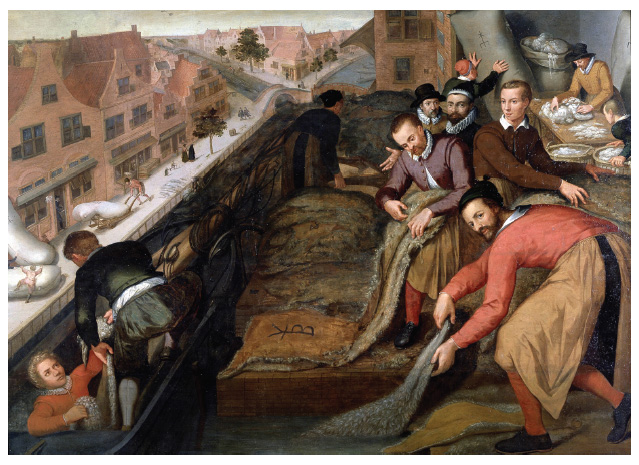
Het vollen en verven, painting by Isaac Claesz van Swanenburg, 1594â1596
SOURCE: MUSEUM DE LAKENHAL, LEIDEN, NO. 422

Van Swanenburg understandably did not depict this aspect of inequality and poverty, since the paintings were commissioned by the city authorities. Their priority was promoting the image of an industrious city and its favourable working conditions, to which end they put the works on display in the new Saaihal. The institution had been established just two years previously in the former convent of Nazareth, moving in 1585 to the Jacobsgasthuis (present-day Lodewijkskerk), a former hospital on the grand Steenschuur. Hundreds of merchants and workers frequented it for quality control or trade, and so were able to admire Swanenburgâs work.56
5 The Production Process
Van Swanenburgâs depictions of say production, though idealised, are accurate and instructive, a visual source for the work done by thousands of men, women and children.57 The division of labour was a main feature of New Drapery production, which was split into a large number of process steps subcontracted to artisans working at home.58 After each step, the drapenier had the intermediate product carried by hand, wheelbarrow, boat or cart to the next address.
The first phase was the preparation and checking of the fleeces. This was an important step, as the quality of the wool was the main factor in the quality of the end product and may have been done in part at the drapenierâs house. Say producers made much use of skin wool, i.e. wool from butchered sheep.59 Such fleeces were brought in by ship, skin and all, and washed in the city canals. Van Swanenburg shows the removal of the wool from the skin, by hand or with shears (Figure 7.5). Fleeces shorn from live sheep were also used, and the painting depicts the huge woolsacks being brought in by barge (Figure 7.3). The wool was then washed in a canal, dried, spread on a rack and beaten with
Het ploten en het kammen, painting by Isaac Claesz van Swanenburg, 1594â1596
SOURCE: MUSEUM DE LAKENHAL, LEIDEN, NO. 420

The prepared wool was then distributed to the spinners. The spinning wheels shown by Van Swanenburg are hand-powered â in reality, spinning was done with one hand only. Two spinners are shown (Figure 7.2). In the painting, the one sitting down makes woollen yarn, drawing the fibres from a little cage as she holds the carded wool atop her distaff. The other works standing up at the âgreat wheelâ or âwalking wheelâ used for worsted; her distaff is not pictured, though its use was mandatory for worsteds. Van Swanenburg does not show the yarn being wound off the spinning bobbin and into skeins for the intermediate washing that removed the grease. The third wheel in the painting is a bobbin wheel, used for transferring the wool from a skein back onto a bobbin. The warper is shown drawing the warp yarns from all the bobbins on the warping rack in a single movement, to measure off exact lengths on the pegs of the warping frame. In the background, three men are shown rolling such a warp onto the beam that will be set in the loom. The weaver sits at his loom on which the warp is being stretched in place. He holds up his shuttle with its bobbin of weft yarn (Figure 7.2).
Say was woven by a single weaver, as the standard widths were between two and three ells. The density of the fabric was determined by the number of warp threads per unit of width, and of weft threads per unit of length. Once weaving was complete, the raw fabric was taken off the loom and entrusted to the fullers (Figure 7.4). Fulling (later also called milling in English) meant submerging the fabric in huge vats of warm water with such additives as soap, fullerâs earth and/or urine, and by pounding hard. The effect was to felt the wool fibres together into a denser structure. From 1316, fullersâ workshops had clustered on a canal in the city centre, but they moved to the northern edge of town after the 1611 extension. The site was favourable, as there waste water could be easily pumped out by mills. The windmills proved even more of an asset when fulling mills started replacing manpower and horse-mills after the middle of the seventeenth century. In Van Swanenburgâs day, however, fulling was still done by trampling with bare feet. After fulling, the fabric was carefully
6 Tight Control, Quality and Fashion
The Leiden authorities consulted specialists to record all the steps in the production process of the export fabrics and incorporated them into their keuren or by-laws. For instance, on 10 November 1465, the council asked a selection of over forty drapeniers to draw up rules âsuch as will best help the Drapery flourishâ.60 Unsurprisingly, such policies tended to prioritise the interests of the entrepreneurs. New by-laws were put into effect with a formal public reading at the town hall. Isaac van Swanenburg depicts such a scene in his allegory of the Neringhe, or Industry, embodied as a young woman, receiving the book of by-laws from the hands of the City, personified by the Stedemaagd. In the background, the town hall is represented by an imaginary Renaissance façade with monumental steps, at the top of which the city council is grouped around the town secretary (stadssecretaris) who is reading from the book of by-laws.61 A cornucopia carried behind the Neringhe emphasises the message: let everyone obey the rules, and our industry shall prosper.
There was a quality control location in Leiden at least as early as 1366: the Wolhuis (wool house), which opened onto the Breestraat in front and the Voldersgracht at the back.62 The use of leaden quality markers is attested by a Leiden cloth seal found by archaeologists in the Warmoesstraat in Amsterdam and dated between 1300 and 1350.63 In the fifteenth century, part of the town hall was used for quality control procedures. The Lakenhal as a dedicated quality control centre and marketplace was a characteristic feature of early
Het verlenen van de keuren aan de Neringhe, painting by Isaac Claesz van Swanenburg, 1596â1601
SOURCE: MUSEUM DE LAKENHAL, LEIDEN, NO. 424

After the immigrants had brought the New Drapery to Leiden just before 1600, its quality control organisation became more specialised and more
De kleermakerswerkplaats, painting by Quiringh Gerritsz van Brekelenkam, 1661
SOURCE: RIJKSMUSEUM AMSTERDAM, SK-C-112

A new group of fabrics was developed about 1630 by the Leiden entrepreneurs and quickly proved successful in the competition against foreign competitors. This was broadcloth, an innovative product which probably owed a good deal to the techniques and knowledge brought by the immigrants from Wallonia. Imitating foreign products, with or without improvements, was a feature of the textile industries, one which made them extraordinarily adaptable and dynamic.67 The new high-quality laken was almost as light and supple as the new says, while retaining the firm, dense texture of the medieval cloth. A robe, gown or uniform made by a tailor from this reinvented Leiden broadcloth became a status symbol for clergies, universities, urban elites and armies all over Europe and the world.68 It soon came to dominate the market for this type of fabric, and production increased so much that in 1638, the city authorities enacted a new by-law to regulate it, the Keur betreffende de lakennering.69 The wool for this specialist product was merino, imported from Spain. Around 1650, Dutch traders accounted for something like eighty per cent of all Spanish merino wool.70 This fine, curly fibre lent itself particularly well to tight fulling, followed by a successive round of raising and cropping the nap, to yield an ultra-fine, dense, supple fabric with a blind finish, not unlike the cloth used today on snooker and billiard tables.
The city authorities were so proud of the new laken that they commissioned a purpose-built Lakenhal for it. They asked the cityâs architect, stadsbouwmeester Arent van âs-Gravensande, for a design that would reflect its strength, premium quality and international reputation. The building, inaugurated on
Gezicht op de Lakenhal in Leiden, painting by Susanna van Steenwijck-Gaspoel, 1642
SOURCE: MUSEUM DE LAKENHAL, LEIDEN, NO. 410

As the quality of the textile reached new heights, so did the colours, mainly thanks to the huge influx of new dyes through the Amsterdam Staple.74 Before the sixteenth century, the dyers were confined almost entirely to dyes grown in Europe, such as madder (Rubia tinctorum), woad (Isatis tinctoria) and kermes (Kermes spp). Woad was gradually displaced by indigo (Indigofera tinctoria) once colonial plantations started to cultivate this in large quantities, relying heavily on slave labour. Kermes from Southern Europe was supplanted in the seventeenth century by cochineal (Dactylopius coccus), a Mexican scale insect producing similar coccid dyes.75 A special Staalhof (sample hall) was established in the Lakenhal in 1645 to guarantee top quality results from these new dyes, manned by special inspectors who tested all blue and black broadcloth for depth and the fastness of the colouring.76
The success of the new, high-quality broadcloth encouraged the Leiden entrepreneurs to invest in the development of another new group of luxury fabrics called grein in Leiden, and usually known in English as camlet. Grein was made from angora goatâs wool, sometimes mixed with varying proportions of camelâs hair, silk or both. All these materials were imported from the Levant, hence such alternative Dutch names as Turks laken, Leids Turcx or Camelot â the first two referring to Turkey and the last to a related but not identical Eastern fabric. The main component, goatâs wool, came from a specific long-haired species which at the time was found only in the Ankara region of central Anatolia in the Ottoman Empire. Its name, Angora, is a variant of Ankara.77
This highly profitable trade was damaged by the two naval wars with England (1625â1654 and 1665â1667); then, in 1672, France took control of the Levantine trade.82 This forced the merchants from the Northern Netherlands to buy their angora wool and yarns from middlemen in the Southern Netherlands and pay heavy import duties.83 The Leiden grein could no longer compete in the European market.84 Increasing exports to Asia proved insufficient to compensate for this, and by 1699, grein production had dropped to 37,000 pieces.85 Its decline continued in the second half of the eighteenth century, even though the city authorities had forced a quota deal with the VOC, the Dutch East India Company, which guaranteed a market.86 At the same time, grein was losing its popularity as a fabric, as printed cottons from Asia were becoming more fashionable.87
7
The second half of the seventeenth century saw the Leiden textile industry developing more and stronger trade connections to distant parts of the world, as global demand for its laken continued to grow. Production reached its height at 28,000 pieces in 1698.88 This was possible because laken, unlike other Leiden products, could not yet be imitated by foreign competitors. Large investments were needed to build the costly windmills for the rigorous fulling of the fabrics.89 The large investments demanded by the laken industry led to the rise of powerful merchants, the reders, who dominated trade from the last quarter of the seventeenth century.90 The drapeniers became mere subcontractors to the reders, who ran a vast international network of middlemen who sold their fabrics and coordinated orders. The merchants also had so much capital that they could afford to stockpile fabrics when the market was slack.91 Already in 1654, the industry was run by about thirty reders and 280 drapeniers.92 The merchants employed 14,000 men, women and children, working on about 450 looms and producing about 20,000 lakens per year. The value of their output for this year alone has been estimated at four million guilders.93 This represents nearly half of the total value of the entire Leiden textile industry. The production costs for one laken, 44 metres long, are described in detail by the merchants and drapeniers in a 1663 document.94 The wool cost about 200 guilders and its processing 184 guilders, so the cost of a finished piece was nearly 400 guilders. This price fluctuated as conditions changed, however, and could rise to as much as 500 guilders. An average artisan, meanwhile, earned only about one guilder a day, which illustrates how valuable the Leiden laken was.95
The concentration of the production process into the hands of a small group of merchants can be illustrated by four examples of successful families of reders, whose economic activities also exemplified the growing entanglements of Leidenâs cloth production with global networks and colonialism. One of the first merchants to start operating globally was Daniël van der Meulen (1554â1600), originally from Antwerp, who had a clear impact on both the textile industry and the politics of Leiden. After six years of working from
Van der Meulenâs exports were largely of Dutch and English woollen fabrics. In return, his ships brought goods such as cereals from the Baltic, or silk and grein yarns from the Levant.98 He had middlemen, often family members, in the cities of the Hanseatic League and in all main ports from Scandinavia to the Mediterranean. Such intermediaries lived in international merchantsâ settlements and received commissions or yearly stipends. Van der Meulen died of the plague in 1600, aged 45. His widow, Hester, backed by her family, successfully took over the business.99 An extensive correspondence shows her running the international trade network from her office in her residence on the Rapenburg. Her position was not exceptional: in the Dutch Republic, widows often had sufficient experience, knowledge, networks and capital to replace their husband as head of the firm.100 The family network extended as far as Asia, both sons going to live in the East Indies to learn the business.101 Her elder son Daniël died in the East, not yet thirty years old. The younger son, Andries, had better luck: in 1613, he signed up for over 60,000 guilders in VOC insurances.102
Daniël van der Meulen pioneered investment in merchant ships to the Gold Coast as early as 1593, shortly after settling in Leiden. This is exceptionally early, as Africa did not start to play a regular role in the transatlantic trade until the second half of the seventeenth century.103 The transformation this brought to commerce is illustrated in an allegorical painting commissioned by the Leiden authorities for the governorsâ chamber in the Lakenhal. It was made in 1650 by the Leiden laken merchant and painter Abraham van den Tempel and shows the Stedemaagd receiving the Lakenneering, personified as an elegantly dressed lady. Behind the Stedemaagd, a black boy is shown holding a folded piece of red laken: a clear reference to the emerging trade in enslaved Africans,
Portrait of Daniël van der Meulen, painting attributed to Bernaert de Rijckere, 1583
SOURCE: THE PHOEBUS FOUNDATION, ANTWERP, ON LOAN TO MUSEUM DE LAKENHAL, LEIDEN, NO. B 1337

Portrait of Hester Della Faille, painting attributed to Bernaert de Rijckere, 1583
SOURCE: THE PHOEBUS FOUNDATION, ANTWERP, ON LOAN TO MUSEUM DE LAKENHAL, LEIDEN, NO. B 1338

De Stedemaagd ontvangt de Neering, painting by Abraham van den Tempel, 1651
SOURCE: MUSEUM DE LAKENHAL, NO. 427

Gomarus van Craeyenbosch (1624â1681) is a second example of a reder making enormous profits on the world market. He is one of four Leiden staalmeesters (the highest officials of the Lakenhal) depicted in their 1675 portrait
De Staalmeesters, painting by Jan de Baen, 1675
SOURCE: MUSEUM DE LAKENHAL, LEIDEN, NO. 12

Portrait of Pieter de la Court, painting attributed to Willem van Mieris, c. 1685
SOURCE: AMSTERDAM MUSEUM, NO. SB 2546

Portrait of Catharina van der Voort, painting attributed to Willem van Mieris, c. 1685
SOURCE: MUSEUM DE LAKENHAL, LEIDEN, NO. E 128

Pieter de la Court (1618â1685), the third example, was a second-generation Leidener who was also able to achieve business success. His father Pierre (1593â1663) had come from Ypres as a staunch Calvinist seeking asylum in Leiden, where he married Jeanne des Planques (1595â1663) from Lille. Together, they built a prosperous textile business. Their two sons, Pieter and Johan, followed their example. As students at the university of Leiden, while still in their twenties, they set up their own firm, which came to supplant their parentsâ. Their strategic business acumen allowed them to accumulate enormous capital. They financed weaving and dyeing workshops and controlled every step of the business, from buying the raw wool to selling the finished laken. This allowed them to fill foreign orders efficiently and fast. In 1660, Pieter de la Court married Catharina van der Voort (1622â1674). This gave his network another boost, as her father was an Italian cloth merchant who had moved first to Antwerp and then to Amsterdam. After his death, Catharina helped her mother and two brothers run the Van der Voort firm in Amsterdam. Their business correspondence shows them trading in cloth and indigo in Europe, the Levant, South America and the East Indies. The marriage resulted in a huge accumulation of capital and extended their worldwide networks of production and trade. The inventory of Catharinaâs dowry lists 10,000 guilders invested in the Dutch West India Company, or WIC, as âcapitael in Westinische actien in de Caemer van Amsterdamâ.112
Exploitation of the powerless took on a whole other dimension through the De la Court familyâs investments in the WIC at a time when the company was becoming active in the trade in enslaved people. For a few decades, the Dutch were the foremost slave traders in the world. Until her death, Catharina saw her capital grow enormously, including through its shares in the Dutch East India Company, the VOC. Her husband Pieter and her brothers Willem and Jan van der Voort also invested heavily in both the VOC and WIC. Their correspondence also shows that they regularly sent laken to their cousin Nicolaas de la Court, who acted as their agent on Curaçao, with their goods being shipped via Africa on slave transports from Angola, Guinea and the Gold Coast.117
Finally, Daniel van Eijs (1688â1739) was one of Leidenâs most important laken merchants in the eighteenth century, through the family network into which he had married. The rapid decline of the industry hit him very hard, though he tried all he could to withstand it.118 His thousands of letters to contacts and firms in France, Spain, Italy, Germany, Russia, the Levant and South America
Portrait of Daniel van Eijs, painting attributed to Martinus de la Court, c. 1709
SOURCE: COLLECTION HOF MEERMANSBURG, LEIDEN

8 Conclusion
The Leiden laken reached a peak of quality, productivity and export in the second half of the seventeenth century, under the stringent quality controls established by the city.122 The large investments necessary for production and trade allowed for increasing dominance of the industry by the small group of reders able to operate on an international scale. Their goal was maximising profits; they felt no strong link to the city. This mercantile capitalism made Leiden a node in a worldwide production system, in which colonialism and slavery increasingly played an important role in the early modern period. Increases in the scale of production shifted the balance of power from the makers to the merchants, and this in turn increased the mobility of people and goods. The reders increasingly outsourced parts of the production process to villages outside Leiden where piecework was cheaper. Employment in Leiden began to go down in the first quarter of the eighteenth century and people
Bibliography
Blockmans, Wim. Metropolen aan de Noordzee: de geschiedenis van Nederland, 1100â1560. Amsterdam: Bert Bakker, 2010.
Boer, Dick E.H. de. âLeiden in de middeleeuwenâ. In Stof uit het Leidse verleden: zeven eeuwen textielnijverheid, edited by Jaap K.S. Moes and Boudien de Vries, 33â51. Utrecht: Matrijs, 1991.
Brand, Hanno. âA Medieval Industry in Decline: The Leiden Drapery in the First Half of the Sixteenth Centuryâ. In La draperie ancienne des Pays-Bas: débouchés et stratégies de survie (14eâ16e siècles), edited by Marc Boone and Walter Prevenier, 121â49. Leuven: Garant, 1993.
Brand, Hanno. âCrisis, beleid en differentiatie in de laat-middeleeuwse Leidse lakennijverheidâ. In Stof uit het Leidse verleden: zeven eeuwen textielnijverheid, edited by J.K.S. Moes and B.M.A. de Vries, 53â67. Utrecht: Matrijs, 1991.
Brand, Hanno. Over macht en overwicht: stedelijke elites in Leiden (1420â1510). Leuven: Garant, 1996.
Brand, Hanno. âUrban Policy or Personal Government: The Involvement of the Urban Elite in the Economy of Leiden at the End of the Middle Agesâ. In Economic Policy since the Late Middle Ages: The Visible Hand and the Fortune of Cities, edited by H.A. Diederiks, Paul M. Hohenberg, and Michael Wagenaar, 17â35. Leicester, 1992.
Brandon, Pepijn, and Ulbe Bosma. âDe betekenis van de Atlantische slavernij voor de Nederlandse economie in de tweede helft van de achttiende eeuw.â TSEG â The Low Countries Journal of Social and Economic History 16, no. 2 (2019): 5â46.
Bulut, Mehmet. âThe Role of the Ottomans and Dutch in the Commercial Integration between the Levant and Atlantic in the Seventeenth Centuryâ. Journal of the Economic and Social History of the Orient 45, no. 2 (2002): 197â230.
Carus-Wilson, E.M., and Olive Coleman. Englandâs Export Trade, 1275â1547. Oxford: Clarendon Press, 1963.
Chorley, Patrick. âThe Evolution of the Woollen, 1300â1700â. In The New Draperies in the Low Countries and England, 1300â1800, edited by N.B. Harte, 7â33. Oxford: Oxford University Press, 1997.
Davids, Karel. âNeringen, hallen en gilden: kapitalisten, kleine ondernemers en stedelijke overheid in de tijd van de Republiekâ. In Kapitaal, ondernemerschap en beleid: studies over economie en politiek in Nederland, Europa en Azië van 1500 tot heden, edited by Karel Davids, Loes van der Valk, and Wantje Fritschy, 95â119. Amsterdam: NEHA, 1996.
Deceulaer, Harald. âBetween Medieval Continuities and Early Modern Change: Proto-Industrialization and Consumption in the Southern Low Countries (1300â1800)â. Textile History 37, no. 2 (2006): 123â48.
Deijk, Frank van. âEen ooggetuige van belang? Isaac Claeszoon Swanenburg en zijn weergave van de Leidse saaiproduktieâ. Textielhistorische bijdragen 33 (1993): 7â42.
Deursen, Arie van. Mensen van klein vermogen: het kopergeld van de Gouden Eeuw. Amsterdam: Bakker, 1991.
Ekkart, Rudolf E.O. Isaac Claesz. van Swanenburg, 1537â1614: Leids schilder en burgemeester. Zwolle: Waanders, 1998.
Emmer, Piet. Geschiedenis van de Nederlandse slavenhandel. Amsterdam: Nieuw Amsterdam, 2019.
Endrei, Walter, and Geoff Egan. âThe Sealing of Cloth in Europe, with Special Reference to the English Evidenceâ. Textile History 13, no. 1 (1982): 47â75.
Franceschi, Franco. âWoollen Luxury Cloth in Late Medieval Italyâ. In The Consumption, Commercialisation, and Production of Luxury Textiles in Italy, the Low Countries and Neighbouring Territories (Fourteenth-Sixteenth Centuries), edited by Bart Lambert and Katherine Anne Wilson, 181â204. Farnham: Ashgate, 2016.
Gaastra, Femme. âDe textielhandel van de VOCâ. Textielhistorische Bijdragen 34 (1994): 50â69.
Gurp, Gerard van. âProto-Industrialization and World Trade of Textiles in Dutch Brabant, 1620â1820â. Economic History Yearbook 49, no. 1 (2008): 281â310.
Ham, Gijs van der. Dof goud: Nederland en Ghana, 1593â1872. Amsterdam: Rijksmuseum, 2013.
Heijer, Henk den. âEen Afrikaan in Leids laken: de Nederlandse textielhandel in West-Afrika, 1600â1800â. In Alle streken van het kompas: maritieme geschiedenis in Nederland, edited by Maurits Ebben, Henk den Heijer, and Joost Schokkenbroek, 277â94. Zutphen: Walburg Pers, 2010.
Heijer, Henk den. Expeditie naar de Goudkust: het journaal van Jan Dircksz Lam over de Nederlandse aanval op Elmina, 1624â1626. Zutphen: Walburg Pers, 2006.
Heuvel, Danielle van den. Women and Entrepreneurship: Female Traders in the Northern Netherlands c. 1580â1815. Amsterdam: Aksant, 2007.
Howell, Martha C. âPirenne, Commerce, and Capitalism: The Missing Partsâ. Belgisch Tijdschrift voor Nieuwste Geschiedenis 41 (2011): 297â322.
Howell, Martha C. Women, Production, and Patriarchy in Late Medieval Cities. Chicago: University of Chicago Press, 2009.
Howell, Martha C. âWomenâs Work in the New and Light Draperies of the Low Countriesâ. In The New Draperies in the Low Countries and England, 1300â1800, edited by N.B. Harte, 197â216. Oxford: Oxford University Press, 1997.
Israel, Jonathan I. Dutch Primacy in World Trade, 1585â1740. Oxford: Clarendon, 1989.
Israel, Jonathan I. The Dutch Republic: Its Rise, Greatness, and Fall, 1477â1806. Oxford: Clarendon Press, 1998.
Jenks, Stuart. âThe Missing Link: The Distribution Revolution of the 15th Centuryâ. In Textiles and the Medieval Economy: Production, Trade, and Consumption of Textiles, 8thâ16th Centuries, edited by Angela Huang and Carsten Jahnke, 230â52. Oxford: Oxbow Books, n.d.
Jongbloet-van Houte, Gisela, ed. Brieven en andere bescheiden betreffende Daniel van der Meulen 1584â1600. âs-Gravenhage: Nijhoff, 1986.
Jonker, Joost, and Keetie Sluyterman. Thuis op de wereldmarkt: Nederlandse handelshuizen door de eeuwen heen. Den Haag: Sdu Uitgevers, 2000.
Kaptein, Herman. De Hollandse textielnijverheid, 1350â1600: conjunctuur & continuïteit. Hilversum: Verloren, 1998.
Kaptein, Herman. Nijverheid op windkracht: energietransities in Nederland, 1500â1900. Hilversum: Verloren, 2017.
Kernkamp, J.H. âBrieven uit de correspondentie van Pieter de la Court en zijn verwanten (1667â1683). Met bijlagen (1657â1685)â. Bijdragen en Mededeelingen van het Historisch Genootschap 72 (1958): 3â195.
Kernkamp, J.H., and J. van Heijst, eds. âDe brieven van Buzanval aan Daniël van der Meulen (1595â1599)â. Bijdragen en Mededelingen van het Historisch Genootschap 76 (1962): 175â252.
Lamal, Nina. âMeertalige tijdingen in het Van der Meulen archief (1588â1600)â. In Makelaars in kennis: informatie verzamelen, verwerken en verspreiden in de vroegmoderne Nederlanden, edited by Erika Kuijpers and Gerrit Verhoeven, 41â68. Leuven: Leuven University Press, 2022.
Lucassen, Jan. âHolland, een open gewest: immigratie en bevolkingsontwikkelingâ. In Geschiedenis van Holland. Deel II: 1572â1795, edited by Thimo de Nijs and Eelco Beukers, 181â215. Hilversum: Verloren, 2002.
Lucassen, Jan, and Maarten Prak. âLeiden: Garenmarkt. Een land van immigrantenâ. In Plaatsen van herinnering: Nederland in de zeventiende en achttiende eeuw, 63â73. Amsterdam: Bert Bakker, 2006.
Lucassen, Leo, and Boudien de Vries. âLeiden als middelpunt van een West-Europees textiel-migratiesysteemâ. Tijdschrift voor Sociale Geschiedenis 22 (1996): 138â67.
Maanen, R.C.J. van. âDe Leidse bevolkingsaantallen in de 16de en 17de eeuw: enkele kanttekeningenâ. Leids Jaarboekje 101 (2009): 41â70.
Maanen, R.C.J. âStadsbeeld en ruimtelijke ordeningâ. In Leiden: de geschiedenis van een Hollandse stad. Vol. 2: 1574â1795, edited by S. Groenveld, 16â41. Leiden: Stichting Geschiedschrijving Leiden, 2003.
Molà , Luca. âA Luxury Industry. The Production of Italian Silks 1400â1600â. In The Consumption, Commercialisation, and Production of Luxury Textiles in Italy, the Low Countries and Neighbouring Territories (Fourteenth-Sixteenth Centuries), edited by Bart Lambert and Katherine Anne Wilson, 205â37. Farnham: Ashgate, 2016.
Munro, John. âMonetary Contraction and Industrial Change in the Late-Medieval Low Countries, 1335â1500â. In Coinage in the Low Countries (880â1500), edited by Nicholas J. Mayhew, 95â161. Oxford: Oxford University Press, 1979.
Munro, John. âSpanish Merino Wools and the Nouvelles Draperies: An Industrial Transformation in the Late Medieval Low Countriesâ. The Economic History Review 58, no. 3 (2005): 431â84.
Nederveen Meerkerk, Elise van. De draad in eigen handen: vrouwen en loonarbeid in de Nederlandse textielnijverheid, 1581â1810. Amsterdam: Aksant, 2007.
Nederveen Meerkerk, Elise van. âTextile Workers in the Netherlands. Part 1: 1650â1810â. Working paper IISH, Amsterdam, 2004.
Nederveen Meerkerk, Elise van. âWerken om te leren? De arbeid van jongens en meisjes in de Leidse textielnijverheid in de zeventiende eeuwâ. Jaarboek der sociale en economische geschiedenis van Leiden en omstreken, 19â20 (2007â2008): 78â103.
Noordegraaf, Leo. Hollands welvaren? levensstandaard in Holland 1450â1650. Bergen: Octavo, 1985.
Noordegraaf, Leo. âThe New Draperies in the Northern Netherlands, 1500â1800â. In The New Draperies in the Low Countries and England, 1300â1800, edited by N.B. Harte, 173â95. Oxford: Oxford University Press, 1997.
Oerle, Hugo van. Leiden binnen en buiten de stadsvesten: de geschiedenis van de stedebouwkundige ontwikkeling binnen het Leidse rechtsgebied tot aan het einde van de Gouden Eeuw. 2 vols. Leiden: Brill, 1975.
Oosten, Roos van. De stad, het vuil en de beerput: de opkomst, verbreiding en neergang van de beerput in stedelijke context. Leiden: Sidestone Press, 2015.
Oosten, Roos van. âHet vestigingspatroon van lakenhandelaren, drapiers en wevers in textielstad Leiden 1498â1748â. Bulletin KNOB 119 (2020): 38â51.
Oostindie, Gert, and Karwan Fatah-Black. Sporen van de slavernij in Leiden. Leiden: Leiden Publications, 2017.
Orsel, Edwin. âOudste Leidse lakenloodje jonger dan gedachtâ. Leids Jaarboekje 106 (2014): 21â24.
Ortega Saez, Natalia. âBlack Dyed Wool in North Western Europe, 1680â1850: The Relationship between Historical Recipes and the Current State of Preservationâ. PhD thesis, University of Antwerpen, 2018.
Phillips, Carla Rahn. âThe Spanish Wool Trade, 1500â1780â. The Journal of Economic History 42, no. 4 (1982): 775â95.
Posthumus, N.W., ed. Bronnen tot de geschiedenis van de Leidsche textielnijverheid, 1333â1795. 6 Vols. Den Haag: Nijhoff, 1910â1922.
Posthumus, N.W., ed. De geschiedenis van de Leidsche lakenindustrie. 3 Vols. Den Haag: M. Nijhoff, 1908â1939.
Postrel, Virginia I. The Fabric of Civilization: How Textiles Made the World. New York: Basic Books, 2021.
Ramackers, Sjoerd. âDaniel van Eijs: van lakenhandelaar naar plantage-eigenaar (1725â1739)â. Leids Jaarboekje 115 (2023): 72â89.
Riello, Giorgio. Cotton: The Fabric That Made the Modern World. Cambridge: Cambridge University Press, 2013.
Schenk, Valentijn. ââEen naare en bedroefde eeuwâ. De verscheping van Leids textiel naar Azië door de tussenkomst van de VOC in de periode 1770â1790 en de rol van het contract van 1776â. Textielhistorische Bijdragen 41 (2001): 49â64.
Slot, Ben. âDe handel tussen Nederland en het Osmaanse Rijkâ. In Topkapi & Turkomanie: Turks-Nederlandse ontmoetingen sinds 1600, edited by Hans Theunissen, Annelies Abelmann, and Wim Meulenkamp, 19â25. Amsterdam: De Bataafsche Leeuw, 1989.
Smit, Cor. âLeiden op stoom: veranderingen in de economische structuurâ. In Leiden: de geschiedenis van een Hollandse stad. Deel 3: 1795â1896, edited by Boudien de Vries, 52â81. Leiden: Stichting Geschiedschrijving Leiden, 2004.
Stabel, Peter. âThe Move to Quality Cloth. Luxury Textiles, Labour Markets and Middle Class. Indentity in a Mediaval Textile Cityâ. In The Consumption, Commercialisation, and Production of Luxury Textiles in Italy, the Low Countries and Neighbouring Territories (Fourteenth-Sixteenth Centuries), edited by Bart Lambert and Katherine Anne Wilson, 159â79. Farnham: Ashgate, 2016.
Tütüncü, Mehmet, Erik Swart, and Bülent Ari, eds. 400+ jaar vriendschap: vriendschapsverdrag uit 1612 tussen Nederland en Turkije, facsimile, tekst en vertaling naar het moderne Turks en Nederlands. Heemstede: SOTA, 2019.
Veluwenkamp, Jan Willem. âDe buitenlandse textielhandel van de Republiek in de achttiende eeuwâ. Textielhistorische Bijdragen 34 (1994): 70â88.
Versprille, Annie. âHester della Failleâ. Leids Jaarboekje 67 (1975): 77â97.
Vries, Jan de, and A.M. van der Woude. The First Modern Economy: Success, Failure, and Perseverance of the Dutch Economy, 1500â1815. Cambridge; New York: Cambridge University Press, 1997.
Vrolijk, Arnoud, Jan Schmidt, and Karin Scheper. Turcksche boucken: de oosterse verzameling van Levinus Warner, Nederlands diplomaat in zeventiende-eeuws Istanbul. Eindhoven: Lecturis, 2012.
Wee, Herman van der. The Growth of the Antwerp Market and the European Economy (Fourteenth-Sixteenth Centuries). Dordrecht: Springer, 1963.
Wee, Herman van der, and John H. Munro. âThe Western European Woollen Industries, 1500â1700â. In The Cambridge History of Western Textiles, edited by David Jenkins, 397â472. Cambridge; New York: Cambridge University Press, 2003.
Zijlmans, Jori. âNieuwe lakens, nieuwe wegen. Leiden als knooppunt van de zuidelijke en noordelijke trekvaartverbindingenâ. Holland: regionaal-historisch tijdschrift 46 (2014): 121â31.
The chapter is available via open access by financial support of the University of Amsterdam, The Netherlands. The research is carried out within the framework of the project âBlack Magic â (Re)discovering the development and changes of black woollens quality standards in the 18th-century Leidenâs staalmeesters sample booksâ granted by NWO (grant no. 628.007.042), Museum the Lakenhal and the Cultural Heritage Agency of the Netherlands.
Van der Wee and Munro, âThe Western European Woollen Industriesâ, 450.
Cf. Postrel, The Fabric of Civilization.
Riello, Cotton; Kaptein, De Hollandse textielnijverheid, 15.
Howell, âPirenne, Commerce, and Capitalismâ, 306.
Posthumus, De geschiedenis van de Leidsche lakenindustrie; Posthumus, Bronnen.
De Vries and Van der Woude, The First Modern Economy.
Brand, âA Medieval Industryâ.
Brand, âCrisis, beleid en differentiatieâ; Kaptein, De Hollandse textielnijverheid.
Howell, Women, Production, and Patriarchy; Howell, âWomenâs Workâ.
Brand, âUrban Policy or Personal Governmentâ, 18â27.
Van Nederveen Meerkerk, De draad in eigen handen.
See, for a discussion of the various population estimates, Van Maanen, âDe Leidse bevolkingsaantallenâ.
Carus-Wilson and Coleman, Englandâs Export Trade, 122â23, 138â39; Posthumus, Bronnen, 1:403.
De Boer, âLeiden in de middeleeuwenâ, 43.
Blockmans, Metropolen aan de Noordzee, 107â17, 236â48.
Brand, âCrisis, beleid en differentiatieâ, 53.
Blockmans, Metropolen aan de Noordzee, 292.
Brand, âA Medieval Industryâ, 122.
Blockmans, Metropolen aan de Noordzee, 117.
Cf. Brand, âCrisis, beleid en differentiatieâ, 53.
Van Oosten, âHet vestigingspatroonâ, 42.
Brand, âA Medieval Industryâ, 124.
Posthumus, Bronnen, 1:39; Blockmans, Metropolen aan de Noordzee, 255.
Brand, âA Medieval Industryâ, 121.
Cf. Franceschi, âWoollen Luxury Clothâ, 184â85.
Cf. Endrei and Egan, âThe Sealing of Clothâ.
Stabel, âThe Move to Quality Clothâ.
Blockmans, Metropolen aan de Noordzee, 243.
De Vries and Van der Woude, The First Modern Economy, 290; Franceschi, âWoollen Luxury Clothâ, 184.
Noordegraaf, Hollands welvaren?, 75â77, 171â73.
Brand, âA Medieval Industryâ, 132.
Brand, âCrisis, beleid en differentiatieâ, 56, 65.
Kaptein, De Hollandse textielnijverheid, 106, 110, 124â29.
Cf. Munro, âSpanish Merino Woolsâ.
Brand, âUrban Policy or Personal Governmentâ, 18â20.
Brand, âCrisis, beleid en differentiatieâ, 61â64.
Munro, âMonetary Contractionâ, 114â18.
Brand, âA Medieval Industryâ, 135, 142; Brand, Over macht en overwicht, 57.
Posthumus, De geschiedenis van de Leidsche lakenindustrie, 1:251.
Van der Wee and Munro, âThe Western European Woollen Industriesâ, 405.
Van der Wee, The Growth of the Antwerp Market.
Molà , âA Luxury Industryâ.
Jenks, âThe Missing Linkâ.
Van der Wee and Munro, âThe Western European Woollen Industriesâ, 428â39.
Lucassen, âHolland, een open gewestâ, 200.
Van der Wee and Munro, âThe Western European Woollen Industriesâ, 430.
Van Maanen, âDe Leidse bevolkingsaantallenâ, 60.
Lucassen and Vries, âLeiden als middelpuntâ.
Van Maanen, âDe Leidse bevolkingsaantallenâ, 63.
Ekkart, Isaac Claesz. van Swanenburg.
Lucassen and Prak, âLeiden: Garenmarktâ, 66â67.
Posthumus, De geschiedenis van de Leidsche lakenindustrie, 2 and 3:105â30.
Noordegraaf, âThe New Draperiesâ.
Van Oosten, De stad, het vuil en de beerput, 229â234.
Van Oerle, Leiden, 1:197, 331â32.
Van Deijk, âEen ooggetuige van belang?â
Posthumus, De geschiedenis van de Leidsche lakenindustrie, 2 and 3:299â301; Van Nederveen Meerkerk, De draad in eigen handen, 46â55.
Van Deijk, âEen ooggetuige van belang?â, 16.
Posthumus, De geschiedenis van de Leidsche lakenindustrie, 1:413â414 (no. 363): âzoals voor haar bloei het meest bevorderlijk zal zijnâ.
Ekkart, Isaac Claesz. van Swanenburg, 48â51.
Posthumus, De geschiedenis van de Leidsche lakenindustrie, 1:16.
Orsel, âOudste Leidse lakenloodjeâ.
Kaptein, De Hollandse textielnijverheid, 42â43.
Van Maanen, âStadsbeeldâ, 21â22; Posthumus, De geschiedenis van de Leidsche lakenindustrie, 2 and 3:469â70.
Davids, âNeringen, hallen en gildenâ; Van Nederveen Meerkerk, De draad in eigen handen, 159â63.
Franceschi, âWoollen Luxury Clothâ, 190â93.
Chorley, âThe Evolution of the Woollenâ.
Posthumus, Bronnen, 4:329â47.
Phillips, âThe Spanish Wool Tradeâ.
Zijlmans, âNieuwe lakens, nieuwe wegenâ.
Posthumus, De geschiedenis van de Leidsche lakenindustrie, 2 and 3:931.
Posthumus, 2 and 3:642.
Israel, The Dutch Republic, 117, 141, 199â200, 325, 401, 410.
Ortega Saez, âBlack Dyed Woolâ.
Posthumus, Bronnen, 4:430â434 (no. 336).
Vrolijk, Schmidt, and Scheper, Turcksche boucken, 63â68.
Bulut, âThe Role of the Ottomansâ; Tütüncü, Swart, and Ari, 400+ jaar vriendschap; Slot, âDe handel tussen Nederlandâ.
Israel, Dutch Primacy in World Trade, 225â26.
Noordegraaf, âThe New Draperiesâ, 187.
Posthumus, De geschiedenis van de Leidsche lakenindustrie, 2 and 3:940â42.
Israel, The Dutch Republic, 207â13, 269â79.
Deceulaer, âBetween Medieval Continuities and Early Modern Changeâ.
Israel, Dutch Primacy in World Trade, 307â13; Veluwenkamp, âDe buitenlandse textielhandelâ, 75.
Posthumus, De geschiedenis van de Leidsche lakenindustrie, 2 and 3:930â31.
Gaastra, âDe textielhandelâ, 54, 65â66; De Vries and Van der Woude, The First Modern Economy, 459; Schenk, âEen naare en bedroefde eeuwâ.
Erfgoed Leiden en Omstreken, Leiden (hereafter ELO), NL-LdnRAL-0501A, no. 6716, f. 22 and 24, Rapport van stadsecretaris David van Royen betreffende de VOC (1740).
Posthumus, De geschiedenis van de Leidsche lakenindustrie, 2 and 3:931.
Kaptein, Nijverheid op windkracht, 134â69.
Noordegraaf, âThe New Draperiesâ, 180â81; Van Nederveen Meerkerk, âTextile Workersâ, 114.
Jonker and Sluyterman, Thuis op de wereldmarkt, 75â104.
Posthumus, Bronnen, 5:10.
Posthumus, De geschiedenis van de Leidsche lakenindustrie, 2 and 3:940â41.
Posthumus, Bronnen, 5:39â50 (no. 30).
Van Deursen, Mensen van klein vermogen, 14â15.
Lamal, âMeertalige tijdingenâ, 47â50.
Kernkamp and Van Heijst, âDe brievenâ, 180.
Van der Wee and Munro, âThe Western European Woollen Industriesâ, 432â33.
Jongbloet-van Houte, Brieven, IX.
Van den Heuvel, Women and Entrepreneurship, 224â26.
Versprille, âHester della Failleâ, 94.
Jongbloet-van Houte, Brieven, XV.
Den Heijer, Expeditie naar de Goudkust, 16â17; Den Heijer, âEen Afrikaan in Leids lakenâ.
Brandon and Bosma, âDe betekenis van de Atlantische slavernijâ; Van der Ham, Dof goud, 243; Emmer, Geschiedenis van de Nederlandse slavenhandel, 200â201; Oostindie and Fatah-Black, Sporen van slavernij, 30â31.
ELO, NL-LdnRAL-0501A, no. 6699.
Brandon and Bosma, âDe betekenis van de Atlantische slavernijâ.
Posthumus, De geschiedenis van de Leidsche lakenindustrie, 2 and 3:465â68.
ELO, NL-LdnRAL-1612, no. 340, Monsterboek van Gommarus van Craeyenbosch betreffende zijn lakenhandel (1661â1671).
Posthumus, De geschiedenis van de Leidsche lakenindustrie, 2 and 3:1017; Van Nederveen Meerkerk, De draad in eigen handen, 300â302.
Van Nederveen Meerkerk, De draad in eigen handen, 310â11.
Van Gurp, âProto-Industrialization and World Trade of Textilesâ, 293; Smit, âLeiden op stoomâ, 53.
Inventaris van Catharina van der Voort, behorende tot de huwelijkse voorwaarden van haar en mr. Pieter de la Court, (26 January 1661); Notariële scheiding overlijden Catharina van der Voort (8 August 1685), published in: Kernkamp, âBrievenâ, 144â48; 180â86.
Kernkamp, 45â46; Posthumus, Bronnen, 6:255; Van Nederveen Meerkerk, De draad in eigen handen, 133â35, 151â52, 177â80.
Van Nederveen Meerkerk, âWerken om te leren?â
Davids, âNeringen, hallen en gildenâ, 107â8.
De Vries and Van der Woude, The First Modern Economy, 287; Israel, Dutch Primacy in World Trade, 382.
Letter from Johanna de la Court to P. de la Court (30 March 1668); Letter from Nicolaas de la Court and Dirk Otterink de Jonge to P. de la Court (10 September 1672); Letter from Nicolaas de la Court to P. de la Court (12 September 1672), published in: Kernkamp, 24â25, 51â55.
Ramackers, âDaniel van Eijsâ.
Posthumus, De geschiedenis van de Leidsche lakenindustrie, 2 and 3:1120â21; Israel, The Dutch Republic, 382.
Davids, âNeringen, hallen en gildenâ, 118; Posthumus, Bronnen, 6:449â50.
Ramackers, âDaniel van Eijsâ, 84.
Chorley, âThe Evolution of the Woollenâ, 24.
Van Nederveen Meerkerk, âTextile Workersâ; Van Gurp, âProto-Industrialization and World Trade of Textilesâ, 281â309.
Chorley, âThe Evolution of the Woollenâ, 25; Van der Wee and Munro, âThe Western European Woollen Industriesâ, 465.
Van Maanen, âStadsbeeldâ, 40â41.