


This chapter traces how and to what extent contributions to sanitation and fire safety were institutionalised in Leiden and assesses the impact of such practices on the material layout of the city. While the topics of sanitation and fire safety have received some scholarly attention, what has remained neglected is how such collective efforts, which were clearly part of the routine management of this and virtually all other cities in Europe â and indeed across the premodern globe â shaped a sense of local community.1 Leiden is an interesting, well-documented case because it had various types of overlapping collectives: administrative wards (bonnen), neighbourhood communities (gebuurten) and confraternities.2 The focus here is on the wards and the more informal, small neighbour collectives. The organisation of sanitation and the promotion of fire safety shows how responsibilities were divided between different agents, and how such tasks contributed to building forms of community. Such efforts fit within the broader concept of healthscaping: how communities shaped behaviours and environments to suit their changing health needs.3
My argument aligns with a broader revision of the history of public health during the later Middle Ages. This reinterpretation asserts that communities undertook far more initiatives to prevent disease and promote wellbeing than previously assumed. These efforts extended beyond responding to epidemic threats, such as the plague. Rather, public health practices were ingrained as routine, continuous and adaptive to the wide variety of challenges premodern urban communities faced, including famines, war, epidemics and environmental crises.4 Yet my goal here is not to paint too harmonious a picture of a very clean medieval city. The key argument is that sanitation and fire safety
Striving for the collective interests of the city was the central aim here, but we need to reflect critically on the motives of the social groups using this discourse. References to the common good also justified the instalment of mechanisms of exclusion, for instance with specific rules for foreign traders and craftsmen, but also regarding the non-residential poor seeking urban charitable assistance.6 In practice, the concept of the common good was not meaningless, but it did often serve the interests of the mid and upper echelons of society, and certainly those with a permanent residence in and ties to the city. Governing elites shaped how the common good was understood, often to the disadvantage of people with less political power or economic means, or those with a more temporary connection to the town. For instance, poor migrants who temporarily rented a room likely had fewer opportunities, but also less interest, time, money and energy to keep their lived environment clean and safe. At the same time, the efforts that both the town council and Leidenâs inhabitants themselves invested into sanitation and fire safety were remarkably collective in nature and deserve more attention as part of urban history.
I focus on two areas of healthscaping activities that were developed in Leiden: cleaning and maintaining the canals and firefighting. The evidence here is based on archival documents: law codes, council minutes and court records. Most of this material dates from between the late fourteenth and mid-sixteenth centuries, with the earliest regulations from around 1360.7 After Leiden obtained its city privileges around 1200, the town slowly expanded its municipal apparatus with the appointment of urban officials and the increased
1 Fire Risk and Waste
The example below gives a first introduction to Leidenâs policies around fire risk and waste management. On 14 October 1455, the town council made a public declaration. In front of the gathered inhabitants (as may be assumed) the magistrates voiced concerns over the fact that ârecently there have been many waste heaps, which could cause fire at night because they have been gathered in such large pilesâ. The nature of the waste was not specified, but likely included ashes, but also used straw and dung. The magistrates ordered âeach ward to inspect the places were waste is collected and clear them, to be done at the neighboursâ costâ.8
There are many interesting components to this brief proclamation, namely the conception of waste, its hazardous nature in terms of fire safety, and the neighboursâ responsibility to remove these nuisances. It targets something that likely routinely happened in the city but was considered a hazard: the presence of too many or too large waste heaps, or heaps building up in the wrong places â a city without waste did, of course, not exist. These waste heaps were problematic not, or in this case not mainly, because they caused stench and were therefore a health risk. Nor because they blocked the flows of traffic, trade and/or people, all reasons for coordinating waste disposal and sanitation to be found in municipal ordinances across premodern Europe, including in Leiden. In this case, the magistrates made an explicit link with fire safety. As it was proclaimed in October, it was likely not drought and hot weather but the increasing cold â leading to greater use of fire inside homes â that caused the town magistrates to issue an extra warning.
Another important component of the short public decree above is the proposed solution to these hazards, and who should execute it. Neighbours (buren) were the main agents with whom Leidenâs authorities, represented by various officials, interacted when it came to urban communal health, safety and sanitation. As this chapter will show in depth, the division of the town into wards and the delegation of tasks to neighbours formed a key part of public health management. The financial burden for the improvement of sanitation was put explicitly on neighbours, who were required to gather a full barge of dredge and refuse.10 The idea that neighbours had to contribute to public hygiene ties in with recent work on the organisation of public services, a topic which is especially explored for the early modern Low Countries. Manon van der Heijden and other historians have argued that town governments, ecclesiastical institutions and organisations such as crafts guilds and confraternities, as well as private citizens â collectively, within specific networks â organised and paid for community services, including public safety and health. This was certainly also true for the later medieval period. Furthermore, historians see processes of appropriation of tasks when urban authorities had the means to do so, and delegation when they did not. That means there was no clear linear development towards either the centralisation or decentralisation of such tasks and services.11
2 A Healthy City: Theories and Policies
Besides being shaped by environmental, economic and political factors, medical insights likely influenced the design and management of premodern cities
Urban policies reflected these medical theories. For instance, in the law code of 1545, we find prohibitions copied from Leidenâs earlier law codes banning the disposal of refuse in front of other inhabitantsâ doors or on quays. Throwing lye and other polluting substances from clothmaking into rivers was forbidden, as were the contents of latrines and blood, either from slaughtered animals or from bloodletting. An instruction to bury dead dogs and cats and not throw them into the water likewise sought to prevent stench and corruption.15 While the bylaws cite no medical authorities, they clearly reflect a wish to prevent pollution of the urban environment based on the idea of miasma.
One group that we are certain possessed this knowledge and brought these ideas to Leiden were medical practitioners, which were contracted by the city authorities.16 In Leiden, the first statutes on medical officials date back as late as 1481, but city surgeons were standard among city officials from 1390 on. Moreover, between 1400 and 1600, Leidenâs authorities hired a total of
3 Who Cleaned the City?
Leidenâs social-administrative structure consisted of overlapping political and civic collectives. The urban magistrates had divided the city (or used a pre-existing division) into wards (bonnen). Parallel to this structure, from the fifteenth century on, the town had a total of three parish churches and several hospitals. The churches hosted most of the townâs confraternities.19 In addition to parish and ward, some residential collectives developed into neighbourhood organisations (gebuurten). Between 1480 and 1540, around eighteen gebuurten were established, followed by several dozen more over the following decades. Almost all evidence generated by those collectives themselves dates from after 1580. However, the scarce fifteenth-century sources suggest that these organisations in Leiden were mainly engaged in coordinating social gatherings, such as elaborate annual feasts, and administering the requisite presence of neighbours at births, marriages and burials.20
The ward masters likely cooperated and sometimes conflicted with the competences of other officials, most notably the surveyors (vestmeesters) who both managed city budgets and public works.23 For example, the latter complained in 1449 to the magistrates that the city moat needed to be cleaned, a task to which all residents were supposed to contribute, each in their own ward. Alternatively, they could pay 6 d. gr. (denarii groot) to be relieved of this service, in which case the city would hire workers in their place. The example shows the continuous negotiation over and deliberation on how to efficiently organise and finance sanitation. The town government could either demand inhabitants to perform tasks or centralise the execution of works and ask for financial contributions â a precursor to forms of taxation for such services.24
Two extant contracts with waste collectors from Leiden, dating from 1404 and 1407, offer a rare insight into the negotiations around the collection of refuse. The 1407 contract appointed a certain Jan Claes Wittenz to gather waste from city-owned and managed spaces, including around the town hall. Wittenz was to heed all calls for sanitation made by the magistrates. For that purpose,
Street paving was another important part of urban sanitation. Leidenâs city accounts routinely listed expenses for paving, roadbuilding and repairing. For example, the magistrates here agreed with municipal street pavers in 1384 and 1433 that their main task was âto fix all the holes of [the roads] belonging to the cityâ.29 The latter reference suggests that the upkeep of many other roads fell to religious institutions or private citizens and neighbours.30 Making and maintaining streets together likely often forced neighbours to coordinate, creating a sense of community, yet since the municipality was not really involved, such socio-material practices are hardly visible in extant sources.
What is visible, however, is that the city routinely delegated the maintenance of bridges to nearby residents. In 1406 they decreed that all costs should be âpaid by the neighbours (nabueren) and not by the cityâ.31 To name a specific
City servants also occasionally performed cleaning activities.33 One example of a city servant performing cleaning work was Florijs, who is in multiple entries referred to as âFlorijs, who transports the dirt (slijc)â, and was active as messenger, guard and assistant in public works.34 And around the 1420s, a certain Meynart, âthe city servantâ, was paid a little over 10 lb. âfor a year to discard dirt (slijc) and clean the city tower and the town hallâ.35 This municipal workman also maintained bridges and fortifications, and later in his life specialised in public works and street paving.36
In sum, the sources offer a rather top-down perspective on the organisation of sanitation. As explored in more detail below, this was also the case for firefighting. On the one hand, this partially reflects historical reality: local municipal authorities were preoccupied with regulating nuisances. Through interventions and by taking active steps to prevent pollution and promote health on a communal level, they performed a type of guardianship and governance over the urban community. In other words, such policies contributed to community formation at a city-wide level.
On the other hand, the agency of inhabitants themselves shines through in these measures in several ways. First, authorities clearly left much of the execution of actual sanitary and safety tasks to local residents. Inhabitants likely initiated arrangements and infrastructures that benefitted their living
4 Urban Sanitation: the Barge System
Municipal apparatuses for urban sanitation developed in reaction to political and economic, but also environmental and topographical factors. This process carved out specific duties and responsibilities for inhabitants, and therefore also reflected ideas about good citizenship and civic morals. Leidenâs âbarge systemâ, as we may call it, exemplifies these dynamics. Like many other Netherlandish cities, Leiden was preoccupied with the continuous need to maintain its waterways. The canals were as characteristic of the urban layout of late medieval Leiden as their seventeenth-century counterparts were of Amsterdam. Wells were not subject to any regulation or administration in water-rich Leiden during the medieval period, nor did that city invest in public wells in this era. This made it even more important to secure the functionality of the canal system. To what extent people used surface water for consumption remains an ongoing point of debate.38 Yet even if few people drank or cooked with canal water but preferred other sources, such as rain water collected from roofs in tubs and cisterns, they surely used it for all kinds of artisanal processes (such as dyeing, as textiles was a major industry in Leiden) and washing. Moreover, the canals could also be used to import high-quality water for consumption. This increasingly happened in many of Hollandâs cities in the premodern period, including Delft, Gouda and Amsterdam from the later Middle Ages onwards.39
Leidenâs magistrates issued a range of bylaws prohibiting dumping waste in canals.40 The water current may have been considered too weak to carry away refuse and other waste. This was also impractical because often waste still had some function, such as to elevate land, strengthen dikes, or as fertiliser. Waste
A decree issued in 1471 discloses the routine. In July, the magistrates informed all inhabitants that they had summoned the ward masters to the town hall in order to instruct them on how they should go about âcollecting and transporting the dredge [â¦] from day to day and time to time, as ordained according to the size and number of houses they have in their wards, and to start where they regarded it most neededâ.45 The authorities also reminded all citizens to pay their contributions of âdredge moneyâ (baggertgeld). The existence of such terms (similar also to the term bruggeld) implies that these were considered a type of special tax. In this case, the practice of paying for dredging seems to have developed into a more centrally organised system compared to two decades earlier. This is an example of the broader phenomenon of âbuying offâ physical tasks.
Such records moreover convey an ongoing monitoring of the state of the urban waterscape. In August 1447, for instance, the magistracy proclaimed that the âwaters are very shallow and polluted by stones, waste and dredge,
Neighboursâ non-cooperation in sanitary tasks did at times create tensions and conflicts. Anybody in Leiden disposing of waste âwithout consentâ in front of other peopleâs doors, streets or quays forfeited 12 s. (solidi).47 That was the general rule, but in 1487 Leidenâs magistrates noted that âgreat complaints [on illegal disposal] daily reach the courtâ. Therefore, they repeated in public the bylaw above, which was in place for almost a century. At the usual penalty, the magistrates urged citizens to âbring [refuse] to the ordained placesâ. They also empowered all citizens with the jurisdiction to fine âanybody committing transgressions in front of their houses or yards or quays, as if it was attested by aldermen or witnessesâ.48 Yet such assertiveness by citizens to enforce the regulation was not always appreciated. In 1446, for example, a certain Bolle Ghijse scolded the sisters from a convent in the Jan Vossensteeg after someone had told him that these women had âpiled their dredgings on his pier, which caused him damageâ. The magistrates sentenced him to a penal pilgrimage because âthe said Ghijs intended to act as his own judgeâ.49 The use of the term âdamageâ as referring to both nuisance and social disruption illustrates that for Leidenâs magistrates, and likely also many inhabitants, perceived social and harmony and material functionality as intrinsically linked. Likewise, in âcivicâ court cases (instigated not by the authorities but by residents themselves) conflicts about waste, hygienic facilities and maintenance at times surfaced. Leidenâs Kenningboeken documents numerous such cases, attesting that neighbours were keen to uphold hygiene standards in their living environments. The cases attest that neighbours formed collectives around shared facilities â another example of (micro) community formation.50
5
Fire was as indispensable as it was dangerous in pre-industrial cities. The threat was urgent wherever building with wood and thatch was standard, including in the highly urbanised Low Countries between 1250â1650. In densely built towns, including Leiden, fire was extremely destructive in a society where capital resided in immovable properties and a wide variety of objects, at a time without bank accounts and few forms of insurance. Yet, even more than disasters as such, transformation was created by the politics of prevention. Indeed, Leiden was able to avoid major conflagrations between the fourteenth and sixteenth centuries, and even during the Siege and the Dutch Revolt it was spared major destruction by fire. Despite the absence of any disaster, the threat of fire seems to have pervaded both inhabitantsâ and magistratesâ minds. During these centuries, a process of policing, improving prevention and fighting fire shaped the urban material fabric and socio-political organisation, here as in other cities of north-western Europe.51
The control of fire risk consisted of two main aspects: material adaptations and a streamlined, well-equipped firefighting organisation. The first aspect, fire-safe buildings, focused on prescriptions on the type of roofs used in construction: the use of masonry (bricks especially) rather than wood for walls, and on how to construct ovens and chimneys. Many of such rules can be found in Leidenâs bylaws between the mid-fourteenth and mid-sixteenth centuries. For instance, already in the fourteenth century, new roofs had to be built with firesafe materials. While the fire measures from the later fourteenth century were copied verbatim in the new legal code of 1406, around 1450 a string of changes in policy occurred.52 In 1446, the magistrates made craftsmen working on roofs responsible for ensuring that people indeed chose less hazardous materials. A new interest prevailed in regulating hearths: wooden constructions were no longer allowed, and homeowners had to adhere to a minimal height for chimneys. Here, Leiden may have been inspired by other Netherlandish cities, which prescribed similar restrictions. A year later, in 1447, the city prohibited the use of thatch on all houses, new and old, that were higher than three metres (9,5 roede voet). As with the barge system, a differentiation on a socio-economic basis was at play, since the taller homes were likely owned

A red, ceramic tile from the roof of Aalmarkt 11, probably from the sixteenth or seventeenth century. In the fifteenth century, the building had a wooden roof construction covered with slates, but these were replaced with cheaper tiles
SOURCE: PHOTOGRAPH BY PHOTO J. LAGAS, ERFGOED LEIDEN EN OMSTREKEN
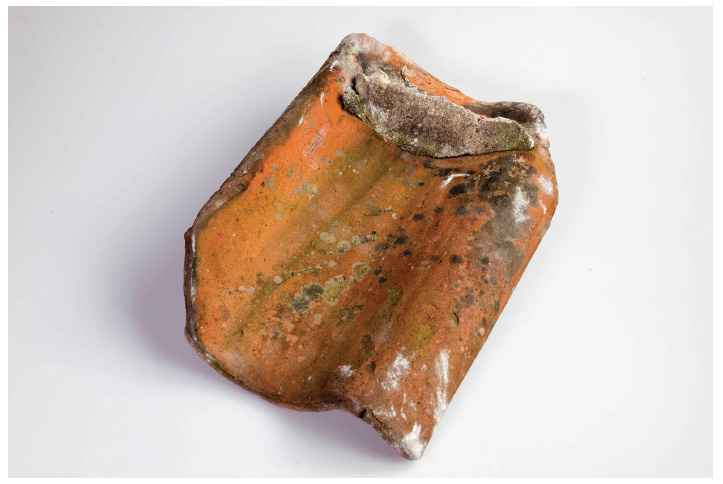
Leidenâs authorities, like their counterparts elsewhere in the Low Countries, tried especially hard to persuade people to adapt their roofs from thatch to harder materials: mainly rooftiles and slate.54 To stimulate change, the city government issued a roof subsidy programme. This programme was not unique: at least twenty Netherlandish towns extended financial aid for fireproof roof constructions.55 Leiden was by no means the first: Deventer had already issued financial assistance between 1337 and 1450. Yet it seems to have been particularly elaborate and relatively successful in Leiden â although
The scale of this municipal preventative programme is remarkable. Premodern policymakers certainly did not lack the competence to make any large-scale âsystematicâ interventions in the urban environment. They thought preventatively about communal wellbeing. The desire to avoid large-scale fire disasters was shared by all inhabitants. Peopleâs awareness was heightened by their knowledge of major fires, either in their own or in other cities. Most likely people also had first-hand experience, and maybe had even suffered the traumas, of smaller accidents and incidents, which were very common. Some fires were also deliberate, as arson was a major and widely used part of premodern warfare. A collective fear of fire therefore seems to have dominated the mindset of Leideners, as it did the inhabitants of many other towns and cities in at least north-western and northern Europe, where building with wood and thatch long remained present because it was easy, relatively cheap and sustainable â despite the fire risks.58 At the same time, there was a realisation that making changes to reduce fire accidents was difficult because of the financial costs involved. A history of fire reveals how restricted communities were economically, and therefore how difficult it was to reduce the occurrence of something as dangerous as fire outbreaks. Leiden and other municipal governments would not raise taxes (often on beer and wine) to create subsidies unless their necessity was generally accepted. Without such investments, and
6 The Bucket System
The programme for material alterations to the city went hand in hand with a system to supply each ward with good firefighting tools. The archival records reveal snippets of its development. I will start by looking at a moment of increased risk. In July 1525, a drought hit Leiden, and the water levels of the canal dropped dramatically. The water shortage posed all kinds of threats to the community, among which, as the magistrates proclaimed on the fifteenth day of that month, was the fact that âif a fire would arise now, may God help us prevent it, and if the firefighting tools (gereescepe vanden brant) are in poor shapeâ, the damage would be massive. Thus, inhabitants and âespecially the ward mastersâ, would have to prepare themselves for inspection (schouw). All ladders and buckets had to be checked and tubs with water placed outside. Tubs had to be ready in case of emergency to supply water to quench the flames which under normal circumstances would likely come from the canals. The barge system protected the quality, availability and accessibility of canal water and therefore also related to fire safety. Additionally, the night watch had to âoversee all haystacks and dung heaps, and the bakers, brewers and tanners and other dangerous places that need supervision, and if they see smoke they must immediately raise alarmâ. The ward masters also had to check if haystacks were âsufficiently dryâ.59 While this may sound counterintuitive, the danger of spontaneous combustion of hay (hooibroei in modern Dutch) was especially high when the heaps were humid. This was a widely known issue, and we find rules on haystacks in many of the fire bylaws in several cities and villages. On other occasions, too, the town paid heralds to go around town reminding people to mind their haystacks or âby yelling: âput your water and ladders at the door!ââ60
The ordinance reveals the contours of Leidenâs firefighting organisation. It revolved around two things: the maintenance of firefighting tools, which by and large was a task delegated to inhabitants themselves, and the supervision of these tools by the ward masters. The latterâs role in firefighting was
The systems for firefighting tools required continuous monitoring and negotiation. In 1515, the city declared that firefighting tools were badly maintained. They were âlost, rotten, and decayedâ, which would lead to massive damage when a fire occurred, âunless the city takes urgent action, as they are obligated to doâ.64 The discourse was a reactionary response to the bad current situation, yet it was also explicitly preventative: focused on avoiding future calamities. The city government thus assumed a key role in preventative action, presenting it as its civic duty. A detailed list of required communal firefighting tools for each of the eighteen wards followed.65 Each ward had to keep a fixed number of between twelve and 24 buckets (six for the small ward Levendaal); between two and four ladders; and between four and eight âsmall laddersâ â the main difference was likely that big or regular ladders were high enough to reach a roof. Also required were between two and four beacons (vuurpannen) and torches. The latter prerequisite suggests that many incidents likely happened at night when people were sleeping â or perhaps when they were drunk. Finally, two canvasses (zeylen) with a minimum length of 30 el (over 20 metres), presumably to cover adjacent homes, were needed to prevent further spreading and to protect buildings from sparks flying through the air.66
Per ward, six men were elected by the ward masters, who were to carry the tools to the place of an incident âand set up the torches on the bridges and alleys
The communal tools per ward were only one part of a more elaborate system of firefighting tools. From 1450 on, households had to keep their own buckets. This demand was reissued in 1515. Homeowners had to mark their bucket with a clear individual sign, linking the bucket to their household, and add the sign of the ward. Bad maintenance was punished by a 40 sc. fine. Not having the right number of buckets or ladders cost much more: 3 lb. Furthermore, in addition to buckets, homes worth over 50 nobel were required to have a ladder high enough to reach their roof, as well as a tub (hoosvat). Also, houses worth 12 nobel had to have one ladder â again, rules differed according to the wealth of inhabitants.69
The amount of regulation and documentation around buckets is astonishing. An ordinance dated 1517 offers the most detailed information. The sources reflect a strong preoccupation with keeping firefighting tools in good order and ready to use. The main way for the town government to enforce such precautions was inspections. An extra inspection was thus instigated during the 1525 drought, mentioned above, but in theory inspections were meant to take place once a year. From 1517, the inspections had to be noted down in âlittle booksâ (boecxkens), which would document precisely how many buckets there were in each ward. These registers have been extant (in parts) for several years. They form a bulk of loose fragments in the archive, some legible, others barely so.70 One exception is one of the very first: the 1515/17 inspection
This 1517 register of bucket inspections deserves a detailed discussion. In all, the city counted 2,063 households, supplying a total of 969 marked buckets. Thus, 1094 homes did not have to contribute one â they were likely too poor.71 Further, people were not allowed to keep their âownâ bucket at home and had to hand it over to the ward masters. The latter would collect them and hang them together with the communal tools (those in collective possession of the ward) âin five or six places, where they can most easily be reached and best [fastest] be brought to a fireâ.72
How exactly would a town of about 14,000 inhabitants use a thousand buckets? On average, there were about fifty buckets per ward. Divided over five or six places, including the communal buckets that each ward had to maintain, this was about a dozen per location. The core of the firefighting response was to get in line and pass the buckets from one to another from the nearest water points to a fire. One would then need about a bucket per metre. Fifty metres was a reasonable distance to the nearest water point. And because time was of the essence, rather than having many buckets in one central place, keeping them nearby helped diminish the risk of spread.
These lists (Figure 3.2) document how the buckets could be recognised as belonging to which house and how much they were worth, and thus how much a person was entitled to if their bucket got lost in a fire. It suggests that the town needed to give some form of insurance in order to convince people to lend their possession for the common good â and so that no one could falsely claim to have lost a bucket of high value if they actually had not.
List from 1515 with number of buckets and their value per household and the household sign that was carved on the bucket (documented in registers per ward). Some households were not required to have a bucket for firefighting
SOURCE: ERFGOED LEIDEN EN OMSTREKEN, NL-LDNRAL-0501, NO. 1172

What does this elaborate bucket system tell us about the urban society that developed it? What is most striking is, first, the extremely detailed level of organisation and, second, the complexity of financing it. Apparently, most people did not have the means to simply pay for and donate a bucket to the communal ward stash. Inhabitants were furthermore obliged to contribute (8 d.) to the maintenance of the communal firefighting tools in their ward, which were maintained by the ward masters.73 If neighbours failed to do so, the town government would advance the money and then claim double
Yet until then, buckets were key. A letter in first person by a certain Clais, who had taken on the distribution of the emmergeld and administration of the buckets, offers a final fascinating glimpse into the practical challenges and potential tensions of this bucket system. Clais notes in his formal letter to the aldermen and city council that he wants âtwo honourable men to inspect the buckets and assess (taxerende) their state, so if any get lost in a fire, I will know how much I will have to pay to reimburse themâ.77 Clais would thereby receive a cloth/uniform âas the other city servants doâ. He also writes that only people living in the two or three nearest wards have to bring buckets, âunless the fire becomes too big and more are necessaryâ. Furthermore, in case of a major conflagration âthen I, Clais, will have the right to use a year of rents to pay for the damage to the bucketsâ.78 Finally, if someone has lost any firefighting tools that he or she has supplied to help, the town will reimburse them, if that person declares his or her loss under oath. 79
The value of these buckets, and more generally the firefighting tools, indirectly confirms how grave the loss of goods, (workshop) tools or entire homes
7 Conclusion
The organisation of sanitation and fire safety in late medieval Leiden illustrates how urban communities negotiated political, economic, but also environmental factors in relation to the recurring challenges of keeping the city clean and safe. The barge system used to clean and maintain the canals was part of a much broader range of healthscaping activities, including interventions to promote fire safety. These issues were interlinked and subject to complex negotiations between different urban agents â magistrates, ward masters and inhabitants. Leidenâs ward masters were key officials, with a broad jurisdiction and a maintenance budget for protecting communal health and infrastructural viability. Inspections in the service of (fire) safety and sanitation extended a governmental gaze into private realms, while at the same time they called for residentsâ contributions to the upkeep of spaces used by the community.
Various financial contributions were so institutionalised that they had their own terms: baggertgeld, bruggeld or emmergeld. Yet, people had to do more than simply pay their precursors of municipal taxes. They had to actively help, and such activities were part of what it meant to belong to a community. One of the key insights of this chapter is that inhabitantsâ contributions were substantial and continuous â as were the daily dangers and nuisances. At the same time, the creation both of subsidy programmes and the elaborate supervision of firefighting tools attests to the difficulties involved in reducing fire risks in particular. Furthermore, we should be careful not to assume that either centralising or delegating forces were permanent transitions. As other studies in civic duties have also pointed out, these were very dynamic processes. Maintaining sanitation and promoting fire safety through safe building and by maintaining firefighting tools, in addition to actually helping to extinguish fires, therefore formed part of citizenship practices: a means to express or perform good civic morals. Although some of these tasks were
Bibliography
Abrahamse, Jaap Evert. De grote uitleg van Amsterdam: stadsontwikkeling in de zeventiende eeuw. Bussum: Thoth, 2010.
Agresta, Abigail. âFrom Purification to Protection: Plague Response in Late Medieval Valenciaâ. Speculum 95, no. 2 (2020): 371â95.
Bankoff, Greg, Uwe Lübken, and Jordan Sand, eds. Flammable Cities: Urban Conflagration and the Making of the Modern World. Madison: University of Wisconsin Press, 2012.
Bartlome, Nikolaus, Erika Flückiger, and Martin Körner, eds. Stadtzerstörung und Wiederaufbau. Vol. 1: Zerstörungen durch Erdbeben, Feuer und Wasser. Bern: Verlag Paul Haupt, 1999.
Bik, J.G.W.F. Vijf eeuwen medisch leven in een Hollandse stad. Assen: Van Gorcum, 1955.
Boele, Anita. Leden van één lichaam: denkbeelden over armen, armenzorg en liefdadigheid in de Noordelijke Nederlanden 1300â1650. Hilversum: Verloren, 2013.
Bouras-Vallianatos, Petros, and Barbara Zipser, eds. Brillâs Companion to the Reception of Galen. Leiden: Brill, 2019.
Brand, Hanno. Over macht en overwicht: stedelijke elites in Leiden (1420â1510). Leuven: Garant, 1996.
Colson, Justin, and Arie van Steensel. âCities and Solidarities: Urban Communities in Medieval and Early Modern Europeâ. In Cities and Solidarities: Urban Communities in Pre-Modern Europe, edited by Justin Colson and Arie van Steensel, 1â24. London: Routledge, 2017.
Conrad, Lawrence I., and Dominik Wujastyk, eds. Contagion: Perspectives from Pre-Modern Societies. Aldershot: Ashgate, 2000.
Coomans, Janna. Community, Urban Health and Environment in the Late Medieval Low Countries. Cambridge: Cambridge University Press, 2021.
Coomans, Janna. âMaking Good and Breaking Bad: Materiality and Community in Netherlandish Cities, 1380â1520â. The English Historical Review 137 (2022): 1053â81.
Coomans, Janna. âSubsidie voor transitie: de stadsbrand van 1463 en het wederopbouwprogrammaâ. Silva 3, no. 2 (2022): 3â15.
Coomans, Janna. âThe King of Dirt: Public Health and Sanitation in Late Medieval Ghentâ. Urban History 46, no. 1 (2019): 82â105.
Coomans, Janna. âUp in Smoke: The Transforming Power of Fire Safety Policies in the Low Countries, 1250â1550â. In Transforming Space: Visible and Invisible Changes in Premodern European Cities, edited by Jaap Evert Abrahamse and Heidi Deneweth, 71â90. Turnhout: Brepols, 2022.
Deligne, Chloé. Bruxelles et sa rivière: genèse dâun territoire urbain (12e-18e siècle). Turnhout: Brepols, 2003.
Destruction et reconstruction de villes, du Moyen Age à nos jours: 18e colloque international, Spa, 10â12. IX. 1996: actes. Bruxelles: Crédit Communal, 1999.
Fay, Isla. Health and the City: Disease, Environment and Government in Norwich, 1200â1575. York: York Medieval Press, 2015.
Ferragud, Carmel, and Juan Vincente GarcÃa Marsilla. âThe Great Fire of Medieval Valencia (1447)â. Urban History 43, no. 4 (2016): 500â516.
Garrioch, David. âTowards a Fire History of European Cities (Late Middle Ages to Late Nineteenth Century)â. Urban History 46, no. 2 (2019): 202â24.
Geltner, G. Roads to Health: Infrastructure and Urban Wellbeing in Later Medieval Italy. Philadelphia: University of Pennsylvania Press, 2019.
Geltner, G., and Janna Coomans. âThe Healthscaping Approach: Toward a Global History of Early Public Healthâ. Historical Methods: A Journal of Quantitative and Interdisciplinary History 56, no. 1 (2023): 18â33.
Geltner, G., Janna Coomans, and Ronit Yoeli-Tlalim, eds. Public Health in the Premodern World: Dynamic Balances. Oxford: Oxford University Press, 2026.
Hamaker, H.G., ed. De middeneeuwsche keurboeken van de stad Leiden. Leiden: Van Doesburgh, 1873.
Heijden, Manon van der. Civic Duty: Public Services in the Early Modern Low Countries. Newcastle upon Tyne: Cambridge Scholars Publishing, 2012.
Henderson, John. Florence under Siege: Surviving Plague in an Early Modern City. New Haven: Yale University Press, 2019.
Herwaarden, J. van. âMedici in de Nederlandse samenleving in de late middeleeuwen (veertiende-zestiende eeuw)â. Tijdschrift voor Geschiedenis 96, no. 3 (1983): 348â78.
Horden, Peregrine, and Elisabeth Hsu, eds. The Body in Balance: Humoral Medicines in Practice. New York: Berghahn Books, 2015.
Huisman, Frank. Stadsbelang en standsbesef: gezondheiszorg en medisch beroep in Groningen 1500â1730. Rotterdam: Erasmus Publishing, 1992.
Jones, Lori, ed. Disease and the Environment in the Medieval and Early Modern Worlds. London: Routledge, 2022.
Jørgensen, Dolly. âCooperative Sanitation: Managing Streets and Gutters in Late Medieval England and Scandinaviaâ. Technology and Culture 49, no. 3 (2008): 547â67.
Jouanna, Jacques. Greek Medicine from Hippocrates to Galen: Selected Papers. Leiden: Brill, 2012.
Kinzelbach, Annemarie. âInfection, Contagion, and Public Health in Late Medieval and Early Modern German Imperial Townsâ. Journal of the History of Medicine and Allied Sciences 61, no. 3 (2006): 369â89.
Koch, A.C.F., C.J. Kolman, D.J. de Vries, and F.C. Berkenvelder. âVerstening in drie IJsselstedenâ. Overijsselse Historische Bijdragen 100 (1985): 23â146.
Ladan, Rudolph. Gezondheidszorg in Leiden in de late middeleeuwen. Hilversum: Verloren, 2012.
Lecuppre-Desjardin, Elodie, and Anne-Laure van Bruaene, eds. De Bono Communi: The Discourse and Practice of the Common Good in the European City (13th-16th c.). Turnhout: Brepols, 2010.
Liddy, Christian D. Contesting the City: The Politics of Citizenship in English Towns, 1250â1530. Oxford: Oxford University Press, 2017.
Ligtenberg, Christina. De armezorg te Leiden tot het einde van de 16e eeuw. Den Haag: Nijhoff, 1908.
Luijk, Madelon van. ââTer eeren ende love Goodesâ: religieuze lekenbroeder- en zusterschappen te Leiden, 1386â1572â. Jaarboek der Sociale en Economische Geschiedenis van Leiden en Omstreken 10 (1998): 23â58.
Marsilje, J.W. Het financiële beleid van Leiden in de laat-Beierse en Bourgondische periode, 1390â1477. Hilversum: Verloren, 1985.
Meerkamp van Embden, A., ed. Stadsrekeningen van Leiden (1390â1434). 2 vols. Amsterdam: Johannes Müller, 1913â1914.
Meyer, G.M. de, and E.W.F. van den Elzen. De verstening van Deventer: huizen en mensen in de 14e eeuw. Groningen: Wolters-Noordhoff, 1982.
Moerman, Dániel. âDe aanleg van regenbakken in vroegmodern Deventerâ. Bulletin KNOB 121, no. 3 (2022): 42â56.
Netiv, Ariela. âLeidse stadsvroedvrouwenâ. In Uit Leidse bron geleverd: studies over Leiden en de Leidenaren in het verleden, edited by J.W. Marsilje, 169â72. Leiden: Gemeentearchief Leiden, 1989.
Nutton, Vivian. âThe Seeds of Disease: An Explanation of Contagion and Infection from the Greeks to the Renaissanceâ. Medical History 27, no. 1 (1983): 1â34.
Oosten, Roos van. De stad, het vuil en de beerput: de opkomst, verbreiding en neergang van de beerput in stedelijke context. Leiden: Sidestone Press, 2015.
Oosten, Roos van. âThe Dutch Great Stink: The End of the Cesspit Era in the Pre-Industrial Towns of Leiden and Haarlemâ. European Journal of Archaeology 19, no. 4 (2016): 704â27.
Orsel, Edwin. De ordinaire kap: een bouwhistorische studie naar kapconstructies op Leidse huizen tussen 1300 en 1800. Hilversum: Verloren, 2020.
Porter, Dorothy. Health, Civilization, and the State: A History of Public Health from Ancient to Modern Times. London: Routledge, 1999.
Prak, Maarten. Citizens without Nations: Urban Citizenship in Europe and the World, c. 1000â1789. Cambridge: Cambridge University Press, 2018.
Rawcliffe, Carole. Urban Bodies: Communal Health in Late Medieval English Towns and Cities. Woodbridge: Boydell & Brewer, 2013.
Rawcliffe, Carole, and Claire Weeda, eds. Policing the Urban Environment in Premodern Europe. Amsterdam: Amsterdam University Press, 2019.
Ryckaert, Marc. âBrandbestrijding en overheidsmaatregelen tegen brandgevaar tijdens het Ancien Régimeâ. In LâInitiative publique des communes en Belgique, 247â56. Brussel: Gemeentekrediet van België, 1984.
Skelton, Leona J. Sanitation in Urban Britain, 1560â1700. London: Routledge, 2016.
Smit, Cor. Leiden met een luchtje: straten, water, groen en afval in een Hollandse stad, 1200â2000. Leiden: Primavera, 2001.
Steensel, Arie van. âHet personeel van de laatmiddeleeuwse steden Haarlem en Leiden, 1428â1572â. Jaarboek voor Middeleeuwse Geschiedenis 9 (2006): 191â252.
Vannieuwenhuyze, Bram. âBrandpreventie en -bestrijding in laatmiddeleeuws Brusselâ. Eigen Schoon en de Brabander 99 (2016): 535â54.
Vis, G.N.M. Van âvulliscuylâ tot huisvuilcentrale: vuilnis en afval en hun verwerking in Alkmaar en omgeving van de middeleeuwen tot heden. Hilversum: Verloren, 1996.
Walle, Kees. Buurthouden: de geschiedenis van burengebruiken en buurtorganisaties in Leiden (14e-19e eeuw). Leiden: Ginkgo, 2005.
Zwierlein, Cornel. Prometheus Tamed: Fire, Security, and Modernities, 1400 to 1900. Leiden: Brill, 2021.
Geltner, Coomans, and Yoeli-Tlalim, Public Health in the Premodern World.
See, on active urban citizenship and a focus on practice rather than legal definitions: Prak, Citizens without Nations; Liddy, Contesting the City; Coomans, âMaking Good and Breaking Badâ.
See, for the concept of healthscaping: Geltner and Coomans, âThe Healthscaping Approachâ.
Jones, Disease and the Environment; Agresta, âFrom Purification to Protectionâ; Henderson, Florence under Siege; Coomans, âThe King of Dirtâ; Geltner, Roads to Health; Rawcliffe, Urban Bodies; Fay, Health and the City; Skelton, Sanitation in Urban Britain; Jørgensen, âCooperative Sanitationâ.
Coomans, Community; Lecuppre-Desjardin and van Bruaene, De Bono Communi; Boele, Leden van één lichaam.
See examples of Leidenâs bylaws: Hamaker, De middeneeuwsche keurboeken, 227, 321, 343, 362, 498. Historians strongly debate if guilds either benefitted from or undermined the public interest. See Prak, Citizens without Nations, 85â87.
ELO, NL-LdnRAL-0508, nos 4, Correctieboeken (1392â1395), 4A-D, Correctieboeken (1434â1491); 41A-D, Kenningboeken (1434â1486); ELO, NL-LdnRAL-0501, nos 381, Vroedschapsboeken (1449â1458), 382, Vroedschapsboeken (1465â1504). The law codes are published by Hamaker, De middeneeuwsche keurboeken. The earliest city accounts are published in Meerkamp van Embden, Stadsrekeningen. Also, see Marsilje, Het financiële beleid.
Erfgoed Leiden en Omstreken (hereafter: ELO), NL-LdnRAL-0501, no. 381, Vroedschapsboek (1449â1458), f. 49r: âItem om die gebreke wille vanden vulnisse hopen daer geschepen is by nachte oens brant of te comen mits dat zij bij groten hoopen gegadert wort etc. Soe is dair op overdragen dat tgerecht dair op een ordinancie maken sullen dat elke bonne zijn scouwe hebben sal ter plaetse dairmen die vulnisse in storte brenge ende wech voeren mach opter buyren kosten ende die ordinancie selmen weder brenge bijder vroescip om dair voir in te consenteren.â
Hamaker, De middeneeuwsche keurboeken, 138â40, 371, 469. Ashes were collected separately in early modern Alkmaar and gathered in ash-pits (askuilen); Vis, Van âvulliscuylâ tot huisvuilcentrale.
On this bylaw, see also Van Oosten, De stad, het vuil en de beerput, 214â15.
Van der Heijden, Civic Duty; Colson and Van Steensel, âCities and Solidaritiesâ, 5â6.
Rawcliffe and Weeda, Policing the Urban Environment.
Rawcliffe, Urban Bodies; Kinzelbach, âInfection, Contagion, and Public Healthâ; Conrad and Wujastyk, Contagion; Horden and Hsu, The Body in Balance; Bouras-Vallianatos and Zipser, Brillâs Companion to the Reception of Galen; Porter, Health, Civilization, and the State.
Nutton, âThe Seeds of Diseaseâ; Jouanna, Greek Medicine.
Hamaker, De middeneeuwsche keurboeken, 364â65.
Van Steensel, âHet personeelâ; Ladan, Gezondheidszorg in Leiden; Netiv, âLeidse stadsvroedvrouwenâ. This was common throughout the Low Countries, see Huisman, Stadsbelang en standsbesef; Van Herwaarden, âMedici in de Nederlandse samenlevingâ; Bik, Vijf eeuwen medisch leven.
Midwives were hired from 1463 on, see Ladan, Gezondheidszorg in Leiden, 109â36, 187â89; See also Ligtenberg, De armezorg.
Geltner and Coomans, âThe Healthscaping Approachâ.
Van Luijk, ââTer eeren ende love Goodesââ, 26â27; Brand, Over macht en overwicht, 20â25.
Walle, Buurthouden, 12â30.
Later such cases were also documented by the surveyors (royeermeesters), but these records are only extant from the late sixteenth century on. ELO, NL-LdnRAL-0501A, no. II, âRoyeermeestersâ (1575â1795).
Hamaker, De middeneeuwsche keurboeken, 7 (1406), 93 (fourteenth century), 140, 149, 237â38, 477. These homans van der bonnen are not to be confused with another type of homans: a sort of treasurer; Marsilje, Het financiële beleid, 66â67, 81; Brand, Over macht en overwicht, 23, 147â49.
From the mid-fifteenth century on, the vestmeesters were appointed at intervals and had to âmaintain the city moat (vesten), gates, towers, and bridges, wherever it is requiredâ; Hamaker, De middeneeuwsche keurboeken, 160â62; Marsilje, Het financiële beleid, 124; Brand, Over macht en overwicht, 153â54.
ELO, NL-LdnRAL-0501, no. 381, Vroedschapsboek, f. 6v. On this process of either delegation and centralisation, see Van der Heijden, Civic Duty.
ELO, NL-LdnRAL-0501, no. 84, f. 244v, Stedeboek (1407).
ELO, NL-LdnRAL-0501, no. 84, f. 284r, Stedeboek (1404).
Van Oosten, De stad, het vuil en de beerput, 211; Smit, Leiden met een luchtje, 32â36.
Van Oosten, De stad, het vuil en de beerput, 181â85, 217, 233â35; Smit, Leiden met een luchtje, 36â39.
ELO, NL-LdnRAL-0501, no. 84, f. 327v, Stedeboek (1384).
He was entitled to a uniform; ELO, NL-LdnRAL-0501, f. 327v, Stedeboek (1384, 1433). See also Van Steensel, âHet personeelâ.
Hamaker, De middeneeuwsche keurboeken, 10 (1406).
Hamaker, 138, 147 (1456), 359 (1308); ELO, NL-LdnRAL-0501, no. 84, f. 90r, Stedeboek (1438).
Coomans, Community, 121â23.
Meerkamp van Embden, Stadsrekeningen, 1:263â65, 355, 361, 394â98, 406, 408, 492.
Meerkamp van Embden, Stadsrekeningen, 2:144.
Meerkamp van Embden, 2:85, 95, 102, 105, 119, 187, 206â7, 210, 232, 394â95, 397, 400, 402, 426.
For a broader discussion on urban communities at various levels, see Colson and Van Steensel, âCities and Solidaritiesâ, 1â24.
Moerman, âDe aanleg van regenbakkenâ, gives a brief historiographical overview.
Coomans, Community, 52â53; Abrahamse, De grote uitleg van Amsterdam. On Brussels, see Deligne, Bruxelles et sa rivière.
Hamaker, De middeneeuwsche keurboeken, 7 (1406), 138 (1450), 280. The Keurboek of 1406 contained a prohibition specifically aimed at leatherworkers.
For example, the magistrates warned inhabitants to keep waste storage at a four-foot distance from the waterways; Hamaker, 120, 125, 272, 277.
See also Van Oosten, De stad, het vuil en de beerput, 215.
Hamaker, De middeneeuwsche keurboeken, 148 (1458), 280 (1508).
ELO, NL-LdnRAL-0501, no. 382, f. 68r, Vroedschapsboek 68r (1471). See also ELO, NL-LdnRAL-0508, no. 4C, f. 161v-162r, Correctieboek C (1487); Hamaker, 483 (1443).
ELO, NL-LdnRAL-0508, no. 4B, f. 220v, Correctieboek B.
ELO, NL-LdnRAL-0508, no. 4A, p. 249, Correctieboek A.
Hamaker, De middeneeuwsche keurboeken, 6, 121, 138, 277 (1396, repeated in 1406, 1450, 1508).
ELO, NL-LdnRAL-0508, no. 4C, f. 167r, Correctieboek C (1487).
ELO, NL-LdnRAL-0508, no. 4A, p. 254, Correctieboek A.
Coomans, Community, 170â215; Coomans, âMaking Good and Breaking Badâ; Van Oosten, âThe Dutch Great Stinkâ.
Building historian Jan Dröge has performed extensive research into Leidenâs subsidy programs. See also Van Oosten, De stad, het vuil en de beerput, 217â18; Coomans, âUp in Smokeâ.
Hamaker, De middeneeuwsche keurboeken, 7â10, 93â94, 132â39.
Hamaker, 136â37.
Koch et al., âVersteningâ.
De Meyer and Van den Elzen, De verstening van Deventer.
Coomans, âSubsidie voor transitieâ; Coomans, âUp in Smokeâ.
Orsel, De ordinaire kap, 139â58.
Key contributions to the premodern history of fire are: Zwierlein, Prometheus Tamed; Garrioch, âTowards a Fire Historyâ; Ferragud and GarcÃa Marsilla, âThe Great Fireâ; Bankoff, Lübken, and Sand, Flammable Cities; Destruction et reconstruction; Bartlome, Flückiger, and Körner, Zerstörungen durch Erdbeben. On the premodern Low Countries, see Ryckaert, âBrandbestrijdingâ; Vannieuwenhuyze, âBrandpreventie en â bestrijdingâ.
ELO, NL-LdnRAL-0501, no. 1172, âOrdonnanties betreffende brand en brandschouw, 1515â1530â.
Meerkamp van Embden, Stadsrekeningen, 1:291 (1429â30), 424 (1433â34).
Hamaker, De middeneeuwsche keurboeken, 7 (1406), 93 (fourteenth century).
ELO, NL-LdnRAL-0501, Stedeboeck, fols. 223v-226r.
Another scribe added below on the folio a recount of 107 buckets that were returned in 1518 âafter the fire at Frans Gerytâs house had been put outâ. ELO, NL-LdnRAL-0501, Stedeboek, f. 223v-226r (1448).
ELO, NL-LdnRAL-0501, 1172, unnumbered folios (1515).
ELO, NL-LdnRAL-0501, 1172, unnumbered folios (1515).
These precise prescriptions per ward, with exact numbers, were repeated in later ordinances as well. See ELO, NL-LdnRAL-0501, 1172, unnumbered folios (1522).
ELO, NL-LdnRAL-0501, 1172, unnumbered folios (1515, 1522).
Hamaker, De middeneeuwsche keurboeken, 141 (1450).
Hamaker, 140â141 (1450); ELO, NL-LdnRAL-0501, no. 1172, unnumbered folios (1515).
ELO, NL-LdnRAL-0501, no. 1173, âMemorie van de brandgereedschappen, 1515, 1551, 1556 en 1572â.
The dataset has been transcribed in 1992 by Jan Rustige; ELO, Library, no. 17921/1 f. He has made an overview of the totals, which I cite here.
ELO, NL-LdnRAL-0501, no. 1172, unnumbered folios (1515).
Hamaker, De middeneeuwsche keurboeken, 366â67.
ELO, NL-LdnRAL-0501, no. 1172, unnumbered folios (1515).
In addition to extant administrative registers from 1438 and a tax register from 1498.
See for instance on its impact in Cologne, Zwierlein, Prometheus Tamed, 190â95.
ELO, NL-LdnRAL-0501, no. 1174, âStukken betreffende het emmergeld en de aanbesteding van het onderhoud van de brandemmers, 1525â1575â. Two fragments of a letter.
ELO, NL-LdnRAL-0501, no. 1174, âStukken betreffende het emmergeld en de aanbesteding van het onderhoud van de brandemmers, 1525â1575â, letter fragment.
Hamaker, De middeneeuwsche keurboeken, 469â470 (c. 1406â1448). Claisâ letter noted that âif someone will come me and complain about damage, and I will not believe his mere words, then that person had to declare them under oath before I am obliged to redeem himâ; ELO, NL-LdnRAL-0501, no. 1174, âStukken betreffende het emmergeld en de aanbesteding van het onderhoud van de brandemmers, 1525â1575â, letter fragment.