


Leiden is probably best known for its university, a legacy of the early modern period. Less known but still visible today is its older industrial past. The medium-sized city was embedded in the relatively dense urban network of the premodern Low Countries; as a typical Dutch city it never attained a prominent political, administrative or religious role. Even from a European perspective, key aspects of Leiden’s premodern history in many ways resembled those of other cities and towns. Yet, the combination of its two defining characteristics – an industrial and a university city – set Leiden apart, rendering it exemplary of urban processes and a valuable comparative case study. In many ways, the textile industry and, after 1575, the university shaped Leiden’s history and society. The pull of Leiden as a place of production, knowledge and creativity attracted people from nearer and more distant places, resulting in an increasingly diverse urban population. But at the same time, Leideners had to cope with the structural political, economic and social inequalities characteristic of the city. This volume aims to reveal, at a high level of detail thanks to the rich documentary evidence, how the tensions between urban opportunities and the realities of urban life came to the fore in Leiden’s medieval and early modern history.
The first part of this introduction offers a brief overview of the historiography of Leiden and identifies the key themes, concepts and debates in urban history with which the authors engage, especially the concepts of diversity and inequality. This engagement with historiography should help readers to compare or connect more easily the case of Leiden with other cities and towns. The second part introduces the individual contributions, situating them briefly within the context of Leiden’s premodern history and providing some relevant facts and figures.
1 Writing about Leiden
Leiden’s historiographical tradition dates back more than four centuries. As urban chronicles were uncommon in the medieval Northern Low Countries,
According to P.J. Blok, who expressed his admiration for their accuracy, Orlers and Van Mieris’ descriptions no longer met the critical standards of the modern historian. Blok adopted a chronological rather than a thematic analysis of urban life in his four-volume history of Leiden, Geschiedenis eener Hollandsche stad (1883–1918), covering the city’s history from its medieval origins up to the early twentieth century.5 More than his predecessors, Blok was interested in the social and economic history of Leiden, but above all he wrote the city’s history from a liberal perspective. He believed that the Dutch nation-state of the nineteenth century had its infancy in the late medieval town, of which he considered Leiden to be a model.6
In contrast to the traditional separation of political and institutional history from social-economic and cultural developments, the strict distinction between city and countryside, and the focus on legal-administrative records, more recent urban histories have developed an integrated approach to the city to understand its dynamics, stemming from its embeddedness in broader contexts and the interlinkages between various events and processes.7 The most recent history of Leiden, the four-volume Leiden. De geschiedenis van een
This volume builds on existing research but differentiates itself from Leiden’s older ‘city biographies’ in important ways. It offers a thematic rather than an exhaustive overview of the history of Leiden from roughly the late twelfth century to the early nineteenth century. This thematic approach takes current trends and debates in urban history as a starting point, in order to connect and confront Leiden’s history with some of the many perspectives on and aspects of premodern urban societies.10 By viewing Leiden’s society through three lenses – that of spaces, peoples and representations – the intersected evolution of spatial structures, human interactions and cultural representations from the medieval period to the end of early modern times is brought to light. The core aim is to capture some of the diversity and inequalities among the inhabitants of Leiden and their life experiences in their multi-layered spatial, institutional and representational contexts. As a companion, the collection of chapters which draw on diachronic perspectives and thematic case studies and refer to the key literature and sources, provides an overview of the pivotal moments and developments in the premodern history of the Dutch town.
This volume is also the first history in English of a city in the medieval and early modern Northern Low Countries. The wave of urban histories in Dutch a quarter of a century ago was not followed up by translations made for an
Above all, this volume aims to bring the history of premodern Leiden, incorporating both older and more recent research, to a new generation of readers and students. The chapters focus on key aspects of this rich history, while recognising that the developments that characterised Leiden’s urban life were inextricably entwined with broader political, economic, social, cultural and ecological histories. With its comparatively wide array of available archival records, Leiden’s history can function as a lens through which to observe the interactions between these processes and small-scale social life, but also as a case study to engage with urban theory on the social context of urbanisation and the urban form.13 Ultimately, urban history is about understanding how people made complex urban societies work in the past and present, and how urban communities, economies and cultures exist as part of larger ecologies, systems and networks and how they transform them.
2 Themes and Debates in Urban History
How can the case study of premodern Leiden be made meaningful for (urban) historians? The authors of this volume address this challenge by connecting their contributions to current themes in urban history and by engaging with debates in the field. But urban history as a field of knowledge is difficult to delineate and has a diverse research agenda. Many of its themes and debates are not strictly urban, rendering the city incidental to questions about broader historical processes, even if one follows Charles Tilly’s argument that cities are ideally suited as ‘laboratories’ to examine the interaction between global social
Historians generally subscribe to the idea of the city as contingent, situated and heterogenous, constituted by interactive processes between materialities, technologies, ideas and humans. But the multiplicity of urban assemblages further complicates the issue of what questions and approaches urban historians have in common, how historical-specific urban contexts can be fitted into larger narratives, and how the co-evolution of urban and non-urban assemblages should be understood. Nonetheless, this volume continues along this path by (often implicitly) acknowledging the composite nature of Leiden, achieved and embodied by an evolving configuration of natural, socio-economic, political and cultural elements. This opens up the possibility of thinking in a more refined way about how the city as a microcosm was embedded in larger networks, how broader processes played out within the urban, and how these processes in turn were shaped by it. The emphasis on the urban as ‘becoming’ also aligns with the proposition of the city as a complex adaptive system, which gives prominence to emergent, co-evolutionary and non-linear processes. Over time, the dynamic interactions between the various material and non-material components, or agents, that constitute the city, including lower and higher-level systems (for example, neighbourhood associations and regional polities, or guilds and trade networks), give rise to new patterns of
From this perspective, it is also no longer meaningful to stick to rigid distinctions between the city as a spatial structure (spaces), socio-economic unit (peoples) or cultural formation (representations). The chapters still follow this order but defy explicit classification, as these conceptualisations often overlap. This can be illustrated with the example of the notion of urban spaces, a recurring theme in the chapters. The spatial turn, warmly embraced by historians, boosted a new interdisciplinary interest in the formation of urban spaces, often supported by digital methodologies.19 From this angle, historians have revisited the evolution of the built urban environment, the use of land in the city and its surroundings, the transformation of the urban landscape, and the perceptions and representations of urban space, which were far less static than had long been assumed.20 More recently, historians have directed their attention to the question of how the movement of people, objects, knowledge and ideas moulded urban spaces.21 This movement, in turn, was shaped by power and social relations that set the rules for access. Furthermore, studies on urban social topography and residential segregation now chart in a less structural manner how political and economic inequalities were spatially engrained and reproduced.22 Thus, a spatial approach is instrumental in integrating various aspects of the city, or urban assemblages, and in understanding how ecological, political, socio-economic and cultural processes co-evolve over time. The contributions in this volume testify to the enrichment offered by this approach, whether with regard to the analysis of urban expansion, public health and services, power relations, economic inequalities, religious institutions, migration or innovation.
This observation brings us to the two related key themes that run through the chapters: the diversity and inequality that characterised urban society
Similar questions are addressed in a recent volume on inequality in cities in the Southern Low Countries, highlighting the multidimensional dynamics of urban inequality. Its authors emphasise the various dimensions and drivers of social inequality, including the common indicators for disparities in wealth and income amongst urbanites. A key issue concerns the interplay between urbanisation and inequality, because the city can simultaneously be a place of social emancipation for some and of social polarisation for others. The editors link this to what they dub ‘the Low Countries’ paradox’: it was exactly the strong middle classes in the cities of the Southern Low Countries that reproduced social inequality.27 This is an example of a broader tale of two cities: the inequality of the city attracting poor migrants who sought economic and social opportunity, and the social mobility of the city offering its residents mechanisms to accomplish their dreams for a better future.28 In the case
The contributions to this volume on Leiden do not chart the long-term evolution of inequalities in this medieval and early modern city, but the question of inequality finds resonance in most of them. Together, they show that urban disparities did not develop linearly and that our understanding of the interrelatedness of different manifestations of inequality still needs refinement. Even a category such as ‘middling groups’ is difficult to define and obscures how men and women were affected differently by hardship or how newcomers found their way in Leiden in various ways.30
The attention paid to power and social relations within the spatial approach to urban society has led to a clear focus on the experiences of city dwellers, which soon faded into the background in structuralist approaches to the history of cities.31 The focus on the physical and socio-economic structures of the city initially left little room for perceptions of the city or the experiences of urbanites in daily life, as did the emphasis on the embeddedness on cities in wider networks and systems. But what was the meaning of the city ‘in and for the lives of its inhabitants’ over time?32 In answering this question, whether from a cultural, social, economic or spatial perspective, attention to both inequality and diversity is crucial.
This brings us to the second key theme of this volume: diversity. For a long time, there was remarkably little attention paid to the fundamental differences between city dwellers in urban history. More recently, diversity, and especially migration-related diversity, has come to the fore in the studies of historians working on migration history, including urban migration.33 We use this concept
To better understand the emergence of inequalities in cities and the diverse experiences of urban life, a more refined differentiation between city dwellers is a prerequisite. A first, and most notable, difference is made along the lines of gender. Historians working on gender increasingly address this urban variable.34 They show how gender played a role in the urban past on various levels: it was fundamental to the shape of cities and towns and was a factor in urban change. The city constructed ideas of masculinity and femininity and defined gender roles. Male and female urban dwellers were confronted with such ideological notions. The city also offered women and men different opportunities, and so their experiences of the city differed.35 This focus has broadened beyond women’s lives in the city to include agency and the explanatory power of gender. Gendered patterns of migration, for example, affected the urban demography and markets.36 The gendered implications of the city as a place for emancipation and threat also explains the significant participation of women in urban crime.37 Finally, gender was intertwined with class and family hierarchy, and research on the role of singles and widows in the urban past indicates the necessity to differentiate by marital status.38
Leiden provides an interesting case in this respect: it was not only an important textile city, attracting many men and women looking for employment, and a university city, attracting scholars and students from different places around the world, and a place from where scholars and students fanned out, it was also a refugee and migrant city, a literary city with a long tradition of the transmission of knowledge, the birthplace or residence of artists and philosophers. It was a nodal point in regional and interregional networks, providing markets and social facilities for its inhabitants and for the surrounding region, and a city that, like many others, at various times counted more women than men, as well as many migrants, amongst its population.
3 Leiden, c. 1200–1800
The major developments in Leiden’s premodern history can be traced from ecological, spatial, demographic, economic and cultural perspectives. The dynamics the city experienced should specifically be understood in relation to its embeddedness in broader networks of varying scope and intensity. Ecologically or environmentally speaking, Leiden can be conceptualised as a historically specific, ever-evolving configuration of human and non-human actors, an entangled web of relationships between citizens and their material context(s).41 The contributions of Wout Saelens, who examines Leiden’s
The urbanites’ growing consumption of energy, food, water and materials transformed the town’s immediate surroundings and even created hinterlands further away. Chrystel Brandenburgh, Edwin Orsel, Roos van Oosten and Ed van der Vlist show in their contribution how the eleventh-century settlement of Leiden originated in Holland’s peat area that was reclaimed in the central Middle Ages. This involved the transformation of the landscape by constructing drainage ditches, some of which were later turned into canals. Leiden remained directly involved in the water management of its surroundings, the district of Rhineland. Although the city was represented on the water board, which had its seat in Leiden on the Breestraat from 1578 onwards, tensions were recurrent about jurisdiction, finances and economic interests.44
The supply of food, materials and energy has been studied from an economic angle, but its ecological implications or costs for Leiden’s hinterland need further exploration. Initially, the town was mostly reliant on its immediate rural surroundings, and throughout the Middle Ages it sought to extend its legal control by obtaining comital privileges to protect its economic interests and by acquiring the neighbouring rural lordships of de Vennip, Leiderdorp, Zoeterwoude and Oegstgeest between 1552 and 1615.45 At the beginning of the fifteenth century, however, Leiden was also well connected to regional
Returning to a more restricted, physical understanding of the urban space as its built environment, the medieval settlement of Leiden emerged in a fluvial landscape favourable to trade and transport, as the earlier Roman presence and the activities of early medieval Frisian traders confirm. The River Rhine had long been a frontier that had enabled exchange, linking the mainland to the North Sea area. Although the wider region was continuously inhabited from at least 2000 BCE,47 the settlement was new when it emerged either in the eleventh or twelfth century in the peatland around the comital manor, south of the Burcht, the tenth-century shell keep that is still situated at the confluence of the Old and New Rhine.48 In spite of the earlier presence of the Romans at different places in the Rhineland region, Leiden has no immediate roots in this period.49 The medieval settlement gradually evolved into an urban centre. Archaeological evidence shows a distinct phase of building activities in the decades before and after 1200. The first town charter granted by the count of Holland probably dates from the same period, the last quarter of the twelfth century.50 By that time, the idea of Leiden as a community was firmly rooted. The town’s autonomy was expressed by its seal, depicting the eight aldermen from the original four wards and the sheriff, kneeling and looking up at St Peter – the town’s patron saint –, who is seated in a gothic church and holds a key in his right hand.51
In terms of built area, the size of the town increased approximately from 0.22 km2, the original medieval four wards, to 1.68 km2 around the middle of the seventeenth century, as the result of a series of enlargements in 1294, 1355, 1386–1389, 1611, 1644 and 1659.52 Figure 1.1 shows that the medieval expansions

Leiden’s population estimates, c. 1250–1800
SOURCES: De Boer, ‘Leiden rond 1300’, 54; Brand, Macht en overwicht, 29–30; Noordam, ‘Leiden in last’, 18–19; cf. Van Bavel en Van Zanden, ‘The Jump-Start’, 507; Van Maanen, ‘De Leidse bevolkingsaantallen’; H.D. Tjalsma, Leiden Historical Population Databank 1700–1850, Population Data Leiden 1671–1895 (The Hague: DANS, 2023), https://doi.org/10.17026/dans-xtw-vgtr
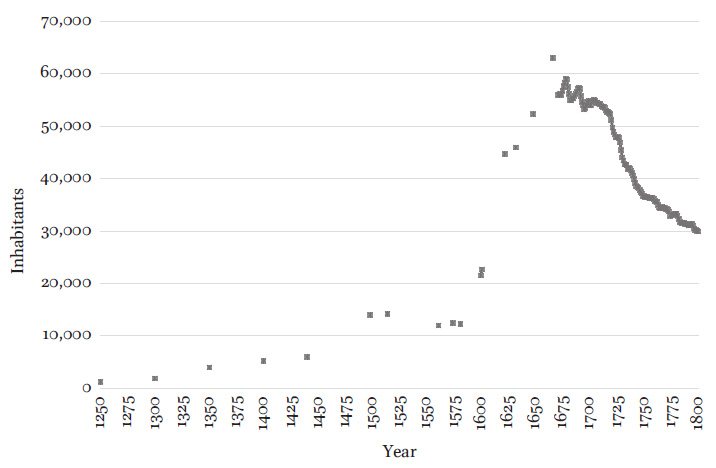
Leiden was one of the largest towns in medieval Holland and played a key role in the economic expansion of the region. Together they formed a poly-nuclear urban system – made up of several closely located towns of moderate size which developed specific economic functions to a certain degree – that remained comparatively un-hierarchical until the ascent of Amsterdam in the sixteenth century. But Leiden maintained its position as the second-largest city of the province in the early modern period.55 Leiden’s growth depended on migration; around 1400 newcomers came mainly from the surrounding countryside, but the city’s economy also lured migrants from the Southern Low Countries and further away from the end of the sixteenth century onwards.56 Together with the other cities Leiden accounted for the exceptionally high urbanisation rate of late medieval and early modern Holland; in the early sixteenth century already an estimated 45 percent of the population of the county lived in cities and towns, and this share would rise to over 61 percent a century later.57 Leiden and its surroundings were a strongly urbanised region from the late Middle Ages onwards.
External factors just as much as the economic fortunes of Leiden explain the phases of demographic growth, contraction and decline, with the result that the correlation between urban demography and economy was not absolute. Leiden’s economy became heavily dependent on the textile sector in the later Middle Ages. The dramatic deterioration of this industry in the sixteenth century due the decline of the medieval Old Drapery and the Siege of 1573–1574, in which some 4,000 people were estimated to have lost their lives, turned around with the arrival of thousands of migrants from the Southern Low Countries. With their knowledge, skill and capital, they stimulated the development of the New Drapery, with which Leiden grew into one of the largest textile producers in Europe. This led to a great economic boom on the one hand, but on the other to a large group of workers being excluded from prosperity. Leiden maintained its status as an industrial city throughout the eighteenth century, but the textile sector was hit hard by the loss of international
Leiden’s premodern growth was not linear, but still the complexity of its society increased incrementally, as did the intricacy and scope of the political and economic structures and networks in which the town became embedded over time.59 Developments in the cloth industry that clearly marked out Leiden from the fourteenth century onwards, for example, can be read as a chronicle of its exchanges with the rest of the world. Jori Zijlmans charts these exchanges in her contribution and shows how internal institutional, organisational and commercial transformations were brought about by shifts in the position of Leiden cloth in the international production and trade networks.
Leiden was a key member of the regional body politic of the county of Holland that was integrated into the Burgundian-Habsburg state in the fifteenth century and was the urban political backbone of the Dutch Republic.60 Both before and after 1574, Leiden was one of the six major cities represented in the States of Holland. Leiden’s constitutional position changed, however, with the Revolt and the proclamation of the Republic of the United Netherlands in 1588. As part of a decentralised state, the city maintained its autonomy and shared power with the province of Holland and the States General in supra-urban matters. In this political constellation, citizenship and participative politics gained a new meaning, as Maarten Prak argues in his contribution, giving broader segments of Leiden’s citizenry – often organised in corporations such as militia and participating in lively public debates61 – a voice in political affairs that went beyond the city’s boundaries.62 The authority of Leiden’s ruling elite to a certain extent depended on the ability of the authorities to deliver key services and govern adequately. Already by the fifteenth and sixteenth centuries, for example, the expenditure on public services per capita had increased, levelling off in the seventeenth century.63 Arie van Steensel argues in his chapter that
This volume aims to transcend the common chronological division between the medieval and early modern periods. The Relief of Leiden in 1574, however, was a turning point not only in political but also in economic and religious matters.64 Again, urban dynamics were driven by broader, interrelated processes, not confined to the urban limits. The Reformation and the split of the Catholic Church changed religious relations significantly. Christine Kooi shows in her contribution how a regime of toleration managed confessional coexistence, as a result of which Leiden’s early modern religious landscape was characterised by diversity. The turbulent years of iconoclasm and warfare made an imprint on the ecclesiastical landscape of Leiden, too. Elizabeth den Hartog explores how medieval churches, chapels and convents were pulled down or, more often, reconverted and given new purposes in this period. The prime example is the continued life of the former chapel of the convent of the White Nuns, which became the Academy building of the university that was founded in 1575.
The town council had considered the fostering of employment and education already in the medieval period. It deemed the Latin school to be important as a place where ‘all youth received their principles to become wise, honourable and worthy of government, by which the good administration, economy and prosperity of towns are maintained’, and encouraged citizens to send their sons to this institution rather than to the various private schools that offered a more practical curriculum.65 Examples of well-read men, situated in urban spaces of knowledge66 and embedded in various cultural and learned circles such as chambers of rhetoric, and who worked tirelessly for the good of the urban community, included town secretary Jan Filipsz (c. 1420–1509) and his later successor Jan van Hout (1542–1609).67 The dissemination of knowledge had a long tradition in Leiden’s history and was important to the city’s development and transformation.
It was at the end of the sixteenth century that Leiden truly became a hub of creativity; the joint efforts of the city council and the university resulted in the arrival of high-quality printers and scholars, contributing to the city’s fame as a centre of academic book production and distribution.68 Leiden also became known for the production of fine paintings, but this cultural industry never became as prominent as in some other cities in the Dutch Republic. Claartje Rasterhoff has demonstrated how the urban factor was decisive in the flourishing of both printing and painting.69 Newcomers gave important impetus to local cultural life. Migrant organisations functioned as channels of cultural transfer and exchange, as Alisa van de Haar and Johannes Müller show, thereby counterbalancing the dominant historical perspective of migration as a story of hardship, expulsion and marginalisation.
The thriving university and the revival of the textile industry, both closely connected to the political and religious upheavals in the last quarter of the sixteenth century, shaped the social relations within the city and its representation to the outside world in the following centuries. Leiden combined the reputation of an industrial city, where capitalist labour relations emerged at an early stage, with that of a university city known both for its culture of knowledge and its cultural impact. The contrast between the proletarian textile workers and the renowned scholars and patrons of the fine arts was stark, expressing the social and economic inequality in the city in the most pressing way. Inequality in the city, however, was expressed in many more ways. Moreover, this dichotomy does not do justice to the diversity among Leiden’s citizens, which was much larger.
Inequality was also reflected in the relative accessibility of other urban institutions. Factors such as socio-economic status and gender, as well as migrant, marital, socio-cultural status or age distinctions, appear to have had an influence, and sometimes in unexpected ways. In the more complex city, social order was an issue of growing concern. Conflict regulation and social control, either exercised by the authorities, churches or among citizens, was dealt with by a broad range of organisations, according to Manon van der Heijden in her chapter on the uses of justice in early modern Leiden. Notwithstanding the absence of formal barriers, civil procedures were increasingly used by men from the upper middle classes, and the poor and newcomers were targeted more often. Thus, legal inequality between Leiden’s inhabitants changed over the course of time, along socio-economic, socio-cultural and gendered lines.
Similar dynamics played a role in the accessibility of the labour market, which was characterised by social as well as gender segmentation. However, to understand the functioning of the early modern labour market, it is not enough to contrast women’s work with men’s work. The importance of the determinants of marital status, migrant background and social embeddedness regarding access to paid work indicates that a more differentiated approach that takes into account the diversity among urban dwellers is crucial, as Ariadne Schmidt argues in her contribution.
This volume lacks a separate chapter on the theme that underlies one of the most fundamental inequalities. For a long time, attention to the colonial and slavery history has mainly focused on port cities or cities with a chamber of the Dutch East India Company (VOC) or West India Company (WIC). Historians are becoming increasingly aware that the local history of other typical industrial cities like Leiden was also intertwined with the history of colonialism and
4 Final Remarks
In many respects Leiden’s medieval and early modern history is typical of other towns and cities in the Low Countries and beyond. The settlement originated around a local centre of power and evolved into a durable urban formation that, on the one hand, made an ecological and economic imprint on the immediate landscape and created more distant hinterlands, and, on the other, was shaped by exchanges within the broader structures and networks of a political, socio-economic and cultural nature in which it was embedded. Within its town walls new communities were formed of various kinds – political, economic, religious and cultural – which offered urbanites and newcomers the opportunity to become part of and create complex human interactions guided by emergent institutions and conventions. From this perspective, the city is fittingly conceptualised as a continuous process of multiple enactments of the urban in concrete, historical-specific practices and spaces. In addition to a focus on the material contexts of urban life – its daily rhythms, the formation of new solidarities and the forging of novel identities – this volume draws attention
To conclude the introduction to this companion, we identify a few starting points for diving into Leiden’s rich archives for future research. The sources are mostly written in Middle or Old Dutch, but they are increasingly accessible through editions and digitisation. First, the sources relating to the political interactions of Leiden in representative institutions, the States of Holland and the States-General, have been collated in edition projects and are available online.74 Next, of great importance to Leiden’s economic and social history is the six-volume collection of sources relating to the textile industry, edited by N.W. Posthumus.75 Third, the Leiden archives provide a rich treasure-trove of primary sources relating to the city’s political, economic, social, religious and cultural institutions and actors, often of a serial character, allowing us to chart long-term developments.76 Some of the older materials have been published, but this is only a tiny fraction of all the materials available.77 Finally, the archives of Leiden University are curated by its library, the map collection of which also contains cartographic sources relevant to Leiden’s history.78 Over the past years, a digital historical mapping platform has been under development,
Bibliography
Blondé, Bruno, Sam Geens, Hilde Greefs, Wouter Ryckbosch, Tim Soens, and Peter Stabel. ‘The Low Countries’ Paradox: Historical Perspectives on Inequality and the City’. In Inequality and the City in the Low Countries (1200–2020), edited by Bruno Blondé, Sam Geens, Hilde Greefs, Wouter Ryckbosch, Tim Soens, and Peter Stabel, 15–42. Brepols Publishers, 2020.
Boer, Dick E.H. de. ‘Die politische Elite Leidens am Ende des Mittelalters: eine Zwischenbilanz’. In Bürgerliche Eliten in den Niederlanden und in Nordwestdeutschland. Studien zur Sozialgeschichte des europäischen Bürgertums im Mittelalter und in der Neuzeit, edited by Heinz Schilling and H.A. Diederiks, 85–109. Köln; Wien: Böhlau, 1985.
Davids, Karel, Bert De Munck, and Ellen Burm. ‘Innovation and Creativity in Late Medieval and Early Modern European Cities: An Introduction’. In Innovation and Creativity in Late Medieval and Early Modern European Cities, edited by Karel Davids and Bert De Munck, 1–35. Farnham: Ashgate, 2014.
Deneweth, Heidi. ‘Renovating Early Modern Leiden: New Perspectives on the Building Trades’. In Building Knowledge, Constructing Histories, edited by Ine Wouters, Stephanie van de Voorde, Inge Bertels, Bernard Espion, Krista de Jonge, and Denis Zastavni, 537–45. Boca Raton: CRC Press, 2018.
Lanen, Rowin J. van, Maurice T.M. de Kleijn, Marjolein T.I.J. Gouw-Bouman, and Harm Jan Pierik. ‘Exploring Roman and Early-Medieval Habitation of the Rhine–Meuse Delta: Modelling Large-Scale Demographic Changes and Corresponding Land-Use Impact’. Netherlands Journal of Geosciences 97, no. 1–2 (June 2018): 45–68.
Rasterhoff, Claartje. ‘Public Spending and Population Growth in Leiden and Utrecht during the Golden Age’. In Serving the Urban Community: The Rise of Public Facilities in the Low Countries, edited by Manon van der Heijden, Elise van Nederveen Meerkerk, Griet Vermeesch, and Martijn van der Burg, 107–34. Amsterdam: Aksant, 2009.
Soens, Tim, Dieter Schott, Michael Toyka-Seid, and Bert De Munck. ‘Introduction: Did Cities Change Nature? A Long-Term Perspective’. In Urbanizing Nature. Actors and Agency (Dis)Connecting Cities and Nature since 1500, edited by Tim Soens, Dieter Schott, Michael Toyka-Seid, and Bert De Munck, 3–25. New York: Routledge, 2019.
Steensel, Arie van. ‘Urban Hierarchies and the Institutional Fabric of Late-Medieval European Towns’. In Urban Hierarchy. The Interaction between Towns and Cities in Europe in Late Medieval and Early Modern Times, edited by María Asenjo-González, Elisabeth Crouzet-Pavan, and Andrea Zorzi, 167–82. Louvain: Brepols Publishers, 2021.
Orlers, Beschrijvinge der stad Leyden.
Verbaan, De woonplaats van de faam, 13, 163–207.
Van Mieris and Van Alphen, Beschryving der stad Leyden. The last two volumes were completed by Daniel van Alphen after Van Mieris’ death.
Van Mieris’s access to Leiden’s archives was restricted, but he published a collection of legal-administrative documents relating to the city in 1759; Van Mieris, Handvesten, privilegien, octroyen.
Blok, Geschiedenis eener Hollandsche stad. He also published an edition of the city’s legal-administrative sources: Blok, Leidsche rechtsbronnen.
Blok, Geschiedenis eener Hollandsche stad, 1:VIII–XII; Tollebeek, ‘De tien jaren van Blok’, 60–63.
Blockmans, ‘Een eeuw geschiedschrijving’.
Van Maanen, Leiden. For the most recent historiographical overview on Leiden’s past, see the contributions to Leids Jaarboekje 100 (2008).
Kooij, ‘Het format van de stad’.
For a recent overview, see the three-volume Cambridge Urban History of Europe, ed. Prak.
Boone and Deneckere, Ghent; Brown and Dumolyn, Medieval Bruges; Blondé and Puttevils, Antwerp.
Blondé, Boone, and Van Bruaene, City and Society.
Schmidt, Mensen maken de stad; cf. Curtis, Van Bavel, and Soens, ‘History and the Social Sciences’.
Tilly, ‘What Good Is Urban History?’
Clark, The Oxford Handbook. Cf. the critical remarks by Jan Hein Furnée, Manon van der Heijden, Karel Davids, Maarten Prak, Willem Frijhoff and Ed Taverne in ‘Dossier: The Oxford Handbook of Cities in World History, Peter Clark (red.)’, Stadsgeschiedenis 9 (2014): 43–70.
Gunn, ‘Urban Agency’; De Munck, ‘Re-Assembling Actor-Network Theory’; Jervis, ‘Assemblage Theory’.
Farías, ‘Introduction’, 8–15.
Ulysses, ‘Complexity Science’. See, for the overlap between the theoretical approaches of assemblages, complex adaptive systems and socio-ecological systems, Spies and Alff, ‘Assemblages and Complex Adaptive Systems’.
Rau, Räume; Colson and Van Steensel, ‘Cities and Solidarities’; Terpstra and Rose, Mapping Space, Sense, and Movement; Rodger and Rau, ‘Thinking Spatially’. See, for a recent (digital) analysis of the uses of Leiden’s town hall, Van Kleij, ‘Van wie was het stadhuis?’
Boone and Howell, The Power of Space; Abrahamse and Deneweth, Transforming Space.
Van den Heuvel, ‘Gender in the Streets’; Nevola, Street Life; Zenobi, ‘Mobility and Urban Space’.
Meinhardt and Ranft, Die Sozialstruktur und Sozialtopographie; Lesger and Van Leeuwen, ‘Residential Segregation’; Lesger, Power and Urban Space.
Lesger, Power and Urban Space, 139.
Noordam, ‘Leiden als ideale stad’, 18.
Leiden is an important case study in the seminal work by Soltow and Van Zanden, Income and Wealth Inequality, on wealth and income inequality in premodern Leiden. See also Bisschops, ‘Ruimtelijke vermogensverhoudingen’; Van Steensel, ‘Measuring Urban Inequalities’; Van Maanen, ‘De vermogensopbouw’; Noordam, ‘Paupers en plutocraten’.
Van Bavel, ‘Wealth Inequality in Pre-Industrial Europe’.
Blondé et al., ‘The Low Countries’ Paradox’.
Lucassen and Willems, Living in the City.
Blondé et al., ‘The Low Countries’ Paradox’, 22–23.
See, in general, for the need for new social safety nets for urbanites in the premodern urban context, Lynch, Individuals, Families, and Communities; Van der Woude, ‘Population Developments’; Laslett, ‘Family, Kinship and Collectivity’.
See, for recent studies emphasising the varied experiences of premodern urban life, Kowaleski, ‘Medieval People in Town and Country’; Rubin, Cities of Strangers; Van den Heuvel, Early Modern Streets.
Frijhoff, ‘Is een globale cultuurgeschiedenis van de stad mogelijk?’
Schrover, ‘Superdiversity’; Crul, Scholten, and Van de Laar, Coming to Terms with Superdiversity.
Cf. Sweet, ‘Introduction’.
Simonton, ‘Gender and the Urban Experience’.
Erickson and Schmidt, ‘Migration’.
Schmidt, Prosecuting Women, 247–55.
Hunt, The Middling Sort; De Groot, Devos, and Schmidt, Single Life.
Crenshaw, ‘Demarginalizing’.
Montenach, ‘Gender and the Underground Economy’, 30; Karlsson Sjögren, ‘Poor Girls’ Schooling’, 78–79.
Soens et al., ‘Introduction’, 19–20.
Coomans, Community, places public health in this field, too. See, for an archaeological and historical perspective on the cesspit in premodern Leiden, Van Oosten, De stad, het vuil en de beerput.
See, for an early contribution to this field: Hoffmann, ‘Footprint Metaphor and Metabolic Realities’; and, more recently, Christophersen, ‘Medieval Urban Environment’. See, for a more theoretical perspective on urban-rural systems, Thomas and Fulkerson, ‘What Makes Urban Life Possible?’
Van Tielhof and Van Dam, Waterstaat in stedenland.
De Boer, ‘De verhouding Leiden-Rijnland’; Brünner, De order op de buitennering; Sluijter, ‘De kaart van Leiden’.
Dijkman, Shaping Medieval Markets, 303.
Van Lanen et al., ‘Exploring Roman and Early-Medieval Habitation’.
Verhulst, The Rise of Cities; Rutte, Stedenpolitiek.
Cf. Brandenburgh and Hessing, Matilo, Rodenburg, Roomburg; Dijkstra, ‘Het raadsel’.
Van der Vlist, ‘Mist over de stad’; De Boer, ‘Die politische Elite’, 84–87.
Versprille, ‘De zegels’.
See, for the development of the built environment, Van Oerle, Leiden; Taverne, In ’t land van belofte. The best-studied street of Leiden from a long-term building history-perspective is Rapenburg, which was added to the town at the end of the fourteenth century but had various functions until the end of the sixteenth century; Lunsingh Scheurleer, Fock, and Van Dissel, Het Rapenburg; Deneweth, ‘Renovating Early Modern Leiden’.
Noordam, ‘Leiden als ideale stad’, 16–22.
Zweep, ‘Haagse groei versus Leidse krimp’, 219–21.
Van Steensel, ‘Urban Hierarchies’, 170; Hoppenbrouwers, ‘Town and Country’; ’t Hart, ‘The Dutch Republic’. See, for the place of Leiden in the wider economic and political structures of the Low Countries, Van Bavel, Manors and Markets; Blockmans, Metropolen aan de Noordzee.
De Boer, Graaf en grafiek, 144–45; Van Bavel and Van Zanden, ‘The Jump-Start’; Noordam, ‘Nieuwkomers in Leiden’; Lucassen and De Vries, ‘Leiden als middelpunt’.
Van Bavel and Van Zanden, ‘The Jump-Start’, 505; De Vries and Van der Woude, The First Modern Economy, 61.
Posthumus, De geschiedenis van de Leidsche lakenindustrie; Moes and De Vries, Stof uit het Leidse verleden.
See, in general, Prak and Van Zanden, Pioneers of Capitalism.
Stein, Magnanimous Dukes and Rising States; Tracy, Holland under Habsburg Rule; Israel, The Dutch Republic.
See, for instance, on Johan and Pieter de la Court’s political-economic writings in the seventeenth century: Weststeijn, Commercial Republicanism.
In contrast to the middling groups, the ruling elite of premodern Leiden has been studied extensively: see Van Kan, Sleutels tot de macht; Brand, Over macht en overwicht; Lamet, ‘Men in Government’; Noordam, Geringde buffels; Prak, Gezeten burgers.
Rasterhoff, ‘Public Spending’.
Groenveld, ‘Korte introductie’.
Santing and Van Steensel, ‘Family, Community, and Sociability’, 85. See, for the option of on-the-job training through apprenticeships in the eighteenth century, Schalk, ‘From Orphan to Artisan’.
Jacob, ‘Lieux de Savoir’. See, for a critical discussion of the notion of urban innovation and creativity, Davids, De Munck, and Burm, ‘Innovation and Creativity’.
Brinkman, Het handschrift-Jan Phillipsz; Brinkman, Dichten uit liefde; Koppenol, Leids heelal; Bouweman et al., Stad van boeken; Bostoen, Hart voor Leiden.
Close links existed between cartographers and surveyors and the city’s (learned) administrative circles in Leiden around 1600, as cartography can also be regarded as part of the creative industries. See, for example, Westra, ‘Jan Pietersz. Dou’; Lilley, ‘Mapping Sites’.
Rasterhoff, Painting and Publishing, 41, 173. See, for the corporate organisation of printers and painters in the seventeenth century: Cruz, The Paradox of Prosperity; Bakker, ‘United Under One Roof’.
Brandon and Bosma, ‘De betekenis van de Atlantische slavernij’.
Oostindie and Fatah-Black, Sporen van slavernij; Ramackers, ‘Daniel van Eijs’.
Van Groesen, ‘The Anglo-Dutch Lake?’; Oostindie and Fatah-Black, Sporen van slavernij, 35–36.
Ramackers, Sow, Schmidt, and Schrikker, ‘Vooronderzoek koloniale en slavernijgeschiedenis’.
Huygens Instituut, Amsterdam, Staten en steden van Holland 1276–1544 (https://www.huygens.knaw.nl/resources/staten-en-steden-van-holland-1276-1544), Resolutiën der Staten-Generaal 1576–1796 (https://www.huygens.knaw.nl/resources/resolutien-der-staten-generaal-1576-1625 and https://republic.huygens.knaw.nl).
Posthumus, Bronnen. Also, accessible online: Huygens Instituut, Amsterdam, Bronnen tot de geschiedenis van de Leidsche textielnijverheid 1333–1795 (https://www.huygens.knaw.nl/resources/bronnen-tot-de-geschiedenis-van-de-leidsche-textielnijverheid-1333-1795).
For an overview of the records, see the online portal of the regional archive, Erfgoed Leiden en Omstreken (ELO): https://www.erfgoedleiden.nl/collecties/archieven. ELO also curates the city’s archeological collection. A list of transcribed or indexed sources can be found on ELO’s website: https://www.erfgoedleiden.nl/collecties/uw-verhalen/uw-verhalen/verhaal/id/279. Some sources are also published on the website of the local historical association: Historische Vereniging Oud Leiden (https://oudleiden.nl/werkgroepen/jan-van-hout-archiefonderzoek). This association also publishes an annual review with articles on Leiden’s history: Leids jaarboekje (https://oudleiden.nl/publicaties/jaarboekje).
Hamaker, De middeneeuwsche keurboeken; Meerkamp van Embden, Stadsrekeningen.
Leiden University Archives (https://www.library.universiteitleiden.nl/subject-guides/leiden-university-archives) and Cartographic Collections (https://www.library.universiteitleiden.nl/subject-guides/cartographic-collections).
Erfgoed Leiden en Omstreken, Historisch Leiden in Kaart (https://historischleideninkaart.nl). A team of volunteers is responsible for data entry and the project is hosted by the local archive. Currently, further investment is required to develop a new platform offering better access to the maps and data. For more background, see Van Steensel, ‘Mapping Medieval Leiden’.