


لا يُضيئ الكتاب حتى يُظلم
The book is bright only when it is dark.
∵
In tenth/sixteenth-century Damascus, the scholar and preacher ʿAbd al-Bāsiṭ b. Mūsā al-ʿAlmawī (d. 981/1573) wrote a book about the merits of striving for knowledge and its transmission. Its last chapter is dedicated to education through books, “the device to [gain] knowledge”, and all the practices related to writing and transmitting texts.1 Finalising the copying of the main text did not necessarily mean the completion of a book. Rather the reverse: the more corrections that were made, the more useful additions such as variant readings, the more explanations and collations with other authoritative exemplars of the same text, the more valued was the manuscript – it embodied the eagerness and endeavour for correctness in transmission, and it embodied the importance of a text. This is why some people said: “The book is bright only when it is dark” (lā yuḍīʾu al-kitāb ḥattā yuẓlima),2 that is, when the page of the main text is darkened with corrections and other texts in the margins and between the lines to improve the quality of the book.
Even though this “darkness” in al-ʿAlmawī’s quotation primarily referred to corrections, it also could be, and in some disciplines definitely was, applied to other marginal annotations, such as commentarial notes. The quotation illustrates that traces of users – or the copyists if they were the ones annotating – were often much appreciated (at least if applied consciously and with care).3 This does not, however, necessarily hold true for precious manuscripts meant to be on display, for example in a mosque. But for many manuscripts to be studied, all these annotations, corrections, comments, and more are a sign of interaction, a space of communication between the main text and the margin, and between the author, the reader, and a future audience. This interaction could potentially occur at one historical moment only; but often it was an ongoing communication that reached across centuries. The margin, as well as the space between the lines, was a place of engagement, of criticism, or learning efforts, as it was a place of memory and repository. One main text at the very centre of the page opened up for a plurality of different voices and responses in the margins or between the lines.
But despite the role that marginal and interlinear annotations have played in intellectual history and the transmission of knowledge, there is a decisive gap in the research when it comes to Arabic manuscripts. Paratexts in general have only been a topic of research from the turn of the millennium on. But publications dedicated to the often highly elaborate marginal texts that paraphrase, explain, interpret, or complement a word or a passage in the main text – the marginal commentaries (Marginalkommentare in German) – are rare. This is where this book comes in: the volume addresses the addition, transmission, and use of marginal commentaries in Arabic manuscripts4 dating from the sixth/twelfth to the fourteenth/twentieth centuries, originating from and circulating in regions from sub-Saharan West Africa and al-Andalus to India, with a major focus on the Middle East. Note that the term “marginal” does include the interlinear space, too, even if this is not always mentioned explicitly. The contributions elaborate on layout, text transmission, teaching and learning environments, and physical circumstances of writing and reading the Arabic script and language in diverse manuscript cultures and disciplines. Guiding ideas in this volume include considerations of how far marginalia differ (both in terms of content as well as layout) with regard to discipline or subject, geographical region, and time, and how to explore the ways of analysing these commentarial annotations.
In order to contextualise the individual chapters of this book under the wider umbrella of marginal commentaries in Arabic manuscripts, and to offer basic introductory information about the impact of these annotations and their codicological features, this introduction aims to provide a basic overview. This maps the field for both students and researchers from academic disciplines dedicated to the Middle East, as well as for manuscript researchers from other academic disciplines. Since a comparative perspective is usually advantageous in contextualising certain phenomena in the wider context of manuscript cultures and practices, a few excursions to works from other academic disciplines will be made. These excursions to non-Arabic material are, however, related only to European manuscript cultures, thus neglecting the many other regional practices. The introduction by no means claims to be exhaustive; instead, it highlights important and recurring phenomena of marginal commentaries in Arabic literatures. The individual chapters are integrated within this overarching scenario.
After a brief discussion of the value given to marginal annotations and the state of research, the introduction addresses the issue of terminology, and lists important functions of commentarial notes in the margin or between the lines. The introduction then presents some basic patterns of practices, and the relation between main text and marginal commentary. In this, it distinguishes between the theoretical guidelines for scribes in normative sources, and the actual phenomena that one can observe in physical manuscripts. Then there is a consideration of new methodological approaches in the field. After this overview there is a brief presentation of the chapters.
The first section of the volume focuses on methodological issues, such as the identification of scribes5 and the dating of entries, as well as matters of classification, with examples from different regions, disciplines, and genres (Liebrenz, Ogorodnikova, Klemm). The following chapters are grouped according to broad academic disciplines: first there are case studies from the field of sciences (Löhr, Schlein), followed by contributions from the fields of history and geography (Danilenko, Liebrenz, Bockholt), and finally there is a section on religious topics (Açıl, Sobieroj, Brinkmann). Even though the volume has a focus on Arabic manuscripts and Arabic marginalia, there are a few chapters that have examples from the Persianate sphere (Danilenko, Bockholt), and one which considers West Africa, including local languages (Ogorodnikova). The book ends with a conclusion.
This volume is but a first step to a systematic exploration of marginal commentaries in Arabic manuscripts. While it tries to address various phenomena of marginal commentaries in manuscripts of different disciplines and regions, it is self-evident that it has its deficiencies that contemporary and future scholars hopefully will address. First, by no stretch of the imagination have all relevant disciplines, geographic regions, or historical time periods been covered. This volume is but a very modest beginning to what will hopefully be much more systematic research in the future. Second, the volume clearly concentrates on text (if we leave aside Nadja Danilenko’s contribution on a geographical work with maps). If we are to understand graphs, diagrams, and images as commentarial elements, then there is a wide field to be systematically explored.6 And third, this book is very much a “male” one. All figures that are identified in the chapters of this volume, be they the authors of the main texts or the annotators, appear to have been male. This does not necessarily exclude female readers and annotators. We know of female students and women acting as teachers, transmitters, calligraphers, and more. We know that there were women who copied books, though comparatively few. Hence, there were surely women who read these annotated books, possibly some who added annotations themselves – but we cannot trace them as long as we do not encounter their names or any other hint that would reveal their gender.
1 The Appreciation of Marginalia in the Eurasian Cultural Sphere
The historical appreciation for marginal and interlinear annotations holds true for European manuscript and book cultures as well as those from the Islamicate world. Arabic lithographs often preserved marginal commentaries in an imitation of manuscripts, as did early European prints. Annotations in European books were prized in sellers’ catalogues until the early decades of the nineteenth century.7 Those books annotated by popular users were especially sought after. That marginalia mattered – and luckily enough matter again after a period of neglect – can be determined from a six-volume edition of Samuel Taylor Coleridge’s (d. 1834) marginalia by George Whalley (1915–1983),8 Roger Stoddard’s exhibition catalogue “Marks in Books, Illustrated and Explained”,9 or the catalogue of Bernard M. Rosenthal’s (1920–2017) collection of early printed books that dedicates substantial space to handwritten annotations.10
In Europe it was not until the nineteenth century, the age of industrialisation and mass production, that the appreciation for traces left by other users was lost. The dislike of such “polluted books” in the nineteenth century turned into something that the bookseller Martin Latham calls “hygiene-fever”.11 Fortunately, some individuals – librarians, booksellers, collectors, and academic scholars – did not lose their curiosity for these scattered voices in the margins of books; the dislike of “dirty books”12 started to fade away in favour of a fascination for used books from the 1970s on. The above-mentioned antiquarian bookseller Bernard M. Rosenthal collected books for 35 years, between 1960 and 1995, focusing on printed books from before 1600. From the outset, he was fascinated by the annotations:
Yet I was now completely captivated, not to say obsessed, by the idea of some day, some day, producing a catalogue of books in which the presence of annotations would not merely be mentioned, but in which the manuscript portions would be ranked on the same level as the printed text and be dignified by proper descriptions which would call attention to and emphasize their importance as primary sources for a great variety of topics.13
Compared to the situation in Europe, print came onto the stage in the Islamicate world at a much later date. In Europe, the first Arabic books printed with movable types were produced in the sixteenth century, with the Medici Oriental Press in Rome playing a major role. Roughly two hundred years later, in the first half of the eighteenth century, such technologies were implemented in the Ottoman Empire: the first Arabic press was established in Constantinople during the reign of Sultan Ahmed III (r. 1115–1143/1703–1730), with İbrahim Müteferrika as the driving figure. But handwritten transmission remained dominant in the Islamicate world well into the thirteenth/nineteenth century14 – and is still practised in some regions like India or sub-Saharan Africa. Similar to the lack of interest in scribal interventions in European print from the late nineteenth century on, there has hardly been any systematic scholarly engagement with handwritten annotations in early printed Arabic books so far.15
A catalogue such as the one produced by B. Rosenthal for his own collection or R.C. Alston’s work Books with Manuscript on books from the British Library16 are, however, the exception to the rule. Manuscript catalogues either completely neglect the existence of marginal annotations, or they simply state that there are some (or many); only in a few cases do they register such a note in its own right, if it was associated with a famous name. There are, for Arabic manuscripts, a few exceptions, such as the catalogue for Arabic, Persian, and Turkish manuscripts at the National Library of Israel,17 where the sources of marginal commentaries quoting from other works have been identified, and the catalogue of Arabic manuscripts at the SS. Cyril and Methodius National Library in Sofia, where the sources of marginal commentaries are identified, even though not always entirely;18 there are also some catalogues of the series Verzeichnis Orientalischer Handschriften in Deutschland (VOHD) that do, at times, identify sources of marginal commentaries,19 but do not do so consistently, and Beate Wiesmüller has similarly done this for some Leipzig and Berlin manuscripts in catalogue entries on the German meta-catalogue Qalamos.20
This is far from being intended as a criticism of cataloguers’ work – hardly any cataloguer in the world has the time to decipher these typically scribbled texts, classify them, and identify their sources, given that the vast majority of them are anonymous, being quotations from other works with no mention of the title or the author of their source.21 But the very fact that catalogues do not register these annotations leaves us with a great loss of cultural history, the knowledge of which texts circulated in the past and of the ways in which the main text was studied.
When I became interested in marginal commentaries, I also started to wonder about the extent to which we might detect interest in or indifference towards these notes by looking at the treatment of the physical margins of books. Did owners – private or institutional – care about these entries when rebinding the manuscripts? In fact, we oftentimes encounter trimmed edges where crucial parts of the marginal annotations were cut and thus lost. With every rebinding, quires shifted and had to be trimmed, and the book block was perhaps adapted to the size of a smaller codicological unit. But apparently some bookbinders tried to consciously spare marginal commentaries by making perpendicular cuts and consecutive folds in the paper, as can be seen in Fig. 0.1.

Marginal commentary spared in a perpendicular cut and consecutive fold after trimming process. MS Leiden, Universitaire Bibliotheken Leiden, Cod. Or. 2747
Photo: Karin Scheper
Unfortunately, there is no systematic study of when and where such an awareness in sparing the marginal annotations during the trimming process can be observed. Indeed, it would be a tricky thing to do, since one would require a defined manuscript collection, or a specific workshop, for which we could, at least to a certain extent, date the local interventions.22
Despite the many actors who did not, or simply could not, pay attention to marginal annotations, a number of scholars have for various reasons started to investigate these handwritten entries during the past decades. It has to be emphasised, though, that the eagerness to explore these marginalia started in academic disciplines such as medieval philology, classical philology, and biblical studies,23 and among booksellers and librarians, each with their own academic background. To this day, research on this topic in Arabic studies is far behind.24
2 State of the Art
As early as 1947, Franz Rosenthal, a pioneer in many topics in Arabic and Islamic studies, drew our attention to paratexts,25 showing their importance and potential for the study of text transmission and the expression of critical opinions.26 But little was done with this until after the turn of the millennium. New and decisive theoretical developments occurred with the many “turns” of the twentieth century – cultural, spatial, and material – that have made us aware of the multiple dependencies of intellectual production and agency.27
In the field of Arabic literature, we have moved away from the isolated text, detached from history, and ideas of a stable Urtext, towards the physical and unique manifestation of texts in manuscripts, and their transmission, rich with variants and depending on many ideological, political, social, cultural, and economic factors. A number of research projects have studied printed books and manuscripts from various perspectives, opening a window onto a vibrant, fluid, and multifaceted landscape of literary production, circulation, and reception. This includes lost works as well,28 and the concepts of Überlieferungszufall (randomness of transmission) and Überlieferungschance (likelihood of transmission).29 Despite the influence of material culture and the New Philology, it took several decades before these approaches gained momentum in Arabic studies. It is especially after the turn of the millennium that we encounter the flourishing of projects and publications.
The coincidental simultaneous financial support of two large-scale interdisciplinary collaborative research centres dedicated to texts and their material manifestations highlights the importance given to this “material turn” in humanities. What is more, the German Research Foundation (DFG) funded both of them from the year 2011. The two centres were the “Collaborative Research Centre (Sonderforschungsbereich, SFB) 950: Manuscript Cultures in Asia, Africa, and Europe (2011–2020)” at the University of Hamburg; and the “Collaborative Research Centre 933: Material Text Cultures at Heidelberg University (2011–2023)”.30 SFB 950 at the University of Hamburg was followed by two institutional follow-ups: the Centre for the Study of Manuscript Cultures, and a Cluster of Excellence “Understanding Written Artefacts”.31 Needless to say, paratexts played a crucial role in both projects.32 Other projects are looking at different, though related, topics. The registration of documentary notes (e.g., names, places, dates) in manuscripts with Arabic texts is central for the project “Bibliotheca Arabica” (2018–2035) at the Saxon Academy of Sciences and Humanities. Combined with data from manuscript catalogues, the transmission and reception of Arabic works can be mapped in time and space.33 With similar questions in mind but different geographical and chronological focuses, are the projects “Nomads’ Manuscript Landscape” (2020–2025), a project that tries to reconstruct the production and transmission of works – Arabic, Persian, and others – in Iran and Central Asia from the thirteenth to the fifteenth century CE;34 and “Beta maṣāḥǝft: Manuscripts of Ethiopia and Eritrea” (2016–2040), which considers Christian texts produced and circulating in Ethiopia.35 With a clear interdisciplinary outlook, the project “Textual Practices in the Pre-Modern World: Texts and Ideas between Aksum, Constantinople, and Baghdad” took a comparative view of textual practices from late antiquity on.36
When it comes to publications, general reading and writing practices, embedded in social and cultural history, have come to the fore with publications such as Konrad Hirschler’s The Written Word in the Medieval Arabic Lands: A Social and Cultural History of Reading Practices,37 the numerous publications of the above-mentioned research clusters, and more. Most publications that focus on marginal and interlinear annotations examine a wide range of paratexts, from sigla, corrections, and titles, to nota bene markers. Research on documentary notes such as different licences for transmission (ijāza) and audition certificates (samāʿ), reading notes (muṭālaʿa), ownership marks (tamalluk/tamlīk), seals, and deeds of endowment (waqf) has begun to thrive, tracing a manuscript’s history and the agents and places involved.38 Comparatively few publications, however, concentrate on what we are calling marginal commentaries here.
Examples for publications addressing a range of different marginal annotations are Emilie Savage-Smith’s article “Between Reader & Text: Some Medieval Arabic Marginalia” (2005), where she elaborates on a wide range of marginalia, from birth certificates to ijāzāt,39 and marginal commentaries of different types.40 Taking a similar broad approach to paratexts, Florian Schwarz has studied a number of manuscripts with marginalia authored by members of a family from the otherwise comparatively unknown border region of the central Ottoman lands, Kurdistan, and the Safavid Empire during the seventeenth and eighteenth centuries. Analysing the paratexts, he was able to reconstruct teacher-student relations, centres of learning, topics taught, circulating literature, and networks of scholars in general.41
Other scholars have concentrated more on what we call marginal commentaries. Walid Saleh stresses the importance of studying glosses (in the sense of marginal commentaries) for the genre of Qurʾan commentary (tafsīr), gaining a better understanding of the development of the genre and intellectual discourse.42 Dmitry Bondarev’s research on marginalia in Qurʾan manuscripts from the sub-Saharan Borno Sultanate (15th–17th cent.) investigates a corpus of Qurʾan commentaries with which the qurʾanic text was studied.43 In a similar vein, Gregor Schwarb examines marginal commentaries in a single manuscript, thereby offering insights into theological studies (kalām) in the Shiʿi Zaydī community in Yemen from the mid-fifteenth to the early eighteenth century.44 And ʿAbd al-Laṭīf b. Muḥammad al-Jīlānī addresses marginal commentaries (ṭurar, ḥawāshī) in Maghribi manuscripts, their impact for research, their terminology, and the difficulties in dealing with them.45
As these few examples illustrate, publications on marginal commentaries in Arabic manuscripts often relate to religious literature, such as the Qurʾan, hadith (sg. ḥadīth, pl. aḥādīth), theology, or legal texts.46 This might not come as a surprise as these types of literature are usually the most annotated ones in manuscripts.
3 Terminology
3.1 Terminology: General
Before opening up to a larger picture of marginal commentaries, it is important to discuss terminology in order to delineate the common ground for this introductory chapter and the following individual contributions. Terminology is a tricky field since its use is not entirely consistent, neither within different manuscript cultures nor in manuscript studies in general.47
First, if we speak of manuscripts in this volume, it relates to the most common understanding of this term, namely manuscripts in book form (codex) made of paper.48 Obviously, the term manuscript covers much more, namely everything unique that is handwritten on a portable object. For this first edited volume on marginal commentaries in Arabic manuscripts, though, it makes sense to concentrate on one physical representation of manuscripts, namely books made of paper, since other formats and materials would require their own categories.
Second, in order to differentiate between the main body of text and the marginal or interlinear commentaries, the central body of text on the page is called the main text, base text, or primary text, filling the central writing area of the page.49 This applies to this introduction as well as to most contributions in this volume.
Third, difficulties arise when discussing terminology for the marginal annotations or marginalia. For the contributions in this volume, intentionally, no guidelines were given, and thus the use of terminology is deliberately not consistent. Some contributors do, however, elaborate on their use of terminology, as Darya Ogorodnikova does. More generally, there is only common ground to a certain extent for the use of English terminology relating to marginal and interlinear (or intralinear) annotations in Arabic manuscripts. This differs somehow from other academic disciplines such as medieval or classical philology. With regard to Arabic manuscripts, Adam Gacek explains the term “marginalia” as any material found in the four margins outside the text proper in his Vademecum for Readers.50 Andreas Görke and Konrad Hirschler opt for a wide approach using “manuscript note” for any (additional) written material relating or not relating to the main text.51 The Centre for the Study of Manuscript Cultures at the University of Hamburg has “paracontent” (including images, etc.) and “paratext” (textual elements) to refer to any visual and textual element in a manuscript in addition to the core content(s).52 Paratexts are, in turn, divided according to their function, namely structuring (e.g., by titles or notifiers), documenting (e.g., ownership notes), and commenting. It is within this very last category that the present volume is situated.
Fourth, the trickiest term is definitely “gloss”. In his Vademecum for Readers, Gacek states that “a gloss or scholium (pl. scholia) is a marginal comment and/or interlinear annotation referring to and explaining a word or group of words in the main text”.53 A similarly wide connotation is provided by the Oxford English Dictionary, where “to gloss” means: “1. a. trans. To insert glosses or comments on; to comment upon, explain, interpret […]; b. intr. To introduce a gloss, comment, or explanation upon a word or passage in a text […]”.54 But in a strict sense, a gloss translates or explains a foreign word. In a medieval European manuscript this would be a translation, or short lexicographical explanation, of a Latin word or group of Latin words into a vernacular language; at times, a synonym or short explanation in Latin may also occur. These glosses would usually appear in the margins of the page or between the lines. Hence, they refer to short lexicographic units, not to other types of explanatory notes or complementing information. In many publications, though, “gloss” is applied to both, to the linguistic translation unit as well as to marginal commentaries. What is more, in some publications, the term “gloss” appears to refer not only to a marginal annotation, or what we call marginal commentary, but also to stand-alone commentary or super-commentary; this rather confusing use of terminology is paralleled when it comes to the Arabic term ḥāshiya, as will be discussed below. The key problem is that both these words, gloss and ḥāshiya, at the same time allude to content (e.g., comment) and to visual aspects (the margin), and the relation between these two is not systematic.
3.2 Terminology Applied in This Introduction and a Number of Contributions
By intention, this volume does not address all kinds of marginalia but concentrates on marginal commentaries. In order to define the term “marginal commentaries” as used in this volume within a broader set of terms, the following categories are used in this introduction (as well as in the contributions of Boris Liebrenz, Nadine Löhr, and Verena Klemm, and my own):
Marginalia or marginal annotations: The term “marginalia” (or “marginal annotations”, including interlinear ones) is the generic term for any kind of annotation (visual and textual) in the margin, or between the lines. These annotations relate to the copying, studying, and transmission of the text, and include glosses, marginal commentaries, corrections, collation marks, variants, notabilia markers, and more.
Manuscript notes: “Manuscript notes” are documentary entries that relate to the production, transmission, and use of the book in which they appear, giving evidence for agents involved, dates, and places (owners, readers, and transmitters, e.g., in audition certificates (samāʿāt); etc.). The documentary elements are names, places, dates, or prices for books, and they mainly refer to who is producing or using the manuscript.
Glosses (marginal, interlinear) and variants: “Glosses” are understood here as shorter lexical annotations such as translations, synonyms, or short lexical explanations; that is, entries relating to lexicography. These annotations might be extended by notes on vocalisation. From here, some annotations add additional information about known readings from a textual tradition. Such variants might intersect with marginal commentaries.55
Marginal (or interlinear) commentaries: The final term is the “marginal commentaries” to which this book is dedicated. These are (often longer) passages of notes in the margin or between the lines, paraphrasing, explaining or interpreting, illustrating, supplementing or complementing, specifying, or criticising, a word or a group of words in the main text. This includes commentarial annotations reacting to other marginal commentaries. Unlike manuscript notes, where the focus is on who has used the manuscript, marginal commentaries elaborate on how the main text was studied. A synonym is “commentary glosses”.
The term “scholium” that I have applied elsewhere56 is avoided here. This is not because it is taken from another manuscript culture, since such transfers of terminology happen in other cases, too, such as in the case of “paratext”. But the term “scholium” is much more connected to a stable textual tradition with which to study the main text, while such curricula-like marginal commentaries are, in general, less represented within Arabic Islamicate culture. This does not exclude the study and glossing of a main text with a more or less fixed set of other works quoted in the margins in specific regions, times, and disciplines. And obviously, there were popular and widely circulating works used for annotation. But the variety of such source texts seems larger than that in, for example, Biblical Studies.
The borders between the above-mentioned terms are at times fluid, and as always, theoretical concepts help classifying but do not necessarily include all actual scribal practices and the many diverse types of marginal annotations that one can encounter in the margin or between the lines. There are, for instance, a number of sigla that have a commentarial function, and are thus, partly, represented in this volume on marginal commentaries: Nadine Löhr discusses various sigla in astrological texts – single signs that embody a body of literary references or textual interrelations, and thus have a commentarial function.57 A correction that apparently substitutes a Zoroastrian temple with a mosque shows the fluid border between corrections and commentarial gesture in Florian Sobieroj’s chapter.58
As mentioned before, marginal commentaries do imply to an overwhelming extent textual annotations in this volume. But obviously, images, graphs, and diagrams have commentarial functions, too, and they can be abundant in scientific manuscripts (see Fig. 0.2). Nadja Danilenko discusses the commentarial role of maps in manuscripts of al-Iṣṭakhrī’s geographical work – the only contribution on images as potential marginal commentaries in this volume.59
Illustrations in a manuscript of mathematics (al-Ṭūsī, Naṣīr al-Dīn Muḥammad: Taḥrīr uṣūl al-handasa li-Uqlīdis). MS Leipzig, Universitätsbibliothek, Cod. Arab. 21, fol. 4v.

3.3 Terminology in Arabic
When it comes to Arabic terminology, the wider term for marginal annotations is usually hāmish (pl. hawāmish), while marginal commentary is ḥāshiya (pl. ḥawāshī; ḥāshiya is also simply the term for the “margin”60 ). The marginal annotation is sometimes superscribed with the term ḥāshiya, the letter ḥā’, or alternative terminology (see the table below, and Fig. 0.12). It can, at times, be confusing that the term ḥāshiya is also applied to a stand-alone commentary, a super-commentary, or a super-super-commentary (on so forth). There is no consent (and no broad systematic research) on the question whether a stand-alone ḥāshiya commentary is called such because it is based on previous marginal commentaries in manuscripts – while suggested, this has so far not been proven. It is also not yet clear to what type of commentary the term ḥāshiya is usually applied, in terms of length or content. But it seems to appear in many (though by no means all) cases as super-commentary or super-super-commentary. A more properly line-by-line commentary is usually called sharḥ (pl. shurūḥ). To add to the confusion, the term ḥāshiya is often translated into English as “gloss”, and hence, a gloss can signify what we call “marginal commentary” in a manuscript, as well as a (short) commentary or a super-commentary.61
However, we do sometimes encounter the term sharḥ in a manuscript indicating a marginal commentary). Other terms are taʿlīq (something attached) and fāʾida, in the sense of “something useful to know, or add”. Semantically closest to ḥāshiya is the term ṭurra (pl. ṭurar). It can, among other meanings, designate both the margin and marginalia, as is the case with ḥāshiya.62 The term ṭurra is claimed to be more in use in the Maghreb, as ʿAbd al-Laṭīf b. Muḥammad al-Jīlānī points out: “People in the Maghreb call the ḥawāshī in books ṭurra, and the ḥawāshī or the hāmish or the ṭurra is what is written in the empty space in the margins of the page.”63 I do not follow al-Jīlānī, though, when he states that a ḥāshiya would signify (mainly) a sharḥ commentary covering at best the entire base text, while ṭurar were added as (scattered) single notes throughout the text.64 As Walid Saleh states with regard to the glosses (ḥawāshī) on al-Zamakhsharīʾs Qurʾan commentary al-Kashshāf: “The nature of many of the glosses is more in the manner of taʿlīqāt, that is, they are not a running commentary, or a gloss on every aspect of al-Kashshāf, but rather they tackle certain specific points.”65
In Arabic manuscripts, we thus meet the terms and abbreviations presented in Table 0.1.66
Terms and abbreviations in Arabic for concepts related to marginal annotations

4 Reconstructing the Past – the Significance of Marginal Commentaries
The UK bookseller Martin Latham – who spoke about the “hygiene-fever” of book markets in the late nineteenth century and through most of the twentieth century, which rejected any kind of annotation in books – calls upon us to annotate our books because these notes are part of our afterlife: “Let us DNA our books. One day they may be all we leave behind.”67 What, then, is the DNA that marginal commentaries can reveal? We get snapshots from the past in each single annotated manuscript that might, taken by itself or merged together with the findings from other manuscripts, tell us something about the transmission and reception of texts and works in different places and at different times, and their place in intellectual history. If we are able to find hints, even if only approximate, to the region and time where and when a manuscript was annotated, we might be able to say something about the circulation or even the popularity of a specific work at given times and in different regions. In my chapter on al-Baghawī’s hadith collection Maṣābīḥ al-sunna, I show that this collection was mostly studied with the texts of its own commentary tradition in a Mongol and post-Mongol setting of thirteenth–fifteenth-century Iran, Iraq, and Adharbayjan. This relates both to the production of important commentaries that are repeatedly cited in the margins of the Maṣābīḥ al-sunna manuscripts and to the production of the manuscripts. Furthermore, if we were to find out who added the marginal commentaries in a manuscript, we might get an impression of the readership of the work contained therein, their gender, social status, and the like.
4.1 Teaching Environments and the Transmission of Texts
Marginal commentaries are a treasure trove for questions relating to the transmission and reception of works. They can tell us something about learning and teaching environments, namely, which texts were used to study the main text, and hence potential traditional streams of transmission in education. One might use the term “curriculum” here, but the body of works that was used to study one central text usually seems less stable than in many European contexts. This does not eliminate the possibility to reconstruct clusters of certain tradition streams. For example, in his 2019 publication mentioned earlier, Dmitry Bondarev examines the familiarity and popularity of certain qurʾanic commentaries (tafsīr) in the early sub-Saharan Borno Sultanate (15th–17th cent.).68 He is able to show that certain commentaries were much in use to annotate manuscripts of the Qurʾan in the empire that covered parts of today’s northern Nigeria, Niger, and southern Sudan.69
There are examples of a similar kind in this volume. Deborah Schlein analyses marginal citations in medical manuscripts and explores the textual reception and medical education of the Graeco-Arabic medical tradition in Mughal and colonial India. She points to recurring works cited in the margins, and illustrates how users studied the main text. Within the multilingual context of India, this includes the issue of languages used for the annotations, above all the relation between Arabic and Persian. Similarly, in her chapter on marginal and interlinear annotations in manuscripts in Arabic and local languages from greater Senegambia from the eighteenth to the twentieth century, Darya Ogorodnikova offers a classification of the different types of annotations and exemplifies annotating practices. These practices reflect reading and studying processes of different textual genres. While annotators would usually quote other authorities in the margins – previous stand-alone works, or instructions of teachers – and only rarely their own opinion, the sheer choice of what to quote in the margin leaves an individual imprint on the manuscript page.
Some types of marginal commentaries do reflect concrete teaching sessions: some annotations were undoubtedly taken directly during teaching sessions. These might be personal notes in a private copy, or a mass of entries in numerous hands over a longer period of time. Some notes might have been taken during lectures on an extra sheet of paper to be added in a more careful way to the proper manuscript in a second stage.70 Both scenarios could be labelled as classroom notes. The typical setting for such teaching sessions would be a teacher, or master, or shaykh reciting a text (and possibly explaining it), with students listening, taking notes, and at times having the possibility to ask questions. Since memorisation of texts was highly regarded, repetitors could reread a text previously presented by the teacher. This setting was valid – obviously with geographical and temporal variations – for all fields of knowledge, from the religious disciplines to the sciences.71 It is known that some disciples of scholars had the task of taking notes from their masters’ lectures, presenting them to the master who later on might revise them and turn them into a stand-alone work. The genre of commentary is surely tightly connected to this practice.
In other cases, annotations might have been chosen deliberately from different sources, selected at times with great care and preparation, in a more private context. The function of such a manuscript could involve teaching, but it might also serve as a repository of the relevant text. The two functions, teaching and learning as well as repository, are not mutually exclusive, and the original reason for annotating a manuscript might change at a later stage. We encounter such a potentially multifunctional situation in the manuscript that is presented by Florian Sobieroj. This manuscript contains commentaries of the Shīrāzī scholar Ibn Khafīf (d. 371/982) on the special properties of qurʾanic verses and prayers for different occasions. In the interplay of the choice of prayers, the commentaries within the main text, and those in the margins or between the lines, Sobieroj detects strategies to propagate the esteem in which the prayers were held and to invite others to learn and implement them. The concrete settings of its use within a wider context of hadith and Sufism remain unknown, however.
4.2 Intellectual Discourses in the Margin
The margin is a place of dispute, of criticism, of engagement, and of attitudes that reveal much about contemporary intellectual discourse. Marginal commentaries can convey a mental map of the reading of individual readers or of communities. In his study on manuscripts of the book of Revelation, Garrick Allen showed that the interpretation of the Beast in Revelation 13:18 and its number 666 as symbolising the prophet Muḥammad reflects the encounter between the Christian-Latin West and the Muslim Ottoman Empire, especially after the fall of Constantinople in 1453.72 And through the study of marginalia, William H. Sherman was able to show that the way in which John Dee (1527–1608 or 1609) – scientist, mystic, and philosopher of the English Renaissance – was known and presented was partly wrong or at least incomplete:
However messy, modest, and (as it were) marginal they at first appear, it is no exaggeration to say that Dee’s marginalia are central to the recovery of his intellectual activities and, indeed, his role in society. In terms of the intellectual historian’s traditional search for sources and influences, the marginalia allow us to move beyond and exclusive reliance on his library catalogue, which is not at all an adequate basis for discussion.73
Other scholars have specifically hinted at critiques on translations, from Greek to Arabic, for example, displaying improved translations in the margin.
In this volume, Verena Klemm explores the possibility of personal agency in a notebook compiled by the Ismaili scholar Muḥammad ʿAlī al-Hamdānī (d. 1315/1898) from northwest India on two levels: the selected excerpts that make up his primary text, and parts of his marginal commentaries. Berat Açıl discusses the marginal annotations of the Ottoman scholar Cārullāh Efendi (d. 1151/1738) on the mystical concepts of Ibn ʿArabī (d. 638/1240), contextualising them within the larger intellectual debate about Ibn ʿArabī’s teachings and Sufi and anti-Sufi movements in the Ottoman Empire of the seventeeth and eighteenth centuries. In Boris Liebrenz’s contribution “Partisan Margins”, we encounter an Ottoman annotator in the margin who not only criticises the way the Mamluk chronicler Ibn Iyās (d. after 928/1522) depicted the Ottoman sultan and the Ottoman conquest of Egypt, but how this annotator at times adds furious comments in the margin.
4.3 Reading and Writing Practices
While we encounter critical attitudes in some of the above-mentioned annotations, other marginal commentaries do reveal the transcultural transmission and at times intercultural fusion of reading and writing practices. This becomes most evident in scientific manuscripts. The reception and translation of works written in, say, Greek or Syriac, are only one part of this process of transmission. In her chapter on “Annotation Systems and Symbols in Arabic Manuscripts on Astral Sciences”, Nadine Löhr shows the wide-ranging exchange of cultural practices from Iran to al-Andalus, and the adaptation of manuscript practices from Greek, Syriac, Latin, Hebrew, and Judaeo-Arabic to Arabic manuscripts. And Deborah Schlein elaborates on the transfer of Greek medical knowledge via its Arabic adaptation to Mughal and colonial India, and its reflection in the main text and the marginalia, which are mainly written in Arabic but at times also in Persian.
4.4 Editing a Text
Marginal commentaries can furthermore take us back in time to observe the editorial work of an author. We can observe the author annotating and revising his or her own work, as in the autograph copy of Tanqīḥ alfāẓ al-Jāmiʿ al-Ṣaḥīḥ, a commentary on al-Bukhārī’s Ṣaḥīḥ written by Muḥammad Badr al-Dīn al-Zarkashī al-Shāfiʿī (794/1392), with many marginal and interlinear annotations in his own hand.74 Such autograph marginalia could be copied alongside the main text, and at times these entries would be labelled as minhu (from/by him), that is, written by the author of the work.75 Such minhiyyāt entries (or minhuwwāt, as they also appear in Arabic works) can be citations from other works by the author of the main text, or the copy of a commentarial note by the author from another manuscript. With the copying of such minhiyyāt, we not only get an impression of an author’s thoughts about the main text, but also a device to trace the transmission of a work – as Philip Bockholt shows in this volume with the example of minhiyyāt in manuscripts of the Persian historiographic work Ḥabīb al-Siyar, written in early sixteenth-century Iran by Ghiyāth al-Dīn Muḥammad Khvāndamīr (d. ca. 942/1535–1536).
4.5 Storing Knowledge
Last but not least, the margin of a manuscript can function as a repository for a text (or parts of it). In fact, at times it is the only place where a text, otherwise lost, has survived. The margin offers space for complete commentaries, or selected citations from forgotten or neglected texts that perhaps were once popular, but that only come down to us today if we move away from the main text into the margin of the manuscript. In some cases, we can assume the margin to have been planned as some kind of archive for the text to be transmitted: the running text of the ḥāshiya in MS Istanbul, Köprülü Library, Fazıl Ahmed Paşa, 449, lavishly decorated in the margin with alternating geometrical ornamentation from double page to double page, was surely intended as a repository. In other cases, the survival of a text (or parts of it) in a margin was not the main intention when the scribbled notes were added in the past. But today, these study notes from bygone centuries can be all that is left to us from a once complete and circulating work.
5 Marginal Annotation and Discipline
Based on our experiences, manuscripts of the disciplines that were taught, at least to a large extend, in an institution76 – such as religious sciences at madrasas or in private circles, or sciences such as astronomy in observatories – do in general show many more annotations than those that were taught and transmitted in other ways, such as geography or history. Future research will hopefully provide a more solid picture based on quantitative analysis.
Key to Islamic culture, and linked to institutionalised education, are disciplines and subjects like hadith, Qurʾan and tafsīr (exegesis), law, theology, and Arabic grammar (and less so lexicography). Thus these are the most annotated disciplines. Still displaying substantial annotations are manuscripts from the fields of sciences and philosophy. Furthermore, all these are disciplines for which the comparison of texts and the collation of manuscripts were of utmost importance.
In general, adab and poetry, as well as technical treatises, might be considered to have a middle position in terms of marginalia. Less annotated are works on crafts, history, and geography. This is partly also valid for the Qurʾan – a text that conversely embodies the genesis of standardisation through the insertion of multiple previous paratexts such as reading advice or variants. When it comes to the central text of the Qurʾan, we find annotated manuscripts including lexical glosses in different local languages and commentary glosses, as well as ones with little or no annotation. Precious, illuminated, high-quality manuscripts were usually less annotated than those used for studies and private reading. There are undoubtedly also regional differences to be considered, given the vast extent of the Islamicate world. Many West African Qurʾan manuscripts, for example, are intensely annotated, mainly with citations from tafsīr works and glosses in local languages. But we lack a clear picture of the density of annotation in relation to region, time, and the quality and use of the manuscript (if there is a clear pattern at all). A future comparative study of Qurʾan manuscripts from different settings of usage, time periods, and regions in relation to the level and type of marginal annotation would give us a better mapping of these practices.
The high quality of manuscripts, possibly including book painting and illuminations, surely also had an effect on the avoidance of too many annotations. Nadja Danilenko concludes her chapter on manuscripts of al-Iṣṭakhrī’s geographical work with the hypothesis that there are relatively few annotations because this text was not for “public” use, that the painted maps in it were for display rather than the concrete study of geography being the object.
The chapters in this volume reflect these general (and much generalised) patterns of annotation, even though they are only single snapshots from the incredibly rich and diverse manuscript cultures of the Islamicate world.
6 Types of Marginal Commentaries: Content, Scribes, and Reader
There are two central issues when it comes to the study of these marginal and interlinear commentaries. As has been stated, marginal commentaries in Arabic manuscripts are largely non-documentary and anonymous. There is no name, no title, no date, no place. This creates challenges in terms of our knowledge both of the scribe and of the source of the note.
6.1 The Scribe
The vast majority of marginal commentaries have no scribal signature; only very rarely does a scribe sign his marginal comment (an example can be seen in Fig. 0.3). In those rare instances where we encounter a scribal name in connection with a marginal commentary, we still might face a problem in identifying the person – especially if he is someone called Aḥmad b. Muḥammad, of whom there were millions. But through the meticulous registration of names and the establishment of interconnections by various means, Boris Liebrenz shows in his contribution “Putting Margins in Context” that, in some cases, we can identify certain scribes in the margin who would otherwise remain anonymous.77 In some cases, palaeography helps in creating relations between single annotations in different manuscripts.
A rare example of a scribe signing the marginal commentary: kātibuhu Aḥmad b. Ḥasan b. Isḥāq (“the scribe of it, Aḥmad b. Ḥasan b. Isḥāq”). MS Berlin, Staatsbibliothek zu Berlin, Glaser 181, fol. 2r
6.2 The Identification of the Source
Related to the anonymous nature of many marginal commentaries is the question of the extent to which the entry represents the genuine and individual voice of the annotator as opposed to the scribe simply having copied excerpts from one or several stand-alone works, or an oral statement, into the margin.
Only a minority of marginal commentaries are genuine individual and personal comments. In Boris Liebrenz’s chapter on a “Partisan Reader”, we find an individual voice complaining about the description of the Ottoman ruling elite in a Mamluk historical text that describes the Ottoman conquest of Egypt in the early tenth/sixteenth century. This critical assessment in the margin is at times rather emotional, calling Ibn Iyās an ignorant historian and a liar.78 This differs from the more sober, “academic” annotations of the Ottoman scholar Cārullāh Efendi (d. 1151/1738) in manuscripts with works by and about the mystic Ibn ʿArabī (d. 638/1240), as Berat Açıl shows in his contribution. In fact, personal and emotional marginal commentaries are very rare across all genres of Arabic literature.79 There seems to have been some kind of ethics at work in the margin, an etiquette fostered possibly in part by the very fact that books were often “shared”, either through their accessibility in libraries and madrasas, their exchange among scholars, or the lending of books. Statements that were too polemical could be criticised in the margin by other readers. A systematic analysis of such ethical attitudes towards marginalia remains a desideratum.
We might retrieve the information, or at least suspicion, that an annotation was written as a personal comment through being provided with a scribal name, or possibly even by stylometry. However, given that most marginal commentaries are anonymous, it can be difficult to claim that a marginal comment is a personal and genuine one: it might be a citation from a text unknown to us today.
And in fact, citations from other stand-alone works are by far the most frequent type of marginal comment. In many cases, however, scribes do not deem it important to add the source from which they quote. There might be a number of reasons for this, such as the knowledge of the sources being assumed in the social and educational contexts where these texts were circulating and studied; or the very fact that connecting the marginal entry to an author and a work was simply not considered important. In my own contribution, I briefly exemplify the difficulty in working with marginal commentaries and this lack of source information. The future use of digital tools and AI will, however, change the situation. Even as this volume is being produced we can observe the beginnings of these powerful tools that will alter, at least to a certain extent, the approaches we use today, creating opportunities for the analysis of huge data sets.
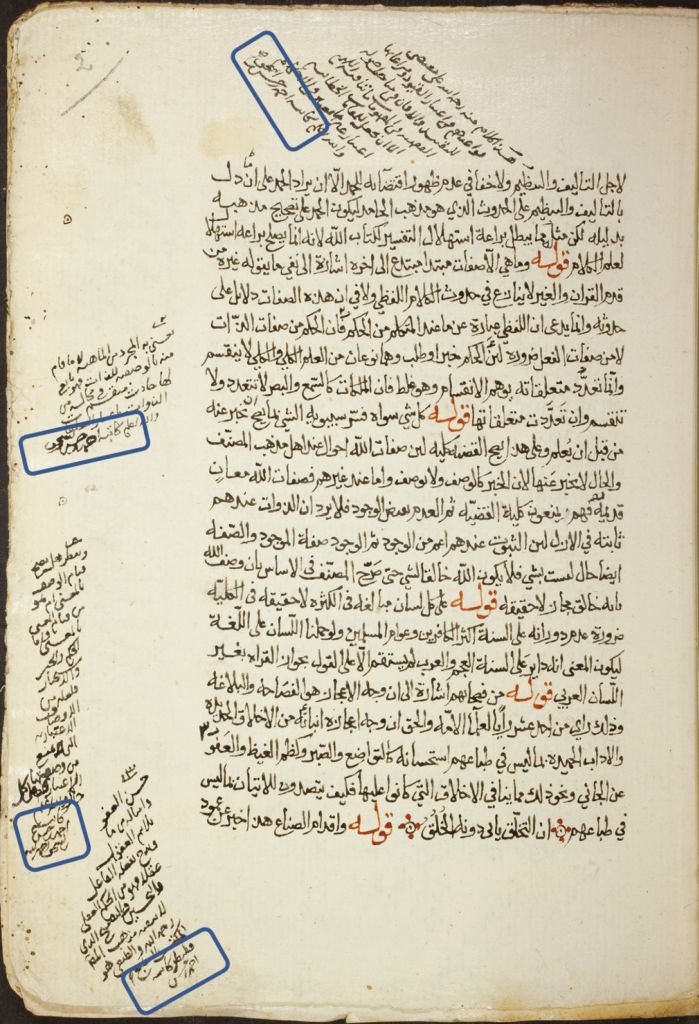
In the typical example seen in Fig. 0.4, the scribe did not deem it necessary to provide the reader with information about the source from which he (she?) took the quotation. Only comparatively rarely is the source mentioned, either by writing the (shortened) name of the author or the title of the work after the marginal commentary (Fig. 0.5 and 0.6), or by introducing the comment with “so-and-so said” (qāla X). Sometimes, in contexts where the authorship of a source was part of shared knowledge, the author was only alluded to by a single letter.80
Marked rectangle: Citation from the commentary of al-Tūrabushtī (or: Tūrānpushtī, d. 661/1263) without mentioning the commentator. MS Paris, Bibliothèque nationale de France, 6606, fol. 4v

The marginal commentary has a shortened title below, Fatḥ, indicating that the citation is from Ibn Ḥajar al-ʿAsqalānī’s (d. 852/1449) commentary Fatḥ al-Bārī. MS Vienna, Österreichische Nationalbibliothek, Glaser 30, fol. 2v. With the kind permission of the Österreichische Nationalbibliothek

The author “al-Zarkashī” (Badr al-Dīn al-Zarkashī, d. 794/1392) is mentioned at the beginning of the note in a manuscript of al-Bukhārī’s Ṣaḥīḥ. MS Leipzig, Universitätsbibliothek, B. or. 227, fol. 45v

All this confronts the person studying marginal commentaries with the tedious task of identifying the texts in the margin – a task that includes many obstacles, one of them the very fact that many works that could be the source of a citation are not available in print, are not known or accessible in manuscript form, or are simply lost. Furthermore, a citation in the margin may not derive from another written text – the marginal commentary could also be grounded in oral teaching, as Darya Ogorodnikova exemplifies in her chapter.81
6.3 Further Questions
Apart from the two major categories of marginal commentaries, namely citations (from another work, or a teacher, or another authority) and personal, individual notes, there is an array of questions to be followed up in order to reconstruct reading and writing contexts. The first of these relates to the social context of adding and reading marginal commentaries in a manuscript, above all, the access to the manuscripts.82 Were these marginal commentaries found in “classroom manuscripts”, meant to be read by others by making the books accessible in a library, discussing them in a madrasa or in scholarly circles, and the like? Or were they kept as private possessions to be read by their owners?
The second issue is that of the level of production. Were the annotations part of the manufacturing process of the manuscript, or do they represent later, post-production layers of additions?83 Was there only one scribe annotating a work, or were several hands involved? And if they were many: do the annotations reveal some kind of planned undertaking – a shared activity, such as in a workshop – or do they represent a dynamic growth of different hands over longer periods of time?
The third issue considers the direction of communication. Does the scribe of the marginal commentary refer exclusively to the main text, or does he (or she) refer to another marginal entry? Do annotators react to each other in the margin? In short: which direction or directions does the communication between main text, marginal commentary, scribe, and reader take?
7 Types of Marginal Commentaries: Layout and Visual Features
Visuality plays a crucial role in our perception of a manuscript page and of a book as a whole. Thinking of marginal and interlinear annotations on the page, the simultaneous appearance of main text and marginalia side by side seemingly makes the person who has added the notes more of an equal partner to the person who wrote the main text. According to some, footnotes radically change this impression,84 not to mention endnotes that banish the annotator’s voice to the very hidden end of a book. In a European context, Lipking and Tribble observe this change of hierarchisation from the early eighteenth century on. Glosses began to decline in the late seventeenth century,
associated as they are with residual medieval notions of authorisation (in which the author is authorized by others, by his place in a relatively undifferentiated tradition). In the later seventeenth century and the eighteenth century the footnote begins to dominate, a form that promises – but does not necessarily deliver – a hierarchisation of knowledge, a firm subordination of text to subtext.85
Approaching marginal annotations in Arabic manuscripts, we need to disentangle the thematic complex from two angles. First, we have a number of historical normative sources that include chapters on the conduct of the scribe and guidelines for how to add certain annotations. Second, we have our “real life” observations from physical manuscripts that display what scribes actually did and how they organised their annotating practice.
7.1 Normative Sources and Best Practice Guidelines
Narrative sources commenting on how a scribe should operate appear from the fourth/tenth century on as part of the standardisation of texts such as the hadith and the Qurʾan. They are thus often connected to the genres in which the exact transmission of texts (including its variants) was of utmost importance. Al-Ḥasan b. ʿAbd al-Raḥmān al-Rām[a]hurmuzī, also known as Ibn al-Khallād (d. before 360/971) and his al-Muḥaddith al-fāṣil is the first key contribution to this field. It is followed by other works on hadith transmission such as al-Khaṭīb al-Baghdādī’s (d. 463/1071) al-Kifāya fī ʿilm al-riwāya and his al-Jāmiʿ li-akhlāq al-rāwī wa-ādāb al-sāmiʿ; the popular Kitāb ʿulūm al-ḥadīth, known as al-Muqaddima, written by Ibn al-Ṣalāḥ al-Shahrazūrī (d. 643/1245); and al-Ḥusayn b. Muḥammad al-Ṭībī’s (d. 743/1342) al-Khulāṣa fī maʿrifat al-ḥadīth. Broader in their thematical range of educational settings (but still very much grounded in hadith transmission and Islamic law), elaborating on the lending of books, their storage and arrangement, their purchase and sale, and so on, are Yaḥyā b. Sharaf al-Nawawī’s (d. 676/1277) Ādāb al-ʿālim wa-l-mutaʿallim, Badr al-Dīn Muḥammad Ibn Jamāʿa’s (d. 733/1333) Tadhkirat al-sāmiʿ wa-l-mutakallim fī adab al-ʿālim wa-l-mutaʿallim, Badr al-Dīn Muḥammad b. Muḥammad al-Ghazzī’s (d. 984/1577) al-Durr al-naḍīd fī adab al-mufīd wa-l-mustafīd, and the previously cited al-Muʿīd fī adab al-mufīd wa-l-mustafīd by ʿAbd al-Bāsiṭ b. Mūsā al-ʿAlmawī (d. 981/1573).
Such works on the transmission of knowledge in general, and hadith sciences (ʿulūm al-ḥadīth) in particular, included chapters on scribal practices (adab al-kātib), dedicated mostly to the copying of the main text, but also commenting on corrections or variants. They call on the scribe to write clearly and “exactly as the transmitter related it, using the vowel signs and diacritical points necessary to eliminate ambiguity”;86 they give advice to separate the individual traditions (aḥādīth) with hollow circles, into which, after collation, a dot could be placed;87 they would suggest the way in which a word should be erased or a superfluous word should be marked; they give a number of known abbreviations (al-rumūz), such as
The vast majority of recommendations in the above-mentioned narrative sources refer to practices of correction, marking lacunae, or variants. Less attention is given to what we call marginal commentaries. Ibn al-Ṣalāḥ considered them to some extent as going beyond strict text transmission and thus not really belonging to the main text. Three centuries later, al-ʿAlmawī dedicated a paragraph to what we label here as marginal commentaries; I cite the beginning of it here, together with Franz Rosenthal’s translation in full:
ولا بأس بحواشي الكتاب من فوائد متعلقة به ولا يكتب في آخره (صح )بل ينبه عليه بِإشارة المتخريج بالهندي مثلا, وبعضهم يكتب على أوّل المكتوب في الحاشية (ﺣ ).ولا ينبغي أن يكتب إلّا الفوائد المهمة المتعلقة بذلك الكتاب والمحل مثل تنبيهٍ على إشكال أو احتراز أو رمز أو خطإ ونحو ذلك, ولا يسوّده بنقل المسآئل والفروع الغريبة, ولا يكثر الحواشي كثرة يظلم منها الكتاب ل […].92
Marginal notes which pertain to the content of a work may be made without hesitation. The end of a marginal note should not be indicated by the use of the word ṣaḥḥa. Other signs – for instance, numerals – should be used for the purpose of showing that a particular marginal note is not part of the text. The beginning of a marginal note is occasionally indicated by the letter ḥāʾ,
ﺣ […]. The only marginal notes which should be made are those which pertain to the content of the whole work or of a particular passage, such as notes that call attention to difficult, or doubtful passages, secret allusions in the text, mistakes, or the like. Notes and remarks which are alien to the contents of a work should not be made in the margin. The total number of marginal notes (in a particular work) should be kept small, so that the pages will not be entirely covered with writing.93
What all these guidelines demand is clarity. A clarity and unambiguousness with regard to marking the type of marginal annotation, its reference to the main text, abbreviations – and that the entire manuscript page should not be overloaded.
7.2 The Scribe at Work – Observations from Manuscripts
The demand for clearness on the manuscript page is, however, not always met in reality. We can observe the implementation of theoretical best practice guidelines in manuscripts, yet, at the same time, we encounter more variety of scribal practices in the physically preserved manuscripts. Normative sources with their concrete agenda (such as the correct transmission of hadith) did not include all the scribal phenomena we observe in manuscripts. The following overview aims at presenting the major features that we encounter in manuscripts – even though it has to be stressed that these characteristics mainly refer to “Middle Eastern” manuscripts. Given the vast area included within the Islamicate world, it is self-evident that in a plurality of manuscripts cultures from sub-Saharan Africa, the Maghreb, and al-Andalus, through the Middle East and the Arabian peninsula, to India, Southeast Asia, and China, numerous regional or even local practices cannot be addressed here.
7.2.1 Script
The script of marginal annotations was usually smaller than in the main text. It could show, though the first is comparatively rare, a calligraphic, “formal” hand, or a “semi-formal” book hand, or an informal, personal hand – at times it was simply scribbled, lacking diacritical dots.94 While for European manuscripts, palaeography can help in dating a text on the basis of certain workshops or scribal conventions, this is not possible for most Arabic marginalia. Obviously, certain calligraphic styles developed in a certain period, allowing us some kind of post quem dating. We can detect the (Persian) nastaʿlīq ductus from the eighth/fourteenth century on, Maghribi styles, or an Ottoman hand. But the use of such calligraphic styles could still span centuries. In by far the majority of cases, we have scripts that would fall under the umbrella term “naskh”, despite their differences and variety. They are hard, if not impossible, to date on palaeographic grounds (if not accompanied by certain elements such as specific sigla that are bound to temporally and regionally confined conventions).95 In theory, the analysis of ink might give us a clue to where a script was used, but we are far away from having any systematic overview of ink recipes from different regions and times.96
7.2.2 Distribution in the Margin of a Codex
Most Arabic manuscripts had a central text block with four delineated margins, of which the outer margin was often more spacious than the inner margin. The upper, outer, and lower margin were the most common places for marginal commentaries, while we encounter fewer annotations in the inner margins, most likely due to possible rebindings and loss of text.
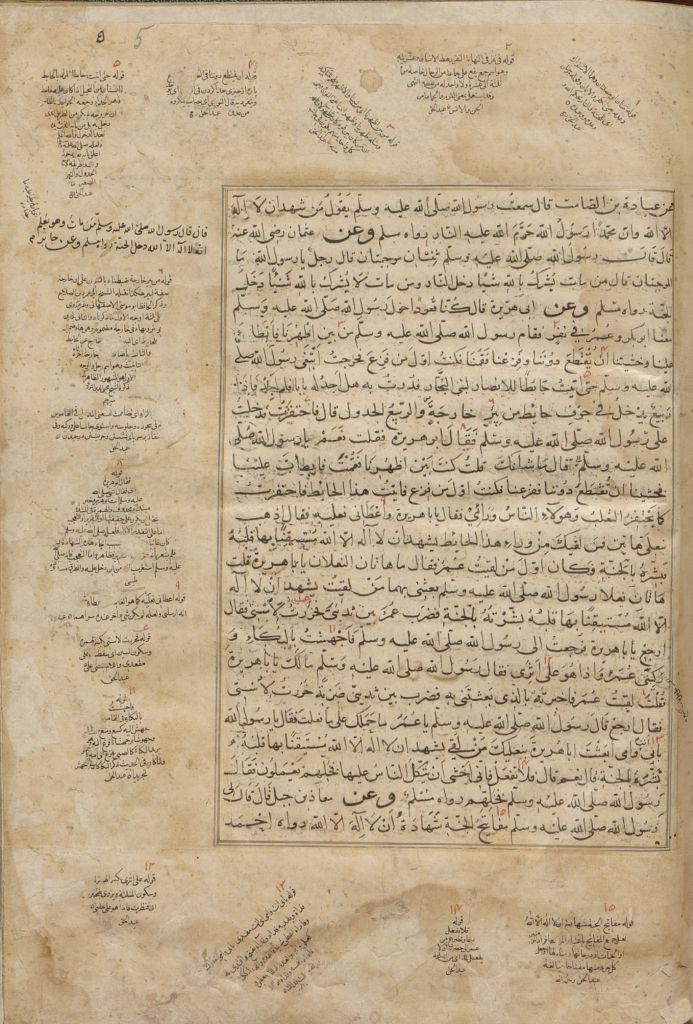
Marginal commentaries are generally differentiated from the main text by a slanting position or consisting of text written upside down relative to the main text. If the lines of the marginal annotation are horizontal, like the ones of the main text, enough space between the two text bodies and the smaller script ideally distinguishes between them. Additionally, in some cases, marginal annotations have specific forms – often a triangle (see Fig. 0.7) – in order to set them apart visually from the main text block. In a few cases, marginal annotations even take the shape of an object such as a tree, a flower, a sword, or some kind of ornamental feature (see Fig. 0.8).97 This shows that marginal commentaries can have an aesthetic quality beyond, or in addition to, conveying content through text.
Neatly arranged marginal notes in a manuscript of al-Khaṭīb al-Tabrīzī’s (d. 741/1340) Mishkāt al-Maṣābīḥ. MS Leipzig, Universitätsbibliothek, MS 999, fol. 5r
Every double page of this manuscript with texts on grammar has different ornamental shapes of text. MS Paris, Bibliothèque nationale de France, 4166, fol. 32r

Unlike the best practice guidelines in the normative sources, many manuscripts are densely annotated. In some manuscripts, different hands and a dense annotation make an unplanned and dynamically growing stock of marginalia over time a likely scenario. In some cases, the marginal annotation was so dense that (coloured) lines around individual entries were necessary to separate the different entries (see Fig. 0.9). In other instances, we can observe that at least the first annotator carefully divided the space of his/her entries, often with the preferred triangle format, leaving space for further annotations. In some cases, marginal comments are neatly prepared and designed during the production process of the manuscript (see Fig. 0.7).
Densely annotated manuscript with al-Baghawī’s Maṣābīḥ al-sunna as main text. MS Istanbul, Millet Kütüphanesi, Feyzullah Efendi, 540, fols. 14v–15r. With the kind permission of the Presidency of the Manuscripts Institution of Turkey

In particular, in those cases where the marginal text is running text, like a short stand-alone commentary or an additional poetic work, we can observe that the layout for the marginal text was well prepared. Unlike in European manuscripts, where the scribe added lines onto the writing surface, a typical method to guarantee a steady rectangular or square layout (or columns) for the main text block (matn, umm, aṣl, ṣulb) and straight lines in Arabic paper manuscripts came from below: the miṣtara (or masṭar). Fine strings or threads were sewn onto a pasteboard (or attached to a wooden board), based on the desired pattern.98 This ruling board was put beneath the paper, and by pressing on the threads (with a thumb or other tools), the ruling board created a pattern of blind lines in the paper.99 Such boards could include threads for ruling margins for annotations, but this was most certainly not regularly the case. Generally speaking, ruling was prepared for the main text block, but not for the margins.
If a ruling pattern was applied to the margin, such a miṣtara could then determine the layout of marginal annotations and so points to the practice of planned annotation (see Fig. 0.10 and 0.11). It should be mentioned, however, that not all annotators necessarily followed this given layout.
Simple misṭara in a West African manuscript. MS Berlin, Staatsbibliothek zu Berlin, Ms. or. quart. 1331

A misṭara created visible diagonal lines in the margin of the manuscript. MS Berlin, Staatsbibliothek zu Berlin, Hs. Or. 14919

A manuscript such as MS Istanbul, Köprülü Library, Fazıl Ahmed Paşa, 449, is more the exception than the rule. The producer of this manuscript that has al-Baghawī’s Maṣābīḥ al-sunna hadith collection as the main text, and has arranged the margins in different geometric patterns that are mirrored on the double page.100
As the text of the marginal commentaries and its layout can tell us something, so does the empty space which has been left blank. In his case study on manuscripts of the late Roman author Amminianus Marcellinus, Justin A. Stover analyses the “absence of writing […] as a paratextual feature”.101 And by the mere calculation of marginal space in relation to the central writing area, Eric Kwakkel illustrated the importance of this empty space for note-taking, especially in educational contexts. In the 353 dated manuscripts written between 1075 and 1225 that he examined, margins ranged between 47 percent and 50 percent of the page, in some cases taking up even 70 percent or more.102 For illuminated and illustrated manuscripts produced in Shiraz between 1303 and 1452, Elaine Wright measured folio area in relation to text area and showed certain patterns of changes in these measures and relations.103 Dmitry Bondarev showed the connection between marginal and interlinear space on one hand, and different levels and purposes of education on the other.104
7.2.3 Marking the Beginning and the End of the Marginal Commentary
Marginal commentaries could be superscribed with an indication of their function: the Arabic terms in Table 0.1 shows the most common words or sigla, which are a letter ḥāʾ for ḥāshiya above the entry; or the word ḥāshiya (as in Fig. 0.12); or, in some instances, the word sharḥ).
The upper marginal commentary is marked with the full word “ḥāshiya”, the lower one with the corresponding letter ḥā’. MS Leipzig, Universitätsbibliothek, B. or. 356, fol. 2r
The word “tammat” marking the end of the marginal commentaries. MS Berlin, Staatsbibliothek zu Berlin, Glaser 149, fol. 150v

The end of a marginal commentary was often marked with tammat (
7.2.4 Establishing the Connection between Main Text and Marginal Annotation
The connection between a word or passage of the main text and a comment in the margin either has to be identified by the reader or can be indicated by auxiliary elements such as lines or signes de renvoi. Normative sources do give advice on how to connect corrections, variants, or omitted words from the main text to the margin, although these recommendations are usually not specifically related to marginal commentaries.
How then is the connection between the relevant passage or word in the main text and the commentarial element (a correction, lacuna, etc.) marked? A general principle for all marginalia is that they should be positioned close to the word or passage of the main text that they relate to. This is the theory we encounter in the advices to the scribe, and it is the practice we observe in many manuscripts. However, it can be very different in the case of densely annotated manuscripts, where a marginal commentary can be written far away from the related word in the main text, and in the worst cases the scribe has had to squeeze in the annotation on the next page.
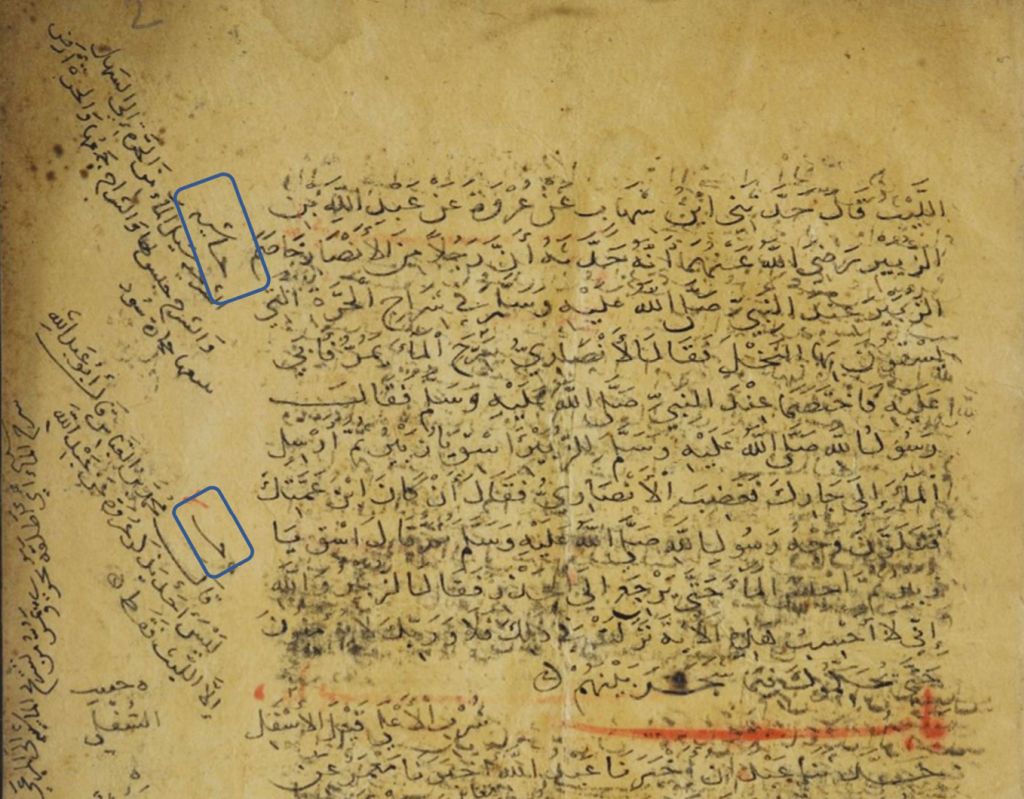
In the case of MS Vienna, Austrian National Library, Glaser 30,106 a manuscript containing al-Bukhārī’s hadith collection al-Jāmiʿ al-ṣaḥīḥ (Fig. 0.14), readers have to establish the connection between main text and marginal entry themselves. There is no visual element such as a line or a reference marker to connect the two texts. But this example still follows a certain pattern in that the upper part of the main text is annotated in the upper margin or the upper part of the outer margin; the lower part of the main text would be correspondingly annotated in the lower part of the outer margin and the lower margin. In Ibn al-Ṣalāḥ’s work on hadith sciences, Kitāb ʿulūm al-ḥadīth, we find some detailed advice how to distribute marginalia: The scribe should start in the upper part in order to make sure that there is space for further annotations if needed. In the case of many annotations, the scribe may distribute the text on the right and left margin in order to avoid too much confusion. Annotations in the left margin should be reserved only for omissions at the end of a line “because of the proximity of the omission to the margin”.107
The framed words show the connection between the marginal commentary and the main text. MS Vienna, Österreichische Nationalbibliothek, Glaser 30, fol. 2r. With the kind permission of the Österreichische Nationalbibliothek

What other means, apart from the intentional spatial distribution of marginalia, do we encounter that can establish more clearly the connection between main text and marginal annotation? One possibility is connecting lines (as seen in Fig. 0.9). Ibn al-Ṣalāḥ describes in more detail how he envisages the ideal way to connect textual omissions (laḥaq) in the main text to the margin:
The preferred method of supplying a textual omission in the margins – and it is called an “addendum” (laḥaq) – is for the student to make a line going up from the spot of the omission in the line of text and then curve it for a short distance between the two lines of text in the direction of the spot in the margin where he will write the addendum. He should begin writing the addendum in the margin opposite the curved line. Let that be in the right margin. If it is near the middle of the page, let the addendum be written – if there is room for it – going up toward the top of the page, and not down toward the bottom. When the addendum is two or more lines long, the student should not begin the lines going from the bottom to the top, but rather begin them going from the top to the bottom, so that the end of the lines is in the direction of the centre of the page, when the insertion is on the right margin; and when it is on the left margin, their end is toward the edge of the page. “It is correct” (ṣaḥḥa) should be written at the end of the addendum. Some people write “It returned” (rajaʿa) with “It is correct”.108
Even though Ibn al-Ṣalāḥ has textual omissions in mind at this point, the practice of inserting connecting lines can also be observed for marginal commentaries.
Ibn al-Ṣalāḥ does not follow other colleagues who recommend that the curved line should be extended from the point of the omission all the way to the marginal addendum: “While it does more clearly indicate where the addendum belongs, it blackens the book and marks it up, especially if there are many addenda. God knows best.”109 What becomes visible in Ibn al-Ṣalāḥ’s recommendations – as well as in those of other scholars – is once again a demand for a certain clarity and orderliness.
Despite Ibn al-Ṣalāḥ’s attitude towards connecting lines, we do find them in manuscripts, even though the overall phenomenon is not very widespread and appears mainly in densely annotated manuscripts in order to guarantee a proper connection between a marginal commentary and the relevant word or passage of the base text. But they also seem to occur more often in certain manuscript cultures such as sub-Saharan ones and the Zaydī manuscript heritage.110
A slightly different practice, but one which resembles the function of lines, is that of beginning to write a marginal annotation in the interlinear space directly below or above the word that is to be commented on, and extending the commentarial note into the margin (Fig. 0.15). The first letter of the marginal commentary could also be elongated from the interlinear space into the margin (kashīda).
The marginal commentary starts at the relevant position between the lines in the main text and continues in the margin. MS Istanbul, Köprülü Kütüphanesi, Fazıl Ahmed Paşa, 446, fol. 13v. With the kind permission of the Presidency of the Manuscripts Institution of Turkey

In addition, one can find overlining or dot systems. Apart from these common and often widespread methods, there are also signe-de-renvoi that relate to a specific regional context or a particular scientific discipline.111 They are of central importance for research into the historical contexts of the production and use of manuscripts, even if research has paid comparatively little attention to them to date.
Coming close to our modern numbered footnotes is the example in Fig. 0.16, where a number is set above the relevant word in the main text and above the related marginal commentary.
Numbers establish the connection between marginal commentary and the relevant word in the main text. MS Leipzig, Universitätsbibliothek, MS 999, fol. 3r

8 Dynamics between Marginalia and Main Text
When we think of marginal commentaries in manuscripts, we usually have a rather static image in in our minds: the “finished” main text block, annotated more or less heavily in the margins or between the lines by the same copyist or later users. But, in fact, the borders between these two spatial areas were frequently fluid, with texts evolving over time, moving from the main text to the margin and vice versa. Pre-print texts were not stable entities. This fluidity and shifting mode between main text and marginalia can relate to the intellectual process of a single author, to an editorial interference by later scholars, or to the fluidity between orality and writing in teaching contexts.
There are instances where a previous paratext becomes part of the main text in a manuscript (but not necessarily remaining as such for the entire text transmission), although the opposite change has also been found.
In the field of sciences, Nadine Löhr illustrates in her PhD thesis that the Arabic translation of Ptolemy’s Tetrabiblos by Ḥunayn b. Isḥāq (d. 873)112 apparently represents a certain stream of tradition, since it is in these manuscripts that we find quotations from the ninth-century scientist Thābit b. Qurra (commonly introduced with the formula qāla Thābit, “Thābit says”). These citations can be found either in the margins of the manuscripts or as part of the main text, and their integration into the main text can at times be so strong that the introductory element qāla Thābit is skipped. Here, a former paratext has been completely integrated into the main text.113 In this volume, Florian Sobieroj stresses the dynamics between commentarial notes in the main text and the margin in a manuscript with Ibn Khafīf’s commentary on the special properties of qurʾanic verses and selected, mainly Prophetic, prayers. And Philip Bockholt discusses the shifting between minhu notes in the margins of manuscripts containing Khvāndamīr’s tenth/sixteenth-century Persian historiographical work becoming – intentionally or otherwise – part of the main text, or indeed vice versa.
Possibly a more isolated and early example relates to the demand not to say bi-smi llāh al-raḥmān al-raḥīm (in the name of God the most gracious, the most merciful), the so-called bismillah (sometimes also given as basmala(h)), at the beginning of the ninth sura of the Qurʾan. Today, it is well known that this sura (al-Tawba) is the only one in the Qurʾan that is not introduced with the bismillah – but this concrete demand is not any longer part of the main text. The demand not to recite the bismillah at the beginning of Sura 9 can be found, though, as part of the main text in one of the oldest Qurʾan manuscripts, the so-called Sana’a Qurʾan. The manuscript proved to be a palimpsest, with the upper text representing the later “Uthmanic” version, while the lower text turned out to be a much older layer, dated through radiocarbon analysis to between 578 and 669 CE. Asma Hilali argues that the instruction not to recite the bismillah would reflect an oral educational setting: in her opinion, what was once perhaps an (oral or written) paratext not to recite the bismillah at the beginning of Sura 9 became part of the main text in this manuscript.114
A typical phenomenon that shows the dynamics between main and marginal texts pertains to the frequent use of citations from stand-alone works in the margin of manuscripts that contain a different work. While marginal citations represent a movement from a previous stand-alone text to the margin, there can also be a movement from the margin to a (posterior) stand-alone work. That is, there are cases of previously marginal commentaries being collected and turned into stand-alone commentaries at a later stage. For example, in the setting of commentaries written on al-Baghawī’s (d. 516/1122) hadith collection Maṣābīḥ al-sunna, the eighth/fourteenth-century commentator Zayn al-ʿArab specifically states in his preface that he collected annotations (ḥawāshī) from his teaching class (dars), revised them, and turned them into a stand-alone commentary.115 We also know from al-Bayḍāwī (d. at the end of the 13th cent. or early 14th cent.) that he had at least one student who took notes from his teachings which al-Bayḍāwī later revised.
9 New Horizons: Quo Vadis, Scholarship on Marginal Commentaries?
9.1 Cognitive Sciences
I have discussed the visual features of margins, from densely annotated ones, through structured and ordered ones, possibly with signes de renvoi, to artistically elaborated ones – but none of this necessarily answers the question of how these marginal annotations were read in practice. We have theoretical guidelines from past scholars and we have the manuscripts displaying actual scribal practice, but we are still missing the link to the reading process. Given the small and at times scribbled script, the notes squeezed between two lines, and texts written upside down, we may ask how these annotations were actually read. Did readers turn the book in order to read a marginal commentary that was written upside down? Or were they trained enough to be able to grasp a marginal entry the wrong way up? With the different directions of the script, the varied positions of marginal commentaries, and at times no obvious connections between main text and marginal notes, we have to ask ourselves how readers orientated themselves on the page.
Recently, new and promising approaches to our understanding of paratexts in general, and marginal commentaries in particular, have been modelled by combining philology and cognitive sciences. How and what do we perceive looking at an annotated page? Where does the eye move to, where and for how long can we observe a fixation of the eye? Can brain activity tell us something about how we react to such entries?116 And what do psychological tests reveal in terms of perception, orientation, and the appreciation of annotated pages?
Such questions are not necessarily new: there are studies dedicated to our perception of websites, photography, paintings, and for museum settings. But these technologies and empirical scientific approaches have so far rarely been applied to manuscripts.117 In their newly funded project “Paratexts Seeking Understanding”,118 a group of scholars from the University of Glasgow will now examine how different readers orientate on the manuscript page with paratexts by using eye-movement trackers, electroencephalography (EEG) to measure brain activity, and psychological tests. Individual sub-projects investigate past as well as contemporary manuscript cultures. Cognitive sciences can potentially provide us with leads to better understand reading processes and the perception of content through its visual implementation on the manuscript page, taking into account a reader’s cultural, religious, and language affiliations to a text, as well as levels of expertise. After the Glasgow project comes to an end in 2026, we might see how far we can extrapolate such contemporary techniques to premodern practices.
An attempt to transfer the scientific findings of today to premodern contexts has also been undertaken by Gregor Hardiess and Cäcilie Weissert, who investigated how non-expert observers without a specifically religious background approach biblical art with text and image in sixteenth-century printed bibles:
Since contemporary sources from the 16th century that provide concrete information on the reading behaviours of the lay public are very scarce, art historians are on the search for methods that allow a better understanding in respect to the semantic and contextual distribution during the viewing process. We certainly cannot take the historical viewer’s perspective and we cannot reconstruct it with all its physical and mental implications. Nevertheless, we can raise the matter how text and image were and are mentally processed. Studies could show that fundamental mental processes have remained the same over the time and that they are based on biological and neural processes.119
9.2 The Margin Goes Digital
The turn of the millennium has clearly marked a new era for the exploration of marginal annotations. An increase in the number of refined digital tools has offered more and more powerful opportunities to reconstruct the life of books and their cultural contexts. A number of projects have used these tools to examine a wide range of marginal annotation, among them marginal commentaries. Unfortunately, though, at the point that this introduction was finalised, no database for marginal commentaries in Arabic manuscripts, or for that matter for marginal commentaries in a single specific Arabic manuscript, has appeared. But other projects can give us an idea of the possibilities of such an undertaking, and the different range, objectives, analytical criteria, and technical solutions.
Wide in thematic range and designed to shed light on the history of books, and combining both print and handwritten annotations, was the five-year project “15cBooktrade”, dedicated to incunabula, that is, books printed between 1450 and 1500.120 Among the many categories that the database “Material Evidence in Incunabula”121 registers are “manuscript notes”, ranging from corrections to supplements, and from collation notes and translations to comments. The database offers a number of ways of visualising this data; for example, one can look at the circulation of books over time and space. Similar approaches can be encountered in the Columbia University-based project “Footprints: Jewish Books through Time and Place”.122 More specifically connected with marginalia in manuscripts is the project “Commentaria in Aristotelem Graeca et Byzantina” at the Berlin-Brandenburg Academy of Sciences and Humanities, a project that aims to register scholia and other paratexts in works of Aristotle within a digital text edition.123
The vast majority of relevant digital projects, though, have been primarily about the establishment of databases for medieval manuscripts, all of them registering glosses and other marginal and interlinear annotations. A first cluster of projects takes as a starting point an interest in the Irish language. With these projects, we can observe a development from a more strictly linguistic concept of “gloss” to a wider and more interdisciplinary concept of annotations. The first of these projects, the “Early Irish Glossaries Database”,124 analysed manuscripts of three major early Irish glossaries that were compiled from the seventh century on, and thus has a focus on the gloss as a (short) linguistic entity of translation or possibly as a synonym.125 One of its project members, Pádraic Moran, was also involved in “The St Gall Priscian Glosses”,126 a digital edition and database for one manuscript containing Priscian’s sixth-century encyclopaedic Latin grammar, copied in 850–851 by Irish scribes, and brought during the ninth century to the Abbey of St. Gall. This manuscript has marginal and interlinear glosses: around one-third of the verbal glosses are Old Irish, representing one of the earliest sources for this language. From an interest in the history of the Irish language, Moran has widened his ambitions, taking into account the global dimension of glossing in different linguistic and cultural settings. The “gloss” transcends now the strict linguistic item to “glossing” as embracing diverse acts of marginal and interlinear annotations. From 2022 to 2026, Moran heads the project “Global and Local Scholarship on Annotated Manuscripts” (GLOSSAM), hosted at the University of Galway.127 Glosses are now understood as “paratexts transmitted between the lines and in the margin of manuscript books, micro-texts that control how the central texts were read and interpreted”.128 Among a number of sub-projects, GLOSSAM will establish digital infrastructure to provide a repository and analytical tool for annotated manuscripts, and publish a multi-authored interdisciplinary handbook of glossing.129
This first “cluster” of activities rooted in a linguistic interest in Irish glosses has a counterpart in medieval Latin manuscripts, with two projects that should be mentioned here. The first, “Marginal Scholarship: The Practice of Learning in the Early Middle Ages (c. 800–1000)”130 was led by Mariken Teeuwen in the Netherlands and carried out in cooperation with Irene Renswoude and Evina Steinová. Their database of approximately 350 manuscripts from the eighth to the tenth century displays three units: the codicological unit, the unit of content, and finally the unit of marginal activity. Within this last unit, we find a classification of marginal and interlinear annotations, ranging from attachments and corrections to commentary. One of their researchers, Evina Steinová, has broadened the digital possibilities for analysis and visualisation. Her database “The Glosses to the First Book of the Etymologiae of Isidore of Seville: A Digital Scholarly Edition”, edited in 2021,131 explores the manuscript tradition of the first forty-four chapters of Isidore’s (d. 636) Latin encyclopedic work and its glosses. For her analytical objectives, graph technology displays the density of annotations in relation to chapters of the work and also in relation to the manuscripts, and allows us to detect certain streams of manuscript transmission as well as the interest that readers had in specific chapters of Isidore’s encyclopedia.
In the field of Arabic manuscript studies, the potential of digital analysis has not yet been explored. In the case of manuscripts of specific hadith collections, the analysis and visualisation of citations from hadith commentaries in the margins would provide us with a better picture of the circulation of certain texts in time and space, and the interrelated intellectual discourses. A large-scale registration of marginal annotations in scientific manuscripts, both text and image, would offer, among other things, an idea about the reception of scientific literatures of different languages and cultures, the state of knowledge at given times and in given regions, and possibly modes of teaching.
The “Bibliotheca Arabica” project, at the Saxon Academy of Sciences and Humanities in Leipzig,132 investigates the history of Arabic literature between 1150 and 1850, with manuscripts as the central source. The corpus contains works, authors, and related manuscripts (it does not, however, contain digitised images). This catalogue data is combined with documentary notes such as ownership marks, readers’ notes, or audition certificates (samāʿāt). Boris Liebrenz’s data set of these documentary notes in Arabic manuscripts,133 as well as the related “Audition Certificate Platform” developed by Said Aljoumani and Konrad Hirschler,134 allow us to reconstruct the life of books, the social world of actors involved, the profile of libraries, and certain aspects of the book trade.135 But since marginal commentaries are largely non-documentary, and since the time span of seven hundred years of literary history is too vast, the usually anonymous commentarial annotations are not registered in the database. This would need individual projects dedicated to the manuscript heritage of a specific work, or even of one specific manuscript, as is the case for all the above outlined projects that have established databases for the wider scope of “glosses” or marginal annotations.
Future generations of scholars will have access to different tools. The amount of data that we can collect and analyse over the course of months or years of work will accelerate stupendously: handwritten text recognition technology has improved enormously, and one day, the scholar bent over marginal commentaries trying to decipher the scribbled notes might belong to the past – at least with regard to certain aspects of his or her activity. Software tools will be able to transcribe all texts within a short time, and the scholar’s duty in this respect will primarily be quality control, correcting mistakes that the machine makes – and training it. This will still demand skills and time, but it will shift the focus of our work. Through the machine reading of manuscript texts, we will also be able to gather large amounts of data about marginal commentaries. The above-mentioned projects collected data for some hundred manuscripts. Future projects will have access to thousands. And since machine reading can, with a good portion of training, already detect individual scribal hands, today’s meticulous palaeographic analysis of different hands in manuscripts will also be handed over to our digital tools. In this way, much larger sets of data can be analysed – but it will still require training from us (at least to a certain extent) and our control.
10 Overview of the Chapters (Following the Order in the Volume)
10.1 Boris Liebrenz (“Putting Margins in Context”)
The often non-documentary character of marginal commentaries poses a challenge to those engaging in the exploration of the informative value of these entries. Boris Liebrenz contrasts the margin as a place of intellectual practice with the difficulty of contextualising these annotations in their historical settings. In this chapter, he presents methodological approaches for two main scenarios, signed notes and unsigned notes. An otherwise unknown signatory might come to the fore through the identification of individual hands, clues given about the annotator in other entries, or by the copyist. A possible identification of the creator of an unsigned note requires the meticulous analysis of palaeography, textual comparison, style, and scribal practices. Liebrenz exemplifies these strategies with three scholars from Constantinople, Damascus, and Cairo in the tenth/sixteenth and eleventh/seventeenth centuries.
10.2 Darya Ogorodnikova
In her chapter, Darya Ogorodnikova offers an overview of interlinear and marginal content in Arabic and vernacular languages in Islamic manuscripts from the eighteenth to the twentieth century from the greater Senegambia region. It introduces a preliminary typology of annotations, categorising them based on their content, their language, and their relation to the primary Arabic text. Additionally, it explores the practice of marking or labelling annotations by scribes. The chapter addresses key points of interest, investigating the scholarly activities behind these annotations, analysing the way in which they reflect the needs and objectives of manuscript scribes or users, and examining whether annotations demonstrate individual scholarly engagement or adherence to an established exegetical tradition. Works cited in the margins reveal widely circulating texts used in contexts of teaching and transmission.
10.3 Verena Klemm
In nineteenth-century India, the Ismaili scholar Muḥammad ʿAlī al-Hamdānī (d. 1315/1898) selected passages from previous works of various disciplines based on his interests, at times adding his own notes, and compiled his own private notebook. Verena Klemm analyses this notebook with the approach of multilayered note-taking, namely a consideration of the excerpts and notes of the central text and the annotations in the margins. Her classification of the marginalia and her analysis of their content show al-Hamdānī’s interest in tracing the transmission of works and his engagement with their content by selecting, commenting, collating, and complementing. Through these multilevel commentarial gestures of note-taking – excerpts and supplemental material in the centre and commentarial notes in the margin – the intellectual work of the scholar can be followed.
10.4 Nadine Löhr
The tradition of organising annotations in manuscripts with distinct sigla and graphemes along the margins is widespread within the Arabic-speaking domain. Typically, sets of sigla or symbols were tailored and utilised for specific purposes and known throughout a cultural and geographical region. Nevertheless, distinct annotation practices could differ significantly depending on the discipline, the sociocultural context, and the region and period. Nadine Löhr’s chapter explores a number of different annotation systems and symbols encountered in Arabic manuscripts, specifically emphasising those related to astral sciences. It seeks to demonstrate the importance of tracing marginal annotation techniques for a better understanding of the cultural milieu in which a text was produced and read.
10.5 Deborah Schlein
Deborah Schlein’s chapter uncovers the state of medical education and textual reception in Mughal and colonial India by examining the marginalia in Arabic and Persian medical manuscripts, specifically those of the Indian manuscript and commentary tradition associated with the medical encyclopedia al-Asbāb wa-l-ʿalāmāt (The Causes and the Symptoms) written by the seventh/thirteenth-century Central Asian scholar Najīb al-Dīn al-Samarqandī. These aspects of Indian Yūnānī ṭibb, “Greek medicine”, are explored specifically through “citational” marginalia, that is, references to medical scholars and their works in the manuscript margins. This chapter brings discussions of curriculum and language to the fore of the South Asian history of medicine, and presents marginalia as a tool of intellectual inquiry for the history of Yūnānī ṭibb in India.
10.6 Nadja Danilenko
Nadja Danilenko’s chapter explores the ways in which readers engaged with geographical literature, in particular al-Iṣṭakhrī’s fourth/tenth-century Book of Routes and Realms, which contains the earliest surviving maps of the Islamic world. Despite the wide circulation of this text until the late nineteenth century, few readers have commented on it. The study begins with an examination of the marginalia in order to determine the interests of the readers and the correlation of the annotations with the main text. Danilenko then examines whether the Book of Routes and Realms is representative of commentary practices in geographical literature in general. By comparing the manuscript tradition of al-Iṣṭakhrī’s work with that of other authors, similarities as well as differences are highlighted. Taking into account illustrated genres, the paper examines the role that maps and diagrams may have played in limiting marginalia in geographical literature.
10.7 Boris Liebrenz (“Partisan Readers”)
In his chapter on partisan readers, Boris Liebrenz moves two less common aspects of marginal annotation to centre stage: the comparatively rare marginal commentaries in manuscripts containing works of history, and a personal, polemic voice writing in the margin. In the margins of a manuscript containing the historiographic work Badāʾiʿ al-umūr by the tenth/sixteenth-century Mamluk Ibn Iyās, an Ottoman reader writes annoyed replies to the negative representation of the Ottoman sultan Selim I in the central text. Arguing over the interpretation of the Ottoman conquest of Egypt in 1517 and the depiction of the Ottoman and Mamluk rulers, such a polemical style remains unusual, reminding us that there was usually some kind of ethics at work in the margin.
10.8 Philip Bockholt
Philip Bockholt investigates minhiyyāt (or minhuwwāt) notes – that is, entries initially written by the author of the main text and thereafter often copied in later manuscripts – as a source for tracing the transmission of the Persian historical work Ḥabīb al-siyar, composed in tenth/sixteenth-century Safavid Iran by Ghiyās̱ al-Dīn Khvāndamīr (d. ca. 942/1535–1536). By comparing minhiyyāt in manuscripts from the tenth/sixteenth century to the age of print, he illustrates the potential of these entries not only for our understanding of the transmission of the text, but also for demonstrating the diverse forms of textual composition. With marginal notes such as minhiyyāt or corrections becoming integrated into the main text, his contribution is also an example for the dynamics between central and marginal text.
10.9 Berat Açıl
In his chapter, Berat Açıl analyses notes that the Ottoman scholar Cārullāh Efendi (d. 1151/1738) wrote in the margins of manuscripts in defence of the mystic Ibn al-ʿArabī (d. 638/1240). The seventeeth and eighteenth centuries witnessed a fierce debate between those Ottoman intellectuals who accused Ibn al-ʿArabī of being an unbeliever (kāfir) and those who followed his doctrines. Taking as a starting point Kātib Çelebi’s The Balance of Truth, Açıl depicts this intellectual dichotomy before analysing Cārullāh Efendi’s marginal notes in the manuscripts containing the works of Ibn al-ʿArabī, or related ones, kept in his own book collection. Elaborating on Ibn al-ʿArabī’s doctrines on the one hand, and criticising his opponents on the other, Cārullāh Efendi engages in an intellectual debate in the margins of his manuscripts.
10.10 Florian Sobieroj
An apparently unique copy of mainly Prophetic prayers and comments on qurʾanic verses, compiled by the Shīrāzī Sufi Muḥammad Ibn al-Khafīf (d. 371/982), is at the centre of Florian Sobieroj’s chapter. This manuscript reflects the fluidity that can be found between the main text and the margin, as commentarial material has been integrated within the central text as well as being placed in the margins. Sobieroj identifies the key functions of the marginal and interlinear notes (lexical glosses, corrections, and comments): explaining difficult expressions to assist in the understanding of a text, and stabilising a text and its transmission. These marginalia for transmission and understanding are seen as prerequisites for a larger goal, that of raising the esteem in which these prayers are held. Sobieroj analyses and classifies these aims, which point out the effectiveness of the prayers or their close relation to the prophet Muḥammad.
10.11 Stefanie Brinkmann
Stefanie Brinkmann illustrates both the challenges of working with marginal commentaries and their potential, with the example of a selection of manuscripts from the seventh/thirteenth to the tenth/sixteenth century containing the post-canonical hadith collection Maṣābīḥ al-sunna by al-Ḥusayn al-Baghawī (d. 516/1122). After exemplifying the difficulties in identifying possible sources of the marginal notes, she highlights the significance of these notes, focusing on the question of which texts were used to study the Maṣābīḥ al-sunna. To this end, she classifies five possible layers of commentary and analyses the varying impact that these different commentaries have had on the study of the Maṣābīḥ al-sunna. The manuscripts of al-Baghawī’s hadith collection and the marginal citations in them clearly show the importance of the Mongol and post-Mongol periods for this particular hadith tradition.
Acknowledgements
For constructive criticism and stimulating thoughts to improve this introduction I thank (in alphabetical order): Cornelius Berthold, Hannah-Lena Hagemann, Thoralf Hanstein (images), Asma Hilali, Verena Klemm, Nadine Löhr, Carl-Fredrik Vogt Andresen and Beate Wiesmüller.
List of Manuscripts
MSS Berlin, Staatsbibliothek zu Berlin, Hs. Or. 14818, 14815, 14737, 14728, 14723, 14696, 14834 (Birgivi’s (Birkawī) al-Ṭarīqa al-Muḥammadiyya).
MS Berlin, Staatsbibliothek zu Berlin, Glaser 181 (multiple text manuscript with six works on diverse subjects such as Quran exegesis, philosophy, disputation, and legal issues).
MS Paris, Bibliothèque nationale de France, 6606 (al-Baghawī: Maṣābīḥ al-sunna) (dated 682/1283).
MS Vienna, Austrian National Library, Glaser 30 (al-Bukhārī: al-Jāmiʿ al-Ṣaḥīḥ) (dated 804/1402).
MS Leipzig, University Library, B. or. 227 (al-Bukhārī: al-Jāmiʿ al-Ṣaḥīḥ) (dated 800/1398).
MS Leipzig, University Library, MS 999 (al-Khaṭīb al-Tabrīzī: Mishkāt al-Maṣābīḥ) (dated 829/1426).
MS Paris, Bibliothèque nationale de France, 4166 (multiple text manuscript with works on grammar) (dated 947/1540).
MS Istanbul, Süleymaniye Library, Feyzullah Efendi, 540 (al-Baghawī: Maṣābīḥ al-sunna) (dated 727/1327).
MS Berlin, Staatsbibliothek zu Berlin, Ms. or. quart. 1331 (West African manuscript, not yet catalogued).
MS Berlin, Staatsbibliothek zu Berlin, Hs. Or. 14919 (not yet catalogued).
MS Leipzig, University Library, B. or. 356 (al-Bukhārī: al-Jāmiʿ al-Ṣaḥīḥ).
MS Berlin, Staatsbibliothek zu Berlin, Glaser 149 (Ibn al-Ḥājib: Sharḥ Kāfiya dhawī al-arab al-muḥsiba fī ʿilm al-ʿarab, grammar) (dated 953/1546).
MS Istanbul, Köprülü Library, Fazıl Ahmed Paşa, 446 (al-Baghawī: Maṣābīḥ al-sunna) (dated 772/1370).
Bibliography
Akkerman, Olly: “The Bohra Manuscript Treasury as a Sacred Site of Philology: A Study in Social Codicology”, Philological Encounters 4 (2019), pp. 182–201.
Ahlwardt, Wilhelm: Die Handschriften-Verzeichnisse der Königlichen Bibliothek zu Berlin: Arabische Handschriften, 10 vols. (Berlin: Staatsbibliothek zu Berlin, 1887–1899).
Ahmed, Asad Q. and Margaret Larkin: “The Ḥāshiya and Islamic Intellectual History”, Oriens 41 (2013), pp. 213–216.
Allen, Garrick: Manuscripts of the Book of Revelation: New Philology, Paratexts, Reception (Oxford: Oxford University Press, 2020).
Alston, Robin C.: Books with Manuscript: Short Title Catalogue of Books with Manuscript Notes in the British Library, including Books with Manuscript Additions, Proofsheets, Illustrations, Corrections (London: British Library, 1994).
al-ʿAlmawī, ʿAbd al-Bāsiṭ: al-Muʿīd fī adab al-mufīd wa-l-mustafīd, ed. Aḥmad ʿUbayd (Damascus: al-ʿArabiyya, 1349/1930–1931).
Altmann, Ulrike, Isabel C. Bohrn, Oliver Lubrich, et al.: “Fact vs Fiction – How Paratextual Information Shapes Our Reading Processes”, Social Cognitive and Affective Neuroscience 9 (2014), pp. 22–29.
Ayalon, Ami: The Arabic Print Revolution: Cultural Production and Mass Readership (Cambridge: Cambridge University Press, 2016).
al-Baghdādī, Abū Bakr Aḥmad b. ʿAlī al-Khaṭīb: al-Kifāya fī [maʿrifat uṣūl] ʿilm al-riwāya, ed. Abū ʿAbdallāh al-Sūraqī (Hayderabad: Dāʾirat al-Māʿārif al-ʿUthmāniyya, 1357 AH).
al-Baghdādī, Abū Bakr Aḥmad b. ʿAlī al-Khaṭīb: al-Jāmiʿ li-akhlāq li-l-rāwī wa-ādāb al-sāmiʿ, ed. Muḥammad ʿAjāj al-Khaṭīb, 2 vols. (Beirut: Mu’assasa al-Risāla, 1416/1996).
Bahl, Christopher D. and Stefan Hanß: Scribal Practices: Global Cultures of Colophons, 1400–1800 (Cham: Springer International Publishing; Imprint: Palgrave Macmillan, 2022).
Bauden, Frédéric: “Maqriziana II: Discovery of an Autograph Manuscript of al-Maqrīzī; Towards a Better Understanding of His Working Method: Analysis”, Mamlūk Studies Review 12 (2008), pp. 51–118.
Berger, Lutz: “Zur Problematik der Späten Einführung des Buchdrucks in der Islamischen Welt”, Das gedruckte Buch im Vorderen Orient, ed. Ulrich Marzolph (Dortmund: Verlag für Orientkunde, 2002), pp. 15–28.
Berthold, Cornelius: “Approaching the Last Decades of Arabic Manuscript Culture (1870–1930): The Content of Handwritten and Printed Books”, Journal of Islamic Manuscripts 15/2 (2024), pp. 145–208.
Blecher, Joel: “Revision in the Manuscript Age: New Evidence of Early Versions of Ibn Ḥajar’s Fatḥ al-Bārī”, Journal of Near Eastern Studies 76 (2017), pp. 39–51.
Blecher, Joel: Said the Prophet of God: Hadith Commentary Across a Millenium (Oakland: University of California Press, 2018).
Bondarev, Dmitry: “Islamic Education and Ample Space Layout in West African Islamic Manuscripts”, The Arts and Crafts of Literacy: Islamic Manuscript Cultures in Sub-Saharan Africa, eds. Andrea Brigaglia and Mauro Nobili (Berlin & Boston: De Gruyter, 2017), pp. 105–142.
Bondarev, Dmitry: “Qur’anic Exegesis in Old Kanembu: Linguistic Precision for Better Interpretation”, Journal of Qur’anic Studies 15 (2013), pp. 56–83.
Bondarev, Dmitry: “Tafsīr Sources in Four Annotated Qurʾanic Manuscripts from Early Borno”, Approaches to the Qur’an in Sub-Saharan Africa, ed. Zulfikar Hirji (Oxford: Oxford University Press, 2019), pp. 25–64.
Bourgain, Pascale: “The Circulation of Texts in Manuscript Culture”, The Medieval Manuscript Book: Cultural Approaches, eds. Michael Johnston and Michael van Dussen (Cambridge: Cambridge University Press, 2015), pp. 140–159.
Brentjes, Sonja: Teaching and Learning Sciences in Islamicate Societies (800–1700) (Turnhout: Brepols, 2018).
Brinkmann, Stefanie: “Marginal Commentaries in Ḥadīṯ Manuscripts”, Practices of Commentary, eds. Christina Lechtermann and Markus Stock (Frankfurt am Main: Vittorio Klostermann, 2020), pp. 6–44.
Carmassi, Patrizia and Christian Heitzmann (eds.): Marginalien in Bild und Text: Essays zu mittelalterlichen Handschriften, Wolfenbütteler Forschungen, vol. 156 (Wiesbaden: Harrassowitz, 2019).
Cinato, Franck, Aimée Lahaussois and John B. Whitman (eds.): Glossing Practice. Comparative Perspectives (Lanham: Lexington Books, 2023).
Ciotti, Giovanni, Michael Kohs, Eva Wilden, et al.: “Definition of Paracontent”, Occasional Paper No. 6, Centre for the Study of Manuscript Cultures, University of Hamburg, 15 November 2018. https://www.csmc.uni-hamburg.de/publications/occasional-papers/files/csmc-occasional-paper-6-tnt.pdf (accessed 16 January 2024).
Colini, Claudia: “Ink Recipes from the Islamic Era: Texts, Manuscripts, Inks Replication and Scientific Analyses”, Bridging the Gap: Disciplines, Times, and Spaces in Dialogue, vol. 1, eds. Christian W. Hess and Federico Manuelli (Oxford: Archaeopress, 2021), pp. 172–186.
Dayeh, Islam: “From Taṣḥīḥ to Taḥqīq: Toward a History of the Arabic Critical Edition”, Philological Encounters 4 (2019), pp. 245–299.
Déroche, François (ed.): Islamic Codicology: An Introduction to the Study of Manuscripts in Arabic Script (London: al-Furqān Islamic Heritage Foundation, 2005).
Durand-Guédy, David and Jürgen Paul (eds.): Personal Manuscripts: Copying, Drafting, Taking Notes (Berlin & Boston: De Gruyter, 2023).
Engin, Sezai: Hadis Şerh Geleneğinde Haşiye ve Talikalar (Istanbul: Endülüs Yayınları, 2019).
Esch, Arnold: “Überlieferungs-Chance und Überlieferungs-Zufall als Historisches Problem des Historikers”, Historische Zeitschrift 240 (1985), pp. 529–570.
Fera, Vincenzo, Giacomo Ferraù, and Silvia Rizzo (eds.): Talking to the Text: Marginalia from Papyri to Print; Proceedings of a Conference held at Erice, 26 September–3 October 1998, as 12th Course of International School for the Study of Written Records, 2 vols. (Messina: Centro Interdipartimentale di Studi Umanistici, 2002).
Frońska, Joanna: “Writing in the Margin – Drawing in the Margin: Reading Practices of Medieval Jurists”, Inscribing Knowledge in the Medieval Book: The Power of Paratexts, eds. Rosalind Brown-Grant, Patrizia Carmassi, Gisela Drossbach, et al. (Berlin & Boston: De Gruyter, 2019), pp. 141–159.
Gacek, Adam: Arabic Manuscripts: A Vademecum for Readers (Leiden: Brill, 2009).
al-Ghazzī, Badr al-Dīn Muḥammad b. Muḥammad: al-Durr al-naḍīd fī adab al-mufīd wa-l-mustafīd, ed. Abū Yaʿqūb Nashshār b. Kamāl al-Miṣrī (Giza: Maktabat al-Tawʿiyya al-Islāmiyya li-l-Taḥqīq wa-l-Nashr wa-l-Baḥth al-ʿIlmī, 2009).
Görke, Andreas and Konrad Hirschler (eds.): Manuscript Notes as Documentary Sources (Beirut: Orient-Institut Beirut, 2011).
Grafton, Anthony: The Footnote: A Curious History (London: Faber and Faber, 1997).
Günther, Sebastian (ed.): Knowledge and Education in Classical Islam: Religious Learning between Continuity and Change (Leiden & Boston: Brill, 2020).
Guo, Li: “Ibn Dāniyāl’s ‘Dīwān’: In Light of MS Ayasofia 4880”, Quaderni di Studi Arabi 5 (2011), pp. 163–176.
Hardiess, Gregor and Caecilie Weissert: “Interaction between Image and Text during the Process of Biblical Art Reception”, Journal of Eye Movement Research 13 (2020), pp. 1–17.
Hilali, Asma: “Was the Ṣanʿāʾ Qurʾān Palimpsest a Work in Progress?”, The Yemeni Manuscript Tradition, eds. Sabine Schmidtke, David Hollenberg, and Christoph Rauch (Leiden: Brill, 2015), pp. 12–27.
Hirschler, Konrad: The Written Word in the Medieval Arabic Lands: A Social and Cultural History of Reading Practices (Edinburgh: Edinburgh University Press, 2012).
Ibn al-Ṣalāḥ al-Shahrazūrī, ʿUthmān: An Introduction to the Science of the Ḥadīth / Kitāb maʿrifat anwāʿ ʿilm al-ḥadīth, transl. Eerik Dickinson (Reading: Garnet, 2006).
Ibn al-Ṣalāḥ al-Shahrazūrī, ʿUthmān b. ʿAbd al-Raḥmān: ʿUlūm al-ḥadīth, ed. Nūr al-Dīn al-ʿAtr (Damascus: n.p., 1406/1986).
Ibn Jamāʿa, Badr al-Dīn Muḥammad: Tadhkirat al-sāmiʿ wa-l-mutakallim fī adab al-ʿālim wa-l-mutaʿallim, ed. Muḥammad b. Mahdī al-ʿAjamī (Beirut: Dār al-Bashāʾir al-Islāmiyya, 2012).
Jackson, Heather J.: Marginalia: Readers Writing in Books (New Haven & London: Yale University Press, 2001).
Jensen, Kristian: “Cataloguing Books with Marginal Annotations: A Report of a Round Table Discussion”, Talking to the Text, eds. Vincenzo Fera, Giacomo Ferraú, and Silvia Rizzo (Messina: Centro Interdipartimentale di Studi Umanistici, 2002), vol. 1, pp. 433–456.
al-Jīlānī, ʿAbd al-Laṭīf b. Muḥammad: “Ẓāhirat al-ṭurar fī al-makhṭūṭ al-maghribī”, al-Makhṭūṭāt al-shāriḥa: Aʿmal al-muʾtamar al-duwali al-thālith li-markaz al-makhṭūṭāt (Maris 2006) / Commentary Manuscripts: Proceedings of the 3rd International Conference of the Manuscript Center (March 2006), ed. Youssef Ziedan (Alexandria: Bibliotheca Alexandrina, 2009), pp. 391–417.
Kenderova, Stoyanka: Catalogue of Arabic Manuscripts in SS Cyril and Methodius National Library, Sofia (London: al-Furqān, 1995).
Kwakkel, Eric: “The Margin as Editorial Space: Upgrading Dioscorides alphabeticus in Eleventh-Century Monte Cassino”, The Annotated Book in the Early Middle Ages: Practices of Reading and Writing, eds. Mariken Teeuwen and Irene van Renswoude (Turnhout: Brepols, 2017), pp. 323–341.
Kühne-Wespi, Carina, Klaus Oschema, and Friedrich Quack (eds.): Zerstörung von Geschriebenem: Historische und Transkulturelle Perspektiven, Materiale Textkulturen, vol. 22 (Berlin & Boston: De Gruyter, 2019).
Lane, Edward: Arabic-English Lexicon (London: Williams & Norgate, 1863).
Latham, Martin: The Bookseller’s Tale (London: Particular Books, 2020).
Liebrenz, Boris (ed.): “The History of Books and Collections through Manuscripts Notes”, special issue, Journal of Islamic Manuscripts 9/2–3 (2018).
Lied, Liv Ingeborg and Marilena Maniaci (eds.): Bible as Notepad: Tracing Annotations and Annotation Practices in Late Antique and Medieval Biblical Manuscripts (Berlin & Boston: De Gruyter, 2018).
Lipking, Lawrence: “The Marginal Gloss”, Critical Inquiry 3 (1977), pp. 609–655.
Löhr, Nadine: “Off the Record: On Studying Lost Arabic Texts and Their Networks”, Medieval Worlds – Comparative & Interdisciplinary Studies 18 (2023), pp. 219–245.
Löhr, Nadine: Reading the Arabic Tetrabiblos: On the Dissemination and Reception of Astrological Manuscripts [working title] (Leiden: Brill), forthcoming 2026.
Lorusso, Vito et al.: “Searching for a Definition of ‘Manuscript’”, Occasional Paper No. 1, Centre for the Study of Manuscript Cultures, University of Hamburg, March 2015. https://www.csmc.uni-hamburg.de/publications/occasional-papers/files/csmc-occasional-paper-1-lorusso-et-al.pdf (accessed 16 January 2024).
Maden, Şükrü: Tefsirde Haşiye Geleneği ve Şeyhzade’nin Envarü’t-Tenzil Haşiyesi (Istanbul: Marmara Üniversitesi Sosyal Bilimler Enstitüsü, 2013).
Maniaci, Marilena: “Manuscript Terminology: A Plurilingual Perspective”, Manuscript Cultures 5 (2012–2013), pp. 3–10.
Massoud, Sami G.: “Ibn Qāḍī Shuhba’s ‘al-Dhayl al-muṭawwal’: The Making of an All-Mamluk Chronicle”, Quaderni di Studi Arabi 4 (2009), pp. 61–79.
Molins-Lliteras, Susana: “A Preliminary Appraisal of Marginalia in West African Manuscripts from the Mamma Haïdara Memorial Library Collection (Timbuktu)”, The Arts and Crafts of Literacy: Islamic Manuscript Cultures in Sub-Saharan Africa, eds. Andrea Brigaglia and Mauro Nobili (Berlin & Boston: De Gruyter, 2017), pp. 143–178.
Montanari, Franco and Lara Pagani (eds.): From Scholars to Scholia: Chapters in the History of Ancient Greek Scholarship (Berlin & Boston: De Gruyter, 2011).
Moulin, Claudine: “Am Rande der Blätter: Gebrauchsspuren, Glossen und Annotationen in Handschriften und Büchern aus kulturhistorischer Perspektive”, Quarto: Zeitschrift des Schweizerischen Literaturarchivs 30–31 (2010), pp. 19–26.
al-Nawawī, Yūsuf b. Sharaf: Ādāb al-ʿālim wa-l-mutaʿallim wa-l-muftī wa-l-mustafī wa-faḍl ṭalab al-ʿilm (Ṭanṭā: Maktaba al-Ṣaḥāba, 1408/1987).
Ogorodnikova, Darya: “‘I Heard It from My Teacher’: Reflections on the Transmission of Knowledge in Islamic Manuscripts from Senegambia and Mali”, Education Materialized: Reconstructing Teaching and Learning Contexts through Manuscripts, eds. Stefanie Brinkmann, Giovanni Ciotti, Stefano Valente, et al. (Berlin: De Gruyter, 2021), pp. 127–145.
Oxford English Dictionary Online: “gloss, v.1”. https://www.oed.com/view/Entry/79132 (accessed 16 January 2024).
Porro, Antonietta: “The Birth of Scholiography: Some Conclusions and Perspectives”, Trends in Classics 6 (2014), pp. 192–205.
Quiring-Zoche, Rosemarie: Arabische Handschriften, Teil 3, Verzeichnis der Orientalischen Handschriften in Deutschland, vol. 17, no. B3 (VOHD XVII B3; Stuttgart: Franz Steiner, 1994).
Quiring-Zoche, Rosemarie: Arabische Handschriften, Teil 5, Verzeichnis der Orientalischen Handschriften in Deutschland, vol. 17, no. B5 (VOHD XVII B5; Stuttgart: Franz Steiner Verlag, 2000).
Quiring-Zoche, Rosemarie: “Minhīyāt – Marginalien des Verfassers in arabischen Manuskripten”, Asiatische Studien 60 (2006), pp. 987–1019.
Ragetti, Lucia (ed.): Traces of Ink: Experiences of Philology and Replication (Leiden: Brill, 2021).
al-Rāmhurmuzī [al-Rāmahurmuzī], al-Ḥasan b. ʿAbd al-Raḥmān: al-Muḥaddith al-fāṣil bayna al-rāwī wa-l-wāʿī, ed. Muḥammad ʿAjjāj al-Khaṭīb (Damascus: Dār al-Fikr, 1404/1984).
Reckwith, Andreas: “Die Materialisierung der Kultur”, Praxeologie: Beiträge zur Interdisziplinären Reichweite Praxistheoretischer Ansätze in den Geistes- und Sozialwissenschaften, Materiale Textkulturen, vol. 3, eds. Friederike Elias, Albrecht Franz, Henning Murmann, et al. (Berlin & Munich: De Gruyter, 2014), pp. 13–25.
Revel, Jacques: “L’institution et le social”, Les formes de l’expérience: Une autre histoire sociale, ed. Bernard Lepetit (Paris: Albin Michel, 1997), pp. 63–84.
Rosenthal, Bernard M.: “The Rosenthal Collection of Printed Books with Manuscript Annotations”, Papers of the Bibliographical Society of America 91 (1997) (= Marks in Books: Proceedings of the 1997 BSA Conference), pp. 485–494.
Rosenthal, Bernard M.: The Rosenthal Collection of Printed Books with Manuscript Annotations: A Catalogue of 242 Editions Mostly before 1600 Annotated by Contemporary or Near-Contemporary Readers (New Haven: Beinecke Rare Book and Manuscript Library, 1997).
Rosenthal, Franz: The Technique and Approach of Muslim Scholarship (Rome: Pontificium Institutum Biblicum, 1947).
Saleh, Walid A.: “The Gloss as Intellectual History: The Ḥāshiyahs on al-Kashshāf”, Oriens 41 (2013), pp. 217–259.
Savage-Smith, Emilie: “Between Reader & Text: Some Medieval Arabic Marginalia”, Scientia in margine: Études sur les marginalia dans les manuscrits scientifiques du Moyen Âge à la Renaissance, eds. Danielle Jacquart and Charles Burnett (Geneva: Droz, 2005), pp. 75–101.
Schwarb, Gregor: “MS Munich, Bavarian State Library, Cod. Arab. 1294: A Guide to Zaydī Kalām-Studies during the Ṭāhirid and Early Qāsimite Periods (Mid-15th to Early 18th Centuries)”, The Yemeni Manuscript Tradition, eds. David Hollenberg, Christoph Rauch, and Sabine Schmidtke (Leiden: Brill, 2015), pp. 155–202.
Schwartz, Kathryn Anne: Meaningful Mediums: A Material and Intellectual History of Manuscript and Print Production in Nineteenth Century Ottoman Cairo, Doctoral dissertation, Harvard University, Graduate School of Arts & Sciences, 2015.
Schwarz, Florian: “Writing in the Margins of Empires: The Ḥusaynābādī Family of Scholiasts in the Ottoman-Ṣafawid Borderlands”, Buchkultur im Nahen Osten des 17. und 18. Jahrhunderts, eds. Tobias Heinzelmann and Henning Sievert (Bern: Peter Lang, 2010), pp. 151–198.
Sherman, William H.: John Dee: The Politics of Reading and Writing in the English Renaissance (Amherst: University of Massachusetts Press, 1995).
Sherman, William H.: Used Books: Marking Readers in Renaissance England (Philadelphia: University of Pennsylvania Press, 2008).
Sobieroj, Florian: Arabische Handschriften, Teil 8, Verzeichnis der Orientalischen Handschriften in Deutschland, vol. 17, no. B8 (VOHD XVII B8; Stuttgart: Franz Steiner Verlag, 2007).
Sobieroj, Florian: Arabische Handschriften, Teil 12, Verzeichnis der Orientalischen Handschriften in Deutschland, vol. 17, no. B12 (VOHD XVII B12; Stuttgart: Franz Steiner Verlag, 2018).
Sobieroj, Florian: “Paratexte in arabischen Handschriften”, Wege zum Geistigen Erbe der Menschheit: Die Katalogisierung der Orientalischen Handschriften in Deutschland, ed. Tilman Nagel (Göttingen: Akademie der Wissenschaften zu Göttingen, 2013), pp. 37–47.
Steinová, Evina: Notam superponere studui: The Use of Annotation Symbols in the Early Middle Ages (Turnhout: Brepols, 2019).
Stoddard, Roger: Marks in Books, Illustrated and Explained (Cambridge: Houghton Library Publications, 2005).
Stover, Justin A.: “Space as Paratext: Scribal Practice in the Medieval Edition of Ammianus Marcellinus”, The Annotated Book in the Early Middle Ages: Practices of Reading and Writing, eds. Mariken Teeuwen and Irene van Renswoude (Turnhout: Brepols, 2017), pp. 305–321.
Teeuwen, Mariken and Irene van Renswoude (eds.): The Annotated Book in the Early Middle Ages: Practices of Reading and Writing (Turnhout: Brepols, 2017).
al-Ṭībī, al-Ḥusayn b. Muḥammad Sharaf al-Dīn al-Dimashqī: al-Khulāṣa fī maʿrifat al-ḥadīth, ed. Abū ʿĀṣim al-Shawāmī al-Atharī (Cairo: al-Maktaba al-Islāmiyya, 1430/2009).
Tribble, Evelyn B.: “‘Like a Looking-Glass in the Frame’: From the Marginal Note to the Footnote”, The Margins of the Text, 4th ed., ed. David C. Greetham (Ann Arbor: University of Michigan Press, 1997), pp. 229–244.
Whalley, George (ed.): The Collected Works of Samuel Taylor Coleridge: Marginalia, vol. 12, parts 1–6 (Princeton: Princeton University Press, 1980–2001).
Wright, Elaine: The Look of the Book: Manuscript Production in Shiraz, 1303–1452 (Washington, DC: University of Washington Press, 2013).
Wust, Efraim: The Catalogue of the Arabic, Persian, and Turkish Manuscripts of the Yahuda Collection of the National Library of Israel, vol. 1, Islamic Manuscripts and Books, vol. 13 (Leiden: Brill, 2017).
Al-ʿAlmawī: al-Muʿīd, p. 151. For a partial English translation of al-ʿAlmawī’s guidelines, see Rosenthal, F.: Muslim Scholarship, pp. 6–40. The al-Muʿīd fī adab al-mufīd wa-l-mustafīd is but an abridgement of al-Durr al-naḍīd fī adab al-mufīd wa-l-mustafīd, composed by al-ʿAlmawī’s contemporary Badr al-Dīn Muḥammad b. Muḥammad al-Ghazzī (d. 984/1577 in Damascus; see al-Ghazzī: al-Durr al-naḍīd). The Durr al-naḍīd in turn is closely linked to Badr al-Dīn Muḥammad Ibn Jamāʿa’s (d. 733/1333) Tadhkirat al-sāmiʿ wa-l-mutakallim fī adab al-ʿālim wa-l-mutaʿallim (see Ibn Jamāʿa: Tadhkirat al-sāmiʿ).
Al-ʿAlmawī: al-Muʿīd, p. 132.
Al-ʿAlmawī stresses that such annotations should never be added to a manuscript without the consent of its owner, apart from manuscripts of the Qurʾan where it is an immediate requirement to correct an inaccurate text; see al-ʿAlmawī: al-Muʿīd, p. 131.
The term “manuscript” is understood here as a material surface to which handwritten script has been applied, being unique and portable. On discussions about a definition, see the occasional paper of Lorusso et al.: “A Definition of ‘Manuscript’”. The term “Arabic” is understood here as referring to texts written in the Arabic language and in Arabic script. There are, however, a few exceptions, in that some contributions include manuscripts containing Persian or West African local languages written in Arabic script.
In this volume, the term “scribe” encompasses both the professional scribe, as well as any user who has written annotations in the margin or between the lines. While the term ‘scribe’ normally refers to the professional scribe, or copyist, this definition is too narrow for the present volume. While professional scribes added marginal annotations to manuscripts (as part of the overall production of the manuscript, or at a later stage), there were a variety of other actors who also added marginal annotations to manuscripts, such as owners, teachers, or students. Compare, for example, ‘scribe’ in the sense of professional scribes in Bahl and Hanß: Scribal Practices.
Compare, from a European context, Frońska: “Writing in the Margin”.
See Jackson: Marginalia. On the growing resistance to marginalia in English books, see Jackson: Marginalia, pp. 234–244. Among many reasons, he mentions the increasing control of readers in public libraries, and the expansion of public schools, with the state providing textbooks for pupils.
Whalley (ed.): Collected Works of Samuel Taylor Coleridge.
Stoddard: Marks in Books.
Rosenthal, B.: Rosenthal Collection. The collection is now housed at the Beinecke Library at Yale University.
Latham: Bookseller’s Tale, p. 248.
Latham: Bookseller’s Tale, p. 249.
Rosenthal, B.: “Rosenthal Collection”, p. 486.
See Ayalon: Arabic Print Revolution; Berger: “Einführung des Buchdrucks”; Schwartz: Meaningful Mediums.
The topic of handwritten annotations in Arabic printed books remains to be explored more systematically. For the coexistence of print and handwriting, see the project “The Last Decades of Arabic Manuscript Culture (1870–1930): Coexistence and Interaction with Printing” (2020–2023) at the Cluster of Excellence “Understanding Written Artefacts” at the University of Hamburg (https://www.csmc.uni-hamburg.de/research/cluster-projects/completed-cluster-projects/fnt05.html). See also Berthold: “Last Decades of Arabic Manuscript Culture”. For editorial practices in manuscripts and print, see Dayeh: “From Taṣḥīḥ to Taḥqīq”.
Alston: Books with Manuscript.
Wust: Catalogue of Manuscripts of the Yahuda Collection.
Kenderova: Catalogue of Arabic Manuscripts in SS Cyril and Methodius National Library.
E.g., the volumes by Florian Sobieroj (VOHD XVII B8 and B12) and those by Rosemarie Quiring-Zoche (VOHD XVII B3 and B5).
https://www.qalamos.net. See, as examples, the manuscripts of Birgivi’s (Birkawī) al-Ṭarīqa al-Muḥammadiyya (MSS Berlin, Staatsbibliothek zu Berlin, Hs. or. 14818, 14815, 14737, 14728, 14723, 14696, 14834; these are also registered under KOHD Digital, https://orient-kohd.dl.uni-leipzig.de); and MSS Leipzig, Leipzig University Library, Ms. or. 330 and 369.
For a discussion on cataloguing marginalia in European manuscripts, see Jensen: “Cataloguing Books with Marginal Annotations”.
I am thankful to Karin Scheper for her information and thoughts about this topic.
See, e.g., Allen: Manuscripts of the Book of Revelation; Carmassi and Heitzmann (eds.): Marginalien in Bild und Text; Lied and Maniaci (eds.): Bible as Notepad; Montanari and Pagani (eds.): From Scholars to Scholia; Moulin: “Am Rande der Blätter”; Porro: “Birth of Scholiography”; Teeuwen and van Renswoude (eds.): Annotated Book; Fera, Ferraù, and Rizzo (eds.): Talking to the Text. An interdisciplinary approach can be found in Cinato et al. (eds.): Glossing Practice, even though Arabic (or Persian, and Turkish) manuscripts were not part of the volume.
Unfortunately, at the time of composing this introduction, the following Turkish publications were not accessible to me, but should be mentioned: Engin: Haşiye ve Talikalar; Maden: Haşiye Geleneği.
Rosenthal, F.: Muslim Scholarship.
A much shorter, descriptive overview of important paratexts is given in Sobieroj: “Paratexte in arabischen Handschriften”.
See, e.g., Reckwith: “Materialisierung der Kultur”.
Löhr: “Off the Record”. Lost books in diverse manuscript cultures with a focus on gender were central to the project “Books Only Known by Title: Exploring the Gendered Structures of First Millenium Imagined Libraries” (2020–2021), hosted by the Centre for Advanced Study at the Norwegian Academy of Sciences and Letters (principal investigators: Marianne Bjelland Kartzow and Liv Ingeborg Lied; https://cas-nor.no/group/36).
See Bourgain: “Circulation of Texts”; Esch: “Überlieferungs-Chance und Überlieferungs-Zufall”; Kühne-Wespi, Oschema, and Quack (eds.): Zerstörung von Geschriebenem.
For the Islamicate world, it is above all the Hamburg projects dedicated to West African manuscripts that move paratexts – including what we label here as marginal commentaries – to centre stage; see, for example, the project “African Voices in the Islamic Manuscripts from Mali: Documenting and Exploring African Languages Written in Arabic Script (Ajami)” (2017–2029), principal investigator: Dmitry Bondarev (https://www.csmc.uni-hamburg.de/ajami-lab/projects/ajami-2029.html). My own project (A11, 2015–2018) at the Centre for the Study of Manuscript Cultures had a focus on marginal commentaries in a manuscript containing al-Bukhārī’s Ṣaḥīḥ from Timurid Shiraz (https://www.csmc.uni-hamburg.de/sfb-950/phase-2/project-area-a.html). For case studies, see, e.g., Bondarev: “Qur’anic Exegesis in Old Kanembu”; Bondarev: “Islamic Education”; Molins-Lliteras: “Marginalia in West African Manuscripts”; Ogorodnikova: “I Heard It from My Teacher”.
The project is hosted by the Saxon Academy of Sciences and Humanities in Leipzig; see https://www.saw-leipzig.de/bibliotheca-arabica (principle investigator Verena Klemm).
The project is hosted by the Austrian Academy of Sciences in Vienna; see https://www.oeaw.ac.at/iran/nomansland/ (principle investigator Bruno de Nicola).
The project is hosted by the Academy of Sciences and Humanities in Hamburg; see https://www.betamasaheft.uni-hamburg.de/about.html (principal investigator Alessandro Bausi).
Hosted by the Center for Advanced Studies, Ludwig-Maximilians-Universität München; see https://www.cas.lmu.de/en/programs/cas-research-focuses/textual-practices-in-the-pre-modern-world.html (spokespersons Theresa Bernheimer, Ronny Vollandt). See also the projects “Biblia Arabica: The Bible in Arabic among Jews, Christians, and Muslims” (https://biblia-arabica.com) and “Paratexts of the Bible” (http://paratexbib.eu).
Hirschler: Written Word.
For a short overview, see Déroche: Islamic Codicology, pp. 330–344. Among the many publications, see Liebrenz (ed.): History of Books and Collections and Görke and Hirschler (eds.): Manuscript Notes as examples.
Ijāzāt are certificates for the transmission and/or teaching of a text or a field of knowledge, usually issued in the context of audition and reading sessions.
See Savage-Smith: “Between Reader & Text”.
See Schwarz: “Writing in the Margins of Empires”.
See Saleh: “Gloss as Intellectual History”.
See Bondarev: “Tafsīr Sources”.
See Schwarb: “MS Munich, Cod. Arab. 1294”.
See al-Jīlānī: “Ẓāhirat al-ṭurar”.
As noted earlier, two Turkish publications (Maden: Haşiye Geleneği; Engin: Haşiye ve Talikalar) were not available to me at the time of finalising this volume; both publications address the religious disciplines of hadith and qurʾanic exegesis (tafsīr).
See, e.g., Maniaci: “Manuscript Terminology”.
Parchment and papyrus might be added, but are not included in this volume.
The word “primary” is to be understood in a chronological way, not hierarchically in terms of importance. Even when the layout of the margin was part of the production process of the entire manuscript, it was the main text that was written first, followed by the marginal annotations.
See Gacek: Vademecum, p. 156.
See Görke and Hirschler (eds.): Manuscript Notes.
On the definition of paracontent, see Ciotti, Kohs, Wilden, et al.: “Definition of Paracontent”.
Gacek: Vademecum, p. 114. See also gloss in the sense of scholium in Saleh: “Gloss as Intellectual History”.
Oxford English Dictionary Online: “gloss”.
Variants occur mainly in two main types, namely variants from another manuscript (min nuskha ukhrā), or variants from a known text tradition.
See Brinkmann: “Marginal Commentaries”.
Compare Steinová: Notam superponere studui, where commentarial functions of sigla become apparent.
Sobieroj, p. 331 and Fig. 10.4.
Nadine Löhr discusses the appearance of maniculae as visual markers to structure a text in her contribution on “Arabic Manuscripts on Astral Sciences”, pp. 176–182.
See Lane: Arabic-English Lexicon, vol. 1, p. 579.
For example, the special issue of Oriens titled “The Ḥāshiya and Islamic Intellectual History”, edited by Asad Q. Ahmed and Margaret Larkin, is dedicated to the “post-classical” commentary genre as a whole, neither specifically to marginal commentaries in manuscript nor specifically to super-commentaries (Ahmed and Larkin: “The Ḥāshiya”).
See al-Jīlānī: “Ẓāhirat al-ṭurar”, pp. 392–393. Muṭarrar would be “glossed, annotated”.
Ammā l-maghāriba fa-yuṭliqūna ʿalā ḥawāshī l-kutub al-ṭurar, fa-l-ḥāshiya aw al-hāmish aw al-ṭurra hiya mā yuktabu fī l-farāgh al-mawjūd ʿalā jawānib al-waraqa […] (al-Jīlānī: “Ẓāhirat al-ṭurar”, p. 391).
See al-Jīlānī: “Ẓāhirat al-ṭurar”, pp. 398–399.
Saleh: “Gloss as Intellectual History”, p. 248.
These terms are the most common ones; see Gacek: Vademecum, pp. 114–115. More rarely, ṣifa and bāb are used to mark marginal entries.
Latham: Bookseller’s Tale, p. 254.
See Bondarev: “Tafsīr Sources”.
Among them were, e.g., the two Qurʾan commentaries of al-Thaʿlabī (d. 427/1035) and al-Baghawī (d. 516/1122) that usually appear together in the marginal citations.
On direct or indirect references to teachers, see Ogorodnikova: “I Heard It from My Teacher”.
For sciences, see Brentjes: Teaching and Learning Sciences; for religious learning, see Günther (ed.): Knowledge and Education.
See Allen: Manuscripts of the Book of Revelation, pp. 140–148.
See Sherman: John Dee, p. 79.
See Ahlwardt: Handschriften-Verzeichnisse, p. 61 (vol. 2, no. 1195, Sprenger 499); see also Blecher: “Revision in the Manuscript Age”; Blecher: Said the Prophet of God, pp. 65–79. On note-taking in general as a stage in an author’s composition or compilation of a work, see Frédéric Bauden: “Maqriziana II”; Massoud: “Ibn Qāḍī Shuhba’s ‘al-Dhayl al-muṭawwal’”; Guo: “Ibn Dāniyāl’s ‘Dīwān’”. With case studies from different disciplines, see Durand-Guédy and Paul (eds.): Personal Manuscripts.
See Quiring-Zoche: “Minhīyāt”.
There are different definitions for the concept of an institution, ranging from a reference to physical entities only through to networks, social bodies, and activities, see Revel: “L’institution et le social”.
See Liebrenz’s chapter “Putting Margins in Context”, where he found fifty-two subscribed marginal commentaries in 6000 volumes with more than 10,000 manuscript notes.
For another example, see Liebrenz’s chapter “Putting Margins in Context”, pp. 73–74, n. 17.
Liebrenz has spotted them most frequently in works of history.
For example: Below a marginal commentary, the scribe of the marginal note used the letter zayn to indicate Zayn al-ʿArab (d. 758/1357) as source of the citation, MS Teheran, National Library, 307654, f. 6r.
See also her article “I Heard It from My Teacher”.
See Hirschler: Written Word. While scholars consider these contexts of access and use as part of manuscript culture in general, Olly Akkerman calls the social context of manuscript production and use “social codicology”; see Akkerman: “Bohra Manuscript Treasury”.
In their edited volume The Annotated Book in the Early Middle Ages, Mariken Teeuwen and Irene van Renswoude collected case studies that shed light on different functions of annotations, from serving as repositories, classroom “notes”, editorial space, and discursive elements; see Teeuwen and van Renswoude (eds.): Annotated Book.
Footnotes differ in some respect from marginal annotations in manuscripts in that one of their main tasks is to provide references from the relevant professional discipline for something argued for in the main text. But they also offer space for additional, complementary information, explanations, and (personal) comments by the author of the text. See Grafton: Footnote; on the discussion of minhiyyāt and footnotes, see Bockholt, pp. 272–274, 290.
Tribble: “Like a Looking-Glass in the Frame”, p. 231; Lipking: “Marginal Gloss”. For Arabic manuscripts, see Rosenthal, F.: Muslim Scholarship, p. 39.
See Ibn al-Ṣalāḥ: Science of the Ḥadīth, p. 130.
See al-ʿAlmawī: al-Muʿīd, p. 138; Ibn al-Ṣalāḥ: Science of the Ḥadīth, p. 132; al-Ṭībī: al-Khulāṣa, p. 175; al-Rāmhurmuzī: al-Muḥaddith al-fāṣil, p. 606.
See, e.g., al-ʿAlmawī: al-Muʿīd, p. 138.
See al-ʿAlmawī: al-Muʿīd, p. 139.
See also Gacek: Vademecum, p. 117.
See al-ʿAlmawī: al-Muʿīd, pp. 138–139. Al-ʿAlmawī even tells us even something about certain scribal practices among the non-Arabs (al-aʿjam), that is, the Persians.
al-ʿAlmawī: al-Muʿīd, p. 139.
Rosenthal, F.: Muslim Scholarship, pp. 17–18.
On script in general, see Gacek: Vademecum, pp. 241–243.
On scripts, see Déroche (ed.): Islamic Codicology, pp. 205–224.
On the reproduction of ink, see Ragetti (ed.): Traces of Ink; Colini: “Ink Recipes”.
For an example of a tree, see Gacek: Vademecum, p. 115.
See Gacek: Vademecum, pp. 231–233.
On ruling and page layout, see Déroche (ed.): Islamic Codicology, pp. 159–184.
On this manuscript, see Brinkmann, pp. 352–354.
Stover: “Space as Paratext”, p. 307.
See Kwakkel: “Margin as Editorial Space”.
See Wright: Look of the Book, pp. 135–142. This change occurs mainly in copies of romantic epics, while Qurʾan, hadith, and didactic works (under which Wright subsumes historical and geographical texts) have “squatter proportions […]. As with folio size, this is not an exclusive association, yet it again demonstrates a definite tendency to cling to early fourteenth-century practices in the production of copies of certain types of texts”; Wright: Look of the Book, p. 139.
See Bondarev: “Islamic Education”; see also Ogorodnikova, “I Heard It from My Teacher”.
Gacek: Vademecum, p. 117.
Ibn al-Ṣalāḥ: Science of the Ḥadīth, p. 137.
Ibn al-Ṣalāḥ: Science of the Ḥadīth, p. 136. Gacek: Vademecum, p. 136. This advice is repeated in al-Ṭībī’s fourteenth-century al-Khulāṣa, which strongly builds on Ibn al-Ṣalāḥ. The curved line is described as: […] fa-la-yakhuṭṭa min mauḍiʿi suqūṭihi fī l-saṭri khaṭṭan ṣāʿidan qalīlan maʿṭūfan bayna l-saṭrayn ʿaṭfatan yasīratan ilā jihati l-laḥaq, thumma yaktuba l-laḥaqa qibālata l-ʿaṭfati fī l-ḥāshiya […] (p. 176).
Ibn al-Ṣalāḥ: Science of the Ḥadīth, p. 137.
I am thankful to Dmitry Bondarev and Hassan Ansari for this information.
See Löhr’s chapter on astral sciences in this volume.
Possibly based on an older, now lost, translation by Ibrāhīm b. al-Ṣalt.
Löhr: Reading the Arabic Tetrabiblos.
See Hilali: “Ṣanʿāʾ Qurʾān Palimpsest”. The parchment manuscript was found in Yemen in 1972 in the course of restoration works at the Great Mosque of Sana’a.
Zayn al-ʿArab: Sharḥ Maṣābīḥ al-sunna, MS Istanbul, Ayasofya, 731, fol. 1v (Arabic foliation).
Within the field of reading practices, cognitive sciences are also investigating, e.g., the extent to which our brain activity differs when reading fictional or factual content in texts; see Altmann et al.: “Fact vs Fiction”.
In their quantitative, data-driven case study, the Glasgow scholars Alejandro Bahena-Rivera, Garrick V. Allen, Kelsie Rodenbiker, and Christoph Scheepers investigated the reaction, and above all the rating, of 400 individuals about one hundred manuscripts from different manuscript cultures (all manuscripts found in the Chester Beatty Library, Dublin). Even though the rating of manuscripts among participants of different ages, genders, religious affiliations, and self-assessed levels of religiosity differed, there was a general positive attitude among all towards structuredness. This impression that an ordered and structured page is perceived as “more likeable” reflects the recommendations in the above-mentioned Arabic normative sources on best practice guidelines for scribes.
https://www.gla.ac.uk/schools/critical/research/researchclusters/biblicalinterpretation/researchprojects/paratextsseekingunderstanding/. Leadership team: Garrick Allen, Christoph Scheepers, and Kelsie Rodenbiker.
Hardiess and Weissert: “Interaction between Image and Text”, p. 3.
https://15cbooktrade.ox.ac.uk. The project was located at the University of Oxford and ran from 2014 to 2019 as an ERC-funded project. It embraced a wide array of physical and written evidence with many scholars and partner institutions involved.
The database (https://data.cerl.org/mei) is hosted by the Consortium of European Research Libraries.
The project is hosted at https://cagb-digital.de.
https://www.asnc.cam.ac.uk/irishglossaries. The project ran from 2006 to 2009 and was based at the University of Cambridge. It was funded by the Arts and Humanities Research Council, and was led by Paul Russell, Sharon Arbuthnot, and Pádraic Moran.
Beyond trying to capture the early strata of the Irish language in medieval Ireland, the project also contextualised the influence of different languages in these glosses within a European context.
http://www.stgallpriscian.ie. The project was led by Bernard Bauer, Rijcklof Hofman, and Pádraic Moran. With its first version edited in 2010, it was revised in 2018.
http://www.glossam.ie. The project is funded by the Irish Research Council (2022–2026). The academic network “Network for the Study of Glossing” is connected to it.
The quotation is taken from the Home page of the GLOSSAM website at http://www.glossam.ie/ (accessed 10 July 2023).
In this (printed!) handbook of glossing, scholars will try to capture and frame the global dimension of glosses (in the wider sense) in manuscripts from a wide geographical area, from Europe and the Middle East to South and East Asia. See also Cinato: Glossing Practice.
https://www.marginalscholarship.nl. The project was supported by the Huygens Instituut (the Institute for the History of the Netherlands at the Royal Netherlands Academy of Arts and Sciences) and the Dutch Research Council.
The database was supported by the Huygens Instituut (see previous footnote), and funded by the Dutch Research Council. Peter Boot was responsible for development and consultancy.
Containing roughly 80,000 entries (at time of writing).
See also the project “Footprints: Jewish Books through Time and Place”, which has similar objectives but with a focus on “Jewish books”; https://footprints.ctl.columbia.edu/about.