


The earliest of the patron saints of Shiraz, Muḥammad b. KhafÄ«f b. IsfakshÄdh/IsfikshÄdh (d. 371/982),1 is known as the author of numerous works on his distinctive brand of Sufism, which is characterised by a synthesis of the sophisticated mysticism of the school of Baghdad headed by Junayd (d. 297/910) and the imagined piety of the Prophetâs successors of the first three generations.2 This synthesis can be recognised in those of his writings that are still extant: for example, Faá¸l al-taá¹£awwuf, on the excellence of Sufism; Iqtiá¹£Äd, on training novices;3 and Sharaf al-faqr on poverty (which is accessible in a Persian translation only).4
In research that I was pursuing in the Süleymaniye Library of Istanbul about a decade ago, I discovered what seems to be the only copy of a work of Ibn KhafÄ«f entitled, to use the variant on the flyleaf, K. Sharḥ khÄṣṣiyyat al-ÄyÄt al-bayyinÄt wa-jawÄmiÊ¿ al-daÊ¿awÄt fÄ« al-awqÄt al-mukhtalifÄt (commentary on the special properties of clear qurʾanic verses5 and all the prayers for different circumstances).6
As the title indicates, the text includes comments on the âspecial propertiesâ of the qurʾanic verses (khÄṣṣat al-ÄyÄt), as well as prayers recommended for recitation in the changing circumstances of life (jawÄmiÊ¿ al-daÊ¿awÄt fÄ« al-awqÄt al-mukhtalifÄt), and, apart from man (al-ÄdamÄ«), it even contains prayers (adhkÄr) of animals (al-ḥayawÄnÄt) and angels (al-malÄʾika; angelsâ prayers are mentioned, e.g., on fols. 25bâ26a). The subject mentioned as the second element of the title (prayer) outweighs the first-mentioned by far â but qurʾanic verses, by virtue of their presumed special properties, have also been integrated into many of the transmitted prayers. These are traced back mostly to Muḥammad7 and, occasionally, to one of the Prophetâs successors, and even more rarely to an early Sufi.
As to the structure of the text under scrutiny, which totals 262 chapters, it is divided into two parts of unequal length: first, the section on suras and parts thereof whose recitation is believed to produce specific effects, mainly of a therapeutic and apotropaic nature; second, the much more extensive section on âtransmittedâ prayers arranged thematically, covering subjects such as prayers for travelling, performing the hajj pilgrimage, funeral service, and so on.8
In the present paper, I will give a short codicological description of the manuscript (which does not seem to have attracted the attention that it deserves from scholars) and focus on the numerous marginalia of explanatory glosses and corrections entered in its leaves.
The assembly of what is mainly Prophetic prayers represents a compilation of traditions similar to the classical hadith collections.9 However, it is possible to discover segments of text integrated within the main textual body in which Ibn KhafÄ«f (or his informants) acts as the commentator of his traditions. As these âparatextsâ do not form part of the marginal commentaries under scrutiny they will not be examined in this chapter. Both Ibn KhafÄ«f and his authorities, quoted in the truncated isnads, have employed strategies to raise the esteem in which their prayers were held in order to encourage the audience to accept his daÊ¿awÄt piously and memorise them.10 An attempt at deconstruction to identify the major âmarketingâ strategies chosen by the authors will round off this paper. It is not directly related to marginalia but to commentarial practice in the wider sense, and it may help in understanding the textual structure of the individual traditions which have served as the points of reference for the glosses.
1 Codicological Description
The Arabic manuscript Istanbul, Süleymaniye Library, Feyzullah Efendi, 1296, kept in a brown binding of partial leather with a flap, comprises 158 leaves with twenty-one lines on each page, which means that it is a relatively long text. The first few leaves have been damaged and text has been lost in an attempt to repair the pages. While the beginning of the literary work (fol. 1b; see Fig. 10.1) has been supplied by a recent hand â four lines of decreasing length â the first chapter is only partially extant â the first seven lines â and chapters 2â5 are completely missing. Likewise, paper damage has resulted in the loss of text in some other places: for example, in chapter 129 on prayers for warriors (fols. 171bâ172a), a tradition traced back to Muḥammad has become illegible due to a large stain (perhaps the impact of moisture?).

First opening of manuscript; paper damages and loss of text; waqf-note; marginal gloss. MS Istanbul, Süleymaniye Library, Feyzullah Efendi, 1296, fols. 1bâ2a

The first chapter deals with the âspecial properties of the qurʾanic versesâ that are said to be included, for example, in SÅ«rat al-Kahf. The first tradition quoted here contains the words of Muḥammad, transmitted by Ê¿Äʾisha, on the effects of reciting ten verses of that sura before going to sleep, which include protection against the eschatological upheaval designated fitnat al-DajjÄl and against the light emanating from the âfalse Messiahâ on Judgement Day. After the lacuna, the text resumes with chapter 6 which no longer refers to any specific qurʾanic verses.11
The manuscript is divided into 262 chapters preceded by headings written with red colour. The length of the chapters varies greatly. Some chapters â for example, chapters 188 and 191 â only contain three lines, while others extend to more than a dozen pages (e.g., there are fifteen pages in chapter 52).
The style of writing is an aesthetically pleasing naskhī that has been executed meticulously by the hand of one scribe only (for a qualification of this statement, see the next footnote). The writing is medium in size, rather flat, and fully pointed.12
The names of the transmitters of the prayers quoted have been regularly overlined by use of red colour (the exception is the DuÊ¿Äʾ DÄniyÄl on fol. 148b, included in a chapter that lacks overlining); similarly, the headings of the prayers ascribed to individual prophets in chapter 261, such as DuÊ¿Äʾ DÄwÅ«d, are overlined. Occasionally, graphic elements such as a triangle-like cluster of three red dots have been used, for example on fol. 147aâb, where these elements serve to separate the divine names from each other; the names are mentioned in the Sufi prayer of the âprophetâ IdrÄ«s, according to Ê¿Abd al-WÄḥid b. Zayd (d. 177/793).13
In a few instances, prayers have been written with full vocalisation, for example the prayer recommended for a person grieving (fol. 83a); likewise, the prayer on fol. 22a, containing praises (tasbīḥÄt) to recite when concluding the ritual prayers. Some vowel signs have been added unsystematically, in order to ease comprehension of the text.
A short colophon (Fig. 10.2) ends the manuscript, stating the name of the scribe, Ê¿Abd al-Laá¹Ä«f b. Ê¿AbdallÄh b. Ê¿Abd al-Laá¹Ä«f al-KatakÄ«,14 and the date of execution of the copy, 21 RabÄ«Ê¿ I 791 (20 March 1389).15
Colophon, with name of scribe and date of copying. MS Istanbul, Süleymaniye Library, Feyzullah Efendi, 1296, fol. 158b

An exlibris (fol. 1a) and an endowment (waqf) stamp indicate that the manuscript belonged to the ShaykhülislÄm Seyyid FeyżullÄh EfendÄ« (d. 1115/1703),16 who made the manuscript an endowment17 in 1112/1700â1701 â that is, at the beginning of the eighteenth century â for use in his madrasa which was situated in the FÄtiḥ quarter of Constantinople.18
2 Marginalia
The manuscript of Ibn KhafÄ«fâs collection of prayers includes numerous carefully written and mostly highly legible marginalia from the scribeâs hand which comprise well-informed comments and lexical glosses as well as corrections (sometimes interlinear); the latter include additions of parts of text that had been omitted as well as collation notes (balagha/buligha) which obviously indicate that the text has been subjected to a revision by the scribe. The scribeâs glosses are mostly short, with a few exceptions that have a length of many lines. These text-stabilising interventions may be viewed as expressions of the effort taken by a transmitter and a user of the manuscript to maintain the authorâs work in its transmitted form and protect it against overgrowth (Verwilderung).
2.1 Comments
Explanatory glosses written in the margins often include clarifications of difficult expressions; that is, they are of a lexical nature.
An expression considered needy of explanation is, for example, asmaÊ¿ al-daÊ¿awÄt, interpreted as aqbal al-daÊ¿awÄt, that is, the prayer most likely to be answered (literally, accepted; fol. 18a). Another lexical gloss includes an explanation of the term adaÊ¿uhÄ, defined as synonymous with atrukuhÄ: one companion of the Prophet â AbÅ« Hurayra â is reported to have said about a prayer he had heard Muḥammad say: âI will not stop saying it as long as I liveâ (lÄ adaÊ¿uhÄ mÄ Ê¿ishtu; fol. 110a). An instruction for a prayer recommended for recitation when one has forgotten something (chapter 139) â and wishes to remember it â stipulates that before saying the prayer formula, one places oneâs forehead in oneâs right hand (waá¸aÊ¿a jabhatahÅ« fÄ« rÄḥatihÄ«); the interlinear gloss explains the final word in this phrase as synonymous with kaffahÅ« (his hand; fol. 84a).19
The expression al-hawÄmm occurring in a comment of the Prophet about permitted apotropaic prayers (ruqya)20 against snakes, scorpions, and other toxic animals is explained, in a gloss in the margin of fol. 131a, as al-hamÄ«m al-dabÄ«b huwa al-mutaḥarrik Ê¿alÄ al-ará¸, that is, a reptile that crawls over the earth.
Lexical glosses have been entered not only in the margins but also between the lines. An example of such an interlinear gloss is the explanation of nukta as nuqá¹a (fol. 47a), relating to Muḥammadâs remarks on the excellence of al-istighfÄr (to say âGod forgive meâ), according to which a black dot is formed in the human heart whenever a man commits a sin (nukitat fÄ« qalbihÄ« nuktatun sawdÄʾ).
The expression yarmalu, in a phrase relating to IbrÄhÄ«m â that is, the patriarch Abraham, mentioned in chapter 191 â kÄna yarmalu fÄ« baá¹n al-wÄdÄ«, is explained as yusriÊ¿u (fol. 125a) in an interlinear gloss written beneath the reference expression, that is, he rushed through the valley near Mecca while saying the prayer recommended by Ibn KhafÄ«f in the Islamic era.
Likewise, the explanation idhÄ akhadhahÅ« for idhÄ taghawwalahu l-ghÅ«l (when the desert demon seizes him) has been written between the lines, again beneath the expression to be explained (chapter 252, fol. 138b).
In an interlinear gloss in chapter 62 relating to a prayer which Ibn KhafÄ«f has recommended as helping in disquieting situations, the verbal phrase idhÄ hammahu l-amr (when some matter worries him), has been explained by idhÄ aqlaqahÅ« wa-ḥazanahÅ« (when it disquiets him and makes him sad; fol. 54a).
Explanatory glosses sometimes include Persian translations (e.g., on fol. 96a, for sg. ukum, âhill, heapâ, pl. ÄkÄm): wa-hiya bi-l-fÄrisiyya, etc. (illegible).
The marginal gloss entered in Persian on fol. 83b is owed, exceptionally, to the intervention of an alien hand. In addition to the main text, it furnishes the wording of a therapeutic prayer known as TiryÄq (namÄz-i ḥÄjat-i mashhÅ«r ba-TiryÄq) with an instruction of how to perform it.
Explanations or translations of Arabic medical terms such as al-sill (tuberculosis) and al-riʾa (lungs) include a statement of literary source (e.g., AnwÄr; fol. 140a) which is a rarity in the present manuscript.
There are some explanatory expressions such as taqsÄ«m (division?) or istifhÄm (question) which serve as syntax markers; that is, they indicate the position and function of words in a sentence, and they are always entered between the lines.21
The explanatory lexical glosses, often introduced by ay (i.e.), are sometimes adduced with a reference to authorities from the field of philology, for example on fol. 89a where the divine name al-muqÄ«t is explained as al-muqtadir, according to the grammarian al-FarrÄʾ (al-DaylamÄ«; d. 207/822) or on fol. 107a, where a lexical gloss is traced back to the lexicographer al-Aá¹£maÊ¿Ä« (d. 213?/828?).22 A comment entered in the margin of fol. 133a, relating to the expression ruqyat al-namla that designates an incantation accompanied by an unspecified use of ants, includes a reference to two written sources, Sharḥ MishkÄt al-Ê¿arÅ«s of al-ṬayyibÄ«23 and al-á¹¢aghÄnÄ«.24
Other types of annotations refer to the transmitters of a text and alternative transmissions. An explanatory gloss from the scribeâs hand in the margin of fol. 83a adds to a prayer communicated in the main text, that it has also been transmitted by Aḥmad (b. Ḥanbal) and others â which reveals that the text has been received within Sunni traditionalist circles.
In an explanatory gloss in the margin of the subsequent leaf (fol. 84b), it is stated that the reference tradition in the main text â relating to a prayer recommended for an indebted person â was recorded by SulaymÄn al-ṬabarÄnÄ« (d. 360/970â971) in his MuÊ¿jam. Since this traditionist originating from Galilee/Tiberias is a scholar from whom Ibn KhafÄ«f, according to al-DaylamÄ« (al-DaylamÄ«: SÄ«rat, p. 209), had heard Prophetic traditions (az gharb), it cannot be excluded that the gloss has been entered by the author himself â Ibn KhafÄ«f â to correct an omission (statement of literary source), in which case it would be an incidence of authorâs marginalia (but note that the technical term minhu, commonly used in more recent manuscripts, has not been entered in the margin).25
2.2 Corrections
Corrections, furnished with the sign á¹£Äd for á¹£aḥḥa (it is correct),26 have been entered in the margins; often, however, between the lines or within the line of the main text.
As a rule, the expression to be corrected has not been crossed out or deleted in other ways nor has it been corrected in the margin; it has instead been left intact and the correct form has been written after or above it.27 An example for the first case (correction written after) can be found on fol. 114b, l. 12 (wa-hdini al-sabÄ«l/al-á¹arÄ«q al-aqwam; see Fig. 10.3), where the synonymous expression al-á¹arÄ«q has been written after the expression to be substituted, al-sabÄ«l â perhaps the added variant has been found in the exemplar of the manuscript; a sign resembling an extended letter á¹£Äd has been placed above sabÄ«l. Obviously, these additions were entered not in a second round of corrections, but in the process of copying the text.
Correction written after the expression. MS Istanbul, Süleymaniye Library, Feyzullah Efendi, 1296, fol. 114b

The sign á¹£Äd can also be found written between the lines on fol. 132b where the missing letter dÄl (in the word Ê¿Äda) has been added; likewise, between the lines, on fol. 160b, for the omitted word AllÄh, the divine name.
In relatively few cases, the expression to be corrected has been crossed out or wiped away in the body of the text. An example of a correction in the reference text which has been crossed out is the quotation of sura 20, v. 69 (fol. 140a), where erroneously written Ê¿aá¹£Äka (your rod), after wa-alqi in the command wa-alqi mÄ fÄ« yamÄ«nika (throw away what you have in your right hand), has been crossed out by means of a horizontal stroke.
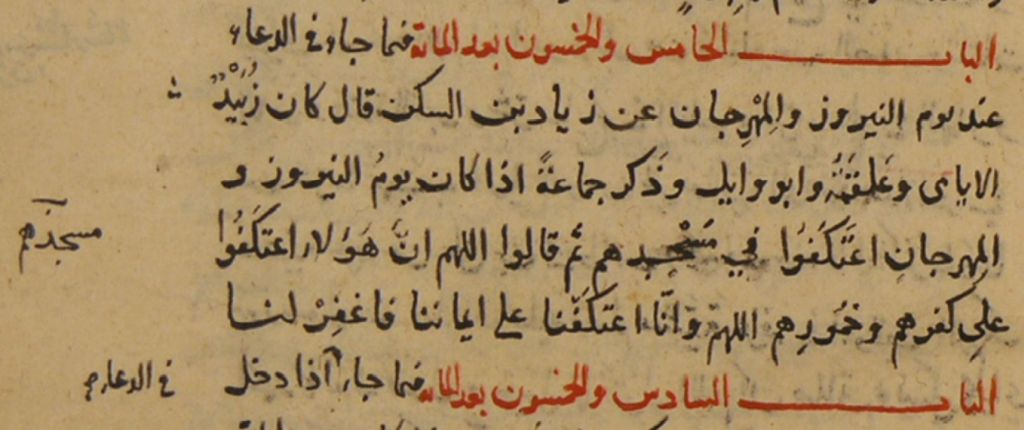
Elsewhere an expression in the main text has been written over and substituted by a variant: a noun no longer legible, apparently designating a Zoroastrian house of worship, on fol. 97a has been replaced by masjiduhum (their house of adoration; see Fig. 10.4).
Corrections: the variant masjidihim was written over the original text; two lines below a marginal correction with ṣaḥḥa and bow-shaped insertion marker. MS Istanbul, Süleymaniye Library, Feyzullah Efendi, 1296, fol. 97a
Often, however, the chapter numbers, spelled out with red ink, have been crossed out; they prove to be incorrect due to the numbers from chapters 203 (al-bÄb al-thÄlith baÊ¿d al-miʾatayn) to 261 being read incorrectly; in a process of correction carried out by the scribe, the correct forms have been entered in the margins, mostly in red, and provided with the sign/letter á¹£Äd.
Notes of correction often relate to text omissions in the main text and contain the corresponding supplements. One example for a supplement entered in the margin â with an insertion marker â is the phrase beginning with kuffirat Ê¿anhu in the sentence, âhe who recites the prayer so-and-so, his sins will become effaced (kuffirat Ê¿anhu) even if numerous as the foam crowns of the oceanâ (fol. 107a).
Occasionally, the place of insertion for omissions to be added in the main text has been marked by a sign in the shape of a bow (fol. 128a, l. 8). The sign is entered in the text while ṣaḥḥa is written in the margin. Another sign for marking a place of insertion is a graph resembling the Arabic number
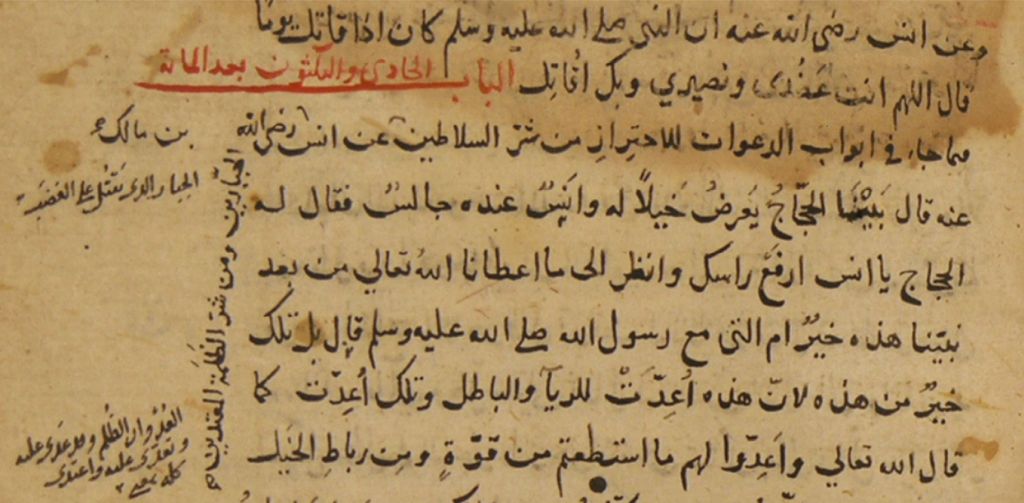
Headings omitted in the main text, probably mostly caused by inattentiveness, have been supplied in the margins, such as the heading of chapter 170 on prayers of protection against scorpions (fÄ«-mÄ jÄʾa min ruqya ilkh), entered at right angles to the main text (fol. 101b); and, corresponding to the usual format of headings, written with red ink. Likewise omitted â though in this case presumably because it was felt to be too long â was the second half of the heading of chapter 131, a protective prayer against despotic rulers and hostile tyrants (li-l-iḥtirÄz min sharr al-salÄá¹Ä«n [and thereafter written in the margin] al-jabbÄrÄ«n wa-min sharr al-áºalama al-muÊ¿tadÄ«n; see Fig. 10.5).
Corrections: second half of the heading of chapter 131 was added in the margin. MS Istanbul, Süleymaniye Library, Feyzullah Efendi, 1296, fol. 73a
An unnumbered heading has been added in the margin and written at right angles to the text body in chapter 184, on entering the Great Mosque (of Mecca) and what has to be recited while doing so.
A few thematic headings not found in the main text, beginning with maá¹lab,29 have been written in the margins by a more recent hand (e.g., fol. 48b, maá¹lab al-duÊ¿Äʾ li-l-muʾminÄ«na wa-l-muʾminÄt, âsubject of supplication of both male and female believersâ). These additions are, of course, corrections only in the widest sense of the word â the intention has been to give orientation to the user of the manuscript.
2.3 Individual Letters (Ḥarf) and Balagh Notes
In a few places, the final letters of the last word of a line have been ejected into the margin in an aesthetically motivated effort to keep the lines straight (e.g., fol. 112a).
Balagh notes, entered in the margins of a few pages, indicate that the copied text has been subjected to a collation with its exemplar. Presumably in this process, redundant alif of third or first person singular imperfect forms of verba tertiae infirmae such as arjū (
3 Strategies to Raise the Status of a Prayer
The discussion in this section on strategies to raise the status of a prayer is not directly related to marginalia, but it provides a glimpse into the culture of prayer as enacted by traditionalist Sufis and may therefore help to shed light on the religious ideas of the members of the milieu in which the manuscript under discussion was produced.
Certain âstrategiesâ can be detected in Ibn KhafÄ«fâs collection that were employed by the authors to boost the esteem in which their prayers were held and to encourage the audience to accept them piously and learn them by heart. The devices include, inter alia, the claim that Muḥammad showed a special interest in a prayer he heard someone say; the claim that a prayer would inevitably be answered by God; the addition of qualifications â often in the morphological afÊ¿al form (e.g., awfaq al-duÊ¿Äʾ or awthaq al-duÊ¿Äʾ); and the provision of an atmosphere of intimacy between the Prophet and the first-generation transmitters of a prayer.
3.1 Stating That the Prophet Recited the Prayer Frequently or on Special Occasions
One strategy for raising the status of a prayer is the claim that the Prophet used to recite that specific prayer frequently (kÄna yukthiru an yaqÅ«la AllÄhumma ilkh.; fol. 112b), or that he said that prayer at a special time such as, for instance, during the so-called farewell pilgrimage (duÊ¿Äʾ fÄ« ḥijjat al-widÄÊ¿; fol. 113a), at the beginning of each lunar year when visiting the martyrsâ tombs (fol. 123a), or in his agony (fol. 118aâb).
3.2 Stating That Muḥammad Was Especially Interested in the Prayer
Other prayers are made to stand out by mentioning the interest which Muḥammad showed in them. In one instance, it is noted that he overheard a prayer said in a mosque, inquired who said it, and, having discovered that, added: â[now] ask [God for something] and you will be given!â In this tradition, AbÅ« Bakr identified (Ê¿AbdallÄh b.) MasÊ¿Å«d as the one who said the prayer designated by Muḥammad as âwish-fulfillingâ, and he asked the companion to repeat to them the duÊ¿Äʾ which he had recited just before (fol. 151b).
Another tradition reports that Muḥammad once went to AbÅ« Dharr, âsocialiste avant la lettreâ, in order to inquire about the prayer which he kept saying. His interest became aroused after JibrÄ«l told him, in allusion to AbÅ« Dharrâs famous solitariness, that the companion was better known among the people of heaven than among those of the earth (inna A. Dh. aÊ¿raf fÄ« ahl al-samÄʾ minhu fÄ« ahl al-ará¸), because of a specific prayer which he recited twice every day (fol. 152).30
3.3 Stating That Muḥammad Mentioned an Authority for the Prayer
In some cases, the Prophet is quoted as mentioning the archangel or the prophets preceding him as his authorities for a given prayer, thereby raising its status. For example, when the Prophet addressed Ê¿Umar, enticing him with the proposal, âShall I not teach you words which JibrÄ«l taught me (a-lÄ uÊ¿allimuka kalimÄtin Ê¿allamanÄ«hinna JibrÄ«l), etc., rather than sending you the load of dates (wasq min tamr) which you asked for?â (fol. 111a), a criticism of the companionâs gluttony was intended, but â at the same time â the prayerâs status has been boosted through the reference to JibrÄ«l.
In talking to Ê¿AlÄ«, Muḥammad claims that the prayer he (regularly) said on the day of Ê¿Arafa (during the hajj pilgrimage), quoted subsequently, is the duÊ¿Äʾ that the prophets before him had said the most (kÄna akthara duÊ¿Äʾ al-anbiyÄʾ qablÄ« duÊ¿Äʾī yawm Ê¿Arafa); it begins with lÄ ilÄha illÄ AllÄh waḥdahÅ« ilkh. (no god but God, etc.; chapter 158, fol. 125b).
3.4 Stating That the Prayer Was Taught and Memorised like the Qurʾan
Prayers are made to stand out through comparison with the Qurʾan and the exhortation to memorise them. The transmitters of the á¹£aḥÄba generation claim, for instance, that the Prophet taught them the duÊ¿Äʾ al-istikhÄra just as he taught them the qurʾanic suras.31 Prayers of this type usually start with the supplication that if a matter is good for someone, God may give him or her the power to do it and bless him or her in its performance, and so on (chapter 64, fols. 54bâ55a).
Likewise, antidepressant prayers such as the daÊ¿awÄt al-karb (fols. 82bâ83b) are reported to have been taught by the Prophet to his companions; the receptive audience was asked to memorise them and not divulge them to other people (yaktumuhÄ, i.e., conceal them). It is stated that prayers which Muḥammad inculcated into his companionsâ hearts could not be forgotten for the rest of their lives (fol. 106a), that is, God would not allow the individual to whom a good outcome has been destined (man arÄda AllÄhu bihÄ« khayran) to forget the prayer (lam yunsihÄ« iyyÄhunna ḥattÄ yamÅ«t). However, the prayers thus inculcated â the tradition says â do not remain in the hypocriteâs heart (innahunna lÄ yathbutna fÄ« qalb munÄfiq).
3.5 Adding Qualifications to the Prayer
Certain qualifications have been added to the prayers increasing the esteem in which they are held. A companion, AbÅ« Hurayra, is reported to have said about a prayer that he had heard the Prophet recite (beginning with: AllÄhumma ijÊ¿alnÄ« uÊ¿aáºáºimu shukraka, âGod, make me value thanking youâ), âI will not stop saying it as long as I liveâ (see also above, p. 328).
Another qualification added with the intention of raising a prayerâs status is the expression âmost likely to yield successâ (awfaq al-duÊ¿Äʾ). An example of this is a prayer transmitted by AbÅ« Hurayra (fol. 110a), which begins with AllÄhumma anta rabbÄ« wa-anÄ Ê¿abduka (âGod, you are my lord and I am your servantâ). An alternative is to call a prayer awthaq al-duÊ¿Äʾ, âthe most reliable of prayersâ â this is a variant of awfaq and perhaps only constitutes a spelling mistake (fol. 110a).32
Another expression that is sometimes added to underline the importance ascribed to a prayer is aḥabbu al-duÊ¿Äʾ ilÄ AllÄh an yudÊ¿Ä bihÄ« (the supplication God loves the most that one prays with it; fol. 112a).
3.6 Stating That There Was an Atmosphere of Intimacy with the Prophet in the Prayer
Another technique for boosting the prestige of a prayer is to establish an atmosphere of intimacy with the Prophet in the context in which the prayer is transmitted. In one instance, Muḥammad takes the hand of MuÊ¿Ädh33 and says that he loves him and the latter says the same, and Muḥammad says to him: âShall I not teach you words to say after each ritual prayer?â34
3.7 Stating That Muḥammad Offered a Valuable Alternative to the Prayer
Another status-raising device is the alternative question that Muḥammad directed to a person to whom he intended to teach a prayer. The companion or family member is asked which of two valuable things he or she would prefer of those the Prophet offered to bestow: one thing is an object of high material value, the other is the prayer.
According to a certain hadith report adduced on the authority of Suwayd b. Ghafla, FÄá¹ima went to her father when she suffered hunger, and was made to choose between 500 goats (Ê¿anz) and five words that JibrÄ«l had taught the Prophet. To no surprise, she chose the prayer. Back with Ê¿AlÄ«, her spouse, she explained that she had departed from him for a worldly matter and returned to him with a thing of the hereafter (dhahabtu min Ê¿indika ilÄ al-dunyÄ wa-ataytuka bi-l-Äkhira; fol. 113b).
3.8 Stating That the Prayer Is Always Answered
Specific prayers in the collection are accompanied by the statement that they are inevitably answered (mustajÄb). In one place, for example, Muḥammad is cited as guaranteeing that a specific type of prayer, prayers with the greatest name â or any of the most beautiful names â of God, is answered.
The cognate belief that a person praying with the divine names will necessarily be rewarded by heaven is documented by traditions (quoted in chapter 142) including a statement by ʿAlī about paradise being the inevitable reward.35
The presumed inevitability that a prayer will be answered is often expressed, in the collection, by a mÄ â¦ illÄ phrase; for instance: âNo Muslim has ever been afflicted with grief and sorrow and said [a prayer with the words] such-and-such without God taking away his grief and sorrowâ (mÄ aá¹£Äba muslim [â¦] hamm wa-lÄ á¸¥uzn fa-qÄla AllÄhumma [â¦] illÄ adhhaba AllÄhu ḥuznahÅ«).36
3.9 Stating That the Prayer Has Proven to Be Effective
The effectiveness of a prayer as claimed in the frame stories is occasionally underpinned by a statement that it has been proven by a transmitter who tested the duÊ¿Äʾ. For example, the ascetic and weeper á¹¢Äliḥ b. Bishr (d. 176/792â793)37 learned from an anonymous person a prayer with the greatest name of God that was said to guarantee that God would answer oneâs supplication. The transmitter says he tested the prayer and claims that whenever he recited it âon land and on seaâ his supplication was answered (jarrabnÄhu wa-lÄ daÊ¿awtu AllÄha fÄ« barrin wa-lÄ baḥrin illÄ istajÄba; fol. 158b).
The invitation to the recipient of a prayer to curse its transmitter if the prayer proves ineffective may also be seen as a device for supporting a claim that it is a supplication inevitably answered. A certain MuqÄtil transmitted a prayer to secure oneâs release from prison and, in order to buttress the claim that it is a proven prayer, he said to the person to whom he taught it that he may curse him, alive or dead, if the duÊ¿Äʾ does not work (fa-in lam tustajab laka fa-lÊ¿an MuqÄtilan).38 The recipient was thrown into Caliph Manṣūrâs prison and thanks to the prayer â so the frame story says â he was immediately released (fol. 82a).39
4 Conclusion
The marginal commentaries in the manuscript of Ibn KhafÄ«fâs prayer compilation were designed to help the user assimilate the supplications recommended by the author(s) â the recommendations are supported by claims made in the frame stories deconstructed as strategies. The lexical glosses are meant to help the reader understand the often archaic wording of the prayer texts, many of which may have originated as early as the second/seventh or third/eighth century, when Arab culture was in transition from orality to scripturality. The chapter headings added in the text or ejected into the margins were designed as aids to comprehend the prayers individually or as thematic groups and to ease memorisation; this didactic motive caused Ibn KhafÄ«f (or his editor?) to delete the isnads which were part of the text at an earlier stage, maintaining a rudimentary chain only. Some marginal glosses referring to the arch-traditionalists revered by Ibn KhafÄ«f, such as Aḥmad b. Ḥanbal and al-ṬabarÄnÄ«, may be seen as remnants of an earlier and more exhaustive use of the marginsâ potential, while they also help in reconstructing the social context in which the prayers were transmitted and received. The interlinear deletion of the name of a Zoroastrian house of worship may be taken as an indication of the religious exclusivism detectable with some representatives of Sunni traditionalism. Notwithstanding this tendency towards parochialism, extraneous material such as the Christian Lordâs prayer has been incorporated, as a therapeutic charm or ruqya, without however indicating its non-Islamic provenance.
In comparison to other hadith manuscripts, whose margins tend to abound with notes of various types, such as ijÄza (MS Berlin, Staatsbibliothek zu Berlin (henceforth SBB), Hs. or. 1653) or samÄÊ¿ notes specifying the details of a teaching session (MS Berlin, SBB, Hs. or. 10864, 10866), authorâs marginalia (minhiyyÄt; MS Berlin, SBB, Hs. or. 5067), textual variants accompanied by sigla (MS Berlin, SBB, Hs. or. 5314), balagh notes (MS Berlin, SBB, Hs. or. 4993), quotations from parallel works evincing participation in scholarsâ debates (MS Berlin, SBB, Hs. or. 4840), catchwords relating to traditions discussed in the main text (MS Berlin, SBB, Hs. or. 5067), and so on, the margins of the present manuscript are rather empty. The types of comments that are profusely written in the margins of the standard hadith text manuscripts have, by contrast, been integrated into the main text in the present artefact. However, it cannot be ruled out that at an earlier stage of text composition, some of the additions40 were written in the margins and eventually found their way into the main text â that the text was reorganised is indicated by the authorâs (or redactorâs) mention in the preface that he shortened the isnads of his traditions.
This relative vacuity, in the margins of the Süleymaniye Library manuscript, reflects the fact that although the text, by its content, represents one of the genres of transmission from the Prophet (and the pious forefathers, al-salaf al-á¹£Äliḥ) â that is, prayer â the compilation did not originate in the sphere of hadith scholarship (Ê¿ilm al-ḥadÄ«th). The author had felt intensely attracted â especially in the early years of his career â to the company of scholars of hadith as bearers of transmitted religious knowledge, and he regularly visited them as a very young traveller (pisar, kudak (a boy)) during his sojourns in the centres of learning in the âWestâ (gharb; DaylamÄ«, SÄ«rat) but he distanced himself from their professional pursuits and technicalities which he considered incompatible with his Sufi aspirations (contemporary Sufis tended to be sceptical about the discipline of Ê¿ilm al-rijÄl â assessment of transmittersâ reliability â as practised by the ahl al-ḥadÄ«th, which they felt amounted to slander, ghÄ«ba).41
Although some prayer texts found in the present compilation may be considered as purely mystical, they form only a relatively small minority. Fol. 120b includes, for example, the famous prayer of the Sufis who would flee from Godâs wrath to his contentment, âfrom you to youâ (aÊ¿Å«dhu bika minka), uttered by the Prophet (according to Ê¿Äʾisha, during sajda) and later by, among others, the great mystic of Baghdad, AbÅ« Bakr Dulaf al-ShiblÄ« (d. 334/945; see Ibn KhamÄ«s: ManÄqib al-abrÄr, fol. 81b). However, a much larger group of prayers, transmitted in the names of the Prophet and his successors in the first three generations (considered as saints (awliyÄʾ) by al-SulamÄ«, for example, in the introduction to his ṬabaqÄt al-Ṣūfiyya), tend to the therapeutic and apotropaic needs of believers; many of these prayers and incantations assembled in Ibn KhafÄ«fâs collection are associated with a belief in special properties that attach to specific qurʾanic verses, words, or letters. Thus, in consonance with the general orientation of Ibn KhafÄ«fâs Sufism, the âtransmitted prayersâ confirm the function of the renunciants (zuhhÄd) who preceded the historic formation of Sufism to serve as his role models.42
Acknowledgements
I would like to express my gratitude to the editor of this volume, Dr. Stefanie Brinkmann, and to Dr. Boris Liebrenz for their corrections and suggestions on how to improve this paper, and last but not least, to Tim Curnow, the indefatigable copy editor who has helped to make my English sentences more easily understandable.
List of Manuscripts
Note that the following abbreviations for libraries are used in the text and footnotes:
| SBB | Staatsbibliothek zu Berlin |
Ibn KhafÄ«f, Muḥammad b. IsfakshÄdh/IsfikshÄdh: K. Sharḥ khÄṣṣiyyat al-ÄyÄt al-mubayyinÄt wa-jawÄmiÊ¿ al-daÊ¿awÄt fi-al-awqÄt al-mukhtalifÄt
MS Süleymaniye, Feyzullah Efendi 1296.
Ibn KhamÄ«s, al-Ḥusayn b. Naá¹£r al-Mawá¹£ilÄ«: ManÄqib al-abrÄr (wa-maḥÄsin al-akhyÄr)
MS Berlin, Staatsbibliothek zu Berlin, Petermann, [I] 376.
Bibliography
Arberry, Arthur John: Shiraz: Persian City of Saints and Poets (Norman: University of Oklahoma Press, 1960).
BasharÄ«, JawÄd: âÄs̱Är-i bar jÄy-mÄnda az Ibn-i KhafÄ«f wa-dastnawÄ«sÄ« az bakhsh-i ibitidÄʾī-i K. al-Iqtiá¹£Ädâ, ÄyÄ«na-i mÄ«rÄs̱ 17, no. 64 (2019), pp. 41â58.
Brockelmann, Carl: Geschichte der arabischen Litteratur, 2 vols. and 3 supplementary vols. (Leiden: Brill, 1937â1949).
al-DaylamÄ«, AbÅ« al-Ḥasan Ê¿AlÄ«: SÄ«rat al-shaykh al-kabÄ«r AbÅ« Ê¿AbdallÄh Ibn al-KhafÄ«f al-ShÄ«rÄzÄ«, ed. Annemarie Schimmel-Tarı (Ankara: Türk Tarih Kurumu, 1955).
al-DhahabÄ«, Shams al-DÄ«n Muḥammad: Siyar aÊ¿lÄm al-nubalÄʾ, eds. ShuÊ¿ayb ArnaʾūṠet al., 25 vols. (Beirut: Muʾassasat al-RisÄla, 1981â1985).
Fletcher, Joseph: âThe Naqshbandiyya in Northwest Chinaâ, Studies on Chinese and Islamic Inner Asia, ed. Beatrice Forbes Manz (Aldershot: Variorum, 1995), 9, pp. 1â46.
Gacek, Adam: Arabic Manuscripts: A Vademecum for Readers (Leiden & Boston: Brill, 2009).
Gacek, Adam: The Arabic Manuscript Tradition: A Glossary of Technical Terms & Bibliography (Leiden & Boston: Brill, 2001).
al-GhazÄlÄ«: AsrÄr khawÄṣṣ kitÄb AllÄh al-Ê¿azÄ«z (n.p.: Maktabat al-Waḥda al-Ê¿Arabiyya, n.d.).
ḤÄjjÄ« KhalÄ«fa: Kashf al-áºunÅ«n Ê¿an asÄmÄ« al-kutub wa-al-funÅ«n. Lexicon bibliographicum et encyclopaedicum. Ed. Lat. vertit et comm. indicibusque instruxit Gustavus Fluegel. Vol. 1â7. (Leipzig. Reprint New York-London, 1835â1858).
Ibn al-JawzÄ«, AbÅ« al-Faraj Ê¿Abd al-RaḥmÄn: á¹¢ifat al-á¹£afwa, 4 parts (Mecca: al-Maktaba al-TijÄriyya, n.d.).
Ibn KhamÄ«s, al-Ḥusayn b. Naá¹£r al-Mawá¹£ilÄ«: ManÄqib al-abrÄr (wa-maḥÄsin al-akhyÄr), ed. SaÊ¿Ä«d Ê¿Abd al-FattÄḥ, 2 vols. (Beirut: DÄr al-Kutub al-Ê¿Ilmiyya, 2006).
Junayd-i ShÄ«rÄzÄ«, AbÅ« al-QÄsim: Shadd al-izÄr fÄ« ḥaá¹á¹ al-awzÄr Ê¿an zuwwÄr al-mazÄr, ed. Muḥammad QazwÄ«nÄ« (TihrÄn, 1328).
Kazemifar, Moein [MuÊ¿Ä«n KÄáºimÄ«far]: MajmÅ«Ê¿a-i Äs̱Är-i Ibn KhafÄ«f-i ShÄ«rÄzÄ«, 2 vols. (ShÄ«rÄz: Nashr-i NigÄh-i MuÊ¿Äá¹£ir, 1401/2022).
Khaá¹Ä«b al-BaghdÄdÄ«, Aḥmad b. Ê¿AlÄ«: K. al-KifÄya fÄ« Ê¿ilm al-riwÄya (Hyderabad: DÄʾirat al-MaÊ¿Ärif al-Ê¿UthmÄniyya, 1357/1938).
Köprülü, Orhan F.: âFeyzullah Efendiâ, Ä°slâm Ansiklopedisi, vol. 4 (Istanbul: Milli EÄitim Basımevi, 1977), pp. 593â600.
Quiring-Zoche, Rosemarie: âMinhÄ«yÄt â Marginalien des Verfassers in arabischen Manuskriptenâ, Asiatische Studien â Ãtudes Asiatiques 60, no. 4 (2006), pp. 987â1019.
Sobieroj, Florian: âAwá¹£Äf al-qulÅ«b and Auctorial Texts of Ibn KhafÄ«f in His Compilation of Transmitted Prayersâ, in Kazemifar: MajmÅ«Ê¿a-i Äs̱Är-i Ibn KhafÄ«f-i ShÄ«rÄzÄ«, vol. 1, pp. 344â355.
Sobieroj, Florian: âDaylamÄ«â, Encyclopedia of Arabic Literature, eds. Julie Scott Meisami and Paul Starkey, vol. 1 (London & New York: Routledge, 1998), pp. 85â86.
Sobieroj, Florian: âHadith and Sufism: Mystical Dimensions of the Traditionsâ, The Oxford Handbook of Hadith Studies, ed. Mustafa Shah (forthcoming).
Sobieroj, Florian: Ibn ḪafÄ«f und seine Schrift zur Novizenerziehung (KitÄb al-Iqtiá¹£Äd): Biographische Studien, Edition und Ãbersetzung (Beirut: Orient-Institut Beirut; Stuttgart: Steiner, 1998).
Sobieroj, Florian: âIbn KhafÄ«fâ, Encyclopaedia of Islam, THREE, eds. Kate Fleet, Gudrun Krämer, Denis Matringe, et al. (Leiden & Boston: Brill, 2016), pp. 137â143. https://doi.org/10.1163/1573-3912_ei3_COM_30858.
Sobieroj, Florian: âReflections of Yemeni Sufi Masters in Sino-Arabic Manuscripts: Lines of Transmission and Symbolismâ, Nouvelles chroniques du manuscrit au Yémen NS 14, no. 33 (2022), pp. 127â177.
Sobieroj, Florian: Variance in Arabic Manuscripts: Arabic Didactic Poems from the Eleventh to the Seventeenth Centuries â Analysis of Textual Variance and Its Control in the Manuscripts (Berlin & Boston: De Gruyter, 2016).
TayÅi, Mehmet Serhan: âFeyzullah Efendi, Seyyidâ, TDV Ä°slâm Ansiklopedisi, vol. 12 (Istanbul: Ä°SAM, 1995), pp. 527â528. https://islamansiklopedisi.org.tr/feyzullah-efendi-seyyid.
TayÅi, Mehmet Serhan and Mustafa Birol Ãlker: âMillet Kütüphanesiâ, TDV Ä°slâm Ansiklopedisi, vol. 30 (Istanbul: Ä°SAM, 2005), pp. 70â71. https://islamansiklopedisi.org.tr/millet-kutuphanesi.
Thibon, Jean-Jacques: Les générations des Soufis: ṬabaqÄt al-ṣūfiyya de AbÅ« Ê¿Abd al-RaḥmÄn, Muḥammad b. Ḥusayn al-SulamÄ« (325/937â412/1021) (Leiden & Boston: Brill, 2019).
UludaÄ, Süleyman: âAbdülvâhid b. Zeydâ, TDV Ä°slâm Ansiklopedisi, vol. 1 (Istanbul: Ä°SAM, 1988), p. 282. https://islamansiklopedisi.org.tr/abdulvahid-b-zeyd.
Coming from later times, RÅ«zbihÄn al-BaqlÄ« (d. 606/1209) and Shams al-DÄ«n ḤÄfiẠ(d. 791/1389 or 793/1391) have been revered as saintly figures in Shiraz, overshadowing Ibn KhafÄ«fâs fame (cf. Arberry: Shiraz, pp. 86â111; for Ibn KhafÄ«f, see Arberry: Shiraz, pp. 61â85; a useful biography, based on the earliest sources, is al-DhahabÄ«: Siyar aÊ¿lÄm al-nubalÄʾ, vol. 16, pp. 342â347; see also Sobieroj: âIbn KhafÄ«fâ).
The authorities cited in the collection of transmitted prayers, who belong to the first three generations after Muḥammad, in all likelihood correspond with the religiosi whom al-Sulamī (d. 412/1021) dealt with in his K. al-Zuhd that, deplorably, is lost (on this work, see Thibon: Les générations des Soufis, p. 8).
In a Persian-language article on the works of Ibn KhafÄ«f that are still extant, JawÄd BasharÄ« studies a fragment of a third copy of the K. al-Iqtiá¹£Äd (the other two manuscripts are MS Princeton, Princeton University Library, Garrett Collection (Yahuda Section), 459, and MS Istanbul, Süleymaniye Library, Pertev PaÅa, 652). The fragment seems to have been produced on the Jabal Ê¿Ämil of Lebanon and is now lodged in the MarÊ¿ashÄ« library of Qum. A paratext on the text transmission (thabt) prefaced to the fragment includes three isnads, the last of which testifies to a transmission of this work by Ibn KhafÄ«f to al-SulamÄ« (see BasharÄ«: âÄs̱Ärâ, p. 48).
A fate this text shares with the biography of Ibn KhafÄ«f written by his disciple Ê¿AlÄ« al-DaylamÄ« (see Sobieroj: âDaylamÄ«â, pp. 85â86) in Arabic, which is extant in a Persian translation made in the eighth/fourteenth century by YaḥyÄ b. Junayd ShÄ«rÄzÄ« (on the translation, see al-DaylamÄ«: SÄ«rat, p. 9).
The expression khÄṣṣiyyat (khawÄṣṣ) al-ÄyÄt refers to certain occult qualities that have been ascribed â at the latest since JaÊ¿far al-á¹¢Ädiq (d. 148/765; Brockelmann: Geschichte der arabischen Litteratur, suppl. vol. 1, p. 104) â to specific qurʾanic verses or expressions occurring in them. Among the authors said to have written texts on this subject, al-GhazÄlÄ« takes pride of place: the theologian is presumed to have written a relevant tract titled AsrÄr khawÄṣṣ kitÄb AllÄh al-Ê¿azÄ«z (not mentioned in Brockelmannâs Geschichte der arabischen Litteratur; recently reprinted by Maktabat al-Waḥda al-Ê¿Arabiyya).
In the Shadd al-izÄr of Junayd-i ShÄ«rÄzÄ«, p. 42, a prosopographic work on saintly individuals buried in Shiraz, a work titled K. Sharḥ al-faá¸Äʾil is ascribed to Ibn KhafÄ«f. In ʿĪsÄ b. Junaydâs HazÄr mazÄr, a Persian translation of Shadd al-izÄr, a work titled JamÄ«Ê¿ al-daÊ¿awÄt is attributed to Ibn KhafÄ«f (see Sobieroj: Novizenerziehung, p. 312, no. 30). ḤÄjjÄ« KhalÄ«fa: Kashf, vol. 5, p. 131, who mentions the text with incipit, offers the title variant K. Faá¸Äʾil wa-jÄmiÊ¿ al-daÊ¿awÄt wa-l-adhkÄr, and thereby seems to indicate that the works referred to in Shadd al-izÄr and HazÄr mazÄr are all identical. On the workâs authenticity, see Sobieroj: Variance in Arabic Manuscripts, p. 91 n. 129; Sobieroj: âIbn KhafÄ«fâ, p. 140; in addition, the authorâs name is mentioned in the preface of the manuscript. BasharÄ«: âÄs̱Ärâ, p. 46, mentions, among the works ascribed to Ibn KhafÄ«f, the present collection of prayers and he adds that it would be highly desirable to study the text.
Notwithstanding his Sufi profession, Ibn KhafÄ«f was also an authority in Prophetic tradition. He frequented the great scholars in hadith in FÄrs and during his travels in the Arab countries, and it was his habit to copy twenty traditions every night, after completing his prayer litanies. Ibn KhafÄ«f did not reject weak traditions of the akhbÄr al-ÄḥÄd type, which he accepted with a caveat: in his creed entitled MuÊ¿taqad (edited by Schimmel-Tarı as an appendix in al-DaylamÄ«: SÄ«rat, p. 301), he declares that they obligate Muslims to practise their contents but âknowledgeâ (i.e., legal rulings) must not be founded on them. He compiled a collection of mufrad traditions but he refrained from holding sessions of dictating hadith, which he did not consider part of his duties (DaylamÄ«: SÄ«rat, p. 209).
A paper concentrating on content-related issues and the relationship between orality and scriptuality as reflected in Ibn KhafÄ«fâs text is in statu nascendi and will be published in German. The section on âstrategiesâ in the present paper (see below, pp. 334â8) is intended to serve as an example of the content-related matters discussed there and to give an impression of how the prayers âworkedâ.
There are similar prayer collections based on hadith such as MuḥyÄ« al-DÄ«n YaḥyÄ al-NawawÄ«âs (d. 676/1277) Ḥilyat al-abrÄr wa-shiÊ¿Är al-akhyÄr fÄ« talkhÄ«á¹£ al-daÊ¿awÄt wa-l-adhkÄr al-mustaḥabba fÄ« al-layl wa-l-nahÄr (MS Berlin, Staatsbibliothek zu Berlin (henceforth SBB), Ms. or. quart. 1705) or al-WasÄʾil al-qurʾÄniyya wa-l-adÊ¿iya al-nabawiyya by the Yemeni ZaydÄ« author YaḥyÄ b. al-MahdÄ« (14th cent.; MS Berlin, SBB, Ms. or. quart. 1834). The focus placed by Ibn KhafÄ«f on prayers with the âgreatest name of Godâ and with verses selected from the Qurʾan on the basis of its hidden properties can also be observed in the last-mentioned text. The dissemination of these collections, ascribed to authors who overshadowed the fame of Ibn KhafÄ«f, may have played a role in the eclipse of the compilation under study. An emphasis laid on (insignificant) variance caused Ibn KhafÄ«f to repeat traditions several times, which defeats the authorâs intention of offering the text as a prayer manual (vade mecum). This however may be considered as one of the reasons why the text, in the course of time, was supplanted by more popular works such as the aforementioned.
Ibn KhafÄ«f composed the text, as he says in the preface, in his youth, and to begin with, he had included the full isnad for each tradition quoted. However, in order to ease memorisation, he deleted the chains of transmitters (fa-ḥadhaftu al-asÄnÄ«d) in a subsequent step, maintaining a truncated form of the isnad only. This statement has in part been supplemented in a marginal gloss (fol. 1b), but this has been tampered with by an alien hand. (As result of this interference, the gloss runs: wa-l-ḥÄdhif ghayr al-shaykh raḥimahÅ« AllÄh (the person deleting was somebody other than the shaykh); see Fig. 1.) It cannot be excluded, however, that the isnads were truncated by a scribe or a redactor who worked on Ibn KhafÄ«fâs original text (in this case one should read: fa-ḥudhifat minhu al-asÄnÄ«du).
As is implied in the chapter heading, âwhat has been passed down as prayer for one who wants to sleep and fears iḥtilÄmâ, it includes, among other things, a prayer in which Godâs protection is implored against nocturnal emissions.
However, between fols. 102b and 103a, a change in the style of writing may be observed, possibly caused by a change of hands.
On this figure, see UludaÄ: âAbdülvâhid b. Zeydâ, p. 282.
Possibly, although it is rather unlikely, a member of the Naqshbandiyya-Khojas of KÅ«cha in Altishahr, who were known as KatakÄ«; Fletcher: âNaqshbandiyyaâ, p. 6.
The manuscript was copied in a Sunni milieu. This may be inferred from the observation that Ê¿Äʾisha is designated umm al-muʾminÄ«n in the first of a series of traditions on prayers that Muḥammad would say when the new moon appeared (Ê¿inda ruʾyat al-hilÄl), reported on her authority (chapter 152).
This previous owner designates himself âal-Sayyid FayḠAllÄh al-MuftÄ« fi-l-salá¹ana al-Ê¿aliyya al-Ê¿UthmÄniyyaâ. For his biography, see TayÅi: âFeyzullah Efendiâ; for his library, TayÅi and Ãlker: âMillet Kütüphanesiâ.
The waqf stamp, reproduced in TayÅi: âFeyzullah Efendiâ, p. 527, includes the stipulation that the manuscript must not be removed from his madrasa. The expression waqf, written with extended letter fÄʾ and sprinkled with gold dust, has also been inscribed on the upper margin of this page as well as on fol. 1b.
Köprülü: âFeyzullah Efendiâ, p. 599a.
In this prayer, God is addressed as the one who makes a person remember âa thingâ (yÄ mudhakkir al-shayʾ wa-fÄÊ¿ilahÅ« dhakkirnÄ« mÄ nasÄ«tu).
Ê¿Äʾisha explained to the person inquiring about its licitness that he may say the charm with the two short muÊ¿awwidha suras (irqi bi-l-muÊ¿awwidhatayn) without, however, breathing (nafth) over âitâ (i.e., the wound).
In a similar context, Darya Ogorodnikova, in her chapter in this volume, uses the term âmorphosyntactic glossingâ.
He explains the two zoological terms al-awraq (min al-ibl) and al-lubÅ«n (min al-shÄt), subspecies of camel and sheep.
Aḥmad b. Muḥammad al-ṬayyibÄ« (al-ṬībÄ«; d. 743/1342; Brockelmann: Geschichte der arabischen Litteratur, vol. 1, p. 448) wrote a gloss on a commentary, or revised and extended version, titled MishkÄt al-Maá¹£Äbīḥ by TibrÄ«zÄ« on the Maá¹£Äbīḥ al-sunna of al-BaghawÄ«.
Perhaps identical to al-Ḥasan b. Muḥammad al-á¹¢aghÄnÄ« (d. 650/1252; Brockelmann: Geschichte der arabischen Litteratur, vol. 1, pp. 443â444, suppl. vol. 1, p. 614), author of works on (apocryphal) hadith.
In the corpus examined by Quiring-Zoche, the earliest instances of minhiyyÄt were detected in artefacts produced in the middle of the thirteenth century; see Quiring-Zoche: âMinhÄ«yÄtâ. In this volume, see Bockholtâs chapter âFootnotes in Premodern Times?â.
Gacek: Glossary, p. 82.
The tendency to leave incorrectly written expressions intact in the main text may be explained by reference to a raised sense of respect for the traditions copied. Al-Khaá¹Ä«b al-BaghdÄdÄ« (d. 463/1071) authored a text titled K. al-KifÄya fÄ« Ê¿ilm al-riwÄya in which relevant issues are discussed; among others, in the chapters dealing with self-corrections by the scribe (and abstaining from it), bÄb mÄ jÄʾa fÄ« iá¹£lÄḥ al-muḥaddith kitÄbahÅ« bi-ziyÄdat al-ḥarf al-wÄḥid fÄ«hi aw bi-nuqá¹£ÄnihÄ« (p. 249 of the Hyderabad edition), or bÄb dhikr al-riwÄya Ê¿amman lam yujawwiz ziyÄdat ḥarf wÄḥid wa-lÄ á¸¥adhfahÅ«, etc. (pp. 177â178).
For the insertion markers, see Gacek: Arabic Manuscripts, p. 250 (s.v. âsignes-de-renvoiâ); Sobieroj: Variance in Arabic Manuscripts, pp. 50, 118.
In some instances, the term maá¹lab has been written on the margins in isolation, i.e., without mention of the reference (e.g., fol. 135b).
AbÅ« Dharr explained to the Prophet that the prayer consisted of ten words which he (JibrÄ«l?) had taught him (innamÄ Ê¿asharat aḥruf alhamanÄ« ilhÄman), beginning: AllÄhumma innÄ« asʾaluka Ä«mÄnan dÄʾiman. The angel enumerated the effects of the prayer as including being loved by the people, forgiveness of sins, and entry into heaven (fol. 152a).
A similar claim is made about the taʿwīdh prayers.
The expression occurs in an address by Muḥammad to AbÅ« Hurayra â inna awthaq al-duÊ¿Äʾ an yaqÅ«la al-Ê¿abd: AllÄhumma anta rabbÄ« wa-anÄ Ê¿abduka (the most reliable prayer that man can say is âGod, you are my lord and I am your servantâ) â and the prayer is identical to the version above.
In all likelihood, identical with MuÊ¿Ädh b. Jabal, the Prophetâs famous missionary to Yemen (see my article âReflections of Yemeni Mastersâ, pp. 151â152).
The words given in all three versions are: AllÄhumma aÊ¿innÄ« Ê¿alÄ dhikrika wa-shukrika wa-ḥusni Ê¿ibÄdatika (help me to remember and thank you and adore you beautifully; fol. 112aâb).
The main part of this chapter (which is headed fÄ«-mÄ jÄʾa fÄ« thawÄb man daÊ¿Ä AllÄh bi-tisÊ¿at wa-tisÊ¿Ä«na isman) consists of a single tradition in which further effects of invoking God with his names are described.
Alternatively, the Prophet is quoted as making the claim of an answering by inevitability through an if-clause, âif you say the prayer so-and-so, God will do such-and-such a thingâ (fol. 83b).
On á¹¢Äliḥ, see, e.g., Ibn al-JawzÄ«: á¹¢ifat al-á¹£afwa (an imitation and abridgement of AbÅ« NuÊ¿aymâs Ḥilyat al-awliyÄʾ), vol. 3, p. 207; his prayer is one of the very last to be adduced in Ibn KhafÄ«fâs collection.
It had to be recited 100 times in conjunction with the morning prayer (idhÄ á¹£allayta al-ghadÄt).
While certain prayers were said to guarantee an answer, with other daÊ¿awÄt specific devices (efforts) can be identified in the collection that were to be adopted as a precondition for success.
âParatextsâ that Ibn KhafÄ«f added to his prayer traditions have been made discernible as such by way of introductory phrases such as qÄla al-shaykh raḥimahu AllÄh (e.g., fol. 69b) or wa-l-muá¹£annif raḥimahu AllÄh ka-dhÄlika (the author has acted in the same way; fol. 133a). The additions may include evaluations of traditions; cross references; notes on variance relating to transmitters and to text; and so on.
For related issues, see my article âHadith and Sufismâ.
I seize this opportunity to refer to a short article of mine, âAwá¹£Äf al-qulÅ«bâ, in which I discuss both the auctorial texts that may be detected in Ibn KhafÄ«fâs collection of prayers and â approvingly â the authenticity of the very comprehensive Awá¹£Äf al-qulÅ«b traditionally ascribed to him. The paper was published in Moein Kazemifarâs two-volume collection of the works of Ibn KhafÄ«f entitled MajmÅ«Ê¿a-i Äs̱Är-i Ibn KhafÄ«f-i ShÄ«rÄzÄ«; the first volume includes the Awá¹£Äf al-qulÅ«b (pp. 59â343), while the second offers nine texts, of which five are Persian translations.