During the contentious seventeenth and eighteenth centuries, in the midst of debates in which some Ottoman intellectuals labelled the mystic Ibn al-Ê¿ArabÄ« (d. 638/1240) an infidel, the Ottoman scholar CÄrullÄh EfendÄ« (d. 1151/1738) responded to such criticism: His annotations in manuscripts from his private collection containing the works of Ibn al-Ê¿ArabÄ« or related works reflect his efforts to elaborate on the mystic's teachings and to counter his critics. Here, marginal commentaries reflect a contemporary intellectual debate.
Manuscript studies have recently gained momentum, as one frequently encounters many academic studies and events of different sizes, such as symposiums, workshops, edited books, and papers on this subject.1 These academic activities have led to the production of more comprehensive projects and publications on manuscripts. Such manuscript research may range from the critical analysis of a single manuscript to the review of an entire collection. Examining annotations made in the margins of texts has recently emerged as a new method to unearth otherwise hidden knowledge âbehindâ the texts.2 A new generation of scholars is employing manuscript notes to write the biographies of more obscure persons, to understand the process of building a library, to gain a deeper comprehension of the literature on certain issues, or as a documentary source.3
Manuscript notes offer biographical, bibliographical, annotative, and glossarial information to researchers as well as providing critical information â that is, performing criticism in the margins. Of these, I focus here on critical annotations that can also be considered marginal commentary because they represent a kind of âmarginal criticismâ. To illustrate the critical attitude of marginal commentaries, I utilise the handwritten notes set down by CÄrullÄh Efendi (b. 1070/1659â1660, d. 1151/1738) in the margins of works investigating Ibn al-Ê¿ArabÄ« to demonstrate that the former considered that the latter should be reconsidered, and further asserted that Ottoman scholars either misunderstood or held certain biases against him. Thus, marginal commentaries show their potential to display intellectual debates.
CÄrullÄh Efendi wrote notes related to Ibn al-Ê¿ArabÄ« in the margins or on the front pages of manuscripts he read. These notes constitute a defence of Ibn al-Ê¿ArabÄ« and his doctrine against the accusations and criticism levelled at him by other scholars, and I will demonstrate how, in these marginal notes, CÄrullÄh Efendi simultaneously defends Ibn al-Ê¿ArabÄ« and criticises esteemed scholars who had denigrated him.
Although Ibn al-Ê¿ArabÄ« was condemned as a kÄfir (unbeliever) by certain Ottoman scholars and intellectuals, other circles in Ottoman society held him to be the greatest shaykh (al-shaykh al-akbar), and this sharp dichotomy persists even today in modern Islamic discourses. Historically, however, the seventeenth century constituted a period when most views portrayed him in a negative light, as exemplified by the work The Balance of Truth (MÄ«zÄn al-ḥaqq fÄ« ikhtiyÄr al-aḥaqq), most likely written in 1656 by KÄtib Ãelebi, also known as ḤÄjjÄ« KhalÄ«fa (d. 1067/1657). This work, in which KÄtib Ãelebi discusses twenty-one controversial issues prevalent in his time, reflects the general atmosphere of the century.
KÄtib Ãelebi was among the most influential figures of the seventeenth century as a result of his writings and his network of contemporaries. Serhat Küçük has reviewed the most well-known assessments of KÄtib Ãelebi to reveal how he has been perceived throughout history in his âKâtip Ãelebi Algısı Ãzerine DüÅüncelerâ (Reflections on the Perception of KÄtib Ãelebi).4 According to Küçük, he tended to employ universal truths for local objectives instead of presenting universal messages for humanity through local issues.5 Thus, he was a man of his times of transformation and inter- and intra-communal intellectual exchange,6 who uses both Eastern and Western knowledge and science.7 As G.L. Lewis puts it, his fame largely rests on his Kashf al-áºunÅ«n, which is still a research tool of Orientalists, and his JihÄnnumÄ is a landmark in Ottoman scholarship since Western sources were essential for the completion of the work.8
KÄtib Ãelebi was one of the students of QÄá¸izÄde Mehmed Efendi (d. 1045/1635), who epitomised one of the two sides present in the political and religious movements of the seventeenth century and who was criticised as having âno acquaintance with rational sciencesâ9 in The Balance of Truth. KÄtib Ãelebi was also an essential scholar in the life of CÄrullÄh Efendi, as he was the teacher (hocÄ) of CÄrullÄh Efendiâs teacher Ê¿Abd al-WahhÄb Efendi (d. 1100/1689), better known by the name Ê¿Arab-zÄdah. This established a direct link between CÄrullÄh Efendi and KÄtib Ãelebi. CÄrullÄh Efendi reflects this in one of the marginal notes he wrote in a manuscript containing the work al-Mulakhkhaá¹£ that KÄtib Ãelebi himself had copied.10 KÄtib Ãelebi most likely taught Ê¿Abd al-WahhÄb Efendi the mathematical sciences that were subsequently taught to CÄrullÄh Efendi. Consequently, CÄrullÄh Efendi can be considered a link in the chain running back to QÄá¸izÄde. This being the case, KÄtib Ãelebi makes the perfect starting point for us to comprehend both the seventeenth century in general and Ottoman scholarsâ view of Ibn al-Ê¿ArabÄ« in particular, since The Balance of Truth gained public approval and confirmation even in his own lifetime, for example, from the shaykh al-Islam of the era, Ê¿Abd al-Raḥīm Efendi.11
According to KÄtib Ãelebi, QÄá¸izÄde, like Birgili Mehmed Efendi (d. 981/1573), had initially desired to become a Sufi. However, upon realising that the âSufi path did not suit his temperament, he adopted the way of the rational sciences (Ê¿aqliyyÄt)â.12 On the other hand, Ê¿AbdülmecÄ«d SiwÄsÄ« (d. 1049/1639) represents the opposite of QÄá¸izÄde, namely taá¹£awwuf (spirituality/Sufism). Ãelebi argues:
These two sheikhs were diametrically opposed to one another; because of their differing temperaments, warfare arose between them. In most of the controversies I have mentioned in this book, QÄá¸izÄde took one side and SiwÄsÄ« took the other, both going to extremes.13
The issues that Ãelebi portrays in The Balance of Truth are the main fault line that divided Ottoman society into two distinct segments. What is of interest to me is that KÄtib Ãelebi posited himself as an arbitrator between them, just as the name of his book implies: The Balance of Truth. He proposed himself as a balance to select âthe truest truth among truthsâ, though he was neither a genuine madrasa teacher nor the best scholar of his time; indeed, he would be classified as an encyclopedist14 rather than a madrasa teacher because he was not educated in a madrasa.
In all, twenty-one controversial issues dominant during the seventeenth century were treated in The Balance of Truth. These are: âThe Life of the Prophet Khiá¸râ, âSingingâ, âDancing and Whirlingâ, âThe Invoking of Blessings on Prophets and Companions [taá¹£liyya and tará¸iyya]â, âTobaccoâ, âCoffeeâ, âLaudanum, Opium and Other Drugsâ, âThe Parents of the Prophetâ, âThe Faith of Pharaohâ, âThe Controversy concerning Shaykh MuḥyÄ« al-DÄ«n Ibn al-Ê¿ArabÄ«â, âThe Cursing of YazÄ«dâ, âThe Innovation [bidÊ¿a]â, âPilgrimages to Tombsâ, âThe Supererogatory Prayers [Nights of RaghÄʾib, BarÄʾat and Qadr]â, âShaking Handsâ, âBowing [inḥinÄ]â, âEnjoining right and Forbidding Wrongâ, âThe Religion of Abrahamâ, âBriberyâ, âThe Controversy between AbÅ« al-SuÊ¿Å«d Efendi and Birgili Mehmed Efendiâ, and âThe Controversy between SiwÄsÄ« and QÄá¸izÄdeâ.15
A look at the subjects addressed in this book reveals that a myriad of controversial issues had emerged by the seventeenth century, demonstrating that this was an intellectually chaotic and contentious century. The most critical of these controversies for this chapter is the one about Ibn al-ʿArabī and his famous doctrine of the unity of being (waḥdat al-wujūd). Although Ibn al-ʿArabī and his theory influenced Ottoman thought throughout its entire history, intellectuals continue to struggle with this topic. Therefore, I will focus on this specific problem, investigating how the two opposing sides assessed Ibn al-ʿArabī and his doctrine of the unity of being in the seventeenth century.
The so-called QÄá¸izÄdelis and SiwÄsÄ«s constituted the two polar camps when it came to Ibn al-Ê¿ArabÄ« and the unity of being, and I believe this reflects the understanding and attitudes of the larger seventeenth-century Ottoman intellectual community. In fact, in his chapter titled âThe Controversy concerning Shaykh MuḥyÄ« al-DÄ«n Ibn al-Ê¿ArabÄ«â, KÄtib Ãelebi discusses the arguments made for and against him by the SiwÄsÄ«s and QÄá¸izÄdelis, respectively. Since QÄá¸izÄde Mehmed Efendi was the teacher of KÄtib Ãelebi, it can be easily argued that he was a first-hand witness to this debate.
Although Ibn al-Ê¿ArabÄ« wrote many influential books (six hundred according to KÄtib Ãelebi), KÄtib Ãelebi mentions only four of his more famous works in The Balance of Truth (Fuṣūṣ, FutūḥÄt, Jafr kabÄ«r, and MiftÄḥ al-jafr) and opines that these made him unmatched among his contemporaries.16 Though it is not stated directly, it does seem that KÄtib Ãelebi adopted an attitude towards Ibn al-Ê¿ArabÄ« that was more similar to the SiwÄsÄ«s than the QÄá¸izÄdelis.17
KÄtib Ãelebi asserts that there were three distinct ways of viewing Ibn al-Ê¿ArabÄ« and the unity of being during seventeenth-century Ottoman society: (1) utter disapproval and disavowal toward him and his doctrine, (2) acceptance and affirmation of him and his doctrine, and (3) suspense of judgement about him. Whereas KÄtib Ãelebi himself was a proponent of the third view, which he considered to be the moderate view, he describes the first group as follows:
Some of the partisans of purification and most of the partisans of speculation examined with the eye of speculation the books he had written regarding the doctrine of purification and on the basis of the principle of the unity of existence and rejected them [â¦]. Some confined themselves to a refusal to accept them, without positively refuting them. Others carried their non-acceptance to the extreme of writing refutations and lampoons, branding the Shaykh as an infidel. Some fanatics of this sort went so far as to distort his appellation of âGreatest Shaykhâ [Åeyḫüâl-ekber] into âMost Infidel Shaykhâ [Åeyḫüâl-ekfer].18
This first group seems to be the supporters of QÄá¸izÄde Mehmed Efendi, as they accuse Ibn al-Ê¿ArabÄ« of engaging in speculation in the above quotation. This condemnation of Ibn al-Ê¿ArabÄ« as an infidel (kÄfir) based on his use of speculation and disavowal of his doctrine of the unity of being is characteristic of a mentality that would eschew all forms of taá¹£awwuf.
The second group, those who accepts Ibn al-Ê¿ArabÄ« and his doctrine, would be characterised as supporters of SiwÄsÄ« and other mystics. According to KÄtib Ãelebi:
Most of the exponents of purification, and several exponents of speculation, who understood the origin and principle of the Shaykhâs doctrine, or who looked at his outward state and judged correctly, never rejected him but accepted all his words. Some even said, âHe is the seal of the Saints and heir of the caliphate of Muhammad.â19
Therefore, the point that separated the first and second groups was their respective elevation of rationalism and mysticism, Ê¿aqliyyÄt and taá¹£awwuf.
The third way of approaching Ibn al-Ê¿ArabÄ« and the unity of being is to suspend judgement: âThey have committed themselves neither to rejection nor to acceptance, saying that it is best not to come to the abyss of the altercation, but to stand on the sideline of neutrality, where safety lies.â20 KÄtib Ãelebi attempts to remain on this safe side and hence recommends laypeople (specifically Ottomans in the seventeenth century) to âthink well of the Shaykh; if one does not do so, one should not think badly of him. This is the attitude proper to the generality of believers. May God Almighty aid them to think well.â21
The relevant and the most crucial questions dealt with throughout the remainder of this chapter are: How did CÄrullÄh Efendi approach Ibn al-Ê¿ArabÄ« and the unity of being? Did he emulate QÄá¸izÄde Mehmed Efendi and reject Ibn al-Ê¿ArabÄ« and his doctrine, or did he accept them like Ê¿AbdülmecÄ«d SiwÄsÄ«? The last possibility is that CÄrullÄh Efendi opted to remain neutral, as the master of his master, KÄtib Ãelebi, had proposed.
Before portraying how he treated Ibn al-Ê¿ArabÄ« and his doctrine, however, it is important to present some of the biographical knowledge we have on CÄrullÄh Efendi. Although he was one of the most influential judges (sg. qÄá¸Ä«, pl. quá¸Ät) among seventeenth- and eighteenth-century Ottoman scholars, he remained relatively obscure to modern scholarship until only very recently, when a comprehensive biography of him was written.
CÄrullÄh Efendi held several titles, including that of scholar (Ê¿Älim), judge, bibliophile, and founder of a madrasa and library. He was born in the vicinity of YeniÅehir, known in Greek as Larissa, in 1070/1659â1660. He completed his primary education in his home village at the age of fifteen, whereupon he travelled to the centre of Larissa, where he stayed for the next fifteen years until 1682 before moving to Istanbul to further his education. He subsequently remained in Istanbul for seven years, then set about his scholarly journey (riḥla). After leaving Istanbul, he migrated to Mecca and Medina for about seven years between 1688 and 1695. His stay in Mecca resulted in his taking on the title âCÄrullÄhâ, which means âthe neighbour of Allahâ. He then moved to Jerusalem and Damascus, from where he departed to Baghdad in 1699. After spending two years in Baghdad, he lived six months in Harir, one month in Diyarbakir, and two months in Aleppo before going to Edirne in 1703 and finally back to Istanbul in 1704.22
CÄrullÄh Efendi was a mudarris (teacher at a madrasa) at the FeyzullÄh Efendi Madrasa until 1727 and then at Büyük Ayasofya (Hagia Sofia) between 1727 and 1729. This latter position seems to have made him well known in Ottoman intellectual circles. He was appointed as judge of Aleppo between 1730 and 1733, though the details of this posting are still unknown to us. He returned to Istanbul in 1735 and became the judge of Edirne in 1737 for two years. He took up the judgeship of Galata before he was appointed to Edirne in 1737, keeping in mind that he returned to Istanbul from Aleppo in 1733, the time of Galata judgeship might be between a time between 1733 and 1737. All these assignments are very prestigious and highlight the depth of his knowledge in the religious sciences. In 1738 he was exiled to Komotini (Gümülcine) for reasons that are still unknown. CÄrullÄh Efendi died in 1738 in Istanbul at the age of 81, most probably after returning from Edirne.
In addition to the professional positions he held and the personal characteristics ascribed to him, what truly makes CÄrullÄh Efendi an essential figure in manuscript studies is his library, which was built in 1734;23 the contents continue to be preserved under the name of the CÄrullÄh Efendi Collection within the Süleymaniye Library, in Istanbul. The collection contains 2193 manuscripts, 1600 of which contain a wide variety of manuscript notes, including reading notes (muá¹ÄlaÊ¿a), ownership statements (tamlÄ«k/tamalluk), endowment attestations (waqfÄ«yya/taḥbÄ«s), and corrections.24 CÄrullÄh Efendi was a keen critic of his age and of previous scholars, and this feature of his permeates into his manuscript notes.25 In this chapter, I will analyse several marginal criticisms from his extant notes written in works on Ibn al-Ê¿ArabÄ« and the unity of being. These will show that CÄrullÄh Efendi defends the doctrine of the unity of being and Ibn al-Ê¿ArabÄ« against the accusations levelled against him by other esteemed scholars.
CÄrullÄh Efendiâs approach to Ibn al-Ê¿ArabÄ« reflects both his exhaustive knowledge of fiqh (Islamic jurisprudence) and his inclination towards mysticism (taá¹£awwuf). As he was the student of a student of KÄtib Ãelebi, it could be hypothesised that CÄrullÄh Efendiâs notes might bear in them the taá¹£awwuf of the SiwÄsÄ«s and the speculation of the QÄá¸izÄdelis, since KÄtib Ãelebi himself was taught by adherents of both views at different times. Most importantly, CÄrullÄh Efendi did not reject Ibn al-Ê¿ArabÄ«, which makes him similar to KÄtib Ãelebi. To use an analogy here, I argue that CÄrullÄh Efendiâs marginal notes could be considered as a balance, treating Ibn al-Ê¿ArabÄ« and his doctrine just like KÄtib Ãelebi did in his book. However, CÄrullÄh Efendi went one step further and defended Ibn al-Ê¿ArabÄ« against condemnation, going so far as to support Ibn al-Ê¿ArabÄ«âs doctrine of the unity of being. CÄrullÄh Efendi, in many manuscript notes, labelled Ibn al-Ê¿ArabÄ« as the shaykh or the great shaykh.26
Before going any further, it is crucial to look at the relationship between CÄrullÄh Efendi and Ibn al-Ê¿ArabÄ« as reflected in the CÄrullah Efendi Collection preserved in the Süleymaniye Library, and more specifically in manuscripts about Ibn al-Ê¿ArabÄ«, to prove that CÄrullÄh Efendi was a loyal follower of Ibn al-Ê¿ArabÄ«. The collection contains 2193 manuscripts, so it is a rich collection of works. After restricting the criteria to include only those works written by Ibn al-Ê¿ArabÄ«, eighteen titles in twenty-three different manuscripts emerge; these are shown in Table 9.1.
Table 9.1
Works by Ibn al-ʿArabī in the Carullah Efendi Collection in the Süleymaniye Library
A quick look at the table reveals that CÄrullÄh Efendi has a particular interest in Ibn al-Ê¿ArabÄ«; he acquired not only his most well-known works, namely The Meccan Illuminations (al-FutūḥÄt al-makkiyya) and The Bezels of Wisdom (Fuṣūṣ al-ḥikam), but also several other pieces that were not so common among the Ottoman intellectual milieu. He meticulously read these works, as they include extensive notes by him in their margins. Another piece of evidence demonstrating CÄrullÄh Efendiâs interest in Ibn al-Ê¿ArabÄ« is that he also obtained and studied commentaries on his works in order to delve more deeply into taá¹£awwuf.27 Although CÄrullÄh Efendi did not obtain all the commentaries written on Ibn al-Ê¿ArabÄ«, he was in possession of several. Most of these commentaries owned by CÄrullÄh Efendi were on The Bezels of Wisdom: altogether, there are eleven commentaries contained in thirteen manuscripts.
CÄrullÄh Efendi itemised all commentaries on Ibn al-Ê¿ArabÄ«âs works, and indicated those items which he had in his collection by marking them with a red dot. In a note on the Sharḥ Fuṣūṣ al-ḥikam, he clearly stated: âI marked those Sharḥ Fuṣūṣ al-ḥikam that I have in my collection with a red dotâ28 (Fig. 9.1). It seems that he uses this practice only for the works of Ibn al-Ê¿ArabÄ« and associated commentaries.
Table 9.2 lists the commentaries on Ibn al-Ê¿ArabÄ« that are maintained and preserved in the CÄrullah Efendi Collection. In sum, CÄrullÄh Efendi collected thirty-five manuscripts directly related to Ibn al-Ê¿ArabÄ«, be they his own works or commentaries on them. This is sufficient evidence for a substantial interest in taá¹£awwuf, Ibn al-Ê¿ArabÄ«, and the doctrine of the unity of being. As stated earlier, I aim to demonstrate how, in his marginal notes, CÄrullÄh Efendi defended Ibn al-Ê¿ArabÄ« and his doctrine against accusations and criticisms, criticising prominent Ottoman scholars while defending Ibn al-Ê¿ArabÄ« and the unity of being.
Table 9.2
Commentaries on Ibn al-Ê¿ArabÄ«âs work in the Carullah Efendi Collection of the Süleymaniye Library
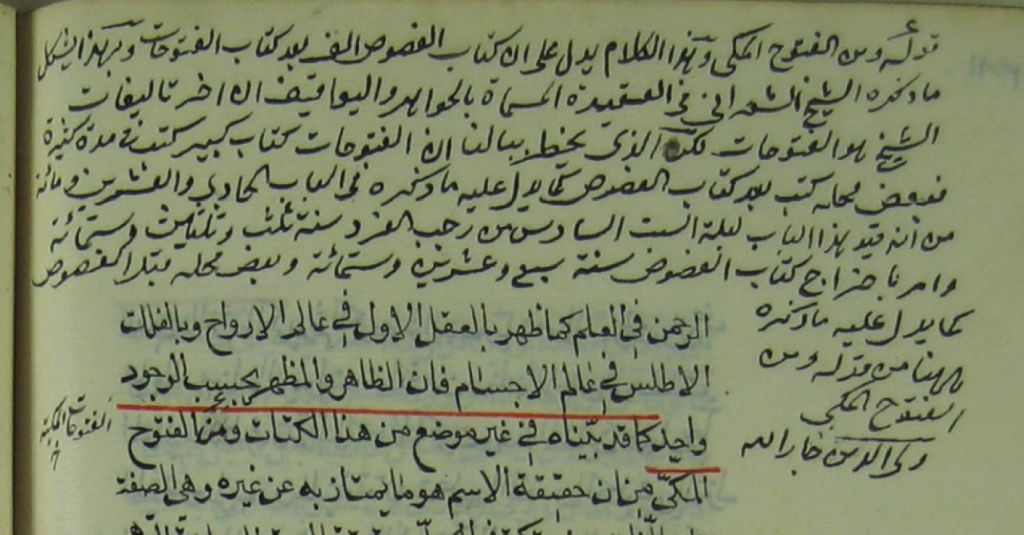
Some of the marginal notes demonstrate CÄrullÄh Efendiâs knowledge of the biography of Ibn al-Ê¿ArabÄ« and his works. It was still a controversial topic precisely when and thus in which order The Bezels of Wisdom and The Meccan Illuminations, two of Ibn al-Ê¿ArabÄ« most prominent works, were composed. In one of his notes, CÄrullÄh Efendi endeavoured to alleviate confusion about this, focusing in particular on the sequence in which these two works were written. He selected the phrase âfrom al-Futūḥ al-MakkÄ«â29 in the main text of The Bezels of Wisdom, marked the line above this with red ink (see Fig. 9.2), and engaged in a detailed discussion on the dates and processes of production of these two important works, writing:
Upon his words âand from al-Futūḥ al-makkÄ«â: This expression shows that al-Fuṣūṣ was written after al-FutūḥÄt. This produces a problem regarding what Shaykh al-ShaÊ¿rÄnÄ« claimed in his work on creed (al-Ê¿aqÄ«da) entitled al-JawÄhir wa-l-yawÄqÄ«t, that the last book written by the shaykh was al-FutūḥÄt. But what comes to our mind [as a solution is the following]: The FutūḥÄt is a sizeable book which was written over a long period, and some parts of it were written after the Fuṣūṣ (â¦). VeliyyuddÄ«n CÄrullÄh.30
Al-ShaÊ¿rÄnÄ« (d. 973/1565), cited by CÄrullÄh Efendi, was an esteemed mystic and scholar of Ibn al-Ê¿ArabÄ«.31 His main achievement was an attempt to legitimise Ibn al-Ê¿ArabÄ«âs doctrine and reconcile it with Sunni theology. Although al-ShaÊ¿rÄnÄ« argued that The Bezels of Wisdom was written before The Meccan Illuminations, CÄrullÄh Efendi identified an overt contradiction between Ibn al-Ê¿ArabÄ«âs testament and al-ShaÊ¿rÄnÄ«âs view on the dates of composition regarding Ibn al-Ê¿ArabÄ«âs works. Nevertheless, it appears that he did not want to reject al-ShaÊ¿rÄnÄ«âs argument directly. So he examined the writing process of The Meccan Illuminations and discovered that Ibn al-Ê¿ArabÄ« had finished one of the chapters of The Meccan Illuminations in 633/1236. In contrast, The Bezels of Wisdom was completed in 627/1229â1230. This renders it possible for The Meccan Illuminations to be referred to in The Bezels of Wisdom while still upholding al-ShaÊ¿rÄnÄ«âs stance that the former work was also Ibn al-Ê¿ArabÄ«âs last.
Another note on one of the hadiths of the prophet Muḥammad illustrates CÄrullÄh Efendiâs knowledge of and critical mind vis-à -vis the religious sciences (Fig. 9.3). Critiquing the hadithâs chain of authorities, CÄrullÄh Efendi strove diligently to evaluate this isnad (isnÄd; chain of transmission). In cases such as this, when he could not authenticate a particular hadith, CÄrullÄh Efendi interpreted its chain of authorities to make its application understandable in specific contexts. In this example, Ibn al-Ê¿ArabÄ« discussed a well-known, albeit disputable, hadith that reads عÙ٠اء ا٠ت٠ÙØ£ÙبÙاء بÙ٠اسرائÙÙ (the scholars of my umma (community) are similar to the prophets of the people of Israel). CÄrullÄh Efendi attempted to legitimise Ibn al-Ê¿ArabÄ«âs use of this hadith, which has often been classified as mawá¸Å«Ê¿ (forged). As a high-ranking scholar in the Ottoman system who studied hadith, CÄrullÄh Efendi might be expected to be very critical of using a mawá¸Å«Ê¿ hadith and thus question the reliability of the isnÄd, and this is exactly what he did in his note:
Upon his words and the phrase âthe scholars of my community â¦â, I say: This is a hadith that has been famous among people and written in many books. However, hadith scholars have stated that it is a forgery (mawá¸Å«Ê¿). Then, it is possible to say that the Great Shaykh (al-shaykh al-kabÄ«r) has argued in another passage of al-FutūḥÄt al-makkiyya that some hadiths were authenticated by kashf (mystical unveiling) even though they were not authenticated by its transmitters (Ê¿inda riwÄya). Therefore, scholars should treat this hadith from this point of view. AbÅ« Ê¿AbdallÄh VeliyyuddÄ«n CÄrullÄh.32
Usually, a teacher (mudarris) like CÄrullÄh should not use mawá¸Å«Ê¿ hadith as an argument and should rebuke authors who do use one. However, CÄrullÄh Efendi made an exception in the case of Ibn al-Ê¿ArabÄ« after scrutinising his other passages and discovering his argument for kashf. This is a manifest effort by CÄrullÄh Efendi to legitimise Ibn al-Ê¿ArabÄ« even when he cited a controversial source. In conclusion, this example demonstrates CÄrullÄh Efendiâs inclination towards Ibn al-Ê¿ArabÄ«.
The most prevalent and scathing condemnation levelled against Ibn al-Ê¿ArabÄ« throughout Islamic history has been that of kufr (unbelief). CÄrullÄh Efendi, however, defended him against this accusation in a marginal note. This marginal note also reflects one of the extreme approaches to Ibn al-Ê¿ArabÄ« and his unity of being in the Ottoman Empire referred to at the beginning of this chapter. Both in the Ottoman literature and among Ottoman scholars, there were those who believed in a sharp distinction between taá¹£awwuf and aqliyyÄt as exemplified by the debate between the QÄá¸izÄdelis and the SiwÄsÄ«s. As noted above, KÄtib Ãelebi argued in The Balance of Truth that some laypeople and scholars, those he talked about as belonging to the first group in his categorisation, branded Ibn al-Ê¿ArabÄ« a kÄfir because of his doctrine of the unity of being. The sentence in question that Ibn al-Ê¿ArabÄ« used is ÙÙس Ù٠اÙÙ Ù Ù٠ابدع Ù Ù Ùذا اÙعاÙÙ , which means that among all possible worlds, there is no better world than this existing one. In MS Istanbul, Süleymaniye Library, CÄrullah Efendi, 792 (illustrated in Fig. 9.4), Ibn al-Ê¿ArabÄ« was admonished for using this sentence. CÄrullÄh Efendi, however, comes to his defence in the marginal note by showing the first usage of the phrase:
I say that this sentence does not necessitate unbelief (al-kufr), as the author of the FutūḥÄt used it more than ten times in his FutūḥÄt, quoting from AbÅ« ḤÄmid al-GhazÄlÄ«. This sentence has many interpretations. I saw a book of ten quires on the interpretation of that word. Shaykh ShihÄb al-DÄ«n al-MaqtÅ«l, too, used this expression in his al-Muá¹ÄraḥÄt and other works. I even saw in Aleppo a treatise by al-BiqÄÊ¿Ä« refuting Shaykh MuḥyÄ« al-DÄ«n al-Ê¿ArabÄ«âs work in which [the author] still said that Imam al-GhazÄlÄ« made a mistake in saying this and accused Shaykh Ibn al-Ê¿ArabÄ« of unbelief (kaffara) as the deviant and the one who led others astray. This is a strange statement made by this ignorant and stubborn man, for he attributes that sentence to al-GhazÄlÄ« as the one who said it and labelled him an unbeliever out of fear of ShafiÊ¿i scholars. So, he accused Shaykh Ibn al-Ê¿ArabÄ« of unbelief, although he [i.e., Ibn al-Ê¿ArabÄ«] is interpreting the sentence of al-GhazÄlÄ«. And what is this, if not his ignorance of what is the truth in the eyes of verifying scholars (al-muḥaqqiqÄ«n)? Written by AbÅ« Ê¿AbdallÄh VeliyyuddÄ«n CÄrullÄh.33
The sentence itself is, as CÄrullÄh Efendi indicated in his note, an old one that was first used by al-GhazÄlÄ« (d. 505/1111), one of the most proficient scholars of his age and who remains to this day a pillar of Sunni Islam;34 and as pointed out, the sentence was also used by many esteemed scholars after al-GhazÄlÄ«. What CÄrullÄh Efendi has correctly done in the note is to research the origin of the sentence, allowing him to discover that its original author was al-GhazÄlÄ«, not Ibn al-Ê¿ArabÄ«. Since, according to him, the earlier source of the phrase is al-GhazÄlÄ«, the author should rebuke him instead of Ibn al-Ê¿ArabÄ«; however, the author could not brand al-GhazÄlÄ« a kÄfir because, as the note clarifies, ShafiÊ¿i scholars were too powerful to allow such an accusation to be levelled during that time. Instead, assumed CÄrullÄh Efendi, the author denounced Ibn al-Ê¿ArabÄ« because he is an easier target as compared to al-GhazÄlÄ«. The note also indicates a disagreement between two prominent schools of law (sg. madhhab, pl. madhÄhib) of Islam, namely the Hanafis and the ShafiÊ¿is. In a manner, CÄrullÄh Efendi, himself a Hanafi, indirectly criticised ShafiÊ¿i scholars and their dominance.
Another dimension that the note reveals is the theological significance of this in the history of Muslim thought. The note is at the heart of the discussion, pivoting on the doctrine of aṣlaḥ (optimum), according to which God could not create a better universe than the existing one. The theory argued that the existing universe is the best of all possible universes that God could have created. This argument divided Muslim scholars into two groups: on the one hand, most of the Muʿtazilite scholars, who asserted that God had no other choice but to create this perfect universe, and the Ahl al-Sunna scholars, who rejected this doctrine, claiming that it would injure the notion of godhood by making God obligated to do something. For Ahl al-Sunna scholars, God created out of His mercy or favour and could, therefore, have created another world in another way if He saw fit.35
Another indirect defence of the unity of being and Ibn al-Ê¿ArabÄ« by CÄrullÄh Efendi is in the marginal note illustrated in Fig. 9.5. In it, CÄrullÄh EfendÄ« advocated for Ibn al-Ê¿ArabÄ« and his doctrine against the accusations of á¹¢adr al-SharÄ«Ê¿a (d. 747/1346). In his work TaÊ¿dÄ«l al-Ê¿ulÅ«m, á¹¢adr al-SharÄ«Ê¿a claimed that some extremely ignorant Sufi (juhhÄl al-mutaá¹£awwifa) and deviant quasi-philosophers (á¸ullÄl al-mutafalsifa) have taken the unity of being as their doctrine (madhhab), and he mentioned that he had written a treatise refuting it.36 Since accusing proponents of the unity of being extremely ignorant mystics and deviant philosophers was tantamount to dismissing many influential and renowned scholars throughout the history of Islam, CÄrullÄh Efendiâs response to á¹¢adr al-SharÄ«Ê¿a in his marginal note is in the same tone:
On the phrase of âan extremely ignorant mystics took, etc.â, I say: The ignorance refers to the son of his auntâs sister [i.e., himself]! For the Proof of Islam (ḥujjat al-IslÄm), Imam al-GhazÄlÄ«, advocated the absolute being (al-wujÅ«d al-muá¹laq). Likewise, so did Shaykh MuḥyÄ« al-DÄ«n Ibn al-Ê¿ArabÄ« in various writings of his, and specifically in his al-FutūḥÄt al-makkiyya; and also his student á¹¢adr al-DÄ«n al-QÅ«nawÄ« in his writings, and specifically in his MiftÄḥ and Nuṣūṣ; and also his students like Shaykh al-FarghÄnÄ« in his Sharḥ al-taʾiyya and Shaykh al-JandÄ« in his Sharḥ al-Fuṣūṣ; and also Shaykh IbrÄhÄ«m al-Ê¿IrÄqÄ« in his LamaÊ¿Ät; and other verifying scholars as well. Even the verifying scholar al-Quá¹b al-RÄzÄ« agrees with this opinion in al-MuḥÄkamÄt. The treatises written on the issue are countless, such as the treatise by Sayyid al-MuḥaqqiqÄ«n, the treatise by BahÄʾ al-DÄ«n, the treatise by the author of al-MafÄḥiá¹£, and others. However, I did not look into the treatise of the author of al-TaÊ¿dÄ«l [i.e., á¹¢adr al-SharÄ«Ê¿a] so that I could really do it justice. AbÅ« Ê¿AbdallÄh VeliyyuddÄ«n CÄrullÄh.37
CÄrullÄh Efendi is indeed brave in this note in accusing such an influential figure as á¹¢adr al-SharÄ«Ê¿a of being ignorant. It is also of importance that CÄrullÄh Efendi employed a sarcastic style in referring to á¹¢adr al-SharÄ«Ê¿a as the son of his auntâs sister.
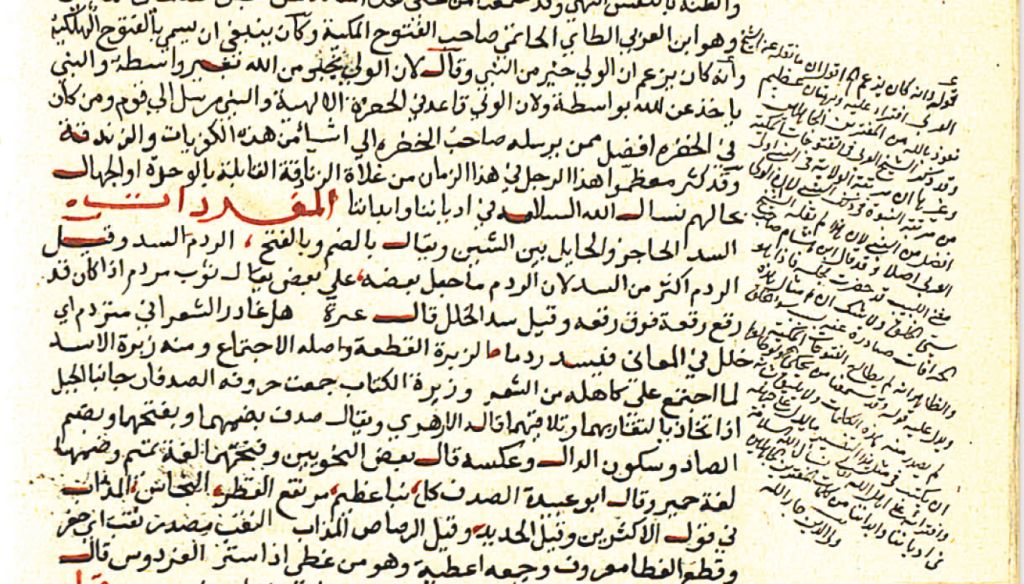
Other historical authorities, too, were the subject of CÄrullÄh Efendiâs marginal criticism. Among them is AbÅ« ḤayyÄn (d. 745/1344), who rebuked Ibn al-Ê¿ArabÄ« in his Qurʾan commentary al-Baḥr al-muḥīṠbased on phrases that the latter had not actually written or intended. CÄrullÄh Efendi, in turn, accused AbÅ« ḤayyÄn of ignorance in one of his notes defending Ibn al-Ê¿ArabÄ« (Fig. 9.6). With reference to the comment of AbÅ« ḤayyÄn, CÄrullÄh Efendi sought to exonerate Ibn al-Ê¿ArabÄ« of the slander and condemnation levelled against him:
Upon his words wa-innahu kÄna yazÊ¿umu, etc., I say this: What he has cited from Shaykh Ibn al-Ê¿ArabÄ« is slander and an enormous accusation (iftirÄ Ê¿alayhi wa buhtÄnun Ê¿aáºÄ«mun). We seek refuge in Allah from ignorant calumniators. In his FutūḥÄt al-makkiyya and other works, Shaykh Ibn al-Ê¿ArabÄ« mentioned that the rank of sainthood (wilÄya) manifested in the prophet is superior to the rank of prophethood (nubÅ«wa) in the same prophet. Because, in fact, Shaykh Ibn al-Ê¿ArabÄ« did not say that sentence: a saint (walÄ«) would be more excellent than a prophet (nabÄ«). In fact, Shaykh Ibn al-Ê¿ArabÄ« did not say that. Ibn HishÄm, the author of MughnÄ« al-labÄ«b, has said [about AbÅ« ḤayyÄn]: âI attended a session of his, and there he was a bad character.â Undoubtedly, such fables (al-khurÄfÄt) derive from him because of his bad character. Moreover, it is obvious that he never examined (yuá¹ÄliÊ¿u) al-FutūḥÄt al-Makkiyya, for which his words are proof: âWe heard someone say, etc.â Had he read it, he would not have used those words. And he does not deserve to write in such a commentary that points to his ignorance and his slander of men of Allah (ahl AllÄh). [â¦] VeliyyuddÄ«n CÄrullÄh.38
The first issue that CÄrullÄh Efendi discussed in this note is the accusation that Ibn al-Ê¿ArabÄ« considered saints to be superior to prophets, which is indeed a strange notion in terms of Islamic faith. In this note, CÄrullÄh Efendi asserted that this is indeed not the case. He first presented the correct sentence and interpreted it. Then, he rebuked AbÅ« ḤayyÄn for inaccurately citing the sentence in a manner that would mislead his readers. According to CÄrullÄh Efendi, this sentence does not compare sainthood with prophethood; instead, it compares sainthood manifested in a prophet with prophethood manifested in the same prophet. Contextually, prophethood is treated as superior to sainthood. After first clarifying the sentence, CÄrullÄh Efendi examined the scholar who argued that Ibn al-Ê¿ArabÄ« used this sentence, concluding that AbÅ« ḤayyÄn was not an adequately meticulous or well-tempered scholar and cannot, therefore, be trusted in his accusations. Consequently, CÄrullÄh Efendi saved Ibn al-Ê¿ArabÄ« from condemnation in a single small marginal note.
The last three marginal notes that I would like to discuss are criticisms of MollÄ FanÄrÄ« (d. 834/1431), a prominent and esteemed scholar in the Ottoman Empire.39 In the note in Fig. 9.7, CÄrullÄh Efendi accused MollÄ FanÄrÄ« of misleading his readers regarding Ibn al-Ê¿ArabÄ«. The manuscript in which this note is found is a commentary written by MollÄ FanÄrÄ« on al-QÅ«nawÄ«âs MiftÄḥ al-ghayb. The most exciting part of CÄrullÄh Efendiâs note is that he accused al-FanÄrÄ« of setting Ibn al-Ê¿ArabÄ« up to be misunderstood. CÄrullÄh Efendi criticised and accused al-FanÄrÄ« in this way because he omitted parts of certain statements of Ibn al-Ê¿ArabÄ«, which in turn causes them to be misunderstood. In the Ottoman world, I believe this is especially important, because al-FanÄrÄ« was one of the most esteemed scholars and renowned pillars of Ottoman thought, making it very hard to oppose him in a scholarly context. We can consider such an attitude as a sign of CÄrullÄh Efendiâs excessive self-assurance. The note reads as follows:
Upon the phrase âand like this, all â¦â: The commentator has omitted some words of the shaykh. As a matter of fact, this is a habit of his [al-FanÄrÄ«]. In fact, the words of the shaykh are as follows: [â¦].40
Al-FanÄrÄ« simply said that Ibn al-Ê¿ArabÄ« wrote something without providing the entire quotation. Obviously, CÄrullÄh Efendi quoted the complete statements of Ibn al-Ê¿ArabÄ« in the continuation of the same note mentioned above:
Whatever he [Ibn al-Ê¿ArabÄ«] has stated in this book is an evident truth and a real case. Other than that, it can be sound in relation and respect to a context, as pointed out previously. And whenever it has become clear to you that I have mentioned in this text, then you have known that the áºuhÅ«r â¦, etc. VeliyyuddÄ«n.41
Thus, CÄrullÄh Efendi established that omitting words was not a practice of Ibn al-Ê¿ArabÄ«, but on the contrary, a habit of al-FanÄrÄ« that creates ambiguity in the intended meaning of a text. If one were solely to read the commentary of al-FanÄrÄ«, the reader would not know what Ibn al-Ê¿ArabÄ« had written, due to al-FanÄrÄ«âs omissions.
In another note (Fig. 9.8), CÄrullÄh Efendi continued to accuse al-FanÄrÄ« of omitting some of Ibn Ê¿ArabÄ«âs words: âUpon his word âaccording to what the shaykh said, etc.â: He [Ibn al-Ê¿ArabÄ«] said it in the seventh breath (nafḥa),42 and what the commentator has quoted here is somewhat of an abbreviated form.â43 It is apparent here that CÄrullÄh Efendi had expected al-FanÄrÄ« to have quoted the entire sentence from the seventh chapter. However, as al-FanÄrÄ« did not quote the whole sentence, the intended meaning remained obscure to the commentaryâs readers.
The final example of CÄrullÄh Efendiâs criticism of al-FanÄrÄ« is in a case where, after having compared al-FanÄrÄ«âs commentary on The Bezels of Wisdom with the original work, he realised that al-FanÄrÄ« had omitted a very important couplet without which an accurate meaning of the text cannot be reached. CÄrullÄh Efendi wrote the following (Fig. 9.9):
Upon the phrase âsaid the Great Shaykh â¦â: This is in the chapter of the prophet Enoch, and there is another couplet between these two couplets:
âThe foresight of the man who comprehends what I have said does not deceive him.
Only the man who has foresight can comprehend this.â VeliyyuddÄ«n.44
In this chapter on the prophet Enoch, al-FanÄrÄ« omitted one of the two couplets in Ibn al-Ê¿ArabÄ«âs original work. This couplet is crucial with regard to mystical knowledge. Remembering that Ibn al-Ê¿ArabÄ« used kashf, this omission alters the method he utilised to obtain true knowledge. CÄrullÄh Efendi implied that al-FanÄrÄ« omitted this couplet deliberately.
The seventeenth century was, according to Ottoman historiography, a period of decline,45 change, crisis,46 and transformation.47 These approaches generally consider the military, administrative, cultural, intellectual, and scientific developments of the period. However, The Balance of Truth, composed by one of the most prominent intellectuals of the era, KÄtib Ãelebi, portrays the main lines of cultural and intellectual division between rival groups. It is, therefore, only reasonable to scrutinise The Balance of Truth to obtain an explicit picture of the empire during the seventeenth century.
KÄtib Ãelebi discussed twenty-one controversial issues in The Balance of Truth. According to him, two groups (i.e., the QÄá¸izÄdelis and the SiwÄsÄ«s) dominated the intellectual landscape of the century and disagreed on these twenty-one issues. Ibn al-Ê¿ArabÄ« and his famous doctrine of the unity of being were among these divisive issues. As KÄtib Ãelebi demonstrated in The Balance of Truth, however, there were three ways of approaching Ibn al-Ê¿ArabÄ« and this doctrine: rejection, acceptance, and suspension of judgement. Whereas QÄá¸izÄdelis and SiwÄsÄ«s adopted, respectively, the first and second approaches, KÄtib Ãelebi was in favour of the third approach, particularly on the issue of kufr.
CÄrullÄh Efendi was the student of one of the students of KÄtib Ãelebi, which appears to be why, like KÄtib Ãelebi, he adopted the third approach in his marginal criticism. Nevertheless, CÄrullÄh Efendi not only suspends judgement against Ibn al-Ê¿ArabÄ« but advocates for his doctrine. A truly erudite scholar, CÄrullÄh Efendi meticulously scrutinised the commentaries and manuscript notes related to Ibn al-Ê¿ArabÄ« as he believed that the distinguished Ottoman scholars judged him and his works unjustly. CÄrullÄh Efendi endeavoured to prove that Ibn al-Ê¿ArabÄ« was innocent of the accusations levelled against him.
CÄrullÄh Efendi wrote many notes throughout the manuscripts preserved in his collection. In those manuscript notes, one may recognise that CÄrullÄh Efendi acted as a critic; he undertook what we could call âmarginal criticismâ. In the notes, CÄrullÄh Efendi corrected the prevailing misunderstandings about Ibn al-Ê¿ArabÄ« and the doctrine of the unity of being while simultaneously absolving him of the accusations of kufr made against him. Presumably, he wished to upgrade the reputation of Ibn al-Ê¿ArabÄ« in the eyes of the potential readers of his marginal annotations, his students at the madrasa being among them. As a result, Ibn al-Ê¿ArabÄ« and the unity of being would be reassessed among the community of readers of the Ottoman manuscripts.
Acknowledgements
I am indebted to MaÅuk Yamaç and Sami Arslan for their invaluable help with this chapter.
Açıl, Berat: âKitap Kültürü ÃalıÅmalarının Genel Seyri: Bir Medhalâ, Osmanlı Kitap Kültürü: Cârullah Efendi Kütüphanesi ve Derkenar Notları, ed. BeratAçıl (Ankara: Nobel Yayınları, 2015), pp. 1â15.
Açıl, Berat: âKitap Kültürü ÃalıÅmalarının Genel Seyri: Bir Medhalâ, Osmanlı Kitap Kültürü: Cârullah Efendi Kütüphanesi ve Derkenar Notları, ed. BeratAçıl (Ankara: Nobel Yayınları, 2015), pp. 1â15.
)| false
Açıl, Berat (ed.): Osmanlı Kitap Kültürü: Cârullah Efendi Kütüphanesi ve Derkenar Notları, ed. BeratAçıl, 2nd ed. (Istanbul: Ilem Yayınları, 2020).
Açıl, Berat (ed.): Osmanlı Kitap Kültürü: Cârullah Efendi Kütüphanesi ve Derkenar Notları, ed. BeratAçıl, 2nd ed. (Istanbul: Ilem Yayınları, 2020).
)| false
Açıl, Berat: âThe Poet Ê¿Azmizade Haleti and the Transformation of Ottoman Empire in the Seventeenth Centuryâ, The Empires of the Near East and India: Sources of the Safavid, Ottoman, and Mughal Literate Communities, ed. HaniKhafipour (New York: Columbia University Press, 2019), pp. 428â449.
Açıl, Berat: âThe Poet Ê¿Azmizade Haleti and the Transformation of Ottoman Empire in the Seventeenth Centuryâ, The Empires of the Near East and India: Sources of the Safavid, Ottoman, and Mughal Literate Communities, ed. HaniKhafipour (New York: Columbia University Press, 2019), pp. 428â449.
)| false
Börekçi, Günhan: Factions and Favorites at the Courts of Sultan Ahmed I (r. 1603â1617), and His Immediate Predecessors, Doctoral thesis, Ohio State University, 2010.
ÃalıÅır, M. Fatih: âIstanbul: A Vibrant Hub for Inter-and-Intra Communal Intellectual Exchangeâ, A âVirtuousâ Grand Vizier: Politics and Patronage in the Ottoman Empire during the Grand Vizierate of Fazıl Ahmed Pasha (1661â1676), Doctoral thesis, Georgetown University, 2016, pp. 133â146.
Erünsal, Ä°smail: Kütüphanecilikle Ä°lgili Osmanlıca Metinler ve Belgeler, vol. 2 (Istanbul: Ä°.Ã. Edebiyat Fakültesi Yayınları, 1990).
Erünsal, Ä°smail: Kütüphanecilikle Ä°lgili Osmanlıca Metinler ve Belgeler, vol. 2 (Istanbul: Ä°.Ã. Edebiyat Fakültesi Yayınları, 1990).
)| false
Faroqhi, Suraiya: âCrisis and Changeâ, An Economic and Social History of Ottoman Empire, eds. HalilÄ°nalcık and DonaldQuataert (Cambridge: Cambridge University Press, 1997), pp. 411â636.
Faroqhi, Suraiya: âCrisis and Changeâ, An Economic and Social History of Ottoman Empire, eds. HalilÄ°nalcık and DonaldQuataert (Cambridge: Cambridge University Press, 1997), pp. 411â636.
)| false
Hirschler, Konrad: A Monument to Medieval Syrian Book Culture: The Library of Ibn Ê¿Abd al-HÄdÄ« (Edinburgh: Edinburgh University Press, 2019).
Hirschler, Konrad: A Monument to Medieval Syrian Book Culture: The Library of Ibn Ê¿Abd al-HÄdÄ« (Edinburgh: Edinburgh University Press, 2019).
)| false
Liebrenz, Boris: âThe Library of Aḥmad al-RabbÄá¹: Books and their Audience in 12th to 13th/18th to 19th Century Syriaâ, Marginal Perspectives on Early Modern Ottoman Culture, eds. RalfElger and UtePietruska (Halle (Saale): Zentrum für Interdisziplinäre Regionalstudien â Vorderer Orient, Afrika, Asien der Martin-Luther-Universität Halle-Wittenberg, 2013), pp. 17â59.
Liebrenz, Boris: âThe Library of Aḥmad al-RabbÄá¹: Books and their Audience in 12th to 13th/18th to 19th Century Syriaâ, Marginal Perspectives on Early Modern Ottoman Culture, eds. RalfElger and UtePietruska (Halle (Saale): Zentrum für Interdisziplinäre Regionalstudien â Vorderer Orient, Afrika, Asien der Martin-Luther-Universität Halle-Wittenberg, 2013), pp. 17â59.
)| false
Tezcan, Baki: âThe Second Empire: The Transformation of the Ottoman Polity in the Early Modern Eraâ, Comparative Studies of South Asia, Africa and the Middle East29, no. 3 (2009), pp. 556â572.
Tezcan, Baki: âThe Second Empire: The Transformation of the Ottoman Polity in the Early Modern Eraâ, Comparative Studies of South Asia, Africa and the Middle East 29, no. 3 (2009), pp. 556â572.
)| false
For general reviews on book culture and manuscript studies, see Açıl: âKitap Kültürü ÃalıÅmalarının Genel Seyriâ, pp. 1â15; Hirschler: Medieval Syrian Book Culture, pp. 5â17.
For a few examples, see Açıl (ed.): Osmanlı Kitap Kültürü; Açıl: âEdebiyatın Ä°lmi veya Ä°lmin Edebiyatıâ, pp. 61â91; Arslan: âEserden Müessire Seyr u Seferâ, pp. 67â83.
The assessment of KÄtib Ãelebi has been a controversial one, including both praise and disparagement, and Serhat Küçük tries to reflect both sides. See Küçük: âKâtip Ãelebi Algısı Ãzerine DüÅüncelerâ, pp. 45â59.
MS Istanbul, Süleymaniye Library, Carullah Efendi, 1489/1, fol. 1r; Sharḥ al-Mulakhkhaá¹£ fÄ« al-hayʾah by QÄá¸izÄde al-RÅ«mÄ«. Here, CÄrullÄh Efendi states that the copier of the book (KÄtib Ãelebi) is the master of his master (Ê¿Abd al-WahhÄb Efendi), who is the author of AsÄmÄ« al-kutub and other books.
For an analysis of the notes CÄrullÄh Efendi wrote on the manuscripts preserved in the Carullah Efendi Collection, see Açıl (ed.): Osmanlı Kitap Kültürü.
Sami Arslan, in his article on the taá¹£awwuf section of the Carullah Efendi Collection, argues that CÄrullÄh Efendi was behaving like a critic when he criticised al-GhazÄlÄ«, al-Ê¿IrÄqÄ«, and al-FanÄrÄ«. See Arslan: âDerkenarâın Gölgesindeâ, pp. 307â309.
See, for example, MS Istanbul, Süleymaniye Library, Carullah Efendi, 77, fol. 267v, and MS Istanbul, Süleymaniye Library, Carullah Efendi, 1051, fol. 67r.
CÄrullÄh Efendi makes forty-three references to Ibn al-Ê¿ArabÄ« and his works while referring ninety-two times to other authors and works related to taá¹£awwuf, most of which are commentaries on Ibn al-Ê¿ArabÄ«âs works or pieces related to the unity of being. See Arslan: âDerkenarâın Gölgesindeâ, pp. 323â325. The Carullah Efendi Collection has 133 manuscripts related to taá¹£awwuf, of which twenty-nine are works of Ibn al-Ê¿ArabÄ« or commentaries on them.
Tezcan: âThe Second Empireâ, pp. 563â568; Börekçi: Factions and Favorites, pp. 148â197; Açıl: âThe Poet Ê¿Azmizade Haletiâ, pp. 428â432.
Açıl, Berat: âKitap Kültürü ÃalıÅmalarının Genel Seyri: Bir Medhalâ, Osmanlı Kitap Kültürü: Cârullah Efendi Kütüphanesi ve Derkenar Notları, ed. BeratAçıl (Ankara: Nobel Yayınları, 2015), pp. 1â15.
Açıl, Berat: âKitap Kültürü ÃalıÅmalarının Genel Seyri: Bir Medhalâ, Osmanlı Kitap Kültürü: Cârullah Efendi Kütüphanesi ve Derkenar Notları, ed. BeratAçıl (Ankara: Nobel Yayınları, 2015), pp. 1â15.
)| false
Açıl, Berat (ed.): Osmanlı Kitap Kültürü: Cârullah Efendi Kütüphanesi ve Derkenar Notları, ed. BeratAçıl, 2nd ed. (Istanbul: Ilem Yayınları, 2020).
Açıl, Berat (ed.): Osmanlı Kitap Kültürü: Cârullah Efendi Kütüphanesi ve Derkenar Notları, ed. BeratAçıl, 2nd ed. (Istanbul: Ilem Yayınları, 2020).
)| false
Açıl, Berat: âThe Poet Ê¿Azmizade Haleti and the Transformation of Ottoman Empire in the Seventeenth Centuryâ, The Empires of the Near East and India: Sources of the Safavid, Ottoman, and Mughal Literate Communities, ed. HaniKhafipour (New York: Columbia University Press, 2019), pp. 428â449.
Açıl, Berat: âThe Poet Ê¿Azmizade Haleti and the Transformation of Ottoman Empire in the Seventeenth Centuryâ, The Empires of the Near East and India: Sources of the Safavid, Ottoman, and Mughal Literate Communities, ed. HaniKhafipour (New York: Columbia University Press, 2019), pp. 428â449.
)| false
Börekçi, Günhan: Factions and Favorites at the Courts of Sultan Ahmed I (r. 1603â1617), and His Immediate Predecessors, Doctoral thesis, Ohio State University, 2010.
ÃalıÅır, M. Fatih: âIstanbul: A Vibrant Hub for Inter-and-Intra Communal Intellectual Exchangeâ, A âVirtuousâ Grand Vizier: Politics and Patronage in the Ottoman Empire during the Grand Vizierate of Fazıl Ahmed Pasha (1661â1676), Doctoral thesis, Georgetown University, 2016, pp. 133â146.
Erünsal, Ä°smail: Kütüphanecilikle Ä°lgili Osmanlıca Metinler ve Belgeler, vol. 2 (Istanbul: Ä°.Ã. Edebiyat Fakültesi Yayınları, 1990).
Erünsal, Ä°smail: Kütüphanecilikle Ä°lgili Osmanlıca Metinler ve Belgeler, vol. 2 (Istanbul: Ä°.Ã. Edebiyat Fakültesi Yayınları, 1990).
)| false
Faroqhi, Suraiya: âCrisis and Changeâ, An Economic and Social History of Ottoman Empire, eds. HalilÄ°nalcık and DonaldQuataert (Cambridge: Cambridge University Press, 1997), pp. 411â636.
Faroqhi, Suraiya: âCrisis and Changeâ, An Economic and Social History of Ottoman Empire, eds. HalilÄ°nalcık and DonaldQuataert (Cambridge: Cambridge University Press, 1997), pp. 411â636.
)| false
Hirschler, Konrad: A Monument to Medieval Syrian Book Culture: The Library of Ibn Ê¿Abd al-HÄdÄ« (Edinburgh: Edinburgh University Press, 2019).
Hirschler, Konrad: A Monument to Medieval Syrian Book Culture: The Library of Ibn Ê¿Abd al-HÄdÄ« (Edinburgh: Edinburgh University Press, 2019).
)| false
Liebrenz, Boris: âThe Library of Aḥmad al-RabbÄá¹: Books and their Audience in 12th to 13th/18th to 19th Century Syriaâ, Marginal Perspectives on Early Modern Ottoman Culture, eds. RalfElger and UtePietruska (Halle (Saale): Zentrum für Interdisziplinäre Regionalstudien â Vorderer Orient, Afrika, Asien der Martin-Luther-Universität Halle-Wittenberg, 2013), pp. 17â59.
Liebrenz, Boris: âThe Library of Aḥmad al-RabbÄá¹: Books and their Audience in 12th to 13th/18th to 19th Century Syriaâ, Marginal Perspectives on Early Modern Ottoman Culture, eds. RalfElger and UtePietruska (Halle (Saale): Zentrum für Interdisziplinäre Regionalstudien â Vorderer Orient, Afrika, Asien der Martin-Luther-Universität Halle-Wittenberg, 2013), pp. 17â59.
)| false
Tezcan, Baki: âThe Second Empire: The Transformation of the Ottoman Polity in the Early Modern Eraâ, Comparative Studies of South Asia, Africa and the Middle East29, no. 3 (2009), pp. 556â572.
Tezcan, Baki: âThe Second Empire: The Transformation of the Ottoman Polity in the Early Modern Eraâ, Comparative Studies of South Asia, Africa and the Middle East 29, no. 3 (2009), pp. 556â572.
)| false