


Simon Gauntâs pioneering contributions to French and Occitan textual criticism include one of the earliest engagements by a medievalist with Giorgio Agambenâs theory of biopolitics. In his 2006 book Love and Death in Medieval French and Occitan Courtly Literature, Gaunt takes up Agambenâs analysis of sovereignty and biopolitics as a framework for understanding articulations of the ladyâs power in troubadour lyric.1 Building on Gauntâs interrogation of the ethical implications of Agambenâs theory, this chapter will assess the transferability of such perspectives to representations of animals and animality in the Bibles moralisées: a series of lavishly illuminated manuscripts, written mainly in French, that pair biblical texts and images with interpretive and moralizing counterparts. Focusing on imagery of animal sacrifice in a fourteenth-century volume written and illuminated in Naples (Paris, Bibliothèque nationale de France, français 9561), the aim is to explore â in light of Agambenâs analysis of sovereignty and biopolitics â the different forms and functions of the animal/human distinction in this setting.
The Bibles moralisées count among the most ambitious projects of manuscript illumination in the Middle Ages. Their purpose was to present a textual and visual commentary on the Bible with a view to passing moral judgement on contemporary society.2 The ensuing analysis centres on a series of miniatures in select examples of the genre that illustrate and comment on Godâs words to Moses in the first book of Leviticus regarding the correct procedures for sacrificial offerings. While these images appear, from one perspective, to affirm a categorical distinction between human and animal, a question mark also remains over exactly where to draw the line.
The two oldest surviving Bibles moralisées â Vienna, Ãsterreichische Nationalbibliothek, cod. 2554 and cod. 1179 â were likely commissioned by Blanche of Castile (1188â1252), wife and after 1226 widow of King Louis VIII of France.3 The first of the Vienna Bibles, which dates to the 1220s and was probably made for the queen herself, presents an abridged reworking of Leviticus 1 across four pairs of medallions (fig. 12.1). In the top left miniature, each of the offerings of animals and food that Moses and his people are commanded to make by God signifies a particular Christian virtue or act: pigeons represent simplicity, lambs sweetness, calves chastity, and so forth. At the top right, the flaying of a cow figures âcelui a cui lâen reuerse la pel et la cotte del munt par martireâ (those whose skin and whose worldly coat are turned inside out through martyrdom); the accompanying moralization miniature shows a naked male being skinned, like Saint Bartholomew, in a sequence designed to draw explicit comparisons between human martyrdom and animal slaughter. In the scene to the bottom left, another cow is butchered, and its joints placed in a bowl ready for washing, while at the bottom right the beastâs limbs and entrails are offered to God on an altar; the corresponding moralizations show Christians being cleansed by confession and baptism (left), while chaste Christians offer their bodies and souls to Christ who receives them (right).

Vienna, Ãsterreichische Nationalbibliothek, cod. 2554, fol. 27r. Bible moralisée, ca. 1220â25. Leviticus 1.5, 10, 14; 2.1, 13, 15; flour signifies martyrdom, oil baptism, wine charity, pigeons simplicity, lambs sweetness, calves chastity (a, upper left). Leviticus 1.6; martyrdom (b, upper right). Leviticus 1.6, 9; those cleansed by confession and washed by baptism (c, lower left). Leviticus 1.9; good Christians offering bodies and souls to God (d, lower right)
Source: ÃNB Vienna, https://viewer.onb.ac.at/10017A6C/57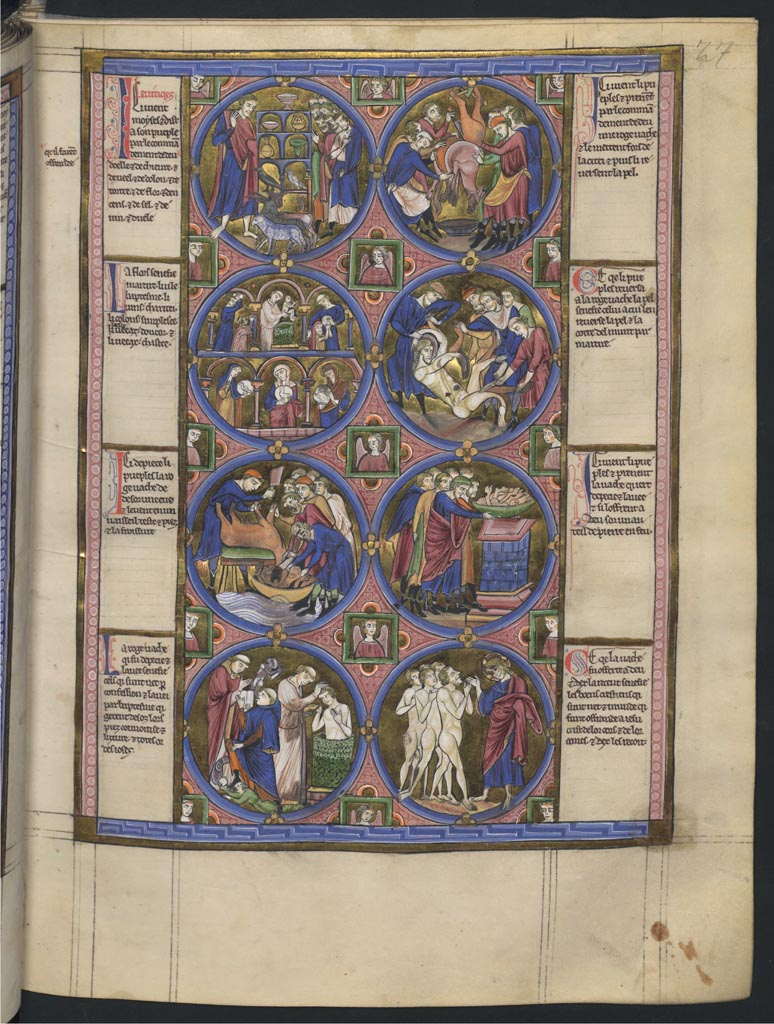
The French biblical texts in the book loosely correspond to the Latin Vulgate, but typically, for this group of manuscripts, the Bible has been substantially modified to suit the moralizersâ goals. For instance, the point of departure for the second pair of medallions is a short phrase in Leviticus 1.6, which describes the removal of skin from the offering (âdetractaque pelle hostiaeâ),4 but the vernacular translators expand this considerably: âIci vient li pueples et prenent par le commandement de deu une roge vache et le mettent fors de la citei et puis li reversent la pelâ (Here the people come and at Godâs command take a red cow and put it outside the city, and then they turn its skin inside out). Among other things, details are inserted about the beastâs colouring, the location of its sacrifice and the mode of flaying, none of which appear in the Vulgate text. The animalâs sex has also been modified, since whereas Leviticus 1.3 specifies that the Israelites offer from the herd a âmasculum inmaculatumâ (male without blemish), the French text refers to a âvacheâ or cow, and in the biblical miniature on the lower left the animal possesses udders.5 The bookâs makers appear to have conflated the Leviticus passage with a passage from Numbers 19, in which God instructs Moses and Aaron to command the Israelites to sacrifice a âvaccam rufamâ (red cow) and to deliver her skin, flesh, blood and dung as an offering. A later folio in the manuscript also features several miniatures illustrating the Numbers passage (fig. 12.2): the sons of Israel who lead âune roge vacheâ before a priest of the law are interpreted as Jews bringing Christ before Pilate (upper right); the Israelitesâ act of placing the cow in a fire and burning it at Godâs command signifies the Jews who crucified Christ (lower left); the ashes of the burnt animal, placed in water and used to cure leprosy, represent the restorative powers of Christ, Peter, Paul and all friends of God who cure peopleâs sins with their attributes and speech (lower right).
Vienna, Ãsterreichische Nationalbibliothek, cod. 2554, fol. 33r. Bible moralisée, ca. 1220â25. Numbers 17.10â11; Christ, restored to Holy Church by God, is joyfully received by apostles (a, upper left). Numbers 19.1â3; Jews take Christ before Pilate (b, upper right). Numbers 19.5; Jews crucify Christ (c, lower left). Numbers 19.9; renewing and healing powers of Christ, Peter, Paul, and all friends of God (d, lower right)
Source: ÃNB Vienna, https://viewer.onb.ac.at/10017A6C/69
Another, more contracted version of the Leviticus sequence appears in a fourteenth-century codex from Naples, the first Old Testament section of which was modelled on a lost Bible moralisée roughly contemporary with the earliest surviving exemplars now in Vienna. One theory holds that this luxurious book was made around 1370 for Joanna I of Naples (1325â82), granddaughter of Robert of Anjou (1276â1343). However, it has also been posited that the Bible was commissioned by Robert himself towards the end of his reign as king of Naples, perhaps to give to Joanna, and completed in the 1350s after Joanna succeeded Robert to the Neapolitan throne; Joanna had been designated as Robertâs heir following the untimely death of his son (and Joannaâs father) Charles, duke of Calabria, in 1328. Significantly, Robertâs own father, Charles of Anjou (1226â1285), was the youngest son of Louis VIII and Blanche of Castile and founder of the Capetian house of Anjou, thus potentially locating the Naples Bible within a similar courtly ambit to the Vienna Bibles.6 The much-abridged biblical texts in the volume are French but contain Italianate elements, corresponding to an illustrative cycle that also betrays the influence of Italian painting. The commissioning of this lavish book was possibly designed to emphasize the connections between the Neapolitan monarchs and their Capetian ancestors, who had sponsored the first moralized Bibles more than a century earlier, as well as reminding the owners of their French cultural heritage.
In the Naples rendition of the Leviticus moralization (fig. 12.3), the sacrificial beast is named as âun veelâ or veal calf, which corresponds to the Vulgateâs reference to a young male animal. While the accuracy of the biblical paraphrase has thereby been restored, the makers of the Naples Bible retain and further develop the moralizing structure of earlier manuscripts in order to emphasize a series of visual correspondences between the biblical narrative and its commentary.
Paris, Bibliothèque nationale de France, fr. 9561, fol. 78v. Bible moralisée de Naples. Naples, ca. 1350 or later. Leviticus 1.3â13; saint losing the clothing of the world through martyrdom (left), saint fleeing worldly sin through martyrdom (centre), worthy man cleansed through confession and penance (right)
Source: Bibliothèque nationale de France. https://gallica.bnf.fr/ark:/12148/btv1b7200010r/f162.item (accessed May 12, 2025)
In the left-hand pairing, a calf and a martyr are flayed using an identical number of knives and the victims are oriented in the same direction, on their backs, heads to the right, limbs pulled outwards, thereby visibly conveying the parallel between animal and human modes of sacrifice. The dismembered calf torso in the central pairing, again oriented to the right, echoes the martyr who is about to lose his head, which is obscured by a machete-like instrument as if to convey the martyrâs already-beheaded state (thus creating a visual parallel with the decapitated calf above). On the right, the penitent sinner, stripped to his waist, turns towards his confessor in the same direction as the skinned beast with its excoriated head, while the vessel used to pour water on the offering echoes the priestâs book and switch in the lower register.7 The Naples Bible also features a rendition of the verses from Numbers 19 describing the sacrifice of a red cow (fig. 12.4). Here the commentary images largely correspond to the equivalent miniatures in the first of the Vienna Bibles, except that the cow is shown being butchered by an enormous meat cleaver rather than being thrown into a flaming brazier.8 But again, the treatment of the beastâs body in the miniatureâs upper register is represented as foreshadowing the treatment of Christ in the scenes below.
These sequences clearly operate within a system in which animal bodies function as vehicles for human concerns. Just as the Bibles moralisées translate the Bible verbally and visually into terms familiar to their medieval makers and patrons, the images they contain participate in a dynamic of metaphoric transfer between âsourceâ and âcopy,â biblical text and commentary, past and present. The pairing of biblical episode and moralizing commentary, which is the defining characteristic of these books, is mirrored in the binary opposition between animal and human, an opposition delineated especially forcefully in the Naples Bible, with its economical top-bottom arrangement. The line differentiating animal bodies from their human counterparts has been represented visually as a seemingly unbridgeable divide, thereby producing a binary distinction where none automatically existed in medieval thought.
Paris, Bibliothèque nationale de France, fr. 9561, fol. 93r. Bible moralisée de Naples. Naples, ca. 1350 or later. Numbers 19.1â10; Jews who deliver Christ to Pontius Pilate (left), Jews who take Christ and put him on the cross (centre), Saints Peter, Paul, and Lawrence, and all good friends of God, who cure people of mortal sins (right)
Source: Bibliothèque nationale de France. https://gallica.bnf.fr/ark:/12148/btv1b7200010r/f191.item (accessed May 12, 2025)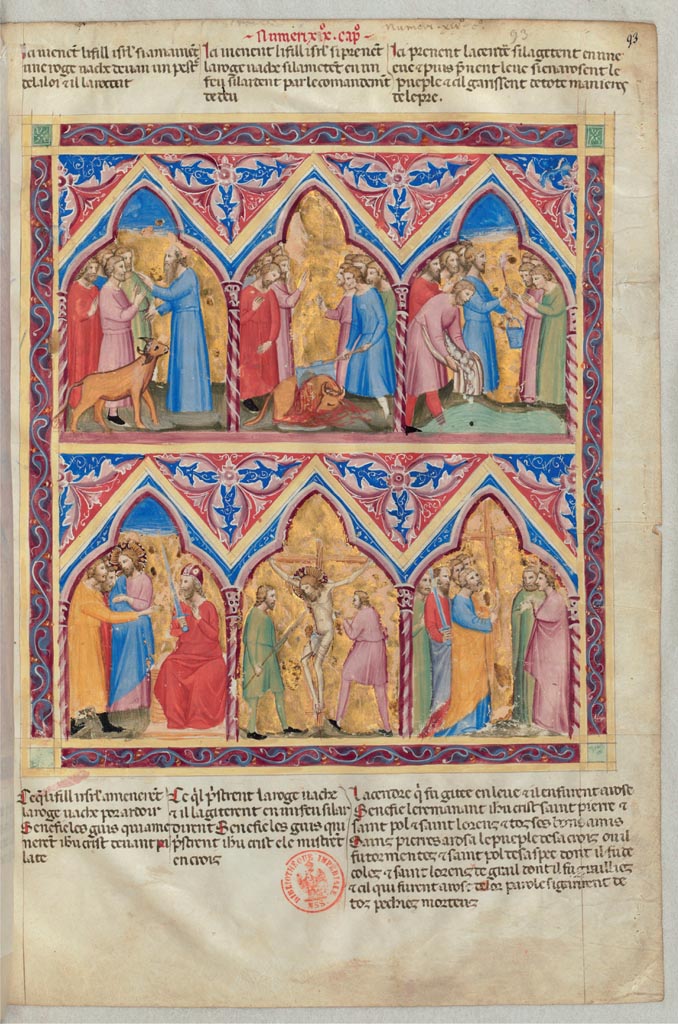
In the Middle Ages, humanity tended to be viewed as a relative category rather than an essential trait, a function of the hierarchy of Godâs creation. Though early church fathers emphasized the distinctiveness of human existence in their writings, these thinkers still assumed that human life is on a continuum with animal life, an attitude they shared with other ancient and early medieval authors. In his sixth-century Etymologies, Isidore of Seville drew attention to the fact that the words for animal in Latin (animal) and animation (animare) are etymologically linked, such that the term âanimal,â meaning âliving thing,â can be applied to both human and nonhuman creatures. Previously Pliny the Elder had made similar connections in his Natural History. And of course, as Aristotle famously explains in his Politics, âmanâ is by definition a âpolitical animal.â These ideas persisted in medieval thought in the form of an epithet inherited from early Christian exegesis and disseminated by scholastics, which held that âman is a rational animal.â Again, this maxim assumes that humans are both animal, in the sense of being living creatures, and that they are not, by virtue of their rationality.9 Similarly, the Parisian scholar Bartholomaeus Anglicus, in his influential compendium De rerum proprietatibus (On the Properties of Things), written ca. 1240, defined âanimalâ as âomne quod consistit ex carne et spiritu vitae animatumâ (all that consists of flesh and the spirit of life), which includes beasts of the air like birds, or of the water like fish, or of the earth like âhomines, reptilia, bestiae et iumentaâ (men, reptiles, wild beasts and livestock).10 Ancient and medieval taxonomic projects thus regarded humans as in some respects superior, on account of a trait, such as reason, that they uniquely possess; but to the extent that the term âanimalâ could be applied to certain categories of human, distinctions between human and animal were fundamentally permeable.
The miniatures illustrating and commenting on Leviticus 1 in the Bibles moralisées therefore construct a sense of uniformity and order out of what were essentially porous and ungrounded terms. Just as the Vulgate âoriginalâ has been recalibrated â and in some ways reinvented â by the booksâ makers, animals have been transformed into symbols, their creaturely qualities positioned as secondary with respect to their signifying aspects. The rendering of animals as offerings, and as figures for the worldly values that Christians should discard, parallels the mundane and ubiquitous procedures by which animals in the Middle Ages were converted into food, fur and other objects of human consumption. The only death of interest in these images is seemingly the martyrâs; what is principally at stake is not the body of a dead, dismembered cow or calf but the lives of human saints and sinners. Animals, already defined as lower in the symbolic hierarchy by virtue of the human characteristics they are supposedly lacking, can thus be exterminated without being murdered; beasts only matter insofar as they provide symbolic support for a Christian message. The tiny roundels held by virtues in the first of the Vienna Bibleâs moralizing scenes (fig. 12.5) express this process succinctly: animal bodies have been turned into abstract signs.
Vienna, Ãsterreichische Nationalbibliothek, cod. 2554, fol. 27r, detail. Bible moralisée, ca. 1220â25. Leviticus 1.5, 10, 14; 2.1, 13, 15; flour signifies martyrdom, oil baptism, wine charity, pigeons simplicity, lambs sweetness, calves chastity
Source: ÃNB Vienna
From one point of view, these sequences can be interpreted as offering only confirmation of the supposed boundary between humans and other animals. But they potentially unsettle the very oppositions they sustain. After all, the juxtaposition of animal sacrifice with human martyrdom also reveals the animality of the human. The life hanging in the balance, whether embodied by saint or sinner, has been stripped of its worldly attributes and exposed to acts of violence and sublimation, but these acts are directly comparable in the mindset of the Christian moralizers to those experienced by other animal bodies. From another perspective, then, these scenes can be interpreted as expressing a shared vulnerability across the human/animal divide.
This is a conceptual entanglement that Agambenâs biopolitical theory brings into sharper focus. At issue in these images is not simply animal life or human life, but the production of what Agamben defines as âbare lifeâ: an exposure to violence and to the machinations of sovereign power that (potentially at least) is experienced by both human and nonhuman creatures.11 These images ask viewers to contemplate a series of encounters between suffering, mortal beings and the networks of power and meaning in which those beings are caught. In each instance bodies are at stake: recall Bartholomaeus Anglicusâs placement of âmanâ within the category of âanimal,â animals being defined collectively as a combination of flesh (carne) and animate life force (spiritu vitae animatum). But within medieval Christianity, the flesh was also characterized as a remnant that, when occupied by human souls, should ideally be disciplined and eventually transcended. As such, martyrs and other virtuous Christians were compelled to renounce their earthly bodies, perceived as tokens of fleshly physicality, in order that their souls ascend to a heavenly state and thereby sidestep the contingencies of time and biological process.
Another special category of person in the Middle Ages, the sovereign, was perceived as fusing fleshly and divine elements in analogous ways. Ernst Kantorowiczâs classic account of the doctrine of the kingâs two bodies, which Agamben discusses in his exploration of biopolitics in his book Homo Sacer, traces the development of the theory of the sovereignâs dual persona.12 First there is the natural, time-bound body, which is subject to the laws of nature and therefore, like all other bodies, dies. Then there is a supernatural, sempiternal body, invested with permanence and incorruptibility.
This division between the natural body of the king and the King as a metonym for the body politic clearly resonates with Agambenâs analysis of the convergence of natural life and political life in Western European thought, a thesis that Gaunt also uses as a springboard for his analysis of sovereign power and biopolitics in troubadour lyric. As Gaunt puts it, in a review of the historical ramifications of Agambenâs account of sovereignty, his intention is not to âcollapse the historical differences between the medieval, early modern and modern periodsâ but to investigate Agambenâs claim that biopolitics have a pre-modern history and are ânot the result of some dramatic and violent epistemic break.â13 In other words, where the doctrine of sovereignty is concerned, what is called the âbodyâ is always potentially biopolitical; it is, to deploy Agambenâs own terminology, âalways already bare lifeâ in some way.14
The pages in the Bibles moralisées representing sacrifice similarly envision two embodied states. On the one hand there is the mortal body, subject to the laws of nature and susceptible to violence. This body is common to human and nonhuman beings. On the other hand, there is the body as super-body, glorified by its supernatural status and moral superiority. This is the form acquired by saints and other virtuous humans; nonhuman animals, as theologians such as Thomas Aquinas remind us, cannot get to heaven.15 Animal bodies thus function as a bridge between the earthly and the spiritual, marking a transitional zone between the two. Simultaneously abject remnants of the physical world of fleshliness that virtuous Christians wish to get beyond, and points of access to the metaphysical realm Christians ultimately seek, the bodies depicted in these images take up a position akin to bare life, insofar as they are situated in what Agamben defines as a âzone of indistinction and continuous transition between man and beast.â16
In The Open, Agamben extends this analysis with reference to the âanthropological machine,â his term for the process of differentiating human from animal through a mechanism that is simultaneously exclusive and inclusive. The machine functions by excluding the not-yet-human from within the human, thereby separating out qualities that human beings share with other animals from those traits (such as language or reason) that are habitually claimed as being uniquely human. Yet, insofar as this process works to isolate human animality, the nonhuman is also included within the human. Furthermore this effort to distinguish human and animal within humanity itself depends on establishing what Agamben calls a âzone of indifference,â wherein human and animal are indistinguishable.17 Rather than facilitating the identification of a âtruly human being,â the zone creates instead the conditions for a âceaselessly updated decisionâ on what passes for human and animal, an âintimate caesuraâ in which the line separating man from non-man, speaking being from living being, is continually revised.18
An additional scene from the Bibles moralisées serves to exemplify this idea. Genesis 37 describes how, after selling Joseph into slavery, Josephâs brothers dip his many-coloured coat in goatâs blood to make their father Jacob think that his son has been killed and devoured by a wild beast. The corresponding illustration in the Naples Bible (fig. 12.6) depicts the brothers bloodying a bright green garment in the stomach of an animal before presenting it to Jacob, who raises up a hand in dismay; the accompanying moralization depicts blood draining from Christâs legs during his flagellation, in a clear analogy to the goatâs blood in the scene above.19 Thus, the figure of the animal within the human is a feature not only of earthly subjects but also contributes to definitions of the God-man himself: Jesusâs body is subjected to violence comparable to that inflicted on a hapless goat. On one level, of course, Christâs flesh is being likened to Josephâs besmirched coat rather than to the goat that is the source of the blood. Implicitly, however, viewers are also being invited to connect Christâs exposed and vulnerable flesh with the flesh of a butchered animal.20
Paris, Bibliothèque nationale de France, fr. 9561, fol. 24r. Bible moralisée de Naples. Naples, ca. 1350 or later. Genesis 37.28â35; angel appears to Peter and apostles (left), Jews who bloody Christâs flesh (centre), Christians who mourn Christâs death (right)
Source: Bibliothèque nationale de France. https://gallica.bnf.fr/ark:/12148/btv1b7200010r/f53.item (accessed May 12, 2025)
A crucial difference between the embodied victims represented in these images and Agambenâs figure of bare life helps to illuminate the historical specificity of such imagery. Homo sacer, the Roman legal category deployed by Agamben as an exemplar of the predicament of bare life, is defined as someone who is set apart or âbanned,â can be killed with impunity and may not be sacrificed according to religious ritual. However, the violence to which the Christian martyr (or indeed Christ) submits can be classified as murder, since his death demands grief and pity. The saint is not simply positioned outside the law, since the spirit animating his body belongs to and is protected by God; martyrdom is thus credited with a sacrificial meaning, at least from the perspective of a Christian audience. In their original scriptural contexts, of course, the deaths of nonhumans were similarly attributed with sacrificial value, but in the Bibles moralisées beholders are encouraged to view human martyrdom as a more meaningful mode of sacrifice. As such, while these images arguably generate a vision of sacrifice that differs in key respects from Agambenâs analysis of the homo sacer, his theory of biopolitics usefully foregrounds the isolation of a form of life common to both humans and nonhumans, one made manifest in the miniaturesâ comparative structure. What is more, this form of life is enlisted in a common enterprise: the legitimization of absolute sovereignty. The universal form of life embodied by both righteous Christians and sacrificial animals, which comes into view by virtue of the violence and ritual cleansing to which both are subjected, is revealed as falling under the jurisdiction of a God-Creator. These creatures exist, at base, in a relation of subjection to their creator, whereby God seizes hold of life in all its infinite variety.21
Significantly, the aforementioned scenes compare humans with a specific group of animals, a context which similarly betrays their historical particularity. Even as the books participate in a general effort to determine a limit between animal and human, âanimalâ is a category that admits division and is subject to cultural contingencies. Most relevant here is the Latin term iumentum, which roughly corresponds to the modern English âlivestockâ: cows, calves and goats can all be gathered beneath this heading, since they are bred and domesticated specifically for the purposes of providing humans with food and clothing, as well as with the very medium â parchment â through which knowledge was preserved and transmitted in medieval culture. The significance of rendering such species sacrificial turns on the fact that bodies usually destined exclusively for human use are required to be handed over instead (or also) to God. Additionally, the comparison relies on the fact that cows and goats are susceptible to potentially human-like experiences of vulnerability. Humans can be flayed or butchered using methods devised for quadrupeds; these beasts, like humans, bleed or emit cries of pain when wounded. Furthermore, it is worth noting that humans tended to live in closer proximity to livestock than some other categories of nonhuman such as wild beasts or aquatic creatures. An image of, say, an insect being crushed or a fish being caught arguably would not have possessed the same aesthetic or emotional impact for medieval viewers as that of a domesticated animal being killed. Acknowledging the specific role played by livestock in medieval sacrificial metaphor can thus be an important step in resisting the assumption that nonhumans were simply perceived in this period as a group of undifferentiated living beings.22
Select moralizing sequences in the Bibles moralisées convey a visual gap between humanity and animality, a space in which (some) humans are elevated above and beyond (some other) animals. But it is also possible to discern, at the centre of these images, a zone of undecidability in which the ability to ascertain what counts as properly âhumanâ is suspended, turned over to a God who determines which beings are included and which excluded. Human sinners and other animals together constitute an unredeemable remnant: only those forms of life that have transcended animality will be allowed to enter Paradise. Consequently, viewersâ attention is also directed, in the juxtaposition of excoriated calves and tormented martyrs, towards the animality that all creaturely beings share, which is manifested, above all, in the representation of a shared fleshliness and vulnerability among both cows and martyrs.
Working against this capacity for resonance and overlap, however, is the realization that the comparison is intended to work in one direction only: the lives that will be salvaged, these images assert, are those of martyrs and virtuous Christians, who will secure a place in heaven by transcending their innate animality. The scene of a cow or calf being flayed âsenefieâ (signifies), the manuscriptsâ makers tell us; the martyr is the tenor, the beast the vehicle. But redirecting our attention from human back to animal, it is possible to envisage the comparison also travelling in different directions or conveying other possibilities.
Crucial to Agambenâs analysis is the argument that what counts as âbare lifeâ is by no means a foregone conclusion. Rather, this form of life, situated in the border zone between human and animal, emerges through specific discursive and socio-political practices. Sovereignty always judges and acts upon bare life as a means of establishing power; but the identities of those rendered bare â and the matrices of power that produce them â are historically contingent. Discussions in Roman law of homo sacer; ancient and medieval funerary practices; medieval literary accounts of the wolf-man and the bandit; nineteenth-century speculation concerning the man-ape or ape-man; contemporary medical-legal discussions of the comatose person â all are cited by Agamben as instances of the variable forms in which bare life has historically been isolated and represented.
The Nazi concentration camp constitutes perhaps the most extreme (and, in responses to Agambenâs work, has proved to be the most controversial) illustration of this phenomenon. However, Agamben does not simply treat the camp as a distinct historical occurrence, but also suggests that it operates paradigmatically in his theory, as a figure for âthe political space of modernity itself.â23 Similarly the Jew, as the archetypal inhabitant of the camp, has an exemplary function in the philosopherâs argument: he is a prime representative of âthe non-man produced within the man.â24 This paradigmatic dimension to Agambenâs thought â the notion that certain phenomena resonate beyond their context as an exemplary template for wider structures â has sometimes been criticized for its ahistoricism or for its lack of attention to particularity; political relations get filtered through the prism of a single, essentially unchanging master concept, sovereignty, which appears to unfold inexorably in the direction of the Nazi death camp.25 However, Agambenâs use of the camp as a paradigm for modern politics is not intended simply to operate metaphorically on the basis of a substitution of one thing (individual Jews, Auschwitz) for another (contemporary biopolitical structures). He uses paradigms in an exemplary fashion, to shed light on a form of political relation that continues be witnessed in contemporary societies, but this does not diminish the fact that the sources of that light arose in discrete historical circumstances.26
Clearly, there are dangers in eliding the historical particularities of sovereignty and biopolitics. An aspect of the treatment of bare life in these manuscripts that warrants detailed attention and contextualization is its use in the service of a Christian rhetoric of anti-Jewish sentiment whereby Jews were aligned with nonhuman animals. In the Middle Ages as today, the animal-human distinction could be taken up as a vehicle for exploring, representing and reinforcing other kinds of difference, including beliefs about religious, ethnic or racial hierarchies.27 In these images, specifically, the staging of a separation between animal and human also served to underpin the perceived boundary between Jew and Christian, as represented in the movement from âOldâ to âNewâ Testament sacrifice. Through a process of metaphoric transfer, Jewish law is effectively depicted as having been superseded by Christâs covenant.
An immediate context for this substitutive logic is the investment of the Bibles moralisées in typology. These manuscripts function by combining illustrations and textual paraphrases of passages from the Hebrew Bible with scenes that interpret those biblical passages in light of New Testament or contemporary events, a line of thinking that provides the basis for a powerful visual polemic against Judaism. In the image cited previously from the Naples Bible, showing Josephâs coat being dipped in goatâs blood as an analogy to Christ being bloodied during his passion (fig. 12.6), the textual caption relates how the staining of the coat âSenefie les gieus qui ensanglanterent la char ihesu crist quant il le herent a lâestacheâ (signifies the Jews who bloodied Christâs flesh when they tormented him at the column), thus linking the perpetrators of Christâs flagellation with the brothers of Joseph in Genesis. Moreover, the Jews implicated in the killing of a goat in Genesis, who in turn prefigure the Jews who torment Jesus in the Gospels, are associated with animalistic acts of violence. Just as Jacob, upon seeing his sonâs coat, assumes that âan evil wild beast hath eaten himâ (Genesis 37.33), which interprets the brothersâ act of concealment as a sign that bestial consumption has occurred, Christâs tormentors are depicted inflicting blows with an animal-like disregard for human suffering.
An immediate context for this substitutive logic is the investment of the Bibles moralisées in typology. These manuscripts function by combining illustrations and textual paraphrases of passages from the Hebrew Bible with scenes that interpret those biblical passages in light of New Testament or contemporary events, a line of thinking that provides the basis for a powerful visual polemic against Judaism. In the image cited previously from the Naples Bible, showing Josephâs coat being dipped in goatâs blood as an analogy to Christ being bloodied during his passion (fig. 12.6), the textual caption relates how the staining of the coat âSenefie les gieus qui ensanglanterent la char ihesu crist quant il le herent a lâestacheâ (signifies the Jews who bloodied Christâs flesh when they tormented him at the column), thus linking the perpetrators of Christâs flagellation with the brothers of Joseph in Genesis. Moreover, the Jews implicated in the killing of a goat in Genesis, who in turn prefigure the Jews who torment Jesus in the Gospels, are associated with animalistic acts of violence. Just as Jacob, upon seeing his sonâs coat, assumes that âan evil wild beast hath eaten himâ (Genesis 37.33), which interprets the brothersâ act of concealment as a sign that bestial consumption has occurred, Christâs tormentors are depicted inflicting blows with an animal-like disregard for human suffering.28
Anti-Jewish imagery is a notable feature in some of the earlier Bibles moralisées. Sara Lipton has identified a range of visual attributes, especially in the Bibles now housed in Vienna, that were designed to differentiate Jews from Christians. In a commentary scene in the second Vienna manuscript, for instance, a group of men have been marked out visually by their flowing beards and conical or pointed hats (fig. 12.7); the accompanying text refers to âJewsâ and âbad philosophersâ being led astray by the devil on account of their wavering faith.29 What is more, comparable features are sometimes bestowed on biblical Jews such as patriarchs, who are not necessarily subjected to the same level of negativity as their modern-day (i.e. thirteenth-century) counterparts; or they may be ascribed to individuals who are not explicitly identified as Jews, thus visually blurring the line between Jew and non-Jew. By drawing attention to the distribution of such attributes across a range of bodies and identities, Lipton pioneers a reading of these books that identifies a âstandardâ method for depicting Jews while at the same time emphasizing how qualities identified as âJewishâ do not simply convey a picture of an essentialized Jewish body but are also imagined as being capable of infecting the entire social fabric. The conception of Jewishness in the Bibles moralisées cannot be understood apart from other unchristian activities such as usury, idolatry, heresy or lust: it testifies to the breakdown of clear-cut distinctions between Christian and Jewish cultures.
Vienna, Ãsterreichische Nationalbibliothek, cod. 1179, fol. 125v, detail. Bible moralisée, ca. 1225. Jews and bad philosophers consult devil
Source: ÃNB Vienna, https://viewer.onb.ac.at/10A997A8/258
Also significant in these Bibles is a tendency to associate evil with animal encounters, which again fuels the production of anti-Jewish rhetoric. In the scene just cited (fig. 12.7), the Jews are flanked to either side by animalized bodies. To the right, a calf-shaped idol looks decidedly lively as it turns, eyes open, towards the âJewsâ and âbad philosophersâ who worship it; to the left, meanwhile, the whiskers of the red-faced devil who seduces them parallel their own bearded chins, conveying a sense of shared physicality. (The devilâs and worshippersâ noses, shown in profile, also imply a physical connection.) As with the scenes showing biblical Jews ritually slaughtering animals or preparing them as offerings in Leviticus 1 (figs. 12.1, 12.3) and Numbers 19 (figs. 12.2, 12.4), the calf here represents a purported attachment to ritual and to matters of the flesh, instead of to the spirit of law. Additionally, Jews could sometimes be linked to cats in the manuscripts, a sign elsewhere associated with philosophers, university students and especially heretics, who were shown worshipping cats or occasionally even kissing them improperly.30
It is worth reflecting, then, on the mundane earthly ends to which scenes of animal and human sacrifice were being put by the makers of the Bibles moralisées in their reflections on verses from Leviticus and Numbers. The depictions of martyrdom and crucifixion in these images convey to Christian readers the universal capacity to be killed or wounded, a potential exposure to violence that members of that community share with both saint/Christ and calf/cow. As viewers, audiences are being asked to submit to the same divine power that has been recognized, and thereby confirmed in a riskier fashion, by the cows, martyrs and other animals on the page. These images reveal a form of life common to all, human and nonhuman, which undergirds a sense of Christian community, even as it simultaneously demonstrates the foundations of that community in a hierarchical boundary that raises one term (human, Christian) above others (animal, Jew). What is represented here as a stark dichotomy, however, is also the place of a deliberate decision concerning what counts as âJewishâ and what counts as âChristian,â one in which the boundary between Christian and Jew potentially dissolves or becomes unstable. Just as the division between humanity and animality cannot, finally, be sustained in any simple or unidirectional fashion, Christian audiences might be reminded, in these scenes, of the lingering âJewishnessâ of their sacrificial metaphors.31
The risk in evoking Agamben in this context is that depictions of Judaism in these books be perceived as participating in a relentless onward march towards modern biopolitics and the discourse of the camp. Lipton makes some pertinent remarks in this regard concerning the use of Jews in the Bibles moralisées as metaphors. If, after encountering such imagery,
it is impossible not to recall Nazi anti-Jewish visual propaganda ⦠let us also remember that it was created in conditions very different from those in the Middle Ages, and that its makers and viewers drew conclusions and formulated policies quite alien to thirteenth-century France. Similarity of form by no means entails identity in meaning. If the power of a metaphor lies in its flexibility and transferability, then the anti-Jewish imagery in the Bible moralisée is powerful indeed.32
This does not mean that the topos of âthe Jewâ had no influence on Christian perceptions of actual Jews, or that anti-Jewish rhetoric of this sort was ultimately more innocuous than has been previously imagined. It does draw attention to the need to understand these images in their immediate manuscript and wider cultural contexts. Agambenâs theory of biopolitics has been invoked in this chapter as a means of articulating the procedure by which Jews, like animals, enter a zone of indistinction with their non-Jewish or âhumanâ counterparts, being subjected to a decision over what counts as fully Christian. Much as these depictions could be interpreted as confirming the persistence of a form over time, however, they do not appear in a cultural or historical vacuum: the biopolitical paradigm was itself endowed with enormous flexibility and transferability.
Another important context for the moralized Biblesâ citations from Leviticus and Numbers was Christianityâs rejection of animal sacrifice and its turn towards the use of sacrificial metaphors concerning human suffering and salvation. This, too, underscores the role played by the animal-human distinction in distinguishing Christians categorically from Jews. Jesus, especially, was assimilated to sacrificial animals in the writings of early Christians such as the Apostle Paul, while elsewhere Paul encouraged Christians to offer their bodies as a âliving sacrificeâ to God.33 In his first letter to the Corinthians, Paul also stridently condemned the practice of sacrificing animals before pagan idols: the point is that Christ, with his blood, made the ultimate sacrifice and that âmeat doth not commend us to Godâ (1 Corinthians 8.8). The frame of reference in such discussions is the ritualistic animal slaughter practised by Jews and pagans, but the nonhuman targets of such slaughter are no longer present in any real sense. Instead, the living human body, whether it belongs to Jesus or to Christians in general, is assigned the role previously inhabited by nonhuman animals. Pauline metaphor thus annuls the materiality of animal sacrifice â its sight, smells, sounds and fleshly realities â in favour of a distinctive metaphorical framework, in which the only âvictimsâ are those who qualify as human. In the period of early Christian persecutions, the rejection of animal sacrifice assumed even greater symbolic value. By refusing to perform acts of sacrifice, Christians were setting themselves up in opposition to the Roman pagans who threatened them with martyrdom. Furthermore, Christians increasingly equated Jewish sacrifice with pagan sacrifice, despite the ritualsâ distinctive characters; both forms were subjected to moral censure.34 The abandonment of animal sacrifice and its replacement by sacrificial metaphor thus entailed locating Christians at one remove from the ritual practices associated with Jews and other religious groups. It also placed Christianity at a distance from the realities of animal slaughter, even as, throughout the Middle Ages, certain categories of animal were killed by Christians. These acts of killing ostensibly took place outside a framework of sacrifice, but sometimes â as in ritualized hunting â they were staged in such a way that sacrificial meanings reappeared in a secular, fragmented guise.
Consequently, these images could also be interpreted as participating in an ideological sleight of hand, whereby the ritual killing of animals gets displaced into a biblical âJewishâ past. Yet these efforts to differentiate past from present are undermined by efforts to modernize the biblical âsourceâ to make it cohere with the moral message. This is especially apparent in the Neapolitan Bible, where the scriptural scenes in the Leviticus sequence (fig. 12.3) are depicted taking place indoors, beneath a series of Gothic trefoil arches; the acts of flaying and chopping are performed on altar-like structures, while the calfâs skinned corpse is washed in a container that bears more than a passing resemblance to a baptismal font. The sacramental meanings associated with ritual animal slaughter are thus conveyed via a series of Christianizing and implicitly de-historicizing manoeuvres: âOldâ Testament ritual has effectively become âNew.â The boundaries separating Christian from Jew, human from nonhuman, present from past, become undecidable, their contours sustained only by a calculation on the part of makers and viewers concerning where exactly to draw the line.
When introducing the manuscripts explored in this chapter, reference was made to a key context for that calculation, namely the courtly settings in which the Bibles moralisées were originally commissioned and created. The Neapolitan manuscript has been linked to Joanna I, queen of Naples, a descendant of the House of Capet whose great grandfather, Charles of Anjou, was the youngest son of Louis VIII and Blanche of Castile, for whom the earlier Vienna Bibles were probably made. As such, while the viewers would also initially have included the booksâ makers, the intended audience was very likely composed of royals and their intimate acquaintances. That is to say, the individuals ultimately assigned the task of distinguishing human from animal â and by extension Christian from Jew â in these images were literally sovereigns; they were rulers whose authority, at least in theory, rested on their capacity to exert power over forms of life putatively excluded from the state but paradoxically also included within it as sovereigntyâs hidden nucleus. Crucially, this logic of inclusive exclusion underpins Agambenâs analysis of the inseparability of sovereign power and biopolitics, notably as revealed in a brief excursus in Homo Sacer on Marie de Franceâs twelfth-century poem Bisclavret, the werewolf protagonist of which exemplifies, for Agamben, the special proximity between sovereign and outcast.35
Gaunt cites Agambenâs reading of Bisclavret in the course of reviewing the pertinence of the philosopherâs theory of sovereignty to representations of empowerment in troubadour lyric.36 In conclusion, however, it is worth noting that, in the domain of cultural discourse, the sovereignâs relation to bare life is also subject to what Gaunt calls âconflicting currents.â As Gaunt puts it, in a characteristically lucid summary:
In Agambenâs schema, the sovereign will not, by definition, give a second thought â or indeed any thought at all â to what the individuals over whom he exercises his sovereign power might think, want, or feel. The sovereign is indifferent to them in the sense that he makes no distinction between them; they are all nothing to him. They, on the other hand, cannot love, since they are reduced to a pure, animal state â bare life. But while acknowledging the constant likelihood that his existence simply may not register for the lady, the loverâs plaint in the lyric is nonetheless predicated on the possibility that she may be susceptible to his plight. The lover therefore seems to be pulled in two conflicting directions: on the one hand, he seems to want to occupy the liminal zone of the homo sacer; on the other, he seems to want his lady to extract him from this space.37
Gauntâs point here is that the sovereignâs relation to bare life, as outlined in Agambenâs theory, contrasts markedly with the discursive representation of this relation, as evidenced by the troubadour tradition. Crucially, Gaunt links this potentially ambiguous climate to the possibility â at least in the loverâs imagination â that the sovereign will exercise mercy and as such behave ethically towards the desiring subject.38
While the Bibles moralisées were produced in a distinctive courtly milieu to the lyrics that are Gauntâs focus, the representations of animal and human sacrifice these books contain arguably also pull in two directions. On the one hand, as a means of underpinning Christian claims to sovereignty, these depictions draw a sharp and seemingly unwavering line between human and nonhuman. The power to allow or to disallow life â and to attribute meaning to violence and suffering â takes place within a space of exception, in which some bodies matter (âChristianâ or âhumanâ) and some do not (âJewishâ or âanimalâ). On the other hand, these representations potentially also hold out the prospect of a relation between the two, by virtue of the visual comparisons they stage, which raise the prospect of a shared physicality and vulnerability that transcends the human/animal divide. Reading such imagery both with and against Agambenâs argument, in other words, it is possible to envision interpretative possibilities that do not simply substantiate the theory but also raise the possibility of a more open, contradictory and perhaps even ethical relationship between sovereignty and its others.
Simon Gaunt, Love and Death in Medieval French and Occitan Courtly Literature: Martyrs to Love (Oxford: Oxford University Press, 2006).
For general orientation, see John Lowden, The Making of the âBibles moralisées,â 2 vols (University Park, PA: Penn State University Press, 2000).
Lowden, Making of the âBibles moraliséesâ 1:8, 52, 94, 132 and 2:200â202; Gerald B. Guest, âPicturing Women in the First Bible moralisée,â in Insight and Interpretation: Studies in Celebration of the Eighty-Fifth Anniversary of the Index of Christian Art, ed. Colum Hourihane (Princeton, NJ: Princeton University Press, 2002), 106â30. Cod. 1179 was consulted in manuscript and cod. 2554 in facsimile. For the latter, see Gerald B. Guest, Bible moralisée: Codex Vindobonensis 2554, Vienna, Ãsterreichische Nationalbibliothek (London: Harvey Miller, 1995), from which the translations quoted in this and the next paragraph are also taken.
Biblical citations are from the Latin Vulgate (www.latinvulgate.com) and, for English translations, the Douay-Rheims Bible (www.drbo.org).
On confusions, inaccuracies and errors in the biblical texts in this and other Bibles moralisées, see Lowden, Making of the âBibles moraliséesâ 2:73; Yves Christe, âLa Bible moralisée de Naples: Une belle inconnue enfin reconnue,â in Bible moralisée de Naples, ed. Marianne Besseyre and Yves Christe (Barcelona: Moleiro, 2011), 74â76.
For an overview, which presents several hypotheses concerning the bookâs provenance, creation and stylistic qualities, see Marianne Besseyre and Yves Christe, eds., Bible moralisée de Naples (Barcelona: Moleiro, 2011). The manuscript, which also contains a sequence of full-page paintings illustrating New Testament episodes that do not conform to the moralizing structure of the original Bibles moralisées, was consulted in facsimile: Bibliothèque nationale de France, Paris, Bible moralisée de Naples (Barcelona: Moleiro, 2009). The argument in this paper centres on treatments of verses from Leviticus and Numbers in just two manuscripts. A more exhaustive survey of comparisons between human and nonhuman sacrifice in the Bibles moralisées would need to consider other scenes, such as a pair of images on fol. 58v of the Neapolitan Bible comparing the sacrifice of the paschal lamb in Exodus 12 with Christâs crucifixion, or fol. 78r in the same volume where the sacrifice of cattle in Leviticus 1.3 is interpreted as signifying baptism.
The biblical texts read: A) âIci comende moyses quil preignet un veel si ostent la pelâ (Here Moses orders that they take a calf and then remove the skin); B) âPuis comende quil le piecentâ (Then he orders that they chop it up); C) âApres comande quil le lavent en un veisel et teste et piez et la froisureâ (Next he orders that they wash the head, feet and joints in a container). The corresponding commentary texts read that the biblical verses signify: a) âceli a cui lâan reverse la cote del mont par martireâ (the one whose worldly coat is turned inside out through martyrdom); b) âli saint qui furent de pecie el monde par martireâ (the saints who were torn from the world by martyrdom); and c) âle prudome qui est lavez per confession par peneanceâ (the worthy man who is washed through confession by way of penance).
On further differences between the Naples and Vienna Bible treatments, see Besseyre and Christe, Bible moralisée de Naples, 241.
For an overview of these tangled definitions in classical, early Christian and medieval thought, see Richard Sorabji, Animal Minds and Human Morals: The Origins of the Western Debate (Ithaca, NY: Cornell University Press, 1993), 195â207.
Bartholomaeus Anglicus, De rerum proprietatibus (Frankfurt am Main: Minerva, 1964), 968â69. See also Susan Crane, Animal Encounters: Contacts and Concepts in Medieval Britain (Philadelphia: University of Pennsylvania Press, 2013), 1â2.
Hence Cary Wolfe, defining humans as âall always already (potential) âanimalsâ before the law,â urges thinkers such as Agamben to contend with the implications of biopolitics for nonhuman beings. See Wolfe, Beyond the Law: Humans and Other Animals in a Biopolitical Frame (Chicago: University of Chicago Press, 2013), 10.
Ernst Kantorowicz, The Kingâs Two Bodies: A Study in Medieval Political Theology (Princeton, NJ: Princeton University Press, 1957); Giorgio Agamben, Homo Sacer: Sovereign Power and Bare Life, trans. Daniel Heller-Roazen (Stanford, CA: Stanford University Press, 1998), 91â94. Homo Sacer is the first and most influential volume in a series of books devoted to the subject.
Gaunt, Love and Death, 71.
Agamben, Homo Sacer, 7.
Agamben discusses the consequences of Aquinasâs statement concerning the exclusion of animal life from Paradise in The Open: Man and Animal, trans. Kevin Attell (Stanford, CA: Stanford University Press, 2004), 19.
Agamben, Homo Sacer, 109.
Agamben, The Open, 37.
Agamben, The Open, 38, 15.
To the left, Ruben, who had earlier pleaded with the other brothers not to shed Josephâs blood, and who was absent when Joseph was sold into slavery, is shown pointing at the pit into which Joseph had been cast while awaiting his fate, alarmed at finding it empty. In the scene below Ruben is likened to the angel in the Gospels who, pointing to Christâs empty tomb, announces Christâs resurrection to the apostles. For analysis of corresponding scenes in this and other Bibles moralisées, see Besseyre and Christe, Bible moralisée de Naples, 143â44.
It is also possible that Jewish dietary regulations concerning kosher slaughter are being evoked here. These restrictions were justified on the basis that blood is a sacrificial entity, which is therefore unfit for human consumption, as outlined in Genesis 9.4â5 and Leviticus 17.10â14.
For a consideration of divine sovereignty and biopolitics as it pertains to medieval hagiography, see Emma Campbell, âHomo Sacer: Power, Life, and the Sexual Body in Old French Saintsâ Lives,â Exemplaria 18, no. 2 (Fall 2006).
For pertinent philosophical reflections on this point, see Jacques Derrida, The Animal That Therefore I Am, ed. Marie-Louise Mallet, trans. David Wills (New York: Fordham University Press, 2008), 29â31; Wolfe, Beyond the Law, 27, 73â74.
Agamben, Homo Sacer, 174.
Agamben, The Open, 37. For more on Agambenâs choice of the camp as âparadigm,â see Leland de la Durantaye, Giorgio Agamben: A Critical Introduction (Stanford, CA: Stanford University Press, 2009), 200â323; Andreas Kalyvas, âThe Sovereign Weaver: Beyond the Camp,â in Politics, Metaphysics, and Death: Essays on Giorgio Agambenâs Homo Sacer, ed. Andrew Norris (Durham, NC: Duke University Press, 2005).
See, for example, Kalyvas, who argues that âAgamben gives no explanation for the sovereignâs repeated victories and unstoppable march toward the campâ (âThe Sovereign Weaver,â 112); or Wolfe, who draws attention in Agambenâs work to a âremarkable flattening of differences between different political, ethical, and institutional conjuncturesâ (Before the Law, 26).
See de la Durantaye, Giorgio Agamben, 224â26. By turning, in later work, to the testimony of survivors, Agamben attempts to confront head-on the historical specificity of life in the camps. See Giorgio Agamben, Remnants of Auschwitz: The Witness and the Archive, trans. Daniel Heller-Roazen (New York: Zone, 1999).
Depictions of animal-human hybrids, for instance, or images of monstrous races of semi-humans on the worldâs margins, were enlisted as tools of medieval race-making, as explored in Debra Higgs Strickland, Saracens, Demons, and Jews: Making Monsters in Medieval Art (Princeton, NJ: Princeton University Press, 2003).
Another scene with anti-Jewish connotations uniquely appears on fol. 58v of the Naples Bible, which illustrates and comments on instructions in Exodus 12 regarding the manner of sacrificing, preparing and eating the paschal lamb. Christ is shown crucified and pierced with a lance by figures described in the accompanying text as âli felon iusâ [the evil Jews]. See further Besseyre and Christe, Bible moralisée de Naples, 199.
The miniature comments on 4 Kings 1.2, which describes how the evil king Ochozias sends messengers to consult with Beelzebub. The commentary text reads âHoc significat iudeos et pravos philosophos qui sunt mutantes in fide et infirmi in sua lege et consultant maiorem suorum magistrorum qui (â¦) ab eis suo nomine bitzebuch vocabanturâ (This signifies Jews and bad philosophers who are wavering in their faith and weak in their law, and they consult the greatest of their masters who is called by them by the name Bitzebuch). On the passageâs ambiguities, see Sara Lipton, Images of Intolerance: The Representation of Jews and Judaism in the âBible moraliséeâ (Berkeley: University of California Press, 1999), 70.
Lipton, Images of Intolerance, 88â91.
On the ability of imagery in the Bibles moralisées to complicate rather than simply confirm dichotomies of the Jew/Christian, flesh/spirit variety, see also Sara Lipton, âThe Temple is My Body: Gender, Carnality, and Synagoga in the Bible moralisée,â in Imagining the Self, Imagining the Other: Visual Representation and Jewish-Christian Dynamics in the Middle Ages and Early Modern Period, ed. Eva Frojmovic (Leiden: Brill, 2002).
Lipton, Images of Intolerance, 141.
See, for example, Romans 3.25, describing Jesusâs death as a âpropitiationâ for the remission of sins; or 1 Corinthians 5.7â8, describing how âChrist our pasch (paschal lamb) is sacrificed.â The source for these descriptions is presumably Isaiah 53.7, which portrays the messiah as a sacrificial lamb. The Bibles moralisées also deploy the motif of Christ as lamb in scenes commenting on Genesis 22.1â14, in which God tests Abraham by commanding him to sacrifice his son Isaac, after which an angel subsequently tells the prophet to spare the son in favour of a ram. See, for example, fol. 5v of the first Vienna Bible, which makes a visual analogy between Abrahamâs actions in the biblical miniature and the actions of Christâs persecutors in the commentary, the latter depicted as Jewish and described in the accompanying text as âles espines del mundeâ (the spines of the world) who sacrifice âli vrais aignauxâ (the true lamb). Or see the equivalent scenes on fol. 18r of the Naples Bible.
On animal sacrifice in Jewish and Greco-Roman pagan religion, and its progressive rejection by Christianity, see Maria-Zoe Petropoulou, Animal Sacrifice in Ancient Greek Religion, Judaism, and Christianity, 100 BCâAD 200 (Oxford: Oxford University Press, 2008) and Daniel C. Ullucci, The Christian Rejection of Animal Sacrifice (Oxford: Oxford University Press, 2012).
Agamben, Homo Sacer, 104â111.
Gaunt, Love and Death, 52â53, 61.
Gaunt, Love and Death, 58.
Gaunt, Love and Death, 61.