


Most of the discussions concerning the literary and cultural phenomenon in Greater Romania (in Romanian, România Mare 1918â1945) focus on the dichotomy traditionalism vs. modernism and emphasise its impact on the evolution of the Romanian intellectual landscape after 1918. Even though such an opposition may seem simplistic,1 it can be useful as a heuristic device, and it can help to better understand the identity dilemmas not only in the literary and cultural field but also on the broader socio-political level of a young statehood, newly formed after World War I,2 obsessed by its history and looking continuously for the most appropriate path of modernisation. This distinction outlines the principal object of the central dispute of the time â the cultural identityâs construction was seen either as a process based on autochthonous elements (which are non-Occidental), or as a long-term process of the full importation of political, cultural, social and literary structures from âWestern countriesâ â the latter representing a desired, but hardly accessible, space for integration after a paradigm shift in the 19th century. The traditionalists wanted to prove that Romanian cultural identity should be built on Orthodox moral values and folkloric and rural heritage, thus the so-called âspecific nationalâ (ânational specificityâ). In contrast, the modernists wanted to synchronise with the European community through the law of imitation (the SburÄtorul circle led by Eugen Lovinescu).3 They believed that once the political and cultural framework was imposed, it would help change the local landscape, eventually contributing to the birth of a critical spirit in Romanian society. Both tendencies were developing simultaneously in a contentious relationship â Romanian interwar modernism would then define itself in opposition to such cultural currents as sÄmÄnÄtorism4 or poporanism,5 denying their belief that the only depositary of permanent national values are Romanian peasants and aiming to universalise the literary experience, to focus on modern narrative and urban space. Such dynamics have influenced the simultaneous emergence of significantly different Romanian interwar literature tendencies, confirming the frequently repeated thesis about the non-linear, paradoxical development of Romanian literature. As Dumitru Micu notes in his work about Romanian modernism: â(â¦) Romanian poetry has gone through all the stages of synchronisation with European modernism, however, contrary to the diachronic development of the great Western literatureâ (Micu 1985, 135).
Another literary critic, Sorin Alexandrescu, puts this phenomenon within a broader context of Romaniaâs integration into European history and culture. He considers it one of the âRomanian paradoxesâ â the paradox of simultaneity (âparadoxul simultaneitÄÈiiâ): âthe great stages of Western culture do not exist as such in Romania [â¦], the great successive currents are projected within Romanian culture in terms of simultaneityâ (Alexandrescu 1998, 34). To observe and understand the mechanism of the development delay described by Alexandrescu, we can take a closer look at the period that constitutes the contextual background for the subject of the chapter (the 1920s), and at the different literary trends emerging in those times. Thus, on the one hand, in 1920 Liviu Rebreanu (1885â1944) published his rural novel Ion, hailed as the most mature realisation of the realism developing in Romania since the 19th century and yet fully blooming only in the interwar period, and here thanks to Rebreanu or Cezar Petrescu (1892â1961). On the other hand, Camil Petrescu (1894â1957) is already attempting to depart from traditional narrative forms and becomes the main representative of modernisation in the Romanian novel. Inspired by Marcel Proust, he publishes his literary masterpieces: Ultima noapte de dragoste, întâia noapte de rÄzboi, 1930 [The Last Night of Love, The First Night of War] and Patul lui Procust, 1933 [The Bed of Procrustes]. Also, Hortensia Papadat-Bengescu (1876â1955) follows the path of literary modernism, introducing into her writing some expressive female characters, an in-depth psychological analysis and topics related to physiology and disease, as we can observe in the novel Concert din muzicÄ de Bach, 1927 [A Concert of Music by Bach]. At the same time, we can notice the appearance of innovating, experimental initiatives which contest a modernism already viewed as ânot new enoughâ (Terian 2014) and deconstruct the poetic language that is still being created and grounded at that period by the most significant represents of interwar poetry, such as Tudor Arghezi (1880â1967), Ion Barbu (1895â1961) and Lucian Blaga (1895â1961), classified, since the Lovinescuâs canonical volume Istoria literaturii române contemporane (1926â1929) [A History of Contemporary Romanian Literature], as âmodernistsâ. Thus, in the 1920s the most important avant-garde magazines begin to appear. The group considered to be more radical includes such titles as 75HP (1924), Punct (1924â1925), Integral (1925â1928) or unu (1928â1932). However, the most significant and longevous of them, Contimporanul [The Contemporary] (1922â1932), founded by Ion Vinea (1895â1964) and Marcel Iancu (1895â1984), seems to be quite âecumenicalâ, promoting also the work of some authors considered to be âmoderateâ modernist, like the already mentioned Arghezi and Barbu, but also B. Fundoianu (1898â1944) or Adrian Maniu (1891â1968) (cf. Pop 1990, 123; Cernat 2007, 135). Moreover, in 1923, in the journal Cugetul românesc [Romanian Thought], at the insistence of Tudor Arghezi [sic!], are released three texts by Urmuz, the writer considered to be an aesthetic precursor of the Romanian avant-garde. Those signals coming from the literary field âdraw attention to the important aesthetic resemblances among the divergent cultural trends surfacing in the 1920sâ (Cernat 2018a, 204).
The coexistence of three tendencies in Romanian art and literature: traditionalism, modernism and the avant-garde is thus characterised by the fact that they develop and mature almost simultaneously, in uninterrupted dialogue, sharing âa common ground that envisaged literature as a privileged battlefield for the preservation of identity, of culture and even of the Romanian national stateâ (Terian 2014). They try to take a position in the conflict between âEuropeannessâ and âRomaniannessâ, thus between the cosmopolitan and autochthonic discourse, which animates the countryâs whole cultural, political, and social scene.
Romanian avant-garde was characterized by an unambiguous and determined rejection of the ideology of nationalism. The need to follow more universal values pushed the left-wing avant-garde artists toward the European cosmopolitan avant-garde scene, where they could immediately affirm themselves by consciously addressing the aesthetic and existential crisis of modernity; they could synchronise with Western literature according to its diachroneity, they could finally oppose the dichotomy centre (Paris) â periphery (Bucharest) and become a part of an avant-garde international constellation, making their contribution direct and without delay.6 As Paul Cernat claims, âthe whole generation was literally obsessed (â¦) with overcoming the condition of a âminorâ and ignored culture at the European peripheryâ (Cernat 2018a, 202).
Their search for a literary experiment would therefore fit, on the one hand, into the need to create an aesthetic and ethical revolution, to find new ways of literary expression and to oppose radically both the local conservative milieu and the modernist one. On the other hand, however, it appears to be a need to deny the cultural backwardness, break with the etiquette of being a âperipheralâ culture, and appear on the European art scene.7
The aim of my article is thus to present the artistic strategies explored by the Romanian avant-garde in the mid-1920s for the purpose of entering into international circulation. Hence, I will describe and contextualise the manifestations of the literary experimentalism present in one of the minor (but significant) avant-garde magazines which appeared in Romania in the early 20th century â 75HP. There are two reasons I have chosen this particular journal to present the experimental potential of the Romanian avant-garde â firstly because the very appearance of 75HP was discussed as an âexplosiveâ one; it was a real assault on all conventions â Victor Brauner, one of its founders, claimed in an interview accorded to the art critic Ionel Jianu, that âscandal is the only modern means of launchingâ, and he pointed out that 75HP was âa journal-manifesto which had to arouse the indignation of the ancientsâ (qtd. in Pop 1990, 72). Secondly, because 75HP was not politically engaged (in contrast to Contimporanul which, on account of Paul Cernat, was at that time, between 1922 and 1924, at the stage dominated by social-political militancy [Cernat 2007, 131]), so I can focus on the aesthetic programme of the avant-garde during its first wave.8 It will help me to demonstrate that the Romanian avant-garde movement in the mid-1920s was determined by the search of synchronisation with international artistic currents (Dadaism, Futurism, Constructivism) in order to reinterpret them and to create their innovative, local variants, which could be then reintroduced, without any signs of peripherality, to the cosmopolite and transnational universe of avant-gardes, therein enriching their subversive potential.
Furthermore, I would like to suggest that although 75HP was an ephemeral magazine with only one issue in October 1924, it focuses lens-like the most important aesthetical tendencies in the Romanian avant-garde of the first half of the 1920s, and its appearance foreshadows the birth of the most original movement in the first wave of the Romanian avant-garde â Integralism, an attempt to synthesise all European avant-garde currents.
On the initiative of Victor Brauner (1903â1966, sculptor and painter, best known for his surrealistic works, though in the mid-1920s, before his first visit to Paris, he is still at his âDadaist, Abstractionist, Expressionistâ stage) and Ilarie Voronca (1903â1946, the most prominent theorist of the Romanian avant-garde in the mid-1920s, a collaborator of the most crucial avant-garde journals), the magazine 75HP makes its appearance in October 1924. André Breton publishes at the same time his Manifesto of Surrealism. Even though the representatives of the Romanian avant-garde are aware of the Surrealist movement (for example Contimporanul no. 50â51 of December 1924 informs briefly about the publication of Bretonâs manifesto), yet, at that moment, they are under the strong influence of Constructivism and Futurism. Already the title announces the Futuristic inspirations of the magazine â âHPâ means âHorse Powerâ and through the reference to a modern automobile engine, eulogises speed and technology.
The issue consists of 16 pages (including the cover). The front page is designed (or rather âconstructedâ, as the title suggests) by Brauner, and its graphic presentation: bold, black and red letters, and simple geometric elements refer directly to the aesthetics of Constructivism. The issue is bilingual (or even tri- or quadrilingual, because there are some single sentences in German while some words are written in an invented language) â although most texts and article-manifestos are in Romanian, the first and the last page are written entirely in French. This is not an isolated case â Romanian avant-gardists often considered French as their second language of expression, thus it commonly appeared in the vast majority of avant-garde magazines.9
Moreover, the revueâs cosmopolitan aspect10 is underlined by Futurismâs strong influence on the magazineâs literary manifestations and typographic layout. F.T. Marinetti and the Italian Futurist movementâs activity echoed widely in Romania and had fascinated some of the collaborators of 75HP (especially Mihail Cosma and Stephan Roll), stimulating their work and appropriating them to the Futurist programme.11 There also occurred an interesting coincidence which was to have an impact on the groupâs international recognition â Miguel Donville, a Romanian poet, who contributed to 75HP, âleft a copy [of the magazine 75HP â O.B.N.] at the Bureau de recherches surréalistes during a trip to Paris in November 1924â12 (Morando 2015, 7). The groupâs international ambitions are also visible on the penultimate page of the magazine â in the column âBitte zu lesenâ they recommend reading European avant-garde publications and propose a quite eclectic choice of titles: Buletin de lâeffort moderne, Block, Cinema Calandrier du CÅur Abstrait, Der Sturm, De Stijl, Disk, ÃK, G, Il futurismo, Les feuilles libres, Le Futurisme, LâEsprit Nouveau, MA, Mecano, Manometre, Merz, Noi, Stavba, Zenit (75HP, 15).13
The artists who identify themselves with the 75HP group, open the issue with a self-praising manifesto, which corresponds with the Dadaist insolence, with the âphilosophy of prideâ characteristic for all movements resonating with everything that is new and revolutionary. Their text is printed at the centre of the page and encased in a red frame: â75HP lâunique groupe dâavantgarde de Roumanie. (â¦) Notre groupement compte parmi ses collaborateurs les meilleurs ecrivains et artistes du mouvement moderniste de tout le mondeâ (75HP the only avant-garde group in Romania. (â¦) Our group has among its collaborators the best writers and artists of the modernist movement from all over the world., 75HP: p. 2 of the cover). This âtone of praiseâ is present in the whole issue, the group glorifies its collaborators, evokes their achievements and artistic plans, invites the public to their art exhibitions.
The contributors to this sole issue of the magazine, who refer to themselves on its pages as âthe only avant-garde group of Romaniaâ and âthe best writers and artists of the modernist movement from all over the worldâ are indeed the most prominent representatives of the modern Romanian cultural space (among them are both painters and writers): the already mentioned Victor Brauner and Ilarie Voronca, but also Stephan Roll (1903â1974), F. Brunea-Fox (1898â1977), Ion Vinea (1895â1964), M.H. Maxy (1895â1971), Marcel Iancu (1895â1984) and Mihail Cosma (1902â1968). Until the appearance of 75HP, they had already contributed to the development of the Romanian avant-garde scene. Still, now, with the new project, they contest everything they had done before and propose something new, which would distinguish them and their art on an international scale â a synthesis of literature and art. They are proclaiming themselves as perpetual innovators. The apogee of activities leading to the full synthesis will be PICTOPOETRY, [in French PICTOPOÃSIE, in Romanian PICTOPOEZIE; the term appears in the issue in both languages] a newly invented art form proposed by Brauner and Voronca. However, many other elements help to construct the central axis of the issue around the idea of invention and innovation, both leading to the final intermedial synthesis. Apart from novel typography and a specific spatial arrangement of the text, the journal also publishes some reproductions of works by Brauner, Iancu and M.H. Maxy, inspired âby the repetitive rigour of the geometric surfaces of the constructivist universe or the aesthetic promoted by De Stijlâ (Morando 2015, 6).
The biggest âstarâ of the issue remains without a doubt Victor Brauner, whose name is mentioned almost on every page; Ilarie Voronca publishes even a text entirely devoted to the work of his friend, concluding it with a sentence which expresses this hopeful desire to join Western European culture: â[â¦] prin personalitatea deplinÄ a D-lui Victor Brauner alÄturi de acele ale D-lor Marcel Ianco Èi Maxy pictura româneascÄ va intra în cadrul marei arte europeneâ (through the personality of Victor Brauner together with those of Marcel Ianco and Maxy, Romanian painting will become a part of great European art, 75HP, 14). Also, 75HP announces (twice!) Braunerâs first solo exhibition in Bucharest. The first announcement is published in Romanian on page 15: âLa 24 Octombrie se va deschide la Maison dâArt expoziÈia pictorului Victor Brauner. ToÈi amatorii de artÄ vor gÄsi cea mai desÄvârÈitÄ desfÄÈurare a unui temperament îndrÄsneÈ: expresionism, cubism, construcÈivism pictopoezieâ (The exhibition of the painter Victor Brauner will open on October 24 at the Maison dâArt. All art lovers will find the perfect development of a bold temperament: expressionism, cubism, constructivism pictopoetry, 75HP, 15). It is worth noting that the text draws attention to the syncretic nature of the painterâs work, and uses the term pictopoetry to describe an autonomous avant-garde art movement. The second announcement is published in French on the reviewâs back page; through the use of hyperbolical constructions it imitates the style of advertisement, thanks to which the performativity of the text is highlighted âTOUT LE MONDE TOUT LE MONDE DOIT ALLER VOIR LâEXPOSITION DU PEINTRE VICTOR BRAUNERâ (EVERYBODY EVERYBODY MUST GO TO SEE THE EXHIBITION OF THE PAINTER VICTOR BRAUNER, 75HP, 16).
Furthermore, the editors, following the Dada spirit which emphasises absurdity and nonsense and allows the use of fake news and alternative facts as the equals of truth, announce future publications of the 75HP publishing house: ones that will never see the light of day. Among those imaginary texts were inter alia: TX(taxi)84, a volume of 150 pages with pictopoetries on wood by Victor Brauner & Ilarie Voronca, Zéro â a volume of collective poetry by Voronca, Brauner, Roll and Donville, or an avant-garde magazine with the symbolic title -â to be edited by Victor Brauner.
The page opening the issue can be read in multiple directions â the reader is thus forced to rotate the journal in order to follow the graphical arrangement of the texts. Irina Livezeanu calls it an âacrobatic printingâ (Livezeanu 2013, 1172). Among the contents, we can find an announcement in search of collaborators for the 75HP group, evidently referring to the Futurist aesthetics of negation, antisentimentalism, as well as to the Dadaist need to oppose conventional language, to juxtapose contradictions absurdly and playfully, and to shock common sense:
TO COLLABORATE ON 75HP. one must: /know how to dance/urinate on everything/respect oneâs parents/have suffered /an aeroplane accident/not do/literature/have a certificate /of good behaviour/drink sulphuric acid/know boxing /decapitate oneself twice/ a week/THE CANDIDATE SHALL DEMONSTRATE: /That instead of a heart he has a straw hat/that he has been using gutta-/percha for intestines/that he has religious/manias.
Besides the instruction for potential candidates, the introductory page announces the groupâs future activities, undertaken in the spirit of innovation and using some extraordinary inventions, like âCABLOCARDOSTEPPâ and âla plus grande invention artistique du siècle LE PICTOPHONEâ â the first one discovered by M. Miguel Donville, the second one, which produces âmusique coloréeâ (colourful music)14 â by Victor Brauner. They also inform the reader about the organisation of âUN GRAND LABORATOIRE PICTOPOÃTIQUE AVEC SALLE de lecture: on pourra lire avec accompagnements de cablocardostepp sur les murs des pictopoésies polynationalesâ (A LARGE PICTOPOETIC LABORATORY WITH A READING room: we can read with the accompaniments of cablocardostepp on the walls of the polynational pictopoetries, 75HP, p. 2 of the cover). The use of the concept of a âpictopoetic laboratoryâ suggests that the synthesising artistic process of pictopoetic works can be compared to an experiment conducted to provide an opportunity for analysing, observation, and testing. From the very beginning then, 75HP reveals the need to create a new, modern space, to invent a new sensibility â all this under laboratory conditions, which will replace an ordinary artistâs atelier.
On pages 3 and 4 Voronca publishes his manifesto entitled AVIOGRAMA, immediately undermining its status by adding the information that actually it is published âIN LOC DE MANIFEST/IN PLACE OF A MANIFESTOâ. As Emilia Drogoreanu observes, this text should be interpreted primarily as âvisual workâ and considered in categories of âtypographic writingâ (Drogoreanu 2004, 191), introduced in the literature of the beginning of the century by Futurism (Drogoreanu 2004, 192). The text is written in capital letters, in different types and sizes of font, with two contrastive colours (black and red); it is chaotically arranged on the page. It does not follow the rules of syntax and punctuation. The vocabulary is taken from the technical and industrial register (âlocomotiveâ, âdynamicâ, âpulseazÄâ, âserviciu maritimâ, âdactilo-cinematografâ, âtelegrafâ, âascensorâ, âbarometerâ, âTSFâ) and refers to modern city life (âboulevardâ, âautobuzâ, âtrotuarâ, âjazzâ; in the central place of page 4 there are the toponyms of the biggest capitalist capitals: âPARIS, LONDRA, BERLIN, NEW-YORKâ). Such a pursuit of modernity, the emphasis on communication speed and dynamic development corresponds with the vision of the artist presented at the beginning of the manifesto: ARTISTUL NU IMITÄ ARTISTUL CREIAZÄ/LINIA CUVÃNTUL CULOAREA PE CARE NâO GÄSEÈTI IN DICÈIONAR (â¦) INVENTEAZÄ INVENTEAZÄ (AN ARTIST DOES NOT IMITATE, AN ARTIST CREATES/A LINE WORD COLOUR YOU CANNOT FIND IN THE DICTIONARY (â¦) HE INVENTS HE INVENTS, 75HP, 3). Also, the reader is invited to forget about the old forms of literature by a (simultaneously quite aggressive and amusing) slogan written vertically on the left-hand side of the page: âCITITOR DEPARAZITEAZÄ-ÈI CREIERULâ (READER DEWORM YOUR BRAIN, 75HP, 3). Another rebellious slogan, invented by Mihail Cosma: âLITTERATURE â LE MEILLEUR PAPIER HYGIENIQUE DU SIÃCLEâ (LITERATURE â THE BEST TOILET PAPER OF THE CENTURY, 75HP, 11), sounds very intriguing in the Romanian context, one characterised by a very short literary tradition â yet, it was enough to contest its credibility and value. Moreover, this appeal corresponds with Manifestul activist cÄtre tinerime (âAn Activist Manifesto to the Youngâ), written by Ion Vinea and published in Contimporanul a few months earlier (in issue no. 46 of May 1924), where conventional art and poetry are insulted: âJos arta, cÄci s-a prostituat!/Poezia nu e decât un teasc de stors glanda lacrimalÄ a fetelor de orice vârstÄâ (Down with Art/âcause it was prostituting itself!/Poetry is nothing but a press to wring the tear gland of girls of any age; Livezeanu 2013, 1170).
Voroncaâs manifesto, built on the âConstructivist foundationsâ (Pop 1990, 122), fits perfectly into the aesthetical and conceptual framework set by Italian Futurists â although in Romania there has never been established an autonomous Futurist group, the influences of that movement are very visible in all Romanian programmes created during the first wave of the avant-garde and based on the idea of synthesising historical avant-gardes: starting with the eclectic character of Contimporanul and continuing with the âmodern synthesisâ claimed by the founders of Integral (Cf. Pop, 163â175).
Very similar inspirations are present in practically all poems/short texts/articles-manifestos published in 75HP. Their dominant idea consists in the rejection of the status quo and the eulogy of the new âstate of mindâ. The contributing authors will realise their programme assumptions by rejecting the lyrical subject, by the ludic tone of their poetry, ironic references to the convention of cooking recipes, and by the introduction of complex and unintelligible mathematical formulas. One of the most representative can be poem-manifesto âMetaloidâ written by Stephane Roll, published on the 6th page of the issue and accompanied by a black and white geometric composition by M.H. Maxy, entitled ConstrucÈie senzualÄ (Sensual construction). In his poem, Roll introduces the Futurist vitalism through the figure of the sportsman: âmâine vor veni alÈii/sportsmaniâ (others will come tomorrow/sportsmen) and the fascination with mechanics and the new, urban energy presented through the metaphor of the human body: âelastici constructivi/plÄmânii oraÈelor/vertebre de bronz/muÈchii schije de platinÄ/suntem aorta zileiâ (constructive elastics / urban lungs / bronze vertebrae / muscles platinum shards / we are the aorta of the day, 75HP, 6).
However, the most important, most innovative and most resonating concept for the ephemeral group 75HP, already mentioned many times in this chapter, is pictopoetry. The idea of a text-image returns in different contexts in the whole issue. Still, its primary representation covers the entirety of page no. 9 â the central place exactly in the middle of the magazine (Fig. 4.1). There is a colour reproduction of Brauner and Voroncaâs work âPICTOPOEZIA NO 5721â (the number seems to be a joke suggesting a nonexisting huge number of pictopoetic works) consisting of geometric forms in which different words are inscribed. Just below the âpaintingâ, we can find the definition of the original art method: PICTOPOEZIA NU E PICTURÄ/PICTOPOEZIA NU E POEZIE/PICTIOPOEZIA E POEZIE (PICTOPOETRY IS NOT PICTURE/PICTOPOETRY IS NOT POETRY/PICTOPOETRY IS PICTOPOETRY, 75HP, 9). The ontological status of this art form is thus clear â it aims to show the perfect connection between text and image, which cannot be studied separately, only as a whole, as an ideal synthesis of words and artistic elements. By resorting to a very well-known collage technique (explored especially by the Cubist and Dada movement), the artists intent to overcome it by introducing a new formula of art, where the idea of integrity and synthesis dominates the idea of the process of an assemblage of different, separated forms which need to be âstuck togetherâ. According to S.A. Mansbach, Brauner and Voronca had the ambition to overcome âthe traditional paragone between the visual arts and poetryâ (Mansbach 1998, 542). Through their art manifesto, they
jointly created their picto-poetry, nonfigurative oil paintings in which words culled from the Dada and Futurist vocabularies were manipulated to expressive effect within a welter of geometric forms. (â¦) Picto-poetry achieved a provocative tension between modes of reading and seeing. (ibidem)

Victor Brauner and Ilarie Voroncaâs work
âPICTOPOEZIA NO 5721â (75HP, p. 9)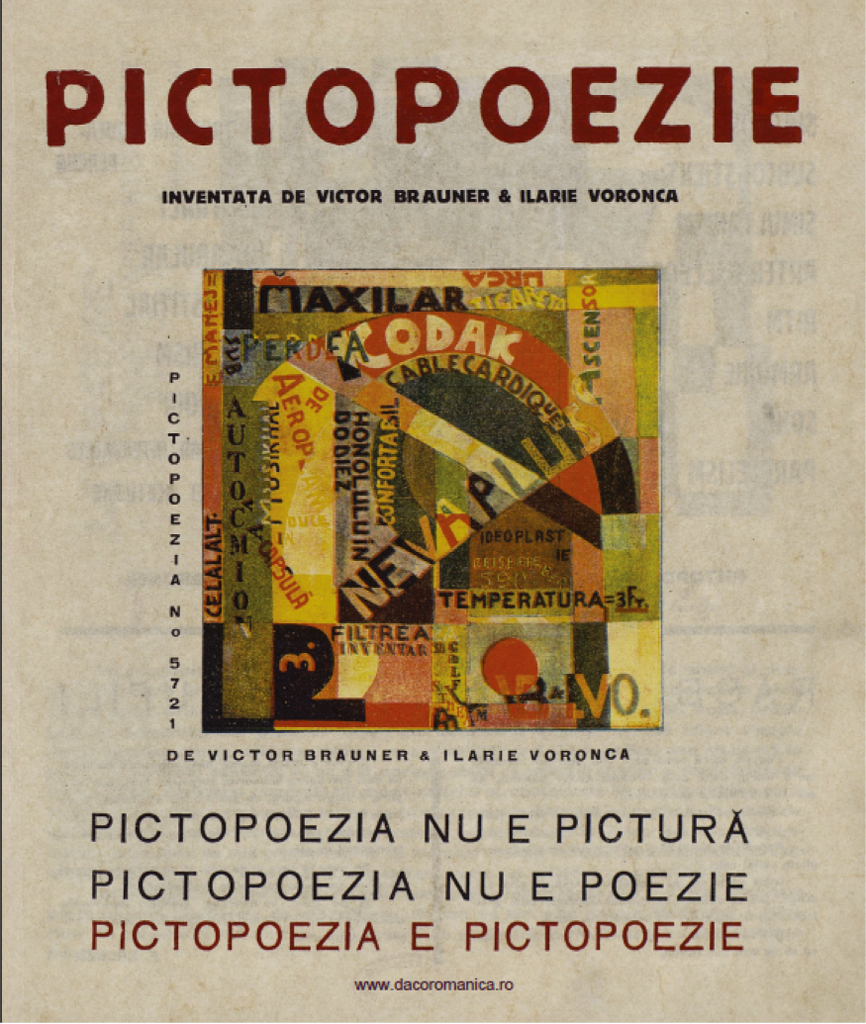
On the next page, we can find the second painting, entitled PICTOPOEZIA NO. 384 (Fig. 4.2) â this time the reproduction is in black and white, but the idea (of the words inscribed into geometrical forms) remains the same. On both sides of the frame, there are columns with some words coloured in red, which may correspond with the painting and which refer to poetry and art (âsintezaâ, âritmâ, âarmonieâ, âpararelismâ, âabstractâ, âsimultanismâ, âvocabularâ), but also to the human brain and body (âsubconÈtientâ, âarteriosclerozaâ, âcerveau acetilèneâ, âinterstitialâ) or to the technical vocabulary of modern times (âle troittoir gouta-perchaâ, âmechanismâ, âjoue par intervallesâ).
Victor Brauner and Ilarie Voronca,
PICTOPOEZIA NO. 384 (75HP, p. 10)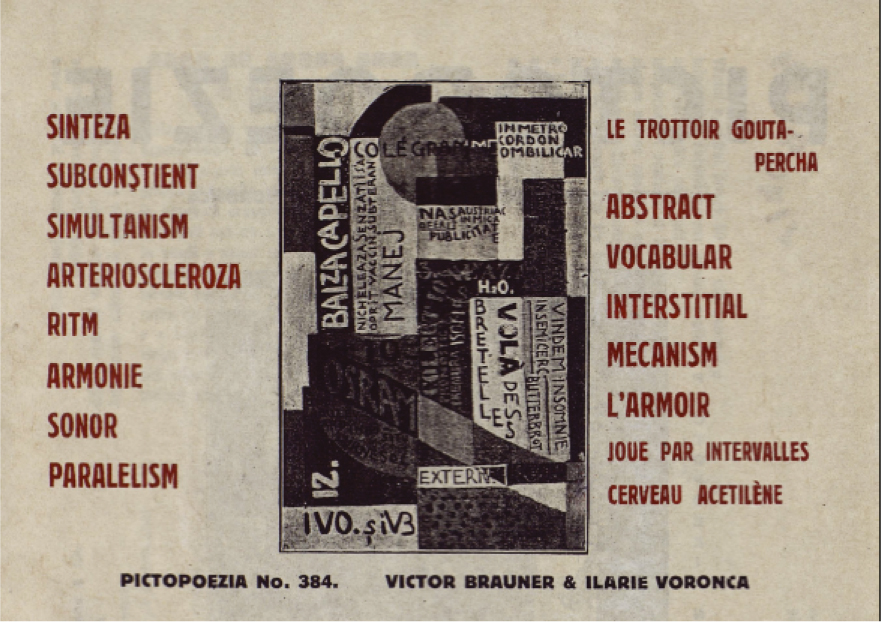
The pseudo-theoretical definition/substantiation of âpictopoetryâ continues on the following pages of the magazine: first, Alex. Cernat (a pseudonym of Ilarie Voronca [Drogoreanu 198]), in his article-manifesto repeating the method of âtypographic writingâ from Aviograma, declares again in the revolutionary spirit of the 75HP group that âthe world must be reinventedâ and âpictopoetryâ is the new form of art representing the perfect synthesis and justifying the existence of the group:
Desigur INVENTIA INVENTIA INVENÈIA. (â¦) E o orÄ de INTELLIGENÈA VITEZA de INTELIGENÈA cu 60 de etaje ascensor. (â¦) Lumea trebuie reinventatÄ. (â¦) PICTOPOEZIA apare ca rÄspunsul unei necesitÄÈi imediate. PICTOPOEZIA e sinteza artei noi Èi ar putea fi ea singurÄ justificarea grupÄrei 75HP. (75HP, 12)
Of course INVENTION INVENTION INVENTION. (â¦) It is an hour of INTELLIGENCE SPEED of INTELLIGENCE with 60 floors elevator. (â¦) The world must be reinvented. (â¦) PICTOPOETRY appears as the answer to an immediate need. PICTOPOETRY is the synthesis of new art and could be the only justification for the 75HP group.
On the last page of the issue, Stephan Roll repeats, this time in French, ideas that had been frequently mentioned before and which confirm the groupâs ambition to create a âtotal artâ:
LA PICTOPOÃSIE (â¦) est le dernier-cri de lâheure actuelle. Tous les dandys doivent se tailler leurs babits dâaprès la coupe pictopoétique. La pictopoésie revivifie tous les courents révélateurs dâart nouveau. LA PICTOPOESIE réalise enfin la vraie synthése des futurismes dadaismes constructivismes [emphasis added, O.B.N.]. Les attitudes les plus eloignées se retrouvent universellement fécondées dans le movement pictopoétique, mots et couleurs recoivent une nouvelle sonorité [emphasis added â O.B.N.] (â¦) PICTOPOÃSIE TRIOMPHE SUR TOUT ENREGIS-/TRE TOUT RÃA-/LISE LâIMPOS-/SIBLE (75HP, 16)
PICTOPOETRY (â¦) is the latest trend of the hour. All dandies must tailor their clothes to the cut of pictopoetry. Pictopoetry revitalises all the revelatory currents of the new art. PICTOPOETRY finally realises the true synthesis of futurisms dadaisms constructivisms [emphasis added â O.B.N.] The most distant attitudes found themselves universally fertilised in the pictopoetic movement, words and colours receive a new sound [emphasis added, O.B.N.] (â¦) PICTOPOETRY TRIUMPHS OVER EVERYTHING RECOR-/DS EVERYTHING REA-/LISES THE IMPOS-/SIBLE.
As we could observe, the idea of âthe new, true synthesis of artâ dominated the one solo issue of the magazine 75HP. It would accompany the editors during their collaboration on other magazines, to finally fully resonate in Integral: revistÄ de sintezÄ modernÄ: organ al miÅcÄrii moderne din Å£arÄ Åi strÄinÄtate (Integral: The Review of Modern Synthesis: The Organ of The Modern Movement at Home and Abroad), the journal appearing between March 1925 and April 1928. The inaugural issue defined Integralâs posture as a âscientific and objective synthesis of all previous aesthetic efforts (â¦) united on the foundations of Constructivism and endeavouring to reflect the intensity and grandeur of twentieth-century lifeâ (Mansbach 1998, 544). The author of the manifesto published in Integral is none other than Ilarie Voronca, hence the propagator of the idea of âmodern synthesisâ, for the first time so visibly exposed in 75HP and then programmatically supported by âIntegral â the only important avant-garde -ism of autochthonous productionâ (Cernat 2018b, 119).
The creative synthesis of Dadaism, Futurism and Constructivism would then represent for the Romanian avant-garde a chance to enter international circulation and not only to synchronise with current Western-European artistic trends but also to propose their own, particular doctrine: âIntegralismul e în ritmul epocei integralismul începe stilul veacului XXâ (Integralism is in step with the age, integralism is the beginning of the twentieth-century style, Voronca 1925, 5). Voronca expels Surrealism from the canonical integration, and he builds the fundaments of the new Integralist movement in opposition to the most influential avant-garde current of that time. His strategy can be understood as âa defensive tactic to secure the continued authority of Dadaismâ (Mansbach 1998, 544), but also as an opportunity to relocate Romanian avant-gardeâs position within the European geocultural system â the rejection of the dominant trends underlines the autonomous character of Integralism. At the same time, Voroncaâs statement: âSuprarealismul nu rÄspunde ritmului vremeiâ (Surrealism does not respond to the rhythm of the times, Voronca 1925, 5) aims to accentuate that along with Integralism, the Romanian avant-garde overcame the condition of a âminorâ culture â for now the âmodern synthesisâ from Bucharest was âin step with the ageâ: the delay had disappeared.15
Bibliography
75HP. 1924. October 1924. Biblioteca DigitalÄ a BucureÈtilor. Accessed February 5, 2021. http://digitool.bibmet.ro:8881/R/UFHGTNAN4BG397U29Q1XL6RPLQ11XXMPJ1Q2KH4IHC8KB2PV3H-02125?func=results-full.
Alexandrescu, Sorin. 1998. Paradoxul român. BucureÈti: Univers.
Cernat, Paul. 2007. Avangarda româneascÄ Èi complexul periferiei. Primul val. BucureÈti: Cartea RomâneascÄ.
Cernat, Paul. 2018a. âCommunicating Vessels: The Avant-Garde, Antimodernity and Radical Culture in Romania between the First and the Second World War.â In Romanian Literature as World Literature, edited by Mircea Martin, Christian Moraru and Andrei Terian, 195â214. New York: Bloomsbury.
Cernat, Paul. 2018b. Vase comunicante. (Inter)feÈe ale avangardei româneÈti interbelice. IaÈi: Polirom.
Drogoreanu, Emilia. 2004. InfluenÅ£e ale futurismului italian asupra avangardei româneÅti. Sincronie Èi specificitate. BucureÈti: Paralela 45.
Fundoianu, B. [Benjamin]. 1980 [1922]. âPrefaÈa la Imagini Èi cÄrÈi din FranÈa.â In Imagini Åi cÄrÅ£i, edited by Mircea Martin, 23â28. BucureÈti: Minerva.
Hitchins, Keith. 2007. âIdentity and Destiny: Idea and Ideology in Interwar Romaniaâ. In Plural 29:1. Bucharest: Romanian Cultural Institute.
Hitchins, Keith. 2014. A Concise History of Romania. New York: Cambridge University Press.
Livezeanu, Irina. 2013. âRomania: âWindows toward the Westâ: New Forms and the âPoetry of true lifeâ.â In The Oxford Critical and Cultural History of Modernist Magazines, edited by Peter Brooker, Sascha Bru, Andrew Thacker and Christian Weikop, 1157â1183. Vol. III. Europe 1880â1940. Part I. Oxford: Oxford University Press.
Mansbach, Steven, A. 1998. âThe âForeignnessâ of Classical Modern Art in Romania.â The Art Bulletin 80 (3): 534â554.
Micu, Dumitru. 1985. Modernismul românesc. BucureÈti: Ed. Minerva.
Morando, Camille. 2015. âVictor Braunerâs Writing in/at Work: Dada and Surrealist Inventions of a Picto-poet.â Dada/Surrealism 20, 1â29. https://doi.org/10.17077/0084-9537.1299.
Ornea, Zigu. 1980. TradiÈionalism Èi modernitate în deceniul al treilea. BucureÈti: Editura Eminescu.
Ornea, Zigu. 1995. Anii treizeci: Extrema dreaptÄ româneascÄ. BucureÈti: Editura FundaÅ£iei Culturale Române.
Petreu, Marta. 2011. De la Junimea la Noica. Studii de culturÄ româneascÄ. IaÈi: Polirom.
Pop, Ion. 1990. Avangarda în literatura românÄ. BucureÈti: Minerva.
Terian, Andrei. 2014. âFaces of modernity in Romanian literature: a conceptual analysis.â Alea: Estudos Neolatinos. 16, 1 (June): 15â34. https://doi.org/10.1590/S1517-106X2014000100002.
Voronca, Ilarie. 1925. âSuprarealism Èi integralism.â Integral, no. 1 (March). Accessed February 5, 2021. http://dspace.bcucluj.ro/jspui/handle/123456789/64229.
To describe the Romanian cultural landscape in the 1930s, Paul Cernat uses the metaphor of âcommunicating vesselsâ and argues, applying categories proposed inter alia by Sorin Alexandrescu and Matei CÄlinescu, that the modernity models undergirding two apparently opposite movements, the existentialist-spiritualist Young Generation and the Romanian avant-garde, are different facets of the same radical cultural paradigm consisting in a radical critique of the rationalist and bourgeois establishment. Such an approach considers the dichotomy of traditionalism versus modernism as outdated (Cernat 2018, 195â214).
After World War I, Romania gained the most significant territorial acquisitions in its history. As a result of the Treaty of Trianon of 1920, the Kingdom of Romania (the United Principalities of Wallachia and Moldavia, united in 1859â1861, became a kingdom formally in 1881) received the provinces of Transylvania, Banat, Bukovina and Bessarabia, thanks to which the country enlarged its area more than twofold.
The leading voice of this option belongs to Eugen Lovinescu (1881â1943), known otherwise as the Pope of Modernism. In his Istoria civilizaÈiei române moderne [A History of Romanian Modern Civilization; 1924â1925], he presents inter alia the theory of synchronism, which proposes a development of Romanian society and culture according to the âspirit of the ageâ and the âlaw of simulation-stimulationâ, positioning the source of imitation in the West, emphasising the importance of Occidental influences and believing in a revolutionary development of Romanian civilization. For a general overview of the intellectual currents in interwar Romania, see Ornea 1980 and 1995; Hitchins 2007 and 2014; and Petreu 2011.
The âsower movementâ, one of the most influential conservative Romanian cultural currents (gathered around the magazine SÄmÄnÄtorul [The Sower]) formed at the beginning of the 20th century, was represented, among others, by Nicolae Iorga (1871â1940), George CoÅbuc (1866â1918) and Mihail Sadoveanu (1880â1961). They believed that the only depositary of permanent national values are Romanian peasants, while the cause of social problems and peasant uprisings was the borrowing and adoption of foreign customs, ones not resulting from Romanian tradition itself.
The word poporanism is derived from popor, meaning âpeopleâ in the Romanian language. This popular movement, modelled after the Russian Narodnik movement, was founded by Constantin Stere in the early 1890s and focused mainly on expanding the power of the peasants, intending to free them from the aristocratic control. It sought in the folk the sources of the most valuable national features and the so called âRomanian spiritâ, ânational specificityâ.
A delay caused by the fact, that âthe official birth certificate of the first local avant-garde is registered only in 1924 with âManifestul activist cÄtre tinerimeâ (âActivist Manifesto to the Youngâ) of Contimporanul magazine, 15 years after the explosion of Italian Futurism, 8 years after Dada and 6 years after the beginning of German, Dutch and Russian Constructivismâ (Cernat 2007, 9).
For a full discussion of the âperipheral complexâ of the Romanian avant-garde, see Cernat 2007.
According to the chronology proposed by Paul Cernat, the first wave (primul val) of the Romanian avant-garde can be located between 1908 and 1930, with the second wave (al doilea val) comprising the 1930s and the Romanian Surrealist movement (Cernat 2007, 5â6).
On the one hand, it is due to the fact that French was an important language of the avant-garde at that time, on the other â educated Romanians treated French as their second language of expression, while French culture and literature was for them an important point of reference.
One of the interwar authors, a modernist poet and essayist who frequented avant-garde circles, B. Fundoianu (1898â1944), emphasises even in PrefaÈÄ [Preface] to his book Imagini Èi cÄrÈi din FranÈa [Images and books from France] almost a colonial dependence on French culture and too rapid a pace in the âtransplantingâ of Western European political, literary, and historical ideas to the local territory. Actually, Fundoianu sees the reason for this dependence on French literature to lie precisely in Romanian bilingualism: âWe are dependent on French literature because of our bilingualism â at least insofar as the upper-class is concerned. We cannot write in French, even though this would be the only logical thing to do. And, writing in Romanian, we are consequently imitating in âour narrow circleâ, so we can hardly contribute anything to world culture, to which we are uselessâ (Fundoianu 1922, 26).
The cosmopolitanism is an important category for Romanian avant-gardists, as they were looking to reach beyond the Romanian (and at some point European!) traditions. A very evident example can be the B. Fundoianuâs column from Contimporanul, suggestively titled âFerestre spre Occidentâ [Windows toward the West], where the author indicated Romanian literatureâs need for a broader cultural and intellectual horizon.
For a full discussion of 75HP see Drogoreanu, 2004. The book explores exhaustively the influence of Futurism on the Romanian avant-garde.
There is record of Donvilleâs visit â a note written by J.A. Boiffard for Cahiers de la permanence surréaliste, available in the digitalized archives of the Association Atelier André Breton: https://www.andrebreton.fr/en/work/56600100135030.
All quotations from the 75HP magazine presented in the article come from an original edition, available in the archives of Biblioteca digitalÄ a BucureÈtilor [Digital Library of Bucharest]. All quotations retain their original spelling. All quotations from French and Romanian have been translated into English by the author, unless stated otherwise.
According to Emilia Drogoreanu, âsurprisingly close to these ideas [of plastic music] is the conception of the Futurist composer Franco Casavola, the author of a theory of correspondences between colours and sounds (â¦).â Casavola was present in Integral (no. 12, of April 1927), with his concept of âvisible musicâ and âharmonic colourâ. We can look in parallel at the experiment of Victor Brauner and that of Casavola, because the 75HP group and even Brauner himself certainly had known some of the Futuristic theoretical acquisitions before the publication of the magazineâ (Drogoreanu 2004, 190).
OA funded by âExcellence Initiative â Research University at the Jagiellonian University in Krakowâ no. WFilolog.3.2.2025.2