


I traveled a distance of about 50,000 li, crossed the Rockies four times, saw both oceans, and touched my feet on both coasts. I was on sailing boats on the Mississippi and Missouri Rivers. In the East, I climbed the White Mountains, and in the West, I visited Yellowstone.1
â¦
As I traveled through more than fifty cities and towns in United Statesâfrom Hartford, Pittsburgh, Baltimore and Kansas City in the East, to Anaconda (Montana), Ogden (Utah), Salt Lake City, Portland, Seattle, Fresno, and Sacramento in the West, and New Orleans, San Antonio and Beaumont (Texas) in the Southâany place that has more than ten thousand people and claims to be a city, all have self-government.2
âµ
From all appearances, Kang Youweiâs 1905 tour of the United States was a victory lap. The enthusiastic response in Chinese communities, both large and small, energized Kang. His precursors in the United StatesâLiang Qichao, Xu
But, Kangâs focus during this U.S. tour was neither promotion nor study. His concerns included, but were hardly limited to:
- âPromoting an anti-American boycott in China to protest Chinese Exclusion laws while attempting to influence the American political debate in both the court of public opinion and at the White House;
- âConfronting a growing controversy over whether the large and visible network of Baohuanghui military schools was actually a Chinese reform army training on American soil;
- âExpanding the Baohuanghuiâs Commercial Corporation by raising shares and making plans to form banks and other lucrative businesses;
- âInspiring Baohuanghui membership morale through speeches and the sales of âBaohuanghui comradeâ badges designed by Kang.
Shadowing Kangâs public activities were two persistent worries. Kang was concerned both by dissension and interpersonal jealousies within the Baohuanghui as well as the growing challenge of revolutionary opponents, namely
1 Kansas City and St. Louis
Kangâs seven months of continuous American travel and politicking began on May 8. He left by train from Los Angeles bound for Washington, DC, and his hoped-for meeting with President Theodore Roosevelt concerning Chinese Exclusion policies. He was accompanied by his secretary and English interpreter Zhou Guoxian, who confidently served as Kangâs political attaché and spokesperson and spent more time at Kangâs side in North America than any other escort. Other members of the party were bodyguard Rupert Humer; Western Military Academy chief instructor Homer Lea; Fresnoâs Western Military Academy âLieutenantâ Ben O. Young (Ouyang Xianzhou, Ouyang Hu); and assistant secretaries Tong Chinn (Tong Qing) and Chen Yuesong, both of Chicago. Their first notable stop was Kansas City, Missouri, arriving there on

Kang Youweiâs visiting card or baitie æå¸, found in Tom Leungâs wallet.

By the time Kang arrived in St. Louis on May 15, an additional and bothersome issue resurfaced. That was the news that California Governor Pardee had acted to disband the âChinese Imperial Reform Armyâ company in Fresno. This action was first brought to Kangâs attention in the St. Louis press, which also reported his arrival in the city for the purpose of inspecting the local Western Military Academy branch.6 And it was to St. Louis that the correspondence from Fresno County District Attorney George W. Jones was forwarded to Homer Lea and from where Lea sent his rebuttal to the actions taken against
Kangâs presence in St. Louis was front-page news, including a full-length drawing of him âfrom life.â10 As would be the case throughout his American tour, Kang, Lea, and the others were feted at a banquet. In St. Louis, the event was held on May 18 at the Mikado restaurant. It was attended by former Missouri Governor Charles P. Johnson, local court judges Benjamin F. Clark and Hiram N. Moore, and other dignitaries, as well as the Baohuanghui members and officers of the local Western Military Academy. Kangâs speech compared Chinaâs need for emancipation with Abraham Lincolnâs freeing the slaves during the American Civil War. The Chinese, coming from the oldest civilization, needed American help as badly did âthe negro homeless race, which, a few years ago, was considered ignorant.â He also contrasted the Empress Dowagerââthe great drawback to the Chinese peopleââwith progressive and enlightened âgood Queen Victoria.â11 On May 19, Kang addressed the American Baptist Missionary Union Convention and made the speech that initiated his public campaign against Chinese exclusion.12 That evening, Kang spoke at a
Dressed in âgorgeous silk raiment of dainty colors,â Kang also indulged his fascination with technological innovation at the St. Louis Post-Dispatch newspaper plant, where he astounded his hosts by climbing onto a bench to poke his head into a linotype machine to understand how it replicated in lead type the keystrokes of the operator.14 He had less interest in the editorial function of an American newspaper than its manufacture, but perked up in the pressroom, moving âas close as possible to the whirling machinery and when one of the big presses stopped again put his high-priced head inside of one of them in an effort to hastily master the intricacy of its construction.â Kang subsequently attempted to recruit a Baohuanghui member to study advanced printing technology âso that he can help our newspapers.â15
As the entourage was preparing to leave St. Louis on May 22, Homer Lea told the press that Kang and his party had received âa most gracious receptionâ in the city, and claimed that 98 percent of the Chinese in St. Louis belonged to the Baohuanghui. Seven carriages decorated with U.S. flags and Baohuanghui insignia took Kang, his traveling companions, and local Chinese to the railroad station. They were escorted by a police sergeant and six patrol officers and followed by âa crowd of curious persons,â according to one account.16
Kang arrived in Chicago on May 23 for a planned one-week visit. He was greeted at the railroad station by a four-hundred-cadet contingent of the Chinese Empire Reform Associationââall in uniformsââand, riding in a carriage drawn by four white horses, was led by the local Baohuanghui band to a reception held at their Chicago headquarters on Clark Street in Chinatown. After a brief speech, he was taken to his lodging, an apartment in the luxurious Congress Hotel, which had been built as the Auditorium Annex for visitors to the Worldâs Columbian Exposition held in Chicago in 1893.17 The travelers were joined in Chicago by Tom Leung (Tan Zhangxiao), Kangâs former student and Los Angeles host who, as an experienced herbalist, served as Kangâs doctor on this trip. In the late afternoon, after a drive through Chicago, Kang attended a banquet in his honor at the âhighly respectableâ Joy Yet Lo, perhaps the earliest Chinese restaurant in the city to attract an American clientele and owned by
Kang Youwei and Homer Lea arriving in Chicago, May 23, 1905.

On May 24, Kang and a fourteen-person retinue made an overnight trip to Zion, Illinois, a Christian utopian community of several thousand people located fifty miles north of Chicago on the shore of Lake Michigan. There they met John Alexander Dowie, a âminister of divine healingâ and âFirst Apostleâ of the Christian Catholic Apostolic Church he had founded in 1900 with the inception of Zion City. Kang wrote in December 1904 that âI already know [Reverend] Dowie and will go to the United States to meet him soon.â20 Kang had corresponded with Dowie for several years, the mutual attraction no doubt stemming from their shared utopian ambitions. Surprisingly, Zion City had attracted numerous Chinese Americans and Chinese visitors (including Liang Qichao and Kang Tongbi in 1903), and its leaders had plans for missionary work in China. Liangâs brother Liang Qixun, a frequent correspondent of Kangâs, was then a student at Zion City College. In Zion City, Kang felt free to expound fully on his one-world Datong vision, which Dowie endorsed: âHis many plans for helping humanity coincide with my own.â21 Kang said that twenty years earlier he wrote several books proposing to unite the people of âall Nations, Flags, and Countries of earth,â speaking one language with equal rights and liberties for all, public institutions designed ânot for the benefit of a few, but for the good of all,â and common cultural customs, such as clothing and food.22 Kang, or rather his interpreter Zhou Guoxian, used Christian language familiar to Zion City citizens: âIf we could carry out this program, we should step towards every heavenly bliss.â But, said Kang, his focus now was on saving his country, not the world.
In his talk, Kang praised Zion City and claimed that he himself had âengaged in Religious and Social work, such as Dr. Dowie is doing here.â He clarified that these were references to the Confucian religion and his reform efforts to bring about social equality for men and women. He also spoke of his political reform efforts during the Hundred Days and his stand against the U.S. Chinese Exclusion laws. Other Chinese followed Kang, including Chan Yoke (possibly Chen Yuesong), speaking for the Chicago chapter of the Baohuanghui, to reinforce Kangâs message about âthe evils of the Exclusion law.â Dowie concluded the assembly by calling for a vote to authorize him to write President Roosevelt âurging His Excellency to take action so that the Congress shall speedily repeal the Chinese Exclusion Act.â All stood in acclamation.
â[Kang] will be glad if I can sit up half the night with him,â said Dowie during the assembly, looking forward to a long conversation that evening. Dowie had just returned from Mexico where he planned to establish seven cities for his followers, supported by truck gardens producing vegetables for sale in the United States, irrigated and powered by the plentiful water under extinct volcanos.26 He was considering buying a hacienda in Tamaulipas and was seeking a concession from the Mexican government to build a railroad. Perhaps it was no coincidence that upon Kangâs return to Chicago, he wrote to Mexican President José de la Cruz Porfirio DÃaz Mori and sent him some antique Chinese
Cover, Leaves of Healing, June 10, 1905, with John Alexander Dowie and Kang Youwei in Zion City, Illinois.

Kangâs longer-than-planned stay in Chicago may have been related to mobilizing promotion and fundraising to support the anti-American boycott. In August, the Chicago Daily News published âBoycott Urged Here: Big Chinese Fight on American Manufactures Started in Chicago, Secrets of Clark Street,â as revealed by restaurateur and interpreter Chen Baixin (Chin Pak Sun), one of the founding members of the Chicago chapter.30 Chen confirmed that âa series of secret meetings were held by [Kang Youwei] in Chicago during the latter part of May and early Juneâ and that the first donations toward the boycott came from Chicago. âChicago men have done their part and done it well,â said Chen, and since they had no political power to change exclusion laws, they were using commercial power and predicted, âThe business nation probably will now treat us with fair consideration.â
3 Washington
Possibly after visiting Baohuanghui chapters in Ohio, Kang arrived in Washington on June 7 and registered at the Arlington Hotel on 15th and I Streets Northwest.31 There Kang and his party received a stream of Chinese visitors,
On June 9, Kang received a delegation of some forty Chinese from Baltimore at his hotel. Since Kang âhas no alternativeâ to their insistence that he visit their city, plans were made go to Baltimore. No expense was spared by his Maryland hosts who engaged a special Pennsylvania Railroad car for the trip.36
4 Baltimore
Kang made the short trip to Baltimore on June 10, arriving in the late afternoon at Union Station, where he was met by prominent Chinese American residents. He was accompanied by his usual traveling companions and a âlarge
5 Washington: Meeting with Theodore Roosevelt
Besides having to work through the government bureaucracy to get an appointment to meet Roosevelt, there was another difficulty. Kang blamed Chinaâs minister to the United States Chentung Liang Cheng (Liang Cheng) for delaying his meeting with the president for three days, presumably because of Kangâs persona non grata status with the Qing government.41 Ironically, Liang Cheng, like Kang, strongly opposed exclusion and favored the boycott. In any case, it was reported that Kang had been called back from Baltimore by Roosevelt himself âto consult him concerning the Chinese treaty and Chinese exclusion.â42
The president was standing there waiting for us. We greeted each other, each shaking hands with him. The president and President Kang talked
about how they had heard about each other for some time and had always wanted to meet. President Kang made the proposal that the Chinese exclusion laws should be abolished. The president said, âI cannot bear to see the cruelty of the laws excluding the Chineseâ and would try his best to remedy the situation. He said that he would treat with leniency upper-class Chinese (shangdeng Huaren) such as students and merchants. He also said that just a day ago Secretary of War [William Howard] Taft was lecturing on lifting the ban on Chinese peopleâs entry into the United States.46 President Kang thanked the president. The president said that the Secretary of War and Mr. Yung used to attend the same school (Yale). Then we shook hands and ended the meeting. After touring around the White House, we left.
Kang was gratified with Rooseveltâs willingness to soften the exclusion policy.47 He wrote New York leader Liang Wenqing, âThe President promised to make efforts to ameliorate Exclusion policy by more lenient treatment of tourists, students, and businessmen.â48 Fellow New Yorker Tang Mingsan, a member of Kangâs Washington escort party, told Liang that as a result of the successful meeting Kang âhas to stay little bit longer and negotiate other matters. It is certainly a great event.â49
Another issue may have come up in the June 16 meeting, but certainly was the subject of Homer Leaâs meeting with Roosevelt the day before.50 Kang later intimated to an audience in Jersey City that he told Roosevelt that Chinese were receiving military training and English-language instruction in Chinatowns around the United States. To this Roosevelt reportedly said âGood!â51
For his second meeting with Roosevelt, Kang told his Chicago confidant Liang Qixun on June 16 that he would bring up the subject of the âmatter of the
Or, Kang may have wanted to speak to Roosevelt about another aspect of the Boxer Indemnity debate in the United States. Secretary Hayâs November 1904 letter to Liang Cheng also said that he favored returning some of the 25 million dollar indemnity owed to the United States by China, because the full sum more than covered the damage done to American property during the Boxer Uprising. In 1905, Hay suggested that this remission be applied toward funding
Finally, it is conceivable that Kang hoped to discuss yet another related topic with Roosevelt: an American plan devised by Cornell University professor Jeremiah Jenks to help China deal with its Boxer debt and modernize its financial system by converting to the gold standard.58 Jenks was a member of a Congressional commission formed on the request of Roosevelt after the president was approached by the governments of Mexico and China to help stabilize the ratio between the values of silver and gold. Mexico, a silver producer, and China, having a massive need for silver to pay its Boxer debts, were both suffering in 1903 as the value of silver kept falling. Jenks visited China in 1904 and proposed a method to convert the country to a gold exchange standard using token coins that could be used to pay foreign gold debts backed by a foreign-based gold-exchange fund in dollars or pounds. Liang Qichao openly supported a gold standard for China, and in 1905 before entering the United States, Kang had in hand a draft of what would become an influential 1910 book on the same topic, in which he stated that China should have accepted the Jenks proposal.59
Kangâs June 16 letter to Liang Qixun admits multiple problems dealing with his Chinese American colleagues.60 It was not enough that the Western Military Academy affair and the Falkenberg debacle continued to be an issue. He told Liang how the Chicago Chinatown leaders âall kept quietâ when he asked
While in Washington, Kang also visited the U.S. Capitol and George Washingtonâs home at Mount Vernon, Virginia.63 In her supplemental biography of Kang Youwei, Kang Tongbi said her father also saw the Washington Monument and visited âa cannon factory, steel factory, a museum, waxworks museum, and the zoo.â64 Washington had no steel factory per se but if he went to the
6 Pittsburgh
Kang Yu Wei makes trouble wherever he goes. The heavy price on his head will sooner or later cause him to be murdered, and we do not desire that any crime be committed among our peaceful brothers in Pittsburgh. In advocating enmity of the Government of China he makes enemies and few friends.67
Tom Leung later received a letter from Kuang Shoumin, who managed the Hong Kong Baohuanghui headquarters, saying that âpeople in Pittsburgh ⦠are extremely opposed,â presumably in regard to requests for funds to support the boycott of American goods.68
It is to America that the Chinese must look for deliverance from the oppression of an ancient and unprogressive government. To effect this deliverance from the oppression no violence is necessary. The reform association must inculcate in its members the desire to study and to utilize American methods so that when they return to their homes they can spread the propaganda among their less enlightened friends.
To carry out this plan the reform party in China will, just as soon as possible, send students to this country to attain technical information and prepare themselves to assist their party in modernizing China. To do this I am making every effort to secure the friendly assistance of the President. He is a fair-minded and fearless man and I believe he will aid us greatly. The Japanese long ago realized the need of injecting new method into their government and they send thousands of students to America. The result is that they are able to carry on a successful war against one of the most powerful nations in the world.69
In the first paragraph quoted above, Kang mentioned one of the important facets of his reform program directed toward the Chinese overseasâthat they should study Western methods and then return to China where they, in turn, would teach their âless enlightened friendsâ in the modern ways of life and government. Another facet of the program outlined in the Pittsburgh speech was sending students to America to study. This had been one of the features in the reform decrees of 1898. At his own expense, Kang had sent his own daughters and former Wanmucaotang student Liang Junke, abroad to study.70 Liang Qichaoâs brother, Liang Qixun, among others, also had been sent to the
On June 19, Kang and his party, which included Zhou Guoxian and Ben O. Young, toured the vast Homestead mills of the Carnegie Steel Company âfrom one end to the otherâ and took especial interest in the production of armor plate from which weapons of war were made, asking âthousands of questions.â73 Whether Kang had time to visit the Westinghouse Electric Company as he had hoped is unknown, but he left Pittsburgh the following day to return to Washington to await further discussion with Roosevelt.74
7 Washington: A Second Meeting with Roosevelt
After returning to Washington, Kang experienced little of the activity that ordinarily surrounded his visit to other cities. He had already gone on sight-seeing expeditions and had had a meeting with the president. Although there was a local chapter of the Baohuanghui, no public reports appeared about further activities involving Kang.75 However, organizational correspondence discloses that a chapter of the Reject the Treaty Society (Juyuehui) had been established in Washington around this time and that donations were being solicited by and from Baohuanghui members to support the anti-American boycott.76 Presumably, chapters of the Society were being formed throughout
On June 24, this time accompanied only by Yung Wing, Kang paid a second visit to the White House. Roosevelt was joined by Secretary of State John M. Hay, who had just returned from Europe.78 As expanded upon in Chapter 6, Roosevelt told Kang that he would issue executive orders that over time would significantly ease restrictions on entry of the exempt classes of Chinese, including students and officials, and improve the experience of ordinary Chinese immigrants by encouraging immigration officers to treat them with courtesy and leniency while ending the humiliating Bertillon measure system. It is clear that Roosevelt saw Kang as having the influence to halt the anti-American boycott, scheduled to begin in July, and it is likely that Roosevelt hoped that his actions would convince Kang to change course and oppose rather than promote the boycott among his followers.
Kang was impressed with Roosevelt, and said that he was âone of the most stern, as well as one of the most broad minded rulers in the world.â79 This, and similarly positive comments, were made during the rest of the itinerary to audiences and interviewers throughout the United States and Mexico. Zhou
June 24, 1905 desk diary for Theodore Roosevelt; â12:30: Mr. Kang Yu Wei, at request of Chew Kok Hean.â

Hours after his second visit with Roosevelt, Kang arrived at the Broad Street railroad station in Philadelphia. There he received the grandest welcome and the most extensive newspaper coverage to date. His visit provided a holiday for local Chinese and they prepared for it elaborately, albeit, not without some friction between Qing loyalists and reformists. The Pennsylvania Railroad train arrived about 6:00 pm, and Kang reportedly emerged dressed in dark red silk robes. His appearance created such a stir at the station that a squad of police had to make a pathway to the carriage awaiting him on Broad Street.
Here [awaited] a platoon of mounted police, the band of the First Regiment [of the Pennsylvania National Guard], merchants from the Chinese colony in carriages and two companies of Chinese soldiers on line ⦠The standard bearers carried the imperial flag of China as well as the Stars and Stripes and borne in line also were yellow guidons with a black dragon, the adopted flag of the Chinese reform party.81
One of the two Chinese cadet companies in the parade was from the New York City Baohuanghui chapter. Kangâs arrival there reportedly was anxiously awaited.82
Kang rode in the lead carriage, which was drawn by four gray horses and headed a line of carriages that bore prominent members of the Philadelphia Baohuanghui. The cavalcade went first to Independence Hall, but âmuch to the disappointment of the visitor the Hall had been closed for the day so the march
The issue of Kangâs lodging costs came up at this time. Chen Yuesong wrote to Kang Tongbi, noting that the hotel bill in Philadelphia for Kang and his entourage would cost upward of $8,000 (some $285,000 in 2024 dollars).84 But this was deemed acceptable since âMr. Kang is a VIP who cannot lower himself to stay anywhere cheaper.â Besides, added Chen, âhis U.S. trip is not for pleasure but for important business.â85
⦠the General himself disclaimed even the remotest thought of [being head of the armies of China], but his constant companionship with Kang Ye We and the enthusiasm which he is rousing among the Chinese here and in Europe has deep significance to all observers.86
âWe are organizing ourselves for self-preservation. Let everyone who desires to join this movement stand up!â The entire assemblage of Chinamen arose.88
During the Philadelphia visit, Kang toured the United States Mint, Independence Hall, and some large industrial establishments of interest, such as the Baldwin Locomotive Works. On June 27, he called on John Weaver, the cityâs Republican Party reform-minded mayor, to learn more about the nature of American municipal reforms.89 One report noted that Kang was accompanied in his visit with Weaver by Captain Lung of the local Chinese military company; Reverend Frederic Poole, superintendent of the Chinese Mission; and Zhou Guoxian as his official interpreter. The article asserted that all but Kang were dressed in uniforms. After the city hall visit, the travelers left for New York City.
Following Kangâs departure, a dispute came into the open between Reverend Poole and Thomas W. Barlow, a lawyer who served as Chinese consul in Philadelphia. Trouble between the two men had long been brewing over political matters in Chinatown. In a statement by Poole about what was developing into internecine strife, he said, âpossibly the thing that has stirred the Chinese most and may have led Mr. Barlow to become angry with me, was the trouble regarding the parade in honor of Kang Ye We ⦠The Chinese in every city are wildly enthusiastic regarding [Kang] and the merchants here wished to show him every honor.â90 On June 23, Poole had personally petitioned the municipal government for permission to hold the parade but Barlow had tried to block the effort.91 Poole also implied that Kangâs association with President Roosevelt should have been enough to have won him the right to be publicly honored in Philadelphia.92 Pooleâs âadherentsâ charged that Barlow had received money from the Qing government and had rendered services to influential Chinatown residents in return. Barlow denied receiving any Qing government money and countercharged that he was anxious to tell the Christian League, which employed the clergyman, âwhat I know about Mr. Poole.â Poole responded with criticism of Barlow for having tried to block the parade for Kang, noting
Coinciding with Kangâs first full day in PhiladelphiaâJune 25âthe Los Angeles Herald published a page-one banner headline â15,000 Armed Chinese in the United States Preparing on American Soil for War of Conquest,â followed by more coverage inside. The story line was that âan organization of Chinese in the United States, Mexico and Canada, armed with modern implements of war and drilled by Americans who have seen service in the regular army of this country ⦠is thriving hereâ and was aimed to overthrow the present government of China.94 The article described the âunseemly controversyâ over the competing leaders of the reform army during Kang Youweiâs visit to Los Angeles, although no mention was made of Leaâs rival, Richard Falkenberg. While the article offered numerous quotes about the benign nature of the militia training, it also mentioned New York Governor Frank Higginsâs call for an investigation, a halt to drilling by the Fresno cadets, and a quote from the U.S. district attorney in Los Angeles on his expectations there would be âa complete explanation ere long.â This major exposé served to bolster the efforts by Falkenberg to embarrass Lea and spur a clampdown by the U.S. government on the Western Military Academy (see Chapters 4 and 5).95 A follow-up article in the Herald linked the âmobilization of a large Chinese army on American soilâ with predictions by an unnamed expert that China and Japan would team up and fight against the United States within a decade. âThere naturally will be much speculation as to the significance of the existence of the great armed aggregation of Mongolians in this country and this persistent influx of yellow men.â It further cited the âbitter feeling of Chinese against the enforcement of the United Statesâ exclusion lawsâ and the anti-American feeling being promoted in China by the announced boycott of American goods. âOrientalism is Spreading Dangerâ managed to link two of the Baohuanghuiâs most successful projects, the Western Military Academy and the anti-American boycott, as ominous threats to American security and commerce.96
Kangâs arrival in New York City had long been anticipated, and preparations for the public reception had been underway since the early part of June. Kang arrived at the Pennsylvania Railroad station in Jersey City, New Jersey, on June 27. It was during that time that Governor Frank Higginsâ investigation of New Yorkâs Western Military Academy took place and, as a result, the reception plans were toned down. In a show of defiance, Kang was accompanied by a battalion of fifty Philadelphia military cadets.97 The Philadelphia battalion was joined by some seventy New York City cadets, and, âheaded by a platoon of policeâ led by the Epworth Band playing âMarching Through Georgia,â Kangâs entourage proceeded to the Cortland Street Ferry to cross the Hudson River. Once in Manhattan, Kangâs group loaded into twenty-two carriages and went directly to Baohuanghui headquarters at 7â9 Mott Street in Chinatown. Because of pressure from the police, instead of rifles the cadets carried flags. The flags included those of the United States, China, and the Baohuanghui.98 The traveling party at this juncture included Zhou Guoxian, Rupert Humer, Homer Lea, Ben O. Young, Tom Leung, Rev. Frederick Poole (listed as the âChaplain of the Third Chinese Regimentâ), and a number of unidentified servants. Kang Tongbi came from South Windsor, Connecticut, to join her father.99 They all were accommodated at the luxurious Waldorf-Astoria Hotel.100
The New York City Baohuanghui was well-established by Liang Qichaoâs visit in 1903, and was given a further boost when Kang Tongbi visited in the fall of the same year.101 She founded a New York chapter of the Chinese Empire Ladies Reform Association (Baohuangnühui) and helped solicit funding for
The Guild has rendered some services in the formation of the Chinese Empire Reform Association in this city. The Association has now in this city about 5,000 members.106
In the run up to Kangâs 1905 visit, several reports noted the active role of guild members in the Baohuanghui. Many praise-worthy comments were made on the role of âFreedom, Knowledge and Equalityâ that the Chinese Empire Reform Association championed for the Chinese.107
But Kangâs first visit to New York City signaled the impending demise of the Western Military Academy and the severing of its association with Homer Lea. On June 28, the New York Sun published âWhite Leader of Chinese.â The article said, âWhen Kang Yu Wei landed in town yesterday, there was a figure in his retinue which attracted more attention than the reformer and ex-Prime Minister of the Chinese Empire himself. It was a hunchback in the full fatigue uniform of a General ⦠Homer Lea is his name.â108 Leaâs bid for top billing greatly offended Kang, whose patience with Leaâs continual self-promotion had long been tested.109 Combined with Leaâs acceptance of American press coverage presenting the Western Military Academy as the Chinese Reform Army, repercussions of the machinations of the other âGeneral,â R. A. Falkenberg, served to dampen Kangâs reception in New York and foreshadowed the official end of Baohuanghui military schools.
Falkenberg, as noted in Chapter 4, was humiliated when Kang publicly declared on April 7 that âGen. Homer Lea of Los Angeles is the only one recognized and appointed by me as the general of all Chinese military schools
Governor Higgins took two courses of action. First, he forwarded the Eckley letter to William Loeb Jr., Theodore Rooseveltâs private secretary, who in turn, forwarded it to the War Department.113 The War Department followed up on Homer Lea and his activities in Los Angeles and wrote to the chief of police of that city, William A. Hammel. Hammel launched an investigation and reported back to Washington that there were, indeed, thirty-six Chinese in a company âunder the personal supervision of Homer Lea, and drilled by ⦠Capt. Ansel OâBanion ⦠operating under a Charter, issued by the Secretary of State, under the name of the Western Military Academy.â However, Hammel reported, they did not drill in public âexcept with permission from the U.S. government, and their object is the betterment of their condition, as they expect to occupy responsible positions in the Chinese Army at some future time.â114 Higgins and the Department of State were duly informed of the events in Los Angeles but, in the meantime, Higgins had launched a second course of action, an investigation of his own in New York.115
Police pressure in New York City kept the Chinese from openly drilling in preparation for Kangâs expected arrival, but after a visit by local Baohuanghui president Joseph M. Singleton to the corporation counselâs office, tentative permission was granted to drill indoors only.120 Thus, on June 27, the flag-carrying cadets who escorted Kang from his train took up their arms to drill for Kangâs inspection when they arrived at Baohuanghui headquarters.121
Throughout the investigations, allegations that the cadets were being trained for eventual return to China to fight against the Empress Dowager
There is little documentation extant on the closing of the New York investigation, leaving the Higgins document and the press reports as the leading sources of information.124 As Chapter 4 describes in detail, the New York academy graduated a class in May 1907, and some of the graduates apparently returned to China.125
During Kangâs first visit to New York City, he made contacts with leading Chinese Americans and their organizations and left a lasting impression on the local Chinese population.126 He granted his usual interviews to the press, made comments in regard to the boycott and exclusion issues, and warned that China was âready to befriend in the future the countries that have befriended our people in the past.â127 Kang went through his routine of reviewing cadets, attending banquets, making speeches, and visiting landmarks. On June 29, Kang, Tongbi, and his âofficial suiteâ met with the Democratic New York City
As his visit to New York City drew to a close, Kang was given a farewell reception at the Baohuanghui Mott Street headquarters on July 3. He departed the following day for his next stop, Boston.130
10 Boston
Kang Youwei, Kang Tongbi, and the rest of the retinue arrived in Boston on July 5 and remained ten days. On July 6 they met Democratic Mayor Patrick Andrew Collins, who gave Kang a pass that would âbring especial courtesiesâ in case Kang visited any of the city institutions.131 Speaking to a reporter the same day as the visit with Collins, and despite his favorable statements about Rooseveltâs personality, Kang said that the presidentâs recent order ârelaxing in some manner the enforcement of the Chinese exclusion act is by no means satisfactory to the Chinese people.â He added that the Chinese were becoming more enlightened and wanted nothing less than most-favored-nation
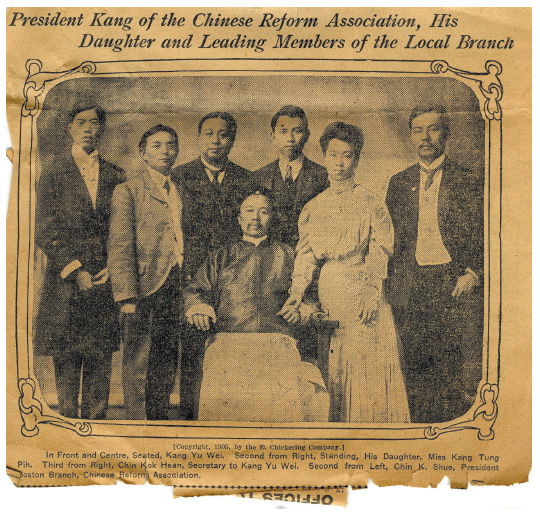
Kang Tongbiâs clipping of Boston Herald, July 8, 1905; pictured in addition to Kang Youwei and Tongbi are from left, unknown man, Chin K. Shue of Boston, Ben O. Young of Fresno, secretary/translator Zhou Guoxian, and Tom Leung, Los Angeles.
O yes; introduce telephones and telegraphs. But already we have telephones and telegraphs in China. What we need now is men with such brains as your inventor of the telegraph and women who may be their sympathetic wives.
On July 9, Kang gave a lengthy oration at the Park Street Congregational Church.135 The audience was almost exclusively Chinese, âfrom the laundryman with his queue to the student at Tech or Harvard with short hair and the most fashionable American garb.â136 Kang encouraged his audience to learn to speak English and to study foreign civilizations to âbe better able to profit from that knowledge.â He spoke at length on the âgreat industrial and intellectual
The day after the Park Street speeches, Kang and his retinue were received by Massachusetts Governor William Lewis Douglas. Douglas, a Democrat, invited the group to visit his shoe factory in Brockton. Kang also asked where he could visit industries which made machinery, as well as local cotton mills. Douglas told him where these could be found and suggested the group also visit Fall River, Massachusetts, and Providence, Rhode Island. The final request was for permission to visit the state prison at Charlestown and this was granted. Unfortunately, Kang suffered heat prostration and was confined to his room in the United States Hotel on Beach Street that afternoon. Tom Leung used his skills as an herbalist and prepared herb tea for Kang, while Tongbi wielded a fan, leading to Kangâs âspeedy recovery.â139 Tom told a Boston Globe reporter that Kang had in fact toured the Brockton factory but would likely not visit the prison.140
Meanwhile, conflict had erupted in San Francisco, where Chen Yikan edited Wenxing Bao and wielded much influence over Baohuanghui fundraising for the anti-American boycott. Problems arose between the reformers and the
Around this time, there began to be consternation within the Baohuanghui over Homer Leaâs evident transgressions. Liang Wenqing wrote to Kang Youwei from New York on July 11, saying âHomer Lea is such an outrage.â He accused Lea of telling the English-language press in New York City that it was he who was responsible for the establishment and financing of the Baohuanghuiâs Western Military Academy branch. Liang described Lea as believing the schools belonged to him personally and criticized him for having not mentioned Kangâs name in this regard. Liang also suggested to Kang, âCould you try to drive him back to Los Angeles from Boston?â146 On July 4 in New York, Lea
11 Hartford
Kang visited Hartford, his daughterâs adoptive hometown, from July 15 to 19. The group arrived at Union Station where they were received by Yung Wing, followed by an official welcome at Hibernian Hall, which housed the local Baohuanghui headquarters. After the reception, their carriages took them to the Allyn House, where they engaged a six-room suite. In the evening, a private dinner was held at the State Street home of Wong Yuen, vice president of Hartfordâs Baohuanghui chapter. Kang, however, wearied from the trip from Boston, did not attend. Otherwise, the visit was quiet and restful for Kang, and he praised Hartford as the âcleanest city he had ever been in.â Cleanliness notwithstanding, during the visit to Hartford, Kang was under the protection of several detectives and uniformed police officers because of rumored threats on his life.149 It could be that Kang feared the revolutionaries active in Hartford, who had been inspired by Sun Yatsenâs visit in December 1904âlikely, these were the Zhigongtang (Chee Kong Tong) members of the Chinese Club
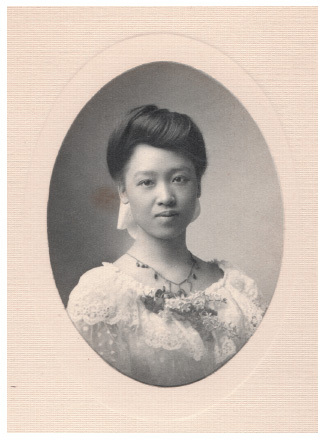
Kang Tongbi, Hartford, Connecticut, Johnstone Studio, circa 1905.
On July 16 Kang Youwei and Kang Tongbi addressed the local Chinese community at the City Mission Hall. Kang was quoted in the local press as saying âPresident Roosevelt appeals to me above all the heads of nations I have met on my journey through five continents.â151 He went on to say the current boycott of American-made goods in China would continue as long as the Exclusion Act was in force. He said the Baohuanghui would not âbring about a revolution by bloodshed, as many of our enemies would make the world believe, but by introducing a desire for freedom and knowledge into China.â On the evening of the 16th, a banquet for seventy guestsâincluding Tongbiâs host in South Windsor, Connecticut, Mary Starr Tudorâwas held at the King Far Low restaurant
The visitors were received by the Democratic Hartford Mayor William F. Hennessey on the morning of July 17. He recommended they visit the state capitol and wrote letters of introduction to the Colt Patent Fire-Arms Manufacturing Company, Underwood Typewriter Company, Columbia and Electric Vehicle Company, Pratt and Whitney Company (which made precision machinery), and other local factories.153 The groupâcomprising Kang Youwei, Kang Tongbi, Zhou Guoxian, Tom Leung, Homer Lea, and Rupert Humerâspent the better part of the afternoon at the Colt factory. Company president Lewis C. Grover himself took the group through the plant. Kang Tongbiâs questions were reported to be âthe rapid-fire kindâ and, when they reached the test range, she surprised everyone by requesting to fire some of the weapons on display. First, she fired a 38-caliber military automatic revolver âwithout flinchingâ and then a 41-caliber âdeadly Derringer,â both with remarkable accuracy. A worker then brought out a tripod-mounted machine gun and attached a bicycle-style seat while Grover personally fed in a belt full of cartridges. Tongbi obliged the group by firing it. âThe sand house shook from the shower of bullets, 450 a minute going into it,â the Hartford Courant reported. Tom Leung took a shine âto the little Derringer and he was peppering away with it until he had to be dragged away.â Tongbi asked the selling price of the machine gun but when informed it was $700, she declined to have her father purchase it for her. However, before leaving the factory, Kang bought two 32-caliber ânew pocketâ revolvers, two pairs of 41-caliber Derringers, four 32-caliber âpocket modelâ automatic pistols, and ten 38-caliber âmilitary modelâ automatic pistols. These weapons were âof the latest patentâ and came with a large supply of cartridges, all for a total cost of $312.05. Most of these weapons were said to be destined for friends in China. The newspaper article reported that Kang made a practice of buying the products of the factories he visited and speculation was made on what would happen should he visit the local automobile factory.154 The
Colt Firearms Co. receipt for $312.05 for firearms and cartridges bought by Kang Youwei, Hartford, Connecticut, July 17, 1905.

12 Translating Kangâs Biography
I think my biography æå³ should be translated by [Yung Wing]. I cannot think of anyone else as qualified for the job as he is. While you [Tongbi] are in the United States and in particular because of his advanced age,
KANG YOUWEI, Los Angeles to Kang Tongbi, South Windsor, Connecticut, March 23, 1905you should take advantage of this opportunity and try to urge him to accomplish this.156
[Kang Youwei] loved the wilderness and went hiking every month. He was in blissful happiness visiting beautiful places and would go where no one else wentâmountains and waters, forests, in the snow, or under moonlight, and secluded paths in the hills or on islands. Deep in the night, he leaned on his stick and went boating. Carefree and at leisure, he chanted as he walked so as to contemplate nature, and it seemed as if he forgot all about the world. In 1898, he frequently thought about traveling in the mountains. And yet he gave lectures every day and repeatedly memorialized the emperor, stressing politics and Confucianism. He took many risks and didnât care if he died from overwork.
KANG YOUWEI, handwritten excerpt from Wo Zhuan, ca 1904, found in South Windsor, Connecticut, 2014157
During his travels in North America, Kang was preoccupied by a personal goal, to see his biography (Wo Zhuan) translated into English, preferably by the man whose fluency in the language and respect from Americans exceeded other candidates for the job, Yung Wing in Hartford. Many letters in the Kang Tongbi South Windsor Collection, written between December 1904 and September 1905, mention the biography and Kangâs persistence in having it translated, presumably because he wanted the English-speaking world, particularly Americans, to read an assessment of his life to date from the perspective of his students and himself.158
Yung Wing, then aged seventy-seven, came to Kangâs aid in a variety of ways in 1905. Most significantly, Yung was Kang Tongbiâs sponsor in Hartford and Kangâs principal host in that city, and he twice accompanied Kang Youwei to the White House as his interpreter and advisor on American politics. Kang also wanted to involve the business-savvy Yung in a Baohuanghui scheme along
Kang Youwei, handwritten excerpt from Wo Zhuan, circa 1904: â[Kang Youwei] loved the wilderness and went hiking every month â¦â

With his intelligence, good memory and broad knowledge, he [Kang Youwei] never forgot anything that happened a long time ago. He would make quick decisions at the critical moment upon encountering something, even those [situations] that were hard to tackle, and could settle things with a few resolute words. So, he is the most decisive and self-confident. And some say this is his stubbornness, autocratic decision-making. Every person has a different perspective and may view his words and deeds as not short of deficiencies. However, the very reason that he could violently shake up the world and risk disastrous prospects without changing his mind is because of his firm and resolute character and great self-confidence. The most important achievements made on earth are invariably carried out by strong-willed and powerful men, because they exemplify unyielding character ⦠It might be that self-decision and rigidness are in his nature, but he grew to pool wisdom from others for his theories.
He daily commended desistance from killing [animals for meat] and yet he ate meat; daily he acclaimed monogamy as just and yet he took a concubine because he had no son [referring to his second marriage at age forty to Liang Suijue]; daily he talked about equality of the sexes and yet the [female] members of his family [jiaren] did not enjoy independence; daily he discoursed on equality of all persons and yet he liked to employ male and female servants. He advocated cutting the queue and yet kept his own. He was expert in Western learning and tools but held fast to Chinese tradition in etiquette, customs, and implements. He praised democratic government, but concentrated on protecting the emperor. He paid attention to a one-world utopia but served only his own country of China. All of these seem to be contradictions in deeds and words. This is because he deeply understands the theories of duality [eryuan] and the
three ages [sanshi] and therefore has prepared appropriately for the long journey ahead before his ideals can be realized.165
The South Windsor documents reveal that Kang himself wrote at least part of this biography, which had been thought to be solely the work of his students, Lu Naixiang and Lu Dunkui, two Hong Kong followers who completed their manuscript in spring 1904.166 They had begun gathering contributions from their Wanmucaotang classmates in fall 1903 with the aim of updating and expanding a brief 1901 biography written in just forty-eight hours by Liang Qichao and published in his Yokohama magazine, Qingyi Bao.167 Kang was in Hong Kong when the two Lus were working on the biography, from fall 1903 until the end of March 1904, suggesting that he participated in the project and could have obtained the full manuscript at that time. However, the Lus did not publish the biography until 1929, after Kangâs death. They explained in the postscript that they feared it was not a full portrait of Kang that met the standard that Liang had set for himself in depicting Kang in 1901, Oliver Cromwellâs fabled admonition to a portraitist, âPaint me as I amâ (warts and all).168 Perhaps this was due to Kangâs interference in their portrayal, but in any case, Kangâs persistence in seeking a translator displays his own satisfaction with the biography. While he also carried a copy of his nianpu when he came to North America, it was Wo Zhuan, which gave a more updated (to 1904 rather
Translating Wo Zhuan for a Western audience, who would have found much of its content difficult to understand without detailed explanatory notes, would have been a daunting and time-consuming job. The biography as it was finally published was 56 double leaves and approximately 35,000 characters in length. The content presented the details of Kangâs life history and elucidated his views on political reform, Confucian philosophy, world view, religion, and the books he wrote, including Datong Shu expounding on his One World utopia. It is no wonder that Yung would not take this on.
Yung Wingâs age and his strongly conflicted feelings about Kang and the Baohuanghui may also have played a role in his unwillingness to publicize Kangâs life through an English translation, but he eventually drafted a lengthy document in English requested by Kang, a letter to President Roosevelt to follow up on their June meetings. Kang wrote a curt note to Yung, complaining that the letter was already two months late, then asked Tongbi on August 20 to urge Yung to âimmediately ⦠complete the letter for the president.â169 Nine days later, Yung wrote to Kang Tongbi, telling her that six days earlier he had sent âthe Memorandumâ to Kang in care of his secretary, Zhou Guoxian, and was concerned whether or not it had been received.170 Presumably this was the long letter that Kang sent to Roosevelt in September 1905 indicting the Empress Dowager.171 So the man whom Kang saw had âan addiction to revolution,â who seems to have not joined the Baohuanghui, and had derailed Kangâs plans to have him translate his biography, apparently had substantive input to the letter Kang would send to Roosevelt in a matter of weeks.
Yung Wing to Kang Tongbi, August 29, 1905: âI sent your father the memorandum on the 23rd instant, six days ago ⦠I intend to come out to see you sometime this week. Do you expect your father to come to Hartford soon?â

Kang left Hartford earlier than planned when an âurgent callâ from New York City required him to preside over the long-planned Baohuanghui plenary session, which would take place later in July.172 Kang expected to return to Hartfordâbecause he found it âa good city to rest inââbefore traveling west and then to âSouth America.â173 His visit to New England ended with a farewell banquet given by Yung Wing. Before leaving Hartford on July 19, Kang hosted a luncheon for Yung and Yungâs close friend and pastor, Reverend Joseph Hopkins Twichell, who had attended Kangâs City Mission Hall speech and noted in his journal that the lunch was âan interesting occasionâthough very little English was spoken by any except Mr. Wing, Miss Khang and myself.â174 Twichell and Mark Twain, both of Hartford, had formed deep friendships with Yung Wing and helped him advance the case of Chinese rights in the United States, and it is possible that Kang also met Twain in 1905. On the way to New York City on July 19â20, an overnight stop was made in New Haven, giving Kang the opportunity to visit the Yale University campus.175
On July 18, the day before Kang left Hartford, he had âa long conversationâ with Homer Lea, before Lea reportedly left for New York City to join Captain Ben O. Young and âsee about what can be done towards keeping up the interest in the New York companies of Chineseâ after Governor Higgins had banned the cadets from bearing arms in public.176 However, no reports of Lea in New York have been found, and he probably did not attend the Baohuanghui plenary session.177 Lea made an extended visit to Canada that summer, so the parting
Despite the generous media coverage of Kangâs visit to Hartford, a week after he left, the Hartford Courant published an editorial saying that reform in China had to begin not âat the top of things ⦠but away down among the people.â The editorial writers criticized Kangâs âluxurious grandeurâ and the size of his staff, saying this was âcertainly not the American way to go about reforming things with gentlemen in waiting â¦â Kang was âpretty much the old thing that needs to be reformed out of China before the people of that country can make a wholesome use of the faculties with which they are certainly endowed â¦â Furthermore, they said Kang âis diplomatically inept or mischievousâ and the people traveling with him were âearning their salaries ⦠by a display of the same qualities.â Homer Lea was branded âonly an ass in all thisâ and his training of Chinese cadets was âa violation of the hospitality of this country and a cruel wrong to the Chinamen who are persuaded to take part in this drilling business.â The editorial ended with a final condemnation. It said Kangâs speech criticizing the exclusion laws was âeasily ⦠as impertinent a speech as was ever made in Hartford, assuming Mr. Kang knew anything of what he was talking about.â Right or wrong, asserted the editors, those laws were âour lawsâ and this foreignerâs attack on them was highly resented.179
14 The New York City Plenum
Kang and his party returned to New York City on July 21, in preparation for the Baohuanghui plenary meeting held July 24â28. To the great fortune of historians, Kangâs preliminary summons to the meeting, rules of order, attendees, and the final charter resulting from deliberations in eight sessions over five days were published as a detailed booklet, mainly written by Kang, dated July 30, 1905, and titled âBaohuanghui Gongyi Gaiding Xinzhangâ (New Baohuanghui Charter Finalized after Public Discussion).180 The primary purpose of the meeting was to enact an organizational charter or constitution (zhangcheng)
According to historian Gao Weinong, Kang had long wanted to convene an international congress that would display his organizationâs democratic character, but kept missing opportunities.181 He presided over a small meeting of leaders in Hong Kong in March 1904 attended by Liang Qichao, Xu Qin, and a few others that launched the Commercial Corporation and several newspapers, among other initiatives.182 However, Baohuanghui members were too widely dispersed to give the Hong Kong gathering a representative attendance. Kang drafted a partial Baohuanghui constitution at that time but had no easy way to obtain the reactions about it from the membership. Kang also wanted to use the opportunity of the 1904 St. Louis Worldâs Fair and the hoped-for presence of numerous overseas Chinese, including Baohuanghui members, but he was too late in recommending the plenary and he himself could not gain entry to the United States.
Once in the United States, Kang revived his plans to convene a congress but his constant travel and lingering ill health caused further postponements. On June 26, when Kang was in Philadelphia, he issued a call to Baohuanghui chapters to come to New York to discuss and revise the organizational charter. Kang had long worked on this document, absorbing ideas from his travels and meetings with Chinatown leaders.183 Now, he wanted to meld his ideas with those of the plenary participants, a process that is apparent in the âXinzhangâ document. Kangâs public letter summoning all chapters to send delegates to the meeting, âBaohuanghui Gongyi Gaiding Zhangchengâ (Baohuanghui Group Discussion to Finalize Editing the Charter), begins: âOur Baohuanghui has only been established five or six years, and it has more than 160 chapters over 5 continents.â Yet, Kang decried, the old charter needed revision with uniform rules for all chapters.184 Just as for a village or a country, the Baohuanghui
The de facto headquarters of the international Baohuanghui was a mobile oneâit was situated wherever Kang Youwei happened to be at the time. There were offices in Macau, Hong Kong, Yokohama, and elsewhere and chapters throughout the world but it was the Canadian and United States chapters that Kang had recently visited and their leaders with whom he was personally acquainted. Despite Kangâs idea that delegates should be democratically elected from among chapter memberships in Canada, the United States, and Mexicoââthe North American coreââthe New York plenum was an all-American affair. Those unable to attend were allowed to submit draft resolutions in writing and they were considered in democratic fashion by the delegates who were present.186
Kang acknowledged that transportation costs meant that a truly representative congress could not occur, even within the United States. Each chapter would have to fund the travel, lodging, and food for its delegates, who would be elected by their membership if the chapter had at least one hundred members. Kang asked chapters to spend the necessary funds for travel to the meeting so that the number attending would be high enough to ensure the results would be fair and equitable. Perhaps because they were already traveling with Kang or because they had contacted him to express their intention to attend, Kang named a few individuals in his June letter as delegates to represent their regions, Tom Leung (Los Angeles), Ben O. Young (Fresno), and Li Meijin (Portland).
Kangâs summons to the July plenary meeting included a detailed list of resolutions that would create several new Baohuanghui divisions (bu) to resolve certain internal problems Kang felt hindered the organization. Notably, his proposals were not adopted without substantial changes, as seen in the differences between the proposed resolutions in the June 26 âZhangchengâ and the final twenty-seven articles in the âXinzhang.â187 Gao Weinong notes that although Kang clearly dominated the Baohuanghui and no proposal would have been accepted that did not meet his approval, most of the content of the
- âStable and increased funding for the Baohuanghui, especially the overburdened headquarters in Hong Kong. Kang attempted to blend the financial needs of the organization with the self-interest of the members through the Lianweibu (Mutual Defense Division) to provide mutual aid and social insurance while collecting fees that would mostly go to the headquarters, and the Shangwubu (Business Affairs Division) to raise stock shares to establish a bank and potentially bring profits to shareholders.
- âCultivation of talent for a future time when the reformers would rule China. Kang proposed a Xuexiaobu (School Division) to supervise the Western Military Academy, establish schools, and send students abroad. Kang also suggested a Quangongbu (Exhortation to Industry Division) that would raise funds to educate the children of members in technology and other fields that would make their homeland strong and wealthy.
- âEmigration to remote, undeveloped lands where Chinese were welcome and could become rich by developing profitable businesses. To facilitate this, Kang suggested a Zhiminbu (Immigration Division) to organize settlements in Mexico, throughout South America, Borneo, and Johor Bahru, just north of Singapore.
- âMolding the ethics and behavior of members. Kang proposed a Jiejingbu (Cleanliness Division) because âour compatriots are the subject of gossip by foreignersâ due to their âlack of cleanliness.â While admitting this was a minor issue, Kang said that it âleaves behind an endless legacy of trouble.â In addition to bodily hygiene, Kang wanted to impose behavioral norms on Baohuanghui members, and among the rules he proposed was a system of clear punishments and rewards, rewarding members who are âenthusiastic, loyal, and have sacrificed their life or spent all their property for their countryâ and punishing those who âare members in name only, or are actually betraying or attacking [the organization], leak secret matters, or are stealthily trying to break up the organization.â Finally, Kang wanted to formalize how Baohuanghui headquarters should dispense hospitality to visiting members, because too many visitors demanded to be treated in costly and time-wasting style.
The plenum was held at the Mott Street Baohuanghui headquarters.188 Besides Kang as presiding officer, the attendees included twenty-five leading Baohuanghui members representing the following sixteen cities, regions and countries: New York (Joseph Singleton, Yee Guy Maine , Li Yiyao, Cao Jiu, Tan Wenji, and
Kang addressed the July 24 plenary opening. He said that China was in danger because of the Empress Dowagerâs unauthorized control of the imperial throne. As he had noted in many speeches before, he said the Guangxu Emperor was âbenevolent and valiant and willing to sacrifice his life to save his people through the reforms.â The Hundred Days had gained world attention and given China âa new lease on life,â but this effort had been wasted and the reform government had been overturned. He went on to describe the founding of the Baohuanghui in Victoria in 1899 and the machinations of Cixi during the 1900 Boxer Uprising that brought on a flood of Baohuanghui telegrams in protest, after which the conservative government âbecame afraid.â He congratulated the Baohuanghui and âall righteous peopleâ for having saved the emperor. He also noted that that âour societyâs flag and that of Englandâs are pursuing each other like the sun and moon. This is an association such as China has never seen before.â He said that had happened because those âwho loved their country were of one heartâ and âresponded on their own,â and thereafter the association developed quickly. He compared the substantial Baohuanghui membership to the size of a small country but one that could not succeed in its current âdisorganized and lawlessâ state. He noted that not everyone who should have participated in the New York meeting was able to attend. But he acknowledged that a critical mass of members was in the United States and the Americas and that it was appropriate that the session was being held in the eastern United States (Dong Mei). He attracted attention in the English-language press for his statement that the delegates should âAdopt for yourselves the principles set forth by Mr. Roosevelt,â because âYou American
The grand plan for this congress [yiyuan honggui] is both exacting and thorough, and like nothing ever held in China before. I am deeply [grateful] that our organization has grown so large and has joined together the talents and righteousness of the meeting delegates. Whether or not we develop vigorously depends on this gathering. At this meeting we will discuss how to remedy old abuses, implement the new system [xinzhi], strictly enforce the rules and regulations, and increase the funds we raise. When we undertake a new activity, we need to manage it well to lessen any harm and increase the benefits ⦠The duties of the members of this assembly are very solemn. It is not just our organization that depends on it, but all of China entrusts their fate in us. Your humble servant cannot bear the great expectations.193
The [constitution] synthesized both the organizationâs guiding principles, goals, organization, internal structure, activities, procedures, regulations, and other basic features and also included a plan for strengthening the organizationâs cohesion. It not only gave a summary review of the stages that the organization had gone through, but embodied the organizational transformation, conceptual renovation, and operational norms of the Baohuanghui.194
The new constitution had twenty-seven sections, as follows:195
Section 1: Aims of the Organization: âTo preserve our organization, we members must abide by our aims, and not take the organizationâs name lightly. The Western name at this time is Reform Society [Weixinhui], and after the
Section 2: Organizational Name: Kang evoked the emperorâs secret edict (reworded after the fact) to justify the name of Baohuanghui: âYou may with your comrades speedily plot a way to save me from danger.â197
Section 3: Duties of Members: âEveryone who joins the society will be loyal and righteous to each other and join together as a group [hequn] to rescue the country.â198
Section 4: To maintain contact among chapters, new chapters were to announce their initiation by sending letters to all chapters; thereafter, chapters were to send reports every three months. Each chapter was required to send monthly reports to the headquarters.199
Section 5: Letter Seal: âHeadquarters will engrave seals to send to new and existing chapters.â Letters between chapters, including public letters, were to be stamped with this seal to authenticate the identity of the sender.200
Section 6: Reception of Guests: âFor the Hong Kong headquarters to treat members with courtesy is especially difficult. With more than one hundred thousand members, more than one thousand return every [month].â Six regulations standardize and subsidize Hong Kongâs costly reception of visiting chapter members, specifying who is to receive what kind of reception, from the types of refreshments served to sightseeing options, and requires chapters to contribute to these costs.201
Section 7: Preferential Treatment for the Ill and for Death and Burial: A set of regulations specifying what kind of care is due to ill chapter leaders according to their position, as well the proper etiquette to follow for funerals of members and leaders, including visits to the bereaved and escorting the funeral procession.202
Section 8: Reporting Achievements (baogong): âThose who perform arduous tasks, are felt by the members to be loyal and righteous, sacrifice their lives, or donate their wealth are to be respected and esteemed by all.â Merit rewards include gold and silver medals, tuition-free education for sons and brothers at
Section 9: Commemorations: Four events were to be commemorated annually: the emperorâs birthday, the founding of the Baohuanghui (July 20, 1899), the execution date of the Six Martyrs in 1898, and a memorial for the martyrs of the failed Qinwang uprising in August 1900.203
Section 10: Proof of Membership: âA membership certificate (huipiao) has been issued to all who have joined the Baohuanghui ⦠For the sake of convenience, a membership badge (huipai) can be used instead of a membership certificate. On the upper left side of the badge is the national flag and on right the Baohuanghui flag, and a portrait of the emperor. All the members must wear the badge at Baohuanghui meetings or gatherings to show they are comrades. And, any member traveling to other Baohuanghui locations should wear the badge as a proof of membership without which comradely reception will be denied.â204
Section 11: Membership Fees: âThe Baohuanghui has now expanded to five continents with multitudes of members, so the requirement of a membership fee has been made a policy now.â The fee was $5 in the United States and the same value in the local currency of other countries.205
Section 12: Certificates to Prove Membership: After a member joins with a five-dollar membership fee, the chapter issues a receipt (shoupiao); every quarter, the chapter remits public funds from membership fees to the headquarters; upon receipt, the headquarters issues a certificate of proof (pingpiao), which is sent to the chapter and given to the member. The chapterâs three-part receipt register would provide proof of membership to be given to the member, sent to headquarters, and kept by the chapter.206
Section 13: Settling Up Public Funds: Membership fees must be collected by chapters and are considered public funds, which must be remitted in full to headquarters to handle national affairs. In this section, Kang scolds chapters for withholding funds from headquarters and attempting to use them locally.207
Section 14: Functionaries (zhiyuan): These are important personnel chosen and dispatched by Kang as president (zongzhang) for both the headquarters and chapters. Functionaries were needed for all of the divisions listed below and for important duties such as managing and accounting for funds,
Section 15: Mutual Defense Division (Lianweibu): The most elaborately described division in the âXinzhang.â Its stated purpose was: âsaving the country and providing mutual aid to our comrades through their trials and tribulations, helping one other whether in good or bad luck and giving mutual aid during illness.â This optional social insurance system for members offered support for medical care and funeral costs; funding for their family and legal support if the member was murdered, in a legal dispute, or the victim of a disaster; and subsidy of travel costs for the elderly and ill to return to China. To join, a member paid an additional monthly contribution of fifty cents, or six dollars per year, collected by the chapter, with 70 percent sent to the Hong Kong headquarters. Chapters in the Northwest, led by Portland, had formed Lianweihui [Mutual Defense Association] branches earlier, and this extended the system to all other Baohuanghui chapters.209 Kang would order some of the collected funds be diverted to pay expenses of activists in China during the 1905 boycott.210
Section 16: Mutual Defense Core Group (Lianwei Neibu): The primary distinction of members of this most dedicated inner circle of the Lianweibu was their annual contribution of one hundred dollars (the type of currency was not included), or in special cases for those without such wealth, those with great passion and loyalty would give what they could afford. Contributions went to the headquarters, and if a Neibu member got in trouble, he would be supported by his fellow core group members.211
Section 17: Bravery Division (Ganbu): This was the âdare-to-die corps,â to carry out dangerous missions on Baohuanghuiâs behalf, with compensation promised to their families should they lose their lives.212
Section 19: Education Division (Xuebu): Devoted to opening civil schools and sending students abroad. â[We must] think up a way to raise funds to help pay the costs of sending students to England, Germany, the United States, France, and Japan.â214
Section 20: Military Affairs Division (Shangwubu): This division administered the Western Military Academy headquarters and the more than twenty branches. The most promising students, after completing a three-year course, will be selected to study at American military schools, to be paid for by headquarters.215
Section 21: Cleanliness Division (Jiejingbu): âMany of our countrymen have dirty bodies, are sloppily dressed, have poor manners, and when foreigners [outsiders] see them, they call out insults.â Each chapter was to set up a âcleanliness bureauâ (jiejingju) and open a bath house to allow members to bathe daily and have their hair cut every ten days.â Kang also specified that âour members wear Western clothes, the clothes ought to be uniform, easy to clean and tidy up. When we go out and talk and laugh, our activities should be legal. Donât cause a hubbub and stomp your feet. When you finish your work, wash your hands, and before going out, wash your face. Then foreigners will see our organization as civilized and wonât despise us.â216
Section 22: Exhortation to Industry Division (Quangongbu): Kang called on members to invest a certain percent of their income in a safe, Chinese-run financial institution, specifically Huayi Gongsi (Wah Yick Company). Their investments would subsidize technological education for members, who would either pay this money back after finishing their education or serve their companies with newly learned skills. Kang said this would be much wiser (and more profitable) for both the members and for China than saving money only for buying land in their villages back in China, the traditional practice of sojourners.217
Section 23: Land Reclamation Division (Pidibu): Here, the Baohuanghui was turning from countries like the United States where Chinese had immigrated and faced exclusion to those where Chinese could invest in and develop land,
Section 24: Legal Division (Falübu): This division was proposed by delegates to render justice through an internal legal system when troublesome members spread rumors, spied on the organization, leaked secrets, embezzled funds, or carried out other traitorous acts against the Baohuanghui.219
Section 25: Speech-making: âAll associations, whether new or old, must use speeches to arouse popular support and enhance group morale.â All members were encouraged to make speeches on ânational affairs,â and speechmaking sessions were to be regularly scheduled each week. Touring orators were also encouraged, and the charter asked chapters to receive visiting speakers warmly.220
Section 26: Reading Newspapers: âThe more newspapers, the larger the association will grow. Each chapter ought to support them, and each newspaper should increase its [stock] shares in order to expand or to add new papers ⦠For our association to save China, our members must be informed about China and the world and agriculture, industry and commerce.â Kang then listed seven Baohuanghui newspapers in Shanghai, Hong Kong, Yokohama, Australia, the United States, and HawaiÊ»i. Newspaper offices also served as local political headquarters for the Baohuanghui.221
Section 27: Discarding Old Rules: âWherever there is a difference between the old rules and the new, the old must be deleted and the new inserted. Although each chapter has autonomy it may not go outside of the rules set by the headquarters.â222
Another feature of the constitution, appended to Section 25, was lyrics for songs, probably written by Kang. âEvery country has songs to praise its leaders. Songs at dinner parties create group spirit, and all the people sing lustily. Here are words for songs, so that when our associationâs comrades gather they can sing together.â223 The lyrics were in high literati style that would have been unfamiliar to the average Baohuanghui member, and were frequently didactic
The constitutionâs epilogue praised the orderly plenary meetings: âThey held eight sessions, the assembly hall was solemn and congenial, the meeting participants were seated in rows, and the secretary recorded all the discussion.â225 Dissent and resistance from within did not cease after the plenary. Kang complained at length later in 1905 to Tom Leung that a prominent Baohuanghui memberâpresumably Chen Yikan who wrote the Lianweihui (Mutual Defense Association) charter when he was in Portland, Oregon, but had not attended the New York plenumâhad done nothing to promote the new Baohuanghui constitution and âthinks that this charter solely aims to extort money from people.â Chen may have been partially correct in his assessment. In the same letter complaining about Chen, Kang lamented the dearth of funds vis-Ã -vis the ongoing needs of the association, especially now that it had a new charter with membership in the Lianweihui requiring monthly dues. The same letter contained complaints about other Baohuanghui members, upon whom he depended but did not always trust. He ended this part of his lengthy letter by telling Tom Leung âYou need to burn this, donât leave this lying around where someone might see it.â226
After the plenary session, Kang remained in New York City. On August 3, he made a forty-mile side trip north to the New York State penitentiary in Ossining (formerly Sing Sing).227 On August 22, Kang, Zhou Guoxian, and Howard Moy (Moy Ying Fook, Mei Yingfu) made a return visit to Philadelphia.228
The entourage had shrunk considerably. Homer Lea had departed under a cloud, Ben O. Young had returned to the West Coast, and Rupert Humer had returned to Austria to visit his sick father. Kang Tongbi had suddenly left her fatherâs side to return to Connecticut on August 13.229 A deep misunderstanding had developed between them during the summer. Kang accused Tongbi of confiding Baohuanghui secrets to her fiancé Luo Chang, who was then in the United States. The secrets included the Cixi assassination plot involving the female student Xue Jinqin (see Chapter 4), and in almost a jealous pique, Kang lashed out at his daughter on August 15: âI dare not to tell you things nor ask for your opinion nor show you any written accounts ⦠Since you have a loved one, you are truly careless and open, and tell him everything, leaking everything out just like a funnel ⦠This letter is a harsh warning. Never show it to him [Luo Chang]. You can mail it back to me and I will burn it. Donât be enslaved by your love affair and ignore your father.â230 As was the case with many of Kangâs flare-ups, Luo Chang and Tang Mingsan, to whom the secrets about Xue Jinqin had been told, met with Kang and cleared his suspicions of them and Tongbi. Luo wrote Tongbi, âIt was all through [your] fatherâs misunderstanding that caused the trouble.â231 Kang, who had also received a letter of explanation from Tongbi, added a hurried postscript to his scathing letter before he sent it: âYou should not be sad or angry because [the leak was not from you].â232
On August 24, the Inquirer ran a short notice saying Kang had returned after a two-month absence. It indicated he would remain âfor a short time, in order to inspect a number of points of interest which he failed to see on his first visit.â235 The boycott issue came up again when Kang linked ending the boycott to the U.S. government taking action âto protect [Chinese] merchants from indignities at the customs houses.â The Inquirer believed that âit is possible that [Kangâs] voice will be the decisive one in negotiations now pending regarding the Chinese boycott of American goods and the Chinese reign of terror in New Yorkâs Chinatown.â Several delegations of Chinese merchants met with Kang at his Hotel Walton lodging, some to discuss the boycott. Others, from New York, came to talk about the increase in killings of rival secret society members in New York City. Kangâs English-speaking secretaries declined âto impart any information regarding the outcome of his various conferences.â236 As to why New York Chinese would go to Philadelphia to see Kang when he had just left their city, a clue may be the escalating tong violence in New York City between August 6 and August 20. It began with targeted killings of On Leong gang members by Hip Sing gunmen, all the more shocking because the victims sat in the audience at the previously neutral and safe territory of the Chinese Theatre on Doyers Street, where Kang and his daughter had given speeches.237
16 New Haven, New York, and New Hampshire
After leaving Philadelphia, Kang is next documented on August 29 at the Hotel Pequot in New Haven, Connecticut, where he rested for several days and prepared for an excursion to the White Mountains in New Hampshire.239 Since such a trip apparently required more appropriate attire, Kang wrote to Tongbi in South Windsor, inviting her to accompany him north and to bring one or two sets of Western clothes (yiâer xizhuang), because the ones sent earlier did not fit.240 From New Haven, Kang traveled west for a boat trip up the Hudson River to the U.S. Military Academy at West Point, New York. There he met the superintendent and reviewed the cadets on September 2 before returning to New York City. It is possible that at the academy, Kang met two Chinese cadets who had been appointed in June and would graduate in 1909. They were the first cadets from China at the academy, specially appointed by President Roosevelt, and certainly notable among the corps.241
Before Kang left the East Coast, he wrote, evidently with Yung Wingâs assistance, the first of three lengthy essays he sent to Roosevelt over the years. In a cover letter, he mentioned his June visit to the White House, and asked for the presidentâs consideration in the matter discussed in two enclosed âmemorandums,â both of which were entitled: âReasons Why the Dowager Empress of China Should Be Requested to Abdicate.â244 The memoranda were detailed indictments of Cixi on political, moral, and philosophical grounds. The memoranda also summarized the efforts of various reform-minded individuals opposed to the Empress Dowagerâs conservatism since the 1880s, including, of course, himself and Liang Qichao. Kang implied in the cover letter that he had discussed all this with Roosevelt during their first June meeting. No mention was made in the letter or memoranda of Chinese immigration problems in the United States, a subject on which Kang would discuss at great length in his second letter to Roosevelt in January 1906.
17 Chicago
The much-diminished traveling partyâKang, Zhou Guoxian, and Tom Leungâheaded for Chicago, through New York, Pennsylvania, Ohio, and Indiana. The Chicago Tribune records his arrival on September 13 âto inspect the
As happened during his visit to Chicago in May, Kang still found cantankerous would-be followers there. After his departure, he wrote to Liang Qixun that he âstrongly blamed the ten people in Chicagoâ and asked âWhy were they so angry?â246 He told Liang that in all other cities people signed on with the Baohuanghui âimmediately after my speechesâ and that âat the least more than one hundred members signed up in each chapter.â He observed that the âChicago people wanted to join Lianwei[hui] (Mutual Defense Association),â implying that they were motivated more by self-interest provided by the protection of this âsocial insurance planâ than by the political aims of the Baohuanghui. In the end, he complained, the Chicago chapter did not establish a Lianweihui and failed to issue Baohuanghui badges or submit funds to support the anti-American boycott.247 âNone of the other chapters act as strange. Why?â Kang wrote to Liang again just before he left the United States in late November. He confirmed that âAs to the association affairs in Chicago, nothing has been achievedâ and that all other Baohuanghui chapters âare doing okay.â248 It would not be the end of his frustrations with Chicago.
18 Westward Bound
Kangâs party arrived in St. Paul, Minnesota, on September 14 and may have been received by the local Baohuanghui chapter, which was founded in 1904.249
After St. Paul, the group traveled to Billings, Montana, arriving there on September 15 with a welcome by âa large delegation of local reformers led by a brass band.â251 After a brief reception, Kang gave a speech interpreted by Zhou Guoxian at the Billings City Hall, to a large crowd, âprincipally Americans.â He was introduced by Judge Oscar Fletcher Goddard and spoke about Cixiâs resistance to reform and modernization, pointedly referring to her opposition to exploiting Chinaâs âvast wealth of mineralsâ and âunderdeveloped agricultural resources.â From Billings the travelers moved on to Livingston, the northern gateway to Yellowstone National Park, which they entered on September 18.252 Kang âcomplained of the mountains that were treeless, the rocks that were âwizened yellow in colorâ, the heat that made the place feel like a boiler.â253 He concluded his unhappy comments with âmy visit lasted for a total of six days: my interest sagged and petered out.â During his time at Yellowstone, Kang reportedly wore âthe regulation American costumeâ but after he left the park, he reverted to his traditional Chinese clothes âbecause they are more comfortable.â254 Kang seems to have preferred Western clothes for these outdoor excursions, as he had urged Tongbi to have his âgrey Western clothesâ altered
19 Helena and Butte, Montana
Kang Youweiâs arrival in Helena, Montana, on September 23 was styled as the enactment of âa cross section of the great reform movement which Chinese enthusiasts believe will result in the regeneration and reformation of China.â256 The local press described the movement as having the purpose of ârevolution in China, a peaceful revolution ⦠but a revolution, they have in mind, notwithstanding.â Kang gave a series of lectures, to both Chinese and non-Chinese audiences, attended by such notable public officials as Helenaâs Democratic Mayor Richard R. Purcell, who introduced Kang at one of his speeches, and Montana Governor Joseph K. Toole, also a Democrat, who was described as an âinterested listener.â257 Helena was the lead city for Montanaâs twelve Baohuanghui chapters and the first to be incorporated, in June 1901, through the efforts of Liang Qitian and his Portland aide Gong Hee.258 Indeed, Montana Chinese were in the core leadership when the Baohuanghui was founded in 1899, and Tom Leung was advised to make contact with the âloyal and righteousâ Li Tengfang (Ting Fong) of Helena and Guan Lai (Quon Louie, Quon Loy) of Butte after he arrived in the United States that year.259
Kang, Zhou, and Tom were escorted from Helena to Butte, Montana, by three officers of the Butte Baohuanghui on September 26.260 The six were
At this juncture, Kang said there were âseveral millionâ Baohuanghui members through the world, with 10,000 in Japan and others scattered throughout European and other countries.262 But, he explained, âThere are fewer members in the United States than any other country for the reason that the statutes of the United States contain a Chinese exclusion act, which prohibits our countrymen from coming here.â The distribution of Baohuanghui members was quite different in reality, with only one known chapter in Europe and far more chapters in the United States than in any other country. Given that there are records of 22,000 membership badges produced in 1905, most of them destined for American chapters, the number of members likely was greater as well.263
At the Original Copper Mine, Butte, Montana, September 29. 1905. Kang Youwei and Tom Leung are midway up the stairs, Zhou Guoxian on the stair below, all holding candles that lit their way into the mine. Tom Leungâs handwritten comments on right.

20 Washington and Oregon
On October 1, 1905, Kang, âhis bodyguard, Arthur Jones,â Zhou Guoxian, and Tom Leung arrived in Spokane via the Northern Pacific Railroad.267 Kang was interested in Spokane because it had been founded only some thirty-two years earlier yet had a rapid and tremendous growth. The usual round of speeches and banquets took place and much was written on Kangâs Hundred Days of Reform. Both Kang and Zhou were interviewed. As he had done in several cities before, Zhou demonstrated his Western education by commenting on various facets of American society. This time, after a lengthy interview with Kang, Zhou accompanied the reporter to the hotel bar and asked the bartender if he could make a mint julep.
âWe can make anything,â said [the bartender].
âThat is the spirit of America,â said the young Chinaman. âWhen you go into a bar in England and ask the man if he can make a drink he will tell you that he will try. When you go into a bar in this country and ask if he can make a drink he will say âsure.â Nothing is impossible in America. That spirit is what makes it so great.â
Among events during the Spokane visit was a tea party held in Kangâs honor at the home of Dr. William L. Hall, a former missionary to China.268 On October 4, Kang, Tom, Zhou, and âone attendantâ traveled to Walla Walla, where they
Proceeding southwest, Kang passed through Pendleton, Oregon, on October 5, where he spoke briefly to reporters and Chinese residents before taking the next train to Portland.273 This was Kangâs second trip in 1905 to Portland, the lead chapter in the Northwest division of the Baohuanghui, incorporating Oregon, Washington, and Idaho, and, according to Liang Qichao in 1903, had twenty-six chapters. The party resided at the Portland Hotel and intended to visit the Lewis and Clark Centennial Exposition.274 Whether they did so is unknown, but in Kangâs only press interview, he gave the fair as the reason for his visit and would not discuss âquestions now disturbing the relations between China and the United States,â in other words, the boycott. Kang had come to realize that he and his organization were embroiled in another
Around this time, Kang received a letter from Homer Lea. He soon relayed to Tongbi that Lea had warned him that âsome people in Washingtonâ had accused the Western Military Academy âof teaching soldiers to rise up and create chaos,â the military schools in California were forced to shut down, and Kang was implicated.275 âThe victims of this troubleâ (presumably the organizers of the military schools) were âafraid of a big disturbanceâ and had advised Kang to leave the United States and go to Canada or Mexico. Kang told Tongbi that if she were summoned to a meeting with President Roosevelt, it would concern this investigation of the Western Military Academy. Kang was rattled by news of an August earthquake in Macau that had sent his terrified mother and wife to Hong Kong. He also heard of rumors about disillusioned Baohuanghui leaders in New York and that it was being said âthat Americans know that I am behind the anti-American boycott.â After some consideration, Kang wrote, âthere is such a stream of rumors, I feel uneasy and want to go to Mexico.â He had not decided whether to first return to New York, where he had left his belongings and planned to oversee the establishment of a bank (the future Huayi Bank).
In Portland, Kang also met the âChinese Joan of Arc,â Xue Jinqin, whose education he had been supporting since she arrived in San Francisco in 1902. Xue, the first woman to give a public speech in China, had given her word to Liang Qichao and Kang that she would return to China upon graduation and as a rare female âreturned student,â join Cixiâs court with the intention of assassinating her.276 Kang had Tom Leung give Xue a $100 farewell gift, travel funds, and continued educational support.277 When Tom returned home to Los Angeles from Portland, Xue probably accompanied him, as she lived with Tom and his family for the next three years while she attended high school and cared for Tomâs children.
21 Idaho, Utah, Colorado, and New Mexico
Leaving Portland, Kang, Zhou, another unidentified interpreter, and a White man (perhaps bodyguard Arthur Jones) traveled by train to Baker City, Oregon, arriving there on October 19 to be met by a procession and the White Swan band, as well as two officers of the Boise, Idaho, Baohuanghui.280 They were feted at a banquet at Baker City chapter headquarters and entertained by the concert band. With his Boise escorts, Kang traveled to Nampa, Idaho, and were met there by a larger delegation from Boise, and were hosted at the local Chinese temple. They then proceeded east twenty more miles to Boise.281 On October 20, they visited the state capitol and met with Republican Governor Frank R. Gooding.282 Gooding responded to Kangâs ârapid fireâ questions concerning the stateâs elective system of government, saying âthat all officers are merely servants of the people.â In particular, Kang asked about the sources and amount of state revenues, who collected them, and how surplus funds were handled. âHe was much impressed with the fact that the people keep a close watch of their public servants, and that rigid economy is insisted upon,â perhaps reinforcing Kangâs view that government could more easily collect taxes if citizens could elect their representatives. After his interview with the governor,
Once again wearing his blue silk ensemble, on October 24 Kang visited the Idaho State Penitentiary. There he and Zhou met Yee Wee, who had been convicted on circumstantial evidence of murdering a fellow Chinese eight years earlier. He had been sentenced to be hanged, but the sentence was commuted to life imprisonment. Kang agreed to seek a conditional pardon for Yee. The Idaho Daily Statesman explained that the governor of Oregon had acceded to a similar request by Kang in April and had pardoned Wong Yik. Immediately after leaving the penitentiary, Kang and Zhou went to see Governor Gooding to plead Yeeâs case. Gooding said he would âdo the best I can for youâ while noting that Americaâs laws are just and âare made to be obeyed.â283 Yee was pardoned in October 1906.284
Kang made an abrupt change in travel plans while in Boise. As of October 19, Kang still planned to return to New York City to handle the challenges to the Western Military Academy in New York and California. He wrote to Tongbi: âThe Gancheng [Western Military Academy] matters have all been caused by that traitor Lea. I have sent Zhangxiao [Tom Leung] there [Los Angeles] to settle the problem, and now all is well, but the chapters are all shocked by this incident. Iâm going back to New York tomorrow or the day after tomorrow and will make decisions once Iâm back.â285 On October 20, in a dramatic turnaround, Kang wrote Tongbi that he had learned from Tang Mingsan that Sun Yatsen was expected back in New York.286 For Kang, this posed a great danger for himself, yet he realized that it was an opportunity for his allies to carry out Sunâs assassination. âThe only reason I would return to New York is to open the bank. But I am afraid it is not proper to be in such a dangerous place (and besides the anti-American boycott has been exposed), so I will definitely
Not only did Kang shun New York, he retreated into the wilderness, as was his impulse when public life became overwhelming. From Boise, Kang and his one remaining travel companion, Zhou Guoxian, traveled by train southeast to Ogden and Salt Lake City, Utah, and then further southeast to Grand Junction and Montrose, Colorado.288 By October 29, they had reached Ouray, Colorado, where they began a rigorous overland journey crossing the Rocky Mountains from Ouray to Aztec, New Mexico, the site of an old irrigation system that Kang had been told resembled Chinaâs and might indicate that Chinese had been there long ago. Kang traveled by train, and, when the mountains were too rugged, transferred to a large carriage pulled by six horses, following the Silverton Trail that twisted up to the 11,000-foot summit of Red Mountain Pass.289 He observed indigenous people in their plank homes and miners camping in tents and panning gold. At the summit, Kang loudly sang a seventy-verse poem extolling the rich resources and rapid growth of the United States, of which excerpts follow:
When Kang spoke of âopening up a new heaven,â he was referring as much to Americaâs territorial expansion as to his political and utopian visions for China. âGreat Britain and Spain wonât perish after 10,000 years because their seeds and roots are everywhere. We Chinese can learn lessons about national power from historyâin the struggle for wealth and power, donât give up the wilderness.â In line with his thought that Chinese needed to colonize unpopulated areas of the world, he imagined, âTens of millions of people can immigrate quickly and establish a new China. This method will save the old country and found a new country, and my people will be safe and strong. Although that will not reach the happiness of Datong, I hope it will at least save those many poor people.â During his Rocky Mountain journey, Kang made plans for further travel to Brazil and Mexico, where he would explore these resource-rich and population-poor countries as more hospitable lands for Chinese immigration than Canada or the United States.291
From Silverton, Kang and Zhou took the narrow-gauge mountain railroad built to haul gold and silver from the productive Rockies to the town of Durango, Colorado, and crossed the border for the short trip to Aztec, New Mexico. Kang visited the ancient stone ruins of an eleventh- and twelfth-century walled city built by ancestors of the Pueblo Indians in Aztec and wrote that the two- and three-story buildings were like those in China; presumably he also saw the irrigation ditches from the Animas River and the rice paddies that had brought him over the Rockies to this small town in search of historical connections of the Americas to China.
Kang left New Mexico by train on November 1, traveling westward via Mancos and then east to Denver. He compared the lush mountain scenery to Guilinâs, considered the most beautiful in China.292 On November 2, he arrived in Denver and then traveled on to Kansas City and St. Louis, arriving on November 6 where he was able to receive mail and spent considerable time
22 New Orleans
Kang and Zhou, along with another secretary, Linn Chew Sang (C. S. Linn, Lin Zhaosheng), took the Louisville and Nashville Railroad to New Orleans, arriving there on November 11.298 Kangâs publicists in New Orleans did a good job of advance news on his arrival. Two articles appeared in the Times-Picayune, one on November 8 and another on November 11, and Kang contributed in his usual voluble way, now signaling greater confidence that he could speak freely in the South, distant from those who could cause him trouble.299
The press of the country has made many ridiculous statements concerning the significance of the tour of his excellency ⦠One cannot help admiring you American newspaper reporters in your persistence in striving for information for your journals, but I have noted in some of the cities where we have visited that the reporters have drawn too much on their own imagination â¦
It is not true that his excellency is arousing the Chinese in this country to a warlike spirit. Such an assertion is absurd. Neither is he organizing military companies. He is here to aid his fellow-countrymen to become better citizens of their adopted country.302
Zhou also emphasized that reformation in China would come without âa general revolution, and probably, without bloodshed.â303
On November 13, Kang and his companions met Democratic Mayor Martin Behrman, City Attorney Samuel Louis Gilmore, Assistant District Attorney St. Clair Adams, Judge Lawrence OâDonnell, and School Board President Andrew Wilson. The judge gave them a âquite repleteâ history of New Orleans and
In an informal discussion with local Chinese leaders at the Baohuanghui office on November 15, Kang stressed to his listeners the importance of paying close attention to propaganda work. âWe want no revolutionary talk,â he said, âa revolution against a well-organized government such as China is, must fail unless there is help from some outside power and revolutionists can hope for no such help.â He continued, âLearn yourselves, and then teach others; educate, and from education will slowly evolve the reforms so ardently sought after.â As examples, Kangâs arguments against revolution and violent upheaval recalled how the French Revolution turned into anarchy and how the Confederacyâs lack of foreign assistance during the American Civil War brought about its failure. Only through reform could China be regenerated. The theme of Kangâs reform program was for gradualism and evolution in government, beginning with constitutional monarchy. The goal of revolution was to destroy the basis on which that constitutional monarchy could rise and lead to a peaceful evolution and full democracy in the future. For Kang there was no room for compromise with the radical solutions offered by revolutionaries.306 It seems clear that Kangâs rhetoric was animated by the growing challenge posed by Sun and his Tongmenghui, founded that August in Tokyo. Kangâs worries were reinforced by Liang Qichao who had just written to him that the Baohuanghui was losing ground in Japan to the Tongmenghui, which was recruiting Chinese students to assassinate the emperor.307
According to the local press, Kang became familiar with two modern conveniences while in New Orleans. As his principal means of transportation he used an automobile while touring New Orleans. The other was a typewriter. He purchased one and had it delivered to his suite in the St. Charles Hotel where he studied the possibility of converting such a machine for use in typing Chinese characters.311 Prior to this time, Zhou Guoxian had typed at least one of Kangâs letters, the one to Theodore Roosevelt, dated September 14, 1905. So the technology was not new to Kang.
After a ten-day visit, one of his longer stays in an American city, Kang departed from New Orleans on the morning of November 22. Accompanying him was his new secretary and interpreter Linn Chew Sang, assistant secretary G. Low, and Louis Ott, whom Kang Tongbi had sent from Hartford to âaccompany her fatherâ; Zhou Guoxian had returned to New York but would rejoin
23 Beaumont and San Antonio, Texas
When the Southern Pacific Railroad âSunset Limitedâ train from New Orleans stopped at Beaumont, Texas, on November 23, Kang came out on the back platform of the train to greet a crowd of Chinese who heard he would be passing through.314 They invited him off the train for a meal and he ended up spending the night. Kang spoke at Yee Woo and Company to âpractically all the Chinamen in Beaumont,â reciting his favored theme that Chinese must adapt to American society and master English so that âyou will be drawn toward [Americans] and they toward you,â while educating themselves in science and other useful knowledge for China. Texas hosted at least six Baohuanghui chaptersâBeaumont, Dallas, Galveston, Houston, San Antonio, and Waco.
The last major stop on the United States tour was San Antonio, where Kang again was hailed as a âChinese Prince.â Grand preparations were made for his planned arrival on the morning of November 23. The local Chinese community, carrying banners, was on hand and accompanied by a brass band playing Western music as the Southern Pacific 8:30 AM train pulled in. Four mounted police officers stood by to lead the procession. But Kang did not arrive as planned because of the unscheduled stop in Beaumont.315 After he did arrive, presumably on November 24, Kang spent six days inspecting oil wells and even
â¦
The United States phase of Kangâs North American travels was at an end after nine and a half months of extensive and intensive travel and study of the complexities of American society and government. The importance of the United States tour is observed in Kangâs and the Baohuanghuiâs involvement with the Western Military Academy controversy, his two-month stay in Los Angeles, public speeches to Chinese and, through interpreters, to non-Chinese audiences, and meetings with local dignitaries (governors, mayors, leading clergymen, and returned missionaries) almost everywhere he went. He took the lead in urging China to boycott American-made goods until the harsh treatment of Chinese by the immigration inspectors was halted. He would point out the correlation between the United Statesâ anti-Chinese exclusion laws and the Chinese boycott of American goods. His highest level meetings, at the White House with President Roosevelt, resulted in a significant change of U.S. government policy, if not practice, in what Secretary of State Hay called the âbarbarous methods.â Kang urged Roosevelt to ask Empress Dowager Cixi to abdicate her position as regent, thus restoring the Guangxu Emperor to power and a clear path to a constitutional monarchy. Kang missed no opportunity to expound his views to diverse audiences on numerous topics of personal interest to himself, the Baohuanghui, and Chinese Americans.
Kang Youwei, Kang Youwei Quanji 康æçºå ¨é (The Complete Works of Kang Youwei), ed. Jiang Yihua and Zhang Ronghua å§ç¾©è¯, å¼µæ¦®è¯ (Beijing: Zhongguo Renmin Daxue Chubanshe, 2007), vol. 12, 268. This is an excerpt from a seventy-verse poem Kang composed at the peak of the Rocky Mountains on October 30, 1905.
Kang Youwei, Lun Zizhi è«èªæ²» (On Self-Government), ca. 1908, in Wanmucaotang Yigao è¬æ¨èå éºç¨¿ (Unpublished Works from the Thatched Hut Among Ten Thousand Trees) (Taipei: Chengwen Chubanshe, 1978), vol. 1, 61. Kangâs choice of cities seems meant to display his wide travels to places most Chinese would never have heard of; they all hosted Baohuanghui chapters in 1905.
These numbers represent chapters existing by 1907 that are documented and identified with their geographical names, at the time of publication; there are more chapters for which we have Chinese names but have not yet verified their geographical locations. See Mapping the Baohuanghui in appendix with updates at https://baohuanghui.blogspot.com/2012/05/mapping-baohuanghui.html. For unidentified chapters with Chinese names only, see Play the Baohuanghui Guessing Game https://baohuanghui.blogspot.com/2013/12/play-baohuanghui-guessing-game.html. L. Eve Armentrout Ma, Revolutionaries, Monarchists, and Chinatowns: Chinese Politics in the Americas and the 1911 Revolution (Honolulu: University of Hawaiâi Press, 1990), 51, estimates that in summer 1900 about 1/8 of the Chinese in the mainland United States were Baohuanghui members. There were about 100,000 Chinese in the United States in 1905.
âKang Yu Wie in Town,â Kansas City Star, May 14, 1905, 8. Advance news of Kangâs arrival in the United States had been reported in Kansas City earlier. See âKang Yu, Chinese Reformer, Kansas City Star, February 18, 1905, 2. The only other reference found in the Kansas City Star at this time was on May 15, 1905, 6, when a brief item said that since the $100,000 reward for Kangâs head had been withdrawn, he now âmust be glad to have such an excellent commercial rating.â Also see Kang Youwei, Kansas City, to Tang Mingsan 湯éä¸ and Liang Wenqing æ¢æå¿ in New York to be forwarded to Kang Tongbi 康åç§, South Windsor, May 14, 1905, no. 康-6, Kang Tongbi South Windsor Collection, about his arrival and activities in Kansas City.
Kang Youwei, Kansas City, to Kang Tongbi, South Windsor, May 14,1905, 康-20, and Kang to Tang Mingsan and Liang Wenqing to be forwarded to Kang Tongbi, May 14, 1905, no. 康-6, both in Kang Tongbi South Windsor Collection.
âWill Disband the Chinese Reformers, California Governor Acts,â St. Louis Globe-Democrat, May 19, 1905, 1.
âLea will Continue His Trip to the East,â St. Louis Republic, May 20, 1905, 2. See Chapter 5 for Fresno episode details.
âFormer Chinese Premier,â The Bee (Earlington, Kentucky), May 18, 1905, 3.
âLea will Continue His Trip to the East,â St. Louis Republic, May 20, 1905, 2.
âBy Education Kang Yu Wei Hopes to Reform China,â St. Louis Republic, May 17, 1905, 1. The drawing looks like it was signed by W. C. Coleman and has the âfrom lifeâ inscription under his signature.
âAsks Americansâ Aid for Chinese,â St. Louis Republic, May 19, 1905, 3; and St. Louis Globe-Democrat, May 19, 1905, 1. The St. Louis company was commanded by Captain Fred C. Husman (pictured in Chapter 4), and had its headquarters at 20 South Eighth Street.
See Chapter 6 for more on this speech and St. Louis as the site of Chinese nationalist anger for the discrimination against Qing officials, merchants and workers at the 1904 Worldâs Fair.
âStrong Feeling Against Exclusion,â St. Louis Republic, May 20, 1905, 2. ââModern Sage of the Flowery Kingdomâ Gathering Mighty Force to Hurl against Walls of Stagnation and Retrogression in China,â St. Louis Republic, May 21, 1905, part 4, 1, gives the St. Louis headquarters address as 20 South Eighth St., but other sources say 23 South Eighth St. The building also housed the Western Military Academy branch.
âChinese Reformer Peers into the Heart of a Great Newspaper Home and Shows Much Interest in Its Features,â St. Louis Post-Dispatch, May 20, 1905, 3.
âIâm looking for someone to study electrotyping [or electroplating] [dianban é»ç].â Kang Youwei to Liang Qixun æ¢åå³, October 22, 1907, in Zhang Ronghua 張榮è¯, ed., Kang Youwei Juan 康æçºå· [Kang Youwei Documents] (Beijing: Zhongguo Renmin Daxue Chubanshe, 2015), 12. Zhang gives a date of November 2, 1906, but the authors have revised the year because Lin Duo, mentioned in this letter, was studying metallurgy at the University of Wisconsin 1907â8.
âChinese Reformer Leaves St. Louis,â St. Louis Republic, May 23, 1905, 3.
âKowtow to Kangyu Wei,â Chicago News, May 23, 1905, 8; âSays Empress Took Bribe,â Chicago Tribune, May 24, 1905, 7.
âChinese Reformer Visiting Chicago,â Chicago Tribune, May 24, 1905, 7; âKang Yu, Reformer Talks to Countrymen,â Chicago Record-Herald, May 24, 1905, 3; âSays Empress Took Bribe,â Chicago Tribune, May 24, 1905, 7. Joy Yet Lo postcard, 1905, âChicago Nostalgia and Memorabilia,â https://chuckmanchicagonostalgia.wordpress.com/2015/01/16/postcard-chicago-joy-yet-lo-co-291-s-clark-chop-sooy-as-served-in-china-highlyrespectable-1905/, accessed November 17, 2022.
âChinese Reform Comes to Chicago,â Inter-Ocean (Chicago), May 24, 1905.
Kang Youwei, North Vancouver, to Liang Qixun, Chicago, December 17, 1904, in Zhang, Kang Youwei Juan, 1; note that Zhang thinks Kang is referring to John Dewey and probably didnât know that Liang Qixun was a student of Dowie.
âZionâs Onward Movement for China,â Leaves of Healing 17, no. 8 (June 10, 1905): 256.
âZionâs Onward Movement for China,â 255.
âZionâs Onward Movement for China,â 248â59; âGrand Reception in Zion City to Former Prime Minister of China,â 249. Chi Jeng Chang visited Zion City in 2014 and shared his photographs of these rare documents.
The permanent population was estimated to be about 7,500, although Dowie claimed it was 10,000 in 1905, according to Grant Wacker, âMarching to Zion: Religion in a Modern Utopian Community,â Church History 54, no. 4 (December 1985): 501.
âZionâs Onward Movement for China,â 253.
âDowie to Establish Eden,â Brownsville (Texas) Herald, May 22, 1905, 1.
Porfirio DÃaz, Mexico City, to Señor Kan YuWei, Chicago, Junio 20 de 1905 (in Spanish), see Jung-pang Lo, âSequel to the Chronological Autobiography,â Kâang Yu-wei: A Biography and Symposium (Tucson: University of Arizona Press, 1967), 202, for a reproduction of the letter.
Li Zesheng æ澤ç, Record of Baohuanghui badge distribution, [July 1, 1905; may be lunar], no. Z-8, Kang Tongbi South Windsor Collection.
Huping Ling, Chinese Chicago: Race, Transnational Migration, and Community since 1870 (Stanford: Stanford University Press, 2012), 30â31, 71â72.
âBoycott Urged Here,â Chicago News, August 9, 1905, 10; âChinese for Reform,â Chicago News, July 23, 1903, 4, lists Chin Pak Sun as an officer in the newly incorporated chapter.
Ohio had at least three Baohuanghui chapters in Cleveland, Cincinnati, and Columbus. The Columbus chapter was formally incorporated chapter in 1907, but it probably had been founded at an earlier date; Cleveland and Cincinnati chapters existed in 1903 and 1904. See Articles of Incorporation, Chinese Empire Reform Association, vol. 122, 95, Office of the Secretary of State, Columbus, Ohio. For Kangâs arrival in Washington, see âPeople Met in Lobbies,â Washington Post, June 8, 1905, 6, which describes Kangâs arrival the previous afternoon with Zhou Guoxian, two other Chinese, and âa bodyguard from Austria ⦠who speaks every continental tongue.â
âSeeks to Reform China, Kang Yu Wei Says Empress is the Obstacle,â The Sun (Baltimore), June 10, 1905, 2.
âKang Yu Wei Is A Visitor Here, Greatest of All Chinese Reformers,â Washington Times, June 9, 1905, 1. See also âProgress in China, A Man Who Works For Reform,â Evening Star, June 9, 1905, 7.
âSeeks to Reform China, Kang Yu Wei Says Empress is the Obstacle.â
Kang Youwei, Washington, to Kang Tongbi, South Windsor, June 11, 1905, no. 康-18, Kang Tongbi South Windsor Collection; written on Arlington Hotel letterhead.
âSeeks to Reform China, Kang Yu Wei Says Empress is the Obstacleâ; âNoted Chinese Leader Coming,â Baltimore American, June 10, 1905, 15; âTo Reach Baltimore Today, Kang to Lecture at Y.M.C.A.,â The Sun, June 10, 1905, 2. Liang Wenqing, Washington, DC, to Kang Tongbi, Hartford, June 9, 1905, no. B-30, Kang Tongbi South Windsor Collection, wrote that he, Tang Mingsan, and Zhao Wansheng had come from New York to meet Kang in Washington.
âNoted Chinese Leader Coming,â Baltimore American, June 10, 1905, 2.
âKang Yu Wei in Baltimore,â Baltimore American, June 11, 1905, 6.
âKang Yu Wei Arrives,â The Sun, June 11, 1905, 16. The two detectives accompanied Kang throughout his visit to the city. See also â$100,000 For His Head, Chinaâs Empress Offered That For His Head, Kang Yu Wei in Washington,â The Sun, June 9, 1905, 2.
The Sun (Baltimore), June 11, 1905; also âMr. Kang Has a Busy Day,â The Sun, June 12, 1905, 12.
A Rangoon Baohuanghui handbill, dated June 10, 1905, said that Liang Cheng æ¢èª âhas been fighting hard against the treaty.â Seeâ âJu Jinyue ChuandanâLü Mei Huaren Laigaoâ æç¦ç´å³å®âæ ç¾è¯äººä¾ç¨¿ [Leaflet Opposing the Exclusion TreatyâManuscript from Chinese Living in America], printed by Yangjiang Xin Bao, June 10, 1905, no. 577 in Fang Zhiqin and Cai Huiyao æ¹å¿æ¬½, è¡æ å ¯, ed., Kang Liang yu Baohuanghui: Tan Liang zai Meiguo Suocang Ziliao Huibian 康æ¢èä¿çæ: èè¯å¨ç¾åæèè³æå½ç·¨ [Kang, Liang, and the Baohuanghui: A Compilation of Materials Collected by Tom Leung in the United States] (Hong Kong: Yinhe Chubanshe, 2008), 379â83. Also see Kang Youwei, Washington, to Liang Qixun, Chicago, June 16, 1905, in Zhang, Kang Youwei Juan, 2.
âTo Meet Kang Yu Wei,â New-York Tribune, June 17, 1905, 6.
Tom Leung èè¯, âJi Kang Huizhang Jinye Lao Zongtongâ è¨åº·æé·é²è¬å總統 [Record of President Kangâs Meeting with President Roosevelt], unknown newspaper, probably Zhongguo Weixin Bao, undated [between June 17 and June 27, 1905]. Enclosed with a letter from Tom Leung to Huang Chuda [Wong Yap, Huang Xi], by way of Wing Wang and Co., Vancouver, June 27, 1905, Yip family and Yip Sang Ltd. Fonds, City of Vancouver Archives. Available online from Yip Sang Collection, University of British Columbia Open Collections https://open.library.ubc.ca/collections/yipsang/items/1.0114246#p0z0r0f.
Kang anxiously awaited Yung Wingâs arrival in Washington, as he understood Yung to be well-versed in American officialdom and able to communicate his ideas to Roosevelt directly. He was reassured when Kang Tongbi wrote him that Yung had departed for Washington from Hartford, Kang Tongbi to Kang Youwei, June 12, 1905, no. Z-47, Kang Tongbi South Windsor Collection.
The date of Kangâs first meeting with Roosevelt is not recorded on June 16, 1905, Desk Diaries, Roosevelt Papers, MSS 38299, Manuscript Division, Library of Congress, https://www.loc.gov/resource/mss38299.mss38299-430_0193_1119/?sp=634&st=image&r=0.173,0.028,0.936,0.395,0. However, the June 15 entry shows a noon appointment with Homer Lea (introduced by General Harrison Gray Otis), with four other appointments scheduled at the same time. Leaâs appointment with Roosevelt may have focused solely on the Western Military Academy controversy, and he seems not to have been with Kang the next day. The Roosevelt Papers contain no other mention of this and a subsequent visit by Kang. No personal diaries exist for this period of Rooseveltâs career. The correspondence of Kang and others after the meeting confirms the June 16 date; see Kang Youwei, Washington, to Liang Wenqing, New York, June 16, 1905, written on Arlington Hotel letterhead, no. 康-34, Kang Tongbi South Windsor Collection. Kang wrote he had seen Roosevelt that day. Also see âKang Yu Wei Says President Aids Chinese Reform,â Pittsburgh Dispatch, June 19, 1905, 3: âKang told his hearers of meeting President Roosevelt and Acting Secretary of State Loomis in Washington last Friday [June 16] and of the pledges made by the President.â
On June 15 at Miami University in Ohio, Taftâs commencement address denounced the Exclusion policy as wrong in principle, unjust in operation; see Delber McKee, Chinese Exclusion versus the Open Door Policy, 1900â1906: Clashes over China Policy in the Roosevelt Era (Detroit: Wayne State University Press, 1977), 127.
Kang Youwei in Washington to Liang Wenqing in New York, June 16, 1905, no. 康-34, Kang Tongbi South Windsor Collection.
Tang Mingsan to Liang Wenqing and Li Zesheng, letterhead of The Arlington, Washington, DC, June 16, 1905, no. Z-43, Kang Tongbi South Windsor Collection.
Desk Diaries, June 15, 1905, Roosevelt Papers, https://www.loc.gov/resource/mss38299.mss38299-430_0193_1119/?sp=634&st=image&r=0.031,0.085,0.78,0.329,0, indicates the appointment was one of five made for noon: âHomer Lea, introduced by [Los Angeles Times publisher] Genl. H. G. [Harrison Gray] Otis.â
âA Brilliant Oriental Exile and Reformer,â Christian Advocate 80, no. 30 (July 27, 1905): 1167. Christian Advocate was a Methodist newspaper published in New York City.
Kang Youwei, Washington, to Liang Qixun, Chicago, June 16, 1905, Kang Youwei, Washington, to Liang Qixun, Chicago, June 16, 1905, in Zhang, Kang Youwei Juan, 2.
Frank H. H. King, âThe Boxer IndemnityââNothing but Badâ,â Modern Asian Studies 40, no. 3 (July 2006): 663â89.
Hongshan Li, U.SâChina Educational Exchange: State, Society and Intercultural Relations, 1905â1950 (New Brunswick: Rutgers University Press, 2008), 51.
Kang Youwei, âBang Fenâ éæ¤ [Anger over the Pound] in Liaotianshi Shiji 寥天室詩é [Poems of the Hut under the Vastness of Heaven], Kang Youwei Quanji, vol. 12, 260.
Li, U.S.âChina Educational Exchange, 51â52.
âKang Yu Wei Says President Aids Chinese Reform,â Pittsburgh Dispatch, June 19, 1905, 3, quoted below.
Austin Dean, âA Coin for China: The Monetary Standards Debate at the end of the Qingâs Dynasty, 1900â1912,â unpublished paper, 2016. Thank you to Professor Dean, University of Nevada, Las Vegas, for the references and background he provided on the Boxer Indemnity controversies and related discussions of the gold standard for China.
Kang Youwei, Jin Zhubi Jiuguo Lun é主幣æåè« [Discussion on the Gold Standard to Save China] (Shanghai: Guangzhi Shuju, 1910); Ye Shichang èä¸æ, Zhongguo Huobi Lilun Shi ä¸å貨幣çè«å² [A History of Chinese Monetary Theory] (Xiamen: Xiamen University Press, 2003), 281. Kung-châüan Hsiao, A Modern China and a New World: Kâang Yu-wei, Reformer and Utopian, 1858â1927 (Seattle: University of Washington Press, 1975), 316, writes that Kangâs 1910 book on the gold standard was actually a collection of essays written between 1904 and 1908. Lo, Kâang Yu-wei, 455, writes that the first draft of Jin Zhubi Jiuguo Lun was finished in 1905.
Kang to Liang Qixun, June 16, 1905.
Liang Wenqing, New York, to Kang Tongbi, South Windsor, January 2, 1905, no. S-C21, Kang Tongbi South Windsor Collection.
Liang Wenqing, New York, to Kang Tongbi, South Windsor, January 2, 1905, no. S-C21, and February 3, 1905, no. S-C54, Kang Tongbi South Windsor Collection.
Lo, âSequel to the Chronological Autobiography,â 198, says Kang attended a session of Congress, but according to the Congressional Record, vol. LI (1905), Congress was not in session at the time. Also, a search of registers of visiting dignitaries to Mount Vernon did not produce Kangâs name, although it is possible he visited without signing the register.
Kang Tongbi 康åç§, Nanhai Kang Xiansheng Nianpu Xubian å海康å çå¹´èçºç·¨ [Continuation of Kang Youweiâs Chronological Life], ed. Lou Yulie æ¨å®ç, Kang Nanhai Zibian Nianpu (Wai er Zhong) 康åæµ·èªç·¨å¹´è: å¤äºç¨® [Chronological Autobiography of Kang Youwei with Two Additional Sections] (Beijing: Zhonghua Shuju, 1992), 61.
âFormer Chinese Premier is Here as a Reformer,â Pittsburgh Dispatch, June 18, 1905, 2.
Pittsburgh Dispatch, June 18, 1905, 2. This story is typical of many supposed habits of Kang Youwei.
Pittsburgh Dispatch, June 18, 1905, 2. Whereas newspapers in other cities reported that the $100,000 reward for Kang had been lifted by Cixi, it was reported that in Pittsburgh there was talk among ostensible opponents of Kang of a $140,000 reward. See âA Price on His Head,â a special report from Pittsburgh published in the Plain Dealer (Cleveland), June 19, 1905, 2. The actual reward was 145,000 taels, as described in Chapter 4.
Kuang Shoumin éºå£½æ°, Hong Kong, to Tan Zhangxiao èå¼µå [Tom Leung], Los Angeles, October 24, 1905, no. 192 in Fang and Cai, 160. Kuang heard about Pittsburghâs intransigence from Chen Yikan, editor of Wenxing Bao æèå ± and collector of Baohuanghui boycott donations in San Francisco.
âKang Yu Wei Says President Aids Chinese Reform,â Pittsburgh Dispatch, June 19, 1905, 3. Also see Kang Youwei, Washington, to Kang Tongbi, South Windsor, June 16, 1905, no. 康-34, Kang Tongbi South Windsor Collection.
Lo, âSequel to Autobiography,â 274 n44.
Lo, âSequel to Autobiography,â 210. Also see Chapter 9 for more about funding student costs through King Joy Lo restaurant in Chicago.
Kang Youwei to Liang Qixun, October 22, 1907, in Zhang, Kang Youwei Juan, 12: âIf Chen Yu wants to enter the Pittsburgh Iron School, I can write him a recommendation. I have to find someone to go to that school.â
âChinese Dignitaries Visit Homestead Mill,â Pittsburgh Post, June 20, 1905, 2.
âChinese are Pleased,â Pittsburgh Post, January 19, 1905, 2.
Kangâs initial stay in Washington, including reception by the local chapter, did make the local press. However, neither of Kangâs visits with Roosevelt were reported in the Washington newspapers although they were mentioned in nearly every press of cities in which Kang traveled during the rest of his tour.
Tang Mingsan, Washington, DC, to Liang Wenqing and Li Zesheng, New York City, June 16, 1905, no. Z-43, Kang Tongbi South Windsor Collection. Also see Kang to Liang Qixun, June 16, 1905, in which Kang says he had sent $1,000 to Yokohama, in Zhang, Kang Youwei Juan, 3. Kang to Liang Qixun, July 22, 1905, in Zhang, Kang Youwei Juan, 5, indicates Kang had allocated 10,000 yuan to Shi Bao æå ± (Shanghai) in support of the boycott. Shi Bao reportedly had a circulation of nearly 10,000 in just one yearâs time. See Gaode é«å¾· [Di Chuqing çæ¥å¿] and Gaoshan é«å±± [Luo Xiaogao ç¾ åé«], Shanghai, to Kang Youwei, June 22, 1905, no. 183 in Fang and Cai, 321. âJuyue Zonghui zhi Huikuanâ æç´ç¸½æä¹å¯æ¬¾ [Remissions to the Reject the Treaty Society headquarters], Chung Sai Yat Po (San Francisco), July 25, 1905, says the Reject the Treaty Society was established June 20, 1905.
Liang Wenqing, New York City, to Kang Tongbi, South Windsor, June 17, 1905, no. B-24, Kang Tongbi South Windsor Collection.
The appointment was made for 12:30 PM. Roosevelt Papers, Desk Diaries, June 24, 1905, https://www.loc.gov/resource/mss38299.mss38299-430_0193_1119/?sp=638&st=image&r=-0.033,-0.005,1.336,0.564,0. Hay had returned from Europe where he had gone for a âcure.â
âTo Go Back to China,â Mexican Herald, January 24, 1906, 2.
âChinese Reform Party is Going to Spokane,â Anaconda Standard, September 30, 1905, 7. Senator Charles W. Fairbanks was Rooseveltâs vice presidential running mate in the 1904 election.
âChinese Reformer Given Glad Welcome,â Philadelphia Ledger, June 25, 1905, 1. To the contrary, the design of the Baohuanghui flag was, as described in other newspapers, a âred, white, and blue ensign, with three white stars upon the wide blue central stripeâ in âHere To Preach Reform of China,â Boston Globe, July 7, 1905, 14; and New York Herald, June 28, 1905, 5, with similar description and picture of flag-bearing Chinese cadets. A preliminary report on Kangâs U.S. travels, his visit to Washington, and his impending visit to Philadelphia is âReform of China This Manâs Aim,â Philadelphia Inquirer, June 10, 1905, 5. Another such report was âChinese Reformer To Be Here To-Day,â Philadelphia Inquirer, June 24, 1905, 7.
As early as June 8, Kangâs imminent arrival was expected in New York City, but necessarily delayed by his appointments in Washington; âReception for Kang-Yu-wei. Regiment of Chinese Soldiers Will Turn out to Escort the Prince,â New York Times, June 8, 1905, 9; and âKang-Yu-Wei Didnât Come,â New York Times, June 13, 1905, 9. Kangâs visit had been anticipated at least since February as indicated in the letter of Joseph M. Singleton, New York, to L. Edwin Dudley, U.S. Consul, Vancouver, February 10, 1905, Miscellaneous Letters Received, U.S. Consulate, Vancouver, vol. 30, Entry UD-10, RG 84, NA-College Park.
âMan Who Wants to Reform China Given a Warm Welcome,â Philadelphia Inquirer, June 25, 1905, 2.
This value was determined using consumer price index on www.measuringworth.com, accessed April 22, 2024.
Chen Yuesong é³å²³å´§, New York, to Kang Tongbi, South Windsor, June 25, 1905, no. B-33, Kang Tongbi South Windsor Collection.
âAmerican May Lead Chinese, General Homer Lee [sic] Given Enthusiastic Reception by Local Celestials, In Company with Kang Ye We,â Philadelphia Inquirer, June 26, 1905, 1. Also see âDeclares Chinaâs Dowager Empress Caused the Russo-Japanese War,â same edition, 2.
âAmerican May Lead Chinese,â Philadelphia Inquirer, June 26, 1905, 1.
âExile From China Arouses Chinamen,â Philadelphia Inquirer, June 26, 1905, 2.
âExile From China Arouses Chinamen,â Philadelphia Inquirer, June 26, 1905, 2; âChinese Reformer at Picnic,â Philadelphia Inquirer, June 27, 1905, 9; and âMayor Receives Kang Yu Wei,â Philadelphia Inquirer, June 28, 1905, 7.
âCrisis Imminent in Internecine Chinatown War,â Philadelphia Inquirer, June 29, 1905, 1, 6. Poole was the âMissionary in Chargeâ of the Chinese Mission, at 929 Race Street, an adjunct of the Christian League of Philadelphia.
âChinese Reformer Here,â Philadelphia Ledger, June 24, 1905, 2.
âCrisis Imminent in Internecine Chinatown War.â
âBarlow Denies Pooleâs Charges,â Philadelphia Inquirer, July 1, 1905, 9. Kang had not yet been to New York City.
â15,000 Armed Chinese in the United States Preparing on American Soil for War of Conquest,â Los Angeles Herald, June 25, 1905, 1, 4.
Lawrence M. Kaplan, Homer Lea: American Soldier of Fortune (Lexington: University of Kentucky Press, 2010), 117â20.
âOrientalism is Spreading Danger,â Los Angeles Herald, June 26, 1905, 1.
âHead Chinese Reformer Here,â New York Sun, June 28, 1905, 7.
âChinese Reformer Here,â New-York Tribune, June 28, 1905, 3; âKang Yu Wei Arrives; Reviews Chinese Troops,â New York Times, June 28, 1905, 2; âHeâs Urging Chinese Reform,â Anaconda Standard, July 9, 1905, 3.
âChina Prefers One Dog,â New York Times, June 29, 1905, 8.
âKang Yu Wei Arrives; Reviews Chinese Troopsâ; an inspection under arms was held at Baohuanghui headquarters.
New York City may have been one of the early chapters formed, in 1899 or 1900, although formal organization probably came later. âAlarm Felt in Chinatown,â New-York Tribune, July 17, 1900, provides evidence that the local Baohuanghui had formed as early as 1899 (most likely after the San Francisco chapter on October 26): âThere is a strong party in Chinatown which was organized a year ago, when the Empress Dowager was trifling with the young Emperor. The party is known to favor reform in China â¦â Incorporation papers were not filed until 1906. See Chapter 3 for details on Kang Tongbiâs activities in New York City.
Information on Singleton has been gleaned from a number of newspaper articles cited above and below, as well as a short paragraph in Warner M. Van Norden, Whoâs Who of the Chinese in New York (New York: no publisher, 1918), 33; Lainâs Brooklyn Directory for the Year Ending May 1st 1889, 1109 (home listed at 911 Fulton Street); Huie Kin, Reminiscences (Peiping: San Yu Press, 1932), 51â52; and personal inquiries by Robert Worden in New York City Chinatown in January and April 1971.
For example, see post office registry receipt from Mrs. A. B. Allyn, South Windsor, CT (Kang Tongbiâs private teacher), August 16, 1905, and envelope addressed to Kang Yu Wei Esq, 173 Putnam Ave, Brooklyn, NY, no. Z-26, Kang Tongbi South Windsor Collection. Singleton was one of the Baohuanghui-connected owners and corporate officers of the Chicago King Joy Lo restaurant from 1912 to 1926.
E. Clowes Chorley, The Centennial History of Saint Bartholomewâs Church in the City of New York, 1835â1935 (New York: no publisher, 1935), 220ff; Huie, Reminiscences, 52; Arthur Bonner, Alas! What Brought Thee Hither?: The Chinese in New York, 1800â1950 (Madison, New Jersey: Fairleigh Dickinson University Press, 1997) 123.
Year Book of St. Bartholomewâs Parish, New York City, 1902 (New York: Winthrope Press, 1903), 89. See Chapter 4 for the absorption of the New York battalion under the Western Military Academy auspices.
Year Book of St. Bartholomewâs Parish, New York City, 1903, 97.
Year Book of St. Bartholomewâs Parish, New York City, 1904, 99â100; Year Book of St. Bartholomewâs Parish, New York City, 1905, 61â62, 70.
âWhite Leader of Chinese,â New York Sun, June 28, 1905, 2.
Liang Wenqing, New York, to Kang Youwei, Boston, July 11, 1905, no. K-0, Kang Tongbi South Windsor Collection.
âStatement of Kang Yu-wei to the American People, Los Angeles, April 7, 1905, Powers Papers, Hoover Institution Archives.
Whether Eckley wrote governors only of those states known to have Western Military Academy branches is unclear, because the governor of Georgia got such a letter and no known Baohuanghui chapter existed there (âChinese are Being Drilled,â Atlanta Constitution, May 28, 1905, 4).
William H. Eckley, St. Paul, to Frank W. Higgins, Albany, May 25, 1905, File no. 1019722, Entry 25, RG 94. Higgins was the interim governor of New York in 1905. Inquiries to the New York State Library for further leads proved nil, as did a search of the Higgins Papers at the George Arents Research Library, Syracuse University.
Frank E. Pesley, Secretary to the Governor, Albany, to William Loeb Jr., Secretary to the President, May 27, 1905, File no. 1019722, Entry 25, RG 94.
W. A. Hammel, Chief of Police, Los Angeles, to Military Secretaryâs Office, June 20, 1905, File no. 1019722, Entry 25, RG 94. Also see Kaplan, Homer Lea, 119.
Military Secretary to Higgins, July 3, 1905; Robert Shawoliver, Acting Secretary of War, to Alvey A. Adee, Acting Secretary of State, July 3, 1905, File no. 1019722, Entry 25, RG 94. There is a possibility that the U.S. Secret Service also investigated these activities, as mentioned in âChinese Drilling in All Countries,â Washington Times, June 19, 1905, 3. Subsequent research into Records of the Secret Service, RG 87, at the National Archives proved nil.
Commissioner of Police (1903â5).
âA Chop Suey Waterloo, Disbandment to End Glory of Chinese Cadets,â New York Evening Post, June 20, 1905, 1.
âThe Chinese Are Drilling, And in Chinatown, Awful Revelation of A Story Ten Years Old,â New York Times, June 21, 1905, 4. Also see âPolice Rout Chinese Soldiers,â Pittsburgh Despatch, June 21, 1905, 6; âOppose Chinese Troops,â New-York Tribune, June 21, 1905, 12. The âten years oldâ assertion is probably a misconception derived from Major George McVickerâs connection with a drill team of Chinese boys at St. Bartholomewâs Community Center on East 190th Street. This group formed in 1902 and became part of the Western Military Academy network in 1904 (see Chapter 4).
âThe Chinese Are Drilling.â
âChinese Indoor Drill,â New-York Tribune, June 23, 1905, 7; âCut Out Chinese Drill, Hot Weather Given As ReasonâOther Causes Alleged,â New-York Tribune, June 26, 1905, 2; âChinatown Drill Omitted, Hint of Police Visitation Was Feared By Recruiting,â New York Times, June 26, 1905, 7.
âChinese Reformer Here,â New-York Tribune, June 28, 1905, 3; âHead Chinese Reformer Here,â New York Sun, June 28, 1905, 7.
âChinese Dragon Not Menace in U.S., Reformers Deny They Plan Revolt on Emperor,â New York American, June 25, 1905. 37.
âOppose Chinese Troops,â New-York Tribune, June 21, 1905, 12.
Inquiries were made to various agencies within the City of New York Municipal Government and the Municipal Archives and Records Center by Robert Worden in 1970 regarding the availability of police department records relating to this investigation. Published reports made no reference to it and no other records were found. Worden was advised by the Practice and Claims Division, Law Department, Corporation Counselâs Office, that records of the sort sought are routinely destroyed after a twenty-year period.
âChinese Regiment Disbands,â New York Times, May 28, 1907, 4.
Numerous inquiries were made among the older residents of Chinatown by Robert Worden in 1970 in regard to Kangâs visits and, while there was a note of reluctance to admit either personal or parental ties to the reform movement, there was a definite sense of pride connected with the memory of Kangâs stay in the city.
âChina Prefers One Dog ⦠Kang Yu wei Says,â New York Times, June 29, 1905, 8. Also see âKang on Chinese Reform,â New-York Tribune, June 29, 1905, 8; âChinaâs Empress Started War, Says Kang,â New York American, June 30, 1905, page 2, for various versions of the interview.
âKang Yu Wei Goes to City Hall,â New-York Tribune, June 30, 1905, 4.
âPeace Love Chinaâs Ruin,â New-York Tribune, July 2, 1905, 12.
âReception to Kang Yu Wei,â New-York Tribune, July 4, 1905, 6.
âHere To Preach Reform of China,â Boston Globe, July 7, 1905, 14. Also see âKang Yu Wei Arrives on Recruiting Errand, Ex Minister Brings Pretty Daughter,â Boston Journal, July 6, 1905, 6. A letter from Kang Tongbi to her fiancé Luo Chang, July 8, 1905, Kang Tongbi South Windsor Collection, no. Z-31, refers to a newspaper photograph (Z-30) from the article, âChinamen Await Kangâs Address,â Boston Herald, July 8, 1905, 14, showing Tongbi with her father and several other men: âI just saw that the American newspaper here printed an article with a photo with my father, me and other people. If youâd just seen the photo you might be suspicious, but it does not matter, since my father was there. If my father had not been there, I would not have allowed a photo of me taken with the other people.â
âChinese Want Equality with Other Nations,â Wilkes-Barre Times, July 6, 1905, 1; âChinese Reformer Here,â Boston Herald, July 6, 1905, 7.
âEmancipation Ideals for Chinese Women,â Boston Globe, July 9, 1905, 26. After this interview, Kang Tongbi drafted a letter to Luo Chang at Oxford expressing heartsickness and jealousy: âYou are now on summer vacation. Are you going other places to travel, or staying at Oxford, I beg to know. I assume you travel only to socialize with others, making me feel confused, or does this make it easier to forget me?â She also complained about the intensity of touring with her father, leaving her feeling âdisorganized with my mind disconnected from my bodyâ; July 8, 1905 (misdated June 8, 1905), no. Z-31, Kang Tongbi South Windsor Collection.
âThe Old Woman as the New Woman,â Wichita Eagle, November 1, 1903, 20: âThe native Chinese women of New York and Boston have organized the âChinese Empire Reform Society.ââ
âPresident Kang of the Chinese Reform Association, His Daughter and Leading Members of the Local Branch,â Boston Herald, July 8, 1905.
âChinese Applaud Reformers, Kang Yu-Wei and Daughter Spoke at Park Street Church,â Boston Globe, July 10, 1905, 3, morning edition; also, âOriental Grandee Talks to Boston Celestials at Park Street Church,â Boston Journal, July 10, 1905, 3; âMass Meeting of Chinese,â New York Times, July 10, 1905, 7.
âMass Meeting of Chinese.â
âEmancipation Ideals for Chinese Women,â Boston Globe, July 9, 1905, 26.
âKang Yu Wei Better, Went Out Earlier than is Customary,â Boston Globe, July 11, 1905, 4, evening edition; âHerb Tea and Fan Saves Kang Yu Wei,â Boston Journal, July 13, 1905, 12. Temperatures had been as high as 96°F for that and the previous day. During the first half of July a record heat wave had struck the East Coast and a âscoreâ of people had reportedly died from heat exhaustion.
âKang Yu Wei Better.â
âOu Juyue Zhili Shi Zhengâ ææç´æ²»çäºè [Beating the Anti-Treaty (Boycott) Manager Ou Confirmed], Datong Ribao, July 15, 1905 (in Chinese), copy in John Endicott Gardner files, Segregated Chinese Records, File Box 85, Entry 132, RG 85, NA-Washington. Datong Ribao 大åæ¥å ± was a pro-Sun Yatsen organ.
Ironically, Datong Ribao was established in 1903 by the Zhigongtang with Ou Jujia and Tang Qiongchang (both Baohuanghui leaders) as editor and manager; in 1904, when Sun Yatsen came to the United States and affiliated with the Zhigongtang, it became a revolutionary organ (see Chapter 4).
Liang Wenqing, New York, to Kang Youwei, Boston, July 11, 1905, no. 康-0 (2) and July 18, 1905, no. 康+0, both in Kang Tongbi South Windsor Collection.
Kuang Shoumin to Tan Zhangxiao, August 10, 1905, no. 189 in Fang and Cai, 156.
âWenxing Bao has declared war with the cursed newspaper [Datong Ribao].â Liang Wenqing, New York, to Kang Youwei, Boston, July 18, 1905, no. 康+0. See Chapter 11 for the newspaper wars.
Liang Wenqing, New York, to Kang Youwei, Boston, July 11, 1905, no. 康-0 (2). For examples of the media, see, âWhite Leader of Chinese,â New York Sun, June 28, 1905, 2; and âChinaâs Greatest Need: General Homer Lea Says Country Must be Nationalized,â New-York Tribune, July 5, 1905, 4.
âChinaâs Greatest Need: General Homer Lea Says Country Must be Nationalized.â
Kaplan, Homer Lea, 123.
âChinese Reformer Coming This Week,â Hartford Courant, July 11, 1905, 4; âKang Yu Wei Here For A Week,â Hartford Courant, July 17, 1905, Part II, 11; âChinese Reformer Comes Tomorrow,â Hartford Courant, July 14, 1905, 8; âWhen Kang Yu Wei Fled From China,â Hartford Courant, July 15, 1905, 3, for local interest in the reformer. Also see Robert L. Worden, âChinese Reformers in Connecticut,â Bulletin of the Connecticut Historical Society 39, no. 3 (July 1974): 78â86.
âChinese Reformer Comes Tomorrow.â Huang Rongye é»æ¦®æ¥, a leader of the Hartford chapter, wrote Kang Tongbi about Sunâs visits to the city, as well as a lecture tour by a revolutionary woman, Wu Fengming ä¼é³³é³´, sponsored by the Zhigongtang, and Yung Wingâs meetings with and praise of Sun: December 7, 1904, no. S-C32, no date 1905, no. S-C22; January 23, 1905, no. S-C14; February 7, 1905, no. S-C16; and March 20, 1905, no. S-C56, Kang Tongbi South Windsor Collection.
âKang Yu Wei Here for a Week.â
Mary Starr Tudor (1840â1917). âChinese Reformer Comes Tomorrow,â which reported the decorations for the forthcoming banquet. Also see âBanquet at Last: Kang Yu Wei is Entertained at King Far Low Restaurant,â Hartford Courant, July 17, 1905. 11.
âMiss Kang Tung Pek Fires Machine Gun,â Hartford Courant, July 18, 1905, Part II, 11.
Receipt, âHis Excellency Kang Yi Wei, Allyn House,â Coltsâ Patent Fire Arms Manufacturing Co., Hartford, Connecticut, July 17, 1905, no. Z-21, Kang Tongbi South Windsor Collection.
âThreaten Life of Khang Tung Pek,â Hartford Courant, January 25, 1905, 5; and telegram from Tong Chinn ç«¥é , Chicago, to Mrs. Kang Tung Bac, Hartford, December 29, 1904, no. E-46, Kang Tongbi South Windsor Collection. Also see letters of Chen Yuesong, Chicago, to Kang Tongbi, South Windsor, December 29, 1904, no. B-31, and January 7, 1905, no. B-32, Kang Tongbi South Windsor Collection.
Kang Youwei, Los Angeles, to Kang Tongbi, South Windsor, March 23, 1905, no. 康-21, Kang Tongbi South Windsor Collection.
Kang Youwei, [1904?], excerpt from conclusion of Wo Zhuan, no. S-C40, n.d., Kang Tongbi South Windsor Collection. Thank you to Chi Jeng Chang, Yang Zheng, and Zhaoyuan Wan for this translation.
The first letter mentioning the biography is in Kang Youwei, Victoria, to Kang Tongbi, December 5, 1904, no. S-C39, Kang Tongbi South Windsor Collection.
Kang Youwei, Los Angeles, to Kang Tongbi, South Windsor, April 25, 1905, no. 康-16, Kang Tongbi South Windsor Collection. âHomer Lea wants to come with me to the East to get things going. What do you think? But for it to be a success, I want our association to invite Yung Wingâdid we get him to join? It is not easy to get a million dollars; I would not dare to say so.â Kang had been discussing business plans with Lea, probably to recruit American businessmen to invest in the Commercial Corporation. An experienced businessman, Yung Wing returned to China as a Yale graduate and engaged in businesses, from tea to translation; he later assisted Zeng Guofan in purchasing machinery in the United States for the Jiangnan Arsenal. Yung Wing, My Life in China and America (New York: Henry Holt, 1909).
Kang Youwei, Portland, to Kang Tongbi, South Windsor, after February 22, 1905, no. S-C24, Kang Tongbi South Windsor Collection.
Kang Youwei, Los Angeles, to Kang Tongbi, South Windsor, April 16, 1905, no. 康-9-3 (âI have received your telegram today and know that Chun Lao ç´è [Yung Wing 容é] is not coming hereâ) and April 23, 1905, no. 康-12 (âI want to send Yuesong [to you in Hartford] immediatelyâ), Kang Tongbi South Windsor Collection.
Kang Youwei, Chicago, to Kang Tongbi, South Windsor, May 27, 1905, on Congress Hotel stationery, no. 康-22, Kang Tongbi South Windsor Collection. It is perhaps this copy that was sent to Luo Chang.
Kang Youwei, Montana, to Kang Tongbi, South Windsor, September 20, 1905, no. 康-35, Kang Tongbi South Windsor Collection.
Kang Youwei, [1904?], excerpts from Wo Zhuan, no. S-C40 and S-C60, Kang Tongbi South Windsor Collection. When and where Kang wrote these sheets is unclear, but there are various word differences from the published version, and this must have been a first draft. For example, in the first sentence of the top paragraph, the phrase ä¹ é äºçä¸å¿ (âhe never forgot anything that happened long time agoâ reads æ¯è®ä¸æ¸éç®æ誦 (âhe had a photographic memory of every book he read.â) in Lu Naixiang and Lu Dunkui é¸ä¹ç¿, é¸æ¦é¨·, Nanhai Xiansheng Zhuan (shangbian) åæµ·å çå³(ä¸ç·¨) [Biography of Mr. [Kang] Nanhai (part one)] (Shanghai: Wanmucaotang, June 1929) in Kang Youwei Quanji, vol. 12, Appendix 2, 470.
Excerpt from Wo Zhuan, no. S-C40, Kang Tongbi South Windsor Collection. The second paragraph begins with a slightly revised translation done by Hsiao, A Modern China and a New World, 32.
Zhongping Chen recognized these two documents as portions of the book by Lu Naixiang and Lu Dunkui, Nanhai Xiansheng zhuan (shangbian) in Kang Youwei Quanji, vol. 12, Appendix 2, 440â71. S-C60 is found in the twelfth section on Kang as a prominent religious scholar, 469â70, and S-C40 is in the thirteenth section, the conclusion, 470â71. There are minor differences between the two documents and the published book. Thanks to Chi Jeng Chang å¼µå礽 for sharing his analysis in an unpublished paper, July 4, 2018, âGuanyu Kang YouweiâWo ZhuanâFanyi shiâ éæ¼åº·æ为âæå³âç¿»è¯äº [Regarding the matter of Translating Kang Youweiâs âMy Biographyâ] and for subsequent analysis of the documents.
Liang Qichao æ¢åè¶ , Nanhai Kang Xiansheng Zhuan å海康å çå³ [Biography of Mr. Kang Nanhai], Qingyi Bao æ¸ è°å ±, no. 100, December 21, 1901 in Kang Youwei Quanji, vol. 12, Appendix 1, 422â39.
Lu and Lu, Nanhai Xiansheng Zhuan in Kang Youwei Quanji, vol. 12, Appendix 2, 471; Liang Qichao, Nanhai Kang Xiansheng Zhuan, 439. As noted by Chi Jeng Chang, email to Jane Larson, December 6, 2022, Kang revised Liangâs 1901 wording, with various sentences in South Windsor document no. S-C 40, paraphrasing Liangâs portrayal of Kang.
Kang Youwei, New York, to Kang Tongbi, South Windsor, August 20, 1905, no. Z-42; and Kang Youwei to Yung Wing, no. Z-45(5), August [15â27?], 1905, Kang Tongbi South Windsor Collection.
Yung Wing, Hartford, to Kang Tongbi, South Windsor, August 29, 1905, no. E-39, Kang Tongbi South Windsor Collection.
Kang Youwei, New York, to Roosevelt, September 14, 1905, with nineteen-page enclosure; Miscellaneous Records of the Department of State, RG 59, https://catalog.archives.gov/id/153673938?objectPage=378, accessed May 24, 2024. See below for more on this letter.
Kang and others mentioned the New York meeting as early as June. For example, see Kang Youwei, Washington, DC, to Kang Tongbi, South Windsor, June 11, 1905, no. 康-18, Kang Tongbi South Windsor Collection.
âKang Yu Wei Departs,â Hartford Courant, July 20, 1905, 18. Kang Tongbiâs host, Mary Starr Tudor, offered to house Kang Youwei, his daughter and entourage upon Kangâs return visit either at her home or that of her sister, âto give my dear little girl the happiness of being with her father during the last weeks of his stay in this country.â Mary Starr Tudor, South Windsor, to Kang Tongbi, New York, July 21, 1905, E-42, Kang Tongbi South Windsor Collection.
Joseph H. Twichell, Personal Journal, vol. 8 (1905), entries of July 15â19, July 19. Yale Collection of American Literature, Beinecke Rare Book and Manuscript Library, Yale University. Thank you to Yvonne Yung to pointing us to this reference.
âKang in New York,â Hartford Times, July 20, 1905, 3; and âKang Yu Wei Departs,â July 20, 1905, 18; âKang Yu Wei, The Chinese Reformer Expected Here This Afternoon,â New Haven Evening Register, July 19, 1905, 11; also Hartford Times, July 20, 1905, 3.
âKang Yu Wei is Pleased with Edict,â Hartford Courant, July 19, 1905, 8.
Ben O. Young [here as Ouyang Hu æé½æ¹] is on the attendance list of the 1905 plenary meeting. âBaohuanghui Gongyi Kaiding Xinzhang,â 1905, Ethnic Studies Library, University of California at Berkeley, Chinese Empire Reform Association, AR-2, AAS ARC 2000/78, hereafter AAS ARC 2000/78.
Kaplan, Homer Lea, 123.
âMr. Kang, The Reformer,â Hartford Courant, July 26, 1905, 8.
âBaohuanghui Gongyi Gaiding Xinzhangâ ä¿çæå ¬è°æ¹å®æ°ç« [New Baohuanghui Charter Finalized after Public Discussion], July 30, 1905, AR-2; âXinzhangâ hereafter.
Gao Weinong é«åæ¿, Ershi Shiji chu Kang Youwei Baohuanghui zai Meiguo Huaqiao Shehui zhong de Huodong äºåä¸ç´å康æçºä¿çæå¨ç¾åè¯å社æä¸çæ´»å [Activities of Kang Youwei and the Baohuanghui among the Chinese in the United States in the First Part of the Twentieth Century] (Beijing: Xueyuan Chubanshe, 2009), 75.
Gao, Ershi Shiji chu Kang Youwei Baohuanghui, 76.
âBaohuanghui Gongyi Gaiding Zhangchengâ ä¿çæå ¬è°æ¹å®ç« ç¨ [Baohuanghui Group Discussion to Finalize Editing the Charter] appears on the first few pages of âBaohuanghui Gongyi Gaiding Xinzhangâ ä¿çæå ¬è°æ¹å®æ°ç« , July 30, 1905, UCB, AASC, AR-2; Gao Weinong mistranscribes gongyi å ¬è° [public discussion] as huiyi æè° [meeting] for both documents.
Gao, Ershi Shiji chu Kang Youwei Baohuanghui, 76.
Gao, Ershi Shiji chu Kang Youwei Baohuanghui, 76â77.
Gao, Ershi Shiji chu Kang Youwei Baohuanghui, 102â7, provides details on differences between Kangâs initial proposals and the final charter approved at the July meeting.
âRoosevelt His Model,â Ogdensburg [New York] Journal, July 26, 1905, 1, reporting from New York on July 25.
âXinzhang,â July 30, 1905, AAS ARC 2000/78, AR-2.
Gao, Ershi Shiji chu Kang Youwei Baohuanghui, 80.
âRoosevelt His Model.â
âRoosevelt His Model.â
Gao, Ershi Shiji chu Kang Youwei Baohuanghui, 78â79.
Gao, Ershi Shiji chu Kang Youwei Baohuanghui, 81.
Gao, Ershi Shiji chu Kang Youwei Baohuanghui, 102â35, reviews the divisions in detail and also compares the 1905 charter to the 1907 charter that succeeded it. For the 1905 original document, see âXinzhang,â July 30, 1905, AAS ARC 2000/78, AR-2. See Chapter 10 for a description of the 1907 charter.
Gao, Ershi Shiji chu Kang Youwei Baohuanghui, 83.
Gao, Ershi Shiji chu Kang Youwei Baohuanghui, 90. See Prelude for Guangxuâs wording of the secret edict.
Gao, Ershi Shiji chu Kang Youwei Baohuanghui, 90.
Gao, Ershi Shiji chu Kang Youwei Baohuanghui, 129.
Gao, Ershi Shiji chu Kang Youwei Baohuanghui, 130.
Gao, Ershi Shiji chu Kang Youwei Baohuanghui, 142â46.
Gao, Ershi Shiji chu Kang Youwei Baohuanghui, 149â52.
Gao, Ershi Shiji chu Kang Youwei Baohuanghui, 148â49.
Gao, Ershi Shiji chu Kang Youwei Baohuanghui, 95â96.
Gao, Ershi Shiji chu Kang Youwei Baohuanghui, 167â68.
Gao, Ershi Shiji chu Kang Youwei Baohuanghui, 178â80.
Gao, Ershi Shiji chu Kang Youwei Baohuanghui, 174.
Gao, Ershi Shiji chu Kang Youwei Baohuanghui, 106â7.
Gao, Ershi Shiji chu Kang Youwei Baohuanghui, 103, 109â17. It is unknown how many chapters adopted this program but Kang reported that several Lianweihui (Mutual Defense Association) had been established in British Columbia. Kang Youwei, Sherwood, Oregon, to Kang Tongbi, February 22, 1905, no. 康-23, Kang Tongbi South Windsor Collection. Lianweihui also were formed in Los Angeles, Fresno and Marysville, California and Helena, Montana.
âJu Jinyue Chuandan,â June 10, 1905, no. 577 in Fang and Cai, 381.
Gao, Ershi Shiji chu Kang Youwei Baohuanghui, 117â21.
Gao, Ershi Shiji chu Kang Youwei Baohuanghui, 105. See Chapter 4 for details on Ganbu æ¢é¨ [Bravery Division].
Gao, Ershi Shiji chu Kang Youwei Baohuanghui, 103, 105.
Gao, Ershi Shiji chu Kang Youwei Baohuanghui, 105.
Gao, Ershi Shiji chu Kang Youwei Baohuanghui, 133â35.
âXinzhang,â July 30, 1905, AAS ARC 2000/78, AR-2.
Gao, Ershi Shiji chu Kang Youwei Baohuanghui, 103â4, 105. See Chapter 8 for Baohuanghui attempts to carry out this ambition in Mexico.
Gao, Ershi Shiji chu Kang Youwei Baohuanghui, 105â6.
Gao, Ershi Shiji chu Kang Youwei Baohuanghui, 130â32, 385â90 for examples of speeches.
Gao, Ershi Shiji chu Kang Youwei Baohuanghui, 132â33. The newspapers were: Shanghai Shi Bao æå ±, Hong Kongâs Shang Bao åå ±, Yokohamaâs Xinmin Congbao æ°æ°å¢å ±, New Yorkâs Zhongguo Weixin Bao ä¸åç¶æ°å ±, San Franciscoâs Wenxing Bao æèå ±, Honoluluâs Xin Zhongguo Bao æ°ä¸åå ±, and Sydneyâs Donghua Bao æ±è¯å ±.
Gao, Ershi Shiji chu Kang Youwei Baohuanghui, 102.
Gao, Ershi Shiji chu Kang Youwei Baohuanghui, 136â37.
Gao, Ershi Shiji chu Kang Youwei Baohuanghui, 138.
Gao, Ershi Shiji chu Kang Youwei Baohuanghui, 80â81.
Kang, Torreón, to Tom Leung, Los Angeles, December 26, 1905, no. 352 in Fang and Cai, 63â68.
Kang Tongbi, Nanhai Kang Xiansheng Nianpu Xubian, 61.
Tang Mingsan to Kang Tongbi, August 23, 1905, no. B-13, and Tan Liang in New York to Kang Tongbi, August 27, 1905, no. B-34, Kang Tongbi South Windsor Collection. Howard Moy and his father, Boston Baohuanghui leader Moy Wah June, would later manage King Joy Lo restaurant in Chicago.
Luo Chang ç¾ æ, New York, to Kang Tongbi, South Windsor, August (n.d.) 1905, no. L-4, Kang Tongbi South Windsor Collection, made it clear that Tongbi left without bidding farewell to Luo or her father.
Kang Youwei, New York, to Kang Tongbi, South Windsor, August 15, 1905. no. 康-27, Kang Tongbi South Windsor Collection.
Luo Chang, New York, to Kang Tongbi, South Windsor, August 15, 1905, no. L-5-1, Kang Tongbi South Windsor Collection.
Kang Youwei, New York, to Kang Tongbi, South Windsor, August 15, 1905, no. 康-27. Kangâs postscript attributes his suspicions to worrying about how close Tongbi had become with Luo Chang and also suspected she was involved romantically with Tang Mingsan.
âChinese Reformer Coming Again,â Philadelphia Inquirer, August 20, 1905, 6.
âAmericans in Danger Through Chinaâs Boycott,â Philadelphia Inquirer, August 21, 1905, 1, 4.
âChinese Reformer Here Again,â Philadelphia Inquirer, August 24, 1905, 9.
âReformer May Put Stop to Boycott,â Philadelphia Inquirer, August 25, 1905, 4.
Scott Seligman, Tong Wars: The Untold Story of Vice, Money and Murder in New Yorkâs Chinatown (New York: Viking, 2016), 113â19. Thanks to Seligman for suggesting the Chinese Theatre Massacre as the reason New York members preferred to meet Kang in Philadelphia.
âTong Killings Pause and Chinatown Feasts,â New York Times, March 29, 1906, 9. The toastmaster was Baohuanghui chapter president Joseph Singleton and others present involved in the Baohuanghui were Fung Mow and Jue Chue.
Kang Youwei in New Haven, Connecticut, to Kang Tongbi, August 29, 1905, no. 康-8(1), Kang Tongbi South Windsor Collection.
Kang Youwei in New Haven, Connecticut, to Kang Tongbi, August 31, 1905, no. 康-8(2), Kang Tongbi South Windsor Collection.
Lo, âSequel to Autobiography,â 199. Kangâs visit was not officially documented in Military Academy records, but most likely he made the visit unannounced (letter of Assistant Archivist, U.S. Military Academy Archives, to Robert Worden, February 14, 1972). Ying H. Wen (graduate 4831, class rank 25) 837, and Ting C. Chen (graduate 4852, class rank 103) 840 were at USMA from June 15, 1905, to June 11, 1909, when they graduated but were not commissioned. See Charles Braden, ed., Biographical Register of the Officers and Graduates of the U.S. Military Academy at West Point, New York, Since its Establishment in 1802, Supplement V, 1900â1910 (West Point: Association of Graduates, U.S. Military Academy, 1910), 837, 840. Also see âChinese at West Point,â Kansas City Star, July 23, 1905, 15, quoting from the New York World and identifying the cadets as Ting Chia Chen and Ying Hsing Wen.
The letterhead noted is in the Tom Leung Collection (no. 346), UCLA Library Digital Collections, https://digital.library.ucla.edu/catalog/ark:/21198/zz0025326k, accessed July 7, 2021. Also see Kang Youwei, âZhu Zhifu Zhuanâ æ±ä¹ç´±å³ [Biography of Zhu Zhifu], early September 1905, no. 346 in Fang and Cai, 95.
Poem, Kang Youwei Quanji, vol. 12, 268: âDongfang deng Baishan, xi you Huangshiyuanâ æ±æ¹ç»ç½å±±, â»æ¸¸â»©ç³å; thank you to Chi Jeng Chang for this source.
Kang to Roosevelt, September 14, 1905, with nineteen-page enclosure; Miscellaneous Records of the Department of State, RG 59, https://catalog.archives.gov/id/153673938?objectPage=378, accessed May 24, 2024.
âChinese Reformer in Chicago,â Chicago Tribune, September 14, 1905, 5, which reports the Chicago Baohuanghui headquarters at 333 Clark, but the Chicago News coverage of the chapter, often sourcing Chen Baixin, consistently gives the address as 311 Clark; the incorporation and dissolution papers use 313 as the street number: Chinese Empire Reform Association, 313 South Clark Street, Chicago, incorporated July 25, 1903, dissolved May 24, 1937; Illinois Secretary of State Papers, Box 900, no. 49527.
Kang Youwei to Liang Qixun, Chicago, September 25, 1905, in Zhang, Kang Youwei Juan, 5â6.
However, see âBoycott Urged Here,â Chicago Daily News, August 9, 1905, 10, which boasts of the local Baohuanghui chapterâs fundraising for the boycott with âthe first assessments to meet the expenses ⦠levied in Chicago.â
Kang Youwei, San Antonio, Texas, to Liang Qixun, Chicago, November 25, 1905, in Zhang, Kang Youwei Juan, 6.
Lo, âSequel to Autobiography,â 199. âYihui you Kaiâ 義æåé [Another Righteous Association Begins], Zhongguo Weixin Bao, August, 4, 1904. The announcement in this newspaper states that âSt. Paul is full of patriotism and ready to do battle for a just cause.â More than one hundred membership certificates were issued, and an office would be set up in the building of the restaurant Kwong Tung Low.
Kang to Roosevelt, September 14, 1905, RG 59, https://catalog.archives.gov/id/153673938?objectPage=378, accessed May 24, 2024. Handwritten cover letter dated âNew York, Sept. 14, 1905,â signed by Kang in a different hand; asks for reply sent care of Chinese Reform News, 7â8 Chatham Square, New York City; stamped received by Department of State Sept. 21, 1905; sent first to White House, forwarded to State. When Kang left the East Coast in September, he fully intended to return to New York City, which, through the newspaper Zhongguo Weixin Bao [Chinese Reform News] was as close to a U.S. base for him as anywhere.
âTells His Hearers of Chinese Reform Party,â Anaconda Standard, September 16, 1905, 4; âAmericans Interested,â Billings Gazette, September 19, 1905, 7.
Lo, âSequel to Autobiography,â 199, which says Kang arrived in Yellowstone September 18 and âspent six days there,â leaving on September 24. Helena Independent, September 24, 1905, 8, announced Kangâs arrival in Helena on September 23. Kang used inclusive counting, and thus his stay was five days in common Western usage.
Kang Tongbi, âSupplement to the Chronological Autobiography of Mr. Kang Youwei,â mimeographed edition, 1958, 73a, cited in Hsiao, A Modern China and a New World, 29â30.
âChinese Reform Party is Going to Spokane,â Anaconda Standard, September 30, 1905, 7.
Kang Youwei, New York to Kang Tongbi, August 20, 1905, no. Z-42, Kang Tongbi South Windsor Collection. This is one of several letters to Tongbi asking for his suits of Western clothes.
âKang Yu Wei in Helena,â Helena Independent, September 24, 1905, 8.
âWeiâs Plea to His People His Mission in America,â Helena Independent, September 26, 1905, 8. Also âWill Speak at Auditorium, Kang Yu Wei Will Recite History of the Reform Movement in China,â Helena Independent, September 25, 1905, 8. Attendance at the public meeting was estimated at 600â700; the text of Kangâs speech was given in the former article.
Mark Johnson, âBecoming Chinese in Montana: The Chinese Empire Reform Association and National Identity among Montanaâs Chinese Communities,â Montana: The Magazine of Western History 64, no. 4 (Winter 2014): 64. The Chinese Empire Reform Society of Montana, based in Helena, was incorporated June 25, 1901. See Chapter 3 for more on Liang and Gongâs organizing efforts.
Liang Yingliu æ¢æ騮 to Tan Zhangxiao, December 8, 1899, no. 501 in Fang and Cai, 331.
âHis Excellency Kang Yu Wei Visits Butte,â Anaconda Standard, September 27, 1905, 7.
See Chapter 6 and Mark T. Johnson, The Middle Kingdom under the Big Sky: A History of the Chinese Experience in Montana (Lincoln: University of Nebraska Press, 2022), 97â99, 118. Johnson notes Montanaâs Chinese population decreased 23 percent between Liang Qichaoâs visit in 1903 and Kangâs in 1905.
âHis Excellency Kang Yu Wei Visits Butte,â Anaconda Standard, September 27, 1905, 7.
The number 22,000 comes from the invoices for badge production sent by Hartford jeweler Ernst Schall to Kang Tongbi between March and September of 1905. Invoices, Ernst Schall Co., 941 Main Street, Hartford, Conn. to Miss Tung Pih Kang, dated March 7 to September 13, 1905, no. Z-16, Kang Tongbi South Windsor Collection.
Johnson, The Middle Kingdom under the Big Sky, 90, 192, indicates that Montana law and custom excluded Chinese from underground mining and not until World War II were Chinese employed at Anaconda Copper Mining Company.
Lo, âSequel to Autobiography,â 199, mentions the copper mine visit. The photograph, with the caption âThe Ben Hur Co. at The Original Mine Butte Mont September 29, 1905â is photo no. 康-5, Kang Tongbi South Windsor Collection. Tom Leung wrote on the cardboard mat of his copy of the same photo: âMr. Nanhai personally descended 2,000 feet deep into the mineâ (collection of Jane Leung Larson).
âChinaâs Great Leader Coming to Spokane,â Spokane Chronicle, September 30, 1905, 1.
âKang Yu Wei to Educate the Chinese,â Spokane Spokesman-Review, October 2, 1905, 10; âKwong Yu Wei is Coming, President of Reform Association Arrives Today,â Spokane Spokesman-Review, October 1, 1905, 9. Arthur Jones may be pictured alongside Kang, Zhou, and Tom in the Original Copper Mine photo. Kangâs regular bodyguard, Rupert Humer, may have rejoined Kang later in October. Humer returned to New York from Europe on October 12 after visiting his ailing father: New York Passenger and Arrival List, Rupert Humer, single, 20 years old, left Liverpool, October 5, 1905, arrived New York, October 12, 1905, from Liverpool on the S.S. Baltic.
âKong Yu Wai is Chinese Guest,â Spokane Spokesman-Review, October 4, 1905, 7, which features a drawing of âChew Kok Hean.â
âNoted Chinaman in City,â Walla Walla Evening Statesman, October 4, 1905, 9.
âTalked at Whitman To-Day,â Walla Walla Evening Statesman, October 6, 1905, 9.
âNotable Women: Kang Tung Pih, Chinese Girl Reformer,â Walla Walla Evening Statesman, October 7, 1905, 5.
Kang Youwei, Portland, to Kang Tongbi, October 13, 1905, no. 康-28, Kang Tongbi South Windsor Collection; âTalked at Whitman To-Day,â says Kang âspoke of how proud he was that one of his countrymen, Lee, was studying here in this well-known college.â However, Li was in Whitmanâs secondary school program, Pearsonâs Academy; Chinese Studentsâ Alliance Annual Bulletin, Pacific Coast, August 1908, 25 [Li Yiyu æå¥æ¦ is rendered Yade Yee Lee].
âFamous Chinaman Hong You Wai Passed through Pendleton,â East Oregonian (Pendleton), October 5, 1905, 8.
Kang Youwei, Hotel Dacres, Walla Walla, to Kang Tongbi, South Windsor, October 5, 1905, no. 康-29, Kang Tongbi South Windsor Collection. âWonât Discuss Boycott,â Portland Oregonian, October 9, 1905, 7.
Kang Youwei to Kang Tongbi, October 5, 1905; and Kang Youwei, Portland, Oregon to Kang Tongbi, October 13, 1905, no. 康-28, Kang Tongbi South Windsor Collection.
Tan Zhangxiao, Zhengxinlu 徵信é [Report on Financial Management] (San Francisco: Guohun Ribao, January 7, 1909) in Fang and Cai, 240. In this report, Xue Jinqin èé¦ç´ is referred to by her alias, Wushi äºå: âOctober 16: paid 52.05 for Wushiâs travel expense to Portland; $75.50 for Wushi to spend; gave $100 to Wushi as a farewell present; paid $16 to the hotel where Wushi stayed; gave Wushi $50 to pay for her and her brotherâs tuition; also paid $128.50 for Wushi and her brotherâs tuition from [end of September to end of December].â
âOctober 15: received [Commercial Corporation] shares [Shang gu] of $7,296.07 (given to me by the master when we parted in Portland).â Tan Zhangxiao, Zhengxinlu in Fang and Cai, 240.
See Chapters 5 and 9.
âPrince Kong Yu Wei Visits at Baker City,â Oregon Journal (Portland), October 20, 1905, 2; âExiled Oriental Due in Boise This Morning,â Idaho Statesman, October 19, 1905, 5. It is possible the assistant interpreter is Quong Sin Wah, as later in the journey, he is identified as accompanying Kang as interpreter in Boise, Idaho and New Orleans. âChinese Colony Will Greet Dr. Kang Yu Wei at Train,â Times-Picayune, November 11, 1905, 5. Li Meijin, head of the Northwest Baohuanghui division, who spoke English, may also have come with Kang from Portland, since Idaho was a part of that division.
âExiled Oriental Due in Boise This Morning,â Idaho Statesman, October 19, 1905, 5.
âKang Yu Wei and Mr. Chew Kok Hean,â Idaho Statesman, October 21, 1905, 3.
âDoors of Pen May Swing Wide for Yee Wee, Sentenced for Life,â Idaho Statesman, October 25, 1905, 5.
In December 1905, a group of local Chinese met with Idaho Secretary of State Will H. Gibson to inquire about the status of Kangâs request that Yee be pardoned. They were informed that the State Pardon Board would take up the case in January. The case, after âa full and complete investigationâ by the board, was finalized in October 1906. âState House News: The Pardon Board,â Idaho Statesman, December 2, 1905, 10; and âChink Yee Wee is Given Liberty,â Idaho Statesman, October 4, 1906, 5.
Kang Youwei in Boise to Kang Tongbi, October 19, 1905, no. 康-24, Kang Tongbi South Windsor Collection.
Kang Youwei in Boise to Kang Tongbi, October 20, 1905, no. 康-30, Kang Tongbi South Windsor Collection. See Chapter 4 for more on this letter and the plot to assassinate Sun.
Zhou Guoxian å¨åè³¢ in Boise to Kang Tongbi, October 23, 1905, no. E-25, Kang Tongbi South Windsor Collection.
Lo, âSequel to Autobiography,â 199. No American press coverage of Kang has been found in Utah newspapers although both Salt Lake City and Ogden had Baohuanghui chapters.
Kang Youwei (Lou Yulie æ¨å®ç, ed.), Kang Nanhai Zibian Nianpu (Wai er Zhong) 康åæµ·èªç·¨å¹´è: å¤äºç¨® [Chronological Autobiography of Kang Youwei with Two Additional Sections] (Beijing: Zhonghua Shuju, 1992), 126â28. This poem is in Liaotianshi Shiji in Kang Youwei Quanji, vol. 12, 267â69.
Liaotianshi Shiji, Kang Youwei Quanji, vol. 12, 267â68. Kangâs quotes in the following paragraph also come from this poem.
Kang, Kang Nanhai Zibian Nianpu, 128, and Liaotianshi Shiji, Kang Youwei Quanji, vol. 12, 267.
Kang Youwei to Tan Zhangxiao, November 7, 1905, Zhengxinlu in Fang and Cai, 256: âSeveral letters have been received. I arrived in St. Louis yesterday and plan to enter Mexico directly via New Orleans. I will not return to New York.â
âPrice on His Head, He Loses No Sleep,â St. Louis Post-Dispatch, November 7, 1905, 10.
Kang Youwei to Kang Tongbi, October 20, 1905, no. 康-30, Kang Tongbi South Windsor Collection.
Tang Mingsan in New York to Kang Tongbi, November 3, 1905, no. B-18, Kang Tongbi South Windsor Collection: âI heard that Xingzhe [Sun] has arrived under cover. Have you heard anything there?â
âChinese Colony Will Greet Dr. Kang Yu Wei at Train,â Times-Picayune, November 11, 1905, 5, quotes a telegram sent from St. Louis on November 10, 1905, by Quomg Sin Wah [sic] saying Kang was departing at 3:50 for New Orleans on the Louisville and Nashville line.
âKang Yu Wei is in Town, Chinese Reformer Welcomed to New Orleans,â New Orleans Times-Democrat, November 12, 1905, 15.
âChinese Reform: President of the Movement to Speak Here,â Times-Picayune, November 8, 1905, 5; and âChinese Colony Will Greet Dr. Kang Yu Wei at Train.â
âChinese Colony Will Greet Dr. Kang Yu Wei at Train.â
âKang Yu Wei is in Town.â
âKang Yu Wei is in Town.â
âKang Yu Wei, President of China Reforms, Guests of the Local Community,â Times-Picayune, November 12, 1905, 14.
âChinese Reformers Call on Mayor,â Times-Picayune, November 14, 1905, 5.
âChinese Reformer Wei Warns His Countrymen Against Armed Revolution,â Times-Picayune, November 15, 1905, 10.
âChinese Reform Chief Gains Many Converts,â Times-Picayune, November 16, 1905, 5.
Kang Youwei in Boise to Kang Tongbi, October 20, 1905, no. 康-30, Kang Tongbi South Windsor Collection.
âChinese Reform Chief,â Times-Picayune, November 17, 1905, 11.
Lin Zhaosheng æå ç is identified as the Astoria, Oregon representative at the New York 1907 plenary meeting. AR-5 âDiguo Xianzhenghui Daji Yiyuan Huiyi Xuliâ å¸åæ²æ¿æ大éè°å¡æè°åºä¾ [Procedures for participants in Imperial Constitutional Association plenary meeting], also in Kang Youwei yu Baohuanghui 康æçºèä¿çæ [Kang Youwei and the Baohuanghui], ed. Shanghai Shi Wenwu Baoguan Weiyuanhui ä¸æµ·å¸æç©ä¿ç®¡å§å¡æ (Shanghai: Shanghai Renmin Chubanshe, 1982), 488.
âChinese Choose Chief: The Election of Bow Wung Weiâs Grand Master,â Times-Picayune, November 21, 1905, 16.
âChinese Reformer Thinks He Can Adopt the American Typewriter to His Countryâs Use,â Times-Picayune, November 19, 1905, Part I, 4. Lo lists among the nonextant works of Kang, Zhongguo huozi yinji ä¸åæ´»åå°æ© [A Movable-Type Press for Chinese), which suggests earlier thoughts on this subject; Lo, Kâang Yu-wei, 440.
âChinese Leader Leaves,â Times-Picayune, November 23, 1905, 5; âKang Yu Wei Here,â Beaumont [Texas] Enterprise, November 23, 1905, 2.
âKang Yu Wei Discusses Chinese Boycott,â Times-Picayune, November 22, 1905, 13.
Lo, âSequel to Autobiography,â 201; âKang Yu Wei Here.â
âTo Be Here Today, Chinese Prince Is Coming To Spend Three Days With Local Celestials,â Daily Express (San Antonio), November 23, 1905, 16; âPrince Coming Today, Chinese Residents Are Not Disappointed Over Non-Arrival,â Daily Express, November 24, 1905, 14. Also see âChinese Reformer in Texas,â Dallas Morning News, November 23, 1905, 5.
Lo, âSequel to Autobiography,â 201.
âHuishi Jiwen: Kang Huizhang you Mei Ru Moâ æäºç´è:康æé·ç±ç¾å ¥å¢¨ [Association News: President Kang leaves America and Arrives in Mexico], Tung Wah Times, February 3, 1906, 5. Kang left the United States on November 29.
âHomer Lea Loses His Peacock Feather,â San Francisco Chronicle, December 30, 1905, 14. The dismissal letter to Lea from Kang in Torreón, dated November 30, 1905, was reprinted with this article. It also appeared in âReform Army a Dream, The Chinese Wake Up,â Anaconda Standard, January 8, 1906, 6.