


The gradual implementation of religious reformation in the new kingdom of Sweden is evident in the liturgical music books from the sixteenth and seventeenth centuries; although new Lutheran music required some new books, the clergy continued to create and circulate their own music manuscripts, often with repertory familiar from the pre-Reformation era. Each liturgical music manuscript is a unique composite in terms of format and content, reflecting the materials available and skills possessed by each clergyman-scribe, who occasionally left his signature on pages to signify ownership of the book. The surviving books offer an invaluable insight into the development of music, liturgy and language; in addition, their physical properties provide an interesting case study for the material culture of books in Sweden, as is the case with the liturgical music manuscript S 110, held in the National Library of Sweden. Prior to ending up in the library the book had gone through a process of production that extends from Stockholm to continental Europe, followed by an intriguing chain of ownership and authorship, which illustrates the varied and flexible material relations a book of music had in post-Reformation Sweden during the late sixteenth and early seventeenth centuries.1
1 Making a Music Book: the Material Properties of S 110
Manuscript S 110 is in oblong quarto format, with page dimensions of 151 × 196 mm. In its current state the book has 61 folios, with some pages missing from the original quire structure. Judging by the surviving spine and bindings, however, it would appear that the number of missing pages is not considerable; the original binding may have consisted of 64 folios, and thus have been made from 16 sheets in total.2 A modern pencil foliation has been added in the top-right corner of the openings, although it is not consecutive throughout. The watermark on the paper is similar to one found in a bailiff’s account book from southern Finland, dated to 1581; it is not listed in the Briquet catalogue, but it is similar to watermarks originating from the area of the Upper Rhine–Lorraine.3
A notable feature that sets S 110 apart from other liturgical manuscripts surviving from the era is its grid of staves printed ready on each page; usually in Swedish manuscripts staves are drawn with the help of either a ruler or a rastrum (see Fig. 3.1). Printed staves usually appear in published books of liturgy, among other textual material, but not as a form of stationery paper to create a book from, as is seen in S 110. Paper with ready-printed staves for music was widely available in Europe during the sixteenth century, although usually these contain staves with either five stave lines for mensural vocal or instrumental music, or even six lines for lute tablatures.4 Music paper with four-lined staves is a little less common, as it restricts its use to more specific musical activities such as chant, but also for plucked instruments such as the mandore, a small lute used mainly in France, and the cittern, a plucked instrument popular throughout Europe in various forms.5 The stave area in S 110 measures c.120 × 155 mm, with a grid of six staves per page, with a stave height of 10 mm and space between staves of 11 mm. The staves were printed from single pieces of type, measuring c.10 × 12 mm; each line of staves is constructed of 12 pieces of type; thus to print one sheet of stave paper seen here would take 288 separate pieces. The printer would have had to invest a small sum for the acquisition of the type, but in terms of labour, the process of assembling formes for printing stave paper like this would have been a fairly straightforward task for experienced printing-house staff.6 The printer of this paper has not yet been identified, but there are at least two manuscripts from the first half of the sixteenth century that use printed music paper with very similar style and dimensions: Stadtbibliothek, Ulm, MS Schermar Misc. 133 contains repertory for mandore, and Bibliothèque Nationale de France, Vm1 957 contains chant repertory for an unidentified professed house.7

Printed staves in MS S 110
National Library of Sweden, Manuscript collection, MS S 110
The continental origin of the printed music paper in S 110 is further evident in light of contemporary music-printing activities in Sweden. King Gustav Vasa began imposing strict censorship from 1526 onwards on all printed books in the kingdom to guard against any Counter-Reformation measures or any other activities that might diminish his status; in addition, he centralised all publishing activities to the royal printing press in Stockholm, which remained the only one in the country throughout the sixteenth century.8 Some printing activity existed prior to the Reformation: the first example of printed staves is the Missale Upsalense of 1484 by Johan Snell in Stockholm, but the materials used in the royal printing house after the Reformation differ in dimension and technique from the earliest works. The royal printer Amund Laurentsson (active 1543–75) printed staves from woodcuts for several liturgical books during his career, as did his follower Torbjörn Tidemansson (active 1576–8).9 Printing staves and notation together from single-type (or cast-type) was not carried out in Sweden until 1586 by Andreas Gutterwitz, who used them in only four known titles before 1600.10 Overall, markets for music publications were very limited in Sweden at the end of the sixteenth century, and printing of any kind of material operated in Stockholm at a considerably smaller scale than in big centres of printing and publishing in continental Europe.11
S 110 has retained its original binding of brown leather with stamped and gilded decoration (Fig. 3.2). The front cover also gives clues as to the original date of the creation of the book, as it carries an inscription ‘V:B | Dono dedit E P | 1580’ (‘[To] V:B.given as a gift from E P, 1580’). Given particularly the decorative motif in the middle of the cover, the likely identity of the binder is Nils Olofsson, also referred to as ‘Nils Bokbindare’, a book dealer and binder of German origin who operated in Stockholm between 1564–1627. Previous research has identified ten different bindings attributed to Nils Olofsson that range from the covers of city privileges and the New Testament in Swedish of 1526 to various account books for different organisations.12 The stamped motif in the middle of the binding of S 110 is identical with one described to have been in the cover of Stockholm’s town hall protocol books (tänkebok in Swedish) collated and bound in the 1590s.13 Nils Olofsson was evidently running a successful book-binding and import business at a considerable volume for the needs of Stockholm and beyond;14 therefore, it is likely that the paper containing the printed staves inside the bindings of S 110 were also imported by him. Printed stave paper was imported and used in Sweden prior to the collation and binding of S 110, as Nils Olofsson’s professional colleague and fellow German Hans Düsterbach provided bindings for a few surviving partbooks that are associated with Erik XIV’s court (1560–8), which have five-line staves printed ready for mensural music.15
Front cover of MS S 110
National Library of Sweden, Manuscript collection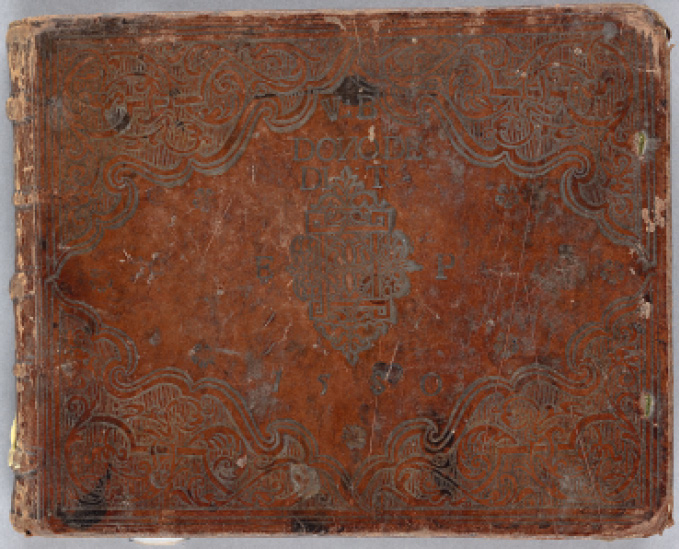
2 Owners: from an Aspirational Bailiff in Stockholm to a Pastor in Uppland
S 110 was donated to the National Library of Sweden on 9 August 1887 by Johann Wilhelm Schürer von Waldheim på Mellingeholm (1843–1914), who was a nobleman and a landowner from Norrtälje.16 He appears to have owned the book for some years prior to donating it, as he has added his name and the year ‘1878’ to the inside of the front cover. The inside of the cover also bears the name of the possible first owner of the book, ‘Anno s. 81 die 21 April. Erich Biörsz Katt’, along with an Ovidian quotation: ‘Conscia mens recti famae mendacia ridet’ (‘A mind that is aware of what is right laughs at the lies of fame’) and a passage from Proverbs 18.10: ‘Turris fortissima est nomen domini’ (‘The name of the Lord is a strong tower’), written in the same handwriting (Fig. 3.3). The card catalogue of the National Library identifies the date as 1681 and the name as ‘Erik Björk Katt’.17 This identification is possibly derived from research by Sigurd Kroon, who researched the possible bearer of that name from the Series pastorum of Uppsala diocese, without finding a match.18 A more plausible identification is presented by Bengt Kyhlberg as ‘Erich Biörsz[on] Katt’, a bailiff from Stockholm Castle, with a date 1581, this being closer to the year indicated in the cover.19 Erik Björnsson first appears in archival material as a commanding officer (skeppshövitsman in Swedish) on various ships between 1565–71.20 He is then listed as a castle bailiff in Stockholm between 1571–81. During his employment at the castle he was also associated with work at Häringe between 1575–81, which was the location of a shipyard and a naval base near Stockholm.21 In 1585 he is listed as a Master of the Ordnance for the field artillery (tygmästare vid fältarkliet) in Livonia, before working for the district court in Sollentuna between 1588–9, and earning himself the title of nobleman on 15 July 1590.22 The last name ‘Katt’ appears in documents is in connection with his daughter, Margareta Eriksson Katt, who inherited a house in Stockholm owned by Erik.23 Although it has not been possible to trace the ‘V.B.’ and ‘E.P.’ mentioned in the cover specifically to Erik Björnsson or any of his associates, a fine leather-bound book with printed staves ready for collating music suitable for moments of pastime is not an inconceivable item in the hands of an upwardly mobile gentleman such as Erik Björnsson evidently was. Yet, judging by the lack of significant gaps in the existing quire structure and the lack of any written notation other than the later liturgical music, it would appear that he did not use the book very much. Although citterns that would have been played from four-stave tablature notation are not mentioned specifically in surviving inventories from late-sixteenth-century Sweden, lutes and lute tablatures appear in the royal inventories and musicians associated with the court in Stockholm, and the import of music instruments to Sweden was an established practice from King Gustav Vasa’s time onwards.24 S 110 does stand out somewhat from the surviving tablatures of late-sixteenth-century Sweden, however, as none of the surviving tablatures are written for a cittern.25
Inside the front cover of MS S 110
National Library of Sweden, Manuscript collection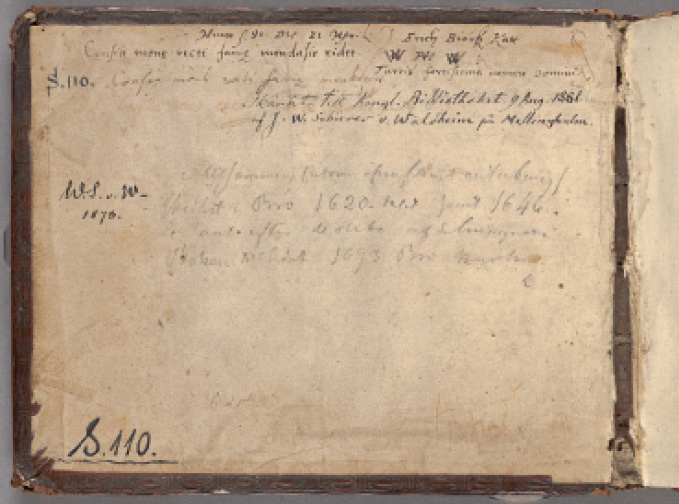
After Erik Björnsson, the next identified owner of the book was Johannes Beck (Becchius), who was the pastor for the Bro parish (now Roslagsbro-Vätö parish in Norrtälje commune) in the Uppsala diocese between 1611 and his death before 1634.26 He received an education in Uppsala and is credited as the author of Catecheseos chytrei of 1602, mentioned by Johannes Schefferus in Svecia literata of 1680.27 It is unclear how the book passed from Erik Björnsson’s possession in Stockholm to Johannes Beck in a small parish in Uppland, as no evidence of Björnsson’s connections with the area survives. The existing contents of the book were added for the most part during Johannes Beck’s ownership, and he used it to preserve liturgical music, especially chants for the Divine Office. The Church Ordinance of 1571 was the first complete church order in Sweden after the Reformation, and remained in force until a new comprehensive church law was written in 1686. The church order stipulates that the use of songs in Latin for the Office is still allowed occasionally, and thus the cathedral schools could ensure proper education in Latin was still available.28
Although the continued use of chants in Latin for the Office is evident from surviving music manuscripts from the first hundred years after the Reformation, no printed books containing the repertory were available until 1620, when Eskil Mattsson printed his Liber Cantus.29 In order to have appropriate songs in Latin available, the clergymen were reliant on their own scribal skills or books collated prior to the Reformation and still in usable condition. S 110 contains chants for the celebration of the Office for some key dates in the liturgical year: Christmas Day, Easter Sunday, Pentecost and the Feast of St Michael (Appendix 1). In addition to the chants for the Office, there are also Kyriales in Swedish for Pentecost, the Feast of St Michael and Easter Sunday, as well as Te Deum and the Athanasian Creed in Swedish. The book has fifteen empty folios in the middle, and the very last quire of the book contains ten funerary songs, one of which is in Swedish. The placement of the funerary songs at the very end of the book reflects an organisational practice seen in other sources in which cantus funebres are presented at the very end of a printed book or a manuscript;30 in the case of S 110 the scribe has made a generous estimate for the space required, which has resulted in the last three folios being left empty. The collections for Christmas and Easter Sunday are the most comprehensive, containing repertory for Matins, Lauds and second Vespers, although for Easter Sunday the section for Vespers includes only two antiphons.
3 Scribes: Wandering Students, Peers, Family Members and Successors
Though the book was owned by Johannes Beck, he seems not to have written any of the music himself. Along with Schürer von Waldheim’s and Björnsson’s names, eight scribes have written their names in relation to the contents of the book, and Beck’s ownership of the book is evident through the dedications written for him. Usually liturgical music manuscripts contain names to indicate ownership of the book, and the dedications of music to the book’s owner are yet another unusual feature in S 110, giving it some features of a liber amicorum. The earliest surviving repertory in the book is for the Christmas Day (fols. 1r–7v), written by Elias Olai and Andreas Johannis Bothniensis, with a dedication reading:
Elias Olavsson and Andreas Johannesson of Bothnia wrote these things for the use of the most learned man Johannes Beck, most watchful pastor of the people of Bro, on the festal day of December 1615.31
The date is later altered to look like ‘1545’ with black ink, possibly by Schürer von Waldheim in the late nineteenth century. Elias Olai Bothniensis (1580–1653) is listed as a chaplain to Bälinge parish (now Bälingebygden in Uppsala commune) in 1623, before his appointment as a pastor to Häverö parish (now Häverö-Edebo in Norrtälje) from 1635 until his death.32 No details of the life and career of Andreas Johannes Bothniensis have survived, apart from a speculative presence at Uppsala University in 1611 along with Elias Olai.33 The first quire is missing some pages from the beginning, and it is possible that the portion written by Andreas Johannes and Elias Olai also included chants for the Vigil for Christmas Eve, as the first page includes the final four words of the antiphon Dum ortus fuerit sol as well as a complete antiphon Ecce completa sunt omnia, also belonging to the Christmas Eve Vigil repertory.
The repertory for Easter Sunday (fols. 8r–14v) was also a team effort by two scribes named Olaus Petri and Johannes Petri Suderbyensis, who did not leave a dedication or a date but only their names at the bottom of fol. 14v. Olaus and Johannes were presumably brothers from a neighbouring parish of Söderby (now Estuna och Söderby-Karl in Norrtälje). Olaus’s career is mostly obscure, apart from his final position as a chaplain at Stockholm’s Storkyrkan before his death around 1630. Johannes’ career is slightly better known, as he entered Rostock University in 1621 and graduated in 1624, followed by an appointment as an academic notary in Uppsala in the same year, and as a rector in the town of Enköping in Uppland in 1628, before settling as a pastor in Väddö parish (now in Norrtälje) from 1635 to his death in 1655; he was evidently very successful in his career as he was also made a provost (kontraktsprost in Swedish) in 1640 and attended the Diet (riksdag) in 1635 and 1643.34 Although the scribal entry in S 110 carries no date, it was in all likelihood made before Johannes departed for Rostock. Again the beginning of the collection is defective, as the invitatory antiphon Alleluia surrexit dominus is missing the first word ‘Alleluia’. The beginning of the chants for Easter does coincide with the start of a quire, and it is possible that it originally contained chants for the first Vespers written on the outer leaves of the previous quire, which are now lost along with the missing first pages of the chants for Christmas Day.
The scribal work of these two pairs of men was probably a result of the tradition of sockengång, in which students toured around parishes to collect money for their studies, and often participated in singing in church services. In 1624 there was an attempt to forbid the tradition because of its potential to disrupt parish life, with a move instead to collect money for schools by tax, but the practice persisted nonetheless.35 It would seem that Pastor Johannes Beck saw the arrival of students in his parish as a way to collect musical material from them and make them work for whatever subsistence they might get. In both sections the handwriting and style are consistent, so it is not clear how – or indeed if – the work was divided between the two. Students would have provided an ideal source of repertory in Latin, as school statutes of 1611 state that musical training received in cathedral schools must include psalms, components of the Mass, and antiphons, responsories and polyphony.36
Not all contributors to Beck’s music collection were wandering students; there were also clergymen with social ties either to the parish or to Beck himself. The scribe for the Feast of St Michael and the sequence Then helge Andens nåd for Pentecost, Te Deum and the Athanasian Creed (fols. 23v–37r), written in 1626, was Israel Roslagius, who had ties to the parish through his father Matthias Nicolai, pastor of Bro parish before Johannes Beck. His name appears in student records of Uppsala University in 1613, but no further details of his life and career survive.37
Gylichius Michaelis Svinfot contributed a Kyriale and chants for the Office for Pentecost (15r–23r). His dedication has no date, but its placement in the book between the section for Easter Sunday (written before 1621) and the following section of music for the Feast of St Michael dated 1626 would suggest a broad timeline between 1615 and 1626. Svinfot was born in the town of Hudiksvall in Hälsingland in 1593, and studied in Gävle, Uppsala, Västerås and Stockholm. He worked as a chaplain in Rasbo parish (now Rasbo-Rasbokil, in Uppsala commune) in 1616, before being ordained as a minister in 1617; in 1636 he became a pastor (kyrkoherde) for the town of Öregrund in Uppland, where he resided until his death in 1654.38 Comparing the timeline of his career to the time he may have entered his contribution to Beck’s book, it would seem likely that he may have been in the early stages of establishing a career during that time, thus making his entry more a gift from peer to peer. Furthermore, he later became a brother-in-law to Johannes Beck through his marriage, so his relation to the book’s owner is perhaps collegial as well as familial.39 He was also socially connected to Israel Roslagius, as his name appears as a baptism witness for his daughter ‘dominus frater Jsrael Matthiae i Vpsala’.40
Another scribe with ties to the Bro parish was Petrus Erasmi Paxhamberus, who wrote the cantus funebres at the end of the book. His written dedication at the end of the book is partially damaged as a result of something burrowing through the final pages and the cardboard on the binding, and the remaining text does not contain a date:
[God] give our business a good ending. … Funeral [songs] for the use of the most learned man of the Lord, Johannes Beck, pastor of the people of Bro. In … and friendship. Peter Rasmusson Paxhamberus wrote it.41
He is thought to have studied at Uppsala University under the name of ‘Petrus Erasmi Roslagius’ in 1614, before being ordained in 1617. He had a very short-lived appointment as a chaplain in Sigtuna until 1618, and no further details of his career survive; it would seem that much like Israel Roslagius, he may have been unemployed and returned to his home parish during the time he was copying the songs for Johannes Beck. His use of name ‘Paxhamberus’ instead of ‘Roslagius’ is possibly a reference to his place of birth (Frötuna, now in Norrtälje commune), distinguishing himself from other locals.42
The repertory for the cantus funebres becomes more common in manuscripts after the publication of Liber cantus of 1620, and given that Petrus Erasmi’s exact time of residence in Bro is uncertain, it is possible that the repertory may have been copied from Mattsson’s printed book or a manuscript copy deriving from it. The order of the songs is slightly different compared to the printed book, and S 110 is missing Iagh weet at min Förlossare leffuer that is present in the Liber cantus, even though there would have been ample space left in the quire for it. Petrus Erasmi was the most artistically adventurous of all the scribes with his stylised decorative initials. Other scribes settled for fairly modest calligraphic initials at the beginning of a section followed by smaller cadels, but Petrus Erasmi has drawn square initials for the funerary songs in Latin, decorating the background of the letter with a grid of lines. For the M in Media vita in morte he has drawn a round frame for the letter, and for L in Libera me domine he has drawn an animal leaning against the body of the letter (Fig. 3.4). The designs made by Petrus Erasmi are not copied from those printed in Mattsson’s book, although the style of confining the letter within a square frame is visually closer to printed initials from woodcuts than calligraphic letters seen in the rest of the book. Other sections in S 110 predate Mattsson’s Liber cantus, except for the melodies written by Israel Roslagius in 1626. Much of the repertory written by him is also in the printed book, although again the organisation of the material does not follow the printed book directly. The Athanasian Creed (Hwilken som wil salig warda) is not in the printed book, however, so he must have had other sources available, making direct stemmatic relationship to Mattson’s printed book even more speculative.
MS S 110, fols. 56v–57r
National Library of Sweden, Manuscript collection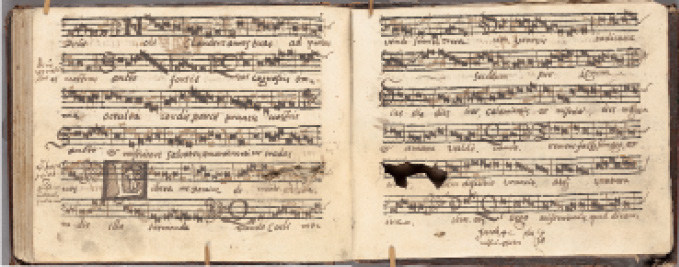
The last scribe in the book is Andreas Bergius, who wrote the Kyriale in Swedish for Easter Sunday. He has signed the music with a date of 28 March 1646 with a note ‘in currenti calamo’ (‘written in haste’), which is fairly apt given the close proximity of the feast in relation to the date given. As the previously written section for Easter Sunday contained only music for the Office, Andreas Bergius’ addition of the Kyriale provides a fairly comprehensive repertory in one book for the music required for the celebrations. His written portion is also the only one in the book not relating to Johannes Beck; Andreas Bergius became the pastor (kyrkoherde) for Bro in 1644, and thus inherited the book for himself. Prior to his arrival in Bro, he was schooled in Västerås, where he is mentioned as one of the trumpeters (tubicines) of the cathedral school in 1622.43 He was ordained in 1629, and served as a chaplain in Veckholm parish (now in Enköping commune) between 1636 and 1643, and he is mentioned as being a Diet representative (riksdagsman) of his parish in 1649, before his death in 1658.44
4 S 110 in the Context of Bro Parish Book Inventories
Andreas Bergius was also the scribe for the earliest surviving book inventory for Bro parish from 1652. The inventory lists six books: two bibles (one of which was bought by Bergius in 1649); a psalter; two manuales (handbooks), one of which ‘according to the old style’ (‘efter gambla sättett’); and finally a ‘sånge book skriffsen’ – the handwritten book of songs that is now S 110. As there are no dates designated for the books apart from a date of purchase of the second bible, it is not possible to ascertain which editions of each book were owned by Bro parish, or whether they were printed books at all. The title ‘sånge bok skriffsen’ appears again in the 1659 inventory, but the subsequent inventories between years 1677–1829 make no mention of the book.45 The back cover of S 110 contains a faint text ‘Thenna book hörer Broo kiyrkia till anno 1693’ (‘This book belongs to Bro church, 1693’),46 so it is not certain for how long the book remained in the parish before ending up in Schürer von Waldheim’s ownership in the nineteenth century. The absence of mention in the inventories is not necessary an evidence of its absence though, as the later inventories possibly omit books not kept in active use: for example, the inventory from 1828–1829 mentions the presence of a manual from year 1614, which is not specified in any of the inventories from the eighteenth century.47
Although S 110 contains a fair amount of musical material, it is missing some of the core repertory seen in many other books, such as melodies for the ferial mass, the Nicene Creed and popular sequences for special feast days either in Latin or Swedish. The repertory written in S 110 was not for everyday service, which curiously coincides with the special material properties of the book, with its use only on special occasions. Based on the contents listed in Bro church book inventory, the other books possibly contained music for the liturgy that is not present in S 110. Throughout the sixteenth century, psalters were printed mostly without notation;48 the first example containing notated melodies along with texts was printed by Eskil Mattsson in Uppsala in 1616,49 followed by an edition by Haquinus Rhezelius, issued by Ignatius Meurer in Stockholm in 1619.50 It is also possible that the manuales contained notation: Eskil Mattsson’s printed Manuale of 1614 – a copy of which was owned by Bro parish based on the 1828–1829 inventory – was printed with notation for the recitation of some parts of holy communion, such as prefaces, Lord’s Prayer and Psalm ‘Gudh giffuer wårom Konung och all Öffuerheet’ (‘O God, give the king your justice’); adding notation to manuales was a standard practice in later editions. Also, any book used for service could have a music manuscript addition included in it, without this warranting a specific mention in later inventories. Even Bibles could have additional material included; for example, MS S 113 at the National Library of Sweden includes eight folios of manuscript pages added in the middle of the Swedish New Testament printed in 1526, which contain liturgy and melodies for the celebration of the Mass.
5 Music Books as Evidence of Material and Social Networks in Post-Reformation Sweden
The material properties of S 110 reflect the flexible approaches taken towards the physical properties of a music book in professional use by the Lutheran clergy in Sweden, but also attest the continuing reliance on handwritten manuscripts and their importance for conducting services, especially for repertory in Latin. It is interesting to note that, unlike many clergymen, Johannes Beck delegated the scribal activities to his visitors. It is also noteworthy that all the persons named as scribes in the book remained geographically close to each other in the Uppsala diocese; many of the men were trained at Uppsala University, but also ended up taking positions in parishes not far removed from each other. A closer study of the material properties of liturgical music manuscripts along with their melodies and repertory thus provides a wealth of evidence on the material culture of books in Sweden: a personal music manuscript meant for pastime activities in a well-to-do household in Stockholm could end up being used in a professional context in a parish in Uppland, with its contents written for the sake of friendship (‘amicitia causa’), preserving a local network of musical exchange between clergymen.
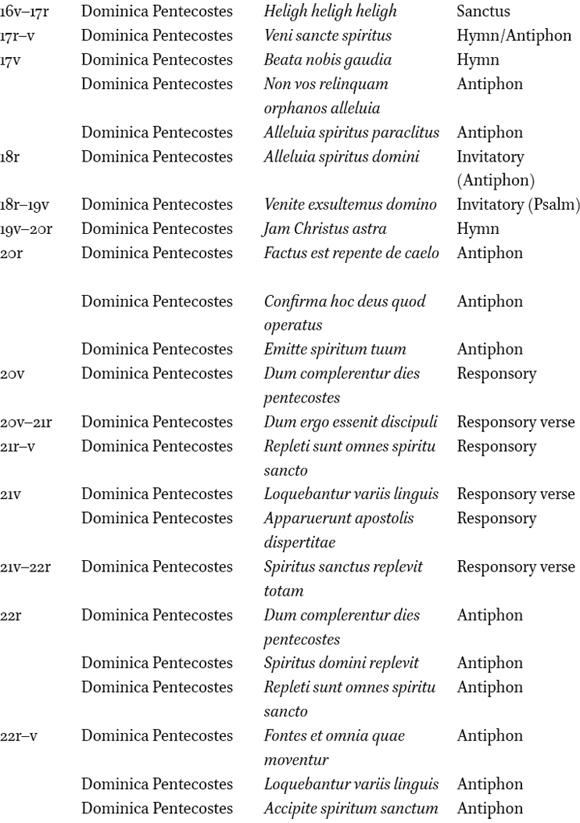
Appendix 3.1. List of Contents for S 110




This chapter stems from my post-doctoral research project Material Culture of Music Books in Post-Reformation Sweden, funded by the Kone Foundation and the Swedish-Finnish Cultural Foundation. My thanks to Wolfgang Undorf, John Milsom, Marianne C. E. Gillion, Mattias Lundberg and Fanny Stenback for sharing their wisdom that has helped me in the process of research and writing. The manuscript S 110 has been digitised by SweLiMus (Swedish Liturgical Music Sources c.1520–1820), a project funded by Riksbankens Jubileumsfond: http://urn.kb.se/resolve?urn=urn:nbn:se:alvin:portal:record-401033.
Quire structure 14 (1, 2 missing), 24, 35, 44, 53, 65 (4 missing), 73, 84. The folio numbers referred to in this chapter are according to the modern foliation, excluding the missing pages.
Kansallisarkisto (KA), Helsinki, Varsinais-Suomen voutikuntien tilejä, 1389 Etelä-Suomen tilikirja (1581) (https://www.finna.fi/Record/narc.VAKKA-316273.KA_VAKKA-2187266.KA); a copy of a similar watermark and its provenance in Nils J. Lindberg, Paper Comes to the North. Sources and Trade Routes of Paper in the Baltic Sea Region 1350–1700 (Marburg (Lahn): International Association of Paper Historians, 1998), pp. A 119, A 190.
For the production of printed music paper, see Iain Fenlon and John Milsom, ‘“Ruled Paper Imprinted”: Music Paper and Patents in Sixteenth-Century England’, Journal of the American Musicological Society, 37/1 (Spring 1984), pp. 139–63; Laurent Guillo, ‘Les papiers à musique imprimés en France au XVIIe siècle: Un nouveau critère d’analyse des manuscrits musicaux’, Revue de musicologie, 87/2 (2001), pp. 307–69; Katherine Butler, ‘Printed Borders for Sixteenth-Century Music or Music Paper and the Early Career of Thomas East’, The Library, 7th ser., 19 (2018), pp. 174–202; John Milsom, ‘Printed Music Papers: Research Opportunities and Challenges’, in Andrea Lindmayr-Brandl and Grantley McDonald (eds.), Lasting Impressions: Music and Material Cultures of Print in Early Modern Europe (London: Routledge, 2021), pp. 41–62.
James Tyler, ‘Mandore’, Oxford Music Online, https://doi-org.ezproxy.its.uu.se/10.1093/gmo/9781561592630.article.45646, accessed 4.4. 2019; James Tyler: ‘Cittern’, Oxford Music Online, https://doi-org.ezproxy.its.uu.se/10.1093/gmo/9781561592630.article.05831, accessed 4.4. 2019.
Milsom, ‘Printed Music Papers’.
Guillo, ‘Les papiers à musique’, pp. 349–50; other four-line stave paper is mentioned in Fenlon and Milsom, ‘Music Paper and Patents’, pp. 159, 162, but the measurements do not match those of S 110.
G. E. Klemming and J. G. Nordin, Svensk boktryckeri-historia 1483–1883: med indelande allmän öfversigt (Stockholm: Mannerheim & Mannerheim, 1983), p. 150; Remi Kick, ‘The Book and the Reformation in the Kingdom of Sweden 1526–71’, in Jean-François Gilmont (ed.), Karin Maag (English edn & tr.), The Reformation and the Book, (Aldershot: Ashgate, 1998), pp. 450–1.
Messan på swensko förbättrat 1548, Messu eli Herran Echtolinen 1549, Een liten songbook til at brukas j kyrkionne 1553 (two editions), Then parabolen om Samaritaner 1572, Se pyhä messu Somen kielen 1575, Troon 1578. Isak Collijn, Sveriges bibliografi intill år 1600, 3 vols. (Uppsala: Svenska litteratursällskapet, 1927–38), 1, pp. xi–xvi.
Åke Davidsson, Studier rörande svenskt musiktryck före år 1750 (Uppsala: Almqvist & Wiksell, 1957), pp. 93–4.
Sten G. Lindberg makes a vivid anecdote by stating that all known printing activity in sixteenth-century Sweden equals to one year’s output of all printing in Paris. Sten G. Lindberg, The Art of Book in Sweden (Lund: Svenska Institutet, 1983), p. 6.
Gustaf Rudbeck, ‘Några band af Nils bokbindare och hans son Mäster Bengt, Med 4 fig.’, Nordisk Tidskrift för Bok- och Biblioteksväsen, II (1915), 265–72; Arvid Hedberg, Stockholms bokbindare 1460–1880, 1 (Stockholm: Kungliga boktryckeriet, 1949), pp. 32–3.
Hedberg, Stockholms bokbindare 1460–1880, p. 32 (fig. 66). The original bindings described and illustrated by Hedberg were discarded as the books were re-bound in 1950 (Stockholms stadsarkiv, Borgmästare och råd före 1636, A:28); the bindings are also described in Daniel Almqvist, Stockholm stads tänkeböcker från år 1592 (Stockholm: Stockholms stadsarkiv, 1939), v.
Hedberg, Stockholms bokbindare, p. 32.
See, for example, Kungliga Biblioteket (KB), Stockholm, MS S 229:1 and 229:2; Musik- och teaterbiblioteket (Kungliga Musikaliska Akademiens Bibliotek), Stockholm, Tyska Kyrkans Samling, 45; Hedberg, Stockholms bokbindare, pp. 33–7; Kia Hedell, Musiklivet vid de svenska Vasahoven: med fokus på Erik XIV:s hov (1560–8), Studia Musicologica Upsalensia, new ser. 20 (Uppsala: Uppsala universitet, 2001), pp. 198–9.
Adam Lewenhaupt, Sveriges ridderskaps och adels kalender 1913 (Stockholm: Bonnier, 1912), pp. 1008–9.
Kungliga Biblioteket (KB), Stockholm, Handsskriftsamlingens nominalkatalog, 22264.
Sigurd Kroon, Ordinarium Missae. Studier kring melodierna till Kyrie, Gloria, Sanctus och Agnus Dei t.o.m. 1697 års koralpsalmbok (Lund: Gleerup, 1953), p. 95 n. 1.
Bengt Kyhlberg, Musiken i Uppsala under stormaktstiden. Bidrag till dess historia grundade på en arkivinventering, 1 (Uppsala: Uppsala universitet, 1974), p. 142.
Hjalmar Börjeson and Georg Hafström, Skeppshövidsmän vid örlogsflottan under 1500-talet. Biografiska anteckningar (Uppsala: Almqvist & Wiksell, 1949), p. 26.
Jan Glete, Swedish Naval Administration 1521–1721. Resource flows and organizational capabilities (Leiden: Brill, 2010), pp. 282, 366, 376.
Johan Axel Almquist, Den civila lokalförvaltningen i Sverige 1523–1630, med särskild hänsyn till den kamerala indelningen, 4 vols. (Stockholm: Norstedt, 1917–23), I, p. 158; IV, pp. 44–5; Bernhard Schlegel and Carl Arvid Klingspor, Den med sköldebrev förlänade men ej å Riddarhuset introducerade svenska adelns ättar-taflor (Stockholm: Norstedt, 1875), p. 379.
Frans de Brun, Holmiana et alia, 1 (Stockholm, 1922), pp. 238–9.
Hedell, Musiklivet, pp. 150–1, 153–9.
A comprehensive list of surviving tablature sources in Jan Olof Rudén, Music in Tablature: A Thematic Index with Source Descriptions of Music in Tablature Notation in Sweden (Stockholm: Svenskt musikhistoriskt arkiv, 1981).
Johan Eric Fant and August Theodor Låstbom, Upsala ärkestifts herdaminne, 1 (Uppsala: Wåhlström & Låstbom, 1842), p. 166; Lars-Erik Bergström and Åke Malmström, Sveriges kyrkobyggnader: i ord och bild jämte series pastorum (1935); Sigurd Kroon, Ordinarium Missae, p. 94; Bengt Kyhlberg, Musiken i Uppsala, p. 142.
‘Analysin Catecheseos Chytrei a D. L. Paulino in Acad. Upsal. expositae publice, excepit An. 1602.’ Johannes Schefferus, Svecia literata seu descriptis & scriptoris gentis sveciae. Opus postumum (Stockholm: Henrici Keyser, 1680); also mentioned in Kyhlberg, Musiken i Uppsala, p. 142.
‘Så mångha ock än nu några Latiniska songer medh ibland sungne warda, för theras skul som thet Latiniska målet kunna eller ock lära skola’, Den svenska kyrkoordningen 1571: jämte studier kring tillkomst, innehåll och använding, ed. Sven Kjöllerström (Lund: Håkan Ohlsson, 1971), p. 103. Also discussed in Jyrki Knuutila, ‘Tukholman suomalaisen seurakunnan ‘messukirja’ ja jumalanpalveluselämän muuttuminen evankeliseksi 1500-luvulla’, in Jorma Hannikainen (ed.), Facultas Ludendi: Erkki Tuppuraisen juhlakirja (Iisalmi: Sibelius-Akatemia, Kuopion osasto, 2010), pp. 79–114 (pp. 95–6).
Liber cantus in quo glorificationes, hoc est: Kyrie et Venite, nec non: Sequentiae ac Antiphonae, in summis & simplicibus Festis, atq; diebus Dominicalibus usitatae, continentur. Additus est etiam cantus ecclesiasticus sive Gregorianus, qui in solennibus Ecclesiae Festivitatibus, canitur. Item: Threnodiae, quibus in funerum deductionibus, utuntur (Uppsala: Eskil Mattsson, 1620), USTC 252345.
For example MS Liber cantus (early seventeenth century), Gamla Uppsala Kyrkoarkiv; Facsimile edition in Folke Bohlin, Olaus Ericis sångbok. En handskriven liber cantus i Gamla Uppsala kyrkoarkiv (Uppsala: Wetterqvist, 1967), Liber Cantus Upsaliensis.
Kungliga biblioteket (KB), Stockholm, MS S 110: ‘Haec in usum Doctissimi viri Domini Johannis Beckii | Pastoris Broensium vigilantissimi, scripserunt Elias Olai | et Andreas Johannis Bothniensis Anno 1615 | die Festio Decembris’.
Fant and Låstbom, Upsala ärkestifts herdaminne, 1, p. 213; Kyhlberg, Musiken i Uppsala, p. 144.
Fant and Låstbom, Upsala ärkestifts herdaminne, 2, p. 123; Kyhlberg, Musiken i Uppsala, p. 160.
Kyhlberg, Musiken i Uppsala, p. 145.
Sten Lindroth, Svensk lärdomshistoria, 2: Stormaktstiden (Stockholm: Norstedts, 1975) p. 212; Tobias Norlind, Latinska skolsånger i Sverige och Finland (Lund: Håkan Ohlsson, 1909), p. 11.
Norlind, Latinska skolsånger, p. 22.
Kroon, Ordinarium Missae, p. 94; Kyhlberg, Musiken i Uppsala, p. 161.
Fant and Låstbom, Upsala ärkestifts herdaminne, 3, p. 490; Kroon, Ordinarium Missae, p. 94; M. Collmar, ‘Ett bidrag till släkten Svinefots historia’, Årsboken Uppland (1961), pp. 95–112.
Kyhlberg, Musiken i Uppsala, p. 148.
Kyhlberg, Musiken i Uppsala, p. 161.
Kungliga biblioteket (KB), Stockholm, MS S 110: ‘[Gudh] Giffue wårt måhl en godh enda. | … [E]xequiale in usum Doctissimi viri | [Domini] [Jo]annis | Becchii Broensium pastoris.v.s.|…. et Amicitia causa. | Scripsit Petrus Erasmi Paxhamberus’.
Fant and Låstbom, Upsala ärkestifts herdaminne, 2, p. 451; Kyhlberg, Musiken i Uppsala, p. 163; Lars Otto Berg, Ärlinghundra kontrakt (Uppsala: Stiftshistoriska kommitén i Uppsala, 2015), p. 303.
Kyhlberg, Musiken i Uppsala, p. 182.
Fant and Låstbom, Upsala ärkestifts herdaminne, 1, p. 167; Lars Otto Berg, Magdalena Hellquist and Ragnar Norrman, Trögs-Åsunda kontrakt 1593–1999 (Uppsala: Stiftshistoriska kommitén i Uppsala, 2004), p. 92.
Stockholms Stadsarkiv, Roslags-Bro kyrkoarkiv, L I a 1 contains inventories from years 1644, 1659, 1677, 1730, and 1749.
Kroon, Ordinarium Missae, p. 95 n. 1.
Stockholms Stadsarkiv, Roslags-Bro kyrkoarkiv, N III 1.
The first book of psalms containing notation was printed by Andreas Gutterwitz in 1586, but even then, it contained notation only for Credo in both Latin and Swedish.
Then swenska psalmboken, medh flijt öfwerseedt och corrigerat sampt medh notuler öfwer några förnemligha psalmer förbättrat. Item calend; eccles. Anno 1616. (Uppsala: Eskil Mattsson, 1616), USTC 252869.
Haquinus Laurentii Rhezelius (ed.): Någre psalmer, andelige wijsor och lofsonger, uthsatte af Laurentio Jonae Gestritio past. Hernösand. Och nu med noter affsatte, och aff trycket uthgångne aff Haquino Laurentii A. Rhezelio Predikant i Gråmuncka Clöster med egen bekostning (Stockholm: Ignatius Meurer, 1619), USTC 252187.