


The early expansion of Jainism in Central Northern India is well attested at the site of Kankali Tila near Mathura between the second century BCE and the third century CE.1, 2 In Eastern India, while several inscriptions found in Orissa testify to the presence of Jainism during the first century BCE, others have been discovered in Bengal dating from the 5thâ6th centuries CE.3 The chronology of the expansion of Jainism into South India, by contrast, is much less precisely defined. This is especially striking for the region of ÄndhradeÅa (hereinafter generally called Ändhra),4 and this despite the fact that there is no shortage of studies on the history of Jainism in South India. The available studies show very clearly that the evidence of Jainism in South India differs radically from one region to another.5
In Tamil Nadu, as has been noticed by Desai and Champakalakshmi, the most ancient remains are caves on mountain slopes, such as Tirupparankunram, Alagarmalai, Kongarpuliyangulam, and Siddharmalai, all in Madurai district (Map 11.1). These sites contain beds carved into the rock with inscriptions in an archaic variety of the BrÄhmÄ« script, dated as early as the 3rdâ2nd centuries BCE, as well as Jaina sculptures of TÄ«rthaá¹ karas carved at a later date, between the 7th and 9th centuries.6 In Karnataka, Jaina remains are numerous, but they appear to be of a later date than in Tamil Nadu. They begin with inscriptions dating from the early Kadamba dynasty, in the middle of the 5th century CE, and come into full bloom with the royal patronage of the RÄá¹£á¹rakÅ«á¹as of Malkhed between the 8th and 10th centuries.7 Jainism in Ändhra, by contrast, has left very few tracesâsuch as inscriptions, caves and statuaryâfrom the beginnings of the first millennium, and those few traces are surrounded by uncertainty.8 This is all the more striking given the conspicuous presence of Buddhist remains in Ändhra starting from the late centuries BCE.

Map 11.1
Sites of Southern India associated with the early spread of Jainism

Secondly, while the presence of Jainism in South India is commonly associated with the emergence of the Digambaras, the available studies have shown that the reality of monastic communities was more complex than the binary division into Digambaras and ÅvetÄmbaras suggests, and that actual practices of eremitism and meditation might have differed from those that are given in the normative literature of both the ÅvetÄmbaras and Digambaras. For example, inscriptions testify to a group called KÅ«rcakas, and literature attests to a group called Boá¸iyas, both of which are now extinct.9 Several studies have tried to throw light on the YÄpanÄ«yas, who are attested in South India between the 5th and the 14th centuries in both Digambara and ÅvetÄmbara sources.10 Furthermore, in their discussion of land-grants given to monks who led monasteries, Schmiedchen and Vasudevan hint at the fact that, next to wandering ascetics, some monks might have led a settled life and thus foreshadowed the tradition of resident monastic leaders or bhaá¹á¹Ärakas.11 There were also Jaina women called kurattiyar12 who seem to have played an influential role that is not expected from the normative Digambara texts.13 Lastly, while some mendicants followed the tradition of asceticism and meditation, others were erudite scholars and poets, as is clear not only from the works that they produced, but also, for example, from Upadhyeâs studies of the YÄpanÄ«yas.14
Thus the evidence for Jainism in South India in the early historic period is relatively exiguous, especially in comparison to its prominence later on. Several studies have tried to fill in the gaps by postulating an earlier history for certain sites and accepting, with more or less scepticism, the traditional stories concerning the migration of Jaina monks to South India. For example, the site of Konakondla has been associated with the teacher Kundakunda, who is highly honoured in Digambara literature, and who appears to have lived in the early centuries CE. As a matter of fact, all the epigraphs mentioning this locale as the birthplace of Kundakunda are from the 10th and 11th centuries, and there is no tangible evidence for Jainism at that site in the first half of the first millennium.15 Against this background, the present paper aims at reviewing the scanty literary and material evidence at our disposal and providing some preliminary answers to the question of when Jainism came to South India and, in particular, to Ändhra.
1 Literary Testimonies
1.1 The Description of Southern Countries in Jaina Literature up to the 10th Century
In the ÅvetÄmbara canon, three heterogeneous lists mention regions of South India together with foreign people and Indian tribes.16 The shortest and perhaps oldest of these lists is found in the BhagavaÄ« (5th Aá¹ ga), a composite text that was probably finally redacted in the fifth century. It presents the origins of slave women (IX.33: 595.19â21):
[â¦] babbariyÄhiá¹, paosiyÄhiá¹, Ä«sigaá¹iyÄhiá¹, joá¹hiyÄhiá¹, cÄru(vÄsa)gaá¹iyÄhiá¹, palhaviyÄhiá¹, lhÄsiyÄhiá¹, lausiyÄhiá¹, ÄrabÄ«hiá¹, damilÄ«hiá¹, siá¹ ghalÄ«hiá¹, pulindÄ«hiá¹, pukkhalÄ«(pakkhaá¹Ä«)hiá¹, bahalÄ«hiá¹, muruá¹á¸Ä«hiá¹, sabarÄ«hiá¹, pÄrasÄ«hiá¹ nÄá¹adesÄ«hiá¹.17
The other two, much longer and presumably of later date, appear in the Paá¹hÄvÄgaraá¹a (10th Aá¹ ga) and in the Paá¹á¹Ävaá¹Ä (5th UpÄá¹ ga). They characterise people with barbaric customs and cruel conduct that do not conform to the principles of Jainism.18 While the Dramilas or Draviá¸as, âTamils,â figure in all the lists, the Ändhras (aá¹dha) are mentioned only in the more extensive lists of the Paá¹hÄvÄgaraá¹a (I.4: 1202.13â22) and of the Paá¹á¹Ävaá¹Ä (I.64:285.5â9):19
[â¦] saka-javaá¹a-sa[va]bara-babbara-gÄya-muruá¹á¸a-uda-bhaá¸aga-tittiya-pakkaá¹iya-kulakkha-goá¸a-sÄ«hala-pÄrasa-koá¹ca-aá¹dhaâdavilaâ(ci)villala-puliá¹da-Ärosa-á¸oba-pokkaá¹a-gandha-hÄraga-bahalÄ«ya-jallara-umamÄsa-bausa-malayÄ caá¹cuyÄ ya cÅ«liyÄ koá¹kaá¹agÄ meta palhava mÄlava mahura ÄbhÄsiyÄ aá¹akka cÄ«na-lhÄsiya-khasa-khÄsiyÄ nehura-marahaá¹á¹a-muá¹á¹hi(a)ya-Äraba-á¸obilaga-kuhaá¹a-kekaya-hÅ«á¹a-romaga-ruru-bharugÄ cilÄya-visaya-vÄsÄ«ya.
Can the exclusion of the Ändhras in the shortest list, that of the BhagavaÄ«, be explained because the term Dramila/Draviá¸a once included all the peoples of southern India, or because the Ändhras did not count as a barbarian people at the time it was constituted, that is to say between the 2nd and 4th centuries?20 It is difficult to draw any conclusions, since the composite nature of the BhagavaÄ« makes it very difficult to establish a chronology of the disparate material.21 The situation is complicated further by the fact that the content of the PannÄvaá¹Ä was at some point incorporated into the BhagavaÄ« (cf. Deleu 1970: 26â29).
Moreover, such lists, once fixed, continued to be reused in subsequent works. The KuvalayamÄlÄ, a novel composed in 779â¯CE by the Jaina monk Uddyotana in Jalor (Rajasthan),22 contains a list of groups in which one would not like to be reborn, and Ändhra and Draviá¸a both appear in the same verse (40.25):
á¸oá¹bilaya-lausa-bokkasa-bhilla-puliá¹dâaá¹dhaâkottha-bharu-rÅ«yÄ |koá¹cÄya dÄ«á¹a-caá¹cuya-mÄlava-davilÄ kaá¸ukkhÄya ||
In another passage of the same work, the author reuses this list in a narrative context. At his arrival in Vijayadurga,23 Prince Kuvalayacandra, the main hero of the novel who hails from AyodhyÄ, encounters a group of merchants and relates their respective good qualities or defects, as well as some words that are supposed to characterise their respective languages. Thus, he praises the merchants of LÄá¹a, or Gujarat (KuvalayamÄlÄ 153.5):
á¹hÄo litta-vilitte kaya-sÄ«maá¹te susohiya-sugatte |âamhaá¹ kÄuá¹ tumhaá¹â bhaá¹ire aha pecchae lÄá¸e ||
Then he saw merchants of LÄá¹a who said âamhaá¹ kÄuá¹ tumhaá¹â.24 They were bathed, smeared with oils, and perfumed. They dyed the parting of their hair and beautified their limbs (even though these latter were) already beauteous.
Uddyotana describes the merchants from Kará¹Ätaka in a more negative fashion, in conformity with the canonical tradition (KuvalayamÄlÄ 153.7):
ukkaá¸a-dappe piya-mohaá¹e ya rodde payaá¹ga-vittÄ«ya |âaá¸i pÄá¹á¸i mareâ bhaá¹ire pecchai kaá¹á¹Äá¸ae aá¹á¹e ||
Then he saw others who were natives of Kará¹Äá¹aka and who said âaá¸i pÄá¹á¸i mareâ.25 These latter had an immoderate arrogance, but they were devoted to their beloved. They were cruel and rash like moths.
He also describes the harsh customs of the merchants of Ändhra (KuvalayamÄlÄ 153.11):
piya-mahiÄ-saá¹gÄme suá¹dara-gatte ya bhoyaá¹e rodde |âaá¹i puá¹i raá¹iá¹â bhaá¹aá¹te aá¹dhe kumaro paloei ||
The prince also saw merchants of Ändhra who said âaá¹i puá¹i raá¹iá¹â.26 These latter loved women and battles; they possessed beautiful limbs; and they were as practised in pleasure as they were in cruelty.
Another stereotyped description of the people of the Southern regions of India is found in the YaÅastilakacampÅ«, composed in 959 by Somadeva, a Jaina monk from Ändhra:27
kadÄcid ÄndhrÄ«á¹Äm alaka-vallarÄ«-vijrÌ¥mbhaá¹a-jaladharaḥ, colÄ«á¹£u bhrÅ«latÄ-nartana-malayÄnilaḥ, keralÄ«nÄá¹ nayana-dÄ«rghikÄ-keli-kalahaá¹saḥ, siá¹halÄ«á¹£u mukha-kamala-makaranda-pÄna-madhukaraḥ, kará¹Äá¹Ä«nÄá¹ kuca-kalaÅa-vilÄsa-pallavaḥ, saurÄá¹£á¹rÄ«á¹£uvali-vÄhinÄ«-vinoda-kuñjaraḥ, kambojÄ«nÄá¹ nÄbhi-valabhi-garbha-sambhoga-bhujaá¹ gaḥ, pallavÄ«á¹£u nitamba-sthalÄ«-khelana-kuraá¹ gaḥ, kaliá¹ gÄ«nÄá¹ calana-kisalayotsava-puá¹£pÄkaraḥ (sa) smaraá¹ viá¸ambayÄm Äsa |
On other occasions he ridiculed the god of love: he was a raincloud, making the creeper-curls of the Ändhra women open up; he was the southern breeze, making the vine-eyebrows of the Cola women dance; he was a swan, playing in the pond-eyes of the Kerala women; he was a bee, drinking the sap of the lotus-mouths of the Sinhala women; he was a young sprout, sporting in the jar-breasts of the Kannada women; he was an elephant, entertaining himself in the rippling river-navel of the SurÄá¹£á¹ra women; he was a snake, enjoying himself within the eave-like navels of the Kamboja women;28 he was an antelope, playing on the plateau-buttocks of the Pallava women;29 he was the spring season, coming into bloom with the sprout-feet of the Kaliá¹ ga women.
Not only does Somadeva recontextualize this stereotyped ethnographic list of people found in other sources, as Uddyotana did before him, but he changes its connotations. The women of the various Southern regions do not represent barbarous groups, but beautiful young ladies with whom MÄridatta, king of the Yaudheya, leads a life of pleasure. Moreover, the order of the groups mentioned is important here: as the author himself hails from Ändhra, he mentions the women from this region first, then mentions the other Southern countries, while the Northern countries come last.30
The stereotyped discussions of the regions of southern India in Jaina literature often manifest the authorsâ attitudes towards those regions. Their continued redeployment suggests changes in the perception, especially in the case of Somadeva. What they cannot do, however, is provide evidence for the presence or absence of Jainism in those regions. That is why I will now turn to two legends associated with the introduction of Jainism in the South.
1.2 King Samprati and the Conquest of the South
In the NiÅÄ«thacÅ«rá¹i (part II: 362), a commentary on the NiÅÄ«thasÅ«tra of the ÅvetÄmbara canon from about the 6th century CE,31 it is said that Samprati, grandson of AÅoka, was converted to Jainism by the teacher Suhastin, and conquered the regions of the Deccan (Daká¹£iá¹Äpatha), including SurÄá¹£á¹ra, Ändhra, Dramila/Draviá¸a, etc.32 While this legend may preserve a memory of Jainismâs spread to the South, it is difficult to take it at face value.33 Rather, it is likely that such a commentary projected onto the past events of the period in which it was composed. In other words, this legend was perhaps modeled on a contemporary event, such as the extension of the kingdom of the RÄá¹£á¹rakÅ«á¹as, which had a similar regional extent and was also friendly to Jainism.34 A similar process of projecting features of oneâs own historical moment into the more distant past seems to have been operative in the legend of the Jaina monk Siá¹hanandin. Later inscriptions make Siá¹hanandin instrumental to the foundation of the Western Gaá¹ ga kingdom in Karnataka in the 4th century. In fact, as Chatterjee shows in his analysis, only inscriptions from the 7th to the 11th century associate the foundation of the dynasty with the assistance given by master Siá¹hanandin. Older inscriptions mention no event of the kind.35 Let us now turn to another legend commonly associated with the implantation of Jainism in the South and see what information it can provide.
1.3 The Monk BhadrabÄhu and the Jaina Migration to the South
As scholarship has noted since the end of the 19th century,36 literary tradition consistently affirms that the expansion of Jainism toward the South was connected with the migration of one part of the community under the leadership of the monk BhadrabÄhu.37 He is said to have converted either the Mauryan king Candragupta or AÅokaâs grandson, Samprati, and to have founded the Digambara sect in the South.38 Does this story reflect a real event that occurred in the 3rd century BCE or around the beginning of the Common Era? Or could the story have been developed in the 7th century at the moment of glory of Jainism in Karnataka, as their followers were searching for an origin story? The site that is most often associated with this legend is Shravana Belgola, where a pair of footprints commemorating the teacher BhadrabÄhu have been engraved. The earliest inscription to mention BhadrabÄhu as the leader of the southbound monks, however, cannot be dated before the 7th century. According to Dundas, âthe association of BhadrabÄhu with Åravaá¹a Beḷgoḷa likely represents an anachronistic attempt to enhance the prestige of an emerging holy place.â39 Another factor that would support Dundasâ argument is the fact that the legend bears on the identity and antiquity of the Digambara community, which was engaged in intense conflict with other sects around the time when narratives about BhadrabÄhuâs southern journey begin to surface.40 None of the Digambara literary works dealing with the legend of BhadrabÄhu predates the 10th century: the BrÌ¥hatkathÄkoÅa of Hariá¹£eá¹a in Sanskrit dates from 931; the anonymous Vaá¸á¸ÄrÄdhane in Old Kannada is placed in the 10th century; and the KahÄkosu of ÅrÄ«candra, composed in Apabhraá¹Åa, dates from the 11th century.41
From the terms they use for designating Jaina sects, however, it does appear that the stories of BhadrabÄhu incorporate some earlier material. Indeed, the terms Digambara and ÅvetÄmbara are not used at all.42 Instead, we read about several divisions of Jaina monks. For instance, in the story of BhadrabÄhu from Hariá¹£eá¹aâs BrÌ¥hatkathÄkoÅa, the following terms occur: firstly, a Nirgrantha with a bowl in his hand (stanza 54: bhiká¹£ÄpÄtraá¹ kare krÌ¥tvÄ), which can hardly designate a Digambara as defined nowadays;43 secondly, monks becoming ArdhaphÄlakas (stanzas 58â59) because they cover their sex with a piece of cloth with their left hand and beg with their begging-bowl in their right;44 thirdly, the community of the YÄpanas who use an overlay (kambala) and are based in the Deccan (stanza 81: daká¹£iá¹Äpatha). In the Vaá¸á¸ÄrÄdhÄne, the same elements of the legend occur, but the terms in use are different: the monks who resume nudity when the famine has subsided are called jinakalpa; the monks who stick to half-clothing are called sthavirakalpa; finally, the ones who adopt a long white garment are called Åvetapaá¹a and attached to the Kambala school when they are in the North, but constitute the community of the JÄpulis when they live in the South. In ÅrÄ«candraâs KahÄkosu, the monks are named niggaá¹thu (47.8, line 8); they also have bowls in their hands (47.14, line 1: leppiá¹u bhikkhÄ-bhÄyaá¹aiá¹), and they are defined as addhaphÄliya when they cover themselves with a white piece of cloth (47.14, line 10: dhavala-visÄliyÄe). For those monks, it is further specified that they have a stick in their right hand (47.14, line 12: dÄhiá¹ae kareppiá¹u daá¹á¸u kare); those who accept to resume nudity are called jinakalpa (47.15, line 4). When they cover themselves with layovers (kaá¹bali-paá¹guraá¹u), they are said to be Åveta-bhiká¹£u and also jappuliya (47.18, lines 11â12). Thus, one sees that, with a degree of variation that needs further study, the same threefold categorization is represented throughout these texts.
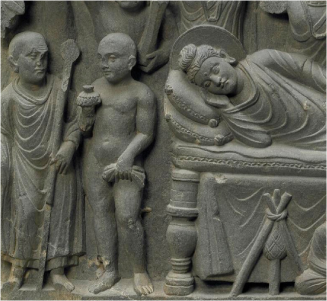
The possibility that the sectarian differences alluded to in these texts might reflect a situation older than the late-first millennium environment in which the texts were compiled is corroborated by epigraphic and artistic evidence.45 As a matter of fact, in an inscription issued by MrÌ¥geÅavarman of the Kadamba dynasty in the fourth year of his reign (during the last quarter of the fifth century), it is said that he made a gift of a village named KÄlavaá¹ ga that was divided in three portions: the first, for the temple of Jinendra situated at a place called Paramapuá¹£kala; the second, for the saá¹ gha of the Åvetapaá¹amahÄÅramaá¹as; and the third, for the use of the NirgranthamahÄÅramaá¹as.46 Another grant of the same king in the 8th year of his reign mentions a division between KÅ«rcakas, YÄpanÄ«yas, and Nirgranthas.47 In sculptural representations too, beside the naked or clad ascetics, there are mendicants represented naked, apart from a piece of cloth draped over the arm, who are interpreted to be ArdhaphÄlakas in the art of Mathura (fig. 11.1) as well as in Gandharan art (fig. 11.2) between the 2nd century BCE and the 3rd century CE.48 Consequently, it would seem plausible to assume that the vocabulary which appears in the various versions of the BhadrabÄhu legend points to an origin before the 3rd century CE in the South, when the tradition of the ArdhaphÄlakas was still alive, and that there were at least three distinct groups of monks involved in this movement. Nevertheless, the material does not make it possible to date more precisely the spread of Jainism to the South or to determine in which regions of the South it was implanted. We will now turn to a presentation of the material remains that might help us to address these questions.
Figure 11.1
Jain monk with ardhaphÄlaka from Kankali Tila, Mathura, Lucknow Museum, acc. no. J. 105

Figure 11.2
Naked Mendicant from Gandhara, National Museum of Asian Art, Washington D.C., acc. no. 49.9G
2 Material Remains
2.1 Caves, Stūpas and Statues
Unfortunately, caves supposed to be Jaina are of no great help. Indeed, the northernmost parts of the ancient Tamil country (now Chittoor district forming part of Andhra Pradesh) contain some caves with rock-cut beds for the monks and slightly raised pillows at two places, Kannikapuram and Nagari, that have been said to be of Jaina affiliation, but no inscriptions have been reported from these sites that can ascertain this affiliation and permit even an approximate dating.49 At the other extremity of the Ändhra country, in Karimnagar district of Telangana, near the border with Maharashtra, at Kapparaopet there is a rock said to be of Jaina affiliation, but it too is undated.50
In Guntur district, about 8â¯km away from the great Buddhist site of Amaravati, there is another site named Vaddamanu and adjacent to it a hillock called Peddakonda which yielded, besides potsherds, remains of a stÅ«pa possibly dating from the second century BCE.51 Sastri thinks this place to be, at least at the beginning of its existence, of Jaina and not of Buddhist affiliation.52 Sastriâs arguments are as follows: the stÅ«pas of Vaddamanu have traditional features recalling Mathura and are built with local granite, while the Buddhist ones in Amaravati use brick with new architectural features during the corresponding period. In addition, there are several inscriptions (on potsherds) allegedly reading the generic terms arahata (no. 8) and jinÄnavihÄraparibhokasame[ta] (no. 62) that are supposedly typical of Jain belief.53 However, these arguments have all been adamantly refuted by Sarma (1994). While some of his counterarguments seem to be too categorical (for instance, the fact that Vaddamanu cannot be Jain because there is no permanent structure for monks in Jainism, or because there is no stÅ«pa in early Jainism), others are relevant, like the fact that arahata could designate as much a Buddhist monk as a Jaina mendicant, or the fact that Ara can be the name of a devotee rather than apply to the 18th TÄ«rthaá¹ kara.54 Moreover, the analysis by Ingo Strauch in this volume does not leave much room for the belief that Vaddamanu could have ever been a Jaina site. Consequently, we have no sure evidence of Jaina stÅ«pas in early Ändhra.
2.2 Rather Late Land Grants
From the 10th century onward, many Jaina inscriptions were engraved in Ändhra, either in Sanskrit or in Kannada. As a matter of fact, in accordance with the usages of the RÄá¹£á¹rakÅ«á¹as, who were obviously great protectors of Jainism in Karnataka, the Eastern CÄlukyas, who were their feudatories in ÄndhradeÅa, also extended their patronage to Jaina monks and writers. For instance, the Kurkyala stone inscription dating from the time of ArikeÅarÄ« II (r. 930â958) mentions a Jaina devotee called Jinavallabha, the brother of Pampa, one of the luminaries of early Kannada literature, who constructed a temple (basadi) called Tribhuvanatilaka, a tank called KavitÄguá¹Ärá¹ava, and a garden called MadanavilÄsa and also had the statues of the first and the last TÄ«rthaá¹ karas installed. In the same inscription, it is stated that king ArikeÅarÄ« II of VemulavÄá¸a gave to the poet Pampa, as a mark of his appreciation of the Kannada work VikramÄrjunavijaya, the revenues of the village Dharmavura.55 As for Somadeva, the author of the YaÅastilakacampÅ« dated 959, he is mentioned in two inscriptions: the Parbhani Plates dated 966â¯CE, which record that ArikeÅarÄ« III, son of Baddega (or VÄdyaga), granted a village named Vanikaá¹upulu to the great Jaina scholar for the upkeep of a temple previously built by his father;56 and in the VemulavÄá¸a epigraph,57 it is stated that Baddega constructed a JinÄlaya for this same scholar, who is named here the chief of the Gauá¸asaá¹ gha, while he himself, in his work, claims to belong to a line of members of the Devasaá¹ gha.58 To account for this uncommon name in the Ändhra region, several explanations have been given. For instance, Premi (1956) said that this name is possibly linked with the Golla kingdom in the South mentioned in inscriptions of Shravana Belgola.59 Another hypothesis put forward by Chatterjee is that the name could allude to the Gauá¸a region in Bengal and, thus, to his North-Eastern origin before joining a saá¹ gha of the South.60 The latter assumption seems much more plausible, insofar as such a migration from Bengal to Karnataka is also alluded to for another lineage. As a matter of fact, as shown by Upadhye, while the earliest reference to the PañcastÅ«pa line of teachers occurs in the Paharpur plate found in Pundravardhana in the 5th century, the monks belonging to this group were found in the South by about the middle of the 7th century. This is attested by a mutilated inscription of Shravana Belgola recording the ultimate fast of a pupil of Vr̥ṣabhanandi of this line, who died there.61 Indeed this hypothesis would suggest a continuous circulation of Jainism between Bengal and Ändhra, but these two pieces of evidence, separated by four centuries, are all we have.
Before the 10th century, there are less than ten inscriptions in Ändhra linked to the Eastern CÄlukya dynasty that mention gifts or donations for the Jaina religion.62 The first charter is attributed to King Viá¹£á¹uvardhana II and issued in the first regnal year (ca. 672). It registers the âgifts of the village Pattipaka situated in Potupa district to the Jaina pontiff KanakanadyÄcÄrya probably for the maintenance of bali, vaiÅva and navakarmma-sÄraá¹as in the Jain temple constructed by the king for the merit of himself.â63 The second much later testimony is the Musinikoá¹á¸a grant dating from 762, during the reign of Viá¹£á¹uvardhana III of the Veá¹ gÄ« CÄlukya dynasty. It mentions that AyannamahÄdevÄ«, the queen of Kubja Viá¹£á¹uvardhana (624â641â¯CE), made the gift of the village Musinikoá¹á¸a for the benefit of a Jaina temple named Nadumbi Vasati at modern Vijayawada. The temple belonged to the KavurÅ«ri or Surasta-gaá¹a and Saá¹ gha-anvaya, and the gift was entrusted to the Jaina teacher KÄlibhadrÄcÄrya for the purpose of performing uninterrupted pÅ«jÄ to the venerable Arhants. Moreover, the inscription glorified the influence of Jainism at that time, since the teacher KÄlibhadrÄcÄrya is said to have made the entire circle of kings obedient to him by the power of his supramundane knowledge (divyajñÄna).64 Another record (of Jayasiá¹ha II, r. 696â709) dating from the beginning of the 8th century and registering a grant of land has been found on a broken slab near Macherla in Palnad Taluk of Guntur district.65 The third Jaina record dated from the 37th year of Viá¹£á¹uvardhana III, thus also from the 8th century, has been found in the Sattenapalle taluk of Guntur district. It refers to a Jaina temple at Munugoá¸u.66 Thus, while it is clear that Jainism enjoyed royal support in Ändhra by the 8th century, the implantation of this religion in the region in the 7th century is so far evidenced epigraphically only in the mention of a queenâs gift of a village to a Jain temple. The presence of Jainism in Ändhra at least from the 7th century onward may now be corroborated by a new inscription discovered on a bronze statue as will be discussed in the next section.
2.3 The Discovery of Two New Inscriptions on Jaina Bronzes
Only a few of the published bronze images of naked Jinas found in Ändhra seem to predate the 10th century.67 As a matter of fact, according to Shah, one of them is a Jain bronze with big eyeballs from Buddhapada, now preserved in the British Museum, dating from around the eighth century.68 The others come mainly from three sites, Bapatla in Guntur district, Lingsur in Raichur district, and Medikonda in Mehboobnagar district.69 Moreover, Shah proposes earlier dates in regard to eight of the eleven Bapatla bronzes previously analysed by Ramesan (1967) and all assigned by the latter to the 11thâ12th centuries.70 Shah dates a statue of AmbikÄ with mixed CÄlukyan and RÄá¹£á¹rakÅ«á¹a influences (Ramesan, fig. 8) to the 10th century,71 a Yaká¹£a and Yakṣī with their TÄ«rthaá¹ kara in miniature (Ramesan, fig. 7) to the 9th century,72 a sitting PÄrÅvanÄtha, a sitting NeminÄtha with his attendants Sarvaá¹a and AmbikÄ, and a sitting TÄ«rthaá¹ kara with attendants who cannot be identified (Ramesan, fig. 4, 5, 6) to the 8th/9th century,73 a standing TÄ«rthaá¹ kara with triple-umbrella above (Ramesan, fig. 1)74 and a standing Yakṣī (Ramesan, fig. 9) to around the 8th century;75 and lastly, Shah is of the opinion that another TÄ«rthaá¹ kara sitting on a pedestal (Ramesan, fig. 10) is a âspecimen of the late sixth or at best early seventh century,â because the hanging on the partly preserved pedestal is of an early tradition and the Jina figure seems to have been of late Viá¹£á¹ukuá¹á¸in influence and origin.76 In addition, according to the same scholar, a standing PÄrÅvanÄtha of Bapatla seems to date also from the 6th or 7th century, but Sivaramamurti assigns it to the 8th/9th century.77 Furthermore, while admitting that his dates are tentative because of the uncleanliness of the material,78 Shah assigns three bronzes from Medikonda to the 7th or 8th centuryâa standing TÄ«rthaá¹ kara dated to the 8th century (his fig. 32)79 and a headless Jina of the 7th century (figs. 23; 24); a Jina image looking young and almost boyish (fig. 26)80âand eight bronzes from Lingsur to between the 6th and the 8th centuries: five standing TÄ«rthaá¹ karas whom he dates to the 8th century (figs. 21; 26â29);81 an inscribed pedestal of a TÄ«rthaá¹ kara image ascribed to the 6th/7th century (fig. 20);82 and two standing TÄ«rthaá¹ karas, which he dates to the 6th century (fig. 15; 16).83 The inscription shown in Shahâs fig. 20, which remains undeciphered to the best of my knowledge, has been inventoried as EIAD 577. For the two bronzes assignable to the 6th century, Shah provides details as follows:
the fig. 15 offers close correspondence with the face of standing Buddha from Buddhapada (= Buddham) illustrated in fig. 14A. The modelling of the torso and legs of the Jina is also graceful and well proportioned. In the rendering of the ears with long ear-lobes, the Jina figure corresponds with the Buddha image.
Thus, the dating proposed for Jaina statues of Ändhra is subject to fluctuation and would require a new study relying on state-of-the-art technologies. In this context, the discovery of bronzes unknown so far is a welcome addition.
Figure 11.3aâb
Standing Jaina TÄ«rthaá¹ kara from Bapatla (a. front view of the image; b. inscription on the pedestal), Telangana State Museum, Hyderabad
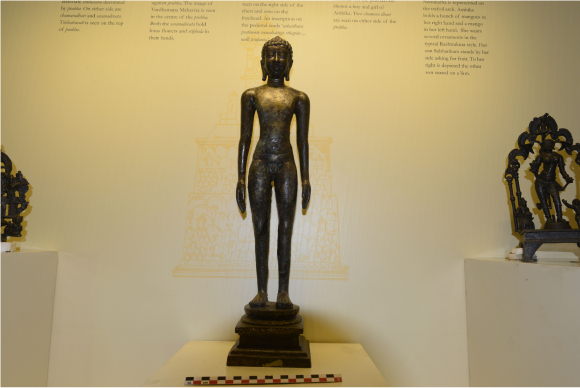

Among the still unpublished material, in the Telangana State Museum (acc. no. 2003â278) at Hyderabad, there is a bronze supposedly originating from Bapatla and bearing the inscription inventoried as EIAD 593 (fig. 11.3aâb).84 According to Akira Shimada, as the facial expressions of the image clearly show the influence of Gupta-period Buddhist sculpture and recall the Buddha image from Buddham mentioned above, the statue can be dated roughly to the post-Gupta period (6th/8th century CE).85 Moreover, the fact that the one-line Sanskrit inscription on the base of the statue is written in a late Southern BrÄhmÄ« script also suggests a date around the 7th century (fig. 11.3b). The text is very damaged and has been tentatively established by Arlo Griffiths as follows:
Figure 11.4aâb
Seated Jina from Ramatirtham (a. front view of the image; b. inscription on the pedestal), Archaeological Museum, Salihundam


(1) ma[he] ? [smÄni]prati[mÄ] ? ? [ma]ka[ndega]sthÄpita ? gu ? nandi pra pari[daya] ? ?86
I am not able to propose a better reading. The only suggestion I would make concerns nandi. Indeed, since the term nandin characterises one of the main branches of Jainism (Nandisaá¹ gha) in South India along with the Senaâ, Deva- and Siá¹hasaá¹ ghas,87 there are many names of Jaina teachers in the South ending in ânandin, the most famous of them being Padmanandin, better known under the name Kundakunda. So the presence of nandi suggests that the name given here designates the name of the Jaina ascetic in charge of, or to whom the temple is dedicated. However, in the current state of the inscription, it is not possible to decide which name it is.88
Another inscription, inventoried as EIAD 656, on a Jaina stone sculpture from Ramatirtham, Vizianagaram District, datable to the 7th/8th century (kept at Salihundam, Sculpture Gallery, no. 6), has been recently identified by Griffiths and Tournier (fig. 11.4aâb).89 A very provisional reading was provided by them:90
(1) ÅrÄ«khanebudha ? bhapa ? ? ? ÅrÄ«(2) pra ? ? ? ? # ? ?(3) ÅrÄ« ? se #
Consequently, the new data from inscribed sculptures would seem to corroborate some of the statuary material analysed by Shah, as well as the evidence from land grants surveyed above, and allow us to state with confidence that Jainism emerged in Ändhra during the 7th century.91 As discussed above, Jainism may have been present throughout the second half of the first millennium as a result of contact from Bengal,92 as suggested by the donations to Jaina monasteries in Pundravardhana in the 5th century and the subsequent mention, in the 10th century, of a Gauá¸agaccha for the highly honoured teacher named Somadeva. But this remains speculative and must await to be confirmed by further discoveries.
I would like to thank here Arlo Griffiths, Oskar von Hinüber, Basile Leclère, Andrew Ollett, Annette Schmiedchen, and Akira Shimada for their insightful comments and suggestions on this paper.
Among the remains, there are elaborate carved stone plaques known as ÄyÄgapaá¹as dating back to the 1st century BCE and extending up to the 1st century CE: see for instance Sircar 1965: 118, no. 25, a Mathura ÄyÄgapaá¹a of the time of ÅodÄÅa, dated from the year 72 (= 15â¯CE? [supposition of Sircar]) comprising a dedication to the Arhat VardhamÄna (nama arahato vardhamÄnasa); Shah 1955: 77â84; Quintanilla 2000: 79â137 and 2007: 99â103; on the possible derivation of the word ÄyÄga, see von Hinüber 1974: 358, n. 15; on the etymology of ÄyÄgapaá¹a, see Rau 1969: 906. In addition, there are between the 2nd century BCE and the 3rd century CE representations on stone sculptures of a peculiar sect of Jaina monks âidentified by the broad piece of pleated cloth draped over the left forearms of the otherwise nude bodyâ (Quintanilla 2004: 187â216). On the remains at Mathura and Kankali Tila, see Bühler 1898; Mitra 1974; Shah 1987: 9â10; Jaini 1995; Sharma 2001: 124â143.
In the caves of Udayagiri the famous Hathigumpha inscription of KhÄravela, King of the Kaliá¹ gas, begins with a homage to the Jinas and mentions a gift to Jaina mendicants: see Cort 2010: 25â32. It is not sure however that KhÄravela, whose reign the majority of scholars place in the late decades BCE and/or early decades CE (Cort 2010: 41), was a Jaina himself since he mentions gifts to all mendicants (see Dundas 2002: 113). The dating of the poorly preserved inscription (Salomon 1998: 142) has been the subject of extensive debate between scholars: for instance, while it is assigned to the 2nd century BCE by Kant 2000, it is ascribed to the 1st century CE by Sircar (1965: 206): âThe angular and straight bases of letters like va, ma, pa, ha and ya, which are usually found in the HÄthÄ«gumphÄ record, suggest a date not much earlier than the beginning of the 1st centuryâ. Its historical interpretation has also been widely varied (Salomon 1998: 164), but according to Cort (2010: 40), Sircarâs work âremains the most critical edition of the inscription.â Griffiths (2015; 2018) has newly edited, translated and analysed two of the three grants found in Bengal and dedicated to members of the Jaina community during the 5thâ6th centuries CE: the Jagadishpur plate 128 Gupta Era (= 448â¯CE); the Paharpur plate 159 ge (= 479â¯CE); and the grant dedicated to three monasteries (ÅiṣīpuñjÄ, MadhyamaÅrÌ¥gÄlikÄ, and GrÄmakÅ«á¹agohÄlÄ«) dated 198 ge (= 518â¯CE).
In his book, Desai (1957: 25) assumes that the Jainas came to Tamil Nadu either by the Eastern maritime route that passed along the coast of Ändhra or by the terrestrial one from Karnataka. See also Dundas 2002: 113. As is underscored by Sastri (2004: 229â230), âthe roads through Avanti in Central India and Coastal Ändhra have similar features: both regions have strategic locations that served as the nuclear regions of trade and political power. [â¦] The former lying towards the north-west provides access to the West-Asian countries for commercial and political links, while the latter far away towards south-east across the Deccan plateau, has an open stretch of the sea of the Bay of Bengal that facilitated maritime contacts with the countries of the Far-East.â Besides, both regions are very fertile, with the Sipra at Ujjain and the two rivers, Krishna and Godavari, in Ändhra (Sastri 2004: 229â237).
For studies on Jainism in South India, see for instance Desai 1957; Champakalakshmi 1974; Sivaramamurti 1983; Joseph 1997; Parasher-Sen 2004. For Tamil Nadu: Ekambaranathan 1996; Orr 1998; Veluppillai 2003: 315â335; Ekambaranathan & Sivaprakasam 2005; Balbir et al. 2006; Mahadevan 2014. For Karnataka: Singh 1975; Bisschop & Cecil 2021. And for Ändhra: Sastry 1974; Arundhati 1990; Hanumantha Rao 1993, 1997; Choudary & Hema 2004; Sastri 2004.
See Desai 1957: 25â174 and Champakalakshmi 1974. For inscriptions, see for instance Sivaramamurti 1983: 38 and Mahadevan 2014; for sculptures, see Champakalakshmi 1974: 94.
See Altekar 1960, 1967; Chatterjee 2000: 117â128; Nagarajaiah 2000, 2014; Schmiedchen 2014.
See Prasad 2004.
The KÅ«rcakas are among the recipients (the others being the YÄpanÄ«yas and the Nirgranthas) of the Halsi grant made by MrÌ¥geÅavarman in the 8th year of his reign in the last quarter of the 5th century (c. 435). See Chatterjee 2000: 124 (referring to Fleet 1877) and Bisschop & Cecil 2021. The Boá¸iyas are mentioned as a schismatic group and as inauspicious in several ÅvetÄmbara canonical works and their commentaries and have been interpreted either as Digambaras (Jain 1984: 274) or as YÄpanÄ«yas (Dhaky & Jain 1991).
On the YÄpanÄ«yas, see Upadhye 1973, 1974; Jaini 1995, 2008.
See Schmiedchen 2014: 201â203; Vasudevan 2004: 291â293.
On this term, feminine form of kuravar, Tamil equivalent of the Sanskrit word guru, see Veluppillai 2003: 326.
See Orr 1998: 190, 196; Veluppillai 2003: 327â328.
See Upadhye 1983b (1974): 199; for a survey of the Jaina works produced in the first millennium, see for instance Jain 1963.
See for instance Desai 1957: 154â157.
See Kirfel 1920: 225â226, 246â247.
For the mentioned names, Sikdar (1964: 508â517) prudently proposes the following identifications: BabbariyÄ = Skt. BarbarikÄs; Īsigaá¹iyÄ = Skt. ĪṣikÄs (mentioned among tribes in the MatsyapurÄá¹a and in the VÄyupurÄá¹a); VÄsagaá¹iyÄ = Skt. VÄsagaá¹ikÄs; Joá¹hiyÄ = Skt. YavanikÄs; PalhaviyÄ = Skt. PahlavikÄs, Parthians (Bactrians); LhÄsiyÄ = ? Skt. NÄsikyÄs; LausiyÄ (not identified); ÄrabÄ« = Arabs; DamilÄ« = Skt. DrÄviá¸ikÄs; Siá¹ ghalÄ« = Sinhalese; PulindÄ« = Skt. PulindikÄs, a tribe; PukkhalÄ« = Skt. Puá¹£kalÄ«s; BahalÄ« = Skt. VÄhlikÄs, Bactrians; Muruá¹á¸Ä« = a tribe; SabarÄ« = Skt. ÅabarÄ«, a tribe; PÄrasÄ« = Skt. PÄraÅÄ«, Persians.
On their sinful behaviours, see Paá¹hÄvÄgaraá¹a (I.4: 1202.13â22): kÅ«ra-kamma-kÄrÄ« ime ya bahave milakkhu-jÄtÄ«, kete? pÄva-maiá¹o jalayara-thalayara-saá¹apphayoraga-khahacara-saá¹á¸Äsa-toá¹á¸a-jÄ«vova(g)gghÄya-jÄ«vÄ« [â¦]; cf. VyavahÄrabhÄá¹£ya 7.126. This description is to be found also in Hindu sources, as mentioned by Jain 1984: 354.
In the edition that I consulted, the list of the Paá¹á¹avaá¹Ä presents several variants compared to that of the Paá¹hÄvagaraá¹a: niá¹á¹aga instead of tittiya; aá¹baá¸a instead of aá¹dha; baá¹dhuyÄ ya sÅ«yali instead of caá¹cuyÄ ya cÅ«liyÄ; maggara instead of madhura; á¹addara moá¹á¸ha instead of nehura-marahaá¹á¹a; bharu instead of ruru. Although these variants may partly be due to the manuscript usedâWeber (1883: 295, 303) noted the important textual discrepancies in this passage between the manuscriptsâ, they also testify to competing lists: thus, laosa paosa kakkeya akkhÄga instead of muá¹á¹hi(a)ya Äraba and the addition of godha. See Paá¹á¹avaá¹Ä (I.64:285.5â9): saga javaá¹Ä cilÄyÄ sabara babbara kaya muruá¹á¸a uá¸a bhaá¸aga niá¹á¹aga pakkaá¹iyÄ kulakkha goá¹á¸a siá¹hala pÄrasa godhÄ koá¹ca aá¹baá¸ai damila villala pulinda Ärosa á¸omba pokkÄá¹a gandhÄ hÄraga bahalÄ«a a jhalara umamÄsa vausÄ malayÄ ya baá¹dhuyÄ ya sÅ«yali kuá¹kuá¹aga meya palhava mÄlava maggara ÄbhasiyÄ anakka cÄ«á¹a lhasiya khasÄ ghÄsiya á¹addara moá¹á¸ha á¸oá¹bilaga laosa paosa kakkeya akkhÄga hÅ«á¹a romaga bharu bharuya cilÄya visaya-vÄsÄ«ya evam ÄÄ«.
The dating is proposed by Weber (1883: 303) on the grounds of the mention of Parthians and Bactrians. The mention of the term Äraba/ÄrabÄ«, which seems to be attested since the Periplus of the Erythaean Sea (Sikdar 1964: 511), does not help to date the text more precisely.
Dundas (2002: 23): âThis is unquestionably a composite text and it is difficult to be confident about which portions of it are genuinely old and which originated nearer to the Council of ValabhÄ« when the version which we have was finally redacted.â For a study of the structure of the text with a nucleus and various accretions, see Deleu 1970: 17â69.
Unlike many Indian literary works, the KuvalayamÄlÄ is precisely dated by its author, Uddyotana (283.6); see Chojnacki 2008: 773 and 2018: 1169.
Upadhye (1970: 175â176) has identified VijayapurÄ« with Vijayadurga in Ratnagiri district, about 80â¯km north of Goa (see Chojnacki 2008: 436).
If these are not a mere sampling of words, as phrase they could possibly signify âa little for us, a little for youâ: amhaá¹ tumhaá¹ seem to be the regular Prakrit forms for the personal pronouns 1st and 2nd persons plural; kÄuá¹ is difficult: could it be the equivalent of kÄiá¹, the indefinite pronoun kÄni(cid)?
Maybe âit is fine for usâ? According to Master 1950: 414, the expression aá¸i paá¸i means in Telugu âit is fineâ; mare could be a form of the personal pronoun 1st pers. plural.
Maybe âit is fine, comeâ? According to Master 1950: 415, the terms aá¹i puá¹i can be a variant from aá¸i pÄá¹á¸i, but raá¹iá¹ is difficult. Upadhye (1970: *145) prudently proposes to understand it as a variant of raá¹á¸i âcomeâ.
Ed. Åivadatta & Parab, vol. I, pp. 33â34. The passage was summarized in Handiqui 1968: 21â22.
For a discussion on the location of the Kambojas in Northern India, see for instance Sircar 1971: 195â200.
Sircar (1971: 33) equates Pallavas with Pahlavas being the Pahlavis or Sassanians of Persia. Because of the logic of the presentation of the list, which evokes a digvijaya from Ändhra clockwise to the Southeast, South, West, North and Northeast, I think that it is more plausible to take this name to designate people of the North rather than to equate them with the Pallavas of the South. Of course, the equivalence -ll- and -hl- cannot be justified phonetically but could be explained by an influence of the other use of the designation Pallava.
On the identification of the people mentioned, see Sikdar 1964: 510; 512 and Sircar 1971: 75â117.
See for instance Schubring 1935, §§â¯82â85.
ujjeá¹Ä« se kumÄra-bhottÄ« diá¹á¹Ä | teá¹a suraá¹á¹haâvisao aá¹dhÄ damilÄ ya uyaviyÄ. âUjjayinÄ« was given to the prince as a province. He had also subdued the region of SaurÄá¹£á¹ra as well as that of the Ändhras and Dramilas.â The story of the conquest is taken up in various canonical commentaries from the 6th century onward. See Mehta & Rishabh Chandra 1970â1972: 741 (citing BrÌ¥hatkalpabhÄá¹£ya 3283â3289; BrÌ¥hatkalpavrÌ¥tti of Ká¹£emakÄ«rti, p. 915; KalpasÅ«travrÌ¥tti of ÅÄntisÄgara, p. 196). The tradition of Samprati as a staunch Jaina likewise has a long history: it also occurs in Hemacandraâs PariÅiá¹£á¹aparvan IX and XI. See Jacobi 1932 and Dundas 2002: 116â118.
See Dundas 2002: 116.
See Altekar 1960: 253â280.
Dundas 2002: 118 (referring to Singh 1975: 6; Nagarajaiah 1999); Chatterjee 2000: 118â119. In literary sources, the legend of Siá¹hanandin is developed in the commentary of the Gommaá¹asÄra, dating to the end of the 10th century (Chatterjee 2000: 119, referring to Mysore Archaeological Report 1921: 26).
See Jacobi 1884.
BhadrabÄhu seems to have been a figure important for both the ÅvetÄmbara and the Digambara tradition. While the latter attributes to a teacher of this name the migration to the South (Desai 1957: 98; Choudary & Hema 2004), the former credits him with the redaction of several canonical scriptures (DaÅavaikÄlikasÅ«tra, KalpasÅ«tra, VyavahÄrasÅ«tra: VyavahÄrabhÄá¹£ya) and with the composition of various commentaries (Mehta & Chandra 1970â1972: 516). The difficulties arising from the gap of time have been accounted for by postulating of two BhadrabÄhus, one not long after MahÄvÄ«ra, and one junior (called LaghubhadrabÄhu) living at the time of Candragupta in the 3rd century BCE (ibid.). But even so, it is not easy to classify the numerous canonical and exegetical works that are assigned to him.
It is Candragupta in the BrÌ¥hatkathÄkoÅa and Samprati in the Vaá¸á¸ÄrÄdhÄne.
Dundas 2002: 225. For a discussion on the royal patronage associated with BhadrabÄhu, see also Balcerowicz 2018.
On the complexity of the relations between both sects, see Dundas 2002: 45â52.
See Dundas 2002: 46â47.
In the epigraphical material, the words ÅvetÄmbara and Digambara occur neither in the inscriptions of the 5th century from Bengal analysed by Griffiths (2015; 2018) nor in the Tamil inscriptions from the 5th up to the 9th century studied by Veluppillai (2003) and from the 9th to the 13th century studied by Orr (1995: 209). In the literary material, the authors do not use either the terms ÅvetÄmbara or Digambara before a late date; in fact, still in the 8th century, at the end of the UttarapurÄá¹a of Guá¹abhadra (continuing the
The possession of a bowl is not permitted for the Digambara monks who eat in their hands (Jaini 1979: 41, 184).
As recalled by Quintanilla (2004: 187â189), in the inscriptions accompanying the representations of these monks, they are called Nirgranthas. Thus, the designation ardhaphÄlaka seems to be a nickname given to them by rival groups after their mendicant emblems, a half-piece (ardha) of cloth (phÄlaka) that the ascetics draped over their left forearms to cover their nudity (Wiley 2004: 39). The etymology of the expression is not certain; von Glasenapp (1925: 348) surmised that it may refer to those who have half-rags.
For instance, in the Hathigumpha inscription, when it is mentioned that the king gratifies mendicants with white clothes (vÄs[Äsi]tÄni in Sircar 1965: 218, with suggestion to emend vÄsÄsitÄnaá¹; vasa-sitÄn(Ä) in Kant 2000: 19), the name associated with it is not ÅvetÄmbara but a term that has been subjected to many different readings: java-ñÄvaka, yÄpÅ«ja, yÄpuha, yÄpaá¹a (Sircar 1965: 217 n. 11) or yÄpujavaka (Sircar 1965: 217; Kant 2000: 19). The term yÄpuniya occurs in an inscription on a copper-plate from Nellore district in Andhra Pradesh dating from 965 (Hultzsch 1907â1908): the donee of the grant is the priest in charge of the temple, the lord of ascetics, Jinanandin, belonging to the pure Nandigaccha and to the Koá¹imaá¸uvagaá¹a associated to the YÄpanÄ«yasaá¹ gha (lines 49â50); the grant is the small village of Maliyapundi (l. 55) given with exemption from all taxes and with libation of water for the cost of repairs of breaks and cracks, offerings, worship, etc. and of an alms-house (sattra) on the occasion of the winter solstice.
See Fleet 1878: 37â38 (lines 20â22).
See Guérinot 1908, no. 99; Fleet 1877; Chatterjee 2000: 124; see also Schmiedchen 2018.
See Shah 1987: 43.
Prasad (2004: 82) dates these caves from the 2nd century BCE but without giving arguments for the dates.
See Krishna Sastry 1983: 125; Jawaharlal 2002: 134.
See Sastri 2004: 231â232. On stÅ«pas in Jainism, see Smith 1901; Upadhye 1983a (1949): 279â283.
See for instance Sastri, Kasturi Bai & Veerender 1992: 24.
See Sastri, Kasturi Bai & Veerender 1992: 116â140.
See Sarma 1994.
Chatterjee 2000: 175â176.
Suryanarayana 1993: 19; Chatterjee 2000: 177.
See Chatterjee 2000: 176.
See YaÅastilakacampÅ«, ed. Åivadatta & Parab, vol. II, p. 418.
See ed. Handiqui 1968: 5.
Chatterjee 2000: 177.
On this lineage of monks, see Upadhye 1983a (1949): 279â283; see also Griffiths 2018.
See Sastry 1974; Suryanarayana 1993; Vasudevan 1999; Vasudevan 2004: 291â298.
See Sastry 1994: 46, 49. Four other charters of this king are known: the Reyuru grant (2nd year), the first set of Pantimuku grant (3rd year), the Palivada grant (5th year), the second set of Pantimuku grant (both are undated). On these and the signification of navakarma-sÄraá¹as, see ibidem.
Chatterjee 2000: 192 (Annual Report on South Indian Epigraphy, 1916â1917, copperplate no. 16).
Chatterjee 2000: 192 (Annual Report on South Indian Epigraphy, 1941â1942, no. 18).
Chatterjee 2000: 192 (Annual Report on South Indian Epigraphy, 1929â1930, nos. 17â19).
In his study, Shah (1975: 275, 285) noticed that very few bronzes of Andhra Pradesh were published and that this was the reason why he was presenting a number of less known Jaina bronzes, especially the bronzes from the Lingsur and Medikonda hoards from Andhra Pradesh. While Sivaramamurti (1983) does take into account the Bapatla bronzes (see below), he leaves out the material from Lindsur and Medikonda, which are in need of analysis with todayâs technical possibilities. To give an idea of the difficulties of dating, one can cite the example of a Bapatla bronze of a TÄ«rthaá¹ kara with a ÅrÄ«vatsa mark on the chest, assigned by Shah to the 12th century (1975: fig. 22) and by Sivaramamurti to the 8th century (1983: 21 [fig. 14]).
Shah 1975: 279, 297: fig. 62. The figure of the attendant Yaká¹£iá¹Ä« is lost.
Shah 1975: 275.
Shah 1975: 279â280. Cort (2010: 45) urges us to handle Shahâs dating with great caution and writes that âespecially in the case of objects from ancient India, Shah tends to date objects at least a century earlier than the scholarly consensus warrants.â That Shah does not always opt for the earliest date possible is suggested by fig. 22 (cf. n. 66).
Ramesan (1967: 30) writes that âcertain features of the image are recognisable in the CÄlukyan sculptures of Jammidoddi near Vijayawada.â Sivaramamurti (1983: 233, 245 [figs. 331, 350, 249]) assigns this AmbikÄ to an even earlier date, namely the 8th/9th century.
See Sivaramamurti 1983: 248 (fig. 355).
For the bronze of PÄrÅvanÄtha, Sivaramamurti (1983: 233 [fig. 332]) gives the same date as Shah; but for the statues of NeminÄtha and another TÄ«rthaá¹ kara, Sivaramamurti does not give any date (respectively 252 [fig. 361]; 251 [fig. 360]).
Shah 1975: 293 (fig. 17), Bapatla hoard no. P. 5309, Hyderabad Museum, height 27â¯cm; also Sivaramamurti 1983: 232; 257 (figs. 330, 357, 249).
Shah 1975; Sivaramamurti 1983: 236, 248 (figs. 337, 356). Sivaramamurti gives a broader range (8thâ9th centuries) and makes the additional assumption that the Yakṣī holding, for PÄrÅvanÄtha, an umbrella broken beyond the handle is PadmÄvatÄ«.
Shah 1975: 293 (fig. 19), Bapatla hoard no. P. 5317, Hyderabad Museum, height 18â¯cm. As Vincent Tournier has pointed out to me, there is evidence (EIAD 175) that the Viá¹£á¹ukuá¹á¸ins who reigned in the region of the Krishna from the early 5th to the late 6th/early 7th centuries fought with the Pallavas. Among the most famous monuments of their reign, there are the rock-temples of Mogalrajapuram near Vijayawada (Sivaramamurti, Okada & Zéphir 1999: 195). Their specific style (with pillars divided in three sections and a decoration of lotus-medallions), inspired by the art of Amaravati, influenced the first Pallava temples (ibidem: 463; 466).
Shah 1975: 293 (fig. 18), Bapatla hoard no. P. 5308, Hyderabad Museum, height 9â¯cm; Sivaramamurti 1983: 250 (fig. 358).
Shah 1975: 285â287.
From the motif of the halo and the backrest.
Shah 1975: 284â285.
Shah 1975: 285.
Shah 1975: 285, 293: âAn uncleaned pedestal of a TÄ«rthaá¹ kara image (brass or bronze), with inscription running probably on three sides, on both the upper and lower rims, is obtained in the Lingsoor hoard (Department of Archaeology, A.P. State, Hyderabad). The letters seem to belong to the six-seventh century.â
Shah 1975: 284.
It is said on the museum label to originate from Bapatla, but the reliability of this information cannot be taken for granted. The history of the find is not known to me. This bronze is apparently unpublished; it is not included in Gopalakrishna Murthy 1963, Ramesan 1967, Shah 1975, or Sivaramamurti 1983.
Personal communication from Akira Shimada in an email from 09/04/2018. For the Buddham bronzes, see Sewell 1895.
Griffiths indicated to me in a mail from 10/07/2017 various possible reading variants: [he] could be read [hi], [ghe], [ghi]; ? could be read[ta]/[na] or [t]/[n]with some other vowel; [smÄ] could be read [smo], [smÄ], [sthÄ]; [ni] could be read [rna], [nÄ], [rta]; [mÄ] could be read [pa] or [ha]; ka is not completely sure, but is the most probable, that is why it is given without brackets; [ndega] could be read [ndiga], [ttiÅa], [tteÅa] or other combinations; the [ma] is only vaguely visible, and several other options are possible: [pa], [ca], [va], [dha].
See for instance Dundas 2002: 121 referring to Epigraphia Carnatica 1973, no. 360.
The name Guhanandin is attested in a Sanskrit inscription from 5th-century Bengal, the Paharpur copper plate grant of the Gupta year 159. Another name, Guá¹anandin, is attested at least in two gaá¹as of South India. One is the DeÅÄ«gaá¹a, comprising the lineage of Kundakunda, UmÄsvÄti, BalÄkapiccha and Guá¹anandin which is mentioned in several inscriptions mainly from Shravana Belgola from the 5th to the 12th centuries. See Guérinot 1908, nos. 95, 255, 285, 323, 388, 547. However, the inscription attributed to the 5th century seems to be a forgery dating from the RÄá¹£á¹rakÅ«á¹a period. Another is the KrÄá¹Å«r-gaá¹a that presents the following lineage: Guá¹acandra, Guá¹anandin, PrabhÄcandra (976) in later inscriptions from the 12th century; see Guérinot 1908, nos. 267, 277, 299.
Rea 1910â1911: 83, pl. XLIII (4). The inscription is unnoticed by Rea and not visible in his illustration. Concerning the Jaina affiliation of the statue, Karine Ladrech wrote to Arlo Griffiths in an e-mail dated 16/03/2019: âConcernant cette sculpture, je penche moi aussi pour une obédience jaïne, même sâil est difficile dâen être tout à fait certain à cause de son état de conservation médiocre. Le buste est très abîmé et il nâest pas possible de déterminer sâil a pu y avoir trace dâun vêtement ou non. Sur les jambes, on ne distingue pas de bordure inférieure dâun vêtement, ce qui fait pencher la balance en faveur dâun Jina, mais sur certaines sculptures de Buddha cette bordure nâest pas très apparente et étant donné que la pierre ici est un peu abîmée, câest gênant dâaffirmer que câest un Jina sur ce seul critère. Mais jâai bien lâimpression quâil y a un triple parasol et non pas un parasol simple au-dessus de sa tête ⦠ce qui confirmerait lâidentité jaïne (Owen 2012: 62). Le décor du piédestal est inhabituel, non seulement par les objets sculptés, mais aussi par leur position (pas un objet bien au centre, absence de symétrie); je nâai pas trouvé dâimage présentant un piédestal similaire; il est peut-être en lien avec le contenu de lâinscription?â
The symbol # marks an interruption in lines 2 and 3 by part of the socle.
Scholars present various reasons for a late presence of Jainism in ÄndhradeÅa: one reason surmised by Champakalakshmi (2011: 415) and Arundhati (1990: 204) would be that it suffered from strong competition not only from Hinduism, but also from Buddhism, which was dominant in the region and had royal support.
See Chatterjee 2000: 105: âIt should here be emphasised that the Jaina monks of Bengal and Orissa were responsible of the early propagation of Jainism in Tamil Nadu and not those of Karnataka, as is usually believed.â
Texts and Editions Cited
UttarapurÄá¹a of Guá¹abhadra. Edited and translated by Pannalal Jain, 1954.
KahÄkosu of ÅrÄ«candra. Edited by Hiralal Jain, 1969.
KuvalayamÄlÄ of Uddyotana. Edited by A.N. Upadhye, 1959 and 1970.
DharmopadeÅamÄlÄvivaraá¹a of Jayasiá¹hasÅ«ri. Edited by L.Bh. GÄndhÄ«, 1949.
NiÅÄ«thasÅ«tra with BhÄá¹£ya and ViÅeá¹£acÅ«rá¹Ä«, part II: UddeÅika 1â9. Edited by Amara & KanhaiyayÄlÄla âKamala,â 2005.
Paá¹á¹Ävaá¹Ä in SuttÄgame, volume II. Edited by Muni ÅrÄ« PhÅ«lchandjÄ« MahÄrÄja, 1954, 265â533.
PanhÄvÄgaraá¹a in SuttÄgame, volume I. Edited by Muni ÅrÄ« PhÅ«lchandjÄ« MahÄrÄja, 1953, 1199â1239.
PariÅiá¹£á¹aparvan of Hemacandra. Edited by H. Jacobi, 1932
BhagavaÄ« in SuttÄgame, volume I. Edited by Muni ÅrÄ« PhÅ«lchandjÄ« MahÄrÄja, 1953, 384â816.
BrÌ¥hatkathÄkoÅa of Hariá¹£eá¹a. Edited by A.N. Upadhye, 1943.
YaÅastilakacampÅ« of Somadeva. Edited by Åivadatta & Parab, 1901 and 1903.
Vaá¸á¸ÄrÄdhane of Åivakoá¹yÄcÄrya. Edited by D.L. Narasimhachar, 1959.
Bibliography
Altekar, Anant Sadashiv. 1960. âThe RÄshá¹rakÅ«á¹as.â In The Early History of the Deccan, Parts IâVI, edited by Ghulam Yazdani, 247â314. London: Oxford University Press.
Altekar, Anant Sadashiv. 1967. RÄshá¹rakÅ«á¹as and Their Times. 2nd rev. ed. Poona Oriental Series 36. Poona: Oriental Book Agency.
Amara & KanhaiyayÄlÄla âKamala.â 2005. Nisith Sutram (with Bhasya) by Sthavir Pungava Shri Visahgani Mahattar and Vishesh Churni by Acharya Pravar Shri Jinadas Mahattar, Part II: Uddeshika 1â9. First edition 1960. VÄrÄá¹asÄ«: Amar Publications.
Amara & KanhaiyayÄlÄla âKamala.â 2005. Sthavira-Puá¹gava ÅrÄ« VisÄhagaá¹i Mahattara-Praá¹Ä«taá¹, SabhÄá¹£yaá¹ NiÅÄ«thi-SÅ«tram, ÄcÄrya-Pravara ÅrÄ« JinadÄsa Mahattara-ViracitayÄ ViÅeá¹£a-CÅ«rá¹i Samalaá¹krÌ¥taá¹. Reprint of the first edition (1960). 4 volumes. VÄrÄá¹asÄ«: Amara Publications.
Arundhati, P. 1990. BrÄhmanism, Jainism, and Buddhism in Ändhra DÄÅa. Delhi: Sundeep Prakashan.
Balbir, Nalini, Karine Ladrech, N. Murugesan & K. Rameshkumar. 2006. Jain Sites of Tamil Nadu. Regards sur lâAsie du Sud / South Asian Perspectives 12. Pondicherry: French Institute of Pondicherry.
Balcerowicz, P. 2018. âRoyal Patronage of Jainism: The Myth of Candragupta Maurya and BhadrabÄhu.â In The Gift of Knowledge: Patterns of Patronage in Jainism. Essays in Honour of Prof. Hampa Nagarajaiahâs Promotion of Jain Studies, edited by Christine Chojnacki and Basile Leclère, 33â66. Bengaluru: Sapna Book House.
Bisschop, Peter C. & Elizabeth A. Cecil. 2021. âJayati BhagavÄñ Jinendraḥ! Jainism and Royal Representation in the Kadamba Plates of PalÄÅikÄ.â Journal of the American Oriental Society 141 (3): 613â635.
Bühler, Johann Georg. 1898. âA Legend of the Jaina Stupa at MathurÄ.â Indian Antiquary 27: 49â54.
Champakalakshmi, R. 1974. âSouth India.â In Jaina Art and Architecture: Published on the Occasion of the 2500th Nirvana Anniversary of Tirthankara Mahavira, edited by Amalananda Ghosh, vol. 1:92â103. New Delhi: Bharatiya Jnanpith.
Champakalakshmi, R. 2011. Religion, Tradition, and Ideology: Pre-Colonial South India. New Delhi: Oxford University Press.
Chatterjee, Asim Kumar. 2000. A Comprehensive History of Jainism, Vol. I: From the Earliest Beginnings toad1000. 2nd rev. ed. New Delhi: Munshiram Manoharlal.
Chojnacki, Christine. 2008. KuvalayamÄlÄ: Roman jaina de 779 composé par UddyotanasÅ«ri. 2 volumes. Marburg: Indica et Tibetica.
Chojnacki, Christine. 2018. UddyotanasÅ«riâs KuvalayamÄlÄ: A Jain Novel from 779ad. Translated by A. Reynolds. Bengaluru: Sapna Book House.
Choudary, K.K. & P. Hema. 2004. âAdvent of Jainism in Andhra.â In Kevala-Bodhi: Buddhist and Jaina History of the Deccan, edited by Aloka Parasher-Sen, vol. 2: 238â241. Delhi: Bharatiya Kala Prakashan.
Cort, John E. 2010. Framing the Jina: Narratives of Icons and Idols in Jain History. Oxford: Oxford University Press.
Deleu, Jozef. 1970. ViyÄhapannatti (BhagavaÄ«): The Fifth Anga of the Jaina Canon. Introduction, Critical Analysis, Commentary and Indexes. Brugge: De Tempel.
Desai, P.B. 1957. Jainism in South India and Some Jaina Epigraphs. Sholapur: Jivaraja Jaina Granthamala.
Dhaky, Madhusudan A. 1991. âA Propos of the Boá¹ika Sect.â In Pt. Dalsukh Bhai Malvania Felicitation Volume, edited by SÄgaramala. Jaina and Madhusudan A. Dhaky, vol. 1: 131â139. Varanasi: Parshvanath Vidyashram Shodh Samsthan.
Dundas, Paul. 2002. The Jains. 2nd edition. London & New York: Routledge.
Ekambaranathan, A. 1996. Jainism in Tamil Nadu: Art and Archeology. Missisauga: Jain Humanities Press.
Ekambaranathan, A. & C.K. Sivaprakasam. 1987. Jaina Inscriptions in Tamilnadu: A Topographical List. Madras: Research Foundation for Jainology.
Fleet, John Faithfull. 1877. âSanskrit and Old Canarese Inscriptions: No. XXIâKadamba Grant of MrÌ¥geÅavarman.â Indian Antiquary 6: 24â25.
Fleet, John Faithfull. 1878. âSanskrit and Old Canarese Inscriptions: No. XXXVIâKadamba Grant of MrÌ¥geÅavarman.â Indian Antiquary 7: 33â38.
GÄndhÄ«, LÄlacandra BhagavÄndÄsa. 1949. DharmopadeÅamÄlÄ-Vivaraá¹a of ÅrÄ« Jayasiá¹ha SÅ«ri. Singhi Jain Series 28. Bombay: Bharatiya Vidya Bhavan.
Glasenapp, Helmuth von. 1925. Der Jainismus: Eine indische Erlösungsreligion. Kultur und Weltanschauung 1. Berlin: Alf Häger.
Gopalakrishna Murthy, S. 1963. Jain Vestiges in Andhra. Archaeological Series 12. Hyderabad: Govt. of Andhra Pradesh.
Griffiths, Arlo. 2015. âNew Documents for the Early History of Puá¹á¸ravardhana: Copperplate Inscriptions from the Late Gupta and Early Post-Gupta Periods.â Pratna Samiksha: A Journal of Archaeology New Series 6: 15â38.
Griffiths, Arlo. 2018. âFour More Gupta-Period Copperplate Grants from Bengal.â Pratna Samiksha: A Journal of Archaeology New Series 9: 15â57.
Guérinot, Armand. 1908. Répertoire dâépigraphie jaina, précédé dâune esquisse de lâhistoire du jainisme dâaprès les inscriptions. Publications de lâÃcole française dâExtrême-Orient 10. Paris: Imprimerie nationale; Ernest Leroux.
Handiqui, Krishna Kanta. 1968. YaÅastilaka and Indian Culture. 2nd edition. JÄ«varÄja Jaina GranthamÄlÄ 2. Sholapur: Jaina Saá¹ská¹ti Saá¹rakshaka Sangha.
Hanumantha Rao, B.S.L. 1993. Religion in Ändhra: A Survey of Religious Developments in Ändhra from Early Times Upto A.D.1325. Hyderabad: Dept. of Archaeology and Museums, Govt. of Andhra Pradesh.
Hanumantha Rao, B.S.L. 1997. Buddhism and Jainism in Andhra Desa. Hyderabad: Potti Sreeramulu Telugu University.
Hinüber, Oskar von. 1974. âDas NandyÄvarta-Symbol.â In XVIII. Deutscher Orientalistentag, vom 1. bis 5. oktober 1972 in Lübeck: Vorträge, edited by Wolfgang Voigt, 356â365. Zeitschrift der Deutschen morgenländischen Gesellschaft, Supplementa 2. Wiesbaden: F. Steiner.
Hultzsch, Eugen Julius Theodor. 1907â1908. âMaliyapundi Grant of AmmarÄja II.â Epigraphia Indica 9: 47â56.
Jacobi, Hermann. 1884. âÃber die Entstehung der ÅvetÄmbara und Digambara Sekten.â Zeitschrift der Deutschen Morgenländischen Gesellschaft 38: 1â42.
Jacobi, Hermann. 1932. SthavirÄvalÄ«carita, or, PariÅiá¹£á¹aparvan, Being an Appendix of the Triá¹£aá¹£ti-ÅalÄkÄpuruá¹£acarita. Bibliotheca Indica 96. Calcutta: Asiatic Society of Bengal.
Jain, Hiralal. 1969. Muni ÅrÄ«candraâs KahÄ-Kosu (an Apabhraá¹Åa Text of the 11th Century). Prakrit Text Society Series 13. Ahmedabad: Prakrit Text Society.
Jain, Jagdish Chandra. 1984. Life in Ancient India as Depicted in the Jain Canons and Commentaries: 6th Centurybcto 17th Centuryad. 2nd revised and enlarged edition. Delhi: Munshiram Manoharlal.
Jain, Jyoti Prasad. 1964. The Jaina Sources of the History of Ancient India (100B.C.âA.D.900). Delhi: Munshiram Manoharlal.
Jaini, Padmanabh S. 1979. The Jaina Path of Purification. Berkeley: University of California Press.
Jaini, Padmanabh S. 1995. âJaina Monks from Mathura: Literary Evidence for Their Identification on Kuá¹£Äá¹a Sculptures.â Bulletin of the School of Oriental and African Studies 58 (3): 479â494.
Jaini, Padmanabh S. 2008. âJain Sectarian Debates: Eighty-Four Points of Contention (CauryÄmsÄ« Bol) between ÅvetÄmbaras and Digambaras (Text and Translation).â Journal of Indian Philosophy 36 (1): 1â246.
Jain, Pannalal. 1954. UttarapurÄá¹a of ÄcÄrya Guá¹abhadra with Hindi Translation, Appendices, etc. JñÄnapÄ«á¹ha MÅ«rtidevÄ« Jaina GranthamÄlÄ: Sanskrit Grantha 14. Varanasi: Bharatiya Jnanpith.
Jawaharlal, G. 2002. Jaina Monuments in Andhra. Delhi: Sharada Publishing House.
Joseph, P.M. 1997. Jainism in South India. Thiruvananthapuram: International School of Dravidian Linguistics.
Kant, Shashi. 2000. The HÄthÄ«gumphÄ Inscription of KhÄravela and the Bhabru Edict of AÅoka: A Critical Study. 2nd revised edition. New Delhi: D.K. Printworld.
Kirfel, Willibald. 1920. Die Kosmographie der Inder: Nach Quellen dargestellt. Bonn & Leipzig: Kurt Schroeder.
Krishna Sastry, V.V. 1983. The Proto and Early Historical Cultures of Andhra Pradesh. Archaeological Series 58. Hyderabad: Govt. of Andhra Pradesh.
Mahadevan, Iravatham. 2014. Early Tamil Epigraphy, from the Earliest Times to the Sixth Century C.E. Vol. 1: Tamil-BrÄhmÄ« Inscriptions. Revised&Enlarged 2nd edition. Chennai: Central Institute of Classical Tamil.
Master, Alfred. 1950. âGleanings from the KuvalayamÄlÄ KahÄ I: Three Fragments and Specimens of the Eighteen DesabhÄsÄs.â Bulletin of the School of Oriental and African Studies, University of London 13 (2): 410â415.
Mehta, Mohanlal & K. Rishabh Chandra. 1970â1972. Ägamic Index, Vol. I: Prakrit Proper Names, Parts I and II. Edited by Dalsukh Malvania. Lalbhai Dalpatbhai Series 28 & 37. Ahmedabad: L.D. Institute of Indology.
Mitra, Debala. 1974. âMathurÄ.â In Jaina Art and Architecture, Volume I, edited by A. Ghosh, 49â68. Delhi: Bharatiya Jnanpith.
Muni ÅrÄ« PhÅ«lchandjÄ« MahÄrÄja. 1953. SuttÄgame Volume I. Gurgaon: SrÄ« SÅ«trÄgama PrakÄÅaka Samiti.
Muni ÅrÄ« PhÅ«lchandjÄ« MahÄrÄja. 1954. SuttÄgame Volume II (Containing next 21 SÅ«tras). Gurgaon: SrÄ« SÅ«trÄgama PrakÄÅaka Samiti.
Nagarajaiah, Hampa. 1999. A History of the Early Ganga Monarchy and Jainism. Bangalore: Ankita Pustaka.
Nagarajaiah, Hampa. 2000. A History of the RÄá¹£á¹rakÅ«á¹as of MaḷkhÄḠand Jainism. Bangalore: Ankita Pustaka.
Nagarajaiah, Hampa. 2014. RÄshá¹rakÅ«á¹as Re-Revisited. Bengaluru: Ruvari, Abhinava imprints.
Narasimhachar, D.L. 1959. ÅivakÅtyÄcÄrya viracita Vaá¸á¸ÄrÄdhane. Kannaá¸a Kavi KÄvyamÄle. Mysore: ÅÄradÄ Mandira.
Orr, Leslie C. 1998. âJain and Hindu âReligious Womenâ in Early Medieval Tamilnadu.â In Open Boundaries: Jain Communities and Culture in Indian History, edited by John E. Cort, 187â212. SUNY Series in Hindu Studies. Albany: State University of New York Press.
Owen, Lisa N. 2012. Carving Devotion in the Jain Caves at Ellora. Brillâs Indological Library 41. Leiden: Brill.
Parasher-Sen, Aloka (assisted by B. Subrahmanyam & Emani Siva Nagi Reddy), ed. 2004. Kevala-Bodhi: Buddhist and Jaina History of the Deccan (The BSL Commemorative Volume). 2 volumes. Delhi: Bharatiya Kala Prakashan.
Prasad, B.R. 2004. âCultural Map of Ändhra DeÅa.â In Kevala-Bodhi: Buddhist and Jaina History of the Deccan (The BSL Commemorative Volume), edited by Aloka Parasher-Sen, vol. 1: 76â97. Delhi: Bharatiya Kala Prakashan.
Quintanilla, Sonya Rhie. 2000. âÄyÄgapaá¹as: Characteristics, Symbolism, and Chronology.â Artibus Asiae 60 (1): 79â137.
Quintanilla, Sonya Rhie. 2004. âExemplars of AnekÄnta and Ahiá¹sÄ: The Case of the Early Jains of Mathura in Art and Epigraphy.â In Ahiá¹sÄ, AnekÄnta and Jainism, edited by Tara Sethia, 187â216. Delhi: Motilal Banarsidass.
Quintanilla, Sonya Rhie. 2007. History of Early Stone Sculpture at Mathura, ca. 150BCEâ100CE. Studies in Asian Art and Archaeology 25. Leiden: Brill.
Ramesan, N. 1967. âJaina Bronzes from Bapatla.â Lalit Kala 13: 28â30.
Rau, Heimo. 1969. âDie ÄyÄkapaá¹as auf den StÅ«pa-Darstellungen von AmarÄvatÄ«, Gummaá¸idurru und NÄgÄrjunakoá¹á¸a.â In XVII Deutscher Orientalistentag, vom 21 bis 26 Juli 1968 in Würzburg, 905â911. Zeitschrift der Deutschen Morgenländischen Gesellschaft, Supplementa 3. Heidelberg: Steiner.
Rea, A. 1910â1911. âBuddhist Monasteries on the Gurubhaktakoá¹á¸Ä and Durgakoá¹á¸Ä Hills at RÄmatÄ«rtham.â Annual Report of the Archaeological Survey of India, 78â86.
Salomon, Richard. 1998. Indian Epigraphy: A Guide to the Study of Inscriptions in Sanskrit, Prakrit, and the Other Indo-Aryan Languages. New York: Oxford University Press.
Sarma, I. Karthikeya. 1994. âJaina Art and Architecture in Andhra.â In Rishabh Saurabh Souvenir: Jain Heritage of Karnataka, edited by S.P. Narang, Paras Das Jain, T.A.V. Murthy, Kumar Bachchan, and Aruna Anand, 92â115. Delhi: Rishabhdev Foundation.
Sastri, T.V.G. 2004. âAn Unwritten Chapter in the History of Early Deccan.â In Kevala-bodhi: Buddhist and Jaina history of the Deccan (The BSL commemorative volume), edited by Aloka Parasher-Sen, 229â237. Delhi: Bharatiya Kala Prakashan.
Sastri, T.V.G., M. Kasturi Bai & M. Veerender. 1992. Vaddamanu Excavations, 1981â1985. Hyderabad: Birla Archaeological & Cultural Research Institute.
Sastry, C.A.P. 1994. âTwo Eastern ChÄlukyan Charters from PeddÄpurappÄá¸á¸u.â Journal of the Epigraphical Society of India (Bharatiya Purabhilekha Patrika)20: 46â50.
Sastry, P.V.P. 1974. Inscriptions of Andhra Pradesh: Karimnagar District. Hyderabad: Government of Andhra Pradesh.
Schmiedchen, Annette. 2014. Herrschergenealogie und religiöses Patronat: die Inschriftenkultur der RÄá¹£á¹rakÅ«á¹as, ÅilÄhÄras und YÄdavas (8. bis 13. Jahrhundert). Gonda Indological Studies 17. Leiden: Brill.
Schmiedchen, Annette. 2018. âReligious Patronage in Favour of Jaina Literary Traditions âthe Epigraphic Evidence.â In The gift of knowledge: patterns of patronage in Jainism Essays in honour of Prof Hampa Nagarajaiahâs promotion of Jain studies, edited by Christine Chojnacki and Basile Leclère, 77â91. Bengaluru: Sapna Book House.
Schubring, Walther. 1935. Die Lehre der Jainas. Berlin & Leipzig: De Gruyter & co.
Sewell, Robert. 1895. âSome Buddhist Bronzes, and Relics of Buddha.â Journal of the Royal Asiatic Society of Great Britain and Ireland, 617â637.
Shah, Umakant Premanand. 1955. Studies in Jaina Art. Banaras: Jaina Cultural Research Society.
Shah, Umakant Premanand. 1975. âJain Bronzes: A Brief Survey.â In Aspects of Jaina art and architecture, edited by Umakant Premanand Shah and Madhusudan A. Dhaky, 269â298. Ahmedabad: Navajivan Press.
Shah, Umakant Premanand. 1987. Jaina-RÅ«pa-Maá¹á¸ana. New Delhi: Abhinav Publications.
Sharma, Virendra Kumar. 2001. History of Jainism: With Special Reference to MathurÄ. Reconstructing Indian History & Culture 23. New Delhi: D.K. Printworld.
Sikdar, Jogendra Chandra. 1964. Studies in the Bhagawatīsūtra. Prakrit Jain Institute Research Publications Series 1. Muzaffarpur: Research Institute of Prakrit, Jainology & Ahimsa.
Singh, Ram Bhushan Prasad. 1975. Jainism in Early Medieval Karnataka (c. A.D.500â1200). Delhi: Motilal Banarsidass.
Sircar, Dines Chandra. 1965. Select Inscriptions Bearing on Indian History and Civilization. Volume I: From the Sixth Century B.C. to the Sixth Century A.D. 2nd edition revised and Enlarged. Calcutta: University of Calcutta.
Sircar, Dines Chandra. 1971. Studies in the Geography of Ancient and Medieval India. 2nd edition revised and Enlarged. Delhi: Motilal Banarsidass.
Åivadatta, MahÄmahopÄdhyÄya Paá¹á¸it & Kâshînâth Pâá¹á¸urang Parab. 1901. The YaÅastilaka of Somadeva Sûri with the Commentary of Årutadeva Sûri, Part I. KÄvyamÄlÄ 70. Bombay: Nirnaya Sagar Press.
Åivadatta, MahÄmahopÄdhyÄya Paá¹á¸it & Kâshînâth Pâá¹á¸urang Parab. 1903. The YaÅastilaka of Somadeva Sûri with the Commentary of Årutadeva Sûri, Part II. KÄvyamÄlÄ 70. Bombay: Nirnaya Sagar Press.
Sivaramamurti, C. 1983. Panorama of Jain Art. New Delhi: Times of India.
Sivaramamurti, C., A. Okada & T. Zéphir. 1999. Lâart en Inde. Paris: Citadelles.
Smith, Vincent A. 1901. The Jain StÅ«pa and Other Antiquities of MathurÄ. Archæological Survey of India: New Imperial Series 20. Allahabad: Government Press.
Suryanarayana, Kolluru. 1993. Inscriptions of the Minor Chalukya Dynasties of Andhra Pradesh. New Delhi: Mittal Publications.
Upadhye, Adinath Neminath. 1943. Bá¹hat KathÄkoÅa of ÄchÄrya Hariá¹£eá¹a: The Sanskrit Text Authentically Edited for the First Time with Various Readings, with a Critical Introduction, Notes, Index of Proper Names etc. Singhi Jain Series 17. Bombay: Bharatiya Vidya Bhavan.
Upadhye, Adinath Neminath. 1959. Uddyotana-SÅ«riâs KuvalayamÄlÄ (a Unique CampÅ« in PrÄkrit) Critically Edited from Rare Mss. Material for the First Time with Various Readings, Notes Etc. and RatnaprabhÄ-SÅ«riâs KuvalayamÄlÄ-KathÄ (a Stylistic Digest of the above in Sanskrit) Critically Edited with Various Readings etc. Part I: KuvalayamÄlÄ, PrÄkrit-Text & Various Readings. 1st ed. Singhi Jain Series 45. Bombay: Bharatiya Vidya Bhavan.
Upadhye, Adinath Neminath. 1970. Uddyotana-SÅ«riâs KuvalayamÄlÄ (a Unique CampÅ« in PrÄkrit) Critically Edited from Rare Mss. Material for the First Time with Various Readings Etc. Part II: RatnaprabhÄ-SÅ«riâs KuvalayamÄlÄ-KathÄ (a Stylistic Digest of the above in Sanskrit) Critically Edited with Various Readings etc., And Also Introduction, Dr. Agrawalaâs Cultural Note, GÄthÄ Index, Notes Etc. Singhi Jain Series 46. Bombay: Bharatiya Vidya Bhavan.
Upadhye, Adinath Neminath. 1973. âOn the Meaning of YÄpanÄ«ya.â In SrÄ«kaá¹á¹hikÄ: Dr. S. Srikantha Sastri Felicitation Volume, 197â198. Mysore: Geetha Book House on behalf of Dr. S. Srikantha Sastri Felicitation Committee.
Upadhye, Adinath Neminath. 1983a (1949). âPañcastÅ«pÄnvaya.â In Upadhye Papers, 279â283. Mysore: Prasaranga University of Mysore.
Upadhye, Adinath Neminath. 1983b (1974). âMore Light on the YÄpanÄ«ya Sangha: A Jaina Sect.â In Upadhye Papers, 191â201. Mysore: Prasaranga University of Mysore.
Vasudevan, C.S. 1999. Kannada Inscriptions of Andhra Pradesh. Vidyaranya: Prasaranga, Kannada University.
Vasudevan, C.S. 2004. âKannada Inscription of Jaina Affiliation from Andhra Pradesh.â In Kevala-bodhi: Buddhist and Jaina history of the Deccan (The BSL commemorative volume), edited by Aloka Parasher-Sen, 291â298. Delhi: Bharatiya Kala Prakashan.
Veluppillai, A. 2003. âJainism in Tamil Inscriptions.â In Jainism and Early Buddhism: Essays in Honor of Padmanabh S Jaini, edited by Olle Qvarnström, 315â335. Fremont: Asian Humanities Press.
Weber, Albrecht. 1883. âÃber die heiligen Schriften der Jaina.â Indische Studien: Beiträge für die Kunde des indischen Alterthums 16: 211â479.
Wiley, Kristi L. 2004. Historical Dictionary of Jainism. Toronto; Oxford: Lanham, Md; The Scarecrow Press.