


During fieldwork for the EIAD project at Nagarjunakonda in January 2016 and January 2017, we came across a small number of inscribed potsherds. Altogether, twelve such objects bearing BrÄhmÄ« letters datable to the Iká¹£vÄku period are found among the excavated materials preserved in the Nagarjunakonda site museum. In most cases, these inscriptions are fragmentary and hardly allow for a clear interpretation. This and the fact that the corpus itself is rather smallâastonishingly small if compared with other contemporary sites that were systematically excavatedâcalls for a broader perspective on this material that takes into account other comparable corpora of pots and potsherds from Buddhist sites.
The present article will therefore cover two major sections. The first will briefly introduce the available evidence for inscribed potsherds and pottery in the South Asian archaeological record; special focus will be given to genres of inscriptions and types of inscribed objects. Moreover, this section will briefly present the most important archaeological sites and their respective studies. The second section of the article will more closely investigate the evidence from ÄndhradeÅa, in particular, the important corpora of pots and pottery inscriptions from Salihundam and Vaddamanu.
1 Inscribed Ceramic Objects in Buddhist Archaeological Contexts
Archaeological exploration of Buddhist sites has yielded a great number of inscribed ceramic objects from all over the Indian subcontinent. Although the majority of these inscriptions are rather short or fragmentaryâmainly representing names of Buddhist monks or donorsâthey provide important evidence for the social and economic history of Buddhism and its institutional setting in different historical and geographical contexts.
Unfortunately, this evidence has never been systemically studied. On the contrary, it seems likely that a considerable number of such objects have remained unnoticed without ever being documented. A remarkable exception to this overall rule is an article by Himanshu Prabha Ray (1987) that attempted a first comprehensive assessment of inscribed pottery and an historical evaluation of this material in the context of Buddhist monastic culture. However, much of the material at Rayâs disposal consists in short references in excavation reports that contain neither a reliable edition nor images of the pots and potsherds in question. At the same time, Rayâs impressive survey shows how common this type of material is in archaeological contexts from the entire subcontinent. Although I do not share all of Rayâs conclusions,1 the author correctly distinguishes between objects from a secular contextâmainly pottery objects inscribed with ownership marksâand those from Buddhist sites. Focusing on the role of certain commodities in the context of Buddhist ritual, Ray leaves open the question of whether the Buddhist practice of inscribing monastic items of daily use is directly derived from the practice of designating vessels with the name of their owners (or commodities).
After Rayâs study, important additional material has come to light that allows for a more systematic and comprehensive comparative evaluation. There is probably a substantial number of stray specimens to be found in relatively obscure publications like the one showing an inscribed potsherd from the site Radhanagar in Odisha (Patnaik 2015: 59).2 More significantly, we now have access to the large corpora recovered from clearly defined archaeological contexts at Kara Tepa (modern Uzbekistan) and Tissamaharama (Sri Lanka). Impeccably edited by Vertogradova (1995), Fussman (2011), and Falk (2014), these provide a completely new perspective on such material. A closer look into this so far largely neglected source material may therefore be worthwhile.
In the following discussion of pottery inscriptions, we will focus on the types of vessels and their representation in the text. The ceramic wares will only occasionally be addressed. As far as we can see, wares are associated with a specific site and a particular type of vessel, but have no bearing on the content or form of the inscriptions. None of the inscriptions discussed below can safely be attributed to a place different from its archaeological context. Even if the vessel was imported, all inscriptions seem to be inscribed in the context of the site they were discovered.
1.1 The Indian North-West and Beyond: Genres and Functions of Pottery Inscriptions
The beginnings of inscribed pottery in the Indian North-West are associated with the âgolden ageâ of âGreater GandhÄraâ: territories extending well beyond the boundaries of the Indian subcontinent and stretching up to Iranian and Central Asian regions formed a rather unique cultural landscape that was politically unified by Indo-Greek and Kuá¹£Äá¹a rulers and culturally dominated by Buddhism, but heavily influenced by a variety of Greek and Iranian religious movements and Brahmanism. This specific cultural character is perfectly mirrored in sites such as Kara Tepa and Fayaz Tepa near Termez in present-day Uzbekistan, where systematic large-scale archaeological investigation brought to light hundreds of inscribed pots and potsherds bearing inscriptions in various scripts and languages. The material from Kara Tepa and Fayaz Tepa can be associated with inscribed objects from territories further south, in present-day Afghanistan and north-west Pakistan. Here, however, the majority of the material comes from illegal excavations and lacks a clear archaeological context.3 Despite these shortcomings, the North-Western corpus is extremely large and diverse, which makes it possible to establish a classification of the material and its formal characteristics. Although a systematic study of inscribed pottery inscriptions from the Indian North-West is still a desideratum, the studies presented so far provide a useful starting point for our discussion.
According to their formulae, the inscriptions can be divided into two major groups: donative inscriptions and possession inscriptions. The donative type was analyzed by Richard Salomon, who established the following formula for this type of inscriptions based on his study of inscribed waterpots from the British Library and the Martin Schøyen Collections (Salomon 1999: 183â247; 2002). According to Salomon, the standard formula of these donative inscriptions consists of the following elements:4
-
Description of the object, e.g., âthis waterpot.â
-
The word daá¹amukha (â[This is] the gift [of]â), or a similar word.
-
The donorâs name in the genitive case.
-
The specification of the recipients, typically with the phrase âto the universal community, in the possession of the masters of the X schoolâ (saghe caturdiÅe acaryaá¹a X-aá¹a parigrahe).
-
The geographical location of the recipients.
-
The statement of the benefit which the donor hopes to obtain as a result of the gift.
The actual usage of this standard formula is highly flexible and an individual inscription may contain all or only some of these elements. The donative type of waterpot inscriptions is more or less identical with other donative inscriptions on other types of objects, such as sculptures or architectural elements. Regarding the inscriptions on movable objects, however, Salomon (2002: 354) made an important observation that may influence our general interpretation of the actual meaning of the donative formula:
The only indispensable element seems to be some form of specification of the recipients of the gift.
This would rather speak in favour of a property-related character of the text which was mainly meant for signifying the rightful owner than to record the act of a donation. If the character of these texts would be donative then in the first line we would expect the donor to be the most important element.
Even more explicit in this regard was Fussman (2011: 41) who stated with regard to the inscriptions from Kara Tepa and Fayaz Tepa that
⦠toutes les inscriptions sur poteries de Kara-Tepa et Fajaz-Tepa sont des revendications de propriété: propriété personnelle quand le texte dit âce vase appartient à Xâ, propriété collective quand le vase a été donné au monastère.
A similar idea was recently presented by Harry Falk (2014: 47) in his studyâmore on which belowâof pottery inscriptions from Tissamaharama:
All legends, here as at other Buddhist monastic sites in the Indian cultural sphere, document individual possession, or, if the local saá¹gha was to receive the vessels, collective possession with the emphasis on the non-clerical person who effected the donation.
Thus, according to these authors, inscriptions on pottery would always belong to the category of possession inscriptions, even if they use the formula of a donative record.
Fussman (2011: 41) went a step further when he stated that, in the case of inscribed waterpots, even the distinction between personal and collective ownership has to be disregarded and that the category of collective property is merely fictional given the fact that the vessel, even if it belonged juridically to the community, was used by an individual monk or nun.5 He refers here to certain texts that use the donative formula with the community as recipient and add an additional phrase that attributes this gift to a specific monk. Although Fussman gives no reference, some texts can indeed be cited to show that some donative inscriptions could fulfil this specific function. These inscriptions use formulae that consist of elements that are typical for both the donation and the possession type. According to their hybrid character, I call this type of inscriptions âdonation-cum-possession inscriptions.â
The only published text of this kind that is known to me is the British Library pot A (CKIÂ 369) with the inscription: âThe possession of the Reverend Catula (?), pupil of Saá¹ ghapriya. This waterpot is the pious gift of Vasavadata (Skt. VÄsavadattÄ), wife of Susoma, for the benefit of her own health. May it be for the proper share on the part of (her) husband Suhasoma, for a proper share on the part of (her) mother and father, for a proper share on the part of [all beings], for a proper share on the part of her friends, kinsmen, and blood relativesâ (Salomon 1999: 193â198). As the translation shows, the usual phrase that attributes this gift to the universal community is missing here.
Still unpublished is another waterpot inscription from Hadda that also pertains to this type:
bhadaá¹ta budhadazasya p(r)atig(r)ahe á¹a keá¹aci hartavye à saghe cadurdiÅe hiá¸age samaá¹tapaÅe mahÄp[r]i°araá¹ye daá¹apatisya soá¹adasya daá¹amukhe Ã
âIn the possession of the Venerable Budhadaza (Skt. BuddhadÄsa) (and) not to be taken away by anybody. Gift by the donor (Skt. dÄnapati) Sonada to the universal community in the MahÄpriya monastery, in SamantapaÅa in Hiá¸aga (Hadda).â6
However, I recommend caution with any kind of generalisation. Such isolated cases cannot be used to indicate that every donative inscription has to be regarded as a âpossession inscription in disguiseâ or that donative inscriptions recording the collective property of the gift are necessarily to be interpreted in terms of personal property inscriptions. The majority of inscriptions on waterpots from the North-West clearly belong to the genre of donative inscriptions without any clear evidence for their possessive character. The evidence available so far rather speaks in favour of two different types of inscriptions on pottery: donation and possession inscriptions that refer to two different types of monastic property, i.e., individual and collective. This conclusion is also supported by literary evidence. In his article âArt, Beauty, and the Business of running a Buddhist monastery in early Northwest India,â published in 2004, Gregory Schopen discusses several passages in the MÅ«lasarvÄstivÄda Vinaya where different types of inscriptions on Buddhist objects are mentioned and described. Beside the well-known donation inscriptions, the Vinaya mentions two types of possession inscriptions, personal/individual and collective ones. Whereas it clearly admits the designation of objects as collective property of the saá¹ gha or a specific monastic community, it prohibits the designation of an object as private or individual property. For illustrating this prohibition, the Vinaya relates the story of the monk Aniruddha. The young disciple who had to wash Aniruddhaâs bowl often confused his and his masterâs dishes. Therefore, he wrote Aniruddhaâs name on the bowl with the words âThe bowl of the Preceptor Aniruddha.â After staying in a laymanâs house, the disciple washed the dishes and was asked by the householder to give him one of the bowls to deliver some food to one of his favourite prostitutes. The disciple handed over Aniruddhaâs bowl, which thus ended up in a brothel where the surprised prostitute decided to establish it as an object of worship. As bizarre as this story seems to be, it clearly provided good reason for the strict prohibition on marking objects of individual use with personal inscriptions. In the Tibetan version of the storyânot extant in Sanskritâthe text here uses the term gang zag so, which renders Sanskrit paudgalika âpersonal, individual.â
As Schopen rightly noticed, the text âindicates that by monastic rule a monkâs private property should not be inscribed,â while âproperty belonging to a monastery should beâ (2004: 24). As the possession inscriptions from Kara Tepa show, at least there the injunctions of the MÅ«lasarvÄstivÄda Vinaya were not followed.7 According to V.V. Vertogradova, who prepared the first comprehensive edition and analysis of the Kara Tepa corpus, the possession inscriptions are composed along the following formula (Vertogradova 1995: 13):
-
auspicious invocation, e.g., siddham
-
designation of the object
-
individualâs name
-
indication of individual ownership: pudgalīyaḥ
-
injunction not to steal: na kenacid hartavyam
As in the case of the donation inscriptions, the actual use of the formula is flexible. Thus, we find possession inscriptions which contain only some of the elements. Especially the last element can be missing. Where it does occur, it clearly marks the text as a possession inscription.8
The majority of inscribed potsherds from the North-West belong to waterpots of different types. The pots in Kara Tepa are usually designated as kuá¹á¸ika, pÄnÄ«ya-kuá¹á¸ika or ghaá¹a (Fussman 2011: 34). A closer look can help to further sharpen the terminology:9
-
kuá¹á¸ika and cognates
-
kuá¸aga: 1 Termez-Est (ârécipient en calcaireâ, large bowl, diameter 36â¯cm, planche 89); 3 ÄT (âcrucheâ, diameter 19â¯cm, planches 89, 90)
-
kuá¸i: 30 KT (?); 64 KT (âcrucheâ); 8 ÄT (?)
-
kuá¹á¸ika: 37 KT (?); 26 KT (âcrucheâ, diameter 20â¯cm)
-
kuá¹á¸iya: 20 KT (âcruche rondeâ, diameter 16â¯cm, height 14â¯cm, planches 29â30); 27 KT (âcruche rondeâ); 170 KT (âcruche rondeâ, diameter 18â20â¯cm)
-
-
pÄnÄ«ya-kuá¹á¸ika, etc. 15 KT (âjarre?â); 18 KT (?); 28 KT (âcruche?â); 29 KT (âcruche rondeâ)
-
ghaá¹a and cognates
-
ghata: 11 KT (âcruche?â); 44 KT (âcruche?â); 45 KT (âpichet ou petite amphoreâ); 46 KT (âcrucheâ); 11 FT (âjarreâ);12 FT (âjarreâ); 16 FT (âjarreâ); 67 FT (âvaseâ)
-
ghaá¸a: 10 FT (âjarreâ)10
-
gaá¸a: 6 ÄT (âcruche?â)
-
Based on the certain identifications, it seems that the term kuá¹á¸ika characterizes rather small globular jugs that were used by an individual monk for water storage (cf. the image in Fussman 2011: 160). Only once, the term kuá¸aga (Kharoá¹£á¹hÄ«) was applied to an exceptional stone bowl, in an early Kharoá¹£á¹hÄ« inscription from East Termez (1 Termez-Est).
On the other hand, the term ghaá¹a was apparently reserved for larger globular vessels or jars.11 In most cases a clear definition of the shape and size of these vessels was not possible on the basis of the small preserved fragments. Thus, items called ghaá¹a and designated by Fussman as âcrucheâ (with or without question mark) are probably remains of jars. The only exception to this rule seems to be represented by the text of 45 KT, inscribed on the sherd of a small amphora or jar (cf. the drawing of these types of vessel in Fussman 2011: 160). Fussman reads here: /eá¹£o ghaá¸a uá¸a [x] âce vase Uá¸A[X] â¦â (2011: 74). As the image of this sherd shows, the reading should rather be corrected to /// eá¹£o gharaüá¸a[g]e. If this revised reading is acceptable, it would refer to the Kara-Tepa term for amphorae or small jars (âpichetâ): gharaüá¸aga, a compound that consists of GÄndhÄrÄ« ghara âhouseâ and kuá¸aga, here probably âvesselâ. Possibly, the GÄndhÄrÄ« kuá¸aga was used in a more generic way than Skt. kuá¹á¸ika.
In some cases, the inscribed potsherds from Kara Tepa and its surroundings also belong to plates or bowls (Fussman 2011: 34), although no text seems to refer to such objects by a specific term. Among the nearly 300 inscribed sherds, only 20 were identified as a bowl or plate (âassietteâ, âgrande assietteâ, âcoupeâ, âbolâ, âjatteâ, âplatâ): 12 KT; 32 KT;12 49 KT; 53 KT;13 59 KT; 62 KT; 73 KT; 89 KT; 94 KT; 116 KT; 142 KT; 161 KT; 195 KT; 199 KT (âbassinâ); 2 FT;14 6 FT;15 46 FT; 55 FT; 9 ÄT; 16 Zar-Tepa.
Although we cannot rely on a comparably thorough study with regard to the other inscribed pottery objects from Greater GandhÄra, the picture there seems to be quite similar. The majority of inscriptions belong to water-pots, although the type of large, globular jars clearly dominates.16 Consequently, the texts consistently refer to the term (pÄni)ghaá¹a when they contain a designation of the object; e.g., CKI 369: pÄnayaghaá¸e; CKI 370: panighaá¸e; CKI 371: panighaá¸a; CKI 373 pa[ni]yaghaá¸ae; CKI 376: yarughaá¸ike; etc.17
Inscribed fragments of other types of ceramic vessels such as bowls or plates are either extremely rare or have not yet been identified. Moreover, I am not aware of a term that would have been used for these types of vessels. It seems that in the Indian North-West and its adjacent regions, water-pots of the ghaá¹a and kuá¹á¸ika types were the preferred objects for inscriptions, whether related to donation or to possession. With very few exceptions, inscriptions were carried out by painting on the vesselâs surface.
The evidence from the North-West covers the entire period of Buddhist activity in this region, ranging from the beginnings of Kharoá¹£á¹hÄ« epigraphy up to the final abandonment of this script in favour of BrÄhmÄ« at the end of the 3rd, the beginning of the 4th century CE. These types of Kharoá¹£á¹hÄ« pot inscriptions were reproduced at the end of this period in BrÄhmÄ« script.18 Late examples from Kara Tepa can perhaps be dated to the 7th century CE (Fussman 2011: 104â105), although the majority of legible potsherds belong to the period up to 400â¯CE.
1.2 Sri Lanka
The evidence from Kara Tepa is confirmed by inscribed ceramic objects from other Buddhist sites in South Asia.19 They show that it was not unusual to have the individual bowl of a monastic designated by a short inscription mentioning the monkâs or nunâs name. Of particular importance here is the corpus from Tissamaharama in Sri Lanka. Excavated by German archaeologists between 1992 and 2010, this site has yielded a substantial corpus of ca. 125 inscribed potsherds from archaeologically well-defined strata. The published potsherds all belong to the site Tissa-3 that wasâat least in its upper layersâidentified as a hospital by the excavators. The lower layers âdisclosed nothing except that which looks like ordinary living quartersâ (Falk 2014: 46). Possibly, the site was located near an ancient monastery. According to the excavators the inscribed potsherds belong to all layers of the excavation, beginning from 500â¯BCE (layer a) up to the 2nd c. CE.20
However, the existence of inscribed sherds in the first layer âaâ, that was dated by Heidrun Schenk on the basis of radiocarbon dating to between 500â¯BCE and 300â¯BCE, raised certain doubts about the reliability of the suggested chronology. As Falkâs table on the stratigraphical distribution of ownership inscriptions shows, among those attributed to layer âaâ, are a bhiká¹£u(á¹Ä«)-saá¹ gha and upÄsikÄs or upÄsakas (Falk 2014: 87, table 1). This would prove the existence of a Buddhist community in Sri Lanka before AÅoka and would result in serious problems regarding the generally accepted historiography of early Buddhism. A thorough discussion of this issue is beyond the scope of this paper, but for the time being I subscribe to Falkâs conclusion: âTaking every single aspect known to me into account, I cannot see the slightest possibility that the earliest inscribed sherds can date before the middle of the third century B.C. Radiocarbon dates apparently speak a different language and this dichotomy is something I am incompetent to explainâ (Falk 2014: 88).
Leaving these problems concerning the absolute dating as well as the character of the site aside, the corpus provides valuable insights into the typology and terminology of pottery inscriptions in a Sri Lankan Buddhist context.
The overwhelming majority of inscriptions report the ownership of the vessel. Among the attested owners are individuals, such as Buddhist monks and nuns and lay-people, and the community, such as the community of monks21 or the community of nuns (Falk 2014: 53â55).
In many cases, the individualâs personal name accompanies his or her title(s). As Falk rightly points out, âno comparable number of classified clerics has ever been presented.â It is therefore worthwhile presenting an overview of the titles attested at Tissamaharama:
-
monks: ter (Pali thera, Skt. sthavira) (Falk 2014: 54)
-
nuns/female novices: samaá¹i (Skt. Åramaá¹Ä«), sÄmaá¹eri (Skt. Åramaá¹erÄ«) (Falk 2014: 55â60)
-
laywomen: upÄsikÄ (Falk 2014: 62â63)
There is no clear evidence for the use of the adjective paudgalika that was usual for the individual possession inscriptions from the Northwest,22 or any similar expression; nor do we find any phrase that would resemble the sentence ânot to be taken away.â
Only one time is the name of a monastery mentioned, namely on a sherd of a âlarge globular storage jarâ read by Falk as jilevihira-bi/bÄ and interpreted as jalevihÄra-bi(ku/kini-Åagasa) âfor the community of monks/nuns at the JalevihÄraâ (2014: 66). Although the fragmentary character of the inscription does not exclude Falkâs interpretation as a donative record, I see no reason to exclude the more usual interpretation as a possession inscription â(Vessel of the community of) monks/nuns at the JalevihÄra.â
The same character can probably also be ascribed to the two short inscriptions with the text ÅagaÅa. Although Falk translates them as â(Property) of the Sangha,â he lists them under the rubric âAnonymous donationâ (2014: 78).
Thus, only a few plausible instances of donative records remain. In most cases, however, they are very fragmentary and can be identified only on the basis of the occurrence of the word dÄna âgiftâ (Falk 2014: 77).
Some of the inscriptions mention the object on which they are incised:
-
pati, no. 16 (Falk 2014: 56), no. 56 (?) (Falk 2014: 66), nos. 83, no. 85 (Falk 2014: 72), nos. 117, 118, 119, 120, 121 (Falk 2014: 82â84)
-
kuá¹a, kÅ«á¹aka, kuá¸a, no. 111, 112, 113, 114, 115, 116 (Falk 2014: 81â82)
-
paá¹ika (Skt. pÄá¹ika), no. 122 (Falk 2014: 84)
-
bajhana (Skt. bhÄjana), no. 123 (Falk 2014: 84)
The typology of the pottery allows us to attribute these terms to the following types of objects belonging to different ceramic wares:
-
pati: Tissa form GÂ 1 âdishâ (Schenk 2001: 93â95)
-
kuá¹a, kÅ«á¹aka, kuá¸a: Tissa forms D âsmall storage or water jar with narrow and short neck and globular bodyâ or F âsmall jug with mostly lenticular built body, a narrow orifice and high and funnel-shaped neckâ (Schenk 2001: 83â86 and 90â93)
-
paá¹ika: Tissa form D âsmall storage or water jarâ
-
bajhana: Tissa form A âpot with restricted and inverted upper body with everted and flared rim zoneâ (Schenk 2001: 74â77)
A special category of inscriptions from Tissamaharama contains the term prÄsÄdaparibhoga. It is mainly found on vessels that âare predominantly deep and voluminous containers for servingâ (Falk 2014: 78).23 Falk convincingly connects the first member of the compound with Pali pÄsÄda, a kind of platform or terrace where food could be served, and consequently translates the term as âobject of use on the platformâ (2014: 78â80).
According to Falk, the entire corpus can be dated to between the 3rd century BCE and the 2nd century CE. The earliest inscriptions from Tissamaharama belong to the oldest strata of Buddhist literacy. They can be dated to the period shortly after the introduction of Buddhism on the island, i.e., to the second half of the 3rd century BCE, and clearly show the influence of Tamil-BrÄhmÄ« orthography and palaeography (Falk 2014: 48â52, 88â89).
1.3 Tamil-BrÄhmÄ« Inscriptions
The close relation to the Tamil-BrÄhmÄ« orthography and palaeography connects the material from Tissamaharama with what are probably the earliest specimens of inscribed potsherds in South Asia. They were found in excavations in the Tamil speaking area. Although they are important evidence for the use of inscriptions on ceramic objects, they have to be distinguished from the inscriptions in a Buddhist context. None of the early Tamil-BrÄhmÄ« inscriptions can be assigned to a Buddhist environment. Sites like Kodumanal and Arikamedu have yielded a large number of potsherds the majority of which are inscribed in Tamil-BrÄhmÄ« and datable between 300â¯BCE and 200â¯CE.24 In 2015, K. Rajan published a comprehensive study of potsherds inscribed with Tamil-BrÄhmÄ« legends. His report lists altogether 795 inscribed potsherds from Tamil Nadu, and an additional number of 13 potsherds that were found outside India, in Egypt (Quseir al-Qadim, Berenike), Oman (Khor Rori), Sri Lanka, and Thailand (Rajan 2015: 267â268). The overwhelming majority come from the place Kodumanal (District Erode), where more than 500 inscribed potsherds were discovered during archaeological explorations. This corpus forms the core of Rajanâs study and can be regarded as representative of the corpus of Tamil-BrÄhmÄ« pottery inscriptions as a whole. According to Rajan, âone may presume that nearly 99â¯% of them are personal names. The remaining 1â¯% also carry personal names along with attributes prefixed or suffixed to the main personal names (â¦). The occurrences of exclusive non-personal names like nikama are very rare and constitute a negligible percentageâ (2015: 269â270). Nearly 90â¯% of the inscribed potsherds belong to layers before the 1st century BCE (Rajan 2015: 271).
In a few cases, the inscriptions mention the object on which they are incised. Thus, we find the term akal that âdenotes a shallow and wide-mouthed earthen bowl or plateâ (Rajan 2015: 418). Rajan associates this term with the term pati from Tissamaharama and pÄti/pÄtÄ« from Salihundam (see below). One inscription refers to taá¹a, a âbowl or vesselâ (Rajan 2015: 418), a term that Rajan compares to kÅ«á¹a or kuá¹á¸ika from Tissamaharama and Kara Tepa.
As Rajan rightly points out, the character of the (non-Buddhist) Tamil-BrÄhmÄ« inscriptions largely parallels that of the inscriptions on objects from Buddhist sites: âin all these inscriptions, the purpose is to indicate the owner of the potâ (2015: 419). The same purpose was probably also fulfilled by the numerous non-alphabetic signs (âgraffitiâ) that covered a large number of potsherds, in many cases from periods that preceded the use of script, but more often, contemporary with its use.
1.4 Kasrawad (Madhya Pradesh)
As tempting as it may be to derive the Buddhist use of possession inscriptions directly from this very early and rich Tamil tradition, there is some indication that the use of personal inscriptions is a more wide-spread, pan-Indian phenomenon.
Of special importance here is the site Kasrawad (Khargone district, Madhya Pradesh). Excavated between 1936 and 1939, this Buddhist site has yielded a sizeable corpus of inscribed potsherds, all of them datable to the 2nd century BCE (Diskalkar 1949: 4). They belonged to different types of objects, including bowls, cups, dishes, and several kinds of jars. The corpus has never been properly studied and analyzed, but the available information allows some preliminary evaluation. The majority of potsherds seem to contain personal names, often in the genitive case. Some of the names, such as valaka, dhamarakhita, sÄmika, asaá¸Ä mahÄra, mita, and sumana, are also attested among the donors at Bharhut (Diskalkar 1946: 7). As in the case of the texts discussed above, these inscriptions most probably relate to individual possession. The owners are males and females.
Few texts seem to add more information, such as geographical designations (takeselila, sÄ«hÄla). More frequent are references to titles, such as seá¹hi (Skt. Åreá¹£á¹hin) and perigÄá¸aka (?).25 Some texts are donative records, as the word dÄna indicates (Diskalkar 1949: 8). It is possible that the small text bhÅ«tiye saghasa (Diskalkar 1949: 7, 8) also refers to the gift of a female, whose name ends in âbhÅ«ti, to the community.
According to this short overview, the early corpus from Kasrawad contains individual possession and donation inscriptions that are attached to different kinds of objects. None of them seems to refer to a specific type of object, with the exception of some sherds mentioning the word dÄ«pa âlampâ (Diskalkar 1949: 8).
2 Inscribed Pots and Potsherds from ÄndhradeÅa
The archaeological evidence for pottery inscriptions in ÄndhradeÅa is mainly associated with two Buddhist sites: Salihundam on the upper coast of Andhra Pradesh, and Vaddamanu, ca. 10â¯km south-east from Amaravati. To these major corpora, several isolated finds can be added, including the 12 inscribed potsherds that are now kept in the Nagarjunakonda site museum.
These materials have not been edited satisfactorily. It therefore seemed necessary to re-edit all inscriptions. Unfortunately, despite several efforts during and after our field trips to Andhra Pradesh and Telangana, it was not possible to get access to the original potsherds.26 Even the improved readings published here, based on the available documentation, therefore retain their tentative character, but they will have to suffice as the basis of the present study. In what follows, all citations refer to my revised edition of pottery inscriptions from ÄndhradeÅa that is found in the Appendix to this article.27 See also Map 2.1.

Map 2.1
Main sites of ÄndhradeÅa and the Tamil South associated with potsherd finds

2.1 Salihundam
The site of Salihundam in north-east Andhra Pradesh was first excavated in 1919 by A.H. Longhurst. These excavations yielded impressive evidence of Buddhist monastic structures, including caityas with reliquaries and Buddha statues, but not a single inscription was found (see Subrahmanyam 1964: 1). A subsequent archaeological survey of this site was conducted between 1943 and 1949. Among the findings was one inscribed water jar (kuá¹á¸ikÄ) that was found near the pedestal of one Buddha image (Ramachandran 1949â1950: 134â135). The reading of the inscription is not completely clear,28 but the text seems to refer to the name of the monastery by using the term kaá¹á¹ahÄrÄma, interpreted by Ramachandran as a âcontraction of Kaá¹á¹ahÄra + ÄrÄmaâ with the first element referring to the âKaá¹á¹ahÄrasuttaâ (Ramachandran 1949: 136). Apparently, Ramachandran was referring to the Kaá¹á¹hahÄrasuttanta which is part of the BrÄhmaá¹asaá¹yutta of the Saá¹yuttanikÄya (S I 180â181). Palaeographically, the inscription belongs to the 2nd century CE. A few years later, another inscribed object from Salihundam became known, this time, an inscribed stone slab bearing the text dhaá¹maraño asokasirino âof the righteous king AÅoka-ÅrÄ«â (Gadre 1955â1956: 87).29 The script of this slab seems to belong to an earlier period, although its dating is controversial, proposals ranging from the 2nd century BCE to the 2nd CE (see Gadre 1955â1956: 88, n. 3). In my view, it should be placed in the latter half of this period. D.C. Sircar, in a revised edition of his âInscriptions of Asokaâ, interpreted this record as âthe copy of a genuine Asokan epigraph referring to his gift made in favour of a Buddhist stupa at the localityâ (Sircar 1975, â11. Spurious recordsâ). Although the archaeological context of this slab is missing, and the EIAD teamâs efforts to find the original slab have not so far met with success, at the site or elsewhere, its text can now perhaps better be compared with the label inscriptions from Kanaganahalli that refer to historical rulers, including AÅoka. It is thus possible that also the mahÄcaitya at Salihundam was once decorated with reliefs that depicted previous and contemporary rulers.
Only the large-scale excavations of 1954 conducted by R. Subrahmanyam brought to light a rather substantial corpus of epigraphical material, including a quite remarkable number of inscribed potsherds that can be dated between the 1st century BCE and the 3rd/4th CE (Subrahmanyam 1964: 119). Although the site was uninterruptedly occupied up to the 7th/8th centuries CE, the later phase did not yield any inscribed pottery. Epigraphically, this phase is mainly represented by several dozens of pilgrim inscriptions on the pavement leading to the mahÄcaitya (cf. Subrahmanyam 1964: 122â123, ARIE 1954â1955: 31â32, nos. 44â65).30
Other inscribed items are two conch-shells (EIAD 657 and 658) (fig. 2.12) referring to the ancient name of the settlement as sÄlipeá¸aka and a terracotta seal of about the fourth century CE (EIAD 659) that probably also refers to the ancient toponym of the site (Subrahmanyam 1964: 21 with various readings, plate XXXVI, center, only very partially readable). The ancient name of the settlement is also attested on one of the potsherds in the form salÄ«peá¸aka (Sal015). Possibly Sal012 also refers to this toponym: [sÄlÄ«]///.
Since the published reading of the two conch-shells is problematic, I will give here my revised readings based on photographs provided by Vincent Tournier from the collection of the Archaeological Survey of India, Epigraphy Branch, Mysore (see Appendix, figure 2.12):31
-
EIAD 657: [symbol] govalavasa pigasa dÄnaá¹ sÄlipeá¸akacediyasa âTo the caitya of SÄlipeá¸aka (this) gift of the keeper of the cattle32 Piga.â
-
EIAD 658: gahapatino budhisa bhariâ¨yÄâ©ya cadakÄya dÄna[á¹] sÄlipeá¸ake thubhakaá¸ake âTo the stÅ«pa site in SÄlipeá¸aka (this) gift of CadakÄ (CandrakÄ/CandrikÄ), the notable Budhiâs wife.â
The majority of the nearly 100 inscribed potsherds from Salihundam are fragments of dishes of different ware types. All inscriptions were executed by âa pointed rod or pin after firingâ (Subrahmanyam 1964: 42). Subrahmanyam (1964: 35â73) divides the pottery into three phases:
-
Early phase: 1st/ 2nd c. BCE to 1st c. CE
predominance of Megalithic Black and Red Ware, other plain wares
-
Middle phase: 1st c. CE to 3rd/4th c. CE
occurrence of rouletted wares, other wares (Black and Red Ware, Black Slipped Ware, Grey Ware, Red Ware)
-
Late phase: 4th c. CE to 7th/8th c. CE
Black and Red Ware, Black Slipped Ware, Grey Ware, Red Ware
The majority of potsherds are attributed by Subrahmanyam to the Middle Phase. None of them was attributed to the early phase, and only four to the late phase (Sal010, Sal055, Sal065, Sal066). As he points out (Subrahmanyam 1964: 67), this dating was apparently mainly based on the palaeography of the inscriptions and less on the appearance of the pottery. Personally, I do not recognize any palaeographical features, which would exclude a dating of these four âlateâ sherds in the middle phase.33
The inscriptions are usually of possessive character, indicating the individual monkâs name and in some cases the designation of the object (see below 2.4). According to their typological features, the majority of artefacts are described as fragments of dishes. If they are labelled, they are called pÄti, etc. (see below). Few objects belong to other ceramic types:
-
deep bowls: Sal007, 032, 059, 067, 068, 074, 075, 076, 089.
-
bowls: Sal023, 038, 040, 048, 079, 091. Only one of these is labelled (Sal040 patrÄ).
-
jars (kuja): Sal065, 066
2.2 Vaddamanu
The site of Vaddamanu was excavated between the years 1981 and 1985 by a team of the Birla Archaeological and Cultural Research Institute (BACRI) led by T.V.G. Sastri. The results of these excavations were published a few years later in a comprehensive report (Sastri et al. 1992). According to the excavators, the site was a large monastic settlement that contained several stÅ«pas and buildings of various types. It was settled between 300â¯BCE and 450â¯CE. Accordingly, the excavators identified four different strata corresponding to the historical periods of Mauryan, SÄtavÄhana, Iká¹£vÄku, and Viá¹£á¹ukuá¹á¸in rule. Altogether, the report refers to 214 inscribed potsherds of different types and wares.34 Out of these 214 items, 14 were archaeologically related to Period I (Maurya), 109 to period II (SÄtavÄhana), 49 to period III (Iká¹£vÄku), and 21 to period IV (Viá¹£á¹ukuá¹á¸in) (Sastri et al. 1992: 116). Unfortunately, the authors decided to select only 124 of these potsherds for publication in the report. In the report, the inscriptions are arranged in chronological order:
-
Period I (c. 300 to 100â¯BCE): Vadd001âVadd007
-
Period II (c. 100â¯BCE to 200â¯CE): Vadd008âVadd077
-
Period III (c. 200 to 350â¯CE): Vadd078âVadd100
-
Period IV (c. 350 to 450â¯CE): Vadd101âVadd113
Vadd114âVadd 124 are surface finds. As noticed in the report, inscriptions from earlier periods are frequently found in later layers. A dating on the basis of this periodisation is therefore very problematic. Thus, none of the sherds found in the layer corresponding to period IV actually belong to this historical period, but they all seem to originate in one of the preceding periods. Accordingly, the evidence for inscribed potsherds ranges only from period I to III. Among them, some show a particularly early script type that clearly belongs to the earliest layer of settlement. Especially the shapes of the aká¹£aras ka, ga, da, bha and ha indicate their early date: Vadd039, 071, 089, 102. Remarkably, two of them belong to periods III and IV, which clearly confirms the hypothetical character of the proposed periodisation. For the rest of the inscriptions, it is difficult to be more precise: their shortness as well as their sometimes careless execution on the difficult surface do not allow a more reliable attribution. For most of them a date between the 1st and 4th c. CE seems plausible. As the other Ändhra inscriptions, the texts are written in a variety of Middle Indo-Aryan, with clear influences of Dravidian phonology (e.g., paribhoka for paribhoga).
Due to the erroneous interpretation of some of its texts, the site was identified as an early Jaina monastery.35 As the revised readings and interpretations in the Appendix show, this identification cannot be maintained. Vaddamanu is without any doubt a Buddhist site, and its archaeological and epigraphical data completely comply with what we know from other contemporary Buddhist places (see also Chojnacki, in this volume).
Beside these potsherds, thirteen inscribed stone objects were discovered, most of them belonging to the stÅ«pa of the site (Sastri et al. 1992: 262â268). On a coping slab of the stÅ«pa railing, the ancient name of the site (vaá¸hamÄna) is attested (Sastri et al. 1992: 267; EIAD 711). The same toponym is also found on some of the pottery inscriptions, such as Vadd049 vaá¸hamÄnapava[t]e âon the Vaá¸hamÄna hillâ and probably also in the fragmentary records Vadd051 (vaá¸ha///) and Vadd121 (vaá¸ham///(Äna)).
As in Salihundam, many of the inscribed sherds belong to dishes labelled as pÄti etc. Objects classified as âbowlsâ seem to belong to the same category and are also called pÄti or pata in some of the accompanying inscriptions (Vadd076, 077, 100). Since the archaeological evidence of all corpora clearly indicates that the term pÄti, etc. is characteristic for rather flat dishes and bowls, it is translated here consistently with Falk (2014) as âdining plate.â
However, quite a considerable number (nearly 50â¯%) of the Vaddamanu potsherds can be ascribed to other ceramic types. The most prominent among them are called âvasesâ in the excavation report. If an inscription refers to this object, it uses the term kuá¸a etc. (Vadd011, 031, 032, 106?,36 140). The term and its use can be compared with the terms kuá¹á¸ika etc. in the Kara Tepa inscriptions and with kÅ«á¹a in the Tissamaharama material. Due to the different shape of these vessels at these sites, the term is here translated as âpotâ.
Only once do we encounter the term ghaá¹aka (Vadd102). The preserved fragment does not allow us to specify whether this fragment once belonged to a large globular vessel as one would expect on the basis of the material from the Northwest.
2.3 Nagarjunakonda and Other South Indian Sites
The extensive archaeological exploration of the many monastic and ritual sites at Nagarjunakonda has yielded an astonishingly limited amount of inscribed pottery. During our fieldwork, we could identify only twelve inscribed sherds (see Appendix). Altogether eighteen inscribed potsherdsâeleven of them seen by usâare described and represented as drawings by Soundara Rajan (2006: 329â330, fig. 109). They originate from various sites of the Nagarjunakonda complex and belong to a variety of wares and forms, including bowls and larger vessels. According to Soundara Rajan, âblack-slipped or black-and-red sherds carrying inscribed names could belong to individual monks. While the red ware vessels records may belong to the monastery or temple (2006: 330, fn. 1).â
The most interesting piece here is the sherd Nag002 with the reading nak[u]taravihÄr./// (Skt. nÄgottaravihÄra) that probably refers to the Nagarjunakonda vihÄra site 12 where the sherd was discovered (fig. 2.2).37 The name of the monastery can be related to the apparently quite popular personal name NÄgutara found in various contemporary inscriptions:
-
EIADÂ 901 = Vadd077: nÄgutarasa (owner of a dining plate)
-
EIADÂ 80: nÄgutarasa (name of a donorâs son at Nagarjunakonda site 6)
-
EIADÂ 92: nagutara (pillar fragment, pilgrim inscription at Nagarjunakonda site 23)
-
EIADÂ 220: nÄg[u]tarasa (donor of a pilaster at Kantamanenivarigudem)38
Similarly meagre is the evidence from other Buddhist sites of the region. Only a few isolated inscribed remains of vessels are reported from the following sites: Amaravati (three sherds), Bavikonda (two objects: one sherd, one fragment of a stone vessel), Pandavulakonda (two sherds), Nandalur (one sherd).39 One of the Amaravati sherds (Ama001) refers to the possession of a dining plate: /// ? thusa pÄta. It was discovered during excavations near the MahÄcaitya, in a pit that is âascribable to the earliest occupational activity at the siteâ (Sarma 1974: 66). The text is written in a very archaic BrÄhmÄ« of the early Post-Mauryan period and belongs, like the early inscriptions from Vaddamanu, to the earliest examples of this type of inscriptions in a Buddhist archaeological context. At the same time, it also ârepresents the earliest extant example of writing recorded from the siteâ (Sarma 1974: 66). The remaining two Amaravati sherds (Ama002, Ama003) seem to display an identical text: malasa, usually interpreted as genitive of a name Mala (Skt. Malla). Both sherds belong to the shoulder âof a red slipped ware vase of medium fabric,â although it âcannot be said with certainty whether the two belong to the same vaseâ (Sarma 1974: 66). Interestingly, exactly the same text was discovered on an imported black-slipped potsherd from Sembiran on the far-away island of Bali40 and in some early Sri Lankan cave inscriptions, written here as malaÅa or malaha (Mahadevan 1995: 16). If Mala really has to be interpreted as a personal name, it must have been a popular one in South India in the period in question. A single potsherd of a bowl from Bavikonda (Bav002) might hint at another possible interpretation. The isolated text reads °aá¹nasa (fig. 2.8). This can hardly be interpreted as genitive of a personal name, but more probably corresponds to Skt. annasya âfor food / boiled rice.â In this case, the inscription would have to be interpreted as indicating the purpose of the dish, rather than its owner or donor. If we read the short texts from Amaravati, Bali, and Sri Lanka along the same lines, they could refer to another possible purpose for a bowl in a Buddhist monastic context: holding flowers (< Skt. mÄlya, P. malya).41
The second object from Bavikonda (Bav001) clearly belongs to a dining plate made of stone (steatite?) and is consequently labelled patiya (fig. 2.7).42 The first sherd from Pandavulakonda (Pan001) is another case of reference to possession of a dining plate, while the second (Pan002) also seems to be a statement of possession.43
The inscribed pot from Nanduru represents a special case (see Appendix, p. 149; figs. 2.13, 2.14).44 According to Nilakanta Sastri, the pot was discovered while digging earth for use in the rice fields, when workers discovered a âbrick encasement for the pot (â¦) Some ashes are said to have been found in the pot at the time of the discovery.â In the 1930s the pot was preserved at the âSÄradÄniketana, a well-known girlâs school maintained in the city of Guntur by Mr. Unnava Lakshminarayana, Bar-at-law and his wife, Mrs. Lakshmi Baiâ (Nilakanta Sastri 1935: 95). Its present location is unknown. The text is incised in clearly visible letters along the body of the vessel.
Based on its peculiar shape and the conditions of its discovery, both Nilakanta Sastri and D.C. Sircar interpreted the pot as a relic container, although they differed in their interpretation of the text. According to Sircar (1948â1949: 205), the two words which make up the inscription have to be interpreted as names:
Äyamaá¹i seems to be the name of a man and PÅ«á¹£á¹ikÄ that of a woman. I therefore think it reasonable to suggest that Äyamaá¹i was the husband of PÅ«á¹£á¹ikÄ who committed SatÄ« or Sahamaraá¹a (â¦), that is to say she burnt herself on the funeral pyre of her husband. In case the relics of both the husband (â¦) and the wife (â¦) were joinly [sic] preserved in the pot under review, we may understand why their names only, followed by marks of interpunctuation were inscribed on the pot without any case ending after them.
Accordingly, he translates the text as follows: â[Here lie the relics of] Äyamaá¹i. [Here lie the relics of] PÅ«á¹£á¹ikÄâ (Sircar 1948â1949: 207). Nilakanta Sastri connected the first name with the Buddhist teacher Äryadeva, taking pruá¹£á¹ikÄ (so read by him) as the designation of a term ârelicâ (Skt. pruá¹£á¹aâ). While Nilakanta Sastri dates the inscription to the 2ndâ3rd centuries CE on palaeographic grounds, Sircar excludes the 2nd century because the text reveals a trace of Sanskritization. According to Hanumantha Rao, the pot âresembles the urn unearthed from a Mahachaitya at Bavikondaâ (1998: 188). Since the archaeological context of the Nanduru vessel is completely unknown and no excavations have been carried out at this site, it cannot be excluded that the object indeed represents a relic container. Its association with a Buddhist context, however, remains uncertain. A connection with Buddhism is equally uncertain in the case of four (fragments of) terracotta jars and one fragment of a dish from Kondapur, in Telangana, which, in the three out of five cases where the meaning can be grasped, are inscribed with short labels of ownership or contents (Kon001â005).45
2.4 Comparative Analysis of Pottery Inscriptions from ÄndhradeÅa
The material from ÄndhradeÅa comprises all known categories of pottery inscriptions discussed above. However, the overwhelming majority of inscriptions report the individual ownership of the inscribed objects which, therefore, places them in the category of individual possession inscriptions.
2.4.1 Individual Possession Inscriptions
As at other Buddhist sites, these texts usually comprise the ownerâs name in the genitive case and, in many cases, the designation of the object. Individual possession inscriptions are found on fragments of dishes or (flat) bowls and on fragments of pots. Fragments of dishes and bowls are designated either as pÄti, pÄtÄ«, pati, patiya or as pÄta, pata or patrÄ. Based on the different shapes of vessels in the Salihundam corpus and the use of pÄti/pÄtÄ« and patta in the Pali Vinaya, von Hinüber suggested âthat patta and pati rather denote vessels of different shapesâ (1991: 124). Clearly distinguished from this group are pots that are referred to as kuá¸a, kuá¸haka, kuá¹a, i.e., Skt. kuá¹á¸a âpot, vessel.â Only once is the term ghaá¹a âwaterpotâ possibly found.
In order to specify the individual character of the possession, the adjective pogalika (Skt. paudgalika) can be added. According to the available evidence, only bowls are designated by this attribute. Thus, the structure of these texts can be represented as follows:
NN (gen.) [pÄti etc.] [[pogalika-]] / [kuá¸a etc.]
â[[Personal]] [dining plate] / [pot] of NN.â
The following texts can be quoted as examples of more or less completely preserved instances of this formula:
-
NN (gen.) [pÄti, pati, pÄta] âDining plate of NNâ
Sal013: bodhikasa pati âDining plate of Bodhika.â
Sal017: ? ? gasa pati [svastika symbol] âDining plate of -ga.â
Sal058: budhisa pati âDining plate of Buddhi.â
Vadd046: [svastika symbol] varÅ«á¹asa pÄti â ? /// âDining plate of Varuá¹a.â
-
NN (gen.) [pÄti, pati, pÄta] pogalika âPersonal dining plate of NNâ
Sal035: rahulasa pÄti pogalikÄ âPersonal dining plate of RÄhula.â
Sal055: selasa pÄ[ti] poga///(likÄ) âPersonal dining plate of Sela (Skt. Åaila).â
Vadd016: /// pÄ[t]i p[o]gal[i]/// (ka) âPersonal dining plate (of â¦).â
Vadd100: °isarakhitasa pati pokalika âPersonal dining plate of Isarakkhita.â
-
NN (gen.) [kuá¸a] âPot of NNâ
Vadd011: ///.isa ku[á¸aka] âPot of -i.â
Vadd031: (ra)///khitasa â kuá¸a âPot of -(ra)kkhita.â
Vadd032: /// kuá¸hako âPot (of) â¦â
Vadd114: /// jasa ku[á¹a] /// âPot of -ja.â
In a few cases, the titles of the monks are mentioned. Thus, the owner of a dish can be designated as bhikhu âmonkâ (Skt. bhiká¹£u), bhadanta âvenerableâ, or atevÄsika âpupilâ (Skt. antevÄsin):
-
bhikhu
Vadd055: (bhi)///[khu]no pa[t]i [po]///(galika) âPersonal dining plate of the monk â¦â
Vadd056: (bhi)///[kh](u)no patiya âDining plate of the monk â¦â
-
bhadanta
Sal051: bhadata vidhikasa pa///(ti) âDining plate of the venerable Vidhika.â
-
antevÄsika
Vadd053: ///[°a]tevasikaha/// â⦠the pupil Ha- â¦â
Vadd120: (°atevÄ)///sikasa himarakhi[ta]///(sa) âOf the pupil Himarakkhita (Skt. Himaraká¹£ita).â
Among the category of titles, we encounter some more specific terms that indicate the monkâs special mastery of certain textual divisions of the Buddhist canon. One of the owners is designated as â(preserver of the) Long and Middle (Divisions)â (of the SÅ«trapiá¹aka):
Sal039: ///kasa dīghamajhima ? ///
A related term is attested in an Iká¹£vÄku-period ÄyÄka pillar inscription from site 1 at Nagarjunakonda.46 Another text uses the title sutatika (Pali suttatika, Skt. sÅ«trÄntika) âversed in the SÅ«tras, SÅ«tra expertâ:
Vadd033: /// s[u]tati[ka]///
The term dharmakathika âreciter of the Dharma,â refers to another title that is used in a variety of sources with a rather generic meaning:47
-
Sal042: (dhaá¹ma)///kadhika[sa] k[u]á¸irahula[sa] /// âOf Kuá¸i-RÄhula, the (dharma)kathika.â
-
Sal052: ///[n]ivasikasa dhaá¹makati[ka]/// â⦠of the dharmakathika â¦, resident (of) â¦â
Surprisingly, we find only one instance of the category of thera âeldersâ (on which, see below):
Pan001: therasa bodhikasa pogaliga ma ga [pati] âPersonal ⦠dining plate of Bodhika, the thera.â
A special category of monks is designated by the term daharabhikhu âyoung monkâ:
-
Sal019: dahara[bh]ikhuno [pa]///(ti) âDining plate of the young monk.â
-
Sal021: d[a]rabhikh(u) /// â⦠(of) the young monk.â
-
Vadd045: /// daha[rabh]i///(khu) â⦠(of) the young monk â¦â
-
Vadd099: daharabhikhu[n]o nÄgamita /// â⦠of the young monk NÄgamitta (Skt. NÄgamitra).â
-
Vadd077: ///[s.]kasa daharabhikhu[ka] nÄgutarasa pÄti pogalika âPersonal dining plate of the young monk NÄguttara (Skt. NÄgottara) â¦â
The numerous attestations suggest that this term had a technical usage in the context of pottery inscriptions from ÄndhradeÅa. While it is nearly absent from the published epigraphical record, at least two inscriptions from Amaravati (EIADÂ 340,48; EIADÂ 537) attest to its use. In both cases the daharabhikkhu is labelled as a pupil (antevÄsin) of a reverend (bhadanta) monk.49 In the text of EIADÂ 537, the teacher is explicitly called a âgreat Vinaya expert of the Theriyasâ (theriyÄna mahavinayadhara).
Although the lexeme dahara (v.l. dahra) is quite common in early sources,50 the compound daharabhikkhu (Skt. daharabhiká¹£u) seems to occur only in post-canonical Pali texts, where it simply designates a young monk, in contrast to an older one. This apparently non-technical usage is already attested in some canonical passages where young (dahara) monks (bhikkhu) are referred to.51
A more technical connotation of the term is implied by later usage, as, e.g., described by the Chinese pilgrim Yijing who characterizes dahara as one of the grades of Buddhist monks:
The following are the grades (lt. Rules of Practice) of Indian priests. After the UpasampadÄ ordination, the priest is called Cha-gÄ-ra (i.e., Dahara), which is translated by âsmall teacher,â and those who have completely passed ten summer-retreats are called Sthavira (elders) (â¦) In letters or any communication one puts down Sramanera N.N., Dahara (small) Bhikshu N.N., or Sthavira Bhikshu N.N. â¦.52
Yijing transliterates the term as duóhéluó é¸æ·æ. A technical connotation is also probable for the reference in the MahÄvyutpatti, where this term is found in a list of technical terms, immediately after sthavira (ed. Sakaki 1916):53
-
8733 sthaviraḥ: Tib. gnas brtan; Chin. å°è ; ç¾ æ¼¢; ä¸åº§; ä¸é¦
-
8734 dahraḥ, (daharaḥ); Tib. gzhon rabs; Chin. 幼輩; å°å¸«54
A related list from the ManobhÅ«mi of the YogÄcÄrabhÅ«mi contains the sequence sthaviraâmadhyaânavaka (cf. Silk 2008: 64), which corresponds to the grades that are attested in the TheravÄda Vinaya. Here the respective grades of monks are designated as nava (1â4 years after ordination), majjhima (5â9 years), thera (10+ years) (Sp 239,3â4). The usage attested by Yijing, the MahÄvyupatti, and our inscriptions from ÄndhradeÅa is apparently different. It can be assumed that daharabhiká¹£u as a technical term corresponds to the first two categories (nava, majjhima). Whether this specific terminological usage is based on Vinaya or on regional differences is difficult to ascertain. The adjective theriyÄna that is found in the Amaravati record EIAD 537 speaks in favour of the latter option. With two possible exceptions discussed below (p. 75), the pottery inscriptions from ÄndhradeÅa contain no hint of the school (nikÄya) affiliation of the monasteries.
2.4.2 Collective Possession Inscriptions
In some cases, the entire community (saá¹ gha) or a monastery (vihÄra) is designated as the objectâs owner. Some texts belonging to this category use the same formula as the individual possession inscriptions without, however, adding the designation pogalika. In both cases, however, it cannot be excluded that saá¹ gha, here, refers to a personal name and the inscriptions do not belong to this category at all.
-
Sal020: /// ? [yata]vi saghasa [pÄ]ti va ? /// â⦠dining plate of the ⦠community.â or â⦠dining plate of ⦠Saá¹ gha.â
-
Sal022: °ariyasaghasa pÄti varatika [symbol] âvaratika (?) dining plate of the noble communityâ or âvaratika (?) dining plate of the noble Saá¹ gha.â
More common and distinctive for this type of inscriptions is the use of the specific term paribhoga (variant: paribhoka) âuse, object of use.â This term can be associated with the expression prÄsÄdaparibhoga from Tissamaharama discussed above. Again, the technical use of this term seems to be restricted to South Indian epigraphical sources.55 In all instances, the term is used in the nominative case, which corresponds to the usage in the Tissamaharama corpus (Falk 2014: 79) and suggests the translation âobject of use.â When the formula is completely preserved, it generally indicates the name of the respective monastery (vihÄra) or community (saá¹gha). The following inscriptions from Vaddamanu belong to this group:
-
Vadd049: (pari)///bhoka vaá¸hamÄnapava[t]e âObject of use (of the community) on the Vaá¸hamÄna hill.â
-
Vadd050: (pari)///bhogo saá¹gha âObject of use (of) the community.â
-
Vadd062: (panativÄ ?)///dinÄna v[ih]Äraparibhoko same /// âObject of use of the monastery of ⦠who propound [the doctrine of mere] designation (Skt. prajñaptivÄdin) (?) â¦â
-
Vadd066: ///sapativihÄra[pa]///(ribhogo) âObject of use of the -sapati monastery.â56
-
Vadd113: /// vihÄraparÄ«bhoko âObject of use of the ⦠monastery.â
-
Vadd123: pabh[a]rasaghayÄya vihÄrapari[bho]///(ga) â⦠for the âpabhara community, (as) object of use of the monastery.â
The fragmentary inscription Vadd085 s[o]na[vihÄrapa]///(ribhoga) and the enigmatic text Vadd070 [snake-shaped flourish] bhogo could also belong here.
Surprisingly, the large Salihundam corpus contains only one example for this formula:
Sal045: (par)///ibhoko bhi[kh]///(u) âObject of use (of the community of) monks.â
Although incompletely preserved, the text of Sal053 may belong to the same category of collective possession inscriptions. As perhaps Vadd062 it refers to the PrajñaptivÄdins:
Sal053 [sidham· °a]kara[á¹a]panativ[Ä]tasihañasih[Ä]sanaparigahakaá¹aá¹ [bha]///
âSuccess! (Gift to the / property of the?) ⦠akaraá¹a, who propound [the doctrine of mere] designation (Skt. prajñaptivÄda), who, known as lions (Skt. siá¹hajña), are holders of the lion throne (Skt. siá¹hÄsanaparigrÄhaka) â¦â
Contrary to the evidence from Tissamaharama, where objects labelled as pasÄdaparibhoga were âpredominantly deep and voluminous containers for servingâ (Falk 2014: 78), the objects from Salihundam and Vaddamanu are all dishes.
2.4.3 Donative Inscriptions
The number of clearly identifiable donative inscriptions is rather small. Usually, the donative character is expressed by the noun dÄna âgiftâ, accompanied by the designation of the object (pÄti, etc.) and by the donorâs name in the genitive case. In some inscriptions, the donors are explicitly labelled as laypersons (upÄsaka, upÄsikÄ).
This simple formula is rather common in early Buddhist epigraphy as attested by numerous inscriptions from sites such as Sanchi, Bharhut or Amaravati.57 As in these early inscriptions, the noun dÄna can be placed either at the end of the phrase or before the designation of the object, resulting in the formulae:
-
NN (gen.) [object] dÄnaá¹
-
NN (gen.) dÄnaá¹ [object]
Examples for type a) are:
-
Vadd069: [symbol] gayanasa himara[kh]itasa pati dana â(This) dining plate (is) the gift of gayana (the singer?) Himarakkhita (Skt. Himaraká¹£ita).â
-
Vadd122: (ra)///khitasa pati dana[á¹] â(This) dining plate (is) the gift of -rakkhita (Skt. -raká¹£ita).â
Given the mainly possessive character of the majority of inscriptions, a different interpretation seems at least not completely impossible, e.g., as âthis gift of a dining plate (belongs) to NN.â
Type b) seems to be represented by:
-
Sal028: /// [°u]pasakÄnÄá¹ d[Ä]naá¹ pÄti [sa]á¹///(ghasa) â(This) dining plate is a gift of laypeople to the community (?).â
-
Sal029: ///.iya dÄnaâ¨á¹ â© p[Äti] [â¦] â(This) dining plate is the gift of -Ä« (â¦).â
Due to their fragmentary character, the complete formula cannot be ascertained for:
Vadd023: (°upÄ)///[si]kaya [dÄ]///(naá¹) âGift of the lay-woman (?, Skt. upÄsikÄ).â
The following fragmentary inscription can probably also be attributed to this group:
Sal025: [°u]vÄsikÄ[y]Ä ? /// â(Gift) of the lay-woman â¦â
The term deyadhamma âpious giftâ that is extremely common in early Buddhist donative texts from about the first century CE onwards, is nearly absent in our corpus, which almost exclusively follows the older donative formula as attested at Sanchi, Bharhut, and Amaravati. This is somewhat surprising, given the fact that the use of this term is well attested in contemporary donative records from ÄndhradeÅa, âwhere the two terms dÄna and deyadhama or deyadhaá¹ma are used mostly as complementary to each otherâ (Bhattacharya 1987: 48). It is of course possible that such a relatively minor gift as an alms-bowl or a waterpot hardly deserved the label deyadharma in the context of our monasteries. That the term was not completely unknown, might be indicated by a single fragmentary inscription from Salihundam:
Sal041: (de)///[ya]dhaá¹maá¹ âPious gift.â
As we saw earlier, some inscriptions also mention the recipient of the gift (type a, above). In one case, the recipient is simply designated as saá¹ gha âthe communityâ (above type b, above, Sal028).
There are, however, three texts that give further details by referring to a specific part of the monastery where the dish was to be used. This seems to indicate that at least a part of the donative inscriptions fulfilled the double purpose of indicating the donation and the place of the actual use of the object at the same time. However, the majority of donative records do not contain such an addition, which clearly speaks against their interpretation as possession inscriptions.
The readings as well as the contents of these three texts are not entirely clear, and particularly one of them, Sal029, has generated various interpretations. However, when taken together, they display some remarkable parallels. All of them contain terms that relate to constructional parts of the monastery (pariveá¹a, dugabha [Skt. dvigarbha], tigabha [Skt. trigarbha]) and terms of direction (dakhiá¹a [Skt. daká¹£iá¹a], puva [Skt. pÅ«rva]). The text of Sal029 can be reconstructed as follows:
///.iya dÄnaâ¨á¹ â© p[Äti] [°a]riyapariveá¹e dÄkhiá¹a [bÄ]hÄya puva bÄ bitiya
The initial portion clearly corresponds to the donative formula, probably preceded by a noun in the gen. sg. fem. The second part, however, poses serious problems. In his study of the Salihundam material, von Hinüber wrote: âIn spite of the fairly certain reading, the interpretation remains obscure: âgift of ⦠ya (female donor); a vessel of the noble monastery of (or: in) the southern buha (??) eastern babitiya (?? dvau dvitiya ???)ââ¯â (1991: 124). Recently, Falk (2014: 88) suggested a new reading and translation of this little text. By changing the reading of the enigmatic [bÄ]hÄya (von Hinüber: buhaya) to pÄhÄya (Skt. prÄhÄya) and by interpreting the final bÄ bitiya (read by him as bÄvÄ«tÄya), he achieved the following translation: âThis pÄtrÄ« is the gift of (Lady) NN ⦠a domicile after having left behind the South and (vyÄvrÌ¥tya?, moving to?) the East.â According to him, the text âseems to bear witness of a move away from Ceylon ⦠(and) a relocated Buddhist monk from the South, most likely Ceylon, was in need of a residence and equipment, which he received from this ladyâ (Falk 2014: 88). This is of course a tempting solution which makes sense of an otherwise incomprehensible phrase. But I must confess that I am not completely convinced. First, what Falk reads as pÄ has been read by all others as bÄ, which is perhaps the most probable, but maybe not the correct reading. The sign consists of a closed square (thus rather ba than pa) to the upper right of which two strokes are added. It cannot be excluded that it represents a symbol rather than a letter, but in any case it should not be read as pÄ. Second, the association of what Falk reads as bÄvitÄ«ya (although again bi seems much more probable for the third syllable) with vyÄvrÌ¥tya seems rather implausible. Without these two verbal forms, however, the whole interpretation tumbles down like a house of cards. If we add to these two points of doubt the parallel texts that also contain directional adjectives and the fact that our short pottery inscriptions do not tend to contain any information on the personal history of the donors, it will seem preferable to stick to von Hinüberâs words concerning the obscurity of this phraseâas unsatisfying as that may be. But even this obscurity allows us to draw some cautious conclusions: the text obviously refers to the place where the bowl was intended to be used by defining a certain pariveá¹a, i.e., a chamber of a vihÄra,58 in terms of its position. In view of the rather enigmatic character of the second half of the text, I prefer to leave this portion largely untranslated:
â(This) dining plate is the gift of -Ä«, in the cell of the nobles, (in the) south, ⦠east, â¦?â
Due to their fragmentary condition, it is impossible to clearly interpret the other two texts of similar character. But as Sal029 indicates, they seem to refer to parts of the monastery by using directional adjectives, in this case, with regard to structures that are called dugabha and tigabha. Terms of this character are frequently attested in Buddhist inscriptions, as shown by Lüdersâ index of âMiscellaneous Termsâ (1912: 202â224, s.vv. bigabha, catugabha, pacagabha, navagabha, and satagabha). In all these cases, the terms designate parts of the monastic complex, either caves (leá¹a) or halls (maá¹á¸apa).
-
Sal060: /// dugabhasa dakhiá¹akoá¹asa [a]/// â⦠of the southern corner of the two-roomed (residence) â¦â
-
Sal062: /// tigabhasa pu[va] /// â⦠east of the three-roomed (residence)â
Possibly, a fragmentary text from Vaddamanu belongs to the same category of inscriptions, if the word (?) parÄce can indeed be connected with Skt. parÄñc âoutside.â
Vadd051: /// ? [pa]rÄce vaá¸ha///(mÄna)
It is noteworthy that none of the donative inscriptions follows the rather elaborate formula found in the North-West that often refers to the recipient in terms of his monastic and school affiliation and is concluded by the term parigrahe/pratigraha.
2.4.4 Toponyms and Names of Monasteries in Pottery Inscriptions from ÄndhradeÅa
As seen above, some of the donative and collective possession inscriptions refer to the monastery or monastic complex to which the vessel was given:
-
Sal015: salÄ«peá¸ake °o /// â⦠in SÄlipeá¸aka.â
-
Vadd049: (pari)///bhoka vaá¸hamÄnapava[t]e /// âObject of use (of the community) on the Vaá¸hamÄna hill.â
-
Vadd051: /// ? [pa]rÄce vaá¸ha///(mÄna)
-
Vadd121: vaá¸ham///(Äna)
In perhaps two cases (Sal052, less certainly Vadd062), the monastery or monastic community was further specified by the attribute panativÄta/(panativÄ)di âwho propound [the doctrine of mere] designation,â which can most probably be connected with the RÄjagiriya nikÄya (see Tournier 2021â2022: 36).
In rare cases, the inscriptions mention toponyms other than the place of their origin. Due to the fragmentary character of the evidence, it is hard to decide which function these toponyms fulfil in the given, but mostly missing context. Thus, the reference to a place called mahÄnÄgaparvata âGreat Serpent Mountainâ in Salihundam (Sal037) seems to indicate the connection of this site with the large monastic complex at Guntupalli which is known under this name in numerous inscriptions from this site (cf. EIAD 208, 213, 220, 216, etc.). By modern roads, Salihundam is nearly 400â¯km away from Guntupalli, which might indicate the importance of both Buddhist centers which attracted visitors from far away.
A very substantial distance was probably also covered by a visitor (?) to Vaddamanu, where we find another place name in Vadd124 /// pithudupuranivÄsi[kasa] ? ? ? /// âof the resident of Pithudu town.â Kasturibai is certainly right in connecting the toponym with pÄ«thuá¹da in KhÄravelaâs Hathigumpha inscription (Jayaswal & Banerji 1929â1930: 79, line 11) and Ptolemyâs Pitundra
2.4.5 An Alphabet on a Potsherd from Vaddamanu
The inscription Vadd014 is of special importance: contrary to its initial interpretation as a text referring to a king of the Chedi dynasty, it clearly contains a part of the BrÄhmÄ« abecedary:
Vadd014: /// [ga] gha á¹ a ca cha ja [jha] ña [á¹a] á¹ha [á¸a] ///
Inscriptions of this type are extremely rare in ancient India. In fact, the majority of known BrÄhmÄ« abecedaries originate from regions outside the subcontinent. Among the thousands of manuscript fragments from Central Asia, some contain specimens of syllabaries that are most probably to be interpreted as scribal exercises. All the abecedaries documented so far are written in a later variety of BrÄhmÄ« and mostly related to the use of this script in a Tocharian linguistic context.59
Earlier examples of epigraphically attested BrÄhmÄ« alphabets were put together by Falk (1993: 232â236). Although they are sometimes controversially discussed and in some cases poorly published, they seem to represent two basic categories: alphabets used as markers on constructive elements such as pillars in order to ensure the correct placement of these elements in an architectural complex; and scribal exercises. Both these categories are also attested in the Kharoá¹£á¹hÄ« using area in the north-west of South Asia as well as in Central Asia. Our inscribed sherd has to be connected with the second category and can be compared in particular with a potsherd from Kara Tepa with a part of the Kharoá¹£á¹hÄ« Arapacana alphabet appearing on it (CKI 512, Salomon 2004 [2008]). The potsherd from Kara Tepa was secondarily used for this purpose; it was inscribed after being broken. Our piece from Vaddamanu is apparently of a different nature. The shape of the sherd as well as the incomplete sequence of letters seem to indicate that this is not an ostracon, but that the alphabet was initially inscribed on the surface of the unbroken vessel. Both the ostracon from Kara Tepa and the potsherd from Vaddamanuâas well as the surviving syllabaries in Central Asian manuscriptsâare scribal exercises of monks living in a Buddhist monastery. In this respect they are closely related to objects that refer to the context of learning, such as the Niya tablet 512 (= CKD 512), with a part of the Arapacana alphabet, or the little stone figurine that depicts the young SiddhÄrtha Gautama at school holding in his hands a tablet with the beginning of the Arapacana alphabet.60 The closest parallel in the BrÄhmÄ« area is perhaps found in some terracotta figurines from Sugha (Haryana) that display the figure of a child holding a tablet on which BrÄhmÄ« signs are incised.61 According to the available reports, there existed an entire set of different figurines whose tablets represented different parts of the alphabet. In his study of this material, Ahuja (2002) mentions more than twenty different objects of this kind with only few of them published so far.62 One type was apparently limited to the vowel signs, while the other presented a mixture of vowel and consonant signs.
A reading of this latter type, apparently based on a photograph provided by Ahuja, was recently given by Falk (2013b: 118). According to him, the following sequence of letters can be distinguished:63
°a °i °ī64 °u °ū °e °ai °o °au °aṠka kha
ga gha á¹ a â â ña á¹a á¹ha á¸a á¸ha á¹a
Falk observes (2013b: 118):
We note that the anusvÄra65 dot stands by the side of the letter, that the visarga is missing, that the sign for the velar nasal has found its way to the North (â¦). The product may have been given to boys on their first school day,âat a time when writing was spreading fast. This time can be pinned down when we consider that early writing in Sanskrit, which requires the use of diphthongs but could dispense with the visarga, developed slowly in the 1st century BC, and that an anusvÄra dot above the letter (â¦)âinstead of by the side of itâis fully developed only in the 1st century AD. This seems to show that the âSuá¹ ga periodâ terracotta pupil should be dated in the 1st century BC, as was to be expected.
As Falk correctly remarks, the Sugha terracottas clearly depict an alphabet that was adapted to the phonology of Sanskrit.66
All these objects certainly allow us to form an idea about the character of the BrÄhmÄ« alphabet that was taught and used in a specific cultural and social environment. It is, nevertheless, important to keep in mind the important lesson that the Arapacana alphabet can teach us: the authoritative alphabet learned by monks and scribes does not necessarily match with the actual scribal practice. Although a scribe certainly learned the entire alphabet (that was also used as mnemonic device), not all of its signs were actually used.67 Such a case is probably also represented by our Vaddamanu potsherd. The Vaddamanu alphabet corresponds to the BrÄhmÄ« alphabet used in the inscriptions there, with one significant exception: the sign for the velar nasal. As is well known, the earliest BrÄhmÄ« inscriptions from the AÅokan period do not know this sign, which is not needed to write a Middle Indo-Aryan language.68 As far as we know, the introduction of this sign in writing appears in two different linguistic contexts:
-
The introduction of Sanskrit
-
The use of BrÄhmÄ« for the Tamil language
It cannot be said with certainty which of these conditions was responsible for the actual introduction of the sign into the BrÄhmÄ« alphabet. For the inscriptions on the Vaddamanu potsherds this sign was never used. It can be suggested, however, that the curriculum of scribes included the teaching of the entire alphabet, regardless of the language they actually used in their scribal practice.
On the other hand, the spelling of several inscriptions from Vaddamanu (and other sites) testifies to a Dravidian linguistic environment. Even though none of the inscriptions can be considered to be written in a Dravidian language, it can be assumed that the scribes of this region were familiar with Dravidian and the associated writing system (Tamil BrÄhmÄ«) and that they were able to communicate in Dravidian writing, in addition to their work in Buddhist monasteries where Prakrit was used.
Concluding Remarks
The inscribed potsherds from ÄndhradeÅa confirm the evidence from sites in North-Western India and Sri Lanka, according to which it has been a wide-spread Buddhist custom to inscribe dining plates and bowls, jars, and water pots in order to designate the objects as gifts or as personal or collective property. As the very early objects from Amaravati, Vaddamanu, and Tissamaharama showed,69 this custom was introduced surprisingly early in the context of Buddhist monastic culture, probably during or shortly after the Mauryan period, when script occurred for the first time in historic India. All corpora attest to the period between the late 3rd c. BCE and the 4th c. CE for inscribed pottery at Buddhist sites; clear evidence for an earlier or later use is missing.
Although the corpora share many common features, certain differences between them point to local and regional traditions. The first difference concerns the technique: while in the North-West, with very few exceptions, the texts were painted on the surface of the burned vessel, the preferred technique in the rest of the subcontinent was, apparently, scratching. It seems that another difference pertains to the type of objects on which inscriptions were applied: while in the North, we mainly find pitchers and large waterpots, the majority of the Southern objects are dining plates and bowls. Whether this distinction reflects a difference in monastic practice has to be further investigated.
It can be suggested that the different types of inscribed objects also motivated the use of different types of formulae: the rather large (and more expensive) objects in the North-West often bear long inscriptions composed with use of an extensive set of formulaic phrases that often refer to the lineage (nikÄya) of the monastery and contain the typical merit passages. This type of formulae is nearly absent in the South where the majority of inscribed fragments belongs to much smaller objects.
It is not surprising to find that, formally, the ÄndhradeÅa corpus is closely related to the Tissamaharama inscriptions, sharing most of its terminology regarding the objects (pÄti etc., kuá¸a), the type of use (paribhoga), and the syntax. On the other hand, the use of the adjective paudgalika or related forms to designate individual possession is common to sites all over India. A certain consistency in terminology can also be observed in the case of the term kuá¸aka, etc. While the shape of the vessel depends on regional practices, the corpora use this word unanimously for vessels for the storage of water. Apparently, they were part of the personal belongings of monastics.
Perhaps a last point may be addressed at the end of this paper. Why are these inscribed potsherds limited to just a handful of the hundreds of Buddhist monasteries that populated India in the past? And why did prominent places like Nagarjunakonda or Amaravati yield only a few samples? I cannot give an answer to these questions, but perhaps the casual remark by Harry Falk on the Tissamaharama excavations holds at least part of the answer.70 Is it possible that the lack of evidence is mainly or partially due to the insufficient documentation of this sort of material in the course of archaeological excavations? It is to be hoped that, in the future, careful archaeological investigation and complete documentation will provide more material of this type. As marginal and as obscure as these fragmentary inscriptions often are, studied in a broader context, they can reveal many aspects of Buddhist monastic life that are otherwise doomed to remain unknown.
Figures
Figure 2.1
Inscribed potsherd (Nag001) from Nagarjunakonda, Nagarjunakonda Archaeological Museum, acc. no. 221

Figure 2.2
Inscribed potsherd (Nag002) from Nagarjunakonda, Nagarjunakonda Archaeological Museum, acc. no. 222

Figure 2.3
Inscribed potsherds (Nag003 and 006) from Nagarjunakonda, Nagarjunakonda Archaeological Museum, acc. nos. 223 and 226

Figure 2.4
Inscribed potsherds (Nag004 and 005) from Nagarjunakonda, Nagarjunakonda Archaeological Museum, acc. nos. 224 and 225
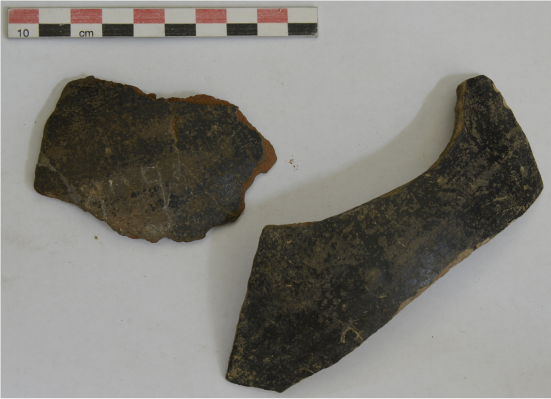
Figure 2.5
Inscribed potsherds (Nag007 and 009) from Nagarjunakonda, Nagarjunakonda Archaeological Museum, acc. nos. 227 and 232

Figure 2.6
Inscribed potsherds (Nag008, 010, 011, 012) from Nagarjunakonda, Nagarjunakonda Archaeological Museum, acc. nos. 231, 233, 234, 235
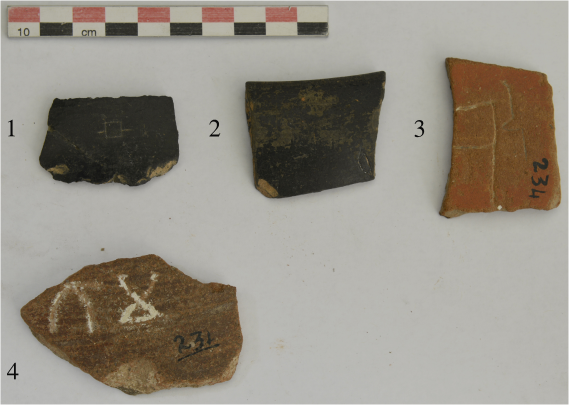
Figure 2.7
Inscribed stone vessel (Bav001) from Bavikonda, Visakha Museum, Visakhapatnam
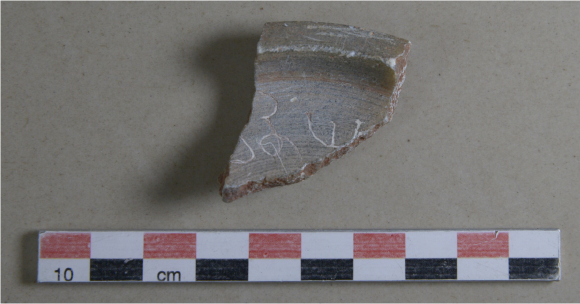
Figure 2.8
Inscribed potsherd (Bav002) from Bavikonda, Visakha Museum, Visakhapatnam
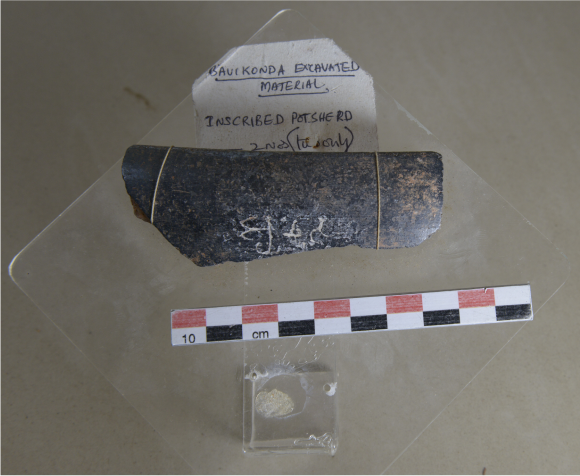
Figure 2.9
Inscribed potsherds (Sal001, 002, 003, 010, 039, 084/ARIEÂ 1954â1955, BÂ 66â71) from Salihundam, current location unknown

Figure 2.10
Inscribed potsherds (Sal032, 033, 035, 036, 048/ARIEÂ 1954â1955, BÂ 72â76) from Salihundam, current location unknown

Figure 2.11
Inscribed potsherds (Sal029, 060/ARIEÂ 1954â1955, BÂ 79â80) from Salihundam, current location unknown
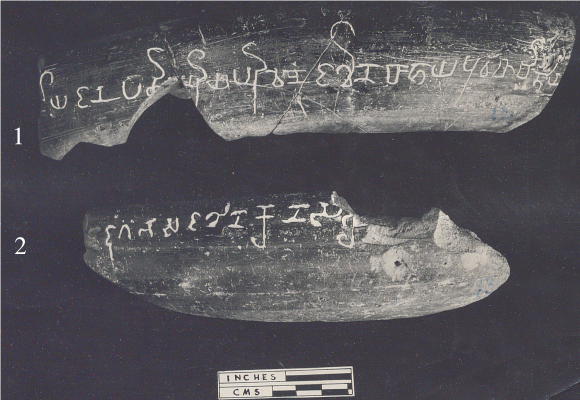
Figure 2.12
Inscribed conch-shells (EIADÂ 657 and 658) from Salihundam, current location unknown

Figure 2.13
Pot inscription from Nanduru, current location unknown

Figure 2.14
Pot inscription from Nanduru, current location unknown
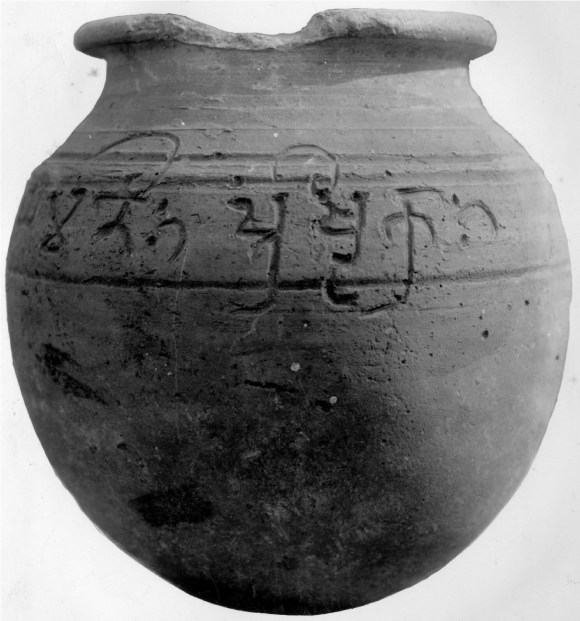
Appendix: Revised Edition of Buddhist Pottery Inscriptions from Early ÄndhradeÅa
Texts quoted from previous publications reproduce the conventions that were used there. My own readings (= IS) are presented according to the conventions of the EIAD corpus:
| [ ] |
uncertain reading |
| ( ) |
editorial restoration of lost text |
| ⨠⩠|
editorial addition of omitted text |
| ⪠⫠|
scribal insertion |
| . |
lost part of an aká¹£ara |
| ⦠|
indeterminate number of aká¹£aras missing |
| ? |
illegible aká¹£ara |
| + |
lost aká¹£ara |
| /// |
textual loss at left or right edge of support |
| â |
punctuation space |
If a sequence of aká¹£aras cannot be tentatively identified as a comprehensible text, the letters are separated by spaces.
A Salihundam Potsherds
The pottery inscriptions from Salihundam have a somewhat complicated and unlucky publication history. Many of them were first published by D.C. Sircar in the Annual Reports of Indian Epigraphy for 1954â1955 (p. 32) and for 1955â1956 (pp. 26â30). The latter publication is apparently based on the plates published later in Subrahmanyam 1964. ARIE 1954â1955 contains only few of the inscriptions, but with different readings. The five unpublished plates that are the basis of these readings were photographed in February 2020 by Vincent Tournier. They will be reproduced at the end of the appendix (figs. 2.9â12).
The excavation report (Subrahmanyam 1964) contains a chapter with a comprehensive edition of the inscribed potsherds (X âInscribed pottery from ÅÄlihuá¹á¸amâ, pp. 83â90, with inscriptions numbered 1â69). The preceding chapter on the pottery displays a large number of drawings of the individual potsherds and their inscriptions (IX âThe potteryâ, pp. 35â82). This chapter also contains readings and translations of several inscriptions numbered according to the drawings there. Moreover, an appendix to the volume written by D.C. Sircar again gives readings of inscriptions (Appendix âInscriptions from ÅÄlihuá¹á¸amâ, pp. 119â123). The inscriptions treated here cover only those that had been published in ARIE 1954â1955. Apparently, both publications are based on the same set of photographs âreceived from Mr. A.S. Gadre, Superintendent, Department of Archaeology, South-eastern circle, Visakapatnamâ (Subrahmanyam 1964: 119). Unfortunately, not only is the numbering different in all these places, but the readings also differ considerably in many cases.
This variance has already been remarked by Oskar von Hinüber (1991: 122) who, in a short, but substantial paper on âInscribed vessels from Buddhist monasteries in Termez and Salihundamâ (1991), revised many of the published readings. Contrary to von Hinüber, who decided to accept the numbering of the ARIE 1955â1956 edition, the numbering in the present Appendix follows Subrahmanyam 1964 (nos. 1â69). Inscriptions that are not listed by Subrahmanyam but are mentioned in previous publications or visible on the plates are added as additional items, with numbers 70 and so on. The order is that of their appearance in ARIE, if they are mentioned there.
Given the mentioned variance of readings, and since the character of the material often makes an undisputable reading impossible, I have decided to cite all readings as they were published. My revised editions are based on the plates depicting the photographs of the potsherds and the accompanying drawings published in Subrahmanyam 1964. Whenever possible, the readings follow the photographs. If letters are visible only on the corresponding drawings, they are indicated as uncertain, i.e., in square brackets. If this information is available, the entry refers to the type of artefact on which the text is inscribed. Moreover, each inscription is accompanied by references to reproductions:
-
plates in Subrahmanyam 1964
-
drawings (figures) in Subrahmanyam 1964
-
images provided by Vincent Tournier from the Epigraphy branch of the Archaeological Survey of India in Mysore (= inscriptions published in ARIEÂ 1954â1955); the plates are reproduced at the end of the Appendix as figures 2.9â12, the separate images on the plates are numerated from the upper left to the lower right.
and by references to readings:
The following concordance facilitates cross-reference:
|
Sal# |
Representations |
Editions |
|||||||
|---|---|---|---|---|---|---|---|---|---|
|
Subrahmanyam 1964 |
Infra |
Subrahmanyam 1964 |
ARIE |
von Hinüber 1991 (p.) |
|||||
|
Plates |
Drawings |
Figures |
S1 (p.) |
S2 (p.) |
S3 (p., no.) |
1954â1955 (no.) |
1955â1956 (no.) |
||
|
1 |
XLVII |
13-3a |
9,1 |
83 |
44 |
119, 1 |
66 |
22 |
|
|
2 |
XLVII |
13-3c |
9,2 |
83 |
44 |
119, 2 |
67 |
23 |
|
|
3 |
XLVII |
13-3d |
9,3 |
84 |
45 |
119, 3 |
68 |
24 |
|
|
4 |
XLVII |
13-3e |
84 |
45 |
25 |
||||
|
5 |
XLVII |
15-4 |
84 |
48 |
26 |
||||
|
6 |
XLVIII |
19-55 |
84 |
56 |
27 |
||||
|
7 |
XLVIII |
19-59 |
84 |
58 |
28 |
||||
|
8 |
XLVIII |
16-32a |
84 |
53 |
29 |
||||
|
9 |
XLVIII |
15-14a |
84 |
50 |
30 |
||||
|
10 |
XLVIII |
24-1 |
9,5 |
84 |
69 |
120,5 |
70 |
31 |
123 |
|
11 |
XLVIII |
15-16 |
84 |
50 |
32 |
123 |
|||
|
12 |
XLVIII |
17-32f |
84 |
53 |
33 |
||||
|
13 |
XLIX |
16-24 |
84 |
51 |
34 |
124 |
|||
|
14 |
17-39a |
85 |
55 |
||||||
|
15 |
XLIX |
16-25 |
85 |
51 |
36 |
||||
|
16 |
XLIX |
15-20 |
85 |
51 |
37 |
||||
|
17 |
XLIX |
15-18 |
85 |
51 |
38 |
123 |
|||
|
18 |
XLIX |
16-22 |
85 |
51 |
39 |
||||
|
19 |
XLIX |
17-37 |
85 |
51 |
40 |
||||
|
20 |
XLIX |
18-42 |
85 |
55 |
41 |
123 |
|||
|
21 |
XLIX |
19-54 |
85 |
57 |
42 |
||||
|
22 |
L |
18-41 |
85 |
55 |
43 |
123 |
|||
|
23 |
L |
20-62 |
85 |
58 |
44 |
||||
|
24 |
L |
17-34 |
85 |
53 |
45 |
122 |
|||
|
25 |
L |
18-39b |
86 |
55 |
46 |
||||
|
26 |
L |
17-34c |
86 |
54 |
47 |
||||
|
27 |
L |
18-40 |
86 |
55 |
48 |
||||
|
28 |
L |
16-32c |
86 |
53 |
49 |
124 |
|||
|
29 |
LI |
17-39 |
11,1 |
86 |
54â¯f. |
121, 12 |
77 |
50 |
124 |
|
30 |
LI |
13-1 |
86 |
43â¯f. |
51 |
||||
|
31 |
LI |
17-34d |
86 |
54 |
52 |
122 |
|||
|
32 |
LI |
19-61 |
10,1 |
86 |
58 |
120, 7 |
72 |
53 |
|
|
33 |
LI |
16-21a |
10,2 |
86 |
51 |
120, 8 |
73 |
54 |
|
|
34 |
LI |
15-17 |
87 |
50â¯f. |
55 |
||||
|
35 |
LI |
17-33 |
10,4 |
87 |
53 |
120, 10 |
75 |
56 |
122 |
|
36 |
LII |
16-23 |
10,5 |
87 |
51 |
76 |
57 |
||
|
37 |
LII |
13-2 |
87 |
44 |
58 |
||||
|
38 |
LII |
19-60a |
87 |
58 |
59 |
||||
|
39 |
LII |
16-32d |
9,4 |
87 |
53 |
120, 4 |
69 |
60 |
|
|
40 |
LII |
20-63 |
87 |
58 |
61 |
124 |
|||
|
41 |
LII |
17-38 |
87 |
54 |
62 |
||||
|
42 |
LII |
17-34a |
87 |
53 |
63 |
||||
|
43 |
LII |
17-34b |
87 |
54 |
64 |
||||
|
44 |
LIII |
17-36 |
87 |
54 |
67 |
122 |
|||
|
45 |
LIV |
13-3 |
88 |
44 |
70 |
||||
|
46 |
LIV |
13-3b |
88 |
44 |
71 |
||||
|
47 |
LV |
15-5 |
88 |
49 |
72 |
||||
|
48 |
LV |
16-26 |
10,3 |
88 |
51â¯f. |
120, 9 |
74 |
73 |
|
|
49 |
LV |
19-51b |
88 |
56 |
74 |
||||
|
50 |
LV |
19-51a |
88 |
56 |
75 |
||||
|
51 |
LV |
19-52d |
88 |
57 |
76 |
124 |
|||
|
52 |
LVI |
17-34e |
88 |
54 |
77 |
||||
|
53 |
LVI |
15-18 |
88 |
49â¯f. |
78 |
||||
|
54 |
LVI |
20-66 |
89 |
58 |
79 |
||||
|
55 |
LVI |
25-22 |
89 |
71 |
80 |
122 |
|||
|
56 |
LVI |
20-67 |
89 |
58 |
81 |
||||
|
57 |
LIX |
15-14 |
89 |
50 |
102 |
||||
|
58 |
LVI |
15-16 |
89 |
49 |
83 |
124 |
|||
|
59 |
LVI |
20-71 |
89 |
59 |
84 |
||||
|
60 |
LVII |
16-32b |
11,2 |
89 |
53 |
121, 13 |
78 |
85 |
|
|
61 |
LVII |
17-37a |
89 |
54 |
86 |
124 |
|||
|
62 |
LVII |
17-32e |
89 |
53 |
87 |
||||
|
63 |
LVII |
17-35 |
90 |
54 |
88 |
||||
|
64 |
LVII |
19-55 |
90 |
57 |
89 |
||||
|
65 |
LVIII |
30-102 |
90 |
78 |
90 |
||||
|
66 |
LVIII |
30-101 |
90 |
78 |
91 |
||||
|
67 |
LIX |
16-27 |
90 |
52 |
105 |
||||
|
68 |
LIX |
16-28a |
90 |
52 |
107 |
||||
|
69 |
LIII |
16-32 |
90 |
52 |
66 |
||||
|
70 |
XLIX |
35 |
|||||||
|
71 |
LIII |
13-1 |
43â¯f. |
65 |
|||||
|
72 |
LIII |
68 |
|||||||
|
73 |
LVI |
82 |
|||||||
|
74 |
19-58 |
57 |
92 |
||||||
|
75 |
19-57 |
57 |
93 |
||||||
|
76 |
19-60 |
58 |
95 |
||||||
|
77 |
19-52b |
56 |
99 |
||||||
|
78 |
19-52a |
56 |
100 |
||||||
|
79 |
LIX |
16-28 |
103 |
||||||
|
80 |
LIX |
16-21 |
51 |
104 |
|||||
|
81 |
LIX |
15-19 |
51 |
106 |
|||||
|
82 |
LIX |
108 |
|||||||
|
83 |
LIX |
109 |
|||||||
|
84 |
1,6 |
120, 6 |
71 |
||||||
|
85 |
15-5 |
50 |
|||||||
|
86 |
19-51 |
56 |
|||||||
|
87 |
19-51c |
56 |
|||||||
|
88 |
19-52c |
56 |
|||||||
|
89 |
19-52e |
57 |
|||||||
|
90 |
19-56 |
57 |
|||||||
|
91 |
26-31 |
71 |
|||||||
|
92 |
26-32 |
71 |
|||||||
Sal001 (EIAD 733) (fig. 2.9 [1])
References: Subrahmanyam, p. 44 (âdish of a rouletted wareâ), p. 83, p. 119, no. 1 (pl. XLVII, fig. 13-3a), ARIE 1954â1955, no. 66, ARIE 1955â1956, no. 22, below figure 9,1
| S1 |
NAKUPONA or NAKUHENA |
| S2 |
NAKULANA, NAKUHENA, or NAKUPONA |
| S3 |
(Na)kupoua or (Na)kulÄna |
| ARIEÂ 1954â1955 |
[na]kupona or [na]kuhena |
| ARIEÂ 1955â1956 |
[na]kulÄna |
| IS |
/// na ku lÄ na |
Meaning unclear; the second element could, however, be connected with Skt. kula âfamily.â For the shape of the first na cf. below Sal037.
Sal002 (EIAD 734) (fig. 2.9 [2])
References: Subrahmanyam, p. 44 (âdish of a rouletted wareâ), p. 83, p. 119, no. 2 (pl. XLVII, fig. 13-3c), ARIE 1954â1955, no. 67, ARIE 1955â1956, no. 23
| S1 |
BAMHANASA |
| S2 |
BAM(H)ANASA |
| S3 |
Bamhanasa |
| ARIEÂ 1954â1955 |
bam[ha]á¹anasa |
| ARIEÂ 1955â1956 |
bamhaá¹asa |
| IS |
bamaá¹asa ? ? /// |
âOf the Brahmin â¦â
The indiscernible scratching on the right bottom of ma is too small to allow the reading âha.
Sal003 (EIAD 735) (fig. 2.9 [3])
References: Subrahmanyam, p. 45 (âdish of a rouletted wareâ), p. 84, p. 119, no. 3 (pl. XLVII, fig. 13-3d), ARIE 1954â1955, no. 68, ARIE 1955â1956, no. 24, below fig. 9,3
| S1 |
SAGHASA |
| S2 |
DAGESA GHASA |
| S3 |
(dha)á¸agÄ saghasa |
| ARIEÂ 1954â1955 |
á¸hÄá¸age saá¹ghasa |
| ARIEÂ 1955â1956 |
⦠á¸age saghasa |
| IS |
///.Äá¸age saghasa /// |
â⦠of/to the communityâ or âof/to Saá¹ ghaâ
The first letter is unclear, but a reconstruction as âpÄá¸age (Skt. âpÄá¹ake) seems not completely impossible. Does this word represent a variant of the otherwise attested SÄlipeá¸aka?
Sal004 (EIADÂ 736)
References: Subrahmanyam, p. 45 (âdish of a rouletted wareâ), p. 84 (pl. XLVII, fig. 13-3e), ARIE 1955â1956, no. 25
| S1 |
SA(PU?)TAKA |
| S2 |
SA(PU?)TAKA |
| ARIEÂ 1955â1956 |
⦠sa[ca]ratako |
| IS |
/// ? [sa varatako] |
Meaning unclear. The reading is based on the drawing. For the text, cf. below varatika in Sal022.
Sal005 (EIADÂ 737)
References: Subrahmanyam, p. 48 (âdish of a black and red wareâ), p. 84 (pl. XLVII, fig. 15-4), ARIE 1955â1956, no. 26
| S1 |
VELABUDHI |
| S2 |
VÄLABUDHI |
| ARIEÂ 1955â1956 |
[Crown symbol] khalabudhi |
| IS |
(1) [triratna symbol] velabu[dhi]/// (2) .i |
âOf (?) Velabudhi â¦â
For Vela- cf. Velagiri in the Jaggayyapeta pillar inscriptions (EIADÂ 31â33).
Sal006 (EIADÂ 738)
References: Subrahmanyam, p. 56 (âdish of a chocolate slipped wareâ), p. 84 (pl. XLVIII, fig. 19-52), ARIE 1955â1956, no. 27
| S1 |
KAMARAKA |
| S2 |
KAMARAKA |
| ARIEÂ 1955â1956 |
kumararÄ â¦ |
| IS |
k[u]mara[ka]/// |
âOf (?) KumÄraka.â
Sal007 (EIADÂ 739)
References: Subrahmanyam, p. 58 (âdeep bowl of a chocolate slip wareâ), p. 84 (pl. XLVIII, fig. 19-59), ARIE 1955â1956, no. 28
| S1 |
NAM BUDHI |
| S2 |
(NA) BUDHI |
| ARIEÂ 1955â1956 |
[saá¹]budhi ⦠|
| IS |
? budhi /// |
Probably part of a personal name.
Sal008 (EIADÂ 740)
References: Subrahmanyam, p. 53 (âdish of a grey wareâ), p. 84 (pl. XLVIII, fig. 16-32a), ARIE 1955â1956, no. 29
| S1 |
SAGHADARA(SA) |
| S2 |
SAGHADARA |
| ARIEÂ 1955â1956 |
saghajera[sa] ⦠|
| IS |
saghadara[sa]/// |
âOf Saá¹ ghadara.â
Sal009 (EIADÂ 741)
References: Subrahmanyam, p. 50 (âdish of a black wareâ), p. 84 (pl. XLVIII, fig. 15-14a), ARIE 1955â1956, no. 30
| S1 |
NAKATHANA |
| S2 |
NAKATHANA |
| ARIEÂ 1955â1956 |
na[ka]thana ⦠|
| IS |
na[ka]á¹hana /// |
Meaning unclear, perhaps for nÄgasthÄna?
Sal010 (EIAD 742) (fig. 2.9 [5])
References: Subrahmanyam, p. 69 (âdish of a black and red wareâ, âlate phaseâ), p. 84 (pl. XLVIII, fig. 24-1), p. 120, no. 5, ARIE 1954â1955, no. 70, ARIE 1955â1956, no. 31, von Hinüber, p. 123
| S1 |
DASA PATRI |
| S2 |
DASAPATI |
| S3 |
cadasa patri |
| ARIEÂ 1954â1955 |
cadasa pÄtrÄ« |
| ARIEÂ 1955â1956 |
⦠jasa pÄtri |
| OvH |
]dasa pati |
| IS |
///cadasa pÄti |
âDining plate of -cada (Skt. Candra).â
For the shape of the final ti, read by Subrahmanyam and Sircar as tri, cf. Sal013 below.
Sal011 (EIADÂ 743)
References: Subrahmanyam, p. 50 (âdish of a black wareâ), p. 84 (pl. XLVIII, fig. 15-16), ARIE 1955â1956, no. 32, von Hinüber, p. 123
| S1 |
RAHILASA PA- |
| S2 |
RAHILASAPA |
| ARIEÂ 1955â1956 |
rÄhilasa pÄ â¦ |
| OvH |
rahilasa pa[ |
| IS |
rÄhilasa p[Ä]///(ti) |
âDining plate of RÄhila.â
Sal012 (EIADÂ 744)
References: Subrahmanyam, p. 53 (âdish of a grey wareâ), p. 84 (pl. XLVIII, fig. 17-32f), ARIE 1955â1956, no. 33
| S1 |
MAHAVIHARE SALI- |
| S2 |
MAHAVIHARE SALI- |
| ARIEÂ 1955â1956 |
⦠lana vihÄre saá¹gha ⦠|
| IS |
///mah[Ä]vi[hÄ]re [sÄlÄ«]/// |
âIn SÄlÄ«(peá¸aka), in the Great Monastery.â
The reconstruction of the last two letters is very uncertain, but at least possible. For the toponym SÄlipeá¸aka cf. Sal015 salÄ«peá¸ake.
Sal013 (EIADÂ 745)
References: Subrahmanyam, p. 51 (âdish of a black wareâ), p. 84 (pl. XLIX, fig. 16-24), ARIE 1955â1956, no. 34, von Hinüber, p. 124
| S1 |
⦠BODHIKASA PATHI- |
| S2 |
BODIKASA PATHI |
| ARIEÂ 1955â1956/OvH/IS |
bodhikasa pati |
âDining plate of Bodhika.â
Sal014 (EIADÂ 746)
References: Subrahmanyam, p. 55 (âdish of a grey wareâ), p. 85 (fig. 17-39a)71
| S1 |
DEVARAKASARA (BHA)CHA |
| S2 |
DEVARAKASA-RA (BHA) CHA |
| IS |
[marakasa sa ra bha]/// |
Meaning and word division unclear. Possibly, the first part belongs to an incompletely preserved kumarakasa. However, there are no traces of ku on the drawing.
Sal015 (EIADÂ 747)
References: Subrahmanyam, p. 51 (âdish of a black wareâ), p. 85 (pl. XLIX, fig. 16-25), ARIE 1955â1956, no. 36
| S1 |
SALIPATAKA(NA) |
| S2 |
SALIPATAKA(NA) |
| ARIEÂ 1955â1956 |
salipeá¸ake o ⦠|
| IS |
salÄ«peá¸ake °o /// |
â⦠in SÄlipeá¸aka.â
Sal016 (EIADÂ 748)
References: Subrahmanyam, p. 51 (âdish of a black wareâ), p. 85 (pl. XLIX, fig. 15-20), ARIE 1955â1956, no. 37
| S1 |
PADARASA ADHIVASI (KA)SA â¦. |
| S2 |
PAJARASA ADHIVASI (KA)SA |
| ARIEÂ 1955â1956 |
⦠pajarasa adhivasisa ⦠|
| IS |
///pa[da]rasa °adhivasi[ka]sa ? /// |
â⦠of the inhabitant of -padara (?).â
The meaning is not beyond doubt, the reading of da is very uncertain. Different interpretations are not excluded, e.g., that of pa[da]ra as part of a personal name ending in âdara, like, e.g., Saá¹ ghadara in Sal008. In this case, the function of adhivasikasa would remain unclear.
Sal017 (EIADÂ 749)
References: Subrahmanyam, p. 51 (âdish of a black wareâ), p. 85 (pl. XLIX, fig. 15-18), ARIE 1955â1956, no. 38, von Hinüber, p. 123
| S1 |
DAGASAPATI |
| S2 |
DAGASAPATI |
| ARIEÂ 1955â1956 |
⦠vagasa pati [Svastika symbol] |
| OvH |
(sa)gasa pati â¨svastika-symbolâ© |
| IS |
? ? gasa pati [svastika symbol] |
âDining plate of -ga.â
Possibly a name ending in -nÄga.
Sal018 (EIADÂ 750)
References: Subrahmanyam, p. 51 (âdish of a black wareâ), p. 85 (pl. XLIX, fig. 16-22), ARIE 1955â1956, no. 39
| S1 |
HAGHASA |
| S2 |
HAGHASA |
| ARIEÂ 1955â1956 |
⦠haghasa u ⦠|
| IS |
[ha]ghasa [pati] |
âDining plate of Haá¹ gha.â
The last word is nearly invisible, but some traces seem to be preserved.
Sal019 (EIADÂ 751)
References: Subrahmanyam, p. 54 (âdish of a grey wareâ), p. 85 (pl. XLIX, fig. 17-37), ARIE 1955â1956, no. 40
| S1 |
DAHARA BHIKU(NO?) |
| S2 |
DAHARABHIKHUNO |
| ARIEÂ 1955â1956 |
daharÄ dhikaá¹a[sa] |
| IS |
dahara[bh]ikhuno [pa]///(ti) |
âDining plate of the young monk.â
Sal020 (EIADÂ 752)
References: Subrahmanyam, p. 55 (âdish of a grey wareâ), p. 85 (pl. XLIX, fig. 18-42), ARIE 1955â1956, no. 41, von Hinüber, p. 123
| S1 |
(BHA)YASA(NA)VISAGHASA DATI (CA?) |
| S2 |
(BHA) YASA (NA) VISAGHASA DATI (VA) |
| ARIEÂ 1955â1956 |
⦠[a]yata visÄghasa [pÄ]ti ca |
| OvH |
+ yatavi saghasa (pa)ti va[ |
| IS |
/// ? [ya ta] vi saghasa [pÄ]ti va ? /// |
â⦠dining plate of the ⦠community.â or â⦠dining plate of ⦠Saá¹ gha.â
Cf. Sal022 below: pÄti varatika. The meaning of the second word is unclear. The reading of the initial part is very uncertain. A reconstruction as ariya-tavi(?) is not impossible.
Sal021 (EIADÂ 753)
References: Subrahmanyam, p. 57 (âdish of a chocolate slipped wareâ), p. 85 (pl. XLIX, fig. 19-54), ARIE 1955â1956, no. 42
| S1 |
DARA |
| S2 |
DHARACHA |
| ARIEÂ 1955â1956 |
jara[sikha] ⦠|
| IS |
d[a]rabhikh(u) /// |
â⦠(of) the young monk.â
Possibly erroneous for daharabhikhu(no). However, a reading dÄra is not completely impossible. The shapes of both letters (dÄ/da) are often very similar. Hence, dÄra could also be interpreted as a contracted form of dahara.
Sal022 (EIADÂ 754)
References: Subrahmanyam, p. 55 (âdish of a grey wareâ), p. 85 (pl. L, fig. 18-41), ARIE 1955â1956, no. 43, von Hinüber, p. 123
| S1 |
⦠ARIYA SACGHASA DHUTICARATIKA |
| S2 |
ARYASAGHASA DUTI CARATIKA |
| ARIEÂ 1955â1956 |
ja ariyasaghasa pÄti caratika |
| OvH |
(a)riyasaghasa pat(i) varatika |
| IS |
°ariyasaghasa pÄti varatika [symbol]72 |
âvaratika (?) dining plate of the noble communityâ or âvaratika (?) dining plate of the noble Saá¹ gha.â
Sal023 (EIADÂ 755)
References: Subrahmanyam, p. 58 (âbowl of a brown wareâ), p. 85 (pl. L, fig. 20-62), ARIE 1955â1956, no. 44
| S1 |
TAKANA |
| S2 |
THAKANA |
| ARIEÂ 1955â1956 |
takana |
| IS |
ta ka na /// |
Meaning unclear.
Sal024 (EIADÂ 756)
References: Subrahmanyam, p. 53 (âdish of a grey wareâ), p. 85 (pl. L, fig. 17-34), ARIE 1955â1956, no. 45, von Hinüber, p. 122
| S1 |
PATIPALIKA |
| S2 |
PATIPOLIKA |
| ARIEÂ 1955â1956 |
⦠[á¹£a] pÄti polÄ«kÄ |
| OvH |
](sa) pati polika |
| IS |
/// ? sa pÄti poâ¨gaâ©likÄ |
âPersonal dining plate of â¦â
Sal025 (EIADÂ 757)
References: Subrahmanyam, p. 55 (âdish of a grey wareâ), p. 86 (pl. L, fig. 18-39b), ARIE 1955â1956, no. 46
| S1 |
VASIKAYA |
| S2 |
(U)VASIKAYA |
| ARIEÂ 1955â1956 |
⦠vÄsikÄ â¦ |
| IS |
[°u]vÄsikÄ[y]Ä ? /// |
â(Gift?) of the lay-woman â¦â
Sal026 (EIADÂ 758)
References: Subrahmanyam, p. 54 (âdish of a grey wareâ), p. 86 (pl. L, fig. 17-34c), ARIE 1955â1956, no. 47
| S1 |
..HASA GARISIKAYA..I.. |
| S2 |
HASAGARICHIKAYA |
| ARIEÂ 1955â1956 |
⦠hÄsa guricikÄyÄ â¦ symbol |
| IS |
/// ho sa gu ri ci kÄ yÄ Â°i /// |
Meaning unclear. Female personal name?
Sal027 (EIADÂ 759)
References: Subrahmanyam, p. 55 (âdish of a grey wareâ), p. 86 (pl. L, fig. 18-40), ARIE 1955â1956, no. 48
| S1 |
⦠SAPATANEHALA ⦠|
| S2 |
SATANEHALA |
| ARIEÂ 1955â1956 |
saá¹anehala ⦠|
| IS |
/// [pa] á¹a â ne ha la /// |
Meaning unclear. Are the first two aká¹£aras related to Skt. pÄtra âvesselâ?
Sal028 (EIADÂ 760)
References: Subrahmanyam, p. 53 (âdish of a grey wareâ), p. 86 (pl. L, fig. 16-32c), ARIE 1955â1956, no. 49, von Hinüber, p. 124
| S1 |
UPASAKA NAM DANA PATI |
| S2 |
UPASAKANAM DANA PATI |
| ARIEÂ 1955â1956 |
⦠opasakÄnÄá¹ jane pÄti |
| OvH |
](u)pasakana dan(e) pati |
| IS |
/// [°u]pasakÄnÄá¹ d[Ä]naá¹ pÄti [sa]á¹///(ghasa)73 |
â(This) dining plate is the gift of ⦠laypeople to the community (?).â
Sal029 (EIAD 761) (fig. 2.11 [1])
References: Subrahmanyam, pp. 54â55 (âdish of a grey wareâ), p. 86, p. 121, no. 12 (pl. LI, fig. 17-39), ARIE 1954â1955, no. 77, ARIE 1955â1956, no. 50, von Hinüber, p. 124, Falk 2014: 88
| S1 |
⦠YA DANA PATI(A?) RIYA PARIVENE DAKINA BAUHAYA PUYA BABITIYA â¦. |
| S2 |
ARIYA PARIVENE DAKHINABAUHAYA PUVA BABITYA |
| S3 |
ya dana pÄ[tia] riya-parivÄá¹ÄdakÄhina-bÅ«(?)hÄya puvabÄbitÄ«ya |
| ARIEÂ 1954â1955 |
⦠iya dana pachi[ma-a]riya-pariveá¹e dakhiá¹a-bÅ«(?)hÄya puva bÄbitÄya |
| ARIEÂ 1955â1956 |
⦠ya dÄna pÄ[ti a]riyapariveá¹e dakhiá¹a bÅ«(?)hÄya puva bÄbitÄ«ya |
| OvH |
]ya dana pati [a]riyaparivene dakhina buhaya puvababitiya[ |
| Falk |
///.ya dana pÄtÄ« [?]iya pariveá¹aá¹ dakhiá¹a pÄhÄya puvo bÄvÄ«tÄya/// |
| IS |
///.iya dÄnaâ¨á¹â© p[Äti] [°a]riyapariveá¹e dÄkhiá¹a [bÄ]hÄya puva bÄ bitiya74 |
â(This) dining plate is the gift of -Ä«, in the cell of the nobles, (in the) south, ⦠east, â¦?.â
For the text, cf. the discussion above, pp. 73â75.
Sal030 (EIADÂ 762)
References: Subrahmanyam, pp. 43â44 (âdish of a rouletted wareâ), p. 86 (pl. LI, fig. 13-1), ARIE 1955â1956, no. 51
| S1 |
PATANA DAYA KOTAYA DA ⦠|
| S2 |
PATANADAYAKOTAYADA |
| ARIEÂ 1955â1956 |
⦠paá¹aá¹ naá¸ÄyÄ koá¹aya da ⦠|
| IS |
paá¹a[naá¸Ä]ya koá¹a[ya dÄ]///(naá¹)75 |
âGift of Paá¹anaá¸Ä Koá¹Ä (?).â
Sal031 (EIADÂ 763)
References: Subrahmanyam, p. 54 (âdish of a grey wareâ), p. 86 (pl. LI, fig. 17-34d), ARIE 1955â1956, no. 52, von Hinüber, p. 122
| S1 |
NAGASA PATI PAGALIKA |
| S2 |
NAGASA PATI POGALIKA |
| ARIE |
⦠á¹agasa pati pogalika ⦠|
| OvH/IS |
/// nagasa pati pogalika /// |
âPersonal dining plate of -naga (Skt. -nÄga ?).â
Sal032 (EIAD 764) (fig. 2.10 [1])
References: Subrahmanyam, p. 58 (âdeep bowl of a brown wareâ), p. 86, p. 120, no. 7 (pl. LI, fig. 19-61), ARIE 1954â1955, no. 72, ARIE 1955â1956, no. 53
| S1/S2 |
VISAGASA |
| S3 |
VisÄgasa |
| ARIEÂ 1954â1955 |
visÄgasa ⦠|
| ARIEÂ 1955â1956 |
visÄgasa ⦠|
| IS |
visÄgasa /// |
â(Dining plate or gift) of VisÄga (Skt.ViÅÄkha).â
Although the third aká¹£ara can clearly be read as ga, it is not excluded that it represents a miswritten kha.
Sal033 (EIAD 765) (fig. 2.10 [2])
References: Subrahmanyam, p. 51 (âdish of a black wareâ), p. 86, 120, no. 8 (pl. LI, fig. 16-21a), ARIE 1954â1955, no. 73, ARIE 1955â1956, no. 54
| S1 |
DHAMASA |
| S2 |
(DHA)MA(SA) |
| S3 |
(Na) mo (ja) |
| ARIEÂ 1954â1955 |
[na]mo[jÄ] ⦠|
| ARIEÂ 1955â1956 |
mo |
| IS |
na [mo jÄ]/// |
Meaning unclear, reading very uncertain.
Sal034 (EIADÂ 766)
References: Subrahmanyam, pp. 50â51 (âdish of a black wareâ), p. 87 (pl. LI, fig. 15-17), ARIE 1955â1956, no. 55
Text:
| S1 |
GA RAKHI DASA |
| S2 |
GARAKHI(DA?)SA |
| ARIEÂ 1955â1956 |
⦠garakhidasa |
| IS |
///garakhidasa |
âOf -garakkhita (Skt. NÄgaraká¹£ita?).â
Sal035 (EIAD 767) (fig. 2.10 [4])
References: Subrahmanyam, p. 53 (âdish of a grey wareâ), p. 87, p. 120, no. 10 (pl. LI, fig. 17-33), ARIE 1954â1955, no. 75, ARIE 1955â1956, no. 56, von Hinüber, p. 122
| S1 |
RAHULISA PATI PAGALIKA |
| S2 |
RAHULASA PATHI POGALIKASA |
| S3 |
Phaulisa pÄá¹i-pogaliks (sic!) |
| ARIEÂ 1954â1955 |
phahulisa pÄni-pogalikÄ |
| ARIEÂ 1955â1956 |
uhulasa pÄti p[o]galika |
| OvH |
(ra)hulasa pati p(o)galika |
| IS |
rahulasa pÄti pogalikÄ |
âPersonal dining plate of RÄhula.â
Sal036 (EIAD 768) (fig. 2.10 [5])
References: Subrahmanyam, p. 51 (âdish of a black wareâ), p. 8776 (pl. LII, fig. 16-23), ARIE 1954â1955, no. 76, ARIE 1955â1956, no. 57, below fig. 10,5
| S1 |
(MA) RAKA SA DUBALA HAGHA SA (PA) |
| S2 |
(M)ARAKASA DUBALAHAGASA (PA) |
| ARIEÂ 1954â1955 |
[ma]rakasa DÅ«balaá¸ughasa |
| ARIEÂ 1955â1956 |
⦠rakasa jūbala haghasa ⦠|
| IS |
///[ma]rakasâ¨iâ©[ddha]balahaghasa [pÄ]///(ti) |
âDining plate of (Ku)mÄraka Siddhabalahagha.â
The second element of the name âhagha can perhaps be connected to Skt. saá¹gha; the reading of the first part remains highly hypothetical. The shape of the ligature ddha (read by others as dÅ«, jÅ«) is especially doubtful. Moreover, there are no traces of âi in sâ¨iâ©. Hence, the preserved sa could also represent the genitive ending of the preceding (ku)maraka.
Sal037 (EIADÂ 769)
References: Subrahmanyam, p. 44 (âdish of a rouletted wareâ), p. 87 (pl. LII, fig. 13-2), ARIE 1955â1956, no. 58
| S1 |
MAHA UGA PAVATE |
| S2 |
MAHADAGALAVATE or MAHAVUGAPAVATHE |
| ARIEÂ 1955â1956 |
mahavaga pav[i]ta ⦠|
| IS |
maha[na]gapavate |
âOn the Great Serpent Mountain.â
MahÄnÄgaparvata is the ancient name of the monastic complex at Guntupalli. For further details, cf. the discussion above, pp. 75â76.
Sal038 (EIADÂ 770)
References: Subrahmanyam, p. 58 (âbowl of a chocolate slipped wareâ), p. 87 (pl. LII, fig. 19-60a), ARIE 1955â1956, no. 59
| S1 |
BUDHI |
| S2 |
BHUDHI |
| ARIEÂ 1955â1956 |
budhi ⦠|
| IS |
budhi /// |
Probably a personal name beginning with budhiâ (Skt. buddhi).
Sal039 (EIAD 771) (fig. 2.9 [4])
References: Subrahmanyam, p. 53 (âdish of a grey wareâ), p. 87, p. 120, no. 4 (pl. LII, fig. 16-32d), ARIE 1954â1955, no. 69, ARIE 1955â1956, no. 60
| S1â¯+â¯2 |
⦠KASA DIGHA MA BHI (JJHI) MA ⦠|
| S3 |
⦠kasa dighamajhima ⦠|
| ARIEÂ 1954â1955 |
⦠kasa dighamajhima ⦠|
| ARIEÂ 1955â1956 |
⦠kasa dighamajhimÄ â¦ |
| IS |
/// kasa dīghamajhima ? /// |
âOf â¦, the (preserver of the) Long and Middle (Divisions).â
For this term, see the discussion above, pp. 67â68.
Sal040 (EIADÂ 772)
References: Subrahmanyam, p. 58 (âbowl of a chocolate slipped wareâ), p. 87 (pl. LII, fig. 20-63), ARIE 1955â1956, no. 61, von Hinüber, p. 124
| S1 |
GASAPATA |
| S2 |
GASAPATHA |
| ARIEÂ 1955â1956 |
⦠[ga]sa patra |
| OvH |
]gasa patra |
| IS |
/// gasa patrÄ |
âBowl of -ga.â
Possibly, a name ending in -nÄga.
Sal041 (EIADÂ 773)
References: Subrahmanyam, p. 54 (âdish of a grey wareâ), p. 87 (pl. LII, fig. 17-38), ARIE 1955â1956, no. 62
| S1 |
(DE) YA DHAMA |
| S2 |
(DE) YADHAMA |
| ARIEÂ 1955â1956 |
⦠[sa] dhaá¹maá¹ [symbol] |
| IS |
(de)///[ya]dhaá¹maá¹ [symbol]77 |
âPious gift.â
Sal042 (EIADÂ 774)
References: Subrahmanyam, p. 53 (âdish of a grey wareâ), p. 87 (pl. LII, fig. 17-34a), ARIE 1955â1956, no. 63
| S1 |
KATHI KA KATI RAHULA |
| S2 |
KADHIKA KATI RAHULA |
| ARIEÂ 1955â1956 |
⦠[ka]dhika kaá¸i rahula[sa] |
| IS |
(dhaá¹ma)///kadhika[sa] k[u]á¸i-rahula[sa] /// |
âOf Kuá¸i-RÄhula, the (dharma)kathika.â
Is kuá¸i related to P. kuá¹i âhutâ, or P. kuá¹á¹a?
Sal043 (EIADÂ 775)
References: Subrahmanyam, p. 54 (âdish of a grey wareâ), p. 87 (pl. LII, fig. 17-34b), ARIE 1955â1956, no. 64
| S1 |
PADA (l)PAVATE (NA?) |
| S2 |
PADA PAVATHE |
| ARIEÂ 1955â1956 |
⦠padi pavate ⦠|
| IS |
///padipavate °i ? /// |
â⦠On the -padi mountain.â
Sal044 (EIADÂ 776)
References: Subrahmanyam, p. 54 (âdish of a grey wareâ), p. 87 (pl. LIII, fig. 17-36), ARIE 1955â1956, no. 67, von Hinüber, p. 122
| S1 |
PATI PAGALIKA |
| S2 |
PATIPAGALIKA |
| ARIEÂ 1955â1956 |
⦠pata paá¹gali[ka] [symbol] |
| OvH |
]pati pogali(k)a â¨srivatsa-symbolâ© |
| IS |
/// pat[i] pogali[ka] [ÅrÄ«vatsa symbol] /// |
âPersonal dining plate â¦â
On the photograph, the i-sign in pati is barely visible and the drawing seems to indicate patÄ.
Sal045 (EIADÂ 777)
References: Subrahmanyam, p. 44 (âdish of a rouletted wareâ), p. 88 (pl. LIV, fig. 13-3), ARIE 1955â1956, no. 7078
| S1 |
TAKABHI |
| S2 |
TAKABHI |
| ARIEÂ 1955â1956 |
⦠bhokoti ⦠|
| IS |
(par)///ibhoko bhi[kh]///(u) |
âObject of use (of the community of) monks.â
Cf. below Vadd050: (pari)///bhogo saá¹gha///. See the discussion of this term above, pp. 70â71. The inscription belongs to the few examples with a highly ornamental variant of the BrÄhmÄ« script.
Sal046 (EIADÂ 778)
References: Subrahmanyam, p. 44 (âdish of a rouletted wareâ), p. 88 (pl. LIV, fig. 13-3b), ARIE 1955â1956, no. 71
| S1 |
VIGASA DA (NA) |
| S2 |
VIGASADA(NA) |
| ARIEÂ 1955â1956 |
vigasa dÄ[na] |
| IS |
/// [vi]gasa dÄ[na]/// |
âGift of -viga.â
As in the case of Sal045, the script is very ornamental.
Sal047 (EIADÂ 779)
References: Subrahmanyam, p. 49 (âdish of a black and red wareâ), p. 88 (pl. LV, fig. 15-5), ARIE 1955â1956, no. 72
| S1 |
KASA |
| S2 |
KASA |
| ARIEÂ 1955â1956 |
⦠kasa [punctuation mark] |
| IS |
///kasa [punctuation mark] |
âOf -ka.â79
Sal048 (EIAD 780) (fig. 2.10 [3])
References: Subrahmanyam, pp. 51â52 (âbowl of a black wareâ), p. 88, p. 120, no. 9 (pl. LV, fig. 16-26), ARIE 1954â1955, no. 74, ARIE 1955â1956, no. 73
| S1 |
PACAVIRASA or PAMCAVIRASA |
| S2 |
PANCHAVIRASA |
| S3 |
paá¹cavirasa |
| ARIEÂ 1954â1955 |
paá¹cavÄ«rasa ⦠|
| ARIEÂ 1955â1956 |
pacavīra[sa] ⦠|
| IS |
paá¹cavirasa /// |
â⦠of Pañcavira.â
The isolated occurrence of this word corresponding to Skt. pañcavÄ«ra âfive heroesâ does not allow for a clear interpretation. Most probably, the word represents a personal name. In any case, Subrahmanyamâs association with the five so-called âdhyÄni Buddhasâ of Tantric Buddhism is highly speculative. There are no other Tantric influences in our material.
Sal049 (EIADÂ 781)
References: Subrahmanyam, p. 56 (âdish of a brown wareâ), p. 88 (pl. LV, fig. 19-51b), ARIE 1955â1956, no. 74
| S1 |
MASA |
| S2 |
(DHA)MASA |
| ARIEÂ 1955â1956 |
⦠[va]sa [punctuation mark] |
| IS |
///[ma]sa [punctuation mark] |
âOf -ma.â80
Possibly name consisting of or ending in dharma.
Sal050 (EIADÂ 782)
References: Subrahmanyam, p. 56 (âdish of a brown wareâ), p. 88 (pl. LV, fig. 19-51a), ARIE 1955â1956, no. 75
| S1 |
LA SAMANA or LA SAMANI |
| S2 |
LA SA MA (NI) (I) |
| ARIEÂ 1955â1956 |
lapama[sa] |
| IS |
la sa ma [sa] |
Meaning unclear.
Sal051 (EIADÂ 783)
References: Subrahmanyam, p. 57 (âdish of a chocolate slipped wareâ), p. 88 (pl. LV, fig. 19â52d), ARIE 1955â1956, no. 76, von Hinüber, p. 124
| S1 |
BHA DA (RA?) AT VIDHIKA SA |
| S2 |
BHA(DA)(RA?) TAVIDHIKASA |
| ARIEÂ 1955â1956 |
bhadata vidhikasa ⦠|
| OvH |
bhadata vidhikasa (p)[ati |
| IS |
bhadatavidhikasa pa///(ti) |
âDining plate of the venerable Vidhika.â
Sal052 (EIADÂ 784)
References: Subrahmanyam, p. 54 (âdish of a grey wareâ), p. 88 (pl. LVI, fig. 17-34e), ARIE 1955â1956, no. 77
| S1 |
DI VASIKASA DAAMAKATI (SA) |
| S2 |
DIVASIKASADHAMAKOTI(SA) |
| ARIEÂ 1955â1956 |
⦠divasikasa dhaá¹ma-kati ⦠|
| IS |
///[n]ivasikasa dhaá¹makati[ka]///(sa) |
â⦠of the dharmakathika â¦, resident (of) â¦â
Sal053 (EIADÂ 785)
References: Subrahmanyam, pp. 49â50 (âdish of a black and red wareâ), p. 88 (pl. LVI, fig. 15-18), ARIE 1955â1956, no. 78
| S1 |
SIDHAMAKARANAPANATI CATA SIHAN SIHASANA PARIGAHAKA NA (BHA?) |
| S2 |
SIDHAMAKARANAPANATI CHATA SIHAN SIHASANA PARIGAHAKA NA (BHA?) |
| ARIEÂ 1955â1956 |
siddhaṠ⦠rakara[pÄ]nativata sihaña sihasana parigahakaá¹aá¹ ta |
| IS/VT |
[sidham· °a]kara[á¹a]panativ[Ä]tasihañasih[Ä]sanapariga-hakaá¹aá¹ [bha]///81 |
âSuccess! (Gift to the / property of the?) ⦠akaraá¹a, who propound [the doctrine of mere] designation (Skt. prajñaptivÄda), who, known as lions (Skt. siá¹hajña), are holders of the lion throne (Skt. siá¹hÄsanaparigrÄhaka) â¦â
Although the inscription is not completely comprehensible, much of it can now be interpreted according to the recent study by Vincent Tournier (2021â2022) on a related Amaravati inscription (EIAD 468).82 Based on this parallel, it can be assumed that the attributes prajñaptivÄda and siá¹hÄsanaparigrÄhaka refer here to the RÄjagiriya nikÄya. The text therefore seems to represent one of the rare cases where a South Indian pottery inscription indicates the nikÄya of a monastery. Possibly, the fragmentary text of Vadd062 also refers to the PrajñaptivÄdins. Moreover, the text is the only example in the Ändhra corpus of an inscription beginning with siddham.
Sal054 (EIADÂ 786)
References: Subrahmanyam, p. 58 (âdish of a dull red wareâ), p. 89 (pl. LVI, fig. 20-66), ARIE 1955â1956, no. 79
| S1 |
-KA SA |
| S2 |
KASA |
| ARIEÂ 1955â1956 |
⦠kasa |
| IS |
///[dh].kasa |
âOf -dh.kaâ.â
The fragmentary text either represents a name, like Bodhika, or a title, e.g., dhamakadhika (Skt. dharmakathika).
Sal055 (EIADÂ 787)
References: Subrahmanyam, p. 71 (âdish of a grey wareâ, âlate phaseâ), p. 89 (pl. LVI, fig. 25-22), ARIE 1955â1956, no. 80, von Hinüber, p. 122
| S1 |
SELASA PA (TI) PAGA- |
| S2 |
SELASA PA (TI) PAGA |
| ARIEÂ 1955â1956 |
jÄlasa á¹habha [poga] ⦠|
| OvH |
s(e)lase pati poga[lika] |
| IS |
selasa pÄ[ti] poga///(likÄ) |
âPersonal dining plate of Sela (Skt. Åaila).â
Cf. for this personal name BHSD s.v. Åaila.
Sal056 (EIADÂ 788)
References: Subrahmanyam, p. 58 (âdish of a dull red wareâ), p. 89 (pl. LVI, fig. 20-67), ARIE 1955â1956, no. 81
| S1 |
-VA DANASA- |
| S2 |
DHADANASA |
| ARIEÂ 1955â1956 |
⦠ejao[sa] |
| IS |
/// ? vadanasa |
âOf -vadana.â
Sal057 (EIADÂ 789)
References: Subrahmanyam, p. 50 (âdish of a black wareâ), p. 89 (pl. LIX, fig. 15-14), ARIE 1955â1956, no. 102
| S1 |
SAPATHI |
| S2 |
SAPATHI |
| ARIEÂ 1955â1956 |
[sa?] pati |
| IS |
///[sa pati]83 |
âDining plate of â¦â
Sal058 (EIADÂ 790)
References: Subrahmanyam, p. 49 (âdish of a black and red wareâ), p. 89 (pl. LVI, fig. 15-16), ARIE 1955â1956, no. 83, von Hinüber, p. 124
| S1 |
BUDHISA PATI |
| S2 |
BUDHISAPATI |
| ARIEÂ 1955â1956 |
budhisa pati |
| OvH |
bhudhisa pati |
| IS |
budhisa pati |
âDining plate of Buddhi.â
Sal059 (EIADÂ 791)
References: Subrahmanyam, p. 59 (âdeep bowl of a red slipped wareâ), p. 89 (pl. LVI, fig. 20-71), ARIE 1955â1956, no. 84
| S1 |
MAS |
| S2 |
(DHA) MASA |
| ARIEÂ 1955â1956 |
⦠[va]sa |
| IS |
///masa |
âOf -ma.â
Possibly, name consisting of or ending in dharma.
Sal060 (EIAD 792) (fig. 2.11 [2])
References: Subrahmanyam, p. 53 (âdish of a grey wareâ), p. 89, p. 121, no. 13 (pl. LVII, fig. 16-32b), ARIE 1954â1955, no. 78, ARIE 1955â1956, no. 85
| S1 |
-DUGA BAASA DAKHINA KONASA (A?) |
| S2 |
DUGABHASADHAKHINAKONASA (A) |
| S3 |
dugabhasa dakhinakonasa (a) |
| ARIEÂ 1954â1955 |
⦠dugabhasa dakhiá¹a-koá¹asa [Ä] ⦠|
| ARIEÂ 1955â1956 |
á¹ajugabhasa dakhiá¹a koá¹asa [a] ⦠|
| IS |
/// dugabhasa dakhiá¹akoá¹asa [°a]/// |
â⦠of the southern corner of the two-roomed (residence) â¦â
It is possible that the text was preceded by some additional aká¹£aras that were not chalked before the photographs were taken. Only very faintly, something lile [.i ja] can be made out. The final [°a] perhaps forms the beginning of ariyasaghaâ or ariyapariveá¹aâ (cf. above Sal029). For this text, see the discussion above, pp. 73â75.
Sal061 (EIADÂ 793)
References: Subrahmanyam, p. 54 (âdish of a grey wareâ), p. 89 (pl. LVII, fig. 17-37a), ARIE 1955â1956, no. 86, von Hinüber, p. 124
| S1 |
SAKA KHARASASAMUDASA PATI |
| S2 |
SAKA KHARASA SAMUDASA PATI (PO) |
| ARIEÂ 1955â1956 |
⦠sasarakasa samudasa pÄti ⦠|
| OvH |
]++ rakasa samudasa pati + [ |
| IS |
/// ? sa [kuma]rakasa samudasa pa[t]i [p]u ///(galikÄ) |
âPersonal dining plate of ⦠KumÄraka Samudda (Skt. Samudra).â
For kumara as name or part of a name, cf. above Sal006 and Sal036, and below Vadd047 and Vadd095. The reading here, however, is uncertain.
Sal062 (EIADÂ 794)
References: Subrahmanyam, p. 53 (âdish of a grey wareâ), p. 89 (pl. LVII, fig. 17-32e), ARIE 1955â1956, no. 87
| S1 |
TIGHABHASA |
| S2 |
TIGHABHASA |
| ARIEÂ 1955â1956 |
⦠tigabhasa ripu [va] |
| IS |
/// tigabhasa pu[va] ///84 |
â⦠east of the three-roomed (residence) â¦â
For tigabha (Skt. trigarbha), cf. above dugabha in Sal060. See also the discussion above, pp. 73â75.
Sal063 (EIADÂ 795)
References: Subrahmanyam, p. 54 (âdish of a grey wareâ), p. 90 (pl. LVII, fig. 17-35), ARIE 1955â1956, no. 88
| S1 |
-SABHAYA TADAAKASA SA PUTA- |
| S2 |
SABHAYATHA DHAKASASA PUTA |
| ARIEÂ 1955â1956 |
(1) tha ⦠|
(2) sa bhayata naá¹kasa sayuta
| IS |
/// sa â bhayatanakasa sayuta /// |
â⦠of the venerable Naka (Skt. NÄga) together â¦â
The beginning of the inscription is fragmentary. Subrahmanyam seems to suggest an interpretation as sabhÄrya âtogether with his wifeâ and, accordingly, saputa âtogether with his son(s)â. The yu in sayuta is, however, certain. The function of this word remains unclear: either it relates to the preceding genitive (âtogether with, accompanied byâ), or it belongs to a following unpreserved phrase. Likewise unclear is the sign above the ya, read by ARIEÂ 1955â1956 as tha.
Sal064 (EIADÂ 796)
References: Subrahmanyam, p. 57 (âdish of a chocolate slipped wareâ), p. 90 (pl. LVII, fig. 19-55), ARIE 1955â1956, no. 89
| S1 |
DHISA |
| S2 |
DHISA |
| ARIEÂ 1955â1956 |
⦠dhisa [Svastika symbol] |
| IS |
///dhisa [svastika symbol] |
âOf -dhi.â
Personal name. Probably Bodhi or Buddhi.
Sal065 (EIADÂ 797)
References: Subrahmanyam, p. 78 (âneck of a kuja of red wareâ, âlate phaseâ), p. 90 (pl. LVIII, fig. 30-102), ARIE 1955â1956, no. 90
| S1 |
DHAMASA |
| S2 |
DHAMASA |
| ARIEÂ 1955â1956 |
dhamasa |
| IS |
dhamasa |
âOf Dhaá¹ma (Skt. Dharma).â
For Dharma as personal name, see, e.g., Strauch 2012b: 95.
Sal066 (EIADÂ 798)
References: Subrahmanyam, p. 78 (âneck fragment of a kuja of red wareâ, âlate phaseâ), p. 90 (pl. LVIII, fig. 30-101), ARIE 1955â1956, no. 91
| S1 |
(SA) GHASA |
| S2 |
SAGHASA |
| ARIEÂ 1955â1956 |
[sī]ghasa |
| IS |
///[s]Ä«ghasa |
âOf -sÄ«gha (Skt. -siá¹ha).â
Sal067 (EIADÂ 799)
References: Subrahmanyam, p. 52 (âdeep bowl of a black wareâ), p. 90 (pl. LIX, fig. 16-27), ARIE 1955â1956, no. 105
| S1 |
VELABUTA |
| S2 |
VELABUTA |
| ARIEÂ 1955â1956 |
valabuá¹a |
| IS |
/// valabu[dha]85 |
Meaning unclear. The dha is perhaps incompletely executed. It is not completely visible on the photograph, but more or less clearly identifiable on the drawing. Perhaps a name ending in âbudha (Skt. buddha).
Sal068 (EIADÂ 800)
References: Subrahmanyam, p. 52 (âdeep bowl of a black slipped wareâ), p. 90 (pl. LIX, fig. 16-28a), ARIE 1955â1956, no. 107
| S1 |
BUDHA |
| S2 |
BUDHA |
| ARIEÂ 1955â1956 |
bu[dha] ⦠|
| IS |
budha/// |
Meaning unclear, perhaps part of a personal name.
Sal069 (EIADÂ 801)
References: Subrahmanyam, p. 52 (âdish of a grey wareâ), p. 90 (pl. LIII, fig. 16-32), ARIE 1955â1956, no. 66
| S1 |
PATA (A)?(DHI?)NA |
| S2 |
PATA (A) (DHI) NA |
| ARIEÂ 1955â1956 |
ghatapuá¹ina ⦠|
| IS |
pata pu[l]i[ka]/// |
Reading uncertain. Perhaps erroneous writing for pata pugalikaâ âPersonal dining plate.â
Sal070 (EIADÂ 802)
References: Subrahmanyam, not discussed but shown on pl. XLIX, ARIE 1955â1956, no. 35
| ARIEÂ 1955â1956 |
⦠á¸haka[srÌ¥] ⦠|
| IS |
/// á¸a ka [m]u /// |
Meaning uncertain. The first two letters could belong to the toponym SÄlipeá¸aka.
Sal071 (EIADÂ 803)
References: Subrahmanyam, pp. 43â44 (âdish of a rouletted wareâ) (pl. LIII, fig. 13-1), ARIE 1955â1956, no. 65
| S2 |
âTrisula or Trident and Swastika symbols. On either side of the Trident symbol is incised a letter âKAâ.â |
| ARIEÂ 1955â1956 |
ka ⦠ka [Svastika symbol] |
| IS |
[ka] [triÅÅ«la symbol] [ka] [svastika symbol] |
Only the drawing on fig. 13-1 is legible. For the second inscription on this sherd, see above Sal030.
Sal072 (EIADÂ 804)
References: Subrahmanyam, not discussed but shown on pl. LIII, ARIE 1955â1956, no. 68
| ARIEÂ 1955â1956 |
rÄ â¦ |
| IS |
? /// |
The isolated sign is unclear; rÄ does not seem to be very probable. If read upside down, lÄ is also possible. Both options are not very helpful in understanding this text.
Sal073 (EIADÂ 805)
References: Subrahmanyam, not discussed but shown on pl. LVI, ARIE 1955â1956, no. 82
| ARIEÂ 1955â1956 |
⦠gatavajakaca ⦠|
| IS |
gatavajakasa /// |
âOf Gatavajaka (?).â
Perhaps related to Skt. gatavayas(ka) âone whose youth is gone, advanced in lifeâ (MW s.v.).
Sal074 (EIADÂ 806)
References: Subrahmanyam, p. 57 (âdeep bowl of a chocolate slipped wareâ) (fig. 19-58), ARIE 1955â1956, no. 92
| S2 |
SA |
| ARIEÂ 1955â1956 |
sa |
| IS |
///[sa] |
Sal075 (EIADÂ 807)
References: Subrahmanyam, p. 57 (âdeep bowl of a brown wareâ) (fig. 19-57), ARIE 1955â1956, no. 93
| S2 |
MA |
| ARIE |
ma |
| IS |
///[ma] |
Sal076 (EIADÂ 808)
References: Subrahmanyam, p. 58 (âdeep bowl of a brown slipped wareâ) (fig. 19-60), ARIE 1955â1956, no. 95
| S2 |
SI |
| ARIEÂ 1955â1956 |
si |
| IS |
[si] |
Sal077 (EIADÂ 809)
References: Subrahmanyam, p. 56 (âdish of a chocolate slipped wareâ) (fig. 19-52b), ARIE 1955â1956, no. 99
| S2 |
RAHU |
| ARIEÂ 1955â1956 |
rÄhu |
| IS |
[rÄhula]/// |
â(Of) RÄhula.â
Sal078 (EIADÂ 810)
References: Subrahmanyam, p. 56 (âdish of a chocolate slipped wareâ) (fig. 19-52a), ARIE 1955â1956, no. 100
| S2 |
MU |
| ARIEÂ 1955â1956 |
mu |
| IS |
[mu]/// |
Sal079 (EIADÂ 811)
References: Subrahmanyam, p. 52 (âbowl of a black wareâ) (pl. LIX, fig. 16-28), ARIE 1955â1956, no. 103
| ARIEÂ 1955â1956 |
Svastika symbol |
| IS |
[svastika symbol] |
Sal080 (EIADÂ 812)
References: Subrahmanyam, p. 51 (âdish of a black wareâ) (pl. LIX, fig. 16-21), ARIE 1955â1956, no. 104
| S2 |
VA or DHA |
| ARIEÂ 1955â1956 |
e ⦠|
| IS |
dha/// |
Possibly, a personal name beginning with Dhama- (Skt. Dharmaâ).
Sal081 (EIADÂ 813)
References: Subrahmanyam, p. 51 (âdish of a black wareâ) (pl. LIX, fig. 15-19), ARIE 1955â1956, no. 106
| S2 |
PA |
| ARIEÂ 1955â1956 |
paá¹ |
| IS |
pa[ta] |
Sal082 (EIADÂ 814)
References: Subrahmanyam, not discussed but shown on pl. LIX, ARIE 1955â1956, no. 108
| ARIEÂ 1955â1956 |
salaá¸a |
| IS |
sa la ? |
âDining plate.â
Sal083 (EIADÂ 815)
References: Subrahmanyam, not discussed but shown on pl. LIX, ARIE 1955â1956, no. 109
| ARIEÂ 1955â1956 |
[si] |
| IS |
si/// |
Possibly the beginning of Siá¹ha, or something similar.
Sal084 (EIAD 816) (fig. 2.9 [6])
References: Subrahmanyam p. 120, no. 6, ARIE 1954â1955, no. 71
| S3 |
⦠mikasa sya ⦠|
| ARIEÂ 1954â1955 |
⦠mikasa aya ⦠|
| IS |
///[m]ikasa °aya /// |
The inscription is written in ornamental aká¹£aras (double lines filled with dots). The text can perhaps be restored as ÄrÄmikasa aya, corresponding to Skt. ÄrÄmikasya Äryaâ âof the ÄrÄmika Äryaâ.â For ÄrÄmika in a Buddhist context, see Strauch 2012b: 107.
Sal085 (EIADÂ 817)
References: Subrahmanyam, p. 50 (âdish of a black wareâ) (fig. 15-15)
| S2 |
CHI |
| IS |
/// [mi] ? ? ? ///86 |
Sal086 (EIADÂ 818)
References: Subrahmanyam, p. 56 (âdish of a brown wareâ) (fig. 19-51)
| S2 |
LA or PA |
| IS |
[pa] ? /// |
Sal087 (EIADÂ 819)
References: Subrahmanyam, p. 56 (âdish of a brown wareâ) (fig. 19-51c)
| S2 |
BHODI or BHOGA |
| IS |
///[? ga]/// |
Sal088 (EIADÂ 820)
References: Subrahmanyam, p. 56 (âdish of a chocolate slipped wareâ) (fig. 19-52c)
| S2 |
SA..RI |
| IS |
///[se va ri] |
Sal089 (EIADÂ 821)
References: Subrahmanyam, p. 57 (âdish of a chocolate slipped wareâ) (fig. 19-52e)
| S2 |
âinscription in form of a letterâ |
| IS |
[symbol] |
Sal090 (EIADÂ 822)
References: Subrahmanyam, p. 57 (âdish of a dull brown wareâ) (fig. 19-56)
| S2 |
graffiti mark X |
| IS |
[symbol in shape of X] /// |
Sal091 (EIADÂ 823)
References: Subrahmanyam, p. 71 (âbowl of a brown wareâ) (fig. 26-31)
| S2 |
BU |
| IS |
[bu] / [bra] |
Sal092 (EIADÂ 824)
References: Subrahmanyam, p. 71 (âdish of a red wareâ) (fig. 26-32)
| S2/IS |
? ? ? |
B Vaddamanu Potsherds
The Vaddamanu potsherd inscriptions were edited by M. Kasturibai who published her readings and interpretations in two different places. The present survey follows the comprehensive study of the corpus in the excavation report (Sastri et al. 1992), where Kasturibai contributed a special chapter on the inscribed potsherds. Another study with sometimes different readings and interpretations was published in 1993. Our revised edition is based on the photographs published in 1992 and refers to the readings of Kasturibai 1992 (K1) and Kasturibai 1993 (K2). The entire corpus is presently kept in the B.M. Birla Science Museum, Hyderabad, where some of the inscriptions as well as parts of the sculpture and stūpa railing recovered at Vaddamanu are on display. Unfortunately, photography is not allowed inside the museum and access to the inscriptions in the reserve collection has not been granted so far, despite repeated requests.
The present revised edition is the result of my collaboration with Stefan Baums, Arlo Griffiths and Vincent Tournier. The final decisions about the readings and the translations were made by myself.
The numbering follows Kasturibai 1992. The references also indicate the character of the object of which the sherd is a fragment as identified in the report and the serial number of the sherd, that refers to site, trench and layer.
Vadd001 (EIADÂ 825)
References: VDMÂ III.B6.4.81, rim of a dish, Kasturibai 1992: 117
| K1 |
[pu] kunasapoga [li] |
| IS |
///[p]ukutasa poga[l](i)///(ka) |
âPersonal (dining plate) of -pukuta.â
Vadd002 (EIADÂ 826)
References: VDMÂ III.B7.4.139, sherd of a vase, Kasturibai 1992: 117
| K1 |
sima or dhama? |
| IS |
dharma///87 |
â(Of?) Dharma.â
Vadd003 (EIADÂ 827)
References: VDMÂ III.B7.4.133, sherd of a vase, Kasturibai 1992: 117
| K1 |
[mi]tasa or [gi]tasa |
| IS |
///.itasa |
âOf -ita.â
A possible candidate for the lost personal name would be a name ending in ârakhita (Skt. raká¹£ita).
Vadd004 (EIADÂ 828)
References: VDMÂ III.B5.4.16, sherd of a dish, Kasturibai 1992: 117
| K1 |
ahaku[na] |
| IS |
°a ha ku ?/// |
Meaning unclear.
Vadd005 (EIADÂ 829)
References: VDMÂ III B6.4.130, rim of a dish, Kasturibai 1992: 117
| K1 |
isidi |
| IS |
°i si d[i]/// |
Meaning unclear.
Vadd006 (EIADÂ 830)
References: VDMÂ III.B6.4.101, sherd of a dish, Kasturibai 1992: 117
| K1 |
[da]sa |
| IS |
///.[i]sa /// |
âOf -i.â
Possible reconstruction: (budh)[i]sa.
Vadd007 (EIADÂ 831)
References: VDMÂ III.B7.4.131, sherd of a dish, Kasturibai 1992: 117
| K1 |
goyanasa |
| IS |
g[o]ya[na]sa /// |
âOf Goyana.â
The reading [na] is very uncertain. An alternative reading, such as ka, cannot be excluded. It is possible that the intended spelling is gÄyanasa. The left arm of the âo is only weakly executed. For the name, cf. below Vadd069 gayanasa. Or does this term refer to Skt. gÄyana âsingerâ?
Vadd008 (EIADÂ 832)
References: VDMÂ III.B6.3.60, sherd of a vase, Kasturibai 1992: 118
| K1 |
(*a)[ra]hata |
| IS |
? ? ?88 |
Vadd009 (EIADÂ 833)
References: VDMÂ III C5.3.123, sherd of a vase, Kasturibai 1992: 118
| K1 |
ukasana |
| IS |
°ukasana/// |
Meaning unclear. Is ukasa related to Skt. utkÄsa (personal name, or name of his descendants, MW s.v.)?
Vadd010 (EIADÂ 834)
References: VDMÂ IV. S7.3.177, fragment of a vase, Kasturibai 1992: 118
| K1 |
so[na]vihara[sa] |
| IS |
so[á¹ava]hÄ[kesa]/// |
Reading and meaning uncertain. It cannot be excluded that the text is corrupt and the intended reading was indeed soá¹avihÄrasa, as suggested by Kasturibai. In this case the text can be related to Vadd085. For va, the reading ca is also possible.
Vadd011 (EIADÂ 835)
References: VDMÂ III.B6.3.163, sherd of a vase, Kasturibai 1992: 118
| K1 |
saku |
| IS |
///.isa ku[á¸aka] |
âPot of -i.â
Vadd012 (EIADÂ 836)
References: VDMÂ II.B6.3.135, sherd of a vase, Kasturibai 1992: 118
| K1 |
sa[n]gha |
| IS |
///sagha/// |
Either a personal name or âcommunityâ.
Vadd013 (EIADÂ 837)
References: VDMÂ II.B6.3.159, sherd of a vase, Kasturibai 1992: 118
| K1 |
vatha goá¹adata |
| IS |
///[va] tha [bhi] á¹a á¸a ? |
Meaning unclear.
Vadd014 (EIADÂ 838)
References: VDMÂ III.B7.3.78, sherd of a vase, Kasturibai 1992: 119, Kasturibai 1993: 107
| K1 |
ghatave ceá¹i raño sathao |
| K2 |
(ta) ghanavechetri raño sathao |
| IS |
/// [ga] gha á¹ a ca cha ja [jha] ña [á¹a] á¹ha [á¸a] /// |
Part of the Sanskrit alphabet. For discussion, see above, pp. 76â79.
Vadd015 (EIADÂ 839)
References: VDMÂ II.E1.3.35, sherd of a vase, Kasturibai 1992: 119
| K1 |
[gi]tasa svastika symbol (?) |
| IS |
(ra)///[kh]itasa [svastika symbol (?)] |
âOf -rakkhita (Skt. -raká¹£ita).â
Vadd016 (EIADÂ 840)
References: VDMÂ III.B6.126, rim of a dish, Kasturibai 1992: 119
| K1 |
patipoga[li] |
| IS |
/// pÄ[t]i p[o]gal[i]///(ka) |
âPersonal dining plate (of â¦).â
Vadd017 (EIADÂ 841)
References: VDMÂ III.B6.3.102, sherd of a vase, Kasturibai 1992: 119
| K1 |
[na] sabeda |
| IS |
///[ka]sa â [caá¹a] |
â⦠of -ka.â
The reading and meaning of [caá¹a] are unclear: mistake for ghaá¹a (?) or miswritten kuá¸a?
Vadd018 (EIADÂ 842)
References: VDMÂ III.B7.3.103, sherd of a vase, Kasturibai 1992: 119
| K1 |
haya |
| IS |
///ha ya |
Meaning unclear.
Vadd019 (EIADÂ 843)
References: VDMÂ III.B5.69, sherd of a vase, Kasturibai 1992: 119
| K1 |
yama |
| IS |
/// ? [dha]ma |
Perhaps (deya)dhamaá¹ (Skt. deyadharma)? The reading of dha is very uncertain because of the irregular shape of this letter. Thus, the reading ya suggested by Kasturibai cannot be excluded.
Vadd020 (EIADÂ 844)
References: VDMÂ III.B7.3.14, sherd of a vase, Kasturibai 1992: 120
| K1 |
[dhi]rasa (?) |
| IS |
///[dha]rasa /// |
â... of -dhara.â
Vadd021 (EIADÂ 845)
References: VDMÂ III.B5.2.43, fragment of a dish, Kasturibai 1992: 120
| K1 |
gopÄta |
| IS |
///[sa] pÄ[ta]/// |
âDining plate of â¦â
Vadd022 (EIADÂ 846)
References: VDMÂ III.B5.2.174, sherd of a vase, Kasturibai 1992: 120, Kasturibai 1993: 110
| K1 |
jina[ka] |
| K2 |
jina (ka) |
| IS |
/// ? â jina ? /// |
Meaning unclear, perhaps personal name containing the element jina. The first visible sign might represent a symbol.
Vadd023 (EIADÂ 847)
References: VDMÂ IV.Q1.3.74, sherd of a vase, Kasturibai 1992: 120
| K1 |
sakaya[da](*nam) |
| IS |
(°upÄ)///[si]kaya [dÄ]///(naá¹) |
âGift of the lay-woman ⦠(?, Skt. upÄsikÄ).â
Vadd024 (EIADÂ 848)
References: VDMÂ III.B5.2.80, sherd of a vase, Kasturibai 1992: 120
| K1 |
ako (?) |
| IS |
/// °a â ko /// |
Meaning unclear.
Vadd025 (EIADÂ 849)
References: VDMÂ III.B7.2.100, sherd of a vase, Kasturibai 1992: 120
| K1 |
yama |
| IS |
///? [dh]amaá¹ /// |
Perhaps (deya)dhamaá¹ (Skt. deyadharma)?
Vadd026 (EIADÂ 850)
References: VDMÂ III.B6.2.20, sherd of a vase, Kasturibai 1992: 121
| K1 |
yapusa [da](*nam) |
| IS |
///[ya]pusa d[Ä]///(naá¹) |
âGift of -yapu.â
Vadd027 (EIADÂ 851)
References: VDMÂ III.B5.2.157, sherd of a vase, Kasturibai 1992: 121
| K1 |
roti nama (?) |
| IS |
///ro [t]i na ma///89 |
Meaning unclear.
Vadd028 (EIADÂ 852)
References: VDMÂ III.B7.2.164, sherd of a vase, Kasturibai 1992: 121.
| K1 |
[gi]tasa |
| IS |
(ra)///[khi]tasa90 |
âOf -rakkhita (Skt. -raká¹£ita).â
Vadd029 (EIADÂ 853)
References: VDMÂ III.B6.2.98, sherd of a bowl, Kasturibai 1992: 121
| K1 |
[sa]bhona? |
| IS |
/// [sa] â bho á¹a |
Meaning unclear.
Vadd030 (EIADÂ 854)
References: VDMÂ III.B6.2.10, sherd of a vase, Kasturibai 1992: 121
| K1 |
mitasa |
| IS |
(ra)///khitasa |
âOf -(ra)kkhita (Skt. -raká¹£ita).â
Vadd031 (EIADÂ 855)
References: VDMÂ III.C5.2.75, sherd of a vase, Kasturibai 1992: 121, on display in the Birla Museum
| K1 |
gitasa kuá¹a |
| IS |
(ra)///khitasa â kuá¸a |
âPot of -(ra)kkhita (Skt. raká¹£ita).â
Vadd032 (EIADÂ 856)
References: VDMÂ III.B5.2.3, sherd of a vase, Kasturibai 1992: 121
| K1 |
kuthako |
| IS |
/// kuá¸hako |
âPot (of) â¦â
Vadd033 (EIADÂ 857)
References: VDMÂ III.B5.2.77, sherd of a vase, Kasturibai 1992: 122
| K1 |
sutati[ka]? |
| IS |
/// s[u]tati[ka]/// |
â(Of) the suttantika (Skt. sÅ«trÄntika) (?) â¦â
Vadd034 (EIADÂ 858)
References: VDMÂ III.B6.2.84, sherd of a bowl, Kasturibai 1992: 122
| K1 |
kara[sa] |
| IS |
kara[sa]///91 |
Name?
Vadd035 (EIADÂ 859)
References: VDMÂ III.B6.3.138, sherd of a vase, Kasturibai 1992: 122, on display in the Birla Museum.
| K1 |
maha |
| IS |
[ma]ha/// |
Meaning unclear, but perhaps related to Skt. mahÄ, cf. below Vadd036.
Vadd036 (EIADÂ 860)
References: VDMÂ III.B6.2.96, sherd of a vase, Kasturibai 1992: 122
| K1 |
(*saá¹)[gha]kÄ maha |
| IS |
///ghaâªkÄâ« maha/// |
Meaning unclear, but a relation to Skt. saá¹gha(ka) and mahÄâ seems possible.
Vadd037 (EIADÂ 861)
References: VDMÂ III.B5.2.24, sherd of a vase, Kasturibai 1992: 122
| K1 |
gaá¹a |
| IS |
[n]i g[u á¹a] /// |
Meaning unclear.
Vadd038 (EIADÂ 862)
References: VDMÂ III.B5.2.88, sherd of a vase, Kasturibai 1992: 122, Kasturibai 1993: 108
| K1 |
ra[ño] parataka |
| K2 |
Ra No Pa Ra Ta Ka |
| IS |
/// ? ri ? pa ra ta ko [symbol] |
Meaning uncertain.
Vadd039 (EIADÂ 863)
References: VDMÂ IV.P6.3.83, sherd of a dish, Kasturibai 1992: 123
| K1 |
nandagitasa ha |
| IS |
na[á¹]dabhatasa â pa///(ti) |
âDining plate of Nandabhatta (Skt. Nandabhakta).â
The script is very ancient, of the early post-Mauryan type.
Vadd040 (EIADÂ 864)
References: VDMÂ III.C5.3.13, sherd of a dish, Kasturibai 1992: 123
| K1 |
makasa? |
| IS |
///makasa [pa]///(ti) |
âDining plate of -maka.â
Vadd041 (EIADÂ 865)
References: VDMÂ III.BE6.3.121, sherd of a dish, Kasturibai 1992: 123
| K1 |
sa[n]gha sa |
| IS |
saghasa /// |
âOf Saá¹ ghaâ or âOf the community.â
Vadd042 (EIADÂ 866)
References: VDMÂ III.B6.3.82, rim of a dish, Kasturibai 1992: 123
| K1 |
sanakabudhi[no] |
| IS |
/// saá¹akabudhi[no] /// |
â⦠of Saá¹akabuddhi (Skt. Sanakabuddhi).â
Vadd043 (EIADÂ 867)
References: VDMÂ II.E2.3.181, sherd of a dish, Kasturibai 1992: 123
| K1 |
[thÄ]nasapati |
| IS |
///[dha]nasa pati |
âDining plate of -dhana.â
The reading of the first preserved letter is very uncertain.
Vadd044 (EIADÂ 868)
References: VDMÂ III.B6.3.127, rim of a dish, Kasturibai 1992: 123
| K1 |
sati |
| IS |
/// ? [pÄ]ti |
âDining plate (of) â¦â
The first visible letter looks like po. It is possible, however, that the left part of the assumed âo belongs to a preceding consonant, e.g., no indicating the genitive of a noun in âi or âu (e.g., âbhikhuno).
Vadd045 (EIADÂ 869)
References: VDMÂ III.B7.3.27, rim of a dish, Kasturibai 1992: 123
| K1 |
jaha(*ra) |
| IS |
/// daha[rabh]i///(khu) |
â⦠(of) the young monk â¦â
Vadd046 (EIADÂ 870)
References: VDMÂ IV.S7.3.173, sherd of a dish, Kasturibai 1992: 124, Kasturibai 1993: 109
| K1 |
vÄranasapÄti |
| K2 |
varÄá¹asapÄti |
| IS |
[svastika symbol] varÅ«á¹asa pÄti â ? /// |
âDining plate of Varuá¹a.â
Vadd047 (EIADÂ 871)
References: VDMÂ III.C6.3.172, sherd of a dish, Kasturibai 1992: 124
| K1 |
kumara |
| IS |
kumarada/// |
â(Of) KumÄrada(tta).â
Vadd048 (EIADÂ 872)
References: VDMÂ III.C5.3.99, sherd of a dish, Kasturibai 1992: 124
| K1 |
[dha]danaá¹ |
| IS |
/// [sa] dÄnaá¹ |
âGift of â¦â
Vadd049 (EIADÂ 873)
References: VDMÂ III.B6.3.54, rim of a dish, Kasturibai 1992: 124, Kasturibai 1993: 110
| K1 |
bhoka vadhamÄna pava[te] |
| K2 |
Bhoka Vadhama Na Pava (Te) |
| IS |
(pari)///bhoka vaá¸hamÄnapava[t]e /// |
âObject of use (of the community) on the Vaá¸hamÄna hill.â
Vadd050 (EIADÂ 874)
References: VDMÂ III.B7.2.53, rim of a dish, Kasturibai 1992: 124, on display in the Birla Museum
| K1 |
bhogo saá¹gha |
| IS |
(pari)///bhogo saá¹gha |
âObject of use (of) the community.â
Vadd051 (EIADÂ 875)
References: VDMÂ III.B6.2.168, sherd of a dish, Kasturibai 1992: 124
| K1 |
[pa]ravecadha? |
| IS |
/// ? [pa]rÄce vaá¸ha///(mÄna) |
The last portion of the preserved text could refer to the Vaá¸hamÄna hill (cf. Vadd049). The word parÄce is perhaps related to Skt. parÄñc âoutsideâ. For other inscriptions referring to the location of monastic buildings, cf. the discussion on p. 73â75.
Vadd052 (EIADÂ 876)
References: VDMÂ III.B5.2.151, rim of a dish, Kasturibai 1992: 125
| K1 |
[san]ghasa |
| IS |
[sa]ghasa |
âOf Saá¹ ghaâ or âOf the community.â
Vadd053 (EIADÂ 877)
References: VDMÂ III.C6.2.165, sherd of a dish, Kasturibai 1992: 125
| K1 |
(*an)tevasika [ha] |
| IS |
///[°a]tevasikaha///92 |
â⦠the pupil (antevÄsika) Ha- â¦â
Vadd054 (EIADÂ 878)
References: VDMÂ III.B6.2.149, rim of a dish, Kasturibai 1992: 125
| K1 |
nepÄna gamaá¹i aya |
| IS |
/// ? n[e] pa na ga ma á¹i ? ? ? /// |
Meaning unclear.
Vadd055 (EIADÂ 879)
References: VDMÂ III.B5.2.144, sherd of a dish, Kasturibai 1992: 125
| K1 |
[ku]dhinepaá¸i |
| IS |
(bhi)///[khu]no pa[t]i [po]///(galika)93 |
âPersonal dining plate of the monk â¦â
Vadd056 (EIADÂ 880)
References: VDMÂ III.B5.2.45, rim of a dish, Kasturibai 1992: 125
| K1 |
[vi] nopatīya |
| IS |
(bhi)///[kh](u)no patiya |
âDining plate of the monk â¦â
Vadd057 (EIADÂ 881)
References: VDMÂ III.B5.2.128, rim of a dish, Kasturibai 1992: 125
| K1 |
[po]gali[sa] |
| IS |
/// ? galī[sa] /// |
Meaning unclear. Related to pogalikaâ âpersonalâ?
Vadd058 (EIADÂ 882)
References: VDMÂ III.B6.2.147, sherd of a dish, Kasturibai 1992: 126
| K1 |
reveÅa |
| IS |
/// ? vi [sa] /// |
Meaning unclear.
Vadd059 (EIADÂ 883)
References: VDMÂ III.B6.2.46, rim of a dish, Kasturibai 1992: 126
| K1 |
tivino buvÄpuragha |
| IS |
/// á¹i vÄ á¹o bu vÄ [b]u ra ga pi ///94 |
Meaning unclear.
Vadd060 (EIADÂ 884)
References: VDMÂ III.B6.2.142, sherd of a dish, Kasturibai 1992: 126, Kasturibai 1993: 107
| K1 |
[ra]ño mavanta |
| K2 |
(Ra) Nomavatma |
| IS |
/// .Ä«[ma]vaá¹tÄ ///95 |
Meaning unclear. The tempting reconstruction hÄ«mavaá¹tÄ (Skt. haimavantaḥ), which would refer to the Buddhist Haimavata school, seems doubtful on the basis of the visible remains of the first preserved letter.
Vadd061 (EIADÂ 885)
References: VDMÂ III.C6.2.156, sherd of a dish, Kasturibai 1992: 126
| K1 |
[da]bhÄraka satige? |
| IS |
â |
The reading cannot be verified on the published image.
Vadd062 (EIADÂ 886)
References: VDMÂ III.C7.2.73, rim of a dish, Kasturibai 1992: 126, Kasturibai 1993: 110, on display in the Birla Museum
| K1 |
jinÄna vihara paribhoka same[ta] |
| K2 |
jina na vihÄra paribhoko sama (ta) |
| IS |
(panativÄ ?)///dinÄna v[ih]Äraparibhoko same/// |
âObject of use of the monastery of ⦠who propound [the doctrine of mere] (designation) (Skt. prajñaptivÄdin) (?)â
The reading is mainly based on our inspection of the sherd in the Birla Museum. The published photograph is nearly illegible. The incomplete shape of the letters vihÄ might be due to the incomplete whitening of the scratches. The reconstruction of the initial portion was suggested by Vincent Tournier, who pointed to the possibly parallel text of Sal053. Given the fragmentary character of the text, this reconstruction remains hypothetical. The last letters form perhaps the beginning of sameta âtogether withâ, although the meaning of this word in the present context remains unclear.
Vadd063 (EIADÂ 887)
References: VDMÂ II.B5.2.55, rim of a dish, Kasturibai 1992: 126
| K1 |
vÄsuda[ma sapari] |
| IS |
vÄsula[m.] ? ? [yÄ] ?/// |
The text probably refers to a personal name VÄsula (perhaps connected with Skt. VÄsudeva). The script is executed in ornamental double-lined letters, as Sal045, Sal046 and Sal084 above.
Vadd064 (EIADÂ 888)
References: VDMÂ III.B5.3.105, rim of a dish, Kasturibai 1992: 127
| K1 |
samuda[sa] |
| IS |
samuda[sa] /// |
â⦠of Samudda (Skt. Samudra).â
Vadd065 (EIADÂ 889)
References: VDMÂ III.B6.3.94, rim of a dish, Kasturibai 1992: 127
| K1 |
budi |
| IS |
bu[dh]i /// |
â⦠(of) Buddhiâ.â
Vadd066 (EIADÂ 890)
References: VDMÂ III.B5.2.110, rim of a dish, Kasturibai 1992: 127, Kasturibai 1993: 106.
| K1 |
sampati vihara [pa] |
| K2 |
sampati vihara pa (â) |
| IS |
///sapativihÄra[pa]///(*ribhogo) |
âObject of use of the -sapati monasteryâ or âDining plate of â¦, object of use of the monastery.â
The interpretation of this text is not beyond doubt. Either sapati refers to the monasteryâs name, which could be related to Skt. sampatti âprosperity, welfare.â Less probable but not excluded is a connection to Skt. pati âlordâ, which would yield a meaning such as âthe monastery of the lord of -sa.â On the other hand, it is also possible that this text refers to pati âdining plateâ preceded by the ownerâs name (perhaps saghasa âof the communityâ) in the genitive case. The fragmentary state of the inscription does not allow for a final solution. In the latter case, the association of paribhoga with the term pati would be exceptional.
Vadd067 (EIADÂ 891)
References: VDMÂ III.C5.2.64, rim of a dish, Kasturibai 1992: 127
| K1 |
[ti] pogÄli [ka] |
| IS |
(pÄ)///[t]i pogÄlÄ«[ka] /// |
âPersonal dining plate (of) â¦â
Vadd068 (EIADÂ 892)
References: VDMÂ III.B5.2.171, sherd of a dish, Kasturibai 1992: 127
| K1 |
ve himachuva |
| IS |
vo hi mÄ cha vÄ [symbol] |
Meaning unclear.
Vadd069 (EIADÂ 893)
References: VDMÂ III.B6.2.31, rim of a dish, Kasturibai 1992: 127, on display in the Birla Museum
| K1 |
gayanÄsa himaragitasa patidÄna[á¹] |
| IS |
[symbol] gayanasa himara[kh]itasa pati dana |
â(This) dining plate (is) the gift of gayana (the singer?) Himarakkhita (Skt. Himaraká¹£ita).â
For the personal name Himarakhita, cf. Kanaganahalli HimarakhitÄ (Nakanishi & von Hinüber 2014: 62, II.4,7) and below Vadd120. The last aká¹£ara looks almost like a ka, but this is probably a slip like the horizontal strokes to the right of the third aká¹£ara na. Due to these little scratches, it is not always possible to clearly distinguish the vowel markers. Thus, a reading gÄ instead of ga for the first aká¹£ara is not impossible and would better correspond to the text of Vadd007: g[o]yanasa for gÄyanasa? The present text could indicate that gÄyana (or gayana) is used in the meaning âsingerâ.
Vadd070 (EIADÂ 894)
References: VDMÂ III.B7.2.154, rim of a dish, Kasturibai 1992: 128
| K1 |
(*pa)ribhogo |
| IS |
[snake-shaped flourish] bhogo96 |
âObject of use.â
Cf. paribhogo etc. in other inscriptions and the discussion above, pp. 70â71.
Vadd071 (EIADÂ 895)
References: VDMÂ III.B7.2.56, rim of a dish, Kasturibai 1992: 128
| K1 |
[na] danam |
| IS |
///[á¹a] dÄnaá¹ |
âGift â¦â
Very early script of the early post-Mauryan type. For the ornamental type of BrÄhmÄ«, cf. above Vadd063.
Vadd072 (EIADÂ 896)
References: VDMÂ III.B5.3.52, rim of a bowl, Kasturibai 1992: 128
| K1 |
[ra]sabu |
| IS |
///[ra]sa â bu |
Meaning unclear. Is bu a carelessly executed pu and thus an abbreviation for pugalika âpersonalâ? In this case, [ra]sa could represent the end of a personal name, e.g. the repeatedly attested Kumara (Skt. KumÄra).
Vadd073 (EIADÂ 897)
References: VDMÂ III.B7.2.71, rim of a rish, Kasturibai 1992: 128
| K1 |
[dha]ra gi[ta]sa |
| IS |
///[b](u)[dha]ra[khita]sa |
âOf Budharakkhita (Skt. Buddharaká¹£ita).â
Vadd074 (EIADÂ 898)
References: VDMÂ III.B7.2.70, sherd of a dish, Kasturibai 1992: 128
| K1 |
pati |
| IS |
///pati /// |
âDining plate (of) â¦â
Vadd075 (EIADÂ 899)
References: VDMÂ III.C5.2.197, sherd of a dish, Kasturibai 1992: 128
| K1 |
na aya |
| IS |
nÄ[tu]ya/// |
Perhaps related to Skt. naptrÌ¥ âgrandson.â
Vadd076 (EIADÂ 900)
References: VDMÂ III.B6.2.49, sherd of bowl, Kasturibai 1992: 128, on display in the Birla Museum
| K1 |
patapogalika |
| IS |
/// â pata pogalika |
âPersonal dining plate (of) â¦â
Vadd077 (EIADÂ 901)
References: VDMÂ III.C5.2.47, rim of a bowl, Kasturibai 1992: 129
| K1 |
[sa] kasa jaha(*ra) bhikhu ka[sa]nagutarasa patipogalika |
| IS |
///[s.]kasa daharabhikhu[ka] nÄgutarasa pÄti pogalika |
âPersonal dining plate of the young monk NÄguttara (Skt. NÄgottara), â¦â
The meaning of the fragmentary initial word is unclear. Based on EIAD 340 °atevÄsikasa daharabhikhusa, the word could be restored as (°atevÄ)s(i)kasa âof the pupil.â The aká¹£ara ka in daharabhikhu[ka] is perhaps miswritten for no or sa, in which case we would have âbhikhuno or âbhikhusa. On the (bad) image, some scratchings to the right of the letter might indicate an attempt to correct the erroneous writing. For the personal name, cf. Nag012 (nak[u]taravihÄra) and the discussion above, p. 63.
Vadd078 (EIADÂ 902)
References: VDMÂ III.A5.3.40, sherd of a vase, Kasturibai 1992: 129. The photograph is missing from the book.
| K1 |
[na] uta |
| IS |
â |
Vadd079 (EIADÂ 903)
References: VDMÂ III.B2.3.166, sherd of a vase, Kasturibai 1992: 129
| K1 |
viraka |
| IS |
///varaka [symbol] |
Meaning unclear, perhaps end of a name related to Skt. vara.
Vadd080 (EIADÂ 904)
References: VDMÂ IV.P2.106, sherd of a vase, Kasturibai 1992: 129
| K1 |
[so]nasa |
| IS |
///[pa]nasa |
âOf -pana.â
Vadd081 (EIADÂ 905)
References: VDMÂ II.E1.2.23, sherd of a dish, Kasturibai 1992: 129
| K1 |
[u]rakÄ |
| IS |
///? ra kÄ |
Meaning unclear. The first letter is incomplete, the readings °u, na and da seem possible.
Vadd082 (EIADÂ 906)
References: VDMÂ II.F2.2.41, sherd of a vase, Kasturibai 1992: 129
| K1 |
kubu |
| IS |
[unfinished svastika?] bu ? /// |
Perhaps a personal name, beginning with budha (Skt. Buddha).
Vadd083 (EIADÂ 907)
References: VDMÂ III.E4.2.155, sherd of a vase, Kasturibai 1992: 130
| K1 |
[na]buda |
| IS |
/// [nÄ] bu ri /// |
Meaning unclear. For the first letter âno is also possible (for bhikhuno ?)
Vadd084 (EIADÂ 908)
References: VDMÂ II.E1.2.4, sherd of a vase, Kasturibai 1992: 130
| K1 |
dhera[sa] |
| IS |
[symbol] [dharasa] /// |
Reading and meaning uncertain, perhaps genitive of an abbreviated personal name related to Skt. dhara.
Vadd085 (EIADÂ 909)
References: VDMÂ IV.S8.2.146, rim of a vase, Kasturibai 1992: 130, on display in the Birla Museum
| K1 |
sÄnavipabu [ta] |
| IS |
s[o]navi[hÄrapa]///(ribhoga) |
âObject of use of the Sona monastery.â
Due to the bad quality of the image, the reading was confirmed by consulting the original potsherd, which is exhibited in the Birla Museum, Hyderabad. The present position of the potsherd does not allow for a safe reading of the final portion of the preserved text. The meaning of sona remains obscure. Is it related to P. soá¹a âa kind of tree; the Bodhi trees of the Buddhas Paduma and NÄradaâ (PTSD s.v. 2soá¹a). Probably related is the (corrupt?) text of Vadd010.
Vadd086 (EIADÂ 910)
References: VDMÂ II.-C.2.143, rim of a lid, Kasturibai 1992: 130, on display in the Birla Museum
| K1 |
saghasa |
| IS |
/// saghasa |
âOf Saá¹ ghaâ or âOf the community.â
Vadd087 (EIADÂ 911)
References: VDMÂ II.B4.2.7, sherd of a vase, Kasturibai 1992: 130
| K1 |
masara |
| IS |
ma sa ? /// |
Meaning unclear.
Vadd088 (EIADÂ 912)
References: VDMÂ II.B2.65, sherd of a vase, Kasturibai 1992: 130
| K1 |
saka |
| IS |
/// s.ka ? /// |
Perhaps part of either °upÄsakasa âlaymanâ or °atevÄsikasa âpupilâ.
Vadd089 (EIADÂ 913)
References: VDMÂ III.A4.2.167, sherd of a dish, Kasturibai 1992: 131
| K1 |
kada[sa] |
| IS |
/// kÄá¸asa /// |
Meaning unclear, perhaps end of a name (or title) in the genitive case. Early post-Mauryan script.
Vadd090 (EIADÂ 914)
References: VDMÂ II.E1.2.176, sherd of a dish, Kasturibai 1992: 131
| K1 |
Ärahilasa |
| IS |
塀rahilasa |
âOf Ärahila.â
Perhaps a personal name related to Skt. arhantâ.
Vadd091 (EIADÂ 915)
References: VDMÂ IV.P1.2.79, sherd of a dish, Kasturibai 1992: 131
| K1 |
[ra]gita[sa] |
| IS |
///[ra]khita[sa] /// |
âOf -rakkhita (Skt. -raká¹£ita).â
Vadd092 (EIADÂ 916)
References: VDMÂ III.A3.2.175, sherd of a dish, Kasturibai 1992: 131
| K1 |
paá¹a |
| IS |
pa ? /// |
Reading and meaning uncertain. If read upside-down, the text would be: ///á¹i ga///. Neither of the two readings results in an intelligible text.
Vadd093 (EIADÂ 917)
References: VDMÂ II.F.2.62, rim of a dish, Kasturibai 1992: 131, on display in the Birla Museum
| K1 |
siá¹hasa |
| IS |
si[v]asa /// |
âOf Siva (Skt. Åiva).â
The reading given by Kasturibai cannot be excluded. In this case, the name would perhaps be related to Skt. Åreá¹£á¹ha, P. seá¹á¹ha.
Vadd094 (EIADÂ 918)
References: VDMÂ IV.Q5.2.2, sherd of a vase, Kasturibai 1992: 131
| K1 |
maha |
| IS |
///mah./// |
Meaning unclear, perhaps related to Skt. mahÄ.
Vadd095 (EIADÂ 919)
References: VDMÂ III.B3.2.11, sherd of a dish, Kasturibai 1992: 132
| K1 |
kuma |
| IS |
kuma /// |
Perhaps a personal name related to kumaraâ (Skt. kumÄra).
Vadd096 (EIADÂ 920)
References: VDMÂ II.E2.2.58, rim of a dish, Kasturibai 1992: 132, on display in the Birla Museum
| K1 |
sa |
| IS |
///sa â [svastika symbol] |
Probably the genitive ending of a personal name. For the double-line ornamental script, cf. Vadd063 and Vadd073 above.
Vadd097 (EIADÂ 921)
References: VDMÂ III.A3.3.57, rim of a dish, Kasturibai 1992: 132
| K1 |
tapa |
| IS |
/// ta pa .i /// |
The preserved letters pa .i might represent pari(bhogo) âobject of useâ or pati âbowl.â For the ornamental script see above Vadd096.
Vadd098 (EIADÂ 922)
References: VDMÂ II.F.2.199, rim of a dish, Kasturibai 1992: 132
| K1 |
na bhaparikha |
| IS |
/// ga ? [na] pari ? ? /// |
Reading and meaning are very uncertain. Can the final part be restored to paribhoga?
Vadd099 (EIADÂ 923)
References: VDMÂ II.B.2.180, rim of a dish, Kasturibai 1992: 132
| K1 |
jahara bhikhuno nÄgamita |
| IS |
daharabhikhuno nÄgamita /// |
â⦠of the young monk NÄgamitta (Skt. NÄgamitra).â
Vadd100 (EIADÂ 924)
References: VDMÂ II.F.2.50. 169 & 198, rim of a bowl, Kasturibai 1992: 132
| K1 |
isara gitasa patipokalika |
| IS |
°isarakhitasa pati pokalika |
âPersonal dining plate of Isarakkhita.â
The personal name can perhaps be connected to Skt. R̥ṣiraká¹£ita. In the form Isirakhita it is quite common in early Buddhist epigraphy, e.g., at Kanaganahalli (Nakanishi & von Hinüber 2014: 62, II.4.6). The present reading would also allow a connection with Skt. Ä«Åa âlordâ.
Vadd101 (EIADÂ 925)
References: VDMÂ II.E4.1.137, sherd of a vase, Kasturibai 1992: 133
| K1 |
sa dÄna[á¹] |
| IS |
/// sa dÄna(á¹) /// |
âGift of â¦â
Vadd102 (EIADÂ 926)
References: VDMÂ II.C4.1.178, fragment of a vase, Kasturibai 1992: 133
| K1 |
ghatakonala bhikena |
| IS |
/// [sa] ghaá¹ako °ulabhÄkena |
â(This) pot of ⦠by UlabhÄka (?).â
Early post-Mauryan script.
Vadd103 (EIADÂ 927)
References: VDMÂ IV.P7.1.92, sherd of a vase, Kasturibai 1992: 133, on display in the Birla Museum
| K1 |
vaya |
| IS |
/// vÄ ya |
Meaning unclear.
Vadd104 (EIADÂ 928)
References: VDMÂ III.C5.1.95, sherd of a vase, Kasturibai 1992: 133
| K1 |
[pa]dayasa |
| IS |
/// [pa] da ya sa /// |
Meaning unclear.
Vadd105 (EIADÂ 929)
References: VDMÂ III.B4.1.37, sherd of a vase, Kasturibai 1992: 133
| K1 |
[ma]datasa |
| IS |
/// ? ? datasa /// |
âOf -datta (?).â
Vadd106 (EIADÂ 930)
References: VDMÂ III.B6.1.97, sherd of a vase, Kasturibai 1992: 133
| K1 |
kotajaka |
| IS |
koá¸a [ja] ka /// |
Meaning unclear. Is koá¸a related to Skt. kuá¹á¸aâ, etc. âpotâ?
Vadd107 (EIADÂ 931)
References: VDMÂ III.B5.1.87, sherd of a vase, Kasturibai 1992: 134
| K1 |
[dha]kati |
| IS |
/// ? [ka] ti |
Meaning unclear. Although hardly visible on the published image, a reading pati seems not completely impossible.
Vadd108 (EIADÂ 932)
References: VDMÂ IV.R6.1.170, sherd of a vase, Kasturibai 1992: 134
| K1 |
dhamapalasa |
| IS |
[symbol] dhamapalasa /// |
âOf Dhaá¹mapÄla (Skt. DharmapÄla).â
Vadd109 (EIADÂ 933)
References: VDMÂ II.B3.1.179, fragment of a vase, Kasturibai 1992: 134
| K1 |
akaku |
| IS |
[ra] ka ku /// |
Meaning unclear.
Vadd110 (EIADÂ 934)
References: VDMÂ III.C5.1.196, rim of a dish, Kasturibai 1992: 134, Kasturibai 1993: 108
| K1 |
asakasa |
| K2 |
asakasa (â) |
| IS |
arikasa |
âOf Arika (?).â
The shape of the ri is similar to that in Tamil-BrÄhmÄ«, very similar to (Mauryan BrÄhmÄ«) jha. The name could be related to Skt. Ärya(ka).
Vadd111 (EIADÂ 935)
References: VDMÂ III.B4.1.66, sherd of a dish, Kasturibai 1992: 134
| K1 |
cetirÄ[ño] |
| IS |
/// ? ? °utar[i] |
Meaning unclear. Perhaps related to Skt. uttara. For the shape of the ri, cf. Vadd110.
Vadd112 (EIADÂ 936)
References: VDMÂ II.E2.1.30, rim of a dish, Kasturibai 1992: 134, Kasturibai 1993: 109
| K1 |
[so] dravasa pati |
| K2 |
podravasapati |
| IS |
///[sodu]vasa pa[t]i |
âDining plate of -soduva (?).â
Vadd113 (EIADÂ 937)
References: VDMÂ III.B4.1.182, rim of a dish, Kasturibai 1992: 134, on display in the Birla Museum.
| K1 |
vihÄra paribhoka |
| IS |
///vihÄraparÄ«bhoko |
âObject of use of the ⦠monastery.â
Vadd114 (EIADÂ 938)
References: Potsherd no. 140, sherd of a vase, Kasturibai 1992: 135
| K1 |
jasa ku[á¹a] |
| IS |
/// jasa ku[á¹a] /// |
âPot of -ja.â
Vadd115 (EIADÂ 939)
References: Potsherd nos. 26 & 120, sherd of a vase, Kasturibai 1992: 135
| K1 |
[sa] ravata |
| IS |
/// [sa] ra [dha] ta /// |
Meaning unclear.
Vadd116 (EIADÂ 940)
References: Potsherd no. 158, sherd of a dish, Kasturibai 1992: 135
| K1 |
ghela |
| IS |
///ghela /// |
Meaning uncertain, perhaps related to the personal name (saá¹)ghila (< Saá¹ ghaâ).
Vadd117 (EIADÂ 941)
References: Potsherd no. 150, rim of a dish, Kasturibai 1992: 135
| K1 |
saghasa |
| IS |
/// ? saghasa /// |
â⦠of Saá¹ ghaâ or â⦠of the community.â
Vadd118 (EIADÂ 942)
References: Potsherd no. 134, sherd of a bowl, Kasturibai 1992: 135
| K1 |
kayapu |
| IS |
///k.ya pu/// |
Meaning unclear; pu perhaps for pugalika? In this case, the preceding letters would form the end of a female personal name in the genitive case.
Vadd119 (EIADÂ 943)
References: Potsherd no. 15, sherd of a dish, Kasturibai 1992: 135
| K1 |
sabugi |
| IS |
sabudhi |
Meaning unclear, perhaps a personal name related to Skt. sambuddhi?
Vadd120 (EIADÂ 944)
References: Potsherd no. 148, rim of a dish, Kasturibai 1992: 135
| K1 |
(antevÄ)sikasa himaragi[ta] |
| IS |
(°atevÄ)///sikasa himarakhi[ta]///(sa) |
âOf the pupil Himarakkhita (Skt. Himaraká¹£ita).â
For the personal name cf. above Vadd069.
Vadd121 (EIADÂ 945)
References: Potsherd no. 1, rim of a dish, Kasturibai 1992: 136, on display in the Birla Museum.
| K1 |
vaá¸hama |
| IS |
vaá¸ham///(Äna) |
Probably related to vaá¸hamÄnapavate in Vadd049.
Vadd122 (EIADÂ 946)
References: Potsherd no. 114, rim of a dish, Kasturibai 1992: 136
| K1 |
gitasa pati danaá¹ |
| IS |
(ra)///khitasa pati dana[á¹] |
â(This) dining plate (is) the gift of -rakkhita (Skt. -raká¹£ita).â
Vadd123 (EIADÂ 947)
References: Potsherd no. 90, rim of a dish, Kasturibai 1992: 136
| K1 |
pabhara saá¹ghayÄya vihÄrapari |
| IS |
/// pabh[a]rasaghayÄya vihÄrapari[bho]///(ga) |
â⦠for the âpabhara community, (as) object of use of the monastery.â
The meaning of pabharasaghayÄya is not clear to me. The initial pabhara could be connected with P. pabbhÄra (Skt. prÄgbhÄra) âslope, caveâ, followed by the word saá¹ gha, hence the âcommunity living at the slope, in the caveâ (?). Is the following âyÄya a corrupt representation of a dative?
Vadd124 (EIADÂ 948)
References: Potsherd no. 32, rim of a dish, Kasturibai 1992: 136, Kasturibai 1993: 109
| K1 |
[bhi] á¹£ukasa pithudapura nivÄsi [kasa] antevÄ |
| K2 |
[bhi] á¹£ukasa pithudrapura nivÄsi [ka] sa ate va (â) |
| IS |
/// [bhi](kh)ukasa pithudupuranivÄsi[kasa] ? ? ? /// |
âOf the monk â¦, resident of Pithudu town.â
Although the reproduction of the sherd is rather poor, it was possible to confirm or revise the given reading. The syntax of the text is not entirely clear. It cannot be excluded that the genitive of bhikkhu denotes the recipient of the gift and is not related to the following word, which could also belong to the donor. The toponym Pithudu (with a clear âdu at the end), cf. the discussion above, p. 76.
C Nagarjunakonda Potsherds
Most of the Nagarjunakonda potsherds are very fragmentary and next to nothing can be said about the contents of their inscriptions. As described by Soundara Rajan (2006: 329â330), the sherds belong to various types of vessels of various ware types. The following readings of twelve items are based on photographs taken in the course of our fieldwork in 2016 and 2017 in the Nagarjunakonda Archaeological Museum. With the exception of one (Nag004), they were described and illustrated as hand drawings in Soundara Rajan (2006: 329â331, fig. 109), accompanied by readings (= SR).97
Nag001 (EIAD 951) (fig. 2.1)
References: Acc. No. 221, Soundara Rajan 2006: 330: H(a) âFragment of a trough type in red ware, â¦, carrying incised slashes below grooves, â¦, layer 2 in N XV/A 4â, 329, fig. 109a
| SR |
HA RE JA (?) |
| IS |
///hare [symbol] /// |
Perhaps the end of vihÄre âin the monasteryâ?
Nag002 (EIAD 952) (fig. 2.2)
References: Acc. No. 222, IAR 1954â1955: 22, Soundara Rajan 2006: 172 (Site 12, N-XI, âmonastery with an open courtyardâ), Soundara Rajan 2006: 331 (âdecorated red ware jar type, â¦, layer 2 in NK III?B4â2â), 329, fig. 109â¯m
| IAR |
nakataravihÄra |
| SR |
NAKATARA VIHÄRA |
| IS |
nak[u]taravihÄr./// |
âThe Nakutara monastery (Skt. NÄgottaravihÄra) â¦â
For the monasteryâs name, cf. the discussion above, p. 63. The vowel sign âu is not clearly discernible due to the break in this part of the shard. However, the parallels make this reading the most likely. The upper portion of the final aká¹£ara r. is missing. However, there seems to be no space for a vowel sign âe. The same site also yielded an inscribed maá¹á¸apa pillar from the reign of VÄ«rapurisadatta (EIAD 69, Soundara Rajan 2006: 172).
Nag003 (EIAD 953) (fig. 2.3, right)
References: Acc. No. 223, Soundara Rajan 2006: 331 (âlarge-sized carinated vessel fragment of red ware, â¦, layer 2 in S III/84-A 2â), 329, fig. 109r
| SR |
MAKA |
| IS |
mÄka |
Personal name, perhaps related to MÄgha?
Nag004 (EIAD 954) (fig. 2.4, right)
References: Acc. No. 224 (fragment of a bowl?, black ware)
| IS |
? ? |
The character of the two incised fragmentary signs is unclear. The sherd does not appear to be included in Soundara Rajan (2006).
Nag005 (EIAD 955) (fig. 2.4, left)
References: Acc. No. 225, Soundara Rajan 2006: 330 (âfragment of a black-slipped ware, â¦, layer 2 in N IV/122 E 4â), 329, fig. 109f
| SR |
AGABUTI |
| IS |
/// °agabu[ti] |
Perhaps a name beginning with aggaâ (Skt. agra)? The second part could be related to Skt. bhÅ«ti, although the last letter is nearly illegible.
Nag006 (EIAD 956) (fig. 2.3, left)
References: Acc. No. 226, Soundara Rajan 2006: 330 (âfragment of a funnel necked KÅ«jÄ type, â¦, From A in S IV/47 [StÅ«pa No. 9])â, 329, fig. 109c
| SR |
BUDDHA |
| IS |
budha |
Probably, (abbreviated) personal name beginning with buddhaâ.
Nag007 (EIAD 957) (fig. 2.5, left)
References: Acc. No. 227, Soundara Rajan 2006: 331 (âfragment of a medium-sized pot of red ware, â¦, layer 2 in NK VII/D 2â), 329, fig. 109n
| SR |
KO |
| IS |
///? ko |
Meaning unclear, but perhaps nom. sg. of a personal name.
Nag008 (EIAD 958) (fig. 2.6 [4])
References: Acc. No. 231, Soundara Rajan 2006: 331 (âfragment of a round pot of red ware, â¦, layer 2 in N II/158-B 4â), 329, fig. 109l
| SR |
GOMA |
| IS |
///gÄma |
Meaning unclear, but perhaps related to Skt. grÄma âvillageâ.
Nag009 (EIAD 959) (fig. 2.5)
References: Acc. No. 232, Soundara Rajan 2006: 330 (âfragment of a huge jar of red ware, â¦, layer 1 in NK XI/E 2â), 329, fig. 109i
| SR |
AKADA |
| IS |
///sa kuḷa/// |
The fragmentary text seems to contain the word kuá¸a (Skt. kuá¹á¸a) âpotâ preceded by a name in the genitive case.
Nag010 (EIAD 960) (fig. 2.6 [2])
References: Acc. No. 233), Soundara Rajan 2006: 331 (fragment of a black-slipped ware bowl, â¦, layer 2 in NK XXIVâ), 329, fig. 109p
| SR |
DHA |
| IS |
dha /// |
Perhaps a personal name beginning with dhamaâ (Skt. dharma). The shape and position of the letter clearly indicate that it forms the beginning of a word. The fragment represents the rim of the bowl with the inscription to be oriented as shown in figure 2.6 (2). The interpretation suggested by Soundara Rajan (2006: 331, âpossible part of Budha (BUDHA)â) is unlikely.
Nag011 (EIAD 961) (fig. 2.6 [3])
References: Acc. No. 234, Soundara Rajan 2006: 331 (âfragment of red ware vase, â¦, layer 2 in N XII/133 [University])â, 329, fig. 109j
| SR |
BUDA |
| IS |
/// buda |
Meaning unclear. Personal name, related to buddha? Cf. Soundara Rajan 2006: 331, no. d, from the same site and layer with the suggested reading busa. See below.
Nag012 (EIAD 962) (fig. 2.6 [1])
References: Acc. No. 235 (fragment of a vessel, black ware), Soundara Rajan 2006: 330 (âfragment of a black-slipped bowl, â¦, layer 2 in S IV/47 (StÅ«pa No. 9)â, 329, fig. 109e
| SR |
BO |
| IS |
bo |
Isolated aká¹£ara; perhaps as a kind of marker (potterâs mark?).
In addition to the twelve objects listed above, Soundara Rajan refers to seven further inscribed objects that are not included in the present overview due to insufficient documentation:
EIADÂ 963
References: Soundara Rajan 2006: 330 (âbody fragment of a huge jar, with two letters which are not fully extant, layer 4 in S IV/4 (StÅ«pa no. 9)â), 329, fig. 109b
| SR |
rÄkÄ (?) |
EIADÂ 964
References: Soundara Rajan 2006: 330 (âfragment of a black-slipped deep bowl, â¦, layer 2 in N XII/133-D 5 [University]â), 329, fig. 109d
| SR |
busa |
EIADÂ 965
References: Soundara Rajan 2006: 330 (ârim fragment of black-slipped bowl, â¦, layer 2 in N III/B 4)â, 329, fig. 109â¯g
| SR |
marakajusa |
EIADÂ 966
References: Soundara Rajan 2006: 330 (âsmall fragment of a black-and-red ware bowl, â¦, layer 2 in S IV/47 (StÅ«pa no. 9)â, 329, fig. 109h
| SR |
ma |
EIADÂ 967
References: Soundara Rajan 2006: 331 (âfragment of a black-and-red shallow dish, â¦, layer 2 in N VII/302 [GhÄá¹ area])â, 329, fig. 109k
| SR |
uncertain (âan inscribed letter (?)â) |
EIADÂ 968
References: Soundara Rajan 2006: 331 (âblack-and-red ware dish fragment, â¦, layer 4 in B IâIIIâ), 329, fig. 109o
| SR |
uncertain (âsome irregular and illegible marksâ) |
EIADÂ 969
References: Soundara Rajan 2006: 331 (âfragment of a black-slipped deep bowl, â¦, layer 2 in NK III/B 3â), 329, fig. 109q
| SR |
sa |
D Potsherds from Other Ändhra Sites
a Amaravati
Ama001 (EIADÂ 546)
References: Acc. No. ASM 769, Sarma 1974: 66, no. 72 (âflattish dish fragment of Black-and-red wareâ) (pl. VII), EIAD 546
| Sarma |
Thusa pÄta |
| IS |
/// ? thusa pÄta |
âDining plate of -thu.â
Remarkably, the fragment is inscribed on the inner side of the dish. As noticed by I.K. Sarma, the script is similar to the Mauryan BrÄhmÄ«. This corresponds to the stratigraphical evidence, according to which the sherd was found in the earliest occupational layer of the site.
Ama002 (EIADÂ 547) and Ama003 (EIADÂ 430)
References: Acc. No. ASM 635 and 635A, Sarma 1974: 66, no. 73 (âtwo shoulder fragments of a red slipped ware vaseâ) (pl. VII).
| Sarma/IS |
malasa |
âOf Mala (Skt. Malla).â or âFor flower(s).â
According to Sarma, the two fragments contain the same text and could belong to the same vessel. On the poor image of Ama003 only ma is visible, followed by two illegible lettersâthe restoration to malasa relies on Sarmaâs reading who probably had access to a better image or even the original potsherd. For a discussion and parallels, cf. above, p. 64.
b Nandalur (EIADÂ 588)
References: ARDAMÂ 1979â1980: 17, Ramachandra Murthy 2006: 10 (RM), EIADÂ 588
| ARDAM |
SIRIRANA OR SIRICA TI |
| RM |
SI RI CHA TA |
According to Ramachandra Murthy (2006: 10), this is the only inscribed potsherd discovered at Nandalur. The script is dated to the 1stâ2nd c. CE. No reproduction is available. The initial siri probably corresponds to the honorific syllable siri (Skt. ÅrÄ«). The final element of the name can be compared with cÄta, cÄnta, etc.
c Nanduru (EIAD 199) (Figs. 2.13, 2.14)
References: Nilakanta Sastri 1935 (with image), Sircar 1948â1949 (with image) (DCS), ARIE 1939â1940: E.27, Hanumantha Rao et al. 1998: 188â189, Tsukamoto 1996â2003, vol. I: 352â353, EIAD 199
| DCS |
Äyamaá¹i I pÅ«á¹£á¹ikÄ I |
| IS |
°Äyamaá¹Ä« [punctuation mark] pÅ«á¹£á¹Ä«kÄ [punctuation mark] |
The punctuation marks correspond to the shape observed above (Sal047) that consists of a slightly curved horizontal stroke between two dots. For the interpretation of this epigraph, see above, pp. 65â66.
d Bavikonda
During their visit to the museum of Vizakhapatanam in 2019, Arlo Griffiths and Vincent Tournier documented two potsherds from the site of Bavikonda.
Bav001 (EIAD 714) (fig. 2.7)
References: not published (fragment of the rim of a flat dish, steatite?)
| IS |
///[pa]tiya /// |
âDining plate â¦â
For this term, see above Vadd056. As Ama001, the dish is inscribed on the inside.
Bav002 (EIAD 715) (fig. 2.8)
References: not published (fragment of the rim of a bowl, black ware)
| IS |
°aá¹nasa |
âFor food (?).â
If this interpretation is correct, the inscription would represent a rare type that designates not the owner or donor of the vessel, but its purpose. See the discussion above, pp. 64â65.
e Kondapur
Khwaja Muhammad Ahmad 1950 (Khwaja) published five pieces of inscribed pottery, each with detailed descriptions, multiple illustrations and reliable readings furnished to him N.P. Chakravarti, then Director General of Archaeology, ASI. The readings are reproduced here with slight modifications based on the available published photographs.
Kon001 (EIADÂ 978)
Reference: Khwaja 1950: 2â3 (âjar no. 1â, âbig storage jarâ, âletters inscribed (â¦) at nearly right angles to each other below the rim on the outside (â¦) after the vessel was taken out of the ovenâ)
| Khwaja/IS |
mocakasa |
âOf Mocaka.â
Kon002 (EIADÂ 979)
Reference: Khwaja 1950: 3 (âjar no. 2â, âbig storage jarâ, inscription executed as above Kon001)
| Khwaja/IS |
nigohasa |
âOf Nigoha.â
Kon003 (EIADÂ 980)
Reference: Khwaja 1950: 3â4 (âjar no. 3â, âletters (â¦) marked with a hard fibre brush before being kiln-firedâ)
| Khwaja/IS |
///[pa]makasa |
âOf -pamaka.â
Kon004 (EIADÂ 981)
Reference: Khwaja 1950: 4 (âjar no. 4â, âtwo BrÄhmÄ« letters (â¦) inscribed at some distance from one another (â¦,) deeply cut with a sharp instrument.â)
| Khwaja/IS |
/// ti la /// |
Due to the fragmentary character of the inscription, the translation proposed by Khwaja (âSesameâ) is highly hypothetical.
Kon005 (EIADÂ 982)
Reference: Khwaja 1950: 4â5 (âvessel no. 5â, âfragment of a dishâ)
| Khwaja/IS |
ti ma /// |
f Pandavulakonda
In Indian Archaeology: A Review 2002â2003, two sherds of rouletted ware from Pandavulakonda were reported, a photograph being furnished for only one of the two. The quality of this photograph is rather bad. I therefore cite here the reading in IAR, with slight modifications.
Pan001 (EIADÂ 648)
Reference: IAR 2002â2003: 8, 11, pl. 3.
| IAR/IS |
therasa bodhikasa pogalÄ«ga ma ga p[Ä]ti |
âPersonal ⦠dining plate of Bodhika, the thera.â
The meaning of the two letters read as ma ga is unclear.
Pan002 (EIADÂ 649)
Reference: IARÂ 2002â2003: 8.
| IAR |
kelasa |
âOf Kela.â
Word Index
The entries are ordered on the basis of the Skt. alphabet, editorial signs are neglected. For the sake of completeness, the index also includes non-explained words and sequences of letters. Important or repeatedly attested terms are indicated in bold.
[°a]/// Sal060
[°a]kara[á¹a]panativ[Ä]tasihañasih[Ä]sanaparigahakaá¹aá¹ Sal053
/// °a â ko /// Vadd024
°agabu[ti] Nag005
°arikasa Vadd110
°atevasika
[°a]tevasikaha/// Vadd053
(°atevÄ)///sikasa Vadd120
°adhivasi[ka]sa ? ///Sal016
°aá¹nasa Bav002
°aya /// Sal084
[°a]riyapariveá¹e Sal029
°ariyasaghasa Sal022
°a ha ku ? /// Vadd004
-Äá¸age Sal003
°Äyamaá¹Ä« Nanduru
塀rahilasa Vadd090
.i Sal005
°i ? /// Sal043
///.itasa Vadd003
///.iya Sal029
///.isa Vadd011
/// .[i]sa /// Vadd006
°isarakhitasa Vadd100
°i si d[i]/// Vadd005
/// .Ä«[ma]vaá¹tÄ // Vadd060
°ukasana/// Vadd009
/// ? ? °utar[i] Vadd111
°upÄsaka/°upÄsikÄ
[°u]pasakÄnÄá¹ Sal028
(°upa)///[si]kaya Vadd023
[°u]vÄsikÄ[y]Ä Sal025
°ulabhÄkena Vadd102
°o /// Sal015
[ka] Sal071 (2x)
/// ? [ka] ti Vadd107
/// k.ya pu/// Vadd118
kara[sa]/// Vadd034
/// kasa Sal039, Sal047
/// [ka]sa Vadd017
/// kÄ[á¸a]sa /// Vadd089
kuá¸aga, etc.
ku[á¹a] Vadd114
kuá¸a Vadd031
ku[á¸aka] Vadd011
kuḷa/// Nag009
kuá¸hako Vadd032
k[u]á¸i-rahula[sa] Sal042
kuma /// Vadd095
k[u]mara[ka] /// Sal006
[kuma]rakasa Sal061
kumarada/// Vadd047
kelasa Pan001
///? ko Nag007
koá¹a[ya] Sal030
koá¸a Vadd106, see kuá¸aga (?)
///[? ga]/// Sal087
gatavajakasa Sal073
/// ga ? [na] pari ? ? ///
gayanasa Vadd069
///garakhidasa Sal034, see ârakhita
/// ? galī[sa] /// Vadd057
? ? gasa Sal017
/// gasa Sal040
/// gÄma Nag008
g[o]ya[na]sa Vadd007
/// [ga] gha á¹ a ca cha ja [jha] ña [á¹a] á¹ha [á¸a] /// Vadd015
///ghaâªkÄâ« Vadd036
ghaá¹ako Vadd102
///ghela /// Vadd116
[caá¹a] Vadd017
/// cadasa Sal010
c[Ä]tasihaña Sal053
[ja] ka /// Vadd106
/// jasa Vadd114
jina ? /// Vadd022
/// á¹i vÄ á¹o bu vÄ [b]u ra ga pi // Vadd059
/// á¸a ka [m]u /// Sal070
///[á¹a] Vadd071
ta ka na /// Sal023
/// ta pa .i /// Vadd097
/// tigabhasa Sal062
ti ma /// Kon005
/// ti la /// Kon004
/// ? thusa Ama001
therasa Pan001
dakhiá¹akoá¹asa Sal060
/// ? ? datasa Vadd105
dana Vadd069, see dÄna-
dana[á¹] Vadd122, see dÄna-
daharabhikhu-
d[a]rabhikh(u) /// Sal021
daharabhikhu[ka] Vadd077
dahara[bh]ikhuno Sal019
daharabhikhuno Vadd099
daha[rabh]i///(khu) Vadd045
dÄkhiá¹a Sal029
dÄnaá¹ Vadd048, Vadd071
dÄnaâ¨á¹ â© Sal029
dÄ[na]/// Sal046
dÄna(á¹) Vadd101
d[Ä]naá¹ Sal028
d[Ä]///(naá¹) Vadd026
[dÄ]///(naá¹) Sal030, Vadd023
[da]bhÄraka Vadd061
dīghamajhima ? /// Sal039
dugabhasa Sal060
deyadhhaá¹ma-
(de)///[ya]dhaá¹maá¹ Sal041
dhaá¹makathika-
dhaá¹makati[ka]///(sa) Sal052
(dhaá¹ma)///kadhika[sa] Sal042
dha /// Nag010
dha ///Sal080
/// [dha]nasa Vadd044
/// ? [dh]amaá¹ /// Vadd025
dhamapalasa Vadd108
dhamasa Sal065
///[dha]rasa /// Vadd020
[dharasa] /// Vadd084
dharma///Vadd002
///dhisa Sal064
///[dh.]kasa Sal054, cf. dhaá¹makathika, bodhikaâ.
na[ka]á¹hana /// Sal009
nak[u]taravihÄr.///Nag002
/// nakulÄna Sal001
/// nagasa Sal031
nÄgutarasa Vadd077
na[á¹]dabhatasa Vadd039
na [mo jÄ]/// Sal033
nÄgamita /// Vadd099
nÄ[tu]ya/// Vadd075
/// [nÄ] bu ri /// CSS083
[n]i g[u á¹a] /// Vadd037
nigohasa Kon002
/// [n]ivasikasa Sal052
/// ? n[e] pa na ga ma á¹i ? ? ? /// Vadd054
pa ? /// Vadd092
[pa] ? /// Sal086
paá¹cavirasa Sal048
pata
pata Sal069, Vadd076
pa[ta] Sal081
pati, see pÄti
pati Sal013; Sal017, Sal031, Sal058, Vadd043, Vadd069, Vadd074, Vadd100, Vadd122
pa[t]i Sal061, Vadd055, Vadd112
pat[i] Sal044
[pati] Sal018, Sal057
pa///(ti) Sal051, Vadd039, Vadd040
[pa]///(ti) Sal019
patiya Vadd056
[pa]tiya Bav001
/// [pa] á¹a â ne ha la /// Sal027
paá¹a[naá¸Ä]ya Sal030
patrÄ Sal040
/// [pa] da ya sa Vadd104
///pa[da]rasa Sal016
/// padipavate Sal043
panativÄta
panativ[Ä]ta, see [°a]kara[á¹a]panativ[Ä]tasihañasih[Ä]sanaparigahakaá¹aá¹, Sal053
(panativÄ ?)///dinÄna Vadd062
///[pa]nasa Vadd080
pabh[a]rasaghayÄya Vadd123
///[pa]makasa Kon003
/// ? [pa]rÄce Vadd051
paribhogaâ, see vihÄraparibhoga
(pari)///bhogo Vadd050
(par)///ibhoko Sal045
(pari)///bhoka Vadd049
pÄti
pÄ[ta]/// Vadd021
pÄti Sal010, Sal022, Sal024, Sal028, Sal035, Vadd046, Vadd077
pÄ[t]i Vadd016
p[Ä]ti Pan001
p[Äti] Sal 029
[pÄ]ti Sal020, Sal055, Vadd044
p[Ä]///(ti) Sal011
[pÄ]///(ti) Sal036
(pÄ)///[t]i Vadd067
pithudupuranivÄsi[kasa] Vadd124
/// [p]ukutasa Vadd001
pu[va] /// Sal062
puva bÄ Sal029
pugalika, see pogalika
[p]u///(galikÄ) Sal061
pu[l]i[ka] Sal069 (?)
pÅ«á¹£á¹Ä«kÄ Nanduru
pogalika
pokalika Vadd100
pogalika Sal031, Vadd076, Vadd077
pogali[ka] Sal043
poga[l](i)///(ka) Vadd001
p[o]gal[i]///(ka) Vadd016
[po]///(galika) Vadd055
pogalikÄ Sal035
poga///(likÄ) Sal055
poâ¨gaâ©likÄ Sal024
pogalīga Pan001
pogÄlÄ«[ka] Vadd067
bamaá¹asa Sal002
[bÄ]hÄya Sal029
bitiya Sal029
[bu] or [bra] Sal091
bu Vadd072
bu ? Vadd082
/// buda Nag011
budha Nag006
budha /// Sal068
[b](u)[dha]ra[khita]sa Vadd073
budhi /// Sal038
bu[dh]i /// Vadd065
budhisa Sal058
bo Nag012
bodhikasa Sal013, Pan001
bhadanta-
bhadatavidhikasa Sal 051
bhayatanakasa Sal063
bhikhu, see daharabhikhu
bhi[kh]///(u) Sal045
[bhi](kh)ukasa Vadd124
(bhi)///[khu]no Vadd055
(bhi)///[kh](u)no VADD056
[bha] /// Sal053
bhogo Vadd070, see paribhoga-
bho á¹a. Vadd029
/// [ma] Sal075
/// makasa Vadd040
ma ga Pan001
[marakasa] Sal014
/// [ma]rakasâ¨*iâ©[ddha]balahaghasa Sal036
malasa Ama002, Ama003
/// masa Sal059
/// [ma]sa Sal049
ma sa ? /// Vadd087
/// mah. /// Vadd094
maha /// Vadd036
[ma] ha /// Vadd035
maha[na]gapavate Sal037
/// mah[Ä]vi[hÄ]re Sal012
mÄ[ka] Nag003
/// [mi] ? ? ? /// Sal085
/// [m]ikasa Sal084
[mu]/// Sal078
mocakasa Kon001
? [ya ta]vi Sal020
///[ya]pusa Vadd026
/// ? [dha]ma Vadd019
[ra] ka ku /// Vadd109
///? ra kÄ Vadd081
-rakhita, see °isarakhitasa, ///garakhidasa, himarakhita-
/// [ra]khita[sa] Vadd091
(ra)///khitasa Vadd030, Vadd031, Vadd122
(ra)///[kh]itasa Vadd015
(ra)///[khi]tasa Vadd028
///[ra]sa Vadd072
rÄhula/rÄhila, see kuá¸irahula
rahulasa Sal035
rÄhilasa Sal011
[rÄhula] /// Sal077
/// ? ri ? pa ra ta ko Vadd038
/// ro [t]i na ma Vadd027
la sa ma [sa] Sal050
va ? /// Sal020
vaá¸hamÄna(pavata)
vaá¸ha////(mÄna)Vadd051
vaá¸ham///(Äna) Vadd121
vaá¸hamÄnapava[t]e Vadd049
/// [va] tha [bhi] á¹a á¸a ? Vadd013
/// ? vadanasa Sal056
/// varaka Vadd079
[varatako] Sal004
varatika Sal022
varÅ«á¹asa Vadd046
/// valabu[dha] Sal067
/// vÄ ya Vadd103
vÄsula[m.] ? ? [yÄ] ?/// Vadd063
/// [vi]gasa Sal046
/// ? vi [sa] /// Vadd058
visÄgasa Sal032
vihÄraparibhoga, see paribhoga,
/// vihÄraparÄ«bhoko Vadd113
v[i]hÄraparibhoko Vadd062
vihÄrapari[bho]///(ga) Vadd123
///sapativihÄra[pa]///(*ribhogo) Vadd0666
s[o]navi[hÄrapa]///(ribhoga) Vadd095
velabu[dhi]/// Sal005
vo hi mÄ cha vÄ Vadd068
/// sagha /// Vadd012
saghadara[sa] Sal008
saá¹gha
saghasa Sal003, Sal020, Vadd041, Vadd086
[sa]ghasa Vadd053
/// ? saghasa /// Vadd117
saá¹gha Vadd050
[sa]á¹///(ghasa) Sal028
saá¹akabudhi[no] Vadd042
satige? Vadd061
///sapativihÄra[pa]///(*ribhogo) Vadd066, see vihÄraparibhoga-
sabudhi Vadd 119
samudasa Sal061
samuda[sa] Vadd064
same /// Vadd062
sayuta Sal063
/// [sa] ra [dha] ta /// Vadd115
sa la ? Sal082
/// sa Sal063, Vadd096, Vadd101, Vadd102, Nag009
/// [sa] Sal057, Sal074, Vadd021, Vadd029, Vadd048
/// ? sa Sal061
/// ? [sa] Sal004m Sal 024
[sa ra bha] /// Sal014
salÄ«peá¸aka
salÄ«peá¸ake Sal015
[sÄlÄ«]/// Sal012
si /// Sal083
[si] Sal076
[sidham·] Sal053
si[v]asa Vadd093
sihaña, see [°a]kara[á¹a]panativ[Ä]tasihañasih[Ä]sanaparigahakaá¹aá¹, Sal053
sih[Ä]sanaparigahakaá¹aá¹, see [°a]kara[á¹a]panativ[Ä]tasihañasih[Ä]sanaparigahakaá¹aá¹, Sal053
/// [s]Ä«ghasa Sal066
sutaá¹tika
s[u]tati[ka]/// Vadd033
selasa Sal055
///[se va ri] Sal088
so[á¹ava]hÄ[kesa]/// Vadd010
s[o]na[vihÄrapa]///(ribhoga) Vadd085, see vihara-paribhogaâ.
/// [sodu]vasa Vadd112
/// s.ka ? /// Vadd088, see °upÄsakaâ or °atevÄsika-
///[s.]kasa Vadd077, see °upÄsakaâ or °atevÄsika-
[ha]ghasa Sal018
/// ha ya Vadd018
/// hare Nag001
himarakhita, see ârakhita
himara[kh]itasa Vadd069
himarakhi[ta]///(sa) Vadd120
/// ho sa gu ri ci kÄ yÄ Â°i /// Sal026
Abbreviations
Pali texts are quoted according to the Critical Pali Dictionary. Editions are those of the Pali Text Society.
| ARDAM |
Annual Report of the Department of Archaeology & Museums, Government of Andhra Pradesh, Hyderabad |
| ARIE |
Annual Report on Indian Epigraphy |
| BHSD |
Buddhist Hybrid Sanskrit Dictionary |
| CKD |
Catalog of Kharoá¹£á¹hÄ« Documents, see See Baums & Glass 2002â. |
| CKI |
Catalog of Kharoá¹£á¹hÄ« Inscriptions, see See Baums & Glass 2002â. |
| DDB |
Digital Dictionary of Buddhism, |
| EIAD |
Early Inscriptions of ÄndhradeÅa, |
| IAR |
Indian Archaeology, A Review. |
| MW |
Monier Monier-Williams, Sanskrit-English Dictionary. |
| PTSD |
T.W. Rhys-Davids and William Stede, The Pali Text Societyâs Pali-English Dictionary |
Cf. also Ray 2006. I consider it very problematic to interpret the majority of potsherds in Buddhist contexts as indicative of long or short distance trade activities and to link this evidence with the introduction of certain rituals, such as the worship of the Buddhaâs bowl. For the latter, see Falk 2005.
The reading yokagatave is implausible, the accompanying image not good enough to propose anything more convincing.
For a good survey and discussion of the then available material, see Salomon 1999: 183â247, in particular 187â191. Important later publications include Salomon 2002; Tarzi, Salomon & Strauch 2015. For recently discovered inscribed potsherds from excavations in Barikot (Swat), see Baums 2020.
Salomon 2002: 354. On the formula, see also Salomon 1999: 240â243 and Tarzi, Salomon & Strauch 2015: 158â159.
Cf. also p. 36, where Fussman states that both types of phrases represent the same reality: âce vase est réservé à lâusage personnel du moine X, quâil lui ait été donné personnellement ou quâil lui ait été attribué par sa communauté.â
For a brief discussion of this inscription, see Tarzi, Salomon & Strauch 2015: 151.
The only nikÄya attested in the inscriptions from Kara Tepa and the surrounding sites is that of the MahÄsÄá¹ghikas.
For the use of this formula on objects other than pots, cf. Falk 2000.
All data are taken from Fussman 2011. The abbreviation KT refers to Kara Tepa, FT to Fayaz Tepa, ÄT to Termez-Äingiz-Tepa.
For a re-edition and discussion of this interesting text, see Baums in Scherrer-Schaub et. al 2012: 160â168.
Fussman: âjarre à eauâ. For a drawing of this type see Fussman 2011: 160.
Fussman 2011: 70: âcette assiette, malgré sa forme, serait donc en fait un bol à aumône.â Fussman reads here with Vertogradova /i bhiká¹£agha[x] and restores a word bhiká¹£aghaá¸a (Skt. bhiká¹£Äghaá¹a). On the photograph the inscription is hardly readable, but except i and gha all is very uncertain, and the sign read as bhi looks more like ke.
The name read by Fussman as vagañasa should probably be corrected to vagavhana[sa], thus an Iranian name ending in âvhana (< âhvarna).
For this nearly completely preserved bowl, the following measurements are given: diameter on top 18â¯cm; at base 5.4â¯cm; height 9â¯cm.
Measurements: diameter on top 18â¯cm; at base 5.4â¯cm; height 10.2â¯cm.
For an archaeological evaluation of this type, see Allchinâs contribution in Salomon (1999: 183â187).
All these inscriptions are published by Salomon (1999: 191â240).
See Strauch 2012a, in particular pp. 154â159, and Tarzi, Salomon & Strauch 2015.
This contradicts Schopen who says that âsuch inscriptions are in any case surprisingly rareâ (2004: 23), a statement that is based on insufficient evidence.
According to Falk (2014: 46, n. 4), â(s)herds from the first excavation called âTissa-1â have not been photographed as meticulously as those of Tissa-3, which are the subject of this paper. There are 27 sherds with BrÄhmÄ« aká¹£aras copied by draughtsmen as eye-copies.â The same scholar referred to Tissa-1 as âworkmenâs quarter.â
E.g. [bi]ku-Åa(gaÅa) (Skt. bhiká¹£usaá¹ghasya), Falk 2014: 53, no. 4.
The only example given by Falk (no. 100) reads /// taha pugi[la] ///, which might represent pugalika (Falk 2014: 76).
Most of these objects represent the type Tissa form B âLarge bowl with wide orificeâ (Schenk 2001: 77â81).
The dating of the earliest layers with Tamil-BrÄhmÄ« inscriptions (540â440â¯BCE) challenge many of the ideas concerning the introduction of BrÄhmÄ« writing in India. Despite the scepticism expressed by Falk (2014: 45â47), among others, this issue needs certainly more research.
Diskalkar interprets both titles as names (1949: 8). But according to their frequency and their position in the texts they rather seem to represent titles.
With the exception of those sherds that are exhibited in the Archaeological Section of the Birla Museum, Hyderabad.
Inscriptions are referred to with an abbreviation for each site (e.g. Nag, for Nagarjunakonda) and a number. The corresponding number for each inscription in the general EIAD inventory is indicated in the Appendix.
Due to the bad quality of the reproduced image, it is not possible to revise the suggested reading.
These two texts are the only inscriptions from Salihundam listed by Tsukamoto (1996â2003, vol. I: 353â355). They have been inventoried, respectively, under EIAD numbers 244 and 243.
These pilgrim inscriptions have at this time not yet received EIAD numbers.
On the published photographs (Subrahmanyam 1964: pl. XLIV) the text is only partially visible.
The term govalava corresponds to Skt. goballava (govallava), see MW s.v. ballava. The term became confused with vallabha (cf. Sircar 1966: 331).
In the presentation of the inscriptions, Subrahmanyam (1964: 89â90) himself refers to the 3rd c. CE. Thus, I cannot completely understand the reasons for his chronological argumentation.
For a detailed discussion of ceramic wares that are characteristic for the below mentioned periods see Sastri et al. 1992: 84â115. The distribution of inscribed potsherds with regard to ware types and periods is shown in the table on p. 116. There are no significant differences concerning the ware types observable.
See in particular Kasturibai & Varaprasada Rao 1995.
The interpretation of the word koá¸a as Skt. kuá¹á¸a is hypothetical.
In earlier publications, the text has been read as nakataravihÄra and interpreted as âVihÄra which was âsuperior to heavenââ¯â (Indian Archaeology, A Report 1954â1955, and Soundara Rajan 2006: 172, 331, 595).
For a detailed discussion of this inscription, see Baums, Griffiths, Strauch & Tournier 2016: 364â368.
Amaravati: EIADÂ 546, 547; Bavikonda: EIADÂ 714, 715; Pandavulakonda: EIADÂ 648, 649; Nandalur: EIADÂ 588.
See I Wayan Ardika & Bellwood 1991: 225â226: âbody-sherd of an open dish-like vessel inscribed on its inside surface.â Interestingly, the inscription on it is one of the numerous cases where B.N. Mukherjee recognized Kharoá¹£á¹hÄ« letters. For more cases see Falk 2013b.
Cf., e.g., Bareau 1962: 241 who refers to âdes vases pour mettre les fleursâ among the elements of a stÅ«pa as described in the SarvÄstivÄda Vinaya (T. 1435). A connection with Skt. and P. mala âdirtâ seems in any case much less plausible.
I was not able to get further information about the exact findspot of both sherds. For the Bavikonda excavation report see Prasad 1994.
For the Pandavulakonda sherds see IAR 2002â2003: 8, 13, and pl. 3.
The photographs were provided by John Guy whom I want to thank for his support.
For the Kondapur material see Khwaja 1950.
Cf. EIAD 6, line 12: dÄ«ghamajhimanikÄyadharena. See also line 11: dÄ«ghamajhimapaá¹camÄtukadesakavÄcakÄnaá¹ âexplaining and reciting the Long and Middle (Divisions) and the Five Matrices.â
For this term in inscriptions and in the MÅ«lasarvÄstivÄda Vinaya, see Schopen 2004: 21, and 38, n. 9. A detailed discussion of the literary and epigraphical evidence of this term and its relation to the title dharmabhÄá¹aka is found in Drewes 2011: 334â338. In the Ändhra material, the term is attested in at least four inscriptions, EIAD 84, EIAD 138, and EIAD 131.
This inscription is the only reference to daharabhikkhu given by Tsukamoto (1996â2003, vol. I: 256, AmarÄvatÄ« 88) and Lüders (1912: 154, no. 1295).
For a brief discussion of both inscriptions, see Tournier 2020: 874 and n. 50.
See PTSD, s.v. dahara, BHSD s.v. dahara.
See, e.g., SN IV 110â112 (daharÄ bhikkhu), AN VI 438 (daharÄnaá¹ daharÄnaá¹ bhikkhÅ«naá¹) and Vin I 85 (dahare bhikkhu). This type of usage is continued in the compound daharabhikkhu which is found in later commentaries, such as Sp 967, Sn-a I 71 or VimativinodanÄ« Be II 210, where we also find a daharasÄmaá¹ero. I am grateful to Oskar von Hinüber and Petra Kieffer-Pülz for drawing my attention to these passages.
Chinese (T. 2125, vol. 54, 220a20â26): ç¶è¥¿æ¹è¡æ³ï¼åè¿åå·²å»åé¸æ·æ(è¯çºå°å¸«)ï¼æ»¿åå¤åæä»èæ(è¯çºä½ä½) (â¦) å¡ææ¸çå¾éï¼é¡äºæ±å¯æä¹ãå°è¾è»æä¹ãä½ä½è¾è»æä¹ãè¥å¸éå §å¤å¾·è¡é«èè ï¼ä¾¿äºå¤èè¾è»æä¹ ã. The translation followed here is that of Takakusu (1896: 104).
See for this list also Silk 2008: 67â68.
For the second Chinese term see DDB, s.v. å°å¸«: âA junior monk of less than ten years full ordination. Also a courtesy title for a disciple; and a self-depreciatory title of any monk (Skt. dahara, *dahra). Transliterated as é¸æ·æ; also written å°é¿å¸«.â
The two instances of paribhoga listed by Tsukamoto (1996â2003, vol. II: 64) belong to later copper-plate charters.
Or: âDining plate of â¦, object of use of the monastery.â Cf. commentary in the Appendix.
See Bhattacharya 1987 on the donative formulae of early Buddhist inscriptions. For some examples of deyadharma in Ändhra inscriptions see EIADÂ 30, 32, 42, 44, 96, etc., for dÄna see, e.g., EIADÂ 193, 126.
Refering to Perera (2005: 168â169), Falk interprets pariveá¹a as âliving quarters of a particular nature, not being an integral part of a vihÄra.â According to Dutt (1962: 58), a âVihÄra might be occupied by a single monk or by a small group of monks and, in the latter case, the allotted portion for each monk was called a Pariveá¹a.â Possibly, the term was used for the private living space of a monk or nun, which could be located within or outside a vihÄra.
For abecedaries among the Turfan manuscripts, see Wille 2014: 209, s.v. syllabary. Other examples are discussed by Salomon 2004 [2008] and Salomon 2016. See also Tamai 2014. For later examples from Southeast Asia cf. Griffiths et al. 2008â2009: 450â451 and n. 31.
Both objects are discussed, with references to earlier literature, by Salomon 2016: 14â18.
These figurines are discussed among others by Falk 1993: 235â236, Ahuja 2002, and in particular Salomon 2016: 7â9 with more bibliographical data.
In a recent publication, Salomon describes the state of affairs: âBut as far as I have been able to determine, none of these additional plaques have been adequately published or illustrated, and they are reportedly now in private hands and inaccessible to scholarsâ (2016: 9).
Based on an unpublished photograph provided to him by Ahuja, Salomon (2016: 9) could distinguish only the following sequence at the end of the second line: ⦠jha ña á¹a á¹ha á¸a á¸ha á¹a. He adds: âSome traces also survive of the letters at the end of the first line, but they cannot be clearly made out. Thus this piece might have originally contained the complete alphabet, like the one mentioned by Ahuja, but this cannot be confirmed from the materials currently available to meâ (2016: 9).
Corrected from i. In Falkâs sequence the letter 塀 is missing. It is however clearly visible on the object published by Salomon (2016: 8, fig. 3).
Corrected from avagraha in Falkâs text.
But see Salomonâs observation: âIt may be relevant that ai (in its post-consonantal form) does occur several times in the Girnar version of the AÅokan inscriptions, so that the long diphthongs (ai, au) might be said to have had some marginal existence in Prakritâ (2016: 10, n. 5).
For a discussion of the Arapacana alphabet and further references, see Strauch 2012a. See also Melzerâs forthcoming edition of the Bajaur manuscript 5 that contains a poem consisting of verses whose initial letters are sorted in the sequence of the Arapacana alphabet (Melzer, forthcoming).
On the doubtful evidence from the Bodhgaya caá¹ kama, see Falk 1993: 232â234.
The palaeographical dating of the Kharoá¹£á¹hÄ« material is much more difficultâat least the first c. BCE seems to be a reliable terminus post quem for the earliest pottery inscriptions.
Cf. above, n. â¨20â©: â(s)herds from the first excavation called âTissa-1â have not been photographed as meticulously as those of Tissa-3.â
This sherd is not depicted on plate XLIX. Its shape and text are different from Sal070, which is shown on this plate and given as no. 35 in ARIE 1955â1956. The reading is therefore based on the drawing in fig. 17-39a.
According to the drawing, there is an additional sign before this text. On the photograph, it cannot be made out.
On the drawing, the letter °u is written as sa.
The bÄ is not clear: two horizontal strokes at the right upper side of the letter.
On the drawing in fig. 13-1, the sherd contains a second inscription that is depicted on the photograph on the top of plate LIII. Cf. below Sal071.
This inscription is not covered in Sircarâs Appendix (S3), although it was apparently depicted on the photograph that was used for ARIE 1954â1955. It seems that at least one line is missing in the published version of the Appendix, which stops on p. 120 in the middle of a sentence. According to Sircarâs description, Sal036 would correspond to his no. 11.
According to Subrahmanyam the symbol represents the âplan of a monastery.â The same interpretation is also given for the symbol on the potsherd depicted on fig. 7, plate LIV (p. 49).
ARIE 1955â1956, no. 69 refers to the image on the top of Subrahmanyam, plate LIV, showing a potsherd with two incised svastika type symbols.
For a punctuation mark containing a stroke like that of the number 1, cf. below Sal049. The sign here consists of a horizontal line and two dots, one below, and the other above it.
For the punctuation mark cf. above Sal047.
The initial sidham is hardly visible on the plate, but clearly readable on the drawing, where it is apparently written in smaller letters and clearly separated from the main text.
I want to thank Vincent Tournier who made a pre-publication version of his article available to me and suggested an improved reading and interpretation of the present text.
Text only readable on drawing.
The scratch between the letters sa and pu, read in ARIE 1955â1956 as ri, is ignored in the suggested reading. It is also left unrepresented in the drawing in fig. 17â32e.
The dha is perhaps incompletely executed. It is not completely visible on the photograph, but more or less clearly identifiable on the drawing.
No photograph is available. On the drawing, only the letter mi can be made out with some certainty.
Note the ornamental shape of the aká¹£ara dha.
Published reading very uncertain; maybe just scratches/decoration, not script?
Instead of [t]i, one could perhaps read [s]i.
The script is nearly identical to that of Vadd030.
The shape of the initial ka is rather unusual and resembles a Kharoá¹£á¹hÄ« mi. I do, however, resist the temptation to read here a Kharoá¹£á¹hÄ« text: ? á¹ami.
The aká¹£ara ha is unusually wide.
There is a svastika symbol below the last letters.
The âÄ in the second aká¹£ara is very long.
The first akṣara could be a ñī or a tī.
There is clearly no other letter preceding the flourish read by Kasturibai as ri.
The author of the relevant chapter is M.D. Khare. For the sake of convenience, I refer here to Soundara Rajan 2006.
References
Ahuja, Naman P. 2002. âMoulded Terracotta from the Indo-Gangetic Divide: Sugh, circa 200BCEâ50CE.â In Indian Terracotta Sculpture: The Early Period, edited by Pratapaditya Pal, 46â57. Mumbai: Marg publications.
Baums, Stefan. 2020. âInscriptions: Kharoá¹£á¹hÄ« and BrÄhmÄ«â2.â In Ceramics from the Excavations in the Historic Settlement at BÄ«r-koá¹-ghwaá¹á¸ai (Barikot), Swat, Pakistan (1984â1992), Part 1: The Study, by Luca M. Olivieri, 279â299. ISMEO Serie Orientale Roma 22. Lahore: Sang-e-Meel Publications.
Baums, Stefan & Andrew Glass. 2002â. âCatalog of GÄndhÄrÄ« Texts.â Gandhari. 2002. https://gandhari.org/catalog.
Baums, Stefan, Arlo Griffiths, Ingo Strauch & Vincent Tournier. 2016. âEarly Inscriptions of ÄndhradeÅa: Results of Fieldwork in January and February 2016.â Bulletin de lâÃcole française dâExtrême-Orient 102: 355â398.
Bhattacharya, Gouriswar. 1987. âDÄna-Deyadharma: Donation in Early Buddhist Records.â In Investigating Indian Art: Proceedings of a Symposium on the Development of Early Buddhist and Hindu Iconography Held at the Museum of Indian Art Berlin in May 1986, edited by Marianne Yaldiz and Wibke Lobo, 39â60. Berlin: Museum für Indische Kunst.
Diskalkar, D.B. 1949. âExcavations at Kasrawad.â Indian Historical Quarterly 25: 1â18.
Drewes, David. 2011. âDharmabhÄá¹akas in Early MahÄyÄna.â Indo-Iranian Journal 54 (4): 331â372.
Dutt, Sukumar. 1962. Buddhist Monks and Monasteries of India: Their History and Their Contribution to Indian Culture. Reprint 1988. Delhi: Motilal Banarsidass.
Falk, Harry. 1993. Schrift im alten Indien: Ein Forschungsbericht mit Anmerkungen. ScriptOralia 56. Tübingen: G. Narr.
Falk, Harry. 1999â2000. âThe PÄtagaá¹á¸igÅ«á¸em Copper-Plate Grant of the Iká¹£vÄku King Ehavala CÄntamÅ«la.â Silk Road Art and Archaeology 6: 275â283.
Falk, Harry. 2000. âProtective Inscriptions on Buddhist Monastic Implements.â In Vividharatnakaraá¹á¸aka: Festgabe Für Adelheid Mette, edited by Christine Chojnacki, Jens-Uwe Hartmann, and Volker M. Tschannerl, 251â257. Indica et Tibetica: Monographien du Den Sprachen und Literaturen des Indo-Tibetischen Kulturraumes 37. Swisttal-Odendorf: Indica et Tibetica. [repr. Falk 2013a: 33â39]
Falk, Harry. 2005. âThe Buddhaâs Begging Bowl.â In South Asian Archaeology 2001, Volume II: Historical Archaeology and Art History, edited by Catherine Jarrige and Vincent Lefèvre, 445â452. Paris: Ãditions Recherches sur les civilisations. [repr. Falk 2013a: 85â92]
Falk, Harry. 2013a. HariÅyenalekhapañcÄÅikÄ: Fifty Selected Papers on Indian Epigraphy and Chronology. Edited by Britta Schneider and Ingo Strauch. Bremen: Hempen.
Falk, Harry. 2013b. âThe Alleged Kharoá¹£á¹hÄ«-BrÄhmÄ« Mixed Script and Some New Seals from Bengal.â Zeitschrift für Indologie und Südasienstudien 30: 105â124.
Falk, Harry. 2014. âOwnersâ Graffiti on Pottery from Tissamaharama.â Zeitschrift für Archäologie auÃereuropäischer Kulturen 6: 45â94.
Fussman, Gérard. 2011. Monuments bouddhiques de Termez, I: Catalogue des inscriptions sur poteries. Publications de lâInstitut de civilisation indienne 79. Paris: Collège de France.
Gadre, A.S. (1960) 1955â1956. âBrahmi Inscription from Salihundam.â Epigraphia Indica 31: 87â88.
Griffiths, Arlo, Amandine Lepoutre, William Aelred Southworth, & Thà nh Phân. 2008â2009. âÃtudes du corpus des inscriptions du CampÄ, III: Ãpigraphie du Campa 2009â2010: prospection sur le terrain, production dâestampages, supplément à lâinventaire.â Bulletin de lâÃcole française dâExtrême-Orient 95: 435â497.
Hinüber, Oskar von. 1991. âInscribed Vessels from Buddhist Monasteries in Termez and Salihundam.â Pakistan Archaeology 29: 120â124. [repr. von Hinüber 2009: 814â818]
Hinüber, Oskar von. 2009. Kleine Schriften. Edited by Harry Falk and Walter Slaje. Veröffentlichungen der Helmuth von Glasenapp-Stiftung 47. Wiesbaden: Harrassowitz.
I Wayan Ardika & Peter Bellwood. 1991. âSembiran: The Beginnings of Indian Contact with Bali.â Antiquity 65 (247): 221â232.
Jayaswal, Kashi Prasad & Rakhal Das Banerji. 1929â1930. âThe Hathigumpha Inscription of Kharavela.â Epigraphia Indica 20: 71â89.
Kasturibai, M. 1993. âSelect Inscriptions from Vaddamanu.â In ÅrÄ« RÄmachandrikÄ: Professor Oruganti RÄmachandraiya Festschrift: Essays on Indian Archaeology, History, Epigraphy, Numismatics, Art, and Religion, edited by A.V.N. Murthy and I.K. Sarma, 105â111. Delhi: Book India Pub. Co.
Kasturibai, M. & J. Varaprasada Rao. 1995. âVaddamanuâan Early Jain Site in Guntur District, Andhra Pradesh.â In Studies in Jaina Art and Iconography and Allied Subjects in Honour of Dr. U.P. Shah, edited by R.T. Vyas and Umakant Premanand Shah, 27â33. Baroda; Delhi: M.S. University; Abhinav Publications.
Khwaja, Muhammad Ahmad. 1950. Inscribed and Riveted Pottery from Kondapur (Cir. 200B.C.âCir. 200A.D.). Kondapur Series 1. Hyderabad: Archaeological department, Hyderabad government.
Lévi, Sylvain. 1926. âPihuna, Pithuda, Pitundra.â Indian Antiquary 55: 145â147.
Lüders, Heinrich. 1912. A List of Brahmi Inscriptions from the Earliest Times to about A.D.400 with the Exception of Those of Asoka. Appendix to Epigraphia Indica and Record of the Archæological Survey of India 10. Calcutta: Superintendent Government Printing.
Mahadevan, Iravatham. 1995. âA BrÄhmÄ« Inscription from Bali.â Studies in Indian Epigraphy 21: 14â16.
Melzer, Gudrun. forthcoming. An Arapacana Acrostic Poem in Gandhari: Bajaur Collection Kharoá¹£á¹hÄ« Fragment 5.
Nakanishi, Maiko & Oskar von Hinüber. 2014. Kanaganahalli Inscriptions. Annual Report of the International Research Institute for Advanced Buddhology at Soka University for the Academic Year 2013, Vol. XVII, Suplement (2014). Tokyo: International Research Institute for Advanced Buddhology, Soka University.
Nilakanta Sastri, K.A. 1935. âAn Inscribed Pot from Naá¹á¸Å«ru.â Journal of Oriental Research (Madras)9: 95â99.
Patnaik, Sunil Kumar. 2015. Excavations at Radhanagar (Kankia): An Early Historical Buddhist Site. Bhubaneswar: Odishan Institute of Maritime and South-East Asian Studies.
Perera, Lakshman S. 2005. The Institutions of Ancient Ceylon from Inscriptions. Vol. II, Part II: Economic and Religious Institutions. Kandy: International Centre for Ethnic Studies.
Prasad, N.R.V. 1994. Bavikonda: A Buddhist Site in North Coastal Andhra Pradesh. Archaeological Series 72. Hyderabad: Dept. of Archaeology & Museums, Govt. of Andhra Pradesh.
Rajan, K. 2015. Early Writing System: A Journey from Graffiti to BrÄhmÄ«. Madurai: Pandya Nadu Centre for Historical Research.
Ramachandra Murthy, N.S. 1999. âPÄtagaá¹á¸igÅ«á¸em Plates of Ehavala ChÄntamÅ«la.â Journal of the Epigraphical Society of India (Bharatiya Purabhilekha Patrika)25: 114â123.
Ramachandra Murthy, N.S. 2006. A Monograph on Nandalur Buddhist Monastic Complex, Kadapa District, Andhra Pradesh. Archaeological Series 74. Hyderabad: Department of Archaeology & Museums, Govt. of Andhra Pradesh.
Ray, Himanshu Prabha. 1987. âInscribed Potsherds: A Study.â Indica 24: 1â14.
Ray, Himanshu Prabha. 2006. âInscribed Pots, Emerging Identities: The Social Milieu of Trade.â In Between the Empires: Society in India 300BCE to 400CE, edited by Patrick Olivelle, 113â143. South Asia Research. New York: Oxford University Press.
Sakaki RyÅzaburÅ æ¦äº®ä¸é. 1916. BonzÅ kanwa shiyaku taikÅ honâyaku meigi taishÅ« æ ¡æ¢µèæ¼¢ååè¯å°æ ¡é£è¯å義大é. Kyoto: ShingonshÅ« KyÅto Daigaku çè¨å®äº¬é½å¤§å¦.
Salomon, Richard. 1999. Ancient Buddhist Scrolls from GandhÄra: The British Library Kharoá¹£á¹hÄ« Fragments. Seattle: University of Washington Press.
Salomon, Richard. 2002. âA Jar with a Kharoá¹£á¹hÄ« Inscription.â In Buddhist Manuscripts, Volume II, edited by Jens Braarvig, 351â355. Manuscripts in the Schøyen Collection 3. Oslo: Hermès publishing.
Salomon, Richard. 2004. âAn Arapacana Abecedary from Kara Tepe (Termez, Uzbekistan).â Bulletin of the Asia Institute 18: 43â51.
Sarma, I.K. 1974. âSome More Inscriptions from AmarÄvati [Sic] Excavations and the Chronology of the MahÄstÅ«pa.â Journal of the Epigraphical Society of India 1: 60â74.
Sastri, T.V.G., M. Kasturi Bai & M. Veerender. 1992. Vaddamanu Excavations, 1981â1985. Hyderabad: Birla Archaeological & Cultural Research Institute.
Schenk, Heidrun. 2001. âThe Development of Pottery at Tissamaharama.â In Ancient Ruhuna: Sri Lankan-German Archaeological Project in the Southern Province, Volume 1, edited by Hans-Joachim Weisshaar, Helmut Roth, and W. Wijeyapala, 59â195. Materialien Zur Allgemeinen Und Vergleichenden Archäologie 58. Mainz: Philipp von Zabern.
Scherrer-Schaub, Cristina Anna, Richard Salomon & Stefan Baums. 2012. âBuddhist Inscriptions from Termez (Uzbekistan): A New Comprehensive Edition and Study.â Indo-Iranian Journal 55 (2): 139â170.
Schopen, Gregory. 2004. âArt, Beauty, and the Business of Running a Buddhist Monastery in Early Northwest India.â In Buddhist Monks and Business Matters: Still More Papers on Monastic Buddhism in India, 19â44. Honolulu: University of Hawaiâi Press.
Silk, Jonathan A. 2008. Managing Monks: Administrators and Administrative Roles in Indian Buddhist Monasticism. Oxford: Oxford University Press.
Sircar, Dines Chandra. (1952) 1948â1949. âNanduru Earthen Pot Inscription.â Journal of the Andhra Historical Research Society 19: 203â207.
Sircar, Dines Chandra. 1966. Indian Epigraphical Glossary. Delhi: Motilal Banarsidass.
Sircar, Dines Chandra. 1975. Inscriptions of Asoka. New Delhi: Publications division, Ministry of Information and Broadcasting.
Soundara Rajan, K.V., ed. 2006. Nagarjunakonda (1954â1960), Volume II: The Historical Period. Memoirs of the Archaeological Survey of India 75. New Delhi: Archaeological Survey of India.
Stein, Otto. 1950. âΠιÏνδÏα μηÏÏá½¹ÏολιÏ.â In Paulys Realencyclopädie der classischen Althertumswissenschaft, Neue Bearbeitung [â¦] zwanzigster Band: Philon bis Plautinus, edited by Konrat Ziegler, 1878â1879. Stuttgart: Druckenmüller.
Strauch, Ingo. 2012a. âThe Character of the Indian Kharoá¹£á¹hÄ« Script and the âSanskrit Revolutionâ: A Writing System between Identity and Assimilation.â In The Idea of Writing: Writing across Borders, edited by Alexander Johan de Voogt and Joachim Friedrich Quack, 131â168. Leiden: Brill.
Strauch, Ingo. 2012b. âCatalogue of Inscriptions and Drawings in the Cave Hoq.â In Foreign Sailors on Socotra: The Inscriptions and Drawings from the Cave Hoq, edited by Ingo Strauch, 25â218. Vergleichende Studien Zu Antike Und Orient, Band 3. Bremen: Hempen Verlag.
Subrahmanyam, R. 1964. Salihundam, a Buddhist Site in Andhra Pradesh. Archaeological Series 17. Hyderabad: Govt. of Andhra Pradesh.
Subrahmanyam, R. 1968. The Guntupally Brahmi Inscription of Kharavela. Epigraphical Series 3. Hyderabad: Govt. of Andhra Pradesh.
Takakusu, JunjirÅ. 1896. A Record of the Buddhist Religion as Practised in India and the Malay Archipelago (A.D.671â695) by I-Tsing. Oxford: Clarendon Press.
Tamai, Tatsushi. 2014. âTocharian Syllabary with Uigur Explanations: M34.4 of the Mannerheim Collection in Helsinki.â Annual Report of the International Research Institute for Advanced Buddhology at Soka University for the Academic Year 201317: 395â400.
Tarzi, Zemaryalaï, Richard Salomon & Ingo Strauch. 2015. âAn Inscribed Bowl from Terrace 57 at Tape Å otor, Haá¸á¸a.â Journal of the International Association of Buddhist Studies 38: 139â190.
Tournier, Vincent. 2020. âBuddhist Lineages along the Southern Routes: On Two NikÄyas Active at Kanaganahalli under the SÄtavÄhanas.â In Archaeologies of the Written: Indian, Tibetan, and Buddhist Studies in Honour of Cristina Scherrer-Schaub, edited by Vincent Tournier, Vincent Eltschinger, and Marta Sernesi, 859â912. Naples: Università degli Studi di Napoli âLâOrientale.â
Tournier, Vincent. 2021â2022. âKings as Patrons of Monasteries and StÅ«pas in Early Ändhra: Sada Rulers, the RÄjagiriya Fraternity, and the âGreat Shrineâ at Amaravati.â Edited by Ryosuke Furui, Arlo Griffiths, and Annette Schmiedchen. Buddhism, Law & Society 7 (Special volume on Epigraphic Evidence on Patronage and Social Contexts of Buddhist Monasteries in Medieval South and Southeast Asia): 1â57.
Tsukamoto KeishÅ å¡æ¬å祥. 1996â1998, 2003. Indo BukkyÅ himei no kenkyÅ« ã¤ã³ãä»æç¢éã®ç 究 (A comprehensive study of the Indian Buddhist inscriptions). KyÅto-shi 京é½å¸: Heirakuji Shoten 平楽寺æ¸åº.
Vertogradova, V.V. 1995. IndiÄskaiÍ¡a Äpigrafika iz Kara-tepe v Starom Termeze: problemy deshifrovki i interpretatÍ¡siiÐндийÑÐºÐ°Ñ ÑпигÑаÑика из ÐаÑаâÑепе в СÑаÑом ТеÑмезе:пÑÐ¾Ð±Ð»ÐµÐ¼Ñ Ð´ÐµÑиÑÑовки и инÑеÑпÑеÑаÑии. Moskva ÐоÑква: IzdatelʹskaiÍ¡a firma âVostochnaiÍ¡a literaturaâ ran ÐздаÑелÑÑÐºÐ°Ñ ÑиÑма âÐоÑÑоÑÐ½Ð°Ñ Ð»Ð¸ÑеÑаÑÑÑаâ Ð ÐÐ.
Wille, Klaus. 2014. âSurvey of the Sanskrit Manuscripts in the Turfan Collection (Berlin).â In From Birch Bark to Digital Data: Recent Advances in Buddhist Manuscript Research: Papers Presented at the Conference Indic Buddhist Manuscripts: The State of the Field. Stanford, June 15â19 2009, 187â211. Ãsterreichische Akademie der Wissenschaften, Philosophisch-historische Klasse, Denkschriften; Beiträge zur Kultur- und Geistesgeschichte Asiens 460; 80. Wien: Verlag der Ãsterreichischen Akademie der Wissenschaften.