


Introduction
Buddhist monastic remains in the Nagarjunakonda valley, or ancient VijayapurÄ«, yielded an exceptionally rich corpus of sculptures and inscriptions of early historic Ändhra. Because most of the dated inscriptions from the valley were engraved during the reigns of three Iká¹£vÄku kings, i.e., VÄ«rapurisadatta, Ehavala-CÄntamÅ«la, and Ruddapurisadatta, there is little doubt that construction work in the valley flourished under these rulers, who developed VijayapurÄ« as their capital in the midâlate 3rd century CE. Since the sculptures show similarities with those from Amaravati of the late period (ca. 200â250â¯CE), they are often described as representing a final, âbaroqueâ phase of Buddhist art of Ändhra in the late 3rd century CE, evolving from the âclassicalâ Amaravati style (Barrett 1954: 44; Harle 1986: 38).
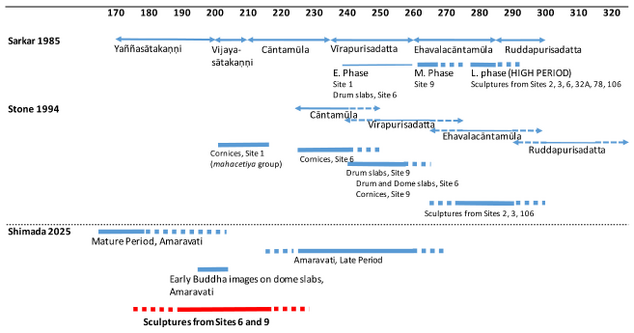
Despite the general scholarly agreement in ascribing the Nagarjunakonda sculptures to the Iká¹£vÄku period, there are still many questions about how and when such a magnificent Buddhist artistic production evolved in the valley. H. Sarkar, Assistant Superintending Archaeologist for the 1954â1960 Nagarjunakonda excavations, argued that Nagarjunakonda sculptures with the fully-evolved style did not appear until the last quarter of the 3rd century CE, although the construction work started earlier (Sarkar 1985: 29â34) (table 6.1). In his view, the oldest dateable structure in the valley was the main stÅ«pa or mahÄcaitya of Site 1, completed in the 6th regnal year of the second king VÄ«rapurisadatta (EIAD 4â19, 41) without sculptural decoration. The oldest sculptures of Nagarjunakonda are a few stÅ«pa slabs from Site 6, which lack âspontaneity and assurednessâ (Sarkar 1985: 31).1 They are dated to the reign of VÄ«rapurisadatta. Following them were sculptures from the main stÅ«pa at Site 9 which lack âthe vigor of and the instinctive appeal so apparent in the mature art phase of NÄgÄrjunakoá¹á¸aâ (Sarkar 1985: 31). He dated them to the 8th regnal of the third king Ehavala-CÄntamÅ«la based on maá¹á¸apa pillar inscriptions found at the site (EIAD 47, 48). In Sarkarâs view, the mature art of Nagarjunakonda appeared later in the reign of the same king, around 275â285â¯CE (Sarkar 1985: 31). Artistic production at Nagarjunakonda thus would have started late and continued over a relatively short period of time. The sculptures from Sites 6 and 9 would be negligible exceptions.
On the other hand, Elizabeth Rosen Stone has proposed a long-term development of the Nagarjunakonda sculptures (Stone 1994: 21â82). She agreed with Sarkar in ascribing the oldest Buddhist monument of the valley to the main stÅ«pa of Site 1, and in dating the fully evolved Nagarjunakonda sculptures to the last quarter of the 3rd century CE during the reign of Ehavala-CÄntamÅ«la (r. 265/75 to 290/300â¯CE in her chronology). By proposing new dates for the sculptures from Sites 6 and 9, on the other hand, she has argued (Stone 1994: 24â31) for substantial artistic production earlier in the reign of CÄntamÅ«la I, the founder of the Iká¹£vÄku dynasty (r. 225 to 240â250 in her dating).
Such differing views on the early development of Nagarjunakonda invite a new review of the early sculptures. How and when did the artistic production start there? How can we understand their stylistic origins? This article will address these questions by examining sculptures from Sites 6 and 9, which are discussed by both Sarkar and Stone as the earliest evidence of sculptural production at Nagarjunakonda. In the first section, I will discuss the approximate dates of Sites 6 and 9 by examining archaeological and epigraphic data. In the second section, I will examine the earliest group of sculptures from Sites 6 and 9 to identify their distinct stylistic and iconographical features. In the final section, I will propose a new chronology of the Site 6 and 9 sculptures and consider the larger political and cultural circumstances in which the sculptures were created. Since the dating of the sculptures and kings by different scholars is rather complicated, the article should be read with reference to the Chronological Table (table 6.1). See also Map 6.1.
Table 6.1
Chronology of Iká¹£vÄku kings and early sculptures from Sites 6 and 9
|
|

Map 6.1
Main sites associated with the inception of Buddhist art at Nagarjunakonda

1 Sites 6 and 9: An Overview
1.1 Site 6
The Site 6 monastery was built on a small mound called Pullabollu, located about half a kilometer southwest of Site 1 (Kuraishi 1926â1927: 160; Longhurst 1938: 21) (see Map 3 in the Introduction, volume I). The monastery consisted of the main stÅ«pa (â ca. 12â¯m), a single-row vihÄra, and a few rubble stÅ«pas (fig. 6.1). Although the monastic complex is not a particularly large as compared to the others at Nagarjunakonda, the main stÅ«pa must have been one of the most distinctive structures in the valley, due to its extensive sculptural decoration. According to an old photograph seemingly taken during Longhurstâs 1929â1930 excavation, four projections of the stÅ«pa drum (commonly called ÄyÄka platforms) were decorated with slabs depicting images of stÅ«pas, pilasters, and cornices (fig. 6.2).2 The lower part of the dome also seems to have been covered, at least partly, with limestone slabs. Unfortunately, the aesthetic appeal of the relief carving made the stÅ«pa a target of antiquarians such as G. Jouveau-Dubreuil, who took out at least two sculptures from the stÅ«pa and sent them to Paris (Kuraishi 1926â1927: 160).3 A few months after Jouveau-Dubreuilâs visit, the Archaeological Survey of India (ASI) sent Muhammad Hamid Kuraishi to the site for a test excavation, which revealed six relief panels from the stÅ«pa (Kuraishi 1926â1927: 160â161).4 A.H. Longhurstâs further excavation of the stÅ«pa yielded a gold reliquary (Longhurst 1929â1930: 147â148; 1938: 21â22). His report also mentions a few drum slabs, one cornice with an inscription that decorated an ÄyÄka platform, and four pillars as coming from the site (Longhurst 1938: 21). Between 1954 and 1960, the ASI excavated the site again and revealed traces of a vihÄra and three rubble stÅ«pas, although no sculptures and inscriptions were found (Soundara Rajan 2006: 594).
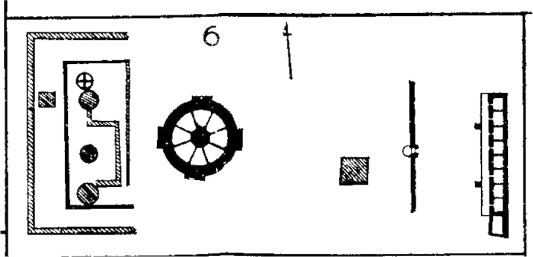
Figure 6.2
Site 6, Main stūpa in the late 1920s

Since the site was heavily disturbed before the proper excavations and did not yield any dated inscriptions, it is hard to know when the monastery was founded. To address this difficulty, Stone noted an inscribed ÄyÄka cornice (fig. 6.3) whose stylistic features show close similarities with cornice sculptures from Site 6 (fig. 6.2). Although the cornice has no record of its find spot, the accompanying inscription mentions the gift of a cornice (unisÄ) along with a
Figure 6.3
Fragment of ÄyÄka cornice from Site 6 (?) bearing inscription EIAD 80, which mention the term mahÄcetiya, Nagarjunakonda, Nagarjunakonda Archeological Museum, Reserve Collection, acc. no. 592

slab (paá¹a) at the Great Shrine or mahÄcetiya (Skt. mahÄcaitya) (EIAD 80).5 Stone has thus associated the cornice with the largest stÅ«pa of Nagarjunakonda at Site 1, because the stÅ«pa yielded ÄyÄka pillar inscriptions that designate the monument as mahÄcetiya (Stone 1994: 25â29; EIAD 4â19, 41). By assuming that the installation of the ÄyÄka pillars took place at the end of the stÅ«pa construction, Stone arrived at a dating of the cornice in question (fig. 6.3) and of the stylistically related cornice sculptures from Site 6 (fig. 6.2) to before the 6th regnal year of VÄ«rapurisadatta, the date of installing the ÄyÄka pillar (Stone 1994: 27). This group of sculptures was thus originally âintended to be installed at Site 1 [= mahÄcaitya] but never wasâ (Stone 1994: 26). Stone dated this groupâthe mahÄcaitya group in her terminologyâto the reign of CÄntamÅ«la I around the second quarter of the 3rd century CE. She even suggested (Stone 1994: 31) a possibility of dating back this group even further to the reign of Siri-VijayasÄtakaá¹á¹i, a SÄtavÄhana ruler who left the earliest dated inscription of Nagarjunakonda (EIAD 1) (figs. 6.3, 6.20, 6.22).
1.2 Site 9
Site 9 was located to the east of the citadel at the southwestern part of the valley (see Map 3, in the Introduction, volume I). Longhurstâs excavation in 1929â1930 uncovered a variety of deposits from the main stÅ«pa, including bones of an ox, deer and hare, water pots, and bowls. It also yielded relief sculptures associated with the stÅ«pa, such as a panel fragment depicting the ÅaÅa-jÄtaka, seven drum slabs depicting stÅ«pas, four ÄyÄka cornices, two buddhapÄdas, and one inscribed pillar (Longhurst 1929â1930: 148â151, pls. 37f, 39aâe; 40câd, Longhurst 1938: 23â24, pl. 42). The ASIâs final excavations of the site in 1957â1959 revealed an entire monastic complex with fully developed features, consisting of the main stÅ«pa (â ca. 13â¯m), two apsidal temples that enshrined a stÅ«pa and a Buddha image respectively, and a vihÄra with a maá¹á¸apa (fig. 6.4). The excavations also confirmed the architectural development of the monastery in four phases and its completion during the reign of Ehavala-CÄntamÅ«la, although the reports do not give any details of the four phases of development (Indian ArchaeologyâA Review 1957â1958: 8â9; 1958â1959: 6, pl. 4A; Soundara Rajan 2006: 172).

The former excavations and explorations also yielded six inscriptions from the site (EIAD 30, 37, 47, 48, 74, 79). Three of them (EIAD 30, 47, 48) include regnal years of kings, dating them to the reigns of VÄ«rapurisadatta and Ehavala-CÄntamÅ«la. A particularly important inscription for the dating of the monastery, which provoked a series of scholarly debates, is the one on a memorial pillar (EIAD 30, see Ollett, Tournier & Griffiths in this volume, pp. 282â283, no. 63).6 On this pillar, found near the main stÅ«pa during Longhurstâs 1930â1931 excavation, VÄ«rapurisadatta records various accomplishments of his father CÄntamÅ«la I. When revising Vogelâs old reading of the inscription (1931â1932: 63â64, item L), Sircar noted the expression savachara[á¹] vijaya[á¹] and interpreted it as the year of Vijaya in Jupiterâs sixty-year cycle. He thus dated the inscription to 273â274â¯CE and proposed a new chronology of the Iká¹£vÄku kings (Sircar 1963â1964: 1â7). Mirashi effectively challenged Sircarâs theory by arguing that the term simply meant âthe victorious yearâ (Mirashi 1967â1968: 70â72; 1969: 318â322). Vidyadara Rao further argued that the victorious year must refer to the accession year of VÄ«rapurisadatta (Vidyadhara Rao 1969, 323â325). These new theories indicate that the monastery was established before VÄ«rapurisadatta came to the throne. A piece of evidence that seems to support this view is another inscription discovered inside the main stÅ«pa (EIAD 37). According to Sircar, a prince (kumÄra) figuring in the inscription whose name began with VÄ«ra-Aribhaâ could be identified as VÄ«rapurisadatta before he came to the throne (Sircar 1963â1964: 19â20). If this is indeed the case, the foundation or renovation of the stÅ«pa would have taken place when VÄ«rapurisadatta was still a prince, i.e., in the reign of CÄntamÅ«la I.
2 Sites 6 and 9 Sculptures
The early foundation of Sites 6 and 9 indicated by archaeological and epigraphic evidence finds further support from stylistic and iconographical features of the sculptures which embellished the stÅ«pas. The earliest group of sculptures from the sites can be classified into the following main architectural types: (1) rectangular slabs that encased the drums of the stÅ«pas; (2) cornices that embellished the upper edges of the ÄyÄka platforms of the stÅ«pas; (3) large rectangular slabs that encased the domes of the stÅ«pas.7 To highlight their main features, these sculptures are compared with the fully evolved Nagarjunakonda sculptures from Sites 2 and 3 (see Map 3, in the Introduction, volume I), dated by both Sarkar and Stone to the last quarter of the 3rd century CE (Sarkar 1985: 31; Stone 1994: 58â71), and with the late Amaravati sculpture, roughly dated to the first half of the 3rd century CE (Shimada 2013: 102â104).
2.1 Drum Slabs
All drum slabs found at Sites 6 and 9 depict images of stÅ«pas, although the shapes of the stÅ«pas vary considerably from one site to the other.8 Three drum slabs from Site 6 depict highly embellished stÅ«pas whose domes and drums are covered with intricate relief sculpture (figs. 6.2, 6.7â9). Compared to the similar drum slabs found at Nagarjunakonda Sites 2 and 3 (fig. 6.5) and Amaravati (fig. 6.6), they show some distinct features. While the relevant slabs from Nagarjunakonda and Amaravati often depict large Buddha or Bodhisattva images at the stÅ«paâs front entrance and fill the domes and drums with narrative scenes (figs. 6.5, 6.6), such decorative programs are not conspicuous in the slabs from Site 6. The stÅ«pasâ front entrances are filled with âsymbolicâ representations of the Buddha, including the bodhi-tree, dharmacakra, and a nÄga (figs. 6.7â6.9). The only recognizable Buddha image in the three slabs is a small one carved on the front face of an ÄyÄka platform (fig. 6.8).9 While the slab that depicts the Buddha image also represents narrative scenes on the dome, the drums and domes of the other two slabs are filled with a variety of non-narrative motifs, such as running animals, garlands, and full-vases (pÅ«rá¹aghaá¹a) (figs. 6.7, 6.9). In contrast to the rather high relief observed on similar drum slabs at Amaravati (fig. 6.6), the carving of the relief is shallow (figs. 6.7â10). It is also notable that the reliefs give a rounder shape to the stÅ«pa railing and the drum by using perspective (figs. 6.7â6.9). This technique became obsolete in late Amaravati sculptures, and then in those from Nagarjunakonda Sites 2 and 3, when the copings of the stÅ«pa railing and the drum were depicted increasingly as flat-horizontal bands (figs. 6.5â6.6). A comparable example of such representation of a stÅ«pa is depicted in a rail-coping of Amaravati, dated to the late 1st century CE in the Sada period (Shimada 2013: 89, 99â102) (fig. 6.11).10
Figure 6.5
Drum slab from Site 3, Nagarjunakonda, Nagarjunakonda Archeological Museum, acc. no. 34

Figure 6.6
Drum slab from Amaravati, British Museum, acc. no. 1880,0709.79

Figure 6.7
Drum slab from Site 6, Nagarjunakonda, Nagarjunakonda Archeological Museum, Reserve Collection, acc. no. 500

The drum slabs from Site 9 have a completely different design. Of the seven slabs excavated by Longhurst, two can be identified from the illustrations in his report (Longhurst 1929â1930: 151, pl. 39c and d) (figs. 6.12, 6.13). They depict relatively plain stÅ«pas with two standing attendants and two flying figures. The stÅ«pas have no railings but have relatively plain domes, and numerous umbrellas sprouting from the harmikÄs. The drum of each depicted stÅ«pa is divided into three registers, embellished with auspicious symbols associated with the Buddha and his legends, such as the relic shrine, the dharmacakra, the flaming pillar, and the bodhi-tree. While the motifs depicted on the surface of the stÅ«pas are represented with shallow, linear carving, the standing attendants and flying figures are carved in high relief and have ample volume. In addition to these two published slabs, the Archaeological Museum at Nagarjunankonda preserves six drum slabs that have similar size, design and formal features.11 Although the provenance of these slabs is not confirmed, it is likely that they include the five slabs mentioned by Longhurst as being from Site 9 without descriptions or illustrations (Longhurst 1929â1930: 151).12 A particularly remarkable feature of these Site 9-type slabs is that two slabs depict Buddha images. While one of the images is too damaged to examine the detail, the other depicts the seated Buddha on a throne with attendants (fig. 6.14). The Buddha has a round face and a low and smooth uá¹£á¹Ä«á¹£a. The halo behind the head is relatively small and its edge is embellished with an incised line and a narrow saw-tooth or pearl border (fig. 6.15). It is also interesting that while representing the anthropomorphic image of the Buddha, it simultaneously depicts a set of buddhapÄdas in front of the Buddha. As will be discussed below, Buddha images with this type of halo appear on ÄyÄka cornices from Site 9 (fig. 6.26b) and dome slabs from Site 6 (figs. 6.27â28). The peculiar combination of symbolic and anthropomorphic representations of the Buddha also appears in an early Buddha image from Amaravati.
Figure 6.8
Drum slab from Site 6, Nagarjunakonda, Nagarjunakonda Archeological Museum, Reserve Collection, acc. no. 554

Figure 6.9
Drum slab from Site 6, Nagarjunakonda, Nagarjunakonda Archeological Museum, Reserve Collection, acc. no. 610

Figure 6.10
Yakṣa standing in front of the railing (details of fig. 6.7)

Figure 6.11
A stūpa depicted in a rail-coping of the Sada period, Amaravati, British Museum, acc. no. 1880,0709.19/20

Figure 6.12
Drum slab from Site 9, Nagarjunakonda, Nagarjunakonda Archeological Museum

Figure 6.13
Drum slab from Site 9, Nagarjunakonda, Nagarjunakonda Archeological Museum
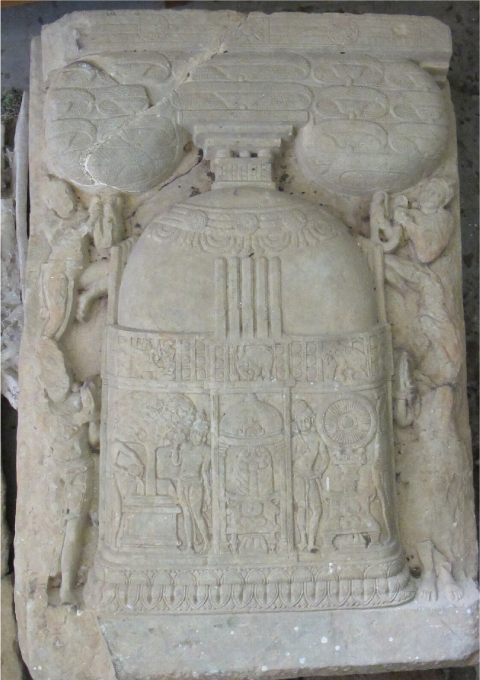
Figure 6.14
Drum slab from Site 9 (?), Nagarjunakonda, Nagarjunakonda Archeological Museum, acc. no. 56

Figure 6.15
Seated Buddha with buddhapÄda (detail of fig. 6.14)

2.2 ÄyÄka Cornices
We may observe similar distinct stylistic and iconographical features in the cornice sculptures which decorated the ÄyÄka platforms of the stÅ«pas (figs. 6.2, 6.16â19). Unlike the cornice sculptures of Nagarjunakonda Sites 3 (fig. 6.20) that divide narrative scenes by columns and mithuna couples, these cornice sculptures divide the scenes by mithunas and vertical rows of lotus medallions. The ends of the cornices have pÅ«rá¹aghaá¹as, not ÅÄlabhañjikÄs. Compared to the complex and dynamic composition of narrative scenes depicted on the cornices from Site 3, those from Sites 6 and 9 have simpler compositions with fewer motifs. The human figures have robust bodies and relatively large faces. The last two features are particularly conspicuous in the cornice sculptures associated with Site 6 (figs. 6.2, 6.3, 6.21, 6.22). Although three of the four cornices in this group lack records of their precise find spots and are thus clubbed together in the âmahÄcaitya groupâ by Stone, they should be associated with Site 6, as their dimensions (h. ca. 33â¯cm; d. ca. 15â20â¯cm), designs, and stylistic features correspond to the one positively known to be from Site 6 (fig. 6.2).13
Compared to the cornices of Site 6, those from Site 9 show more variations in design and style, a fact indicating a longer period of production. According to Longhurstâs list of the cornices (1929â1930: 149â151), they include both those that divide the narrative scenes with vertical rows of three lotus medallions (fig. 6.18) and those with four medallions (figs. 6.16, 6.17, 6.19).14 While many of them have heights of around ca. 30â¯cm, one frieze is slightly higher (ca. 32â¯cm) (fig. 6.19). Beside these five cornices, the Archaeological Museum at Nagarjunakonda has at least three more fragments whose sizes and formal fea-tures correspond to the cornices from Site 9 (figs. 6.23â6.25).15 While the human figures carved on the cornices show general similarities with Site 6 sculptures with their robust bodies and larger faces (figs. 6.17â6.19, 6.23â6.24), some figures have elongated limbs and dynamic postures that look closer to the figures of the fully-evolved Nagarjunakonda sculpture (figs. 6.16, 6.25). It is also noteworthy that they include two Buddha images (figs. 6.26aâb). Both images are characterized by round faces, low uá¹£á¹Ä«á¹£as, and small halos. One of the Buddha images (fig. 6.26b) has a halo whose edge is decorated with a saw-tooth/pearl border motif. These features correspond well with those of the Buddha carved on a stÅ«pa slab associated with Site 9 (fig. 6.15).
Figure 6.16
ÄyÄka cornice from Site 9, Nagarjunakonda, Nagarjunakonda Archeological Museum, acc. no. 17

Figure 6.20
ÄyÄka cornice from Site 3, Nagarjunakonda, Nagarjunakonda Archeological Museum, acc. no. 3

Figure 6.17aâb
ÄyÄka cornice from Site 9, Nagarjunakonda, Nagarjunakonda Archeological Museum, Reserve Collection, acc. nos. 503, 608


Figure 6.18
Shorter ÄyÄka cornice from Site 9, Nagarjunakonda, Nagarjunakonda Archeological Museum, Reserve Collection

Figure 6.19
Shorter ÄyÄka cornice, Site 9, Nagarjunakonda, Nagarjunakonda Archeological Museum, Reserve Collection, acc. no. 599

Figure 6.21
ÄyÄka cornice from Site 6 (?), Nagarjunakonda, Nagarjunakonda Archeological Museum, Reserve Collection, acc. no. 579
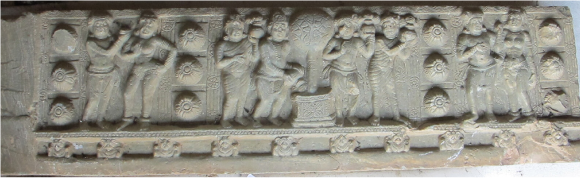
Figure 6.22
ÄyÄka cornice from Site 6 (?), Nagarjunakonda, Nagarjunakonda Archeological Museum, Reserve Collectiona, acc. no. 511

Figure 6.23
Fragment of ÄyÄka cornice from Site 9 (?), Nagarjunakonda, Nagarjunakonda Archeological Museum, Reserve Collection, acc. no. 520
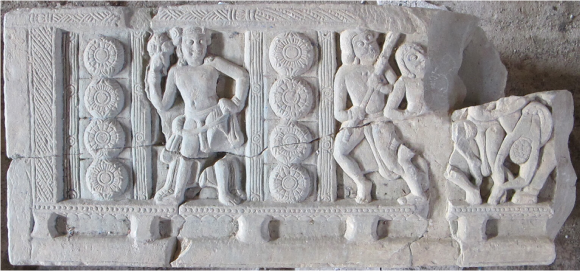
Figure 6.24
Fragment of ÄyÄka cornice from Site 9 (?), Nagarjunakonda, Nagarjunakonda Archeological Museum, Reserve Collection, acc. no. 573
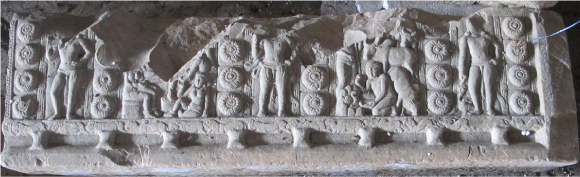
Figure 6.25
Fragment of ÄyÄka cornice from Site 9 (?), Nagarjunakonda, Nagarjunakonda Archeological Museum, Reserve Collection, acc. no. 583

Figure 6.26aâb
Standing Buddha (a. detail of fig. 6.25; b. detail of fig. 6.16)


2.3 Dome Slabs
In addition to the drum slabs and cornices, Site 6 yielded two rectangular slabs that decorated the dome of the stÅ«pa (Kuraishi 1926â1927: 160). These slabs, discovered by Jouveau-Dubreuil prior to the ASIâs survey of Nagarjunakonda, were successfully identified by Stone with the dome slabs in the Musée Guimet in Paris and the Metropolitan Museum of Art in New York respectively (Stone 1994: 51â52) (figs. 6.27â6.28). They show different iconographical and stylistic features from the âtypicalâ dome slabs of Nagarjunakonda found at Sites 2 and 3.16 While the latter examples depict narrative scenes in three registers, the slabs from Site 6 seem to consist of only two registers. Narrative scenes in the registers are carved in relatively high relief. The robust bodies, broad faces, wide noses, and thick lips of the human figures resemble those of the cornice sculptures associated with Site 6 (figs. 6.3, 6.21). On the other hand, in comparison with the cornice sculptures, the narrative scenes on these dome slabs have a more complex composition and depict anthropomorphic forms of the Buddha. It is also notable that the small halos decorated with a saw-tooth/pearl border behind the heads of the Buddha and the Bodhisattva (figs. 6.29aâb) are the same as the ones observed on a drum slab and ÄyÄka cornices from Site 9 (figs. 6.15, 6.26b).
Figure 6.27
Dome slab from Site 6, Nagarjunakonda, Musée Guimet, acc. no. MG 17067

Figure 6.28
Dome slab from Site 6, Nagarjunakonda, Metropolitan Museum of Art, acc. no. 28.105

3 Sites 6 and 9 Sculptures in Context
To summarize, sculptures from Sites 6 and 9 possess several stylistic and iconographical features that clearly distinguish them from the fully evolved Nagarjunakonda sculptures and the late Amaravati sculptures. Despite Sarkarâs rather dismissive comments on the sculptures, they exhibit the flowering of vigorous artistic production in these monasteries. The three-dimensional representation of stÅ«pas and the robust bodies of human figures also remind us of the mature phase of the Amaravati sculptures dated to the late 1st and early 2nd centuries CE. These features suggest the overall validity of Stoneâs long chronology of the Nagarjunakonda sculptures, which ascribes the earliest sculptures from Sites 6 and 9 to the reign of CÄntamÅ«la I and even before it. On the other hand, my observation of the sculptures and the continuing growth of our knowledge of the Buddhist material culture of Ändhra highlight the following issues that may lead us to reconsider certain details of her chronology.
The first issue is the so-called âmahÄcaitya groupâ of cornice sculptures, suggested by Stone as belonging to Site 1 (figs. 6.3, 6.21â6.22). As already mentioned, according to my measurement of the cornices, they have the same heights and depth as the cornice known to come from Site 6 (fig. 6.2). Their stylistic features are hardly different from the latter. The only difference between the two groups is that the cornice from Site 6 is a long frieze that depicts several scenes of the Buddhaâs legends in a row. Recent archaeological discoveries, however, suggest that such composition of narrative sculptures appeared in the farther upstream region at Kanaganahalli as early as the reign of king VÄsiá¹á¹hÄ«putta Siri-SÄtakaá¹á¹i (r. ca. 125â147) (Poonacha 2011: pl. CXXV, Arlt & Zin 2021).17 This feature does not necessarily imply a later date of the cornice from Site 6 in comparison with the âmahÄcaitya group.â Another inconvenient fact for Stoneâs theory is that the excavation reports of Nagarjunakonda do not record any sculpture from Site 1 (Longhurst 1928â1929: 100â101; 1938: 16; Soundara Rajan 2006: 163â164, 593). There is thus no strong reason to separate the âmahÄcaitya groupâ of cornices from the one from Site 6. It is more likely that all the cornices belonged to Site 6.
The second issue is the stylistic origin of the sculptures. As discussed above, drum slabs and pilasters associated with Sites 6 and 9 represent yaká¹£as and human figures with robust bodies. They show differences from the late Amaravati and the fully-evolved Nagarjunakonda sculptures which represent human figures with slender bodies and elongated limbs. While such stylistic features could be comparable to Mathura sculptures, as noted by Stone, the best comparative examples are found in early sculptures of Ändhra around the 1stâ2nd centuries CE, such as the ones at Amaravati and Chandavaram (figs. 6.11, 6.35). It is also notable that sculptures from Gummadidurru, the site suggested by Stone as transmitting the Mathura style to Nagarjunakonda, do not show close similarity with the sculptures from Site 6. The miniature stÅ«pas depicted on drum slabs from Gummadidurru, for example, are of the highly elaborated type and are not three-dimensional (Kuraishi 1926â1927: pls. 35â36) (fig. 6.33). These features discourage us from specifying Mathura and Gummadidurru sculptures as the stylistic origin of the early Nagarjunakonda sculptures.18
Figure 6.29aâb
Heads and halos of Bodhisattvas (a. detail of fig. 6.27; b. detail of fig. 6.28)
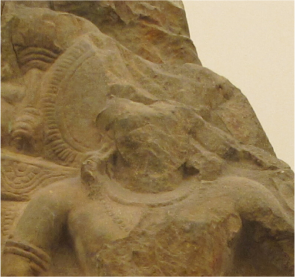

The third issue is the distinct iconography of the Buddha images. The halos of the Buddha images, characterized by their smaller sizes and the decorative bands on the edges (figs. 6.15, 6.26b, 6.29aâb), are rather uncommon in the late Amaravati and other Nagarjunakonda sculptures, in which Buddha and Bodhisattva images have relatively large and plain halos (fig. 6.30). The depiction of buddhapÄdas along with the Buddha image carved on a drum slab of Site 9 type (fig. 6.15) is not found in the late Amaravati or other Nagarjunakonda sculptures either. Interestingly, however, we do find Buddha images with such iconographical features in the earliest surviving Buddha images in Amaravati, which are carved on three fragments of dome slabs (Burgess 1887: pls. 46-1,2, 48-3) (figs. 6.31, 6.32). Although they are damaged, all images have relatively small halos decorated with a saw-tooth/pearl border motif on the edges (fig. 6.32). According to Burgessâ early observation of the sculpture, one of the images (fig. 6.31) depicted a buddhapÄda in front of the seated Buddha, like the image from Site 9 (Burgess 1887: 90) (fig. 6.18). These Buddha images are datable to the end of the 2nd century CE, as this type of dome slab includes an inscription (EIAD 534) mentioning King GotamÄ«putta Siri-YaññasÄtakaá¹á¹i (ca. 170â200â¯CE).19 The iconographical features of the Buddha images, particularly the hair composed of snail-shell curls, also support this dating (Shimada 2013: 102â104). The sculptures from Sites 6 and 9 stÅ«pas that depict Buddha images with the same iconographical features, therefore, should also be placed around the same period.
Figure 6.30
Seated Buddha, ÄyÄka slab from Site 3, Nagarjunakonda, Nagarjunakonda Archeological Museum, acc. no. 35

Figure 6.31
Seated Buddha on a dome slab from Amaravati, Government Museum, Chennai, acc. no. 187
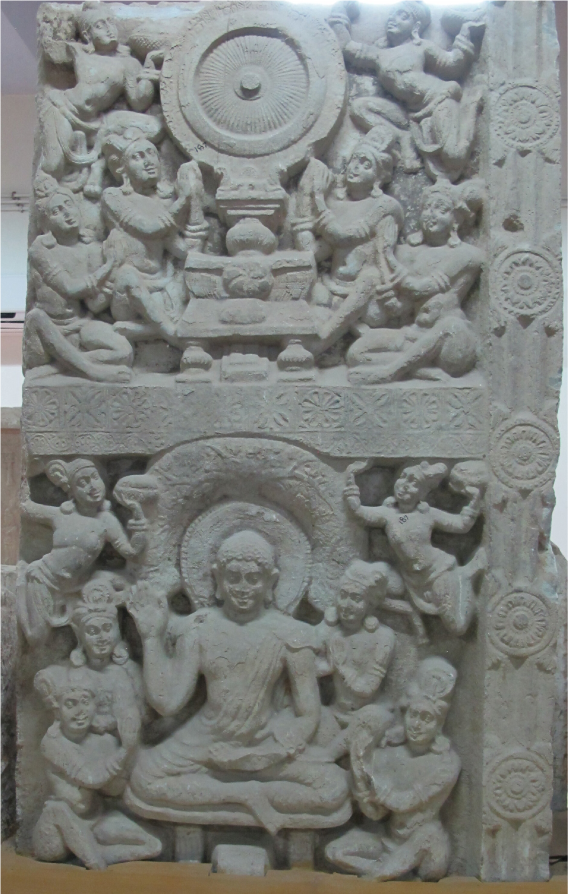
Figure 6.32
Head of the Buddha (detail of fig. 6.31)

Figure 6.33
Drum slab from Gummadidurru, Amaravati Site Museum, acc. no. 363

Based on the above observations, I would suggest two modifications to Stoneâs chronology of Sites 6 and 9 sculptures. First, considering the âclassicalâ features of the sculptures and the iconographical features of the Buddha images, it would be plausible to date these sculptures earlier than Stoneâs suggested dates. They can be placed roughly between the end of the 2nd and the early 3rd century CE. The earliest type of sculptures in the group are cornices associated with Site 6, including those of the âmahÄcaitya group,â since they all show simple composition in the relief and do not include Buddha images. The rest of the sculptures that depict the Buddha images can be somewhat but not much later than the above cornices, because the Buddha images in the sculptures show early iconographic features.
Second, since one of the cornices associated with Site 6 includes an inscription that records donations to a mahÄcaitya, the main stÅ«pa of Site 6 seems to have been called mahÄcaitya, at least in its outset. A possible issue with this hypothesis is how the stÅ«pa, whose size is not large, could have been called âgreatâ (mahÄ). The term, however, was used flexibly in early Buddhist inscriptions and literature to emphasize the subjective greatness of the caitya (Skilling 2016: 25). A good example showing the subjective nature of the term is the Kesanapalli stÅ«pa, located some 60 kilometers to the east of Nagarjunakonda. While a pillar inscription from the site (EIAD 3), dated to the 13th regnal year of CÄntamÅ«la I, calls the stÅ«pa mahÄcetika (= Skt. mahÄcaitya), the diameter of the stÅ«pa drum is only about three meters (Khan 1969: 4 and pl. 2). This shows that a relatively small stÅ«pa like the one at Site 6 could be called mahÄcaitya if it was an important place of worship. If this were the case, the stÅ«pa must have been established before the 6th regnal year of VÄ«rapurisadatta and may have been worshipped as the most important stÅ«pa in the Nagarjunakonda valley before the Iká¹£vÄkus made their new mahÄcaitya.
The modified chronology that I have proposed suggests that Nagarjunakonda developed substantial construction work and artistic production in the pre-Iká¹£vÄku period. It also suggests that the Buddhist construction work of the valley did not start with the creation of a magnificent stÅ«pa at Site 1, but with modest-sized monastic complexes at Sites 6 and 9. In the dynastic history of Ändhra, the suggested beginning period of Nagarjunakonda was the time when the rule of the SÄtavÄhanas started to wane in the Deccan as a result of the conflicts with the Åaka Ká¹£atrapas in western India.20 This increasing presence of the Åakas not only affected the political climate of the Deccan but may also have caused a growing influence of northern culture in the region. As already noted, in Buddhist art, a manifestation of this phenomenon is the appearance of Buddha images at Amaravati around the end of the 2nd century CE, probably in the reign of king GotamÄ«putta Siri-YaññasÄtakaá¹á¹i (ca. 170â200â¯CE) (fig. 6.32). It is also notable that the earliest Buddha images at Amaravati are carved on dome slabs that exhibit an interesting mixture of early and late sculptural features. While depicting Buddha images in three slabs, most slabs represent three key events or places associated with the Buddha (the Enlightenment at Bodhgaya, the First Sermon at Sarnath, and the ParinirvÄá¹a at Kusinagara) with traditional signs (a tree, a pillar with a wheel and a stÅ«pa). While the human figures, with their robust bodies and simple ornaments, retain the general features the Amaravati sculptures from the late 1st and the 2nd centuries CE, the rather dramatic poses of the flying figures shows similarity with the sculptures of the later period, dated to the 3rd century CE.21 This suggests that Amaravati sculpture around the end of the 2nd century CE experienced a stylistic transformation, possibly by the emergence of a new artistic tradition.
Sites 6 and 9 sculptures, showing similar stylistic and iconographical features, may have been created under similar political and cultural circumstances as the dome slabs from Amaravati. Archaeological evidence shows that the development of early historic settlements in the Nagarjunakonda valley did not start until the second half of the 2nd century CE (Soundara Rajan 2006: 54). Such late development of the valley can be explained by its secluded location, surrounded by hills and with a rather inhospitable climate. Probably due to the unstable political condition of the Deccan in the late 2nd century CE, people got interested in this well-protected valley and developed settlements there. A particularly notable record in this regard is a pillar inscription in year 6 of GotamÄ«putta Siri-VijayasÄtakaá¹á¹i (EIAD 1), dated around the beginning of the 3rd century CE.22 This oldest-dated inscription of Nagarjunakonda, honoring the Buddha (bhagavato agapogalasa), suggests the inauguration of Buddhist construction activity in the valley under the SÄtavÄhanas. According to Sarkar (1965â1966: 274), the name of the king suggests that he was the founder of VijayapurÄ«. If this hypothesis is accepted, we may further speculate that the construction of Sites 6 and 9 may have started under his reign. Nonetheless, the construction of new Buddhist monasteries in the valley, such as those at Sites 6 and 9 was most likely undertaken by new settlers, who brought the contemporary style and iconography of Buddhist art from the surrounding artistic centers, in the final years of the SÄtavÄhanas. Notable in this connection is that one of the drum slabs from Site 6 has a short inscription that reads dhamasa on the undressed part of the slab (EIAD 66), and the same dhamasa inscription is found on an Amaravati railing pillar (EIAD 521).23 Sarkar (1968â1971: 231) suggested that these are masonâs marks recording the name of a masonsâ guild. Although the paleography of the two inscriptions is clearly different, it is possible that the artisans who worked on Nagarjunakonda Site 6 were in an old guild which had sent their artisans to work on the embellishment of the Amaravati stÅ«pa in the 1stâ2nd centuries CE.
Besides Amaravati, another stylistic resource for making the sculptures from Sites 6 and 9 was the local Buddhist artistic tradition that had already developed in different parts of Ändhra. As attested by Kanaganahalli in northern Karnataka, Ter in Maharashtra, and Dhulikatta in northern Telangana, the Buddhist artistic tradition of Ändhra expanded more widely into the plateau area of the eastern Deccan even before the Christian era and developed locally (Poonacha 2011; Krishna Sastry 1983: 144â145; Shimada 2013: 134, pl. 65). In the vicinity of the Nagarjunakonda valley, artistic work was started on the Kesanapalli stÅ«pa around the 2ndâ1st centuries BCE. Yelleswaram, just opposite Nagarjunakonda across the Krishna River, developed urban culture and artistic production by the 1stâ2nd centuries CE (Khan 1963a: 9â11; 1963b: 5â6). Although they may not have been associated with Buddhism, terracotta figures found at the site show resemblance to human figures depicted in Site 6 sculptures in their broad faces, flat noses, and thick lips (Khan 1963b: pl. 3). As a good number of similar terracotta figures were also found at Kondapur and Kanaganahalli in an area further inland (Yazdani 1941: 177â178, pls. 8â11; Nagaraja Rao 1985: pl. 53), such representation of human figures could have been widely prevalent in inland Ändhra during the pre-Iká¹£vÄku period. Perhaps the most remarkable site whose sculptures show strong similarities with those from Sites 6 and 9 is Chandavaram, located about 100â¯km to the south of Nagarjunakonda (Annual Report of the Department of Archaeology and Museums, Andhra Pradesh 1972â1973: 13â14; 1974â1975: 8â13; 1976â1977: 17â24; Arlt 2021). The remains of a monastic complex, consisting of a large stÅ«pa (â ca. 40â¯m) and monasteries overlooking the stÅ«pa, yielded a good number of relief sculptures decorating the drum and dome of the stÅ«pa, dated roughly to the 2nd century CE. Human figures depicted in the sculptures show basic similarities to Site 6 sculptures, with their robust bodies and broad faces (fig. 6.34). The stÅ«pa slabs also have a design very similar to the Site 9 type (fig. 6.35). Considering the fact that stÅ«pa slabs resembling the Site 9 type are also found at several other sites in the inland area surrounding Nagarjunakonda, such as Dupadu, Goli, and Phanigiri (Ramachandran 1929: pl. 10; Subba Reddy 1988), it is likely that this design of stÅ«pa slabs was a common type of the mid-Krishna valley and its surroundings (fig. 6.36). Although studies of these smaller sites have hardly developed yet, they indicate the strong presence of local artistic traditions surrounding the Nagarjunakonda valley before the rule of the Iká¹£vÄkus. Sculptural styles of Sites 6 and 9 would thus be based on such local artistic traditions.
Figure 6.34
Visiting the shrine of a tutelary deity, dome slab from Chandavaram, State Museum, Hyderabad, acc. no. P6647

Figure 6.35
Drum slab from Chandavaram, State Museum, Hyderabad, acc. no. P6650

Figure 6.36
Site 9-type drum slab from Goli, Reserve Collection, Government Museum, Chennai

Conclusion
As noted in the beginning of this article, a prevalent narrative of the Nagarjunakonda sculptures tends to describe them as a mere successor of the Amaravati sculptures, produced under the rule of the Iká¹£vÄkus dynasty. I have highlighted the inadequacy of such a general narrative by analyzing the sculptures from Sites 6 and 9. Our modified chronology of the sculptures suggests that the Buddhist artistic production in the valley started in the pre-Iká¹£vÄku period, around the end of the 2nd century CE and the early 3rd century CE, the time when the political and cultural landscape of Ändhra started changing due to the increasing presence of the Åakas from the north and the waning power of the SÄtavÄhanas. Such a new political and cultural milieu seems to have had significant impact on the Buddhist art of Ändhra, as indicated by the appearance of the Buddha images in sculptures. By this period, Buddhist artistic production had already developed in different parts of Ändhra, including the surrounding area of the Nagarjunakonda valley. The distinct style and iconography of sculptures from Sites 6 and 9 reflect such complex interactions between new forms of Buddhist art and worship from the north and local artistic traditions that had already developed in Ändhra.
Since this new chronology proposes the substantial development of Buddhist construction and artistic activity in the Nagarjunakonda valley before the Iká¹£vÄku period, it leads us to formulate another set of questions. After this transitional period, when and how did the Buddhist sculptures of Ändhra evolve into the latest style, represented by the late Amaravati sculptures and the Nagarjunakonda sculptures from Sites 2 and 3? How do we understand the chronological gap between the earliest Nagarjunakonda sculptures we discussed (ca. the end of the 2nd century CE and the beginning of the 3rd century CE) and the fully-evolved Nagarjunakonda sculptures (ca. last quarter of the 3rd century CE)? Would this suggest that the latest style of the Nagarjunakonda sculptures started earlier than the last quarter of the 3rd century CE, as suggested by Barrett (1954: 44)? The detailed examination of the earliest Nagarjunakonda sculptures and their chronology encourages us to address such further questions to establish a comprehensive chronology of Amaravati and Nagarjunakonda sculptures in a future study.
Acknowledgements
This article crucially depends on the result of my field survey at the Archaeological Museum at Nagarjunakonda in January 2017. I owe sincere gratitude to Arlo Griffiths, Vincent Tournier and Ingo Strauch, who invited me to join their field trip to Ändhra. I am grateful to Surya Prakash Gudi and all the staff of the Archaeological Museum at Nagarjunakonda for their special arrangements during my work. I would like to thank Mavis Pilbeam and Julian Wheatley who carefully proofread my drafts and made the article readable. I am grateful to Elizabeth Rosen Stone, Monika Zin, and Sonya Rhie Mace, and my co-editors who gave valuable comments on earlier versions.
Although he did not specify the provenance of the slabs in the article, a figure clearly shows that he meant the slabs from Site 6 (Sarkar 1985: plate 32). In his earlier article, Sarkar dated a stÅ«pa slab from Site 6 to the 2nd regnal year of Ehavala-CÄntamÅ«la (Sarkar 1968â1971: 227). As noted by Stone, no inscription with such a date was found at Site 6 (Stone 1994: 52).
Since Longhurstâs excavation reports (1929â1930: 144â148; 1938) do not include this photograph, I was not able to confirm if it was taken by his team during the excavation, or by Kuraishi during his trial excavation. The photograph is also available at the Digital Collection of the Leiden University Library (P-038041, accessible via
Upon a request from C.T. Loo, a famous art dealer in Paris, Jouveau-Dubreuil made a tour of unprotected Buddhist sites from Ändhra and removed some pieces from Nagarjunakonda in July 1926. Because of the nature of the work, Jouveau-Dubreuilâs âexcavationsâ in Ändhra are not published. The photograph archive at the Musée Guimet has a few photographs that seem to preserve a visual record of his work. I thank Amina Okada, the curator of the museum for allowing me to study the photographs when I visited Paris in January 2011. As for Jouveau-Dubreuilâs life and activities in India, see Roustan Delatour 1996 and Kaimal 2012: 137â142.
Note that the numbering systems of the sites used by the early archaeologists are different from the one used by the ASI. In Kuraishiâs report, Site 6 is numbered as Site 4. Longhurst mentions that the pieces found by Kuraishi were removed for safety to the large sculpture enclosure (Longhurst 1929â1930: 144).
The transliteration and translation of EIAD 80 are as follows: (1) sidhaá¹ nÄmo bhagavato agapogalasa budhasa chadakapavaticana padumavÄniya gharaniya sagaya saputakÄna hagasirisa sigasa nÄgutarasa ca sabhaja[yÄ] ⦠(2) saputikÄna ca deyadhaá¹ma paá¹o unisÄ ca mahÄcetiye patiá¹hÄvito âSuccess! Homage to the Bhagavant, the highest man, the Buddha! A slab and a coping stone were established as a pious gift at the Great Shrine by SagÄ, distinguished wife of (?) PadumavÄniya of the Chadakapavaticas, together with her sons, (i.e.) Hagasiri, Siga and NÄgutara, together with their wives (â¦), and together with their daughters.â The use of the term unisÄ (Skt. uá¹£á¹Ä«á¹£a) to denote a cornice stone, not a rail coping, sounds unfamiliar but there are two examples at Amaravati (EIAD 283 and 329, see also Barrett 1990: 79). Oskar von Hinüber has noted that one of the two cornices from Amaravati (EIAD 283) could be identified as puphagahani because newly discovered inscriptions from Kanaganahalli designate the cornices placed on the top of the lower drum as such, and the inscription attached to the cornice from Amaravati includes a similar term (puphagaá¹iya paá¹a) in the list of donations (Nakanishi & von Hinüber 2014: 45). I do not follow his suggestion because the puphagahanis at Kanaganahalli are L-shaped slabs and depict railing patterns. Their shape and design are different from the Amaravati cornice which is a rectangular frieze and depicts narrative scenes. While the puphagahanis at Kanaganahalli decorated the non-projecting part of the drum, the cornice in question from Amaravati decorated the northern gate (utaradÄre), probably the ÄyÄka projection. The cornices that decorated the cardinal projections of the Kanaganahalli stÅ«pa are not called puphagahani but rather ÄyÄka or ÄyÄga-paá¹a (Nakanishi & von Hinüber 2014: 42â43, II-3, II-4).
See Chapter 3 of this volume (no. 58) for the further discussion of this pillar and the inscriptions.
In addition to the types of slabs discussed in this article, Site 6 yielded two more types of sculptures. One is seated Buddhas carved at the bottom of ÄyÄka pillars (Stone 1994: fig. 116). As one of the images is unfinished, and the images were carved deeper than the surrounding sculptural surface, they may have been added to the pillars secondarily. Another one is a long frieze (h. 19â¯cm; w. 206â¯cm) that depicts the KinnarÄ«-jÄtaka (Stone 1994: 65 and figs. 119â121). As noted by Stone, the unique curved shape of the top of the frieze and its lesser height indicates the friezeâs non-association with the cornice of the ÄyÄka platform. It could be a base molding attached to the monastery. The unusual design of the frieze, divided by gavÄká¹£a-like motifs, and the extremely shallow carving also indicate a later date for the frieze. Because the main goal of this article is to scrutinize the features of early Nagarjunakonda sculptures, we will not include these pieces in our discussion.
The only possible exception is a panel fragment from Site 9 that depicts the ÅaÅa-jÄtaka (Longhurst 1929â1930, pl. 37f; Stone 1994, fig. 106). Although Stone identifies it as a dome slab, its size indicates that it could be a drum slab.
Sarkar either did not know or overlooked this panel. He mentions that these stūpa slabs do not include anthropomorphic forms of the Buddha (Sarkar 1985: 31).
Tournierâs study of the relief in light of the inscription engraved above it (EIAD 468) convincingly suggests that the stÅ«pa featuring in the center of the visual narrative represents one of the three mahÄcaityas established in Ändhra by King Pussagutta, an unknown king possibly related to the Sada dynasty (Tournier 2021â2022: 15â39).
Drum slabs, Archaeological Museum, Nagarjunakonda, acc. nos. 25, 55, 56, 496, 528, 603.
Sarkar mentions one drum slab as being from Site 1, although he does not explain the reason for his identification (Sarkar 1960: 84, pl. 46). As noted by Stone, the slab shows an association with Site 9 (Stone 1994: 26).
Acc. nos. 511, 579, 592. See also Stone 1994: figs. 33, 34.
Also see Stone 1994: figs. 64â66, 90â91. Longhurst (1929â1930: 149â151) says that there were four beams that decorated the stÅ«pa. Only one beam, depicting the so-called âMan in the Wellâ story, is in a good state of preservation. Longhurstâs other three fragmented beams are the one illustrating MÄyÄâs Dream, the Interpretation of the Dream, the Birth, and the First Sermon; the one depicting the Campeyya-jÄtaka and MandhÄtu-jÄtaka; and the one depicting the Sarvaá¹dada-jÄtaka and the Subjugation of a Mad Elephant. Longhurst describes the fourth beam depicting âscenes from Sivi JÄtaka and the Subjugation of a Mad Elephantâ as a single cornice (Longhurst 1929â1930: 151), but this was an error (Stone 1994: 46). The two reliefs most likely formed two shorter cornices placed at the sides of the ÄyÄka platform, since their sizes are consistent (h. ca. 30â32â¯cm; w. 120â125â¯cm) and they are largely intact. Beside these pieces with excavation records, there are three more fragments whose sizes and formal features correspond to the cornices from Site 9.
Stone includes a cornice (acc. no. 593) depicting the Campeyya-jÄtaka in the âmahÄcaitya groupâ / Site 6-type (Stone 1994: 27, fig. 35). I disagree with her identification because the composition of narrative scenes depicted on the cornice is complex and the narrative scenes are divided with rows of four (not three) lotus medallions.
For the examples of dome slabs from Sites 2 and 3, see Stone 1994: figs. 192, 194, 218, 225, 227â229.
Arlt has reached this conclusion by re-examining the inscription that accompanied the sculpture. For earlier studies of the inscription, which have proposed different readings, see Poonacha 2011: 457 (no. 68) and Nakanishi & von Hinüber 2014: I-12. Arltâs reading of the inscription, based on his own examination at the site, is the most reliable one.
To prove a link between Sites 6 sculptures and Gummadidurru sculptures, Stone compared a drum pilaster in the Cleveland Museum of Art, which she identified as from Site 6, and a pilaster from Gummadidurru in the Cincinnati Art Museum (Stone 1994: 55, 85, figs. 122â123). This comparison may not be valid because the precise find-spot of the Cleveland pilaster is not known.
For discussion on the date of GotamÄ«putta Siri-YaññasÄtakaá¹á¹i, see Bhandare 1998: 316; Shimada 2013:51â54, 104; Nakanishi & von Hinüber 2014: 22â23.
Epigraphic records attest that the later SÄtavÄhanas were long in conflict with the Åaka Ká¹£atrapas in western Malwa. Although the wars between them ceased for a few decades after GotamÄ«putta SÄtakaá¹á¹iâs defeat of Ká¹£atrapa NahÄpana in the late 1st century CE and the SÄtavÄhanaâs subsequent move to coastal Ändhra, conflicts became acute again after the mid-2nd century CE, as indicated by the Junnagarh inscription (year 72 of the Åaka era, or 149/150â¯CE) that records Ká¹£atrapa RudradÄmanâs defeat of a SÄtavÄhana king, probably VÄsiá¹á¹hÄ«putta Siri-SÄtakaá¹á¹i (Burgess 1876: 128â133). The Åakas continued to be active in the Deccan in the 3rd century CE, as attested by a Nasik inscription that records a gift by a daughter of the Åaka Agnivarman in the reign of king ĪÅvarasena of the ÄbhÄ«ras (Tsukamoto 1996, NÄsik 16).
For more detailed discussion on the chronology of the Amaravati railing sculptures and dome slabs, see Shimada 2013: 95â104, 107â110.
Scholars give slightly different dates to the reign of GotamÄ«putta Siri-VijayasÄtakaá¹á¹i. Sarkar (1985: 31) and Stone (1994:31) date the reign as 203â209â¯CE and 201â207â¯CE, respectively. Bhandareâs numismatic study dated the king slightly later, to ca. 215â225â¯CE (Bhandare 1998: 320).
Besides the references listed in the inventory (see Griffiths & Tournier in volume I), also see Sarkar 1968â1971: 226â235; 1985: 31. Another inscription bearing the term dhamasa was discovered at Site 64 (the so-called the âKubera templeâ) of Nagarjunakonda (EIAD 87).
Bibliography
Arlt, Robert. 2021. âChandavaram no bijutsu ãã£ã³ãã´ã¡ã©ã ã®ç¾è¡.â In Ajia bukkyo bijutsu ronsyu, Minami ajia I ã¢ã·ã¢ä»æç¾è¡è«é. æ±ã¢ã·ã¢ I, edited by Miyaji Akira and Fukuyama Yasuko, 323â350. Tokyo: Chuo koron bijutsu shuppan.
Arlt, Robert & Monica Zin. 2021. âKanaganahalli (or Sannathi).â In The Encyclopedia of Ancient History: Asia and Africa, edited by Daniel T. Potts, Jason Neelis, Roderick James McIntosh, and Ethan Harkness, 1, 1â5. Wiley.
Barrett, Douglas E. 1990. âStyle and Palaeography at AmarÄvatÄ«.â Oriental Art 36 (2): 77â82.
Barrett, Douglas E. 1954. Sculptures from Amaravati in the British Museum. London: Trustees of the British Museum.
Bhandare, Shailendra. 1999. âHistorical Analysis of the SÄtavÄhana Era: A Study of Coins.â PhD thesis, Mumbai: University of Mumbai.
Burgess, James. 1876. âThe Sah or Rudra DÄmÄ Inscription.â In Report on the Antiquities of Kâá¹hiâwâḠand Kachh, Being the Result of the Second Seasonâs Operations of the Archaeological Survey of Western India, 1874â1875, 128â133. Archaeological Survey of Western India 2. London: India Museum.
Burgess, James. 1887. The Buddhist Stupas of Amaravati and Jaggayyapeta in the Krishna District, Madras Presidency, Surveyed in 1882. With Translations of the AÅoka Inscriptions at Jaugadi and Dhauli by George Bühler. Reprint New Delhi 1996. Archaeological Survey of Southern India 6. London: Trübner & Co.
Harle, James C. 1986. The Art and Architecture of the Indian Subcontinent. Hardmondsworth: Penguin Books.
Kaimal, Padma Audrey. 2012. Scattered Goddesses: Travels with the Yoginis. Asia Past & Present 8. Ann Arbor: Association for Asian Studies.
Khan, Mohammad Abdul Waheed. 1963a. A Monograph on YÄlÄÅwaram Excavations. Archaeological Series 14. Hyderabad: Govt. of Andhra Pradesh.
Khan, Mohammad Abdul Waheed. 1963b. âYeleswaram Excavations.â Journal of the Andhra Historical Research Society 29 (1â2): 1â8.
Khan, Mohammad Abdul Waheed. 1969. A Monograph on an Early Buddhist Stūpa at Kesanapalli (District Guntur, Andhra Pradesh). Edited by N. Ramesan. Archaeological Series 27. Hyderabad: Govt. of Andhra Pradesh.
Krishna Sastry, V.V. 1983. The Proto and Early Historical Cultures of Andhra Pradesh. Archaeological Series 58. Hyderabad: Govt. of Andhra Pradesh.
Kuraishi, Muhammad Hamid. 1926â1927. âTrial Excavations at Alluru, Gummadidurru and Nagarjunikonda.â Annual Report of the Archaeological Survey of India, 150â161.
Longhurst, A.H. 1928â1929. âExcavations at Nagarjunikonda.â Annual Report of the Archaeological Survey of India, 100â151.
Longhurst, A.H. 1929â1930. âExcavations at Nagarjunikonda.â Annual Report of the Archaeological Survey of India, 144â151.
Longhurst, A.H. 1938. The Buddhist Antiquities of NÄgÄrjunakoá¹á¸a, Madras Presidency. Memoirs of the Archaeological Survey of India 54. Delhi: Manager of Publications.
Mirashi, Vasudev Vishnu. 1967â1968. âEpigraphic Note.â Epigraphia Indica 37: 70â73.
Mirashi, Vasudev Vishnu. 1969. âIs Vijaya Mentioned in NÄgÄrjunikoá¹á¸a Inscriptions the Name of Cyclic Year?â Journal of the Oriental Institute (M.S. University of Baroda)18 (4): 318â322.
Nagaraja Rao, M.S. 1985. âBrÄhmÄ« Inscriptions and Their Bearing on the Great StÅ«pa at Sannati.â In Indian Epigraphy: Its Bearing on the History of Art, edited by Frederick M. Asher and Govind Swamirao Gai, 41â45. New Delhi: Oxford & IBH; American Institute of Indian Studies.
Nakanishi, Maiko & Oskar von Hinüber. 2014. Kanaganahalli Inscriptions. Annual Report of the International Research Institute for Advanced Buddhology at Soka University for the Academic Year 2013, Vol. XVII, Suplement (2014). Tokyo: International Research Institute for Advanced Buddhology, Soka University.
Poonacha, K.P. 2011. Excavations at Kanaganahalli (Sannati), Taluk Chitapur, Dist. Gulbarga, Karnataka. Memoirs of the Archaeological Survey of India 106. New Delhi: Archaeological Survey of India.
Ramachandran, T.N. 1929. Buddhist Sculptures from a Stupa near Goli Village, Guntur District. Bulletin of the Madras Government Museum, New Series, General Section 1. Madras: Government Press.
Roustan Delatour, C. 1996. âGabriel Jouveau-Dubreuil lâérudit de Pondichéry.â In Ãges et visages de lâAsie: un siècle dâexploration à travers les collections du musée Guimet, edited by Jean-Paul Desroches, Emmanuel Starcky, and Catherine Gras, 31â40. Dijon: Musée des Beaux-Arts.
Sarkar, H. 1960. âSome Aspects of the Buddhist Monuments at Nagarjunakonda.â Ancient India: Bulletin of the Archaeological Survey of India 16: 65â84.
Sarkar, H. 1965â1966. âNagarjunakonda Prakrit Inscription of Gautamiputra Vijaya Satakarni, Year 6.â Epigraphia Indica 36: 273â274.
Sarkar, H. 1968â1971. âChronological Aspects of Masonâs Marks at NÄgÄrjunakoá¹á¸a.â Bharati (Bulletin of the Department of Ancient History, Culture, and Archaeology)12â14: 226â235.
Sarkar, H. 1985. âThe NÄgÄrjunakoá¹á¸a Phase of the Lower Ká¹á¹£á¹Ä Valley Art: A Study Based on Epigraphical Data.â In Indian Epigraphy: Its Bearing on the History of Art, edited by Frederick M. Asher and Govind Swamirao Gai, 29â34. New Delhi: Oxford & IBH; American Institute of Indian Studies.
Shimada, Akira. 2013. Early Buddhist Architecture in Context: The Great StÅ«pa at AmarÄvatÄ« (ca. 300BCEâ300CE). Brillâs Indological Library 43. Leiden: Brill.
Sircar, Dines Chandra. (1966) 1963â1964. âMore Inscriptions from Nagarjunikonda.â Epigraphia Indica 35: 1â36.
Skilling, Peter. 2016. âCaitya, MahÄcaitya, TathÄgatacaitya: Questions of Terminology in the Age of Amaravati.â In Amaravati: The Art of an Early Buddhist Monument in Context, edited by Akira Shimada and Michael Willis, 23â36. Research Publication 207. London: British Museum Press.
Soundara Rajan, K.V. 2006. Nagarjunakonda (1954â1960), Volume II: The Historical Period. Memoirs of the Archaeological Survey of India 75. New Delhi: Archaeological Survey of India.
Stone, Elizabeth Rosen. 1994. The Buddhist Art of NÄgÄrjunakoá¹á¸a. Buddhist Traditions 25. Delhi: Motilal Banarsidass.
Subba Reddy, V.V. 1988. âTwo StÅ«pa Slabs from Dupadu, Prakasam District-Coastal Andhra Pradesh.â Quarterly Journal of the Mythic Society 79 (3): 296â300.
Tsukamoto KeishÅ å¡æ¬å祥. 1996. Indo BukkyÅ himei no kenkyÅ« I: Text, Note, Wayaku ã¤ã³ãä»æç¢éã®ç 究 I: Text, Note, å訳 [A comprehensive study of the Indian Buddhist inscriptions, Part I: Text, Notes and Japanese Translation]. KyÅto: Heirakuji Shoten.
Vidyadhara Rao, B. 1969. âOccurrence of Sexagenary Cycles in Two Inscriptions from NÄgÄrjunakoá¹á¸a.â Journal of the Oriental Institute (M.S. University of Baroda)18 (4): 323â325.
Vogel, Jean Philippe. 1931â1932. âAdditional Prakrit Inscriptions from Nagarjunikonda.â Epigraphia Indica 21: 61â71.
Yazdani, G. 1941. âExcavations at Kondapur: An Andhra Town (Cir. 200B.C. to 200A.D.).â Annals of the Bhandarkar Oriental Research Institute 22 (3): 171â185.