


1 Introduction
In the debate on protection of TK under UC rules, it is worth considering how TK might be linked to trademark law. One answer might be implied in the conception of TK itself discussed above in Chapter 1 of this study.779 TK as a broad description (TK in lato sensu) inter alia “embraces the distinctive signs and symbols associated with TK.”780 It refers to tradition-based designs, marks, names and symbols.781 Hereinafter I use TK-related signs (TK-RS) to refer to TKH s’ signs, marks, words, names, symbols, icons, motifs, designs and concepts.
Regarding traditional aspects of TK-RS, traders’ use of marks on their works is a tradition in itself, dating back more than a thousand years, and some say it is as ancient as trade itself. “In the Arsacid era, Iranian colourful rugs used to be marketed very costly for decorating the Roman palaces.”782 There are examples of ancient marks which are still in use today. The Japanese inn, Hoshi Ryokan, has been in the business for 1,300 years, and one Japanese construction company has been in operation for 1,400 years. The famous European beers, Löwenbräu and Stella Artois, have been on the market since the 14th century.783
Also, protection of TK has close ties with protection of the reputation or distinctive character of TK.784 In a nutshell, a trademark serves two main functions: first it protects the goodwill of producers and secondly it prevents confusion among consumers about what they are purchasing.785 On the one hand, trademarks have been important for gaining a reputation in the market for merchandise known for its high quality and value.786 This helps customers in choosing and buying goods, because the trademark actually represents the characteristics of a product. On the other hand, more than a thousand years ago, craftsman marked their goods with TK-RS to distinguish themselves, their business and goods from those of like manufacturers, before selling them in the local and distant markets.787 Thus, they could easily introduce their products to the public. Also, trademarks help the customer to choose easily between similar goods without needing comprehensive and detailed information about the manufacturer.
Having considered the ties mentioned above between TK and trademark law, it seems reasonable to ask whether and to what extent the existing trademark regime is a potential tool to protect TK; and if trademarks might be used for the protection of TK-RS.788 Some scholars believe trademark law can help to differentiate authentic TKH s’ artworks through a distinctive sign. In this regard, Downes and Laird argue that trademark law is able to meet some concerns of TKH s. Rights on trademarks can apply forever and limit the use of certain names and symbols. They state:
[t]hat geographical indications and trademarks can be used by producers to differentiate their products, according to various criteria such as the sustainability or traditional nature of production, and thus create specific market niches and appeal to the consumers.789
Some authors go even further, suggesting goods created by and services offered by TKH s or by those who represent them may be distinguished from those of others by using a trademark and service mark, and that “the trademark is an essential element in the commercial promotion of goods and services both within the country and abroad.”790
Similarly, many TKH s’ businesses use the trademark law to promote their products often preferring the longer term of trademark and certification mark protection.791 For instance, Chinese producers have used a trademark for protection of traditional Chinese foods for a very long time.792 In Iran, hundreds of parties with an interest in PC s have registered their trademarks in different classes for goods and services involved in the production and commercialization of PC s and offering related services. Figure 1 illustrates a registered trademark in Iran, categorized under classes 7 and 27, specifically associated with goods such as carpet weaving and carpet workshops. Additionally, it covers a wide array of services under classes 35, 39, and 42, including bargaining, packaging, warehousing, transportation, preservation, and the design of carpets.

Registered trademark for the House of Artist Carpet Weavers

Trademark law cannot only help TKH s to commercialize certain elements of TK, but it can also provide protection against UC by competitors. Unfair acts by competitors can create confusion about their goods and services; mislead consumers as to their nature, features, quality, quantity and manufacturing process; or false allegations aimed to discredit the establishment, the goods and commercial activities of TKH s. “However, legal action on the basis of unfair competition does not require that goods be already protected by trademark or other forms of legal protection.”793
In contrast, trademark law may serve as a vehicle for third parties to legally obtain exclusive rights over specific names of TKH s for their own commercial benefit.794 An example of such use is the car producer Nissan, which branded one of its crossover models after the name of the Iranian Qashqai tribe (see Figure 2).795
International registration under the Madrid System796

The Qashqai is the name of a tribal confederacy of Iran. Its members are nomadic pastoralists who live and migrate with their flocks twice yearly between highland summer pastures in Iran’s central and western provinces and lowland winter pastures near the Persian Gulf. The hand-woven carpets produced by Qashqai are well-known worldwide because of the beauty of the designs and quality of the products. In particular, the highly specialized techniques for producing high-quality crewel yarn, herbal colours and the weaving is incomparable.797
There are several more examples of trademark rights over TK being granted to third parties. For instance, ‘Arte Seri’ is a registered trademark for mass production of ironwood products, which have been traditionally produced from the Olneya tesota tree by the Seri people of Mexico.798 Another example is the traditional medicine ‘Truong Son Balsam’ from Vietnam, which has been registered as a trademark by third parties.799 There is also the case of Moana Maniapoto who is a New Zealand singer. As her name ‘Moana’ is protected by a registered trademark in Germany, she was not able to use her own name on her CD s during her concert tour of Germany.800
Some believe that the IPR regimes in general, and trademarks law in particular, are not suitable for protecting the rights of TKH s. It has been said that: “One should not attempt to amend Western laws to cater for indigenous peoples. Attempts to do so will be doomed, because the IP system and the needs of indigenous peoples are too distinct.”801 Thus the use of trademarks to protect TK-RS, raises the concerns that the existing system of trademarks “is not their system.”802
To avoid the trademark being a double-edged sword, some believe that trademarks and the registration system within existing IPR s could be amended and adapted to provide a proper protection mechanism for TK-RS.
Following the idea of amending trademark law to address TKH s’ concerns regarding inappropriate registration of TK-RS, New Zealand created a community-centred system for protection of Māori trademarks through consultations with Māori representatives and amendment of the national trademarks act.803 The Russian Law on Trademark, Service Marks and Appellation of Origin has established legal protection for goods with specific characteristics which reflects Russian culture and history.804 Other countries like Canada, Australia and Portugal use their national trademark law to guarantee the quality and originality of their TKH s’ arts and crafts.805
Having considered the various positions, it is reasonable to look at advantages and disadvantages of using trademarks for the protection of TK. It is important, however, to review the applicability of the trademark regime to the protection of TK. In this regard, and following the general approach of this research, the questions that will be asked are as follows:
-
What do TKH s’ expect from trademark law?
-
What are the TKH s’ approaches to the protection of TK-RS under trademark law?
-
What are the challenges to the protection of the TK-RS under trademark law?
-
Who are the beneficiaries of TK-RS?
-
For how long should TKH s’ rights over TK-RS be protected?
In order to answer these questions, international instruments that play a significant role in protection of trademarks need to be reviewed.
2 Brief Review of International Instruments regarding Trademark Law
There are three types of international legally binding instruments regarding protection of trademarks. The first type includes treaties that establish substantive regulations for protection of trademarks at the international level. The four main conventions in this regard are:
-
The Paris Convention for the Protection of Industrial Property;
-
The TRIPS Agreement;
-
The Nairobi Treaty on the Protection of the Olympic Symbol;
-
The Madrid Agreement for the Repression of False or Deceptive Indications of Source on Goods.
Instruments of the second type fall under the so-called Madrid System and are intended to facilitate international registration and protection of trademarks. The Madrid System consists of:
-
The Madrid Agreement Concerning the International Registration of Marks; and
-
The Protocol Relating to the Madrid Agreement Concerning the International Registration of Marks.
The third kind comprises treaties that establish classification systems and provide list of goods and services under that classification system. The system and the lists are subject to procedures for improvement by a group of experts. Two treaties under the industrial property regime deal with trademarks classification. They are:
-
The Nice Agreement Concerning the International Classification of Goods and Services for the Purposes of the Registration of Marks;
-
The Vienna Agreement Establishing an International Classification of the Figurative Elements of Marks.
All these three kinds of treaties are important for setting standards on worldwide protection of trademarks. Moreover, they have a significant impact on the level and scale of protection of TK-RS. Therefore, before considering the possibility of protection of TK under the trademark law regime, a brief review of these treaties is essential.
2.1 Paris Convention
The Paris Convention for the Protection of Industrial Property806 with 178 members is one of the most widely ratified international treaties.807 It establishes a union for protecting industrial properties and includes trademarks, service marks and trade names among other types of industrial property subject matters.808 Besides the substantive principles of ‘national treatment’809 and the ‘right of priority,’ a considerable numbers of the Paris Convention articles are dedicated to common rules on trademarks. Key aspects also cover the use and non-use of marks, conditions for registration, and special provisions for well-known marks and collective marks. Additionally, the Convention addresses the assignment of marks, prohibits the registration of State emblems, and outlines the procedure for protection of marks registered in one Member States across other Union States. It also provides measures against unauthorized use, including the seizure of goods bearing marks unlawfully and legal remedies for infringement, and stipulates temporary protection for marks at certain international exhibitions. These comprehensive articles ensure robust protection and uniform standards for the registration and management of trademarks globally.
2.2 TRIPS Agreement
The TRIPS Agreement requires members of the WTO to protect trademarks in accordance with the provisions of the Paris Convention:
Members shall comply with Articles 1 through 12, and Article 19, of the Paris Convention.810
Furthermore, it contains a set of obligations that go beyond the provisions of the Paris Convention.811 The TRIPS Agreement sets forth comprehensive rules for the protection of trademarks to ensure uniform standards across its Member States. Key provisions encompass the eligibility criteria for trademark registration, the grounds upon which registration may be denied, and the dependency of registration on the actual use of the mark. Additionally, the Agreement ensures that the rights of trademark owners are clearly defined, including special considerations for well-known trademarks and stipulated exceptions to these rights. The Agreement also mandates the publication of trademark registrations to allow for opposition, establishes the minimum term for trademark protection, and outlines requirements related to the use of trademarks. Furthermore, it specifies conditions under which trademarks may be licensed or assigned and provides extensive measures for enforcing trademark rights, including specific Articles dedicated to combating counterfeit goods. Service marks are afforded the same level of protection as marks distinguishing goods, emphasizing the Agreement’s aim to facilitate a balanced and effective trademark protection system.
2.3 Nairobi Treaty
The Olympic Games, symbolized by five interlaced rings of blue, yellow, black, green, and red, are among the world’s premier sporting events.812 This symbol is protected under the Nairobi Treaty, which prevents its commercial use without the International Olympic Committee (IOC)’s approval.813 Member States must deny or invalidate any mark containing the Olympic symbol and prevent its unauthorized commercial use. Moreover, if the IOC earns revenue from authorizing the symbol’s use within a Member State, that nation’s Olympic Committee receives a share of the profits.814 Unauthorized use of the Olympic Symbol, such as in advertising or on goods, requires a licensing fee.815
2.4 Madrid System for International Registration of Marks
The Madrid System includes two treaties: namely ‘The Madrid Agreement Concerning the International Registration of Marks’816 and the ‘Protocol Relating to the Madrid Agreement Concerning the International Registration of Marks.’817 The Madrid System deals with issues regarding international registration of marks, such as users of the system, international applications, procedures for registration, duration of procedures, and statements of grant or refusal of protection of marks. The owners of a trademark may enjoy several advantages of registering their trademarks in foreign territories.818 By submitting a single international trademark application and paying a single set of fees, trademark holders can seek protection in as many as 130 countries. Additionally, they can modify, renew, or extend their trademark portfolio internationally through a single centralized system.819
2.5 Nice Agreement
The Nice Agreement Concerning the International Classification of Goods and Services for the Purposes of the Registration of Marks820 “constitutes a Special Union and adopts a common classification of goods and services for the purposes of the registration of marks.”821 The purpose of the Agreement was to establish a coherent system and, in a way, to facilitate registration of trademarks for both trademark offices and applicants. By using the Nice Classification system, applicants may apply easily for registration of their marks in the trademark offices of other member states of the Agreement. In addition, this system allows trademark offices to ensure better organization and administration regarding registration of trademarks of foreign applicants.822 The Nice Classification includes a list of 45 classes (consisting of 34 classes for goods and 11 classes for services) as well as an alphabetical list of goods which comprises 11,000 items.823 According to Article 3 of the Nice Agreement, a committee of experts shall decide on changes in the classification. The committee may request the WIPO Director-General to invite experts from Member States of the WIPO or the Paris Convention. Class 27 includes carpets, rugs, mats and matting, linoleum and other materials for covering existing floors as well as wall hangings (non-textile), which are the products that are intended to be added as furnishings to previously constructed floors and walls.824 Applicants must indicate the number of classes under which their marks are intended to be registered by trademark offices. Also, trademark offices must indicate the number of classes in connection with each registration in the official documents for registration and publication.
2.6 Vienna Agreement
‘The Vienna Agreement Establishing an International Classification of the Figurative Elements of Marks’825 creates a specialized classification system for signs that contain or consist of figurative elements. The reason for establishing this type of classification was that a significant number of trademarks include such elements. “The Classification of Figurative Elements comprises a list of categories, divisions and sections in which the figurative elements of marks are classified, together with, as the case may be, explanatory notes.”826 The Agreement is consistent with the Nice Agreement. According to the Vienna Agreement, figurative elements of marks are classified under 29 categories, 145 divisions and 1700 sections.827 Trademark offices of the Contracting Parties may use the Classification of Figurative Elements as either the principal or a subsidiary system of their national classification system, but are required to include the number of categories, divisions, and sections in the official documents and publications regarding the registration and renewal of the trademarks.828
2.7 Trademark Law Treaty
The Trademark Law Treaty (TLT)829 is designed to facilitate and standardize the procedure for registration and protection of trademarks at the national and regional levels and make the procedure more user-friendly.830 The treaty makes the registration procedure more predictable and less complex as it provides “a maximum level of information that national authorities may require from trademark applicants – seeking to reduce the burden on applicants from complying with differing requirements.”831 Therefore, it should be clear to the applicants what registration offices may or may not require from them. The TLT sets out an exhaustive list of requirements regarding application for registration, changes and amendments after registration, and duration and renewal of registration. Member States shall comply with the provisions of the Paris Convention832 and must apply the Classification System under the Nice Agreement.833
2.8 Singapore Treaty
The Singapore Treaty on the Law of Trademarks834 was established to resolve some restrictions of the TLT.835 Technological advances and increasing requests for electronic registration of trademarks at the national and international levels have led the TLT’s Member States to call for the TLT to be updated to meet these challenges and to harmonize related administrative procedures. Therefore, the Singapore Treaty has built on the TLT. While both treaties are applicable to trademarks and service marks,836 neither the TLT nor the Singapore Treaty apply to collective marks, certification marks, or guarantee marks.837 Unlike the TLT, which applies only to the marks consisting of visible signs,838 the Singapore Treaty applies to marks of all natures consisting of signs and non-traditional visible marks such as holograms, movement marks, olfactory or sound and taste marks, provided that they are registrable under the national law of the Member State concerned.839
2.9 Producers’ and Consumers’ Memberships in the International Treaties on Trademarks
Iran, India, Pakistan, Türkiye, China, Afghanistan and Nepal are the world’s main producers of handwoven carpets. In 2017, the principal importers of PC s were the USA, Germany, Lebanon, England, Japan, the UAE, Pakistan, South Africa, Italy, Australia, Canada, and Switzerland. Iran and all the countries that are the world’s primary producers of handmade carpets in the world,840 as well as all countries that are the primary market for PC s,841 are parties to the Paris Convention. Tables 4 and 5 below delineate the status of membership in the Paris Convention, the TRIPS Agreement, and the Madrid System for the world’s principal exporting and importing countries of handwoven carpets:
Membership of key carpet producers in trademark treaties
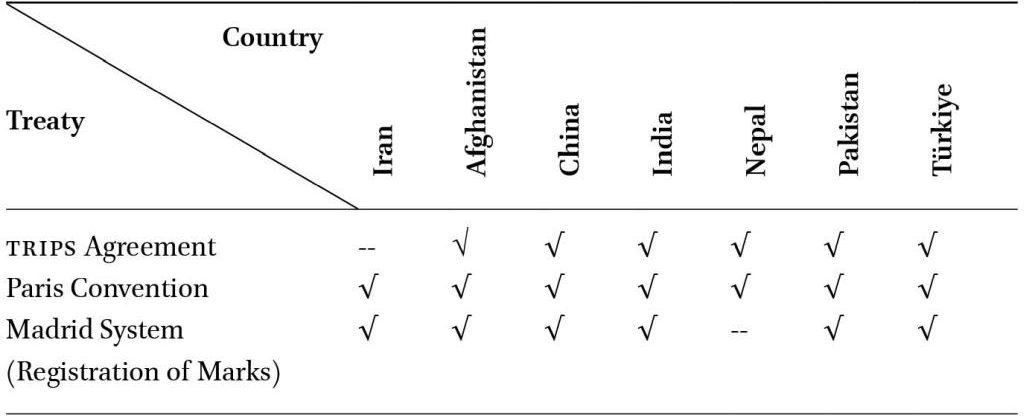
Memberships of key PC s markets in trademark treaties

3 What Do TKH s Expect from the Trademark Legal Regime?
Although, trademark law is not inherently designed to protect TK, TKH s use it as a tool for protection of at least some elements of their TK including TK-RS. Trademark law is also expected to help TKH s to receive acknowledgement from their respective states of their moral rights as well as their rights to maintain, control and develop their TK under the protection of trademark law.842 Frankel explains signs and symbols are not just simple art of indigenous peoples’ culture. They carry and express the spirituality of them. This spirituality is “to a certain extent a similar theme is arguably behind moral claims in copyright law.”843 Furthermore, TKH s demand recognition of their rights to maintain, control, protect and develop their TK and its elements including TK-RS.844 Moreover, TKH s will be able to appropriate their TK-RS for marketing their original and distinct products and gain commercial benefits from them.845 These of course are not the ultimate goals of demanding protection of TK under trademark law. Trademark law has the capability to provide information on the originality of a product and its link to a specific community, which could lead to commercial benefits for TKH s; but the unauthorized use of words and symbols by parties other than TKH s can potentially cause confusion in the minds of consumers about the source of the products. The use of TK-RS as trademarks by non-native competitors may lead consumers to believe that particular products genuinely originated from the relevant community or that they have certain qualities and traits, which in reality they do not possess.846 In fact, the reputation of TKH s products, which reflects their stylish distinctive products is often misappropriated and misrepresented by non-local and non-indigenous legal entities or individuals.847 For instance, “scientific institutions use traditional cultural symbols and practices to generate an extra ounce of confidence or certainty.”848 Similarly, large pharmaceutical companies have been using the Inookshook rock formations as symbol of their products while these formations were used initially by Inuit to mark their land.849 Symbols and words such as Ayurveda, Veda and Yoga, with immense value for India’s local communities850 and the word Ashanti in Ghana851 are examples that have been registered as trademarks by people other than TKH s or by multinational companies. During the Vancouver Olympic Games of 2010, the trademarked logo of the games, which is a symbol used by the Inuit people, was used by non-indigenous people for commercial products such as clothing, alcohol labels, umbrellas and many others.852 TKH s are also concerned about mass production of their products using new technologies. For example, hand-woven carpets take months to produce, but machine-made carpets may be manufactured in factories in just a few hours. These machine-made carpets, which use the TK-RS of original products, are available to consumers at lower prices. In Iran alone, between March 20, 2015 and March 20, 2016, more than 1000 manufactures were actively producing machine-made carpets and employed 35 thousand workers. They produced 80 million m2 of machine-made carpet, of which 30 million m2 were exported to foreign markets.853 For instance, “Farrahi Carpet Group has started its activity since 1990. By producing different kind of handmade look and silk look carpets in wide variety of designs … has been succeeded to satisfy the customers but also this company has reached a proper place in machine made carpet industry in Iran.”854 Figures 3 and 4 illustrate the national and international registrations of the trademark for Farhi carpets.
National Trademark Registration for the Machine-Made Carpets Manufacturing Company of the Farrahi Group855

International Trademark Registration for the Machine-Made Manufacturing Company of the Farrahi Group856

TKH s perceive this activity as UC against their traditional methods, materials and techniques. Such inappropriate use not only may result in “financial loss but can cause considerable spiritual offence”857 to the TKH s. The TKH s suffer misuse and misappropriation of their TK-RS by the private sector and even by public institutions, which amounts to a denial of the TKH s’ dignity and integrity.858
Another significant concern of TKH s is the lack of appropriate recognition of local artists and designers who form part of TK.859 This is a crucial issue that has been raised in almost every discourse on the protection of TK. TKH s demand recognition to able them to continue to control, preserve, develop and exploit their TK-RS.860 Moreover, many communities believe that local artists and their products are not recognized properly. In addition, in the process of marketing TKH s’ products in the national, regional and international markets, no credit is given either to these communities as holder and provider of TK-based commodities or to the traditions, stories and information which is relevant to communities. This refusal to recognize TKH s and their artists and designers creates a real problem for these communities because it does not take into consideration the distinctive character and status of local artists and designers. In consequence, their products cannot be distinguished, and the TK-RS of these communities and artists can be easily registered by others. Particularly the traditional weavers’ cooperatives are faced with different types of registered marks and brands in the market, which prevent them from marketing their handcrafted products in local, regional and national markets. Acknowledgement of TKH s will also help raise awareness among people and markets about the living source of TK and will benefit both communities and consumers.861
To address the above-mentioned concerns, TKH s try to gain acknowledgement and exclusive rights over their TK-RS. They also attempt to impede misuse and misappropriation of TK either by controlling the trademark registration system to prevent third parties’ claims over identical and similar marks with the TK-RS or by invalidating trademark rights which were granted to third parties in ignorance. In this regard, trademark law might assist TKH s to achieve those goals through providing a legal ground for positive and defensive protection of TKH s’ trademarks. As its ultimate goal this approach may help TKH s to restore and maintain TK-RS which have been destroyed or are feared to be almost extinct and preserve them as elements of their culture.862 In fact, the appropriate exploitation of TK-RS could assist in preserving and promoting TKH s cultures too.863 TKH s are also interested in looking into how the international IPR s system within WIPO could address the extensive concerns of TKH s about the theft of their cultural identities embodied in their TK-RS.864 Therefore, it is necessary to understand how TKH s could exploit the trademark regime for registration of their marks. Another question is how trademark law could prevent culturally offensive marks from being registered and whether it is possible to avoid TK-RS s being misappropriated. These questions might be answered while looking into the approaches for protection of TK-RS.
4 Approach for Protection of TK-Related Signs
Trademark law in its current state is simultaneously an instrument for protecting the rights of TKH s on the one hand and for facilitating the abuse of their TK-RS on the other. TKH s have found that, in some circumstances, the legal regime of trademarks can be used as a means of protecting their culture and traditions. Meanwhile, third parties misuse the trademark system to register trademarks and exploit TK-RS that are inherently owned by TKH s, to achieve their own business goals. Therefore, this system can work against TKH s because they lose their rights and control over their heritage and TK-RS in favor of the trademark owner, at least for certain classes of goods and services. Here two approaches for protection of TK-RS could be taken into consideration: (a) positive protection: to grant exclusive rights on TK-RS as trademarks to TKH s; (b) defensive protection: to prevent unauthorized registration of TK-RS as trademark by companies and persons other than TKH s.865
4.1 Positive Protection
Products of TK might be branded and protected using trademark legal regimes at the national and international levels. Various advantages of registration of TK-RS for TKH s have been noted. Using trademarks could be a mechanism for identifying the original TKH s’ products and artworks. Distinctive signs in relation to TKH s’ products indicate how these products are made, based on their knowhow, knowledge and practices. Likewise, relying on trademarked TK-RS, TKH s could establish a system under which their goods and services that adhere to specific standards and methods might be traded. For example, the Māori Community Mark is intended to indicate to consumers that quality of goods and products is certified by Māori descent. This positive protection was intended to address the concerns of misuse and abuse of Māori imagery, styles and concepts by non-Māoris and to provide, even if limited, protection for the original community.866 Also, by registration of their marks, these communities could prevent third parties from using signs that may lead to confusion of consumers and the public.867 In this regard, in Canada, the petroglyph has a significant religious value for the ‘Snuneymuxw First Nation.’ Therefore, they have registered ten petroglyphs to halt the commercial use of their sacred images on items such as postcards and T-shirts.868 Moreover, TKH s seem to be required to register their trademark before marketing and commercialization of their products. If the registration office finds their marks are not registrable, all their investments and expenses are wasted.869 On the other hand, in cases where the law of UC is not enforceable, the registration of the TK-RS at the national level, and even the international level, can be used as a means of preventing the abuse of TKH s’ cultural symbols. Another advantage of trademark registration is that it can help TKH s to focus on those signs that are vital for their communities. Precision and reliability of trademark law for TKH s is another important feature not found in other legal systems, such as contract law or customary law.870 In addition, traditional designers and artists from local and indigenous communities can apply for registration of new products which are made based on the TKH s’ cultural heritage.871 An example is the registered trademark for Australian indigenous peoples’ products “in respect of cultural festivals, soaps, perfumery, essential oils, body lotions and other natural resource products, arts centres, clothing and textiles, music, film and broadcasting, publications, and Internet-related services.”872
Panama, trying to provide a system for protection of TK-RS, established a registration system through special legislation, with an approach similar to the Pacific Regional Framework for the Protection of TK and EoF, which recognizes for the ‘traditional Owners’ the right to prevent or authorize use and exploitation of a trademark.873 However, to understand such a system, it is necessary to understand the trademark law. Besides, protection may be applied to different types of marks including trademarks, service marks and collective marks, and may include certification marks too. Therefore, a brief introduction to the different faces of trademarks seems essential.
4.1.1 Types of Trademarks
4.1.1.1 Trademarks and Service Marks
4.1.1.1.1 Trademarks
A trademark is a sign or any combination of signs874 that distinguishes and separates goods and services of an institution or producer from the goods and services of its associates and competitors. The sign may consist of “words including personal names, letters, numerals, figurative elements and combinations of colours as well as any combination of such signs.”875 Also, it may consist of drawings, devices and shapes of product.876 Under Iranian law “mark means any visible sign …”877
The Paris Convention, despite addressing trademarks in a few of its articles, does not provide a definition, but the TRIPS Agreement describes what could comprise a trademark:
Any sign, or any combination of signs, capable of distinguishing the goods or services of one undertaking from those of other undertakings, shall be capable of constituting a trademark.878
This definition emphasizes the two features of ‘ability to distinguish’ and ‘one undertaking from … other undertakings.’ These two features were also used in the North American Free Trade Agreement:
trademark consists of any sign, or any combination of signs, capable of distinguishing the goods or services of one person from those of another, including personal names, designs, letters, numerals, colours, figurative elements, or the shape of goods or of their packaging.879
The trademark laws in Iran also mention the distinctive feature in the definition of a trademark:
“Mark” means any visible sign capable of distinguishing the goods or services of legal entities or of natural persons.880
According to this definition, the mark must be visible to be registered. Therefore, invisible marks, such as acoustic marks, olfactory marks, taste marks, etc. are excluded from the above definition. With respect to visually understandable marks, the TRIPS Agreement stipulates that members as a condition of registration may request that a mark be visually perceptible.881 The Paris Convention does not include any limitation in this regard. The TLT stipulates that the provisions of the treaty “shall not apply to hologram marks and to marks not consisting of visible signs, in particular, sound marks and olfactory marks.”882 Since carpets are considered as handicrafts and the industry is generally characterized by visible marks, this definition appears to exhibit the characteristics necessary to protect the trademarks of carpet manufacturers, whether they are individual producers or workshops. Therefore, natural and legal parties involved in the production and trade of handmade carpets might market their goods or services using the mark through the trademark system. In this regard, some PC producers and beneficiaries have registered and have been using their exclusive trademarks. Figure 5 presents two instances of trademarks registered in Iran: one associated with Tabriz Shafaghi Carpets and the other with Iran Carpet Co.
Two examples of registered trademarks in the PC industry

Although the Paris Convention offers no definition of a trademark, it stipulates that Member States may not deny an application for registration of industrial or commercial marks unless the marks are devoid of any distinctive character.883 The TRIPS Agreement refers to the function of the trademark, which is distinguishing goods and services in trade. Through this function trademarks provide protection of the reputation, quality and economic value of products and their producer. This function also assists consumers to distinguish between products on the market, as trademarks offer them enhanced information on products and markets.884 It seems that having distinctive attributes is a necessary feature of a sign to constitute a trademark; otherwise it might not help the customer in choosing the desired product.885 In other words, the trademark must have the ability to make the goods and services recognizable.
Under Iran’s trademark law, in the absence of a distinctive character, the mark might not be registered.886 The capability of distinguishing a trademark, may arise because of distinctiveness acquired through use.887 The Paris Convention also called on Member States to consider all actual circumstances in addition to the attributes as distinctive features, especially for how long the mark has been used, to determine whether the mark is eligible for registration:
In determining whether a mark is eligible for protection, all the factual circumstances must be taken into consideration, particularly the length of time the mark has been in use.888
Being distinctive is one of the main features of TKH s and their culture, habits, ceremonies and products. Accordingly, TK-RS are distinctive signs, which are able to distinguish communities and their products from others. Therefore, trademark law may provide protection for their signs and grant exclusive rights to TKH s for registration of their trademarks and using their signs in the process of marketing their products.889
The Maqui trademark is a good example of TK-RS of Ecuadorian hand-woven straw producers. The mark Maqui means ‘hand’ in the local language. This high-quality hat, known worldwide as the ‘Panama hat,’ is produced using the TK of Ecuadorian weavers. Over the course of more than 20 years, this mark has become well-known in global markets. This mark represents the quality and style of Ecuadorian hand-woven hats. Consumers can identify their branded hats from a wide range of hats and be assured about their quality and originality. Consumers can also be sure that each hat is made in Ecuador and is completely unique. The mark has been increasingly recognized and its value has been rising steadily.890
4.1.1.1.2 Service Marks
Service marks are like trademarks, with the same functions, only they apply to services rather than goods. Enterprises use service marks to offer consumers a way to distinguish their services in sectors such as food, finance, tourism, transport and repairs, from those of other enterprises. Therefore, the service mark must also distinguish the services of a company from other services of other companies. The Paris Convention provides for the support of service marks:
The countries of the Union undertake to protect service marks. They shall not be required to provide for the registration of such marks.891
In the Madrid Protocol, any references to ‘marks’ refers to both trademarks and service marks:
any reference in this Protocol to “marks” shall be construed as a reference to trademarks and service marks.892
In accordance with this Article, Member States are committed to protect service marks, but they are not obliged to provide special legislation or registration for such marks. Still, states may grant protection for service marks by other means, such as a law against UC.893 According to Iranian trademark law, mark means:
[a]ny visible sign capable of distinguishing the goods or services of legal entities or of natural persons.894
Therefore, service marks for PC s are registerable at the Iranian Intellectual Property Centre. Figure 6 refers to a service mark for the association of carpet cleaning services, registered under registration no. 261196.
Registered mark for the Association of Carpet Cleaning, Carpet Weavers and Carpet Services

4.1.1.2 Trade Names
Examples of abuse of PC s include the exploitation of the names of well-known designers, producers and merchants; using their designs or works and sailing the fake products under third parties’ names in domestic and international markets. The question is, whether the legal regime on trade names provides the necessary framework to prevent such abuses? In order to understand how important the trade name could be in the production and trade of PC s, one only has to consider the number of exhibitors participating in Iran’s yearly international exhibition of handmade carpets. In terms of quantity, quality and production, this is the largest exhibition of PC s in the world. For example, at the 27th Iran Handmade Carpet Exhibition which ran from 25–31 August 2018, more than 670 manufactures, merchants and exporters, companies, and craftspeople of the country participated, and showed a treasure trove of handmade carpets and rare works of Iranian weavers and artists.895
Although no internationally agreed definition of ‘trade names’ has been agreed, by and large it is accepted that “a trade name is a name or designation distinguishing the enterprise of a natural or legal person from that of others.”896 Trade names are also known as commercial names and designations897 and any “corporate names; fictitious business names; assumed names; partnership names; the names of non-profit, charitable, religious, and educational institutions; and the names of sole proprietorships,” which could single out a business or person may create a trade name.898 Therefore, producers, artists, professionals or traders in local and indigenous communities, as well as the groups which are formed by them and represent them (cooperation, institutions etc.) may use trade names by which they are recognized as true TKH s or their affiliated institutions.
Without providing any definition of a trade name or of what constitutes a trade name, Articles 1(2), 8, 9 and 10ter of the Paris Convention deal with trade names. While Article 1(2) designate the trade name as the protectable object of the industrial properties, Article 8 requires that “a trade name shall be protected in all the countries of the Union without the obligation of filing or registration, whether or not it forms part of a trademark.”899 Article 9 includes rules on seizure of the goods that bear unlawful trade names, and Article 10ter deals with the right to sue and to compensation in the event of a violation of the rights relating to trade names, among other things, The TRIPS Agreement makes no mention of ‘trade name,’ but in accordance with the WTO Appellate Body decision regarding the Havana Club case the TRIPS Agreement refers to trade name as an IP category.900 Therefore, the members of the WTO have the same commitment to protect trade names by way of Article 2(1) TRIPS.901
In order to allow national legislators to determine the objectives and methods of legal protection; the Paris Convention left the issue of defining trade names and the manner of their protection to national laws. Therefore, it is entirely conceivable that protection might be enforced through specific rules regarding trade names or by general laws, such as UC rules or personality rights to the names. In most cases, countries provide a mixed legal protection of trade names in their territories. For instance, Swiss Civil Code, and Swiss Federal Law on UC provide a legal basis for protection of trade names.902 Also, Iranian law in the commercial code, the tort law, the act on the registration of companies, and in the law of industrial property, provided detailed rules on the definition903 and protection of trade names.
Protection of trade names shall not be conditional on their being registered; however, if the protection of a trade name in a country is conditioned on use, or if a trade name is a basis for confusing or damaging another trade name, countries can impose such a requirement.904 Registration of trade names in Iran is optional and trade names shall enjoy protection against illegal activities of other persons even without registration905 unless registration of a trade name is required according to other laws and under certain regulations.906 For example, prior approval of the Iranian Ministry of Health, Treatment and Medical Education is necessary for registration of trade names of any medicine or pharmaceutical and of medical institutes and pharmacists.907 The registered trade name cannot be used by any other person.908 Regarding use requirements of trade names, many states protect trade names upon their use. For example, in accordance with Finnish law “the exclusive right to use a trade name is acquired either by registering that name or by establishing it through use.” And “a trade name is regarded as having been established by use where it is generally well known by the public targeted by the activity of the economic operator.” “However, according to that case-law, protection of such foreign trade names is subject to the condition that the ‘effective’ element of that trade name be, at least to some extent, well known in the relevant Finnish trade circles.”909 In other words, Finnish law protects trade names only if they are well known at a specified level by the interested parties in the relevant business circle in Finland. The ECJ in the Anheuser-Busch v. Budéjovický Budvar case ruled that such a requirement is not contrary to either the Paris Convention or the TRIPS Agreement.910
Despite the importance of a trade names mechanism to protect the names of TKH s, it should be noted that there often is a misconception about trade names. Many traders and manufacturers mistakenly believe that if their business is registered in the national business registry, their trade name is eligible to be protected automatically as a trademark. In fact, registration in a national business registry is completely different from registration of a trademark, even if the subject of both registrations is a unique trade name. Although a trade name can function as a trademark if it is used or registered as a trademark, it is important to apprehend the difference between trade names and trademarks. A trade name is the name of a business and often includes the legal character of the business such as ‘Ltd’ or ‘GmbH.’ A trademark is the name of a product or a service of a business. An individual or an enterprise only possesses one trade name while they may possess different trademarks for their different products or services.911 In this regard, even a registered trademark may not prevent a person the bona fide practicing of their name as trade name,912 unless the use of a trade name is “made for the purposes of distinguishing goods or services.”913
As explained earlier in the first chapter of this study, the PC s’ TKH s include cities, rural and nomadic communities. Members of these communities incorporate a wide range of individuals and legal entities who play a critical role in the PC production chain. Also, associations and merchants and, in some cases, public institutions play the role of representatives of these communities. Except in limited cases, merchants and independent retailers are widely active in the target markets. Therefore, even if trade names of the TKH s from the cities and rural and nomadic communities are legally acknowledged, it is merely the trade name of the merchants and retailers that are used in target markets and might be protected. Consequently, TKH s may have their unique trade names for the community, but they would need to have different trademarks for their TK-RS. However, the TKH s can apply for protection of their names as trademarks.
Another critical issue is the impact of freedom of expression (also known as freedom of speech) on the protection of TKH s’ trademarks in general and trade names in particular. Freedom of expression is one of the most fundamental human rights914 and it is guaranteed globally by international human rights instruments915 and by countries’ constitutional law.916 Although, freedom of expression is a fundamental right that should not be restricted in any way, in certain circumstances it is limited by other rights inter alia the IPR s. For example, in the USA, the First Amendment of the Constitution protects rights to free speech in general and commercial speech (including use of trade names); nevertheless, individuals and legal entities cannot expect to enjoy full protection for every commercial expression they make. The commercial expressions are legally protected only to the degree that they are not misleading or false.917 Therefore, the use of trade names in commercial speech, such as advertisements for products which do not come from certain geographical origins, are not eligible to be protected under the freedom of speech principle of the First Amendment of the USA Constitution.918 In this context, in the case of Piazza’s Seafood World LLC v Bob Odom, the Court ruled that consumers must be protected from actually or inherently misleading and deceptive use of trade names; thus one cannot use trade names for products which do not come from specific geographical origins. It seems in this case that a trademark should be treated as a trade name, as their functions and application are not different in respect of trademark law.919 It appears that there is a possibility to demand protection of PC s’ trade names with reference to this case, as PC s originate from a specific geographical source and also consumers of PC s shall be protected against use of trade names in commercial expressions that are deceptive and may mislead them.
4.1.1.3 Collective Marks
TKH s consider the collective marks mechanism as an appropriate tool for protection of their communities’ TK-RS as they are able to protect shared interests of producers in associations. TK is often considered to be the collective knowledge of traditional communities. Therefore, the collective ownership by these associations shall be recognized and protected under the notion of the collective mark in a such a way as to accommodate the interests and profits of TKH s.920 Besides, TK includes communities’ TK-RS, encompassing designs, images, figures, symbols, models and other cultural elements.921 The concept of the collective mark is potentially useful to provide partial protection for TK-RS. To understand whether the collective mark can truly meet the expectations of TKH s, the elements of the collective marks protection system and its functions need to be studied. Although there has been no formal and generally accepted definition of collective mark, it may be defined as a “sign to distinguish the origins or other common characteristics of goods or services of different enterprises, and different enterprises are controlled by the owner of the registered trademarks when using such a trademark.”922
The Paris Convention does not define collective marks, but it deals with these types of marks in Article 7bis.
The countries of the Union undertake to accept for filing and to protect collective marks belonging to associations the existence of which is not contrary to the law of the country of origin, even if such associations do not possess an industrial or commercial establishment.923
The TRIPS Agreement by virtue of Article 2 has incorporated such marks.
The Paris Convention obliges Member States to register and protect collective marks belonging to unions or associations including producers, designers, craftsmen, etc., either operating in a particular region or country or sharing other common features. Secondly, the existence and activities of such unions must not be in conflict with the laws of the country of origin. Otherwise, registration and protection of their marks will be refused. Thirdly, applicants for registration are not required to have an industrial or commercial establishment.924 Therefore, if TKH s constitute legally legitimate associations or unions in the country where they are domiciled, they will be able to apply for and acquire collective marks for their distinctive signs.925 They are not required to establish a business directly in the target markets.
Collective marks are established either by meeting certain criteria and standards or are only based on an individual criterion which stipulates a given community or a certain place as the origin of products or services. Thus, the function of the collective mark is to inform the general public about certain aspects of the product for which the mark is used. For this reason, in most IP offices, applicants are required to submit the regulations based on which use of collective marks are permitted. The rules for using the collective mark must be attached to the application for registration, and any changes thereto must also be notified to the IP offices. Typically, these regulations include the conditions for using collective marks and membership requirements.926 If such a mark is used in a manner contrary to the terms of the above-mentioned regulations or in a way which would lead to misleading the public, the mark will be cancelled. That is why the collective mark plays a vital role in protecting consumers against misleading practices. In this regard, collective marked TK-RS can represent a specific quality standard for traditional commodities or their geographical origins. For instance, this would apply to handicrafts that are produced according to traditional production methods by TKH s.927 Produced and processed products of stylish, typical and characteristic TK in a given region can be identified and recognized through their specific and distinctive collective marks. These signs can be utilized as collective marks of these communities and their associated unions, such as farmers; cotton, wool, silk and herbal colours producers; designers, weavers, traders, and other individuals affiliated with these communities, to serve as a guarantee of credibility and quality of their products. It is not an easy task for TKH s to attract consumers’ recognition and loyalty. It is even more difficult to keep them attracted. Moreover, access to markets, wholesale and retail of local products and dealing with the distribution system require considerable investment that usually goes beyond the financial and knowledge resources of TKH s.928 Therefore, collective marks may help TKH s to improve marketing and increase profits from their traditional activities.929
The other advantage of the collective mark is its link with individual trademarks of members of traditional communities. In principle, a collective mark may be owned by group of people or their representatives, such as associations, unions, cooperatives of producers or traders, or even a public body,930 which does not use a collective mark itself, but the members benefit from the mark. However, a business that allows the use of a collective mark could at the same time have its own trademark. As communities include individual producers of goods and services, those individuals may together establish community collective marks using TK-RS. As members of a community, they will be able to use a collective mark for marketing and protecting their traditional products and related services,931 which in turn can decrease their marketing expenses.932 But, community members can still use their own individual trademarks along with the community’s collective mark. The main difference between a trademark and a collective mark is that a trademark can only be used to distinguish the products or services of a person or company, whereas similar products and services of members (whether individuals or enterprises) of a community are allowed to use a collective mark.933
This offers some advantages for members of the local community. They can benefit from the trust of consumers in the products and services supplied under the community collective mark and, at the same time, they are allowed to distinguish their own products and services from those of their fellow members in a given community. Sometimes this permission is limited as specific conditions apply to concurrent use of individual trademarks with a certification mark.934 This is very significant for TKH s in general and for PC s in particular. Although PC s’ reputation is strongly associated with different regions in Iran, hundreds of thousands of designers, producers and service providers within these communities are working to improve the quality and beauty of their products and services, and they are well-known even worldwide.935
A good example of a collective mark for traditional art is the ‘Taita Basket,’ which has been produced by local women in Kenya for generations (see Figure 7 below). The Taita Basket Association is the owner of the collective mark. Members are allowed to use it under regulations established by the association and they have to adopt the quality standards set under those regulations.936
Taita Basket collective mark (Kenya IP Office Registration no. 94134)

In accordance with Iranian industrial property law, a collective mark is defined as:
any visible sign designated as such in the application for registration and capable of distinguishing the origin or any other characteristics, including the quality, of goods or services of natural persons or of legal entities which use the sign under the control of the registered owner of the Collective Mark.937
Use of collective marks is allowed for producers, traders or other related parties, subject to the terms of the contract in which quality controls are imposed on the products by the licensor and must effectively control the perceived quality of the goods and services. Otherwise, if the control is not effective, the contract will be invalidated:
Any License Contract concerning the use of registration of a Mark, or an application thereof, must provide for effective control by the licensor of the quality of goods or services of the licensee. Otherwise, or if such control is not effectively carried out, the License Contract shall not be valid.938
A very important aspect that becomes apparent through the careful examination of the above-mentioned articles is that the PC s’ unions, which are located and active in the production and distribution areas of PC s all over the country, can design their collective marks. This would include a description of the specific features of PC s associated with the mark, such as knot types, traditional and herbal colours, original designs and drawings of their PC s. Then they could register the mark for the production of carpets by their real and legal members. For example, the Isfahan carpet weavers’ association could register its collective mark with the intellectual property centre by choosing a famous and historic symbol of that region, such as ‘Si-O-Se-Pol’ Bridge or ‘Aaliqapou’ and incorporating the name ‘Isfahan Carpet’ into the symbol. It could then, apply for international registration of the mark based on the mechanisms under the Madrid System. Thus, consumers buying PC s would be able to distinguish original Isfahan carpets from fake carpets marketed under the name ‘Isfahan carpet’ by unauthorized manufacturers and other commercial rivals. This would also enable them to achieve the predicted national and international performances to prevent fraudulent actions by competitors.
4.1.1.4 Certification Marks
Certification marks might be considered a special type of collective mark that are used only when based on a specific standard such as GI s, substances, production methods, method of services’ performances, quality and accuracy of products or services.939 In this manner, both collective mark and certification mark goals are informing consumers that the products or services possess assured characteristics.940 Collective marks are used only by certain companies that are members of an association or a union that owns the collective mark. In other words, the collective mark concentrates on membership while the certification marks may be used by anyone who can ensure that their goods and services comply with the corresponding standards which have already been defined by the owner.941 Therefore, certification marks are not expected to imply production of products in a specific geographical area: there is no dependence on the land or climate in this type of mark.
Two examples of registered certification marks

The Paris Convention does not explicitly refer to this category of trademarks, but the nature of certification marks is not essentially different from that of collective marks. The main purpose of both marks is to support the specific characteristics of a product or service. Therefore, it might be concluded that the provisions of the Paris Convention for collective marks apply to the certification marks as well.942
A major problem faced by TKH s concerns false and misleading signs that are alleged to be origin and authentic. TK-RS are often copied and attached to fake products and fake traditional creative arts (sometimes called ‘fakelore’943) to make consumers believe they are original or of the same quality. This problem is very common in the area of PC s.
To avoid such confusing and misleading practices by competitors, certification marks for protection of TK-RS have been gradually developed by TKH s. They use certification marks for goods or services with distinctive and specific qualities and standards to protect the originality and authenticity of their arts.944 In Nigeria, the Bioresources Development and Conservation Program945 brand, as shown in Figure 9, has been used as an assurance of traditional drug quality.946

In Australia, the National Indigenous Arts Advocacy Association uses certification marks for guaranteeing the authenticity of indigenous people’s products and to prevent fake commodities.948
The Label of Authenticity Trade Mark Project

Another example is the ‘COWICHAN’ certification mark of the Cowichan Tribes in British Colombia in Canada. The Cowichan tribes include seven traditional villages and, with more than 4900 members, are the largest First Nation Band in the state of British Colombia. They are also famous for their blankets and knitted clothes, which withstand the cold and are known as Cowichan Sweaters.949 In September 1995, the Cowichan Band Council applied for registration of the COWICHAN certification mark by the Canadian Intellectual Property Office. The certification mark was granted in 1996 and in accordance with the Canadian Trademark Details webpage, it “to be used by persons authorized by the certifier, will certify that the wares have been hand-knit in one piece in accordance with traditional tribal methods by members of the Coast Salish Nation using raw, unprocessed, undyed, hand-spun wool made and prepared in accordance with traditional tribal methods.” The COWICHAN mark distinguishes “clothing, namely sweaters, vests, ponchos, hats, toques, mittens, scarves, socks and slippers.”950
Harris Tweed is another good example of a certification mark for traditional hand-woven cloths made by the islanders of Lewis, Harris, Uist and Barra in Scotland (see Figure 11 below). The mark was registered as a certification mark in 1910951 and later in 1911 it was stamped on the local products of “hand-woven cloths made from yarn spun and dyed in the Outer Hebrides.”952 Use of the Harris Tweed brand is subject to conformity with the ‘Brand Use Rules.’ These rules are approved by the Harris Tweed Authority and certify that “the brand is used appropriately to preserve its integrity for generation to come.” The rules include:
-
Introduction of the brand, and the objectives of the rules;
-
Key elements of the brand itself;
-
Conditions for using the brand;
-
Labels and swing tags;
-
Naming and describing products containing Harris Tweed;
-
Example of products suitable for use of the accessory or seam label.953
Harris Tweed hand-woven certification mark

In New Zealand, the ‘Māori Arts Board’ known as ‘Te Waka Toi’ developed and used a certification mark to authenticate their handicrafts.954 ‘Toi Iho’ was registered in 2001.955 Their mark as a mark of authenticity was intended to guarantee the quality of products made by Māori tribes to consumers. It was also created and registered to tackle the increasing concerns about misuse and misappropriation of Māori TK-RS and to provide commercial advantages for the Māori people. Four categories of the toi ihoTM marks were designed and registered:
-
Māori Made Mark, which only artists of Māori descent are allowed to use. The use of this kind of sign has enabled Māori artists to be identified as authentic artists and allows consumers to purchase their products with full knowledge of their authenticity (see Figure 12).
-
Mainly Māori Mark, which is allowed to be used by groups of artists of Māori descent to create, offer, perform and sell Māori art-works. The purpose of this trademark is to promote Māori arts in global markets. In this way, Māori artists are supposed to be more motivated to produce high-quality works and to maintain the integrity of the TKH s’ culture. The sign also means that customers can be confident that when they buy a product with this mark, it is actually a real product of Māori tribes and it is not a mass-produced product imported from another country (see Figure 12).
-
Māori Co-production Mark, which was designed to be used by Māori and non-Māori artists and businesses working together to create, present and perform art works. This type of Māori mark recognizes the need for cooperation between different stakeholders for protection of TK and to promote marketing for TK-RS. The benefits of this method are substantial. For example, the collaboration between a traditional artist and a large clothing manufacturer can help to maintain the originality and quality of products while increasing production and sales (see Figure 12).
-
Licensed Stockist Mark, which was designed to be used by craft retailers and galleries under Māori licenses. This mark allows Māori to determine an appropriate price for their products, which assures the protection of their own interests as well as those of their consumers. Also, it allows them to control the supply of their goods and services. Moreover, they can exploit the excellent standards, experience and knowledge of galleries, retailers and art dealers in order to promote their marketing and sales of their products and services.956

Iran’s abolished ‘Trademark and Patent Registration Law of 1931,’ which has been replaced with the ‘Patents, Industrial Designs and Trademarks Registration Law of 2007,’ stated that trademarks may be used to distinguish the products of a group of farmers, traders or craftsmen, or to identify a product of one area of the country.958 The registration of such marks required certification by the competent authority to allow the use of these marks by the manufacturers of the products, which included the trade unions, chamber of commerce, municipality or governors.959 The new rules on trademarks in Iran have been developed in such a way that collective marks in the general sense and confirmatory marks in the specific sense are also included within the scope of this definition.960 In other words, the legislator has referred to the general concept of this clause in the general sense of collective marks (any visible sign designated as such in the application for registration …) while some certification marks are mentioned as examples of collective marks (… capable of distinguishing the origin or any other characteristics, including the quality, of goods or services of natural persons or of legal entities which use the sign under the control of the registered owner of the Collective Mark). In general, there is a considerable potential in Iran’s Industrial Property Law to provide a registration system for certification marks in the context of PC s. To exploit this law, PC producers and their representatives may use certification marks to notify their consumers about the standards of PC s and their originality and authenticity. For example, standards such as:
-
PC s are hand-made products;
-
Certain biological resources have been exploited to produce PC s;
-
PC s are made purely from natural local materials, such as herbal colours;
-
Certain TK-RS are used for production of PC s;
-
Certain quality controls are applied to the process of PC production;
-
The role of women in production of PC s and/or no children were engaged in the production process;
-
PC s are made by known local and tribal communities.
In brief, positive protection of TK-RS under trademark law, especially the use of collective marks and certification marks will help TKH s to:
-
decrease and discourage the imitation of TKH s’ products in the market through distinct and original traditional crafts;
-
increase public awareness;
-
provide reassurance to consumers as to the authenticity of the goods they are buying;
-
help TKH s to distinguish their products and crafts from those made by non-local suppliers;
-
assist them to promote the reputation of the local artists and producers nationally and internationally;
-
increase TKH s’ fair and equitable economic benefits.
Despite the advantages of positive protection of TK-RS, it is, however, important to note the challenges regarding this type of protection.
4.1.2 Challenges of Positive Protection of TK-RS
4.1.2.1 Challenge of Descriptive Characteristics of TK-RS
Descriptive marks usually describe significant features of a product or a service.961 Trademarks are ‘descriptive’ mainly when consumers make a connection between the marks and the goods or services they are assigned to.962 Terms such as ‘bicycle for make of bicycles’ is an example of marks that are descriptive.963 In the same manner, incorporating the term ‘carpet’ or ‘rug’ in the trademarks for PC s might construct a descriptive mark. Almost all traders and manufacturers providing goods and services are interested in offering their products with a type of mark that includes a descriptive feature, which could immediately convey information on their products to customers. This might put mark holders at serious risk, because even if they succeed in registering their marks at the trademark offices, they may have to abandon their marks because there is a considerable possibility that they could have to face litigation from competitors. The grounds for refusal or invalidation of the descriptive marks are mentioned in the diverse instruments. In accordance with the Paris Convention descriptive signs may be denied registration or invalidated if they are “devoid of any distinctive character, or to designate the kind, quality, quantity, intended purpose, value, place of origin, of the goods, or the time of production.”964 EU legislation on trademarks follows the same approach as the Paris Convention. According to the EU law, trademarks which “are devoid of any distinctive character” or “consist exclusively of signs or indications which may serve, in trade, to designate the kind, quality, quantity, intended purpose, value, geographical origin, or the time of production of the goods or of rendering of the service, or other characteristics of the goods or services” either are not registrable or shall be invalidated even after registration.965 Article 15(1) of the TRIPS Agreement stipulates that trademarks are not eligible for registration “where signs are not inherently capable of distinguishing the relevant goods or services.” Although the TRIPS Agreement has not provided details of descriptive marks, it can be concluded that according to the agreement descriptive marks are not registrable as they fail to distinguish goods and services. Besides, Article 15(2) of the TRIPS Agreement obliges its Member States not to derogate from the provisions of the Paris Convention.
The Iranian industrial property law approach is like that of the TRIPS Agreement. According to this law, a trademark is not registrable if it “is not capable of distinguishing the goods or service of one enterprise from those belonging to another enterprise.”966 The general practice of the Iranian Intellectual Property Centre – which is to deny registration of descriptive marks – supports such an interpretation of the Article 15(1) of the TRIPS Agreement. For instance, applications for ‘New Design Carpet’ and ‘Anti-Blot Carpet’ were denied as they were descriptive in nature.967
Although TK-RS are distinctive as they have been used to refer to signs and symbols of given TKH s’ communities, tribes, families and their products or their religious rituals and ceremonies,968 they are nevertheless descriptive in nature. Therefore, in many cases, TKH s’ applications for registration of their TK-RS have been unsuccessful.969 Moreover, if TKH s want to register their marks in a foreign territory, the designated trademark office may ask for the translation of the mark. The officials will examine the mark in the local language and if they conclude it is descriptive in the local language they will probably reject the application. In this regard, in Australia “approximately 90 applications have been lodged for trademarks including the word ‘Dreamtime’ 15 have been registered and nine are pending.”970
To deal with this challenge, TKH s are recommended to use collective marks and certification marks. Whereas a trademark should not be descriptive, collective and certification marks might be distinguished through describing geographical location or standards of the goods or services. As already mentioned, a significant distinction between them is that trademarks are used to identify just one individual enterprise that provides products or services while collective and certification marks describe and assure some characteristics of the products or services of different individuals or entities which are members of associations.971 It is, however, important to note the limitations of collective marks and certification marks. According to WIPO, many countries protect collective and certification marks at the national and regional levels.972 Nevertheless, “collective marks are not defined in the same way by the various national legislations.”973 Moreover, no standard procedure for registration and protection of such marks is established at the international level. In this regard, neither the TLT nor the Singapore Treaty apply to collective marks and certification marks:
[Kind of Marks] This Treaty shall not apply to collective marks, certification marks and guarantee marks.974
While, as explained before, collective and certification marks are the most promising tools for providing positive protection of TK-RS in national legislations, existing international instruments have failed to take them into consideration.
4.1.2.2 Challenge of Use Requirement
It is important to TKH s to continue to use their marks; because registration is not sufficient for providing constant protection of a trademark. In a completely different approach from the copyright regime, right holders of trademarks must exercise and actively defend their exclusive rights to use their trademarks. Otherwise, their exclusive rights over their trademarks may be lost if they fail to actively use their trademarks or do not fight against any infringements. The philosophy of the ‘Use Requirement’ rule is to reduce the numbers of trademarks and avoid conflict between trademarks.975
The requirements of use to maintain protection of IPR s are also known as local working requirements. Those requirements and the limitation on them are spread throughout the Paris Convention and the TRIPS Agreement.976 Although, neither the Paris Convention nor the TRIPS Agreement has required the termination of a trademark in the case of non-use,977 they do not prevent their Member States from setting local use requirements and cancelling registrations in the case of non-use. In accordance with the Paris Convention, cancellation is permitted only after a certain period of non-use:
If, in any country, use of the registered mark is compulsory, the registration may be cancelled only after a reasonable period, and then only if the person concerned does not justify his inaction.978
The TRIPS Agreement stipulates a three-year period to allow right holders to use their trademarks.
an application shall not be refused solely on the ground that intended use has not taken place before the expiry of a period of three years from the date of application.979
If use is required to maintain a registration, the registration may be cancelled only after an uninterrupted period of at least three years of non-use.980
Also, according to the TLT “any Contracting Party may require that an application contain … a declaration of intention to use the mark.”981 Similarly, the EU Directive on protection of trademarks states that trademarks may fulfill their purpose only when they are used on the market:
It is therefore essential to require that registered trade marks actually be used in connection with the goods or services for which they are registered, or, if not used in that connection within five years of the date of the completion of the registration procedure, be liable to be revoked.982
Most countries assign a fixed period of time (usually a three- or five-year period)983 within which a trademark shall be used. Otherwise, the rights will be assumed abandoned and the registration might be cancelled.
Regarding the concept of ‘use of a trademark,’ the approach varies considerably between countries, but the general rule is that the use of the sign is related to a specific product or service in the context of business. Procedures such as binding marks on product packaging or on containers and labels, as well as trademark advertisements, can be considered instances of the notion of ‘use of a trademark.’984 In this regard, for instance, in the United States trademark act of 1946 ‘use in commerce’ is a fundamental issue for protection of trademarks.985 In this context “use in commerce means the bona fide use of a mark in the ordinary course of trade,” which include placing a mark on the goods, on their containers, on the tags or labels affixed to the goods, or on the documents associated with the goods or sale of goods, and also in the sale or advertising of service marks.986 According to the EU trademarks law, ‘genuine use’ in connection with the goods or services in respect of which a trade mark is registered is necessary to prevent revocation of marks on the ground of non-use.987 The concept of ‘genuine use’ is interpreted in Ansul v Ajax case by the European Court of Justice (ECJ) in which “there is ‘genuine use’ of a trade mark where the mark is used in accordance with its essential function.” In evaluating the genuine use of a trademark, the following facts must be examined:
whether the commercial exploitation of mark is real,
whether such use is viewed as warranted in the economic sector concerned to maintain or create a share in the market for the goods or services,
the nature of the goods or services at issue,
the characteristics of the market and the scale and frequency of use of the mark.988
Therefore, TKH s’ intention to maintain the registration of their registered TK-RS through use would not be enough. Effective use is required.989
In the same manner, Iranian industrial property law takes revocation of a registered trademark as the consequence of non-use, while it stipulates:
Any interested person may request the court to invalidate the registration, if he establishes that, the owner of a registered Mark, or a person authorized by him, has not used the said Mark for a period of at least three full years running from the date of registration up to one month prior to filing the request.990
Yet it provides no definition of use of a trademark or any criteria to identify non-use conditions. Therefore, it is up to the courts to decide case by case if the requirement for use of a mark has been met.991 Iranian jurisprudence on the context of the use requirement is sparse. Yet in the cases that have been brought, courts ordered proprietors of the disputed trademarks to offer evidence of their use as the defendant without making it clear what kinds of use are acceptable to prevent revocation of the marks.992 Despite the court practice, in Iran’s industrial property law, it is stipulated that the burden is on the plaintiff to show that disputed trademark has not really been used.993 This goes completely against the current procedure in the EU, WTO and national laws of many other countries. For instance, in the EU, the proprietor of the trade mark shall furnish proof that the trade mark has been put to genuine use.994 Therefore, when a trademark is “challenged for non-use, the burden is on the trademark owner to show that the mark has been used.”995 In the WTO judicial precedent, in the US – Wool Shirt and Blouses case, the Appellate Body states that “the party who asserts a fact, whether claimant or respondent, is responsible for providing proof thereof” and that the “burden of proof rests upon the party, whether complaining or defending, who asserts the affirmative of a particular claim or defence.”996 Also, according to Swiss Trade Mark Law “evidence of use is required to be provided by the proprietor of the trade mark.”997
Iranian scholar Mirhosseini suggests that the approach of the Iranian trademark law follows the general principle of actori incumbit onus probandi998 where the burden of proof will be on the plaintiff who claims that a trademark owner has not been using their trademark in the given period.999 It seems that the approach of Iran trademark law is not supported by the principle of negativa non sunt probanda and by the Iranian Civil Code. According to the principle of negativa non sunt probanda it is “virtually impossible to prove a negative since proof requires some concrete evidence and a negative does not readily offer that possibility.”1000 The ‘non-use requirement’ is a missing circumstance or negative fact which cannot be proved or at least is very hard for a plaintiff to prove. Therefore, the trademark owner must provide positive evidence that they have been using the marks in the given period.1001 Also, the most recent part of Article 1257 of the Iranian Civil Code stipulates that respondent is responsible for providing proof if they claim something which needs evidence:
Anyone who claims a right has to establish the same and if the defendant, wishing to defend himself, claims something which may require evidence, it is he who must prove it.1002
Hence, in the context of the use requirement of trademarks, if the proprietor of a trade mark alleges constant use of their mark, they are required to provide evidence of that use. As mentioned before, such an argument has been used in courts’ verdicts as they required the owner to provide the evidence that they were using their marks.1003
It seems that the local use requirement will raise real concerns for TKH s who are required not only to register their TK-RS as trademarks but also to use them actively in the course of trade. Moreover, TKH s or their representatives are required to provide the evidence of constant and genuine use of their registered trademarks. In many cases, this does not help TKH s whose wish is to protect TK-RS against third parties’ exploitation,1004 but in the case of PC s, the use requirement does seem have a less negative impact on protection of TK-RS abroad. The reason for such a conclusion is the vast dimensions of the PC s’ market and the number of territories that are PC s consumers. In only one year, between 2017 and 2018, more than 71 countries were among the PC s’ target markets.1005 Nevertheless, the PC s would lack protection in more than half of the world’s countries.
To overcome the challenge of the use requirement, it seems that the concept of genuine use or use in commerce must be developed in a way to include the cultural and social characteristics of TK-RS.
In this regard, the theory of TIP-rights shall be considered as a solution to promote the concept of use. According to Cottier and Panizzon: “Active use of TK should constitute the required limit of protection. Rights to TK should only arise so long as the process or information exists within, and is being used by, a particular community.”1006 It seems that their theory is compatible with the TK criteria. Because, TKH s argue TK an essential element of their cultural life; and if TKH s cease using their TK-RS, the traditional character of the given TK would not be relevant and qualify for protection.1007 Moreover, by using TIP-rights theory, active use and activities and applications by given communities could possibly be expanded as the use concept under trademark law. This in turn requires that the geographical scope of use must also be transposed from the national level to include the regional and international level.
4.1.2.3 Challenge of the Classification System
One of the characteristics of the trademark regime is the creation of a classification system for goods and services. According to this system, any goods or services are placed in one or more categories. The principle purpose of establishing a classification system under the Nice and Vienna Agreements was to facilitate searching, registration, documentation and publication of trademarks. Therefore, the classification was not intended to affect the scope of protection afforded to a mark. But, in practice, acceptance of an application for the registration of a trademark is subject to providing a list of goods and services to which that sign is attributed. In some countries, applicants are asked to submit a separate application for every class. For others, several classes could be applied for the same application.1008 However, protection of registered TK-RS is linked to specific categories and thus positive protection of the trademark is only available for designated categories. Therefore, others are not prevented from registering the mark for other categories.1009 “While trademarks can help distinguish authentic goods, they do not prohibit third parties from using traditional knowledge”1010 and they do not avoid misuse of TK-RS or impede the sale of imitations.1011 To prevent such a scenario, some TKH s have registered their TK-RS in all categories under the Nice and Vienna classification systems. For example, in the Nice Agreement, PC s are categorized under class 27 (Basic No. 270011) for goods, and for services regarding PC s under classes 35 (for export), 37 (for repair including cleansing), 39 (packaging of goods and distribution), 40 (for treatment of materials) and 42 (for designing carpets).1012 But some well-known PC producers like Seirafian have registered their mark even for clothes and shoes (class 25), for laces and embroidery, ribbons and braid; buttons, hooks and eyes, pins and needles; artificial flowers (class 26), for games and playthings (class 28) and for foods and vegetables (class 29),1013 which are not related to the PC s or TK-RS or even TKH s. Choosing an appropriate strategy to determine the class of goods and services is considered to be very consequential, because if the number of classes is too high, this will increase the likelihood of a refusal or opposition to the application, and if it is too limited then it will limit the scope of protection of the mark. Besides, in practice, TKH s could not afford to maintain the use of their registered marks in commerce (as the trademark law of the USA requires), to practice the genuine use of their marks (as the EU trademark regime implies) or to provide the evidence of use (as national laws in Switzerland and Iran demand) in all categories of the international classification system and they would lose their rights over their TK-RS at least in some classes in the target markets.
One solution to the problem of classification could be approval of a new class for the TK-RS through the WIPO Preparatory Working Group and Committee of Experts for the Nice Agreement.1014 In accordance with the Nice Agreement:
“Amendment” shall mean any transfer of goods or services from one class to another or the creation of any new class.1015
Therefore, the creation of new classes is entirely possible. At first, the Nice Classification only involved 34 classes of goods, and 11 more classes relating to services. More classes were gradually added to the classification system. For example, in 2000, Class 43 “services for providing food and drink; temporary accommodation,” Class 44 “Medical services; veterinary services; hygienic and beauty care for human beings or animals; agriculture, horticulture and forestry services” and Class 45 “personal and social services rendered by others to meet the needs of individuals; security services for the protection of property and individuals” were created and added to the Nice Classification system.1016 Moreover, the group of experts made numerous essential amendments to the international trademark classification of the Nice Agreement.1017
4.1.2.4 Challenge of Cost of Positive Protection
The protection of a trademark through registration is always subject to payment of related fees. Normally paying for registration of trademarks, especially at the international level, goes far beyond the financial resources of TKH s. The principle costs could include fees for:
-
filing the application,
-
applying for additional classes (beyond principle classes),
-
registration or publication of registered marks,
-
payment of renewal fees.1018
Also, there are diverse additional fees which are applicable in different trademark offices, such as:
-
statement of use,
-
amendment to allege use,
-
examination,
-
dividing an application,
-
amending a deficiency in an application,
-
objections or reply to objections,
-
new certificate of registration,
-
certificate of correction,
-
application for collective marks.
These costs are even higher if the applicant seeks international registration, which would add more expense for:
-
International registration fees based on the Madrid System which vary depending on the number of classes and the countries in which the protection is sought;
-
Hiring a professional trademark lawyer or agent to assist with filing an application or to help with the registration process;
-
Costs associated with continued use of a trademark in goods and services, such as use of marks in advertising, labels, packaging, brochures and displays, etc.;
-
Renewal fees for international registration.
Some argue that although the costs of positive protection may appear to be high, but one should take into consideration that applicants often have limited numbers of marks to be registered. Also, once a mark is registered, it could be used for a wide range of products and services. Furthermore, the costs could be shared among members of community or association if the mark is registered as collective mark or certification mark.1019
To work out the possible minimum costs for registration of a TK-RS, some examples of registrations fees charged by trademark offices of Iran,1020 Switzerland,1021 the USA,1022 the EU1023 and the WIPO Madrid System are presented in Table 6:10241025
Trademark registration fees in Iran, Switzerland, USA, EU and WIPO

These costs appear to be too high for TKH s and PC producers to afford for positive protection of their TK-RS in their target markets. For instance, if a community or its members decide to register their mark in colour under the Madrid System in just 6 classes: 27 (for PC s), 35 (for export), 37 (for repair including cleansing), 39 (packaging of goods and distribution), 40 (for treatment of materials) and 42 (for designing carpets) with the 9 trademark offices of the countries – the USA, Germany, United Kingdom, Japan, Italy, Australia, Switzerland, Denmark and Sweden – which were among the main importers of PC s during the twelve months between 21 March 2017 and 20 March 2018,1026 it would cost as much as 8810 Swiss Francs.1027 In fact, PC s were exported to more than 71 countries during the same time period, which shows how expensive the process for positive protection in the target markets could be. In this regard, as Popova-Gosart points out:
Many of the smaller producers cannot afford this initial fee, nor the accompanying fee for using the registered design. These smaller producers are usually the families or communities who employ the traditional process and designs. But with this registration process, they are being further marginalized from the industry that enables their livelihood.1028
In the light of the above, the positive protection of TK-RS is possible through the legal regime of trademarks. But, even if the TKH s could overcome the legal and technical complexities of the registration process, the fees for registration of TK-RS would have to be paid. Only those who have sufficient financial resources to go through with the registration process will be able to afford the expenses; and, unfortunately, TKH s or most of them are not a part of this group.
Cottier, however, notes that, in the case of collective and certification marks, the challenge of the high cost might be overcome by sharing the fees among the TKH s. His comment seems well-founded. Firstly, the cost for registration of collective or certification marks is almost as much as the registration fees for individual trademarks. For example, the registration fee for a collective mark under the Madrid System in the nine main PC-importing countries is about 8810 Swiss Francs. Secondly, as Gangjee points out, collective and certification marks are of “particular interest because the parties involved have voluntarily agreed to share the name in question”1029 Therefore, they must share the cost of registration their collective and certification marks. For instance, 5200 members of the 16 apple-producing cooperatives working in Valle di Non and Valle di Sole (Italy) use the collective mark MELINDA.1030 Clearly, if each of those members were to pay their share for registration of their collective mark, the registration fee would be greatly decreased.
To overcome the challenge of high fees for registration of trademarks, countries may offer specific mechanisms or financial packages to help TKH s. For example, they may:
-
reduce the costs associated with the registration of trademarks,
-
establish a special fund, grants or loans to TKH s to register their TK-RS,
-
appoint professional trademark lawyers to provide free legal services to TKH s,
-
reform tax laws so that TKH s could generate revenue from their trademarks,
-
reduce taxes on TKH s’ trademarked commercial products or services.1031
Although these solutions might help TKH s; but one should recall that the most TKH s are located in the developing and least-developed countries which have inadequate financial resources to provide the above-mentioned services to their TKH s.
Finally, positive protection might have a contrary effect on TK-RS. As already explained, most of the payments are related to registration fees, but the consequences of failure to pay the renewal fee are severe. Avoiding payment of a renewal fee will be deemed abandonment of the trademark. When a mark is abandoned by its owner “it may be adopted and used by another entity, who in doing so gains rights that are enforceable against others.”1032 In such a case third parties may adopt abandoned TK-RS. Also, they could prevent TKH s from using their own TK-RS.
4.1.2.5 Outcome of Challenges
Many TKH s have registered their TK-RS, but the number of unregistered marks of TKH s is considerably higher than the number that is registered.1033 Besides, in the face of the above-mentioned challenges, positive protection offered by trademark law seems to be inadequate to provide full protection of TK-RS. As Frankel states, the trademark registration system has not been designed to protect TK-RS. This system is problematic in its entirety and cannot meet the TKH s’ expectations for protection of TK. TKH s are only able to exploit this system occasionally when they see it as useful and convenient.1034 In the meantime, failures must be noted and solved – there is a need for mechanisms to prevent trademarks being granted if they confer unfair and unjustified rights over TKH s’ marks and signs “through efforts to ‘exclude’ certain material from trade mark registration.”1035 For instance the Andean Community, in Decision 486, stipulates that those sign may not be registered as marks which consists of:
the names of indigenous Afro-American or local communities, or the names, words, letters, characters or signs used to distinguish their goods or services or the manner of their processing, or which constitute an expression of their culture or practice, except where the application is filed by the community itself or with its express consent.1036
Therefore, defensive protection needs to be exploited as much as possible for supplementary protection of TK-RS at the national and international levels as discussed in the following section.
4.2 Defensive Protection
As already explained, TKH s are concerned about unauthorized commercial use and registration of the TK-RS as trademarks by parties other than themselves. Although some Aboriginal businesses and organizations have registered trademarks relating to traditional symbols and names, the number of unregistered trademarks used by Aboriginal businesses and organizations is considerably greater than those that are registered.
Therefore, in the context of trademark law, defensive protection must aim to prevent people other than TKH s from being granted IPR s over TK-RS. In other words, the defensive protection mechanism must be employed as a tool to reject applications of non-TKH s regarding registration of elements of TK-RS and to refuse to register them as trademarks. In principle, the mark applied for international registration can only be rejected for reasons justifiable under the Paris Convention. This has been emphasized in the Madrid System, which stipulates that “any such refusal can be based only on the grounds which would apply, under the Paris Convention.”1037 Here the question that emerges is whether these grounds under the Paris Convention are capable of providing a defensible basis for refusing an application for registration of a TK-RS as trademark. To answer this question, the applicability of these grounds is surveyed as bellow.
4.2.1 Defensive Protection Regarding Certain Signs and Symbols
Symbolism in the PC s has been passed down from generation to generation. The PC s’ symbols also used to be considered as distinctive marks of the PC s in the course of trade. Examples of these symbols include the resting eagle as the sign for high-mindedness of the spirit; the paradise bird as the sign for heaven; the cypress tree as the sign for life after death; the iris as the sign for religious freedom; the mihrab as the sign for the gateway to paradise; the hyacinth as the sign for regeneration; and the comb as the sign for cleanliness.1038
The Paris Convention, in Article 6ter, mandates that Member States refuse or invalidate ‘registration’ or ‘use’ of some specific signs and symbols as marks or elements of marks. These specific signs and symbols include “armorial bearings, flags, and other State emblems, of the countries of the Union, official signs and hallmarks indicating control and warranty adopted by them, and any imitation from a heraldic point of view.”1039 For instance, application for registration of the Vietnamese flag for marketing Vietnamese silk weave shall be refused.1040 Also, “armorial bearings, flags, other emblems, abbreviations, and names, of international intergovernmental organizations of which one or more countries of the Union are members.”1041 However, the signs and symbols that are already the subject of other international agreements in force are exempt from this Article.1042 For example, The Nairobi Treaty obliges its Member States to refuse or invalidate the registration of any marks that contain Olympic symbols and prevent the unauthorized use of the symbol for commercial purposes.1043
It seems that the purpose of Article 6ter is not to create a right to claim industrial property in favor of a country or an intergovernmental organization in relation to distinctive marks, but rather to prevent the use of those marks as trademarks in industrial and commercial activities.1044 Such an exclusion was maintained because it would affect that state’s rights to control the use of symbols and signs of their identity and sovereignty.1045 This type of prohibition might be considered as a defensive protection that could prevent registration and use of TK-RS.
For the implementation of the provisions of Article 6ter, a process has been established. According to this process, official signs, symbols, emblems, abbreviations and names for which protection is sought must to be communicated to the other States party to the Paris Convention through the International Bureau of WIPO.1046 This process of Article 6ter is also incorporated into the TRIPS Agreement by Article 2(1), which requires WTO members to “comply with Articles 1 through 12, and Article 19, of the Paris Convention (1967).” Besides, Article 63(2) of the TRIPS Agreement directly refers to Article 6ter of the Paris Convention:
The Council shall also consider in this connection any action required regarding notifications pursuant to the obligations under this Agreement stemming from the provisions of Article 6ter of the Paris Convention (1967).
In this regard, Article 3 of the WTO-WIPO Cooperation Agreement stipulates that the International Bureau of WIPO should administer the procedures regarding Article 6ter of the Paris Convention:
The procedures relating to communication of emblems and transmittal of objections under the TRIPS Agreement shall be administered by the International Bureau in accordance with the procedures applicable under Article 6ter of the Paris Convention (1967).1047
In accordance with the Madrid Agreement and its protocol, documentary evidence which approved the use of certain elements such as armorial bearings incorporated in marks, are legitimate shall be exempted from any reclamation or certification.1048 In other words, in first place, use of such elements shall be legitimate.
At the national level, according to the abolished “law of the registration of marks and inventions” of Iran, “the flag of Iran, and any other flag that the Iranian Government prohibits its use as a trademark, the mark, …, badges, and symbols of the Iranian government” and “the marks of official institutions such as … Red Cross, and so on” were not registrable.1049 This rule was later repeated in the industrial property law of 2007, in which marks are not registerable if:
[i]t is identical with, or is an imitation of or contains as an element, an armorial bearing, flag or other emblem, a name or abbreviation or initials of the name of, or official sign or hallmark adopted by, any State, intergovernmental organization created under an international convention, unless authorized by the competent authority of that State or organization.1050
Although it seems that defensive mechanisms could be exploited to protect TK-RS, there are problems in relying on exclusions of TK-RS from the registration system under the prohibition laid down in Article 6ter. Firstly, this prohibition does not apply to the rights which had already been acquired over signs in good faith in a Member State of the Paris Convention.1051 This means the TK-RS which have already been misused may no longer be the subject of protection. Secondly, prohibition under Article 6ter could only be applied when the mark in question is going to be registered and used on goods and services of the same kind as the signs and hallmarks indicating control and warranty are used for.1052 In other words, even if TK-RS could be communicated to WIPO and other Member States of the Paris Convention, they might only prevent similar marks in the same class. Thirdly, the official signs and hallmarks indicating control and warranty under Article 6ter(1)(a) might be protected only if the states themselves adopt them. The adoption by the lower public bodies, institutions and organizations or public non-governmental bodies would be inadequate to protect those signs and symbols.1053 Consequently, TK-RS which are adopted by the TKH s could not be covered by this Article. Fourthly, Article 6ter includes a mechanism according to which Member States of the Paris Convention may object to such prohibition.1054
Despite the above-mentioned obstacles to the defensive protection of TK-RS at the international level under Article 6ter, some national laws exploit such prohibition either through a sui-generis law or within their trademark law. For instance, the Swiss Federal Act on the Protection of the Swiss Coat of Arms and Other Public Signs is specifically dedicated to protecting the Swiss cross, coat of arms, flag, emblems and Swiss national figurative or word signs including national symbols such as Swiss landmarks, heroic figures, sites or monuments at the federal, cantonal and communal levels.1055 And, according to the United States Trademark Act, the USPTO may refuse registration or cancel the registration of a mark if it is confusingly identical to Native Americans’ flags, coat of arms, emblems, or devices of Native American tribes who are officially recognized federally or by any states. This prohibition does not include words:1056
(b) Consists of or comprises the flag or coat of arms or other insignia of the United States, or of any State or municipality, or of any foreign nation, or any simulation thereof.1057
Unlike the Swiss Federal Act, which is solely focused on national protection of Swiss nationals’ signs and symbols, the United States approach extends protection not only to American Indians and tribes but also to TKH s worldwide. Therefore, a useful strategy for protection of the PC s could be a bilateral agreement between Iran and the USA for protection of TK-RS to prevent registration of PC s’ marks in the USA.
4.2.2 Defensive Protection against Deceptive Marks
As a principle, marks must not be misleading to the public1058 and the most fundamentals goal of trademark law is to protect consumers’ rights by preventing the supply of deceptive or misleading goods and services on the market.1059 The Fair Trading Act of 1986 in New Zealand,1060 for example, provides important protections for trademark owners, especially against misleading or deceptive conduct related to the use and application of trademarks. This includes penalties for forgery of trademarks or false application or use that could mislead or deceive consumers. The application of these provisions varies depending on the specific circumstances of each case, making the law flexible enough to address a range of situations concerning counterfeit goods. Despite this critical role of the legal regime concerning trademarks, challenges persist regarding the use of similar marks that may leverage the reputation or distinctive characteristics of these carpets. Such practices may result in consumer confusion regarding the authenticity, origin, production methods, or stylistic features of the goods. PC s along with a few other products such as Persian Caviar are the most important brands of Iranian products that have found a place in the world markets. This reputation has led competitors to sell their carpets under the PC s brands.1061
Separately, the terms ‘Persian Carpet’ and ‘Persian Rug’ have been observed in trademark registrations or commercial use by certain private entities (see Figure 13 and Figure 14) that are not recognized as TKHs. The use of the term ‘Persian’ in these contexts may influence consumer perceptions concerning the authenticity and traditional characteristics of carpets that are not produced in Iran.
Example of Persian carpet trademarks filed in China

Example of Persian rug manufacturers produced in India
Therefore, some measures must be taken to prohibit producers from copying and making carpets and selling them using marks labelled as PC s.
Deceptive marks have harmful effects on fair competition and on consumer’ rights, and it is a requirement that a sign must not deceive the public and it must not possess a misleading character.1062 In this regard, according to the Paris Convention, when a trademark is likely to deceive the public it may be denied registration or invalidated.1063 Also, in accordance with the TRIPS Agreement its Member States “shall refuse or invalidate the registration of trademarks which contain or consist of a geographical indication with respect to goods not originating in the territory indicated,” if such use of the indication would mislead the public as to the true place of origin.1064 This provision was incorporated into the European Union Community Trademark law in which “trade marks which are of such a nature as to deceive the public, for instance as to the nature, quality or geographical origin of the goods or services,” “shall not be registered or, if registered, shall be liable to be declared invalid.”1065 Iran’s Trademark law follows the same wording. In accordance with this law, a trademark which is “likely to mislead the public or trade centres, in particular as regards the geographical origin of the goods or services concerned or their nature or characteristics” is not registerable.1066
Regarding the use of PC s’ marks by foreign competitors, although these competitors correctly declare the place of carpet production, it seems that they attempt to mislead the consumer by attribution to their products of PC s’ nature and quality, which is clearly against the international trademark law. To avoid such misappropriation the USA law has established a specific Act. The Indian Arts and Crafts Act of 1990 (IACA)1067 updated the original 1935 Act to enhance the Indian Arts and Crafts Board’s authority to protect Indian artists against UC arising from misrepresented arts and crafts claiming to be Native-made. This law includes more stringent criminal penalties and new civil remedies. The IACA’s purpose is to protect and promote authentic Indian arts and crafts, support Indian American self-sufficiency, and safeguard consumers by ensuring the authenticity of goods marketed as Native-made.1068 The 2000 amendment to the IACA, known as the Indian Arts and Crafts Enforcement Act, improved its enforcement by allowing Indian tribes, organizations, and individuals to initiate civil actions. It broadened the scope of liability to include manufacturers and wholesalers along with retailers, further protecting the economic and cultural integrity of Indian arts and crafts. The IACA thus serves to protect and promote Indian arts and crafts, promote Indian self-sufficiency, protect Native American culture and know how, and protect consumers. The original law of 1935 only allowed criminal penalties for false advertising of Native American crafts, but no one was ever charged. The 1990 update allowed the government and even individuals to sue violators, in addition to enabling criminal charges to be pressed. Since then, there have been a couple of federal criminal cases and a handful of lawsuits, most of which never went beyond a district court, with only one reaching a higher court.1069 The Navajo Nation v. Urban Outfitters1070 case was a landmark legal battle centered around IPR s and cultural appropriation. The Navajo Nation, the largest federally recognized Native American tribe, sued the popular retail chain Urban Outfitters and its subsidiaries in 2012. The case involves a trademark infringement and dilution claim filed by the Navajo Nation against Urban Outfitters. The lawsuit was initiated because Urban Outfitters used the ‘Navajo’ name and patterns associated with the Navajo culture in their clothing and accessory products without permission. The basis of this lawsuit was the company’s extensive use of the term ‘Navajo’ to market and sell various products, including clothing, jewellery, and flasks, which often bore no connection to authentic Navajo designs or craftsmanship. The Navajo Nation, which holds trademarks for the ‘Navajo’ name, argued that Urban Outfitters’ actions violated the Indian Arts and Crafts Act of 1990, under which it is illegal to offer or display for sale products in manner that falsely suggests they are Indian products:
It is unlawful to offer or display for sale or sell any good, with or without a Government trademark, in a manner that falsely suggests it is Indian produced, an Indian product, or the product of a particular Indian or Indian tribe or Indian arts and crafts organization, resident within the United States.1071
This usage misled consumers about the origin of the products, which could potentially harm the reputation of Navajo arts and crafts. The case highlighted issues surrounding cultural appropriation and the commercial use of indigenous cultural elements in fashion. Additionally, the Navajo Nation claimed trademark infringement and dilution, asserting that the company’s use of the ‘Navajo’ name damaged the reputation and value of authentic Navajo-made goods. The case dragged on for years, with legal arguments about fair use, abandonment of trademark rights, and the scope of protection for tribal names. Ultimately, in 2016, the two parties reached a confidential settlement, the details of which were not disclosed to the public.1072 As a complementary step “U.S. law prevents the registration of a mark that is confusingly similar to official insignia of any Native American tribe.”1073 Databases are extremely useful in these situations, aiding trademark offices in their evaluations. For example, the USPTO maintains a specific database for Native American tribal insignias. This database is used by examiners to ensure that any trademark application that falsely implies an association with a person or group is rejected on a case-by-case basis.1074 Moreover, the USPTO may refuse or cancel at any time registration of a mark which may consist of a false suggestion of a connection between the mark and persons, institutions, beliefs or symbols.1075
4.2.3 Marks Contrary to Public Order or Morality
In some scenarios, governments may revoke trademarks due to concerns about or violations of public morality. In 2002, New Zealand introduced the Trade Marks Act, which disallows the registration of trademarks that could offend significant community sections, including the Māori. The legislation enables individuals who are ‘culturally aggrieved’ to seek invalidation of registered marks. Additionally, it established the Māori Trade Marks Advisory Committee to guide the trademarks commissioner on potential offense caused by trademarks featuring Māori symbols and language. Committee members are required to possess expertise in Māori culture and protocols.1076 In Europe, both Article 7(1)(f) of the EU Trade Mark Regulation1077 and Article 4(1)(f) of the EU Trade Marks Directive1078 prohibit the registration of trademarks that conflict with public policy or accepted principles of morality. However, court practices have varied, often allowing or denying registration of cultural heritage items based mainly on their distinctiveness.1079 The EFTA Court’s ruling in the Vigeland case1080 is a significant marker for the interpretation of public order and morality in trademark law, especially concerning cultural heritage material. In this case, the court evaluated whether artworks by Gustav Vigeland, which had entered the public domain, could be registered as trademarks by the Municipality of Oslo. The court determined that such registration could contravene public order or accepted principles of morality under certain conditions. It emphasized that while trademark law typically provides exclusive rights, these should not impede public access to significant cultural works. The court opined that the safeguarding of the public domain represents a fundamental societal interest. It argued that the exclusivity granted by trademark law should not be used to unduly extend control over cultural expressions that have lapsed into the public domain. This stance introduces a nuanced approach to trademark law, aligning it with broader societal interests and acknowledging the intrinsic value of cultural and historical works. Moreover, the court clarified the application of public order and morality in rejecting trademark applications for cultural signs. It set a precedent that only under circumstances posing a genuine and serious threat to fundamental societal values, such as protecting the public domain, should such works be denied trademark registration. This decision marks a shift towards incorporating public policy considerations into the trademark registration process, potentially influencing future applications involving culturally significant symbols.1081 Another example is recent disputes in the United States, which have underscored the conflict between trademark protection, individual or group identity, and the concept of freedom of expression. Unlike patent and copyright laws, Section 2(a) of Lanham Act prohibits the registration of trademarks that are deemed “immoral, deceptive, or scandalous matter; or matter which may disparage or falsely suggest a connection with persons, living or dead, institutions, beliefs, or national symbols, or bring them into contempt, or disrepute;” In 1992, Native American leaders challenged the sport team ‘Redskins’ trademark registration at the USPTO, arguing it was derogatory, supported by evidence of its usage as an ethnic slur, and condemnation by Native groups. By 1999, the USPTO had canceled the trademarks, but the team successfully appealed in the D.C. federal court, citing decades of use and registration prior to the complaint, which led to the dismissal of the case due to significant delay. However, in 2014, the issue resurfaced when another group of Native petitioners succeeded in having the trademarks canceled under the Lanham Act. The team challenged the decision again, arguing that the disparagement clause violated the First Amendment, a claim upheld by the Supreme Court. As a result, the ‘Redskins’ trademark registrations were ultimately reinstated, despite ongoing controversy over the term’s offensiveness.1082
As explained in Chapter 2 of this study, TK has various faces. It might be tangible or intangible and is mostly a combination of the two. In fact, the tangible and intangible characters of the TK are so entwined that they cannot be separated.1083 A good example of tangible expression of TK is hand-woven rugs in which intangible characters are deeply incorporated. Rugs in Iran as an original and rich art have been one of the manifestations of the use of signs and symbols. It can be said that the PC is a symbol of itself, which has deep meanings behind its beautiful appearance.1084 The PC designers, while paying attention to the appearances, size and forms of the hand-woven carpets, influenced by their religious beliefs have been attempting to enrich the content of the designs and praise the Iranian and Islamic principles.1085 Symbols such as the Tree of Life of Persians and the Persian myth of Ahuramazda,1086 or Hand for prayer and mihrab for the gateway to Paradise are some examples of sign of beliefs incorporated into the PC s.1087 In this regard, “defensive strategies might also be used to protect sacred cultural manifestations, such as sacred symbols or words, from being registered as trademarks.”1088 The term ‘sacred’ in this context means “any expression of TK that symbolizes or pertains to religious and spiritual beliefs, practices or customs.”1089 Although it is up to the TKH s to decide whether their TK is sacred or not, the sacred signs and symbols might be commercialized by the TKH s themselves or by third parties.1090 The TKH s have a right to expect their religious and spiritual values and practices to be respected.1091 To avoid commercialization of sacred trademarks by third parties, TKH s may use trademark law, which provides the grounds for refusal of registration, or invalidation of the registration of marks that are contrary to morality or public order1092 while religious orientation is also concerned with morality.1093 In this regard, according to the Paris Convention, marks that are “contrary to morality or public order” may be denied from registration.1094 This provision is incorporated in the European trademark law in accordance with “trade marks which are contrary to public policy or to accepted principles of morality.”1095 In many countries, national laws include comparable rules.1096 For instance, in Iran, a mark is not registerable If “it is contrary to Rules of Sharia, public order or morality.”1097 In Switzerland, signs contrary to public policy and morality are excluded from protection under trademark law.1098
The marks containing TKH s’ religious symbols are examples of a mark contrary to public order1099 that “would cause offence or offensive behaviour;”1100 and ‘culturally offensive’ marks could be prevented from unauthorized registration because of being contrary to public order and morality.1101 In this regard, the New Zealand legislation, addresses Māori concerns over the possibility of registration of trademarks which consist of Māori signs or those that are offensive to Māori. In accordance with the Act ‘the Commissioner of Trade Marks’ is allowed to consider whether registration or use of a mark is probably offensive to a significant section of the community, including Māori. To execute this function, the Commissioner takes the advice of the advisory committee whose members must be qualified persons with knowledge of te ao Māori (Māori worldview) and tikanga Māori (Māori protocol and culture).1102 For example, any mark including the word ‘Papatūānuku’ which is an important element of Māori culture as atua or tipuna (god or spiritual ancestor) could be counted as offensive to New Zealand’s indigenous peoples.1103
Experience in countries such as New Zealand may show that the defensive protection of sacred marks could be considered as appropriate and adequate to meet TKH s’ expectations. However, it would seem that such a conclusion is not accurate. At present, the notion of what is contrary to morality or public order is strongly dependent on the domestic laws and regulations of the countries. As Gupta suggests, names and signs associated with religious beliefs should be respected not only domestically, but also a strong international agreement must establish means to prevent them from being used in a disrespectful manner.1104 To consolidate his claims, he also cites Michael Blakeney’s initiative. Blakeney suggests “perhaps as we have trademarks and service marks we may create a bunch of holy signs that are restricted to use by particular communities or their representatives, or those that are permitted by them.” According to Blakeney, such a provision will lead to a remarkable mental and spiritual relaxation for TKH s who feels aggrieved because of unauthorized exploitation of their sacred signs and symbols.1105 Therefore, both Blakeney and Gupta believe that as well as domestic defensive protection an international defensive protection system could be used to prevent registration of offensive marks.
Despite the above-mentioned approach, it should be noted that even such an international instrument does not seem sufficient to protect sacred marks beyond national borders. In this regard, the most compelling evidence is the domestic character of public order and morality. It is not easy to include examples of public order and morality in the international trademarks law. As Pflüger points out “public order means those provisions that are not mere ‘rules of national trademark law,’ but are essential principles of domestic legislation.”1106 On the other hand, the way in which these rules are interpreted and read is dependent on the judgement and experience of the employees of the Intellectual Property Offices and the judges of the courts.1107 While such failures must not be discounted, defensive protection of sacred marks such as Māori in foreign territories seems almost impossible. It is up to the foreign trademark offices to decide based on their respective countries’ national policy if they will expand defensive protection to TK-RS and refuse registration of offensive marks on the grounds of public order or morality of the designated countries. Different legal systems refuse trademark registration on specific accounts. In the European Union and the EFTA, trademarks can be refused registration on the grounds of public policy and accepted principles of morality, which are considered absolute reasons for refusal. The United States, under the Lanham Act, traditionally prohibited the registration of scandalous and disparaging trademarks. However, landmark decisions the United States Supreme Court deemed such restrictions unconstitutional, asserting that they infringed upon freedom of speech rights protected by the First Amendment. Consequently, from 2017 onwards, even offensive trademarks are protected under the First Amendment in the U.S.1108
4.2.4 Defensive Protection of the PC s’ Well-Known Marks
For a professional expert, distinguishing PC s from other oriental rugs1109 is easy. They use two lines of detailed surveys. Firstly, they examine the colours and designs, and then they review the technical details of weave and of finish.1110 But, for the public, knowing whether they are really buying the noble and original PC s depends on the trust in the well-known brand of PC s on the carpet. As mentioned in the first chapter of this study, for many centuries, PC s have been well-known worldwide for their unique quality and beauty. As a French officer writes in his report of 1845 “the reputation of the Persian carpets is not only due to the design’s beauty but also the elegance of the wool and the good quality of the herbal colours.”1111 Undoubtedly, PC s and their related marks are very famous, but the question is if PC s and their affiliated signs are eligible to enjoy protection under well-known (famous) marks regulations.
Article 6bis of the Paris Convention requires its Member States to protect well-known marks without defining what well-known marks are. But it does outline the rules intended to protect these well-known trademarks. According to the Paris Convention, if a trademark causes confusion with a well-known mark, countries may refuse or cancel the registration of that mark if it is used for identical or similar goods.1112 Or, they might even prevent use of the conflicting trademark. It seems that the main purpose of this provision is to allow the well-known marks to enjoy the legal protection of trademarks law in the territory of other Member States of the convention, merely due to the reputation of well-known marks and regardless of the registration or use of a disputed mark in the given territories. The protection of well-known trademarks is based on the fact that a trademark which has a good reputation in a Member State would merit protection in the other Member States. The registration or use of a similar trademark – which in most cases turns into UC – may prejudice the public interests, because they could potentially mislead consumers in connection with the well-known trademarks.1113
The Paris Convention refers to well-known trademarks but nothing more. Accordingly, its Member States have the liberty to apply the provisions of Article 6bis to service marks. But those member states who are members of the WTO have no such freedom. Because the TRIPS Agreement – again without defining a well-known mark – stipulates “Article 6bis of the Paris Convention shall apply, mutatis mutandis, to services” and “to goods or services which are not similar to those in respect of which a trademark is registered.”1114 Thus, the TRIPS Agreement acknowledges application of the well-known marks’ regulations on service marks and in the same manner, the TLT applies to marks relating to goods (trademarks) or services (service marks) or to both goods and services.1115 As Cottier points out as an outcome of the TRIPS Agreement “the protection of well-known trademarks and of internationally well-known trademarks is enhanced.”1116
Protection of well-known marks is also incorporated in the regional instruments. For instance, in accordance with the Andean Community Decision No. 486, “A well-known distinctive sign shall be protected from use or registration that is not authorized.”1117 Moreover, use of all or a part of a well-known distinctive sign or the reproduction, imitation, translation, or transliteration thereof, that may create confusion in respect of identical or similar businesses, activities, products or services to those to which it is applied, shall constitute unauthorized use of that distinctive sign.1118 Also, in the EU, a trademark shall not be registered or, even after registration, shall be liable to be invalidated, if it is identical to a well-known mark, or because of its identity with, or similarity to a well-known mark in the concerned Member States. In the EU trademark regime, the concept of well-known marks is aligned with Article 6bis of the Paris Convention.1119
Member states of the Paris Convention undertake to legislate on well-known marks. In this regard, the Switzerland’s trademark law follows the same approach as the EU trade marks law with respect to protection of well-known marks. Thus, a trade mark is excluded from protection if it is identical to “a trade mark that is well known in Switzerland within the meaning of Article 6bis of the Paris Convention.”1120 Under the Iranian trademark law, a mark is not registerable if under certain conditions it is identical with or confusingly similar to a well-known mark regardless of the goods and services they are associated with.1121
The protection of well-known marks is justified due to the significant investments and efforts of the marks’ proprietor for maintaining their goodwill and reputation, which are achieved over time regarding their distinctive and attractive goods and services in a given territory. Such an achievement should not be allowed to be at risk of misappropriation by competitors through the registration or use of a similar trademark and unfair competitive practices. At the same time, maintaining public interest and the need to avoid misleading the consumers requires stronger support for well-known marks.1122 In particular, in the era of globalization, use of similar or identical marks for similar and identical goods and services will increase the risk of misleading the public as to the origin of the goods and services.1123 Therefore, the main idea of such strong protection of the famous marks is preventing competitors from “unfair exploitation of the sign’s prestige or fame.”1124 In practice, the protection provided for the well-known marks stretches beyond the regular protection of other marks. In this regard, firstly, well-known marks enjoy protection even if they are not registered with competent authorities or even if they have not been used in the territory of a given country.1125 In fact, well-known marks doctrine as an exception to the territoriality principle, expands protection to the foreign marks.1126 Secondly, despite other trademarks, even if the goods or services connected to a well-known mark are not sold or marketed in a country, that mark still can be considered and recognized as a well-known mark in that country due to its reputation and public knowledge.1127 Thirdly, the protection of well-known marks applies not only to preventing the registration and use of trademarks which are confusingly associated with similar goods and services but also to those which are associated to non-identical or dissimilar goods and services.1128 Thus, no one is allowed to use the well-known mark, if such use indicates some kind of connection between the famous mark’s owner and causes damage to their reputation.1129
It seems that the trademarks and in particular collective and certification marks of the PC s and affiliated TK-RS would have the opportunity to be recognized as famous marks due to the well-known marks doctrine, which in turn prevents the registration or use of misleading trademarks. There are many examples in this regard. For example, Handwoven Carpets of Tabriz, Isfahan, Bijar, Naein, Senneh, Kashan and the like are famous signs that could enjoy the benefits of the famous marks mechanism. Despite the above-mentioned advantages of the famous marks doctrine, there are barriers to relying on this mechanism for providing protection of PC s.
Article 6bis of the Paris Convention and Article 16 of the TRIPS Agreement neither provide a formal, clear or uniform definition of well-known marks nor set out standards to determine what constitutes a well-known mark.1130 The Paris Convention stipulates that recognition of the well-known marks is subject to the approval of the authorities of the country of registration or use.1131 This ambiguous notion of well-known marks as well as the role of diverse decision-making authorities worldwide leads to different interpretation and implementation by the competent authorities in different member states. For example, In Wagner Asia Equipment LLC v. Borogchin LLC, with respect to the fact that the Mongolian IP law lacks the legal mechanisms for determining a well-known mark, the court decided to invoke Article 16(2) of the TRIPS Agreement to determine if the trademark claimed by Wagner is famous. For satisfying the court, Wagner made a survey among the mining industry of Mongolia and beyond, which proved that its mark was well-known to them due to the aggressive marketing and advertising. Accordingly, the court decided to sustain the plaintiff’s claim and to cancel the Borogchin trademark’s registration.1132 In a completely opposite approach, the USA courts, revoking constitutional doctrine, believe that U.S. national law takes precedence over the USA’s international obligations for protection of the well-known marks under Article 6bis of the Paris Convention. The USA has imposed a long-established embargo against Cuban companies and their businesses and assets in the USA. ‘Cubatabaco’ is a Cuban producer of a widely known cigar product ‘Cohiba’ worldwide. ‘General Cigar’ is a USA-based cigar company which has registered the trademark ‘Cohiba’ at the USPTO. ‘Cubatabaco’ filed a case against ‘General Cigar’ based on its rights over the well-known mark of ‘Cohiba.’ Cubatabaco demanded the Court to cancel the registration of the trademark ‘Cohiba’ as well as a Court injunction to prevent ‘General Cigar’ from marketing cigars under the mark ‘Cohiba.’ In Empresa Cubana del Tabaco v. General Cigar Co. the USA Court of Appeal (2nd Circuit) decided to reject the plaintiff’s claim for protection of its well-known mark. The Court justified its decision because such protection was prohibited by the embargo regulations against Cuban nationals and entities.1133 These examples show how the well-known marks doctrine of the Paris Convention is treated differently by the national laws and authorities.
In 1999, a ‘Joint Recommendation Concerning Provisions on the Protection of Well-Known Marks’ was adopted by the General Assembly of WIPO. The Joint Recommendation suggests a non-exhaustive list of elements that might be used by authorities to determine if a mark can be established as a well-known mark. The main goal of the recommendation was consolidating and clarifying an international mechanism for protection of well-known marks based on the Paris Convention and the TRIPS Agreement.1134 In practice, some countries have brought the rules of the Joint Recommendation into their own national legislation. For example, the Republic of India refers to the Joint Recommendation provisions explicitly to regulate its national provisions regarding protection of well-known marks.1135 Also, the factors mentioned in the Joint Recommendation for determining whether a mark is well-known have been recognized by Switzerland’s Judiciary System. The Swiss Federal Court in decision No. 4C.229/2003 states that the notion of well-known marks is to be interpreted uniformly in the light of Article 6bis of the Paris Convention and Article 16(2) and (3) of the TRIPS Agreement having regard to the WIPO Recommendation.1136
The joint recommendation consists of rules and procedures on:
-
definitions including the definition of ‘competent authority’ whose duty is to determine whether a mark is a well-known mark, or for enforcing the protection of well-known marks;
-
determination of whether a mark is a well-known mark in a Member State;
-
scope of protection of well-known marks;
-
conflict between marks and well-known marks;
-
conflict between business identifiers;
-
conflict between domain names.1137
As mentioned earlier, the Joint Recommendation provides a non-exhaustive list of factors for determination of well-known marks. In brief, these factors, which competent authorities shall take into consideration, include:
-
“the degree of knowledge or recognition of the mark in the relevant sector of the public;
-
the duration, extent and geographical area of any use of the mark;
-
the duration, extent and geographical area of any promotion of the mark;
-
including advertising or publicity and the presentation, at fairs or exhibitions, of the goods and/or services to which the mark applies;
-
the duration and geographical area of any registrations, and/or any applications for registration, of the mark, to the extent that they reflect use or recognition of the mark;
-
the record of successful enforcement of rights in the mark, in particular, the extent to which the mark was recognized as well known by competent authorities;”1138
In the same manner, Decision No. 344 of the Andean Community introduces some criteria for recognizing well-known marks:
-
“(a) the extent to which it is known to the consuming public as the distinguishing mark of the goods or services for which it was granted registration;
-
(b) the scale and scope of the dissemination and advertising or promotion of the mark;
-
(c) the age of the mark and the constancy of its use;
-
(d) analysis of the production and marketing of the goods identified by the mark.”1139
Despite their different wording, both documents suggest similar criteria for recognizing well-known marks, which include the knowledge and awareness of the public about distinguishing characteristics of the given mark; the extent, scale, scope and geographical distribution of associated goods and services; duration of exploitation of the given mark; and marketing activities like advertising, dissemination, publications and presentation in the market or at exhibitions and fairs for related goods and services. It seems that PC s can meet the above-mentioned criteria for enjoying protection under the well-known marks legal system. Yet, although these factors are recognized by some national authorities and courts as a tool for determining whether a mark is a famous mark, it should be noted that the WIPO Recommendation is not an internationally binding instrument and it is also not even accepted as a guidance document to be integrated into the national laws of all Member States of the Paris Convention.1140
5 Beneficiaries of TK-RS
In Chapter 1, Sections 3 and 4 of this study I discussed the general concept of the ‘beneficiaries’ in the context of TK and ‘beneficiaries’ regarding PC s. The beneficiaries of PC s are either individuals, such as producers, designers and members of 26 other related professions, or communities including nomadic peoples, rural communities and cities. I also explained that although the TKH s are the owners of rights, they are not the sole beneficiaries of the PC s. The merchants of the PC s are one of the most important links in the PC s marketing chain. Besides them, national and local authorities play a very critical role in protecting PC s. Therefore, not only owners but also beneficiaries of the PC s shall be acknowledged and have the power to exercise and enforce their rights. This approach is compatible with the TIP-rights theory which suggests:
TIP right should be inclusive, rather than exclusive, with respect to prospective beneficiaries of protection. It should encompass the spectrum of all relevant persons touched by such a law, ranging from individuals to communities, from associations to cooperatives.1141
International trademark law appears to acknowledge the same concept of beneficiaries as it recognizes a wide range of individuals and groups as ‘beneficiaries’ of trademark law, and, therefore, it provides the necessary platform for protection of TK-RS of the PC s. Owners/proprietors, interested parties, agents/representatives, producers/manufacturers and merchants and their federations or associations are subject to the protection of trademark law.
Article 6ter of the Paris Convention recognizes and acknowledges ‘the owners of rights’ (who acquired their rights in good faith).1142 Also, the concept of ownership of the mark has been reflected in the term ‘proprietor’ in the various rules of the Paris Convention including:
-
Use of trademark by the proprietor;
-
Use of the same mark by co-proprietor;
-
The assignment of the mark together with business or goodwill to the assignee;
-
The action of the agent or representative of the proprietor to apply for the registration of the mark without proprietor’s authorization;
-
The right of the proprietor to oppose the use of their mark by their agent or representative;
-
The period of time in which the proprietor of a mark may exercise their rights.1143
Also, in the context of the assignment of marks and collective marks, the Paris Convention acknowledges the concept of ownership while it stipulates that the mark belongs to associations, the businesses or goodwill:
[t]he assignment of a mark is valid only if it takes place at the same time as the transfer of the business or goodwill to which the mark belongs …1144
The countries of the Union undertake to accept for filing and to protect collective marks belonging to associations …1145
The TRIPS Agreement, like the Paris Convention, uses the term owner of trademarks regarding owners’ exclusive rights over trademarks, owners’ consent, interests of trademark owners, requirement of use by trademark owners, and owners’ rights to assign or license trademarks to third parties.1146 The Madrid agreement follows the procedure of the Paris Convention and refers several times to the term proprietor (of the mark) in its provisions.1147 The Madrid Protocol, in an entirely different approach, refers to the notion of ownership, although only once.1148 The Iranian legislator in a similar manner has considered the concept of the ‘owner of the mark’ as it recognizes the ownership relationship between the mark and its owner.1149 According to this approach, a trademark is a mark which must in any case be owned by a person or group of persons, but their ownership over the trademark will be recognized if the trademark is registered. “The exclusive right to use a Mark shall belong to the person who registers his Mark.”1150 The Law also acknowledges the registered owner of the collective mark and its power to control the use of the mark.1151 As described in Chapter 1, Section 3 of this study, the same relation between TKH s and TK is assumed. TKH s like trademarks’ holders are owners of the TK whether communities or individuals. In summary, TKH s are owners of rights and therefore beneficiaries of TK and shall have the right to attain, exercise and enforce their rights.
Besides the concept of the owner of the trademark, the Paris Convention also refers to the interested party of the trademarks who might be:
Any producer, manufacturer, or merchant, whether a natural person or a legal entity, engaged in the production or manufacture of or trade in such goods and established either in the locality falsely indicated as the source, or in the region where such locality is situated, or in the country falsely indicated, or in the country where the false indication of source is used …1152
An interested party may request competent authorities to refuse, cancel or prohibit the registration of a trademark1153 or to seize all goods unlawfully bearing a trademark or trade name which are entitled to protection on importation.1154 Moreover, Member States of the Paris Convention shall allow representatives of interested parties, including federations and associations of industrialists, producers and merchants, to represent them and take action on their behalf before the courts or before executive authorities.1155 Moreover, as mentioned earlier in Chapter 1, Section 5 of this study, TKH s’ commercial representatives of PC s include associations and merchants. While efforts by associations and unions are focused on protecting the interests of their guild members, merchants play a vital role in the PC s’ life and trade. Trademark law may help to determine the most appropriate commercial relationship between TKH s and merchants in such a way that TKH s could benefit from their ownership PIC rights over TK-RS, and merchants could benefit from their licensed trade practices in the markets.
The Paris Convention provides no role for local or national institutions as an interested party to trademarks. However, these institutions act in accordance with the laws of some countries as the competent authority for verifying the registration or use of the mark by interested parties. According to the national laws and regulations of these countries, the registration of the marks is subject to obtaining the necessary approvals from the local and national authorities. Marks that do not have such approvals will not be registered. For instance, in the New Zealand trademarks law, an advisory committee is established to “advise the Commissioner whether the proposed use or registration of a trade mark that is, or appears to be, derivative of a Māori sign, including text and imagery, is, or is likely to be, offensive to Māori.”1156 In Malta, one of the duties of the ‘Office of the Registrar of Crafts, Craftspersons and Craft Entrepreneurs’ is to “establish and maintain a voluntary certification system of craft products which are in compliance with the definition of craft provided in this Act.”1157 In the USA, the Indian Arts and Crafts Board, has the authority “to create trademarks of genuineness and quality for Indian products and the products of” American Indians; “to establish standards and regulations for the use of Government-owned trademarks; to register any such trademark owned by the Government” in the USPTO.1158 In Iran, as previously described, among the tasks of the National Carpet Centre is determining the provision of technical requirements for production and export of PC s, as well as the organization of the issues related to the provision of high-quality raw materials for the production and trade of PC s. But verifying the registration and use of trademarks is not included. Among other national and local authorities, other institutions like Iran High Council of Nomads, Provincial Councils for Planning and Development, village councils or city councils have no official function to approve the use of trademarks.
Existing trademark law, recognize fully and comprehensively the different beneficiaries under the TIP-rights theory. Moreover, it provides the opportunity for TKH s and their members – as beneficiaries of TK-RS – to resort to trademark law for protecting their rights within the framework and concept of the beneficiaries under trademark law. However, there are issues which the trademarks law in its existing form is not able to resolve. In practice, the final benefits will be obtained only by the merchants of PC s; and other beneficiaries including TKH s as owners of TK-RS would not receive the final benefits of trademark law. Even if associations and unions act as representatives of TKH s, it is unknown how they could distribute the benefits of protecting TK-RS among different beneficiaries. Therefore, it is necessary to add new regulations to existing national trademark law in order to clarify the relationships among different beneficiaries and the method of benefit sharing among them.
6 Duration of Protection of TK-RS
As explained in Chapter 2, Section 4 of this study, there are two prevailing theories regarding the period of protection for TK. One view argues that TKH s’ rights should apply in perpetuity without limitation. Munzer and Raustiala support this view.1159 In contrast, the second theory, known as TIP-rights – which has been developed by Thomas Cottier and Marion Panizzon – suggests that TK protection shall continue as long as TKH s actively use TK and TK meets the criteria on eligibility for protection. To understand which of these two theories is most suitable for the protection of PC s’ marks, it is necessary to examine the compatibility of the trademark protection duration with these theories. At first blush, the second theory seems likely to be applicable in trademark law as the protection period of a trademark is limited, but it is renewable periodically provided that the use of the registered marks continues.1160
The Paris Convention is silent about the duration of trademark protection. At the same time, it allows countries to renew the registration of the marks for unlimited times. While the Paris Convention has no fixed period for protection of trademark, the Nice Agreement Concerning the International Classification of Goods and Services for the Purposes of the Registration of Marks demands that “the same duration as the Paris Convention for the Protection of Industrial Property” should apply.1161 Under the terms of the TRIPS Agreement “initial registration, and each renewal of registration, of a trademark shall be for a term of no less than seven years. The registration of a trademark shall be renewable indefinitely.”1162 According to the Madrid Agreement, the mark is protectable for more than twenty years with the possibility of unrestricted extension for 20-year periods from the expiration of the preceding period.1163 The Madrid Protocol reduced this period to ten years with the extension possibility for periods of ten years without a time limit from the expiry of the prior period.1164 Likewise, under the TLT the term of protection is up to ten years.1165 Likewise, in the EU Directive, the registration period is for ten years from the application date, and it may be renewed for further periods of ten years’ duration.1166
Typically, registration of a trademark will remain in force for a specific term of ten years from the date of application for registration. In Switzerland, trademark protection is valid for ten years from the date of the application, and there is the possibility of extending the term of protection for further ten years.1167 In the Iranian law, the marks that are registered will be protected from the date of submission of the application for ten years. The owner of the mark can apply for a renewal, and, if granted, the owner’s right will be extended for ten more years. The term of validity of the protection will be extendable for consecutive periods based on the mark owner’s request.1168 Conversely, in Canada, a trademark is registered initially for ten years starting from the registration date.1169
Although in principle, trademark law allows trademark owners to extend their exclusive rights indefinitely, the exercise of this right is subject to certain conditions. These conditions include compliance with the deadlines for the renewal of trademark registration, payment of the trademark renewal fees, and continuous use of the trademark. Regarding the first and second requirements, the owner of the trademark must request renewal of trademark registration and pay the renewal fees before the expiration date of the trademark registration. If the owner fails to pay the renewal fees before the expiration date, a period of grace of no less than six months shall be allowed for the late payment of renewal fees1170 during which the owner’s right will remain in force. However, if they do not pay the renewal fees during the grace period, the termination of the registration will come into force from the original date of expiration.1171 Concerning the third requirement, although trademarks are renewable for unlimited periods, merely paying the extension fees will not be enough to maintain trademark rights.1172 According to the Paris Convention, if use of a trademark is required “the registration may be cancelled only after a reasonable period” and “if the person concerned does not justify his inaction.”1173 Previously in this chapter, the justification for non-use was discussed. Therefore, they are not repeated here. In brief, according to that discussion, if the trademark has not been used for a specific period of time, it might be cancelled.1174 Likewise, TK-RS may receive indefinite protection as long as they are used actively by the TKH s. In this regard, Scafidi argues as long as the expressions of culture continues to be maintained and used by the relevant community, the protection would be continued. In her view, the protection of TK would lapse as soon as the TK ceases to be used. This is a trademark-like regime in its current use.1175 Therefore, it seems that the theory of TIP-rights developed by Thomas Cottier and Marion Panizzon would provide a base for the needs for protection of TK-RS of TKH s based on trademarks rights.
7 Summary and Recommendations
Broadly speaking, TK refers among others to TKH s’ signs, marks, words, names, symbols, icons, motifs, designs and concepts. These aspects of TK are tied to reputation and the distinctive character of TK. Trademark law’s function is to distinguish goods and services of one entrepreneur from competitors’ goods and services, to protect the goodwill and reputation of producers and to prevent confusion among consumers. TK is capable of distinguishing a local community from other communities. TKH s throughout the ages have distinguished their products with TK-RS and in modern times they seek to use modern trademark law as a tool to differentiate goods created by and services offered by them or by those who represent them. TKH s seek acknowledgement and exclusive rights over their TK-RS. Trademark law may serve TKH s to recover and sustain TK-RS which have been demolished or are set to become extinct and preserve them as components of TKH s’ culture. The appropriate use of TK-RS could serve in preserving and strengthening TKH s’ cultures too. They also strive to prevent misuse and misappropriation of TK either by registration of their TK-RS under trademark law or through stopping third parties’ claims for marks which are identical or similar to their TK-RS. In this regard, trademark law cannot only help TKH s to commercialize certain elements of TK, but it can also provide protection against UC by competitors. Trademark law might support TKH s to achieve those objects by presenting legal grounds for positive and defensive protection of TKH s’ TK-RS.
Regarding positive protection, multiple benefits of registration of TK-RS for TKH s are evident, such as:
-
identifying the original PC s’ goods and artworks which can help customers to recognize genuine products and their commercial value;
-
helping TKH s to raise the national and international reputation of their local artists and producers;
-
preventing third parties from using marks identical or similar to TK-RS that may drive consumers and the public to make mistakes about products and services of PC s;
-
applying for registration of TK-RS could help TKH s to understand if the designated office finds their marks registrable and help the TKH s to avoid wasting their investments on marketing and commercialization of their products and services;
-
in the absence of protection against UC, registration of trademarks could prevent abuse of PC s’ cultural symbols;
-
precision and reliability of trademark law is useful for TKH s to protect TK-RS of PC s;
-
different types of trademarks, including service marks, collective marks, certification marks and trade names provide a comprehensive platform for protection of different beneficiaries of the PC s including individuals and groups;
-
develop fair and equitable economic benefits for TKH s.
Notwithstanding, the benefits of positive protection and registration of TK-RS, a number of challenges remain.
The first challenge, descriptive characteristics of TK-RS and especially PC s’ marks might put mark owners at serious risk of litigation with their competitors. While TKH s may use collective marks and certification marks to deal with this challenge, these mechanisms are not protected under existing international trademark law, which does not provide a harmonized registration system for collective and certification marks. Therefore, first the national legislators must recognize such character of TK-RS, and second, recognition must take place at the international level, States needs to take the necessary steps to harmonize the international instruments to cover registration of collective marks and certification marks of TKH s. As long as recognition of the descriptive nature of TK-RS is not officially provided, the TKH s should use collective and certification marks mechanisms for registration of their PC s. Also, members and individual representatives of TKH s should not only use the collective and certification marks of the PC s but also their distinctive and non-descriptive marks for their products and related services. At the same time, they should use the trade name protection to introduce themselves as recognized activists for PC s.
The second challenge of positive protection is the requirement of active use of the trademark in the market. This condition is of concern to TKH s because it means that registration of TK-RS will not provide enough protection. Still, TKH s or their representatives need to maintain their ownership of their registered marks through constant use of their trademarks. Although, in many instances, this does not help TKH s whose wish is to protect TK-RS against third parties’ exploitation, in the case of PC s, the use requirement does seem to have a less negative influence on the protection of TK-RS abroad. The reason for such a conclusion is the wide scope of the PC s’ market and the number of territories that are consumers of PC s. However, PC s would suffer from lack of protection in more than half of the world’s countries. To face this challenge, national legislators must expand the concept of use beyond the existing notions of genuine use or use in commerce to cover the cultural and social features of TK-RS. Moreover, national laws and international instruments should recognise cultural activities and applications as the proper means to meet the use requirement. Besides, they must also extend the geographic range of use from the local level to the international one. To overcome the challenge of the use requirement under existing trademark law, TKH s or their representatives and in particular merchants of the PC s must actively use TK-RS. As the concept of use varies between territories, the TKH s have to understand the concept of use in designated markets and met the requirements. If TKH s have no intention to be present in or supply their products and offer their services some markets, it is strongly recommended not to register their TK-RS in those markets.
The third challenge of positive protection of trademarks is the limitation of protection to those classes of goods and services that trademarks are registered for. Hence, third parties will be able to use similar or identical marks for other classes and related goods and services. Therefore, TKH s also face the challenge of deciding on a proper approach to determining the class of goods and services for the protection of their PC s. If they attribute their TK-RS to too many classes, the risk of refusal or opposition to their application will significantly increase. Moreover, even if TKH s can successfully register their TK-RS in a maximum number of classes, they will not be able to maintain genuine use of their registered marks or to provide evidence of the use of their marks in all these classes. On the other hand, if their application includes too few classes, then they only will enjoy a limited scope of protection for their TK-RS, and they will lose their rights over TK-RS at least in some classes in the destination markets. One possible solution could be the creation of a whole new class for TK-RS or to make the necessary amendments in the international trademark classification of the Nice Agreement to cover TK-RS. In the absence of such a modification in the Nice Agreement Classification regime, it is strongly recommended that TKH s avoid applying for registration of their marks for those goods and services which are beyond their abilities to supply in the targeted territorial markets.
The fourth challenge for positive protection of PC s’ marks is the costs of registration of the trademarks at national and international levels, which is typically beyond the financial capacity of TKH s. However, the TKH s may overcome such a challenge by sharing the registration fees for their collective mark. Even more important, if the TKH s fail to pay renewal fees for their registration, the administrative and legal authorities in designated countries assume that the owners have legally abandoned their trademarks, and thus third parties will be allowed to use the abandoned marks. To overcome this challenge, countries may offer specific mechanisms or financial packages to help TKH s. Measures such as decreasing the fees for the registration of TK-RS, setting up a funding system to help TKH s with registration their marks, assignation of a pro-bono trademark lawyer or experts to assist TKH s with free legal services, reforming the tax law and reducing taxes on TK-RS products and services may help TKH s to overcome the expenses associated with the trademark registration system.
Need for defensive protection: It seems that positive protection of trademarks, despite its benefits for the protection of TK-RS, poses challenges for TKH s. On the other hand, registered TK-RS, represent only a small fraction of the whole TK-RS. In consequence, a large number of TK-RS do not receive any protection. Thus, positive protection alone would not be strong enough to meet the needs of TKH s to protect their TK-RS adequately. Besides, TKH s complain of misuse and misappropriation of their TK-RS by persons (either companies or individuals) and registration of them as their own trademarks. Nevertheless, it is necessary to use a preventive mechanism able to avoid third parties to being granted unfair and unjustified protection over registration of trademarks that are similar or identical to TK-RS. Therefore, in addition to the positive protection, it is necessary to use defensive protection at the national and international levels. In this regard, existing trademark law includes grounds for refusal of registration for some types of trademarks and applicability of these grounds as a defensible basis for rejecting applications for registration of TK-RS demanded by persons other than TKH s. Such defensive protection mechanisms include:
Defensive protection regarding certain signs and symbols: Under existing trademark law, some specific signs and symbols might not be registered as trademarks or elements of trademarks. For instance, armorial bearings, flags and State emblems, official signs and hallmarks, international organizations names and abbreviations, and Olympic symbols are not allowed to be registered as trademarks. Although, this type of prohibition is not designed as defensive protection for TK-RS, some national laws have incorporated such prohibitions to protect TK-RS at the national and international level. Still, prohibition of registration of certain signs and symbols of PC s faces some challenges. The marks which have already been misused and registered as trademarks can no longer be subject to such prohibition. Moreover, the prohibition applies only to those trademarks that are going to be registered on goods and services of the same class of PC s. Besides, only official State institutions might adopt signs and symbols and exclude them from registration, and TKH s have no role determining such prohibition. Finally, the officials in the designated office may object to and reject such prohibition and there is no means for TKH s to question such a decision. To overcome this challenge, the States should try to establish an internationally binding instrument which recognizes TK-RS as non-registrable signs and symbols. Regarding PC s, Iranian officials involved in negotiations on trade agreements should try to add a list of non-registrable PC s sings and symbols as trademarks in the designated trademarks office.
Defensive protection against deceptive marks: Preventing supply and marketing of goods and services with deceptive or misleading marks is one of the most fundamental aims of trademark law. One of the typical methods of misuse of PC s is the appropriation of their famous marks to mislead consumers about the authenticity, origin, manufacturing method or style of a product or regarding services. Deceptive marks on PC s will mislead the public in a way which has harmful effects on fair competition and on consumers’ rights. Thus, registration and usage of such marks is clearly against international trademark law. National laws may avoid registration of marks which are confusingly similar to signs and symbols of PC s and falsely suggest that there is a connection between the goods and services they provide and those of the TKH s.
Defensive protection against marks which could be contrary to the public order or morality: PC s include many symbols or signs which represent religion and beliefs of TKH s. Although it is up to them to decide what part of their TK expressions are sacred and what part of sacred TK is suitable for commercialization, the sacred signs and symbols are at risk of being marketed by third parties. Therefore, TKH s should demand defensive protection to prevent registration or use of their sacred TK-RS as trademarks by third parties. Under existing trademark law competent national authorities may refuse or cancel the registration or use of marks which they recognize as incompatible with the given societies’ public order, morality or religious rules. In some national laws, authorities identify trademarks containing sacred elements of TK-RS of their TKH s as culturally offensive and avoid registration of them. However, it seems that such a strategy only provides domestic protection of the sacred TK-RS; and to be effective the prohibition of registration and use of sacred TK-RS must be expanded to the international level through international agreements. Although establishing an internationally binding instrument has defenders among TKH s and some scholars, even such a binding agreement would not provide adequate protection of sacred marks beyond national borders, because the notion of morality and public order depends strongly on a society’s norms, values and domestic laws and the opinions of its national authorities. Therefore, TKH s and the States must list their sacred TK-RS as certain signs which they want to be excluded from registrable marks not just because they are sacred but because they are a part of TKH s’ signs and symbols.
Defensive protection of the well-known marks: PC s are well-known globally for their unparalleled excellence and elegance. They have obtained their great reputation through the ages by merit. Consumers and the public opinion trust the originality and distinguishing features of PC s’ brand on the carpets. The registration or use of similar or identical trademarks could on one hand lead to UC against TKH s; and on the other hand, it could mislead customers about the connection between the trademark and PC s and lead customers to mistakenly trust in the quality of the fake products and services. Therefore, TKH s may demand PC s and PC s affiliated signs to be protected under the well-known marks regime! In particular, they believe the advantages of well-known marks will help them to protect their TK-RS. These benefits include:
-
TKH s can demand the protection for their famous marks even if the marks have not been registered or used in the given foreign markets,
-
TK-RS might be recognized as well-known marks in the given foreign markets due to their reputation and public knowledge,
-
Well-known marks not only impede the registration and use of trademarks which are confusingly associated with similar goods and services but also to those which are associated to non-identical or dissimilar goods and services.
Notwithstanding the benefits of protection of well-known marks, protection of the PC s under the regime of well-known marks would face some impediments. Lack of uniform definitions, lack of harmonized standards, diverse decision-making authorities, different interpretation and implementation of well-known marks are some barriers to the effective protection of well-known marks. To overcome these hurdles and in order to avoid fragmentation among its members, WIPO provided a recommendation document on non-exhaustive list of elements that might be used by national authorities for protection of well-known marks. However, the recommendation is not an internationally binding instrument and therefore it has value only as a guidance document and countries have no obligation to accept the harmonization of the rules.
Beneficiaries of protection of PC s – matching with the TIP-rights approach – include an inclusive list of communities, associations, companies and individuals. Trademark law in its different types (trademarks, service marks, trade name, collective marks and certification marks) recognizes the concept of beneficiaries as it provides the necessary grounds for protection a wide range of PC s’ beneficiaries under the concept of owners, interested parties, agents and representatives, producers, manufacturers and merchants and their federations or associations are subject to protection of trademark law. Moreover, trademark law may help to determine the most appropriate commercial relationship between TKH s and merchants in a way that TKH s could benefit from their ownership PIC rights over TK-RS, and merchants could benefit from their licensed trade practices in the markets. Besides role of local or national authorities for verifying and approval of registration or use of the mark by interested parties is recognized and accepted by trademark law; and marks that do not have such approvals will not be registered. Still States and TKH s must consider the difficulties of applying trademark law to the concept of beneficiaries under the TIP-rights. It seems that even if the trademark legal system could be used to protect TK-RS, in reality, the benefits will be gained only by the PC s merchants, and the real owners of these signs; that is, TKH s, cannot enjoy such benefits completely. Even if associations and unions act as representatives of TKH s and register TK-RS, it is unknown how they could distribute the benefits of protecting these marks among different beneficiaries.
Duration of Protection: According to the existing trademark law, registration of the marks may last for specified periods, and the registration and protection can potentially be renewed indefinitely without limitation. Although trademark law allows owners to renew the registration of their marks and extend their exclusive rights indefinitely, the exercise of this right is subject to constant use of the trademark. Likewise, the theory of TIP-rights suggests TK-RS may receive indefinite protection, as long as they are used actively by the TKH s. In this regard, the protection of TK would lapse as soon as TK ceases to be used. Therefore, it seems that the theory of TIP-rights will provide a base for the needs for protection of TK-RS of TKH s based on trademarks rights.
Conclusion: Among different legal regimes that might be capable of protecting TK, trademark law possesses the potential features to prevent use of misleading or deceptive marks that are falsely claiming to be TK-RS or have a connection with TKH s. Although TKH s and individuals have tried to use trademark law to obtain protection for their TK, they only achieved limited success. Besides, trademark law can be a double-edged sword rule leading to increased misappropriation of TK-RS, especially through the registration system. Therefore, specific revisions or adjustments to trademark law may be needed to meet the interests of TKH s better and to prevent misappropriation of their TK-RS. Some States are redesigning their national legal system to provide protection for TK and to avert misappropriation of TK-RS. Yet, as these efforts have not been supported by international trademark law, it is necessary to amend and establish norms and rules to meet the specific needs for protection of TK-RS based on the TIP-rights Principle.
Chapter 1, Section 2.2 of this work.
WIPO, Intellectual Property, Traditional Knowledge and Traditional Cultural Expressions/Folklore: A Guide for Countries in Transition (n 327) Page 4.
See: IGC-GRTKF Secretariat, ‘List and Brief Technical Explanation of Various Forms in Which Traditional Knowledge May Be Found’ (n 187); and Also: IGC-GRTKF Secretariat, ‘Revised Provisions for the Protection of Traditional Cultural Expressions/Expressions of Folklore – Policy Objectives and Core Principles’ (World Intellectual Property Organization 2007) WIPO Doc WIPO/GRTKF/IC/12/4(c) Annex Article 1(a)(i) & (iv) In accordance with: names, symbols and words among others are accounted as verbal expression and designs, carpets and handicrafts are tangible expressions within TCE s.
Mojabi (n 237) Page 12.
Aaron Schwabach, Intellectual Property: A Reference Handbook (ABC-CLIO 2007) Page 8.
WIPO, WIPO IP Handbook (n 450) Page 57.
See Abbott, Cottier and Gurry (n 367) Page 9.
Dana Shilling, Essentials of Trademarks and Unfair Competition (John Wiley & Sons 2002) Page 1.
WIPO, WIPO IP Handbook (n 450) Page 67.
Susy Frankel, ‘Trademarks and Traditional Knowledge and Cultural Property Rights’ in Graeme B Dinwoodie and Mark D Janis (eds), Trademark Law and Theory: A Handbook of Contemporary Research (Edward Elgar Publishing 2008) Page 434.
See: David R Downes and Sarah A Laird, ‘Community Registries of Biodiversity-Related Knowledge-The Role of Intellectual Property in Managing Access and Benefit Sharing’ (UNCTAD Biotrade Initiative 1999); quoted in: Gupta, WIPO-UNEP Study on the Role of Intellectual Property Rights in the Sharing of Benefits Arising from the Use of Biological Resources and Associated Traditional Knowledge (n 363) Page 58.
See: GRULAC, ‘Traditional Knowledge and the Need to Give It Adequate Intellectual Property Protection’ (World Intellectual Property Organization 2001) WIPO Doc WIPO/GRTKF/IC/1/5 Annex II Page 3.
Gupta, WIPO-UNEP Study on the Role of Intellectual Property Rights in the Sharing of Benefits Arising from the Use of Biological Resources and Associated Traditional Knowledge (n 363) Page 62.
See Chinese Delegation statement: IGC-GRTKF Secretariat, ‘Report of Intergovernmental Committee on Intellectual Property and Genetic Resources, Traditional Knowledge and Folklore’ (n 61) Page 20.
Posey and Dutfield (n 180) Page 87.
Frankel (n 788) Pages 434–435.
See: Nissan, ‘The Qashqai Story: Necessity Is The Mother of Innovation’ (NISSAN INSIDER, 1 February 2017) <http://nissaninsider.co.uk/the-qashqai-story-necessity-is-the-mother-of-innovation/>.
‘Madrid Monitor’ (WIPO, 2006) <http://www.wipo.int/madrid/monitor/en/index.jsp?search=MARK_ALL,HOL:qashqai>
See: Julia Huang, Tribeswomen of Iran: Weaving Memories among Qashqai Nomads (IB Tauris 2014) Page 3; and Abolghasem Dadvar and Hamid Reza Momenian, ‘
WIPO, Intellectual Property and Genetic Resources, Traditional Knowledge and Traditional Cultural Expressions (n 231) Page 34.
Ryan Abbott, Documenting Traditional Medical Knowledge (WIPO 2014) Page 24.
IGC-GRTKF Secretariat, ‘Consolidated Analysis of the Legal Protection of Traditional Cultural Expressions’ (World Intellectual Property Organization 2003) WIPO Doc WIPO/GRTKF/IC/5/3 Annex Pages 33–34.
‘Roundtable’ (1998); quoted in: WIPO, Intellectual Property Needs and Expectations of Traditional Knowledge Holders (n 166) Page 72.
WIPO, Intellectual Property Needs and Expectations of Traditional Knowledge Holders (n 166) Page 72.
See the Delegation of New Zealand statement: IGC-GRTKF Secretariat, ‘Report of Intergovernmental Committee on Intellectual Property and Genetic Resources, Traditional Knowledge and Folklore’ (n 61) Page 47.
See the Delegation of the Russian Federation: IGC-GRTKF Secretariat, ‘Report of Intergovernmental Committee on Intellectual Property and Genetic Resources, Traditional Knowledge and Folklore’ (World Intellectual Property Organization 2001) WIPO Doc WIPO/GRTKF/IC/2/16 Pages 12–13.
WIPO, WIPO IP Handbook (n 450) Page 65.
See: Paris Convention.
See: WIPO, ‘WIPO-Administered Treaties: Members of the Paris Convention for the Protection of Industrial Property, Stockholm Act (1967)’ (World Intellectual Property Organization, January 2019) <https://www.wipo.int/export/sites/www/treaties/en/documents/pdf/paris.pdf> accessed 12 June 2018.
Paris Convention Article 1(1)–(2).
ibid Article 2.
TRIPS Agreement Article 2(1).
UNCTAD-ICTSD (n 492) Pages 214–248 and 575–623.
Ian S Blackshaw, Sports Marketing Agreements: Legal, Fiscal and Practical Aspects (Springer Science & Business Media 2012) Page 18.
Nairobi Treaty on the Protection of the Olympic Symbol 1981 (1863 UNTS 367 (entered into force 25 September 1982)).
ibid Article 3.
William J Miller, Dictionary of International Commerce (Chapman and Hall 1985) Page 179.
Madrid Agreement Concerning the International Registration of Marks 1979 (828 UNTS 389 (entered into force 23 October 1983)).
Protocol Relating to the Madrid Agreement Concerning the International Registration of Marks 2007 ((entered into force 1 September 2008)).
WIPO, Summaries of Conventions, Treaties and Agreements Administered by WIPO (World Intellectual Property Organization 2013) Pages 13–14.
See: WIPO, Guide to the Madrid System (WIPO 2022).
See: Nice Agreement Concerning the International Classification of Goods and Services for the Purposes of the Registration of Marks 1977 (1154 UNTS 89 (entered into force 6 February 1979)).
ibid Article 1(1).
Jessie N Roberts, International Trademark Classification: A Guide to the Nice Agreement (OUP USA 2012) Page xiii.
WIPO, Summaries of Conventions, Treaties and Agreements Administered by WIPO (n 818) Page 19.
Roberts (n 822) Page 171.
Vienna Agreement Establishing an International Classification of the Figurative Elements of Marks 1973 (1863 UNTS 317 (entered into force 9 August 1985)).
ibid Article 2.
WIPO, Summaries of Conventions, Treaties and Agreements Administered by WIPO (n 818) Page 27.
Vienna Agreement Article 4(2) & (3).
Trademark Law Treaty 1994 (2037 UNTS 196 (entered into force 1 August 1996)).
WIPO, WIPO IP Handbook (n 450) Page 297.
Abbott, Cottier and Gurry (n 367) Page 434.
TLT Article 15.
ibid Article 3(1)(a)(xv),(5) and Articles 6, 9, 13(1)(a)(vii) and 22(a)–(b).
Singapore Treaty on the Law of Trademarks 2006 (2633 UNTC 3 (entered into force 16 March 2009)).
Abbott, Cottier and Gurry (n 367) Page 435.
TLT Article 2(2)(a); Singapore Treaty Article 2(2)(a).
TLT Article 2(2)(b); Singapore Treaty Article 2(2)(b).
TLT Article 2(1).
Singapore Treaty Article 2(1).
Tehran Chamber, ‘
Iran National Carpet Centre, ‘
‘United Nations Declaration on the Rights of Indigenous Peoples’ (n 48) Article 11(1) – “Indigenous peoples have the right to practice and revitalize their cultural traditions and customs. This includes the right to maintain, protect and develop the past, present and future manifestations of their cultures, such as … artefacts, designs.” Article 31(1) – “Indigenous peoples have the rights to maintain, control, protect and develop their cultural heritage, TK and TCE s as their intellectual property, as well as the manifestations of their cultures, including … designs, … visual and performing arts.”
Frankel (n 788) Page 437.
See: ‘United Nations Declaration on the Rights of Indigenous Peoples’ (n 48) Article 31.
Felicia AB Sandler, ‘Music of the Village in the Global Marketplace: Self-Expression, Inspiration, Appropriation, or Exploitation?’ (PhD Dissertation, University of Michigan 2001) Page 39.
Simon Brascoupé and Karin Endemann, ‘Intellectual Property and Aboriginal People: A Working Paper’ (Research and Analysis Directorate, Department of Indian Affairs and Northern Development 1999) Page 22.
IGC-GRTKF Secretariat, ‘Draft Gap Analysis on the Protection of Traditional Cultural Expressions’ (n 594) Page 20.
Gupta, WIPO-UNEP Study on the Role of Intellectual Property Rights in the Sharing of Benefits Arising from the Use of Biological Resources and Associated Traditional Knowledge (n 363) Page 28.
See the Representative of the Inuit Circumpolar Conference statement: IGC-GRTKF Secretariat, ‘Report of Intergovernmental Committee on Intellectual Property and Genetic Resources, Traditional Knowledge and Folklore’ (World Intellectual Property Organization 2003) WIPO Doc WIPO/GRTKF/IC/5/15 Page 66.
See Statement of the Indian Delegation: IGC-GRTKF Secretariat, ‘Report of Intergovernmental Committee on Intellectual Property and Genetic Resources, Traditional Knowledge and Folklore’ (n 68) Page 22.
See the Delegation of Ghana Statement: IGC-GRTKF Secretariat, ‘Report of Intergovernmental Committee on Intellectual Property and Genetic Resources, Traditional Knowledge and Traditional Cultural Expressions’ (n 355) Page 65 Paragraph 388.
See the Representative of the Indigenous Peoples Caucus of the Creators’ Rights Alliance (CRA) Statement: IGC-GRTKF Secretariat, ‘Second Draft Report of Intergovernmental Committee on Intellectual Property and Genetic Resources, Traditional Knowledge and Folklore’ (World Intellectual Property Organization 2005) WIPO Doc WIPO/GRTKF/IC/8/15 Prov 2. Pages 55–56, Paragraph 103.
Ali Yazdani, ‘
‘About Us | Farrahi’ (Farrahi Carpet Co. – Farrahi Group, 2016) <http://farrahicarpet.com/EN/about_us/>.
Iran Intellectual Property Centre, ‘
WIPO, ‘Madrid Monitor’ (WIPO Madrid System, 2 July 2016) <http://www.wipo.int/madrid/monitor/en/#>
WIPO, Intellectual Property and Genetic Resources, Traditional Knowledge and Traditional Cultural Expressions (n 231) Page 46.
See the representative of Foundation for Aboriginal and Islander Research Action (FAIRA) Statement: IGC-GRTKF Secretariat, ‘Draft Report of Intergovernmental Committee on Intellectual Property and Genetic Resources, Traditional Knowledge and Folklore’ (World Intellectual Property Organization 2004) WIPO Doc WIPO/GRTKF/IC/7/15 Prov. Page 46 Paragraph 92.
Popova-Gosart (n 117) Page 92.
Frankel (n 788) Page 438.
A Håkansson and K Deer. “Indigenous Ethics: Practicing Cultural Diversity in the Information Society.” quoted in: Popova-Gosart (n 117) Pages 61–62 and 92.
Frankel (n 788) Page 438.
IGC-GRTKF Secretariat, ‘Draft Gap Analysis on the Protection of Traditional Cultural Expressions’ (n 594) Page 22.
Aroha Te Pareake Mead, ‘Intellectual Property, Genetic Resources and Associated Traditional Knowledge: Sharing Indigenous and Local Community Experiences’ (Intergovernmental Committee on Intellectual Property and Genetic Resources, Traditional Knowledge and Folklore, Thirtieth Session, Geneva, Switzerland, 30 May 2018) Page 1 <www.iucn.org/ceesp>.
WIPO, Intellectual Property Needs and Expectations of Traditional Knowledge Holders (n 166) Page 224.
IGC-GRTKF Secretariat, ‘Report of Intergovernmental Committee on Intellectual Property and Genetic Resources, Traditional Knowledge and Folklore’ (n 804) Page 56.
WIPO and UNEP, ‘The Role of Intellectual Property Rights in the Sharing of Benefits Arising from the Use of Biological Resources and Associated Traditional Knowledge: Selected Case Studies’ (WIPO 2001) Pages 80–81.
Pires de Carvalho (n 158) Page 271.
ITC and WIPO, Marketing Crafts and Visual Arts: The Role of Intellectual Property – a Practical Guide (World Intellectual Property Organization 2003) Page 74.
IGC-GRTKF Secretariat, ‘Consolidated Analysis of the Legal Protection of Traditional Cultural Expressions’ (n 800) Page 20.
WIPO, Intellectual Property and Traditional Cultural Expressions/Folklore-Booklet N°1 (n 656) Page 16.
Janke (n 645); quoted in: IGC-GRTKF Secretariat, ‘Consolidated Analysis of the Legal Protection of Traditional Cultural Expressions’ (n 800) Page 49.
IGC-GRTKF Secretariat, ‘Survey of Existing Forms of Intellectual Property Protection for Traditional Knowledge’ (n 361) Page 11.
TRIPS Agreement Article 15(1); and Regulation (EU) 2017/1001 of the European Parliament and of the Council of 14 June 2017 on the European Union Trade Mark 2017 (OJ L 154/1) Article 4; and The North American Free Trade Agreement 1992 (32 ILM 289 (entered into force 01 January 1994)) Article 1708(1).
TRIPS Agreement Article 15(1).
IGC-GRTKF Secretariat, ‘Consolidated Analysis of the Legal Protection of Traditional Cultural Expressions’ (n 800) Page 45.
Iran – Patents, Industrial Designs and Trademarks Registration Law 2007 Article 30(a).
TRIPS Agreement Article 15.
NAFTA Agreement Article 1708(1).
Iran – Patents, Industrial Designs and Trademarks Registration Law Article 30(a).
TRIPS Agreement Article 15(1).
TLT Article 2(1).
Paris Convention Article 6quinquies(B)(2).
Thomas Cottier and Christophe Germann, ‘Agreement on Trade-Related Aspects of Intellectual Property Rights: Part I. General Provisions and Basic Principles’ in Thomas Cottier and Pierre Véron (eds), Concise International and European IP Law: TRIPS, Paris Convention, European Enforcement and Transfer of Technology, vol 4 (2nd edn, Kluwer Law International 2008) Page 52.
“Distinctive signs refer to the reputation and the certain qualities of the product and it is a shorthand way of passing information to consumers on specific aspects of a product. It helps consumers to differentiate products and services of competitors.” See: Mariano Riccheri, ‘The Importance of “Distinctive Signs” for the Handmade Carpet Sector: Trade Marks, Collective Marks and Certification Marks (Main Features)’ (Seminar on ‘The Use of Industrial Property for the Protection of Iranian Handmade Carpets,’ Tehran, Iran, 26 April 2011) Page 7.
Iran – Patents, Industrial Designs and Trademarks Registration Law Article 32.
TRIPS Agreement Article 15(1).
Paris Convention Article 6quinquies(C)(1).
GRULAC, ‘Traditional Knowledge and the Need to Give It Adequate Intellectual Property Protection’ (World Intellectual Property Organization 2001) WIPO Doc WIPO/GRTKF/IC/1/5 Annex I Page 6, Paragraph 3.
ITC and WIPO (n 869) Pages 118–119.
Paris Convention Article 6sexies.
Madrid Protocol Article 2(3).
WIPO, WIPO IP Handbook (n 450) Page 255.
Iran – Patents, Industrial Designs and Trademarks Registration Law Article 30(a).
See: ‘Iran Handmade Carpet Exhibition Kicks Off in Tehran’ (Islamic Republic News Agency, 25 August 2018) <http://www.irna.ir/en/News/83011584/> accessed 17 January 2019.
Martin Pflüger, ‘Paris Convention for the Protection of Industrial Property’ in Thomas Cottier and Pierre Véron (eds), Concise International and European IP Law: TRIPS, Paris Convention, European Enforcement and Transfer of Technology, vol 4 (2nd edn, Kluwer Law International 2008) Page 203.
WIPO Convention Article 2(viii).
Stephen Elias and Richard Stim, Trademark: Legal Care for Your Business & Product Name (9th edn, Nolo 2010) Page 37.
Paris Convention Article 8.
See: UNCTAD-ICTSD (n 492) Page 53.
TRIPS Agreement Article 2(1) – ‘In respect of Parts II, III and IV of this Agreement, Members shall comply with Articles 1 through 12, and Article 19, of the Paris Convention (1967).’
See: Swiss – Civil Code 1907 (210 (entered into force 10 December 1907)) Article 29; and Swiss – Federal Law on Unfair Competition 1986 ((entered into force 01 March 1988)) Principle 3.
In Iranian Industrial Property Law, the ‘trade name’ means “the name or designation identifying and distinguishing a natural person or a legal entity.” See: Iran – Patents, Industrial Designs and Trademarks Registration Law Art 30(c).
WIPO, WIPO IP Handbook (n 450) Page 257.
Iran – Patents, Industrial Designs and Trademarks Registration Law Art 47.
Iran – Commercial Code 1932 Art 576.
Iran – Law on the Rules of Medical and Pharmaceutical Affairs and Eatable and Drinkable Materials 1955 Art 13(note 1).
Iran – Commercial Code Art 578.
Finland Toiminimilaki 1979 (128) Paragraphs 2(1) & (3); quoted in: Anheuser-Busch Inc v Budéjovický Budvar, národní podnik [2004] ECJ C-245/02, 2004 I-10989 Paragraphs 21–23.
Anheuser-Busch Inc v Budéjovický Budvar, národní podnik (n 909) Paragraph 97.
ITC and WIPO (n 869) Page 75.
John S McKeown, Canadian Intellectual Property Law and Strategy: Trademarks, Copyright and Industrial Designs (Oxford University Press 2010) Page 36.
Directive 2015/2436 of the European Parliament and of the Council of 16 December 2015 to Approximate the Laws of the Member States Relating to Trade Marks 2015 (OJ L 336/1) Preamble, Note (19).
H Victor Condä, A Handbook of International Human Rights Terminology (University of Nebraska Press 2004) Pages 23, 92 and 93.
‘Everyone has the right to freedom of opinion and expression; this right includes freedom to hold opinions without interference and to seek, receive and impart information and ideas through any media and regardless of frontiers.’ See: United Nations (n 366) Article 19; and also ‘Everyone shall have the right to freedom of expression; this right shall include freedom to seek, receive and impart information and ideas of all kinds, regardless of frontiers, either orally, in writing or in print, in the form of art, or through any other media of his choice.’ See: ICCPR Article 19(2).
See: Iran – The Constitution of the Islamic Republic of Iran Principles 23 and 24.
Stephanie Marcantonio, ‘What Is Commercial Speech? An Analysis in Light of Kasky v. Nike’ (2003) 24 Pace Law Review 357, Page 359.
Piazza’s Seafood World LLC v Bob Odom [2006] USA Court of Appeals, 5 Circuit 448 F. 3d 744, 448 Federal Reporter 744.
Burkhart Goebel, ‘Trademarks as Fundamental Rights – Europe’ (2009) 99 The Trademark Reporter 931, Pages 931–932.
WIPO, Intellectual Property and Genetic Resources, Traditional Knowledge and Traditional Cultural Expressions (n 231) Page 35.
Panama – Special System for the Collective Intellectual Property Rights of Indigenous Peoples 2000 (Act No 20, Published in Gaceta Oficial (Official Gazette) No 24,083 of June 27, 2000); and Panama – Regulating Law No. 20 of June 26, 2000, on the Special Intellectual Property Regime Governing the Collective Rights of Indigenous Peoples for the Protection and Defence of their Cultural Identity and their Traditional Knowledge, and Enacting Other Provisions 2001 (Executive Decree No 12) Article 1.
BIRPI, Model Law for Developing Countries on Marks, Trade Names, and Acts of Unfair Competition (BIRPI Publication 1967) Art 1(c).
Paris Convention Article 7bis(1).
WIPO, WIPO IP Handbook (n 450) Page 256.
John Mugabe, ‘Intellectual Property Protection and Traditional Knowledge, an Exploration in International Policy Disclosure,’ Intellectual Property and Human Rights (World Intellectual Property Organization 1999) Page 107.
ITC and WIPO (n 869) Page 83.
WIPO, Protect and Promote Your Culture (n 664) Page 42.
ITC and WIPO (n 869) Page 82.
Gupta, WIPO-UNEP Study on the Role of Intellectual Property Rights in the Sharing of Benefits Arising from the Use of Biological Resources and Associated Traditional Knowledge (n 363) Page 159.
WIPO, WIPO IP Handbook (n 450) Page 256, Paragraph 5.119.
WIPO, Protect and Promote Your Culture (n 664) Page 42.
ibid.
ibid.
ITC and WIPO (n 869) Page 83.
In the second chapter of this work, the most important name of these designers, producers and service providers are mentioned.
WIPO, ‘WIPO Project: Collective Mark for Kenyan Basket Weavers’ (2017) <http://www.wipo.int/cooperation/en/funds_in_trust/japan_fitip/news/2017/news_0001.html>.
Iran – Patents, Industrial Designs and Trademarks Registration Law Article 30(b).
ibid Article 44.
ITC and WIPO (n 869) Page 84.
WIPO, ‘Intellectual Property & Traditional Handicrafts’ (World Intellectual Property Organization) Background Brief No 5 Page 2.
WIPO, Making a Mark – An Introduction to Trademarks for Small and Medium-Sized Enterprises (WIPO 2006) Page 16.
Paris Convention Article 7bis.
Torsen and Anderson (n 440) Page 16.
WIPO, Intellectual Property and Genetic Resources, Traditional Knowledge and Traditional Cultural Expressions (n 231) Page 32.
‘BDCP is a globally recognized not-for-profit organization established in 1992 that promotes the sustainable utilization of natural products. BDCP and its affiliates promote high quality scientific research on sustainable utilization of biological resources for health, economic development and conservation of the environment; create knowledge in the application of technology and global commerce for poverty alleviation; and develop partnerships with agencies, communities and governments for sustainable development.’ See: Isa Bashir, ‘About Us | Bioresources’ (Bioresources Development and Conservation Program, 2014) <http://bioresources.org/about/> accessed 24 May 2018.
See: WIPO, ‘Traditional Medicine as a Tonic for Development’ (World Intellectual Property Organization and Bioresources Development and Conservation Programme 2015) Project Report.
See: InterCEDD Health Products, ‘About Us|Intercedd Health Products’ (Intercedd Health Products, 2007) <http://intercedd.com.ng/about-us/> accessed 24 May 2018
Gupta, WIPO-UNEP Study on the Role of Intellectual Property Rights in the Sharing of Benefits Arising from the Use of Biological Resources and Associated Traditional Knowledge (n 363) Page 63.
See: ‘About Cowichan Tribes’ (Cowichan Tribes, 1995) <https://ised-isde.canada.ca/cipo/trademark-search/pdf/0792173?lang=eng>.
Canada Trademark Office, ‘COWICHAN Certificate Mark’ (Canadian Trademarks Detail, 6 November 1996) <https://ised-isde.canada.ca/cipo/trademark-search/pdf/0792173?lang=eng>.
‘Trade Mark Number UK00000319214’ (Intellectual Property Office of UK) <https://trademarks.ipo.gov.uk/ipo-tmcase/page/Results/1/UK00000319214> accessed 25 May 2018.
ITC and WIPO (n 869) Pages 119–120.
Harris Tweed Authority (HTA), ‘Brand Use Rules’ (Harris Tweed Authority 2017) Version 2.
‘Report of the UNCTAD-Commonwealth Secretariat Workshop on Elements of National Sui Generis Systems for the Preservation, Protection and Promotion of Traditional Knowledge, Innovations and Practices and Options for an International Framework, Geneva, 4–6 February 2004.’ (United Nations 2005) UNCTAD/DITC/TED/2005/18 4.
See: New Zealand Intellectual Property Office, ‘Search Trade Mark Case(s)’ (2018) <https://app.iponz.govt.nz/app/Extra/IP/TM/Qbe.aspx?sid=636629099839050546>.
See: IGC-GRTKF Secretariat, ‘Consolidated Analysis of the Legal Protection of Traditional Cultural Expressions’ (n 800) Page 48; also: ITC and WIPO (n 869) Pages 120–121.
See: ‘What Is the Attitude the Use of Māori Images for Artistic or Commercial Purposes?’ (Māori Information Sources) <http://oil.otago.ac.nz/oil/module11/Scenarios/Maori-images.html>
Iran – Law on Registration of Marks and Inventions 1931 Article 1.
ibid Article 2(5).
Iran – Patents, Industrial Designs and Trademarks Registration Law Article 30(b).
ITC and WIPO (n 869) Page 77.
Abbott, Cottier and Gurry (n 367) Page 318.
Adam Jolly and Jeremy Philpott, The Handbook of European Intellectual Property Management: Developing, Managing and Protecting Your Company’s Intellectual Property (2nd edn, Kogan Page 2009) Page 526.
Paris Convention Article 6quinquies(B)(2).
See: Directive 2015/2436 Article 4(1)(b) & (C); and EU Trademark Regulation Article 7(1)(b) & (c).
Iran – Patents, Industrial Designs and Trademarks Registration Law Article 32(a).
Interview with Gholamreza Bayat, ‘Interview with Mr. Gholamreza Bayat, Head of Trademarks division of the Iranian Intellectual Property Centre’ (2 September 2018).
GRULAC (n 889) Page 6, Paragraph 3.
IGC-GRTKF Secretariat, ‘Consolidated Analysis of the Legal Protection of Traditional Cultural Expressions’ (n 800) Page 49.
Janke (n 645) Pages 32–33 and 38.
ITC and WIPO (n 869) Pages 82 and 84.
SCT Secretariat, ‘Summary of Replies to the Questionnaire on Trademark Law and Practice (SCT/11/6)’ (World Intellectual Property Organization 2005) WIPO Doc SCT/14/5 Pages 33–35.
SCT Secretariat, ‘Technical and Procedural Aspects Relating to the Registration of Certification and Collective Marks’ (World Intellectual Property Organization 2010) WIPO Doc WIPO/STrad/INF/6 Page 3.
TLT Article 2(2)(b); and Singapore Treaty Article 2(2)(b).
Robin Jacob, Daniel Alexander and Matthew Fisher, Guidebook to Intellectual Property (A&C Black 2014) Page 111.
Thomas Cottier, Shaheeza Lalani and Michelangelo Temmerman, ‘Use It or Lose It: Assessing the Compatibility of the Paris Convention and TRIPS Agreement with Respect to Local Working Requirements’ (2014) 17 Journal of International Economic Law 437, Page 442.
Jürg Simon, ‘Agreement on Trade-Related Aspects of Intellectual Property Rights: Section 2: Trademarks’ in Thomas Cottier and Pierre Véron (eds), Concise International and European IP Law: TRIPS, Paris Convention, European Enforcement and Transfer of Technology, vol 4 (2nd edn, Kluwer Law International 2008) Page 59.
Paris Convention Article 5(C)(1).
TRIPS Agreement Article 15(3).
ibid Article 19(1).
TLT Article 3(1)(a)(xvii).
Directive 2015/2436 Preamble note 31.
This period is 5 years in the member states of the EU, see: Directive 2015/2436; also 5 years in Switzerland, see: Swiss – Federal Act on the Protection of Trade Marks and Indications of Source 1992 (232/11 (entered into force 1 April 1993)); and 3 years in Iran, see: Iran – Patents, Industrial Designs and Trademarks Registration Law.
SCT Secretariat, ‘Summary of Replies to the Questionnaire on Trademark Law and Practice’ (n 972) Pages 139–143.
Arnold Lutzker, Content Rights for Creative Professionals: Copyrights and Trademarks in a Digital Age (Focal Press 2003) Page 97.
The US – Trademark Act 1946 (Pub L No 79-489, 60 Stat 427,) § 45.
See: Directive 2015/2436 Articles 18(1), 47(2), 58(1)(a) and 64(2).
See: Ansul BV v Ajax Brandbeveiliging BV [2003] ECJ C-40/01, ECR I-2439; quoted in: Annette Kur and Thomas Dreier, European Intellectual Property Law: Text, Cases and Materials (Edward Elgar 2013) Page 231.
Jacob, Alexander and Fisher (n 975) Page 112.
Iran – Patents, Industrial Designs and Trademarks Registration Law Article 41.
Seyed Hassan Mirhosseini,
Hamid v Arman Co [2014] Tehran Civil Inferior Court 9209980226300930; and Mehrdad & Reza v Saeed [2016] Tehran Civil Court of Appeal 93099802263916.
Iran – Patents, Industrial Designs and Trademarks Registration Law Article 41.
Directive 2015/2436 Article 17.
Jacob, Alexander and Fisher (n 975) Page 111.
United States – Measure Affecting Imports of Woven Wool Shirts and Blouses from India [1997] World Trade Organization (Appellate Body); quoted in: Andrew D Mitchell, Legal Principles in WTO Disputes (Cambridge University Press 2008) Page 101.
Swiss – Federal Act on the Protection of Trade Marks and Indications of Source Article 12(3).
This Latin term means: ‘the burden of proof rests with the claimant.’
Mirhosseini (n 991) Page 420.
James T Bretzke, Consecrated Phrases: A Latin Theological Dictionary; Latin Expressions Commonly Found in Theological Writings (3rd edn, Liturgical Press 2013) Page 111.
See: Abdolkarim Lahiji, ‘
Iran – Civil Code 1928 Article 1257.
Hamid v Arman Co. (n 992); and Mehrdad & Reza v Saeed (n 992).
IGC-GRTKF Secretariat, ‘Consolidated Analysis of the Legal Protection of Traditional Cultural Expressions’ (n 800) Pages 48–49.
Iran National Carpet Centre (n 841).
Cottier and Panizzon, ‘Legal Perspectives on Traditional Knowledge’ (n 359) Page 393.
Riffel (n 3) Pages 184–185.
WIPO, WIPO IP Handbook (n 450) Page 80.
WIPO, Intellectual Property, Traditional Knowledge and Traditional Cultural Expressions / Folklore: A Guide for Countries in Transition (n 327) Page 15.
Abbott (n 799) Page 24.
WIPO, ‘Intellectual Property & Traditional Handicrafts’ (n 940) Page 2.
See: Roberts (n 822).
Iran Intellectual Property Centre, ‘
Since the first meeting from 1961 and during their discussions the group of experts has been revising the Nice Classification continuously, and their most recent meeting (the 35th meeting) was held from April 28 to May 2, 2025. See: ‘Committee of Experts of the Nice Union’ (World Intellectual Property Organization, May 2025) <https://www.wipo.int/meetings/en/details.jsp?meeting_id=46428>.
Nice Agreement Article 3(7)(b).
International Classification of Goods and Services for the Purposes of the Registration of Marks (Nice Classification), vol II (8th edn, World Intellectual Property Organization 2001) Page v.
Roberts (n 822) Introduction.
WIPO, WIPO IP Handbook (n 450) Pages 80–83.
ITC and WIPO (n 869) Pages 77–78.
Iran – Executive Regulation of Patents, Industrial Designs and Trademarks Registration Law 2009 Annex 1.
Swiss Federal Institute of Intellectual Property, ‘How Much Does It Cost to Protect a Trade Mark in Switzerland? Costs and Fees’ (IGE / IPI) <https://www.ige.ch/en/protecting-your-ip/trade-marks/national-applications/costs-and-fees.html> accessed 16 October 2018.
Office of the Chief Financial Officer, ‘USPTO Fee Schedule’ (The USPTO) Trademark Fees </learning-and-resources/fees-and-payment/uspto-fee-schedule> accessed 22 October 2018.
EU Trademark Regulation Annex 1.
See Articles 8(2) and 8(7) of both: Madrid Agreement; Madrid Protocol.
Except to those Member States of Madrid Protocol which require individual fees including: Antigua and Barbuda, Australia, Bahrain, BES Islands, Brunei Darussalam, Cambodia, Columbia, Curaçao, Denmark, European Union, Estonia, Finland, Gambia, Georgia, Ghana, Greece, Iceland, India, Indonesia, Ireland, Israel, Japan, Laos, Mexico, New Zealand, Norway, OAPI, Oman, Philippines, Republic of Korea (South Korea), Singapore, St-Martin, Syrian Arab Republic, Sweden, Thailand, Tunisia, Türkiye, Turkmenistan, United Kingdom, United States of America, Uzbekistan, Zambia, Zimbabwe. Individual fees may be subject to change regularly.
See: Iran National Carpet Centre (n 841).
Extracted from: ‘International Registration of Marks – Fee Calculation’ (World Intellectual Property Organization, 2018) <https://madrid.wipo.int/feecalcapp/> accessed 22 October 2018.
Popova-Gosart (n 117) Pages 62 and 63.
Fhima Ilanah Simon, ‘Introduction’ in Fhima Ilanah Simon (ed), Trade Mark Law and Sharing Names: Exploring Use of the Same Mark by Multiple Undertakings (Edward Elgar 2009) Page 6.
WIPO, Making a Mark – An Introduction to Trademarks for Small and Medium-Sized Enterprises (n 941) Page 18.
WIPO, WIPO IP Handbook (n 450) Page 167.
David A Burge, Patent and Trademark Tactics and Practice (John Wiley & Sons 1999) Page 150.
Pires de Carvalho (n 158) Page 258.
Frankel (n 788) Pages 442–443.
Johanna Gibson, ‘Knowledge and Other Values – Intellectual Property and the Limitations for Traditional Knowledge’ in Guido Westkamp (ed), Emerging Issues in Intellectual Property: Trade, Technology and Market Freedom: Essays in Honour of Herchel Smith (Edward Elgar Publishing 2007) Page 318.
The Andean Community, ‘Decision 486 – Common Intellectual Property Regime’ (World Intellectual Property Organization 2001) WIPO Doc WIPO/GRTKF/IC/1/11 Annex IV Chapter I(136)(g).
Madrid Agreement Article 5(1).
Ali Esmaili, ‘Understanding Symbolism in Persian & Other Antique Rugs’ (Esmaili Rugs and Antiques, 14 October 2016) <https://www.esmailirugs.com/index.php?dispatch=pages.view&product_id=75> accessed 17 November 2018.
Paris Convention Article 6ter(1)(a).
ITC and WIPO (n 869) Page 76.
Paris Convention Article 6ter(1)(b).
ibid.
Nairobi Treaty Article 3.
WIPO, WIPO IP Handbook (n 450) Page 253.
SCT Secretariat, ‘Article 6ter of the Paris Convention: Legal and Administrative Aspects’ (World Intellectual Property Organization 2005) WIPO Doc SCT/15/3 Page 4.
Paris Convention Article 6ter(3)(a).
Agreement Between the World Intellectual Property Organization and the World Trade Organization 1995 (35 ILM 754 (entered into force 1 January 1996)) Article 3(1)(a).
Madrid Agreement Article 5bis; and Madrid Protocol article 5bis.
Iran – Law on Registration of Marks and Inventions Article 5(d).
Iran – Patents, Industrial Designs and Trademarks Registration Law Article 32(d).
Paris Convention Article 6ter(1)(c).
ibid Article 6ter(2).
Bodenhausen (n 759) Pages 96–97; and SCT Secretariat, ‘Article 6ter of the Paris Convention: Legal and Administrative Aspects’ (n 1045) Page 4.
Paris Convention Article 6ter(4).
Swiss – Federal Act on the Protection of the Swiss Coat of Arms and Other Public Signs 2013 (232/21 (entered into force 1 January 2017)) Section 1.
USPTO, ‘Report on the Official Insignia of Native American Tribes’ (United States Patent and Trademark Office 1999) Pages 24–26.
The US – Trademark Act Section 2(b).
WIPO, WIPO IP Handbook (n 450) Page 111.
Popova-Gosart (n 117) Page 41.
New Zealand – Fair Trading Act 1986.
Esmail Ghaderi, ‘
WIPO, WIPO IP Handbook (n 450) Page 71.
Paris Convention Article 6quinquies(B)(3).
TRIPS Agreement Article 22(3).
See: Directive 2015/2436 Article 4(1)(g); and EU Trademark Regulation Article 7(1)(g).
Iran – Patents, Industrial Designs and Trademarks Registration Law Article 32(c).
The US – Indian Arts and Crafts Act of 1990 as amended as at September 2003 1990 (PL 101-644).
Daphne Zografos, Intellectual Property and Traditional Cultural Expressions (Edward Elgar Publishing 2010) Pages 201–203.
ibid Page 211.
Navajo Nation v Urban Outfitters, Inc (2019) 379 F Supp 3d 783.
The US – Indian Arts and Crafts Act of 1990 as amended as at September 2003 Sec 1159(a).
Semina Choi, ‘Indigenous Intellectual Property and the Law: Navajo Nation v. Urban Outfitters’ (2018) 1 Culture 91.
Coenraad J Visser, ‘Making Intellectual Property Laws Work for Traditional Knowledge’ in J Michael Finger and Philip Schuler (eds), Poor People’s Knowledge, Promoting Intellectual Property in Developing Countries (The World Bank and Oxford University Press 2004) Page 217.
Justin Hughes, ‘Traditional Knowledge, Cultural Expression, and the Siren’s Call of Property’ (2012) 49 San Diego Law Review 1215, Page 1233.
The US – Trademark Act Section 2(a).
James AR Nafziger, Robert Kirkwood Paterson and Alison Dundes Renteln, Cultural Law: International, Comparative, and Indigenous (Cambridge University Press 2010) Pages 650–651.
EU Trademark Regulation.
Directive 2015/2436.
Mira Burri, ‘The Protection of Cultural Heritage by Trademarks’ in Irini Stamatoudi (ed), Research Handbook on Intellectual Property and Cultural Heritage (Edward Elgar Publishing 2022) Page 66.
Municipality of Oslo (“Vigeland”) [2017] EFTA Court Case E-5/16.
Martin Senftleben, ‘No Trademark Protection for Artworks in the Public Domain – A Practical Guide to the Application of Public Order and Morality as Grounds for Refusal’ (2021) 71 Journal of European and International Law 3, Pages 3–6.
Fandiño Mariana Bernal, ‘Controversial Trademarks: A Comparative Analysis’ in Jamar Steven D. and Lateef Mtima (eds), The Cambridge Handbook of Intellectual Property and Social Justice (Cambridge University Press & Assessment 2024) Page 455.
WIPO, Intellectual Property and Genetic Resources, Traditional Knowledge and Traditional Cultural Expressions (n 231) Page 15.
Mohammad Afrough, ‘
Amirhossein Chitsazan and Mohammad Reza Pour Jafar, ‘
JE Cirlot, ‘Dictionary of Symbols’ 451 Pages 189 and 356.
Esmaili (n 1038).
WIPO, Intellectual Property and Genetic Resources, Traditional Knowledge and Traditional Cultural Expressions (n 231) Page 22.
Doris Estelle Long, ‘The Impact of Foreign Investment on Indigenous Culture: An Intellectual Property Perspective’ (1997) 23 North Carolina Journal of International Law and Commercial Regulation 229; quoted in: Daniel J Gervais, ‘Spiritual but Not Intellectual? The Protection of Sacred Intangible Traditional Knowledge’ (2003) 11 Cardozo Journal of International and Comparative Law 467, Page 469.
IGC-GRTKF Secretariat, ‘List and Brief Technical Explanation of Various Forms in Which Traditional Knowledge May Be Found’ (n 187) Pages 10–11.
Indigenous and Tribal Peoples Convention Article 5(a).
IGC-GRTKF Secretariat, ‘Draft Gap Analysis on the Protection of Traditional Cultural Expressions’ (n 594) Page 23.
Ursula Goodenough, ‘Naturalizing Morality’ in Charles R McManis (ed), Biodiversity and the Law: Intellectual Property, Biotechnology and Traditional Knowledge (Earthscan 2007) Page 35.
Paris Convention Article 6quinquies(B).
Directive 2015/2436 Article 4(1)(f).; EU Trademark Regulation Article 7(1)(f). This provision was incorporated on the older version of European trademark law in the Article 3(1)(f) and (g) Directive 2008/95/EC and Article 7(f) and (g) Council Regulation (EC) No. 40/94.
IGC-GRTKF Secretariat, ‘Draft Gap Analysis on the Protection of Traditional Cultural Expressions’ (n 594) Pages 18–19.
Iran – Patents, Industrial Designs and Trademarks Registration Law Article 32(b).
Swiss – Federal Act on the Protection of Trade Marks and Indications of Source Article 2(d).
Bodenhausen (n 759) Page 116.
Jacob, Alexander and Fisher (n 975) Page 84.
WIPO, Intellectual Property Needs and Expectations of Traditional Knowledge Holders (n 166) Page 224.
New Zealand – Trade Marks Act 2002 Parts 1(3)(c), 2(17)(c), 5(178) and 5(179)(2).
New Zealand Intellectual Property Office (n 661) Page 11.
IGC-GRTKF Secretariat, ‘Draft Gap Analysis on the Protection of Traditional Cultural Expressions’ (n 594) Page 23.
Michael Blakeney, Intellectual Property Aspects of Ethnobiology (Sweet & Maxwell 1999); quoted in: Gupta, WIPO-UNEP Study on the Role of Intellectual Property Rights in the Sharing of Benefits Arising from the Use of Biological Resources and Associated Traditional Knowledge (n 363) Page 70, Footnote 40.
Pflüger (n 896) Page 263.
IGC-GRTKF Secretariat, ‘Draft Gap Analysis on the Protection of Traditional Cultural Expressions’ (n 594) Page 23.
Jeremy N Sheff, ‘Misappropriation-Based Trademark Liability in Comparative Perspective’ in Irene Calboli and Jane C Ginsburg (eds), The Cambridge Handbook of International and Comparative Trademark Law (Cambridge University Press 2020) Page 459.
Oriental Carpets are the carpets and rugs which are from anywhere in Asia. See: KK Goswami, ‘Developments in Handmade Carpets: Design and Manufacture’ in KK Goswami (ed), Advances in Carpet Manufacture (Woodhead Publishing Limited 2009) Page 193.
‘The Eastern rug world of to-day is conveniently regarded as consisting of six main groups or divisions, as follows: Persia, China, Central Asia, Caucasia, Türkiye and India.’ See: CJ Delabère May, How to Identify Persian Rugs and Other Oriental Rugs: A Text Book for Collectors and Students (Bell 1952) Pages 13 and 15.
JP Ferrier, Voyages et Aventures en Perse (Dentu 1870) Pages 46–49; quoted in: Homa Nategh,
Paris Convention Article 6bis(1): “The countries of the Union undertake, ex officio if their legislation so permits, or at the request of an interested party, to refuse or to cancel the registration, and to prohibit the use, of a trademark which constitutes a reproduction, an imitation, or a translation, liable to create confusion, of a mark considered by the competent authority of the country of registration or use to be well known in that country as being already the mark of a person entitled to the benefits of this Convention and used for identical or similar goods. These provisions shall also apply when the essential part of the mark constitutes a reproduction of any such well-known mark or an imitation liable to create confusion therewith.”
WIPO, WIPO IP Handbook (n 450) Page 256.
TRIPS Agreement Article 16(2) & (3).
TLT Article 2(2)(a).
Thomas Cottier, ‘Trade and Intellectual Property: Background Paper’ in Thomas Cottier, Matthias Oesch and Thomas M Fischer (eds), International Trade Regulation: Law and Policy in the WTO, the European Union and Switzerland: Cases, Materials and Comments (Staempfli Publishers 2005) Page 926.
The Andean Community (n 1036) Article 225.
ibid Article 226.
Directive 2015/2436 Article 5(2)(d); and EU Trademark Regulation Article 8(2)(c).
Swiss – Federal Act on the Protection of Trade Marks and Indications of Source Article 3.
Iran – Patents, Industrial Designs and Trademarks Registration Law Article 32(e) & (f).
Abbott, Cottier and Gurry (n 367) Page 356.
Pflüger (n 896) Page 243.
The Andean Community (n 1036) Article 226(c).
Abbott, Cottier and Gurry (n 367) Page 356.
Graeme B Dinwoodie, ‘Trademarks and Territory: Detaching Trademark Law from the Nation-State’ (2004) 41 Houston Law Review 885, Page 888.
WIPO, WIPO IP Handbook (n 450) Page 252.
See: TRIPS Agreement Article 16(3): “Article 6bis of the Paris Convention (1967) shall apply, mutatis mutandis, to goods or services which are not similar to those in respect of which a trademark is registered.”; Andean Decision No. 344 – Common Regime on Industrial Property 1993 (entered into force 1 January 1994) Article 226: ‘Also constituting unauthorized use of a well-known distinctive sign is the use of all or of an essential part of that sign, or the reproduction, imitation, translation, or transliteration thereof, even if in respect of businesses, activities, goods, or services other than those to which that well-known distinctive sign is applied.’
Cottier, ‘Chapter 22 – The Agreement on Trade-Related Aspects of Intellectual Property Rights’ (n 397) Page 1087.
In this regard, Swiss Federal Court in its decision discusses in details the different possible notions of well-known marks. See: Federal Court Case 4C229/2003/lma; quoted in: Pflüger (n 896) Page 244.
Paris Convention Article 6bis(1).
See: Wagner Asia Equipment LLC v Borogchin LLC [2001] The Sukhbaatar District Court Decision No. 452; quoted in: Tsogtbaatar Damdin, ‘Chapter 75 – Mongolia’ in Patrick FJ Macrory, Arthur E Appleton and Michael G Plummer (eds), The World Trade Organization: Legal, Economic and Political Analysis, vol 3 (Springer 2005) Pages 264–5.
Abbott, Cottier and Gurry (n 367) Pages 364–5.
Paris Convention Article 6bis; TRIPS Agreement Article 16(2) & (3).
India – Trade Marks Act 1999 (Act No 47 of 1999 (entered into force on 15 September 2003)) Chapter II, 11(6) to (10).
Federal Court Case 4C.229/2003/lma (n 1130); quoted in: Pflüger (n 896) Page 245.
WIPO, ‘Joint Recommendation Concerning Provisions on the Protection of Well-Known Marks’ (World Intellectual Property Organization 2000) 833(E). See articles 1–5.
ibid Article 2(1)(b).
Andean Decision No. 344 Chapter V, Section I(84).
Pflüger (n 896) Page 245.
Cottier and Panizzon, ‘Legal Perspectives on Traditional Knowledge: The Case for Intellectual Property Protection’ (n 178) Page 583.
Paris Convention Article 6ter(1)(c).
ibid Articles 5(C)(2) & (3) and 6septis.
ibid Article 6quater(1).
ibid Article 7bis(1).
TRIPS Agreement Articles 16, 17, 19 and 21.
See: Madrid Agreement Articles 3bis(1), 4bis(1), 5(3) & (6), 7(4), 8(1), 9bis(1) & (3) and 9ter(3).
Madrid Protocol Article 9.
See: Iran – Patents, Industrial Designs and Trademarks Registration Law Articles 30(b), 31, 40(a) & (b), 42.
ibid Article 31.
ibid Article 30(b).
Paris Convention Article 10(2).
ibid Article 6bis(1).
ibid Article 9(3).
ibid Article 10ter(2).
New Zealand – Trade Marks Act Note 178.
Malta – Crafts Council Act 2020 Note 5(c).
The US – Indian Arts and Crafts Act of 1990 as amended as at September 2003 Section 102(2).
Munzer and Raustiala (n 5) 55.
WIPO, Intellectual Property Needs and Expectations of Traditional Knowledge Holders (n 166) Page 38.
Nice Agreement Article 10.
TRIPS Agreement Article 18.
Madrid Agreement Article 6 and 7(1).
Madrid Protocol Article 6(1) and 7(1).
TLT Article 13(7).
Directive 2015/2436 Articles 48 and 49.
Swiss – Federal Act on the Protection of Trade Marks and Indications of Source Article 10(1),(2).
Iran – Patents, Industrial Designs and Trademarks Registration Law Article 40(d).
Canada – Trademarks Act 1985 (RSC, 1985, c T-13) Subsection 46(1).
See: Paris Convention Article 5bis(1); The request for renewal of a mark shall be given to trademark offices within 6 months promptly after the original expiration date. For example: Madrid Agreement Article 7(5); Madrid Protocol Article 7(4); The US – Trademark Act § 1058(a)(3); Swiss – Federal Act on the Protection of Trade Marks and Indications of Source Article 10(3); Iran – Patents, Industrial Designs and Trademarks Registration Law Article 40(d).
Abbott, Cottier and Gurry (n 367) Page 355.
UNCTAD-ICTSD (n 492) Page 244.
Paris Convention Article 5(C)(1).
ITC and WIPO (n 869) Page 77.
See: Scafidi (n 768); quoted in: Secretariat of the Pacific Community, Guidelines for Developing National Legislation for the Protection of Traditional Knowledge and Expressions of Culture Based on the Pacific Model Law 2002 (Secretariat of the Pacific Community 2006) Page 47.