


1 Brief Review of International Instruments regarding TK
Although TK is created, preserved and governed by local communities and indigenous peoples, it is demanded to be protected not only locally and nationally, but globally to the extent that such knowledge is employed in international economic relations and trade. The TKHs face challenges to preserve and protect their local interest in the global context, thus, they also need global solutions. Moreover, there is a wide world interest in TK as fruitful asset and protection of TK represents a common concern of the international community. Therefore, TK has been receiving high level of attention in the last three decades. Countries and TKHs worldwide have been engaged in the debates of how to find the best way to address TK issues in different international institutions. These discussions range from organization to organization and across different forums. The multi-dimensional and complex nature of TK has brought it to the attention of every concerned organization within its area of expertise and interests. Regarding IPRs, the WIPO and the WTO today are two main international institutions which deal with protection of TK on the global level.70
The first initiative for providing a TK protection model was taken jointly by WIPO and the United Nations Educational, Scientific and Cultural Organization (UNESCO) in 1978. The fruit of cooperation between these two organizations was the ‘Model Provisions for National Law on the Protection of Expressions of Folklore Against Illicit Exploitation and Other Prejudicial Action of 1982.’71 Since then, more attempts were initiated by the international community through international bodies dealing with human rights, environment and IPRs to protect TK and TKHs.72 Gradually, as a result of such efforts, the international community began to establish institutions, norms and rules addressing protection of TK.
1.1 International Agreements and Soft Law
1.1.1 Convention Concerning Indigenous and Tribal Peoples
The Convention Concerning Indigenous and Tribal Peoples in Independent Countries, also known as International Labour Organization Convention No. 169 of 1989,73 is a human rights instrument addressing indigenous and tribal peoples’ rights over their lands and their rights to self-identification. Member States of the convention are committed to “respect the special importance for the cultures and spiritual values of the peoples concerned.”74 In this regard, states shall “promote the full realization of the social, economic and cultural rights of these peoples with respect for their social and cultural identity; their customs and traditions and their institutions.”75 They shall recognize and protect “social, cultural, religious and spiritual values and practices” of these peoples.76 Although the convention neither defines TK nor directly calls for the protection of TK, it recognizes indigenous peoples’ rights over their lands, traditions, customs and institutions. Governmental activities and measures shall be taken in a way to preserve and protect the communities, inhabitants and environment.77
1.1.2 Convention on Biological Diversity
Negotiations for the codification of the 1992 Convention on Biological Diversity (CBD) took place in Nairobi, Kenya, and the final draft was signed the same year on June 5th in Rio de Janeiro, Brazil. Among the goals of the Convention range appropriate access to genetic resources, appropriate transfer of related technologies, and to move toward a fair and equitable sharing of benefits obtained from the application of genetic resources.78 The CBD calls upon its Member States to “respect, preserve and maintain knowledge, innovation and practices of indigenous and local communities.”79 It recognizes a possible influence of IPRs on implementation of the convention and obliges the contracting parties to cooperate at national or international level to ensure that IPRs are “supportive of and do not run counter” to the convention objectives.80 Iran ratified the Convention in 1996.
1.1.3 Bonn Guidelines
The Bonn Guidelines are voluntary guide to assist governments in developing access and benefit-sharing (ABS) policy. The first draft of the guidelines was prepared during the intergovernmental meeting on October 2001 in Bonn, Germany. The final text of the Bonn Guidelines were eventually adopted in April 2002, in the Hague during the sixth meeting of the Conference of the Parties of the CBD. The guidelines were prepared in implementing Article 15 of the CBD on ‘Access to Genetic Resources.’81 The scope of the guidelines with the exclusion of human genetic resources are “All genetic resources and associated traditional knowledge, innovations and practices covered by the Convention on Biological Diversity and benefits arising from the commercial and other utilization of such resources.”82 Regarding the ABS, among other things, it includes provisions on roles and responsibilities in ABS, the participation of stakeholders, and necessary steps in ABS procedures. With respect to the IPRs, the guidelines recommend governments to apply it in a “coherent and mutually supportive manner with the work of WIPO,”83 take measures to encourage the disclosure of the origin of TK and innovations and practices of indigenous and local communities in applications for IPRs,84 use of IP terms and conditions in the mutually agreed terms of the ABS,85 and steps of national monitoring on application for IPRs.86 Moreover, the Guidelines in its appendix I, suggest IP elements in the material transfer agreements.
1.1.4 The Nagoya Protocol
The Nagoya Protocol on Access to Genetic Resources and the Fair and Equitable Sharing of Benefits Arising from their Utilization to the Convention on Biological Diversity was adopted in 2010 during the 10th Conference of Parties (COP) of the CBD, following up on the Bonn Guidelines. According to Article 1 of the Protocol, its objective is “the fair and equitable sharing of the benefit arising from the utilization of GRs.” Besides GRs, the Protocol recognizes the importance of TK87 and considers the term “traditional knowledge associated with genetic resources” in several different Articles.88 The principal activities of the protocol include inter alia access to TK and sharing of benefits arising from the utilization of such knowledge.89
1.1.5 United Nations Convention to Combat Desertification
‘The United Nations Convention to Combat Desertification in Those Countries Experiencing Serious Drought and/or Desertification, Particularly in Africa (UNCCD)’90 is a Convention aiming to combat desertification and mitigate the effects of drought. It was adopted on 17 June 1994 in France (Paris) following the recommendations of the Rio Agenda 21. It requests its Member States to grant protection of “traditional and local technology, knowledge, know-how and practices,”91 Moreover, the convention parties shall undertake policies and legislation to facilitate access to technologies taking into account the need to protect IPRs.92 They shall also take appropriate measures “conducive to development, transfer, acquisition and adaptation of suitable technology, knowledge, know-how and practices, including measures to ensure adequate and effective protection of intellectual property rights.”93 Iran joined the convention in 1996.
1.1.6 International Treaty on Plant Genetic Resources for Food and Agriculture
The International Treaty on Plant Genetic Resources for Food and Agriculture (ITPGRFA)94 was signed in 2001. It was negotiated in harmony with the CBD objectives95 and adopted by the Conference of the Food and Agricultural Organization (FAO). The objective of the treaty is the protection of sustainable use and dissemination of PGRs while securing fair and equitable benefit sharing from use of them.96 The contracting parties of the treaty are committed to take measures for “protection of traditional knowledge relevant to plant genetic resources for food and agriculture.”97 ITPGRFA Contracting Parties agree on their responsibilities to take measures to protect and promote farmers’ rights including protection of TK relevant to PGRs for food and agriculture.98 Farmers’ rights are based on recognition of TKHs and farmers’ contributions for the conservation and development of PGRs.
1.1.7 United Nations Declaration on the Rights of Indigenous Peoples
Declaration on the Rights of Indigenous Peoples99 is a resolution of the United Nations General Assembly which declares that:
Indigenous peoples are entitled to the recognition of the full ownership, control, and protection of their cultural and intellectual property. They have the right to special measures to control, develop and protect their sciences, technologies and cultural manifestations, including human and other genetic resources, seeds, medicines, knowledge of the properties of fauna and flora, oral traditions, literatures, designs and visual and performing arts.100
In this regard, “States shall take effective measures to recognize and protect” indigenous peoples’ rights over their TK.101 States are required to protect the integrity, cultural values and ethnic identities of indigenous peoples as distinct peoples.102
1.1.8 Intangible Cultural Heritage Convention
The Convention for the Safeguarding of the Intangible Cultural Heritage (also known as Intangible Cultural Heritage Convention) was signed during the 32nd session of the general conference of the UNESCO which was held in Paris, from 29 September to 17 October 2003. In accordance with the convention, “the practices, representations, expressions, knowledge, skills – as well as the instruments, objects, artefacts and cultural spaces associated therewith” are recognized as the ‘Intangible Cultural Heritage’ of communities and in some cases of individuals.103 These people, in reaction to the environment, nature and history recreate their heritage continuously and transmit it from one generation to the next generation; and it forms a part of their identity and continuity. The manifestations of the ‘intangible cultural heritage’ are – among others – “knowledge and practices concerning nature and universe.”104
1.1.9 The TRIPS Agreement
The TRIPS has been seen to amount to the strongest binding instrument ever adopted in order to protect IPRs globally due to its integration in the WTO and its powerful enforcement mechanism. TRIPS by incorporating ‘Berne Convention for the Protection of Literary and Artistic Works’ (Berne Convention)105 and Paris Convention, has become a comprehensive agreement on IPRs regimes including copyrights and related rights, trademarks, GIs, industrial designs, patents, layout-designs (topographies) of integrated circuits as well as the protection against UC and the procedural norms which have been an obligatory part of commercial law and trade multilateral system. It binds Member States to harmonizing IPRs in terms of minimal standards and simultaneously to subject it to WTO dispute settlement.106 TK was never a subject matter of negotiations during the Uruguay Round. The topic came up in the Committee on Trade and Environment as of June 1995.107 Since then, interest in involvement of TK in the WTO debates increased. It was assumed that TKHs may use the TRIPS Agreement as a coherent platform to achieve a worldwide protection capability.
Given the strong connotation of TK to human rights values, as expressed in the Declaration on Indigenous Rights above, and the absence of TRIPS to refer to human rights values, the question arises as to how TRIPS could be linked to TK and such values.
In response to this, Cottier and Germann argue that IPRs, despite their utilitarian foundations, also include human rights values in some areas such as copyrights which are highly important to the protection of individual rights. Furthermore, IPRs need to take into consideration human rights in the process of shaping the scope of rights. Finally, the development and extension of IPRs to the protection of issues such as TK in WIPO or other international organization such as FAO and World Health Organization (WHO), each dealing with different perspectives of IPRs in their respective functions, could also allow linking TK to the WTO negotiations.108
TK has not been referred to as an IP category among those subjects of Sections 1 through 7 of Part II of the existing TRIPS Agreement. However, it should be noted that for progressive elaboration of IPRs globally TK may be dealt with and even enhanced as an IP subject matter to meet the trade aspects of the TRIPS Agreement rules, including marketing and licensing.109 The Doha Ministerial Declaration at paragraph 19 introduces the subject and requires the TRIPS Council in pursuing its work program to review Article 27.3(b) and Article 71.1 to examine, inter alia, the relationship between the TRIPS Agreement and the protection of TK and folklore:
We instruct the Council for TRIPS, in pursuing its work programme including under the review of Article 27.3(b), the review of the implementation of the TRIPS Agreement under Article 71.1 and the work foreseen pursuant to paragraph 12 of this Declaration, to examine, inter alia, the relationship between the TRIPS Agreement and the Convention on Biological Diversity, the protection of traditional knowledge and folklore, and other relevant new developments raised by Members pursuant to Article 71.1. In undertaking this work, the TRIPS Council shall be guided by the objectives and principles set out in Articles 7 and 8 of the TRIPS Agreement and shall take fully into account the development dimension.110
Most of the developing countries are sceptical about the benefits of TRIPS for their development policy111 and NGOs believe that implementation of the substantial rules of TRIPS will have a negative impact on the daily life of their people.112 Notwithstanding this negative opinion, it seems that all possible avenues to achieve the protection of TK goals and objectives need to be considered. One might argue that if there would not be a worldwide system such as TRIPS as a tool for harmonization IPRs standards among countries, how world trade would develop in the face of fragmentation in implementing IPRs.
It should be mentioned that main competitors in the global markets of hand-woven carpets are Iran, China, India, Pakistan, Türkiye, Afghanistan and Nepal.113 Except for Iran, these countries are Member States of the World Trade Organization (WTO). Iran’s Working Party was established on 26 May 2005. The Working Party has not yet met.114 Accession negotiations will give the advantage to those states to exploit WTO and TRIPS mechanism for exporting and marketing carpets and to eventually address these issues in WTO dispute settlement.
1.1.10 World Intellectual Property Organization
In its 26th session from September 25 to October 3, 2000, the WIPO General Assembly decided to establish an intergovernmental committee on intellectual property and genetic resources, traditional knowledge and folklore (IGC).115 The IGC serves as a forum for discussing and debating IPRs issues regarding:
(i) access to genetic resources and benefit sharing;
(ii) protection of traditional knowledge, whether or not associated with those resources; and
(iii) the protection of expressions of folklore.116
Trying to involve all stakeholders, the IGC is composed of WIPO Member States and representatives of indigenous and local communities, international organizations, non-governmental organizations and research and education institutions.117
The IGC has carried out different tasks to address all concerns and opinions of delegations raised, such as the examination of IP protection regarding TK documentation, TK databases and IPRs terms in the bilateral accession agreements. Moreover, debates continued as other subject matters have remained unsolved. All delegations and observers repeatedly reached a consensus that the committee’s work should be extended to push ahead the IGC mandate for another two years. In consequence, in October 2003, WIPO General Assembly agreed to renew the mandate of the IGC and authorized “the possible development of an international instrument or instruments” for an additional two years. While developing countries had been emphasizing and pushing for an international treaty for protection of TK, Traditional Cultural Expressions (TCEs) and GRs within WIPO system, Industrialized countries showed their desire for a more gradual approach to IGC work.118 Therefore, due to lack of agreement on nature and procedure of protection among IGC participants, the General Assembly decided to renew its mandate several times. So far, the IGC has held meetings for more than two decades at WIPO’s headquarters in Geneva. The goal of the IGC negotiations over the past two decades has been to develop international IP legal instruments on GRs, TK, and TCEs. These efforts aim to narrow existing gaps and reach a consensus on core issues including: definitions, subject matter of protection, objectives and beneficiaries of protection, scope of rights and public domain.119
Under the 2022–2023 biennial mandate approved by the WIPO General Assembly in 2021,120 the IGC convened in June 2022. The meeting resulted in a committee report that detailed the outcomes of its 42nd and 43rd sessions held earlier that year and offered recommendations to the General Assembly. Notably, the report discussed the ‘Draft International Legal Instrument Relating to Intellectual Property, Genetic Resources and Traditional Knowledge Associated with Genetic Resources,’ known informally as the Chair’s Text, prepared by Mr. Ian Goss (former Chair of the IGC).121 Both sessions made considerable progress and achieved significant convergence around the Chair’s text as a “focused, effective, and balanced basis for further engagement.” Contrary to the expectations that the General Assembly would merely review the report and renew the IGC’s mandate, the Assembly, acting on a proposal from the African Group, decided to convene a diplomatic conference on GRs and associated TK in 2024.122 This decision was notably taken by vote rather than consensus, diverging from the usual procedures of the Assembly. In preparation for the diplomatic conference, a Preparatory Committee met from September 11 to 13, 2023, in Geneva to establish the conference’s modalities, including the agenda, timeline, and procedural rules. Additionally, an initial proposal for the treaty’s administrative and final provisions was drafted. Prior to this, a special session of the IGC convened from September 4 to 8, aiming to bridge any significant gaps in preparation for the conference.123
The Diplomatic Conference on the Proposed Treaty on Intellectual Property, Genetic Resources, and Associated Traditional Knowledge was held in May 2024 at WIPO’s Geneva Headquarters. The central proposition mandated that patent applications concerning inventions derived from GRs and associated TK must incorporate detailed information regarding the source or origin of these elements. Currently, such disclosure is not typically required within patent applications, as it does not generally pertain to the assessment of an invention’s patentability. Certain GRs are linked to TK by virtue of their utilization and preservation by TKHs across generations.124 This TK occasionally aids in scientific research, potentially leading to the creation of protected inventions. Additionally, outside the domain of IPRs, these GRs and the TK associated with them are governed by ABS agreements, as delineated in the CBD, the Nagoya Protocol, and other pertinent international accords.125
On 24 May 2024, WIPO member states adopted a historic new treaty, expected to primarily address the issue of biopiracy, marking only a modest advance in the broader efforts to combat the misappropriation of TK. This outcome will likely close a chapter on one aspect of TK misappropriation, yet it leaves unanswered a central question explored in this book: whether PCs are protectable under trademark and GIs regimes. This unresolved issue remains crucial for the comprehensive protection and recognition of TCEs.
1.2 Regional Agreements
The dispersion of TK does not necessarily follow the geopolitical borders of countries or countries’ internal geographical divisions. As the geopolitical borders often do not match the cultural borders, there are many local communities divided between different countries but united in culture identities and share the same TK. In fact, TKHs with the same identity have been separated by today borders of neighbouring countries through the ages; but, they share the same values and rights over TK among themselves in transnational communities. Those countries must address the coherent policies and legal measures for protecting the TKHs’ rights in cooperation not only with their neighbour states but the traditional peoples as well. An important role of regional organizations and their competent national authorities would be to cooperate and make a common recognized system for protection of shared TK among their local communities. The importance of the regional cooperation has been reflected in the IGC negotiations and documents in accordance with them if the same TK is common and shared among several states, they are called to cooperate for protection of that TK.126 Two examples of such regional cooperation are reflected in Swakopmund Protocol, and The Economic Cooperation Organization Trade Agreement (ECOTA).
1.2.1 Swakopmund Protocol
On August 9th, 2010, during its diplomatic conference in Namibia, (Swakopmund), the African Regional Intellectual Property Organization (ARIPO)127 adopted the text of “Swakopmund Protocol on the Protection of Traditional Knowledge and Expressions of Folklore.”128 The Swakopmund Protocol distinguishes between TK and TCEs as subject matters of protection in parts II and III, and addresses directly several issues regarding TK. It includes: protection criteria, formalities, beneficiaries, rights of TKHs, exceptions and limitations, compulsory licenses, duration of protection, administration and enforcement and access to TK.129
1.2.2 ECOTA
Iran is a diverse society with different cultural and ethnic groups such as Azerbaijanis, Arabs, Kurds and Balochs with many other minorities.130 These groups share the identical knowledge and cultures within themselves and some neighbour countries. For example, Azerbaijanis live in the North-West region of Iran in provinces named West Azerbaijan, East Azerbaijan and Ardabil which are in borders with Republic of Azerbaijan.131 The Iranian Balochs inhabit in Iranian Sistan and Balochistan province in border with Pakistani’ Balochistan. Therefore, the Iran Government attached great importance to conclude the regional arrangements with its neighbours. ECOTA is a regional agreement for promotion in regional cooperation, support for the accession of Economic Cooperation Organization members to the WTO, harmonization of economic policies, and more engagement with economic development. The general principles governing this agreement are national treatment, equitable access of the contracting parties to the benefits of the agreement, and exchange in multilateral concessions.132 The goals of the agreement are the promotion, support, and advancement of regional trade based on shared principles, and solidification of economic cooperation between Member States, accordingly:
to promote through the expansion of trade the harmonious development of the economic relations among the Contracting Parties;
-
to provide fair conditions of competition for trade among the Contracting Parties;
-
to contribute in this way to intra-regional trade, to the smooth flow of commodities and the expansion of world trade; and
-
to increase substantially trade-related investment opportunities in the territories of the Contracting Parties.133
The agreement includes commitment of members to protect IPRs. Members shall grant and enforce protection of copyrights, comprising computer programs and databases, neighbouring rights, archaeological heritage, trademarks, GIs, industrial designs, patents, plant varieties as well as traditional knowledge, undisclosed information and know-how on a non-discriminatory basis. Besides, they shall hold expert consultations on IPRs and in particular on activities relating to the harmonization, administration and enforcement of international conventions and on activities in international organizations. Concerning cooperation related to WTO, members “shall extend to any other Contracting Party, not a member state of WTO, a treatment no less favorable than that extended to the WTO member states in relation to protection of IPRs falling within the scope of the Agreement.” As a general exception, agreement shall not preclude the prohibitions or restrictions on, inter alia, the protection of IPRs if such measures are made effective in conjunction with restrictions on domestic production or consumption.134 Although, this regional agreement provides a good ground for regional cooperation on protection of TK, yet not a single measure has been taken by member states to utilize such protection mechanism. It offers a suitable platform to take up, and integrate, the protection of TK, in particular, in relation to PCs.
1.3 Bilateral Agreements
TK is going to be a very important subject matter between trade partners. For instance, Colombia and Peru have been known very pursuant actors in international negotiations for the establishment of legal frameworks to protect TK. In the ‘understanding regarding biodiversity and traditional knowledge’ both Colombia and Peru attached a letter to their Free Trade Agreements (FTAs) with the USA and highlighted the TK contribution to their cultural, social and economic developments. Also, they recognized that access and benefit sharing of TK “can be adequately addressed through contracts that reflect mutually agreed terms between users and providers.”135 This approach is fostering the position of TK in bilateral trade agreements as countries following the principle of ‘most favoured nations’ try to achieve the same advantage in respective agreements. A very good example of such an approach is reflected in the understanding letter of the ‘United States – Panama Trade Promotion Agreement.’ In the course of IPRs negotiations under Chapter Fifteen, the two countries reached a promise that they recognize the importance of TK and Folklore for their people. They also agreed that if the USA and a third country sign an FTA that contains provisions addressing TK or folklore, “the United States and Panama shall promptly consult after that agreement enters into force on whether to apply similar provisions, as appropriate, between the United States and Panama.”136 These bilateral agreements have not prevented Colombia, Peru and Panama from demanding a multilateral solution for the protection of TK in the context of ongoing negotiations in the other international arrangements like WIPO IGC or WTO Doha Round.
Iran has concluded about 18 bilateral agreements on IPRs, Amity, Trade, Customs, Economic and Industrial Cooperation, Cultural and Artistic Affairs, Scientific and Technological Cooperation which directly or indirectly refer to protection of IPRs between parties.137 Also, by the end of 2019, Iran concluded 68 Bilateral Investment Treaties (52 of them in force) with other countries in which IPRs including copyrights, patent, utility models, industrial designs, trademarks, service marks, trade names, and know-how are counted as investors’ protectable property in the territory of other parties.138 Unfortunately, none of these agreements consider TK as a subject matter of the IPRs regimes protection. Therefore, Iran and its contracting parties only may rely on the existing IPRs for protection of TK which will depend on common interpretation of both parties on applicability of those regimes to the protection of TK.
2 What Is Traditional Knowledge?
2.1 Definition of Traditional Knowledge
Despite an increasing recognition of the importance of TK, the international community has not been able to reach an agreement on the necessity of establishing a definition, nor on how to define TK in a manner that covers all aspects of their needs, expectations, and concerns. In brief, discussions on TK begin with consideration of TK definition at the first stage, and the scope and concept of TK subject matters at the second stage. Therefore, further discussion is needed on the purpose of a definition for TK.139
During the international debates on TK issues, two main approaches to a definition of TK exist. Considering the fact that it is difficult to find a clear definition of TK,140 and because of TK manifestations of diverse characteristics, conceptual discussions on TK may be useful helping to achieve solid results, but no firm conclusion on concepts and definitions should be established, as a condition for the beginning of discussions on the legal framework under the first approach.141 In contrast, the second attitude argues with precise definition, distinguishes different subjects and seeks to clarify the concept. Each of these theoretical positions makes a significant contribution to our understanding of TK and need to be analyzed.
Achieving an exhaustive and comprehensive definition of IPRs has never been the main concern of the international IP conventions or agreements. Instead, they have sought to establish minimum standards, harmonization of specific rights of IP regimes and guarantees of national treatment of reciprocal rights, giving more flexibility to national legal systems for determinations of the boundaries of protectable subject matters.142
The lack of a precise definition of TK and its subject matters is not a barrier to effective protection and enforcement of the rights of TKHs. Historically, terms such as ‘trademarks’ or ‘unfair competition’ have not been defined in the Paris Convention and the convention only refers to ‘industrial property’ as a broad term. Generally speaking, any and each international IP regime approach has been to create coordination and harmonization among its members on the basis of minimal standards and to compel them to establish effective legal protection in their jurisdictions and grant exclusive rights to applicants independently from the other members’ jurisdiction. Even on the national level, offering and use of precise definitions is not a concern as long as the national law is capable of granting IPRs within an identical legal scope.143 Moreover, TK is notably diverse and dynamic and no single definition could cover all of its features and “it would be difficult to obtain a specific and complete definition of TK.”144 “However, such a singular definition may not be necessary in order to delimit the scope of subject matter for which protection is sought.”145
On the other hand, proponents of having a precise definition argue that definitions help countries clarify their proposition on the same topic. They assert that without clear definitions of the subject-matter at hand, it seems impossible to reach a shared understanding on a particular idea. They refer to the WIPO experience of promoting a working definition of TK which proved to be helpful for facilitating the discussions.146 In the same spirit, “the EU Delegation welcomed the opportunity to constructively participate in discussions on the purpose of a definition of the term traditional knowledge.”147
Before investigating both views, there is a need to understand what we expect from a definition. Kelley in his book ‘The Art of Reasoning’ points out that definition is “a statement that gives the meaning of a concept”148 and explains “concepts serve as mental file folders we use to organize our knowledge about classes of similar things. Definitions tell us what is in the folder.”149 It can be seen from Kelly’s opinion that no definition of TK can meet those expectations. Because even if we assume that a definition can serve a meaning for TK to organize our knowledge about it; as it was accepted widely by different scholar, TK has dynamic nature and therefore neither can it construct classes of similar things nor it can tell us what is contained within it.
Another significant aspect is the relation between the definition of TK and the legal protection of TK. To provide such a link, a set of concepts needs to be considered in which TK could be characterized as eligible object for the enjoyment of legal protection. While characterizing of TK might be possible, this would lead us to a vicious circle150 between the definition and characterization of TK. And finally, the protection of TK is not constrained by consensus on a definition.
As it was explained before, at present, there is no globally accepted definition of TK or a comprehensive consensus on the notion and scope of the term, which may influence the legal impact on protection. Instead, the main approaches have to discuss the merits and subject matters of protection which is more important than seeking a definition of TK.
2.2 The Subject Matter of Traditional Knowledge
The term ‘Traditional Knowledge’ is composed of two words: ‘knowledge’ and ‘tradition.’ As the Japan delegation raised the question when discussing IPRs, it is important to clarify what ‘traditional’ and ‘knowledge’ mean, as well as what should be protected?151 Regarding etymology, the origin of the word ‘knowledge’ comes from Middle English, derived irregularly from the word ‘known’ and it means among others “the fact or condition of knowing something with familiarity gained through experience or association, acquaintance with or understanding of a science, art, or technique.”152 In accordance with the American Heritage Dictionary ‘Knowledge’ is defined as, “The state or fact of knowing; familiarity, awareness, or understanding gained through experience or study; the sum or range of what has been perceived, discovered, or learned …”153 This definition refers to two main elements of knowledge consisting of ‘what is known’ and ‘what has been acquired through study or experiences.’154 The term ‘knowledge’ as described above is a general term which covers a wide range of issues, while in this study only the knowledge with a tradition character is regarded. In other words, knowledge has to be ‘traditional’ to be considered in the discussion of TK.
The term ‘tradition’ refers to “past customs and usages that influence or govern present acts or practices.”155 In the context of TK, ‘traditional’ means that “the TK is developed according to the rules, protocols and customs of a certain community, and not that it is old.”156 Also, ‘traditional context’ refers to the way of using TK in the proper artistic framework based on continuous usage by the community.157 According to Pires de Carvalho, the adjective ‘traditional’ qualifies the method of creating TK and not the knowledge itself.158 Given the mentioned concept of the term ‘tradition,’ TK is traditional as it is the result of customs and traditions of a specific community. Thereupon, ‘traditional’ refers neither to the nature of knowledge nor to the time or duration of creation of knowledge.
While this is correct that traditional is not an adjective concerning the nature of knowledge but relates to the way knowledge has been created, Munzer and Raustiala point out that TK passes from one generation to the next generation and evolves over ages.159 Equally, Cobo when describing indigenous communities and people, notes the ‘historical continuity’ of these societies:
[t]hose which, having historical continuity with pre-invasion and precolonial societies that developed on their territories, consider themselves distinct from other sectors of the society now prevailing in those territories or parts of them.160
Therefore, it is generally conceded that the factor of time cannot be entirely denied in describing TK. After all, in the context of PCs, both the manner of creation and the historical background can be identified.
Beyond the traditional description of knowledge, another important aspect of TK is to identify the criteria of protectable subject matter. In this regard, two main views are considered: TK as stricto sensu and TK as lato sensu.
2.2.1 Traditional Knowledge Subject Matter in Narrow Sense (TK stricto sensu)
TK in the narrow sense is attributed to knowledge as such. In particular, it refers to “the knowledge resulting from intellectual activity in a traditional context, and includes know-how, practices, skills, and innovations.”161 This approach to TK is evident in the United Nations Convention to Combat Desertification which mentions “relevant traditional and local technology, knowledge, know-how and practices.”162 In the same way, the CBD refers to “knowledge, innovations and practices.”163 In the IGC’s work TK stricto sensu is used to refer to knowledge itself:
content or substance of knowledge resulting from intellectual activity in a traditional context, [including] the know-how, skills, innovations, practices and learning that form part of traditional knowledge systems, and knowledge embodying traditional lifestyles of indigenous and local communities, or contained in codified knowledge systems passed between generations.164
In like manner, the Swakopmund Protocol defines TK in the narrow sense as:
[a]ny knowledge originating from a local or traditional community that is the result of intellectual activity and insight in a traditional context, including know-how, skills, innovations, practices and learning, where the knowledge is embodied in the traditional lifestyle of a community, or contained in the codified knowledge systems passed on from one generation to another. The term shall not be limited to a specific technical field, and may include agricultural, environmental or medical knowledge, and knowledge associated with genetic resources.165
The term TK is not limited to a specific field, and may include agricultural, scientific, technical, ecological, medicinal, biodiversity-related and other technical knowledge.166 In the same way, Githaiga separates TK and folklore as aspects of heritage and refers to knowledge as “all kinds of scientific, agricultural, technical and ecological knowledge, including cultigens, medicines and the rational use of flora and fauna.”167
2.2.2 Traditional Knowledge Subject Matter in Broader Sense (TK as lato sensu)
Opposing the approach for defining the subject matter of TK in a narrow sense, TK in lato sensu – or in a broad portrayal – includes the content of knowledge, associated genetic resources and traditional expressions of the knowledge. Since TK is strictly interrelated with TCEs and GRs, in a way, it cannot be considered without addressing corresponding aspects of the two others.168
Traditional Knowledge as a broad description of subject matter, generally includes the intellectual and intangible cultural heritage, practices and knowledge systems of traditional communities, including indigenous and local communities (traditional knowledge in a general sense or lato sensu). In other words, traditional knowledge in a general sense embraces the content of knowledge itself as well as traditional cultural expressions, including distinctive signs and symbols associated with traditional knowledge.169
With this in mind, some countries believe that a broad definition should be adopted for TK.170 This approach is supported by scholars such as Munzer & Raustiala who point out, “TK is the understanding or skill possessed by indigenous peoples pertaining to their culture and folklore, their technologies, and their use of native plants for medicinal purposes.”171 In their view, TK is firstly possessed by peoples and secondly, it relates to the culture and folklore, technologies and use of plants. In like manner, Lewinski divides knowledge of traditional communities into four main sections including genetic resources, traditional knowledge, indigenous names and designations, and folklore.172 In the same way, Hansen and van Fleet identify TK as peoples’ information “based on the experience and adaptation to a local culture and environment, have developed over the time and continue to develop.”173 Another debate which supports the notion of TK in its broader concept is the difference between TKHs and indigenous communities. While all indigenous peoples and communities are TKHs, not all TKHs are recognized as indigenous.174 In this debate, TK includes both TK stricto sensu as well as TCE. Given these interpretations, I allow myself to conclude that TK must be regarded in its broader concept and include not only knowledge but also TCEs and GRs.
Regarding TCEs, TK aims to cover TCEs as forms of TK. Some forms that have embodied TK are:
-
traditional designs, icons, and symbols that are representative of specific indigenous and local communities or of groups within these;175
-
traditional music, arts, performances, rituals and traditional fabrication and use of instruments or products that are identified with particular indigenous and local communities;
-
traditional dress, customs, and corporeal accessories identified with particular indigenous and local communities;
-
traditional material culture and handicrafts production; and artifacts;
-
traditional designs and methods in jewellery, stonework, metalwork, woodwork, etc;176
Concerning GRs, they are inseparable in nature from TK. Different reasons support their integrated natures:
-
landraces and traditional varieties are products of farmers’ knowledge who have conserved and developed them through generations.
-
according to the TKHs, intangible and tangible components of TK have been used and transmitted together and cannot be separated.
-
conservation of the TK depends on the customary use of GRs.177
Besides, the term TK, among others, refers to the “ways and means by which individuals or communities identify and improve GRs over time, including processes related to their extraction from nature and their preparation for human usage.”178 As the term implies, an important part of TK is the TKHs’ information of using GRs. As Cottier states:
We are now essentially dealing with the appropriation of information. Such information, genetically encoded, is either exclusively contained in nature, yet untouched by man, or it exists in combination with human knowledge as how to make good use of such information or know-how with or without knowledge of the gene code.179
Other scholars, while accepting this linkage between TK and GRs, provide a list of TK associated with GRs in different categories including:
-
knowledge of current, previous, or potential use of plant and animal species,
-
know-how concerning preparation, processing, or storage of useful species,
-
knowledge of individual species,
-
knowledge of ecosystem conservation,
-
classification systems of knowledge such as traditional plant taxonomies,180
In the same manner, Gupta lists technological fields in relation to GRs. This list includes, inter alia, crop protection and production, animal husbandry, grain storage, leather industry, organic farming and local varieties of seeds.181 Having considered these categories, we will be able to understand how TK plays an important role for the “conservation of biological diversity and the sustainable use of its components and for the sustainable livelihoods” of TKHs.182 This role is already recognized in the Nagoya Protocol as associated TK.183 Furthermore, according to some experts, even when TK associated with GRs does not match the final products, it adds value to GRs by indicating the potential value of GRs.184 Even regarding biopiracy, it has been widely accepted by different stakeholders that biopiracy is the illegitimate appropriation or commercialization of TK and GRs.185
2.2.3 Which Approach Is More Feasible for the Protection of TK?
The clarification of TK and identification of its subject matter are key elements for analyzing the relationship between TK and IP protection systems. TK has a miscellaneous nature and a wide spectrum of issues, which could be addressed as its different expressions. At the same time, these varied and dynamic expressions are clearly distinct from each other and individualized. Traditional customs and customary laws and institutions;186 health and medicine; traditional agriculture and farming; traditional use of environment and biodiversity; traditional usage of natural resources such as water and land; traditional know-how for production, preservation and conservation of foods; and traditional architecture and building techniques; and traditional designs, paints, symbols and icons, arts and music are parts of the TK different faces.187 This gives TK diverse holistic conceptions with a dynamic and evolving nature.188 To address all mentioned areas, different terminologies have been hired regarding TK subject matters. Among these terminologies, Terms such as Folklore,189 Expression of Folklore,190 Traditional Cultural Expression,191 Traditional Ecological Knowledge,192 Traditional Environmental Knowledge193 have been used more than others in the context of international debates on protection of TK. Again, besides the area in which TK may be found, the diverse technical methods of classification of TK have been hired to explain its nature and importance for the related communities. For instance, TK is technically organized as: formal and informal, fixed or not fixed194 (whether documented or non-documented, verbally or manifested by actions, recorded or unrecorded, written or non-written), codified and non-codified,195 disclosed and undisclosed196 and exclusive and publicly available.197
Having considered the vast array of different terms, and although each terminology tries to add a set of values to a given type of TK, it is important to avoid fruitless disputes over which terminology could represent TK correctly and truly. Instead, it is significant to properly consider a broader concept of TK which enables us to develop a context-sensitive use of the term and facilitate proper responses to needs and expectations raised by stakeholders and to gain deeper understanding of TK by considering it from different viewpoints. Moreover, the creation of international IPRs protection has never been dependent on one harmonized, standard, comprehensive and exhaustive definition of the protection of subject matter. Instead the attitude towards globalization of IPRs protection has been focused on establishing a common policy at an international level in order to give national authorities enough space to determine the boundaries of protectable issues and subject matters.
A general definition of TK, particularly at the international level, may allow national authorities to use a general concept of terminology to promote more precise definitions for TK subject matters at the national level, based on national law. “[f]or most categories of IP protection, the approach taken to defining subject matters is more general and remains open to distinct interpretation and application at the national level.”198 Furthermore, the broad definition of TK could be used by local legal systems to determine TK subject matter separately, and to specify their eligibility for the enjoyment of legal protection as a subset of TK. Equally, portioning out TK to its subject matters which are eligible to be protected might serve as a tool for national policy makers to determine the criteria for protection on a case-by-case approach on one side and to select and grant protection to those TKs which are important and vital for their concerned communities. In contrast, the concrete determination and setting of the boundaries for the scope of protection will increase the risk of delimitation of subject matters.199 And also, it may deprive some communities of the legal protection of their associated TK.
TK has different manifestations and different meanings for different communities in different areas. Differentiation among diverse types of TK will “artificially disaggregate components of single reality and make it more difficult to enforce a viable system of legal protection for TK”200 in general, and for PCs in particular. Therefore, for the purposes of this study, the broader concept of TK is chosen as follows to discuss:
-
PCs in the context of knowledge per se.
-
PCs as manifestation of traditional cultural expressions.
-
PCs associated to genetic resources.
2.3 Persian Carpets as Subject Matter of Traditional Knowledge
In the Persian language, carpet is named ‘Farsh’ and ‘Qali.’ In the historical texts in the Pahlavi Language,201 the words ‘Namat,’ ‘Vistarg’ and ‘bop/bup’ were used to name ‘Farsh,’ and ‘Qali’ as a precious type of ‘Farsh.’ Farsh literally means whatever is used for spreading on the ground. It consists any ground cloth woven form natural materials such as wool, silk, fibres and cottons. Although Kilim202 (Kelim or Gelim), Zilu,203 Jajim204 (Jijim, Djidim, Cicim), Palas (Pallas), Namat,205 Farsh206 and Qali207 and other like objects are different types of Farsh, but the word Farsh is normally used to specifically refer to Qali.208 In international instruments, carpets have been addressed as tangible expression of Folklore.209
Raw materials used to produce carpets are sourced from the local fauna and flora of the regions and include wool, hair, silk, thread, yarn, and dyes. Understanding the methods for exploiting, processing as well as procedures for use of these materials would be vital when establishing a unique linkage between the TK of the producers and the production itself, which results in a quality unmatched in other regions of the world or even within the country.
2.3.1 PCs and Knowledge
2.3.1.1 Knowledge of Making Dyes
The history of making dye in Iran is several thousands of years old. The enamel tiles of ‘Persian Immortals Soldiers’ discovered in Persepolis, held at the Louvre Museum, indicate that Iranians have long recognized the secret of access to these magical colours. The bright and pleasant colours of these tiles are the best indicators of the taste and manner of Iranians in the preparation of different colours and the methods of their use. The tiles that adorn the doors and walls of the historic buildings of Isfahan and the palaces of the Safavid Dynasty Kings are of great beauty. Soulful colours and harmony in applying these colours together make each viewer wonder how these colours are still magic and eye-catching after more than 300 years. The profession of glazing is due to the technical work and the use of hidden knowledge that others have not been able to achieve and has always been shrouded in secrecy and ambiguity. The secret of making magical colours was only passed on if the son followed in his father’s footsteps, otherwise it would go to the grave with the death of the father.
Today, carpet dyeing, due to ownership of this latent knowledge and applying of the old skills and techniques to provide beautiful and pleasant colours, and despite the introduction of various types of chemical dyes into the industries, is an indelible factor in the structure and overall composition of the carpet of Iran. Although the making of these colours is not the same in different parts of the country, the overall construction for making them is the same from native plants. These colours do not lose their appearance against sunlight or when rinsing. The stability of traditional organic colours against the sunlight and alkaline materials during washing, although it creates somewhat roughness in the carpet, preserves the carpet’s integrity for a long time and does not lose its colour at all. Only gradual passing of the time and the slow effect of alkali materials on the carpet causes it to gradually diminish its colour over time and its colours become more delicate and interspersed, and in harmony with each other, giving rise to a natural and striking sparkle. In this case, the colours are no longer crude, and their identical luminosity creates a special coherence which cannot be limited to any border.210
Dyeing the materials needed for carpet weaving is a task that requires both artistic taste and sophistication, and demands precision and efficiency. Masters of carpet dyeing, using traditional dyeing materials such as walnut shells, grape leaves, and rhinos and other similar materials, create consistent staining colours that have been resistant to light and other natural factors for hundreds of years, and as the life and the aging and erosion of the carpet is increased, its shine and gloss increase rather than diminish.
In many areas of the world where carpets are produced, the use of industrial colours is commonplace in terms of time and cost savings and speed of operation in time and cost. In Iran, PCs’ companies and some famous manufacturers have continued to use traditional techniques in carpet dyeing and have maintained this tradition. Obviously, if the traditional methods in PCs’ dyeing are not pursued with systematic planning, it can be argued that the PCs will suffer irreparable damage, as the knowledge of the traditional colouring techniques which are especially in hands of Iranians’ dyeing masters, would be lost. Since artificial colours are produced and used in all carpet-producing countries, there would be no significant difference between the PCs and the carpets produced in other countries
2.3.1.2 Knowledge of Weaving
Carpet weaving, particularly the weaving of high-quality carpets, requires deep know-how and skills. These types of carpets are mostly woven in specific regions such as Qum, Naein, Isfahan, Tabriz, Kashan.211
The steps to start the weaving of a carpet are as follows:
-
Preparing the raw and original materials;
-
Arranging the loom and other tools;
-
Designing;
-
Setting up the warping frame;
-
Weaving the Kilim;
-
Knotting the warps;212
-
Knotting based on the design (coloured checkered);
-
Weaving the weft and the process of beating;
-
Securing the selvages and fringes;
-
Beating the course (Raj) and trimming excess piles;
-
Taking careful precautions to avoid damage;
-
Removing from the loom.213
2.3.1.3 Producing Tools
After procuring the initial materials using the traditional and indigenous knowledge of the people, carpet weaving can begin. However, this process would not be possible without using the practical tools that manufacturers and weavers from various regions utilize, each tailored to their specific style of production. In this section, these tools are briefly described:
2.3.1.3.1 Carpet Loom
The device used for carpet weaving is called Carpet Loom. It is based on a framework consisting of two vertical posts and two horizontal timbers that are fastened together by means of joints. The way of working with such devices and the way weavers stand against them is not only effective in the texture and quality of the carpet, but also important for the health of weavers.214 The beams used in Iran for the construction of carpets are made from Poplar215 Trees which are relatively straightforward. In Iran, four types of Carpet Looms are used:
-
Horizontal Loom: Rug wrapped with horizontal beams will cover most of the small pieces, as the size of the wooden beams will make it difficult to transport them.
-
Vertical Loom: It has three types: Rural, Tabriz and Battalion-style.
2.3.1.3.2 Other Tools
Apart from loom, carpet weavers use other tools. These tools, each of which has a particular role in weaving process, started with different structures from what we use today. However, the defects and imperfections of this tool have gradually been addressed, resulting in their present form. These tools include hooks, combs,216 beaters, and scissors.
2.3.2 PCs’ Designs, Words, Signs, Names and Symbols
Designs and drawings that can be produced, expressed or manifested as forms of tangible expressions, shall be protected regardless of their mode or form of expression.217 The designs, motifs and colours of the PCs are among the components that have played a major role in shaping the cultural and artistic identity of the PCs. Importantly, the placement of design and motif and colour along with other qualitative aspects of the carpet, combine to make it materially and spiritually valuable. What produces the variety and diversity in the imagination of the carpet is the original pattern and colours that a variety of producers (weaver, designer) can create. In fact, the design and role of the flow in the permanent and evolving carpet have transformed throughout its life. From this continuous cycle in motion, there have always been many designs left out and sometimes forgotten, and others which have become luckier and have been given more time and scope to manifest themselves.
On the other hand, terms such as designs, motifs, patterns, carpets, and rugs are used interchangeably, while each has a distinct definition. For example, Lachak Toranj carpets, Lachak Toranj drawing, Lachak Toranj designs, and Lachak Toranj motifs are used in place of each other, while some of them are principally incorrect. Therefore, the structure must be known precisely to avoid such mistakes. From this perspective, the motifs are the same forms while their composition and positioning together establish the differences from other patterns. In this manner, the term Lachak Toranj of Shah Abbasi in Isfahan, means a pattern with the structure of Lachak Toranj which constitutes the main and dominant element of the Shah Abbasi Patterns which belongs to Isfahan region. The main designs or structures are: Shah Abbasi, Vase Design, In and out Fish Design, Bandi, Moharamat, Historical Monuments Design, Celebrities,218 Golfarang, Eslimi Design, Boteh, Tree,219 Prayer-niche Design,220 Overall Flower Design, Talfighi, Derivatives.221
2.3.3 PCs and Genetic Resources
Producing PCs has a direct relation to the use and exploitation of biological resources222 belonging to the geographical spots of production.
2.3.3.1 Animal Genetic Resources
2.3.3.1.1 Sheep Wool
Most PCs produced by villagers and tribes are made of wool because of the ease of access to wool in Iran. Wool quality depends directly on the delicacy of the fibre, its thin diameter, the length of the wool blade, its strength, wave, natural colour, the ability to dye and elasticity. Regardless of these factors, reversibility, transparency and odour are also important in the wool structure. Regarding the elegance of the fibres, the quality of the wool is not the same over the whole body of the sheep. Wool of the shoulder is the best part, and wool from the area of the ribs is graded as second, while third grade wool comes from the thighs and under the abdomen. Obviously, if the wool is a mix of different parts, the desired uniformity and the elegance of the texture cannot be achieved. As for the diameter of the wool fibre, the lesser it is, the thinner and of higher-quality is the wool. Also, the higher the warp lengths, the better. This length can even reach seven centimetres in first-grade wool fibres. The wool strength has direct relation with the animal’s nutrition where the wool will become dry and fragile in the case of improper nutrition. Furthermore, waved wool will cause problems in the weaving process, and as the straightening of the fibres involves chemical operations, wool durability is reduced, regardless of increasing the costs. The natural colour of the wool can be white, yellow, grey, brown and black. The best qualities and the most expensive wools are white. White wools are easily coloured without involving any chemical process which could decrease the quality and durability of the wool. In terms of commercial value, this type is called first-grade wool. In brief, dyeability of the wool depends on the following factors:
-
the original colour of the wool;
-
the amount of fat that should be removed or minimized by proper washing;
-
the diameter of the wool fibres.
The best and brightest wool is made from the sheep which are fed on the mountainside pastures. For example, Kurdish, Sarkhsi and Sistani sheep raised in Khorasan Province bear the best types of wools. In the eastern and western Azerbaijan provinces, breeding sheep of Maku and Harki races prevail.223
2.3.3.1.2 Silkworm
Silk is one of the important materials for producing high-quality carpets. It is a type of natural protein fibre. Silk originates mainly from silkworm larvae which form cocoons.224 Silk is usually used for making bluish rugs, and sometimes also for making fine rugs. Sometimes they use it for flowers and paints and carpet paintings. This kind of carpet is called ‘silk carpet.’ A carpet made entirely of silk is not commonly used for flooring and mostly it is used to decorate the walls and the tables. Producing silk carpets needs expertise and currently only a few countries are capable of producing such carpets. In Iran, these types of carpets are mostly woven in Qum, Naein, Isfahan, Tabriz, Kashan, and, of course, as it was said, its texture is considered very low compared to other carpets. In the provinces of Khorasan and Gilan, and some other places, there are some silkworm breeding factories.225
2.3.3.1.3 Coccus laccae226
One of the most expensive natural colours of PCs is red. Cochineal is the main source of the red colours. Cochineal “usually describes dye made from the dried bodies of the female coccus cacti.”227 The insect lives in the branches of the fig tree family and absorbs sap from the plants. It dyed wool in various shades of red from bright red to purple. In Iran, Cochineal is called ‘Lac.’228
2.3.3.2 Plant Genetic Resources
2.3.3.2.1 Cotton
Cotton is an essential material for providing the carpet’s warp and weft. In the past, wool was predominantly used in the production of warp. Still in many parts of Shiraz and also by Qashqai tribes, and some other places, warp is made of wool. Nowadays, because of the cost of wool and some technical issues, weavers prefer to make carpet from cotton. Cotton is a fibre plant, and the diameter, length and strength of cotton fibres are as important as wool. Cotton is cultivated in most parts of Iran. Iranian cotton includes diverse varieties. Each variety has special physical and natural characteristics, and this variation depends on the breeding environment and its climatic conditions. Therefore, choosing the most applicable breed of cotton is very important.229
2.3.3.2.2 Organic Colour
The most important of PGRs for organic colouring are Madder, Weld (sometimes known as Dyer’s Mignonette), Indigo (NIL), Dyer’s Woad (isatis tinctoria), Pomegranate Skin, Walnut Skin, Sumac and Safflower, which are used in dyeing.
2.4 Matching TK Criteria for PCs
Although TK as local knowledge systems are diverse in nature, some definite common characteristics are known among them. It is important to know these common characteristics of TK, because they will help clarify whether a special subject matter could be considered under TK manifestation. These characteristics also serve to identify the scope of TK that would be eligible for legal protection.230 Three common characteristics have been identified among them, including:
-
TK is generated, preserved and transmitted in a traditional and intergenerational context;
-
TK is distinctively associated with a local or traditional community; and
-
TK is integral to the cultural identity of a local or traditional community.231
These three aspects are considered in different facets of TK. For instance, Daes, talking about heritage, points out, “the heritage of indigenous people has a collective character and is comprised of all objects, sites and knowledge … the nature or use of which has been transmitted from generation to generation, and which is regarded as pertaining to a particular people or its territory of traditional natural use.” She also points out that the heritage includes creation such as biodiversity-related knowledge and symbols and designs.232 These elements have been reflected in PCs as a manifestation of TK.
2.4.1 Intergenerational Aspect of PCs
The nature of knowledge is to be gained through experiences or studies, but it does not stipulate whether the factor of time plays a critical role in attaining experiences and studies, but the term ‘traditional’ – as an adjective to the knowledge – has been used to emphasise the important of time in defining TK. Moreover, traditional issues are elements of a culture passing down from generation to generation. They are modes of thoughts or behaviours, customs or usages which are continuously followed from generation to generation.233 TK is rarely frozen in time and evolves over ages. It is passing from one generation to the next, carrying the information and knowledge. “Indeed, it is implicit in the very concept of TK that the knowledge in question is fairly old.”234
Regarding the element of time, PCs have an old background. The history of PCs goes back to the time when the first tribal and nomadic communities took shape on ancient land of Persia. Iran is the land of early agriculture communities, whose farming skills provide cotton from the fields, and wool from local sheep and goats, and also silk, which became available later. The most ancient sign of hand-woven carpet in Iran goes back to the Bronze Age, when a carpet weaving knife was found in an excavated grave in north of Iran. More evidence from 3500–2800 BC, was found in the Burnt City235 that in today Sistan and Balochistan236 Province.
Again, the oldest hand-woven carpet dates back 500–400 BC which is believed it was made in Persia in the Achaemenian or Parthian era. Its designs and motifs were popular in their age. It is named as Pazyryk and at present, is being kept in the Hermitage Museum in St. Petersburg in Russia.
The most famous Carpet in the history of Persia is Baharestan Carpet. It was a property of the last king of Sassanid Dynasty and materials such as silk, gold, silver and precious stones were used in it. It is said that the Baharestan was torn apart by the Islamic Conqueror around 637–651 AD. During the Safavid Dynasty (1501–1736 AD), PCs reached their heights. In the period of Shah Ismaeil, the dynasty’s founder, he established the first carpet weaving workshop in his capital city of Tabriz. His successor, Shah Tahmasb also encouraged the production and the art of hand-woven carpets. Probably, Ardabil Carpets are the most famous carpets of this time. They were made in pair to be laid in Sheikh Safi al-Din Ardabili Shrine. At present one of them is being kept by Victoria & Albert Museum in London and the other by the Los Angeles Museum of Arts. The region of Shah Abbas the first (1587–1629 AD), he made Isfahan the new capital of the Safavid Dynasty. He did a great attempt to organize and modernize tribal and rural crafts. Therefore, enormous workshops were established in Isfahan. Moreover, other regions of the country were persuaded to remain faithful to their local designs and weaving methods to safeguard the originality of their works designs. Also, his ruling set new standards for raw materials such as silk, wool and cotton. In his time, workshops began to receive orders from foreign traders which caused great improvement in carpet producing either from artisanal angle or economical aspects. Moreover, foreign traders – mostly from Europe – established their merchant houses in Iran to directly control the trade of carpets.
In 1736, Afsharit Dynasty was founded by Nader Shah, who ousted the Safavid Dynasty. He chose the holy city of Mashhad in north-eastern province of Khorasan as the new Capital city of Iran; and Mashhad became the new capital of PCs weaving activities and Afshari designs and motifs became the new mark in the art of PCs. The PCs of Mashhad and its subordinate cities possess their distinctive characteristics and are known by warm colours, robust structures and long life but also cheaper values.
Zandieh Dynasty was the next ruler of Iran, and during their era, Shiraz was chosen as the new capital city of Iran. During Zandieh artisanal work directly and the art of carpet weaving indirectly were encouraged.
The art and economy of PCs continued during the Qajar era well into the twentieth century from 1785 to 1925. This is the period in which commercialization of PCs experienced its most significant development; in particular trade with European countries. In this period, trading offices from England, France, Italy, Germany, Austria and the Netherlands were established in cities such as Tabriz, Isfahan and Kerman. They initiated direct trade with major PCs producing centres. For example, Companies such as Ziegler & Co invested heavily in the PCs’ industry in order to meet the developing need of wealthy European markets.
Since the twentieth century, extensive advances in the preparation of raw materials as wool, cotton and silk and dyes; and forming new designs and patterns were made. Also, new standards on size and quality of PCs were set. During this time, new institutions were established to organize and support the production of PCs. Nowadays many higher education institutions and universities offer academic courses on PCs from providing high quality materials to the weaving techniques and art of designing.
In brief, the art and economy of PCs is a never-ending magical story of Iranian TKHs who, generation after generation, put forth innovative efforts to create what are called The Magic Carpets.237
2.4.2 PCs Associated with Local Community
When we speak of TK, the main approach focuses on a particular community with a particular geographic perimeter. Iran’s vast plateau, with its special climate and geography, and its hard-working people, has long been a land suitable for agriculture and animal husbandry. The inhabitants of Iran’s land – as history attests – were among the first of peoples who have made handicrafts, especially the weaving of various Rugs, Carpets, Kilim and Felts from sheep’ wool and the evolution of this industry over its long life, is an indication of the people’s desire for carpet weaving. Iran’s carpet is first and foremost a popular product. This pleasant effect is due to the work of every single anonymous artist who is scattered throughout this land and has dedicated their life to this end. It is this geographic extent that has paved the way for Iran’s carpet to have diverse designs and outstanding features. This diversity has a complete and unbreakable bond with the beliefs, and desires of the people who cherish it and strive toward this goal.238
2.4.3 PCs and the Identity of a Local Communities
Mountain people in this area, following their hard-working life, are weaving thick and broken geometric lines, because the structure of their life and their tireless struggle and their solidarity with the heights, lines, and surfaces of rocks, have raised them in such a manner. The inhabitants of the plains apply delicate and beautiful designs such as flowers, leaves, branches and spinning lines, and they use fine, and soft fibres for carpet weaving and use bright colours in their works and weave large carpets. Nomads that have less space to live in, weave smaller carpets to lighten their load while travelling. Women transfer what they know about the courage of the lion and the dignity of the horse to the carpet and put it on the walls of their houses, so the men and other members of the family can share in such moods. Such features in the carpet, have traditionally made this handmade item an ancestral art and made it public in Iran.239
Although carpet weaving is an ancestral art and industry in this land and it is common in every corner of Iran, the geographical situation of some parts of this land is more favorable for further development of this industry. In some parts of Iran, in every house and shop, there are devices for carpet weaving, and the general public, especially those near their main businesses, is also engaged in carpet weaving. These centres have been developed today in view of the positive impact of carpet weaving on strengthening the families’ finances.
3 Who Are the Beneficiaries?
One of the problems regarding the protection of TK is identifying who the beneficiaries of protection of different elements of TK are and what the legal relation is between beneficiaries and other actors in regard to a given TK, and in our case PCs. Therefore, clear rights and obligations of diverse actors must be set. In the second step, there is a need to clarify how to distribute the benefits between them in an equitable way. Although both steps are of equal importance, identifying beneficiaries of TK protection is more critical. Then the rights and obligations of the different involved actors can eventually be defined whenever misappropriation of TK is at issue.240
As stated above, no universal definition of beneficiaries of protection of TK has been accepted yet. Although, it has been argued that since TK is collectively originated and held, the beneficiaries of the rights will be communities, other than in some cases where individuals might be recognized as beneficiaries of protection.241 In the IGC negotiations, beneficiaries are defined as “all persons who create, originate, develop and preserve TK in a traditional setting and context.”242 In the context of TK, the term beneficiaries is an issue which could include a wide range of terminology. Terms such as indigenous peoples, indigenous communities, local communities, traditional communities, cultural communities,243 nations,244 groups, families, and minorities245 and individuals, have been referred to.246 Also, terms such as local population, tribal communities,247 nomadic people,248 people concerned, social group, ethnic group, and practitioners might be considered related to the beneficiaries. Importantly, it is not limited to indigenous people but extends to all kind of communities, mainly but not exclusively rural.
Although, no universal definition has been agreed upon regarding terminology, ‘Indigenous and Local Community’ has attracted more attention and generated considerable discussions. In particular, the CBD refers to the “knowledge, innovation and practices of indigenous and local communities.”249 The Convention uses the term ‘indigenous and local communities’ in recognition of communities that have a long association with the resources that they have traditionally lived on or used.250 The same term is used in different articles of the Nagoya Protocol.251 This term is also used in the FAO Treaty on Plant Genetic Resources for Food and Agriculture in which member states shall recognize the enormous contribution that the ‘local and indigenous communities’ of all regions of the world have made and will continue to make for the conservation and development of PGRs.252 The Treaty demands its member states to “promote or support, as appropriate, ‘farmers and local communities’ efforts to manage and conserve on-farm their plant genetic resources for food and agriculture …”253
But what is the difference between indigenous peoples/communities and local communities? In reply to this question, plenty of definitions have been suggested by different institutions.254 And yet, there is no unique universal acceptance of those definitions. Riffel points out that the privilege of TK is not limited to indigenous people.255 Besides, as it has been mentioned before in explaining the concept of TK, the scope of TK is broader than the scope of indigenous peoples. Although there is no doubt that indigenous peoples are TKHs, not all TKHs are recognized as indigenous.256 Therefore, to embrace as many communities as possible under the TK protection systems and also to avoid any misinterpretation on identification of related communities and assigning rights to them, I chose the term ‘Traditional Knowledge Holders’ to refer to the groups or individuals as beneficiaries of PCs. Although the definition of ‘holder’ might be different in various jurisdictions because of the history and political, economic and stage of development in each of them,257 in general, it refers to communities and individuals who conserve, develop and maintain TK system.258 In this regard, Swakopmund Protocol, trying to identify the concept of ‘holder,’ refers to forms of “custodianship, guardianship, collective and cultural ownership and responsibilities.”259 It calls for recognition the rights of TKHs, empowering TKHs to exercise due control over their knowledge, protecting TKHs against infringement of their rights, registering or recording of knowledge, relevant policies and laws and procedures of TKHs.260 The protocol also refers to the rights conferred to holders of TK.261
TKHs are assumed to be the owner of rights. The term ‘owner’ is referred to in the Swakopmund Protocol in which the owner of rights shall be the TKHs whether indigenous and local communities or individuals recognized within those communities who create, preserve and transmit knowledge in a traditional and intergenerational context.262 Some suggest using the term ‘stewardship’ rather than the term ‘ownership’263 In summary, TKHs are owners of rights and therefore beneficiaries of TK. Beneficiaries of TK either communities or individuals linked to concerned communities shall have right to attain, right to exercise, and enforce their rights:
The peoples concerned shall be safeguarded against the abuse of their rights and shall be able to take legal proceedings, either individually or through their representative bodies, for the effective protection of these rights.264
4 Who Are the Beneficiaries of PCs?
Production of carpets in Iran is done either individually by home producers or in workshops. In addition, many jobs are dependent on the carpet industries. It is estimated that about 28 professions relating to the carpet weaving exist, including livestock breeding, cutting wool, spinning wool, scouring, classification and distribution, yarn, selling colours, dyeing, painter and designer, skein cutter, carpet weaving, carpet sellers, marketer and merchant. Each of these businesses acts as part of the production chain and has their own definitions and characteristics.265 Recognition of these beneficiaries is important because, after defining PCs as subject matter of protection, the recognition of those who can benefit from the protection, or in other words, those who have the right to be protected, is of great importance.
4.1 Communities as Persian Carpets’ Beneficiaries
In Iran, identification of local communities is directly linked with the laws and regulation regarding the country’s divisions. Therefore, in this study, these divisions and their indicators are used for the analysis of PCs’ communities.266 The main divisions are: villages, rural districts, districts, cities, counties, and provinces.267
4.1.1 Rural Community
‘Rural Knowledge’ is among the various terms used for referencing TK and for describing the rural communities’ knowledge on different and diverse issues like botany, zoology, agriculture, and know-how, which all of them are born as a result of creativities and innovations of rural life in their ecosystems and typically include the best and the most compatible methods and mechanisms to live within all the elements of the natural life in their given place.268 In this regard, strengthening and promotion of rural activities have been emphasized in the ‘Indigenous and Tribal Peoples convention,’ and governments shall recognize rural communities’ activities such as handicrafts and community-based industries.269
Taking the same approach, the importance of the rural areas is reflected in Iran’s national laws and regulations, according to which the village is the smallest geographic unit in the country’s divisions, and its indicators are:
-
Environmentally homogeneous in terms of natural, social, cultural, and economic status,
-
Independent customary or formal sovereignty,
-
Including at least 20 households or 100 people, whether centralized or dispersed,
-
Occupation of residents is directly or indirectly engaged in agriculture, animal husbandry, horticulture in general, and rural industries and fishing activities.270
4.1.2 Cities
Besides TKHs who might live in remote areas, some individual members of their communities may inhabit cities and still carry the same TK while they may lose their connection with the originating societies.271 Also, rural areas may change to the city because of changes in their entity. A city is a place with a legal entity within the geographical boundaries and has a structure with its own characteristics in terms of construction, employment and other factors. And the majority of its permanent residents are employed in business, trading, industry, agriculture, services and administrative activities. And in the field of urban services, it has a relative affinity and it is the center of social, economic, cultural and political exchanges and has at least 10,000 residents. Any dismemberment, integration, conversion, creation and consolidation, as well as the determination and modification of the centralization and renaming of the divisions of the country other than the provinces will be based on the proposal of the Ministry of Interior and the approval of the Cabinet of Ministers.272
The differences between the legal definitions and criteria of villages and cities are not only significant but also impactful in the context of TK and PCs and the application of protection mechanisms to them. For instance, changing the number of residents could lead to the conversion of a village’s identity to a new city which would have severe legal impacts, and consequently, the overall changes in the local authorities, representatives and administrative institutions.
4.1.3 Nomadic People
In addition to rural and urban communities, nomadic societies have been an important part of Iran’s social, cultural and economic life. Their TK and hand-woven carpets are well-known all over the world. The designs and patterns of nomadic and rural rugs are amongst the richest reservoirs of designs and patterns that need to be preserved, not only to preserve them as ancient objects, but also because they are national heritage and an important cultural and historical change to assets. Therefore, their maintenance is necessary.273
According to a survey of the status of Iran’s nomadic people during the past few decades, it has been observed that a decrease in the proportion of nomadic population in the country has taken place compared to the total population of the country. In accordance with historical sources, in 1866, about 38.6 percent of Iran population were nomads, which decreased to 9.6 percent in 1967. The latest official nomadic census conducted by the Iranian Statistics Centre, the ratio of the nomadic population to the total population has decreased to 1.68%, which indicates a deep decrease in the proportion of the nomadic population of the country. However, from 1987 to 1998 the number of nomads was growing again while its proportion decreased compared to whole population of the country. Again, this trend reversed, with the nomadic population declining to 1,186,398 in 2008 and to 1,115,041 in 2020. This relates, on the one hand, to various nomadic settlement programs and, on the other hand, to the migration and control of the population of this community.274
Therefore, it is vital to consider the legal situation of nomadic peoples in Iran. They have a migratory tribal life and their life depends on livestock, animal husbandry and pastoral activities.275 Besides, the law on definitions and criteria of country divisions and its by-law recognize the regional, geographical and administrative criteria of Iran’s nomadic people. In accordance with this law, nomads in the various seasons are under the governorate of the authorities of the area in which they reside at the very same time.276 Also, the districts which are located in the passage of nomads during their seasonal movements are recognized as ‘nomadic districts’ and those districts will be responsible for providing the services and administrative supports for nomads. In addition, the identification of these districts will be proposed by the Ministry of Interior and approved by the Cabinet of Ministers.277
4.1.4 Well-Known Communities of PCs
In the following table, some well-known regions of PCs are briefly introduced:278

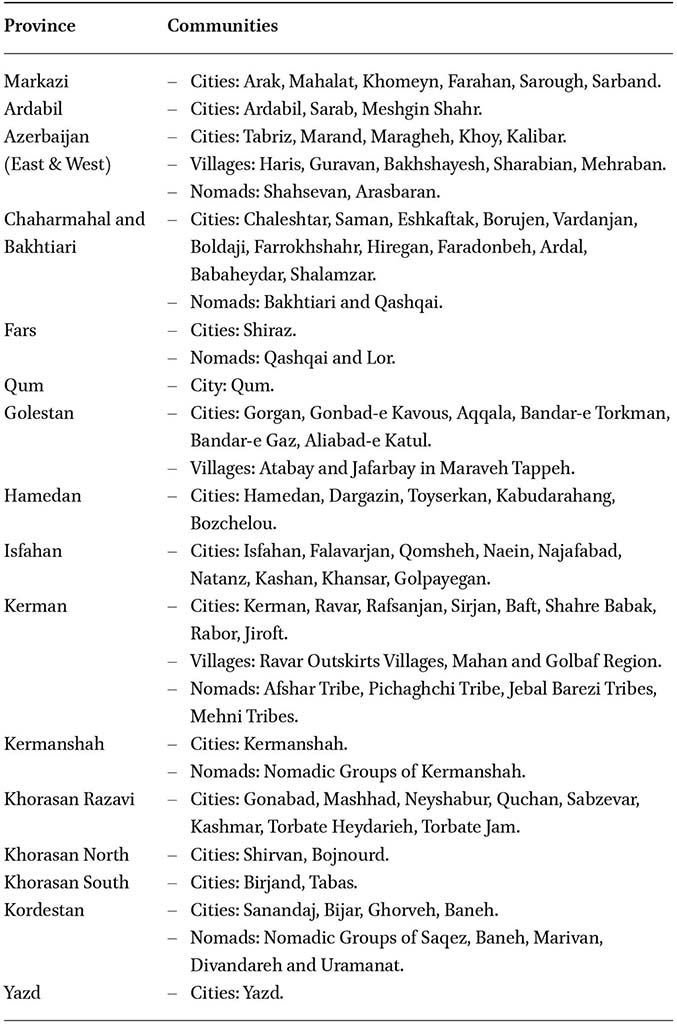
4.2 PCs Individual Beneficiaries
A wide range of beneficiaries, including individuals, cooperatives, associations, and communities, are included under the concept of TKHs. As Cottier and Panizzon point out “given the strong intergenerational component of TK, it will be difficult to identify a single holder.”279 To understand the role and position of individuals with regard to the clarification of the beneficiaries is a key issue, in particular, in application of TKHs rights and protection and the role of communities or their representatives to recognize individuals.280 As noted before, there are a wide range of businesses that rural, urban and nomadic people are engaging in these businesses and play a role in the production process from procurement of raw materials to exporting the carpets to foreign markets. However, the carpet weavers should be recognized as the most important part in this context.
4.2.1 Domestic Producers
In the PCs’ industry, both natural persons and legal entities are active, and the first group is mainly engaged in weaving at their own homes. Weavers at home are those who weave in their homes and decide when to weave the carpet, and most family members are often employed in the process. Domestic production is categorized into two types: producers on their own accounts and producers on the order by others. Domestic producers on their own account are those who provide the carpet’s raw materials themselves, own the carpet weaving tools, and sell the carpet after weaving. Many carpet designers fall into this category. Domestic producers on the order by others are producers who weave carpets at home by order of others. In this arrangement, the client supplies the raw materials, and after weaving, gives a share to the weaver and takes the carpet. One example of this type is decentralized weaving carpet workshops which are collections of weavers at home working under a single management.281
4.2.2 Workshops Production
Workshop production refers to a distinct style. In this style, carpets production takes place in the workshops. Workshops owners employ weavers as contractors and weavers must work from 7 AM to 6 PM in the workshop for gaining wages. Carpet weavers are actually organized weavers whose main place of work is the workshops of carpet industries. This method has been prevalent across the country since the past. Also, some major PCs producers such as ‘Iran Carpet Company’ and ‘Astan-e-ghods-e-Razavi Carpet Co’ operates such workshops in different regions of the country.
One of the important differences between home producers and workshop producers is the size of carpets they weave. While household production produces small size carpets (6 m2 or less), workshops mostly weave larger size. Another dissimilarity of these two methods is the quality of woven carpets. In the workshops, the quality of carpets is expected to be higher because of the better raw materials, texture and constant monitoring on weavers’ works. Besides, workshops usually engage more experienced weavers. However, workshop production increases the cost and eventually the price of carpets. Therefore, it is essential to support and maintain the production of carpets in workshops to assist the constant quality and distinctive features of the PCs.282
Therefore, government policy has been focused on promoting this method. In this regard, in 2003, the ‘Act for Supporting Establishment and Administration of Large and Centred Carpet Weaving Complexes’ was enacted.283 According to the by-law of the Act, complexes shall apply the quality criteria which are set by Iran National Carpet Centre (INCC). These criteria cover a wide range of issues such as using specific raw materials, the methods of weaving, washing mechanisms, and the standards of tools.284 If these criteria are violated, the INCC, after two written notices, will proceed with the suspension of the establishment license.285
4.2.3 Well-Known Producers of PCs
In the following table, some well-known producers of PCs are briefly introduced:286
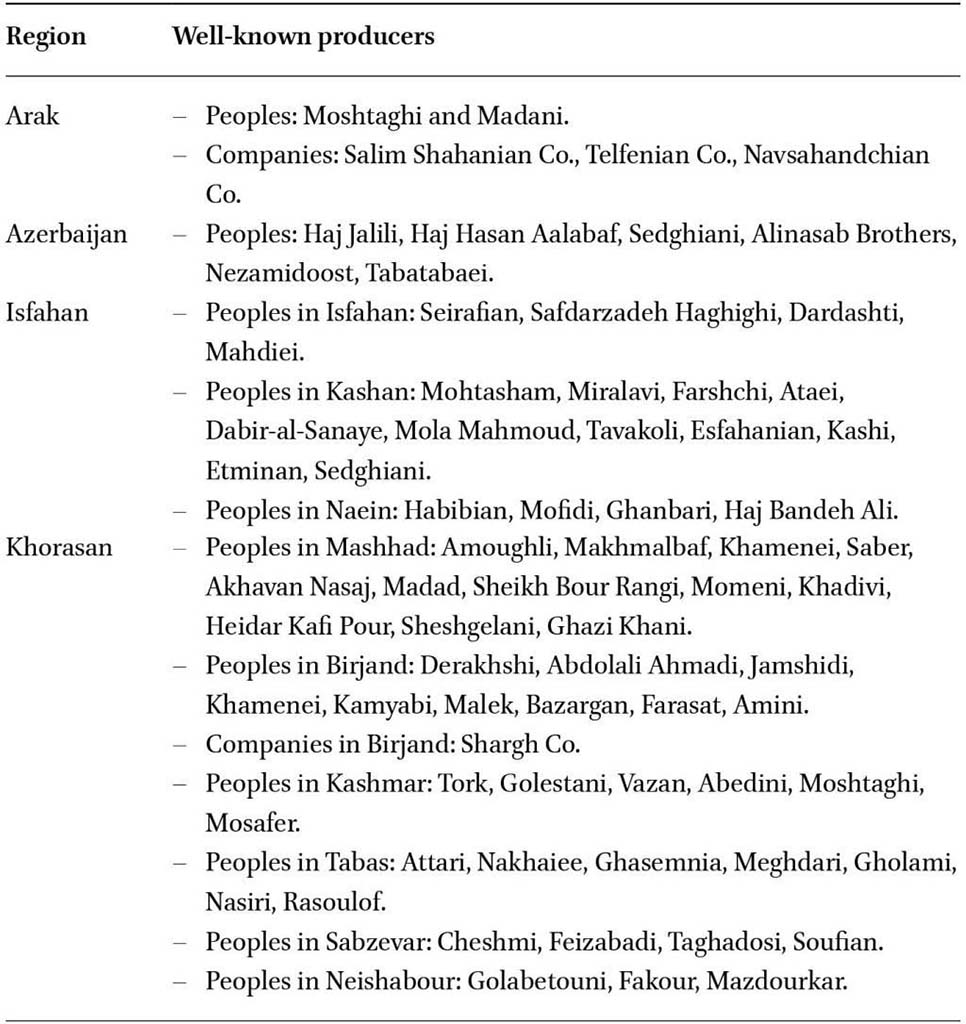
4.2.4 Well-Known Designers of PCs
In the following table, some well-known designers of PCs are briefly introduced:287
Well-known designer in each region

5 Who Might Represent Beneficiaries?
To manage TKHs’ rights and to help the government in the administration of its duty to promote and protect those rights, specific representatives and agencies have to be established as focal points of the TKHs concerned. Governments shall consult THKs through their representatives.288 Secondly, TKHs’ representatives shall be fully included in the decision making process regarding their TK.289 For instance they shall participate in any process regarding the documentation of TK.290 Thirdly, TKHs shall be able to take legal proceedings against the abuse of their rights – including use, management and conservation of their resources – through their representatives.291 For example, TKHs’ representatives could apply for IPRs on behalf of their respected communities. Representative also have an important role on awareness-raising campaigns for informing their respected communities of their existing rights and structures and to support the recognition and protection of the rights of communities. This could be implemented through a reporting and monitoring system.292 However, further points need to be considered. Firstly, determining who can act on behalf of TKHs in PCs. And secondly, identifying the political and commercial nature of these representatives:
5.1 Commercial Representatives
5.1.1 Associations
Unions play a significant role in protecting TK. The primary approach and the ultimate goal of the unions, particularly, and guilds in general, are to protect the rights of their members. In the context of TK, the most prominent right of TKHs is to maintain the collective rights of the communities’ members over TK. For example, Rurales’ and nomads’ unions may support their members to use and practice their TK, including irrigation and farming practices, the use of natural fertilizers, pest control practices, plant and animal breeding, coping with unexpected coldness and hundreds of other practical knowledge. In area of PCs, hand-woven carpet associations play a critical role in the process of production to the final stage of trading. They act as representatives of producers and merchants alongside the national authorities, particularly, with regards to the implementation and administration of recognized rights of PCs actors. The competence of the unions includes organization’s affairs, duties, powers, limits and rights of unions and their members. Crafts and traders in the similar occupational activities may form their union. These unions are independent and they have non-profit legal personality.293 The authorities and obligations of the unions are accounted for as:
-
Submission of the proposal for the preparation, regulation or modification of the criteria for issuing business licenses and work permits to the Council of Trade Unions,
-
Implementation of the resolutions and directives of the Supreme Supervisory Board and the Supervisory Commission,
-
Submission of the proposals regarding trade unions’ affairs to the council of trade unions,
-
Issuance of business license in accordance with applicable laws and regulations,
-
Revocation of licenses and suspending the businesses which disobey the law and regulations and preventing unauthorised business activities of traders that are not licensed or whose licenses are cancelled,
-
Creating the necessary facilities for the training of unions and their members,
-
Establishment of Commissions for hearing complaints, dispute settlements, inspection of business units, technical and educational offices. …294
The rules and regulations of the guild system, in particular, have paid special attention to the businesses in the field of hand-woven carpets and in the mechanisms in which associations operate in the production and supply of handmade carpets. The law and its regulations have established the appropriate capacities to create PCs production and trade associations. According to this law, emphasizing the importance of PCs, the lawmaker allowed the establishment of provincial or local associations of hand-woven carpets weavers or related professions in order to support hand-woven carpets professions.295 Some important associations that are active in the PCs professions are:
-
Iran Carpet Manufacturers and Exporters Association
-
Iran Rural Hand-Woven Carpet Central Association
-
Iran Nation-Wide Union of Carpet Producing Cooperatives
-
East Azerbaijan Union of Carpet Producing Cooperatives
-
Tehran Carpet Sellers Association
-
Carpet Manufacturers & Weavers Union of Tabriz
-
Qum Hand-Woven Carpet Exporters Association
-
Isfahan Hand-Woven Carpet Producers Association
-
Shiraz Hand-Woven Carpet Weavers Association
-
Khorasan Razavi Hand-Woven Carpet Exporters Association
-
Mashhad Hand-Woven Carpet Weavers and Producers Association
-
Yazd Hand-Woven Carpet Sellers Association
Considering the extensive list of associations of hand-woven carpets, a very rich capacity is available for TKHs of PCs in different regions in Iran to serve as their representatives.
5.1.2 Merchants
Merchants play a key role, among others, for continuing the production of PCs. In the absence of PCs merchants or ineffective trade practicing, carpet as a commodity will face an unavoidable misfortune and the gradual destruction. Therefore, merchants are also considered as an important part of the production chain. In this regard, ‘Act for Protection of Geographical Indications’ refers to traders as producers:
“Producer” means any person who is engaged in production and processing of agricultural, livestock and food products or produces industrial tools and handmade articles or manipulates natural materials for the purpose of production or a trader of the said products.296
According to last part of this recital, a trader of handmade articles counts as producer. Therefore, merchants of PCs are member of communities concerned. These traders can be natural persons or legal entities. Amongst the most important legal entities involved in the trading of PCs are the hand-woven carpet cooperative companies and Iran Carpet Company.297 At the same time, as will be pointed out in later sections, PCs’ merchants can be considered as beneficiary only in case they can provide evidences of a kind of dependence on carpet production areas. Hence, provincial units of each of these companies can be considered as traders if they have an independent legal personality.
5.2 Public Representatives
In Iran, two types of public representatives consisting of governmental institutions and elected institutions for TKHs of PCs are recognized.
5.2.1 Governmental Institutions
Regarding governments obligations, TKHs expect a wide range of activities to be undertaken by governments among them:
-
designate an appropriate authority as a body or an agency which is authorized by the State or entrusted with the responsibility to supervise and administer the rules and regulations,298
-
ensure the existence of appropriate agencies and mechanisms for administrating the programs affecting THKs,299
-
ensure that activities like handicrafts, rural and community-based industries are strengthened and promoted,300
-
provide technical and financial assistance for TKHs,301
-
take necessary action for protecting the rights of TKHs,302
-
prevent and redress any action which may aim to or affect TKHs’ cultural values or their integrity as distinct peoples,303
-
prevent third parties from unauthorized use of TK,304
-
mitigate TKHs’ difficulties in facing new conditions of life,305
-
improve TKHs’ life and work conditions and levels of health and education,306
-
carry out studies to assess the social, cultural and environmental impact of development activities on TKHs.307
It happens that TK has no identifiable holder or author, therefore, one of the state duties is to identify the beneficiaries, when there is no identifiable holder of TK.308 The Berne Convention principally has accepted that the works of unknown creators are entitled to be protected. To do so it has recognized those works may be represented by the designated competent national authorities.309 Such an approach is taken in the USA copyright law in cases where an identifiable person reworks a work of unknown authorship.310
Besides all the above-mentioned functions, national authorities can take any other measures which seem to them necessary for protection of TK. Although all of those obligations are of the same value, I assume the first and the most important task of governments is to designate an ‘appropriate authority’ as a body or an agency which is authorized by the State or entrusted with the responsibility to supervise and administer the rules and regulations.311 By the same token, in Iran, some institutions have been designated as responsible agencies for fulfilling such tasks, but of course, these institutions have different approaches. In the first approach, PCs, as manifiestations of TK, are subject matter of protection. In the second, the institutions’ obligation is to support TKHs themselves. Therefore, I will consider both types to reach tangible understanding of which approach could be more efficient for the protection of PCs.
5.2.1.1 Iran National Carpet Centre (INCC)
Before 2003, policies, administration, supervision and management regarding PCs production and trade were divided across several institutions of different levels such as Ministry of Commerce, Ministry of Agriculture Jihad, the Handicraft Organization, Iran Carpet Company, and others. In 2003, in order to centralize and organize PCs affairs in a unique nation-wide institution, the INCC established.312 It is affiliated with the Ministry of Industry, Mine, and Commerce. The goals for establishing the Centre are:
-
increasing in production,
-
enhancing quality,
-
organizing the hand-woven carpet industry,
-
solving market problems including supply and marketing,
-
setting the criteria and technical requirements for production and exports,
-
preserving the artistic and cultural aspects of hand-woven carpets,
-
reducing government role in production and sales,
-
aggregating the tasks of parallel state-owned institutions in one organization,313
-
investigating and addressing violations of ‘Large and Centred Carpet Weaving Complexes’ that do not comply with production quality standards, and suspending their licenses.314
Establishment of the Centre has provided the possibility of an integrated management of PCs across the country. Accordingly, all issues regarding PCs including policy making, planning, conduction, supervision, support and protection of hand-woven carpets, as well as researches and education, setting the criteria and technical requirements regarding production and export of the hand-woven carpets have been transferred from other organizations and institutions and assigned to the Centre. On the other hand, government involvement in producing and trade of carpets has been delegated to the private sector.315 The INCC provides the necessary legal ground and capacity for the use of law for protection of PCs such as IPRs. INCC functions and obligations are to support and protect PCs itself as subject matter of TK. It does not protect and support TKHs themselves.
5.2.1.2 Iran High Council of Nomads
The establishment of the ‘High Council of Nomads’ was suggested for the first time in the era of ‘Muzaffar ad-Din Shah’ who was the fifth Qajar Monarch of Persia and reigned from 1896 to 1907. But in practice, Council was created in 1946 during the next dynasty, the Pahlavi, with the goal to regulate Nomads affairs.316 After Islamic Revolution of 1979, the Council was restructured under the Ministry of Internal Affairs to settle Nomads’ problems and improve their levels of life as well as the restoration of indigenous and tribal cultures and traditions, and support them by providing social services such as education and health.317 Soon it was realized that the Ministry of Internal Affairs did not have enough capacity to manage all aspects of Nomads needs and expectations and more institutions should be engaged to meet Nomadic Peoples’ requirements. Therefore, in 1986, the Council was reformed again under the Iran Presidency Office. The duties of the Council are:
-
Policy making, long-term, and short-term planning,
-
Coordinating with various operational responsible organizations and monitoring their programs and operations,
-
Providing facilities for the improvement and development of animal husbandry and handicraft products of nomads,
-
Addressing the status of the nomadic community of Iran,
-
Improving the living conditions and reviving traditional and nomadic cultures,
-
Proper use of their potential and talents.318
Although the Council, as a responsible body, has the authority to take necessary measures for supporting and protecting Nomads’ TK, its duties regarding the production of handmade carpets have been delegated to the INCC.
5.2.1.3 Provincial Councils for Planning and Development
In the Iranian administration system, the ‘Provincial Councils for Planning and Development’ play a special role in managing local affairs and enjoy relative autonomy. Local governors and other government officials are required to comply with the decisions of the councils, which are made based on the councils’ competence.319 The responsibilities of the Councils, among others, include determining the economic, social, and cultural development policies as well as investment opportunities in each province.320
It should be noted that the Councils have technical and professional committees which work as specialized working groups of the Councils and evaluate local communities’ needs. The Culture and Art Working Group, which has a special and guided role in supporting TKHs, is one of them. Although the structure of the Council provides a high capacity for the support of TKHs in general and PCs in particular within development programs, it has not yet addressed the issue.
5.2.1.4 Other State Entities
In addition to the aforementioned governmental bodies, other organizations also share responsibilities in supporting individuals and legal entities involved in the PCs production. According to the ‘Act for Supporting Artists, Artisans, and Handicrafts Practitioners,’ PCs are recognized as an innovative and aesthetic manifestation of the artistic and traditional industries. The Ministry of Cultural Heritage, Tourism, and Handicrafts and the Ministry of Industry, Mine, and Commerce bear direct responsibility for supporting the PCs production. Other governmental organizations, indirectly and in cooperation with these two ministries, are also tasked with providing support for PCs and other handicrafts.
These supportive actions encompass a wide range of management and technical assistance, information dissemination, education, promotion, financial support, and the empowerment of non-governmental, cooperative, and private institutions. Notably, Note (D) of Article (4) specifically assigns these two ministries the duties of coordination and planning regarding the IPRs of PCs both domestically and internationally. However, it is important to note that none of these responsibilities explicitly includes the representation of artists, craftsmen, and handicrafts practitioners.321
5.2.2 Elected Institutions
In Iran, local people elect the members of the ‘Village Councils’ and ‘City Councils’ through a direct vote in accordance with the ‘Law on Organization, Duties and Election of the Islamic Councils of the Country and Assignment of Mayors.’322 Unfortunately, nothing in the law refers to the TK of the respected communities. Although, it calls for participation and cooperation of the public in cultural activities.323 But it seems non-efficient for offering any kind of support for TKHs or their TK. While TK had been considered in the prior abolished laws. For example, the efforts for documenting village historical geography, identity, stories, legends, customs, rituals, poems and local songs were part of rights and obligations of Village Associations, who should cooperate with ‘Village House of Culture’ and seek guidance from respected elders and local authorities to fulfill these responsibilities324 or on the duties of the Islamic Councils of Village, the act encourages villagers to engage in handicrafts and rural industries.325 Although the members of these institutions are representatives of the villagers, in practice their capacity does not include management of the TK or supporting respected communities.326
6 Summary
TK is an important subject matter for a wide range of communities known as TKHs across the world. As it was mentioned earlier in Section 1 of this chapter, the vital role of TK is relatively reflected in various international legal instruments which call for respecting the rights of TKHs and the supporting and protection of TK. Although TK has absorbed a lot of interest from different stakeholders, and despite the efforts made by beneficiaries and users of TK, there is no agreement on what the proper legal definition of TK is. Some scholars defend the necessity of reaching a worldwide accepted definition for TK. In contrast, others discuss how TK has a dynamic nature and no definition can fully represent TK. Instead, they suggest we will be better off with identification of what the subject matters of TK are. I could not be more in agreement with the second group and I suppose that an abstract definition of TK will not help to reach an agreement for protection of TK both on international and national levels. Besides, any definition should be left to the national authorities and TKHs to provide their version of definition regarding different faces of TK in the respective communities.
If we accept that no comprehensive definition on TK could and should be reached, then the subject matters of TK need to be identified. We expect to learn what is protectable as TK. Supporters of the no-definition idea are divided among themselves on the issue of subject matter of TK. The first group regards TK in a narrow sense and believes TK only to include knowledge in the form of know-how, practices, skills and innovations in nature, and should be treated and protected as such. The second group accounts the difficulties of such a vision, and considers TK in a broader sense. They argue that TK is not separable from GRs and TCEs in nature and therefore, knowledge, genetic materials and culture of TKHs shall be protected under one umbrella of TK. This approach seems to be more reasonable in relation to PCs. As the knowledge related to the production of raw materials or finished carpet products receives little to no protection for TKHs in the context of handicrafts and PCs, I put PCs under general discussion of protection of TK.
After considering PCs as subject matter of TK, the next important issue is to assess who are the beneficiaries of TK protection in general and PCs protection in particular. The term ‘Beneficiaries’ encompasses a wide range of concepts. It is concluded from current global debates that local communities, indigenous peoples and individuals of these communities are the most related people to the term beneficiaries. However, in this study TKHs were considered as beneficiaries; because TK includes a broader scope than indigenous people, and it is essential to include as many communities and related individuals as possible as TK beneficiaries.
In the light of the discussion of TK beneficiaries, the analysis of PCs was extended to identify beneficiaries of PCs in the rural and nomadic communities as well as in cities, and related individuals to those communities. Then Iran’s laws and regulations were examined to determine who could play the role of representative of TKHs in regards to PCs.
A wide range of beneficiaries is involved in PC production. These beneficiaries include communities and their individual members, cooperatives and associations. Three well-known groups of communities are known to be beneficiaries of PCs.
Iran’s rural communities include households that have independent customary or formal sovereignty and are homogeneous in terms of natural, social, cultural and economic status. They engage in rural industries and, in particular, in producing PCs.
Urban areas in Iran are the communities that have emerged from the expansion of the rural regions. Thus, cities carry the cultural, social and economic heritage of Iranian villagers. Moreover, rural migration to cities leads to a continuous cultural, social and economic exchange between rural and urban areas. The production of PCs in cities is therefore under the influence of the surrounding rural areas. Despite the common features between the rural and urban areas, it should be noted that, at the same time, urban communities have unique characteristics that distinguish them from rural areas. For example, unlike in villages where individual producers are more common, workshop productions are more common in cities. Moreover, many professions, especially in services, are also concentrated in cities. The differences between the criteria of the villages and cities are legally significant in the context of PCs and the application of the protection mechanisms. For instance, there are dissimilarities in the local authorities, representatives and administrative institutions.
The third significant group of beneficiaries of PCs is tribal communities. The Iranian legal system officially recognizes their independent identity. Moreover, as nomadic people, they migrate according to the seasons, and, therefore, they are simultaneously under the governance of their various places of residence.
Cities like Tabriz, Isfahan, Kashan, Qum, Mashhad, Bijar and Sarough; rural areas such as Haris, Sharabian, Ravar, Mahan, Golbaf; and the nomads of Shahsevan, Qashqai, Lor and Afshar are some examples of communities well known for producing high-quality PCs.
More than 28 professional disciplines are members of these communities. However, the carpet weavers and designers play the most crucial role in this context. Weavers and designers work either individually as domestic producers or together in workshop productions. Domestic production includes producers on their own accounts and producers who take orders from others. In workshop production, the carpet-producing activities take place in the workshops. Domestic producers are heavily dependent on those individuals who provide them with raw materials. Workshop owners employ weavers and designers as contractors. Production in workshops has been predominant in the PC industry. While workshops produce higher quality carpets, their cost is higher too. Therefore, it is essential to support and maintain the production of carpets in workshops to ensure the consistent quality and distinctive features of the PCs. Some major PC producers such as the ‘Iran Carpet Company’ and ‘Astan-e-ghods-e-Razavi Carpet Co’ operate such workshops in different regions of the country. Also, there is a long list of well-known producers and designers.
Other key beneficiaries of PCs are representatives of TKHs. These include:
-
commercial representatives including PCs’ associations and merchants,
-
public representatives including INCC; Iran High Council of Nomads; and Provincial Councils for Planning and Development; and Village and City Councils.
These entities carry out a wide range of activities on behalf of the TKHs. Such activities include documentation of the TK in PCs, awareness-raising, managing, promoting and protecting TKHs’ rights, assisting national and local authorities in policy-making, and participation in implementation of the laws and regulations.
Christoph Beat Graber and Martin A Girsberger, ‘Traditional Knowledge at the International Level: Current Approaches and Proposals for a Bigger Picture That Includes Cultural Diversity’ in Jörg Schmid and Paul Richli (eds), Recht des ländlichen Raums: Festgabe der Rechtswissenschaftlichen Fakultät der Universität Luzern für Paul Richli zum 60. Geburtstag (Schulthess 2006) Page 267.
The Committee of Governmental Experts and WIPO, ‘Model Provisions for National Laws on the Protection of Expressions of Folklore Against Illicit Exploitation and Other Prejudicial Actions’ (UNESCO, WIPO 1983) UNESCO/WIPO/FOLK/AFR/2.
Surinder Kaur Verma, ‘Protecting Traditional Knowledge, Is a Sui Generis System an Answer?’ (2004) 7 The Journal of World Intellectual Property 765, Page 771.
Indigenous and Tribal Peoples Convention.
ibid Article 13.
ibid Article 2(2).
ibid Article 5(a).
ibid Art 7(4).
CBD Article 1.
ibid Article 8(j).
ibid Article 16(5).
Secretariat of the Convention on Biological Diversity, Bonn Guidelines on Access to Genetic Resources and Fair and Equitable Sharing of the Benefits Arising out of Their Utilization (Secretariat of the Convention on Biological Diversity 2002).
Bonn Guidelines on Access to Genetic Resources and Fair and Equitable Sharing of the Benefits Arising out of their Utilization 2002 (CBD COP Dec VI/24, Item A, 6th mtg, UNEP Doc UNEP/CBD/COP/6/20 Annex) I(C).
ibid I(D)(10).
ibid II(C)(16)(d)(ii).
ibid IV(D)(43)(c) & (d).
ibid V(C)(55)(c).
Nagoya Protocol Preamble Paragraph 21.
ibid Preamble Paragraphs 12bis, 20, 22, 23, 24; and Articles 3(1), 4(4), 5bis, 7bis, 9, 10(b), 12bis(1), 14, 17, 18(5)(J).
ibid Article 3.
United Nations Convention to Combat Desertification in those Countries Experiencing Serious Drought and/or Desertification, Particularly in Africa (UNCCD) 1994 (1954 UNTS 3 (entered into force 26 December 1996)).
ibid Article 18(2).
ibid Article 18(1)(b).
ibid Article 18(1)(e).
International Treaty on Plant Genetic Resources for Food and Agriculture (ITPGRFA) 2001 (2400 UNTS 303 (entered into force 29 June 2004)).
ibid Article 1.
ibid.
ibid Article 9(2)(a).
ibid Article 9(2).
‘United Nations Declaration on the Rights of Indigenous Peoples’ (n 48).
ibid Article 31(1).
ibid Article 31(2).
ibid Article 8(2)(a).
Convention for the Safeguarding of the Intangible Cultural Heritage 2003 (2368 UNTS 3 (entered into force 20 April 2006)) Article 2(1).
ibid Article 2(2).
Berne Convention for the Protection of Literary and Artistic Works, as revised at Paris 1971 (1161 UNTS 3 (entered into force 15 December 1972)).
Thomas Cottier, Matthias Oesch and Thomas M Fischer, International Trade Regulation: Law and Policy in the WTO, the European Union and Switzerland: Cases, Materials and Comments (Staempfli Publishers 2005) Page 916.
Graham Dutfield, ‘TRIPS-Related Aspects of Traditional Knowledge’ (2001) 33 Case Western Reserve Journal of International Law 233, Pages 269–271.
Thomas Cottier and Christophe Germann, ‘Agreement on Trade-Related Aspects of Intellectual Property Rights: The TRIPS Agreement Is Annex 1C of the Marrakesh Agreement Establishing the World Trade Organization, Signed in Marrakesh, Morocco on 15 April 1994.’ in Thomas Cottier and Pierre Véron (eds), Concise International and European IP Law: TRIPS, Paris Convention, European Enforcement and Transfer of Technology, vol 4 (2nd edn, Kluwer Law International 2008) Pages 7 and 9.
ibid Pages 9 and 34.
WTO, ‘Doha Ministerial Declaration’ WTO Doc WTO Doha Ministerial Conference, 4th sess, WTO Doc WT/MIN(01)/DEC/1 (20 November 2001 Adopted on 14 November 2001) Article 19.
Carlos M Correa, Intellectual Property Rights, the WTO and Developing Countries: The TRIPS Agreement and Policy Options (Zed Books; Third World Network 2000).
Khor (n 35) Page 10.
See: Fatemeh Rostami, ‘
‘Members and Observers’ (World Trade Organization, 1 April 2024) <https://www.wto.org/english/thewto_e/acc_e/a1_iran_e.htm>.
Dutfield, ‘TRIPS-Related Aspects of Traditional Knowledge’ (n 107) Pages 266–269.
WIPO Secretariat, ‘Matters Concerning Intellectual Property and Genetic Resources, Traditional Knowledge and Folklore’ (2000) WIPO GA Dec WO/GA/26/6 Page 4.
Ulia Popova-Gosart, Traditional Knowledge & Indigenous Peoples (World Intellectual Property Organization 2009) Page 105.
Antonella Ingrassia, Daniele Manzella and Elzbieta Martyniuk, The Legal Framework for the Management of Animal Genetic Resources (Food and Agriculture Organization of the United Nations 2005) Pages 30–31.
WIPO Secretariat, ‘Report of the Assemblies of the Member States of WIPO’ (2017) WIPO GA Doc A/57/11 ADD.6.
The WIPO General Assembly, at its Fifty-Fourth (25th Ordinary) Session in October 2021, agreed on the mandate for the IGC for the 2022/2023 biennium, to expedite its work, building on existing work carried out by the Committee, to narrow existing gaps and reach common understanding on core issues, with the objective of finalizing an agreement on an international legal instrument(s) which will ensure the balanced and effective protection of GRs, TK and TCEs. See: WIPO Secretariat, ‘Report on the Intergovernmental Committee on Intellectual Property and Genetic Resources, Traditional Knowledge and Folklore (IGC)’ (World Intellectual Property Organization 2021) WIPO GA Doc WO/GA/54/10.
See: Chair of the IGC Mr Ian Goss, ‘Chair’s Text of a Draft International Legal Instrument Relating to Intellectual Property, Genetic Resources and Traditional Knowledge Associated with Genetic Resources’ (2022) WIPO Doc WIPO/GRTKF/IC/43/5.
WIPO Secretariat, ‘Proposal to Advance WIPO Normative Agenda on the Subjects of Genetic Resources Associated with Traditional Knowledge, and the Design Law Treaty’ (World Intellectual Property Organization 2022) WIPO GA Doc WO/GA/55/11 Annex.
WIPO Secretariat, ‘Summary Report of Assemblies of the Member States of WIPO’ (2022) WIPO GA Doc A/63/9 Page 6, Note 27.
Chair of the IGC Mr Ian Goss (n 121).
Wend Wendland, ‘Is an International Agreement on IP, Genetic Resources and Associated Traditional Knowledge Finally in Sight?’ [2023] WIPO Magazine.
See: IGC-GRTKF Secretariat, ‘The Protection of Traditional Knowledge: Draft Articles Rev. 2’ (n 12) Article 12.
The ARIPO was established in 1976 under Lusaka Agreement. Members of the African Union (AU) or members of the United Nations Economic Commission for Africa (ECA) can be member of the ARIPO. At present, 19 states are members of the Lusaka Agreement and therefore members of ARIPO. These states are Botswana, The Gambia, Ghana, Kenya, Lesotho, Malawi, Mozambique, Namibia, Sierra Leone, Liberia, Rwanda, São Tomé and Príncipe, Somalia, Sudan, Swaziland, Tanzania, Uganda, Zambia and Zimbabwe. For more information. See: ARIPO, ‘About Us | ARIPO’ (IP ARIPO, 2017) <https://www.aripo.org/member-states>.
Swakopmund Protocol.
ibid Sections 4–15.
Laura Etheredge, Iran (Britannica Educational Pub in association with Rosen Educational Services 2011) Page 14.
‘Admission of the Republic of Azerbaijan to Membership in the United Nations’ (1992) Res 742, UN SCOR, 3052nd mtg, SC Res S/RES/742(1992); “Historically, the geographical entity known as Azerbaijan covered a much larger area than the present-day Iranian provinces of the same name, extending to the north and to the west across the boundaries of several contemporary nation states.” See: John Henry Lorentz, Historical Dictionary of Iran (Scarecrow Press 2007) Page 41.
The agreement was signed by Economic Cooperation Organization (ECO) members in Islamabad, Pakistan and subsequently ratified by five countries: Afghanistan, Iran, Pakistan, Tajikistan, and Türkiye. See: Economic Cooperation Organization Trade Agreement (ECOTA) 2003 (entered into force 24 April 2008) Preamble and Articles 2(1),(2) and (3).
ibid Article 2(4).
See: ibid Articles 4(3), 15(A)(1), 19(1), (2) and (4).
The United States – Colombia Trade Promotion Agreement 2006 (entered into force 15 May 2012); and The United States – Peru Trade Promotion Agreement 2006 (entered into force 14 December 2007).
The United States – Panama Trade Promotion Agreement 2007 (entered into force 31 October 2012).
These agreements are concluded with Algeria, Armenia, Cuba, Georgia, Germany, Italy, Japan, Lebanon, Macedonia, Nigeria, Poland, Qatar, Russia, Spain, Sweden, Syria, USA and Venezuela and an agreement with International Atomic Energy Agency (IAEA).
‘Islamic Republic of Iran – Bilateral Investment Treaties (BITs)’ (UNCTAD Investment Policy Hub, 25 October 2016) <http://investmentpolicyhub.unctad.org/IIA/CountryBits/98#iiaInnerMenu>.
See European Community statement: IGC-GRTKF Secretariat, ‘Report of Intergovernmental Committee on Intellectual Property and Genetic Resources, Traditional Knowledge and Folklore’ (n 61) Page 7.
Thomas Cottier and Andrea Nascimento Müller, ‘The Case for Protecting Geographical Indications and Traditional Knowledge in Agricultural Trade’ Page 440; in Thomas Cottier, Trade and Intellectual Property Protection in WTO Law: Collected Essays (Cameron May 2005).
See statement of Brazil delegation: IGC-GRTKF Secretariat, ‘Report of Intergovernmental Committee on Intellectual Property and Genetic Resources, Traditional Knowledge and Folklore’ (n 61) Page 17, Paragraph 27.
IGC-GRTKF Secretariat, ‘Traditional Knowledge – Operational Terms and Definitions’ (World Intellectual Property Organization 2002) WIPO Doc WIPO/GRTKF/IC/3/9 Page 2.
ibid Page 3.
IGC-GRTKF Secretariat, ‘Report of Intergovernmental Committee on Intellectual Property and Genetic Resources, Traditional Knowledge and Folklore’ (World Intellectual Property Organization 2002) WIPO Doc WIPO/GRTKF/IC/3/17 Page 71.
Government of Switzerland, ‘Draft Guidelines on Access and Benefit Sharing Regarding the Utilisation of Genetic Resource’ (World Intellectual Property Organization 2001) WIPO Doc WIPO/GRTKF/IC/1/9 Page 22.
UNEP-CBD, ‘Report of the Meeting of the Group of Technical and Legal Experts on Traditional Knowledge Associated with Genetic Resources in the Context of the International Regime on Access and Benefit-Sharing’ (n 56) Page 10.
IGC-GRTKF Secretariat, ‘Report of Intergovernmental Committee on Intellectual Property and Genetic Resources, Traditional Knowledge and Folklore’ (n 61) Page 7.
David Kelley, The Art of Reasoning (Norton 1988) Page 32.
ibid.
Vicious Circle is defined as: “a situation in which an attempt to resolve one problem creates new problems that lead back to the original situation. It is also a fallacy in reasoning in which the premise is used to prove the conclusion, and the conclusion used to prove the premise. For example, A depends on B and B depends on A. The conclusion is that A depends on A. It is the circularity in argument or proof.” See: ‘Vicious Circle’ (Islamic Quest Net, 16 March 2013) <http://www.islamquest.net/en/archive/keyword/vicious%20circle> accessed 17 March 2014.
See the statement of the Japan Delegation: IGC-GRTKF Secretariat, ‘Revised Draft Report of Intergovernmental Committee on Intellectual Property and Genetic Resources, Traditional Knowledge and Folklore’ (World Intellectual Property Organization 2008) WIPO Doc WIPO/GRTKF/IC/11/15 Prov 2. Paragraph 296.
Encyclopaedia Britannica, ‘Knowledge,’ Britannica Online Encyclopaedia (2014) <http://www.britannica.com/bps/dictionary?query=knowledge> accessed 23 January 2014.
Houghton Mifflin Company (n 7).
ibid.
Garner (n 19).
IGC-GRTKF Secretariat, ‘Elements of a Sui Generis System for the Protection of Traditional Knowledge’ (World Intellectual Property Organization 2002) WIPO Doc WIPO/GRTKF/IC/4/8 Page 11.
The Committee of Governmental Experts and WIPO (n 71) Part III (42).
Nuno Pires de Carvalho, ‘From the Shaman’s Hut to the Patent Office: A Road Under Construction’ in Charles R McManis (ed), Biodiversity and the Law: Intellectual Property, Biotechnology and Traditional Knowledge (Earthscan 2007) Page 244.
Munzer and Raustiala (n 5) Page 58.
See Dr Martinez Cobo quoted in: Michael Blakeney, ‘What Is Traditional Knowledge? Why Should It Be Protected? Who Should Protect It? For Whom? Understanding the Value Chain’ (World Intellectual Property Organization 1999) WIPO Doc, WIPO/IPTK/RT/99/3 Pages 3–4.
IGC-GRTKF Secretariat, ‘Glossary of Key Terms Related to Intellectual Property and Genetic Resources, Traditional Knowledge and Traditional Cultural Expressions’ (World Intellectual Property Organization 2014) WIPO Doc WIPO/GRTKF/IC/28/INF/7 Annex Page 40.
UNCCD Article 18(2).
CBD 8(j).
IGC-GRTKF Secretariat, ‘Revised Provisions for the Protection of Traditional Knowledge: Policy Objectives and Core Principles’ (World Intellectual Property Organization 2010) WIPO Doc WIPO/GRTKF/IC/17/5 Annex Page 32.
Swakopmund Protocol Section 2.
WIPO, Intellectual Property Needs and Expectations of Traditional Knowledge Holders: WIPO Report on Fact-Finding Missions on Intellectual Property and Traditional Knowledge (1998–1999) (WIPO 2001) Page 25.
Joseph Wambugu Githaiga, ‘Intellectual Property Law and the Protection of Indigenous Folklore and Knowledge’ (1998) 5 Murdoch University Electronic Journal of Law 53, Page 2.
For the same reason, WIPO general assembly decided to establish intergovernmental committee on genetic resources, traditional knowledge and folklore as a forum in which discussions on intellectual property issues that arise in the terms of the theses three themes could proceed together. For more information see documents: WIPO Secretariat, ‘Matters Concerning Intellectual Property and Genetic Resources, Traditional Knowledge and Folklore’ (n 116) Paragraph 14; and WIPO Secretariat, ‘Report of General Assembly’ (2000) WIPO GA Dec WO/GA/26/10 Paragraph 71.
WIPO, Intellectual Property Needs and Expectations of Traditional Knowledge Holders (n 166) Page 25.
See Asian Group statement: IGC-GRTKF Secretariat, ‘Report of Intergovernmental Committee on Intellectual Property and Genetic Resources, Traditional Knowledge and Folklore’ (n 61) Page 9.
Munzer and Raustiala (n 5) Page 38.
Lewinski (n 69) Page 4.
Hansen and van Fleet (n 4) Page 3.
WIPO, Intellectual Property Needs and Expectations of Traditional Knowledge Holders (n 166) Page 26.
ibid Page 25.
ibid.
UNEP-CBD Executive Secretary (n 43) Page 3.
Thomas Cottier and Marion Panizzon, ‘Legal Perspectives on Traditional Knowledge: The Case for Intellectual Property Protection’ in Keith E Maskus and Jerome H Reichman (eds), International Public Goods and Transfer of Technology under a Globalized Intellectual Property Regime (First, Cambridge University Press 2005) Page 566.
Thomas Cottier, ‘The Protection of Genetic Resources and Traditional Knowledge: Towards More Specific Rights and Obligations in World Trade Law’ (1998) 1 Journal of International Economic Law 555, Page 558.
Darrell A Posey and Graham Dutfield, Beyond Intellectual Property: Toward Traditional Resource Rights for Indigenous Peoples and Local Communities (International Development Research Centre 1996) Page 12.
Quoted from: Graham Dutfield, ‘Harnessing Traditional Knowledge and Genetic Resources for Local Development and Trade’ (WIPO 2005) Pages 9–10.
See: Nagoya Protocol Preamble, Recital 21.
ibid Article 12.
UNEP-CBD, ‘Report of the Meeting of the Group of Technical and Legal Experts on Traditional Knowledge Associated with Genetic Resources in the Context of the International Regime on Access and Benefit-Sharing’ (n 56) Page 8, Paragraph 13.
Miguel N Alexiades and Sarah A Laird, ‘Laying the Foundation: Equitable Biodiversity Research Relationships’ in Sarah A Laird (ed), Biodiversity and Traditional Knowledge: Equitable Partnerships in Practice (Earthscan Publications 2002) Page 8.
See for example: Indigenous and Tribal Peoples Convention.
For more information on the forms of TK see: IGC-GRTKF Secretariat, ‘List and Brief Technical Explanation of Various Forms in Which Traditional Knowledge May Be Found’ (World Intellectual Property Organization 2010) WIPO Doc WIPO/GRTKF/IC/17/INF/9 Annex Page 2–3.
Swakopmund Protocol Section 1(2)–(3).
Discussions around traditional communities’ intellectual creativities were oriented under the notion of Folklore; but other scholars gradually generated other terms such as TK to challenge concept of Folklore. Blakeney notes that Folklore reflects the cultural and social identity of the communities in different forms such as rituals, customs, architecture, handicrafts and all kind of arts. And according to Githaiga, Folklore refers to “all kinds of literary and artistic works such as music, dance, song, ceremonies, symbols and designs, narratives and poetry.” See: Blakeney, ‘What Is Traditional Knowledge? Why Should It Be Protected? Who Should Protect It? For Whom? Understanding the Value Chain’ (n 160) Page 2; And Githaiga (n 167) Page 2.
In accordance with the WIPO-UNESCO Model Provisions Expressions of Folklore are “productions consisting of characteristic elements of the traditional artistic heritage developed and maintained by a community of a country or by individuals reflecting the traditional artistic expectations of such a community, in particular: (i) Verbal expressions, (ii) Musical expressions, (iii) Expressions by action, (iv) Tangible expressions.” Also, Swakopmund Protocol defines Expressions of Folklore as: “[a]ny forms, whether tangible or intangible, in which traditional culture and knowledge are expressed, appear or are manifested.” It puts the forms of EoF in same categories of WIPO-UNESCO Model Provisions and offers example of some forms of expressions or combinations of them. According to the both documents, words, signs, names and symbols are examples of verbal expressions; and drawings, designs, paintings, carpets and handicrafts categorized under tangible expressions. See: The Committee of Governmental Experts and WIPO (n 71) Section 2; and Swakopmund Protocol Section 2(1).
WIPO’s IGC use Traditional Cultural Expressions and Expressions of Folklore alternatively and as synonyms to refer the intangible and tangible forms of TK and Cultures. See: IGC-GRTKF Secretariat, ‘Glossary of Key Terms Related to Intellectual Property and Genetic Resources, Traditional Knowledge and Traditional Cultural Expressions’ (n 161) Pages 13, 14 and 39.
Berkes considering different concepts of traditional ecological knowledge defines TEK as: “a cumulative body of knowledge and beliefs, handed down through generations by cultural transmission, about the relationship of living beings (including humans) with one another and with their environment.” See: Fikret Berkes, ‘Traditional Ecological Knowledge in Perspective’ in Julian T Inglis (ed), Traditional Ecological Knowledge: Concepts and Cases (International Program on Traditional Ecological Knowledge: International Development Research Centre 1993) Page 3.
The Dene Cultural Institute defines Traditional Environmental Knowledge as “a body of knowledge and beliefs transmitted through oral tradition and first-hand observation. It includes a system of classification, a set of empirical observations about the local environment, and a system of self-management that governs resource use. Ecological aspects are closely tied to social and spiritual aspects of the knowledge system.” See: Marc G Stevenson, ‘Indigenous Knowledge in Environmental Assessment’ (1996) 49 Arctic Institute of North America 278, Page 281.
Some scholars point out protection of TK is not conditioned to fixation in a tangible form such as writing or drawing. See: Munzer and Raustiala (n 5) Page 53.
Codified TK is “traditional knowledge which is in some systematic and structured form, in which the knowledge is ordered, organized, classified and categorized in some manner.” See: IGC-GRTKF Secretariat, ‘List and Brief Technical Explanation of Various Forms in Which Traditional Knowledge May Be Found’ (n 187) Pages 6–7.
Undisclosed TK or Secret TK are important for communities in accordance with their customary law and practices. See: IGC-GRTKF Secretariat, ‘Glossary of Key Terms Related to Intellectual Property and Genetic Resources, Traditional Knowledge and Traditional Cultural Expressions’ (n 161) Page 37; Something is secret if it is “kept from the knowledge of others or shared only with those concerned.” See: Garner (n 19).
IGC-GRTKF Secretariat, ‘List and Brief Technical Explanation of Various Forms in Which Traditional Knowledge May Be Found’ (n 187) Pages 3–4.
IGC-GRTKF Secretariat, ‘Traditional Knowledge – Operational Terms and Definitions’ (n 142) Page 3.
ibid Pages 8–9.
Cottier and Panizzon, ‘Legal Perspectives on Traditional Knowledge: The Case for Intellectual Property Protection’ (n 178) Page 583.
Pahlavi or Pehlevi language was a Middle Iranian language during Sassanid times (224–654 CE). For more information see: Rüdiger Schmitt, Compendium Linguarum Iranicarum (L Reichert 1989).
Short-napped coarse carpet.
Pileless carpet.
Woollen cloth.
Felt.
Carpet.
Rug.
Ahmad Daneshgar,
Swakopmund Protocol Section 2(1)[6](iv).
Yasavoli (n 8).
Daneshgar (n 208).
It should be explained that in a carpet, the density of the knots and their elegance represents the quality of the carpet. This means that the higher the number of knots and the so-called ‘carpet weighing,’ the higher its quality. In general, PCs weaving is in two common types: the Turkish knot (symmetric) of Tabriz, Hamedan, Fars tribes and so on. Farsi knot (asymmetric) of Arak, Isfahan, Mashhad, Birjand, Kerman, Naein, Kashan, Qum and others.
‘Process of Weaving’ (Iran Carpet Co., 2015) <http://en.irancarpet.ir/CarpetEncyclopedia/TheProcessofWeaving.aspx>.
In Persian Bafandeh. See: Peter F Stone, Oriental Rugs: An Illustrated Lexicon of Motifs, Materials, and Origins (Tuttle Publishing 2013).
In Persian Tabrizi or Sepidar.
“A weighted comb is used to beat down wefts over rows of knots in weaving pile rugs. An image of a comb is often used as a filler motif in tribal and nomadic rugs.” Excerpt from: Stone (n 214).
See: Swakopmund Protocol Sections 2(1)[6](iv) and 16(b).
In Persian: Shakhsiatha.
In Persian Derakhti.
In Persian Mihrabi.
In Persian Eghtebasi.
“Biological resources include genetic resources, organisms or parts thereof, populations, or any other biotic component of ecosystems with actual or potential use or value for humanity.” See: CBD Article 2; also, it has been defined as “individuals, organisms or parts of them, populations or any biotic component of value or of real or potential use that contains a genetic resource or its by-products.” See: ANDEAN Decision No. 391 – Common Regime on Access to Genetic Resources 1996 (entered into force 17 July 1996) Article 1.
See: Yasavoli (n 8).
See: Iranian Company of Breeding of Silkworm,
Daneshgar (n 208).
In Persian ‘Ghermez Daneh.’
Stone (n 214).
See: Yasavoli (n 8).
Daneshgar (n 208).
IGC-GRTKF Secretariat, ‘The Protection of Traditional Knowledge: Draft Articles’ (World Intellectual Property Organization 2016) WIPO Doc WIPO/GRTKF/IC/31/4 Annex Page 7, Article 1.
See: WIPO, Intellectual Property and Genetic Resources, Traditional Knowledge and Traditional Cultural Expressions: Overview. (World Intellectual Property Organization 2015) Page 13; and Swakopmund Protocol Section 4.
Erica-Irene Daes, ‘Principles and Guidelines for the Protection of the Heritage of Indigenous People’ (UN Commission on Human Rights, Sub-Commission on the Promotion and Protection of Human Rights 2000) UN ESC Doc E/CN.4/Sub.2/2000/26 Annex I Notes 12 and 13.
Houghton Mifflin Company (n 7).
Munzer and Raustiala (n 5) Page 58.
Shahr-e-Soukhteh.
Also, Sistan-Baluchistan.
See for more details: Sayed Ali Mojabi, An Introduction on the History of Persian Carpet – Since Genesis until the Late 19th Century (1st edn, Persian Carpet Research Centre (PCRC) 2003) 6–30; and ‘History | Iran Carpet Co.’ (Iran Carpet Co., 2015) <http://en.irancarpet.ir/IranCarpetCo/History.aspx>.
Daneshgar (n 208).
ibid.
Grethel Aguilar, ‘Access to Genetic Resources and Protection of Traditional Knowledge in the Territories of Indigenous Peoples’ (2001) 4 Environmental Science & Policy 241, Page 243.
IGC-GRTKF Secretariat, ‘Draft Report of Intergovernmental Committee on Intellectual Property and Genetic Resources, Traditional Knowledge and Folklore’ (World Intellectual Property Organization 2011) WIPO Doc WIPO/GRTKF/IC/17/12 PROV. 2.
IGC-GRTKF Secretariat, ‘Glossary of Key Terms Related to Intellectual Property and Genetic Resources, Traditional Knowledge and Traditional Cultural Expressions’ (n 161) Page 41.
Cultural community is “a tightly knit social unit whose members experience strong feelings of unity and solidarity and which is distinguished from other communities by its own culture or cultural design, or by a variant of the generic culture.” The term includes the nationals of an entire country. See: UNESCO, ‘DRAFT GLOSSARY – Proposed by a Group of Dutch Experts Convened by the Bureau of the Netherlands National Commission for UNESCO’ (2002) International Meeting of Experts on Intangible Cultural Heritage: Establishment of a Glossary UNESCO Doc, TER/CH/2002/WD/4.
The term ‘nation’ is defined as “a large group of people having a common origin, language, and tradition and usually constituting a political entity.” See: Garner (n 19); It carries “connotations of a community shaped by common descent, culture and history and often by a common language as well.” See: Dieter Kugelmann, ‘The Protection of Minorities and Indigenous Peoples Respecting Cultural Diversity’ in Armin von Bogdandy, Rüdiger Wolfrum and Christiane Philipp (eds), Max Planck Yearbook of United Nations Law, vol 11 (Max-Planck-Institut für Ausländisches Öffentliches Recht und Völkerrecht 2007) Page 235.
The term ‘minority’ refers to “a group that is different in some respect from the majority and that is sometimes treated differently as a result.” See: Garner (n 19); According to Capotorti “a minority is a group which is numerically inferior to the rest of the population of a State and in a nondominant position, whose members possess ethnic, religious or linguistic characteristics which differ from those of the rest of the population, and who if only implicitly, maintain a sense of solidarity directed towards preserving their culture, traditions, religion or language.” See the definition developed in 1979 by Francesco Capotorti, the former Special Rapporteur of the United Nations; Quoted in: Kugelmann (n 244) Page 237.
IGC-GRTKF Secretariat, ‘Glossary of Key Terms Related to Intellectual Property and Genetic Resources, Traditional Knowledge and Traditional Cultural Expressions’ (n 161) Page 2.
Tribal peoples are distinguished from other sections of national community because of their social, cultural and economic conditions and by their own traditions or customs. See: Indigenous and Tribal Peoples Convention Article 1(1)(a).
See: ibid Article 14(1).
See: CBD Article 8(j).
See: Secretariat of the Permanent Forum on Indigenous Issues, ‘Who Are Local Communities?’ (UNEP 2006) UNEP Doc, UNEP/CBD/WS-CB/LAC/1/INF/5.
See: Nagoya Protocol Preamble and Articles 5, 6, 7, 11, 12, 13, 14, 16, 21, 22 and 25.
ITPGRFA Article 9(1).
ibid Article 5(1)(c).
See for instance: UNDP, ‘The UNDP and Indigenous Peoples: A Policy of Engagement’ (United Nations Development Program 2001); and UNESCO, ‘DRAFT GLOSSARY – Proposed by a Group of Dutch Experts Convened by the Bureau of the Netherlands National Commission for UNESCO’ (n 243); and UNEP, Glossary of Terms for Negotiators of Multilateral Environmental Agreements (UNEP 2007) Page 49; and UNEP-CBD Executive Secretary (n 43); and World Bank, ‘Indigenous Peoples’ (2005) Operational Policies: OP 4.10; and IFAD, ‘Engagement with Indigenous Peoples: Policy’ (The International Fund for Agricultural Development 2009); and UNEP-CBD Executive Secretary, ‘Identification of Common Characteristics of Local Communities’ (UNEP 2011) UNEP Doc, UNEP/CBD/AHEG/LCR/INF/1.
Riffel (n 3) Page 135.
WIPO, Intellectual Property Needs and Expectations of Traditional Knowledge Holders (n 166) Page 26.
William O Hennessey, Toward A Conceptual Framework for Recognition of Rights for the Holders of Traditional Knowledge and Folklore (University of New Hampshire School of law 2002) Page 8.
IGC-GRTKF Secretariat, ‘Revised Provisions for the Protection of Traditional Knowledge: Policy Objectives and Core Principles’ (n 36) Page 3.
Swakopmund Protocol Section 4(iii).
See: ibid Preamble Paragraphs 9 and 14 and Sections 1 and 5(2).
ibid Section 7.
ibid Sections 6, 7(1),(2),(4), 8(1), 17(4) and 18.
See: Kristen A Carpenter, Sonia K Katyal and Angela R Riley, ‘In Defense of Property’ (2009) 118 The Yale Law Journal 1022.
Indigenous and Tribal Peoples Convention Article 12.
Hassan Azarpad and Fazlol’lah Heshmati Razavi,
The idea of links between the Iranian system of administrative divisions and the identity of local communities was put forward by Mr Motamedi in his Master thesis on national protection of TK. See: Gholamreza Motamedi, ‘
Iran – Law on Definitions and Criteria of Country Divisions 1983 Article 1.
See: Robert Chambers, Rural Development: Putting the Last First (Longman 1989).
Indigenous and Tribal Peoples Convention Article 23(1).
Iran – Law on Definitions and Criteria of Country Divisions Article 2.
Graham Dutfield, ‘Legal and Economic Aspects of Traditional Knowledge’ in Keith E Maskus and Jerome H Reichman (eds), International Public Goods and Transfer of Technology under a Globalized Intellectual Property Regime (First, Cambridge University Press 2005) Page 498.
Iran – Law on Definitions and Criteria of Country Divisions Article 13.
Mohammad Ali Espanani, ‘
‘
Iran – Decree on Establishment of Iran’s Nomads High Council 1986 (A Decree of Iran Council of Ministers) Article 1.
Law on Definitions and Criteria of Country Divisions, supra note 246 at Article 5.
Iran – Regulation of Law on Definitions and Criteria of Country Divisions 1984 (A Decree of Iran Council of Ministers) Article 11.
See: Daneshgar (n 208).
Cottier and Panizzon, ‘Legal Perspectives on Traditional Knowledge: The Case for Intellectual Property Protection’ (n 178) Page 583.
See statement of the delegation of Colombia: IGC-GRTKF Secretariat, ‘Revised Provisions for the Protection of Traditional Knowledge: Policy Objectives and Core Principles’ (n 36) Page 5.
See: Nourallah Pasha, ‘
ibid.
See: Iran – Act for Supporting Establishment and Administration of Large and Centred Carpet Weaving Complexes 2002.
Iran – By-Law of the Act for Supporting Establishment and Administration of Large and Centred Carpet Weaving Complexes 2006 (A Decree of Iran Council of Ministers) Article 6.
ibid Article 7.
Daneshgar (n 208).
ibid.
Indigenous and Tribal Peoples Convention Article 6(1); and also: ‘United Nations Declaration on the Rights of Indigenous Peoples’ (n 48) Article 32.
United Nations, ‘What Can We Do? Activity Guide for the Implementation of the Second International Decade of the World’s Indigenous People, 2005–2014’ (Department of Economic and Social Affairs 2010) Page 9.
WIPO, ‘The World Intellectual Property Organization Traditional Knowledge Documentation Toolkit’ (World Intellectual Property Organization 2012) Page 12.
Indigenous and Tribal Peoples Convention Article 12 and 15(1).
United Nations (n 289) Pages 27 and 33.
Iran – Act on Country’s Guild System Articles 1 and 21(note 1).
ibid Article 30.
ibid Article 77.
Iran – Act for Protection of Geographical Indications 2005 Article 1(d).
Iran Carpet Co. was established in 1935 and possesses over 80 years of rich experiences of weaving, producing and commercialization of PCs. It is a major public company and the biggest hand-woven carpet companies across the country. It has 100 branches in the major cities and 500 branches in the rural areas with 10.000 weavers. Besides, providing wide-range of carpets in different size, design and dyeing, the Company participates in the national and international fairs and exhibitions, and taking orders for producing unique carpets for specific places and consumers. See: ‘History | Iran Carpet Co.’ (n 237).
Swakopmund Protocol Section 2(1).
Indigenous and Tribal Peoples Convention Article 33(1).
ibid Article 23(1).
ibid Article 23(2).
ibid Article 2(1).
‘United Nations Declaration on the Rights of Indigenous Peoples’ (n 48) Article 8(2)(a).
Indigenous and Tribal Peoples Convention Articles 14–15–16 and 17(3).
ibid Article 5(c).
ibid Article 7(2).
ibid Article 7(3).
UNEP-CBD, ‘Report of the Meeting of the Group of Technical and Legal Experts on Traditional Knowledge Associated with Genetic Resources in the Context of the International Regime on Access and Benefit-Sharing’ (2009) CBD AHWG, 8th mtg, Agenda Item 32, UNEP Doc UNEP/CBD/WG-ABS/8/2 Page 21.
Berne Convention Article 15(4).
Munzer and Raustiala (n 5) Page 53 Footnote 38.
Swakopmund Protocol Section 2(1).
Iran – Resolution on Increasing of Production, Enhancing of Quality and Organizing Hand-Woven Carpet Industry 2003 (Resolution of High Council of Administrative Affairs).
ibid Note 1.
Iran – By-Law of the Act for Supporting Establishment and Administration of Large and Centred Carpet Weaving Complexes Article 7.
Iran – Resolution on Increasing of Production, Enhancing of Quality and Organizing Hand-Woven Carpet Industry Note 2.
See: ‘
See: Iran – Reconstruction of Iran High Council of Nomads in the Ministry of Internal Affairs 1980 (A Resolution of Iran Revolutionary Council).
Iran – Decree on Establishment of Iran’s Nomads High Council Article 4.
Iran – The Constitution of the Islamic Republic of Iran 1979 Principle 104.
Iran – Law for the Third Development Plan of the I.R. Iran 2000 Article 71 and 73; and Iran – Law on Standing Rules of the Country Development Program 2017 Article 31.
See: Iran – Act for Supporting Artists, Artisans, and Handicrafts Practitioners 2018.
See: Iran – Law on Organization, Duties and Election of the Islamic Councils of the Country and Assignment of Mayors 1996.
ibid Article 68(L).
Iran – Act for the Establishment of Village Association and Village’s Governor 1975 Article 27(11) and (13).
Iran – Act on Establishment of the Country Islamic Councils 1982 Article 26(5).
See: Motamedi (n 266).