Abstract
Citizen science education is a new approach in science education for promoting scientific inquiry related to localized problems and for engaging in social action based on inquiry results. Using agency as a lens for understanding teachers’ practices when using this approach is important. In this ethnographic case study, a teacher implementing a citizen science education program using Arduino was investigated from an ecological approach using temporal and relational dimensions of agency. In the iterational dimension, the teacher’s own experiences and traits from life and professional histories were identified. His identity as a teacher and his religious values formed the projective dimension. Encouraging administrators, the financial difficulties of the school, and the COVID-19 pandemic were major elements of the practical-evaluative dimension. Findings reveal the complex array of the teacher’s agency in the context of implementing citizen science education with Arduino with students, which contributes new understandings about science teacher agency.
1 Introduction
Socioscientific issues (SSI s), such as the climate crisis, nuclear power plants, and reduced biodiversity, have been increasing, and modern society has been perceived as a risk society (Beck, 1997). Many have believed that when risks arise in society they can be handled and overcome by the scientific capabilities of experts (Lee, 2010). However, as uncertainty about the cause and effect of the problem grows, science and technology expertise often becomes an obstacle rather than a key to solving the problem (Ravetz, 1999). In particular, in the case of environmental problems, it is difficult to grasp the causal relationship due to the complexity of the ecosystem, and the frequency and degree of uncertainty are severe (Park & Kang, 2018). As a result, criticism of experts’ monopoly on knowledge has been increasing, and the concept of citizen science, which means public participation in research activities and problem solving, began to emerge. The scope of citizen science has expanded from assisting scientific research by data collection to participating in overall processes of scientific research. Recently, citizens have even participated in local or global problem solving related to the issues investigated in collaboration with researchers, businesses, and governments (Kim & Park, 2017). Citizen science has ample capacity for transdisciplinarity and for integrating natural, physical, and health sciences with the humanities and social sciences (Pykett et al., 2020; Tauginiene et al., 2020). Haklay (2012) named the most expanded version of citizen science “extreme citizen science.” The ability to participate in extreme citizen science seems to be well linked to scientific literacy in modern society and likely will be in the future. This is known as scientific literacy Vision III (Sjöström & Eilks, 2017) and should be fostered in school science (Park, 2022).
The development of the internet of things (IoT) and Arduino technology, which can be easily used by the general public (Korea Energy Appliances Industry Association [KEAIA], 2020), can greatly facilitate citizen science through making access to data collection, enhancing data processing, dissemination of the results, interaction among citizen scientists and scientists, and communication among public and related sectors of society. IoT refers to a system of interrelated computing devices, mechanical and digital machines, and other objects or people that are provided with unique identifiers and the ability to transfer data over a network, without requiring human-to-human or human-to-computer interaction (IT-Americano, 2022). Arduino technology refers to an opensource electronics platform that can be used to design and build boards using microcontrollers to interact with and collect information about the environment, such as temperature or air quality, by using various compatible boards and other devices (see www.arduino.cc). These tools offer excellent methods for harnessing non-traditional data sources to tackle societal challenges and can allow for individuals to contribute to certain Sustainable Development Goals of the United Nations (Fritz et al., 2019; Fraisl et al., 2020). Citizen science with technology can also prepare the public with technological and data literacy.
Scientific literacy Vision III has been reflected in major international or national educational visions or national curriculums. In the PISA 2024 Strategic Vision and Direction for Science (OECD, 2020), socioenvironmental systems and sustainability and the development of scientific knowledge and its misuse are included in the new scientific knowledge area for future generations. It also suggests that new capabilities of using scientific knowledge for decision making and action should be developed. In Korea’s 2015 Revised National Curriculum, students need to cultivate scientific inquiry skills and attitudes to develop scientific and creative solutions to individual and social problems and to foster democratic citizenship based on awareness of the interrelationship between science, technology, and society (Ministry of Education [MOE], 2015). These goals could be fostered by experiencing citizen science activities. Citizen science activities are expected to help students improve their inquiry skills and emotional aspects (Shin & Park, 2020), improve the foundations for participating in citizen science in adulthood (Oh & Kim, 2020), and contribute to cultivating scientific literacy and participating in community problem solving in a risk society.
The need to introduce citizen science in school science education is increasing for future generations. For this, preparations of content, educational materials, teacher preparation, and learning environments for citizen science are required. In this study, we focus on teachers, because teacher is central in education. Citizen science education must be quite new and demanding to teachers because it aims not only to improve understanding of scientific knowledge and inquiry skills but also to promote individual and social problem-solving abilities. It is important to understand the teacher’s agency in the course of implementing a citizen science education program, because the concept of teacher agency can provide an integrated understanding of teachers’ practices in the new context of citizen science (Lee, 2017). As for teacher agency, the ecological approach (Priestley et al., 2015) has recently attracted attention by developing arguments that consider the influence of both the personal and the social aspects of human behavior (Giddens, 1986; Sewell, 1992; Archer, 2000). This model argues that it is important to consider the social and structural contexts in which a teacher is located, as well as the personal characteristics of the teacher, when identifying teacher agency.
Based on this agency perspective, many researchers have explored teachers’ practices from various angles and contexts, such as studying on the social conditions for teacher agency (You & Kim, 2020), analyzing factors influencing agency in a new global citizen education (Lee, 2018), and studying agency and factors in online classes during the COVID-19 situation (Lee, & Kim, 2021). Teacher agency research has focused on understanding and exploring teachers’ subjective practices when new situations, educational policies, and environments are given and the direction of supporting them through exploration of teachers’ practices and factors that affect them. However, only a small part of many contexts has been explored in terms of teacher agency, and more empirical studies are necessary to explore the achievement of teacher agency in schools. Few studies have dealt with the interaction and complexity between the various factors in teachers’ practice. This study aims to explore the interactions between ecological elements and teacher agency achievement in citizen science education in the context of using Arduino. To this end, it is based on the theory of an ecological approach to teacher agency, and, in particular, its intent is to understand a teacher’s past experiences, long-term and short-term goals and values, and the current situation of the teacher.
The purpose of this study is to explore the elements of temporal and relational dimensions of the ecological approach in the context of the agency of a teacher who implemented citizen science education programs using Arduino technology. The research questions framing this study are:
-
When using Arduino technology for citizen science education, what factors form temporal and relational dimensions related to teacher agency?
-
When using Arduino technology for citizen science education, how is teacher agency achieved and how do temporal and relational dimensions affect the achievement process?
2 Background
2.1 Citizen Science
The scope of citizen science has been extended from citizens in a simple auxiliary role in scientists’ research activities to collaboration with scientists on scientific research and even to science-related problem solving, decision making, and data collection. Although the definition of citizen science varies from scholar to scholar, it can be defined as “a variety of ways in which the general public voluntarily participates in scientific research activities and cooperates with professional scientists” (Koh et al., 2019, p. 186) and gradually exerts social influence through citizens’ active roles based on the results of the research.
Citizen science has been classified into several types. Bonney et al. (2009) suggested three types based on their influence on scientific activities: contribution, collaborative, and co-creative models. The contribution model is designed by scientists, and citizens mainly collect and provide data according to the protocol set by scientists. Most citizen science projects belong to this type (Koh et al., 2019). The collaborative model goes beyond the contribution model, with citizens helping to design research, interpret and analyze data, draw conclusions, and participate in disseminating the results. The co-creative model is a type of collaboration between scientists and citizens, with citizens actively participating with scientists in most stages, including research design, scientific inquiry, analysis, and discussion. The degree of citizens’ participation is increased from a passive form in the contribution model to an active form in the co-creative model. Haklay (2012) classified citizen science into four types according to the level of citizen participation: crowdsourcing, distributed intelligence, participatory science, and extreme citizen science. In crowdsourcing, citizens simply serve as sensors in the form of citizens helping scientists. Distributed intelligence is a stage in which citizens can use their cognitive abilities to participate in basic data collection and/or interpretation. In the participatory science stage, citizens participate in problem definition and design data collection methods with scientists.
In extreme citizen science, citizens participate in all stages from problem recognition to inquiry design to actual data collection and analysis with scientists. The concept of extreme citizen science evolved to include all people, regardless of literacy levels, and should be able to benefit from the scientific process, from the definition of local problems and collaboration in data collection, to the use of the results to address and resolve issues identified by the communities themselves (Moustard et al., 2021). In this study, researchers adopted extreme citizen science. The activities implemented were aimed at designing the exploration of problems of the citizens themselves and the community, along with teachers who participated in collecting data and drawing conclusions, which influenced both the community and society.
2.2 Citizen Science and Technology
Data collection and processing must be an important part of citizen science. Citizen science creates a nexus between science and education that, when coupled with emerging technologies, expands the frontiers of ecological research and public engagement. Newman et al. (2012) foresaw networked, open science and the use of online computer/video gaming as important tools to engage non-traditional audiences. The nature of technologies to support citizen science, a method of inquiry that leverages the power of crowds to collect and analyze scientific data, has been positively explored (Prestopnik & Crowston, 2012). As a growing worldwide phenomenon, citizen science has been promoted by evolving new technologies that connect people easily and effectively with the scientific community (Mazumdar et al., 2018). For example, Podest et al. (2017) developed Arduino-microcontrollers and a phone application to collect, analyze, and display soil moisture data for the Global Learning and Observation to Benefit the Environment (GLOBE) program. GLOBE is one of the longest-running international citizen science platforms for the collection of in situ variables.
In this study, we focused on Arduino as a data collection technology for citizen science. Arduino is known to be effective in improving students’ creative problem-solving abilities (Shim et al., 2016; Choi et al., 2016; Yoon et al., 2018; Kim et al., 2018), and even ordinary students learn and can use it easily (Park et al., 2015; Ga, 2021). The internet of things, or IoT was also used so that students could collect, store, and analyze data by transmitting to and accumulating on an internet network (Ga et al., 2021).
2.3 Citizen Science Education
Citizen science is a field of growth in research and practice that creates new knowledge and understanding through cooperation among citizens and scientists in scientific research, and it is also becoming important to consider its potential to foster education and learning opportunities (Roche et al., 2020). With the continued emphasis in the United States on science teaching reform as a way to increase the scientific literacy of all, the integration of informal science learning activities like citizen science has been emerging as a possible way to enhance formal science teaching and learning (Bracey, 2018). Citizen science education can provide effective opportunities to promote Vision III scientific literacy. Studies dealing with citizen science in classrooms have begun to appear recently in Korea. Shin and Park (2020) reported that citizen science activities had a positive effect on the science-related affective aspects of elementary students and deepening students’ understanding of measurement.
Introducing citizen science into school science is quite new, and a few studies on teacher preparation and practice for citizen science education have been conducted. The adoption of citizen science projects by teachers is critical, but difficulties can arise. Huffling and Scott (2021) explored teachers’ critical environmental agency (CEA) during their participation in local watershed citizen science monitoring. Teachers who participated came to see themselves as people who care about the environment and became empowered to envision a more sustainable future for their students and communities. The findings of the study could inform how teachers’ CEA develops as a foundation for their practice as a citizen and a teacher. However, it could not provide information on teachers’ actual practice and approach to introducing citizen science in school classrooms. Kloetzer et al. (2021) discussed the engagement of teachers in citizen science education in classrooms in terms of several major areas: how they view their roles in teaching, multiple tasks as participants and facilitators, and identification skills for outdoor projects. Harris (2017) delved into teachers’ practice of citizen science in a classroom context. A teacher plays an important role in mediating opportunities for students to engage in investigative, explanatory, and argumentative practices of science through citizen science, teacher framing of citizen science, and how teachers perceive what is going on and how they communicate that to students as they launch citizen science tasks. Through analysis of videos and interviews of two upper elementary school teachers, she found that teachers adopted the frame of citizen science for different purposes. These framings were influenced by teachers’ goals, orientations towards science and citizen science, planning for instruction, and prior knowledge and experience (Harris, 2017).
2.4 Teacher Agency
2.4.1 The Concept of Teacher Agency
The concept of agency is useful for understanding the complex and diverse practices of teachers. It is rooted in social science (Giddens, 1986; Emirbayer & Mische, 1998; Archer, 2000), postmodern, post-structural, social culture, identity, and various other intellectual traditions (Eteläpelto et al., 2013). In the past, agency has been described as the ability for autonomous behavior and regarded as the actor’s ability to critically form responses to problem situations regardless of social structure constraints (Calhoun, 2002; Biesta & Tedder, 2007). On the other hand, agency has been conceptualized as being inherent in social environment, tools, and people, and that individual beliefs, thoughts, and actions have been seen as being formed by historical and sociocultural practices (Vähäsantanen, 2015), such as in Bourdieu’s (1977) concept of habitus. In extreme cases, agency is defined by the cultural system and social structure, and this sociodeterministic conceptualization is an over-socialized perspective and is criticized for considering individual behavior as just a side result of society (So & Choi, 2018). A more advanced discussion of the concept of agency recognizes both the personal and social aspects of human behavior and takes a position that considers the ability of the actor and the influence of the social structure at the same time. This includes Giddens (1986), who asserted the duality of the structure called the practice of the actors, Archer (2000), who presented the interaction between the actors and the structure through “analytical separation,” and Sewell (1992), who defined agency as the ability to move and expand the schema to a new context.
In the critical theory approach, agency is regarded for social justice and equality, and in the post-structural approach, the teacher is supposed to be formed in discourse practices and agency was understood with the relationship to identity based on the ongoing process of discovering and dismantling it (Kim, 2019). As such, the conceptualization of agency has been changing, and made in various and complex ways depending on the theoretical point of view. Recently, agency has been understood as a phenomenon achieved by an individual through the interaction of individual abilities, environment, resources and structures, and constraints. Emirbayer and Mische (1998) defined agency as an act constructed temporally by actors in different structural environments. They explained that agency means changing and interacting with historical situations through the interaction of habits, imagination, and judgment to reproduce and transform structures (Emirbayer & Mische, 1998). In addition, Biesta and Tedder (2007) conceptualized agency as an ecological phenomenon achieved through the interaction of individuals and environments under certain ecological conditions. This concept of agency was actively used in describing the practice of teachers implementing educational policies.
Tao and Gao (2017) defined teacher agency as referring to a teacher’s ability to actively move in a relationship between the personal and social structure dimensions. In particular, Emirbayer and Mische (1998) argued that agency can be captured only when viewed analytically within the passage of time, and they suggested that the structural context of the action itself is not only a relational domain but also a temporal domain. Based on the temporal and relational perspective on this agency, Priestley et al. (2015) advocated the ecological approach model for understanding agency. In this model, they explain that agency is achieved with interactions between the time and structural, cultural, and material factors that lead from the past to the present and the future of the teacher, and this perspective constitutes a theoretical framework for many recent teacher agency studies. Studies based on this point of view show a pattern in which the context dynamically interacts with the teacher (Kim, 2019). In this study, Priestley et al.’s (2015) ecological approach to teacher agency was adopted to explore ecological elements of teacher’s practices.
2.4.2 Ecological Approach to Teacher Agency
What is important in understanding teacher agency is the interaction between competency and conditions (Priestley et al., 2015). This also means that in order to promote the achievement of teacher agency, while it is necessary to focus on improving teachers’ abilities through teacher training and development programs, attention should also be paid to the factors and dimensions that form the teacher’s work ecosystem. Figure 1 shows the ecological approach for exploring teacher agency suggested by Priestley et al. (2015). This model posits that the achievement of teacher agency is influenced by three temporal dimensions: iterational, practical-evaluative, and projective.
The iterational dimension refers to selective reactivation in which past thoughts and behavior patterns of actors are integrated into everyday practical activities to give stability and order to the social world and help sustain identity, interaction, and institution (Emirbayer & Mische, 1998). This includes the life history of the teacher, the subject of action, the education and occupational history that has been practiced as a teacher, and the individual’s abilities, competencies, beliefs, and values, such as skills and knowledge (Priestley et al., 2015). Just as humans form the past around experiences that have had a special impact on their own situations, the core of agency achievement in the iterational dimension appears in the schematization of social experiences. The actor selectively schematizes the experience from their past experiences with the iterational dimension of the results of achieving agency, reflects it in daily life, or repeatedly implements the structure.

An ecological approach to teacher agency
Citation: Asia-Pacific Science Education 8, 2 (2022) ; 10.1163/23641177-bja10054
Adapted from Priestley et al., 2015The projective dimension, which corresponds to the temporal flow of the future, includes the imagination of the subject of action about the direction of the action that may occur in the future, and the thoughts and actions of the actors can be creatively reconstructed in relation to hope for, fear about, and desire for the future (Emirbayer & Mische, 1998). This includes the short- and long-term orientations of teachers, that is, the goals and objectives of educational behavior related to specific contexts and values, goals, or ambitions (Priestley et al., 2015). Since these goals and objectives reflect teachers’ beliefs, the projective dimension can be related to iterational dimension.
The practical-evaluative dimension, which corresponds to the present, involves the ability of actors to make substantial and normative judgments in response to the new needs, dilemmas, and ambiguities of the current evolving situation (Emirbayer & Mische, 1998). The achievement of agency related to the practical-evaluative dimension means the practice of judgment that the actor makes in response to the demands and contingencies that occur in the current situation. In the case of teachers, the cultural, material, and structural elements of the working environment are divided. Priestley et al. (2015) explained that cultural elements relate to language, thought, value, belief, aspiration, and so forth; material elements relate to resources and physical environments that promote or interfere with agency; and structural elements relate to social and relational resources that contribute to the achievement of agency, such as school work environments and organizational structures.
3 Methods
This study aims at exploring the complex process of a teacher achieving agency by delineating and navigating through the teacher’s practice in school culture. A single case study has the advantage of being able to focus on a phenomenon to gain an in-depth understanding of a particular situation and the complex implications contained therein and has been found suitable for studies conducted with the aim of providing new information from unprecedented, unusual cases (Merriam, 1998). Since this requires analysis of each temporal dimension, a single case study (Creswell, 2012) was adopted for thorough and detailed understanding of the case.
3.1 Research Site and Participating Students
Sunshine High School (pseudonym), a Christian mission school, where Jin-u Kim (pseudonym), the participating teacher, worked at the time of the study is an autonomous private high school located in the Seoul Metropolitan Area of Korea, and the majority of teachers and students are Christians. A new educational policy to change autonomous private high schools to ordinary high schools was implemented in 2014, and the school has experienced many changes, including a decrease in students applying to enroll. From researcher participation observations, we found that students tended to be fairly passive about participating in school events and activities. This lack of participation was attributed in part to students’ focus on college entrance exam preparation. Teachers at Sunshine High School confirmed that because all of the students were so high-achieving, it was so difficult for students to receive a sufficiently high grade point average (GPA) to be competitive for college admissions. For this reason, many students preferred to spend time preparing for the annual Korean college entrance exam rather than applying early-decision to college where admittance is usually based on the school GPA. This meant that students rarely participated in extra-curricular activities.
The data of the study were collected during autonomous club activity for citizen science in the school. The participating teacher attracted students with a promotional campaign and personal recommendations. Sunshine High School was operating non-face-to-face classes due to COVID-19 when the study was conducted. Twenty students were selected based on their proximity to the school because the club activity required face-to-face attendance. The level of academic achievement of the participating students varied, and some of them applied because of their interest in citizen science, but most were more interested in Arduino.
3.2 Participant
At the time of the study, the participating teacher, Jin-u Kim, was in his late 50s, had more than 30 years of teaching experience, and would be reaching retirement age in 2 to 3 years. His major was chemistry education and had master’s degree. He started teaching at his alma mater, but moved to Sunshine High School, a new mission school at the time, to practice Christian education, and has been working until now. He was active in hosting school events, providing students with various experiences, and had a positive attitude about learning new things (Researcher’s fieldnotes, May 26, 2021). Kim was interested in participating in various external projects or leading students to participate in science competitions. In addition, he enjoyed participating in technology education, such as AI, coding, and Arduino, and training and lectures related to nature and the environment. These interests led him to participate in this study (Teacher preliminary interview, May 12, 2021).
Kim was at that time in charge of homeroom work, career guidance, and volunteer club guidance for 11th graders and was in charge of developing career roadmaps for students and recruiting related speakers. His passion and effort for new learning were very strong, and he expressed gratitude about learning a new teaching method by participating in this study (Teacher interview, August 25, 2021). During citizen science club activities, he experienced difficulties from unexpected situations, such as in securing educational materials for classes, delays due to the spread of the COVID-19, and the dropping out of three participating students. However, he did his best to guide and support students to finish their projects despite many difficulties (Researcher’s fieldnotes, July 7, 2021).
3.3 Researchers
Several researchers participated in this study. Among them, the lead researcher directly participated in collecting research data and collected participatory observations and field data. The lead researcher was a high school earth science teacher who participated in a science education master’s degree program. She had also graduated Sunshine High School and had been a student of Kim. She regularly visited Sunshine High School after graduation and maintained a close relationship with Kim. Accordingly, the lead researcher was able to take an emic perspective and make cultural interpretations as a secondary school teacher who was the same as the study participants. The lead researcher could understand the teacher culture of Sunshine High School based on her high school experience. However, since there had been changes in Sunshine High School, the researcher also tried to explore the current school culture. The co-authors were theoretically fully equipped with PhDs in pedagogy, and they were professors of earth science education. Although they did not directly observe participation, they contributed to balanced research in research design and data analysis from an etic perspective. In addition, the co-researchers helped establish citizen science theory and designed the program of this study. They also participated in data analysis and reliability and validity verification processes.
3.4 Citizen Science Education Program
A citizen science education program was developed and applied under the theme of “citizen science using Arduino.” The program was first developed by a group of researchers, including one person with a doctoral degree in earth science education and seven others with expertise in science education. Continuous review and revision were conducted. The program consists of four stages: understanding citizen science, learning Arduino, small-group inquiry, and social action. The program was designed to foster students’ scientific inquiry skills and social action (Table 1).
Preconfigured programs by researcher and program change in the teacher practice process
Citation: Asia-Pacific Science Education 8, 2 (2022) ; 10.1163/23641177-bja10054
Stage 1 introduces students to the background, history, and cases of the emergence of citizen science and presents examples of causes and methods of exploration of atmospheric environmental problems (fine dust, climate change, and harmful substances in the atmosphere) that students will explore. The class was conducted in the form of a lecture, and the school schedule was tight, so it proceeded at a very fast pace. Kim reconstructed the content of the class by adding and explaining problems in the community where Sunshine High School is located and his experiences.
Stage 2 introduces Arduino and connects fine dust sensors, temperature and humidity sensors, and carbon dioxide sensors with Arduino to measure these things and upload the measurement results to the IoT web platform. As opposed to Stage 1, this class was student led and proceeded freely. There was a difference in learning speed between students skilled in coding and beginners, so Kim guided highly skilled students to help other students.
Stage 3 is a process in which students set up measurement activities and research topics using Arduino, explore, organize results, and write reports. Kim organized groups considering the characteristics and relationships of the students, and the students established a group research plan based on pilot research. In this stage, due to the deepening of COVID-19, it was very difficult for several students to gather and conduct the exploration.
Stage 4 is the most important part of the program and is distinguished from science classes that are generally conducted only up to Stage 3 and terminated. Students establish social action plans based on the results of the inquiry and use the summer vacation period to carry out social actions and share the results. Contrary to Kim’s expectation that students would have active social practice during the summer vacation, students mostly performed social practice using the online environment and had insufficient time for this due to their studies and COVID-19.
The program was reorganized in consideration of the context and the academic schedule of the school. The final program had 20 sessions, with four sessions added to the third and fourth stages. Classes were every Wednesday from 17:00 PM to 19:00 PM from May 12 to August 25, 2021, including the summer vacation period. The fifth session was delayed for 1 week because of the spread of COVID-19. After the 11th session, the spread of COVID-19 caused difficulties among students who were participating in the sessions, so three students needed to drop out of the program.
3.5 Data Collection
Data were collected from various sources such as teacher interviews, video recording of sessions, teacher voice recordings during sessions, researchers’ field notes, teacher’s teaching materials, and teacher’s class reflection journals. Before the program, semi-structured an interview was conducted to understand the environments, teaching practices, teaching beliefs, and life history of the participating teacher. Adapted from a protocol developed previously by one of the researchers (Kim, 2021), in-depth interview protocol questions were drafted using elements corresponding to the iterational, projective, and practical-evaluative dimensions (Priestley et al., 2015). The protocol questions were revised through review by 11 science education experts. After each session, in-depth interviews were conducted for 30 to 60 minutes to understand the participating teacher’s impressions about the sessions related to agency achievement. The teacher’s specific actions or remarks related to agency achievement that were related to each theme of the sessions were repeatedly explored. After the end of the program, two additional in-depth interviews were conducted to collect supplementary information for data analysis.
The entire program was filmed, and the teacher’s voice during all sessions was recorded. Researchers participated in all sessions and kept field notes. In the fieldnotes, the focus, content, and points to be discussed were described (Wragg, 1999). The contexts in which the situation occurred, what actions and results the teacher took, and conjectures about what the situation would have been like if the teacher had made a different choice were also included. The teacher’s class journal describing the program preparation process and resources used and the teacher’s reflection journal describing reflection, feelings, and future plans were collected. All teaching materials (lecture slides, video, activity site, and reference site address) were collected. Five types of data (teacher’s in-depth interviews, video recordings of the sessions and voice recordings of the teacher, researcher’s field notes, the teacher’s reflection journal, and the teacher’s teaching materials) were used for analysis. Interviews and video and audio recordings were all transcribed.
3.6 Data Analysis
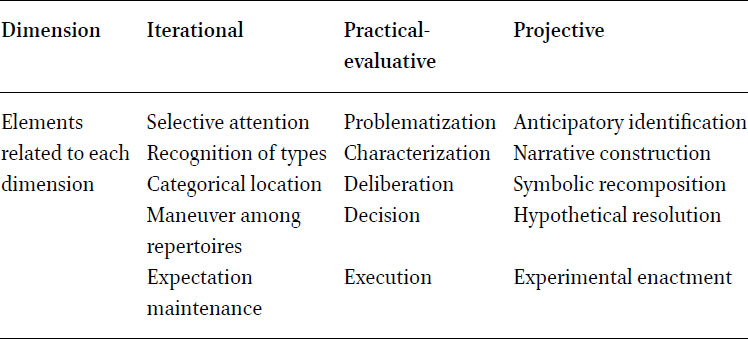
To analyze data, data description, patterned rule confirmation, an analysis strategy composed of contextualization within the analysis framework (Wolcott, 1994), and spiral data analysis (Creswell, 2012) were utilized. First, the entire database was explored according to the spiral data analysis method, and the short sentences, thoughts, and key concepts that emerged were noted while repeatedly searching for collected interview transcripts, participatory observation logs, teacher’s reflection logs, and class recording images. Second, the collected data were categorized. The categorization work went through a three-step coding process. The first coding was data description, and it was intended to express specific information revealed in the data. The data were comprehensively reviewed and summarized in sentences centering on the parts judged to be related to the teacher’s agency. The secondary coding was confirming patterned rules. Researchers aimed to confirm the rules shown in the first coding results and to express these regularities in sentences with integration. The tertiary coding was contextualizing within the analysis framework, and the secondary coding results were categorized using the theoretical analysis framework related to the teacher agency. For this purpose, the analysis framework was constructed by utilizing the elements of the temporal dimension of the agency (Priestley et al., 2015; Table 2).
Analysis frame configured for tertiary coding of data
Citation: Asia-Pacific Science Education 8, 2 (2022) ; 10.1163/23641177-bja10054
Based on the analysis framework, data were arranged according to the elements of each dimension. They were then classified by similarities in contexts, grouped into larger categories, and schematized to show the context of teacher agency achievement. Table 3 shows an example of the tertiary coding process in which items related to teacher practices are organized according to the analysis frame.
Example of a third coding process to classify secondary coding results according to the analysis frame
Citation: Asia-Pacific Science Education 8, 2 (2022) ; 10.1163/23641177-bja10054
Related factors used in the analysis of agency (Emirbayer & Mische, 1998)
Citation: Asia-Pacific Science Education 8, 2 (2022) ; 10.1163/23641177-bja10054
Third, for each category classified by the analysis framework, the direct interpretation of the teacher agency achievement process was described using each of the temporal dimension-related elements (Table 4) as presented in Emirbayer and Mische (1998).
To analyze the process of how teacher agency can be expanded or achieved, first, the instances of teacher agency in relation to teacher practice were each identified. Teacher practices were identified in chronological order and further classified as being related to experiences from the past to the present (related to the iterational dimension), as an example of problem solving arising from the current situation (related to the practical-evaluative dimension), or as a practice meant to modify future goals (related to the projective dimension). Finally, each stage was then categorized as being related to a specific temporal dimension. Accordingly, the processes for achieving agency was described in order, focusing on the agency-related factors that were judged to be most relevant to the teacher’s practice (Table 3). Among the data collected in this process, the temporal and relational factors were identified, and a causal relationship was identified in an attempt to understand how these factors influenced on teacher practice, ultimately affording or constraining this teacher’s agency while engaging in this citizen science education program.
3.7 Credibility of the Data Analysis
In order to increase the validity and reliability of the data collection and analysis process, triangulation, confirmation of participants, and peer review were used. First, in the triangulation process (Wragg, 1999), data were collected from various sources, such as teacher interviews, teacher’s reflection journal, teaching materials, researchers’ field notes, and video and audio recordings of the sessions. During analysis, data from the teacher’s in-depth interviews, the teacher’s reflection journal, researchers’ field notes, and the teacher’s teaching materials were compared for crosschecking. The credibility of the analysis was improved through the mutual inspection of the two researchers who had participated in data collection.
Second, we used participant checking. Researchers asked the teacher to review the results of the analysis. The review was conducted twice, in October and November 2021, and each took about 120 minutes. For example, researchers had described the Kim’s iterational dimension using the phrase “direct and indirect experience related to citizen science”; however, Kim suggested that the environmental activity experience on Sihwa Lake also had a great influence on him and suggested it should be described separately. In this way, the participating teacher’s opinions about what to emphasize and his additional explanations were added and reflected in the secondary analysis.
Third, through repeated review by colleagues, the analysis and interpretation of the data were checked. For this purpose, a research group consisting of 11 experts including a professor and doctoral and master’s students of science education reviewed the overall process including research problem setting, research design, and data collection and analysis. In this process, the overall validity of the study could be improved by modifying ambiguous research problems, reflecting revisions to the analysis framework created by the researcher, receiving feedback on additional necessary data items, and checking analysis results.
4 Results
The goal of the study was to explore teacher agency from an ecological perspective in the context of citizen science education. To meet this goal, elements consisting of temporal and relational dimensions were described. The characteristics of the participant and the environment where he was located were classified into iterational, projective, and practical-evaluative dimensions. The elements of iterational dimension, projective dimension, and practical-evaluative dimension have led participating teachers in research programs to achieve agency through various interactions. We will focus on the achievement of agency in the process of changing one’s thoughts and future plans. This appeared largely through a four-step process.
4.1 Elements of the Iterational Dimension
In the iterational dimension, attributes in life history and professional histories were identified and described.
4.1.1 Life Histories: The Growth of a Teacher
Four attributes were identified in the life history of the participant in the iterational dimension: positive experiences with teachers during his school days, financial difficulties, religious faith, and having a strong, inquisitive mind. The first aspect is positive experience with teachers, such as experiences with and information provided by homeroom teachers during Kim’s earlier school days. These had a decisive impact on his desire to be a teacher since childhood, and he tended to emphasize providing students with various experiences, challenges, and exploration opportunities.
When I was in sixth grade, my teacher made me do a lot of various things …. Because of that experience, I learned, “There is a world like this.” So I have an educational philosophy emphasizing the importance of experience and tell the kids, “You have to do a variety of things, not just learn content.” (Interview, May 12, 2021)
The second attribute from his life history is economic difficulties. Kim’s desire to be a teacher was partly related to the stability of teaching profession and also the financial support from the government to support students who were enrolled in teachers’ colleges at that time.
Being a teacher was a job that was quite [economically] stable, respected, and meaningful. … What’s important is that there were economic difficulties. [Tuition fee for the college of education] was free …. (Interview, May 12, 2021)
In line with this, Kim tried to solve his financial difficulties by securing a budget by applying for external projects. One reason for volunteering for this study was also securing Arduino kits for free for students’ exploration.
The third attribute in life history was his religious faith. He transferred to Sunshine High School to practice Christian education. Religious beliefs seem to be the basis of his educational values and goals, which are also deeply related to his projective dimension.
[In the previous school] there was a limit to exerting Christian influence. … At that time, when I heard that a new Christian school will be established … “Let’s make a school that hasn’t been in the world before.” That’s the reason why I came here. (Interview, May 12, 2021)
The fourth attribute in his life history was his strong inquisitiveness of mind. Usually, Kim attended in-service education and conducted experiments with students not just to prepare for classes but to satisfy his own inquisitive mind and interest. In participating the study, he was happy with new learning and agonized over the subject of inquiry with the students.
More practice was needed to find out modules or programming to connect sensors, and it was difficult due to minor clogging. But there was joy in learning new things. (Teacher’s reflection journal, May 26, 2021)
The inquisitive mind of the participant was the driving force for his continued effort to begin new activities or projects. Therefore, this was an important attribute of his iterational dimension.
4.1.2 Professional Histories: Values and Class Beliefs about the Environment
Most of the Kim’s professional experience came from his experience at Sunshine High School. First, environmental activities at Sihwa Lake and reading anecdotes by Linus Carl Pauling in the past contributed to the formation of his iterational dimension, valuing chemistry and the environment.
My most respected chemist is Linus Carl Pauling. … In the past, I thought that everything was better because of chemistry, but now the problem is serious because of chemicals. … Just in time, the nuclear issue was raised, so he stepped up. So I heard that he took the lead there and later won the Nobel Peace Prize. … I used to run a chemistry club in my school, but I learned about the environment. Therefore, chemistry and environment should be considered two wheels and go together. With this thought, I established a chemistry-environment club. (Interview, May 12, 2021)
This professional experience became a turning point in his teaching life. Kim had to consider chemistry and the environment at the same time, and highly appreciate the value of citizen science. The second professional experience was his teaching life related to Kim’s traits. He tended to take action with full understanding of the purpose and reason of the action. He also stressed that students should “know why they are learning.” In this study, he clarified and emphasized the purpose of the class every time. We call this attribute “emphasis on learning goals.”
Today’s topic is this: “Why do I have to do this? Why do I have to learn? Where do you use it in real life?” I say that the most. … “If you learn this through this class, it’s intellectually natural and you have to change your mind.” (Interview, May 12, 2021)
In addition, he believed that it was important to help students cooperate with others during group interaction. However, due to the COVID-19 epidemic, interactions among students were inevitably restricted, and he expressed regret.
It took me some time to prepare for the [small-group interaction] class, but the students participated said, “I liked it, it was the best.” … Even though a student doesn’t know the theme of a lesson well, they can understand it with the help of other students. That’s the most beautiful thing I can see. … However, [because of COVID-19] students have to sit apart, so they can’t interact with each other. (Interview, May 20, 2021)
The third aspect of professional experience includes guiding students participating in extracurricular activities, such as school clubs, science projects, and external projects. Kim felt a sense of accomplishment while guiding students participating in various activities because he thought that there were limitations in time and scope in regular classes.
I feel a sense of accomplishment every year. … Every year, I usually attend energy-related activities through projects, and even if the theme is not energy, I still conduct one project each. (Interview, May 12, 2021)
In addition, his experience and knowledge related to Arduino also constituted the iterational dimension. He developed interests in coding from previous learning in AI, data, and statistics and teaching experience of microbit to middle school students. Due to this, he was able to familiarize himself with the technology in the program without difficulty even though the sensors were new to him.
Finally, his experience of guiding students is an aspect of professional experience in iterational dimension. Since he worked as a homeroom teacher for most of his teaching career, he had extensive experience in interacting with students and was good at teaching students. However, despite his efforts, such as eating with or consulting students, he has more difficulties recently, because of the changes in new generations.
4.2 Elements of the Projective Dimension
The projective dimension was divided into the short- and long-term orientations. In general, the actions of the past and future goals of a person are deeply related, so the iterational dimension is sometimes connected to the projective dimension (Priestley et al., 2015).
4.2.1 Short-Term Orientations: Why, Right, and Differently
Three short-term orientations were recognized: his goals of teaching, expectations for students, and expectations for himself. During the citizen science education program, his emphasis on “students’ awareness of the reason for their learning” developed into a short-term orientation that students should “know how to use science correctly.”
As a citizen scientist, I’m really looking forward to dealing with something unfair and misleading. … How will this change after my participation? … It makes sense that science is really used like this. Anyway, I’m focusing on such expectations. (Interview, May 12, 2021)
He also hoped that students would be able to have a variety of experiences through the program. He judged that conducting Arduino based inquiry activities and social practices in this program could provide students with the experiences he had anticipated.
I have an educational philosophy that students can find their dreams, careers, and develop through those experiences. … With experience, people may choose that way or know, “Oh, this fits me. or I think this fits me.” (Interview, May 12, 2021)
Finally, he recognized himself as a guide of the program and expected that he would learn citizen science along with students. In addition, based on this experience, he expected that he would participate in citizen science activities in his area in the future.
What would I do in particular? I am just a guide. … “Let’s assume you’re in the first group of citizen scientists and look forward to seeing the second group next year.” Wouldn’t the members of the first group work hard? (Interview, May 12, 2021)
4.2.2 Long-Term Orientations: Realizing the Laws of Nature and Humanity
The long-term orientation was viewed as the ultimate goal not only in this program but also throughout his life. He revealed two long-term orientations. The first was his aim for students to realize that “the world is running according to the laws of nature.”
Children understand nature well and live accordingly because these laws and provisions will proceed in the future. … It’s a class that our school really wants. (Interview, May 12, 2021)
The second long-term orientation was related to the goal of the school: “honesty, diligence, and kindness.” His way of interpreting the school goals was students using science to help their neighbors. Citizen scientists seemed to fit well with this.
Honesty is honesty before God. Diligence is diligence to me and kindness to neighbors. That’s our school’s goal. … I show God through a subject called chemistry, and chemistry is affecting our lives through it, so I need to make a chemical product that has no problem with the environment and how to love my neighbors with that life. … It’s not just about making money. (Interview, May 12, 2021)
4.3 Elements of the Practical-Evaluative Dimension
The practical-evaluative dimension describes elements of the current environment affecting the practice of the participant. Cultural, structural, and material elements were identified and described.
4.3.1 Cultural Elements: Features of Sunshine High School
The cultural elements include ideas, values, beliefs, and discourses of the school. The participant’s practice was affected by several cultural elements of the school. The school administrators tended to allow teachers to try what they wanted to do, and the school had free atmosphere. The participant accepted this policy and the culture positively and tried new challenges as much as he could.
Each teacher in this school usually said, “What would I do then?” “Some teachers are doing that?” “OK, then I’m going to do this.” These are all various things. … The atmosphere of our school is like that. (Interview, May 12, 2021)
However, as the average academic achievement of students had decreased recently compared to the past, he had to adjust the level of his teaching according to the students’ ability.
Since I have a career of almost 30 years now, I can teach the class right away. … But the level is … The level of students has changed a lot. … I should lower the level. This is a dilemma that I sometimes feel right now. (Interview, May 20, 2021)
The school was greatly influenced by the test-oriented culture due to the critical competition to enroll in prestigious colleges in Korea, so students were sensitive to regular examinations or college entrance exams. Participating students were often absent from the program when school exams and performance assessments in the regular classes approached.
4.3.2 Structural Elements: Relationship between School Members and Kim
These structural elements shaped Kim’s relationships, his structural roles, and his position in the school. Three kinds of relationships were recognized: with students, colleagues, and administrators. He recognized himself as a “guide” for or “helper” of students by providing necessary resources or opportunities. Even though he could not remember specific elements of each student, he thought it was his role to provide opportunities for students’ learning. His relationships with his colleagues were friendly. However, he felt that younger teachers tended to be less proactive compared to his similarly aged colleagues.
Around the 2010s … Each of us developed a variety of activities. But most of them are in their 50s. … I’m trying to be quiet now. Quiet. If there’s a rumor that I’m working hard, teachers say that “you know it doesn’t make any difference …” However, I don’t have a bad relationship with teachers. (Interview, May 12, 2021)
He expressed satisfaction with his relationship with the school administrator. The principal was close to him and actively helped with and supported his new attempts.
There’s nothing uncomfortable because we’re about the same age. … Overall, there is an atmosphere where teachers do what they want to do. The administrators like that. (Interview, May 12, 2021)
He was in charge of student career path-related tasks and considered ways to provide opportunities to find career paths to students who were confused about what to do.
Children who have no idea what they are going to do. … If they want to find it, they have to try this and that. That’s why I’m interested in career guidance. I hope they can design their career well … (Interview, May 12, 2021)
Finally, the structural aspect related to Kim’s ability to be agentic to meet his goals was the COVID-19 epidemic. COVID-19 made it difficult to implement group activities and physical contact among students was minimized. Therefore, Kim could not have classes as planned, which eventually limited his achievement of agency or resulted in negative achievement.
If I have time, I can do a lot of project activities and presentation classes, but I don’t have time [because of COVID-19]. … They told me to provide lectures rather than experiments. Since we have to follow the guidelines of the Ministry of Education … (Interview, May 20, 2021)
4.3.3 Material Elements: Conditions of Sunshine High School
The material aspect is related to the facilities and physical environment of the school and the resources used by Kim. He depended on his life experience and indirect experience from books and videos to develop appropriate explanations in the classroom.
I’m thinking about what the best explanation is. I couldn’t create all of it, but there must have been similar stories in books or somewhere. I think I should say that I structured it in my own way. (Interview, May 20, 2021)
The difficult financial situation of the school had substantial influence on his implementation in terms of the material aspect.
I hope the financial support goes well. … I wanted to implement a citizen science education program, but it’s difficult to ask for a budget from school finance. … Public schools receive various financial support from the government to revitalize high schools. … There’s no such thing in a private high school. We have to ask for a budget from our own corporation, but it’s tight. I have to find it [from external sources]. (Interview, May 12, 2021)
There were difficulties because the school was a financially poor autonomous private high school, and he always tried to find ways to reduce costs. Due to the financial difficulties of the school, the physical environment was poor and there were many restrictions on the purchase of equipment and materials needed for education. During the Arduino practice process, both the Kim and his students were frustrated due to limited capabilities of the school’s computers.
4.4 Teacher Agency and Interactions during a Citizen Science Education Program using Arduino
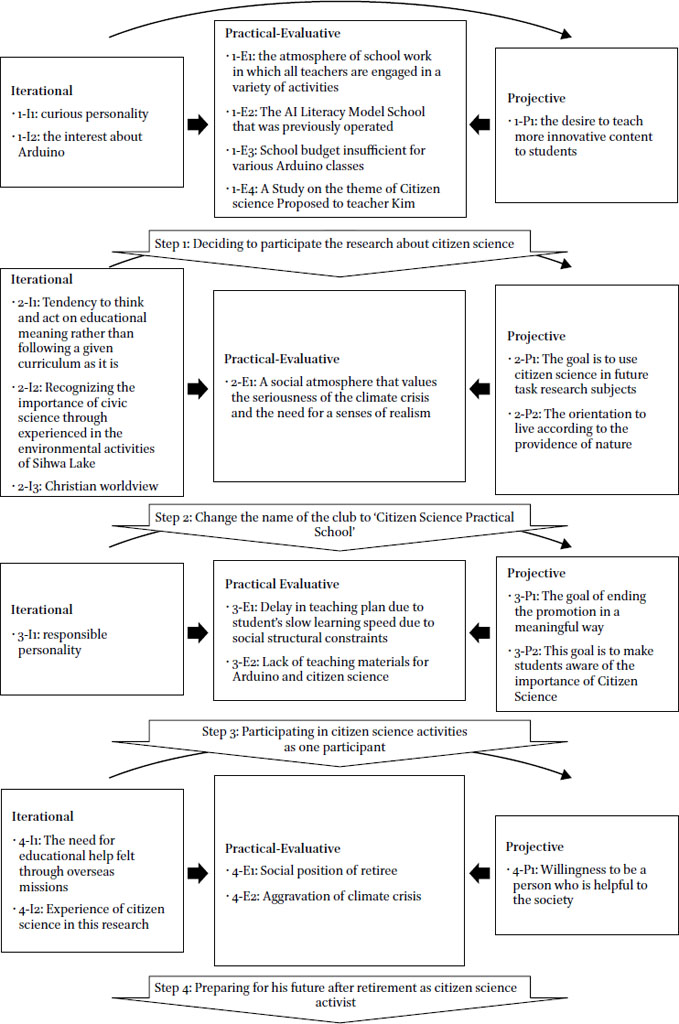
The elements of the iterational, projective, and practical-evaluative dimensions led Kim to participate in research programs and achieve agency. His agency achievement appeared in four steps (Figure 2).
Elements impacting on teacher agency during the implementation of a citizen science education program from an ecological approach perspective
Citation: Asia-Pacific Science Education 8, 2 (2022) ; 10.1163/23641177-bja10054
4.4.1 Step 1: Participation in a Citizen Science Education Program Using Arduino
His curious personality (1–I1) and his interest in Arduino (1–I2) and the projective dimension, such as the desire to teach more innovative content to students (1–P1), had an influence on the teacher taking an interest in citizen science and participating in this study. However, the factors of the practical-evaluative dimension had the greatest influence on his agency. As seen in the practical-valuative dimension, Sunshine High School had an atmosphere where all teachers could do the activities they wanted (I–E1), and it was designated as an AI literacy model school, so it did a lot of innovative technology-related activities (I–E2). However, the school itself was looking for outside support due to a lack of funding to conduct classes using Arduino (I–E3), and when university researchers offered a citizen science class, he readily decided to participate in the study (I–E4).
4.4.2 Step 2: Transformation into a “Citizen Science Practical School”
Kim thought about educational meaning and taking the initiative rather than following the given curriculum as it was (2–I1). The program was originally designed by researchers, but Kim determined for himself why and how to teach it. In the process of reflecting on the educational meaning, Kim discovered that his current activities were similar to those he had previously conducted with students in environmental activities such as garbage monitoring and bird exploration and realized that the activities could also be citizen science (2–I2).
Sihwa Lake activities in 1997 are the same behavior as citizen science. Sihwa Lake Environmental Ecology Center, migratory bird monitoring, I’ll take students to inspect birds and give feedback … They were all part of citizen science! I’ve already done it, but it’s different to have them learn it like this way. (Interview, May 20, 2021)
He was also a Christian, who perceived solving environmental problems as returning to the original form God created (2–I3) and had a direction to live according to the providence of nature (2–P2). This orientation made Kim more sympathetic to the purpose of citizen science.
I think it’s the science to learn how nature moves. I think that solving the environmental problem is going back to the way God created it again … (Interview, May 20, 2021)
In the process of implementing this class, Kim thought that he could use this class for his next task research subject (2–P1). Therefore, he thought that participation in this study was a good opportunity to learn how to guide citizen science classes using Arduino.
I think I’m learning a lot through a good opportunity. I also wanted to open a subject for student research. … If I open a project next year, … “Ah, I can use it like this for student research.” (Interview, June 9, 2021)
In addition, Kim was influenced by climate change and social trends that value citizen science (2–E1). Through environmental lectures for teachers, Kim realized the occurrence of global warming caused by methane gas and the seriousness of the current climate crisis. In addition, he encountered an online platform for citizen science activities in AI lectures, and became interested in it, so he searched for articles and papers related to citizen science. Kim realized that there was a great deal of discussion about citizen science as a way to solve environmental problems in the community, and also agreed with the purpose of the content. Kim was originally attracted to the aspect of using Arduino and decided to participate in this study. However, as a result of the aforementioned interaction at each level, Kim realized that civic science was important in this program and gave the name “A school that practices citizen science” to an autonomous club that had no specific name. He emphasized to students the need for citizen science in the next class.
4.4.3 Step 3: Teacher Conducts His Own Citizen Science Activities
He faced difficulties such as delay in the teaching plan due to students’ slow learning speed caused by social structural constraints (3–E1). Due to COVID-19, it was difficult to have enough time for club activities as the school’s academic schedule changed, and students felt that spending a lot of time on autonomous club activities was a burden due to the school’s regular exams and cram school schedules. Since Kim was a very responsible person in schoolwork and class (3–I1), he thought that he should lead his class well to the end (3–P1). He also wanted to finish the class successfully because he had a strong goal of recognizing the importance of citizen science to his students. He thought that in order to make the citizen science activity easier for students, good examples should be shown.
When I show the sample to the students, I think there’s something that follows right away … (Interview, July 21, 2021)
However, it was very difficult for Kim to obtain teaching materials for citizen science using Arduino (3–E2). In order to solve this problem situation, he personally achieved the agency of participating in citizen science under the theme of “measurement of the concentration of fine dust generated during food cooking.” He practiced social practice for fellow teachers and experienced inner changes.
I posted to my science teachers about when there was a ventilator at my house and when there was no ventilator. … Talking about this and that helped. To the point where I want to do more experiments. I even finished thinking, “Why don’t we think about a similar experiment in the second semester?” (17–18 Class Sessions, August 4, 2021)
4.4.4 Step 4: Teacher Who Became a Pioneer in Citizen Science: Changes in Projective Dimensions
In the process of participating in this research and running the citizen science program, Kim realized the importance of citizen science. Near the end of the program, he began to associate citizen science with his future after retirement. He thought a great deal about what he would do after retirement, similar to other workers facing retirement (4–E1). After hearing about the case of volunteering for education as part of his missionary work in Ulaanbaatar, Mongolia, in the past, he felt that there were many places in the world that needed educational help, and he thought that he should participate in such an activity (4–I1). While he had this idea in mind, he became fascinated with citizen science while running this program (4–I2). Also because he was well aware of the social concerns about the climate crisis (4–E2), he felt it was meaningful to act in response to the climate crisis. After this program, he said that he seemed to have become a pioneer in citizen science and set a goal for himself to participate in a citizen science organization after retirement.
It would be great if we could make a small contribution to tackling climate change. Rather than thinking about what we can do in Korea, we can do a lot of things if we work together with the idea that what we do will help something. … The measure of data I get through citizen science is nothing, but when 100 people gather and 1,000 people gather, it becomes scientifically meaningful data. (Class July 28, 2021)
I think we need to create a system for citizen science. In a way, we have a pioneering position. Develop students through citizen science activities like this. I have a mission like that … after retirement, I want to lead an NGO organization. (Interview, July 21, 2021)
As part of this agency achievement, he showed that after the program ended, he produced posters for social practice in terms of citizen science even in regular club activities, not just in autonomous clubs.
5 Conclusion
This study attempted to explore the ecological elements of a teacher’s agency in a citizen science education program using Arduino. To this end, in the citizen science education program using Arduino, elements of the temporal and relational dimensions related to teachers were classified into the iterational, fractional-valuable, projective dimensions, and the interaction between these elements and the resulting agency achievement were analyzed. The results of the study and the conclusion are as follows.
The results of the first study show that the elements of the temporal and relational dimensions related to Kim’s agency in the citizen science education program using Arduino are as follows. First, in the iterational dimension, Kim’s experiences with his homeroom teachers during his childhood, his economic hardships, his positive experiences studying and having a strong curiosity to learn, and his participation in environmental activities at Sihwa Lake, were all important influences contributing to his sense of achievement from engaging in various external projects and clubs. Second, in the practical-evaluative dimension, working in a school environment that was relatively autonomous, being in a school with an established culture of student high-achievement and a dedicated focus on preparing for the annual college entrance examination, working with administers who were open-minded, and being in a school with limited physical resources were all strong factors shaping Kim’s agency. Finally, in the projective dimension, it was found for the short-term orientation, Kim felt his students should learn science content while using Arduino and for the long-term orientation, Kim emphasized the importance that students be aware of the goals for science learning that are shaping the direction of the class. These elements were theorized to have caused numerous interactions, influenced practices, and contributed to the achievement of Kim’s agency as a teacher.
The results of the second study show that an interaction among various factors related to successfully using a citizen science teaching approach were due, in part, to Kim’s keen interest for exploring Arduino technology with his students. As Kim’s agency expanded, his project dimension changed such that Kim began to consider using citizen science as a future goal for his teaching. This indicates that Kim was positively influenced by the context and structural factors of the school where he was located, and the iterational dimension and projective dimensions which formed as a result, had a great influence on his practice. However, some factors that can restrict teachers were also found to afford Kim’s agency in this case as the limitations he faced caused him to seek out alternatives which resulted in more expanded learning opportunities for him and his students. In addition, due to the practical-evaluative dimension, Kim’s iterational dimension and projective dimensions were newly formed. We found that while the existing schematic of the ecological perspective of teacher agency has revealed fragmentary directions in which agency can be afforded as a result of each dimension’s interaction, this study was different in that we found that each dimension can be changed as a result of expanded teacher agency. Therefore, it can be seen that the existing ecological approach to teacher agency should be further developed to reflect the influence of multiple dimensions in each direction.
6 Discussion
Teacher agency research has focused on understanding and exploring teachers’ subjective practices when they have to work under new situations, educational policies, and environments. It also explored the direction of supporting teachers through the understanding of teachers’ practices and factors that affect them. Lee and Kim (2018) reported that teacher agency could be expanded even while teaching science in unfamiliar online environments during the COVID-19 pandemic when teachers reflect on their own practices and incorporate external suggestions in their lessons. Lee (2018) investigated major factors of teachers’ agency during their practice of new global citizen education. She found the importance of teachers’ community of practice (structural), prior experience (individual), and the interest and support of school administrators. Students’ responses and changes also affected teachers’ individual changes. However, teachers’ willingness, sense of duty, and educational beliefs seem not to be major factors for teacher agency.
The results of this study show some similarities to and differences from those of prior studies. Although the contexts were new to the teachers and different from one another, prior experience was recognized as an important aspect for teacher agency. As citizen science education and Arduino technology introduced in this study were new to the teacher in this study, prior experiences that were relevant, such as the teacher’s environmental activities at a lake near the school, were recognized. The importance of school administrators’ support (Lee, 2018) was also found in this study. However, there were also differences from previous studies. For example, while Lee (2018) reported that teachers’ willingness, sense of duty, and educational beliefs were not major factors for teacher agency, in this study, teacher’s personal beliefs, such as religious beliefs and long-term orientation to be a citizen scientist, were both recognized important elements of teacher agency in this study. These findings are similar to a study conducted by Varpanen et al. (2022) that argued that temporality is a key element in teachers’ agency, with teachers’ beliefs about the future and experiences of the past both shaping their agentic orientations.
While the differences in these studies may stem from the use of different methodologies, these findings also reaffirm the significance of context and experience as factors that increase complexity when examining agency. This study found that sometimes being agentic can change temporal and relational elements that are central to the identity of the teacher. In this study, Kim dynamically changed his plans for his future as a result of participating in this program. Changes to Kim’s projective dimension and in his practices as revealed by the practical-evaluative dimension both suggest that the expansion of teacher agency requires the development of both elements of these two related dimensions.
The ecological approach used temporal dimensions – iterational, practical-evaluative, and projective – to describe different elements of teacher agency. However, the results of the study can be rearranged in terms of scope. Some of the elements, such as test-oriented education in the cultural aspect and COVID-19 pandemic in the structural aspect, are both related to Korean society at the macro-level. This dimension includes school level elements at the meso-level, such as school atmosphere and relationships with colleagues and school administrators in the structural aspect and economic issues that affect the facilities of the school in the material aspect. Elements of the iteration and projective dimensions seem to be more related to the micro- or personal-level. As such, teachers may try to achieve agency by mobilizing personal-level elements to effectively afford and constrain different factors at the meso- and macro-levels.
Finally, while unexpected, we noted that constraints can also have positive impact on teacher agency. For example, in this study, the schools’ economic limitations inspired Kim to seek resources outside of the school and, as a result, created new, positive opportunities for both him and his students. By securing and introducing Arduino technology into the program, both the teacher and participating students maintained interest in the program, and reported that participation was not only rewarding, but that they also experienced the joy of learning through the citizen science activities of the program.
7 Implications
This study aimed to analyze the factors limited or afforded a teacher’s practices and agency while teaching using a citizen science education approach. Based our findings, this study proposes the following directions for supporting teacher agency related to citizen science. First, the fact that factors that seem to constrain the teacher can also positively afford a teacher’s agency is important to recognize as this suggests that limiting factors can be used to help a teachers overcome challenges to meet their goals. Therefore, after closely identifying the affording and constraining structural elements teachers face at their school site, it is necessary to then consider which factors could serve as a sites for expanding individual and collective agency when approached from a problem-solving perspective.
Second, it seems that the important factor that led Kim to become agentic in ways that changed his projective dimension was that Kim participated in a process that connected himself with citizen science. Therefore, it is necessary to determine whether teachers have an iterational dimension or projective dimension related to citizen science and connect them with it so they can be led to empathize with the purpose of citizen science education. In order for citizen science to be expanded in school settings, it is important to consider the structure and environment of school sites and then design programs that are well aligned to teachers’ projective dimensions. We found that teachers also benefit from an understanding of each dimension that constitutes agency and providing individual guidance to identify strengths and challenges are important for success.
Since this study is a single case study, it is difficult to generalize the findings of the study for teachers’ practices for citizen science education. However, the case of the teacher in this study may generally reflect an example of a teacher working in citizen science education in the Korean educational context. This study was similar to Bracey (2018), who showed that to support citizen science education in the field, it is important to consider challenges that may arise in a number of situations. We found the same to be true when conducting citizen science projects in classroom contexts. Furthermore, if the interaction between various factors in the process of achieving teacher agency can be analyzed, it may help to understand the complexity of teacher practice. The results of this study may provide the basis for advancing the current ecological approach to exploring teacher agency. In the modern society where the importance of citizen science is growing, it is hoped that follow-up studies on how to improve citizen science education with teacher and students in school-based contexts will be conducted in the future.
Abbreviations
| GLOBE | The Global Learning and Observation to Benefit the Environment program |
| GPA | Grade Point Average |
| IOT | Internet of Things |
| SSI | Socioscientific issue |
Funding
This research was supported by the National Research Foundation of Korea (NRF) by a grant funded by the Ministry of Science and ICT (NRF-2020R1A2 C1014534).
Ethics Approval and Consent to Participate
Approval to conduct this study was granted by the Seoul National University Ethics Review Board. The data collected from this project were obtained with the necessary clearance from the school, guardians and the students involved in the study.
About the Authors
Seo-Ha Na works as an earth science teacher in South Korea and earned master’s degree in science education from Seoul National University. Her research focuses on achieving teacher agency in the context of citizen science education using Arduino. She is interested in the ecological approach to teacher agency and citizen science education.
Jong-Uk Kim is a teacher at Hwayang Elementary School in Seoul, Republic of Korea. He holds a doctoral degree in Earth Science education from Seoul National University in the Republic of Korea. His research areas include socioscientific issues education, spatial thinking in astronomy, and preservice science teachers’ technological pedagogical content knowledge. He has recently been interested in geological field trips utilizing virtual reality and risk perception related to nuclear power.
Seok-Hyun Ga is a visiting assistant professor at the Science Education Center, National Taiwan Normal University. He holds a B.S. in Earth Science Education and Physics Education from Seoul National University (SNU), a B.S. in Computer Science from Korea National Open University, and an M.S. and Ph.D. in Science Education from SNU. His current research interests include technology-assisted science learning employing physical computing, internet of things, virtual reality, and augmented reality.
Changmi Park is a teacher in Seoul Yangmok Elementary School in Seoul, Republic of Korea. She holds a bachelor’s degree in engineering from Ewha Womans University and also a bachelor’s degree in elementary school education from Daegu National University of Education. And she holds a master’s degree and a doctoral degree in earth science education from Seoul National University in Republic of Korea. Her research focuses on scientific inquiry, STEM (STEAM) education, and pedagogical content knowledge in science education using various technologies. Also, she is particularly interested in citizen science education in the school context and technology-embedded scientific inquiry (TESI).
Chan-Jong Kim is a Professor in the Department of Earth Science Education at Seoul National University in Seoul, Republic of Korea. He holds a bachelor’s degree in earth science education and master’s degrees in geological sciences from Seoul National University in the Republic of Korea. He also holds doctoral degree in science education from University of Texas at Austin in the United States. His research focuses on scientific modeling as an approach to scientific exploration and learning in a variety of subjects, content, and contexts and on development and application of various methods for the analysis of collective talk with learning of science. He is also particularly interested in education for diverse K–12 learners in Korea on global environmental risks such as climate change.
References
Archer, M. (2000). Being human: The problem of agency. Cambridge University Press.
Beck, U. (1997). Risk society: Towards a new modernity (S. Hong, Trans.). Saemulgyul. (Original work published 1986).
Biesta, G., & Tedder, M. (2007). Agency and learning in the lifecourse: Towards an ecological perspective. Studies in the Education of Adults, 39(2), 132–149. https://doi.org/10.1080/02660830.2007.11661545.
Bonney, R., Ballard, H., Jordan, R., McCallie, E., Phillips, T., Shirk, J., & Wilderman, C. (2009). Public participation in scientific research: Defining the field and assessing its potential for informal science education. A CAISE Inquiry Group Report. In Online Submission. https://eric.ed.gov/?id=ED519688.
Bourdieu, P. (1977). Outline of a theory of practice. Cambridge University Press.
Bracey, G. (2018). Teaching with citizen science: An exploratory study of teachers’ motivations & perceptions. Unpublished doctoral dissertation, University of Missouri, MO, United States.
Calhoun, C. (2002). Dictionary of the social sciences. Oxford University Press.
Choi, S., & Kim, S. (2016). Effects of physical computing education using App inventor and Arduino on industrial high school students` creative and integrative thinking. The Journal of Korean Association of Computer Education, 19(6), 45–54. https://doi.org/10.32431/kace.2016.19.6.005.
Creswell, J. W. (2012). Qualitative inquiry and research design: Choosing among five approaches. Sage publications.
Emirbayer, M. & Mische, A. (1998). What is agency? The American Journal of Sociology, 103, 962–1023. https://doi.org/10.1086/231294.
Eteläpelto, A., Vähäsantanen, K., Hökkä, P., & Paloniemi, S. (2013). What is agency? Conceptualizing professional agency at work. Educational Research Review, 10, 45–65. https://doi.org/10.1016/j.edurev.2013.05.001.
Fraisl, D., Campbell, J., See, L., Wehn, U., Wardlaw, J., Gold, M., Moorthy, I., Arias, R., Piera, J., Oliver, J. L., Masó, J., Penker, M., & Fritz, S. (2020). Mapping citizen science contributions to the UN sustainable development goals. Sustainability Science, 15(6), 1735–1751. https://doi.org/10.1007/s11625-020-00833-7.
Fritz, S., See, L., Carlson, T., Haklay, M. (Muki), Oliver, J. L., Fraisl, D., Mondardini, R., Brocklehurst, M., Shanley, L. A., Schade, S., Wehn, U., Abrate, T., Anstee, J., Arnold, S., Billot, M., Campbell, J., Espey, J., Gold, M., Hager, G., … West, S. (2019). Citizen science and the United Nations sustainable development goals. Nature Sustainability, 2(10), Article 10. https://doi.org/10.1038/s41893-019-0390-3.
Ga, S.-H. (2021). Development and application of action-oriented science education program using the internet of things: Focused on technical configuration, teachers’ technical Difficulties, and students’ environmental science agency. Doctoral dissertation, Seoul National University, Seoul, Republic of Korea. https://s-space.snu.ac.kr/handle/10371/178568.
Ga, S.-H., Cha, H.-J., & Kim, C.-J. (2021). Adapting internet of things to Arduino-based devices for low-cost remote sensing in school science learning environments. International Journal of Online and Biomedical Engineering (IJOE), 17(02), Article 02. https://doi.org/10.3991/ijoe.v17i02.20089.
Giddens, A. (1986). The Constitution of Society: Outline of the Theory of Structuration (Reprint edition). University of California Press.
Haklay, M. (2013). Citizen science and volunteered geographic information: Overview and typology of participation. In D. Sui, S. Elwood, & M. Goodchild (Eds.), Crowdsourcing geographic knowledge: Volunteered geographic Information (VGI) in theory and practice (pp. 105–122). Springer. https://doi.org/10.1007/978-94-007-4587-2_7.
Harris, E. M. (2017). Examining teacher framing, student reasoning, and student agency in school-based citizen science. Unpublished doctoral dissertation, University of California, Davis, CA, USA. https://ui.adsabs.harvard.edu/abs/2017PhDT…….118H.
Huffling, L. D., & Scott, H. C. (2021). Using critical environmental agency to engage teachers in local watersheds through water quality citizen science. Water, 13(2), Article 2. https://doi.org/10.3390/w13020205.
IT-Americano. (2022). The internet of things and how it affects us. Retrieved from https://www.it-americano.com/articles/the-internet-of-things-and-how-it-affects-us/.
Kim, H., Jeong, S.-J., Jeong, S.-R., & Mun, S.-Y. (2018). Development and application of environmental education program for elementary school students using Arduino. Korean Journal of Environmental Education, 31(2), 167–179. https://doi.org/10.17965/kjee.2018.31.2.167.
Kim, H.-U. (2020). Monitoring system of the atmospheric environment based on IoT. Korea Energy Appliances Industry Association. https://standard.go.kr/KSCI/ct/ptl/download.do;jsessionid=4DArBXMjHwbZRIP3LvGIefFP.node01?fileSn=124204.
Kim, J. (2019). The systematic literature review of teacher agency and the support plan for teacher agency. Journal of Education & Culture, 25(5), 105–128. https://doi.org/10.24159/joec.2019.25.5.105.
Kim, J.-U. (2021). Exploring elementary school students’ climate activist identity in practice in an action-oriented climate change activity. Unpublished doctoral dissertation, Seoul National University, Seoul, Republic of Korea.
Kim, J., & Park, J. (2017). Special edition 1: Citizen science. Industrial Engineering Magazine, 24(4), 13–17.
Kloetzer, L., Lorke, J., Roche, J., Golumbic, Y., Winter, S., & Jõgeva, A. (2021). Learning in citizen science. In K. Vohland, A. Land-Zandstra, L. Ceccaroni, R. Lemmens, J. Perelló, M. Ponti, R. Samson, & K. Wagenknecht (Eds.), The Science of Citizen Science (pp. 283–308). Springer. https://doi.org/10.1007/978-3-030-58278-4_15.
Koh, J. K., Kim, Y. S., & Ye, M. J. (2019). The potential of citizen science to address environmental issues. Gyeonggi Research Institute. Retrieved from http://www.dbpia.co.kr/journal/articleDetail?nodeId=NODE10500477.
Lee, H., & Kim, H.-B. (2021). Exploring science teacher agency as agent of change: The case of distance learning practice due to COVID-19. Journal of the Korean Association for Science Education, 41(3), 237–250. http://dx.doi.org/10.14697/jkase.2021.41.5.415.
Lee, S.-H. (2017). The challenges and implications of teacher agency for professional learning community. Andragogy Today: Interdisciplinary Journal of Adult & Continuing Education (IJACE), 20(2), 1–27. https://doi.org/10.22955/ace.20.2.201705.1.
Lee, Y. (2018). Analysis of factors affecting teacher agency: A case study on global citizenship education lead teachers in Korea. Unpublished master’s thesis, Ewha Womans University, Seoul, Republic of Korea.
Lee, Y. H. (2010). Theories and practices of participatory risk governance. Journal of Korean Social Trend and Perspective, 79, 281–314.
Mazumdar, S., Ceccaroni, L., Piera, J., Hölker, F., Berre, A., Arlinghaus, R., & Bowser, A. (2018). Citizen science technologies and new opportunities for participation. In S. Hecker, M. Haklay, A. Bowser, Z. Makuch, J. Vogel, & A. Bonn (Eds.), Citizen science – Innovation in open science, society and policy. (pp. 303–320). UCL Press. https://www.jstor.org/stable/j.ctv550cf2.
Merriam, S. B. (1998). Qualitative research and case study applications in education: Revised and expanded from case study research in education (2nd Revised & Expanded edition). Jossey-Bass.
Ministry of Education [MOE]. (2015). Science curriculum. Ministry of Education Notice No. 2015–74. Retrieved from https://www.moe.go.kr/boardCnts/fileDown.do?m=040401&s=moe&fileSeq=dc926a43bf953203951fb928ff098b1c.
Moustard, F., Haklay, M., Lewis, J., Albert, A., Moreu, M., Chiaravalloti, R., Hoyte, S., Skarlatidou, A., Vittoria, A., Comandulli, C., Nyadzi, E., Vitos, M., Altenbuchner, J., Laws, M., Fryer-Moreira, R., & Artus, D. (2021). Using sapelli in the field: Methods and data for an inclusive citizen science. Frontiers in Ecology and Evolution, 9. https://www.frontiersin.org/articles/10.3389/fevo.2021.638870.
Newman, G., Wiggins, A., Crall, A., Graham, E., Newman, S., & Crowston, K. (2012). The future of citizen science: Emerging technologies and shifting paradigms. Frontiers in Ecology and the Environment, 10(6), 298–304. https://doi.org/10.1890/110294.
Oh, M., & Kim, C. (2020). Environmental citizens participating in citizen science: Exploring the possibility of environmental education based on civic science. Korean Society of Environmental Education Conference Proceedings, 66–68.
Organisation for Economic Co-operation and Development [OECD]. (2020). PISA 2024 strategic vision and direction for science. OECD. https://www.oecd.org/pisa/publications/PISA-2024-Science-Strategic-Vision-Proposal.pdf.
Park, C. (2022). Students’ experiences of scientific inquiry and transference during school citizen science program based on technology embedded scientific inquiry. Unpublished doctoral dissertation, Seoul National University, Seoul, Republic of Korea.
Park, J. H. (2018). The current state and tasks of citizen science in Korea. Journal of Science and Technology Studies, 18(2), 7–41.
Park, J.-H., & Kang, Y. (2018). Environmental problems, citizen knowledge, and citizen science: Chance and challenges of citizen science in environmental problems. Environmental Philosophy, 25, 93–124. https://doi.org/10.35146/jecoph.2018..25.004.
Park, J.-H., & Kim, S.-H. (2015). Case study on utilizing Arduino in programming education of engineering. Journal of IKEEE, 19(2), 276–281. https://doi.org/10.7471/ikeee.2015.19.2.276.
Podest, E., Das, N. N., Rajasekaran, E., Jeyaram, R., Lohrli, C., Hovhannesian, H., & Fairbanks, G. (2017). An Arduino based citizen science soil moisture sensor in support of SMAP and GLOBE. 2017, ED31D-0310. https://ui.adsabs.harvard.edu/abs/2017AGUFMED31D0310P/abstract.
Prestopnik, N. R., & Crowston, K. (2012). Citizen science system assemblages: Understanding the technologies that support crowdsourced science. Proceedings of the 2012 IConference, 168–176. https://doi.org/10.1145/2132176.2132198.
Priestley, M., Biesta, G., & Robinson, S. (2016). Teacher agency: An ecological approach (Reprint edition). Bloomsbury Academic.
Pykett, J., Chrisinger, B., Kyriakou, K., Osborne, T., Resch, B., Stathi, A., Toth, E., & Whittaker, A. C. (2020). Developing a citizen social science approach to understand urban stress and promote wellbeing in urban communities. Palgrave Communications, 6(1), Article 1. https://doi.org/10.1057/s41599-020-0460-1.
Ravetz, J. R. (1999). What is post-normal science? Futures, 31(7), 647–653. https://doi.org/10.1016/S0016-3287(99)00024-5.
Roche, J., Bell, L., Galvão, C., Golumbic, Y. N., Kloetzer, L., Knoben, N., Laakso, M., Lorke, J., Mannion, G., Massetti, L., Mauchline, A., Pata, K., Ruck, A., Taraba, P., & Winter, S. (2020). Citizen science, education, and learning: Challenges and opportunities. Frontiers in Sociology, 5. https://doi.org/10.3389/fsoc.2020.613814.
Sewell, W. H. (1992). A theory of structure: Duality, agency, and transformation. American Journal of Sociology, 98(1), 1–29.
Shim, S., Ok, K. J., & Kim, J. (2016). Development of STEAM learning program using Arduino to improve technological problem-solving ability for middle school students. The Korean Journal of Technology Education, 16(1), 77–100.
Shin, J.-Y., & Park, S. W. (2020). A study on science-related affective characteristic and perception of measurement of elementary students who participated in citizen science activities. Journal of Korean Elementary Science Education, 39(2), 168–182. https://doi.org/10.15267/keses.2020.39.2.168.
Sjöström, J., & Eilks, I. (2018). Reconsidering different visions of scientific literacy and science education based on the concept of bildung. In Y. J. Dori, Z. R. Mevarech, & D. R. Baker (Eds.), Cognition, Metacognition, and Culture in STEM Education: Learning, Teaching and Assessment (pp. 65–88). Springer. https://doi.org/10.1007/978-3-319-66659-4_4.
So, K., & Choi, Y. (2018). Understanding teachers’ practices in the context of school-based educational reform: Focusing on the concept of ‘teacher agency.’ The Journal of Curriculum Studies, 36(1), 91–112.
Tao, J., & Gao, X. (2017). Teacher agency and identity commitment in curricular reform. Teaching and Teacher Education, 63, 346–355. https://doi.org/10.1016/j.tate.2017.01.010.
Tauginienė, L., Butkevičienė, E., Vohland, K., Heinisch, B., Daskolia, M., Suškevičs, M., Portela, M., Balázs, B., & Prūse, B. (2020). Citizen science in the social sciences and humanities: The power of interdisciplinarity. Palgrave Communications, 6(1), Article 1. https://doi.org/10.1057/s41599-020-0471-y.
Vähäsantanen, K. (2015). Professional agency in the stream of change: Understanding educational change and teachers’ professional identities. Teaching and Teacher Education, 47, 1–12. https://doi.org/10.1016/j.tate.2014.11.006.
Varpanen, J., Laherto, A., Hilppö, J., & Ukkonen-Mikkola, T. (2022). Teacher agency and futures thinking. Education Sciences, 12(3), 177. https://doi.org/10.3390/educsci12030177.
Wolcott, H. F. (1994). Transforming qualitative data: Description, analysis, and interpretation. SAGE Publications.
Wragg, E. C. (1999). An Introduction to Classroom Observation. Psychology Press.
Yoon, J. K., & Kim, Y. (2018). Influence of programming education utilizing Arduino on creative problem solving ability of high school students. The SNU Journal of Education Research, 27(3), 53–73.
You, Y., & Kim, M. (2020). Teacher agency achievement in the educational capacity enhancement project in general high school. The Journal of Learner-Centered Curriculum and Instruction, 20(18), 905–935. https://doi.org/10.22251/jlcci.2020.20.18.905.