


1 Farrokh Khan Arrives in France
According to a private letter written at Constantinople on December 18th, 1856,
Ferukh-Khan, the Persian Ambassador Extraordinary, was to leave for France at the beginning of January, at which period the Mediterranean is totally free from the influence of the equinox.1 The same letter states that Ferukh-Khan, after having transmitted to his Sovereign the demands of England, proposes to continue negotiations in Paris and London, and that he has asked for instructions from his Court with that view.2
In company with Bourrée, Farrokh Khan travelled to Marseille from Constantinople aboard the French naval corvette-steamer and sometime French imperial yacht Roland,3 commanded by Captain Périgot.4 While some in Paris speculated that Bourrée was travelling alone to France, in the belief that he had left Farrokh Khan in Constantinople because he and Canning were on the brink of resolving the Anglo-Persian crisis,5 this was clearly not the case. According to one report the Roland was expected to leave for Marseille on December 20th or 22nd.6 When the vessel failed to arrive as anticipated the French began to worry and sent a vessel out to meet it en route, but bad weather forced it to turn around and return to Marseille.7 Although it was expected to reach Marseille on January 10th, 1857,8 the Roland did not in fact make landfall until the evening of January 13th. Although the poor weather forced the cancellation of the full military reception that had been planned — despite the fact published illustrations showing the Persian envoy disembarking at Marseille give no indication either that it was night time or that the weather was inclement — Farrokh Khan and his suite (Fig. 6.1) were nevertheless greeted with a fifteen gun salute. A French Foreign Ministry official who had travelled with Bourrée and Farrokh Khan set out immediately for Toulon.9

Faroukh Khan Amin al-Dowleh and members of his Suite, One of 274 Vintage Photographs, 1857. Gelatin silver printing out paper, photo: 3 11/16 × 5 9/16 in. (9.4 × 14.1 cm); mat: 9 5/16 × 12 1/8 in. (23.7 × 30.7 cm)
Brooklyn Museum, Purchase gift of Leona Soudavar in memory of Ahmad Soudavar, 1997.3.233. No known copyright restrictions (Photo: Brooklyn Museum, 1997.3.233_IMLS_PS3.jpg)
To the outside world, the proximate concern of Farrokh Khan’s European mission was the negotiation of peace with Great Brtain. It seems clear, however, that discussions in Tehran had also identified the need to expand Iran’s diplomatic reach by entering into a number of treaties with European states, principally as a counterpoise to the imbalance caused by Russia and Britain. Although not of any obvious economic importance, this initiative also resulted in a treaty with the Vatican, a reminder that the position of Iran’s Catholics and Iran’s relationship with the Pope were of some moment. Because so much of this initiative was managed by Farrokh Khan, and because his visits to Catholic institutions and treaty with the Papal States formed part of his larger European mission, his movements and social as well as diplomatic engagements are examined below.
On January 16th, 1857, three days after their arrival at Marseille, Farrokh Khan and his large suite attended a military review at the city’s garrison. The following day Farrokh Khan was expected at Paris10 and on January 17th he and his suite arrived at the Gare de Lyon.11 According to one account, Farrokh Khan
was attended by a large staff [of] brilliant mirzas, shining khans, whose names here follow: — Mirza Zeman Khan, First Councilor; Mirza Malcom, Second Councillor; Mirza Riza, First Dragoman; Mohammed Ali Aga, Second Dragoman; Marimak Khan, First Secretary; Mirza Ali Majni, Second Secretary; Mirza Ebd Eassem Khan, First Writer; Mirza Hussein, Second Writer; Mirza Riza, Doctor of Medicine; and Foquetti, Professor of Pharmacy of the College of Teheran.12 Ferukh Khan also brought with him twenty servants and six magnificent black horses, which together afforded an interesting spectacle to the groups of people who stood near the door of the hotel prepared for the reception of the Ambassador and his suite.13
The night of his arrival, Farrokh Khan ‘accompanied by the mirzas, and others the leading members of his staff, went in several carriages to the Turkish Embassy, where they supped and were afterwards conducted to the house No. 46, Avenue Montagne [sic, Montaigne],14 which had been taken for them.’15 His first audience with Napoleon III did not occur for another week. According to one correspondent, it ‘was delayed by the indisposition of the Imperial Prince — an indisposition which we have grave reasons for suspecting arose from the process (unhappily indispensable — to princes especially) of dentition. On Saturday week, however, the little Imperial jaws having become somewhat soothed, the Ambassador of Persia was solemnly received.’16 Thus, on January 24th, 1857, Farrokh Khan and his suite ‘were conducted to the palace of the Tuileries17 in three state carriages.18 The cortège approached the palace of the Tuileries by the Place du Carrousel, and on passing under the triumphal arch, was received by a regiment of Grenadiers of the Guard.’19 At his first audience with Napoleon III, Farrokh Khan wore ‘a magnificent cashmere gown, trimmed with fur, and ornamented with diamond clasps, white kerseymere pantaloons with gold stripes, and the Astrakan cap. Two of his suite (cousins of the Shah, we believe) wore the same costume. The rest were in military uniform.’20 Farrokh Khan presented his credentials, ‘an autograph letter from the Shah,’21 and several sumptuous gifts.22
The lion of the day is decidedly Ferouk Khan, the Persian Ambassador. On Saturday he was presented at the Tuileries, in great state … Ferouk Khan (who speaks but a few words of French) pronounced an address to the Emperor, which was translated by M. Kasimirski;23 and in Napoleon’s reply — similarly rendered — allusion was made to the war between England and Persia, the Emperor expressing his regret that the Sovereign Ferouk Khan represented should be engaged in hostilities with a nation he considered as among his ‘best friends;’ and adding his hope that the presence of the Ambassador in France might tend to facilitate the arrangement of the differences existing between the Government of Great Britain and Persia. Ferouk Khan is the bearer of offerings from the Sultan [sic, Shah], consisting of the Order of the Sun for the Emperor; a necklace of splendid pearls for the Empress; and a magnificent sabre, with jewelled hilt, for the Prince Imperial. Besides these he brings the Emperor some Persian horses, extremely tall and extremely ugly.24
On January 29th Farrokh Khan attended ‘a magnificent ball at the Tuileries… and divided the honours of the evening with the Russian Prince Yusupoff,25 whose display of diamonds fully rivals that of the representative of the Shah.26 Less than a week later, on February 4th, 1857, a grand ball was given in honor of Farrokh Khan at the Hôtel de Ville by the Prefect of the Seine, baron Georges Eugène Haussmann (1809–1891). As noted in the press, ‘After being formally introduced to Madame Hausmann,27 he was conducted through the ball-room to a reserved salon, from which he presently emerged, and went through the principal rooms, with the superb and tasteful decorations of which he professed himself much struck.’28
As one writer observed,
In this carnival season29 … balls are the great event of the day — literally of the day, since your grand ball is not fairly started till after midnight. That of the Hotel de Ville30 came off recently; the Persian Ambassador, Ferukh Khan, was the principal lion of the occasion. There used to be a number of these municipal balls during the winter, and as many as 7000 invitations were sometimes issued, so that a considerable portion of ‘The tag and rag and bobtail of mankind,’31 foreign as well as native, found their way in. But this entertainment is to be the only one — at least during the carnival — and fewer than 3000 guests were present.32
According to another account, that night’s ‘lion of the occasion’
wore the astrakhan cap, a cashmere pelisse trimmed with fur and black trousers with golden stripes. The portrait of the Shah in diamonds hung from his neck; agraffes of diamonds and rubies shone on his pelisse. The handle of his sword was adorned with precious stones.33
A notice published on February 14th, 1857, reported, ‘The latest intelligence received from Paris states that Ferouk Khan was expected to leave that capital for London in a few days.’34 This, however, was a false rumor. On the contrary, Farrokh Khan was about to open negotiations with the British Minister in Paris, Lord Cowley (1804–1884)35 and, according to a report published on February 16th, despatches sent from Tehran had instructed Farrokh Khan to conclude a peace treaty with Britain.36 Cowley had been sceptical of his chances of success, fearing hostile French interference and believing London was the more appropriate venue for the talks, but Clarendon was of the opinion that attacks by the Opposition in Parliament on the sitting government would have made it untenable to hold negotiations in the British capital.37 Moreover, if reports of February 5th coming out of Tehran were to be believed, both the Turkish and the French Ministers38 had received instructions from their respective governments to urge Naser al-Din Shah to accept the treaty being worked out in Paris.39 Negotiations with Lord Cowley (Fig. 6.2) kept Farrokh Khan in the French capital:
The present complication of the Persian question keeps the Shah’s Ambassador at Paris prominently before the world. In the House of Commons we hear, that with Lord Cowley Ferukh Khan is negociating the settlement of the quarrel; but the same journal which records the gratifying information, also gives us a manifesto from the Persian Court virtually accepting the quarrel. Meanwhile, the Ambassador’s popularity in Parisian society loses nought. The fame of his presents goes before him; and while his enamelled armlets, his ‘jackets of Cachmere with deep gold embroidery,’ secure the good wishes of the ladies of the Court, it is not to be doubted that they throw a certain charm over the opinions of gentlemen in office. We, in England, however, who are without the circle of fascination, are simply anxious that the Ambassador should really carry through what now proves to be a main object in his instructions — the termination of the Persian quarrel. The Emperor himself doubtless also wishes for such a consummation, and we may reckon upon his friendly offices in the matter.40
Lord Cowley. Mayer et Pierson. Photograph, glass negative, 1856. 600 × 450 mm (plate)
Bibliothèque nationale de France, département Estampes et photographie, FOL-NF-49
On February 18th, ‘Colonel Ouseley,41 professor of Persian at the East India Company College, Haileybury, proceeded to Paris … by the direction of Government, to assist at the negotiations now being carried on with Ferukh Khan.’42 Ten days later it was reported that
Colonel Ouseley, Professor of Persian, and Interpreter of that language to the East India Company, has arrived in Paris from London. He has brought despatches for the British Ambassador, whom he is to assist in his conferences with Ferukh Khan, which are to be resumed on Monday. It is said that the British Government, besides the Island of Karrack,43 demands authority to found an establishment on the Island of Ormus,44 and to establish depôts of coal on several points of the Persian coast. Letters received from Teheran almost all speak of the fact of a recent treaty between Russia and Persia. The only difference of opinion among the writers is as to the terms of the treaty.45
Despite having misigivings about the French position — a view not shared by some sources, such as the Nord in Brussels46 — Cowley reported having ‘a long conversation between the Emperor and himself on February 23,’ and observed, ‘No one can behave better than both he and Walewski in this matter.’47 The same could not be said for the Russian ambassador, Pavel Dmitrievich Kiselyov (1788–1872), however. In fact, according to Lord Wodehouse, the British ambassador in St. Petersburg, the Russian government earnestly hoped that the ‘Persian affair … would either turn the Government out or force them to make peace on any terms.’ Cowley told Kiselyov he ‘did not care one halfpenny about the hostility of Russia,’ and despite the fact that he considered Farrokh Khan ‘a very cunning and shifty negotiator,’ the negotiations continued. Although Farrokh Khan balked at one of the clauses of the treaty, the alteration of which had been requested by Russia, his official instructions to this effect were accompanied by a private letter ‘telling him not to heed his public instructions and giving him to understand that the Treaty would be ratified!’48
When or if Farrokh Khan would travel to London was unclear. According to a report from Paris of February 18th, Farrokh Khan’s departure was delayed since the conclusion of the negotiations appeared imminent:
The departure of the Persian ambassador Ferukh Khan to London, which was scheduled for one of these days, has been delayed somewhat, as the negotiations between these diplomats and the British ambassador Lord Cowley are progressing so favorably that they will probably come to an early conclusion that will ensure the restoration of peace between England and Persia. The arrangement would be based on the mutual return of Bushire and Herat and the establishment of a free port on the island of Karrack [Khark], in the interests of the Euphrates railroad projected by the British.49
A notice from February 22nd suggested that terms had been agreed to by Lord Cowley and Farrokh Khan, one of which granted permission for the presence of British Consuls in all cities where a Russian one was established.50 A report published on February 23rd, however, spoke of difficulties and a termination of negotiations which made a visit by the Persian envoy to the British capital unlikely.51 The very next day, though, a breakthrough was announced which promised a great success.52 A report from February 25th attributed this progress to the intercession of Napoleon IIII.53 A report dated to March 3rd suggested that negotiations between Lord Cowley and Farrokh Khan were so far advanced that the treaty would be concluded at any moment.54 On March 3rd Farrokh Khan went with his interpreter to Lord Cowley. The two spent three hours together, going over all of the documents and files pertaining to the treaty, as well as the treaty itself. Finally, on March 4th, at 11 a.m., according to one account, or in the evening, according to another, the provisional treaty was signed that brought about an end to hostilities between Iran and Britain. As one writer expressed it
The signing of the treaty between Persia and England, which took place on the 4th evening, after the debates, seems to have been influenced, according to the Independence belge, by the definite news that the Persian people were truly enthusiastic about a holy war against England. Mirza-Malcolm-Chan is said to have made no secret of this popular sentiment. The treaty is not a referendum, i.e. one that can be accepted and rejected by the Shah, but Feruk-Chan has been given such great authority by the Shah that the ratification of the treaty is a mere formality.55
The hastily transmitted news of the treaty stopped the British expeditionary force in its tracks. As Capt. Claude Clerk recounted,
Whilst Sir James Outram had been planning a campaign, the carrying out of which would have brought the Prime Minister [Sadr Azam] to his senses, and would have forced him to accept any terms, however advantageous to the English, Lord Cowley and Ferukh Khan had been busy with their pens at Paris. The result of their operations was, that a victorious general was stopped in mid-career, and a treaty of peace drawn out, in which the conquered power treated apparently on equal terms with the conquering. In due course of time, when one morning the camp was astir as usual, at an early hour, busy with the preparations for a march into the interior, the despatch bearing the treaty of peace arrived. When the news spread, a general feeling of disappointment prevailed throughout the little camp. In a few hours the piles of commisariat stores, the mountain-train, the light field-guns, the animals of the land-transport, were being hurried down for re-embarkation to the river — the frigates and transports lying off, ready to receive them, a few yards from the banks.56
On March 5th two members of Farrokh Khan’s staff, Neriman Khan and Mirza ʿAbol Khan, left Paris for Marseille bearing a copy of the treaty.57 A week later they set sail for Constantinople.58 Additionally, according to an account published on March 14th, a second copy was forwarded across Europe, telegraphically. Directly after the signing of the treaty, ‘Ferouk Khan sent off a despatch to Bucharest, the last station of the telegraph line, where one of the attachés of the Persian Minister of Foreign Affairs was in waiting to receive it, and to start immediately for Teheran.’59 In the aftermath of the treaty negotiations, Farrokh Khan remained in Paris, busy as ever, using his position in one of Europe’s premiere capitals to engage in a flurry of diplomatic activity. Although he was to depart shortly for England, it was said that, ‘Before leaving the French capital for London Ferouk Khan commenced negotiations for the purpose of concluding treaties of commerce between Persia and … Austria, Prussia, Tuscany, Piedmont, and the Kingdom of the Two Sicilies.’60 Additionally, ‘according to Paris letters,’ Farrokh Khan was ‘endeavouring to negociate a treaty of commerrce between Persia and Belgium.’61
2 Persian Diplomacy on the Offensive
Less than two weeks after the signing of the Anglo-Persian treaty, Farrokh Khan left Paris for London, where he arrived on March 19th, intending to stay for several weeks. While there, Capt. Henry Blosse Lynch (1807–1873)62 served as his interpreter and guide.63 The day after his arrival Farrokh Khan presented his credentials to Queen Victoria at Buckingham Palace.64 On April 7th he had an audience with ‘Prince Albert65 at Buckingham Palace, to take leave, on a brief visit to Paris, where his presence is required to complete the ratification of the treaty.’66 Prior to his departure it was reported that, ‘Ferouk Khan, the Persian Ambassador, now in London, had a long conference with John Young Mason (1799–1859), the American Minister at Paris, before leaving that city.’67 On April 9th, Farrokh Khan headed to Paris68 where he was expected to arrive on the 11th.69
Having successfully concluded the treaty that ended the brief Anglo-Persian War, Farrokh Khan turned to other business. His diplomatic work consisted principally of negotiating a raft of treaties of friendship and commerce with various European powers. All this while more treaties of friendship and commerce were being negotiated. On April 20th negotiations resumed with the Sardinian Minister, Marchese de Villamarina,70 for a commercial treaty71 which was signed on April 26th.72 About ten days later, on May 2nd, it was reported in The Hague that the Minister of Netherlands, Leonardus Antonius Lightenvelt (1795–1873),73 had been ‘instructed to negotiate a treaty of commerce and political relations with Ferouk Khan on the same basis as regards sundry points as that concluded with England.’74
As for the principal object of Farrokh Khan’s mission, namely the peace accord between Iran and Britain, reports from Paris, of May 4th,75 and London, published on May 6th,76 suggesting that Naser al-Din Shah had refused to ratify the treaty, were baseless, not least because the despatch making this claim originated in St. Petersburg, and the nearest telegraphic station, from which the news could have reached the Russian metropolis was a 30–35 days’ journey from Tehran:
News has arrived in London by telegraphic despatch that the Shah of Persia has refused to ratify the peace treaty concluded between Ferukh-Khan and Lord Cowley. It has been learned that this dispatch reached London from Petersburg. However, according to inquiries drawn from the best sources, there is every reason to believe that this communication is entirely unfounded. On March 4th, the Anglo-Persian peace treaty was concluded. The attaché of the Persian legation, Neriman Khan, who had been commissioned to deliver the text of the treaty to Tehran, departed from Marseilles on the 12th; on March 25th he reached Trebizond, from where he immediately traveled on to Tehran. He could only have arrived in the Persian capital between April 12th and 15th. It is therefore materially impossible that anyone in London or Petersburg could have been aware of the reply from the Court of Tehran by this date [May 4th], as it takes at least 30 to 35 days to travel from Tehran to the first telegraph station. Ferukh Khan was also, as can be assured, given the most extensive powers by the Shah and his ministers to negotiate a peace treaty with the British government.77
For his part, according to ‘news from Teheran, received at the Persian embassy in Paris’ on May 9th, Farrokh Khan had no doubt ‘that the treaty will be ratified by his government.’78 A week later, on May 17th, a Treaty of Friendship, Commerce and Navigation was signed with Austria.79
On June 25th the Prussian Minister in Paris, Maximilian Graf von Hatzfeldt zu Trachenberg-Schönstein (1813–1859),80 and Farrokh Khan, signed a Treaty of Friendship and Commerce:
The Union’s trade relations with Persia … have recently increased both through the sale of Union-produced goods there and through the purchase of raw silk, shawls, goat hair and other Persian products via Trapezunt and Redutkale. After all the Customs Union states had agreed to the proposals made by Prussia regarding a friendship and trade treaty with this state, the Prussian envoy in Paris, Count von Hatzfeldt, concluded this treaty with the Persian ambassador in Paris, Ferukh Khan, on June 25, 1857 in French and Persian on behalf of Prussia and the other states of the Customs Union. The subjects of both state systems are thereby permitted free residence, free import, export, purchase and sale, exchange and trade: for internal trade, each must submit to the laws of the country concerned. With regard to legal proceedings, succession, consular and diplomatic protection, the appropriate provisions are attached. The treaty is concluded for eight years.81
3 Farrokh Khan, Cardinal Gousset and the Lazarists
On Sunday, November 1st, Farrokh Khan visited Reims Cathedral (Fig. 6.3) and its Archbishop, Cardinal Thomas-Marie-Joseph Gousset (1792–1866) (Fig. 6.4):82
Last week, the Persian ambassador, Feroukh-Khan, visited Reims, where he had received an invitation from the Société industrielle. The Constitutionnel describes at length the incidents of the Persian diplomat’s stay; we borrow from its account the following details of the reciprocal courtesies exchanged by Feroukh-Khan and H. E. [His Eminence] Cardinal Gousset. …
On Wednesday morning, His Excellency Feroukh-Khan went to the archbishop’s palace, where His Eminence the Cardinal was waiting for him on the staircase of the great hall, with all his clergy in full regalia. It was an imposing sight to see the large group of priests gathered around the prince of the Church, at the far end of the courtyard, dominated, as we know, by the lofty cathedral, which gives it a character of grandeur and solemn magnificence. Introduced to the apartments of His Eminence the Cardinal, Feroukh-Khan received the most gracious welcome. ‘I receive you,’ said the Cardinal, ‘in the apartments which were restored in 1825, on the occasion of the coronation of Charles X, and which are now the Emperor’s apartments, where I have already had the honor of receiving him once. His Excellency replied: ‘Places and buildings that have been visited and inhabited by illustrious figures such as those Your Eminence has mentioned, always preserve in posterity a great reflection of the splendor of these characters. This palace has the double advantage of preserving beautiful memories and still being inhabited by people of the highest distinction.’
His Eminence continues:
‘Your Excellency must find that, in our climes, the north wind, like the one blowing today, is of a harshness difficult to bear.’
‘I received,’ Feroukh-Khan replied, ‘too warm a welcome in the city of Reims to be sensitive to the impression of the north wind.’
‘I hope,’ said the cardinal again, ‘that, during his journey to the West, Your Excellency enjoys good health and succeeds in all his undertakings.’
‘I hope,’ continued the ambassador, ‘that the wishes expressed by so eminent a personage will be listened to by heaven.’
He then asked His Eminence the cardinal to give him one of his portraits to take to Persia, as a token of the gracious welcome with which he was honored. A fine photographic portrait was presented to His Excellency Feroukh-Khan, at the time of his departure, by Mgr Gérard, the cardinal’s nephew.83
Before going to the station, the ambassador visited the Sisters’ asylum and school in the suburb of Cérès,84 and was struck by the results achieved by the intelligent care given to very young children in our municipal establishments. He made a point of noting his admiration by inscribing the following words in the asylum room register:
‘Having come to Reims, in response to the desire of the distinguished people of this city, to visit the factories and ancient monuments of the country, I was enchanted by what I saw, and especially by this school devoted to children from three to five years old. I was charmed to see the solicitude of the lady in charge of this establishment. It is fair to say that there is nothing more effective for the education of these young children.
Written on the 14th of the month rebil el ewwel [Rabī al-ʿAwwal], year 1274.85
Feroukh-Khan, Emil-oul-moulk [Amīn-al-Molk]
(Minister of State.)
In the Sisters’ school he listened kindly to the compliment paid to him by one of the young schoolgirls, and took away, as a specimen of this child’s degree of instruction, a page of writing that one of the delegates from the Industrial Society had detached from the study notebook.
The sight of these schools, their high number in Reims, even beyond what the population figure seems to imply, the aspect of our public charity establishments, whose remarkable development they had appreciated the day before, passing in front of the Hôtel-Dieu86 and the various hospices, seemed to make a deep impression on our Oriental visitors. The good education of children and the care given to the unfortunate explained to them the degree of our civilization and the possibility of drawing from the intelligence of generations the best results for the elevation of ideas.87
Meanwhile, it was clear that Bourrée’s departure from Iran, coupled with the withdrawal of Russian protection, had been a blow to the Lazarists’ mission. On December 16th, 1857, Cluzel wrote again to Salvayre from Urmia. By this time, he noted, the American missionaries had ‘recovered their liberty of action’ and were busy ‘buying souls’ with their silver.88 Cluzel also reported on the visit of General Mahmud Khan (1828/1829–1887), former Minister at St. Petersburg,89 who spoke French better than Cluzel himself and delighted in paying long visits to the Lazarists so that he could indulge his linguistic skills. Offers of protection and service had been readily made, but the Lazarists’ ‘adversaries,’ i.e. the American missionaries, had gotten to him, arranging brilliant dinners and a ‘good sum of money,’ and had entirely subverted the General who promised the Americans he would obtain access for them to the Catholic stronghold of Khosrova.90 Cluzel looked forward very much to the arrival of the new French Minister Plenipotentiary, André-Théodore, baron Pichon (1805–1891), who had already been accorded a glittering reception at Tabriz. Darnis had seen him there and received assurances that he would do everything in his power to help the Lazarists.91
Reims cathedral. Photograph by Charles Marville, 1854. ark:/12148/btv1b532805110
Bibliothèque nationale de France, département Estampes et photographie, EO-6 (4)-FOL
Cardinal Thomas Gousset. Oil on canvas, 109.5 × 86 cm. By Pierre-Adhémar Marquant-Vogel
Musée des Beaux-Arts (inv. 854.14.1), Reims. Photo: © Christian Devleeschauwer
After his return to Paris, Farrokh Khan wrote to Gousset in fulsome terms, expressing his deep admiration:
I remember Your Excellency and I want to tell you only this: If the ministers of all religions imitated Your Excellency, the difference between these religions would soon be changed into an intimate union, and all peoples would have the same beliefs. As the memory of Your Excellency will never be erased from my heart, I hope that a place will be reserved for me in Your Eminence’s friendship.92
4 A Treaty with the Papal States
On February 3rd, 1858, it was reported that Farrokh Khan had arrived at Turin by train from Lyon in order to conclude a treaty of commerce, and that he would visit other Italian cities during the course of the month, including Rome,93 before returning to Paris and heading home.94 On the day of his arrival he met with the Prime Minister of the Kingdom of Sardinia, Camillo Benso, Count of Cavour (1810–1861),95 and on February 6th Farrokh Khan had an audience with King Victor Emmanuel II96 and signed a treaty of friendship and commerce between Persia and the Kingdom of Sardinia.97 In Turin Farrokh Khan was a huge social success, as a news bulletin from February 20th makes clear:
Feruk Khan still lives at Trombetta’s Hotel98 and is the lion of the day in our capital. He is honored and fêted beyond all measure, and repays the hospitality shown him by extremely metaphorical compliments, which are as blooming as the roses of his native country, by flowers of speech, which must sometimes embarrass his clever little interpreter, who has to render them in French. On Monday he dined with the King, and yesterday the beautiful and famous Countess Castiglione99 gave him a banquet. At the great party given by Count Cavour100 on Monday, he was the chief object of curiosity for the numerous guests, and though it was thought that his costume bore a great resemblance to a badly made dressing-gown, it was admitted, on the other hand, that the diamonds flashing on his breast were of the first water.101 He is leaving for Rome in the coming days.102
In fact, Farrokh Khan did not head directly to Rome but instead, on February 14th, left Turin for Genoa.103 Following hard on the heels of Farrokh Khan’s visit to Cardinal Archbishop Gousset came a report of February 13th, according to which Farrokh Khan proposed making another ecclesiastical visit, for he was ‘on his way to Rome to conclude a treaty of commerce with the Pope, and to arrange on a better basis the position of the Catholic Bishops in Persia’.104 A week later, on February 20th, it was reported that the Commercial Treaty between Persia and the Papal States would fundamentally improve the position of the Catholic bishops, i.e. the Chaldaean Catholic bishops, in Iran.105 According to the press, as he was in Turin, ‘Ferukh Khan, the Persian ambassador, has been lionized at Rome. The ladies criticise his dress, but praise his diamonds.’106
Finally, on March 5th, Farrokh Khan ‘signed a treaty of commerce with Mgr. Milesi (Fig. 6.5),107 Minister of His Holiness the Pope.’108 As one source noted
During his stay, Feruk-Khan has added a new contract with the Papal States to the trade agreements with which he is returning to his homeland … More than the trade agreement, the Holy See will be more interested in the fact that in the same treaty the Shah’s ambassador consented to the establishment of a Catholic bishopric in Tehran.109
Mgr Giuseppe Milesi Pironi Ferretti. Albumen print
Carte-de-visite, 1860
However, not everything ran smoothly during Farrokh Khan’s interactions with the Papal States. As one writer noted, he
had reason to praise all the nations he had visited, with the sole exception of the Papal States. On arriving with his retinue in Civita-Vecchia,110 he was tormented by the local police, who, on opening the Persian trunks, were alarmed to find daggers and other weapons. What especially aroused the suspicions of Cardinal Antonelli’s111 agents was an unknown instrument, with a terrible and murderous appearance, whose introduction into the most peaceful state in the world they thought it prudent to stop. This fatal instrument, who would have believed it? was a pair of scissors! Persian scissors, whose peculiar shape and two rings, folded one on top of the other, could, it seems, pass for an offensive weapon to Roman eyes. These scissors, with which Persians are accustomed to sharpen their calames [pens], can be found in all native kalemdans or writing cases. As for the daggers, they should come as no surprise, as Easterners have been accustomed to wearing these weapons on their belts since time immemorial, as an inherent part of their costume. As soon as they arrived in Rome, the same hassles beset the entire embassy, which so displeased Ferroukh-khan that he left the Eternal City after two days’ residence. We have heard him recount on more than one occasion the unpleasantnesses he had to endure during this trip, adding with the vivacity of spirit that characterizes him: ‘Now I understand well why the theologians of all religions tell us that entry into the celestial kingdom is fraught with difficulties.’112
5 The End of Farrokh Khan’s Embassy
Five days after signing the treaty with the Papal States, it was reported that Farrokh Khan was headed to Vienna for a week before returning to Paris.113 By mid-March he was on his way back to Paris.114 On April 3rd it was announced that Farrokh Khan would ‘leave Marseilles on April 15, and that, before returning to Persia, he will stay three months at Constantinople, to settle all questions relating to the Turkish boundaries on the Persian frontier.’115 On April 8th the French government steam-frigate Christopher Columbus, docked at Toulon, received orders to ready itself to transport Farrokh Khan and his suite to Constantinople and on to Trabzon.116 Four days later, on April 12th, Farrokh Khan had his audience of leave with Napoleon III.117 He and all of the members of his delegation received rich gifts from the Emperor and the following day took leave of Foreign Minister Walewski118 before heading off to Marseille.119 Three days later it was announced in the press that
The Persian envoy Ferukh Khan, whose departure for Marseilles we have reported, will embark there for Constantinople on board the steam frigate ‘Christopher Columbus’, which the government has placed at his disposal. He is taking with him magnificent gifts from the Emperor for the Shah of Persia, a complete collection of samples of all the products of Parisian industry, as well as a selection of elementary textbooks, which are to be translated and introduced into the schools of Persia. Ferukh Khan will remain in Constantinople until around mid-June to settle the Turkish-Persian border issue.120
On April 30th, according to a telegraphic despatch received by the Minister of the Navy on May 2nd, the vessel arrived at Constaninople.121
With the conclusion of the Anglo-Persian treaty a rumor arose that Murray would not return to Tehran as Minister but would instead be replaced by Charles Wright Parker Alison (1811–1872). This was denounced as groundless by Murray’s brother.122 Nevertheless, if there is any truth to an anecdote related by William Ashton Shepherd in 1857, the Persians were well aware of Murray’s shortcomings, which they attributed to his service at Cairo and his pro-Turkish/pro-Egyptian leanings, whereas Sir Henry Creswicke Rawlinson, whom everyone knew and liked, would have been eminently more qualified,123 and was in fact the eventual appointee as Murray’s successor.
According to one report, Farrokh Khan ‘left Constantinople for Teheran, in all haste, on the 28th September,’124 after, ‘Three special couriers were sent by the Shah of Persia to hasten’ his departure.125 From Trabzon he continued on to Tehran on October 2nd.126 Upon his return, Farrokh Khan was made Prime Minister. It is clear, however, that his diplomatic successes in Europe had aroused the jealousy of the Sadr Azam. J.E. Polak related an anecdote that reflects this in no uncertain terms:
The Persian envoy Ferruch Chan had concluded trade agreements with many countries during his time in Europe. When he negotiated one with a small German state and reported to Tehran, the Grand Vizer Saderazam, who was jealous of his successes, wrote to him: ‘Tehran does not have room for so many envoys and consuls, just as there is not enough room on your chest for all the medals you have been awarded.’ But the Sader said to the king at a public salaam: ‘If such great things are accomplished by one of your least servants, this is not the merit of the envoy; it is rather the sublime call of the King of Kings, to whom all potentates are eager to pay homage.’127
A clear sign of the extent to which Farrokh Khan’s conduct had earned Naser al-Din Shah’s approbation is the fact that, months after the envoy’s return to Tehran, it was said that the Shah ‘delights in learning from all the wonders which he beheld in the West.’128
6 Lazarist Developments and Francophilia
While Farrokh Khan was in Europe an important change occurred in the lives of the Lazarist community in Iran who suffered a severe blow when their beloved leader, Joseph Darnis, died on April 5th, 1858.129 After seventeen years of service in the Persian Lazarist mission Darnis was buried at Khosrova in a baked brick tomb. Cluzel felt certain that, had Darnis not taken on the onerous task of supervising the Lazarist efforts at Khosrova, he might have lived much longer.130 As Sister Marie-Philomène de Couësbouc noted, Darnis was universally loved and admired except, perhaps, by the malicious American Protestants131 who, she said in a letter written at Urmia to Boré, on June 16th, 1858, gloated over his death. Sister Marie-Philomène lamented that the Lazarists and Daughters of Charity could no longer accomplish anything in Persia because ‘their Pope is dead.’132
In addition to reporting Darnis’ death, Sister Marie-Philomène’s letter contained a request for a further ten sisters — eight for Urmia and two for Khosrova — to enable the mission to expand and live up to its potential.133 A little more than a year later, when Cluzel wrote to Salvayre on June 6th, 1859, there were four sisters at Khosrova and five at Urmia. The school at Khosrova boasted 140–150 girls. In addition the sisters offered medical care.134 By contrast, the Sisters’ school at Urmia had only 20–25 pupils. Nevertheless, their parents had requested French lessons for their daughters, though these had not yet begun.135 This was not merely the expression of a desire by the local gentry, however. Rather, Naser al-Din Shah himself, who understood some French, had commanded the younger Persian nobility to learn French, and several ‘princesses and other young people of high rank,’ presumably members of the extended Qajar royal family and other prominent houses, had requested French instruction from the nuns. In fact, according to Rouge, Naser al-Din Shah wanted all state bureaucrats to know French.136 The fact that there were only two Daughters of Charity at Urmia, working in small quarters, had forced them to put this initiative on hold, although Cluzel could clearly see the advantage of teaching French to the broader public, thereby elevating the Lazarists and Daughters of Charity in their eyes. He wrote,
as the French language is becoming very fashionable in the capital, and the Shah, who knows a little of it, orders almost all his young nobles to learn it, a few princesses and other high-ranking young people in Ourmiah are already begging to be admitted as pupils. But as there are still only two of our sisters in Ourmiah, and all they have for lodgings are a few small holes where they can barely turn, we are obliged to postpone this work, which could provide some resources for the others, as we would be charging these Muslim girls for the honor of learning the French language. But the best advantage of all is that such a school raises the profile of our Mission in the eyes of the whole world, and thus greatly facilitates the success of our main projects.137
Indeed, as Cluzel noted in a letter to Salvayre, written at Khosrova on March 10th, 1860, as French became more and more popular in Persia, and even an imperfect knowledge of it was considered a ticket to a lucrative and honorable career, the desirability of opening a ‘grand école’ at Urmia, in which the language of instruction was French, seemed increasingly attractive. In his opinion
The best way to spread enlightenment and faith through schools would be the one I mentioned in my letter of March 10, namely: to open a large school in the town of Ourmiah. The teaching of the French language would attract many people, and would be a great competition to our adversaries.138
All of the young people who had learned a bit of French with the Lazarists were employed either in government or in the households of Persian magnates, to give French lessons. The Protestant schools, on the other hand, turned out graduates who never entered government service. French was the only foreign language that was held in high esteem by the Persians.139
After Farrokh Khan’s return, Cluzel wrote from Khosrova to the Abbé Salvayre in Paris on November 26th, 1858, with news of an important communication between the Minister of the Interior and Nicolas, the French Legation interpreter in Tehran. The Minister had said to him, ‘Write to your gentlemen and tell them we’ll see to it that the American priests are driven out of Khosrova and other villages.’ Shortly thereafter a royal firman arrived ordering the governor of the Christians to follow his orders, closing the protestant schools and halting proselytism. The governor came to Urmia and read the firman to Cluzel. Knowing where it came from, he became pale and visibly embarrassed since he himself had been involved in the intrigues of the American missionaries and Khosrova. After swearing his undying loyalty to the Lazarist cause, he humbly requested Cluzel to use his good offices in his favor at Tehran. But knowing that all of his pro-Lazarist protestations were bald-faced lies, Cluzel simply told him, be sincere this time and I shall be happy to write to Tehran.140 Later, however, the governor admitted to some of the Lazarists that he would allow the Americans to retain a few of their schools, while taking as much of their money from them as possible. Meanwhile, Pichon was actively supporting the Daughters of Charity with a donation of 360 francs for their work. Farrokh Khan had returned ‘well pleased’ from France, and the Persians were beginning to understand that the friendshp of France is best for them, and that France was their only disinterested ally.141
7 Hasan ʿAli Khan’s Embassy
On February 7th, 1859, it was announced in Tehran that Hasan ʿAli Khan Garrusi (Fig. 6.6)142 would leave the country on March 1st to take up a newly-created, permanent, diplomatic posting in Europe. He was to be accredited in Paris, where he would spend the winter; London, where he would summer; and Brussels.143 The idea of having permanent diplomatic representation in Europe, as reported in the press, was attributed to Farrokh Khan:
H.I.M. [His Imperial Majesty] the Shah of Persia, at the suggestion of his grand-vizier Ferroukh-khan, has decided to send a permanent ambassador to Paris to represent his interests. As we have already announced, the imperial choice fell on Hassan Ali-khan, one of his aides-de-camp, belonging to one of Persia’s most illustrious families. In his country, he is one of the best versed men in literature, history and the mathematical and strategic sciences. For the past twenty-five years, he has constantly held high positions in politics and diplomacy. He distinguished himself in several wars, most notably in the capture of Herat.144
Hasan ʿAli Khan. Un album de 195 photographies positives sur papier albuminé, format carte de visite; 31 cm
Public domain. Bibliothèque nationale de France, département Estampes et photographie, 4-NE-112 (1). http://catalogue.bnf.fr/ark:/12148/cb403559372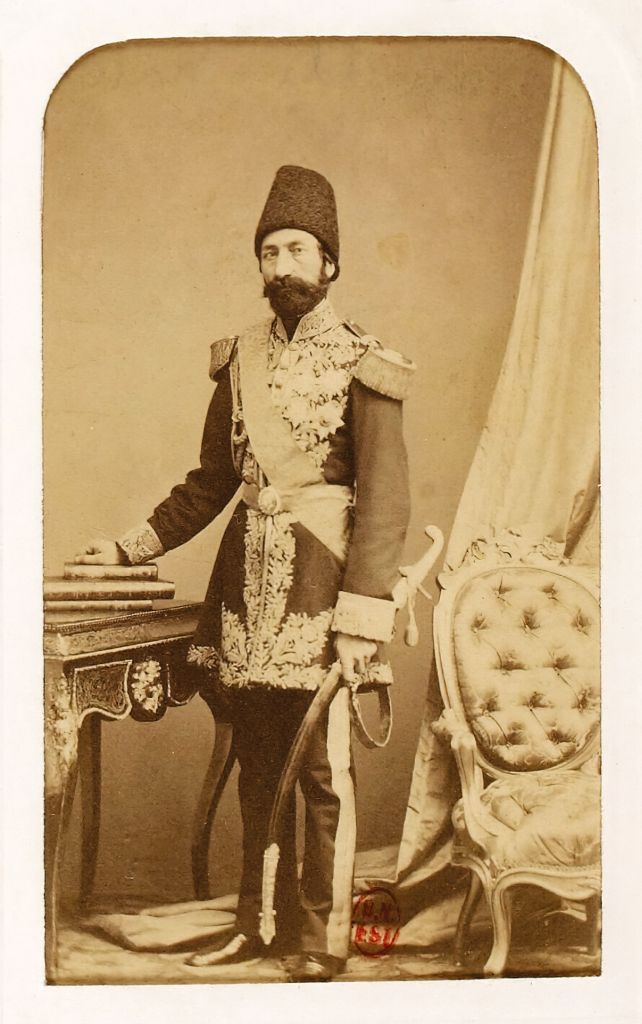
Born in 1821 at Bijar into a Garrus Kurd family, Hasan ʿAli Khan held the rank of colonel (sarhang) in the Garrusi regiment at the age of eighteen, and was present at the siege of Herat in 1839.145 In 1841 he went with his regiment to the Kermanshah garrison where he remained for two years. Thereafter he left his military pursuits and returned to his home where he succeeded his deceased father as chief of the Garrus tribe. When, following Naser al-Din Shah’s accession, Khorasan rebelled he brought his forces to join Morad Mirza in putting down the rebellion, and was instrumental in the recapture and pacification of Mashhad. In 1851 the Shah sent him to Zanjan to put down a revolt sparked by the Babis and after the succesful conclusion of the campaign promoted him to general (sartip) in command of two regular infantry regiments of Garrus Kurds. During the next few years he participated in campaigns at Isfahan and in Khorasan, and made a pilgrimage to Karbala. In 1856 he participated in the siege of Herat and commanded the garrison occupying it after the city’s capitulation. For this he was rewarded with further promotion to the rank of General aide-de-camp. Following the cessation of hostilities with Britain, Hasan ʿAli Khan was chosen to tender the government’s apologies to Minister Murray, then at Baghdad. Upon his return from this successful mission he was installed in the royal palace with various duties relating to the royal guard and the administration of the royal household, and when, in 1858, Naser al-Din Shah decided to establish a permanent presence in Europe, Hasan ʿAli Khan was made Envoy Extraordinary and Minister Plenipotentiary.146 The rumor that Mirza Malkom, who had been part of Farrokh Khan’s legation,147 was to receive the nomination was false.148
On April 9th, 1859, several months before Hasan ʿAli Khan’s departure, it was reported that, ‘Five young Persians have arrived in Paris from Teheran — two of them to study medicine, two to be educated in military schools, and the fifth, who is a nephew of Ferouk Khan, to be an out-door pupil of one of the principal colleges.’149 According to a letter written by Jean-Baptiste Varèse150 at Urmia, on June 29th, 1859, over two months later, a larger group of forty students — actually forty-two (see below) — were travelling with Hasan ʿAli Khan to Paris in order to study the sciences and the arts.151 One of those headed to Paris was Qahraman Khan, nephew of Nazar Aqa (see below), both of whom had attended Bebek College and the Lazarist school at Urmia.152 In order to extend his good wishes to the members of the Persian delegation heading off to Paris, Cluzel travelled especially to Khoy to meet them. While there he also saw a second mission bound for Constantinople.153 It was reported on July 21st that both delegations had arrived together at Constantinople from Trabzon.154 From there Hasan ʿAli Khan and his suite travelled to Marseille, where they arrived on August 3rd. In addition to the Minister, the small delegation included Mirza Mohsen Khan (first secretary), Mirza Sadek Khan (second secretary) and Nazar Aqa (first dragoman). All were said to be extremely distinguished and capable of speaking multiple European languages.155
8 Church Bells and Gospel Controversies
On January 29th, 1860, Varèse wrote from Urmia to Pier Paolo (Pierre-Paul) Sturchi. Cluzel had returned from a trip to Tehran with depressing news. According to the Foreign Minister, Naser al-Din Shah had signed a new decree prohibiting the ringing of church bells, as well as proselytism, even amongst the Christian sects and their schools. Cluzel had decided to protest the first of these, even though the ringing of bells might seem the more trivial of the two, and had been given an assurance that the bells that had been in place at Khosrova for the past four years could be rung. Jean-Baptiste Nicolas, the first dragoman at the French Mission, helped Cluzel to convince the Foreign Minister that such prohibitions did more damage to the Persian government than to the Lazarists. In fact, Cluzel was convinced that the government didn’t really want to cause a fuss over such an issue and that the French missionaries should just carry on doing what they had been doing, discretely.156 Nevertheless, the news out of Tehran was not all bad. Cluzel had obtained a firman confirming the new Chaldaean bishop of Khosrova as well as one according protection and an annual pension of 100 tomans to the Daughters of Charity there.157 As Rouge noted, the firman was ‘full of compliments, of very beautiful things.’158 On March 10th, 1860, Cluzel wrote to Salvayre from Khosrova, lamenting the fact that the Lazarist schools were being held back for want of books printed in Neo-Aramaic.159 In fact, it was an embarrassment to them to have to rely on a grammar produced by their arch-rivals, the American Presbyterian missionaries, and to use a Syriac New Testament similarly printed by them.160 A translation of the New Testament had been promised at Rome, but nothing had yet been received. Nor had the Dominicans in Mosul been able to get a printing press up and running. Failing that, Cluzel sought the equipment needed to produce his own lithographic editions.161
At Khosrova, Cluzel compiled a catalogue of information on the schools of the Lazarists and Daughters of Charity in Azerbaijan, which he sent to Salvayre on April 10th, 1860. While Khosrova was certainly the largest, with 70–80 boys and 150–160 girls, there were four other small schools with between a dozen and thirty pupils at villages in the region. No fewer than ten schools had been established in and around Urmia, although these tended to be smaller, with between six and twenty-five pupils.162 The large girls school at Khosrova was, in Cluzel’s opinion, their greatest achievement.163 On May 19th, 1860, Sister Couësbouc wrote to Boré at Constantinople, noting that Malek Mansur Mirza had given the Daughters two Kurdish girls with the intention that they should learn French and then be in a position to teach others in Tehran.164
The year 1860 was of some significance in that it was then that, as a result of the recently signed treaty between Persia and the Papal States, Mgr Nicolás Castells (1799–1873) was named provisional Apostolic Delegate to Mesopotamia, Lesser Armenia, Kurdistan and Persia, a position in which he was confirmed in 1866.165 Castells does not seem to have ever visited Iran, however, and his appointment received no mention in the Lazarist correspondence. In late February it was announced that a diplomatic mission, led by Commendatore Marcello Cerruti,166 and accompanied by Felice Gianotti, was heading to Tehran to pay Victor Emmanuel’s compliments to Naser al-Din Shah.167
Meanwhile, strife arose yet again between the Lazarists and the Americans. On May 28th, 1861, Father Jean Dbi-Goulim (1831–1866), a young Chaldaean from Khosrova who had joined the Lazarists,168 wrote to Jules-Auguste Chinchon (1816–1897), director of the Séminaire interne at Paris, describing an ugly incident at Urmia in which some of the American missionaries and their followers had not only forced their way into a Catholic church, but remained inside where they ate their dinner, locking the door behind them. Eventually, the door was forced open and the invaders chased from the church. A complaint was lodged with the prince-governor of Azerbaijan, Mozaffar al-Din Mirza,169 who sided with the Lazarists against their Protestant adversaries.170
In July, 1861, Louis-Marie Plagnard (1836–1891),171 of the diocese of Rodez, left France for Iran in company with Paul Bedjan.172 Varèse travelled from Tehran to Khosrova to meet Plagnard who then accompanied him back to the capital.173 On September 30th, 1861, Cluzel wrote to one of the Daughters of Charity in Paris, announcing that Bedjan had returned from France with a harmonium, which he had learned to play in Paris. The joy was boundless amongst the Lazarists who had longed for organ music and, despite the heat, a great mass was held complete with singing, to the enjoyment of a large congregation.174 Bedjan’s singing and playing was widely praised by the women of Khosrova175 and missed when he was absent.176 Moreover, in addition to a harmonium, Bedjan had brought with him a small autographic press for the printing of small school books.177 However, although this was used to print smaller works for use in the schools, no longer works, and certainly no Old or New Testament, were ever printed on it. Cluzel later learned a Syriac font had been sent separately to Khosrova from Rome, but this never arrived.178
In company with their servants Yohanna and Isaac from Urmia, Varèse and Plagnard finally arrived in Tehran on November 21st, 1861, and moved into a house in the Shah ʿAbdul Azim quarter in the southern part of the city which Varèse had rented on May 5th from one Angelo La Rocca.179 Shortly thereafter were able to purchase land in the center of the city where they built a residence and a church ‘dedicated to the Immaculate Conception’180 that served the small group of European Catholic merchants, numbering eighty-seven,181 living in Tehran at that time.182 On December 18th Varèse wrote to Sturchi to say that the arrival of Arthur de Gobineau (1816–1882), the former chargé d’affaires who replaced Bourrée after his departure, and newly appointed French Minister replacing Baron Pichon, was imminent.183
On May 23rd, 1862, Cluzel wrote in some frustration from Khosrova to Salvayre. He noted that 600 copies of a catechism translated into Neo-Aramaic (‘chaldéen vulgaire’), which had been printed by the Propaganda Fide, were expected to arrive from Rome.184 Further, a printed New Testament, or at least the four Gospels, were meant to have been made from a handwritten Syriac copy he had sent, assuming it had not gotten lost in transit. Fearing the worst, he was going to send a second copy written by Dbi-Goulim, even though he was not very sanguine about its chances of ever reaching Rome or, if it did, of being printed. Since it had taken almost three years for Rome to send copies of the catechism, how long would he have to wait for the New Testament, which was ten times as long?
In fact, the Syriac manuscript sent to Rome by Cluzel had arrived. However, four and a half months earlier, on January 6th, 1862, Pope Pius IX had ordered the creation of a Sacrée Congrégation de Propagande pour les Affaires du Rite Oriental, under the direction of the Bavarian cleric Karl August Cardinal von Reisach (1800–1889) who, after receiving Cluzel’s manuscript, had passed it on to the Austrian scholar Father Pius Jacob Zingerle (1801–1881).185 However, in a letter to Mgr Serafino Cretoni (1833–1909) of the Propaganda, written on September 3rd, 1862, Zingerle maintained that the Syriac text was in fact a translation from the Latin Vulgate and as such not authentic enough to warrant reproduction.186 Unaware that this had transpired, Cluzel wrote again to Rome on May 26th, 1862, and, having assumed that the Syriac copy of the New Testament he had sent in 1859 had never arrived, he enclosed the second copy made by one of the Chaldaean priests and checked by Dbi-Goulim,187 noted above. Half a year later, however, Cluzel received the depressing news that his request to have the New Testament printed in Syriac in Rome had been rejected. Cluzel reacted to this in a letter written on February 16th, 1863. There he noted that, in Persia, Syriac Bibles printed in London by Samuel Lee in 1826188 were still in use, one of which had served as the Vorlage for the bilingual text, with a lefthand column in Syriac and a righthand one in vernacular Neo-Aramaic, that he had sent to Rome for printing. Faced with the prospect of letting the local Persian Catholic priests use texts printed by Protestants or ones that were, from a text-critical and philological point of view, less than perfect, he had not hesitated to recommend the latter. Upon reading this, Reisach had second thoughts and sought the opinion of the Orientalist Daniel Bonifacius von Haneberg (1816–1876).189 Hanenberg was less critical of the manuscript submitted by Cluzel, feeling it was reasonably well done. Reisach decided therefore that, after correction, the Syriac New Testament could be printed at Rome, as Cluzel had requested, but without mentioning the Propaganda Fide.190
A further reason Cluzel looked forward so much to the arrival of the catechism was the fact that he believed it would help, in some small way, counteract the efforts of the American Protestants, who were flooding the countryside with short tracts, one worse than the next, printed on their own press. Faced with this situation, it is hardly surprising that Cluzel harbored a long-held desire to obtain his own small printing press which he viewed as an urgent desideratum,191 particularly as the press brought by Bedjan was so inadequate. Cluzel knew that a sum of money had been allocated to the Dominican fathers at Mosul so that they might establish a press, but he did not expect this to help matters in and around Khosrova. In fact, communication between Khosrova and Mosul was almost as difficult as it was between Khosrova and Rome, and he doubted that his mission would derive much benefit from the Dominican press in Mosul.192
Cluzel also related a curious fact about the seminary. It housed eighteen students, one of whom was a child born out of wedlock to the Lazarists’ adversary, since deceased, the former Russian Minister Medem.193 If he were to come back from the dead, how surprised would this Lutheran be to see his son a Catholic, in spite of the resistance Cluzel had long put up to the boy’s desire to embrace Catholicism, due to doubts about the youngster’s sincerity and perseverance.194
On October 23rd, 1862, Bedjan wrote to Chinchon from Urmia. As noted above, he had brought a harmonium with him when he returned to Iran and in his letter he noted that he was ‘still’ the organist, as well as choirmaster, offering the seminarians instruction in Latin and Nestorian chant. The harmonium was a great success and made a big impression on holidays.195 Indeed there had been general discontent when the harmonium had been moved to Urmia, where Bedjan went after an initial period of work at Khosrova. At Urmia he encountered difficulties caused largely by the Americans.196
Before the year 1863 was out another Lazarist, Jean-Paul Trapes (d. 1885), had been sent to Persia.197 The new year began with a tragedy, however. On January 2nd, 1863, the Lazarist missionary Félix Rouge died at Urmia.198 On May 4th Cluzel wrote to Étienne from Urmia. Among other things, he warned him of the precarious situation in which the Lazarists had found themselves as a result of their late leader Rouge’s zeal. A crisis had been sparked when an old woman took a foundling, presumed to be the child of a Muslim mother, from the entrance to a mosque and brought it to Rouge who subsequently refused to surrender it to Fathollah Khan, the leader of that quarter of the town. Indeed, Rouge had openly preached the doctrine of baptizing Muslim children.199 Cluzel suggested that the Lazarists cease immediately from baptizing infants except in cases of imminent death, where there was no fear of the baptism becoming known. Even though this was several years before the great famine of 1871, Cluzel reported that Catholic families in the village of Barbari had had their small provision of flour for the winter stolen by the village headman, who sold it at an exorbitant price in the bazaar for his own profit.200
A month later, on June 2nd, 1863, Cluzel wrote to Boré from Khosrova. Among other things, he summarized the case of the foundling and Fathollah Khan who had eventually dropped his demand for the child, in part at the insistence of his own ‘numerous’ family. What’s more, when the French Minister Gobineau was informed of the fracas, he brought the issue up at Court with the result that Fathollah Khan found himself summoned to appear in Tehran and fined 300 tomans, while the Lazarists were exonerated of any wrongdoing. Cluzel also reported on a school recently established in Tehran by the Daughters of Charity which Gobineau had informed him was gaining favorable notoriety. Gobineau even had hopes that the school could develop into a college that might one day replace the Dar al-Fonun founded by Naser al-Din Shah. Cluzel himself was sceptical, however, given that Tehran was a thoroughly Muslim city with a hundred or so ‘schismatic’ and hostile Armenian families.201
On March 13th, 1864, Cluzel wrote from Khosrova describing a ‘persecution that might cause significant damage to our being, and which has already done great harm to the work of the mission at Urmia.’202 Cluzel reviewed the history of the prohibition against proselytism, instituted in the early 1840s and repealed in 1850 which, ‘by one of the contradictions common in this country,’ continued to be maintained by the deputy-governor of the Christian population of Azerbaijan. In fact, however, the deputy-governor had frequently assured Cluzel that the injunction did not apply to Catholics, Armenians or Nestorians, and that as their religion was recognized by the state, they were free to convert from one sect to another. Only ‘unrecognized’ sects, like Presbyterianism, were subject to the prohibition. Despite protestations of religious liberty for all Christian subjects of the Shah, Cluzel had noticed some worrying signs, particularly in the behavior of the Foreign Minister, Mirza Sayid Khan.203 The lenient deputy-governor was replaced by one Haji Mirza Najaf ʿAli, ‘a nasty first-class villain,’204 who had formerly been in the service of the Ottoman Consul at Tabriz and had tried to foment war between Persia and Turkey, for which he was imprisoned before fleeing to Constantinople. Naser al-Din Shah would have had him strangled upon his return to Iran had it not been for the intervention of the Foreign Minister.205
Clearly chastened, Haji Mirza Najaf ʿAli sought out Varèse at Tehran and told him that, because of the close ties between France and Persia, he had strict orders to treat the Lazarists with complete beneficence. Upon his return to Urmia he reiterated this to Cluzel, but shortly thereafter began leaning towards the American Protestants. The first sign of malevolence concerned three young novitiates whom the Daughters of Charity had sent to Constantinople. Haji Mirza Najaf ʿAli insisted that this required his prior authorization, just as the sending of any additional Lazarist male missionaries or Daughters of Charity did, a claim which had absolutely no credibility since Persia was ‘like a house open on four sides,’ into which any and all might enter and exit. The second issue concerned proselytism. Cluzel counselled Haji Mirza to follow the policies of his predecessor. Nevertheless, not long afterwards, Mgr Joseph,206 an octogenarian bishop who had converted to Catholicism some thirty years earlier, was imprisoned for twenty-four hours. Only the intervention of Mozaffar al-Din Mirza, the prince-governor, succeeded in effecting the man’s release. Even then, the affair was not over, for two days later Haji Mirza demanded that the bishop turn himself in for examination by a ‘council’ he had constituted, threatening to burn down his house and expel the Lazarists if he did not surrender himself. Varèse protested and the bishop stayed with the Lazarists since Haji Mirza had threatened to take him to Tabriz or even Tehran. The affair seemed to calm down but, as Cluzel asked, why was it that the orders against proselytism only seemed to apply to Catholics and not to the American Presbyterians? In Cluzel’s opinion, all of this reflected collusion between Haji Mirza and the Americans. Moreover, he had evidence that the English Consul in Tabriz and a lower-ranking staff member of the English Legation in Tehran who was at Urmia were mixed up in it. Additionally, Haji Mirza was stirring up trouble around land bought on behalf of the Lazarists by Persian subjects.207
Cluzel had relayed all of this information to the French chargé d’affaires in Tehran whom, because he was a devout man, Cluzel hoped would take steps to remedy the situation.208 Reparations and the punishment of Haji Mirza for his partisanship were in order. Moreover, the comte de Rochechouart, he hoped, would obtain a stay on the order against proselytism since, given Haji Mirza’s leanings and the Americans’ chicanery, the injunction against it was being applied solely to the Lazarists.
Meanwhile, at Khosrova Cluzel wrote to his ‘très-honoré Confrère,’ Monsieur N., on July 26th, 1865. Here he recounted the story of Mgr Joseph, related above, and his persecution by Haji Mirza, as well as providing an update on developments and struggles at Urmia and Khosrova. He also had much to say about Bishop Mar Yohanna who had accompanied Justin Perkins and his family to America over twenty years earlier.209 By this time, Mar Yohanna was nearly sixty years old, and had just married a young girl of only fifteen, eschewing the normal celibacy of Nestorian bishops and adopting the marriage practices of his American Presbyterian friends. He had, however, been suffering from extreme dysentery for the past year and was reduced to a skeleton.210 On a brighter note, the Catholic church built at Ordushai in 1843, which had been taken from the Lazarists, was restored to them in 1865.211 As noted in Ch. 4, this church had been the subject of prolonged litigation. According to Cluzel,
This church remained in effect for twenty years in the hands, not of the Nestorians who never entered it, but in the hands of the Protestant missionaries who went and turned it into a stable for their horses when they rode to Ardichaï, until it was taken from them and restored to the Catholics, by an imperial firman of His Majesty Nasr-Iddin Shah, at the moment when one least expected it.212
On April 24th, 1866, Cluzel wrote to Étienne from Khosrova reporting the death, four days earlier, of Jean Dbi-Goulim at the age of only thirty-five.213 In a letter written at Khosrova on May 10th, Cluzel explained the basics of the seminary there, the purpose of which was to educate indigenous Chaldaean Catholic clergy. The course of study lasted five years and the curriculum included written Chaldaean (Syriac), Latin, French, geography, mathematics and a bit of history. Singing was also taught and before long the seminarians were able to celebrate mass with Gregorian chant. Only with a knowledge of Latin and French could the seminarians access any ecclesiastical literature, since none was available to them in Syriac. After the first five years, a sixth was spent studying philosophy, followed by four more in theology, scripture and ecclesiastical history. The number of seminarians in 1866 stood at eighteen, seven of whom were in their second year of theology.214 As for the girls’ school run by the Daughters of Charity, this was already a dozen years old and had 300–400 pupils who were taught reading, writing and Christian doctrine, alongside ‘virtuous habits.’215
On September 28th, 1866, Cluzel wrote from Urmia to Salvayre. A brief but lethal cholera epidemic of three months’ duration, in which one-sixth of the population of Urmia had died, amounting to roughly 6000 people, had finally abated. The Daughters of Charity had performed miracles in tendering aid to the afflicted population.216 The French missionaries had been without news for months, however. Because of the cholera, nobody ventured to travel into or out of Tabriz where their letters were held up.217 A little over two weeks later, on October 14th, 1866, Varèse wrote to Boré from Urmia. The picture he painted of the Lazarists’ functions was wide-ranging. They were obliged to fulfill the roles of missionary, curate, schoolmaster, doctor, justice of the peace, attorney, counsellor, ‘and even some less noble professions.’218 The Lazarists, he wrote, got along well with the Muslims, Chaldaeans and Nestorians. Only the Protestants and their minions were the enemies of the Lazarists.219
On January 4th, 1867, Cluzel wrote to Étienne from Urmia. Leaving Plagnard in Tehran, Varèse, who had some knowledge of architecture, had come to Urmia and built a large, comfortable new house for the mission.220 When Cluzel wrote to Boré a month later, on February 7th, he reported that Boré’s name was still very much alive among the Catholics of the region. Whereas Catholics had lived in only five or six villages on the Urmia plain when Boré was in Iran, they now inhabited over sixty.221 Cluzel told Boré frankly that he and his colleagues counted on him to be the Lazarist missionaries’ ‘arm of Providence’ in Paris, and again, on March 12th, he repeated this, entreating Boré to speak with Salvayre in order to win them a budget increase. For their ordinary operating expenses the mission at Urmia required 8,000 fr., but in order to thrive and succeed in their work, a regular allocation of 10,000 fr. was required.222 Moreover, as Cluzel noted in a further letter to Boré written on April 12th, while he normally lived at Salmas, if he were transferred to Urmia, where his presence would doubtless irritate the American Presbyterian missionaries, he would be likely to attract a greater following, thus increasing the need for more funding. Conversely, by cutting the budget for Khosrova, the aggregate extra sum required would be only 2000 fr.223
On January 15th, 1867, Jean-Paul Trapes wrote to Étienne from Khosrova. Commenting on the ups and downs of missionary life, which he compared to a rose with its thorns, he wrote, ‘It is impossible to express the satisfaction and contentment experienced when one has the good fortune to tear a soul away from Nestorius or Luther, to lead it back to the fold of the divine Shepherd.’224 On February 9th, 1867, Sister Anna (Narges) Eyvaz wrote to Boré from Urmia, humbly requesting additional funds and, above all, additional missionaries for their poor Mission, particularly after the death of Dbi-Goulim and two Daughters of Charity.225
Five days before Christmas, 1867, Sister Bocheron wrote from Khosrova. She described how, for want of books, three pupils were obliged to use a single one in class, a circumstance that often gave rise to petty quarrels and disrupted the lessons. Moreover, the books that they did possess were all heavily worn and it had been impossible to replace them due to the absence of a press. How wonderful, therefore, that after repeated requests by Cluzel, lodged with the authorities in both Paris and Rome, Salvayre had sent a printing press and Cardinal Barnabò226 had provided the font in Syriac (‘caractères chaldéens’). However, Sister Bocheron lamented the fact that the press was so large that it could not be mounted on the backs of mules and it was therefore stranded at Trabzon,227 whereas Cluzel himself wrote that the press was so old and missing so many pieces that it was utterly useless.228 Indeed, a few years later Cluzel continued to stress that the biggest obstacle to fulfilling the Lazarists’ potential was a lack of books and a press on which to print them, which meant they had to give their Chaldaean Catholic flock Protestant Bibles.229
On April 27th 1868, Sister Brigitte Cullin wrote to Étienne from Urmia. The large numbers of conversions to Catholicism by Nestorians was encouraging — the second Sunday after Easter saw seventeen children receive their first Communion, a fact which in some measure compensated the missionaries for their hard labors. But, as she noted, quoting Luke 10:2, ‘the harvest is truly great, but the laborers are few.’230 Several days later, on May 1st, Cluzel himself also wrote to Étienne. He had ‘reclaimed’ Bedjan. ‘He sings; he has his organ [sic, harmonium], and with that he imparts to our holy ceremonies a lustre that they can hardly have without him.’ But Cluzel himself felt terribly torn. He was needed at Khosrova and at Urmia. The result was that, in wanting to be a little bit everywhere, he found himself nowhere and although things went on, they did not proceed as he would have wished.231
9 A Catholic Persian Ambassador in Paris
On March 10th, 1870, General Nazar Aqa (Fig. 6.7), who had been named chargé d’affaires, presented his credentials to Napoleon Daru (1807–1890), the French Foreign Minister.232 Although Algar called him ‘an Assyrian from the Urumiya region,’233 he was, in fact, a half Polish-half Chaldaean Christian. Edmé Casimir, marquis de Croizier (1846–1921),234 described him as follows:
Descended from a European family235 long-established in Persia and highly regarded at the court of Fath-Ali-Schah, General Nazare-Aga arrived at the high position he occupies after a rapid and brilliant diplomatic career. He was born in Ourmiah in 1817. His mother, the pious Rachel,236 once celebrated by European travelers, was Chaldean and belonged to the only family of her people to have risen to the rank of khan.237 — His elder brother, the artillery colonel Borzou-Khan,238 is well known to our missionaries, to whom he has constantly rendered important and numerous services. — General Nazare-Aga speaks and writes fluent French, English, Russian, Turkish, Persian, Armenian239 and Chaldean; he is a talented orator and a writer of merit. Everything about him is in perfect harmony with the nobility of character and the elevation of intelligence that public opinion recognizes in him. Still young, with a beautiful and noble physiognomy, expressive features, loyal eyes and finely smiling lips, we can praise in him the qualities of a man, the spirit that dazzles, the grace that seduces and the talent that imposes itself. An amiable figure, what strikes one about him is the multiplicity of aspects, the variety of aptitudes and the unity of the person. — He’s a 19th-century Athenian, born, by a quirk of fate, on the shores of Lake Ourmiah, two thousand leagues from our civilization.240
Nazar Aqa
After Lazard and Favereau 1902: opposite 44
As Rohrbacher wrote of this ‘European’ family in Persian service:
The head of the house, a Pole who had emigrated, after marrying Rachel, a Chaldean girl, entered the service of the King of Persia, rose to the rank of major, and died bravely on the battlefield. He left three sons, the eldest two [Nazar and Borzu] of whom are already honorably replacing their father in the army. One of them, named Sukan, at the age of seventeen, made a noble reply to his king Feth-Ali-Shah, who urged him to become a Muslim, promising him all his favors. “King,” he said with an assurance worthy of the first Christian martyrs, “my father died for you; I am ready for the same sacrifice; but, if you talk to me about leaving my religion, take back this sword and turn it against your servant;” and he reached for his belt to unbuckle it. The Shah, amazed by his magnanimity, rewarded him with a higher rank. The courage of his ebullient youth led him, at that age, to use the same sword to right all wrongs done to Catholics. Having learned that the Nestorian khans were holding a sort of council against the Orthodox priests, he entered the assembly in arms, threatening them with his wrath if they did not cease their intrigues. His family being the only Chaldean-Persian to have risen from the rank of raïs241 to the dignity of khan, the bishops, fearing his influence, then used moderation.242
On December 22nd, Nazar Aqa presented new letters of accreditation to the French republican government that had succeeded Napoleon III after the disastrous defeat at the Battle of Sédan in early September, 1870.243 When Cluzel had written to Boré in Paris, during the Franco-Prussian War, he noted that the American missionaries were painting the conflict as one beween ignorant and illiterate Papists and literate Protestants:
France no longer wants Papism; the healthy part of the nation has recognized that the setbacks that have just befallen it are due to the superstition of the Priests and the ignorance of the people. All Prussian soldiers know how to read and read the Holy Books: hence their strength and success. The same cannot be said of French soldiers; most of them can’t read, and are forbidden from reading the Holy Books: hence their weakness, their inferiority and their setbacks.244
Cluzel went on to note, ‘In general, it was hard to understand how France, so great, so famous, so powerful, so invincible and so Catholic, could be defeated by a Protestant nation, whose name we didn’t even know until now.’245 More salient was the new, brutal, financial reality occasioned by the French defeat. As Cluzel later acknowledged
In 1870, the mission had to endure a harsh and damaging ordeal, which the Protestant missionaries exploited with rare skill. We found ourselves with nothing in our hands as a result of the siege of Paris, and were forced to suspend all our works, seminary and schools. There were cries for the death of the Catholic Mission, but we had the consolation of seeing our old and new Catholics hold firm.246
After more than a quarter of a century spent battling them, the Protestants had become even more detestable to Cluzel following the defeat of France in the Franco-Prussian War. In 1871 Cluzel wrote,
In Protestant schools, pupils are simply provided with an inexhaustible repertoire of objections and slanders against the Roman Church. The superficial notions of history and geography that are added are all directed towards this goal. In their maps, Catholic countries are all marked with bold red colors. This means that these lands have been reddened by the blood of Protestants spilled by Catholics. That’s how they explain it. For the young ethnographers of this school, the peoples of all Catholic countries are ignorant, drunken and bloodthirsty, especially those of southern Europe. Protestant countries, on the other hand, are inundated with science and enlightenment; they are all models of charity and morality. Protestant missionaries have overlooked nothing to share these precious advantages with their Chaldean neophytes. Their own newspaper, Raysof Light,247 has not been spared. But this very ray, combined with the others, proved too weak. The Protestant schools have not produced a single man of note. The best among them are those who know how to speak most poorly of the Roman Church.
The Catholic schools, on the other hand, despite their disproportionate numbers and resources, have produced different results. We can point to several subjects who figure honorably in the ranks of high society, and who render good service to their government. For example, the current chargé d’affaires of the Persian legation in Paris is a pupil of ours. He is Nezer-Aga, brother of Colonel Bourzou-Khan, mentioned above. The first interpreter of the Persian legation in St-Petersburg, Mirza-Davoud of Khosrova, is our pupil. There are others who serve the Persian government in Teheran as interpreters or French teachers. Others earn their living honourably elsewhere, without needing to talk nonsense to anyone in order to make a living; not to mention those who have joined the priesthood, who today render such fine services to the Church and do it so much honour.248
Possibly a reference to the hot, dry, ‘Saharan’ influence that prevails in the Mediterranean between the March and September equinoxes. See Stoianovich 1994: 334.
Anonymous 1857a: 684.
The Roland had formerly been Napoleon III’s imperial yacht. See http://www.dossiersmarine.fr/c-c5.htm. The Roland formed part of the French Mediterranean squadron and shortly before it was used to transport Farrokh Khan it had seen action in the Crimean War. See Ladimir and Arnoul 1855: 90; Ribeyre 1871: 191–192.
Ranc 1856: 639; Anonymous 1856y: 4895. Previously, it had been reported that Bourrée had landed at Marseille on December 16th, 1856. See Anonymous 1856v.
In a news bulletin dated Paris, December 17th, it was said that ‘Bourre’s arrival in Marseilles without Feruk-Khan is still regarded as a sign that promises the possibility of peace, since it is assumed that the French envoy in Teheran left Feruk-Khan behind in Constantinople because there is still hope of a settlement, and Lord Stratford de Redcliffe is known to make this possibility dependent on the condition that Feruk-Khan refrains from traveling to France. But we must confess that these prospects are very slight, and we rather believe that Feruk-Khan will soon arrive in Paris.’ See Anonymous 1856k.
According to a bulletin dated Constantinople, December 19th, Farrokh Khan was to leave the following day for Marseille, i.e. on December 20th, and had his audience of leave with the Sultan on December 18th. See Anonymous 1856x: 5847. Cf. Anonymous 1856y: 4895.
Anonymous 1857a.
Anonymous 1857c. Paulin 1857: 50, published on January 24th, simply said that Farrokh Khan had arrived at Marseille several days earlier.
Anonymous 1857g. Cf. Anonymous 1857f. Anonymous 1857d dated, seemingly incorrectly, the arrival to January 12th.
Anonymous 1857h.
Anonymous 1857o dated his arrival to January 24th, but also made that a Sunday when in fact it was a Saturday. Because of other accounts, the 17th will be used here. Anonymous 1857i: 70 dated his arrival in Paris to 7 p.m. on January 18th.
According to Picot 1900: 70, ‘the chemist, Foquetti,’ retired from the Dar al-Fonun in 1859.
Anonymous 1857o: 85.
Actually 25, Rue de Montaigne. See Jerrold 1867: 176.
Anonymous 1857o: 85. The house belonged to Jules de Lesseps who was later the ‘commissaire général’ for China, Japan, Tunis and Morocco at the Paris Universal Exhibtion of 1867. See Anonymous 1868c: 22.
Anonymous 1857o: 85.
Lit. ‘tile yards,’ where Catherine de Medici ordered a new palace to be built which, however, was not completed until 1660, by Louis XIV. See Lemer 1856; Edwards 1893: 207.
An engraving showing the arrival of the cortège was published in Anonymous 1857o: 84. Two of the carriages were drawn by six horses each. See Anonymous 1857l: 80.
Anonymous 1857o: 85.
Anonymous 1857o: 85.
Anonymous 1857o: 85.
As noted in Anonymous 1857b: 95. Anonymous 1857o: 85 dated Farrokh Khan’s arrival at Paris to January 24th, and his audience with Napoleon III to January 31st.
Albert C. (Kazimirski) de Biberstein, who had taken part in Sercey’s mission. See Ch. 3.
Anonymous 1857ac: 80.
Prince Nikolai Borisovich Yusupov (1827–1891), ‘one of the attachés to the Russian embassy in Paris; everyone knows that he is the head of the richest household in the Russian imperial court, that he has nearly 70,000 serfs on his estates, and that finally, an artist himself and a man of taste, he devotes part of this immense fortune, so well placed in his hands, to the fine arts.’ See Busquet 1858: 215.
Anonymous 1857ax.
Louise Octavie de Laharpe (1807–1890), wife of Georges Eugène Haussmann, or Baron Haussmann (1809–1891), Prefect of the Seine, who initiated largescale urban restructuring in Paris during the reign of Napoléon III. The French Romantic writer Prosper Mérimée considered her ‘not only common, but also a bit crazy.’ See Basso 1975: 365, n. 69.
Anonymous 1857p: 128.
The festive season preceding Ash Wednesday and the beginning of Lent. According to Murray 1893: 125, ‘in France it comprises Jeudi gras, Dimanche gras, Lundi gras and Mardi gras, i.e. Thursday before Quinquagesima, Quinquagesima, Sunday, Monday and Shrove Tuesday; in a still wider sense it includes “the time of entertainments intervening between “Twelfth-day” (or Boxing Day) and Ash Wednesday.”’
As Edwards 1893: 246–247 noted, ‘throughout the second Empire the Hôtel de Ville was occupied, in lieu of an independent Municipal Council, by a sort of consultative commission without mandate and without authority, attached to the Prefect in order to verify his accounts with closed eyes. By way of compensation, however, the Hôtel de Ville was encouraged to give balls, to which the chief of the State accorded his gracious patronage.’ Among others, Queen Victoria and Alexander II of Russia were entertained there. For the history of the building see Lambeau 1908.
A line from Firmilian by the Scottish poet William Edmondstoune Aytoun, published under the pseudonym, T. Percy Jones: ‘Uninspired dullards, unpoetic slaves,/ The rag, and tag, and bobtail of mankind.’ See Jones 1854: 100.
Anonymous 1857p: 128.
Anonymous 1857n.
Anonymous 1857p: 128.
Henry Richard Charles Wellesley, 1st Earl Cowley, British Minister in France from 1852 to 1867. For diplomatic career in Paris see Wellesley 1928.
Anonymous 1857s: 158.
Wellesley 1928: 106.
In the absence of Bourrée, Arthur comte de Gobineau filled the office of chargé d’affaires until his departure on January 31st, 1858. See Gobineau 1859: 486. Better known for his racist writings than his diplomatic career, Gobineau published prolifically. Aside from his Aryan-supremacy-tainted writings like Gobineau 1864 which refers, in its opening sentence to ‘la race blanche,’ see, e.g. on his previous stay as chargé d’affaires and secretary at the French Mission in Tehran, Gobineau 1859 and Gobineau 1905.
Anonymous 1857ab: 212.
Anonymous 1857q: 103.
Joseph Walker Jasper Ouseley (1800–1889). Half-brother of Sir William and Sir Gore. See Kelly 1910: 136.
Anonymous 1857r: 123.
Iranian island in the northern Persian Gulf for which see Floor and Potts 2017b.
Hormuz island, near the Straits of Hormuz, formerly seat of an independent Iranian dynasty and later an important outpost of the Portuguese maritime empire. For an overview of its history see Floor 2012.
Anonymous 1857z: 198.
‘According to the Nord, of Brussels, the French Government, on the arrival of Ferukh-Khan, the Persian Ambassador, in Paris, will intercede between Great Britain and Persia, and undertake the arrangement of their differences.’ See Anonymous 1857b: 6.
Wellesley 1928: 106. Comte Alexandre Colonna-Walewski (1810–1868) was a son of Napoléon I, by his Polish mistress, Marie Walewska. For an appreciation of his career and abilities see Lano 1892: 309–318.
Wellesley 1928: 107–109.
Anonymous 1857t: 228.
Anonymous 1857x: 250.
Anonymous 1857u: 184.
Anonymous 1857v: 188.
Anonymous 1857w: 192.
Anonymous 1857ab: 212.
Anonymous 1857ad. As one news report noted, ‘The same treaty could not have been obtained at Constantinople as had been concluded at Paris. The powers of Ferukh Khan, in the first instance, were defective, and the negotiations were broken off by him.’ See Anonymous 1857ay: 678.
Clerk 1862: 286–287.
Anonymous 1857aa, ‘The day before yesterday Ferukh Khan, accompanied by his interpreter, went to Lord Cowley, with whom he remained in conference for three hours. All the papers and documents relating to the treaty, as well as the treaty itself, were carefully read out again. Only this morning at 11 o’clock did they sign the provisional treaty, which is to put an end to the war between the two nations. A member of the Persian legation is leaving for Tehran today to have the treaty ratified by the Shah.’ Cf. Anonymous 1857an, ‘Paris, Friday. Neri [Neriman] Khan, an attache of Ferouk Khan, left Paris on the 4th for Teheran, with the Treaty, just signed, which requires the ratification of the Persian Government.’ Cf. Anonymous 1857ao.
Anonymous 1857ah. Cf. Anonymous 1857ai: 178.
Anonymous 1857af.
Anonymous 1857ak.
Anonymous 1857ag: 162. Cf. Anonymous 1857ae: 246.
A native of Ballinrobe, County Mayo, Ireland, Lynch had had a distinguished career in the Indian Navy, surveying the Persian Gulf, participating as second-in-command in the Tigris and Euphrates Expedition under F.R. Chesney, and superintending the Bombay dockyard, among many other roles. Considered an excellent linguist in both Arabic and Persian, Lynch had been on the Oriental Examination Committee in Bombay. After his retirement in 1856 he settled in Paris. For his biography see Lynch 1925: 72–76.
Anonymous 1857aj.
Anonymous 1857aj.
Prince Albert of Saxe-Coburg and Gotha (1819–1861), cousin and husband of Queen Victoria (1840–1861).
Anonymous 1857al. Cf. Anonymous 1857at.
Anonymous 1857ap.
Anonymous 1857al.
Anonymous 1857am.
Marchese Salvatore Pes di Villamarina (1810–1890). For his life see Bosio 1863.
Anonymous 1857y. Cf. Anonymous 1857ar: 426.
Davanture 1858: 60.
Long-serving Dutch Minister in Paris (1854–1867). Previously he had been Minister of Catholic Religion. See Homan 1966: 208.
Anonymous 1857at. Cf. Anonymous 1857as: 458. For the text of the treaty see Dunlop 1912: 575–579.
Anonymous 1857av: 620.
Anonymous 1857au: 426, ‘The news arriving here that the Shah of Persia refuses to ratify the treaty concluded between Ferukh-Khan and Lord Cowley, which had been approved in London, is described by French newspapers as false.’
Anonymous 1857av: 620.
Anonymous 1857aw: 298.
Püttlingen 1860: 121–122, ‘Treaty of Friendship, Commerce and Navigation between His Majesty the Emperor of Austria and His Majesty the Shahinshah of Persia, concluded at Paris, May 17, 1857, exchanged in the ratifications there on November 13, 1857.’
He was successively Prussian Secretary of Legation (1838–1847), Legation Councillor (1847–1848) and Envoy Extraordinary and Minister Plenipotentiary in Paris (1849–1859). For a biography see Wippermann 1880: 34.
Viebahn 1858: 240. Cf. Davanture 1858: 72.
Gousset 1903: 532–533 and elsewhere for his life and work.
Secretary of the Archbishopric of Reims. Gousset 1903: 262, n. 1, confused him with Joseph Gérard (1831–1914) who left France in 1853 and went to South Africa as a missionary to the Basotho in Lesotho, never to return to Europe. Rather, Gousset’s nephew was ‘the Abbé Gérard, nephew of Cardinal Gousset, Canon of the metropolis,’ who, at the time of his death in 1880, ‘had exercised for thirty years the functions of chaplain to the boarding school.’ See Hannesse 1888: 496.
Cérès was a slum-like neighborhood of Reims, overwhelmingly inhabited by impoverished textile workers. Among the religious orders established there were the Dames de la Providence who had a convent in rue de la Barre and probably ran the school visited by Farrokh Khan. See Anonymous 1864b: 154.
Nov. 1st, 1857.
Established in 1827 in the old Abbey of St. Rémi, it included a chapel, library of the Benedictines and a series of paintings from the 14th and 15th centuries depicting the passion of Christ, as well as a hospital. See Anonymous 1864b: 105–106, 155.
Ranc 1857: 439–440.
Cluzel 1858c: 310.
Mahmud Khan Naser al-Molk Farmanfarma. For a brief account of his career, see Navaʿi 1999.
Cluzel 1858c: 312.
Cluzel 1858c: 313.
Gousset 1903: 532.
Anonymous 1858a, Anonymous 1858b.
Anonymous 1858k. Anonymous 1858e reported he would be taking fifteen military advisers back to Tehran when he left France, but this was false.
Anonymous 1858l. For Cavour’s life see e.g. Spender 1876; Mazade 1877.
Anonymous 1858t.
Piemontese 1968 with refs. This is missing in the list of Persia’s treaties given in Lorini 1900: 508–509.
As Spender 1876: 312 wrote, ‘There are few persons of any expeience in continental travel who have not visited Trombetta’s Hotel dell’ Europa at Turin. It is conveniently situated for the tourist, lying in the very heart of the subalpine capital, and looking out upon the large and somewhat handsome brick palace known as the Madama. … Trombetta’s Hotel has seen important political gatherings within its walls.’
Napoleon III’s mistress, Virginia Oldoini, Countess of Castiglione (1837–1899), was originally sent to France as an eighteen year-old to push the cause of Italian unification and was widely considered the most beautiful woman of her time. For the remarkable photographic record of her life see Apraxine and Demange 2000. For her biography see Montesquiou 1913.
The Prime Minister of the Kingdom of Sardinia, Camillo Benso, Count of Cavour (1810–1861), mentioned above.
According to Watkins 1810: s.v. Diamonds, ‘The first water in diamonds, means the greatest purity and perfection of their complexion, which ought to be that of the purest water. When diamonds fall short of this perfection, they are said to be of the second or third water, &c. till the stone may be properly called a coloured one: for it would be an impropriety to speak of an imperfectly coloured diamond, or one that has other defects, as a stone of a bad water only.’
Anonymous 1858g: 205–206. Cf. Anonymous 1858f.
Anonymous 1858h: 215.
Anonymous 1858r.
Anonymous 1858i.
Anonymous 1858t: 269.
Mgr. Giuseppe Milesi Pironi Ferretti (1817–1873), Minister of Commerce, the Fine Arts and Public Works, was made a Cardinal on March 15th, 1858, the same day that he concluded the treaty with Farrokh Khan.
Anonymous 1858v: 256. Cf. Anonymous 1858c.
Anonymous 1858d.
The principal port of Rome on the Tyrrhenian Sea which had come under Papal control in 728 and was lost to the Italian state in 1870. It was, thus, still part of the Papal States when Farrokh Khan visited it. With the shift from sail to steam navigation, the Civitavecchia lost much of its former importance due to its size. See Calisse 1900: 210.
Giacomo Antonelli (1806–1876) was perhaps the closest and staunchest ally Pius IX ever had. For his life see Waal 1876; Coppa 1990. For more on Antonelli see Ch. 7.
M.K. 1861: 94–96. If M.K. stands for Monsieur K. then this was probably Nikolai Vladimirovich Khanykov.
Anonymous 1858j.
Anonymous 1858m.
Anonymous 1858n.
Anonymous 1858o: 1790.
Anonymous 1858p: 443.
Anonymous 1858q. Cf. Anonymous 1858r.
Anonymous 1858s.
Anonymous 1858a.
Anonymous 1858u: 499.
Anonymous 1858w: 3358, ‘Mr. Murray had been recalled from his post of Minister at the Persian Court, and Mr. Alison, who had been Lord Stratford’s chargé d’affaires at Constantinople until Sir Henry Bulwer’s resignation, had been appointed his successor; which caused the Times to indulge in an editorial on the difficulties of the duty of an English envoy at Teheran at the present time, when the Shah, in view of the Indian rebellion [Mutiny of 1857] not yet subdued, is delaying in every way the fulfillment of the terms of peace imposed upon him. Meanwhile, the Honorable H.A. Murray, in a letter to The Times, assures us that this rumor is groundless; his brother has neither been recalled nor does he intend to resign his post.’ In fact, in the summer of 1859 it was announced that Sir Henry Rawlinson would be going to Tehran to fill the position of Minister. See below.
Shepherd 1857: 158–159.
Anonymous 1858x: 1062. According to Anonymous 1858z: 324 Farrokh Khan was ‘embarking on the 29th.’
Anonymous 1858y: 645.
Anonymous 1858z, Anonymous 1858aa.
Polak 1865: 191.
Anonymous 1859a: 122.
Cluzel 1858d: 315.
Cluzel 1858d: 322.
Couësbouc 1858b: 327.
Couësbouc 1858c: 337.
Couësbouc 1858c: 339.
Cluzel 1859b: 293–294. As Cluzel 1859c: 441 noted, ‘The number of Muslim patients cared for by our sisters is so great that, after midday, they are obliged to close their doors, to put an end to consultations and have time to attend to their other duties.’ According to Rouge 1862: 442–443, Sister Anna Eyvaz and Sister Marie-Philomène de Couësbouc (for females), along with Brother Issa Mouchil (for males), delivered medical care, noting, ‘There are always large numbers of sick.’
Cluzel 1859b: 295.
Rouge 1861: 15, ‘The king wants all his employees to know French, otherwise, even if they are princes, they will lose all consideration. Everyone, you understand, wants to learn the language.’
Cluzel 1858c: 441–442.
Cluzel 1861b: 25. Cf. Cluzel 1861a: 18.
Cluzel 1861a: 19.
Cluzel 1859a: 59–60.
Cluzel 1859a: 61–62.
For a detailed biographical sketch up through his appointment to Paris, see Anonymous 1861g: 356–366.
Anonymous 1859c.
Anonymous 1859f: 442.
Anonymous 1861e.
Anonymous 1861g: 363.
On Mirza Malkom (1833–1908) see in general Algar 1973. As noted in Anonymous 1873ap: 19–20, ‘This is Melkum Chan, of Armenian descent (his father was still a Christian), a man of excellent intellectual gifts and a fine Oriental and Occidental education. This Melkum Chan was once able to exert an extraordinary influence over his prince. In his youthful enthusiasm for free-thinking Europe, he had organized the first masonic lodge in the Persian capital, to the great annoyance of the powerful Shiite priestly class. From Franc maçon chane (House of Freemasonry) the jargon made Feramusch-Chane, i.e. House of oblivion, where on entering all distinctions of rank, birth and wealth are to be forgotten … Nothing was spoken of but the feramusch chane, and when even the youthful king entered there and, leaving aside the three pages of titles, allowed himself to be addressed as “brother”, everything in this old seat of Asian thought was bound to lose its head, and it was especially the avaricious molla world that spoke of the downfall of all religion and custom. Of course, this remained only a faint stirring in the mind of the youthful Nasreddin.’
According to Anonymous 1859b: 204, on February 19th it was reported, ‘The Shah of Persia intends, it is said, to have a resident Ambassador at the Court of France; and Mirza Malcoulm, who accompanied Ferukh Khan in his visit to France, and who had before resided for several years in Paris, is mentioned for the post.’
Anonymous 1859d.
Varèse had joined the mission in 1852. ‘Born to honorable shopkeepers in Port-Maurice [Porto Maurizio, Liguria], Italy, but very French in character, Mr. Varèse was, through his mother, grandson of the famous Manuel, Prosecutor of the Paris Commune in 1793. Nevertheless, he drew from his family strong faith and a passionate zeal to serve the Church. He died in Paris in 1873.’ See Bray and Touzé 1900: 205.
Varèse 1861a: 7, ‘A new Persian embassy has just left for Paris and London. It is leading some forty young people whose education we wish to have in France, to train them either in the sciences or in the arts.’ This letter was presumably the source of a report to the same effect that appeared in the French press. See Anonymous 1859f: 442.
Varèse 1861a: 7. For Bebek College see Chapter 4.
Varèse 1861a: 7.
Anonymous 1859e.
Anonymous 1859f: 442. Nazar Aqa had also worked for a time at Dar al-Fonun, the technical college in Tehran established by Nasr al-Din Shah, and was a Russian translator. See Bidrouni 2012: 61. Nazar Aqa was ‘educated at the Lazarist Catholic School in Istanbul and the Polytechnic College (Dar al-funun) in Tehran. He served as a translator to the Iranian consulate in Tbilisi [1854–1855].’ See Afkhami 2019: 224, n. 131. He also worked as second translator in the Persian Legation in St. Petersburg. See Sohrabi 2012: 156, n. 58.
Varèse 1861b: 10–11.
Varèse 1861b: 11. Cf. Anonymous 1860a: 112, in which it was reported that, Naser al-Din Shah, ‘having heard of the good done for the poor classes by the Daughters of Charity who had been quartered for two years in the province of Azerbaijan, and expecting that the Muslims are cared for by them with the same regard as the Christians, ordered the sum of 100 tomans (1200 francs) to be drawn for their benefit … and a petitioner converted this gift into an annual and perpetual pension.
Rouge 1861: 15.
Cluzel 1861a: 16–17.
Vosté 1946: 60.
Cluzel 1861a: 16–17.
Cluzel 1861b: 22–24.
Cluzel 1861c: 34–35.
Couësbouc 1861: 40.
Anonymous 1874a: 86; Hergenröther 1880: 1009; Merland 1881: 273.
Commendatore Marcello Cerruti (1808–1896), ‘an Italian diplomat originally on behalf of the Kingdom of Sardinia. He held a number of consular posts before leading the Italian expedition to Persia (Iran) (1862). He went to Persia as Minister Plenipotentiary and Italian Ambassador to the court of the Shah. … Cerruti was subsequently Minister Plenipotentiary in Berne (1867), Washington (1868), The Hague (1869) and Madrid (1869). He retired (1870) and became a Senator of the Kingdom of Italy.’ See Beolens, Watkins and Grayson 2020: 114.
Anonymous 1861d. Cerruti was accompanied by ‘Brother and Knight Felice Gianotti.’ Canon Carlo Felice Gianotti was Director of the college of the classes ‘where noblemen’s sons are generally educated.’ He was ‘an ex-Jesuit, a most astute man.’ See Orsini 1857: 16. For the Italian mission to Iran in general see Gusso 2017. See Anonymous 1861a, 1861b and 1861c for Hasan ʿAli Khan’s visit to the Italian monarch.
One of the Lazarists’ seminarians (see Oussani 1911: 724), he was born at Khosrova in 1831, sent to Paris in 1853 and returned to Iran as a missionary in 1858. See Anonymous 1860b: 312; Cluzel 1866b: 641; Chatelet 1926: 322; Vosté 1946: 61–62, n. 11.
Mozaffar al-Din Mirza was appointed governor of Azerbaijan in May, 1861, at the age of eight. See Hagigi 2012: 141.
Dbi-Goulim 1862: 450–452.
For his dates see Anonymous 1892d: 651.
Anonymous 1862b: 335. For his life see Babakhan 1922.
Cluzel 1862: 457.
Cluzel 1862: 455.
Cluzel 1862: 455–456, ‘the hero of the fête was without question M. Bedjan. He eclipses us all, and we throw only a pale light compared to him. These days the women of Khosrova, grouped around his mother, say to him, perhaps not without a small amount of jealousy and malice: “Oh! aren’t you glad to have given a day to such an intelligent child, who sings with his mouth, his feet and his hands at the same time! provided he doesn’t become crazy from such intelligence!” And the poor mother cried from joy and fear!’
On January 4th, 1867, for example, Cluzel wrote to Étienne from Urmia noting that, since Bedjan had been somewhat indisposed, Cluzel had sent him back to his natal town of Khosrova to improve his health. ‘But since this dear colleague has left, our chapel is practically mute. With his harmonium and the voice of some children, one could celebrate in a passable manner the Latin and even the Chaldaean service; because he accompanied the Chaldaean chant. Now it is sad and meagre.’ See Cluzel 1869b: 124–125.
Cluzel 1862: 457. This was probably a Waterlow & Sons autographic (lithographic) press, patented in 1850, which could take a handwritten sheet and transfer it to a metal plate from which copies could then be printed. See e.g. Anonymous 1850d.
Vosté 1946: 67, n. 28.
Le Cunuder 1952: 200. Cf. O Flynn 2017: 751 who, however, did not cite his source.
Frazee 1984: 35. See also Piemontese 1969: 160–161.
Le Cunuder 1952: 200.
Bray and Touzé 1900: 211, ‘Messrs. Varèse and Plagnard were the first to be sent there. Only the second was able to acclimatize. For a good price he acquired land in the center of the city and had a residence and a beautiful church built. This latter became a center around which, little by little, the Europeans, previously scattered about the city, began to concentrate; houses were built and this quarter, previously a bit of a desert, is today the prettiest in Tehran.’ Oussani 1911: 724, called this ‘the most beautiful residential section of the Persian capital.’
His posting had been announced in Paris on September 3rd, 1861. See e.g. Anonymous 1861f: 4636.
Cluzel 1864: 187.
For his life see Kollmann 2015.
Vosté 1946: 62.
Vosté 1946: 62.
The Syriac Old Testament was printed by Lee in 1823, not 1826 as stated by Cluzel. See Lee 1823; Lee 1896: 249. Cf. Haar Romney 2016: 253–254.
Appointed bishop of Speyer in Germany in 1872. For his life see Schegg 1877.
Vosté 1946: 66.
Cluzel 1864: 187.
Cluzel 1864: 188.
Discussed in Ch. 4. As noted above, Medem was a Protestant from Kurland, not a member of the Russian Orthodox faith.
Cluzel 1864: 191.
Bedjan 1865: 454.
Bedjan 1865: 455.
Anonymous 1864c: 336.
Cluzel 1864: 186, n. 1; Couësbouc 1864: 197, posthumously published as she herself died at Urmia in September, 1863 according to n. 1 on the same page, mis-dated Rouge’s death to late December, 1862. Bray and Touzé 1900: 204–205 noted, ‘He never ceased to devote himself unreservedly to this cause, until death, in 1863, robbed him of the love and veneration of all. What Christians still say of him, and the intimate notes he left, give us the idea of a saint worthy of being placed on the altar. When, twenty years after his death, his body was raised from the ground to be joined to that of M. Cluzel, it was found perfectly intact, a fact all the more admirable given that the soil of Ourmiah rests on a sheet of water that impregnates it with unceasing moisture.’
Cluzel 1865a: 464.
Cluzel 1865a: 465.
Cluzel 1865b: 470.
Cluzel 1865c: 472.
Cluzel 1865c: 473.
Mirza Najaf ʿAli Khan Danesh Tabrizi (d. 1892). In the fictional Siyahatnameh-ye Ebrahim Beg by Zayn ol-Abedin Maragheʾi, published between 1895 and 1902, Ebrahim Beg said of him, ‘the wickedness of whose evil doings destroys all that the Iranians in Istanbul and other Ottoman lands have, and everyone mentions his name with abiding hate;’ and, ‘I saw no one who, when recalling the name of Mirza Najaf ʿAli Khan, didn’t first mention his name with damnation.’ See Clark 2006a: 7, 133.
Cluzel 1865c: 473–474. In 1864 this was Mirza Saʿid Khan Ansari. See Anonymous 1864a: cxii.
Cluzel 1865d: 481 called him ‘more than a septuagenarian.’ The name of the addressee is missing in this letter but the salutation is identical to that in Cluzel 1866a suggesting it may have been sent to a ‘Monsieur N.’
Cluzel 1865c: 478.
Presumably a reference to Julien comte de Rochechouart, Secretary, 3rd class. See Anonymous 1864a: 41. According to Rochechouart 1867: 112 himself, ‘The tolerance of the Persians in religious matters is so great that Christians, Jews, [and] Zoroastrians teach their doctrines, the most opposed to Islam, without anyone presuming to disturb them and with the government becoming involved. Moreover, since the Lazarists established their school, they have sought permission from no one, whereas numerous Muslims have assiduously helped them.’ This does not sound like the view of someone who felt the Lazarists were suffering any form of persecution.
For the entire episode with refs. see Potts 2022b: 57–79.
Cluzel 1866a: 631.
Cluzel 1868: 450.
Cluzel 1880b: 80.
Cluzel 1866b: 640. According to Varèse 1866: 643, he died of a chest ailment that lasted seven months. Cf. Varèse 1869: 150, ‘as a result of a pulmonary infection, after a sickness lasting seven months.’
Cluzel 1867b: 42–43.
Cluzel 1867b: 46–47.
Cluzel 1869a: 121.
Cluzel 1869a: 123.
Varèse 1869: 150.
Varèse 1869: 151.
Cluzel 1869b: 125.
Cluzel 1869c: 128.
Cluzel 1869d: 144.
Cluzel 1869d: 146–147.
Trapes 1869: 153.
Eivasse 1869: 158.
Alessandro Barnabò (1801–1874). Educated in a military academy as a youth, he was possessed of a formidable work ethic, ‘read every paper, took every decision, and exercised an essentially despotic control’ over the Propaganda which he first joined in 1838, rising to secretary in 1847 and ultimately cardinal prefect in 1856. See Barr 2020: 9–10.
Bocheron 1868: 439.
Cluzel 1872c: 369–370.
Cluzel 1871b: 202. Cf. 1872c: 369.
Cullin 1869: 161.
Cluzel 1869f: 159.
Anonymous 1870b: 963; Anonymous 1870c: 996 and Anonymous 1870a: 167. Cf. Contant 1870: 167; Anonymous 1873t; Croizier 1873a: 150.
Algar 1973: 21.
Best known for his research in Cambodia on ancient Khmer art, he also travelled to Central Asia and wrote on Bukhara and Samarqand. See Gorshenina 2003: 290.
‘European’ because its head was a Polish émigré. See Cluzel 1871a: 169. After Napoleon’s defeat, Poles who had served in his forces were sent by the Russians to distant posts in Siberia and the Caucasus. The rate of desertion was high and many went to Iran. According to a report published in 1846, there were about 400 Polish deserters from Russian regiments in Iran at that time. See Andreeva 2018: 78; Potts 2022a: 1813. Reclus 1895: 112 noted that ‘many Polish deserters from the Russian army have become Mussulmans, and are now classed as Iranians.’ Although it was said in 1877 that ‘Polish deserters to the Turkish army are few and far between,’ there was also a so-called ‘Polish Legion’ in the Ottoman armed forces stationed in eastern Turkey (Armenia). See Anonymous 1877: 538.
In an undated letter, Cluzel 1867a: 18–19 related how, having been forced to take to his bed for a few days due to a bad eye infection, he was treated by Rachel. He wrote, ‘I have more confidence in her, because while applying a remedy to my eyes, she invoked the saint’s names of Jesus and of Mary.’
No doubt drawing on Cluzel 1871a: 169 who wrote, ‘There is no Chaldaean nobility. Only one family has been elevated to the rank of Khan, and still the head of this family was a Polish émigré. The mother, the pious Rachel, celebrated previously by M. Boré, is a Chaldaean. This family was the protection and the refuge of Chaldaean Catholics, above all from Ourmiah, before the establishment of our mission.’ Cf. Lamarre et al. 1878: 50. Boré 1840/2: 265–266, had written, ‘In the town of Ourmi is a Catholic family that one could call the support and the example of the faithful of the entire district. The head of the household, a Polish émigré, after having married Rachel, a Chaldaean girl, entered the service of the king of Persia, rose to the rank of major and died bravely on the field of battle.’ This was repeated verbatim in Migne 1857: 1051.
Croizier 1873b: 61 noted, ‘the colonel of artillery Bourzou-Khan, is well known to our missionaries, for whom he has constantly rendered numerous and important services.’ In a letter written at Khosrova to Salvayre, dated September 16th, 1869, Cluzel wrote of the Nestorians desirous of conversion to Catholicism around Urmia, ‘Providence has given them a good Catholic as their protector, who cannot help but look favorably upon and defend their conversions: it is Colonel Bourzou Khan, brother of General Nazar Agha, chargé d’affaires of Persia in Paris.’ See Cluzel 1873: 67. Cluzel 1871a: 169 wrote, ‘The current head, Colonel Bourzou-Khan, is well-respected at Ourmiah, and, what is even better, he is an excellent Catholic.’
In 1878, while on his second tour of Europe, Naser al-Din Shah saw Nazar Aqa’s wife whom he described as ‘an Urúmíeh Armenian, a niece of Major Baba Khán at Teheran.’ See Houtum-Schindler and de Norman 1879: 218.
Croizier 1873b: 61–62. Cf. Meulemans 1887.
Raʾīs, ‘chief.’ Not to be confused with Rayas or ryots in Turkey and Persia, i.e. subjects in the sense of ‘serf/sharecropper.’ Thus Sister Vincent Meunier, one of the Daughters of Charity at Urmia, described the situation in the following way: ‘All the villages belong to the Aghas (lords) of the land, and all of the villagers are their Rayas (serfs), to be worked and ordered about at will; the Aghas make no bones about exploiting their rayas.’ See Vincent Meunier 1881a: 407.
Rohrbacher 1848: 455.
Anonymous 1871b.
Cluzel 1872b: 71.
Cluzel 1872b: 72.
Cluzel 1880e: 533.
Founded in 1849, Zahrīri d-Bahrā, The Rays of Light appeared monthly in an edition of 400 copies. Its content varied considerably, consisting of 384 pages across twelve issues in 1866, as against only 104 pages in 1869. See Anderson 1872: 517. Eventually it turned into a bi-monthly publication and appeared until 1918, having been published for 69 years. See Murre-van den Berg 1999: 53. It ‘was the first periodical in the modern Assyrian language and the first generally circulating periodical to be printed in Iran. At the present time [2008] it remains the longest lasting Assyrian periodical. Its motto was the second part of John 1:8: “he came only as a witness to the Light.”’ See Malick 2008: 44. The periodical was almost shut down. As Wilson 1896b: 81 noted, ‘In 1893, according to reports, the Catholic bishop desired permission to print a newspaper. The shah’s government refused. He complained that the Americans were printing one. The government professed ignorance of its existence and ordered its suspension. Representations of its character and purpose procured the royal authorization, after several months’ delay, with the command not to refer to Islam or the State.’ After it finally ceased publication, Speer and Carter 1922: 571 wrote, ‘It would be a good thing if the Missions were able to supply a monthly Christian paper published in Persian and Turkish editions, and the evangelical Church in Urumia should be encouraged and helped to resume the publication of the “Rays of Light” in Syriac, that in some new form it may illumine and mold the people as it did in its old form for a generation.’ As O Flynn 2017: 737 noted, The Rays of Light promoted ‘reformed religious views and, indirectly, rising Assyrian nationalism.’
Cluzel 1871a: 170.