


1 Papal Overtures to Ilkhanid and Safavid Monarchs
Contacts between the Vatican and the rulers of Qajar Iran were not without precedent and had what one might call a ‘prehistory.’ Qajar rulers were aware of this, and certainly knew that, in the Safavid period, several of their predecessors had had direct communications with a number of different Popes. Nor was the antiquity of relations between the various dynasties that had ruled Iran and the Papal States unknown to the missionaries who arrived in the early nineteenth century. This history provides an important backdrop for developments in the Qajar period.
Between the early 13th and the late 17th century a handful of catholicoi of the Church of the East (Nestorian) engaged in both direct and indirect communication with Popes Gregory IX (1227–1241), Benedict XI (1303–1304), Julius III (1550–1555), Gregory XIII (1572–1585), Innocent X (1644–1655), Alexander VII (1655–1667) and Clement X (1670–1676).1 In addition, during the 13th and early 14th centuries, the Ilkhans Hülegü, Abaqa, Arghun and Ghazan were in direct communication with Popes Urban IV (1261–1264), Clement IV (1265–1268), Gregory X (1271–1276), Honorius IV (1285–1287), Nicholas IV (1288–1292) and Boniface VIII (1294–1303), seeking an alliance to help them expel the Mamluks from Syria and Palestine in return for the coveted city of Jerusalem, while from the Papal side, conversion of the Mongols and protection of Christians in the Mongol realms were the primary objectives.2
In 1507 and 1508, even before the first Papal communications with the Safavid dynasty are attested, Pope Julius II (1503–1513) wrote to Manuel I of Portugal (r. 1495–1521) and Ladislas II of Bohemia (r. 1471–1516) hoping they might share his ‘magnificent hopes of the conversion of Ismail the Shah of Persia.’3 While this obviously came to nought, a few years later Pope Leo X (1515–1523) learned of Shah Ismaʾil’s overtures to the Grand Master of Rhodes, exhorting him to incite a Christian campaign against the Ottomans,4 and letters were exchanged by Shah Ismaʾil and Leo X over the next decade or more concerning joint, anti-Ottoman operations.5
Not all Safavid rulers were as pragmatic in their dealings with Christians, however. In discussing the Islamic doctrine of ritual impurity (najāsat), R.M. Savory pointed to Anthony Jenkinson’s account of his visit in 1562 to Shah Tahmasp:
he reasoned with me much of religion, demaunding whether I were a Gower, that is to say, an vnbeleeuer, or a Muselman, that is, of Mahomets lawe. Vnto whom I answered, that I was neither vnbeleeuer nor Mahometan, but a Christian. What is that sayd hee vnto the king of Georgians sonne, who being a Christian was fled vnto the sayd Sophie, and hee answered that a Christian was he that beleeueth in Iesus Christus, affirming him to bee the sonne of God, and the greatest prophet: Doest thou beleeue so sayd the Sophie vnto mee: Yea that I doe sayd I: Oh thou vnbeleeuer sayd he, we haue no neede to haue friendship with the vnbeleeuers, and so willed mee to depart. I being glad thereof did reuerence and went my way, being accompanied with many of his gentlemen and others, and after mee followed a man with a Basanet of sand, sifting all the way that I had gone within the said pallace, euen from the sayd Sophies sight vnto the court gate.6
As Savory pointed out, the Shah’s reference to having no need for friendship with a non-believer appears to echo Sura 5:51 in the Quran, ‘Take not the Christians and Jews for friends.’ Even more striking, the treatment of Jenkinson’s steps through the palace suggests that ‘the footprints of the infidel were deemed to have polluted the ground upon which he walked.’7 Nevertheless, the hope of an anti-Ottoman alliance continued at Rome and on November 16th, 1571, following the defeat of the Ottoman navy in the Battle of Lepanto, Pius V (1566–1572) wrote to Shah Tahmasp urging him ‘to embark upon grand and magnificent emprises and vigorously to conduct them’ against the Turk, although this letter was never delivered.8 Moreover, despite the popular image of Tahmasp ‘as a ruler of strict religious beliefs averse to seeking and maintaining ties with Christian powers,’ the reality is that he sent envoys to Portuguese Goa and initiated dialogue with Venice.9 Further tentative moves in the same vein can be documented, including ‘an undated draft of directions for an envoy from Rome to Shah Muhammad Khudabandeh, which states plainly Pope Gregory XIII’s objectives,’10 and in 1582 the Shah indicated to Father Simon of the Conception, who had delivered a letter from King Philip II of Spain, that he ‘desired king Philip would take hostile action against the Turks.’11
Contacts intensified under Clement VIII (1592–1605) and Shah ʿAbbas I (r. 1587–1629) (Fig. 1.1). In 1592 Clement wrote to ʿAbbas in highly flattering terms of his military prowess, urging him ‘to yearn for the bringing low and crushing of the unbearable pride of the tyrant of the Turks, a man the foulest of all and the enemy as much Ours as Yours.’ He added, ‘Let us at this juncture combine in the handling of this business, and so let us make a league with the rest of the princes of Christendom and attack him with joint forces and arms.’12 In 1599 ʿAbbas sent Sir Anthony Sherley and Hoseyn ʿAli Beg to offer ‘his friendship and goodwill to all the Christian princes … incited to this present friendship … by hatred of the common enemy, the Turk.’13

Shah ʿAbbas I
Bibliothèque nationale de France, département Estampes et photographie, N-2. http://catalogue.bnf.fr/ark:/12148/cb41870026
2 The First Catholic Missionaries in Iran and the Sceriman Family’s Catholicism
ʿAbbas also professed religious tolerance as a cornerstone in the foundations of an ambitious plan to establish an anti-Ottoman axis with Europe’s main Christian powers by allowing ‘Catholic orders to establish themselves in Iran.’14 Thus it was that, on July 6th, 1604, Father Paul-Simon of Jesus, Father Jean-Thaddé of Saint-Élisée and Father Vincent of Saint-François were sent to Isfahan (Fig. 1.2), bearing letters from Pope Clement VIII dated June 30th and October 2nd, 1604. By the time of their arrival at Isfahan, the Pope had died.15 Nevertheless, the embassy secured Shah ʿAbbas’ permission for the establishment of a mission of Discalced Carmelites at Isfahan in 1607.
View of Isfahan, after Adam Olearius, Ausfuhrliche Beschreibung der kundbaren Reyse nach Muscow und Persien. Schlesswig: Johan Holwein, 1663
David Rumsey Map Collection, David Rumsey Map Center, Stanford Libraries. Creative Commons CC BY-NC-SA 3.0 license
On the other hand, ʿAbbas was strenuously opposed to Carmelite proselytization among the Armenians,16 an estimated 2,000 families of whom he deported from Old Julfa, on the Aras river, to the south side of the Zayandeh Rud, opposite Isfahan where, in the spring of 1605, they established a suburb that became known as New Julfa.17 On July 1st, 1610, Pope Paul V (1605–1621), Clement VIII’s successor, sent another letter to Shah ʿAbbas, thanking him for the goodwill with which he had received the Papal representatives.18 Pope Urban later repeated the thanks in a letter to Shah ʿAbbas dated March 9th, 1624.19
In 1614/15, a decade after the Armenian deportation, ʿAbbas issued a decree to all ‘Armenian priests, clerics, elders, leaders and people living in the Royal Capital of Isfahan,’ authorizing the construction of a cathedral in New Julfa, using the ‘sacred Stones of Echmiazin’ which the Shah had ordered to be brought from the ruined church there to Isfahan.20 In his decree, ʿAbbas further declared ‘that there exists a friendly relationship between our great kingdom and the Christian states, particularly with the Lord Pope of Rome and His Majesty the King of Spain,’ noting that ‘We have friendly communications with the Pope of Rome, because people travel between all the Christian states and our kingdom,’ and announcing that, ‘We will send a messenger to the Holy Pope of Rome and ask him to send a Christian priest or cleric to the Capital Isfahan to pray in the said church, so that the people may learn and we may also benefit from the prayers.’ The exact location of the future structure was selected by ʿAbbas himself, ‘according to the wishes of the priests and the fathers,’ i.e. the Catholic missionaries.21
Despite ʿAbbas’ opposition to proselytizing by Carmelite fathers amongst the Armenian population of New Julfa, conversions to Catholicism certainly did occur. Among the deportees were members of the Sarrat family that became known as Shahrimanian (var. Sceriman, Seriman, Shariman and Sheriman).22 The Scerimans, as they are conventionally referred to in the literature, were in the ruby and diamond trade. They had branches offices at Bago (Pegu) in Burma, for rubies; and Madras and Surat in India, for diamonds.23 Within several decades of their arrival, the Scerimans had become the wealthiest Armenian merchant family in New Julfa. Jean Chardin described being invited to a great party by ‘Sarhat, the richest Armenian merchants in Persia … They were five brothers, all rich with £400,000–500,000 each, all well-established, skilled merchants and very famous.’24 By 1613 the Scerimans owned a house in Corte dei Pignoli, near St. Mark’s Square, in Venice, close to that part of the city in which Armenians had first settled in the mid-13th century,25 which functioned both ‘as a warehouse as well as a temporary residence for their agents and family members.’26 However, a request made in 1629 for ‘a “Frank” superior to be sent to New Julfa from Rome to establish a college for Armenian youths and seminarians, to assure their proper training in the Roman rite and true faith … met with no success.’27
On November 15th, 1646, Khoja Sarhat Sceriman converted to Catholicism28 and his son Gasparo, who visited Italy twice in the 1650s and 1660s and underwent some instruction in Catholicism, proselytized among his family after his return to New Julfa. In 1685 eleven of the Scerimans ‘converted in Julfa in the presence of a Carmelite missionary.’29 The family eventually became one of 17th century Europe’s largest and wealthiest trading houses.30
In 1653, during the reign of Shah ʿAbbas II (r. 1642–1666), Jesuit missionaries followed the Carmelites, Capuchins, Dominicans and Augustinians in establishing a presence in Julfa with the goal of converting ‘schismatic’ Gregorian Armenians. According to Jean de Thevenot, who visited Isfahan in 1664, Christians were at that time barred from entering public bath houses and coffee houses because they were deemed impure (najis) and, if they had the temerity to enter the Royal Mosque, they were beaten with clubs like dogs.31 ʿAbbas II resisted a petition from the Armenians to expel all foreign missions from Julfa, and asked the Armenian envoy who had presented it to him, ‘how they thought they would stop the “Frank” Fathers from living amongst them, when his father,’ i.e. Shah Safi (r. 1629–1642), ‘had allowed them to make churches in the very houses of the king himself.’32 In 1670 the Spanish cleric Pedro Cubero Sebastián (1640–c.1696) began a nine year journey that took him from Arragon to Rome where he was given letters from Clement X in 1671 which he delivered to Shah Soleyman at Qazvin before resuming his journey around the world.33
In 1667/8 construction was begun on the Church of the Annunciation, or Surb Nerses, by the Sceriman family.34 After four years of construction, the church was completed in 1670/1.35 According to a letter from Père des Vignes,36 a French Jesuit missionary and sometime translator for Nader Shah,37 to Père Roger, Procurer of the Missions of the Levant, written at New Julfa on May 26th, 1744, Surb Nerses was a Catholic, not a Gregorian Armenian church. In his letter Père des Vignes underscored the fact that, ‘There are twenty-two Armenian churches in Julfa, each with its own priests. I do not include in this number the three churches of the Frankish missionaries, nor the Catholic church of the Armenian ritual, commonly called the Church of the Cherimens, because it was the first heads of this illustrious family who had it built.’38
The Scerimans’ conversion was more closely tied to Rome than to any Carmelite influence exerted at New Julfa although this, too, played a role. In 1692 Basilio Sceriman, son of Gasparo Sceriman, was able to enter the Collegio urbano of the Propaganda Fide (Pontificium Collegium Urbanum de Propaganda Fide), thanks in part to letters of recommendation from the Discalced Carmelites at New Julfa.39 Four years later, with a view to stimulating the trade of the Papal States, Pope Innocent XII (1691–1700) ‘granted the whole Sceriman family full citizenship of Rome as well as trading privileges for the ports of Civitavecchia and Ancona.’40 For commercial reasons, however, Venice, rather than Rome, remained the Scerimans’ main base of operations and when the small number of Catholics in New Julfa began experiencing difficulties with the Armenian clergy there, three of the Sceriman brothers — Gasparo, Markar and Murat — decamped, moving themselves and their families to Venice. In 1692 two of Murat’s sons were at Venice and Livorno.41 Two years later they were still paying the jizya in New Julfa,42 but by 1698 they are attested in a Venetian Senate document.43 Five years later, for reasons which are unclear, but certainly involving pressure, not to say extortion, two Scerimans, Markar and Michiel, converted, nominally at least, to Islam. Yet Markar soon afterwards emigrated to Venice, perhaps ‘in order to escape from practice of the religion forced on him.’44 Meanwhile, in 1681, an important event occurred in northwestern Iran when the Chaldaean bishop at Khosrova and his congregation converted to Catholicism. Thereafter, there were, at times two Catholic bishops in Azerbaijan, at Khosrova and at Urmia.45
In the account of his travels in 1701, Paul Lucas described the situation at Isfahan as follows:
There are three religious houses in the town of Hispaham. That of the Capuchins, whose garden produces fruit. The Carmes Déchaussez have a very large one, given to them by the King. The church is beautiful, and the garden is so large that the Fathers have planted vines. The last is that of the Portuguese Augustinians, which the King also gave them. These Fathers are still ambassadors to the King of Persia, because of Bandarcongne [Bandar Kong], which the King gave to the Portuguese. These churches are only in Hispahan for the honor of Christianity, since all Christians live in Julfa.46
On September 7th, 1708, during the reign of the last Safavid ruler, Shah Soltan Hoseyn (Fig. 1.3), a treaty was signed between France and Persia, entitled ‘Capitulations between France and Persia, made and brought by Sieur Michel, King’s Envoy.’ In §26 of that treaty the protection of French Catholic missionaries was guaranteed:
Since under the reigns of our illustrious ancestors — may God illumine their graves! — several European ecclesiastics were received in Persia and edicts issued that they should be well treated, the Lord Emperor of France has requested, through the mouth of his Envoy, [comparable arrangements for the future]. We therefore promise that European bishops and ecclesiastics residing anywhere in our Empire will be free to devote themselves to their prayers and to exercise their religion in the places and houses where they may be lodged without let or hindrance, on condition that outside their houses they shall do nothing which may be contrary to the religion of the Twelve Imams. No one may violate the edicts that have been issued on behalf of the Europeans living in Nakhichevan and other localities of our Empire or cause them anxiety. Furthermore, we promise to conform and ratify the edicts that have been issued on behalf of our predecessors. If ecclesiastics of the Armenian nation or those of the other European nations should unjustly and unreasonably attack or mistreat [French clerics] in their district, they will be required, after conclusive proof, to pay to the Royal divan a fine of fifty Tabrizi tomans. Carmelite, Dominican, Capucin, Augustin, Jesuit and other ecclesiastics established in the regions of Shirvan, Khalkhal, Alla Shur, Karabagh, Azarbayjan or Media, Isfahan, Tabriz, Tiflis, Ganja, Erivan, Nakhichevan, Shiraz, Bandar ʿAbbas and in other regions and towns of our realm will be free to live in these localities and wherever else they may deem fit. No one may oppose or hinder the Armenians and Christians and their children, if they should want to go and study with [the ecclesiastics] and listen to their lessons. Members of the [French] nation will be free to bury their dead in cemeteries set aside for them in accordance with their own religious customs. They will be free to present their complaints and to receive merited justice. If contrary to right and reason someone should deal with them unjustly, he shall be fined, chastized, corrected and reprimanded, as he deserves.47
Shah Soltan Hoseyn. Cornelis de Bruyn, 1705
Rijksmuseum, CC0 1.0 Universal
3 Afghan Rule and Nader Shah
It is not surprising that the Afghan overthrow of the Safavid dynasty and the civil strife that ensued caused a rupture in communication between Iran and Rome. Despite the emigration of many members of the Sceriman family to Venice, some remained in New Julfa after the fall of the Safavids. Even after Venice had become the Sceriman firm’s ‘head office,’ New Julfa functioned as an important link in the Sceriman commercial chain that extended all the way to Southeast Asia. This is hardly surprising. The exclusive concentration of the Sceriman’s business at Venice would have made managing the importation of diamonds from Madras and Surat, and rubies from Pegu in Burma, difficult if not impossible.48
Seen from an Afghan perspective, the Scerimans were certainly useful to the new rulers. When Shah Ashraf sought to curry favor with the Ottomans in order to weaken his rival, the fugitive Tahmasp Mirza, he sent an ‘officer of his army to Constantinople in the role of ambassador, but as this officer was a soldier of fortune, and hardly suited to a negotiation of this sort, he attached an Armenian named Manuel Chériman,49 head of the family of this name, the noblest and greatest of the Armenian families of Julfa.’50
What changes were wrought by the defeat of the Afghans and the seizure of power by Nader Shah? After his coronation in 1736, Nader Shah (Fig. 1.4) issued a decree of religious tolerance towards his Christian subjects which appears to single out European missionaries (farangis). The document stated:
Since among the people of the followers of Jesus (peace and blessing of Allah be upon him and our Prophet and Jesus Christ) there are several confessions of religions that differ from each other, both in the chosen path of religion, and in customs and mores. Each of these confessions is associated with a particular people, and each sect follows its own rules and customs. However, since all these people are faithful servants of [the Afshar’s] state, it was decided that the hākims [Ar. ruler] of the vilayāts [Ar. provinces] should not hinder Christians and not interfere with their rituals so that they could follow the path of the farangs [Europeans] or farangs wish to follow along their path, without creating interference to them. And if they want to repair their churches and places of worship or build new ones, no one should impede them.51
Nader Shah. ‘Tamas Kuli-Kan Generalissimo dell’Armi Persiane’ (1728). Prints, Drawings and Watercolors from the Anne S.K. Brown Military Collection
Brown Digital Repository. Brown University Library. https://repository.library.brown.edu/studio/item/bdr:231126/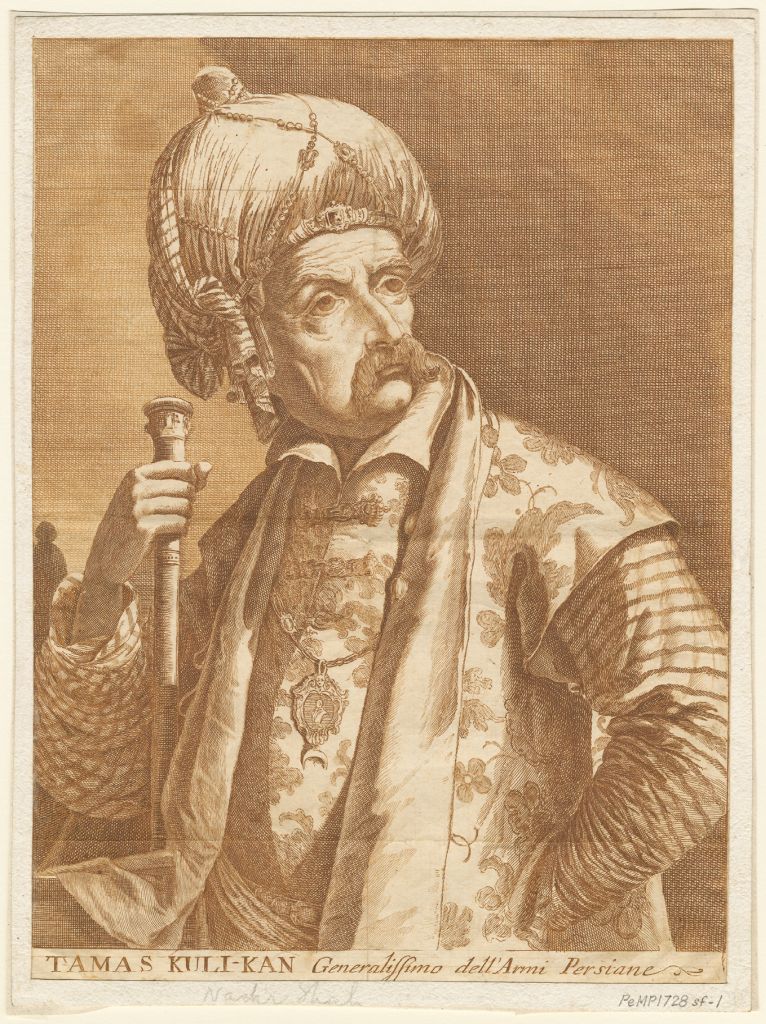
Nader Shah’s reference to ‘several confessions of religion,’ each of which had their ‘own rules and customs,’ reflects his interest in the Abrahamic tradition and thus it is not surprising that, early in 1740, he sent a mollah to Isfahan to assemble a group of Jews, Armenians and ‘Franks’ whom he charged with making a Persian translation of the books of Moses (Genesis, Exodus), the Psalms and the Evangelists (Matthew, Mark, Luke, John). The mollah assigned the Old Testament books to the Jews and the New Testament ones to the Armenians and Franks. The Franco-Armenian committee consisted of two French missionaries, two Catholic Armenians, two Gregorian Armenian priests and two Gregorian Armenian monks. The work commenced in May, 1740, and lasted six months. According to Jonas Hanway, who was with Nader Shah at the time,
The affair was put under the direction of Myrza Mehtie,52 a man of some learning, who being vested with a proper authority for the purpose, summoned several Armenian bishops and priests, together with divers missionaries of the Romish church, and Persian mullahs, to meet him at Isfahan. As to the latter, they could not be gainers; since the change, if any took place, was to be in prejudice of Mahommedanism. Beside, Nadir’s conduct towards them had been severe to an extreme, and unprecedented; many of them therefore gave Myrza Mehtie large bribes to excuse their appearance.
Among the christians summoned on this occasion, only one Romish priest, born in Persia, was a sufficient master of the language, to enter upon a work of so critical a nature. As to the Armenians, tho’ they are born subjects to Persia, and intermixed with the inhabitants, yet there are very few of them who understand the language fundamentally. It was natural to expect, that Myrza Mehtie and the Persian mullahs, would be more solicitous how to please Nadir, and support the credit of Mahommedanism, than to divest themselves of prejudices, and become masters of so important a subject. This translation was dressed up with all the glosses which the fables and perplexities of the khoran [Quran] could warrant; their chief guide was an ancient Arabic and Persian translation. Father Des Vignes, a French missionary,53 was also employed in this work, in which he made use of the vulgate edition.54 They were but six months in completing this translation, and transcribing several fair copies of it.55
At the completion of the work Nader Shah was encamped near Tehran. A delegation comprising the Catholic bishop and two missionaries; the mollah; and four Armenian bishops,56 brought the finished work to Nader Shah:
But when presented with the translation, he said he didn’t have time to examine it, and that since there was only one God, there could only be one prophet. These words saddened our missionaries, who had conceived from this translation ideas advantageous to religion. Since then, we have heard nothing more of the work, and whatever efforts we have made to obtain a copy, we have been unable to do so: all our hopes have thus vanished.57
Hanway, however, gave a more colorful account, noting
Nadir received them with some marks of civility, and had a cursory view of the performance. Some part of it was read to him; on which occasion he made several ludicrous remarks on the mysterious part of the christian religion; at the same time he laughed at the Jews, and turned Mahommed and Ali equally into ridicule. Under such circumstances, it was impossible this performance should produce any good effect. He observed that the evangelists did not agree in their accounts, more than the Mahommedan and christian priests; therefore he must remain under the same difficulty that he was in before: that out of both, if it pleased God to give him health, he would engage to make a religion much better than any which had been yet practised by mankind; with several other vague reflections of the like nature. He then dismissed these church-men and translators with some small presents, not equal in value to the expence of their journey.58
Nader Shah’s tolerance decree would seem to have offered protection to the likes of the Sceriman family, whether Gregorian Armenian or Catholic, who still remained in Iran. In fact, however, like the rest of the Armenians of New Julfa, they became objects of Nader Shah’s wrath, not because of their religion, but because of their wealth. Describing the Scerimans at New Julfa in 1744, Père des Vignes wrote,
Messrs Aroution, Léon and Petros form the main branch of this large and respectable family, and these three brothers are the firmest supporters of the faith. They defend it by their credit, they extend it by their generosity; and it is to the open protection they give to Catholics that the missionaries owe some of the conversions they carry out.59
Elsewhere in the same letter des Vignes praised the brothers of ‘this family so opulent and so Catholic’ for their attempts to safeguard the Catholic missionaries and converts of Julfa.60 However, the Armenian clergy sought to nullify the Scerimans’ influence by accusing Aroution of the murder of an Armenian priest who was travelling from Mashhad to New Julfa, and convincing the Persian authorities to arrest him. Aroution was imprisoned and when his brothers went to see him they declared that, if he were guilty, so were they, and thus joined him in his confinement. The upshot of a long and tortuous process was the complete exoneration of the Scerimans and the defeat of the Armenian clergy who opposed them.
Despite official professions of religious tolerance and the Scerimans’ social standing, the family was singled out for harsh treatment on account of their wealth. Nader Shah made his first visit to Isfahan following his coronation right after Christmas, 1745. This ‘second Herod,’ as he was called in Carmelite sources, ‘opened the courts of his injustice. … It was a sight to see in all parts of the city, and especially in the great Maidan (square) numbers of people of every grade tortured by the royal officials in order to extract money from them in accordance with the orders of the tyrant.’61 The merchants of New Julfa were drained of 60,500 tomans on this occasion, and a further 30,000 in 1746/7.62
Early in 1746 Nader Shah travelled to Mashhad, but when the Armenians of New Julfa learned that he was to return before year’s end, ‘many of them as a precaution got away their children out of the country, sending them by various caravans to Basra, Baghdad orother parts.’ Among those who availed themselves of this opportunity were the
Messrs. Shariman, an Armenian family well known both by their illustrious relatives who live in Europe and have the title of ‘Count’, and for their great riches which they have placed in the hands of various agents of theirs in all parts of the world, and much more by their great attachment and zeal which they have always shown in defending and maintaining in Persia the Catholic Faith and the missionaries, also succeeded in getting their children away from Persia before the return of the Shah. Messrs. Leo and Peter, brothers of Count David living in Leghorn, themselves tried to do the same on the occasion of a caravan leaving for Basra; but their flight being discovered by the governor of the city and Kalantar of Julfa, the latter sent armed men after them, who brought them back to Julfa, to their great misfortune, because they were afterwards obliged to suffer great tribulations.63
Nader Shah returned to Isfahan on December 14th, 1746, and immediately sent out tax-collectors who, in the space of five weeks, managed to squeeze 300,000 tomans out of the population of the city and surrounding villages. In addition, word reached Isfahan that a caravan was coming from Basra, carrying over 5000 tomans, 2000 of which ‘belonged to the Messrs. Shariman’ and was confiscated for the royal treasury.64
The treatment of the Scerimans, and Armenians in general, appears to have had little to do with their religion and everything to do with their wealth. On January 14th, 1747, eight merchants were publicly burned alive. These included the sexagenarians ‘Mr. Aratun Shariman and Mr. Minas, bound together by a chain,’ the first of whom ‘lingered more than an hour in the flames, crying out for mercy and pardon for his sins till he expired. The night after, relatives searched for their bones and, when recognized, those of Mr. Aratun were interred by the Catholics in the sepulchre of his ancestors.’65 Another family member, Petros Shahrimanean, ‘was bastinadoed to within an inch of his life before escaping into hiding, but his brother Lēo died soon after from shock and fear.’66 As the Carmelite chronicler noted,
Since Mr. Peter Shariman passed among the Armenians, and also among the Persians as one of the richest, very many persons gave his name; for that reason the poor gentleman had so many beatings, that he made his last confession and was given the Last Sacraments. Then, as he saw that they never came to an end, fines upon fines, imposts after imposts, hardly had he extricated himself from one than another was put on him, one day he succeeded in escaping from the hands of the extortioners by throwing himself down from the roof of his house into the neighbouring house, near the sacristy of the church of the Carmelite Fathers. He entered their house barefooted, and in a parlous state: he asked the Father for his slippers, and in them he escaped, it was not known where, and hid himself so well that for 45 days and nights that he was sought in all the houses it was never possible to find him: and this flight freed him from death.67
The Carmelite sources put the number of inhabitants ‘killed, mutilated and tortured’ during Nader Shah’s five week stay in Isfahan at 5000.68 Much later, in 1839, John (Hovhannes/Jean/Giovanni) Derderian, ‘a most zealous Armenian Catholic priest who was subsequently elected bishop … but did not live to receive consecration’ as bishop of Isfahan,69 and who is discussed further in Chapters 2 and 3, gave this assessment of Nader Shah, calling him
a man of unbounded avarice and of a cruel disposition. Yielding to his barbarous character, he put out the eyes of Pascal Chehriman,70 a rich Armenian Catholic, and then condemned him to be publicly burned alive, in order to seize upon his treasures. Nadir successively confiscated all the riches of his Armenian subjects, and thus dispersed the Catholics, who abandoned their houses and their lands, and sought an asylum in other countries. Up to our days the churches were all closed, and neither bishop nor missionary was to be found throughout the whole extent of the Persian dominions.71
Beyond pure financial gain, the Carmelite chronicler offered another reason why Nader Shah was so cruel to the Armenian community of New Julfa. He wrote,
The cause why the Tyrant was so angered against the Armenians they say to have been that, having levied an imposition of a certain great sum of money on their patriarch, who usually resides in Echmiadzin, a place in Persian territory, the latter finding himself unable to make so large a disbursement took refuge in Erzerum, a city of the Ottoman dominions: and for that he began to treat all Armenians as rebels, although the Armenian community were not alone in having the misfortune to experience the effects of the cruelty and avarice of the tyrant on their race: Persians, even the more distinguished, were not exempt and in particular all officials and soldiers. For any slight suspicion or pretext found he caused very many of them to perish daily, either by the bowstring or under the pole72 … of eyes every day he had so many put out that heaps could be made of them.73
It is, therefore, remarkable that, despite this brutal treatment, Laurence Lockhart wrote in 1938,
Nādir was tolerant towards his Christian subjects, with whose freedom of worship he never interfered. The Armenian Catholicos Abraham speaks in the highest terms of his good treatment at the hands of Nādir, who even attended service in the cathedral at Echmiadzin … Nādir raised no objection to the presence of foreign missionaries in Iran; a number of these were in Isfahān, while others were in Gīlān.74
As Gozalova, however, observed recently, the Gregorian Armenian catholicos Ghazar was concerned about an increase in Catholic proselytizing amongst the Armenian population, and successfully appealed to Nader Shah to issue decrees calling for the punishment and even expulsion of Catholic missionaries.75 Hence, he was hardly an unbiased observer. An unexpected ‘Christian’ footnote to Nader Shah’s career dates to 1827. When the Bishop of Babylon, Pierre-Alexandre Coupperie (1770–1831), visited Mosul in that year, he was told that during Nader Shah’s siege of the city in 1743, the Ottoman governor there vowed to build two churches in honor of ‘the most holy and most pure Virgin Mary,’ if the city withstood the siege. Although a Muslim, the governor kept his promise and had the two churches built, for which he paid himself.76
4 Zands and Catholics
As John Perry noted many years ago,
both Karim Khan in 1177/1764 and ʿAli Morad in 1195/1781 issued farmans in response to a petition on behalf of the “French Padrés,” the Carmelites, Benedictines, Jesuits, Capuchins, Augustinians, and other orders still residing in various provinces of Iran, guaranteeing them freedom of residence, worship, and trade, as under the Safavids, and protection from molestation by the Armenian Christians, on condition that their behavior did not offend the Shiʾa and its adherents.77
Nevertheless, on August 2nd, 1764, the non-resident Bishop of Isfahan, Cornelius of St. Joseph, wrote from Basra to the Secretary of the Sacred Congregation, ‘Things being in so critical a state not even a single one of our Catholics, who had gone abroad, has so far returned to Persia.’78 Five years later that situation had still not changed, although the Dominican Father de Bernardis expressed the hope, now that Karim Khan’s position had improved, ‘that some Catholic families too will return.’79 But such was not to be the case. Cornelius of St. Joseph, who had only gotten as far as Bushehr, returned to Basra and then Rome. According to an account written, admittedly, almost seventy years later but surely drawing on local knowledge, which began with a description of the relatively flourishing state of the Catholics in Safavid Iran,
This prosperity continued until about the year 1770, when urged on by the intrigues of the heretics [viz, Armenians], the reigning schah raised a cruel persecution against his Catholic subjects; all the missionaries were forced to quit his empire, and the orthodox Persians, in order to preserve their faith, found themselves under the painful necessity of taking refuge in foreign countries. Their churches were either destroyed or desecrated to profane purposes; the houses and property belonging to the missions were confiscated or sold, so that in a short time there was not a single Catholic church throughout the whole empire.80
This may help explain why, in 1770, the Chaldaean Catholic patriarch sent a letter to Clement XIV (1769–1774) expressing a desire to renew ties with Rome, although this was not acted upon. Eventually, with the transfer of the patriarchal seat from Urmia to Kochanes, Diyarbakir and Mosul, this particular papal tie to Iran was lost.81
Oussani 1911: 722–723. Most of this communication was prompted by the desire of the Eastern prelates to effect a union with Rome and it was in this period that the Catholic converts, formerly members of the Church of the East (Nestorians), came to be called Chaldaeans. When Laurent Abel, bishop of Sidon, was sent out to assess the state of the Oriental Christians by Gregory XIII, he took with him a pallium for Mar Simeon Denha, the Chaldaean patriarch. On Laurent Abel, a native of Malta, who died at Rome in 1605 or 1606, see Bayle 1820: 517.
For earlier bibliography see Potts 2014: 205–206. See esp. Richard 1949 and Richard 1998.
Pastor 1901: 441–442. Cf. Rota 2021: 590. Citing Pastor, Meserve 2014: 595 wrote that ‘Julius II may have already entered into secret diplomatic negotiations with Shah Ismail in 1506 aimed at building an international coalition against the Ottomans,’ but this was not stated by Pastor on the pages that she cites.
Chick 1939: 15. The bibliography on this subject is vast. For Safavid-Vatican relations in general see e.g. Rubiés 2011, Rubiés 2016; Kołodziejczyk 2017; Rota 2021.
As described in Rota 2021: 590.
Morgan and Coote 1886: 146–147.
Savory 2003: 441–442.
Chick 1939: 21.
Matthee 2011: 228–229.
Chick 1939: 23–24. For Gregory XIII’s relations with Iran see Karttunen 1911.
Chick 1939: 26.
Chick 1939: 68.
Chick 1939: 27. See also Nanni 2009: 203 and n. 80. According to a notice written on June 9th, 1601, before Hoseyn ʿAli Beg left Rome ‘the Pope presented him with three thousand crowns. Before the departure of the Persian, however, three of his servitors, his secretary, his barber and his cook, separated themselves from him in order to remain here and be baptized in the Christian Faith. The Pope is to give them ten crowns monthly, and he is in hopes that the King of Persia may likewise abandon the Musulman Faith.’ See Klarwill and Chary 1924: 243.
Savory 2003: 443.
For the complete text see Berthold-Ignace de Sainte-Anne 1886: 79–83.
Richard 1990.
The date comes from Araǩel Dawrižeći who put the deportation in the month of Nawasard 1504, i.e. October 21st–November 19th, 1604. See Ghougassian 1998: 25.
Monsignani and Ximenes y Rubente 1768: 418–419, addressing Shah ʿAbbas as, ‘Illustris, ac Potentissime Sciah Abhabas Persarum Rex salute, & Apostolicam benedictionem.’
Monsignani and Ximenes y Rubente 1768: 479–480. As Flannery 2013: 240 noted, however, Shah ʿAbbas ‘appears to have over-estimated the power and influence of the papacy in European politics, attributing to it an authority over the Catholic princes which, as the continued failure to create an anti-Ottoman alliance among them demonstrates, had little basis in fact.’
As Carswell 1968: 7 noted, ‘Shah Abbas was anxious to dispel any ideas that the Armenians might have had of returning to their homeland. Learning that they had not lost their reverence for the holy places at Etchmiadzin, the religious centre of Armenia and the seat of the Catholicos, he decided to provide an alternative, at least in token form. He arranged to have several relics transferred from Etchmiadzin to Isfahan, such as the right arm of Saint Gregory the Illuminator, and in 1614 he had the stone altar and other architectural fragments transported from the cathedral at Etchmiadzin. The relics were placed in the care of the leader of the Armenian community, Khodja Nazar, and the stones were placed in St. George’s Church in Julfa, where they have remained till this day.’ While the stones remained, the relics were returned illicitly to Echmiadzin in 1637. As Carswell 1968: 40 further noted, ‘They were installed in a domed building in the village of Bathoun outside Isfahan, all the Armenians coming to see them, and honour them with incense and candles. Here they remained until the Moslem inhabitants complained that the villagers were dying and the crops failing. The Shah ordered them to be transferred to Julfa, where they were put in the church of Khodjentz (i.e. St. George) in 1614.’
Ghougassian 1998: 204–205, ‘The Decree of Shah ʿAbbas I, to build a Cathedral in New Julfa, with the Sacred Stones of Ēǰmiacin.’ Matthee 2020: 72 pointed to the testimony of Jean Chardin who noted that, because of its décor, which included Biblical scenes, the cathedral became an attraction which drew Muslim visitors.
For the family tree see Aslanian 2011: Fig. 14 with notes.
Korsch 2014: 227.
Chardin 1711: 7.
Korsch 2015: 366. Aslanian 2011: 28 noted that, even before the Armenian deportation to New Julfa, ‘old’ Julfans had appeared at Venice, according to the state archives there, from as early as 1571.
Korsch 2015: 367.
Atamian 1984: 145, n. 1.
Chick 1939: 1358.
Aslanian 2011: 150 and n. 97; Korsch 2014: 228. Esche-Ramshorn 2021: 77 suggested that, because the Scerimans came originally from Old Julfa, and Old Julfa is relatively close to Alinja (Ernjak) where the Dominicans were active beginning in the 1330s, ‘in Old Julfa, during the sixteenth century and probably before that time, there must have existed a Catholic church, where mass was celebrated according to Latin rite.’ This is by no means certain and the conversion of Sarat Sceriman, as well as the later involvement of the Scerimans with the Catholic church, suggest rather that their Catholicism post-dated their deportation from Old Julfa and had nothing to do with putative, earlier Dominican influence. Cf. Landau and Lint 2015: 315, n. 34, ‘The conversion to Catholicism of the entire family does not seem to have taken place before the deportation to New Julfa.’
Berchet 1864: 13. Cf. Zekiyan 2009: 99 noted, ‘the well known family Shehrimanian (Sheriman, Sceriman, Seriman), which settled in Venice from New Julfa, is estimated to have been one of the richest families in Europe in the first half of the 18th century.’ And in Zekiyan 2009: 99, n. 19 we read, ‘Besides the many interest-free or low-interest loans that the Shehrimans granted to the Serenissima, they still contributed to her finances on different occasions by sunk capital gifts, whose total amount was nearly two million gold ducats. If we consider that the Shehriman family expended four thousand ducats simply to buy their palace in the neighbourhood of Santi Apostoli in Venice, the amount of two million ducats should be evaluated in today’s [2009] currency at something around 15 billion Euros.’ For an overview of the family see Chick 1939: 1358–1362; Bonardi 1969; Aslanian 2011: 149–158. For their Russian business interests see e.g. Kotilaine 2004: 457–458. The Šahrimanenk’ family is attested on a petition dating to 1671 which the New Julfan Armenian merchant Grigor Lusikov used when he negotiated a trade agreement between the Armenian merchants of New Julfa and the Kingdom of Russia. See Ghogoussian 1996: 89.
Savory 2003: 442. Disguised in Persian dress, however, Thevenot himself entered the mosque without incident. See Thevenot 1674, ‘Christians are not allowed to enter, and if they are recognized, they are chased away with sticks like dogs, but this did not prevent me from going with Monsieur Diagre, Dutch Commander in Ispahan, who for this purpose dressed in the fashion of the country, as well as myself, and we received no displeasure.’
Chick 1939: 379. As Willem Floor (pers. comm.) informs me, ‘the Roman Catholic Armenians were also called Frank or Farangi.’
Cubero Sebastián 1682: 224–226. Cf. La Harpe 1820: 414. Cf. Noonan 2007: 104. My thanks to W. Floor for bringing Cubero Sebastián to my attention.
Landau and Lint 2015: 318, 320. The building was also known as Surb Aweteac‘ after its architect, Aweteac‘ Gilanentz.
Although Yovhaniantz wrote in 1871 that ‘the ruins are still visible’ (Carswell 1968: 8, n. 31; cf. Ershadi 2009: 24 who said it was destroyed), see Carswell 1968: 57–58 and Pls. 60–61 for the building and its paintings.
Also Desvignes. Michel Raymond des Vignes was born at Arles on November 2nd, 1704, was received into the Jesuit order of the province of Aquitaine on March 3rd, 1726, and travelled to Julfa in 1737 where he became the Superior of the mission in 1754. According to Sommervogel 1898: 747, he was still alive in 1758. However, O’Neill and Domínguez 2001: 233 say he died in Baghdad in 1757. See also Backer 1876: 1399.
Jancigny 1854: 174.
Aimé-Martin 1838: 434. Backer and Backer 1861: 749 list him as ‘Vignes, des, Jésuite français, missionnaire en Perse au milieu du 18e siècle,’ and it is clear that this was Michel Raymond des Vignes.
Windler 2018: 348. For a much later letter to Pope Clement XIII by another Sceriman, see Sceriman 1761.
Korsch 2014: 228.
Windler 2018: 351. For the Scerimans’ activities at Livorno, where David Sceriman was by far the richest of the Armenians settled there during the 1730s and 1740s, see Sanacore 1988: 127–160 and Trivellato 2000: 213–214.
For the jizya or poll tax levied on the Armenians of New Julfa see Ghougassian 1998: 59, 83.
Korsch 2015: 367.
Baghdiantz-McCabe 1997: 390.
Wilson 1896a: 345. Cf. Boré 1840/2: 256ff.
Lucas 1705: 75. Here the distinction is made between Isfahan proper and the suburb of New Julfa, which are separated by a river, i.e. the Zayandeh Rud.
Hurewitz 1956: 37. For the original French text see e.g. d’Hauterive and de Cussy 1844: 389–390; Thieury 1866: 45–56. Two further firmans were issued by Shah Soltan Hoseyn ‘in favor of the French.’ See Thieury 1866: 57–61.
As Aslanian and Berberian 2009 noted, despite the relocation of the family’s ‘head office’ to Venice, ‘The Julfa branch was integral to the smooth functioning of the firm and was, therefore, maintained as long as possible for at least two reasons. First, the traditional capital-generating markets for the firm were in India and southeastern Asia, which meant that having a regional office in Julfa was strategically useful in linking the Mediterranean sphere of Sceriman activities with those of the diamond and gem markets in the Indian Ocean. The second reason could have to do with the fact that despite their Catholicism and eagerness to integrate, assimilate, and succeed in their host society in Venice, the Scerimans still remained Julfan Armenians, at least as far as their trading habits were concerned.’ See Korsch 2014: 227.
Emmanuel, attested in the Sceriman family tree. See Aslanian 2011: Fig. 14.
Cerceau 1741: 117. The embassy reached Constantinople on January 18th, 1726.
For the text see Gozalova 2023: 144.
Mirza Mahdi Khan Astarabadi, Nader Shah’s ‘main chronicler.’ See e.g. Matthee 2024: 115. Sir William Jones published a French translation of Mirza Mahdi’s Tarikh-i Jahangusha-ye Naderi as Jones 1770.
Père des Vignes, discussed above.
The Latin translation by St. Jerome.
Hanway 1762: 404. Cf. the discussion in Thomas 2015: 157–158.
Nader Shah showed great respect and even affection for Abraham of Crete who wrote extensively about the period 1734–1736 when he met ‘the khan called Alexander,’ i.e. Nader Shah, and was given costly presents including robes of honor by him. See Bournoutian 1999: 66. My thanks to W. Floor for pointing out the importance of Abraham of Crete in this regard.
Aimé-Martin 1838: 444.
Hanway 1762: 404. Cf. the abbreviated discussion in Thomas 2015: 156 and n. 43.
Aimé-Martin 1838: 434–435.
Aimé-Martin 1838: 438.
Chick 1939: 649.
Herzig 1991: 106–107; Aslanian 2011: 204.
Chick 1939: 650.
Chick 1939: 651.
Chick 1939: 652.
Herzig 1991: 107 and n. 404.
Chick 1939: 651.
Chick 1939: 653.
Oussani 1911: 723. Referred to as ‘monseigneur Giovanni Derdérian’ in some sources. See Boré 1840/2: 477, 479.
The extensive Sceriman family tree (Aslanian 2011: Figs. 13–14) contains no ‘Pascal.’
According to Derderjan 1839a: 87. For a French version see Derderjan 1839b: 503. Cf. Anonymous 1840c: 43 which, however, misdated Nader Shah’s deed to 1770, several decades after his death.
Meaning by bastinado, using long, pole-like sticks of wood.
Chick 1939: 653.
Lockhart 1938: 395.
Gozalova 2023: 155.
Coupperie 1828a: 123–124.
Perry 1979: 222.
See Chick 1939: 663.
Chick 1939: 670.
Anonymous 1839a. Cf. Anonymous 1839b: 501 for a French translation of the same.
Oussani 1911: 723.