


1 Introduction
Since the early 1990s, Nordic higher education (HE) has been reshaped by government-led reforms inspired by New Public Management (NPM). These initiatives introduced market-oriented reforms into the sector by streamlining the governance and operations of HE institutions (HEI s), emphasising efficiency, clearly defined roles, and enhanced accountability – often at the expense of traditional collegial governance and professional autonomy. The consequence, however, was a gradual hybridisation of traditional and market-oriented features within HEI s. This blending has permeated various dimensions of
In 2020, university sector was hit by the COVID-19 pandemic. The abrupt shift to remote work, accelerated digitalisation, and the disruption of international travel introduced new operational arrangements within Nordic HEI s. These changes built upon ongoing transformation processes driven by technological advancement and globalisation. The interaction between these new arrangements and the ongoing infusion of new values and logics in HE further deepened and broadened the process of hybridisation to encompass the blending of physical and digital services and structures. These intertwined hybridisation processes, shaped by the Nordic model of HE – characterised by a commitment to egalitarianism, the view of higher education as a universal welfare right and a driver of societal and economic progress, substantial public funding, and strong state–university relations – have become central to the resilience mechanisms of HEI s in the Nordic region.
Although popular in academic and policy communities, hybridity is still a debated concept (Pekkola et al., 2021). In the context of governing organisations and societies, hybridity (a concept that has its origin in biology) is defined as the “impure existence in between pure types” of governance logics (Johanson & Vakkuri, 2017). More specifically, in public policy and organisational research, hybridity refers to the coexistence of different sets of institutional drivers within the same unit of analysis. Hence, it encompasses a spectrum of blending arrays between contradictory institutional logics and values, across different analysis layers (Johanson & Vakkuri, 2017). Hybridity thus asks for analyses in multiple levels such as: professional work, organisation, institutional logics, politics and public policies as well as missions of universities. Often these levels are nested or interrelated, giving rise to tensions and dilemmas which cannot be adequately addressed without systematic and critical scrutiny (Pekkola et al., 2021).
Despite multi-level hybridity has become increasingly entrenched – especially in the Nordic HEI context – limited attention has been paid to hybridity as a driver of organisational resilience. Yet universities are among of the oldest and most enduring institutions in Western societies, perhaps precisely because of their ability to adapt to changes, survive crises, and cultivate institutional resilience. In particular, there is a lack of systematic exploration into how hybrid arrangements, whether positively or negatively, emerge and take shape through the everyday activities of HEI s and have impact on (a) the primary tasks of teaching, research, and societal engagement/innovation, (b) the
This chapter is structured as follows. First, we discuss the recent crises and their role in development of HE. After that we discuss hybridity as a resilience mechanism for the changes caused by external triggers. Finally, we outline the content of the book organised into three sections: (1) a conceptual overview of hybridity in HE, (2) hybridity as a response to crises such as COVID-19 pandemic; and (3) hybridity as a response to neoliberal policies in HE.
2 Higher Education in Crises?
Hybridisation is inherently a process of change, which in turn comes in many forms: it can be limited or comprehensive, planned or emergent, sudden or continuous (Dee et al., 2023). According to Tight (2024), HE scholars and practitioners often frame situations involving change as crises whenever possible. Consequently, HE is perceived as being in a state of constant crisis, meaning it faces perpetual environmental challenges while still maintaining its core functions and activities.
Crisis, however, represents a particular form of change, or at least the potential for change, that poses a threat to existing goals or values (Milburn et al., 1983). This implies that both organisations and societies must actively respond to such crises. Typically, discussion around crises revolves around the direction and extent to which the world and the organisations around us will transform. However, as Marmolejo and Groccia (2022) note in the context of HE, there is often a prevailing assumption that once a crisis, such as the COVID-19 pandemic subsides, operations and practices will revert to their previous state of normalcy.
Consequently, not all disruptions in HE meet the etymological definition of a “crisis,” derived from the Greek krisis, signifying a decisive turning point in matters of life and death (Online Etymology Dictionary, 2021). Tight (2024) argues that, in many cases, the term “crisis” should be replaced with “issues” or “challenges” to more accurately reflect the realities of the academic environment. Nevertheless, he identifies seven overarching attributes of crises in the literature. First, the most evident recent crisis in the literature is (i) the COVID-19 pandemic. Second and third, there are two persistent streams of crisis literature: the impacts of (ii) environmental and (iii) economic crises on HE. These include a body of literature addressing (iv) student mental health crises,
The market-emulating reforms beginning in the 1980s represent one of the topics that have affected the provision of public services, including HE. The fundamental change, in contrast to previous government reforms, was that the position of public administration was politicised, and the government apparatus itself became a target for policy reform (Pollitt & Bouckaert, 2017). Austerity measures together with marketisation, privatisation, and contracting out have – where implemented – altered the role of government in service provision to backseat control rather than front seat driving, blurring previously established links between production, governance and accountability (Pierre & Painter, 2010). The introduction of a managerial approach, performance measurement, and the positioning of service users as clients rather than citizens have in many places swept throughout public service provision, altering the balance between intrinsic and extrinsic motivation among public servants (Frey et al., 2013). Universities have not evaded the influence of these reforms, and in many cases, the university community has been highly critical of these developments (Deem & Brehony, 2005; Marginson, 2013).
Because of the abovementioned changes, many former government entities have evolved into hybrid organisations: While they continue to rely on public funding and remain subject to government control and oversight, they no longer operate as traditional public agencies. In these cases, the dependency on public funding and continuous government control mean that the service providers have not transitioned into fully independent, private entities either. In other cases, the public status has been maintained but complemented by the creation of market-like structures characterised by competition (Kettunen et al., 2022). Being situated between public and private implies that universities, among other organisations attracting public interest, orbit the government’s gravitational field, being inextricably tied to its workings and interests regardless of the practicalities of each particular system – but interact with the competing and merging logics in new, challenging ways (Adams & Balfour, 2010).
As this overview illustrates, the two predominant challenges universities have faced in recent decades are the COVID-19 pandemic and shifts in the politico-economic landscape. While the pandemic posed an immediate threat to operations, it has also given rise to a series of post-pandemic challenges that have reshaped the HE landscape. The political and economic shifts, however, represent a slower and more gradual structural and cultural transformation.
3 Changing Higher Education Landscape and Resilience
Contemporary research has introduced resilience as a relevant concept to address HEI s’ ability to respond and adapt to the above discussed crises and disruptions (Pinheiro et al., 2022). Resilience is a way of organisations responding to environmental changes and threats by adaptation of their internal design and structures (Frigotto et al., 2022). The term originated in the natural sciences where it was used to describe the elasticity of materials – their capacity to (a) bounce back, i.e., to return to its original state after an external shock, or (b) adapt to a new situation, while preserving its nature (Frigotto et al., 2022). Resilience stands in opposition to fragility, the susceptibility of a material to reach its breaking point when under stress. In a HE context, resilience refers to properties of academics, universities and HE systems which enable them to survive despite disruptions and adverse events. The notion of resilience is akin to using contingency theory to gauge organisations’ capacity to adapt to external environmental demands and uncertainties (Pinheiro et al., 2022).
The environmental change that calls for resilience can be traced back to adversity triggers, which can be either expected or unexpected (Frigotto et al., 2022). In this volume, we address different types of adversities: First, COVID-19 represented an unexpected crisis for which HEI s were largely unprepared. In the immediate aftermath, universities were forced to pivot quickly, shifting from traditional in-person learning to remote and hybrid models with little time to plan or adapt. This disruption not only tested the resilience of institutions but also highlighted significant gaps in infrastructure, technology, and support systems. In the longer term, the aftermath of the pandemic has continued to pose challenges, as universities grabble with ongoing financial repercussions, shifts in student expectations, and the need for sustained digital transformation. The crisis also prompted a re-evaluation of the role of HE in society, as well as the long-term viability of certain educational practices and structures, leaving institutions to contend with both the immediate consequences and the enduring impacts of the pandemic.
Second, and in contrast, financial crises and related issues have been a long-standing concern, discussed extensively since the era of Reagan and
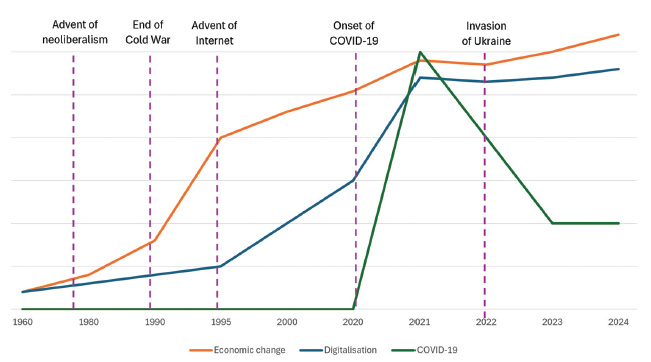
As the cases presented in this book illustrate, the composite crises resulting from the interplay of multiple adversities have prompted HE systems’ resilience not only to “bounce back” (i.e., absorptive resilience, see Frigotto et al., 2022) but also to develop enduring changes (i.e., adaptive or even transformative resilience, see Marmolejo & Groccia, 2022). Yet, the nature of the resilience response provided by a system as complex as HE – whether if it bounced back or “forward”, and how – can only be witnessed over time. The three main changes and adversities (COVID-19, economic change, and digitalisation) discussed in this volume have fundamentally different timelines. Figure 1.1 depicts the extent of these changes and adversities as contrasted against the five HE environment impacting change triggers identified.

Change triggers and the extent of economic change, digitalisation, and COVID-19 effects over time
4 Post-Pandemic Resilience and Hybridity
Resilience mechanisms are expected to vary depending on the differing timelines and impacts of these changes. However, there is a clear and recent convergence of change triggers that not only build upon one another but also create new conditions for the continued functioning of HE. This sets the stage
There are three main viewpoints on the position of hybrids in changing societies: (1) Hybridity as a consequence of government reform efforts, (2) Hybridity as an inherent part of society, and (3) hybridity as a medium for collective action. These perspectives correspond with the position of HEI s differently.
From the first viewpoint, hybridity would result from layered logics, traditions, and reforms forcing affected organisations to find new ways of combining an expanding array of governing mechanisms rooted in diverse and sometimes conflicting ideals (Sahlin, 2012). It could therefore be viewed as crossbreeding of different ways of thinking and acting into new perspectives and systems containing elements of both their origins as well as emergent properties resulting from the unique combination itself. Such crossbreeding could be intentional, but more likely results from the incremental introduction of new mechanisms rooted in different political hegemonies, without the simultaneous retirement of the mechanisms already in place. This positions universities as recipients – perhaps even victims – of public policies cascading down upon them over time, forcing adaptation to changing conditions, while positioning hybridity as either a side-effect of reform patterns or as a method of dealing with resulting challenges.
According to the second viewpoint, hybridity is an essential part of any society, both historical and contemporary. At the point of origin, the lack of division of labour between governing, trade, and community building enmeshed human activity in a primordial soup with rudimentary separation between institutions (see Stross, 1999). The building of states has been a long-term process in which markets, civil society, and government have evolved from personalised relationships and kinship to more organic types of interaction, such as stockholding in business enterprises, neutral and meritocratic bureaucracies in governments, and an active civil society organised around shared interests rather than locality or family ties (Rueschemeyer, 2005). From the hybridity point of view, the parts of society are still not totally separate entities, but rather interconnected structures with fluid and porous boundaries, far from being exclusive or insurmountable (Migdal, 2001). In this context, the
From the third perspective, hybridity appears as a medium to tackle the grand challenges of modern societies, such as poverty, inequality, peace preservation, and climate change, as codified for instance in the United Nations’ Sustainable Development Goals (SDG s). More specifically, the hybridity lens offers possibilities to see options for concerted action that transcends the traditional boundaries of business, government, and civil society. Here, local solutions in combining enabling rule systems with the sustainable use of resources (Ostrom, 1990) can be used to overcome some of the collective action problems (Olson, 1971). HE plays an important role in equipping students with a broad understanding of how society functions. Thus, the rise of hybridity places demands on HEI s to adapt and integrate these perspectives into their curricula (Johanson et al., 2024).
The central question emerging from the above notions is whether hybridity fosters and promotes resilience or not. The answer is not straightforward. First, as the following chapters will demonstrate, whether universities adhere to their traditional models or adopt and adapt to new modes of operation, they remain inherently hybrid in their composition. Second, adoption of new hybrid forms offers neither a guaranteed path to success nor an inherent threat to the existence of HEI s.
Overall, traditional hybrid HE systems have demonstrated remarkable durability, representing one of the oldest and most enduring forms of organised human activity. However, while hybridity may foster resilience by enabling flexibility and innovation in governance, teaching, and research, it could also present some significant challenges. The coexistence of competing institutional logics, as demonstrated in the chapters in this volume, can create ambiguity in decision-making, role conflict among academic staff, and tensions between managerial and collegial governance structures. Hybrid work practices may also strain institutional coherence and complicate accountability, particularly when balancing professional autonomy with performance metrics.
As inherently complex organisations with multiple stakeholders and missions, universities must navigate these tensions carefully. This volume views hybridity at institutional, organisational, and individual levels as a key contributor to organisational resilience and long-term sustainability. However, in an
5 Book Outline
The book integrates empiric studies approaching cross-level hybridity which affects diverse types of HEI s in the Nordic countries – from diverse angles, and through diverse methods. The included chapters aim to understand how the emergence and prominence of hybridity at Nordic HEI s shape and are shaped by core university tasks; formalised arrangements; and academic (cultural) postures and mindsets. The book is divided into three sections. The first section offers a conceptual overview and introduces the chapters. The remaining two sections explore the contexts of hybridity: sudden crises and a slowly changing political environment. One context is marketisation, which has been reshaping and challenging academic work for decades. Despite being both a continuing and already experienced phenomenon, marketisation driven changes continue to be a source of turbulence for universities. The other context is the impact of the COVID-19 pandemic and its aftermath, which triggered an acute crisis in HE, compelling universities to adapt rapidly and often under considerable pressure. This was illustrated in Figure 1.1 above in which we positioned hybridity as a resilience mechanism, enabling institutions to respond to adversity triggers within their institutional environment.
5.1 Conceptual Overview: Hybridity in Higher Education
The first section of the book provides a conceptual foundation for the discussion on hybridity as a response for societal change. In Chapter 2 Johanson et al.
5.2 Managing Crises Triggered by the Pandemic, War, and Digitalisation
The second section of the book discusses hybridity as a response to pandemic and digitalisation development peaking during the Covid 19. In Chapter 4 Perkins studies the relationship between hybridity theory and crisis management using HEI s as a case. He explores the utility of hybrid theory, which focuses on, for example, conflicting demands, values, and norms, to facilitate understanding of crisis management. The chapter explores crisis leadership in hybrid organisations and offers insights on how to facilitate it across various types of organisations. In Chapter 5 Lundborg and Geschwind explore management during crises in Swedish HEI s. Managing hybrid organisations, such as HEI s, requires navigating complex expectations, including the external environment, but also taking the internal interests into account. The authors explore what happens to the complex structures of HEI s, which are easily influenced by their environments, when faced with disruptive crises.
The crises have also impacted the work practices and international relations in HE. In Chapter 6 Santos et al. examine the evolving forms of work in higher education institutions (HEI s) in the post-COVID-19 context. The transition from fully remote work during the pandemic to hybrid arrangements – combining on-site and remote work – has posed new challenges for HEI managers. The authors focus on how this shift has reshaped managerial practices and perspectives within Finnish universities. In Chapter 7 Juusola studies the nested hybridity in HE co-operation during unexpected situations, such as times of war. International HE collaboration is sensitive to global circumstances and to the current social and political dynamics. The author examines the moral justification of HE collaboration, at national, organisational and operational levels in Finland and Sweden, in the context of Russian invasion of Ukraine.
5.3 Crises and Marketisation
The third section of the book approaches hybridity as a response to more structural and long-term crises or issues changing the HE landscape. In Chapter 10 Rajala explores hybridity in terms of different accountabilities that manifest in teaching at HEI s. More specifically, the chapter compares market and quasi-market accountabilities arising from competition over students and funding at HEI s.
Two chapters in this section examine academic leadership within a changing environment. In Chapter 11 Hedmo and Waks study hybrid professionalism and analyse the roles, work tasks, and expectations related to academic leader positions (such as department heads and chairs) in Swedish public universities. In Chapter 12 Siekkinen et al. examine the hybrid roles of academic middle managers in Finnish universities. In this context, middle managers operate in dual capacities – as academic professionals and as organisational managers – navigating the demands of both roles within the university environment.
The HEI s respond to the new environment also by changing their governance and accountability structures. In Chapter 13 Mikkonen et al. explore the manifestation of hybridity at different levels of the nested systems of Universities of Applied Sciences in Finland and provide insights into how board members navigate and reflect on competing values in their governance roles.
When the overall operating landscape of HE changes, HEI s face multiple demands for accountability alongside growing expectations for collaboration with other societal actors. It is not only the work practices and steering that are becoming increasingly hybrid, but also new organisational actors who are navigating these changes. In Chapter 14 Kärkkäinen and Muhonen examine
Overall, the chapters in this volume highlight hybridity as a defining feature of contemporary higher education, particularly within the Nordic context. In Chapter 15, Pekkola et al. conclude the book by summarising its key findings and political implications related to perceiving hybridity as a resilience mechanism for HEI s in a changing environment.
References
Adams, G. B., & Balfour, D. L. (2010). Market-based government and the decline of organizational ethics. Administration & Society, 42(6), 615–637.
Alajoutsijärvi, K., Kettunen, K., & Pinheiro, R. (2024). Ideologies shaping university competition. Studies in Higher Education, 49(10), 1710–1719.
Britannica. (2024, October 17). Hybrid. In Encyclopedia Britannica. https://www.britannica.com/science/hybrid
Dee, J. R., Leišytė, L., & van der Meulen, B. J. R. (2023). Conceptualizing higher education transformation: Introduction to the research handbook on the transformation of higher education. In L. Leišytė, J. R. Dee, & B. J. R. van der Meulen (Eds.), Research handbook on the transformation of higher education (pp. 2–23). Edward Elgar.
Deem, R., & Brehony, K. J. (2005). Management as ideology: The case of ‘new managerialism’ in higher education. Oxford Review of Education, 31(2), 217–235.
Frey, B. S., Homberg, F., & Osterloh, M. (2013). Organizational control systems and pay-for-performance in the public service. Organization Studies, 0(0), 1–24.
Frigotto, M. L., Young, M., & Pinheiro, R. (2020). Resilience in organizations and societies: The state of the art and three organizing principles for moving forward. In R. Pinheiro, M. L. Frigotto, & M. Young (Eds.), Towards resilient organizations and societies. A cross-sectoral and multi-disciplinary perspective. Palgrave Macmillan (Open access). https://doi.org/10.1007/978-3-030-82072-5_1
Johanson, J. E., & Vakkuri, J. (2017). Governing hybrid organisations: Exploring diversity of institutional life. Routledge.
Johanson, J. E., Vakkuri, J., Dudau, A., & Mills, D. (2024). Hybridized public management. Australian Journal of Public Administration, 83(2), 1–24.
Kallo, J., & Välimaa, J. (2025). Higher education in Nordic countries: Analyzing the construction of policy futures. Higher Education, 89(2), 275–292.
Kettunen, K., Alajoutsijärvi, K., Hunnes, J. A., & Pinheiro, R. (2023). Emergence and early institutionalization of competition in higher education: Evidence from Finnish business schools. Tertiary Education and Management, 29(4), 365–389.
Marginson, S. (2013). The impossibility of capitalist markets in higher education. Journal of Education Policy, 28(3), 353–370.
Marmolejo, F. J., & Groccia, J. E. (2022). Reimagining and redesigning teaching and learning in the post-pandemic world. New Directions for Teaching and Learning, 2022, 21–37. https://doi.org/10.1002/tl.20480
Milburn, T. W., Schuler, R. S., & Watman, K. H. (1983). Organizational crisis. Part I: Definition and conceptualization. Human Relations, 36(12), 1141–1160.
Migdal, J. S. (2001). State in society: Studying how states and societies transform and constitute one another. Cambridge University Press.
Olson, M. (1971). The logic of collective action: Public goods and the theory of groups, with a new preface and appendix (Vol. 124). Harvard University Press.
Ostrom, E. (1990). Governing the commons: The evolution of institutions for collective action. Cambridge University Press.
Pekkola, E., Pinheiro, R., Geschwind, L., Siekkinen, T., Carvalho, T., & Pulkkinen, K. (2021). Hybridity in Nordic higher education. International Journal of Public Administration, 45(2), 171–184.
Pierre, J., & Painter, M. (2010). Why legality cannot be contracted out: Exploring the limits of new public management. In. M. Ramesh, E. Araral, & X. Wu (Eds.), Reasserting the public in public services: New public management reforms (pp. 49–62) Routledge. https://doi.org/10.4324/9780203858523
Pinheiro, R., Frigotto, M. L., & Young, M. (2022). Towards resilient organizations and societies: A cross-sectoral and multi-disciplinary perspective (p. 336). Springer Nature.
Pollitt, C., & Bouckaert, G. (2017). Public management reform: A comparative analysis-into the age of austerity. Oxford University Press.
Ramirez-Barrera, A., Rojas-Berrio, S., Rincon-Novoa, J., & Montoya-Restrepo, L. A. (2024). Experiences in higher education in times of pandemic: A systematic review of the literature. Journal of e-Learning and Knowledge Society, 20(1), 37–46.
Rieseberg, L. H. (1997). Hybrid origins of plant species. Annual Review of Ecology and Systematics, 28(1), 359–389.
Rueschemeyer, D. (2005). Building states – inherently a long-term process? An argument from theory. In P. Evans, M. Lange, & D. Rueschemeyer (Eds.), States and development: Historical antecedents of stagnation and advance (pp. 143–164). Palgrave Macmillan.
Sahlin, K. (2012). The interplay of organizing models in higher education: What room is there for collegiality in universities characterized by bounded autonomy? In B. Stensaker, J. Välimaa, & Sarrico, C. (Eds.), Managing reform in universities: The dynamics of culture, identity and organisational change (pp. 98–221). Springer Nature.
Stross, B. (1999). The hybrid metaphor: From biology to culture. Journal of American Folklore, 112(445), 254–267.
Tight, M. (2024). The crisis literature in higher education. Higher Education Quarterly, 78, e12504. https://doi.org/10.1111/hequ.12504