


1 Introduction
Hybridity in international higher education collaboration (IHEC) is multifaceted. It combines intersections with different geographical locations, cultural and social environments and policy objectives (Marginson, 2022), which are interpreted in different ways within higher education institutions themselves (Bamberger & Morris, 2023). IHEC is also highly sensitive to global circumstances and the social and political dynamics that these entail. This sensitivity can manifest itself in various and unexpected ways. For example, geopolitical shifts may change immigration policies and diplomatic relations or directly affect international mobility (Juusola & Nokkala, 2024).
This research addresses the following questions: How does the war in Ukraine manifest itself at the national, organisational and operational levels in Finland and Sweden in the context of IHEC, and 2) how are these reorganised premises justified? The interpretation is based on the analytical approaches of HEI s as nested hybridity (Pekkola et al., 2020) and the convention-theoretical understanding of reality tests (Boltanski, 2011) and moral justification (Boltanski & Thévenot, 2006). These approaches highlight the efforts of higher education institutions to pursue the ‘common good’ in challenging circumstances, drawing on a variety of values and underlying principles. This in turn allows us to observe how, from IHEC’s perspective, HEI s are increasingly situated as nested hybridities at the intersection of moral and pragmatic questions. The future direction of these issues is sought through the deployment of strategies, but their resolution requires situational awareness in order to act appropriately in the moment.
2 Shared Values and Diverging Strategies of IHEC in Finland and Sweden
In general, IHEC is linked to several institutional, national, European and, increasingly, global objectives. For higher education institutions (HEI s), IHEC can mean, for example, attracting international students (Filippou & Jokila, 2024) and improving research quality through international collaboration (Bamberger & Morris, 2023). Institutional goals are also linked to national and European goals, for example through the development of reputation and regional competitiveness (Brankovic, 2018). Furthermore, IHEC is increasingly expected to act as a catalyst for solving global problems and promoting sustainable development (de Wit & Deca, 2020). As such, IHEC’s activities also have a moral obligation to embrace diversity and strive for the global common good.
Despite the common Nordic value base, there are also differences between the goals of Finnish and Swedish IHEC activities. For example, solidarity and the development of collaboration with the global South has been one of the main rationales for IHEC activities in Sweden for decades (Alexiadou & Rönnberg, 2022). In Finland, similar approaches have been promoted, for example with the establishment of the Global Networks initiative (MINEDU, 2024), funded by the Ministry of Education and Culture, but visible education policies have been strategically focused on attracting skilled workers and promoting education export implementations (Juusola & Nokkala, 2024). These are not entirely exclusive to Sweden either, and there have also been initiatives by national higher education teams to boost the economy, for example by emphasising the knowledge nation and introducing annual tuition fees for students from outside the EU/EHEA (Alexiadou & Rönnberg, 2022).
At the same time, geopolitical differences have partly coloured the education-related internationalisation goals of these two countries. For example, Finland had a representative of the national education network ‘Team Finland’ in Russia, whose aim was to promote Finnish higher education and research and to foster bilateral collaboration between Finland and Russia (MINEDU, 2017). The Finnish government had also funded a bilateral mobility programme to support such collaboartion (Mäkinen, 2023). After the outbreak of the war, Team Finland’s activities in Russia were suspended. Nevertheless, educational collaboration also produced results. This becomes clear when examining the nationalities of international students in Finland, where Russian citizens were the second largest group both in 2018 and even after the start of the war in Ukraine in 2022 (NAE, 2023a). In Sweden, on the other hand, the number of students arriving from Russia is not among the most common nationalities in these sample years, although some students from Russia do study in Sweden (SCS, 2024). However, as far as student exchanges are concerned, the number
Overall, the IHEC reveals underlying factors related to geography, history and security policy. Finland’s historical location between Russia and Sweden has shaped its international relations for centuries. In addition, the Russian-speaking minority is the largest minority group in Finland, which has created a rich social and cultural connection between Finland and Russia (Jasinskaja-Lahti et al., 2024). In Sweden, the Russian-speaking population is significantly smaller (Karpava et al., 2018), and relations to Russia is likely to be more visible in national politics and less so in everyday life. From the perspective of the IHEC, Finland’s relations with Russia are thus socially more multilayered than Sweden’s relations with Russia. It is therefore not surprising that, prior to the war in Ukraine, Finland had a strong strategic focus on developing both educational and research collaboration with Russian higher education institutions (MINEDU, 2017).
3 Nested Hybridity and More Justification in IHEC
IHEC can be seen as an example of nested hybridity of higher education, where public value is created through non-linear processes that occur simultaneously at different levels and are linked to different drivers (Pekkola et al., 2020, 2022). Indeed, IHEC is not situated only in the middle ground between public and private, but also between regulatory and non-regulatory, nationally embedded and cross-border (see e.g., Marginson, 2022). This gives rise to sometimes conflicting and multi-layered value-creation processes. For example, national labour policy goals include attracting international students, while HEI s seek international visibility through foreign partnerships and facilitate internationalisation opportunities for staff and students (Bamberger & Morris, 2024; de Wit & Deca, 2020; Filippou & Jokila, 2024).
Multi-faceted nature of IHEC reflects the complexity of nested hybridity. As Pekkola et al. (2020) note, nested hybridity in higher education involves multiple levels, including policy, system, organisational, positional, work and individual levels. These levels are interlinked, meaning that the effectiveness of policy and strategic actions is ultimately manifested in micro-level professional practices (Pekkola et al., 2020). Nested hybridity is also related to the value creation of higher education in the public sphere and its operational legitimacy (Johanson & Vakkuri, 2017; Pekkola et al., 2020). This is particularly relevant in times of uncertainty. For example, geopolitical upheavals, such as the war in Ukraine, may lead to both strategic and moral re-evaluations within IHEC, affecting operational accountability (Juusola & Nokkala, 2024).
In the IHEC context, for example, social representation may form areas from which fee-paying students are recruited. Similarly, the IHEC ‘reality’ gathers elements from different angels such as national higher education policy strategies and EU funding instruments such as the Erasmus plus mobility programme. Thus, the reality of IHEC is sustained at local, national and global levels, and these levels overlap (Marginson, 2022). For example, the funding instruments of the Erasmus plus programme can be applied nationally in a way that corresponds to national strategic areas, or institutionally in a way that corresponds to the institution’s own starting points. Reality tests support this, and these reality tests also form categories and symbolic representations with which HEI s can justify what is fair and what is unfair. However, according to Boltanski (2011), there is a distinction between reality and the world. Boltanski (2011) defines the world as ‘everything that happens’, so the world itself is messy and unpredictable. To deal with this, HEI s can focus on controlling their operational attention to reality, which is therefore either still supported or changed by reality tests.
In this study, reality tests (Boltanski, 2011) require HEI s to consider ‘what is’ the appropriate approach for IHE and ‘what could be’ in the future. It is possible that a single crisis, such as the war in Ukraine, could trigger multiple tests for different IHEC activities, such as questions about the admission of students from Russia or the discontinuation of the previous research collaboration. Similarly, in reality tests, the justification for the activity is sought through conventions that represent socio-cultural frames, each of which has a different set of values and criteria for justification (Diaz-Bone & de Larquier, 2022). Previous studies on convention theory (Boltanski & Thévenot, 2006; Imdorf & Leemann, 2023; Ye & Nylander, 2024) have identified a total of ten conventions: Civic (emphasising solidarity, social responsibility), Industrial (emphasising efficiency and standardisation), Domestic (emphasising tradition and hierarchy), Inspired (emphasising passion and innovation), Market (emphasising competition and commodification), Fame (emphasising prestige and visibility), Project (emphasising network and project), Green (emphasising environmental sustainability) and Prospective (emphasising anticipation and expectation). According to convention theory, actors (in this case representatives of higher education institutions and national agencies) have the ability to
As shown in Figure 7.1, the nested hybridity (Pekkola et al., 2020, 2022) of IHEC is manifested in this study at three levels: the national policy level, the strategic level that defines international collaboration of higher education institutions (HEI s), and the operational level of IHEC activities. At these levels, the war in Ukraine requires a redefinition of the moral legitimacy of IHE activities, as the surrounding reality of “what is” and “what could be” (Boltanski, 2011) has shifted. As a result, the public accountability of IHE is being redefined in relation to both Russia and Ukraine. Accountability is understood in this study in terms of conventions that represent moral legitimacy (Diaz-Bone & Larquier, 2022, Boltanski & Thévenot, 2006). These conventions are not merely institutional principles, but broader, collectively recognised social frameworks of the common good (Boltanski & Thévenot, 2006) that are relied upon to ensure that actions are publicly acceptable. This is particularly important in situations where there are no pre-established practices or planned strategies. However, these legitimations are not inherently stable and may need to be reassessed as circumstances evolve (see, for example, Juusola & Nokkala, 2024). The different levels of nested hybridity also form a dynamic whole, with national-level decisions influencing both the strategic choices of HEI s and their practical operations. Similarly, in operational activities, a specific value-based justification may emerge strongly and be reflected in the decisions made by HEI s. It is also possible that conflicts may arise between different conventions at different levels of hybridity, necessitating compromises.

Moral justification in nested hybridity of IHEC in the situation of war in Ukraine
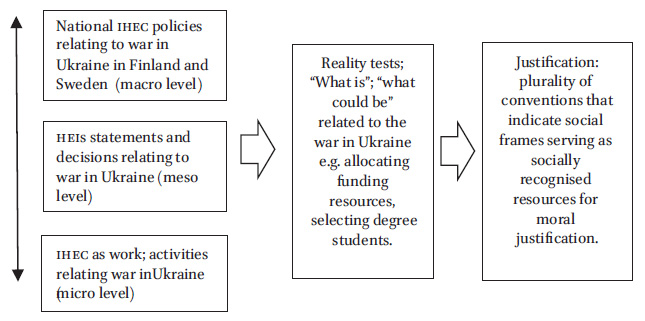
The research strategy of this study is based on comparative higher education research (Kosmützky et al., 2020), which focuses two geopolitical context (Finland, Sweden), and the higher education institutions in these countries. Therefore, the units of analysis occur simultaneously at least on three levels: macro (national context in Finland and Sweden), meso (higher education institutions) and micro (international activities). This approach brings to light country-specific, and organisation-specific similarities and differences (see e.g., Kosmützky, 2020). In the choice of countries, Finland and Sweden, attention has been paid to their comparability (see e.g., Kosmützky et al., 2020): both countries represent the Nordic countries and are active members of the EHEA. Both countries have a similar educational value base, although there are observable national differences in their implementation. The purpose of the comparison is to highlight not only the similarities inherent in hybridity but also the differences stemming from national contexts.
The data consists of 16 interviews and seven documents. Of the interviews, nine were conducted online and seven on site. Seven interviewees were from Finnish higher education institutions and seven from Swedish higher education institutions, representing staff with strategic responsibility for IHEC (e.g., heads of international affairs) or, in two cases, responsible for coordinating student mobility (e.g., international coordinators). Two interviewees represented national higher education authorities (one from Finland and one from Sweden). The interviews with the Swedish participants were conducted in English, while those with the Finnish participants were conducted in Finnish. The latter interviews helped to clarify national contexts and are used as part of the analysis to refine the country-specific contexts reflected in the HEI s’ responses.
Both the choice of language and the professional status of the interviewees may have influenced how the issues were discussed, or which aspects were emphasised in the interviews. At the same time, different professional roles may have overlapped in a crisis where the situation was ‘ongoing’ and there was sometimes a need to react without well thought out instructions. The choice of language was primarily pragmatic: on the one hand, it is natural to use one’s mother tongue in interviews, and on the other, the interviewees’ working language is predominantly English, so it was assumed that they were used to using it naturally for self-expression.
The transcribed interviews were analysed using reflective thematic analysis guided by qualitative abductive logic (Braun & Clarke, 2019; Braun, Clarke & Weate, 2016). This approach considered assumptions identified in previous research on Finnish higher education institutions (Juusola & Nokkala, 2024).
Seven documents were added to the data, based on themes that emerged from the analysis of the interview data. These documents provided a national perspective, for example when discussing the termination of
5 Findings
The findings from the reflective thematic data analysis were structured according to the three levels of nested hybridity (Pekkola et al., 2022; 2020), encompassing national contexts, organisational strategic responses and the role of IHEC as work in the first year of the war. This approach allows an examination of the moral justifications (Boltanski & Thévenot, 2006) of nested hybridity not only across levels, but also as a country-specific comparison. Overall, the findings reveal a shared sense of fatigue with successive crises. Just as the challenges of the pandemic had been overcome and international activities were beginning to return to routine with a focus on promoting mobility rather than managing restrictions, the war in Ukraine forced a reassessment of IHEC activities from a new perspective. For HEI s, this meant dealing with a changed geopolitical landscape with no previous experience of a similar situation.
5.1 National Responses to the War in Ukraine in the Context of IHEC
The Russian invasion of Ukraine ultimately led to the freezing of collaboration with Russian higher education and research institutions in both Finland and Sweden. Statements issued by the respective national ministries and authorities responsible for education emphasised recommendations to suspend institutional collaboration with Russian and Belarusian higher education and research institutions, while expressing solidarity with Ukraine (MINEDU, 2022a; Swedish Research Council, 2022). In both countries, the suspension of collaboration took place relatively soon after the Russian attack, in March 2022. However, Sweden issued an official statement on the matter before Finland and before the European Commission’s decision to suspend collaboration under, for example, the Horizon Europe research funding framework (European Commission, 2022). This timing potentially has been influenced by the fact that, according to statistics on student mobility (ESF, 2024; NAE, 2023a; SCS, 2024) and interviews conducted, Finland had more strategic collaboration with Russia, which may have required more deliberation.
Both Finland and Sweden underlined at national level that the suspension of institutional collaboration was aimed at organisations rather than individuals (MINEDU, 2022a; Swedish Research Council, 2022). The countries also emphasised the principle of non-discrimination, stressing that no one should be discriminated against on the basis of nationality within higher education and research communities. Such principles reflect Nordic values of equality, while at the same time addressing national security concerns and wartime protection policies were seen important. Finland’s national statements on education also emphasised the possibility of continuing to recruit international students regardless of their nationality (MINEDU, 2022b).
In both Finland and Sweden, new funding mechanisms were launched to support Ukrainian education and facilitate the relocation of Ukrainian students and researchers. Part of this funding has been allocated through European Union programmes such as Erasmus+, with a stronger focus on supporting students coming from Ukraine (NAE, 2023b). In addition, national funding programmes have been set up to promote various forms of collaboration with Ukrainians, including strengthening Ukrainian educational institutions and improving their reconstruction capacities (Ministry of Education and Research, 2023; NAE, 2023c).
When interpreting national education and science policy approaches to international higher education collaboration (IHEC) in the context of the war in Ukraine, moral justifications are primarily based on domestic considerations emphasising security policy concerns regarding the suspension of institutional collaboration with Russian actors. On the other hand, national politics also extended solidarity to Ukraine in general and stressed importance of non-discrimation at individuals. These justifications are analytically consistent with a civic convention indicating social responsibility and solidarity. There are no significant differences between Finland and Sweden in terms of the moral justifications behind these actions; both countries had similar justification for legitimising their policies. However, the Finnish Ministry of Education
5.2 Re-Consideration of IHEC Institutional Strategies
As the war in Ukraine began, IHEC activities were beginning to stabilise and, in many ways, a gradual return to freer post-pandemic international mobility was underway. This was also evident in the interviews, as HEI s in both countries anticipated a return to the ‘new normal’. However, the war in Ukraine further complicated these efforts by creating now geopolitical uncertainties, especially in Europe, and posing new kinds of testing situations (Boltanski, 2011).
This (war) felt like an incredibly unfair burden after COVID-19, when I thought the world was opening up and we could start building a future full of hope and meeting colleagues and acquaintances. We had such strong, diverse and natural international relations with Russia, all over Russia, and now they’ve been cut off. I think it was devastating.
PARTICIPANT 8, Finnish HEI
We had supported them [Ukrainian students] so they could stay for another year, but those were the people who were here a year ago, and then we had only few more students from Ukraine.
PARTICIPANT 4, Swedish HEI
Of course, also in international activities, the goal is to consider and assess where and how, and on what grounds actions are taken, so that we can be responsible actors.
PARTICIPANT 9, Finnish HEI
with some participants contemplating the potential for enhanced European collaboration, possibly extending to the Nordic region. From this perspective, strategic development is closely tied to European collaboration and initiatives that impact the entire European Higher Education Area (EHEA), such as the European Universities Initiative. It was also noted that strategic partnerships are influenced by the global geopolitical context and the varying priorities of major education actors, such as China. Consequently, strategic re-consideration is not merely a local matter but is deeply connected to national contexts, geopolitical tensions, Europeanization, and the broader global situation.
From the perspective of reality testing and moral justification, the war in Ukraine fundamentally disrupted established norms and expectations, particularly for Finnish HEI s. It also necessitated a systematic re-evaluation of ethical principles and crisis awareness in reformulating IHE strategies. This re-evaluation was partially justified through industrial conventions emphasising transparency and systemic thinking, domestic conventions emphasising (national) security concerns, and civic conventions highlighting social responsibility toward Ukrainians. Simultaneously, strategic rethinking also involved the consideration of prospective scenarios, suggesting elements of a prospective convention (Ye & Nylander, 2024) and potential outcomes. Within this framework, global responsibility plays a role, albeit with certain limitations. Similar observations have been documented in earlier research (Juusola & Nokkala, 2024).
5.3 Reassessing IHEC as Work: Navigating Solidarity and Global Tensions
Based on the interviews, the war in Ukraine had an impact on the practical work of IHEC, requiring the reconsidering of exchange arrangements, the consideration of the sensitivity of events and the reassessment of personal professional relationships. These reflections illustrated different dimensions of solidarity and the visibility of global tensions in everyday work.
In interviews with both Finnish and Swedish HEI s’ representatives, two key themes emerged: on the one hand, the desire to support Ukrainian students
Like we receive one student from Ukraine and then one student from Lithuania, but original nationality was Belarus. Okay, so then I was wondering if, like, usually, when, when we organise an orientation program, I tended to show the like the world map to show like student diversity, but now, should I use the same method or some other practicality? This complexity changed our preparation, or routine to some extent.
PARITICPANT 5, Swedish HEI
In the practical work of IHE, the test situations were particularly connected to questions of community, social, and global responsibility, where previous practices, such as orientations, had to be reassessed in a new reality – considering “what is” and “what could be” (Boltanski, 2011). In IHEC work, the civic convention, emphasizing solidarity, and the domestic convention, highlighting traditional trust and security, were particularly prominent as foundations for justification at both national and organisational levels (Imdorf & Leemann, 2023). In addition, IHEC work reveals elements of the inspirational convention (Boltanski & Thévenot, 2006; Imdorf & Leemann, 2023), which in this context can be described as morally inspired action. This includes the willingness of
6 Conclusion
In this research, my aim was to examine the nested hybridity (Pekkola et al., 2020) and moral justification (Boltanski & Thévenot, 2006; Imdorf & Leemann, 2023) of international higher education collaboration (IHEC) in Finland and Sweden in the context of the Russian invasion of Ukraine. I also explored whether these meanings differ or remain consistent across the two national contexts (Finland and Sweden). Through the study, a comprehensive understanding of IHEC emerged as a nested hybridity (Pekkola et al., 2020), where national policies, organisational strategic actions and practical operations are in dynamic interaction. However, this interaction requires the use of partly different emphases between Finland and Sweden and partly different justification frameworks at different levels of hybridity, reflecting both national characteristics and the specificities of the levels of hybridity.
In general, the findings highlighted the domestic convention, which emphasises national security and traditions, and the civic convention, which reflects solidarity and social responsibility (Imdorf & Leemann, 2020). The data also revealed elements of the industrial convention, which refers to uniformity, transparency, and standards, and the inspirational convention, which supports personal moral responsibility (Boltanski & Thévenot, 2006; Imdorf & Leemann, 2020). However, when examining the different levels of nested hybridity, it can be noted that national education policies emphasised domestic conventions, particularly in relation to national security, trustfulness and the geopolitical positioning of Finland and Sweden in response to the Russian invasion of Ukraine (Juusola & Nokkala, 2024). In both countries, national solidarity with Ukraine and equal treatment regardless of nationality were emphasized, which reflected the civic convention. However, compared to Sweden, in Finland, the situation of Russian students and researchers was somewhat more pronounced, where the industrial convention was highlighted, particularly in the processes that could be followed in this context, such as in student recruitment.
At the organisational (HEI s) level, the findings revealed a balancing act between different justifications. For example, industrial conventions were reflected in the formalisation of mobility processes and the re-evaluation of
At a practical level (IHEC as work), the civic convention was particularly evident in everyday actions. HEI s worked to create inclusive environments, re-evaluating practices such as orientation sessions to avoid discrimination on the basis of nationality. The domestic convention was also evident as institutions navigated the challenges of maintaining collaboration with Russian academics while addressing security concerns and ethical considerations. Inspirational conventions were demonstrated through individual acts of moral responsibility. HEI s’ representatives relied on personal networks to facilitate links with Ukrainian students and researchers, demonstrating the dynamic interplay between formal structures and personal initiative.
This analysis indicates that crises underscore the hybrid nature of IHEC activities as a form of coordination that is adaptable to situations but challenging to manage (see also Johanson & Vakkuri, 2017). This is especially evident in uncertain situations where what is expected to be and what is no longer applies in the same way. In such cases, IHEC activities must be carried out considering situational specificity, while ensuring accountability to different stakeholders. At the same time, it can be argued that it is precisely this hybridity that enables the flexibility of IHEC activities, as they operate at different levels, in different areas, targeted at different stakeholder groups, and utilizing different funding bases. Thus, analytically speaking, the continuity of IHEC activities is based on their hybridity, although this also means that managing them is challenging.
There are also limitations to this study, such as the focus on specific national contexts which, despite sharing similar value bases, have unique cultural and political characteristics. For example, differences in the governance of higher education at the national level may have an impact on the comparative analysis. In addition, this study focuses on a short period of time, which may not capture the long-term effects of the war situation.
Further research could examine the hybridity of IHEC activities from the perspective of different spatiotemporal spaces, investigating which are manageable and which are not. The war in Ukraine provides an example of individual actors taking the initiative in the absence of institutional relationships. This may result in new openings in IHEC activities that are not reflected or recognized in the HEI s’ strategies.
Ala-Vähälä, T., Juusola, H., Moisio, J., & Saarinen, T. (2021). Monitasoinen ja monialainen toimijuus: Euroopan unioni ja suomalainen korkeakoulupolitiikka. In K. Elo (Ed.), Suomi 25 vuotta Euroopan unionissa (pp. 117–203). Bibliotheca Sigillumiana.
Alexiadou, N., & Rönnberg, L. (2022). Transcending borders in higher education: Internationalisation policies in Sweden. European Educational Research Journal EERJ, 21(3), 504–519. https://doi.org/10.1177/1474904120988383
Bamberger, A., & Morris, P. (2024). Critical perspectives on internationalization in higher education: Commercialization, global citizenship, or postcolonial imperialism? Critical Studies in Education, 65(2), 128–146. https://doi.org/10.1080/17508487.2023.2233572
Boltanski, L. (2011). On critique: A sociology of emancipation. Polity.
Boltanski, L., & Thévenot, L. (2006). On justification: Economies of worth. Princeton University Press.
Braun, V., & Clarke, V. (2019). Reflecting on reflexive thematic analysis. Qualitative Research in Sport, Exercise and Health, 11(4), 589–597. https://doi.org/10.1080/2159676X.2019.1628806
Braun, V., Clarke, V., & Weate, P. (2016) Using thematic analysis in sport and exercise research. In B. Smith & A. C. Sparkes (Eds.), Routledge handbook of qualitative research in sport and exercise (pp. 191–205). Routledge.
Brankovic, J. (2018). The status games they play: Unpacking the dynamics of organisational status competition in higher education. Higher Education, 75(4), 695–709. https://doi.org/10.1007/s10734-017-0169-2
Cloutier, C., Desjardins, F., & Rouleau, L. (2024). Grand challenges viewed through the pragmatist lens of the economies of worth: A multidisciplinary review and framework for the conduct of moral work in pluralistic settings. Journal of Management Studies. https://doi.org/10.1111/joms.13078
Diaz-Bone, R., & de Larquier, G. (2022). Conventions: Meanings and applications of a core concept in economics and sociology of conventions. In R. Diaz Bone & G. de Larquier (Eds.), Handbook of economics and sociology of conventions (pp. 1–27). Springer.
de Wit, H., & Deca, L. (2020). Internationalization of higher education, challenges and opportunities for the next decade. In A. Curaj, L. Deca, & R. Pricopie (Eds.), European higher education area: Challenges for a new decade. Springer. https://doi.org/10.1007/978-3-030-56316-5_1
Education Statistics Finland (ESF). (2024). Tutkinto-opiskeliojiden kansainvälinen liikkuvuus [International mobility of degree students]. Retrieved December 1, 2024, from https://vipunen.fi/fi-fi/_layouts/15/xlviewer.aspx?id=/fifi/Raportit/Tutkinto-opiskelijoiden%20kansainv%C3%A4linen%20liikkuvuus%20-%20vuosi.xlsb
European Comission. (2022, March 3). Statement on research by commisioner Mariya Gabriel. Statement. Retrieved December 1, 2024, from https://ec.europa.eu/commission/presscorner/detail/en/STATEMENT_22_1528
Filippou, K., & Jokila, S. (2024). Academic, social, and financial changes in international students’ lives due to the COVID-19 pandemic. Nordic Journal of Migration Research, 14(2), 7–7. https://doi.org/10.33134/njmr.560
Gribbe, J. (2021). The Swedish higher education authority’s pandemic assignment. The Swedish Higher Education Authority.
Imdorf, C., & Leemann, R. J. (2023). Education and conventions. In R. Diaz-Bone & G. Larquier (Eds.), Handbook of economics and sociology of conventions (pp. 1–33). Springer. https://doi.org/10.1007/978-3-030-52130-1_69-1
Jasinskaja‐Lahti, I., Szebeni, Z., Birman, D., Mitikka, E., & Renvik, T. A. (2024). Diasporas during conflict: A mixed‐method analysis of attitudes of the Russian‐speaking community in Finland towards the Russia‐Ukraine war. Journal of Community & Applied Social Psychology, 34(4). https://doi.org/10.1002/casp.2824
Johanson, J. E., & Vakkuri, J. (2017). Governing hybrid organisations: Exploring diversity of institutional life. Routledge.
Juusola, H., & Nokkala, T. (2022). Legitimations of Finnish education export – Exploring the plurality of guiding principles. European Journal of Higher Education, 12(2), 211–227.
Juusola, H., & Nokkala, T. (2024). Justification regimes and crisis practices: International educational collaboration amidst pandemic and war. European Educational Research Journal (Online first). https://doi.org/10.1177/14749041241275274
Karpava, S., Ringblom, N., & Zabrodskaja, A. (2018). Language ecology in Cyprus, Sweden and Estonia: Bilingual Russian-speaking families in multicultural settings. Journal of the European Second Language Association, 2(1), 107–117. https://doi.org/10.22599/jesla.41
Kosmützky, A., Nokkala, T., & Diogo, S. (2020). Between context and comparability: Exploring new solutions for a familiar methodological challenge in qualitative comparative research. Higher Education Quarterly, 74(2), 176–192. https://doi.org/10.1111/hequ.12255
Mäkinen, S. (2023). Nothing to do with politics? International collaboration in higher education and Finnish-Russian relations. European Journal of Higher Education, 13(2), 216–237.
Marginson, S. (2022). Space and scale in higher education: The glonacal agency heuristic revisited. Higher Education, 84(6), 1365–1395. https://doi.org/10.1007/s10734-022-00955-0
Ministry of Education and Culture [MINEDU]. (2024). Internationalisation programme and global networks. Retrieved August 28, 2024, from https://okm.fi/en/internationalisation-programme-and-global-networks
MINEDU. (2022a, March 9). Finland freezes higher education and research cooperation with Russia – Support for Ukrainian students in Finland. Press release. Retrieved December 1, 2024, from https://okm.fi/-/suomi-jaadyttaa-korkeakoulu-ja-tutkimusyhteistyon-venajan-kanssa-suomessa-olevia-ukrainalaisopiskelijoita-tuetaan?languageId=en_US
MINEDU. (2022b). Russia’s invasion of Ukraine and its effects in the administrative branch of the ministry of education and culture. Retrieved December 1, 2024, from https://okm.fi/en/ukraine
MINEDU. (2017). Better together for a better world: Policies to promote internationalisation in Finnish higher education and research 2017–2025. Retrieved December 1, 2024, from https://okm.fi/documents/1410845/4154572/YMP-en-net.pdf
Ministry of Education and Research. (2023, March 17). Sweden provides SEK 75 million to UNESCO to rebuild schools and preschools in Ukraine. Press release. Retrieved December 1, 2024, from https://www.government.se/press-releases/2023/11/sweden-provides-sek-75-million-to-unesco-to-rebuild-schools-and-preschools-in-ukraine/
National Agency of Education [NAE]. (2023a). Ulkomaalaisten opiskelijoiden yleisimmät kansalaisuudet 2018 ja 2022 [The most common nationalities of foreign students in 2018 and 2022] Retrieved December 1, 2024, from https://www.oph.fi/sites/default/files/documents/Yleisimm%C3%A4t%20kansalaisuudet%202018%20ja%202022.pdf
NAE. (2023b). Supporting Ukrainians affected by the war: Specific guidance for projects in the Erasmus+ and European Solidarity Corps programmes. Retrieved December 1, 2024, from https://www.oph.fi/en/programmes/supporting-ukrainians-affected-war-specific-guidance-projects-erasmus-and-european
NAE. (2023c, March 21). STFK-ohjelman erillisessä Ukraina-haussa rahoitusta myönnettiin 7 koulutusyhteistyöhankkeelle [In the separate Ukraine call of the TFK program, funding was granted to 7 educational cooperation projects]. Press release. Retrieved December 1, 2024, from https://www.oph.fi/fi/uutiset/2023/tfk-ohjelman-erillisessa-ukraina-haussa-rahoitusta-myonnettiin-7
Moisio, S. (2020). State power and the COVID-19 pandemic: The case of Finland. Eurasian Geography and Economics, 61(4–5), 598–605.
Pekkola, E., Pinheiro, R., Geschwind, L., Siekkinen, T., Carvalho, T., & Pulkkinen, K. (2020). Nested hybridity and value definition in public higher education: A conceptual view. In J. Vakkuri & J.-E. Johanson (Eds.), Hybrid governance, organisations and society: Value creation perspectives (1st ed., pp. 59–80). Routledge.
Pekkola, E., Pinheiro, R., Geschwind, L., Siekkinen, T., Pulkkinen, K., & Carvalho, T. (2022). Hybridity in Nordic higher education. International Journal of Public Administration, 45(2), 171–184. https://doi.org/10.1080/01900692.2021.2012190
Rönnberg, L., & Hinke Dobrochinski Candido, H. (2023). When Nordic education myths meet economic realities: The “Nordic model” in education export in Finland and Sweden. Nordic Studies in Education, 43(2), 145–163. https://doi.org/10.23865/nse.v43.4046
Statistics of Sweden (SCS). (2024). Students from abroad in Swedish higher education academic years 2014/15–2023/24 by geographic area, country and sex. Retrieved December 1, 2024, from https://www.scb.se/en/finding-statistics/statistics-by-subject-area/education-and-research/higher-education/international-student-mobility-in-higher-education/
Swedish Council for Higher Education. (2023). For newly arrived from Ukraine.
Swedish Research Council. (2022, March 3). Statement from the Swedish Government – Call to suspend research collaboration with Russia and Belarus. Retrieved December 1, 2024, from https://www.vr.se/english/just-now/news/news-archive/2022-03-03-statement-from-the-swedish-government---call-to-suspend-research-collaboration-with-russia-and-belarus.html
Ye, R., & Nylander, E. (2024). Conventions of skilling: The plural and prospective worlds of higher vocational education. European Educational Research Journal EERJ. https://doi.org/10.1177/1474904124126282