


Higher education institutions are intimately intertwined with their environments, and are subjects of a wide variety of expectations from external parties. Such parties include government actors, regional and local authorities, private enterprises, non-profit organisations, funding bodies, student and worker unions and the general public. The interests that these parties represent vary significantly and range from problem-solving related to competence provision and innovation to softer values along the lines of Bildung (Aarrevaara et al., 2021; Carvalho, 2021; Cloete & Maassen, 2015; Sørensen et al., 2019). To a significant extent, universities and colleges rely on meeting these expectations to maintain funding, trust, and access to valuable infrastructure and information. As a result, they have been demonstrated to be highly reactive to external pressures. Their reactions to these pressures have in turn been shown to be double-sided in that they can both constitute adaptation to external realities and active efforts to influence the way these realities are developed and implemented (Jernberg, 2017).
In order to manage this complex web of expectations from both their external environments and from internal interests, universities have established similarly complex internal governance structures (Schuster, 2010). Management teams have grown (Logue, 2013), new groups of professional support staff have emerged (Ryttberg, 2020), and the line between different internal roles have blurred through hybridisation processes (Pekkola et al., 2020). Hybrids in this context denote anything that combines aspects from two or more previously established categories, no longer being clearly identifiable as one or the other. All organisations are hybrid to some extent, but some are more hybrid than others (Hallonsten & Thomasson, 2023) – and there are many levels of hybridity in higher education institutions (Pekkola et al., 2022). Such hybridity may rest on contradictory values, giving rise to uneasy balances between different principles in the construction of internal roles and processes: e.g., autonomy and control, or quality and efficiency – in universities often represented by hierarchies and market incentives working within professionally anchored, loosely coupled systems (Noordegraaf, 2015).
The maintenance of this increasingly complex structure requires extensive internal communication networks and intricate decision-making processes that are in continuous flux and may as a result be untested in rough conditions. Although this growing complexity is globally occurring (Sahlin & Eriksson-Zetterquist, 2024), the specific interactions of different components of the structure are bound to be highly dependent on the local, regional, and national context where they are situated: different political systems and cultures give
In the Swedish system, they are manifested by a tug-of-war between collegial and managerial modes of governance (Ahlbäck Öberg et al., 2016; Boberg, 2022), which is by no means a unique circumstance of Sweden in particular (Fischer, 2009; Leišytė & Gozlan, 2023; McGettigan, 2013; Newton, 2002; Želvys et al., 2021). It has, however, been placed front and centre of policy development as a subject of recurring government investigations (SOU 2008:104; SOU 2015:92; SOU 2019:6). The issue is also given unique characteristics through the distinctive Swedish dualistic system of government, where the question of “what to do” is separated from the question of “how to do it” (Andersson, 2004) – giving rise to a historical division between supreme authority over academic and administrative matters in Swedish universities (SOU 2015:92).
This division is no longer regulated by the government, but is echoed in a sector-wide agreement where the universities voluntarily divide all costs into “indirect” (administrative) or “direct” (academic) (Mattsson, 2011), making the distinction between these categories of activities an ever-present component of internal decision-making. The division of costs acts as a guide for internal funding arrangements, applications for external funding, as well as benchmarking efforts between different higher education institutions. This generates limitations on what funding is available for which purposes, competing perceptions of fairness in distribution, and an in-built division of all economic activity (and hence personnel costs) between academic and administrative (Mörtberg & Setterberg, 2024). The guidelines explicitly define different organisational units (e.g., “HR department”), processes (e.g., “student services”), roles (e.g., “IT-technician”) and – notably – leadership positions (e.g., “dean” and “research director”) as administrative, further determining how resources spent on these functions are allowed to flow through the system (SUHF, 2023). The overall distribution between direct (academic) and indirect (administrative) costs for each higher education institution is tracked internally and compared nationally each year – as illustrated by Figure 5.1, which provides an excerpt from an annual presentation of national ranking of higher education institutions by administrative costs.

Budgeted indirect (administrative) costs at Swedish higher education institutions in 2024, as a proportion of total costs 2023 (Source: Mörtberg and Setterberg, 2024)

The intricacies of the relationship between the academic and the admin-istrative in the Swedish system are well-studied, but mostly in terms of their structural connections (Ahlbäck Öberg & Boberg, 2023), disconnects (Andersson et al., 2024), overlaps (Ryttberg, 2020), and gaps (Ekman et al., 2018). Likewise, the development over time has received significant scholarly attention
The covid-19 pandemic of 2020–2021 provides an interesting proving ground against this backdrop, where the strenuous demands of a rapidly evolving crisis may serve to show if the complex governance structures already straining under pressure in a state of relative sunshine can withstand a storm. Studies of covid-19 responses in higher education have frequently identified issues related to organisational preparedness and availability of necessary resources and infrastructure to maintain operations when faced with rapidly changing operational conditions (Bhagat & Kim, 2020; El Masri & Sabzalieva, 2020; Natow et al., 2022; Ross, 2020; Stracke et al., 2022; Wang & Sun, 2022). Some studies have indicated breakdowns of existing managerial structures and processes in the initial stages of the pandemic, giving way to temporary ad hoc procedures (Palumbo & Hill Duin, 2022; Pekkola et al., 2021), and highlighting the need for systems equipped to deal with unforeseen events (Tilak & Kumar, 2022). Others have pointed to reliance on authoritative guidelines and “data-driven” approaches to outline clear and universal paths forward at the institutional level (O’Shea et al., 2022).
In March 2020, the government of Sweden recommended all higher education institutions to close their campuses to students and switch to digital education (Public Health Agency of Sweden, 2020). As most higher education institutions in the country are public authorities, this recommendation can in practice be interpreted as an instruction. During the rest of the spring semester, several large investments in expansion of higher education were introduced in an effort to halt the economic downturn resulting from the pandemic and its management efforts (Government Offices of Sweden, 2020), and a national coordinator was appointed for the Swedish Scholastic Aptitude Test (Dir. 2020:92) – a nationally standardised test for selection of students for admission to higher education, normally carried out under relatively autonomous conditions by the higher education institutions. Practical circumstances – such as the move to distance education, increased sick-leave, difficulties in maintaining partnerships and external funding during a steep economic crisis – thus echoed global patterns of disruption. Simultaneously, a system of governance rooted in unsettled tensions was made all the more precarious by sudden government mandates, and the uneasy balance in higher education management was set for a trial by fire.
Although the pandemic represents a period of sudden disruption, it can also be expected to bring long-term effects that go far beyond the scope of immediate crisis management (UNESCO IESALC, 2020; Welch, 2022). Higher education institutions find themselves in a challenging position having to
In answering this question, the next section of this chapter will outline a theoretical approach resting on a fundamental resource dependence perspective anchored in an empirical lens of crisis management theory, followed by a description of the empirical data supporting the chapter and the methodological approach. The chapter then presents the results of the analysis, and finally concludes by considering the implications of these results in a concluding discussion.
2 Theoretical Approach
This paper adopts a resource dependence perspective (Pfeffer & Salancik, 2003), viewing organisations as coalitions of interest groups interacting with each other and their environments through the exchange of resources. Neither organisations nor interest groups are necessarily static or easily defined. Most actors have multiple different interests that are not all shared with the same group, meaning that their group affiliations can shift depending on context. Actors and resources hence flow back and forth between the “inside” and the “outside” of the organisation, forming an open system.
The resources that flow are not limited to money, but can include equipment, time, information, legitimacy, or anything else that an interest group could require or provide (Biermann & Harsch, 2017). The differing access to and need for various types of resources makes groups dependent on each other, which is reflected in the structure of the organisation. Asymmetrical dependencies, where one group needs another more than the inverse, breed control over the organisation’s processes, which in turn breeds control over its structures, which in turn breeds control over its actions (Johnson, 1995).
This control is, however, not direct, so the relationship between who controls the important resources and who governs the actions of the organisation
Managerial action plays a key role in this process. It is aimed at securing the resources that the organisation needs by responding to or influencing pressures from the environment or various internal interest groups (Aldrich, 1976). This action generates structures that balance different demands against each other, and means that the way an organisation functions at a given time is the result of a precarious balancing act based on known information. The measure of success for the results of this balancing act is how well it deals with uncertainties (Davis & Cobb, 2010).
In this case, such uncertainties can be represented by crises, as understood by crisis management literature. Crises suddenly disrupt normal operations and threaten the resources of an institution (Zdziarski, 2006), meaning that they change both the availability and the desirability of various resources. This also brings changes in the nature of internal as well as external interdependencies: who needs what from whom, and who can provide what to whom. Because of this, crises risk upending the delicate balancing act between interest groups, who suddenly find their interests and dependencies temporarily or permanently altered. The status quo is thus called into question, and existing structures are tested based on whether they are capable of maintaining balance even under different conditions than those that spawned them.
Jaques (2007) outlines four overarching clusters of components of a crisis management process, consisting of (1) crisis preparedness, which is aimed at creating robust structures that can survive disruption; (2) crisis prevention, which consists of identifying approaching crises through risk management and monitoring; (3) crisis incident management, where realised crises are recognised and managed; and (4) post-crisis management, where recovery and evaluation take place.
The relationship between these four clusters is not necessarily sequential: they may overlap and build upon each other, as e.g., even management
Viewed through a lens of resource dependence theory, each of the clusters of activities represent deals that are struck between interest groups in order to safeguard their stable access to required resources.
Crisis preparedness represents the long-term structuring of interdependencies: the balance struck between different interest groups in their pursuit for resources.
Crisis prevention denotes activities that manage uncertainties and thus secure availability of resources even in case of approaching changes in the environment.
A resource dependent crisis management relational model, adapted from Jaques (2007)
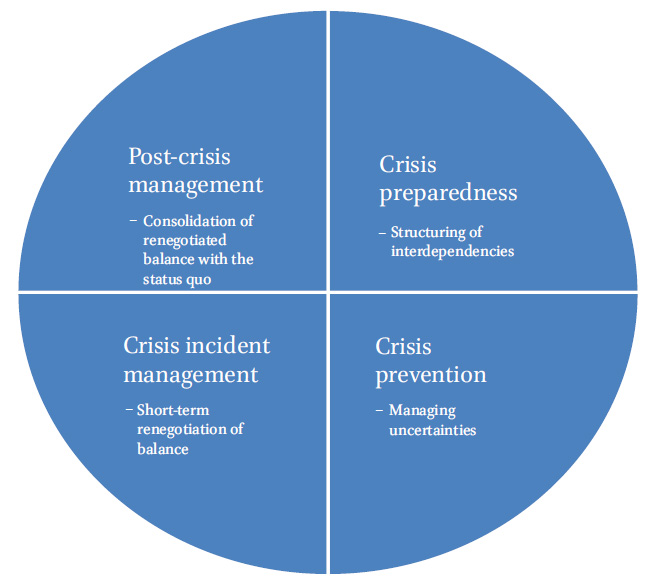
Post-crisis management finally represents the consolidation of renegotiated balances with prior structures into a new status quo, finding a new equilibrium that takes into account permanently changed conditions from the crisis.
This interpretation of crisis management can provide information about how disruptive crises affect the negotiated balance between interest groups, how different dependencies are weighed against each other, and what parts of the crisis management process drive which types of changes.
3 Methods and Materials
The study is based on 21 interviews with senior academic and administrative management as well as members of strategic councils – permanent bodies tasked with governing a particular area of strategic importance for the university, or advising senior management on their governance (Lundborg & Geschwind, 2023) – at three Swedish universities, carried out during the spring of 2021.
The universities were selected due to their different structural characteristics in terms of size and disciplinary width in order to see if the way the processes are discussed by the interviewees is influenced by the complexity and traditions of the university. Hence one university was chosen from each of the classic Swedish groups of comprehensive universities, specialised universities, and new universities. The first category represents large and disciplinarily wide universities, the second group comprises large and disciplinarily narrow universities and the third group represents small and disciplinarily wide universities. Small and disciplinarily narrow universities are generally not found in Sweden, as that combination of traits is mostly present at university colleges (Lundborg & Geschwind, 2021).
The interviews were conducted in a semi-structured format, encompassing open questions about the way their respective university is governed, how strategic issues are normally resolved, and how the crisis management of the pandemic response was structured. The interviews lasted for approximately one hour each, were recorded and then transcribed verbatim in preparation for analysis. The interviews and analysis were conducted in Swedish, and illustrative quotations were then translated into English. During translation, lexical equivalence was sought when possible. In cases where lexical equivalence could not be achieved, such as with idioms, conceptual equivalence was sought instead. Minor omissions of identifying words were also incorporated
The transcribed interviews were coded in the qualitative analysis software NVivo through a data-driven thematic analysis process (Braun & Clarke, 2021), where topic summaries for the responses were defined and grouped in relation to their perspectives on long-term strategic processes, short-term crisis management, and the transition between one and the other. The resulting code distribution was then cross-referenced with structural information concerning the interviewees such as their university and role, in order to facilitate comparisons and detect salient connections between responses, and further processed into themes based on the analytical model defined in the theoretical framework.
Distribution of roles and positions among interviewees
| Type of institution | Council member | Role |
|---|---|---|
| Comprehensive university | Yes | Senior academic manager |
| Comprehensive university | Yes | Senior academic manager |
| Comprehensive university | Yes | Senior administrative manager |
| Comprehensive university | No | Senior administrative manager |
| Comprehensive university | Yes | Senior academic manager |
| New university | No | Senior administrative manager |
| New university | Yes | Senior academic manager |
| New university | Yes | Administrative Officer |
| New university | Yes | Administrative Officer |
| New university | No | Senior academic manager |
| New university | Yes | Academic staff |
| New university | Yes | Senior academic manager |
| New university | Yes | Senior academic manager |
| Specialised university | Yes | Senior academic manager |
| Specialised university | Yes | Senior academic manager |
| Specialised university | Yes | Senior academic manager |
| Specialised university | No | Senior administrative manager |
| Specialised university | Yes | Senior academic manager |
| Specialised university | Yes | Senior academic manager |
| Specialised university | Yes | Administrative Officer |
| Specialised university | Yes | Administrative Officer |
We have a very collegial process when it comes to the strategy. […] We are going to formulate a renewed strategy, and we will form a new group of teachers and researchers [who will work on it], with the vice chancellor or pro-vice chancellor as the chairperson. And the head of university administration will also participate this time, I think.
– SENIOR ACADEMIC MANAGER, new university
The deans are really important players [in strategic issues]. They are in this mid-way position where they have links both upwards or whatever you should call it, towards the vice chancellor and the rest of the university management, and then of course within their own organisation. So they are some sort of core … Or well, very important people anyway that you can’t skip in these processes. Then of course the vice chancellor and their deputy vice chancellors run the processes.
– SENIOR ADMINISTRATIVE MANAGER, specialised university
In [the council], where you mostly have the deans, you can discuss more general policy and strategy issues. And determine that ‘this is the way we will act as a university’. And then the dean takes this home to their faculty and makes sure they move in that direction. Or actually, it’s more like they discuss and reach a consensus, and then the faculties start acting in a similar manner in different types of issues.
– SENIOR ADMINISTRATIVE MANAGER, comprehensive university
The crisis management group was led by the head of administration and staffed by key staff within the university administration, mostly legal
– SENIOR ACADEMIC MANAGER, comprehensive universityofficers. So a lot of [the decisions] made during the spring and fall were sort of processed in this crisis management group, where legal officers had the final word when it came to what we could and couldn’t do. And of course, there were also people from the communications department, because a lot of this is … [pause] to lead in these situations is really just to communicate. So it was a good team.
We had a group we called the crisis management. And that consisted of [the vice chancellor], the chief security officer, the communications director, the chairman of the students’ union and then a number of people who were needed depending on what crisis was on the table. In this case the HR-director and the chairman of the board of education.
– SENIOR ACADEMIC MANAGER, specialised university
The head of administration has been responsible for the coordination of the entire pandemic … All of the covid-related issues.
– SENIOR ACADEMIC MANAGER, new university
Pandemic management at all three universities revolved around a central crisis management group either formed for this purpose or adapted from an existing crisis management group. The focus in their staffing was clearly on senior university management and administrative officers, whereas the academic personnel take a toned-down role, if represented at all – essentially the reverse of how processes of strategy formulation were described. The first quote in particular illustrates how the power over decision-making within the university was shifted towards administrative management and staff, giving legal officers key influence when it comes to what was decided and communication officers key influence when it comes to how the decisions were spread through the organisation. These are two groups of personnel never mentioned at all in relation to the long-term strategic processes.
It was so incredibly quick, so sometimes you just had no time. You just had to inform everyone after the fact. And then you had to be extra careful of course and put your ear to the ground so they didn’t react negatively. That never happened, instead they were just grateful that someone sort of took the reins. Because by making a decision you also take the
– SENIOR ADMINISTRATIVE MANAGER, comprehensive universityblame if something goes wrong. And at the faculties and further down, they are so scared to do something wrong at the institution level and the subject level. So they would rather do nothing at all. And then it’s often easier that you make a decision a bit higher up and then you sort of take the blame, so to speak.
It’s pretty interesting, actually, when the pandemic hit … It’s amazing, adult people, experienced leaders, sitting and screaming for a decision so that they know what they should do. That they don’t realise that we can’t say what happens tomorrow.
– SENIOR ACADEMIC MANAGER, comprehensive university
Most of what we’ve gotten now are temporary reinforcements. And that doesn’t really affect our planning, but becomes more of a pressure on the faculties to deliver as well as they can on what they’re already doing.
– SENIOR ACADEMIC MANAGER, new university
You don’t have time to start any new programmes, so you just throw more onto what is already there, really, and scale up a little. So no, there hasn’t been much of a discussion. There hasn’t been any criticism either, instead you just … [Pause] It’s more that now we try to do as well as we can based on these circumstances, and help each other. So there is one faculty that has managed this better than the others in relation to their size […] that has had quite a lot of digital education since before, and has been able
– SENIOR ADMINISTRATIVE MANAGER, comprehensive universityto take on a lot of [the government investments in expanded education]. And it has been accepted, there has never been any discussion when it comes to this.
The tension that remains and that I don’t think we’ll ever really get away from, it concerns these wet and dry faculties. The ones with a lot of education funding and the ones with a lot of research funding, particularly external research funding. And the ones with weak price tags and the ones with strong price tags. […] They are experts at writing long, long memos explaining why they should get the money.
– SENIOR ADMINISTRATIVE MANAGER, comprehensive university
So then we used these councils and boards and groupings so that each got to have a look at these texts for the strategy from their perspective, then provide feedback. So when we had the final strategy and decided on it, it had been shown everywhere and viewed from a lot of different perspectives.
– SENIOR ACADEMIC MANAGER, specialised university
It went straight to the management. From administrative officer to management, you could say. That is if it was a great hurry. So then you don’t always have time to run it through these groupings, actually. They don’t
– SENIOR ADMINISTRATIVE MANAGER, new universityconvene that often, really. So then you are sort of forced to cut to a shorter path in order to reach a decision.
So what we were trying to do was really just to … [Pause] I guess we didn’t really make any conscious decisions when it comes to [the processes], instead we really just tried to make it happen. And what happens then, I think, is that you skip these parts of the process that are about anchoring within the organisation, that the questions should be discussed widely, the processes that you are used to. […] Ordinarily the processes would have been longer and more thought-through in different ways.
– SENIOR ADMINISTRATIVE MANAGER, specialised university
I had a meeting with [the chairperson] of a virus centre at the university, and you can imagine what their situation has been like during the last year. So of course, you don’t sit down with them and discuss non-essential issues.
– ADMINISTRATIVE MANAGER, comprehensive university
Well, [the pandemic] has affected a lot, but it has really been an indirect effect in that … well, everyone has been a little too overloaded. And then we have some parts of the university that do clinical work. Nursing, dentistry, and such. They have carried an insanely heavy load so that means that we have simply had to pause certain things.
– ACADEMIC MANAGER, new university
– ADMINISTRATIVE OFFICER, specialised university
We have ended up in a completely new situation, but I don’t really see any effects anywhere, especially not for the council. […] I don’t think we have had a single item on the agenda that ties in with the pandemic. […] It is sort of business as usual, I think you might say.
Upon direct questions about whether the pandemic has affected the selection of items entered into the agenda at the strategic councils, all secretaries interviewed replied with more or less firm negatives.
5 Concluding Discussion
The goal when structuring a process or organisation is to build something robust enough to last through not only the good times, but also the bad. It is somewhat clear that while the decision-making processes at the universities studied might have such robustness, it would only be because they are temporarily put aside during times of crisis to be reinstated when the all-clear has been signalled. In terms of crisis preparedness, the structures seem insufficient, echoing previous findings regarding the breakdown of established structures in the face of disruptive changes (Pekkola et al., 2021; Palumbo & Hill Duin, 2022), as well as findings regarding Swedish crisis management structures in other sectors, which point towards a prevalence of ad hoc solutions with tenuous connections to non-crisis management structures (Engberg & Wimelius, 2015).
There is a clear difference in the distribution of organisational power in the studied universities when it comes to long-term planning and short-term crisis management, with the pandemic having shifted authority and influence clearly towards administrators while side-lining both collegial and managerial functions within the academic parts of the organisation. This side-lining is, however, not forced upon the side-lined academics – to a certain extent it instead seems to be demanded. This illustrates a previously identified administrative-frontline divide in the internal approach to higher education crisis management (Myer et al., 2011).
The divide is tied to a difference in how the realities of decision-making are perceived in each respective type of scenario. Long-term strategic planning is viewed through a lens of conflicting perspectives and interests, and resolved through the airing of these conflicts and negotiation of their solutions. Short-term crisis management is instead viewed as the handling of an objective reality where there is a right course of action and a multitude of wrong ones – and no one wants to be the one that accidentally picks one of the wrong options.
The specific division of labour between academics and administrators may be an artifact of the likewise specific context of Swedish higher education. This context includes a heritage from a dualistic system of government and an in-built categorisation of all functions as administrative or academic in nature – entrenching a mindset where the two are opposites in a binary system, and notably defining leadership functions even within the conventional academic sphere as administrative overhead (making management a nominally administrative task). Importantly, however, the study illustrates that there are different sets of labours to be divided – and that this division may generate significant disconnects in the overall management system.
In terms of the crisis management framework, a cycle can be identified in the studied universities where crisis preparedness – constructing the fundamental mechanisms of how the organisation works – falls under the purview of academics. Crisis prevention and crisis incident management, dealing with the nuts and bolts of making sure the system works under pressure, is left to the administrators. When all is said and done, the academics return to take the reins of post-crisis management. This might serve to explain the structural breakdowns identified both here and in previous studies: It is here that the role division generates a disconnect between the framework of the system and its application. Mechanisms are designed and applied respectively by different people acting under different conditions according to different perspectives – a combination of crisis management traits termed by Myer et al. (2011) as compartmentalisation, where different functions act independently of one another, and limited focus, where the planning process fails to consider the whole scope of consequences.
In terms of resource dependence theory, crises like the covid-19 pandemic upend the delicate balance between interest groups established through crisis
This observation coincides well with previous observations of structural movement towards line management as opposed to collegial governance mechanisms (Trowler, 2010; Göransson, 2011; Davis et al., 2016; Želvys et al., 2021; Boberg, 2022), stronger emphasis on administrative concerns and the growth of audit systems in higher education (Kehm, 2006; Kristensen et al., 2011; Sahlin, 2012; Wheeldon et al., 2022) and the entry of administrators into traditionally academic domains (Whitchurch, 2008; Ryttberg, 2020). It also mirrors fundamental understandings of implementation and policy research, where the visions and decisions do not necessarily translate easily into what eventually happens in practice (Pressman & Wildavsky, 1984; Colebatch, 2006).
There are multiple hybridisation processes at play that might serve to explain why such structural movements happen. Issues of long-term strategic planning are conceptualised as distinct from issues of short-term crisis management, but in practice the same issue can be moved more or less seamlessly between the boxes depending on the specific circumstances, the perspective applied, and the priorities championed. And so, an issue that seemed like it was clear-cut strategic in nature before the crisis turns into something rather more operative when time is limited. Managers are conceptualised as dominant over support staff, but in times of crisis it suddenly becomes much less clear whose word is law. What is academic and what is administrative is codified in the very backbone of financial accounting and organisational structure, but becomes much more mutable in practice when the boat begins to rock.
The increasingly blurred lines between academics and administrators (Ryttberg, 2020) are accompanied by similarly blurred lines between the academic and the administrative, in that fundamentally similar issues can gravitate towards one end or the other of the spectrum depending on how they are framed. Simultaneously, the labels themselves appear to remain intact, safeguarded by the dualistic heritage of Swedish government as well as the sector-wide economic framework dividing costs into precisely these two categories.
The implication for policy practitioners seems to be that a key to minimising the effects of uncertainties is to stress the relational component of their crisis management models – strengthening the connections between components and avoiding compartmentalisation of different stages of the process, to make it clear what choices are being made and what implications they have for the future. In practice, such measures could be taken in relation to all four clusters of the crisis management process. For crisis preparedness, procedural safety valves could be incorporated into existing governance structures, detailing which alternate paths should be taken to safeguard important values in case the ordinary process proves impossible to maintain. For crisis prevention, systematic bidirectional links could be established between permanent crisis management teams and strategic actors within the university, ensuring knowledge transfer and continuity in transitions from “business-as-usual” to crisis and vice versa. For crisis incident management, measures could be taken to ensure representative and balanced staffing of crisis management teams so that perspectives from different parts of the organisation can be taken into account even if the ordinary pathways have to be momentarily sidelined. For post-crisis management, decisions taken outside of normal procedures could be logged and later reviewed in order to generate overviews of long-term effects to be supported or countered.
Although this particular case shows a division of labour between the administrative and the academic, the more general implication lies in the disconnect between different crisis management activities that causes labour to be divided in the first place. For Swedish higher education specifically, further research into the relationship between the academic and the administrative as domains rather than actors might serve to generate an understanding of how such avoidance might be achieved. For other contexts, similar studies taking aim at other sectors or countries might serve to generate further insights into the effects of contextual factors for how the chips fall in terms of effects of crises on the internal distribution of labour and influence.
Aarrevaara, T., Finkelstein, M., Jones, G. A., & Jung, J. (2021). Universities and the knowledge society: An introduction. In T. Aarrevaara, M. Finkelstein, G. A. Jones, & J. Jung (Eds.), Universities in the knowledge society: The nexus of national systems of innovation and higher education (pp. 3–14). Springer Nature.
Carvalho, T. (2021). The transformation of universities in response to the imperatives of a knowledge society. In T. Aarrevaara, M. Finkelstein, G. A. Jones, & J. Jung (Eds.), Universities in the knowledge society: The nexus of national systems of innovation and higher education (pp. 15–31). Springer Nature.
Government Offices of Sweden. (2020, June 29). Ytterligare förstärkning av möjligheten till studier vid universitet och högskolor i höst. Regeringskansliet. https://news.cision.com/se/utbildningsdepartementet/r/ytterligare-forstarkning-av-mojligheten-till-studier-vid-universitet-och-hogskolor-i-host,c3143955
Leišytė, L., & Gozlan, C. (2023). The emergence of academic resistance platforms against new public management: Towards “new” forms of movement organizing? In L. Leišytė, J. R. Dee, & B. J. van der Meulen (Eds.), Research handbook on the transformation of higher education (pp. 127–141). Edward Elgar.
Logue, D. M. (2013). Adoption and abandonment: Global diffusion and local variation in university top management teams. In G. S. Drori, M. A. Höllerer, & P. Walgenbach (Eds.), Global the4mes and local variations in organization and management: Perspectives on glocalization (pp. 175–188). Routledge.
Lundborg, S., & Geschwind, L. (2021). The interplay of higher education, research, and innovation in Sweden. In T. Aarrevaara, M. Finkelstein, G. A. Jones, & J. Jung (Eds.), Universities in the knowledge society: The nexus of national systems of innovation and higher education (pp. 297–317). Springer Nature.
Pressman, J. L., & Wildavsky, A. (1984). Implementation: How great expectations in Washington are dashed in Oakland; Or, why it’s amazing that federal programs work at all, this being a Saga of the economic development administration as told by two sympathetic observers who seek to build morals on a foundation of ruined hopes. University of California Press.
Public Health Agency of Sweden. (2020, March 17). Lärosäten och gymnasieskolor uppmanas nu att bedriva distansundervisning. Folkhälsomyndigheten. https://www.folkhalsomyndigheten.se/nyheter-och-press/nyhetsarkiv/2020/mars/larosaten-och-gymnasieskolor-uppmanas-nu-att-bedriva-distansundervisning/
Sahlin, K. (2012). The interplay of organizing models in higher education: What room is there for collegiality in universities characterized by bounded autonomy? In B. Stensaker, J. Välimaa, & C. S. Sarrico (Eds.), Managing reform in universities: The dynamics of culture, identity and organizational change (pp. 198–221). Palgrave Macmillan.
Stracke, C. M., Burgos, D., Santos-Hermosa, G., Bozkurt, A., Sharma, R. C., Swiatek Cassafieres, C., dos Santos, A. I., Mason, J., Ossiannilsson, E., Shon, J., Wan, M., Obiageli Agbu, J.-F., Farrow, R., Karakaya, Ö., Nerantzi, C., Ramírez-Montoya, M. S., Conole, G., Cox, G., & Truong, V. (2022). Responding to the initial challenges of the COVID-19 pandemic: Analysis of international responses and impact in school and higher education. Sustainability, 14(3), 1876.