


On April 10, 1973, the front page of the Washington Post featured the story ‘Live-Fetus Research Debated.’ The story revealed that the National Institutes of Health (NIH) supported human fetal research both in the United States and abroad, including studies on living fetuses obtained from abortion operations. National press coverage followed, pushing NIH officials to issue denials and clarifications. Repeatedly, Sweden was mentioned as a permissive country for fetal research where American scientists went to access human material that was highly limited at home. According to one source, the NIH had in fact funded studies at the famous Karolinska Institute (KI) in Stockholm in which aborted fetuses were kept alive for several hours by artificial means. Geneticist Kurt Hirschhorn of New York’s Mount Sinai School of Medicine told a reporter that such investigations were not unethical because a ‘nonviable’ fetus is ‘nothing more than a piece of tissue.’ Cardinal John Crol, on the other hand, spoke of ‘using victims of abortions as living human guinea pigs.’ He was backed up by two hundred Roman Catholic high school students who protested in front of the NIH offices to call for a total ban on fetal research.1
Thus by the early 1970s, the Swedish context was closely interrelated with reproductive research and politics in other countries. This book demonstrates for the first time how Sweden came to occupy a central place in international and transnational scientific research that involved the use of aborted human embryos and fetuses. Our studies also highlight the particular historical circumstances that made this possible and show that specifically Swedish conditions were linked to international anti-abortion activism. But looking back to the 1970s is insufficient for understanding these developments. Instead, we
Public policy and bioethics scholars have discussed how research scandals and scientific breakthroughs in the late twentieth century sparked ethical and political debates on the use of human embryos and fetuses in science.2 In particular they have pointed to research on early embryos, including surplus IVF embryos, embryonic stem cells, and cloned embryos as an important backdrop to ethical debate.3 Authors have often framed these scandals and disputes in terms of the historical legacy of Nazism and eugenics, as well as linking them to a number of horrific clinical research studies including the Tuskegee syphilis study. Moreover, they have also stressed that what characterized the debate in the United States was the close connections made between embryo/fetal research and battles surrounding abortion. In this literature, today’s bioethical definitions, policies, and regulations concerning research on embryos and fetuses are seen as the outcome of these public outrages and controversies.4
Our book approaches these questions in a different way. Drawing on international historical research on reproduction, our aim is to explore a variety of meanings, values, norms, and policies surrounding the uses of fetuses for medical knowledge production, including the development of vaccines and pharmaceuticals, in Sweden over a long historical period.5 We understand ‘the fetus’ or ‘pregnancy’ not as stable entities but as created, materialized, and negotiated in shifting historical settings. By interrogating the conflicted views
The volume then differs in three main ways from other valuable histories of public controversies around fetal knowledge production. First, the adoption of a long-term perspective, covering five hundred years of reproductive history. Most historical work on fetal knowledge production that has examined the period before the Second World War tends to be restricted to shorter time frames or does not address the issue of controversy.7 To grasp both change and continuity, we need to reach further back in time. Our story begins in the mid-sixteenth century, at the time of Sweden’s founding as a modern nation-state with imperial aspirations. It concludes in the present period, which is marked by ongoing conflicts over abortion and reproductive rights in numerous countries. Nevertheless, the focus is on the decades following the Second World War, during which Sweden emerged as a leading actor in the international field of human fetal research. We emphasize the 1990s, when the legal framework for fetal research was established, but also address the historiographical discussions that have taken place in public discourse up to recent years. Along the way, we highlight a variety of changing and conflicting understandings of fetuses and fetal experimentation. In this fashion, we strive to provide both context for more limited studies and details that can inform more general histories.
Second, our geographical focus is on Sweden, a country located on the Scandinavian Peninsula in northern Europe, often characterized as a highly secular and developed welfare state, promoting gender equality, sexual freedom, and women’s rights. More national histories like this one can help reveal how reproductive and biomedical research as well as legal and ethical frameworks emerged in specific ways in different places. The established historiography is to a large extent based on an American narrative, even if the perspective has broadened in recent years to include the experiences of several European
Third, we use a broad definition of the domain under study—fetal knowledge production—to allow for a historical investigation into different discursive and material practices across contexts. The empirical areas of study range from natural philosophy, medical science, and health care to religion, law, politics, and visual culture. Earlier scholarship’s focus on embryo/fetal-research controversy as a route to bioethics is in itself limiting since it effectively rules out past meanings of ethics and how it should be practiced. For instance, a focus on past debates concerning medical confidentiality and abortion may reveal complex negotiations between states, physicians, lawyers, patients, and the wider public on the boundaries of medical secrecy.10 Moreover, historically, medical ethics has competed with other cultural criteria for measuring value, most notably religious, scientific, and economic ones. Thus, it is important to study fetal research in relation to a wider set of colliding criteria, values, concepts, meanings, and technologies, as well as in terms of bioethicalization.11
The book brings together a multidisciplinary group of scholars working within areas such as the history of science, medicine, and technology, as well as political science and film studies. The fourteen chapters are chronologically organized and each focuses on one or several themes of fetal and reproductive knowledge production that relate to concepts and classifications; material and visual dimensions; the notion of controversy and value conflicts; and policies, politics, and regulations. Using a broad range of sources, including sermons,
We demonstrate that the ‘unborn’ has been imbued with a multitude of conflicting meanings and values since early modern times. This also leads us to confirm Lynn Morgan’s observation that embryos and fetuses need not be automatically or naturally associated with abortion. Rather, they have been materialized, mobilized, and negotiated over time in response to particular social and political issues and concerns.12 And, crucially, abortion history differs between countries. In this book, we illuminate the historically specific conditions and interests—including relatively liberal abortion legislation and support from US funding—that promoted the emergence of research on living fetuses in the Swedish postwar period. The repercussions of this research were felt internationally in the early 1970s, as anti-abortion groups in several countries prepared for battle. Taken as a whole, our book highlights both continuities and discontinuities in the longue durée of the Swedish history of reproductive politics. Until now, no such broad study has existed.13
1 Histories of Fetal Knowledge Production
This volume builds on and engages with international historical research on reproduction, most of which focuses on western Europe and North America. This extensive literature examines pregnancy and the human fetus across the fields of history and also includes other disciplines such as sociology, anthropology, and archaeology.14 Early on, feminist scholars set the agenda
The conventional history of midwifery in early modern European culture described a shift in authority concerning the maternal-fetal relationship, from the experiences and understanding of the pregnant woman to the definition and control of medical men. More recent scholarship has nuanced this story of the disempowerment of the birthing woman and the professional struggles over childbirth between female midwives and male obstetricians.16 Importantly, as Rebecca Whiteley has demonstrated, midwives of both genders used printed manuals and images to introduce and communicate new modes of knowing, approaching, and treating pregnancy.17 This knowledge was often adopted from anatomy to lend authority to their own professional status. However, anatomy was not always seen as an ideal point of reference, since it was associated with death and dissection, and primarily gave visual access to the interior, including the reproductive organs such as the uterus and the placenta. Midwifery, on the other hand, relied heavily on haptic knowledge of the living, pregnant body.18
We have several histories about the collecting of human fetuses for research, education, and display. A common starting point is the seventeenth-century Dutch anatomist Frederik Ruysch’s ground-breaking technique for preparing and preserving infant and fetal bodies.19 By the late eighteenth century, evidence shows that human fetal and infant cadavers were considered a valuable and unique source of knowledge about normal anatomical development as well as congenital abnormalities.20 ‘Beaded babies,’ preparations of human
Adele Clarke has shown how the reproductive sciences took off in the United States after 1910, including reproductive physiology, reproductive endocrinology, and gynecological and obstetric research. Britain made early contributions, and several major research centers were established in the interwar period.23 Experimental methods spread across disciplines, and a few systematic studies of a larger number of human embryos and fetuses were conducted. Emily Watson has described the work of American neuroanatomist Davenport Hooker, who, between 1932 and 1958, produced film recordings of neurological tests on aborted fetuses.24 The same abortion technique that Hooker used, small cesarean section through the vagina or abdomen, was employed by National Socialist scientists conducting coercive experiments on pregnant women and their fetuses, which were surgically removed from the uterus during abortions and sterilizations.25
From the beginning of the twentieth century, attempts were also made to use fetuses not as an object of study in itself but as material for the growth of living human tissues. In 1949 the American virologist John Enders and his research group managed to keep the polio virus alive and replicating in cultures of skin and muscle from aborted fetuses and other materials. As Hannah Landecker has demonstrated, human cell culture technologies became a standardized technique in biological research.26 In addition, HeLa, the first human cell line, was established in the United States in 1951, when the Johns Hopkins researcher George Gey cultivated samples of a cervical tumor from Henrietta Lacks, without patient consent. Among other scientific achievements, these technologies provided scientists with means to develop a vaccine against polio.27 Several scholars have explored how fetal tissues and cells have continued to be used for research and therapy in various national and international contexts. In
After World War II new strands of fetal experimentation developed, as the relationship between science, medicine, and public health was profoundly transformed. Research funding was one crucial agent that contributed to the growth of the ‘biomedical complex’ and the emergence of international fetal research.30 According to Clarke, the postwar period experienced a shift in US sponsorship of reproductive and contraceptive research: from a landscape composed primarily of private and corporate philanthropy to one that included governmental as well as industrial funding.31 Crucially, these funding agencies promoted international collaboration across disciplines, including endocrinology, gynecology, pediatrics, embryology, and genetics. First, they sponsored foreign fellowship programs that allowed researchers from all parts of the world to spend time at federal and private research locations. Second, they supported US scientists wishing to access training opportunities overseas that were not available within the United States. Third, they financed multidisciplinary conferences that stimulated the development of new research areas and specialized fields; for instance, prenatal research. Fourth, they funded reproductive and fetal research programs and centers in countries that were considered to have more favorable conditions for conducting this research.32
This postwar context is essential for understanding the emergence of specific strands of research on human fetuses and how this research provoked public controversy. Indeed, it was not until this period that the term ‘fetal research’ started to be used in official documents and in the media. According to the American public policy researcher Steven Maynard-Moody, fetal research emerged as an ‘exciting field’ in the 1960s, and by the early 1970s it was ‘a hot scientific area’ that included drug testing and the development of
The postwar period also saw the development of prenatal diagnosis. Historians have traced the rise of various biomedical technologies that made the living fetus an object of study. In the 1960s the genetic analysis of human cells, the improvement of amniocentesis, the detection of biochemical markers of fetal anomalies in maternal blood, and the invention of obstetric ultrasound paved the way for routine testing for birth defects during pregnancy. From the 1970s and onward, fetoscopy became available.35 In the 1980s, as scholarship has also detailed, the new field of fetology, concerned with fetal surgery, started to define the ‘fetal patient.’ Together with other medical specialties such as perinatal medicine (the study of the fetus and the newborn), this development contributed to perceptions of the fetus as a vulnerable organism in need of protection, a theme that echoed in abortion debates.36
Despite this wealth of historical writing on fetal knowledge production, we still lack long-term perspectives and geographical diversity. Analyses of shorter periods dominate, as do perspectives from the major Atlantic democracies. We are also left wondering precisely when and how human fetal research stopped being ‘hot’ and became controversial. Duncan Wilson, in his book on the history of tissue culture in twentieth-century Britain, states that the practices for obtaining and using human tissues were seen by both professionals and the public as unproblematic for most of the period. It was not until the 1970s that controversy emerged, reflecting opposition against the liberalization of abortion laws. Moreover, Wilson argues that demands for informed consent were often raised by the scientists themselves.37 This is a bold claim that I will revisit in the epilogue of this book.
In this volume we use ‘fetal knowledge production’ as an umbrella term for various ways of coming to understand the ‘unborn,’ utilizing material from fetuses for scientific research or, more broadly, fabricating visions of fetal life and death. Our focus is on the human side of the story because we are especially interested in the historical links between medical frameworks, abortion, and controversy.38 We highlight knowledge production that involved not only pregnant women and their fetuses but also entities that we know of today as gametes, zygotes, and embryos, as well as miscarriages and stillborn or newborn with fetal damages. This approach contributes to a fuller historical picture. However, we have not included the more recent history of in vitro fertilization and human embryo research, from the 1960s and onward, as this would have taken us on a slightly different route to public controversy.39
An overarching aim of this volume is then to historicize fetal knowledge production, reproductive politics, and conflicted values in Sweden. The authors have adopted diverse analytical strategies to achieve this goal. Even so, four themes consistently emerge in a number of chapters: conceptual issues, material and visual dimensions, the notion of controversy and value conflicts, and perspectives on policies, politics, and regulation.
A first theme that is common to several of the chapters is the historical contingency of meanings around pregnant bodies, fetuses, and newborn. In processes where ‘the beginning of life’ is at stake, it is likely that boundaries are established but also contested and negotiated.40 As interdisciplinary scholarship has demonstrated, definitions of ‘pregnancy,’ ‘humanness,’ and ‘personhood’ vary between cultures and across time. Lynn Morgan, among others, has emphasized that in some cultures the unborn is deemed to become an infant not through biological attributes but rather through processes
A second theme underlines that reproductive concepts, categories, and values are always linked to material and visual dimensions of pregnant and fetal bodies. As many studies in the wake of the material turn have shown, discourse cannot be detached from the world of concrete objects and mundane practices.42 Bodies matter as well as the technologies and images used to materialize and communicate knowledge of fertility, pregnancy, delivery, and birth. In particular, we are interested in how the availability of human fetuses and fetal material conditioned the formation of academic disciplines, infrastructures, and networks as well as new scientific conceptions of pregnancy and reproductive health technologies.43 In addition, building on earlier scholarship on medicine’s visual culture, we are interested in how representations of fetuses and other reproductive phenomena were made, circulated, and used by multiple actors over the course of several centuries. In intricate ways, these activities contributed to the rise of ‘the public fetus.’44
Third, a central theme deals with the role of controversies and value conflicts over fetal knowledge production. Following Adele Clarke, the reproductive area is viewed as especially exposed to political and moral disputes and claims of illegitimacy. Therefore, some authors trace scientists’ strategies for managing their controversial status and addressing audiences and stakeholders. Full-fledged controversy—when social worlds collide, to use Clarke’s phrase—may not always arise.45 Some authors examine ignorance production and secrecy as a way of handling sensitive information in specific historical contexts.46 Drawing on valuation studies, a new interdisciplinary field, several chapters stress the conflicting yardsticks or criteria used in
A fourth theme that is addressed in this volume revolves around the politics, policies, and regulations that shaped and were shaped by fetal knowledge production. The concept of biopolitics is used to chart a long view of Swedish reproductive history, from the population concerns of the early modern nation-state to the modern welfare state’s support and care for all people.48 In particular, we are interested in historical questions related to the ethical and legal regulation of the uses of aborted fetuses for research, vaccine production, and drug development. General path dependency has been shown to play an essential role in regulatory regimes. However, there are considerable differences between national approaches to the regulation of fetal research. These differences need to be understood in light of varying historical, political, religious, social, and cultural conditions.49
One last consideration unites the chapters that follow. As historians we need to make decisions concerning the use of historical terminology. This is especially difficult when it comes to words that are interwoven with highly politicized issues such as pregnancy, abortion, and fetal research. The authors of this book have chosen the vocabulary that they consider appropriate for their specific cases and source material. As editor I have encouraged them to be attentive to how concepts are defined historically in order to avoid anachronisms. We largely adopt the historical actors’ language, even when this implies the use of terms that today are considered unacceptable, such as ‘monsters,’ or disputed, such as ‘pregnant women’ and ‘she/he.’ Terms like ‘birth defects’ and ‘congenital malformations,’ although by no means unproblematic, are still used in medical practice today.50
The historical terminology in the area of reproduction is indeed rich and varied. Swedish has borrowed many words from German, French, and English,
Yet even embryologists were not always strict in their terminology. August Hammar repeatedly used ‘fetus’ for all stages of development, whereas Ivar Broman, in his embryological textbook of 1927, emphasized that some authors preferred to employ ‘embryo for younger fetuses (before the 25–30-mm stage).’54 Much later, the 1991 Governmental Commission report on the medical uses of tissues from aborted fetuses indicated that from the eighth week of gestation there was strong growth and a further development of tissues and organs; in effect ‘the embryo has become a fetus.’ Nonetheless, the members of the commission stated that ‘fetus’ was to be used for all stages of human development in the report.55 This may have been done for practical reasons, but imprecise language could also be used for political purposes. The Swedish anti-abortion movements, following their US and British counterparts, insisted that embryos and fetuses were ‘unborn children.’56
This volume’s fourteen chapters and the epilogue address more than 500 years of Swedish reproductive history. It starts with a chapter on early modern birth intervention strategies and ends with a chapter that deals with the regulation of prenatal diagnosis in the late twentieth century. In between, we have contributions showcasing the activities of many actors and various aspects involved in the uses and definitions of fetuses, stillborn, reproductive organs, and pregnant bodies. Although we engage with the long-term of fetal knowledge production, the emphasis is on the period after World War II. Therefore, the remaining part of the introduction will provide historical context for the volume as a whole, along the way highlighting and synthesizing the individual chapters as well as contributors’ work published elsewhere. The current section gives a brief overview of Swedish population concerns and issues from the Lutheran Reformation to the welfare state.
Sweden was founded as a modern nation-state in the sixteenth century. Gustav Vasa initiated the Reformation that made it a Lutheran Protestant country. From 1560 wars were fought repeatedly with Denmark to gain control over the Baltic region. In the middle of the seventeenth century Sweden rose to the status of a great power in northern Europe, after the intervention of Gustav II Adolf on the side of the German Protestants in the Thirty Years’ War. Following years of constant conflict, disease, and famine, the country lost its preeminence at the end of the Great Northern War in 1721. As a result of the outcome of the Finnish war in 1809, the eastern third of Sweden was established as the Grand Duchy of Finland within the Russian empire. As compensation for this loss, Norway was forced into a union with Sweden in 1814. This union was peacefully dissolved in 1905.57
During the reforms of the sixteenth century, Gustav Vasa confiscated the estates of the church, including care facilities and charitable institutions. Thereafter, the overall responsibility for health care lay with the royal administration. An important step toward a central authority occurred in 1663, when a group of university-trained physicians based in Stockholm founded the Collegium Medicum. This private corporation was engaged by the royal administration to tighten up the regulation of health services and exert some control over other health occupations. Its authority was not accepted without protests from the surgeons’ guild. The conflict between physicians and surgeons was finally settled when in 1796 the Surgical Society merged with the Collegium Medicum,

Portraits of pregnant women in early modern Sweden were quite rare. This image portrays Anna Margareta von Haugwitz, who was married to Carl Gustaf Wrangel, a statesman and field marshal who commanded Swedish forces in the Thirty Years’ War, among others. They had eleven children together, of whom six died very young. She is holding the lamb and globe, which were symbols of Christian devotion and eternity. Oil painting by the Swiss artist Matthaeus Merian the Younger around 1650. Skokloster Castle.

During the seventeenth and eighteenth centuries, as elsewhere in Europe, mercantilism became the dominant economic policy of the Swedish state, and several initiatives were launched for stimulating export trade and domestic production. A growing population was considered of vital importance for the wealth of the nation, although the primary concern was not for the people themselves but for the work they performed. To regain Sweden’s strength and increase its population, the state and the Collegium Medicum took measures
In the eighteenth century the penalties for infanticide and abortion were tightened. Sweden, like many other countries in Europe, introduced a presumption—a reversed burden of proof—whereby an unmarried woman whose newborn died was suspected of having killed her child. If she had been alone at the time of birth, hid the child, and it was then found dead, the woman would be sentenced for infanticide and executed unless she could prove that the child was stillborn or had died a natural death. For a long time, abortion had been considered a less severe crime or not a crime at all if it happened before quickening, when the first movements of the fetus were felt. However, in 1688, a medicinal order forbade apothecaries and grocers to sell
An extraordinary birth scene presumably in Åbo, Sweden (subsequently Turku in Finland) around 1800. On the left of the woman giving birth is the father, to the right a caricature of a midwife. The figure pouring water into a bowl may be a maid preparing to wash the child or perhaps the personification of the goddess Hygeia. Oil painting by unknown artist. CC BY-NC 4.0. Wellcome Collection.
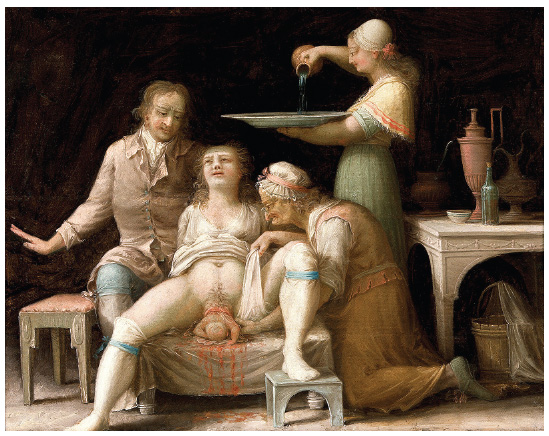
In practice, however, the laws were not strictly implemented. Moreover, the penalties for both infanticide and abortion were lightened from the late eighteenth century onward. Wanting to rule as an enlightened despot, Gustav III also issued the Infanticide Act of 1778, which made it possible for women to give birth anonymously and without public disgrace. In 1864 the death penalty for abortion was replaced with penal labor for two to six years, for both the woman seeking to terminate a pregnancy and the abortion provider. A reform in 1921 replaced the penal labor with a shorter term in prison for the woman, but kept the original penalty for the provider.61
In 1749, as part of Sweden’s mercantilist policy, a system for national population statistics (the Office for Tabulation) was founded on the initiative of the Royal Swedish Academy of Sciences. As described in Maja Bondestam’s chapter in this volume, the ground had already been prepared through the Church Law of 1686, which ordered parishes across the country to start keeping records on the population. This law had also made the clergy responsible for annual tax registration, and the church’s existing organizational structure facilitated the collection of population data. Every parish had to register the members of all families, and the records were to cover births, including ‘monstrous birth’ and stillbirths, baptisms, marriages, deaths, and migration. The clergy compiled parish records and sent them to Stockholm for further statistical compilation. After a few years, in 1756, the Tabulation Commission, the first statistical agency in the world and the predecessor of today’s Statistics Sweden, was established.62 Bondestam argues that this interest in the lives and deaths of the population signaled the rise of Swedish biopolitics.
In the early nineteenth century, the population theory of Thomas Robert Malthus was introduced in Sweden. He argued that population growth, especially among the poor, would surpass a nation’s available resources unless
In contrast to Malthus, neo-Malthusians in the late nineteenth and early twentieth centuries supported the use of contraception. The Uppsala student Knut Wicksell, later a well-known economist, argued in the 1880s that overpopulation in Sweden was the cause of poverty, alcoholism, a declining marriage rate, many illegitimate children, prostitution, and infanticide. Extensive emigration was associated with this problematic picture, since it meant the loss of able-bodied individuals. The solution that Wicksell proposed was that society, primarily physicians, should educate women so that they would have no more than two or three children.64 But sexuality and sexual morals were a controversial topic at the time, discussed in newspapers, magazines, novels, and theatrical plays. The early women’s movement did not have a unified position in this public debate.65 Between 1910 and 1937 it was illegal to provide knowledge publicly about—but not to use—contraceptives. By 1937 the Swedish Association for Sexuality Education had spent several years campaigning for the right to contraception and sex education. Sweden became the first country in the world to make sex education compulsory in schools in 1955.66
Eugenic ideas were introduced in the Scandinavian countries during the decades around 1900, drawing on German, British, and US sources. Sweden, Denmark, and Norway went through a period of rapid modernization, with expanding industries, urban growth, and political democratization. Increasingly, class tensions, urban slums, and poverty were matters of concern. Birth rates declined dramatically, as the middle and upper classes shrank and the numbers of poor residents grew. This phenomenon was often interpreted as a
The Mother and Child exhibition at Malmö City Hall (in southern Sweden) in 1936. This traveling exhibition was organized by the Swedish Red Cross and revolved around the ‘population issue,’ promoting the popularization of eugenics. To the right, the ‘Transparent Woman,’ a counterpart to the ‘Transparent Man,’ illuminated anatomical models built at the German Hygiene Museum in Dresden. In the background are exhibits on the importance of breastfeeding (left) and the severe risks associated with illegal abortion operations (right). Photo: Otto Ohm. Copyright Historisk Bildbyrå.

Page from a propaganda brochure about abortion and pregnancy demonstrating the welfare state’s support of women who decide to give birth to children. Top left: the mother to be on a free visit to the maternity care center. The other images show scenes from a day-care center that has been established to help working women. Unknown photographer. From Asklund and Lundberg, Havandeskap, samhällets hjälp, abort, 12–13. Published with permission from the National Board of Health and Welfare.

Throughout this period, controversy surrounded the abortion issue. Opposition often came from conservatives but did not always align with party-political patterns. It could also be a matter of religious belief. Many Christians—members of the dominant Evangelical Lutheran state church as well as minor Protestant denominations—reacted against the socio-medical indication, even though they accepted eugenic abortion and medical abortion when pregnancy threatened a woman’s life. Bishops and priests mobilized in the battle against abortion, and they were joined by some prominent physicians, using visual propaganda. As Solveig Jülich has shown elsewhere, photographer Lennart Nilsson contributed photographs of aborted fetuses to anti-abortion campaigns in 1950s Sweden (figure 0.5). A decade later, in 1965, he won international acclaim for his story ‘Drama of Life before Birth’ in the American magazine Life. By then Nilsson’s images had started to be used as sex-education aids in Swedish schools, and he no longer expressed negative views of abortion.70
Sweden maintained an image of neutral politics during the Second World War, and thereafter neutrality became a foundation of Swedish foreign policy. This ‘myth of neutrality’ was also used as a way of positioning and legitimizing government-sponsored high-tech industry in Sweden in an international
Photograph by Lennart Nilsson in an abortion-critical report in the popular magazine Se (See) in 1952. The caption reads: ‘Does not everyone have the same right to be born and live in a democratic country? The picture shows one of those who was not asked: a fetus extracted during legal abortion at the age of five months.’ From Hillgren and Nilsson, ‘Varför måste fostret dödas?,’ 13. Courtesy of Lennart Nilsson Photography/SPL.

In 1962, a public outcry followed media reports that women who had taken the drug thalidomide (in Swedish, Neurosedyn) during pregnancy had later given birth to children with severe deformities of limbs and other organs. It was revealed that the National Board of Medicine (from 1968 the National Board of Health and Welfare) already had information about the risks in November 1961 and stopped the sale of the drug but did not launch a campaign to warn the public; doing so would have stirred anxiety in pregnant women, according to the director general. After the fact, a number of measures were taken, including an amendment of the Abortion Act in 1963 that added fetal damage as grounds for abortion, as well as the establishment of a new regulatory framework for the clinical testing of new drugs.74 As explored by Francis Lee in this volume, the scandal also stimulated the emergence of ‘surveillance medicine’ in Sweden. To prevent a new medically induced tragedy, the Swedish Register of Congenital Malformations was founded as an early warning system in the mid-1960s. Housed at the Tornblad Institute of Comparative Embryology at Lund University, this institution built on Sweden’s long tradition of registering the population and joined a new international movement toward the surveillance of birth defects. In her chapter, Maria Björkman addresses tensions in the rehabilitation program launched by Swedish authorities in the years following the scandal. It aimed at normalization—expecting that the affected children should be able to live as normally as possible with the help of prosthetic technology. Nonetheless, it gradually became evident that existing devices were
The thalidomide scandal and the shocking images of ‘thalidomide babies’ circulated by the media in the 1960s may have created public mistrust in pharmaceutical science and medicine. But it was also used as an argument to legitimize more scientific research on female reproductive and fetal bodies. Science continued to be an essential component of the Swedish welfare state’s approach to governance, as did strategies for controlling sensitive information and maintaining ignorance. But before diving into the specificities of postwar fetal research, the next section will probe into the emergence of the fetus as an object of study along with the establishment of obstetrics, embryology, and teratology as scientific fields.
4 The Emergence of the Fetus as an Object of Knowledge
During the early modern period a shared academic culture emerged in Europe, as anatomists, physicians, and midwives disseminated knowledge in letters and printed works. Obstetrical and embryological images were an important part of this knowledge production. The womb was portrayed as a hidden and mysterious place containing the secrets of life before birth. Birth figures, showing fetuses in various positions and movements, had been produced before but became increasingly important in vernacular midwifery manuals as well as surgeons’ treatises. From the last decades of the seventeenth century, a naturalistic and highly detailed style of representing the fetus in utero was developed in anatomical illustrations commissioned by authors versed in scholarly knowledge. Through physical circulation and processes of translation and copying, many of these printed texts and images, which were originally produced in Germany, Britain, France, Italy, Spain, and the Netherlands, enabled individuals in these countries to contribute to each other’s culture of pregnancy and childbirth.76
Sweden, which had few formally educated medical practitioners and sent its limited group of students abroad, had little to offer to this transnational academic culture. Most medical books in Swedish were translations, and the images copied from foreign works. Yet these processes brought new elements
The wild couple, perhaps Adam and Eve in Gothic disguise, holding the royal coat of arms in the first medical book published in Swedish—a complex symbol of fecundity, descent, and territorial power. Woodcut by unknown artist. From Olai, Een Nyttigh Läkere Book, n.p. Uppsala University Library.

In the late seventeenth and eighteenth centuries academic medicine started to develop in Sweden. What remained constant, however, was the lack of dead human bodies for medical education and knowledge production. As elsewhere, anatomical study through dissection was fraught with ambiguity. In popular and Christian beliefs, the practice of dissection was a desecration of the dead body. Authorities, on the other hand, justified it as a means of advancing medical and surgical training for the benefit of all people in society. The ever-increasing demand for cadavers for use in anatomical investigations and study at universities, medical schools, and private courses exceeded the supply. Over time, new categories of dead bodies were made available by legislation, including those of executed criminals and members of socially vulnerable groups. Anatomists’ access to fetuses that had died during pregnancy or stillbirth was, however, not regulated in law.80
In Stockholm around 1700, the Collegium Medicum organized anatomical demonstrations, some of which were open to the public. One of its members was the obstetrical surgeon Johan von Hoorn, who had studied medicine abroad in Leiden, Amsterdam (with the anatomist Frederik Ruysch), and Paris. He regularly performed dissections of the bodies of deceased pregnant women, as well as forensic examinations of dead and stillborn infants. Materials from these dissections formed the basis of a collection of anatomical specimens and models that he used in lectures and the private teaching of midwives.81 Given the strong opposition toward human dissection at the time, it was no doubt of crucial importance to actively hide certain aspects of this activity and emphasize others. In addition, the female reproductive organs and childbearing were highly sensitive topics.
Feelings of shame and modesty often required male physicians to secure permission from their patients before undertaking physical examination, and these emotions and attitudes also affected writings about pregnancy and childbirth.82
Contrasting views of how to understand the life and death of the unborn were held in early modern theology, medicine, and law. The clergy, on the one hand, assumed that the fetus was alive and ensouled at the moment of conception. Unlike Catholicism, which demanded that the fetus be born and baptized in order to be saved, Lutheranism held that it was possible to save the fetus through intercession prayers. The scientific position on the beginning of life was in flux. Many physicians claimed that the crucial time was when the pregnant woman felt the fetus move inside, ‘quickening.’85 Around 1700, the increasing success of the theory that a preformed embryo simply started to grow after fecundation bolstered supporters of early ensoulment. While the tradition of late ensoulment in the Catholic Church supported tolerance toward abortive practices, the Lutheran doctrine was harsher. As mentioned earlier, with the Civil Code of 1734, Protestant Sweden adopted the conception theory and introduced the death penalty for abortion at any stage of pregnancy.86
Yet, as suggested by Tove Paulsson Holmberg in this volume, the complex interplay between religion and medicine could foster a more utilitarian stance. The emphasis in Lutheran contexts on the significance of securing (at least)
Preformationism visualized in a Swedish treatise on embryology. The homunculus inside the human egg had been copied from Portal, La pratique des accouchemens, 367. Frontispiece engraved by Johan Spiegelberg in von Hoorn, Anatomes Publicae. Hagströmer Library, KI.

A picture of a male fetus with umbilical cord that often has been attributed to the Uppsala anatomy professor Lars Roberg, the teacher of Carl Linnaeus, but was sketched from Bidloo, Anatomia Humani Corporis, Pl. 57. The more naturalistic style that characterized Bidloo’s atlas sheds light on the fact that this fetus is very dissimilar to Portal’s homunculus in Anatomes Publicae, a treatise that Roberg contributed to. The drawing is preserved in the special collections of Uppsala University Library. Digital Source: Alvin, http://urn.kb.se/resolve?urn=urn:nbn:se:alvin:portal:record-100176 (accessed 2024-01-18).

Increasingly, physicians and obstetric surgeons such as von Hoorn were called in to assist lawyers and judges at the courts, and forensic medicine was established as a field of knowledge. Monstrous births posed a particular challenge in defining what constituted humanness, as discussed by Bondestam in
Modeled on German forerunners, embryology, along with teratology, emerged as a specialized field of research in early nineteenth-century Sweden. Even so,
Cesarean section in the mid-nineteenth century, a surgery that was potentially deadly for the woman, but that might save the life of the fetus. This image was compiled along with others, most from foreign sources, in an atlas by a physician who trained midwives at Gothenburg Maternity Hospital in order to compensate for the ‘complete lack’ of obstetrical illustrations in Swedish medical literature. The original images in the plate were published in Busch, Atlas geburtshülflicher Abbildungen, Pl. 48. From Carlson, Afbildningar till förlossningsläran: ‘Förord’ and Pl. 56. Hagströmer Library, KI.

In nineteenth-century obstetrics, bodies and fetuses from dead women were collected, prepared, and studied for similar yet distinct purposes. Whereas Anders Retzius assembled ‘race skulls’ for comparative analysis, his brother and colleague Magnus Retzius established a collection of ‘race pelves’ from numerous colonial contexts. Helena Franzén demonstrates in this volume that Magnus Retzius’s obstetrical collection emerged within Sweden’s
Craniotomy or, more broadly, embryotomy was a surgical intervention performed in severely obstructed labor when the woman’s life was at stake. Various instruments could be used to reduce the volume of the fetal head, which prevented vaginal delivery. The original images in this plate were published in Churchill, On the Theory and Practice of Midwifery, Pl. 96–99. From Carlson, Afbildningar till förlossningsläran, Pl. 53. Hagströmer Library, KI.

Animal dissection class in Stockholm around 1900. Karolina Widerström (dressed in black), Sweden’s first female physician with a university degree, is supervising a group of student teachers. At the back are some of Widerström’s anatomical posters. KvinnSam, Gothenburg University, A131.

Additionally, Magnus Retzius collected female pelves with pathological conditions. In several instances, as Franzén has shown elsewhere, these body parts came from radical surgeries—such as the cesarean section—on women in severely obstructed labor. Physicians faced a critical dilemma when the woman’s pelvis was too narrow or deformed by disease, so that the fetus could not be delivered manually or with forceps. A decision had to be made either to dismember a living fetus through craniotomy in the hope of saving the woman, or to risk the patient’s life by daring to perform a cesarean section. In Protestant Sweden, Franzén suggests, most physicians stressed that the ultimate decision should be made by the woman alone. Yet what this consent meant, and whether it was free from coercion by the medical practitioner, is impossible to know. The skeletonized pelves of the women who did not survive were
One of the anatomical posters of female organs and embryonic development that Karolina Widerström and fellow gynecologist and sex educator Alma Sundquist produced as teaching aids for schools. Widerström and Sundquist, Anatomiska väggtavlor, Pl. 4. National Library of Sweden.

In these contexts—science, medicine, theology, law—the bodies of dead pregnant women, fetuses, and newborn were handled in different ways, imbued with meanings, and used as evidence for various purposes. Through the practices of anatomy and embryology, their bodies were sliced into pieces and then given new materiality through reconstructive technologies such as drawings and wax models that were brought into the public domain (or rather presented to select audiences). Embryos stood in for evolution and were increasingly asked to support theories concerning race and heredity. They became accessible owing to deliveries that went wrong and interrupted pregnancies, including induced abortions, but they did not primarily signal abortion. This interpretation began to change in early twentieth-century Sweden, as the next section will discuss.
In the decades around 1900, embryological specimens and illustrations were used in medical research and education as well as in training courses for teachers in primary and secondary schools. Pioneering female physicians created anatomical posters of fetal development and reproduction to educate girls and young women in ‘sexual hygiene’ (see figures 0.11 and 0.12). Collections with human and animal material, kept first at university institutions and gradually at schools’ museums and biology rooms, were crucial for this enterprise.88 To establish these collections, leading researchers and medical practitioners in Sweden, as elsewhere, established a reproductive bioeconomy in which products from interrupted pregnancies were defined as medical waste and converted into valuable scientific material.89 Like Johan von Hoorn and the Retzius brothers before him, anatomist Ivar Broman created a collegial network of physicians and midwives that provided him with dead embryos and fetuses for his collection at Lund University. Jülich shows (in this volume) that several of the preserved specimens in this collection came from legal abortions carried out in the late 1930s and 1940s at the women’s clinics in the region. There is no evidence that the female patients were asked for their consent, which would have been unlikely given physicians’ paternalistic attitude at the time.
In scientific and pedagogic publications intended for a Swedish audience, Broman was careful not to expose his collecting practices, let alone mention the names of contributing colleagues. Historical sources are scarce, Jülich ascertains, but a probable reason for this secrecy was the delicate nature of reproductive research (reminiscent of von Hoorn’s dilemma). Sexuality—especially that of women—was surrounded by strong norms and rules, and scientific fields that related to sexual and reproductive issues were particularly vulnerable to criticism and questioning from lay people. Above all, abortion was controversial. At the same time, the silence may have had to do with patient confidentiality.
We do not know how long the current abortion law will last. It would be a remarkable waste of a unique scientific material if this was not used for extensive studies of chemical and physiological problems for which similar conditions probably exist nowhere in the world.90
Legal abortions offered a unique opportunity to conduct studies on human fetuses that were unauthorized or heavily regulated in other countries. This advantage was emphasized over and over again in official policy documents describing the conditions for medical research and vaccine development in postwar Sweden. Yet this interest in acquiring aborted fetuses for research did not automatically mean that the researchers and physicians approved of the Swedish abortion law. Quite the opposite; many of them were explicitly against abortion. A ‘moral economy’ was thus established on the basis of instrumental motivations. Since the damage had already been done, it seemed better to use the abortion material to save lives or improve the human condition. At least this is the reasoning that was communicated to the public.91
As Jülich and Isa Dussauge discuss in their chapter in this book, access to tissues from aborted human fetuses was essential for developing the Swedish polio vaccine in the early 1950s. A new supply infrastructure was created in Stockholm, linking state and municipal laboratories with women’s clinics and gynecological wards at hospitals in the region. Organs from aborted fetuses were used by virologists to provide a substrate in which the polio virus could grow, testing the antigenicity of vaccines. This connection to legal abortion made the vaccine development controversial, and the state, as provider of abortions, was now the target for anti-abortion groups and campaigns. To counter criticism the leading virologist Sven Gard introduced the metaphor of ‘the abortion medal’ in interviews with the daily press. On the flip side of the medal there were abortions, the taking of human lives. But on the front side, these abortions could be used to save lives, especially those of children, the nation’s future. Journalists happily adopted this metaphor.
This policy aligned with the promotion of Sweden as a modern country, upholding a neutral position in the Cold War and building its welfare on scientific expertise and technological development. However, in the late 1950s a more ambivalent image of Sweden emerged in an international, especially
Scientific interest in embryological specimens and models started to wane during the 1940s, but they were still used as attractions at amusement parks. To create legitimacy, they were presented as sex education (even if this too was associated with controversy). The magazine Se (See) mocked the “sex prophet” and “autodidact” Gustav Nyberg in one of its issues while at the same time presenting a series of titillating pictures from his show. Photo: ‘Gey’. From ‘Sexualprofet på nöjesfältet,’ 5–6. Copyright Dagens Bild.

Importantly, international research-funding agencies were attracted by the sexual politics and climate for medical research in Sweden. With the identification of global overpopulation as a social problem in the 1950s, several new sponsors took the lead. Swedish reproductive researchers became recipients of major grants from US federal and philanthropic funders, including the Ford Foundation and the American Association for the Aid of Crippled Children.93 In addition, the international pharmaceutical industry supported endocrinological research directed toward the development of contraceptives.94 All this contributed to making Sweden a global hub for reproductive research and training.
A drawing interpreting the debates about the global overpopulation crisis by Swedish artist Edward Lindahl, 1964. ‘The child bomb’ was a common metaphor in these debates. The Museum of Drawings in Laholm. Courtesy of the Edward Lindahl family.

As described by Helena Tinnerholm Ljungberg in this book, several lines of reproductive research were developed in 1950s and 1960s Sweden that took advantage of access to mid-term aborted fetuses. For instance, pediatricians at the KI in Stockholm created a collection of whole fetal specimens and tissues that was part of an international, collaborative research program. The overall aim of the program was to advance knowledge of the factors causing prenatal mortality and miscarriage. In an earlier publication, Jülich has shown that endocrinologists at the KI also conducted research on whole fetuses from legal abortions. Led by Egon Diczfalusy, a so-called perfusion technique was developed that made it possible to keep human fetuses alive for a short period of time after the abortion operation (see figure 0.15). Above all, the researchers were interested in acquiring basic knowledge about the interaction between the fetus, placenta, and ‘mother,’ a system that was conceptualized as ‘the fetoplacental unit.’ It was anticipated that a new ‘thalidomide catastrophe’ could be prevented by
Researchers at the KI perfusing an aborted human fetus around 1970. In the center, a glass container (the ‘perfusion chamber’) filled with glucose solution (‘artificial amniotic fluid’) is enclosing the fetus. It ensured a constant temperature and blood volume. The cylinder (the ‘oxygenator’) served the purpose of oxygenating the blood. This apparatus made it possible to keep the fetus alive for several hours under conditions similar to those in utero. Photograph by Lennart Nilsson. Courtesy of Lennart Nilsson Photography/SPL.

Research on pregnant women and fetuses was not only motivated by arguments that the resulting knowledge would protect future individuals from damage, malformations, and death. Using cells from aborted fetuses, geneticists Joe Hin Tjio and Albert Levan at Lund University made the discovery in 1956 that humans have forty-six chromosomes, which led to the chromosome analysis for diagnosing Down syndrome.100 Also at Lund, gynecologist Bertil Sundén evaluated the risks as well as the potential of obstetrical ultrasound by testing this new imaging technology on women who were waiting for legal abortions in the early 1960s. As investigated by Annika Berg in this volume, the availability of such women helped create a favorable milieu for innovation, placing Lund after Glasgow in the front line of ultrasound pioneers. Since the pregnancies were to be aborted, the experiments were not considered problematic, but it is uncertain to what extent the women were informed about possible risks, which were still under evaluation via rat studies.101 Anna Tunlid’s chapter in this volume highlights that, from a societal point of view, as various medical experts asserted, the development of prenatal diagnosis was essential to reduce costs for the care and rehabilitation of children with disabilities. For these actors, the focus was not on fetal cells or abortion patients, but on the larger collective good and the lives of normal children.
Moreover, 1960s and 1970s Swedish reproductive research seemed to provide a tool for solving the perceived global overpopulation problem. Through collaboration between medical researchers and pharmaceutical companies a new abortion method—abortion pills—was developed at the KI. Women who had been granted abortion were included in clinical trials of a specific compound that was seen as a promising abortifacient. As explained by Morag Ramsey in this volume, these mid-1960s trials were unsuccessful but led to new legislation that opened up possibilities for prostaglandin research, which supported the development of the more successful RU486, today used for medical abortion. But first a bill had to be passed to allow it. Several members of the Parliament who felt uneasy about this research positioned it against their own concern for protecting fetuses. Proponents stressed the potential humanitarian value of such work for controlling overpopulation by means of family
Postwar fetal research in Sweden was not conducted in secrecy. Researchers reported on their activities in international scientific publications and shared their results with colleagues at conferences. Yet the research was not altogether open either. The Medical Research Council asked grant recipients to keep a low profile and restrict public transparency.102 Although the Freedom of the Press Act of 1766 stipulated that the media, indeed all citizens, had the right to access official documents, the Government and authorities could refer to provisions on secrecy to protect public interests.103 As Jülich and Dussauge discuss in this book, newspapers repeatedly complained over the secrecy around the development of the polio vaccine and their lack of access to vital information about what was actually happening in the laboratories. Direct criticism was not to be expected, since 1950s media was highly dependent on good relations with physicians and institutions for medical reporting. In addition, news coverage often used technical language, and it is uncertain what the nonmedical reader would understand from the brief descriptions of scientific research offered in the media.104
At the same time, we may be historically insensitive or even ignorant to look for controversy here. What has been deemed controversial has changed across time and place. Either way, the debates in question were not about the personified fetus with moral or legal rights that we are familiar with from today’s abortion wars. The development of the polio vaccine was indeed provocative because of its connection to abortion, but the aborted fetuses used by virologists were not discussed as vulnerable creatures worthy of protection or persons with autonomous lives.
Nonetheless, a tendency to present embryological specimens and pictures as evidence against abortion was already manifest in Broman’s publications. In the 1930s, he used a photograph of an embryo showing the early formation of the heart to argue that abortion was unacceptable in all cases except when the life of the woman was in danger. This picture had been photographed against
6 Fetal Research in Dispute
From 1960 until 1974, when the new Act on Abortion was passed by the Parliament, the view of embryos and fetuses as waste persisted and remained a prerequisite for fetal research—but it also faced growing resistance. At the same time, the fetus gained a new visibility outside medical contexts, not least through Lennart Nilsson’s widely circulated photographs. Nilsson’s work can be said to have influenced the visual culture of pregnancy in a paradoxical way. On the one hand, his images contributed to the individualization of the fetus by presenting it as an autonomous individual, separate from the pregnant woman. On the other hand, they have come to stand for the universal fetus, symbolizing the human collectivity. In any case, the Swedish photographer has been credited with an enormous impact on the rise of ‘the public fetus.’107
As Jülich has discussed elsewhere, Nilsson’s early photographs of the beginning of human life were produced in close collaboration with KI researchers who conducted experiments on fetuses obtained from legal abortions. From the late 1950s, Nilsson kept photographic and technical equipment in an office close to the operating room at Sabbatsberg’s women’s clinic in Stockholm. Placing aborted fetuses in saline-containing vessels (similar to the method Davenport Hooker had used for his fetal experiments), he tried various technical arrangements and color film to make the objects look as ‘natural’ as possible. These attempts were the basis for the production of photographs for the story ‘Drama of Life before Birth’ in Life as well as the advice book Ett barn blir till (A Child Is Born), both of which were published in 1965 and made Nilsson an international celebrity.108 His images were soon promoted as first-rate
In 1960, the newspapers reported that Diczfalusy had received a larger research grant from the American NIH; in conjunction with this story, his fetal experiments were also described. This was the starting point for debates that would be held in both public and political contexts over more than a decade. The crucial question was whether the aborted fetus should be considered ‘viable’ or not, and what this determination meant in terms of rights and protection. New legislation also drew attention to fetal research. This was the case with the population registration law, which provided that every fetus that breathed at birth and showed a heartbeat or pulsations in the umbilical cord
Photograph by Lennart Nilsson of a sex education lesson in a Stockholm school in the mid-1960s. The school students are being shown a folder containing his world-famous fetal pictures from Life magazine. Courtesy of Lennart Nilsson Photography/SPL.

Reports in the daily press drew a response from the (liberal) People’s Party member and pastor Axel Gustafsson. He demanded clarification from Herman Kling, minister of justice in the Social Democratic government, on the question of whether scientific studies in which aborted fetuses were kept alive could be compatible with the new population registration law’s definition of life. Kling’s response was evasive; he emphasized that the fetuses in question were so undeveloped that they had no chance of surviving. He also referred to medical expertise which, in light of the new Transplant Act, equated fetuses with surgically removed organs or tissues. The experiments therefore did not contravene current legislation, even though they were ‘less appealing from an ethical point of view.’111
The debate continued in different media and political contexts with varying degrees of intensity throughout the 1960s. The voices that were critical of fetal experiments were found above all in the Church of Sweden and the free churches. Christian politicians and commentators, not the women’s movement, were the earliest to express the view that abortion patients should be asked for their consent to use their fetuses for research. The Society for the Neurosedyn [Thalidomide] Affected was also active and demanded information: Did abortions occur on suspicion of birth defects and, if so, were the aborted fetuses used for medical research? A former member of the Parliament, from the Conservative Party, asked for the legal status of fetuses to be clarified and requested that the authorities investigate whether Sweden had violated the United Nations Charter on Human Rights.112
From the mid-1960s, journalist Eskil Block tried to mobilize opinion against fetal experiments. The truth was, he argued, that medical researchers used ‘living’ aborted fetuses—these fetuses had independent lives and should be accorded human dignity and rights. Were abortion applications deliberately delayed so that researchers could get larger fetuses for their experiments? Was hysterotomy chosen as an abortion method so that the fetuses were whole and intact after the abortion, which served research interests? Nilsson’s photographs and his collaboration with fetal researchers were also criticized. The
In the early 1970s, two motions regarding concerns over fetal research were submitted by members of the Swedish Parliament. The 1974 Parliamentary Committee on Education dealt with the motions and conducted a comprehensive investigation, in order to find out whether ‘still living,’ aborted fetuses were used in research. The committee demanded answers from key medical institutions. Nevertheless, its conclusion was that research on fetuses obtained through abortion procedures was to be equated with studies on dead organs and tissues. When used in research and teaching, such surgically removed organs and tissues did not require the consent of the patient, and therefore consent from the woman undergoing the abortion was not needed either. With the new Abortion Act that came into force the following year—and which set a sharp limit for late abortions after the end of the eighteenth week of pregnancy—the conditions for research on viable fetuses were in any case considered to have been eliminated.114
This growing concern over fetal research in Sweden can be seen in light of international debates, as discussed by Tinnerholm Ljungberg in her chapter in this book. In fact, Sweden played a central role in these debates. For some time, allegations that living aborted fetuses were sold for medical experiments had been circulating in the UK press. The Peel Advisory Group, appointed in 1970 to investigate fetal research and named after its chair, Sir John Peel, learned about Diczfalusy’s perfusion studies and internally described them as very sensitive. Although it did not mention Sweden explicitly, the so-called Peel Report concluded that research on ‘nonviable’ fetuses had occurred outside the United Kingdom, then proposed a set of guidelines for British fetal research.
Tinnerholm Ljungberg also discusses the heated US public debate that took off in 1973, after coverage of fetal research in the Washington Post. As already mentioned, these articles revealed NIH-funded research on living aborted fetuses in Sweden and US researchers’ frequent travel to the KI to participate in such research. Other scholars have highlighted the publicity related to Agneta Philipson, a visiting researcher on leave from Karolinska Hospital. She was one of four physicians affiliated with Boston City Hospital who in 1974 were convicted for ‘violation of sepulture,’ the 1814 ‘grave-robbing’ statute. The four of them had been collaborating on a study of the effects of antibiotics on
In 1974, president Nixon signed into law the National Research Act, establishing the National Commission for the Protection of Human Subjects of Biomedical and Behavioral Research and imposing a temporary moratorium on all fetal research. The commission consisted of physicians, lawyers, ethicists, biomedical researchers, and one public representative, who were tasked with investigating research on living fetuses and recommending whether such research should be supported by federal authorities. Their report, entitled Research on the Fetus, included a review of the scientific literature on research involving the fetus inside and outside the uterus, primarily from the 1960s to the early 1970s. Research on the nonviable fetus ex utero was found to be limited, comprising fewer than twenty articles (this estimate was inaccurate). Only one principal investigator had conducted research in the United States, as part of a study involving attempts to develop an artificial life-support system. All other research had been done in other countries—mainly Sweden but also Finland and Britain. The report emphasized that the purpose of perfusion studies on aborted fetuses was solely to obtain knowledge about normal fetal physiology for the benefit of other fetuses and infants.116 And it went on to outline five ethical principles to which all types of fetal research must adhere, including that the woman must give her informed consent. Finally, the commission recommended an end to the moratorium on fetal research. These recommendations, approved in 1975, became the first federal regulations governing fetal research in the United States as well as research supported by US funding abroad.117
The liberalization of abortion in the United Kingdom and the United States was a central backdrop for the media coverage and debates that led to national
As discussed in Elisabet Björklund’s chapter in this volume, the situation in Sweden was different. Anti-abortion movements existed and used Nilsson’s images as well, but never gained momentum. Drawing on television programs from the late 1960s to the 1980s, Björklund shows that, with one spectacular exception, mainstream Swedish media avoided addressing fetal research and rarely displayed explicitly aborted fetuses. Moreover, when US anti-abortion images and films, such as The Silent Scream from 1984, were debated in the media, they were dismissed as propaganda. Björklund suggests that a line was thus drawn between Sweden and its ‘good,’ beautified fetuses, portrayed by Lennart Nilsson and symbolizing universal life, and the United States, where ‘bad’ pictures of often gory-looking fetuses were disseminated by anti-abortion activists. Again, it was the notion of Sweden as a rational, modern country that the mainstream media wished to evoke.
7 Regulating Fetal Research in Sweden
For most of the twentieth century, Swedish legislation on abortion, population registration, and transplantation promoted rather than hindered access to fetuses for medical research. The media and political debates in the 1960s as well as the circulation of Lennart Nilsson’s images contributed to portrayals of the fetus as vulnerable and in need of protection but had no direct effects on the formal framework for conducting research. All the same, the international controversies, committees, and regulations of the 1970s put pressure on the Swedish medical community and alerted parliamentary politicians. The strategy chosen was to prefer ethical review of fetal research over regulation by law, a tendency earlier referred to as bioethicalization.
Ethical guidelines and regulations were slow to develop. Despite international attempts to establish ethical standards for medical experimentation
The 1974 Parliamentary Committee on Education highlighted the role of the research ethics committees. Throughout its investigation, medical representatives argued that legislation in the field would severely hinder free research and progress. Parliamentary politicians, on the other hand, pointed to the Peel Advisory Group and asked for corresponding guidelines to regulate Swedish research. Finally, the Committee on Education published a report recommending that all research on humans, including fetuses, be assessed by a local research ethics committee. It also proposed that the medical community should include lay persons in these committees to increase transparency. This new demand for the ethical review of fetal research was then confirmed by the Medical Research Council.122 It was hardly a coincidence that medical research ethics became a central topic during the same period that Swedish fetal research appeared in the headlines of the Washington Post and was discussed by a US federal commission.
As in other liberal democracies, many questions concerning medical research and therapeutics involving human embryos and fetuses were increasingly handled by an expert bioethical committee.123 The Swedish National Council on Medical Ethics was founded in 1985 as an advisory board to the Government on ethical issues in health care and biomedicine. Characteristic of the Swedish council was—and still is—that it consisted not only of ethical, legal,
The regulation of prenatal diagnosis was one of the issues that political and public debates brought to the forefront. Apart from the 1974 Abortion Act, which prescribed the conditions for having an abortion if a woman decided to terminate a pregnancy, there was no legislation that regulated the practice of prenatal diagnosis in Sweden. Anna Tunlid (in this volume) focuses on the 1984 Governmental Commission of the Unborn Child in order to examine various arguments for and against regulation. By using the metaphor of the ‘moral landscape,’ she explores how a broad set of actors, including physicians, disability organizations, and women’s organizations, negotiated sometimes conflicting values and interests related to novel technologies such as obstetric ultrasound and amniocentesis. According to the commission, the fetus’s right to legal protection increased during its development. Still, in the end the Government defended women’s reproductive rights. Ten years after the appointment of the commission, in 1994, the Parliament decided that no special legislation on prenatal diagnosis was needed.
Around this time the Parliament also took a stance concerning fetal research. As discussed by Jülich and Tinnerholm Ljungberg elsewhere, the 1995 Transplant Act regulated the use of aborted fetuses for scientific research for the first time, and from that point, the consent of the woman is required by law. Other conditions were the lack of better means to acquire the same results and approval from an ethical committee and the National Board of Health and Welfare (from 2019 the Swedish Ethical Review Authority). New recommendations for the handling of abortion material were also introduced: fetuses older than twelve weeks should be cremated and the ash spread anonymously if the woman seeking an abortion had no other request. Material from earlier abortions should continue to be treated as biological waste.125
Yet controversies emerged around early embryos. In the spring of 1998, the media revealed that a hospital in the north of Sweden routinely cremated and buried the ashes from early aborted ‘fetuses’; that is, those from abortions before the end of the twelfth week of pregnancy. According to the head
The practice established by the National Board of Health and Welfare’s guidelines and general advice in 1990, whereby older fetuses would be cremated, while embryos from early abortions would continue to be treated as ‘risk waste,’ remained in use for almost twenty years. In 2008 the responsibility for deciding what information would be given to abortion-seeking women was placed on the care provider. Today, in the case of early abortions that terminate in hospitals, local practice is applied. Concerning early medical abortions that end in the home environment, there are still no overall guidelines for dealing with the abortion material.127 In a way, this situation is reminiscent of early modern times, when women privately handled and disposed of their products of miscarriage and abortion.
Although we only touch briefly upon late twentieth- and twenty-first century reproductive research and technologies such as embryonic stem cell research, cloning, and human gene editing, it is tempting to try to discern a Swedish route through this complex moral landscape. As we know, while the United States periodically has banned federal fetal research and embryonic stem cell research, such activities have continued in Sweden, and with fewer restrictions.128 What seems to have been a recurrent theme (or path dependence) in Swedish medical and policy discussions is the view that research has to be free and unhindered. As has been noted above, the many pressing democratic issues concerning the uses of embryos and fetuses for scientific research as well as the development of prenatal diagnosis have largely been assigned to consensual-seeking bioethical expert committees.
By exploring the longue durée of reproduction in Sweden, we show that controversies and value conflicts surrounding fetal knowledge production are not exclusive to the 1970s and onward. As discussed, the chapters highlight, among other things, how early modern discourse on abortions and extraordinary births defined humanness and the relationship of humans to other species, as well as nineteenth-century scientists’ endorsement of evolutionary theory and the interlinking of sex and race. The twentieth century saw the expansion of human fetal research, legitimated as a means to help save the nation from polio epidemics and solve the global population crisis. Through this historical lens we also see that the connection between the personified and individualized fetus on the one hand and abortion on the other began to be establish in the mid-twentieth century.
Our approach to this rich history goes far beyond narratives of research scandals and bioethics. Many historiographies have pointed to bioethics as key to the emergence of ethical contestation around embryo and fetal research in democracies on both sides of the Atlantic. Yet, bio/ethical standards came late to this history. As mentioned above, religious views on the boundaries of human fetal life were prevalent and sometimes coexisted with medical and legal criteria in early modern Sweden. For most of the twentieth century scientific definitions of dead embryos and fetuses as valuable research material dominated. But other categories of actors, such as women’s movements and disability organizations, manifested their own set of standards.
In sum, we learn several things from the Swedish case. First is the striking historical continuity in the politics of population and reproduction over the centuries. Biopolitical knowledge production about human life was dependent on access to the dead bodies of women and fetuses. Early on, anatomists’ and obstetricians’ uses of the corpses of adults were governed by legislation, but it was not until 1995 that a new law regulated scientific research on aborted fetuses. Only then did it become mandatory by law to obtain the woman’s consent before fetal research began. Women’s rights in regard to their own bodies had been strengthened, especially through the introduction of abortion on demand in 1975. But their right to decide what happens to an aborted fetus came much later.
Second, Sweden’s relatively liberal abortion law created a unique situation for fetal and reproductive research. Fetal research was conducted in other countries in the mid-twentieth century, but nowhere were the conditions as favorable. No regulations restricted access to aborted fetuses, and moreover the fetuses obtained were well preserved. The potential for using this human
Third, the production of knowledge, ignorance, and secrecy in Sweden were closely intertwined. On the one hand, research in the field of human reproduction has improved the lives and health of many individuals. For instance, the ‘Swedish abortion pill’ contributed to the development of medical abortion, which has made abortion safer and more accessible for women. Pioneering work on obstetric ultrasound at Lund University led to a less risky procedure for diagnosing fetal conditions and anomalies than existing X-ray technology. But the risks, uncertainties, and doubts associated with reproductive knowledge, innovations, and products were not always publicly debated. Quite the contrary, as demonstrated by the National Board of Medicine’s attempt to restrict reports about the dangerous side effects of thalidomide. In addition, endocrinological studies that involved living aborted fetuses were secretive or largely ignored until controversies made them public. Even after disclosure, medical actors were reluctant to share confidential information.
Fourth, ethical regulation was slow to develop but then gave way to bioethicalization. Notwithstanding the establishment of an international infrastructure for research ethics after World War II, it was mainly through pressure from US funding agencies that Swedish university hospitals accepted the ethical review of research in the mid-1960s. Moreover, another decade passed before the medical community agreed to include lay people in these research committees, and this was after Sweden had become linked to controversies associated with fetal studies internationally. Increasingly, ethical review boards and bioethical committees consisting of experts and politicians came to influence decision-making on medical-ethical questions. For several commentators today this organization signals a democratic deficit, since it tends to support medical solutions rather than involving citizens in decisions that have major impacts on their lives and health. A more pluralistic approach has been suggested that would open up the debate on complex biomedical issues, an ‘ethos of controversies.’129
Above all, the Swedish case demonstrates the interplay of national, transnational, and global histories of fetal medicine and research. From early modern
Bibliography
Åhrén, Eva. Death, Modernity and the Body: Sweden 1870–1940. Rochester, NY: University of Rochester Press, 2009.
Al-Gailani, Salim, and Angela Davis. ‘Introduction to “Transforming Pregnancy Since 1900.”’ Studies in History and Philosophy of Biological and Biomedical Sciences 47, Pt. B (September 2014): 229–32.
Andersson, Jenny, and Mary Hilson. ‘Images of Sweden and the Nordic Countries.’ Scandinavian Journal of History 34, no. 3 (2009): 219–28.
Ankele, Monika, and Benoît Majerus, eds. Material Cultures of Psychiatry. Bielefeld: Transkript, 2020.
Arnberg, Klara, Pia Laskar, and Fia Sundevall, eds. Sexualpolitiska nyckeltexter. Stockholm: Leopard, 2015.
Arnberg, Klara, Fia Sundevall, and David Tjeder, eds. Könspolitiska nyckeltexter: Från Det går an till #metoo. 2nd ed. Göteborg: Makadam, 2019.
Asklund, Lis, and Willy Maria Lundberg. Havandeskap, samhällets hjälp, abort: Folkskrift i abortfrågan. Stockholm: Medicinalstyrelsen, 1947.
Banchoff, Thomas. Embryo Politics: Ethics and Policy in Atlantic Democracies. Ithaca, NY: Cornell University Press, 2011.
Bartholdy, Nils G. ‘De danske kongers skjoldholdere.’ Heraldisk tidsskrift 10, no. 98 (2008): 345–57.
Bauer, Susanne, and Ayo Wahlberg, eds. Contested Categories: Life Sciences in Society. Ashgate: Farnham, 2009.
Berg, Annika. ‘Rays of Death and Visions of Life: Ultrasound Narratives, Risk Evaluations, and Prenatal Imaging.’ Technology and Culture 65, no. 3 (2024): 933–65.
Bergenlöv, Eva. Skuld och oskuld: Barnamord och barnkvävning i rättslig diskurs och praxis omkring 1680–1800. Lund: Lund University, 2004.
Bidloo, Govard. Anatomia Humani Corporis, Centum et Quinque Tabulis Illustrata. Amsterdam: Sumptibus Viduæ Joannis à Someren, Hæredum Joannis à Dyk, Henrici & Viduæ Theodori Boom, 1685.
Björklund, Elisabet. ‘Contested Pictures of Persuasion: American Images of Foetuses in Swedish Antiabortion Campaigns of the 1970s and 1980s.’ In Nordic Media Histories of Propaganda and Persuasion, edited by Fredrik Norén, Emil Stjernholm, and C. Claire Thomson, 97–116. Cham: Palgrave Macmillan, 2023.
Björklund, Elisabet. The Most Delicate Subject: A History of Sex Education Films in Sweden. Lund: Lund University, 2013.
Björklund, Elisabet, and Solveig Jülich. ‘Rethinking the Public Fetus: An Introduction.’ In Björklund and Jülich, Rethinking the Public Fetus, 1–21.
Björklund, Elisabet, and Solveig Jülich, eds. Rethinking the Public Fetus: Historical Perspectives on the Visual Culture of Pregnancy. Rochester, NY: University of Rochester Press, 2024.
Björkman, Maria. ‘The Cost of Normalization: The Thalidomide Affected and the Welfare State.’ Scandinavian Journal of History 48, no. 3 (2023): 341–58.
Björkman, Maria, and Sven Widmalm. ‘Selling Eugenics: The Case of Sweden.’ Notes and Records of the Royal Society of London 64, no. 4 (2010): 379–400.
Blizzard, Deborah. Looking Within: A Sociocultural Examination of Fetoscopy. Cambridge, MA: MIT Press, 2007.
Bock von Wülfingen, Bettina, Christina Brandt, Susanne Lettow, and Florence Vienne, eds. ‘Temporalities of Reproduction: Practices and Concepts from the Eighteenth to the Early Twenty-First Century.’ Special issue, History and Philosophy of the Life Sciences 37, no. 1 (2015).
Broman, Ivar. Människans utveckling före födelsen: En kortfattad handledning i människans embryologi. Lund: Gleerup, 1927.
Buklijas, Tatjana, and Salim Al-Gailani. ‘A Fetus in the World: Physiology, Epidemiology, and the Making of Fetal Origins of Adult Disease.’ History and Philosophy of the Life Sciences 45, no. 44 (2023): 1–34.
Buklijas, Tatjana, and Nick Hopwood. Making Visible Embryos (online exhibition). 2008–10. Accessed May 6, 2023. http://www.hps.cam.ac.uk/visibleembryos/.
Busch, D. W. H. Atlas geburtshülflicher Abbildungen, mit Bezugnahme auf das Lehrbuch der Geburtskunde. Berlin: Hirschwald, 1841.
Carlhed, Carina. ‘The Rise of the Professional Field of Medicine in Sweden.’ Professions and Professionalism 3, no. 2 (2013): 1–15.
Carlson, H. I. Afbildningar till förlossningsläran: Jemte inledande text. Göteborg, 1859.
Casper, Monica J. The Making of the Unborn Patient: A Social Anatomy of Fetal Surgery. New Brunswick, NJ: Rutgers University Press, 1998.
Churchill, Fleetwood. On the Theory and Practice of Midwifery. London: Henry Renshaw; Dublin: Fannin, 1842.
Clarke, Adele E. Disciplining Reproduction: Modernity, American Life Sciences, and ‘the Problems of Sex.’ Berkeley: University of California Press, 1998.
Clarke, Adele E. ‘Research Materials and Reproductive Sciences in the United States, 1910–1940.’ In Physiology in the American Context 1850–1940, edited by Gerald L. Geison, 323–50. Bethesda: American Physiological Society, 1987.
Cohn, Victor. ‘Live-Fetus Research Debate.’ Washington Post, April 10, 1973.
Cohn, Victor. ‘NIH Vows Not to Fund Fetus Work.’ Washington Post, April 13, 1973.
Cohn, Victor. ‘Scientists and Fetus Research.’ Washington Post, April 15, 1973.
Collijn, Isak. Postscript to Biblia: Thet är then helgha scrift på swensko: Tryckt i Uppsala 1540–1541; Gustav Vasas bibel. Facsimile ed., 3–18. Uppsala: Almqvist & Wiksell, 1938.
Creager, Angela N. H., and Hannah Landecker. ‘Technical Matters: Method, Knowledge, and Infrastructure in Twentieth-Century Life Science.’ Nature Methods 6, no. 10 (2009): 701–5.
Czarnowski, Gabriele, and Sabine Hildebrandt. ‘Research on the Boundary between Life and Death: Coercive Experiments on Pregnant Women and their Fetuses during National Socialism.’ In From Clinic to Concentration Camp: Reassessing Nazi Medical and Racial Research, 1933–1945, edited by Paul Weindling, 73–99. London: Routledge, 2017.
de Chadarevian, Soraya. Heredity under the Microscope: Chromosomes and the Study of the Human Genome. Chicago: University of Chicago Press, 2020.
Dittmar, Jenna M., and Mitchell Piers. ‘From Cradle to Grave via the Dissection Room: The Role of Foetal and Infant Bodies in Anatomical Education from the Late 1700s to Early 1900s.’ Journal of Anatomy 229 (2016): 713–22.
Dolan, Brian. ‘Malthus’s Political Economy of Health: The Critique of Scandinavia in the Essay on Population.’ In Malthus, Medicine and Morality: ‘Malthusianism’ after 1798, edited by Brian Dolan, 9–32. Amsterdam: Rodopi, 2000.
Donaghy, Paige. ‘The Secrets of the Placenta in European Anatomy and Midwifery, 1560–1700.’ Isis 114, no. 2 (2023): 249–71.
Dron, Heather A. Teratology Transformed: Uncertainty, Knowledge, and Conflict over Environmental Etiologies of Birth Defects in Midcentury America. Diss. San Francisco: University of California, 2016.
Dubow, Sara. Ourselves Unborn: A History of the Fetus in Modern America. New York: Oxford University Press, 2011.
Dussauge, Isabelle, Claes-Fredrik Helgesson, Francis Lee, and Steve Woolgar. ‘On the Omnipresence, Diversity, and Elusiveness of Values in the Life Sciences and Medicine.’ In Value Practices in the Life Sciences and Medicine, edited by Isabelle Dussauge, Claes-Fredrik Helgesson, and Francis Lee, 1–28. Oxford: Oxford University Press, 2015.
Elvbakken, Kari Tove. Abortspørsmålets politiske historie 1900–2020. Oslo: Universitetsforlaget, 2021.
Ericsson, Martin. ‘What Happened to “Race” in Race Biology? The Swedish State Institute for Race Biology, 1936–1960.’ Scandinavian Journal of History 46, no. 1 (2021): 125–48.
Fissell, Mary E. ‘Man-Midwifery Revisited.’ In Hopwood, Flemming, and Kassell, Reproduction, 319–32.
Franzén, Helena. ‘Att lära sig se embryologiskt: Samlingsobjekt i forskning och pedagogiska kontexter 1870–1920.’ Scandia 89, no. 2 (2023): 201–29.
Franzén, Helena. ‘From Patient to Specimen and Back Again: Radical Surgeries and Pelvic Pathologies in the Museum Obstetricum.’ Lychnos (2020): 33–57.
Gottweis, Herbert, Brian Salter, and Catherine Waldby. The Global Politics of Human Embryonic Stem Cell Science: Regenerative Medicine in Transition. Basingstoke: Palgrave Macmillan, 2009.
Guerrini, Anita. ‘The Material Turn in the History of Life Science.’ Literature Compass 13, no. 7 (2016): 469–80.
Håkansson, Håkan. ‘Den lärda världen.’ In Signums svenska kulturhistoria: Renässansen, edited by Jakob Christensson, 101–49. Lund: Signum, 2005.
Hammar, Johan August. Några huvuddrag av fosterutvecklingen med hänsyn till förhållandena hos människan. Vol. 2. 3rd ed. Stockholm: Bonnier, 1919.
Han, Sallie, Tracy K. Betsinger, and Amy B. Scott, eds. The Anthropology of the Fetus: Biology, Culture, and Society. New York: Berghahn Books, 2018.
Hedenborg, Susanna. ‘En alltför stor befolkning leder till fattigdom.’ In Arnberg, Sundevall, and Tjeder, Könspolitiska nyckeltexter, 72–76.
Hedlund, Maria. ‘Democratic Expert Influence through Bioethical Advisory Commissions? The Case of PGD Legislation in Sweden.’ In Quality Issues in Clinical Genetic Services, edited by Ulf Kristoffersson, J. J. Cassiman, and Jörg Schmidtke, 233–42. Dordrecht: Springer, 2010.
Hedlund, Maria. ‘Ethicisation and Reliance on Ethics Expertise.’ Res Publica (2023), https://doi.org/10.1007/s11158-023-09592-5
Hendriksen, Marieke. ‘The Fate of the Beaded Babies: Forgotten Early Colonial Anatomy.’ In The Fate of Anatomical Collections, edited by Rina Knoeff and Robert Zwijnenberg, 179–94. Farnham: Ashgate, 2015.
Hillgren, Karl E., and Lennart Nilsson. ‘Varför måste fostret dödas?’ Se, no. 28, July 10–16, 1952, 13–17.
Hoorn, Johan von. Anatomes Publicae Anno MDCCV. Stockholmiae habitae Lectio Tertia. Sive Omnipotentis Mirabilia Circa Generationem Humanum. Uppsala: Werner, 1709.
Hopwood, Nick. Haeckel’s Embryos: Images, Evolution, and Fraud. Chicago: University of Chicago Press, 2015.
Hopwood, Nick. ‘The Keywords “Generation” and “Reproduction.”’ In Hopwood, Flemming, and Kassell, Reproduction, 287–304.
Hopwood, Nick. ‘Producing Development: The Anatomy of Human Embryos and the Norms of Wilhelm His.’ Bulletin of the History of Medicine 74, no. 1 (2000): 29–79.
Hopwood, Nick, Rebecca Flemming, and Lauren Kassell, eds. Reproduction: Antiquity to the Present Day. Cambridge: Cambridge University Press, 2018.
Hopwood, Nick, Rebecca Flemming, and Lauren Kassell. ‘Reproduction in History.’ In Hopwood, Flemming, and Kassell, Reproduction, 3–17.
Hopwood, Nick, Peter Murray Jones, Lauren Kassell, and Jim Secord, eds. ‘Communicating Reproduction.’ Special issue, Bulletin of the History of Medicine 89, no. 3 (2015).
Hornuff, Daniel, and Heiner Fangerau, eds. Visualisierung des Ungeborenen: Interdisziplinäre Perspektiven. Paderborn: Brill/Fink, 2020.
Hult, Olof T. ‘Benedictus Olai.’ Svenskt biografiskt lexikon. Accessed July 8, 2023. https://sok.riksarkivet.se/sbl/Presentation.aspx?id=18477.
Hurlbut, Benjamin. Experiments in Democracy: Human Embryo Research and the Politics of Bioethics. New York: Columbia University Press, 2017.
Jacobs, Noortje. Ethics by Committee: A History of Reasoning Together about Medicine, Science, Society, and the State. Chicago: Chicago University Press, 2022.
Jacobs, Noortje, and Helena Tinnerholm Ljungberg, eds. ‘How Ethics Travels: The International Development of Research Ethics Committees in the Late Twentieth Century.’ Special issue, European Journal for the History of Medicine and Health 78, no. 2 (2021).
Johannisson, Karin. ‘The People’s Health: Public Health Policies in Sweden.’ In The History of Public Health and the Modern State, edited by Dorothy Porter, 165–82. Amsterdam: Rodopi, 1994.
Jonsen, Albert R. The Birth of Bioethics. New York: Oxford University Press, 1998.
Jülich, Solveig. ‘The Drama of the Fetoplacental Unit: Reimagining the Public Fetus of Lennart Nilsson.’ In Björklund and Jülich, Rethinking the Public Fetus, 143–70.
Jülich, Solveig. ‘Fetal Photography in the Age of Cool Media.’ In History of Participatory Media: Politics and Publics, 1750–2000, edited by Anders Ekström, Solveig Jülich, Frans Lundgren, and Per Wisselgren, 125–41. New York: Routledge, 2011.
Jülich, Solveig. ‘Fosterexperimentens produktiva hemlighet: Medicinsk forskning och vita lögner i 1960- och 1970-talets Sverige.’ Lychnos (2018): 10–49.
Jülich, Solveig. ‘The Making of a Best-Selling Book on Reproduction: Lennart Nilsson’s A Child Is Born.’ Bulletin of the History of Medicine 89, no. 3 (2015): 491–525.
Jülich, Solveig. ‘Picturing Abortion Opposition in Sweden: Lennart Nilsson’s Early Photographs of Embryos and Fetuses.’ Social History of Medicine 31, no. 2 (2018): 278–307.
Jülich, Solveig, and Elisabet Björklund. ‘The Public Fetus: A Traveling Concept.’ In Björklund and Jülich, Rethinking the Public Fetus, 289–309.
Jülich, Solveig, and Helena Tinnerholm Ljungberg. ‘Från medicinskt avfall till rättighetsinnehavare: Framväxten av värdekonflikter kring aborterade foster i Sverige.’ Tidskrift för genusvetenskap 40, no. 3–4 (2019): 33–54.
Kent, Julie. Regenerating Bodies: Tissue and Cell Therapies in the Twenty-First Century. London and New York: Taylor and Francis, 2012.
Kent, Neil. A Concise History of Sweden. Cambridge: Cambridge University Press, 2008.
Kosmin, Jennifer F. Authority, Gender, and Midwifery in Early Modern Italy: Contested Deliveries. London: Routledge, 2020.
Kumlien, Mats. Finns det ett kristet synsätt på abort? Uppsala Faculty of Law, Working Paper 2012:2. Uppsala: Uppsala universitet, 2012.
Landecker, Hannah. Culturing Life: How Cells Became Technologies. Cambridge, MA: Harvard University Press, 2007.
Lee, Francis, Solveig Jülich, and Isa Dussauge. ‘The Politics of Valuation: Value Disjunctures in Bioethics and Fetal Research During the Twentieth Century.’ Nordic Journal of Science and Technology Studies 12, no. 2 (2024): 5–17.
Lemke, Thomas. Biopolitics: An Advanced Introduction. New York: New York University Press, 2011.
Lennerhed, Lena. ‘No Backlash for Swedish Women? The Right to Abortion on Demand, 1975–2000.’ Journal of Modern European History 17, no. 3 (2019): 326–36.
Lennerhed, Lena. ‘Taking the Middle Way: Sex Education Debates in Sweden in the Early Twentieth Century.’ In Shaping Sexual Knowledge: A Cultural History of Sex Education in Twentieth Century Europe, edited by Lutz Sauerteig and Roger Davidson, 55–70. London: Routledge, 2009.
Linnér, Birgitta. Sex and Society in Sweden. New York: Pantheon Books, 1967.
Littoz-Monnet, Annabelle. Governing through Expertise: The Politics of Bioethics. Cambridge: Cambridge University Press, 2020.
Löwy, Ilana. ‘Historiography of Biomedicine: “Bio,” “Medicine,” and In Between.’ Isis 102, no. 1 (2011): 116–22.
Löwy, Ilana. Imperfect Pregnancies: A History of Birth Defects and Prenatal Diagnosis. Baltimore: Johns Hopkins University Press, 2017.
Lundin, Per, and Niklas Stenlås. ‘Technology, State Initiative, and National Myths in Cold War Sweden: An Introduction.’ In Science for Welfare and Warfare: Technology and State Initiative in Cold War Sweden, edited by Per Lundin, Niklas Stenlås, and Johan Gribbe, 1–34. Sagamore Beach, MA: Science History Publications, 2010.
Lupton, Deborah. The Social Worlds of the Unborn. Basingstoke: Palgrave Macmillan, 2013.
Maehle, Andreas-Holger. Contesting Medical Confidentiality: Origins of the Debate in the United States, Britain, and Germany. Chicago: University of Chicago Press, 2016.
Matthews, Kirstin R. W., and Daniel Moralí. ‘National Human Embryo and Embryoid Research Policies: A Survey of 22 Top Research-Intensive Countries.’ Regenerative Medicine 15, no. 7 (2020): 1905–17.
Maynard-Moody, Steven. The Dilemma of the Fetus: Fetal Research, Medical Progress and Moral Politics. New York: St. Martin’s Press, 1995.
Morgan, Lynn M. Icons of Life: A Cultural History of Human Embryos. Berkeley: University of California Press, 2009.
Morgan, Lynn M. “‘Properly Disposed of”: A History of Embryo Disposal and the Changing Claims on Fetal Remains.’ Medical Anthropology 21, no. 3–4 (2002): 247–74.
Morgan, Lynn M. ‘When Does Life Begin? A Cross-Cultural Perspective on the Personhood of Fetuses and Young Children.’ In Talking about People: Readings in Contemporary Cultural Anthropology, edited by William A. Haviland, Robert J. Gordon, and Luis A. Vivanco, 35–46. Boston, MA: McGraw-Hill, 2002.
National Commission for the Protection of Human Subjects of Biomedical and Behavioral Research. Research on the Fetus: Report and Recommendations. US Department of Health, Education and Welfare, Publication No. (OS) 76–127. Washington, DC: Government Printing Office, 1975.
National Commission for the Protection of Human Subjects of Biomedical and Behavioral Research. Research on the Fetus: Appendix. US Department of Health, Education and Welfare, Publication No. (OS) 76–128. Washington, DC: Government Printing Office, 1976.
Nexø, Sniff Andersen. Det rette valg: Dansk abortpolitik i 1930’erne og 1970’erne. Copenhagen: Copenhagen University 2005.
Nicolson, Malcolm, and John E. E. Fleming. Imaging and Imagining the Fetus: The Development of Obstetric Ultrasound. Baltimore: Johns Hopkins University Press, 2013.
Nordlund, Christer. Hormones of Life: Endocrinology, the Pharmaceutical Industry, and the Dream of a Remedy for Sterility, 1930–1970. Sagamore Beach, MA: Science History Publications, 2011.
Nott, John, and Anna Harris, eds. Making Sense of Medicine: Material Culture and the Reproduction of Medical Knowledge. Bristol: Intellect Books, 2022.
Olai, Benedictus. Een Nyttigh Läkere Book ther uthinnen man finner rådh / hielp och Läkedom til allehanda menniskiornes siwkdomar bådhe inwertes och uthwertes […]. Stockholm, 1578.
Olszynko-Gryn, Jesse, Patrick Ellis, and Caithan Gainty, eds. ‘Reproduction on Film.’ Special issue, British Journal for the History of Science 50, no. 3 (September 2017).
Olszynko-Gryn, Jesse, and Caroline Rusterholz. ‘Reproductive Politics in Twentieth-Century France and Britain.’ Medical History 63, no. 2 (2019): 117–33.
Park, Katharine. Secrets of Women: Gender, Generation, and the Origins of Human Dissection. New York: Zone Books, 2006.
Paulsson Holmberg, Tove. Onaturlig födelse: Johan von Hoorn och det obstetriska dilemmat 1680–1730. Lund: Lund University, 2017.
Pfeffer, Naomi, and Julie Kent. ‘Framing Women, Framing Fetuses: How Britain Regulates Arrangements for the Collection and Use of Aborted Fetuses in Stem Cell Research and Therapies.’ BioSocieties 2, no. 4 (2007): 429–47.
Poort, Looneke, Tora Holmberg, and Malin Ideland. ‘Bringing in the Controversy: Re-politicizing the De-politicized Strategy of Ethics Committees.’ Life Sciences, Society and Policy 9, no. 11 (2013): https://doi.org/10.1186/2195-7819-9-11.
Portal, Paul. La pratique des accouchemens soutenue d’un grand nombre d’observations. Paris: Gabriel Martin, 1685.
Quirke, Viviane, and Jean-Paul Gaudillière. ‘The Era of Biomedicine: Science, Medicine, and Public Health in Britain and France after the Second World War.’ Medical History 52, no. 4 (2008): 441–52.
Ramsey, Morag. The Swedish Abortion Pill: Co-producing Medical Abortion and Values, ca. 1965–1992. Uppsala: Uppsala University, 2021.
Ramsey, Paul. The Ethics of Fetal Research. New Haven and London: Yale University Press, 1975.
Ray, Sara. ‘The Monsters of Peter and Wolff: Anatomical Preparations and Embryology in Eighteenth Century St. Petersburg.’ In Björklund and Jülich, Rethinking the Public Fetus, 22–44.
Rothman, David J. Strangers at the Bedside: A History of How Law and Bioethics Transformed Medical Decision Making. 1991. New Brunswick, NJ: AldineTransaction, 2003.
Schoen, Johanna. Abortion after Roe. Chapel Hill: University of North Carolina Press, 2015.
‘Sexualprofet på nöjesfältet.’ Se, no. 26, June 28-July 4, 1945, 5–6.
Siegemund, Justine. Die Chur-Brandenburgische Hoff-Wehe-Mutter. Cölln an der Spree: Liebpert, 1690.
Sköld, Peter. ‘The Birth of Population Statistics in Sweden.’ History of the Family 9, no. 1 (2004): 5–21.
Svärd, Per-Anders, and Helena Tinnerholm Ljungberg. ‘Fetal and Animal Research in Sweden: The Construction of Viable Lives in Regulatory Policy Debates, 1970–1980.’ Studies in History and Philosophy of Science, Part A 89 (2021): 248–56.
Svendsen, Mette N., and Lene Koch. ‘Unpacking the “Spare Embryo”: Facilitating Stem Cell Research in a Moral Landscape.’ Social Studies of Science 38, no. 1 (2008): 93–110.
Svenska akademiens ordbok (website). Accessed July 29, 2024. https://saob.se/.
Swedish Ministry of Health and Social Affairs. Aborterade foster, m.m.: Betänkande. SOU 1991:42. Stockholm: Allmänna förlaget, 1991.
Swedish Ministry of Justice. Public Access to Information and Secrecy: The Legislation in Brief. Stockholm: Ministry of Justice, 2020.
Takala, Tuija, and Matti Häyry. ‘Physicians Controlling Women’s Reproductive Choices: The Slow Liberalization of Abortion Laws in Finland.’ Cambridge Quarterly of Healthcare Ethics 32, no. 3 (2023): 391–96.
Thornstedt, Hans. ‘The Beginning and the End of Life from the Perspective of Swedish Criminal Law.’ Scandinavian Studies of Law 14 (1970): 225–49.
Thorsén, David. ‘Karolina Widerström och skolans dissektionsundervisning 1900–1920.’ Nordic Journal of Educational History 8, no. 1 (2021): 3–30.
Tinnerholm Ljungberg, Helena. ‘Regulating Research: The Origins and Institutionalization of Research Ethics Committees in Sweden.’ European Journal for the History of Medicine and Health 78, no. 2 (2021): 267–86.
Tjeder, David. ‘Mellan utlevelse och kyskhet: 1880-talets sedlighetsdebatt.’ In Arnberg, Sundevall, and Tjeder, Könspolitiska nyckeltexter, 85–89.
Topçu, Sezin, and Irène Maffi. ‘Rethinking Ignorance Production in the Field of Reproductive Biomedicine: An Introduction.’ Reproductive Biomedicine & Society Online 14 (2022): 216–21.
Tydén, Mattias. ‘The Scandinavian States: Reformed Eugenics Applied.’ The Oxford Handbook of the History of Eugenics, edited by Alison Bashford and Philippa Levine, 363–76. New York: Oxford University Press, 2010.
Tydén, Mattias. ‘Staten och våra gener.’ In Den kreativa staten: Framtidspolitiska tendenser, edited by Torbjörn Lundqvist, 73–101. Stockholm: Institutet för framtidsstudier, 2006.
Waldby, Catherine. ‘Production and Reproduction in the Bioeconomy.’ Keynote for the conference ‘Critical Sociology: Current Issues and Future Challenges.’ Frankfurt am Main, 2014. Accessed August 14, 2022. https://anu-au.academia.edu/CatherineWaldby.
Waldby, Catherine, and Robert Mitchell. Tissue Economies: Blood, Organs, and Cell Lines in Late Capitalism. Durham, NC: Duke University Press, 2006.
Whiteley, Rebecca. Birth Figures: Early Modern Prints and the Pregnant Body. Chicago: University of Chicago Press, 2023.
Whiteley, Rebecca. ‘The Limits of Seeing and Knowing: Early Modern Anatomy and the Uterine Membranes.’ Object: Graduate Research and Reviews in the History of Art and Visual Culture 19 (2017): 95–119. Accessed July 8, 2023. https://doi.org/10.14324/111.2396-9008.026.
Widerström, Karolina, and Alma Sundquist. Anatomiska väggtavlor, 2nd ed. Stockholm: P. A. Norstedt & Söner, 1928.
Wilson, Duncan. Tissue Culture in Science and Society: The Public Life of a Biological Technique in Twentieth Century Britain. Basingstoke: Palgrave Macmillan, 2011.
Wilson, Emily K. ‘Ex Utero: Live Human Fetal Research and the Films of Davenport Hooker.’ Bulletin of the History of Medicine 88, no. 1 (2014): 132–60.
All translations in the chapters are by the authors, unless stated otherwise.
Cohn, ‘Live-Fetus Research Debate’ (quotation from Hirschhorn); Cohn, ‘NIH Vows Not to Fund Fetus Work’ (quotation from Crol); Cohn, ‘Scientists and Fetus Research.’ Other countries were mentioned, including Britain and Finland. However, as discussed below and in chapter 8, it was Sweden that continued to play a prominent role in the US media coverage; it also figured as a bad example when fetal research became a topic of heated public debate in Britain in the early 1970s.
On debates about embryo and fetal research as part of the rise of bioethics, see Jonsen, Birth of Bioethics, chap. 4. Scholarship that provides historical mappings of these debates as well as the role of bioethics includes Banchoff, Embryo Politics, and Hurlbut, Experiments in Democracy. For an early attempt at an overview of policy debates on fetal research that includes some pre-1970s examples, see Maynard-Moody, Dilemma of the Fetus. See also Ramsey, Ethics of Fetal Research.
Key events are usually said to be the first successful fertilization of a human egg outside the womb in 1969, the birth of Louise Brown through IVF a decade later, the isolation of human embryonic stem cells in 1998, and the first verified cloning of a human embryo in 2008. See, e.g., Banchoff, Embryo Politics, 1.
The role of national legacies in shaping ethical controversies about embryo research is discussed in Banchoff, 14–19. Rothman’s Strangers at the Bedside is the classic account of how the field of bioethics emerged as a response to research scandals and other events. For a discussion of historical research that has challenged bioethicists’ historiography, see Jacobs, Ethics by Committee, 8–11.
On the need for and challenges of long-term perspectives on reproductive history, see Hopwood, Flemming, and Kassell, ‘Reproduction in History,’ 13–14; Bock von Wülfingen et al., ‘Temporalities of Reproduction.’
For a recent account of the history of research ethics, using the Netherlands as a case study, see Jacobs, Ethics by Committee.
However, see Buklijas and Hopwood, Making Visible Embryos, and Hopwood, Haeckel’s Embryos. For a long-term perspective on visualizations of fetal knowledge from an ethical perspective, see also Hornuff and Fangerau, Visualisierung des Ungeborenen.
Jacobs and Tinnerholm Ljungberg, ‘How Ethics Travels.’
For a discussion of the idea of a Nordic model, see Andersson and Hilson, ‘Images of Sweden and the Nordic Countries.’ On abortion history in individual Nordic countries, see Elvbakken, Abortspørsmålets politiske historie 1900–2020; Lennerhed, ‘No Backlash for Swedish Women?’; Nexø, Det rette valg; Takala and Häyry, ‘Physicians Controlling Women’s Reproductive Choices.’
Maehle, Contesting Medical Confidentiality, chap. 3.
The term ‘bioethicalization’ refers to the tendency to frame scientific and technological issues as bio/ethical and to call for bio/ethics expertise to resolve dilemmas and controversies. See Lee, Jülich, and Dussauge, ‘The Politics of Valuation’; Hedlund, ‘Ethicisation and Reliance.’
Morgan, Icons of Life, 160.
Two source books with valuable introductions and commentaries (only available in Swedish) are Arnberg, Laskar, and Sundevall, Sexualpolitiska nyckeltexter, and Arnberg, Sundevall, and Tjeder, Könspolitiska nyckeltexter.
Recent collections include Hopwood, Flemming, and Kassell, Reproduction, and Han, Betsinger, and Scott, Anthropology of the Fetus.
For historiographic discussions, see Morgan, Icons of Life, 24–28, and Olszynko-Gryn and Rusterholz, ‘Reproductive Politics’; on the visual history, also see Björklund and Jülich, Rethinking the Public Fetus.
For historiographic discussions, see Al-Gailani and Davis, ‘Introduction to “Transforming Pregnancy,”’ Fissell, ‘Man-Midwifery Revisited,’ and Kosmin, Authority, Gender, and Midwifery, 4–6.
Whiteley, in Birth Figures, is instructive in relating her historical analysis to earlier scholarship.
Whiteley, ‘Limits of Seeing,’ 112–13. See also Park, Secrets of Women, and Donaghy, ‘Secrets of the Placenta.’
For a recent account, see Ray, ‘Monsters of Peter and Wolff.’
Dittmar and Piers, ‘From Cradle to Grave.’
Hendriksen, ‘Fate of the Beaded Babies.’
Hopwood, ‘Producing Development’; Hopwood, Haeckel’s Embryos; Morgan, Icons of Life.
Clarke, Disciplining Reproduction, 9, 69–74; Clarke, ‘Research Materials,’ 334–35.
Wilson, ‘Ex Utero.’
Czarnowski and Hildebrandt, ‘Research on the Boundary.’
Landecker, Culturing Life, 121–25.
Landecker, 161–62.
Waldby and Mitchell, Tissue Economies; Gottweis, Salter, and Waldby, Global Politics; Svendsen and Koch, ‘Unpacking the “Spare Embryo.”’
Pfeffer and Kent, ‘Framing Women, Framing Fetuses’; Kent, Regenerating Bodies, 119–22.
For discussions on this general transformation, see Quirke and Gaudillière, ‘Era of Biomedicine,’ and Löwy, ‘Historiography of Biomedicine.’
Clarke, Disciplining Reproduction, 225–29.
Clarke. See also Dron, Teratology Transformed.
Maynard-Moody, Dilemma of the Fetus, 6, 13. On the typology of fetal research, see also Ramsey, Ethics of Fetal Research, 21–25.
Schoen, Abortion after Roe, chap. 2.
Löwy, Imperfect Pregnancies. See also Blizzard, Looking Within; de Chadarevian, Heredity under the Microscope; Nicolson and Fleming, Imaging and Imagining the Fetus.
Casper, Making of the Unborn Patient; Dron, Teratology Transformed, 222–28. For fetal physiology, see Buklijas and Al-Gailani, ‘Fetus in the World.’
Wilson, Tissue Culture in Science and Society.
See Svärd and Tinnerholm Ljungberg, ‘Fetal and Animal Research,’ for an analysis of the intersection of Swedish debates about animal and human fetal research in the 1960s and 1970s.
Current debates about national laws and guidelines that restrict this research extend well beyond the use of human embryos for generation of embryonic stem cells and genome editing of human embryos. The development of technologies for culturing human embryos in vitro up to fourteen days and the creation of ‘embryoids’ (stem cell–based embryo models) have led scientists and other actors to question the so-called fourteen-day limit, a rule which restricts research on human embryos after they reach a key point of complexity—the formation of the primitive streak. On this new policy landscape, including Swedish regulations, see Matthews and Moralí, ‘National Human Embryo.’
Bauer and Wahlberg, Contested Categories.
Lupton, Social Worlds, chap. 1; Morgan, ‘When Does Life Begin?’
For an overview and discussion of this literature, see Guerrini, ‘Material Turn.’ Recent contributions include Ankele, and Majerus, Material Cultures of Psychiatry, and Nott and Harris, Making Sense of Medicine.
For conceptual discussions: Clarke, ‘Research Materials’; Creager and Landecker, ‘Technical Matters.’
See, among others, Björklund and Jülich, Rethinking the Public Fetus; Hopwood et al., ‘Communicating Reproduction’; Olszynko-Gryn, Ellis, and Gainty, ‘Reproduction on Film.’
Clarke, Disciplining Reproduction, 233–36.
Topçu and Maffi, ‘Rethinking Ignorance Production.’
For an introduction to valuation studies, see Dussauge et al., ‘On the Omnipresence.’ On the notion of moral economy and its use by scholars in the history of science, see pp. 17–18.
For a helpful introduction, see Lemke, Biopolitics.
For this argument, see Jacobs and Tinnerholm Ljungberg, ‘How Ethics Travels.’
For a similar discussion, see Björklund and Jülich, ‘Rethinking the Public Fetus,’ 20–21.
For a helpful history of important terms, see Hopwood, ‘Keywords “Generation” and “Reproduction.”’
For the etymology of these words, see Svenska Akademiens ordbok, and the chapters in this book.
Thornstedt, ‘The Beginning and the End,’ 230. In fact, current Swedish legislation does not define ‘embryo’ but instead uses the term ‘fertilized egg.’ Since this characterization does not apply to ‘embryoids,’ research on them is permitted. See Matthews and Moralí, ‘National Human Embryo,’ 1910–11.
Hammar, Några huvuddrag av fosterutvecklingen; Broman, Människans utveckling före födelsen, 1n2.
Swedish Ministry of Health and Social Affairs, Aborterade foster, 25.
See Björklund’s chapter in this volume, and her ‘Contested Pictures of Persuasion.’
Kent, A Concise History of Sweden, chap. 3–4, 153.
Carlhed, ‘Rise of the Professional Field,’ 3–5.
Johannisson, ‘The People’s Health.’
Kumlien, Finns det ett kristet synsätt, 21–25. The member of the Collegium Medicum was the physician and anatomist Magnus von Bromell. See Bergenlöv, Skuld och oskuld, 396.
Kumlien, Finns det ett kristet synsätt, 26–27.
In addition to Bondestam’s chapter, see Sköld, ‘Birth of Population Statistics.’
Dolan, ‘Malthus’s Political Economy of Health,’ 13, 21–27.
Hedenborg, ‘En alltför stor befolkning.’
Tjeder, ‘Mellan utlevelse och kyskhet.’
Lennerhed, ‘Taking the Middle Way,’ 55–70.
Björkman and Widmalm, ‘Selling Eugenics’; Tydén, ‘Scandinavian States.’
Tydén, ‘Scandinavian States’; Ericsson, ‘What Happened to “Race.”’
Ramsey, Swedish Abortion Pill, 42–45. Compulsory sterilizations in connection with abortion operations were carried out until 1975.
Jülich, ‘Picturing Abortion Opposition.’
Lundin and Stenlås, ‘Technology, State Initiative,’ 3, 8.
Ramsey, Swedish Abortion Pill, 53, 59.
Nordlund, Hormones of Life, 124; Jülich, ‘Fosterexperimentens produktiva hemlighet,’ 14.
Björkman’s chapter in this volume.
See also Björkman, ‘Cost of Normalization.’
Whiteley, ‘Limits of Seeing,’ 95–97. For the fuller argument, see also Whiteley, Birth Figures.
Håkansson, ‘Den lärda världen,’ 135–39. On Olai, see also Hult, ‘Benedictus Olai.’
Olai, Een Nyttigh Läkere Book.
Olai, n.p. On the woodcut in Gustav Vasa’s Bible, see Collijn, ‘Postscript,’ 13–14; on wild men in Scandinavian heraldry, see Bartholdy, ‘De danske kongers skjoldholdere’; on Gothicism, see Håkansson, ‘Den lärda världen,’ 120–24.
Åhrén, Death, Modernity and the Body, 19–24; Paulsson Holmberg, Onaturlig födelse, 152–55.
Paulsson Holmberg, Onaturlig födelse, 84–87, 156–61.
Paulsson Holmberg, 156, 171–73.
Paulsson Holmberg, 176–77. In fact, von Hoorn was not the sole author of Anatomes Publicae, since at least some editions contain a section by Lars Roberg at the end.
Paulsson Holmberg, Onaturlig födelse, 177–79. The engraved plate originated from Siegemund, Die Chur-Brandenburgische.
See the chapters by Paulsson Holmberg and Runesson in this volume.
Kumlien, Finns det ett kristet synsätt, 21–26.
Franzén, ‘From Patient to Specimen.’
Franzén, ‘Att lära sig se’; Lennerhed, ‘Taking the Middle Way,’ 55–56; Thorsén, ‘Karolina Widerström.’
On the classification of fetal remains as ‘medical waste,’ see Morgan, “‘Properly Disposed of.’” On the concept of ‘reproductive bioeconomy,’ see Waldby, ‘Production and Reproduction’; Jülich and Tinnerholm Ljungberg, ‘Från medicinskt avfall till rättighetsinnehavare.’
Cited in Jülich, ‘Fosterexperimentens produktiva hemlighet,’ 17.
Jülich, 16–19.
For an overview of historical research on this theme, see Björklund, Most Delicate Subject, 16–19.
Jülich, ‘Fosterexperimentens produktiva hemlighet’; Ramsey, Swedish Abortion Pill, 144–45; Tinnerholm Ljungberg in this volume.
Ramsey, Swedish Abortion Pill, 144–45.
Tinnerholm Ljungberg in this volume. Mid-term pregnancy comprises weeks thirteen to twenty-six.
Ramsey, Swedish Abortion Pill, 73, 80–81.
Ramsey, 49–50.
Jülich and Dussauge (in this volume) highlight how the production chain of polio vaccine shifted to a substrate of animal tissues when the supply of aborted human fetuses diminished in 1955, owing to a decline in the number of abortions and of those conducted by hysterotomy. In turn, this trend was connected with women’s opposition to hysterotomy, after the publicity created by a medical report showing that this procedure was riskier than others.
Jülich, ‘Fosterexperimentens produktiva hemlighet.’
de Chadarevian, Heredity under the Microscope, 6.
See also Berg, ‘Rays of Death.’
Jülich, ‘Fosterexperimentens produktiva hemlighet,’ 18–19.
The Swedish Freedom of the Press Act of 1766 has been regarded as the world’s first law supporting the freedom of the press and of information. It abolished censorship and stated that Swedish citizens have the right to access official documents. A revision was made in 1949, but its main principles remained the same. There were, however provisions on secrecy that restricted the right to access official documents—for instance, those that were considered to have exceptional importance for national security or whose circulation could in any other way severely harm the nation. For a report on the rules of the Freedom of the Press Act, see Swedish Ministry of Justice, Public Access to Information.
See also Jülich, ‘Fosterexperimentens produktiva hemlighet,’ 40–41.
See Jülich’s chapter in this volume.
See also the chapter by Jülich and Dussauge.
For a historical discussion on the paradox of embryo and fetus imagery today, see Morgan, Icons of Life, 213–17. On the concept of the ‘public fetus,’ see Jülich and Björklund, ‘Public Fetus.’
Jülich, ‘Drama of the Fetoplacental’; Jülich, ‘Making of a Best-Selling.’
Jülich, ‘Fetal Photography’; Linnér, Sex and Society in Sweden.
Jülich, ‘Fosterexperimentens produktiva hemlighet,’ 19–20.
Jülich, 21–22
Jülich, 29, 31–32.
Jülich, 26–28.
Jülich, 34–39.
Dubow, Ourselves Unborn, 67–69, 75.
National Commission for the Protection of Human Subjects of Biomedical and Behavioral Research, Research on the Fetus: Report and Recommendations, 12–15. Reports and papers submitted to the committee were published separately as Research on the Fetus: Appendix, and Swedish research is described on pp. 24–25 (footnotes 111, 115–16).
The five ethical principles developed by the commission were: 1. Investigations on animal models and nonpregnant humans must come before research on the human fetus. 2. The knowledge must be important and not possible to obtain in any other way. 3. The risks and benefits to the mother and the fetus must have been described and thoroughly evaluated. 4. Informed consent from the mother must have been granted. 5. Subjects must be selected so that ‘risks and benefits will not fall inequitably among economic, racial, ethnic and social classes.’ See Research on the Fetus: Report and Recommendations, 63–64. The lifting of the moratorium is discussed on p. 76. For a discussion of the commission, see Dubow, Ourselves Unborn, 78–79.
Schoen, Abortion after Roe, 74–75, 88–89.
Jülich, ‘Fetal Photography,’ 134–37.
Jacobs and Tinnerholm Ljungberg, ‘How Ethics Travels.’
In addition to her chapter in this volume, see Tinnerholm Ljungberg, ‘Regulating Research.’
Tinnerholm Ljungberg in this volume.
Littoz-Monnet, Governing through Expertise.
Hedlund, ‘Democratic Expert Influence.’
Jülich and Tinnerholm Ljungberg, ‘Från medicinskt avfall,’ 47.
Jülich and Tinnerholm Ljungberg, 48.
Jülich and Tinnerholm Ljungberg, 48–49.
On the United States, see Banchoff, Embryo Politics, 169–170. The Swedish case is discussed by Tydén, ‘Staten och våra gener,’ 73–76, and Hedlund, ‘Democratic Expert Influence.’
Hedlund, ‘Democratic Expert Influence’; Poort, Holmberg, and Ideland, ‘Bringing in the Controversy.’