


In 1984, the Swedish Government appointed a commission of inquiry to examine issues related to the protection of the fetus and the ethical and legal questions surrounding prenatal diagnosis. The backdrop was a broad political and public debate concerning the moral status of the fetus, particularly in relation to emerging reproductive and genetic technologies, as well as the societal, political, and moral consequences of prenatal diagnosis. At this point in time there were no specific guidelines or legislation that regulated the practice of prenatal diagnosis in Sweden, with the exception of the 1974 Abortion Act, which defined the conditions for abortion if a woman decided to terminate a pregnancy. Apart from that, the practice of prenatal diagnosis was ruled by general medical praxis.
The call for regulation touched on a number of critical issues: feminists’ long-term struggles for abortion and reproductive rights; the status and rights that were ascribed to the fetus by various groups, from medical experts to Christian communities; and the disability movement’s opinion that selective abortions of impaired fetuses might negatively affect attitudes toward people with disabilities.1 In addition, the long history of eugenics cast a shadow over the issue, although the context of prenatal diagnosis differed in many ways from eugenic practices of the early 1900s.2 The practice and regulation of prenatal diagnosis was therefore a complex configuration of medical technologies, cultural values, social norms, and legal cultures. Being the result of historical, social, and political processes, such configurations are particular to individual countries.
Regardless of how these configurations have changed in specific contexts, the introduction of prenatal diagnostics in the 1970s altered perceptions of both the fetus and the pregnant woman. This diagnostic method was originally developed to help women in so-called risk groups make informed decisions about whether to terminate a pregnancy if the fetus was found to have
The technology also had a decisive impact on individual pregnant women. Those women considering prenatal diagnosis faced a series of difficult deliberations and decisions and became, in the words of anthropologist Rayna Rapp, ‘moral pioneers.’4 However, the increasingly advanced biomedical methods for identifying fetal characteristics also led to a very different discussion over the possibility of curing the fetus while still in utero. Although the potential to do so has historically been very limited, this hope helped to promote the view of the fetus as a patient with its own rights and interests.5 Contributing to this increased attention on the fetus was also the emphasis on its vulnerability to drugs, alcohol, and toxic substances in the environment, and thus its need for protection, in some cases even against the pregnant woman and her behavior.6
The view of the fetus as a patient with potential rights or as a vulnerable body had profound consequences for the pregnant woman and her experience of pregnancy. The biomedical discourse defined both the fetal and the pregnant body, giving them meaning and regulating them. In this process, the pregnant woman and the fetus were increasingly recognized as two separate individuals with, at times, conflicting interests and rights. However, as historian Sara Dubow has reminded us, we should not exaggerate the importance of technology in understanding the changing significance attributed to the fetus; we must also examine the social values and political circumstances that have shaped various discourses on the fetus.7 While the conceptions of the fetus and the pregnant woman had implications for reproductive rights and policy more broadly, they also formed the backdrop to the discussion of prenatal diagnosis.
This chapter deals with the 1984 investigation concerning regulation of prenatal diagnosis in Sweden and the various arguments posed for or against such regulation, including whether there should be any changes in the legislation of late-term abortions. The investigation was a so-called governmental commission, a political institution with a long tradition in Sweden. Being appointed
Using the spatial metaphor of a ‘moral landscape,’ I will explore how various actors—the commission, the numerous consulting bodies, and the Government—tried to negotiate their position on a controversial issue that was shaped by novel medical technologies and the critical questions that these technologies engendered. The moral landscape in which these negotiations took place could be likened to a topography of values and practices intersected by various pathways, created by the actors as they tried to navigate these complex issues.9 By analyzing the positions taken by various actors, I will demonstrate how their paths were guided not only by abstract bioethical principles—although those were present—but also by their efforts to negotiate and reconcile the sometimes conflicting values and practices of prenatal diagnosis. During these negotiations, the moral landscape was constantly transformed as new positions were shaped and reshaped. The image of finding one’s way in a moral landscape thus draws attention to the temporal and multifaceted process of creating moral positions.
After briefly surveying the 1974 Abortion Act and the introduction of prenatal diagnosis within the Swedish healthcare system, the chapter deals with emerging public discussions on the issue. This is followed by an analysis of the commission’s reports as well as the various referral opinions and the final governmental bill. The last section discusses the changing moral landscape of prenatal diagnosis, arguing that although the practice raised questions about the moral status of the fetus and human dignity, the official regulation
1 Development of Prenatal Diagnosis and the 1974 Abortion Act
The development of prenatal diagnosis was based on the innovation of several biomedical technologies: the improvement of amniocentesis, the study of human chromosomes, the description of biochemical markers of fetal anomalies in maternal blood, and the invention of obstetric ultrasound.10 A crucial step was taken at Lund University in Sweden in 1956, when the cytogeneticists Albert Levan and Joe Hin Tjio suggested that the number of human chromosomes was forty-six, not forty-eight, which was the previously accepted view.11 The number was soon confirmed, which paved the way for extensive studies of chromosomal anomalies. Another technology with strong links to Swedish biomedical research was obstetric ultrasound, which the gynecologist Bertil Sundén started to develop in the late 1950s.12 The development of both technologies benefited from the 1938 Abortion Act, which allowed abortion under certain circumstances. Moreover, close links between biomedical research and clinical practice facilitated the introduction of these technologies within Swedish healthcare.
By using the new technologies, or a combination of them, it was possible to detect chromosomal abnormalities, genetic diseases, and structural anomalies of the fetus. These technologies developed rapidly, and new ones evolved, thereby increasing the number of conditions that could be diagnosed antenatally. Their introduction in obstetric care took place at the same time as Lennart Nilsson’s images of the fetus began to circulate in his best-selling book Ett barn blir till (A Child Is Born, 1965).13 While Nilsson’s aestheticized images of the fetus were produced to display ‘the miracle of life,’ the emergent technologies formed the basis of what Löwy has called the ‘biomedical fetus’—that is, a conception of the fetus shaped by new medical technologies.14
In Sweden, the clinical practice of prenatal diagnosis was introduced in early 1970. It soon became associated with amniocentesis, although several
The medical experts had several arguments for performing prenatal testing. The tests could prevent abortion of a healthy fetus when the pregnant woman was afraid of having (another) impaired child. They could also be used to decide whether to abort an impaired fetus, thereby preventing the expected child from suffering and easing the burden on the afflicted family. A third argument was that the tests could be used to calm anxious prospective mothers in those cases where there was no obvious medical risk to the fetus. In addition to the medical and psychological arguments, economic reasons were put forward: prenatal diagnosis, followed by abortion of impaired fetuses, could decrease public spending on medical care for the disabled.17 Although the medical experts carefully pointed out that it was women who decided whether to take the test or have an abortion, the economic argument introduced a societal interest in prenatal diagnosis. This train of thought was not unique to Sweden; in several countries an explicit link was drawn between prenatal diagnosis and economic benefits to society in the 1970s.18
The development of prenatal diagnosis occurred at the same time as Sweden adopted new, liberal abortion legislation that guaranteed women’s right to make their own decisions about abortion, albeit with some restrictions. The former legislation, the 1938 Abortion Act, was very restrictive and had only legalized abortions on specific indications. However, in 1963 the law was amended to also allow abortion in cases where there was a risk of serious fetal impairment. The reason for this reform was the birth defects caused by the tranquillizer thalidomide, which provoked considerable debate in Sweden.19
In contrast, the 1974 Abortion Act stated that until the eighteenth week of pregnancy, the choice to have an abortion was entirely up to the woman. After the eighteenth week, permission could only be given by the National Board of Health and Welfare. These ‘late abortions’ were only allowed in cases with severe indications and as long as the fetus was not ‘viable.’ In this context, viability meant the ability of the fetus to survive and develop outside the woman’s body. When the 1974 Abortion Act was introduced, this was considered to occur at the twenty-fourth week of pregnancy if advanced neonatal care was provided. The time limit for late-term abortions was set at twenty-two weeks to provide a sufficient margin of safety for a viable fetus.21
A fundamental notion in the new abortion legislation was that the fetus was considered part of the woman’s body in early pregnancy and that the fetus’s right to life increased gradually during its development. This was expressed in the eighteen-week limit on the woman’s right to make her own decision and in the ban on abortions of viable fetuses (abortion after this threshold was only permitted if the woman’s life was in danger). Fetal rights were only briefly mentioned in the report by the governmental commission, Rätten till abort (The right to abortion), which preceded the legislation. However, the subsequent government bill discussed it to some extent.22 Here it was concluded that the eighteen-week limit was reasonable, considering fetal viability but also with respect to the psychological strain of late abortions.23 The disputed issue in the late 1970s was whether selective abortions—before or after the eighteenth week—differed from other abortions and if they had to be regulated in any specific way. These discussions concerned the issue of fetal rights but also societal attitudes toward people with disabilities and opened up new pathways in the moral landscape.
The public debate concerning prenatal diagnosis was initiated in the late 1970s by people in close contact with those living with disabilities. While physicians usually pointed out that the main reason for prenatal diagnosis was to reduce the future suffering of children and to ease the burden on afflicted families, critical voices argued that the ultimate reason was to reduce public spending on health care and support for people living with disabilities. Some voices even warned that prenatal diagnosis could lead to eugenic tendencies.24 According to this view, prenatal diagnosis with a subsequent abortion posed a threat to human dignity, especially for people with disabilities, and risked increasing discriminatory attitudes toward this group. The critique sparked a wider debate about the ethical principles of prenatal diagnosis and possible regulation.25
In parallel, the issue of fetal rights emerged from two partly overlapping developments. One concerned abortion in general, specifically the 1974 Abortion Act, which according to its critics did not take sufficient account of the moral and legal status of the fetus.26 The other was more intimately linked to the development of prenatal diagnosis, claiming that these diagnostic tools had demonstrated beyond doubt that the fetus was a unique individual. Moreover, rapid technological development made it likely that in the near future it would be possible not only to diagnose diseases in the fetus but also to treat them. The fetus could thus be considered as a potential patient, which raised the issue of its legal status. This view was held by the physician Gustav Giertz, chairman of the Ethical Committee of the Swedish Society of Medicine, among others. According to Giertz, a paradoxical situation had arisen: ‘A physician can theoretically be held liable if he does not initiate the treatment required by the fetus’s condition—but the pregnant woman is legally entitled to abortion of the same fetus.’27 The increasing interest in ‘the unborn child’ (this notion was repeatedly used) became clear in a symposium organized by the Ethical Committee with the title ‘Who Takes Responsibility for the Unborn?,’ which covered a broad range of topics related to the fetus—such as pregnant women’s smoking and drug abuse, chemical exposure in work environments, and future opportunities for fetal therapy.28 According to the Ethical Committee,
On several occasions in the late 1970s and early 1980s, issues about abortions, prenatal diagnosis, and fetal rights were also brought up in the Swedish Parliament.30 Although the political majority stood behind the main principle of the 1974 Abortion Act, recurring discussions about the legal and moral status of the fetus influenced the debate in a way that could ultimately affect women’s reproductive autonomy.31 This became clear in a report by the National Board of Health and Welfare concerning prenatal diagnosis.32 One of several questions that the board raised was whether there were grounds for introducing special rules for abortions in weeks fourteen to eighteen, implying an obligation to inform the authorities when abortions were performed because of fetal impairments. This suggestion would violate the woman’s legal right to have an abortion without giving any reason. The board’s concern was that in the future, more and more congenital disorders would be possible to detect before the eighteenth week of pregnancy, meaning that these abortions would be performed without the authorities’ approval. As a consequence, society would lose the ability to surveil the development. Another concern was that an increasing number of less serious impairments could be diagnosed, leading to ‘quality control’ of the fetus and devaluation of people with disabilities. The board thus asked whether the woman herself should have the right to decide on abortions motivated by fetal traits. Although the board did not suggest any changes to the 1974 Abortion Act, questions like these linked the issue of prenatal diagnosis to, on the one hand, the situation of people with disabilities and, on the other, to women’s reproductive rights.33
In a few years, the moral landscape of prenatal diagnosis had thus changed, as the status of the fetus and the situation of people with disabilities came under increasing scrutiny. The emerging landscape included a complex tangle of values and interests, and it became the task of the 1984 commission of inquiry to propose how prenatal diagnosis and late-term abortions should be regulated.
The assignment was given to Tor Sverne, who was assisted by a committee made up of members of Parliament and experts on medicine, psychology, and theology. Sverne had a background as a lawyer and was deeply engaged in issues concerning children’s rights.34 On several occasions in the early 1980s, he had discussed whether it was time to also protect the unborn child.35 The commission, which adopted the name Utredningen om det ofödda barnet (The Commission of the Unborn Child), had two tasks: first, to consider situations when a pregnant woman did not realize the risk of her behavior for the expected child, primarily concerning the use of alcohol and tobacco but also drug abuse; and second, to investigate ‘the principled and ethical issues that prenatal diagnosis actualized and to analyze the problems associated with possible legislation.’36

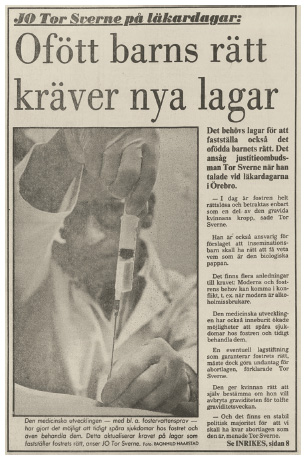
In this article from 1984, Tor Sverne who was chair of The Commission of the Unborn Child stated that the fetus currently had no rights and was considered only a part of the pregnant woman’s body. However, medical developments, including amniocentesis, had demonstrated the need for new laws to establish the rights of the unborn child. From ‘Ofött barns rätt kräver nya lagar.’ Courtesy of Svenska Dagbladet
The notion of the pregnant woman and the fetus as two individuals worthy of protection was further developed in the commission’s second report, Den gravida kvinnan och fostret—två individer: Om fosterdiagnostik; Om sena aborter (The pregnant woman and the fetus—two individuals: On prenatal diagnosis; On late-term abortions). In this report, the commission stressed that the status of the fetus had changed since the 1974 Abortion Act. One reason was the development of prenatal diagnosis; another was the changing perception of children and their rights, which, according to the commission, naturally drew attention to the rights of the unborn child.39 Central to the commission’s deliberations on fetal rights was an ethical perspective called en humanistisk människosyn (a humanistic perspective on human beings), emphasizing human dignity, the inviolability of life, and personal integrity. According to the commission, every human being was a goal in itself. This view contrasted with a technocratic perspective, which would regard human beings as objects that could be manipulated.40 Concerning the disputed issue of when the fetus should be recognized as a person and granted human dignity, the commission
While the fetus did not have the status of a person in its early development, according to the commission it still had legitimate interests. In principle, the commission argued, the fetus had the right to develop and be born; this was in the fetus’s interest even if it was diagnosed with some impairment, the only exception being when serious damage placed it at risk of dying during or shortly after birth. On the other hand, the commission continued, it was in the interest of the woman to have the right to make decisions on prenatal diagnosis and selective abortions based on her specific situation. Personal integrity and autonomy were important parts of human dignity. The ethical conflict then, the commission argued, was between the fetus’s human dignity and value, regardless of health and functioning, and the woman’s autonomy, particularly how she assessed her ability to care for a child with disabilities. The balance of interests between the woman and the fetus was, according to the commission, ‘difficult and delicate,’ yet it was obvious that in certain situations the interest of one had to take precedence over the other.43 In early pregnancy, the commission argued, the interest of the woman outweighed that of the fetus, while the interest of the fetus became increasingly significant as fetal development progressed. Thus, despite viewing the fetus as an individual, in practice the commission followed the current abortion legislation, in which the woman had the right to make her own decision in early pregnancy, while the fetus’s interest—that is, its right to life—took over in late pregnancy.
Although the commission argued that the fetus’s interests were subordinated to the woman’s in early pregnancy, it seemed deeply concerned about the development of prenatal diagnosis, especially in light of the rapid scientific advancement and the possibility of diagnosing a greater number of anomalies. In its view, selective abortions posed a threat to human dignity and the principle of equal value of all human beings. Trying to detect every possible deviation of the fetus, the commission emphasized, was unethical and could lead to the pursuit of perfection, causing elitist attitudes toward human life.
The commission’s rather skeptical attitude toward prenatal diagnosis was reflected in its deliberations about guidelines and regulations. Basically, prenatal diagnosis should only be used for monitoring pregnancy or detecting serious diseases or conditions of the fetus. General fetal screening was dismissed since it might be regarded as a routine attempt to detect abnormalities. However, the commission also defended women’s reproductive rights by emphasizing their entitlement to full information about prenatal diagnosis as well as the complete test results. It also proposed that the current indications for prenatal diagnosis, based on specific risk groups, should be discarded. The woman herself, in discussion with her physician, should decide whether she wanted to undergo prenatal diagnosis.45 Regarding late-term abortions, the commission argued that the safety margin for a viable fetus was sufficient, and there was no need to lower the eighteen-week limit for unrestricted abortion.
The commission’s deliberations demonstrate the difficulties of reconciling a restrictive approach to prenatal diagnosis with a defense of women’s autonomy, and in the end, the commission did not propose any specific legislation related to prenatal diagnosis.46 One reason may have been that it did not have the mandate to propose any major changes to the 1974 Abortion Act. However, its thorough discussions about fetal rights and human dignity changed the topography of the moral landscape. Women’s reproductive rights were now situated close, on the one hand, to notions of fetal rights and, on the other hand, to critiques from the disability rights movement. In discussing prenatal diagnosis and selective abortions, all actors had to navigate between these positions. This became clear in the report’s referral opinions from consulting bodies. Several authorities and organizations responded to the report, developing various positions in the moral landscape.47
The commission’s premise that the pregnant woman and the fetus were two individuals was questioned by several consulting bodies who argued that it was contradictory to regard the fetus as an individual and yet not give it full protection throughout pregnancy. However, as these critics noted, such a view would have undermined the foundations of the current abortion legislation. Others agreed with the commission’s statement, drawing the conclusion that fetal rights had to be respected. This was the opinion of a joint statement by several Christian churches, including the Swedish State Church, which had been one of the sharpest critics of the proposal for liberal abortion legislation in the early 1970s.48 Taking a critical approach to the current law, which, according to the churches, did not take into account the fetus’s rights in early pregnancy, the statement expressed deep concerns that prenatal diagnosis could lead to selective abortions. The fetus, they argued, had human dignity from conception; human dignity was inherent in human existence and was not dependent on the level of development, or on any human characteristics or functions. The ‘unborn child was a specific human life and as such an individual with human interests and with the right of life and development.’49 This view, the statement emphasized, was consistent with Christian belief and tradition but could also be supported by biomedical developments that had demonstrated that the fetus was an independent individual. Therefore, to be able to examine and, in the future, even treat the fetus and still not give it legal protection was ethically untenable. While abortions in general posed a threat to the inviolability of life, selective abortions risked undermining the equal value of all human beings. However, maintaining these principles was a matter for society as a whole. Denouncing the tendency to individualize the ethical conflict of selective abortions with its existential and social dimensions, the churches’ statement emphasized societies’ responsibility to support those taking care of children with disabilities. Selective abortions, they concluded, were an emergency measure that should only be used in particularly vulnerable situations.50 Framed by a general critique of abortion, this path in the moral landscape thus turned toward protecting fetal rights, while women’s reproductive autonomy was challenged.
However, prenatal diagnosis was a complex issue, and the disability movement was not entirely unanimous in its views; how to value this medical technology had been a thorny issue within the movement for several years. When the technology was introduced in the 1970s, many were cautiously positive. As the Swedish Disability Rights Federation, one of the largest associations, initially argued, prenatal diagnosis was a means to prevent disabilities.52 When the debate evolved, and the moral landscape changed, this perspective seemed increasingly untenable to many members. The movement tried to find new pathways, navigating between respectful attitudes toward those who thought prenatal diagnosis and selective abortions could be justified in specific situations, and those who stressed that abortions of impaired fetuses undermined human dignity.
Central to all disability organizations’ reactions to the commission’s report was the equal value of all human beings. Prenatal diagnosis should not be used to screen out people with disabilities. Instead, it was society’s responsibility to provide the necessary conditions so that all people, regardless of characteristics or functioning, could live a good life.53 The argument that selective abortions could prevent suffering was dismissed. Loss of functioning was not suffering in itself; it was exclusion from society and the lack of equality that caused suffering.54 However, as the Disability Rights Federation carefully pointed out, the strict view of prenatal diagnosis did not mean condemning women who saw abortion of an impaired fetus as the only solution to a difficult situation. What they demanded was that society take its responsibility, defend the equal value of all people, and support families living with children with disabilities.55 This
Journalist Sture Gustafson, author of the book Vem har rätt att födas? (Who has the right to be born?), was a prominent voice in the debate on prenatal diagnosis in the early 1980s. Gustafson argued that developments in prenatal diagnosis called into question the right to life of people with disabilities. From Brinde, ‘Vem har rätt att födas?’ Courtesy of Expressen

A third path in the moral landscape more explicitly defended women’s rights. Referring to the 1974 Abortion Act, actors in this position argued that the woman’s interest took precedence over fetal interests in early pregnancy and that women were competent to make difficult decisions about prenatal diagnosis and selective abortions.58 Ascribing the fetus moral status as an individual, with the right to protection that this status implied, was criticized. As the Swedish Society of Medicine emphasized, this would mean that abortion could not be defended at all. Instead, the fetus should be considered as a potential individual, whose interest in some cases had to be subordinated to the woman’s (or parents’) situation.59 Nowhere did the Society of Medicine argue that the fetus might be a patient, which was one of the issues that Giertz, the former chairman of the society’s Ethics Committee, had brought up as an argument for changing the moral status of the fetus. One reason might have been that the possibility of providing treatment to the fetus had proved very limited.60 Instead, the Society of Medicine deplored the moral debates about prenatal diagnosis and selective abortion, as they had caused families to refrain from ‘a medically well-motivated examination.’61 In the same spirit, one of the women’s organizations pointed out that discussions about the ‘inviolability of life,’ which tended to be brought up in relation to the moral status of the fetus, too often led to ‘a violation of the woman’s integrity and autonomy, which is unjustifiable.’62
At the same time, these referral opinions carefully pointed out that prenatal diagnosis and selective abortions did not mean any downgrading of people
Probably from the 1970s, this poster proclaims the ‘Right to free abortion’ (Rätt till fri abort). Women’s right to decide on abortion was well established in Sweden and the regulation of prenatal diagnosis and selective abortions was, according to the women’s movement, a restriction of this right. The text at the right-side reads: ‘Listen up you dicks at the top of society; we are the ones who decide about our bodies!!’ Unknown artist. KvinnSam, Gothenburg University Library.

Several years after the commission’s report and the consultation process, the Government submitted a bill to Parliament about prenatal diagnosis and abortion.66 Although the fetus’s right to protection during its development was recognized, the Government clearly defended women’s reproductive rights: No matter how difficult the decision on prenatal diagnosis was, no one was better suited to make it than the woman herself, in consultation with her physician. Therefore, no regulation of prenatal diagnosis was suggested. Access to adequate knowledge about the medical examination and the implications of the tests, as well as information about society’s support for people with disabilities, was, however, a prerequisite for an informed choice. According to the Government, ‘information and knowledge was one of the central issues of prenatal diagnosis.’67 The bill was approved by Parliament, and ten years after the appointment of the Commission of the Unborn Child, Sweden ended up with a decision that no special legislation on prenatal diagnosis and selective abortion was needed.68 Prenatal diagnosis thus became inseparably linked to
5 Discussion
Parliament’s decision marked the end of a debate on prenatal diagnosis that had been going on for almost two decades. During this time, the moral landscape underwent various changes as new arguments and positions developed, while others were abandoned or downplayed. In the end, the political decision demonstrated that the main path was to defend women’s reproductive autonomy, while the notion that life was inviolable from conception did not receive much support.
Although the regulation of prenatal diagnosis did not primarily concern abortion legislation, there were obvious overlaps, and the balance between the interests of the fetus and the woman that had been established by the 1974 Abortion Act also shaped the view of prenatal diagnosis. This outcome points to the strong political support for liberal abortion legislation in Sweden, particularly with regard to women’s reproductive autonomy.70 The Swedish anti-abortion movement never gained the scope and political influence that it did in the United States, where political conflicts over abortion-related issues have always been intense.71
Another sign of broad support for women’s reproductive autonomy was that the Church of Sweden (until 2000, the Swedish State Church), along with several other churches in Sweden, gradually accepted the right to abortion, arguing that although the ‘the unborn life’ had human dignity and should be protected, there was no room to change the abortion legislation and no alternative to women’s autonomy.72 The churches’ influence on the issue of abortion was arguably diminishing in Sweden, which is often considered as one of the most secularized countries in the world.73 Nevertheless, their recognition of the
As this chapter has demonstrated, the debate on prenatal diagnosis also concerned the practice’s consequences for people with disabilities, with the differences of opinion centered on whether prenatal diagnosis and selective abortions expressed negative and discriminatory attitudes toward people with disabilities, a view that has been called the expressivist argument.74 Some actors addressed this dilemma by distinguishing between individual choice and societal norms and values. In this way, support for women’s reproductive autonomy and a respectful view of persons with disabilities could be reconciled. However, this approach was not convincing to the disability movement, whose members felt that prenatal diagnosis risked undermining essential social values and ultimately society’s support for persons with disabilities. This argument was important when these public debates emerged in Sweden, and it was further developed in referral opinions to the commission’s report. However, the government bill mentioned it only briefly, focusing instead on the conflict of interest between the woman and the fetus. The tension between women’s reproductive autonomy and the potential devaluing of people with disabilities thus remained and has continued to be addressed in relation to new reproductive biotechnologies.75
Several of the arguments in the Swedish debate on prenatal diagnosis and selective abortions show similarities with corresponding debates in other countries, although the emphasis and focus have varied.76 Common features included socioeconomic arguments in the early debates, the perception that prenatal diagnosis and selective abortion were tools to prevent suffering, and the reactions of the disability movement. The increased focus on the fetus and its potential rights has also attracted much attention, as have, of course, the pregnant woman, her experiences of pregnancy, and her reproductive rights. However, the Swedish investigation and subsequent responses provide a vivid picture of how the different aspects were weighed against each other in a specific historical situation.
Finally, it should be noted that prenatal diagnosis formed part of a larger moral landscape of developing genetic and reproductive technologies such as preimplantation diagnostics, as well as medical research involving fertilized
Bibliography
Bashford, Alison. ‘Epilogue.’ In The Oxford Handbook of the History of Eugenics, edited by Alison Bashford and Philippa Levine, 539–58. New York: Oxford University Press, 2010.
Björkman, Maria, and Anna Tunlid. ‘The Establishment of Genetic Counselling in Sweden: 1940–1980.’ In History of Human Genetics: Aspects of Its Development and Global Perspectives, edited by Heike I. Petermann, Peter S. Harper, and Susanne Doetz, 339–66. Cham: Springer International, 2017.
Brinde, Ellen. ‘Vem har rätt att födas?’ Göteborgs-Tidningen, May 27, 1984.
Casper, Monica J. The Making of the Unborn Patient: A Social Anatomy of Fetal Surgery. New Brunswick, NJ: Rutgers University Press, 1998.
de Chadarevian, Soraya. ‘Chromosome Photography and the Human Karyotype.’ Historical Studies in the Natural Sciences 45 (2015): 115–46.
Doetz, Susanne. ‘Healthy, Happy, Rational: Reflections on Genetic Counselling in the GDR.’ Medical Humanities 49, no. 2 (2023): 236–47.
Dubow, Sara. Ourselves Unborn: A History of the Fetus in Modern America. New York: Oxford University Press, 2011.
Ewerlöf, Göran, Barbro Röst Andréasson, and Tor Sverne. Barnets bästa: Om föräldrars och samhällets ansvar. Stockholm: Liber Förlag, 1982.
‘Fostertest: Rätt eller plikt?’ Dagens Nyheter, June 18, 1980.
Gustafson, Sture. Fosterdiagnostik—för vem? Stockholm: LT:S förlag, 1980.
Gustafson, Sture. Vem har rätt att födas? En bok om människosyn och fosterdiagnostik. Stockholm: LT:S förlag, 1984.
Helgason, Agnar, and Gisli Palsson. ‘Contested Commodities: The Moral Landscape of Modernist Regimes.’ Journal of the Royal Anthropological Institute 3 (1997): 451–71.
Hermerén, Göran. ‘Det svårfångade människovärdet.’ In Det svårfångade människovärdet: En debattskrift, 61–99. Etiska vägmärken 4. Stockholm: Statens Medicinsk-etiska råd, 1991.
Herzog, Dagmar. Unlearning Eugenics: Sexuality, Reproduction, and Disability in Post-Nazi Europe. Madison: University of Wisconsin Press, 2018.
Hofmann, Bjørn. ‘“You Are Inferior!” Revisiting the Expressivist Argument.’ Bioethics 31 (2017): 505–14.
Johnston, Josephine, and Rachel L. Zacharias. ‘The Future of Reproductive Autonomy.’ Hastings Center Report 47 (2017): S6–S11.
Jülich, Solveig. ‘The Making of a Best-Selling Book on Reproduction: Lennart Nilsson’s A Child Is Born.’ Bulletin of the History of Medicine 89, no. 3 (2015): 491–526.
Karlsson, Yngve. ‘“Det ofödda barnets rätt” etisk nyckelfråga som får ny aktualitet genom fosterdiagnostiken.’ Läkartidningen 77 (1980): 1266–68.
Karlsson, Yngve. ‘Vem svarar för den ofödde?’ Läkartidningen 37 (1981): 3131–36.
Koch, Lene, and Mette N. Svendsen. ‘Negotiating Moral Value: A Story of Danish Research Monkeys and Their Humans.’ Science, Technology, & Human Values 40 (2015): 368–88.
Kumlien, Mats. Finns det ett kristet synsätt på abort? Uppsala Faculty of Law, Working Paper 2012:2. Uppsala: Uppsala universitet, 2012.
Lennerhed, Lena. Kvinnotrubbel: Abort i Sverige 1938–1974. Möklinta: Gidlunds, 2017.
Lennerhed, Lena. ‘No Backlash for Swedish Women? The Right to Abortion on Demand, 1975–2000.’ Journal of Modern European History 17, no. 3 (2019): 326–36.
Linders, Annulla. ‘Victory and Beyond: A Historical Comparative Analysis of the Outcomes of the Abortion Movements in Sweden and the United States.’ Sociological Forum 19 (2004): 371–404.
Lindqvist, Rafael. ‘Swedish Disability Policy: From Universal Welfare to Civil Rights?’ European Journal of Social Security 2 (2000): 399–418.
Lindsten, Jan, and Lars Beckman. Klinisk genetik: Supplement till Medicinsk service. Stockholm: Socialstyrelsen 1976.
Löwy, Ilana. Imperfect Pregnancies: A History of Birth Defects and Prenatal Diagnosis. Baltimore: Johns Hopkins University Press, 2017.
Löwy, Ilana. Tangled Diagnoses: Prenatal Diagnosis, Women and Risk. Chicago: University of Chicago Press, 2018.
Lupton, Deborah. The Social Worlds of the Unborn. Basingstoke: Palgrave Macmillan, 2013.
National Board of Health and Welfare. Fosterdiagnostik: Rapport från en av Socialstyrelsen tillsatt expertgrupp. Stockholm: Socialstyrelsen, 1982.
Nemec, Birgit, and Gabriele Moser. ‘Counselling, Risk and Prevention in Human Genetic Early Diagnosis in the Federal Republic of Germany.’ In History of Human Genetics: Aspects of Its Development and Global Perspectives, edited by Heike I. Petermann, Peter S. Harper, and Susanne Doetz, 367–92. Cham: Springer International, 2017.
Nilsson, Lennart, Axel Ingelman-Sundberg, and Claes Wirsén. Ett barn blir till: En bildskildring av de nio månaderna före födelsen; En praktisk rådgivare för den blivande mamman. Stockholm: Bonnier, 1965.
‘Ofött barns rätt kräver nya lagar.’ Svenska Dagbladet, April 10, 1984.
Parens, Erik, and Adrienne Asch, eds. Prenatal Testing and Disability Rights. Baltimore: Georgetown University Press, 2000.
Paul, Diane B. ‘Reflections on the Historiography of American Eugenics: Trends, Fractures, Tensions.’ Journal of the History of Biology 49 (2016): 641–58.
Rapp, Rayna. Testing Women, Testing the Fetus. New York: Routledge, 1999.
Reagan, Leslie J. Dangerous Pregnancies: Mothers, Disabilities, and Abortion in Modern America. Berkeley: University of California Press, 2010.
Stern, Alexandra Minna. Telling Genes: The Story of Genetic Counselling in America. Baltimore: Johns Hopkins University Press, 2012.
Swedish Ministry of Justice. Abortfrågan: Remissyttranden över 1965 års abortkommittés betänkande Rätten till abort (SOU 1971:58). SOU1972:39. Stockholm: Justitiedepartementet, 1972.
Swedish Ministry of Justice. Den gravida kvinnan och fostret—två individer: Om fosterdiagnostik; Om sena aborter. SOU 1989:51. Stockholm: Justitiedepartementet, 1989.
Swedish Ministry of Justice. Rätten till abort. SOU 1971:58. Stockholm: Justitiedepartementet, 1971.
Swedish Ministry of Justice. Skydd för det väntade barnet. 1. Åtgärder vid missbruk m.m. under graviditet. SOU1987:11. Stockholm: Justitiedepartementet, 1987.
Swedish Parliament. ‘Nr 14. Socialutskottets betänkande om lagstiftning till skydd för ofödda m. m.’ In Riksdagens protokoll. Collection 12, Vol. E9. Socialutskottets betänkanden och yttranden nr 1–56, 1–37. Stockholm: Riksdagen, 1981–82.
Swedish Parliament. ‘Nr 4. Sammanfattning av hearing 1984-09-04. Bilaga till Socialutskottets betänkande om vissa medicinsk-etiska frågor.’ In Riksdagens protokoll. Collection 12, Vol. E9. Socialutskottets betänkanden och yttranden, 28–49. Stockholm: Riksdagen, 1984–85.
Swedish Parliament. ‘Nr 70. Kungl. Maj:ts proposition med förslag till abortlag m.m.; given den 8 mars.’ In Riksdagens protokoll. Collection 1, Vol. B9. Kungl. Maj:ts propositioner nr 51–76, 1–123. Stockholm: Riksdagen, 1974.
Swedish Parliament. ‘Nr 142. Fosterdiagnostik och abort.’ In Riksdagens protokoll. Collection 1, Vol. B21. Regeringens propositioner nr 130–149, 1–82. Stockholm: Riksdagen, 1994–95.
Swedish Parliament. ‘Motion 1980/81:376 av Mårten Werner och Gunnar Oskarson om tilläggsdirektiv till 1980 års abortkommitté.’ In Riksdagens protokoll. Collection 3, Vol. D2. Motioner nr 180–520, 13–14. Stockholm: Riksdagen, 1980–81.
Swedish Society of Medicine’s Ethics Delegation. ‘Stärk skyddet för det ofödda barnet!’ Läkartidningen 37 (1981): 3139–41.
Wisselgren, Per. ‘Reforming the Science-Policy Boundary: The Myrdals and the Swedish Tradition of Governmental Commissions.’ In Academics and Public Intellectuals, edited by Sven Eliaeson and Ragnvald Kalleberg, 173–95. Newcastle: Cambridge Scholars, 2008.
Zuckerman, Phil. ‘Why Are Danes and Swedes So Irreligious?’ Nordic Journal of Religion and Society 22 (2009): 55–69.
Rätt till fri abort. Poster, n.d. The Archive of the Woman’s House in Stockholm. B68:13. KvinnSam. Gothenburg University Library.
Fredrika Bremer Association. Statement of opinion to MHSA, April 26, 1990. E1A:2583. MHSA.
Joint statement from the Catholic Bishops’ Office, the Swedish Ecumenical Board, the Bishops’ Meeting of the Church of Sweden, the Swedish Council of Free Churches with the main agreement of the Central Board of the Church of Sweden. Statement of opinion MHSA, May 10, 1990. E1A:2583. MHSA.
Karolinska Institute. Statement of opinion to MHSA, May 4, 1990. E1A:2583. MHSA.
National Association of the Disabled. Statement of opinion to MHSA, April 4, 1990. E1A:2583. MHSA.
National Association of the Neurologically Disabled. Statement of opinion to MHSA, April 20, 1990. E1A:2583. MHSA.
National Board of Health and Welfare’s advisory board for ethical issues. Statement of opinion to MHSA, March 30, 1990. E1A:2583. MHSA.
National Council for the Disabled. Statement of opinion to MHSA, April 18, 1990. E1A:2583. MHSA.
Swedish Association for Sexuality Education. Statement of opinion to MHSA, August 28, 1990. E1A:2583. MHSA.
Swedish Disability Rights Federation. Statement of opinion to MHSA, April 25, 1990. E1A:2583. MHSA.
Swedish Medical Association. Statement of opinion to MHSA, April 23, 1990. E1A:2583. MHSA.
Swedish National Association for People with Intellectual Disability to MHSA, December 21, 1983. Vol. 1, ‘Commission of the Unborn Child.’ NAS, Stockholm.
Swedish Society of Medicine. Statement of opinion to MHSA, May 8, 1990. E1A:2583. MHSA.
There are several studies on prenatal diagnosis; see, e.g., Rapp, Testing Women, Testing the Fetus; Löwy, Imperfect Pregnancies; Löwy, Tangled Diagnoses.
Whether there is a link between early twentieth-century eugenics and later reproductive genetics, including prenatal diagnosis, is controversial. See, e.g., Bashford, ‘Epilogue’; Paul, ‘Reflections on the Historiography.’
Löwy, Imperfect Pregnancies, 7.
Rapp, Testing Women, Testing the Fetus, 306–11.
For a critical discussion of fetal surgery and reproductive politics, see Casper, Making of the Unborn Patient.
Lupton, Social Worlds of the Unborn, 92–112.
Dubow, Ourselves Unborn, 3.
Wisselgren, ‘Reforming the Science-Policy Boundary.’
Helgason and Palsson, ‘Contested Commodities’; Koch and Svendsen, ‘Negotiating Moral Value.’
Löwy, Imperfect Pregnancies, 2.
de Chadarevian, ‘Chromosome Photography.’
See Berg’s chapter in this volume.
Nilsson, Ingelman-Sundberg, and Wirsén, Ett barn blir till. The first American edition was published in 1966 by Delacorte Press and the first British edition in 1967 by Allen Lane/Penguin Press. For a discussion of the book, see Jülich, ‘Making of a Best-Selling Book.’
Löwy, Tangled Diagnoses, 16.
Lindsten and Beckman, Klinisk genetik, 40.
Björkman and Tunlid, ‘Establishment of Genetic Counselling,’ 356–57.
Björkman and Tunlid, ‘Establishment of Genetic Counselling,’ 356–60.
E.g., Nemec and Moser, ‘Counselling, Risk and Prevention,’ 381–84; Stern, Telling Genes, 161–64.
Lennerhed, ‘No Backlash’; Lennerhed, Kvinnotrubbel, chap. 5. See also Björkman’s chapter in this volume.
Reagan, Dangerous Pregnancies.
Swedish Parliament, ‘Nr 70. Kungl. Maj:ts proposition.’ The viability concept was also included in the US Supreme Court decision Roe v. Wade. On this, see Lupton, Social Worlds of the Unborn, 28.
Swedish Ministry of Justice, Rätten till abort. See also the reservation by the conservative member of Parliament Astrid Kristensson, concerning legal protection of the fetus.
Swedish Parliament, ‘Nr 70. Kungl. Maj:ts proposition.’
E.g., ‘Fostertest.’
Swedish National Association for People with Intellectual Disability to MHSA. The association suggested a governmental commission about prenatal diagnosis with representation from the disability organizations.
E.g., Swedish Parliament, ‘Motion 1980/81:376.’
Karlsson, ‘“Det ofödda barnets rätt.”’
Karlsson, ‘Vem svarar för den ofödde?’
Swedish Society of Medicine’s Ethics Delegation, ‘Stärk skyddet för det ofödda barnet!’
E.g., Swedish Parliament, ‘Nr 14. Socialutskottets betänkande.’
The concept of reproductive autonomy began to appear in the context of the fight for more liberal abortion legislation in the United States in the 1960s. For a brief history of the concept, see Johnston and Zacharias, ‘Future of Reproductive Autonomy.’
National Board of Health and Welfare, Fosterdiagnostik.
For a discussion about the intersections of disability and reproductive rights from a European perspective, see Herzog, Unlearning Eugenics.
E.g., as chairman of the governmental commission ‘Om barnens rätt’ (On children’s rights) during the 1970s.
Ewerlöf, Röst Andréasson, and Sverne, Barnets bästa, 119–120. See also Swedish Parliament, ‘Nr 4. Sammanfattning av hearing.’
Swedish Ministry of Justice, Den gravida kvinnan, 19.
Swedish Ministry of Justice, Skydd för det väntade barnet, 69.
Swedish Ministry of Justice, Skydd för det väntade barnet, 42.
Swedish Ministry of Justice, Den gravida kvinnan, 80.
Swedish Ministry of Justice, Den gravida kvinnan, 75. ‘En humanistisk människosyn’ is a central concept in Swedish discussions on medical ethics. Hermerén, ‘Det svårfångade människovärdet.’
Swedish Ministry of Justice, Den gravida kvinnan, 77.
On the contested status of the unborn, see Lupton, Social Worlds of the Unborn, 13–19.
Swedish Ministry of Justice, Den gravida kvinnan, 78.
Swedish Ministry of Justice, Den gravida kvinnan, 81.
This procedure followed a basic principle in Swedish health care: ultimately it was the physician who decided whether a treatment was medically justified.
Only minor adjustments of the 1974 Abortion Act were suggested.
Forty-five referral responses were made by authorities, political organizations, and various interest groups. It should be noted that the term ‘fetus’ was used throughout these responses, and no distinction was made between ‘embryo’ and ‘fetus,’ presumably because the opinions concerned fetal diagnosis.
Joint statement of opinion to MHSA. On the Swedish State Church’s opinion of the proposal for new abortion legislation, see Swedish Ministry of Justice, Abortfrågan, 96–108.
Joint statement of opinion to MHSA.
Joint statement of opinion to MHSA.
Lindqvist, ‘Swedish Disability Policy.’
Gustafson, Fosterdiagnostik, 66.
See, e.g., National Association of the Disabled, statement of opinion to MHSA; National Association of the Neurologically Disabled, statement of opinion to MHSA; National Council for the Disabled, statement of opinion to MHSA; Swedish Disability Rights Federation, statement of opinion to MHSA.
National Association of the Disabled, statement of opinion to MHSA.
Swedish Disability Rights Federation, statement of opinion to MHSA.
Swedish Disability Rights Federation, statement of opinion to MHSA.
E.g., National Association of the Neurologically Disabled, statement of opinion to MHSA, and National Council for the Disabled, statement of opinion to MHSA.
E.g., Fredrika Bremer Association, statement of opinion to MHSA; and Swedish Association for Sexuality Education, statement of opinion to MHSA.
Swedish Society of Medicine, statement of opinion to MHSA. See also Karolinska Institute, statement of opinion to MHSA.
Cf. Swedish Ministry of Justice, Den gravida kvinnan, 26.
Swedish Society of Medicine, statement of opinion to MHSA.
Fredrika Bremer Association, statement of opinion to MHSA.
Swedish Society of Medicine, statement of opinion to MHSA.
Swedish Medical Association, statement of opinion to MHSA; and National Board of Health and Welfare’s advisory board for ethical issues, statement of opinion to MHSA.
National Board of Health and Welfare’s advisory board for ethical issues, statement of opinion to MHSA.
Swedish Parliament, ‘Nr 142. Fosterdiagnostik och abort.’
Swedish Parliament, ‘Nr 142. Fosterdiagnostik och abort,’ 22–23.
Only minor changes to the 1974 Abortion Act were made—for example, that the woman should be offered a meeting with a counsellor before and after the termination of a pregnancy if she so desired.
For a discussion of liberal abortion legislation as well as decisions about development, prenatal diagnosis, and reproduction in other European countries, see, e.g., Löwy, Tangled Diagnoses, chap. 3 on France; and Doetz, ‘Healthy, Happy, Rational’ on the GDR.
See Lennerhed, ‘No Backlash.’ For a brief discussion about Swedish anti-abortion activists, see Björklund’s chapter in this volume.
Linders, ‘Victory and Beyond’; Lennerhed, ‘No Backlash.’
Kumlien, ‘Kristet synsätt på abort?, 41–43.
Zuckerman, ‘Why Are Danes and Swedes.’
See, e.g., Parens and Asch, Prenatal Testing and Disability Rights; Hofmann, ‘“You Are Inferior!”’
See, e.g., Hofmann, ‘“You Are Inferior!”’
See, e.g., Löwy, Tangled Diagnoses; Lupton, Social Worlds of the Unborn; Stern, Telling Genes, chap. 7.