


How can one capture a fish on paper? This question was often on the mind of the Jewish-German naturalist Marcus Ãlieser Bloch. His ambitious and costly book series, the Allgemeine Naturgeschichte der Fische â twelve lavishly illustrated volumes on fish published from 1782 to 1795 â was the result of decades of research into these creatures and contained over four hundred hand-coloured engravings. These coloured illustrations were the defining feature of the work. In 1794, the missionary Christoph Samuel John (1747â1813), who had contributed a considerable number of specimens from the Coast of Coromandel where he was stationed, wrote to Bloch describing admiration Blochâs series of fish books elicited in all those who saw them. Published in the Berlinische Monatschrift for all of the periodicalâs enlightened audience to read, Johnâs letter went on to explain how the black fishermen who supplied him with specimens for him âwere astounded by how lively their fishes swam about on the page.â1 Whether this exchange actually took place, this was an exaggerated account of it, or whether John wanted to present Bloch with a flattering fiction, the terms that he used are significant. After all, Bloch had taken great pains to ensure that each and every illustration in the book series portrayed the fish species as they must have looked before death and subsequent decay. To replicate the glistening of scales, his artists sometimes even used paints that contained from actual silver and gold.
While it was common practice for authors to copy illustrations, the majority of the 432 plates in Blochâs work had been designed anew by artists. The illustration of a species of catfish that John had sent him, which Bloch had named the bimaculated silure (Figure 14), shows how the engravings were carefully hand-coloured, delicately depicting the speciesâ various hues.2 By ingeniously combining techniques for engraving and colourisation, Bloch crafted his illustrations to function as âepistemic imagesâ which distilled the characteristics of fishes that he considered essential so that the image could serve as a substitute for the depicted species.3 In this sense, his books are rather different to those of Linnaeus and Artedi, which appeared virtually image-free. While Bloch continued the classificatory approach that the Swedish naturalists had promulgated in their works, he could not imagine doing without illustrations. In fact, in his introduction to the book series he declared that he was only including those fishes for which he was able to offer drawings done after nature.4 Believing that illustrations allowed for the most accurate capture of fish, Bloch took pride in sparing neither effort nor expenditure in giving his volumes âthe highest degree of perfection.â5

Engraving of Silurus bimaculatus, Johann Friedrich Hennig, vol. 12 (Berlin: J. Morino, 1795), plate CCCLXIV
New York Public Library
Looking beyond the beautiful images, the books bring together a rather surprising constellation of people. As the list of subscribers to the volumes shows, his books were of interest to a Luxembourgian fishing guild as well as to royals and nobles, government officials, bankers, apothecaries, physicians, preachers, and booksellers.6 It is an example of how the European audience for âvisually sumptuous and winningly designed volumesâ, was growing in the eighteenth century.7 Yet it is also indicative of how Bloch, a Jewish naturalist who was not granted full legal equality with the other inhabitants of his city of Berlin, found a way to fully integrate in learned circles. The work was, furthermore, produced within a colonial context. Even though the early modern German states did not maintain a consistent presence outside of Europe, Bloch benefited from colonial infrastructures in expanding his collection. John, who was the main contributor of foreign species to Blochâs project, was a Pietist missionary based in South India who relied on individuals in and around the mission to furnish him with specimens. The purpose of this chapter is to show how Blochâs fish series, which promoted these coloured engravings as its unique selling point, helped him to negotiate intricate social structures, and, furthermore, that these engravings were instrumental in the creation of his image as a naturalist.
The chapter first introduces Bloch and his collection, in order to embed him in the wider community of late eighteenth-century Naturforscher. The second section considers how his series of fish books straddled various geographical boundaries and catered to varied audiences. The third section traces how those specimens that hailed from Europeâs colonial outposts had reached the shelves of Blochâs cabinet in the first place, focusing on the most important contributor of colonial specimens, the abovementioned German missionary John, who enlisted local assistants to collect fish on the Coromandel Coast of South India. The fourth and last part of the chapter analyses the way in which Blochâs fish collection was preserved on paper, with particular emphasis on the way in which the illustrations were designed and executed and how they functioned as an act of preservation. Ultimately, it argues that the manner in which Bloch presented his collection on paper served to make him an authority on the fishes of the world without requiring him to travel outside of his Berlin.
1 Collections, Identities, and Reputations
It was in the early 1770s that Bloch had started to assemble an impressive collection in his home on the SpandauerstraÃe in Berlin, where the more prosperous Jewish inhabitants of the city lived.8â In his guide to notable places in the area of Berlin and Potsdam, the printer Christoph Friedrich Nicolai (1733â1811) described it as a âwell-ordered collection of naturalia contained in eight glass cabinets and five drawered chestsâ, which accommodated a broad range of natural productions. Amongst the many items he mentioned were fossils and polished stones, wood samples, endemic and foreign birds with their nests, reptiles (âmany beautiful snakesâ), several boxfishes and a flying fish, rare shells, large Surinam beetles, and even human remains, of which he found âan embryo conceived by an European and a Mohrinâ most noteworthy.9â This description demonstrates both the breadth of the collection and the colonial context which shaped it. Blochâs cabinet was not in itself unique; Nicolai described 27 other collections in Berlin alone.10 In eighteenth-century Europe, increasing numbers of merchants, physicians, professors and others amassed collections of rare and valuable natural and cultural objects in their households.11â Blochâs collection, however, was held in particularly high esteem. Even the great Wilhelm von Humboldt spoke of the âBlochâsche Cabinetâ, writing to Johann Wolfgang von Goethe that he heard it held all kinds of rarities.12â
What made this collection truly stand out, however, was its vast amount of fish. By the time of his death in 1799, Blochâs collection of fish had grown to encompass almost 1,400 specimens.13â Over 1,000 of these floated in glass jars full of alcohol, while others were stuffed with hay or existed as preserved skins, some of which were mounted on wooden models. Why this focus on fish? It is a question the naturalist answered on the very first page of the preface to the very first volume of the Allgemeine Naturgeschichte der Fische.14 In this preface, Bloch explained how, given that he was spending much of his leisure time perusing natural history, a friend sent him a salmon from the lake of Miedwie, in the Province of Pomerania bordering on the east of Brandenburg. On consulting his copy of Linnaeusâ Systema naturae he found that not only did this particular species of salmon go unmentioned, but so too did many other fish common in the German statesâ .15 Germanic Europe may have been, in the words of Kathryn Olesko, âculturally diverse, politically fragmented and geographically fluidâ, Bloch saw it as an area unified enough to be charted through its fish.16
Just as Willughby and Ray had done a century before him, Bloch obtained specimens at marketplaces and harboursâ . While his initial intention was to chart only German fishes, his collection soon expanded to what he called fremde Fische [foreign fish], that is to say fish not native to the German states.17â Bloch boasted that he received fish from all corners of the world through his network consisting of government officials, physicians and missionaries. His collection thus grew to encompass specimens that originated in Scandinavia, Greenland, the North Atlantic, the Mediterranean, Africaâs west coast, the Caribbean, Surinam and Brazil, North America and South India.18 A further section of this chapter will explore the various individuals who contributed the specimens from the latter region that ended up on Blochâs shelves.
As various historians have shown, collections were tied closely to identities. They were about making and displaying connections: presenting objects from faraway places allowed the collector to impress viewers with their global reach.19 In his biography of Hans Sloane, James Delbourgo showed how as the âcollector of collectorsâ, Sloane created a central position for himself in the learned world of the late seventeenth and early eighteenth centuries.20 Collectors did not merely demonstrated their connections, however, but also their skill and taste. As Emma Spary has noted, collections were thought to represent the collectorâs personal character, so that making an orderly and aesthetically pleasing cabinet was a good way of establishing oneâs reputation.21 Such factors may well have played a role in Blochâs decision to build a collection. As a Jew, Bloch was perceived as a relative outsider by the learned community. This was not, of course, because Jewish thinkers did not have a profound influence on early modern natural philosophy â quite the contrary. Compared to other naturalists, however, Blochâs entry to the world of learning was conditional, as we will see, both in a judicial and a cultural sense. We will now look at his emergence as a collector and naturalist in more detail.
Bloch was born in 1723 in Ansbach, Bavaria, and grew up in a rather impoverished, orthodox Jewish household.22â His upbringing was traditional; he was taught Hebrew, for example, but probably not how to read in the Latin alphabet, as this was not encouraged in orthodox circles.23â Sometime around 1743 he travelled to Hamburg, where he had obtained a position as teacher to the son of a Jewish surgeon. This is where he learned German and Latin, and where he acquired some basic medical knowledge. He then travelled to relatives in Berlin in order that he might study anatomy. When Bloch decided to pursue a doctorate in Medicine in 1760, he moved to Frankfurt am Oder; this cityâs university was the only one in Prussia that admitted Jews.24â Having received his degree in 1762, Bloch settled in Berlin where he set up practice as a physician, married, and involved himself in the cityâs intellectual life.
Soon after arriving in Berlin, Bloch became involved in the Haskalah, also known as the Jewish Enlightenment, which was spurred by a group of intellectuals that had moved to the city due to its growing reputation as a centre of scholarship.25â As home to the centre of Prussian government, the royal court, and a military garrison as well as being an emerging commercial hub, Berlin had been growing rapidly in the first half of the eighteenth century.26â Among its varied population were migrants from different religious backgrounds.27 Although the city was relatively open to newcomers, Jews, as elsewhere in Prussia, did not have full legal equality. The government curbed their rights to marry, buy property, found businesses, or attend university.28â The figureheads of the Haskalah worked towards reforms to advance the legal status of the Jewish community in the city. Some of these, such as the philosopher Moses Mendelssohn (1729â1786) and the banker David Friedländer (1750â1834) were close friends with Bloch.29â Bloch himself was one of the founders of Berlinâs Jewish hospital.30â He also dedicated the tenth volume of his series of fish books to the heir presumptive, Frederick VI of Denmark (1768â1839), in acknowledgement of a decree that ensured the rights of Blochâs âsuppressed brethrenâ by granting Jewish pupils access to apprenticeships with craftsmen.31â It is the only instance in which Bloch explicitly alludes to his Jewish background in his books, and yet it is clear that this emancipation effort was important to him.
Following the death of his first wife in 1769, Bloch wedded the affluent Cheile Ephraim (1757â1780) in 1774, a marriage which might well have facilitated the expansion of his collection.32â His first publication, a book of medical observations, appeared in that same year.33â In the following decades he established himself as prolific author of natural history, spending most of his time on the study of fish.34 He collected species of fish, scoured the natural historical literature to see if they had already been described, and classified them according to Linnaean principles if that had not yet been done. The first volume of his fish series was published in 1782. From this moment on, his collection and his series of fish books nourished, influenced and reinforced one another. In the prefaces to the published volumes, Bloch solicited ever more fish specimens and drawings from his readers. They plainly obliged, as over the years in which his fish series was published, he continued to receive a good supply of specimens, which he in turn converted into descriptions and depictions for his series. Even though the development of the collection and the series were closely connected, we will first turn to the formation of the former, and only subsequently discuss the latter.
Bloch moved not only within the circle of the Jewish enlightenment, but also sought out others who shared his fascination for the study of nature. While it seems that the Königlich-PreuÃische Akademie der Wissenschaften [Royal Prussian Academy of Sciences] in Berlin would admit neither Bloch nor Mendelssohn because of their Jewish background, this may not have been an insurmountable blow, because Bloch had created his own club.35â He was one of the founding members of the Gesellschaft Naturforschender Freunde [Society of Friends of Nature Research] in 1773.36â As its name reveals, this society consisted of people united by their interest in studying nature. This club was, on the one hand, open and egalitarian, as it welcomed members from various backgrounds and religious denominations who wished to contemplate Godâs Creation through the study of nature. Furthermore, its statutes stressed that its members were considered equal without regard for birth, rank or standing.37â On the other hand, the founders of the Gesellschaft Naturforschender Freunde were hesitant to admit people who were too affluent, as they feared that they would be too full of pride in their wealth and reputation to engage in debates in the spirit of equality and friendliness.38â The membership of the Gesellschaft thus consisted largely of middle-class men, among them apothecaries, physicians, and government officials.39â In order to join, these members had to demonstrate that they were serious Naturkenner.
A good way to do so was to collect natural historical objects. In fact, the ownership of a collection of natural rarities [natürlichen Seltenheiten] was a primary requirement for admission, as founding member Friedrich Wilhelm Heinrich Martini (1729â1778) declaredâ .40 In the spirit of collaboration and cooperation, the membersâ collections and libraries were to be made accessible to the others.41â As Spary has argued for the Parisian collecting community, the Gesellschaft Naturforschender Freunde likewise preferred collections to be suitably ordered. As we saw, Nicolaiâs guidebook wrote approvingly of Blochâs wohlgeordenete Naturaliensammlung, which by and large adhered to Linnaean systematics.42â By ordering his cabinet in a systematic manner, Bloch â quite literally â showcased his knowledge of the Linnaean system. Bloch and collectors like him thus presented their expertise in the same breath as they presented their material possessions.
That Bloch was a significant figure in the learned landscape is underscored by the portrait engraving that the German physician and naturalist Johann Georg Krünitz (1728â1796) commissioned of him for the thirteenth part of his Oeconomische Encyclopädie (Figure 15), published in 1784.43â As its title indicates, this series offered an encyclopaedic overview of all matters relating to âoekonomieâ â a term that encompassed all kinds of practical endeavour that contributed to socio-economic improvement in one way or the other.44â Bloch deserved a place in this survey: as the text on the engraving declares, he was much loved as a physician, nationally renowned for his study of nature and an esteemed philanthropist.45â Each of the portraits of eminent figures that Krünitz commissioned for his encyclopaedia convey something that is specific to the person depicted. In the case of Bloch, the scenic backdrop against which his portrait is placed signifies his interest in the study of nature. A pair of putti peruse natural historical volumes, one of them with a magnifying glass in hand; one can still make out the drawings of fish on the pages. They are a visual nod to the fish books that Bloch became widely known for.
Portrait engraving of Marcus Ãlieser Bloch, Johann Conrad Krüger. Johann Georg Krünitz, Oeconomische Encyclopädie vol. 31 (Berlin: Joachim Pauli, 1778)

When the last volume of his book series appeared in 1795, Blochâs fame extended far beyond the German states. He had earned memberships of learned societies such as the Royal Society in London and the Muséum national dâHistoire naturelle in Paris, as well as those of â Leipzig, Göttingen, Utrecht and Frankfurt, amongst others.46â And yet, Bloch accrued these international accolades despite leaving Germany just one time, in 1796, when â well into his seventies and a few years before his passing â he travelled to Amsterdam and Paris to attend auctions, visit collections and even meet the renowned naturalist Georges Cuvier (1769â1832), certainly one of the most celebrated savants of his time.47â
Towards the end of his life, therefore, Bloch had become an internationally renowned author and collector. His Jewish background had several consequences for his position in the social, cultural and intellectual echelons of Berlin: while he was part of a vibrant community of Jewish thinkers, he also faced forms of exclusion. It is possible that Bloch felt that he had something to prove, and that in assembling his collection he showed that he was fully able to participate â and perhaps better than most Christians â in the learned life of Berlin and beyond. It is also easy to imagine that he opted for a relatively underexplored area of natural history, one that carried less risk of creating rivalry with more established naturalists. In any case, through building up a collection of natural rarities he created a space for himself in the cityâs learned landscape, even co-founding an egalitarian society for which owning a cabinet of natural curiosities was a prerequisite. Those who visited his cabinet in the SpandauerstraÃe could admire Blochâs piscine treasures with their own eyes. By publishing the series of fish books, which was largely based upon drawings of the specimens in his collection, he circulated knowledge about his collection to the wider, learned community. This series of books will now be discussed.
2 Charting German and âForeignâ Fish
In the preface to the sixth volume of his natural history of fishes, published in 1787, Bloch announced that it would mark the conclusion of this series of books.48 This did not mean he truly thought his project was finished. After all, he still had more than a hundred unpublished drawings of fish in his possession, executed in the most beautiful colours, and many of the specimens in his impressive collection in Berlin were yet to be depicted.49 Lack of research material was not the issue here, nor did the book series fall short of attention. The problem was, rather, that many of its subscribers had not actually paid their dues. Bloch had funded the full publication process himself. He conceded that of the 20,000 Reichsthalers he had spent out of his own pocket â a staggering sum â he had earned only about half back.50 In order to guard his family from further impoverishment, he was forced to put his project on hold.51 While this statement of financial duress may seem somewhat unusual to us, it is yet another example of how Bloch adhered to the cultural code of the learned community of his time. The idea was that one published books as a service to the society, and not even in the slightest hint of a pursuit of profit.52 As we saw, publishing a well-made book was more of an investment in oneâs name. Upon altering his publication strategy, Bloch ultimately managed to proceed with the project and deliver the final six volumes, bringing the book series to actual completion with the twelfth.
What made these volumes particularly expensive to produce was the fact that each description was accompanied by a hand-coloured engraving. As we saw in previous chapters, Willughby and Rayâs Historia piscium was a tricky enterprise for the Royal Society on account of its many engravings, whereas Linnaeus opted to include none in his own works to keep them affordable. Bloch clearly was not willing to stint on images. Even though he agreed with Artedi and Linnaeus on the crucial importance of classifying fish on the basis of physical marks, he did not think that their decontextualised manner of description was sufficient for the purpose of demarcating species. As he explained in the inaugural volume of his fish series, he had noticed that many of the fish that he came across, âcould not be determined from the works of Linnaeus nor Artedi, nor of the older ichthyologists, because the descriptions in the first two are in respect to certain fish too short, and the latter are often unreliable because of their bad and unfaithful images.â53 The Jewish naturalist deemed an illustration essential to the proper representation of a fish.
Blochâs series of fish books followed the expansion of his collection in close step. The first volume appeared in 1782 under the title Oeconomische Naturgeschichte der Fische Deutschlands. Bloch paid for its publication out of his own pocket (or likely, that of his wife) and it was printed by the bookseller Hesse in Berlin. It contained thirty-seven species descriptions and an equal number of engraved, hand-coloured plates. The latter were published in separate, bound volumes in a large folio format, so that all of the fishesâ parts could be made clearly visible.54 Two more volumes on German fish followed in 1783 and 1784; these were printed by Realschule Buchhandlung. When Bloch had collected and described the fish of the German states, he still had a lot of fish in his possession that as yet undescribed as they were not native to Germany. The descriptions and illustrations of foreign fish were published in nine parts as Naturgeschichte der ausländischen Fische. The first three of these appeared with the Realschule (1785â1787), the rest with the publishing house Johann Morino & Comp (1790â1795). The combined series of fish books became known as the Allgemeine Naturgeschichte der Fische. When the twelfth and final volume was published in 1795, the fish series had classified, described and depicted well over four hundred species.
Blochâs series of fish books is divided into âGermanâ and âforeignâ fishes. This polarity mirrors the tendency of naturalists in the sixteenth and seventeenth centuries to contrast the âindigenousâ with the âexoticâ.55 For botanists, however, the fruitful transportation of plants from the tropics to Europe was a topic of both considerable scientific and economic interest.56 Acclimatisation was difficult, but the successful cultivation of plants like the Peruvian potato and American tobacco in the cold Dutch Republic indicated that boundaries between âindigenousâ and âexoticâ were permeable.57 As it turns out, Bloch also saw great opportunities for introducing fish from the warmer to the cooler climes. His book contained detailed advice on how one should go about transporting live fish from one continent to the other, recommending the selection of fish that were close to spawning and to emulate the original environment of the fish as closely as possible in their new home. With the exception, however, of hardy species like the goldfish, a beloved creature from East Asia that Bloch noted had been successfully naturalised in Amsterdam, London and Berlin, such attempts to transplant fish rarely proved successful.
The contrast between Blochâs proximity to the German fish he described in his work on the one hand, and his distance from the foreign fish that he included on the other has caught the attention of historians. As Johannes Müller has argued, Blochâs examination of German fishes and of foreign fishes followed a different methodology and approach. For the German fish, he would often have the opportunity to examine various living specimens with his own eyes. In his work on the foreign fishes, Bloch had to interpret the observations of others, evaluating and comparing the different written accounts at his disposal before settling upon his own verdict.58 What complicated matters was that Blochâs knowledge of geography came from books rather than from travel, and that at times he attributed species to their wrong locales, confusing, for example, species from South America with those from South India.59 His distance from the environments of these foreign fish posed another epistemological challenge. As Dorothee Fischer has shown, it was difficult for naturalists such as Bloch to reconstruct how a species would have looked like while still alive based on prepared specimens.60 Where the last section of this chapter looks more closely at matters of interpretation, this section examines how Bloch envisioned the contribution of his own work and how he sought to cater to different audiences.
When the Holy Roman Emperor Joseph II (1741â1790) received the first volume of Blochâs book series, he awarded him with a gold medal in recognition of what he perceived to be the bookâs great benefits.61 Bloch presented the three first volumes of his series of fish books as an oeconomic natural history. In his preface, Bloch noted, not without astonishment, that while entire societies had dedicated themselves to mastering the intricacies of bee-keeping, fish received only scant attention. âDo fishes not equally deserveâ, Bloch wondered, âour attention; do they not form an important part of our diet; have they not always been an important trade stuff?â62 The German fish were certainly deserving of a series of their own. Bloch wanted his work to be useful not only to scholars [Gelehrte], but also to agriculturists [Landwirthe], and he therefore included a discussion of different types of fishing nets and how to use them.63â Bloch indicated which net to use for each fish, explained at what time of the year it was best to catch it and how it should be prepared; information he might have gathered during the summer vacations that he spent in a nearby fishing village in order to collect useful observations from the fishermen.64 Rather than catering to a strictly Latinate audience, as Willughby, Ray and Artedi had done in their works of fish, Bloch decided to publish his fish series first and foremost in the vernacular, thus making it accessible to a wider, German-speaking public. Again, this was very much in line with the broader ideal shared by communities of Naturforscher, namely that one produced a work as an act of service to the community.65â
In the first volume of the series, Bloch gave his own definition of fish: âI take the word fish in its common parlance, and understand by it all those water dwellers that move through their element with fins. To it [fish] therefore belong also the whales and swimming amphibians, which Linnaeus saw fit to separate from the fish in the twelfth edition of his natural system.â66â Interestingly, however, Bloch did not actually discuss the whales in his books because he was aware that his fellow naturalist Johann Christian von Schreber (1739â1810) was already planning on incorporating them in his natural historical series on mammals.67 This goes to show how the meaning of the word âfishâ continued to fluctuate even after Linnaeus had presented his ultimate system of the order of nature, with some naturalists placing whales in the realm of fishes and others in the realm of mammals.
Just as the fishes on the shelves of Blochâs cabinet were ordered according to Linnaean principles, so were the fishes described in his book series. He conceived his work as a continuation of the taxonomical system that Linnaeus had presented in the twelfth edition of his Systema naturae.68 The classification system for fish in this edition diverged from that of the first edition, which had effectively presented the system of Artedi, in a few respects. Most changes had occurred on the level of orders, all of which Linnaeus replaced with his own.69 He also added new genera.70â The underlying aims and principles were not altogether different from those of the Ichthyologia â it was just that other characteristics were selected as the basis for certain taxonomical ranks. The number of fins and their relative position to one another, as well as the number of rays in a fin, remained especially salient features for deciding genera and species. By the last volume of the Allgemeine Naturgeschichte der Fische, Bloch had expanded the list of known fish by no fewer than 250 species.71
Blochâs descriptions adhered to the same general format. They were headed by the vernacular name of the fish, followed by its Linnaean binomial, a reference to its corresponding plate, and one sentence describing its main characteristics. These included one sentence enumerating the number of rays in each and every fin in an abbreviated and almost formulaic manner: in the case of a species of flying fish, for example, he noted âK. 10, Br. 15, B. 6, A. 13, S. 20, R. 17â, referring to the number of bones in the gill flap and the number of rays in the pectoral fin, pelvic fin, anal fin, caudal fin and dorsal fin respectively.72â It is an example of the quantitative focus that had governed Artediâs work, and had also been visible in that of Willughby and Ray. If the fish had already been described by earlier authors, Bloch listed all of these, from Aristotle to Artedi â demonstrating his comprehensive knowledge of natural historical literature and, by extension, offering a glimpse into his well-stocked library.
The first paragraph of the actual species description gave a more elaborate description of the fishâs main characteristics. This focus on differentiating marks was also seen in the works Willughby and Ray, Artedi and Linnaeus. Each species description included discussions of the external parts of the fish; if Bloch was able to perform a dissection of the species, these descriptions were supplemented by reports on their inner parts. In some instances, the descriptions contained statements on how the fish at hand could best be caught and with which tools, when it was best eaten, and even, in a few cases, recipes. In line with Blochâs preoccupation with the oeconomic qualities of fish, the procreation and growth of fish were also important topics. Blochâs descriptions varied in length. For instance, the species description of a carp that he had received from Malabar barely took up one page, whereas that of the common carp, a fish well-known across the German states, stretched out over fifteen pages and even contained an elaborate account of how they are bred in ponds.73 All species descriptions concluded with a summary of the names given to the species in other languages.
On describing a species, Bloch first ascertained whether earlier naturalists had already described it. If that was the case, he would correct the existing accounts where necessary. For example, he stated how the caudal fin of the carp consisted of 11 rays rather than the 9 rays that Artedi had reported.74 Bloch speculated that Artedi must have copied this number from Willughby, who neglected to include the smaller rays at the end of the tail in his count. In seeking to refine the existing classification system as well as he could, Bloch did not, however, follow Linnaeus and Artedi to the letter. He accorded weight to characteristics that the Swedish naturalists had not cared for. They, for example, had only occasionally commented on the colouration of fish in their species descriptions, as they deemed colour too unstable a quality for use in classification. Artists and naturalists alike grappled with the subjective qualities of colour, and attempts to codify it either visually or textually proved complicated at best.75 Nevertheless, Bloch considered colour to be a valuable characteristic for recognising species and paid it a lot of attention in both word and image. In some instances, he took colouration as the defining mark of the fish, such as in the case of a new species he described and which he named the red mackerel.76 âThe red colourâ, Bloch wrote, âsets this fish apart from the others of this department [the genus].â77 He continued â[o]n the back and on the sides until the lateral line, the red colour predominates, through which the silver colour shines through, but from thereon however, the proportion is the other way around. The fins are yellow, and play into purple.â78 As will be discussed in the last part of this chapter, he exhorted both himself and his artists to bring out colours the best way possible in the illustrations.
Bloch may have been intent on making his books of interest to a wide audience, but it seems like not everyone would have been able to afford it. An indication of how much one might have had to pay for a copy can be found in the price listings of late eighteenth-century sales catalogues. In 1792, for example, the publisher Morino put out an advertisement for the ninth volume of the fish series, which he announced would cost the same as the preceding volumes: 10 Reichsthaler for the folio, or 12 Reichsthaler for a large folio.79 That same year, a bookseller in Jena offered the 9 volumes that had been published so far as a set at the discount rate of 70 Reichsthalers rather than the 120 he claimed it usually went for.80 When Leipzig bookseller Johann Gottlob Beygangs (1755â1823) advertised the book series in 1797, he asked between 12 and 18 Reichsthalers per volume, depending on both the size and quality of the paper it was printed on.81 These examples give a sense of the price range of the series â buyers should expect to pay at least 10 Reichsthalers per volume unless a seller made a sensational offer. For a fisherman or farmer, who Bloch had mentioned as possible readers, such a price would have been steep if not altogether out of reach. In comparison: the aforementioned Beygangs priced an exegetical handbook of the Old Testament at about two thirds of a Reichsthaler.82 The capital investment represented by Blochâs books of fish also demanded no little caution on the part of the bookseller. The bookseller Beygangs concluded his advertisement for the series of fish books with a nota bene: â[â¦] this important work can, due to its considerable cost, henceforth no longer be bought on credit, but must be paid for in cash.â83â
From the eighth volume (1791) onwards, plates are inscribed with the names of those who financed the engraving. Bloch opted for this publication strategy when production costs became too onerous, citing Willughby and Rayâs Historia piscium as an exemplar.84 The archive of the Berlin-Brandenburgische Akademie der Wissenschaften holds a circular encouraging readers to take out plate subscriptions for Blochâs series.85 This undated leaflet was probably a response to Blochâs 1787 announcement that he would cease publication. The document, likely drafted by scholars and publishers close to Bloch, is addressed to friends and patrons of learning. It suggested that âevery supporter of this enterprise underwrite the cost of producing as many plates, at 2 Louis dâOr apiece [around 10 Reichstalers], as his desire to see this work completed inspires him.â86 The circular offers a fascinating insight into the reasons why the series was considered worthwhile. It explains that Blochâs fish series, âa work whose accuracy has earned it the best reviews in Germany, France, England and every foreign country, and has been universally been declared a classic work of natural historyâ, might otherwise be left uncompleted.87
This, the authors declared, would be a shame. It could take centuries, they stated, before another scholar as well positioned as Bloch to combine a unique possession of materials with the right approach to the subject matter might emerge.88 Subscriptions were solicited âfor only 200 plates, [â¦] with which this work will be completed for Germanyâs honour.â89 Judging from the number of plates on which names are engraved, the appeal was successful. The Königlich-PreuÃische Akademie der Wissenschaften, for example, although unwilling to admit Bloch as a member, was prepared to support his work financially.90 As can be seen on (Figure 14), the Jewish banker Bernhardt Friedländer, brother of the aforementioned David, also sponsored a plate.
That Bloch wished to reach as wide of an audience as possible is evident from his plans for translating his book series. He arranged the translation of the series into French not long after the first volume had appeared in German.91 These translations appeared between 1785 and 1797 as Ichtyologie, ou, Histoire naturelle, générale et particulière des poissons, and were published by François de la Garde in Berlin.92 The French edition follows the original German very closely: it retains its focus on German fish and does not contain a separate preface introducing the translation.93 French was, of course, a language more widely read in international learned circles than Blochâs German, and thus made his work accessible to a larger scholarly public. In 1787, Blochâs son journeyed to France and England to seek subscribers for the French edition.94 In June 1791, Bloch wrote to Joseph Banks to solicit his opinion on also issuing an English translation. In his reply, Banks explained that while he was charmed by the idea âpar amour de la science Ichtiologiqueâ [sic], the British âGens de lettresâ for the most part understood either French or German or both so that it was doubtful whether he could find the number of subscribers needed for such a translation.95 After the Jewish naturalistâs death, a Dutch translation was begun but never completed.96â
As this section has shown, Blochâs series of fish books spanned various territories and audiences, no matter that they sometimes appeared at odds. His initial aim was to chart all the fishes of the German states and, offering descriptions rich with morphological detail in the vernacular that they might benefit fishermen and farmers as well as scholars. He included illustrations to facilitate recognition of species, more so than the diagnostic sentences that Linnaeus and Artedi provided. Bloch started to build up a picture of this region by collecting its fish. He then expanded his scope to include âforeignâ fishes and issued a French translation of the entire series. He sought out opportunities to further distribute his work, eventually choosing the early modern equivalent of crowd-funding, subscription, when the cost of producing its hand-coloured engravings became too much for him to bear alone. Blochâs series of fish books connected several geographical territories, both national and global. One important geographical context was colonial, and it is to this that we now turn.
3 Colonial Collecting on the Coast of Coromandel
The many ways in which the global entanglements of empire and trade spurred maritime knowledge-making have been evident in previous chapters. The dried sea-unicorn from Brazil in Grewâs cabinet, Sloaneâs account of his voyage to Jamaica, the siren allegedly caught and transported to Leiden by a Dutch WIC official, Sebaâs collection of natural treasures from the Dutch East Indies, or Catesbyâs book of colourful fishes from Carolina, Florida and the Bahamas all bear its fingerprints. Blochâs oeuvre of fish provides a particularly interesting case study of how knowledge of nature was made in the colonies. Given that the early modern German states did not have a continuous presence outside Europe, the colonial connections of his work is less overt than in some of the abovementioned natural historical publications. And yet, as we will see, a significant part of Blochâs collection was created in missionary settlements overseas, with local informants and assistants involved in every step of the way â from collecting, preserving, drawing, to describing and packing. Both his collection and the series of volumes derived from it serve to illustrate that it was not merely commercial aims that worked to expand global infrastructures of knowledge, but that religious aspirations were anything but a negligible factor in expanding global infrastructures of knowledge.97
If we look at the origins of the âforeign fishâ that were described in Blochâs book series, one particular source stands out. The German Pietist missionary Christoph Samuel John, introduced in the beginning of this chapter, was Blochâs top supplier in this category. John is mentioned as a donor in over fifty species descriptions, which amounts to more than a tenth of the total of species discussed in the series.98â John was stationed in Malabar in South India, on the Coast of Coromandel. He had reached out with an offer to help collect specimens after acquiring one of Blochâs books from the Nachlass of his late fellow missionary (and former student of Linnaeus) Johann Gerhard König (1728â1785).99â Johnâs correspondence in the archives of the Franckesche Stiftungen [Francke Foundations] and the published reports from his hand show how assisting Bloch served his missionary purpose.100â After studying Theology at the University of Halle, John worked at the Foundations erected by the Lutheran pastor August Hermann Francke (1663â1727) in Halle an der Saale 1698 in order to educate and elevate orphans through Pietist faith.101â Franckeâs religious and societal ideals stretched far beyond the cityâs borders. He had established the Danish-Halle mission at the Coast of Coromandel in South India in 1702, at the behest of the Danish King Frederick IV (1671â1730). In 1771, John boarded ship to become part of this mission, settling in a Danish colony named Tranquebar, a fishing village that was called Tarangambâdi, or âvillage of the singing wavesâ in the Tamil language.102
When John landed at Coromandel, he found a land that had been shaped by imperialism. The Portuguese had made settlements on the Coast of Coromandel in the sixteenth century, and they were soon followed by Dutch traders. The British East India Company also established a trading port here in the late seventeenth century. Such settlements often rested on the labour of enslaved Africans or Southeast Asians, transported there to be forced to work in planting, farming and fortification.103â In the area where John was stationed, he would have encountered these unfree labourers, as well as Tamil of different castes and professions or traders, officers, and missionaries of different European nationalities. It was against this background that John took up his work at the mission: converting local inhabitants and teaching at the mission schools which were attended by both European and Indian pupils.
Rather than reciting or discussing Scripture, John came to consider the study of nature as an effective tool of conversion.104â He began, for example, to teach the school children botany.105 This would not have been an altogether new idea for John: the Halle orphanage where his teaching had commenced was furnished with a Kunst- und Naturalienkammer through which its pupils could contemplate the wisdom of God.106â Slowly but surely, John amassed a collection of natural specimens containing aquatic animals, reptiles, amphibians and insects as well as stuffed birds and mammals.107 The collecting of naturalia was a widespread practice among the various European mission posts in India such as the United Brethren of the Moravian church.108â Besides König and John, the missionary Johann Peter Rottler (1749â1836), for example, was active in trading specimens. These and other nature-minded missionaries met each other as well as government officials and private merchants in the Tranquebarian Society, which was founded in 1788.109â
The exclusive access to the natural riches of Tranquebar and surrounding islands these missionaries enjoyed made them invaluable for European naturalists. There was an intricate infrastructure in place through which several collectors on different continents could exchange objects. John not only collected for Bloch, but also sent items to other collectors including the Danish preacher and naturalist Johann Hieronymus Chemnitz (1730â1800), who also seems to have acted as Johnâs agent in transporting specimens throughout Europe.110 Some of these missionaries divided the realm of nature among them. In a letter to his superior in Halle, Johann Ludwig Schulze (1734â1799), John revealed that he agreed with Rottler that the latter would concern himself with the field of botany, and that he would focus on the study of animals.111â As he noticed that hitherto fish had not been deemed a subject particularly deserving of attention, making it relatively easy to stumble on as yet undescribed speciesâ , he decided they would be his focus.112 As John wrote to his superior: âI was most eager to see how far the East Indian fish were known, and to support his [i.e., Blochâs] work through bringing to light more [of them].â113
But who did the actual collecting of these specimens? Colonial contributors to European collections often drew on the know-how and expertise of local collectors.114â Delbourgo has shown, for example, that Sloane relied on local assistants, including African and (West) Indian hunters, fishermen, and divers to obtain Jamaican animals and that he wrote appreciatively of their methods, such as the manner in which Africans caught fish by intoxicating them with dogwood-bark.115 John likewise depended on local fishing communities to furnish him with specimens. In a letter to Bloch in February 1792, published in the enlightened monthly magazine Berlinische Monatschrift, he describes organising a fish-collecting session in which fishermen took specimens from the mission garden ponds, the rivers, and the sea.116 In other instances, his European and Tamil pupils collected fishes.117â John furthermore possessed a considerable number of shells from the port city of Tuticorin (now Thoothukudi) on the Bay of Bengal, some of which had been procured for him by Tamil divers.118 When it came to collecting the world underwater, diving was a particularly prized skill for Europeans, few of whom knew how to swim. Delbourgo has described how in Isla Margarita near Venezuela, first indigenous American divers and later African divers were forced to retrieve maritime treasures such as pearls from the bottom of the sea, and how their physical integrity was compromised due to too long and frequent dives.119â
Maritime knowledge-making in the colonies might have entailed such unfree work, but its exact nature is not always easy to reconstruct. In tracing âthe labour behind Linnaeusâs monumental storehouseâ, Barlow Robles provides the example of a black servant who collected several of the fish that Alexander Garden would later send to Linnaeusâ , explaining that this unnamed individual was likely enslaved.120 Language can obscure relations and identities. Anna Winterbottom has noted this for the records of the EIC, where the words âblack servantsâ and âslavesâ are used interchangeably, and the term âblackâ is used in reference both to Africans and Asians.121â We also encounter terms such as âservantsâ and âblackâ in the letters of John. He referred, for example, to those helping him collect and prepare specimens as âblack handsâ â.122 John appointed one of his local assistants, a âblack Natural Philosopherâ, on an expedition to the Nicobar Islands to collect fish and shells, as well as insects, seeds and plants.123â Although the designation of natural philosopher conveys status to this individual, much is left unsaid about his background and the nature of this appointment. While Johnâs mission activities are relatively well documented, we often lack proper insight regarding what was at stake for those individuals who assisted him. It is not always clear what they would stood to gain by this and whether their involvement in these activities were a matter of choice, coercion, or something in between.
Once a specimen had been collected, John gathered information that he felt Bloch might use in his descriptions. He would often include local names of the species, as well as elaborations of how they were caught, how they tasted and how they could be prepared and preserved as a foodstuff. Johnâs descriptions range from brief notes to rather more extensive reports which offer a glimpse of fishing activities in the region. A species of the order of blennies, for example (called Karumudel in Tamil) that dwelled in the sea near river mouths and was often caught in November with fishing rods, measured around fifteen inches in length and had fat and tasty flesh. Its meat was consumed both fried and boiled, and it was sometimes dried to last longer.124 On the species called Kalamin, the Tamil name for the common threadfin, John wrote in the description accompanying a specimen that it could grow up to four foot in length, weighing so much that one required strong muscles to carry it.125 The fish was dried and salted, or sometimes cooked and eaten with wine vinegar.126 Such knowledge, which Bloch was so keenly interested in for his German fish, stemmed not only from Johnâs own observations, but also came from local fishermen and cooks skilled in preparing and preserving these fish. John also carefully noted the taxonomic divisions that the Tamil made between four species of pomfret, of which Bloch had so far only described one.127
When possible, John had drawings made of the collected specimens, and even mentions enlisting an Indian Zeichenmeister for this purpose; unfortunately, none of the drawings that John sent to Bloch seem to be extantâ .128 He also instructed his European pupils to draw the collected naturaliaâ , but he found they often did not know how to draw âafter natureâ, and that they would invariably leave once they had mastered this skill to some degree, much to his dismay.129â With suitable drawing skills in short supply, those possessing this ability could put this asset to market, as John describes:
It is unfortunate, however, that my draughtsman has left me, and has gone into English service, where he is paid around 80 gold reichsthaler monthly. I did all I could to keep him with me, and offered him 1 reichsthaler for every drawing. He laughed at me, however, for such a small thing; even though he is only the son of a sergeant, has a black mother, and himself looks like burnt coffeeâ .130
This remark makes clear just how prevalent hierarchical ideas with regard to skin colour were, with white naturalists relegating those with darker skin to a lower status. It also draws out another issue: the lack of money in the mission. The strains that this put on Johnâs research are a recurrent theme in his correspondence. On multiple occasions, he entreated his superiors to supply him with research funding.131â One of the items on his list of desiderata was a colour-box. In a letter to Gottlieb Friedrich Stoppelberg (d. 1797), the man who oversaw the accounts of the Franckesche Stiftungen, John explained that he had thus far been unable to secure any good paints from Germany, and that he required an English paint cabinet costing around 30 Reichsthalers, which he thought both his pupils at the mission schools and his draftsmen could put to good use.132
Besides collecting and drawing, John was also dependent on the help of others for preserving his specimens. Where the previous chapters have already discussed the difficulties presented by the preservation of fishes, this was an even more trying undertaking the tropics. John describes how, while waiting for a ship to sail to Denmark to transport a freshly collected batch of fish in a cask, the rainy season had set in and the humid climate had destroyed his specimens, with worms appearing in them.133 He then ordered fishermen to catch new specimens, let his European and Malabarian boys skin them, dried the skins in an oven and let them be coated by cajuput oil. Whenever possible he also sent an example of each species submerged in spirit so that Bloch could examine the internal anatomy of the fish. For this, glass jars needed to be filled with arak (a strong liquor made from juice of coconut trees, rice and sugar cane), which had to be refreshed multiple times. Needless to say, this process was both labour-intensive and expensive. John complained that he could scarcely get anythings that were required for preserving specimens such as appropriate knives and other such instruments necessary for stuffing animals, needles to pin up insects, glass jars and corks to close these with, cases to pack specimens in, as well as paper of adequate quality to preserve plants with. These materials were so scarce that he had to import from Halle at his own expense. While John explained that he was eager to learn the holländische Kunst of stacking skins of fish amid wooden plates, he lacked the thin plates required for this method.134 It is likely that he meant the ichthyarium method of Gronovius, which utilised such wooden plates.
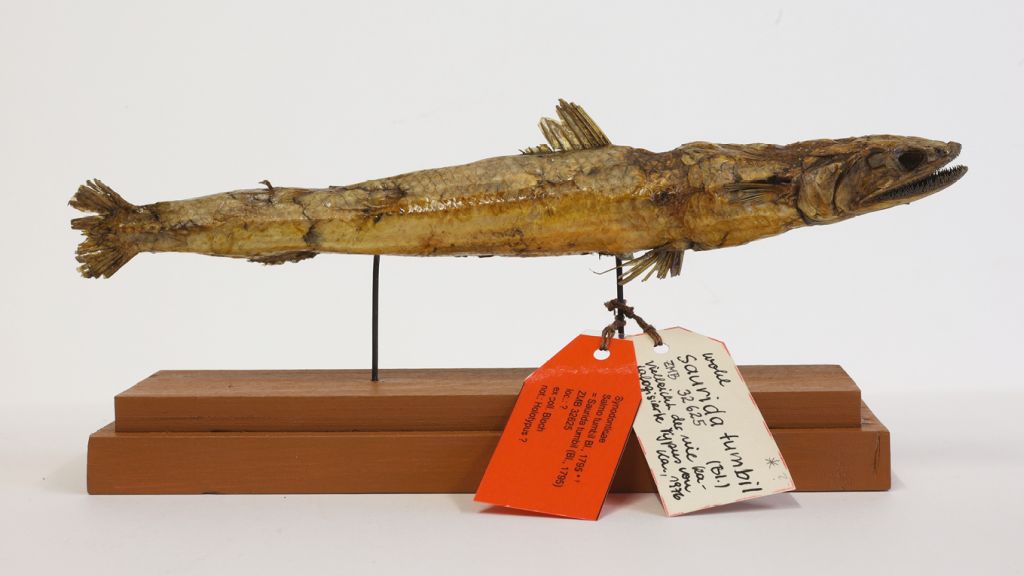
At least eight of the fishes forwarded by John to Bloch are known to be still extant.135 These include both wet and dry specimens and show a heterogeneity of preservation techniques. Fischer has shown, for example, how two examples of the same species of pufferfish might be preserved in radically different ways, each presenting an altogether different image of that species.136 Earlier chapters have touched upon the considerable gap between a living animal and prepared specimen. One example of a dried specimen in his collection was a species of lizardfish, which Bloch named Salmo tumbil (Figure 16).137 It is a stuffed exemplar, furnished with a layer of varnish, that displays an impressive row of teeth; its fins and their rays appear somewhat withered.
Specimen of Salmo tumbil from Blochâs collection. ZMB 32625, Museum fuÌr Naturkunde, Berlin
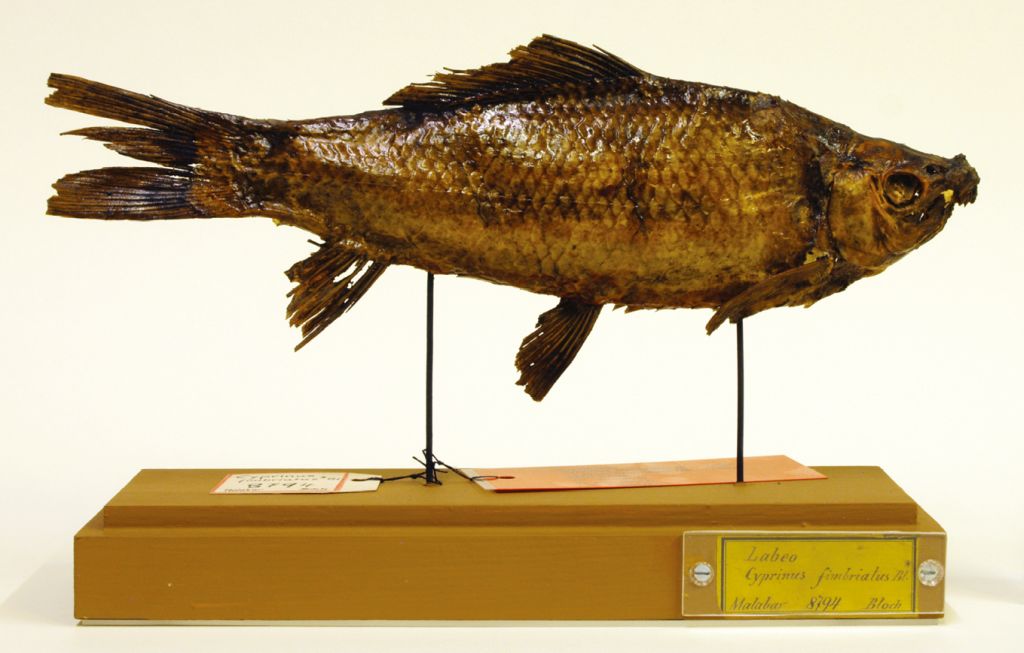
Another one of Johnâs dried specimens is the carp that had been taken from the missionâs pond (Figure 17). The Tamil called it the Sölköndei (the meaning of which is not explained in the description) and Bloch named it fringed carp because of its fringed mouth.138 In this particular instance, the carpâs skin has been curved a little rather being pressed flat on the page, thus retaining some of the fishâs original shape. While it may have been mounted onto a piece of wood made especially for this purpose to achieve this curve, no such cast is extant. A label, sadly illegible, has been pasted into the inner part of the skin. While this was a rather labour-intensive technique, it was also relatively cheap because less material was needed to make the specimen and it was easier to transport than glass. At the same time, the preservation method rendered the specimen somewhat fragile: fins might tear or break, which would hinder identification and classification. The work of cutting open fish to preserve their skin, turning their frail bodies into stable specimens came with challenges even under ideal conditions; doing so in the tropics required particular dedication and skill.
Specimen of Cyprinus fimbriatus from Blochâs collection. ZMB 8794, Museum fuÌr Naturkunde, Berlin
A cask of rotting fish, infested with worms. This is an image that undercuts Bruno Latourâs notion of a âcentre of calculationâ, a centre where maps, specimens, diagrams etc. are accumulated and turned into universal knowledge so as to act at a distanceâ .139 Indeed, this idea has long since been complicated by historians, who have demonstrated that the control of those residing in the centre of calculation was far from absolute.140â Kapil Raj, for example, has stressed that new knowledge was created in contact zones where Europeans and South Asians interacted rather than in the more unidirectional movement Latour envisages.141â In attempting to reconstruct the far-flung and multidirectional connections that made Blochâs collection possible, as this section has attempted to do, the limits of such a reconstruction have also become clear, in that local contributors to this collection remain only partly visible. We can also problematise the usefulness of the very notion of âlocalâ, as it is often used by historians but seldom qualified. Who, precisely, do we see as local? Is it appropriate to speak of local in the context of the forced displacement of people? And is it imaginable that the missionaries, spending decades in their settlements, would at some point become local? Although there are perhaps no clear answers to such questions, it is worthwhile to consider them.
The (in)visibility of these collectors also has a visual expression. We find it within the vignette on the title page of the tenth part of Blochâs book series (Figure 18) set in a hilly landscape with a lakeâ .142 It is an allegorical, stylised depiction of the process of collecting. It portrays various putti engaged in the process of either packing or unpacking a wooden crate, the lid of which reads âTranquebarâ â referring to the origin of many of the species described in the volume â and which contains fish submerged in glass jars. One of the putti examines a specimen while two others study a drawing of a fish. In the history of science, cupids have been seen as representations of invisible technicians, as Steven Shapin has argued for example for the seventeenth-century prints of the air pump of Otto von Guericke (1602â1686), where the instrument is operated by puttiâ .143 As Dominik Hünniger has argued, however, putti on frontispieces of natural historical publications convey both the manual and intellectual labour involved in the study of nature, as they are often depicted observing and discerning species as well as gathering them.144 The cupids on Blochâs vignette make visible the kinds of work entailed in the study of fish, stressing the collective nature of such an enterprise, while they render the workers themselves â Johnâs largely unnamed collaborators and assistants â invisible. It is an example of a process of representing and effacing that we also see on other allegorical frontispecies.145
Vignette, Johann Carl Wilhelm Rosenberg (artist) and Daniel Berger (engraver). Marcus Ãlieser Bloch, Allgemeine Naturgeschichte der Fische vol. 10 (Berlin: J. Morino, 1793)

The fish collected on the Coromandel Coast included several species and even an entire genus that had not yet been described according to the Linnaean system. Bloch marked the latter feat by naming said genus Johnfische.146 Moreover, John gained access to several communities of Naturkenner, both in Tranquebar as well as in Germany, through his natural historical efforts. By 1800, more than eight European learned societies had welcomed missionaries as corresponding members.147 John and Rottler, for example, were elected both to the Academy of Sciences Leopoldina, at that time based in Erlangen, and the Gesellschaft Naturforschender Freunde in Berlin. The names of missionary naturalists where thus codified in textual monuments such as scientific names or the membership lists of prestigious societies. The contributors to Johnâs shipments of fish to Bloch, vital as they were to the natural histories that were being produced, would have no new species or genera named after them, however. And yet, the fish currently held in the Museum für Naturkunde and their paper counterparts in the books of Bloch are eloquent testimony to their work.
As the letter in the introduction to this chapter showed, the collectors of the fish, whom John referred to as âmy black fishermenâ, might have seen the specimens that they had collected returned to them in illustrated form, swimming on the pages of Blochâs book. John had asked his superior to send him the newest volume of Blochâs book series because he only had an older, incomplete copy. As his requests to his superiors for materials could also fall on deaf ears, John was dependent on exchanges with European naturalists like Bloch and Chemnitz to procure such items as he needed for his studies. In a published letter, John thanks Bloch for sending him the latest volume.148 The accumulation of a small library in Tranquebar was practical, because any questions that John received from his correspondents would often refer to published works such Blochâs.149â Mostly, however, these books facilitated the process of collecting: natural historical books served as a list from which could be inferred those species still to be obtained, and those which were already identified.150â The collection of fish in the colonial context of Coromandel was thus neither an isolated event nor a linear movement, but rather constituted a circular, iterative process to which Johnâs many unnamed helpers proved vital.
4 To Capture Fishes on Paper
After the fringed carp that Johnâs helpers had taken from the mission pond was converted into a specimen for Blochâs collection, it was described and depicted in the last volume of the fish series.151 Most of his specimens were subjected to a similar process. We will now take a closer look at the process of illustrating specimens and turn to the depiction strategies used by Bloch and his artists. Despite the centrality of illustrations to Blochâs project, these strategies have never been examined in detail before. The illustration process is richly documented compared to that other of many natural historical publications. This is, first of all, because the original drawings for a considerable proportion of the specimens in Blochâs collection are still extant, as are, of course the engravings subsequently published in the series â object, drawing and engraving can thus be compared. The second reason is that Bloch was quite explicit in formulating his ideas about what made a good illustration.
In this section, we analyse Blochâs illustration policies and discuss how he combined existing visual techniques with new ones to both present his fish in animated colours and to offer a three dimensional view of the specimen on paper. With the help of his artists, engravers, printers and colourists, he created âepistemic imagesâ, serving not so much to only depict the object at hand but to replace it all together.152 Bloch had those characteristics of the fish which he deemed essential recorded by his artists, the resulting illustrations becoming a substitute not of the preserved specimens in his collection, but the living, swimming species of fish these represented. They were nature revived. As we will see, Bloch and his various artists encountered both practical and epistemological challenges as they attempted to create impages that lived up to this intention.
Bloch outlined his illustration policy in the preface to the first volume of the book series. The three pages that he devotes to it show he had given a lot of thought to how one could produce the best visual representation of a species. A good drawing, in fact, began before lead or brush had touched the paper, by selecting the most suitable specimens. These were, according to Bloch, fresh as well as fully grown exemplars, because these best showed the speciesâ distinguishing marks.153 Bloch argued that such a meticulous approach to illustration was necessary because fishes tended to look alike, making it hard to distinguish one from the other.154 He thus required his artists to be attentive to even the slightest deviations in a specimen. All details needed to be recorded on paper as they were relevant to get a proper understanding of the depicted species.
Over the more than a decade that it took to publish his book series, Bloch employed no fewer than nineteen draughtsmen and engravers.155 The signature of the painter Johann Friedrich August Krüger (b.1754) appears on many on the plates; he was also commissioned by Martini for a series on shells.156 The drawings made by draughtsmen were turned into engravings by, among others, Johann Friedrich Hennig (b.1778), Johann Godlieb Schmidt (1750â1822), and Georg Bodenehr (dates unknown). It remains unclear who subsequently coloured these engravings. At the time, it was common to hire women or children for this part of the process, because they were paid less even if the work they performed required considerable skill.157
Bloch highlighted six further areas to which contributing artists were to pay particular attention. First of all, he stated, they needed to convey the proportions of the specimen properly. Secondly, they had to represent the position and the shape of the fins correctly, particularly that of the caudal fin; these were, after all, important marks for classification. Thirdly, the precise number of bones in the gill flap as well as the number of rays in the fin were to be clearly represented. Bloch explained the reason that both were to be delineated in the same terms as Artedi, noting that the former was necessary for deciding genera, and the latter for deciding species.158 The fourth rule was to give a truthful representation direction of the lateral line (the thin line on the side of the fish stretching from its head to its tail).159 The fifth rule was that the artist had to consider several different elements to ensure they showed the fishâs scales accurately: their size, placement, and shape as well as any pattern of stripes or dots they might display.160 The sixth and last item on the list of instructions was that artists should always include the ânatural colourâ of the fish.161
These were the pictorial ideals that needed to be put into practice. The process began with the creation of a drawing of a specimen in preparation for the engraving. Fortuitously, some two hundred of these of Originalzeichnungen still exist in the Historische Arbeitstelle of the Museum für Naturkunde.162 These drawings are assembled together in two volumes, with many of them being carefully pasted onto the bound pages.163 Each drawing has been executed in colour â sometimes in watercolour, other times in what appears to be a thicker, gouache-like paint. Let us take a look at one particular drawing: the one that Johan Friedrich Hennig made for the lizardfish that John had sent to Bloch (Figure 19). The drawn fish corresponds to the preserved specimen in its shape (although the depicted specimen is somewhat more plump) and its open mouth displaying rows of teeth. While the position of the fins in the drawing correspond to their placement on the specimen, their aspect does not: while the fins on the specimen have dried out, the drawings show them fanned out, as they would have seemed when the fish had still been under water. The most striking difference between specimen and drawing, however, is to be found in the palette of colours used by the colourist. As no traces of colour remained in the specimen, and Johnâs rendition of its colours seemed similarly bereft, Hennig was put in a delicate position when deciding the appropriate colours. He opted for a brownish, grey colour with maroon overtones. As we will discuss shortly, the engraving based on this drawing would have a different colouration (Figure 20).
Original drawing of Salmo tumbil, Johann Friedrich Hennig. ZM B VIII / 423, Bl. 430, Archiv Museum für Naturkunde, Berlin
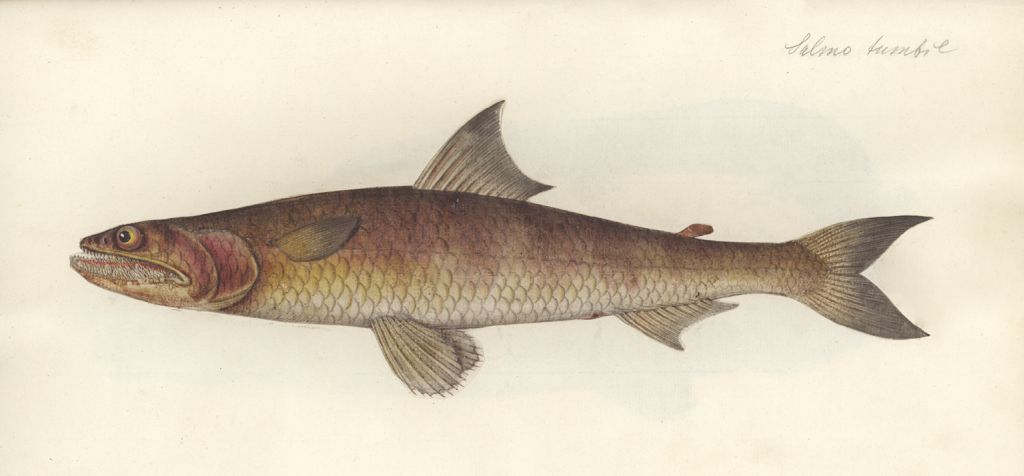
Engraving of Salmo tumbil, Johann Friedrich Hennig. Marcus Ãlieser Bloch, Allgemeine Naturgeschichte der Fische, vol. 12 (Berlin: J. Morino, 1795), plate CCCCXXX

The drawings were subject to revision. Given Blochâs very clear opinions on the subject, it seems unlikely that a drawing would be sent to the engraver without his stamp of approval. It was common for naturalists to closely supervise their draughtsmen, making sure that they drew the relevant, correct features.164 A symbiotic collaboration between artist and naturalist with regard to drawing would result in, as Lorraine Daston and Peter Galison have put it, âfour-eyed sightâ; the head of the naturalist fusing with the hand of the artist.165 That there must have been at least some discussion between Bloch and his artists is evidenced by the drawings themselves. A few of them contain corrections in graphite or sometimes ink.166 In some instances, Bloch or one of his draughtsmen might alter a fishâs shape. In one image, a graphical edit was suggested, indicating that the fishâs eye might be placed more accurately.167 Clear evidence of the assertion of Blochâs third rule, which focused on the correct representation of the number of rays in the fins, can be found in the annotations included in certain drawings besides each of the fins of the fish that indicate how many rays it has, and how many of these rays are spikey (Figure 21).168 Bloch wanted his illustrations to be precise enough for naturalists to be able to identify and classify any fish based on its image alone where possible. His intention was thus very much the opposite of that Artedi, whose descriptions rendered drawings superfluous. Blochâs wish to cater to a broader audience than a literate or Latinate one may have been one of the reasons why he considered images so important.
Original drawing of Bodianus maculatus, Johann Friedrich Hennig. ZM B VIII / 423, Archiv Museum für Naturkunde, Berlin

After drawings had been approved, the next step was to engrave them. Although the engravings do, as one can reasonably expect, differ somewhat in colouration between physical copies of Blochâs works, overall they are chiefly consistent especially with regard to the considerable intensity of the paint.169 Overall, the engravings follow the model drawings closely, in everything except colour.170 The colours of the original drawings seem more subdued that those of their engraved counterparts. This might be a result of the specific pigments or paints used, but may also have to do with whether or not a layer varnish was applied, as well as the mode of storage used; lengthy or recurrent exposition to sunlight would cause the colours to fade. Although it is of course impossible to ascertain the extent to which the colours of these engravings and drawings have altered over the past centuries, however subtly, these differences between drawings and engravings seem significant considering the very specific demands placed by Bloch on replicating the natural colour of the specimen.
Naturalists and the artists whom they employed were well aware that time was of the essence in illustrating fish. They started drawing the specimen as soon as possible after it was caught, and developed several tricks to aid naturalistic rendition. In the preface to his natural history of Carolina, Catesby (whose pictures, we read in the previous chapter, Gronovius deemed to be painted very well) explained that: âfish, which do not retain their colours when out of their element, I painted at different times, having a succession of them procurâd while the former lost their colours.â171â Ferdinand Lukas Bauer (c.1760â1826), one of the artists accompanying the naturalist John Sibthorp (1758â1796) on his expedition to the Mediterreanan, deployed a sort of painting-by-numbers technique which allowed him to indicate the shades of colour of specimens without having to actually paint them on the spot.172â Although Artedi and Linnaeus considered colour to be of secondary importance, other naturalists and their artists continued to put considerable time and effort into capturing it accurately.
Although the sixth rule, which specified that artists should portray the natural colour of the fish was quite straightforward in principle, obeying it in practice was not quite so simple. First of all, it could be a tricky exercise to exactly replicate the natural colour of a fish. In his description of the golden tench, a gift from the palace pond of Elisabeth Christine, Queen of Prussia (1715â1797), Bloch lamented the fact that the artists, despite their substantial skill and best efforts, had not managed to truly capture the beauty of the specimensâ natural colour.173 Of course, such a response would have been entirely appropriate considering the effectively royal status of the fish as gift, but it also exposes a certain tension underlying the work of colouring fishes. Bloch could of course only have assessed whether colours had been mixed correctly when he had a living specimen at hand for comparison. That was not the case for any fish that was sent to him by a correspondent.
In the case of the aforementioned fringed carp, its species description reveals that the specimen had been accompanied by a drawing from the life on which Blochâs draughtsmen could base their engraving of the fish; as mentioned, however, not one of the illustrations sent over by John has survived.174 Even in those cases where Johnâs drawings are mentioned in a species description, no indication is made of whether or not they included colour; recall Johnâs difficulties in securing proper paint. In the cases such as the lizardfish, where no accompanying drawing is mentioned, Blochâs draughtsmen must have had to make do with the preserved objects themselves and the verbal descriptions that possibly accompanied them. Exactly how draughtsmen and colourists went about the business of replicating the exact colourings of any individual fish when all they had to go one was an essentially monochrome preserved specimen (and perhaps some verbal description) remains somewhat of a mystery.
Colour was applied both during the printing process and after. As discussed in Chapter 1, early modern printed works occasionally included colour: this could be due to the use of coloured printing ink, but in most cases, colour was applied by hand.175 In Blochâs series of fish books, however, we find a unique combination of both types of colour administration. Mechanical colour printing had by this time become a more established technique.176 Although most of the plates are printed in black or grey ink, some 10% of the plates were printed in brown, orange, red, and green.177 Colour printing was still relatively crude, however, and not suitable for displaying sophisticated gradations and variegations. This is why all Blochâs prints were also coloured by hand. The function and effect of colour printing can be seen on the engraving of the red mackerel (Figure 22). For this fish, a striking red has been used â as discussed earlier, Bloch had stipulated that its red colour set this species apart from other mackerel.178 The ink used for the printing of the plate is red.179 This gave the engraved illustration the correct undertone, on which the colourists could layer their own colouration.180 The effect is an intense red colour, which is especially striking when compared to the subtle tints of the original drawing made for this species (Figure 23).181 A similar contrast can be seen in the case of the lizardfish, where the original drawing (Figure 19) offers distinctly subdued colouration when compared with the published engraving (Figure 20).
Engraving of Scomber ruber, Johann Friedrich Hennig. Marcus Ãlieser Bloch, Allgemeine Naturgeschichte der Fische, vol. 10 (Berlin: J. Morino, 1793), plate CCCXLII

Original drawing of Scomber ruber, Johann Friedrich Hennig. ZM B VIII / 424, Bl. 342. Archiv Museum für Naturkunde, Berlin
Leiden University Library
At the same time, one has to be careful in assuming what was and what was not known about the actual colourings of specimens. Although Claudia Kreklau has argued, for example, that the dried exemplars of foreign fishes, with their brown hues, âfit comfortably in the naturalistsâ worldview of a dark and dreary underwater worldâ,182 it appears that Bloch, at least, was not prejudiced by such a dismal outlook. Bloch repeatedly marvelled at the splendid colours displayed by the fishes of faraway regions. In the preface to the ninth volume, for example, he exclaimed that its plates dedicated to foreign fishes distinguished themselves from those made after German fishes by their beautiful colours.183 He confidently stated this without ever having seen a living fish from, say, the East Indies in the flesh. Blochâs statement fits into a broader exoticist discourse, which lauded the spectacular colours of plants and animals in the warmer climes.184 As Kreklau seems to overlook, while stay-at-home naturalists like Bloch could not glimpse the original, dazzling colours from preserved specimens, they may well have had access to coloured drawings of either these or similar species, as well as colourful descriptions of them in letters or other textual works. These second or even third-hand colourisations of foreign fishes would become part of the visual repertoire of both naturalists and their artists, and would literally colour any subsequent encounters with specimens from a similar âexoticâ origin.
Bloch purposefully sought out other illustrations of fishes. He consulted, for example, a copy of the vividly, if somewhat fantastically, coloured Poissons, écrevisses et crabes de diverses couleurs et figures extraordinaires (1719) by Louis Renard.185 At a public auction in Berlin, furthermore, he obtained a collection of drawings of Caribbean fishes by the French missionary Charles Plumier (1646â1704).186 He also visited the cityâs Royal Library to peruse manuscript volumes containing drawings of fish from the West Indies, made under the auspices of Johan Maurits van Nassau-Siegen â an expedition discussed in Chapter 1.187 While Bloch prided himself on offering original illustrations in his works, created under his direction in his own studio after fresh or preserved samples of fish, he did have his artists copy drawings from the abovementioned manuscripts. As he explained in the preface of one of his volumes, âboth [authors] had faithfully depicted the fish on the spot and painted them in lively colours.â188 That the drawings had been made ad vivum made them reliable enough to merit inclusion in Blochâs own work. Chapter 1 has shown that it was, in fact, quite common to use one illustration as a reference drawing for the other. Nickelsen has argued for such âcopying linksâ that they are not merely derivative drawings, but the outcome of a conscious process of including and excluding certain elements of the initial illustrations.189
One of the most striking aspects of Blochâs illustrations is that a considerable proportion of them have been heightened in silver and gold. This means that silver and gold paint is applied to certain parts of the fish, for example its scales and certain parts of its head; just as Baldnerâs artists had done with white in Chapter 2. Substituting white with gold and silver was not a completely new practice, but was still altogether rare.190 The paints were, in all likelihood, made by mixing powdered silver or gold leaf with a binding medium such as gum arabic.191 This was an expensive procedure, and one that an eighteenth-century painting manual therefore advised should only be used for special occasions.192 Bloch seemed to believe that these costs were warranted. One reason for this might have been the sense of luxury that it added to his series of fish books. Another reason may have been the particular effect that it produced. This has to do with the luminescent qualities of silver and gold: the metals in the paint capture and reflect light. In applying the paint judiciously to the parts of a fish that would naturally catch the light, such as the edges of its scales and its gill cover, the artist endowed the illustration with some of the vivacity, as the silver or gold pigments imitated the glistening sunlight on the wet scales of the fish as it is plucked from the water. Others sought to replicate this technique. When requesting the purchase of a colour-box for his draughtsmen, John added that he also lacked sufficient silver and gold colour for them to draw the fishes.193
Another remarkable aspect of Blochâs fish illustrations is the degree to which they consider the fact that the specimens which they reproduce exist in three dimensions. The majority of plates contain a representation of the fish in cross section. This visual technique was used by William Hooke in his seventeenth century depictions of ammonites,194 while the aforementioned Plumier offered cross-sectional views with his drawings of Caribbean fish, of which Bloch owned a manuscript. Bloch was the first to consistently include such sections for fish in a printed work.195 An example can be seen on the engraving of the red mackerel (Figure 21). It is a schematic depiction of what you would see if you were to cut the fish in half at its thickest point. In his illustration policy, Bloch explains, in one sentence, the purpose of these contours: to offer an idea of whether a species was thick or thin.196 That cannot have been the sole intent, however. For even though Bloch does not mention it, besides outlining the circumference of the fishâs body, the sections also indicate the shape and location of its spine and abdominal cavity.197 The dissection of a fish, which as we saw in Chapter 1 could be a rather complex process, revealed those parts not usually visible. The technique of the cross section offered a neat, abstracted representation, and was more widely used to portray the properties of both human and animal tissue.198 To create such a cross section for fish required the cutting of at least one specimen in half â the specimen would then, of course, no longer be intact. This might explain why almost all of the plates of German fish, but only around half of the foreign ones, of which Bloch could not easily attain a wide sample of each species, include this cross section. It also required a complete specimen: making such a cross section was not possible from dried exemplars, from which all flesh and intestines had already been removed.
Besides showing the thickness of species on the engraved plates, Bloch also indicated their magnitude. Many of the plates indicate whether the engraved image reflected the speciesâ true size [natürliche Grösse], or whether it offered a reduced [verkleinerte] view.199 This attention to the actual shape and size of a specimen was of course far from new in natural historical depictions. The representation of the âtrue sizeâ of observed entities had been a pressing problem especially for early microscopists of the seventeenth century, who often included illustrations of the naked eye view alongside the magnified drawing one to indicate the scale.200 Blochâs specimens were not microscopic entities, however, and his size indications are less exact in nature: his aim was only to indicate that a specimen was either larger or smaller than the illustration made from it. Taken together, the decisions to include cross sections of and size indications for the specimen helped the onlooker to envision the general size and shape of the actual, three-dimensional object on which the engraving was based from its two-dimensional representation on the page.
In sum, the coloured engravings were the result of carefully measured decisions on part of Bloch and his artists. The artists set to work capturing the properties of the specimens on paper in detail â filling in the gaps where necessary. As we saw with the lizardfish from Tranquebar, a specimen and a drawing of an individual species might differ markedly, especially with regard to shape and colour, while the metamorphosis from drawing to engraving was most likely to affect a fishâs colouration. Certain features could be altered in this three-stage act of preservation, while others might be lost irrevocably. Even though some naturalists considered illustrations to be suitable substitutes for objects, they were mediated by necessity. It is not now possible to recover the full extent of this mediation: historians cannot hope to determine just how much the physical state of these materials has changed over the past two centuries, to what degree the specimens, drawings and engravings look the same as they did in the eighteenth century.
Bloch was aware that even the most truthful (allergetreuesten) illustrations could not always express all those marks that were of pertinence for classification, as for some species of fish these were located inside the body.201 While the illustrations thus might help in classification, that was not their only function. To understand why Bloch considered the time and costs incurred in these efforts worthwhile, the notion of a âpaper museumâ can be useful. Historians have used this term to describe various paper formalisations of collections from the seventeenth up to the nineteenth century.202 Debora Meijers has succinctly defined it as âa group of drawings whose coherency stems from a deliberate effort of conservation.â203 Blochâs series of fish books not only preserved the fishes in his collection in their splendid, living state (albeit in mediated form), it also preserved the collection as a whole. Just like specimens themselves, after all, natural historical collections conceived as a whole were also in danger of disintegration. The fate of Sebaâs collection is a case in point. While his first collection had been purchased by Peter the Great, the apothecaryâs death led to his second collection being auctioned off piecemeal, its specimens dispersed into the collections of a wide variety of naturalists.204 Many other collections suffered a similar (or worse) fate. The quarto volumes bearing Sebaâs name, however, with its coloured illustrations of the objects accompanied by brief descriptions, outlived his physical collection and, in a very real sense, preserved it much as he had preserved its individual specimens in the first place. Creating a visual record of the objects in oneâs collection brought particular advantages. A paper museum that displayed the plants in a botanical garden, for example, as Meijers explains, âshowed them in their unchanging beauty, alive and intact, and blooming all at the same time.â205
As the discussion of the difficulties of making drawings from specimens has highlighted, it is important not to assume the (perceived) vicarious quality of drawings. While Martin Rudwick has contended that drawings of fossils could act as a stand-in for actual specimens, he attaches the caveat that âan effective proxy experience was necessarily mediated by the social and artistic conventions that underlay any pictorial representations in a given historical and cultural context.â206 This process of mediation, as has been discussed earlier in this chapter, obscured some parts of the depicted object, highlighted others, and might even add something new (whether wittingly or unwittingly). It is not difficult to imagine that the creation of a paper museum held an appeal to Bloch, as it both preserved the collection itself and made its general circulation possible. The fish specimens on the shelves in Berlin were thus only one manifestation of his collection â the book series was another.
As has been stressed above, Blochâs project was iterative in nature. As soon as a volume had found its way into bookshops and from there into the libraries of barons, countesses, physicians, merchants and naturalists, it invited its readers to send ever more specimens Blochâs way. As we saw, at least some of the volumes travelled to John in Malabar. In the Auftausch between Bloch and John of books and specimens, the seriesâ illustrations played an essential role. While their size and cost made taking Blochâs volumes into the field somewhat impractical, John appears to have used the illustrations to communicate with those of his collectors who could not read the descriptions. As he explained, the coloured engravings allowed for âevery dumb fisherman and journeymanâ to collect the desired specimens.207
Together with his artists, Bloch developed an innovative pictorial format which helped bring the fish alive on the pages of his books. With his carefully developed and executed format for depicting fish, Bloch seems to have set a new standard. We see that, in the nineteenth century, images remained an essential component in natural historical publications of fish, such as the Histoire naturelle des poissons [Natural history of fishes] by Georges Cuvier and Achille Valenciennes and the Atlas ichthyologique des Indes Orientales Néêrlandaises [Ichthyological atlas of the Dutch East Indies] of Pieter Bleeker.208 As is the case in Blochâs series of books, these works feature fish that are depicted on full folio plates, carefully coloured, often containing a cross-section of the species or an important detail of its anatomy highlighted. Just as in previous centuries, however, the nineteenth century saw the precise use and function of images in the natural history of fish continue to be hotly debated, not least the perennial question of how to preserve their colour on paper.209
The coloured plates fulfilled different functions. For Bloch, the book series may have served as a paper museum to his collection, the illustrated fish far surpassing the beauty of that of the specimens stowed away on the shelves of his cabinet. It is conceivable that a part of his audience was primarily attracted to the luxuriously executed plates. For naturalists, the carefully executed illustrations were a useful work of reference because of the care that had been taken to depict those characteristics that were salient for classification, for example correctly portraying the number of rays in the fins. As we saw, John used the illustrations as a way to communicate to his collectors which species still needed to be gathered, and so the plates had mnemonic value. The high selling price of these volumes, however, meant that Blochâs target audience of fishermen and farmers were probably unable to actually afford the volumes. Considering the purposes these coloured engravings actually served, as simultaneously beautiful and functional images, allows for a better appreciation of the ways in which these illustrations acted even beyond Blochâs own intentions for them.
5 Conclusion
In the eighteenth-century German states, the study of nature was a popular pastime. It attracted a varied group of people, including merchants, physicians, professors, apothecaries, book printers, agriculturists, among others. In the cameralist fashion of the time, investigations into living nature tended to focus on the ways in which the extraction of minerals, the cultivation of plants and the breeding of animals might advance the general health and wealth of the (envisioned) nation. Such pursuits were often presented as a patriotic act, though this was, of course, dependent on their not being followed for commercial gain. Fish also had their part to play in this shared project to chart nature along increasingly nationalistic lines, even though in following their own migration routes they slipped effortlessly beneath the borders that people had so fervently constructed. Bloch initially presented his work as an oeconomic natural history of fishes of the German states. By providing carefully coloured illustrations, he hoped that anyone might easily recognise the fishes that he described in his books, and in doing so might learn to see and use these fish as natural resources. Overall, Blochâs series was celebrated as an accomplishment for and of Germany, the characterisations of his work by contemporaries often striking a tone of national pride.
As this chapter has suggested, by portraying fish Bloch also presented himself. His collection and series of fish books were closely connected to his reputation as a Naturkenner in Berlin, the German states and in the wider enlightened circles of Europe. One of Blochâs eulogists called his fish oeuvre âthe crowning glory that placed him among the ranks of our illustrious naturalists.â210â
With his book series, Bloch added no fewer than 250 new species to the European natural historical canon. As a careful compiler with an impressive library, he corrected existing descriptions of fishes where necessary, comparing and contrasting different accounts and by drawing on the specimens in his collections. What distinguished this book series apart from earlier encyclopaedic books of fish, of course, were the more than 400 sumptuously executed plates.
While it is unlikely that Bloch made any financial profit from his series â as can be inferred from his periodic references to the costs and expenses he incurred â he did have something to gain. As we saw, as a Jew in Berlin he was subject to several forms of exclusion. Firmly embedded in a group of Jewish enlightened thinkers, he also sought to establish connections with other Naturkenner in Berlin and beyond. In this, the assembly of a cabinet of naturalia was paramount. Through expanding his collection and publishing his series of fish books, he created a vast network. This network can be partially reconstructed from the names mentioned in the booksâ species descriptions, its subscription lists and sponsored engraved plates, and his correspondence. Joseph II and other monarchs expressed their interest in and support of the project, as did counts, bankers, book sellers, professors, missionaries, surgeons, and apothecaries, as well as a fishing guild. Up until the moment of the publication of the very last volume of his series, Blochâs books and collection reinforced one another â the publication of this series of fish books was a dynamic rather than a static, linear process. In this chain of collectors spanning different continents, Bloch was positioned at the end.
In considering natural historical works published by naturalists from countries without a continuous presence outside of Europe, one can easily miss the ways in which these naturalists did, in fact, benefit from colonial infrastructures. Bloch was only able to produce his series of fish books because of the many shipping routes that had been created by the expansion of trade and religion in the preceding centuries. The Danish-Halle mission was of particular importance to Blochâs project, as it formed an important link between Germany and India. From his post in South India, Christoph Samuel John sought to align himself with Blochâs project, providing Bloch with no fewer than 50 fishes as he did so. By inserting himself into Blochâs network in this manner, the Pietist missionary also furthered his own identity as a naturalist participating in learned circles in Europe. Just as Bloch relied on men such as John, so the missionary, in his turn, depended on his own network of contributors, which included his European and Tamil pupils as well as fishermen and cooks. These individuals played a central role in every stage, from collecting to preserving, from describing to illustrating, and finally in packing everything for transport to Berlin. These contributors, however, are only partly visible. The language used by historical actors such as Bloch and John to describe these contributors â language often unwittingly echoed by contemporary historians when they use terms such as âlocalâ without qualification â has tended to obscure their identities.
While Bloch continued the classificatory approach that Artedi and Linnaeus had promulgated in their works, he conceived of his own work as an improvement of theirs. With its combination of elaborate descriptions and precise illustrations, Blochâs work simplified the often thorny and contentious business of identifying a species. The illustrations themselves were based on the preserved specimens of fish in his own collections â specimens which had already been selectively edited. Drawing on established techniques and introducing new ones, Bloch succeeded in developing a format for his âepistemic imagesâ that were to act as enhanced substitutes for his specimens. He introduced, for example, the use of cross-sectional views of specimens in print, experimented with innovative techniques such as the mechanical printing of colour, and heightened some of his illustrations with paint made from silver and gold. These decisions served to present the fish as three-dimensional, living beings that were revived on the pages of Blochâs works. His work set a new standard for the depiction of fish that would be emulated in later ichthyological publications.
As we saw, Blochâs distance from living, foreign fish that he and his artists only saw as preserved specimens created epistemological tensions, especially given his own extensive rules for how a fish should be represented on paper. Where the actual process of converting these specimens onto paper remains somewhat of a mystery, we can consider the effect of these engravings. Nevertheless, the pens and brushes of the draughtsmen and colourists rendered these diverse fish, caught and collected by many individuals from various regions, in a uniform style. Any epistemological uncertainties caused by the interpretation of the colours and other characteristics from dried specimens rather than living, breathing fish were not expressed. There was, also, power in repetition. Under the hands of the artists, the engraved plates were presented as a continuous set, painted in the animated colours of life. As Bloch could claim first-hand knowledge of many of the German fishes, he could, by association, allege a similar experience for the foreign fish. Bloch became a recognised authority on all the worldâs known fish without having to travel far from his Berlin home, let alone leaving Europe.
By the time he passed away in 1799, Bloch had become a celebrated figure in a country that nevertheless refused to grant him full legal equality. Friedländer was involved in handling his legacy, which entailed finding a fitting home for the collection.211 Along with a dozen or so members of the Gesellschaft Naturforschender Freunde, he petitioned King Friedrich Wilhelm III (1770â1840) to purchase Blochâs cabinet.212 Friedrich Wilhelm was in the process of turning his Kunstkammer, which comprised coins, antiquities, ethnographic objects and naturalia, into Berlinâs first public museum.213 In their letter to the kingâs representatives, the Gesellschaft members argued that Blochâs cabinet, and specifically his collection of fishes and amphibians, was the only one of its kind and that it formed an âexquisite ornamentâ for the city of Berlin.214 They entreated the king to make haste; if he did not procure the collection before it was put to auction, they argued, it might be dismantled at the hands of eager buyers, or worse, remain intact but carried off abroad by one those foreign collectors who had been anticipating the collection being put up for offer. Their attempts to save it from such a glum fate were eventually successful: Friedrich Wilhelm bought it, securing it for a mere 4500 Reichsthalers, half the asking price. Blochâs collection became, officially, a national asset.
â[â¦] und meine schwarzen Fischer können nicht genug erstaunen, wie ihre Fische itzt [jetzt] auf dem Papier so lebendig herumschwimmen.â Christoph Samuel John, âEinige Nachrichten von der Küste Koromandel. Auszug eines Schreibens des Hrn Missionarius C.S. John an Hrn D. Bloch in Berlin,â Berlinische Monatschrift 24 (1794): 351.
The Latin name Bloch gave this fish was Silurus bimaculatus.; its currently accepted species name is Ompok bimaculatus.
For the notion of âepistemic imagesâ, see: Lorraine Daston, âEpistemic Images,â in Alina Payne (ed.) Vision and Its Instruments: Art, Science, and Technology in Early Modern Europe (Pennsylvania State University Press: Philadelphia, 2015), 13â35.
âIch werde mich indessen nur auf solche Fische einschränken, von welchen ich nach der Natur gemalte Zeichnungen zu lieferen im Stande bin [â¦].â Allg. Nat. der Fische, vol. 1, sig. Ar.
â[â¦] da ich weder Mühe noch Kosten gesparet, um demselben den möglichsten Grad der Vollkommenheit zu geben.â Allg. Nat. der Fische, vol. 3 (Berlin: Realschule, 1784), n.p.
Allg. Nat. der Fische, vol. 1, n.p.
Schmidt, Inventing Exoticism, 18.
Steven M. Lowenstein, The Berlin Jewish Community: Enlightenment, Family, and Crisis, 1770â1830 (Oxford: Oxford University Press, 1994), 16. Blochâs collection is mentioned in the Tagebuch entry of 17 August 1773 of the Gesellschaft Naturforschender Freunde. MfN, ZMB, GNF, S. Bloch, TB 1.
Christoph Friedrich Nicolai, Beschreibung der Königlichen Residenzstädte Berlin und Potsdam vol. 2 (Berlin: Friedrich Nicolai, 1779), 599â601. An abbreviated, paraphrased translation can be found in Antoine-Joseph Dézallier dâArgenville, La conchyliologie, ou, Histoire naturelle des coquilles de mer, dâeau douce, terrestres et fossiles (Paris: Guillaume de Bure fils aîné, 1780), 828.
Nicolai, Beschreibung, 598â609.
For a recent overview of types of collections in eighteenth-century Europe, see: Eva Dolezel, Rainer Godel, Andreas PeÄa and Holger Zaunstöck, eds., Ordnen â Vernetzen â Vermitteln. Kunst- und Naturalienkammern der Frühen Neuzeit als Lehr- und Lernorte (Stuttgart: Wissenschaftliche Verlagsgeselschaft, 2018).
Wilhelm von Humboldt to Johann Wolfgang von Goethe, 22 August 1795, Goethes Briefwechsel mit den Gebrüdern Humboldt (1767â1832), ed. F.Th. Bratranek (Leipzig: F.A. Brockhaus, 1876), 7.
Eva Dolezel, âLehrreiche Unterhalting oder Wissenschaftliche Hülfsmittel? Die Berliner Kunstkammer um 1800. Eine Sammlung am Schnittpunkt Zweier Musealer Konzepte,â Jahrbuch der Berliner Museen 46 (2004): 151â152.
Allg. Nat. der Fische, vol. 1, sig. *2r.
He does not mention which edition.
Kahtryn Olesko, âGermany,â in Hugh Richard Slotten, Ronald L. Numbers and David N. Livingstone (eds.) The Cambridge History of Science: Modern Science in National, Transnational, and Global Context (Cambridge: Cambridge University Press, 2020) 23.
Allg. Nat. der Fische, vol. 3, n.p.
Paepke, Blochâs Fish Collection, 27.
Daniela Bleichmar and Peter C. Mancall, âIntroduction,â in Collecting Across Cultures: Material Exchanges in the Early Modern Atlantic World, eds. Daniela Bleichmar and Peter C. Mancall (Philadelphia: University of Pennsylvania Press, 2013), 1.
Delbourgo, Collecting the World, 202.
Emma Spary, âThe Naturalist Collecting Community in Paris, 1760â1789: A Preliminary Survey,â in Dolezel, Godel, PeÄa and Zaunstöck, Ordnen â Vernetzen â Vermitteln, 310.
The most detailed biographical sketch of Bloch has been written by Christine Karrer, who has pieced it together from a variety of sources, including the letters and accounts of some of Blochâs contemporaries. Karrer, 130â132.
Lowenstein, The Berlin Jewish Community, 189; Johannes Müller, âDistance, Geography, and Anecdote in M.E. Blochâs Natural History of Fishes.â In Smith and Egmond, Ichthyology in Context, 614.
Karrer, âMarcus Elieser Bloch,â 132.
Lowenstein, The Berlin Jewish Community, 34, 49. On the Haskalah, see also Shmuel Feiner, The Jewish Eighteenth Century: A European Biography, 1700â1750 (Bloomington: Indiana University Press, 2020).
Lowenstein, The Berlin Jewish Community, 4.
For example, French Huguenots and Austrian Protestants; ibid., 19.
Ibid., 13.
Shmuel Feiner, The Jewish Enlightenment (Philadelphia: University of Pennsylvania Press, 2002), 117, 315.
Karrer, âMarcus Elieser Bloch,â 135.
Marcus Ãlieser Bloch, Allgemeine Naturgeschichte der Fische, vol. 10 (Berlin: J. Morino, 1793), vi. See also Martin Schwartz Lauzen, Jews and Christians in Denmark: From the Middle Ages to Recent Times (Leiden: Brill, 2015), 89â124.
Karrer, âMarcus Elieser Bloch,â 134.
Marcus Ãlieser Bloch, Medicinische Bemerkungen, Nebst einer Abhandlung vom Pyrmonter Augenbrunnen (Berlin: Christian Friedrich Himburg, 1774).
Besides publishing his fish series, Bloch wrote, among other things, on opal, tortoises and bladder worms in the Beschäftigungen of the Gesellschaft Naturforschender Freunde. His Systema ichthyologiae was published posthumously by Johann Gottlob Schneider (1750â1822) in 1801.
Lesser, âDr. Marcus Elieser Bloch,â 242.
On the history of the Gesellschaft Naturforschender Freunde, see: Katrin Böhme, âDie Gesellschaft Naturforschender Freunde zu Berlin: Bestand und Wandel einer gelehrten Gesellschaft Ein Ãberblick,â Berichte zur Wissenschaftsgeschichte 24, no. 4 (2001): 273.
Anke te Heesen, âVom naturgeschichtlichen Investor zum Staatsdiener: Sammler und Sammlungen der Gesellschaft Naturforschender Freunde zu Berlin um 1800,â in Sammeln als Wissen. Das Sammeln und seine wissenschaftsgeschichtliche Bedeutung, eds. Anke te Heesen and Emma Spary (Göttingen: Wallstein, 2001), 64.
Ludwik Lesser, Chronik der Gesellschaft der Freunde in Berlin (Berlin: Petsch, 1842), 46.
Katrin Böhme, Gemeinschaftsunternehmen Naturforschung: Modifikation und Tradition in der Gesellschaft Naturforschender Freunde zu Berlin 1773â1906 (Stuttgart: Franz Steiner, 2005), 29.
Friedrich Wilhelm Heinrich Martini, âGesetze der Hiesigen Gesellschaft,â Beschäftigungen der Berlinischer Gesellschaft Naturforschender Freunde 1, no. 1 (1775): xxviii.
Nickelsen, Draughtsmen, Botanists and Nature, 109.
Nicolai, Beschreibung, 601.
The engraving was by the hand of the artist Johann Conrad Krüger (1733â1791), who also made engravings of other notable figures including Moses Mendelssohn and Krünitz himself. See: Johann Georg Krünitz, Oeconomische Encyclopädie (Berlin: Joachim Pauli, 1773â1796).
Phillips, Acolytes of Nature, 35.
âAls Arzt, beliebt; als Forscher der Natur, berühmt bey seiner Nation nicht nur / als Menschenfreund, wie Mendelssohn geschäzt, ist Bloch, dem Wahrheit dieses Denkmal setzt: durch ihren Freund, Krünitz.â; it is not clear whether the term âNationâ refers to the Jewish community, in its usage in the Hebrew Bible, or an envisioned German state. Bloch himself uses this term in the preface to his first volume to refer to the various German states.
Allg. Nat. der Fische, vol. 12 (Berlin: J. Morino, 1795), title page.
Karrer, âMarcus Elieser Bloch,â 137.
Marcus Ãlieser Bloch, Allgemeine Naturgeschichte der Fische, vol. 6 (Berlin: Realschule, 1787), sig. a2r; the series is henceforth abbreviated as Allg. Nat. der Fische.
Allg. Nat. der Fische, vol. 6, sig. a2r.
Allg. Nat. der Fische, vol. 8 (Berlin: J. Morino, 1791), sig. *2r.
At this time, Bloch had three children: a son (whose name remains unknown) from his marriage to Breinche Rintel (1747â1769) in 1765, a daughter named Rose from wedlock with Cheile Ephraim (c.1757â1780) whom he had married in 1774, and his daughter Rebecca after marrying Rahel Bendix (1767â1833) in 1784.
Phillips, Acolytes of Nature, 51.
â[â¦] dass sich viele Fische, [â¦] weder nach dem Linné und Artedi, noch nach den ältern Ichthyologen bestimmen liessen, da die Beschreibungen der erstern in Ansehung mancher Fische zu kurz, und leztre wegen der Verwechselungen der Namen und der schlechten und ungetreuen Zeichnungen, öfters unzuverlässig sind.â Allg. Nat. der Fische, vol. 1, sig *2r.
Allg. Nat. der Fische, vol. 1, sig. *3r.
Cooper, Inventing the Indigenous, 32.
See: Staffan Müller-Wille, âWalnuts at Hudson Bay, Coral Reefs in Gotland: The Colonialism of Linnean Botany,â in Schiebinger and Swan, Colonial Botany, 34â48.
Alix Cooper, âThe Indigenous versus the Exotic: Debating Natural Origins in Early Modern Europe,â in Landscape Research 28 (2003): 58.
Johannes Müller, âDistance, Geography, and Anecdote in M.E. Blochâs Natural History of Fishes,â in Smith and Egmond, Ichthyology in Context, 628.
Ibid.
Dorothee Fischer, âThe Afterlives of Fish Far from Home: (Mis)Representations in the Iconography of Preserved and Printed Pufferfish in 18th-Century Germany,â in Smith and Egmond, Ichthyology in Context, 566.
Notice in Magazin des Buch- und Kunsthandels, welches zum Besten der Wissenschaften und Künste von den dahin gehörigen Neuigkeiten Nachtricht giebt (Leipzig: Johann Gottlob Immanuel Breitkopf, 1782) no. 7, 558.
â[â¦] verdienen aber die Fische nicht eben so wohl unsre Aufmerksamkeit; machen sie nicht einen grossen Theil unsrer Nahrung aus; waren sie nicht zu allen Zeiten ein wichtiger Handlungszweig?â Allg. Nat. der Fische, vol. 1, sig. *2v/*3r.
Ibid., 1.
Ibid., sig *3r.
Phillips, Acolytes of Nature, 37.
âIch nehme das Wort Fisch nach dem gewöhnlichen Sprachgebrauche und verstehe darunter alle diejenigen Wasserbewohner, welche sich mittelst der Flossen in ihren Elemente bewegen. Es gehören daher auch die Wallfische und schwimmende Amphibien mit in meinen Plan, welche Linné in der zwölften Ausgabe seines Natursystems davon zu trennen für gut fand.â Allg. Nat. der Fische, vol. 1, 2. Contrary to Blochâs claim, however, this separation had been suggested already in the 10th edition of the Systema naturae.
Johann Christian von Schreber, Die Säugthiere in Abbildungen nach der Natur mit Beschreibungen (Erlangen: Wolfgang Walther, 1774â1804).
Carl Linnaeus, Systema naturae, ed. 12 (Stockholm: Lars Salvi, 1766â1767).
Linnaeus had relegated the order of the Plagiuri to his class of mammals, and that of the Chondropterygii to the amphibians. He did away with the Malacopterygii and Acanthopterygii (a division based on soft or thorny rays). His newly established orders Apodes, Jugulares, Thoracici, and Abdominales were all based on the presence and position of pelvic fins. Linnaeus, Systema naturae, ed. 12, 422.
See: ibid., 423â424.
According to an estimation cited in Wells, âM.E. Blochâs Allgemeine Naturgeschichte der Fische: A Study,â 9.
Currently accepted species name: Exocoetus evolans. Allg. Nat. der Fische, vol. 12, 14. The German names for these fins are Kiemenhaut, Brustflosse, Bauchflosse, Schwanzflosse, Rückenflosse.
The Latin name Bloch gave this fish was Scomber ruber; its currently accepted species name is Cyprinus carpio.
Allg. Nat. der Fische, vol. 1, 44.
On these efforts, see, for example, Richard Mulholland, âThe Mechanism and Materials of Painting Colour ad vivum in the Eighteenth Century,â in Balfe, Woodall and Zittel, Ad vivum?, 328â3355; and Joachim Rees, Die Verzeichnete Fremde. Formen und Funktionen des Zeichnens im Kontext europäischer Forschungsreisen 1770â1830 (Paderborn: Wilhelm Fink, 2015), esp. chapter 4, âKodiertes Kolorit,â 153â230.
Currently accepted species name: Caranx ruber .
âDie rothe Farbe unterscheidet diesen Fisch von den übrigen dieser Abtheilung.â Allg. Nat. der Fische, vol. 10, 75â76.
âAm Rücken und an den Seiten bis an die Seitenlinie hat die rothe Farbe die Oberhand, durch welche die Silberfarbe durchschimmert, von da weiter aber, verhält es sich umgekehrt. Die Flossen sind gelb, und spielen inâs Violette.â Ibid.
Advertisement by Johann Morino, Intelligenzblatt der Allgemeinen Literatur-Zeitung vom Jahre 1792 (Leipzig: Johann Gottfried Müllerischen Büchhandler, 1792), 338â339.
Advertisement by Hn. Adv. Fiedler, Intelligenzblatt der Allgemeinen Literatur-Zeitung vom Jahre 1792, 767.
Advertisement by Johann Gottlob Beygangs, Intelligenzblatt der Allgemeinen Literatur Zeitung vom Jahre 1797 (Leipzig: Johann Gottfried Müllerischen Büchhandler, 1797), 246.
Ibid., 245.
âNB. Dieses wichtige Werk kann wegen des zu grossen Kostenaufwand, fernerhin nicht mehr in Rechnung, sondern gegen gleich baare Bezahlung erlassen werden.â Advertisement by Johann Gottlob Beygangs, Intelligenzblatt der Allgemeinen Literatur-Zeitung vom Jahre 1792, 348.
Allg. Nat. der Fische, vol. 8, sig. *3r.
Circular in Berlin-Brandenburgische Akademie der Wissenschaften (hereafter BBAW), Berlin, PAW (1700â1811), I-XII-11.
â[â¦] dass jeder Beförderer dieses Unternehmens die Kosten für so viele Platten, eine jede zu 2 Louisdâor zu bezahlen unterchreibt, als ihm seine Liebe zu der Vollendung dies Werks eingiebt.â BBAW, PAW (1700â1811), I-XII-11, f1v. This equivalent is given in the newspaper Der Anzeiger: Ein Tagblatt zum Behuf der Justiz, der Polizey und aller bürgerlicher Gewerbe, wie auch zur freyen gegenseitigen Unterhaltung der Leser über gemeinnützige Gegenstände aller Art 19, no. 19â20 (1792): 154.
â[â¦] ein Werk, das sowohl, wegen seiner Richtigkeit, in Deutschland als auch in Frankreich, England und jedem Auslande die besten Recensionen erhalten hat, und durchgängig in der Naturgeschichte für ein klassisches erklärt wird [â¦]â ibid., f1r.
â[â¦] und Jahrhunderte verstchreichen, ehe wieder ein Gelehrter aufstände, wo sich Besitz der Materialien und der nehmliche richtige Standpunkt auch so vereinigten, wie bey dem in diesem Fache schon so rühmlich bekannten Herrn Doktor Bloch?â Ibid.
âFür 200 Platten wird nur Subscription angenommen, als womit dieses Werk zu Deutschlands Ehre vollendet seyn wird.â BBAW, PAW (1700â1811), I-XII-11, f1v.
Plates CCCXXVIIIâCCCXXX, CCCXXXIIâCCCXXXIII, CCCXXXV, CCCXXXVIIIâIX, Hans-Joachim Paepke, âEin jüdischer Untertan des PreuÃenkönings Friedrich II. studiert die Fischfauna der Welt,â in Klasse, Ordnung, Art: 200 Jahre Museum für Naturkunde, eds. Ferdinand Damaschun, Sabine Hackethal, Hannelore Landsberg, and Reinhold Leinfelder (Rangsdorf: Basiliskenpresse, 2010), 87.
The translation was carried out by Jean Charles Thibault de Laveaux (1749â1827), professor of French in Basel. Ellen B. Wells, âM.E. Blochâs Allgemeine Naturgeschichte der Fische: A Study,â Archives of Natural History 10, no. 1 (1981): 7â8.
Marcus Ãlieser Bloch, Ichtyologie, ou, Histoire naturelle, générale et particulière des poissons, trans. Jean Charles Thibault de Laveaux (Berlin: François de la Garde, 1785â1797).
The main difference appears to be that, in the German edition, descriptions and engravings were bound separately, while in the French edition, the engravings interleave the descriptions.
Karrer, âMarcus Elieser Bloch,â 136.
Joseph Banks to Bloch, dated 24 June 1791, Abteiling Historische Drucke of Staatsbibliothek zu Berlin (hereafter SBB), Berlin, Sammlung Darmstaedter Weltreisen 1768: Banks, Sir Joseph, f1r.
The first part was printed by Cornelis Nozeman and Johann Christiaan Sepp under the title Afbeeldingen en beschrijvingen van in- en uitlandsche visschen M.E. Bloch; gevolgd naar het Hoogduitsch in Zaltbommel in 1804. I thank Esther van Gelder for drawing my attention to it.
See, for example, Andrés I. Prieto, Missionary Scientists: Jesuit Science in Spanish South America, 1570â1810 (Nashville: Vanderbilt University Press, 2011); Florence C. Hsia, Sojourners in a Strange Land: Jesuits and Their Scientific Missions in Late Imperial China (Chicago: University of Chicago Press, 2009).
Arthur MacGregor, âEuropean Enlightenment in India: An Episode of Anglo-German Collaboration in the Natural Sciences on the Coromandel Coast, Late 1700sâEarly 1800s,â in MacGregor, Naturalists in the Field, 378.
Christoph Samuel John to Johann Ludwig Schulze, 18 October 1787, AFSt/M 1 C 28 : 87; Anne-Charlott Trepp, âMatters of Belief and Belief that Matters: German Physico-Theology, Protestantism, and the Materialized Word of God in Nature,â in Blair and Von Greyerz, Physico-Theology, 135.
Johnâs correspondence with his superiors is held by the Frankesche Stiftungen in Halle an der Saale as part of their Missionsarchiv mit der Indien- und der Amerikaabteilung, AFSt/M. His reports frequently appeared in the Neue Hallesche Berichten, the printed periodical of the mission. A general discussion of source material regarding the mission can be found in Erika Pabst and Thomas Müller-Bahlke, Quellenbestände der Indienmission 1700â1918 in Archiven des deutschsprachigen Raums.
For a history of the Frankesche Stiftungen, see: Holger Zaunstöck, ed., Gebaute Utopien, Franckes Schulstadt in der Geschichte europaischer Stadtentwürfe (Halle: Frankesche Stiftungen, 2010).
Daniel Jeyaray, âMission Reports from South India and Their Impact on the Western Mind: The Tranquebar Mission of the Eighteenth Century,â in Converting Colonialism: Visions and Realities in Mission History, 1706â1914, ed. Dana L. Robert (Cambridge: William B. Eerdmans, 2008), 23.
Anna Winterbottom, Hybrid Knowledge in the Early East India Company World (Basingstoke: Palgrave Macmillan, 2015), 169, 183.
Karsten Hommel, âPhysico-Theology as Mission Strategy: Missionary Christoph Samuel Johnâs (1746â1813) Understanding of Nature,â in Halle and the Beginning of Protestant Christianity in India, vol. 3, eds. Andreas Gross, Y. Vincent Kumaradoss, and Heike Liebau (Halle: Franckesche Stiftungen, 2006), 1115.
Heike Liebau, Cultural Encounters in India: The Local Co-Workers of Tranquebar Mission, 18th to 19th Centuries (London: Routledge, 2017), 399.
See: Stefan Laube, âPrivilegierte Dinge für Unterprivilegierte? Die Kunstkammer im Waisenhaus,â in Dolezel, Godel, PeÄa and Zaunstöck, Ordnen â Vernetzen â Vermitteln, 49â72.
Hommel, âPhysico-Theology,â 1112.
John was inspired by the collection of the Herrnhut missionaries, which also functioned as a deposit of objects for his own collection. Thomas Ruhland, Pietistische Konkurrenz und Naturgeschichte: Die Südasienmission der Herrnhuter Brüdergemine und die Dänisch-English-Hallesche Mission (1755â1802) (Herrnhut: Herrnhuter Verlag, 2018), 256.
Niklas Thode Jensen, âThe Tranquebarian Society: Science, Enlightenment and Useful Knowledge in the Danish-Norwegian East Indies, 1768â1813,â Scandinavian Journal of History 40, no. 4 (2015): 535.
On Chemnitz, see: Trepp, âMatters of Belief and Belief that Matters,â 132.
John to Schulze, 20 January 1790, AFSt/M 1 C 31a : 21.
Ibid.
âIch war just am begierigsten darauf um zu sehen wie weit die Ostindische Fische bekannt wären und sein Werk durch die Bekantmachung mehrere zu unterstutzen.â John to Schulze, 12 October 1789, AFSt/M 1 C 30a : 2.
Barlow Robles, Curious Species, 150.
Delbourgo, Collecting the World, 118.
Christoph Samuel John, âEinige Nachrichten von Trankenbar auf der Küste Koromandel. Aus einem Briefe von dem Missionarius Hrn John an Hrn Doktor Bloch in Berlin,â Berlinische Monatschrift 20 (1792): 587.
John to Schulze, 20 January 1790, AFSt/M 1 C 31a : 21.
MacGregor, âEuropean Enlightenment in India,â 377.
Delbourgo, âDivers Things,â esp. 159â176.
Barlow Robles, Curious Species, 150.
Winterbottom, Hybrid Knowledge, 165.
Christoph Samuel John, âEinige Nachrichten von Trankenbarâ in: Berlinische Monatsschrift 22 (1794) 350â351.
Pratik Chakrabarti, Materials and Medicine Trade, Conquest and Therapeutics in The Eighteenth Century (Manchester: Manchester University Press, 2023), 120.
Allg. Nat. der Fische, vol. 12, 101.
Currently accepted species name: Polydactylus plebeius.
Allg. Nat. der Fische, vol. 12, 24.
Ibid., 89.
Karrer, âMarcus Elieser Bloch,â 146.
Christoph Samuel John, âFragen des Herrn Professor Forster in Halle an die Missionarien in Trankenbar, und Herrn Johns Antworten darauf,â Neuere Geschichte der evangelischen Missionsanstalten zu Bekehrung der Heiden in Ost-Indien 4, no. 43 (1793): 655; John, âEinige Nachrichten von der Küste Koromandel,â 352.
âTraurig aber ist es, dass mein Zeichner mich verlassen hat, und in Englische Dienste gegangen ist, wo er monatlich gegen 80 Rthlr. Gold erhalt. Ich that alles Mögliche, ihn bei mir zu behalten, und bot ihm für jede Zeichnung bis 1 Rthlr. Er lachte mich aber für einde solche Kleinigkeit gleichsam aus; ob er gleich nur eines Unteroffiziers Sohn war, eine schwarze Mutter hatte, und selbst wie gebrannter Kaffee aussah.â John, âEinige Nachrichten von Trankenbar auf der Küste Koromandel. Aus einem Briefe von dem Missionarius Hrn John an Hrn Doktor Bloch in Berlin,â Berlinische Monatschrift 20 (1792): 589â590.
Liebau, Cultural Encounters in India, 264; in a response, Schultze explained that the natural historical works were too expensive to be sent, see: Schultze to John, 19 August 1790, AFSt/M 1 C 31b: 30.
John to Stoppelberg, 15 September 1791, AFSt/M 1 C 33a 87; to give some context, Johnâs annual salary in the 1780s would have been 400 Reichsthalers; Liebau, Cultural Encounters in India, 193.
Christoph Samuel John, âEinige Nachrichten von der Küste Koromandel. Auszug eines Schreibens des Hrn Missionarius C.S. John an Hrn D. Bloch in Berlin,â Berlinische Monatschrift 24 (1794): 357.
Ibid.
See: Paepke, Blochâs Fish Collection in the Museum für Naturkunde, 41â154.
Fischer, âThe Afterlives of Fish Far from Home,â 566.
Specimen of Salmo tumbil (currently accepted species name: Saurida tumbil) MfN, ZMB 32625. Described in Allg. Nat. der Fische, vol. 12, 112â113.
Specimen of Cyprinus fimbriatus (currently accepted species name: Labeo fimbriatus), MfN, ZMB 8794. Described in ibid., 50.
This concept is developed in Bruno Latour, Science in Action: How to Follow Scientists and Engineers Through Society (Cambridge Mass.: Harvard University, 1987), 215â257.
Lissa Roberts, âIntroduction: Centres and Cycles of Accumulation,â in Centres and Cycles of Accumulation in and Around the Netherlands During the Early Modern Period, ed. Lissa Roberts (Berlin: LIT, 2011), 6.
See: Kapil Raj, Relocating Modern Science: Circulation and the Construction of Scientific Knowledge in South Asia and Europe (Basingstoke: Palgrave Macmillan, 2007).
Every volume of images carries its own vignette. Some of these are modelled after prints of Theodoor de Bry, published in his reprint of Thomas Hariot, A Briefe and True Report of the New Found Land of Virginia (Frankfurt: Johann Wechel, 1590). I thank Kim Sloan for pointing out this connection.
Shapin, âThe Invisible Technician,â 556; elsewhere, he and Schaffer have argued that the depiction of such cherubs is a standard convention in baroque illustrations, to imply that the depicted process of knowledge production was divine, see: Shapin and Schaffer, Leviathan and the Air-Pump, 334â335.
Dominik Hünniger, âVisible Labour? Productive Forces and Imaginaries of Participation in European Insect Studies, ca. 1680â1810,â Berichte zur Wissenschaftsgeschichte, 44 (2021), 185.
Barnett, âShowing and Hiding,â 248.
Or, in Latin, Johnius. Allg. Nat. der Fische, vol. 10, 132.
Hanco Jürgens, âVan Godâs Akker tot Spiegel der Natuur: Veranderende Percepties van de Indiase Natuur in Berichten van Duitse Zendelingen,â De Achttiende Eeuw 36, no. 2 (2004): 82.
John to Stoppelberg, 15 September 1791, AFSt/M 1 C 33a 87 and John, âEinige Nachrichten von der Küste Koromandel,â 351; unfortunately, he does not mention which particular copy he has received.
Ruhland, Pietistische Konkurrenz, 337.
Anne Mariss, A World of New Things: Praktiken der Naturgeschichte bei Johann Reinhold Forster (Frankfurt am Main: Campus, 2015), 350.
Allg. Nat. der Fische, vol. 12, 50.
Daston, âEpistemic Images,â 17.
Allg. Nat. der Fische, vol. 1, sig. *3r.
Ibid., sig. *3v.
Few of the names of these artists are known; Wells, âM.E. Blochâs Allgemeine Naturgeschichte der Fische,â 9.
Claus Nissen, Die Zoologische Buch-Illustration, vol. 2 (Stuttgart: Anton Hiersemann, 1978), 153 and Wells, âM.E. Blochâs Allgemeine Naturgeschichte der Fische,â 9â10.
Nickelsen, Draughtsmen, Botanists and Nature, 62.
Ibid.
Ibid., sig. *4r.
Ibid.
Ibid.
Bound volumes with drawings of fish for plates CCI to CCCCDDDI (with some gaps), ZMB, VIII/423 and VIII/424. It seems that there were originally two more of these volumes, according to Karrer, âMarcus Elieser Bloch,â 145.
A practice also used in the drawings of aquatilia in the Gessner-Platter albums mentioned in Chapter 1 and 2.
See, for example: Fransen, âAntoni van Leeuwenhoek, His Images and Draughtsmen,â 493.
Lorraine Daston and Peter Galison, Objectivity (New York: Zone Books, 2007), 88.
Karrer, âMarcus Elieser Bloch,â 146.
Drawing of Chaetodon nigricans (currently accepted species name: Acanthurus nigricans), ZMB, VIII / 423, 3.
Drawing of Bodianus maculatus (currently accepted species name: Plectropomus maculatus), ZMB B VIII / 424, 21.
I base this statement on having perused physical copies in Leiden University Library, Artis Library and Teylers Museum alongside digitised copies at Biodiversity Heritage Library (https://www.biodiversitylibrary.org, last accessed 15 February 2025).
Karrer, âMarcus Elieser Bloch,â 146.
Mark Catesby, Natural History of Carolina, Florida and the Bahama Islands (London: W. Innys and R. Manby, 1729â1747), xi.
Rees, Die Verzeichnete Fremde, 199.
âIch muss bekennen, dass, ohnerachtet die Künstler bei dem Ausmalen desselben allen Fleiss angewendet, sie doch noch weit zurück geblieben sind, die Schönheit der natürlichen Farben zu erreichen.â Allg. Nat. der Fische, vol. 1, 90. Currently accepted species name: Tinca tinca.
Karrer, âMarcus Elieser Bloch,â 146.
See also: Kusukawa, Picturing the Book of Nature, 69â81.
For the historical development of colour printing, see Elizabeth Savage and Ad Stijnman, ââMaterial Colourâ: The Heritage of Colour Knowledge in Seventeenth- and Eighteenth-Century Printshops,â in Colour Histories: Science, Art, and Technology in the 17th and 18th Centuries, eds. Magdalena Bushart and Friedrich Steinle (Berlin: De Gruyter, 2015), 95â113 and Margócsy, Commercial Visions, chapter 4 âKnowledge as Commodity: The Invention of Color Printing,â 167â199.
43 of the total of 432 plates use coloured ink rather than black. I have counted the illustrations of the copy at UBL, 137 A 1/6, but have not been able to verify these exact numbers for other copies.
Allg. Nat. der Fische, vol. 10, 75.
Engraving of Scomber ruber, Allg. Nat. der Fische, plate CCCXLII.
I am indebted to Sabine Hackethal for this insight.
Drawing of Scomber ruber, ZMB B VIII / 424, 342.
Kreklau, âTravel, Technology, and Theory,â 596.
Allg. Nat. der Fische, vol. 9 (Berlin: J. Morino, 1792), sig *2r.
Schmidt, Inventing Exoticism, 11â12.
Theodore W. Pietsch and Justin R. Hanisch, âLouis Renard (1678/1679â1746) and His Poissons, ecrevisses et crabes (1719): 300 Years of One of Natural Historyâs Most Curious Colour Plate Books,â in Smith and Egmond, Ichthyology in Context, 584.
Theodore W. Pietsch, Charles Plumier (1646â1704) and His Drawings of French and Caribbean Fishes (Paris: Publications Scientifiques du Muséum, 2017), 83.
This material is discussed in more detail in Whitehead and Boeseman, A Portrait of Dutch 17th Century Brazil, 40â43.
â[â¦] beide haben die Fische an Ort und Stelle getreu abgebildet, und nach lebendigen Farben ausgemalt.â Allg. Nat. der Fische, vol. 6, sig. a2r.
Nickelsen, Draughtsmen, Botanists and Nature, 203â214.
An early example of applying gold to natural historical drawings of fish is John White (1539â1593). See: Kim Sloan, A New World: Englandâs First View of America (Chapel Hill: University of North Carolina Press, 2007).
This technique was also known as âshell goldâ, because the ingredients were often mixed in shells. See also: Michèle Seehafer, âShimmering Virtue: Joris Hoefnagel and the Uses of Shell Gold in the Early Modern Period,â in Materialized Identities: Objects, Affects, and Effects in Early Modern Culture, 1450â1750, eds. Susanna Burghartz, Lucas Burkart, Christine Göttler and Ulinka Rublack (Amsterdam: Amsterdam University Press, 2021), 281â321.
Willem Goeree, Verligterie-kunde, of regt gebruik der water-verwen (Amsterdam: Andries van Damme, 1705), 22.
âAn einen guten Quantität Silberfarbe und etwas Goldfarben fische zu zeichnen fehlt es mir auch sehr eigentlich an feine Pinseln.â John to Stoppelberg, 15 September 1791, AFSt/M 1 C 33a : 87.
Sachiko Kusukawa, âDrawings of Fossils by Robert Hooke and Richard Waller,â Notes and Records of the Royal Society of London 67, no. 2 (2013): 124.
These cross sections also appear in later works of the 1780s, for example Pierre Joseph Bonnaterreâs Tableau encyclopédique et méthodique des trois règnes de la nature: Ichthyologie (Paris: Mme Veuve Agasse, 1788). Bonnaterre also prepared the fish illustrations in Diderotâs Encyclopédie depicting similar sections.
âDamit man aber auch wissen möge, ob der Fisch dick oder dünn ist; so habe ich einen Umriss van stärksten Theile deselben beygefügt.â Allg. Nat. der Fische, vol. 1, sig. *4r.
The cross section also offered an indication on both the muscle mass and the amount of meat of the fish â possibly useful knowledge for consumption. I thank Martien van Oijen for this insight.
For examples, see: Domenico Bertolini Meli, Visualizing Disease: The Art and History of Pathological Illustrations (Chicago: Chicago University Press, 2017), 79 and Matthias Bruhn, âBeyond the Icons of Knowledge: Artistic Styles and the Art History of Scientific Imagery,â in The Technical Image: A History of Styles in Scientific Imagery, eds. Horst Bredekamp, Vera Dünkel and Birgit Schneider (Chicago: Chicago University Press, 2015), 41.
Allg. Nat. der Fische, vol. 1, sig. *4r.
Fransen, âAntoni van Leeuwenhoek, His Images and Draughtsmen,â 506â509.
Allg. Nat. der Fische, vol. 10, sig. 2r.
Francis Haskell and Henrietta McBurney, âThe Paper Museum of Cassiano dal Pozzo,â Visual Resources 14, no. 1 (1998): 1â17; Debora J. Meijers, âThe Paper Museum as a Genre: The Corpus of Drawings in St Petersburg within a European Perspective,â in The Paper Museum of the Academy of Sciences in St Petersburg c. 1725â1760, eds. Renée Kistemaker, Natalya Kopaneva, Debora J. Meijers and Georgy Vilinbakhof (Amsterdam: Royal Netherlands Academy of Arts and Sciences, 2005), 19â54; Martin Rudwick, âGeorges Cuvierâs Paper Museum of Fossil Bones,â Archives of Natural History 27, no. 1 (2010): 51â68.
She distinguishes between ârealâ paper museums, which are representations of objects existing in an actual collection, and âwish-listâ paper museums in which drawings act as substitutes for objects not in the possession of the collector. Meijers, âThe Paper Museum as a Genre,â 25.
The fate of the objects of Sebaâs second collection has been traced in Boeseman, âThe Vicissitudes and Dispersal of Albertus Sebaâs Zoological Specimens,â Zoologische Mededelingen 44, no. 13 (1970): 177â210.
Meijers, âThe Paper Museum as a Genre,â 33.
Martin Rudwick, Bursting the Limits of Time: The Reconstruction of Geohistory in the Age of Revolution (Chicago: Chicago University Press, 2005), 76.
âHat man Werke mit gemahlten Zeichnungen, so kann jede dumme Fischer und Tagelöhner samlen halfen wie ich bey Chemnitz Conchylien Werk und Blochs Naturgeschichte der Fische ofte erfahre.â John to Schulze, 20 January 1789, AFSt/M 1 C 30c : 24.
Georges Cuvier and Achille Valenciennes, Histoire naturelle des poissons, 22 vols. (Paris & Strasbourg: chez F.G. Levrault, 1828â1849); Pieter Bleeker, Atlas ichthyologique des Indes Orientales Néêrlandaises, publié sous les auspices du Gouvernement Colonial Néêrlandais, 9 vols. (Amsterdam: Frédéric Muller, 1862â1878).
See: Robbert Striekwold, âImages, Specimens, and Species: Hermann Schlegel on the Various Ways of Depicting a Fish,â in Smith and Egmond, Ichthyology in Context, 701â726.
âMais son immortel ouvrage sur lâichthyologie acheva de mettre le comble à sa gloire, en le plaçant au rang de nos illustres naturalistes.â Antoine-Jean Coquebert de Montbret, âÃloge de Monsieur Bloch,â Rapport général des travaux de la Société philomatique de Paris 4 (1800): 145.
The transfer is documented in âActa betr. die Ãbergabe des Blochschen Kabinetts an Prof. Walter. 1804â, BBAW, PAW (1700â1811), I-XV-30; f49râ54v contains a floor plan for the room in which Blochâs collection was to be displayed, that shows a designated spot for the chests of drawers in which dried fish could be held. The file also contains a design for these cabinets.
Martin Heinrich Klaproth and David Friedländer to the Kingâs Secretary, undated, BBAW, PAW (1700â1811), I-XV-29, f10r.
See also: Eva Dolezel, Der Traum vom Museum: die Kunstkammer im Berliner Schloss um 1800: eine museumsgeschichtliche Verortung (Berlin: Gebr. Mann, 2019); Marcus Becker, Eva Dolezel, Meike Knittel, Diana Stört and Sarah Wagner (eds.), The Berlin Kunstkammer: Collection History in Object Biographies from the 16th to the 21st Century (Petersberg: Michael Imhof Verlag, 2023).
Tagebuch, MfN, ZMB, GNF S. Bloch 1, TB 6, 67 B 3102 a-g, 108r/v; I have made use of the transcription by Doreen Bombitzki, dated 16 June 1999 in ZMB, S. Bloch 1, bd. 4, 23â24.