


Introduction
The Jewish and Christian Milieu of the QurâÄn
Even a quick reading of the QurâÄn is sufficient to disclose that the QurâÄn emerged in a religious milieu deeply informed by biblical literatureâby which I mean the Bible, apocrypha, and post-biblical Jewish and Christian worksâand that the audience of the QurâÄn included Arabic-speaking Jews and Christians.1 Against this backdrop, it is not at all surprising that the QurâÄn recalls many narratives, themes, motifs and notions from biblical literature. In the scholarship of the nineteenth and twentieth centuries, the appearance of Jewish and Christian literary traditions in the QurâÄn was viewed in terms of borrowing, and scholars usually examined parallels in biblical literature and in the QurâÄn with the intention of discovering the Jewish and Christian âsourcesâ of the QurâÄn. While some scholars emphasized the Jewish setting of the QurâÄn,2 others stressed its Christian background,3 but neither acknowledged that the QurâÄn is an original religious proclamation that participates in Jewish and Christian literary traditions for the purpose of voicing an alternative reading of them, a reading that ultimately conforms to its particular message.4 Today, however, the QurâÄn is read not as a book of Jewish and Christian borrowings but as a distinctive voice in dialogue with both Jewish and Christian literary traditions, or in the words of Munâim Sirry:
In the last few years we have witnessed a new development in scholarly studies on the QurâÄnâs relation to the Bible. Instead of arguing that elements of other religions were co-opted and integrated into the Muslim scripture, scholars contend that the QurâÄn is in conversation with biblical literature, both Jewish and Christian.5
The Syriac Background of the QurâÄn
The scholars of the nineteenth and twentieth centuries who put considerable effort into discovering the Jewish and Christian âsourcesâ of the QurâÄn have in varying degrees demonstrated the Syriac background of the QurâÄn.6 Other scholars, such as Arthur Jeffery, Alphonso Mingana and Josef Horovitz, working on the vocabulary and language of the QurâÄn, have identified a great number of Syriac loanwords in the QurâÄn, and they have also showed that most proper names of biblical figures in the QurâÄn follow the Syriac form and that the writing of qurâÄnic words and the structure of qurâÄnic sentences reflect Syriac orthography and syntax.7 Luxenberg has put forward the controversial thesis that the QurâÄn was originally a Syriac lectionary written in a Syriac-Arabic hybrid language.8 John Bowman has argued that Muhammadâs monotheism, his view of the Old Testament and much of the QurâÄnâs vocabulary are in debt to the West-Syriac tradition.9 Erwin Gräf has argued that the literary style of the QurâÄn was shaped against the background of liturgical and homiletic texts of the Syriac tradition.10
The aforementioned scholars of the nineteenth and twentieth centuries have certainly demonstrated the Syriac background of the QurâÄn, but only recently have a growing number of scholars begun to show that the QurâÄn is not simply a passive recipient of Syriac literary traditions, nor a reservoir of misread theological dogmas and ideas of Syriac Christianity, but a creative participant in the Syriac tradition.11 Based on such an understanding of the QurâÄn, Sidney Griffith has aptly described how one should approach the QurâÄn:
Hermeneutically speaking, one should approach the QurâÄn as an integral discourse in its own right; it proclaims, judges, praises, blames from its own narrative center. It addresses an audience which is already familiar with oral versions in Arabic of earlier scriptures and folklores. The QurâÄn does not borrow from, or often even quote from these earlier texts. Rather, it alludes to and evokes their stories, even sometimes their wording, for its own rhetorical purpose. The Arabic QurâÄn, from a literary perspective, is something new. It uses the idiom, and sometimes the forms and structures, of earlier narratives in the composition of its own distinctive discourse. It cannot be reduced to any presumed sources. Earlier discourses appear in it not only in a new setting, but shaped, trimmed and re-formulated for an essentially new narrative.12
Guided by his defined approach to the QurâÄn, Griffith goes on to study the qurâÄnic story of the youths of the cave (Q 18:9â26)âoriginally a Christian legend about the miraculous life of some youths in Ephesusâin the light of earlier Syriac retellings, particularly the retelling of Jacob of Serugh. After a careful study, involving a comparison of motifs and diction, Griffith concludes that the QurâÄn evokes the Christian legend, âas it must have circulated orally among the Arabic-speaking âJacobiteâ Christians of Muhammadâs day in Arabia,â but removes its âChristian frameworkâ and provides instead a âQurâÄnic horizon within which the legend takes on a whole new hermeneutical significance.â13 To put it differently, while the youths in the Syriac tradition are persecuted because of their faith in Christ as Lord and miraculously saved from persecution by him, the youths in the QurâÄn are persecuted because of their faith in God as Lord and miraculously saved from persecution by him. Obviously, the mention of Christ as Lord is removed in the qurâÄnic story. It seems, then, that the QurâÄn evokes the Syriac story but reacts to its Christian framework or, more precisely, to its christocentric framework.
Another interesting example of how the QurâÄn evokes Syriac literary traditions but reacts to their christocentric framework is provided by Michael Marx. Noting that, in the Syriac tradition, Mary is described as the Temple, in that she carried God the Son in her womb, and as the blooming Rod of Aaron, in that she as a virgin gave birth to him, Marx argues that the QurâÄn evokes both notions by relating Mary to the Temple and to Aaron but removes their christocentric framework by placing Mary in the Temple (Q 3:37, 42â46; 19:16â22) instead of describing her as the Temple and by calling her the sister of Aaron (Q 19:28) instead of the blooming Rod of Aaron.14
Here is not the place to try to summarize the recent studies, some of which have been referenced in note 11, that explore the QurâÄn in the light of the Syriac tradition. Suffice it to say, however, that several of these studies, like those of Griffith and Marx, show that the QurâÄn evokes Syriac literary traditions but reacts to their christocentric framework. Furthermore, note that the studies of Griffith and Marx demonstrate that the QurâÄn reacts to the christocentric framework of Syriac stories of Christian saints (the youths of Ephesus) and New Testament figures (Mary). How about the christocentric framework of Syriac stories of Old Testament figures? For example, does the QurâÄn react to the christocentric framework of the Syriac story of Joseph?
The Joseph Story
The Joseph story in Genesis 37â50, probably written in the Solomonic court around the tenth century BC or in the Northern kingdom in the eight century BC, intends to depict Joseph, the ruler of Egypt, as the ideal power figure and to bridge the traditions about Abraham, Isaac, and Jacob in Canaan and those about the Israelites in Egypt.15 At least from the third century BC and on, the Joseph story caught much attention and was frequently retold and significantly expounded by various authors not only in the Jewish tradition16 but also in the Christian tradition.
The Joseph Story in the Syriac Tradition
As Grypeou and Spurling note, in the Christian tradition, âJoseph was the biblical figure par excellence that represented a type for Jesus,â17 and they go on to remark that âthe typological approach to Joseph is particularly prominent in the Syriac tradition.â18 Already in 1923, Heinrich Näf offered a study of the Joseph story in the Syriac tradition, based largely on the twelve homilies of Ps Ephrem, the two homilies of Ps Narsai, and the ten homilies of Jacob, but he discussed the typological approach to Joseph only briefly.19 More recently, in 2008, Kristian Heal offered an in-depth study of the Joseph story in the Syriac tradition, and he too used, besides other sources, the homilies of Ps Ephrem and Ps Narsai.20 In his study, Heal devoted one chapter to the typological approach to Joseph,21 and in an appendix to his study, he listed 53 comparisons drawn by several Syriac authors between the life of Joseph and the life of Christ.22
The Joseph Story in the QurâÄn
In chapter 12 of the QurâÄn, entitled Sura Yusuf, Joseph appears as the prophet of God proclaiming the same religious message that all of the prophets of God, including Abraham, Isaac, and Jacob, proclaimed, namely, that God is one, worthy of worship, has no equals, and will reward good and punish evil on the Day of Judgment. Yet in the Bible, neither Joseph nor Abraham, Isaac or Jacob appears as a prophet. Interestingly, in the Syriac tradition, like in the QurâÄn, Joseph, as well as Abraham, Isaac and Jacob, appears as a prophet, but unlike the QurâÄn, the Syriac tradition depicts Joseph and other Old Testament figures, such as Abraham, Isaac, and Jacob, as prophets because they either saw the types of Christ or themselves were his types.23 Evidently, the QurâÄn agrees with the Syriac tradition that Joseph is a prophet but not that he is the type of Christ. Against this backdrop, can it be that the Joseph story in the QurâÄn functions inter alia as a counter-discourse to the Joseph-Christ typology in the Syriac tradition? Although many scholars have studied the Joseph story in the QurâÄn,24 none has, to the best of my knowledge, explored this question.
The Joseph Story in the QurâÄn as a Counter-Discourse to Christocentric Typology
In his dissertation from 2011, Joseph Witztum offered an insightful study of the qurâÄnic Joseph story in comparison with both Jewish and Syriac sources, in which he demonstrates that the qurâÄnic Joseph story âis closely related to the Syriac tradition,â that âthe evidence suggests that the QurâÄn was aware of Christian Syriac traditions concerning Joseph,â that the Syriac tradition âplayed a major roleâ in the formation of the qurâÄnic story and that without the Syriac tradition âwe cannot truly understand what the QurâÄn is doing.â25 What, then, is the QurâÄn doing in telling its own Joseph story? As Witztum and others have noted, the qurâÄnic Joseph story was meant to encourage Muhammad and his believing followers in Mecca in the face of tribulation, to let his unbelieving opponents know that the final triumph will be his and to confirm that his religious message stands in line with that of Joseph.26 I do not disagree with such a reading of the qurâÄnic story. In fact, the closing verses of the qurâÄnic story make such a reading apparent (Q 12:102â111). However, I believe that the qurâÄnic story is doing more than that. It seems to me that the qurâÄnic story is also reacting to the typological reading of the Joseph story in the Syriac tradition.
As we have seen, Syriac authors from the fourth to sixth centuries construed Joseph as the type of Christ, a typological construal that the QurâÄn must have been familiar with because, as Witztum has demonstrated, the QurâÄn was certainly aware of the Joseph story in the Syriac tradition. Hence, my thesis, which I will try to demonstrate in the case study below, is that the QurâÄn not only participates in the Joseph story in the Syriac tradition but also reacts to the typological construal of Joseph in the Syriac tradition. Why the QurâÄn reacts to the Joseph-Christ typology is a question that I will discuss in the conclusion of this paper.
Recall that neither the Bible nor any other biblical literature was available in Arabic by the time of the emergence of the QurâÄn, yet centuries before that, oral versions in Arabic of Jewish and Syriac literary traditions were circulating in Arabia.27 Consequently, the Joseph story and its various Jewish and Syriac retellings were certainly widespread in Arabic throughout Arabia, including Mecca, in the seventh century, in which the QurâÄn participated so as to voice its own understanding of the Joseph story. A close reading of the qurâÄnic story reveals, on the one hand, that it follows the general storyline of the biblical story but, on the other hand, that it departs from the biblical story in terms of narrative details. For example, the qurâÄnic story does not mention the biblical detail that Jacob made a robe for Joseph, a detail that is frequent in our Jewish and Syriac sources. Why would the QurâÄn omit this detail? This omission calls for an explanation, and, as I will try to show in the case study, my thesis seems to explain why the qurâÄnic story omits the biblical detail that Jacob made a robe for Joseph. To give another example, in the qurâÄnic story, Jacob takes Josephâs second dream to mean that God will choose Joseph to be his prophet, a narrative detail that is nowhere to be found in the biblical story. Why would the QurâÄn have Jacob interpret Josephâs second dream as a confirmation of Josephâs future prophethood? This addition, too, calls for an explanation, and, again, as I will try to show in the case study, it seems that my thesis provides a reasonable explanation of why the QurâÄn has Jacob interpret Josephâs second dream as a confirmation of Josephâs future prophethood.
Jewish and Syriac sources on Joseph
Before presenting my case study, I will outline the Jewish and Syriac sources that will be used in the case study, and I will also explain why and how I will use Jewish sources in my case study.
Jewish sources on Joseph
The Jewish sources on Joseph that will be used in my case study are the following:
-
On Joseph: Retelling of the Joseph story written in Greek by Philo of Alexandria (d ca 40 or 50).28
-
Jewish Antiquities: Multivolume work written in Greek by Josephus (d ca 100). The first four books retell the events of the Pentateuch, and as for the Joseph story, it is retold in the second book.29
-
Genesis Rabba: Collection of rabbinic exegesis on Genesis written predominantly in Hebrew in Palestine. Genesis Rabba is usually dated to the fifth century.30
My main reason for using Jewish sources, besides Syriac sources, is to trace how widespread the literary traditions concerning Joseph, in which the qurâÄnic story is participating, were by the time of the emergence of the QurâÄn. This is of particular importance when I am dealing with qurâÄnic omissions of biblical narrative details concerning Joseph. Take for example the qurâÄnic omission of the biblical detail of the robe that Jacob made for Joseph. How do we know that the qurâÄnic story is deliberately omitting the detail of the robe? Maybe the detail of the robe had fallen into oblivion by the time of Muhammad, and therefore, the qurâÄnic story is simply not aware of it. Such a conclusion is not convincing because the detail of the robe is, as noted above, frequent in our Jewish and Syriac sources.
Syriac Sources on Joseph
As for the Syriac sources on Joseph that will be used in my case study, they are the following:
-
Demonstrations: Artistic prose work written by Aphrahat between 337 and 345. The Demonstrations consists of 23 demonstrations. In the twenty-first demonstration, Aphrahat develops a remarkable Joseph-Christ typology my means of a rather complex syncrisis.31
-
Commentary on Genesis: Prose commentary on Genesis written by Ephrem (d 373).32
-
Syriac History of Joseph: Prose retelling of the Joseph story written in Syriac and wrongly attributed to Basil of Caesarea (henceforth Ps Basil). The Syriac History of Joseph dates to the late fourth century or early fifth century.33
In addition to the sources on prose, I will use four other sources on verse, namely, homilies on Joseph by four Syriac authors:
Case Study
In this section, I will consider four qurâÄnic departures from the biblical Joseph storyâtwo omissions (Josephâs robe; Josephâs first dream) and two additions (Jacobâs interpretation of Josephâs second dream; Josephâs religious proclamation in prison)âand I will argue that each departure can be explained by my thesis. I will close this section with a discussion of two important concepts in the qurâÄnic Joseph storyâthe concept of qurâÄn and that of Äyaâand I will argue that these concepts not only reflect similar concepts in the Syriac homilies on Joseph but also reinforce my thesis.
The First QurâÄnic Omission: Josephâs Robe
In the opening of the Joseph story in the Bible, we are told among other things that Jacob made a robe for Joseph (Gen 37:3). The biblical detail that Jacob made a robe for Joseph is mentioned in our Jewish and Syriac sources.38 The QurâÄn, however, omits this detail.39 Why? I suggest that the qurâÄnic omission of Josephâs robe has to do with the typological construal of it in the Syriac tradition.
In his twenty-first demonstration, Aphrahat uses Josephâs robe to proclaim the Christian belief of the incarnation: âThe persecuted Joseph was the image of the persecuted Jesus: the father of Joseph clothed him in a long-sleeved tunic, and the Father of Jesus clothed him in a body from the Virgin.â40 In his first homily on Joseph, Jacob uses Josephâs robe to proclaim the Christian belief of the crucifixion:
The truth compelled Jacob to depict the crucifixion in Joseph / so he made a long-sleeved robe and clothe him in it. / In his love, he made a long-armed garment for his son / in order to portray the great cross of the Son of God. / In a great mystery, he stretched out the long sleeves on the young one, / and that was as if he extended him on a cross while clothing him.41
Both Aphrahat and Jacob construe Josephâs robe typologically. In Aphrahatâs demonstration, the robe typifies the incarnation of the Son of God, that is, the beginning of Christâs salvific life, whereas in Jacobâs homily, the robe typifies the end of Christâs salvific life, that is, his crucifixion. By omitting the biblical detail that Jacob made a robe for Joseph, which our Syriac sources construe typologically, the QurâÄn seems to react to the typological construal of it.
Interestingly, elsewhere in its text, the QurâÄn discloses its awareness of the christocentric significance of the imagery of clothing in the Syriac tradition, and if this is the case, then we should not be surprised that the QurâÄn is aware of the christocentric significance of Josephâs robe which is thematically related to the imagery of clothing. Let me spell this out.
The qurâÄnic story of the fall of Adam and Eve states that Adam and Eve were wearing clothes before the fall but lost them at the fall as a result of their sin (Q 7:20â27; 20:116â123). This notion is contrary to the biblical narrative which clearly states that Adam and Eve were naked before the fall (Gen 2:25) and that they realized their nakedness at the fall as their eyes were opened (Gen 3:7). Now, the notion of Adam and Eve wearing clothes before the fall but losing them at the fall is the starting point of the Syriac imagery of clothing.42 The Syriac imagery of clothing was developed by Syriac authors, such as Ephrem and Jacob, in order to yield a creative and complete expression of the course of salvation history,43 which, according to the imagery, consists of the following elements:
-
Before the fall, Adam and Eve were clothed in robes of glory and light.
-
At the fall, Adam and Eve were stripped of their robes of glory and light.
-
At the incarnation, the Son of God became man in order to reclothe the naked state of mankind in the robe of glory and light.
-
Through his baptism, the incarnate Son of God, Jesus Christ, sanctified all baptismal water and placed the robe of glory and light there for each Christian to put on at his or her baptism.44
Some conclusions are in order. First, elements (1) and (2) are undoubtedly reflected in the qurâÄnic story of the fall of Adam and Eve, and therefore, we can conclude that the QurâÄn is aware of the Syriac imagery of clothing. Second, elements (3) and (4) are obviously christocentric,45 and since they are inseparably related to (1) and (2), of which the QurâÄn is aware, we can conclude that the christocentric significance of the Syriac imagery of clothing is known to the QurâÄn. Third, given that the QurâÄn is familiar with the christocentric significance of the Syriac imagery of clothing, we should not be surprised that the QurâÄn is aware of the christocentric significance of Josephâs robe which is thematically related to the imagery of clothing.
The Second QurâÄnic omission: Josephâs First Dream
In the biblical story, Joseph is said to have had two dreams, both of which he told to his brothers. In the first dream, Joseph saw himself and his brothers binding sheaves in the field, and suddenly, Josephâs sheaf rose and stood upright, and the brothersâ sheaves gathered around it and bowed down to it (Gen 37:6â7).
Although Josephâs first dream is mentioned in our Jewish and Syriac sources,46 the QurâÄn omits it. Why? Is it, perhaps, because the dream, according to which the brothers (represented by their sheaves) bowed down to Joseph (represented by his sheaf that rose in the midst), implies an embarrassment to the qurâÄnic belief that God alone is worthy of worship? I do not think so, for it is clearly implied elsewhere in the qurâÄnic story (Q 12:99â101) that bowing down to Joseph is an act of revering a future ruler, not an act of worshiping a deity. Besides, in the qurâÄnic account of the second dream (Q 12:4), Joseph is bowed down to by celestial bodies, which means that the QurâÄn does not seem to find it problematic to ascribe such reverence to Joseph. Why, then, would the QurâÄn omit the first dream? It seems to me that a possible answer is found in Jacobâs first homily on Joseph, for in it, he interprets Josephâs sheaf as the type of the eucharist, that is, the body of the Son of God, which is said to give life to the world:
Revelation depicted the body of our Lord by means of Josephâs sheaf / of which all longing nations were satisfied. / âI am the bread and whoever eats of me will not hunger again / for in me is fullness and life for the one who is worthy of me.â / This bread came down from above for the hungry nations / and there is no fullness in any bread other than in him. / Josephâs sheaf rose up / in order to show where the lifegiving bread is.47
I suggest that, by omitting Josephâs first dream, the QurâÄn seems to react to Jacobâs eucharistic interpretation of the dream.
In their co-authored book about Christ in the QurâÄn, Mouhanad Khorchide and Klaus von Stosch argue that Q 5:112â115, the so-called table episode of the QurâÄn, refers to Christâs institution of the eucharist.48 In this, Khorchide and von Stosch are in line with the scholarly consensus.49 Given that the QurâÄn alludes to Christâs institution of the eucharist, we should not be surprised that the QurâÄn is aware of and perhaps responding to Jacobâs eucharistic interpretation of Josephâs first dream.
The first QurâÄnic Addition: Jacobâs Interpretation of Josephâs Second Dream
Josephâs second dream, in which the sun, the moon, and eleven stars bowed down to him, is similarly recounted in the biblical story (Gen 37:9) and in the qurâÄnic story (Q 12:4), but Jacobâs interpretation of the dream is different in each story:

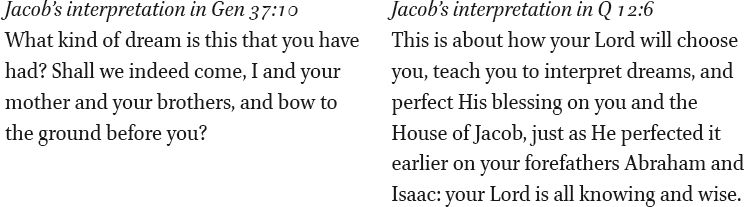
As we can see, the biblical story has Jacob explain that the dream is about how the entire family of Joseph will bow down to him, which seemingly means that Joseph will become a ruler, a meaning clearly expressed by the brothersâ interpretation of Josephâs first dream (Gen 37:8) and disclosed later in the story (Gen 42:6; 43:26). By contrast, the qurâÄnic story has Jacob explain that the dream is a divine declaration that God will choose Joseph and perfect his blessing on him, which apparently means that God will choose Joseph to be his prophet. In this, the QurâÄn is creative, for none of our Jewish and Syriac sources has Jacob interpret the dream as a divine declaration of Josephâs future prophethood. Why would the QurâÄn, in contrast to the biblical story and to the Jewish and Syriac sources, take Josephâs dream to be a divine declaration of his future prophethood? I suggest that this qurâÄnic addition to the biblical story has to do with the following typological reading of Josephâs dream in Jacobâs first homily:
The sun and the moon bend their heads and bowed down to Joseph, / for they beheld the mystery of the Son in the virtuous one. / Celestial bodies assigned honor to the one bearing the mysteries, / and from their places, they bowed down to him as to a ruler. / Through sheaves and celestial bodies, heaven and earth bowed down to him, / for all of this is due to the Son whose rule has no end. / The day and the night bowed down to Joseph because they beheld / that he had put on the types of the great sun of righteousness. / The dream summoned celestial bodies and had them surrender to the servant / who had put on his Lordâs image so that he would be held in honor because of the image.50
By having Jacob interpret Josephâs dream as a divine declaration that he will become the prophet of God, the QurâÄn seems to react to Jacobâs typological reading of Josephâs dream. In his homily, Jacob argues that Joseph was reverenced in the dream because he was the type of Christ. The QurâÄn, not agreeing with such a typological reading, responds that Joseph was reverenced in the dream not because he was the type of Christ but because he would become the prophet of God.
The Second QurâÄnic Addition: Josephâs Religious Proclamation in Prison
A remarkable qurâÄnic addition to the biblical story is found in a later episode of the Joseph story: when Joseph is imprisoned in Egypt alongside two other men. Both the biblical story and the qurâÄnic story recount that the two men, who were the Pharaohâs servants, had troublesome dreams which they told to Joseph so that he would interpret them. In the biblical story, after hearing their dreams, Joseph interprets them immediately (Gen 40:9â19), but in the qurâÄnic story, before interpreting their dreams, Joseph voices his religious proclamation:
I reject the faith of those who disbelieve in God and deny the life to come, and I follow the faith of my forefathers Abraham, Isaac, and Jacob. Because of Godâs grace to us and to all mankind, we would never worship anything beside God, but most people are ungrateful. Fellow prisoners, would many diverse gods be better than God the One, the All Powerful? [No indeed!] All those you worship instead of Him are mere names you and your forefathers have invented, names for which God has sent down no sanction. Authority belongs to God alone, and He orders you to worship none but Him: this is the true faith, though most people do not realize it. (Sura Yusuf 37â40)
Interestingly, Josephâs religious proclamation in prison, which is an addition to the biblical story, seems to participate in a similar narrative development in Jacobâs homilies. In his fifth homily on Joseph, Jacob says that, by means of being the type of Christ, Joseph proclaimed the Gospel in prison:
The wronged one, who was innocent, entered prison, / and likewise, the Son, who was free, dwelled in Sheol. / Our Lord poured mercy and grace on Joseph in prison, / for our Lordâs descent to Sheol was depicted in him. / In his virtuous freedom, Joseph entered prison / in order to abundantly care for the prisoners. / With his soul, the only begotten Son entered Sheol, / and in his divine providence, he cared for them in their dwelling place. / ⦠/ The prison became like a grave for Joseph proclaiming / that the firstborn [= Christ] would descend to Sheol to the dead ones. / Joseph is in prison in Egypt, although he had not committed any crime, / and this is, as it were, our Lord, who gives life to all, in Sheol. / ⦠/ Neither did Joseph neglect to do good in prison / nor did our Lord neglect to proclaim the Gospel in Sheol. / Although he was imprisoned, he cared for the prisoners wisely, / for he resembled his Lord who died and gave life to the dead ones.51
Through his death, Christ entered Sheol, proclaimed the Gospel and gave life to the dead ones. Christâs salvific descent to Sheol, which is part of the Gospel, was typologically proclaimed by Joseph as he entered prison and cared for the prisoners. Furthermore, in his sixth homily on Joseph, Jacob turns the prison, in which Joseph interprets the dreams of the two prisoners, into Golgotha, at which Christ judges the two thieves. Thus, Jacob strengthens the notion that Joseph, by means of being the type of Christ, proclaimed the Gospel in prison:
In prison, Joseph was entirely immersed in the image of the Son / as he was in the midst of the two thieves at Golgotha. / Joseph separated the kingâs servants apart, / judging one to life and the other to death. / He made one enter the kingdom and the Pharaohâs residence, / and delivered the other to become food for birds. / ⦠/ Our Savior was in the midst of the two thieves at Golgotha, / condemning one and justifying the other, just like Joseph had done. / He made one enter the kingdom because of his faith, / and threw the other into Gehenna because of his offence. / ⦠/ Joseph proclaimed these things, as in a mystery, / by making a chasm between the right side and the life side. / ⦠/ Through Josephâs mouth, death and life came forth, / for by means of interpretation, he had the power to give life and death. / Similarly, by our Lordâs word, the kingdom of heaven came forth, / for he has the power to give life to anyone who seeks him.52
As we can see, the qurâÄnic story agrees with Jacob that Joseph proclaimed a religious message in prison, but at the same time, it disagrees with him that the religious message of Joseph was typologically linked with Christ. In this, we perceive that the QurâÄn participates in Jacobâs reading of Josephâs religious proclamation in prison but reacts to his typological construal of it. To be sure, my explanation of Josephâs religious proclamation in prison does not discard the quite obvious observation that, by means of Josephâs words, the QurâÄn was addressing the polytheists in Mecca and its surroundings, but my explanation does suggest that Josephâs religious proclamation was equally efficient to address the Christians in Mecca and its surroundings who were aware of the Joseph-Christ typology in the Syriac tradition.
The Concept of QurâÄn
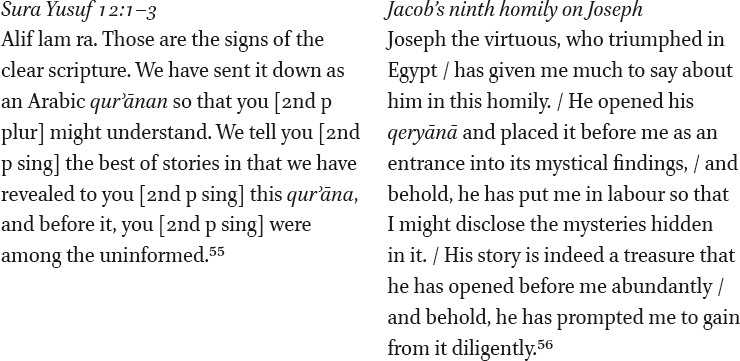
On the basis of a structural analysis of the Meccan chapters of the QurâÄn, Angelika Neuwirth has demonstrated that the middle and late Meccan chapters betray a liturgical development of the qurâÄnic community in Mecca towards a liturgical structure that is reminiscent of the liturgy of the word of the Christian Church. Structurally, the liturgy of the word consists of three parts: an appellatory beginning part, a narrative middle part, and an appellatory closing part. The narrative middle part includes the event of scriptural reading and homiletic commentary, and this middle part is introduced and concluded by other liturgical events, such as prayer, litany, and credo formula.53 Interestingly, the three-part structure of the liturgy of the word is apparent in Sura Yusuf, which opens with a beginning part (Q 12:1â3), continues with a narrative middle part (Q 12:4â101), and ends with a closing part (Q 12:102â111). With this in mind, the Arabic word qurâÄn, which appears twice in the opening of Sura Yusuf as a self-designation of the qurâÄnic Joseph story, takes on a new significance. Many scholars have pointed out that the Arabic qurâÄn comes from the Syriac qeryÄnÄ, meaning liturgical reading that takes place in the narrative middle part of the three-part liturgical structure,54 but none has, to the best of my knowledge, recognized that qeryÄnÄ appears in the opening of Jacobâs homilies on Joseph, which confirms that the Joseph story in Sura Yusuf parallels, on a conceptual level, Jacobâs homilies on the Joseph story. Compare the opening of Sura Yusuf with that of Jacobâs ninth homily on Joseph:
Moreover, in the opening of Jacobâs seventh homily on Joseph, we learn that the mysteries hidden in any qeryÄnÄ are ultimately from Christ and about Christ:
The mysteries of our Lord lead me to the qeryÄnÄ in order for me to proceed / through them towards a discourse about the only begotten Son. / The prophetic writings are written about the Son / and there is not even one page in any qeryÄnÄ that does not carry his image. / He is the cause of every true revelation / and whatever does not come from him is false.57
Comparing the opening of Sura Yusuf with that of Jacobâs seventh and ninth homilies, we recognize remarkable similarities between them pertaining not only to their nature of being liturgical readings but also to their intention of being divine interpretations of the Joseph story. The opening of Sura Yusuf and that of Jacobâs homilies inform their addressees that what they are about to hear, that is, the interpreted Joseph story, contains mysteries or signs, originates from a divine source and reveals unknown or hidden things. Yet, there is at least one important difference between the opening of Sura Yusuf and that of Jacobâs homilies. While Jacobâs homilies, divinely inspired by the mysteries of Christ, are read out so as to disclose the Joseph-Christ typology, Sura Yusuf is revealed by God to Muhammad so as to unfold a reading of the Joseph story that, inter alia, seems to disclaim the Joseph-Christ typology.
The Concept of Äya
Note that the opening of Sura Yusuf informs its addresses that the first three letters of the chapter (alif lam ra) are ÄyÄt âsignsâ of the heavenly scripture that has been sent down to them as an Arabic qurâÄn. In Q 12:7, the Joseph story itself is said to contain ÄyÄt. The concept of ÄyÄt in the QurâÄn, which basically has to do with the ways in which God reveals his existence, omnipotence and message to humanity, has been studied by several scholars.58 It is commonly held among them that the Arabic word Äya (singular of ÄyÄt), which appears almost four hundred times in the QurâÄn, derives from the Syriac word ÄthÄ (singular of ÄthwÄthÄ). In this, they follow Jeffery who notes that Äya has no root in Arabic and is a loanword from Syriac.59 What is more, some of them point out that the concept of signs in the QurâÄn seems to reflect the concept of signs in the writings of early Syriac authors.60 According to the QurâÄn, God reveals his existence, omnipotence and message to humanity by means of his various signs which are found in nature, as textual units of the QurâÄn and in human history. As for the first kind of signs, those in nature, Q 2:163â165 serves as a representative example. As for the second kind of signs, those pertaining to textual units of the QurâÄn, scholars point to qurâÄnic passages in which the verb talÄ âto reciteâ appears in connection with the word ÄyÄt.61 The third kind of signs has to do with Godâs involvement in human history through his prophets who were chosen by him in order to proclaim his message and whose stories are told in the QurâÄn as a reminder for all times of Godâs message. This kind of signs is not only evident in the qurâÄnic Joseph story but also reminiscent of the usage of signs in the Joseph story in the Syriac literature. Let us take a closer look at this.
In the qurâÄnic Joseph story, in which there are signs (Q 12:7), we find that Joseph, who was chosen by God to be his prophet (Q 12:4â6), proclaimed Godâs message throughout his prophetic life, and therefore, Godâs message which Joseph proclaimed is understood as the sign that he carried as Godâs prophet.62 Interestingly, in the Syriac works on Joseph, particularly in the liturgical homilies, the idea that Joseph carried signs throughout his life is very frequent, to say the least. However, there is a crucial difference between the signs carried by Joseph in the qurâÄnic story and in the Syriac homilies. In the QurâÄnic story, the signs are related to the qurâÄnic message of God, whereas in the Syriac homilies, the signs are typologically linked with Christ. In the preceding sections, we saw some examples from our Syriac authors of how Joseph carried the signs of Christ, that is, typified Christ. Construing Joseph as the type of Christ, our Syriac authors use several terms, such as rÄzÄ âmysteryâ or âsymbolâ, á¹upsÄ âtypeâ, á¹£urtÄ âpictureâ, á¹£almÄ âimageâ, dmÅ«tÄ âfigureâ, yuknÄ âlikenessâ and nÄ«Å¡Ä âemblemâ, all of which are equivalent to ÄthÄ âsignâ, and some of which are used more than others and appear in the same context. For example, in Jacobâs sixth homily on Joseph, we read:
The á¹£urtÄ of the Son, which Joseph put on, is above any limit, / and he is greater than and not defined by whatever I say. / The living fire is hidden in the story of Joseph, / and as I seek to approach him, its flame blazes against me. / The story of Joseph is ineffable unless it is told in our Lord, / for through him, Joseph seized the land of Egypt, once he had gone down to it. / He brought the nÄ«Å¡Ä of the king in order to place it among the Egyptians /and the ÄthÄ seized the rebellious land of Egypt. / The Son of God set his witness in his servant Joseph / and sent him to Egypt so that he would depict the á¹£almÄ in it.63
While the signs carried by Joseph in the Syriac homilies point to Christ,64 the signs carried by Joseph in the qurâÄnic story point to the religious message of the QurâÄn.
Conclusion
In my case study, I have tried to demonstrate my thesis that the QurâÄn, which is aware of Syriac literary traditions concerning Joseph, reacts to the typological construal of Joseph in the Syriac tradition. In this, we perceive that the Joseph story in the QurâÄn functions, inter alia, as a counter-discourse to the Joseph-Christ typology in the Syriac tradition.
Due to limited space allowed in this paper, I could only present four cases in support of my thesis. In each case, however, we saw that the qurâÄnic Joseph story follows the general storyline of the biblical Joseph story but departs from it either by omitting narrative details in the biblical story (Josephâs robe; Josephâs first dream) or by adding narrative details to the biblical story (Jacobâs interpretation of Josephâs second dream; Josephâs religious proclamation in prison). Each one of the four qurâÄnic departures could be explained by my thesis that the Joseph story in the QurâÄn reacts to the typological construal of Joseph.
Now, the question is, why would the QurâÄn take issue with the Joseph-Christ typology? One answer could be that the QurâÄn, which does not seem to affirm high christology, reacts to the christocentric reading of the Joseph story because Syriac authors use the Joseph story to proclaim high christology, and so, by reacting to the Joseph-Christ typology, the QurâÄn disclaims high christology. However, there is at least one main problem with this answer. If we read the qurâÄnic passages about Christ in their historical context, taking into account political factors (such as the imperial policy of the byzantine empire) and religious factors (such as Christian claims of salvific exclusivity), and without uncritically accepting the later Islamic tradition (which interprets the QurâÄn as rejecting high christology), then a new understanding of the qurâÄnic passages on Christ may appear.65 Hence, if the proclaimer of the QurâÄn was addressing the imperial policy of the byzantine empire, which evidently was misusing high christology to justify its imperial war and persecution on both Christians and non-Christians, then could it be that the qurâÄnic passages about Christ are responding to the misuse of high christology by the byzantine empire and not per se to high christology?66 Or, perhaps, the QurâÄnâs reaction to the christocentric reading of the Joseph story has to do with Christian claims of salvific exclusivity which is a soteriological position that many early Christian authors held. These authors did not only believe that Christ is the savior of the world, which was and still is the view of the Church, but they were unreservedly convinced that no one outside the Church, or their specific ecclesiological body, had any possibility to be saved by Christ. This soteriological position could be the underlying reason as to why the QurâÄn reacts to the christocentric reading of the Joseph story, for in this view, by reacting to the Joseph-Christ typology, the QurâÄn disclaims the view of salvific exclusivity which could be implied in the typological construal of Joseph or any other Old Testament figure.67 To sum up, there seems to be more than one possible answer as to why the QurâÄn take issue with the Joseph-Christ typology. I have offered three possible answers. Based on the literary evidence, it seems to me that the QurâÄn most likely reacts to the typological construal of Joseph in the Syriac tradition, but I am not sure why the QurâÄn would do so. Before drawing conclusions in that regard, I suggest that we have to await further research on Christ in the QurâÄn that takes into account political and religious factors of the seventh century.
Selected Bibliography
Akhrass, Roger, and Syryany, Imad, eds., 160 Unpublished Homilies of Jacob of Serugh, vol. 1 (Homilies 1â72); vol. 2 (Homilies 73â160) (Damascus: Department of Syriac Studies â Syriac Orthodox Patriarchate, 2017).
Bedjan, Paul, ed. Histoire complete de Joseph par Saint Ephrem: Poeme en douze livres (Paris: Harrasowitz, 1891).
Bedjan, Paul, ed. Liber Superiorum seu Historia Monastica auctore Thomas episcopo Margensi (Paris: Harrassowitz, 1901).
Brock, Sebastian. âClothing Metaphors as a Means of Theological Expression in Syriac Tradition,â in Schmidt, Margot, ed. Typus, Symbol, Allegorie bei den östlichen Vätern und ihren Parallelen im Mittelalter (Regensburg: Friedrich Pustet, 1982) 11â38.
Colson, F. H. transl., Philo, vol. 6 (Loeb Classical Library; Cambridge: Harvard University Press, 1935).
Freedman, H. Midrash Rabbah: Genesis, 2 vols. (London: The Soncino Press, 1939).
Griffith, Sidney. âChristian Lore and the Arabic QurâÄn: âCompanions of the Caveâ in Surat al Kahf and in Syriac Christian tradition,â in Reynolds. The QurâÄn in Its Historical Context, 109â137.
Grypeou, Emmanouela, and Spurling, Helen. The Book of Genesis in Late Antiquity: Encounters between Jewish and Christian Exegesis (Leiden: Brill, 2013) 323â336.
Heal, Kristian. Tradition and Transformation: Genesis 37 and 39 in Early Syriac Sources (PhD Dissertation, University of Birmingham 2008).
Heal, Kristian, transl. âThe Syriac History of Joseph: A New Translation and Introduction,â in Bauckham, Richard. James Davila and Alexander Panayotov, eds., Old Testament Pseudepigrapha: More Non-Canonical Scriptures, vol. 1 (Grand Rapids: Wm. B. Eerdmans Publishing, 2013) 85â120.
Jeffery, Arthur. The Foreign Vocabulary of the QurâÄn (Leiden: Brill, 2007).
Khorchide, Mouhanad, and von Stosch, Klaus. The Other Prophet (London: Ginko Library, 2019).
Lehto, Adam, tranls. The Demonstrations of Aphrahat, the Persian Sage (Piscataway, NJ: Gorgias Press, 2010).
Madigan, Daniel. The QurâÄnâs Self-Image: Writing and Authority in Islamâs Scripture (Princeton: Princeton University Press, 2001).
Marx, Michael. âGlimpses of a Mariology in the QurâÄn: From Hagiography to Theology via Religious Political Debate,â in Neuwirth, Angelika. Nicolai Sinai and Michael Marx, eds. The QurâÄn in Context: Historical and Literary Investigations into the QurâÄnic Milieu (Leiden: Brill, 2010) 533â564.
Mingana, Alphonse, ed. Narsai Doctoris syri Homiliae et Carmina, vol. 2 (Mausilii: Typis Fratrum Praedicatorum, 1905).
Mingana, Alphonse. âSyriac Influence on the Style of the Kuran,â in Bulletin of the John Rylands Library 11 (1927): 77â98.
Neuwirth, Angelika. The QurâÄn and Late Antiquity: A Shared Heritage (Oxford: Oxford University Press, 2019).
Witztum, Joseph. The Syriac Milieu of the QurâÄn: The Recasting of Biblical Narratives (PhD Dissertation: Princeton University, 2011).
Throughout the QurâÄn, Jews and Christians are alluded to and addressed which presupposes their presence in the audience of the QurâÄn. For a further reading on the Jewish and Christian presence in Arabia by the time of the emergence of the QurâÄn, and even centuries before that, see Uri Rubin, âJews and Judaism,â in Jane Dammen McAuliffe, ed., Encyclopaedia of the QurâÄn, vol. 3 (Leiden: Brill, 2002), 21â34; Gordon Newby, A History of the Jews in Arabia: From Ancient Times to Their Eclipse Under Islam (Columbia: University of South Carolina, 1988); Robert Hoyland, Arabia and the Arabs: From the Bronze Age to the Coming of Islam (London: Routledge, 2001); Sidney Griffith, âChristians and Christianity,â in Jane Dammen McAuliffe, ed., Encyclopaedia of the QurâÄn, vol. 1 (Leiden: Brill, 20012), 1:307â316; Gabriel Reynolds, The Emergence of Islam: Classical Traditions in Contemporary Perspective (Minneapolis: Fortress Press, 2012), 121â133, 153â166; Greg Fisher and Philip Wood, âArabs and Christianity,â in Greg Fisher, ed., Arabs and Empires Before Islam (Oxford: Oxford University Press, 2015), 276â372.
Abraham Geiger, Was hat Muhammed aus dem Judenthume aufgenommen? (Bonn: Baaden, 1833); Charles Torrey, The Jewish foundation of Islam (New York: Bloch, 1933).
Richard Bell, The Origin of Islam in its Christian Environment (London: Frank Cass, 1926); William St. Clair Tisdall, The Original Sources of the QurâÄn (London: Society for Promoting Christian Knowledge, 1905).
The sourcesâhunt that started with Abraham Geiger in 1833 began to attenuate a century later with Heinrich Speyer who, in his comprehensive and detailed work Die biblischen Erzählungen im Qoran (Hildesheim: Georg Olms, 1931), collected most of the parallels to the Jewish and Christian material in the QurâÄn. For surveys of the centuryâlong sourcesâhunt, see Gabriel Reynolds, The QurâÄn and Its Biblical Subtext (London: Routledge, 2010), 3â22; Tryggve Kronholm, âDependence and Prophetic Originality of the Koran,â Orientalia Suecana 31â32 (1982â1983): 47â70; Joseph Witztum, The Syriac Milieu of the QurâÄn: The Recasting of Biblical Narratives (PhD Dissertation: Princeton University, 2011), 10â17.
Munâim Sirry, âIntroduction,â in Munâim Sirry, ed., New Trends in QurâÄnic Studies: Text, Context, and Interpretation (Atlanta: Lockwood Press, 2019), 3â4.
Besides the scholars referenced in notes 2â4, see Samuel Lee, Controversial Tracts on Christianity and Mohammedanism (Cambridge: Cambridge University Press, 1824), 124â138, who highlighted thematic and linguistic similarities between the QurâÄn, on the one hand, and the writings of Ephrem and the Syriac Bible, on the other hand, in order to substantiate his claim that Muhammad had acquired his knowledge of Christianity in Syria; and see also Tor Andrae, Mohammed, sein Leben und sein Glaube (Göttingen: Vandenhoeck & Ruprecht, 1932), who examined the Syriac background of the QurâÄnâs eschatology and piety, and like Lee, he explored similarities between the QurâÄn and Ephrem. For a critical review of both Leeâs work and Andraeâs work, see Witztum, The Syriac milieu of the QurâÄn, 18â42.
Arthur Jeffery, The Foreign Vocabulary of the QurâÄn (Leiden: Brill, 2007); Alphonse Mingana, âSyriac Influence on the Style of the Kuran,â Bulletin of the John Rylands Library 11 (1927): 77â98; Joseph Horovitz, âJewish Proper Names and Derivatives in the Koran,â Hebrew Union College Annual 2 (1925): 145â227. On page 80, Mingana estimates that about â70 percent of the foreign influences on the style and terminology of the Kuranâ come from âSyriac (including Aramaic and Palestinian Syriac).â In a similar vein, on page 19, Jeffery notes that Syriac, including Christian Aramaic (Palestinian Syriac), âis undoubtedly the most copious source of QurâÄnic borrowings.â
Christoph Luxenberg, Die syroâaramäische Lesart des Koran: Ein Beitrag zur Entschlüsselung der Koransprache (Berlin: Schiler & Mücke, 2000). Several critical reviews of Luxenbergâs work have appeared. In his article, âA Christian QurâÄn? A Study in the Syriac background to the language of the QurâÄn as presented in the work of Christoph Luxenberg,â Journal for Late Antique Religion and Culture 3 (2009): 44â71, Daniel King considers Luxenbergâs work from the perspective of Syriac philology and summarizes eight reviews of Luxenbergâs work.
John Bowman, âThe Debt of Islam to Monophysite Syrian Christianity,â Nederlands Theologisch Tijdschrift 19 (1964â1965): 177â201. He, moreover, made much effort to demonstrate that the InjÄ«l in the QurâÄn refers to Tatianâs second-century harmony of the Gospels, known as the Diatessaron, written in Syriac and used by Syriac communities up to the fifth century but was extant even later. For a critical review, see Witztum, The Syriac milieu of the QurâÄn, 43â50.
Erwin Gräf, âZu den christlichen Einflüssen im Koran,â Al-Bahit: Festschrift Joseph Henninger (1976): 111â144. For a critical review, see Witztum, The Syriac milieu of the QurâÄn, 50â52.
Andrew J. Hayes, âThe Treasury of Prophecy: The Role of Knowledge in Salvation History for the QurâÄn in the light of Syriac Tradition,â in this volume; Reynolds, The QurâÄn and Its Biblical Subtext; Witztum, The Syriac Milieu of the QurâÄn; Michael Marx, âGlimpses of a Mariology in the QurâÄn: From Hagiography to Theology via Religious Political Debate,â in Angelika Neuwirth, Nicolai Sinai and Michael Marx, eds., The QurâÄn in Context: Historical and Literary Investigations into the QurâÄnic Milieu (Leiden: Brill, 2010), 533â564; Emran ElâBadawi, The QurâÄn and the Aramaic Gospel Traditions (London: Routledge, 2013); Kevin van Bladel, âThe Alexander Legend in the QurâÄn 18:83â102,â in Gabriel Reynolds ed., The QurâÄn in Its Historical Context (London: Routledge, 2008), 175â203; Sidney Griffith, âChristian Lore and the Arabic QurâÄn: âCompanions of the Caveâ in Surat al Kahf and in Syriac Christian tradition,â in Reynolds, The QurâÄn in Its Historical Context, 109â137; Sidney Griffith, âSyriacisms in the âArabic QurâÄnâ: Who Were Those Who Said âAllah is Third of Threeâ according to alâMaida 73?â in Meir Bar Asher et al., eds., A Word Fitly Spoken: Studies in Medieval Exegesis of the Hebrew Bible and the QurâÄn â Presented to Haggai Ben Shammi, (Ben Zvi Institute, 2007), 83â110.
Griffith, âChristian lore and the Arabic QurâÄn,â 116. As noted by Griffith, âoral versions in Arabic of biblical literature of earlier scriptures and folkloresâ must have been circulating in Arabia by the time of the QurâÄn becauseâas he shows in The Bible in Arabic: The Scriptures of the âPeople of the Bookâ in the Language of Islam (Princeton: Princeton University Press, 2013), 41â53. There is no clear evidence that the Bible, or any other biblical literature, had been translated into Arabic by the seventh century.
Griffith, âChristian lore and the Arabic QurâÄn,â 130.
Marx, âGlimpses of a Mariology,â 533â564.
George Coats, âJoseph,â in David Freedman, ed., The Anchor Yale Bible Dictionary, vol.3 (London: Yale University Press, 1992), 976â981; Richard Blum and Kristin Weingart, âThe Joseph Story: Diaspora Novella or North Israelite Narrative?â ZAW 129/4 (2017): 501â521. For a historicalâcritical reading of the Joseph story, see Ephraim Speiser, Genesis: Introduction, Translation, and Notes (New York: Doubleday, 1964), 285â378; John Barton and John Muddiman, The Oxford Bible Commentary (Oxford: Oxford University Press, 2001), 60â67.
For the Joseph story in the Jewish tradition, see James Kugel, In Potipharâs House: The Interpretive Life of Biblical Texts (Harvard University Press, 1990); James Kugel, Traditions of the Bible: A Guide to the Bible As It Was at the Start of the Common Era (Cambridge: Harvard University Press, 2009), 438â458; Maren Niehoff, The Figure of Joseph in Post Biblical Jewish Literature (Leiden: Brill, 1992); Emmanouela Grypeou and Helen Spurling, The Book of Genesis in Late Antiquity: Encounters between Jewish and Christian Exegesis (Leiden: Brill, 2013), 323â336; Louis Ginzberg, Legends of the Jews, vol. 1 (Philadelphia: The Jewish Publication Society, 2003), 327â431; Dirk Rottzoll, Rabbinischer Kommentar zum Buch Genesis (Berlin: De Gruyter, 1994), 429â537.
Grypeou and Spurling, The Book of Genesis in Late Antiquity, 336. Not only Joseph but most of the Old Testament figures were construed as types of Christ. In fact, the typological reading of the Old Testament was the primary, but not the only, hermeneutical approach to the Old Testament in the early Church. For surveys of patristic exegesis, see John J. OâKeefe and R. R. Reno, Sanctified Vision: An Introduction to Early Christian Interpretation of the Bible (Baltimore: The Johns Hopkins University Press, 2005); Charles Kannengiesser, Handbook of Patristic Exegesis: The Bible in Ancient Christianity, vol. 1 (Leiden: Brill, 2004), 165â269; Frances M. Young, Biblical exegesis and the formation of Christian culture (Cambridge: Cambridge University Press, 1997).
Grypeou and Spurling, The Book of Genesis in Late Antiquity, 337.
Heinrich Näf, Syrische JosefâGedichte: Mit Uebersetzung des Gedichts von Narsai und Proben aus Balai und Jaqob von Sarug (Zürich: Schwarzenbach, 1923). His main discussion on the typological approach to the Joseph story is found on pages 50â52.
Kristian Heal, Tradition and Transformation: Genesis 37 and 39 in Early Syriac Sources (PhD Dissertation, University of Birmingham, 2008).
Heal, Tradition and Transformation, 81â110. See also Kristian Heal, âJoseph as a Type of Christ in Syriac Literature,â Brigham Young University Studies Quarterly 41/1 (2002): 29â49.
Heal, Tradition and Transformation, 269â272.
For example, compare Jacobâs homily The Mysteries of our Lord in the Old Testament in Roger Akhrass and Imad Syryany, eds., 160 Unpublished Homilies of Jacob of Serugh, vol 1. (Damascus: Department of Syriac Studies â Syriac Orthodox Patriarchate, 2017), 121â127.
See, for example, Shalom Goldman, âJoseph,â in McAuliffe, Encyclopadia of the QurâÄn, vol. 3, 55â57; Gabriel Reynolds, The QurâÄn and the Bible: Text and Commentary (New Haven: Yale University Press, 2018), 361â386; Ayaz Afsar, âPlot Motifs in Joseph/Yusuf Story: A Comparative Study of Biblical and QurâÄnic Narrative,â Islamic Studies 45/2 (2006): 167â189; Mustansir Mir, âThe QurâÄnic story of Joseph: Plot, Themes, And Characters,â The Muslim World 76/1 (1986): 1â15; Jaakko HämeenâAnttila, âWe Will Tell You the Best of Stories: A Study on Surah XII,â Studia Orientalia 67 (2015): 7â32; Muhammad Abdel Haleem, Understanding the QurâÄn: Themes and Style (London: I. B. Tauris, 2001), 138â157; Witztum, The Syriac Milieu of the QurâÄn, 188â256.
Witztum, The Syriac Milieu of the QurâÄn, 255â256.
Witztum, The Syriac Milieu of the QurâÄn, 251â255; Roberto Tottoli, Biblical Prophets in the QurâÄn and Muslim Literature (London: Routledge, 2002), 3â16, 31.
See note 12.
For the Greek text with English translation, see F. H. Colson, transl., Philo, vol. 6 (Loeb Classical Library; Cambridge: Harvard University Press, 1935), 136â271.
For the Greek text of the first four books with English translation, see Henry Thackeray, Josephus, vol. 4 (Loeb Classical Library; Cambridge: Harvard University Press, 1930).
For the Hebrew/Aramaic text, see Julius Theodor and Chanoch Albeck, eds., Midrash Bereshit Rabba: Critical Edition with Notes and Commentary (Jerusalem: Wahrmann Books, 1965). For an English translation, see H. Freedman, Midrash Rabbah: Genesis, vol. 2 (London: The Soncino Press, 1939), 770â1003.
For the Syriac text, see Jean Parisot, ed., Aphraatis Sapientis Persae Demonstrationes (PS I, vols. 1â2; Paris: Firmin-Didot, 1894; 1907). For an English translation of Aphrahat, see Adam Lehto, The Demonstrations of Aphrahat, the Persian Sage (Piscataway, NJ: Gorgias Press, 2010).
For the Syriac text, see R. M. Tonneau ed., Sancti Ephraem Syri In Genesim Et In Exodum Commentarii (CSCO 152; Louvain: Durbecq, 1955). For an English translation, see Edward G. Mathews, Joseph P. Amar and Kathleen E. McVey (eds.), St. Ephrem the Syrian: Selected Prose Works (The Fathers of the Church 91; Washington, DC: Catholic University of America Press, 1994).
The first edition of the Syriac History of Joseph was published in two partsâthe first in 1893 by Magnus Weinberg, Die Geschichte Josefs angeblich verfasst von Basilius dem Grossen aus Casarea (Berlin: Itskowski) and the second in 1895 by Samuel Wolf Link, Die Geschichte Josefs angeblich verfasst von Basilius dem Grossen aus Cäsarea (Berlin: Itskowski)âon the basis of one manuscript, Berlin Syriac 74, dated to 1695. The text of Syriac History of Joseph begins on folio 24r and consists of 28 leaves. Due to the loss of a leaf after folio 37, there is a lacuna in the text of Syriac History of Joseph and thus in the published edition of Weinberg and Link. Since the Syriac History of Joseph is preserved in four other manuscripts, dated to a time between 1600 and 1800, Kristian Heal was able to fill the gap in the edition of Weinberg and Link. For an English translation of the Syriac History of Joseph, see Kristian Heal, transl., âThe Syriac History of Joseph: A New Translation and Introduction,â in Richard Bauckham, James Davila and Alexander Panayotov, eds., Old Testament Pseudepigrapha: More Non-Canonical Scriptures, vol. 1 (Grand Rapids: Wm. B. Eerdmans Publishing, 2013), 85â120.
For the Syriac text, see Paul Bedjan, ed., Histoire complete de Joseph par Saint Ephrem: Poeme en douze livres (Paris: Harrasowitz, 1891).
For the Syriac text, see Paul Bedjan, ed., Liber Superiorum seu Historia Monastica auctore Thomas episcopo Margensi (Paris: Harrassowitz, 1901), 521â606.
For the Syriac text, see Alphonse Mingana, ed., Narsai Doctoris syri Homiliae et Carmina, vol. 2 (Mausilii: Typis Fratrum Praedicatorum, 1905), 265â288.
For the Syriac text, see Akhrass and Syryany, 160 Unpublished Homilies of Jacob of Serugh, vol. 1, 493â579.
Genesis Rabba (Freedman, Midrash Rabbah, 775); Philo (Colson, Philo, 157); Aphrahat (Lehto, The Demonstrations of Aphrahat the Persian Sage, 405); Ps Basil (Heal, âThe Syriac History of Joseph,â 94); Ps Ephrem (Bedjan, Histoire complete de Joseph, 19); Narsai (Mingana, Narsai, 269); Jacob (Akhrass and Syryany, 160 Unpublished Homilies of Jacob of Serugh, 494).
The motif of Josephâs qamÄ«á¹£ âshirtâ is mentioned more than once in the QurâÄnic story (Q 12:18, 25â28, 96), but there is nothing in the context of these mentions that suggests that the shirt is the robe that Jacob made for him. Be that as it may, the QurâÄn omits the notion that Jacob made Joseph a robe.
Lehto, The Demonstrations of Aphrahat the Persian Sage, 405.
Akhrass and Syryany, 160 Unpublished Homilies of Jacob of Serugh, 494. Translation mine.
For a detailed treatment of the imagery of clothing in the Syriac tradition, see Sebastian Brock, âClothing Metaphors as a Means of Theological Expression in Syriac Tradition,â in Margot Schmidt, ed., Typus, Symbol, Allegorie bei den östlichen Vätern und ihren Parallelen im Mittelalter (Regensburg: Friedrich Pustet, 1982), 11â38.
Brock, âClothing Metaphors as a Means of Theological Expression in Syriac Tradition,â 11, notes that âwhile individual elements of this imagery are indeed quite often to be found in Greek and Latin writers, it would appear that it is in the Syriac tradition that the imagery is the most consistently and fully developed.â
Brock, âClothing Metaphors as a Means of Theological Expression in Syriac Tradition,â 12.
Aphrahat even calls Christ âthe Garment and the Coat of Glory in which the victorious are clothed.â (Lehto, The Demonstrations of Aphrahat the Persian Sage, 323.)
Philo (Colson, Philo, 143â144); Josephus (Thackeray, Josephus, 173); Genesis Rabba (Freedman, Midrash Rabbah, 776â777); Aphrahat (Lehto, The Demonstrations of Aphrahat the Persian Sage, 405); Ephrem (Mathews, St. Ephrem the Syrian, 182); Ps Basil (Heal, âThe Syriac History of Josephâ, 94); Ps Ephrem (Bedjan, Histoire complete de Joseph, 7â10); Ps Narsai (Bedjan, Liber Superiorum, 520); Narsai (Mingana, Narsai, 270â271); Jacob (Akhrass and Syryany, 160 Unpublished Homilies of Jacob of Serugh, 497â498).
Akhrass and Syryany, 160 Unpublished Homilies of Jacob of Serugh, 498â499. Translation mine.
Mouhanad Khorchide and Klaus von Stosch, The Other Prophet (London: Ginko Library, 2019), 106â109.
Matthias Radscheit, âTable,â in Jane Dammen McAuliffe ed., Encyclopaedia of the QurâÄn (Leiden: Brill, 2006), 188â191.
Akhrass and Syryany, 160 Unpublished Homilies of Jacob of Serugh, 497. Translation mine.
Ibid., 529â530. Translation mine.
Ibid., 535. Translation mine. A similar, though less developed, typological connection between Joseph in prison and Christ at Golgotha is found in Narsai (Mingana, Narsai, 279).
Angelika Neuwirth, The QurâÄn and Late Antiquity: A Shared Heritage (Oxford: Oxford University Press, 2019), 277â312; Angelika Neuwirth, âStructure and the Emergence of Community,â in Andrew Rippin, ed., The Blackwell Companion to the QurâÄn (Oxford: Blackwell Publishing, 2006), 140â158.
Jeffery, The Foreign Vocabulary, 234; Mingana, âSyriac Influence on the Style of the Kuran,â 88.
Translation mine.
Akhrass and Syryany, 160 Unpublished Homilies of Jacob of Serugh, 552. Translation mine.
Akhrass and Syryany, 160 Unpublished Homilies of Jacob of Serugh, 542. Translation mine.
See, for example, Binyamin Abrahamov, âSigns,â in Jane Dammen McAuliffe, ed., Encyclopaedia of the QurâÄn, vol. 5 (Leiden: Brill, 2006), 2â14; Ian Netton, âNature as Signs,â in McAuliffe, Encyclopaedia of the QurâÄn, vol. 3, 528â535; Neuwirth, The QurâÄn and Late Antiquity, 80â103, 264â277; Sidney Griffith, âThe âSunna of Our Messengersâ: The QurâÄnâs Paradigm for Messengers and Prophets; a Reading of Surat ash-Shuara (26),â in Angelika Neuwirth and Michael Sells, eds., QurâÄnic Studies Today (London: Routledge, 2016), 207â227; William Graham, âThe QurâÄn as a Discourse of Signs,â in Alireza Korangy and Daniel Scheffield, eds., No Tapping around Philology: A Festschrift in Honor of Wheeler McIntosh Thackston Jr.âs 70th Birthday (Wiesbaden: Harrassowitz, 2014), 263â275; Daniel Madigan, The QurâÄnâs Self-Image: Writing and Authority in Islamâs Scripture (Princeton: Princeton University Press, 2001), 96â103.
Jeffery, The Foreign Vocabulary, 72â73.
Neuwirth, The QurâÄn and Late Antiquity, 274â275; Griffith, âThe Sunna of Our Messengers,â 210, 221. For an overview of the concept of signs in the writings of Ephrem and Jacob, see Robert Murray, âThe Theory of Symbolism in St Ephremâs Theology,â Parole de lâOrient 6 (1975): 1â20; Thomas Kollamparampil, Salvation in Christ According to Jacob of Serugh: An Exegetico-theological Study on the Homilies of Jacob of Serugh on the Feasts of Our Lord (Piscataway, NJ: Gorgias Press, 2010), 49â75.
Q 2:129, 151, 252; 3:58, 101, 108, 113, 164; 8:2, 31; 10:15; 19:58, 73; 22:72; 23:66, 105; 28:45, 59; 31:7; 34:43; 39:71; 45:6, 8, 25, 31; 46:7; 62:2; 65:11; 68:15; 83:13. This enumeration of references is taken from Madigan, The QurâÄnâs SelfâImage, 96, n 56.
This does not mean that Godâs message which the prophets proclaimed is the only sign that they carried. Needless to say, Godâs message is the most important of his signs, but he provided his prophets with other signs, as well, such as miracles, extraordinary deeds, wisdom, and revealed scripture.
Akhrass and Syryany, 160 Unpublished Homilies of Jacob of Serugh, 534. Translation mine.
This kind of usage of signs is also found in the homilies of Ps Ephrem (Bedjan, Histoire complete de Joseph, 4), Ps Narsai (Bedjan, Liber Superiorum, 559â561), and Narsai (Mingana, Narsai, 268, 279, 287), who use rÄzÄ and á¹upsÄ, but not ÄthÄ, when they construe Joseph as a type of Christ. Jacob alone uses ÄthÄ, besides rÄzÄ and á¹upsÄ, when he construes Joseph as a type of Christ.
As a first step in this direction, see Khorchide and von Stosch, The Other Prophet, 157â201.
The anti-imperial and anti-byzantine character of the QurâÄnic proclamation is highligted at length in Zishan Ghaffar, Der Koran in seinem religions- und weltgeschichtlichen Kontext. Eschatologie und Apokalyptik in den mittelmekkanischen Suren (Paderborn: Schöningh, 2020).
See Vahid Mahdavi Mehr, âCan there be an Islamic comparative theology?â in Pim Valkenberg, ed., Handbook for Comparative Theology (forthcoming).