


Tudor printer and publisher John Day established his dominance over the trade in English martyrologies and cemented a reputation for brazen Protestant polemics packaged in richly illustrated books with the publication of his 1563 book Actes and Monuments. While much ink has been spent on Dayâs effective use of paratext and illustrations to further his patronsâ propagandistic endeavours, significantly less has been written about his most heavily illustrated texts: Christian Prayers and Meditations (1569) and the subsequent A Booke of Christian Prayers (1st ed. 1578).1 While the two prayer books have too many textual and visual variations to be considered two editions of the same work, their shared content and means of creation makes it imprudent to examine them in isolation.2 As the most densely illustrated Tudor prayer books, the little attention these works have received in the historiography characterises them as aberrations and oddities. However, when we contextualize the prayer books within Dayâs political network and print output, they appear particularly on-brand for this image-conscious book producer. For example, Actes and Monumentsâ prefatory address, âAd doctum lectoremâ, parallels and contrasts Dayâs martyrology against the most famous compilation of Catholic saintsâ lives, Jacobus de Voragineâs The Golden Legend, (which author John Foxe attacks as being âfilled with prodigious portents and most empty and utterly vain fictionsâ).3 In the years between bringing to market the first two editions of this financially and politically profitable inversion of Catholic hagiographies, Day briefly turned his attention toward appropriating another lay devotional format: books of hours.
The most immediately noticeable feature of Dayâs two prayer books is their remarkable similarity to printed Catholic books of hours. Both textually and paratextually, the works clearly borrow from early-fifteenth-century private devotional aids, particularly those printed in Paris. Dayâs choice to assume the conventions of books of hours has led some scholars to position the works as Protestant didactics, masquerading in a comforting Catholic format in an attempt to appeal to popular pre-Reformation sensibilities. Eamon Duffy best expressed this sentiment when he claimed the 1578 book was âin fact a Trojan Horse, harnessing the old forms to smuggle in the new religionâ.4 Other scholars have registered surprise at Dayâs use of a traditional Catholic format. Before unpacking the Protestant text, Richard L. Williams wondered how Day, an âimportant figure in the evangelical wing of the English reformers ⦠[and] printer of John Foxeâs Acts and Monumentsâ could print âthe borders in his 1569 book that were so redolent of books of hours from the time of âpoperyâ.5 However, when we situate Dayâs two illustrated prayer books within the context of Actes and Monumentsâ self-conscious use of the martyrological topos, the prayer books no longer seem surprising.
This chapter will argue that just as Actes and Monuments explicitly positions itself within the Christian literary tradition while inviting comparisons with famous Catholic hagiographies. Dayâs prayer books similarly employ a distinctive format to draw out a comparison by association. Moreover, the abundant and shifting illustrations, which caused some scholars to disregard the five editions of these prayer books, are remarkable resources for studying the tensions surrounding religious images in early modern England. Tessa Watt, in her argument against Patrick Collinsonâs âiconophobiaâ thesis, states that a more accurate description of the tightening limitations on religious images is not a sudden change in mentality but âa continuing process of substituting acceptable images for unacceptable, albeit within increasingly constrictive boundariesâ.6 The tension Watt describes surrounding the ever-narrowing boundaries of image permissibility is palpable on the pages of Dayâs prayer books. Rather than deceiving the viewer into unwittingly digesting Protestant theology, they are unique examples of vigorously Protestant prayer books that, like their Catholic model, provided their readers with a rich compendium of iconography.
Patrons on the Page
Day was careful in his selection of images to print in these deluxe prayer books (as will be detailed below) but the choice of lay Catholic devotional format to refashion for the new church was obvious. For centuries, books of hours fostered a unique relationship between reader and text as practical aids to a spiritual necessity. Additionally, books of hoursâ established use and traditionally flexible content made them ideal vehicles for disseminating new beliefs while also suggesting historic continuity. Some of the English Reformationâs earliest legislation acknowledged the influence of private devotional texts, and sought to control their contents.7 Each of the post-Reformation Tudor monarchs, including Catholic Queen Mary, endorsed books of hours that supported their agenda and used devotional aids within their wider propaganda campaigns.8 Unlike the many official or quasi-official English Protestant books of hours, Christian Prayers and Meditations did not simply adapt the texts of its Catholic predecessors: the 1569 book was the first to incorporate the abundant illustrative content found in many Catholic works.
The visual scheme of the earlier book, Christian Prayers and Meditations, is expressed in elaborated borders that frame the devotions (see figure 16.1). Each border is composed of five cuts, the most prominent of which are the sidepieces closest to the finished bookâs fore-edge. These sidepieces repeat two highly conventional cycles frequently used in books of hours (or âprimersâ, as they were often called in England): the Life of Christ and the Dance of Death. In the Life of Christ cycle (repeated seven times in the work) each image associated with an event in Jesusâ life is contextualised with a corresponding scriptural quotation and two depictions of Old Testament prefigurations. At the foot of the page are two patriarchs, who indicate to the reader the biblical source for the Old Testament prefigurations. Towards the end of the book, the Life of Christ cycle is replaced with a series of Dance of Death images, which depict the certainty of death by illustrating Death seizing various members of sixteenth-century society in descending order of rank.9

Christian Prayers and Meditations (1569), sig P2v
St Paulâs Cathedral Library
Nine years after the publication of Christian Prayers and Meditations, John Dayâs son Richard reused most of its illustrations in A Booke of Christian Prayers. Like its predecessor, A Booke of Christian Prayers is also a collection of devotions and images based on traditional books of hours. However, fresh from his disappointing work on the much-maligned third edition of Actes and Monuments, Richard exercised his Eton and Cambridge education by expanding the devotional content and framing his prayer book in a signed letter âTo the Christian Readerâ.10 Richard also set the work apart from the earlier Christian Prayers and Meditations by diversifying the illustrative content. The 1578 first edition of A Booke of Christian Prayers had four new border cycles: the Virtues, the Six Works of Mercy, the Five Senses and the Fifteen Tokens of Judgement, each with matching footpieces.
Given the religious and political environment of Elizabethan England, lay prayer books are valuable resources for exploring the long process of establishing new orthodoxy and of how contemporaries internalised the state-mandated faith. Dayâs richly illustrated prayer books were too expensive to have been intended for a large, popular audience, as the three shillings and four pence price that the owner of a copy of A Booke of Christian Prayers (now in Harvardâs Houghton Library) paid indicates.11 However, the booksâ official backing, as well as their status as the only luxury printed illustrated prayer books of Elizabethan England, offers rare insight into the political process of establishing a Reformed religious iconography. Like many of Dayâs deluxe publications, it is likely that he understood the initial return on investment not in terms of success on the retail market, but in how the books bolstered his reputation and relationships. In printing these works, Day appropriated a traditional means of disseminating iconography to establish an English visual vocabulary that suited both the new orthodoxy and his powerful patrons.
Throughout his career, Day was under the patronage of some of the most influential people in English society. As Elizabeth Evenden has shown, Dayâs long-standing relationships with figures such as William Cecil, Robert Dudley and Archbishop Parker allowed him to secure valuable patents. These included the exclusive rights to publish bestsellers, such as ABC with Little Catechism and the English metrical psalms.12 On the many occasions when other members of the Stationersâ Company challenged Dayâs monopolies or ambitions for expansion, his powerful allies often proved crucial in protecting his interests.13 Given the often perilous economics of early modern print, satisfying his patrons was essential to Dayâs success.
Day used his patrons to secure his elevated position in the English print market and the works he produced reinforced those valued relationships. The dedication of Actes and Monuments begins with a woodcut capital C depicting the virgin Queen enthroned atop a vanquished pope and receiving homage from three men, mirroring the iconography of the Adoration of the Magi.14 Instead of three kings, the figures in the capital are identified as John Day, John Foxe, and William Cecil.15 From the outset Dayâs intentions are clear, it was the relationship between author, printer and patron that allowed the presentation of this Protestant martyrology to the Queen and her people. In Dayâs two prayer books, he was not nearly as explicit about the workâs patronage, but nevertheless used his text and paratext to please his patrons while expressing the Crownâs endorsement of the material within.
As Evenden explains, Day was operating between shifting spheres of influence over his long career and deftly maintained patronage among secular and sacred elites. The only known completed copy of Christian Prayers and Meditations, which now resides in Lambeth Palace Library, is thought to be Elizabethâs presentation copy given to her by Dayâs patron Archbishop Parker.16 Reflecting the status of this gift, this presentation copy was elegantly hand-coloured by artists in Parkerâs Lambeth workshop.17 While Parker undoubtedly played a crucial role in disseminating the 1569 book, it is the Queenâs confidant, Robert Dudley Earl of Leicester, whose patronage is most evident within the pages of Dayâs prayer books. An ornament featuring the heraldic device of Robert Dudley, the staked bear and staff, encircled in a heart of grape vines, appears 18 times in the first edition of A Booke of Christian Prayers (see figure 16.2).
Ornament featuring the heraldic device of the Earl of Leicester from A Booke of Christian Prayers (1578), sig. M2v
British Library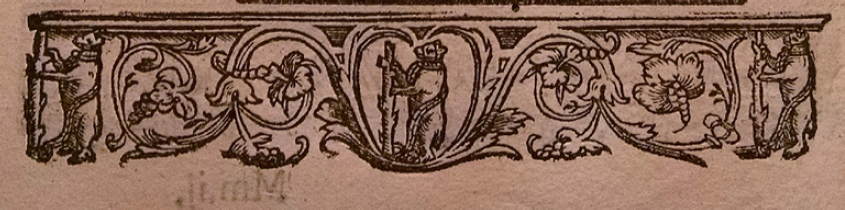
The royal arms and emblems associated with Tudor monarchs, such as roses, shamrocks, fleurs de lys and Beaufort portcullises are also woven throughout the works. Both prayer books feature a prefatory portrait of Queen Elizabeth having set aside the symbols of her authority â her crown, sceptre and sword â and kneeling in private prayer at a prie-dieu with a little book open before her (see figure 16.3).18 This prefatory portrait, entitled Elizabeth Regina, echoes representations of the Old Testament kings, David and Solomon. To underscore this connection further, the epigraph cites 2 Chronicles 6:14, the prayer Solomon gave to dedicate to the completed Temple. The modelling of Elizabeth as a latter-day Solomon reverberates throughout the texts of both of Dayâs compilations and relates to the wider agenda of the works.19 The association with the pious king Solomon seeks to legitimise the contemporary Church of England by claiming its own biblical prefigurations.
Elizabeth Regina. Prefatory portrait from A Booke of Christian Prayers (1578), sig. [fist] 1v
Lambeth Palace Library, shelfmark [ZZ]1569.6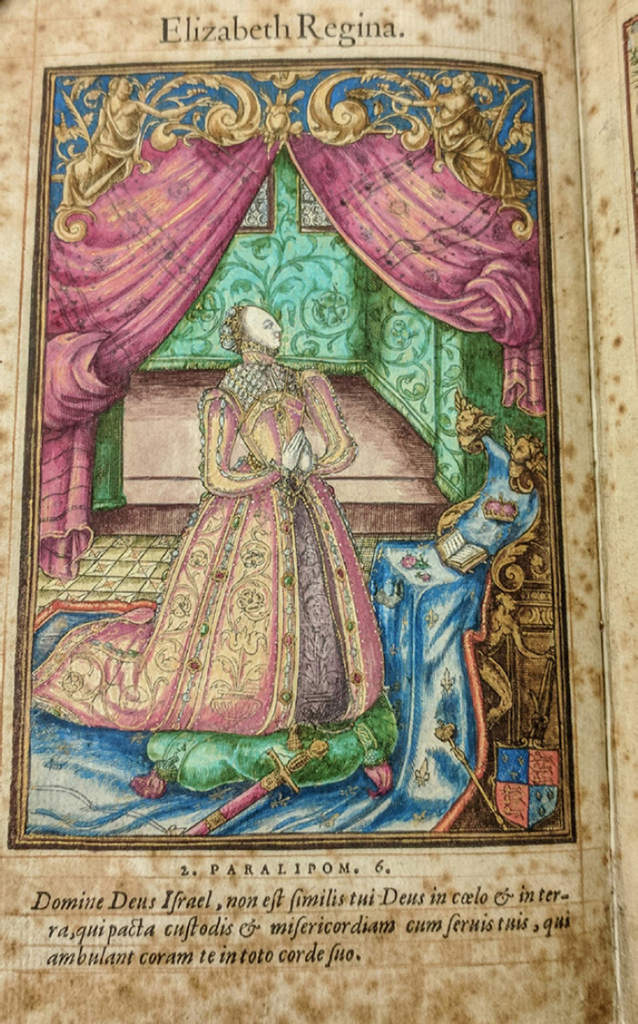
The Elizabeth Regina portrait is also positioned in the space often reserved for the portrayals of the Virgin in both print and manuscript books of hours.20 The placement and composition honours the piety of the Queen while providing viewers with an unimpeachable example of the proper use of the book in hand.21 The depiction shows Elizabeth in her opulently decorated private chapel, but there is nothing in the room that would trouble even the most fervent of Elizabethan iconoclasts. This image is clearly a fiction. As we know from the work of Margaret Aston, the Queenâs chapel was a site of continual iconoclasm and image restoration. Aston remarks that, over the course of many years, âElizabethan Polyeuctes ⦠bravely undertook to destroy the idols in the royal pantheonâ, only to see the offending cross and candlesticks reappear.22 Despite this imagined space, the badges of the monarch and her favourite express the agenda of the books while framing the devotional material with the trappings of authority.
While the visual rhetoric of authority in the work is clear and unwavering, the wider illustrative programme is far from stable. The shifting visual schemes of Christian Prayers and Meditations and A Booke of Christian Prayers makes them especially fertile sources for examining the changing mentality regarding religious images throughout their print run. In 1945, Samuel C. Chew noticed that when Richard Day reused the blocks from Christian Prayers and Meditations to make the first edition of his A Booke of Christian Prayers in 1578, he excised two images of Mary.23 The two PietaÌs featured in the 1569 Christian Prayers and Meditations were clearly no longer acceptable for the 1578 A Booke of Christian Prayers (see figure 16.4). Given the PietaÌâs strong association with the Cult of Mary and papal indulgences, their removal was almost certainly induced by a need to conform this state-sanctioned work to the current religious climate.
The first 1569 PietaÌ is accompanied by two Old Testament prefigurations from Ruth and Lamentations, while the second is shown with prefigurations of Joseph being lowered into the pit and Jonah cast overboard.24 The PietaÌs were replaced in 1578 by new cuts of the Entombment and the Maries visiting the Tomb (see figure 16.5).25 The method of excising the PietaÌs remains a matter of debate. Chew and others believe that the border images are woodcuts, and that each PietaÌ and two prefigurations were a single vertical woodblock. In contrast, Leslie Manhin Oliver and the bibliographers of A Guide to English Illustrated Books, Ruth Samson Luborsky and Elizabeth Morley Ingram contend that the borders were composed of metalcuts produced by a process known as polytypage.26 If the latter group is correct, the three images would have been cast separately, and only bound to each other once in the printerâs matrix, allowing for easier alterations.
(left) One of two Pietà s from Christian Prayers and Meditations (1569), sig. E2r. St Paulâs Cathedral Library; (middle) Replacement Maries visiting the Tomb from A Booke of Christian Prayers (1578), sig. L2r. The British Library; (right) Upside down Entombment from A Booke of Christian Prayers (1590), sig. F1r
The British Library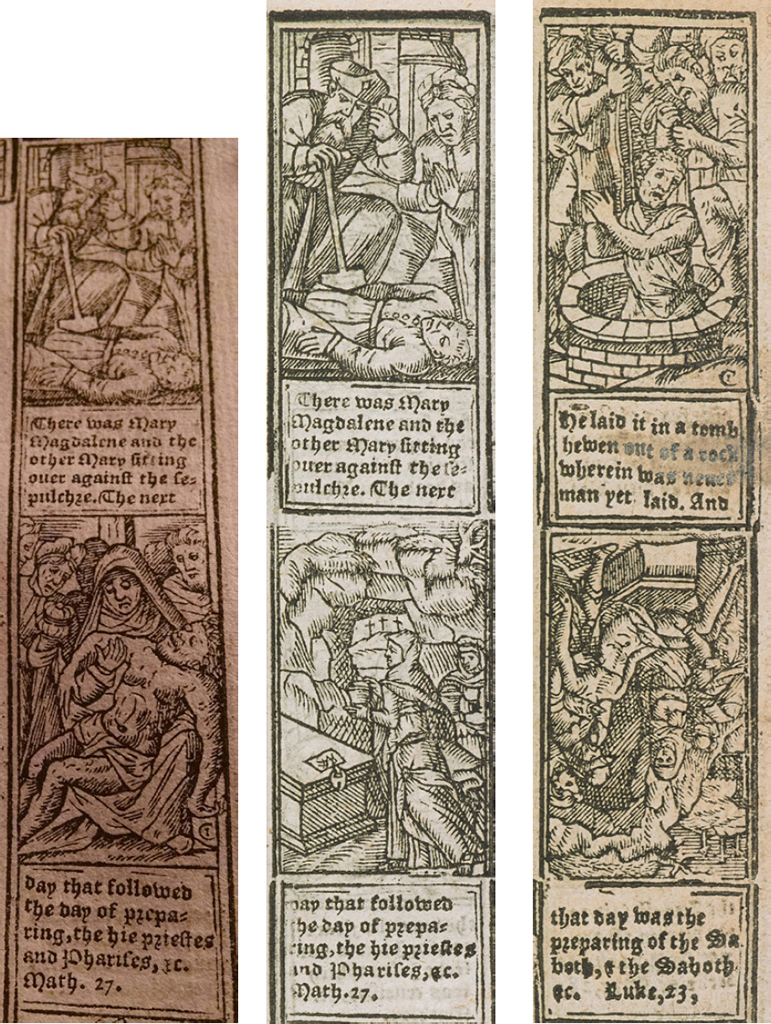
The new images were slotted into the same positions as their predecessors and are immediately recognisable as having been crafted by a different hand. In later editions, this micro-iconoclastic endeavour is made even clearer by the fact that, in the 1581, 1590 and 1608 editions, at least one of the replacement images was printed upside down (see figure 16.6). As Chew states, âin comparing these embellishments in their original and altered forms we have before our eyes the process of uprooting and destroying âRomishâ imagesâ.27 By making that very comparison, we see that what was deemed admissible in 1569 needed to be expurgated only nine years later.
Unlike the above case of iconoclasm within the pages of Dayâs devotional works, some iconographic boundaries did not take years to shift; rather, they shifted in the course of printing. Three of the blocks from A Booke of Christian Prayer received substantive alterations, and two of them are present in the 1569 work in both their altered and original forms. Prefiguring Jesus being pierced by the Holy Lance is an image depicting Eve being brought forth from Adamâs side. In the image, God is depicted as an old, bearded man wearing a voluminous robe and bending down towards the supplicant Eve, while his left hand reaches out to Eveâs shoulder and his right is blessing her. After several quires with the anthropomorphic representation of the God had been printed, suddenly, Godâs head is chunked out and replaced with a tetragrammaton in a cloud (see figure 16.7).28 The block was cut with a diagonal incision that manages to excise Godâs face and right hand while keeping Eve intact. The substitution is rather clumsy: behind the recumbent figure of Adam, the viewer can still see Godâs billowing robes, and his left hand, still reaching toward Eve, has been disembodied. Out of the seven times this image is printed in the Christian Prayers and Meditations, three feature God as human, and four have the tetragrammaton replacement.29
The Creation of Eve from Christian Prayers and Meditations (1569), sig. e1r and o4r
St Paulâs Cathedral Library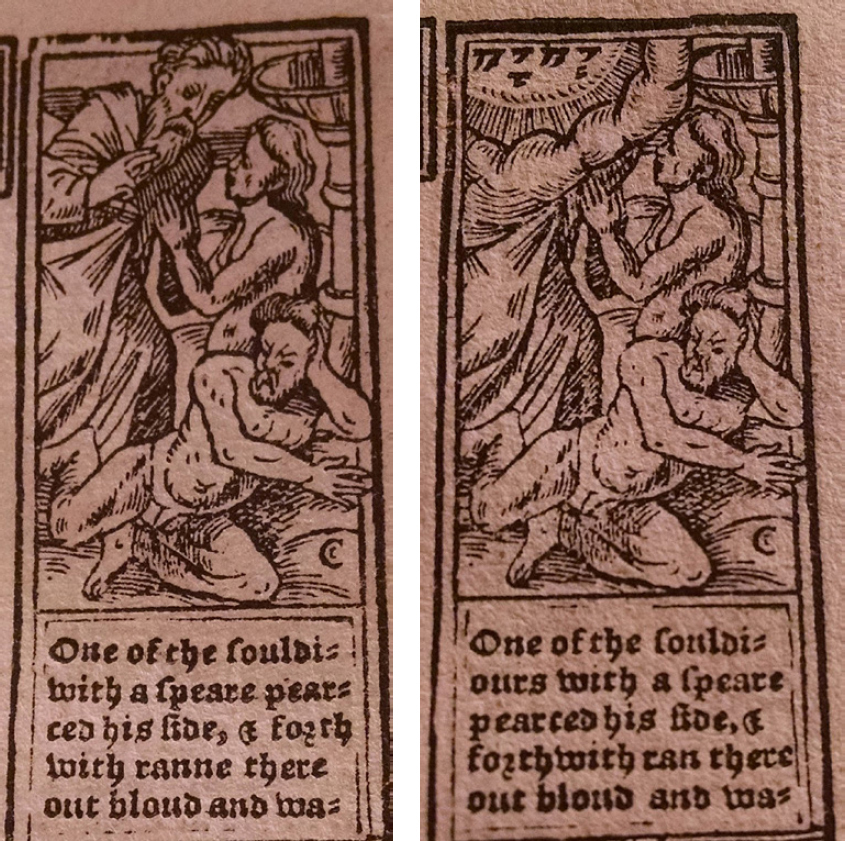
This same disruption occurred twice more in the work. Following a similar procedure to the altered Creation of Eve woodcut, in the illustration of Moses taking off his shoes at Godâs request from Exodus 3, God was replaced with the tetragrammaton (see figure 16.8). Again, in the edited impressions, the anthropomorphic God is still visible from the waist down.30 Finally, all seven instances of the image of David praying to God from Samuel 2 have clearly had the same treatment, but no pre-edited version made its way into the work (see figure 16.9).31
Moses before the burning bush from Christian Prayers and Meditations (1569), sig. A3r and L4r
St Paulâs Cathedral Library
David praying about his return to Judah from Christian Prayers and Meditations (1569), sig. B4r
St Paulâs Cathedral Library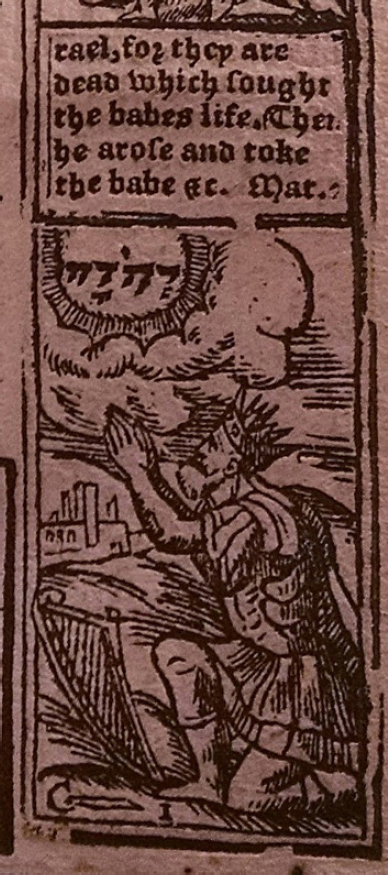
Uncommented on in the literature on Dayâs prayer books is the tiny anthropomorphic God handing Moses the Decalogue in the background of the Golden Calf cut.32 This depiction of a bearded God avoided the editorial decapitation exacted on the images cited above, and remained unaltered in the subsequent editions of A Booke of Christian Prayers. Although this image escaped expurgation in the four print shops that used this cut from 1569â1608, the artists charged with colouring the Queenâs personal copy caught the unwelcome guest and diligently blotted him out. In each of the above cases, the artists in Parkerâs Lambeth workshop skilfully blended any traces of the personified God into the background, and, for some impressions, even delicately added manuscript tetragrammatons (see figure 16.10).
Hand-coloured Moses and the Golden Calf, with a manuscript Tetragrammaton covering God in a cloud
The Lambeth Palace Library, shelf mark [ZZ]1569.6
Astonâs often-cited unpacking of the complex events surrounding the Bishopsâ Bible controversy provides insight into the iconoclasm in Christian Prayers and Meditations. The Bishopsâ Bible of 1568 was conceived by Archbishop Parker to provide a more authoritative English translation. Parkerâs Bible included 134 woodcut illustrations based on the work of German artist Virgil Solis, printed from blocks that Aston proved were brought to England from Cologne.33 Solisâ compositions were Lutheran in origin, but were also deemed acceptable for use in a series of Catholic Bibles. Aston describes a process remarkably similar to that of the refashioning of Dayâs books:
⦠some of the blocks were carefully altered to suit the confessional demands of the Elizabethan Churchâ¦. Prints that included large depictions of God were reworked. The offending section was cut out, a plug of new wood deftly inserted into the block, and a wood-engraver filled the sometimes awkward space with the tetragrammaton.34
As in Christian Prayers and Meditations, the Bishopsâ Bibleâs Creation of Eve scene was modified by replacing the representation of God as a bearded ancient with a tetragrammaton.
The anxiety about depicting God the Father had long been stirring in England. Archbishop Cranmerâs Catechism of 1548 attacks images of God as âan olde man with a long hore berdâ, and between 1559 and 1560, one of the 11 Articles by the Bishops of Lambeth stated that the clergy should twice yearly preach that they âutterly disallow ⦠all kind of expressing God invisible in the form of an old manâ.35 Parkerâs purging fell in line with English Protestant tastes, but, to his criticsâ delight, his biblical iconoclasm was not entirely thorough. Several smaller woodcut images of the anthropomorphic God made their way into the first edition of the Bishopâs Bible. The 1572 A Second Admonition to the Parliament featured a brutal attack on these images: â⦠in their last great Bible in the first edition of it, such a sight of blasphemous picture of God the father, as what they deserve for it, I will refer them to none other judge then their owne note uppon the 15 verse of the fourth of Deuteronomie â¦â.36 The Admonition closes by teasing its readers with an anonymous colophon, stating âThys worke is finished thankes be to God/And he only wil keepe us from the searchers rod. And though master [John] Day and [Humphrey] Toy watch & warde/ We hope the living God is our savegarde â¦â.37
The contemporary controversy surrounding the images in the Bishopsâ Bible sheds light on the similar changes made during the printing of Christian Prayers and Meditations. As Dayâs patron, Parker played an important part in the dissemination of Christian Prayers and Meditations. Evenden explains that, in 1568, shortly after Parker presented Elizabeth with a copy of the Bishopsâ Bible, the Archbishop presented her with the hand-coloured copy of Christian Prayers and Meditations.38 The two books were published only months apart, and, although the criticism cited above was from 1572, it has been argued that outrage over the images in this high-profile book was also voiced immediately.39 Therefore, while Day was in the midst of printing, it is probable that the outcry over the depiction of God was starting to break out. This contemporary public indignation could explain the apparent hastiness of the excisions of Godâs face.
There is material evidence to suggest that Day set about his iconoclasm immediately. In a work composed of three different paper stocks, an edited and unedited image of the Creation of Eve is printed on paper with identical watermarks, implying that the images were printed in a relatively short span of time.40 Williams asserts that these changes are proof of Dayâs self-censorship, rather than censorship having been imposed upon him by outside authorities. If the deletion of the anthropomorphic God was the work of the body of clerical censors put in place in the Royal Injunctions of 1559, it is unlikely that they would have allowed the images of the human manifestations of God that were already printed to remain in the work.41
From these examples of iconoclasm within the pages of Christian Prayers and Meditations and A Booke of Christian Prayers, we see the complexities of Dayâs role as an image producer. Clearly, he was beholden to the limits on iconographic depictions that were already in place. In Christian Prayers and Meditations, this meant the speedy, if uneven, censorship of the image of God, and his replacement with a more abstract representation that emphasises the Word over a physical depiction. In A Booke of Christian Prayers, this tension manifests in editing blocks to exclude the images of the PietaÌs, with their associations with idolatry and indulgences. However, Dayâs official status meant that he was not just reacting to changes in orthodoxy, but also actively involved in presenting acceptable images and establishing the new boundaries.
Fashioning the New Orthodoxy
Much of the Elizabethan discourse on the role of images in devotion conformed to the writings of Calvin. For Calvin and for the Elizabethan Church, it was the intent behind an image that marked it as idolatrous or permissible. Calvin simplifies this distinction by explaining the two classes of acceptable representations:
historical, which give a representation of events, and pictorial, which merely exhibit bodily shapes and figures. The former are of some use for instruction or admonition. The latter, so far as I can see, are only fitted for amusement.42
However, in practice, the exact definition of an âun-abusedâ image was vague, and, as we have already seen in this paper, subject to changes. Therefore, Day took great pains to cite the biblical and historical sources for the images in his prayer books while stressing their educational intention.
Starting on leaf M1, the visual scheme of the 1578 A Booke of Christian Prayersâ borders shifts to a cycle portraying representations of the Virtues, which were not featured in the earlier Christian Prayers and Meditations. The Virtues were expanded from the traditional seven Christian Virtues typically found in the iconographic program of printed books of hours.43 These borders personify each Virtue as a psychomachic figure trampling the embodiment of the corresponding vice underfoot.44 This effective format for depicting spiritual conflict is used for 22 different Virtues throughout the work, and depicts battles such as âIndustryâsâ victory over âSlothâ or âSobrietyâsâ conquest over âVoluptousnesseâ. In the 1578 and 1581 editions, one of these images speaks directly to the danger of improper use of images in devotional practices.45 The crowned figure identified as the âLove of Godâ is portrayed as victorious over âIdolatryâ (see figure 16.11). Her depiction indicates that she was adapted from the traditional image of âCharityâ found in printed books of hours.46 Unlike âCharityâ, who typically is shown conquering a personification of âHeresyâ, âLove of Godâ is trampling the objects used in Catholic sacraments and rituals. Under âLove of Godâsâ feet, the viewer sees a bishopâs crosier, chalice, scourge, rosary, Eucharist wafer, candlestick, crucifix and a pax that features an image of a figure praying. Directly below the defeated objects, the letterpress caption informs the reader that âIdolatry, is Spirituall adulteryâ. The psychomachic rhetoric makes it abundantly clear that objects associated with Roman Catholicism and image worship are not viable ways to access true love of God.
âLove of Godâ and âIdolatryâ and Communion from A Booke of Christian Prayers (1578), sig. M1v
The British Library
The pageâs pedagogical message does not end with the depiction of âLove of Godâ. Accompanying the virtue every time she appears in the work is a footpiece that details the sacrament of Communion. In contrast to the defeated Catholic wafer, the minister in the footpiece hands out pieces of bread torn from a large loaf.47 Similarly, juxtaposing the vanquished chalice, with its long stem and small cup that was intended for the priestâs use during the sacrament, the footpiece depicts a wide-mouthed cup that the minister could share with parishioners in a Protestant service.48 Both the cup and the loaf of common bread are placed upon a table completely bare of decoration within the body of an equally unadorned church. This adversarial and dependent pairing works to destroy the validity of the Catholic sacrament while presenting in its place a positive image of Protestant service. In effect, the viewer witnesses the moment of victory in the battle over idolatry and is then presented with the ideal, purified result.
The âLove of Godâ and Communion pair is not the only illustration within A Booke of Christian Prayers that presents an image of a Protestant sacrament. In the border directly preceding âLove of Godâ is the related Virtue of âKnowledge of Godâ, who is shown with a burning taper and open book and is trampling âMahometâ.49 Paired with âKnowledge of Godâ is an image of the other gospel sacrament of Baptism. In the image, a swaddled infant is held over an unembellished baptismal font while the minister sprinkles water over its head. This representation is a conscious departure from the Sarum rite, which called for the immersion of the naked baby (see figure 16.12).50 In each of these pairs, we see Dayâs attempt to construct a new set of images to direct devotions and edify his readers. These are not the meditative or venerable images found in previous books of hours; rather, they are strictly pedagogical.
Baptism from A Booke of Christian Prayers (1578), sig. R1v
The British Library
In each of these sacramental images, the minister is shown wearing a surplice. The years preceding the publication of A Booke of Christian Prayers were plagued with controversy about the authority of the regulation of trivial aspects of the church, or adiaphora, and the outfitting of ministers was at the centre of the controversy.51 The issue of ecclesiastical dress divided the clergy, with conservatives supporting the traditional vestments that the Queen and Archbishop Parker demanded be maintained. On the other side, nonconformists, such as Bible translator Miles Coverdale and Parkerâs successor Edmund Grindal, saw traditional clothing as a vestige of popery. By observing the surpliced ministers of the Communion and Baptism footpieces, the contemporary viewer is informed that A Booke of Christian Prayers was not just a Protestant work, but a conservative Protestant work.
Dayâs, and his influential patronsâ, conservative message is reiterated in the Dance of Death cycles towards the end of A Booke of Christian Prayers. For the most part, the images in the Dance of Death cycles were taken from Christian Prayers and Meditations. However, the earlier Christian Prayers and Meditations only illustrated secular figures. A Booke of Christian Prayers expanded the cycle by depicting the futile struggle of 14 new members of English society, including figures identified as âArchbishopâ, âBishopâ, âDoctorâ and âPreacherâ.52 As one might expect from the representations of the clergy in these sacramental images, the four ecclesiastical figures are outfitted in the conservative vestments. Yet again, the elaborate illustrations in the prayer book refashioned an iconographical trope to suit the new political and religious environment.
The images explored in this paper represent only a fraction of the massive illustrative content of the two books, but they are telling of the overall message of the work. While remarkably similar, the illustrations in Dayâs prayer books do not function like the prescribed meditative and devotional images in Catholic books of hours. In choosing the images to include in Christian Prayers and Meditations and A Booke of Christian Prayers, Day took measures to make sure that his readers did not see the illustrated borders as objects of veneration. He succeeded by ensuring that there would be little room for subjectivity. With copious biblical citations and prefigurations, controlled depictions of Protestant services, extant signs of editing and emblems of authority, the Reformed intentions of the images are clear. The images Day edited or substituted reflect the newly established boundaries of permissibility. Likewise, the pedagogical images Day added show how the reader was intended to understand the acceptable images he provided. With these tightly controlled illustrations, Day transformed the images in his borders from objects of reverence to reference.
Repetition and Reception
If, as I argue, Day was consciously appropriating the format of a book of hours to disseminate an acceptable English, Protestant iconography, it is worth examining how his readers interacted with and used the permissible images he published. Seventeenth-century antiquarian John Bagford praised Dayâs title pages because they were âprented cut in vood finley designed [as was] his head peces and borders and tale peces with maney of his grat letters vsed in the dedicationsâ.53 Aside from comments like Bagfordâs, the visual and textual marginalia added by early modern readers are important sources for the reception of Dayâs images.54 The amateur production of so-called âdoodlesâ and placement in the literal margins has led some historians to dismiss visual marginalia as the scratchings of bored children. However, when contextualized within the wider pictorial scheme and the illustrations they are frequently found near, a doodle suddenly becomes evidence of image reception.
In a copy of the 1578 A Booke of Christian Prayers, now in Northwestern Universityâs theological library, one reader, Joshua Hilton, clearly spent a considerable amount of time looking at the âfinley designedâ border images in his book. The visual marginalia he left behind show his copying of the key aspects that bind Jesusâ instruction to âtake and eatâ the bread at the Lordâs supper with its Old Testament prefiguration of the Israelites receiving Godâs gift of manna (see figure 16.13). Although roughly executed, Hiltonâs copying of Jesusâ hand passing the bread, and a bowl that an Israelite uses to catch manna, indicates that he saw and, more importantly, understood the images. On a later leaf, Hilton also copied an unidentified graverâs mark hidden in most of the Life of Christ images.55 A marginal note in a 1590 edition of A Booke of Christian Prayers, now in the British Library, shows a contemporary hand coping the textual warning against idolatry, which contextualises the Adoration of the Magi (and destruction of an idol) composition in the Life of Christ series. Perhaps noting the small, personified God in the Golden Calf prefiguration, which was noted above, the reader transcribed âHe shall breake downe there altars he shall destroy their imagesâ, reminding himself, and later readers, of the peril of misusing religious images.56
Looking beyond the material page, we see that these books were not only an attempt to shape the public image of Elizabeth and her church, but were also used by owners to fashion their own public images. As Tara Hamling explains, from 1570 to 1640, the dramatic rise in construction and living standards created conditions that resulted in an increase in home building on nearly every level of the social scale.57 For Dayâs elite readers, a well-crafted public image was essential to maintaining status, and social conventions dictated that rank be expressed with material displays of wealth.58 This could prove problematic for committed Protestants, who were instructed to rejected vanity and conspicuous consumption. Many overcame these tensions by decorating their homes with images pulled from state-approved illustrated books.
Joshua Hiltonâs marginalia from A Booke of Christian Prayers (1578)
Northwestern University Styberg Library, shelf mark: BV245.D27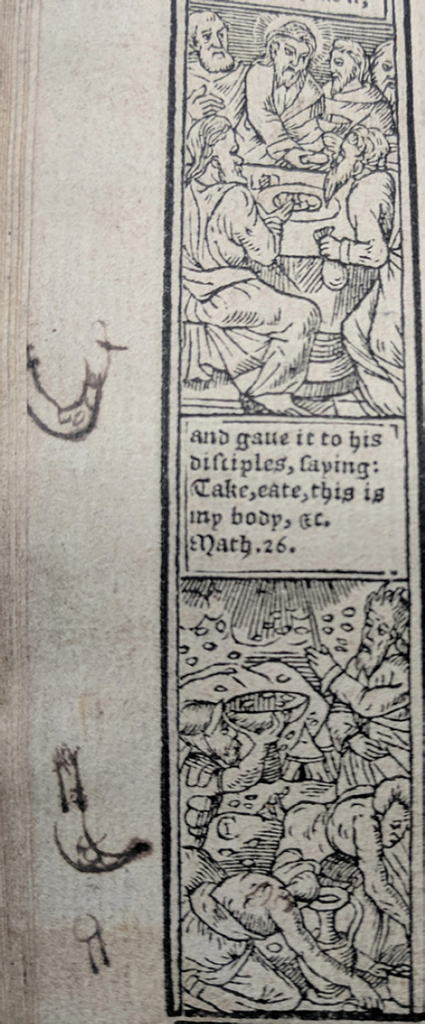
Given the nebulous definition of acceptable images, the householder who patronised domestic decorations could inadvertently open himself, and his household, to idolatry or signify religious and political dissent if a poor selection was made. The stakes of choosing the correct subject become higher when one considers that the early modern English home was a semi-public space that reflected the social standing and godliness of the principal householder. By producing a vehemently reformed illustrated devotional work, Day provided a cornucopia of permissible images that could be adapted and reused in diverse media.
In her work Decorating the âGodlyâ Household, Hamling identified a number of adaptations of images from Christian Prayers and Meditations and A Booke of Christian Prayers into early modern English homes. Her research also suggests that it was the homeowner who dictated the decorative scheme of the household (and not the craftsmen and women who executed it), and that patrons mainly came from the mainstream Protestant majority who adopted the state-sponsored faith.59 One such conformist was Mark Hawkings, a prosperous fish merchant from North Devon, who built a townhouse around 1635, featuring a parlour with an elaborate plasterwork ceiling depicting the Tree of Jesse mined from the title page of Dayâs compilations.60 While the Tree of Jesse has been altered in its transition to the Hawkingsâ ceiling, on both the title pages and the ceiling, the bearded patriarchâs sleeve identifies him by name.
Dayâs richly illustrated prayer books also provided the iconography for the 1614 carved overmantel at Postlip Hall in Gloucestershire.61 The fireplace overmantel displays an elaborate coat of arms flanked by two psychomachic figures that are nearly identical copies of the personifications of Virtues of âTemperanceâ and âCourageâ in the margins of the A Booke of Christian Prayer. The only substantial difference between the two mediums is the omission of the vomit spewing from the figure of âIntemperanceâ, who lies defeated beneath the feet of âTemperanceâ. This tasteful emendation is understandable when one considers that the overmantel is located in Postlip Hallâs great chamber, a formal room used for dining in state.62 Hamling also found that a composition from Dayâs prayer books was used in an overmantel in Devon, which copied the illustration of Elijah in the fiery chariot.63 In each of these examples, we see not only the internalisation of the Protestant message of Dayâs images, but also the lasting influence and acceptance of his iconographic program and how it was used by owners in their own pious self-fashioning. Additionally, when transferred into a semi-public space home, the didactic message is opened not just for those who can afford a copy at the bookstall, but to an audience that encompasses every member of early modern households, including servants, apprentices and children.
The illustrations in Christian Prayers and Meditations and A Booke of Christian Prayers resonated for many centuries after they were created. As we saw with these plaster quotations, the iconographic scheme Day established was picked up by others seeking appropriate images. The reuse, copying, exchanging, selling, stealing or recycling of woodcuts and metalcuts was common practice in the early English printed book trade.64 This economically prudent practice emerged in response to the limited resources of English book producers, and meant that the iconographic programme that Day established would be seen not only by his own readers, but also by readers of a range of texts for centuries to come. Tracing these transferences allows us to see the reach of a printed image in England and the vast and interconnected network of printers who disseminated them.
In the sixteenth century alone, the images in Dayâs prayer books were used in ten surviving texts by six different printers.65 Some of these diverse works include a Latin grammar by Robert Waldegrave in London, an edition of BeÌzaâs Propositions and Principles of Divinitie also printed by Waldegrave but in Edinburgh, a theological disputation printed in Cambridge by Thomas Thomas and a collection of poems by Giles Fletcher, printed in Cambridge by John Legat.66 The same year that construction began on the Hawkingsâ home, the 1634 edition of Philaster was printed with the Virtue of Patience that had first appeared in the 1578 A Booke of Christian Prayers.67 As for the Queen Elizabeth prefatory portrait discussed above, in 1817, Thomas Frognall Dibdin was âextremely well-persuaded, that this cut of Q. Elizabeth was preserved so late as 1652, and was used in the Benlomeâs Theophila, [Wing B1879] printed in that yearâ.68
Certainly, recycling images was common in the English book trade, but the remarkable scale of these repetitions suggests that more than convention was at hand. Whether on a printed page or a plaster ceiling, the images in Christian Prayers and Meditations and A Booke of Christian Prayers had established an iconography free from idolatrous connotations, and was therefore safe for copying. From the reception and repetition of the images, we see that, for the conforming majority, these books offered an approved iconographic scheme to inform, affirm and direct their devotions.
Conclusion
Based on the booksâ unique positions as the only deluxe illustrated prayer books printed during the English Reformation, many scholars have chosen to view Dayâs works as curiosities or outliers. Similarly, their dependence on books of hours, especially in the border images, has led some to dismiss them as examples of religious continuity. This chapter, by contrast, has contended that, in Dayâs multifaceted iconographic content, the anxieties that surrounded the use of images in devotions are manifest. As we have seen, tensions about religious images did not just lead to an impulse to destroy; rather, Protestant image creators like Day reshaped, controlled and edited visual content to suit the new religious and political reality.
Christian prayers and meditations in English, French, Italian, Spanish, Greek and Latine (London: John Day, 1569), USTC 39731; A booke of Christian prayers, collected out of the auncient writers, and best learned in our tyme, worthy to be read with an earnest mynde of all Christians, in these daungerous and troublesome dayes, that God for Christes sake will yet still be mercyfull unto us (London: John and Richard Day, 1578), USTC 508554, 509278, 511512, & 3003447. For Actes and Monuments: see Julian Roberts, âBibliographical Aspects of John Foxeâ, in D.M. Loades (ed.), John Foxe and the English Reformation (Aldershot: Ashgate Scolar Press, 1997) pp. 36â51; Elizabeth Evenden and Thomas S. Freeman, Religion and the Book in Early Modern England (Cambridge: Cambridge University Press, 2011); Elizabeth Evenden and Thomas S. Freeman, âPrint, Profit and Propaganda: The Elizabethan Privy Council and the 1570 Edition of Foxeâs âBook of Martyrsââ, The English Historical Review, 119 (2004), pp. 1288â1307; and John King, Tudor Books and Readers: Materiality and the Construction of Meaning (Cambridge: Cambridge University Press, 2010).
In recognition of their similarities, bibliographers have collectively referred to all five editions of these two books as âQueen Elizabethâs Prayer Bookâ. Some speculate that the anonymous compiler of Christian Prayers and Meditations was Queen Elizabeth (or John Foxe). See Erzsébet Stróbl, âThe Queen and Death: An Elizabethan Book of Devotionâ, in Kinga Földváry and Erzsébet Stróbl (eds.), Early Modern Communi(cati)ons: Studies in Early Modern English Literature and Culture (Newcastle upon Tyne: Cambridge Scholars Publishing, 2012), p. 15; Jennifer Clement, âThe Queenâs Voice: Elizabeth Iâs, Christian Prayers and Meditationsâ, Early Modern Literary Studies, 13:3 (2008), pp. 1â26. For the suggestion that Foxe compiled the work: Francis Douce, Dance of Death (London: W. Pickering, 1833), p. 147.
John Foxe, Actes and monuments (London: John Day, [1563]), USTC 506152, sigs. B3râB4r. Translation from John N. King, âLiterary Aspects of Foxeâs Acts and Monumentsâ, The Acts and Monuments Online. [
Eamon Duffy, Marking of the Hours: English People and Their Prayers 1240â1570 (New Haven: Yale University Press, 2006), p. 171.
Richard L. Williams, âCensorship and Self-Censorship in Late Sixteenth-century English Book Illustrationâ, in Michael Hunter (ed.), Printed Images in Early Modern Britain (Farnham: Ashgate, 2010), p. 45.
Tessa Watt, Cheap Print and Popular Piety (Cambridge: Cambridge University Press, 1993), p. 135; Patrick Collinson, From Iconoclasm to Iconophobia (Reading: University of Reading, 1986).
Charles C. Butterworth, The English Primers (1529â1545): Their Publication and Connection with the English Bible and the Reformation in England (Philadelphia: University of Pennsylvania Press, 1953); Duffy, Marking the Hours, p. 147â170.
Helen C. White, Tudor Books of Private Devotion (Madison: University of Wisconsin Press, 1951); Duffy, Marking of the Hours.
Douce, Dance of Death, pp. 147â148; Samuel C. Chew, âThe Iconography of âA Book of Christian Prayersâ (1578), illustratedâ, Huntington Library Quarterly, 3 (1945), pp. 297â301.
White, Tudor Books of Private Devotion, pp. 187â196; Evenden, Patents, Pictures and Patronage, p. 152. Also see William Keating Clay, Private Prayers put Forth by Authority During the Reign of Queen Elizabeth (Cambridge: The Parker Society, 1851). Clay meticulously identifies much of the source material for most of the prayers in A Booke of Christian Prayers. For John and Richardâs contentious and litigious relationship, see the above-cited Evenden or C.L. Oastler, âJohn Day, the Elizabethan Printerâ, Oxford Bibliographical Society, 10 (1975), appendix I, pp. 65â69.
Houghton Library shelfmark: STC6431, this copy is also available on EEBO. A 1615 price inscription in another 1590 edition lists a 2 shillings and 1 pence price, National Library of Scotland shelfmark: Gray.449. Among the books included in Francis R. Johnsonâs often-cited âNotes on English Retail Book-Prices, 1550â1640â, The Library, 5 (1950), pp. 83â112, is an unbound copy of the 1581 edition of A Booke of Christian Prayers. Johnson noted a one-shilling price for Richard Dayâs book is sourced from the 1585 inventor stock list of Edinburgh bookbinder Robert Gourlaw. Although the price he cites is wholesale, Johnson explains that âwholesale price in Scotland approximates so closely to the retail price in Londonâ that we can take it as roughly equivalent to the price a Londoner would have paid. By his calculations, the price Johnson lists means that the 1581 A Booke of Christian Prayers sold for .32d a sheet, making it markedly cheaper than the 1.08d a sheet the owner of the Harvard copy paid. Tracing this valuation back to Johnsonâs original source, a 1836 printing of Gourlawâs inventory in The Bannatyne Miscellany, we find that the work he identified as A Booke of Christian Prayers is listed in the inventory simply as âCristiane prayerisâ, which could be a short title for any number of devotional works. It seems clear that Johnson misidentified this work and that his listed price is not accurate.
Evenden, Patents, Pictures and Patronage; Andrew Pettegree, âDay, John (1521/2â1584)â, Oxford Dictionary of National Biography (Oxford: Oxford University Press, 2004). Consulted online. [
In the case of this book, the records of the Stationersâ Company contain a formal challenge against the printing of the 1578 work filed by the son of John Dayâs former partner, William Seres, on the basis that he had inherited the privilege to print primers from his father. The matter was settled in Dayâs favour on 28 January 1580. W.W. Greg and E. Boswell (eds.), Records of the Court of the Stationersâ Company 1576 to 1602 from Register B (London: Bibliographical Society, 1930), pp. 9â10.
This woodcut capital was later used in 1577 on sig. I3r of John Deeâs Perfecte Arte of Navigation (USTC 508331) and in 1578 for Gabriel Harveyâs Gratulationum Valdinensium Libri Quatuor (USTC 508571). Roy Strong posits the image of Elizabeth enthroned is based on a work attributed to miniaturist Levina Teerlinc. Roy Strong, Gloriana, the Portraits of Queen Elizabeth I (London: Pimlico, 2003), pp. 55â57. Also see John N. King, Tudor Royal Iconography (Princeton: Princeton University Press, 1989), pp. 154â158.
King suggests that the third figure is not Cecil, but Thomas Norton. See King, Tudor Royal Iconography, p. 156. For the Cecil attribution, see Evenden, Patents, Pictures and Patronage, p. 113â114.
Evenden, Patents, Pictures and Patronage, p. 107. The Lambeth edition is the only copy in which the Litany was written entirely in the first person. William Keatinge Clay states, âWhilst, therefore, the rest of the impression was printed for the public generally, this particular book must have been prepared expressly for the Queenâ. Clay, Private Prayers, p. xxi.
Lambeth Palace Library, Featured Image: Queen Elizabeth I Prayer Book, [<
Most scholars refer to this image as a âfrontispieceâ. However, because of its position on the verso of the leaf following the title page (a2v), this paper is conforming to Ruth Samson Luborsky and Elizabeth Morley Ingramâs more general designation of âprefatory portraitâ. For more on this portrait, see King, Tudor Royal Iconography, p. 114.
For more on casting Elizabeth as the new Solomon in Dayâs prayer books, see Linda Shenk, Learned Queen The Image of Elizabeth I in Politics and Poetry (New York: Palgrave Macmillan, 2010), pp. 21â53.
Notable examples of illustrations of the Virgin used at the opening of a codex are The Hours of Mary of Burgundy (Flanders, c. 1475), Book of Hours of Richard III (London, c. 1420), and The Hours of Lorenzo Strozzi (Naples, 1478). This substation is not unique to these works, as Patrick Collinson states: âIt has been almost commonplace to observe that in Elizabethan England the image of the Virgin was replaced by that of the virgin queen in polite and even popular devotionâ. Collinson, From Iconoclasm to Iconophobia, p. 23.
For Elizabeth as a user of books in royal iconography, rather than depicted like her father and brother as active participants in book production and dissemination, see Evenden, Patents, Pictures and Patronage, pp. 115â116.
Margaret Aston, The Kingâs Bedpost: Reformation and Iconography in a Tudor Group Portrait (Cambridge: Cambridge University Press, 1993), pp. 102â107.
Chew, âIconographyâ, pp. 293â305.
Christian Prayers and Meditations (London: John Daye, 1569), USTC 39731, sig. e2r and e2v.
A Booke of Christian Prayers (London: John Daye, 1578), USTC 508554, sig. L1v and L2r.
Leslie Mahin Oliver, âThe Procession of the Virtues in a Book of Christian Prayersâ in Harvard Library Bulletin, VI (1952), p. 308; Ruth Samson Luborsky and Elizabeth Morley Ingram, A Guide to English Illustrated, Books 1536â1603 (Ann Arbor: University of Michigan, 1998), p. 315.
Chew, âIconographyâ, p. 300.
For more on the history of the tetragrammaton in English print, see David J. Davis, Seeing Faith, Printing Pictures: Religious Identity during the English Reformation (Leiden: Brill, 2013) pp. 143â177; Margaret Aston, âSymbols of Conversion: Proprieties of the Page in Reformation Englandâ, in Michael Hunter (ed.) Printed Images in Early Modern Britain: Essays in Interpretation (Aldershot: Ashgate, 2010).
USTC 39731. God the Father is featured on sig. e1r, E1r, and Dd1r, while sig. i4r, o4r, K1r, and Ii1r have the tetragrammaton edits.
USTC 39731. God the Father is featured on sig. A3r and F3r, while sig. a4r, f4r, l2r, L4r, and Ee3r have the tetragrammaton edits.
USTC 39731, sig. b4r, g3r, m2r, B3r, G3r, L4v, and Ff2v.
USTC 39731, sig. b2v, g1v, l4v, B1v, G1v, M3r, Aa1v, and Ff1v.
Margaret Aston, âThe Bishopsâ Bible Illustrationsâ in Diana Wood (ed.), The Church and the Arts (Cambridge: Ecclesiastical History Society, 1992), p. 271.
Aston, âThe Bishopsâ Bible Illustrationsâ, pp. 283â284.
Aston, âThe Bishopsâ Bible Illustrationsâ, p. 280 ; Gerald Lewis Bray (ed.) Documents of the English Reformation 1526â1701, (Cambridge: James Clarke & Co., 2004), pp. 349â351. USTC 504011, sig. C8vâD1r.
Aston, âThe Bishopsâ Bible Illustrationsâ, p. 272. The note to which the critics refer was written by Bishop Alley to clarify Godâs words on Mount Horeb and read: âMeaning that plagues hang over them that would make any image to represent God byâ USTC 506837, sig. D6r.
[Thomas Cartwright], A second admonition to the parliament ([Hemel Hempstead: John Stroud, 1572]), USTC 507415, sig. H5r. The colophon plays with Dayâs title as the Warden of the Stationersâ Company and Toyâs terms as Under-Warden in 1571. See Greg and Boswell (eds.), Records of the Court of the Stationersâ Company, p. 95; Evenden, Patents, Pictures and Patronage, p. 79.
Evenden, Patents, Pictures and Patronage, p. 107.
Williams, âCensorshipâ, p. 57.
Watermarks observed in the St Paulâs Cathedral Library copy (Shelfmark.24A) of USTC 39731, sig. e1r and o4r.
Williams, âCensorshipâ, p. 57.
John Calvin, Henry Beveridge (trans.), Institutes of the Christian Religion: A New Translation (Edinburg: Calvin Translation Society, 1845), Book I, p. 113.
Oliver, âVirtuesâ, p. 303.
King, Iconography, pp. 118â122.
Expanding on Chew, Mahin Oliver notes that this image (and âKnowledge of Godâ which will be discussed below) âwere lost from the book after the 1578 impressionâ. This is not entirely accurate: both these images are present on R1v and R2r of the 1581 edition, but are not found in the two later editions. Oliver, âVirtuesâ, p. 307. Chew, âIconographyâ, p. 302.
Oliver, âVirtuesâ, p. 305.
Christopher Haigh explains that in the controversy and confusion over the use of common bread or unleavened wafers, traditionalists (including Queen Elizabeth and Parker) advocating for the customary wafers and hard-line Protestants sided with the 1552 Book of Common Prayerâs call for âbread be such as is usual to be eaten at the tableâ. By the time of this printing in 1578, conservatives had mostly conceded and Archbishop Sandysâ metropolitan visitations of that year reinforced the use of common bread. Christopher Haigh, ââA matter of much contention in the realmâ: Parish controversies over communion bread in post-Reformation Englandâ, History, 88 (2003), pp. 393â404.
King, Iconography, p. 114.
In respect of Muslim readers, this image is not reproduced here.
Eamon Duffy, âContinuity and Divergence in Tudor Religionâ, in R.N. Swanson (ed.), Unity and Diversity in the Church (Cambridge: Ecclesiastical History Society, 1996), p. 202.
For an overview of the events of the vestments controversy, see Patrick Collinson, The Elizabethan Puritan Movement (Oxford Scholarship Online, 2011). For the issue of adiaphora and its influence over the image debate, see Davis, Seeing Faith, pp. 45â69.
USTC 508554, sig. Y3vâY4r.
Quoted from Oastler, âJohn Day, the Elizabethan Printerâ, p. 2. Oastler cites, B.M. MS. Harl. 5910, II, f.12v.
For more on early modern marginalia see William H. Sherman, Used Books: Marking Readers in Renaissance England (Pennsylvania: University of Pennsylvania Press, 2010) and his forthcoming The Readerâs Eye.
Marginalia observed in Northwestern University Styberg Libraryâs copy (Shelfmark: BV245.D27) USTC 508554, sig. I3v and Ee2v.
Marginalia observed in the British Libraryâs copy of Richard Day, A booke of Christian prayers (London: Richard Yardley and Peter Short for the assigns of Richard Daye, 1590), USTC 511512, sig. C2v. Shelfmark: c.24.a.21.
Tara Hamling, Decorating the âGodlyâ Household (New Haven: Yale University Press, 2010), p. 68.
Tara Hamling, âThe Appreciation of Religious Images in Plasterwork in the Protest Domestic Interiorsâ, in Tara Hamling and Richard L. Williams, (eds.), Art Re-formed (Cambridge: Cambridge University Press, 2007), p. 150.
Hamling, âGodlyâ Household, p. 20. Although significantly later, a 1688 contract between the Earl of Strathmore and Dutch artist Jacob de Wet directs that 15 ceiling panels will be painted with âdistinct stories of our blessed Saviour Confrome to the Cutts in a bible here in the house or the Service Bookâ. Patrick Lyon Strathmore and Alexander Hastie Millar (ed.), The Book of Record, a Diary Written by Patrick first Earl of Strathmore and Other Documents Relating to Glamis Castle, 1684â1689, (Edinburgh: Printed at the University Press by T. and A. Constable for the Scottish History Society, 1890), p. 104.
Hamling, âGodlyâ Household, p. 113. For more examples of printed images used to decorate overmantels, see Anthony Wells-Coles, Art and Decoration in Elizabethan and Jacobean England, The Influence of Continental Prints, 1558â1625 (New Haven: Yale University Press, 1997) and Tara Hamling, âGuides to Godliness: From Print to Plasterâ, in Michael Hunter (ed.), Printed Images in Early Modern Britain (Farnham: Ashgate, 2010), pp. 65â85.
Hamling, âGuides to Godlinessâ, p. 70.
Hamling, âGuides to Godlinessâ, p. 70.
Hamling, âGodlyâ Household, p. 234â235.
David J. Davis, âImages on the Move: The Virgin, the Kalendar of Shepherds, and the Transmission of Woodcuts in Tudor Englandâ, Journal of the Early Book Society for the Study of Manuscripts and Printing History, 12 (2009), pp. 99â132; David J. Davis, Seeing Faith; Ruth Luborsky, âConnections and Disconnections between Images and Texts: The Case of the Secular Tudor Book Illustrationâ, Word and Image, 3 (1987), pp. 74â83.
Luborsky and Ingram, English Illustrated Books, p. 324.
See USTC 510361, 511729, 511100 and 512374. According to McKerrow, by the time of John Dayâs death in 1584, Richard was already disinherited and did not receive any of his fatherâs printing devices. By 1586, Dayâs woodcuts and metalcuts can be seen in the works of Waldegrave. Ronald B. McKerrow, Printersâ & Publishersâ Devices in England & Scotland, 1485â1940 (London: Bibliographical Society, 1913), p. 169. He notes that the only major difference is the size of the Virtues, which he ascribes to the shrinking rates of various qualities of metals. Oliver, âVirtuesâ, p. 310.
Francis Beaumont and John Fletcher, Philaster, or love lies a bleeding (London: William Jones for Richard Hawkins, 1634) USTC 3017078.
Thomas Frognall Dibdin, The Bibliographical Decameron (London: W. Bulmer & Co., 1817), p. 114. See sig. Hh1r of Wing B1879 for the Queen Elizabeth prefatory portrait.