


One of most prominent printing-houses in Krakow, the capital of print in early modern Poland-Lihuania, was an enterprise best known by its Latin name: Officina Lazari. The ownership of the Drukarnia Åazarzowa, as it was called in Polish, stayed within a single family for almost a century, making it one of the most stable printing houses in the region. Despite its prominence, relatively little is known about Drukarnia Åazarzowaâs operations. The business history of the workshop, as well as the owners efforts to make the press viable thanks to the support of powerful individuals is scarcely studied. This article seeks to add to our knowledge about the relationship between Officina Lazari and contemporary authorities, both lay and ecclesiastical. It analyses the state and church-sponsored printing produced by Drukarnia Åazarzowa between 1577 and 1587, arguing that during that period its owner, Jan Januszowski (1550â1613) was able to secure the workshopâs position by profiting from his connections with state and church authorities.
Beginning with a brief introduction on the dynamics of book production in sixteenth-century Krakow, the article will focus on analysing the initial decade of Januszowskiâs printing activity. In order to understand both Janusowskiâs ambitions and his connections to state authorities and church prelates, I will first discuss his background and education. Next, I will give examples of books Januszowski produced thanks to the patronage of highly placed individuals. Though the printer also received royal commissions, I will concentrate on the church patronage that the Drukarnia Åazarzowa obtained. As we shall see, Januszowski devoted huge efforts to receive commissions for printing post-Tridentine liturgical books, resulting in the appearance of the most illuminating and best-documented example: a monumental missal financed by the bishop of Warmia. The wealth of archival evidence about the realisation of this particular edition makes it possible to reconstruct the dynamics of a production process for a massive volume, whose printing was commissioned and paid for by a potent prelate.
Krakow, the Book Centre of Poland-Lithuania
By the 1450s, when printing began in Europe, Krakow was an established place of power, learning and trade. It was a major urban centre in the largely rural region: the seat of secular and church authorities and (with the university founded in 1364) a city linked by a network of intellectual connections with other European kingdoms. Well situated at a junction of trade routes, it also remained an important economic hub. As such, Krakow constituted a vibrant market for books: the city was a natural distribution point for books imported from the printing dominions of Western Europe, and it developed its position as a centre of book production simultaneously.1 The first presses operated in Krakow as early as 1473, and in the sixteenth century, the city became the principal printing centre in its region of Europe, dominating other publishing towns, which were more modest than the capital of the multinational, multi-ethnic and multilingual state of Poland-Lithuania. Already in the fifteenth century, printers in Krakow produced books in Latin and in Old Church Slavonic (printing the earliest books in Cyrillic script). In the sixteenth century they started to print in Polish and other European vernaculars (producing the first books in Hungarian in the world), as well as in Greek and in Hebrew. Surviving material documents the broad range in the output of the Krakow presses, and the extent of local printersâ experience with books addressed to different audiences.2
During the sixteenth century, more than twenty printing offices were active in the city. Among these was an enterprise operating in GoÅÄbia Street â in platea Columbarum. The ownership of the firm, established ca. 1517 by Hieronim Wietor, remained within the inheritance of a single family: Wietorâs widowed wife Barbara, then her new husband Åazarz Andrysowic, and finally Jan Januszowski, who was the son of Barbara and Åazarz. In the seventeenth century, the printing office was to be inherited by Januszowskiâs sonsâ (who never became seriously interested in printing books themselves) and then was finally sold. Managed by Jan Januszowski from 1577 onwards, Drukarnia Åazarzowa became one of the most prominent printing houses in Krakow â both in terms of the number of editions and quality of printing.3 Januszowskiâs ambitions to produce beautiful books and to print significant texts were apparent as early as the first decade of his activity as a printer (1577â1587) â the years of King Stefan Batoryâs (Báthory István) reign over the Polish-Lithuanian Commonwealth (1576â1586) â right after the young master-printer inherited Drukarnia Åazarzowa from his father. To understand Januszowskiâs position as he started his career as a printer, it is important to note two things. First, that a vital part of Januszowskiâs inheritance was an extensive social network built by his predecessors. Second, that Januszowski started the business with an upbringing that was rather unusual for the son of a craftsman.
Januszowski inherited a printing house with long-standing traditions, one that had already been active for 60 years, and that was an important site on the map of sixteenth-century Krakow.4 By the time of Januszowskiâs management, its previous owners had produced over 900 editions, which survive to the present day (while a great number must have perished over the intervening five centuries). They had developed various relations with the Krakow Universityâs authorities and scholars, with local intellectuals, and with the town elite as well as with the Church dignitaries and state officials. These connections undoubtedly helped the young printer to garner the support needed for his own publishing ventures. We know that Januszowski was recommended to prospective patrons as a descendant of outstanding printers who had served the predecessors of potential backers as if these relationships could be heritable, and he himself used his lineage to obtain new commissions.5
Januszowski was not just a craftsmanâs son brought up in the workshop of his father. As a teenager, Januszowski had received instruction at the court of Emperor Maximilian II in Vienna and at Krakow University. At the beginning of 1570, he worked as a scribe writing letters in the private chancellery of Zygmunt August (Sigismund Augustus the Jagiellon, 1520â1572).6 Joining the Jagiellonian court meant that the printerâs son encountered intellectuals and statesmen either employed by the chancellery or working for the monarch from a very early age. After Sigismund Augustus died in 1572, Januszowski set off to study law in Padua, supported with both the money he inherited from his mother, and a grant from MikoÅaj Firlej, an influential nobleman, who would later become the voivode of Krakow. Januszowski returned to Krakow just before the newly elected King, Stefan Batory, was crowned in 1575. Upon his return, he soon re-joined the royal chancellery and remained in service, close to the king and state affairs, until his father died in 1577. Both his university education and the time he spent at court certainly broadened the craftsmanâs sonâs horizons, and stimulated intellectual ambitions of a prospective printer, who was also a prolific writer and translator.7 Importantly, Januszowski established a network of contacts during his formative years. When he left the royal court in 1577 for the printing shop, he could rely on these connections to obtain commissions and privileges and, as a result, to develop the position of his enterprise.
The Importance of Staying Connected
In Poland-Lithuania, Januszowski was not âthe average small printer, who could not make the contacts that won wealthy patronsâ.8 Both printed books and archival documents demonstrate the support Januszowski received from lay and ecclesiastical dignitaries, with whom he had first made acquaintance in Vienna, in Padua, in the chancellery, or at court. There is not enough space here to mention all the names and elaborate on the nature and results of Januszowskiâs connection with them.9 Suffice to say that the printerâs main patron was Jan Zamoyski (1542â1605), who was the most powerful man in the Polish-Lithuanian Commonwealth at the time of Batoryâs reign. Zamoyski held two of the most important state offices: he was both Grand Chancellor of the Crown (that is of Poland, as Lithuania had its own chancellors and army commanders) and Commander-in-Chief. He had forged a spectacular political career as Batoryâs most trusted advisor. Even if it was the king who distributed grants, to obtain the royal favour one needed a proper recommendation and the support of a person who had direct access to the monarch.10 In the 1570s and 1580s, the person closest to the king was Jan Zamoyski, who controlled the internal affairs of the Polish-Lithuanian Commonwealth and dominated Stefan Batoryâs patronage policy.
As early as 1578, Zamoyski had seen to it that Januszowski was granted a privilege that made him a servant of the king (servitor), and a royal printer.11 This act had important practical implications, as it excluded the printer from any municipal jurisdiction, reserving law enforcement for the king. The same privilege gave Januszowski the sole right to print all books he chose to produce for ten years and banned his competitors from copying his imprints. The document also confirmed Januszowskiâs right to reprint works once produced by his father, Åazarz Andrysowic (unless they were deemed heretical).12 Januszowski set about printing some of the titles explicitly mentioned in the privilege immediately. Other books listed in the document were potential ideas for future publication, and would not be printed until decades later. For example, Icones regum et principum Poloniae mentioned in the 1578 privilege, was only published in 1605 as Ikones ksiÄ Å¼Ä t i królów polskich.
Unfortunately for Januszowski, his 1578 privilege was not a permanent arrangement for treasury-sponsored editions. These (from 1577) were reserved for another Krakow printer favoured by Zamoyski, MikoÅaj Szarfenberger, who was authorised to produce constitutions, the kingâs ordinances, decrees and law collections.13 Nevertheless, in subsequent years Januszowskiâs acquaintance with the elite active at the royal court certainly helped him obtain commissions for a number of state-sponsored books. These included both large folio volumes like De verae et falsae Ecclesiae discriminae by Batoryâs court preacher StanisÅaw SokoÅowski (1537â1593), as well as smaller books like Disputatio de putredine by the kingâs physician Simon Simoni (1532â1602).14 It is relatively easy to trace the financial support of the king through the presence of a traditional formula on the book itself (such as âsumptu et impensa regiaâ on the title page of SokoÅowskiâs work).
Sometimes, though â and it is difficult to say how often and why â a royal commission to publish a particular title was not mentioned in the printed volume. That this must have been the case is suggested in editions like Iudicium de libro quem Lutherani vocant concordiae by Roberto Bellarmino, issued by Drukarnia Åazarzowa in 1586.15 The kingâs commission and the monarch paying for production is not indicated as such in the volume. Instead, it is attested by archival documents: first by a letter from Stefan Batory where the king commissions Januszowski to print âlibrum patris Bellarminiâ and to send him 200 copies, second by a receipt issued by Januszowski confirming that he has received the money to produce the book.16

StanisÅaw SokoÅowski, De verae et falsae Ecclesiae discriminae (Kraków: Drukarnia Åazarzowa, 1583)

Close to the Church and Its Reformed Books
Januszowski was unable to break Szarfenbergerâs monopoly on state subsidized editions, and treasury sponsored books remained only occasional projects for his workshop.17 However, he had a good understanding of the opportunities that printing books on the commission of the church authorities could give him. Naturally, he issued books authored or financed (or both) by local ecclesiasts.18 To boost the sale of these books he advertised that these were recommended by high-ranking prelates. For example, when a volume of catholic sermons Postilla ortodoxa by Marcin BiaÅobrzeski (ca. 1530â1586) produced in 1581 proved slow to sell, he had the first sheet of the copies still in stock replaced by a newly printed one that contained mandates by Piotr Myszkowski (ca. 1510â1591), the Bishop of Krakow, and StanisÅaw Karnkowski (1520â1603), the Archbishop of Gniezno, who both ordered their priests to improve their preaching with the use of the sermon collection printed by Januszowski.19
Januszowski was also appreciative of the opportunities offered by having a share in the printing of newly reformed liturgical books â volumes revised following the recommendations of the Council of Trent (held between 1545 and 1563). The period after the Council of Trent was crucial for the romanising of the Western liturgy, even if this process had been continuous from the twelfth century onwards. The Council recommended the unification of the liturgy, a revision of liturgical books according to Roman use, and finally the universal adoption of the Tridentine books.20 The reform of liturgical books and other Catholic texts was still underway when the Council ended. The new breviary was promulgated in 1566, and the missal in 1570. Other texts, such as a catechism and book of hours, had also been revised.21 The uniform imposition of the Roman liturgy by the local churches was possible thanks to the medium the Catholic reformers had at their disposal â the printed book. The Church authorities in Rome sought to control and supervise the production and distribution of revised texts. They required that the clergy and the faithful could only use the new, approved versions, and they granted privileges to print the reformed texts to chosen printers. For the printers who obtained such monopolistic privileges, this meant producing thousands of copies of texts in huge demand, as well as a predictable, substantial profit.22 Thus, Januszowski used his connections with local ecclesiastics to obtain the rights and commissions to produce new liturgical books for the Polish-Lithuanian Commonwealth â a potentially very lucrative business.
The favoured printers for the task â most notably Christophe Plantin â were chosen early on.23 Naturally Januszowski did not hope to compete with any of them, but to win the privilege to produce distinct versions of the new service books specially modified for Polish use. This was an achievable goal, since in their quest for the unification of the liturgy, the Catholic reformers had realised that local traditions were strong in many regions. For this very reason, Pius V made it possible for dioceses that had had their own liturgical books for longer than 200 hundred years to continue performing their rituals according to local rites. This was the case in the earliest Polish dioceses, where both manuscript and printed books reflected long-existing and highly-developed local traditions. The bishops, the synods and the specialists who debated liturgical matters at the time opted for the adoption of the Roman use, but with respect for the particularities of the ecclesiastical provinces in Poland.24 This attitude naturally implied that the respective volumes should be edited and then printed.
In the Polish Kingdom, the most energetic reformer of the liturgy in the Catholic Church was undoubtedly Marcin Kromer (1512â1589), the Bishop of Warmia. Kromer inspired and co-authored Agenda sacramentalia (1574) and Agenda ceremonialia (1578), which combined both the recommendations of the Council of Trent and local rites.25 These books were acclaimed by Polish bishops and used widely in the ecclesiastical province of Gniezno.26 Subsequently, Kromer published a breviary (1581), and made his assistants work on a missal that would conform to both local traditions and the standards of the Roman Curia.27 At the same time, at the beginning of the 1580s, the archbishop of Gniezno, the primate of Poland, StanisÅaw Karnkowski, chose a group of liturgists to edit a missal for the whole of his province.28
It is difficult to say when Januszowski started to establish contact with people who could commission the further production of Polish liturgical books in Krakow, using his printing shop rather than having them printed in Cologne. The earliest trace of such efforts comes from 1582, in a letter from Tomasz PÅaza (ca 1512/1530â1593), a parish priest in Krakow, who had assisted Kromerâs various ventures since the 1550s and was the bishopâs trusted factotum.29 Acting as the prelateâs representative, PÅaza managed and supervised the printing of Kromerâs works in Germany and elsewhere. He described his dealings on behalf of the bishop in informative letters sent to the prelate, of which over 250 are known to have survived until the present day.30 In 1582, PÅaza recommended Jan Januszowski to Kromer, saying that he âis a good man and an exceptional printerâ.31 In the same letter, PÅaza informed Kromer that he had accompanied Januszowski to see the Archbishop StanisÅaw Karnkowski, the prelate of Poland, and that the printer was well prepared to produce liturgical books. Around the turn of the year, the idea to print liturgical books with Januszowski must have taken root among the dignitaries. Januszowski was promised the commission to produce breviaries and missals for the ecclesiastical provinces of Gniezno and Lviv with the financial support of the bishops.32 In May 1583, the King, Stefan Batory, signed a privilege reserving to Januszowski the right to print the reformed missals and breviaries aimed at Polish-Lithuanian dioceses and to sell them throughout the Commonwealth.33 Januszowski energetically prepared his workshop for the anticipated enterprise. In the same year, 1583, he took out a loan from Andrzej Patrycy Nidecki (1522â1587), a Krakow cathedral canon, and it is quite probable that he invested the money mostly in the founts of roman type as well as musical types, with which he planned to print the liturgical volumes.34
However, his business became complicated. The prelates who had previously declared that they would edit the missal and the breviary for Poland- Lithuania and have it printed with Januszowski did not proceed with the work. Correspondence between all the involved parties suggests that StanisÅaw Karnkowski, the primate of Poland, hesitated to take the initiative and financial responsibility.35 Instead, Karnkowski proposed that the council of Poland (synod) decide about the production of breviaries and missals for the province of Gniezno. The bishop of Krakow Piotr Myszkowski (ca. 1510â1591) procrastinated, and asked the canons of Krakow cathedral to resolve the matter themselves.36 The chapter did not want to act, and the canons sent letters to Karnkowski and other bishops urging them to decide about the printing.
While waiting for the missal and the breviary for Poland-Lithuania to be edited and submitted to him, Januszowski used his connections in the circle of Catholic reformers to keep his presses busy. In 1584, he signed a contract to produce an Agenda for the Moravian diocese of Olomouc. The production was commissioned and paid for by Bishop Stanislav Pavlovský (ca. 1545â1598), a prelate of Silesian origin, whose links to Poland were particularly strong because of his diplomatic activities.37 Details concerning the production of the work have been preserved in documents compiled in the episcopal chancery. These sources inform us that the bishopâs secretary, and one of the worksâ editors, Johannes Jerger, was sent with a manuscript copy of the book to Krakow two months before Christmas in 1584. The first part of Agenda (Agenda Sacramentalia) in 1,040 copies was ready within three months, and the second part (Agenda Cerimonialia) was issued in 600 copies in 1586. Production costs amounted to over 2471 florins, including golden coins bearing Pavlovskýâs coat of arms, which were gifts received by Januszowski for himself, his wife and their three sons.38
In printing the Agenda, Januszowski could use the typographical and woodcut material that he had acquired to print the missals and breviaries for Poland-Lithuania. He also experimented with the visual appearance of the volume, for example by abandoning black letter for roman and italic characters. These typographical solutions recurred in the next liturgical volume Drukarnia Åazarzowa issued: Missale Varmiense.39
The Missal and Its Patrons
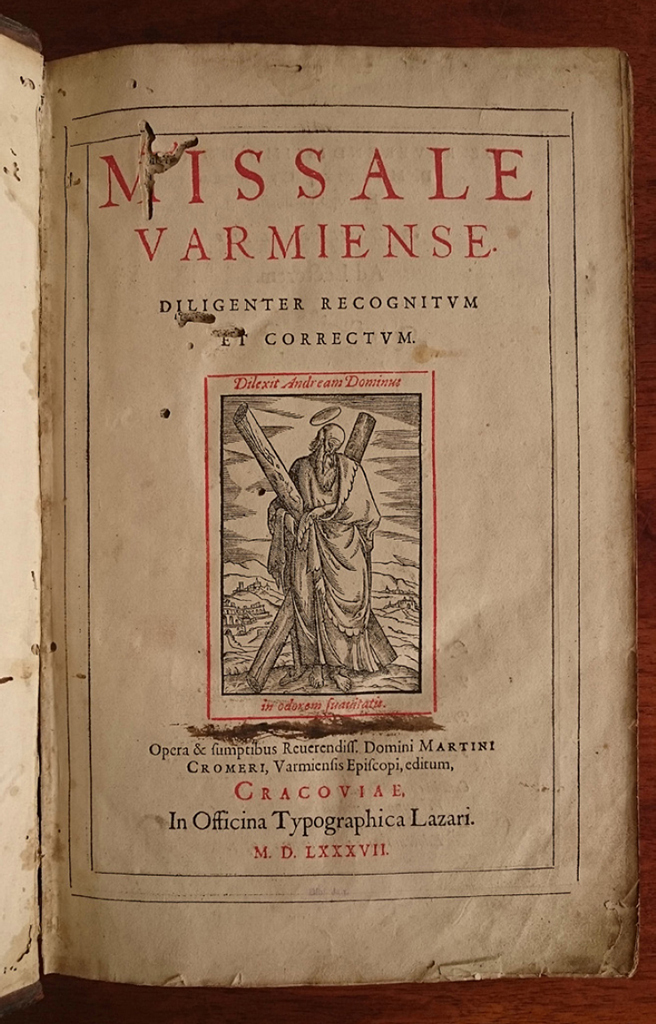
Missale was a commission by Marcin Kromer, the Bishop of Warmia. The plan for Januszowski to print liturgical books for the Commonwealth was devised around 1582. At the beginning, and even up to the early months of 1586, Januszowski and his protectors hoped that the printer would work on the missal for all the dioceses under Gnieznoâs jurisdiction and the missal for Warmia, an autonomous bishopric, at the same time. The plan was to have the larger part of the text in the missals to be identical, which meant that the production costs could be shared by the bishops, making the whole enterprise less expensive for the ecclesiasts and more profitable for the printer. Kromer had already proceeded in a similar way when he had produced his liturgical books in Cologne.40 However, Kromer grew rightly impatient with the other Polish bishops and with the primate StanisÅaw Karnkowski for delaying their decisions, and he eventually commissioned Missale Varmiense independently with Januszowski.41
The history of this publishing venture can be reconstructed thanks to surviving archival documents, mainly the letters Bishop Kromer received from Tomasz PÅaza, his long-time assistant. Kromer resided in Warmia and PÅaza lived in Krakow. It was PÅaza who recommended Januszowski to the bishop and later on managed Missale Varmienseâs production and distribution, regularly reporting to Kromer about the process. A handful of letters Januszowski wrote to PÅaza and to Kromer, and those the Krakow Bishop Piotr Myszkowski addressed to his canons provides evidence for further developments. There is also a draft of a contract prepared by Januszowski, and a final agreement signed in 1586 by the printer, PÅaza (acting as Kromerâs proxy) and Marcin Glicjusz z Pilzna, canonicus Cracoviensis, who was a liturgist committed to the cause of post-Tridentine reform. Sources of secondary importance are a diary compiled in 1580 in Krakow by Maurycy PaweÅ Henik, Kromerâs secretary, the Acta actorum of the Krakow cathedral chapter, a draft of Kromerâs epistle to the Krakow canons, as well as Januszowskiâs letters to the chancellor Jan Zamoyski written in 1599, where the printer reminiscences about his enterprises from years earlier. Together, these documents give us an unusually detailed insight into how the production of Missale Varmiense was planned, organised and paid for. As such, they constitute the kind of evidence extremely rare for early printed books produced in Poland.
It was eventually decided that Januszowski would print Missale Varmiense in 1584. Almost a year later, in June 1585, PÅaza, acting as a middle man and the manager of the publishing process, reported to Kromer that he and Januszowski âwere ready for the missalâ, yet the bishop and his collaborators in Lidzbark WarmiÅski did not have a complete text to despatch to Krakow.42 While PÅaza and the printer waited for the manuscript, they were planning the bookâs layout. Kromer was sent specimen pages of the envisaged edition and âprincipum Agendae Olomucensisâ, certainly as proof of the Krakow workshopâs technical abilities and the proposed design for the missal.43 At the same time, PÅaza suggested that the bishop should have the missal printed with âthe bigger letterâ, which was more expensive, but âmore useful for old priests as well as young onesâ.44 He also revealed that the ultimate sources for the visual appearance of the planned missal were books produced in Antwerp, no doubt in Christoph Plantinâs workshop.45 However, no contract was signed, perhaps because Kromer, PÅaza and Januszowski still hoped for the primate Karnkowski and other bishops to join them in the publishing enterprise.
Not only did this never happen, but the work of the trio was put to a halt by the Krakow cathedral chapter in the spring of 1586. The canons declared they were afraid that the publishing of the missal might become a cause of papal disgrace, and warned PÅaza and Januszowski not to begin printing without the consent of their general council held in May and until receiving a resolution of the Krakow Bishop Piotr Myszkowski.46 In letters he wrote in April 1586, an anxious Januszowski tried to persuade PÅaza and his master, the bishop, to let him start the work âwhen the day is longâ, if only by commissioning the paper for the edition.47 At the same time, PÅaza reported to Kromer that he did not want the printer to go to any further expense âbecause God knows if your highness will not change your mind and send the missal elsewhere or if the Krakow bishop will not forbid the printingâ.48 Kromer intervened with an irate letter to the canons. The Krakow ecclesiasts expressed their consent for the missal to be printed and the work continued. In June 1586, PÅaza gave the printer the money to commission the paper for the volume. In August, a contract to print the book in 400 copies was signed (even if the printer consistently proposed producing 500). In the same month, Kromer received the first printed sheets of the missal. The work went swiftly, and the whole book was ready just after Christmas 1586, at the very beginning of January 1587.
A wealth of epistolary evidence, along with the survival of secondary sources, reveals that the printing of Missale Varmiense was a cooperative venture: a multifaceted, dynamic process, spread over a period of about five years, hindered by the financial limitations of the commissioners, the ill will of the Church authorities, or even bad transport and weather conditions. More interestingly, since the documents that tell the story of how Misssale Varmiense was created are, for the most part, letters â ego-documents or Selbstzeugnisse â they reflect the human dimension of a printing and publishing enterprise.49 They give us a fairly good idea of the interactions among the people engaged in the process of printing a major volume: their ambitions, expectations, worries and joys. They expose the social relationships within the small group â personal, direct, and patron-client interactions. They leave no doubt that the social standing of Januszowski the printer was low compared not only with the bishop, whom he could only address in humble Latin supplications, but also in comparison with the other ecclestiasts he worked with. These were Tomasz PÅaza â Kromerâs factotum, and Marcin Glicjusz z Pilzna â the Krakow cathedral canon, who were both Januszowskiâs supporters in the period when he sought to secure a commission for printing liturgical books. Januszowski had neither power nor agency; the capital at his disposal was substantial enough to invest in new founts of type, but he would not commission the paper for the missal without money from his backers. Wealth, status and power were with Kromer; PÅaza â the bishopâs middleman â emanated these qualities only thanks to his close relationship with the prelate.
Marcin Kromer (ed.), Missale Varmiense diligenter recognitum et correctum (Kraków: Drukarnia Åazarzowa, 1587)
Januszowski, the printer, and PÅaza, who managed the publication process, worked under a lot of stress. They kept waiting and adapting. They waited for Kromerâs decision on where to produce the missal. Then, they waited for the canonsâ of the Krakow cathedral and for Bishop Myszkowskiâs consent to begin the printing. They received the manuscript from Kromer in bits and pieces, and the money also came in piecemeal. The correspondence was irregular, and the recurrent rumours about Kromerâs death caused additional stress. PÅaza repeatedly rejoiced in his letters to Kromer that the bishop was still alive (Kromer eventually died in 1589). Finally, the letters reflect Januszowski and PÅazaâs pride in the results of their labours. Happy that Kromer was also content with the missal, his assistant wrote: âthese missals and your other books will commemorate you better than any rich property you could buyâ.50
PÅaza, a local resident, spent a lot of time in Drukarnia Åazarzowa, correcting and revising text sent to Krakow by Kromer. In his personal letters to the bishop, PÅaza praised the commitment and competence of the printer, and commented on the amount of labour Januszowski invested in the publication of Missale Varmiense. It seems that Januszowski was working to build his reputation as a specialist printer of liturgical books and perhaps, thanks to Kromerâs recommendation, to attract the patronage of other prelates. However, Januszowskiâs apparent success with the Warmia missal and the satisfaction of his benefactors did not result in a Church commission to print the breviaries and missals for Poland-Lithuania with Drukarnia Åazarzowa. The sudden death of the printerâs royal protector, Stefan Batory, and the turbulent time of the double election, which gave the Polish throne to both the Swedish prince Sigismund Vasa and archduke Maximilian of Habsburg, definitely discouraged the prelates, who were reluctant to invest in the production of the reformed liturgical volumes from the very beginning.
Januszowski, ever resilient, approached the bishops gathered in Warsaw in 1587 during the interregnum after Batoryâs death, and reminded them of the arrangements that had been made âto print new missals and graduals for all Polandâ.51 As late as 1589, the council of Poland (synod piotrkowski) confirmed Januszowskiâs privilege to print liturgical books for the Commonwealth. In October of the same year, Januszowski was paid in advance by the Bishop of Kujawy Hieronim Rozrażewski âto print breviaries, missals and other liturgical books in his dioecesisâ.52 In April 1590, King Zygmunt III Waza (Sigismund Vasa) recognised Januszowskiâs sole right to print all kinds of books needed by the clergy.53 Yet the results of Januszowskiâs negotiations with the episcopate must have been unsatisfactory; neither the missals nor the breviaries for the Commonwealth of Poland-Lithuania were ever printed in Drukarnia Åazarzowa in Krakow. PÅaza was right when he reported to Kromer in May 1588, three months after the new King Zygmund III Waza was crowned in the Krakow cathedral: âJanuszowski, the printer, is angry with the bishops for having wronged him and failed with the missals. We will not see the missals for this provinceâ.54
Conclusion: Complaints and Rewards
Januszowski remained bitter about the failed venture for years to come, accusing the prelates of failing to honour their agreements.55 When Stefan Batory died and Jan Zamoyski fell out of favour with the new king, Januszowski complained about the lack of patrons who could provide the financial basis for much of the important publishing enterprises he wished to undertake: âThere is no patron, maecenas, promotor for me ⦠Eheu, fatum Janussovii!â.56 Deciding to what extent his laments were sincere and justified still demands scholarly attention. After all, Januszowski obtained some reward for his labours on behalf of his highly placed backers. In 1590, he became âarchitypographus regius and ecclesiasticusâ, a title that no doubt echoed Plantinâs title. At the same time, a royal privilege reserved Januszowski the right to print both liturgical books and state publications. More importantly, two years earlier, in January 1588, the newly crowned King Zygmund III Waza, had elevated this craftsmanâs son to the nobility. In the âgentry nationâ that Poland was, this was an enormous social advancement, possible only for the most talented and conscientious and the best connected.
Throughout his career as a printer, Januszowski consciously emulated his successful colleagues active in most vibrant centres of print in Europe. Producing books for a provincial and an outlying market, Januszowski could not equal the enormous output of the most prosperous printers. Nevertheless his state and Church sponsored publications â Missale Varmiense in particular â exemplify well the potential of his workshop. At the same time the evidence provided by both the books printed by Januszowski and archival sources sheds important light on how an early printing officeâs fortunes related to or even depended upon patronage, support and sponsorship from those with wealth and power.
Janina Bieniarzówna and Jan MaÅecki, Kraków w wiekach XVIâXVIII (Krakow: Wydawnictwo Literackie, 1984); Maria Bogucka and Henryk Samsonowicz, Dzieje miast i mieszczaÅstwa w Polsce przedrozbiorowej (WrocÅaw: Ossolineum, 1986), pp. 329â392, pp. 489â508; Jan MaÅecki, âRola Krakowa w handlu Europy Årodkowej w XVI i XVII w.â, Zeszyty Naukowe Akademii Ekonomicznej w Krakowie, 70 (1974), pp. 174â175; Jan PirożyÅski, âDer Buchhandel in Polen in der Renaissance-Zeitâ, in Hubert G. Göpfert etc. (eds.), Beiträge zur Geschichte des Buchwesens im konfessionellen Zeitalter (Wiesbaden: Harrassowitz, 1985), pp. 267â294; Jan PirożyÅski, âZagadnienie eksportu polskiej ksiÄ Å¼ki na zachód Europy w XVI wieku w Åwietle ówczesnych targowych katalogów i bibliografiiâ, Sobótka, 3â4 (1982), pp. 249â258; Monika Jaglarz, KsiÄgarstwo krakowskie XVI wieku (Krakow: Towarzystwo MiÅoÅników Historii i Zabytków Krakowa, 2004); Renata Å»urkowa, KsiÄgarstwo krakowskie w pierwszej poÅowie XVII wieku (Krakow: Towarzystwo MiÅoÅników Historii i Zabytków Krakowa, 1992).
Alodia Kawecka-Gryczowa, âKrakówâ, in Alodia Kawecka-Gryczowa (ed.), Drukarze dawnej Polski, vol. 1: MaÅopolska, part 1: Od XV do XVI wieku (WrocÅaw: Ossolineum, 1983) (henceforth quoted as Drukarze 1, 1), pp. 105â115.
Drukarnia Åazarzowa managed by Jan Januszowski printed over 400 known editions in almost 9,000 sheets. See Alodia Kawecka-Gryczowa, âJanuszowski Janâ, in Drukarze 1, 1, p. 69â99; Renata Å»urkowa, âJanuszowski Janâ, in Jan PirożyÅski (ed.), Drukarze dawnej Polski, vol. 1: MaÅopolska, part 2: Wiek XVIIâXVIII, vol. 1 (Krakow: Polska Akademia UmiejÄtnoÅci, 2000), pp. 250â257; Renata Å»urkowa, Åazarzowa Drukarnia, in J. PirożyÅski (ed.) Drukarze dawnej Polski, vol.1: MaÅopolska, part 2: Wiek XVIIâXVIII, vol. 2 (Krakow: Polska Akademia UmiejÄtnoÅci, 2000), pp. 411â412.
Justyna KiliaÅczyk-ZiÄba, âIn Platea Columbarum. The Printing House of Hieronim Wietor, Åazarz Andrysowic and Jan Januszowski in Renaissance Krakowâ, Publishing History, 67 (2010), pp. 5â37. For details concerning the production of Wietor, Wietorowa and Andrysowic see as well: Anna MaÅkowska and Alodia Kawecka-Gryczowa, âWietor Hieronimâ, in Drukarze 1, 1, pp. 325â352; Alodia Kawecka-Gryczowa and Anna MaÅkowska, âWietorowa Barbaraâ, in Drukarze 1, 1, pp. 352â357; Alodia Kawecka-Gryczowa and Anna MaÅkowska, âAndrysowic Åazarzâ, in Drukarze 1, 1, pp. 124â137.
Letter by Tomasz PÅaza to Marcin Kromer on 6 November 1582, Archiwum Archidiecezji WarmiÅskiej w Olsztynie (further as AAWO), call no AB D 35, f. 52v; Letter by Jan Januszowski to Bishop Marcin Kromer on 19 November 1585, AAWO, call no AK, Ab 5, f. 189â189v.
On royal chancellery and court in Poland see: Marek Ferenc, Dwór Zygmunta Augusta. Organizacja i ludzie, (Krakow: Towarzystwo Wydawnicze Historia Iagellonica, 1998); MirosÅaw Korolko, Seminarium Rzeczypospolitej Królestawa Polskiego. HumaniÅci w kancelarii królewskiej Zygmunta Augusta (Warsaw: Wiedza Powszechna, 1991); Leszek Kieniewicz, âSekretariat Stefana Batorego. ZbiorowoÅÄ i kariery królewskich sekretarzyâ, in Anna Izydorczyk and Andrzej WyczaÅski (eds.) SpoÅeczeÅstwo staropolskie, vol. 4 (Warsaw: PaÅstwowe Wydawnictwo Naukowe, 1986), pp. 33â61; Waldemar ChorÄ Å¼yczewski, âPoczÄ tki kancelarii pokojowej za Jagiellonówâ, in Waldemar ChorÄ Å¼yczewski and Wojciech Krawczuk (eds.), Polska kancelaria królewska miÄdzy wÅadzÄ a spoÅeczeÅstwem (Warsaw: Wydawnictwo DiG, 2008), pp. 33â46.
About Januszowskiâs formation and his activity as a writer and a translator see Justyna KiliaÅczyk-ZiÄba, CzionkÄ i piórem. Jan Januszowski w roli pisarza i tÅumacza (Krakow: Universitas, 2007). On other printer-intellectuals see Elizabeth L. Eisenstein, âThe Early Printer as a âRenaissance manâ, Printing History, 3 (1981), pp. 6â16.
Robert M. Kingdon, âPatronage, Piety, and Printing in Sixteenth-Century Europeâ, in Robert M. Kingdon, Church and Society in Reformation Europe (London: Variorum Reprints, 1985), p. 31.
KiliaÅczyk-ZiÄba, CzcionkÄ i piórem, pp. 19â24; pp. 70â74.
Wojciech Tygielski, âA faction which could not looseâ, in Antoni MÄ czak (ed.), Klientelsysteme im Europa der Frühen Neuzeit (Munich: R. Oldenburg Verlag, 1988), pp. 177â201, here pp. 192â193. See as well: Wojciech Tygielski, Politics of patronage in Renaissance Poland: chancellor Jan Zamoyski, his supporters and the political map of Poland, 1572â1605, transl. PaweÅ T. Dobrowolski (Warsaw: Wydawnictwa Uniwersytetu Warszawskiego 1990), a shortened version of a monograph published by the same author as Listy, ludzie, wÅadza. Patronat Jana Zamoyskiego w Åwietle korespondencji (Warsaw: Viator, 2007).
Maria Juda (ed.), Privilegia Typographica Polonorum. Polskie przywileje drukarskie 1493â1793 (Lublin: Wydawnictwo UMCS, 2010), nr. 54.
Jan PtaÅnik, Monumenta Poloniae typographica (Lviv: Ossolineum, 1922), pp. 147â148; Juda, Privilegia, pp. 10â11.
Alodia Kawecka-Gryczowa and Anna MaÅkowska, âSzarfenberger MikoÅajâ, in Drukarze 1, 1, pp. 264â283.
StanisÅaw SokoÅowski, De verae et falsae Ecclesiae discriminae (Krakow: Drukarnia Åazarzowa, 1583) USTC 242453; Simon Simoni, Disputatio de putredine (Krakow: Drukarnia Åazarzowa, 1583) USTC 242491.
Roberto Bellarmino, Iudicium de libro quem Lutherani vocant concordiae (Krakow: Drukarnia Åazarzowa, 1586) USTC 242586.
On the 12 of July 1586 Batory wrote from Grodno in todayâs Belarus to the treasurer Hiacynt MÅodziejowski: âlibrum patris Bellarmini, quem volumus, ut istic Cracoviae elegantioribus typis excudi curet, nobisque 200 exemplaria mittat. Qua de re transiget cum Januszewski typographoâ (PtaÅnik, Monumenta, pp. 361). On 9 September 1586 Januszowski confirmed that he had received the money from the officials of the treasury as was ordered by MÅodziejowski (PtaÅnik, Monumenta, p. 361).
Kawecka-Gryczowa, âJanuszowski Janâ, p. 79.
For example, a series of books printed in Drukarnia Åazarzowa was published by StanisÅaw Karnkowski, the prelate of Poland (e. g. PowinnoÅÄ chrzeÅcijaÅska of 1582, whereabout of a copy once kept in the National Library in Warsaw are unknown; Hanibale Roselli, Pymander, libri III, IV and V of 1584â1586).
Privilegia, pp. 92â94. The additional sheet contained as well letters from King Stefan Batory and Queen Anna Jagiellon to the author; both thanked BiaÅobrzeski for copies received. See Magdalena Komorowska, ââLarge Volumes Bought by the Fewâ: Printing and Selling Postils in Early Modern Polandâ, in Shanti Graheli (ed.) Buying and Selling. The Business of Books in Early Modern Period (Leiden: Brill, 2019), pp. 241â242.
Pierre-Marie Gy, âLâUnification liturgique de lâOccident et de la liturgie de la Curie Romaineâ, Revue des sciences philosophiques et théologiques, 59 (1975), pp. 601â612. Liturgical matters, and in particular the reform of the breviary and missal were discussed at the 25th session of the Council. See as well Cristina Dondi, âBooks of Hours. The Development of the texts in printed formâ, in Kristian Jensen (ed.), Incunabula and their Readers, (London: British Library, 2003), pp. 56â57.
For an overview of the process see e.g. Niels Kroogh Rasmussen, âLiturgy and Liturgical Artsâ, in John W. OâMalley (ed.), Catholicism in Early Modern History: A Guide to Research (St. Louis: Center for Reformation Research, 1988), pp. 273â297; Karen Lee Bowen, Christopher Plantinâs Book of Hours. Illustration and Production (Nieuwkoop: De Graaf, 1997), pp. 63â64, Robert M. Kingdon, âThe Plantin breviaries: a case study in the sixteenth-century business operations of a publishing houseâ, in Kingdon, Church and Society, pp. 133â150.
Bowen, Christopher Plantinâs Book of Hours, p. 63.
Léon Voet, The Golden Compasses. A History and Evaluation of the Printing and Publishing Activities of the Officina Plantiniana at Antwerp, vol. 1: Christophe Plantin and the Moretuses. Their lives and their world (Amsterdam: Vangendt & Co, 1969), pp. 65â70.
PaweÅ Sczaniecki, SÅużba Boża w dawnej Polsce. Studia o Mszy ÅwiÄtej, seria druga (PoznaÅ: KsiÄgarnia Åw. Wojciecha 1966), pp. 142â145.
Agenda sacramentalia (Cologne: Maternus Cholinus, 1574) USTC 609588; Agenda ceremonialia (Cologne: Maternus Cholinus, 1578) USTC 609575.
WÅadysÅaw Nowak, âGeneza Agendy biskupa Marcina Kromeraâ, Studia WarmiÅskie, 6 (1969), pp. 173â209.
Breviarium Varmiense (Cologne: Maternus Cholinus, 1581), not in USTC. Only three surviving copies, kept in the following libraries: Biblioteka Instytutu PóÅnocnego, Olsztyn, Linköpings Stadsbibliotek and Uppsala Universitetsbibliotek.
WÅadysÅaw Nowak, âBiskup Marcin Kromer jako liturgistaâ, in StanisÅaw Achremczyk (ed.), Marcin Kromer i jego czasy (1512â1589) (Olsztyn: OÅrodek BadaÅ Naukowych im. Wojciecha KÄtrzyÅskiego, 2012), pp. 174â176 (the same text published in Komunikaty WarmiÅsko-Mazurskie, 212 (2012), pp. 571â594).
WacÅaw Urban, âPÅaza Tomaszâ, in Polski SÅownik Biograficzny, vol. 26 (WrocÅaw: Ossolineum, 1981), pp. 778â780; Janusz MaÅÅek, âWstÄpâ, in Marcin Kromer, Historyja prawdziwa o przygodzie żaÅosnej ksiÄ Å¼Äcia finlandzkiego Jana i królewny polskiej Katarzyny (Olsztyn: Pojezierze, 1974), pp. XIIIâXV.
Krystyna Stasiewicz, âKorespondencja Tomasza PÅazy z Marcinem Kromeremâ, Odrodzenie i Reformacja w Polsce, 33 (1978), pp. 167â185.
âJest dobry czÅowiek i typograf osobliwyâ. See letter by Tomasz PÅaza to Marcin Kromer on 6 November 1582. AAWO, call no AB D 35, f. 52v.
StanisÅaw Bodniak, âW oficynie âarchitypografaâ. Rzecz o kÅopotach Januszowskiegoâ, Silva Rerum, 5 (1930), pp. 138â143, here p. 139.
Privilegia, pp. 97â98.
Kawecka-Gryczowa, Januszowski, p. 73.
Tomasz PÅazaâs letters to Marcin Kromer, Jan Januszowskiâs letters to both the Warmia bishop and his secretary, epistolary exchange between the Krakow Bishop Piotr Myszkowski and the canons of the Krakow Cathedral.
Letter by Piotr Myszkowski to Krakow Cathedral Chapter on 30 August 1583, Archiwum KapituÅy Krakowskiej w Krakowie, call no LA 24, f. 227r.
See Jaroslav Pánek, âBiskup StanisÅaw II PawÅowski, Polacy i Czesi (PraÅat, polityk i mecenas poÅrednikiem pomiÄdzy dwoma sÄ siednimi narodami)â, in Henryk Gmiterek and Wojciech IwaÅczak (eds.), Polacy w Czechach, Czesi w Polsce: XâXVIII wiek (Lublin: Wydawnictwo UMCS 2004), pp. 89â101; Jakubec OndÅej (ed.), Stanislav Pavlovský z Pavlovic (1579â1598). Biskup a mecenáš umÃrajÃcÃho vÄku (Olomouc: Muzeum umÄnÃ, 2009).
Ladislav Zavadil, âDie alte Olmützer Agenda vom Bischof Stanislausâ, Zentralblatt Für Bibliothekswesen, 1889, pp. 452â455; Karl Lechner, âNachtrag zur Olmützer Agenda des Bischofs Stanislaus Pawlowskyâ, Zentralblatt Für Bibliothekswesen, 1897, pp. 175â179.
Missale Varmiense diligenter recognitum et correctum (Krakow: Drukarnia Åazarzowa, 1587) USTC 240295.
Nowak, Geneza, pp. 200â205.
He was empowered to do so, as his diocese, that formerly belonged to the Riga ecclesiastical province, after its decomposition was a subject to Rome only and not to the archbishop of Gniezno. See: WiesÅaw Müller, âStruktura organizacyjna diecezji rzymskokatolickich w Polsce w XVIâXVIII wiekuâ, in Marian Rechowicz and Zygmunt SuÅowski (eds.), KsiÄga tysiÄ clecia katolicyzmu w Polsce (Lublin: Wydawnictwo Towarzystwa Naukowego KUL, 1969), p. 95.
See letter by Tomasz PÅaza to Marcin Kromer, June 1585, AAWO, call no AB D 35, f. 81r: âTypograf jest gotów do drukowania MszaÅuâ.
See letter by Tomasz PÅaza to Marcin Kromer on 25 October 1584, AAWO, call no AB D 35, f. 73r.
Letter by Tomasz PÅaza to Marcin Kromer, June 1585, AAWO, call no AB D 35, f. 81r: âBÄdzie droższy egzemplarz niźli on mniejszym pismem, ale pożyteczniejszy kapÅanom mÅodym i starymâ.
Letter by Tomasz PÅaza to Marcin Kromer on 25 April 1586, AAWO, call no AB D 35, f. 90v: âtypis istis quorum exemplar mitto ad instar Antverpiensis imprimet missaleâ.
See letter by Tomasz PÅaza to Marcin Kromer on 25 April 1586, AAWO, call no AB D 35, f. 90â91r.
See Bodniak, âW oficynie â¦â, p. 142; Justyna KiliaÅczyk-ZiÄba and Katarzyna Gara, âListy Jana Januszowskiego do Marcina Kromera i Tomasza PÅazy dotyczÄ ce produkcji Missale Varmiense (1587) w Drukarni Åazarzowejâ, Terminus, 20:3 (2018), pp. 383â401.
Letter by Tomasz PÅaza to Marcin Kromer on 25 April 1586, AAWO, call no AB D 35, f. 90r: âjeÅli też vmcz nie odmienisz woli swojej a nie poÅlesz gdzie indzie, jeÅli biskup nie dopuÅci drukowaÄâ.
For the history and use of these terms see Michael Mascuch, Rudolf Dekker and Arianne Baggermann, âEgodocuments and History: a Short Account of the Longue Duréeâ, The Historian, (2016), pp. 11â56; Waldemar ChorÄ Å¼yczewski and Agnieszka Rosa, âEgodokumenty â egodokumentalnoÅÄ â analiza egodokumentalna â spuÅcizna egodokumentalnaâ, in Waldemar ChorÄ Å¼yczewski, Arvydas PaceviÄius and StanisÅaw Roszak (eds.) Egodokumenty. Tradycje historyczne i perspektywy badawcze (ToruÅ: Wydawnictwo Naukowe Uniwersytetu MikoÅaja Kopernika, 2015), pp. 11â21.
See letter by Tomasz PÅaza to Marcin Kromer. January 1587: AAWO, call no AB D 35, f. 85r: âwiÄtszÄ pamiÄ tkÄ vmcz tymi mszaÅami i inszymi ksiÄgami po sobie zostawisz, a niźlibyÅ kupiÅ jakie bogate imienieâ.
Bodniak, W oficynie, pp. 140â141.
PaweÅ Sczaniecki, SÅużba Boża w dawnej Polsce. Studia o Mszy ÅwiÄtej, seria druga (PoznaÅ: Ksiegarnia Sw. Wojciecha, 1966), p. 146.
Januszowski obtained the right to print âlibros usibus cleri necessarios, quos alioqui a peregrinis et remotis officinis typographicis petere cogebatur, utpote missalia, breviaria, agenda, antiphonaria, gradualia, psalteria et aliaâ, Privilegia, nr. 73, pp. 102â104.
Letter by Tomasz PÅaza to Marcin Kromer May 1587, AAWO, call no AB D 35, f. 133v: âDominus Januszowski typographus rozgniewaÅ siÄ, iż go biskupi zawiedli i omylili z strony mszaÅów ⦠Nie doczekamy siÄ mszaÅów pro hac provinciaâ.
Letter by Jan Januszowski to Jan Zamoyski on 20 July 1599 quoted in Alodia Kawecka- Gryczowa, Z dziejów polskiej ksiÄ Å¼ki w okresie Renesansu. Studia i materiaÅy (WrocÅaw: Ossolineum 1975), pp. 296â298.
Jan Januszowski âpatrona, mecenasa i promotora nie maszâ¦. Eheu, fatum Janussoviiâ. See the letter by Jan Januszowski to Jan Zamoyski on 19 May 1599, quoted in Kawecka- Gryczowa, Z dziejów, p. 300.