


1 Introduction
This paper takes as its core subject the contribution of the calligrapher Mir Muhammad Husayn Ê¿Ata Khan to the Polier albums in Berlin. Ê¿Ata Khanâs contribution is worth studying for several reasons, not the least of which is that he led a very interesting life; he was famous throughout India as a skilled calligrapher who was awarded the honorific MuraṣṣaÊ¿ Raqam (Ornamented Pen) as well as a poet and writer of Urdu and Persian prose under the penname TaḥsÄ«n. He was particularly well-known for his Urdu prose translation of the collection of Persian tales known as ChahÄr darvÄ«sh (The Four Dervishes). The translation, which bore the title Naw á¹arz-i muraṣṣaÊ¿ (New Ornamented Style) and was dedicated to the nawab of Awadh, ShujaÊ¿ al-Dawla (r. 1754â1775), is widely recognised as an important milestone in the development of Urdu prose literature.1
Furthermore, Ê¿Ata Khan was a close friend and important and trusted employee of Antoine Polier (1741â1795) and numbers among the most frequent of Polierâs correspondents in the collection of the latterâs Persian letters, the IÊ¿jÄz-i ArsalÄnÄ« (Wonder of Arsalan, a reference to Polierâs Mughal title ArsalÄn Jang).2 Though, disappointingly, there is no mention in these letters of Ê¿Ata Khanâs calligraphic contribution to the albums, a dedication to Polier by Ê¿Ata Khan on the second of a two-page calligraphic composition in one of the albums shows that he composed calligraphic pages specifically for Polier (fig. 12.1).3 Cross-references between the subjects of paintings in the albums and the texts of his calligraphic contributions would furthermore indicate that Ê¿Ata Khan composed pages specifically for inclusion in the albums and may even have played a role in their organisation.
Ê¿Ata Khanâs contribution is concentrated in three of a larger group of five related albums4 that were probably compiled for Polier in the late 1180s and early 1190s (i.e., c. 1773â1780) while Polier was in the employment of first ShujaÊ¿ al-Dawla (r. 1754â1775) in Faizabad and then the Mughal emperor Shah Ê¿Alam II (r. 1760â1788, 1788â1806) in Delhi.5 Given Polierâs presumably limited knowledge of Persian, Arabic and Indo-Persian calligraphic traditions, it seems likely that he was assisted in the collection and compilation of the calligraphic contents of the albums. In addition to those of Ê¿Ata Khan, these albums contain a number of pieces by two other calligraphers from among Polierâs circle of friends and employees, IÊ¿jaz Raqam Khan and Nawab Murid Khan Tabatabaʾi, who could also have assisted Polier in the collection of calligraphic specimens. We will briefly look at Polierâs correspondence with these figures in the IÊ¿jÄz-i ArsalÄnÄ«, examine the contents of some of the albums in Berlin to which they contributed, and suggest ways in which they might have shaped their overall calligraphic content.
Ê¿Ata Khan, IÊ¿jaz Raqam Khan and Murid Khan were members of the administrative and aristocratic elites that took advantage of the emergence of new provincial centres of power and patronage during the eighteenth century. For the administrative classes in particular, aptly termed the âservice gentryâ by C.A. Bayly, the emergence of the independent nawabates offered an expanded range of opportunities.6 In the nawabates, there was a high degree of administrative, political and cultural continuity with Mughal imperial traditions. While Mughal military power had dissipated, the Mughal emperorâs symbolic role as the fount of authority, if anything, increased in importance during the eighteenth century.7 For the noble and administrative classes, the practice of Mughal courtly traditions like calligraphy and poetry were important markers of socio-economic status as well as of broader cultural and political affiliation.8 At the same time, the evolving political dispensation, the emergence of new actors and the increasingly important role played by the expanded administrative classes meant that cultural life was far from static.9 We will suggest ways in which the calligraphic contents of the Polier albums might be seen to reflect processes of cultural transformation.
2 Mir Muhammad Husayn Ê¿Ata Khan
2.1 Mir Muhammad Husayn Ê¿Ata Khanâs life
Our chief source for calligraphers in Delhi and Awadh in this period is the biography of calligraphers, the Taáºkira-yi khushnavÄ«sÄn (Memorial of Calligraphers) of Ghulam Muhammad Dihlavi Haft-Qalami (d. 1823).10 In addition to mentioning Ê¿Ata Khanâs literary fame, Ghulam Muhammad informs us that he trained with his father Muhammad Baqir, who was a tughrÄ-navÄ«s, a writer of the calligraphic signatures of rulers placed at the head of official documents.11 He mentions that Ê¿Ata Khan had a mastery of nastaÊ¿lÄ«q, naskh and shafÄ«Ê¿Äʾī, the latter being a particular type of Iranian shikasta that was developed by the Herati master Muhammad ShafiÊ¿ Haravi Husayni (d. 1670), who bore the penname ShafÄ«Ê¿Ä.12 We should note that despite this assertion, none of the shikasta pieces signed by Ê¿Ata Khan in the Polier albums are in the shafÄ«Ê¿Äʾī style but are rather in Indian shikasta styles.13 Several unsigned pieces in the shafÄ«Ê¿Äʾī style are, however, found in albums to which Ê¿Ata Khan contributed.14
Much more information regarding Ê¿Ata Khanâs life and works is found in biographies of poets and writers, much of which was collected by Sayyad Sajjad in a very useful monograph on Ê¿Ata Khan entitled âAn Early Prose-Writer of Modern Urduâ, published in 1939.15 From these sources we learn that in addition to the Naw á¹arz-i muraṣṣaÊ¿, Ê¿Ata Khan was the author of a lost Persian work, Å»avÄbiá¹-i AngrÄ«zÄ« (The Regulations of the English); the title of this would suggest that it was either a dictionary of English or a guide to administration under British rule in India. Additionally, he is said to have authored a Persian historical work, TÄrikh-i QÄsimÄ« (History of Qasim), which may have been a history of the nawab of Bengal, Nawab Qasim Ê¿Ali Khan (r. 1760â1763; d. 1777). He is also said to have collected his correspondence in a single volume called the InshÄʾ-i TaḥsÄ«n (Correspondence of Tahsin).16
Regarding Ê¿Ata Khanâs early years, it is said that he was born at some point in the middle of the eighteenth century to a family of sayyids in Etawah in modern-day Uttar Pradesh. His family was said to have originally come from Gardiz in Afghanistan and to have settled in Kara Manikpur. His father, Muhammad Baqir Khan, the writer of tughrÄs, also wrote poetry under the penname Shawq and is said to have moved to Delhi as a young man, where he obtained the rank of a commander of 3,000 in the administration of Aurangzeb.17
According to various sources, Ê¿Ata Khan studied calligraphy with the master IÊ¿jaz Raqam Khan.18 This piece of information, which is not included in Ghulam Muhammadâs entry on Ê¿Ata Khan, is particularly interesting since IÊ¿jaz Raqam Khan himself contributed a number of calligraphic pieces to two of the Berlin Polier albums, both of which also contain a number of pieces by Ê¿Ata Khan.19 We learn from the IÊ¿jÄz-i ArsalÄnÄ« that IÊ¿jaz Raqam Khan also performed administrative services for Polier and that he was employed on Polierâs recommendation with the latterâs friend and fellow collector Jean-Baptiste Gentil (1726â1799).20 From these details, a picture emerges of a circle of cultivated administrators who, as well as aiding Europeans in the management of their affairs, may also have in certain ways guided their artistic ambitions.
Another interesting fact that we learn from Sajjadâs study is that Ê¿Ata Khanâs grandfather, a certain Navazish Ê¿Ali Khan, had apparently worked a tax-collector (taḥsÄ«ldÄr) for the British.21 If that information is correct, then it might account for Mir Muhammadâs familiarity with British customs and the English languages and his facility in working with British and European officers. Ê¿Ata Khan led an itinerant life across north and east India, with periods of employment in Calcutta, Patna, Faizabad and Lucknow.22 He also seems to have made himself useful as someone skilled in dealing with the British at an early date in his career. In an anecdote in his introduction to Naw á¹arz-i muraṣṣaÊ¿ he refers to a boat journey he made to Calcutta in the company of a General Smith;23 this was most probably Richard Smith, who was made Commander-in-Chief, India, the most senior position in the British Army in India, in 1767.24 Later, Smith would charge Ê¿Ata Khan with various duties in Patna, giving him power of attorney in his affairs following his departure for England.25 After Ê¿Ata Khan moved to Awadh, he enjoyed the trust of the British Commandant, Captain Gabriel Harper, who alongside his military duties handled diplomatic relations between the Nawab ShujaÊ¿ al-Dawla and the British.26 Harper, who is perhaps best known for appearing alongside ShujaÊ¿ al-Dawla, the latterâs four sons, and Sir Robert Barker, Commander-in-Chief, India, in a painting by Tilly Kettle in the Victoria Memorial museum in Calcutta, was later appointed Resident in Lucknow in 1785.27 An anecdote from Ghulam Ê¿Aliâs history of the rulers of Awadh, Ê¿ImÄd al-SaÊ¿Äda (Pillar of Happiness), which can be inferred from the context to have occurred around 1185 (1770/71), relates how Harper intercepted a letter from ShujaÊ¿ al-Dawla and had Ê¿Ata Khan explain the contents to him.28 The anecdote may indicate that Ê¿Ata Khan was in fact in Harperâs employment; Sajjad in his monograph on Ê¿Ata Khan suggests that it was Harperâs influence that secured Mir Muhammad a position at ShujaÊ¿ al-Dawlaâs court.29 We do not know exactly in what capacity Ê¿Ata Khan worked for ShujaÊ¿ al-Dawla, but, given Ê¿Ata Khanâs familiarity with Europeans and their customs, it is highly plausible that it concerned relations with the British, who after the Battle of Buxar in 1764 had established themselves as the dominant power in North India.
It was probably as an employee of the nawab that Ê¿Ata Khan became attached to Polier after the latter was sent to Awadh by Warren Hastings in 1773, ostensibly to direct the construction of various buildings for the nawab in Faizabad and to act as a surveyor for the East India Company. It is clear from Polierâs letters that he held Ê¿Ata Khan in great trust, charging him at one point with sensitive correspondence with the nawab ShujaÊ¿ al-Dawla.30 Ê¿Ata Khan continued in Polierâs service after the death of ShujaÊ¿ al-Dawla in 1775 and the accession of his son Asaf al-Dawla (r. 1775â1797); in this period Polier employed him to work alongside his chief financial officer (dÄ«vÄn), Manik Ram, in the frustrating but crucial process of extracting his wages (tankhwÄh) from his assigned land grants.31
In 1775, Polier resigned from his position with the East India Company as a result of pressure placed on him by ill-wishers. His offence was to have joined the nawabâs army without the authorisation of the Company in the taking of Agra for the Mughal emperor Shah Ê¿Alam II from the Jats of Bharatpur. The moves against Polier were part of a larger effort on the part of members of the General Council of Administration of the East India Company to undermine the position of Polierâs superior and protector, Warren Hastings.32
Following his resignation, Polier was able to obtain a position as a military engineer at the court of the Mughal emperor Shah Ê¿Alam II in Delhi, where he maintained correspondence with Ê¿Ata Khan. There is no doubt that Ê¿Ata Khanâs situation in Awadh was adversely affected by the turn of events and it possible that his association with Polier, who was out of favour with the East India Company, worked against him. The correspondence between him and Polier refers to the suspension of his salary and Polier seems to have tried to help him resolve the situation through his contacts within the Company.33
Polier at one point even encouraged Ê¿Ata Khan to move to Delhi, offering to take him on there as his agent (vakÄ«l).34 For some reason, Ê¿Ata Khan did not make the move; perhaps he did not obtain the requisite permission from the nawab. With the passing of time, Ê¿Ata Khanâs financial situation appears to have worsened and his correspondence with Polier betrays his increasing desperation to move to Delhi. Polierâs own situation in Delhi, however, was complicated by his inability to collect the revenues from the land grant awarded to him by Shah Ê¿Alam and in his letters he repeatedly discourages Ê¿Ata Khan from making the move until his own affairs became settled. Even after Ê¿Ata Khanâs fell into debt, Polier continued to advise him against making the move.35
Fortunately, Ê¿Ata Khanâs situation was rescued by the award of a land grant carrying salary to the amount of 18,000 rupees over the course of three years.36 This must have come as a great relief and there are no more references in the IÊ¿jÄz-i ArsalÄnÄ« to moving to Delhi. Polierâs affairs in Delhi too reached some sort of conclusion after he was able to gain the permission of the East India Company to return to Awadh to resume his former posts at the nawabâs court.37 In a letter dated 11 Rajab of the regnal year 21 (25 July 1779), Polier wrote that he had received permission to return to Lucknow and expresses his joy in the anticipated meeting with Ê¿Ata Khan there.38
We do not know how Ê¿Ata Khanâs association with Polier developed after the latterâs return to Awadh nor do we have any information about the later stages of his life. Though the chronology of the compilation of Polierâs albums is yet to be firmly established, an initial examination would suggest that Ê¿Ata Khan was producing pieces specifically for inclusion in Polierâs albums in the late 1180s and early 1190s (i.e., c. 1773â1780). His work is no longer found in albums that must have been compiled and completed in the second half of the 1190s or early 1200s and it is possible that at this stage he was no longer alive. I. 4597, for example, which cannot have been compiled before 1199 (1785/86), does not contain a single piece by him.39
By that stage, the choice of calligraphic materials was almost certainly the responsibility of the calligrapher Muhammad ʿAli, whose work, dated between 1195 (1780/81) and 1200 (1786/87), dominates the calligraphic contents of the later albums made for Polier.40 Curiously, Muhammad ʿAli appears to have occasionally used the same soubriquet, Muraṣṣaʿ Raqam, as ʿAta Khan. He signed his work this way on at least four pieces, three of which are dated 1195 (1780/81); it seems unlikely that he would have used this title if ʿAta Khan had still been alive at this point.41
Before we turn to examine the calligraphic specimens themselves, we should point out that Polierâs letters to Ê¿Ata Khan indicate a genuine friendship and often include touching details such as Polierâs commiseration on the loss of a child and of his clear concern over Ê¿Ata Khanâs financial difficulties.42 Polier makes frequent mention of their friendship and despite discouraging Ê¿Ata Khan from moving to Delhi, he assures him that he would nonetheless always find a home in his own house there.43
2.2 Mir Muhammad Husayn Ê¿Ata Khanâs Contribution to the Berlin Polier Albums
Ê¿Ata Khanâs signature is found across three of the Berlin Polier Albums on eight single-page specimens44 as well as on one specimen running over two pages.45 The album with the largest number of pieces by Mir Muhammad Husayn Ê¿Ata Khan in Berlin is the undated album I. 4598. This contains a total of six pages (fols. 4v, 21v, 22v, 28v, 30v, 33v) by Ê¿Ata Khan, all in shikasta. Two of these pages (fols. 21v [fig. 12.1], 22v [fig. 12.2]) form a single composition in the form of exercises on joined and unjoined letters (mufradÄt u murakkabÄt); interestingly, in the fifth line of fol. 21v, Ê¿Ata Khan writes that this particular style of shikasta was developed by his father, Mir Muhammad Baqir Khan. This composition is also of particular interest because it bears a dedication to Polier, who is referred to by his official titles IftikhÄr al-Mulk ImtiyÄz al-Dawla Mayjir PÅ«lÄ«r (Major Polier) BahÄdur ArsalÄn Jang (sixth line) and includes the information (seventh line) that the piece was written in Faizabad on 5 ShaÊ¿ban 1188 (11 October 1774). If, as seems probable, Ê¿Ata Khan composed this piece specifically for inclusion in the album, this would suggest that the album I. 4598 was being compiled in the final years of the 1180s.

Figure 12.1
The second page of calligraphic exercises by Mir Muhammad Husayn ʿAta Khan in a style of shikasta developed by his father Mir Muhammad Baqir Khan, written for Polier in Faizabad on 5 Shaʿban 1188 (11 October 1774)
Staatliche Museen zu Berlin, Museum für Islamische Kunst, I. 4598, fol. 21v
Figure 12.2
The first page of calligraphic exercises by Mir Muhammad Husayn ʿAta Khan in a style of shikasta developed by his father Mir Muhammad Baqir Khan, written for Polier in Faizabad on 5 Shaʿban 1188 (11 October 1774)
Staatliche Museen zu Berlin, Museum für Islamische Kunst, I. 4598, fol. 22v
A role for Ê¿Ata Khan in the compilation of I. 4598 might also be inferred from another piece by him, on fol. 33v (fig. 12.3). This takes the form of a model for a letter from a bridegroom to his consort which, after expressing the desire to meet, describes their union in highly florid language, most of which contains allusions to astrological conjunctions and heavenly bodies. The letter opens with an expression of the âeagerness of the bridegroom of union and felicity for the embrace of that peerless, jewel-tongued moonâ.46 Since this page is on the reverse of a painting showing an amorous couple in embrace (fol. 33r) (fig. 12.4), it would seem likely that the text was commissioned to accompany the painting.
Another piece by Ê¿Ata Khan in I. 4598, fol. 30v, is written in a very similar style and on the same kind of gold-flecked, marbled paper as the amorous letter. The text is a letter by the Mughal emperor Jahangir (r. 1605â1627) upbraiding the general Mahabat Khan on the occasion of his revolt. Loyalty to a ruler is in fact the subject of several of the pieces by Ê¿Ata Khan in the Polier albums; these include I. 4598, fols. 4v and 28v, both of which contain almost the same text. This is an enumeration of the titles and talents of the famed vizier at the court of Emperor Akbar (r. 1556â1605), Raja Birbar (Birbal), around whose legendary wit and wisdom a corpus of folk tales grew. One of the pieces, fol. 4v, contains a slightly longer version of the text and includes a small note that it was written âin the hand of Khan-Khananâ, by which we are presumably meant to understand that the original text was penned by Ê¿Abd al-Rahim Khan-Khanan, the guardian of the young emperor Akbar. Since one of the paintings in I. 4598, fol. 28r (fig. 12.5), bears a text identifying the subject as âRaja Birbal, companion (muá¹£Äḥib) of Akbar Badshahâ, it is possible that these pages were written to accompany the painting, though of course we do not know at what point the identification was added.
Figure 12.3
Persian calligraphic page in shikasta by Mir Muhammad Husayn Ê¿Ata Khan, consisting of a letter from a man to his bride, from an album assembled for Polier in Awadh (Uttar Pradesh) or Delhi after 1188 (1774/75)
Staatliche Museen zu Berlin, Museum für Islamische Kunst, I. 4598, fol. 33v
Figure 12.4
Amorous couple, from an album assembled for Polier in Awadh (Uttar Pradesh) or Delhi after 1188 (1774/75)
Staatliche Museen zu Berlin, Museum für Islamische Kunst, I. 4598, fol. 33r
Viziers and their relation to the emperor are the subject of one of the compositions in the album I. 4599, the compilation of which was completed on 28 Rajab 1190 (12 September 1776) in Shahjahanabad. According to a note at the very end at the end of the text on fol. 2v (fig. 12.6), âMir Muhammad Husayn Ê¿Ata Khan copied it from the hand of Mirza Muhammad Husaynâ.47 This is presumably Mirza Muhammad Husayn, the son of Shukrullah Shahristani Isfahani, a famous calligrapher who was active at the court of the Safavid Shah Muhammad Khudabanda (r. 1578â1587) and emigrated to India where he served at the courts of Humayun (r. 1530â1540 and 1555â1556) and Akbar. According to Ghulam Muhammad Dihlavi, it was Mirza Muhammad Husayn who established shikasta as a canonical hand in India.48
Figure 12.5
Portrait of Raja Birbal, from an album assembled for Polier in Awadh (Uttar Pradesh) or Delhi after 1188 (1774/75)
Staatliche Museen zu Berlin, Museum für Islamische Kunst, I. 4598, fol. 28r
The text relates sayings about the role of the vizier on the authority of wise figures such as the Sasanian vizier Buzurjmihr and Aristotle and ends with an anecdote about Fadl b. al-RabiÊ¿, the vizier of the Ê¿Abbasid caliph Harun al-Rashid (r. 786â809). The text describes the vizier as having been endowed with special intelligence and placed above other men by God; though the text does mention the role of the vizier in protecting the welfare of the people at large, it is above all the vizierâs role as confidante, advisor and protector of the sultan that is stressed. The sultan, we are told, should treat the vizierâs word with the utmost respect and miss no opportunity to listen to his advice, which is of a kind that not even a mother or father can impart. In the anecdote about Fadl b. al-RabiÊ¿ and Harun al-Rashid, the vizier cautions the caliph frankly about the need to avoid the advice of women.
It is tempting to view these texts in the context of the nawabsâ claims to legitimacy not only as the deputies of the Mughal emperor, but also as his defenders and the protectors of his interests; since the time of ShujaÊ¿ al-Dawlaâs father Safdar Jang (r. 1739â1754), the nawabs of Awadh also held the office of chief vizier of all the Mughal realms (wazÄ«r al-mamÄlik). For the nawabs, it was loyalty and attachment to the emperor that distinguished their own, essentially independent, rule, from that of other groups, such as the Jats, Sikhs and Marathas who had more overtly challenged Mughal authority.49 As an illustration of the importance of these notions, we might note the painting in album I. 4599, fol. 25r (fig. 12.7) showing Safdar Jang standing before the enthroned emperor Ahmad Shah (r. 1748â1754) in a pose of sincerity and service with his hands held together in front of his chest. As an officer in the employment of the nawab, Polier too was a participant in a political system that was still defined by notions of loyalty to the emperor. Polier claimed that he had been acquainted with the emperor Shah Ê¿Alam II as early as 176150 and in the gilt ownerâs inscription dated 1181 (1767/68) in album I. 4593, which may have been a gift to Polier, he is described as the loyal servant (fidvÄ«) of the emperor.51 As we have mentioned, Polier participated in the campaign in 1774 to take Agra for Shah Ê¿Alam II from the Jats of Bharatpur, and not long afterwards served as an officer at the court of the emperor in Delhi; in fact, judging by their dedications, four of the Berlin albums were completed during his period of royal employment. In the dedications to Polier in those albums, his relationship to the emperor is signified by the use of the title navvÄb (deputy).52
Figure 12.6
Persian calligraphic page in shikasta by Mir Muhammad Husayn Ê¿Ata Khan, consisting of a text on the subject of viziers, from an album assembled for Polier in Shahjahanabad (Delhi) on 27 Rajab 1190 (11Â September 1776)
Staatliche Museen zu Berlin, Museum für Islamische Kunst, I. 4599, fol. 2v
Figure 12.7
Nawab Safdar Jang before Emperor Ahmad Shah, from an album assembled for Polier in Shahjahanabad (Delhi) on 27 Rajab 1190 (11Â September 1776)
Staatliche Museen zu Berlin, Museum für Islamische Kunst, I. 4599, fol. 25r
Idealised depictions of the vizier-ruler relationship would also have had significance for ʿAta Khan himself as a member of the administrative class. It has been argued that members of the various official and bureaucratic classes in the nawabates regarded histories of familial service to the Mughal Empire and adherence to Mughal courtly traditions and administrative practices as markers of status, competence, probity and suitability for office.53 It has also been suggested that historians in Eastern India, who were drawn from the various ranks of the nawabi administration, were engaged in a process of recasting imperial Mughal notions of royal authority to reflect their own bureaucratic outlook and socio-economic concerns. Many of these historians, like Ghulam Husayn, who dedicated the Siyar al-mutaʾakhkharīn (Exploits of the Moderns) to Warren Hastings, were members of the nawabi bureaucracy who found employment under the East India Company; accordingly, their histories have been interpreted by some as petitions to the Company to respect Mughal-nawabi traditions including the role of the nawabi administrative class and its access to financial reward.54
While it seems unlikely that the Polier albums would have had as overtly a didactic purpose as the late eighteenth-century histories, it is nonetheless clear that texts set in the classical past concerning idealised depictions of viziership, service, and loyalty would have had ideological, political and socio-economic significance for a contemporary audience. Such texts might even have had a particularly sharp relevance for Ê¿Ata Khan, Polier, andâas we shall seeâNawab Murid Khan, all of whom faced challenges in extracting revenues from the land grants that were supposed to be the rewards for their service.
Notions of loyalty and service to the ruler might also be the basis for certain textual and visual cross references in I. 4599. In the text on the importance of viziers on fol. 2v (fig. 12.6), by way of illustrating the superiority of viziers as a category of people, it is stated that while âall birds are birds, they are not all like royal falcons (shah-bÄz)â.55 Royal falcons are also the subject of a very interesting calligraphic page on fol. 31v (fig. 12.8), the text of which written in the unusual form of a cypress tree; like fol. 27v, which bears Ê¿Ata Khanâs signature, the text is a tale from the AnvÄr-i SuhaylÄ« (Lights of Canopus) and though the piece is unsigned, the shikasta hand is comparable to Ê¿Ata Khanâs and it is highly likely that he also copied it. The story concerns a king who had a favourite hunting falcon that was constantly on his hand; one day out hunting, the king was overcome with thirst and came across water dripping down a hillside. Each time he collected the water in his cup, the falcon inexplicably knocked the cup over. Eventually, the king became enraged and dashed the falcon against the ground, killing it. The king, having decided to find the source of the water, came across a spring in which a dead dragon was lying; the king, realising that the falcon was trying to prevent him from consuming the poisoned water, was overcome with remorse.56
That the recurrence of the theme of the royal falcon was intentional is suggested by the presence in I. 4599 of a number of paintings of kings with falcons, including Shah Ê¿Abbas (fol. 16r), Akbar together with Jahangir (fol. 19r) (fig. 12.9), and a figure who may also be Jahangir (fol. 21r). One might even suggest that the royal falcon, whose protective role is the subject of fol. 27v and who is likened to the vizier on fol. 2v (fig. 12.6) in order to illustrate the latterâs superior nature, was intended as a symbol for the vizier-ruler relationship. Even if one were to discount such an interpretation as far-fetched, it seems likely that these textual and visual allusions to royal falcons were intended as cross-references. In the light of Ê¿Ata Khanâs role in producing several of these texts, the high number of pieces by him in album I. 4599, as well as his close relationship to Polier, it is possible to suggest that he played some sort of role in the thematic organisation of the album.
While it is likely that certain texts, such as those concerning the vizierate, would have been recognised as having significance for the current political situation, other texts may have only had a very general cultural or ethical relevance. The abovementioned shikasta piece by Ê¿Ata Khan in I. 4599, fol. 27v, for example, consists of the beginning of another tale from the AnvÄr-i SuhaylÄ« of Husayn WaÊ¿iz al-Kashifi, this time concerning a sultanâs favourite minstrel. The minstrel had a pupil who eventually surpassed the master in skill and replaced him in the sultanâs affections, leading the jealous master eventually to murder his pupil.57 Another piece by Ê¿Ata Khan in I. 4599, fol. 20v, consists of two couplets from a ghazal of Hafiz and is written in nastaÊ¿lÄ«q on the diagonal, the classical format for calligraphic album pages. Ê¿Ata Khanâs single contribution to the album I. 4595, fol. 8v, is a calligraphic specimen in nastaÊ¿lÄ«q in the form of Persian verses in praise of the Prophet Muhammad.
Figure 12.8
Calligraphic album page in shikasta, consisting of a tale from AnvÄr-i SuhaylÄ«, from an album assembled for Polier in Shahjahanabad (Delhi) on 27 Rajab 1190 (11 September 1776)
Staatliche Museen zu Berlin, Museum für Islamische Kunst, I. 4599, fol. 31v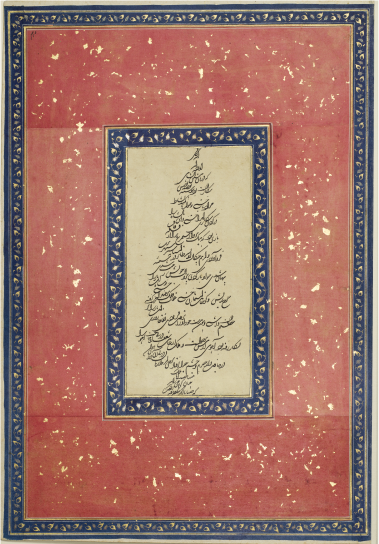
Figure 12.9
Akbar and Jahangir with a royal falcon, from an album assembled for Polier in Shahjahanabad (Delhi) on 27 Rajab 1190 (11Â September 1776)
Staatliche Museen zu Berlin, Museum für Islamische Kunst, I. 4599, fol. 19r
3 Collecting Calligraphy
It is not clear to what degree Polier himself was able to read or write Persian and how deep his appreciation of Persian and Arabic calligraphy would have been; since he had a number of calligraphers among his circle of acquaintances, friends and employees, one can easily imagine that these figures may have given or sold him works in their own hand or advised him on the purchase of work by other past and present calligraphers.
Figure 12.10
Calligraphic exercises in nastaʿlīq copied by Iʿjaz Raqam Khan in 1188 (1774/75) from an album assembled for Polier in Awadh (Uttar Pradesh) or Delhi
Staatliche Museen zu Berlin, Museum für Islamische Kunst, I. 4598, fol. 10v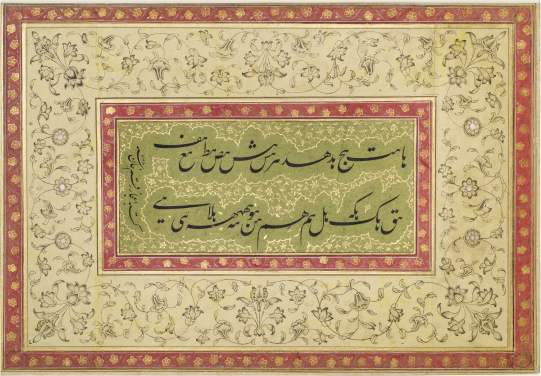
Alongside Mir Muhammad Husayn Ê¿Ata Khan, another figure who could have advised Polier on collecting calligraphic pieces was Ê¿Ata Khanâs teacher, IÊ¿jaz Raqam Khan; as we have seen, he was also an employee of Polier, if not apparently on such intimate terms, and a number of pieces by him are included in the Berlin Polier albums.58 Interestingly, we learn from the IÊ¿jÄz-i ArsalÄnÄ« that IÊ¿jaz Raqam Khan found employment on Polierâs recommendation with Polierâs friend and fellow collector, Jean-Baptiste Gentil.59 All of the pieces by him in the Polier albums are in nastaÊ¿ lÄ«q and fall into conventional categories such as exercises on joined and unjoined letters (mufradÄt u murakkabÄt) or Persian verses written in the diagonal. One of these, I. 4598, fol. 10v (fig. 12.10), is dated 1188 (1774/75), which is also the year in which Ê¿Ata Khan copied I. 4598, fol. 21v (fig. 12.1), the calligraphic exercises in the shikasta hand developed by his father Mir Muhammad Baqir that is included in the same album.
Another calligrapher and friend of Polier was a Mughal officer called Nawab Murid Khan Tabatabaʾi, who signed his work MurÄ«d KhÄn-i ṬabÄá¹abÄ (Murid Khan of Tabataba), and is known in connection with the calligraphic pages by him that were at some point attached to a famous manuscript of the GulistÄn (Rose Garden) copied by Muhammad Husayn Kashmiri, now in the Royal Asiatic Society.60 A group of manuscripts and albums belonging to Murid Khan passed into Polierâs possession, including an album of shikasta calligraphic specimens in Murid Khanâs hand61 and a copy of a glossary of Indian words in Persian.62 Murid Khanâs signature is found on a total of eight pages in shikasta and taÊ¿lÄ«q in the Berlin Polier albums63 and two further pages bear attributions to him.64 Pieces by him are also found in albums compiled for Polier other than the ones in Berlin, such as a calligraphic composition in taÊ¿lÄ«q included in an album that Polier commissioned for presentation to William Jones (1746â1794) in or after 1200 (1785/86), now in the University of Manchester, John Rylands Library (Persian MS 10).65
We do not know much about Murid Khanâs life; according to Ghulam Muhammad in his entry on him in the Taáºkira-yi khushnavÄ«sÄn, he was a sayyid whose name was Muhammad Sadiq Tabatabaʾi who had been an officer in imperial service.66 The latter is corroborated by Ghulam Husayn Tabatabaʾiâs history Siyar al-mutaʾakhkharÄ«n, where it is stated in connection with events in the years 1155 (1742/43) and 1156 (1743/44) that he was sent by the imperial court to collect arrears from the province of Bihar-Bengal and that once there he was appointed to office in Ê¿Azimabad (Patna) by Nawab Ê¿Alivardi Khan (r. 1740â1756).67 Several of the pieces by Nawab Murid Khan in the album that came into Polierâs possession were produced during his residence in Ê¿Azimabad.68
It is not clear how Polier and Nawab Murid Khan came to be acquainted; that he was still resident in Bihar might be inferred from the Ê¿IjÄz-i ArsalÄnÄ«, where Polier, having being recalled from Faizabad to Calcutta, mentions in his various correspondence on a single day (23 July 1775) an imminent meeting between the two men as well as his intention to visit Ê¿Azimabad.69 It is clear from the Ê¿IjÄz-i ArsalÄnÄ« that they were on terms of friendship; one letter from Polier concerns a watch he sent Murid Khan and another a shipment of horses he had arranged to be sent to him.70 Much of Polierâs correspondence with Murid Khan concerns Polierâs attempts to assist Murid Khan recover his property and a land grant which had been confiscated; it is possible that Murid Khan was among the members of the nawabi elite in Bengal-Bihar whose wealth and status was already being undermined by the East India Companyâs reshaping of the administration there.71 Polier took up the matter on Murid Khanâs behalf both with the Shah Ê¿Alamâs advisor Majd al-Dawla in Delhi as well as with Nathaniel Middleton, the Resident in Lucknow.72 We do not know how Nawab Murid Khanâs affairs were settled, though from Polierâs correspondence it would not appear that the latterâs attempts to help him were successful.73 It cannot be easily established at what point Murid Khan died; though the attributions on I. 4595, fol. 13v and I. 4597, fol. 36v describe him as deceased (marḥūm), it is likely that these attributions were added at a later point since these albums were likely to have been compiled in the late 1180s or early 1190s when Murid Khan was still alive and corresponding with Polier. It is possible that Murid Khan was still alive when the albums I. 4597 (Museum für Islamische Kunst) and I 5005 (Museum für Asiatische Kunst) were completed during or after 1199 (1784/85), though by this point he would have been very elderly.74
Regarding Nawab Murid Khanâs skill as a calligrapher, Ghulam Muhammad reports that he had reached the highest level of achievement in a number of hands including shikasta, taÊ¿lÄ«q and thuluth. He also says that he wrote shikasta in a number of different styles and that he had apparently learnt the hand from Akbar Ê¿Ali and Dirayat Khan, the sons of Kifayat Khan, who was a grandson of the aforementioned Mirza Muhammad Husayn, the Iranian émigré calligrapher who established a tradition of shikasta in India, and himself a famous calligrapher employed in the administration of Shah Jahan.75
Alongside the abovementioned piece by Murid Khan, a calligraphic composition signed by Kifayat Khan is found in John Rylands Library, Persian MS 10, the album commissioned by Polier for presentation to William Jones.76 A specimen by Kifayat Khanâs son and Murid Khanâs teacher, Dirayat Khan, who according to Ghulam Muhammad surpassed even his father in his skill in shikasta and taÊ¿lÄ«q,77 is found in the album I 5005, fol. 3v, and a piece attributed to Dirayat Khan is found in another album of calligraphic compositions, which is very similar in terms of contents to Rylands Persian MS 10, now in the Victoria and Albert Museum (National Art Library, MSL/1858/4765).78 One can imagine that as well as providing Polier with his own work, Murid Khan could also have advised him on the purchase of other pieces, including ones by his own teacher as well as other past masters. Although Rylands MS 10 and the Victoria and Albert Museum album may well have been compiled after Murid Khanâs death, it is possible that some of the pieces, including ones by him, his teacher and his teacherâs father, were originally acquired on his recommendation.
Interestingly, most of the texts of the pieces by or attributed to Murid Khan in the Polier albums are from Timurid and early-Safavid Persian historical works, such as Khwandamirâs ḤabÄ«b al-siyar (Beloved of Virtues),79 Ê¿Abd al-Razzaq al-Samarqandiâs Maá¹laÊ¿-i saÊ¿dayn u majmaÊ¿-i baḥrayn (Rise of Jupiter and Venus and Conjunction of the Two Seas),80 and MuÊ¿in al-Din Zamchi Isfizariâs history of Herat Rawá¸at al-jannÄt fÄ« awá¹£Äf madÄ«nat HarÄt (Gardens of Paradise Concerning the Characteristics of the City of Herat).81 Other texts include reports concerning Iskandar (Alexander the Great) based on Mirkhwandâs Rawá¸at al-á¹£afÄʾ (Garden of Purity),82 as well as an extract from an historical work dealing with the reign of Sultan Ghiyath al-Din Khalji of Malwa (fig. 12.11).83 The texts deal with a wide range of historical figures and periods, including, in addition to those already mentioned, the Sasanian King Shapur, the period following the death of the Prophet Muhammad, the Kartid ruler of Herat MuÊ¿izz al-Din Husayn (r. 1332â1370), and events from the reign of the Timurid Shahrukh.
Figure 12.11
Calligraphic page in shikasta by Nawab Murid Khan Tabatabaʾi, consisting of a text concerning the reign of Sultan Ghiyath al-Din Khalji of Malwa, from an album assembled for Polier in Awadh (Uttar Pradesh) on 2 Muharram 1190 (22 February 1776)
Staatliche Museen zu Berlin, Museum für Islamische Kunst, I. 4596, fol. 20v
It would of course be rewarding to examine these texts more closely and to compare them with the texts copied by Murid Khan in other albums, including Supplément Persan 391 in the Bibiothèque nationale de France, which belonged to Polier and consists of pieces by Murid Khan in shikasta and taÊ¿lÄ«q. Though that task is beyond the scope of the present study, it is nonetheless worth nothing that the text of I. 4597, fols. 36v and 38v, which contains the same passage from al-Samarqandiâs Maá¹laÊ¿ al-saÊ¿adayn wa-majmaÊ¿ al-baḥrayn concerning events from the reign of Shahrukh (r. 1405â1447), is also found in Supplément Persan 391.84 Murid Khanâs choice of shikasta and taÊ¿lÄ«q for copying texts from historical works is a subject we shall return to later. Let us know turn more generally to the question of the contents of the Polier albums made around the year 1190 (1776/77).
4 The Calligraphic Contents of Polierâs Faizabad/Delhi Albums
The dedications on three of the Berlin Polier albums, I. 4594, I. 4596 and I. 4599, are dated 1190 (1776/77).85 That two other albums, I. 4595 and I. 4598, were made around the same time is suggested by the fact that all five albums contain leaves from many of the same manuscripts. This group also contains nearly all the specimens by Ê¿Ata Khan86 and IÊ¿jaz Raqam87 as well as several pieces by Murid Khan.88 As we have mentioned, two pages in album I. 4598, one by Ê¿Ata Khan bearing a dedication to Polier (fol. 21v; fig. 12.1), the other consisting of calligraphic exercises by IÊ¿jaz Raqam Khan (fol. 10v, fig. 12.10), are dated 1188 (1774/75), which would support the argument that this album was made in the late 1180s or early 1190s (i.e. c. 1773â1780).
To this group should probably be added another album made for Polier, now in the University of Manchester, John Rylands Library (Indian Drawings 13), whichâthough boundâis in a disordered state. This contains a composition over two pages by Ê¿Ata Khan consisting of calligraphic exercises on joined and unjoined letters (mufradÄt u murakkabÄt) in shikasta (fig. 12.12).89 These are very similar to those found on I. 4598, fols. 21v and 22v (figs. 12.1 and 12.2)âdated 5 ShaÊ¿ban 1188 (11 October 1774)âand were in fact made under a week after the completion of those pages in Faizabad on 11 ShaÊ¿ban 1188 (17 October 1774). They also contain a dedication to Polier, though they lack the information that the style of shikasta was based on that developed by Ê¿Ata Khanâs father Muhammad Baqir.
Figure 12.12
The second page of calligraphic exercises in shikasta by Mir Muhammad Husayn ʿAta Khan written for Polier in Faizabad on 11 Shaʿban 1188 (17 October 1774)
University of Manchester, John Rylands Library, Indian Drawings 13, fol. 2r
All of the albums in this group contain leaves from a manuscript of the Qaṣīdat al-Burda (Poem of the Mantle) (fig. 12.13) written in three lines of thuluth to the page.90
Three of them also contain a number of leaves from a group of leaves made in the Qutbshahi Sultanate in the Deccan; the texts on these include Prophetic and Ê¿Alid hadith by the calligrapher Muhammad al-Shirazi al-Fakhkhar (fig. 12.14) as well as a number of ShiÊ¿i verses in Dakhni Urdu, apparently composed by the Qutb-Shahi ruler Muhammad Quli Qutbshah (r. 1580â1612), copied by the calligraphers Muhammad Riza and Ê¿Ali Zayn al-Din.91 Leaves from these works are, by contrast, absent from the later Polier albums the calligraphic content of which is dominated by the work of Muhammad Ê¿Ali.
Figure 12.13
Leaf from an album containing the Qaṣīdat al-Burda of al-Busiri in thuluth, included in an album assembled for Polier in Awadh (Uttar Pradesh) on 9 Dhuâl-Hijja 1190 (19 January 1777)
Staatliche Museen zu Berlin, Museum für Islamische Kunst, I. 4594, fol. 2v
Figure 12.14
Calligraphic page in thuluth and naskh copied by Muhammad al-Shirazi b. Husayn al-Fakhkhar in Hyderabad c. 1000 (1591), consisting of sayings attributed to ʿAli b. Abi Talib, included in an album assembled for Polier in Shahjahanabad (Delhi) on 27 Rajab 1190 (11 September 1776)
Staatliche Museen zu Berlin, Museum für Islamische Kunst, I. 4599, fol. 36v
Despite containing leaves from common sources, these albums nonetheless show a huge diversity in terms of style and content. A brief examination of the contents of I. 4594 (Museum für Islamische Kunst) will suffice as a demonstration of the eclectic nature of the contents of this group of albums. This album, which was completed on 9 Dhuâl-Hijja 1190 (19 January 1777), contains specimens in thuluth, naskh, nastÊ¿alÄ«q, shafÄ«Ê¿Äʾī and tughrÄʾī. The amount of ShiÊ¿i material included is conspicuous, which is perhaps not surprising given that the ruling family of nawabs in Awadh was ShiÊ¿i,92 as were many members of the administrative classes, including probably both Ê¿Ata Khan and Murid Khan.93 It should be noted that ShiÊ¿i texts are mixed in with texts from key Sunni works such as the QasÄ«dat al-Burda; though there may have been nothing unusual about this in the context of Awadh, our knowledge of late eighteenth-century albums is too rudimentary to make general statements in this regard.
The texts represented include, among other types of works, Persian lyrical poetry (e.g., fol. 3v), Sunni devotional poetry in Arabic (fol. 2v), ShiÊ¿i prayers in Arabic (fols. 4v, 14v), ShiÊ¿i devotional poetry in Dakhni Urdu (fols. 5v, 8v), Prophetic hadith (fol. 10v), Arabic belles-lettres (fol. 19v), a leaf from a manuscript of the GulistÄn (fol. 23v), exercises on joined and unjoined letters (versos of folios 30â35), a certificate for pilgrimage to Mashhad (fol. 29v), as well as two striking calligraphic designs, one of which is an overlapping thuluth (fol. 17v), the other in a tughrÄʾī style (fol. 25v).
The range of calligraphers who have signed their work is also large, including prized Iranian and Central Asian artists such as ʿAli al-Katib (al-Harawi) (fol. 30v), court calligraphers from throughout the Mughal period such as Muhammad Husayn Kashmiri (fol. 18v), ʿAbd al-Rahim ʿAnbarin Qalam (fol. 3v), ʿAli Riza Khan Tabrizi Javahir Raqam (fol. 13v), Hidayatullah Zarrin Qalam (fol. 12r) and Iʿjaz Raqam (fol. 21v), royal calligraphers such as Dara Shikoh (fol. 36v) and Prince Aurangzeb (fol. 11v) as well as the calligraphers Muhammad Riza (fol. 5v) and Zayn al-Din ʿAli (fol. 8v) who were active in the Deccan.
While the study of the calligraphic contents of albums in eighteenth-century India is far for comprehensive, it is probably safe to say that such diversity in style and textual content was not typical for albums compiled for patrons of the highest level for most of the eighteenth century. Courtly tastes in particular remained conservative in the sense that the most-highly valued pieces were written in nastʿalīq by a small number of canonical Mughal and Iranian masters; the calligraphic content of the most luxurious albums typically consisted exclusively of their work.94
Aristocratic tastes, too, probably remained largely conservative. A comparison of the contents of I. 4594 with those of the album I. 4593 may in this sense be instructive. The latter album bears an ownership inscription belonging to Polier dated 1181 (1767/68) and, judging by its patterned borders, was probably made in Awadh not long before it entered Polierâs possession. The contents of the album would suggest a sophisticated rather than royal level of patronage and it may have been a gift to Polier from an aristocratic friend or acquaintance.95
While I. 4593 contains the works of a comparable quality and in a similarly wide range of calligraphers as I. 4594,96 in terms of content and style it is much more homogenous. All the specimens in I. 4593 are in nastaʿlīq apart from a single piece in shikasta, fol. 34v, which may have had a historical rather than calligraphic significance since it consists of a text in praise of Aurangzeb, copied in 1095 (1684) when the emperor was in Ahmednagar.97 The majority of the calligraphic pieces in the album are Persian verses, most of which are written in the conventional diagonal format. Other texts largely consist of standard types such as leaves from manuscripts of Persian poetic and prose works and calligraphic exercises.
Other aristocratic patrons seem to have been less bound by convention and more willing to collect calligraphic specimens in styles other than nastaÊ¿lÄ«q. We have already noted in this regard Supplément Persan 391, the album of pieces by Murid Khan in taÊ¿lÄ«q and shikasta that entered Polierâs possession. In addition to aristocratic connoisseurs and specialists such as Murid Khan, specimens in shikasta may also have been collected by other classes of collector, who may not have been able to afford the work of the most prized calligraphers.
Evidence for the kind of diversity of hands and types of texts found in the Polier albums is, however, scarcer. Though one might explain the diversity of styles and texts in Polierâs albums with reference to the relatively undiscriminating taste of a European collector unfamiliar with the traditional parameters of collecting, it is also possible that Polier deliberately requested a wider range of calligraphic pieces, either out of curiosity or a desire for variety; as souvenirs of India or as representations of Indo-Persian calligraphic traditions, he may have wished for their albums to be somehow comprehensive. It should be noted while some of the albums commissioned by Polier around the year 1199 (1784/85) or later display a narrower range of styles and types of text than the Faizabad/Delhi group of the late 1180s and early 1190s (i.e., c. 1773â1780),98 others are almost encyclopedic in terms of style, even if they are dominated by the work of a single calligrapher, Muhammad Ê¿Ali. This is particularly true of Rylands Persian MS 10, the album of commissioned by Polier for presentation to William Jones and the related album in the Victoria and Albert Museum (National Art Library); in compiling the former, Polier may have thought that an almost typological approach would appeal to the philologist Jones.99 It would also be interesting to investigate whether the presence in the Polier albums of some of the more unusualâat least in an Indian contextâcalligraphic designs inspired by Iranian models were related to a desire for inclusivity on the part of collectors as well as to the diffusion of Iranian cultural forms in eighteenth-century Awadh generally.100
We might also consider the possibility that the Indian calligraphers or connoisseurs who worked for or advised European patrons like Polier were embarking on an altogether new kind of endeavour; if these albums were indeed meant to be somehow representative, then those who were responsible for the collection of the calligraphic contents would be would have been charged with the task of presenting the Indo-Persian calligraphic tradition to outsiders for the first time. It has in fact been argued that such a paradigmatic shift can be discerned in the histories written by members of the administrative classes in East India and presented to officials of the East India Company in the late eighteenth century. According to such arguments, the ascendancy of the East India Company in the late eighteenth century prompted historians like Ghulam Husayn Tabatabaʾi to write histories that, though seemingly traditional, contained a new element of âself-representationâ, as though the authors were forced by the ascendancy of political actors of a very different sort to view themselves, the past and current events in a new light.101
It would be interesting to study the contents of albums made for Polier and other European and Indian collectors, as well as biographical works on calligraphers such as Ghulam Muhammad Dihlaviâs Taáºkira-yi khushnavÄ«sÄn, from a similar perspective. Rare but intriguing evidence for the compilation of albums of mixed contents containing calligraphic specimens in a wide range of styles is found, for example, in seven of the eight albums from the collection of the Scottish surgeon, Archibald Swinton (1731â1804), held in the Museum für Islamische Kunst and the Museum für Asiatische Kunst, Berlin.102 While we can be sure that at least one of these albums was commissioned by Swinton himself,103 inscriptions and seal impressions in other albums indicate that they may have been compiled by none other than the historian Ghulam Husayn Tabatabaʾi before being acquired by Swinton.104
One would of course not wish to draw simplistic analogies between Ghulam Husaynâs respective roles as historian and collector or prematurely assign the presence of the British in India a role in the broader development of collecting practices. For one thing, we are at present severely hampered by our incomplete knowledge of collecting and album compilation in eighteenth-century India generally, a particularly serious obstacle being the lack of information concerning albums in Indian collections. As such, we cannot yet discount the possibility that albums containing calligraphically diverse contents were being compiled in North India already at an earlier date. For the time being, a more fruitful line of inquiry maybe to attempt to account for at least some of the diversity of texts and styles evident in the Polier albums by placing it in the context of the expansion of the administrative classes in the nawabates in the course of the eighteenth century.
5 New Directions
5.1 Transforming Traditions
It is now a well-established feature of the landscape in histories of the eighteenth-century India that the dissipation of Mughal military power and the emergence of regional centres of power provided new opportunities for groups that mediated between rulers and societyâs agrarian base, particularly merchants, revenue farmers and members of the various administrative classes. Though rulers in the provinces also faced political problems and difficulties in gathering revenue, they were nonetheless able to penetrate the countryside more effectively with the assistance of cadres of loyal administrators and revenue officials.105 One of the results of this development was that, as skilled administrators migrated to the provinces, Mughal administrative traditions became in fact more entrenched. As C.A. Bayly succinctly put it, âthe spirit of Mughal administration went marching on even when Delhiâs military power lay mouldering in the graveâ.106
The administrative classes were not a monolithic group. The most senior members, like Nawab Murid Khan, were often drawn from the ranks of the Mughal office-holding nobility. Other ranks were drawn, as in the case of Ê¿Ata Khan, from the âpetty Muslim gentry of north and central Indiaâ,107 while scribal roles were often filled by Persianised members of Hindu castes. What the various administrative classes shared was an attachment to Mughal cultural forms such as calligraphy, poetry, history writing, epistolary traditions and music. As we have discussed, both loyalty to the Mughal dynasty and adherence to courtly cultural traditions were important markers of status and identity for members of these classes.108 If these administrative cadres brought Mughal cultural traditions to the provinces, they also transformed them. It has been demonstrated, for example, how in the eighteenth century, the Mughal epistolary tradition (inshÄʾ), became standardised, a development that accompanied the emergence of the munshÄ«s (secretaries) as a quasi-caste in the service of rulers, members of the nobility and, by Polierâs time, Europeans. Polierâs letters, the IÊ¿jÄz-i ArsalÄnÄ«, which were probably written by several munshÄ«s including a certain Krishan Sahai, belong to this genre.109
Mughal historiographic traditions were also reshaped by members of the administrative classes in this period. While the authors of these histories preserved many of the established parameters of Indo-Persian historical writing, at the same time they clearly reshaped them according to their own particular circumstances and perspectives. While many late-eighteenth-century histories, for example, adhered to the traditional notion of the central role played by the Mughal emperor, they came to view this role as somewhat ceremonial rather than active; good rule was embodied not so much in the personal qualities of the monarch, but rather in the maintenance of the institutions of government. Such an outlook was clearly the result of the authorsâ origins in the ranks of the expanded administration.110
It is worth asking in the light of these discussions around literary and epistolary traditions, how calligraphers and connoisseurs who also typically came from various ranks of the administration, may have, consciously or unconsciously, reformulated past calligraphic traditions.
5.2 Expanding the Canon
The number of pieces in the classical Mughal nastaÊ¿lÄ«q idiom in this group of albums by past masters clearly attests to the continued relevance of canonical Indo-Persian calligraphic traditions, while numerous pieces in conservative styles by contemporaries of Polier such as IÊ¿jaz Raqam Khan, Hafiz Nurullah, and, occasionally, Ê¿Ata Khan also demonstrate a clear continuity with those traditions.111 That Ê¿Ata Khan saw himself as part of a Mughal calligraphic tradition is also signified by his use of a traditional type of calligrapherâs honorific, MuraṣṣaÊ¿ Raqam.
The inclusion of pieces in a range of hands in the Polier albums, however, might also be taken as evidence of a desire to reshape or expand the boundaries of the Indo-Persian calligraphic tradition. The origins of some of these styles as bureaucratic hands may here be of significance. The albums include, for example, a number of striking calligraphic designs in the tughrÄʾī style (e.g., I. 4595, fol. 25v), which took its name from the word tughrÄ, the rulerâs calligraphic signature placed at the head of official documents. Though the development of tughrÄʾī as a free-standing calligraphic hand independent of official documents is yet to be studied, it is likely that calligraphers with backgrounds in the administration played a role in the process; it is worth noting in this regard that Ê¿Ata Khanâs father, Mir Muhammad Baqir, is reported to have been a tughrÄ-navÄ«s, a writer of tughrÄs.112 Similarly, the calligrapher Muhammad Ê¿Ali, who was responsible for at least two and probably several more pieces in tughrÄʾī styles in later albums made for Polier (fig. 12.15), is also reported to have been the son of a farmÄn-navÄ«s (writer of royal edicts), a certain Mirza Khayrullah.113
Even more so than in the case of tughrÄʾī, one might view the emergence of shikasta as a calligraphic hand in this period as a corollary of the expansion of the bureaucratic classes and the reshaping of various Indo-Persian calligraphic and literary traditions according to their perspectives and tastes. Though shikasta was initially a bureaucratic hand used in correspondence and official documents, albums such as Supplément Persan 391, consisting of specimens by Murid Khan exclusively in shikasta, demonstrate that it was at some level also appreciated as a calligraphic hand, even if it continued to be excluded from grander albums. It is possible that erudite calligraphers may also have considered shikasta, which had been developed to be written with speed, as a suitable hand in which to explore a range of longer texts; we have noted already in this regard Murid Khanâs choice of extracts from historical texts dealing with a wide range of figures and periods, as well as Ê¿Ata Khanâs choice of a mixture of epistolary, literary and calligraphic texts for his shikasta pages. It is surprising, in fact, how few of the pieces in shikasta and taÊ¿lÄ«q by these artists even belong to the epistolary inshÄʾ genre, given the traditional association of these hands with correspondence and chancery documents. Buying or commissioning pieces in shikasta may also have been a relatively inexpensive way for Polier to fill any gaps in his albums; as we have already suggested, less discriminating European collectors may not have been disturbed by such a mix of calligraphic styles. We might also consider the possibility that by including pieces in shikasta alongside the work of past and present masters of nastaÊ¿lÄ«q, Polierâs advisers were trying to elevate the status of the former and accord it a place in the Mughal calligraphic canon. It is worth noting in this regard that many of the pieces written by Ê¿Ata Khan are on beautiful marbled, gold-flecked paper, as if to emphasise these piecesâ status as luxury works of art (figs. 12.3, 12.12).114
Figure 12.15
Calligraphic page consisting of the tughrÄ of Shah Ê¿Alam II (r. 1760â1806), attributable to Muhammad Ê¿Ali, from an album compiled for Polier after 1196 (1781/82) in Lucknow, Awadh (Uttar Pradesh)
Staatliche Museen zu Berlin, Museum für Asiatische Kunst, I 5063, fol. 21r
We might also interpret the inclusion of pieces in shikasta by earlier masters such as Nawab Murid Khanâs teacher, Dirayat Khan, as a way of establishing a venerable pedigree for the style. Ê¿Ata Khanâs claim to have copied I. 4599, fol. 2v, from the hand of Dirayat Khanâs ancestor and apparent founder of the shikasta style in India, Mirza Muhammad Husayn, might be seen as a similar attempt to garb shikasta in a cloak of venerability.
Respect for the Mughal calligraphic tradition combined with a desire to accord shikasta a place within it are evident in Ghulam Muhammad Dihlaviâs Taáºkira-yi khushnavÄ«sÄn, where the author traces the style back to Mirza Muhammad Husayn through Kifayat Khan and Dirayat Khan.115 In praising the latterâs skill in the style, he makes sure to ground the discussion within the Mughal calligraphic tradition by invoking its most revered calligrapher, the Herati master, Mir Ê¿Ali. At the same time, there is in Ghulam Muhammadâs statement a clear acknowledgment of the relative newness of the shikasta style, as well as an admiration for its inventiveness: âIn the creation and establishment of the style he contrived a Samir-like magic. If Mulla Mir Ê¿Ali had seen his shikasta, he would have given up writing nastaÊ¿lÄ«qâ.116
6 Concluding Remarks
A combination of attachment to the Mughal past and a sharpened awareness of change has been noted as feature of political and literary discourse in the nawabates and in Bihar-Bengal under the East India Company. Mostly, this seems to have occurred in the context of decrying the decline of Mughal central authority, the rise of groups whom the authors considered to be political and social upstarts, or the ascendancy of aliens who were insufficiently versed in Indian customs.117 It would be an interesting line of inquiry to examine whether perceptions of the newness of the age also extended to discussions of artistic achievement. In contrast to the paradigms of decline and disorder found in histories, there are a few indications that in the cultural sphere at least, the newness of the age may have been on occasions something worth celebrating. That this was indeed the case might be inferred, for example, from the title of Ê¿Ata Khanâs homage to his father as the founder of a new style of shikasta on I. 4598, fol. 21v (fig. 12.1), or from the title of his pioneering Urdu prose work, Naw á¹arz-i muraṣṣaÊ¿ (The New Ornamented Style). Lastly, it is worth considering how concerns around such notions as tradition and newness on the part of the Indian calligraphers who composed and possibly collected calligraphic specimens for Polier may have interacted with or overlapped with Polierâs own criteria for collecting calligraphy and painting, including, perhaps, representativeness and inclusivity. In this way, future studies might examine the Polier albums as the fruit of multiple interests.
Acknowledgements
The author would like to thank Manijeh Bayani, Jake Benson, Wheeler Thackston, and Friederike Weis for generously sharing their knowledge and expertise.
For a summary of Mir Muhammad Husayn Ê¿Ata Khanâs life and achievements, see Munibur Rahman, âTaḥsÄ«nâ, Encyclopaedia of Islam, Second Edition, Volume 10 (Leiden: Brill, 2000), pp. 113â114. The fullest and most authoritative account of Ê¿Ata Khanâs life is Sayyid Sajjad, âAn Early Prose-Writer of Modern Urdu,â Islamic Culture 13/1 (1939), pp. 60â75.
The manuscript of the IÊ¿jÄz-i ArsalÄnÄ« is in two volumes in the Bibliothèque nationale de France, Paris, Supplément Persan 479 and 479 A. The first volume has been translated into English, Muzaffar Alam and Seema Alavi (eds.), A European Experience of the Mughal Orient: The IÊ¿jÄz-i ArsalÄnÄ« (Persian Letters, 1773â1779) of Antoine-Louis Henri Polier (New Delhi: Oxford University Press, 2001). The first volume is available online at
Museum für Islamische Kunst, Berlin, I. 4598, fols. 21v and 22v (figs. 12.1â12.2), of which fol. 21v is dated 5 ShaÊ¿ban 1188 (11 October 1774). Two calligraphic pages, consisting of calligraphic exercises on joined and unjoined letters (mufradÄt u murakkabÄt) by Ê¿Ata Khan, bearing a dedication to Polier dated 11 ShaÊ¿ban 1188 (17 October 1774), are also found in an album made for Polier in the University of Manchester, John Rylands Library, Indian Drawings 13, fols. 1r, 2r. Thanks to Friederike Weis and Jake Benson for drawing my attention to this album and Ê¿Ata Khanâs contribution to it.
Museum für Islamische Kunst, Berlin, I. 4594, I. 4595, I. 4596, I. 4598, I. 4599.
For the chronology of the group of albums made for Polier while he was in Faizabad and Delhi, see Friederike Weisâ article in the present volume, table 1.
For the expanded role of what the author calls the âservice gentryâ in the eighteenth century, see C.A. Bayly, Rulers, Townsmen and Bazaars: North Indian Society in the Age of British Expansion: 1770â1870 (Cambridge: Cambridge University Press, 1983), esp. pp. 8, 12, 25â27, 34, 46, 53, 101â102, 125, 164â166, 189â196. See also C.A. Bayly, Indian Society and the Making of the British Empire (Cambridge: Cambridge University Press, 1988), esp. pp. 9â13.
Bayly, Indian Society, pp. 14â16.
For the cultural and socio-economic significance of Mughal cultural traditions for the expanded administrative classes, see Bayly, Rulers, Townsmen and Bazaars, p. 200; Bayly, Indian Society, pp. 16â18; Muzaffar Alam and Sanjay Subrahmanyam, âWitnesses and Agents of Empire: Eighteenth-Century Historiography and the World of the Mughal Munshiâ, Journal of the Economic and Social History of the Orient 53/1â2 (2010), pp. 393â423, esp. p. 410; Kumkum Chatterjee, âHistory as Self-Representation: The Recasting of a Political Tradition in Late Eighteenth-Century Eastern Indiaâ, Modern Asian Studies 32/4 (Oct., 1998), pp. 913â948, esp. pp. 919â920.
Bayly, Indian Society, pp. 38â44.
Ghulam Muhammad Haft Qalami Dihlavi, The Tadhkira-i KhushnavÄ«sÄn of MawlÄnÄ GhulÄm Muhammad DihlavÄ«, ed. M. Hidayet Husain, Bibliotheca Indica, no. 1233 (Calcutta: Asiatic Society of Bengal, 1910). On Ghulam Muhammad, see ibid., pp. iiiâiv; C.A. Storey, Persian Literature: A Bio-Bibliographical Survey. Volume 1, Part 2: Biography, Additions, and Corrections (London: Luzac & Co, 1953), p. 1076.
Dihlavi, The Tadhkira-i KhushnavÄ«sÄn, pp. 61â62.
For the style known as shafÄ«Ê¿Äʾī, see Susan Stronge and Behnaz Atighi-Moghaddam, âAn Unrecorded Polier MuraqqaÊ¿ (c. 1785). New Insights into British-Hindustani Cultural Interactionâ, in Adle NÄmeh: Studies in Memory of Chahriyar Adle, ed. Alireza Anisi (Research Institute for Cultural Heritage and Tourism: Tehran, 2018), pp. 195â228, esp. p. 205 and figs. 6 and 7.
It should be noted that the hand known simply as shikasta in India, which according to Ghulam Muhammad Dihlavi was formulated by the Iranian emigré Mirza Muhammad Husayn and developed by his great-grandson Muhammad JaÊ¿far Kifayat Khan (d. 1683) and the latterâs son Dirayat Khan is distinct from the various hands called shikasta, shikasta-taÊ¿lÄ«q and shikasta-nastaÊ¿lÄ«q in Iran. At present, there is no detailed study of the development of Indian shikasta in English. For Ghulam Muhammadâs account of the development of shikasta in India, see Dihlavi, The Tadhkira-i KhushnavÄ«sÄn, pp. 103â106. For an examination of the letter forms in Indian shikasta, see E.H. Palmer, Oriental Penmanship: Specimens of Persian Handwriting, Illustrated with Facsimiles from Originals in the South Kensington Museum (London: W.H. Allen & Company, 1886), pp. 24â37. For the various Iranian shikasta hands, see Sheila Blair, Islamic Calligraphy (Edinburgh: Edinburgh University Press, 2006), pp. 441â446.
These are Museum für Islamische Kunst, Berlin, I. 4594, fols. 6v, 9v; I. 4599, fol. 10v. An inscription added to the lower-left corner of I. 4594, fol. 9v reads khaá¹á¹-i shafÄ«Ê¿Äʾī (shafÄ«Ê¿Äʾī calligraphy).
Sajjad, âAn Early Prose-Writerâ.
Sajjad, âAn early prose-writerâ, pp. 62, 67.
Rahman, âTaḥsÄ«nâ, p. 113; Sajjad, âAn early prose-writerâ, p. 62. The information about Ê¿Ata Khanâs father serving at Aurangzebâs court is stated in Rahman, âTaḥsÄ«nâ, without giving a specific source.
Sajjad, âAn early prose-writerâ, pp. 63, 65.
All of the verso sides of I. 4598, fols. 9â20; I. 4599, fol. 12v, 33v.
Alam and Alavi (eds.), IÊ¿jÄz-i ArsalÄnÄ«, pp. 129, 133, 195â196.
Sajjad, âAn Early Prose-Writerâ, pp. 63, 64.
Ibid., pp. 63, 65.
Ibid., p. 65.
Sajjad identifies this person as Richard Smith in âAn Early Prose-Writerâ, pp. 70â75. Since then, more information on Smith has been published. For a biography of him, see G.J. Bryant, âSmith, Richard (bap. 1734, d. 1803), army officer in the East India Company and politicianâ, in Oxford Dictionary of National Biography, online version at
Sajjad, âAn Early Prose-Writerâ, p. 65. According to Bryant, Smith departed India in 1770, see Bryant, âSmith, Richardâ.
Sajjad, âAn Early Prose-Writerâ, p. 62.
On Captain, later Colonel, Harper, see Venetia Porter, Arabic and Persian Seals and Amulets in the British Museum, (London: The British Museum, 2011), pp. 128â129; Sir Henry Montgomery Lawrence, Essays, Military and Political, Written in India, (London: Wm. H. Allen & Co., 1859), pp. 93â94.
Sajjad, âAn Early-Prose Writerâ, pp. 62â63.
Ibid., p. 64.
Alam and Alavi (eds.), IÊ¿jÄz-i ArsalÄnÄ«, pp. 141â142.
See ibid., e.g., pp. 254â260.
For this stage in Polierâs career, see Sanjay Subrahmanyam, âThe Career of Colonel Polier and Late Eighteenth-Century Orientalismâ, Journal of the Royal Asiatic Society, Third Series 10/1 (April 2000), pp. 43â60, esp. pp. 51â53.
Alam and Alavi (eds.), IÊ¿jÄz-i ArsalÄnÄ«, pp. 329â330, 341, 376â377.
Ibid., pp. 378â379, 382â383.
Supplément Persan 479 A, fols. 99v, 108v, 118v, 126r, 145v.
Ibid., fol. 205v.
Subrahmanyam, âThe Career of Colonel Polierâ, pp. 53â54.
Supplément Persan 479 A, fol. 258r.
Museum für Islamische Kunst, Berlin, I. 4597, fol. 25v, is signed by Muhammad ʿAli and dated 1199 (1785/86). This album contains pieces by Muhammad ʿAli dated between 1195 (1780/81) (fols. 9v, 10v, 12v, 14v, 16v, 18v, 24v, 26v) and 1199 (1785/86) (fols. 13v, 25v).
In addition to I. 4597, other albums dominated by the work of Muhammad Ê¿Ali include Museum für Asiatische Kunst, Berlin, I 5005, I 5063, and a purely calligraphic album in the Victoria and Albert Museum (National Art Library, London), MSL/1858/4765 (see Stronge and Atighi-Moghaddam, âAn Unrecorded Polier MuraqqaÊ¿â). Like I. 4597, all of these contain pieces by Muhammad Ê¿Ali dated between the years 1195 (1780/81) and 1199 (1785/86). University of Manchester, John Rylands Library, Persian MS 10, contains pieces by Muhammad Ê¿Ali dated between 1197 (1782/83) and 1200 (1786/87) (see Jake Benson, âPolierâs Posterior Album: Rylands Persian MS 10â in the present volume). From the dates found in these various albums it would be reasonable to assume that Muhammad Ê¿Ali was active in Polierâs service in the years from 1195 to 1200.
The pieces dated 1195 are Museum für Asiatische Kunst, Berlin, I 5005, fol. 5v, which does not contain Muhammad Ê¿Aliâs name but is clearly his work; Museum für Asiatische Kunst, Berlin, I 5063, fol. 16r; a page from the Lady Coote Album in the Fine Arts Museums of San Francisco, 1982.2.70.12, mentioned in Stronge and Atighi-Moghaddam, âAn Unrecorded Polier MuraqqaÊ¿â, p. 205, n. 44. An undated piece signed Muḥammad Ê¿AlÄ« MuraṣṣaÊ¿ Raqam is in Rylands Persian MS 10, fol. 22v (see Benson, âPolierâs Posterior Albumâ, in the present volume).
Alam and Alavi (eds.), IÊ¿jÄz-i ArsalÄnÄ«, p. 339.
Supplément Persan 479 A, fol. 99v.
Museum für Islamische Kunst, Berlin, I. 4595, fol. 8v; I. 4598, fols. 4v, 28v, 30v, 33v; I. 4599, fols. 2v, 20v, 27v.
Museum für Islamische Kunst, Berlin, I. 4598, fols. 21v (fig. 12.1), 22v (fig. 12.2).
Himmat-i Ê¿arÅ«s-i jamÊ¿Ä«yat u shÄdmÄnÄ« ham-ÄghÅ«sh-i Än mÄh-i bÄ«-mis̱ÄlÄ«-yi jawhar al-lisÄnÄ«.
Naql-i khaá¹á¹-i MÄ«rzÄ Muḥammad Ḥusayn MÄ«r Muḥammad Ḥusayn Ê¿Aá¹Ä KhÄn navisht.
For Mirza Muhammad Husayn, see Dihlavi, The Tadhkira-i KhushnavÄ«sÄn, pp. 103â105.
This view is represented in late eighteenth-century histories, the authors of which were mostly drawn from the ranks of the nawabi bureaucracy, where the nawabates are depicted as loyal, miniaturised versions of the Mughal government, whereas the Jats, Marathas and Sikhs, are cast as rebellious troublemakers. See Chatterjee, âHistory as Self-Representationâ, p. 926; Alam and Subrahmanyam, âWitnesses and Agents of Empireâ, esp. pp. 412â416.
Subrahmanyam, âThe Career of Colonel Polierâ, p. 52.
This inscription is found in a gilt roundel that resembles a seal impression on the opening doublure of Museum für Islamische Kunst, Berlin, I. 4593, and reads: IftikhÄr al-Mulk ImtiyÄz al-Dawla Mayjir PÅ«lÄ«r BahÄdur ArsalÄn Jang fidvÄ«-yi ShÄh Ê¿Älam BÄdshÄh GhÄzÄ« (Iftikhar al-Mulk Imtiyaz al-Dawla Major Polier Bahadur, loyal servant of Shah Ê¿Alam, Warrior Emperor). While it is possible that this album was a gift to Polier, who by this date had not yet established his own atelier, there is no evidence to corroborate Volkmar Enderleinâs opinion that this album was a gift from the emperor himself (Volkmar Enderleinâs introduction to Regina Hickmann, Indische Albumblätter: Miniaturen und Kalligraphien aus der Zeit der Moghul-Kaiser [Leipzig and Weimar: Gustav Kiepenheuer Verlag, 1979], p. 5). I am grateful to Friederike Weis for information concerning this album.
Museum für Islamische Kunst, Berlin, I. 4594, fol. 40v; I. 4598, fol. 40v; I. 4599, fol. 40v; I. 4596, fol. 30v. I. 4596 was completed in 2 Muharram 1190 (22 February 1776), at which point Polier was on his way to Delhi to take up employment at the court of Shah Ê¿Alam II (see Alam and Alavi [eds.], IÊ¿jÄz-i ArsalÄnÄ«, p. 314). I. 4599 was completed on 27 Rajab 1190 (11 September 1776) in Shahjahanabad, I. 4594 on 9 Dhuâl-Hijja 1190 (19 January 1777). Though I. 4598 is undated, the use of the title navvÄb (deputy) in the dedication on folio 40v would suggest that it was also completed during the period of Polierâs imperial service.
Chatterjee, âHistory as Self-Representationâ, esp. pp. 919â922.
Ibid., esp. pp. 939â942.
MurghÄn hama murghand u lÄkin na chÅ« shah-bÄz.
For this story see Husayn WaÊ¿iz al-Kashifi and J.W.J. Ouseley (ed.), AnvÄr-i SuhelÄ« or Lights of Canopus, being the Persian version of the Fables of BÄ«dpai by Ḥusain Vaiz̤ KÄshifÄ« (Hertford: Stephen Austin, 1851), pp. 352â354.
For this story, see ibid., pp. 388â389.
I. 4594, fol. 21v (signed faqÄ«r al-ḥaqir niyÄzmand IÊ¿jÄz Raqam KhÄn); I. 4598, fols. 9v (signed niyÄzmand IÊ¿jÄz Raqam KhÄn), 10v (signed katabahu IÊ¿jÄz Raqam KhÄn sana 1188, fig. 12.10), 11v (signed li-kÄtibihi IÊ¿jÄz Raqam KhÄn), 12v, 13v, 14v, 15v, 16v, 17v, 18v, 19v, 20v, 36v (signed IÊ¿jÄz Raqam KhÄn); I. 4599, fols. 12v, fol. 33v (both signed rÄqimuhu IÊ¿jÄz Raqam KhÄn). Another calligraphic composition signed by IÊ¿jaz Raqam Khan is on a leaf from a Polier album in the British Museum, London, 1920,0917,0.145r, published online at
Alam and Alavi (eds.), IÊ¿jÄz-i ArsalÄnÄ«, pp. 129, 133.
Royal Asiatic Society, Persian 258, available online at
Bibliothèque nationale de France, Paris, Supplément Persan 391, available online at
Eton College Library, Pote 291, D.S. Margoliouth, Catalogue of the Oriental Manuscripts in the Library of Eton College (Oxford: Horace Hart, 1904), no. 107. See also Shiva Mihan at
Museum für Islamische Kunst, Berlin, I. 4595, fol. 25v; I. 4596, fol. 20v; I. 4597, fol. 34v, 38v; I. 4598, fol. 38v; Museum für Asiatische Kunst, Berlin, I 5005, fols. 5v, 8v, 14v.
Museum für Islamische Kunst, Berlin, I. 4595, fol. 13v; I. 4597, fol. 36v.
See University of Manchester, John Rylands Library, Persian MS 10, fol. 14v, which is signed MurÄ«d KhÄn-i ṬabÄá¹abÄ and dated 1148 (1735/36). The entire album is available online at
Dihlavi, The Tadhkira-i KhushnavÄ«sÄn, p. 107.
Ghulam Husayn Khan, Seear-ool Mutakh-reen: The Exploits of the Moderns, ed. Hukeem Abdool Mujeed (Calcutta: Medical Press, 1833), pp. 107, 128â129. See also Ghulam Husayn Khan and Haji Mustafa (tr.), A Translation of Sëir Mutaqherin Vol. III: Views of Modern Times being an History of India, from the Year 1118 to the Year 1195 of the Hidjrah (Calcutta: James White, 1789), pp. 375, 434, 445â448.
Supplément Persan 391, fols. 6r, 18r, 29v.
Alam and Alavi (eds.), IÊ¿jÄz-i ArsalÄnÄ«, pp. 100 (fol. 10b), 269 (fols. 289bâ290b).
Ibid., pp. 100 (fol. 10b, dated 17 Rajab 1187 [4 October 1773]), 269.
For this process in Bihar, see Kumkum Chatterjee, Merchants, Politics and Society in Early-Modern India. Bihar: 1733â1820, (Leiden, New York, Cologne: Brill, 1996), pp. 213â217.
Alam and Alavi (eds.), IÊ¿jÄz-i ArsalÄnÄ«, p. 365; Supplément Persan 479 A, fols. 27râ27v, 56vâ57r, 78râ78v, 172v.
The final correspondence between Polier and Murid Khan to be included in the IÊ¿jÄz-i ArsalÄnÄ« is dated 23 Dhuâl-Hijja of the regnal year 21 (1 January 1780), Supplément Persan 479 A, fol. 301v. From this it is apparent that Murid Khanâs affairs had not been settled.
A calligraphic page by Murid Khan, Museum für Islamische Kunst, Berlin, I. 4597, fol. 34v, is dated 5 Ramadan, regnal year 28; this could be either from the reign of Muhammad Shah (r. 1719â1748), in which case it would correspond to 5 Ramadan 1158 (1 October 1745), or from the first reign of Shah Ê¿Alam II, in which case it would correspond to 5 Ramadan 1200 (2 July 1786). These calculations are based on Shahpurshah Hormasji Hodivala, Occasional Memoirs of the Numismatic Society of India. II: Historical Studies in Mughal Numismatics (Calcutta: Baptist Mission Press, 1923), pp. 284â285, 288.
Dihlavi, The Tadhkira-i KhushnavÄ«sÄn, p. 107.
University of Manchester, John Rylands Library, Persian MS 10, fol. 12v. See also Benson, âPolierâs Posterior Albumâ, in this volume.
Ibid., p. 106.
Victoria and Albert Museum (National Art Library, London), MSL/1858/4765, fol. 18 [no. 17], published in Stronge and Atighi-Moghaddam, âAn Unrecorded Polier MuraqqaÊ¿â, p. 205 and fig. 4. The entire album is available online at
Museum für Islamische Kunst, Berlin, I. 4595, fol. 25v. The text concerns the question of the imamate/caliphate in the period following the death of Muhammad. Interestingly, though the text belongs to the manuscript tradition of the ḤabÄ«b al-siyar that was tailored to a ShiÊ¿i audience, it still refers to Abu Bakr as âHis Highness the Commander of the Faithfulâ (ḥażrat-i amÄ«r al-muʾminÄ«n). For this passage from ḤabÄ«b al-siyar, see Philip Bockholt, Weltgeschichtsschreibung zwischen Schia und Sunna: ḪvÄndamÄ«rs ḤabÄ«b as-siyar im Handschriftenzeitalter, Iran Studies, vol. 20 (Leiden: Brill, 2021), p. 381.
Museum für Islamische Kunst, Berlin, I. 4597, fols. 36v, 38v. For the text on this page, see Kamal al-Din Ê¿Abd al-Razzaq Samarqandi, Maá¹laÊ¿-i saÊ¿adayn u majmaÊ¿-i baḥrayn, vol. 2, part 1, ed. Ê¿Abd al-Husayn Navaʾi (Tehran: PazhÅ«hashgÄh-i Ê¿UlÅ«m-i InsÄnÄ« va MutÄlaÊ¿Ät-i FarhangÄ«, 1383 SH [2004/05], pp. 157â158).
Museum für Asiatische Kunst, Berlin, I 5005, fol. 14v. For the text on this page, see MuÊ¿in al-Din Muhammad Zamchi Isfizari, Rawá¸at al-jannÄt fÄ« awá¹£Äf madÄ«nat HarÄt, vol. 2, ed. Sayyid Muhammad Kazim Imam (Tehran: IntishÄrÄt-i DÄnishgÄh-i Tihran, 1339 SH [1960/61], pp. 17â18).
Museum für Islamische Kunst, Berlin, I. 4597, fol. 34v; I. 4598, fol. 38v.
Museum für Islamische Kunst, Berlin, I. 4596, fol. 20v.
Bibliothèque nationale de France, Paris, Supplément Persan 391, fol. 11v.
Museum für Islamische Kunst, Berlin, I. 4596, dated 2 Muharram 1190 (22 February 1776); I. 4599, dated 27 Rajab 1190 (11 September 1776); I. 4594, dated 9 Dhuâl-Hijja 1190 (19 January 1777).
Museum für Islamische Kunst, Berlin, I. 4595, fol. 8v; I. 4598, fols. 4v, 21v, 22v, 28v, 30v, 33v; I. 4599, fols. 2v, 20v, 27v.
Museum für Islamische Kunst, Berlin, I. 4595, fol. 21v; I. 4598, fols. 9v, 10v, 11v, 12v, 13v, 14v, 15v, 16v, 17v, 18v, 19v, 20v, 36v; I. 4599, fols. 12v, fol. 33v. The only other page by Iʿjaz Raqam from a Polier album that I know of, is British Museum, 1920,0917,0.145r. I am grateful to Jake Benson for bringing this piece to my attention.
Museum für Islamische Kunst, Berlin, I. 4595, fols. 13v, 25v; I. 4596, fol. 20v; I. 4598, fol. 38v.
University of Manchester, John Rylands Library, Indian Drawings 13, fols. 1r, 2r. The album contains only fourteen folios and the shamsa is oddly placed on fol. 9r. Thanks to Friederike Weis and Jake Benson for drawing my attention to this album and Ê¿Ata Khanâs contribution to it.
Museum für Islamische Kunst, Berlin, I. 4594, fol. 2v (fig. 12.13); I. 4595, fols. 9v, 30v; I. 4596, fols. 16v, 29v; I. 4598, fol. 23v; I. 4599, fols. 11v, 14v, 19v, 25v, 26v; Rylands Indian Drawings 13, fol. 10r.
Museum für Islamische Kunst, Berlin, I. 4599, fols. 16v, 36v; I. 4594, fols. 5v, 8v; I. 4596, fols. 15v, 24v. Fifteen leaves from this group are in the Chester Beatty Library, Persian 225. David James has suggested that this originally consisted of two albums both made for Muhammad Quli Qutb Shah, one containing Arabic and Persian materials that was assembled to mark the arrival of the millennium in the year 1000 (1591), the other containing ShiÊ¿i-flavoured verses in Dhakni Urdu by Muhammad Quli Qutb Shah, see David James, âThe Millenial Album of Muhammad Quli Qutb-Shahâ, Islamic Art II (1987), pp. 243â255. See also Laura Weinstein, âVariations on a Persian Theme: Adaptation and Innovation in Early Manuscripts from Golcondaâ (PhD. diss, Columbia University, 2011), pp. 195â218.
For the most comprehensive study of the development of ShiÊ¿ism in Awadh, see J.R.I. Cole, The Roots of North Indian ShÄ«Ê¿ism in Iran and Iraq: Religion and State in Awadh, 1722â1859 (Berkeley, Los Angeles and Oxford: University of California Press, 1989).
Judging by their names, Mir Muhammad Husayn Ê¿Ata Khan and his father Mir Muhammad Baqir Khan were probably ShiÊ¿i. Murid Khan, whose name Tabatabaʾi signifies descent from Ê¿Aliâs great-great-grandson, IsmaÊ¿il b. Ibrahim, and whose Ê¿Alid genealogy is given on fol. 1r of Supplément Persan 391, was also probably ShiÊ¿i.
See for example, the Teignmouth Album in the Royal Collection, RCIN 1005068, published in Emily Hannam, Eastern Encounters: Four Centuries of Paintings and Manuscripts from the Indian Subcontinent (London: Royal Collection Trust, 2018), cat.no. 37. For this album, see also Emily Hannamâs article in this volume. The calligraphic content of this album, compiled during the reign of Muhammad Shah (r. 1719â1748), consists solely of pieces by Mir Ê¿Ali, Sultan Ê¿Ali (Mashhadi), Mir Ê¿Imad, Ê¿Abd al-Rashid Daylami and Sayyid Ê¿Ali Jawahir Raqam.
As we have explained, though the ownership inscription on the opening doublure mentions Polier as the devoted servant of Shah Ê¿Alam II, there is no reason to believe, as Enderlein has suggested, that this was a gift from the emperor himself (see Enderleinâs introduction to Hickmann, Indische Albumblätter, p. 5). Even if one were to accept Enderleinâs suggestion of a royal origin for this album, its contents would not place it in the category of the most valuable albums.
Among the calligraphic pages are ones attributed to Mir ʿAli (fols. 24, 27v), as well as ones signed by ʿAbd al-Rahim ʿAnbarin Qalam (fol. 36v), ʿAli Riza Khan Tabrizi Javahir Raqam (fol. 17v) and Hidayatullah Zarrin Qalam (fol. 1v). In addition to other lesser-known Mughal, Iranian and Central Asian artists such as Muhammad Rafiʿ (fol. 46v), Khudayar (fol. 48v), Mir Husayn al-Husayni (fol. 49v) and Muhammad ʿArif al-Husayni (fol. 41v), it contains numerous unsigned pieces (e.g., fols. 2v, 12v).
Museum für Islamische Kunst, Berlin, I. 4593, fol. 34v, copied on 23 RabiÊ¿ I 1095 (10 March 1684), regnal year 21, âat the time when the elevated, victorious standards threw their rays upon the city of Ahmednagarâ (dar vaqtÄ« ki rÄyÄt-i Ê¿ÄliyÄt-i fÄ«rÅ«zÄ«-ÄyÄt dar balda-yi Aḥmadnagar partaw-afkan bÅ«d).
Museum für Islamische Kunst, Berlin, I. 4597, in which fol. 25v is signed by Muhammad ʿAli and dated 1199 (1785/86), for example, contains thirty-one pieces in nastaʿlīq and only three pieces in shikasta.
For the varied contents of Victoria and Albert Museum (National Art Library), MSL/1858/4765, see Stronge and Atighi-Moghaddam, âAn Unrecorded Polier MuraqqaÊ¿â. For the contents of University of Manchester, John Rylands Library, Persian MS 10, and its relation to MSL/1858/4765, see Benson âPolierâs Posterior Albumâ, in this volume.
See for example Jake Bensonâs discussion of Museum für Islamische Kunst, I. 4595, fol. 17v, in ibid.
Chatterjee, âHistory as Self-Representationâ, esp. pp. 913â917, 939â945. See also Partha Chatterjeeâs description of Ghulam Husaynâs political thought as âcontaining the germ of something elseâ, Partha Chatterjee, The Black Hole of Empire (Princeton: Princeton University Press, 2012), p. 83. Alam and Subrahmanyam suggestion a similar process is at play in âWitnesses and Agents of Empireâ, p. 419, when they state that the poet and writer Mirza Muhammad Hasan âQatilâ, writing in Lucknow in the early nineteenth century, âhas stepped away from his own culture of origin and has made himself its ethnographerâ.
Four albums in the Museum für Islamische Kunst, Berlin, I. 4589, I. 4590, I. 4591, I. 4592, and three albums in Museum für Asiatische Kunst, Berlin, I 5001, I 5003, I 5004, all from the collection of Archibald Swinton, contain a mixture of paintings and calligraphic specimens in a wide range of hands. Of these, I 5003, for example, contains specimens in nastaÊ¿lÄ«q, naskh, shikasta, shafÄ«Ê¿Äʾī and thuluth. A further album in the Museum für Asiatische Kunst, I 5002, contains only paintings. For these albums, see also the appendix by Kwiatkowski and Weis in the present volume.
On Museum für Islamische Kunst, I. 4589, fol. 45r, is a dedication to Swinton and a description of the contents of the album in the form of a calligraphic page. See also the appendix in the present volume.
See Lucian Harris, âArchibald Swinton: A New Source for Albums of Indian Miniatures in William Beckfordâs Collectionâ, The Burlington Magazine 143/1179 (June, 2001), pp. 360â366, esp. pp. 365â366. See also appendix in the present volume.
Bayly, âRulers, Townsmen, Bazaarsâ, esp. pp. 5â6, 11â15.
Bayly, âIndian Societyâ, p. 16.
Ibid.
See Bayly, Rulers, Townsmen and Bazaars, p. 200; Bayly, âIndian Societyâ, pp. 16â18; Muzaffar Alam and Sanjay Subrahmanyam, âWitnesses and Agents of Empireâ, p. 410; Chatterjee, âHistory as Self-Representationâ, pp. 918â922.
Alam and Alavi (eds.), IÊ¿jÄz-i ArsalÄnÄ«, pp. 9â18.
See Kumkum Chatterjee âHistory as Self-Representationâ, esp. pp. 927â939. See also Alam and Subrahmanyam, âWitnesses and Agents of Empireâ, for how historians and writers from various Hindu castes transformed Mughal historical and epistolary traditions in the course of the eighteenth century.
For the contribution of Hafiz Nurullah, which is all in a conservative nastaÊ¿lÄ«q idiom, see I. 4598, fols. 8v, 24v, 25v, 26v. Ghulam Muhammad, who met the calligrapher in Lucknow, praises him for his skill and modesty, see Dihlavi, The Tadhkira-i KhushnavÄ«sÄn, pp. 64â65.
Dihlavi, The Tadhkira-i KhushnavÄ«sÄn, pp. 61â62.
Ibid., p. 65; Stronge and Atighi-Moghaddam, âAn Unrecorded Polier MuraqqaÊ¿â, p. 206. Two calligraphic pages consisting of Qurʾan 2:255 in a tughrÄʾī style, both signed by Muhammad Ê¿Ali, are in Victoria and Albert Museum (National Art Library), MSL/1858/4765, fol. 15 [no. 14], and University of Manchester, John Rylands Library, Persian MS 10, fol. 5v. For these, see ibid., pp. 209â210 and fig. 8; see also Benson, âPolierâs Posterior Albumâ, fig. 3 (in the present volume). For unsigned calligraphic pages attributable to Muhammad Ê¿Ali in the tughrÄʾī style, see e.g., Museum für Asiatische Kunst, Berlin, I 5063, fols. 7r, 21r (fig. 12.15). These, like fol. 14r in the same album, which is identical to I. 4594, fol. 25v, may in fact be copies of designs by other calligraphers from earlier Polier albums or elsewhere. If that were the case, it might explain the absence of Muhammad Ê¿Aliâs signature on these pieces.
Particularly fine in this regard are I. 4598, fols. 28v, 30v, 33v (fig. 12.3) and Rylands Indian Drawings 13, fol. 2r (fig. 12.12).
Dihlavi, The Tadhkira-i KhushnavÄ«sÄn, pp. 103â106.
Dar Ä«jÄd u vażʿ-i uslÅ«b siḥr-i sÄmirÄ« ikhtirÄÊ¿ farmÅ«da. Agar MullÄ MÄ«r Ê¿AlÄ« khaá¹á¹-i shikasta-ash mÄ«dÄ«d az nastaÊ¿lÄ«q-navÄ«sÄ« dast mÄ«kashÄ«d, ibid., p. 106.
Bayly, âIndian Societyâ, p. 12; Chatterjee, esp. pp. 924â926, 939â941.