


1 From Nonnus to Homer
In Nonnus’ Dionysiaca, mothers are a persuasive force to be reckoned with. They excel at convincing their sons and daughters. In this chapter, we explore the diachrony of mother-child speeches in the Greek and Latin epic tradition. In taking Nonnus as our starting point we approach the topic in a reverse chronological order. Via a process of selection, playful imitation and extensive transformation of his models, Nonnus roots his poetry in the literary tradition.1 He offers a late antique viewpoint and invites his audience to read Homer, Apollonius, and Vergil through a “Dionysiac” looking glass.
Let us start with an example. In Book 31 of the Dionysiaca, Nonnus elaborately rewrites Homer’s “Deception of Zeus” (Il. 14.153–360). The war between Dionysus and the Indian king Deriades is assimilated with the Trojan war. As in Homer, Nonnus’ Hera goes against the will of Zeus by strongly favoring one party. In this case, she bears a grudge against Dionysus as Zeus’ bastard son and therefore assists the Indians. In both texts, she decides that she needs the help of Hypnus, god of Sleep, to help her distract Zeus from the battlefield. In the Iliad, however, Hypnus is at first reluctant to plot against Zeus. When Hera proposes her plan, Hypnus refers to a previous occasion on which he obeyed Hera, and to his mother’s interference (Nyx, the formidable goddess of Night), who had to protect him from Zeus’ resulting wrath (Il. 14.243–262). It is only after Hera promises him the Grace Pasithea in marriage, sealing her promise with an oath, that Hypnus obeys (Il. 14.264–280).
In Nonnus, Hypnus is immediately persuaded. It is as if Hera has adapted her rhetorical strategy with his Iliadic reluctance in mind:2 Nonnus’ Hera does not approach Hypnus herself but instructs Iris to disguise herself as his mother Nyx (Dion. 31.116–120; cf. Il. 14.249–262), and to promise Pasithea in marriage (Dion. 31.121–123; cf. Il. 14.267–269). And indeed, the persuasive voice of his mother seems to make a difference: the reluctant Iliadic Hypnus is fully compliant in the Dionysiaca. This is especially apparent after the capping of Iris-Nyx’ speech:
Nonnus, Dionysiaca 31.191–193Ὣς φαμένη παρέπεισε .καὶ οἷά τε μητρὸς ἀκούων Ὕπνος ἀνεπτοίητο ,καὶ ὤμοσεν ὄμματα θέλγειν Ζηνὸς ἀκοιμήτοιο καὶ εἰς τριτάτης δρόμον Ἠοῦς·
translation by Whitmarsh et al., used for all passages of NonnusWith these words she turned his mind. Thinking it was his mother he heard,Sleep was beside himself, and swore to charm the eyesof sleepless Zeus even up to the third Dawn’s course;
The authority of his mother is so strong that Hypnus spontaneously swears an oath himself (cf. Il. 14.271–279). Taking a closer look at the language of Iris-Nyx persuasive speech (Dion. 31.136–190), it is clear that her disguise is an integral part of her rhetorical strategy. She constructs a (fake) persona of an indignant mother calling on the help of her son to fight Dionysus, who, supposedly, has offended her (155:
The speech abounds in a.) explicit references to the mother-son relationship between Hypnus and Nyx (136:
As argued profusely in previous scholarship, the rhetorical display in Nonnus’ long monologues can be understood in the context of the late antique ethopoiia. In this popular school exercise, rhetors challenged themselves and their students to provide an answer to the question, “what would character X say in situation Y?” Often these classroom assignments were variations on famous Homeric scenes.4 The far-fetched argumentation of Iris-Nyx’ speech—Vian calls it “rhétorique caricaturale” (1997, 54), e.g. inventing a feud between Nyx and Dionysus—is part of a tongue-in-cheek display of rhetorical versatility and skill in the impersonation of Nyx, as a minor Homeric character, but also a primordial goddess, and a mother. Playing this role, Iris exploits the perspective of the mother to persuade the son to action.
Similar strategies recur throughout the epic, as is especially apparent in disguised speeches whereby a divine speaker adopts the guise of a family member of the addressee in order to use specific modes of persuasion appropriate to the family tie between speaker and addressee: in 20.196–221, Iris disguises herself as Ares (Lycurgus’ father) to exhort Lycurgus; Nike (2.209–236) disguises herself as Leto (as mother of Zeus’ children) to exhort Zeus; Athena (40.11–30) disguises herself as Morrheus (a trusted son-in-law) to convince Deriades to face Dionysus in a duel. These are just a few of the most striking examples.5 Obviously, this pattern is not without precedent, but rather a continuation of the many disguised-god-meets-mortal scenes which are a feature of epic poetry already in the Homeric epics and hymns.6 The scene in which Athena-Morrheus exhorts Deriades can serve to illustrate this aspect of continuation as it is a direct imitation of Il. 22.226–247 where Athena takes on the guise of Hector’s trusted brother Deiphobus.7
2 More Mother-Child Speeches
Nonnus’ elaborate “ethopoiic” speeches rhetorically exploit the relationships between speakers and addressees and invite us to investigate the connection between speech style, argumentation and speaker-addressee relations in the epic tradition at large. In this chapter, we have chosen to focus specifically on the relationship between mothers and children, asking what it means to speak like—or to impersonate—a mother in the Greek and Latin epic tradition.8 Still looking through Nonnus’ looking glass, we first expand our scope to all mother-child speeches in the Dionysiaca (Table 18.1). Casting our net as widely as possible, this includes speeches, like Iris’, of characters disguised as the mother of the addressee and also speeches of adoptive rather than biological mothers (as Rhea is to Dionysus).9
Table 18.1
Mother speeches in Nonnus’ Dionysiaca
|
Dionysiaca ref. |
Speaker |
Disguise of speaker |
Addressee |
Method of detection |
|---|---|---|---|---|
|
4.77–176 |
Aphrodite |
Peisinoe |
Harmonia |
Wikidata and Manto |
|
20.44–20.98 |
Eris |
Rhea |
Dionysus |
Manual |
|
31.136–31.190 |
Iris |
Nyx |
Hypnus |
Manual |
|
33.149–179 |
Aphrodite |
Eros |
Wikidata and Manto |
|
|
41.408–427 |
Aphrodite |
Eros |
Wikidata and Manto |
|
|
48.15–48.30 |
Gaea |
Giants |
Only Manto |
|
|
48.892–908 |
Aura |
Aura, Aura’s children, hares, jackals, lions |
Manual |
This list was generated using the DICES database of Greek and Latin Epic Speech, which functions as an index of all speeches in epic. DICES can filter, for example, on female speakers only—a first step which already significantly speeds up the process of finding speeches by mothers. In order to assemble a list of all mother-child speeches in the extensive DICES corpus (Homer to late antiquity), we automated a process to cross-reference DICES records with linked data in two external databases, Manto (
Table 18.2
Top 6 epic mothers ranked by number of direct speeches addressed to their children
|
Mothers |
Children |
Speeches |
Authors |
|
|---|---|---|---|---|
|
1 |
Aphrodite-Venus |
Eros/Amor/Cupid (sg./pl.), Aeneas, Harmonia |
18 |
Apollonius, Claudian (Epith.), Colluthus, Ovid, Nonnus (Dionysiaca), Silius, Vergil |
|
2 |
Thetis |
Achilles |
11 |
Homer (Iliad), Statius (Achilleid) |
|
3 |
Hecuba |
Hector, Paris, Polyxena |
7 |
Homer (Iliad), Ovid, Quintus |
|
4 |
Mary |
Jesus |
5 |
Eudocia (Homerocentones), Nonnus (Paraphrase) |
|
5 |
Rhea-Cybele |
Demeter-Ceres, Dionysus, Jupiter |
4 |
Homeric Hymns, Claudian (De raptu), Nonnus (Dionysiaca), Vergil, |
|
6 |
Penelope |
Telemachus |
4 |
Homer (Odyssey) |
Both in Nonnus and in the epic tradition as a whole, one mother stands out as a particularly prominent speaker. Aphrodite (Venus) has several children: Eros (or Amor/Cupid, sometimes also in plural), Aeneas (whom she protects in the Iliad and Posthomerica, but speaks to only in the Aeneid), and, specific to Nonnus, Harmonia (wife of Cadmus). She never directly addresses her other children Beroe (in Nonnus) and Hermaphroditus (Ovid). Speeches of Aphrodite/Venus to Eros/Amor/Cupid (sg./pl., 12 in total) can be traced throughout the epic tradition,14 with the scenes in Apollonius’ Argonautica 3.25–157 and Vergil’s Aeneid 1.658–690 as important models for later authors.15 In the next paragraphs we will briefly explore some (potential) intertextual connections by analyzing Argonautica 3.25–157 in relation to Dionysiaca 33.149–179 and 41.408–427, and Aeneid 1.335–409 in relation to Dionysiaca 4.77–176.
3 Aphrodite to Eros in Apollonius and Nonnus
The third book of Apollonius’ Argonautica famously starts with a conversation between Hera and Athena, who plot to make Medea fall in love with Jason. Hera and Athena make a remarkable decision: they do not ask Aphrodite to use her powers to connect the lovers, neither do they visit Eros with the request themself, but they approach Aphrodite as an intermediary. The detour of approaching the child via the mother adds an additional layer of complexity to the plot, resulting in a delightful divine comedy, a clear imitatio cum variatione of Il. 14.190–221 (Hera requesting Aphrodite’s cestus as a means to seduce Zeus).16
The mother-child relationship and its persuasive potential is explicitly referred to when Hera explains her intentions to Athena (3.26:
Why Aphrodite’s sudden change of heart and confidence? Aphrodite’s actual speech to Eros (3.129–144) allows us to reinterpret the meaning of (3.105)
Nonnus’ Dionysiaca includes two distinct scenes in which Aphrodite asks Eros for a strategic use of his arrows. Both times, she provides an alluring gift, a tribute to Apollonius. Quite like Apollonius, who starts Book 3 with a long prologue leading up to Aphrodite’s request, Nonnus in Book 33 introduces a range of unexpected plot moves in the scenes leading up to the mother speech: Aphrodite does not go to her son herself, but rather sends for him with a fake call of distress and puts up a show, hugging and kissing her son to beguile him (33.55–148).
The speeches in Nonnus both imitate and supplement the persuasive strategy of Apollonius’ Aphrodite. The gifts have become a much less prominent part of her strategy and take up less space in the speeches (33.174–176 and 41.422–427).20 The long speech of 33.149–179 is explicitly introduced as manipulative, faking fierce indignation (148:
Both speeches share a similar argumentative structure and refer to family ties (not gifts!) as the main motivator for Eros to grant Aphrodite’s request. In the context of Book 33 Aphrodite wilily presents the Indian war as a family feud, associating the Indians with Aphrodite’s own old enemy Helius (151–152)22 and with Aphrodite’s now disloyal lover Ares who chooses the side of his own mother Hera in this battle (157–158). She also strongly associates Dionysus (165:
Whereas Nonnus clearly keeps his Apollonian model in mind, especially in Book 33, with many Apollonian echoes also in the broader context of the speech,24 the tone of Aphrodite’s speeches to Eros is markedly different. Does he “correct” his Hellenistic model by following Hera’s advice to use gentle persuasion and refrain from anger? Or does he rather confirm to a more conventional speech mode associated with epic mothers when addressing their (adult) children? Within the Dionysiaca, mother speeches are fairly consistent in tone, with similar affectionate language and similar persuasive strategies, based on family pride and obligations. In that respect, Aphrodite’s two speeches to Eros in Nonnus clearly align with the motherly speech of Iris-Nyx. Also in Gaia’s exhortation to her children the Giants (Dion. 48.15–30) and Eris-Rhea’s exhortation to Rhea’s foster son and grandson Dionysus (Dion. 20.44.98), (grand-/foster) mothers effectively move their sons to action by emphasizing family feuds, filial obligations, and parental pride. One of the questions this chapter tentatively tries to answer is whether this motherly mode of (persuasive) speech can be traced more broadly throughout the epic tradition.
4 Pretending Not to Be a Mother in Nonnus and Vergil
Exceptions to this pattern within the Dionysiaca are the lament of Aura, who rejects her motherhood entirely (Dion. 48.892–908), and, more interesting for our purposes, Aphrodite’s long persuasive speech to Harmonia (Dion. 4.77–176) delivered in the guise of a local girl. She successfully convinces her daughter to marry Cadmus but hides her true identity and therefore cannot use “motherly” arguments.25
Again, it is helpful to look briefly at the wider context of the passage. Harmonia is the biological daughter of Aphrodite and Ares but was raised, estranged from her parents, by her foster mother Electra on Samothrace. In Book 3 of the Dionysiaca, Hermes tells Electra to give Harmonia in marriage to Cadmus in accordance with the wishes of “Zeus, Ares and Aphrodite” (3.444) and warns her not to give in to the objections of Harmonia (442:
At the beginning of Book 4, Electra tells Harmonia about Cadmus. Her speech is rendered as indirect speech, accompanied with gestures. Interestingly, this indirect speech is the only example of failed motherly persuasion in Nonnus: Harmonia refuses to marry. She responds to Electra, addressing her explicitly as her mother (4.36:
At this point in the story, however, Aphrodite suddenly intervenes in her capacity as the goddess of love (67–69: with the cestus and the robe of Persuasion), taking on the guise of a young neighbor with the telling name Peisinoe (“convincing the mind”). The situation is odd. There are no narratorial comments in the introduction or capping of the speech indicating that Aphrodite is actually Harmonia’s mother. This has led Pierre Chuvin to argue that Aphrodite’s speech to Harmonia might have been a relic from a different version of the story in which Harmonia is the biological daughter of Electra, and which features Aphrodite as the goddess of love, not as her mother.26 But the fact that she is the biological mother in Nonnus seems crucial for the interpretation of the speech in the context of later developments in Book 4, when Aphrodite is scolded by the Moon for using her weapons of love on her own daughter (4.216:
Nonnus, Dionysiaca 4.124–125εἰ δὲ γένος μεθέπεις ἐξ Ἄρεος ,ἐξ Ἀφροδίτης ,σοὶ γάμον ἄξιον εὗρε γάμων ταμίη σέο μήτηρ .
You trace your descent from Ares and Aphrodite:your mother, the guardian of marriages, has found a marriage fit for you!
According to the DICES database, there is only one other example in the entire epic tradition of a mother speaking to her own child while in disguise: Venus’ conversation with Aeneas in Book 1 of the Aeneid (Aen.1.314–410). A brief comparison of the two reveals further structural similarities.
In the first book of the Aeneid, Aeneas has arrived in an unknown land after a storm. He sets out to explore and is greeted by a local huntress, Venus in disguise. Venus-huntress identifies the land as Carthage and tells the life story of queen Dido (cf. Aphrodite-Peisinoe telling Harmonia about Cadmus), after which Aeneas introduces himself, and Venus-huntress tells him to go to the queen’s palace where he will also find the comrades he lost during the storm. As in Nonnus, the disguise of the mother creates a strong effect of dramatic irony. Throughout the conversation, Aeneas is sure that the huntress is a goddess (328: o dea certe; 372: o dea), even after she has denied identification with Diana. Knowingly, Venus asks her own son who he is (369: sed vos qui tandem) and Aeneas returns her question with another question, asking if she perchance has ever heard about Troy, before identifying himself as pius Aeneas (378) and stating that his goddess-mother has been guiding him on his path (382: matre dea monstrante viam).29
Finally, he recognizes her when she turns away and disappears. He calls after her with reproaches: quid natum totiens, crudelis tu quoque, falsis / ludis imaginibus? (407–408: “Why, cruel like others, do you so often mock your son with vain phantoms?”) The qualification totiens has vexed commentators, because indeed no clear precedents of Venus disguising herself in front of Aeneas can be found in the extant sources.30 Harmonia in Nonnus, by contrast, does not recognize her mother, but wonders “Ah me, who has changed my heart?” (Dion. 4.182:
To what extent are Vergil and Nonnus’ speeches of mothers-in-disguise similar to the other mother-child speeches discussed so far? A first formal difference can be noted in the impersonal form of the address. Venus-huntress opens the conversation with “Hey there, young men” (Aen. 1.321 “heus iuvenes”) and, after Aeneas has formally introduced himself, answers indifferently with “Whoever you are” (Aen. 385: quisquis es). Aphrodite-Peisinoe addresses Harmonia as “fortunate one” (Dion. 4.77:
Can we draw any provisional conclusions based on our comparison and close reading of these few, selected epic mother speeches? Mothers, it seems, have the potential to persuade their children to act, be it with softness and charm (Nonnus’ Aphrodite), with the authority of a matrona (Nonnus’ Nyx, Rhea, and Gaea), or with threats and treats (Apollonius’ Aphrodite). They succeed in their persuasive goals, at least if they don’t allow themselves to be moved by their children’s tears (like Nonnus’ Electra). Mother speeches in later epics often seem to echo parallel speeches from earlier epics, both confirming and challenging the conventions. Apart from Apollonius’ Aphrodite, Homer’s Hecuba and Thetis seem important models and a more thorough exploration of epic mother-child conversations would no doubt reveal further interesting connections.34
5 From Close to Distant Reading
The motherly features of these speeches, as well as the resonances between them, have so far been the observations of close reading. One of the exciting affordances of the DICES database, however, is that we can expand the scope of our investigation to a larger corpus by automating the analysis. In the present study, that allowed us to set the nuanced readings of these key passages against the larger context of all epic speeches and to identify the degree to which the phenomena described in our case studies were meaningfully representative or generalizable.
The first step was to operationalize our close reading. What was it that we thought we were noticing in the text? Could we write a set of consistent rules to represent the steps of the process by which we recognized mother speech? We returned once again to Nonnus, beginning with the speech of Iris-Nyx (Dionysiaca 31.136–190). The linguistic elements noted in Section 1 above—terms for familial relationships, pronouns of the first and second person, possessives—formed the core of our hypothetical mother-speech diagnostic feature set. This lexicon was expanded by the manual addition of further Greek synonyms and Latin equivalents.
With a preliminary constellation of features to look for having been selected, the next step was to see whether these terms preferentially occurred in mother speeches. All speeches in the DICES corpus for which open-access texts were available35 were tokenized and lemmatized using the natural language processing packages CLTK and spaCy.36 Based on AI language models, these tools automatically broke the text into sentences and inferred part of speech, dictionary headword, and morphological details such as case, tense, and mood for every word.
With this corpus-sized data set, we were able to perform a first check on our readerly sensibilities by comparing the lexicon of mother language derived from close reading with measured word frequencies. We ranked all lemmata by the difference in their frequency per 1000 words in mother speeches versus non-mother speeches respectively.37 The results varied slightly between CLTK and spaCy,38 but generally affirmed the intuitions of our close reading. Words related to family, and pronouns and possessive adjectives of the first and second persons singular, two classes originally identified by the initial close-reading approach, filled many of the top positions. Table 18.3 gives a list of the top-ranked CLTK lemmata with example calculations. Figure 18.1 represents the same data graphically, showing not only how the difference metric is related to the frequencies in mother and non-mother speeches, but also how content words, with relatively low frequencies, and function words with high frequencies, can behave differently and yet still show similar propensities to occur in mother speech.
Table 18.3
Top 10 CLTK lemmata ranked according to difference in frequency between mother and non-mother speeches
|
count |
frequency (per 1000) |
|||||
|---|---|---|---|---|---|---|
|
lemma |
mother |
non-mother |
mother |
non-mother |
diff |
label |
|
? |
114 |
2101 |
12.40 |
5.78 |
6.62 |
interrog |
|
tu |
93 |
1851 |
10.11 |
5.09 |
5.02 |
pers_2s |
|
|
110 |
3149 |
11.96 |
8.66 |
3.30 |
pers_2s |
|
|
25 |
94 |
2.72 |
0.26 |
2.46 |
family |
|
|
43 |
830 |
4.68 |
2.28 |
2.39 |
pers_1s |
|
mater |
26 |
192 |
2.83 |
0.53 |
2.30 |
family |
|
hic |
75 |
2164 |
8.16 |
5.95 |
2.21 |
|
|
nascor |
28 |
342 |
3.05 |
0.94 |
2.10 |
family |
|
ego |
70 |
2130 |
7.61 |
5.86 |
1.76 |
pers_1s |
|
|
172 |
6244 |
18.71 |
17.17 |
1.53 |
|
The lemma column gives dictionary headword as determined automatically by machine learning. Numeric columns give the counts and frequencies (per 1000 words) of lemmata in mother and non-mother speeches as well as the calculated difference in frequency. For lemmata independently identified in close reading as contributing to the “motherly” style, the label column shows the classification assigned by the human reader. Of the top 10 lemmata according to frequency difference, eight were also identified as significant in our manual selection
The automated analysis also highlighted the relative prominence of interrogatives within mother speeches: the Latin editorial question mark ranked first in both spaCy and CLTK’s lemma lists, and interrogatives such as quis,

Figure 18.1
Top 10 CLTK lemmata ranked according to difference in frequency between mother and non-mother speeches. Position on the x-axis shows frequency in mother speeches per 1000 tokens; the y-axis shows the same measure for non-mother speeches. The colored bars show regions of the figure with equal difference scores: higher scores (red) represent words more common in mother speech, while lower scores (blue) represent words more common in non-mother speech

Our goal in identifying a collection of motherly lexical and stylistic features and measuring them across the corpus was not so much to discover new mother speeches, since we had already exhaustively identified these before we started, as to see whether the features we perceived subjectively as motherly were in fact as diagnostic as we thought. A positive result—clean separation between mother speeches and non-mother speeches—would mean that we had built an accurate model of motherly style.42 A negative result—significant overlap between mother and non-mother speeches in the frequencies of the selected features—would not disprove that these speeches evoked motherly feelings, but would suggest that as readers we had not yet been able to attribute those feelings to quantifiable features detectable by today’s language models.
6 Results
Scores for mother and non-mother speeches showed meaningful differences in distribution, with the median score for mother speeches significantly higher than for non-mother speeches (Fig. 18.2). However, the selected features alone were not sufficient to consistently separate mother speeches from non-mother speeches across the corpus. Many mother speeches were highly ranked, and many of the highly-ranked non-mother speeches had important affinities with mother speech which we will examine briefly below, but even at the highest ranks, mother speeches were outnumbered by non-mother speeches.43
Figure 18.2
Distribution of scores for non-mother speeches (n=4030) and mother speeches (n=94). Each speech is represented by the maximum score (count of motherly tokens) in any five consecutive lines. The central horizontal lines represent the median of each group; colored boxes represent the middle 50 % of the distribution. By convention, whiskers extend to 1.5 times the interquartile range beyond the box, and values beyond that are represented as outliers. More than half of mother speeches score 7 or higher, compared with only 18 % of non-mother speeches; the majority (59 %) of non-mother speeches score 4 or lower, compared with only 27 % of mother speeches.

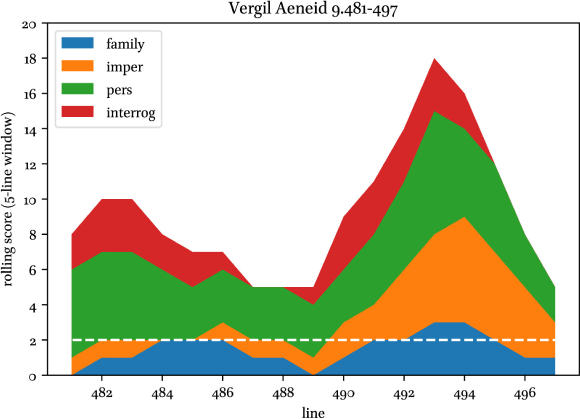
Table 18.4 gives as an example the list of speeches with max rolling score of 15 or higher—that is, the speeches containing the highest concentrations of motherly features within any window of five consecutive lines. Of the two speeches tied for top rank, one is by a mother to her child—the lament of Euryalus’ mother and address to her dead son at Aeneid 9.481–497. Figure 18.3 shows the distribution of tokens in each category of our feature set across the length of the speech. The y-axis shows the total number of tokens flagged as belonging to one of the hand-selected lexica within a five-line window around a given line. For example, the score for line 483 tallies motherly diction between lines 481 and 485 inclusively. Where the rolling window would extend beyond the bounds of the speech it is cut off: the score for line 481, for example, tallies only lines 481–483. While Euryalus’ mother deploys markers of motherly speech throughout this passage, there is a somewhat higher concentration at the beginning of the speech and a more prominent increase towards the end. There, a final emotional address to the son is followed by two swift changes of addressee, imploring first the Rutulians and later Jupiter to kill her along with her son. As she changes addressee, she also changes the forms she uses: a series of rhetorical questions (red) addressed to her son (481–483, 490–492) gives way to imperatives (orange) addressed to the Rutulians (493–494) and Jupiter (495–496). Family words (blue) are less dominant, while personal pronouns and possessives (green) contribute substantially throughout the speech. The dashed white line shows the median score across all five-line windows in the entire corpus.44
Table 18.4
Top speeches ranked by maximum score per speech. The tokens column gives the number of tokens as parsed by spaCy. This is roughly equivalent to the number of words, but some punctuation marks are included as well as enclitic ‑que in Latin. The max score column gives the highest count of tokens matching our “motherly” feature set in any five consecutive lines of the speech. Mothers addressing their children are marked with an asterisk.
|
author |
work |
locus |
speaker |
addressee |
tokens |
max score |
|---|---|---|---|---|---|---|
|
Vergil |
Aeneid |
9.481–497 |
mother of Euryalus * |
Euryalus |
622 |
18 |
|
Nonnus |
Dionysiaca |
48.832–847 |
Artemis |
Aura |
512 |
18 |
|
Statius |
Thebaid |
10.690–718 |
Creon |
Menoeceus |
1095 |
16 |
|
Nonnus |
Dionysiaca |
10.129–136 |
Semele |
Semele |
223 |
15 |
|
Nonnus |
Dionysiaca |
10.196–216 |
Dionysus |
Ampelus |
733 |
15 |
|
Ovid |
Metamorphoses |
10.320–355 |
Myrrha |
Myrrha |
1354 |
14 |
|
Silius |
Punica |
9.157–165 |
Solymus |
Fortuna, Mancinus, Satricus |
262 |
14 |
|
Ps.-Oppian |
Cynegetica |
3.220–233 |
mother donkey* |
child donkey |
430 |
14 |
|
Claudian |
Epithalamium |
20–46 |
Honorius |
Honorius |
871 |
14 |
|
Eudocia |
Homerocentones |
2059–2064 |
Mary* |
Jesus |
206 |
14 |
Figure 18.3
Motherly features over the course of the speech of the mother of Euryalus to her son, his killers and Jupiter (Vergil Aeneid 9.481–497). Rolling score tallies features over a 5-line window centred on the line in question. Total score is broken out into the categories used in our feature set
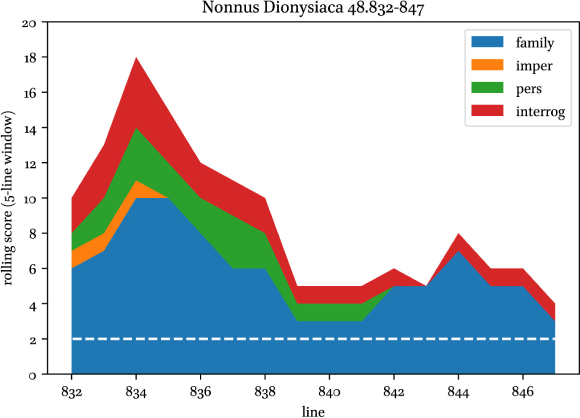
The other highest-scoring speech in the corpus, Artemis’ address to Aura in Nonnus’ Dionysiaca, is not by a mother but does extensively treat the subject of motherhood in an emotionally charged tone. In Book 48 of Nonnus’ poem, the nymph Aura teases Artemis and claims to have a less womanly body than the chaste goddess; in revenge, Artemis causes Aura to be raped by Dionysus in her sleep. After Aura has given birth, Artemis mocks her for her motherhood and for the physical changes it brings. The opening six lines of the speech include multiple family terms on nearly every line, while using rhetorical questions and emphatic pronouns to underscore the mocking tone.
Παρθένε ,τίς σε τέλεσσε λεχωίδα μητέρα παίδων ; ἡ γάμον ἀγνώσσουσα πόθεν γλάγος ἔλλαχε μαζοῦ ; οὐκ ἴδον οὐ πυθόμην ὅτι παρθένος υἷα λοχεύει . ἦ ῥα φύσιν μετάμειψε πατὴρ ἐμός ; ἦ ῥα γυναῖκες 835νόσφι γάμου τίκτουσι ; σὺ γάρ ,φιλοπάρθενε , κούρη ὠδίνεις νέα , τέκνα καὶ εἰ στυγέεις Ἀφροδίτην .Nonnus, Dionysiaca 48.832–837
Figure 18.4
Motherly features over the course of Artemis’ speech to Aura (Dionysiaca 48.832–847), as in Fig. 18.3
Maiden, whomade you themother ofchildren , lying in labor? How can one who knows not marriage havemilk in her breasts? I have never seen or heard of a virgin whobore a son !When didmy father change the course of nature? Can womenGive birth withoutmarriage , then? Mygirl ,you cherished your virginity—And nowyou are tobring forth newborns , though you despise Aphrodite yet.
In the cited passage, the tokens that are flagged as motherly features are highlighted with the same colors as in the graphical representation (Figure 18.4). Family words (blue) consistently make up a large fraction of the score in this case. The model however fails to recognize
The next-ranked speech in the list shares much with the speech of Euryalus’ mother, the principal difference being that here it is a father who speaks. At Thebaid 10.690–718, Creon addresses his son Menoeceus as the latter prepares to sacrifice himself for the sake of the city. Like Euryalus’ mother, Creon speaks in short interrogative phrases punctuated by reminders of their familial ties.
Table 18.5 shows the top-ranked mother speeches by max score. In addition to Vergil’s grieving mother of Euryalus, we also see Homer’s Hecuba, the archetypical grieving mother, among the high-ranking examples, along with a host of grieving mothers in imperial Greek and Latin epic, who are to one extent or another modeled after Homeric motherly prototypes.
Table 18.5
Top-ranking mother speeches according to max rolling score
|
author |
Work |
Loc |
speaker |
addressee |
tokens |
max score |
|---|---|---|---|---|---|---|
|
Vergil |
Aeneid |
9.481–497 |
mother of Euryalus |
Euryalus |
622 |
18 |
|
Ps.-Oppian |
Cynegetica |
3.220–233 |
mother donkey |
child donkey |
430 |
14 |
|
Eudocia |
Homerocentones |
2059–2064 |
Mary |
Jesus |
206 |
14 |
|
Statius |
Thebaid |
7.497–7.527 |
Jocasta |
Polynices, Argives |
1160 |
12 |
|
Homer |
Iliad |
22.82–89 |
Hecuba |
Hector |
275 |
11 |
|
Statius |
Thebaid |
6.138–183 |
Euridice |
Argives, Opheltes, Cadmus |
1642 |
11 |
|
Claudian |
De Raptu |
3.92–96 |
Ceres |
Proserpina |
154 |
11 |
|
Nonnus |
Dionysiaca |
31.136–190 |
Iris-Nyx |
Hypnus |
1706 |
11 |
Mary in Eudocia’s Homerocentones (1st redaction) is a striking case in point. By definition, the Homeric cento is a literary collage exclusively recombining lines taken from the Iliad and the Odyssey. The speeches are almost entirely composed from Homeric speech lines.45 This speech however scores higher than any of its “source speeches”. Figure 18.5 shows the shape of the rolling composite score over Mary’s brief address to Jesus. The motherly tone remains consistently high.
The first three lines of this passage draw on two speeches by the dead Anticlea to her son Odysseus in Odyssey 11. While both these source texts are mother speeches, neither ranks comparably to the Mary speech. Eudocia strikingly concatenates affectionate addresses (2059, 2061:
Figure 18.5
Rolling scores for the motherly features over the speech addressed by Mary the mother of Jesus to her son (Eudocia Homerocentones 2059–2064). As above

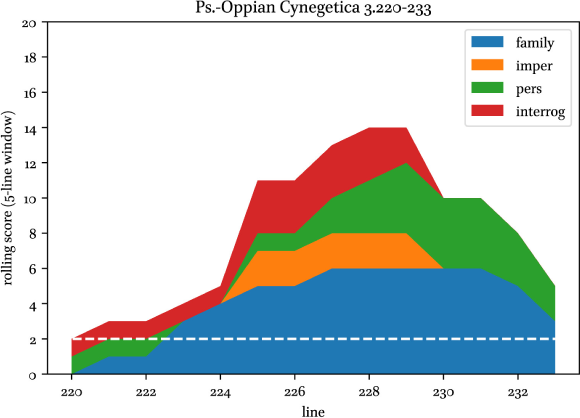
The high-ranking example from Pseudo-Oppian’s Cynegetica, on the other hand, can be read as a parody of a typical grieving mother speech, put into the mouth of a donkey whose male offspring has been castrated by the father. The peak in Figure 18.6 marks the transition from the first part of the speech (rebuking the father-donkey who mutilated the child) to the final part (lamenting the mutilated donkey-child).
When looking closer at the final lines, addressed at the donkey-child, it becomes clear that the high level of family words and pronouns is mostly due to the repetitive nature of this passage, evoking pathos. The family word
Pseudo-Oppian, Cynegetica 3.229–233δειλὴ , ἐγώ πανάποτμος ἀωροτάτοιο , λοχείης καὶ σὺ τέκος πάνδειλον ἀλιτροτάτοιο .230 τοκῆος δειλὴ , ἐγώ τριτάλαινα ,κενὸν τόκον ὠδίνασα ,καὶ σὺ , τέκος τμηθεὶς οὐχὶ στονύχεσσι λεόντων ,ἀλλ᾿ ἐχθραῖς γενύεσσι λεοντείῃσι . τοκῆος
Wretched and unhappy
trans. Mair, with changesI in my untimelymotherhood , and altogether wretchedyou , mychild , in your most sinfulfather . WretchedI , thrice miserable, who havetravailed in vain, and wretchedyou ,child , marred not by the claws of lions, but by the cruel lion jaws of yourfather .
Figure 18.6
Rolling scores for the motherly features over the speech addressed by a mother donkey to her child (Cynegetica 3.220–233). As above
What the automatic feature analysis does not show, but what makes this example especially interesting for this diachronic survey of mother speech, are the intertextual echoes of earlier mother and father speeches. Line 229 is of particular interest in this respect. The expression
7 Conclusions on the Method
We asked above, what does it mean to speak like a mother? In exploring our ability to quantify motherly speech, we found that although our proposed feature set was imperfect, it nevertheless did in important ways represent a motherly stylistic signal. At the same time, we learned much from the imposters, the false positives, and the mothers in disguise. Let us return one final time to the imposter mother with whom we began, before considering the limitations and implications of these results.
Iris-Nyx’ speech to Hypnus holds a relatively high position in our ranking of the “most motherly” mother-speeches (Table 18.5), confirming our intuitive reading of its features as striking (among the top 10 % of mother speeches and the top 3 % of all speeches), just as the frequency-based ranking method earlier on confirmed our feature selection to be indicative of mother-speech language. Looking at the rolling 5-line score over the course of the speech (Figure 18.7) we see two distinct peaks in the first half of the speech, followed by several smaller bursts of motherly language throughout the second half. We noted in Section 1 that the dense cluster of personal pronouns with which the speech opens emphasizes the connection between speaker and addressee and reinforces Iris’ assumed identity.47 Here we can see how Iris-Nyx combines them with rhetorical questions to heighten the emotional stakes of the speech. Her use of imperatives is relatively even—after all, she wants Hypnus to do something for her. But she carefully delays introducing them until after establishing a motherly tone in the first 10 lines and she bookends the demands with a smaller cluster of personal words at the speech’s conclusion.
Figure 18.7
Rolling scores for the motherly features in the speech of Iris-Nyx to Hypnus (Nonnus Dionysiaca 31.136–190). As above

It is noteworthy that several of the top speeches in our rankings, both mother- and non-mother, were from Nonnus. One reasonable hypothesis is that the motherly style we identified based on Nonnus’ mother speeches was at least in part a Nonnian style. An alternative, or perhaps complementary, explanation is that the features we identified do represent important aspects of epic motherhood, but with some important caveats: firstly, they are not exclusive features belonging to the stylized communication of a mother to her child—there is a clear overlap with other subcategories of speeches, especially highly emotional speeches in which family relationships are thematized, like father-child speeches (Statius’ Creon to Menoeceus), a soliloquy of a proud mother (Nonnus’ Semele) or speeches thematizing parenthood (Nonnus’ Dionysus guessing after the identity of Ampelus’ parents); and secondly, some of these features seem to have become more exaggerated over the evolution of the genre and its tropes. While our feature search indeed resulted in quite some high-ranking imperial Greek and silver Latin examples, we feel reassured by the presence of inarguably classic mother scenes in Homer and Vergil among the top as well, suggesting that our classifier is tuned into a broadly transtextual trope and sensitive to classical as well as late antique instances.
We find it interesting that although we built our diagnostic criteria around a particular sub-genre of persuasive mother speeches, when we applied them to the entire corpus, the speeches that were most highly ranked rather belonged to the category of grieving mother speeches, as well as non-mother speeches that share important traits with this type. These results suggest that to some degree in epic, to sound like a mother means to sound like a certain well-known type of mother. At the same time, we should be careful that what we choose to look for does not limit the kinds of answers we find, even in quantitative research. We hope that future work will be able to produce a more fine-grained classifier sensitive to nuance within mother speech (able to distinguish, perhaps, the persuasive and the grieving aspects of Hecuba’s speech to Hector in Iliad 22).
The promise of the DICES database was that computational methods would enable philologists to combine close reading with corpus-scale analysis. Our first attempt to implement such a study has given us confidence in that promise, but much work remains in the refinement of the technical methods. The use of a rolling window was helpful in making more manageable the uneven distribution of features and variability of speech lengths in the corpus, but the shortest speeches remain problematic. For example, in Statius’ Thebaid, as the dying youth Crenaeus slips beneath the waves for the last time, he cries out simply, mater! (9.350), and his mother Ismenis responds, with equal brevity, Crenaee! (9.356). Her one-word speech is clearly an arch example of the grieving mother, but a statistical metric that could capture this and compare it in a quantitatively meaningful way with, say, the 16-line speech of Euryalus’ mother, escapes us.
Meanwhile, the ability to extract lemma, part-of-speech, and morphological details from an entire corpus opens up enormous possibilities for contextualizing close reading, as we see here, but currently available methods are imperfect. While core texts are available in digital editions, those peripheral to the classical corpus are challenging to acquire; open-access texts contain errors and idiosyncrasies. Natural language processing tools based on machine inference can be unpredictable at times—the two models tested here, for example, produced incompatible results in the identification of future tense verbs. More generally, while DICES offers the tantalizing ability to search for speeches across both Greek and Latin, for the present both the specificity of the language models and real differences between the languages continue to make nuanced cross-language comparison a subjective process. We did not, so far, try to combine our feature search with complementary detection methods for tracing verbal repetitions and potential cases of intertextuality, as would have been particularly helpful, e.g. in the case of Pseudo-Oppian’s mother-donkey.48
Apart from these challenges of a more technical nature, the corpus of 94 mother speeches also appeared to be more diverse than we perhaps had anticipated. Yet, looking at the full stylistic range within the mother speech corpus, from the most motherly to the least motherly speeches, being able to tentatively measure this diversity is perhaps the most exciting result of our experiment. Let us illustrate this point by briefly returning to another speech that was also part of the close reading analysis. Interestingly, Venus-huntress’ second speech to Aeneas (Aeneid 1.325–370, in which she tells him the story of Dido) is among the lowest scoring mother-speeches (Figure 18.8). It only contains one personal pronoun (referring to herself as huntress, and therefore ambiguous, hiding Venus’ true self), a small number of family words, all referring to Dido’s family relations, and a rhetorical question at the end. Like Iris-Nyx’, Venus-huntress’ disguise is highly efficient. Her distant and impersonal narrative speech fools both her own son and our computational classification models.
Figure 18.8
Rolling scores for the motherly features in the speech of Venus-huntress to Aeneas (Vergil Aeneid 1.335–370). As above

Acknowledgments
This chapter is the result of a close collaboration between its two authors. We are grateful to the audience of the Nonnus of Panopolis in Context V in Madrid (2023), the participants of the Mt. Allison Epic Speeches Forum in Sackville, Canada (2023) and the members of the Hellenistenclub in Amsterdam (2024) for their thought-provoking questions and comments. We are much also endebted to Francesco Mambrini and Bernhard Söllradl who provided peer feedback in the course of the project and helped us to improve our arguments.
Appendix: Manually Selected “Motherly” Features: Family Words
As can be noticed, this list contains some non-existing words and inflected forms (marked with an *). These are included in the list because of the errors that occur during the automatized lemmatization process with spaCy and CLTK, which incorrectly identified these as the dictionary headwords corresponding to the family words we selected for our feature search. This family words lexicon is still work in progress. The present list allows for reconstructing and understanding the results of the experiments presented in this chapter.
|
altrix auus coniunx coniux filius frater gemina genetrix genitor genus infans mater maternus nascor nata nate natus parens pario partus pater paternus patrius |
pietas proavum proles puer soror spons * |
* |
See Shorrock 2001 for the most comprehensive study of Nonnus’ intertextual engagement and Accorinti 2016 (esp. chapters 22–25) for more up to date surveys.
Agosti 2004, 398: “Era si rivela attenta … lettrice dell’ Iliade.” See for extensive discussion Verhelst 2017, 55–62.
“Striking” here is an intuitive reader’s observation. See footnote 47 for a quantitative approach.
See Agosti 2005, Miguélez Cavero 2008, 316–340, Verhelst 2017, 74–79 and 221–273 and Delucchi in this volume (chapter 6, 138).
See Verhelst 2017, esp. 125–128 (on Iris-Ares’s speech), 194–199 (on Nike-Leto’s speech), and 97–98, 185–186 (on Athena-Morrheus’ speech). Tomcik in this volume (chapter 16, 370–371) discusses the relation between disguise and deceptive persuasion for the Flavian epics, but focuses on the aspect of familiarity and trust rather than on family ties.
See Reitz 2019 for recent surveys of the phenomenon with further references. One of the peculiar aspects of Nonnus’ disguised gods is that they deceive fellow gods. See Auger 2003, 415–417.
De Jong 2012, 117–118 discusses Deiphobus’ affectionate language, appropriate for a brother, and the cruelty of Athena. On the Athena-Morrheus speech in Nonnus see Kröll 2022, 91–93; Shorrock 2001, 86–87.
In recent years the topic of female and motherly perspectives in epic has been especially prominent in Latin Augustan and Flavian authors (e.g. Augoustakis 2010; 2012, Manioti 2016, McAuly 2015). On the Greek side, there has been an interest in the Homeric divine and mortal mothers, with Slatkin 1991 as an influential example. For a gendered perspective on Homeric speech, see especially Minchin 2007. See also Loraux 1990 and Sharrock, Keith 2020 on ancient (conceptions of) motherhood.
After some deliberation, we decided not to include the speech of Eeria, the daughter who breastfeeds her own father Tectaphus, although she assumes a motherly role (Dion. 30.167–185).
Repeating (be it on a larger scale) an earlier experiment: see Forstall, Finkmann, Verhelst 2022 for a more extensive description of the methodology.
Due to the unstable genealogy of the gods: e.g., Dionysus is encoded as the son of both Semele and Aphrodite in the Manto Database. The relationship with Aphrodite is based on a poem by Praxilla (PMG 752) and irrelevant to the context of Aphrodite’s speech to Dionysus (as son of Semele) in Nonnus.
In most of these cases, Manto and Wikidata had no information about speaker or addressee. This is especially the case for anonymous characters, e.g. the mother of Euryalus in Vergil (Aen. 9.481–497) or Pseudo-Oppian’s female donkey (Cyn. 3.220–233), and lesser known historical and mythological characters (e.g. Ismenis and Crenaeus in Statius’ Thebaid). These 24 also include a number of character pairs for which the speaker is disguised as the mother of the addressee, which could have been detected automatically, but this was not yet part of our search strategy at the time of the experiment.
See the introduction to this volume for a full overview of the DICES corpus. We have identified mother speeches in Apollonius, Callimachus’ Hymns, Claudian, Colluthus, Eudocia, Homer, Hesiod, the Homeric Hymns, Lucan, Oppian, Ps.-Oppian, the Orphic Argonautica, Quintus, Ovid, Silius, Statius, Theocritus, Valerius Flaccus and Vergil.
Aphrodite instructs her son Eros/Amor to incite gods or humans with passion in Apollonius’ Argon. 3, Aen. 1, Ov. Met. 5, Nonnus’ Dion. 33 and 41. She exhorts a whole throng of Erotes in Silius’ Pun. 7 and 11, Coll. De Raptu and in Claudian’s Epith. Claudian (Epith. 73–75), however, points out that only one single Amor is the biological son of Venus, the rest are her alumni, sons of the Nymphs. We decided to include the speeches to the Erotes (pl.) in Claudian in our corpus, although it is left ambiguous whether Amor is among them (Epith. 127: parvos … alumnos; 204: pennata cohors).
See Nelis 2001, 93–96 for Vergil’s creative engagement with Apollonius in this scene, with further bibliography. Ovid in turn primarily engages with Vergil (see Johnson 1996, 134) and further elaborates the image of Venus imperatoris (cf. her matriarchal authority in Silius).
As is well established in scholarship, e.g. Lennox 1980, Pavlock 1990.
Aphrodite’s attempts to punish her disobedient son is a literary topos in Hellenistic and later literature, cf. Moschus, Eros the Runaway; Lucian, Dialogi Deorum 19 and is also commonly depicted in art (cf. Young 2020, Venit 2002).
3.135:
Almost all mother speeches include one or more vocatives to address the child. Most common are
See Verhelst 2017, 64–69.
Compare the affectionate address of Vergil’s Venus to Amor (Aen. 1.664: Nate, meae vires, mea magna potentia), further echoed in the opening line of Ovid’s Venus to Cupid (Ov. Met. 5.365: arma manusque meae, mea, nate, potentia).
Referring to Helius’ betrayal of Aphrodite and Ares in Od. 8. Aphrodite highlights the blood ties between Helius and the Indians, especially their ruler Deriades (151:
In Vergil, Venus similarly asks Amor to make Dido fall in love with Aeneas, while also highlighting the sibling relationship (Aen. 1.667: frater ut Aeneas) between Amor and Aeneas.
Dion. 33.60–108 describes Eros participating in a game of kottabos. This scene was already recognized as derived from Apollonius (Argon. 3.111–128: Eros cheating in a game of knucklebones) in a marginal note of the L manuscript (ca. 1280) of the Dionysiaca. Nonnus continues his imitation of Apollonius after the speech of Aphrodite with the descriptions of Eros shooting the arrow (Dion. 33.189–191 // Argon. 3.281), of the darkness and silence of the night (Dion. 33.266–279 // Argon. 3.744–750) and Medea/Morrheus leaving their bed at night (Dion. 33.280 // Argon. 3.645). See Gerlaud 2005, 36–52 and 60–62 for extensive discussion with further references.
On the persuasive structure of Aphrodite-Peisinoe’s speech see also Carvounis 2014, 30–33, Frangoulis 2006, 42–46, and Verhelst 2017, 248–250.
Chuvin 1976, 42.
Another echo of Apollonius, cf. Argon. 4.57–65, the Moon mocking Medea.
Strangely, 4.92
See Fuhrer 2010, 68.
E.g. Belfiore 1984, 20; Reckford 1995, 11: “The reproach is heartfelt. This hide-and-seek business has happened, we may imagine, many times before.”
A striking similarity between the two episodes is the divine prophecy announcing everlasting glory for the Roman empire (race of Aeneas = race of Dardanus, Harmonia’s foster brother) which immediately precedes the disguised mother-child scene in both epics (compare Dion. 3.426–428; and Aen. 1.267–296). This may be an indication that Nonnus indeed had Vergil in mind when composing the episode on Samothrace. In studies of late antique poetry, however, the “Latin Question” remains a thorny issue. Whether or not Nonnus and other late antique Greek authors read and referred to Vergil and Ovid has been the subject of much, inconclusive discussion. See Carvounis and Papaioannou 2023 for the most thorough recent exploration of this possibility, with further references.
For Nonnus’ echoes of Apollonius in the wider context of Dion. Book 4 see Chuvin 1976, 43–44 and Vian 2001 (see also note 25), for Vergil’s engagement with Apollonius in Aen. 1 see Nelis 2001, 146–148.
Highet 1972, 271–276; Reckford 1995.
Thetis is a model for Venus, esp. in Aen. 1 and 8. See, e.g., Leach 1997. Hecuba’s attempt to persuade Hector to stay within the walls of Troy (Il. 22.82–89), albeit unsuccessful, is likely to be an important prototype for the affectionate type of motherly plea which we have encountered in Nonnus. See more below.
Text was available for 4122 of the 4690 speeches in the database, including 88 of the 94 speeches identified as mother-child. The text of the remaining 6 mother speeches (4 from Eudocia’s Homerocentones, 1 from Eudocia’s St. Cyprian, and 1 from Nonnus’ Paraphrase) were added manually. We should note that this creates a certain imbalance in the data, since the non-mother speeches from the same three works (88, 57, and 380, respectively) were not added.
Texts were parsed with CLTK using the default pipelines for Latin and Greek. The spaCy model used for Latin was la_core_web_lg 3.7.4 by Burns et al. For Greek, the spaCy model was grc_odycy_joint_trf 0.7.0 by Kostkan and Kardos. Latin:
Monroe et al. 2008 provides a helpful evaluation of several different metrics for feature selection in a two-class scenario (Republican vs. Democrat texts on abortion) comparable in some ways to our corpus. They find that “difference of proportions”, as they call the method we use here, overemphasizes high-frequency words relative to content words. However, since we are interested in balancing semantic features such as mater and
The NLP models had different strengths, resulting in variability in lemmatization. For example, only CLTK included nascor among the top lemmata, because the Latin model used with spaCy had difficulties lemmatizing the vocative nate, a key motherly word. On the other hand, CLTK often failed to recognize typographical variations of the pronoun
In future work we hope to rigorously test an approach using a hand-selected list of interrogative words in both languages. For the present experiment, in part due to the limits of the automatic parsing (especially in distinguishing interrogative and relative pronouns in Latin), a punctuation-based approach produced more consistent results.
The complete list of family words are given in the Appendix below. See also
An important consideration with this dataset is the presence of embedded speech. Where one character directly reports the words of another, the embedded words are attributed only to the innermost speaker and are excluded from the enclosing speech in order to avoid being counted twice. For example, when Odysseus in his Apologue reports to his internal audience the words spoken to him by the ghost of his mother Anticlea, her words are attributed to her and removed from Odysseus’ speech.
See both Burns (chapter 9) and Söllradl (chapter 13) in this volume for similar attempts to build a diagnostic feature set, resp. for speech and emotional speech styles.
From the accompanying digital appendix it is possible to consult and download the results of our computational analysis, including graphs similar to Figures 18.3–18.7 for every speech.
Note that the median score across all five-line windows is lower than the per-speech median shown in Figure 18.2. In that case each speech was represented solely by its highest-scoring five consecutive lines; the value shown here takes into account that most five-line windows across the corpus have much lower scores.
And only occasionally lines of the Homeric narrator. See Verhelst 2024 for a quantitative analysis of the Homeric origin of the speech lines in the Homerocentones, including a section on Mary’s reuse of motherly and wifely language. On Mary’s laments see also Lefteratou 2020.
In a still unpublished article (planned to appear in S. Renker, ed., Pseudo-Oppian’s Cynegetica), Sean McGrath moreover argues that the mother donkey scene imitates the scene with the mother dolphin in Oppian’s Halieutica (mother speech: Hal. 5.560–564). The allusions are apparent in the narrator text rather than in the speeches themselves in this case, but the similarities and comic inversions make it clear that Ps.-Oppian also engages in an intertextual play with a mother speech scene in his most immediate predecessor and model Oppian.
We can now also make a better judgement as to how exceptional such pronoun clusters are. When taking the five-line windows as our standard unit of observation, we find that clusters of five or more pronouns per five lines occur only in 9.72 % of all speeches (mother and non-mother) in the DICES corpus. Only 1.3 % have clusters of 7 or more pronouns as is the case in the Iris-Nyx speech. For sure, this is in part a feature of Nonnian style. Large clusters (five or more) occur more frequent in Nonnus’ Dionysiaca (16.3 %) than in any of the other multi-book epics, but even so clusters of seven or more are extremely rare: only four other speeches in the Dionysiaca share this feature.
Söllradl in this volume (chapter 12) demonstrates not only the utility of repetition as a stylistic feature for quantifying affect but also a preliminary attempt at combining automated detection of anaphora with lexical and morphological features. Cesca and Mambrini (chapter 2) show how automated text-reuse detection software can be applied to a corpus of DICES speeches. It would be an exciting next step to combine our feature search with corpus-scale methods for detecting intertextual allusions, such as, for example, those developed by the Tesserae project. (
Bibliography
Accorinti, D., ed. (2016). Brill’s Companion to Nonnus of Panopolis. Leiden/Boston.
Agosti, G., ed. (2004). Nonno di Panopoli. Le Dionisiache. Vol. 3 (Canti xxv–xxxix). Milan.
Agosti, G. (2005). L’etopea nella poesia greca tardoantica. In: E. Amato and J. Schamp 2005, eds., Ethopoiia: la représentation de caractères entre fiction scolaire et réalité vivante à l’époque impériale et tardive, Salerno, pp. 34–60.
Auger, D. (2003). “Le monde des rêves dans les Dionysiaques de Nonnos.” In: D. Accorinti and P. Chuvin, eds., Des géants à Dionysos: mélanges de mythologie et de poésie grecques offerts à Francis Vian, Alessandria, pp. 415–432.
Augoustakis, A. (2010). Motherhood and the Other. Fashioning Female Power in Flavian Epic. Oxford.
Augoustakis, A. (2012). “Per hunc utero quem linquis nostro: Mothers in Flavian Epic.” In: L.H. Petersen and P. Salzman-Mitchell, eds., Mothering and Motherhood in Ancient Greece and Rome, Austin, pp. 205–223.
Belfiore, E. (1984). ‘Ter Frustra Comprensa’: Embraces in the Aeneid. Phoenix 38, pp. 19–30. https://doi.org/10.2307/1088086.
Campbell, M. (1994). A commentary on Apollonius Rhodius Argonautica III 1–471. Leiden.
Carvounis, K. (2014). Peitho in Nonnus’ Dionysiaca: The Case of Cadmus and Harmonia. In: K. Spanoudakis, ed., Nonnus of Panopolis in Context. Poetry and Cultural Milieu in Late Antiquity with a Section on Nonnus and the Modern World, Berlin, pp. 21–38.
Carvounis, K., and Papaioannou, S., eds. (2023). Later Greek Epic and the Latin Literary Tradition: Further Explorations. Berlin.
Chuvin, P., ed. (1976). Nonnos de Panopolis. Les Dionysiaques. Vol. 2: Chants iii–v. Paris.
Frangoulis, H., ed. (2006). Nonnos de Panopolis. Les Dionysiaques. Vol. 12, Chants xxxv et xxxvi. Paris.
Forstall, C.W, Finkmann, S., and Verhelst, B. (2022). Towards a linked open data resource for direct speech acts in Greek and Latin epic. Digital scholarship in the Humanities 37, pp. 972–981. (https://doi.org/10.1093/llc/fqac006)
Fuhrer, T. (2010). Vergil’s Aeneas and Venus acting with words: Miscarried dialogues. In: T. Fuhrer and D. Nelis, eds., Acting with Words. Communication, rhetorical performance and performative acts in Latin literature, Heidelberg, pp. 63–78.
Gerlaud, B. (2005). Nonnos de Panopolis. Les Dionysiaques. Tome XI, Chants XXXIII–XXXIV. Paris.
Highet, G. (1972). The Speeches in Vergil’s Aeneid. Princeton, NJ. (https://doi.org/10.1515/9781400869466)
Johnson, P.J. (1996). Constructions of Venus in Ovid’s “Metamorphoses” V. Arethusa 29, pp. 125–149.
De Jong, I.J.F. (2001). A Narratological Commentary on the Odyssey. Cambridge.
De Jong, I.J.F. (2012). Homer, Iliad book XXII. Cambridge Greek and Latin Classics. Cambridge.
Kröll, N. (2022). Shape-shifting Athena. On the transformation of Homeric characters in Nonnus’ Dionysiaca. In: B. Verhelst, ed., Nonnus of Panopolis in Context IV: Poetry at the Crossroads, Leuven, pp. 77–102.
Leach, E.W. (1997). Venus, Thetis and the Social Construction of Maternal Behavior. CJ 92, pp. 347–371. http://www.jstor.org/stable/3298407
Lefteratou, A. 2020. The Lament of the Virgin in the I Homeric Centos. An Early Threnos. In F. Hadjittofi and A. Lefteratou, eds., The Genres of Late Antique Christian Poetry, Berlin, pp. 275–292.
Lennox., P.G. (1980). Apollonius, Argonautica 3, 1ff. and Homer. Hermes, 108, pp. 45–73. http://www.jstor.org/stable/4476147
Loraux, N. (1990). Les mères en deuil. Paris.
Manioti, N., ed. (2016). Family in Flavian Epic. Leiden. (https://doi.org/10.1163/9789004324664)
Mair, A.W. (1928). Oppian, Colluthus, Tryphiodorus. Oppian, Colluthus, and Tryphiodorus. Translated. Loeb Classical Library. Cambridge, MA.
McAuley, M. (2015). Reproducing Rome. Motherhood in Virgil, Ovid, Seneca, and Statius. Oxford. (https://doi.org/10.1093/acprof:oso/9780199659364.001.0001)
McGrath, S.E. (unpublished), Love, the universe and everything. The Cynegetica and Oppian’s Halieutica. To appear in: S. Renker, ed., Pseudo-Oppian’s Cynegetica. On the Hunt for Ethics and Poetics (provisional title).
Miguélez Cavero, L. (2008). Poems in context. Greek poetry in the Egyptian Thebaid 200–600AD. Berlin.
Minchin, E. (2007). Homeric voices. Discourse, memory, gender. Oxford.
Monroe, B.L., Colaresi, M.P., and Quinn, K.M. (2008). Fightin’ Words. Lexical Feature Selection and Evaluation for Identifying the Content of Political Conflict. Political Analysis 16(4), pp. 372–403. (https://doi.org/10.1093/pan/mpn018)
Nehrkorn, H. (1971). A Homeric Episode in Vergil’s Aeneid. AJPh 92, pp. 566–584. (https://doi.org/10.2307/292664)
Nelis, D.P. (2001). Vergil’s Aeneid and the Argonautica of Apollonius Rhodius. Leeds.
Pavlock, B. (1990). Eros, Imitation, and the Epic Tradition. Ithaca, NY.
Petersen, L.H., and Salzman-Mitchell, P., eds. (2012). Mothering and Motherhood in Ancient Greece and Rome. Austin.
Reckford, K. (1995). Recognizing Venus (I): Aeneas Meets His Mother. Arion 3, pp. 1–42. (http://www.jstor.org/stable/20163572)
Reitz, C. (2019). Apparition scenes in ancient epic. In: C. Reitz and S. Finkmann, eds., Structures of Epic Poetry, Volume II.2, Berlin, pp. 685–717.
Shorrock, R. (2001). The challenge of epic. Allusive engagement in the Dionysiaca of Nonnus. Leiden/Boston.
Sharrock, A., and Keith, A. (2020). Maternal Conceptions in Classical Literature and Philosophy. Toronto.
Slatkin, L.M. (1991). The power of Thetis: Allusion and interpretation in the Iliad. Berkeley.
Venit, M.S. (2002). Fit to be tied. The punishment of Eros and two vases by Euphronios in the Villa Giulia. In: A.J. Clark and J. Gaunt, eds., Essays in honor of Dietrich von Bothmer, Amsterdam, pp. 317–322.
Verhelst, B. (2017). Direct Speech in Nonnus’ Dionysiaca. Narrative and Rhetorical Functions of the Characters’ “Varied” and “Many-faceted” words. Leiden/Boston.
Verhelst, B. (2024). Who is speaking? A computational analysis of the Homeric heroic voices in the Homerocentones (first recension). Phoenix 77, pp. 374–397.
Vian, F., ed. (1997). Nonnos de Panopolis. Les Dionysiaques. Vol. 10, Chants xxx–xxxii. Paris.
Vian, F. (2001). Echoes and imitations of Apollonius Rhodius in Late Greek Epic. In: T.
Papanghelis and A. Rengakos, eds., A companion to Apollonius Rhodius, pp. 285–308. Reprinted in: D. Accorinti, ed., L’épopée posthomérique. Recueil d’études, Alessandria, 2005, pp. 89–114.
Whitmarsh, T., ed., Shorrock, R., Geisz, C., Whitby, M., Whitmarsh, T., and Verhelst, B., trans. (forthcoming). Collected Imperial Greek Epics. Volume One. Nonnus, Dionysiaca. Berkeley.
Young, Y. (2020). A painful matter: the sandal as a hitting implement in Athenian iconography. Humanit Soc Sci Commun 7. (https://doi.org/10.1057/s41599-020-00558-z)