


1 Introduction
In the surviving narratives of the Second Punic War, tradition holds that the Carthaginian army is overcome with dread when they see the Alps for the first time. In a speech recorded by Polybius, Livy, and Silius Italicus, Hannibal attempts to remove his soldiersâ fears by reminding them of what they had already accomplished.1 Livyâs account of the speech concludes by contrasting the difference between the appearance of the Alps and the reality of their navigability:
What else do they believe the Alps are except the peaks of mountains (montium altitudines)? They might suppose that the Alps are higher (altiores) than the ridges of the Pyrenees: surely, no lands touch the sky and are insurmountable to humans. Indeed, the Alps are inhabited, cultivated, give birth to and nourish living beings, allow passage to small forces and even to entire armies. The very ambassadors whom they saw before their eyes had not passed over the Alps lifted on wings from above. Not even their ancestors were indigenous, but they were foreigners, the inhabitants of Italy, and had safely crossed the Alps often with huge armies on the move, and with their children and wives.
21.30.6â9
Hannibal notes several reasons that his army should have no fear of crossing the Alps: people live in the mountains, ambassadors had just crossed the range, and both armies and migrants frequently make the passing. Polybiusâ version of the speech does not contain this rationale, but the evidence that the Livian Hannibal uses in his exhortation is markedly similar to the explanation that Polybiusâ narrator gives in a well-known digression attacking his predecessors (3.47.6â48.12).2 Scholars have demonstrated that the Polybian aside is likely the source for this portion of Livyâs speech or, as Levene has shown, can be viewed as both source and intertext.3 However, that Livy moves comments of Polybiusâ narrator into a character speech in the AUC is perhaps the most striking aspect of this allusive language.4 In this chapter I examine several speeches of Silius Italicusâ Punica for a similar narratological shift. I argue that Silius transfers language between narrators and character speeches as he engages with the AUC as both source and intertext. In several speech clusters across the Punica, Silius moves phrases and imagery reminiscent of Livyâs language between speakers to comment on the socio-political concerns of the late Flavian Age and to draw parallels between Hannibal, Hercules, and Domitian.
The relationship between the Punica and the AUC has encouraged a substantial bibliography. While earlier scholars treated Silius as a historian and Livy as his main source, more recent work has argued that Silius engages with Livy in original and complex ways.5 Other scholars have also detailed the complicated intertextual connections between Silius, Livy, and Vergil or considered how Livian exemplarity impacted the Punica.6 Importantly for the questions examined in this chapter, recent studies have considered the role of speeches in the Punica: Villalba Ãlvarez examines the correspondences between battlefield speeches in Silius and Livy; Billot compares the speeches at Zama to consider the approaches of Polybius, Livy, and Silius; and Bartolomé focuses specifically on âfailedâ battlefield speeches.7
Throughout the chapter, I focus on nodes of speech connected to Hannibal, who takes a conspicuously central role in the epic.8 The Punica includes extended episodes focusing on Hannibalâs childhood oath (1.70â139), his character sketch (1.239â267), his arming scene with an ekphrasis of a gifted shield (2.395â456), and two of his portentous dreams (3.158â213, 15.158â169). Of the seventeen books of the epic, seven (iv, v, viii, xi, xii, xiii, and xvi) open with narratives of Hannibalâs actions and three more (vi, ix, and x) begin with the description of a battle fought against him. Indeed, the focus on Hannibal has led Matier to note his place as the âreal heroâ of the epic and Klaassen to argue that he is an anti-hero set up as antithetical to Scipioâs Aeneas-like figure.9 Stocks argues that Silius engages with the prior Roman literary traditions about Hannibal to mark him as a character that both represents and inverts the ideals of Romanitas within the epic.10 Furthermore, speeches involving Hannibal are given considerable space in the epic. The DICES database indicates that Hannibal gives nearly twenty percent of the speeches in the Punica and is the addressee in another ten percent.11 During his campaign in Italy, Hannibalic speeches end three successive books (iv, v, and vi). Of the final seven speeches in the epic, Hannibal is the speaker of six and the addressee of the other.12 Hannibalâs frequent connection to speech in the Punica makes him an ideal figure for the analysis undertaken here.
Before continuing, however, I must address a key difference between speech in epic and historiography. The DICES database includes only instances of direct speech, while historiography frequently employs a mixture of direct and indirect speech, often moving between the two forms of speech within a single speech act.13 While Livy more frequently uses indirect speech, as can be seen in Hannibalâs speech at the foot of the Alps (21.30), he regularly includes both modes: a complete exhortation of Hannibal is rendered in direct speech when he encourages his Spanish allies (21.21.3â6) and Livy mixes the two modes when Hannibal addresses his forces as they depart Italy (30.20.2â9). In general, historiography employs both indirect and direct speech in instances where epic prefers direct speech, such as for battlefield exhortations and debate scenes. Therefore, as I compare the speeches of the AUC and the Punica, I use Livian examples of both direct and indirect speech and, for Silius, primarily the direct speeches catalogued in DICES.
2 Hannibal and the Alps
To begin, Hannibalâs speech at the foot of the Alps showcases how Silius weaves a complicated intertextual narrative as he adapts the language of the AUCâs narrators for the Punica. The form of the speeches in each text differs greatly. Livyâs version (21.30) is much longer than Siliusâ (3.506â511), which comprises only six lines of hexameter. Livyâs character speeches do tend to be longer than a corresponding speech act in the Punica.14 Still, there is much to encourage the direct comparison of both speeches: Livy was a vital source for Silius, both place the speech at the same point in the narrative, and the speech introductory language also resonates between the two texts:
Hannibal called an assembly (advocata contione) and revived the spirits of his troops (militum versat animos) with a mixture of reproach and encouragement (adhortandoque).
Livy 21.30.1
Punica 3.504â505⦠sed languida maestiscorda uirum fouet hortando reuocatque uigorem
He roused the sluggish hearts of his men from their sadness by encouraging them and he recalled their courage.15
Several words build the intertextual connection: Siliusâ revocat echoes Livyâs advocata, the phrase corda virum recalls militum animos in the AUC, and the gerund adhortando is repeated in the Punica in the simplex, hortando. Each text also includes a sequence of indicative verb (versat, fovet), gerund (castigando, hortando), and third verbal element joined by âque (adhortandoque, revocatque).
To compare the content of the two versions of the speech, Livyâs version (21.30) is rather long and is best summarized here. Livyâs Hannibal expresses surprise at the troopsâ fears (§â¯1), provides a list of their past exploits (§§â¯2â5), describes the Alps and their navigability (§§â¯5â9), praises the Celtsâ success against Rome (§â¯10â11), and finally notes the ultimate objective of assaulting the city (§â¯11). Here is Siliusâ much shorter version of the speech:
3.506â511non pudet obsequio superum fessosque secundis,post belli decus atque acies, dare terga niuosismontibus et segnes summittere rupibus arma?nunc, o nunc, socii, dominantis moenia Romaecredite uos summumque Iouis conscendere culmenhic labor Ausoniam et dabit hic in uincula Thybrim.
Does it not shame you, tired out by your success and the favor of the gods after the glory of war and the battle line, to turn your backs on these snowy mountains and to be too lazy to commit your arms to these cliffs? Now, comrades, now believe that you are climbing the very walls of imperious Rome and the highest summit of Jove. This task, this one will put Italy and the Tiber in bondage.
In content, then, the version of the speech in the Punica has some similarities to the one in the AUC: Hannibal summarizes Livyâs list of Carthaginian exploits (secundis / post belli decus atque acies) and describes the Alps (nivosis montibus). Generally, as Silius adapts the speech for the Punica, he condenses some portions of Livyâs version and removes others.
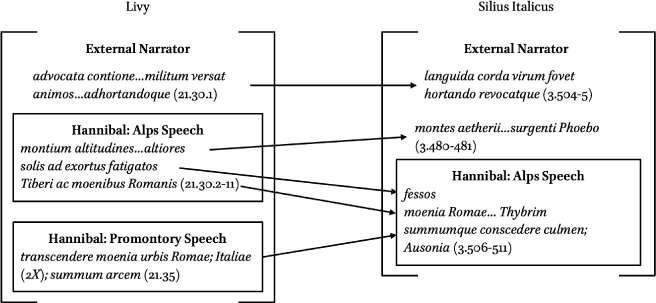
Despite these changes, direct verbal echoes appear in the concluding lines of the two speeches, with both mentioning an assault on Rome. Livyâs version ends with the following tag: âThe end of their journey is the field lying between the Tiber and the Roman wallsâ (itineris finem ⦠campum interiacentem Tiberi ac moenibus Romanis; 21.30.11). In both cases, Hannibal uses the pairing of Roman walls and Tiber to indicate their objective. The combination of the direct verbal parallels in the speech introductory language as well as the concluding lines provides a frame that further enhances the correspondences between the two versions of the speech. Figure 7.1 provides a visual representation of the shifts described here. Additionally, from the beginning of the Punica, both narrators and character speeches connect the imagery of crossing the Alps and assaulting Rome, as the language appears in the narratorâs opening lines (1.16) and in Hannibalâs childhood oath (1.114â119).16 On first glance, then, the language of both narrators and character speeches in the AUC and the Punica are linked for the scenes of Hannibalâs speech at the foot of the Alps.

Figure 7.1
Hannibalâs speech at the foot of the Alps

However, Siliusâ engagement with Livyâs text is richer and more complex. Despite the similarities just noted, the final lines of the Alps speech in the Punica have an even closer Livian parallel in a separate speech made by Hannibal:
After ordering his soldiers to stop, he shows them Italy and the fields on the plains along the Po lying below the Alps. He says that they are now climbing the walls not just of Italy but even of the city of Rome (moeniaque ⦠transcendere non Italiae modo sed etiam urbis Romanae). He says that the rest of the journey will be flat or downhill and that after one or at most two more battles they will take into their possession and under their power the highest citadel and capital of Italy (summum ⦠arcem et caput Italiae ⦠ac potestate).
21.35.8â9
Figure 7.2
Hannibalâs speech at the foot of the Alps (bis)

This speech is often called the âpromontory speech,â as its dramatic setting is a cliffside viewpoint in the Alps that overlooks Italy.17 At the same point in his narrative, Silius does not give a full speech, but he does have Hannibal climb above his troops and call down to them (3.517). This brief note highlights the absence of the promontory speech from the Punica and encourages the audience to consider, instead, how Silius incorporates parts of it elsewhere. As we compare Livyâs promontory speech with Siliusâ version of the Alps speech, we see that both include a compounded form of scandere (conscendere; transcendere), mention the walls of the city, and correlate that goal to a summit (summum ⦠culmen; summum ⦠arcem). Italiae is repeated twice in Livyâs promontory speech and appears in the Punica with the mythological moniker Ausonia. With these additions to Hannibalâs speech at the foot of the Alps, Silius embeds the heart of Livyâs promontory speech into the earlier exhortation while eliminating the later speech from the narrative. This move effectively combines the two Livian speeches, made by a single character, into one speech in the Punica, despite that speechâs condensed length and focus (see figure 7.2).
The description of the Alps in each text reveals how Siliusâ intertextual engagement with the AUC also appears at the level of the narrators:
The rank and file was certainly afraid (timebat) of the enemy, since the memory of the previous war had not yet been erased (nondum oblitterata memoria superioris belli), but even more were they fearing (metuebat) the immeasurable journey and the Alps, a task made dreadful by rumor (rem fama ⦠horrendam), at least to the inexperienced (inexpertis).
21.29.7
Silius 3.477â482Sed iam praeteritos ultra meminisse laboresconspectae propius dempsere pauentibus Alpes.cuncta gelu canaque aeternum grandine tectaaequaeuam glaciem cohibent: riget ardua montisaetherii facies surgentique obuia Phoeboduratas nescit flammis mollire pruinas.
But when the Alps were seen up close, they removed from the terrified men all the memories of their prior labors. The Alps are always covered with ice and hail and contain an age-old glacier. The sheer face of the airy mountain rises straight up and, even when it is face-to-face with the rising sun, there is no way for the sun to soften the harsh snows with its heat.
Elements of the narratorsâ descriptions approximate each other. Both Livy and Silius note the terror felt by the troops (timebat ⦠horrendam; metuebat; paventibus), and this fear impacts the memories of their past deeds.18 Importantly, however, Hannibalâs troops in the Punica have their memories struck blank at the terrifying sight of the Alps, while in the AUC they keep the memories of their recent successes despite their fear. This difference plays out in the two versions of Hannibalâs speech: Livyâs Hannibal delivers a thorough and detailed list of their deeds (21.30.2â5), while Siliusâ Hannibal narrowly mentions his soldiersâ victories in a few words: secundis / post belli decus atque acies (3.506â507). The intertextual connections between the two accounts encourage the audience to compare the speeches, thereby revealing that the recollection of the Carthaginiansâ past successes is not as prevalent in the Punica as it is in the AUC. The expectations that the narrators make in both texts about the presence (for Livy) or absence (for Silius) of the troopsâ memories are realized by the speeches of the two characters.
Although Silius leaves out elements of the Livian version of Hannibalâs Alps speech from his own, as noted above, he shifts descriptive language from that speech to his narrator. In the middle of Hannibalâs speech in the AUC, he calls the Alps montium altitudines and describes them as altiores (21.30.6; quoted at the beginning of the chapter). Siliusâ narrator identifies them as montis / aetherii (3.480â481), with the phrase enjambed between the lines to further emphasize the physical expanse of the Alps. A few lines later (3.492â493), Silius places altis / montes at successive line ends. Similarly, Livyâs Hannibal opens his speech by expressing his surprise at the troopsâ fear of the imposing mountain range before them, and then gives them reasons to take heart:
He said that he was amazed at the sudden fear that invaded their always fearless hearts. ⦠At that time, it seemed long to no one, although they made their way from the far west to the extreme east (solis ad exortus). ⦠They have the Alps in sight, with Italy on the other side of them, they stopped fatigued at the very gates of the enemy (in ipsis portis hostium fatigatos)!
21.30.2, 4â5
In this portion of the speech, Hannibal uses his soldiersâ past experiences to dispel their present concerns. Despite this sectionâs absence from the Silian version of the speech, some of Hannibalâs comments here align with those made by the narrator of the Punica. Both mention the rising sun: solis ad exortus in Livy and the metonymic expression surgenti Phoebo in Silius (3.481, given above). Livyâs Hannibal also notes the exhaustion of his troops (fatigatos). The description of the armyâs fatigue appears at both narrative levels in the Punica: the narrator claims the soldiers have âsluggish heartsâ (languida ⦠corda; 3.504â505) and the Silian Hannibal, immediately afterward, describes the troops as fessos (3.506). Silius thereby duplicates a comment in a Livian speech across two levels of his narrative, as summarized in figure 7.3, below.
Figure 7.3
Hannibalâs speech at the foot of the Alps (ter)
Silius also engages with various Livian speakers in the notion that Hannibal follows in the steps of Hercules.19 In the description of the Alps, the narrator of the Punica claims that âHercules was the first to approach these citadels previously untriedâ (primus inexpertas adiit Tirynthius arces; 3.496). While Siliusâ inexpertas mirrors the narratorâs comment in Livyâs description of the Alps (inexpertis; 21.29.7), the sense of the rest of the line, with its focus on Hercules, does not appear in Livyâs account of Hannibalâs speech at the foot of the Alps. Silius returns to the idea a few lines later in indirect speech as Hannibal exhorts his forces to cross the most difficult portion of the Alps:
3.513â517⦠uestigia linquere notaHerculis edicit magni crudisque locorumferre pedem ac proprio turmas euadere calle.rumpit inaccessos aditus atque ardua primusexuperat summaque uocat de rupe cohortes.
He orders them to leave behind the well-known paths of the great Hercules, to march in unknown places and to avoid the crowds on a pass of their own. He breaks open previously inaccessible pathways, was the first to conquer steep places, and he calls to his troops from the highest cliff.
Hannibalâs orders here are rendered as a type of reported speech (not represented either in direct speech or indirect speech). He pushes his men to overcome the idea that made the Alps fearful in the first place. They were traversing known pathways (vestigia ⦠nota) frequented by crowds (turmas). The descriptive language here makes the typical pathway of the Alps far from âuntried,â as both Silius and Livy had hinted (inexpertas, 3.496; inexpertis, 21.29.7)âa fact that Livyâs Hannibal admits (21.30.6â9) in the passage at the opening of this chapter. However, the Silian Hannibal orders his troops to advance by breaking completely new ground (inaccessos aditus).20 Just as Hercules was the first (primus) to take any path through the Alps, Hannibal here is the first (primus) to traverse these higher trails. Not only does Hannibal outdo Hercules in his path through the mountains, Silius also allows Hannibalâs primus to surpass Herculesâ primus by moving it to the emphatic line-final position.
While Livy makes no direct connection between the similar journeys of Hercules and Hannibal in his narrative of the crossing of the Alps, he does include a similar comment in Publius Scipioâs speech before the Battle of the Ticinus (21.40â41).21 Throughout the speech, Publius discusses potential strategies for the campaign against Carthage and warns the soldiers that they are now fighting to protecting Italy itself and their families, not some distant lands. In the middle of his speech, Publius makes the following quip: âIt would please me to know whether Hannibal is emulating the journey of Hercules, as he himself claimsâ (experiri iuvat ⦠utrum Hannibal hic sit aemulus itinerum Herculis, ut ipse fert; 21.41.6â7). This comment includes an embedded reported speech that Hannibal himself asserts to follow in Herculesâ footsteps, even though he never makes this claim elsewhere in the AUC. The closest the Livian Hannibal comes to giving voice to that idea is when he reminds his army that they began their journey at the âPillars of Herculesâ (ab Herculis columnis; 21.43.13), but he never again mentions the demigod as he describes the rest of their march. This short comment emphasizes the absence of Herculesâ name from the rest of Hannibalâs speech, in direct opposition to the claim made just before by Publius Scipio that Hannibal himself asserts that he is an emulator of Hercules.
In the Punica, however, Silius includes in the voices of the narrator and Hannibal himself what was otherwise an unsupported claim made by Publius Scipio in the AUC, as is shown in figure 7.4. This move reifies the idea that Hannibal follows and even outstrips the passageways traversed by Hercules and allows Silius to correct Livy for the absence of this element in Hannibalâs speech. For any character in Siliusâ narrative, the emulation of Hercules would have taken on a special significance in Flavian Rome, given Domitianâs own syncretism with the demigod.22 As Silius doubles down on the correlation between Hannibal and Hercules, he also creates an allusive comparison between Hannibal and Domitian, perhaps implying the danger that the emperor poses to Rome and even forecasting his eventual defeat.
Figure 7.4
Hannibalâs speech at the foot of the Alps (quater)

3 Omens at Lake Trasimene
Next, we will consider the speeches that bookend Siliusâ account of the Battle of Lake Trasimene. Character speeches of Flaminius and Hannibal use language that not only mirrors each other but also gains additional significance when compared to the words of Livyâs narrator. In the Punica, Flaminius encourages his troops before the battle in a multipart speech (5.107â129 and 5.151â185) surrounding a heroic arming scene (5.130â150). In the first section of the speech, Flaminius describes the Roman arms as a means of divination and then questions what might follow if Hannibal advances unopposed:
5.118â126⦠sat magnus in hostemaugur adest ensis, pulchrumque et milite dignumauspicium Latio quod in armis dextera praestat.an, Coruine, sedet, clausum se consul inertiut teneat uallo, Poenus nunc occupet altosArreti muros, Corythi nunc diruat arcem,hinc Clusina petat, postremo ad moenia Romaeinlaesus contendat iter? deforme sub armisuana superstitio est.
The sword is a powerful enough diviner against the enemy, and what the right hand, when armed, can accomplish is a glorious and fitting omen, worthy of the soldier of Latium. Or, Corvinus, should the consul settle down and shut himself in to hold a useless rampart? Let the Carthaginian soon seize the high walls of Arretium? Let him tear apart the citadel of Cortona and, from there, let him seek out Clusium, and finally should he make his way untroubled to the walls of Rome? A meaningless superstition is an ugly thing for those under arms.
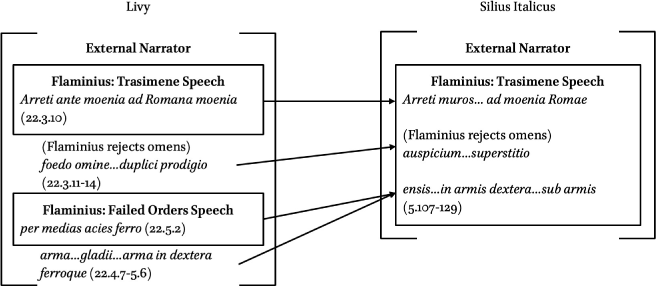
Flaminius dismisses other means of divination and prefers instead to encourage his troops to fight their way to victory in reliance on their own arms and skill.23 The corresponding speech in Livyâs narrative (22.3.10) contains several elements that correspond to Flaminiusâ supposition of what would happen if they were to choose not to confront Hannibal. Both speeches frame the potential disaster with the images of the walls of Arretium and Rome (Livy: Arreti ante moenia ⦠ad Romana moenia; 22.3.10). However, Flaminius makes no overt discussion of omens or divination in his speech in the AUC as he does in the Punica. Nevertheless, as the narrative resumes, Flaminius dismisses two portents that forbode the Romansâ defeat: the consul is thrown from his horse, which Livy labels a âterrible omenâ (foedo omine), and the standard-bearer is unable to lift the standard to tell the troops to advance (22.3.11â12). After Flaminius orders his troops to ignore the signs, Livyâs narrator notes how the soldiers remain âterrified by this two-fold portentâ (territis ⦠duplici prodigio; 22.3.14).24 The walls of Arretium and Rome and Flaminiusâ rejection of various omens allow Silius to combine the words of Livyâs narrator with those of his character speech into a single speech act in the Punica.
However, the omens change considerably between the two texts. Portents play a large role in the AUC and, as such, Siliusâ audience would likely pay attention to any mention of omens here in the Punica. While Livyâs narrator famously describes Flaminiusâ dismissal of the portents, Silius includes an omen and its interpretation within the speech itself. This allows the poet to renegotiate the sign and its meaning for the Punica. The Silian Flaminius alters the focal point of the omen to spotlight the soldiersâ right hands, swords, and armor (ensis ⦠in armis dextera ⦠sub armis). This focalizes the attention of both external and internal audiences onto the soldiersâ armament. In the corresponding Livian version of the speech, Flaminius discusses none of these items. However, there is a moment within the battle shortly after the Carthaginians ambush the Romans that the consul does encourage his men to action: âHe exhorts them ⦠that by the sword a way may be made through the middle of the enemyâs linesâ (adhortatur ⦠per medias acies ferro uiam fieri; 22.5.2). Unfortunately, the chaos of the battle makes his orders inaudible (22.5.3). The Roman troops in Livyâs narrative therefore never receive the encouragement to use their swords to escape the melee.
Livyâs narrator, however, repeatedly brings our attention to the Romansâ arms throughout the battle:
The shout [of the Carthaginians] arose from all sides and the Roman forces sensed that they were surrounded before they could see it, and the fighting began in front of them and to their sides before their battle lines were drawn up or before they were able to prepare their arms or draw their swords (expediri arma stringique gladii possent).
22.4.7
Their minds were hardly capable of seizing their arms and preparing for battle (ad arma capienda aptandaque pugnae), and some of them were cut down, more burdened than protected by their arms.
22.5.3
It became apparent that there was no hope of safety for them except in their right hands and in their swords (in dextera ferroque). Then each man became his own leader and motivator for setting himself to the task, and a new battle sprung up from the one that was not yet finished.
22.5.6
While a description of their weaponry might be typical of a battle narrative, Livyâs narrator reiterates that the Romans failed to employ their arms. He repeats twice that Hannibalâs surprise attack engaged the Romans before they could put on their armor or draw their swords and even notes their arms were a burden. Although the soldiers come to the realization that they must fight their way out the external audiences of both texts know well that the Roman soldiers are doomed. The outcome of Flaminiusâ prophecy in the Punica has already been realized by Livyâs narrator who reiterates that the Romans were unable to use their armament throughout the battle. By incorporating language that mirrors Livyâs narrator into Flaminiusâ speech, as visualized in figure 7.5, Silius has the consul offer an omen that can never come to fruition, because the portent, as so described, contradicts the previously established narrative of his source text.
Figure 7.5
Flaminius at the Battle of Lake Trasimene
In the aftermath of the battle, the Silian Hannibal further complicates this imagery in a speech encouraging his men to examine their defeated enemy:
5.669â678⦠âQuae uulnera cernis,quas mortes!â inquit âpremit omnis dextera ferrum,armatusque iacet seruans certamina miles.hos, en, hos obitus nostrae spectate cohortes!fronte minae durant, et stant in uultibus irae.et uereor, ne, quae tanta creat indole tellusmagnanimos fecunda uiros, huic fata dicarintimperium, atque ipsis deuincat cladibus orbem.âSic fatus cessit nocti; finemque dederecaedibus infusae subducto sole tenebrae.
[Hannibal] says, âWhat wounds do you see? What deaths? Every right hand grasps its sword, and every soldier lies in armor and preserving the struggle. Behold, comrades! Look at these dead men. The threats endure on their brows, and their anger remains fixed on their faces. I am afraid that the fates dictate an empire to this land, which abounds in such quality and produces these heroic men, and that it will conquer the earth even in defeat. He spoke these words and then yielded to the night. The sun set and darkness poured in and gave an end to the slaughter.â
Figure 7.6
Flaminius at the Battle of Lake Trasimene (bis)

Hannibal provides a vivid description of the dead Roman soldiers, who lie lifeless but still ready for war in armor, with their hands on their swords, and threatening looks fixed to their faces. His language (dextera ferrum armatusque) coincides with Flaminiusâ prophecy before the battle and the comments made by Livyâs narrator, as shown in figure 7.6. In Livyâs narrative of the battle and its aftermath (22.4â7), Hannibal makes no speech equivalent to this one from the Punica.25 Instead, the Livian Hannibal buries his fallen men, searches in vain for the body of Flaminius, and agrees to Maharbalâs concession to release some captured Romans with a single item of clothing each (22.6â7). Hannibal frees them and places them in chains. Livyâs narrator labels this move as âPunic scrupleâ (Punica religione; 22.6.12). In the speech in the Punica, too, the narrator indicates that the Silian Hannibal perpetrates a deception. Immediately after Hannibal finishes his speech, the sun sets and darkness falls, concluding the battle. This sudden move to darkness would obscure the Roman bodies on the field for Hannibalâs men. While this is fitting for a battle already marked for its limited visibility, it also allows the Silian Hannibal to act with âPunic scrupleâ like his Livian counterpart. The internal audience of the Carthaginian army must trust Hannibal at his word. The textâs external audience, however, understands that the spectacle the general describes is inaccurate: the Romans were unable to arm themselves or wield their weapons, so their bodies should not appear as Hannibal reports.
In his narrative of the Battle of Lake Trasimene, Silius includes speeches by Flaminius and Hannibal that incorporate language and imagery that coincide with descriptions made by Livyâs narrator and two Flaminian speeches. In so doing, Silius playfully engages with the larger traditions surrounding the battle. Flaminius is known from the AUC to have disregarded the disastrous omens that occurred the morning of the battle. In the Punica, his speech offers its own means of divination, in a comment that the external audience, aware of Livyâs narrative, knows will fail. Hannibal uses the same imagery in his speech after the battle to trick his own troops. This move shows him using some unscrupulous behavior parallel to his Livian counterpart and allows Siliusâ audience to question Hannibalâs own prophecy for the future of the Roman Empire, that Rome can âconquer the earth, even in defeatâ (deuincat cladibus orbem). The audience of the Punica can only fully appreciate the impact of this spectacle by considering the way in which Silius intertextually embeds the language of Livyâs narrator and character speeches into his own to question the efficacy of Flaminiusâ prophecy and enhance Hannibalâs deception.
4 The Battle of Zama
The speeches given by Hannibal and Scipio before the Battle of Zama, as depicted by Livy and Silius, are rightly famous for the ways that they allow the authors to define both the battle itself and the entire account of the war to that point.26 Although an iconic part of the tradition of this battle is a private meeting between Hannibal and Scipio (Polyb. 15.6, Liv. 30.30â31, App. Pun. 39, Flor. Epit. 1.22.58â59, Zon. 9.14), the conversation does not appear in the Punica.27 Here, I will focus on the series of exhortations offered to their troops shortly after their meeting and before the battle. As Scipio and Hannibal return to their camps, Livy provides a reported speech shared by the two generals:
As they went into their camps, both announced that the soldiers should prepare their arms and their courage for the decisive struggle, to be the victors not just for a single day, but for all time (in perpetuum), if fortune were present for them. They said that they would know before the following night whether Rome or Carthage would make laws for the world, for the reward for victory would not be Africa or Italy but the whole earth (orbem terrarum).
30.32.1â2
This âcamp speechâ allows Livyâs narrator to provide an explanation of the lessons each learned in their joint meeting, which links together the fates of Rome and Carthage by voicing parallel interpretations of the battle in the mouths of both generals.28 Livyâs report gives the impression that the two generals speak verbatim exhortations synchronously in their own encampments, claiming that whoever wins this engagement controls the world (orbem terrarum). This shared speech even includes the notice that the outcome decided here will last âfor all timeâ (in perpetuum). There are, of course, Vergilian echoes here from Jupiterâs prophecy in the Aeneid that carry important notions of Augustan ideology: âI offer them neither limits to their space nor time, but I give them empire without end,â (his ego nec metas rerum nec tempora pono / imperium sine fine dedi; 1.278â279). Livy also includes the possibility for worldwide rule in Hannibalâs battlefield exhortation:
[Hannibal] shows them it will either be death and slavery or the rule of whole earth (imperium orbis terrarum), there is no middle ground to hope for or fear.
30.33.11
The conclusion of Hannibalâs speech here recalls the terminology both generals use in the camp speech, (orbis terrarum), but adds the idea of imperium. Although the camp speech is absent from the section of the Punica that might have been lost, Hannibalâs battlefield exhortation does conclude with the interpretation that the battle would determine rule over the entire earth:
17.335â340â⦠non altera restatiam Libyae, nec Dardaniis pugna altera restat.certatus nobis hodie dominum accipit orbis.âHannibal haec. sed non patiens remorantia uerbaAusonius miles, quotiens dux coeperat orasoluere ad effatus, signum pugnamque petebant.
âThere is not another battle left for Carthage, nor is there one for the Romans. Today, the struggle will yield the mastery of the world to one of us.â Hannibal said these things, but when their general began to open his mouth to speak to them, the Roman soldiers did not allow the words to delay them and demanded the signal and the battle.
The speech in its entirety (17.295â337) is the longest of Hannibalâs speeches in the Punica. Conversely, Scipioâs speech is cut off before it begins. The Silian narrator ensures that the absence of Scipioâs speech is conspicuous by remarking that he prepared to speak only to be cut off by his troopsâ enthusiasm for battle. As we compare the character speeches between Livyâs and Siliusâ Zama narratives, we see that the language of the camp speechâa reported speech from the AUC shared between the two generalsâappears in an exhortation in the Punica made by Hannibal alone. This allows Siliusâ Hannibal to usurp Scipioâs entire speech. The Roman general is silenced both by his troops and by the way that the Silian narrative moves the language from two speeches, including one shared by the two generals, into a speech given by Hannibal alone.29
Additionally, there are elements of Hannibalâs exhortation at Zama that correspond to Siliusâ narrative of Lake Trasimene. Just as Flaminius and Hannibal both offered omens in their speeches at Trasimene in the Punica, Scipio, before Zama, makes an ominous prediction (ominatur; 30.32.9). Scipio claims that the Carthaginians received portents like those before the Battle of the Aegates Isles (30.32.9â10), sealing the fate for a Roman victory like the one they earned at the end of the First Punic War. Here, the external audiences of both the AUC and the Punica know that Scipio prevails in the engagement to come, as Livy hints when he claims that Scipio delivers this speech such that âyou would think that he had already conqueredâ (vicisse iam crederes; 30.32.11).
5 Conclusions
Finally, what do the changes made in Hannibalâs speeches at Zama and elsewhere reveal about Siliusâ perspective on contemporary Rome? Hannibalâs Zama exhortation recalls speeches around the Battle of Lake Trasimene in content and language. In both texts Hannibal celebrates the exploits of his soldiers. Livyâs Hannibal (30.32.6) is said by the narrator to call out individuals and to remind them of their many successes in Italy. In the Punica, Hannibal specifically evokes the memory of the Battle of Lake Trasimene: âYou brought me the dripping head of the dead general Flaminius! I know your right hand,â (tu mihi Flaminii portas rorantia caesi / ora ducis: nosco dextram; 17.295â296). Hannibal here recalls the battle itself and the speeches made before and after the engagement. He highlights a soldierâs dextram, recalling the word in the competing omens shared by Hannibal and Flaminius at Trasimene. This shared language encourages the audience to compare Hannibalâs speeches at these two battles, as figure 7.7, below, illustrates. Between them, Hannibal provides two divinations for the future of Roman power that are strikingly similar with one important shift. Hannibal ends his speech at Trasimene with imperium ⦠orbem (5.676) and the one at Zama with dominum ⦠orbis (17.337). Within the context of the Punica, then, Hannibalâs speeches take the Roman world from imperium to dominum. This shift is identical to a change that becomes evident when the Livian and Silian versions of the Zama speeches are compared: Livy concludes Hannibalâs exhortation with imperium orbis terrarum, compared again to Siliusâ dominum ⦠orbis. Consequently, Hannibalâs exhortation at Zama in the Punica referentially connects itself to two different speeches: externally, his corresponding speech in the AUC; and, internally, his speech after Trasimene. In both cases, the Silian Hannibal at Zama stresses a shift from imperium to dominum.
Figure 7.7
Zama âcamp speechâ and battlefield exhortation

Similarly, when we compare Livyâs promontory speech with its intertextually connected passage of the Punica, we find that the Hannibal has exchanged Livyâs urbis Romae ⦠potestate (21.35.8â9) for dominantis ⦠Romae (3.509). Hannibalâs character speeches in the Punica therefore replace words of import to Republican or Augustan Rome (imperium, potestas) with words of greater significance in the late Flavian age (dominum, dominantis). This change allows Silius to reflect on contemporary concerns. Scholars have often recognized the Punica as a text that explores meaningful turning points in the Roman world or have often focused on the image of Scipio in the epic as a precursor for solitary rule in Rome or as a positive role model for Domitian.30 Other contemporary questions of the civil war that allowed the Flavians to take power arise throughout the text and its intertextual connections to Lucanâs De Bello Civili.31 However, the analysis in this chapter of the narrators and character speeches in the epic provides an additional wrinkle to this interpretation, complicated by the connections between Hannibal and Hercules in the narrative of the Alpine crossing, discussed above. Hercules is the figure that connects Hannibal, Scipio, and Domitian. While Hannibal surpasses the semi-divine hero in his crossing of the Alps, the Punica ends with an image of Scipio in his triumphal chariot looking like Hercules (17.649â650).32 While the epic largely offers Domitian a positive role model in Scipio and the affinity for Hercules that the two share, Hannibalâs own emulation of Hercules within the text and his character speeches warn of the dangers faced to Rome by a different side of Hercules, one that might take the peaceful Republican and Augustan ideals of imperium and potestas and replace them with an overpowering dominum. The complex way that Silius engages with Livyâs narrator and speeches throughout the Punica thereby provides another lens for the poetâs reflections on contemporary politics: a warning that, much like Hannibal, danger continues to lurk near the walls of Rome.
Acknowledgements
I thank the organizers of the DICES workshops, Christopher Forstall, Berenice Verhelst, and Simone Finkmann, for creating this useful database and encouraging such great conversations among the meetingsâ participants. This paper has benefitted greatly from comments and discussions with Berenice, Christopher, and the other contributors to this volume. I would also like to thank BYUâs Kennedy Center for supporting my travel to Rostock for the initial DICES workshop in 2022.
For the full accounts of each speech: Polybius 3.44, Livy 21.30, Silius 3.506â511. Parts of Livyâs and Siliusâ speeches will be examined in the chapter below. For how these speeches fit into the opening sequence of the Second Punic War: Händl-Sagawe 1995, 193â195.
Esp. Polyb. 3.48.5â7. For Livyâs echo of Polybius: Doblhofer 1983, 142â144; Händl-Sagawe 1995, 196â197; Feldherr 2009; Levene 2010, 148â155; 2014, 208.
Levene 2010, 154â155. Livy simultaneously uses Polybius as a source and creates a wider allusive relationship with him: Levene 2006, 84â85.
On this move and its impact throughout the Third Decade: Oughton 2016.
On Silius and Livy: Nicol 1936; von Albrecht 1964, 15â24; Gibson 2010; Pomeroy 2010. For some other approaches to the question of Siliusâ sources: Lucarini 2004, Devillers, Krings 2006, and Campus 2008.
e.g. Bartolomé 2018; Chaudhuri et al. 2015; Ricchieri 2019; On exemplarity: Tipping 2010a; Walter 2018.
Villalba Ãlvarez 2007; Billot 2014; Bartolomé 2015. For battlefield exhortations, see also Schwameis and Telg genannt Kortmann in this volume (chapter 4).
For Hannibalâs role in the epic: Dominik 2003; Foulon 2003; Stocks 2014; Fucecchi 2020.
Matier 1989; Klaassen 2010.
Stocks 2014.
Per DICES database search 12 September 2022, Hannibal is the speaker in 60 of 318 total speeches in the Punica and the addressee of 34 speeches. According to Schwameis and Telg genannt Kortmann in this volume, the total number is 59 after the restoration of the transmitted text at 1.340 removes a speech otherwise attributed to Hannibal (see chapter 4, 87â89).
Hannibal as speaker: 17.445, 460â466, 542â543, 548â553, 558â565, and 606â615; as addressee: 17.570â574.
Usher 2009. Villalba Ãlvarez 2007, 359â365, contrasts the uses of direct and indirect speech by Silius and Livy and shows that Silius prefers the former and Livy, the latter.
Villalba Ãlvarez 2007, 351â355, notes how this difference can reflect a greater appeal to emotion on the part of the epic poet.
Throughout the chapter, bolded words are discussed in the analysis immediately following the text and words that are both bolded and italicized are discussed much further below.
The interconnectedness of the journey across the Alps and the assault on Rome increasingly becomes a focus of Hannibalâs efforts and thoughts: Tipping 2010a, 61â63. On the Alps throughout the epic: Å ubrt 1991. von Albrecht 1964, 24â46, describes âMoenia Romaeâ as a central theme for the epic.
On the difficulties in identifying where this might have occurred: Hoyos 2006, 450â456.
In the Punica, the surrounding narrative comparing the terror of the Alps to the underworld imitates Hom. Il. 8.13â16; Spaltenstein comm. ad loc.
Hannibal himself bolstered his reputation for his connections to Hercules: Rawlings 2005.
Livyâs Hannibal performs the same feat shortly after the promontory speech: 21.36.4â5.
The only other mention of Hercules in Livyâs surrounding narrative has Hannibal (21.21.9) fulfil a vow to Hercules before setting out from Spain.
On Domitianâs connections to Hercules: Hekster 2005. On this relationship in Statiusâ Thebaid: Rebeggiani 2021, 123â152. On the trend in imperial sculpture: Tuck 2005.
A leader using a weaponâs success as a means of divination on the battlefield is an epic trope: cf. Verg. Aen. 10.773â774, where Mezentius uses similar language (dextra mihi deus et telum, quod missile libro / nunc adsint) before aiming his spear at Aeneas; cf. Hom. Il. 12.243â250.
On the Flaminian omens in Livyâs larger narrative of the Third Decade: Levene 1993, 41â46.
Spaltenstein comm. ad 5.669 notes here the similarities to a speech of Pyrrhus after the Battle of Tarentum in Flor. Epit. 1.13.17 [the comm. incorrectly reads 1.18.17] and noted in Livy Perioch. 13. While the Silian Hannibal does not mirror his Livian counterpart directly, he may echo another Roman enemy in Southern Italy.
Billot 2014 argues that Polybius, Livy, and Silius each tailor their Zama speeches to fit their purposes in making the battle have more impact than its meaning for the outcome of the war alone: Polybius makes the battle about control for the whole world, while Livy makes it the most memorable ever fought, and Silius lays the groundwork for the Principate.
However, there is likely a lacuna in the text where that narrative might have occurred: McGushin 1985.
On the correlation between Rome and Carthage in Livyâs Zama narrative: Levene 2010, 231â237.
While the absence of the âcamp speechâ in the Punica is not certain, given the possibility for a lacuna, the single speech in the text we have includes the language of both Livyâs âcamp speechâ and Hannibalâs exhortation. Therefore, the effect is the same, with or without the âcamp speech.â Similarly, Spaltenstein 1990 comm. ad 17.291 notes that the conversation between the generals is not necessary as âthe verses [as they are] provide a satisfactory meaning in every respectâ (ces vers donnent un sens satisfaisant en tout point).
On the âturning-pointâ ideology in the text: Ahl et al. 1986; Cowan 2010: 335. Scipio as forecasting solitary rule: Ahl et al. 1986; Fears 1981; Tipping 2010b. On Scipio as a positive role model for Domitian: Marks 2005; Burgeon 2020.
On the forecasting of civil war: Dominik 2018. On Silius and Lucan: Marks 2010. Tipping 2010b: 217â218 notes how the Scipionic lesson in the Punica counteracts the danger of the slide to civil war.
Scipio and Hercules: Asso 2010; Tipping 2010b.
Bibliography
Ahl, F.M. et al. (1986). Silius Italicus. ANRW II 32.4, pp. 2492â2561. (https://doi.org/10.1515/9783110890785-010)
Albrecht, M. von. (1964). Silius Italicus: Freiheit und Gebundenheit Römischer Epik. Amsterdam.
Asso, P. (2010). Hercules as a Paradigm of Roman Heroism. In: A. Augoustakis, ed., Brillâs Companion to Silius Italicus. Leiden/Boston, pp. 179â192. (https://doi.org/10.1163/9789004217119_009)
Bartolomé, J. (2015). Una aproximación al estudio de las arengas fallidas. Livio, Lucano y Silio Itálico. Talia Dixit 10, pp. 1â27.
Bartolomé, J. (2018). El combate de los trillizos y la imagen de la guerra civil en las Púnicas de Silio Itálico. Emerita: Revista de Linguistica y Filologia Clasica 86.1, pp. 109â132. (https://doi.org/10.3989/emerita.2018.06.1713)
Billot, F. (2014). Representing the Battle of Zama to Create an Iconic Event. Antichthon 48, pp. 55â76. (https://doi.org/10.1017/S0066477400004743)
Burgeon, C. (2020). La virtus, la fides et la pietas dans les Punica de Silius Italicus. Turnhout. (https://doi.org/10.1484/M.GIFBIB-EB.5.120766)
Campus, A. (2008). Annibale e Scipione: riflessioni storico-religiose sulla seconda Guerra punica. Atti della Accademia Nazionale dei Lincei, Classe di Scienze morali, storiche e filologiche. 9a 19, pp. 121â182.
Chaudhuri, P. et al. (2015). Strings, Triangles, and Go-Betweens. Intertextual Approaches to Siliusâ Carthaginian Debates. Dictynna 12. (https://doi.org/10.4000/dictynna.1156)
Cowan, R. (2010). Virtual Epic. Counterfactuals, Sideshadowing, and the Poetics of Contingency in the Punica. In: A. Augoustakis, ed., Brillâs Companion to Silius Italicus. Leiden/Boston, pp. 323â351. (https://doi.org/10.1163/9789004217119_015)
Devillers, O., and Krings, V. (2006). Le songe dâHannibal. Quelques réflexions sur la tradition littéraire. Pallas 70, pp. 337â346.
Doblhofer, E. (1983). Livius und andere âImperialisten.â In: E. Lefèvre and E. Olshausen, eds., Livius: Werk und Rezeption: Festchrift für Erich Burck zum 80. Munich, pp. 133â162.
Dominik, W. (2003). Hannibal at the Gates. Programmatising Rome and Romanitas in Silius Italicusâ Punica 1 and 2. In: A. Boyle and W. Dominik, eds., Flavian Rome. Culture, Image, Text. Leiden, pp. 469â497. (https://doi.org/10.1163/9789004217157_018)
Dominik, W. (2018). Civil War, Parricide, and the Sword in Silius Italicusâ Punica. In: L. Ginsberg and D. Krasne, eds., After 69CEâWriting Civil War in Flavian Rome. Berlin, pp. 271â293. (https://doi.org/10.1515/9783110585841-013)
Fears, J.R. (1981). The Theology of Victory at Rome. Approaches and Problems. ANRW 17.2, pp. 736â826. (https://doi.org/10.1515/9783110850680-006)
Feldherr, A. (2009). Delusions of Grandeur. Lucretian âPassagesâ in Livy. In: P. Hardie, ed., Paradox and the Marvellous in Augustan Literature and Culture. Oxford, pp. 310â329. (https://doi.org/10.1093/oso/9780199231249.003.0016)
Foulon, E. (2003). Mercure Alètès apparaît en songe à Hannibal. In: P. Defosse, ed., Hommages à Carl Deroux. Vol. 4: Archéologie et histoire de lâart, religion. Brussels, pp. 366â377.
Fucecchi, M. (2020). Constructing (Superâ)characters. The Case Study of Siliusâ Hannibal. In Coffee et al. eds., Intertextuality in Flavian Epic Poetry: Contemporary Approaches. Berlin, pp. 259â282. (https://doi.org/10.1515/9783110602203-012)
Gibson, B. (2010). Silius Italicus: A Consular Historian? In: A. Augoustakis, ed., Brillâs Companion to Silius Italicus. Leiden/Boston, pp. 47â72. (https://doi.org/10.1163/9789004217119_004)
Händl-Sagawe, U. (1995). Der Beginn des 2. punischen Krieges: ein historisch-kritischer Kommentar zu Livius Buch 21. Munich.
Hekster, O. (2005). Propagating Power. Hercules as an Example for Second Century Emperors. In: L. Rawlings and H. Bowden, eds., Herakles and Hercules: Exploring a Graeco-Roman Divinity. Swansea, pp. 205â222. (https://doi.org/10.2307/j.ctv1n357sj.13)
Hoyos, D. (2006). Crossing the Durance with Hannibal and Livy: The Route to the Pass. Klio 88, pp. 408â465. (https://doi.org/10.1524/klio.2006.88.2.408)
Klaassen, E.K. (2010). Imitation and the Hero. In: A. Augoustakis, ed., Brillâs Companion to Silius Italicus. Leiden/Boston, pp. 99â126. (https://doi.org/10.1163/9789004217119_006)
Levene, D.S. (1993). Religion in Livy. Leiden. (https://doi.org/10.1163/9789004329232)
Levene, D.S. (2006). History, Metahistory, and the Audience Response in Livy 45. CA 25, pp. 73â108. (https://doi.org/10.1525/ca.2006.25.1.73)
Levene, D.S. (2010). Livy on the Hannibalic War. Oxford. (https://doi.org/10.1093/acprof:oso/9780198152958.001.0001)
Levene, D.S. (2014). Allusions and Intertextuality in Livyâs Third Decade. In: B. Mineo, ed. A Companion to Livy. Malden, pp. 205â216. (https://doi.org/10.1002/9781118339015.ch16)
Lucarini, C.M. (2004). Le fonti storiche di Silio Italico. Athenaeum 92.1, pp. 103â126.
Marks, R.D. (2005). From Republic to Empire. Scipio Africanus in the Punica of Silius Italicus. Frankfurt am Main.
Marks, R.D. (2010). Silius and Lucan. In: A. Augoustakis, ed., Brillâs Companion to Silius Italicus. Leiden/Boston, pp. 127â153. (https://doi.org/10.1163/9789004217119_007)
Matier, K.O. (1989). Hannibal: The Real Hero of the Punica? Acta Classica 32, pp. 3â17.
McGushin, P. (1985). The Transmission of the Punica of Silius Italicus. Amsterdam.
Nicol, J. (1936). The Historical and Geographical Sources used by Silius Italicus. Oxford.
Oughton, C.W. (2016). Opsis and Exemplarity in the Hannibalic War: Narrators, Intertext, and Tradition in Polybius and Livy. Univ. of Texas at Austin, Diss.
Pomeroy, A.J. (2010). To Silius through Livy and his Predecessors. In: A. Augoustakis, ed., Brillâs Companion to Silius Italicus. Leiden/Boston, pp. 27â45. (https://doi.org/10.1163/9789004217119_003)
Rawlings, L. (2005). Hannibal and Hercules. In: L. Rawlings and H. Bowden, eds., Herakles and Hercules: Exploring a Graeco-Roman Divinity. Swansea, pp. 153â184. (https://doi.org/10.2307/j.ctv1n357sj.11)
Rebeggiani, S. (2021). The Fragility of Power. Statius, Domitian, and the Politics of the Thebaid. Oxford. (https://doi.org/10.1093/oso/9780190251819.001.0001)
Ricchieri, T. (2019). Annone e Drance: antieroismo e pacifismo in Livio 21, 10 e Virgilio Aen. 11 (con osservazioni su Silio Pun. 2). Aevum Antiquum 19, pp. 181â207. (https://doi.org/10.26350/020747_000051)
Spaltenstein, F. (1986, 1990). Commentaire des Punica de Silius Italicus. 2 vols. Geneva.
Stocks, C. (2014). The Roman Hannibal. Remembering the Enemy in Silius Italicusâ Punica. Liverpool.
Å ubrt, J. (1991). The Motif of the Alps in the work of Silius Italicus. Listy Filologické 114, pp. 224â231.
Tipping, B. (2010a). Exemplary Epic. Silius Italicusâ Punica. Oxford. (https://doi.org/10.1093/acprof:oso/9780199550111.001.0001)
Tipping, B. (2010b). Virtue and Narrative in Silius Italicusâ Punica. In: A. Augoustakis, ed., Brillâs Companion to Silius Italicus. Leiden/Boston, pp. 193â218. (https://doi.org/10.1163/9789004217119_010)
Tuck, S. (2005). The Origins of Roman Imperial Hunting Imagery. Domitian and the Redefinition of Virtus under the Principate. Greece & Rome 52.2, pp. 221â245. (http://dx.doi.org/10.1093/gromej/cxi024)
Usher, S. (2009). Oratio Recta and Oratio Obliqua in Polybius. GRBS 49, pp. 487â514.
Villalba Ãlvarez, J. (2007). Ãpica e historiografÃa: La arenga militar en los Punica de Silio Itálico y su relación con Titio Livio. In: J.C. Iglesias Zoido, ed., Retórica e historiografÃa: El discurso militar en la historiografÃa desde la Antigüedad hasta el Renacimiento. Madrid, pp. 341â366.
Walter, A. (2018). Regulus and the Inconsistencies of Fame in Silius Italicusâ Punica. In: S. Finkmann, et al., eds., Antike Erzähl- und Deutungsmuster: zwischen Exemplarität und Transformation: Festschrift für Christiane Reitz zum 65. Berlin, pp. 201â218. (https://doi.org/10.1515/9783110612516-009)