


1 Introduction: Theodoretus’ Text
In Diels’ Doxographi Graeci, Aëtius’ Placita 2.2 is entitled “on the shape of the cosmos” (
καὶ οἱ μὲν μυλοειδῶς, οἱ δὲ τροχοῦ δίκην περιδινεῖσϑαι ⟨τὸν κόσμον ⟩.4
And some (say that) (the cosmos) whirls around like a millstone, others (say) that it (whirls around) in the manner of a wheel.
The words ⟨

The sun, allegedly moving like a horizontally turning millstone above the earth
Drawing by the author
As far as I know, the image expressed by the word
Since Moritz’ Grain-Mills and Flour in Classical Antiquity,10 in which also several Greek texts are discussed, the awareness has dawned that rotary mills with a horizontally rotating millstone were not used in Greece until the first century bce. Especially in the last decades, many articles by archeologists have been published, in which this insight is confirmed. Nevertheless, many scholars, when they read the words “mill” and “millstone” in ancient Greek texts, will still think that such rotary mills were meant.
In my previous book, I already made the suggestion of a vertically placed millstone.11 In the present essay I will argue that in Anaximenes’ time and place the vertical millstone of an oil mill was the only possible option. This still leaves open the question as to whether Theodoretus meant it that way, and thus, whether he was alluding to Anaximenes when he used the image of the millstone to describe the movements of the heavenly bodies. Before presenting the archaeological evidence, I will address the rather complicated interpretive problems related to other textual material describing the movements of the heavenly bodies according to Anaximenes.
2 Other Texts on Anaximenes and the Movements of the Heavenly Bodies
Anaximenes is usually thought to have been active about the middle of the sixth century bce.12 In chapter 7 of my book When the Earth Was Flat, I argued that according to Anaximenes, the heavenly bodies revolve around the flat earth, which means that they also pass under the earth.13 Fig. 7.2 illustrates my interpretation of the cosmology of Anaximenes, showing how the heavenly bodies turn aslant the earth’s surface, around the tilted celestial axis.14
The paths of the heavenly bodies according to Anaximenes
Drawing by the author
I based this interpretation on Ps.-Plutarch’s version of a doxa in Aëtius:
Ἀναξιμένης ὁμοίως [sc.Ἀναξίμανδρῳ ]ὑπὸ τὴν γῆν καὶ περὶ αὐτὴν στρέφεσϑαι τοὺς ἀστέρας .15
Anaximenes likewise (sc. like Anaximander), (said that) the heavenly bodies revolve under the earth and around it.
Here the word
Anaximenes believed that the heavenly bodies move above and under the earth.16
This sounds as if the text Qusṭā Ibn Lūqā translated in Arabic had
Ἀναξιμένης οὐχ ὑπὸ τὴν γῆν, περὶ αὐτὴν δὲ στρέφεσϑαι τοὺς ἀστέρας .17
Anaximenes (says that) the heavenly bodies do not revolve under but around the earth.
Ἀναξιμένης οὐχ ὑπὸ τὴν γῆν δὲ ἀλλὰ περὶ αὐτὴν στρέφεσϑαι τοὺς ἀστέρας .18
Anaximenes (says that) the heavenly bodies do not revolve under but around the earth.
Theodoretus’ simile of the millstone is commonly thought to express the same idea as Eusebius’ and Stobaeus’ versions of Aëtius. Both in the Doxographi Graeci and the Fragmente der Vorsokratiker, Diels puts forward Stobaeus’ version as the right one,19 and this is almost always the only one quoted by other scholars in handbooks and commentaries. Diels even amended Ps-Plutarch’s version as if it would say the same as Eusebius’ and Stobaeus’ version. In When the Earth Was Flat, I argued at length why Ps.-Plutarch’s version should be preferred.20 Since they reacted at that, I feel obliged to insert a short discussion of Mansfeld and Runia’s remarks on this question. They put forward several arguments for their favoring Stobaeus’ and Eusebius’ reading and they conclude: “There can be little doubt that E[usebius] and S[tobaeus] preserve the right reading”.21 For this statement they provide arguments, that deserve to be considered more closely.
In 2009 (MR 2.2), Mansfeld and Runia defended their choice for Eusebius’ and Stobaeus’ version by stating that the versions of PQ [Ps.-Plutarch and Qusṭā ibn Lūqā] “are most likely the result of textual corruption, e.g., in response to the word
Given that two contradicting versions of this doxa exist (Eusebius/Stobaeus, versus Ps.-Plutarch/Qusṭā Ibn Lūqā), the most obvious assumption is that one must be the original and the other the distorted version. In Heaven and Earth I argued that Ps.-Plutarch must have offered the right version, contrary to the dominant opinion among scholars. Whether I was right or wrong in preferring Ps.-Plutarch’s version, it remains interesting to examine what Eusebius and Stobaeus could have meant by saying that the heavenly bodies do not go under but around (
3 Texts That Seem to Confirm Stobaeus’ Version
Three other texts seem to confirm Eusebius’ and Stobaeus’ reading of Aëtius’ above quoted doxa. A text in Diogenes Laërtius is similar to that of Stobaeus and apparently draws from the same source with key words in bold:
Ἀναξιμένης (…)κινεῖσϑαι δὲ τὰ ἄστρα οὐχ ὑπὸ γῆν, ἀλλὰ περὶ γῆν .26
Anaximenes says that the heavenly bodies do not move under the earth but around the earth.
Hippolytus, too, uses similar expressions:
Ἀναξιμένης (…)οὐ κινεῖσϑαι δὲ ὑπὸ γῆν τὰ ἄστρα λέγει, καϑὼς ἕτεροι ὑπειλήφασιν, ἀλλὰ περὶ γῆν , ὡσπερεὶ περὶ τὴν ἡμετέραν κεφαλὴν στρέφεται τὸ πιλίον. κρύπτεσϑαι τε τὸν ἥλιον οὐχ ὑπὸ γῆν γενόμενον, ἀλλ᾽ ὑπὸ τῶν ὑψηλοτέρων τὴς γῆς μερῶν σκεπόμενον καὶ διὰ τὴν πλείονα ἡμῶν αὐτοῦ γενομένην ἀπόστασιν .27
(Anaximenes) denies that the heavenly bodies move under the earth, as some others suppose, but he says that they move around the earth like a felt cap turns around our head. The sun is hidden not by going under the earth, but by being covered by the higher parts of the earth and by being a greater distance away from us.
The words “as some others suppose” obviously are an addition by Hippolytus. More interestingly, Hippolytus adds three new elements: the simile of the felt cap (
τὸ πολλοὺς πεισϑῆναι τῶν ἀρχαίων μετεωρολόγων τὸν ἥλιον μὴ φέρεσϑαι ὑπὸ γῆν ἀλλὰ περὶ τὴν γῆν καὶ τὸν τόπον τοῦτον, ἀφανίζεσϑαι δὲ καὶ ποιεῖν νύκτα διὰ τὸ ὑψηλὴν εἶναι πρὸς ἄρκτον τὴν γῆν .28
Many of the ancient meteorologists are convinced that the sun does not travel under the earth but around the earth and that (northern) region, and that it disappears and causes night because the earth is high towards the north.
In the above mentioned chapter of my Heaven and Earth, I argued that it is rather the other way around than Mansfeld and Runia suggest: not only Eusebius and Stobaeus, but also Diogenes Laërtius and Hippolytus copied what they had read in Aristotle, thinking that Aristotle’s anonymous “many of the ancient meteorologists” should be applied to Anaximenes, and they altered Aëtius’ words in conformity with what they had read there. That their wordings go back to Aristotle is most apparent in Hippolytus’ version, for he also repeats the notion of the higher parts of the earth in the northern region, behind which the sun at night is hidden. Perhaps they had Theophrastus as a common source for this misguided interpretation of Aristotle’s words.
4 Recent Interpretations of the Movement of the Celestial Bodies According to Anaximenes
Recently, several scholars, mainly referring to Hippolytus’ text, have argued that Anaximenes, in contrast with Anaximander, said that the heavenly bodies circle always above the earth, parallel to the surface of his flat earth. Moreover, they combined this interpretation with Hippolytus’ image of a felt cap. The combination of these ideas is illustrated for the sun in a picture in Graham’s book, showing the firmament as a hemisphere that stands upon the rim of the earth as a kind of cap (see Fig. 7.3). The picture also shows the mountains, behind which the sun is supposed to hide at night: the “higher parts of the earth”, mentioned by Aristotle and Hippolytus.29 Graham’s picture is probably derived from a picture in Bowen and Todd.30 However, that picture represents the situation of an observer on one of the poles on a spherical earth, when the sun is half a year above and half a year below the horizon. The circle around the central observer is the circle of his horizon, while in Graham’s picture it is the rim of Anaximenes’ flat earth. This is the source of the absurdities Graham’s picture leads to. For the sake of clarity, I will repeat my main arguments of my refutation of the combination of the image of the felt cap and the idea that the heavenly bodies always circle above the earth.
The heavens as a felt cap and the sun at night hiding behind the northern mountains, after Graham
Drawing by the author
Panchenko and Kočandrle also seem to accept this image as reflecting Anaximenes’ ideas, understanding it essentially as expressed in Fig. 7.3.31 Appealing to ancient Chinese cosmology, both authors suggest that the curvature of the heaven is just an optical illusion. It is, however, not easy to understand how these authors combine the two ideas that, on the one hand, the curvature of the heaven (and thus the setting sun) is an illusion, and that, on the other hand, the heaven is actually shaped like a cap.32 Moreover, especially Panchenko makes a big point of the last words of Hippolytus’ text (“[The sun is hidden] … and by being a greater distance away from us”), as though the setting sun would behave like those things we can no longer see because they are out of the reach of our range of visibility.33 In my opinion it would be strange if Hippolytus would have said that according to Anaximenes the sun sets both because it appears behind a mountain and because it disappears out of sight just like all objects that are far away. These two options seem to mutually exclude. It has been suggested that this last clause might be a doxographical addition.34 I think that the text can remain as it is and that Hippolytus, when he speaks of the great distance, wants to say that the mountains behind which the setting sun hides are as far away as possible on a flat earth and thus are situated at its periphery. If the sun disappears behind a nearby object, be it a house, a hill, or a mountain, it does not become night; only when the sun disappears behind mountains far away, night is falling. In other words, the Greek word “
As we saw, Mansfeld and Runia consider Aristotle’s text as, although anonymously, containing the same doxa as that in Eusebius and Stobaeus on Anaximenes.35 They also seem to consider Aristotle’s text as the source of Aëtius’ doxa on Anaximenes, since they quote it under the heading “Sources and Other Parallel texts.”36 Unfortunately, however, they concoct a strange mixture of the interpretation of Graham and the above explained archaic world-picture. They write: “the preposition
Since the sun is at different heights in the sky during the seasons, we may ask which sun is depicted in Graham’s drawing. Given the supposed notion that the sun is always above the earth’s surface, the intention probably is that the sun of Fig. 7.3, which is rather low above the horizon, is the winter sun. Then we must add the sun in spring and autumn as well as the sun in summer, rotating somewhere higher in the sky. In this conception, the orbit of the winter sun is wider than that of the spring/autumn sun, which in its turn is wider than the orbit of the summer sun. This is also Panchenko’s interpretation of the supposed movement of the sun during the seasons above the surface of the flat earth: “I propose that not only the track of the sun is alternatively expanding and contracting, but also that the sun goes half a year down and half a year up; from solstice to solstice, it describes a truncated cone.”38 This is visualized in Fig. 7.4.39 Lest the mountains behind which the sun is supposed to hide would reach beyond the heavens, I had to stretch the ‘cap’ of the firmament making it look more like an ancient Greek
This picture shows that, given a diameter of the earth’s surface of about 5000 kilometers (which is the extent of the earth as known in Anaximenes’ days), the inevitable consequence is that the mountains behind which the sun is supposed to hide at night would reach the absurd height of several thousands of kilometers instead of a normal height of, say, 4,000 meters. The source of this strange consequence is the attempt to make sense of Hippolytus’ words, “the heavenly bodies move around the earth like a felt cap turns around our head”. In this interpretation, the words
There is no need for the absurdities this interpretation of Anaximenes’ cosmology leads to. In an earlier investigation of the interpretive difficulties of the cap simile, I concluded that it must have been an invention on the part of Hippolytus in a failed attempt to elucidate Anaximenes’ intentions.42 After all, no other source mentions this image. Guthrie already wrote: “Hippolytus’ taste for homely human similes cannot be said to be very helpful.”43 My suspicion is that Hippolytus was misguided by Anaximenes’ use of the verb
Aristotle, on the other hand, after discussing why most rivers flow from north to south, only mentioned a cosmological afterthought about an archaic world-picture, in which the heavenly bodies take a daily bath in the Ocean, out of which they rise again.44 As Panchenko already remarked, these mountains at the rim of the earth should not be in the northern region only, since in Greece the summer sun rises and sets in southern regions.45 Aristotle certainly did not have in mind such ridiculously high mountains as in Fig. 7.4, but mountains of a normal size. The archaic world-picture that Aristotle was hinting at can, e.g., be found in Homer and in Hesiod and is illustrated in Fig. 7.5.
The sun during the seasons, supposedly circling above the flat earth
Drawing by the author
In the archaic Greek conception, the sun at night moves around the rim of the earth (περὶ γῆν )
Drawing by the author
The simple explanation of the word
5 A Papyrus Text
Before we can properly address Theodoretus’ text with which this essay started, we need to look at yet another text. Although it does not mention a name, a papyrus text from Epicurus should, according to Graham, quoting Perilli, express Anaximenes’ idea of celestial bodies moving above the earth in circles parallel to the earth’s flat surface. Since the interpretive problems of this text are of a different nature than those discussed above, I postponed its discussion in order to pay separate attention to it. The slightly different reading and a new translation I will propose now, I only discovered after I had mentioned this text already in When the Earth Was Flat. In that book, I still followed Arrighetti’s reading of this text and Graham’s translation (except for the word “and”, which Graham puts before “for all those”, but which is not in the Greek text).46 I will first quote it here from Arrighetti and in Graham’s translation:
τοίχους ἐν [κύκλ ]ωι ποιήσαντες ἴ [να φρά ]ξωσιν ἡμᾶς πρ [ὸς τ ]ὴν δῖναν, ὡς ἔξωϑεν αὐτῆς περιφερομέ [ν ]ης, πᾶ [σ ]ιν (?) [ὕ ]π [ὲρ κε ]φά [λ ]ης τὰ ἄστρα περιάγου [σι ]ν .47
They construct walls in a circle [around the earth] so that they may screen us against the vortex, as it whirls around outside the earth, for all those (?) who drive the heavenly bodies around in a circle overhead.48
This looks like a free paraphrase of Aristotle’s above quoted text, with the significant difference that walls all around the earth protect us against the cosmic whirl instead of mountains in the north behind which the sun would hide at night. The intention of the verbs
At first sight, the final clause “for all those who drive the heavenly bodies around in a circle overhead”, seems to confirm the interpretation of the heavenly bodies moving in circles parallel to the surface of the flat earth, as in the interpretations of Graham, Panchenko, and Kočandrle,50 especially because of the combination of the preposition
My suggestion is that the interpretive problems of Epicurus’ text can be solved by another translation and a slightly different reading of the text.51 Arrighetti, Perelli, and Graham read
τοίχους ἐν [κύκλ ]ῳ ποιήσαντες ἵ [να φρά ]ξωσιν ἡμᾶς πρ [ὸς τ ]ῆν δῖναν, ὡς ἔξωϑεν αὐτῆς περιφερομέ [ν ]ης, πά [λ ]ιν [ὕ ]π [ὲρ κε ]φά [λ ]ης τὰ ἄ [σ ]τ [ρα ]περιάγου [σι ]ν .
Having constructed walls in a circle [around the earth] so that they (sc. these walls) may protect us from the vortex when it goes around outside the earth, they drive the heavenly bodies around above our heads again.
The image that the restored text of Epicurus evokes is the same as the archaic idea discussed above and drawn in Fig. 7.5 of heavenly bodies that make a part of a circle in the heavens from their rising to their setting, and after they have set go around the earth from west via north to east, where they rise again. We may imagine that at the rim of the earth the celestial vortex is dangerously close by, so that some protection in the form of mountains (or walls, or an elevated rim) would not seem a superfluous idea. This is especially the case when the celestial bodies are imagined not to go under the earth, but to circle around the rim of the earth and thus might be feared to intrude the earth or in their vortical motion to drag along some of it and its inhabitants.
I think the reading of
ποσὶν αὐτῷ φαινομένου κατωτέρῳ τ [οῦ ]το οὐ νοήσει, δ νῦν ἀναβὰς ὑπὸ ποσὶν ἔλαβεν, πρότερον ὕπὲρ κεφάλης ἔχ [ο ]ν [ἔ ]δυ .53
that which appeared to be below his feet, he cannot believe this, that what he now sees rising from below his feet (was the same as what) earlier, being above his head, has set.
I suppose that the single letter
Thus far I have discussed several texts about the movements of the celestial bodies, all of which are or have been related to Anaximenes. My conclusion is that they are all about the archaic world-picture, visualized in Fig. 7.5, but not about heavenly bodies always orbiting above the flat earth, as in the interpretation of recent authors. The above discussion was intended to pave the way for the rest of this essay, in which I will focus on the interpretation of Theodoretus’ use of the image of the millstone in explaining the movements of the celestial bodies. Drawing on archeological research, I will explore what a millstone could have been in Anaximander’s time, in order to understand what the image of a millstone, used for the movements of the heavenly bodies, might have meant.
6 Grain Milling in Ancient Greece
The raw cereal grains are not digestible to humans, but must be cooked or roasted, or crushed by means of a grinding device. Milling with horizontally lying millstones can be done in windmills, where the vertical rotation of the sails by means of gears is transferred to a horizontal rotation of the upper millstone (the so-called runner stone), or in watermills, when the rotation is transferred from a vertical waterwheel. These mills must also have the necessary equipment to lift the upper millstone a little above the lower one (the bedstone). The first reason is that otherwise its weight, which can amount to several hundreds of kilograms, would prevent the rotation of the upper millstone, or else, if it were possible at all to make it rotate, it would produce gravel. The second reason is that there should be just enough space between the two stones for the grain to be milled.55 The suspension of the upper millstone is made by an iron support called ‘rynd’ (or ‘rind’), which is usually four-armed or cross-shaped and eventually can be adjusted according to the speed of the wind or when the grinding surface becomes worn.56 The runner stone is slightly concave and the bedstone slightly convex, which helps the centrifugal flow of the flour. The underside of the runner stone and the upper surface of the bedstone are divided into ‘furrows’ (for cutting and distribution of the grain and flour, and for ventilation) and ‘land’ (between the furrows).
The windmill was invented in the Middle Ages, while the use of a waterwheel not just for raising water to a higher level for irrigation or to supply water to a town, but as a power source for driving a millstone was a Roman invention in the second century bce and described by Vitruvius (first century bce), or perhaps it was invented in the ancient Near East, in the third century bce.57 It is mentioned in an ode by the poet Antipater of Thessalonica (first half of the first century bce), in which he praised an overshot watermill as a relief for the hard work of milling with hand-mills:
Cease from grinding, you women who toil at the mill; sleep late, even if the crowing cocks announce the dawn. For Demeter has ordered the Nymphs to perform the work of your hands, and they, leaping down on the top of the wheel, turn its axle which, with its revolving spokes, turns the heavy concave Nisyrian millstones. We taste again the joys of the primitive life, learning to feast on the products of Demeter without labor.
As to the question of whether Anaximenes could have known such rather complicated mills with two horizontal stones, the upper of which rotates over the lower, immobile stone, the answer must undoubtedly be in the negative. Therefore, it is worthwhile to investigate what ‘mills’ and ‘millstones’ looked like in Anaximenes’ time.
7 Non-rotary Grain Mills
We are used to understand the word ‘milling’ as referring to a rotary motion, but this is a special kind of what in a broader sense is called ‘milling’, or ‘grinding’, or ‘crushing’. The Greek word
Greek women pounding, 6th century bce. Photography from the mid-20th century
Public Domain
A more advanced, but also very old device was the so-called saddle-quern, on which the grain was not pounded but rubbed, and which has been used for millennia in Greece and the surrounding countries. It consisted of a lower slab and a smaller stone, the grain-rubber or rider that was rubbed back and forth on the slab’s surface. Both mortars and saddle-querns have been excavated in great numbers, for example in Troy, and they were still in use in Anaximenes’ time and much later. The word
A further development of the saddle-quern was the hopper-rubber, also called the ‘Olynthus mill’, after one of the sites in the southern Peloponnesus where it was found. Another site was, for example, Priene, near Miletus.69 In this device, the upper stone was no longer cylindrical but flat and rectangular and provided with a slit that served as a hopper from which the grain could be fed into the mill. It was probably invented in the sixth century bce and spread throughout Greece.70 An early specimen of this mill, still in use in Egypt in the first century ad, is shown in Fig. 7.8.71 In contemporary papyri it was called a Theban mill.72 It looks like a square saddle-quern with a hopper in the upper stone and two handles to push and pull it over the table-stone. On the photograph only the furrows on top of the table-stone are visible, but the underside of the upper stone with the hopper also had a pattern of furrows.73
Saddle-quern with charned grain
Photo by the author
Egyptian statuettes (18th dynasty, about 1350 bce) of two women grinding grain with saddle-querns
Photo by the author
A simple hopper-rubber (Theban Mill), found in Karanis
Photo kindly provided by the Kelsey Museum of Archaeology, University of Michigan
The mills of Fig. 7.7a, 7.7b, and 7.8 were the simple mills that were used in households and the milling could be done by women because, although tiring, it did not require excessive strength. As soon as the need arose for larger amounts of flour for several households or whole villages, milling had to be done in bakeries with larger mills. For this purpose, the Greeks developed the big hopper-rubber of Fig. 7.9 and Fig. 7.10, where the upper stone was heavier and fixed to a post on one side. Operating this kind of mills required much more strength, and thus the milling was done by manpower. Such a hopper-rubber is depicted two times on a Megarian bowl (third or second century bce, see Fig. 7.9).74 The figures in the frieze appear to perform a comic act of a group of intruders who break into a mill and disturb the millers at their work.75 The people handling the mill are referred to as
Two hopper-rubbers on a Megarian bowl, fourth century bce
Public domain
A reconstruction of an Olynthian mill
Photo by Fritz Mangartz
In Fig. 7.10, a little boy tries (in vain) to operate a reconstruction of an Olynthian mill, pulling and pushing the hopper-rubber over a stone platform that is put on a table.76 The beam he handles is attached to the top of upper stone and fixed to a vertical peg at the other end.
The
8 Rotary Grain Mills
We already saw that the watermill, in which the vertical rotation of the waterwheel was transferred to the horizontal rotation of the upper millstone, was a Roman invention. However, other kinds of rotary mills existed in the ancient Mediterranean world, of which we must investigate whether they were known in Anaximenes’ time and region. The simplest rotary tool was the hand-mill with the upper stone turned by a handle. According to Moritz, the oldest rotary hand-mills were conical, (the lower stone was convex and the upper stone concave), to keep the stones concentric. In a later development, a rynd-and-spindle arrangement with two circular stones of about equal diameter proved to be more efficient (see Fig. 7.11).79
A rotary hand-quern still in use in northern Jordan
Photo by Dia’a Mazari Gharaibeh
After a thorough investigation of ancient rotary hand-mills, Moritz drew the conclusion that the origin of the rotary hand-mill is to find farther west and much later than is generally assumed.80 The rotary hand-mill was used in the western Mediterranean territory and probably invented in Spain, but arrived in Greece only in the first century bce.81 Moritz’ book still is the standard work on the history of grain-mills in antiquity, but recent authors tend to date the oldest rotary hand-mills further back Jaccottey, for instance, writes: “La meule rotative à main apparaîtrait vers le milieu du Ve siècle a.C. au nord-est de la péninsule Ibérique”, which is still after Anaximenes’ lifetime and far from his country.82 Most important for the subject of this essay is, however, that recent authors agree that rotary hand-mills only much later spread eastwards and reached Greece centuries after Anaximenes’ lifetime, at the end of the Hellenistic period (in the first century bce). For example, from the 105 fragments of milling devices found in a recent excavation site at the Acropolis in Athens, only 6 were from rotary querns, dated as Late Hellenistic, Roman, Byzantine and Medieval; the others were from saddle-querns and hopper-rubbers, dated as Prehistoric, Late Helladic, Geometric, Mycenaean, Archaic, Classical, Hellenistic, Roman, and early Byzantine.83 Frankel and Syon recently concluded: “The rotary hand-mill was brought to the east much later, probably by roman soldiers”.84 They offer a diagram of the diffusion of different types of mills over the Mediterranean territory, very similar to that of Alonso Martinez, who compares the ancient Iberian and Greek traditions of milling, and which is reproduced here as Fig. 7.12a.85 The red line indicates the diffusion of the rotary quern from Spain (“Oeste”) in the 5th century bce via Italy (“Centro”) to Greece (and the Levant; “Este”) at the beginning of the Christian era. See the timeline on the left of the diagram. Greek testament texts on papyri from Ptolemaic Egypt, dating from the first century ad demonstrate that at that time hopper-rubbers still were preferred above or at least used next to rotary querns.
Development and diffusion of different types of mills over the Mediterranean territory, after Martinez 2015

Legenda for Fig. 7.8a, after Martinez 2015
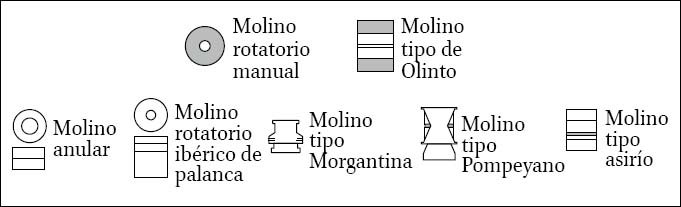
One of the reasons of the surprisingly long absence of rotary hand-mills in Greece could have been that “with the hand-mill the advantage of rotary over oscillatory motion is slight”.86 Or, as Moritz writes elsewhere, “a reasonably fine flour can be produced even by primitive milling methods, and an improvement of these methods does not necessarily mean that the flour is any finer, but that it is produced with less human effort”.87 I think we can be more precise about the reason why the Greeks stuck to the rubbing mills for such a long time. Saddle-querns and hopper-rubbers made it possible to produce a flour as fine as desired by rubbing it with upper stone as often as needed. In the rotary hand-mill, on the other hand, the upper stone, touching with its entire surface the bedstone, has to be lifted up a little by means of a rynd to make some space between them, because otherwise the upper stone could not be turned or would produce gravel. This means that the resulting flour was less fine than could be achieved with the saddle-quern or the hopper-rubber. In the western Mediterranean, people opted for less human effort, whereas the Greeks opted for finer flour. Only after a tool had been developed that enabled the millers to regulate the distance between the stones (as is still used in modern mills), it became possible to produce flour of any desired quality with rotary mills.
Two claims of earlier rotary hand-mills are questionable. Foxhall mentions the discovery of a rotary mill from the end of the sixth century in Carthago, reported by Morel.88 Jaccottey, however, dates it at the end of the fourth century bce and writes about this claim: “Interprétés comme des parties de meules rotatives, ces fragments sont difficiles à caractériser à cause de leur petite taille.”89 The picture of Morel’s found (Fig. 7.13) shows, how justified such reservation is. Moreover, Morel does not deny the fact that is crucial for our enquiry, namely that in the Greek world the rotary hand-mill only appeared at the end of the Hellenistic period.90
Fragment of a rotary hand-mill (?)
Photo by J-.P. Morel
Drawing of the upper and lower side of the upper part of a rotary hand-quern found near Lake Van (dating questionable)
Photo by J-.P. Morel
Storck and Teague mention the find of “the upper quern stone of a manually rotated circular stone, dating from about the eight century bce, complete with not only hopper but rynd” from Urartu at the Lake Van region in the far eastern part of present-day Turkey, described by Tseretheli (see Fig. 7.14).91 I was unable to consult Tseretheli’s publication, but his early dating seems very questionable.
If this really concerns a rotary hand-mill from the Urartu period (860 to 585 bce), “it appears to stand entirely outside the line of western milling development” as Storck and Teague remark.92 The find must have been misdated by Tseretheli, who was not an archaeologist but a philologist. His publication was not considered worth mentioning in a recent review of the archeology of Urartu.93 From the western Mediterranean world, the rotary hand-mill was introduced in the Levant during the Roman occupation of Palestine. The earliest published example of a rotary quern in the region is from the first century ad in Masada, Israel.94
Two ‘hour-glass’ mills found in Pompei
Photo courtesy of Rick Bauer
Cross-section of an ‘hour-glass’ mill
Public domain
Another Roman invention was the rotary mill called ‘hour-glass’ mill after its shape, several of which were found in a bakery in Pompei, which were driven by manpower or by donkeys (see Fig. 7.15a and 7.15b).95 Earlier types go back to 185 bce.96 The rotating part was called catillus, the conical bedstone was called meta. This type of mill was replaced in the fourth and fifth century ad by the watermill with millstones, because the flow of water could produce much more power than a donkey.97
We may conclude that, in all probability, such things as rotary mills with a horizontally turning millstone did not exist in Anaximenes’ time and environment. Still, the problem remains what could be meant in Theodoretus’ text, quoted at the beginning of this essay, by saying that the cosmos whirls around like a millstone.
9 Millstones in Ancient Greek Olive Crushing
So far, we have only dealt with grain-mills. An authority on grain-mills in classical antiquity, however, tells us that “the rotary olive-grinder may well be older than the rotary grain-mill.”98 And an authority on olive cultivation in ancient Greece, discussing the Roman rotary olive crusher called trapetum (on which more below, see Fig. 7.19), writes: “it is possible that rotary mills per se are much earlier than has previously been thought.”99 Let us therefore look at the production of olive oil and see what these rotary mills could have done for olive crushing.
In ancient Greece, olives were harvested every two years. The olives could not (and still cannot) be pressed into oil immediately; they had to be crushed first, producing a kind of pulp. In ancient times, this initial crushing was done with mortar and pestle.100 Another, more developed olive-crusher was the roller-and-bed type, which looks like a saddle-quern, of which it was obviously a derivative. This crushing device had a much bigger cylindrical roller that was moved back and forth over the olives on the lower grinding stone, called
Palestinian women crushing olives with a roller-crusher
Public domain
In a further development, the arduous labor of rolling back and forth a cylindrical stone was replaced by the circular motion of a vertically placed disk-like millstone that was made to roll both over and around the platform of a circular basin. This mill was driven by manpower or by a donkey. The mechanism was quite simple: the millstone had a hole in the center, through which a horizontal handle was inserted that was connected to a vertical axle on the center of the platform (see Fig. 7.17a104 and 7.17b).105 The roller was either cylindrical or somewhat tapered like a truncated cone. When found alone and outside a mill, it can easily be distinguished from a bedstone or runner stone of a horizontally rotating mill, because a roller stone has no furrows and no traces of a rynd. The oldest devices appear to have had only one single millstone.106 Lynch and Rowland date this invention at about 600 to 500 bce, which was during Anaximenes’ lifetime.107 Later olive mills have two opposite stones, or sometimes three, placed in a circle.

Horse-driven olive crusher
Photo from Piazzasalento, https://www.piazzasalento.it/importare-via-obbligata-per-andare-avanti-73932
The photos of mills on Fig. 7.17a and 17b show two of still functioning olive-mills of this type. The mill in Fig. 7.17a has a rather small crushing cylinder and can be driven by hand force. The mill in Fig. 7.17b is bigger and is driven by a horse; in ancient times this would have been a donkey. It is important to note that these vertical millstones have two motions: one around its own axis and another rolling in a circle on top of the platform. A vertically rolling millstone has only a relatively slight contact with the platform on which it rolls and is therefore much easier to make it turn than a millstone that is horizontally placed with its flat surface on the flat surface of a bedstone. This explains why vertically rolling millstones were developed and used much earlier than horizontally rotating millstones. The construction with the stick through the hole in the center of the millstone and attached to the vertical spindle is not only a means to make the stone roll, but also prevents it from toppling over. Note also the disk-like elevation in the center of the platform in Fig. 7.17a.
The excavation site of the olive oil plant in Klazomenai
Courtesy of E. Koparal
The first (blue) and the second (orange) phases of the olive oil plant in Klazomenai
Courtesy of E. Koparal
Reconstruction of the first phase with a hand-driven rotary mill
Courtesy of E. Koparal
Most interesting is the recent excavation in 1992–2004 and the reconstruction in 2004–2005 of an archaic olive oil plant, in Klazomenai, about 100 kilometers north of Miletus, where Anaximenes lived. Its first phase dates from 600/580–546 bce, which was during (or even before) Anaximenes’ lifetime (see Fig. 7.18a,108 7.18b,109 and 7.18c110). The big basin in Fig. 7.18b is colored half blue and half orange, which means that it was in use both in the first and in the second phase.
The combination of the roller stone with the central piercing and the big basin in which it lies, both visible on the photograph of the excavation site looks like the remnants of two essential parts of a roller mill. However, the reconstruction of the crushing mill on the right side leaves open several questions.111 For example, the rather complicated construction of a platform on which the operator of the mills stands, which is obviously done because the basin of the mill is so close to the wall. Although the reconstruction is said to represent the first phase, the excavators remark that “in the first phase the olives might have been crushed on the bedrock with the aid of a cylinder”.112 If their reconstruction is right, the mechanism must have been already a further development from the simple roller-crusher described above.
This equipment evolved into a mill with two opposite stones and much later into what Cato described as the trapetum,113 a rotary mill with two hemispherical stones in a large stone basin (Fig. 7.19).114 The earliest evidence for mills that looked like the trapetum has been found in Olynthus and can be dated fifth to the fourth century bce.115 The construction as a whole and especially the hemispherical stones are indications of a high degree of craftsmanship. This implies that previously more primitive roller mills, as shown above, must have been in use.
A trapetum in the Antiquarium at Boscoreale, Pompei
Public Domain
For our purposes in this essay, the simple mill with one rolling stone (as in Fig. 7.17a and Fig. 7.17b) is the most appealing. Even apart from the excavation in Klazomenae, there are several reasons why it could have existed already in Anaximenes’ times. The crushing of olives was a necessary operation before the resulting pulp could be pressed to produce the oil. Crushing the olives with a cylindrical roller (as in Fig. 7.16), moved back and forth by hand, was a strenuous job to do. To develop the rather simple device of the millstone rolling in a circle and attached to a pole in the base stone was not beyond the technological capacities of the time. It would have made the crushing of the olives much easier and could also have resulted in a better product.
It has been remarked that there are several reasons, why this kind of equipment is so hard to find or to identify in excavations.116 First, while primitive mills for grinding grain like the saddle-quern were available in every ancient household and used on a daily basis by the housewife or a slave, oil pressing installations were scarcer, used only every second year after the harvest and situated close to the olive gardens outside the usual excavation sites, which are villages or cities. Second, primitive olive crushers had wooden parts, which have been worn in the course of time. Third, the remaining stones, the roller and the basin, could later have been removed from their original places and used for other purposes.
Both Aristotle and Diogenes Laërtius tell the story that Thales purchased all
Anyway, there is ample reason to believe that, if such a thing as a ‘millstone’ that could be used as an image for the movement of the cosmos existed at all in Anaximenes’ time and environment, it must have been the vertical roller of a primitive olive-crushing mill. If you seriously want to attribute the word
The sun symbolized by a red dot on a vertically rolling millstone, after Martinez 2015
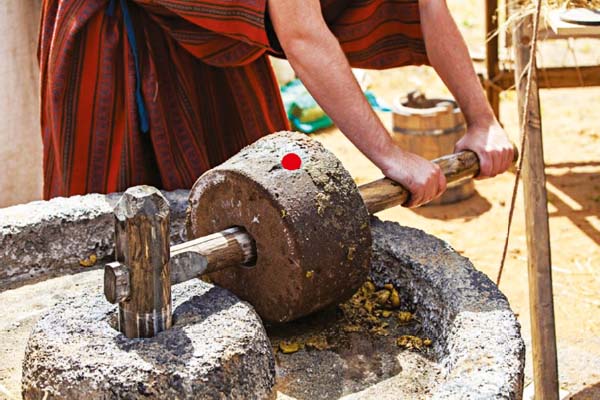
The image of the sun moving like a millstone will function most effectively on two conditions: 1) when the circumference of the millstone is as large as the circle it describes rolling over the platform, so that the sun (the red dot on the millstone) always culminates at the same point (the south); 2) when the elevated disk-like part in the center of the basin, representing the earth, is not too low, so that the red dot actually “takes a bath” in the basin, in which the millstone is rolling around.
A cycloid. Drawing after Cycloid – from Wolfram MathWorld [https://mathworld.wolfram.com/Cycloid.html]

As with all similes, there are also elements that are not accurate. For example, the figure described by the red dot when the millstone is rolling, is a cycloid (or more precisely in the case of a millstone rolling in a circle: a cycloid projected on an imaginary cylinder). The cycloid is also referred to as “the Helen of geometry”. In Fig. 7.21, it is shown how a point on the rim of a rolling circle generates a cycloid. Of course, Anaximenes did not know that this figure was a cycloid.
The point of comparison is, though, that the sun at night turns behind the rim of the earth in a similar way as the point on the millstone turns behind the central disk on the platform. This is as far as the image of a millstone can get in representing an archaic conception of the movements of the heavenly bodies.
10 A New Interpretation of Theodoretus’ Text
The result of the foregoing investigation into the archeological evidence is that if the simile of the millstone as an image of an archaic conception of the movements of the heavenly bodies goes back to Anaximenes himself, it can only have been in reference to the vertical millstone of an olive mill. It is tempting to stop here and conclude that Theodoretus’ simile of the millstone should be understood as the vertically rolling millstone of an olive oil mill and that Diels was right when he stated that this simile relates to the cosmology of Anaximenes. This would imply that Theodoretus, just like Stobaeus, Diogenes Laërtius, and Hippolytus, understood the cosmology of Anaximenes as a return to an archaic world-picture, in which the heavenly bodies, once risen, circle from east to west above the surface of the flat earth and, when set, take a bath in the Ocean and move around the rim of the earth from west to east, behind mountains. Yet, there are reasons why I do not draw that conclusion. Although the rotation of the vertical millstone of an olive-mill can offer a reasonably fair representation of an archaic conception of the movement of the heavenly bodies, as shown above, the crucial question is whether Theodoretus used it that way. Theodoretus lived in the first half of the fourth century ad, when mills with a horizontally rotating millstone had become more common. Another interpretation of the above text would come about when considering how the words
Cleomedes’ birth and death dates are unknown and a matter of discussion among scholars. Bowen and Todd contend that his book “may belong chronologically to some time around ad 200”.118 Referring to Posidonius, Cleomedes uses the image of a millstone (
κύκλον οὖν περιγράφουσαι παρ᾽ αὐτοῖς αἱ σκιαὶ περίσκιους αὐτοὺς ποιοῦσι, παραπλασίως τοῖς μύλοις ἐν τοῖς ὑπὸ τοὺς πόλους κλίμασι στρεφομένου τοῦ κόσμου .119
Shadows there accordingly describe a circle, and make people “encircled with shadows”, since in the regions below the poles the cosmos revolve like a millstone.
Cleomedes is describing how shadows behave at different latitudes (
Crown-like circles of latitude in a stereographic projection on an astrolabe for an observer at a latitude of 30 degrees north
Public Domain
Circles of latitude cutting off millstone-like parts of northern half of the celestial sphere
Drawing by the author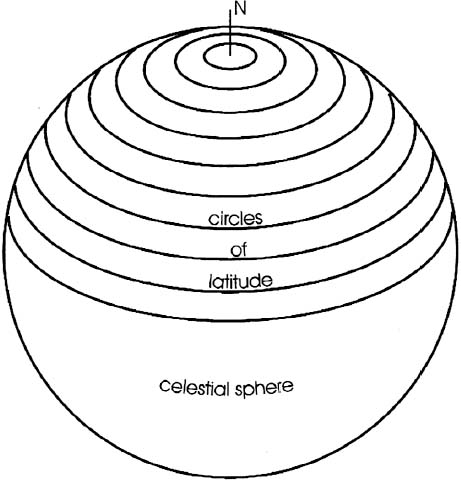
Even more instructive is a text in the Treatise on the Astrolabe by Joannes Philoponus (c.490–c.570 ad), in which he compares certain crown-like (parts of) circles on the astrolabe with the parallel circles of latitude on the celestial sphere (see Fig. 7.22a120 and 7.22b):
ὥστε τέμνεσϑαι ὑπ᾽ αὐτῶν τὸ ὑπὲρ γῆν ἡμισφαίρον στεφανοειδῶς, οἵαν ἔχουσι ϑέσιν οἱ παράλληλοι κύκλοι ἐν τῇ μυλοειδεῖ τοῦ παντὸς ϑέσει .121
so that the hemisphere above the earth is cut by them after the fashion of a crown, in a placing similar to that occupied by the parallel circles in the millstone-like arrangement of the whole.
In Fig. 7.22a, the lines of the “crown” are drawn for an observer at 30 °22′ N. The horizontal diameter indicates his horizon, the vertical diameter his meridian. The stars and configurations stay on the lines of the “crown” during their daily rotation. This is not the place to elaborate on the astrolabe and its functioning. In the context of this essay, the image of the millstone is the only thing relevant. “The whole” (
The same image is also used in a Scholium on a text of Autolycus of Pitane (c.360–c.290 bce), in which the rotation of the celestial sphere around its north-south axis is described:
Ὅ ἐστν ἐπὶ τῆς μυλοειδοῦς κινήσεως· 122
This is about the millstone-like motion.
This is a Scholium of unknown date in the Christian era, preserved in a manuscript from the 14th century.123 According to Drecker, the quotation is from Autolycus himself, but it is not included in Aujac’s edition.124
These three texts demonstrate that in later times it had become customary to compare the movement of the heavens to a horizontally turning millstone. The millstones in these three texts could have been those which Vitruvius had already described, using water as their driving force, or the rotating upper stones of rotary hand mills. It is a fair guess that Theodoretus, too, had in mind such a horizontally turning millstone. In that case, Theodoretus probably used it as a conventional image of the contemporary, Ptolemaic, cosmology of a spherical earth in the center of a spherical cosmos. This would also provide an answer to the question, who Theodoretus could have meant with “some” (
One question remains, namely: who are the people Theodoretus had in mind by “others” (
Using the plural (
11 Conclusions
The aim of this essay was to investigate whether Diels’ attribution to Anaximenes of the image of the millstone for the movement of the celestial bodies in Theodoretus’ text was right. It became an exercise in excluding an interpretation of a text on ancient Greek cosmology with the help of relevant archeological data. A survey of the archeological evidence showed that rotary mills with a horizontally rotating millstone did not yet exist in Anaximenes’ time and place. This means that Theodoretus’ text cannot be invoked as supporting the idea that the celestial bodies always orbit above the surface of the flat earth, as in the interpretation of Anaximenes’ cosmology by some recent scholars. Only a vertically placed millstone rolling around on its base as in an oil mill appears to provide a reasonably fair image of the movement of the celestial bodies, and especially of the sun, in which they, after having set, were supposed to travel around the rim of the earth (see Fig. 7.5). This would be consistent with texts of Aëtius and others, provided they are interpreted according to a text in Aristotle that was shown to refer to an archaic world-picture.
However, a closer look at Theodoretus’ text compared with other texts dating from after the introduction into Greece of mills with a horizontally rotating millstone, revealed that Theodoretus himself in all probability not had meant to refer to a vertically rolling millstone of an oil mill, but to a horizontally rotating millstone, and that he must have intended it as an image of the movement of the celestial bodies in contemporary (Ptolemaic) spherical earth cosmologies. Theodoretus contrasted this with the representation of the movement of the celestial bodies in ancient flat earth cosmologies, for which he used the image of a wheel. This image appears in Anaximander’s cosmology, but is applicable to other Presocratic cosmologies as well, including that of Anaximenes, in which the celestial bodies, when set, go under the earth (see Fig. 7.2). My interpretation of Theodoretus’ words would be in agreement with Pseudo-Plutarch’s and Qusṭā Ibn Lūqā’s versions of a text of Aëtius, which states that according to Anaximenes, as with Anaximander, the celestial bodies continue their orbits under the earth.
Works Cited
Berliner Griechische Urkunden (BGU), http://berlpap.smb.museum/.
Elton, J. 1905. The Evolution of the Flour Mill from Prehistoric Ages to Modern Times. Introductory Article for the First International Miller’s Congress and Annual Convention of the National Association of British & Irish Millers, held in Paris, October 16th to October 20th, 1905. http://www.angelfire.com/journal/pondlilymill/elton.html.
Haggis, D. 2006. Excavations at Azoria in 2006. https://azoria.unc.edu/summary-field-reports/2006-summary/.
Koparal, E., E. İplikçiç and A. Savaş Bakir 2010. “Klazomenai Olive Oil Plant: Dating, Reconstruction and Contemporary Use of it”. 319–335 in U. and A. Kaan Senol (eds.), Olive Oil and Wine Production in Anatolia During Antiquity / Antikçağda Anadolu’da Zeytinyağı ve Şarap Üretimi Mersin: Research Center of Cilician Archeology.
Liddell-Scott-Jones Lexicon. http://stephanus.tlg.uci.edu/lsj/#eid=1, released in February 2011.
Mansfeld, J. and D. Runia 2020. Aëtiana, The Method and Intellectual Context of a Doxographer, Volume Five: An Edition of the Reconstructed Text of the Placita with a Commentary and a Collection of Related Texts. Part Two: Book 2 Text and Commentary, Book 3 Text and Commentary. Leiden: Brill 2020.
Thibodeau, P. 2019. The Chronology of the Early Greek Natural Philosophers. North Haven, Connecticut: Cosmographia.net (https://www.cosmographia.net/).
Wefers, S. 2012. “Reibst Du noch oder drehst Du schon? Die ältesten bekannten Drehmühlen aus dem westlichen Europa.” 13–24 in A. Kern et al. (eds.), Technologieentwicklung und –transfer in der Hallstatt- und Latènezeit. Beiträge zur Internationalen Tagung der AG Eisenzeit und des Naturhistorischen Museums Wien, Prähistorische Abteilung. Langenweissbach: Beier & Beran.
See Diels 1879, 329, see also ibidem 46. Cf. Mansfeld and Runia 2009, 324: “[this text] refers to motion rather than shape (…). It seems out of place in the present chapter.”
See Mansfeld and Runia 2009, 331–336 (hereafter MR, followed by the publication of the volume being cited.).
See MR 2020, 777–779 (Appendix).
Theodoretus, Graecarum affectionum curatio 4.16 = DK 13A12 = Wöhrle 2012, As112 (with the misprint “die Erde” instead of “der Kosmos”); not in Laks and Most 2016, hereafter ‘LM’, Graham 2010, and Kirk, Raven and Schofield 1983; hereafter KRS.
Cf. DK 12A21 and 12A22.
The only place where the sun according to Anaximenes seems to be compared to a stone or brick is in a book attributed to al-Ğāḥiẓ, who has, in Daiber’s translation, which I am not able to check: “[die Gestalt der Sonne] ist wie eine breite Platte” (Daiber 1980, 399, sub 8; not in DK or in other handbooks). However, this has to do with the shape and the substance of the sun, not with its movement. More familiar is the comparison of the heavenly bodies to nails or leaves (DK 13A14; see also DK 13A15: “the sun is flat like a leaf”). The authorship of al-Ğāḥiẓ is a matter of discussion among scholars, see Plessner 1975, 103, n. 255.
MR 2020, 778.
Couprie 2018, chapter 7.
So, e.g., MR 2009, 334: “circular motion in a horizontal plane”. But in MR 2020, 778, they correctly write: “that in the archaic period the millstone was not horizontal as it became later, but stood vertically”.
Moritz 1958.
Couprie 2018, 123.
See, e.g., Guthrie 1962, 115; KRS 1983, 143–144. Recently, Thibodeau 2019, 240–261, has argued for a much later date: he places Anaximenes’ birth in the 520’s bce. This, however, does not influence the argument in my paper.
Couprie 2018, 99–130.
Drawing from Couprie 2019, 126, Fig. 7.14.
This version not in DK, LM 2016, Graham 2010, and KRS 1983. But see MR 2009, 487 sub P2.16.4; Mansfeld and Runia 2020, 944–945, §5. Curiously, Wöhrle 2012, As 38 deletes
Daiber 1980, 153. I am not able to read the Arabic original. In German, it reads: “Anaximenes glaubte, daß die Sterne sich oberhalb und unterhalb der Erde bewegen”. See also Wöhrle 2012, As205; MR 2009, 488, and MR 2020, 938, note at 2.16.5.
Eusebius, Praeparatio Evangelica 15.47.
Stobaeus, Eclogae 1.24.1 = DK 13A14 = Graham 2010 Axs 19 = Wöhrle 2012, As 124; not in LM 2016 and in KRS 1983. In MR 2009, 488 and 495 it is read
See Diels 1879, 136 and 346; DK 13A14.
Couprie 2018, 114–128.
MR 2020, 944.
MR 2009, 488.
MR 2020, 945.
MR 2009, 488; MR 2020, 944. For a quotation and discussion of Aristotle, Meteorology 354a28–32, see the next section.
Couprie 2018, 119.
Diogenes Laërtius, Lives of Eminent Philosophers 2.3 = DK 13A1 = Wöhrle 2012 As 72; not in LM 2016, Graham 2019, and KRS 1983.
Hippolytus, Against All Heresies 1.7.6 = DK 13A7(6) = LM 2016, D5(7) = Wöhrle 2012 As 56(7.6) = Graham, 2010, Axs 12(6) = KRS 1983, 156.
Aristotle, Meteorology 354a28–32 = DK 13 A14 = LM 2016, D16 = Wöhrle 2012 As 4 = Graham 2010, Axs 18 = KRS 1983, 157.
Graham 2013, 62–65. Drawing by the author, after Graham, Fig. 2.2.
Figure 9(a) in Bowen and Todd 2004, 177.
See Panchenko 2015, 416, quoting with consent KRS 1983, 157: “The cap-image must illustrate the hemispherical shape of the sky, not its obliquity.” Kočandrle 2019, 116, writes: “The turning of a felt cap would then reflect the movement of the Heavens as a whole.” See also Kočandrle 2021a, 255–256 and 2021b, 198–199.
See Panchenko 2015, 416: “It follows that the slant of Heaven in this system is illusory”; Kočandrle 2019, 109: “it (sc. the sun) seems to follow a semicircular path”. Kočandrle (2019, 106) rightly remarks, that in the Chinese gai tian system “both heaven and earth are two fully separate, parallel planes”, but he does not tell how this relates to the supposed cap-shaped heaven of Anaximenes. Similarly in Kočandrle 2021a, 257 and 2021b, 204.
See Panchenko 2015, 414.
KRS 1983, 156.
MR 2020, 944: “the same doxa is already anonymously reported in almost exactly the same formulation in Aristotle’s Meteorology.”
MR 2020, 948, referring to DK 13A14.
MR 2020, 943 (my italics).
Panchenko 2015, 423.
In Couprie 2018, 103, Fig. 7.2, I followed Boll’s suggestion of the heaven as a top hat (Boll 1914, 361, n.1). Now I think it does more right to the interpretation of Graham, Panchenko, and Kočandrle to keep the image of a curved
For an image of the ancient Greek
Kočandrle 2019, 109 (my italics); Panchenko 2015, 413: (my italics).
See Couprie 2018, 99–129.
Cf. KRS 1983, 157: “his context, which is concerned with showing that the greatest rivers flow from the greatest mountains, in the north, makes it quite clear that he understands ‘the earth being high in the north’ to refer to its northern mountain regions.” See also Guthrie 1962, 138.
Cf., e.g., Guthrie 1962, 138.
Cf. Panchenko 2015, 420.
Cf. Couprie 2018, 121.
Epicurus, On Nature, in Arrighetti 1960, 233–234: 33, from Herculaneum Papyri 1042.8.vi. See Graham 2010, Axs20 and p. 92; Perilli 1992, 16–17.
Arrighetti (1960, 232) translates
Cf. Perilli 1992, 16: “Epicuro polemizza, in sostanza, contro una concezione della terra
Of these three, only Graham refers to this text, although tucked away in a section on Anaxagoras; see Graham 2013, 127.
In Couprie 2018, 121, I still accepted Arrighetti’s reading
The word
Arrighetti 1960, 232, Pap. 1042, 8.v.
Arrighetti 1960, 230–231, Pap. 154, 8.iv:
This is still the case in modern mills; cf. Hockensmith 2009, 7: “the distance between the stones was carefully regulated to prevent them from touching but keep them running close enough together to grind.”
Cf. Storck and Teague 1952, 82.
Cf. Watts 2002, 47; Moritz 1958, 131 and 220; Vitruvius, De architectura 10.5.2.
Antipater of Thessalonica, Epigrams 9.418 (http://www.attalus.org/poetry/antipater2.html; for the Greek text, press G). Nisyros is an island in the Aegean Sea.
See Moritz 1958, 2.
Cf. Blümner 1875, 25; Blümner, however, still thought that all Greek mills were rotary.
Cf. Moritz 1958, 3 and Lindet 1899, 15. The verb
Cf. Lindet 1899, 14.
Cf. Hesiod, Works and Days 423; Herodotus, Histories 1.200. Later words used for mortar were
Picture freely available on the internet: http://www.mlahanas.de/Greeks/images/WomenGrain.jpg.
Homer, Odyssey vii, 104; xx, 106, 111; ii, 355. See the discussion of these texts in Moritz 1958, 4–6.
See Liddell, Scott, and Jones 2011, s.v.
Tell Balata, Palestine, 1550–500 bce, Allard Pierson Museum voor Oudheden, Leiden. Photo by the author.
Sakkara, ca. 1350 bce, Allard Pierson Museum voor Oudheden, Leiden. Photo by the author.
Cf. Moritz 1958, 43 n2, 50 n. 2.
Cf. Moritz 1958, 42–52.
Photo kindly provided by the Kelsey Museum of Archaeology, University of Michigan. On the website of the museum it is said that it “follows an ancient Egyptian design”. Pestman 1990, 123, using the same photo, identifies the Theban mill with the Olynythian mill, but the former is clearly a more primitive hopper-rubber than the latter.
See, e.g., BGU (Berliner Griechische Urkunden) I.251.17 and III. 719.10.
Cf. Frankel 2003, 9, Fig. 7 (patterns of striations on lower stones) and 10 Fig.8 (patterns of striations on upper stones). See also Moritz 1958, 46, Fig. 5 and 48, Fig. 6; Lepareux-Couturier 2014, 150, Fig. 1.
Drawing from: https://books.openedition.org/pufr/8575. Megarian bowl, Louvre CA 936. See also: Frankel 2003, Fig. 2; Moritz 1958, 13, Fig. 1; Storck and Teague 1952, Chapter. 7. The pictures of the bowl on the website of the Louvre are too vague to reproduce here, and for our purpose taken from the wrong side. The photos in Rostovtzeff 1937 are better, but he also has the same drawing.
Cf. Moritz 1958, 15–16. I intend to discuss more aspects of this bowl and its inscriptions elsewhere.
From Wefers and Mangartz 2014, 87, Fig. 4; reconstruction by Kuno Menchen, Römisch-Germanisches Zentralmuseum, photo by Fritz Mangarz. See also Frankel 2003, Fig. 5 and 6.
Liddell, Scott, and Jones 2011, s.v.
Cf. Moritz 1958, 45 n. 1; Foxhall 2007, 205. See also LSJ s.v.
Ebeling 2019, 83, Figure 2. Photo by Dia’a Mazari Gharaibeh.
Cf. Moritz 1958, 61.
Cf. Moritz 1958, 105. See also Runnels and Murray 1983, 62.
Jaccottey et al. 2013, 405.
See Poupaki 2014–15.
Frankel and Syon 2016, 93–94.
Alonso Martinez 2015, 31, Figura 3. See also Wefers 2012, 16, Abb. 2 (spread of rotary mills in Europe).
Moritz 1958, 114–115.
Moritz 1958, xxv–xxvi.
Foxhall 2013, 171; Morel 2001, 240–251.
Jaccottey 2013, 407.
Morel 2001, 241. Photo from Morel 2001, 242, Fig. 1.
Storck and Teague 1952, 77 and Figure 39; Tseretheli 1939, Plate 32.
Storck and Teague 1952, 77.
Cf. Bobadilla 2014. Barnett and Watson (1952, 136, 139, and 142) mention several “stone rubbers”, “stone querns” and “querns” from Urartu, found in excavations of a citadel in Karmir-Blur (near Yerevan, the present capital of Armenia), without further descriptions and without pictures. In these cases, we probably have to do with saddle-querns, not with rotary hand-mills. Piotrovski (1969, Plate 25, caption on p. 210) has one picture of a “basalt quern” from the same excavation, apparently showing the best-preserved item, without further description. The photo is too bad to reproduce but shows a round bedstone with what seems to be the roller or upper stone of a saddle-quern.
Ebeling 2019, 81.
Photo of Fig. 14a, courtesy of Rick Bauer, from Dr George Fay’s slides collection. https://www.pompeiiinpictures.com/pompeiiinpictures/R6/6%2006%2017.htm; VI.6.17 Pompeii. August 1976. Looking through doorway to bakery in north wall of entrance room. Fig. 14b from Moritz 1958, 75, Fig. 8.
See Moritz 1958, 74.
Cf. Blümner 1875, 48.
Moritz 1958, 104.
Foxhall 2007, 166.
Cf. Foxhall 2007, 179.
Cf. Foxhall 2007, 205.
Photograph freely available on the internet: Palestinian women crushing olives – Google zoeken. See also: Frankel, Avitsur and Ayalon 1994, 30, Fig.19, and Foxhall 2007, 189, Fig. 6.27.
Ca. 700–500 bce. See Haggis 2006, 4. D300.
Source: Piazzasalento, https://www.piazzasalento.it/importare-via-obbligata-per-andare-avanti-73932.
Cf. Foxhall 2007, 171.
Lynch and Rowland 2003, 9 and 33 (“2500 bce” on p. 3 is obviously a misprint).
Koparal 2010, 327, fig. 2. Photo courtesy of E. Koparal.
http://www.klazomeniaka.com/300-ZEYTINYAGI-ISLIGI-2.htm, Resim 3; see also: Koparal 2010, 328, fig. 3a. Drawing courtesy E. Koparal.
Koparal 2010, 328, fig. 3b; courtesy of E. Koparal. The man hanging on the lever of the oil press is a pastiche of a picture on an Attic skyphos (sixth century BV), Boston Museum of Fine Arts (nr. 99.525); cf. Foxhall 2007, 135, Fig. 6.2.
See the critical notes in Foxhall 2007, 140–143, and Frankel 2020, 556.
Koparal 2010, 323.
Cato, De Agri Cultura 20.2.
Photo History St Ursula’s College Kingsgrove, History Classes, 12 Ancient History, Pompeii 1A. https://sites.google.com/a/syd.catholic.edu.au/boudica/12-ancient-history/12-ah-vesuvius/pompeii-1a.
Cf. Foxhall 2007, 169; Moritz 1958, 57.
Cf. Foxhall 2007, 131–132.
See Aristotle, Politica 1259a6 = DK 11A10 = LM 2016 THALES P15 = Graham 2010, Ths 8 = Wöhlre 2009 Th 28 = KRS 1983, 73; Diogenes Laërtius. Lives of Eminent Philosophers 1.26 = DK 11A1(26) = Wöhrle 2009, Th 237(26); not in LM 2016, Graham 2010, and KRS 1983.
Bowen and Todd 2004, xi.
Cleomedes, Caelestia 1.4.136–139. See Todd 1990, 23. Bowen and Todd 2004, 58. This text is also mentioned in the discussion of Theodoretus’ text in MR 2009, 334.
Drawing from Drecker 1928, 7, Abb.2. See also Jarry 2015, XLIII.
See Jarry 2015, 6, line 13–14 (section 2). I am obliged to Jaap Mansfeld, who brought this text to my attention. It is also mentioned in MR 2009, 334. I take the commentary “these texts suggest that the image of the millstone properly refers to the heaven rather than the cosmos” to mean that the words “cosmos”, “hemisphere” and “the whole” in the texts of Cleomedes and Philoponus are shorthand for “the celestial bodies”, just as I suggested at the beginning of this essay about the word “cosmos” in Theodoretus’ text.
Hultsch 1885, 12, note at
See Hultsch 1885, LV, Adnotatio in Scholia, referring to footnote on 12, lines 23–25; see also XXIII for the date of the manuscript, and 214 s.v.
Drecker 1928, 23, n. 9; Aujac 2002, 48–49.
Aëtius, Placita 2.20.1 = DK 12A18 = LM ANAXIMAND. D20 = MR 2020, 2.20.1 = Graham 2010, Axr 22 = Wöhrle 2012, Ar 148; Aëtius, Placita 2.25.1 = DK 12A22 = LM ANAXIMAND. D26 = Gr Axr 25 = MR 2020, 2.25.1.
See MR 1997, 328, Figure 2: “the tradition of the Aëtian Placita”. See also 284: “He certainly has direct access to the original work”.