


In all European teacher education systems, the structural and conceptual design of teacher training, the acquisition of key competences for the teaching profession and the effects of training on teachers and learners are topics that are of great importance for stakeholders, policymakers, teacher educators, and researchers. The demands on the professional competences of teachers and the complexity of the professional field are growing continually (Neuber & Lipowsky, 2014; Rothland, 2013). An important number of scientific studies and government reports are addressing questions about the prerequisites, development, measurement and impact of teachers’ professional competences (Cochran-Smith, Feiman-Nemser, McIntyre, & Demers, 2008; Zlatkin-Troitschanskaia, Beck, Sembill, Nickolaus, & Mulder, 2009, Filâtre, 2016). Consequently, in many European countries, curriculum design and teaching development measures have been initiated with the aim of improving the coherence of study programmes and structures - for example by more closely interlinking different study phases and content. Supported by regional or international funding, programmes such as the German “Teacher Training Quality Campaign” initiated by the German federal and state governments or the CATE initiative in Norway are regularly launched with the aim of promoting and supporting teacher training (BmBF, 2014; CATE, 2012).
To deal adequately with the increasingly complex social structures and professional requirements, most European countries are reflecting on their teacher education system and reforming the way future teachers acquire knowledge and skills on the path to a competence-oriented professionalisation (Buchman & Floden, 1991; Darling-Hammond, 2013, 2017). An integrative consideration of professional knowledge, professional understanding, and motivational factors are essential and can provide the theoretical blueprint and structural models for a coherent vocational competence orientation (Pachler & Field, 2001; König, 2014).
In this context, the aim of our paper is to analyse whether the 2011 and 2020 French curriculum reforms which both aimed at an integrative consideration of professional knowledge, professional understanding, and motivational factors, succeeded in strengthening a vocational competence orientation and reflect coherence. In the general context of teacher shortage, which affects France, as it does most OECD countries, we are particularly interested in the results of the 2020 reform, whose explicit aim was to strengthen the professional dimension of training, with a view to making the profession more attractive. Our contribution aims to verify whether the 2020 reform’s aim to promote
2 Educational Context
A consistent, competence-based professionalisation of teacher education must be able to link very several dimensions of teacher education. It must ensure a consistent temporal progression between different phases of training, to guarantee structural, curricular and conceptual coherence through the pedagogical alignment of module structures and course objectives. Therefore, the importance of an integrative approach for a sustainable theory-practice relationship in teacher education programmes needs to be emphasised if a teacher education system wants to avoid fragmentation of content and different phases of teacher education. Too often, students criticise the disjointed nature and structure of the training phases and areas, which primarily produce isolated knowledge, allow discontinuities between training phases, do not adapt examination forms to the training phases, and thus only meet the complex requirements of the teaching profession to a limited extent (Hammerness, 2006; Blömeke, 2006; Terhart, 2004). In other words, they feel that their programme lacks coherence.
2.1 Theoretical Background: The Concept of Coherence
The concept of coherence evokes primarily text linguistic theories and procedures (van Dijk, 1977) and has not yet been extensively researched in educational research. So far, it has mainly been used in the US to describe teaching programmes at universities. Coherence describes the meaningful connection of learning contents and structures (e.g., Buchman & Floden, 1991; Canrinus, Bergem, Klette, & Hammerness, 2015; Hammerness, 2006; Hellmann, 2019). Coherence can refer to the entire professional biographical process with a particular focus on lifelong learning and is particularly important in crucial transition moments, when students move from university to practical phases, as in continuing professional development. A distinction is generally made between vertical and horizontal coherence, i.e., coherence across different phases of study and training (vertical) and between different domains of professional knowledge (horizontal). Creating coherent teaching-learning opportunities is about generating connections that enable students to experience their studies
In general, coherent learning-teaching arrangements link the content of individual or different knowledge domains and areas of expertise, align learning objectives, learning opportunities and forms of assessment, demonstrate the benefits and possible applications of what has been learnt and enable transfer or provide space for practical testing. A clear mission statement shared by teacher training institutions, faculties, departments or even individual teachers on what is to be considered a “good” teacher education also enhances coherent structures and content (Biggs, 2003; Buchman & Floden, 1991; Canrinus, Bergem, Klette, & Hammerness, 2015; Hammerness, 2006; Desjardins, Altet, Étienne, Paquay & Perrenoud, 2012). Furthermore, various instructional psychology approaches provide indications of how, for example, task formats can be designed to stimulate knowledge networking and transfer between subject-specific science and subject-specific didactics (van Merrienboer & Kirschner, 2017).
Coherent learning opportunities within a study programme allow learners to view knowledge from different domains, disciplines, courses, semesters, or even institutions through interconnected perspectives and to acquire it in an integrated manner. This leads to a more elaborate acquisition of competences and generates flexible, transferable knowledge (Spiro, Feltovich, Jacobson, & Coulson, 1991; Cavana, Molloy Elreda, Youngs, & Pippin, 2021). It also prevents the development of purely inert knowledge (Gruber, Mandl, & Renkl, 2000). The experience of coherence in the teaching-learning process should ultimately have a positive effect on subsequent teaching activities and enable professional and competent behaviour.
To link these current educational science debates to our research question about how the French reforms and changes in educational policy affected the perspective of the pre-service teachers, it is important to underline that the perception of a coherent competence orientation and professionalisation depends largely on socio-cultural traditions or facts, on the training programmes and most of all on the education policy of each country (Canrinus, 2015). The impact and the responsibilities of the stakeholders and policy makers cannot be overestimated. It is necessary to analyse and evaluate the consequences of their acts and to interrogate those who are most concerned: the student teachers. Do they consider that the reforms take into account the necessity of a coherent competence orientation? Are they able to link, transfer, relate domains, structures, contents, and phases of their study programme? And do they feel prepared for their vocational career? Our presentation of the French consecutive reforms and the analysis of the student data we are
Before processing the data, we need to explain the characteristics of the French teacher training system.
2.2 Characteristics of the Teacher Education System in France
Traditionally, the French Teacher Training System has accorded little importance to coherent professionalisation. For decades, since the Education Orientation Law of July 10, 1989 and until the 2011 reform, a strict separation between the first and second phases of teacher training, i.e., between a subject-based university degree programme and a school-based preparatory service made the French system a prime example of a consecutive and compartmentalised teacher education system. It consisted of two training phases that were largely isolated from one another. During the first phase, the students completed a subject study bachelor which prepared them for research-oriented Master’s degree programmes. They then passed the Concours CAPES (Concours du certificat d’aptitude au professorat du second degré), a state entrance examination for the teaching profession. The principal objective of this Concours for secondary school teaching is to allocate a limited number of available positions annually, contingent upon the demand in different subject areas, to those candidates who perform best in the written and oral examination. Those candidates are then automatically allocated one of the places reserved for the one-year preparatory service and entitled to a guaranteed civil service job. Until the 2011 reform, the Concours, was undertaken without any specific didactical or pedagogical training. The second phase of the teacher training which took place at the Institut Universitaire de Formation des Maîtres (or IUFM), the School of Education, was purely practice- and method-oriented and detached from subject-specific content, and didactic or educational research (Jolion, 2011; Schmider & Zaki, 2019). The validation of this study and training programme on teaching methodology and disciplinary reinforcement, observation and practice hours with a supervising teacher, and part-time classroom teaching phase at the IUFM was necessary for tenure (MEN, 1989). This meant that teacher education students who obtained the CAPES, gained access to the teacher profession and obtained civil servant status without ever having followed didactic or educational science related courses. In other words, students completed a subject-related course,
As a consequence of general European impulses from education policy and research, such as the Bologna reform or Agenda 2020, and the resulting paradigm shift towards competence and task orientation, fundamental reforms aimed at strengthening the integrated professional competences of teachers in their various areas and facets were also initiated in France from 2011 onwards (Shulman, 1987; Baumert & Kunter, 2006; König, 2014). If we reflect on the aims, preconditions, implementation and prospects of these large-scale reforms in France, it quickly becomes clear that the demand for horizontal and vertical coherence was met with very specific educational systemic and cultural conditions.
A fundamental element of the French system is the centralised and top-down organisation of the ministry of education which standardises the training of French primary and secondary school teachers across the country and directs it according to the same ministerial guidelines. The institutional framework of the Éducation Nationale, the French educational system, is set by two responsible ministries (the MEN or Ministère de l’Éducation Nationale and the MESR or Ministère de l’Enseignement Supérieur et de la Recherche). It is certainly very rigid, but also completely transparent in its application. The constraints are identical for each of the thirty Académies, the twenty-six metropolitan school board districts and the four overseas School board districts (Guadeloupe, Guyana, Martinique, and the joint district of Reunion and Mayotte). The Académies are controlled by the respective Rectorates, which represent the Ministère de l’Éducation Nationale, whereby access to the teaching profession, the recruitment and transfer of teachers, and all career decisions are regulated by this Ministry (MEN, 2024c; Schmider & Zaki, 2019). Unlike in countries with a federal structure or education system, there is no exchange or negotiation between the central government and regional stakeholders: the Ministry decides, and the academies apply. When it comes to reforms, this system has its’ advantages and inconveniences. For local players in teacher training, the application of directives can sometimes be seen as authoritarian. On the other hand, they are generally applied with a speed and efficiency that would be more difficult in a federal system.
Another important feature of the French Teacher Education system is that access to the teaching profession has traditionally been linked to the double requirement of a university degree and the Concours, and that this centralised recruitment system means that candidates can be sent anywhere in France,
2.3 The Reform of the Teacher Education System in France
The first major change to the French system was the so-called masterisation of teacher education in 2011/12, which we will call, from now on the 2011 reform. In response to the Bologna process, this masterisation questioned the entry modalities to the teaching profession in a way that was quite radical for France: instead of the previously sufficient Bachelor’s degree (or “licence” in French), candidates wishing to pass the Concours for upper secondary education now had to complete a Master’s degree. In addition, the CAPES examination programme, which was traditionally redefined each year and focused on subject-specific knowledge, was eliminated and replaced by examinations with a didactic and professional component. Above all, the French teacher training system underwent a fundamental change the following year, when access to teacher training was reformed with the introduction of the so-called Master MEEF (Master de l’Enseignement, de l’Education et de la Formation), the new Master of Education for teacher education students (MEN/MESER, 2013).
2.3.1 Changing of Paradigm: The 2011/12 Reform
The creation of this vocational Master of Education was followed by the introduction of new schools of education in 2012/213 which were associated with the university. These University schools of education, the ESPE (Ecole Supérieure du Professorat et de l’Enseignement), were created by the law no. 2013-595 on the refoundation of the school of the republic, passed on 8 July 2013 (JORF, 2013) and henceforth responsible for the education and training of teachers. Their aim was to enable all future teachers to acquire transversal, professional competences and to enhance the interlinking of subject-specific, subject-didactic and educational science study components as well as to provide practical teaching experience. Unlike the former IUFM s, they were not to be seen as a separate institution, but associated and administratively integrated into the universities (as a separate faculty).
At a curricular level, the structure of the new “Master MEEF” degree programme is a particularly drastic change, as it combines traditionally very distinct phases of teacher training – namely the Master of Education degree/Concours and the practical teacher training service. The challenge of a coherent curricular concept essentially consisted, on the one hand, of combining the strongly subject-specific Concours preparation with the subject-didactic and educational science content of the Master’s programme and, on the other
Since the creation of the Master MEEF in 20212–2013, French teacher students completed their internship during the Master of Education’s second year, after passing the CAPES Concours. At the core of this first major reform was the concept of “dual-track teacher training” (JORF, 2013), which integrates the induction phase for future teachers into university education. After having ignored any form of theory-practice relationship in the study programme of teacher education, the reform had focused on continuous exchange between theory-based teacher training and practical classroom experience, strengthening thereby the institutional and curricular coherence of the teacher training programme. In concrete terms, this meant that after passing the Concours in the first Master year, students had a dual status in the second year of the Teacher Education Master’s programme: They were employed with a half-time teaching assignment (9 hours) with full responsibility, either in the Collège (secondary school from grade 6 to 9) or in the Lycée (secondary school from grade 10 to 12). As Professeur Fonctionnaire Stagiaire de l’Education Nationale (PFSE), these probationary teachers also had student status, as they spent the second half of their teaching load at the ESPE, where they completed didactical and educational science courses (MESER, 2014).
Regarding the institutionally anchored interlinking of theory and practice, the creation of mixed teacher educator teams (équipes pédagogiques mixtes) that support, supervise, and evaluate teacher training, played a decisive role in the development of a common scientific culture (culture commune). The importance of this creation was emphasised in the first major evaluation report on the results of the reform (Filâtre, 2016). As classic communities of practice (Wenger, 1991), these teams consisted of university subject sciences and subject didactics teachers, researchers, supervising teachers from the placement schools, mentors, school inspectors, and practitioners for each subject. Through the creation of the mixed teacher educator teams, teacher training also turned into a joint project at the institutional and personnel level, a shared responsibility between universities and schools. As a result, the students became future teachers in the eyes of the university teachers, who therefore were more inclined to develop specific course formats orientated toward a professionalisation of the study programme.
2.3.2 The 2020 Reform: Aims and Consequences
The 2020 reform comes at a particular time, marked by the Covid pandemic, with a growing shortage of candidates for the teaching profession and an ever-increasing demand for the professionalisation of teacher training. The overhaul of teacher training, the principle of which was set out by the Minister of
The reform introduced significant changes to the Concours’ position and the practical training period for student teachers. Previously held during the first year of the Master’s programme, the Concours was now moved to the second year. In the first semester, Master’s 2 students were required to present their thesis, prepare for the Concours throughout the year, and take the written and oral exams in March and June, respectively. The positioning of the competitive examination at the end of the second Master year was meant to avoid splitting the Master’s degree into two years, and to allow students to spread out their objectives. The practical training phase has also undergone significant changes. Previously, it was designed as an induction phase integrated into the university teacher education programme, consisting of 9 hours of fully responsible teaching assignments during the Master 2 year of study for which the student was paid. The 2020/2021 reform replaced practical training as probationary civil servants: the student teachers could choose between 6-hour contracts as a fully responsible teacher or chose the option of observation and accompanied training for twelve weeks during the second master with an experienced in-service teacher. Either way, the separation between the university degree on one hand and the induction phase and tenure on the other hand, was made effective and confirmed by eliminating the co-tutoring of student teachers, who previously received school visits from a university tutor and in-service teacher tutor. Double tutoring was replaced by mentoring through in-service teachers as tutors without a link to the university (MEN, 2019).
For a better understanding of the differences, the comparative figure below summarises the 2011/2012 and 2020 reforms.

Structure of French Teacher Education Programme after the 2011 reform
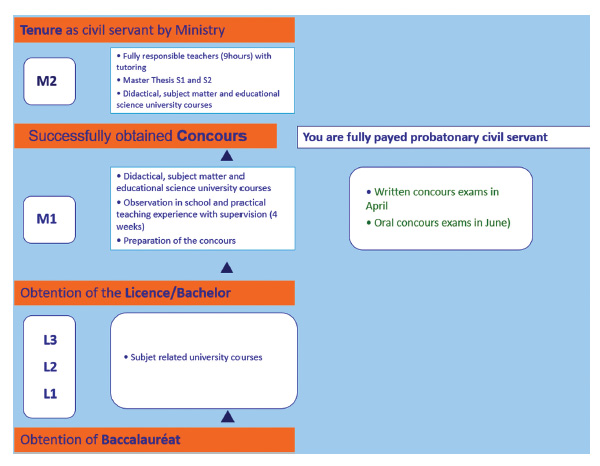
Structure of the French Teacher Education Programme after the 2022 reform

The explicit aim of the successive reforms has been to better reflect the realities of teaching in the classroom and the new demands and expectations placed on future teachers through a coherent professionalisation of teacher education. To evaluate the initial feedback and reactions of those primarily affected by the reform and its practice-oriented professionalisation, namely the teacher education students, the University of Nice commissioned an evaluation of student satisfaction and perception through the INSPE.
3.1 Methods and Metrics for Students’ Evaluation
The survey aimed to measure the satisfaction with the 2011 and 2020 reforms and student’s perception of the measures of professionalisation and coherence. Students in the first year (Master 1) and second year (Master 2) of their Master’s programme were asked to give their opinion on the study organisation and its contents. The focus of the survey, which differentiated between first- and second-year students, was primarily on five indicators:
General satisfaction with the education programme and core courses.
Relationship between and satisfaction with the disciplinary courses and the courses related to didactics.
Participation by school practitioners.
Internship evaluation and internship supervision.
State exam preparation: professional orientation (Master 1), tutoring, practical components and master thesis (Master 2).
For our paper, we have chosen questions from the survey that ask for a certain degree of coherence for our paper.
Firstly, we’ll address the overall satisfaction regarding the courses by comparing students’ satisfaction levels with content-related courses to their satisfaction with didactic courses. Secondly, we’ll monitor the evolution of two cohorts from Master 1 to Master 2 and follow their appreciation of the time allocated to subject courses and the didactic courses. Finally, we’ll discuss the extent to which specific modules designed to promote professionalisation were perceived as useful by students in helping them to imagine themselves as future teachers.
3.2 Survey Versions and Participants
In total, we were able to rely on five surveys, namely for the academic years 2014–2015 (Boissicat, 2015), 2016–2017, 2017–2018, 2018–2019 (Calistri, 2017, 2018, 2019)
The survey instruments we employed in the years before the 2020 reform were consistent with those administered in 2022–2022. The questions were identical, ensuring continuity in date comparison. We used a 5 points Likert Scale, a nonparametric Kruskal-Wallis test which was significant and Dunn’s post hoc test.
Distribution of participants
| Year | Master year | Participants | Female | Male | Other |
|---|---|---|---|---|---|
| 2015 | M1 | 92 | 65 | 25 | 1 |
| 2017 | M1 | 59 | 33 | 26 | |
| 2018 | M1 | 46 | 26 | 19 | 1 |
| 2019 | M1 | 47 | 23 | 23 | 1 |
| 2023 | M1 | 37 | 23 | 14 | |
| 2015 | 281 | ||||
| 2017 | M2 | 107 | 67 | 40 | 1 |
| 2018 | M2 | 95 | 53 | 42 | |
| 2019 | M2 | 34 | 18 | 16 | |
| 2023 | M2 | 38 | 32 | 6 | |
| M2 | 32 | 20 | 12 | ||
| 306 | 587 | 360 | 223 | 4 |

A whole series of aspects stand out in the evaluation of the respective indicators of coherence.
3.3.1 Overall Satisfaction and Comparison of Satisfaction with Disciplinary and Didactical Courses
In Figure 11.4, we present the overall satisfaction with the courses and a comparison as to the satisfaction with the subject-related disciplinary courses and the didactical courses. The blue line represents the score for the disciplinary courses, the orange one the score for the didactical courses. The two red bars mark the moment when the curricular changes of the 2020 reform were implemented. It is important to note that this diagram connects the data points for interpretation and does not imply the presence of multitudinal data as it involves different groups. We chose to present the results for both the M1 and M2 cohorts in a single diagram as the two Master years form a teaching continuum. This presentation makes it easier to visualise the evolution of the two groups over the course of their study programme and to see the change in their professional posture as well as their evolving professional expectations as a result of their practical experience in schools during the M2 year.
Several conclusions can be drawn: First, course satisfaction rises over time for M1 students, while the M2 satisfaction remains more or less stable. Second, the satisfaction of M2 students is systematically lower than that of M1 students. A possible explanation for the difference in general satisfaction between M1 and M2 students could be the confrontation with the reality of teaching and the associated practical shock that begins for M2 students.
Survey results: Comparison of trend in course satisfaction. Questions asked: “I’m satisfied with the teaching of the disciplinary courses” (blue line). “I’m satisfied with the teaching of the didactical courses” (orange line)
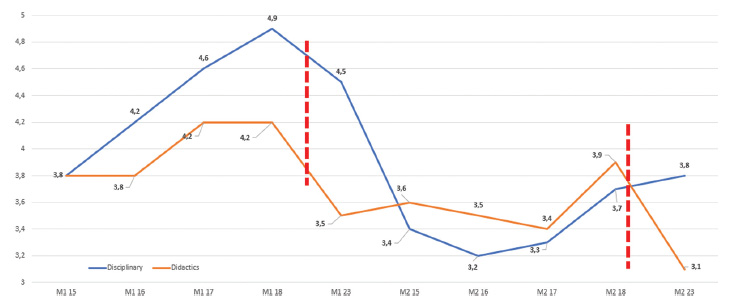
Interestingly, this drop in satisfaction during the M2 year applies not only to didactic competences, which one might assume are more crucial for students when teaching in class, but also to content-related knowledge. Students appear to recognise that to become effective teachers, they must first excel in their subject area. If they feel insecure about their proficiency in the subject matter, they encounter difficulties in designing and delivering the course curriculum. Before the 2020 reform, the Concours was scheduled in the first year of the Master’s programme. Consequently, the content related curriculum had largely diminished in scope and time, and students obviously felt left alone.
If we now analyse the satisfaction after the 2020 reform, we can see that the gap between the M1 and M2 year is still relevant, but that for the first time the satisfaction score for the disciplinary courses in M2 was higher than the score for didactical courses and the drop from M1 (4,5) to M2 (3,8) less important. A possible explanation could be that students no longer teach half time as responsible teachers in the classroom, and are therefore less confronted with their content-related weaknesses. Nevertheless, they now have to succeed the Concours. As the exam approaches, they feel less prepared because the M2 curriculum offers few content-related courses. The satisfaction with didactics also falls to its lowest after the 2020 reform. Here again, the positioning of the Concours with its now more professional orientation in M2, combined with a heavily reduced teaching experience seems to be the cause of a deep-rooted feeling of lack of preparation.
3.3.2 Time Allocation for Teaching Didactics and Disciplinary Knowledge
This question reformulates the overall satisfaction question and confirms the previous discussed results about the overall students’ satisfaction with disciplinary and didactical courses. Both satisfaction curbs fall in M2. After the 2011 reform, the legislative authority decided to allocate less time to disciplinary courses during Master 2 in favour of the practical aspects of the job (Jolion, 2011). Because they are fully responsible teachers for 9 hours, students’
Survey results: Time allocation for teaching didactics and disciplinary knowledge. Questions asked: “Was the time allocated to disciplinary teaching sufficient?” (blue line). “Was the time allocated to didactics teaching sufficient?” (orange line)

Nonetheless, this data indicates that both types of courses are necessary and that disciplinary courses remain vital even when student teachers assume the role of the teacher in their own classroom during their internship. We can also clearly see that after the 2020 reform, satisfaction with the time spent on both areas drops significantly between M1 and M2, and especially for the content knowledge assessed in the Concours in M2.
3.3.3 Envisioning Oneself as Future Teacher
To evaluate whether the study programme enabled students to project themselves as future teachers and allowed a sustainable professionalisation, based on a coherent organisation of the study programme, we asked them to reflect on two curricular modules. They had to answer whether the module “didactics for teaching” would be of interest to them in their future profession and whether the module “feedback on teaching practice” was useful for their understanding of the complexity of the profession. The course descriptions of the two teaching lessons emphasise that their aim is to link the different areas of teacher training (i.e., didactics, subject matter and educational science) and enable students to transfer knowledge and competences previously acquired. They therefore aim to strengthen the internal coherence of the training programme.
As shown in the precedent diagrams, we can observe the decreasing satisfaction between M1 and M2, both before and after the 2020 reform. It is
Survey results: Envisioning oneself as future teacher. Questions asked: “Were the lessons on didactics for teaching of interest for your future teaching career?” (blue line). Were the feedback on teaching practice sessions useful for understanding the complexity of the teaching profession?” (orange line)

If we now compare the data before and after the 2020 reform, we see that both courses, satisfaction with didactics for teaching and feedback for reaching, received the lowest scores of all the surveys for both years. How can this be explained? If we go back to the new curricular structure, there is no substantial practical training in the second year. The didactic teaching therefore seems disconnected from the future professional reality. There is no opportunity for the students to implement what they have learned and therefore nor transfer of competences necessary for a coherent learning progression. If, before the 2020 reform, students found it difficult to relate didactics to the actual work of a teacher because it was too abstract, now it seemed even less helpful for the practical teaching experience. In addition, the interest in didactics in the first year of the Master’s programme is lower than it was before the 2020 reform. The new curricular structure obviously resulted in a disconnection of the core competence for future teachers – didactics – from the reality of teaching.
The aim of our paper was to measure the impact of the consecutive French curricular reforms on student’s perception and satisfaction with the teacher education study programme. We wanted to analyse whether the 2020 reform, which aimed to integrate professional knowledge, professional understanding and motivational factors, has succeeded in strengthening a professional competence orientation and reflecting coherence.
In this perspective, we compared the survey results on student satisfaction and perceptions of coherence measures between the cohort that obtained their Master’s degree after the 2011 reform and preceding the last reform in 2020 on one hand, and the cohort that obtained their Master’s degree after the 2020 reform, on the other. We posed several questions, such as “Do student teachers feel that their study programme and structural and curricular organisation take into account the need for a coherent competence orientation? Are they able to link, transfer, and relate areas, structures, contents, and phases of their study programme? And do they feel prepared for their professional careers”? To answer our research questions, we used data from 5 rounds of Master’s cycles surveys.
The results clearly show that for both teacher education systems, the weak point was the second year of the Master’s degree which did not offer students the professional preparation they wanted and needed for a successful entry into the profession. It seems obvious that having undergone the concours exams and spending a significant amount of time in class, the students’ priorities and posture have shifted. Feeling more as teachers than students, they are focused on their relationship with the school tutors and much more critical towards the university programme. For French stakeholders and policy makers, this significant drop in satisfaction does not bode well for the recruitment of future teachers and the formation of a pool of candidates. In an era of severe teacher shortages (Farges & Szerdahelyi, 2024), ensuring that teacher education meets the needs of the profession, that training provides the necessary skills and competences, and that the various areas of training are linked in ways that make learning coherent and useful, is of paramount importance. Our study has of course certain limitations. Firstly, we could not obtain data from the 2021/2022 cohort, following directly the implementation of the reform. The impact of the pandemic and especially distance learning in schools and universities made it impossible to collect data on student teachers’ practical experience. Moreover, the data we have used to measure students’ perceptions is of course relatively limited, since we only have data from one teacher training programme in France, the Institut National Supérieur du Professorat et de l’Education de
5 Conclusion
At the time of writing, it seems that our fairly critical view of the 2020 reform, based on the results of our study and the data obtained, are also used as an argument in the latest announced reforms. In April 2024, the French President, Emmanuel Macron, announced a complete overhaul of the teacher training system, scrapping the 2020 reform and possibly even a return to the situation before 1990, thus before introducing the mastering of the curriculum. He proposes to radically change the initial training of teachers by moving the entrance exam for the teaching profession, the Concours, to the third year of a Bachelor’s degree instead of the second year of a Master’s degree, a reform intended to remedy the serious recruitment crisis in the French education system. The idea is to make the profession more attractive, with training time in front of a class during the two years of the Master’s course, during which time the students will be paid. Future teachers will be trained in the new “teacher training colleges for the twenty-first century”, known as ENSP (Ecole Normale Supérieure du Professorat). A large part of both Bachelor and Master training will be devoted to the gradual assumption of responsibility for the classroom, ranging from observation periods to supervised practice, then to taking on
References
Baumert, J., & Kunter, M. (2006). Stichwort: Professionelle Kompetenz von Lehrkräften. Zeitschrift für Erziehungswissenschaft, 9(4), 469–520. https://doi.org/10.1007/s11618-006-0165-2
Biggs, J. B. (2003). Aligning teaching and assessment to curriculum objectives. Imaginative curriculum project. LTSN Generic Centre.
Blömeke, S. (2006). Struktur der Lehrerausbildung im internationalen Vergleich. Ergebnisse einer Untersuchung zu acht Ländern. Zeitschrift für Pädagogik, 52(3), 393–416.
Boissicat, N. (2015). Internal report on the evaluation by teacher education students of the academic year 2014–2015 [Unpublished internal report]. L’Institut National Supérieur du Professorat et de l’Éducation de l’Académie de Nice, Université Côte d’Azur.
Buchmann, M., & Floden, R. E. (1991). Program coherence in teacher education: A view from the USA. Oxford Review of Education, 17, 65–72.
Bundesministerium für Bildung und Forschung. (2014). Qualitätsoffensive Lehrerbildung. https://www.qualitaetsoffensive-lehrerbildung.de/lehrerbildung/de/home/homenode.html
Calistri, C. (2017). Internal report on the evaluation by teacher education students of the academic year 2016–2017 [Unpublished internal report]. L’Institut National Supérieur du Professorat et de l’Éducation de l’Académie de Nice, Université Côte d’Azur.
Calistri, C. (2018). Internal report on the evaluation by teacher education students of the academic year 2017–2018 [Unpublished internal report]. L’Institut National Supérieur du Professorat et de l’Éducation de l’Académie de Nice, Université Côte d’Azur.
Calistri, C. (2019). Internal report on the evaluation by teacher education students of the academic year 2018–2019 [Unpublished internal report]. L’Institut National Supérieur du Professorat et de l’Éducation de l’Académie de Nice, Université Côte d’Azur.
Canrinus, E. T., Bergem, O. K., Klette, K., & Hammerness, K. M. (2015). Coherent teacher education programmes: Taking a student perspective. Journal of Curriculum Studies, 39, 1–21. https://doi.org/10.1080/00220272.2015.1124145
Cavanna, J. M., Molloy Elreda, L., Youngs, P., & Pippin, J. (2021). How methods instructors and program administrators promote teacher education program coherence. Journal of Teacher Education, 72(1), 27–41. https://doi.org/10.1177/0022487119897005
Cochran-Smith, M., Feiman-Nemser, S., McIntyre, D. J., & Demers, K. E. (2008). Handbook of research on teacher education. Routledge.
Darling-Hammond, L., Hyler, M. E., & Gardner, M. (2017). Effective teacher professional development. Learning Policy Institute.
Darling-Hammond L, Newton S. P., & Wei R. C. (2013). Developing and assessing beginning teacher effectiveness: The potential of performance assessments. Educational Assessment, Evaluation and Accountability, 25, 179–204. https://doi.org/10.1007/S11092-013-9163-0
De Smet, C., & Schmider, C. (2023). Internal report on the evaluation by teacher education students of the academic year 2022–2023 [Unpublished internal report]. L’Institut National Supérieur du Professorat et de l’Éducation de l’Académie de Nice, Université Côte d’Azur.
De Smet, C., & Schmider, C. (2024). Assessing student perceptions of professionalization measures and coherence after the 2011 French curriculum reform. In K. Zaki, G. Doetjens & K. Hellmann (Eds.), Coherence in European teacher education. Springer (in press).
Desjardins, J., Altet, M., Étienne, R., Paquay, L., & Perrenoud, P. (2012). La formation des enseignants en quête de cohérence. De Boeck Supérieur. https://doi.org/10.3917/dbu.altet.2012.01
DGESIP. (2021). Réforme de la formation initiale des professeurs et de conseillers principaux d’éducation en instituts nationaux supérieurs du professorat et de l’éducation. https://services.dgesip.fr/fichiers/2021_vademecum_formation_CPE_professeurs.pdf
Farges, G., & Szerdahelyi L. (2024). En quête d’enseignants. Regards croisés sur l’attractivité du métier. Presses universitaires de Rennes.
Filatre, D. (2016). Vers un nouveau modèle de formation tout au long de la vie. Rapport sur la formation continue. Comité national de suivi de la réforme de la formation des enseignants et personnels d’éducation. http://cache.media.education.gouv.fr/file/2016/19/2/Formation_des_enseignants_Rapport_N6_FTLV_674192.pdf
Gruber, H., & Renkl, A. (2000). Die Kluft zwischen Wissen und Handeln: Das Problem des trägen Wissens. In G. H. Neuweg (Ed.), Wissen - Können - Reflexion: ausgewählte Verhältnisbestimmungen (pp. 155–174). Studien-Verl.
Hammerness, K. (2006). From coherence in theory to coherence in practice. Teachers College Record, 108(7), 1241–1265. https://doi.org/10.1111/j.1467-9620.2006.00692.x
Hellmann, K. (2019). Kohärenz in der Lehrerbildung – Theoretische Konzeptionalisierung. In K. Hellmann, J. Kreutz, M. Schwichow, & K. Zaki (Eds.), Kohärenz in der Lehrerbildung: Theorien, Modelle und empirische Befunde (pp. 9–30). Springer VS. https://doi.org/10.1007/978-3-658-23940-4
Jolion, J. M. (2011). Mastérisation de la formation initiale des enseignants: Enjeux et bilan. https://www.vie-publique.fr/rapport/32105-masterisation-de-la-formation-initiale-des-enseignants-enjeux-et-bilan
Journal officiel de la République française. (2013). Loi d’orientation et de programmation pour la refondation de l’école de la République. https://www.legifrance.gouv.fr/jorf/id/JORFTEXT000027677984/
König, J. (2014). Kompetenzen in der Lehrerbildung aus fächerübergreifender Perspektive der Bildungswissenschaften. In A. Bresges, B. Dilger, T. Hennemann, J. König, H. Lindner, & A. Rohde (Eds.), Kompetenzen diskursiv. Terminologische, exemplarische und strukturelle Klärungen in der LehrerInnenbildung (pp. 17–47). Waxmann.
L’Etudiant. (2024). Que prévoit le gouvernement pour réformer la formation des enseignants? https://www.letudiant.fr/etudes/concours-fonction-publique/que-prevoit-le-gouvernement-pour-reformer-la-formation-des-enseignants.html
Merle, P. (2020). La réforme de la formation des professeurs. La vie des idées. https://laviedesidees.fr/La-reforme-de-la-formation-des-professeurs
Ministère de l’éducation nationale (MEN). (1989). Loi d’orientation sur l’éducation, n°89-486 du 14 juillet 1989. Journal Officiel. https://www.legifrance.gouv.fr/loda/id/JORFTEXT000000509314/
Ministère de l’éducation nationale (MEN)/Ministère de l’enseignement supérieur et de la recherche (MESER). (2013). Arrêté du 27 août 2013 fixant le cadre national des formations dispensées au sein des master «métiers de l’enseignement, de l’éducation et de la formation». Journal Officiel. https://www.legifrance.gouv.fr/affichJO.do?idJOJORFCONT000027904794&fastPos=1&fastReqId=1205187121
Ministère de l’enseignement supérieur et de la recherche (MESER). (2014). Arrêté du 22 août 2014 fixant les modalités de stage, d’évaluation et de titularisation de certains personnels enseignants et d’éducation de l’enseignement du second degré stagiaires. Journal Officiel. https://www.legifrance.gouv.fr/loda/id/LEGITEXT000029402723
Ministère de l’éducation nationale (MEN). (2016). Rapport de situation comparée relatif à l’égalité professionnelle entre les hommes et les femmes. https://www.education.gouv.fr/rapport-de-situation-comparee-relatif-l-egalite-professionnelle-entre-les-femmes-et-les-hommes-du-4187
Ministère de l’éducation nationale (MEN). (2019). Loi n° 2019-791 du 26 juillet 2019 pour une école de la confiance. Journal Officiel. https://www.legifrance.gouv.fr/jorf/id/JORFTEXT000038829065/
Ministère de l’éducation nationale (MEN). (2020). Devenir enseignant : une meilleure formation initiale et des parcours plus attractifs pour entrer dans le métier. https://www.education.gouv.fr/devenir-enseignant-une-meilleure-formation-initiale-et-des-parcours-plus-attractifs-pour-entrer-dans-3170
Ministère de l’éducation nationale (MEN). (2021). Vademecum. Réforme de la formation initiale des professeurs et des conseillers principaux d’éducation. https://services.dgesip.fr/fichiers/2021_vademecum_formation_CPE_professeurs.pdf
Ministère de l’éducation nationale (MEN). (2024a). Avis sur la formation initiale et le recrutement des professeurs des premier et second degrés. https://www.education.gouv.fr/media/133442/download
Ministère de l’éducation nationale (MEN). (2024b). Concours et recrutements. https://www.education.gouv.fr/concours-et-recrutements-99944
Ministère de l’éducation nationale (MEN). (2024c). Métiers de l’enseignement et de l’éducation. https://www.education.gouv.fr/metiers-de-l-enseignement-et-de-l-education-89624
Neuber, V., & Lipowsky, F. (2014). Was folgt auf den Sprung ins kalte Wasser? – Zur Entwicklung beruflicher Belastung von Lehramtsabsolventinen der Phase zwischen Berufseinstieg und beruflicher Konsolidierung? In G. Höhle (Ed.), Was sind gute Lehrerinnen und Lehrer? Zu den professionsbezogenen Gelingensbedingungen von Unterricht (pp. 122–137). Prolog Verlag.
Pachler, N., & Field, K. (2001). Learning to teach modern foreign languages in the secondary school. Routledge.
Rothland, M. (2013). Belastung und Beanspruchung im Lehrerberuf. Springer Verlag.
Schmider, C., Zaki, K. (2019). Die Reformen der Anderen – Kohärenz und Professionsorientierung in der französischen Lehrerbildung. In K. Hellmann et al. (Eds.), Kohärenz in der Lehrerbildung. Springer VS. https://doi.org/10.1007/978-3-658-23940-4_20
Shulman, L. (1987). Knowledge and teaching: Foundations of the new reform. Harvard Educational Review, 57, H. 1, 1–22.
Spiro, R. J., Feltovich, P. J., Feltovich, P. L., Jacobson, M. J., & Coulson, R. L. (1991). Cognitive flexibility, constructivism, and hypertext: Random access instruction for advanced knowledge acquisition in ill-structured domains. Educational Technology, 31(5), 24–33. http://www.jstor.org/stable/44427517
Terhart, E. (2004). Struktur und Organisation der Lehrerbildung in Deutschland. In S. Blömeke, P. Reinhold, G. Tulodziecki, & J. Wildt (Eds.), Handbuch Lehrerbildung (pp. 37–59). Klinkhardt.
Van Dijk, T. A. (1977). Text and context: Explorations in the semantics and pragmatics of discourse. Journal of Linguistics, 16(1), 113–119. https://doi.org/10.1017/S002222670000640X
van Merriënboer, J. J. G., & Kirschner, P. A. (2017). Ten steps to complex learning: A systematic approach to four-component instructional design (3rd ed.). Routledge. https://doi.org/10.4324/9781315113210
Wenger, E. (1991). Communities of practice: Learning, meaning and identity. Cambridge University Press.
Zlatkin-Troitschanskaja, O., Beck, K., Sembill, D., Nickolaus, R., & Mulder, R. (2009). Lehrprofessionalität – Bedingungen, Genese, Wirkungen und ihre Messung. Beltz.