


1 Introduction: The Turkish Self between âthe Nationalâ and âthe Religiousâ
The role of Islam in the construction of Turkish national identity has been discussed in several works on modern Turkish history. In addition to highlighting how Islam is revisited in the local context following the dominant secularist policies under one-party rule of the early Republican era (Brockett, 2011), or intermingling representations of nationalism, conservatism and Islamism in the political stage (Bora, 1998), these critics have also addressed the educational context. Since the 1970s, it has been emphasised that the introduction of the Turkish-Islamic synthesis, which suggests a unity of national and religious components, has had a considerable impact on the educational philosophy that underpinned the curriculum and, consequently, the content of the relevant textbooks (Copeaux, 2006). Furthermore, during the last decade, these critics have expanded to encompass research and critique of Turkish education and educational media used abroad.
In addition to a growing body of work on educational media used in the teaching of Turkish as a âheritage languageâ (Herkunftssprachliche Unterricht/ HSU) in Germany (Cetin and Spielhaus, 2022; GEW, 2013; KaradaÄ and BaÅ, 2019; Topçu Tecelli and Tekeli, 2021; Uslucan, 2013), recent research has also offered a comprehensive description of Islamic education in public schools, including a historical overview of its development and implementation throughout Germany (Adıgüzel, 2010; Bilgin, 1988; Ãinemre, 2018; IÅık YiÄit, 2010; Mediendienst Integration, 2025; Yavuzcan, 2017), as well as specific experiences in various German federal states (Ev, 2003; Kiefer, 2005; Reichmut et al., 2006; Søvik, 2008; Topçuk, 2015; Wiedenroth-Gabler, 2008). A second form of Islamic education offered in Germany, namely classes provided in the facilities of Islamic organisations, has come under particular criticism from a political standpoint. They have been criticised for retaining close ties with the Turkish state (Narlı and Bayrak, 2011: 54; Maritato, 2018; Ãztürk and Sözeri, 2018; Rosenow-Williams, 2012: 212) or for adopting a nationalist stance (Ãıtak, 2018; Kiefer, 2005; Zentrum für Türkeistudien, 2005). In comparison to an expanding body of research on educational materials used in Islamic education in Germany (Ãinemre, 2017; Ceylan, 2008, Kiefer, 2012; Spenlen, 2012), Turkish educational media created in Germany for religious education has lacked a comprehensive analysis in terms of socio-cultural research examining the construction of a sense of belonging among young Turkish community members living in Germany, aside from the limited emphasis on the educational aspect compared to the political dimension (ÅimÅek, 2019; Yerkazan, 2017).
This study is predicated on the idea that textbooks can be viewed not only as âan excellent means to capture the social and political parameters of a given society, its social and cultural preoccupations, its anxieties and trepidations,â (Schissler and Soysal, 2005: 7), but also âboth as a site of the reproduction of nation-racial-culturally coded orders of belonging, and as a mechanism to transform such orders,â as Mecheril emphasises (2018, p. 121). In this regard, a study of Turkish educational media for Islamic education in Germany will not only fill the aforementioned empirical gap, but will also contribute to the identity-related socio-political debates by focusing on how textbooks are used as means to shape the construction of Turkish self-image in interaction with religious and national senses of belonging. Analyses of the continuity and changes in their depiction of self-image in relation to national and spatial attributes would show how these actors sought to shape the receiversâ perception of various components and forms of identity between socialisation and acculturation. Examining Turkish educational media produced in Germany, I argue, will enable us to investigate the evolution of an emic approach in the space between German and Turkish educational and socio-cultural contexts by viewing them as an increasingly important agent during debates about âorigin languageâ and religious education.
This study draws on critical discourse analysis (Wodak and Meyer, 2001; Wodak, de Cillia, Reisigl and Liebhart, 2009), which highlights the intentional, persuasive aspects of discursive products with a particular focus on discursive strategies, in order to address how the relationship between Turkish national and religious identity was constructed with reference to the Turkish and German components in the textbooks examined.
2 Islamic Education in Germany
Long-running debates in Germany since the 1970s have resulted in the adoption of various models in both heritage language and Islamic education (Azzaoui, 2011; IÅık YiÄit, 2010; Mediendienst Integration, 2025; Yasar, 2013). Introduced in North Rhine-Westphalia in 2012/2013 (Mende, 2013), Islamic education is provided in eleven federal states in Germany according to different models as of 2025. These include âIslamic studiesâ (Islamkunde) under state responsibility in Bavaria, Hessen and Schleswig-Holstein; Islamic religious education (Islamischer Religionsunterricht) given by or in collaboration with Islamic associations in Baden-Württemberg, Berlin, Hessen and Lower-Saxony; confessional-based model projects in Hessen North Rhine-Westphalia, Rhineland-Pfalz and Saarland or as part of interdenominational religious studies in Bremen and Hamburg (Mediendienst Integration, 2025).
Educational resources used in these courses have been available in both German and Turkish. For example, the first category included the Oldenburg Schulbuchverlag series Mein Islambuch, which was offered in 2009 for elementary schools, in accordance with the educational framework in Baden-Württemberg, Bavaria, Berlin, Hessen, Niedersachsen, Nordrhein-Westfalen and Rheinland-Pfalz; Islamstunde, published by the same publishing house for Grades 1 to 8; Saphir, offered by Schroeder publishing house as the first recognized textbook in German to be taught at the secondary-school level in Bayern, Hessen and Rheinland-Pfalz; Bismillah- Wir entdecken den Islam for Grades 1â4 and Bismillah-Islam verstehen for Grades 5â7, published by Westermann for use in schools across all federal states; as well as Ein Blick in den Islam for Grades 5â8, published by Anadolu Verlag in 2010.
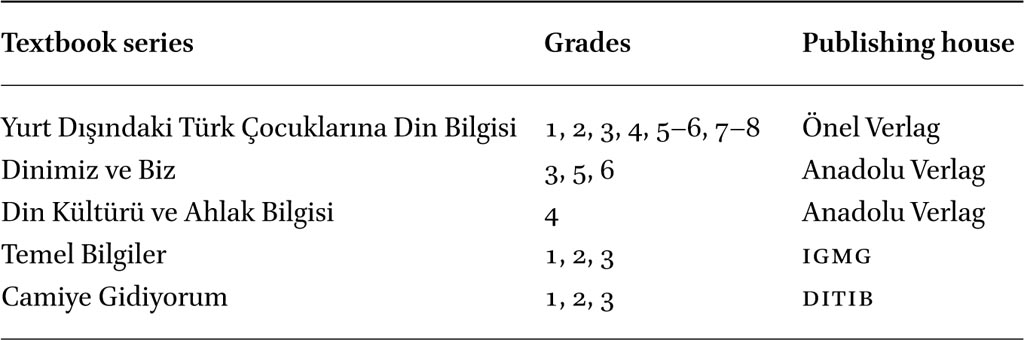
In terms of Turkish initiatives, two prominent Turkish publishing houses, Anadolu- and Ãnel Verlag, have already been providing educational media for Turkish education in Germany since the late 1970s, including those for Islamic education. While Ãnel Verlag previously published the series âYurt DıÅındaki Türk Ãocuklarına Din Bilgisiâ 1, 2, 3, 4, 5â6, and 7â8 in Turkish and recently âDie Schöne Quelleâ for Islamic education in primary schools at Grades 3 (2008) and 4 (2011), Anadolu Verlag has provided a broader range, including the previously published series âDinimiz ve Bizâ 3, 5, 6; Din Kültürü ve Ahlak Bilgisi 4; âAlevilik Dersleriâ 1 and 2 published in Turkish in the 1980s; and recently published series in German, including âStaunen und Verstehenâ for Grades 1â2, and 3â4 for primary schools and âEin Blick in den Islamâ 5/6 and 7/8 for use at secondary schools.
My research is limited to Turkish textbooks published by Anadolu and Ãnel Verlag, as well as a second set of educational media developed by the two major Turkish-Islamic communities in Germany, DITIB (Diyanet Ä°Åleri Türk Ä°slam BirliÄi/ Türkisch-Islamische Union der Anstalt für Religion e.V) and IGMG (Islamische Gemeinschaft Millî GörüÅ), in order to analyse the constructed relationship between the Turkish national self and the religious self. In the following section, I provide an overview of this educational media in terms of the methodological framework of this study.
3 Methodology
The research data for this study is based on a total sample of 16 textbooks released mostly between the 1990s and the present, including Anadolu and Ãnel Verlag series for religious education in Turkish, as well as two recently released series produced by DITIB and IGMG:

By drawing on the methodological framework of CDA, I first identify key thematic contents that portray Turkish religious identity in connection to different historical and cultural characteristics of Turkishness as well as new experiences in the German setting. These are the sub-sections in the analysis part of this work.
Recognizing that discourses about national identities can be used to correspond to four major functions of their construction, perpetuation or justification transformation and demontage or dismantling (Wodak et al., 2009: 36â42), I investigate how specific strategies are used in the construction of the image of the self and the other, which are described by Wodak (2001, p. 73) as âthe basic fundaments of discourses of identity and differenceâ. These are the strategies of referential/nomination, predication, argumentation, perspectivation and intensification or mitigation (Wodak, 2001). This enables us to address the following questions:
Whether and how discursive strategies and relevant linguistic devices are used to describe characteristics of Islamic identity in relation to Turkishness (i.e. Turkish culture, geography, or history) and how they are experienced in new German settings?
Are the Turkish or German components connected with Turkish religious identity portrayed positively or negatively, and which linguistic tools are used to reinforce this positive or negative labelling?
What argumentative schemes are used in Turkish and German contexts to construct and justify favourable conceptions of Turkish religious identity? Are any particular topoi utilized to sustain these narratives?
Are there any specific perspectives other than that of the textbook authors used to reinforce these attributes and qualities?
What statements or narratives are used to intensify or mitigate the favourable or unfavourable images of the Turkish or German elements associated with Turkish religious identity experienced in Germany?
Finally, as specified by Wodak et al. (2009, pp. 36â42), particular linguistic devices used to support these discursive strategies will be highlighted.
4 Findings and Discussion
4.1 Thematic Contents
The textbooks in the Yurt DıÅındaki Türk Ãocuklarına Din Bilgisi (Din Bilgisi hereinafter) series, published by Ãnel Verlag, include the studyâs earliest data. These textbooks are more of a reader than a chapter-based structure, featuring a variety of reading texts. The textbooks were approved and recommended by the Turkish Ministry of National Education and The Supreme Council of Religious Affairs of the Directorate of Religious Affairs in 1981 and 1982, respectively, for Turkish children and teachers living abroad.
In addition to traditional Islamic education topics such as creation and God, the tenets of belief and Islam, the Qurâan, the life of the prophet Mohammad, Islamic ethics and praised behaviours in daily life, and Islamic rituals, the volumes in this series cover sections that depict Turkish history and culture. These include Turkish customs and traditions (Din Bilgisi 2, p. 39), love of homeland (Din Bilgisi 2, p. 40; Din Bilgisi 4, pp. 2, 47; Din Bilgisi 7â8, pp. 127â128), Turkish contribution to Islam (Din Bilgisi 4, p. 9; Din Bilgisi 7â8, p. 61), and world civilization (Din Bilgisi 7â8, pp. 123â126), as well as passages on Turkish geography and history (Din Bilgisi 4, pp. 56â61), Turkish Islamic literature on the birth of Prophet Mohammad (Din Bilgisi 5â6, pp. 62â64), and secularism (Din Bilgisi 4, p. 62; Din Bilgisi 5â6, p. 67; Din Bilgisi 7â8, pp. 129â130).
Anadolu Verlagâs Dinimiz ve Biz includes reading passages as part of thematic chapters that address both essentially religious and Turkish-related topics. Dinimiz ve Biz 3, for example, comprises ten chapters and covers issues such as âTurksâ Adoption of Islamâ (pp. 90â95) and âIstanbul as a Model City for Interreligious Dialogueâ (pp. 43â45). Rather than having chapters dedicated completely to Turkish culture or history, Dinimiz ve Biz 5 and 6 feature relevant aspects in different sections.
The last two series under consideration were published by DITIB and IGMG, Germanyâs two largest Turkish Islamic organisations. The first series, Temel Bilgiler was published by the IGMG and is taught in the premises of their mosques throughout Europe. They are based on the prescribed elementary (IGMG, 2017a) and secondary (IGMG, 2017b) curricula, and are separated into three age groups: two-year preparatory courses for children aged 7â8, primary education for children aged 9â12, and secondary education for children aged 13â15. (IGMG 2017a: 8). Apart from the fundamental courses of the Qurâan and the books of prayers and surahs, the primary educational media for religious education are Temel Bilgiler Hazırlık 1 and 2, Temel Bilgiler 1, 2, and 3. (IGMG 2017a: 8; 2017b: 8). In addition to these primary materials, the curricula include a list of secondary literature to be reviewed. It is stipulated that no other source be utilised, and that any such demand should be handled through the Education Directorate (EÄitim BaÅkanlıÄı) (IGMG, 2017a: 8, 2017b: 9).
The second set, created by DITIB and used in religious instruction at DITIB mosques in Germany, includes Camiye Gidiyorum 1 for children aged 7â9, Camiye Gidiyorum 2 for children aged 10â12, and the recently published Camiye Gidiyorum 3 children aged 13+. The DITIBâs Directorate for Education, Research and Publishing Services (DÄ°TÄ°B EÄitim, AraÅtırma ve Yayın Hizmetleri MüdürlüÄü) developed the Basic Religious Studies Curriculum, which was approved by its Education Commission in Western European Countries (Batı Avrupa Ãlkeleri EÄitim Komisyonu).
According to the preliminary content analysis, religious education in the analysed textbooks is based on five common, major subjects. These are belief (inanç/itikad), worship (ibadet), the life of the Prophet Mohammad (siyer), morals (ahlak) and the fundamental sources, particularly Qurâan. Specific subjects include the last section, Religion, Culture and Science in textbooks of Camiye Gidiyorum; religious music and the organisational history of the IGMG (TeÅkilat Dersleri/Organisational Lessons) in Temel Bilgiler 1â2, as well as Sufism, Islamic History, Turkish language, oratory and human rights in Temel Bilgiler 3.
After describing the main thematic frameworks presented in the analysed textbooks, I will identify major discursive strategies used for constructing and justifying an essential link between the Turkish religious and national sense of belonging, as well as how this has been maintained or revised in the German setting by various publishing initiatives.
5 Revisiting Textbooks from the 1980s and 1990s: Drawing the Line between âOur Beloved Homelandâ and âthe Land of the Germansâ
One of the initial grounds for establishing the relationship between Turkish national and religious identity was the construction of distinctive images of Germany and Turkey. Religious textbooks, as stated in the content-related description, do not limit themselves to religious subjects alone, but also cover Turkey-related themes, although to varying degrees depending on the publication period and the publisher. In this regard, I contend that the early textbooks were specifically designed to maintain the Turkish self-image through a black-and-white portrayal.
I argue that it was first developed through a strategy of nomination, using linguistic means of membership categorization to remind pupils where they belong to. This becomes apparent through possessive determiners enabling this referential strategy from the first grade textbook onward, referring to Turkey as âour homelandâ (Din Bilgisi 1, pp. 2, 24; Din Bilgisi 2, p. 40; Din Bilgisi 4, p. 47), and âour country (Din Bilgisi 2, pp. 40, 41; Din Bilgisi 3, pp. 14, 34), or simply through narrations that are meaningful in the Turkish context, such as games that are mostly played in Turkey (Din Kültürü 4, pp. 92â93).
Furthermore, a black-and-white depiction underscores this differentiation by highlighting that â(they) have relatives, friends and acquaintances in (their) country,â adding that â(they) are children of a Muslim countryâ (Din Bilgisi 2, p. 41) or by stating that they are âchildren of another nation,â and âas a Muslim Turkish kid worthy of (their) country, (they) need to pay closer attention to (their) behavioursâ (Din Bilgisi 4, p. 52). Similarly, students are reminded in Din Kültürü 4 (p. 24) that â(they) should get along well with (their) friends and brothers, even if they are of another religion.â The same textbook depicts the use of a membership categorization strengthened by distinction while advising on intercommunal relations as follows: âIslam is the best religion chosen by God for all mankind. However, we respect other religions and do not despise anyone because of their beliefsâ (p. 39), adding that âWe must protect and observe the rights of everyone, Muslim or non-Muslimâ (p. 126).
While the same focus is placed on page 41 of Din Bilgisi 2, we can see that the distinction is subsequently maintained through a strategy of predication, particularly by supporting the referential strategy with a positive self-presentation. The nation and the country, as represented by natural space as well as cultural and historical legacy, are the subjects of this positive self-presentation. These discursive constructs allow pupils to have a favourable image of Turkey in comparison to a neutral, which does not represent an attachment, or an unfavourable image of Germany. This is reinforced by the strategy of predication, specifically the use of evaluative attributions to Turkey such as the âlovely homelandâ (Din Bilgisi 1, p. 3; Din Bilgisi 2, p. 41), as well as the use of possessive determiners such as âmyâ or âour.â
This predication strategy is extended to the portrayal of the Turkish nation, which was already constructed using a referential strategy with possessive determiners referring to âour nationâ (Din Bilgisi 2, p. 40; Din Bilgisi 3, p. 14). In Din Kültürü 4 (p. 115), we see that the motherland and the nation are presented as an integral part of personality in the context of the praised values transmitted by the family: âDidnât we learn about Allah, our Prophet, haram, halal, our homeland, our nation, how to eat and drink, and what is right from them?â This is closely related to the goal of upbringing, as stated on page 115 that â(they) should be raised to be persons of faith, morals, hard work, service to others, and love for (their) homeland and nation,â or, similarly once again highlighting that â(they) should grow up to be faithful, moral, hardworking people who observe the rights of everyone, who are useful to themselves, their families, their homeland, and their nationâ (p. 126). In the text âWho is Called a Muslim?â in the same textbook, an idealised, generalised self-image is provided through the referential strategy, which is reinforced by intensification, to remind students that â(they) are Turks.â (They are) the descendants of a great nationâ (p. 51). Positive self-presentation of the Turkish image is further maintained here by evaluative attributions such as having âa rich civilization, has its own traditions and customs that have continued for centuriesâ (Din Kültürü 2, p. 39), or simply âa glorious historyâ (Din Kültürü 4, p. 119) as well as narrations such as the one depicting how Mehmed II was welcomed after his conquest of Istanbul (Din Kültürü 4, p. 122) . This is emphasised through traits such as being ârenowned for its honesty, helpfulness, respect for elders and kindness for youngers ⦠clean and hardworking,â as well as the fact that âhospitality is a very long tradition of Turksâ (Din Bilgisi 2, p. 39). In the depiction of Turksâ contribution to world civilization in Din Bilgisi 7â8, we see not only a strategy of predication, such as Turks being described as âa nation with an artistic spirit,â (p. 124), but also an intensification stating that âthe geniuses of science, thought and art are all Turksâ by listing several scholars (p. 123). This intensification is furthered by the use of a superlative, as presented on the following page: âafter merging with Islamic culture, the Turkish nation decorated various corners of the world, from Central Asia to the European continent, with the highest works of art and architectural wonders (p. 124).
The predication strategy is constructed and maintained not just through narratives, but also through images accompanied by descriptions based on evaluative attributions. Din Bilgisi 5â6 (p. 7), for example, depicts an image of Istanbul as âthe pearl of our Turkey, beautiful Istanbul.â Furthermore, in addition to several images from mosques which clearly highlight the Turkish context in Din Kültürü 4 (pp. 46, 47, 58, 62, 63, 76, 78, 82, 88, 102), images of mosques are used to represent Istanbul as part of a perpetuation strategy that reinforces positive self-presentation through a topos of the lovely place/ locus amoenus (Din Bilgisi 4, p. 17: Din Bilgisi 5â6, pp. 14, 18, 24):
Our great mosques, which are among the highest works not only of Turkish-Islamic art but also of world art, and which you all visit with pride when you visit our city of Istanbul and under whose domes we experience deep religious feelings, attract the attention of the world with their inaccessible beauty. (Din Bilgisi 7â8, p. 124)
In this example, it is not only the use of a superlative to denote a singularity, but also the use of a possessive determiner that adds to the establishment of a link between the national and religious selves through geographical and architectural identifiers.
When compared to the Turkish image, which is constructed through referential and predication strategies, the German image is almost presented neutrally. In addition to the aforementioned portrayal of Istanbul as âthe pearl of our Turkey, beautiful Istanbul,â for example, Bonn is simply described as âthe city of Bonn in West Germanyâ (Din Bilgisi 5â6, p. 7). Furthermore, the topos of differentiation is used to sustain a distinction. In Din Bilgisi 3, for example, students are taught that âit is (their) primary duty to be respectful towards the society (they) live in, apart from (them), even if it is of a different religion, and to comply with the laws and regulations that this society applies to everyoneâ (p. 14), similar to the description in the text on âOther Religionsâ on page 43 of Din Bilgisi 2: âMoreover, as Muslim children, we strive to set a good example with our behaviour in the society we live in, and we want others to think well of us.â While specifying religious affiliation as a sign of distinctness from the larger society may be considered expected, it is different discursive means that would maintain this distinction.
After establishing the distinction between Turkey and Germany, as âusâ and âthem,â the connection of the Turkish national and religious self was maintained through a strategy of argumentation centred on the discourse of the âlove of homeland.â The passage âPatriotismâ (p. 40) in Din Bilgisi 2, for example, refers to possessive determiners as well as comparison and narration referencing to historical legacy to build an emotional sense of patriotism:
Our country and nation are sacred to us, as our home and family are sacred to us. We must exhibit the same love and commitment to our country and nation as we do to our home and family. We must not forget that our country is the cornerstone of our existence. We must keep in mind that every piece of land is watered with the blood of our heroes, who gave their lives to protect it, and that it is entrusted to us. We should commemorate our martyrs who gave their lives for our country. We should recite Fatiha to them.
Furthermore, patriotism is described in terms of perspectivation with references to religious sources, specifically a saying, which is usually attributed to the Prophet Mohammad, on the introduction page of Din Bilgisi 4 (p. 2): âpatriotism is from faith.â On page 47 of the text âIslamic ethicsâ, students are given five fundamental principles, beginning with the love of homeland. The importance of love of homeland is emphasised as a responsibility, which is strengthened by references to the topos of historical legacy:
Our forefathers entrusted us with the defense and exaltation of our homeland. We, like them, should demonstrate our loyalty to the homeland at every chance, and we should not avoid making any sacrifice for this cause. In order for our state to be strong, we must fully fulfil our responsibilities to the state, such as paying taxes and enlisting in the military,â adding that âthe glorious victories of (their) forefathers in history are also the result of the belief and ideal of âIf I die, I will be a martyr, if I remain a veteranâ. Every Turkâs principal obligation is to work for the country and nation, to obey our stateâs laws and commands, and to defend our homeland against any danger.
This sense of historical legitimacy is reinforced by a perspectivation strategy that refers to the Prophet Mohammadâs battles to prescribe what to do if necessary: âwe should also be able to give our lives for our religion, our homeland, and our nation.â (p. 32)
Perspectivation is also used in relation to a role model authority, Mustafa Kemal Atatürk, the founder of the Turkish Republic. References to his statements were primarily depicted as part of sections on secularism in Din Bilgisi 4, 5â6, and 7â8 to support the established connection between the Turkish national and religious self, including the following quotation, which not only depicts his praise of Islam but also the Turkish nation`s relationship to it: âOur nation possesses two robust virtues, religion and language. No power has ever been able to take these virtues away from the heart and conscience of our people, and they will never be able to,â adding that âThe Turkish nation should be more religious. I mean, it should be religious in all simplicityâ (Din Bilgisi 4, p. 62).
The fundamental difference between the Din Bilgisi series and Anadolu Verlagâs Dinimiz ve Biz in the 1990s and early 2000s is an increased focus on the German context. This is maintained not only through texts but also images, such as the cover of Dinimiz ve Biz 6 portraying students in a classroom in Germany; a photo from a paediatricianâs practice (p. 8), another depicting the traditional âthe first day at schoolâ ceremony (p. 24), as well as depictions of Christian and Jewish clergy with Bible and Torah (pp. 48â49).
Given that Germany is now the setting for their new experiences, we see a variety of portrayals of the Turkish religious and national self. The predication strategy for establishing a positive self-portrayal of the Turkish national self is maintained, but to a lesser extent than in prior editions. This is primarily supported by the topos of historical legacy, which constructs two main themes.
The first is the discourse of the tolerant Turkish rule. This is portrayed either through references to historical figures such as Ottoman sultan Mehmet II or Bayezid II, who welcomed Jews after their expulsion from Spain in 1492 (Dinimiz ve Biz 3, p. 45) or Istanbul as the model setting for not only inter-religious coexistence but also the tolerant Turkish rule: âThanks to this tolerance, Christians and Jews who believe in a monotheistic religion and are recognized as People of the Book have been able to coexist peacefully for centuries,â adding that âIstanbul, is one of the best examples of this. Istanbul, where churches, synagogues and mosques have coexisted for centuries, retains this vitalityâ (p. 43).
The second theme that allows for a positive portrayal of the Turkish self is the contribution of Turks to the Islamic civilization. However, in comparison to previous textbooks, it is now depicted relatively briefly and in a broad, abstract way:
â They built mosques, castles, bridges and madrasas in Islamic countries.
â They created significant works in the arts of carving, embroidery and calligraphy.
â They have trained many scientists. (Dinimiz ve Biz 3, p. 93)
In addition to the positive self-presentation of the Turkish component, the portrayal in black and white was introduced and depicted in the series Dinimiz ve Biz through the use of the topos of the bitter homeland (acı vatan), which attached negative connotations to labour migration to Germany. On page 78 of Dinimiz ve Biz 6, for example, labour migration is compared to the Hijra of the first generation of Muslims, who migrated from Mecca to Medina with Prophet Mohammad, stating that both aimed to âensure a good future for their children.â Furthermore, the topos of the bitter homeland is conveyed through narrations of everyday challenges. For example, in Dinimiz ve Biz 5, the section âCauses of Lonelinessâ presents two narratives on how Turkish characters may suffer loneliness in the setting of Germany (p. 8).
The topos of the bitter homeland can also be regarded as an initial point in DITIB and IGMG textbooks to address the in-betweenness of the Turkish self between Turkish and German settings. IGMG`s Temel Bilgiler, for example, used a referential strategy to highlight the in-betweenness of Turkish children raised and educated in Europe by emphasising âhaving difficulties between two culturesâ after describing the crucial role that religious and language education plays in the development of oneâs identity (Temel Bilgiler 1, p. 9; Temel Bilgiler 2, p. 9).
However, the backdrop for the existence of the topos of the bitter homeland in Temel Bilgiler was shaped more by the past than the present, specifically the early stages of labour migration. This included addressing the difficulties of establishing a new life in Germany as well as the early organisational efforts of the IGMG-related people in the 1960s. Temel Bilgiler 1 (p. 140) states that, âthey had no places to gather together, drink tea and chat. More crucially ⦠a mosque where they could perform their Friday and Eid prayers,â whereas the following volume addressed difficulties in daily life from a religious point of view by detailing that âat that time, there were no Muslim-owned markets yet. (They) could find and eat the foods (they) knew from German markets. It was quite difficult to find halal food. There were a few options. Many people did not discern between halal and haram or did not know the differenceâ (Temel Bilgiler 2, p. 199).
Furthermore, there were two major differences between Camiye Gidiyorum of DITIB and the Temel Bilgiler series of IGMG. The layout and didactical framework of Camiye Gidiyorum are basically more similar to what students find in German classes. The fact that âboth the method of teaching the lessons in the book, as well as the size and shape of the textbooks, are the types that students are accustomed to from their schoolsâ (p. 3) was already highlighted in Camiye Gidiyorum 3.
In terms of content, the already established distinction between Turkey and Germany is deconstructed in Camiye Gidiyorum series not only by presenting an increasing number of images from Germany corresponding to the overall context, but also by highlighting the presence of the Turkish-Muslim community in Germany and contextualising Islamic issues in the German setting.
In terms of the increasing portrayal of the German component, the text on page 217 of Camiye Gidiyorum 2 describes the beauty of the gardens and flora in Altonaer Volkspark in Hamburg. Furthermore, while the text âWhat is a constitution?â in the chapter âThe Qurâan gives us adviceâ is accompanied by a photo of the German flag and the constitution (Camiye Gidiyorum 3, p. 97), the first assignment in chapter 26 on âGiving Almsâ asks students to âgather information about âDie Tafelnâ (p. 158).
What is more remarkable in terms of establishing an awareness of the self and the other is that Germany is now presented as a place where Islamic identity can be retained. This is demonstrated by the images used as well as the content.
In terms of the former, students will see several images of the DITIB, Central Mosque in Köln (Camiye Gidiyorum 1, pp. 197â198; Camiye Gidiyorum 2, pp. 26, 87, 98, 99, 105, 106, 138, 148, 170) as well as gatherings in various mosques throughout Germany. (Camiye Gidiyorum 2, p. 40).
Finally, the contextualization of Islamic debates or themes in the German context is increasingly highlighted through a strategy of perspectivation represented in particular texts as well as assignments. In addition to learning about Islamic concepts and larger texts that are now available in German, students are now also asked to frame religious issues in the German context.
Regarding the former, each chapter concludes with a summary and reading samples in addition to the German translations of major religious concepts throughout the chapter so that â(they) can develop the habit of reading religious texts in German (Camiye Gidiyorum 2, p. 3). How it is expected to be received by the students is already shown in a text on prayer, in which the Turkish kid Ahmet is depicted to be highly pleased when he learns that the book supplied for learning the Qurâan is written in both Turkish and German, adding his thoughts as follows: âthatâs a brilliant idea! If I donât understand the Turkish section, I read in German; if I cannot understand the German section, I read in Turkishâ (Camiye Gidiyorum 1, p. 95). This is put into practice by asking students to write the German translations or names of religious figures, such as Prophets (Camiye Gidiyorum 1, p. 143; Camiye Gidiyorum 3, p. 80); related verses from the Qurâan or sayings of Prophet Mohammad (Camiye Gidiyorum 3, p. 160), compare some surahs in Turkish and German (Camiye Gidiyorum 3, p. 173); or explain why Judaism, Christianity and Islam are referred to as âAbrahamitische Religionenâ in German (Camiye Gidiyorum 3, p. 81).
In relation to the latter, they might, for example, discuss in class âwhether it is permissible to smoke cannabis (Gras/Hanfpflanze), following the rule used in the above fatwasâ (Camiye Gidiyorum 3, p. 129) or clarify the amount to be given as alms provided in Euros. (p. 159).
In summary, when compared to the national self, the religious self is described as creating and expanding a space of exchange between the Turkish and the German selves.
6 Expanding the Boundaries between âthe Turkishâ and âthe Germanâ: Revisiting Religious Festivals
Through the topos of differentiation, religious festivals have already been established as one of the core components of the manifestation of a distinctive religious self, albeit without any negative or positive attributions, such as the portrayal of Ramadan as one of âourâ major feasts, similar to âGermansâ Christmas and Easterâ in Dinimiz ve Biz 5 (p. 64).
Furthermore, images of inter-religious exchanges, as well as representations intended to foster inter-religious awareness and understanding, became an increasingly visible theme beginning with the Dinimiz ve Biz series. In this context, a referential strategy is used to establish Turkish religious self-image through the topos of differentiation while fostering intercultural understanding and dialogue.
For example, students are encouraged to âtry to practise interfaith dialogue by inviting (their) Christian or other religious friends to (their) classâ (Dinimiz ve Biz 3, p. 45), or assigned to write an essay about different forms of fasting in Christianity and (if applicable) other religions, after reading the story âBirthday of Sabine and Fastingâ (p. 66). In Dinimiz ve Biz 5, students are further asked to âthink about other activities with the aim of living together with non-Muslims in peaceâ after reading the text âLiving Together with non-Muslims,â which depicts a dialogue between a Turkish woman and her neighbours on holy days (p. 15). They are also reminded that â(they) can tell their German friends in the class about the Ramadan feast,â and âget information from (their) Christian friends about their holy months and days similar to this monthâ (p. 55).
This perspective has been maintained in religious education textbooks produced in the 2010s as well. It was presented in the Camiye Gidiyorum series as a basis to enhance inter-religious understanding and dialogue on the basis of a referential strategy.
The chapter âwe are celebrating,â in Camiye Gidiyorum 1 (p. 114), asks students to share âthe feasts of (their) non-Muslim friendsâ with their deskmate. The following page (p. 115) is titled âReligious feasts of my friendâ and depicts sample postcards for Christmas and Easter, as well as the two major Islamic holidays, by suggesting that they âcongratulate each other on religious holidaysâ and asking students to separate them according to religion as well as create a poster presenting their common and different aspects. Without presenting any critical argumentation, it can be expected that this will lead to a change in perspectivation and put the students in a position to actively expand the aforementioned bounds beyond the strictly defined cultural frames of âusâ and âtheirs.â
The topic of âOur feastsâ appears again in Camiye Gidiyorum 2 (pp. 87â91). In the assignment following the text titled âReligious Feasts of My Friendsâ, students are asked to prepare greeting cards for these four major religious feasts for their friends and acquaintances, similar to the previously suggested perspectivation in Camiye Gidiyorum 2, which highlights that âthere are people believing in other religions in the countries that (they) live in,â (p. 89). In the final assignment, they are also asked to create a calendar that contains all religiously significant days. (p. 91). In a didactic sense, this demonstrates how assignments can be used to deconstruct the widely accepted cultural frameworks currently in place that determine how one perceives oneself and others.
While these depictions suggest a transformative strategy that replaces a clear distinction between the Turkish self and the German other with one that allows positioning at the intersecting boundaries between the Turkish and German cultural realms, the two series of the DITIB and IGMG adopt a similar strategy in establishing a Muslim self replacing the Turkish self, within the context of the previously established topos of âTurks serving Islamâ
7 âThe Turkishâ and âthe Muslimâ vs. âthe Turkishâ or âthe Muslimâ
The relationship between the Turkish self and the Muslim image in the broader context was primarily constructed through narratives depicting Turks as the actor contributing to the expansion of the Islamic civilization throughout history, ranging from the political to the cultural realms, as detailed in the first part of the analysis of textbooks for Islamic education published in the 1980s and 1990s. This referential strategy was subsequently replaced by another that emphasised Muslimsâ contributions to the global civilization as well as their self-perception in everyday life in Germany.
It is remarkable that, while DITIB has been harshly criticised for fostering a nationalist mindset in its area of service, Camiye Gidiyorum presents a dominant strategy of predication emphasising Muslimsâ contributions to world civilization (Camiye Gidiyorum 2, pp. 212â214).
The two final chapters of each volume, namely âThe Contributions of Muslims to Global Civilizationâ and âIslamic Art and Literature,â primarily used a referential strategy for the depiction of âMuslimâ figures rather than Turkish ones, who were emphasised as âhaving made a great contribution to humanityâ (Camiye Gidiyorum 2, p. 246), despite the fact that almost all of the depicted figures are of Turkish origin, such as Evliya Ãelebi, Hezarfen Ahmed Ãelebi, Nasreddin Hoca, UluÄ Bey, and Yunus Emre (Camiye Gidiyorum 2, pp. 158; 246â248); as well as the well-known historical figures of love stories in Turkish literature including Leyla and Mecnun, Kerem and Aslı, and Ferhat and Åirin (Camiye Gidiyorum 3, p. 165). Their relevance to the national self is established rather through references to towns or regions where they were born or created their works, as well as the emphasis that âpoems that (Yunus Emre) wrote are much loved in Turkish.â (Camiye Gidiyorum 2, p. 247), or described as the âpeak of our literatureâ (Camiye Gidiyorum 3, p. 166).
The reading text on calligraphy (hat), as part of the German synopsis, is titled âArt among the Ottoman Turksâ has also no more predication, except for the preceding textâs similar emphasis on âMuslimsâ rather than Turks (Camiye Gidiyorum 2, p. 249).
In this respect, the Temel Bilgiler series also follows a clearly defined referential strategy, emphasising a global, idealised Muslim sense of belonging rather than the Turkish or the Turkish-Muslim self. This is expressly stated in the text that provides students with the IGMGâs organisational development in Temel Bilgiler 1:
It was determined that a Muslim should always be a useful person to her/his environment and the society s/he lives in, and that one should work as a community with the Muslim identity. (p. 142).
This membership categorization is maintained and strengthened in the following volume: âMuslims need Islamic morals just like they need air and waterâ (p. 172). The only exception appears to be provided in the historical context, giving students a brief overview of different eras in Turkish history: âThe Ottoman Army, which advanced to the middle of Germany with Yavuz Sultan Selim and Kanuni Sultan Süleyman, both ensured Islamic unity and brought its rise to the highest point in history by pioneering in science, culture and civilization (Temel Bilgiler 3, p. 185).
Finally, in the very first description of the IGMG as âa non-governmental organisation that is deeply concerned with the problems of the Muslim minority that immigrated to Europe and settled in Turkeyâ (Temel Bilgiler 3, p. 1), Temel Bilgiler highlights a distinct category of âminority.â
8 Conclusion
Educational media for Islamic education in Turkish offered in Germany presented a diverse realm during the more than six-decade history of the Turkish community. The two largest Turkish-Islamic groups recently began offering their own educational media in the 2010s, following the textbooks provided by the two major Turkish-origin publishing houses, Anadolu and Ãnel Verlag dating back to the 1980s. Analysis of these textbooks revealed various changes and differences in terms of time and actors releasing them.
The first set of textbooks clearly drew the distinction between Germany and Turkey and sought to forge a strong, unchallengeable connection to the latter. This was established by emphasising specific content created using particular discursive strategies, such as embracing the connection to Turkey through the use of possessive determiners, establishing a positive self-presentation not only through evaluative attributes, such as superlatives, but also by justifying it with certain topoi such as historical legacy or love of homeland, the latter reinforced through specific perspectivation including references to major religious sources. While the Turkish self-image, both with references to the nation and to the country, has been praised as a component of the black-and-white portrayal, the German component has either been presented neutrally or negatively connoted in terms of the topos of the bitter homeland representing an overall image of the labour migration.
On the other hand, the new sets of textbooks created in the 2010s, especially the Camiye Gidiyorum series, deconstructed this portrayal in black and white to a certain extent through an increased portrayal of the German component, not only in the design of the educational media including an increased visibility of the German language, but also through images representing the Muslim presence in Germany as well as contextualising Islamic debates within the German context, thereby replacing the previously established image of Germany as a place of non-belonging with one where Muslims can maintain and express their religious identity. It has been notably religious holidays, whose portrayal expectedly emphasised distinction through references to various religious-cultural traditions, while also providing an appropriate foundation or opportunity for intercultural understanding and exchange. The analysis also showed that a transformative strategy appears to be portrayed in the textbooks in favour of a Muslim identity, in contrast to the previous set of textbooksâ predominant focus on the Turkish component in the religious-national image of the Turkish.
In brief, the findings show that textbooks for Islamic education in Turkish have undergone significant changes over the last three decades with apparent differences today not only in terms of design and layout, but also the portrayed content and didactic framework. Changes in the portrayal of the self and the other in the German and Turkish contexts indicate that these textbooks not only correspond to the changing identity-relevant dynamics of the Turkish community living in Germany, but also emerge as a medium of active participation in the reframing of Islamic issues in the German context, and encouraging students to actively communicate their religious identity in an intercultural setting through the use of perspectivation.
References
Adıgüzel, Yusuf. 2010. âAlmanyaâdaki Devlet Okullarında âÃslam Din Dersiâ Sorunu ve Ãözüm ArayıÅları.â Akademik Ä°ncelemeler Dergisi 52(2): 59â72.
Arkilic, Z. Ayca. 2015. âThe Limits of European Islam: Turkish Islamic Umbrella Organizations and their Relations with Host Countries- France and Germany.â Journal of Muslim Minority Affairs 35(1): 17â42.
Aydemir, Süleyman, Akın CoÅkuntürk, Cevat Ãztürk, and Abdurrahman Mengüç. 1996. Dinimiz ve Biz 5, 5th edition. Hückelhoven: Schulbuchverlag Anadolu.
Aydemir, Süleyman, Akın CoÅkuntürk, Cevat Ãztürk, and Abdurrahman Mengüç. 1997. Dinimiz ve Biz 6, 5th edition. Hückelhoven: Schulbuchverlag Anadolu.
Bilecek, Hayri. n.d. Din Kültürü ve Ahlâk Bilgisi 4. Hückelhoven: Anadolu Verlag.
Bilgin, Beyza. 1988. âAlmanya Federal Cumhuriyetinde Türk Ãocuklarına Ä°slami Din Dersi Program GeliÅtirme ÃalıÅmaları.â Ankara Ãniversitesi Ä°lahiyat Fakültesi Dergisi 30(1): 143â154.
Bora, Tanıl. 1998. Türk SaÄının Ãç Hâli: Milliyetçilik, Muhafazakârlık, Ä°slamcılık. Ä°stanbul: Birikim.
Brockett, Gavin D. 2011. How Happy to Call Oneself a Turk: Provincial Newspapers and the Negotiation of a Muslim National Identity. Austin: University of Texas Press.
Cetin, Ãnder, and Riem Spielhaus. 2022. Konstruktionen des türkischen Selbstbilds in Schulbüchern für den Herkunftssprachlichen Türkischunterricht von 1991 bis 2017, Eckert. Dossiers 1. Braunschweig: Leibniz-Institut für Bildungsmedien | Georg-Eckert-Institut.
Ceylan, Rauf. 2008. Islamische Religionspädagogik in Moscheen und Schulen: Ein sozialwissenschaftlicher Vergleich der Ausgangslage, Lehre und Ziele unter besonderer Berücksichtigung der Auswirkungen auf den Integrationsprozess der muslimischen Kinder und Jugendlichen in Deutschland. Hamburg: KovaÄ.
Copeaux, Etienne. 2006. Tarih Ders Kitaplarında (1931â1993): Türk- Tarih Tezinden Türk-Ä°slam Sentezine. Ä°stanbul: Ä°letiÅim.
Ãıtak, Zana. 2018. âNational conceptions, transnational solidarities: Turkey, Islam and Europe.â Global Networks 18(3): 377â398.
Ãinemre, Semra. 2017. âAlmanyaâda Ä°slam Din Dersleri Ve Almanca Din Dersi Kitaplarının İçerik Analizi,â Ph.D. diss., Ondokuz Mayıs Ãniversitesi.
Ãinemre, Semra. 2018. âAlmanyaâda Ä°slam Din Dersinin TeÅekkül Sürecindeki Temel Bazı Meseleler.â Trabzon Ä°lahiyat Dergisi 5(2): 435â469.
DİTİB. 2016. Camiye Gidiyorum 1. Köln: DİTİB Verlag.
DİTİB. 2019. Camiye Gidiyorum 2, 2nd Edition. Köln: DİTİB Verlag.
DİTİB. 2021. Camiye Gidiyorum 3. Köln: DİTİB Verlag.
Ev, Halit. 2003. âAlmanya-Kuzey Ren Westfalen Eyaletindeki âÄ°slam Din Dersleriâ Konusunda Bazı Tespit Ve Teklifler.â Türkiyeânin Avrupa BirliÄiâne GiriÅinin Din Boyutu Sempozyumu, Ãanakkale 18 Mart Ãniversitesi Ä°lahiyat Fakültesi, 65â88. Ankara: Diyanet Ä°Åleri BaÅkanlıÄı Yayınları.
Gewerkschaft Erziehung und Wissenschaft. 2013. Analyse des Unterrichtsmaterials âTürkçe ve Türk Kültürüâ (Türkisch und türkische Kultur). Unpublished document.
IGMGâIslamische Gemeinschaft Milli GörüŠe.V. 2017a. Temel EÄitim Müfredatı. Cologne: Plural Publications.
IGMGâIslamische Gemeinschaft Milli GörüŠe.V. 2017b. OrtaöÄretim Müfredatı. Cologne: Plural Publications.
IGMGâIslamische Gemeinschaft Milli GörüŠe.V. 2017c. Temel Bilgiler 3, 19th edition. Cologne: Plural Publications.
IGMGâIslamische Gemeinschaft Milli GörüŠe.V. 2018. Temel Bilgiler 1, 36th Edition. Cologne: Plural Publications.
IGMGâIslamische Gemeinschaft Milli GörüŠe.V. 2019. Temel Bilgiler 2, 21st edition. Cologne: Plural Publications.
IÅık YiÄit, Tuba. 2010. âAlmanyaâda Ä°slâm din dersinin geliÅimi ve müfredat sorunu.â UludaÄ Ãniversitesi Ä°lahiyat Fakültesi Dergisi 19(2): 299â314.
KaradaÄ, Ãzay, and Bayram BaÅ. 2019. Need Analysis for Turkish and Turkish Culture Course. Sakarya Ãniversity Journal of Education 9(3), 434â454.
Kiefer, Michael. 2005. Islamkunde in deutscher Sprache in Nordrhein-Westfalen: Kontext, Geschichte, Verlauf und Akzeptanz eines Schulversuchs. Münster: LIT Verlag.
Kiefer, Michael. 2012. ââSaphir 5/6â und âEinBlick in den Islam 5â6ââkritische Anmerkungen aus islamwissenschaftlicher Perspektive.â In Integrationsmedium Schulbuch: Anforderungen an islamischen Religionsunterricht und seine Bildungsmaterialen, edited by Klaus Spenlen and Susanne Kröhnert-Othman, 99â112. Göttingen: V & R Unipress.
Maritato, Chiara. 2018. âAddressing the blurred edges of Turkeyâs diaspora and religious policy: Diyanet women preachers sent to Europe.â European Journal of Turkish Studies: Social Sciences on Contemporary Turkey 27: 1â17.
Mecheril, Paul. 2018. âOrders of Belonging and Education: Migration Pedagogy as Criticismâ In Migration: Changing Concepts and Approaches, edited by Doris Bachmann-Medick and Jens Kugele, 121â138. Berlin: De Gruyter.
Mediendienst Integration. 2025. âIslamischer Religionsunterricht in Deutschlandâ. https://mediendienst-integration.de/gruppen/islam-und-muslime.html.
Mende, Claudia. 2013. âIslamic Religion Classes in German Schools: Who Decides?â https://en.qantara.de/content/islamic-religion-classes-in-german-schools-who-decides.
Mertek, Muhammed, and Celal Aydemir. 2000. Dinimiz ve Biz 3. Hückelhoven: Schulbuchverlag Anadolu.
Narlı, Nilüfer, and Sezen Bayrak. 2011. âAlmanya-Türkiye Hattı: Ä°slami Ãrgütler, TransnasyonalleÅme, Kadın Dernekleri ve Entegrasyon.â In 50. Yılında Göç, edited by Faruk Åen, 51â65. Ankara: T.C. Kültür ve Turizm BakanlıÄı.
Ãnel, Tarık, ed. 1999a. Yurt DıÅındaki Türk Ãocuklarına Din Bilgisi Ä°lkokul I, 7th edition. Köln: Schulbuchverlag Ãnel.
Ãnel, Tarık, ed. 1999b. Yurt DıÅındaki Türk Ãocuklarına Din Bilgisi Ä°lkokul II, 7th edition. Köln: Schulbuchverlag Ãnel.
Ãnel, Tarık, ed. 1999c. Yurt DıÅındaki Türk Ãocuklarına Din Bilgisi Ä°lkokul III, 8th edition. Köln: Schulbuchverlag Ãnel.
Ãnel, Tarık, ed. 1999d. n.d. Yurt DıÅındaki Türk Ãocuklarına Din Bilgisi Ä°lkokul IV, 9th edition. Köln: Schulbuchverlag Ãnel.
Ãnel, Tarık, ed. n.d. Yurt DıÅındaki Türk Ãocuklarına Din Bilgisi Ortaokul ve Liseler İçin Sınıf: 5â6. Köln: Schulbuchverlag Ãnel.
Ãnel, Tarık, ed.. n.d. Yurt DıÅındaki Türk Ãocuklarına Din Bilgisi Ortaokul ve Liseler İçin Sınıf: 7â8. Köln: Schulbuchverlag Ãnel.
Ãztürk, Ahmet Erdi, and Semiha Sözeri. 2018. âDiyanet as a Turkish foreign policy tool: Evidence from the Netherlands and Bulgaria.â Politics and Religion 11(3): 624â648.
Rosenow-Williams, Kerstin. 2012. Organizing Muslims and Integrating Islam in Germany: New Developments in the 21st Century. Leiden and Boston: Brill.
Reichmuth, Stefan, Mark Bodenstein, Michael Kiefer, and Birgit Väth, eds. 2006. Staatlicher Islamunterricht in Deutschland: Die Modelle in NRW und Niedersachsen im Vergleich. Münster: LIT Verlag.
Søvik, Margrete. 2008. âIslamic Instruction in German Public Schools: The Case of North-Rhine-Westphalia.â In Islam and Muslims in Germany, edited by Ala Al-Hamarneh and Jörn Thielmann, 241â265. Leiden and Boston: Brill.
Schissler, Hanna and Yasemin NuhoÄlu Soysal, eds. 2005. The Nation, Europe and the World: Textbooks and Curricula in Transition. New York: Berghahn.
Spenlen, Kiefer 2012. ââSaphirâ und âEinBlick in den Islamââkritische Anmerkungen aus paedagogischer Perspektive.â In Integrationsmedium Schulbuch: Anforderungen an islamischen Religionsunterricht und seine Bildungsmaterialen, edited by Klaus Spenlen and Susanne Kröhnert-Othman, 113â137. Göttingen: V & R Unipress.
ÅimÅek, Emre. 2019. âAlmanyaâdaki Müslüman Topluma Katkıları BaÄlamında DÄ°TÄ°Bâin Din EÄitimine Yönelik Faaliyetleri.â Eskiyeni 39: 259â282.
Topçu Tecelli, Nazmiye, and Feride Tekeli. 2021. âAlmanyaâda âTürkçe ve Türk Kültürüâ Derslerinde Malzeme Seçimi ve Kullanımı.â Hacettepe Ãniversitesi Türkiyat AraÅtırmaları Dergisi 35: 199â221.
Topçuk, Ali. 2015. âAlmanyaâda Uygulanan Ä°slam Dini Dersi Hakkında Bir DeÄerlendirme (Kuzey Ren Westfalya ÃrneÄi).â Ãukurova Ãniversitesi Ä°lahiyat Fakültesi Dergisi 15(1): 249â269.
Uslucan, Haci-Halil. 2013. âWissenschaftliche Analyse der türkischen Lehrbücher. Gutachten im Auftrag des Landes Nordrhein-Westfalen.â Unpublished document.
Wiedenroth-Gabler, Ingrid. 2008. âIslamischer Religionsunterricht in Niedersachsen. Ein Modellversuch zwischen politischem Anspruch und pragmatischem Schulalltag.â Theo-Web. Zeitschrift Religionspädagogik 7(2): 80â89.
Wodak, Ruth. 2001. âThe discourse-historical approachâ In Methods of Critical Discourse Analysis, edited by Ruth Wodak and Michael Meyer, 63â94. London: Sage.
Wodak, Ruth, Rudolf de Cillia, Martin Reisigl, and Karin Liebhart. 2009. The Discursive Construction of National Identity, 2nd Edition. Edinburgh: Edinburgh University Press.
Yavuzcan, Ismail H. 2017. âStand und Entwicklung des Islamischen Religionsunterrichts und Religionspädagogik in Deutschlandâ In Muslime in Deutschland: Historische Bestandsaufnahme, aktuelle Entwicklungen und zukünftige Forschungsfragen, edited by Peter Antes and Rauf Ceylan, 171â186. Wiesbaden: Springer VS.
Yerkazan, Hasan. 2017. âÃÄrencilerin Gözüyle Almanyaâda Cami Dersleri.â Diyanet Ä°lmî Dergi 53(2): 175â209.
Zentrum für Türkeistudien. 2005. Religiöse Praxis und organisatorische Vertretung türkischstämmiger Muslime in Deutschland: Ergebnisse einer telefonischen Befragung. Essen: Stiftung Zentrum für Türkeistudien.