


The wars of the 20th century were characterized by the vastly greater number of men deployed in the field by the various armies and by the simultaneous increasing technicalization of weapons and essential aids to warfare; consider as just one example the introduction of vehicles equipped with internal combustion enginesâtrucks, cars, tractorsâwhich gradually replaced the animal traction that had hitherto dominated. In this new context, war logistics became increasingly important, i.e. the complex organizational machinery for getting men and weapons to where they were needed and at the exact time they were needed. The importance of this is not generally matched by the level of attention given to it in the historiography, if we exclude specific studies, which are only read and studied by specialists. Certainly, it is more appealing to write and publish books dealing with great generals and great battles.
The mountain war, which represents a page in itself of the story of the Great War 1914â18, has its own peculiarities that make it unique.1 Firstly, the geographical context in which it took place is the Alps. We are therefore in the framework of the war between Italy and Austria-Hungary, in which troops of the respective coalitions took part only marginally. At the same time, the historiography on that theatre of war has always been considered secondary and âregionalâ, and is not comparable with the extraordinary flourishing of publications on the war on the Western Front or even the war on the Eastern Front, against Russia. Secondly, in mountain warfare, modernity and the atavistic nature of a natural-geographical context intersect, in which the combatants had to be at the same time expert climbers, tireless walkers, and ready to face
This essay examines a small territorial cross-section, which presents some aspects of mountain warfare, but also included elements of âplainâ warfare, so to speak. The territory examined is the south-eastern corner of Trentino: the Valsugana, where the Brenta River flows towards Venice, together with the plateaus of Lavarone, Folgaria, and Luserna that flank it to the south, and which represented the state border between Italy and Austria-Hungary in those years.
1 The Trentino Region in the New Strategic Situation after 1866
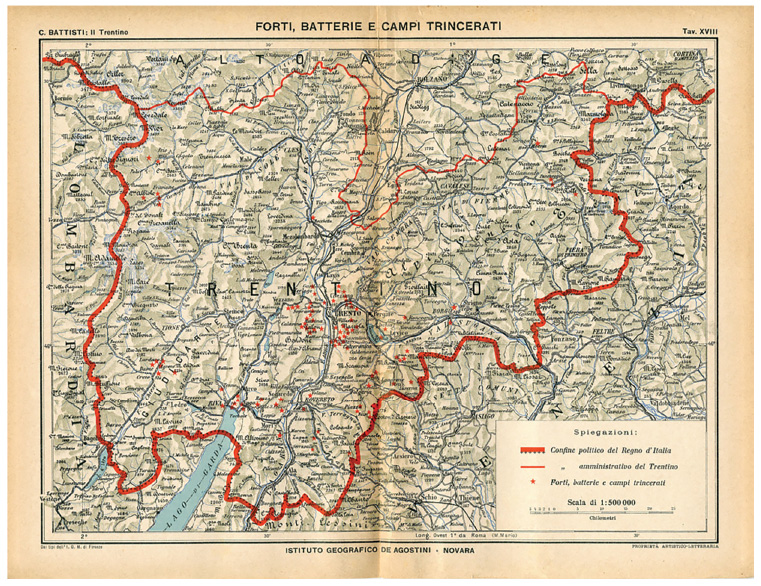
The cession of Venetia to the Kingdom of Italy, after the Austro-Prussian War of 1866 (best known in Italy as the Third War of Independence), brought the southern part of the Land Tirol, the Trentino, inhabited by a large majority of Italian-speaking people, to the forefront of the confrontation between Austria-Hungary and Italy.3 The Viennese government began to devote special attention to the strengthening of the regionâgeographically a sort of wedge into the Italian territoryâin a double perspective: to defend the empire but also in view of an attack against the traditional enemy. [Figure 2.1]

Borders
SOURCE: CESARE BATTISTI, IL TRENTINO, ISTITUTO GEOGRAFICO DE AGOSTINI, NOVARA, 1919.
Although they were both members of the Triple Alliance, a diplomatic invention (1882) by Chancellor Bismarck, Italy and Austria were not able to overcome the pre-existing strategic and political divide between them. In particular, the opposing nationalisms conjured the spectre of âirredentismâ of the Italian-speaking populations, and respectively the national homogenization of that small linguistic-cultural minority. In the region, especially from the beginning of the new century, a real war of words, gestures, and images was fought between the opposing nationalist groupings.4
A deep-going militarization of the region had to be pursued, concentrating resources in building a new and more effective infrastructure system in order to prepare for an inevitable war. In the forefront, a series of new fortresses was to be constructed at the borders, with fortifications built on the western side of the border, towards Lombardy, in the high mountain areas of Ortles, Adamello, and Tonale, to the northern shore of Lake Garda but also on the plateaus of Folgaria and Lavarone, and in the eastern part of Trentino, as well as in the Dolomites, always on the eastern side of the border.6 [Figure 2.2]
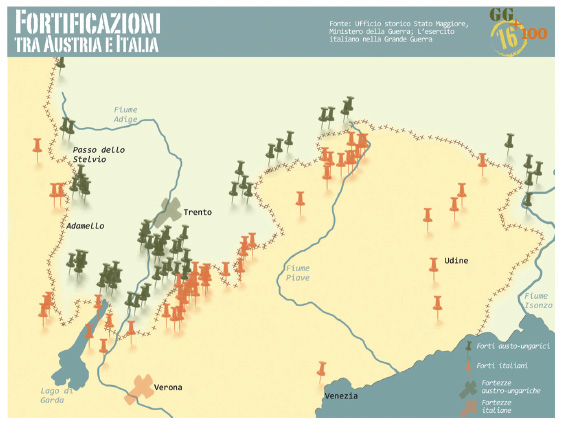
Here, we will focus our attention on a small, but important, portion of this very long border. The Valsugana was a valley with a westâeast/southâeast orientation that started from the area of Lakes Caldonazzo and Levico, immediately east of the regional capital, Trento. It was marked by the course of the River Brenta, which gushed from Lake Caldonazzo; this, bending south over the border with the Kingdom of Italy at Tezze/Primolano, flowed 174 kilometres into the Venice lagoon. The valley was thus one of the points of access, or connection, between Italy and Austria-Hungary. It was an easy access, as had been shown by the war of 1866, the so-called Third War of Independence from the Italian point of view, which had seen Italian troops move up the valley almost to the immediate vicinity of Trento.
The southern edge of the upper part of the Valsugana Valley was represented by the so-called plateaus of Lavarone, Folgaria, and Luserna, a mountainous and rugged area, which served as the southern border with the Kingdom of Italy. While it was relatively easy to block the bottom of the Brenta Valley with fortified barrages, the defence of the border on the highlands was more delicate and difficult.
Beginning in the last third of the 19th century, the government of Vienna started planning a defence system based on forts built on top of the highlands. From this point of view, the Valsugana was to represent the immediate logistical hinterland for the fortified system. At the same time, the military authorities had conceived and partially realized a concentric system of fortifications that was to protect the âTrento fortressâ (Festung Trient) from the west, south, and east; in parallel, a similar fortified system was planned and partially realized about 100 kilometres further northâthe so-called Festung Brixen, which was to block the junction between the Isarco Valley and the Pusteria Valley.
The Valsugana, lying immediately behind the plateaus, had therefore to play a major role at the rear of the fortresses to be built, from the beginning of the new century, close to the border with Italy. It should be mentioned that the same policy was pursued by the Italian counterpart. In the last decades of the 19th century, the construction of fortifications, fortified barrages, and other
At the beginning of the 20th century, a qualitative leap was made. On the Austro-Hungarian side, seven major forts were erected in the years immediately preceding the war on the plateau, at an altitude of between 1100 and 1900 metres. The fortifications were constructed according to the most modern techniques, using concrete, iron, rotatable iron domes for the artillery, and with forts partially excavated from caverns. It was a very expensive and powerful war machine, apt both for defence and for attack. Italians did the same in the same years, in a sort of ârace to fortificationâ.
The planning for a coming war, between the end of the 19th century and the first decade of the 20th, magnified the role of logistics, based on transport and communications. Railways were central to this.8 In Europe they were considered infrastructure to serve also, if not primarily, for military purposes. The modern railway lines were able to transport large quantities of men, and all other items necessary for the military, close to the front in a very short time. In the Austro-Hungarian Empire, the whole railway system was planned in the second half of the century following a military vision. The Brenner line was realized between 1853 and 1867 under the pressure of strategic necessity, namely to improve the military defence against the Italian enemy.9 The Valsugana railway line, too, from Trento to Venice, was completed between 1894 and 1896 according to both military and economic (fostering tourism) imperatives. In truth, the Austrian line stopped at Tezze, before the border, and the connection of the tracks with the section on Italian territory was only completed in July 1909.10
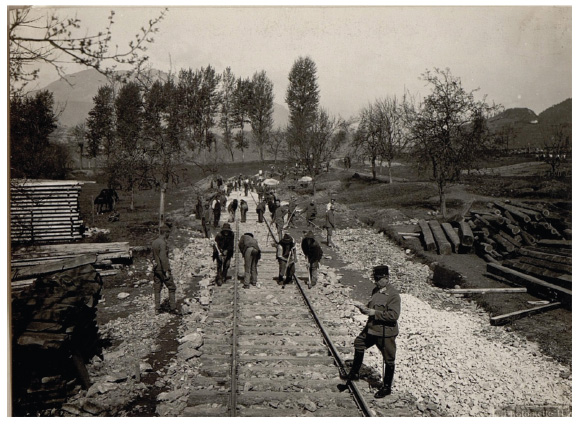
As a spin-off from the railway, in the same period, a network of routes connecting the Valsugana and the plateaus of Lavarone and Folgaria was planned and accomplished, or existing routes were modernized, to function as a crucial supporting element for the construction of the above-mentioned line of
Road under construction
SOURCE: KRIEGSARCHIV VIENNA.

Map of telephone cables
SOURCE: KRIEGSARCHIV VIENNA.

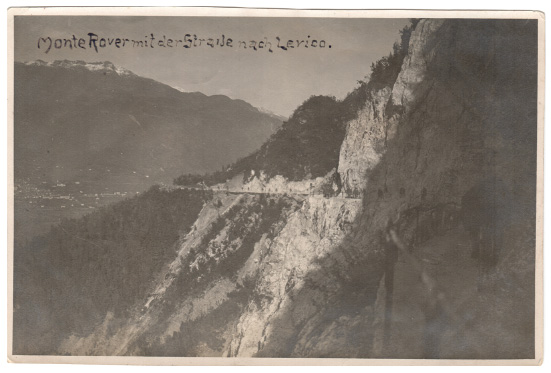
The old roads that connected the valley floor with the highlands were not adequate for the transport of heavy armament parts, such as the steel domes made by Skoda for the new forts and other pre-constructed concrete and steel parts. The Kriegsministerium in Vienna estimated that almost 3,000 transports were required to cover the needs for the construction of the forts. The existing roads were widened, the gradients reduced as far as possible, and new ones were built: the Fricca pass road and, foremost, the road from Caldonazzo to Monterovere, built between 1901 and 1912.11 The latter was named
In the same years, at the beginning of the century, the Valsugana railway line was equipped with new tracks and platforms in some stations, in particular Caldonazzo, and with new warehouses and stores for military purposes. Since the construction of the railway, the village of Caldonazzo had been equipped with a small station on the railway line, which was located in an important strategic position, as the village is directly below Monterovere (1,200 metres above sea level), the gateway to the highlands. Not only that, but thanks to the protected location, the construction of the Kaiserjägerstrasse as well as the construction of a cableway from Caldonazzo to the summit of Monterovere would have run less risk of being under fire from Italian artillery, which in the event of war might have been located in the valley floor east of Borgo Valsugana.
The planning and construction of the routes to the plateaus was a matter of frequent discussion and disagreement between the central state authorities and the local ones, who tried to defend their privileges and traditions, such as the communal woods. Seen from another perspective, the construction of routes demanded a large civilian workforce on the spot as well as transport facilities through carriages hired from the civilian population. These needs secured a new income source for a population largely consisting of poor peasants and small artisans.13
In general, the priorities of the central authorities always took precedence over those of the communes, which also had to bear a partial amount of the costs for constructing the new routes. Otherwise, the military had to fight with
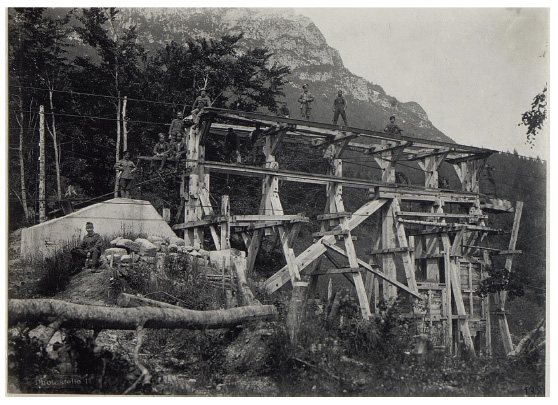
Another pillar of the development of logistic facilities is represented by the ropeways, a system of cables, hung from towers (in this case made of wood) from which carriers are suspended, aimed to transport materials specially in hilly and mountain areas. These could be built easily and in a relatively short time, using in large part materials present on site (trees, in particular). Ropeways, developed specially by German engineers and firms, could transport a huge number of items (up to many hundreds of tons per day) over hundreds of metres (up to one kilometre) of difference in height. [Figure 2.5]
Ropeway under construction
SOURCE: PRIVATE COLLECTION.
Obviously, the high wear and tear on cables and moving parts required constant monitoring and careful maintenance. Specially trained departments of technicians were set up to cover these needs. At first, the cableways were privately or communally owned and served mainly for economic purposes, to quickly transport timber and other agricultural goods. For example, the cableway from Levico to Cima Vezzena (1908 metres above sea level) was designed to transport timber from municipal forests downstream. With the approach of
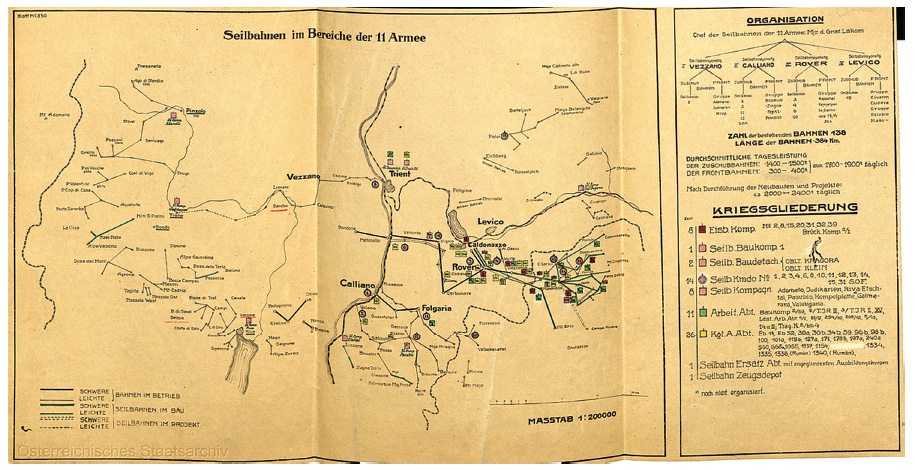
The frenetic building activity of fortifications came to an abrupt end with the entry of Italy into the war in May 1915. Some forts and other military installations remained unfinished. Instead, other sectors boomed; this is the case in particular for the construction of ropeways. [Figure 2.6]
Map of ropeways
SOURCE: KRIEGSARCHIV VIENNA.
The war, and in particular the preparation in early 1916 of the so-called Maioffensive (best known in the Italian tradition as the Strafexpedition) increased the transformation of the Valsugana as a crucial area of the immediate rear front for amassing reserves of military items, such as munitions and food rations. To give one example, the freight transported by railway on the Valsugana line increased by 600 per cent, confronting the war year 1916/17 with the average of the decade before.
As a second example, not far from Pergine, near to the northern shores of Lake Caldonazzo, in the marshy and only recently reclaimed area of San Cristoforo, a gigantic logistics centre was built in early 1916, in order to prepare for the offensive. It consisted of 15 tracks (each 500 metres long) and 28 large buildings. One of these was equipped as a military hospital with 2,000 beds. The location was chosen firstly because it was a wide plain, but also because it was out of the firing range of the Italian artillery, which was able to disturb the loading and unloading activities at the other logistical hub, the aforementioned Caldonazzo station.
As previously mentioned, the construction of ropeways, too, boomed in the years after 1915.14 Hundreds of so-called light ropeways (short and with a limited transport capacity) were built by the belligerent armies, with the help of large numbers of civilian workers, in a very short time. But heavy ropeways, longer and with a much higher transport capacity, were also constructed from the valley to the heights of the plateau. The three parallel ropeways built at different times from the logistics centre of Caldonazzo to Monterovere had a total (potential) capacity of more than 1,000 tons daily. At their mountain station, they were connected with a network of other smaller ropeways to supply the whole front line on top of the plateaus.
The increasing dynamic towards a militarization of the region, from the last decades of the 19th century, involved an intricate, partly conflictual relationship between military and civilian populations. It should be noted that the Italian part of Tyrol was one of the poorest of the entire Habsburg Empire.15 The rural economy was characterized in general by large peasant families cultivating small plots. Manufacture was almost absent, except for some isolated factories in Trento and Rovereto and the first modern water power plants. The incipient touristic development was limited to small parts of the territory, in particular the northern shore of Lake Garda (Arco and Riva) and the spas in Valsugana (Levico Terme and Roncegno). The rural male population was therefore forced to migrate, in large part as seasonal migrants to the north (Austria and Germany). But since the late 19th century, lifelong migration had also increased. It has been calculated that from 1850 to the beginning of the war, almost 10 per cent of the population had permanently emigrated, mostly to the Americas.
The arrival of the military brought some incentives, in particular in the form of workers (and animals) hired in large numbers for labour on the new roads and railroads, but also to build forts and other military instalments. [Figure 2.7] Female workers did chores for the military dislocated in the villages, for example, cooking, washing, and ironing.16 The construction of aqueducts and other infrastructure (electricity, telephone, sewers, etc.) benefitted not only the military but also the civilian population.
Civilians at work
SOURCE: PRIVATE COLLECTION.
However, the fortification and militarization of the territory involved its deep-going transformation, which damaged the local economy. Examples of this include rigid laws and rules issued to block any form of construction, even agricultural works, in the areas surrounding the forts. The so-called Festungs-Rayongesetz (first issued in 1856, but later rigorously amended) involved
These prohibitions created permanent tensions between the municipal authorities and the military. The capital city of the province, Trento, was transformed into a fortress (the previously mentioned Festung Trient) which meant, among other limitations, that 10 per cent of the urban area was subject to the prohibitionist legislation of the Rayongesetz. One of the consequences of the law was the depreciation of the areas in and around the city. Controls and restrictions on freedom of movement and in particular on taking pictures also represented a limitation for tourists, who liked to wander or hike in the mountains.17
It should also be added that the military authorities in the region were inclined to treat civilians with mistrust, fearing that in the event of war they would take Italyâs side. This attitude determined the worst consequences after May 1915, when the military decided to deport en masse the inhabitants of the
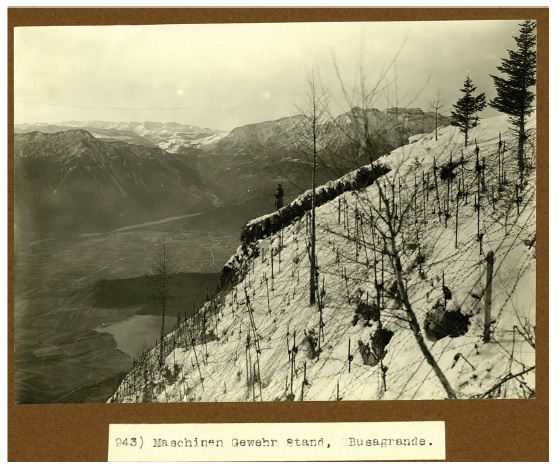
A second negative consequence of the militarization was the massive destruction of the woods, both for use of materials for military purposes and in order to clear the firing lines for the artillery all around the forts. As a consequence, the peasant families and the communal authorities lost an important source of income. The slopes of the mountains underwent dramatic changes: excavation of tunnels, levelling of uneven surfaces, canalization and rectification of torrents, and many other radical changes in the landscape. [Figures 2.8 and 2.9] Part of the agricultural area was sacrificed for military work. The works resulted in frequent incidents, which caused losses or injuries among the civilian workers.19
Barbed wire
SOURCE: KRIEGSARCHIV VIENNA.
This militarization process also became a major factor in the political discourse. In Trentino, the urban elites were divided between a small liberal party
Together with the request for an Italian university in the Dual Monarchy, which provoked a harsh reaction from the Austro-German nationalists at the beginning of the 20th century,20 and the general question of school and education,21 the militarization of the region, with the extension of rules, limitations, and obligations for the civilian sphere, was a third motivation for tension. The members from Trentino of the Diet of Tyrol and of the Parliament in Vienna gave voice to supposed unrest among the civilian population, but in vain.22 The military priorities of the Dual Monarchy in the wake of the July crisis had achieved supremacy over all other aspects of social life. To offer just one example, the new building destined by the municipality of Levico for the schools in 1914 was transformed by order of the authorities into a military hospital.
In the years following the end of the conflict, many of the elements introduced into the landscape by the Austro-Hungarian military authorities, to prepare for the conflict and then to fight it, underwent a gradual transformation to civil uses, allowing the start of a process of tourism development that has marked the destiny, and the present, of the Trentino-Alto Adige/Südtirol region since that time: from roads to cableways, to communication and urbanization
Bibliography
Allegri, Davide. Colle delle Benne [Bucket Hill]. Levico: Associazione Culturale Forte delle Benne, 2017.
Antonelli, Quinto. Storia della scuola trentina: Dallâumanesimo al fascismo [History of schools in Trentino: From humanism to fascism]. Trento: Il Margine, 2013.
Battisti, Cesare. Il Trentino: Cenni geografici, storici, economici [Trentino: Geographical, historical, economic background]. Novara: De Agostini, 1915.
Bonoldi, Antonio, and Maurizio Cau, eds. Il territorio trentino nella storia europea IV: Lâetà contemporanea [The Trentino territory in European history IV: The contemporary age]. Trento: FBK Press, 2011.
Corni, Gustavo, ed. Preparare la guerra: Logistica e militarizzazione del territorio in Alta Valsugana [Preparing the war: Logistics and militarization of the territory in Alta Valsugana]. Trento: Curcu & Genovese, 2019.
Filosi, Luca. âAmministrare una città in guerra: Trento 1914â1918â [Administering a city at war: Trento 1914â1918]. Thesis, University of Trento/University of Verona, 2016â17.
Fontana, Nicola. La regione-fortezza: Il sistema fortificato del Tirolo [The fortress-region: The fortified system of Tyrol]. Rovereto: Museo storico italiano della guerra, 2016.
Fontana, Nicola. âLâimpiego di manodopera femminile nei lavori di fortificazione sul fronte trentinoâ [The employment of female labour in fortification work on the Trentino front]. In Donne in guerra 1915â1918: La Grande guerra attraverso lâanalisi e le testimonianze di una terra di confine [Women at war 1915â1918: The Great War through analysis and testimonies from a borderland], edited by Paola Antolini et al., 47â68. Tione: Centro studi Judicaria, 2007.
Frizzera, Francesco. Cittadini dimezzati: I profughi trentini in Austria-Ungheria e in Italia (1914â1919) [Citizens halved: Trentino refugees in Austria-Hungary and Italy (1914â1919)]. Bologna: Il Mulino, 2018.
Gehler, Michael, and Günther Pallaver, eds. Università e nazionalismi: Innsbruck 1904 e lâassalto alla Facoltà di giurisprudenza italiana [Universities and nationalism: Innsbruck 1904 and the assault on the Italian Faculty of Law]. Trento: Fondazione Museo storico del Trentino, 2010.
Leonardi, Andrea. Un innovatore nellâingegneria dei trasporti del XIX secolo: Luigi Negrelli [An innovator in 19th-century transport engineering: Luigi Negrelli]. Bologna: Il Mulino, 2021.
Leoni, Diego. La guerra verticale: uomini, animali e macchine sul fronte di montagna, 1915â1918 [Vertical warfare: men, animals and machines on the mountain front, 1915â1918]. Torino: Einaudi, 2015.
Longhi, Luigi, and Antonio Zandonati, Teleferiche dellâ11a: Armata austro-ungarica dallâAdige al Brenta (1915â1918) [Ropeways of the 11th: Austro-Hungarian Army from the Adige to the Brenta (1915â1918)]. Rovereto: Museo storico italiano della guerra, 2013.
Malni, Paolo. Gli spostati: Profughi, Flüchtlinge, UprchlÃci. 1914â1919 [The displaced: Refugees, Flüchtlinge, UprchlÃci. 1914â1919], vol. 2, La storia [History]. Rovereto: Laboratorio di Storia, 2015.
Martinelli, Nirvana. ed. La strada della Valcaretta: Cartoline dalla collezione di Luigi Matuella [The Valcaretta road: Postcards from Luigi Matuellaâs collection]. Levico: Associazione Forte Colle delle Benne, 2017.
Pircher, Gerd. Militari, amministrazione e politica in Tirolo durante la prima guerra mondiale [Military, administration and politics in Tyrol during the First World War]. Trento: Società Trentina di studi storici, 2005.
Rasera. Fabrizio, and Anna Pisetti, eds. Paesaggi di guerra: Il Trentino alla fine della prima guerra mondiale [Landscapes of war: Trentino at the end of the First World War]. Rovereto: Museo storico italiano della guerra, 2010.
Rosner, Willibald. Fortificazione e operazione: Lo sbarramento degli altipiani di Folgaria, Lavarone e Luserna [Fortification and operation: The barrier of the Folgaria, Lavarone and Luserna plateaus]. Trento: Curcu & Genovese, 2016.
Sciocchetti, Gian Piero. La ferrovia della Valsugana [The Valsugana railway]. Pergine: Amici della storia, 1998.
Sondhaus, Lawrence. Franz Conrad von Hötzendorf: Lâanti-Cadorna. Gorizia: Libreria Editrice Goriziana, 2003.
Tabarelli, Gian Maria. I forti austriaci del Trentino [The Austrian forts of Trentino]. Trento: Temi, 1988.
Thompson, Mark. The White War: Life and Death on the Italian Front 1915â1919. New York: Basic Books, 2009.
Tonezzer, Elena. Il corpo, il confine, la patria: Associazionismo sportivo in Trentino (1870â1914) [Body, border, homeland: Sports clubs in Trentino (1870â1914)]. Bologna: Il Mulino, 2012.
Toller, Leo. âLa fine di un Kronland. Ricerche sui verbali della Dieta tirolese (1912â1914) e sui protocolli dellâAssemblea e del Consiglio Nazionale tirolese (1918)â [The End of a Kronland. Research into the minutes of the Tyrolean Diet (1912â1914) and the protocols of the Tyrolean Assembly and National Council (1918)]. Masterâs thesis, University of Trento, 2016â17.
Vecchiet, Romano. âLe ferrovie e la guerra sul fronte orientaleâ [Railways and the war on the Eastern Front]. In La Grande guerra e le ferrovie in Italia [Great War and the railways in Italy], edited by Andrea Giuntini and Stefano Maggi, 61â106. Bologna: Il Mulino, 2017.
The case study presented here is the synthesis of research carried out in 2018â19 by a group of young researchers coordinated by the writer, who for the first time investigated the archives to analyse the issue of logistics before and during the war in the Valsugana area. Their contributions are collected in Gustavo Corni, ed., Preparare la guerra: Logistica e militarizzazione del territorio in Alta Valsugana [Preparing for war: Logistics and militarisation of the territory in Alta Valsugana] (Trento: Curcu & Genovese, 2019).
Diego Leoni, La guerra verticale: uomini, animali e macchine sul fronte di montagna, 1915â1918 [Vertical warfare: men, animals and machines on the mountain front, 1915â1918] (Torino: Einaudi, 2015). See also Mark Thompson, The White War: Life and Death on the Italian Front 1915â1919 (New York: Basic Books, 2009).
Still fundamental today is the monograph on regional geography written in the years immediately preceding the war by the socialist Cesare Battisti, Il Trentino: Cenni geografici, storici, economici [Trentino: Geographical, historical, economic background] (Novara: De Agostini, 1915). Battisti, a volunteer fighter in Italy, was captured in the summer of 1916 and executed after a brief summary trial in Trento on 12 July.
On the peculiar case of sport in this regard, see Elena Tonezzer, Il corpo, il confine, la patria: Associazionismo sportivo in Trentino [Body, border, homeland: Sports clubs in Trentino] (1870â1914) (Bologna: Il Mulino, 2012).
Lawrence Sondhaus, Franz Conrad von Hötzendorf: Lâanti-Cadorna [Franz Conrad von Hötzendorf: The anti-Cadorna] (Gorizia: Libreria Editrice Goriziana, 2003).
Gian Maria Tabarelli, I forti austriaci del Trentino [The Austrian forts of Trentino] (Trento: Temi, 1988). More recently, Willibald Rosner, Fortificazione e operazione: Lo sbarramento degli altipiani di Folgaria, Lavarone e Luserna [Fortification and operation: The barrage of the Folgaria, Lavarone and Luserna plateaus] (Trento: Curcu & Genovese, 2016).
A monographic study on Forte Colle delle Benne (Werk Colle delle Benne), which was constructed during the 1880s, is Davide Allegriâs Colle delle Benne [Bucket Hill] (Levico: Associazione Culturale Forte delle Benne, 2017).
Romano Vecchiet, âLe ferrovie e la guerra sul fronte orientaleâ [Railways and the war on the Eastern Front], in La Grande guerra e le ferrovie in Italia [Great War and the railways in Italy], ed. Andrea Giuntini and Stefano Maggi (Bologna: Il Mulino, 2017), 61â106.
Andrea Leonardi, Un innovatore nellâingegneria dei trasporti del XIX secolo: Luigi Negrelli [An innovator in 19th century transport engineering: Luigi Negrelli] (Bologna: Il Mulino, 2021).
Gian Piero Sciocchetti, La ferrovia della Valsugana [The Valsugana railway] (Pergine: Amici della storia, 1998).
One of the oldest roads, the Valcaretta, was also widened and made passable by military transports, see Nirvana Martinelli, ed., La strada della Valcaretta: Cartoline dalla collezione di Luigi Matuella [The Valcaretta road: Postcards from Luigi Matuellaâs collection] (Levico: Associazione Forte Colle delle Benne, 2017).
A fundamental reconstruction of the regionâs fortification policy, with its consequences for the relationship between the military and the political and social spheres, is the study of Nicola Fontana, La regione-fortezza: Il sistema fortificato del Tirolo [The Fortress-Region: The Fortified System of Tyrol] (Rovereto: Museo storico italiano della guerra, 2016).
Gerd Pircher, Militari, amministrazione e politica in Tirolo durante la prima guerra mondiale [Military, administration and politics in Tyrol during the First World War] (Trento: Società Trentina di studi storici, 2005).
For a comprehensive work on the cableways on the western side of the front, see Luigi Longhi and Antonio Zandonati, Teleferiche dellâ11a Armata austro-ungarica dallâAdige al Brenta (1915â1918) [Ropeways of the 11th: Austro-Hungarian Army from the Adige to the Brenta (1915â1918)] (Rovereto: Museo storico italiano della guerra, 2013). For the eastern sector, I refer to the essays in Corni, Preparare la guerra.
In addition to the contemporary assessments of Cesare Battisti, see Antonio Bonoldi and Maurizio Cau, eds., Il territorio trentino nella storia europea IV: Lâetà contemporanea [The Trentino region in European history IV: The contemporary age] (Trento: FBK Press, 2011), p. 71ff.
Many women workers were also employed in the construction of forts, roads, and other infrastructure. See Nicola Fontana, âLâimpiego di manodopera femminile nei lavori di fortificazione sul fronte trentinoâ, in Donne in guerra 1915â1918: La Grande guerra attraverso lâanalisi e le testimonianze di una terra di confine [Women at war 1915â1918: The Great War through analysis and testimonies from a borderland], ed. Paola Antolini et al. (Tione: Centro studi Judicaria, 2007), 47â68.
Luca Filosi, âAmministrare una città in guerra: Trento 1914â1918â [Administering a city at war: Trento 1914â1918] (Thesis, University of Trento/University of Verona, 2016â17).
Essential for the topic is Francesco Frizzera, Cittadini dimezzati: I profughi trentini in Austria-Ungheria e in Italia (1914â1919) [Citizens halved: Trentino refugees in Austria-Hungary and Italy (1914â1919)] (Bologna: Il Mulino, 2018). See also the work of Paolo Malni, Gli spostati: Profughi, Flüchtlinge, UprchlÃci. 1914â1919 [The displaced: Refugees, Flüchtlinge, UprchlÃci. 1914â1919], vol. 2, La storia [History] (Rovereto: Laboratorio di Storia, 2015). The first of the two volumes is a collection of largely unpublished photographs.
The available photographic images testify to the radical transformations induced in the landscape by its militarization, before and during the conflict, as well as by the events of the war itself. See the richly illustrated book edited by Fabrizio Rasera and Anna Pisetti, eds., Paesaggi di guerra: Il Trentino alla fine della prima guerra mondiale [Landscapes of war: Trentino at the end of the First World War] (Rovereto: Museo storico italiano della guerra, 2010).
Michael Gehler and Günther Pallaver, eds., Università e nazionalismi: Innsbruck 1904 e lâassalto alla Facoltà di giurisprudenza italiana [Universities and nationalism: Innsbruck 1904 and the assault on the Italian Faculty of Law] (Trento: Fondazione Museo storico del Trentino, 2010).
Quinto Antonelli, Storia della scuola trentina: Dallâumanesimo al fascismo [History of schools in Trentino: From humanism to fascism] (Trento, Il Margine, 2013).
Leo Toller, âLa fine di un Kronland. Ricerche sui verbali della Dieta tirolese (1912â1914) e sui protocolli dellâAssemblea e del Consiglio Nazionale tirolese (1918) [The End of a Kronland. Research into the minutes of the Tyrolean Diet (1912â1914) and the protocols of the Tyrolean Assembly and National Council (1918)]â (Masterâs thesis, University of Trento, 2016â17).
Patrick Gasser, Gunda Barth-Scalmani, and Andrea Leonardi, eds., Krieg und Tourismus im Spannungsfeld des Ersten Weltkrieges [War and Tourism in the Tension of the First World War] (Merano/Meran: Touriseum, 2013).