


1 Professor of Theology
On 30 March 1653, less than a year after he was appointed professor of history, Gerhard defended an inaugural disputation Christus ex mortuis resuscitatus (Christ revived from the dead) under his old teacher Johannes Musaeus.1 The disputation, which does not make use of Gerhard’s or Musaeus’ command of oriental languages, may seem unremarkable. Its significance lies not in its scholarly merits but in its being an academic rite of passage, signalling that Johann Gerhard’s son was now himself a doctor of theology. This was not lost on contemporaries. The printed disputation was appropriately dedicated to Duke Ernst of Saxe-Gotha-Altenburg.2 With this Gerhard had fulfilled the academic requirement for a professorship in the theological faculty, of which he was now a member. The three chairs in the theological faculty in Jena were occupied at the time and Gerhard continued in the meanwhile to teach history in the lower faculty. The appointment to a chair in theology followed two years later, in the summer of 1655. The exact formal arrangement is not completely clear, but some letters preserved among Gerhard’s papers shed some light on this, and, more importantly in the present context, tell us something about his standing among the ducal patrons of his university prior to his final appointment in 1655. A letter to the university authorities of 17 October 1653 from Wilhelm IV of Saxe-Weimar reveals that Gerhard was appointed extraordinary professor of theology (i.e. not holding a chair) in tandem with his ongoing obligations as a professor of history,3 and four months later, on 20 February 1654, a further letter arrived from the Weimar Duke who, after conferring with Ernst of Saxe-Gotha-Altenburg, confirmed Gerhard’s (unpaid) extraordinary professorship in theology alongside his professorship of history in the lower faculty.4
On 4 January 1654 Johannes Major, who had been serving as professor of theology in Jena since 1612, died in his ninetieth year.5 He was succeeded by his son, Johannes Tobias Major. The latter, however, died suddenly on 25 April 1655, leaving the chair once again vacant. This time it went to Gerhard, who was appointed on 12 July of that year and had thus reached what to many must have seemed the almost inevitable telos of his academic career.
Two weeks after the appointment Gerhard delivered his inaugural lecture as professor of theology, which has been preserved among his manuscripts.6 A considerable portion of the address is dedicated to the praise of his two immediate predecessors. In praising Major the Elder, Gerhard recalled an incident during the Thirty Years War when the latter successfully entreated the Catholic League’s field marshal Tilly (whom Gerhard does not mention by name) to spare the town and its university – or, to put it in Gerhard’s terms, Major played the latter-day Jaddus (the High Priest in Jerusalem at the time of Alexander’s conquest of the city) to the Catholic Alexander the Great.7 This episode would have been particularly close to Gerhard’s heart as Major set out to entreat Tilly together with his colleague Johann Gerhard.
In his years as professor of theology Gerhard continued to publish his father’s work. This was in fact a central preoccupation for the rest of his life. Thus, Sengenwald published the extensive collection of Johann Gerhard’s disputations in the year of Gerhard’s theological appointment,8 and the year before, on the sixteenth anniversary of his father’s death (17 August 1654), Gerhard signed the dedicatory epistle to a revised edition of his father’s Genesis commentary.9 In 1657 he published his father’s commentary on Deuteronomy. A letter from the Hamburg theologian Johannes Müller thanking him for a copy thereof is one of many such acknowledgements preserved in his correspondence.10 Most ambitious was the new edition of Johann Gerhard’s Loci theologici, a nine-volume exposition of Lutheran theology which Gerhard published between 1657 and 1664. The dedicatory epistle to Ernst of Saxe-Gotha11 was also signed on 17 August (1656), the anniversary of Johann Gerhard’s death. A close scrutiny of the theological dissertations which Gerhard supervised in his thirteen years as professor of theology may reveal that many were related to his mammoth undertaking as his father’s posthumous editor. To the long list of his father’s works should also be added Gerhard’s extensive editorial work on Georg Dedeken’s (1564–1628) Thesaurus conciliorum decisionum12 – an elaborate work of Lutheran casuistry, the reworking of which Gerhard had not completed on his death in 1668.13

Portrait of Gerhard by Christian Richter in the year of his appointment to the theological faculty (1655). Friedrich-Schiller-Universität Jena

Modern students of the history of oriental scholarship, who may be disappointed by Gerhard’s apparent neglect in his latter years of the study of oriental languages and the Syriac Bible, must bear in mind that both his prestigious position at the university and the theological expectations he had internalized from early on would have left him little time for these scholarly pursuits. A consideration of his own theological work (which is relatively modest in scope) and of the significance of his extensive editorial work for Protestant theology lies beyond the scope of the present study and is best left to experts in this complex field. An account of Gerhard as a scholar, based strictly on a published corpus of which he is the author, would have to end here – and by doing so would miss a vital point.
A study of Gerhard’s years as a professor of theology (1655–1668) presents us with no great work, or any ambitious undertaking such as the Harmonia of his early years. What we do find is a series of academic treatises, not composed by Gerhard himself but by his students and young colleagues. While these vary in quality and intention, they do betray, when viewed as a whole, a broader scholarly programme. In other words, the final chapter of his life, setting aside his major responsibility for publishing his father’s theological works, is marked by Gerhard’s patronage and his object of facilitating of a certain kind of historical scholarship.
In Chapter Three we encountered Johann Friedrich Nicolai, whom Gerhard, later in life, encouraged to further elaborate his early harmonic grammar. This is part of a pattern of Gerhard’s professorial years in which he supervised and delegated a series of scholarly works dealing with the history of non-Latin Churches as well as a treatise on ‘Mohammedan theology’. This theologically-minded comparative history of religion in Jena culminated with the work of Gerhard’s young colleague Christian Hoffmann Umbra in luce (Shadow in light). Some of the young authors follow their own agenda and are in no way merely ‘their master’s voice’, but they partook (willingly, it appears) in what must have seemed like a broader undertaking. In addition to Gerhard’s encouragement and direct influence on their arguments, which is at times difficult to gauge, his enormous private library played a decisive role. Gerhard, who had a reputation for putting the museum Gerhardinum at the disposal of colleagues, seems to have used its riches to further the line of inquiry we shall now encounter. As we shall see in the case of Hoffmann’s Umbra in luce, this also included exotic artefacts in his private collection.
The series of dissertations, with which this chapter is concerned, are unusual in that they were clearly not written by Gerhard, who served as praeses, but by the various auctores. In such cases there are usually indications in the body of the text or in prefaces, disclaimers etc. Gerhard himself made no secret of this. What this final chapter in his career offers us is not, so to speak, a collection of paintings by the master himself, but an instructive look into his workshop. Though the ‘academic paintings’ we shall observe are not by Gerhard, they reflect his interests and, when considered as a whole, they reveal a bustling and ambitious ‘academic workshop’.
Writing with the benefit of hindsight, we know that these are Gerhard’s swan song. It must, however, be borne in mind that this was far from patent to Gerhard and his collaborators. His life was marked by repeated spells of poor health, but his death after a brief illness in February 1668 was not anticipated. In other words, it is quite possible that the intellectual collaborative project, which was being articulated by Gerhard’s young students and collaborators, was intended as part of a broader undertaking and was cut short by his death at the age of forty-six.
Gerhard’s proxy explorations of the history of non-Latin (and mostly non-European) Churches and of world religions was very much part of the intellectual landscape of his day. Such studies were undertaken in the seventeenth century by authors as diverse as Samuel Purchas (1577–1626), Edward Brerewood (c. 1565–1613), and Athanasius Kircher, the latter two studied carefully by Gerhard and his students, as well as by more local figures closer to Gerhard’s Lutheran milieu; one such work was the 1663 Historisch-und theologischer Bericht vom Unterschied der Religionen (An historical and theological account of the variety of religions) by the Lutheran pedagogue and superintendent Johann Heinrich Ursinus (1608–1667).14 Ursinus’ was among the works consulted by Gerhard’s collaborators. A work which appeared too late to be of use to Gerhard is Andreas Sennert’s Scrutinium religionum, or to translate the full title: An inquiry concerning religions, or a theological-historical exercise concerning the variety of religions world-wide in general and in particular, that only the Christian [religion], the evangelical in particular, is true and in what narrow boundaries it is nowadays confined etc.15 While Gerhard and Ursinus had exchanged letters at least once,16 Sennert, who had been his colleague in Wittenberg in the late 1640s and who, as we have seen in Chapter Three, shared his interest in harmonic oriental linguistics, was an old acquaintance who had many interests in common with Gerhard.
Sennert and Ursinus follow the standard practice, found also in Brerewood, of dividing world religions into four categories: Christianity, Judaism, Islam, and paganism, the latter category accounting for any religious phenomenon which falls outside the first three. This made paganism a broad category accounting for such diverse phenomena as Graeco-Roman religious practices, the various religious cults of America, Buddhism, and religious artefacts from Indonesia, which Gerhard’s Dutch connections were supplying him with. Both Ursinus and Sennert agreed with Brerewood that paganism accounted for at least three fifths of the inhabited world.17 Only a fraction of humanity worship the true Deity. The realisation that Christians accounted for a small minority of the world’s inhabitants did not lead to an irenicist or conciliatory approach toward the various Christian denominations. Sennert and Ursinus, like other contemporaries, were keen to stress the differences within Christianity between its true unadulterated form (in their case Lutheranism) and its perceived corruptions. A typical division of Christianity within the framework of world religions is offered by Sennert: 1) The first Christians. 2) Arians and Photinians. 3) Latins (Pontifical). 4) Greeks (mostly contemporary). 5) Evangelicals (Lutherans otherwise defined as adherents of the Augsburg Confession). 6) Reformed (Zwinglian-Calvinists). 7) Fanatics. This approach was also highlighted by Gerhard’s elder contemporary Hieronymus Kromayer (1610–1670) in his 1670 Scrutinium religionum. The full title translates: An inquiry into religions: both the false [religions]: Paganism, Mohammedanism, Judaism, Anabaptism, Quakerism, Weigelianism, Rosicrucianism, Socinianism, Arminianism, Calvinism, Abyssinianism, Anatolicism, Papism, as well as Lutheranism, which alone is the true and orthodox [religion].18 Kroymayer’s work, which went through no less than five editions, was still being printed in 1714. Exhibiting both broad scholarship and confessional narrow-mindedness, it is a salubrious caution to historians to treat with suspicion claims that a broadening of scholarly horizons necessarily entails broad-mindedness. Last but not least, we encounter in Jena a young scholar, Johannes Saubert the Younger (1638–1688), pursuing an ambitious study of the history of religion at the same time as Gerhard and his collaborators. Saubert resembles Gerhard in several respects. Like him he was the son of a well-known Lutheran theologian (Johannes Saubert the Elder of Altdorf). Like Gerhard he lost his father at an early age and was, eventually, to take his ‘rightful place’ as a theology professor at the same university at which his father had taught. Saubert, himself an orientalist, did not share the scope of Gerhard’s linguistic interests, but evinced a broader and arguably more creative antiquarian interest. He was to become professor of oriental languages in Helmstedt in 1660,19 where he became the protégé and son-in-law of Hermann Conring before moving on in 1673 to the chair in theology in Altdorf. In 1659, while still studying in Jena, Saubert published an ambitious compilation De sacrificiis veterum (On the sacrifices of the ancients),20 an antiquarian, rather than theological, consideration of ancient sacrificial practices. Among those to endorse the young scholar’s work was Gerhard, who contributed a congratulatory poem to the volume. While Gerhard and his students made some original contributions to the learned inquiry into various religions, it was part of a broader trend, and one which had respectable representatives in their immediate academic and confessional milieu.
The works which mostly concern us here, not in a strictly chronological order, are a series of works on Church history which Gerhard encouraged and supervised: the Armenian Church (January 1663), the Russian Orthodox Church (October 1665), the Copts (June 1666), ending with a dissertation on the Maronites, delivered in January 1668, a few weeks before Gerhard’s final illness. To these is added a treatise on Islam (June 1664) and the ambitious Umbra in luce (January 1667). As stated above, these works were not written by Gerhard, at least not primarily, but were clearly encouraged and assisted by him, and, I shall argue, even if the degree of his direct influence on the content varied, taken as a whole they reflect an intellectual agenda. In surveying these works their immediate context should not be overlooked. Their authors, who at times were more independent than the academic framework usually allowed, had agendas of their own. As with the harmonic grammar, we have here an intellectual programme cut short. While the harmonic grammar (and abortive lexicon) seems to have been dropped after its relative failure, Gerhard’s ‘global history of religion’ was terminated by his unexpected death in February 1668. What this might have evolved into had Gerhard lived longer must remain an open question. Since this final episode in his intellectual career does not require a strictly diachronic scrutiny, we shall begin with the Church histories before turning to the dissertation on Islam and finally to Christian Hoffmann’s Umbra in luce.
2 The Armenian, Muscovite, Coptic, and Maronite Churches
We turn first to a series of dissertations debated and printed in the 1660s under Gerhard’s supervision. It should be noted at the outset what these dissertations are not: they are not an attempt by Gerhard’s students and collaborators to find ecclesiastical kindred souls in non-Latin Churches. These Churches had a long history – in the case of the Copts and Armenians, going back to Antiquity. The existence of ancient Churches which did not recognise the authority of the Roman Pontiff had an obvious appeal for Protestant scholars since the early days of the Reformation. This, in the second half of the sixteenth century, led to an ecumenical exchange between a group of Lutheran theologians of Tübingen and the (rather less interested) Patriarch of Constantinople Jeremias II.21 Such expectations (prior to an acquaintance with the reality of Greek Orthodox teachings and practice) can also be attributed in part to the rise of scholarship on the Orthodox Churches crystallised in David Chytraeus’ short account of Eastern Churches focusing on the Greeks (1575).22 The question of elective affinities with Lutheranism is never absent from the dissertations which Gerhard sponsored, but European scholars of the mid-seventeenth century were mostly too well informed to indulge for long in the wishful thinking which had briefly enthralled some Protestant scholars a century earlier. Gerhard and his students were also aware of the successes and setbacks of the Catholic ecumenical policies of their day. As far as these academic works are concerned, these Churches were the object of scholarly scrutiny and confessional polemics against Catholicism, rather than an expression of missionary or oecumenical aspirations. However, as we shall see, Gerhard’s attitude toward missionary work was more complex – at least where ‘pagans’ in the New World were concerned.
3 Armenia (1665)
In January 1665 Gerhard presided over a dissertation defended by Martin Kempe, a magister artium and theology student, De statu Armeniae ecclesiastico et politico, tam pristino, quam hodierno (On the ecclesiastical and political state of Armenia in both past and present times). Martin Kempe (164223–1682/3) of Königsberg had been crowned poet laureate in Jena in 1664, where he studied between 1661 and 1665, the same year he obtained his Master’s degree.24 He later travelled to the Netherlands and England in 1670–1672, where he made the acquaintance of Robert Boyle, among other members of the Royal Society, and attended some of his air-pump experiments.25 He later became court historiographer in Brandenburg and was elevated to the nobility by the Emperor in 1677.26 Kempe dedicated his dissertation on Armenia to Sigismund von Birken, who had welcomed him the previous year into the Pegnesischer Blumeorden, a literary society founded in Nuremberg in 1644.27 He was also to become a member of the famous literary society, the Fruchtbringende Gesellschaft.28
In his short preface to the printed dissertation Gerhard confirms Kampe’s authorship of the work and notes that not enough is known about the Armenians, and that much of what is reported is tinged with fantasy and calumnies.29 They may not be free of error, but Gerhard refuses to accept at face value the accusations made against the Armenian Church by Catholic theologians and by their traditional ecclesiastical adversaries, the Greek Orthodox. Revealingly, he regards Kempe’s main achievement as having pointed out the differences between Armenian and Catholic teachings.30 Kempe’s own preface, which reiterates his authorship of the work, also illustrates Gerhard’s role. We find similar attestations by other of Gerhard’s students:
Considering these things with great care, I thought it worth devoting my attention to [this] Asian Church, persuaded by the most honourable Dr. Gerhard, my teacher and patron, who, by the holiest practice of piety, deserves at all times to be revered. At first, indeed, I considered this most grave task too great for my young shoulders, but the benevolence of our praeses made the task considerably lighter by allowing me to consult that illustrious abode of the muses and common treasure house of erudition – his library.31
To claim that the bibliotheca gerhardina functioned as a research institute would probably be an exaggeration, but it is clear that in his years as a professor in Jena he used his extraordinary collection to further an intellectual agenda.
Among the books which Gerhard acquired on his travels was an Armenian translation of Bellarmine’s Doctrina Christiana, which he purchased in Paris from Cardinal Mazarin’s library in August 1650.32 While the bilingual edition (Armenian/Latin) bears no marginalia and, as far as I know, Gerhard could not read Armenian – he did copy the Armenian alphabet with the Latin equivalent for each letter on the blank page preceding the title. We find a similar exercise, probably dating back to Gerhard’s younger years, where he elegantly drew different alphabets, including Armenian, which he attributed to John Chrysostom.33 Though the dissertation contains several words printed in Armenian (on the title-page and occasionally in the text itself), these do not necessarily indicate knowledge of the language. They are all borrowed with acknowledgement from Francesco Rivola’s Armenian-Latin dictionary.34 Kempe’s acquaintance with the languages may well have been restricted to a command of the alphabet – as was in all likelihood the case with Gerhard. As to knowledge about the country, Kempe relies heavily, as one would expect, on Adam Olearius’ travel account.35
Apart from fragmentary evidence of Gerhard’s fleeting interest in the language, Kempe’s dissertation and Gerhard’s encouragement are embedded in a broader context. In addition to the burgeoning interest in extra-European religions and customs, in which Gerhard’s ‘workshop’ partook, there is an Armenian context which is worth noting. Armenian ties with the Byzantine world and the West have a long and complex history.36 Since the sixteenth century Armenia was divided between the Ottoman and Safavid Empires and was fought over by these powers throughout the early modern period. That the Armenian political classes were involved in intricate international diplomacy is hardly surprising. By the time Kempe wrote his dissertation the ecclesiastical contacts with the Armenian Church were primarily a Catholic affair and predominantly French.37 The Armenian Catholicos in Etchmiadzin (Vagharshapat), Yakob IV (1655–1680), was conducting diplomatic negotiations with Louis XIV and Armenian emissaries were trying to convince the Safavid rulers to attack the Ottomans.38 By the 1660s most Armenian diplomatic efforts in the West were directed at the French court in the hope of enlisting its support (in concert with Poland-Lithuania, Muscovy, and Persia). As Kempe was writing this dissertation the Cretan war (1645–1669) was still raging. Though it would soon end in Ottoman victory, Armenian diplomats were still hoping to mobilize France and other European powers together with Persia in order to weaken the Ottoman Empire.39 In 1664 the head of the Armenian Church Yakob IV was on his way to Rome to submit to the Roman Catholic Church. This was thwarted by anti-Latin opposition in Armenia. A further milestone in the history of the Armenian Church occurred in 1666 with the printing of an Armenian Bible in Amsterdam.40 Armenia, as both Gerhard and Kempe state at the outset, was a remote country barely known in Europe, yet it was a not-inconsiderable arena of international diplomacy and ecclesiastical negotiations (both mostly Catholic) at the time this dissertation was presented and printed in Jena.
While the dissertation is ostensibly a general account of Armenia and begins with a brief survey of its history, geography and language, its focus is theological and it contains a confessionally motivated assessment of the Armenian Church, which at the time must have seemed to Lutheran observers dangerously close to a union with Rome. Not surprisingly, Kempe is not impressed by Catholic claims of an imminent union and repeats the claim that the doctrinal concessions which the Armenian legates agreed to at the Council of Florence were made under duress.41
Kempe is aware of the differences between the teachings of the Armenian Church and his own – among them elementary Christological differences owing to the Armenian rejection of the Council of Chalcedon (451). This leads him to conclude the work with two questions: Are the Armenians heretics? And which other Church do they most resemble, i.e. are they more Catholic or Protestant? In his answer to the former Kempe concludes: ‘I doubt not that God has in the Armenians His chosen Church and will lead back those who err on occasion to the right path. For this I pray repeatedly from the bottom of my heart!’42 As to the latter, Catholic claims of agreement between their own church and the Armenians are clearly false.43 Despite the errors in their teaching, Kempe concludes, the Armenians are closer to Lutherans than to the Catholics or Calvinists.44 This pronouncement is all the more striking since Kempe’s dissertation shows how clearly he was aware of the fundamental doctrinal differences between the Lutherans and the Armenians.
4 The Muscovites (1665)
The Armenian Church was a subject of topical relevance and interest, yet also a very distant. The following work, on the Muscovites, was of direct personal relevance to its author. Dissertatio theologica de religione ritibusque ecclesiasticis Moscovitarum (A theological dissertation on the religion and ecclesiastical rites of the Muscovites) was presented in the morning hours of 18 October 1665 by Johannes Schwabe (1644–1699) with Gerhard presiding. Schwabe, a German speaking Lutheran from Tallinn (Reval) matriculated in Jena in 166445 where he attained his master’s degree in 1665.46 Several early modern sources cite him as the author of a work on the Russian Orthodox Church with a pronouncedly polemical title: De religione moscovita tanquam erronea, deque ritibus Moscovitarum ecclesiasticis (On the extremely erroneous Muscovite religion and ecclesiastical rites of the Muscovites), apparently misquoting the title of the present dissertation.47 According to one eighteenth-century authority, this dissertation was only the first part of a more extensive treatise on the Muscovite Church, the second part of which was never completed.48
Schwabe had been recommended to Gerhard by the Baltic theologian Gabriel von Elvering (1625–1670), at the time the Lutheran superintendent in Tallinn, whose acquaintance Gerhard had made in Strasbourg in 1651. Their acquaintance, as Gerhard’s note in his commendation of Schwabe’s dissertation makes clear, was part of a broader Lutheran network going back to Johann Gerhard, since, at the time of his encounter with Elvering the latter was a student there of Johann Georg Dorsche (1597–1659), who in turn had been one of his father’s students in Jena.49 Schwabe would later return to Tallinn to pursue an ecclesiastical career, becoming dean at the Church of the Holy Ghost in 1669, pastor in 1681, and a member of the town consistory and of the royal (Swedish) consistory in 1692. He had a son of the same name, who would matriculate in Jena in 1694.50 According to a late seventeenth-century account, Schwabe’s Jena dissertation stood at the centre of a diplomatic crisis: in his 1690 history of Livonia, Christian Kelch (1657–1710) claimed that the emissaries of the Tsar Fyodor III Alexeyevich threatened to break off the truce with the Swedes, citing, among other reasons, Schwabe’s hostile account of their church in his Jena disputation. According to Kelch, this was mere sabre rattling on the part of the Tsar’s emissaries and Kelch prefaces this brief account by stating that the new Tsar was a weakling and hardly prone to war. It is nonetheless remarkable to find that this dissertation played a role, however minor, in diplomatic affairs of the later seventeenth century. Schwabe was alive when Kelch published his history, and as both were at the time members of the Lutheran clergy in Tallinn, it is more than likely that they were personally acquainted.51 In modern times this dissertation and Gerhard’s encouragement of this line of work have been seen as one of the first instances of the study of Slavic Europe among German academics.52
While this dissertation fitted nicely with Gerhard’s interest in ecclesiastical history, and the history of non-Latin churches in particular, his Livonian student Schwabe understandably had a more immediate interest in the Russians and their church. Schwabe’s dissertation is based nonetheless on written accounts rather than on first-hand experience. The dissertation was reprinted in Jena in 1720,53 when both Gerhard and Schwabe were long dead.54 It is probable that recent Russian gains in the Baltic were seized upon by the printer as an opportunity to re-publish the work. It is also worth noting that the dissertation makes (limited) use of parallels with Syriac and Ethiopian sources – especially the latter must have been Gerhard’s direct contribution. Schwabe was considerably younger than the auctores of the other dissertations in this chapter and Gerhard’s involvement in composing the work is likely to have been more substantial, even if the work was mostly Schwabe’s.
Schwabe is not concerned with the origin and history of the Russian Orthodox Church offering instead a theological account of key points of dogma and practice.55 This systematic form of description, which analyses a given religion according to theological criteria (which typically reflect Protestant concerns), was a standard approach among seventeenth-century academics. This is true of numerous accounts of various churches as well as accounts of Judaism and Islam. Schwab’s dissertation may not betray the same learning as, say, the work of Gerhard’s earlier mentor, Theodoricus Hackspan in his Leges Muhammedicae (1646), but follows the same form of enquiry.
At least one of the sources at his disposal was a direct acquisition from Gerhard’s stay in Altdorf of 1640. A leitmotif in the dissertations of Gerhard’s students in those years was the access allowed them to his private library. Schwabe was no exception. Among the printed and manuscript sources he found there, he singles out a printed book in Russian which offered a statement of Russian Orthodox faith.56 The book had passed from Elias Hutter to the Altdorf orientalist and mathematician Daniel Schwenter and from his Nachlass to Gerhard.57
As Schwabe makes clear, in writing about the Muscovites and their Church he was writing about the enemy of his native Tallinn, which at the time was still part of the (Lutheran) Swedish empire. This was to change in 1721 in the aftermath of Sweden’s final defeat in the Great Northern War and the resulting loss of Livonia to Russia. This, however, lay beyond Schwabe’s lifetime. His hometown, nonetheless, had been ransacked by Russian troops as recently as 1656, during the Russo-Swedish War (1656–1658) and the dissertation, which begins by asking whether the Russians qualify as Christians, opens with a description of the horrific violence to which Tallinn civilians had been subjected by Russian troops. Schwabe was in no way writing about some distant culture sine ira et studio. He does, however, stress that such harrowing acts of cruelty were by no means characteristic of Russians in general and that most Russians deplore such acts. He concludes that Russians certainly qualify as Christians.58 To this is added their rejection of the Roman Pontiff’s claim to supremacy59 – though the rest of the dissertation makes clear how erroneous he finds their theology and practices to be.
This study had an anti-Catholic point to make: the Muscovites, Schwabe notes with relish, not only refuse to recognize the bishop of Rome as primate, but even deny him the status of priest. And yet, despite the mutual enmity to the Church of Rome, Schwabe is not kindly disposed to the Russians even if he insists that they are indeed Christians.
Schwabe’s dissertation coincided with several contemporary treatises on the Russian Orthodox Church by German speaking Baltic Lutherans, and it is rooted in the polemical interest in that church. The Russian empire was a formidable foe during Livonia’s Swedish period and a sizeable Russian Orthodox minority, resident in Livonia, was the target of repeated attempts at conversion to Lutheranism. In this context an interest in Russian Orthodoxy was also a Swedish affair of state.60
Starting with a set of more rarefied theological points, such as the Russian Orthodox views on the Trinity, the image of God in the first man, and predestination, the dissertation goes on to examine ecclesiastical practices and rites as well as the church’s relationship to secular authorities. While there is no lack of disapproval, Schwabe approves of the Russian Orthodox teaching on several points. He approves, for example, of the view of secular magistrates as divine ordinations with a responsibility to uphold religion and subject the church to secular jurisdiction, and of the fact that celibacy is not required of priests – both obvious parallels to Protestant teaching and practice. He likewise approves of their teaching that ministry is (at least in theory) an institution of preaching and that bishops should not meddle in political affairs. At the same time, Schwabe finds fault in their reported toleration of ignorant and sinful priests and rejects Russian claims that Lutheran pastors have concubines rather than legitimate wives.61 That the work was closely linked to confessional views is further illustrated by the appended polemical corollary which consists of five points of contention aimed in turn at ‘Photininas’ (anti-Trinitarians), the Greek Orthodox, Catholics, and the Calvinists. Untypically for an academic dissertation of the day is Schwabe’s comment at its end that he would have liked to elaborate further points (in a work spanning over eighty pages and far exceeding the average length of a seventeenth-century dissertation) yet was forced to end abruptly since the printer was in a hurry to print the work in time for the Leipzig book fair.62
5 The Copts (1666) and the Maronites (1668)
A theological exercise describing the origin, growth, and central doctrinal teachings of the Coptic Church, i.e. the Church of Egypt’s Christians63 was delivered in Jena on 20 June 1666. It was written by a certain Franz Wilhelm von Ramshausen, encouraged by Gerhard who allowed him access to his library. Ramshausen, a magister from Queckenberg in Westphalia, had matriculated in Jena the previous year64 and was studying theology there after attending the universities of Rostock and Rinteln.65 Fifteen years earlier, when on his travels through France, Gerhard had the opportunity to inspect Coptic manuscripts when visiting Gilbert Gaulmin in Paris.66 In his preface to the piece, which was meant, among other things, to confirm Ramshausen’s authorship, Gerhard stresses the obscurity of the topic (hardly one in ten Europeans knows who the Copts are and where they are to be found) and his appreciation for Ramshausen’s taking time off his more important occupations (theological studies) to study the matter. Gerhard seems to have used his position in the theological faculty to find suitable candidates for academic treatises on the subject.
The confessional context of the work is stated openly: According to Gerhard, Ramshausen was drawn to this arcane topic by indignation at the vainglorious boasts of Catholics, Cesare Baronio, first and foremost, as well as Barthold Nihus, a regular target of Gerhard’s confessional ire, who had died in 1657.67 Gerhard was infuriated by Catholic claims that the Coptic Church had submitted to the Roman Pontiff. Baronio, the main target of this work, was opposed by Protestant scholars who rejected the notion of the Copts adhering to Rome, and these, we are told, were savagely attacked by none other than the ‘apostate’ Barthold Nihus. Gerhard observes with approval that noted Catholic scholars have disproved this claim, quoting the Carmelite Philip of the Blessed Trinity and his great contemporary Athanasius Kircher, whose argument in the Prodromos Copticus (1636) that the Copts had fallen from their pristine virtue and have been living in schism – ostensibly in opposition to Baronio’s claims – is cited approvingly. What the learned Jesuit acknowledged with regret the Lutheran professor confirms with relish.68
The plurality of world religions and the plurality of languages were often considered in tandem, most famously in Edward Brerewood’s Enquiries touching the diversity of languages and religions through the chief parts of the world, known to Gerhard and his colleagues through the Latin translation of 1650, which Gerhard owned.69 It is therefore not surprising that after an obligatory consideration of the etymology of the term Copts, Ramshausen discusses their language at considerable length.70 The Copts, their language, and the Coptic Church had been the subject of keen interest in the West since the late fifteenth century.71 Of immediate relevance to Ramshausen, and indeed to any European studying Coptic in the 1660s, was Athanasius Kircher’s assertion that Coptic was a preserved form of the language of the ancient Egyptians, an argument he articulated as early as 1636 in his Prodromus Copticus. Gerhard and Ramshausen were primarily interested in the Copts as part of a confessionalised Church history, yet Kircher’s claim that Coptic was the guide to deciphering the mysteries of ancient Egypt could not be ignored. It will be remembered that the supposed traces of ancient Egyptian in the Hebrew Bible were on Gerhard’s mind as early as 1645.72 Ramshausen follows Kircher and offers an account of Coptic as a form of ancient Egyptian, to which a considerable body of Greek words had been later introduced. The Coptic types available in Jena are used – no mean typographical achievement, however coarse the letters are. Ramshausen’s debt to Kircher’s Prodromus is openly stated; he even reproduces a section of the Bembine Table from Kircher’s work.73 As much as we may wish to consult Gerhard’s own copy of Prodromus Copticus – and even more so his copy of the Oedipus Ægyptiacus – in the hope of finding marginalia or even indications of interest like underlinings, no work by Kircher is preserved in the Bibliotheca Gerhardina.74 The Copts as a gateway to Egyptian antiquity and Kircher’s Prodromus were clearly on Gerhard’s mind in the 1660s. Thus, for example, we find him openly following Kircher in a 1667 dissertation on Moses’ burial in which Gerhard considered the possibility of Moses being a Coptic name – drawing mostly on the Prodromus Copticus.75 Unlike Kircher, it was not Egyptian antiquity as such which Gerhard was after, but rather the uses of Egyptian antiquity in better understanding portions of the Old Testament – and on a much humbler scale than Kircher’s grand undertaking.
Ramshausen could use Gerhard’s library and could also inspect rare objects in Gerhard’s library (museum Gerhardinum). And so, in discussing the ancient Egyptians’ use of papyrus, Ramshausen notes that papyrus was also used elsewhere, mentioning several papyrus leaves with Japanese writing which had been presented to Gerhard by the Lutheran pastor in The Hague, Johann Schelhammer.76 In Ramshausen’s (and probably Gerhard’s) opinion, the Japanese papyrus was fairly recent, which means that papyrus was still being used for writing texts at which Gerhard and Ramshausen could marvel but not read.
Compared to the other dissertations considered here, Ramshausen’s work shows a keener interest in history, tracing the emergence of the Coptic Church and following its fortunes through Late Antiquity and Muslim rule up to Ottoman times. The work ends, nonetheless, with a systematic consideration of Coptic doctrine – or as Ramshausen puts it ‘On the Copts’ principle errors in religion’.77 That Ramshausen and Gerhard found many points of doctrine and practice to disapprove of in a Monophysite church comes as no surprise. Yet, as with the other churches Gerhard’s collaborators were studying, there were numerous points of ostensible agreement which are cordially acknowledged – especially when these stood in opposition to Catholic (and occasionally Reformed) teaching.
The Disputation on the Maronite Church follows a similar course of argument.78 The disputation was presented in January 1668 by Johann Georg Müller, a theology student,79 shortly before Gerhard’s final illness. As with the dissertations on the Armenians and Copts, this too is an attempt to disprove Catholic claims about the age-old loyalty of Oriental Churches to the Roman See,80 and once again it is Baronio who bears the brunt of the author’s ire for claiming that the Maronites had subjected themselves to the Roman Pontiff in 1182.81 After a brief history of the church, Müller offers a systematic overview of Maronite teaching and customs. While these make clear the difference between Lutherans and Maronites in both theology and practice, they also attempt to distance the Maronites from Catholicism. This is, in a way, a continuation of Gerhard’s work on the Syriac Bible which we encountered in Chapter Two.
6 Beyond Church History
As mentioned above, a common seventeenth-century division of world religions, found in Edward Brerewood, postulated four categories: Christianity, Judaism, Islam, and Paganism. Brerewood and his seventeenth-century readers were convinced of the unique veracity of Christianity, but were aware of the fact that only a fifth of the world’s population acknowledged Jesus of Nazareth as their saviour. In fact, a large portion of humanity seemed never to have heard of him. The latter point, as we shall see, was of concern to Gerhard himself. We must bear in mind that this phase in Gerhard’s life came to an abrupt and unexpected end. It would thus be wrong to over-interpret omissions in this collaborative ‘world history of religions.’ Had an opportunity and an appropriate candidate for the job presented themselves, we may well have had dissertations on the Ethiopian Church and perhaps several on Jews and Muslims. What we do have are two substantial works on non-Christian religions emerging from Gerhard’s ‘academic workshop’: a treatise on Islam (1664) and an ambitious account of world religions (1667).
7 Islam
We turn now to a work by another of Gerhard’s collaborators, Peer Holm (1633–1684), who in 1664 published in Jena a treatise on Islam with the typically combative title
Holm’s work was presented as a dissertation in Jena on 30 June and printed in Jena by Bauhöfer with Gerhard cited on the title-page as the praeses. It appeared a second time that year, with a new title page quoting Holm as author, and erasing its original academic function as a dissertation and, by extension, Gerhard’s role as praeses. The treatise would appear again (with the same printer) in 1670 – and once again as a treatise by Holm, rather than a dissertation presided over by Gerhard. Holm was at pains to stress his independent authorship and this was confirmed by Gerhard in his preface to the work. The latter’s role in the emergence of the work is also stated clearly. Holm’s preface opens with the following acknowledgement:
If ever an unaccustomed fear has seized upon those who wish to join the ranks of those men assembled at such a summit – a fear occasioned in part by reverence for the greatness of these men whom they wish to approach, and in part by an awareness of their own insignificance – I, in particular, am among those. […] I have sketched the outlines of the Turkish Religion (as it is commonly called) but this at the instigation and prodding of the most reverend and greatly respected Johann Ernst Gerhard, the renowned Doctor and public professor of sacred theology in this most famous university, my Patron, Teacher, and Host […].85
Gerhard’s lengthy gratulatory epistle (24 June 1664) expects a Swedish crusade against the Turks (!) – and praises Holm’s aptitude for convincing his compatriots to undertake it. We also learn that Holm had been recommended to Gerhard by Christian Ravius.86 To those who find fault with this undertaking, claiming that Christian (i.e. orthodox) teaching has enough internal foes and does not require a study of external ones, Holm points out that the heathens are constantly studied. Why then not study Muslims, who are at least monotheists? And since the study of Jewish teachings is taken up enthusiastically, why not also that of Islam which has its origin mostly in Jewish heresies? Why contemn in the rivulets that which is admired in the source, he asks rhetorically.87
The tone of the treatise is polemical even by the standards of the day. Thus the chapter on the sources of Islam begins:
Of Tarquin, to whom his deeds added the sobriquet Superbus, the seventh to rule [Rome] after the foundation of the city […] the authors of the Roman annals tell us that he set up the city’s great underground sewer, i.e. the receptacle of all the dirt.88 Satan, that primordial spirit of arrogance and manslayer (John 8:44),89 observed and imitated this in the seventh century after the restoration of salvation by Christ, the Son of GOD, and the building of the City of God in the New Testament, consecrated through his own blood. For after this tyrant, the Devil, saw that he was not able to subvert the Church built on CHRIST, the Son of God, by means of the various heresies, such as those of Simon Magus, Cerinthus, Saturninus, Carpocrates [of Alexandria], Marcion, Basilides, Sabellius, Montanus, [Paulus] Samosatenus, Arius, Mani, Audius, Nestorius, Photinus, Pelagius etc., he has been accosting the Church by other means. Having reckoned that if single heresies are of no avail then many collated into one would aid his purpose. He thus directed the above-mentioned and other horrendous heresies into one Stygian swamp, i.e. Mahommedanism.90
Holm, echoing traditional Lutheran polemics, goes on to posit Muhammad as the Anti-Christ in the East – a diabolical pendant to the Anti-Christ in the West, the Pope.91
Holm is also typical in his treatment of the Qurʾan as an exhaustive guide to Islamic theology and Muslim practice. Typical is also his judgment of the Qurʾan as a badly composed motley of opinions pilfered from various sources in order to appeal to different groups. Muslim circumcision and the ban on pork were thus a calculated attempt on the part of Muhammad to ingratiate himself with the Jews, and even the numerous positive utterances on Jesus,92 which had traditionally caused ambivalence among early modern European readers of the Qurʾan, are damned by Holm as an impostor’s calculated flattery.93
After considering the emergence of Islam, the second and third parts of the work follow the established academic practice in offering a summary of Muslim dogma on a set of points which mostly follow Protestant rather than Islamic theological concerns. First comes the nature of the Qurʾan (in opposition to Christian Scripture), its teaching concerning Christ and the Trinity, followed by a scrutiny of a series of doctrinal points: Creation, angels, providence, the image of God in man, sin, free will, Law, Gospel, penitence, justification, sacraments, the Church, political magistracy, matrimony, prayers and invocations, death, resurrection and final judgment, hell, and eternal life.
8 Umbra in luce (1667)
We turn now to the most ambitious product of the ‘Gerhard workshop’ written in 1667 by Gerhard’s young colleague Christian Hoffmann. The work is ambitious in several ways, most notably for attempting a panoramic view of world religions. Covering over two-hundred pages, it far exceeds the length of an average academic disputation, though it was as such that it was originally presented in Jena (or more likely, a shorter version of it). It is not an easy read, owing both to the density of the material and what to the present reader seems like a poor and often inconsistent structure of the argument. Its value, however, lies not in a modern assessment of its merits and flaws, but in what it reveals about the academic study of world religions in the seventeenth century. The following is an attempted reconstruction of its author’s intentions (and indirectly those of Gerhard) and a consideration of what these tells us about Gerhard and his broader intellectual milieu.94
9 An Unexpected Prelude: Justinian von Weltz (1621–1668?) and His Mission to the Heathens
Missionary work overseas was not a hallmark of seventeenth-century Lutheranism. In addition to widespread scepticism as to its plausibility, several Lutheran theologians of the day were openly hostile to a diversion of ecclesiastical effort in this direction. There was, at the time, no Lutheran equivalent to the Congregatio de propaganda fide or the Jesuit missions overseas. Gerhard and his collaborators’ interests in various non-Latin Churches and Islam often had a polemical edge – eager to refute error, and more often, to polemicize against Catholic adversaries. To the best of my knowledge Gerhard never took an interest in a Lutheran mission to the Churches of the East or the Muscovites – an interest we find several decades later with Halle Pietists. In 1670, shortly after Gerhard’s death, Matthias Wasmuth and Christian Ravius, both professors in Kiel at the time, made public their plan for a missionary collegium orientale, yet won little support and it did not materialize.95 Even Martin Kempe’s pious hopes for an Armenian return to correct (i.e. Lutheran) teaching was not coupled with any practical concern to see this happen. These academic gestations were not meant to convert Muslims or Muscovites. Their audience was fellow Lutheran scholars, or possibly Catholic adversaries, not the distant worshippers whose dogmas and practices were being analysed in Latin. These works which Gerhard patronized are not missionary manuals. This in itself is not surprising, especially in view of the general lack of interest of most Lutheran theologians and churchmen in missionary work before the end of the seventeenth century. Having said that, before we come to Gerhard and his associate’s views on ‘paganism’, ancient and contemporary, a short but revealing episode is worth considering, which sheds a more nuanced light on his interest in contemporary ‘pagans’.
While mission is not a concern in Gerhard’s printed œuvre, his papers reveal a sympathetic interest not otherwise apparent, namely his correspondence with the Lutheran missionary Justinian von Weltz (1621–1668?).96 Gerhard in fact went as far as sending several of his Jena students to Weltz to be trained in Amsterdam for missionary work in the New World.97 Weltz, an Austrian Protestant Baron, became a champion of Lutheran missions – and while failing to convince the Corpus Evangelicorum to support his endeavours, he set out to Surinam (Dutch Guiana) to proselytise among the ‘heathens’ – and seems to have fallen prey to the country’s wildlife.98 His efforts to form a missionary society went against the grain of seventeenth-century Lutheran Orthodoxy, with its deep suspicion of oversees missions.99 It is also worth noting that one of the prevalent early seventeenth-century voices against missionary activity among the ‘heathens’ was none other than Gerhard’s father. In his Loci theologici, Johann Gerhard formulated the classical arguments against such a mission, which were to be reiterated in later decades by Weltz’s Orthodox contemporaries, first and foremost the above-mentioned Regensburg superintendent Johann Heinrich Ursinus, who was openly dismissive of Weltz’s design to establish a missionary society, the Jesus liebende Gesellschaft. Beside practical misgivings, the Orthodox rejection of the urgency of a Protestant mission also rested on the argument that the ‘heathen peoples’ of the non-Christian parts of the globe had all been introduced to Christianity at one stage or another – this was demonstrated for Johann Gerhard by certain resemblances between ‘pagan’ and Christian rites and myths – and had rejected the Good Word through their own arrogance and ingratitude. These societies were responsible for their own damnation. Their conversion was by no means unwelcome, and a mission could, in principle, be desirable, but a series of pre-conditions had to be fulfilled to make this a practical pursuit.100 Johann Ernst Gerhard’s interest in Weltz’s plans is all the more striking against this backdrop, but he was not alone in endorsing Weltz. Among others, the Nuremberg preacher Johann Michael Dilherr, Gerhard’s former teacher in Jena, expressed his support.101
Weltz first wrote to Gerhard from Ulm on 2 December 1663.102 Seeking patrons for his newly envisaged missionary society, Weltz asked him to contact sympathetic professors in Leipzig, Wittenberg, and Helmstedt, and expressed the hope that Gerhard and other professors would, in the fullness of time, send him students wishing to undertake missionary work overseas. We do not have Gerhard’s reply, but it must have been enthusiastic since Weltz responded promptly with a cordial and detailed answer.103 ‘Your Excellency’s heart-warming (geliebte) response only reached me on 3 February, and since I took heed of your Excellency’s honest and wise thoughts on the promulgation of our pure Evangelical teaching with great pleasure, I wished to send you this short note.’104 Gerhard was clearly taken by the idea and the following events prove the sincerity of his intentions. In this second letter Weltz informed him of the latest developments in his missionary enterprise. He had written to Ernst of Saxe-Gotha as well as to the courts of Wolfenbüttel, Darmstadt, Durlach, Stuttgart, and Neustadt, and was on his way to Regensburg to promote his plans at the Perpetual Diet. Weltz’s attempts to win support at these courts and at the Imperial Diet in Regensburg were unsuccessful. He had written to the Wittenberg theologian Abraham Calov (possibly following Gerhard’s advice), ‘I also ask your Excellency to further communicate my plans to others, both in conversation and in writing, but the Calvinists must not catch wind of our secret plans.’ Reacting in all likelihood to Gerhard’s proposal, Weltz addressed the subject of recruiting students. Married students who would travel to Amsterdam, where he planned to train his future missionaries, would require sufficient stipends.105 The need to allocate funds for the training of prospective missionaries whom Gerhard was to send to Weltz would eventually give rise to frustration on Weltz’s part. In February 1664 he was confident enough of Gerhard’s support to conclude his letter with a request that the Jena professor compose for him a short poem in Latin or German to be printed as an endorsement in his next work. This Gerhard did, sending Weltz a German sonnet.106 Gerhard, in other words, was happy to put his support for the missionary endeavour on public record. The sonnet was published together with several other such poems as a preface to Weltz’s Einladungs-Trieb zum herannahenden grossen Abendmahl (An urgent invitation to the immanent great communion), an exhortation to forming a missionary society.107 In March 1664 Weltz sent Gerhard four copies of his recently printed Christian and true-hearted admonition to all orthodox adherents of the Augsburg Confession, concerning a society through which, together with divine help, our Evangelical religion may be promulgated with the request that he should send one copy to Leipzig, one to Wittenberg, one to Helmstedt, and to do what he saw fit with the fourth copy.108 On 1 May 1664, while still in Regensburg, Weltz wrote again to Gerhard:
I shall promptly travel with an associate (Bundesgenoße) to Amsterdam via Nuremberg and Frankfurt to attain privileges from the West India Company and the States General. Since I have changed my mind, and, to avoid the expenses, I shall not be sending the student to Jena [to recruit students for missionary work], I ask His Excellency to tell students whom you know about the undertaking and see if any wish to journey to America. No one will be obliged to remain there for a long period against his will. After six months or a year, they will be able to travel back.
Intending to set up a commonwealth in Surinam he was looking for twelve suitable law students, who could serve in its council as well as a dozen theology students. Students of medicine and mathematics were also required. Apart from establishing a new colony, he was hoping to set up churches in the existing Dutch colonies in America.109 To this letter Weltz appended a short handwritten description of Surinam which he had compiled.110 Apart from dwelling on the remarkable fecundity of the country (in which he had not yet set foot) it also offers an account of the natives: ‘The natives are very fond of the Germans, but one should not wilfully offend them. They are simple-minded and much admire the Germans’ writing and reading and are quite sociable”.111 Gerhard seems to have fully endorsed Weltz’s plans.
After arriving in Amsterdam Weltz wrote again to Gerhard on 19 June 1664 (New Style). Gerhard seems to have recommended a collaboration with Dutch Reformed Protestants for his envisaged mission in what were, after all, Dutch colonies. Weltz was not convinced. He could easily enlist a sufficient number of Dutch collaborators, but would not do so since they were obstreperous, lazy, spoiled by their prosperity, and thus prone to mutiny and, perhaps most importantly, unsuitable due to their obnoxious religion (wiedrige religion) ‘I shall therefore enlist only those dedicated to the Evangelical faith, and, generally speaking, seek Germans. I would rather incur the costs thereof than rely on the Dutch.’112 Weltz’s rejection by the Orthodox Lutheran establishment did not render him tolerant of other Protestant denominations. It is striking, however, that Gerhard should have recommended collaboration with the Dutch Reformed.
The paper trace left by this episode comes to an abrupt end with a letter Weltz wrote to Gerhard from Amsterdam in August 1664:
There must have been a misunderstanding about my letters concerning the American journey, for I intended everything there conditionally, if this were to happen, and if, and if etc. I did not mean you to send the students to me immediately. I only wished to be informed by writing whether some fifty students would be interested in undertaking the journey to America. I therefore kindly ask your Excellency to send not a single further student to Amsterdam. Procuring the upkeep for so many students is beyond the means of a baron nor did I ever intend to undertake this myself […] Your Excellency is clearly not to blame for this but rather the avarice of students who hope to find gold in America […]
To add insult to injury, Weltz had been outrageously mistreated by one of the ‘godless’ theology students sent from Jena, who had been handling Weltz (who by then had renounced his aristocratic title and usually signed his letters with his first name, Justinian) ‘more like a common thief and creditor than a baron’ and seems to have taken legal action against him. Gerhard should in no way be misled by the slander spread by this ‘murderous man’ and ‘godless blackguard’. The other five students are worthy of the task and would doubtless speak highly of their treatment. The letter ends with the exclamation ‘I beg you, for God’s sake, send me no more students.’ This seems to have been the end of the collaboration between the two men. Weltz eventually found his way to Surinam, where he probably met a violent death in 1668 – the same year of Gerhard’s departure. Jena students were not to play a role in setting up a Lutheran utopia in the Dutch colonies of South America. That Gerhard should have been taken by this plan and sent students to be trained by Weltz in Amsterdam is in itself remarkable. That this enthusiastic endorsement of a mission to the ‘heathens’ of Surinam coincided with his academic patronage of a series of studies on world religions is no less interesting.
10 Shadow, Light, and Penumbra
While Umbra in luce (1667) was written by Hoffmann not Gerhard, the title of the work and its metaphoric conceptual framework, I would argue, were Gerhard’s. To understand this better we must briefly return thirteen years earlier to 12 August 1654.113 Gerhard was still a professor of history in Jena when the famous solar eclipse occurred. We have seen in the previous chapter that he was sufficiently interested in the eclipse and its possible significance as an omen to interrupt his lecture series, and, more importantly, in the present context, that he was keenly interested in the work of his colleague Erhard Weigel, which offered a map of the ecliptic umbra and penumbra, the partly shaded region surrounding an ecliptic shadow. In addition to its intrinsic merits, Weigel’s ground-breaking charting of the ecliptic umbra and penumbra must have impressed Gerhard as a particularly apt metaphor for his and his colleagues’ investigations into the history of world religions. The concept of light and shadow, and crucially, the penumbratic ‘shadow in light’ found its apogee in Gerhard’s circle with Christian Hoffmann’s Umbra in luce, to which we shall presently turn.114 Several earlier occurrences of this ecliptic metaphor in Gerhard’s milieu make its appeal clear.
We have already encountered in Chapter Three Gerhard’s younger colleague Johann Friedrich Nicolai and his Hodogeticum orientale harmonicum (1670), an elaboration of Gerhard’s harmonic grammar. The same Nicolai supervised a disputation on 27 February 1667 (practically coinciding with Hoffmann’s Umbra in luce) with the intriguing title: Discursus physicus de veterum pyramidibus lucis & umbrae (A natural-philosophical (physicus) discourse on the ancients’ pyramids of light and of shade). The work itself, despite appearances, is not about the Egyptian pyramids but rather about the Christian critique of pagan metaphysics. Gerhard himself was not involved, but it is worth noting that Weigel was among those to write a commendation for the work. Closer to our inquiry is a dissertation Gerhard himself supervised in February 1663 entitled Lumen gentium.115 The respondent, Johann Andreas Olearius (1639–1684), was on the threshold of a successful ecclesiastical career.116 Lumen gentium is a reference to Simeon’s appellation of Jesus in Luke 2:32 as ‘a light to lighten the Gentiles’.117 Needless to say, there is nothing exceptional in referring to a deity (Christian or other) as light, illumination and the like. The full title of the dissertation also makes its significance within the context of confessional polemics clear: The repeatedly sung light to the Gentiles, Luke 2:32 opposed to the various vapours of various light-shunning adversaries who wage war with Christ. Nonetheless, the motif of light is here significant beyond the patently obvious. The frequent references to oriental languages suggest that Gerhard actually composed this work, or was at least actively involved in its preparation. What interests us here is the claim that the divine light greeted by Simeon in Jerusalem in Luke was not restricted to a single nation118 and that the lumen gentium was uncreated and eternal. This precludes any temporal generation and signifies co-perpetuity with the Father and Son – a Christological tenet contested not only by Jews, Muslims, and pagans, but, Gerhard cautions, also by Christian heretics, including ancient and latter-day Arians and Socinians.119 In a sense, this work foreshadows the more elaborate and ambitious Umbra in luce. The penultimate section ‘Lumen gentium est lumen salvificum’, concludes: ‘From this it is clear that it is mere mists and shadows, with which they attempt to obstruct this Light unto the gentiles.’120 The divine (Christian) light shines universally but is obstructed by mists and darkness casting a shadow of false teachings. Among the shadow-casting culprits Gerhard sees Epicureans and Christian heretics (ancient and modern), heathens who worship the (created) sun rather than this light of nations (among whom Gerhard singles out the Japanese),121 Mahommedans, Jews, ‘Papists’ (who attempt to make a new Law out of the light of grace), and Calvinists.122 To this list of perfidious obscurers of divine light are added the Photinians, Schwenkfeldians, Weigelians, Anabaptists, Arminians and pseudo-Christians – those who confess the faith of the divine light but whose actions prove otherwise (none are named).123 Not surprisingly, the work ends with the conclusion that Lutheranism alone is the true and ancient religion.
Two final points need to be made before we turn to Umbra in luce. First, the universalist radiation of the divine light is not an explanation of affinities between different religions by recourse to natural religion. Indeed, the work opens with an argument for the inherent insufficiency of natural theology – without calling the child by name. The epic story told here is of divine revelation and human obfuscation. Secondly, Gerhard’s Lumen gentium stands in a broader tradition of seventeenth-century writings about world religions, which, as we have seen above, had its practitioners in Gerhard’s immediate Lutheran sphere. What modern readers may see as confessional narrow-mindedness should not obscure the significance such an approach had in the seventeenth century for an increasingly globalized history of religion(s).
11 Christian Hoffmann’s Umbra in luce (1667)
We turn finally to the most ambitious of the treatises composed under Gerhard’s academic auspices in the 1660s, Umbra in Luce, the full title of which can be rendered: Shadow in Light, or the agreement and disagreement with the Christian truth of the profane religions, namely Judaism, Samaritanism, Mohammedanism, Genghis-Khanism, and Paganism (especially modern).124 The dissertations which Gerhard supervised in those years, often have a title in a non-Latin alphabet, which was a widespread practice at the time. The above considered dissertations on church history bore titles in the language of the corresponding church. Umbra in luce boasts a Samaritan title: Ṭelal be-nahar (shadow in light).125
The work was presented as a disputation in Jena by Christian Hoffmann on 12 January 1667 and printed in Jena in the same year. A second edition appeared in 1680, this time without the mention of Gerhard as praeses. As with Holm’s dissertation on Islam, this too was a confirmation of Hoffmann’s authorship – and as with Holm, there are numerous indications corroborating Hoffmann’s authorship: among them numerous errors in the vocalisation of Arabic nouns which Gerhard would not have committed.126 Here too, while Gerhard did not write the piece, and some of its aspects and nuances reflect Hoffmann’s independent concerns and interests, it seems to fit in well with Gerhard’s interests and intellectual agenda of those years, and, despite the work’s shortcomings, is an impressive product of Gerhard’s circle.
Title page of Umbra in luce (1667). Forschungsbibliothek Gotha
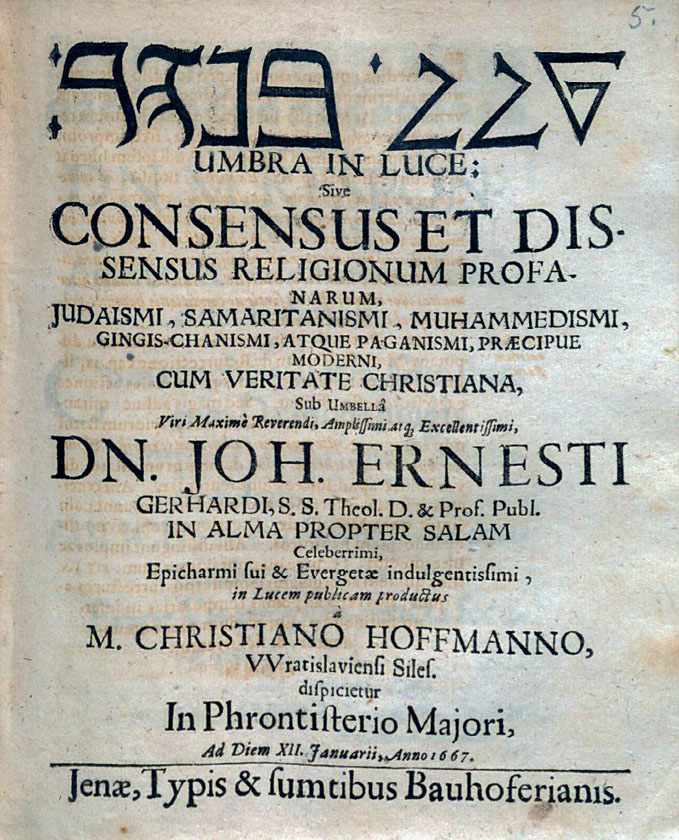
Umbra in luce and a series of other works by Hoffmann make clear that he has received far less scholarly attention than his due and make the scraps of biographical information we have about him all the more tantalizing. We must here make do with what follows. We know that Christian Hoffmann was born in Breslau and matriculated in Jena in 1664. By the time he presented Umbra in luce (January 1667), the title-page tells us, he was a magister. The modern editors of Jena’s matriculation records add that in 1669 he applied for a position as adjunct – apparently unsuccessfully. Hoffmann dedicated Umbra in luce to the magistrates of his native city, and these, as a letter Gerhard received from a certain David Hoffmann of Breslau (who does not identify himself as Christian Hoffmann’s father but as Gerhard’s brother-in-law) informs the praeses, Hoffmann had been awarded sixty-six Reichsthaler for Umbra in luce.127 Even a cursory glance at the treatise makes clear Hoffmann’s admiration for Athanasius Kircher. Six years later, in 1673, he published in Jena what he claimed to be an anonymous manuscript entitled Ars magna.128 In the introduction to this work he betrays (again) his admiration for Kircher (ingeniosissimus Kircherus) – this time for expounding the Lullian ars combinatorica.129 Other than these two works, we have several pieces which he published in Jena, the last of which appeared in 1673. They cover topics as diverse as Machiavellus ante Machiavellum (1668), the office of dictator in ancient Rome (1670), the skeletal remains of giants (1670),130 a natural-philosophical consideration of whether the copulation of man and beast would produce a human (1671),131 Ramist method (1673),132 and a history of the Silesian gold mine in Reichenstein (Złoty Stok) (1674).133 That his publications break off abruptly in 1674 suggests that he left Jena and academic life. He seems also to have been on friendly terms with the pioneer sinologist Andreas Müller.134 Hoffmann may not emerge from the pages of Umbra in luce as a great scholar, but (together with his other works) an exceptionally versatile one with intellectual horizons worthy of a contemporary of Hiob Ludolf and the young Leibniz.
Gerhard’s commendation which serves as a preface offers us the master’s direct comment on the work of his young colleague.135 Gerhard’s amazement is not due to the fact that substantial common ground with Christianity should be found among the non-Christian religions of the world, but he marvels rather at the heathens’ ignorance. In other words, Gerhard takes the work’s title, umbra in luce (which, it is reasonable to assume, came from him), quite seriously. It is not about the penumbrian light to be found in the recesses of ‘heathen shadow’ but the fact that amidst the universal radiance of divine light (revealed light, not the light of natural reason) so much darkness should prevail. Gerhard, at least rhetorically, is not so much delighted to find some of the original light in heathens as he is baffled by the shadow amidst bounteous divine light:
A baffling darkness (stupendae tenebrae) shrouded ancient heathenism’s knowledge of the true God and the darkness shrouding modern heathenism is hardly less dense. That which God’s chosen vessel and most illuminated teacher unto the nations, St. Paul the Apostle, declared of the ancient heathens, was, namely, that they were without excuse (
ἀναπολόγητοι ),136 for that which can be known of God was manifest in those things which God had revealed to them. Indeed, those things which are invisible can be considered from Creation as long as they are grasped through their actions. This is also true of His eternal power and divinity, and having acknowledged God, they did not praise him, nor were they grateful. [… The same holds true of modern pagans] all the more so since a considerable number of rays of the new light of the preaching of the Gospel, which had been lit throughout the world, have reached them to no lesser extent than those who have steadfastly heeded Christ’s call. Our bafflement continues that a shadow (umbra) of such a light, which the most benign deity had allowed them, has remained in them. For both [ancient and modern heathens] have substituted a lie for the divine truth and have adored and worshipped those which are created above Him who has created and have replaced the glory of the immortal God with images moulded not after the semblance of mortal man, but of birds, beasts, and reptiles. 137
A morbid fascination with the ancient worship of beasts as one of the most extravagant forms of pagan corruption of divine teaching was shared by some of Gerhard’s contemporaries, for example the Leipzig theologian Valentin Alberti who wrote his On the idolatrous worship of beasts in 1669.138 Alberti, incidentally, wrote a congratulatory poem for Hoffmann which prefaces Umbra in luce.139 Gerhard concludes his praise of his young colleague by stating that Hoffmann had set out to find shadow and has found light, assuring the author and his readers that he would go far – an academic prophecy which failed to come true.
As the title promises, the work is a study of the points of agreement and disagreement between true religion (Christianity in its Lutheran form) and other (false) religions. After a detailed introduction, Hoffmann proceeds by way of two unequal sections: the first on Scripture and the second, which accounts for most of the work, on the triune Deity. The work, to my mind, is more striking for its amassment of learning than for its argument, yet this learning is impressive and its production (with Bauhöfer, the Jena printer who published a large part of the academic output of Gerhard and his collaborators) required the whole span of alphabets available at the time in Jena. Other than the obvious Latin and Greek, Hebrew, Syriac, Arabic, Ethiopic, Samaritan, and Armenian types were used. The work also features several engravings. Some, as we shall see, were copied from Athanasius Kircher’s Oedipus Ægyptiacus (1655) and others made especially for the occasion.
The suspicion that while the work is by Hoffmann the title was given by Gerhard is affirmed by what seems like the author’s initial uneasiness with the optic metaphor which had been on Gerhard’s mind since the solar eclipse of 1654. Hoffmann thus opens his introduction to the work: ‘We present to you, kind reader, a shadow in light. Take heed lest you presume you have been invited to lectures on nature or the opticians’ seminars. Theological lectures are not concerned with shadows, the silhouettes of bodies (the vain apparition of a body) and leave its wonderful spectacles to artists.’ He continues to labour the obvious point that his work is not concerned with the optical phenomenon of light either.140 Lest anyone miss the point, Hoffmann reiterates that light and shadow are here meant metaphorically. The introduction then explains the key concepts underlying the study – a standard practice in academic treatises of the day, in which much of the argument (and counter-arguments in the oral disputation) was traditionally based on definitions. This is an inbuilt formal tension which pervades much of this kind of academic gestation of the seventeenth century. They are, to a great extent, arguments relying on a broad amassment of historical-philological knowledge, presented in a formal argumentative framework, which was inherently suited for a dialectical, rather than a historical-philological, argumentation. Hoffmann was a well-read rather than a disciplined writer, and in the opening section, as in the rest of the work, he is prone to eclectic digressions. We thus find him commenting at the outset on the blindness of the Jews – a point which leads to a short onslaught on Maimonides. To stress the point, Hoffmann compares the Jews to laymen observing the heavenly bodies at night and mistaking the seemingly radiant crinitum sider for a nocturnal sun, while the expert, armed with a telescope, can discern that what seems to the layman a radiance is in fact a cloud of ether reflecting rather than generating light. This too is borrowed with acknowledgments from Erhard Weigel.141 In other words, a comparative study of religion, borrowing its metaphors from astronomy, dealt not just with light, its obstruction, and the ensuing shadow and penumbra, but also with the correct identification of the sources of light and its distinction from the semi-opaque mediums which allow it to pass.
More than any other work associated with Gerhard, Umbra in luce deals with the variety of religion. Here the modern reader must beware of anachronisms. The variety of religious teachings and practices is not a rich variety or any other adjective we would use today to denote an approach welcoming diversity. This plurality, while clearly fascinating (and the work is redolent with the fascination) is an embarrassment, or at the very least a paradox, to be tackled. Rather than meriting celebration, it requires explanation. Variety is a sign of falsehood and the great variety of Christian practices requires an apology. Hoffmann cannot deny that Christianity is not united, neither worldwide, nor in Latin Europe, but the ‘pagans’, he states apologetically, are infinitely more splintered – a standard apologetic counter-punch. And so, in dealing at length with China, basing his account on Athanasius Kircher, Andreas Müller, Bernhard Varenius, Edward Brerewood and others, he exclaims: ‘Behold the vast and confused chaos of paganism!’142 Hoffmann’s readers are, from the outset, made acquainted with the plurality of sects and groups within non-Christian religions, for example the various divisions in the Islamic world, including the four schools of Sunni Islam, which Hoffmann correctly points out are not mutually implacable, as well as historical divisions in Islam, such as the Mu’tazilites and their adversaries, which are.143 Recognizing the innumerable divisions among contemporary ‘pagans’ (such as Lapps, Greenlanders, Lithuanians, and the inhabitants of parts of Russia and China) does not lead him to question the validity of the over-crowded category under which they are all grouped.
Hoffmann’s definition of ‘profane religions’ (religiones profanae) is of interest: Despite the great variety of religions, the term religio denotes for Hoffmann all that which is needed in conviction and action (creditu & factu) to make man blessed (homo beandus). The origin of the Latin term religio is man’s ultimate aim of binding himself to the deity (religare). Just as with philosophy which emerges from the corrupted arguments of reason, religion too may bifurcate into the plural, when no clear boundaries are set the ‘spiritual wanderer’, who, seeking to know the requirements of his journey, depicts them with fanciful colours, and thus falls into impiety and superstition. Profane religions are all those outside the citadels of (correct) Christianity and are thus false and irreligious. There is, in this respect, no difference between Judaism, Samaritanism, Mohammedanism, and paganism. They are, to his mind, all detestable.144 Hoffmann’s treatment of all non-Christian religions in the opening ‘Antefixa’ section of his work is no kinder: the Jews are blind, the Samaritans guilty of syncretism (involving elements of their ancestral Mesopotamian heathenism), Islam is a motley heresy culled from Christianity (true and false), Judaism, ‘Saracenism’, and the figments of Muhammad’s own imagination. ‘Genghis-Khanism’, the religion of the Mongolians (whom he does not name as such) relates to Islam as ‘Samaritanism’ does to Judaism and is in fact a mixture of Christianity, Islam, and paganism. Paganism itself, for Hoffmann, barely deserves to be called a religion. Other sects have at least some aptitude and certain limits to their error – not so paganism which obfuscates understanding of both the natural and supernatural.145 Nonetheless, there is a certain agreement, however recondite, between all of these and Christianity.
Hoffmann’s argument takes on an epistemological turn. Many of the things considered in the broad field of theology are recondite mysteries: What is then the relationship between the nature of things incomprehensible and the feebleness of human cognitive faculties? Not surprisingly, when the object of comprehension exceeds one’s mental capacity, the darkness of ignorance arises. This is also true of the heathens who reject Holy Writ. The Jews, Muslims, Samaritans, and ‘Genghis-Khanians’ have only partial principles of cognition.
Not all shadows are alike. Umbra in Luce: umbra is the absence of light – but, as with the ecliptic penumbra, not a total absence thereof. These shadows vary in size, shape and intensity.146 God sheds His light on all inhabitants of this world. Optical darkness, with the exception of the biblical Plague over Egypt and that of the blind, is in reality not total, and, carrying further the optical metaphor, the radiance of the sun is perceived reflected throughout, however imperfectly and partially. At the same time, the Spirit of Darkness has cast before the sons of our age a confluence of opinions. Non-Christians are likened by Hoffmann to those who are fast asleep in mid-day or those who wince while gazing at the sun – blind as they are in the midst of so much radiant light.
Hoffmann offers a brief consideration of the causes of darkness with the help of a thought experiment:
Consider your own shadow. You would be foolish to seek the principle of its contour in the sun. Your opaque body posed against the undiminished light of the sun offers the principles thereof. Similar is the condition of dissent [from Christianity], nor is the explanation for consent different. Turn your gaze to the sun. Your faintly glimmering image will not extend to the same spot as that of him who has turned his back to the sun. In both cases the agent was free. At the same time, you should recognize that the cause of the opposite actions rests within yourself and you should attribute it to yourself alone.147
In his contorted way Hoffmann was making the striking claim that the blindness of non-Christians was the result of poor decisions they themselves had made freely. They are themselves the causes of the penumbral shadow they were casting, and its contours were in their own image and likeness.
His approach to the plethora of religious phenomena is mostly orthodox and at the same time truly global. Apart from his consideration of religions in remote parts of the world, his treatment of more familiar religions attempts a broader geographical approach. Thus, in considering Jews, whom, as opposed to biblical Israelites, he defines as those who adhere to Rabbinical religion, Hoffmann points out to readers that they can also be found in large numbers in Persia, China, and India. That this is a global approach is also made clear in his claim that the Jewish Cabbalists are equivalent to the Greek philosophers, Chaldean astrologers, Persian magi, Gallic druids, Indian Gymnosophists, and Egyptian Psontomphanechs – here too, following Kircher’s Oedipus.
The two unequal parts of Hoffmann’s work can be roughly labelled as an epistemological and an ontological account of world religions. The first part surveys the teachings of different religions concerning the sources of human knowledge about the divine, while the second, considerably longer part deals with various teachings about the nature of the divinity.
We come to the first part of the work ‘On Holy Writ’. Remarkable as Hoffmann is for the scope of material he covers and the linguistic and typographical variety of his work (how many of the more ‘exotic’ languages which he produced he could actually read must here remain an open question), he is archetypical in considering the question of divine channels of communication with humanity from a strictly textual standpoint. In other words, Hoffmann’s consideration of human claims to have apprehend the divine is a Protestant overview of the teachings of world religions on Scripture. This he does in six theses:
-
That God alone can reveal the principle of religion. All four of Hoffmann’s World religions, Christians, Jews, Muslims, and Pagans agree on this point.
-
That God has revealed this principle. This too, for Hoffmann, is a straightforward case of agreement.
-
This divine revelation is to be found solely in the Old and New Testaments.148 Here, expectedly, consensus gives way to dissent. The Jews famously acknowledge the Old Testament but reject the New. Hoffmann briefly describes the Pharisees (starting with Hillel the Elder) who ‘prefer the scholar to the prophet’, the Sadducees and Essenes. He then turns to the later Karaites, who are, to Hoffmann’s mind, somewhat preferable in avoiding such blind reliance on human opinion. ‘If only they believed in our sole master Jesus of Nazareth!’149 Alas, they did not. The Samaritans, for their part, adhere to the Pentateuch alone which they believe was handed down to Pinchas.150 They accuse Samuel of sorcery, faithlessness, and dishonour – Hoffmann quotes from the Samaritan Chronicle (in Hottinger’s Historia Orientalis).151 Muslims are closer to the mark in identifying both Testaments as authentic, and Hoffmann notes the praise of Jesus in the Qurʾan.152 This is laudable, yet here too a snake lurks among the flowers: they profess this solely with their tongue not with their heart. Worse yet are the Muhammedologi, i.e. Muslim scholars who have concocted a plethora of books of holy revelation attributed to Adam, Seth, and others.
-
The text of the biblical canon known today is uncorrupted.153 By the time Hoffmann wrote this treatise the integrity of the biblical canon was not only an inter-religious point of contention, but equally one among Christian scholars. In some cases this was connected with a Catholic critique of the Protestant sola scriptura principle. At the same time the very text of the Hebrew Old Testament, or more concretely, the presumed divine inspiration of the vocalization of the Hebrew text, was called into question, most famously by the Reformed scholar Louis Cappel. Hoffmann, squarely on the side of orthodoxy in his defence of the divine inspiration of Old Testament vocalization, cites the Lutheran authorities Johann Gerhard, Salomon Glassius, and Abraham Calov, as well as Hottinger’s Thesaurus philologicus. The Jews, too, have a sound teaching on this matter, while Muslims were wrong to accuse Jews and Christians of falsifying the Bible by erasing all mention of Muhammad’s prophethood. Revealingly, Hoffmann does not make do with Muslim arguments readily available to European scholars in translations of the Qurʾan, but he also quotes an account by the famous traveller Adam Olearius on theological conversations he held with Muslims on the supposed corruption of the Bible by Jews and Christians.
-
Scripture alone is the authentic measure of faith and actions and is manifest and perfect.154 On this point too Hoffmann believes that the Jews are right about the Old Testament and the Samaritans about the Pentateuch. He is too well informed about rabbinical Judaism to overlook the great authority of the Talmud. Jews who consider studying Scripture a waste of time, he states, neglect it at the age of fourteen in favour of the Talmud. Muslims, he states, do the same thing with the study of the Qurʾan – Christians alone are illuminated by the celestial splendour of the Divine Word.
-
Hoffmann stresses that there is nothing reprehensible in the use of reason as such, which was never condemned by the Church. The transgression is to rely on reason in matters concerning the mysteries.155 The fundamental error of Jews and Muslims, as well as the Chinese sages,156 is their assumption that everything that human reason dictates is correct.157 The source of this erroneous unanimity is depraved reason (depravata ratio – Rom. 1:21–2). This wrong-headed reliance on human reason has also led to an unwarranted reverence for human traditions. Thus, the Japanese persist in the ancestral worship of their monster-shaped gods, he argues, lest they be seen to divert from the custom of their ancestors and the Indians of Golconda adhere to the religion of the Brahmins. One should not ask the reason – they are merely adhering to ancestral custom, which seems to be an extension of human reasoning.
-
Only the sense of Scripture conveyed in the original languages is genuine.158 Hoffmann affirms this point by relying on such diverse authorities as the Lutheran theologian Salomon Glassius and the Jesuit Athanasius Kircher.159 Scripture is to be interpreted from Scripture, and it is their failure to do so that had led the Pharisees to misinterpret references to Christ in the Old Testament, relying on their own fallible judgment. Hoffmann is equally dismissive of Cabbalistic interpretations of Scripture.160 He is well informed about the views on scriptural canons of numerous religions and his mental landscape reaches far beyond the limits of his Lutheran confession. Yet he seems perfectly capable of integrating the global information at his disposal within a staunchly orthodox worldview.
In the lengthy second section Hoffman considers the various opinions on the nature of the Deity. This too, despite the variety of the cases considered, is Christianocentric in approach, charting the agreement and dissent of religious teachings with respect to Christian doctrine. Hoffmann surveys approaches of numerous world religions to the triune deity, yet his inquiry is much broader, and seems, at first glance, to be an Orthodox reaffirmation of the consensus gentium, i.e. the teaching, according to which the acknowledgment of some sort of deity and a corresponding religious practice are universal and, by dint of this universal consent, also proven to be true. A clear indication to contemporary readers that this was his ostensible aim is to be found in his treatment of the Hottentots. The Hottentots, the European name given to the several indigenous groups of South Africa, were much discussed among early modern thinkers – especially due to the supposed threat they posed to the concept of the universal acknowledgment of a deity.161 Confronting peoples and customs which were formerly unknown to Europeans may have caused excitement, but did not, as such, profoundly challenge the early modern Christian universal historical view of mankind as the unfolding of a divine plan. The religious practices of the Aztecs, or the various belief systems and rites of the Indian subcontinent, required an explanation, but such explanations were readily at hand and in one way or another rooted in a Christian understanding of the world. They were often seen as corruptions of the true Ur-monotheism, corrupted either by human gullibility or diabolical wiles. In Gerhard’s circle this second idea is to be found in the work of his former teacher Johann Michael Dilherr, Dei simia Diabolus (1640). The ever-expanding variety of religious beliefs and customs known to Europeans could on occasion give rise to a form of sceptical relativism, which either implicitly or explicitly called one to question one’s own religion. Montaigne’s Essays provide a famous and rightly celebrated example. Yet these, I would argue, are exceptions. To the best of my knowledge, for most Christian thinkers of the sixteenth and seventeenth centuries the discovery of hitherto unknown societies with foreign religious practices did not pose a substantial challenge to their worldview any more than did the realisation formulated by Brerewood and others that Christians were but a small minority among the inhabitants of the world. What did pose a challenge was the discovery of societies which were perceived to be a-religious. A society practising a ‘false religion’ was one thing, but a functioning society innocent of any notion of a deity and, correspondingly, of religion, was a different matter altogether and seemed to challenge the concept of a consensus gentium. The so-called Hottentots were considered by numerous European scholars of the period to exemplify this troubling possibility of an atheistic society, and the heated debates about them went far beyond an early modern European interest in the life and beliefs of ethnic groups in the south of the African continent.162
Any experienced seventeenth-century reader would have immediately noticed references to the Hottentots and Hoffmann’s treatment of them would at first assuage the concerns of any orthodox reader. The Hottentots, Gerhard’s young colleague informs his readers, are said to believe in neither God nor the Devil, but, as a matter of fact, they do have a form of religious worship, despite appearances. Their religious sentiments may be crude, but are not entirely lacking. They convene before daybreak to dance and ring bells in honour of the Creator of heaven and earth in whom they believe. Something of a shibboleth, this would have reassured orthodox readers leafing through the work and would surely serve as an intellectual marker – Hoffmann (and Gerhard) were upholding the tradition of a consensus gentium.163 Conveniently, Hoffmann offers their German name (Hottendot) conspicuously printed in Gothic type, so that anyone looking for the Hottentots would easily find the orthodox passage upholding the notion of a universal acknowledgement of God. This impression would have been confirmed by Hoffmann’s consideration of indigenous peoples of Brazil immediately following the Hottentots and whom he also clears of atheism. Despite this, and much rhetoric in the work, it would be wrong to identify Hoffmann and Gerhard as champions of the consensus gentium. Hoffmann in his perusal had come across an alarming number of atheistic peoples or, at the very least, is prepared to list unchallenged reports of irreligious societies such as the Jenxuans in Japan,164 the inhabitants of part of Sumatra and New Guinea, some groups in southern Africa, and all peoples who dwell beyond the Southern Tropic.165 The same holds true for the natives of Madagascar ut nulla apud eos sit Numinis suspicio, quia nulla religio. Numerous native inhabitants of the West Indies were no better: according to Hoffman’s sources the Souriquois Indians (Mi’kmaq) of Nova Scotia and the native inhabitants of Virginia lacked a cognizance of God and a corresponding religion, and the natives of Mexico were brutes devoid of any trace of humanity and piety. He repeats the assertion made by Bernhard Varenius that when Europeans tried to convince the Brazilian cannibals of God’s existence they responded (in a surprisingly Epicurean manner) that such a god must be vile, taking pleasure as he does in striking fear into the hearts of men.166 The natives of Chile are without any religious cultic framework and, significantly, make no distinction between days, and the inhabitants of the Tierra del Fuego were likewise shrouded in ignorance. The world Hoffmann encountered in Gerhard’s library stood in the light of a Christian revelation obstructed to varying degrees by human darkness, like the solar eclipse which had fascinated Gerhard in the previous decade. Many of the religious beliefs and practices were, traditionally speaking, a distortion of the original (Christian) revelation, but at the same time in numerous corners of the globe and in crevices of the human spirit a full eclipse held sway. The solace of a consensus gentium was no longer available. That this sombre recognition was drowned in a deluge of quotes and footnotes, I would argue, made the work seem more innocuous than it was.
In other respects the work remains within the framework of a traditional consideration of the history of religion. If Hoffmann had an overarching theory on the emergence and nature of the known religions of the world, he does not share it with his readers. It is not unreasonable to suspect that he did not, nor, to judge from his other surviving works, does he seem to have been searching for one. If the work has a statement to make, beyond the myriad of sources and cases it examines (and sometimes merely quotes), it is its eclectic approach to the matter. The abundant evidence which Hoffmann cites for the widespread existence of atheist ‘barbarians’ is never fully endorsed or explained; it is an amassment of bibliographical data from which the author could always distance himself if need be. Hoffmann was not attacking orthodoxy, but perhaps quietly distancing himself from some of its tenets. In this there is reason to believe that he was close to Gerhard. This is also suggested by an anecdote dating a year and a half earlier, to the summer of 1665.
In 1665 Johannes Saubert the Younger, whom we have encountered above, was in need of reference letters for an audacious undertaking. Saubert, who had studied in Jena, was since 1660 a professor of Hebrew in Helmstedt.167 In addition to this he was kept busy by the Duke of Brunswick-Lüneburg August the Younger (1579–1666) who, among other things, commissioned him to produce a new German translation of the Bible – a bold enterprise among Lutherans for whom Luther’s translation had acquired such an authoritative status. The story of this unusual project and Saubert’s involvement in it is interesting in its own right.168 What concerns us here is the fact that this undertaking elicited predictable misgivings from Lutheran theologians and prompted Saubert’s search for supporters. Among the extensive correspondence occasioned by this translation (which Saubert jettisoned as soon as the old duke died in September 1666)169 is a letter by Gerhard to Saubert’s father-in-law and academic patron Hermann Conring. Saubert had elicited Gerhard’s report, together with those of other Lutheran theologians whom he thought would be open to a new German translation of the Bible. Gerhard’s response, in a detailed report sent to Conring, is revealing. He has numerous philological observations and points of criticism, yet in the present context what is more interesting than the actual report is Gerhard’s accompanying letter to Conring. Not surprisingly, while speaking highly of Saubert, he is wary of the controversial undertaking and cautions Conring discreetly about the upheaval this may cause among ‘our theologians’. This in itself does not seem an unreasonable warning, until we recall that Gerhard was himself a professor of theology in Jena – unlike Helmsted a bastion of Lutheran orthodoxy – and the son of a prominent Lutheran theologian. Cautioning Conring that his protégé had adopted several readings rather too close to Calvinist teaching, and that these may incur ‘the indignation of our theologians’ is hardly the wording of someone who is, at least formally, at the academic heart of the Lutheran Orthodoxy. This is not to suggest that Gerhard did not adopt a perfectly orthodox stance on various matters – he did. Here and there in his detailed criticism, moreover, there was probably more philological know-how and diplomacy than subversive scepticism. Nevertheless, it seems that Gerhard, the theology professor, did not fully identify himself as one of the nostrates theologi.170
Apart from its metaphorical framework, Umbra in luce is striking for the range of religious phenomena it considered. The theological framework of the theses seems at times more like a straightjacket imposed on the material than the form of a well-constructed argument. Hoffmann, like Gerhard and the overwhelming majority of academic scholars of his day, was an armchair-scholar and his knowledge of world religions is culled almost exclusively from books – the more philologically remote the culture whose religious manifestations he was studying, the more he relied on travel accounts and compilations by other scholars. In this respect it is worth noting that Gerard Vossius’ encyclopaedic De theologia gentili is mentioned here only rarely and briefly. On these few instances Hoffmann was quoting the partial edition of 1641. The full, posthumous edition was to appear in 1669 and would become a standard reference and scholarly vantage-point for academic scholars (at least for Continental Protestants) into the early eighteenth century,171 but this was not yet the case when Hoffmann composed Umbra in luce two years before the appearance of the full edition of Vossius’ magnum opus.
A striking element in Hoffmann’s work is his reliance on artefacts. These do not play a decisive role in his argument, but in a work whose strength lay in its broad eclecticism, these are noteworthy. They also offer us a tantalizing glance at the exotic collection in the museum Gerhardinum which has not survived. While several of the woodcut-illustrations are copied from Kircher’s Oedipus Ægyptiacus, others were made from objects in Gerhard’s collection. One example is a woodcut image of Bhairava, the destructive incarnation of Shiva. Hoffmann’s interpretation is crude and scant, to say the least. The important point here is that Gerhard possessed a statuette of the god. It had been purchased from the Dutch East India Company by Gerhard’s acquaintance Johann Schelhammer, the Lutheran pastor in The Hague. Schelhammer sent Gerhard this object, as well as a series of other far eastern artefacts. Hoffmann (and probably Gerhard) wrongly identifies this statuette of Bhairava as a ‘Chinese idol’. It seems to have exercised a sufficient fascination on him to have an engraving made and printed in his work.
Hoffman was likewise fascinated by another object he found in Gerhard’s collection, also presented by Schelhammer: a Wayang kulit shadow-play figure. This is represented in an engraving and identified as an object of devil worship in Batavia akin to devil worship in Mexico and elsewhere. Following the account of the German soldier Johann Jacob Saar (1625–1664), Hoffmann reports briefly on a large-eyed, black-faced Indonesian idol called Josin, which he identifies with the Indonesian shadow puppet in Gerhard’s possession.172 The Devil and his wiles also stood at the centre of a dissertation by a Dutch student, Benedict Hahn, supervised by Gerhard in 1663.173
Bhairava as ‘idolum chinensium’. Umbra in luce, N2r, Forschungsbibliothek Gotha

‘The Chinese Idol called Josin’ appended to Umbra in luce, Forschungsbibliothek Gotha

Hoffmann was also interested in a further artefact in Gerhard’s collection, offering an engraved illustration of “Pengort, the same [devil] in a different posture from the same shelves [in Gerhard’s collection],” whom he identifies as a hobgoblin (
Hoffmann’s extensive perusal and inspection of religious artefacts confronted him with a myriad of foreign, and for him outlandish, phenomena. He clearly relished the opportunity to dwell on them.
In the long run a comparative approach to religion may well have given rise to a relativism in the approach of learned Europeans to other religions and to their own in particular. Gerhard and his collaborators, however, offer us an important caveat. Confessional orthodoxy (of all stripes) may well have been losing ground, but this was an intellectual battleground which persisted over the years. To assume that Gerhard’s interest in foreign churches and alien religions, and even his comparative study of them, necessitated, or even implied, scepticism, or a Herodotean cultural relativism, is empirically wrong. The early modern orthodox view of the world may have been doomed to eventual decline, but we should not underestimate the intellectual resilience of old world-views, and their ability to incorporate new information.
If, as I have suggested, the dissertations dealt with in this chapter formed part of a larger intellectual agenda, even if not a concrete plan, this was terminated by Gerhard’s death in February 1668. They seem to be the eclectic fruits of a scholar who, despite being firmly anchored institutionally, was intellectually still searching for his vocation. The young orientalist of the 1640s had become a professor of theology and the thirty-year-old who travelled to Leiden and Paris to meet the luminaries of the Republic of Letters, settled down to the respectability of a middling scholar in his home town. The son of the famous Johann Gerhard spent much of his adult life attending to his father’s literary legacy. At the same time, we should, I believe, avoid the temptation of painting Gerhard’s life as a quiet tragedy. There is nothing in his private papers to suggest he ever regretted the course his life had taken. Johann Ernst Gerhard never rose to greatness, and his œuvre fell perhaps short of what he may have hoped for as a young man, yet we would probably be wrong to attribute to him any great regret. By the standards of mid seventeenth-century Germany Gerhard led a comfortable and stable life, and seems to have been well content. In his interest in the history of religion, as with his hopes for an improved harmonic grammar of oriental languages, Gerhard delegated to students and younger colleagues. One thing, I believe, this string of dissertations makes clear: whether we take the pessimistic view of Gerhard as the would-be citizen of the Republic of Letters who, by birth, became the prisoner of a theological career, or the more optimistic view of his life as the slightly remote but well-contented Lutheran academic, Johann Ernst Gerhard clearly retained an inquisitive spirit.
Indonesian Kris, Umbra in luce, L1r. Herzog August Bibliothek Wolfenbüttel, M: Li 3885

Johannes Musaeus (praeses), Johann Ernst Gerhard (respondens), Christus ex mortuis resuscitatus. Ex decreto venerandae facultatis theologicae ex Actorum cap. ii, 24 descriptus in disputatione inaugurali […] pro licentia consequendi doctoris in theologia gradum publicae ἐξετάσει submittit M. Johannes Ernestus Gerhardus historiarum professor publicus. a.d. 30 Martii horis ante- & pomeridianis in auditorio theologorum (Jena, 1653).
Musaeus, Christus ex mortuis resuscitatus, (1v–2v).
Chart. A 418 fol. 72r–v.
Chart. A 418 fol. 74r–v.
See Bernhard Pünjer’s article on Major in ADB.
Chart. B 480 fol. 290r–301r (25 July 1655).
Chart. B 480 fol. fol. 97r–98r. Gerhard and his audience would have encountered the story of Jaddus (Jaddua) and Alexander in Josephus, Jewish Antiquities, 11.302–47. The episode is also recalled by Zedler’s account of Major in Universal-Lexikon, s.v. (without reference to Josephus and the Jaddus and Alexander episode).
Johann Gerhard, Disputationum theologicarum, in Academia Jenensi conscriptarum & publice habitarum, partes tres (Jena, 1655).
Johann Gerhard, Commentarius super Genesin, in quo textus declaratur, quaestiones dubiae solvuntur, observationes eruuntur, & loca in speciem pugnantia conciliantur (Jena, 1654). Dedication to Friedrich Wilhelm II of Saxe-Altenburg a2r–a4v.
Chart. A 139 fol. 1.
The dedication is to Ernst III of Saxe-Gotha. When in 1672 Ernst became Duke of Saxe-Gotha-Altenburg, he would become Ernst I of this new line.
Published originally in Hamburg in 1628.
A revised and extended version of the book was prepared by Christian Grübel and appeared in Jena in 1671. See Benjamin T.G. Mayes, Counsel and Conscience: Lutheran Casuistry and Moral Reasoning after the Reformation (Göttingen, 2011), pp. 53f.
Johann Heinrich Ursinus, Historisch-und theologischer Bericht / vom Unterschied der Religionen heutiges Tags auf Erden / Und welches der waare allein-seligmachende Glaube seye kürzlich entworffen (Nuremberg, 1663).
Andreas Sennert, Scrutinium religionum sive exercitatio theologico-historica, de religionum orbis universi terrarum varietate in communi: & in specie, quod una sola Christiana, & praesertim Evangelica sit vera: & quam angustis illa hodie coercita sit terminis, &c. (Wittenberg, 1668).
Chart. A 140, fol. 149r–150v.
Sennert, Scrutinium religionum, B1v.
Hieronymus Kromayer, Scrutinium religionum tum falsarum, Paganismi, Muhammetismi, Judaismi, Catabaptismi & Quakerismi, VVeigelianismi & Rosae-Crucianismi, Socinianismi, Arminianismi, Calvinismi, Abyssinianismi, Anatolicismi, Papismi, tum unice verae & orthodoxae, Lutheranismi (Leipzig, 1670).
On Saubert’s career in Helmstedt see Sabine Ahrens, Die Lehrkräfte der Universität Helmstedt (1576–1810) (Helmstedt, 2004), s.v. and Asaph Ben-Tov, ‘Helmstedter Hebraisten’, in Das Athen der Welfen. Die Reformuniversität Helmstedt 1576–1810, ed. J. Bruning and U. Gleixner (Wiesbaden, 2010), pp. 224–31.
The work was reprinted in Leiden in 1699.
See Dorothea Wendebourg, Reformation und Orthodoxie: Der ökumenische Briefwechsel zwischen der Leitung der Würtembergischen Kirche und Patriarch Jeremias II. von Konstantinopel in den Jahren 1573–1581 (Tübingen, 1986) and more generally Steven Runciman, The Great Church in Captivity: A Study of the Patriarchate of Constantinople from the Eve of the Turkish Conquest to the Greek War of Independence (Cambridge, 1968).
David Chytraeus, Oratio de statu ecclesiarum hoc tempore in Graecia, Asia, Boëmia &c. (Rostock, 1569). This was followed by numerous editions as well as a German version (1581 and 1584).
Zedler’s Universal-Lexicon, s.v. gives 1637 as Kempe’s year of birth.
Martin Kempe, De statu Armeniae ecclesiastico et poiltico, tam pristino, quam hodierno (Jena, 1666). Gerhard’s address refers to Kempe (2v–4v) as a poet laureate of Königsberg and a student of theology.
R.E.W. Maddison, ‘Studies in the Life of Robert Boyle, F.R.S. Part IV. Robert Boyle and some of his Foreign Visitors’, Notes and Records of the Royal Society of London 11 (1) (1954), pp. 38–53, here pp. 44–6.
John Flood, Poets Laureate in the Holy Roman Empire: a bio-bibliographical handbook (Berlin, 2006), s.v.
Renate Jürgensen, Melos conspirant singuli in unum. Repertorium bio-bibliographicum zur Geschichte des Pegensischen Blumenordens in Nürnberg (1644–1744) (Wiesbaden, 2006), pp. 272–9. See also Hermann Stauffer, Sigmund von Birken (1626–1681): Morphologie seines Werkes (Berlin, 2007), p. 539.
See Zedler, Universal-Lexicon, s.v.
Kempe, De statu Armeniae, (2v–4v). Gerhard signed his preface 2 January 1665.
Kempe, De statu Armeniae, (3r–v).
De statu Armeniae, A1v. ‘Haec altius ego mecum pensitans suasu Maxime Reverendi Dn. D. Gerhardi, Praeceptoris & Promotoris mei, sanctissimo pietatis cultu nullo non tempore devenerandi, Asiaticae Ecclesiae operam locare operae pretium putavi. Gravissimum equidem & juvenilibus humeris imparem laborem prima fronte judicabam; eum tamen insignis Dn. praesidis favor haut mediocriter levabat, siquidem illustre Musarum domicilium & commune eruditionis aerarium, bibliothecam suam pervolendi, copiam mihi faciebat.’
Doctrina christiana, a Petro Paulo, sacerdote armeno, versa in linguam armenam (Paris, 1634). FBG shelf mark Theol 4º 00435/05 (BG B124/401–10). A hand-written note on the title page reads: ‘Ex superfluis libris Bibliothecae Card. Mazarini compara[t] sibi [h]anc Instit. [Doctrinae] Christianae [] M. Joh. Ern. Gerha[rdus] mens. Augus[to] 1650. 8st. 1. lb.’
FBG Ms. orient. 8 fol. 76r. See Chapter One.
See e.g. reference in De statu Armeniae, G3v, H1r, I3r, and K1r. Kempe was using the 1633 edition of Rivola’s dictionary. On Armenian printing in Europe, Armenia, and elsewhere in the Ottoman and Safavid empires see Meliné Pehlivanian, ‘Mesrop’s Heirs: The Early Armenian Book Printers’, in Middle Eastern Languages and the Print Revolution, ed. E. Hanebutt-Benz, D. Glaß, and G. Roper (in collaboration with Th. Smets) (Westhofen, 2002), pp. 53–92.
Adam Olearius, Offt begehrte Beschreibung der newen orientalischen Rejse (Schleswig, 1647). Thus e.g., Kempe quotes at length from Olearius on an Armenian wedding ceremony he witnessed in Isfahan. De statu Armeniae, H2r–v.
See S. Peter Cowe, ‘The Armenians in the era of the crusades 1050–1350’, in The Cambridge History of Christianity. Vol. 5 Eastern Christianity, ed. M. Angold (Cambridge, 2006), pp. 404–29 and idem ‘Church and diaspora: the case of the Armenians’, ibid. pp. 430–56.
Cowe, ‘Church and diaspora’, p. 432.
Ibid. See also Raymond H. Kévorkian, ‘La diplomatie arménienne entre l’Europe et la Perse au temps de Louis XIV’, in Arménie entre Orient et Occident. Trois mille ans de civilization, ed. idem (Paris, 1996), pp. 188–95.
Kévorkian, ‘La diplomatie arménienne’.
Ibid. p. 433.
Kempe, De statu Armeniae, L3r–v.
Kempe, De statu Armeniae, N3v.
Kempe, De statu Armeniae, N3v–N4r.
Kempe, De statu Armeniae, N4v.
Reinhold Jauernig and Marga Steiger (eds.), Die Matrikel der Universität Jena vol. 2 (Weimar, 1977), p. 741.
According to Christian Gottlieb Jöcher, Gelehrtenlexikon (Leipzig, 1751), s.v.
Mentioned by Jöcher, who was probably quoting both the title and the ensuing diplomatic incident from Christian Kelch, Liefländische historia oder kurze Beschreibung der Denckwürdigsten Krieges- und Friedens- Geschichte Esth- Lief- und Lettlandes (Tallinn, 1695), pp. 603f.
Friedrich Konrad Gadebusch, Livländische Bibliothek nach alphabetischer Ordnung, vol. 3 (Riga, 1777), p. 127.
Dissertatio theologica de religione ritibusque ecclesiasticis Moscovitarum (Jena, 1665), (3r–v). On Elvering see Carola L. Gottzmann and Petra Hörner, Lexikon der deutschsprachigen Literatur des Baltikums und St. Petersburg vom Mittelalter bis zur Gegenwart (Berlin, 2007), s.v. On Dorsche see Hermann Schüssler’s article in NDB.
Gadebusch, Livländische Bibliothek, p. 127. Cf. also a consistorial ruling concerning the alleged bigamy of a certain Jürgen Christerson (18. September 1690) wedded in Tallinn in April 1688 by the pastor Magister Schwabe. Roland Seeberg-Elverfeldt, Revaler Regesten. Beziehungen niederländischer und skandinavischer Städte zu Reval in den Jahren 1500–1795 (Göttingen, 1969), no. 390. For Johann Schwabe Jr.’s matriculation in Jena see Jauernig and Steiger, Die Matrikel der Universität Jena, p. 741 (1 October 1694).
Kelch, Liefländische, pp. 603f.
See Othmar Feyl, Beiträge zur Geschichte der slawischen Verbindungen und internationalen Kontakte der Universität Jena (Jena, 1959), pp. 10ff. and Wilhelm Kahle, Die Begegnung des baltischen Protestantismus mit der russisch-orthodoxen Kirche (Leiden, 1959) pp. 34–46.
Note that on the title page of the 1720 edition the date of the dissertation is mistakenly given as 18 October 1662, rather than 1665, which has led some scholars to misdate Schwabe’s dissertation to that year.
The 1665 edition was printed in Jena by Johann Jacob Bauhöfer, the 1720 by Paul Erich.
Compare this to a contemporary academic account of the Russian Orthodox Church by Michael von Oppenbusch, Exercitatio historico-theologica in qua religio moscovitarum breviter delineate & exhibita (Strasbourg, 1667).
Schwabe, De religione ritibusque ecclesiasticis moscovitarum, A1v. Schwabe does not identify the book or its author.
Schwabe, De religione ritibusque ecclesiasticis moscovitarum, A2r. Schwenter was no longer alive when Gerhard was studying in Altdorf in 1640 but there are among Gerhard’s papers several of his transcriptions of Schwenter’s works, possibly noted during his studies in Altdorf. Schwabe also relied heavily on Paulus Oderbornius and Antonio Possevino.
Schwabe, De religione ritibusque ecclesiasticis moscovitarum, B2v–B3v.
Schwabe, De religione ritibusque ecclesiasticis moscovitarum, B2r–v.
Kahle, Die Begegnung des baltischen Protestantismus mit der Russisch-Orthodoxen Kirche, ch. 3.
Schwabe, De religione ritibusque ecclesiasticis Moscovitarum, M2v–M3r.
Schwabe, De religione ritibusque ecclesiasticis moscovitarum, M4r.
Exercitatio theologica, ecclesiae copticae, hoc est christianorum aegyptiacae ortum, progressum, praecipueque doctrinae capita repraesentans (Jena, 1666).
15 July 1665. See Jauring, Steiger, and Mentz, Die Matrikel der Universität Jena. Bd. 2: 1652 bis 1723 Personenregister (Weimar, 1962), s.v.
Cf. Gerhard’s prefatory comments Ramshausen, Exercitatio theologica, ecclesiae copticae, unpag. 2v.
See Alastair Hamilton’s discussion of this work in The Copts and the West, 1439–1822: The European Discovery of the Egyptian Church (Oxford, 2006), pp. 141f.
On Gerhard’s feud with Nihus see Chapter Two.
See Hamilton, The Copts and the West, pp. 74–6, Baronio, Annales xvi, pp. 697f.
Scrutinium religionum (Frankfurt am Main, 1650). Gerhard’s copy: FBG shelf-mark Theol. 8º 653/1 (2).
Ramshausen, Ecclesia coptica, A3r–C1v.
See Hamilton, The Copts and the West.
See his two dissertations De voce
Ecclesia coptica, B3r. On Kircher’s use of the Bembine Table see Daniel Stolzenberg, Egyptian Oedipus: Athanasius Kircher and the Secrets of Antiquity (Chicago, 2013), ch. 4.
It seems highly unlikely to me that Gerhard should not have owned any of Kircher’s works. The reason for this absence is probably unspectacular.
Disputatio theologica de Sepultura Moysis (Jena, 1667). The dissertation was presented by a visiting scholar, Master Johannes Creil of Zwickau who is attested in the Jena matriculation records between 6 February and 13 March 1667 ‘Cygnea-Misnicus, in patria Cantor et scholae collega’. Jauring, Steiger, and Mentz, Die Matrikel der Universität Jena, s.v. This dissertation reappeared in a second edition in 1684 – retaining the information of the original title page, but varying in pagination. This makes Gerhard’s authorship more likely, since other dissertations under his nominal authorship discussed in this chapter, were later re-issued without his name on the title page.
Ramshausen, Ecclesia Coptica, B4v.
Ramshausen, Ecclesia coptica, ch. 7 ‘De praecipuis Coptitarum in religione erroribus’, I1r–K4v.
Johann Georg Müller, Disputatio de Ecclesia Maronitarum (Jena, 1668).
This may be the later professor of poetry in Jena (as of 1698). See Bartholomäus Christian Richard, Commentatio de vita et scriptis professorum hodie in academica jenensi publice docentium (Jena, 1710), pp. 103f. and Jöcher, Gelehrten-Lexikon, s.v. Though, if this is our Müller, neither mention his theological studies.
Müller, De ecclesia Maronitarum,)(2r–v.
Müller, De ecclesia Maronitarum,)(2v.
A Swede by the name of Petrus Gregorius Holm is recorded in the Helmstedt matriculation records for 8 June 1650 – this may have been Holm’s father. Werner Hillebrand, Die Matrikel der Universität Helmstedt 1636–1685 (Hildesheim, 1981), s.v.
See Jöcher, Gelehrtenlexikon, s.v. and Zedler, s.v.
Reinhold Jauring, Günter Steiger, and Georg Mentz (eds.), Die Matrikel der Universität Jena. Bd. 2: 1652 bis 1723 Personenregister (Weimar, 1962), s.v.
Holm, Theologiae Muhammedanae brevis consideratio, (2r). ‘Si unquam illos, qui tantos in tanto fastigio collocatos Viros accedere volunt, insolitus quidam timor, partim ex reverentia magnitudinis eorum, quos adeunt, partim ex propriae tenuitatis conscientia, corripere solet; illorum certe ego unus sum, quam qui maxime. Nam praeter haec omnia, invidiâ insuper suscepti argumenti, laborare videor. Duxi, sed instinctu, impulsuque Plr. Rever. & Ampliss. Dn. JOHANNIS ERNESTI GERHARDI, SS. Theolog. D. & Professoris Publici, in Celeberrima hac Salana Famigeratissimi, Dn. Patroni, Praeceptoris & Hospitis mei aetatem debito cultu observantiaque suscipiendi, prima lineamenta Religionis (uti plurimum vocant) Turcicae.’
Holm, Theologiae Muhammedanae brevis consideratio,)(3v.
Holm, Theologiae Muhammedanae brevis consideratio,)(2v.
Livy 1.56.
John 8:44. ‘You are of your father the devil, and the lusts of your father ye will do. He was a murderer from the beginning, and abode not in the truth, because there is no truth in him. When he speaketh a lie, he speaketh of his own: for he is a liar, and the father of it.’
Holm, Theologiae Muhammedanae brevis consideratio, A4r. ‘Quod de Tarquinio, cui Superbi nomen facta indiderunt, quique ordine septimus ab Urbe, a Romulo vel condita vel restaurata, inibi scelere parto imperio regnavit, memorant annalium Romanorum conditores, cloacam scilicet maximam receptaculum omnium purgamentorum urbis sub terram egisse: id Satanas, Spiritus ille Superbiae, &
Holm, Theologiae Muhammedanae brevis consideratio, A1r. An eschatological identification of the Pope and Muhammad as Antichrists was a widespread element of Protestant polemics in the Reformation and later. See Thomas Kaufmann, ‘Türckenbüchlein’. Zur christlichen Wahrnehmung ‘türkischer Religion’ in Spätmittelalter und Reformation (Göttingen, 2008), esp. pp. 62–5.
Whose divinity is nonetheless promptly rejected in the Qurʾan.
Holm, Theologiae Muhammedanae brevis consideratio, B3r.
A forthcoming study by Martin Mulsow and Paola von Wyss-Giacosa incorporates considerable portions of Hoffmann’s Umbra in luce in the broader context of European encounters with the religions of India. I am grateful to both for a fruitful exchange on this work. See also Martin Mulsow, ‘An “Our Father” for the Hottentots: Religion, Language, and the Consensus Gentium’, in A Historical Approach to Casuistry: Norms and Exceptions in a Comparative Perspective, ed. C. Ginzburg and L. Biasiori (London, 2019), pp. 239–61.
Christian Ravius and Matthias Wasmuth, Literae circulares wegen Errichtung eines Collegii Orientalis (Kiel, 1670). See also Martin Friedrich, Zwischen Abwehr und Bekehrung: Die Stellung der deutschen evangelischen Theologie zum Judentum im 17. Jahrhundert (Tübingen, 1988), pp. 96f. and Alastair Hamilton, ‘“To rescue the Honour of the Germans”: Qurʾan Translations by Eighteenth- and Early Nineteenth-Century German Protestants’, Journal of the Warburg and Courtauld Institutes, 77 (2014), pp. 173–209, here 178.
Also spelled Welz. In his letters top Gerhard Weltz signs simply ‘Valentin Weltz’, conspicuously dropping his baronial title and ‘von’.
Noted by Othmar Feyl in Beiträge zur Geschichte der slawischen Verbindungen und internationalen Kontakte der Universität Jena (Jena, 1969), p. 246.
Fritz Laubach, ‘Justinian von Welz und sein Plan einer Missionsgesellschaft innerhalb der deutschen und englischen Sozietäts- und Missionsbestrebungen des 17. Jahrhundert’ Diss. (University of Marburg, 1955), esp. pp. 7–36. See also Laubach’s introductory essay ‘Justinian von Welz – Leben und Werk’, in ed. idem, Justinian von Welz. Ein Österreicher als Vordenker und Pionier der Weltmission (Wuppertal and Zurich, 1989), pp. 7–32.
Laubach, ‘Justinian von Welz und sein Plan einer Missionsgesellschaft.’
Laubach, ‘Justinian von Welz und sein Plan einer Missionsgesellschaft‘, pp. 20–30.
Wolfgang Größel, Justinianus von Weltz, der Vorkämpfer der lutherischen Mission (Leipzig, 1891), p. 20.
Chart. A 418 fol. 255r–256r.
Chart A 418 fol. 259 (5 February 1664).
Chart A 418 fol. 259. ‘E. Exc. geliebte Antwort ist mir erst den 3 Febr. zuhanden kommen, und weilen ich E.E. treuherziger, und hochvernünfitiger gedanken von der außbreitung unserer reinen Evang. lehre zu meinem großen vergnügen darauß vernomen, alß habe ich dieses wenige zu einer gegenantwort überschicken wollen.’
Chart. A 418 fol. 259.
For which Weltz thanked him on 30 March Chart. A 418 fol. 260v.
Weltz, Einladungs-Trieb zum heran-nahenden Grossen Abendmahl: und Vorschlag zu einer Christ-erbaulichen Jesus-Gesellschafft behandlend die Besserung des Christentums und Bekehrung des Heidentums (Nuremberg, 1664), (vir. 196f). Gerhard’s sonnet is also printed in Laubach’s edition of Weltz’s collected works (1989), pp. 247f. praising Christian devotion to Jesus over hollow worldliness and praising Weltz’s piety – with no reference, however, to his missionary project.
The treatise was published by Weltz himself in 1664 in Nuremberg under the title: Eine Christliche Vermahnung an alle rechtgläubige Christen / der Augspurgischen Confession, betreffend eine sonderbahre Gesellschaft / durch welche / nechst göttlicher Hüllffe / unsere evangelische Religion möchte außgebreitet werden. In his letter to Gerhard (Chart. A 418 fol. 260r) he states that it was printed in Nuremberg for him by Lochner – though the latter, perhaps realizing the controversial nature of the treatise, is not cited in the title-page nor is Nuremberg.
Chart. A 418 fol. 261r.
Chart. A 418 fol. 260ar-v.
Chart. A 418 fol 620ar.
Ibid. ‘[…] was die Holländer anlanget, könte ich derselben zwar wohl genug mitbekomen, dieweilen Sie aber gar trotzigen gemüths, sehr faul, der guten tag vnd vberflußes, welcher anfänglich mith gleich in Verrath sein kan, gewohnet, auch wiedriger religion vnd deßwegen zu keinen ambtern zugebrauchen, alß werde ich nur etlich[e] der Evangelischen Religion zugethane eligiren, im übrigem mich nach hochteutschen bewerben, bey deren ich lieber die vnkosten, alß ahn denen Holländer anwenden will.’
New Style.
See also Martin Mulsow, ‘Global Intellectual History and the Dynamics of Religion’, in Dynamic of Religion: Past and Present. Proceedings of the XXI World Congress of the International Association for the History of Religions, ed. Ch. Bochinger and J. Rüpke (in collaboration with Elisabeth Begemann) (Berlin, 2017), pp. 251–72.
Johann Ernst Gerhard (praeses), Johann Andreas Olearius (respondens), Lumen gentium, Lucae II. v. 32 decantatum, variis variorum adversariorum, lucifugarum & Christomachorum nebulis oppositum (Jena, 1663). A second edition appeared in Jena in 1717.
Jauernig and Steiger, Die Matrikel der Universität Jena, p. 570. At the time Olearius was already acting as second preacher at the Halle cathedral. On his death in 1684 he was general-superintendent and senior court chaplain.
Luc. 2:32 ‘
Gerhard, Lumen gentium, B1r. ‘Verum haec lux vera lucem impertit non uni tantum nationi, sed omnibus hominibus, prodeuntibus in hujus mundi tenebras: Venerat, ut per Evangelicam fidem illucesceret cordibus omnium totius orbis nationum. Non excluditur Scytha, non Judaeus, non Hispanus, non Gothus, non Britannus, non Reges, non servi. Quantum est in ipsa Luce, venit illustrandis omnibus.’
Gerhard, Lumen gentium, Cr-v.
Gerhard, Lumen gentium, E4v. ‘Ex quibus omnibus patet, meras esse nebulas & tenebras, quibus hoc gentium Lumen obscurare conantur.’
Relying on Bernhard Varenius, Descriptio regni Iaponiae (Amsterdam, 1649).
Gerhard, Lumen gentium, F1r. ‘qui per fictam suam particularitatem gratiosissimos luminis hujus radios, quantum in ipsis est, extinguunt, atque ita omne solidum afflictis conscientiis solatiam eripiunt.’
Gerhard, Lumen gentium, F1v.
Christian Hoffmann (auctor) Johann Ernst Gerhard (praeses), Umbra in Luce: sive Consensus et Dissensus Religionum profanarum, Judaismi, Samaritanismi, Muhammedismi, Gingis-Chanismi, atque Paganismi praecipue moderni, cum veritate Christiana (Jena, 1667).
According to Alan D. Crown the types used here follow those made for the Propaganda Fide: ‘Further notes on Samaritan typography’, The British Library Journal 21 (1) (1995), pp. 1–15, here p. 13.
Hoffmann in several instances gets the final vowel wrong: e.g. tanwīn ḍammah instead of ḍammah in words appearing with the definite article.
Chart. A 702 fol. 135r–v. (12 March, New Style).
Anonymi Ars magna, ex paucis multa, et de multis pauca dicendi: sive methodus, cujus, ex tempore, de quocunque themate, quod vel experientia constat, vel ex certis disciplinis cognitum est, prolixa & varia oratio haberi potest; ita ut locuturum aut scribturum, neque ordo, neque materia amplificandi & variandi unquam deficiant. Ex MSto luci dedit, notas & exemplum adjecit M. Christianus Hoffmannus. Wratislaviensis (Jena, 1673). Hoffmann here cultivated the minor affectation of spelling scribtio (for scriptio) as he does consistently in Umbra in luce.
Anonymi Ars magna, A2v.
Christian Hoffmann (praeses), Theophilus Müller (auctor et respondens), Disputatio physica de gigantum ossibus (Jena, 1670). See Bernd Roling, ‘Vom dämonischen Archetyp zur Konstruktion einer Urtradition. Die Kontroverse über das Geschlecht der Giganten an den barocken Universitäten’, in Constructing Tradition: Means and Myths of Translation in Western Esotericism, ed. A.B. Kilcher (Leiden, 2010), pp. 449–65, here p. 461.
Problema physicum: An ex homine et bruto generari possit homo (Jena, 1671).
Ars magna ex paucis multa (Jena, 1673).
Berg-Probe: oder Reichsteinischer Göldner Esel / anfänglich / aus eigener Beschreibung / im Jahr 1659. In Bergmännischer Redens-Art / sambt Beschreibung deß Ursprunges der Metallen / Berg-Arten u.d.g. wie auch alle Berg-Arbeit (Jena, 1674).
See Wenchao Li, ‘Wegen monument[i] Sinici’, in Pluralität der Perspektiven und Einheit der Wahrheit im Werk von G.W. Leibniz. Beiträge zu seinem philosophischen, theologischen und politischen Denken, ed. F. Beiderbeck and S. Waldhoff (Berlin, 2011), pp. 121–38, here p. 129.
Umbra in luce, a2v–a3v.
Rom. 1:18–20. ‘For the wrath of God is revealed from heaven against all ungodliness and unrighteousness of men, who hold the truth in unrighteousness [19] Because that which may be known of God is manifest in them; for God hath shewed it unto them. For the invisible things of him from the creation of the world are clearly seen, being understood by the things that are made, even his eternal power and Godhead; so that they are without excuse (
Umbra in luce, 2v–3r. ‘Stupendae omnino priscae gentilitatis circa veri DEI cognitionem cultumque tenebrae fuerunt, haut minores tamen recentioris. Id quod vero de antiquis gentilibus vas illud DEI electum, gentiumque Doctor illuminatissimus, D. Apostolus Paulus affirmat, eos nempe
Valentin Alberti, Disputatio historica de cultu idololatrico bestiarum (Leipzig, 1669). See Asaph Ben-Tov, ‘Pagan Gods in late seventeenth- and eighteenth-century German Universities: a sketch’, in Knowledge and Religion in Early Modern Europe: Studies in Honor of Michael Heyd, ed. idem, Y. Deutsch, and T. Herzig (Leiden, 2013), pp. 153–77, esp. pp. 159f.
Hoffmann, Umbra in luce, a2r.
Hoffmann, Umbra in luce, A1r. ‘Vmbram in Luce Tibi sistimus, Lector benevole. Cave, Te invitari putes ad
Umbra in luce, A3v. Weigel, Speculum uranicum (Jena, 1661).
Hoffmann, Umbra in luce, C3r. ‘Immensum ecce & indigestum Paganismi Chaos!’
Hoffmann, Umbra in luce, C1r–v.
Hoffmann, Umbra in luce, A2r. ‘Religionum profanarum dispar plane est facies. Religionis etenim vox proprio suo & adaequato Conceptu omnia Homini beando creditu & factu necessaria importat. Et si appellationis hujus incunabula rimari fas est, rationem involvit, qua Homo, Finis sui simpliciter ultimi desiderio ardens, aeterno Numini aeternum religatus fuit, aut religandus est. At vero sperandum, Christianam praeter Veritatem plures adhuc dari ad salutem vias? Sane, quemadmodum Philosophia, ex corrupto rationis judicio ortum trahens, nihil minus est, quam Philosophia, ita Religio, nisi metam [A2v] Viatori spirituali, cum requisitis ad hoc iter conficiendum necessariis, vivis depingat coloribus, Impietatis sese, & (ut mollissime dicam,) Superstitionis infamiâ prostituet. Profanae ergo omnes omnium, extra Christi pomoeria degentium, sunt Religiones: profanae, inquam, h.e. falsae, irreligiosae, nullae. In digitos, quaeso, mitte Judaicam, apud animum Tibi propone Samariticam, per transennam saltem adspice Muhammedicam, per somnium modo Paganam cogita; & nudum earum sine viribus nomen mecum detestaberis.’
Hoffmann, Umbra in luce, A1r–C3r.
Umbra in luce, B3r–v.
Umbra in luce. B3v. ‘Tui ipsius Umbram contemplare. Ineptus esses, si determinationis principium in sole quaereres. Opacum Corpus tuum imminutae in opposito Lucis fundamentum praebet. Parilis Dissensûs conditio. Nec Consensus diversa ratio. Soli vultum ostende. [B4r] Sublustris t[u]i Imago non in eam plagam porrigetur, in quam tergum Lumini obvertentis sese projiciebatur. Utrobique Agens liberum est. Contrariorum insimul actuum caussam in sinu tuo persentiscas, soli tibi acceptam referas. Consule, si lubet, Ger. J. Vossium de Theol. Gent. I, 4.’
Umbra in luce, D1r.
Hoffmann, Umbra in luce, D3r.
2. Reg. 17:28. Hoffmann thus follows the Walton Polyglot (opus Anglicanum) and Louis Cappel in arguing for the identity of the Samaritan Pentateuch with the Hebrew – except that it was written in an older alphabet.
Hoffmann, Umbra in luce, D4r.
Hoffmann, Umbra in luce, D2r.
Hoffmann, Umbra in luce, E2r. ‘Textus utriusque Testamenti hodie[r]num incorruptus est.’
Hoffmann, Umbra in luce, E3r. ‘Sola haec Scribtura authentica Credendorum & Agendorum Norma est; eatenus perspicua eadem, atque perfecta.’
Hoffmann, Umbra in luce, F1r.
Following here Ursinus, von Unterschied der Religionen.
On early modern views of Islam as a rational religion see Noel Malcolm, ‘Islam as a ‘Rational’ Religion: Early Modern European Views’, in Scholarship between Europe and the Levant: Essays in Honour of Alastair Hamilton, ed. J. Loop and J. Kraye (Leiden, 2020), pp. 15–33.
Hoffmann, Umbra in luce, F1r. ‘Solus Scribturae S. sensus, ad literam unicus, genuinus est, quem, adhibitis rite adminiculis, ipsa in originali Lingua insinuat.’
Hoffmann, Umbra in luce, F1r–v.
Hoffmann, Umbra in luce, F1v–F2r.
On European debates on Hottentots from the fifteenth to the nineteenth century see François-Xavier Fauvelle-Aymar, L’invention du Hottentot. Histoire de regard occidental sur les Khoisan (XVe–XIXe siècle) (Paris, 2002). On the Hottentots and the consensus gentium see Mulsow, ‘An “Our Father” for the Hottentots’.
See Mulsow, ‘An “Our Father” for the Hottentots’.
Hoffmann, Umbra in luce, F4v. ‘Bestias dicas Nationem Hottendot / quae Caput Bonae Spei occupat. Neque DEUM neque Diabolum nosse, Mandelslo (Itin. p. 161) asserit. Sub diluculum tamen conveniunt, manibus se invicem apprehendunt, choreas agitant, sonoque meleagridum glocitantium aemulo clamorem Coelo tollunt. Caussam Cerimoniae vel Davus conjecerit. Creatorem Coeli & Terrae, in quem se credere ipsi interrogati confitentur, ululatu isto celebrare forte satagunt (Jo Jac. Saar, Itin. p. 157).’
Following Bernhard Vernerius, Brevis informatio de diversis gentium religionibus (Amsterdam, 1649).
Following Kircher, Oedipus Ægyptiacus, p. 416.
Gerhard had met Varenius in Amsterdam on 19 June 1650. Album amicorum, fol. 169.
See Ben-Tov, ‘Helmstedter Hebraisten’.
See Wolf-Dieter Otte, ‘Herzog August und die Revision der deutschen Lutherbibel’, Wolfenbütteler Beiträge 5 (1982), pp. 53–82.
The first part of the translation, reaching 1 Samuel appeared in Wolfenbüttel 1666: Der Heiligen Schrifft Alten Testaments Ersther Theil.
Letter to Conring, Herzog August Bibliothek Wolfenbüttel, ms. 76 Noviss. 2º fol. 29r–30r.
Nicholas Wickenden, G.J. Vossius and the Humanist Concept of History (Assen, 1993), pp. 27–30. For some notes on the uses of Vossius in late seventeenth- and early eighteenth-century Germany see also Ben-Tov, ‘Pagan Gods’.
Hoffmann, Umbra in luce, K4v–L1r.
Though Hahn may have written portions of the relatively long dissertation before arriving in Jena. Hahn, Spectrum Endoreum, ex 1.Sam. 28 (Jena, 1663). This dissertation appeared in a revised edition in Jena 1666. A third edition appeared in 1673, with further editions following; a seventh edition appeared in Jena as late as 1722 – an extraordinary success for this type of academic work.
Hoffmann, Umbra in luce, L1r. Cf. Kircher, Oedipus, p. 401.