Abstract
Previous literature has attributed differences in individuals’ inventive productivity to a range of environmental, organizational and individual traits. However, the behavior of individuals with different inventive productivity has not been empirically explored in detail. Based on interviews with twenty Swedish academic inventors of diverse patenting experience, this paper analyses how serial and occasional inventors acted in patent initiation, patent application and subsequent patent management for specific inventions. Two modes of behavior are identified: passive and active. Individuals’ inventive productivity was not aligned with behavioral mode, with both modes of behavior exhibited by occasional as well as serial academic inventors. Individual academic inventors also varied in mode of behavior across different patent processes. These findings suggest that commonly used volume-based classifications of academic inventors obscure potentially relevant behavioral differences. This insight has implications for contemporary policy and organizational practice. It also highlights the need for further investigation of when academic inventors assume an active or passive mode of behavior in processes of academic commercialization.
Arabic
Danielle Lewensohn, Ebba Sjogren and Carl Johan Sundberg
Chinese
Danielle Lewensohn, Ebba Sjogren and Carl Johan Sundberg
French
Productivité signifie-t-il activité ? Comportement des inventeurs académiques occasionnels et sériels dans les processus de brevetage
Danielle Lewensohn, Ebba Sjogren and Carl Johan Sundberg
Résumé
La littérature existante a attribué les différences de productivité inventive des individus à un ensemble de traits environnementaux, organisationnels et individuels. Cependant, le comportement des individus ayant une productivité inventive différente n’a pas été empiriquement exploré en détail. Sur la base d’entretiens avec vingt inventeurs universitaires suédois ayant une expérience diversifiée en matière de brevets, cet article analyse comment les inventeurs sériels et occasionnels ont agi dans le brevetage et la gestion des brevets d’inventions spécifiques. Deux modes de comportement, passif et actif, sont identifiés. La productivité inventive des individus n’a pas de lien avec le mode de comportement, les deux modes se retrouvant aussi bien chez les inventeurs universitaires occasionnels que sériels. Être un inventeur universitaire productif ne signifie pas que l’on participe activement aux processus de brevetage. Le mode de comportement de chaque inventeur universitaire varie également selon les différents processus de brevetage. Ces résultats suggèrent que les classifications basées sur le volume des inventeurs universitaires cachent des différences de comportement potentiellement pertinentes. Ceci a des implications pour les politiques et les pratiques organisationnelles contemporaines.
Mots-clés
Processus de brevetage – comportement de l’inventeur – productivité inventive – activité inventive – inventeurs universitaires – brevetage universitaire – brevetage – droits de propriété intellectuelle
Portuguese
Produtivo significa ativo? O comportamento de inventores acadêmicos ocasionais e seriados em processos de patenteamento
Danielle Lewensohn, Ebba Sjogren and Carl Johan Sundberg
Resumo
A literatura anterior atribuiu diferenças na produtividade inventiva dos indivíduos a uma série de características ambientais, organizacionais e individuais. No entanto, o comportamento de indivíduos com produtividade inventiva diferente não foi explorado empiricamente em detalhes. Com base em entrevistas com vinte inventores acadêmicos suecos com experiência diversificada em patentes, este artigo analisa como inventores seriais e ocasionais atuaram na iniciação de patentes e no gerenciamento de patentes subsequente para invenções específicas. Dois modos de comportamento são identificados: passivo e ativo. A produtividade inventiva dos indivíduos não estava alinhada com o modo comportamental, com ambos os modos de comportamento exibidos por inventores acadêmicos ocasionais e também seriais. Ser um inventor acadêmico produtivo não significa que seja um participante ativo nos processos de patenteamento. O modo de comportamento do inventor acadêmico individual também variou entre os diferentes processos de patentes. Essas descobertas sugerem que as classificações baseadas em volume de inventores acadêmicos obscurecem diferenças comportamentais potencialmente relevantes. Essa percepção tem implicações para as políticas e práticas organizacionais contemporâneas.
Palavras-chave
processo de patente – comportamento do inventor – produtividade inventiva – atividade inventiva – inventores acadêmicos – patenteamento acadêmico – patenteamento – direito de propriedade intelectual
Russian
Spanish
¿Productivo significa activo? El comportamiento de los inventores académicos ocasionales y en serie en los procesos de patentamiento
Danielle Lewensohn, Ebba Sjogren, Carl Johan Sundberg
Resumen
La literatura anterior ha atribuido las diferencias en la productividad inventiva de los individuos a una variedad de rasgos ambientales, organizacionales e individuales. Sin embargo, el comportamiento de individuos con diferente productividad inventiva no se ha explorado empíricamente en detalle. Basado en entrevistas con veinte inventores académicos suecos de diversa experiencia en patentes, este artículo analiza cómo actuaron los inventores seriales y ocasionales en la iniciación de patentes y la posterior gestión de patentes para invenciones específicas. Se identifican dos modos de comportamiento: pasivo y activo. La productividad inventiva de los individuos no estaba alineada con el modo de comportamiento, con ambos modos de comportamiento exhibidos por inventores académicos ocasionales y en serie. Ser un inventor académico productivo no significa que uno sea un participante activo en los procesos de patentamiento. El modo de comportamiento del inventor académico individual también varió en los diferentes procesos de patentes. Estos hallazgos sugieren que las clasificaciones de inventores académicos basadas en el volumen oscurecen las diferencias de comportamiento potencialmente relevantes. Esta idea tiene implicaciones para la práctica política y organizativa contemporánea.
Palabras clave
Proceso de patente – comportamiento del inventor – productividad inventiva – actividad inventiva – inventores académicos – patentamiento académico – patentar – derechos de propiedad intelectual
1 Introduction
The successful commercialization of research undertaken in the university setting lies at the heart of the Triple Helix model of positively reinforcing interactions between academia, industry and government (Etzkowitz and Leydesdorff, 2000). But to achieve this outcome requires the promotion of particular behaviors. Given that the core of the Triple Helix model lies in a “focus on the entrepreneurial university” (Cai and Etzkowitz, 2020), this notably means that contemporary academic researchers are expected to take on responsibilities outside of their traditional missions of research and education (Boehm and Hogan, 2014; Kyvik, 2013). For individuals in the natural, physical or engineering sciences these responsibilities include the patenting of research results. It has therefore become customary to characterize and assess both academic institutions and individual academics in terms of inventive productivity, as measured by patent output (Fisch et al., 2015). A dominant conceptualization of the inventive productivity of academics equates it with volume-based measures such as number of annually filed or granted patent applications. Thus, the extant literature routinely differentiates occasional inventors, i.e. individuals with low volume counts, from serial inventors that have a high(er) volume of patent filings or grants (see e.g. (Lawson and Sterzi, 2014; Zucker and Darby, 1996)). It is routinely implied that serial inventors, exhibiting high inventive productivity, have high agentic capacity and are desirable role models and appropriate targets for innovation support activities (Göktepe-Hultén, 2008; Kordal et al., 2016; Weilerstein and Couetil, 2016). However, assessments of inventive productivity are largely silent about the activities preceding the achievement of a measured patent-related outcome. This paper investigates whether differences in inventive productivity – as measured by number of filed or granted patents – are indicative of how serial and occasional inventors behave in patent initiation and subsequent patent management activities at the micro-level. By probing the link between volume-based patent measurements and behavior in patenting processes, the study speaks to the fundamental issue of “how to best identify and measure behaviors and activities” (Etzkowitz, 2016) in the process of academic commercialization.
There is a well-documented heterogeneity among academic inventors’ productivity (Blomkvist et al., 2014; Göktepe, 2008; Lissoni, 2012; Wallmark, 1997). Numerous empirical studies on academic patenting have sought to link differences in inventive productivity to organizational, contextual and individual characteristics through aggregate analysis of academic patents and larger inventor populations (Azoulay et al., 2007; Nelson, 2014; Wu et al., 2015). Previous studies indicate, for example, that certain academic environments can help foster patenting and subsequent entrepreneurship (Kenney and Richard Goe, 2004; Owen-Smith and Powell, 2001). Notably, the presence of a technology transfer office (TTO) has been shown to influence patenting and licensing levels (Lawson and Sterzi, 2014). Inventor motivations and peer effects have also been linked to individuals’ patent propensity (Bercovitz and Feldman, 2008; Stuart and Ding, 2006). For instance, researchers differ in their entrepreneurial aspirations and abilities (Erikson et al., 2015; Gabrielsson et al., 2013; Owen-Smith and Powell, 2002). The role of social networks and relationships for academics’ involvement in patenting and commercialization has also been investigated (Aldridge and Audretsch, 2011; Lissoni, 2010) and varying patterns of inventor-collaboration have been observed in patent ownership data (Capellari and De Stefano, 2016). Thus, notwithstanding the impact of structural and cultural characteristics at the organizational or environmental level, the individual inventors’ role in opportunity recognition, exploitation and collaboration initiation appears crucial for commercialization of academic research (D’Este et al., 2012; Goel et al., 2017; Thursby et al., 2001).
While probing individual agency in academic settings is still a rather recent phenomenon (Leišytė and Sigl, 2018), a growing stream of research has begun to conceptualize academic inventor heterogeneity based on behavioral differences. As discussed by Leišytė and Sigl (2018), one fundamental division in the narrative of academic commercialization is made between the “passive and inert” scientists that are resistant to or unaware of the technology transfer structures in their research organizations and the “active protagonists” with an entrepreneurial mindset who participate in commercialization. An early typology posited four archetypes of such “scientific entrepreneurs”, based on a combination of motivational and behavioral traits (Etzkowitz, 1997). Subsequent research have proposed other categorizations, for example based on empirical studies of how academic inventors’ choose to formalize the commercialization of inventions Göktepe, (2008) or the extent to which a person assumes the role of individual or institutional innovator within the Triple Helix system (Ranga and Etzkowitz, 2013). Other empirical studies have also found that the extent to which individual researcher’s participate in specific commercialization projects varies (Hoye, 2006) and that academic scientists use different cognitive strategies to rationalize their involvement in both science and business (Jain et al., 2009).
Notwithstanding these various accounts of behavioral heterogeneity, to date the relationship between individuals’ inventive productivity and commercialization behavior has not been empirically explored in much detail. Notably, how academic inventors behave in specific processes of patent initiation and patent management remains largely opaque. This is surprising, given the central importance that continues to be ascribed to patents as a mode of academic commercialization (Fini et al., 2018; Leydesdorff and Etzkowitz, 1998; Owen-Smith and Powell, 2003) and the on-going discussions on how to appropriately incentivize and support faculty members to both participate in academic commercialization and improve inventive productivity once they have done so (Cesaroni and Piccaluga, 2016; Kochenkova et al., 2016; Sanberg et al., 2014; Walter et al., 2013). The purpose of this study is to address this gap, by probing the relationship between individuals’ inventive productivity and their patenting behavior. To this end, the present study poses the research question: How do serial and occasional academic inventors behave in patenting processes?
To answer the research question, 20 academic inventors from across the inventive productivity spectrum were asked about their behavior in a total of 49 patent processes. Interviewees’ procedural accounts were analyzed through a step-wise coding that moved from empirical first-order categories to more abstract analytical concepts (Gioia et al., 2013). Based on this analysis, two distinct modes of behavior were found in relation to patent initiation and patent management. Active behavior is characterized by the individual inventor taking initiative and responsibility for specific activities in the patenting process. This contrasts with passive behavior, where the academic inventor takes few initiatives and lets other stakeholders take the lead.1 Both modes of behavior were exhibited by occasional and serial academic inventors. Thus, differences in inventive productivity were not indicative of an individual’s exhibited mode of behavior. That both occasional and serial inventors can adopt a passive mode of behavior – and that highly productive serial inventors need not be “active protagonists” – is counterintuitive to the established status of serial inventors as role models (Göktepe-Hultén, 2008; Kordal et al., 2016; Weilerstein and Couetil, 2016). In showing how behavior at the micro-level does not equate with inventive productivity, this study thus makes a first contribution to the extant literature on inventive productivity by highlighting how volume-based measures of patent output obscure potentially meaningful variation in academic inventors’ involvement in patenting processes. The inductively derived conceptualization of active and passive modes of behavior on the part of both serial and occasional inventors raises questions about when to differentiate inventors based on patent or invention counts in academic research, and its analytical implications.
The study’s findings also offer a second contribution to the literature on academic inventors’ behavior in commercialization processes (Etzkowitz, 1997; Göktepe-Hultén, 2008; Leišytė and Sigl, 2018; Ranga and Etzkowitz, 2013). In addition to confirming previous observations that individual academic inventors vary in whether they participate in different activities during the patenting process or not e.g. (Hoye, 2006), the present study also found that academic inventors exhibit different modes of behavior across patenting processes. Notably, all serial inventors in the study described how they took initiative and responsibility in certain patent processes (active behavior), but not in others (passive behavior). This hybrid behavior, which emerged as a consequence of the study’s process focus at the micro-level, makes visible that individual academic inventors do not necessarily have a stable pattern of behavior. This contrasts to underlying assumptions in previous categorizations of academic inventors’ behavior (e.g. (Etzkowitz, 1997; Louis et al., 1989)).
In a recent commentary on the development of Triple Helix scholarship, Cai and Etzkowitz (2020: 212) conclude that “there is an urgent need to explore micro-level mechanisms”. The study’s findings point to several new areas for further investigation of analytical relevance to understanding the conditions that promote desirable behavior in academic commercialization, notably regarding when individual academic inventors shift between active and passive modes of behavior and whether these modes of behavior are learned over time.
The identified heterogeneity of inventor behavior within groups of individuals with higher/lower inventive productivity and the observed individual variation across different patent processes also has policy implications. Notably, since the active/passive modes of behavior cut across the classification of academic inventors based on their inventive productivity, the study suggests that universities which seek to promote inventive productivity should do so through a repertoire of initiatives which can identify and target active inventors – rather than merely productive ones.
The remainder of the paper is organized as follows. The next section positions the study in relation to previous research on academic inventors’ inventive productivity and behavior. The following section outlines the chosen research design and explains key methodological choices in the undertaking of the study. The study’s findings are then presented, after which the concluding section discusses the contributions and practical implications of the study.
2 Literature Review
2.1 Inventor Heterogeneity: Understanding Differences in Productivity
In most organizations, the number of patented inventions typically follows the same skewed distribution pattern which has been observed for scientific productivity (Ernst et al., 2000; Lotka, 1926; Narin and Breitzman, 1995; Narin and Hamilton, 1996). While a majority of academic inventors and corporate inventors are considered occasional inventors, generating one or two inventions over the course of their career (Blomkvist et al., 2014; Göktepe-Hultén, 2008), a much smaller subset of academic inventors are responsible for most patented technologies (Wallmark, 1997). These individuals are typically referred to as serial inventors (Göktepe-Hultén, 2008). The notion of serial inventors has attracted attention among both policy makers and scholars of academic innovation and entrepreneurship (Hoye and Pries, 2009; Lawson and Sterzi, 2014). For instance, serial inventors have been distinguished from the rest of the researcher population in terms of their ability to produce “dual knowledge” (Murray and Stern, 2007), i.e. both scientific and commercial opportunities (Lawson and Sterzi, 2014; Zucker et al., 1998). This observation has been reconfirmed in several studies that have found a positive correlation between scientific and inventive productivity (Breschi et al., 2007; Czarnitzki et al., 2007; Van Looy et al., 2006). Many studies on academic inventors seek to understand the basis for the observed productivity differences.
A wide range of factors have been suggested to influence inventors’ patenting levels, including environmental (e.g. institutional and legislative), organizational and individual determinants (Azoulay et al., 2007). For instance, the effects of the implementation of Bayh-Dole Act-like legislation on inventive productivity have been investigated through various cross-country comparisons (Geuna and Rossi, 2011). Evidence indicate that the role of Bayh-Dole Act in stimulating patenting levels ought to be considered in relation to other legislative changes affecting universities (e.g. autonomy reforms), increased industry funding and establishment of technology transfer offices (Henderson, 1998; Lissoni et al., 2013). Recent studies in the European context argue that local practices such as business plan competitions, entrepreneurship education and incubators have more influence on academic patenting rates in comparison to changes in legislative frameworks (Weckowska et al., 2015).
Another stream of research has emphasized the importance of local organizational norms and structures (e.g. at the research department or university-level) in stimulating inventive productivity (Bercovitz and Feldman, 2008; Stuart and Ding, 2006). In a case study by Nelson (2014), the influence of organizational context in shaping the commercialization process of a Stanford University-originated invention is investigated. The unconventional practice of bringing in individuals from industry at an early stage to further develop invention “inside academe” illustrates how mobility of individuals between different organizational contexts can affect the commercialization process. Establishment of so-called Centers of Excellence is one example of governmental efforts to “mimic” such organic mobility in the intersection of research and innovation. However, as observed in a case study by Borlaug and Gulbrandsen (2018), the “success” of such initiatives appears to depend on the compatibility of their orientation (i.e. science or commercial) and researchers’ identification. Similar findings have been made in studies of other intermediary organizations such as TTOs (Geuna and Rossi, 2011). While recent findings point to the adaptation of TTO structures and processes to meet the diverse needs among and between academic institutions (Schoen et al., 2014; Villani et al., 2017), there is compelling evidence which suggests that individual scientists often choose to entirely bypass their local TTO (Aldridge and Audretsch, 2011; Huyghe et al., 2016).
Besides environmental and organizational characteristics, scholars have also explored how factors at the individual level influence inventive productivity differences including scientific discipline (Owen-Smith and Powell, 2001), age and tenure (Allen et al., 2007) and motivation (Giuri et al., 2007). For example, it appears that older and tenured faculty members are more likely to patent with industry partners than non-tenured staff (Allen et al., 2007). Research also points to motivational differences as explanations for why some faculty members participate in patenting processes and others do not. For instance, Göktepe-Hultén and Mahagaonkar (2010) find that the likelihood of patenting is correlated with an expectation to increase academic reputation, but not with an expectation of personal pecuniary gains. The influence of peers and social networks has also been addressed as an important determinant in shaping academic inventive productivity (Aldridge and Audretsch, 2011; Bercovitz and Feldman, 2008).
These previous studies demonstrate the influence of structural characteristics at the environmental, organizational and individual level on inventors’ ability to produce patents and these findings have been used to argue in favor of designing structures, processes and incentives to promote inventive productivity e.g. (OECD, 2014, 2019). However, missing in this contingency approach to scientific commercialization is a deeper understanding of how academic inventors of varied inventive productivity behave in patenting processes at the micro-level. The underlying assumption is that differences in inventive productivity mirror differences in (structurally mediated) behavior. However, a growing stream of research on academic inventors’ behavior has begun to problematize assumptions that inventor heterogeneity is fully captured through the lens of inventive productivity.
2.2 Inventor Heterogeneity: Understanding Differences in Behavior
A growing stream of research has begun to conceptualize behavioral differences among academic inventors. One basic trope in the narrative of academic commercialization, which echoes themes used in relation to entrepreneurs more generally (e.g. Anderson and Warren, 2011), is the action-oriented protagonist with an entrepreneurial spirit (e.g. Leišytė and Sigl, 2018; Middleton, 2013). And while “the agency of individual scientific entrepreneurs in commercialization of knowledge … is still underexplored” (Leišytė and Sigl, 2018: 5), the agentic character of academic inventors has nevertheless been characterized in various ways.
Using an early survey study, Louis et al. (1989) described the entrepreneurial activity of university scientists in the life science fields as falling into one of five categories, ranging from involvement in externally funded large-scale science projects to new venture creation. Another early typology posited four main styles of “scientific entrepreneurs” based on a combination of motivational and behavioral traits (Etzkowitz, 1997). Ranga and Etzkowitz (2013) subsequently proposed to differentiate individuals based on whether they take on the role of individual or institutional innovator within the Triple Helix system. Leišytė and Sigl’s (2018) study of academic inventors and researcher managers similarly shows how individual academic inventors act to shape the local context for commercialization, overcoming resistance through situated bricolage or, in the case where the individual could assume a managerial role, engaging in structural institutional entrepreneurship to facilitate scientific entrepreneurship. Other studies have also used institutional theory to explain how key organizations, and certain individuals, act at key junctures to transform the structural conditions of academy-industry-government relations (Cai and Etzkowitz, 2020). Fewer empirical studies have considered how individual academic inventors behave within an established structure for academic commercialization. For example, Göktepe-Hultén (2008) provides a typology of inventors based on the “level of patenting activity by inventors” (i.e. inventive productivity) and “the way in which the inventors applied for and utilized their patents” (i.e. forms of patenting processes).
In addition to these typologies, scholars have also found that individual’s participation/non-participation in specific activities during the commercialization process varies (D’Este et al., 2012; Hoye, 2006; Omar, 2012). In some cases, university researchers are involved in every aspect of the process from invention conception to the identification of interested licensees. In other cases, the main contribution of the researcher may be purely that of scientific knowledge transfer. In a case study of six academic inventions and their subsequent commercialization, Omar (2012) shows how the decision to patent is either carried out by the academic inventors together with their industrial partners, by the academic inventors or by the TTO alone.
Adding to these observed behavioral differences in academic inventors’ involvement in activities associated with patenting as well as other parts of academic commercialization, studies have also highlighted variation in how academic inventors make sense of and rationalize doing both science and “business” (Fogelberg and Lundqvist, 2012; Jain et al., 2009). Based on an analysis of detailed accounts of the introspection individual researchers engage in, Jain et al. (2009) point to differences in how academic inventors perceive and manage themselves and suggest that university scientists pursuing venture creation experience a more commercial identity rather than that of a “true” academic, taking on a hybrid-role identity in managing different challenges posed in translating their research into commercial products and services.
In conclusion, there is a well-established understanding that academic inventors vary in terms of their inventive productivity and a keen interest in explaining what conditions encourage high(er) inventive productivity. This has led to a detailed understanding of a complex and interacting set of environmental, organizational and individual conditions which shape the conditions for scientific entrepreneurship (Ranga and Etzkowitz, 2013). There is also a developing concern for the heterogeneity of academic inventors’ participation/non-participation in commercialization processes. To date, these studies of academic inventors’ behavior have provided several classifications, albeit with an underlying assumption that academic inventors belong to stable categories. However, somewhat surprisingly given the importance ascribed to inventive productivity in research (e.g. Leydesdorff and Etzkowitz, 1998; Owen-Smith and Powell, 2003) and practice (OECD, 2014, 2019), the link between inventive productivity and behavioral differences at the micro-level remains underexplored. The present paper addresses this gap through an empirical investigation of serial and occasional academic inventors’ behavior. The following section outlines the design and conduct of this empirical study.
3 Methodology
3.1 Research Design
3.1.1 Methodological Approach
As outlined above, previous research has identified numerous contextual and individual characteristics which are associated with academic inventors’ propensity to patent (e.g. (Azoulay et al., 2007; Bercovitz and Feldman, 2008; Stuart and Ding, 2006)) as well as their involvement in different parts of the commercialization process (e.g. D’Este et al., 2012; Hoye, 2006). These findings of multiple interacting (Ranga and Etzkowitz, 2013) characteristics, when paired with a dearth of studies on the situated micro-processes of academic inventors’ behavior in specific processes of patent initiation and patent management, informed the choice of a qualitative approach (Miles and Huberman, 2002). In addition to its long-acknowledged appropriateness for addressing “how” questions (Yin, 1989), a qualitative approach has the advantage of being sensitive to unfolding empirical themes, giving “the chance to refocus [the] work as new ideas and opportunities arise in the field” (Silverman, 2013: 4). This had bearing on the trajectory of the present paper, as described further below (see 3.3 Data analysis), when the early analysis of the raw interview transcripts prompted a “surprise” (Tavory and Timmermans, 2014: 63) in relation to the underlying assumption of differences in individuals’ behavior based on higher/lower inventive productivity in the extant literature.
3.1.2 Setting
The study is based on interviews with scientists employed at Sweden’s largest medical research university, Karolinska Institutet (KI). One of the reasons for choosing KI is its medical research orientation. Previous studies indicate that medical universities provide fertile ground for university-originated inventions (Ali and Gittelman, 2016; Azoulay et al., 2007; Bercovitz and Feldman, 2008). Related are research findings that show the importance of patents as appropriability mechanism in the life sciences (Holgersson et al., 2016; Huang, 2017). Another reason for investigating academic inventors at KI is that it gives an opportunity to study individuals in a setting with relatively high agentic scope, as academic inventors are allowed to pursue a plurality of technology transfer routes. Compared to most other universities outside of Sweden, the case of KI provides unique insights into a system, where invention and technology transfer processes have been left relatively “untouched” by legislation.
3.1.3 Identification and Selection of Academic Inventors
Interviewees where chosen based on a purposeful selection, as “particular settings, persons, or activities [were] selected deliberately to provide information that is particularly relevant … and that can’t be gotten as well from other choices” (Maxwell, 2012: 97). To identify and select academic inventors for interviews, the Karolinska Institutet Intellectual Property (KIIP) database was utilized. Through name-matching, faculty members employed anytime between 1995 and 2010 that were named inventor(s) on at least one patented invention were identified. In total, KIIP contains information on 437 academic inventors, which corresponds to 700 patented inventions across all 22 research departments of KI. The database also holds information on co-inventors and commercial routes used by inventors (Audretsch et al., 2006).
To present a broad and varied sample, experience (i.e. number of inventions), academic position, and gender and research department affiliation of inventors were considered. Academic position varies over the course of the selected interviewees’ career. Since the study explores inventors across a fifteen-year time-period, inventors with multiple inventions could have patents originated at different points in their career; during their PhD training, as senior researchers and/or as principal investigators.
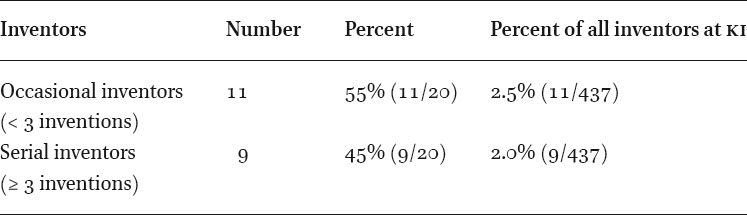
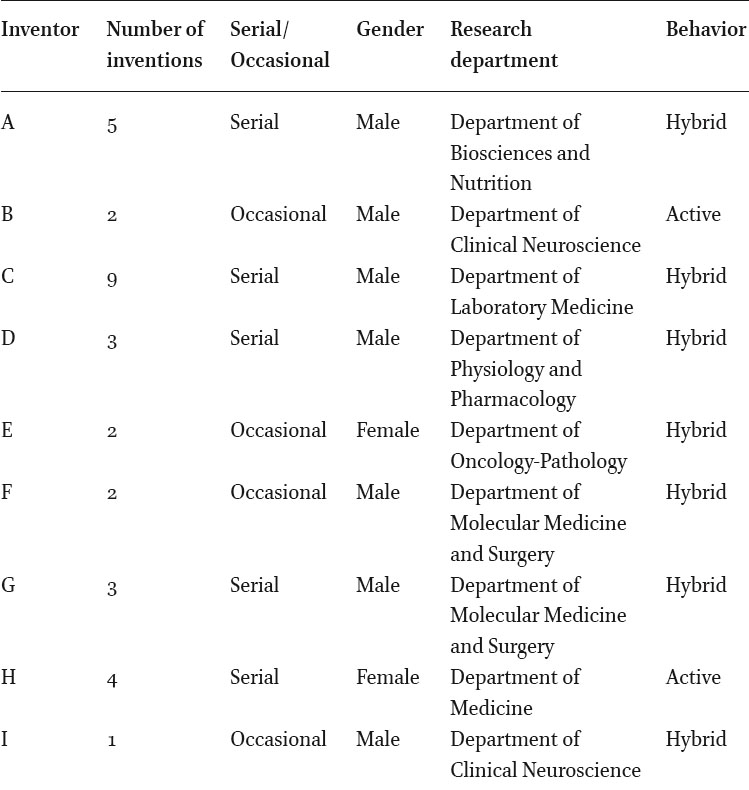
An analysis of the sample (Appendix 1) showed that the distribution of inventors follows the typical Lotka-like productivity pattern (Narin and Breitzman, 1995). Previous work on academic inventors has also observed similar patent productivity distributions at the national level (Geuna 2010; Lissoni 2008) and at the university level (Wallmark 1997). In this study, inventors were categorized according to Göktepe-Hultén (2008) who divides academic inventors into two groups: serial inventors, holding three or more patents, and occasional inventors, holding fewer than three patents (Table 1).

Twenty academic inventors were selected in this study; 11 were categorised as occasional and 9 were categorised as serial inventors
Citation: Triple Helix 8, 1 (2021) ; 10.1163/21971927-bja10021
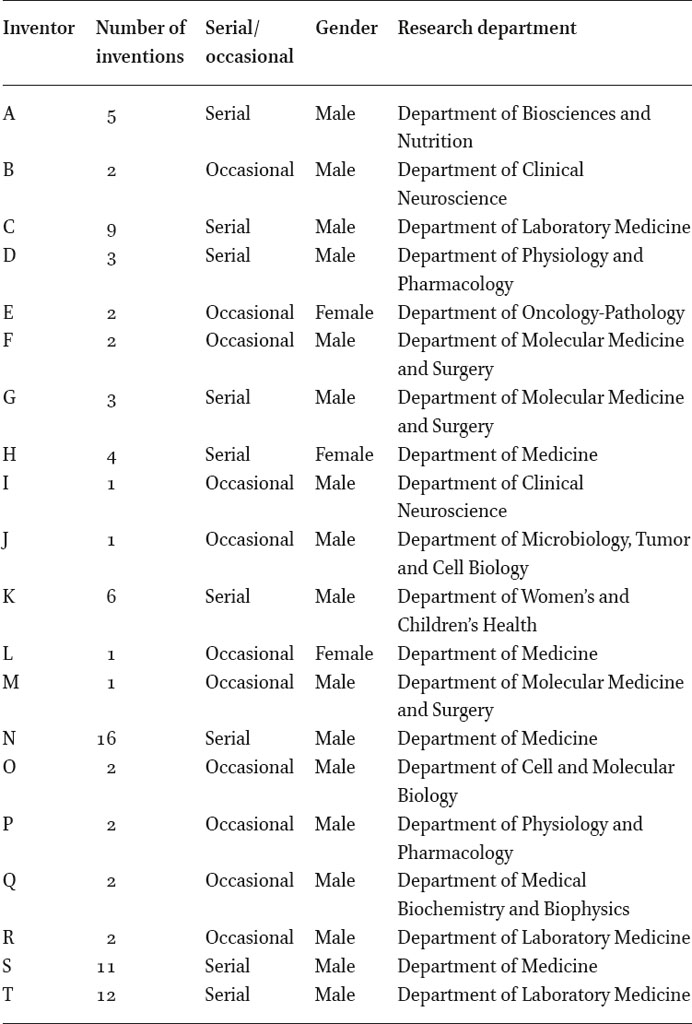
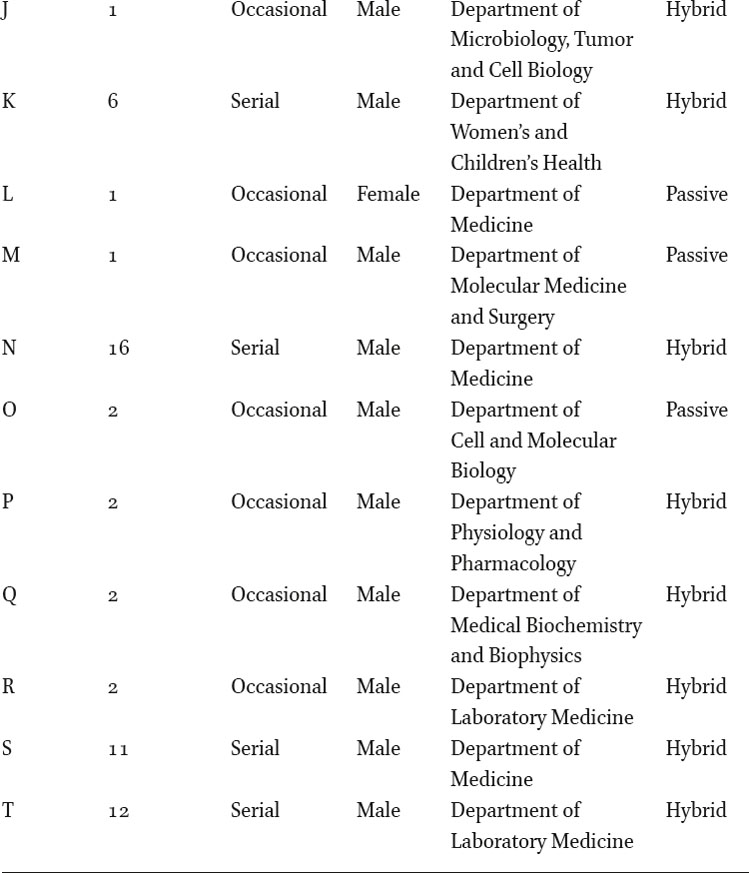
Since the aim of the study was to probe the relationship between inventive productivity and academic inventors’ behavior in patent initiation and management, the objective was to select interviewees that reflected the pool of academic inventors including both serial and occasional inventors. Altogether 59 inventors were contacted by email or phone. Out of these, 39 declined, referring to time constraint as one of the major reasons for not wishing to participate in the study. As shown in Table 2 below, the final sample consisted of 20 academic inventors. Eleven of these were classified as occasional inventors and the remaining nine as serial inventors.
Selected inventors; number of inventions, gender and departmental affiliation
Citation: Triple Helix 8, 1 (2021) ; 10.1163/21971927-bja10021
3.2 Data Collection
3.2.1 Interviews
To understand inventor behavior in patent processes, semi-structured interviews were used (Fontana and Frey, 1994). Prior to each interview, background research on the academic inventor was conducted. As mentioned above, inventors and associated patent information were identified in the KIIP database. Besides tracing each inventor through the “Inventor ID” label available in the database, other secondary sources such academic profile pages, company websites, news articles and press releases were explored to gain any additional information on the inventors, inventions and companies they had founded. Before every interview, patent documents related to the inventors were extracted from the European Patent Office electronic files.2 The abstract of each invention was studied and sometimes followed up with a more detailed analysis of the patent specification. These preparatory notes facilitated a more general understanding of the respondents’ research topics and were helpful for understanding the patented inventions. Also, in cases of multiple patents per interviewee, documentation of each interviewee’s patenting history was used to keep track of different inventions (in chronological order). During the actual interview, such documentation helped to direct the inventor to discuss specific patent processes and limited the need for basic explanatory questions in favor of analytically relevant follow-up questions related to the topics of interest.
3.2.2 Open-Ended Questions
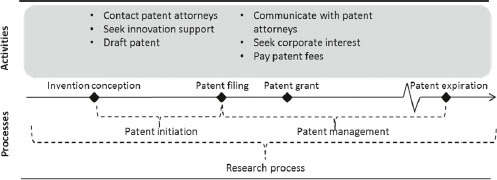
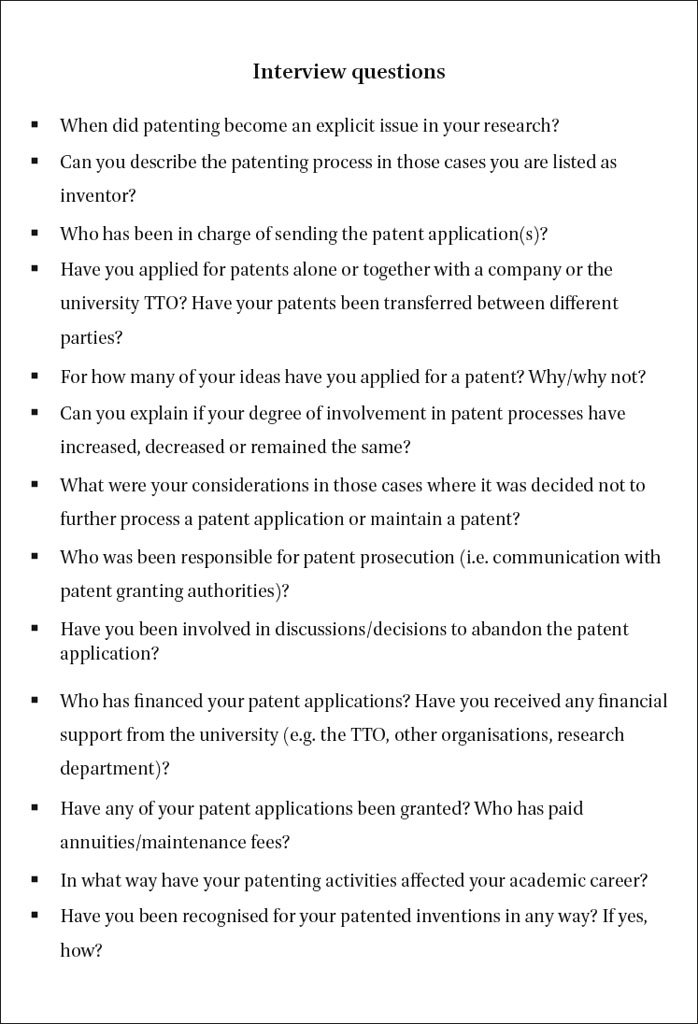
The primary purpose of the interviews was to capture how patenting was triggered and how inventors behaved in patent initiation and subsequent patent management activities (Figure 1). The questions were designed in an open-ended fashion (Appendix 2) to allow the interviewees to reflect on their patenting experiences and allow each interviewee to “tell their patenting stor[ies]” (Strauss and Corbin, 1998). Retrospective interviewing requires interviewees to recall past events, some of which may have occurred more than a decade past. To aid respondents in their recollection, each interviewee was initially prompted to speak about a specific patent process (in those cases where the individual held more than one patent). Interviewees were also encouraged to think about when patenting became an issue in their research, in order to “take the interviewee” back in time to the point before the actual filing of any patent application(s).
Illustrates the processes and underlying process activities investigated here
Citation: Triple Helix 8, 1 (2021) ; 10.1163/21971927-bja10021
During the course of each interview, inventors were explicitly asked to refer to their invention(s) and patent processes in their past experience. Interviewees were also asked follow-up questions to further develop and reflect on the timing and circumstances of patent initiation and other patenting activities. Otherwise, interviewees were allowed to speak freely about their work with academic commercialization. This open-ended format meant that respondents in several cases also came to reflect on matter outside the scope of the present study, such as their post-patenting activities, including experiences of investment roadshows, founding of spin-offs and participation in corporate management or boards.
The interviews took place between September 2015 and June 2016. Interviews lasted between 40 and 120 minutes. At the first two interviews, the first and second authors were present. All interviews were digitally recorded and transcribed verbatim. Each interviewed inventor was guaranteed anonymity, which is reflected in the use of pseudonyms and the selective masking of collaborating organizations and individuals as well as other research-specific identifiers in direct quotes.
3.3 Data Analysis
3.3.1 Method of Analysis and Initial Coding Scheme
The method of data analysis which underpins the findings presented in the paper was informed by the Gioia methodology (Gioia et al., 2013). This approach was developed by Gioia and associates over several decades (Gioia and Chittipeddi, 1991; Gioia et al., 2010), as a “systematic inductive approach to concept development” (Gioia et al., 2013: 16), for the purpose of improving the analytical rigor of qualitative research. While it has been emphasized that the methodology is not a “template” (Gioia et al., 2013: 25–26), a fundamental tenet is the successive movement from informant-centric, so-called “1st-order” categories to more abstract, “2nd-order” researcher-centric concepts. The former requires the researcher(s) to “willing suspension of belief” (Gioia et al., 2013: 21) as regards previous research, in favor of emic sensemaking. The latter, meanwhile, allows for the introduction of etic terminology and understanding. While the possibility and desirability of the researcher to distance themselves from previous research has been contested (Mees-Buss et al., 2020) one of the main justifications for using this methodology is the relevance of concept development that can depart from “too strongly rooted” constructs which delimit how the researcher makes sense of organizational realities (Gioia et al., 2013: 16). The departure from established constructs played a formative role in how the data analysis unfolded in the present case.
As part of the original research design, an initial coding scheme had been agreed upon among the authors, based on four empirical dimensions of established analytical interest in the extant literature. Foremost among these was the type of inventor, as measured by inventive productivity (serial versus occasional). The intention was to probe similarities and differences in how individuals with higher/lower inventive productivity participated in individual patent processes (micro-level), in particular as regards the outcome of specific decision points and actions related to patent initiation and patent management (such as the trigger to patent, filing a patent application, choice of channel for commercialization, use of external advisor and so on) and the relationships between the academic inventor and other stakeholders. Previous research on inventive productivity as well as academic inventors’ behavior suggested that occasional and serial inventors would exhibit differences in behavior at the micro-level. However, an empirical surprise in the early stages of data analysis, as described below, led to a reorientation from this more structured approach to qualitative analysis to the more inductive Gioia methodology where the use of previous research shaped the 2nd-order coding but did not provide an explanatory framework for our findings. As discussed in the concluding section of this paper, the inductively derived findings of the paper indicate the relevance of further behavioral theorizing of academic inventors’ behavior in future research.
3.3.2 Reconsideration of Planned Coding Scheme and Resultant Data Structure
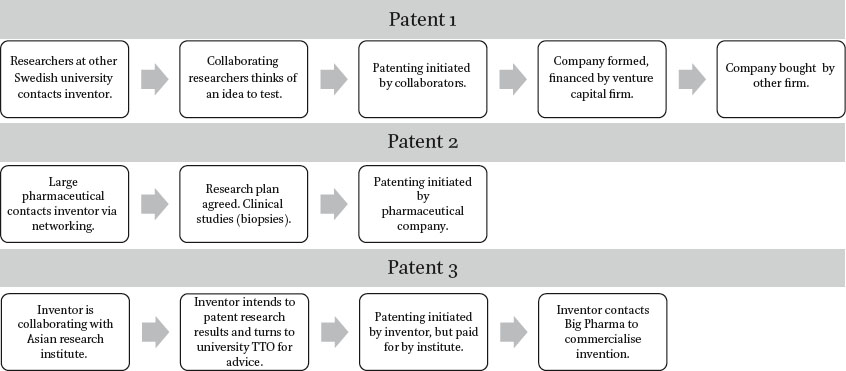
In line with the initial coding strategy, a first step in analyzing the interview material was to temporally structure interviewees’ accounts in relation to specific patenting processes. Since some of the interviewees spoke about several inventions and patenting processes intermittently, it was necessary to disentangle these different processes. To do so a visual mapping was undertaken (Langley, 1999), with the chronological plotting of major events in each patent process discussed by each interviewee (Appendix 3). The activities accounted for in each transcribed interview was concurrently coded in relation to the identified patenting process(es). Only process accounts related to patents identified in the KIIP database were included in the study. Thus, when interviewees segued to discuss inventions that were made outside the chosen time span or were unrelated to their research work at Karolinska Institutet, these patent processes were excluded from the analysis. Similarly, interviewees’ accounts of post-patenting activities such as venture creation and marketing were also excluded.
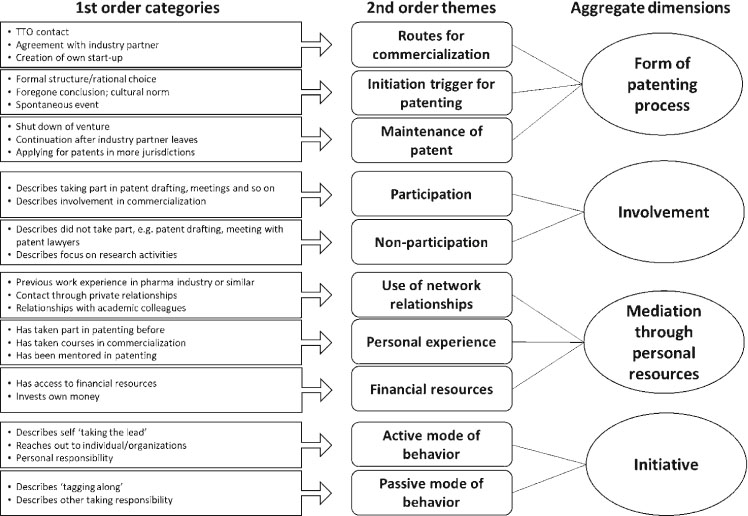
The subsequent step in the planned coding scheme was the detailed coding of actions in specific stages of the patenting process. However, the initial procedural tracing of all raw transcripts led to an “intuitive insight” (Dörfler and Ackermann, 2012): that behavioral differences – specifically the intensity of inventors’ engagement, as expressed through statements of personal initiative and responsibility – in specific patenting processes did not align with the classification of individuals as an occasional or serial academic inventor. This prompted a revision of the coding scheme to open up for a more inductive analysis of statements in the 1st-order coding of the procedural narratives of patenting behavior. The resultant data structure is outlined below (Figure 2). In line with the established experience, the use of the Gioia methodology led to a “myriad” of 1st-order categories (Gioia et al., 2013: 20) related to processes, structures, different actors’ participation as well as the academic inventors’ personal resources, responsibility and initiative. For example, patent initiation was characterized by informants to occur in a formal fashion typically through a relationship with the university TTO or with a pharmaceutical company (labelled “structured rational choice”) but also as a “foregone conclusion” in their research milieu or a “spontaneous event” outside of an established process. Interviewees also revealed how patent initiation was “mediated” via their professional or personal network as well as through previous experience. There were also 1st-order categories related to accounts of patent initiation that expressed that this was driven by the interviewee (coded as “self”) in contrast to cases where TTO staff, investors or companies took responsibility for patent filing including drafting and paying for patent costs (coded as “other”).
The numerous 1st-order codes were then reviewed in relation to our interest in academic inventors’ behavior in patenting processes at the micro-level and clustered in 2nd-order themes (Figure 2), several of which are recognizable from the extant literature on how academic commercialization is pursued and how academic inventors participate in patenting processes. Themes such as Routes of commercialization and Use of network relationships reflect established understandings of the role of organizational and institutional factors and social relationships in shaping the trajectory of academic innovations. The dual themes of Active mode of behavior and Passive mode of behavior also emerged based on accounts of inventors’ personal initiative and responsibility in all patent initiation and management activities (see examples in Appendix 4). In a final step, a smaller sub-set of aggregate dimensions was generated from the 2nd-order themes. The aggregate dimension Initiative captures the identified differences in modes of behavior and distinguishes it from the differences in academic inventors’ Involvement that has been described in previous research. The concept of Initiative, as expressed through Active and Passive modes of behavior, articulates the initial creative imagination of behavioral differences through subsequent analytical processing (Kump, 2020: 14–15; Sandberg, 2005). These findings are presented in the following section.
4 Findings
The analysis of how serial and occasional academic inventors acted in the initial steps of the patenting process found that the individual’s initiative was associated by whether the trigger was a formalized collaboration with an external stakeholder. In subsequent steps, both serial and occasional inventors exhibited a broader variation of personal initiative for activities such as preparing patent filings and financing costs associated with gaining and maintaining patents.
4.1 Activity and Initiative in Different Forms of Patent Triggering: From Formal Process to Spontaneous Event
Previous research has highlighted how formal and informal conditions shape patent propensity (e.g. Aldridge and Audretsch, 2011; Bercovitz and Feldman, 2008; Geuna and Rossi, 2011) and that academic inventors choose to pursue commercialization via different routes, when it is possible to do so (Aldridge and Audretsch, 2011; Göktepe-Hultén, 2008; Huyghe et al., 2016, Omar, 2012). Interviewees’ accounts of how patenting was triggered fall into one of three categories: 1) formally structured process, 2) culturally established norms or 3) response to a spontaneous event. In the interviewees’ procedural narratives, the individual’s expressed degree of initiative was shaped by the degree to which patenting was formalized from the outset. Academic inventors were more passive when patenting was triggered by external partners, and most active when exploiting the possibilities of a spontaneous event or realizing culturally established expectations of patenting.
4.1.1 Formally Structured Process for Patenting
Most of the inventors in the study referred to the university TTO somewhere during their individual interviews, and nearly all of the serial inventors had met with TTO representatives at some point in their career. For several occasional inventors, the initial contact with the TTO led to much subsequent support with drafting and patent filing within a formalized and structured process. It was not even so that the individual academic inventor needed to take the initiative to contact the TTO. For example, one occasional inventor credited his then-supervisor and other people at the University with directing him to take the first step towards patenting through the TTO:
Yes, together with [Supervisor] because he was very coaching, and he understood that I wanted to go in that direction. We talked a lot about it. He introduced me to these people at the [TTO] … with these people that were establishing it, with the [university president]. I don’t recall all these names there, but it was the investment side. [Supervisor] was instrumental there because then, as it was described to me, [the TTO] helped with the patent.
Inventor P, Occasional
Once the TTO was involved, the same individual noted that its staff structured the patent application process and surrounding activities in line with their processes:
We did what they call an invention disclosure and then I got to come there to [the TTO] and present, and they thought it was exciting, so they helped us with the patent application and all surrounding it, that was the first round.
Inventor P, Occasional
With academic inventors having the choice to collaborate and patent their research results with any entity, many chose to collaborate with a corporate partner. Such an agreement also meant that the academic inventor did not need to take a particular initiative to patent. By way of illustration, one serial inventor recalled “tagging along” in the patenting process, as these were taken-for-granted by the company and facilitated by their in-house process for managing intellectual property rights:
Since we worked together with this group at [pharmaceutical company], they were already involved in patenting activities. It was something that was present in everything they did…. They had this whole structure. They had their own patent department. They had lawyers taking care of all that. They could just press the button and so it happened. It was very easy in that way, so I just tagged along so to speak.
Inventor D, Serial
In a similar fashion, another occasional inventor described how patenting was subject to contractual terms within the overall research collaboration agreement. It was not necessary for this individual to take initiative for it to happen:
[Biotech company] provided reagents, something that we simply needed. Then it was part of the conditions that if something commercially viable occurred, they would patent it …
Inventor J, Occasional
Thus, when patent initiation was triggered by formal arrangements, either via the TTO or commercial contracts, there was limited initiative and responsibility that lay with the individual academic inventor. This differed from other forms of patent initiation.
4.1.2 Culturally Established Norms for Patenting
In contrast to patenting being a consequence of a formalized and structured process, several interviewees emphasized how patenting was taken-for-granted in their research environments. In some cases, this culture “was foremost an atmosphere of patent-friendliness” (Inventor E, Occasional) or the perceived standard practice within a rapidly emerging field with new scientific and technological breakthroughs: “This was when the genome was being sequenced and all researchers in my field wanted to patent new genes. So there was a bit of pressure to follow what others were doing” (Inventor A, Serial). The expectation that patenting would be initiated was not necessarily expressed in a structured form, “not something specific like a course or something like that” (Inventor B, Occasional). However, as another occasional inventor explained, the culture of patenting could also be associated with established relationships with external parties which served to channel the impulse for patent initiation in a specific process:
Such a culture already existed in my research group and there was also a company tied to the research … or not to the research group, but [supervisor] was involved with a company, with some of the post docs in that group. It was a company that was run by [investment company].
Inventor R, Occasional
Certain academic inventors noted that they had been socialized to recognize opportunity and initiate patenting in conjunction with academic research, through their personal experiences “in different places … so one gets different types of influences when it comes to patenting” (Inventor K, Occasional). One occasional inventor explained the trigger to patent as rooted in “[my] background from industry … as director at [pharmaceutical company] for twelve years and then vice president in another company. I have helped with some start-ups and also started companies. In those processes, in that world, patenting is important” (Inventor B, Occasional). A serial inventor similarly noted that patenting became a topic of interest following a post-doc in the US, which gave “our first contact with the world of patents was at US universities…. And then we were taught that in the US you can publish and, then you have one year before you have to patent” (Inventor H, Serial). Another serial inventor reflected that their propensity to patent had increased with experience:
These days, when one has reached some maturity in this process, one thinks this and that could be turned into a patent. It is almost one of the first thoughts that comes to mind when you think of something. That was not the case 20 years ago, but nowadays it could be that one thinks “oh yes, if I do it that way it is patentable”.
Inventor T, Serial
In the presence of strong established norms for patenting, interviewees’ expressed less need for overt initiative from the individual academic inventor to conceive of the idea to patent, although there was still need to actively initiate a patenting process. Such actions were more clearly exhibited when patenting was triggered by a spontaneous event.
4.1.3 Patenting Following a Spontaneous Event
It is well-recognized that fortuitous circumstances can play a formative role in scientific invention and entrepreneurship (Arthur, 2007; Miettinen, 1996; Roberts, 1989). The present study’s focus on procedural narratives elaborates on the role of individual initiative in making something material out of such an event. For example, one occasional inventor reminisced about running into a former colleague and this leading to further conversations that same evening, after years of silence:
[S]everal years went by and we were not in touch at all … and then we bumped into each other at the parking lot that used to be down here before it was demolished…. And then we started … that evening when we coincidentally met … to talk about what we were up to.
Inventor F, Occasional
In a similar vein, another serial inventor spoke of recently conceiving of a patentable idea while listening to a scientific conference presentation and then actively taking the initiative to speak with the presenter, which had led to an as-yet undeveloped collaboration:
Like last week when I was at a conference in the UK. I have worked traditionally on a research project during many years and then during a lecture at the conference I heard something that made me say … “yes this is how you do it”. And then I caught the presenter and now we are collaborating … after a few days we are collaborating. “Let’s do it”.
Inventor C, Serial
Both occasional and serial inventors noted the importance of maintaining professional relationships and how such networks could be activated when seeking to initiate a patenting process – but also prompt spontaneous requests to respond to. One serial inventor speculated that an old colleague had generated such a request many years later:
I knew a fellow, who was a professor at one of the departments at Stockholm University at Arrhenius laboratory. He is no longer there. He went to SCRIPPS in California and then he disappeared to [pharmaceutical company] in Basel and that is how there was a connection to [pharmaceutical company]…. He probably told the people at [pharmaceutical company], that I was here.
Inventor G, Serial
The importance of nurturing relationships established during doctorate education for future research collaboration was emphasized, as when another serial inventor referred to the “natural connection” between him and his co-inventor, whom he first met when they were PhD candidates (Inventor N, Serial).
In summary, interviewees spoke of three ways in which patenting was conceived of and triggered. Of these, the least initiative and responsibility was required of the individual academic inventor when patenting was triggered by formal arrangements. In contrast, serial and occasional inventors exhibited a broader range of initiative when patenting was initiated in a setting where this was a taken-for-granted behavioral norm or when patenting followed from a spontaneous event. In the latter case, more was typically required of the individual inventor to identify and realize the opportunity that this event offered. In subsequent steps, both serial and occasional academic inventors exhibited active and passive modes of behavior.
4.2 Differences in Initiative: Academic Inventors’ Active and Passive Behavior in Patenting
Following the trigger of a patenting process, interviewees gave varying accounts of their own degree of initiative and responsibility. In some cases, the inventor did not take the initiative to pursue patenting and further commercialization. One example of such passive behavior was one serial inventor who recalled how the patent application process was taken care of through the established in-house processes of the TTO of a foreign university, which took lead in a particular process:
We have one patent application with Oxford; it was a collaboration with a researcher there. And that patent application I was not prepared to drive myself, because I did not wish to lead the project. But my [co-inventor] wanted us to try to patent the findings, so then I said “That is fine, if I get the same deal as you”. Then he spoke with his TTO at Oxford and they agreed to help. And I got the same conditions.
Inventor H, Serial
In a similar vein, another occasional inventor recounted how his supervisor took responsibility for the patenting process, and only included him in late-stage communication with patent agents regarding drafting of the patent application:
Everything with patenting was [supervisor] idea. I would have never thought about filing it. I recall when we were visiting the patent attorneys at Östermalm and that was like the day before the paper was submitted or something like that. It really was last minute.
Inventor O, Occasional
These accounts of limited initiative and responsibility contrast with other inventors’ accounts of active behavior, where they were responsible for leading the patenting process. As one occasional inventor noted, when discussing one of the patent processes that he had been involved in:
In this case … I was the driving force and applied for a patent. I worked with sterols and turned to [co-inventor] and asked him to test their activity against cancer…. So then we had that project.
Inventor F, Occasional
Another occasional inventor similarly emphasized their involvement in creating momentum in the patenting process:
I was probably very pushy to get it patented. We had a possibility through an already established collaboration with a patent firm who managed the patents for this company, so I drafted the patent together with their patent agent.
Inventor R, Occasional
An active behavior was often described when the invention had been conceived independently by the academic inventor. One such occasional inventor described how his initial idea then led him to investigate both patentability and marketability:
I came up with this idea on my own and in that situation I saw that there was a big market for it. We have a patentable idea, which has sufficient inventive step and for which there is also a market. It was pretty easy for me to see that there are about 10 percent of [population suffering from condition] in Sweden, which means that there are about one million people that could be treated. Globally, there might be up to 500 million people that could be targets for this biomolecule.
Inventor B, Occasional
A serial inventor outlined a consciously strategic approach to patenting, where the desire to have an active role how patenting was pursued shaped how to proceed with a priori identified key stakeholders:
In this case I waited to initiate patenting until I knew that [a company] was interested, because I did not want to make a big thing out of it. I did not want to go to the TTO, because I wanted to do it myself. Partly because I now know how you do it yourself. So I could go to these British people directly. And partly because it costs 60.000–70.000 SEK [approximately 7000–8200 USD] to do it. Since we are subject to the teacher’s exemption, you have to pay yourself, since you own the patent. So before I did it, I wanted to be pretty sure that I would get the money back. So I started talking to them, before I started to patent. When I realized that they seemed sufficiently interested I patented it.
Inventor S, Serial
In many accounts, both serial and occasional inventors noted that they were particularly active until patent drafting where they worked with patent firms to shape the patent application. One serial inventor noted that the first application, in which he and his team took an active role, taught him the importance of assuming an active mode of behavior in relation to patent agents:
We were very active in writing [the first patent application]. It was team work together with the patent agent. And I have worked with many patent agents later also. It is very important that one communicates well with the patent agent, because it is really difficult for them to grasp it all. So I have several patents now, patent applications, so I have learnt a lot about that process, but it is still that first, it was granted very quickly.
Inventor H, Serial
Several other inventors described a routine practice in patent drafting, where initial work by the academic inventor was subsequently revised by the patent expert:
The usual approach is that I write a description. I try to write in the same style of a patent, but in my own way, you know, by adding a couple of diagrams and then it is a description, it is a bit of background, and then a couple of examples and then I try to suggest claim.
Inventor S, Serial
In addition to drafting, the patent application process includes costs associated with patent filing. Several interviewees mentioned patent fees as challenging for Swedish academic inventors, since the regulatory context meant that there was no automatic organizational support available to cover these costs. Some of the interviewed inventors adopted an active mode of behavior in seeking out funding. For example, one serial inventor described himself as fortunate to have received funding from a governmental foundation that covered the patent fees, but also indicated that this windfall came because he activated a pre-existing relationship with an organizational insider:
I was lucky really, since I knew a person who worked for this foundation, so I got a “letter of recommendation” so I got money … to run a patent process.
Inventor A, Serial
In some cases, the individual inventor could take a more passive role, if financing was available through the chosen formalized commercialization route. A serial inventor noted how he did not have to take any financial risk since the university TTO covered the costs for patent preparation and filing, and “this just kept running” (Inventor D, Serial). Patent costs were also routinely covered by collaborating companies or venture capitalists. For another serial inventor, “that means that my contribution has been limited to scientific advisory work” (Inventor C, Serial). An occasional inventor similarly described how an offer to finance the cost of patenting was easily given within the framework of an existing corporate relationship, which required little initiative on the part of the individual inventor:
I was doing another project … [and] we have some money from [a biotech company] and it is a company which has really invested 80 million in research all over the world in [disease condition] and when they heard [about my project], they just said “we would like to finance your patents”. Then, since they just said that, just like that, I could choose a patent agent and then I could initiate it.
Inventor B, Occasional
Still, in a few cases, financing had to be provided by the individual inventor. One serial inventor described a situation where there were four co-inventors, of which a few were associated with a foreign hospital that held the patent, but where the Swedish inventors needed to provide initial financing with personal funds:
[I]n the US one does not own the patent oneself. It was [the hospital innovation support organization] that agreed [to pursue the invention further]. We were four co-inventors. But then [the two of us] paid with our own money first. We really believed in this, so we paid with private money.
Inventor H, Serial
In summary, within the patent application process, serial and occasional inventors characterized an active and a passive mode of behavior. The former involved the individual inventor taking the initiative to advance the patenting process. This contrasts with a passive mode of behavior, where this initiative and responsibility lay with other stakeholders, such as the individual’s supervisor, a patent agent, the TTO or a collaborating partner.
4.3 Switching Modes of Behavior between Processes – and Over Time
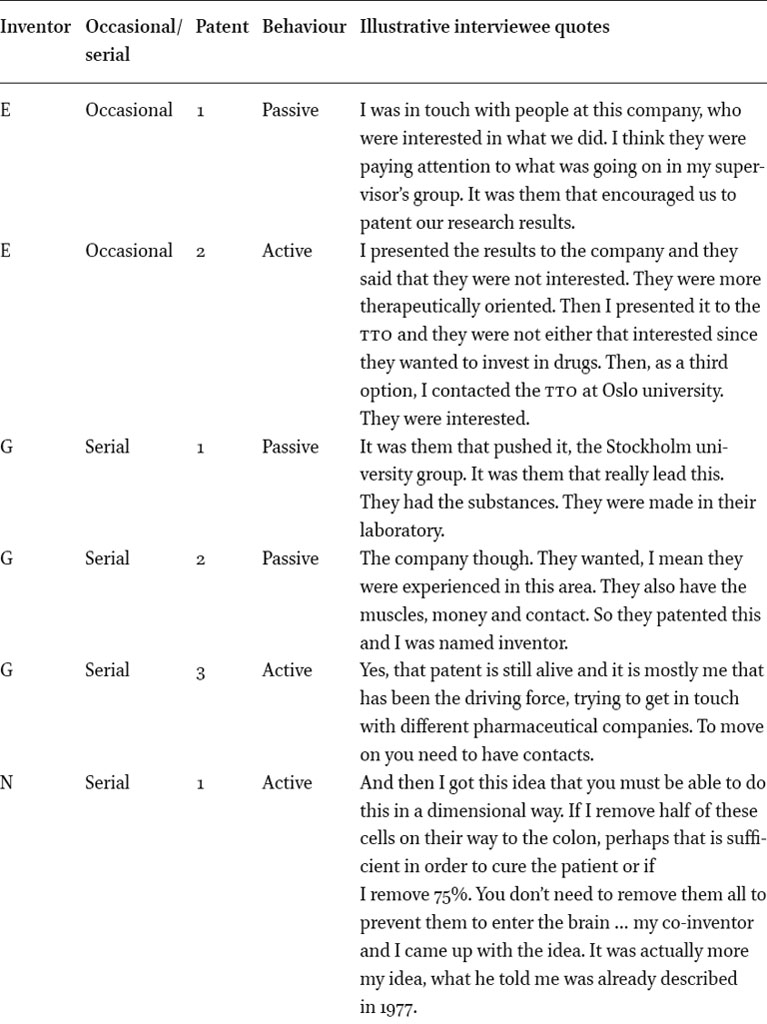
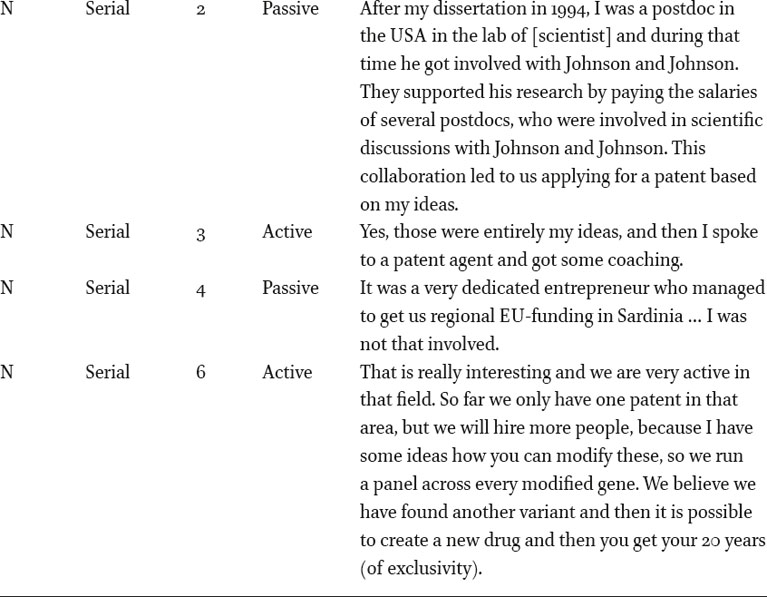
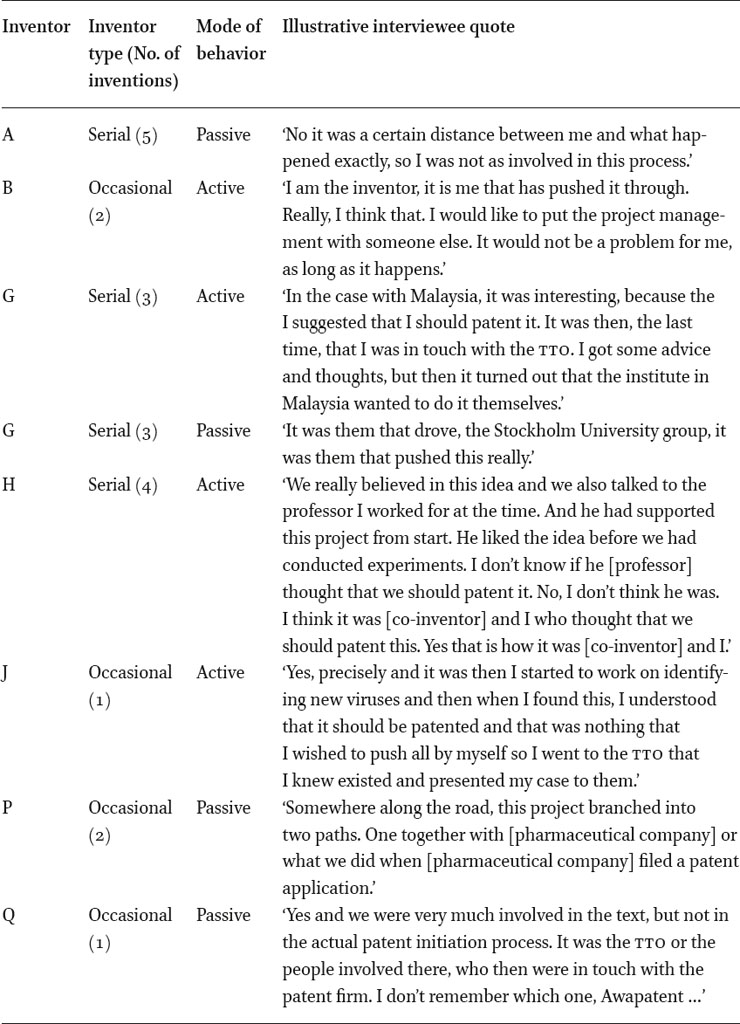
While different inventors described how they adopted active or passive behavior in specific patenting processes, the same inventor could also characterize how they switched behavior between processes. This switching behavior was described by both serial and occasional inventors (Table 3).
Examples of interviewee quotes describing how the same inventor switches between passive and active behavior in different patent processes
Citation: Triple Helix 8, 1 (2021) ; 10.1163/21971927-bja10021
In addition to switching behavior, and notwithstanding the degree of activity in the patenting process, most inventors described how they assumed a more passive mode of behavior post-patent, when the focus shifted to bringing a product to market. This approach is illustrated by the following quote from one occasional inventor:
That was when the roles changed. At that point, it was them that managed the contacts with potential customers. We managed the biology and the chemistry and we were inventors, but we were not involved in the commercial end of things.
Inventor P, Occasional
However, a recurrent exception to this development, was when a new demand for active involvement could arise to maintain a patent over time. As previously shown, both serial and occasional academic inventors commonly adopted a passive behavior in patenting processes that involved collaboration with a corporate entity. However, in cases where this company was no longer interested to pursue commercialization of the patented invention, the responsibility to maintain the patent could shift from the company to the academic inventor. In such situations, where the patent was transferred back to the inventor, the costs of keeping the patent alive forced individuals to adopt an active mode of behavior to seek out new stakeholders:
Because they did not wish to maintain the patent and since there was a clause in the agreement we had with them that said that the patent should be transferred to the inventors. So we got it back and then it was up to us to continue paying for it, to keep it alive so to speak. So we tried in different ways to find other stakeholders that were willing to take on this patent.
Inventor D, Serial
Becoming the legal owner of a patent was described by several interviewees as challenging. The same serial inventor described his “shaken” reaction when he realized the financial implications that a potential transfer of patent ownership from the former corporate partner would entail:
A lot of expenses came with [the patent], so I was a bit shaken. And then I tried to find people that were interested in taking over the patent. It ended up going to a company in Lund, which took care of the patent and maintained it.
Inventor D, Serial
In a similar fashion, an occasional inventor received a patent from his former corporate collaborators. Since this patent was part of a larger patent family, the inventor was faced with a situation where patents had to be upheld in several jurisdictions. Not only did this require the inventor’s time and scientific knowledge, but more so, he had to find a way to cover the costs:
The old patent was applied for by [pharmaceutical company] from the beginning and I was a co-applicant. They abandoned this project later … So I got to take over ownership and it was not so easy since [they] were patented all over the world. I think I ended up spending several hundred thousand SEK [approximately 25,000 USD]. I got help from an American, who has supported me a little bit. He helped and paid for some of it, but it was a lot of work.
Inventor Q, Occasional
Another occasional inventor explicitly spoke of the perceived imperative to “get rid of” a patent that had advanced to a stage where the financial burden of maintaining this patent was sizable:
[The collaborating investor] went bankrupt, or it was bought by completely different reasons and I got to take over the patent. I paid for overlapping costs personally. But it was still, the international phase milestone had not yet come up, so it was just costs associated with patent filing. So there I was with a patent application and it was critical to get rid of it as soon as possible so that I did not have to face the costs personally, when it started to approach the [international phase].
Inventor B, Occasional
In summary, our analysis of academic inventors’ behavior across patenting processes found that the same individual could switch between taking personal initiative for activities and “tagging along” when other stakeholders took such initiatives. It was also observed that certain individuals were faced with the need to possibly take a more active role in maintaining a patent in situations when a collaborating party (typically a company) declined to pursue the invention further. Such a situation could arise long after the initial patenting of the invention. The following section discusses the contributions of the study and its implications for policy.
5 Discussion and Conclusions
This paper investigates whether differences in inventive productivity – as measured by number of filed or granted patents – are indicative of how academic inventors behave in patent initiation and subsequent patent management activities at the micro-level. Twenty occasional and serial academic inventors affiliated to Karolinska Institutet in Stockholm, Sweden were asked about how patent initiation occurred in one or more individual patent processes. Based on these accounts, academic inventors are found to differ as regards the initiative they exhibit in patenting processes. Specifically, individuals can adopt an active or passive mode of behavior. Individual academic inventors are also found to adopt different modes of behaviors across patent processes. These findings have implications for theory development and policy.
5.1 Theory Development
5.1.1 Inventive Productivity and Behavioral Differences
This study posed the research question: How do serial and occasional academic inventors behave in patenting processes? In answer to this question, we propose the inductively derived conceptualization of initiative, as expressed through an active and a passive mode of behavior. The identified behaviors within groups of individuals with higher/lower inventive productivity and the observed individual variation across different patent processes makes two contributions to the extant literature.
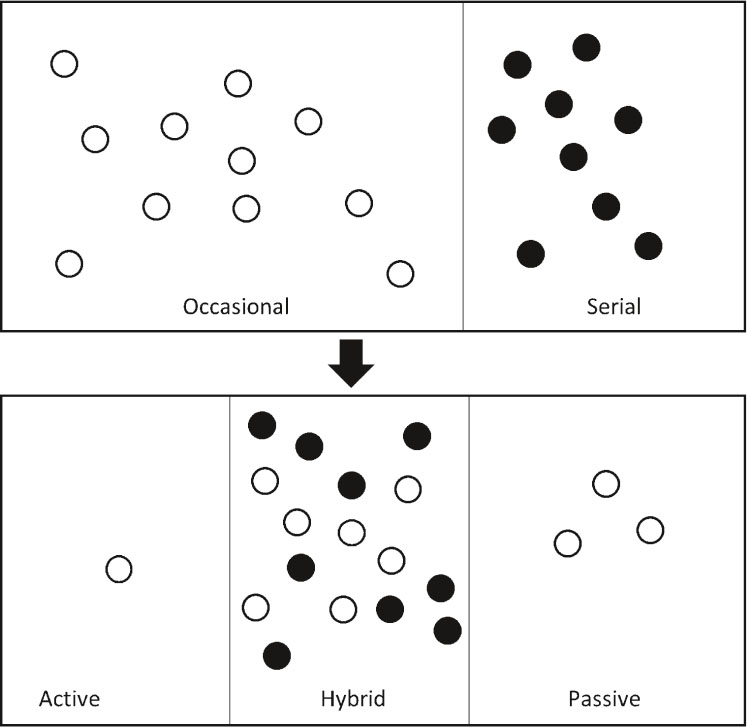
A first contribution is to the literature on inventive productivity. High inventive productivity is a well-established conceptualization of desirable behavior on the part of academic inventors within a Triple Helix model. Classifications based on inventive productivity are commonly used to investigate the impact of environmental, organizational and individual contingencies on high/low patenting among academic inventors (Bercovitz and Feldman, 2008; Lawson and Sterzi, 2014; Nelson, 2014; Owen-Smith and Powell, 2001) and to target innovation support (OECD, 2014, 2019). However, the literature has to date been largely silent about the exhibited behaviors of serial and occasional academic inventors in the commercialization process at the micro-level. The underlying assumption has been that the form of patenting processes (and their outcome) is contingent on various interacting structural characteristics, which together provide a proxy for agentic capacity and behavioral differences. Yet when the present study has explicitly probed the link between inventive productivity and individuals’ behavior in specific patenting processes, it was found that inventive productivity is not indicative of the initiative exhibited by the individual academic inventor in patenting processes (Table 4). Thus, categorizing individuals based on exhibited behavior in patenting processes gives a different perspective on the studied academic inventors than a grouping based on inventive productivity (Figure 3). Notably, active behavior can be exhibited by both occasional and serial inventors. Furthermore, all serial inventors in the present study described how they assumed an active mode of behavior in some processes and a passive mode in others (denoted “hybrid” mode of behavior).
These findings suggest that the established categorization of academic inventors based on quantitative measures of inventive productivity can obscure potentially meaningful differences in individual’s behavior. As this study shows, inventors with one or two patenting experiences do not necessarily show less initiative than inventors with three or more inventions. For example, a scientist working with firms that have established (in-house) IP (intellectual property) management processes may repeatedly be named inventor yet act passively in each of these processes. It is therefore problematic to analytically conflate productivity and activity.
Selected inventors; number of inventions, gender, departmental affiliation and behaviorial categorization
Citation: Triple Helix 8, 1 (2021) ; 10.1163/21971927-bja10021
Serial and occasional inventors described how they assumed an active, passive or hybrid mode of behavior in patenting
Citation: Triple Helix 8, 1 (2021) ; 10.1163/21971927-bja10021
The finding that individual academic inventors can and do switch behavioral modes between patenting processes also extends previous research on academic inventors’ behavior. Previously proposed typologies of academic inventors have tended to assume a stable category placement (e.g. Etzkowitz, 1997; Göktepe-Hultén, 2008; Louis et al., 1989). This contrasts with observations in the present study. While several occasional academic inventors exhibited a coherent mode of behavior (either active or passive), certain occasional inventors and all serial inventors expressed such a hybrid mode of behavior (Figure 3). This expressed heterogeneity suggests that behavior is more situated that previously theorized.
Conceptually, this study therefore underscores the relevance of further developing on procedural and behavioral theorizing of academic inventors’ expressed behavior in patenting processes. In particular, the present study suggests that the understanding of individual academic inventors’ involvement in patenting and mediation of personal resources (such as network relationships, experience and financial resources) would benefit from a deepened understanding of differences in initiative. By doing so, future studies could provide a more dynamic model of when contingent factors shape individual actions and activate a passive or active mode of behavior and how this shapes the trajectory of academic commercialization.
5.1.2 Limitations and Future Research
The exploratory design of the present study has several limitations, which each point to possible avenues for future research. The analysis is based on interviews with academic inventors affiliated to a single faculty research university subject to the teacher’s exemption, which provides large individual discretion in the choice of patenting routes. It would therefore be of interest to broaden future studies to allow for cross-disciplinary and international comparison. The latter, in particular, could serve as a means of further explicating the role of individual initiative and responsibility in formalized patenting processes. A further limitation is that the chosen methodology did not accommodate a complete mapping of all serial inventors’ patenting processes and their respective behaviors therein. Such a study is desirable to validate the observation of changing modes of behavior among serial inventors.
The chosen research design also did not allow for comparisons between cohorts of academic inventors at different career stages or between individuals over time. Since the selection of occasional and serial academic inventors through retrospective tracing of patents filed over a fifteen-year period fails to distinguish the experiential effects of career progression, it would be interesting to compare early career patenting experiences with late career patenting experiences. Narrative accounts by serial inventors in the present study would suggest that there is one developmental path where an individual adopts a more active behavior as they gain patenting process experience. However, the observation that occasional inventors (who lack patenting experience) can exhibit a coherent passive or active mode of behavior raises questions about who transitions from occasional to serial inventor over time. Are occasional inventors with an active mode of behavior more likely to become serial inventors than occasional inventors with a coherently passive mode of behavior? If so, then the passive mode of behavior exhibited by serial inventors is also a learned strategy. In a similar vein, the design of the study did not encourage informants to speak about their general motivation(s) to undertake academic commercialization. It would therefore be relevant to probe whether differences in espoused motivation to patent, as described in the literature (e.g. Giuri, et al. 2007), Göktepe-Hultén and Mahagaonkar, (2010), translate to differences in exhibited initiative at the micro-level.
Another area for future study could be to further explore when and how active academic inventors serve a boundary-spanning role in academic-industry relationships (Goel et al., 2017). Invention conceptualization, patent drafting and associated communication is seldom the work of one person (Lissoni and Montobbio, 2014). Nor is it the result of an entirely stream-lined process (Arthur, 2007; Maggitti et al., 2013). Earlier studies have noted how academic inventors may need to engage in time-consuming bricolage to overcome the structural barriers caused by absent or poorly tailored innovation support systems (Leišytė and Sigl, 2018). The present study has identified that academic inventors may be faced with a requirement to take on an active role to maintain a patent over time when collaborating partners do not wish to pursue commercialization further. To date, less is known about the division of labor between named parties over time, for example in the maintenance of patents. More knowledge about this understudied part of the commercialization process could deepen the conceptualization of academic inventors’ role in tying together the Triple Helix over time. An understanding of such “time-spanning” might improve the temporal dimension of innovation support. For example, while public investment in reduced patent application filing fees can be valuable to increase inventive productivity, it does not necessarily mirror the activity and funding needed on behalf of individual inventors to maintain a patent over time.
Finally, given the exploratory research design of this study and the inductively derived conceptualization of two modes of behavior that is proposed based on its findings, future studies would arguably benefit from explicitly seeking to incorporate more process-oriented theorizes from the outset. To date, scholars have drawn on institutional theory and the notion of institutional entrepreneurship to gain an understanding of how key organizations and change agents act to transform university-industry-government relationships into (more) balanced Triple Helix systems (Cai and Etzkowitz, 2020). The present study suggests that further theorizing should also seeks to link micro- and meso-level processes of on-going academic commercialization within existing university-industry-government relationships.
5.2 Implications for Policy and Organizational Practice
The varied behavior of academic inventors between patenting processes, and over time, add further nuance to previous observations of the “quite heterogenous phenomenon” of academic commercialization (Leišytė and Sigl, 2018). Notwithstanding these differences, national policies continue to incorporate output-oriented measures such as annual patent filings and academic spin-offs creation to stimulate and increase researchers’ productivity (Guthrie et al., 2013). However these initiatives risk reinforcing the well-documented limitations of these kinds of measures (Basberg, 1987; Gittelman, 2008; Griliches, 1990). The practical implications of our findings speak to the identified need to better accommodate individual behavior in measurement and evaluation of innovation (Etzkowitz, 2016).
In particular, the proposed distinction between active and passive academic inventor behavior has bearing on the design and operation of innovation support targeted at the development and management of intellectual property. The behavioral differences observed in the study are not clearly linked to differences in inventive productivity, as measured by patent counts. Thus, innovation support efforts that are engineered to promote a minority of serial inventors, who exhibit high inventive productivity regardless of their behavior, are unlikely to meet the needs of active, occasional academic inventors (Nelson, 2014).
At a policy level, the process-based distinction between active and passive modes of behavior is difficult to operationalize and manage in a scalable fashion. However, it would be feasible to develop a positive narrative around inventive activity, which could also incorporate promotion of broader forms of academic engagement and impact (Fini et al., 2018; Perkmann et al. 2021). At an organizational level there is greater scope for targeting and promoting active behavior in patenting processes at the micro-level. For example, university innovation supports units could be more granular in their segmentation of faculty (Meyer, 2005), in a manner which more clearly aligns with the observed heterogeneity of individuals’ actions. Depending on the regulatory environment (inventor- or university-owned intellectual property context), this segmentation might be informed by a more systematic mapping of intra-organizational contact initiatives from faculty, forms of academic engagement by faculty, as well as structured inter-organizational collaborations between faculty and third parties.
Notes
Corresponding author
Unit for Bioentrepreneurship, Department of Learning, Informatics, Management and Ethics, Karolinska Institutet, Tomtebodavägen 18A, SE-171 77, Stockholm, Sweden
The present study distinguishes between active and passive behavior based on individuals’ accounts of initiative and involvement in patent initiation and patent management activities. This differs from the classification of academic inventors in the thesis by Göktepe-Hultén (2008) which is based on the formal structure for commercialization. Active inventors are those “who have formed a firm to apply for the patent” (2008: 123). Passive inventors, meanwhile, are those “who have patented with firms, TTO s – i.e. who sold, licensed, disclosed or gave their research results to another organization” (2008: 124).
The European Patent Office (EPO) offers free patent search in the publically available espacenet database (
Acknowledgements
The authors gratefully acknowledge Liisa Olsson (Department of Learning, Informatics, Management and Ethics, Karolinska Institutet) for her help in transcribing interviews. We would also like to extend our thanks to Pär Åhlström, Anders Richtnér, Pär Mårtensson and Mattia Bianci (all at the Department of Management and Organisation, Stockholm School of Economics), for their comments on an earlier draft.
Appendices
shows the distribution of the number of inventions per inventor at Karolinska Institutet between from the year 1995 to 2010
Citation: Triple Helix 8, 1 (2021) ; 10.1163/21971927-bja10021
Questions posed in semistructured interviews
Citation: Triple Helix 8, 1 (2021) ; 10.1163/21971927-bja10021
Chronological plotting of major events in three different patent processes as accounted for by one inventor
Citation: Triple Helix 8, 1 (2021) ; 10.1163/21971927-bja10021
Examples of interviewee quotes of serial and occasional inventors, in which they describe their behavior in patent processes
Citation: Triple Helix 8, 1 (2021) ; 10.1163/21971927-bja10021
References
Aldridge TT and Audretsch D (2011) The Bayh-Dole act and scientist entrepreneurship. Research Policy 40(8): 1058–1067.
Ali A and Gittelman M (2016) Research paradigms and useful inventions in medicine: patents and licensing by teams of clinical and basic scientists in Academic Medical Centers. Research Policy 45(8): 1499–1511.
Allen SD, Link AN and Rosenbaum DT (2007) Entrepreneurship and human capital: evidence of patenting activity from the academic sector. Entrepreneurship Theory and Practice 31(6): 937–951.
Anderson AR and Warren L (2011) The entrepreneur as hero and jester: enacting the entrepreneurial discourse. International Small Business Journal 29(6): 589–609.
Arthur WB (2007) The structure of invention. Research Policy 36(2): 274–287.
Audretsch DB, Aldridge TT and Oettl A (2006) The knowledge filter and economic growth: the role of scientist entrepreneurship. Kauffman Foundation Large Research Projects Research.
Azoulay P, Ding W and Stuart T (2007) The determinants of faculty patenting behavior: demographics or opportunities? Journal of Economic Behavior & Organization 63(4): 599–623.
Basberg BL (1987) Patents and the measurement of technological change: a survey of the literature. Research Policy 16(2/4): 131–141.
Bercovitz J and Feldman M (2008) Academic entrepreneurs: organizational change at the individual level. Organization Science 19(1): 69–89.
Blomkvist K, Kappen P and Zander I (2014) Superstar inventors – towards a people-centric perspective on the geography of technological renewal in the multinational corporation. Research Policy 43(4): 669–682.
Boehm DN and Hogan T (2014) “A jack of all trades”: the role of PIs in the establishment and management of collaborative networks in scientific knowledge commercialisation. The Journal of Technology Transfer 39(1): 134–149.
Borlaug SB and Gulbrandsen M (2018) Researcher identities and practices inside centres of excellence. Triple Helix 5(1): 1–19.
Breschi S, Lissoni F and Montobbio F (2007) The scientific productivity of academic inventors: new evidence from Italian data. Economics of Innovation and New Technology 16(2): 101–118.
Cai Y and Etzkowitz H (2020) Theorizing the triple helix model: past, present, and future. Triple Helix 7(2/3): 189–226.
Capellari S and De Stefano D (2016) Different network typologies in patenting activity of academic inventors through time: the case of Italian chemists in the period 2000–2011. Triple Helix 3(1): 1–18.
Cesaroni F and Piccaluga A (2016) The activities of university knowledge transfer offices: towards the third mission in Italy. The Journal of Technology Transfer 41(4): 753–777.
Czarnitzki D, Glänzel W and Hussinger K (2007) Patent and publication activities of German professors: an empirical assessment of their co-activity. Research Evaluation 16(4): 311–319.
D’Este P, Mahdi S, Neely A and Rentocchini F (2012) Inventors and entrepreneurs in academia: what types of skills and experience matter? Technovation 32(5): 293–303.
Dörfler V and Ackermann F (2012) Understanding intuition: the case for two forms of intuition. Management Learning 43(5): 545–564.
Erikson T, Knockaert M and Foo MD (2015) Enterprising scientists: The shaping role of norms, experience and scientific productivity. Technological Forecasting and Social Change 99: 211–221.
Ernst H, Leptien C and Vitt J (2000) Inventors are not alike: the distribution of patenting output among industrial R&D personnel. IEEE Transactions on engineering management 47(2): 184–199.
Etzkowitz H (1997) The entrepreneurial university and the emergence of democratic corporatism. In: Etzkowitz H et al. (eds) Universities and the Global Knowledge Economy: A Triple Helix of University – Industry – Government Relations. London: Cassell Academic, 141–152.
Etzkowitz H (2016) The entrepreneurial university: vision and metrics. Industry and Higher Education 30(2): 83–97.
Etzkowitz H and Leydesdorff L (2000) The dynamics of innovation: from national systems and “mode 2” to a triple helix of university – industry – government relations. Research Policy 29(2): 109–123.
Fini R, Rasmussen E, Siegel D and Wiklund J (2018) Rethinking the commercialization of public science: from entrepreneurial outcomes to societal impacts. Academy of Management Perspectives 32(1): 4–20.
Fisch CO, Hassel TM, Sandner PG and Block JH (2015) University patenting: a comparison of 300 leading universities worldwide. The Journal of Technology Transfer 40(2): 318–345.
Fogelberg H and Lundqvist MA (2012) Integration of academic and entrepreneurial roles: the case of nanotechnology research at Chalmers University of Technology. Science and Public Policy scs074.
Fontana A and Frey J (1994) The art of science. In: Denzin N and Lincoln Y (eds) The SAGE Handbook of Qualitative Research. Thousand Oaks, CA: Sage, 361–376.
Gabrielsson J, Politis D and Dahlstrand ÅL (2013) Patents and entrepreneurship: the impact of opportunity, motivation and ability, International Journal of Entrepreneurship and Small Business 19(2): 142–166.
Geuna A and Rossi F (2011) Changes to university IPR regulations in Europe and the impact on academic patenting. Research Policy 40(8): 1068–1076.
Gioia DA and Chittipeddi K (1991) Sensemaking and sensegiving in strategic change initiation. Strategic Management Journal 12(6): 433–448.
Gioia DA, Corley KG and Hamilton AL (2013) Seeking qualitative rigor in inductive research: notes on the Gioia methodology. Organizational Research Methods 16(1): 15–31.
Gioia DA, Price KN, Hamilton AL and Thomas JB (2010) Forging an identity: an insider-outsider study of processes involved in the formation of organizational identity. Administrative Science Quarterly 55(1): 1–46.
Gittelman M (2008) A note on the value of patents as indicators of innovation: implications for management research. Academy of Management Perspectives 22(3): 21–27.
Giuri P, Mariani M, Brusoni S, Crespi G, Francoz D, Gambardella A, Garcia-Fontes W, Geuna A, Gonzales R and Harhoff D (2007) Inventors and invention processes in Europe: results from the PatVal-EU survey. Research Policy 36(8): 1107–1127.
Goel RK, Göktepe-Hultén D and Grimpe C (2017) Who instigates university – industry collaborations? University scientists versus firm employees. Small Business Economics 48(3): 503–524.
Göktepe-Hultén D (2008) Academic inventors and research groups: entrepreneurial cultures at universities. Science and Public Policy 35(9): 657.
Göktepe-Hultén D (2008) Inside the Ivory Tower-Inventors and Patents at Lund University. CIRCLE, Lund University.
Göktepe-Hultén D and Mahagaonkar P (2010) Inventing and patenting activities of scientists: in the expectation of money or reputation? The Journal of Technology Transfer 35(4): 401–423.
Griliches Z (1990) Patent statistics as economic indicators: a survey. Journal of Economic Literature 28(December): 1661–1707.
Guthrie S, Wamae W, Diepeveen S, Wooding S and Grant J (2013) Measuring research: a guide to research evaluation frameworks and tools. In: Book Measuring Research: A Guide to Research Evaluation Frameworks and Tools. Available at: http://www.rand.org/pubs/monographs/MG1217.html.
Henderson R, Jaffe AB, Trajtenberg M (1998) Universities as a source of commercial technology: a detailed analysis of university patenting. Review of Economics & Statistics 80(1): 119.
Holgersson M, Phan T and Hedner T (2016) Entrepreneurial patent management in pharmaceutical startups. Drug Discovery Today 21(7): 1042–1045.
Hoye K (2006) University Intellectual Property Policies and University – Industry Technology Transfer in Canada. UWSpace. Available at: http://hdl.handle.net/10012/2855.
Hoye K and Pries F (2009) Repeat commercializers, the “habitual entrepreneurs” of university – industry technology transfer. Technovation 29(10): 682–689.
Huang KG-L (2017) Uncertain intellectual property conditions and knowledge appropriation strategies: evidence from the genomics industry. Industrial and Corporate Change 26(1): 41–71.
Huyghe A, Knockaert M, Piva E and Wright M (2016) Are researchers deliberately bypassing the technology transfer office? An analysis of TTO awareness. Small Business Economics 47(3): 589–607.
Jain S, George G and Maltarich M (2009) Academics or entrepreneurs? Investigating role identity modification of university scientists involved in commercialization activity. Research Policy 38(6): 922–935.
Kenney M and Richard Goe W (2004) The role of social embeddedness in professorial entrepreneurship: a comparison of electrical engineering and computer science at UC Berkeley and Stanford. Research Policy 33(5): 691–707.
Kochenkova A, Grimaldi R and Munari F (2016) Public policy measures in support of knowledge transfer activities: a review of academic literature. The Journal of Technology Transfer 41(3): 407–429.
Kordal R, Cahoy D, Koev B and Sherer EA (2016) Prevalence of serial inventors within academia. Technology & Innovation 17(3): 113–126.
Kump B (2020) No need to hide: acknowledging the researcher’s intuition in empirical organizational research. Human Relations: 0018726720984837.
Kyvik S (2013) The academic researcher role: enhancing expectations and improved performance. Higher Education 65(4): 525–538.
Langley A (1999) Strategies for theorizing from process data. Academy of Management Review 24(4): 691–710.
Lawson C and Sterzi V (2014) The role of early-career factors in the formation of serial academic inventors. Science and Public Policy 41(4): 464–479.
Leišytė L and Sigl L (2018) Academic institutional entrepreneurs in Germany: navigating and shaping multilevel research commercialization governance. Triple Helix 5(1): 1–23.
Leydesdorff L and Etzkowitz H (1998) The triple helix as a model for innovation studies. Science and Public Policy 25(3): 195–203.
Lissoni F (2010) Academic inventors as brokers. Research Policy 39(7): 843–857.
Lissoni F (2012) Academic patenting in Europe: an overview of recent research and new perspectives. World Patent Information 34(3): 197–205.
Lissoni F and Montobbio F (2014) Guest authors or ghost inventors? Inventorship and authorship attribution in academic science. Evaluation review: 0193841X13517234.
Lissoni F, Pezzoni M, Poti B and Romagnosi S (2013) University autonomy, the professor privilege and academic patenting: Italy, 1996–2007. Industry and Innovation 20(5): 399–421.
Lissoni F, Llerena P, McKelvey M and Sanditov B (2008) Academic patenting in Europe: new evidence from the KEINS database. Research Evaluation 17(2): 87–102.
Lotka AJ (1926) The frequency distribution of scientific productivity. Journal of Washington Academy Sciences 16: 317–323.
Louis KS, Blumenthal D, Gluck ME and Stoto MA (1989) Entrepreneurs in academe: an exploration of behaviors among life scientists. Administrative Science Quarterly 34(1): 110–131.
Maggitti PG, Smith KG and Katila R (2013) The complex search process of invention. Research Policy 42(1): 90–100.
Maxwell JA (2012) Qualitative Research Design: An Interactive Approach. London: Sage.
Mees-Buss J, Welch C and Piekkari R (2020) From templates to heuristics: how and why to move beyond the Gioia methodology. Organizational Research Methods doi.org/10.1177/1094428120967716.
Meyer M (2005) Independent inventors and public support measures: insights from 33 case studies in Finland. World Patent Information 27(2): 113–123.
Middleton KLW (2013) Becoming entrepreneurial: gaining legitimacy in the nascent phase, International Journal of Entrepreneurial Behavior & Research 19(4).
Miettinen R (1996) Theories of invention and an industrial innovation. Science & Technology Studies 9(2): 34–48.
Miles MB and Huberman M (2002) The Qualitative Researcher’s Companion. London: Sage.
Murray F and Stern S (2007) Do formal intellectual property rights hinder the free flow of scientific knowledge? An empirical test of the anti-commons hypothesis. Journal of Economic Behavior & Organization 63(4): 648–687.
Narin F and Breitzman A (1995) Inventive productivity. Research Policy 24(4): 507–519.
Narin F and Hamilton K (1996) Bibliometric performance measures. Scientometrics 36(3): 293–310.
Nelson AJ (2014) From the ivory tower to the startup garage: organizational context and commercialization processes. Research Policy 43(7): 1144–1156.
OECD (2014) Commercialising Public Research: New Trends and Strategies. Paris: OECD.
OECD (2019) University – Industry Collaboration: New Evidence and Policy Options. Paris: OECD.
Omar WAHW (2012) Entrepreneurial Role of the Inventors and Technology Transfer Office in Licensing University Technologies.
Owen-Smith J and Powell W (2001) To patent or not: faculty decisions and institutional success at technology transfer. The Journal of Technology Transfer 26(1/2), 99–114.
Owen-Smith J and Powell WW (2002) Standing on shifting terrain: faculty responses to the transformation of knowledge and its uses in the life sciences. Science & Technology Studies 15(1): 3–28.
Owen-Smith J and Powell WW (2003) The expanding role of university patenting in the life sciences: assessing the importance of experience and connectivity. Research Policy 32(9): 1695–1711.
Perkmann M, Salandra R, Tartari V, McKelvey M and Hughes A (2021) Academic engagement: a review of the literature 2011–2019. Research Policy 50(1): 104–114.
Ranga M and Etzkowitz H (2013) Triple helix systems: an analytical framework for innovation policy and practice in the knowledge society. Industry and Higher Education 27(4): 237–262.
Roberts RM (1989) Serendipity: Accidental Discoveries in Science. Hoboken, NH: Wiley.
Sanberg PR, Gharib M, Harker PT, Kaler EW, Marchase RB, Sands TD, Arshadi N and Sarkar S (2014) Changing the academic culture: valuing patents and commercialization toward tenure and career advancement. Proceedings of the National Academy of Sciences 111(18): 6542–6547.
Sandberg J (2005) How do we justify knowledge produced within interpretive approaches? Organizational Research Methods 8(1): 41–68.
Schoen A, van Pottelsberghe de la Potterie B and Henkel J (2014) Governance typology of universities’ technology transfer processes. The Journal of Technology Transfer 39(3): 435–453.
Silverman D (2013) Doing Qualitative Research: A Practical Handbook. London: Sage.
Strauss A and Corbin J (1998) Basics of Qualitative Research Techniques. Thousand Oaks, CA: Sage.
Stuart TE and Ding W (2006) When do scientists become entrepreneurs? The social structural antecedents of commercial activity in the academic life sciences. American Journal of Sociology 112(1): 97–144.
Tavory I and Timmermans S (2014) Abductive Analysis: Theorizing Qualitative Research. Chicago: University of Chicago Press.
Thursby J, Jensen R and Thursby M (2001) Objectives, characteristics and outcomes of university licensing: a survey of major US universities. The Journal of Technology Transfer 26(1/2): 59–72.
Van Looy B, Callaert J and Debackere K (2006) Publication and patent behavior of academic researchers: conflicting, reinforcing or merely co-existing? Research Policy 35(4): 596–608.
Villani E, Rasmussen E and Grimaldi R (2017) How intermediary organizations facilitate university – industry technology transfer: a proximity approach. Technological Forecasting and Social Change 114: 86–102.
Wallmark JT (1997) Inventions and patents at universities: the case of Chalmers University of Technology. Technovation 17(3): 127–139.
Walter T, Ihl C, Mauer R and Brettel M (2013) Grace, gold, or glory? Exploring incentives for invention disclosure in the university context. The Journal of Technology Transfer 43(6).
Weckowska DM, Molas-Gallart J, Tang P, Twigg D, Castro-Martínez E, Kijeńska-Dąbrowska I, Libaers D, Debackere K and Meyer M (2015) University patenting and technology commercialization – legal frameworks and the importance of local practice. R&D Management 48(1): 88–108.
Weilerstein P and Couetil ND (2016) Creating a culture of invention: fostering student innovation and invention through proactive intellectual property policy and practice. Technology & Innovation 17(4): 205–210.
Wu Y, Welch EW and Huang W-L (2015) Commercialization of university inventions: individual and institutional factors affecting licensing of university patents. Technovation 36: 12–25.
Yin RK (1989) Case Study esearch: Design and Methods. Newbury Park, CA: Sage.
Zucker LG and Darby MR (1996) Star scientists and institutional transformation: patterns of invention and innovation in the formation of the biotechnology industry. Proceedings of the National Academy of Sciences 93(23): 12709–12716.
Zucker LG, Darby MR and Armstrong J (1998) Geographically localized knowledge: spillovers or markets? Economic Inquiry 36(1): 65–86.