Abstract
Implementing the third mission is challenging for the university’s various schools. This research explores its successful implementation at the Harvard Graduate School of Education from a leadership and agency perspective. The case study reveals three findings. First, the two main ways to fulfill the third mission at the Graduate School of Education are student entrepreneurship and faculty consulting and training for the industry. Second, the impact extends beyond the region. Third, the successful implementation of the third mission requires leadership and agency that are both entrepreneurial and collaborative. While entrepreneurial leadership encourages faculty and students to drive the school’s entrepreneurial spirit, collaborative leadership builds teamwork to enhance engagement. The developed framework explains how we can achieve this.
1 Introduction
This research explores how to implement the entrepreneurial and engaged university concept at the Graduate School of Education. The entrepreneurial university concept introduces a third mission: supporting regional economic development (Etzkowitz, 1998). The engaged university concept broadens this mission with social development (Moussa et al., 2019). This shift from pure economic performance to broader impact fits better with sustainable development goals (Lehmann et al., 2024; Menter, 2024). This research adopts the broad concept and conceptualizes the third mission through the university’s economic and social contributions (Thomas and Pugh, 2020).
Implementing the third mission demands integrating entrepreneurial and intrapreneurial approaches to the university and engagement with industry, government, and society (Klofsten et al., 2024; Rubens et al., 2017). It means significant changes in the university’s strategy and practices, which call for a redefinition of education, research, and governance (Garomssa, 2025). This may be challenging for some universities and their schools (Philpott et al., 2011). For example, commercializing innovations from academic research is tough. Only top engineering schools at reputable universities succeed in this area (cf. Etzkowitz et al., 2019; O’Shea et al., 2007). As a result, faculty from other schools, e.g., the School of Education, may feel less valued (Tapanila, 2022). They might see the third mission threatening the university’s autonomy and values (Katila et al., 2021).
These observations motivate the need for a better understanding of how to implement the third mission successfully beyond engineering schools. Even with the recognition that context is key for the third mission’s successful implementation (Garomssa, 2025; Guerrero et al., 2024), research at the school level remains limited. The university’s schools have different organizational goals, strategies, cultures, and processes (Abreu and Grinevich, 2024). So, we need more research to understand how schools implement the third mission differently. This research addresses this need and explores how to implement the third mission successfully at the Graduate School of Education.
The research questions are: 1) What are the ways to fulfill the third mission at the Graduate School of Education? 2) What kind of leadership and agency is necessary to fulfill the third mission at the Graduate School of Education? A leadership and agency perspective is adopted because the third mission brings change (Garomssa, 2025), which requires strong leadership and active agency. Earlier literature, which recognizes leadership as crucial for the third mission’s success, supports this choice (cf. Abreu and Grinevich, 2024; Etzkowitz et al., 2019; European Commission and OECD, 2012).
Using a leadership perspective in higher education research often focuses on the university’s educational mission (Dopson et al., 2018; Žydžiūnaitė, 2018). Thus, the type of leadership needed for the third mission remains to be explored. This research develops a theoretical framework for this purpose.
This research is exploratory. It uses the qualitative approach and the case study strategy. The case is the Harvard Graduate School of Education (HGSE). The selection criteria for this case are that HGSE, established in 1920, has had a significant impact throughout its history and is a top-ranked Graduate School of Education worldwide. HGSE can offer valuable insights into the third mission and its successful implementation, like earlier studies from top universities such as Stanford University (Etzkowitz et al., 2019) and Massachusetts Institute of Technology (O’Shea et al., 2007). The Graduate School of Education was selected because, as Katila et al. (2021) and Tapanila (2022) highlight, the School of Education faculty worry about implementing an entrepreneurial mission.
The rest of the paper is organized as follows. The next section reviews relevant literature and develops a preliminary theoretical framework. The third section describes the methodology, and the fourth section presents results. The fifth section discusses the theoretical contributions, limitations, and practical implications. Then, the paper concludes and makes suggestions for future research in the sixth section.
2 Literature Review
2.1 Ways to Fulfill the Third Mission
The university’s two main goals are to educate skilled graduates and to generate new knowledge through research. The entrepreneurial and engaged university concept adds a third mission to contribute to the region’s economic and social development (Etzkowitz, 1998; Moussa et al., 2019).
The third mission focused initially on the commercialization of innovations from academic research (Etzkowitz, 2013; Guerrero et al., 2024). This first way to fulfill the third mission requires strong collaboration between academia and industry. To support this, universities set up technology transfer offices, industrial liaison offices, science parks, and business incubators (Etzkowitz and Leydesdorff, 2000). This way also requires the university’s capabilities to generate technology, so its accomplishment was limited to engineering schools of reputable universities (Cai and Etzkowitz, 2020). Recent studies broaden the first way to cover academic intrapreneurship (cf. Abreu and Grinevich, 2013; Engzell et al., 2025; Klofsten et al., 2024). Academic intrapreneurship can take many forms, such as securing funds for the university, establishing research centers, addressing societal challenges through policy influence, and developing pedagogical innovations (Klofsten et al., 2024).
The second way for faculty to fulfill the third mission is through consulting and training the industry (Philpott et al., 2011). This way encourages knowledge exchange and develops the skill set of the industry’s human resources. It also guides faculty to conduct engaged research that addresses the industry’s challenges (Thomas and Cassidy, 2022).
In the 2000s, literature on the third mission expanded its scope to students. As a result, stimulating student entrepreneurship and providing entrepreneurship education became the third and fourth ways to fulfill the third mission (Philpott et al., 2011). Universities added entrepreneurship courses to their programs. They created student entrepreneurship clubs and start-up incubators (Etzkowitz et al., 2019). Stimulating an entrepreneurial culture among students means embracing transformative education, allowing students to discover new solutions that tackle social challenges (Odell et al., 2020).
The fifth way to fulfill the third mission is through the university’s institutional engagement with industry and regional government to build strategies for regional development (Etzkowitz, 2013; Rinaldi et al., 2018).
The preliminary theoretical framework adopts these five ways to answer the first research question.
2.2 Leadership and Agency to Fulfill the Third Mission
The third mission aims to capitalize on knowledge; engage with industry, government, and society; and foster an entrepreneurial and intrapreneurial culture (Etzkowitz et al., 2019; Guerrero et al., 2024; Klofsten et al., 2024). These goals might not happen without entrepreneurial/intrapreneurial role models, support mechanisms and pathways for entrepreneurship and intrapreneurship, or flexible structures that allow interactions with industry, government, and society (Klofsten et al., 2019; Philpott et al., 2011; Rubens et al., 2017). Their establishment requires appropriate leadership and agency.
Leadership is a multifaceted concept (Northouse, 2019). This necessitates us to select a suitable perspective for the context of the third mission. Adapting from Žydžiūnaitė (2018), leadership means in this research “performing leadership roles in ways that support the agencies of faculty and students to fulfill the third mission”.
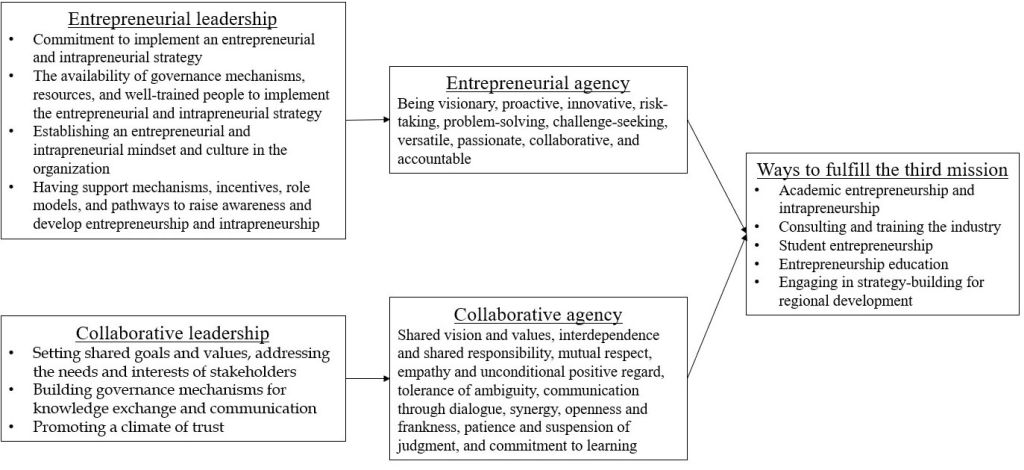
Etzkowitz et al. (2019) argue that we need an entrepreneurial and collaborative mindset to overcome the barriers to the third mission. This hints that appropriate leadership and agency should be both entrepreneurial and collaborative. Following calls by Abreu and Grinevich (2013), Engzell et al. (2025), and Klofsten et al. (2024), entrepreneurial agency and entrepreneurial leadership also include intrapreneurial activities and behaviors. This research adopts entrepreneurial and collaborative lenses on leadership. It suggests that entrepreneurial leadership boosts entrepreneurial agencies, while collaborative leadership encourages collaborative agencies (see Figure 1).

A preliminary framework of leadership and agency for fulfilling the third mission at the entrepreneurial and engaged university
Citation: Triple Helix 12, 2 (2026) ; 10.1163/21971927-bja10067
Entrepreneurial agency means changing the structure to create and capture entrepreneurial and intrapreneurial opportunities (Klofsten et al., 2024; Mc Mullen et al., 2021). Its key attributes are being visionary, proactive, innovative, risk-taking, problem-solving, challenge-seeking, versatile, passionate, collaborative, and accountable (Coyle, 2014; Leitch and Volery, 2017).
Entrepreneurial leadership means “the ability to help people to increase their capacity to recognize and exploit entrepreneurial and intrapreneurial opportunities” (Babson College, n.d.). It aims to build an entrepreneurial and intrapreneurial culture in the organization, which will support the growth of entrepreneurial agencies (Coyle, 2014). It also directs resources and motivates agents to take risks (Renko et al., 2015).
Entrepreneurial leadership must meet four conditions to promote entrepreneurial agencies effectively (see Figure 1). First, there should be an entrepreneurial and intrapreneurial strategy and a commitment to implement it (European Commission and OECD, 2012). Second, we need governance mechanisms, resources, and well-trained people to implement the entrepreneurial and intrapreneurial strategy (European Commission and OECD, 2012). Third, an entrepreneurial and intrapreneurial mindset and culture are necessary (Etzkowitz et al., 2019; Leitch and Volery, 2017; Philpott et al., 2011). Finally, support mechanisms, incentives, role models, and pathways are needed. These will help raise awareness and develop entrepreneurship and intrapreneurship (European Commission and OECD, 2012; Klofsten et al., 2019).
The second assumption is that collaborative leadership will foster collaborative agencies. According to Conrad and Andrews (2023), collaborative agency refers to “people working together across their potential differences in ways that enhance their agency, constituting an interdependent agency to achieve shared objectives”. This suggests a feeling of togetherness, which comes from having shared values and is strengthened by active social interaction (Raelin, 2016).
Collaborative agency means open dialogue, listening, reflecting on different views, and learning from each other (Raelin, 2016). Its key attributes are shared vision and values, interdependence and shared responsibility, mutual respect, empathy and unconditional positive regard, tolerance of ambiguity, communication through dialogue, synergy, openness and frankness, patience and suspension of judgment, and commitment to learning (Raelin, 2016).
Collaborative leadership must fulfill three roles to foster collaborative agencies (see Figure 1). The first role is to set shared goals and values, addressing the needs and interests of stakeholders (Cleveland and Cleveland, 2018). The second role is to build appropriate governance mechanisms for smooth knowledge exchange and communication (European Commission and OECD, 2012). Finally, the third role is to promote a climate of trust (Jameson et al., 2006).
This research adopts the concepts of entrepreneurial leadership, entrepreneurial agency, collaborative leadership, and collaborative agency to answer the second research question.
3 Methodology
This research studies how the Graduate School of Education puts the third mission into action from a leadership and agency viewpoint. A qualitative approach pursuing the case study research strategy suits the exploratory nature of this research because it allows studying complex human behavior in its context and gaining rich insights for theory development (Yin, 2003). Its suitability is also evidenced in earlier entrepreneurial and engaged university research (cf. Etzkowitz et al., 2019; O’Shea et al., 2007).
Most research on entrepreneurial and engaged universities focuses on the university level. This research recognizes that the university is a complex organization with multiple schools, each having different organizational goals, strategies, cultures, and processes (Abreu and Grinevich, 2024). Therefore, it focuses on the school level. Such a focus will enable a more precise understanding of fulfilling the third mission at the Graduate School of Education. According to Katila et al. (2021) and Tapanila (2022), the School of Education faculty worry about implementing an entrepreneurial mission. Understanding how to implement the third mission at the Graduate School of Education may help alleviate the worries.
The case is HGSE. HGSE claims to have achieved high levels of impact. 100 impact stories were published on the school’s website in honor of its 100th anniversary in 2020. The school’s ambition for impact is also visible in its mission statement, “learn to change the world”. In addition, HGSE is ranked as one of the world’s leading graduate schools of education. These attributes make HGSE a strong choice to learn valuable insights from. According to O’Shea et al. (2007), a case should not be studied independently of its context, in which it is embedded. Following this suggestion, the innovation and entrepreneurship ecosystem at Harvard University was also studied.
Data collection and analysis were conducted concurrently. First, all relevant secondary data about HGSE and Harvard University were collected and analyzed. The secondary data included entrepreneurial stories of HGSE students and alumni, speeches and interviews of the deans and faculty of HGSE and Harvard University, publications on the Public Education Leadership Program (PELP), and news on the Ed. Magazine, the Harvard Gazette, and the web pages of HGSE and Harvard University. Using data from these secondary sources did not require permission, as it met the fair use rules for research under Section 107 of the U.S. Copyright Act.
Later, primary data was collected via two semi-structured interviews. The first interview was with a director of Harvard Innovation Labs (to be called iLab hereafter). Founded in 2012, iLab is a shared space on campus where selected students and alumni develop their entrepreneurial ideas. The second interview was with an alumna of HGSE. She developed her entrepreneurial idea while studying there. Now, she runs a social enterprise in education. Interview questions were designed with the help of the preliminary framework and shared with the interviewees in advance. Interviewees were also informed about the research objectives, and their consent was received. Both interviews were recorded and later transcribed verbatim.
The preliminary theoretical framework guided the data analysis. The analysis started by reducing the data with codes derived from the preliminary theoretical framework. The reduced data was then transferred to Microsoft Excel, one piece of data to one row at a time, and initial analytical comments for each piece of data were noted. Once all the reduced data had been transferred and the initial analysis finished, the systematic analysis started. This was done code by code, using the filter function in Microsoft Excel. This allowed for the identification of any missing data. Then, more data was collected until all categories of the preliminary framework were filled with adequate data that enabled theory development. During the analysis, memos and mind maps were made to visualize the concepts and their relationships (Corbin and Strauss, 2008). Attention was paid not to force the concepts of the preliminary theoretical framework on the data, and to notice themes emerging from the data. Data saturation was achieved when no new themes emerged.
Having the research questions guide the whole research process increased the credibility of the findings (Lincoln and Guba, 1985). Using a theoretical framework in conducting the empirical study further improved credibility by establishing internal coherence between the research questions and the findings. The findings also became more dependable thanks to triangulating data from multiple reliable sources, recording and transcribing the interviews verbatim, approaching the data skeptically, and analyzing it systematically (Yin, 2003).
4 Results
4.1 HGSE’s Impact is not only Regional but also National and Global
Unlike in the preliminary theoretical framework, the HGSE case shows that impact goes beyond the region. This is evident in HGSE’s mission statement, “learn to change the world”. Additionally, nearly 30,000 alumni are active in more than 110 countries (HGSE, n.d.a).
A strong example of national impact is PELP. This professional training program, which was started in 2003 by the HGSE and Harvard Business School faculty, aims to enhance public education in urban school districts across the U.S. (Harvard PELP, n.d.). PELP has served 58 urban school districts across 27 states (Harvard University, n.d.a).
During the COVID-19 pandemic, HGSE made another national impact. They sent 26 recent graduates as Dean’s Education Fellows. These fellows consulted U.S. public schools to tackle online learning challenges (HGSE, 2020a).
Initiatives like edLabs, the Saul Zaentz Early Education Initiative, and the REACH Initiative further demonstrate national and global impact. Founded in 2008, edLabs has brought innovations to enhance K-12 education in the U.S. (The Harvard Gazette, 2008). Research at the Saul Zaentz Early Education Initiative has focused on developing early education in the U.S. (HGSE, n.d.b). The REACH Initiative stands for Research, Education, and Action to create Change and Hope. It has provided high-quality education in Botswana, Syria, Lebanon, Kenya, and Uganda (HGSE, 2020b).
HGSE enhances its impact by sharing faculty research with educators through its web platform, “usable knowledge” (HGSE, n.d.c).
4.2 The Main Ways to Fulfill the Third Mission at HGSE
The preliminary framework identified five ways to fulfill the third mission. At HGSE, the main ways observed are: (1) student entrepreneurship and (2) industry consulting and training. Entrepreneurship education was also observed at HGSE. This is, however, an indirect way to support student entrepreneurship. At HGSE, evidence was insufficient for academic entrepreneurship and engaging with industry and regional government in strategy-building for regional development.
4.2.1 Student Entrepreneurship
As informed by the HGSE alumna, HGSE perceives students as primary agents of change. Her following words reflect this:
Studying at HGSE is not like you are there to learn something from courses. Rather, everyone already knows that you will change the world, and the faculty and courses are there to support you in your mission. They give you this feeling from the very beginning, and it develops your self-confidence for entrepreneurship.
HGSE’s curriculum is transformative. Students are encouraged to build an entrepreneurial mindset. This helps them tackle global education challenges right from the start. Entrepreneurship courses and the HIVE program motivate students to develop entrepreneurial ideas (HGSE Innovation and Ventures in Education, n.d.). Dean’s Innovation Challenge and Fellowships allow selected teams of students to further develop their ideas at the iLab (Harvard Innovation Labs, n.d.).
At the iLab, students practice entrepreneurship. They get mentoring from entrepreneurs-in-residence and learn about funding opportunities. The iLab also provides networking opportunities with organized events (Harvard Innovation Labs, n.d.). These events connect entrepreneurial students with actors in the Massachusetts entrepreneurial ecosystem.
More HGSE students are choosing entrepreneurship as their career. As informed by the iLab Director, they are the second largest group at the iLab, just after Harvard Business School. Many successful new businesses have been started by HGSE students (HGSE, 2020d).
4.2.2 Consulting and Training the Industry
HGSE faculty blend research and practice. They cultivate educational leaders, address educational issues, and engage with practitioners (HGSE, 2020c). HGSE provides professional training to over 18,000 educators each year through nearly 100 programs (HGSE, n.d.d).
This way of creating impact demands the agencies of the faculty. A good example is PELP, a joint initiative by the faculty of Harvard Business School and HGSE. PELP hosts a six-day Summer Institute on campus. There, educational leaders from urban school districts learn together in teams (Johnson et al., 2015). Each team works on a strategic educational problem with faculty guidance, and they collaborate all year through regular meetings (Johnson et al., 2015).
Consulting and training the industry gives faculty chances to do engaged research. During the training program, PELP faculty studied public education in urban school districts and shared their findings with the industry (Johnson et al., 2015).
4.3 Entrepreneurial Leadership Stimulates Entrepreneurial Agencies at HGSE
At HGSE, we can see students’ entrepreneurial agencies in their entrepreneurial initiatives to improve education (HGSE, 2020c, n.d.e). Improving education is a meaningful purpose, for which students are passionate (HGSE, 2016). This passion is a source of intrinsic motivation, which nourishes innovativeness (HGSE, 2012). At HGSE, entrepreneurial agency also implies risk-taking (HGSE, 2012). Entrepreneurs must consider the risk of failure and persevere to keep going afterward (HGSE, 2018). Moreover, student entrepreneurship at HGSE calls for teamwork built on trust: students must collaborate and be accountable (HGSE, 2012).
Leadership at HGSE refers to the school’s core management team. It comprises three steering committees led by the Dean (HGSE, n.d.f). At HGSE, entrepreneurial leadership aims to foster an environment where entrepreneurial agencies can thrive. This objective breaks down more specifically into the following goals: (1) raise awareness for education problems and inspire passion for solutions, (2) provide incentives and learning opportunities to develop entrepreneurial/intrapreneurial skills, (3) support entrepreneurs and intrapreneurs after failure, (4) offer networking opportunities, and (5) empower entrepreneurs and intrapreneurs (see Figure 2).
Entrepreneurial leadership stimulates entrepreneurial agencies at HGSE
Citation: Triple Helix 12, 2 (2026) ; 10.1163/21971927-bja10067
To achieve these goals, entrepreneurial leadership is exercised at HGSE in four ways. The first way is to commit to implementing an entrepreneurial and intrapreneurial strategy. HGSE’s mission statement, “learn to change the world” reflects its entrepreneurial and intrapreneurial strategy (HGSE, n.d). According to the HGSE alumna, this mission statement is a living concept embraced by faculty and students.
The second way is to establish governance mechanisms, provide resources, and train people to implement the strategy effectively. HGSE boosts student interest in entrepreneurship through entrepreneurship courses, the HIVE program, and Dean’s Innovation Challenge and Fellowships (HGSE, 2013a). The iLab offers more resources and support, such as mentorship from entrepreneurs-in-residence, advice from venture capital and legal experts, space for networking, grants, seed funds, and links to the Massachusetts entrepreneurial ecosystem.
The third way is to establish an entrepreneurial and intrapreneurial mindset and culture. The iLab Director noted that 20 years ago, students at Harvard University did not view entrepreneurship as a career path. This has been changing, and today, it is possible to talk about an entrepreneurial mindset and culture. Tolerance for failures is vital for promoting such a culture (The Harvard Gazette, 2017). The HGSE alumna said that the network of entrepreneurs around comforts students, knowing there is a cushion to fall back on in case of failure. Also, HGSE has a democratic and supportive culture. Here, power distance is low, so new ideas are shared openly and without prejudice.
The fourth way is to have support mechanisms, incentives, role models, and pathways for entrepreneurship. Educational entrepreneurship is a career choice for HGSE students. They want to tackle global educational challenges. According to the HGSE alumna, students can join extracurricular activities. These activities help them meet people and get insights, inspiration, and feedback on their entrepreneurial ideas. According to the iLab Director, moral support matters for student entrepreneurs because entrepreneurship is a lonely venture. Sharing ideas with peers and talking with entrepreneurs-in-residence provides valuable support.
4.4 Collaborative Leadership Fosters Collaborative Agencies at HGSE
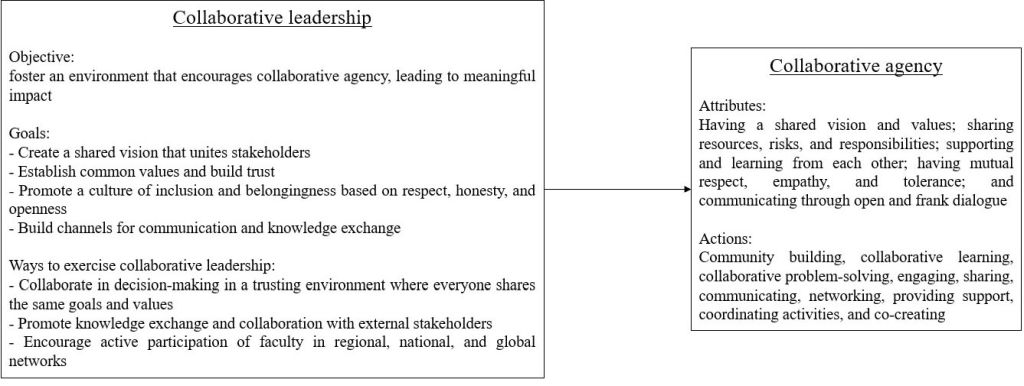
HGSE’s mission statement, “learn to change the world”, demands that we collaborate because we can’t change the world alone. Collaborative agency at HGSE means community building, collaborative learning, collaborative problem-solving, engaging, sharing, communicating, networking, providing support, coordinating activities, and co-creating (HGSE, 2012; Harvard Innovation Labs, n.d.; The Harvard Gazette, 2017). It is enabled by having a shared vision and values; sharing resources, risks, and responsibilities; supporting and learning from each other; having mutual respect, empathy, and tolerance; and communicating through open and frank dialogue (see Figure 3).
Collaborative leadership fosters collaborative agencies at HGSE
Citation: Triple Helix 12, 2 (2026) ; 10.1163/21971927-bja10067
Collaborative leadership at HGSE aims to foster an environment that encourages collaborative agencies, leading to meaningful impact. This objective is broken down into clear goals (see Figure 3). First, it aims to create a shared vision that unites stakeholders. Second, it seeks to establish common values and build trust. Third, it promotes a culture of inclusion and belonging based on respect, honesty, and openness. Finally, it builds channels for communication and knowledge exchange.
To achieve these goals, HGSE exercises collaborative leadership in three ways. The first way is to collaborate in decision-making. This happens in a trusting environment where everyone shares the same goals and values. At HGSE, faculty contribute to strategic decisions in a collaborative, democratic setting. An earlier Dean of HGSE describes this as follows:
You need to involve faculty. In the end, if they are not interested in it or excited by it, it will not work out. That is not something you can impose on faculty. Involving them in its design is the key to making it successful (HGSE, 2020e).
HGSE has created a community of faculty and students. They all share the school’s mission and values (HGSE, 2020c). A former Dean said that PELP started thanks to the enthusiasm of faculty from Harvard Business School and HGSE: her role as Dean was to support their efforts (HGSE, 2020f). Collaboration can sometimes have moments of tension. The faculty at Harvard Business School and HGSE noted these moments in PELP. They acknowledged that open communication and respect for each other helped them overcome challenges (Johnson et al., 2015).
The second way at HGSE is to promote knowledge exchange and collaboration with external stakeholders. HGSE works with other Harvard schools through the One Harvard Initiative and the Common Spaces Initiative. These initiatives bring the university’s different schools under a shared vision and create spaces for in-person meetings (The Harvard Gazette, 2013). HGSE’s knowledge exchange platforms include the Ed. Magazine, the “usable knowledge” platform, and the Harvard Ed Portal. This portal serves as Harvard University’s digital learning platform for the local community in Allston and Cambridge (Harvard University, n.d.b). HGSE faculty work there with youth, teachers, and parents in the public-school partnerships program (Harvard University, n.d.c).
The third way is to encourage active participation of faculty in regional, national, and global networks. HGSE supports student and faculty mobility with financial resources and guidance for travel practicalities (HGSE, n.d.g). Harvard University had an endowment value of 53.2 billion USD in fiscal year 2024 (Harvard University, 2024). It has a strong global brand and alumni in top positions worldwide. These create opportunities for collaboration in regional, national, and global networks.
5 Discussion
5.1 Theoretical Contributions
Higher education leadership literature is vast, but it focuses primarily on the university’s educational mission (Dopson et al., 2018; Žydžiūnaitė, 2018). Leadership research in the context of the third mission is limited, even though leadership has been identified as a key capability for successfully implementing it (Abreu and Grinevich, 2024; Etzkowitz et al., 2019; European Commission and OECD, 2012). Considering these, the main contribution of this research is a leadership and agency framework that helps us understand how we can fulfill the third mission at the Graduate School of Education.
Taking the school as the unit of analysis was a key choice because schools differ in their organizational goals, strategies, cultures, and processes (Abreu and Grinevich, 2024). Recent studies by Katila et al. (2021) and Tapanila (2022) noted that the School of Education faculty viewed the third mission skeptically. The second contribution of this research is to alleviate these concerns. It demonstrates that the Graduate School of Education can fulfill the third mission.
The narrow definition of the entrepreneurial university focuses on academic entrepreneurship (Etzkowitz, 2013). This is observed as the primary way to fulfill the third mission at the schools of life sciences and engineering (Etzkowitz et al., 2019; O’Shea et al., 2007). Not observing academic entrepreneurship at HGSE challenges this narrow view. Indeed, agreeing with Abreu and Grinevich (2013), Engzell et al. (2025), and Klofsten et al. (2024), the PELP initiative shows that academic intrapreneurship is more relevant at the Graduate School of Education. This is the third contribution of this research.
The case shows that adopting a transformative approach to education (Odell et al., 2020) and supporting student entrepreneurship can help make graduate schools of education more entrepreneurial. This supports the increasing focus on student entrepreneurship and entrepreneurship education after the 2000s (Philpott et al., 2011).
Contrasting earlier literature (cf. Etzkowitz, 2013; Rinaldi et al., 2018), engaging in strategy building for regional development was not observed at HGSE. This way of realizing the third mission may be more relevant at the university level.
With the mission statement, “learn to change the world”, HGSE addresses education challenges regionally, nationally, and globally. This finding questions the mainstream literature on entrepreneurial and engaged universities, which mainly looks at regional development (cf. Etzkowitz and Leydesdorff, 2000). The recognition of a broader impact is the research’s fourth contribution.
HGSE’s ambitions for broader impact call for a shift in the school’s approaches to its education and research missions. HGSE’s curricula have adopted a transformative approach (Odell et al., 2020), inspiring students to tackle global education challenges. In addition, the PELP initiative is an excellent example of engaged research (Thomas and Cassidy, 2022), with faculty tackling national education challenges. Hence, the case shows that the school’s three missions are interdependent. Fulfilling the third mission necessitates entrepreneurial and engaged approaches to the school’s education and research missions. This finding is the fifth contribution of this research.
To summarize, this research makes five theoretical contributions. The contributions are: 1) a leadership and agency framework to make the third mission work at the Graduate School of Education, 2) reducing concerns about implementing the third mission at the School of Education, 3) supporting the role of academic intrapreneurship to fulfill the third mission, 4) acknowledging impact beyond the region, and 5) emphasizing the roles of transformative education and engaged research to support the third mission.
5.2 Limitations
This research was subject to three limitations. First, data analysis in qualitative research allows for interpretation, which can lead to subjectivity (Corbin and Strauss, 2008). The following measures were taken in this research to mitigate subjectivity. First, data was collected from multiple reliable sources. Second, the analysis was applied with rigor. The codes were derived from the preliminary theoretical framework and used systematically. Then, ideas were noted as memos and reflected upon regularly during the research. Third, feedback was received on the developed framework from colleagues familiar with leadership in higher education. Their insights helped reconsider and revise parts of the framework. More interviews, especially with the HGSE core management team, could help further. However, requests for this were not accepted.
The second limitation is that the findings are based on a single case study. This means they can’t be immediately applied to other contexts without considering contextual differences. We should note that this research aims to develop a theory. Hence, generalization is analytical, i.e., from findings to theory (Yin, 2003). Context is crucial for the third mission’s success (Garomssa, 2025; Guerrero et al., 2024). So, we should critically view practical implications when comparing them to other graduate schools of education or the university’s different schools.
The third limitation is that this research focused only on the third mission. Thus, the identified types of leadership and agencies are valid only for that mission. The types of leadership and agencies to fulfill the university’s education and research missions may differ (cf. Dopson et al., 2018; Žydžiūnaitė, 2018).
5.3 Practical Implications
This research shows how HGSE successfully implemented the third mission and created impact regionally, nationally, and globally. Faculty and students were key in making the third mission work. Faculty acted as intrapreneurs. They started initiatives to connect with education industry practitioners, like the PELP initiative. They consulted and trained practitioners to tackle their real-world problems. In doing that, they conducted engaged research and created new knowledge. Students acted as entrepreneurs. They undertook entrepreneurial initiatives to tackle global education challenges. HGSE’s mission statement, “learn to change the world”, drove a transformative curriculum with entrepreneurship courses and initiatives that continued at the iLab. These present good examples for the Graduate School of Education managers.
The Graduate School of Education managers must exercise strong entrepreneurial and collaborative leadership to boost the agencies of faculty and students. They can use the developed framework as a guide to set the objectives and goals of such leadership. They can assess their leadership performance and identify areas needing improvement. The framework makes practical suggestions to boost entrepreneurial and collaborative agencies.
To boost entrepreneurial agencies, managers can raise awareness of education problems and inspire passion to solve them. They can offer networking possibilities and provide incentives and learning opportunities to develop entrepreneurial/intrapreneurial skills. They can also empower and support student entrepreneurs and faculty intrapreneurs after failure. In doing these, managers should commit to an entrepreneurial and intrapreneurial strategy. They should also establish an entrepreneurial and intrapreneurial mindset and culture.
To boost collaborative agencies, managers can create a shared vision that unites stakeholders. They can build trust and promote a culture of inclusion and belonging. They can also build channels for communication and knowledge exchange and encourage the active participation of faculty in regional, national, and global networks.
6 Conclusion and Suggestions for Future Research
This research developed a framework to understand how the Graduate School of Education can implement the third mission. The framework says that the primary ways to fulfill the third mission are: 1) student entrepreneurship, and 2) consulting and training of education industry practitioners. Student entrepreneurship makes the school entrepreneurial, while consulting and training engage it with industry. The framework offers ways to lead that will foster the agencies of faculty and students. In fulfilling the third mission, both education and research need new approaches. We must adopt the approaches of transformative education (Odell et al., 2020) and engaged research (Thomas and Cassidy, 2022).
Contextual differences are important in fulfilling the third mission (Abreu and Grinevich, 2024; Garomssa, 2025; Guerrero et al., 2024). Therefore, more school-level research from different contexts is necessary. One avenue for future research is to study other Harvard University schools. This would help us see how different schools in the same university implement the third mission differently. Another suggestion is to study other graduate schools of education. Comparing results from various universities helps us understand how the third mission is implemented differently in graduate schools of education.
The third suggestion for future research is to create and test propositions from the framework. This would increase the generalizability of findings.
This research calls for adopting transformative education (Odell et al., 2020) and engaged research (Thomas and Cassidy, 2022). The fourth suggestion for future research is to do a longitudinal study that explores challenges and success factors in adopting these new approaches in education and research.
Alumni were not seen as key actors at HGSE for the third mission. Their main role was to create networking opportunities. Recent research highlights the importance of alumni engagement (Politis et al., 2024). Future research could explore how universities and their schools can use alumni to support the third mission.
References
Abreu, M., and Grinevich, V. (2013). The nature of academic entrepreneurship in the UK: Widening the focus on entrepreneurial activities. Research Policy, 42(2), pp. 408–422.
Abreu, M., and Grinevich, V. (2024). The entrepreneurial university: Strategies, processes, and competing goals. The Journal of Technology Transfer, 49(6), pp. 1991–2034.
Babson College (n.d.). Entrepreneurial leadership is needed to change the world. https://www.babson.edu/about/our-approach/entrepreneurial-leadership/.
Cai, Y., and Etzkowitz, H. (2020). Theorizing the triple helix model: Past, present, and future. Triple Helix, 7(2–3), pp. 189–226.
Cleveland, M., and Cleveland, S. (2018). Building engaged communities – A collaborative leadership approach. Smart Cities, 1(1), pp. 155–162.
Conrad, R., and Andrews, C. Z. (2023). Collaborative agency and relationality in a high school/college poetry partnership. Childhood, 30(3), pp. 286–300.
Corbin, J., and Strauss, A. (2008). Basics of qualitative research. Sage.
Coyle, P. (2014). How entrepreneurial leadership can engage university staff in the development of an entrepreneurial culture. Industry and Higher Education, 28(4), pp. 263–269.
Dopson, S., Ferlie, E., McGivern, G., Fischer, M. D., Mitra, M., Ledger, J., and Behrens, S. (2018). Leadership development in higher education: A literature review and implications for programme redesign. Higher Education Quarterly, 73(2), pp. 218–234.
Engzell, J., Klofsten, M., and Lundmark, E. (2025). Academic intrapreneurship beyond commercialisation: Exploring the establishment of a research centre as an intrapreneurial venture. Triple Helix, 11(3), pp. 258–285.
Etzkowitz, H. (1998). The norms of entrepreneurial science: Cognitive effects of the new university-industry linkages. Research Policy, 27(8), pp. 823–833.
Etzkowitz, H. (2013). Anatomy of the entrepreneurial university. Social Science Information, 52(3), pp. 486–511.
Etzkowitz, H., Germain-Alamartine, E., Keel, J., Kumar, C., Smith, K. N., and Albats, E. (2019). Entrepreneurial university dynamics: Structured ambivalence, relative deprivation and institution formation in the Stanford innovation system. Technological Forecasting & Social Change, 141, pp. 159–171.
Etzkowitz, H., and Leydesdorff, L. (2000). The dynamics of innovation: From national systems and “mode 2” to a triple helix of university-industry-government relations. Research Policy, 29(2), pp. 109–123.
European Commission and OECD (2012). A guiding framework for entrepreneurial universities. https://www.oecd.org/site/cfecpr/EC-OECD%20Entrepreneurial%20Universities%20Framework.pdf.
Garomssa, H. (2025). The entrepreneurial university concept as a narrative of change in HEIs. Studies in Higher Education, 50(2), pp. 365–386.
Guerrero, M., Fayolle, A., Di Guardo, M. C., Lamine, W., and Mian, S. (2024). Re-viewing the entrepreneurial university: strategic challenges and theory building opportunities. Small Business Economics, 63(2), pp. 527–548.
Harvard Innovation Labs (n.d.). Harvard innovation labs. https://innovationlabs.harvard.edu/.
Harvard PELP (n.d.). The history of PELP. https://www.youtube.com/watch?v=Os6Los6ESRg.
Harvard University (2024). Financial report – Fiscal year 2024. https://finance.harvard.edu/files/fad/files/fy24_harvard_financial_report.pdf.
Harvard University (n.d.a). The Public Education Leadership Project. https://pelp.fas.harvard.edu/.
Harvard University (n.d.b). Harvard Ed Portal. https://edportal.harvard.edu/.
Harvard University (n.d.c). Public school partnerships. https://edportal.harvard.edu/public-school-partnerships.
HGSE (2012). Answering the question: Why the Ed.L.D.? Ed. Magazine. https://www.gse.harvard.edu/news/ed/12/05/answering-question-why-edld.
HGSE (2013). HGSE announces education entrepreneurship fellows. https://www.gse.harvard.edu/news/13/05/hgse-announces-education-entrepreneurship-fellows.
HGSE (2016). Adventures in learning. https://www.gse.harvard.edu/ideas/news/16/04/adventures-learning.
HGSE (2018). The unlikely entrepreneur. Ed. Magazine. https://www.gse.harvard.edu/ideas/ed-magazine/18/08/unlikely-entrepreneur.
HGSE (2020a). Serving the field of education in a time of crisis. https://www.gse.harvard.edu/news/20/10/serving-field-education-time-crisis.
HGSE (2020b). 100 stories of impact. A path to opportunity for refugees. https://www.gse.harvard.edu/hgse100/story/path-opportunity-refugees.
HGSE (2020c). Celebrating our centennial and looking to the future. https://www.gse.harvard.edu/news/20/01/celebrating-our-centennial-and-looking-future.
HGSE (2020d). 100 stories of impact. An innovation engine. https://www.gse.harvard.edu/hgse100/story/innovation-engine.
HGSE (2020e). Conversations with HGSE deans. James Ryan, Dean, 2013–2018. https://www.gse.harvard.edu/hgse100/conversations-hgse-deans.
HGSE (2020f). Conversations with HGSE deans. Ellen Condliffe Lagemann, Dean, 2002–2005. https://www.gse.harvard.edu/hgse100/conversations-hgse-deans.
HGSE (n.d.a). Our impact. https://www.gse.harvard.edu/about/ourimpact.
HGSE (n.d.b). Saul Zaentz Early Education Initiative. https://zaentz.gse.harvard.edu/.
HGSE (n.d.c). Usable knowledge. https://www.gse.harvard.edu/uk.
HGSE (n.d.d). Professional education. About us. https://www.gse.harvard.edu/ppe/about-us.
HGSE (n.d.e). Conversations with HGSE deans. Patricia Albjerg Graham, Dean, 1982–1991. https://www.gse.harvard.edu/hgse100/conversations-hgse-deans#Graham..
HGSE (n.d.f). Who studies at HGSE? https://www.gse.harvard.edu/admissions/who-studies-hgse.
HGSE Innovations and Ventures in Education (n.d.). Hive. https://hive.gse.harvard.edu/.
Jameson, J., Ferrell, G., Kelly, J., Walker, S., and Ryan, M. (2006). Building trust and shared knowledge in communities of e‐learning practice: Collaborative leadership in the JISC eLISA and CAMEL lifelong learning projects. British Journal of Educational Technology, 37(6), pp. 949–967.
Johnson, S. M., Marietta, G., Higgins, M. C., Mapp, K. L., and Grossman, A. S. (2015). Achieving coherence in district improvement: Managing the relationship between the central office and schools. Harvard Education Press.
Katila, S., Kuismin, A., Laine, P-A., and Valtonen, A. (2021). Orchestrating affect at the entrepreneurial university. In: U. Hytti, ed., A research agenda for the entrepreneurial university, Edward Elgar Publishing, pp. 67–84.
Klofsten, M., Brem, A., Guerrero, M., and Urbano, D. (2024). Intrapreneurial universities in digital times – New ways of thinking and future challenges. Technovation, 135, 103069.
Klofsten, M., Fayolle, A., Guerrero, M., Mian, S., Urbano, D., and Wright, M. (2019). The entrepreneurial university as driver for economic growth and social change – Key strategic challenges. Technological Forecasting and Social Change, 141, pp. 149–158.
Lehmann, E. E., Otto, J. M., and Wirsching, K. (2024). Entrepreneurial universities and the third mission paradigm shift from economic performance to impact entrepreneurship: Germany’s EXIST program and ESG orientation. The Journal of Technology Transfer, 49(6), pp. 2184–2199.
Leitch, C. M., and Volery, T. (2017). Entrepreneurial leadership: Insights and directions. International Small Business Journal, 35(2), pp. 147–156.
Lincoln, Y. S., and Guba, E. G. (1985). Naturalistic inquiry. Sage.
Menter, M. (2024). From technological to social innovation: Toward a mission-reorientation of entrepreneurial universities. The Journal of Technology Transfer, 49(1), pp. 104–118.
McMullen, J. S., Brownell, K. M., and Adams, J. (2021). What makes an entrepreneurship study entrepreneurial? Toward a unified theory of entrepreneurial agency. Entrepreneurship Theory and Practice, 45(5), pp. 1197–1238.
Moussa, A., Kesting, T., and Clauss, T. (2019). Embedding entrepreneurial and engaged universities: A holistic view. In: T. Kliewe, T. Kesting, C. Plewa, and T. Baaken, eds., Developing engaged and entrepreneurial universities: Theories, concepts and empirical findings, Springer, pp. 19–41.
Northouse, P. G. (2019). Leadership: Theory and practice. Sage.
Odell, V., Molthan-Hill, P., Martin, S., and Sterling, S. (2020). Transformative education to address all sustainable development goals. In: W. L. Filho, A. M. Azul, L. Brandli, P. G. Özüyar, and T. Wall, eds., Quality education: Encyclopedia of the UN Sustainable Development Goals, Springer, pp. 905–916.
O’Shea, R. P., Allen, T. J., Morse, K. P., O’Gorman, C., and Roche, F. (2007). Delineating the anatomy of an entrepreneurial university: The Massachusetts Institute of Technology experience. R&D Management, 37(1), pp. 1–16.
Philpott, K., Dooley, L., O’Reilly, C., and Lupton, G. (2011). The entrepreneurial university: Examining the underlying economic tensions. Technovation, 31(4), pp. 161–170.
Politis, D., Aaboen, L., Eide, A. E., and Haneberg, D. H. (2024). Re-viewing entrepreneurial universities through alumni engagement. Small Business Economics, 63(2), pp. 655–671.
Raelin, J. A. (2016). Imagine there are no leaders: Reframing leadership as collaborative agency. Leadership, 12(2), pp. 131–158.
Renko, M., El Tarabishy, A., Carsrud, A. L., and Brännback, M. (2015). Understanding and measuring entrepreneurial leadership style. Journal of Small Business Management, 53(1), pp. 54–74.
Rinaldi, C., Cavicchi, A., Spigarelli, F., Lacchè, L., and Rubens, A. (2018). Universities and smart specialisation strategy: From third mission to sustainable development co-creation. International Journal of Sustainability in Higher Education, 19(1), pp. 67–84.
Rubens, A., Spigarelli, F., Cavicchi, A., and Rinaldi, C. (2017). Universities’ third mission and the entrepreneurial university and the challenges they bring to higher education institutions. Journal of Enterprising Communities: People and Places in the Global Economy, 11(3), pp. 354–372.
Tapanila, K. (2022). Työn merkityksellisyyden rakentaminen osana tutkija-opettajien ammatillista kasvua muuttuvassa yliopistossa [Construction of meaningfulness of work as part of academics’ professional growth in the transforming university]. Tampere University.
The Harvard Gazette (2008). Lab aims to advance innovations in public education. https://news.harvard.edu/gazette/story/2008/10/lab-aims-to-advance-innovations-in-public-education/.
The Harvard Gazette (2013). One Harvard. https://news.harvard.edu/gazette/story/2013/05/one-harvard/.
The Harvard Gazette (2017). Mark Zuckerberg’s commencement address at Harvard. https://news.harvard.edu/gazette/story/2017/05/mark-zuckerbergs-speech-as-written-for-harvards-class-of-2017/.
Thomas, V., and Cassidy, A. (2022). Practicing engaged research through pandemic times: do not feed the animals? Journal of Science Communication, 21(2), A05. https://jcom.sissa.it/article/pubid/JCOM_2102_2022_A05/.
Thomas, E., and Pugh, R. (2020). From ‘entrepreneurial’ to ‘engaged’ universities: Social innovation for regional development in the Global South. Regional Studies, 54(12), pp. 1631–1643.
Yin, R. K. (2003). Case study research: Design and methods. Sage.
Žydžiūnaitė, V. (2018). Considerations on intellectual and academic leadership of a scholar in higher education: The descriptive literature review. Acta Educationis Generalis, 8(1), 33–49.