Abstract
Multiple approaches have been devised to capture recent transformations in university governance connected to sustainability and innovation agendas. This study operationalises the Sustainable Entrepreneurial University (SEU) framework to assess sustainability and entrepreneurship orientation in practice at a sample of Finnish research-intensive universities. Drawing on the framework’s theoretical foundations, the study evaluates its applicability across the selected universities. Through qualitative content analysis of the strategic plans of six universities, the study examines the alignment of institutional discourse with the Ivory Tower University, Entrepreneurial University, and SEU models. The findings provide a detailed analysis of each university’s strategic direction, emphasising their commitment to sustainability and entrepreneurship, with most coded text indicating the alignment with SEU principles. This research offers insights into the framework’s applicability and potential for refinement. Future research could explore the framework’s implementation and impact in other institutional contexts, and the development of metrics for sustainability to track progress.
Our biggest challenge in this new century is to take an idea that seems abstract (sustainable development) and turn it into a reality for all the world’s people.
Kofi Annan, 2001
∵
1 Introduction
Universities are pivotal in driving societal transformations and advocating sustainability and ecological stewardship. As generators and disseminators of knowledge, providers of education and training, and contributors to societal development, universities have the potential to lead the way in sustainable practices (Leal Filho et al., 2017). Sustainability has become a crucial term in contemporary society, representing the urgent need to address environmental, social, and economic challenges (United Nations, 2015). The integration of environmental and societal dimensions into innovation models, specifically those stemming from Triple-Helix – such as Quadruple and Quintuple Helix (Carayannis & Campbell, 2009) and Neo-Triple Helix (Cai, 2022) – marks the advent of the post-entrepreneurial university era.
The Triple-Helix innovation model (Etzkowitz & Leydesdorff, 2000) emphasises relationships between academia, industry, and government, which has been instrumental in understanding innovation and economic growth within society. As Cai (2022) identified in the Neo-Triple Helix innovation model, the academy-industry-government relationship is the “innovation gene” within the innovation ecosystem. However, as society grapples with sustainability issues, scholars recognised that the Triple Helix model needed to evolve (Cai, 2022; Carayannis & Campbell, 2009). The societal and environmental integration into innovation systems signified a shift towards the post-entrepreneurial university era, where universities are not only engines of economic progress but also the main drivers of sustainability.
In response to this paradigm shift, a growing body of literature has proposed new models for universities, including civic universities (Goddard & Vallance, 2013; Goddard et al., 2016), engaged universities (Benneworth, 2013), ideas of a university ecology (Wright, 2016), responsible university (Sørensen et al., 2019), university 4.0 (Giesenbauer & Müller-Christ 2020), and the sustainable entrepreneurial university (SEU) as synthesised by Cai and Ahmad (2021). While all these models are valuable perspectives on university organisation, the SEU model stands out for its comprehensive approach towards sustainability and entrepreneurship within innovation ecosystems (Cai & Ahmad, 2021). Unlike other models that may focus on specific aspects such as civic engagement (Goddard & Vallance 2013; Goddard et al., 2016) or technological advancement (Giesenbauer & Müller-Christ, 2020), the SEU model integrates sustainability principles into its core operations, emphasising social, economic, and environmental sustainability (Cai & Ahmad, 2021).
Representing an advancement beyond traditional entrepreneurial university (EU) models, Cai and Ahmad’s (2021) SEU model offers a holistic conceptualisation of what universities ought to be in contemporary contexts. While the sustainable development goals (SDGs) outlined by the United Nations (2015) are not central to the SEU’s model architecture, they are integrated as both input and envisaged outcomes. SEU-type institutional action entails embracing the SDGs as guiding principles for research and as focal points for stakeholder collaboration to steer innovation systems toward sustainability (Cai & Ahmad, 2021).
Within this evolving context, Cai and Ahmad’s (2021) SEU framework emerged as a tool to investigate further and understand the best practices for sustainable universities. Compared to the previously prevailing models of Ivory Tower (IT) and EU, the emerging SEU model offers a comprehensive set of indicators for understanding the unique features of universities advocating sustainability (Cai & Ahmad, 2021). Cai and Ahmad’s (2021) SEU model emphasises the need for university operations to be socially, economically, and environmentally sustainable, making the advocacy of sustainability an integral part of its entrepreneurial stance. Furthermore, the SEU model advances interdisciplinarity and stakeholder engagement, recognising its critical role in addressing sustainability.
Drawing on insights from previous theoretical formulations, Cai and Ahmad’s (2021) SEU framework provides an ambitious theoretical approach that integrates and compares the more established IT and EU models to the newly proposed SEU. By adopting the SEU framework, researchers can identify the research, societal engagement, organisation and administrative operations, and teaching elements aligned with the universities’ sustainability objectives across various university models. This framework facilitates the analysis of prevailing trends and strategies as universities reposition themselves. Despite Cai and Ahmad’s (2021) promising formulation, their framework remains at a conceptual level, and the dimension-categories used to capture its unique features may require further refinement through critical examination in empirical contexts.
Against this backdrop of evolving university models and sustainability imperatives, Nordic countries have been at the forefront of comprehensively integrating sustainability. This leadership is evident in the latest Sustainable Development Report (2024), where Finland, Sweden, and Denmark lead the ranking of all 193 United Nations Member States in progressing towards the SDGs. Finland, in particular, has consistently reviewed and promoted its sustainability efforts throughout the past decade, including in the higher education sector (Prime Minister’s Office, 2016; 2020). Finland’s latest Voluntary National Review of the 2030 Agenda states: “Higher education institutions and public research institutions are increasingly regarding sustainable development as part of their strategy and focus of research” (Prime Minister’s Office, 2020: 60). However, as the report further emphasises: “These higher education institutions are autonomous entities, which are responsible for their own administration, research, and teaching” (Prime Minister’s Office, 2020: 62).
Finland’s higher education system, with its strong emphasis on sustainability and university autonomy, provides a unique context for examining emerging models like the SEU. This setting offers valuable insights into how the SEU and other university models align with institutional goals and drive innovation strategies. It also reveals the extent to which national sustainability aspirations are reflected – or not – in their strategic positioning. In this context of national and institutional entrepreneurship and sustainability aspirations, our study has three primary aims:
1) To operationalise the SEU framework by identifying quantifiable indicators for its dimensions to examine sustainability and entrepreneurship aspirations across the sample of Finnish universities.
2) To refine the SEU framework by critically evaluating its dimensions, including expanding, merging, or reducing them based on empirical findings.
3) To analyse the strategic aspirations of the sample of Finnish universities using the IT, EU, and SEU frameworks, thereby understanding how these universities position themselves within these models.
1.1 Research Questions
To achieve these aims, this study answers the following questions:
1) How can the SEU framework be effectively operationalised to examine sustainability and entrepreneurship orientation among the sample of Finnish universities?
2) How can the SEU framework be refined to enhance its applicability in assessing sustainability and entrepreneurship?
3) How do the strategic aspirations of the sample of Finnish universities align with the IT, EU, and SEU models?
By addressing these research questions, we aspire to contribute to the field of sustainability and innovation in universities, providing insights into how the SEU framework can be operationalised, refined, and effectively applied to better understand the apparent institutional convergence toward sustainability and entrepreneurship.
2 Theoretical Framework
This study draws significant inspiration from the work of Cai and Ahmad (2021), which presents a creative synthesis of and an expansion of the ideas around the innovation ecosystem and entrepreneurship in higher education. The conceptualisation defining three models of the university (i.e., IT, EU, and SEU) is applied in this study as a theoretical framework. It also relies on the work of Etzkowitz et al. (2017) as cited in Cai and Ahmad (2021), which provides the 12 dimension-categories used to describe such models.
The framework proposed by Cai and Ahmad (2021) aims to bridge numerous theoretical perspectives and ideas on the optimal definition of universities and innovation ecosystems. In recent decades, universities have undergone significant transformations to meet the expectations and demands of stakeholders such as students, faculties, government, society, and industry. As a result, universities have become part of innovation ecosystems (Carayannis et al., 2018), where sustainability and ecology play a key role.
Innovation ecosystems require a deeper understanding of the role of universities in society (Cai & Ahmad, 2021), which extends beyond models like the EU (Clark, 1998; Etzkowitz, 2013; 2016) and allows for an analysis of university contributions to innovation systems. Integrating sustainable development into innovation systems, based on the Triple-Helix concept, fosters the emergence of the post-entrepreneurial university era. However, Cai and Ahmad’s (2021) SEU theoretical framework enables cross-university comparisons based on the three university models, providing a continuous and coherent theoretical foundation for analysis. The IT, EU, and SEU models are described below.
2.1 Ivory Tower University
The IT serves as a contrasting university model for the EU and a point of departure for its definition. IT is a theoretical construct inspired by some Humboldtian-type universities widespread before the advent of the EU model. Its core characteristic is the belief in exclusivity and isolation from society (Etzkowitz et al., 2019). Knowledge production conducted in discipline-based departments is valued for its own sake, with helpful knowledge often emerging as an accidental by-product. Campus-based teaching is managed by administrators exclusively from academia, with the university itself regarded as the sole internal stakeholder. In the IT university, funding is perceived as a right, and the academic mindset reinforces a focus on self-sustainability. Over the past two decades, there has been a noticeable global shift from the IT to the EU model (Etzkowitz et al., 2000).
2.2 Entrepreneurial University
The EU model was first proposed by Etzkowitz (1983), providing the foundational groundwork for its development. Röpke (1998) and Clark (1998; 2004) later made significant contributions and refinements, followed by further developments from Etzkowitz (2013; 2016). The main characteristics of the EU model can be summarised as follows: 1) a strong link with industry and government through partnerships; 2) an efficient and effective system for technology and knowledge transfer; and 3) an active role in the local innovation strategy (Etzkowitz, 2013; 2016).
Following Etzkowitz’s (2013; 2016) perspective, the EU has three development phases. The first phase, “University Entrepreneur One,” is characterised by a clear focus on deciding the university’s strategy and core priorities. There are two ways to accomplish that: through an independent collection of resources (e.g., donations or tuition fees) or negotiations with other resource providers. In “University Entrepreneur Two,” universities generate income from their outcomes and intellectual property by systematically organising technology transfer mechanisms. The final “University Entrepreneur Three” stage sees universities establishing strong connections with regional firms and actively contributing to government and industry-led regional innovation strategies (Etzkowitz, 2013; 2016).
Moreover, Eztkowitz (2013; 2016) defines four interconnected principles guiding the EU: “Interaction,” which refers to the close connection between the university, government, and firms; “Independence,” as universities remain autonomous institutions not directly dependent on others; “Hybridisation,” which resolves conflicts between institutions or authorities, leading to the creation of hybrid organisations; and “Reciprocity,” the result of continuous renewal driven by changes in academia, government, or industry.
2.3 Sustainable Entrepreneurial University
A SEU is a concept that integrates the principles of sustainability and entrepreneurship within the context of universities (Cai & Ahmad, 2021). Developed as an advanced type of the EU and guided by the SDGs, the SEU signifies a shift in the role and function of universities. A SEU promotes a comprehensive and integrated approach to sustainability, encompassing the economic, social, and environmental dimensions. Moreover, a SEU emphasises its interactions with external stakeholders and the larger community, incorporating sustainability practices within the institution.
Regarding entrepreneurship, SEUs encourage and support entrepreneurial activities among students, faculty, and staff (Guerrero & Urbano, 2012). It recognises the significance of fostering an entrepreneurial mindset and providing the necessary resources and support for individuals to develop their entrepreneurial abilities and ventures. This may involve providing entrepreneurial programs, incubators, and accelerators, as well as facilitating connections with industry collaborators and funding sources.
Engagement with the community is a vital characteristic of a SEU. It actively pursues partnerships and collaborations with external stakeholders, including local communities, industries, governments, and non-profit organisations, to address pressing societal challenges (Yarime et al., 2012). Through research, innovation, and the dissemination of knowledge, a SEU seeks to develop meaningful and sustainable solutions that positively impact society. In addition, a SEU adheres to sustainability principles in its operations and practices. It employs sustainable practices in its infrastructure, resource management, curriculum development, and governance. This may include instituting energy-efficient measures, promoting sustainable transportation options, integrating sustainability-focused courses and programs, and integrating sustainability into institutional policies and decisions.
2.4 Dimension-Categories across University Models
The models of universities described above are analysed through a set of 12 dimension-categories grouped into three missions (teaching, research, and societal engagement) and organisation and administration for achieving those missions (Cai & Ahmad, 2021). In particular, the two fundamental missions of a university under the SEU model (i.e., teaching and research) are set up in a distinctly unique way compared to the IT and EU models.
The single dimension category assigned to the teaching mission – teaching location – is not tied to a campus anymore as in the IT model but finds itself shifting between on- and off-campus teaching with a decisive role of online teaching tailored for the global context.
Three dimension-categories assigned to the research mission – knowledge mission, direction of research, and knowledge-related intention – also offer a unique proposal for the SEU model. Cai and Ahmad (2021) point to the “democracy of knowledge” as a distinguishing factor of SEU’s knowledge mission, where various paradigms of knowledge production (modes 1, 2, and 3) converge (Carayannis & Campbell, 2012). The purpose of knowledge production is much broader and more involved than in the other university models. The direction of research is shaped by multiple factors, but a novel and significant impact is gained by the SDGs (Waas et al., 2010). Lastly, the knowledge-related intention is not only centred around usefulness, as it is in the EU model, but also incorporates concerns about sustainable growth and societal impact.
The third central mission of the SEU’s framework is societal engagement, which seeks to connect the university with external stakeholders and resolve societal issues. Multiple dimensions – knowledge exchange and co-creation, university-society link, contribution points, and stakeholders – contribute to this engagement. The first dimension, technology and innovation transfer to industry, prioritises knowledge exchange and co-creation over technology transfer. Second, the university-society link dimension emphasises the development of robust connections and collaborations between the university and the larger society. Understanding society’s requirements and priorities enables the university to align its activities, resources, and expertise to have a positive impact (Morawska-Jancelewicz, 2022).
The societal engagement mission also identifies contribution points where the university can leverage its expertise and resources to effect positive change. These contributing factors represent societal challenges or opportunities, characterised by a bidirectional relationship in which the university both actively contributes to and receives meaningful contributions from its environment. A university may concentrate on sustainable energy solutions, social entrepreneurship, environmental conservation, or public health initiatives. By emphasising these areas, the university directs its efforts toward making significant contributions and addressing pressing societal issues. Lastly, effective stakeholder engagement is vital in the societal engagement dimension. Students, faculty, staff, alumni and alumnae, industry partners, government agencies, and local communities are actively engaged and work in collaboration with the university (Jongbloed & Salerno, 2008).
According to the SEU framework (Cai & Ahmad, 2021), achieving the goals of each mission requires shaping the university – including its organisation and administration – as a unique configuration of the IT and EU models. In terms of the disciplines in organisation dimension, interdisciplinarity is institutionalised as central in the SEU model (Kandiko & Blackmore, 2008), advancing beyond the EU model, where disciplinary and interdisciplinary departments hold equal importance, and diverging further from the IT model, which maintains a discipline-based organisation. Second, the source of university administration in the SEU model is a university network (Wright, 2016; Kahle et al., 2018) constructed through activities aimed at accomplishing the three main missions. In the EU, administrative staff typically come from multiple sources, including the government and industry. In the IT model, staff were selected from the academic sector.
The perception of funding embeds fundamental changes in the SEU, since the resources should be allocated as a matter of exchange while advocating for social justice and moral responsibility (Geschwind et al., 2019). Every resource should be gained in an ethical way, not only according to a profit-driven rationale. This is a significant transformation from funding perceived as a matter of right by the IT model or something to be allocated after an exchange as in the EU. Finally, beyond the academic ideation of the IT and the entrepreneurial stance in the EU, the SEU mindset merges both sustainability and entrepreneurialism (Etzkowitz, 2004; Kassel et al., 2016; Giesenbauer & Müller-Christ, 2020). Economic growth in the SEU is pursued through the consideration of how to preserve or renovate resources (Moon et al., 2018).
3 Methodology
3.1 Research Approach
We adopted a qualitative research approach to assess the applicability of Cai and Ahmad’s (2021) SEU framework on institutional convergence toward university models. We chose this approach because it preserves a more naturalistic perspective, allowing for an in-depth exploration of complex phenomena such as institutional aspirations and their alignment with theoretical frameworks (Creswell, 2014). Qualitative research emphasises context, meaning, and interpretation, making it well-suited for analysing ambiguous statements and nuanced institutional attributes that cannot be easily quantified (Dey, 2005).
Furthermore, our initial intention was to explore the applicability of Cai and Ahmad’s (2021) framework and its transferability across universities with relatively similar characteristics, rather than to reach generalisable conclusions about the entire population of Finnish universities. A qualitative exploration of the data, with its characteristic openness (Kohlbacher, 2006), also allowed us to gain insights into areas where the framework could be further developed. The qualitative content analysis thus supported our research goals by enabling us to operationalise Cai and Ahmad’s (2021) SEU framework and analyse Finnish universities’ strategic aspirations.
3.2 Sample Universities
Governed by the Universities Act of 2009, the Finnish higher education system provides a unified legal framework for governance, degree structures, and funding models (Ministry of Education and Culture [MEC], 2017). The system comprises 36 higher education institutions (HEIs): 14 research-intensive universities and 22 universities of applied sciences (UASs).
Research-intensive universities emphasise multidisciplinary research and academic education, whereas UASs focus on practice-oriented education aligned with labour market needs. While UASs play a crucial role in vocational and applied education, their mission, governance, and funding models differ fundamentally from those of research-intensive universities. Given these distinct roles, UASs were excluded from this study to maintain an analytical focus on research-intensive universities.
Beyond institutional governance, Finnish research-intensive universities operate within a national regulatory framework, where government decrees establish: 1) Degree classifications and degree-awarding authority; 2) Objectives of degrees at bachelor’s, master’s, and doctoral levels; 3) Study structures, including credit and curriculum requirements; and 4) Other essential academic provisions for ensuring educational quality and consistency.
Among Finland’s 14 research-intensive universities, this study focuses on the 13 universities operating under the MEC’s framework, excluding the National Defence University, which falls under the Ministry of Defence (MEC, 2025). Although MEC-governed universities share a common legal framework, their institutional profiles vary, shaped by regional contexts, historical trajectories, disciplinary orientations, and strategic priorities.
Finnish universities fall into two legal categories – public and foundation universities – which differ in governance and financial autonomy. Public universities are governed by public law, while foundation universities operate as private foundations under private law. The latter is a relatively recent development in Finnish higher education, with only two such institutions established in the past two decades (Poutanen et al., 2020).
The primary differences between the two categories pertain to internal governance structures and funding practices. Foundation universities are governed by boards with significant representation from business and societal stakeholders and are designed to seek external funding actively. In contrast, public universities maintain a stronger link to the state – both in decision-making and funding – and continue Finland’s traditional higher education governance model. However, public universities also incorporate external perspectives, as at least 40% of their board members must come from outside the university community, including representatives from industry, government, and other societal sectors (Poutanen et al., 2020). Despite these structural differences, public and foundation universities are subject to national oversight, primarily through a performance-based funding model (Pinheiro et al., 2019), which allocates resources based on quantitative and qualitative indicators aligned with national education and research priorities.
Sample selection. In selecting Finnish HEIs for analysis, we focused on capturing a diverse representation of the 13 universities operating under the MEC to examine institutional convergence and the applicability of the SEU framework. Hence, we purposefully selected six universities through a three-step process.
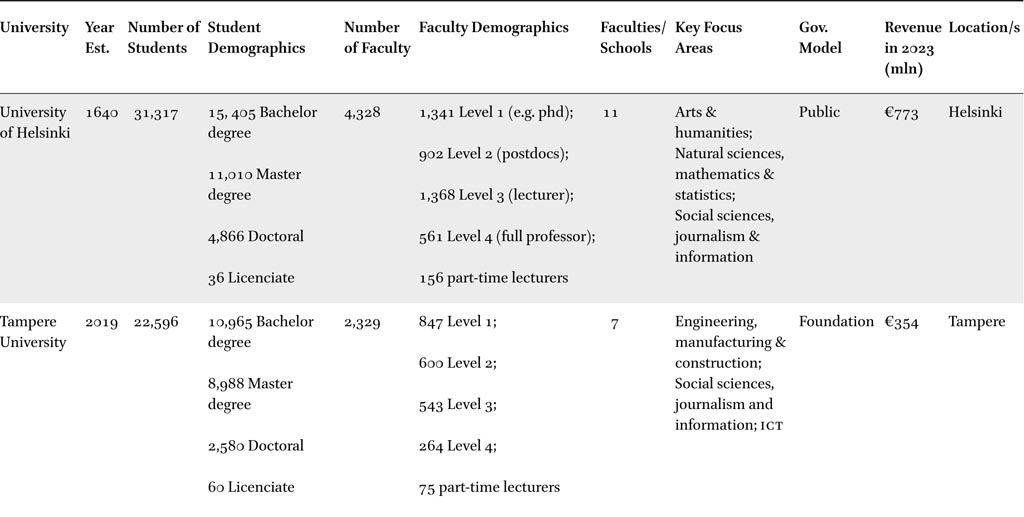
First, we conducted a system mapping to identify all MEC-governed universities, ensuring comprehensive institutional representation. Second, we assessed for institutional diversity based on several factors, including geographic distribution (central, southern, eastern, and northern Finland), enrolment rates (students vs faculty), governance models (public vs foundation universities), historical development (traditional vs recently merged institutions), and disciplinary strengths (e.g., multidisciplinary, technology, business, social sciences). The selection process was informed by data from annual reports and official websites, ensuring a comprehensive understanding of each institution’s profile. Further details on the sample universities are provided in Table 1.
Finally, the study included expert consultation with Finnish higher education scholars to validate the selection and ensure it aligned with the research objectives. This structured approach ensured that the selected universities represent a diverse yet comparable set of institutions for analysing institutional convergence and the applicability of the SEU framework, without constraining them to any specific institutional models. This allowed us to conduct a more unbiased analysis, based solely on institutional profiles. The selected universities are as follows:
University of Helsinki. Founded in 1640, it is the oldest and largest university in Finland. Based in Helsinki, the capital’s metropolitan area, it emphasises a multidisciplinary approach to addressing global societal challenges across a wide range of disciplines (University of Helsinki, 2023a).
Tampere University. Located in Tampere, Finland’s second-largest urban area, the university was established in 2019 through the merger of the University of Tampere and Tampere University of Technology. It has a strong focus on multidisciplinary research and innovation. It is important to note that Tampere UAS is a separate institution, but it is part of the broader Tampere Universities community, collaborating with Tampere University in various academic and research initiatives (Tampere Universities, 2023).
University of Eastern Finland. Operating across two campuses in Kuopio and Joensuu, this institution was formed in 2010 by merging universities named after these cities. The university aims to foster a multidisciplinary, participatory, and international research community, with faculties spanning philosophy, social sciences, health, science, forestry and technology (University of Eastern Finland, n.d.).
University of Turku. Founded in 1920, it is the third-largest university in Finland in terms of student population. Located in southwestern Finland, with campuses in Turku, Pori, and Rauma, it focuses on high-quality multidisciplinary research and active engagement in regional development (University of Turku, n.d.).
University of Lapland. The University of Lapland is a small but unique institution in northern Finland. As the northernmost university in the European Union, it plays a pivotal role as an Arctic university, dedicated to generating new knowledge, skills and expertise for the North and beyond (University of Lapland, n.d.).
Aalto University. A globally recognised multidisciplinary university, Aalto University is in Espoo, Finland. Established in 2010 through the merger of three prestigious institutions – Helsinki University of Technology, the Helsinki School of Economics, and the University of Art and Design Helsinki – it is committed to producing high-quality research while developing breakthrough initiatives with an entrepreneurial mindset (Aalto University, 2023).
For this paper, these institutions provide a balanced representation of research-intensive Finnish universities, allowing for an in-depth examination of institutional convergence and the SEU framework applicability through a detailed analysis of their strategic documents.
3.3 Document Analysis
Following an exploratory desk-based review of the sample universities, we employed document analysis as our primary data collection method (Bowen, 2009), focusing on the strategic plans of the sample universities. This approach aligns with established practices in higher education research (Bohnsack et al., 2010; Fumasoli & Huisman, 2013; Morphew et al., 2018). Moreover, the decision to use strategic plans as a data source was grounded in the naturalistic qualitative approach adopted in this study, recognising these documents as rich data sources for understanding institutional priorities, values, and missions (Cardno, 2018). However, it is important to emphasise that while we utilised annual reports to select and describe the sample universities, these were not included in the in-depth systematic document analysis. This is because our aim was not to examine outcomes or actions but to focus on the institutional aspirations related to the IT, EU, and SEU models across the sample universities.
Document analysis involves systematically examining documents to extract meaning and insights, which has been recognised as a valuable research method in various fields, including those influenced by internal and external policy decisions such as education (O’Leary & Hunt, 2014). The validity of using strategic plans as a data source is supported by their official nature, wide distribution across organisations, and grounding in social sciences research (Hinton, 2012). Unlike other qualitative methods, such as interviews and written survey replies, document analysis is non-reactive, meaning the data remains unaltered by the research process (Bowen, 2009). It is also cost-effective and enables the examination of past and present strategic directions without the constraints of direct data collection from individuals (Cardno, 2018).

Key facts and demographics of the sample universities in 2023
Citation: Triple Helix 12, 2 (2026) ; 10.1163/21971927-bja10066
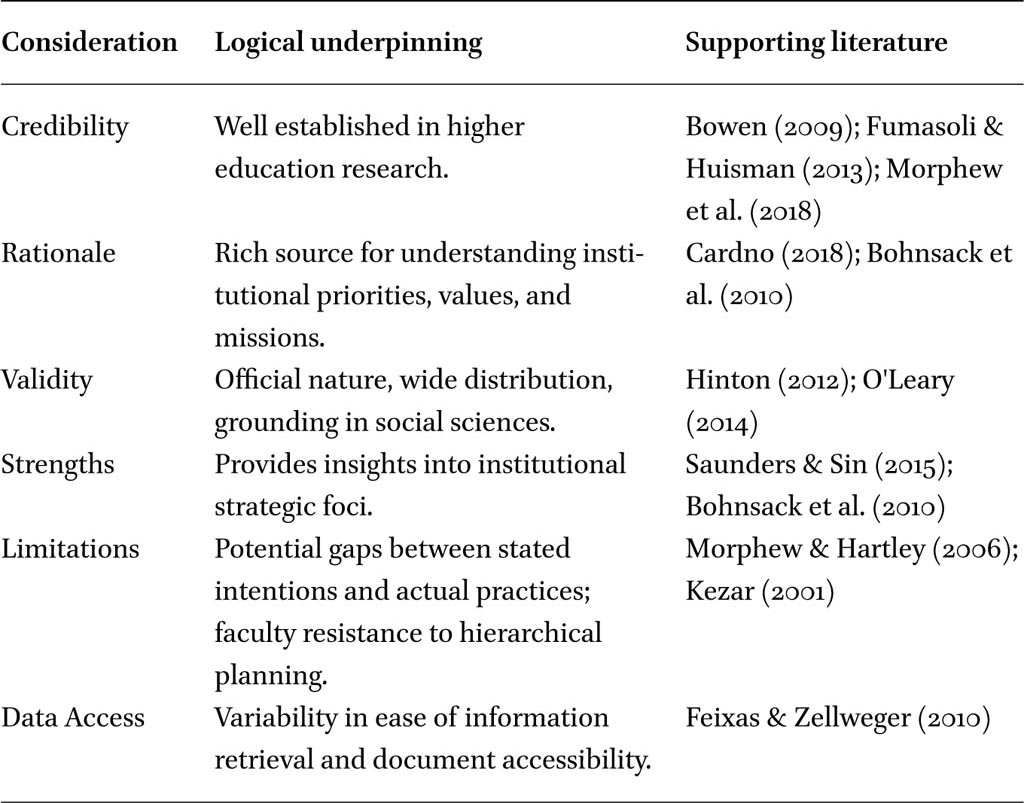
Furthermore, examining universities’ aspirations provides a valuable foundation for understanding institutional evolution, particularly in emerging models like the SEU, where strategic positioning may still be in an aspirational phase. We acknowledge that relying solely on strategic plans has limitations. These limitations include potential gaps between stated intentions and actual practices (Morphew & Hartley, 2006), as well as complications arising from faculty resistance to hierarchical planning processes (Kezar, 2001).
While remaining cognisant of the method’s limitations, as summarised in Appendix I, we could derive insights into the strategic priorities of the sample universities by systematically analysing these documents, including their content, language use, and production context. As such, we maintain that this research methodology provides valuable insights into institutional strategic foci. As Saunders and Sin (2015) argue, strategic plans, despite their limitations, offer a window into how institutions conceptualise and prioritise their goals. The strengths and limitations of this approach are further discussed in section 8. Strengths and Limitations.
To obtain the strategic plans, we accessed the official websites of the sample universities and downloaded the relevant documents. All strategic plans examined were publicly available, ensuring transparency and replicability in our approach. While variations in website structure and document accessibility affect ease of retrieval, such variability is a common challenge in document analysis of universities (Feixas & Zellweger, 2010).
3.4 Positionality
As authors of this study, we recognise the importance of acknowledging our positionality in this research. We are a diverse group of early-career researchers from various regions of the world, including Europe (Italy, Poland, and Spain), Latin America (Brazil and El Salvador), Southeast Asia (Indonesia), and Africa (South Africa). Our diverse experiences and perspectives may influence how we approach and interpret the data, particularly in areas such as entrepreneurship and sustainability, which are inherently subjective and context-dependent, and we acknowledge that this may affect the findings and their implications.
4 Analysis
We implemented a systematic and collaborative document and content analysis approach to ensure methodological rigour and trustworthiness. A structured coding scheme based on Cai and Ahmad’s (2021) SEU framework served as the theoretical foundation for identifying the strategic aspirations of the sample universities.
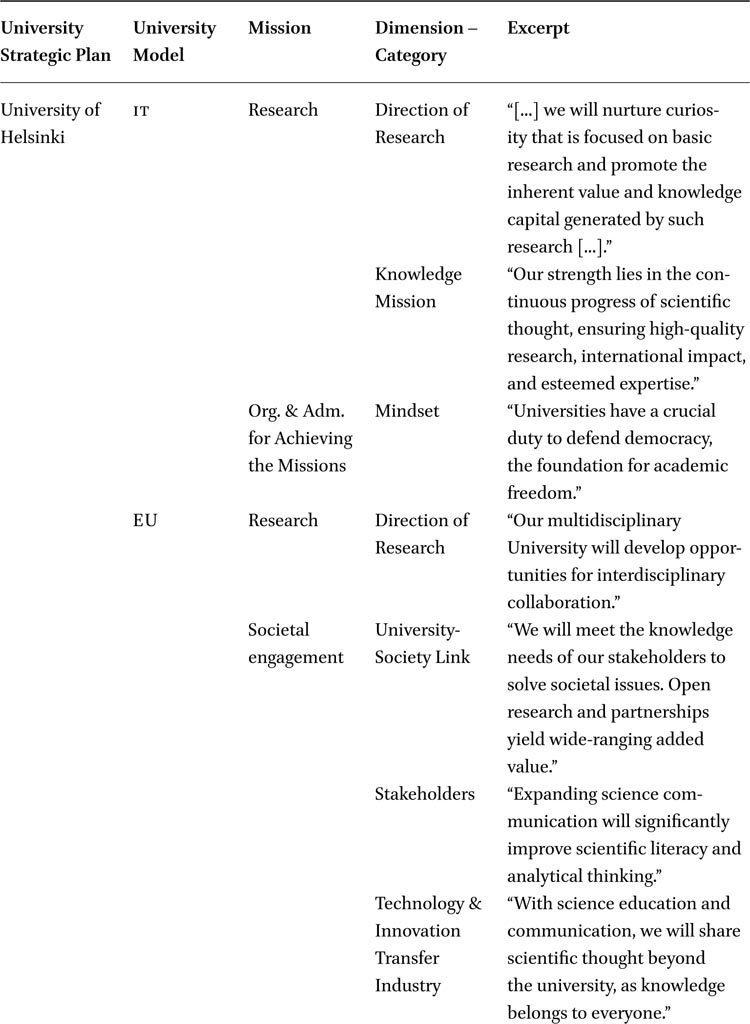
The coding process followed a deductive approach, guided by the predefined dimension-categories, missions, and university models outlined in the SEU framework (see Table 2). Using Atlas.ti software over the course of a week, we systematically categorised statements from the case universities’ strategic plans into three layers: 1) A “Mission-Level Coding” where text excerpts were marked under a particular mission of the SEU framework (e.g., research, societal engagement, teaching); 2) a “Dimension-Level Coding” where statements were assigned to a specific dimension-category of the SEU framework (e.g., teaching location, direction of research, university-society link); and 3) a “University Model Classification” where each coded statement was linked to one of the three university models (IT, EU, or SEU).
However, not all relevant statements across strategic plans fit within the predefined dimensions of the SEU framework. In such instances, excerpts were coded as “unclassified” to capture content that did not align with existing dimension-categories but still held potential relevance for further analysis. Some of these unclassified excerpts were used to refine and augment the SEU framework, as discussed in section 6.2. The Need for Additional Dimensions Beyond the Initial SEU Framework.
To enhance reliability and validity, four groups of researchers, each consisting of two to three members, collaboratively conducted the coding. Researchers within the same group reviewed each strategic plan at least twice to ensure consistency and accuracy in identifying relevant excerpts. A hybrid approach accommodated logistical constraints, with some groups meeting in person and others collaborating via online platforms.
Following the coding phase, each group presented their findings in a team meeting to ensure transparency, consistency, and alignment across groups. To facilitate these discussions, each group prepared a comprehensive report documenting key text excerpts categorised into different dimensions of the SEU framework, the corresponding university model, and any other “unclassified” excerpts, allowing for further reflection on potential emerging dimensions. This presentation approach, though time-consuming, significantly contributed to the trustworthiness of the results by fostering critical discussions and validating findings across all groups.
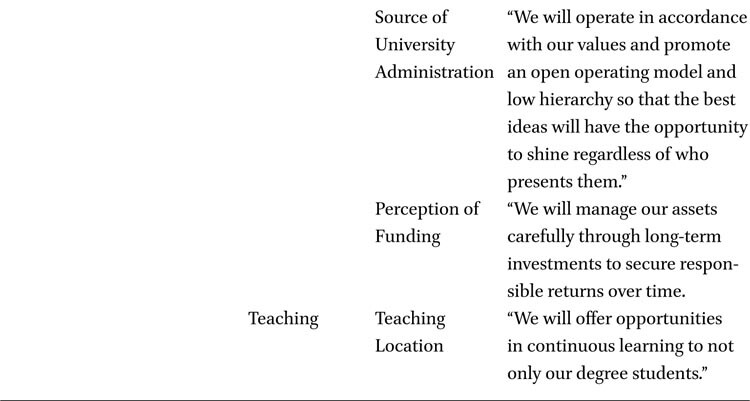
Table 2 below presents an example of the deductive content analysis of the University of Helsinki strategic plan coded based on the SEU framework’s missions, dimensions, and university models.
Examples of the deductive content analysis of the University of Helsinki’s strategic plan
Citation: Triple Helix 12, 2 (2026) ; 10.1163/21971927-bja10066
5 Findings
The varying degrees of alignment with the models described by Cai and Ahmad’s (2021) SEU framework across the strategic plans of the universities analysed are presented in this section. The presence and predominance of the university models can be gauged by the frequency of excerpts identified in each strategic plan. The different configurations in which the university models are combined can also be perceived by the dimension-categories in which they are apparent.
5.1 University of Helsinki
The University of Helsinki’s 2021–2030 strategy, With the Power of Knowledge – For the World (University of Helsinki, 2021), closely aligns with the SEU model while incorporating substantial elements of the EU and IT models.
Our analysis identified 39 excerpts associated with the SEU model, particularly in the university-society link (9), knowledge mission (8), mindset (7), teaching location (5), direction of research (5), perception of funding (2), stakeholders (2), and source of university administration (1) dimensions. For instance, the university emphasises sustainability in the university-society link: “Sustainability and responsibility will guide all our operations. Our research and teaching will enhance sustainable well-being through interaction with the surrounding society.” The knowledge mission highlights accessibility: “Open science and open-access data will promote the development of research and make research-based knowledge available throughout society.”
Ethical considerations across all institutional decisions are also central to the mindset dimension: “We will promote responsibility and sustainability not only in research and teaching but also in every choice we make.” Similarly, the direction of research underscores interdisciplinary approaches: “The key challenges of mitigating climate change, preserving biodiversity, using natural resources sustainably, safeguarding health and well-being, and maintaining social cohesion can be addressed by making use of the comprehensive research-based knowledge produced by the University.” Lastly, the perception of funding stresses long-term sustainability: “We will manage our assets carefully through long-term investments to secure responsible returns over time.”
The EU model appears in 16 excerpts, covering the university-society link (5), direction of research (4), stakeholders (3), teaching location (2), and technology and innovation transfer industry (2) dimensions. For example, in the university-society link, collaboration is emphasised: “We will meet the knowledge needs of our stakeholders to solve societal issues. Open research and partnerships yield wide-ranging added value.” The direction of research promotes innovation: “We nurture curiosity-driven basic research and the knowledge capital it generates.” Science communication is a focus in the stakeholders dimension: “Expanding science communication will significantly improve scientific literacy and analytical thinking.” Strengthening the connection between research and teaching is also central to the teaching location dimension: “During the strategy period, we will reinforce the link between research and teaching at all levels.” Finally, the technology and innovation transfer industry dimension highlights the export of scientific knowledge: “With science education and communication, we will share scientific thought beyond the university, as knowledge belongs to everyone.”
The IT model, while less prominent, appears in 11 excerpts, mainly in the direction of research (5), mindset (3), and knowledge mission (3) dimensions. The direction of research emphasises excellence: “Groundbreaking basic research, open-minded curiosity, and boundary-crossing cooperation are essential for a top academic institution.” The mindset dimension upholds academic freedom: “Universities have a crucial duty to defend democracy, the foundation for academic freedom.” The knowledge mission stresses high standards: “Our strength lies in the continuous progress of scientific thought, ensuring high-quality research, international impact, and esteemed expertise.”
The University of Helsinki’s strategy reflects a strong commitment to sustainability, entrepreneurship, and societal engagement, deeply rooted in the SEU model. While the EU model enhances innovation, the IT model reinforces research excellence. As Finland’s most prestigious institution, Helsinki balances its research legacy and a forward-looking vision for societal impact and sustainability.
5.2 Tampere University
Tampere University’s 2023–2030 strategy, We Work Together to Build a Sustainable World (Tampere University, n.d.), primarily aligns with the SEU model while incorporating elements of the EU model and, to a lesser extent, the IT model. This analysis is based on information from the university’s public-facing website, particularly the Strategy and Key Information page and the Strategy of Tampere University 2030 document (Tampere University, n.d.).
Our study identified 49 excerpts linked to the SEU model, with notable mentions across the contribution point (14), stakeholders (9), source of university administration (9), teaching location (6), disciplines in organisation (5), perception of funding (4), and mindset (2) dimensions. For instance, the contribution point highlights societal engagement: “We are a trusted, respected, and visible societal actor. We build and maintain strong partnerships with business life, and the public and third sectors.” In this line, stakeholder engagement is also prioritised: “A standardized survey conducted annually gathers stakeholders’ views on the university.” Furthermore, sustainability principles shape the source of university administration: “The principles of sustainable development guide our operations,” and interdisciplinary collaboration is evident in the disciplines in organisation: “We integrate research and education in technology, health, and society to foster sustainability in partnership with external actors.”
The EU model is present in 18 excerpts, covering the contribution point (6), stakeholders (3), disciplines in organisation (3), mindset (3), source of university administration (2), and teaching location (1) dimensions. For example, the contribution point underscores innovation: “We renew our operations through digitalisation.” Moreover, collaboration within Tampere’s higher education community is reflected in disciplines in organisation: “We deepen cooperation in education, research, development, and innovation.” The mindset dimension fosters creativity: “We inspire inventive and open-minded solutions,” and efficiency is a priority in the source of university administration dimension: “We ensure smooth daily operations and empower our community members.”
The IT model appears in four excerpts, primarily in the direction of research (2) and knowledge mission (2) dimensions. For example, the direction of research highlights quality impact: “Our research is of high quality and impact, and we promote open science,” and the knowledge mission dimension sets ambitious academic goals: “We aim to be an internationally esteemed research university, an impactful educator, and a strong partner.”
Tampere University’s strategic focus revolves around sustainability, societal impact, and interdisciplinary collaboration, aligning firmly with the SEU model. The EU model strengthens its commitment to innovation and stakeholder engagement, while the IT model plays a more limited research-focused role. This combination positions Tampere as a dynamic institution, actively addressing societal challenges and fostering locally and internationally sustainable development.
5.3 University of Eastern Finland
The University of Eastern Finland’s 2021–2024 strategic plan is structured across four documents: 1) Overview of the strategy (University of Eastern Finland, 2022); 2) Strategic Programme 1: Research-based understanding (University of Eastern Finland, 2023a); 3) Strategic Programme 2: Modern and renewal-driven learning (University of Eastern Finland, 2023b); and 4) Strategic Programme 3: A Participatory and inclusive academic community (University of Eastern Finland, 2023c).
The strategy is positioned between the EU and SEU models, with a more substantial alignment toward the SEU model. Some dimensions incorporate elements of both models, while no elements distinctly reflect the IT model. The SEU model is particularly prominent, with 35 coded excerpts present in the dimensions of direction of research (11), contribution point (8), mindset (6), disciplines in organisation (7), and knowledge-related intention (3). This highlights the university’s emphasis on open research policies and regional development.
The direction of research and disciplines in organisation dimensions are evident in the university’s focus on interdisciplinary, challenge-driven research to address global issues. As articulated in Programme 1: “Finding solutions to the complex problems of our changing world calls for an ability to think and combine things in a novel way. Our interdisciplinary, renewal-driven research communities have the ability to respond to global and national challenges in a unique way.” The contribution point dimension is reflected in Programme 3, which emphasises inclusivity and regional development: “We are an international, diverse, creative, and attractive scientific community that is characterised by open interaction and well-being. Responsibility and sustainability guide all our activities.” Also in Programme 3, the mindset dimension is captured through the university’s focus on academic freedom and participatory governance: “We have a clear, goal-oriented, encouraging and incentive career model that is supported by proactive and systematic career management.”
The EU model is represented in 22 excerpts, notably in the knowledge mission (7), technology and innovation transfer to university (5), direction of research (3), stakeholders (3), perception of funding (2), and teaching location (2) dimensions. For instance, the direction of research and perception of funding dimensions are reflected in Programme 1, linking research to competitive funding and innovation ecosystems: “We actively recruit high-level experts to further advance research activities in our profile areas. Our research environments and infrastructures cater to the preconditions of high-level research.” We can also find the teaching location dimension in Programme 2, underscoring the regional economic integration and internationalisation: “We increase the amount of education offered in English and the number of international students across all levels of education. We develop measures and procedures to promote the employment of our graduates.”
Also in Programme 2, the knowledge mission dimension is emphasised through workforce-responsive education and employability: “Development of the components of the degrees, and of micro-credentials […] Increasing the amount of education that responds to workforce needs.” Lastly, technology and innovation transfer, and stakeholders dimensions are both present in Programme’s 1 and 2, respectively: “Successful innovation activities and effective RDI partnerships […] the University of Eastern Finland path for innovation activities” and “Increasingly systematic strengthening of collaboration with companies, the public sector, and the third sector.”
The University of Eastern Finland’s strategy integrates elements of both the SEU and EU models, with a stronger inclination toward SEU principles. The university’s hybrid approach suggests a transitional phase toward a globally oriented SEU model while retaining EU-driven regional engagement.
5.4 University of Turku
The University of Turku’s strategic plan, Target State for 2035 (University of Turku, n.d.), demonstrates a strong emphasis on sustainability, multidisciplinary, and stakeholder engagement, reflecting its alignment with the SEU model. Our analysis identified 13 excerpts associated with the SEU model, with notable mentions in the university-society link (6), knowledge mission (4), and mindset (3) dimensions.
Turku’s strategic plan explicitly integrates sustainability considerations across its research and institutional practices, as seen in the knowledge mission dimension: “We consider the requirements of both sustainability transformation and twin transition in all our activities.” This statement aligns with the SEU model’s emphasis on addressing global challenges through sustainable solutions. In the university-society link dimension, Turku also highlights the importance of open dialogue with society to ensure societal impact: “We work openly in regional, national and international networks and with stakeholders. Our collaboration is responsible, reciprocal and goal-oriented. We actively contribute research-based knowledge to the public debate.” To a lesser extent, the mindset dimension was also evident in the university’s commitment to open science and knowledge dissemination: “An open dialogue, both within our community and with the wider society, is of particular importance to us. Openness supports the production of new knowledge and sharing it with society.”
The EU model was also present, with eight coded excerpts, primarily in the university-society link (6) and direction of research (2). Within the university-society link dimension, the EU model’s emphasis on applied research and innovation evident: “Collaboration with our stakeholders has expanded, introducing new research resources and innovations.” The strategic plan also highlights the university’s recognition of the research approach to regional development: “Our Principles for Responsible Assessment of Research and Researchers support the recognition and acknowledgement of broader and more diverse success. We advance the graduation of our doctoral researchers and support our researchers at all stages of their careers.”
No excerpts aligned with the IT model, suggesting that the University of Turku prioritises external engagement and sustainability over a traditionally academic or insular institutional approach.
The strategic plan’s predominant SEU alignment underscores Turku’s commitment to sustainability and social collaboration. While EU elements highlight its applied research initiatives, the absence of the IT model further reinforces its emphasis on knowledge production for direct societal impact.
5.5 University of Lapland
University of Lapland’s strategy, LUC Strategy 2030 (University of Lapland, 2023b), aligns predominantly with the SEU model, reflecting clear aspirations towards sustainability and entrepreneurship. Our analysis identified 19 excerpts linked to the SEU model, compared to only five associated with the EU model. In some instances, excerpts could be assigned to both models, but a clear preference for one was usually discernible. The most frequently identified SEU dimensions were mindset (4) and knowledge mission (4), highlighting the university’s strong focus on fostering an entrepreneurial and sustainability-oriented mindset while prioritising knowledge production for societal impact.
The strategic plan explicitly defines the University of Lapland’s mission as producing new knowledge and competencies from an Arctic perspective to ensure the region’s long-term viability: “Our mission is to produce new knowledge and competence from the Arctic perspective so that life in the Arctic can continue to thrive in the future.” This statement aligns with the SEU model’s knowledge mission dimension, which emphasises research addressing societal challenges. Additionally, the university’s thematic focus on Arctic research aligns with the SEU model’s direction of research (3) dimension, as it seeks to leverage global networks for strategic objectives: “… we strive to ensure prosperity and well-being in this area as both individuals and communities are encouraged to take responsibility, and our global networks focused on Arctic issues are harnessed to benefit our strategic aims.”
Beyond mindset, and knowledge mission, the SEU model was also reflected across multiple other dimensions: university-society link (2), teaching location (1), disciplines in organisation (1), contribution point (1), knowledge-related intention (1), stakeholders (1), and technology and innovation transfer to industry (1). For instance, in the university-society link and stakeholders dimensions, the university emphasises stakeholder collaboration: “The University of Lapland community operates in an ecologically, socially and economically sustainable manner in constant dialogue with our stakeholders and partners.”
The EU model was less represented, yet present across several dimensions: the direction of research (2), contribution point (1), teaching location (1), and disciplines in organisation (1). For example, in the direction of research and teaching location dimensions, the strategic plan highlights the importance of digitalisation for the production of knowledge and student’s learning: “We offer our students an inspiring learning environment characterized by digital solutions, connections to working life and the economy, and participation in research and education networks.” Furthermore, in the disciplines in the organisation dimension, the EU model is evident in the university’s focus on specialised areas in the country, such as sustainable tourism and future services: “Particular focus on global Arctic responsibility, sustainable tourism, future services, and reachability.”
No excerpts indicated alignment with the IT model, suggesting that the University of Lapland prioritises societal engagement, innovation and sustainability over traditional academic structures. This conclusion is reinforced by the university’s thematic emphasis on Arctic research, a field deeply invested in driving positive environmental and societal impact in the country.
5.6 Aalto University
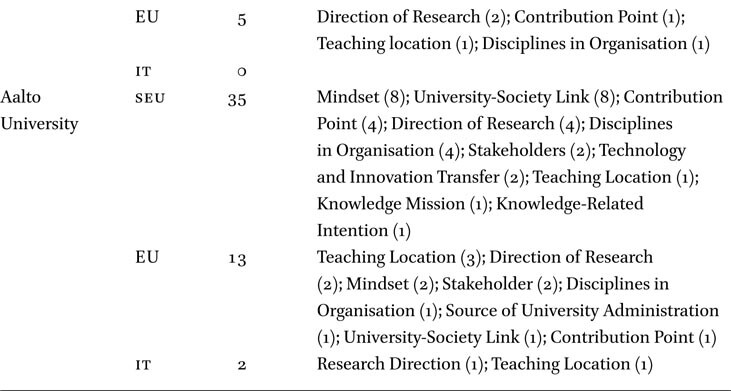
Aalto University’s strategy, We Shape Sustainable Future (Aalto University, 2023), also aligns primarily with the SEU model, emphasising sustainability, entrepreneurship, and societal engagement. Our analysis identified 19 excerpts linked to the SEU model, moderately outnumbering the 13 excerpts associated with the EU model. While some excerpts fit both models, a clear preference for the SEU model emerged. The most frequently identified SEU dimensions were mindset (8) and university-society link (8), reflecting the university’s commitment to fostering an entrepreneurial mindset and strengthening partnerships beyond academia. Other dimensions supporting the SEU model included contribution point (4), direction of research (4), disciplines in organisation (4), stakeholders (2), technology and innovation transfer (2), teaching location (1), knowledge mission (1), and knowledge-related intention (1).
The strategic plan underscores Aalto’s aspirations to shaping a sustainable future through research and education, emphasising an entrepreneurial mindset: “Aalto University’s purpose is to shape a sustainable future [….] We spark the game changers of tomorrow, and renew society with research-based knowledge, creativity and an entrepreneurial mindset.” Aalto’s commitment to collaboration and impact is also explicitly stated: “We create impact by becoming a prominent node in global networks. We invite our entire community – faculty, staff, students, alumni, and partners – to join and build an innovation, creative, and entrepreneurial ecosystem.” Among the less frequent dimensions, the contribution point focuses on investments for successful institutional and personal developments: “We enable our success by investing in our community and people, infrastructures, campus, and services.”
The EU model was also present, with teaching location (3) being the most frequently occurring dimension. Other EU model dimensions included: direction of research (2), mindset (2), stakeholders (2), disciplines in organisation (1), source of university administration (1), university-society link (1), and contribution point (1). Aalto’s emphasis on teaching location is evident on its mentions to campus infrastructure as a hub for entrepreneurship: “Our campus has rapidly grown into a world-class collaboration hub and meeting place, and we have transformed into one of Europe’s most international universities.” In the direction of research (2) dimension, the EU model is reflected in Aalto’s applied research and innovation approach: “We offer solutions to the most pressing societal challenges by combining cutting-edge science with design expertise and business thinking.”
The IT model appeared less frequently, with only two excerpts, but was notable in the research direction (1) and teaching location (1) dimensions. A stronger alignment with the IT model is found in Aalto’s emphasis on academic excellence: “We do high-quality research, excelling and making breakthroughs in and across science, art, technology, and business.” This reflects the university’s dedication to maintaining rigorous academic standards, a hallmark of the IT model.
Aalto University’s strategic plan demonstrates adaptability by incorporating elements from multiple models. Its dominant SEU alignment underscores a commitment to entrepreneurship, sustainability, and societal impact, while EU elements highlight the university’s focus on applied research and innovation. The IT model’s presence, though limited, reinforces its academic rigour. This blended approach positions Aalto University as a dynamic institution addressing modern educational and societal challenges.
5.7 General Overview
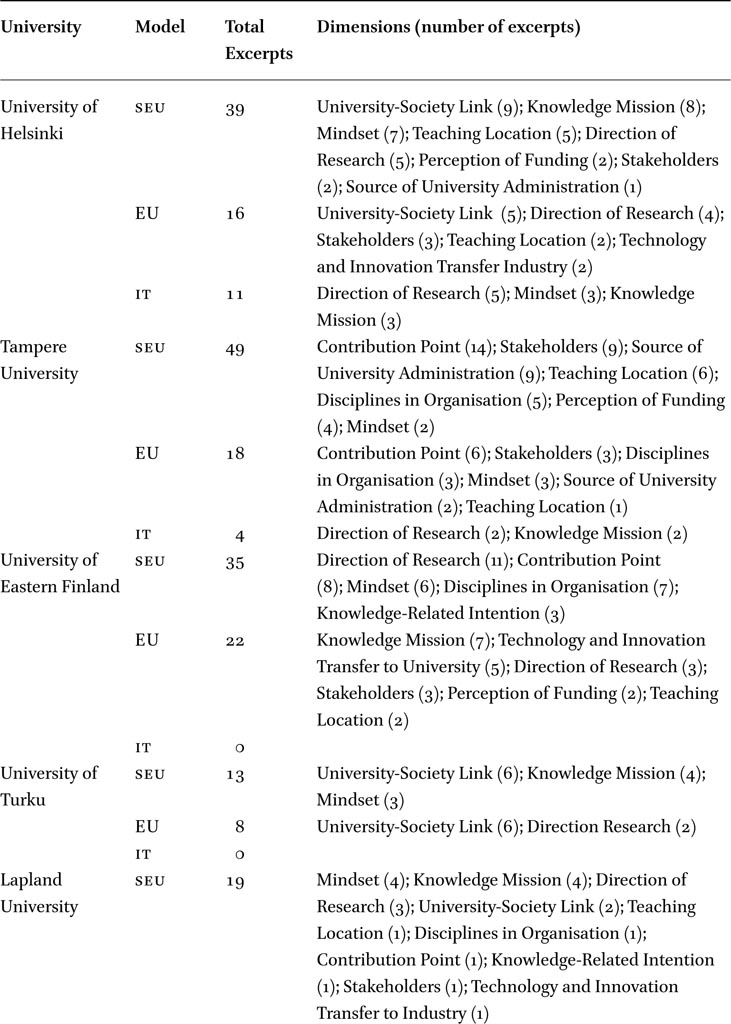
In general, the analysis of the strategic plans across the six universities reveals distinct trends regarding the presence of the three university models (see Table 3). While present in the aspirations of a few universities, the IT model has a notably limited influence, appearing most prominently in the strategic plans of the University of Helsinki, Tampere University, and Aalto University. The IT’s is mainly confined to research-related dimensions, such as direction of research, or to specific institutional aspirations and teaching location, especially for those universities that focus predominantly on on-campus education. As for the EU and SEU models, both were widely represented across all sample universities, with the SEU model being the most prevalent.
The SEU model dimensions varied significantly across universities, as shown in Table 3. For instance, Tampere University stands out with 49 excerpts related to the SEU model, particularly in contribution point, stakeholders, and source of university administration, underscoring its focus on societal impact and governance structures. In contrast, the University of Turku and the University of Lapland have fewer SEU excerpts, emphasising university-society link and knowledge mission. The EU model dimensions also show variation: universities like the University of Eastern Finland and Aalto University emphasise knowledge mission and technology and innovation transfer, while the University of Lapland provides minimal references to the EU model. Though not as central in most universities, the IT model remains an important aspect in the direction of research and mindset dimensions at the University of Helsinki and Aalto University.
General overview of the total & dimension specific university strategy excerpts by model
Citation: Triple Helix 12, 2 (2026) ; 10.1163/21971927-bja10066
This general overview underscores the diverse ways the SEU, EU, and IT models intersect across research-intensive Finnish universities operating under the MEC. As indicated in Table 3, the SEU model remains dominant, but each university seems to adapt their strategies according to its unique priorities and strategic vision. The variations in SEU dimensions highlight different emphases on societal impact, governance, and research. Notably, all strategic plans included elements that extend beyond the original SEU framework, which are discussed next. These findings set the stage for the following discussion, exploring how these insights can contribute to refining the SEU framework and their broader implications for research and policy in higher education.
6 Discussion
In this section, we discuss our study’s findings, focusing on the coded excerpts within the SEU model, the aspirational variations observed across the sample universities, and the need to consider additional dimensions and operationalising indicators beyond those in the SEU framework.
6.1 Variations in Emphasis and Priorities within the SEU model
Through our analysis of the strategic plans of the six sample universities, we observed similar emphases and priorities based on the SEU framework. All six universities exhibit diverse yet similar strategic orientations towards the SEU model, corroborating Cai and Ahmad’s (2021) SEU framework applicability in analysing university strategies. This framework provided insights into how the sample universities present institutional aspirations based on the SEU framework’s parameters. However, the ambiguity surrounding aspirations and how universities align with the SEU model raises an important question: does this alignment indicate a genuine transformation of a university in a specific direction, or are they merely adopting new aspirations?
The longstanding gap between strategy and implementation has been well-documented and theorised, as has the notion that universities adopt change symbolically rather than substantively (Pettigrew, 1987; Rahimnia et al., 2009; Routhe, 2016; van den Hende et al., 2022). Strategic plans across universities and other institutions may highlight ambitious goals, yet actual implementation often diverges due to institutional inertia, resource constraints, and external pressures, among other obstacles (Leal Filho et al., 2017; Vigfússon, 2021). Some universities meaningfully integrate SEU principles into their operations, while others may adopt them primarily to align with policy expectations without enacting substantive change. Regardless of the type of integration, such aspirations hold symbolic value, which has proven essential in driving fundamental strategic change in management processes, particularly within universities during moments of transformation (Johnson, 1990; Barlosky, 1995; Subotzky, 2003).
In the pursuit of the SDGs – both symbolically and in more practical terms – sustainability remains a challenge across universities and society due to implementation issues and the subjective nature of organisational change (Routhe, 2016; Veiga Ávila et al., 2019). Cai and Ahmad’s (2021) SEU framework captures universities’ complex aspirational approaches to entrepreneurship, sustainability, and societal engagement. However, it is not without limitations.
During the deductive coding process, we encountered strategic plan excerpts that did not neatly fit within the predefined dimensions. For instance, at the University of Eastern Finland, strategic goals related to implementing diverse teaching methods, expanding global reach, and academic responsibilities within extensive university networks raised issues beyond the scope of comparing the EU and SEU models. One of the university’s strategy documents states that, in pursuit of its internationalisation targets, “[The University of Eastern Finland’s] actions put their focus in increasing educational collaborations, expanding their offering of international degrees and multilingual pedagogy and pedagogical integration.” These complexities show that universities operate in a dynamic landscape that requires a more comprehensive analytical approach.
As such, enhancing the model demands greater capacity to account for overlapping orientations within the same category, suggesting that ideals within universities may be less clear-cut than anticipated and require further qualitative analysis. Furthermore, our findings revealed that university aspirations and specific strategic goals can extended beyond the framework’s predefined dimension categories. In the following, we present additional dimensions and suggestions to operationalise further existing ones, which we deemed necessary to enhance the framework’s analytical capacity.
6.2 The Need for Additional Dimensions beyond the Initial SEU Framework
The SEU framework identifies four core missions of universities: research, societal engagement, organisation and administration for achieving the missions, and teaching. While these missions remain central to the model, our findings revealed additional dimensions not fully captured by the predefined dimension-categories within the teaching mission. Hence, we propose three new dimensions within the teaching mission: approaches to learning, culture and language, and well-being (see Table 4). These additions ensure the continued relevance and adaptability of the SEU model in addressing contemporary challenges in higher education.
Approaches to learning. As a core function of universities, this dimension examines how pedagogical methods shape student learning experiences. The IT model follows a teacher-centred approach, where students are seen as disciples; the EU model adopts project-based learning, positioning students as entrepreneurial trainees; and the SEU model emphasises problem-based learning, where students act as continuous learners (or problem-solvers) and networked agents.
A key distinction between the EU and SEU models lies in their approach to applied learning. The EU model encourages students to design marketable solutions, tackling relevant issues with a value-adding perspective. In contrast, the SEU model prioritizes students’ responsibilities within collaborative groups, ensuring coherence between theoretical concepts and real-world applications. Problem-based learning is inherently open-ended and demands deeper engagement with stakeholders. As Barron et al. (2014) explain, project-based learning focuses on practice and output, whereas problem-based learning fosters an understanding of complexity, goals, and contextual purposes. This distinction was evident in the institutional approaches across the sample universities.
The University of Turku and the University of Helsinki exemplify problem-based learning by integrating research into teaching and fostering a lifelong learning philosophy. For example, the strategy plan of University of Turku states: “We foster learning, high-quality multidisciplinary research, and education based on research. We foresee changes in our operational environment and look to the future. As a multidisciplinary institution, we offer a wide range of studies in continuous learning.” Similarly, the University of Helsinki reinforces this idea: “We will offer opportunities in continuous learning to not only just our degree students.” This holistic approach fosters a dynamic learning environment where students are encouraged to engage with multiple disciplines and participate in lifelong learning opportunities.
Meanwhile, the EU model incorporates a more structured approach to learning, often with a stronger emphasis on education, employment, and economic needs. The example from the University of Lapland, emphasises the importance of providing inspiring learning environments with a strong connection to working life and the economy: “We offer our students an inspiring learning environment characterised by digital solutions, connections to working life and the economy, and participation in research and education networks.”
These approaches highlight the diversity in pedagogical strategies and their impact on student development. While the IT model focuses on teacher-led instruction, the EU and SEU models emphasize applied learning – through entrepreneurial projects and collaborative problem-solving. Each model shapes students’ skills for real-world challenges, ensuring they are prepared to adapt to the evolving demands of society and the workforce.
Culture and language. Beyond pedagogical strategies, culture and language play a critical role in shaping how students and faculty navigate international and cross-sectoral environments. The IT model would primarily frame culture and language studies as academic disciplines rooted in the scholarly canon, emphasising the preservation and study of established cultural and linguistic traditions. In contrast, the EU model would treat culture and language as market-driven competencies, focusing on developing communication skills tailored to business’s needs and economic competitiveness. The SEU model, however, advances a broader vision, viewing intercultural competence as a core component for fostering cooperation within cross-sectoral and international teams, preparing students for meaningful engagement in diverse professional and societal contexts.
This intercultural and linguistic distinction aligns with Deardorff’s (2008) conceptualisation of intercultural competence, which underscores the ability to adapt and communicate effectively across cultures. More broadly, intercultural competence in international higher education has become central to fostering intercultural dialogue and equipping students with the skills necessary for global engagement (Deardorff, 2010; Deardorff & Jones, 2022). The sample universities explicitly refer to such cultural and linguistic awareness in their institutional strategies. For instance, the University of Eastern Finland highlights this commitment, stating: “The high standard of research and education of our university builds a global future and strengthens the vitality of eastern Finland. We foster education and culture by making research-based knowledge available to benefit everyone.” Similarly, the University of Turku underscores the role of cultural sustainability in fostering well-being, noting: “Communities, groups, and minorities have their cultural memories, and understanding them forms the starting point for cultural sustainability and well-being.”
These examples demonstrate that, in the SEU model, cultural and linguistic elements are not merely supplemental but integral to institutional strategy and student experience, ensuring graduates are prepared to operate in diverse, globalised environments.
Well-being. This third dimension has emerged as a distinct and measurable priority across the sample universities, shifting from a peripheral concern to a strategic institutional focus. In the IT model, the well-being dimension would often be unattended, with institutions offering minimal welfare and care to students. The EU model, by contrast, would link well-being to institutional prestige, treating it as a reputational asset that enhances the university’s marketability and attractiveness. The SEU model, however, positions well-being as a fundamental necessity for fostering a sustainable academic community, integrating it into institutional policies and pedagogical frameworks to promote student success and long-term societal well-being.
This shift is reflected by the growing body of research emphasising the connection between student well-being and academic performance (Pascoe et al., 2020). Furthermore, it aligns with the Inner Development Goals framework, which recognises health and well-being as essential for achieving the SDGs (Inner Development Goals, n.d.). The emphasis on well-being in the SEU model also reinforces its role in continuous learning and problem-solving, ensuring students are mentally and physically supported to engage effectively. This is especially crucial for navigating the global contexts – both academically and professionally – that the SEU model implies.
Institutions such as the University of Lapland exemplify this commitment through structured well-being programs designed to support both students and staff: “[The university] has a programme promoting well-being and a sense of community, aiming to support the everyday well-being of students and staff and to encourage interaction, dialogue and an open operational culture.” Similarly, the University of Eastern Finland explicitly connects student well-being to pedagogical excellence and accessibility, reinforcing the idea that well-being is not merely a support function but a core component of effective learning environments: “The accessibility of our education, students, learning processes of a high pedagogical standard, and student well-being stand at the core of our activities and create pedagogical well-being.”
Beyond the university environment, the SEU model extends its well-being framework to broader societal engagement. Tampere University, for example, positions well-being as part of a larger mission to enhance societal resilience and sustainability: “Together with our partners, we are developing solutions to improve human health and well-being, societal resilience, and environmental sustainability.” These institutional strategies illustrate how the SEU model moves beyond traditional conceptualisations of well-being, embedding it into academic programs and community engagement initiatives to ensure that universities contribute to individual and collective sustainability.
By incorporating approaches to learning, culture and language, and well-being as integral dimensions within the SEU framework, we provide a more comprehensive model that reflects the evolving priorities of contemporary higher education. The distinctions between the IT, EU, and SEU models – operationalised through specific indicators – clarify how institutions can strategically adapt to societal changes. These additional dimensions ensure that the SEU model remains an effective analytical tool for understanding and guiding the future of higher education. Nevertheless, ensuring the SEU framework remains relevant and practical may require the refinement of other indicators among the pre-established dimensions used for analysis.
Proposed additional dimensions beyond the initial SEU framework
Citation: Triple Helix 12, 2 (2026) ; 10.1163/21971927-bja10066
6.3 Enhancing the SEU Framework: Refining and Augmenting Indicators
The SEU framework already operationalises under a participatory approach, mainly through its analytical emphasis on social engagement as a mission and respective dimensions, such as stakeholders, the university-society link, and perceptions of funding under the separate mission of organisation and administration for achieving the missions. However, based on the current indicators, its focus centers on perceptions rather than active participation in governance, decision-making, and evaluation processes, among other institutional functions (Cai & Ahmad, 2021). This gap is particularly relevant given the increasing emphasis on co-governance and participatory evaluation in sustainable higher education (Karahan, 2024).
Among the sample universities’ strategic plans analysed in our study, the University of Eastern Finland highlights the importance of “open, inclusive, and transparent leadership and decision-making,” reinforcing the role of participatory governance in institutional sustainability. Similarly, the University of Turku emphasises a “commitment to expanding positive societal impact by integrating ecological, economic, social, and cultural dimensions.” These examples align with research advocating for stakeholder co-creation in university governance and sustainability (Loureiro et al., 2020; Grunwald et al., 2024; Karahan, 2024).
To better operationalise a participatory approach across the SEU dimensions, we propose the following indicators:
Stakeholder engagement mechanisms. Formal processes that involve students, faculty, local communities, and external partners in decision-making (Ferrero-Ferrero et al., 2018).
Transparency and co-creation. The extent to which HEIs adopt open governance practices and co-develop sustainability strategies with stakeholders (Jirapong, 2024).
Impact assessment by diverse actors. Inclusion of non-academic stakeholders in evaluating institutional performance, as advocated in sustainability governance literature (Findler et al., 2019).
Rather than treating participatory governance as a subset of the stakeholder, university society-link, or perceptions of funding dimensions, proposed indicators underscore the participatory governance’s role as a core methodological principle within the SEU framework. Overall, universities can better align their strategic planning with contemporary sustainability and co-governance trends by refining the operationalisation of participatory governance within the SEU framework. Adding these new dimensions, along with the proposed refinements to existing ones, is a step toward a more holistic approach to examining university strategies. The following sections will explore the broader implications of these findings and discuss the study’s strengths and limitations.
7 Implications
The findings of this study have significant practical and social implications, offering valuable insights for universities, researchers, and policymakers. By verifying and advancing the SEU framework, we provide universities and researchers with a tool to evaluate universities’ stances on sustainability and innovation. The refined SEU framework, with its additional dimensions and recommendations for operationalisation, better captures the diverse strategic orientations and priorities across Finnish universities operating under the MEC. This can empower universities to conduct self-assessments, identify areas for further improvement, and develop targeted strategies to enhance their overall approach to sustainability.
The implications of this research extend beyond the individual universities studied. While there is a significant lack of quantifiable measures for SEU, in contrast to the more advanced development of quantitative indicators for the EU model, such as HEInnovate and metrics of the EU (Etzkowitz, 2016), these existing metrics focus less on the crucial aspect of sustainability emphasised in the SEU model. Therefore, a key recommendation for future research is the development of metrics for the SEU model, paying particular attention to quantitative indicators for the sustainability components.
A tailored metric for SEU could serve as a valuable tool for multiple stakeholders to assess universities’ sustainability and innovation progress. For instance, policymakers and funding agencies could utilise such a metric to promote transparency and accountability, guide resource allocation, identify best practices, and design initiatives supporting higher education sustainability and innovation. Overall, the findings of this study contribute to the broader agenda of higher education for sustainable development and the realisation of the SDGs (United Nations, 2015).
8 Strengths and Limitations
We were motivated to conduct this investigation to provide researchers with a tentative application of the SEU framework. To our knowledge, only one other study (Karahan, 2024) has applied this framework, focusing on universities in Germany. By extending the framework’s application to Finnish universities, our study contributes to its broader validation in different national contexts. Thus, a key strength of this research is its implementation of a theoretical framework within a real-world setting.
Furthermore, our proposed improvements to the SEU framework show promise in two key areas. First, we introduce a novel approach to analysing universities’ strategic plans. Second, the study evaluates the strengths and weaknesses of a recently developed theoretical framework (Cai & Ahmad, 2021). Doing so, contributes to ongoing discussions around sustainability, innovation, and entrepreneurship in higher education (Pique et al., 2024).
Nevertheless, the current study underscores specific limitations that warrant acknowledgement. Notably, the study’s sample is confined to research-intensive Finnish universities operating under the MEC, potentially constraining the generalisability of findings beyond universities with similar characteristics in Finland. Furthermore, Cai and Ahmad’s (2021) SEU framework is still in its initial stages, with a limited number of studies having operationalised it (Karahan, 2024), implying the need for further cross-cultural adaptation to ensure their relevance across diverse contexts. Otherwise, the absence of a comparative element in research proposing a conceptual framework can limit findings, making it difficult to benchmark or evaluate the significance within a broader context (Miles et al., 2014). Therefore, until such developments materialise, it is essential to interpret the study’s results with caution.
The constraints surrounding our proposed additional dimensions – approaches to learning, language and culture, and well-being – are also particularly significant. While our analysis of the sample universities’ strategies has highlighted these dimensions, they have not been extensively addressed in Cai and Ahmad’s (2021) or Karahan’s (2024) recent theoretical advancements. Moreover, these dimensions stem from the specific strategic plans of the universities in our sample and may not be present in other institutions. Thus, further research is needed to explore whether these emerging dimensions hold relevance across different contexts. In this regard, collaborative efforts involving researchers from multiple countries and regions could help further refine the SEU framework, ensuring its global applicability and reliability.
As previously discussed, this study analysed university aspirations through strategic plans, which may not fully reflect institutional initiatives and outcomes. Future research should broaden its scope by examining a larger sample of universities, accounting for regional and institutional differences, and employing multi-case studies with diverse data collection methods. Triangulating data from strategic plans, annual reports, key performance indicators, and direct communication with university officials would offer a more comprehensive understanding of how institutions align with the SEU and other university models.
9 Conclusion
This study contributes to the discourse on the sustainable development of higher education by analysing the strategic plans from six Finnish research-intensive universities operating under the MEC, and building upon the theoretical foundations of the SEU framework. The findings offer valuable insights into the alignment between sustainability and the entrepreneurial orientations within these institutions, demonstrating the framework’s applicability in examining institutional convergence across the sample universities.
However, we acknowledge the need for continued application and refinement of the SEU framework to effectively capture the unique characteristics of sustainable entrepreneurship in other countries and institutional contexts. Further studies operationalising the SEU framework could open avenues for its expansion, as well as for broader institutional and societal impact. Additionally, there is a clear need for more practical approaches that foster transparency and accountability. We encouraged the development of metrics beyond entrepreneurial approaches, incorporating specific indicators for universities to assess their sustainability and innovation progress and potential.
Though higher education for sustainable development has a long way to go, this study helps bring universities closer to transforming the abstract concept of sustainable development into tangible action. By embracing the ever-evolving relationship between academia, society, and sustainable progress, we move closer to creating an inclusive future for all individuals and communities.
Acknowledgments
We express our heartfelt gratitude to the Higher Education Group at Tampere University for their invaluable insights and support throughout our research and academic endeavour. We would like to extend our special appreciation to our MARIHE-8 colleagues for their important contributions with respect to data collection. We also thank the reviewers for their patience and thoughtful comments, which have significantly enhanced the quality and clarity of this manuscript.
Disclosure Statement
There are no relevant conflicts of interest regarding the research and/or authoring of this article.
Funding
The authors did not receive any funding for this research.
References
Aalto University (2023). Our Strategy. https://www.aalto.fi/en/strategy.
Aalto University. (2025). Key figures of 2023 and annual reports. https://www.aalto.fi/en/aalto-university/key-figures-of-2023-and-annual-reports.
Annan, K. (2001). Annan pleads with West as environment is pushed up UN agenda. The Guardian, 15 March. Available at: www.theguardian.com/environment/2001/mar/15/globalwarming.climatechange.
Barlosky, M. (1995). Symbolic leadership and institutional change in Ontario’s community colleges. Community College Journal of Research and Practice, 19(5), 395–410. https://doi.org/10.1080/1066892950190503.
Barron, B. J., Schwartz, D. L., Vye, N. J., Moore, A., Petrosino, A., Zech, L., & Bransford, J. D. (2014). Doing with understanding: Lessons from research on problem-and project-based learning. In: Learning Through Problem Solving (pp. 271–311). Psychology Press.
Benneworth, P. (2013). University Engagement with Socially Excluded Communities. Dordrecht; London: Springer.
Bohnsack, R., Pfaff, N., & Weller, W. (2010). Qualitative Analysis and Documentary Method: In International Educational Research (p. 369). Verlag Barbara Budrich.
Bowen, G. A. (2009). Document analysis as a qualitative research method. Qualitative Research Journal, 9(2), 27–40. https://www.emerald.com/insight/content/doi/10.3316/QRJ0902027/full/pdf?title=document-analysis-as-a-qualitative-research-method.
Cai, Y. (2022). Neo-Triple Helix model of innovation ecosystems: Integrating Triple, Quadruple and Quintuple Helix models. Triple Helix, 9(1), 76–106. doi: https://doi.org/10.1163/21971927-bja10029
Cai, Y., & Ahmad, I. (2021). From an entrepreneurial university to a sustainable entrepreneurial university: Conceptualization and evidence in the contexts of European university reforms. Higher Education Policy, 36, 20–52. https://doi.org/10.1057/s41307-021-00243-z.
Carayannis, E. G., & Campbell, D. F. (2009). ‘Mode 3’ and ‘Quadruple Helix’: Toward a 21st century fractal innovation ecosystem. International Journal of Technology Management, 46(3–4), 201–234. https://doi.org/10.1504/IJTM.2009.023374.
Carayannis, E.G., Grigoroudis, E., Campbell, D. F. J., Meissner, D. and Stamati, D. (2018). The ecosystem as helix: an exploratory theory-building study of regional co-opetitive entrepreneurial ecosystems as Quadruple/Quintuple Helix Innovation Models. R&D Management 48(1): 148–162. https://doi.org/10.1111/radm.12300.
Cardno, C. (2018). Policy document analysis: a practical educational leadership tool and a qualitative research method. Educational Administration: Theory & Practice, 24(4), 623–640. https://files.eric.ed.gov/fulltext/EJ1305631.pdf.
Clark, B. R. (1998). Creating Entrepreneurial Universities: Organizational Pathways of Transformation (1st ed). Published for the IAU Press by Pergamon Press.
Clark, B. R. (2004). Delineating the character of the entrepreneurial university. Higher Education Policy, 17(4), 355–370. https://doi.org/10.1057/palgrave.hep.8300062.
Creswell, J. W. (2014). Educational Research: Planning, Conducting and Evaluating Quantitative and Qualitative Research. Pearson.
Deardorff, D. K. (2008). Intercultural competence: A definition, model, and implications for education abroad. In Developing Intercultural Competence and Transformation (pp. 32–52). Routledge.
Deardorff, D. K. (2010). Intercultural competence in higher education and intercultural dialogue. Speaking Across Borders: The Role of Higher Education in Furthering Intercultural Dialogue, pp. 87–100.
Deardorff, D. K., & Jones, E. (2022). Intercultural competence as a core focus in international higher education. In: The Handbook of International Higher Education (pp. 223–241). Routledge.
Dey, I. (2005). Qualitative Data Analysis: A User-friendly Guide for Social Scientists. Routledge.
Education Statistics Finland (2024). www.vipunen.fi.
Etzkowitz, H. (1983). Entrepreneurial scientists and entrepreneurial universities in American academic science. Minerva, 198–233.
Etzkowitz, H. (2004). The evolution of the entrepreneurial university. International Journal of Technology and Globalisation 1(1): 64–77 https://doi.org/10.1504%2FIJTG.2004.004551.
Etzkowitz, H. (2013). Anatomy of the entrepreneurial university. Social Science Information, 52(3), 486–511. https://doi.org/10.1177/0539018413485832.
Etzkowitz, H. (2016). Innovation lodestar: The entrepreneurial university in a stellar knowledge firmament. Technological Forecasting and Social Change, 123, 122–129. https://doi.org/10.1016/j.techfore.2016.04.026.
Etzkowitz, H. (2016). The entrepreneurial university: Vision and metrics. Industry and Higher Education, 30(2), 83–97. https://doi.org/10.5367/ihe.2016.0303.
Etzkowitz H and Leydesdorff L (2000). The dynamics of innovation: From National Systems and “Mode 2” to a Triple Helix of university-industry-government relations. Research Policy 29(2): 109–123. https://doi.org/10.1016/S0048-7333(99)00055-4.
Etzkowitz, H., Webster, A., Gebhardt, C. and Terra, B.R.C. (2000). The future of the university and the university of the future: evolution of ivory tower to entrepreneurial paradigm. Research Policy 29(2): 313–330. https://doi.org/10.1016/s0048-7333(99)00069-4.
Feixas, M., & Zellweger, F. (2010). Faculty development in context: Changing learning cultures in higher education. Changing Cultures in Higher Education: Moving Ahead to Future Learning, pp. 85–102.
Findler, F., Schönherr, N., & Martinuzzi, A. (2019). Higher education institutions as transformative agents for a sustainable society. In: Chancen und Grenzen der Nachhaltigkeitstransformation: Ökonomische und soziologische Perspektiven (pp. 95–106). Springer. https://doi.org/10.1007/978-3-658-22438-7_6.
Ferrero-Ferrero, I., Fernández-Izquierdo, M. Á., Muñoz-Torres, M. J., & Bellés-Colomer, L. (2018). Stakeholder engagement in sustainability reporting in higher education: An analysis of key internal stakeholders’ expectations. International Journal of Sustainability in Higher Education, 19(2), 313–336. https://doi.org/10.1108/IJSHE-06-2016-0116.
Fumasoli, T., & Huisman, J. (2013). Strategic agency and system diversity: Conceptualizing institutional positioning in higher education. Minerva, 51, 155–169.
Geschwind, L., Kekäle, J., Pinheiro, R., & Sørensen, M. P. (2019). Responsible universities in context. In The responsible university: Exploring the nordic context and beyond (pp. 3–29). Cham: Springer International Publishing.
Giesenbauer, B., & Müller-Christ, G. (2020). University 4.0: Promoting the transformation of higher education institutions toward sustainable development. Sustainability, 12(8), 3371. https://doi.org/10.3390/su12083371.
Goddard, J., and Vallance, P. (2013). The University and the City. Routledge. https://doi.org/10.4324/9780203068366.
Goddard, J., Hazelkorn, E., & Vallance, P. (Eds.). (2016). The Civic University: The Policy and Leadership Challenges. Edward Elgar Publishing.
Grunwald, G., Kara, A., & Spillan, J. E. (2024). Sustainable innovations through project partnerships at higher education institutions: Challenges and implications for stakeholder engagement. Management Decision. https://doi.org/10.1108/MD-05-2024-1060.
Guerrero, M., & Urbano, D. (2012). The development of an entrepreneurial university. Journal of Technology Transfer, 37(1), 43–74. https://doi.org/10.1007/s10961-010-9171-x.
Hinton, K. E. (2012). A Practical Guide to Strategic Planning in Higher Education (Vol. 7). Ann Arbor, MI: Society for College and University Planning. http://www.vincentgaspersz.com/wp-content/uploads/2019/12/Higher-Education-Strategic-Planning-Guide-VG.pdf.
Inner Development Goals. (n.d.). Home. Inner Development Goals. https://innerdevelopmentgoals.org/.
Jirapong, K. (2024). Entrepreneurship Co-creation towards Sustainability: Driving Innovation for a Better Future (Order No. 31500412). ProQuest Dissertations & Theses Global. https://doi.org/10.14279/depositonce-20442.
Jongbloed, B., Enders, J., & Salerno, C. (2008). Higher education and its communities: Interconnections, interdependencies and a research agenda. Higher Education, 56(3), 303–324. https://doi.org/10.1007/s10734-008-9128-2.
Johnson, G. (1990). Managing strategic change: The role of symbolic action. British Journal of Management, 1(4), 183–200. https://doi.org/10.1111/j.1467-8551.1990.tb00006.x.
Kahle, J., Risch, K., Wanke, A., & Lang, D. J. (2018). Strategic Networking for Sustainability: Lessons Learned from Two Case Studies in Higher Education. Sustainability, 10(12), 4646. https://doi.org/10.3390/su10124646
Kandiko, C. B., & Blackmore, P. (2008). Institutionalising Interdisciplinary Work in Australia and the UK. Journal of Institutional Research, 14(1), 87–95. http://files.eric.ed.gov/fulltext/EJ1055581.pdf.
Karahan, M. (2024). Advancing sustainable entrepreneurial universities: Sustainability transformations of university business incubators in Germany. Small Business Economics, 63(3), 575–609. https://doi.org/10.1007/s11187-023-00860-5.
Kassel, K., Rimanoczy, I. and Mitchell, S. F. (2016). “‘The Sustainable Mindset: Connecting Being, Thinking, and Doing in Management Education.’” Academy of Management Proceedings 1: 16659. https://doi.org/10.5465/ambpp.2016.16659abstract.
Kezar A. J. (2001). Understanding and facilitating organizational change in the 21st century. https://eric.ed.gov/?id=ED457711.
Kohlbacher, F. (2006). The use of qualitative content analysis in case study research. Forum Qualitative Sozialforschung / Forum: Qualitative Social Research, 7(1), 1–30.
Leal Filho, W., Wu, Y. C. J., Brandli, L. L., Avila, L. V., Azeiteiro, U. M., Caeiro, S., & Madruga, L. R. da R. G. (2017). Identifying and overcoming obstacles to the implementation of sustainable development at universities. Journal of Integrative Environmental Sciences, 14(1), 93–108. https://doi.org/10.1080/1943815X.2017.1362007.
Loureiro, S. M. C., Romero, J., & Bilro, R. G. (2020). Stakeholder engagement in co-creation processes for innovation: A systematic literature review and case study. Journal of Business Research, 119, 388–409. https://doi.org/10.1016/j.jbusres.2019.09.038.
Miles, M. B., Huberman, A. M., & Saldaña, J. (2014). Qualitative Data Analysis: A Methods Sourcebook. SAGE Publications.
Ministry of Education and Culture. (2017). Universities Act 558/2009.https://www.finlex.fi/en/laki/kaannokset/2009/20090558.
Ministry of Education and Culture. (2025). Universities in Finland. Retrieved from https://okm.fi/en/universities.
Moon, C. J., Walmsley, A. and Apostolopoulos, N. (2018). Governance implications of the UN higher education sustainability initiative. Corporate Governance: the International Journal of Business in Society 18(4): 624–634. https://doi.org/10.1108/cg-01-2018-0020.
Morawska-Jancelewicz, J. (2022). The role of universities in social innovation within quadruple/quintuple helix model: Practical implications from Polish experience. Journal of the Knowledge Economy, 13(6), 2230–2271. https://doi.org/10.1007/s13132-021-00804-y.
Morphew, C. C., & Hartley, M. (2006). Mission statements: A thematic analysis of rhetoric across institutional type. The Journal of Higher Education, 77(3), 456–471. https://repository.upenn.edu/server/api/core/bitstreams/af1833bf-c916-4ef3-a44a-a1ed6e8b29ea/content.
Morphew, C. C., Fumasoli, T., & Stensaker, B. (2018). Changing missions? How the strategic plans of research-intensive universities in Northern Europe and North America balance competing identities. Studies in Higher Education, 43(6), 1074–1088. https://doi.org/10.1080/03075079.2016.1214697.
O’leary, Z., & Hunt, J. (2014). Primary data: Surveys, interviews and observation. The Essential Guide to Doing your Research Project, pp. 201–216.
Pascoe, M. C., Hetrick, S. E., & Parker, A. G. (2020). The impact of stress on students in secondary school and higher education. International Journal of Adolescence and Youth, 25(1), 104–112. https://doi.org/10.1016/j.lindif.2023.102288.
Pettigrew, A. M. (1987). Context and action in the transformation of the firm. Journal of Management Studies, 24(6), 649–670. https://doi.org/10.1111/j.1467-6486.1987.tb00467.x.
Pinheiro, R., Aarrevaara, T., Berg, L. N., Fumasoli, T., Geschwind, L., Hansen, H. F., … & Söderlind, J. (2019). Nordic higher education in flux: System evolution and reform trajectories. In Reforms, organizational change and performance in higher education: A comparative account from the Nordic countries (pp. 69–108). Cham: Springer International Publishing.
Pique, J. M., Rapetti, C., Cai, Y., & Amaral, M. (2024). Introduction to the special issue: XXI Triple Helix Conference – Barcelona 2023. Triple Helix, 11(1), 1–3. https://doi.org/10.1163/21971927-12340018.
Poutanen, M., Tomperi, T., Kuusela, H., Kaleva, V., & Tervasmäki, T. (2020). From democracy to managerialism: foundation universities as the embodiment of Finnish university policies. Journal of Education Policy, 37(3), 419–442. https://doi.org/10.1080/02680939.2020.1846080.
Prime Minister’s Office Finland. (2016). National report on the implementation of the 2030 Agenda for Sustainable Development. Prime Minister’s Office Publications. https://sustainabledevelopment.un.org/content/documents/10164Finland%20HLPF%20VNR%20Summary%20-%20FINAL%2017.5.2016.pdf.
Prime Minister’s Office Finland. (2020). Report on the implementation of the 2030 Agenda for sustainable development (Voluntary National Review). Publications of the Prime Minister’s Office 2020:8. https://sustainabledevelopment.un.org/content/documents/26261VNR_Report_Finland_2020.pdf.
Rahimnia, F., Polychronakis, Y., & Sharp, J. M. (2009). A conceptual framework of impeders to strategy implementation from an exploratory case study in an Iranian university. Education, Business and Society: Contemporary Middle Eastern Issues, 2(4), 246–261. https://doi.org/10.1108/17537980911001080.
Röpke, J. (1998). The Entrepreneurial University: Innovation, Academic Knowledge Creation and Regional Development in a Globalized Economy, Marburg, Germany: Philipps-Universitat.
Routhe, A. (2016). Reading the signs of sustainability in Christian higher education: Symbolic value claims or substantive organizational change? In: J. Davim & W. Leal Filho (eds) Challenges in Higher Education for Sustainability (pp. 45–60). Springer. https://doi.org/10.1007/978-3-319-23705-3_3.
Saunders, M., & Sin, C. (2015). Middle managers’ experience of policy implementation and mediation in the context of the Scottish quality enhancement framework. Assessment & Evaluation in Higher Education, 40(1), 135–150.
Sørensen, M. P., Geschwind, L., Kekäle, J., & Pinheiro, R. (2019). The Responsible University: Exploring the Nordic Context and Beyond (p. 318). Springer Nature.
Statistics Finland (2023). University Students and Degrees. https://pxdata.stat.fi/PxWeb/pxweb/en/StatFin/StatFin__opiskt/statfin_opiskt_pxt_136b.px/.
Subotzky, G. (2003). Symbolism and substance: Towards an understanding of change and continuity in South African higher education. In: Globalization and Reform in Higher Education (pp. 164–193). Open University Press.
Tampere Universities. (2023). About us. https://www.tuni.fi/en/about-us.
Tampere University Foundation sr. (2023). 2023 Annual report and financial statements. https://content-webapi.tuni.fi/proxy/public/2024-05/annual-report-and-financial-statements-of-tampere-university-foundation-sr-for-2023.pdf.
Tampere University. (n.d.). Strategy 2030. https://content-webapi.tuni.fi/proxy/public/2020-02/tampereen-yliopisto-strategia-10022020-eng.pdf.
United Nations. (2015). Transforming our World: The 2030 Agenda for Sustainable Development Transforming our World. Preamble.
University of Eastern Finland. (n.d.). University. https://www.uef.fi/en/university.
University of Eastern Finland. (2022). Seizing a sustainable future. https://studentuef.sharepoint.com/UEF_Strategia_Visualisointi_ENG.pdf.
University of Eastern Finland. (2023a). Programme 1: Research-based understanding. https://studentuef.sharepoint.com/Strategian_ohjelma_1_ENG_2023.pdf.
University of Eastern Finland. (2023b). Programme 2: Modern and renewal-driven learning. https://studentuef.sharepoint.com/Strategian_ohjelma_2_ENG_2023.pdf.
University of Eastern Finland. (2023c). Programme 3: A Participatory and inclusive academic community. https://studentuef.sharepoint.com/Strategian_ohjelma_3_ENG_2023.pdf.
University of Eastern Finland Board approved the university’s plan of operations and budget for 2024 | University of Eastern Finland. (2023). https://www.uef.fi/en/article/uef-board-approved-the-universitys-plan-of-operations-and-budget-for-2024.
University of Helsinki. (2021). Strategic plan 2021–2030. https://www.helsinki.fi/en/about-us/strategy-economy-and-quality/strategic-plan-2021-2030
University of Helsinki. (2023a). We Are the University of Helsinki. https://www.helsinki.fi/en/about-us/university-helsinki.
University of Helsinki. (2023b). Key financial figures. https://www.helsinki.fi/en/about-us/strategy-economy-and-quality/university-finances/key-financial-figures.
University of Lapland. (2023a). https://www.ulapland.fi/FI/Yliopisto/Nain-toimimme/Talous.
University of Lapland. (2023b). LUC Strategy 2030. https://www.ulapland.fi/EN/About-us/Our-principles/Strategy.
University of Lapland. (n.d.). Who we are. University of Lapland. https://www.ulapland.fi/EN/About-us/Who-we-are.
University of Turku. (2023). Key facts and figures. https://www.utu.fi/en/university/facts-and-figures.
University of Turku (n.d.). Strategy 2030 of the University of Turku. https://www.utu.fi/en/university/university-strategy-2030.
van den Hende, F., Whitsed, C., & Coelen, R. J. (2022). An organizational change perspective for the curriculum internationalization process: Bridging the gap between strategy and implementation. Journal of Studies in International Education, 27(3), 520–538. https://doi.org/10.1177/10283153221105321.
Veiga Ávila, L., Beuron, T. A., Brandli, L. L., Damke, L. I., Pereira, R. S., & Klein, L. L. (2019). Barriers to innovation and sustainability in universities: An international comparison. International Journal of Sustainability in Higher Education, 20(5), 805–821. https://doi.org/10.1108/IJSHE-02-2019-0067.
Vigfússon, K., Jóhannsdóttir, L., & Ólafsson, S. (2021). Obstacles to strategy implementation and success factors: A review of empirical literature. Strategic Management, 26(2), 12–30. https://doi.org/10.5937/StraMan2102012V.
Waas, T., Verbruggen, A. and Wright, T. (2010). University research for sustainable development: definition and characteristics explored. Journal of Cleaner Production 18(7): 629–636. https://doi.org/10.1016/j.jclepro.2009.09.017.
Wright, S. (2016). Universities in a knowledge economy or ecology? Policy, contestation, and abjection. Critical Policy Studies, 10(1), 59–78. https://doi.org/10.1080/19460171.2016.1142457.
Yarime, M., Trencher, G., Mino, T., Scholz, R. W., Olsson, L., Ness, B., … & Rotmans, J. (2012). Establishing sustainability science in higher education institutions: towards an integration of academic development, institutionalization, and stakeholder collaborations. Sustainability Science, 7, 101–113.
Appendix 1
Document analysis in higher education strategic planning: a methodological overview
Citation: Triple Helix 12, 2 (2026) ; 10.1163/21971927-bja10066