Abstract
Technology Transfer (TT) process is complex and influenced by numerous factors. Associated with this context, the recent and growing Digital Transformation has impacted practically all sectors, through disruptive technologies such as the Internet of Things (IoT), 5G and 6G networks, Industry 4.0, Digital Agriculture, and Artificial Intelligence, among others. Thus, the present study intends to investigate the characteristics of TT processes involving digital solutions generated by Public Research Institutes, seeking to identify the factors that interfere in this process. A literature review was carried out regarding the factors that influence a TT process focused on digital technologies produced by Public Research Institutes, followed by the systematization of the findings and the proposition of a theoretical model. Thus, this study seeks to contribute to the understanding of the critical factors for the TT processes associated with digital innovation.
1 Introduction
Scientific and technological production is fundamental for the development of a nation. Through it, are generated technological innovations that allow the development of countries and companies, being, therefore, a strategic investment for maintaining relevance and competitiveness at a global level, especially for emerging economies (Amini Sedeh et al., 2022; Bengoa et al., 2021; Ghobril et al., 2017). The path taken by technologies generated in Research Institutes (RIs) to become innovation, for the benefit of society, is complex and has numerous factors that impact it. Furthermore, knowledge production (creativity) and its use (innovation), are valuable resources for maintaining sustained competitive advantage (Anderson et al., 2014; Qian et al., 2022).
The Technology Transfer process is complex and involves different actors in a coordinated flow of steps to achieve its main objective: that the technological knowledge developed in Research Institutes is transformed into new products and services available to society. RIs are active both in scientific and technological research and in the development of new products and services. The ultimate goal is that the knowledge produced in research is translated, in fact, into innovations for citizens and companies (Vicentino & Garbelotti, 2021). Furthermore, knowledge and Technology Transfer processes are crucial for exploiting the state-of-the-art technologies produced by RIs and applying them in solutions to real problems faced by companies on a daily basis (Olvera et al., 2021).
TT has already been widely studied from different angles and under different aspects, as pointed out by Bengoa et al. (2021), Qian et al. (2022), and Siegel et al. (2023), however, given the increasing digitalization of the economy, observed by technologies that are at our doorstep, such as IoT, Industry 4.0, Digital Agriculture, 5G and 6G networks, intensive use of Artificial Intelligence, saturation of marketplaces and emergence of new business models, among others, it becomes crucial to understand how these technological innovations can impact the processes of knowledge production and its subsequent adoption by society, as well as impact the TT processes (Bengoa et al., 2021; da Silva et al., 2022; Galera-Zarco et al., 2020; He et al., 2020; Verhoef et al., 2021). This accelerated digitization promotes new ways of producing and accessing goods and services, also enabling the creation of new forms of relationships between the actors of the innovation ecosystem, including strategic Alliances. So, it is mandatory to deepen the knowledge about how this context affects the relations between actors in the innovation ecosystem (Autio et al., 2018; Bengoa et al., 2021; He et al., 2020).
Thus, the present study intends to contribute to filling this gap regarding the factors that interfere in the TT processes specifically involving digital technologies, as pointed out in several studies like Bengoa et al. (2021), Autio et al. (2018) and He et al. (2020). Our assumption is that given the characteristics of digital technologies, the factors that interfere in this process may be slightly different or contribute with different degrees of influence on the outcome of the process than other kinds of technologies. Another specificity adopted in this work is the search for factors that are applicable to Public RIs since a large part of the funding and promotion of technological research is supported by organizations linked to governments (Etzkowitz & Zhou, 2017).
Recent publications on the subject of Technology Transfer were analyzed, and the 129 factors presented in the selected literature were clustered into 4 components (Research Institute, Partner Company, Technology, and Relationship) and 29 key factors for the Technology Transfer process involving digital assets developed from Public RIs. So based on our findings, this study unveils the 29 most influential factors that can contribute to the successful Technology Transfer process.
The theoretical contribution of this study is to categorize the factors that influence TT specifically for digital technologies in four categories, therefore proposing an analytical framework. In practical terms, the differences in factors that impact general technologies, and digital technologies will help managers to better reach the outcome of TT, especially public managers of public RI’s optimizing the use of resources.
2 Theoretical Foundations
2.1 Creativity and Innovation
Technological innovation is fundamental for the development of a country, being a main mechanism for productivity and allowing competitiveness at a global level. Investing in innovation is strategic for companies and nations (Ghobril et al., 2017). According to the United Nations (UN), the creation, development, and diffusion of innovations and technological knowledge, including TT under mutually accepted agreements, are powerful drivers of economic growth and sustainable development (Bengoa et al., 2021).
Until innovation is available for society, it has to accomplish an uncertain and complex path. Additive (incremental) and multiplicative (radical) synergies in the context of technological innovations are ways to innovate (Harrigan et al., 2017; Rahman Malik et al., 2023). The emergence of strategies based on Open Innovation (Chesbrough, 2003) and Technology Transfer (Kogut& Zander, 1992) have been widely used in this context. However, Antonioli et al. (2017) indicate that organizations resort to strategic partnerships as a way to overcome the barriers inherent to the innovation process.
Creativity and innovation are interwoven (Amabile, 1988; Anderson et al., 2014; Kuzior et al., 2024; Revilla, 2019; Rossi et al., 2024; Vlăduţ et al., 2018). Research has given attention to individual factors (Alhosani & Ahmad, 2024; Fleischer & Wanckel, 2023; Sherief, 2019) as well as to social components (Koh et al., 2019; Santiago-Torner, 2023; Suliman & Al Harthi, 2022; West et al., 2003) stating that creativity is a complex and multilevel phenomenon (Anderson et al., 2014; Houtgraaf et al., 2023).
According to the Systemic Model of Creativity (Csikszentmihalyi, 1999, 2014), the creative process depends on the interaction of three forces: the individual, the field / organizational and institutional network, and the domain / culture. In the view of Csikszentmihalyi (2014), the individual, from his skills and knowledge in a particular domain, produces variations in this domain which will be validated by the field, before being approved as innovations. The field puts efforts into the implementation of these novel ideas to produce more immediate results, through the exploration of products and services (Revilla, 2019). State, industry, and academia are typical actors in the field, according to the systemic approach.
2.2 Technology Transfer
Technology Transfer can be understood as the process by which technological knowledge generated in a Research Institute is transferred to another actor for eventual finalization and refinement, to then be packaged into a solution and made available on the market to society. In short, the transfer process is characterized as a continuous interaction between scientific system actors and organizations with other social subsystems and citizens (Mietzner & Schultz, 2021).
Research in the field of Technology Transfer is not new, with the first publications on the subject dating back to the end of the 60s. Based on a broad bibliometric study, Bengoa et. al.(2021) when analyzing the publications found in the field of TT, state that the literature covers a significant number of topics and has already been studied from different angles, with the main focus being on the economic perspective. Bengoa et. al. (2021) also present a list of the 25 journals that most publish on the subject, highlighting the top 4: Journal of Technology Transfer (226), Research Policy (192), International Journal of Technology Management (147), and Technovation (145).
Based on the literature, studies on human and organizational aspects of TT, enabling factors and barriers to the efficiency of the TT process, and studies on absorptive capacities in the context of TT stand out. Regarding the agents involved in TT, most studies focus on aspects related to large companies, usually multinationals, in addition to TT processes involving the relationship between university and industry (Bengoa et al., 2021).
In the literature, there are studies with different focuses on TT, such as: From the perspective of Universities (Quiñones et al., 2019; Ravi & Janodia, 2022; Temel et al., 2021), from developing countries (Pusinhol, 2021; Ravi & Janodia, 2022; Shmeleva et al., 2021), from industry (Temel et al., 2021), from different sectors of the economy (Min et al., 2020), from the perspective of different arrangements (Sutopo et al., 2019), from the perspective of public Research Institutes (Ko et al., 2021; Pusinhol et al., 2021; Singhai et al., 2021; Zhang et al., 2022), etc. Even so, it was identified that more than 81% of the authors who published on the TT topic have only one publication in the field, which generally indicates that the research field is new and has not yet reached maturity (Bengoa et al., 2021).
Through a wide bibliometric review, Bengoa et al. (2021) brings that the most cited work in the context of TT is the article “Knowledge of the firm, combinative capabilities, and the replication of technology”, published in 1992 by Kogut & Zander, with over 5,000 citations on Web Of Science and over 20,000 in Google Scholar, in which the authors, when describing TT, point out characteristics such as the combinative capabilities of organizations to synthesize and organize the knowledge in a competitive environment context. This work is not the first in the area and neither are the authors the most active in this field, but this seminal study brings relevant reflections for the advancement in the field of research and that is why it is so referenced.
There are several ways to promote Technology Transfer from RIs to society and their implementation requires a deep understanding of the target market, the ability to navigate complex legal and regulatory environments, and the willingness to adapt and customize solutions to meet the unique needs of each context. Chen et al. (2022), point out that the main forms of TT can be grouped into 5 approaches: (i) Intellectual Property (IP) management, through patent licensing and other IP exploitations; (ii) Alliances for TT, through technical cooperation agreements for co-development solutions or cooperations to increase maturity and facilitate access to markets; (iii) Public research spin-offs, through the creation of companies for joint exploitation of technological innovation opportunities; (iv) research contracts, through collaboration on specific projects between RIs and companies; and, (v) non-commercial transfers, through personnel exchanges and training, mobility of researchers, and free provision of assets (Chen et al., 2022).
As a rule, RIs, especially the public ones, face resource limitations, whether in physical structure, financial and adequate personnel to conduct all phases of development of a solution and make these innovations available to the market. In this sense, it is essential to establish partnerships, in general, with the private sector for co-development, co-production, or even licensing of products and services, to give the necessary refinement to the solutions besides giving scale to them (Antonioli et al., 2017; Ghobril et al., 2017; Massruhá et al., 2020). For companies, in turn, especially startups, one of the main attractions of innovation is having a competitive product or service to take to market and generate wealth, which will potentially be reinvested in R&D, in a virtuous cycle (de Carvalho et al., 2020).
There are several stimuli for cooperation between different organizations, among these reasons, the existence of barriers, whether financial, technological, or otherwise, makes organizations more open to strategic partnerships (Antonioli et al., 2017). Both to overcome these barriers and to provide faster responses to the challenges faced in an environment of increased uncertainty and greater risk, organizations have increasingly sought to establish cooperation among themselves, this form of alliance has been commonly called Open Innovation (Carayannis & Meissner, 2017). The most widespread and accepted concept of Open Innovation comes from Chesbrough (2003), who defined it as the use of intentional knowledge flows to accelerate internal innovative power and expand markets for external use of innovation. In other words, it is the sharing of knowledge between actors in an ecosystem to generate value through the joint development of technological solutions, in various sectors, with emphasis on interorganizational networks of cooperation for innovation in the agricultural sector (Dias et al., 2019, 2021). The knowledge flow described by Chesbrough (2003) is also a flow of cultures and experiences, as this sharing allows the internalization of the innovation culture in the organization, essential in both Digital Transformation and Open Innovation (Burchardt & Maisch, 2019). This connection also enables the development of new businesses, especially digital ones (He et al., 2020).
2.3 Triple Helix Model of Innovation
In the search for the ideal configuration to boost innovation, different proposals were systematized to explain the forms of organization that produced a better result. One of the best-known models is the one proposed by Etzkowitz and Leydesdorff (2000) and is based on the joint action of three relevant actors of the ecosystem: the Government, companies, and universities. In this model, the State acts as an innovation promoter and regulator; the Universities (or RIs), act in scientific and technological production; and the Industry (or companies in general), act as diffusers of innovations produced for society (Etzkowitz, 2003; Etzkowitz et al., 2023). In the knowledge economy, the Triple Helix model has been fundamental to explaining the generation of innovation and how it has been achieved through the sharing of R&D activities (Pan & Guo, 2022).
The process of Technology Transfer (TT) is strongly linked to the relationship between the propellers of the triple helix model, with the critical relationship between academia (including public research centers) and industry standing out. Collaboration between these two players is essential for TT to be effective, as each brings complementary resources and capabilities. Academia, through its research and innovation, provides knowledge and emerging technologies, while industry offers the means to commercialize these innovations and meet market demands (Pan & Guo, 2022; Ranga & Etzkowitz, 2013). Intellectual property management and strategic alliances for TT, for example, are facilitated by partnerships between universities and companies, which can co-develop technological solutions and accelerate the maturity of these technologies (Vicentino & Garbelotti, 2021).
In addition, the creation of public research spin-offs and collaboration on specific projects between Public RIs and companies demonstrates the synergy needed for a successful TT process. These initiatives not only promote innovation but also strengthen the internal capabilities of the organizations involved (Perkmann et al., 2013). The continuous interaction between academia and industry fosters an ecosystem where the culture of innovation is internalized, allowing for quick and effective responses to market challenges. Thus, by understanding these relationships and their background, it is possible to gain valuable insights into how to maximize the impact of TT through policies and practices that encourage strategic and continuous partnerships between research centers and companies. Factors influencing TT, such as the culture of innovation within institutions and the ability to adapt to market needs, are amplified by close collaboration between these three pillars. The internalization of a culture of innovation, facilitated by interaction with different actors, not only speeds up the TT process but also increases the robustness and resilience of the technological solutions developed (Carayannis & Campbell, 2009).
The Triple Helix model is the result of observing the movements between these three key actors of the innovation ecosystem over time, especially in the second half of the 20th century (Etzkowitz, 2003). In a good part of Latin America, in some other countries, especially where governments were exercised by military regimes, it was possible to observe the application of rigid models of innovation, in which the State controlled private initiative and academia as well as their interactions, developing a top-down innovation model, that is, a statist model of innovation.
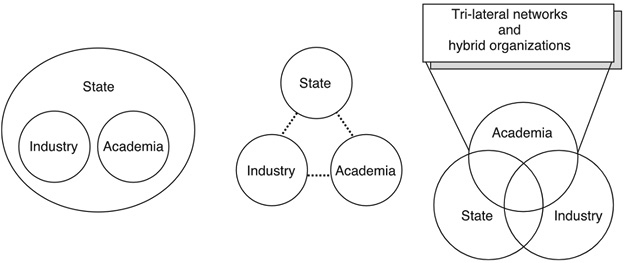
Other experiences present a relationship classified by Etzkowitz (2003) as laissez-faire, where the actors (government, industry, and academia) are seen as independent of each other, and initiating an approximation, albeit timid, with each other. In the Laissez-faire model, the university is seen as a trainer of specialized labor for the industry, which does not have many expectations regarding greater support from the university for its technological challenges. In the Triple Helix model of innovation for social and economic development, the three identified actors (helices) act together, helping to boost each other’s activities and performance, in a win-win relationship. The main thesis of the Triple Helix model is that the university is moving from a secondary role as a workforce trainer and is starting to play an active role in the generation of new ventures (Etzkowitz & Zhou, 2017). Figure 1 below presents the transformation of the statist and laissez-faire models into the Triple Helix model of innovation (Etzkowitz, 2003).

Evolution of the Triple Helix model from the Statist and Laissez-faire models
Citation: Triple Helix 11, 1 (2024) ; 10.1163/21971927-bja10047
Source: Etzkowitz (2003: 302)Etzkowitz (2003) presents that the Triple Helix model was originated from the observation of the transformations that were perceived at the end of the last century with these three institutions. The academy, the State, and the companies began to act beyond their initial attributions to expand the generation of innovation. In this way, it was possible to observe how the academy, for example, became more concerned with the adoption of technologies generated in its research. Thus, the University is no longer just a generator of knowledge and has become an entrepreneurial university, increasing its focus on actions that generate new ventures such as science parks, spin-offs, and incubators. As a result, it is possible to see the emergence of new hybrid organizations that integrate and combine characteristics of different helixes (Champenois & Etzkowitz, 2018).
The Government, in turn, began to act more directly in fostering innovation, generating structures and regulations to favor the generation of innovation and TT. A widely cited example is the publication of the Bayh-dole Act of 1980, by the US government, which regulated TT actions originated in research with public funding, generating greater autonomy and security in the relationship between private companies and universities (da Cruz & de Souza, 2015). On the other hand, companies started to get more involved in R&D partnerships, it is not difficult to observe the movement of large companies investing more and more in startups, research, and innovation centers in conjunction with universities and even with other companies. All this movement evidenced how the coordinated action between the 3 helices enabled the emergence of new arrangements, such as science parks, incubators, and spin-offs, among others (Champenois & Etzkowitz, 2018; Etzkowitz, 2003; Olvera et al., 2021; Pena, 2020).
2.4 Quadruple and Quintuple Helixes
Miller et al. (2018) claim that the Triple Helix model is basically a model that drives innovation, based on knowledge generated in universities (RIs) to generate new technologies, also relying on financial support from the government and financing from the private sector. This model was heavily criticized for not meeting expectations regarding the generation of new jobs, the speed of the creation of new technologies, and even the generation of new sources of wealth. Innovation development cycles are generally long and expensive, given the closed nature of this type of development (Miller et al., 2018). To address the bottlenecks of this model, the quadruple helix model was presented by Carayannis and Campbell (2009). The fourth helix represents the innovations coming from society as a new actor in the process of creating innovation, aligned with co-creation processes and greater cooperation between actors, in line with the wishes of society (Machado et al., 2024; Mietzner & Schultz, 2021). The new model (quadruple helix), brings a greater emphasis on the public’s view of innovation, reflecting their values, culture, art, lifestyles, and so on (da Silva et al., 2022) and the government and political system, addressing the innovation system, needs to be democratic in substance, not only in form (Carayannis & Campbell, 2022).
An evolution of the quadruple helix model was published by Carayannis et al. (2012) to incorporate the environmental dimension into the innovation process. This so-called quintuple helix model comes in the wake of increased concern with environmental preservation and the perception that the environment and economic aspirations must be viewed as drivers in the production of sustainable innovations and aligned with an agenda that places ecology at the center of attention (Carayannis et al., 2012; Carayannis & Campbell, 2022; Pan & Guo, 2022) and also points to the necessary socio-ecological transition of society and the economy in the 21st century (Garcia et al., 2022). This fifth helix model serves as a framework for transdisciplinary and interdisciplinary analysis in the realms of sustainable development and social ecology (Machado et al., 2024).
2.5 TT and the Digital Innovation
The constant changes generated by digital technologies demand new skills from institutions to adapt and remain productive and competitive. The new paradigm for business and technology production, in general, has been Digital Transformation (DT). DT presupposes the generation of value through digital innovation in products, processes, and business models, even generating new business areas (Camillo et al., 2020; Galera-Zarco et al., 2020). Basically, the innovations in business models generated from Digital Transformation have changed consumer expectations and habits, improving the customer experience and operational processes, and generating strong pressure on companies to continue serving an increasingly demanding public (Galera-Zarco et al., 2020; Verhoef et al., 2021).
In general, Digital Transformation goes through 3 phases: (i) Digitization, where analog data are now stored in digital format and new systems are implemented to support the business; (ii) Digitalization, in which new processes are introduced through digital technologies, creating new communication, management, and delivery channels to customers, for example; (iii) and, finally, the Digital Transformation itself, in which the company’s business models are radically changed to make way for new strategies and ways to generate and capture value through digital interaction (Verhoef et al., 2021). The implementation of a successful DT project involves developing the organization’s Digital Capabilities, which consists of combining skills and processes to develop, mobilize, and use the institution’s resources, supported by digital technologies, to meet challenges and generate value for the organization (Costa et al., 2020). Digital Capabilities form an important part of the so-called Dynamic Capabilities, which according to Teece (2018a) are the company’s abilities to integrate, develop, and reconfigure internal and external competencies to respond to rapid changes in the environment.
Digital Transformation has been directly related to the development and intensive use of new digital technologies, but it goes beyond the creation of technological solutions, directly impacting the development of new skills, processes, and models in order to generate the necessary responses to changes in the environment (Galera-Zarco et al., 2020). The time when a new technology by itself was already sufficient to generate and capture value for the institution is gone. There are countless cases of companies that, having really disruptive technologies at their fingertips, were unable to bring these technologies to the market, enabling the adoption and value capture through these technologies (Melo, 2018). Currently, it has been noticed that innovation in the business model associated with a particular product/service has greater potential to generate value than the product/service itself (Gassmann et al., 2020).
Capturing value in the digital economy poses different challenges from those of the industrial economy. Technology licensing, for example, is one of the most used models for capturing value in technology assets, at the same time it is one of the most difficult to implement given its characteristics, even more so in a context where interoperability has been widely used to generate of new business and connect different solutions from different suppliers (Teece, 2018b).
Among the changes in companies’ business models, there is a distinction between business model adaptation and the so-called Business Model Innovation (BMI). While the first can be understood as an improvement in the model, the second is related to a radical change in the model, usually seeking a disruption in the model and areas involved (Saebi et al., 2017). The authors (2017) also point out that adaptation is a response, in general, to threats that the firm faces, and innovation, in turn, occurs both by external factors and is motivated by factors internal to the organization. The concept of business model innovation is the result of three dimensions working together: innovation in value creation, innovation in value proposition, and innovation in value capture (Clauss, 2017).
With the impact generated by the digital revolution, organizations need to prepare themselves for the challenges generated. With new possibilities, the consumer market becomes increasingly demanding, and companies, in order to remain competitive in this scenario, need to be aware of the new forms of relationships, exchanges, and collective construction of value. These impacts will be observed in virtually all areas of knowledge, including influencing the Technology Transfer processes (Bengoa et al., 2021). The rapid development and adoption of new digital technologies have generated huge asymmetries in the domain of these technologies between organizations, sectors, and even between countries. This deficit in digital capabilities has been seen as a driver for the establishment of strategic partnerships to assimilate new skills and resources not available internally (Antonioli et al., 2017; Galera-Zarco et al., 2020; He et al., 2020).
The growing adoption of digital technologies, increasingly complex and specialized, poses another challenge for the effectiveness of Technology Transfer in this context: the lack of specialized personnel to work with cutting-edge technology in topics such as IoT, Artificial Intelligence, Industry 4.0, Digital Agriculture, robotics, 5G and 6G networks, among others (Kovaleski et al., 2022; Verhoef et al., 2021). In the case of Industry 4.0, for example, the study by Adebanjo et al. (2023) presents that, among the different aspects that impact the ability to adopt Industry 4.0 technologies, the existence of qualified human capital is the aspect that most impacts this implementation. Later, in order of relevance, aspects such as interoperability and data use are pointed out, and only then do aspects related to the availability of hardware, systems, security, and infrastructure appear. Knowledge and technologies are developed and generated by people, which makes the human factor essential for innovation management processes (Carayannis & Meissner, 2017), especially in the context of digital production, where human capital should be developed together with technology (Adebanjo et al., 2023).
3 Methodology
This work seeks to identify in the literature, factors that influence the TT process involving digital assets, preferably in the context of public Research Institutes. Taking as a starting point the widely known work of Bozeman (2000), later updated by Bozeman et al. (2015), searches were conducted in the Web of Science and Scopus databases in search of papers that analyzed the Technology Transfer process and consolidated key factors for the process. Scopus and Web of Science were chosen because they are widely recognized by the international scientific community as databases of excellence, covering a wide variety of disciplines and providing comprehensive, multidisciplinary coverage. In addition, both databases are particularly efficient at indexing high-quality literature, as they apply strict selection criteria to the publications in question. This ensures that the sources used in the study of technology transfer are reliable and that the research can benefit from a robust, peer-reviewed database.
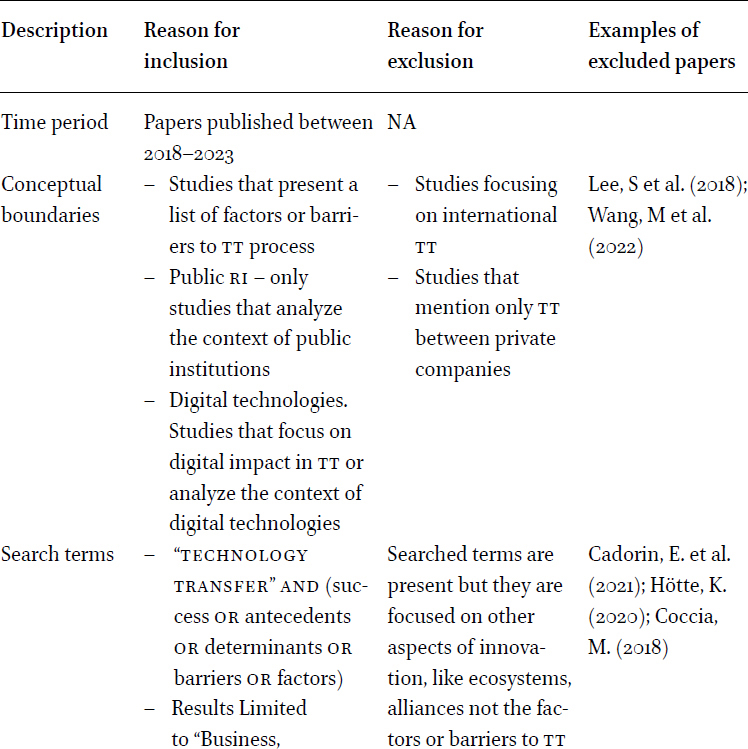
The search in the selected databases was carried out with the following search argument: “TECHNOLOGY TRANSFER” AND (success OR antecedents OR determinants OR barriers OR factors). The search was restricted to the last five years and resulted in more than 190 works. The papers were read, initially from the title, abstract, and keywords, and papers were sought that brought an analysis on the key factors for TT success, the enablers of this process, as well as models that explained a superior performance in partnerships involving mainly public research institutes. After removing articles that dealt with TT exclusively between private organizations, international TT, and other aspects of TT that do not dialogue with the objective of this research, six papers were then selected (Chiș & Crișan, 2020; Ko et al., 2021; Pagani et al., 2020; Pertuz et al., 2021; Ravi & Janodia, 2022; Singhai et al., 2021), in addition to the initially identified paper by Bozeman et al. (2015). Later, a seventh work was identified (C. C. Pusinhol, 2021) and added to this review. Table 1 shows an overview of the criteria used for inclusion and excursion of papers.
Inclusion and exclusion criteria
Citation: Triple Helix 11, 1 (2024) ; 10.1163/21971927-bja10047
Source: Authors of this article (Assunção, Dias and Dechandt)In possession of the selected articles, a new phase began, in which 129 key factors were identified, arising from 7 studies identified in the previous phase. The work by Pagani et al. (2020) was not considered at this stage because it deals with generic aspects of TT. The identified factors are related to aspects of the Research Institute, or transferor, of the technology, of the receiving company, of the political, legal, and environmental environment, among others.
For the next step, the identified factors were arranged in a virtual wall, each factor being placed on a card and, subsequently, the cards were clustered in order to join similar concepts, generating a grouping that synthesizes the idea of the cards in each cluster. The card sorting technique was used in the clustering using the Miro1 collaborative platform, which allows a relatively easy arrangement of cards and their free movement. The card sorting technique may be used with an open or closed approach. In the closed approach, the resulting categories are previously defined, while in the open approach, participants are free to define the categories that group the initial cards (Spencer, 2009).
4 Results and Discussion
From a search in Scopus and Web Of Science databases, 8 recent works were identified that dialogue with the focus of this research:(Bozeman et al., 2015; Chiș & Crișan, 2020; Ko et al., 2021; Pagani et al., 2020; Pertuz et al., 2021; Pusinhol, 2021; Ravi & Janodia, 2022; Singhai et al., 2021). Works were sought that brought an analysis of the key factors for the success of TT, enablers of this process, as well as models that explained a superior performance in partnerships involving mainly public RIs. Among the selected works, there are authors from different countries, highlighting Brazil and India with two works each. Colombia, the United States, South Korea, and Romania had one paper each. Based on the findings, the key factors reported in the selected studies were clustered according to similarity, thus generating a proposal with 4 components divided into 29 factors with the potential to influence the outcome of the TT process for digital assets. Below, in section 4.1, a brief summary of each selected work will be presented, and, in section 4.2, the model resulting from the analysis performed.
4.1 Selected Technology Transfer Models
I – Bozeman et al. (2015) – Contingent Effectiveness Model of TT
The model created by Bozeman in 2000, is called the Contingent Effectiveness Model, in which the author describes a model with 5 key elements for innovation and its characteristics: The transferring Agent, the Receiver, the Transferred Technology, the Transferring Medium, and the Demanding Environment, these 5 elements being connected to an output with criteria to validate the model’s effectiveness (Pena, 2020). That model was later updated in 2015 to include public value as one of the validation criteria (Figure 2). In short, the two models are very similar and seek to highlight who is transferring technology, what is being transferred, how, and to whom (Bozeman et al., 2015).
Structure of the “contingent effectiveness model of technology transfer”
Citation: Triple Helix 11, 1 (2024) ; 10.1163/21971927-bja10047
Source: Bozeman et al. (2015)A striking feature of the model presented by Bozeman et al. (2015) is that in addition to indicating the key factors associated with each component of the model, it also brings potential gains or performance indicators for the TT process, highlighting the public value in the updated model. This model received influences from other models such as the Triple Helix (Etzkowitz & Leydesdorff, 2000), Open Innovation (Chesbrough, 2003), and contributions from the Open Source movement, such as Creative Commons (Bozeman et al., 2015).
II – Pagani et al. (2016, 2020) – Generic Model for Knowledge and Technology Transfer
Based on a systematic review concerning Technology Transfer models reported in the literature, covering papers between 1990 and 2015, Pagani et al. (2016, 2020) identified that each published model reflected the needs of an organization in a given context. This helps to explain the differences in the models found and even some difficulty in transposing these models to different realities. Thus, Pagani et al. (2016) developed a generic model, which can be adapted and applied in different TT contexts.
This model is the result of other studies, including Bozeman (2000) and Bozeman et al. (2015), and, for each component of the model, Pagani et al (2016, 2020) detail how the element is formed. According to the authors (2016) the TT process can be initiated by either the “transferor” or the “transferee”. The “transferor”, which can be represented by the RI, the university, the research center, and researchers, among others, starts the process when it seeks to sell, license, or simply make its own technology available to third parties. The “transferee”, on the other hand, which can be represented by startups, private companies, entrepreneurs, and technology investors, begins the process when it seeks new technologies to acquire and invest in. As for the outputs of this process, the development of new products, new production processes, licenses, patents, agreements, new companies, etc is pointed out (Pagani et al., 2016). The components of this model were not considered for final elaboration of the key factors for the TT process because they represent a generic model for TT and do not list concrete elements that can be evaluated.
III – Chiș & Crișan (2020) – Framework for success factors in TT
Understanding how TT processes can be enhanced and accelerated is a question that intrigues researchers, entrepreneurs, and governments around the world. The work developed by Chiș & Crișan (2020), brings the proposition of a framework that tries to systematize, based on a literature review and from the perspective of the technology transmitter, the main factors that influence the TT process.
The conceptual model presented by the authors (2020) shows that the 5 main categories are: The technology itself, organizational factors, external context factors, factors related to the collaboration between the actors, and factors related to the Absorptive Capacity of customers (or technology recipients). For each of these categories, the factors that would be most related to the success of the TT process were identified. Subsequently, the researchers (2020) performed a field validation in the context of the Graphene4Life project in Romania, and arrived at the following set of key factors:
Technology-related factors: Availability of technology-related resources; Value of technology to customers; Suitability, compatibility, and reliability of the technology; Positions across the entire product value chain.
Organization-related factors: Marketing and advertising culture; Management role and engagement; Tactics and strategy; Economic; Academic entrepreneurship; Patenting and intellectual property factors.
Factors associated with the External Context: Regulatory factors; Environmental, political, social, spatial, and temporal contextual factors; Support from government and other institutions.
Factors associated with Collaboration: Openness to collaboration; Technology Transfer offices; Commercialization capabilities; University-industry links.
Factors associated with the customer’s Absorptive Capacity: Non-technological capabilities of the customer; Technological capabilities of the customer; Previous experience in collaborative projects.
The design presented by Chiș & Crișan (2020) is very close to the final design proposed in this work, being that the elements related to the context were distributed in the other elements.
IV – Pertuz et al. (2021) – Success factors in the University-Industry collaboration process
The work by Pertuz et al. (2021), focused on the University-Industry collaboration process, which is one of the possible paths for TT, where the University (RI) makes the Technology Transfer to Industry and explores the main factors that contribute to the success of these partnerships. In short, the authors (2021) did a scoping review in the Web of Science and Scopus databases, looking precisely for the factors that influence in some way the partnerships between Universities and the Market. Subsequently, the authors (2021) grouped these factors into 4 dimensions: Structure, Strategy, Knowledge, and Relationships. This article emphasizes the importance of communication and coordination among stakeholders as well as the effective sharing of information and knowledge for the successful development of joint projects. Moreover, fostering a culture of mutual trust and respect is essential to build a solid foundation for collaboration. The study by Pertuz et al. (2021) also notes that good governance, clear definitions of roles and responsibilities, and the establishment of dispute-resolution mechanisms are essential to ensure the efficiency and sustainability of partnerships.
The authors (2021) further point out that combining knowledge and skills from different areas leads to more comprehensive and creative solutions. Overall, Pertuz et al. (2021) argue that effective communication, mutual trust, good governance, adequate resources, leadership engagement, supportive public policies, diversity, and continuous evaluation are essential for successful university-business partnerships.
V – Ko et al. (2021) – Factors affecting TT in public research institutes
For Ko et al. (2021) the factors influencing TT may be different depending on the mission of the RI. The authors (2021) found, for example, that for public RIs focused on research related to future growth, the number of human resources involved in research is associated with a higher performance in TT, while this relationship is inversely proportional when analyzing the TT performance compared to total RI budget, number of patents and published papers. In this type of Research Institute, despite the interest in TT on the part of researchers, the budget is prioritized for actions aimed at publishing papers. For RIs whose mission is more closely related to public infrastructure, the number of patents and the size of the team working in the technology licensing office are the factors that contribute most to the increase of TT cases in the RI. Finally, in RIs connected with research on commercial products for small and medium-sized companies, that is, focused on industrialization, the characteristics of this type of product require solutions that are quickly launched on the market, thus performance is associated with a higher number of patents and specialized personnel to bring these solutions to market (Ko et al., 2021).
VI – Singhai et al. (2021) – Conceptual model for successful TT from public RIs for small and medium enterprises
Singhai et al. (2021), based on the experience with TT in India, systematized a model with 18 factors that impact a successful TT process and grouped them into 3 levels: (i) micro, focusing on mechanisms, actors and their role in TT; (ii) meso, focusing on the support institutions, their activities, and roles; and (iii) macro, focusing on TT support policies at different levels, as well as on issues such as effectiveness, measurement, and evaluation of TT. To investigate the main factors influencing TT, the authors (2021) used a structural equation modeling-based approach. Among the main findings, the article indicates that factors such as knowledge absorptive capacity, effective communication, and mutual trust among organizations create an environment conducive to collaboration and sharing of resources and knowledge, facilitating Technology Transfer.
The existence of partnerships between organizations that share common goals and interests increases the chances of TT success. The work of Singhai et al. (2021) also highlights that other factors are relevant to the success of TT processes, such as resource support, including adequate funding and technological infrastructure, the regulatory and legal context, and the ability to protect intellectual property rights.
VII – Pusinhol (2021) – Effectiveness Factors to the process of technology licensing
The research conducted by Pusinhol (2021), brings the result of a systematic literature review on the effectiveness factors for the technology licensing process based on public RIs. After identifying these factors, the author (2021) conducted a survey with representatives of companies that entered into licensing contracts with a Brazilian public RI in order to find out if these factors mentioned in the literature effectively had an impact on the licensing process according to the view of these representatives. As a result, of the 38 factors reported in the literature, only 24 had a level of agreement greater than 75%, and were therefore considered in the model.
Pusinhol’s work (2021), also evaluated the potential barriers to the licensing process. Likewise, the main barriers to the process were raised in the literature, and 15 factors were identified. When these factors were submitted to the representatives of the licensed companies, only 3 obtained a level greater than 75% of agreement between the respondents and were, therefore, considered in the model presented by the author (2021).
VIII – Ravi and Janodia (2022) – Main barriers in the process of TT between university and industry
Ravi and Janodia (2022) indicate that the main barriers in the TT process between university and industry, in the view of faculty members from 25 Indian universities are: (1) lack of adequate resources and infrastructure; (2) lack of creativity and critical thinking in curricula; (3) overemphasis on publications due to lack of knowledge about patenting, publishing, and commercialization of research; (4) Intellectual Property offices or similar offices serve only to meet statutory requirements; (5) lack of qualified people to manage Intellectual Property/TT activities; and (6) conflict between academic and commercially viable research.
4.2 Synthesis of Models
The models studied make a significant contribution to the field of Technology Transfer and focus on essential elements for TT. The components of the model proposed by Bozeman (2000) do not necessarily indicate key factors for the success of the TT process, especially those involving digital technologies, but they do point to some essential elements in the process. For example, the need for human capital in science and technology, as corroborated by Adebanjo et al. (2023) and Carayannis and Meissner (2017). The work developed by Chiș & Crișan(2020) organizes the knowledge deposited in the literature of the area according to 5 categories: the technology itself, organizational factors, external context factors, factors related to collaboration between the actors, and factors related to the absorptive capacity of customers. This model by the authors (2020) has a great deal of influence on the final result of this work by grouping the key factors into components that are very much in line with what is proposed here. The critical success factors, as well as the barriers to the TT process impact on different actors and phases of Technology Transfer, and can be grouped in different ways, such as at the micro, meso, and macro levels, according to (Singhai et al., 2021), in axes of action such as Structure, Strategy, Knowledge and Relationships (Pertuz et al., 2021) and even according to the actor/component of the model, as in (Ko et al., 2021) and (Bozeman et al., 2015).
Despite the depth that each study brings to the field, these studies do not focus on the scope designed in this research, which is to shed light on the key factors that have to do with TT, especially for digital technologies which are developed by public research centers. In this way, we hope to contribute to advancing the understanding of the challenges for TT in the context of growing digitalization.
For purposes of organization and better understanding, the factors identified in the literature were grouped according to their connection with the actors and components of the TT process. The generated groupings reflect part of the studies found when reproducing the components partially found in Bozeman et al. (2015) and Ko et al. (2021) among others, and will be distributed as follows:
Characteristics of Research Institute – Set of factors that derive from or are related to the attributes of the institution that makes and transfers the developed technology. In this grouping are items such as a dedicated TT team, TT strategies, and internal RI policies.
Characteristics of the Partner Company – Set of factors related to the Company that receives the transferred technology. In this group are items such as absorptive capacity, available resources, and previous experience in TT projects;
Technology Characteristics – Set of factors related to the innovation Asset, the object of the TT. In this grouping are items such as technology maturity level, degree of complexity, degree of innovativeness, impact capacity, ROI, etc.
Partnership Characteristics – Set of factors related to the cooperation process itself. This grouping includes items such as frequent communication between members of the RI and the partner company and clear contractual definitions.
Based on this work, a conceptual model of the Technology Transfer process with digital assets was elaborated, and a representation of this model is presented in Figure 3, below, according to which a Research Institute, through a partnership, transfers technology to a partner company.
Proposed conceptual model of the TT process involving digital assets
Citation: Triple Helix 11, 1 (2024) ; 10.1163/21971927-bja10047
Source: Authors of this article (Assunção, Dias and Dechandt)Based on the models found in the literature, the results of 7 studies were analyzed (Bozeman et al., 2015; Chiș & Crișan, 2020; Ko et al., 2021; Pertuz et al., 2021; Pusinhol, 2021; Ravi & Janodia, 2022; Singhai et al., 2021), which identify key factors for the successful TT process in different contexts. Each work analyzed, by itself, is already a review of key factors for the TT process and, therefore, compiles a large part of what has been recently published on the topic. The factors listed by each author listed above were arranged in an open frame in order to be clustered according to the similarity of their concept or the context in which the author related them. As a basis for this clustering, the categories reported above were pre-defined (Research Institute, Partner Company, Technology, and Partnership).
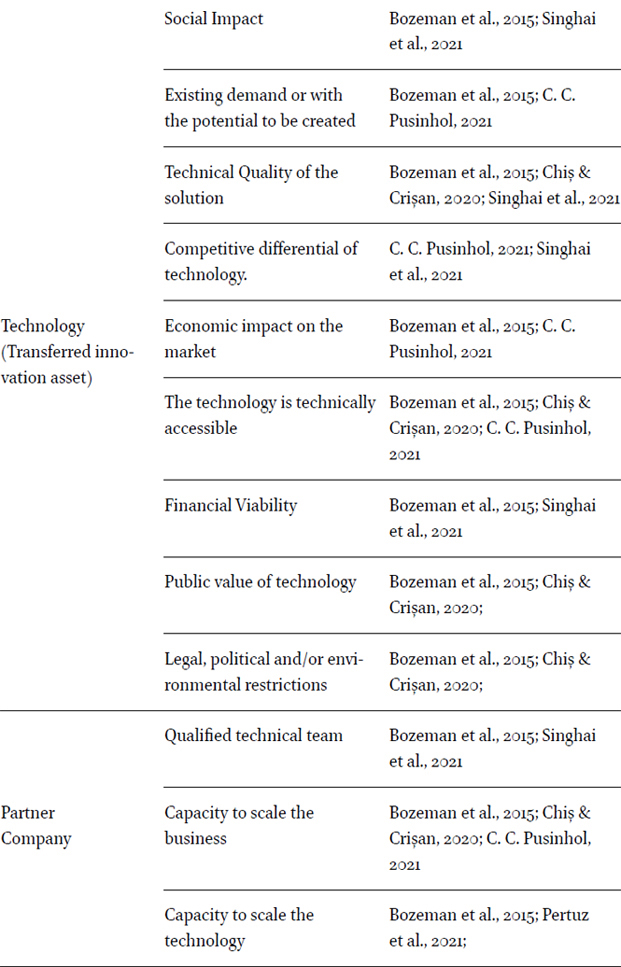
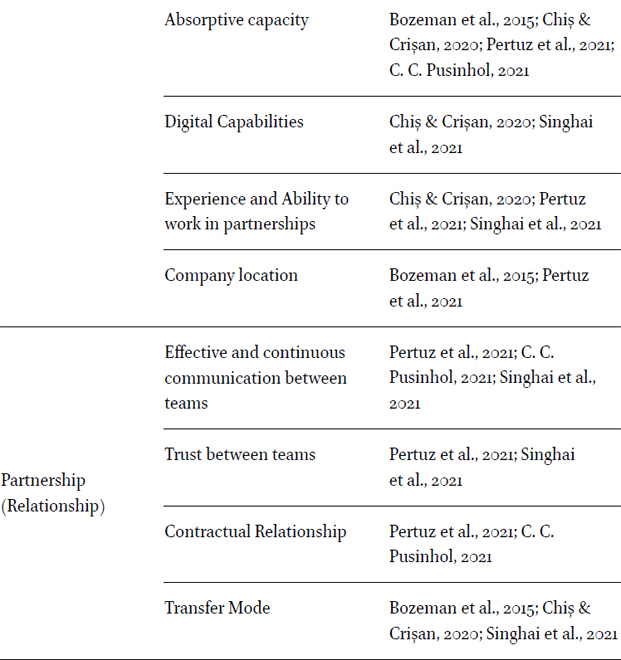
Proposed key factors for the TT process involving digital assets
Citation: Triple Helix 11, 1 (2024) ; 10.1163/21971927-bja10047
Source: Authors of this article (Assunção, Dias and Dechandt)As a result of the application of the clustering technique to the 129 factors arising from the seven selected studies, 29 factors were identified that can affect the successful TT process involving digital assets. It is necessary to emphasize that the clustering performed seeks to reflect the findings in the literature, but in certain cases, a factor can be grouped into a cluster whose label does not exhaust the semantic possibilities of its components, but only captures the central idea of the elements that compose it. As this is a craft work, the result of this clustering takes into account the skill and knowledge of the researcher who conducted the activity, and, therefore, it is possible that from the same initial set of items, the result of the clustering is slightly different. Table 2 presents the 29 factors identified in this stage.
Each factor reproduced in the model proposed here is a grouping of the factors reported in the selected studies and a brief detail will be presented below:
Research Institute-related factors:
Engagement between TT and R&D teams. In some organizations, when the relationship between the TT and R&D teams is not close, the TT processes take longer to be carried out, as knowledge does not flow from the research team to the partner’s team. The lack of participation of the inventor researchers in the formulation of the final product is often pointed out as an obstacle to the process.
Motivated and open team for collaborative processes. This factor refers to the existence of processes aimed at reducing informational and cultural barriers with partners, as well as increasing mutual trust, open dialogue, and collaborative attitude (Chiș & Crișan, 2020). Collaboration enhances knowledge flow and for this reason, innovative environments are often reported as collaborative. The management of activities related to collaboration as well as the motivation of the team for these processes is critical for TT success (Pertuz et al., 2021).
Availability of Infrastructure and adequate resources. The existence of financial resources and infrastructure is considered essential for the development of technologies and for the respective TT process. The lack of these resources compromises the scope and speed with which technologies can reach the market.
Qualified and dimensioned TT team. The execution of a successful TT process depends in a special way on the capabilities of the team that deals directly with TT. The existence of a dedicated and trained team in the different aspects of TT is crucial for the flow of TT processes since it is this team that will establish contracts, prospect new partnerships, and be the bridge between research teams and partner institutions.
Communication actions for TT: the structuring of regular marketing actions as well as the development of an internal culture aimed at communicating TT actions extends the reach of the organization’s technologies, especially in the context of the digital economy where the emergence of new technologies and in ever shorter times, can generate difficulties for partners to identify a good opportunity among so many offers on the market.
Qualified R&D team. Technological production is ultimately done by people, so the capacity of the R&D team is a differential and key factor for the development of new technologies. In the context of digital innovation, this investment becomes more relevant because, given the speed with which new technologies emerge, the lack of adequate personnel to work with these technologies can become a difficult bottleneck to overcome. Open innovation has been widely used in this context to bring new skills to teams and, among the advantages of establishing partnerships, the improvement of human capital in Science and Technology is certainly one of the most valued.
Well-defined IP Policy. The exploitation of the generated technologies depends on the correct protection of its Intellectual Property. Thus, the existence of a well-defined policy can avoid problems in the establishment of partnerships for the exploitation of technologies. Another point identified is that there is a certain conflict between the generation of papers and the generation of patents. Organizations that place greater value on the production of papers are generally less effective in transferring technologies. The IP policy must be well-defined and disseminated by the organization.
Relationship with the ecosystem. The (good) relationship with other actors in the ecosystem facilitates the establishment of partnerships. Thus, the organization should seek greater contact with startups in the sector, government agents, universities, and research centers as a way to generate connections that can later become partnerships.
Top management support for TT actions. Technology transfer should be understood by top management as being strategic to the organization. Institutions that have TT as part of their mission and have active policies in this regard, in general, have greater chances of success in TT processes.
Technology-related factors (transferred innovation assets):
Social Impact. There is an increasing search for technologies that bring benefits beyond the economic factor and have the potential to contribute to social development. The advancement provided by new technologies must be sustainable and generate improvements in several indicators such as the socioeconomic ones (Singhai et al., 2021).
Existing demand or with the potential to be created. One of the key factors for adopting any technology is the existence of an identified or potential demand for that technology. Sometimes, the organization has the ability to induce demand by specific marketing actions or by launching other products that demand the technology in question.
Technical Quality of the solution. The perception that potential customers have about the quality of the technology offered is fundamental for the adoption of this technology. Thus, the organization must strive for technical quality, whether visual or material, performance, timeliness, usability, and generating accurate and reliable information. In the case of mobile applications, for example, the interface must be actual, the response time must be adequate, the functionalities must be complete for what is proposed, and the process of acquisition, updating, and operation of the technology must be at least at the same level of similar market solutions.
Competitive differential of the technology. This factor concerns the increase that this solution offers in relation to other solutions that may exist in the market for the same problem. Technology has to offer something that differentiates it from others. The greater the competitive differential, the greater the chances of adoption, especially in digital technologies, which are launched in less time and with more resources than the previous generation.
Economic impact on the market. One of the main motivators for the production and adoption of new technologies is the possibility of economic exploitation of the intellectual property assets associated with the technology. The economic value capture of disruptive technology has the potential to generate significant movements, generate new business areas, and impact the status quo of a given sector. The development of digital technologies is even more sensitive to this factor because some really impactful and scalable solutions do not necessarily demand large structures to be generated.
The technology is technically accessible. This factor is especially important when you have technologies that require specific infrastructure or the development of an entire supply chain to be disseminated. Sometimes the technology is technically very good, but it depends on other technologies or preconditions that are not yet well solved at the market level. Chiș & Crișan (2020) indicate that all technology-related components must be supplied such as materials, intermediate products, equipment, and the final product.
Financial viability. This factor is simple to understand but sometimes neglected. Is the investment generated in the technology, in the generation of the partnership, in the finalization, in the scaling, and in the go-to-market phase, is viable in face of the capture of value that is intended with this technology? Does the potential financial value to be captured with this technology support the costs throughout its development and delivery cycle?
Public value of technology. There has been a growing interest in the public value generated by technologies, especially those originating from public RIs. Among the success criteria of a technology is whether it contributes to achieving the goals for which the institution was created. For example, a public agricultural research company, in theory, should produce technologies aligned with the objectives of that company, such as increased productivity, greater food security, lower costs for producers, etc.
Legal, political and/or environmental restrictions. These restrictions must be closely observed and are sector-specific. In the context of digital technologies, attention is growing on the use of data, privacy, possible types of processing, etc., giving the data subject more autonomy, but increasing the transaction costs involved.
Factors related to the Partner company:
Qualified technical team. The technical capacity of the technology receiver’s team. Human capital in Science and Technology involves not only formal knowledge but also tacit knowledge, know-how, previous experiences in the field of application of the transferred technology, etc. (Bozeman, 2000; Singhai et al., 2021).
Capacity to scale the business. This factor brings together the characteristics of the receiving company in being able to commercially meet the potential demand for the technology to be commercialized (Chiș & Crișan, 2020). Does the company have enough experience and robustness to perform the necessary marketing actions to place the technology on the market at the right time and under the right conditions? If necessary, does it have the capacity to enter new markets?
Capacity to scale the technology. This item concerns the technical, manufacturing, and production capabilities to scale the technology in order to supply the expected market share. It involves the availability of resources, the size of the production line, and previous experience in similar processes (Bozeman et al., 2015; Pertuz et al., 2021).
Absorptive capacity. It is related to the capacity of the receiving company to internalize the processes required to absorb the transferred technology. It involves the existence of knowledge-sharing processes and the customers’ non-technological capabilities such as culture, motivation, and communication (Bozeman et al., 2015; Chiș & Crișan, 2020; Pusinhol, 2021).
Digital capabilities. A combination of digital business processes and skills to mobilize the appropriate technological resources for the partnership to perform well. It also involves business agility, trained personnel, and infrastructure, connection with the ecosystem, and digitization of processes. In general, private partners have more flexibility to provide these resources than public organizations (Camillo et al., 2020; Chiș & Crișan, 2020).
Experience and ability to work in partnerships. The fact that a company has already carried out at least one TT process makes some internal processes known and facilitates the establishment of new partnerships. The TT processes tend to be more fluid when the company has a culture open to sharing, the partnership is stronger. Another key point in this factor is the ability to share resources and costs involved in the process (Pertuz et al., 2021; Singhai et al., 2021).
Company location. Proximity to areas with high business density and/or being located near innovation ecosystems such as science parks and innovation districts facilitate the connection with companies and the emergence of partnerships. Organizational proximity is taken as a preponderant factor in choosing business partners (Pertuz et al., 2021).
Factors related to Partnership (Relationship):
Effective and continuous communication between teams. Effective communication between the teams involved in the partnership is fundamental for its success. Communication channels must be established and partner companies must maintain contact with researchers to transfer not only technology and formal knowledge associated with it but also tacit knowledge. Contact with the research team avoids potential technical barriers in the TT process (Pertuz et al., 2021; Pusinhol, 2021).
Trust between teams. It is crucial for the success of TT that teams trust each other so that the transfer of technology and associated knowledge is complete. For this, it is necessary to seek the establishment of common goals, shared vision, respect for deadlines, and establish processes that allow the increase of trust within the partnering relationship (Pertuz et al., 2021; Singhai et al., 2021).
Contractual relationship. To avoid problems throughout the process and TT, it is important to establish and share the rules that will govern the partnership relationship. Establishing clear governance mechanisms is a good predictor of the reduction of noise in the relationship (Pertuz et al., 2021).
Transfer mode. The choice of the most appropriate TT model for each technology should be aligned with the organization’s strategy and with the intended value capture. The most usual modalities are licensing, generating Spin-Offs, publishing papers, demonstrating technologies, exchanging researchers, and research agreements, and even making them freely available. There is a certain pressure for the technologies generated by public RIs to be made available for free, but the generation of new businesses, even if monetized, does not distance the institution from its original mission. Thus, more and more, it has been observed for example, the emergence of movements such as the entrepreneurial university, which not only produces knowledge and trains personnel but also generates new business opportunities (Bozeman et al., 2015; Etzkowitz & Zhou, 2017; Singhai et al., 2021).
5 Concluding Remarks
Creativity, technological production, and, ultimately, innovation have been widely recognized as strong drivers of economic and social development, both for companies and countries. The search for ways to boost innovation has manifested itself in several ways, including through the growing interest of academia in topics such as innovation, creativity, Technology Transfer, etc. The number of studies on TT has grown considerably in the last two decades. Even so, the topics covered do not exhaust the different compositions and arrangements that can benefit from TT.
This study addresses recent research that has focused on the factors that influence TT and seeks to condense the different studies into a conceptual model for TT. We identified 29 factors that potentially affect the TT process, especially for digital assets. Among the listed factors, some stand out in the context of digital technologies and public RIs, such as the availability of adequate infrastructure and resources, which was pointed out by all selected papers as being crucial for the TT process. In some cases, digital technologies require investment in new equipment and training of the R&D team, and in emerging economies, it is not uncommon for public RIs to face budget difficulties to meet these demands.
When observing the factors related to technology, several of them draw attention, such as the technical quality of the solution, the competitive differential, and its social and economic impacts. The need to previously identify the demand for technology is another preponderant factor for the adoption of the technology, as well as the existence of the entire supply chain required for the complete adoption of the technology. In the case of the partner company, its absorptive, digital, and scalability capabilities that the company has stand out, without leaving aside previous experience in TT projects. In the relationship itself, the factors that stand out are, in addition to the selected transfer modality, the establishment of a transparent contractual relationship, as well as the generation of trust, and an effective flow of communication between the parties involved.
5.1 Managerial Implications
As a social/managerial contribution, the identified factors help all actors in the TT process to focus their efforts on strengthening actions that are identified as crucial to the success of the TT. Thus, managers, analysts, researchers, and entrepreneurs can, from the beginning of the partnership, pay attention to aspects of the Research Institute, the technology, the partner company, and the relationship that are identified as critical to the success of the TT process, prioritizing the choices that allow a higher level of return and security, enhancing the adoption of transferred technologies.
This study aims to contribute to a better understanding of the dynamics of TT, in order to help Public Research Institutes in conducting the TT processes, considering the eventual specificities that are inherent to this process when the object of the transference is a digital solution. Thus, it is expected to contribute to the improvement of the success rate in the TT processes, increasing the adoption of technologies produced by Public RIs and eventually expanding the revenues earned through these technologies.
5.2 Theoretical Implications
Although all the selected studies make significant contributions to understanding the field under study, this study has highlighted the growing and recent digitization in the context of digital technologies developed by public research centers. This approach offers a more precise look at the factors related to these digital technologies in the TT process. When looking at factors related to the partner, for example, in the context of digital technologies, proximity to the research center, although desirable, is not seen as a factor as relevant as the partner’s digital capabilities. This is because, given the nature of digital technologies, many exchanges are carried out by digital means and direct contact with the research center is not essential. On the other hand, the partner’s ability to receive the transferred technologies, their processes, and related knowledge and internalize it in their team in order to assimilate the transferred technology, is fundamental to the success of the TT process. This shows that different types of technology (genetic, digital, biological, health, etc.) can have their own nuances and these nuances must be observed throughout the TT process in order to achieve a greater degree of success.
5.3 Limitations
The TT process is known to be complex and the present study did not intend to exhaust the multitude of factors that may influence the TT processes for digital assets, but only to identify the main ones from the recent literature, based on works that are widely cited or with relative analysis density. Thus, it is quite possible that other works, with equal scientific rigor, have been left out of this analysis.
As the focus of this study, only papers related to public research institutes and papers in the context of digital technologies were selected for this study. So, it is possible that these criteria introduce some kind of bias in the sample, and factors that can influence other kinds of assets can be not identified in this study.
The 129 factors related in the literature and that were clustered in the 29 factors in the proposed model, were named based on the experience of the authors, and different scholars could name some of these clusters (factors) in a different way, but we tried to keep some level of coherence when doing this activity.
5.4 Future Agenda
Overall, technological innovation is a critical factor in the progress and development of society. It enables individuals and organizations to develop new and innovative solutions to complex challenges, creating new opportunities and driving economic growth. As technology continues to evolve and society becomes increasingly interconnected, the importance of innovation, and therefore Technology Transfer, will continue to grow. Thus, the deepening of knowledge on how these processes develop and how to foster them shall be the focus of further research over the next few years. As a suggestion for future research, the application of the proposed model in one or more public Research Institutes that work on the production of digital assets may help validate and prioritize these factors.
This study focuses on the context of digital technologies and related to public institutes, so a wider focus on other kinds of contexts can offer new opportunities to understand more deeply the factors that influence the process of Technology Transfer.
Acknowledgements
This research was supported by FAPDF (Federal District Research Support Foundation) and National Council for Scientific and Technological Development (CNPq) project 305544/2021-7.
References
Adebanjo, D., Laosirihongthong, T., Samaranayake, P., & Teh, P.-L. (2023). Key enablers of industry 4.0 development at firm level: Findings from an emerging economy. IEEE Transactions on Engineering Management, 70(2), 400–416. https://doi.org/10.1109/TEM.2020.3046764.
Alhosani, A. A., & Ahmad, S. Z. (2024). Charting creativity in government: The relationship between transformational leadership, psychological empowerment and employee creative performance. Transforming Government: People, Process and Policy, 18(1), 33–48. https://doi.org/10.1108/TG-10-2023-0160.
Amabile, T. M. (1988). A model of creativity and innovation in organizations. Research in Organizational Behavior, 10(1), 123–167. https://web.mit.edu/curhan/www/docs/Articles/15341_Readings/Group_Performance/Amabile_A_Model_of_CreativityOrg.Beh_v10_pp123-167.pdf.
Amini Sedeh, A., Pezeshkan, A., & Caiazza, R. (2022). Innovative entrepreneurship in emerging and developing economies: The effects of entrepreneurial competencies and institutional voids. The Journal of Technology Transfer, 47(4), 1198–1223. https://doi.org/10.1007/s10961-021-09874-1.
Anderson, N., Potočnik, K., & Zhou, J. (2014). Innovation and creativity in organizations: A state-of-the-science review, prospective commentary, and guiding framework. Journal of Management, 40(5), 1297–1333. https://doi.org/10.1177/0149206314527128.
Antonioli, D., Marzucchi, A., & Savona, M. (2017). Pain shared, pain halved? Cooperation as a coping strategy for innovation barriers. The Journal of Technology Transfer, 42(4), 841–864. https://doi.org/10.1007/s10961-016-9545-9.
Autio, E., Nambisan, S., Thomas, L. D. W., & Wright, M. (2018). Digital affordances, spatial affordances, and the genesis of entrepreneurial ecosystems. Strategic Entrepreneurship Journal, 12(1), 72–95. https://doi.org/10.1002/sej.1266.
Bengoa, A., Maseda, A., Iturralde, T., & Aparicio, G. (2021). A bibliometric review of the Technology Transfer literature. The Journal of Technology Transfer, 46(5), 1514–1550. https://doi.org/10.1007/s10961-019-09774-5.
Bozeman, B. (2000). Technology Transfer and public policy: A review of research and theory. Research Policy, 29(4), 627–655. https://doi.org/10.1016/S0048-7333(99)00093-091.
Bozeman, B., Rimes, H., & Youtie, J. (2015). The evolving state-of-the-art in Technology Transfer research: Revisiting the contingent effectiveness model. Research Policy, 44(1), 34–49. https://doi.org/10.1016/j.respol.2014.06.008.
Burchardt, C., & Maisch, B. (2019). Digitalization needs a cultural change: Examples of applying agility and open innovation to drive the digital transformation. Procedia CIRP, 84, 112–117. https://doi.org/10.1016/j.procir.2019.05.009.
Camillo, G. M., de Vasconcellos, S. L., & Amal, M. (2020). Capacidades Digitais: Uma Revisão Bibliométrica. Future Studies Research Journal: Trends and Strategies, 12(3), 483–510. https://doi.org/10.24023/FutureJournal/2175-5825/2020.v12i3.551.
Carayannis, E. G., Barth, T. D., & Campbell, D. F. J. (2012). The Quintuple Helix innovation model: global warming as a challenge and driver for innovation. Journal of Innovation and Entrepreneurship, 1(1), 1–12. https://doi.org/10.1186/2192-5372-5371-2.
Carayannis, E. G., & Campbell, D. F. J. (2009). “Mode 3” and “Quadruple Helix”: toward a 21st century fractal innovation ecosystem. International Journal of Technology Management = Journal International de La Gestion Technologique, 46(3/4), 201. https://doi.org/10.1504/ijtm.2009.023374.
Carayannis, E. G., & Campbell, D. F. J. (2022). Helix trilogy: The triple, quadruple, and quintuple innovation helices from a theory, policy, and practice set of perspectives. Journal of the Knowledge. https://link.springer.com/article/10.1007/s13132-021-00813-x.
Carayannis, E. G., & Meissner, D. (2017). Glocal targeted open innovation: challenges, opportunities and implications for theory, policy and practice. The Journal of Technology Transfer, 42(2), 236–252. https://doi.org/10.1007/s10961-016-9497-0.
Champenois, C., & Etzkowitz, H. (2018). From boundary line to boundary space: The creation of hybrid organizations as a Triple Helix micro-foundation. Technovation, 76–77, 28–39. https://doi.org/10.1016/j.technovation.2017.11.002.
Chen, K., Zhang, C., Feng, Z., Zhang, Y., & Ning, L. (2022). Technology Transfer systems and modes of national research institutes: Evidence from the Chinese academy of sciences. Research Policy, 51(3), 104471. https://doi.org/10.1016/j.respol.2021.104471.
Chesbrough, H. W. (2003). The era of open innovation. MIT Sloan Management Review, 44(3), 34–41. https://books.google.com/books?hl=en&lr=&id=SDNJzAjyocQC&oi=fnd&pg=PA127&dq=The+era+of+open+innovation&ots=VfURIHAjGR&sig=y5fYd9YaSKhSOUNK0J1UWmfuYzU.
Chiș, D.-M., & Crișan, E. L. (2020). A framework for Technology Transfer success factors: Validation for the Graphene4Life project. Journal of Science and Technology Policy Management, 11(2), 217–245. https://doi.org/10.1108/JSTPM-06-2019-0066.
Clauss, T. (2017). Measuring business model innovation: conceptualization, scale development, and proof of performance. R&D Management, 47(3), 385–403. https://doi.org/10.1111/radm.12186.
Costa, G. M., Freitas Junior, J. C. da S., & Brinkhues, R. A. (2020). Um ensaio sobre framework para transformação digital. XLIV ENCONTRO DA ANPAD – EnANPAD 2020., Evento on-line. http://www.anpad.org.br/abrir_pdf.php?e=Mjc3OTE=.
Csikszentmihalyi, M. (1999). Implications of a systems perspective for the study of creativity. In R. J. Sternberg (ed.), Handbook of Creativity (Vol. 490, pp. 313–335). Cambridge University Press, ix. https://psycnet.apa.org/fulltext/1998-08125-08016.pdf.
Csikszentmihalyi, M. (2014). Society, culture, and person: A systems view of creativity. In M. Csikszentmihalyi (Ed.), The Systems Model of Creativity: The Collected Works of Mihaly Csikszentmihalyi (pp. 47–61). Springer Netherlands. https://doi.org/10.1007/978-94-017-9085-9087_4.
da Cruz, H. N., & de Souza, R. F. (2015). Sistema Nacional de Inovação e a lei da inovação: Análise comparativa entre o Bayh-dole Act e a lei da inovação tecnológica. I. Review of Administration and Innovation, RAI, 11(4), 329. https://doi.org/10.11606/rai.v11i4.110254.
da Silva, V. L., Kovaleski, J. L., & Pagani, R. N. (2022). Fundamental elements in Technology Transfer: An in-depth analysis. Technology Analysis & Strategic Management, 34(2), 223–244. https://doi.org/10.1080/09537325.2021.1894328.
de Carvalho, F. Z., Bersani, V. T., Maldaner, L. F., & Piqué, J. M. (2020). Institutions that foster innovative entrepreneurship in brazil: mapping and connections. Revista Prâksis, 2, 245–269. https://doi.org/10.25112/rpr.v1i0.1961.
Dias, C. N., Hoffmann, V. E., & Martínez-Fernández, M. T. (2019). Resource complementarities in R&D network for innovation performance: Evidence from the agricultural sector in Brazil and Spain. International Food and Agribusiness Management Review, 22(2), 193–213. https://doi.org/10.22434/IFAMR2018.0023.
Dias, C. N., Hoffmann, V. E., & Martínez-Fernández, M. T. (2021). Condiciones de las redes interorganizativas para la innovación en áreas rurales. Economía Agraria Y Recursos Naturales, 21(1), 135–163. https://dialnet.unirioja.es/servlet/articulo?codigo=7971730.
Etzkowitz, H. (2003). Innovation in innovation: The Triple Helix of university-industry-government relations. Social Sciences Information. Information Sur Les Sciences Sociales, 42(3), 293–337. https://doi.org/10.1177/05390184030423002.
Etzkowitz, H., Dzisah, J., Albats, E., & Cai, Y. (2023). Entrepreneurship and innovation in the Triple Helix: The perspicacity of intermediate ties. Industry and Higher. https://journals.sagepub.com/doi/abs/10.1177/09504222221151122.
Etzkowitz, H., & Leydesdorff, L. (2000). The dynamics of innovation: From National Systems and “Mode 2” to a Triple Helix of university – industry – government relations. Research Policy. https://www.sciencedirect.com/science/article/pii/S0048733399000554.
Etzkowitz, H., & Zhou, C. (2017). Hélice Tríplice: inovação e empreendedorismo universidade-indústria-governo. Estudos Avançados, 31(90), 23–48. https://doi.org/10.1590/s0103–40142017.3190003.
Fleischer, J., & Wanckel, C. (2023). Creativity in policy capacity: Organizational and individual determinants. Public Administration Review. https://doi.org/10.1111/puar.13676.
Galera-Zarco, C., Opazo-Basáez, M., Marić, J., & García-Feijoo, M. (2020). Digitalization and the inception of concentric strategic alliances: A case study in the retailing sector. Strategic Change, 29(2), 165–177. https://doi.org/10.1002/jsc.2319.
Garcia, J. C., Carayannis, E. G., & Barth, T. D. (2022). O Modelo de Inovação da Hélice Quíntupla: O aquecimento global como desafio e motor da inovação. The Comparative and International Law Journal of Southern Africa = Tydskrif Vir Regsvergelyking En Internasionale Reg van Suidelik Afrika = Jornal de Direito Comparativo E Internacional Para Os Paises Do Sul Da Africa = Journal de Droit … https://periodicos.univel.br/ojs/index.php/redir/article/view/178.
Gassmann, O., Frankenberger, K., & Choudury, M. (2020). The Business Model Navigator: The Strategies Behind the Most Successful Companies. https://www.alexandria.unisg.ch/260927/.
Ghobril, A. N., Marcondes, R. C., & Benedetti, M. (2017). Inovação por meio da integração entre corporações, ICTs e startups. Fórum Liberdade Econômica, Centro de Liberdade Econômica, Mackenzie. https://liberdadeeconomica.mackenzie.br/fileadmin/OLD/62/ARQUIVOS/PUBLIC/user_upload/artigo_forum_liberdade_economica_mauricio_30_10.pdf.
Harrigan, K. R., Di Guardo, M. C., & Cowgill, B. (2017). Multiplicative-innovation synergies: tests in technological acquisitions. The Journal of Technology Transfer, 42(5), 1212–1233. https://doi.org/10.1007/s10961-016-9514-3.
He, Q., Meadows, M., Angwin, D., Gomes, E., & Child, J. (2020). Strategic alliance research in the era of digital transformation: Perspectives on future research. British Journal of Management, 31(3), 589–617.
Houtgraaf, G., Kruyen, P. M., & van Thiel, S. (2023). Public sector creativity as the origin of public sector innovation: A taxonomy and future research agenda. Public Administration, 101(2), 539–556. https://doi.org/10.1111/padm.12778.
Kogut, B., & Zander, U. (1992). Knowledge of the Firm, Combinative Capabilities, and the Replication of Technology. Organization Science, 3(3), 383–397. https://doi.org/10.1287/orsc.3.3.383
Koh, D., Lee, K., & Joshi, K. (2019). Transformational leadership and creativity: A meta‐ analytic review and identification of an integrated model. Journal of Organizational Behavior, 40(6), 625–650. https://doi.org/10.1002/job.2355.
Ko, S., Kim, W., & Lee, K. (2021). Exploring the factors affecting Technology Transfer in government-funded research institutes: The Korean case. Journal of Open Innovation Technology Market and Complexity, 7(4), 228. https://doi.org/10.3390/joitmc7040228.
Kovaleski, F., Picinin, C. T., & Kovaleski, J. L. (2022). The challenges of Technology Transfer in the industry 4.0 era regarding anthropotechnological aspects: A systematic review. Sage Open, 12(3). https://doi.org/10.1177/21582440221111104.
Kuzior, A., Samoilikova, A., Kossek, W., Krišková, P., & Vasylieva, T. (2024). Is digital development a factor of university-industry R&D collaboration and vice versa. Production Engineering Archives, 30(2), 204–213. https://doi.org/10.30657/pea.2024.30.19.
Machado, H. P. V., Sartori, R., & Rosa, P. F. M. (2024). Beyond the Triple Helix model: Scientific production on the quadruple and quintuple helix. Journal of the Knowledge Economy. https://doi.org/10.1007/s13132-024-02026-4.
Massruhá, S. M. F. S., Leite, M. A. de A., Oliveira, S. R. de M., Meira, C. A. A., Luchiari Junior, A., & Bolfe, E. L. (2020). Agricultura digital: pesquisa, desenvolvimento e inovação nas cadeias produtivas. Embrapa Agricultura Digital-Livro Científico (ALICE). https://www.alice.cnptia.embrapa.br/handle/doc/1126213.
Melo, H. da S. S. (2018). Estudo de caso da transformação digital do modelo de negócios de um Banco público de abrangência nacional [MSC]. Fundação Getúlio Vargas.
Mietzner, D., & Schultz, C. (2021). New Perspectives in Technology Transfer: Theories, Concepts, and Practices in an Age of Complexity. Springer Nature. https://play.google.com/store/books/details?id=32caEAAAQBAJ.
Miller, K., McAdam, R., & McAdam, M. (2018). A systematic literature review of university Technology Transfer from a quadruple helix perspective: Toward a research agenda. R&D Management, 48(1, SI), 7–24. https://doi.org/10.1111/radm.12228.
Min, J.-W., Kim, Y., & Vonortas, N. S. (2020). Public Technology Transfer, commercialization and business growth. European Economic Review, 124, 103407. https://doi.org/10.1016/j.euroecorev.2020.103407.
Olvera, C., Piqué, J. M., Cortés, U., & Nemirovsky, M. (2021). Evaluating university- business collaboration at Science Parks: Abusiness perspective. Triple Helix, 8(3), 445–485. https://doi.org/10.1163/21971927-bja10007.
Pagani, R. N., Ramond, B., Da Silva, V. L., Zammar, G., & Kovaleski, J. L. (2020). Key factors in university-to-university knowledge and Technology Transfer on international student mobility. Knowledge Management Research and Practice, 18(4), 405–423. https://doi.org/10.1080/14778238.2019.1678415.
Pagani, R. N., Zammar, G., Kovaleski, J. L., & Resende, L. M. (2016). Technology Transfer models: Typology and a generic model. International Journal of Technology Transfer and Commercialisation, 14(1), 20. https://doi.org/10.1504/ijttc.2016.079923.
Pan, J., & Guo, J. (2022). Innovative collaboration and acceleration: An integrated framework based on knowledge transfer and triple helix. Journal of the Knowledge Economy, 13(4), 3223–3247. https://doi.org/10.1007/s13132-021-00852-4.
Pena, V. (2020). A Preliminary Concept for a Model of Federal Technology Transfer. Institute for Defense Analysis. https://policycommons.net/artifacts/2218377/a-preliminary-concept-for-a-model-of-federal-technology-transfer/2975321/.
Perkmann, M., Tartari, V., McKelvey, M., Autio, E., Broström, A., D’Este, P., Fini, R., Geuna, A., Grimaldi, R., Hughes, A., Krabel, S., Kitson, M., Llerena, P., Lissoni, F., Salter, A., & Sobrero, M., (2013). Academic engagement and commercialisation: A review of the literature on university – industry relations. Research Policy, 42(2), 423–442. https://doi.org/10.1016/j.respol.2012.09.007.
Pertuz, V., Francisco Miranda, L., Charris-Fontanilla, A., & Pertuz-Peralta, L. (2021). University-industry collaboration: A scoping review of success factors. Entrepreneurship and Sustainability Issues, 8(3), 280–290. https://doi.org/10.9770/jesi.2021.8.3(16).
Pusinhol, C. C. (2021). Gestão de ativos tecnológicos – estudo sobre os fatores condicionantes de eficácia no processo de licenciamento de tecnologias da Embrapa Instrumentação: a percepção das empresas licenciadas [MSc, Universidade Federal de São Carlos]. https://repositorio.ufscar.br/handle/ufscar/14204.
Pusinhol, C. C., Lúcia, A., Torkomian, V., & Taño, D. (2021). Efficiency in Technology Licensing of Science and Technology Institutions for Companies: A Systematic Rewiew. 677–688. http://www.ieomsociety.org/brazil2020/papers/374.pdf.
Qian, F., Hong, J., Hou, B., & Fang, T. (2022). Technology Transfer channels and innovation efficiency: Empirical evidence from Chinese manufacturing industries. IEEE Transactions on Engineering Management, 69(5), 2426–2438. https://doi.org/10.1109/TEM.2020.3014731.
Quiñones, R., Caladcad, J. A., Quiñones, H., Caballes, S. A., Abellana, D. P., Jabilles, E. M., Himang, C., & Ocampo, L. (2019). Open innovation with fuzzy cognitive mapping for modeling the barriers of university Technology Transfer: A Philippine scenario. Journal of Open Innovation Technology Market and Complexity, 5(4), 94. https://doi.org/10.3390/joitmc5040094.
Rahman Malik, M. A., Butt, A. N., & Zahid, F. (2023). Drivers of radical and incremental creativity: A moderated mediation framework. Canadian Journal of Administrative Sciences / Revue Canadienne Des Sciences de L Administration. https://doi.org/10.1002/cjas.1713.
Ranga, M., & Etzkowitz, H. (2013). Triple Helix systems: An analytical framework for innovation policy and practice in the knowledge society. Industry and Higher Education, 27(4), 237–262. https://doi.org/10.5367/ihe.2013.0165.
Ravi, R., & Janodia, M. D. (2022). Factors affecting Technology Transfer and commercialization of university research in India: Across-sectional study. Journal of the Knowledge Economy, 13(1), 787–803. https://doi.org/10.1007/s13132-021-00747-4.
Revilla, E. (2019). The creativity dilemma. Revista de Administração de Empresas, 59(2), 149–153. https://doi.org/10.1590/S0034–759020190207.
Rossi, L., Pasca, M. G., Arcese, G., & Poponi, S. (2024). Innovation, researcher and creativity: A complex indicator for territorial evaluation capacity. Technology in Society, 77, 102545. https://doi.org/10.1016/j.techsoc.2024.102545.
Saebi, T., Lien, L., & Foss, N. J. (2017). What drives business model adaptation? The impact of opportunities, threats and strategic orientation. Long Range Planning, 50(5), 567–581. https://doi.org/10.1016/j.lrp.2016.06.006.
Santiago-Torner, C. (2023). Clima ético y creatividad: el papel moderador de la autonomía laboral y el papel mediador de la motivación intrínseca. Cuadernos de Gestión, 23(2), 93–105. https://doi.org/10.5295/cdg.221729cs.
Sherief, M. (2019). Key organizational climate elements influencing employees’ creativity in government. The Innovation Journal: The Public Sector Innovation Journal, 24(1), 1–16. https://search.proquest.com/openview/0e7b13eae34368db45eaa8f4228e96c1/1?pq-origsite=gscholar&cbl=2028854.
Shmeleva, N., Gamidullaeva, L., Tolstykh, T., & Lazarenko, D. (2021). Challenges and opportunities for Technology Transfer networks in the context of open innovation: Russian experience. Journal of Open Innovation Technology Market and Complexity, 7(3), 197. https://doi.org/10.3390/joitmc7030197.
Siegel, D., Bogers, M. L. A. M., Jennings, P. D., & Xue, L. (2023). Technology Transfer from national/federal labs and public research institutes: Managerial and policy implications. Research Policy, 52(1), 104646. https://doi.org/10.1016/j.respol.2022.104646.
Singhai, S., Singh, R., Sardana, H. K., & Madhukar, A. (2021). Analysis of factors influencing Technology Transfer: A structural equation modeling based approach. Sustainability: Science Practice and Policy, 13(10), 5600. https://doi.org/10.3390/su13105600.
Spencer, D. (2009). Card Sorting: Designing Usable Categories. Rosenfeld Media. https://play.google.com/store/books/details?id=-nk3DwAAQBAJ.
Suliman, A., & Al Harthi, B. (2022). Institutional environment and creativity: Evidence from police organisations. Organization Development Journal, 40(4), 39–55. https://openurl.ebsco.com/EPDB%3Agcd%3A7%3A1798103/detailv2?sid=ebsco%3Aplink%3Ascholar&id=ebsco%3Agcd%3A159971428&crl=c.
Sutopo, W., Astuti, R. W., & Suryandari, R. T. (2019). Accelerating a technology commercialization; with a discussion on the relation between Technology Transfer efficiency and open innovation. Journal of Open Innovation Technology Market and Complexity, 5(4), 95.
Teece, D. J. (2018a). Business models and dynamic capabilities. Long Range Planning, 51(1), 40–49. https://doi.org/10.1016/j.lrp.2017.06.007.
Teece, D. J. (2018b). Profiting from innovation in the digital economy: Enabling technologies, standards, and licensing models in the wireless world. Research Policy, 47(8), 1367–1387. https://doi.org/10.1016/j.respol.2017.01.015.
Temel, S., Dabić, M., Murat Ar, I., Howells, J., Ali Mert, & Yesilay, R. B. (2021). Exploring the relationship between university innovation intermediaries and patenting performance. Technology in Society, 66, 101665. https://doi.org/10.1016/j.techsoc.2021.101665.
Verhoef, P. C., Broekhuizen, T., Bart, Y., Bhattacharya, A., Qi Dong, J., Fabian, N., & Haenlein, M. (2021). Digital transformation: A multidisciplinary reflection and research agenda. Journal of Business Research, 122, 889–901. https://doi.org/10.1016/j.jbusres.2019.09.022.
Vicentino, A. R. R., & Garbelotti, M. G. (2021). Os contratos de transferência de tecnologia na Lei de Inovação brasileira: o impacto da exclusividade na exploração de tecnologia/patente da ICT por terceiros. Revista Electrónica de Direito. RED. https://cije.up.pt/client/files/0000000001/9-maria-gabriela-garbelotti_1797.pdf.
Vlăduţ, G., Tănase, N. M., Caramihai, M., & Purcărea, A. A. (2018). Innovation audit for business excellence. Proceedings of the International Conference on Business Excellence, 12(1), 1026–1037. https://doi.org/10.2478/picbe-2018-0092.
West, M. A., Borrill, C. S., Dawson, J. F., Brodbeck, F., Shapiro, D. A., & Haward, B. (2003). Leadership clarity and team innovation in health care. The Leadership Quarterly, 14(4), 393–410. https://doi.org/10.1016/S1048-9843(03)00044-00044.
Zhang, Y., Cheng, Z., Pan, Y., & Xu, Y. (2022). Psychological antecedents and consequences of social integration based on self-disclosure in virtual communities: Empirical evidence from Sina microblog. Frontiers in Psychology, 13. https://doi.org/10.3389/fpsyg.2022.829327.
MIRO collaborative platform, available at https://miro.com/.