Abstract
The article provides an introduction to RNL St. Petersburg Ms. EVRÂ II BÂ 61+, a 10th century Masoretic codex containing the Latter Prophets that is nearly entirely extant. There is considerable evidence that Solomon b. BuyÄÊ¿Ä, the scribe of the Aleppo Codex and RNL St. Petersburg Ms. EVRÂ II BÂ 17, wrote the consonantal text and most of the Masorah magna of Ms. EVRÂ II BÂ 61+. The identity of the scribe that provided the Masorah parva, vocalisation, and cantillation is also considered. Cantillation symbol and Masorah parva similarity between II BÂ 17/L1 and the present codex suggest that these were added by Solomonâs brother Ephraim, the masran and naqdan of L1.
1 Introduction
The Second Firkovich Collection, housed within the National Library of Russia in St. Petersburg, contains a large number of model Hebrew part-Bibles (e.g., Torah only, Prophets only) that are dated or dateable to the tenth and eleventh centuries.1 This well-known fact notwithstanding, research on the Second Firkovich Collection is still in its infancy and there is much about this collection that remains to be discovered. There is no external catalogue, for example, and even the number of substantially extant codices represented within the collectionâs 1,582 classmarks is unknown.2
It is perhaps unsurprising, then, that some of the oldest codices within the collection have received little more than passing mention to date. One such example is St. Petersburg EVR IIÂ BÂ 61, a manuscript of the Latter Prophets. This codex contains several atypical paratextual features also found in the Aleppo Codex (A) and St. Petersburg EVR IIÂ BÂ 17 (L1). This observation is noteworthy because it is generally accepted that the consonantal texts of both A and L1 were written by Solomon b. BuyÄÊ¿Ä.3
The goal of the paper is to provide an introduction to MS EVR IIÂ BÂ 61, and then, in light of this introduction, to evaluate any potential connection with Solomon b. BuyÄÊ¿Ä. Based upon these considerations, it is concluded that Solomon b. BuyÄÊ¿Ä wrote the consonantal text, and probably also the Masorah magna of MS EVR IIÂ BÂ 61. The identity of the scribe that provided the Masorah parva, vocalisation, and cantillation is also considered. Cantillation symbol and Masorah parva similarity between L1 and the present codex suggest that these were added by Solomonâs brother Ephraim, the masran and naqdan of L1.
2 Description of MS EVR IIÂ BÂ 61+
2.1 Classmarks and Reference Ranges
The text of MS EVR IIÂ BÂ 61 (hereafter, IIÂ BÂ 61) is not limited to the leaves of IIÂ BÂ 61 proper. By matching the appearance of the leaves of IIÂ BÂ 61 and the extant reference ranges occurring therein, additional leaves can be found in other classmarks from the Second Firkovich Collectionâhence the â+â attached to IIÂ BÂ 61. This allows us to reconstruct the codex with a high degree of confidence. The complete list of relevant classmarks is as follows.
-
II B 26b (pp. 93â102, 129â154, 175â209, 212â213)4
-
IIÂ BÂ 61 (entirety thereof)
-
II B 221 (pp. 5â6, 17â28)
-
IIÂ BÂ 1348 (entirety thereof)
-
II B 1379 (pp. 45â46)
-
IIÂ BÂ 1410 (entirety thereof)
When the reference ranges are assembled consecutively, we arrive at the following (â = exact text match between classmarks).5
-
Isa 1:12â8:8;â8:9â9:10;â9:10â10:14; 11:6â24:5; 25:8â46:7;â46.:7â49:4;â49:4â49:26;â49:26âend
-
Jer 1:1â26:7; 26:23âend
-
Ezek 1:1â6:6;â
6:6â7:13 ; 12.:1â33:29; 34:14â41:6; 42:2âend -
Hos 1:1âend
-
Joel 1:1âend
-
Amos 1:1â9:7;â
9:7âend -
Obad
1:1â1:14 ;â1:14âend -
Jonah 1:1â1:12;â
1:12â3:9 ;â3:9âend -
Mic 1:1âend
-
Nah 1:1âend
-
Hab 1:1âend
-
Zeph 1:1âend
-
Hag 1:1âend
-
Zech 1:1â9:5;â
9:5â12:3 ;â12:3â13:7;â13:7â14:17 -
Mal 1:14â3:19;â
3:19âend
Classmark key: IIÂ BÂ 26=regular font, IIÂ BÂ 61=underscore,
Only twelve leaves are missing in their entirely from II B 61+.6 There are 234 leaves extant; the bulk are with II B 61 (179 leaves).7 According to these figures, the codex is ca. 95 percent complete, although numerous extant leaves are partially damaged, particularly on the upper margin. Some leaves are stuck together.8
The codex is comprised of nineteen lines in three columns.9 There is full Masorah, including instances of cumulative Masorah.10 The Masorah magna (Mm) and the Masorah parva (Mp) do not appear to have been written by the same person. In addition, some secondary Mp additions were made that cite a Masoretic authority, usually Ben Asher. There are occasional corrections to the main text in a different hand, in addition to infrequent overwriting of faded lettering. Some of the âusualâ parashiyyot space breaks were omitted, a later hand marking their observation alongside the relevant column.11 These features and corrections will be described in greater detail in following sections.
II B 61+ does not contain a colophon, nor are there dedicatory/ownership notes. The final leaves (II B 221, pp. 26â27) are mostly blank. The first leaf is missing (Isa 1:1â12), along with any potential colophon that the recto of that leaf may have contained.12 Similarly, there do not appear to be acrostics in the Mm that could provide the name of the scribe or Masorete.13 In sum, there is no biographical information contained in the still-extant leaves of II B 61+.
According to Ktiv, IIÂ BÂ 61 is to be dated to the tenth or eleventh century.14 Yeivin lists IIÂ BÂ 61 as twelfth century.15 In light of the Solomon b. BuyÄÊ¿Ä connectionâto be elaborated upon, belowâIIÂ BÂ 61+ should be considered an early tenth-century manuscript.
2.2 Comments on Main Text
2.2.1 Palaeography of Main Text
The hand of the main text of IIÂ BÂ 61+ is consistent, distinctive, and highly calligraphic.
In numerous instances, the serifs of II B 61+ are more pronounced than those of other early Mizraḥi codices.16 For example, the serif of resh has a distinctive lip shape (circled). In contrast, leaves of II B 26 not belonging to II B 61+ show the serif with a flatter nose that is characteristic of most of the early model codices.
In II B 61+, the base of samech is heart-shaped (col. 1): both of the vertical strokes angle inwards towards a point. In many other early codices, the base stroke is approaching horizontal, and the left vertical line is nearly at right angles with the headline (col. 2).
Attention to fine detail can be seen in the carefully drawn yod of IIÂ BÂ 61+. While some scribes treat the yod as a kind of vav with a shorter downstroke, the yod of IIÂ BÂ 61+ is written more nearly with a âhalf-moonâ shape, often culminating in a very fine point.

2.2.2 Marginal Zayin/Final Nun
IIÂ BÂ 61+ frequently marks qere-ketiv type instances with a large zayin/final nun. This letter appears adjacent to the main text upon which it comments and is approximately of the same size. The letter appears to have been written by the scribe of the main text and not the Masorete.17
The marginal letter is a common occurrence in some early codices with a slightly thicker script, e.g., the Cairo Codex, IIÂ BÂ 20, IIÂ BÂ 50. Within the general script type of IIÂ BÂ 61+, however, the marginal letter is seldom written, making IIÂ BÂ 61+ a rare exception to the general rule.18
Figure 4
Large, marginal letter examples (II B 61, p. 261)
Citation: Textus 34, 1 (2025) ; 10.1163/2589255X-bja10049
2.2.3 Seder Markers
The seder markers of II B 61+ are of several shapes and styles, apparently having been added by multiple persons. Some appear to be original, attesting the same heart-shaped base of the samech that appears in the main text (col. 1). These putatively original seder markers match also the preservation of the main text: if the ink of the main text is largely intact, so too are these seder markers; if the ink of the main text is faded, so too are these seder markers. The majority of seder markers, however, are probably secondary (cols. 2â7).
Figure 5
Sampling of seder markers in IIÂ BÂ 61+
Citation: Textus 34, 1 (2025) ; 10.1163/2589255X-bja10049
2.2.4 Left Justification
Left justification in IIÂ BÂ 61+ consists of three principle methods: over-spacing, partial letters, and ragged margin. There is almost no letter dilation, as typical for an early, model codex.
-
Over-spacing. Sometimes instead of filler marks at the end of a line, the final word of a line is placed farther to the left, resulting in a slight over-spacing between the penultimate and ultimate words of the line. In some of these cases, a dot is inserted into the empty space. From an examination of the currently available images, it is not clear if the dot was added at the time of original copy or if it is secondaryâalthough there is some support for it having been added originally.19 In either event, the frequency with which the dot appears seems to subside the further one proceeds through the codex. Perhaps it was used initially, and then abandoned.
-
Partial letters. As with many codices, IIÂ BÂ 61+ uses non-incipient, partial letters for left justification. These letters, almost invariably, are lamed and aleph. They generally occur as a pair: first partial-lamed and then partial-aleph.
-
Ragged margin. The degree to which a scribe permits a left margin to be ragged can vary greatly, even in model codices. In my (admittedly subjective) estimation, IIÂ BÂ 61+ evidences a ragged left margin to an equal or greater extent than that found in many codices, e.g., the codices of Samuel b. Jacob, IIÂ BÂ 39, IIÂ BÂ 55. The increased frequency for a ragged margin in IIÂ BÂ 61+ is generally the result of a reduction in the number of instances with partial letters and over-spacing.
Figure 6
Over-spacing with filler dots (II B 61, p. 82)
Citation: Textus 34, 1 (2025) ; 10.1163/2589255X-bja10049
Figure 7
Partial letters as line filler (II B 61, p. 87)
Citation: Textus 34, 1 (2025) ; 10.1163/2589255X-bja10049
2.2.5 Marking Open Spaces at the Head and Foot of a Column
When a â®
2.2.6 Second Hand in Main Text
There are a limited number of corrections to the main text by a noticeably different hand. It is difficult to say when these corrections occurred, although it is not unreasonable to suppose them to be relatively early. In an example from Hag 2:22â23, the bottom four lines were erased and then rewritten due to haplography in v. 23.
Figure 8
Text correction (II B 61, p. 348)
Citation: Textus 34, 1 (2025) ; 10.1163/2589255X-bja10049
In another example, several lines of text were erased completely, and filler marks were put in their place. This correction is transparently the work of a secondary scribe: the line prior to the filler markings (underlined) is in a noticeably different hand than that of the remaining text. Note also that the Mp notes for the now-deleted section of the verse were left undisturbed (circled).
Figure 9
Further text corrections (II B 61, p. 267)
Citation: Textus 34, 1 (2025) ; 10.1163/2589255X-bja10049
2.3 Comments on the Masorah Magna
2.3.1 Description of Mm Hand
The hand that wrote the Mm is somewhat larger than what one finds in many early codices. The angular shape of the Mm letters suggests that the scribe of the main text and the scribe of the Mm are the same person.21 Consistent with this hypothesis are the listed verse totals that occur between Bible books. The letters for these figures are written at a size midway between that of the main text and the Mm. When one compares these three script sizes side by side, as in Fig. 10, their similarity of shape is unmistakable.
Figure 10
The three hand sizes of one(?) scribe (II B 61, p. 305)
Citation: Textus 34, 1 (2025) ; 10.1163/2589255X-bja10049
2.3.2 Peculiarities of the Mm masran
The following subsections highlight several peculiarities of the Mm masran that showcase his independence from other masranim. These differences could be attributed to the relatively early date of IIÂ BÂ 61+ (early tenth century). Other explanations are also possible.
2.3.2.1 Arrangement of Mm
Whilst the practice of many masranim was to arrange the Mm into blocks of text that contain more than one Mm note, the Mm masran of IIÂ BÂ 61+ frequently stacks the Mm notes separately, offsetting their subsequent placement so that each Mm note is presented separately. Because the shape of the letters, the size of the letters, and the ink do not change from subsection to subsection, it appears that all sections of Mm notes were written by the same person and at roughly the same time.
Figure 11
Stacking of Mm notes (II B 61, pp. 14, 45)
Citation: Textus 34, 1 (2025) ; 10.1163/2589255X-bja10049
Citation: Textus 34, 1 (2025) ; 10.1163/2589255X-bja10049
The proclivity to stack Mm notes on top of one another is seldom seen in other early codices as already adumbrated, except in instances where Mm notes were added secondarily.22
2.3.2.3 Cumulative Masorah
IIÂ BÂ 61+ contains cumulative Masorah (â®
Table 1
Incidence of cumulative Masorah
|
Classmark |
Instances of |
# pp. examined |
|---|---|---|
|
cumulative Mm/page |
||
|
A |
0â¯% |
100 |
|
Leningrad Codex |
0â¯% |
100 |
|
IIÂ BÂ 10 |
0â¯% |
100 |
|
L1 |
1â¯% |
100 |
|
IIÂ BÂ 26 |
0â¯% |
100 |
|
IIÂ BÂ 39 |
0â¯% |
100 |
|
IIÂ BÂ 55 |
1â¯% |
100 |
|
IIÂ BÂ 67 |
1â¯% |
100 |
|
IIÂ BÂ 96 |
0â¯% |
50 |
2.3.2.4 Babylonian Vowel Signs
There are a considerable number of instances where Babylonian vowel signs are used in the Mm of IIÂ BÂ 61+. In some cases, Babylonian and Tiberian vowels appear on the same word. The reason that the Mm masran chose to intersperse Babylonian vowels is unclear.
In the following instances, all taken from a single page of Ezekiel, it is noted that â®
Figure 12
Instances of Babylonian vowel signs (II B 61, p. 268)
Citation: Textus 34, 1 (2025) ; 10.1163/2589255X-bja10049
2.3.2.5 Babylonian Masoretic Terms
The use of the Babylonian Masorah is not limited to the vowel signs in IIÂ BÂ 61+; some terminology is also Babylonian, or at least occurs more frequently in Babylonian Masorah than in âtypicalâ Tiberian Masoretic Bibles. These terms include:
-
Rule stating Mm notes beginning with â®
××× â¬â âallâ (e.g., II B 61, pp. 63, 93). Both the rule stating nature of the note and the plene spelling of âallâ tend to occur in collocation with Babylonian Masorah -
Use of â®
ש××Ö¯ â¬â instead of â®××Ö¯ â¬â for âpleneâ (e.g., II B 61, p. 164) -
Use of â®
××ר֯ â¬â instead of â®×ª×ר֯ â¬â for âTorahâ (e.g., II B 61, p. 220).
In particular, there is widespread use of rule-stating notes in IIÂ BÂ 61+, a feature that is generally considered a reliable indicator of Babylonian influence.25
2.3.2.6 Order of Bible Books in the Mm
The order of the biblical books is different from the Babylonian Masorah to the Tiberian Masorah. In the Tiberian Masorah, for example, Isaiah precedes Jeremiah, Chronicles is the first book of the Writings rather than the last, and the order of Daniel and Esther are reversed. Because the catchwords of elaborative Mm notes are usually arranged in canonical order, one way to check if Mm notes in a Tiberian codex are taken from a Babylonian source is by examining the order in which the catchwords are listed.
Judging by catchword order, 19 percent of examined elaborative Mm notes in IIÂ BÂ 61+ are from a Babylonian source. As the number of Mm notes consulted was small (twenty-one Mm lists examined at random), these figures cannot be considered wholly representative; a fuller study is required.26 In such a study it is also necessary to compare the catchword order in other early manuscripts to ensure that any potential âBabylonianâ example was not the result of a shared transmission error. Such extended comparisons are extremely time-consuming.
Until a fuller treatment can be conducted, it is perhaps useful to examine a single elaborative Mm list in IIÂ BÂ 61+: the four instances of â®
Table 2
Catchword placement for Mm list (ââ®
|
MS |
Isa 34:11 |
Isa 65:9 |
Jer 30:3 |
Ps 69:36 |
|---|---|---|---|---|
|
IIÂ BÂ 61+ |
|
|
|
|
|
A |
|
|
|
|
|
Len. Cod. |
|
|
|
|
|
Sass. 1053 |
|
|
|
|
|
IIÂ BÂ 9 |
|
|
|
|
|
IIÂ BÂ 2629 |
|
|
|
|
|
IIÂ BÂ 30 |
|
|
|
|
|
IIÂ BÂ 57 |
|
|
|
|
|
IIÂ BÂ 50 |
|
|
|
|
|
Cairo C. |
|
|
|
|
|
IIÂ BÂ 116 |
|
|
|
|
|
IIÂ BÂ 1283 |
|
|
|
|
|
IIÂ BÂ 1341 |
|
|
|
|
Catchword occurring 1st=
A quick scan of the table makes it sufficiently clear that âBabylonianâ influence can be attributed only to II B 61+. II B 61+, alone of the thirteen manuscripts examined, begins with the catchword for Jer 30:3 (line 1). In contrast, seven manuscripts follow the expected Tiberian canonical order (lines 2â8). The final five manuscripts contain inexplicable catchword orders (lines 9â13), which probably indicate transmission errors. It is especially noteworthy that the bottom four manuscripts share precisely the same noncanonical sequence (Isa 43:11, Jer 30:3, Isa 65:9, Ps 69:36), while also sharing identical catchwords.30
In sum, comparisons such as this, done at scale, would indicate the degree to which the Mm notes of IIÂ BÂ 61+ were taken from a Babylonian source. Until then, we can note with at least some confidence that Babylonian source material played a role in the composition of the Mm of IIÂ BÂ 61+.31
2.4 Comments on the Masorah Parva
2.4.1 Description of Hand that Wrote the Mp
The hand that wrote the majority of the Mp notes is slightly different in appearance from the Mm hand. Namely, the letters are slightly smaller and more rounded in shape. These differences cannot be attributed to slight size difference; the shape of some letters points towards a different ductus altogether.32
-
Bet: Mm hand, base of letter is written slightly oblique, descending as it moves leftward; Mm hand, base of letter is nearly horizontal
-
Gimel: Mm hand, base formed from two oblique lines; Mp hand, base is more cursive in appearance, resulting in an only slightly undulating horizontal line formed from a single stroke
-
He: Mm hand, the left leg of the letter touches the overhanging horizontal bar; Mp hand, the left leg of the letter is gapped with the horizontal bar
-
Samech: Mm hand, the bottom of the letter comes to a heart-shaped point; Mp hand, the bottom of the letter is much more rounded
Figure 13
Comparison of Mm and Mp hands in IIÂ BÂ 61+
Citation: Textus 34, 1 (2025) ; 10.1163/2589255X-bja10049
Based upon these differences, it is unlikely that the masran of the Mp and the masran of the Mm are the same person.
2.4.2 Mp Term Yattīr
Instances in IIÂ BÂ 61+ where the reading and writing traditions differ are oftentimes marked with the large, marginal letter, as stated above. Not all such instances were subsequently marked as qere by the Mp masran, i.e., with an accompanying â®
These two uses can be seen in the following examples from Nah 2:1. In the example from the first line, the vav is to be removed (thus, yattÄ«r), resulting in the reading â®
Figure 14
Yattīr and qere (II B 61, p. 332)
Citation: Textus 34, 1 (2025) ; 10.1163/2589255X-bja10049
According to the Mp masran of II B 61+, then, there were (at least) two categories of textual difference: yattÄ«r and qere. Both terms, in turn, were subsets of the category signified by the large, marginal letter (â®
2.4.3 Babylonian Terminology in the Mp
Although the Mp and the Mm appear to be written by two different people, there is a significant amount of Babylonian terminology in both: viz., it is not possible to characterise the Mp as less âBabylonianâ than the Mm. For example, within the Mp notes there are:
-
Frequent instances of rule-stating Mp notes that begin with â®
××× â¬â âallâ (e.g., II B 61, pp. 63 [2Ã], 75, 76, 78, 100, 102, 116, 132, 184 [3Ã]) -
Use of â®
ש××Ö¯ â¬â âpleneâ (e.g., II B 61, pp. 164, 324, 349, 358).
In sum, it is likely that the Mp and Mm were produced from similar sorts of Masoretic lists.
2.4.4 Secondary Mp Hand
Not all that appears in the Mp was written by the primary Mp masran. In some instances, it is clear that the writing is secondary. This secondary Mp masran was either a corrector of the main text or a (later) masran who wished to corroborate or emend what appeared in the main text.
Some instances of main-text emendation are marked with a small circule in the margin adjacent. This prooferâs mark was so that the corrector could circle back to the error and correct it later. In the following example, it appears that the consonantal text was changed from plene to defective: â®
Figure 15
Prooferâs mark (II B 61, p. 101)
Citation: Textus 34, 1 (2025) ; 10.1163/2589255X-bja10049
Sometimes the prooferâs mark was contradicted when the corrector returned to make the correction. In the following instance, â®
Figure 16
Prooferâs mark with no correction (II B 26b, p. 148)
Citation: Textus 34, 1 (2025) ; 10.1163/2589255X-bja10049
Other instances of secondary Mp notes include the mention of Ben Asher or Ben Naphtali. These Mp notes occur in a still smaller hand than the remaining Mp and in a manner out of keeping with the majority of Mp notes. There are also other Mp notes that are not likely to have been original. It is not clear when these secondary Mp notes were added, or if indeed they are all by the same person.36
Figure 17
Some secondary Mp notes in IIÂ BÂ 61+
Citation: Textus 34, 1 (2025) ; 10.1163/2589255X-bja10049
3 Comparison of IIÂ BÂ 61+ with A and L1
The present section argues that the consonantal text of IIÂ BÂ 61+ was written by Solomon b. BuyÄÊ¿Ä. Because the hand of the main text and the Mm hand are quite similar (see above), this would imply that Solomon b. BuyÄÊ¿Ä also wrote the Mm. The Mp, cantillation, and vocalisation were provided by an associate of Solomon b. BuyÄÊ¿Ä, perhaps his brother Ephraim. I uncovered no evidence to indicate that Aaron b. Moses b. Asher assisted in producing this codex; it appears to be generally in line with the vocalisation of other early model codices with a similar script, e.g., IIÂ BÂ 9, IIÂ BÂ 26, IIÂ BÂ 30, IIÂ BÂ 55, but neither more nor less similar to Ben Asher.
Comparison of IIÂ BÂ 61+ with A and L1 is made difficult for two reasons: (1) The letters of A, a complete Bible, are smaller than those of IIÂ BÂ 61+ and L1.37 This size difference of the lettering also produces some minor layout differences that must be accounted for. (2) While scholars generally accept that A and L1 are written by the same scribe, critical engagement on the matter is infrequent. Some paleographers, necessarily cautious, even profess uncertainty regarding the attribution of A to Ben BuyÄÊ¿Ä.38 It is hoped that the examination of IIÂ BÂ 61+ in direct comparison with A and L1 will help to resolve objections stemming from both of the aforementioned difficulties.
3.1 Similarity of Main Text
3.1.1 Main Text Letter Shapes
The letter shapes of the main texts of A, L1, and IIÂ BÂ 61+ are highly similar, as the following images attest.
Figure 18
Main-text comparison of IIÂ BÂ 61+, L1, and A
Citation: Textus 34, 1 (2025) ; 10.1163/2589255X-bja10049
Aleppo Codex image courtesy of the Ben Zvi Institute for the Study of Jewish Communities in the East, Jerusalem; photographer: Ardon Bar HamaThese similarities are made more obvious still when placing the letters alongside one another.
Figure 19
Comparison of letter shapes in IIÂ BÂ 61+, L1, and A
Citation: Textus 34, 1 (2025) ; 10.1163/2589255X-bja10049
Aleppo Codex images courtesy of the Ben Zvi Institute for the Study of Jewish Communities in the East, Jerusalem; photographer: Ardon Bar HamaThese three letter shapes, namely, (1) the yod ending in a fine point, (2) the bottom point of the samech concluding in a heart shape, and (3) the horizontal bar of the resh (also observed in dalet, he, etc.) having a lip on the lower left side of the serif, can be compared against three other early codices. The differences, particularly of the samech and resh, are readily apparent.
Figure 20
Comparison of letters shapes in other codices of the period
Citation: Textus 34, 1 (2025) ; 10.1163/2589255X-bja10049
3.1.2 The Marginal Letter
It has been pointed out elsewhere that the large, marginal letter is written more frequently in some Mizraḥi script subtypes than others.39 Significantly, the script style of A, Leningrad Codex, II B 10, et al., i.e., the basic script style of our II B 61+, is one where the marginal letter seldom occurs. In point of fact, the large, marginal letter does not occur in A whatsoever.
Nonetheless, the letter occurs occasionally in L1 and frequently in IIÂ BÂ 61+.40 The reason for this difference between the putative Ben BuyÄÊ¿Ä codices can only be hypothesized (different instructions by the respective patrons?). Nonetheless, instances of the marginal letter in IIÂ BÂ 61+ and L1 are similar in shape. The fact that (1) the letter occurs in both, and (2) the letters are of a similar shape are consistent with shared authorship. This is not an overwhelming proof, certainly, but one worth noting, particularly in light of the infrequent occurrence of the marginal letters in codices of this script subtype elsewhere.
Figure 21
Marginal zayin/nun in IIÂ BÂ 61+, L1, and A
Citation: Textus 34, 1 (2025) ; 10.1163/2589255X-bja10049
3.1.3 Seder Markers
Many of the seder markers in IIÂ BÂ 61+ were added secondarily (as noted above). But what of the seder markers of A and L1?
The seder markers of L1 follow one basic design: a flattened samech that results in a circle that is wider than it is high. These sederim bear little resemblance to the hand of the main text, and thus cannot be used in making comparisons with IIÂ BÂ 61+.41 The seder markers of A, unlike the seder markers of both IIÂ BÂ 61+ and L1, are smaller than the main text. If they were written by Solomon b. BuyÄÊ¿Ä, it is unlikely that they were inserted in the course of writing the main text.42 Due to the differences of the seder markers resulting from apparent secondary insertion, the sederim of A cannot be used when investigating shared authorship either.
For what it is worth, some of the secondary seder markers in IIÂ BÂ 61+ are remarkably similar to those in either A or L1, possibly indicating a shared post-composition history.
Figure 22
Comparison of seder markers in IIÂ BÂ 61+, L1, and A
Citation: Textus 34, 1 (2025) ; 10.1163/2589255X-bja10049
Aleppo Codex images courtesy of the Ben Zvi Institute for the Study of Jewish Communities in the East, Jerusalem; photographer: Ardon Bar Hama3.1.4 Left Justification
The three primary left justification strategies of IIÂ BÂ 61+ are over-spacing, partial letters, and ragged margin, as already adumbrated. These three strategies for left justification also feature prominently in A and L1. They are not unique to the present three codices, but, to the best of my knowledge, the distribution of these strategies is.
As regards over-spacing, L1 is perhaps the most cautious in employing this method, often relying upon partial letters and a ragged margin instead. A, due to the smaller size of the letters themselves, sometimes has a generally straight left margin as a by-product. Here, partial letters and over-spacing predominate. The present differences between the three codices are slight, however, and it is possible to find leaves in L1, for example, with multiple instances of over-spacing. A, likewise, has instances with a remarkably crooked left margin. The following images showcase the present similarities.
Figure 23
Left justification in IIÂ BÂ 61+, L1, and A
Citation: Textus 34, 1 (2025) ; 10.1163/2589255X-bja10049
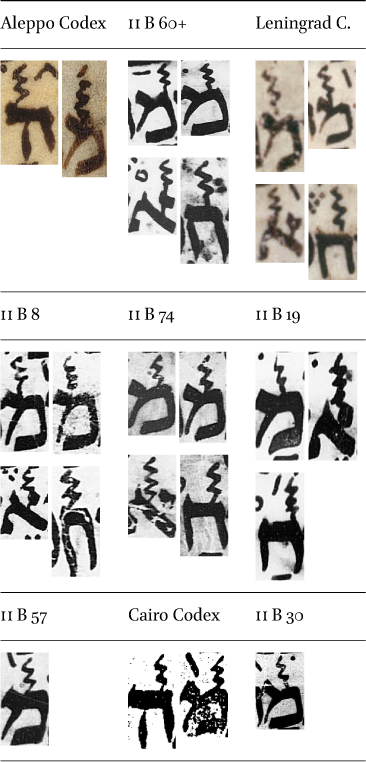
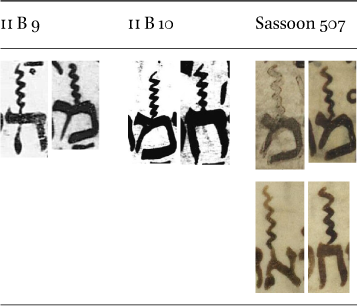
Aleppo Codex image courtesy of the Ben Zvi Institute for the Study of Jewish Communities in the East, Jerusalem; photographer: Ardon Bar HamaThe type of line filler in all three codices, whenever there is adequate space, is an aleph-lamed pairing: first partial aleph and then partial lamed. This pairing is not unique. Other early codices also use partial letters, and a few even tend to use the aleph-lamed pairing. None, however, is identical to the shape of the partial letters in the putative Ben BuyÄÊ¿Ä codices, as the following table demonstrates. Note especially the differences in the writing of the roof of the partial aleph.
Figure 24
Comparison of partial letters in eight manuscripts
Citation: Textus 34, 1 (2025) ; 10.1163/2589255X-bja10049
Aleppo Codex images courtesy of the Ben Zvi Institute for the Study of Jewish Communities in the East, Jerusalem; photographer: Ardon Bar Hama3.1.5 Marking Open Spaces
In A, open parasha breaks at the foot of a column are marked with a centred nun; similar breaks occurring at the head of a column are left blank. This has long been known and discussed.43 The same practice occurs in L1, and, as already mentioned in §â¯2.2.5, in II B 61+.
Figure 25
Comparison of space breaks at head and foot of column
Citation: Textus 34, 1 (2025) ; 10.1163/2589255X-bja10049
Aleppo Codex images courtesy of the Ben Zvi Institute for the Study of Jewish Communities in the East, Jerusalem; photographer: Ardon Bar HamaWhat has not been pointed out is that the present method for marking open spaces at the head or foot of a column is highly unusual. Other early codices may use a single vav (e.g., Cairo Codex), one or several pehs (e.g., Or. 4445, Sassoon 1053, IIÂ BÂ 8, IIÂ BÂ 60), or marks similar to reverse commas on either side of the white space (e.g., Washington Pentateuch, Sassoon 507, IIÂ BÂ 19, IIÂ BÂ 20, IIÂ BÂ 57). To date, I have encountered only one other codex that uses nun on the foot of a column (Leningrad Codex), but the nunim contained therein are written backwards and positioned on either side of the white space rather than a single nun in the centre of it.44
Citation: Textus 34, 1 (2025) ; 10.1163/2589255X-bja10049
Figure 26
Backwards nun in Leningrad Codex
Citation: Textus 34, 1 (2025) ; 10.1163/2589255X-bja10049
We are left, then, with only three codices that share exactly the same practice for marking open sections at both the head and foot of a column: A, L1, and IIÂ BÂ 61+.
3.1.6 Filler Marks
Due to the requirements of a poetic layout (e.g., Haʾazinu, Deut 32:1â43), sometimes the scribe of A and L1 had more space to fill than text to fill it with. In these instances, the scribe interspersed a number of lines comprised of partial letters. This has been noted and commented upon, and is thought to be one of the strongest arguments for shared authorship of A and L1.45
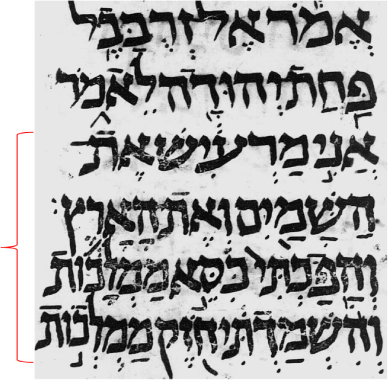
While there are no poetic layouts in the Latter Prophets that would require one to insert fillers on a preceding page, there are two instances where the scribe of II B 61+ used partial letters to patch up apparent errors. The first instance is by a transparently secondary corrector of the main text and was already discussed (§â¯2.2.6). The second example appears to be by the original hand and matches perfectly with the filler markings of A and L1 (col. 1).46
Figure 27
Line filler in IIÂ BÂ 61+, L1, and A
Citation: Textus 34, 1 (2025) ; 10.1163/2589255X-bja10049
Aleppo Codex image courtesy of the Ben Zvi Institute for the Study of Jewish Communities in the East, Jerusalem; photographer: Ardon Bar Hama3.1.7 Space Breaks
Tiberian codices show a remarkable amount of variation when comparing the parasha space breaks.47 This is because, unlike the Babylonian Masoretes, Tiberian Masoretes did not attempt to fix any specific tradition for the space breaks.48 In some instances, the variation can be used to corroborate likely authorship. For example, several codices attributed to the eleventh-century scribe, Samuel b. Jacob, are largely uniform in their uses of space breaks.49
With the putative Ben BuyÄÊ¿Ä codices, the issue is more complicated. Aleppo contains above average similarity with the space breaks of L1 in the Torah, although the similarity is, in fact, exceeded by other codices not written by Ben BuyÄÊ¿Ä. As regards the agreement of IIÂ BÂ 61+ with A, however, the amount of similarityâalthough not maximalâis nonetheless the highest of all the codices surveyed. The corroborating data for these claims are presented in the following three tables. Table 3 compares the similarity of the Leningrad Codex and IIÂ BÂ 60+, both written by Samuel b. Jacob. Note how that IIÂ BÂ 60+ shares 96.4 percent similarity with the Leningrad Codex, 8.4 percentage points higher than the next codex of the list.
Table 3
Space-break concordance between Leningrad Codex and other early codices (Gen 1âExod 40)50
|
Manuscript |
Spaces compared |
Spacing agreements |
Similarity % with Leningrad |
|---|---|---|---|
|
|
|
|
|
|
IIÂ BÂ 80+ |
183 |
161 |
88.0 |
|
IIÂ BÂ 65+ |
204 |
178 |
87.3 |
|
IIÂ BÂ 73+ |
165 |
142 |
86.1 |
|
IIÂ BÂ 17+ |
259 |
222 |
85.7 |
|
IIÂ BÂ 74+ |
145 |
123 |
84.8 |
|
Washington Pent.51 |
256 |
213 |
83.2 |
|
IIÂ BÂ 20+ |
154 |
128 |
83.1 |
|
IIÂ BÂ 51+ |
181 |
150 |
82.9 |
|
Sassoon 507 |
257 |
211 |
82.5 |
|
IIÂ BÂ 67+ |
140 |
115 |
82.1 |
|
IIÂ BÂ 13+ |
272 |
218 |
80.1 |
|
Or. 4445 |
201 |
159 |
79.1 |
|
Sassoon 1053 |
227 |
171 |
75.3 |
|
IIÂ BÂ 8+ |
274 |
204 |
74.5 |
|
Gottheil 18 |
289 |
200 |
69.2 |
|
IIÂ BÂ 79+ |
189 |
126 |
66.7 |
|
IIÂ BÂ 38+ |
216 |
142 |
65.7 |
|
IIÂ BÂ 10+ |
229 |
145 |
63.3 |
|
Gottheil 6 |
277 |
149 |
53.8 |
|
Tbilisi Torah |
237 |
127 |
53.6 |
Table 4 compares A and L1, along with other codices of the period. Here there are six codices having more space-break similarities with A than L1 does.
Table 4
Space-break concordance between A and other early codices (Gen 1âExod 40)52
|
Manuscript |
Spaces compared |
Spacing agreements |
Similarity % with A |
|---|---|---|---|
|
IIÂ BÂ 65+ |
208 |
193 |
92.8 |
|
IIÂ BÂ 74+ |
149 |
135 |
90.6 |
|
IIÂ BÂ 60+ |
226 |
201 |
88.9 |
|
IIÂ BÂ 51+ |
181 |
159 |
87.8 |
|
Leningrad C. |
289 |
252 |
87.2 |
|
IIÂ BÂ 80+ |
185 |
161 |
87 |
|
|
|
|
|
|
IIÂ BÂ 13+ |
273 |
234 |
85.7 |
|
IIÂ BÂ 20+ |
154 |
132 |
85.7 |
|
IIÂ BÂ 73+ |
169 |
143 |
84.6 |
|
Sassoon 507 |
261 |
217 |
83.1 |
|
IIÂ BÂ 67+ |
140 |
116 |
82.9 |
|
Washington Pent.53 |
260 |
214 |
82.3 |
|
Or. 4445 |
205 |
165 |
80.5 |
|
Sassoon 1053 |
231 |
171 |
74 |
|
IIÂ BÂ 8+ |
278 |
200 |
71.9 |
|
IIÂ BÂ 79+ |
192 |
135 |
70.3 |
|
Gottheil 18 |
293 |
203 |
69.3 |
|
IIÂ BÂ 38+ |
216 |
143 |
66.2 |
|
IIÂ BÂ 10+ |
233 |
153 |
65.7 |
|
Gottheil 6 |
281 |
162 |
57.7 |
|
Tbilisi Torah |
241 |
138 |
57.3 |
Table 5 compares A and IIÂ BÂ 61+, along with some other codices of the period. Here, the percentage of similarity of A and IIÂ BÂ 61+ is 7.1 percentage points higher than the next codex of the list.
Table 5
Space-break concordance between A and other early codices (Isa 1â40)
|
Manuscript |
# of spaces compared |
# of spacing agreements |
Similarity % with A |
|---|---|---|---|
|
|
|
|
|
|
Cairo Codex |
160 |
127 |
79.4â¯% |
|
IIÂ BÂ 55+ |
59 |
46 |
78.0â¯% |
|
IIÂ BÂ 30+ |
111 |
82 |
73.9â¯% |
|
IIÂ BÂ 57+ |
123 |
90 |
73.2â¯% |
|
IÂ BÂ 3 |
160 |
101 |
63.1â¯% |
|
Sassoon 1053 |
160 |
95 |
59.4â¯% |
|
IIÂ BÂ 50+ |
160 |
82 |
51.3â¯% |
|
Leningrad C. |
160 |
75 |
46.9â¯% |
These data are consistent with Solomon b. BuyÄÊ¿Ä authorship for both A and IIÂ BÂ 61+, although other scenarios remain possible.
3.2 Similarity of Mp and Cantillation Markings
The evidence adduced thus far demonstrates that IIÂ BÂ 61+, A, and L1 probably were written by the same scribe, i.e., Solomon b. BuyÄÊ¿Ä. It is also likely that this scribe added the Masorah magna. But what of the Masorah parva, the vocalisation, and the accents? Who added these? Providing an answer to this question is more difficult. One plausible scenario is that someone close to Solomon b. BuyÄÊ¿Ä provided these features, such as, for example, his brother Ephraim, who added the vocalisation and Masorah of L1. To test such a hypothesis, one would need to examine IIÂ BÂ 61+ and L1 for similarities on precisely these points.
3.2.1 Mp notes
One simple way to explore whether the Mp masran of IIÂ BÂ 61+ and the masran of L1 are the same person is by comparing the two hands. The following figure places letter-shapes taken from the Mp notes of the two codices side by side.
Figure 28
Mp script comparison of IIÂ BÂ 61+ and L1
Citation: Textus 34, 1 (2025) ; 10.1163/2589255X-bja10049
It is readily apparent that the shape and ductus of the above letters would permit shared authorship.
In order to see if the above similarities are more than incidental, it is necessary to compare a larger number of Mp hands. In figure 29,54 fourteen codices are evaluated for script similarities using the same four letters: bet, gimel, he, and samech. We shall take these fourteen manuscripts and evaluate each of the four letters in turn.
-
Bet: The base of the bet of IIÂ BÂ 61+ and L1 is very nearly horizontal in orientation. Less than one-third of its length is on the right side of the vertical downstroke that connects the base and upper horizontal bar. The serif on the left side of the upper horizontal is generally small. The upper horizontal, rather than being written in a completely straight line, tends to dip slightly in the middle (cf. also the upper horizontal of the he and samech). Of the fourteen chart manuscripts, ten match with the present description: IIÂ BÂ 26, IIÂ BÂ 39, IIÂ BÂ 55, IIÂ BÂ 57, IIÂ BÂ 74, IIÂ BÂ 99, A, Cairo Codex, Leningrad Codex, and Sassoon 507. The greatest amount of similarity is perhaps with IIÂ BÂ 99.
-
Gimel: The gimel found in IIÂ BÂ 61+ and L1 is slightly cursive, probably written with a single stroke instead of the apparent two strokes visible in some of the other codices. The right side of the letter was written first in a single downstroke. Then, rather than lifting the pen off the parchment, setting it back down at the point where the left leg of the gimel was to connect to the main body of the letter and moving leftward, our scribe kept his pen in contact with the parchment for the duration, retracing the letter upwards slightly before veering leftward to complete the second leg. Of the fourteen chart manuscripts, seven share this slightly cursive aspect to the formation of the base of gimel: IIÂ BÂ 19, IIÂ BÂ 26, IIÂ BÂ 30, IIÂ BÂ 55, IIÂ BÂ 57, IIÂ BÂ 74, and A. The greatest amount of similarity is perhaps with IIÂ BÂ 26 or A.
-
He: The horizontal bar of he in IIÂ BÂ 61+ and L1 tends to slightly dip in the middle, rather than being drawn across in a straight line. The left-hand downstroke does not quite meet the horizontal, leaving a slight gap between the two. Of the fourteen chart manuscripts, eight more or less share the presently described features: IIÂ BÂ 8, IIÂ BÂ 10, IIÂ BÂ 30, IIÂ BÂ 39, IIÂ BÂ 55, IIÂ BÂ 57, Cairo Codex, and Sassoon 507. The horizontal bars of all of the aforementioned do not dip to the degree seen in IIÂ BÂ 61+ and L1, however.
-
Samech: The body of samech in IIÂ BÂ 61+ and L1 has a rounded base as opposed to a pointed base; the body is generally squat-shaped, about as wide as it is high. The serif is minimal. The upper horizontal of the letter does not always connect with the left side of the letter. Of the fourteen chart manuscripts, four share the presently described features: IIÂ BÂ 19, IIÂ BÂ 30, A, and Sassoon 507.
Figure 29
Script examples from Mp of other early codices
Citation: Textus 34, 1 (2025) ; 10.1163/2589255X-bja10049
When placing the above described manuscripts in a checklist, ticking each codex where it shows at least some similarity with IIÂ BÂ 61+ and L1, we arrive at the following.
Table 6
Letter shapes and ductus match with IIÂ BÂ 61+ and L1
|
Bet |
Gimel |
He |
Samech |
|
|---|---|---|---|---|
|
|
|
|
|
|
|
|
|
|
|
|
|
IIÂ BÂ 8 |
â |
|||
|
IIÂ BÂ 10 |
â |
|||
|
IIÂ BÂ 19 |
â |
â |
||
|
IIÂ BÂ 26 |
â |
â |
||
|
IIÂ BÂ 30 |
â |
â |
â |
|
|
IIÂ BÂ 39 |
â |
â |
â |
|
|
IIÂ BÂ 55 |
â |
â |
â |
|
|
IIÂ BÂ 57 |
â |
â |
||
|
IIÂ BÂ 74 |
â |
â |
||
|
IIÂ BÂ 99 |
â |
|||
|
A |
â |
â |
â |
|
|
Cairo C. |
â |
â |
||
|
Leningrad C. |
â |
|||
|
Sassoon 507 |
â |
â |
â |
None of the above manuscripts match with IIÂ BÂ 61+ and L1 in all four instances! While this quick comparison does not prove authorship, it provides a strong indication that the Mp script similarities of IIÂ BÂ 61+ and L1 cannot be considered incidental. Thus, the âplausible scenarioâ outlined above, namely that Ephraim b. BuyÄÊ¿Ä contributed the Mp notes of IIÂ BÂ 61+, remains a valid hypothesis.
3.2.2 Gershayim
The disjunctive cantillation accent â®
In the majority of codices, though, the slant of the angle is somewhat less than forty-five degrees (see Fig. 31).
Figure 30
Gershayim with marked rightward slant
Citation: Textus 34, 1 (2025) ; 10.1163/2589255X-bja10049
Figure 31
Gershayim with moderate rightward slant
Citation: Textus 34, 1 (2025) ; 10.1163/2589255X-bja10049
Aleppo Codex images courtesy of the Ben Zvi Institute for the Study of Jewish Communities in the East, Jerusalem; photographer: Ardon Bar HamaIn only a few codices can gershayim be found with little/no rightward slant. Two of these codices are L1 and IIÂ BÂ 61+.
Figure 32
Gershayim with little/no rightward slant
Citation: Textus 34, 1 (2025) ; 10.1163/2589255X-bja10049
3.2.3 Shalshelet
The accent shalshelet consists of a zigzagging, vertical line above the syllable in question (i.e., â®
Figure 33
Shalshelet with two peaks
Citation: Textus 34, 1 (2025) ; 10.1163/2589255X-bja10049
Aleppo Codex images courtesy of the Ben Zvi Institute for the Study of Jewish Communities in the East, Jerusalem; photographer: Ardon Bar HamaAnother variation consists of two instances of sideways double-U in succession. Here there are four peaks and four troughs.
The final method observed consists of writing shalshelet with three peaks and three troughs. Two of the three observed manuscripts that use this method are IIÂ BÂ 61+ and L1.
Because the use of shalshelet is rare (occurring only seven times in the twenty-one books),56 further examples cannot be adduced in most of the above instances. The available data, however, demonstrate that the majority of manuscripts mark shalshelet in a manner not used by IIÂ BÂ 61+ and L1.
3.2.4 Zarqa
The shape of zarqa is similar to that of a final peh in early model codices. Zarqa is written vertically above the line, its descender resting upon the final letter of the word of the main text (in printed Bibles, a horizontal S is generally preferred instead: i.e., â®
Other codices show the opposite inclination: the nose of zarqa markedly curls back upon itself.
More common, however, are codices where the nose of zarqa is curled somewhere between the above two extremes. Among these codices are IIÂ BÂ 61+ and L1.
Figure 38
Zarqa with moderate curl
Citation: Textus 34, 1 (2025) ; 10.1163/2589255X-bja10049
Aleppo Codex images courtesy of the Ben Zvi Institute for the Study of Jewish Communities in the East, Jerusalem; photographer: Ardon Bar HamaIn sum, the shape of zarqa is shared by IIÂ BÂ 61+ and L1. As the majority of early model codices also share this shape, the present cantillation marking cannot be considered proof of shared authorship. Nonetheless, when viewed alongside other similarities, the shared shape of zarqa is a meaningful bit of evidence indicating that the accents of IIÂ BÂ 61+ and L1 probably were written by the same person.
4 Conclusion
It is hoped that the reconstruction of IIÂ BÂ 61+ from six different classmarks will prove useful for scholars, whose future work on early Tiberian Bibles can now include this nearly wholly extant codex of the Latter Prophets.
The data presented indicate that the argument for Ben BuyÄÊ¿Ä authorship of IIÂ BÂ 61+ is strong. Such is particularly the case for Solomon b. BuyÄÊ¿Ä (main text, most of the Mm). The involvement of Ephraim b. BuyÄÊ¿Ä (vocalisation, cantillation, Mp) is both plausible and probable, although firm conclusions should not be drawn without additional research. In any event, the clear similarity of this codex with L1 and A indicates that IIÂ BÂ 61+ can be dated confidently to the early tenth century.57
Finally, the present comparisons between IIÂ BÂ 61+, L1, and A further strengthen the authorship claims made in the respective colophons of L1 and A and Mordechai Glatzerâs argument that a single scribe wrote the main texts of L1 and A.58
By âmodel,â I refer to codices with full vocalisation, cantillation, and Masorah (both parva and magna), generally written in three columns and on parchment. These Bibles can be contrasted with so-called âcommonâ Bibles, sometimes referred to as ânonstandard Tiberianâ Bibles. Common Bibles are more or less owner produced and tend not to follow the written Tiberian tradition fully. For a fuller description of common Bibles and the various means of describing them, see Estara J. Arrant, âA Codicological and Linguistic Typology of Common Torah Codices from the Cairo Genizahâ (PhD thesis, University of Cambridge, 2021), §â¯2.2.
I am grateful to Prof. Yosef Ofer for his insightful comments on an earlier version of this paper.
Vincent Beiler, âThe Small Masorah: Genealogical Relationships in 112 Early Hebrew Bible Codices Based upon the Masorah Parvaâ (PhD thesis, University of Cambridge, 2023), §â¯4.7.3., suggests that within the Second Firkovich Collection the number of âcodices likely to date prior to 1200â¯C.E. ⦠is perhaps around 100,â before emphasizing that even this figure is merely a rough estimate. For a description of the partial catalogues available for the Firkovich manuscripts, see Viktor Golinets, âBiblical Manuscripts from the Collections of the National Library of Russia and Their Use in the Textual Research of the Hebrew Bible,â in The Hebrew Bible Manuscripts: A Millennium, ed. Ãlodie Attia and Antony Perrot (Leiden/Boston: Brill, 2022), 218â260, esp. 220â225.
As described in Mordechai Glatzer, ââ®
The IIÂ BÂ 26b microfilm (as opposed to the IIÂ BÂ 26a microfilm) is listed as the alternative version on Ktiv (link can be found under the âView Catalogue Recordâ tab); the âaâ and âbâ image sets are similar, but some page numbers differ. Note also that what are here referred to as page numbers are, in reality, numbers assigned arbitrarily by Ktivâs manuscript viewer. For most of the IIÂ B collection, folio numbers do not exist.
In five of the fourteen instances marked with the infinity symbol, the text matches between classmarks are reliant upon some minor text reconstruction. These instances may be found at Isa 49:4 (II B 61, p. 7; II B 1348, p. 5), Ezek 6:6 (II B 61, p. 186; II B 221, p. 17), Amos 9:7 (II B 61, p. 318; II B 221, p. 5), Jonah 1:12 (II B 61, p. 320; II B 221, p. 19), and Mal 3:19 (II B 61, p. 364; II B 221, p. 28).
Assuming that a leaf contains approximately twenty verses on average, the missing reference ranges are as follows: Isa 1:1â12 (12 vv., recto of leaf only); 10:14â11:6 (26 vv., 1 lea.); 24:5â25:8 (26 vv., 1 lea.); Jer 26:7â23 (16 vv., 1 lea.); Ezek 7:13â12:11 (101 vv., ca. 5 lea.); 33:29â34:14 (18 vv., 1 lea.); 41:6â42:2 (22 vv., 1 lea.); Zech 14:17âMal 1:14 (19 vv., 1 lea.).
Double counting can occur; some images appear twice on Ktiv.
E.g., II B 61, pp. 16 and 17.
The current description is based upon a black and white digitised microfilm. Codicological comments, therefore, cannot be performed to satisfaction.
Cumulative Masorah = â®
E.g., II B 61, pp. 36, 50, 51, 81, 134, 191, 239, 354.
The text of II B 223, p. 5, matches perfectly with II B 61+. This potential match was rejected, however, due to slight differences between the two (e.g., eighteen lines instead of nineteen, different Mm hand, the partial letters used in left justification are of different sizes, and the leaf dimensions are slightly different). It is the opinion of Ofer, moreover, that II B 223 is a bespoke replacement leaf for a now-lost codex, and thus no more leaves matching II B 223 are to be expected. See Yosef Ofer, âTwo Dedicatory Inscriptions in Manuscripts of Scripture and the Question of Their Authenticity,â JJS 70.2 (2019): esp. 67â70.
Cf. BL Ms. Or. 4445, f. 113v. For information on the scribal acrostics of Or. 4445, see David Lloyd Lyons, âThe Vocalization, Accentuation and Masora of Codex Or. 4445 (Brit. Mus.) and Their Place in the Development of the Tiberian Masorahâ (PhD thesis, University of London, 1983), 411; Yosef Ofer, âAcrostic Signatures in Masoretic Notes,â VT 65 (2015), esp. 240â241.
The estimated dates for IIÂ BÂ 221, IIÂ BÂ 1348, IIÂ BÂ 1379, and IIÂ BÂ 1410 are all listed on Ktiv as unknown. IIÂ BÂ 26, which contains leaves not belonging to IIÂ BÂ 61+, is listed as eleventh century (accessed March 2024).
Israel Yevin, â®
Mizraḥi = Oriental, but without the latter termâs colonial connotations.
For the few instances where the marginal letter appears secondary, see II B 61, pp. 39, 143.
Vincent Beiler, âThe Marginal nun/zayin: Meaning, Purpose, Localisation,â in Studies in the Masoretic Tradition of the Hebrew Bible, ed. Daniel J. Crowther, Aaron D. Hornkohl, and Geoffrey Khan (Cambridge: Cambridge Semitic Languages and Cultures, 2022), esp. 86â89.
For example, in leaves where the ink of the main text has faded whilst the ink of the vocalisation, cantillation, and Masorah are relatively well-preserved, the spacing dot (if present) appears to mirror the ink of the main text and not the remaining markings.
This example can be found at II B 26b, p. 96.
There are exceptions. Some Mm notes found in the first leaves of Isaiah do not appear to be written by the same hand that produced the remainder of the Mm notes; e.g., II B 26b, p. 97 infra.
For instances of secondary Mm note insertion, see Sassoon 1053 (e.g., p. 11, bottom two lines of the infra Mm) and II B 56 (e.g., p. 47, bottom three lines of infra Mm under leftmost column). Clear examples of secondary Mm note insertion are not to be found in II B 61+; the closest one gets is perhaps II B 61, p. 161, supra, where some lettering appears smaller, probably to accommodate the needed Mm within a smaller space.
It appears that the frequency of cumulative Masorah increases towards the latter part of IIÂ BÂ 61+. Perhaps the masran ran out of elaborative Masorah notes and turned to cumulative Masorah to make up the deficit.
By way of comparison, A contains only ca. 30 Mm instances of Babylonian vocalisation. See Israel Yeivin, â®
See Aron Dotan, ââ®
I examined twenty-one Mm lists at random containing instances where the canonical order of the biblical books is different in the Tiberian and Babylonian Masorahs. In seventeen instances, the Mm lists followed the Tiberian order; in four instances, the Mm lists followed the Babylonian order. To achieve a fully representative sample, it is probably necessary to collate at least forty Mm lists.
Most occurrences of this Mm note occur on the leaf containing Isa 34:11. The exceptions are listed as follows (it is also possible that the note occurs in more than one place in a single codex):
Isa 65:9: Leningrad Codex, IIÂ BÂ 30, IIÂ BÂ 57, IIÂ BÂ 1283
Jer 30:3: Sassoon 1053, IIÂ BÂ 9, IIÂ BÂ 61+, IIÂ BÂ 1341.
â®
The note occurs at II B 55, p. 333; because the leaves of several codices are scrambled, the section in question does not belong with the greater part of II B 55, belonging with II B 26 instead.
Corroborating the shared error hypothesis, one should note that the main texts and a considerable number of paratextual features also indicate that the four codices are exceptionally similar. See Vincent Beiler, âIs There a Scribal School for the Cairo Codex?â in Interconnected Traditions: Semitic Languages, Literatures, Cultures, ed. J.C.E. Watson et al. (Cambridge: Open Book Publishers, forthcoming 2025).
Ofer, â®
An exception occurs with the Mm notes from the first leaves of Isaiah; perhaps they are written by the Mp masran; cf. n. 21.
In this case â®
A partial list of other such instances includes: II B 61, pp. 207, 220, 260, 266, 269, 300.
There is no visible evidence that an aleph was erased or that the word was otherwise emended. For an alternate spelling of â®
A partial list of such instances includes II B 61, pp. 167, 200, 237, 251, 270, 275, 293, 332.
According to the handwritten front paper of II B 61, included with the images of the same on Ktiv, the dimensions of its main text are approximately 292.5â¯Ãâ¯287.5â¯mm. The dimensions of the main text of L1 are slightly larger: 310â¯Ãâ¯304â¯mm. In contrast, the dimensions of the main text of A are only 226â¯Ãâ¯207â¯mmâthis despite the fact that A contains 28 lines per page while II B 61+ has 19 lines and L1 has 20 lines (21 lines at the Song of the Sea and the Song of Moses). The dimension for the main text of L1 and A are taken from Michéle Dukan, La Bible hébraïque: Les codices copiés en Orient et dans la zone séfarade avant 1280 (Turnhout: Brepols, 2006), 239, 303.
For example, note the cautious wording in Malachi Beit-Arié, Collette Sirat, and Mordechai Glatzer, Codices hebraicis litteris exarati quo tempore scripti fuerint exhibentes: jusquâà 1020, Vol. 1 (Turnhout: Brepols, 1997), 18, regarding the possibility that Solomon b. BuyÄÊ¿Ä is the scribe of A. See also Nehemia Gordon, âBlotting out the Name: Scribal Methods of Erasing the Tetragrammaton in Medieval Hebrew Manuscripts, Part 2,â Textus 29/2 (2020): 135, n. 166, who quotes Edna Engel as averring that âBen BuyaÊ¿a might not have been the scribe who wrote the letters of the Aleppo Codex.â
As asserted in Beiler, âThe Marginal nun/zayin,â 80â92.
In addition to the table instances, the large marginal letter in II B 17 can also be found inserted secondarily on pp. 30, 250, 374, 455.
At the very least, the seder markers postdate the parasha markers (cf. the parasha marker occupying pride of place and the seder marker being smaller and atypically placed in II B 17, pp. 27, 37, 56, 94, 129, 141, 464). There are also instances where the ink of the main text and the seder marker have faded at different rates, and thus were not written at the same time (e.g., II B 17, pp. 302, 444); for instances where the ink has faded in both places, see pp. 405, 440, 456.
Here too, the seder markers postdate the parasha markers. Cf. Aleppo Codex, ff. 2r, 5v. Similarly, they may postdate the Mp: see Aleppo Codex, ff. 23r, 45v, 50r, 56r, 76v, 94r, 118v, 125r, 135r, 145v, etc. (contra ff. 109v, 158v).
Cf. Yosef Ofer, ââ®
The use of nunim in the Leningrad Codex to fill an open space at the foot of a column is atypical even there. The majority of instances in the Leningrad Codex use one or several pehs.
See Glatzer, ââ®
In this instance, the line was filled in with partial letters in a place where A has an open space. The following leaf of IIÂ BÂ 61+ is missing, however, and so we cannot determine the reason for filling up this open space. One likely explanation, although necessarily hypothetical, is that the scribe preferred to leave a full blank line on the second page, making the open space explicit on the page where the new section begins.
Cf. M.H. Goshen-Gottstein, âA Recovered Part of the Aleppo Codex,â Textus 5 (1966): esp. 55â56. Note also the oft-quoted comments of Maimonides on the matter in Mishneh Torah, Ahava, Hilkhot Sefer Torah 8.4.
Based upon extant lists of the open and closed passages, we can assume that attempts of the Babylonian Masoretes to fix the spacing tradition were only partially successful. Cf. Yosef Ofer, The Masora on Scripture and Its Methods (Berlin: De Gruyter, 2019), 65â66.
See Vincent Beiler, âSamuel b. Jacob and St. Petersburg EVR II B 60+,â Textus 33.1 (2024), §â¯3.15. See also Mordechai Breuer, â®
Classmarks numbers in this table and elsewhere having a plus sign affixed are comprised of several classmarks. For these matches, see Beiler, The Small Masorah, §â¯4.5.
Note: the space-breaks data for the Washington Pentateuch were limited to the leaves containing the primary hand.
For the present comparison, it is assumed that the space breaks of A in the Torah are those found in Maimonidesâs Mishneh Torah (Ahava, Hilkhot Sefer 8.4).
Note: the space-breaks data for the Washington Pentateuch were limited to the leaves containing the primary hand.
The Aleppo Codex images in figure 29 are courtesy of the Ben Zvi Institute for the Study of Jewish Communities in the East, Jerusalem; photographer: Ardon Bar Hama.
See Yeivin, Introduction to the Tiberian Masorah, 208â209.
See II B 30, p. 259, with its Mm note that reads â®
And other comparisons could doubtlessly be added, e.g., the use of the Masoretic circule; see Kim Phillips, âIs the Masora Circule, too, among, the Scribal Habits?â TynBull 71.1 (2020): 19â42. In the present study, Phillipsâs method was trialled and then abandoned due to the excessive amount of space that that examination would require.
See n. 3.