Abstract
In the description of the scribal habits of the Qumran corpus, usually no distinction is made between its constituent groups. Indeed, the Aramaic corpus shares the major scribal practices with the Hebrew corpus (Table 1) as well as some specific ones (Table 2). The two corpora reflect the same systems that were practiced in the last three pre-Christian centuries and the first century CE in Palestine. Further, quite unexpectedly from the angle of the scribal practices, the scribes of two scrolls may be linked to Qumran sectarian scrolls, 4QpapToba ar (4Q196) and 4QPsDana ar (4Q243).
In the description of the scribal habits of the Qumran corpus, usually no distinction is made between its constituent groups. The usual working hypothesis is that all the groups of scrolls shared the same features. Nevertheless, some groups are distinguished by a few features that are specific to those groups (Scripture texts, texts written in the Paleo-Hebrew script, tefillin and mezuzot, texts written on papyrus, texts written in Greek, pesharim, texts written in cryptic scripts, Aramaic texts).1 If we consider the nonbiblical Qumran texts to be the major group of texts, the Scripture texts and Aramaic texts are the closest to that group, while the other groups are visibly different from the main group: texts written in the Paleo-Hebrew and cryptic scripts, tefillin and mezuzot, texts written on papyrus, and pesharim.
Beyond the assumptions of Scribal Practices, this study focuses on the question as to whether the Aramaic Qumran texts, different in language from the main corpus, and quite dissimilar in nature and outlook, reflect the same scribal background as the parallel Hebrew corpus.
Following scholarly conventions, I refer to the Aramaic scrolls found at Qumran as a corpus. That decision is a mere formality. It is not known how many fragmentary Aramaic writings were found at Qumran, and various scholars define this corpus in slightly different ways. The list in DJD XXXIX (2002) contains 127 fragmentary Aramaic texts,2 including neither the Nabatean texts nor the targumim (4QtgLev [4Q156], 4QtgJob [4Q157], 11QtgJob [11Q10]). After the publication of that list, seventy-nine fragmentary Aramaic texts were added to this number in Tov, Revised Lists.3 However, the total number of more than 200 fragmentary Aramaic texts does not yield a group of texts large enough for analysis.4 The corpus of the Aramaic Qumran scrolls sufficient for comment consists of some eighty scrolls listed in the Table of Contents in Machiela, Handbook.5 For the analysis of the scribal practices, I focus merely on these texts while Machiela analyzes a slightly larger group since he also includes six Aramaic Scripture scrolls of Daniel and Ezra and the three targumim mentioned above. The latter two groups may be analyzed together with the Aramaic compositions, but for the study of scribal practices they belong to a different realm. In my view, the Aramaic Scripture scrolls should be analyzed together with the other Scripture scrolls since those scrolls follow a few specific rules.6
The scribal practices of the Aramaic scrolls are analyzed not merely to compare them with the Hebrew scrolls but also as a means of gaining a better understanding of the Aramaic corpus. The scribal aspects form only a tiny part in the analysis of that corpus. The internal coherence, nature, and origin of the Aramaic corpus remain a matter of dispute. Most scholars agree that the Aramaic scrolls are nonsectarian, just like many Hebrew scrolls. Furthermore, most scholars assume that these scrolls are pre-Essene (for a summary of the positions, see Machiela, Handbook, 2–6). The major ideas and terminology of the yaḥad are not represented in the Aramaic texts with the exception of the mention of the
Nevertheless, some Aramaic texts may have been copied at Qumran as may be learned from the assumption that a Hebrew and an Aramaic text were copied by the same hand recognized by common handwriting or shared scribal features. Indeed, according to Hayes,9 11QNJ ar (11Q18) belonged to a small group of eight Qumran scrolls that were copied by the same scribe. Hayes’s proposal is based on machine analysis of the handwriting of Qumran scrolls, even AI. The compositions that Hayes ascribed to this group have nothing in common except for their handwriting. According to Hayes, this scribe, probably active at Qumran in the early Herodian period (approximately 30 BCE [Hayes, “Searching,” 283]), copied the following texts: the Aramaic 11QNJ ar (11Q18) and the Hebrew 4QpIsaa (4Q161), 4QpHosa (4Q166), 4QpPsa (4Q171), 4QTNaph (4Q215), 4QMMTd (4Q397), 4QTJoseph ar (4Q439), and 4QRenewed Earth (4Q475). All the Hebrew texts are written in the Qumran scribal practice (QSP) style.
Further, John Strugnell ascribed the Aramaic 4QTQahat ar (4Q542) to the same hand as 4QSamc.10 If correct, this assumption would indicate an additional joining of the writing of a Hebrew and an Aramaic scroll by the same scribe.
The Aramaic corpus has a different focus11 from the Hebrew corpus that is well formulated by Dimant in the study mentioned in n. 7. The six rubrics into which Dimant divides the Aramaic compositions are: (1, 2) works about the period of the flood and the patriarchs; (3) visionary compositions; (4) legendary narratives and court tales; (5) astronomy and magic; (6) varia. These works may have reached Qumran from different sources.
A distinction ought to be made between the compositions just described and the individual scrolls in which they were inscribed. Most scholars assume that these scrolls were imported into Qumran. I consider this likely, but we have no way of verifying this assumption. Some may have been penned at Qumran, at least the one scroll that may have been copied by a scribe who also copied the other seven scrolls in the QSP style. In Table 2 we mention two scrolls that may relate to Qumran scribes. At the same time, we should be open to the possibility of a link between some Aramaic scrolls and the (pre-)Essene movement at the content level. This possibility was raised by John Collins and Peter W. Flint regarding the link of 4Q243–244 (4QPs-Dana-b ar) with the ‘sectarian literature’ in a broad sense, but they note that it does not refer explicitly to the Qumran yaḥad.12 In a separate analysis, Devorah Dimant advances the suggestion of a close connection between the book of Tobit and the Aramaic and Hebrew compositions found at Qumran.13 She reviews common themes and phrases and summarizes that “Tobi’s practices […] may point to a special relationship with circles close to the Qumran community. The same may be true of at least some and perhaps all of the Aramaic texts from Qumran.”14 Below we will mention a scribal habit that strengthens this possibility relating to one of the Aramaic Tobit manuscripts.
We now turn to a comparison of the scribal habits of the Hebrew scrolls with the seventy to eighty Qumran Aramaic scrolls large enough for analysis. This type of comparison may yield conclusions about the scribal situation in Palestine and possibly about specific relations between the two corpora. When comparing the scribal habits of the two corpora, it is found that they reflect the same parameters (Table 1), while in a few cases they reflect unique customs (Table 2). The numbers of the scribal features in the Aramaic scrolls in Table 1 are smaller because that corpus is roughly five times smaller than that of the Hebrew scrolls that are large enough for analysis (500).
The Aramaic corpus shares the following scribal practices with the Hebrew corpus according to the sequence of the chapters and tables:
Table 1
Special scribal features of Aramaic scrolls shared with Hebrew scrolls
|
The Aramaic texts share with the Hebrew texts all the general writing parameters, such as the alphabet, final letters, writing under the line, structure and measures of the columns and margins, word divisions, and sense divisions. In addition, this table refers to special scribal features shared by Hebrew and Aramaic texts. |
|
– Special ink. The copper-containing ink of 1QapGen (1Q20) ar practically destroyed the parchment. See Yoram Nir-El and Magen Broshi, “The Black Ink of the Qumran Scrolls,” DSD 3 (1996), 164. The similar corrosion pattern of other scrolls was probably also caused by copper in the ink: 4QpaleoExodm, 4QExod-Levf, 4QLevd, 4QDand, and 4QShirShabbg (4Q406). |
|
– Unruled scrolls: Most scrolls are ruled, but some are not. For the Aramaic corpus: 4QLevia ar (4Q213 [however, guide dots are attested in frg. 2]), 4QLevib ar (4Q213a), 4QJube ar (4Q220), 4QPrayer of Nabonidus ar (4Q242), 4QList of False Prophets ar (4Q339; a mere scrap of leather), 4QTQahat ar (4Q542). This list is joined by a host of Hebrew unruled scrolls, e.g., 4QJerc, 4QCantb, 4QFlor (4Q174), 4QJube (4Q220), 4QMc (4Q493), 4QapocrLam B (4Q501). |
|
– Opisthographs are found with Hebrew as well as Aramaic texts. At Qumran, opisthographs are found in twenty-two Hebrew texts (of which 13 are tefillin), three Aramaic texts (4Q201/338, 4Q324/335 [?], 4Q342/342), one Nabatean, and one mixed Greek/Hebrew text. |
|
– Long scrolls: The reconstructed length of the longest Qumran scroll, 1QapGen ar, an Aramaic scroll, is 11.83 meters.15 Other long scrolls are reconstructed as a little less than 10 meters. |
|
– Small writing block: Scrolls with a small writing block (5–14 lines) consist of mostly Hebrew texts with several penned in Aramaic. The Hebrew scrolls are mainly all known copies of the Five Scrolls and several liturgical copies, while the Aramaic short scrolls are narratives: 4QBirth of Noahb ar (4Q535) (6 lines), 4QJews at Persian Court ar (4Q550) (7, 8), 4QDanSuz? ar (4Q551) (8), 4QapocrDan ar (4Q246) (9), 4QZodiology and Brontology ar (4Q318) (9). |
|
– Large and very large writing block: Among the scrolls with a large (25–34 lines) or a very large writing block (35–60+ lines) are seven Aramaic scrolls: 1QapGen ar (1Q20) (34 lines); five copies of Enoch: 4QEng ar (4Q212) (25–26), 4QEna ar (4Q201) (27), 4QEnb ar (4Q202) (28, 29), 4QEnc ar (4Q204) (30), 4QEnastrb ar (4Q209) (c. 40); 4QpapToba ar (4Q196). |
|
– Proportional spacing (leaving extra spaces between words toward the end of the line): I noted ten Hebrew and three Aramaic scrolls, but there are probably more: 4QEnc ar (4Q204), 4QFour Kingdomsa ar (4Q552) 2, 4QNJa ar (4Q554). |
|
– Titles included in the first words of the scroll: Ten Hebrew and four Aramaic compositions: 4QPrayer of Nabonidus ar (4Q242), 4QWords of Michael ar (4Q529) 1, 4QVisions of Amrama,c ar (4Q543, 545). |
|
– Uninscribed area at the end of scrolls: fourteen Hebrew scrolls and one in Aramaic: 4QpsDanc ar (4Q245). |
|
– Mixture of final and nonfinal letters: forty Hebrew scrolls and one Aramaic scroll. This data is not exhaustive. |
|
The following features are not necessarily connected with the original scribes. They may have been inserted by scroll manufacturers,16 readers, later scribes, librarians, or archivists. |
|
– Initial handle sheet: Six Hebrew compositions and one in Aramaic: 4QVisions of Amrama ar (4Q543). This system was set up by the scroll manufacturer. |
|
– Guide dots are indicated in the margins for the drawing of lines: Nine Aramaic scrolls (1Q20, 1Q32, 4Q210, 4Q213, 4Q213a, 4Q546, 4Q547, 4Q551, 11Q18) together with forty-seven Hebrew texts. |
|
– Larger bottom than top margins in leather scrolls: Larger bottom than top margins are found in many Hebrew and several Aramaic scrolls, as subsequently prescribed by the rabbinic regulations (y. Meg. 1.71d [1.9]): 4QapocrDan ar (4Q246), 4QapocrLevib? ar (4Q541), 4QTQahat ar (4Q542), 4QJews at Persian Court (4Q550), fragment 7. |
|
– Unruled wide initial margin: Seventeen Hebrew and three Aramaic scrolls: 4QPrayer of Nabonidus ar (4Q242), 4QVisions of Amramc ar (4Q545), 4QWords of Michael ar (4Q571). This system was set up by the scroll manufacturer. |
|
– Ruled wide margin at the beginning of scrolls. Seven Hebrew scrolls and one in Aramaic followed this system: 4QBirth of Noaha ar (4Q534) (probable beginning). This system was set up by the scroll manufacturer. |
|
– Repair stitching: Performed in the middle of the text in nine Hebrew texts and one Aramaic text, and probably more: 4QVisions of Amrame (4Q547) 5. |
|
– Luxury editions: Thirty-three Hebrew luxury texts were identified in the Judean Desert together with two in Aramaic: 1QapGen ar (1Q20), 4QpapVisionb? ar (4Q558). |
|
– Cancellation dots: Sixty-nine Hebrew and five Aramaic texts: 1QapGen (1Q20) ar, 4QEnastra ar (4Q208) 18 2, 4QTQahat ar (4Q542), 4QVisions of Amrame,f ar (4Q547, 548). Cancellation dots were inserted by both the original scribes and later ones. |
|
– Paragraphos, straight line protruding into the margin, with or without ornaments on the right and/or left side: Five Hebrew and two Aramaic texts: 4QEnGiantsd ar (4Q532) 1 ii, before line 7, 4QTQahat ar (4Q542) 1 ii, before line 9. |
|
– Paragraphos, ‘Fishhook sign’: Fifteen Hebrew and two Aramaic texts: 4QLevia ar (4Q213) 1 ii 12, 4QLevib ar (4Q213a) 2 11.17 |
|
– Letters in the Cryptic A Script Written in the Margins of Texts Written in the Square or Cryptic A Script: Eight Hebrew texts and one Aramaic text: 4QpapToba ar (4Q196) 35. |
|
– X sign before text: This sign calling attention to a detail in the text is found in three Hebrew and two Aramaic texts: 4QProphecyb ar (4Q556a) 1 ii, 4QUnid. Fragments A ar frg. m (4Q584m). |
|
– X sign as warning to the readers: This X sign indicates that a space at the end of a line should not be mistaken for an ‘open section,’ which has an exegetical meaning. This sign appears in four Hebrew documentary texts, three Hebrew literary texts, and one Aramaic documentary text: XḤev/Se papDeed of Sale E ar (XḤev/Se 21) (DJD XXVII, pl. XI). |
|
– Letters and marks possibly numbering sheets and units: These indications appear in eight Hebrew18 and one Aramaic scroll: 1QapGen ar (1Q20) V, X, XVII (see n. 15). |
At the same time, in a few cases, unique scribal features are spotted in Aramaic texts (Table 2). The data in this table must be treated carefully because of the fragmentary nature of the evidence: These features may be considered unique to the Aramaic documents as long as no Hebrew documents are found with the same features.
Table 2
Unique scribal features of Aramaic scrolls
|
– Crossing out with a vertical line: In Hebrew texts, the practice of crossing out letters and words is much less frequent than the technique of cancellation dots. The table records words or letters crossed out in fourteen biblical and nonbiblical texts written in the QSP, nine texts not written in that system, and seven Aramaic texts, that is, a proportionally large number of Aramaic texts featuring elements crossed out with a line. Among these texts, four crossed-out letters with a vertical line, a practice that is apparently known only from Aramaic texts: 4QpapToba ar (4Q196) 2 2; 4QLevib ar (4Q213a); 4QEnGiantsb ar (4Q530); 4QEnGiantsc ar (4Q531) (fig. 1). Note that these texts do not use cancellation dots. |
|
– Insertion signs: Signs for inserting elements into the text are found in two Aramaic texts and one Hebrew text: 4QpapToba ar (4Q196) 6 8 (fig. 2), 4QEna ar (4Q201) (2×), 11QTb (11Q20) XIII 3, thus more in Aramaic than in Hebrew texts. The latter sign is somewhat different, separating between the linear text and the marginal addition. |
|
– Indication of verses and half-verses. The scribes of the Hebrew–Aramaic biblical texts from the Judean Desert did not indicate small sense units (verses) in writing because that practice was initially only oral. The beginning of verse division is transmitted only in translated texts, in early Judean Desert manuscripts of the LXX and the targum, in the former indicated by spacing and in the latter by a dicolon and spacing: 4QtgLev (4Q156) (dicolon after Lev 16:12, 14a, 14b, 18a, 21a, 21b); 4QtgJob (4Q157) (spacing between verses, fig. 3). The unique appearance of the dicolon in the targum manuscripts should be viewed in the light of the appearance of that sign in older Aramaic sources (fig. 4). Although it has been suggested that a few Qumran manuscripts reflect the beginning of verse division, there is insufficient evidence for such a claim, with the possible exception of 4QDana. |
|
– Number signs: Five Hebrew (3Q15, 4Q319, 4Q320, 4Q326, 6Q17) and six (4Q318, 4Q540, 4Q554, 4Q554a, 4Q558, 4Q559) Aramaic texts use the number signs in nondocumentary texts. The relation between these texts indicates that the Aramaic corpus, five times smaller than the Hebrew one, was more prone to use its ‘own’ numbers. |
|
– Erasure: In Aramaic leather scrolls, erasures (Machiela, Handbook, 416 with some twelve examples) are much more frequent than cancellation dots (see above) and crossing out with a line. No statistics are available. |

Figure 1
Element crossed out with vertical line: 4QpapToba ar (4Q196) 2 2
Citation: Textus 34, 1 (2025) ; 10.1163/2589255X-bja10047
With the consent of the Leon Levy Dead Sea Scrolls Digital LibraryFigure 2
Insertion sign: 4QpapToba ar (4Q196) 6 8
Citation: Textus 34, 1 (2025) ; 10.1163/2589255X-bja10047
With the consent of the Leon Levy Dead Sea Scrolls Digital LibraryFigure 3
Indication of verses with spaces: 4QtgJob (4Q157)
Citation: Textus 34, 1 (2025) ; 10.1163/2589255X-bja10047
With the consent of the Leon Levy Dead Sea Scrolls Digital LibraryFigure 4
Dicolon between verses in 4QtgLev (4Q156)
Citation: Textus 34, 1 (2025) ; 10.1163/2589255X-bja10047
With the consent of the Leon Levy Dead Sea Scrolls Digital LibraryThe scribal practices of the Aramaic corpus share all the major features with the Hebrew corpus (Table 1), which implies that these corpora reflect the same systems that were practiced in the last three pre-Christian centuries and the first century CE in Palestine. Both the Hebrew and the Aramaic corpora include early and late scrolls. Early Aramaic scrolls are: 4QEnastra ar (4Q208) dated to 225–175 BCE, 4QVisions of Amrama,b,e ar (4Q543, 544, 547) dated to 150–100 BCE, 4QTQahat ar (4Q542) dated to 125–100 BCE. The following are late Aramaic scrolls: the documentary 4QDebt Acknowledgement ar (4Q344) dated to 72–127 CE, 6QpapGiants ar (6Q8), 4QpapApocalypse ar (4Q489) dated to 50 CE, 6QApoc ar (6Q18) dated to 30 BCE–68 CE.19
Both the Aramaic and the Hebrew texts share practices with the Aramaic documents of the fifth century BCE as well as with earlier Aramaic texts (Dušek, “Nests of the Aramaic Scribal Culture”), while the Aramaic texts are not closer to those traditions than the Hebrew texts. A few Aramaic texts display idiosyncratic Aramaic scribal features (Table 2): 4QtgLev (4Q156), 4QtgJob (4Q157), 4QpapToba ar (4Q196) (2×), 4QEna ar (4Q201) (2×), 4QLevib ar (4Q213a), 4QEnGiantsb ar (4Q530), 4QEnGiantsc ar (4Q531).
Can we say more? We hinted above at occasional links between the Aramaic texts and Qumran and the Essene community. Further, quite unexpectedly from the angle of the scribal practices, two scrolls may be linked to sectarian scrolls. This would be unusual in the Aramaic corpus that has no clear sectarian identity but it would indicate which texts were copied by the Qumran scribes. One of the texts is 4QpapToba ar (4Q196), which I listed above as reflecting idiosyncratic Aramaic scribal practices (vertical cancellation strokes, insertion sign).
1. Tetrapuncta: Within the Qumran corpus, the presentation of the divine name with four dots (….) is known from nine Hebrew texts written in the QSP (1QS, 1QIsaa, 4QSamc, 4Q175, 4Q176, 4Q382, 4Q443, 4Q462, 4Q524), four additional Hebrew texts (in 4Q391: dots; in 4Q248, 4Q306, XḤev/Se 6 [from Qumran]: strokes) and one of the Aramaic manuscripts of Tobit: 4QpapToba ar (4Q196) 17 i 5 (Tob 12:22), 18 15 (Tob 14:2) (fig. 5). This practice reflects reverence for the divine name, considered so sacred that it was not to be written with regular characters lest an error be made or lest it be erased by mistake. According to one view, the Aramaic Tobit joins the four non-QSP texts displaying the Tetrapuncta. According to another view, does this manuscript somehow reflect the same scribal style as the Qumran scribal practice? We should not forget that the use of Tetrapuncta is very rare in the Qumran corpus.
Figure 5
Tetrapuncta: 4QpapToba ar (4Q196) 18 15 (Tob 14:2)
Citation: Textus 34, 1 (2025) ; 10.1163/2589255X-bja10047
With the consent of the Leon Levy Dead Sea Scrolls Digital LibraryIn the Hebrew texts, the Tetrapuncta stand for the Hebrew Tetragrammaton, but in the Aramaic 4Q196 they probably reflect the four letters of
| – |
4QpapToba ar (4Q196) 17 i 5 (Tob 12:22) |
| – |
Tob 12:22 LXX II (S) |
Furthermore, Daniel Machiela shows that the same verse of Tobit (14:2) is quoted in another copy of Tobit as
This feature of 4Q196 is joined by the two mentioned scribal peculiarities, crossing out with a vertical line and the use of an insertion sign. These features render this scribe a unique scribe, who is dated to 75–25 BCE. I don’t know what is behind the riddle of his sharing this unique feature with the QSP.
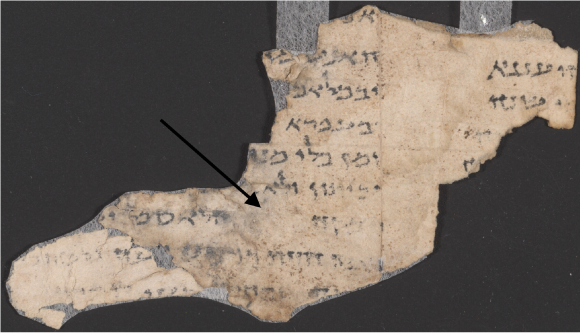
2. ʾEl(ohim) Written with Paleo-Hebrew Characters in a Scroll Written with Square Characters: Unexpectedly, 4QPsDana ar (4Q243) 1 2 displays the divine name in Paleo-Hebrew characters (
Figure 6
The divine name in Paleo-Hebrew characters: 4QPsDana ar (4Q243) 1 2
Citation: Textus 34, 1 (2025) ; 10.1163/2589255X-bja10047
With the consent of the Leon Levy Dead Sea Scrolls Digital LibraryIn conclusion, the scribal practices of the Aramaic corpus share all their major features with the Hebrew corpus,23 which implies that these corpora reflect the same systems that were practiced in the last three pre-Christian centuries and the first century CE in Palestine. Both the Hebrew and the Aramaic corpora include early and late scrolls. The provenance of the Aramaic scrolls has not been solved in this limited survey. We quoted Hayes’s conclusion that a Qumran scribe copied seven Hebrew scrolls and an Aramaic scroll at Qumran. We also found two scribal habits that link two specific scrolls with scrolls copied in the so-called Qumran scribal practice at Qumran or elsewhere. The scribal background of these two scrolls, 4Q196 and 4Q243, remains enigmatic for me.24
Emanuel Tov, Scribal Practices and Approaches Reflected in the Texts Found in the Judean Desert, STDJ 54 (Leiden: Brill, 2004), 249–260.
Emanuel Tov, ed., The Texts from the Judaean Desert: Indices and an Introduction to the Discoveries in the Judaean Desert Series, DJD XXXIX (Oxford: Clarendon, 2002), 221–225.
Emanuel Tov, Revised Lists of the Texts from the Judaean Desert (Leiden: Brill, 2010). Émile Puech, Qumran Cave 4.XXVII: Textes araméens, deuxième partie: 4Q550–575a, 580–587 et Appendices, DJD XXXVII (Oxford: Clarendon, 200) added seventy-eight fragmentary texts, mainly “unidentified.” See, further, XQ6.
Various scholars quote different numbers for the number of Aramaic compositions at Qumran, usually around 120–130, thereby disregarding the many fragmentary texts mentioned in the previous note. Machiela, Handbook, 1, reckons with a corpus of 130 texts. For a list of the various calculations of the Aramaic corpus, see Andrew B. Perrin, The Dynamics of Dream-Vision Revelation in the Aramaic Dead Sea Scrolls, JAJSup 19 (Göttingen: Vandenhoeck & Ruprecht, 2015), 24, n. 3.
Daniel Machiela, A Handbook of the Aramaic Scrolls from the Qumran Caves, Manuscripts, Language and Scribal Practices, STDJ 140 (Leiden: Brill, 2023).
See Tov, Scribal Practices, 250–254.
Devorah Dimant, “The Qumran Aramaic Texts and the Qumran Community,” in History, Ideology and Bible Interpretation in the Dead Sea Scrolls, Collected Studies, FAT 90 (Tübingen: Mohr Siebeck, 2014), 185–194 (187).
Machiela, Handbook, 203.
Gemma Hayes, “Searching for Dead Sea Scribes: A study on using artificial intelligence and palaeography for writer identification in correlation with spelling and scribal practices, codicology, handwriting quality, and literary classification systems for Dead Sea Scrolls” (PhD diss., Groningen University, 2023), ch. 3.8. The scribe is named GQS001.
Recorded in Bonani et al., “Radiocarbon Dating,” 28.
This different focus is also emphasized by Florentino Garcia Martinez, “Scribal Practices in the Aramaic Literary Texts from Qumran,” in Myths, Martyrs, and Modernity: Studies in the History of Religions in Honour of Jan N. Bremmer (Brill: Leiden, 2010), 329–341.
In George Brooke et al., in consultation with James C. VanderKam, Qumran Cave 4.XVII: Parabiblical Texts, Part 3, DJD XXII (Oxford: Clarendon, 1996), 137.
Devorah Dimant, “Tobit and the Qumran Aramaic Texts,” in Is There a Text in This Cave? Studies in the Textuality of the Dead Sea Scrolls in Honour of George J. Brooke, ed. Ariel Feldman, Maria Cioată, and Charlotte Hempel, STDJ 119 (Leiden: Brill, 2017), 385–406; eadem, “Tobit and the ‘Torah for Exile’ in Light of the Qumran Texts,” ZTK 119 (2022): 4–30. I am grateful to Devorah Dimant for bringing these studies to my attention and providing me with copies.
Dimant, “Tobit,” p. 406.
Based on the missing part at the beginning is reconstructed as 9 meters by Matthew Morgenstern, “A New Clue to the Original Length of the Genesis Apocryphon,” JJS 47 (1996): 345–347. This view is based on the letters appearing in the top right corners of the last three sheets possibly numbering these sheets. This practice is parallelled by other evidence in the scrolls (see Tov, Scribal Practices, 211–212). For a different view, see Daniel A. Machiela, The Dead Sea Genesis Apocryphon: A New Text and Translation with Introduction and Special Treatment of Columns 13–17, STDJ 79 (Leiden: Brill, 2009), 29.
There is no external evidence about the production of scrolls in early times. Data from other cultures may not be relevant and the little that is known from rabbinic literature derives from a much later period. Nevertheless, it is assumed that different persons were involved in the manufacturing process of the scrolls, which is a technical procedure, and the copying, a technical procedure with many intellectual aspects. Such a difference is assumed, inter alia, on the basis of the uninscribed last column of 1QpHab as well as the ruled margins showing that the scribe worked on a scroll that was meant for a different purpose; the manufacturers often had no precise knowledge of the text to be inscribed as indicated by discrepancies between the inscribed text and the ruled lines. The different dimensions of the scrolls, columns, lines, and margins, the system of the guide dots, and the systems employed at both extremities were probably also determined by the manufacturers.
4Q213 and 4Q213a probably represent the same text. See Hanneke van der Schoor, “The Assessment of Variation: The Case of the Aramaic Levi Document,” DSD 28 (2021): 179–206 and Machiela, Handbook, 153.
See Tov, Scribal Practices, 211–212.
For the dates, see Brian Webster, “Chronological Index of the Texts from the Judaean Desert,” in The Texts from the Judaean Desert: Indices and an Introduction to the Discoveries in the Judaean Desert Series, ed. Emanuel Tov, DJD XXXIX (Oxford: Clarendon, 2002), 351–446.
Manuscript S, named G II in the edition of Robert Hanhart, Tobit, Septuaginta, Vetus Testamentum graecum auctoritate Academiae Scientiarum gottingensis editum, VIII,5 (Göttingen: Vandenhoeck & Ruprecht, 1983), is considered the original, long version of the book, shortened and revised in manuscripts AB, G I; see Robert Hanhart, Text und Textgeschichte des Buches Tobit, AAWG, Phil.-Hist. Kl. 3/139, MSU XVII (Göttingen: Vandenhoeck & Ruprecht, 1984), 21–37.
Daniel Machiela, “Lord or God?: Tobit and the Tetragrammaton,” CBQ 75 (2013): 463–472 (469).
Above, n. 12. Similarly, Machiela, Handbook, 414.
A similar conclusion was reached by Florentino Garcia Martinez, “Scribal Practices in the Aramaic Literary Texts from Qumran” (n. 11 above). This study analyzes general trends and is not text-based.
Thanks are due to the anonymous reviewers for helpful remarks.