Abstract
Since the nineteenth century, a religious tradition known as rujiao has flourished in Southwest China. Its origin in Sichuan is closely associated with the Lord Guan spirit-writing cult in the early Qing dynasty. From the early 1840s, the Qing Emperorâs Sacred Edict was believed to possess spiritual power, and rujiao integrated the imperial decree on Preaching the Sacred Edict into its theology and rituals. Furthermore, four traditional Chinese techniques of receiving revelations were used in combination by rujiao to produce scriptures and popularize the Sacred Edict. By transforming the Sacred Edict into a religious practice, rujiao not only secured support from local communities but also shaped subsequent popular religious movements.
In his fieldwork in Sichuan in the 1930s and 1940s, the American missionary and anthropologist David C. Graham (1884â1961) discovered a religion called rujiao
Whether or not this religion spread from Szechwan into adjoining provinces, and when and by whom it was originated, I have never been able to learn. Certain it is that it grew steadily during the days of the Republic, until it had temples in most of the cities of Szechwan. In 1928 there was one temple in I-pin, with a population of 100,000, and in 1948 there were three. A nearby city with a population of 10,000 had one temple. In 1948 Chengtu, with a population of over 600,000, had seven Ju Tâan temples. ⦠The word ju means Confucian or the literati. The Confucian religion is often called the Ju Chiao, and thus the Ju Tâan borrowed the prestige of the literati or the Confucian scholars. (Graham 1961:104)1
Among âthree-religions-in-oneâ groups from the Ming and Qing dynasties, it was common to drew on Confucianism as a source of doctrine and thought. However, it was uncommon for them to identify themselves using the term ru. Thus, Grahamâs discovery was particularly important. Graham returned to the United States in 1948 during the Chinese civil war, and his records of the rutan were not published until after his death in 1961. This may be why his discovery did not receive the attention it deserved.
In addition, most late twentieth-century scholars with related interests tended to ask questions such as âWas Confucianism a religion?â or, less strongly, âCan Confucianism be regarded as a religion?â The focus of these discussions was not on the religious practices of Confucianism, but on doctrine or philosophical teachings. By the twenty-first century, however, a considerable number of mainland Chinese scholars were willing to acknowledge that Confucianism had indeed appeared as a distinctive form of religion in Chinese history.2 By contrast, during the same period, scholars from outside mainland China examined the varieties of âConfucianism as a religionâ from the perspective of local practice based on their investigations in Taiwan.3 In recent years, âConfucianism as a religionâ has become a topic of interest in academic research, and several anthologies that address this theme have appeared. The subjects of these collections range from early twentieth-century sectarian movements, redemptive societies, and spirit-writing altars to contemporary Confucian temples, ancestral shrine rituals, and the recent phenomena of the ârevival of traditional cultureâ in mainland China.4 It is important to note, however, that these phenomena were given the label âConfucianismâ or rujiao by researchers. In other words, in these cases, the category âConfucianism as a religionâ is not a self-identification. While scholars bestowed the label rujiao on their subjects, few have paid attention to actual historical instances where groups explicitly identified themselves in this way.5
The âJu Chiaoâ documented by Graham continued to exist in China after he left, and indeed into the communist period, but it failed to receive much academic attention. In mainland China, only two scholars, both focusing on folk performance and music, conducted investigations and interviews into contemporary manifestations of rujiao in Sichuan. In 1995, during a field trip to Liangping County
In 2017, I encountered a rutan in Dazhou
Shengjiao wengao èææ稿 and the Early History of rutan in Sichuan
The relevant texts of Shengjiao wengao I have collected were all published after 1850. Thus, it is hard to conclude when Shengjiao wengao was composed, or when rujiao and rutan emerged in Sichuan.7 During the late Qing dynasty, Shengjiao wengao had been revised and reprinted across different regions. Among these various editions, the earliest preface of Shengjiao wengao was compiled by Patriarch Lü
According to an 1883 preface, the Shengjiao wengao originally appeared in eastern Sichuan and consisted of two volumes; this refers to the edition with the preface in 1849 in Guangâan. Over time the text grew, and a five-volume edition appeared and gained popularity. The five-volume edition printed in the 1860s bore the title prefix xinzuan
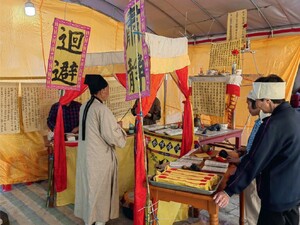
What rituals did the rutan conduct? Examining the content of Shengjiao wengao, the ritual activities performed by the rutan encompassed many aspects of peopleâs religious life. They included celebrations of the anniversaries of deities in different temples, sacrifices in connection with agriculture for villages and local communities, individual and family-focused rituals for seeking blessings and warding off disasters, and funerals (Figure 1). The comprehensive nature of these rituals allowed rutan to replace Buddhism or Daoism in some counties and towns, monopolizing the local market in ritual services.

rutan priests in a home funeral ceremony, 2023
Citation: Review of Religion and Chinese Society 11, 2 (2024) ; 10.1163/22143955-12340027
Photo: authorThe foreword (juanshou
Shengjiao wengao is closely related to the worship of Guan Yu (also known as Wusheng dijun
The section of the foreword entitled âExamples and Models of Petitions and Memorialsâ (Zhushu biaoshi
The rituals in Shengjiao wengao and Shengjing zhaiyao were called âscripture recitationsâ (songjing
Takeuchi Fusaji (1990) discovered that beginning around 1840, a new religious trend emerged in Southwest China, combining spirit-writing (fuluan
Celestial Lord Gao spent three days on his work, and he also composed one of the three prefaces. This preface expressed the view that moral improvement could rescue humanity. Vincent Goossaert (2014) has shown that during this period many scriptures revealed by spirit-writing proposed a similar soteriology. For the rutan in Sichuan, the most important method of moral reform was preaching the Sacred Edict.
The Transformation of Preaching the Sacred Edict in Late Qing Sichuan
In the early Ming Dynasty, the emperor Zhu Yuanzhang
The Sacred Edict reflected Confucian ethical values and was applicable to all people, whether educated or not. In later years, preaching became increasingly common as a means of communicating the Sacred Edict to common people. Adaptations, commentaries, paraphrases, and exegeses began to appear, many of them written in the colloquial language. Groups who participated in preaching the Sacred Edict also diversified. As Yao Chi-On (2008) has shown, preaching the Sacred Edict was no longer solely the activity of governmental authorities. Some religious groups also participated, including emerging popular sects who used their preaching as a means of gaining legitimacy to avoid repression by the government. For example, in Ba County
After the disruptions caused by the White Lotus Rebellion (1796â1804) in Sichuan, local officials recognized the limitations of the local bureaucracy. As a result, the responsibility to administer many local mattersâincluding charitable activities related to social relief, as well as preaching the Sacred Edictâwas delegated to people in those places. In 1874, the magistrate of Ba County, noting that the Emperorsâ twenty-two maxims (that is, Shunzhiâs six and Kangxiâs sixteen) were a valuable means to educate the many domineering and unruly people in his county, stated that âCharitable halls have instituted preaching [the Sacred Edict].â12 Thus, some non-governmental organizations, including charitable halls (shantang
The Gengzi year of 1840 marked a significant turning point not only for the popular religious movements described by Takeuchi Fusaji, but also for the transformation of preaching the Sacred Edict. The Qing archives of Ba County show that before 1840, local government decrees urging preaching the Sacred Edict were mainly directed to officials. After 1840, however, the decrees show that while local government encouraged grassroots preaching of the Sacred Edict, they also began to be wary of unofficial preachers âmisleading the people with unorthodox teachingsâ (xiejiao huozhong
According to the theology of the rutan, as noted above, Lord Guan observed the coagulation of black qi and became convinced of the imminent arrival of a calamity caused by the corruption of the Three Religions. Therefore, Lord Guan organized the saints and deities of the Three Religions into a new sect and instructed them to descend to the human world to spread the teachings, transform the morals of the people, and save them from calamity. The primary means of improving morality was preaching the Sacred Edict. From this perspective, the decrees issued by the Qing court tended to confirm the decrees from the deities of the rutan. The Emperorsâ maxims, therefore, had a salvational role in their theology.
The fifth volume of Shengjiao wengao contains documents related to preaching the Sacred Edict, such as the âPrayer Document for Preaching [the Sacred Edict]â (xuanjiang zhuwen
Preaching the Sacred Edict in the Various Rituals of Rutan
In Shengjiao wengao the ultimate goal of preaching the Sacred Edict is to gain salvation. From at least the late nineteenth century, rutan had preached the Sacred Edict. In the vicinity of Mianyang, I found another guide for rituals used by rutan, called âThe Superlative Compilationâ (xuanqing bian
Unlike Shengjiao wengao, Xuanqing bian lists âPreaching the Sacred Edictâ as an individual category. Under this heading are various prayers for specific problems that all invoke the Sacred Edict. The logic in these prayers is that the problem at issue is caused by the moral laxity of the individual, family, or community. Preaching the Sacred Edict, sometimes repeatedly, will correct the errant behavior which will, in turn, lead to the eradication of the problem. Thus, preaching the Sacred Edict had become an element of normal prayer. A person encountering illnesses, infertility, or other troubles in their life could request preaching the Sacred Edict ceremonies from the rutan to gain merit and receive the blessings of the deities. Xu Xinyu (
It is the custom in Sichuan Province, when a family member falls ill or encounters misfortune, to make a wish to the deities and authorize several nightsâ lecturing on the Sacred Edict.
å·çç¿ä¿ï¼å®¶äººå¶æç çï¼æééä¸ç¥¥äºï¼ååç¥å許é¡ï¼ å說ãèè«ãå¹¾å¤ã (Xu 1985:95)
The transformation of the Sacred Edict into a text that could prevent the upcoming calamity and also help people to overcome various problems in their daily lives turned it into a scripture. As this occurred, the moral instructions of the Sacred Edict became precepts (jie
Tadao Sakai (2010) has demonstrated that in the late Qing many books intended for non-official preachers emerged, such as the Collected Essentials for Preaching [the Sacred Edict] (Xuanjiang jiyao
These precepts can be seen as a religious manifestation of the Sacred Edict, giving the government decree a theological effect. Just as becoming a Buddhist monk or a Daoist priest requires getting the Certificate of Ordination (jiedie
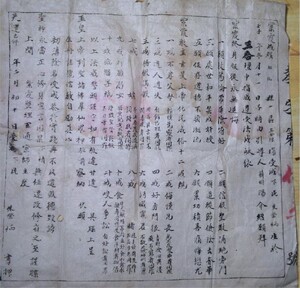
Certificate for Lord Guanâs Twelve Precepts from 1939
Citation: Review of Religion and Chinese Society 11, 2 (2024) ; 10.1163/22143955-12340027
Photo: author, 2023In many cases, such precepts are granted to the departed, especially to âunclaimed soulsâ (guhun
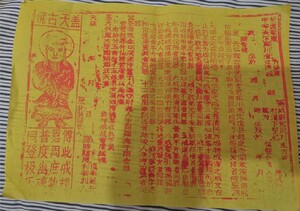
In the third volume of Xuanqing bian, there are various documents for âgiving precepts [to the dead] to get rid of enmitiesâ (shijie jieyuan
Certificate for Lord Guanâs Twelve Precepts for the Departed
Citation: Review of Religion and Chinese Society 11, 2 (2024) ; 10.1163/22143955-12340027
Photo: author, 2019Compared with these ceremonies, funeral rites were more frequent. Death is a matter all families face, and providing funeral services became one of the main concerns of rutan. A major aspect of these ceremonies was the preaching of the Sacred Edict to the souls of the departed. A liturgical text used by altars in northwestern Sichuan provides information on this. Ritual Texts of the Sacred Teachings (Shengjiao keyi
While the Sacred Edict itself did not encourage people to perform rites for the departed, preaching the Sacred Edict survived as part of the funeral ceremonies of the rutan. The foreword of Shengjiao wengao makes it clear that at least until the mid-nineteenth century, preaching the Sacred Edict was the primary business of rutan in Sichuan, with the performance of ritual being supplementary. However, by the end of the nineteenth century and in the early twentieth century, preaching the Sacred Edict had become fully integrated into the various rituals of rutan. During my fieldwork, I was told that the present rutan in Sichuan no longer conducted Sacred Edict preaching aimed at the living. However, the funeral rituals that included preaching the Sacred Edict continue to be performed regularly.
Both Chinese Buddhist and Daoist priests hold rituals for teaching the departed and giving them precepts. Rutan found theoretical justification to provide similar ritual services by using the Sacred Edict. This not only gave theological significance to the Sacred Edict but also conferred political legitimacy on the rituals of the rutan. As a result, preaching the Sacred Edict became more closely related to peopleâs lives, giving them reasons to invite preachers to conduct rituals. This ensured its survival even after the fall of the Qing. By the 1940s, in Chongqing, the temporary capital of the Nationalist government, the popularity of preaching the Sacred Edict surprised the premier, Chiang Kai-shek. His government attempted to use these preachers to propagate official ideology again, but this time for the Kuomintang. However, it was obvious that the preaching had become distinctly religious. In a decree signed by Chiang Kai-shek, local officials in Chongqing reported that many Sacred Edict preachers in Sichuan were âpromoting superstitionâ (guchui mixin
Importantly, rituals associated with preaching the Sacred Edict provided rutan with substantial economic benefits, encouraging people to learn and perform their rituals. In 1851, the Ba County court issued a decree to arrest people if they accumulated wealth under the pretext of preaching the Sacred Edict, indicating the economic benefits of doing so.17 Among the texts I have collected is a preacherâs liturgical book from Santai County
Shenjiao ç¥æ : the Combination Method of Revelation
David Graham did not record the rutan he observed preaching the Sacred Edict. However, he did document other activities that left a deep impression on him. Graham initially translated rutan as âSpiritualismâ in his Chinese Record article of 1935.18 He believed that communicating with spirits was the most significant characteristic of the rutan:
What are the reasons for the success and gradual growth of the Ju Tâan at the very time when Buddhism and Taoism were waging a life-and-death struggle for their very existence in West China? They are, first, the borrowing of the prestige of the literati through its name; second, the uses of methods and ceremonies acceptable to most of the people; and third, and I would say mainly, because of its supposed ability to obtain at will messages from the gods and from deceased relatives and ancestors. (Graham 1961:104)
This relates to the second aspect of the new religious trend in Southwest China in the late Qing that Takeuchi Fusaji proposed, namely fuluan
Graham identified the main reason for the success of the rutan as their ability to âobtain messagesâ from the other world. He described what he saw:
The Ju Tâan produced and used ceremonially its own sacred books, with the same purposes and the same expected results as among the Buddhists and the Taoists. They had charms and incantations, conducted funerals and memorial ceremonies, and exorcised demons, but they did not have a celibate priesthood. Their greatest distinction was that they obtained messages from the gods or from deceased relatives and ancestors. Often they used the planchette, a table covered with sand, on which two persons skillfully manipulated a pen so as to write characters that they read as messages. Sometimes these revelations were published in books, and some of these books contained the words of Jesus, called the Chi-tu-chiao-chu.
In some of the Ju Tâan temples there were dark rooms in which were left pens, ink, and paper ready for writing. No one was supposed to be inside, but later when the door was opened, characters appeared on the paper, supposedly written by the gods. â¦
Even more impressive are the works of the mediums in getting messages from deceased husbands, wives, and ancestors for their living friends, relatives, and descendants. These are delivered verbally. In one instance the widow of a wealthy church member at Chi-tâien-pa, south of I-pin, was the recipient of such a message. She was, of course, able to make a very sizable contribution. In due time the medium called her by name. âYour husband says,â he began, and gave her a long message. She was thrilled, believing that her husband had spoken to her through the medium. I heard of another man who received a message supposedly from his father. On hearing the words of the medium, he knelt down and burst into tears. (Graham 1961:103â104)
This passage presents at least three ways of receiving messages: (1) two persons use a planchette to write characters on sand, the characters then being recognized as words; (2) in a sealed space, without human intervention, a deityâs words appear directly on paper using ink and pens provided for the purpose; (3) a medium delivers messages from the deceased.
The first type is typically termed fuji
Furthermore, Weiâs account provided additional details and included the terminology related to the third method described by Graham, namely communicating with the dead. According to Wei, this was called âtraveling to the underworldâ (youming
Traveling to the underworld has a long history in Chinese religion and has been an important way of creating morality books: many of them describe the experiences of a living person entering the underworld and returning to narrate what they saw, admonishing people not to commit evil deeds so as to avoid punishment after death. One of the most famous works of this kind is, in Jordanâs translation, the Jade Guidebook (Yuli baochao
Wei added a fourth method of communication with the otherworld, namely mediums; in Sichuan they were called xiang
Compared to fuji, feiluan does not require individuals to write down and identify characters one by one; instead, it can produce lengthy, readable texts directly. However, youming and xiangshen are even quicker, with the messages being conveyed orally. Additionally, unlike fuji or feiluan, these latter two methods are public and performative, and accessible to the illiterate.
All four of these methods of revelation have a long history in Chinese religions, but it is unusual to find all of them mentioned in the same context. However, since 1840, the rutan started to employ fuji, feiluan, youming, and xiangshen in a combined method, which accelerated the production of their texts. From that point on, a large number of scriptures and moral books related to preaching the Sacred Edict were generated. The Shengjing zhaiyao published in 1856 contains twenty-four volumes containing over 130 scriptures, and most of them were composed by these four methods. To a certain extent, rutan acquired the ability to continuously produce new texts and steadily update their doctrines, allowing them to evolve in step with the times.
This significant innovation had a profound impact on its spread, but it also meant that when a new rutan was established, it was necessary to learn all four techniques. Between 1860 and 1863, the Qunying tan
The first chapter records that in 1840 a book composed by the Divine Teachings (shenjiao
In this book, the combination of the four techniques was named shenjiao, an abbreviation of âEstablishing Teachings by the Divine Wayâ (Shendao shejiao
The example of the Qunying tan illustrates the impact of the revelation of techniques in 1840 on the spread of rutan, with cross-regional dissemination of altars occurring with the transmission of these four methods. Sometimes, this transmission relied on people like Wuyuan traveling to other places, but at other times it relied on the circulation of books. For example, the Xuanqing bian, which circulated in northwest Sichuan, includes instructions on all four techniques.20 Thus, the methods of the Divine Teachings could be learned directly from this book.
Longnü Temple was still active in the first half of the twentieth century; I have observed a plaque with this name dated 1932. This indicates that nearly a hundred years after the innovations of 1840, Longnü Temple remained active. During this period, the combination technique was so influential that various rutan regarded Longnü Temple, where this combination technique was revealed, as a holy site, and claimed it as their origin point, even if they had no real connection to it. Beyond the rutan, this event had a broader influence on Chinese religions. Many sects that had been banned by the government began incorporating the 1840 event into their sacred narratives, claiming that they too originated in Longnü Temple in order to gain more recognition and claim orthodoxy. An altar in Songpan County
Conclusion
Based on the Lord Guan spirit-writing cult, rutan in Sichuan developed a theological framework for salvation. Obtaining revelations to compile morality books and preaching the Sacred Edict became the two main approaches to elevate peoplesâ morality. The two approaches complemented each other. While morality books primarily targeted literate individuals, preaching the Sacred Edict could reach those who were illiterate.22
In addition, during the development of rutan, both approaches acquired additional functions. Preaching the Sacred Edict became part of the rutan rituals for prayer and funerals, while the four techniques of revelation were used to help people with divination or communicate with their departed relatives. This meant that rutan could be employed to offer ritual services for economic benefit, ensuring their persistence over the long term.
As anthropologists, David Graham and Wei Hwei-lin observed the rutan, but they did not have the opportunity to examine the history of this religious tradition. Over eighty years later, I have been able to locate existing altars and collect their texts. As this article has shown, they are still using texts printed in the nineteenth century. These texts survived partly because of the rutan teachings on valuing paper and written texts, and also partly because of its unique publishing culture.
Liturgy books of local religious traditions are usually in manuscript form because the transmission of manuscripts is typically private, and they better reflect the sacredness of their religious knowledge. However, rutan were always keen on printing and publishing their liturgy books. Over the past two centuries, we have seen the repeated printing of Shengjiao wengao throughout the country, as well as of other texts used only in a few counties and published by local altars, such as Shengjiao keyi and Xuanqing bian. The circulation of liturgy books of rutan may be related to their publication of morality books. These morality books often state that the deities commanded rutan to compile and publish the book as a meritorious act. Similar statements also appear in the prefaces of their liturgy books. Thus, both the morality books and liturgy books of rutan have become public publications. In 2019, I interviewed an altar member born in 1928 in Mianyang who recalled that before the 1950s, all liturgy books in his altar were printed copies. A town near Mianyang specialized in printing and selling these texts, and rutan members from nearby counties would go there to purchase them.
Rutan were established in different places. They had similar but not identical doctrines and rituals, forming a relatively loose community with no hierarchy or cross-regional leaders. During the Republican Period, various religious groups registered with the government, with Buddhists and Daoists forming associations from the national and provincial to the county levels. We can observe that several counties in Sichuan had rujiao associations
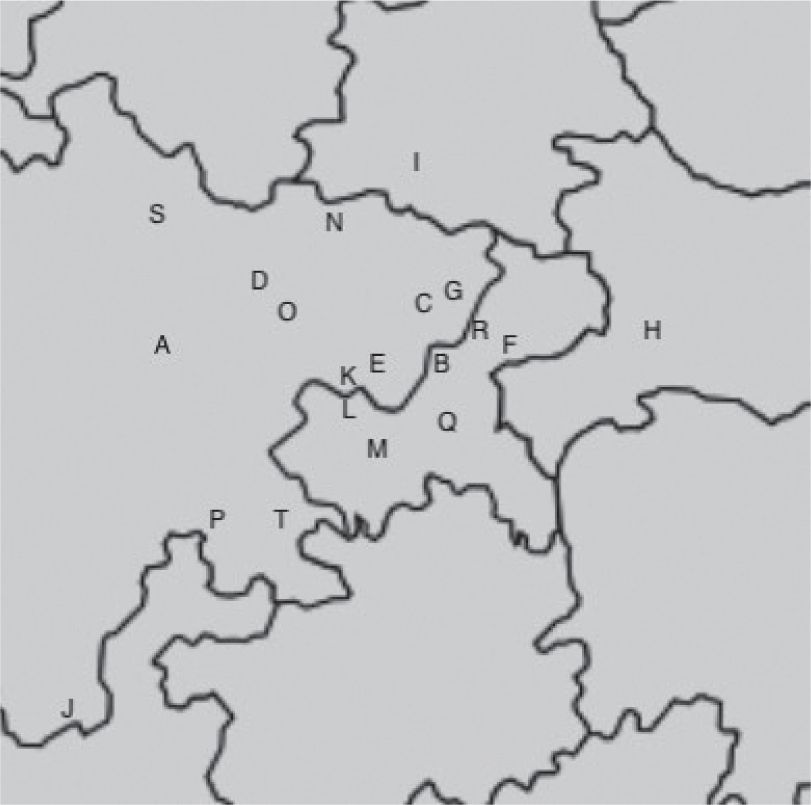
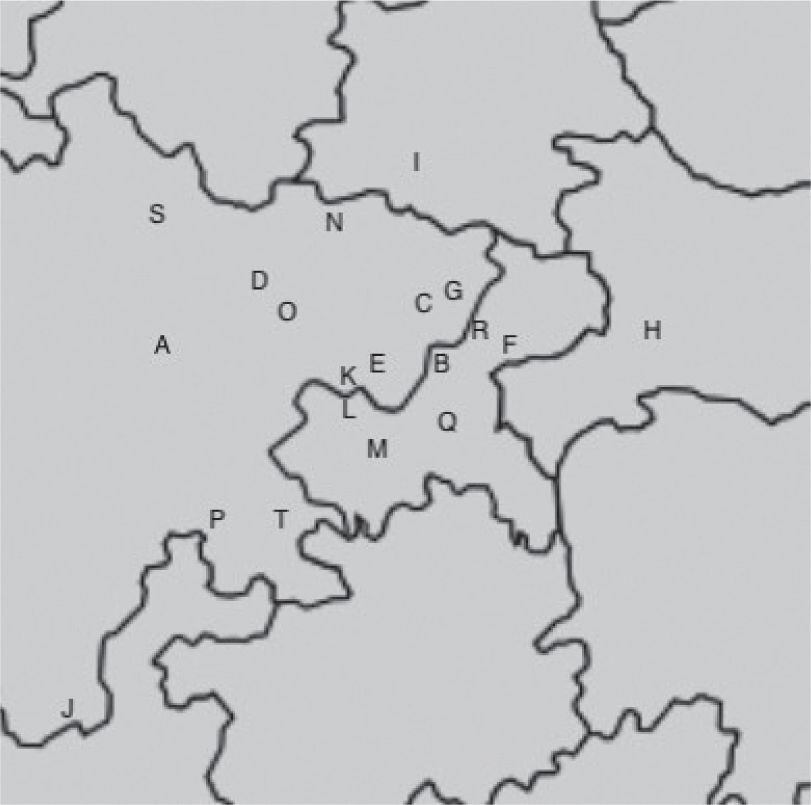
The locations mentioned in this article. Key: A. Chengdu æé½ B. Liangping æ¢å¹³ C. Dazhou éå· D. Mianyang ç¶¿é½ E. Guangâan å»£å® F. Yunyang é²é½ G. Dongxiang æ±é H. Xingshan èå±± I. Hanzhong æ¼¢ä¸ J. Huili æç K. Dingyuan å®é L. Hezhou åå· M. Ba County 巴縣 N. Zhaohua æå O. Santai ä¸å° P. Yibin å®è³ Q. Fengdu é
é½ R. Kai County é縣 S. Songpan æ¾æ½ T. Lu County ç縣
Citation: Review of Religion and Chinese Society 11, 2 (2024) ; 10.1163/22143955-12340027
Acknowledgments
I would like to express my heartfelt gratitude to my supervisor, Benjamin Penny, and the two anonymous reviewers. They carefully read the manuscript, offered valuable suggestions, and corrected various grammatical errors. Special thanks go to my friend, Daoist Master Huang Xinzhi
References
Primary Sources
Ba County Archive, Sichuan Provincial Archives, Chengdu.
Chongqing Archive, Chongqing Archives, Chongqing.
Dunhou jiæ¦åé. Reprinted 1898. Housed in the Sichuan Provincial Library.
Guandi mingsheng jing zhushiéå¸æèç¶æ³¨é. Reprinted 1912. Included in the DaoÂzang jicheng Guandi juanéèéæ-éå¸å·, vol. 21. Beijng: Zhongguo shudian, 2020.
Jiusheng chuanæçè¹. 1876 edition. Included in the Sandong shiyiä¸æ´æ¾éº, vol. 6. Hefei: Huangshan shushe, 2005.
Shengjiao keyièæç§å. 1904 edition. Owned by the author.
Shengjiao wengaoèææ稿. Printed 1893. Housed in the Sichuan Provincial Library.
Shengjing zhaiyaoèç¶æè¦. Reprinted 1898. Owned by the author.
Sichuan Chenbaoåå·æ¨å ±. Housed in the Sichuan Provincial Library.
Xingmi taiping xinjingé迷太平æ°ç¶. 1944 edition. Housed in the Sichuan Provincial Library.
Xinshu baoæ°èå ±. Housed in the Sichuan Provincial Library.
Xuanqing biané¸éç·¨. 1902 edition. Housed in the Jiangyou Municipal Library.
Secondary Sources
Cao, Xinyu æ¹æ°å®, ed. 2019. Jibian rujiao: jinshi Zhongguode zongjiao rentong æ¿è¾¯åæï¼è¿ä¸ä¸åçå®æèªå [Provocations to Confucianism: Identifying religion in modern China]. Beijing: Zhonghua shuju.
Clart, Philip. 1996. âThe ritual context of morality books: A case-study of a Taiwanese spirit-writing cult.â PhD diss., University of British Columbia.
Clart, Philip. 2003. âConfucius and the Mediums: Is There a âPopular Confucianismâ?â Tâoung Pao 89, no. 1/3: 1â38.
Gan Shaocheng çç´¹æ 2013. âCong ruyuan wengao kan zaoqi chengdu rutan de shezhi yili yu dongjing yinyueâ å¾ãåé¢æ稿ãçæ©ææé½åå£çè¨ç½®ãå禮èæ´ç¶é³æ¨ [Looking at setting, ritual and music of the Confucian Altars in Chengdu in the early period from ruyuan wengao]. Yinyue tansuo é³æ¨æ¢ç´¢ [Explorations in Music] 2013 (2): 75â82.
Goossaert, Vincent. 2014. âModern Daoist Eschatology: Spirit-Writing and Elite Soteriology in Late Imperial China.â Daoism: Religion, History & Society, no. 6: 219â246.
Goossaert, Vincent. 2022. Making the Gods Speak. Leiden: Harvard University Asia Center.
Graham, David C. 1935. âReligion of the Chinese in Szechwan.â Chinese Recorder 66: 421â428, 484â490.
Graham, David C. 1961. Folk Religion in Southwest China. Washington, DC: Smithsonian Press.
Hu, Jiechen. 2023. âThe Spectrum of Spirit-Writing in Early Modern China: A Preliminary Study.â In Communicating with the Gods: Spirit-Writing in Chinese History and Society, 171â205. Leiden: Brill.
Hsieh Tsâung-hui è¬è°è¼. 2013. Xin tian di zhi ming: Yuhuang, Zitong yu feiluan æ°å¤©å¸ä¹å½: ççãæ¢æ½¼èé£é¸ [Mandate from the New Heavenly Emperor: Jade Sovereign, Zitong, and Flying Phoenix]. Taipei: Shangwu yinshuguan.
Jordan, David K., and Daniel L. Overmyer. 1986. The Flying Phoenix: Aspects of Chinese Sectarianism in Taiwan. Princeton, NJ: Princeton University Press.
Lee Fong-mao æè±æ¥. 2001. âLisheng yu daoshi: taiwan minjian shehui zhong liyi shijian de liang ge mianxiangLisheng yu daoshi: taiwan minjian shehui zhong liyi shijian de liang ge mianxiang
Mair, Victor H. 1985. âLanguage and Ideology in the Written Popularizations of the Sacred Edict.â In Popular Culture in Late Imperial China, edited by David Johnson et al., 325â359. Berkeley: University of California Press.
Ren Jiyu 任繼æ, ed. 2000. Rujiao wenti zhenglun ji åæåé¡çè«é [The debate on Confucianism]. Beijing: zongjiao wenhua chubanshe.
Sakai, Tadao é äºå¿ 夫. 2010. Zhongguo shanshu yanjiu ä¸ååæ¸ç 究 [Studies on Chinese morality books], trans. Liu Yuebing åå²³å µ. Nanjing: Jiangsu renmin chubanshe.
Billioud, Sebastien, and Joel Thoraval. 2015. The Sage and the People: The Confucian Revival in China. Oxford: Oxford University Press.
Takeuchi Fusaji æ¦å §æ¿å¸. 1990. âShin-matsu Shisen no shakyó undó--furan-senkôkei shûkyó kessha no tanióâ æ¸ æ«åå·ã®å®æéåâæ¶é¸Â·å®£è¬åå®æçµç¤¾ã®èªç [Religious Movements in Late Qing Sichuan: The Emergence of Spirit-Writing and Preaching the Sacred Edicts-Based Religious Societies]. Gakushiin Daigaku bungakubu kenkyi nempó å¸ç¿é¢å¤§å¸æå¸é¨ç ç©¶å¹´å ± [The Annual collection of essays and studies, Faculty of Letters, Gakushuin University] 37: 59â93.
Ter Haar, Barend. 2017. Guan Yu: The Religious Afterlife of a Failed Hero. Oxford: Oxford University Press.
Wang, Chien-chuan çè¦å·. 2008. âTaiwan âGuandi dang Yuhuangâ chuanshuo de youlaiâ å°ç£ãéå¸ç¶ççãå³èªªçç±ä¾ [The Origins of Taiwanâs Myth of âGuan Di as the Jade Emperorâ]. In Hanren zongjiao, minjian xinyang yu yuyanshu de tansuo: Wang Jian- chuan zixuanji 漢人å®æãæ°éä¿¡ä»°èé è¨æ¸çæ¢ç´¢ [The Exploration of Han Chinese Religion, Popular Religion and Prophecies], 412â430. Taipei: Boyang.
Wang, Chien-chuan çè¦å·. 2021 âDaoyan shiquan hui zixia jiao yu qing zhogye yilai de guandi xinyangâ å°è¨:åå ¨æãç´«éé®èæ¸ ä¸è以ä¾çéå¸ä¿¡ä»° [Introduction: The Ten-Perfections Society, Offerings of the Purple Mist, and the Cult of Lord Guan since the Mid-Qing Dynasty]. In Minjian sizang: Zhongguo minjian xinyang minjian wenhua ziliao huibian æ°éç§è : ä¸åæ°éä¿¡ä»°æ°éæåè³æå½ç·¨ [Private Collections: A Compilation of Chinese Folk Beliefs and Cultural Materials], series 4, comp. Wang Chien-châuan çè¦å· et al., 1: 1â14. Taipei: Boyang.
Wei, Hwei-lin è¡æ æ. 1935. Fengdu zongjiao xisu diaocha é é½å®æç¿ä¿èª¿æ¥ [Survey of Fengdu Religious Customs]. Sichuan: Xiangcun jianshe xueyuan yanjiushiyanbu.
Xu Xinyu å¾å¿ä½. 1985. Shu you wen jian lu è游é»è§å½ [A Record of Observations from Travels in Sichuan]. Chengdu: Sichuan sheng xinhua shudian faxing.
Yau Chi-on 游åå®. 2008. âCong xuanjiang shengyu dao shuo shanshu: jindai quanshan fangshi zhi chuanchengâ å¾å®£è¬èè«å°èªªåæ¸ï¼è¿ä»£å¸åæ¹å¼ä¹å³æ¿ [From the lectures on the Sacred Edict to the Recitation of Morality Books: Transmission of the didactic methods in the modern period]. Wenhua yichan æåéºç¢ [Cultural Heritage] 2008 (2): 49â58.
Yu Yi äºä¸. 1996. âSichuan Liangping âRujiaoâ zhi kaochaâ åå·æ¢å¹³ãåæãä¹èå¯ [An Investigation of the âConfucian Religionâ in Liangping County of Sichuan Province]. Minjian zongjiao æ°éå®æ [Popular Religions] 2: 281â290.
In this article, I have converted Grahamâs romanization from Wade-Giles to Hanyu Pinyin.
In the late 1970s and 1980s, mainland Chinese scholars like Ren Jiyu initiated several discussions on the issue of Confucianism. Ren Jiyu delivered a speech titled âConfucianism is a Religionâ in late 1978, followed by a series of articles that sparked wider discussions. See Ren 2000.
For instance, Lee Fong-mao pointed out that in the first half of the last century in Taiwan, rites specialists (lisheng
For recent studies, see Billioud and Thoraval 2015; Cao 2019.
Philip Clart first noticed Grahamâs research on rujiao in the Sichuan region. See Clart 1997:348.
The term
I did discover a rutan ritual text reprinted in 1898, entitled the âHonesty and Sincerity Collectionâ (Dunhou ji
In rutan texts, âpreachingâ (xuanjiang
Huâs religious name was Wanâan
The Six Maxims are as follows: Be filial to your parents
The Sixteen Maxims are as follows: Esteem most highly filial piety and brotherly submission, in order to give due importance to the social relations
Ba County Archive, 6-23-1119.
Ba County Archive, 6-8-583 and 6-4-363.
For instance, the most popular precepts in rutan, Lord Guanâs âTwelve Precepts,â are as follows: Do not disobey your parents
Originally, yan kou was a Buddhist food-bestowal ritual, performed to liberate hungry ghosts with flaming mouths from their thirst, hunger, and suffering in the netherworld by providing them with food and Buddhist teachings. The term yankou was adopted from Buddhism by rutan. In addition, keyi was originally a Daoist term, also adopted by rutan as the title of their liturgical book. Some preaching the Sacred Edict activities were also incorporated into rutan rituals. For example, according to Xuanjiang shiyi, at the commencement of preaching the Sacred Edict, the assistants of the preacher would shout, âEveryone, be quiet! Every member, be devout!â (
Chongqing Archive, 81-4-722-1.
Ba County Archive, 6-18-363.
Chinese Record 1935, 464.
See Jordan and Overmyer 1986:49; Clart 1997:22â34.
Xuanqing bian, vol. 3, 44â45.
The most representative case is Precious Raft Pointing the Way (Zhilu baofa
Jiusheng chuan contains a discussion of these two approaches.
Some newspapers during the Republican era recorded activities of rujiao associations. See, e.g., âChongde Primary School in Lu County was established by the rujiao Associationâ (