Abstract
With the aim to reach deeper insights into dynamics of resilience and resurgence in Sámi systems of knowledge, this article explores how Sámi worldviews and knowledges are enacted and passed on despite violent efforts of erasure by colonial state actors and settler colonialists. I analyze a variety of sourcesâinterviews, a podcast, a documentary and a magazineâto highlight Sámi resilience and resurgence from different sites in the Norwegian part of Sápmi. Using the notion of heritage work, I illustrate how Sámi knowledge systems have kept their inner coherence while emerging in close affinity with hegemonic systems of knowledge. While illuminating tensions, contestations and complexities, the analysis brings attention to intersections between Sámi spirituality and Lutheran Christianity and recognize the embodied ways in which Sámi epistemes and nature-centered and multi-relational cosmologies are practiced beyond logocentric modes of knowledge, and highlight the role of gender for passing on these tacit forms of knowledge.
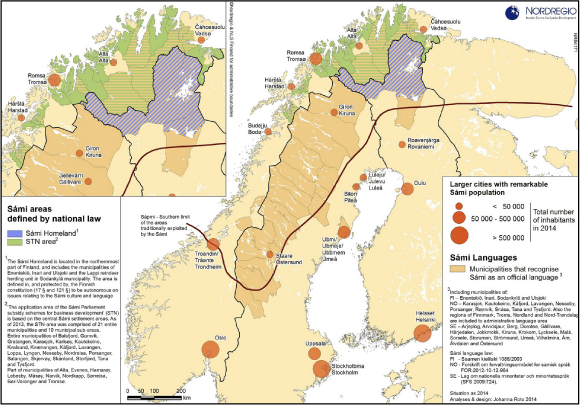
Sápmi1 is the region of the Indigenous Sámi peoples in the European Arctic, encompassing northern Norway, Sweden, Finland and the Kola peninsula in Russia (see Figure 1).

Figure 1
Sápmi, the livelihoods of Sámi
Citation: Religion and Gender 15, 1 (2025) ; 10.1163/18785417-tat00021
Map: Johanna RotoSignificant scholarly attention has been brought to the important struggles in Sápmi around resource extraction and environmental destruction that risk to destruct Sámi livelihoods and lands (BuitvydaitÄ and Engebretsen 2023; Lindgren and Cocq, 2017; Ojala and Nordin, 2015; Rosamond, 2020). Sámi scholars Rauna Kuokkanen and Ina Knobblock (2015) illuminate the focus in Indigenous methodologies on land and its commitment to promoting the self-determination of Indigenous peoples as distinct from postcolonial approaches. Aside of such attention to questions of Sámi rights to land and self-determination, Sámi scholars emphasize the need for an expanded attention to Indigenous worldviews and knowledges, and for more systematic analyses of the consequences of epistemicide, a kind of cultural genocide, in the Sámi context, following from the attempt, among national state actors and settler colonialists, to erase Sámi knowledge, heritage, culture and language (Knobblock 2022; Kuokkanen 2008). In this article, I aspire to bring such questions of epistemicide to the center of attention.
With the aim to reach deeper insights into dynamics of resilience and resurgence in Sámi systems of knowledge, I explore how Sámi worldviews and knowledges are enacted and transmitted despite violent efforts of erasure by state actors and settler colonialists, and how Sámi knowledge systems have kept their inner coherence while emerging in close affinity with hegemonic systems of knowledge. In this ambition, Liisa-Rávná Finbogâs (2015) notion of heritage work has been fruitful, recognizing tacit forms of practical knowledge as a form of embodied knowledge transmission. According to Finborg (2015, 96), heritage work is âany work pertaining to the expression and fortification of indigenous cultural identity and heritageâ, which facilitates the sharing of local and Indigenous knowledge and strengthens the connection between the local cultural heritage and the local community, boosting Sámi autonomy and self-determination. In what follows, I explore two modes of heritage work, at first, the widespread spiritual-traditional Sámi practice of enacting rituals, sacrifice and blessings, and second, the popular aesthetic-emotional practice of singing in Sámi.
I analyze a broad variety of material, reflecting both everyday practices and media discourses, including in-depth interviews with a Sámi laywoman and reindeer herder and a Lutheran priest based in Finnmárkku fylka, Finnmark, Norway, a region in the North Sámi area; ten episodes of the podcast FápmuâKraft [Force] from the Sámi broadcasting cooperation (2022 and 2023); the documentary film Sámi Jienat voices of Sápmi, about the Sámi choir (2013); and the South Sámi church magazine Dearpies Dierie, established in 1997. I draw on this material to examine how Sámi cultural practices take shape as heritage work to strengthen and pass on Sámi systems of knowledge and worldviews at the intersection between Sámi everyday Christianity and institutionalized Lutheran Christianity. As my fieldwork for the article was located in the Norwegian part of Sápmi, I situate this article in the historical context of the emergence of the Norwegian nation-state.
Until recently, scholarship was mainly in agreement that the Sámi participated in two different religious spheres, as they continued to practice their Indigenous religion alongside Christianity, after the systematic Christian mission started, with Catholic influences already during the Middle Ages (Kristiansen 2005; Rasmussen 2016; Rydving 1995). Lately, however, Sámi religious historians and theologists have challenged this conclusion, by theorizing Sámi religiosities from a perspective of convergence, rather than understanding Sámi religiosity as remaining fragments of an old tradition. Religious historian Siv Rasmussen (2016) points to examples from the 13th century, such as the existence of Christian symbols on goavddis, the sacred drum, to suggest the existence of syncretic aspects of religious practice among the Sámi. With reference both to historical and contemporary sources, Sámi religious studies scholar Lovisa Mienna Sjöberg (2018) illuminates how sivdnidit, the blessing, have been cultivated and practiced as a form of Sámi everyday Christianity, enacting Sámi animism in complex intersection with Lutheran Christianity in various aspects of life. Further, Sámi theology and religious studies scholar Tore Johnsen (2022) illuminates the theological significance of North Sámi Christianity to Scandinavian Lutheranism, revealing the non-hierarchical and multi-relational cosmology of Sámi everyday Christianity. Yet, as these scholars emphasize, throughout history, forceful attempts at Christianizing the Sámi have had decisive consequences for Sámi life-worlds, social organization (marriage, courtship, sexual morals) and systems of belief (Fur 2016), for example by condemning the yoik, which was associated with pre-christian heathen ceremonies, seen by Christian missionaries as âserving the Devilâ (Härmäläinen et al. 2018, 4) and, in Norway, the assimilation policy called âNorwegianizationâ lasting for over a century from the mid-19th century, targeted Sámi cultures, traditions and languages. Within this context, the Lutheran Church of Norwayâuntil 2012 a state church in Norwayâplayed an important role, among other things because Christian education in schools was under the supervision of the church (Kristiansen 2016). Thus, an analysis of the intersections between Sámi Indigenous religion and Lutheran Christianity needs to recognize the multiple tensions and power relations that characterize both historical and present negotiations and potential forms of convergence between Sámi worldviews and Lutheran Christianity.
1 Third Space Methodology: Indigeneity and Gender
In researching this topic, I am situated in a position of in-betweenness, a position characterized by dynamics of separation and loss, continuity, and mobility. On the one hand, I recognize my location as that of a non-Indigenous, Nordic-based settler researcher, and acknowledge the ethical concerns posed by such positionality when engaging in issues of Sámi practices of heritage work. Sámi scholars have brought attention to the ways in which research from a non-Sámi locatedness have resulted in reinforced stereotypes about Sámi people, in a search for the âexoticâ (Lehtola 2017, 83), and shown how research re-enact a colonial Othering of Indigenous peoples (Knobblock 2022; Smith 2012, 60). From the location of a non-Indigenous scholar, these and other power dynamics are particularly important to take into account (BuitvydaitÄ and Engebretsen 2023; Clarke and Yellowbird 2020). On the other hand, I recognize that my location also carries a heritage imbued by loss and disconnection, and stories untold. As a result of historical trauma experienced by Sámi ancestors, many Sámi descendants are affected by a trauma of absence (Finbog 2021), expressed through feelings of loss, emptiness and detachment (Knobblock 2022). In my research, when taking part of the stories of how previous generations tried to escape from violent oppression and stereotypes, by hiding and suppressing their Sámi identity and language, fragments in my own memory comes to life, of my motherâs descriptions of language loss, of her grandmotherâs shame of her background, and the silence around their ancestors, during her upbringing in the 1940s and -50s in Giron, Kiruna, located in the most northern part of Sweden. Today, only my mother is still in life and when I ask her, she says that she âwas not curious enough as a childâ and regrets that she didnât ask more questions. However, I am not so sure that she should blame herself for this lost connection, which on a broader scale reflects the repressive policy exercised by these national states toward the Sámi and Kven2 peoples. As a matter of fact, my knowledge of our family tree on my motherâs side ends with my great-grandmother Hilda. She grew up in Sáivomuotki, Saivomuotka in Gárasavvon, Karesuando by the border to Finland. She later moved to the countryside by the border to Ãhkanjárga, Narvik, Norway. Finally, in Giron, Kiruna, she settled to take up a profession as tailor, to help my grandmother after my mother was born. My mother never learnt the language Hilda used when speaking with older relatives, which my mother refers to as a âsecretâ or âshamefulâ language. Acknowledging the continuous significance of the colonization of Sápmi, I find it important to develop deeper insights about how Sámi systems of knowledge have been cultivated and transmitted despite harsh repression from the state and the Christian (Catholic and Lutheran) church across centuries.
This article should not be read as an attempt to give a triumphalist account over how Christianity has successfully subsumed Sámi spiritualism. Instead, taking heed of Johnsenâs (2022) emphasis on the importance to approach Sámi everyday Christianity on its own premises, I seek to provide a nuanced understanding of the practices of lived religion among the Sámi, perceived as an outcome of complex historical negotiations between Sámi Indigenous spirituality, late medieval Catholicism and later Lutheranism. Within the frames of Indigenous methodologies, I follow the notion of the third space, informed by an ambition not to portray Indigenous traditions and identities as pure categories in binary opposition to Euro-Western traditions and identities (Chilisa 2012). While some contemporary debates on Sámi spiritual traditions carry a normative language based on an either/or approach to everyday spirituality, in the context of my fieldwork, I have found that such usages of tradition may risk to marginalize hybrid understandings of Sámi cultures. Seeking to avoid creating rigid or polarized discourses, I pay attention to hybridity and change within the notion of the âthirdâ in-between space (Chilisa 2012). In doing so, I approach modes of heritage work, in which Sámi knowledge and worldviews are cultivated, fortified and passed on, despite the violent attempts of erasure by state actors and their representatives. In my own family history, as well as in my research material, I have found that the passing down of tacit knowledge primarily has been done by women. In the analysis, I recognize the role of gender for the transmission of such knowledge and for shaping these in-between spaces, as these spaces were initiated and led by women on an everyday basis.
This approach allows me to conceptualize enactments of Sámi Christianity characterized by convergence, resulting from a historical encounter between Sámi and colonial-hegemonic worldviews and systems of knowledge (Johnsen 2022). In what follows, I acknowledge tensions and complex power dynamics that characterize these dynamics.
2 Everyday Sámi Christianity beyond the Nature/Culture Divide
My exploration of everyday Christianity among the Sámi focuses on how Sámi knowledge systems and values are practiced and passed on through heritage work, i.e. expressions and fortifications of Indigenous cultural identity and heritage (Finbog 2015). I conceptualize this as a tacit form of knowledge which is kept alive through embodied enactments, known without spoken about. The material that shapes the basis for the analysis in this chapter is collected through ethnographic fieldwork over five years. The variety of sourcesâinterviews, a podcast, a documentary and a magazineâreflects my ambition to strengthen the accuracy of the analysis and highlight practices and discourses about Sámi resurgence from different sites and locations in the Norwegian part of Sápmi. In the article I use Sámi place-names and terminology when significant. The material includes: (i) two in-depth interviews conducted in March 2019 in Girkonjárga, Kirkenes in Finnmárku, Finnmark, Norway. In these interviews, my interlocutors were a Sámi laywoman, who was reindeer herder and one of the initiators of the practice of reconnecting to singing hymns in Sámi in this community, and a priest in the Norwegian Lutheran Church in Mátta-Várjjaga gielda, Sør-Varanger municipality;3 (ii) the podcast Fápmuâ[Kraft] (Force), which examines Sámi art, spirituality, shamanism and environmental activism in ten episodes broadcasted 2023 and 2024;4 (iii) the documentary film Sámi Jienat Voices of Sapmi, by Alistar Fowler (2013). The documentary illustrates the story of the cross-border Sámi choir. The documentary is fifty-eight minutes long, and illustrates singing as an embodied enactment of Sámi heritage and as a mode of resurgence;5 (iv) and finally, the South-Sámi church magazine Dearpies Dierie, founded in 1997, published in Swedish, Norwegian and Southern Sámi language.6 The magazine is issued four times per year and covers a wide range of topics, including Sámi church life and cultural life and news about the Sámi community. For the analysis, I have downloaded and closely read issues from the last ten years (2014 until 2024).
As I have approached this material, I have sought to reach deeper insights into Sámi cosmological orientation, which I understand as shaped by animistic and shamanistic features (Kristiansen 2005). An animistic worldview conceptualizes everything as a living subjectânature, animals, objectsâand involves the building of relationships between oneself and the world. Such relational approach to the world implies that one lives in an equal relationship with the world, a world which consists of negotiations, since no one can decide over another subject. From this animistic worldview follows a nature-centered and multi-relational worldview that is associated with shamanism and with individual and communal rituals (Johnsen 2022; Rydving 2010). In the analysis, I highlight how such a Sámi worldview is enacted through contemporary Sámi spiritual practices and integrated into Lutheran Christianity, informed by a Sámi cosmological orientation pointing beyond the human/nature dichotomy and the supernatural/natural divide.
3 Epistemicide and the Notion of Resurgence
Decolonization is an ongoing struggle that needs to be negotiated and contextualized (Kuokkanen 2007). Decolonial scholars have theorized how the colonial expansion in 1492 shaped a hierarchical divide of the population rooted in ideas of race and gender (Lugones 2007; Quijano 2000). With this, a modern/colonial gender system emerged, through the co-constituency of gender, modernity and coloniality under capitalism (BoatcÄ and Roth 2016; Lugones 2007) and a Eurocentric approach to knowledge, which delegitimized all other conceptual formations across the world (Grosfoguel 2013). Decolonial scholars are guided by an ambition to restore alternative genealogies of knowledge (Tlostanova 2015) and to recover the âepistemological diversity of the worldâ (Santos 2014, 24). Yet, as Dankertsen (2022) and Knobblock (2022) underline, despite historical and ongoing forms of epistemic violence towards Indigenous peoples, Indigenous experiences should not be conceptualized as predominantly or even primarily characterized by âcolonial damageâ but seen as joyful and rich life-worlds, able to transcend the colonial impact. In this article, by recognizing Sámi systems of knowledge in their own right, I seek to highlight Sámi experiences as compound and rich modes of relationality to the world.
Defined by Santos, epistemicide is âthe destruction of the knowledge and cultures of these populations, of their memories and ancestral links and their manner of relating to others and to natureâ (2014, 18). Seeing that a kind of cultural genocide has been enacted by the national states in their attempts to erase Sámi culture and language (Knobblock 2022), exemplified by settler colonialism and the aggressive Norwegian assimilation policy Norwegianization [fornorskning], in this article, I examine the consequences of such epistemicide in the Sámi context.
I also employ the notion of Sámi resurgence, which brings attention to positions and processes grounded in Indigenous visions of freedom and autonomy and creates alternatives to colonial knowledge/cultural erasures by highlighting relational epistemes and practices (Knobblock 2022). In similarity with anticolonial struggles in other contexts (Thiongâo 1986), the language has a significant role in anticolonial resistance and critique, and scholars have recognized the significant role of Sámi language in cultural mobilization and revitalization (Heith 2017; Hirvonen 2008)âpractices of resurgence which often starts from the stigmatization and shame following from language loss.
4 Christianization, Colonial Expansion and the Policy of Norwegianization
The established understanding of Sámi Christian history in Norway holds that Thomas von Westen converted the Sámi in 1716, with Lars Levi Laestadius advancing the so-called Sámi version of Christianity in the 1830s. However, recent scholarly work has begun to challenge this narrative. For example, finding that already in the 13th century, the cross was associated with Sámi burial practices (Kraft 2009) and recognizing the early establishment of churches in Finnmárku and Torne lappmark (Rasmussen 2014), scholars propose that the Sámi in these areas were exposed to the Catholic Church at an earlier stage than the Sámi located in the south. The incorporation of the North Sámi into the Catholic Church starting in the 13th century is described as a result of the colonial expansion of Scandinavian kingdoms along the northern coastal regions (Hansen and Olsen 2007). In the 17th century, the influx of settlers, administrators, and missionaries disrupted the Sámi way of life in aggressive and violent ways. With the promise of tax cuts and free land, settlers migrated north, but this came at a cost to the Sámi people (Kuhn 2020). Through violent Christianization efforts, the âgoavddis, the traditional Sámi drum, were confiscated, sieidi, the sacred sites, destroyed, and noaidi, the traditional healer, the shaman, burnedâ (Kuhn 2020, 30). Church buildings were strategically used to incorporate the remote Sámi lands into the respective states (Lindmark 2016) and witch hunts took place, particularly strong in Finnmárku, targeting noaidi, the Sámi shaman, ritual specialist and keeper of traditions.
The most profound impact on Sámi religious life, scholars show, resulted from the intense Lutheran mission at the turn of the 18th century, as goavddis, Sámi sacred drums, were burnt or confiscated, and in many areas, sieidi, sacred sites, were destroyed (Hansen and Olsen 2007; Lindmark 2016; Rydving 1995). Furthermore, in the 18th century, forced dislocation and land grabbing was common, which opened up space for more settlers who established industries to exploit the natural resources of the region and to seize control of the waterways. Sámi who resisted dislocation had reindeer killed or their fences torn down by the settlers. Although the physical oppression and violence was an intrinsic part of the colonization, the most devastating effects, scholars find, came from the deprivation of Sámi spirituality and the material basis for their livelihoods (Finbog 2013; Kuhn 2020; Minde 2005).
Norway got its constitution in 1814, after 400 years of governance by other countries. A nationalist spirit broke out and the country saw a need to strengthen the Norwegian identity, community and sovereignty. The Sámi people were seen as a particular âpolar raceâ, or âSámi raceâ (Finbog 2013, 30), a distinct people with a particular kind of culture, a defining contrast to the Norwegians, an Other. The reinforced nationalist ideas justified ambitions to assimilate the Sámi people, carried out through the policy of Norwegianization [fornorskning]. The policy of Norwegianization formally started in 1851. A strict definition of the concept primitive and a view of Norwegiansâ as racially superior was used to define the Sámi people as biologically inferior and to âcivilizeâ them (Aarseth 2006). Sámi children were removed from their home environments and placed in boarding schools, while the Sámi people were regarded as foreign immigrants from the East whose loyalty to the Norwegian state needed to be secured (Minde 2005).
From the mid-19th century, the Lutheran pietistic revival movement called Laestadianism emerged from within the North Sámi community. In contradistinction to the formal policy of Norwegianization, the pastor Lars Levi Laestadius encouraged the use of Sámi language in singing hymns. Described as a more âindigenizedâ form of Christianity (Kristiansen 2005), some scholars propose that the old Sámi nature-centered religion âtook refugeâ in Laestadianism (NergÃ¥rd 2006), though this claim is contested (Johnsen 2022, 28). Nonetheless, in Finnmárku region still today, Laestadianism remains a significant religious movement and reference point.
Already in the early 20th century, an organized political resistance against Norwegianization emerged, but collapsed in the 1920s (Zachariassen 2011). In the 1960s, the Sámi movement reemerged and gained momentum in the 1970s. The Sámi political struggles culminated in the Alta conflict between 1979 and 1981, with the protests against the Alta-Kautokeino River dam project. The conflict marks a turning point in Norwayâs minority policy towards the Sámi (Pedersen and Høgmo 2012) after which the Norwegian parliament passed several significant measures to strengthen Sámi rights: the Sámi Act (1987) and the Sámi Constitutional Clause (1988). In 1990, Norway became the first country to ratify the ILO Convention 169 on Tribal and Indigenous Peoples, and in 1991 the Sámi Act was updated to include a Sámi language clause. The Finnmark Act, aimed at resolving the Sámi land rights issues, was adopted in 2005.
Within the frames of this historical context, with attempts of epistemicide by state actors and settler colonialists, below, I explore how Sámi worldviews and cultural identity are enacted and transmitted through tacit forms of knowledge.
5 Enacting Sámi Cosmologies
5.1 Dynamics of Resilience and Sámi Everyday Christianity
According to researchers as well as to my interlocutors, today many Sámi, and especially the elderly, find Christianity important and take active part in Christian church services. This gives the Lutheran Christian church a strong standing in Sápmi. Considering the violent Christian mission in the area, and the tensions and complexities this has given rise to, the podcast Fápmu [Kraft] (Force) produced ten episodes broadcasted via the Sámi Radio to explore the relationship between Sámi art, spirituality and environmentalism in Sápmi. In the podcast, journalist Anna Maria Allén is in conversation with invited guests. In two episodes, religious historian à sa Virdi Kroik describes the important role of Lutheran church among the Sámi, that baptisms and funerals in particular attract a lot of people.7 According to Virdi Kroik, Lutheran Christianity among the Sámi appears as an âapproved way of expressing spirituality, while another one cannot be expressed in the same wayâ. This âotherâ type of spirituality refers to the nature-centered traditional spirituality, shaped by Sámi animism and shamanism.
In the podcast, Virdi Kroik explains that Sámi people seek to bridge and live with this gap between the visible Lutheran Christianity and the less visible, but significant, shamanism. She describes how these spiritual practices are enacted, but not spoken about. Herself being Sámi, she explains how she as a child learned several spiritual practices, but never the words for them. The spirituality was enacted through practice and action. Examples of such spiritual practices is given in the podcast, which illustrates the respect for all living within Sámi animistic worldview, such as for example the practice of placing uncooked rice in a certain order in the goahti/the Sámi hut as an offer to the goddesses; or laying down a found reindeer horn on a rock with a smaller rock on its top. Other examples illustrate how Sámi worship sieidi, the sacred sites, for example by throwing coins on a holy rock; or pouring the last part of the coffee in the bonfire as an offer to the goddess of fire. âI had learned that we donât offer sacrificesâ, Virdi Kroik continues, âbut [â¦] found that the practice [of giving offerings] still exists. People have their places, one or two knows about them, and put down their things there. Many do this.â Since spiritual expressions like these were prohibited by the Lutheran Church, such practices should not be further cultivated, and became impossible to speak about. Still today, Virdi Kroik continues, âpeople can say, also to themselves, that they donât enact such practices but later [you can see] the same person doing it.â For some, it may represent tradition, for others, it may be a spiritual act. As highlighted in the south-Sámi magazine Daerpies Dierie, Sámi language has primarily been a spoken language, and Sámi history has not been written down, in particular not the everyday history of Sámi women (Engvall 2014).8 Today, these traditions and spiritual acts are picked up by Sámi who refer to their parents or grandparents as having passed the traditions further through tacit forms of transmission. The magazine features an interview with a Sámi woman engaged in tracing Sámi history. She recalls that: âWhen I grew up, no one of the elderly said anything about the locations of the old Sámi huts, or other memorial or spiritual sites. Probably they thought it didnât have any value.â (Engvall 2014: 8) For conceptualizing such tacit, hinted or insinuated, modes of passing down knowledge, the concept of heritage work (Finbog 2013) can be used to highlight how these practices of knowledge have been passed on through generations, available for younger generations to pick up, by which Sámi culture and heritage is expressed and fortified.
In her doctoral dissertation, Sámi religious historian Lovisa Mienna Sjöberg (2018) writes about Sámi spiritual practices as modes of sivdnidit, meaning both âto createâ and âto blessâ. Sivdnidit is a religious practice, enacted in dialogue with the creation, and it is a widespread practice in Sápmi, performed in many different situations, often, but not always, linked to the Trinity and the Christian God. It can be enacted through holding the grace at dinner or reading the evening prayer, but it can also be enacted through nature-centered rituals or by sacred sites. Sjöberg (2018, 7) explains sivdnidit as a way of âpracticing humility and gratitude, while reminding oneself of oneâs own responsibility and a life of forbearance with others.â She shows how modes of sivdnidit intersect with practices of Lutheran Christianity, as traditions of Lutheran Christianity, such as the baptism or hymn singing, are included within an animistic worldview. One example of such practice is the habit of invoking Godâs guardianship before a trip, an advice often given from the elderly to the younger generation: âMana dál dearvan Ipmila háldui, ja muitte fal sivdnidit!â [âGo with health in Godâs creation, and remember to blessâ] (Sjöberg 2018, 109). Here, sivdnidit is connected to an awareness of exercising care for nature and oneself, to avoid situations that can be dangerous for oneself, the reindeer or nature. To organize the bones of the animal after a meal is yet another example of sivdnidit, a blessing and a way to honor Ipmila láhjitâthe gifts of Godâto bring luck in hunting, fishing, or success with the reindeer herding (Sjöberg 2018). âIf the bones are scattered, the reindeer herd is also scatteredâ, as was expressed by the Sámi woman involved in tracing Sámi history interviewed in Daerpies Dierie (Engvall 2014, 8). Through the ritual, God bless the reindeer herd and the fish, and secured regrowth (Johnsen 2005).
The intersection between Sámi animism and Lutheran Christianity, highlighted in these spiritual practices, illustrate the emergence of a âthird spaceâ, within the hybrid exercise of Sámi animistic spirituality and Christian theology, emanating from complex historical negotiations between Sámi Indigenous spirituality, late medieval Catholicism and later Lutheranism. As a result of these convergences, in the everyday practising of Sámi religiosity, significant tensions can emerge. While contemporary Lutheranism follows a logic based on a divide between the natural/supernatural and between the sacred/profane, in Sámi worldview, Johnsen (2022) highlights, matter and spirit are seen not as separate realms, but blessing places and things applies everywhere, as illuminated in the examples of ritual and sacrifice above. As a result, Sámi religiosity approaches material and immaterial dimensions of reality as interconnected and non-hierarchical. Maintaining such holistic approach to landscape and creation, Sámi religiosities transgress dichotomies beyond human/nature. In relation to the institutional Lutheran Christian church, such nature-centered Christianity bring tensions to life. According to Johnson (2022: 257), the Lutheran Church may embrace a nature-centered perception of reality from an âecotheological perspectiveâ, but still approaches it with âdeep suspicion, or simply ignore[s it] as inferior or irrelevant to a Christian interpretation of the world.â Contestations also emerge within the Sámi community about the boundaries between Sámi spirituality and the Lutheran church, such as for example when the Sámi Lutheran priest Bierna Bientie held a sermon by a sieidi, a sacred rock (Jernsletten 2009; Sjöberg 2018), in an effort to counter the previous demonization by Christianity of such sacred sites. During the sermon, sieidi was introduced as a portal to the sacred. Afterwards, a debate emerged, in which some found this a break with the praxis of how to act near a sieidi, others found that the church as an institution entered a space which should be free from interference by the church, while yet others found the sermon conciliatory, a way to reconcile with a âturbulent and partly unhealed historyâ (Sjöberg 2018, 10).
The practice of cultivating a Sámi cosmology through enacting animistic rituals, sacrifice and blessings within a context of Lutheran Christianity, brings tensions and complexities between the institutional Lutheran Church of Norway and everyday Sámi Christianity to the fore. Yet, the interconnections between material and immaterial dimensions in these enactments of faith, sacrifice and blessings, suggests that Sámi religiosity has integrated a non-hierarchical worldview of an animistic cosmology, and incorporated a transgression beyond the human/nature divide, into everyday practices of Christianity. As a form of heritage work, dynamic, resilient practices such as those illuminated here, serves to express and transmit Sámi lived religiosities and heritage through tacit forms of enacted knowledge.
5.2 Resurgent Acts: Singing as Embodied Enactment
In addition to enactments of ritual, sacrifice and blessings at the intersection between a Sámi nature-centered spirituality and Lutheran Christianity, in my fieldwork, another kind of heritage work was revealed in the practice of singing the yoik and singing in Sámi language, by which Sámi heritage and culture was expressed and strengthened through enactments of resurgence, yet again highlighting tensions with Lutheran Christianity but also within the Sámi community.
Among the Sámi, the living tradition of singing the yoik has an ancient history, and is practiced in situations of everyday life (Hämäläinen et al. 2018), expressing feelings without any mediating dimension, often sung without lyrics. Musicologist Stéphane Aubinet (2020) describes that the yoik among the Sámi is seen as connected to nature. The Sámi never yoik ââ¯âaboutâ anything: they yoik someone or somethingâ (Aubinet 2020, 856), and the power of the yoik does not come from revealing meaning about the world but rather from the ways through which a connection with the world is created through the yoik, exploring epistemic potentials of the voice beyond spoken discourse. This illustrates a move away from logocentric modes of knowledge and rationalist notions of language, as the yoik is seen as an act of creation and self-expression (Hämäläinen et al. 2018; Moss et al. 2018). In the process of Sámi revitalization, especially, but not exclusively, the younger generation has returned to yoik as a marker of identity and belonging (Hilder 2014). Traditionally, yoik singing sustained a communal sense of togetherness among the Sámi. With Shaman singers and their goavddis, drums, yoik singing was and is still associated with heathenism (Ridanpää 2016). As Christian missionairies condemned the yoik, seen as âserving the Devilâ (Hämäläinen et al. 2018, 4), and with the long-term ambitions of the state of cultural assimilation following from the policy of Norwegianization, in many areas, the yoik almost disappeared.
Sámi Jienat voices of Sápmi is a documentary about the transnational Sámi choir founded in 2002. The choir sings various songs connected to Sámi heritage. In the documentary, members of the choir reflect around the practice of singing hymns and the ban on the yoik from the Lutheran Christian church. Lars Magne Andreassen, a member of the Sámi choir, explains that: âLaestadianism has been strong here in 150 years, so [we sing] a lot of hymns, also Sámi hymns. People know more hymns than yoiks in this area. Itâs a well-known fact that yoik has been seen as non-Christian. If the tradition hasnât disappeared altogether, then itâs been threatened for some time.â He adds that in some environments, the yoik tradition has been particularly strong, such as in the reindeer milieu. Máhte Jovnna Niillas, another member of the choir, explains that still today, many older Sámi thinks that yoiking serves the Devil, and get upset when they hear it. In similarity with the practices of sivdnidit discussed above, yoiking is transferred as a tacit form of knowledge, not spoken about or even denied, but enacted as a tacit form of knowledge. In the documentary, Niillas recalls how yoiking during his own upbringing was seen as a sin and his mother told him that âpeople only yoik when they are drinking.â However, when he and his mother were getting food for the reindeers, he could hear his mother yoik. In the documentary, Niillas say, âmy mother didnât comment. But she knew I had heard it, and in a way, I got the feeling that she didnât judge it too badly.â As a performative mode of singing, the practice of singing yoik can be interpreted here as a form of heritage work, in which younger generations tacitly learn how to further cultivate the knowledge without revealing that the practice is still enacted and passed on. However, while singing yoik is seen as a significant way of connecting to Sámi language, history and spirituality, members of the Sámi choir highlight the difficult decision to start singing yoik. Niilas explains:
Everything [negative that] my family, Christianity and others said about yoik came to mind, and I almost couldnât get my mouth open. But I felt that it was right to yoik. Now I donât regret that I started to yoikâonly that I didnât start when I was young. Yoiking has opened up many Sámi things for meâmy Sámi spirit, views, Sámi history and many other things.
The quote demonstrates that a construction of a third in-between space can be a difficult process. The violent colonial efforts to eradicate Sámi knowledge by condemning yoik as serving the Devil, and the force by which these still hold Sámi people in their grip, resonate in Niilasâ anxiety, hesitance and struggle when he is about to take up yoiking, illustrated by the physical difficulty of opening his mouth and letting the song out.
Among the Sámi, there is a broader knowledge of Sámi hymns than yoiks. Also singing hymns in Sámi is regarded as a social performance, enacting a politics of resistance and revitalization of heritage (Ridanpää 2016; Sjöberg 2018), in similarity with other Indigenous populations across the globe, where music is used to criticize the process of marginalization and to rebuild Indigenous identity (Koh 2008). Singing in Sámi has been conceptualized as speech acts, or as âsinging actsâ, serving as âtools for the preservation of ethnic languages and for the deconstruction of the stereotypes directed at northernnessâ (Ridanpää 2016, 17). In the south-Sámi church magazine Daerpies Dierie,9 the ambiguous role of Lutheran Christianity for revitalizing Sámi culture is highlighted, recognizing that the Lutheran Church of Norway executed a strong oppression of the Sámi, at the same time as the Lutheran Laestadian movement functioned to preserve Sámi culture and language. Furthermore, Sámi priests are not any novelty, but have been present in Sápmi since the end of the 16th century.10 Still today, as previously mentioned, Lutheran Christianity has an important role among the Sámi and it is not unusual that priests are Sámi themselves.
Girkonjárga, Kirkenes is a small, almost rural, Norwegian town on the coast of the Barents Sea, 30 kilometers away from the border to Russia. Up until the 1980s, the authorities in the region had as an explicit goal that people belonging to the communities of Sámi and Kven, a Finnish-speaking minority in region, should be assimilated as Norwegian. In spring 2019, I conducted in-depth interviews with Magnus, a local priest in the Lutheran Church in Mátta-Várjjaga gielda/Sør-Varanger municipality and Máijá, a Sámi woman and reindeer herder, responsible for activities for women and youth in the church. I first met them during a Rainbow mass in Girkonjárga, which I visited in relation to fieldwork during Barents pride in 2018. During the mass, I noticed that the hymns were written in three languages: North Sámi, BokmÃ¥l and Nynorsk. In the sermon, the priest Magnus acknowledged the violent oppression, exercised by the Lutheran Church in the area, of the Sámi as well as of LGBTI+-people, and in the church service, Máijá took responsibility for significant parts of the mass. In the interview later, I asked Máijá about the use of Sámi language in the hymns and the strong Sámi presence in the mass. She told me that it all started in 1995, when she was encouraged by the secretary general of the Sámi church council11 to travel to Geneva to attend a network meeting against racism for minority and Indigenous women in Europe, a network meeting organized within the frames of the International Decade of the Worldâs Indigenous Peoples (1995â2004).12 Upon her return back from Geneva, Máijá assembled a group of interested women in the municipality and asked them what they wanted to do to revitalize Sámi language and culture in the area. Máijá told me: âAll women said, that they wanted to sing. Sing the hymns they had been singing at home as children.â Listening to the women, Máijá organized a group that was singing hymns in Sámi language. These women belonged to an older generation, and as the Norwegianization process had banned everything Sámiâthe language, traditions and cultureâthey hadnât heard these hymns for many years. Also after the formal ending of the Norwegianization process in the area in the 1980s, feelings of shame around Sámi culture and language continued to inhibit expressions of Sámi heritage. In our interview, Magnus, the priest, referred to his own experiences of growing up in the area, and found that the hymn singing project in important ways had ignited the Sámi revitalization process. He said that: âtwenty years ago, no one here said they were Sámi. The assimilation process of Norwegianization had been so strong. Now this has changedâ. Magnus referred to the practice of singing hymns in Sámi, which had been initiated by Máijá and the group of women around her.
In my conversations with Magnus and Máijá, the practice of singing hymns in Sámi language has contributed to perpetuate broader processes of transformation in the region, and can be conceptualized as a form of heritage work that has strengthened and revitalized Sámi identity and self-expression. In the municipality, Magnus explains, up until the 1990s, the Sámi was almost done away with as a result of the policy of Norwegianization and a cultural genocide was about to happen. Among other significant ways to revitalize Sámi language and culture, Magnus and Máijá both illuminate that the hymn singing in Sámi contributed to set a significant process of Sámi revitalization into motion, a process which still is ongoing. Yet, it which is far from over and Máijá underlines that significant challenges remain. Sámi children still are bullied at school and in relation to questions of Sámi land rights, Sámi reindeer herders are involved in tough fights against the forces of capital as the Norwegian state and industries still attempt to appropriate the land of the reindeer herders. Máijá also refers to struggles within the Sámi community itself, and the tensions that emerge between Sámi people who are more and less assimilated into the Norwegian society.
The activity of singing Sámi hymns during church services started in 1996 and the group of women involved set as their goal to make the institution of the church responsible for keeping up the work with Sámi presence in the church. Notably, both Magnus and Máijá explains, it is not only the language which is affected by Sámi inclusion in the church, but the liturgy of the mass and the theological underpinnings are influenced by a Sámi animistic and non-hierarchical cosmology. A Sámi natural-centered and multi-relational approach to the creation differs from the regular theology of the Lutheran Church of Norway which has a strong monotheistic and anthropocentric approach. Through the notion of enacted faith, Johnsen (2022) highlights that local north Sámi everyday Christianity takes shape as a system of practices, rather than a system of beliefs. In such enactments, faith appears as a relational matter, rather than an intellectual system. These different approaches to faith also resonated in my interview with Máijá, who highlighted that it was immensely difficult to make Norwegian Lutheran priests understand Sámi cosmology, its practical and nature-centered approach to faith and to the creation.
Starting as a small project among a group of women, the practice of singing hymns in Sámi language contributed to a broader change in the church life, and took the shape of heritage work, as it revitalized the Sámi language and culture. But the hymn singing project also served to strengthen Sámi presence in the Lutheran theological foundations, by the incorporation of Sámi animistic cosmology and multi-relational worldviews in the Lutheran Christian church services. Taken together, as embodied enactments, practices of singing in Sámiâthe yoik and the hymnsâhas contributed to a revitalization of Sámi culture, heritage and language. In addition, singing hymns in Sámi, as an form of enacted faith, is not limited to a linguistic revival, but involves a more structural change of the ways in which faith is enacted in the church, allowing a stronger presence of nature-centered Sámi cosmologies within the frames of Lutheran Christianity.
6 Concluding Reflections
In this article, I have followed an Indigenous methodology of the third space to recognize hybridity and change in Indigenous enactments of religiosity. Highlighting the existence of tensions and complexities, the analysis brought attention to examples of intersections between enactments of Sámi spirituality and Lutheran Christianity. To capture the transmission of Sámi cultural practices within a context of epistemicide, the notion of heritage work (Finbog 2015) allowed me to grasp how Sámi knowledge systems have kept their inner coherence while emerging in close affinity with hegemonic systems of knowledge, highlighting that knowledge about Sámi spirituality and culture is passed on through various unspoken, insinuated and hinted practices in the everyday. While little is known about patterns of womenâs participation in cultivating Indigenous cultures, several scholars have highlighted how womenâs involvement in traditional forms of art-making functions to preserve and transmit skills and knowledge of importance for the cultivation of Indigenous cultures (Alvarez et al. 2024; Simmer-Brown 2002; Tzanidaki and Reyonlds 2011; Vaid-Menon and Vaid 2024). In contrast to a focus on top-down modes of protecting Sámi traditions and culture, for example through governmental work in the Sámi council, this article has taken interest in exploring narratives modes of sustaining and passing on knowledge of Sámi culture and traditions on an everyday basis from the ground up. I conceptualized these as tacit forms of knowledge, as practices of Sámi culture are passed on through embodied practices.
I also illuminated the specificities of Sámi cosmology and worldviews and recognized contestations around where the boundary should be drawn between Sámi sacred sites and the institution of the Lutheran Church and I demonstrated how Sámi cosmology have been incorporated in the theology and liturgy of the Lutheran Church. While the encounter between Sámi animism and multi-relationality, and the Lutheran Christian anthropocentric divide between nature/culture, is not without tensions and disagreements, in the context of my fieldwork in Norway, Sámi everyday religiosities appear to take shape through a convergence between Sámi cosmology and Lutheran Christianity.
With regards to the complexities that characterize this research field, there is a need for deeper explorations into how Sámi systems of knowledge and spiritual practices (re)configure in the encounter with hegemonic modes of knowledge and practices of faith, and how the inner coherence of Sámi systems of knowledge is kept within the context of such historical encounters. There is also a need of more knowledge about the gendered nature of sustaining and transmitting Sámi culture and heritage. Such explorations would expand current insights of cultural hybridity, continuity and change, by providing a deeper understanding of dynamics of gender, including dimensions of the everyday, for passing on Indigenous knowledges, culture and spirituality to coming generations.
Acknowledgments
This article would not have been written without the urge of the losses and disconnections experienced in our family history, and I owe deep thanks to my mother, grandmother and great-grandmother for passing on traces of hidden history. I am grateful for the time and sensibility of my research participants, sharing personal narratives and insights. I have had the fortune of receiving fruitful feedback on earlier drafts of this article on several occasions, the Religious Transformation and Gender in Utrecht 2021, and the European Feminist Research Conference in Milan 2022. I am grateful for conversations on the topic with the network Transforming values and with colleagues in the work-in-progress seminar at the Department of Gender Studies, Lund University 2023. I would like to thank reviewers and senior editors of Religion and Gender for excellent suggestions on earlier drafts.
Among the estimated 80 000 to 100 000 Sámi totally in the world, approximately 50 000â65 000 is estimated to live in Norway, 20 000â40 000 in Sweden, 8000 in Finland and 2000 in Russia (
Kven is a minority population in the northern Sweden, Finland and Norway, also denominated Tornedaling, kven or lantalainen, which constitutes a cultural and regional identity in the region,
The interviews were conducted in Swedish and my interlocutors responded in Norwegian. English translations of quotes from the interview transcripts are done by myself.
All episodes in Fápmu [Kraft] (Force) are available online via the link:
Sámi Jienat Voices of Sámi, link to documentary on Vimeo:
Dearpies Dierie, issues from 2014 and onwards available online:
Fápmu [Kraft] (Force) episode 2, May 22, 2024, and episode 3, May 22, 2024,
Daerpies Dierie no. 1, 2014, p. 8.
Daerpies Dierie no. 2, 2014, p. 5.
In the 17th century, Sjöberg (2018) higlights, almost one fifth of the priests in the Swedish-Finnish so called lappmarkerna were of Sámi heritage (17â¯%).
The Sámi church council aims to promote Sámi church life and was established in 1992.
Efforts in the international society to establish protections for indigenous peoples have been going on during several decades. Ultimately, in 2007, the UN Declaration on the Rights of Indigenous Peoples (UNDRIP) was adopted by a majority of 144 states in favor (United Nations 2007). The UNDRIP recognizes womenâs rights and Indigenous rights as âinextricably linkedâ, and highlight âpoints of alignment between international human rights instruments and local values and practices that uphold womenâs rightsâ (Pérez-Bustillo and Hohmann 2018, 527). Recently, however, current demands for ânew agreements and conventionsâ between Indigenous communities and parties on the international arena have been brought to the fore, with emphasis on the need to address problems from the âground-upâ, i.e. from within the indigenous communities themselves (Rÿser 2024, 65).
References
Alvarez, Daniela, Roberta Uno, and Elizabeth M. Webb. 2024. FUTURE/PRESENT: Arts in a Changing America. Durham: Duke University Press.
Aubinet. Stéphane. 2021. âMeaning or Presence? Ways of Knowing of the Sámi Yoikâ, American Anthropologist 124: 855â865.
BoatcÄ, Manuela, and Julia Roth. 2016. âUnequal and Gendered: Notes on the Coloniality of Citizenship.â Current Sociology 64(2): 191â212.
BuitvydaitÄ, AkvilÄ, and Elisabeth L. Engebretsen. 2023. âThe Poetics of Climate Change and Politics of Pain: Sámi Social Media Activist Critique of the Swedish State.â In Transforming Identities in Contemporary Europe, edited by Elisabeth L Engebretsen and Mia Liinason, 136â153. New York: Routledge.
Chilisa, Bagele. 2012. Indigenous Research Methodologies. Los Angeles: SAGE.
Engvall, Urban. 2014. âIngrid ger historien plats och liv.â No. 1. Daerpies Dierie.
Dankertsen, Astri. 2022. âThe Activism of Having Fun: Young Sámi in Urban Areas of Norway and Sweden.â In The Sámi World, edited by Sanna Valkonen, Ãile Aikio, Saara Alakorva, and Sigga-Marja Magga, 565â579. New York: Routledge.
Finbog, Liisa-Rávná. 2013. Med nav og eiker. En museologisk analyse av hvordan markesamisk identitet skapes, reforhandles, vedlikeholdes og utvikler seg ved Várdobáiki samisk senter. Oslo: Reprocentralen Oslo University.
Finbog, Liisa-Rávná. 2015. âGákti ja goahti. Heritage work and Identity at Várdobáiki Museum.â Nordisk Museologi 2: 95â107.
Finbog, Liisa-Rávna. 2021. Indigenous and Nature. Thought Processes on the âNoble Savageâ as Nature and Colonizer, 2 april, accessed 21 July 2024. https://liisaravna.blog/2021/04/02/indigenous-and nature/.
Fur, Gunlög. 2016. âKolonisation och kulturmöten under 1600- och 1700-talet.â In De historiska relationerna mellan Svenska kyrkan och samerna: en vetenskaplig antologi, edited by Daniel Lindmark and Olle Sundström, 241â282. SkellefteÃ¥: Artos & Norma.
Grosfoguel, Ramon. 2013. âThe Structure of Knowledge in Westernized Universities: Epistemic Racism/Sexism and the Four Genocides/Epistemicides of the Long 16th Century.â Human Architecture: Journal of the Sociology of Self-Knowledge 11(1): 73â90.
Hansen, Lars Ivar, and Bjørnar Olsen. 2007. Samenes Historie fram til 1750. Oslo: Cappelen Akademiske Forlag.
Heith, Anne. 2017. Laestadius and Laestadianism in the Contested Field of Cultural Heritage: a Study of Contemporary Sámi and Tornedalian Texts. Umeå: Umeå University.
Hilder, Thomas. 2014. Sámi Musical Performance and the Politics of Indigeneity in Northern Europe. Lanham, MD: Rowman & Littlefield
Hirvonen, Vuokko. 2008. Voices from Sápmi: Sámi Womenâs Path to Authorship. Kautokeino: DAT.
Johnsen, Tore. 2005. Sámi luondduteologiijaâSamisk naturteologi pÃ¥ grunnlag av nÃ¥levende tradisjonsstoff og nedtegnede myter. Tromsø: Institutt for religionsvitenskap, Det samfunnsvitenskapelige fakultet, Universitetet i Tromsø, accessed 26 November 2024. https://sh.pedit.no/web/NettskoleRessurs.axd?id=755d011e-5904-4893-ae9e-ecb6f952f84d.
Johnsen, Tore. 2022. Sámi Nature-Centered Christianity in the European Arctic Indigenous Theology beyond Hierarchical Worldmaking. New York and London: Lexington Books.
Jernsletten, Jorunn. 2009. Bissie dajve: relasjoner mellom folk og landskap i Voengel-Njaarke sïjte. Tromsø: Universitetet i Tromsø, accessed 26 November 2024. https://munin.uit.no/handle/10037/2512.
Hämäläinen Soile, Frauke Musial, Anita Salamonsen, Ola Graff, and Torjer A. Olsen. 2018. âSami Yoik, Sami History, Sami Health: A Narrative Review.â International Journal of Circumpolar Health 77(1): 1â9
Knobblock, Ina. 2022. âSámi Feminist Conversations.â In The Sámi World, edited by Sanna Valkonen, Ãile Aikio, Saara Alakorva, and Sigga-Marja Magga, 535â550. New York and London: Routledge.
Knobblock, Ina 2022. âWriting-Weaving Sámi Feminisms: Stories and Conversations.â PhD diss., Lund University.
Knobblock, Ina, and Rauna Kuokkanen. 2015. âDecolonizing Feminism in the North: A Conversation with Rauna Kuokkanen.â NORAâNordic Journal of Feminist and Gender Research 23 (4): 275â281.
Kraft, Siv Ellen. 2009. âSami Indigenous Spirituality: Religion and Nation-Building in Norwegian Sápmi.â Temenos 45 (2): 179â206.
Kristiansen, Roald E. 2005. Samisk religion og læstadianisme. Bergen: Fagbokforlaget.
Kristiansen, Roald E. 2016. âDen norske kirken og det samiske.â In De historiska relationerna mellan Svenska kyrkan och samerna. En vetenskaplig antologi, edited by Daniel Lindmark and Olle Sundström, 1053â1084. SkellefteÃ¥: Artos & Norma bokförlag.
Kuhn, Gabriel. 2020. Liberating Sápmi: Indigenous Resistance in Europeâs Far North. Oakland: PM Press.
Kuokkanen, Rauna. 2007. Reshaping the University: Responsibility, Indigenous Epistemes, and the Logic of the Gift. Vancouver: UBC Press.
Kuokkanen, Rauna. 2008. âWhat is Hospitality in the Academy? Epistemic Ignorance and the (Im)Possible Giftâ. Review of Education, Pedagogy, and Cultural Studies 30(1): 60â82.
Lehtola, Veli-Pekka. 2015. âSámi Histories, Colonialism, and Finland.â Arctic Anthropology 52(2): 22â36.
Lindgren, Simon, and Coppélie Cocq. 2017. âTurning the Inside Out: Social Media and the Broadcasting of Indigenous Discourse.â European Journal of Communication 32(2): 131â150.
Lindmark, Daniel. 2016. âSvenska undervisningsinsatser och samiska reaktioner pÃ¥ 1600-och 1700 talen.â In De historiska relationerna mellan Svenska kyrkan och samerna: En vetenskaplig antologi, edited by Daniel Lindmark and Olle Sundström, 341â369. SkellefteÃ¥: Artos & Norma bokförlag.
Lugones, MarÃa. 2007. âHeterosexualism and the Colonial/Modern Gender System.â Hypatia 22(1): 186â209.
Mignolo, Walter, and Arturo Escobar. 2009. Globalization and the Decolonial Option. London: Routledge.
Minde, Henry. 2005. âFornorskinga av sameneâhvorfor, hvordan og hvilke følger?â Gáldu Äálaâtidsskrift for urfolks rettigheter 3: 5â20.
Nergård, Jens-Ivar. 2006. Den levande erfaring: En studie i samisk kunnskapstradisjon. Oslo: Cappelen Akademisk Forlag.
Ngugi wa Thiongâo. 1986. Decolonising the Mind: The Politics of Language in African Literature. Suffolk and New York: Boydell and Brewer.
Ojala, Carl Gösta, and Nordin, Jonas 2015. âMining Sápmi: Colonial Histories, Sámi Archaeology, and the Exploitation of Natural Resources in Northern Sweden.â Arctic Anthropology 52(2): 6â21.
Ãssbo, Ã sa. 2022. âHydropower Company Sites: A Study of Swedish Settler Colonialism.â Settler Colonial Studies, 13(1): 115â132
Pedersen, Paul, and Asle Høgmo. 2012. Sápmi slÃ¥r tilbake: Samiske revitaliserings og moderniseringsprosser i siste generasjon. Kárášjohka: ÄálliidLágádus.
Quijano, Hanibal. 2000. âColoniality of Power, Eurocentrism, and Latin America.â Nepantla: Views from South 1(3): 533â581
Rasmussen, Siv. 2014. âThe Protracted Sámi ReformationâOr the Protracted Christianizing Process.â In The Protracted Reformation in Northern Norway, Vol. 1, edited by Lars Ivar Hansen, Rognald H. Bergesen, and Ingebjørg Hage, 165â183. Stamsund: Orkana Akademisk.
Ridanpää, Juha. 2016. ââSinging Actsâ from the Deep North: Critical Perspectives on Northern Exotics. Contemporary Ethnic Music and Language Preservation in Sámi Communities.â Journal for Cultural Research 20(1): 17â30.
Rosamond, Annika B. 2020. âMusic, Mining and Colonisation: Sámi Contestations of Swedenâs Self Narrative.â Politik 23(1): 70.
Rydving, HÃ¥kan. 1995. The End of Drum-Time: Religious Change among the Lule-Saami, 1670sâ1740s. Uppsala: Acta Universitatis Upsaliensis.
Rydving, HÃ¥kan. 2010. Tracing Sami Traditions: In Search of the Indigenous Religion among the Western Sami during the 17th and 18th Centuries. Oslo: Novus.
Santos, Bonaventura. D.S. 2014. Epistemologies of the South: Justice against Epistemicide. London: Paradigm Publishers.
Simmer-Brown, Judith. 2002. âThe Roar of the Lioness. Womenâs Dharma in the West.â In Westward Dharma: Buddhism Beyond Asia, edited by Charles S. Prebish, and Martin Baumann, 309â323. Oakland: University of California Press.
Smith, Linda T. 2012. Decolonizing Methodologies: Research and Indigenous Peoples. London: Zed Books.
Sjöberg, Minna. 2018. Att leva i ständig välsignelse. En studie av sivdnidit som religiös praxis. Oslo: Oslo universitet.
Solberg, Bergljot. 2003. Jernalderen i Norge. Oslo. Cappelen Akademiske Forlag.
Tlostanova, Madina. 2015. âCan the Post-Soviet Think?â Intersections: East European Journal of Society and Politics 1(2): 38â58.
Tzanidaki, Despina, and Frances Reynolds. 2011. âExploring the Meanings of Making Traditional Arts and Crafts among Older Women in Crete.â British Journal of Occupational Therapy 74(8): 375â382.
Vaid-Menon Alok, and Urvashi Vaid. 2024. âFeminist Coalition and Queer Movements across Time.â In FUTURE/PRESENT: Arts in a Changing America, edited by Daniela Alvarez, Roberta Uno, and Elizabeth M. Webb, 504â514. Durham: Duke University Press.
Zachariassen, Ketil. 2011. Samiske nasjonale strategar: Den samepolitiske opposisjonen i Finnmark, ca. 1900â1940. Tromsø: UiT Universitetet i Tromsø.