Abstract
Parliaments have invested heavily in communications to redress declining levels of trust. This is a delicate venture, as they must remain non-partisan to be accepted by different political groups. Whilst research has documented the expansion of public engagement, little is known about how parliaments balance meaningful interaction with impartiality. Informed by narrative theory, we examine how parliamentary staff build this balance through the use of storytelling by the Chamber of Deputies (Brazil) and the House of Commons (UK) in instances where they responded to violent attacks. Our research combines narrative analysis of website and social media content with 12 semi-structured interviews of parliamentary staff. We show that impartiality is central to parliamentary communication, but that it can be interpreted differently, namely as âneutralityâ (UK House of Commons) versus âpluralityâ (Brazilâs Chamber of Deputies). Our findings make a novel contribution to understanding how parliamentary institutions communicate with the public.
Distrust has become a key issue in politics since the turn of the 21st century. As Valgarðsson et al. point out, trends across the globe show a clear decline of trust, which affects particularly representative institutions (2025). In 2023, parliament was the third least trusted institution in the United Kingdom (UK), outranked only by news media and political parties. While 24% of UK adults reported high or moderate trust in parliament, 56% reported low or no trust (ONS 2023). In the following year, 57% of Brazilians reported low or no trust on the National Congress (Globo 2024), with only political parties scoring lower. The declining levels of trust, accompanied by claims of lack of transparency, have led parliaments to adopt transparency directives and public engagement policies, which are increasingly seen as a remedy against democratic deficiencies (Fox 2009; Barros et al. 2014; Leston-Bandeira and Siefken 2023, Bernardes and Mitozo 2025). The Inter-Parliamentary Union (IPU) has encouraged its 183 parliament members to enable people âto connect with and participate in the law-making, policy formulation and oversight processes that impact their lives,â (IPU 2022, p.7) as a tool to sustain parliaments and democracy.
Every time a representative speaks, some citizens will not agree with them; every time a political group acts, they will be expressing a partial view, and many citizens will be critical. Parliaments are forums providing for the expression of differing factions. These factions often have contradictory agendas and may actually compete with the institution itself.
leston-bandeira 2014, p.7
Nevertheless, recognizing âdisenchantment and disconnectionâ (IPU 2022, p.13), parliaments have been counteracting, often focusing on highlighting their role within democracy. This is based on the view that democracy itself has not lost relevance to people, despite negative public perceptions about democratic institutions and politicians, in the classic distinction between diffuse support, attached to long-term values, and specific support, referring to perceptions of current performance (Easton 1975; Valgarðsson et al. 2025). Consequently, parliamentary institutions have expanded their communications resources to explain to the public how they operate and how they affect peopleâs lives (IPU 2022; Leston-Bandeira and Siefken 2023).
Despite parliamentary communications being often at the core of these institutionsâ efforts to bolster and sustain their legitimacy as key institutions at the heart of democratic systems, we still know little about what and how parliaments communicate. As intensely political institutions, representing a wide range of competing political opinions, a fundamental characteristic and challenge to the communication strategies developed is to remain institutional and impartial (Bernardes and Barros 2010) and to focus on the role and value of the institution rather than the politics (Judge and Leston-Bandeira 2018), aiming to be trustable by all political perspectives.
The question arises then of how to communicate parliamentary politics in a non-partisan, impartial, way. How to explain what is happening in parliament, whilst remaining impartial to the competing political positions and at the same time relevant to peopleâs lives? The task is particularly challenging within the context of todayâs world of hyper 24/7 communication, marked by polarisation and disinformation. (Bennett and Livingston 2018; McCoy et al 2018; Tenove 2020; Fuks and Marques 2022; Gomes 2024; Choucair and Maia 2025).
We approach this question through the concepts of narrative and storytelling. We trace the origin of the concepts in narrative theory, discuss its contemporary developments, and adopt Barthesâ (1966) analytic model as adapted by Prior and Leston-Bandeira (2022) to the study of parliamentary storytelling. The examination of texts and images produced by parliaments unveils the complexity of parliamentary communications. Studying the narratives produced helps us understand how parliaments see themselves and how they seek to present themselves to citizens; specifically, it enables us to explore how two parliaments approach impartial communication.
Drawing from this conceptual framework, we examine the communications strategies of two distinct examples: the House of Commons in the UK and the Chamber of Deputies in Brazil. The differences between the two begin with the fact the House of Commons dates to, at least, 1341 (UK Parliament 2025), while the Chamber of Deputies dates to 1826 (Câmara dos Deputados 2025b); the UK is a parliamentary monarchy in Europe, while Brazil is a presidential republic in the Global South. However, the similarities are also significant: both are lower chambers with elected members, part of bicameral parliaments. Both are complex structures developed to support a large and similar number of members: 650 in the UK and 513 in Brazil. As we show, similarities and differences go further and provide important insights into how parliaments communicate with the public.
We start with a discussion of the concepts of narrative and storytelling, and their use in parliamentary communication, followed by a methods section. We then introduce the case studies selected for our comparative analysis: episodes of violence against these parliaments in recent years, as examples of extreme questioning of parliamentary legitimacy: in the UK, the murders of MPs Jo Cox (2016) and David Amess (2021), and of police officer Keith Palmer (2017); in Brazil, the invasion of the National Congress building on January 8, 2023. We analyse how the two parliaments positioned themselves in relation to these and how they communicated about them. The analysis of both the content produced and the institutional approach to communication indicates that, while in the UK the principle of impartiality translates into a neutral communicative model that prioritizes distance from political contestation, in Brazil it is operationalized through a pluralistic model that frames impartiality as the balanced representation of competing political perspectives.
1 Narrative and Parliamentary Storytelling
Our analysis draws from narrative theory, namely the concepts of narrative and storytelling. In recent decades, the capacity of narrative to attribute meaning to experience by organizing it in accounts of events lived by characters â stories â has been widely acknowledged across humanities and social sciences, from literature studies and linguistics to psychology, sociology, history and parliamentary studies (see, e.g., Barthes 1966; Lyotard 1979; Brooks 1984; Fisher 1985; White 1987; Bruner 1991; De Fina and Georgakopoulou 2011; Shiller 2017; Truan 2021). For our purposes, we note that the narrative approach, grounded in linguistics and anthropology, has questioned the positivist notion of objectivity, which assumes that reality can be mirrored in empirical description. Instead, Bird and Dardenne (2009), in their reassessment of the narrative approach to journalism, argue that narrators, including journalists, are not mere reporters of reality. Rather, they act as storytellers who use conventional objective structures to shape events, âand in doing so define the world in particular ways that reflect and reinforce audienceâs notions of realityâ (Bird and Dardenne 2009, p.205).
The understanding of narrativesâ ability to attribute meaning, by transporting the audience to the story world and by fostering their identification with characters, has led to the incorporation of the concepts of story (the individual account) and narrative (the structure) into the vocabulary of marketeers, both in business and politics, and later to the toolkit of those countering disinformation (Ma and Ma 2025). In these contexts, narrative is not, as Dawson (2025) points out, simply another word for story in its specific sense of a representation of a sequence of events, or in a broader sense, a cultural script or frame â it is âan interpretive template that shapes perspectives on events and offers a normative guide to behaviourâ (2025, p.229). It is therefore a particularly apt conceptual tool to understand âimpartialityâ in the context of parliamentary communication.
Authors have also examined how narratives have changed over time. Brooks (2022), along with Lyotard (1979), points to the relinquishment of the grand narratives that sustained societies, fearing stories may be replacing the debate that should be the basis of democracy. In Brooksâ view, we are living at a time when âeven public discourse supposedly dedicated to reasoned analysis seems to have been taken hostageâ (2022, p.4). Brooks (2022) and Han (2024) draw from Walter Benjaminâs essay âThe storytellerâ (2019), first published in 1936 to understand the changes in narrative and their effects. Nearly a century ago, Benjamin questioned whether people were losing their ability to tell stories in the community and, thus, share and give meaning to their experiences. Benjamin linked this change to the transition from oral narrative to the novel. However, he still identified the novelâs capacity to help us understand the passing of time and its meaning (Brooks 2022, pp.77â78). As Brooks argues, we continually require narrative to make our experiences understandable and transmissible â be it oral tales, novels or other forms in everyday life.
This mirrors the small stories linguistic perspective, developed in identity research as a narrative tool for interpreting brief and mundane everyday conversations and current social media interaction practices through which people construct a sense of who they are (Bamberg and Georgakopoulou 2008; Georgakopoulou 2016). This perspective reveals how telling stories functions as a strategy for argumentation in group discussions as well, making it a significant element in public deliberation (Sprain and Hughes 2015). Bächtiger and Dryzek (2024, p.17) also include personal stories along with arguments among reason-giving forms in deliberation, understood as an everyday political and social practice.
From a historian point of view, Ginzburg (2023) similarly approaches everyday narratives to investigate the dissemination of fake news, citing an essay of another historian. Writing in 1921, Bloch (2013) dissected cases of what he called false news circulating around the front during the Great War of 1914â1918 and revealed how meanings are attributed to events according to preexisting collective representations. In her history of human rights, Hunt (2007) claims that new kinds of reading â such as novels and accounts of torture in the 18th century â created in the public experiences of identification with characters, making possible the rise of political concepts such as equality. Narrative theory thus enables us to understand not only the internal functioning of stories, but also their inextricable connection to the culture and society in which they are produced and interpreted by the public.
In this article, we address the stories presented by parliaments to the public within a broader context of challenges to democracy (Bächtiger and Dryzek 2024; Maia 2025). Focusing on the parliaments of Brazil and the UK, we ask: what kind of narrative are parliaments producing through the stories they tell about themselves, and what is their democratic potential? Prior and Leston-Bandeira (2022, p.2) argue that narrative theory helps us understand who parliament claims to be, through the analysis of stories told by its members, departments and constituents, especially those crafted with the direct purpose of engaging with the public and highlighting the importance of democracy to each oneâs lives.
We employ Prior and Leston-Bandeiraâs narrative framework onto the analysis of our case studies. Drawing from Barthesâ (1966) structural analysis of narrative, the framework proposes the following dimensions to examine narrative meanings in specific texts: storyteller (S) and narrator (N); characters (C); plot (P); and audience (A). Before defining each of these, they differentiate narrative from stories, considering the first as the broader social frames that individual stories allude to. In our case studies, weâll show that the baseline narrative is that of democracy as a value to be protected.
In narrative theory, the storyteller is the author whereas the narrator is the point of view adopted in the story, meaning that a story can have more than one narrator alternating points of view. In parliamentary storytelling, it is important to note that the institution itself is not a unified voice and the storyteller can be, as in the case studies analysed here, the department responsible for communicating on behalf of the institution, whereas the narrator can vary depending on the text analysed. Weâll show how parliamentary storytelling generally employs a third-person narrator to convey impartiality towards the competing political perspectives represented in parliament.
Characters and the existence of a plot are key elements that differentiate a story from other types of texts. In parliamentary storytelling, the characters are often the MPs involved in the debate of a bill, while the plot corresponds to the process of discussion and voting. Or, in texts crafted for engagement purposes, as the ones analysed by Prior and Leston-Bandeira (2022, pp. 12â13), the characters may be actors in the history of the institution or constituents providing testimony for an enquiry. In the cases analysed in this article, weâll demonstrate how narrators and characters can be presented in ways that emphasise unity in situations where the legitimacy of parliament itself is challenged. Weâll further show that they can also be arranged to either omit or expose the diversity of positions inherent to democracy, in what we call, respectively, neutral and plural approaches.
Lastly, there is the audience. For the constructivist theory of representation, the audience is the recipient to whom the representative claim is offered (Saward 2010). In narrative analysis, the audience is accessed through the text, by the explicit or implicit clues left on it by the storyteller. As such, it is always an imagined audience, created by the storyteller and the story. If we understand that engagement is a dialogic process, the audience becomes a key element to appreciate the narrative devices employed by parliaments (Prior and Leston-Bandeira 2022, pp. 6â7; 10).
2 Methods
We adopt the narrative framework developed by Prior and Leston-Bandeira (2022) in this qualitative study. In order to allow a deeper analysis of parliamentary storytelling, we chose particularly meaningful cases, delimiting the sample by time and theme. For that, we used the case study method, a classical option in political science, as Sandes-Freitas and Freitas (2024) emphasize, which allows thoroughly analysing phenomena with a strong contextual character and profound human agency impact.
Adopting a purposive sampling strategy, the choice of our case studies was guided by a focus on events that stand out of parliamentary routine. We singled out episodes of violence against parliament or against parliamentarians. The first case selected was the invasion on January 8, 2023, of the Brazilian National Congress, the Presidential Palace and the Supreme Court, all located in the same square in BrasÃlia. One week after the presidential inauguration, hundreds of right-wing extremists, who questioned the results of the October 2022 elections, vandalized these buildings while calling for a military coup. It took hours for the police to expel and later arrest the invaders, who had been camping in front of the Armyâs headquarters. The significance of this attack led to an immediate and extensive response from the Chamber of Deputies, both in terms of parliamentary activity and communication, part of a fierce public debate about democracy (Penteado et al 2025).
The choice of the Brazilian attack led to the initial selection of three political motivated murders in the UK, as comparable cases because of their violent characteristics. On June 16, 2016, during the European Union referendum campaign, Labour Member of Parliament (MP) Jo Cox was murdered in the street by an extremist who reportedly shouted âBritain first. This is for Britain. Britain will always be firstâ. In response to the murder, Jo Cox maiden speech in Parliament was transformed in the hashtag #moreincommon, a call for unity in diversity widely adopted on the public arena (Parry 2019) and by Parliament itself. On March 22, 2017, police officer Keith Palmer was killed while attempting to stop a terrorist attacker at the entrance of Parliament, in London. On October 15, 2021, Conservative MP David Amess was killed at a constituency meeting in Essex, Southeast of England. Both Brazil and UK case studies represent thus extreme moments of questioning of the democratic system.
Once the possible case studies were selected, we identified all the content published online by each parliamentâs communication team on these events, both on their websites and on social media platforms: Facebook, Twitter/X and YouTube in the case of the UK; Facebook, Instagram, Twitter/X, TikTok and YouTube in the case of Brazil. As we aim to better understand institutional engagement efforts conducted by parliaments through their institutional communication teams, MPsâ speeches were included only as reported in pieces published by those teams. We did not include the communication content produced by MPsâ individual communication teams. We also excluded the extensive coverage by commercial and public media, since the scope of this study is the institutionsâ own use of narrative. While it would be relevant to explore the extent to which media outlets reproduced or influenced the narrative created by parliaments, that would be the subject of another study.
Since we only considered content published by the Brazilian Chamber of Deputies and by the UK House of Commons, and not by other authors, it was possible to identify the publications manually, through a systematic review of each websiteâs and social media platformsâ search engines, besides Google. The review was supported by assistance from professionals of the Chamber of Deputies. Spreadsheets with the content selected were submitted to the House of Commonsâ communications team for further refinement of its accuracy.
In Brazil, the sample covers the period from January 2023 to February 2024, to include the celebrations of the first anniversary of the invasion. In the UK, the sample covers the period from June 2016, when Jo Cox was murdered, to October 2022, the first anniversary of the killing of Sir David Amess, making it comparable. As we explore further in the article, the anniversaries are significant moments for the narrative constructed about the attacks. The identification of this significance led to the delimitation of the samples by the anniversary dates. Following these criteria, the sample comprised 795 items from the Chamber of Deputies and 54 items from the House of Commons. The contrast in the numbers is one of the researchâs findings, which we analyse later (see Figure 12). It also led us to retain the three UK cases in the comparison, while including only one Brazilian case.
In the second phase, the items were manually coded according to their platforms, types, and themes (see Figure 13). During this stage, we identified three comparable sets of publications from each House: those published on the dates of the events, on the anniversaries, and during the period between the two milestones. Each set includes news articles, videos, audio materials, and posts published on each Houseâs website and social media channels. In the third phase, publications from each House were analysed using the narrative framework.
To identify the structures supporting communications in each parliament and their strategies, we analysed official documents and conducted elite semi-structured interviews with parliamentary officials. We selected 12 interviewees (six from each house) through purposive sampling, based on their roles performed in producing communication content. The interviews followed a semi-structured script, which allowed for the comparison of information across a set of topics, while maintaining enough flexibility for new elements to emerge during each conversation (Duarte 2005). The interviews were conducted between October 2024 and February 2025, partly in person and partly online.
This study is co-authored by a researcher from the Brazilian Chamber of Deputies and a UK-based academic with extensive experience studying and collaborating with the UK Parliament and other parliaments, as the co-founder and chair of the International Parliament Engagement Network (IPEN), which supports and disseminates research and practice on parliamentary public engagement across the world. These institutional ties facilitated access and provided contextual insight, while also requiring reflexivity to ensure analytical distance. The development of this article has also been supported by the use of artificial intelligence tools: Notebook LM assisted with interview transcription and organization; ChatGPT and Copilot were used for translation, graphic and table generation, APA 7 referencing, and text revision.
3 Parliaments, Communication and Engagement
Before analysing the narratives in the selected cases, we analyse the institutional context in which narratives are produced in each of the legislatures studied, as these shape the material. The belief that strengthening public engagement can help counter growing distrust in parliaments â and thereby protect democracy â has driven a significant recent expansion of communication efforts. These efforts target both the press, as intermediaries, and the public directly, whose information consumption increasingly bypasses traditional media.
However, parliaments have not always adopted this perspective. Fuller et al. (2025) summarize the relationship between the UK Parliament and the press as a long history of resistance. Reporting parliamentary proceedings was prohibited for centuries before a Press Gallery opened in the middle of the 19th century. The idea of broadcasting procedures was also resisted for decades and formally rejected at least eleven times before the House of Commons Plenary was first broadcast in 1989. Members of Parliament in favour of broadcasting argued that televising would enable the public get information directly, removing press biases. With the evolution of technology, this view led to the creation of the website Parliamentlive.tv in 2002 to stream proceedings of both the House of Commons and the House of Lords.
Brazilian parliamentarians used similar arguments to justify the creation of the Chamber of Deputiesâ communication platforms: a website (1996), TV channel (1998), radio station (1999), and news agency (2000) (Bernardes and Mitozo 2025). Since 2011, the Chamber has also streamed its proceedings online. The countryâs re-democratization and the 1988 Constitution emphasized the publicâs right to access government institutions, later reinforced by legislation. At the same time, parliamentarians and communication staff attributed the institutionâs negative public image to limited and often sensationalist coverage by commercial media (Barros et al. 2014). This led to strong internal support for establishing a journalistic structure within parliament to provide broader coverage including technical committee work. As Barros et al (2014, p.17) argue, âfrom the perspective of the foundational discourse analysed here, public misinformation about the Legislative Power compromises the legitimacy of popular representation and the parliamentary mandate, as well as hindering dialogue between representatives and the represented.â
In the UK, the Modernisation Select Committee recommended in 2003 the creation of a central press office to promote the House and its work (Fuller et al. 2025). Twenty years later, the Administration Committee of the House of Commons published a specific report about communication and engagement, recommending the adoption of an even more strategic approach to explain how Parliament works and why (House of Commons 2023).
In Brazil, the corporate strategy approved by the Chamberâs administration for the period of 2025â2032 lists as one of its challenges the need to âprovide transparency to the actions of the Chamber of Deputies through the publication of clear and accurate informationâ (Câmara dos Deputados 2025c). The policy of communication of the Chamber âis governed by the principles of impartiality, pluralism, balance, transparency, and accuracyâ, aiming to âstrengthen the institutional image through information that contributes to a better understanding of the acts and decision-making processes of the Chamber of Deputiesâ (Câmara dos Deputados 2025a).
In addition to emphasizing the need to explain how parliament works, both houses prioritize an impartial communication approach. As stated in Brazilian Chamber of Deputiesâ policy, communication should âadopt an institutional and representative voice that coexists with the political plurality of the parliamentariansâ (Câmara dos Deputados 2025a). This aligns with what Judge and Leston-Bandeira (2018) define as the âinstitutional representationâ of parliament. Impartiality enables institutional communication: âThe single strongest feature of parliamentâs ability and credibility in communicating directly to all audiences is its reputation for accuracy and impartialityâ, underline Fuller et al (2025, p.223). Moreover, impartiality cements an institutional identity that transcends political divisions.
As the next section shows, this is carried off in the UK House of Commons through a neutral communicative approach, that refrains from presenting concurring political perspectives. How does this work in practice? The central communications team of the House of Commons consisted of around 45 professionals in November 2024, when interviews were conducted for this research. They oversaw media relations, digital media (including photography, social media and the website) and internal communication. The staff interviewed shared their daily effort to achieve balance: âthere is not a tone on the websiteâ (Interviewee 4), which restricts information to essential business such as schedules and transcriptions. âThey are above all concerned with being absolutely impartialâ, confirms a journalist interviewee.
In Brazil, Mirandaâs research (2024) on accredited journalists showed they trusted the information published by the Chamberâs news agency as impartial and accurate. The news agency is one of the multiple channels maintained by the central communications team of the Chamber of Deputies, which had around 550 professionals in November 2024. Besides overseeing the same areas as their UK counterparts, they were responsible for, amongst other, a television station, a radio station, a TV and radio network maintained in partnership with state and municipal legislative houses, a museum, a cultural centre, and events. This is consequently a much larger team than its counterpart in the UK, notwithstanding a smaller number of parliamentarians (513 vs 650).
Despite the multiplicity of programs, the core of the Chamberâs communication strategy over the past 25 years has been the broadcasting of parliamentary sessions and the production of journalistic content, in the form of written news pieces published online, radio and television news casts. Journalistic techniques and language were adopted to make legislative information more accessible and to ensure impartial representation of diverse political views (Barros et al. 2008). As our analysis will demonstrate, information structures through journalistic techniques remains central to the Chamberâs communication strategy, even as content is now also distributed via social media. Bernardes and Barros (2010, pp. 174â177) argue that the legitimacy of the journalistic reporting adopted by parliamentary communication lies in its ability to balance competing viewpoints, in what journalism traditionally calls impartiality, which we interpret here as a plurality-oriented approach.
4 Parliamentary Stories
As explained above, our analysis of parliamentary narratives focuses on situations in which the institutions were challenged by violent attacks. Adapting the framework developed by Prior and Leston-Bandeira (2022), we identify the communication teams of each parliament as the storytellers (S) of the texts examined. The other elements of the narrative â narrator (N), characters (C), plot (P) and audience (A) â may vary. We examined three sets of content published about the violent episodes against both parliaments, as explained above: firstly, the days of the violent attacks; secondly, the period that followed the attack; thirdly, the anniversaries of the attacks, which stand out as significant symbolic moments.
4.1 We Remember
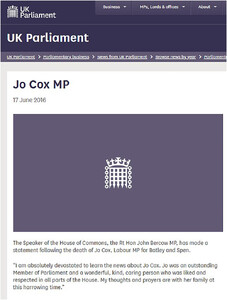
In the case of the House of Commons, the first publication analysed is a short piece on the website (UK Parliament 2016b) about the murder of MP Jo Cox (see Figure 1). The objectivity of the piece stands out as an example of the impartiality aimed for by the communication team, which corresponds to the storyteller (S) in the news pieces published on the website. This approach is so deep-seated that interviewee 4 phrases it as follows: âI donât really say that was a strategy. We were very like reacting to eventsâ. Actually, the communication team was reacting to events according to a strategic and established procedure, which is the use of the journalistic technique of neutral reporting to convey the institutional positioning about the event in the most impartial way possible.

Screenshot of parliamentary website item about Jo Cox MP. source: uk parliament (2016b) , https://www.parliament.uk/business/news/news-by-year/2016/june/statement-from-the-speaker-on-the-death-jo-cox/.
Citation: International Journal of Parliamentary Studies 6, 1 (2026) ; 10.1163/26668912-bja10119
One could argue that the piece is so objective and short that it is not even a story, merely a statement. But the word story is in fact commonly used as a synonym for a news piece, and that is not without reason. When the narrator (N) introduces the words of the Speaker only, and of no other characters, it gives prominence to this chief character (C), who is allowed to give his opinion, in the first-person singular, and to set the tone of unity in relation to the MPâs death: Jo Cox was âliked and respected in all parts of the Houseâ. That very brief piece contributes decisively to the narrative that is built. As Leston-Bandeira and Siefken (2023) explain, public engagement activities led by staff tend to be neutral, aiming to present the institution as a collective defined by generic values as democracy and nationhood, which transcend politically divisive issues and thus favour a connection of the institution with the public regardless of political debate.
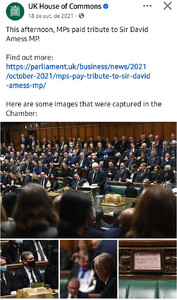
On social media platforms, images added a more emotional tone to the reports published on the website, reinforcing the collective and non-partisan character of the tributes paid, as illustrated in Figure 2 in relation to the murder of MP Amess. There, again, the storyteller attempts to erase the narrator by saying the images âwere capturedâ, with no author of this capture being acknowledged. Also note the photo of the empty seat with its plaque, a moving detail that represents the absence of the MP without the need for any words:
Screenshot of UK House of commonsâ Facebook post about Sir David Amess MP. source: uk house of commons (2021a) , https://www.facebook.com/share/p/1Ayk3ruERy/.
Citation: International Journal of Parliamentary Studies 6, 1 (2026) ; 10.1163/26668912-bja10119
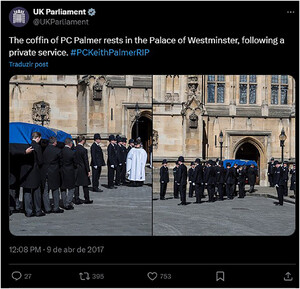
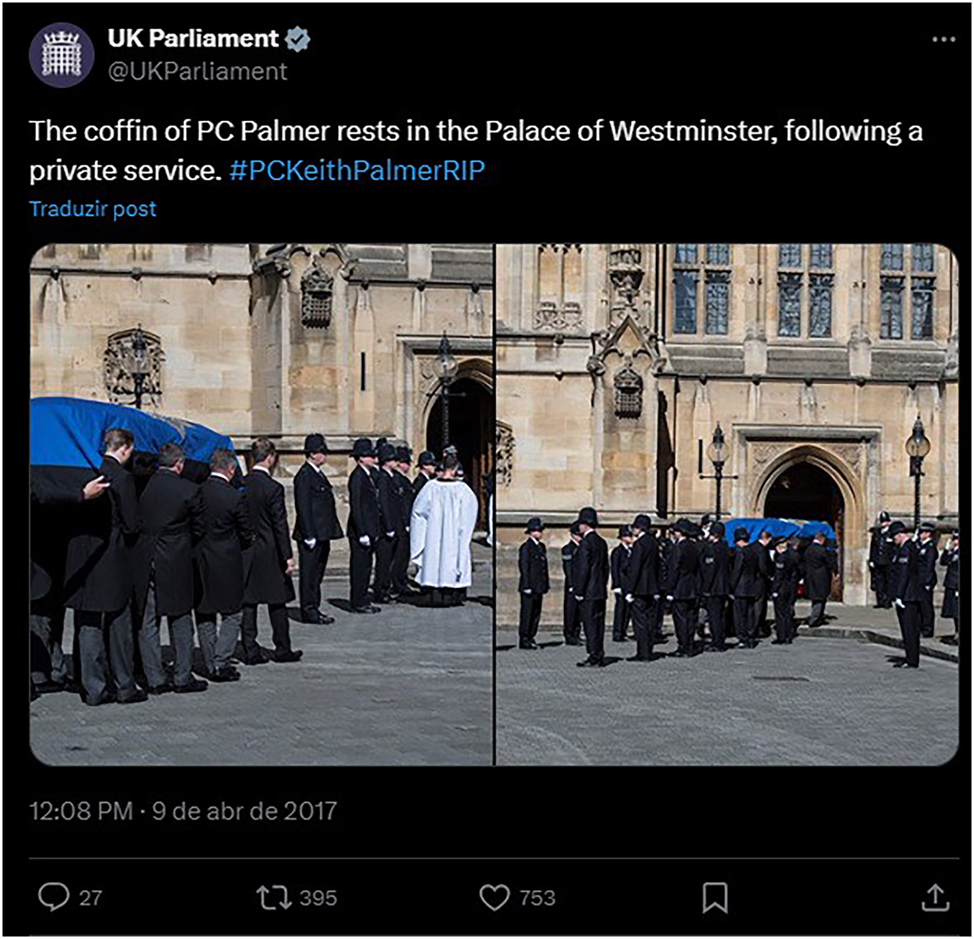
The post reporting the service in honour of PC Palmer also gives prominence to images (see Figure 3). It is important to note that those photos were not published on the website. Interviewee 4 explains that the website âhas no toneâ while âsocial media are more humanâ, meaning the website should preserve the highest degree of neutrality, while social media, due to their characteristics, offer a space where an institutional voice can be more freely expressed through captions and images.
Screenshot of UK Parliamentâs X post about the private service of PC Palmer. source: uk parliament (2017a) , https://x.com/UKParliament/status/851089453821120513.
Citation: International Journal of Parliamentary Studies 6, 1 (2026) ; 10.1163/26668912-bja10119
After the murders and before the anniversaries, little was reported. For example, the news piece about the launching of an inquiry into hate crime, published on July 4, 2016, cited Jo Cox in the committeeâs chair comments. As with other publications, Figure 4 shows that such comments were placed in a separate section of the news piece, a format that underscores the impartiality of the text.
Screenshot of item on UK Parliament website about an Inquiry into hate crime and its violent consequences launched.source: uk parliament (2016a) , https://committees.parliament.uk/work/3206/hate-crime-and-its-violent-consequences-inquiry/news/100596/inquiry-into-hate-crime-and-its-violent-consequences-launched/.
Citation: International Journal of Parliamentary Studies 6, 1 (2026) ; 10.1163/26668912-bja10119
The tone in the anniversaries was different. On June 16, 2019, for example, both the UK Parliament and the House of Commons accounts on Twitter, now X, published a thread of posts (see Figure 5) remembering MP Jo Cox and quoting her maiden speech. This speech adhered to the non-partisan narrative constructed by the House and had become a motto and a hashtag on social media â #moreincommon â after her death: âWhile we celebrate our diversity, what surprises me time and time again as I travel around the constituency is that we are far more united and have far more in common with each other than things that divide usâ (UK Parliament 2016c). Parry (2019) shows how the hashtag started to be seen on Twitter in the evening of June 18, together with images of Jo Cox, beginning an iconisation process of a relatively little-known public figure, transformed by her violent death in a symbol of a political vision of the possibility of living and working together above divisions.
Screenshot of UK Parliamentâs X thread about the anniversary of Jo Coxâs death. source: (UK Parliament 2019) uk parliament (2019c), https://x.com/UKParliament/status/1140164954051489792.
Citation: International Journal of Parliamentary Studies 6, 1 (2026) ; 10.1163/26668912-bja10119
On social media, celebrating another anniversary, the text of the post adopts a first-person plural voice to say that âToday we remember our colleague (â¦)â. If the storyteller (S) is the team responsible for the social media accounts, the narrator (N) can be understood to be Parliament itself, speaking as a collective body, who uses a possessive pronoun â our â and is capable of remembering. The possibilities of social media language are explored: the image, the details of the coat of arms described, and the informality of calling the MP by her first name: âJoâ.
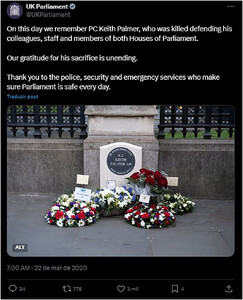
In March 2020, Keith Palmer was remembered (see Figure 6). Once again, the text speaks from a first-person plural perspective, stating, âOur gratitude for his sacrifice is unending. Thank you to the police, security and emergency services who make sure Parliament is safe every day.â Are the police an intended audience (A)? Probably, as they could be considered as relevant stakeholders, along with the families of the deceased, which Interviewee 4 cites as an important agent to consider. In all instances cited, social media bring a collective narrator (N) that pays tribute to individual characters (C) whose value seems to be undisputed, regardless of political divisions.
Screenshot of UK Parliamentâs X post about the anniversary of PC Palmerâs death. source: uk parliament (2020) , https://x.com/UKParliament/status/1241666077312106497.
Citation: International Journal of Parliamentary Studies 6, 1 (2026) ; 10.1163/26668912-bja10119
4.2 Democracy Unshaken
In the case of the Brazilian Chamber of Deputies, the first set of stories analysed refers to the date of the attack, on January 8, 2023, and its subsequent days; the second set, mainly to the investigative committeeâs activities coverage; and the third, to the first anniversary of the invasion.
It was not the first-time attacks to the Congress Palace in BrasÃlia happened. The previous ones were protests against specific bills, as the invasion by Indigenous leaders protesting the changes in land demarcation in 2013, and the attempt of invasion by police officers protesting a pensions reform in 2017. Yet January 8 was a massive attack to the institutions â Executive, Legislative and Judiciary branches. It happened on a Sunday afternoon, and the three palaces were still occupied by invaders when an official statement of the president of the Chamber was published on the website and on social media accounts, setting the tone for institutional communications: âThose responsible for promoting and covering up this attack on Brazilian democracy and its main symbols must be identified and punished in accordance with the law,â said Arthur Lira (Câmara dos Deputados 2023d). The president of the Chamber was the main character (C) and was given voice by a third-person neutral narrator (N).
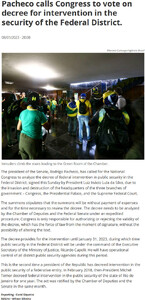
In the same evening, the Chamberâs news agency published two other pieces. The first announced the summoning of the National Congress for the next day, to vote a presidential decree issued to intervene in the local government of BrasÃlia (Câmara dos Deputados 2023e). The text explained the procedures without any direct quote, displaying other narrative features of the standard journalist format adopted by the Chamberâs communication, especially the use of a third-person narration to show impartiality. Another feature is the erasure of the narrator (N) from the text. Even if the names of the reportâs authors are published on the page, they are not a byline at its beginning, highlighting authorship, but much more a transparency or accountability concession at the end of the text, as Figure 7 shows:
Screenshot of Câmara dos Deputadosâ website. All material from the Brazilian channels was translated into English using automated tools, with translations double-checked by the authors for accuracy. source: câmara dos deputados (2023e) , https://www.camara.leg.br/noticias/933233-pacheco-convoca-congresso-para-votacao-do-decreto-de-intervencao-na-seguranca-do-df/.
Citation: International Journal of Parliamentary Studies 6, 1 (2026) ; 10.1163/26668912-bja10119
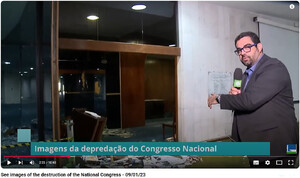
The last news piece published by the Chamber of Deputies on the day of the invasion reported statements of government and opposition party leaders condemning the attack (Câmara dos Deputados 2023c). The text was a concertation of voices orchestrated, once again, by a third-person narrator. The following morning, other voices besides the parliamentarians were added to tell the story of the invasion. âReporter Lincoln Macário walks through the premises of the National Congress, which were stormed on Sunday by radical supporters of a coup dâétatâ, reads the caption of a video published on YouTube and reproduced by the news agency to present a visual testimony to the destruction (Câmara dos Deputados 2023f and 2023g). In this 10-minute video, the narrator (N) is the reporter, who begins by saying âTV Câmara has been filming since six in the morning, when access was first authorized for security reasons, capturing the aftermath of yesterdayâs invasion of the National Congress building to show you the state of the Brazilian peopleâs houseâ. By identifying himself with the institutionâs TV station, the reporter effectively effaces his own presence, although he is on the screen, while directly addressing the audience (A) in the second person singular (see Figure 8).
Screenshot of Câmara dos Deputados YouTube video reporting the day after the invasion. source: câmara dos deputados (2023g) , https://youtu.be/fqzKIiN2B-I.
Citation: International Journal of Parliamentary Studies 6, 1 (2026) ; 10.1163/26668912-bja10119
If we use the word âcoup plotterâ, we could be accused by right-wing and centrist parties of supporting the left. We then decided that we would refer to it as anti-democratic acts because they were attacks on the three branches of government. (Interviewee 10)
The period between the attack and its anniversary was eventful, reflecting the extension of the impact of the invasion of the buildings of the National Congress, Presidency and Supreme Court. On one hand, the building and many works of art had to be restored, an effort that was of great interest to the media, and which the Chamber exploited to convey its message. At the same time, a Senate joint investigative committee conducted a series of public hearings, all live-streamed and subject to hundreds of publications (see Figure 13, later in the article). Public hearings of people accused of being responsible for the invasions were full of drama, with opposing characters (C) confronting each other. Furthermore, the invasion, its planning and the police response provided a clear plot (P), which does not always happen in legislative hearings.
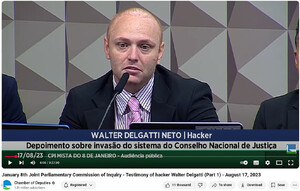
The YouTube channel of the Chamber of Deputies emphasises in its byline that parliamentary activities are streamed live, without editing. This statement reflects the impartiality aimed for by the parliamentary communication teams. Although the YouTube channel publishes journalistic shows and institutional pieces, the full live stream of parliamentary meetings is its flagship product. The streaming uses subtitles to identify the speakers and the session (see Figure 9), but there is no evident narrator (N). Even if the president of the committee conducts the hearing, they are more of a main character (C). When the streaming is live on the TV channel there is a journalist acting as a narrator (N) whose voice explains the procedures, with maximum care to be both clear and impartial. As Interviewee 8 states: âI continue presenting both sides, I keep showing whatâs happening in an impartial way, and I continue giving a voice to all political perspectives.â
Screenshot of a Câmara dos Deputados YouTube video covering committee hearing about invasion. source: câmara dos deputados (2023a) , https://www.youtube.com/watch?v=vEMWrHL3-Ro.
Citation: International Journal of Parliamentary Studies 6, 1 (2026) ; 10.1163/26668912-bja10119
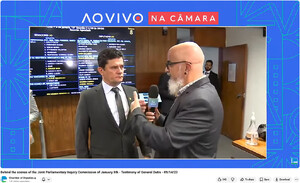
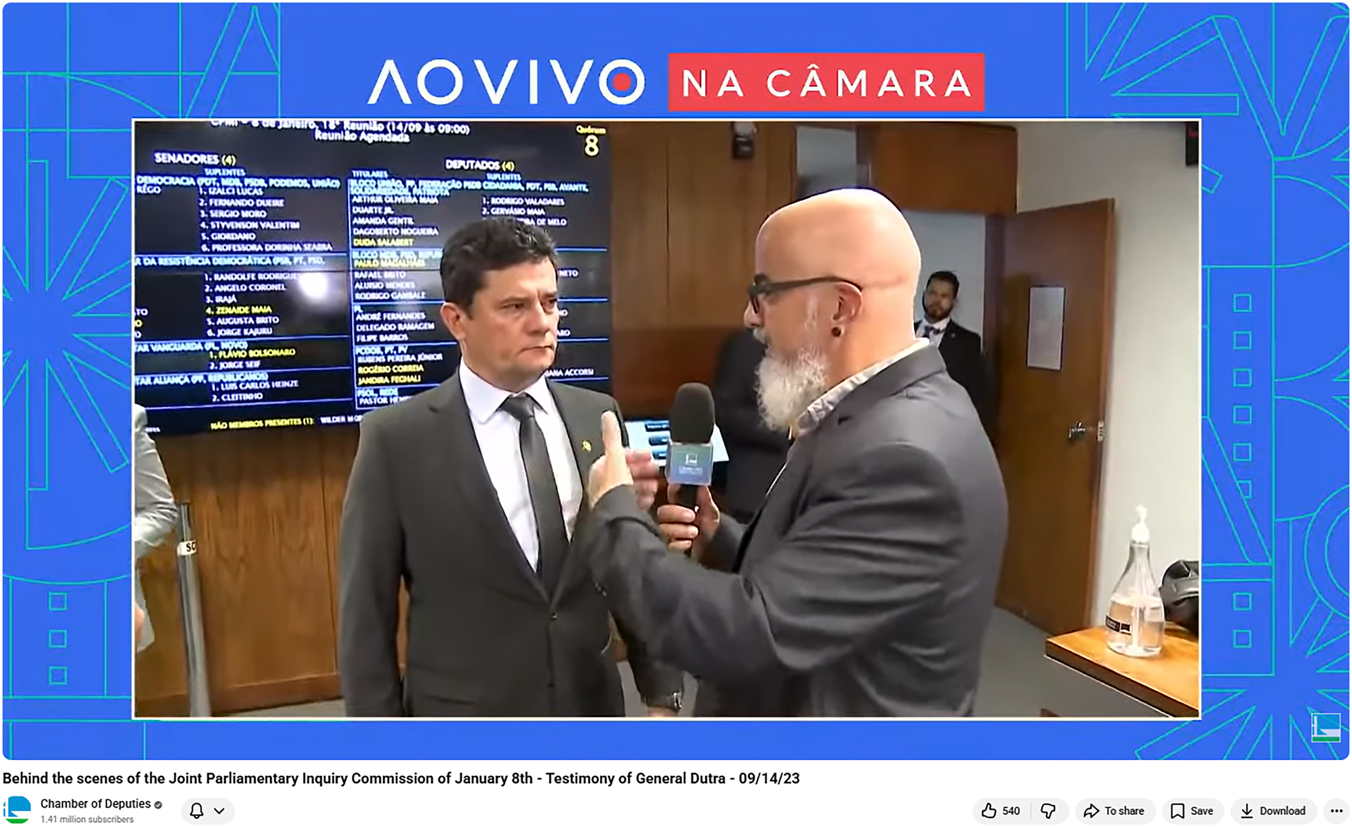
The investigative committeeâs public hearings were covered through live reporting on YouTube which pushed the boundaries of impartiality by presenting behind-the-scenes preparations in more informal tone than traditional news coverage (see Figure 10). Reporters explained what was about to happen and interviewed committee members using colloquial language, asking about their expectations and assessments of the committeeâs work. These live reports, streamed just before the hearings, became some of the most viewed content. They featured a clear narrator (N), the reporter who spoke directly to the audience (A) and to MPs, portrayed as characters (C) in the unfolding story of the investigation, alongside the deponents, who were also key characters in the original narrative of the invasion.
Screenshot of Câmara dos Deputados YouTube video reporting on the behind-the-scenes of committee hearings. source: câmara dos deputados (2023b) , https://www.youtube.com/watch?v=Xtr5P49dAOs.
Citation: International Journal of Parliamentary Studies 6, 1 (2026) ; 10.1163/26668912-bja10119
The public can post comments on all YouTube, social media and news pieces published on the Chamberâs website, with moderation only excluding offensive comments. This enables the audience (A) which here is not only imagined, but real, to express significant disagreement. As Interviewee 12 summarizes, it is a divided audience, which does not always side with the view of the invasion as an attack on democracy: âThe comment section of posts has practically turned into an arena of combat, a battleground for debate between these sides â one in favour, the other againstâ and many times we find ourselves being criticized for defending the institution and democracy.â
The defence of democracy was once again explicit on the first anniversary of the invasion. The celebration was strategically planned to mark the events in a positive tone: the invasion was a deviation, and it was overcome. A solemn event was staged with participation of the Presidency of the Republic, the Supreme Court, the Senate and the Chamber of Deputies; an exhibition with photos and broken objects was placed on the main hall outside the Plenary; a mini documentary was produced and a hashtag was coined: #unshakendemocracy (in Portuguese: #democraciainabalada). A special website published a statement by the president of the Chamber (see Figure 11): âJanuary 8 was a deviation from the path that Brazil chose to face its challenges. The deviation was rejected, and we must work to ensure that it never happens again. This is what the Chamber of Deputies tried to do throughout 2023, with the discussion and approval of matters of the utmost importance for the future of Brazil, such as the new fiscal frameworkâ (Câmara dos Deputados 2024).
Screenshot of the Câmara dos Deputados special website dedicated to remembering the 8 January attack. source: câmara dos deputados (2024) https://infograficos.camara.leg.br/memoria-8-de-janeiro/.
Citation: International Journal of Parliamentary Studies 6, 1 (2026) ; 10.1163/26668912-bja10119
4.3 The Different Modes of Impartiality: Neutrality vs Plurality
The comparison of the content produced about the violent attacks to the House of Commons and Brazilian Congress by each communications team reveals similarities but also important distinctions in storytelling, both in meaning and format. These are the result of the nature of the episodes themselves and of the parliamentary communication strategies developed over time.
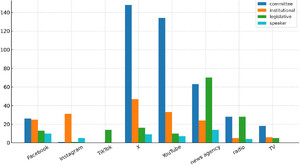
Even before analysing the content of the actual stories, a major difference stood out. The House of Commons is much more economical than the Chamber of Deputies in its content production: 54 pieces about the three murders were identified between 2016 and 2022. In contrast, the Chamber of Deputies published 795 pieces about 8 January 2023 from then until February 2024, a much shorter period. Figure 12 shows the platforms each used.
Publications by channel. source: authors.
Citation: International Journal of Parliamentary Studies 6, 1 (2026) ; 10.1163/26668912-bja10119
One explanation for this difference in volume could lie in the characteristics of the attacks suffered. The invasion of Brazilian Congress was part of an attempted coup. Besides investigations that led to charges presented by the Attorney General, including against former president Jair Bolsonaro (Procuradoria Geral da República 2025) and to the convictions of more than 800 invaders so far (Supremo Tribunal Federal 2025), the Chamber of Deputies and the Senate created a joint committee (CPMI) to investigate the invasion of January 8. The activities of the CPMI were the object of an extensive coverage by the Chamberâs media, which accounts for more than half of the content published in the period studied (418 of 795 pieces), as Figure 13 shows. The dominance of this coverage is particularly relevant on X, where all news pieces are reproduced, and on YouTube, where the hearings were streamed live.
Chamber of Deputies â focus of publications. source: authors.
Citation: International Journal of Parliamentary Studies 6, 1 (2026) ; 10.1163/26668912-bja10119
In the UK, there was no attempted coup in any of the three attacks analysed. The terrorist attacks, which resulted in murders, were also object of criminal investigations and court convictions, but there was no correspondent parliamentary political investigation that could have been object of the production of content by the institution. There was an inquiry on hate crime, carried out by the Houseâs Home Affairs Committee in 2016â17, and MP Jo Coxâs death was mentioned on one news piece about the launch of the inquiry. Interviewee 5 highlighted that after the murders, security was the theme of press briefings, which shared context information that was not to be published either by the House of Commons or by the press.
Another reason for the difference in the number of outputs is the distinct role journalistic narrative devices play in institutional communication in Brazil. As previously mentioned, since the 1990s the Chamber of Deputies has viewed as a core task to report on legislative business in the form of news, as extensively as possible, aiming to provide material that can be freely reproduced by news media besides reaching the public directly through its website, TV and radio stations. The objective was to enhance existing media coverage of parliament, perceived as incomplete due to limited resources, which led to the invisibility of most committee work, for example, and biased due to newsworthiness criteria that emphasized controversy and scandals. Journalistic techniques were also perceived as useful means to guarantee impartiality and trust in institutional communication (Barros et al 2008). This approach has not changed over time; on the contrary, it has evolved to include each new communication technology incorporated into the media ecosystem, such as the different social media platforms, still using the news produced as the basis for most of the content delivered, as the analysis will show.
We will do a weekly bulletin on Friday afternoon that says this is whatâs happening in the Chamber next week. If a committee has been taking evidence or had some interesting witnesses, our select committee media team, which is a separate department, will do kind of a more traditional news story. But we donât do news stories about whatâs happened in the plenary that day, which I know a lot of parliaments do. Itâs difficult for the House to do a write up of it because it can be quite politicized. Youâve got the two main parties, and thereâs lots of smaller parties. How would we do a news story that accurately covered off all views? (Interviewee 5)
One of our challenges, due in part to our editorial principles and the very nature of Parliament, with its multiple parties, is that some MPs do not classify those events as an attempted coup. As a result, we began to standardise the terminology we used to refer to these events: they are described as anti-democratic acts. And, just as we give voice to the various political currents within Parliament, those MPs who do not view the events as a coup attempt, who describe them merely as disorderly conduct, are also represented in our coverage. We make a point of including them. (Interviewee 9)
Those distinct views on how to cover parliamentary business impact the volume of content produced, the size of the teams â since the extensive coverage demands more staff â, and on the storytelling. In Brazilian institutional communication, journalistic techniques, with their focus on impartial presentation of different points of view, prevail and influence every media. Drawing on the narrative framework, we observe that in Brazil the narrator (N) is most often a neutral third person, even on social media, where many of the posts analysed in the UK adopt a first-person plural perspective. In Brazil exceptions typically occur in reportersâ testimonies, such as in the video reports published the day after the invasion and during the behind-the-scenes livestreams of the investigative committee. In both instances, reporters speak directly to the audience (A), either to explain what is being shown or to introduce the members they are interviewing. However, they refrain from using the first-person singular or expressing personal opinions.
The use of the first-person narrator on social media by UK communications differs significantly. There, the narrator (N) speaks on behalf of parliament as a whole, conveying unity above partisan divisions and taking a clear stance against the violence suffered by individual members in hate crimes. This intended unity is encapsulated in the motto and hashtag drawn from MP Jo Coxâs maiden speech: #moreincommon.
While in the UK the victims were individuals, albeit representing parliament, in Brazil, the direct target of the attack was the institution itself. The besieged institution is not represented by a first-person narrator (N), as in the UK, but more commonly by a neutral third-person narrator who introduces the views of the characters (C). The distance afforded by this third-person perspective allows for the presentation of contesting viewpoints represented in the institution, whose legitimacy is contested and must be reaffirmed in light of the attack endured.
The last news piece published by the Chamber of Deputies on the day of the invasion demonstrates this distinction. The article, which brings together statements from party leaders condemning the invasion, exemplifies a characteristic feature of the journalistic narrative form adopted by both institutions: the storyteller (S) is the parliamentary communications team, writing on behalf of the institution. This storyteller is self-effacingly represented through a neutral third-person narrator (N), who delivers the account via the voices of the characters (C) â mainly MPs, especially the presiding officers. Although unity was a key message in both legislatures and impartiality is core to the institutional narrative in both institutions, this article highlights a crucial distinction: whereas in the UK different points of view are only implied with neutrality being the core voice, in Brazil there is a need to depict the multiplicity of parties and their unified stance against the attack on the institution and democracy.
The baseline narrative in both cases is that of democracy as a value to be protected above differences. In Brazil, as in the UK, the anniversary of the violent attacks became an opportunity to ascribe this meaning to the events. Exhibitions, documentaries, a special website, publications, and a ceremony marked the occasion. The chosen motto was #unshakendemocracy (#democraciainabalada), which serves as a synthesis of an idea invoking the threat posed by the violent attack, in much the same way as the UKâs motto #moreincommon alludes to hatred of difference underlying the murders. As Santos and DâAlmeida (2017, p.297) state, organizations tend to produce narratives of engagement to legitimise their actions referencing universal values.
Both the UKâs and Brazilâs commemorations of the anniversaries of these attacks reveal another common feature of institutional narratives: conflict tends to be portrayed together with its suggested resolution, in a constructive manner. In this spirit, Jo Cox reminds the public that we have more in common; Keith Palmer recalls the services that ensure parliamentâs safety every day; and the invasion that was overcome reaffirms Brazilâs young democracy.
Previous research (Barros et al. 2014; Judge and Leston-Bandeira 2018) has shown that impartiality towards different political positions enables institutional communications in parliaments. What remains to be discussed is the democratic outcome of the impartiality model and of its two versions â neutrality and plurality â identified in this research. What is the effect of an a-political communication of a political institution, as aimed for in the neutral model? Does the plural model of impartiality generate a more political outcome? Do both, or either, of the models lead to engagement?
Miguel and Biroliâs (2010) discussion of the liberal model of impartiality and pluralism, especially as formulated by Robert Dahl in the concept of polyarchy, and as critiqued by authors such as John Rawls, Iris Marion Young and Nancy Fraser, is particularly useful for analysing the implications of the narrative traits of parliamentary communication. Both the House of Commons and the Chamber of Deputies tell the stories of the attacks they suffered using narratives that converge on the defence of democracy. However, rather than erasing differences in political perspectives represented in Parliament, as the UKâs communication does, Brazilian parliamentary communication presents these differences to the public. Drawing from Miguel and Biroliâs discussion, this strategy may have greater democratic potential, not because it succeeds in balancing competing perspectives, as if they were equal, but because it makes their existence and conflict visible. We summarize the two distinct models of impartiality and their possible outcomes in Table 1:
5 Conclusions
This article examined institutional communication approaches of the House of Commons in the UK and the Chamber of Deputies in Brazil, within a context of expanding parliamentary public engagement activities since the early 21st century. This expansion responds to low levels of public trust in political institutions, which are perceived as risks to both the institutions themselves and to democracy (Barros et al. 2014; Leston-Bandeira and Siefken 2023).
The research demonstrated that, in an effort to engage the public, parliaments are increasingly using communication to explain their role and functioning. Both parliamentary administrations have directives aimed at this objective and have established complex systems to achieve these goals, albeit with significant differences in strategy, size, and capacity. At the time of our research, the UK team comprised 45 professionals, mainly focused on media relations and digital communication, whereas the Brazilian team consisted of 550 professionals who prioritised journalistic techniques and maintained a broader range of media outlets, including television, radio, and a news agency. Reflecting the distinct media cultures of each country, content production is much more extensive in Brazil, as the Chamber of Deputies considers part of its role to complement media coverage, in contrast to the House of Commons.
By applying narrative theory, particularly the parliamentary storytelling model established by Prior and Leston-Bandeira (2022) based on Barthes (1966), to items reporting violent attacks, we identified how the communication teams of both houses employ specific textual tools to convey impartiality towards the different political positions represented in parliament, thereby building an institutional voice that underscores democratic values above political divisions. Beyond the similarity of objectives, the contents published by the two houses highlights a fundamental difference between their communication strategies. In the UK, institutional communication avoids presenting political positions, whereas in Brazil, the strategy is to present all political positions. Thus, impartiality in the UK is understood as neutrality, while in Brazil, it is understood as plurality.
Narrative analysis demonstrated how, in the House of Commons, the anniversaries of the murders of two Members and a police officer, for example, were opportunities for institutional communications to commemorate the individuals whose lives were taken and to recognise their qualities and democratic roles, regardless of party affiliation. In the Chamber of Deputies, journalistic coverage of the activities of the committee investigating responsibility for the invasion on 8 January 2023 included commented streaming of the hearings and hundreds of news pieces. These pieces adopted impartial journalistic techniques, such as third-person narration, to explain procedures and to portray the different political positions represented.
By comparing two parliaments, this research contributes to the understanding of parliamentary public engagement and communication, by identifying the pivotal role played by impartiality and how this can be interpreted differently according to context. This matters because impartiality is core to any parliamentary public engagement endeavours and usually assumed as self-defining. However, our research shows how it can be approached differently according to the wider context of the institution.
Leston-Bandeira and Siefken (2023) explain that information activities, such as those analysed in this article, are the main form of public engagement developed by parliaments in the last two decades, intending to meet rising public expectations towards governance and declining levels of trust (Brooks 1984). Information can function as a basis for participation, but the authors also warn that âby distinguishing engagement activities from the potential effect on the citizen, one is acknowledging that just because an activity exists, this does not mean that it will result in citizens feeling engaged.â
Future research could build on these findings to evaluate the outcomes of these initiatives, such as audience perception of parliamentary stories, namely in terms of identifying differences between the two models of impartiality. This would deepen our understanding of the role of parliamentsâ engagement initiatives in shaping public perception of parliamentary work and its function in democracy.
References
Bächtiger, A. , and J. S. Dryzek . 2024. Deliberative Democracy for Diabolical Times. Cambridge University Press.
Bamberg, M. , and A. Georgakopoulou . 2008. âSmall Stories as a New Perspective in Narrative and Identity Analysis.â Text & Talk 28 (3): 377â96. https://doi.org/10.1515/TEXT.2008.018.
Barros, A. T. , C. B. Bernardes , and C. R. F. Lemos . 2008. âAs mÃdias legislativas e a redefinição da noticiabilidade polÃtica no Brasil.â Em Questão 14 (1): 11â24. https://seer.ufrgs.br/EmQuestao/article/view/3142/3523.
Barros, A. T. , C. B. Bernardes , and M. R. Rodrigues . 2014. âO discurso fundador das mÃdias legislativas da Câmara dos Deputados.â E-Legis: Revista Eletrônica do Programa de Pós-Graduação da Câmara dos Deputados 14 (14): 7â25. https://doi.org/10.51206/e-legis.v14i14.184. https://e-legis.camara.leg.br/cefor/index.php/e-legis/article/view/184.
Barthes, R. 1966. âIntroduction à lâanalyse structurale des récits.â Communications 8: 1â27. https://doi.org/10.3406/comm.1966.1113.
Benjamin, W. 2019. âThe Storyteller: Reflections on the Work of Nikolai Leskov.â In The Storyteller Essays. New York Review Books.
Bennett, W. L. , and S. Livingston . 2018. âThe Disinformation Order: Disruptive Communication and the Decline of Democratic Institutions.â European Journal of Communication 33 (2): 122â39. https://doi.org/10.1177/0267323118760317.
Bernardes, C. B. , and A. T. Barros . 2010. âA credibilidade jornalÃstica como instrumento para ampliação da confiança no Parlamento.â In Estudos legislativos â 20 anos da Constituição Brasileira, edited by D. Messenberg , J. R. Pinto , L. Sousa , and C. F. Faria , 164â92. Senado Federal.
Bernardes, C. , and I. Mitozo . 2025. âCommunication in Parliaments: Information, Openness and Public Engagement in Brazil.â Más Poder Local 61: 73â84. https://doi.org/10.56151/maspoderlocal.285.
Bird, S. E. , and R. W. Dardenne . 2009. âRethinking News and Myth as Storytelling.â In The Handbook of Journalism Studies, edited by K. Wahl-Jorgensen , and T. Hanitzsch , 205â17. Routledge.
Bloch, M. 2013. Reflections of a Historian on the False News of the War. https://www.miwsr.com/2013/downloads/2013-051.pdf.
Brooks, P. 1984. Reading for the Plot: Design and Intention in Narrative. Alfred A. Knopf.
Brooks, P. 2022. Seduced by Story: The Use and Abuse of Narrative. New York Review Books.
Bruner, J. 1991. âThe Narrative Construction of Reality.â Critical Inquiry 18 (1): 1â21. https://doi.org/10.1086/448619. http://www.jstor.org/stable/1343711.
Câmara dos Deputados . 2023a. Depoimento do hacker Walter Delgatti (Parte 1) â 17/08/23 [Video]. YouTube. https://www.youtube.com/watch?v=vEMWrHL3-Ro.
Câmara dos Deputados . 2023b. Depoimento do general Dutra â CPI Mista do 8 de Janeiro [Video]. YouTube. https://www.youtube.com/watch?v=Xtr5P49dAOs.
Câmara dos Deputados . 2023c. LÃderes condenam vandalismo contra Congresso, STF e Planalto e exigem punição dos responsáveis. https://www.camara.leg.br/noticias/933228-lideres-condenam-vandalismo-contra-congresso-stf-e-planalto-e-exigem-punicao-dos-responsaveis/.
Câmara dos Deputados . 2023d. Lira: Agiremos com rigor para preservar a liberdade, a democracia e o respeito à Constituição. https://www.camara.leg.br/noticias/933211-lira-agiremos-com-rigor-para-preservar-a-liberdade-a-democracia-e-o-respeito-a-constituicao/.
Câmara dos Deputados . 2023e. Pacheco convoca Congresso para votação do decreto de intervenção na segurança do DF. https://www.camara.leg.br/noticias/933233-pacheco-convoca-congresso-para-votacao-do-decreto-de-intervencao-na-seguranca-do-df/.
Câmara dos Deputados . 2023f. TV Câmara mostra o rastro de destruição deixado pelos invasores do Congresso. https://www.camara.leg.br/noticias/933321-tv-camara-mostra-o-rastro-de-destruicao-deixado-pelos-invasores-do-congresso/.
Câmara dos Deputados . 2023g. Veja imagens da depredação do Congresso Nacional [Video]. YouTube. https://youtu.be/fqzKIiN2B-I.
Câmara dos Deputados . 2024. Memória 8 de janeiro. https://infograficos.camara.leg.br/memoria-8-de-janeiro/.
Câmara dos Deputados . 2025a. Ato da Mesa n° 218, de 30 de setembro de 2025. https://www2.camara.leg.br/legin/int/atomes/2025/atodamesa-218-30-setembro-2025-798137-publicacaooriginal-176730-cd-mesa.html.
Câmara dos Deputados . 2025b. Conheça a história da Câmara. https://www.camara.leg.br/historia-e-arquivo/.
Câmara dos Deputados . 2025c. Estratégia 2025â2032. https://www2.camara.leg.br/a-camara/estruturaadm/gestao-na-camara-dos-deputados/gestao-estrategica-na-camara-dos-deputados.
Choucair, T. , and R. C. M. Maia . 2025. âPolarização PolÃtica em Diferentes Dimensões.â In Esfera pública no Brasil: Diferentes faces dos conflitos sociais, rupturas e reconstrução democrática, edited by R. C. M. Maia , and M. Orlandini , 187â204. EDUFBA.
Dawson, P. 2025. âWho Controls âThe Narrativeâ? Journalistic Emplotment and Political Discourse in the Networked Public Sphere.â Journalism 26 (1): 228â44. https://doi.org/10.1177/14648849241231682.
De Fina, A. , and A. Georgakopoulou . 2011. Analyzing Narrative: Discourse and Sociolinguistic Perspectives. Cambridge University Press.
Duarte, J. 2005. âEntrevista em Profundidade.â In Métodos e técnicas de pesquisa em comunicação, edited by J. Duarte , 62â83. Atlas: São Paulo.
Easton, D. 1975. âA Re-Assessment of the Concept of Political Support.â British Journal of Political Science 5 (4): 435â57. https://doi.org/10.1017/s0007123400008309.
Fisher, W. 1985. âThe Narrative Paradigm: An Elaboration.â Communication Monographs 52 (4): 347â67. https://doi.org/10.1080/03637758509376117.
Fox, R. 2009. âEngagement and Participation: What the Public Want and How Our Politicians Need to Respond.â Parliamentary Affairs 62 (4): 673â85. https://doi.org/10.1093/pa/gsp027.
Fuks, M. , and P. H. Marques . 2022. âPolarização e contexto: Medindo e explicando a polarização polÃtica no Brasil.â Opinião Pública 28 (3): 560â93. https://doi.org/10.1590/1807-01912022283560.
Fuller, S. , A. Rendall , and A. Weerasinghe . 2025. âParliament and the Media.â In Exploring Parliament. 2nd ed., edited by C. Leston-Bandeira , A. Meakin , and L. Thompson . Oxford University Press.
Georgakopoulou, A. 2016. âFrom Narrating the Self to Posting Self(ies): A Small Stories Approach to Selfies.â Open Linguistics 2 (1). https://doi.org/10.1515/opli-2016-0014.
Ginzburg, C. 2023. âTexts, Images, Reproductions: On the Shoulders of Walter Benjamin.â In Secularism and its Ambiguities: Four Case Studies. Central European University Press.
Globo, O . 2024. Congresso, STF, Forças Armadas, igrejas: Pesquisa aponta a confiança dos brasileiros nas instituições. https://oglobo.globo.com/blogs/pulso/post/2024/07/congresso-stf-forcas-armadas-igrejas-pesquisa-aponta-a-confianca-dos-brasileiros-nas-instituicoes.ghtml.
Gomes, W. 2024. Transformações da polÃtica na era digital. Paulus.
Han, B.-C . 2024. The Crisis of Narration. Polity Press.
House of Commons . 2023. Communicating the Commons: How Effectively does the House of Commons Administration Communicate About Parliament? Administration Committee, First Report of Session 2023â24, HC306. https://committees.parliament.uk/publications/42252/documents/210055/default/.
Hunt, L. 2007. Inventing Human Rights. Norton.
Inter-Parliamentary Union . 2022. Global Parliamentary Report 2022: Public Engagement in the Work of Parliament. https://www.ipu.org/GPR22.
Judge, D. , and C. Leston-Bandeira . 2018. âThe Institutional Representation of Parliament.â Political Studies 66 (1): 154â72. https://doi.org/10.1177/0032321717706901.
Leston-Bandeira, C. 2014. âThe Pursuit of Legitimacy as a Key Driver for Public Engagement: The European Parliament Case.â Parliamentary Affairs 67 (2): 415â36. https://doi.org/10.1093/pa/gss050. https://eprints.whiterose.ac.uk/91192/.
Leston-Bandeira, C. , and S. T. Siefken . 2023. âThe Development of Public Engagement as a Core Institutional Role for Parliaments.â The Journal of Legislative Studies 29 (3): 361â79. https://doi.org/10.1080/13572334.2023.2214390.
Lyotard, J. F. 1979. La Condition Postmoderne. Les Ãditions Minuit.
Ma, Z. , and R. Ma . 2025. âThe Role of Narratives in Countering Health Misinformation: A Scoping Review of the Literature.â Health Communication 40 (11): 2353â64. https://doi.org/10.1080/10410236.2025.2453451.
Maia, R. C. M. 2025. âEsfera pública: Releituras do conceito em momentos de ruptura e reconstrução democrática.â In Esfera pública no Brasil: diferentes faces dos conflitos sociais, rupturas e reconstrução democrática, edited by R. C. M. Maia , and M. Orlandini , 19â46. EDUFBA.
McCoy, J. , T. Rahman , and M. Somer . 2018. âPolarization and the Global Crisis of Democracy: Common Patterns, Dynamics, and Pernicious Consequences for Democratic Polities.â American Behavioral Scientist 62 (1): 16â42. https://doi.org/10.1177/0002764218759576.
Miguel, L. F. , and F. Biroli . 2010. âA produção da imparcialidade: A construção do discurso universal a partir da perspectiva jornalÃstica.â Revista Brasileira de Ciências Sociais 25 (73): 59â78. https://www.scielo.br/j/rbcsoc/a/7mM4dBPXgZMy8zbbVYYB3MN/.
Miranda, T. 2024. Usos da Agência Câmara: Um caminho de pesquisa a partir da cobertura do Arcabouço Fiscal [Masterâs thesis, Câmara dos Deputados, Centro de Formação, Treinamento e Aperfeiçoamento (Cefor)].
Office for National Statistics . 2023. Trust in Government, UK. https://www.ons.gov.uk/peoplepopulationandcommunity/wellbeing/bulletins/trustingovernmentuk/2023.
Parry, K. 2019. â#MoreInCommon: Collective Mourning Practices on Twitter and the Iconization of Jo Cox.â In Visual Political Communication, edited by A. Veneti , D. Jackson , and D. G. Lilleker , 227â45. Cham: Springer.
Penteado, C. L. de C. , P. R. E. de Souza , P. D. dos Santos , and L. H. G. Homma . 2025. âDemocracy and Freedom in Dispute on Social Media: An Analysis of the Attempted Coup DâÃtat in Brazil in 2023.â Revista de Estudios Sociales 94 (04): 23â43. http://journals.openedition.org/revestudsoc/59981.
Prior, A. , and C. Leston-Bandeira . 2022. âParliamentary Storytelling: A New Concept in Public Engagement with Parliaments.â The Journal of Legislative Studies 28 (1): 67â92. https://doi.org/10.1080/13572334.2020.1848081. https://eprints.whiterose.ac.uk/168940/.
Procuradoria Geral da República . 2025. PGR denuncia 34 pessoas por atos contra o Estado Democrático de Direito. https://www.mpf.mp.br/pgr/noticias-pgr2/2025/pgr-denuncia-34-pessoas-por-atos-contra-estado-democratico-de-direito.
Sandes-Freitas, V. , and J. Freitas . 2024. âEstudo de caso em Ciência PolÃtica: Teoria e aplicação.â In Manual de introdução à s técnicas de pesquisa qualitativa em ciência polÃtica, edited by R. Sampaio , and C. de Paula , 134â68. Enap. http://repositorio.enap.gov.br/handle/1/9135.
Santos, L. C. dos , and N. DâAlmeida . 2017. âNarrativa e comunicação organizacional.â Organicom 14 (26): 290â301. https://doi.org/10.11606/issn.2238-2593.organicom.2017.139374.
Saward, M. 2010. The Representative Claim. Oxford University Press.
Shiller, R. J. , and National Bureau of Economic Research . 2017. Narrative Economics. National Bureau of Economic Research.
Sprain, L. , and J. M. F. Hughes . 2015. âA New Perspective on Stories in Public Deliberation: Analyzing Small Stories in Discussions About Immigration.â Text & Talk 35 (4). https://doi.org/10.1515/text-2015-0013.
Supremo Tribunal Federal . 2025. Em dois anos, STF responsabilizou 898 pessoas por atos antidemocráticos de 8 de janeiro. https://noticias.stf.jus.br/postsnoticias/em-dois-anos-stf-responsabilizou-898-pessoas-por-atos-antidemocraticos-de-8-de-janeiro/.
Tenove, C. 2020. âProtecting Democracy from Disinformation: Normative Threats and Policy Responses.â The International Journal of Press/Politics 25 (3): 427â57. https://doi.org/10.1177/1940161220918740.
Truan, N. 2021. âNarratives of Dialogue in Parliamentary Discourse: Constructing the Ethos of the Receptive Politician.â Journal of Language and Politics 20 (4): 563â83. https://doi.org/10.1075/jlp.20018.tru.
UK House of Commons . 2021a. âThis Afternoon, Mps Paid Tribute to Sir David Amess MP.â [Post]. Facebook. https://www.facebook.com/share/p/1Ayk3ruERy/.
UK Parliament . 2016a. Inquiry into Hate Crime and Its Violent Consequences Launched. https://committees.parliament.uk/work/3206/hate-crime-and-its-violent-consequences-inquiry/news/100596/inquiry-into-hate-crime-and-its-violent-consequences-launched/.
UK Parliament . 2016b. Jo Cox. https://www.parliament.uk/business/news/news-by-year/2016/june/statement-from-the-speaker-on-the-death-jo-cox/.
UK Parliament . 2016c. Jo Cox Maiden Speech in the House of Commons. https://www.parliament.uk/business/news/news-by-year/2016/june/jo-cox-maiden-speech-in-the-house-of-commons/.
UK Parliament . 2017a. âThe Coffin of PC Palmer Rests in the Palace of Westminster, Following a Private Service.â [Post]. X, (Formerly Twitter). https://x.com/UKParliament/status/851089453821120513.
UK Parliament . 2019a. âToday We Remember Our Colleague Jo Cox MP, who was Tragically Killed on Her Way to a Constituency Meeting on 16 June 2016â. [Thread]. X, (formerly Twitter). https://x.com/UKParliament/status/1140164954051489792.
UK Parliament . 2020. âOn This Day We Remember PC Keith Palmer, who was killed Defending His Colleagues, Staff and Members of Both Houses of Parliament.â [Post]. X, (formerly Twitter). https://x.com/UKParliament/status/1241666077312106497.
UK Parliament . 2025. Rise of the Commons. https://www.parliament.uk/about/living-heritage/evolutionofparliament/originsofparliament/birthofparliament/overview/riseofcommons/.
Valgarðsson, V. , W. Jennings , G. Stoker , H. Bunting , D. Devine , L. McKay , et al. 2025. âA Crisis of Political Trust? Global Trends in Institutional Trust from 1958 to 2019.â British Journal of Political Science 55 (e15): 1â23. https://doi.org/10.1017/s0007123424000498.
White, H. 1987. The Content of the Form: Narrative Discourse and Historical Representation. Johns Hopkins University Press.