Abstract
This paper traces the various steps of the redefinition process implemented by Arab musicians performing in France and in the United States. The assembling of Arabic music groups outside their institutional and national borders reveals new patterns and raises several questions: (1) While most Arabic countries do not share the same institutional music traditions, or the same repertoires (Arab-Andalusian vs. maqamat), how can Arabic musicians from different countries assemble outside their institutional and national borders? (2) How can we understand the heterogeneity of repertoires (scholarly and popular) when the musicians come from different traditions and institutions? Can musicians pursue the legacy—and legitimacy—of classical repertoires or do they necessarily have to embrace Arabic pop culture? Finally, (3) while they were part of the elite in their home countries, how are Arab musicians considered outside their musical institutions, in their new countries such as France and the United States? Have they remained elite musicians in the eyes of their new audiences? Or have they simply become ‘popular’ musicians, regardless of the repertoire they play?
1 Introduction
Various fields of the social sciences address the Middle East and the Arab world. In the area of culture particularly, many scholars and specialists focus specifically on music from these regions of the world. Since the mid-nineteenth century, anthropologists, ethnomusicologists, musicologists and even sociologists have been investigating and documenting cultural and musical practices. From Rodolphe D’ Erlanger’s studies and monographs, to the modern works of the Garland Encyclopedia of World Music on the Middle East, passing through the universal Sociology of Music by Max Weber, Arabic music has long been a source of interest for academic research and scholars. In the introduction of his Essay of Codification of the Common Rules of Modern Arabic Music, Rodolphe d’ Erlanger began with the following statement:
If it is a branch of Oriental Art which has long awakened, and rightly so, the curiosity of Western artists and scholars, it is indeed the melodic system specific to the peoples of the Muslim Near East, especially those of Arabic language. Essentially melodic, the music of these peoples owes all its character, all its distinctive qualities, to the variety of its modal combinations, to the richness of its melodic scale.
D’ Erlanger 2001
Nowadays, there is new interest in this field of study. With the rise of mass media and the globalization of culture, academic research and studies on Arabic music have significantly increased and further specialized on countries of the Arab world. According to many recent studies (Frishkopf 2010; Ulaby 2010; al-Wassimi 2010; Nassar 2010; Cestor 2010; Marcus 2007), the rise of mass media has profoundly transformed and homogenized many aspects of musical practices, as well as the broader culture of the Arab world. However, by focusing on the Arab world as a region with national borders, many of these debates have neglected the broader role of culture and cultural practices in a globalized world. Hence, these analyses seldom (if ever) address the question of immigrants’ practices in the Arab diaspora, and pay very little attention to the processes by which Arabic music and culture is decontextualized outside national borders. How do Arab musicians practice their music outside the Arab world and redefine their repertoires according to their new audiences in their new countries? How do these musicians react to the decontextualization of their practices? Are they developing adaptive or hybrid strategies with new conceptions of Arabic music? Or, conversely, is their musical heritage and knowledge gradually becoming obsolete, and is it condemned to disappear with the globalization of culture?
In this paper, I trace the steps of the redefinition process implemented by Arab musicians performing in western countries such as France and the United States. The assembling of Arabic music groups outside their institutional and national borders brings to light different patterns and raises new questions: (1) Since most Arab countries do not share the same institutional musical traditions, or the same repertoires (Arab-Andalusian vs. maqamat),1 how can musicians from different countries assemble and form groups outside their institutional and national borders? (2) How can we understand the heterogeneity of repertoires (scholarly and popular) when musicians come from different traditions and institutions? Do musicians focus on the legitimacy of classical repertoires or Arabic pop culture? Finally, (3) while they were part of the elite in their home countries, how are Arabic musicians considered outside their musical institutions, in countries such as France and the United States? Have they, as musicians, remained part of the elite? Or have they simply become ‘popular’ musicians?
2 Introducing the Research
I conducted this research in France and the United States, on musicians from a variety of musical schools and institutions in the Arab world (Middle East and the Maghrib). As a first step, the survey was conducted in Marseille over a period of two years—as a practicing musician (oud player)—by following two formations: a professional ensemble (Tarab Ensemble), and an amateur orchestra (Orchestra of the Cité de la Musique of Marseille). In a second step, the survey was carried out over a period of two years spent in Chicago with a professional network of immigrant musicians from musical schools and institutions in the Arab world. I followed these musicians to a number of American cities, watched a professional ensemble (Arabesque Music Ensemble), and several annual training programs (Heartland Seminar and Educational Program on Arabic Music).
France and the United States have been impacted differently by migration, especially with regard to immigrants from the Arab world. In the case of Marseille, from the end of the French colonial period, the city has remained closely tied to various countries and regions of the Maghrib (North Africa). Historically Marseille is recognized as a cultural crossroads for populations from the Mediterranean and Europe. The city is the second largest city in France and with about 1,727,000 inhabitants in its metro area. Because of its pre-eminence as a Mediterranean port, Marseille has long been one of the main gateways into France. This geographic location has attracted many immigrants and made Marseille a cosmopolitan melting pot. Many people in Marseille come from elsewhere in France or from abroad. According to national statistics, almost one in two inhabitants have immigrant ancestors. The Muslim population of the city is over 250,000 inhabitants. Marseille also has the third largest Jewish population in Europe, after Paris and London.
A large number of musicians playing Arabic music in Marseille come from the Maghrib, much more than from Middle Eastern regions. Musicians migrate from Algeria, Tunisia and Morocco, but the vast majority comes from Algeria, because of the historic relations and enduring exchanges between Marseille and Algeria. The geographic and cultural ‘domination’ of Algerians in the city of Marseille creates a very interesting and unique situation in which to analyze how musicians from different schools and institutions manage to assemble themselves outside their institutional and national borders.
As musicians with backgrounds in the musical institutions of the Maghrib, a great part of the repertoire played by ensembles gathered in Marseille is often labeled Arab-Andalusian music. Arab-Andalusian music is known as a classical music genre throughout the Maghrib. But, while all countries of the Maghrib share a strong and common Arab-Andalusian heritage, they do not share the same traditions. Significant variations in music traditions exist between countries such as Morocco, Algeria and Tunisia. Arab-Andalusian music is a generic category used to describe diverse music practices of the Maghrib, practices inherited from the legacy of al-Andalus, during the time of Arab Andalusia (now Spain), when refugees—Arabs and Jews—fled the Catholic Reconquista. However, the appellation of Arab-Andalusian music can differ quite significantly when compared between countries. In Tunisia, for instance, Arab-Andalusian music is commonly called maalùf, while Morocco uses the words al-Ala or al-Andaloussi, and Algeria uses several categories to define this musical practice; these include moussiqa al-Andaloussia, Sanʾa, or Gharnati (lit., ‘from Granada’).
The words used to define Arab-Andalusian music between countries of the Mahgrib are also strong indicators of internal divisions that prevail between schools and institutions. For instance, in Algeria, two musicians from different institutions do not necessarily play the same Arab-Andalusian repertoire. This means they might not be able to play together because of the prevailing rules of repertoires and structures of the music practices and traditions in the Algerian institutional landscape. This explains, more generally, the diverse ways these countries interpret Arab-Andalusian music, as the same rules apply both internally and externally. However, if these divisions can be applied between Arab-Andalusian schools and institutions, they are even stronger between musical genres, such as hawzi and shaʿabi, which are more ‘popular’ repertoires. In Algeria or Morocco, where the elite families of the bourgeoisie practice Arab-Andalusian music, distinguishing music genres such as hawzi and shaʿabi from the Arab-Andalusian repertoire is not just a question of taste, it also relates to power. If Arab-Andalusian music is often associated with highbrow taste and sophistication, listening to hawzi or shaʿabi music is clearly a sign of low cultural taste and ‘bad education’, at least to many distinguished Maghribi families. In other words, differences between music genres can reflect social and cultural divisions between institutions in the Maghrib, since Arab-Andalusian music repertoires cannot be homogenized as a single and popular culture.
In the United States, migrations from the Arab world have differed quite significantly from migration to France. Arabic music ensembles that have assembled themselves in the United States are essentially gatherings of musicians from the Middle East and the Levantine region. As migratory routes and the geographic origins of musicians differ, so have the repertoires. As in the case of Marseille, musicians performing in the United States are well-educated musicians who have been rigorously trained in schools and institutions in the Middle East. However, the repertoire taught in these schools differs significantly from that found in institutions in the Maghrib. In contrast to their counterparts in the Maghrib, Middle Eastern music schools and institutions are much more influenced by classical Egyptian and Syrian repertoires, such as the muwashshah2 and the waslah.3 They include modern twentieth-century compositions, for example, Sayyid Darwish, Muhammad el-Qasabgi, Umm Kulthum, Abdel Wahab, Fairuz, Sabah Fakhri, etc., and repertoires from other regions in the Middle East, such as the historical tradition (turath) of the maqamat, based on the oriental system of modes. These differences between regions and schools create huge gaps between musicians, gaps based on their geographical and institutional origins. Repertoires and musical knowledge can differ significantly from one musician to another. So how can these musicians play together when decontextualized in France and the United States? Do they develop new conceptions of Arabic music with adaptive strategies? Or conversely, do they retain, ‘without compromise’, old institutional paradigms and divisions that have structured and singularized their musical practice, and that still prevail in the Arab world?
3 The Development of Musical Schools and Institutions in the Arab World: From takkt Ensembles to firqat Orchestras
Before further analyzing how Arab musicians assemble outside their national and institutional borders, it is necessary to examine the history of music to have a better understanding of the cultural dynamics in which the modern musical institutions of the Arab world originated.
For many anthropologists, ethnomusicologists and sociologists, the expression ‘Arab music’ is a self-evident category. The heterogeneous discourse produced with regard to Arabic music, whether in the press or in research and specialized publications devoted to it, contributes to the elaboration of a narrative fiction that structures (at the level of general representations) the idea of a relatively homogeneous and stable music genre. Particularly in the western world, Arabic music is often understood as a practice that has no borders and that originated from the global region of the Arab world. Yet, it is very difficult, if not impossible, to objectively answer the question, what is Arabic music? Should a musical practice be defined solely based on general perceptions of its cultural features? Or, on the contrary, should it be understood based on the institutions and heterogeneous expertise and techniques that are at the origin of its implementation?
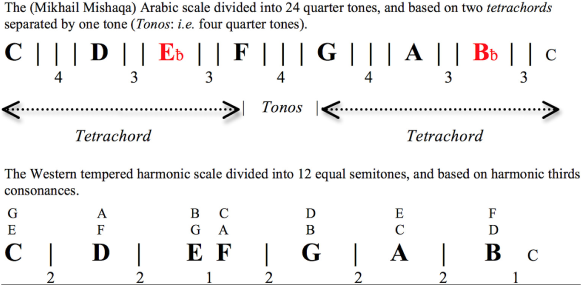
Music has long been at the center of political concerns in the history of the Arab world. Whether employed as a religious or secular vocation, support and patronage from sovereigns played an essential role in the development of scholarly music. Throughout the history of Arab civilization, members of the Arab-Islamic aristocracy used their fortunes to support musicians who brightened their existence and sang panegyrics with specific instruments and techniques (Jargy 1988). The historical tradition (turath) of Arabic music was founded on quarter tones—micro-intervals that gave very specific tones to this musical art. All these developments distinguished Arabic music culture. Nowadays, the Arabic Mishaqa4 scale counts 24 quarter tones, while the western harmonic scale is divided into 12 equal semitones (fig. 1).

Figure 1
Comparison between the (Mikhail Mishaqa) Arabic scale and the western tempered harmonic scale
Citation: Middle East Journal of Culture and Communication 12, 1 (2019) ; 10.1163/18739865-01201006
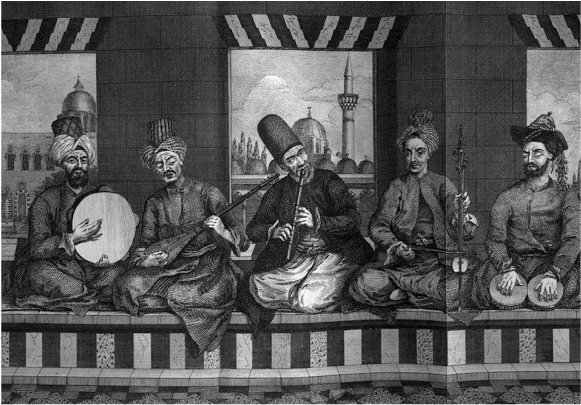
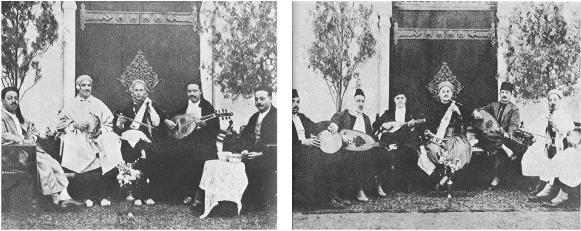
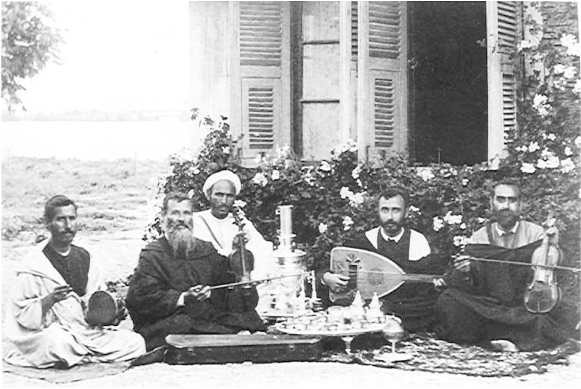
At the end of the nineteenth century, Arabic music was still strongly influenced by the aristocratic heritage of the Ottomans. At that time, court music was mainly intended to relax and entertain the elite, and was still based on Arabic quarter tones (fig. 2). For instance, in countries like Syria and Egypt, musicians were organized into guilds, and subject to the superior authority of shaykhs (masters) and sovereigns, who ensured their livelihood. As Philippe Vigreux reports, ‘scholarly art is the art of the elite. The space in which it is practiced is a closed space, frequented by a public of connoisseurs. The great singers perform in the khedival courtyard or during private evenings organized by rich urban families’ (Vigreux 1991a: 64). The typical musical formations of this period were often composed of no more than four to five instrumentalists, sometimes six. These formations were called takht ensembles—after the Persian term for the stage where the musicians perform—and were, in most cases, composed of a lute (ʿud), a qanun5 (trapezoid-shaped zither), a violin (adopted in Egypt in the last third of the nineteenth century to replace the rebab, a two-string viol), a nay (oblique flute in a reed), and a riqq (tambourine) with metal jingles on the frame. However, in spite of this corpus of instruments, the takht did not have a typical form, rather it involved regular or episodic collaborations between musicians (figs. 2, 3 and 4).
Figure 2
A Turkish concert given by a Syrian band from Ottoman Aleppo, mid-eighteenth century (1756), by Alexander Russell (1715–1768). Russell describes the musicians here as, first, an ordinary Turk, who beats the daff; next to him is an ordinary Christian who plays the tanbur (a long-necked lute); the middle figure is a dervish playing the nay; the fourth is a Christian playing the ‘Arab fiddle’ (rebab); and the last is an ordinary man beating small drums (Russell 1756: 133)
Citation: Middle East Journal of Culture and Communication 12, 1 (2019) ; 10.1163/18739865-01201006
In many ways, takht ensembles significantly favored interactions between musicians by enabling improvisation. Improvisation occupied a major part in the interpretation of musical repertoires and constituted an essential criterion for the appreciation of musical practice. According to Frédéric Lagrange, ‘the heterophonic aesthetics of takht led, at best, to a virtuoso competition, and for worst, to resentments between artists seeking to “pull the cover” to impose their improvisations’ (Lagrange 2001: 86). Moreover, in a practical sense,
the takht could play a tahmîla, a kind of musical dialogue between instrumentalists. The ensemble performs a short, composed introduction, then one of the soloists engages in a measured improvisation (taksim) in the form of a question, answered by the other members of the takht. Other questions follow, traveling from mode to mode until returning to the starting tone. It is then another musician who, in turn, makes a lap.
Lagrange 2001: 89
Figure 3
On the left, a Tunisian maluf takht ensemble, 1932; on the right, Shaykh Larbi Bensari’s takht ensemble from Tlemcen (Algeria) 1932
Citation: Middle East Journal of Culture and Communication 12, 1 (2019) ; 10.1163/18739865-01201006
As for concert performances, some historians and musicologists report that such events were usually undertaken in a spirit of a great freedom for musicians of this time.
At the end of the nineteenth century, evenings of scholarly music took place in large salâmliks (reception rooms) of rich dwellings or in a suradiq set up for the occasion, in a garden or in the street. The members of the takht sat on chairs or carpets. The evening began with feasts in which the artists could participate. … The takht began the concert at about nine in the evening, after its members had eaten a lot and drunk some alcohol. … The concert was composed of three waslas, the third, which ended at dawn, was the most popular for amateurs, as singers’ voices were reaching a peak of suppleness. A wasla seldom lasted more than an hour or an hour and a half; the intermissions were a pretext for feasting and chatting.
Lagrange 2001: 77
At the end of the nineteenth century, different schools thus emerged under the authority of shaykhs and Ottoman sovereigns. In Egypt, musicians playing in takht ensembles were identified as being from the ‘Nahda School’. The school of the nahda must be understood in the sense of an aesthetic and stylistic community of artists and musicians. The term refers to the ensemble of musicians who participated in the elaboration of court music from the reign of the khedive Ismaʿil Pasha, a music that synthesized the oriental traditions from Syria, Turkey and Persia, in keeping with Egyptian taste (Lagrange 2001: 76).
Figure 4
Concert given by a takht ensemble in a private garden in Marrakech, 1920
Citation: Middle East Journal of Culture and Communication 12, 1 (2019) ; 10.1163/18739865-01201006
The legacy of the takht ensembles lasted until the mid twentieth century. In the aftermath of World War II, with the wind of change brought by the anti-colonial struggle new modernist forces emerged and wiped out the traditional musical schools in the Arab world. In Egypt, the nahda genre, which embodied the legacy of the classical tradition, was superseded by the ‘modernist school’ that promotes music for ‘everyday consumption’. Frédéric Lagrange reports that ‘this “old” music, which has become an element of heritage, lost its position in the media and is now confined to the universe of amateurs (music fairs), or to the Royal Institute of Arabic Music, which was presided over by the aristocrat qânûn player, Mustafa Ridâ Bey, until his death in 1950’ (Lagrange 2001: 105–106).
Two artists led this cultural renewal: Umm Kulthum and Muhammad ʿAbd al-Wahhab. Trained at the same school, they took charge of the cultural destiny of an entire nation and ensured the prestige and cultural influence of the new Egypt from the gulf to the ocean. The reforms undertaken by these two artists profoundly transformed the artistic life of Egypt and the Arab world. These changes began with the composition of takht ensembles, and resulted in a considerable increase in the number of musicians. While until the 1930s, these two modernist artists practiced music based on the model of takht ensembles in the spirit of Sayyid Darwish’s formations, they moved forward to orchestral formations, where the inclusion of western instruments ‘modernized’ Arabic music ensembles. The integration of new instruments, first the piano, cello, double bass, castanets, and then in the 1960s, the mandolin, accordion, electric guitar, and many musical motifs borrowed from European classical music (Verdi, Bizet, Beethoven, Tchaikovsky) significantly contributed to the implementation of the modernist movement that called for a definitive elimination of Arabic quarter tones, which were considered ‘the greatest obstacle to the development and progress of Oriental music’ (Vigreux 1991a: 76).
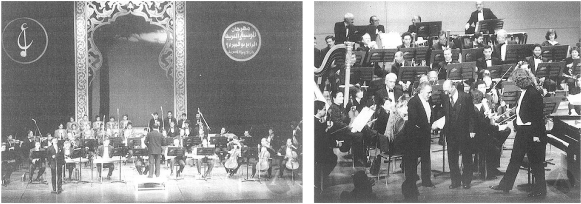
Figure 5
On the left, the Firqat al-Musiqa al-Arabiya (Grand Orchestra of Arabic Music) on stage at the Cairo Opera (1960); on the right, composer Aziz al-Shawan, pianist Bengt-Ake Lundin, conductor Mustapha Nagui and the Grand Orchestra of Arabic Music of Cairo (1960)
Citation: Middle East Journal of Culture and Communication 12, 1 (2019) ; 10.1163/18739865-01201006
Beginning in the 1970s, the takht was abandoned in favor of the firqat type of ensembles; this was the beginning of the ‘expanded’ format orchestras throughout the Arab world. We can first see this change in Egypt, with the creation of Firqat al-Musiqa al-Arabiya (Grand Orchestra of Arabic Music) (figs. 5 and 6). From then, Arabic music orchestras, which at that point enjoyed written orchestral arrangements and were rid of all ‘slag’ associated with personal interpretations (and at the same time from quarter tones), produced an impression of extraordinary homogeneity to the new audiences and the media. This observation is confirmed by Issam al-Mallah, who reported
… the orchestra began to play as a block or as an undifferentiated instrumental grouping, each musician confining himself to executing the options and ideas of the leader. There is no longer any difference between the game of one or another musician, each one has a well-defined role, to play what has been agreed on, in other words, what is written and ‘fixed’ on the score. Even the movements of the bows are rigorously fixed. [There are] no ornaments, [and] no personal embellishments.
al-Mallah 1992: 168
Figure 6
The Firqat al-Musiqa al-Arabiya (Grand Orchestra of Arabic Music), 2010
Citation: Middle East Journal of Culture and Communication 12, 1 (2019) ; 10.1163/18739865-01201006
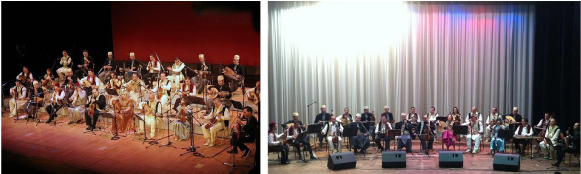
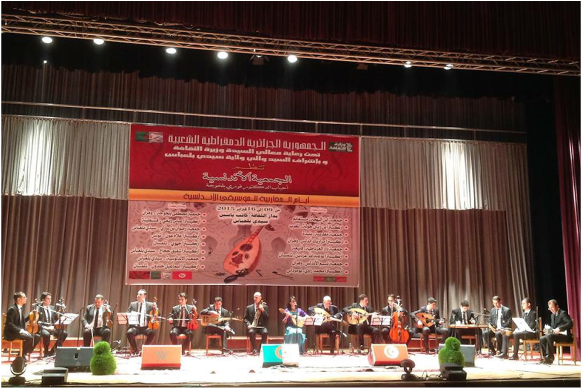
© Cairo Opera HouseThese transformations in Arab musical institutions and orchestras continued beyond Egyptian society, and were further strengthened by nationalism, throughout the wave of independence movements. These changes swept the whole Arab world—including the Maghrib—during the 1950s and 1960s, and contributed significantly to an increase in the number of instruments in Arabic music ensembles, and continued until the newly independent states created the modern national orchestras (figs. 5, 6, 7 and 8).
Figure 7
On the left and right, the National Algerian Ensemble of Arab-Andalusian Music (ENAMA), 2011
Citation: Middle East Journal of Culture and Communication 12, 1 (2019) ; 10.1163/18739865-01201006
© ENAMA4 Redefining the Conditions of a Musical Practice: The Decontextualization of Arabic Music Outside Its National and Institutional Borders
For almost a century, the historical traditions (turath) of scholarly Arabic music practices and their institutions have been the subject of debates and controversies among social scientists. As early as 1932, the Cairo Congress of Arab Music initiated by the Baron Rodolphe d’ Erlanger addressed the various issues Arabic music faced, with the increasing influence of western culture on its musical practices. At the end of the congress, several recommendations were made to revitalize and preserve the historical Arabic music system based on quarter tones, and to prevent its decline among musicians.
Figure 8
The Regional Ensemble of Arab-Andalusian Music from Tlemcen, 2015
Citation: Middle East Journal of Culture and Communication 12, 1 (2019) ; 10.1163/18739865-01201006
© Regional Ensemble of Arab-Andalusian Music from TlemcenNowadays, with the increased globalization of culture, music institutions in the Arab world appear to be even more threatened than in the past. For the first two decades of this century, many anthropologists, ethnomusicologists and sociologists have been monitoring the impacts of mass media and new technologies on musical practices in Arab countries. These investigations have come to a variety of conclusions, yet the future scenarios for Arabic music and its institutions remain overwhelmingly similar.
On one hand, scholars have stressed that music disseminated through mass media is a new and powerful force of social change in the broader region of the Arab world. Many scholars thus forecasted that the ‘creative turn’ of Arab pop music and culture implemented by the new social media would play a transcendent role in connecting Arab populations across borders (Stokes 2015, 2012a; Frishkopf 2010; Ulaby 2010; al-Wassimi 2010; Nassar 2010; Cestor 2010). On the other hand, some studies also raised concerns about the outcomes of the transformations of musical practices that came about through the use social media. According to these analyses, the rise of mass mediated music means an increase in the globalization of culture and leads to more homogenization and acculturation in the Arab world. Indeed, most Arabic music institutions have been severely declining in recent years, as the interest of a great majority of young people has shifted to the music industry spread by mass media. These new cultural offerings are often based on western popular music patterns, played on new electronic devices, including new repertoires and on harmonic instruments (Cestor 2007; Marcus 2007; Mallet 2004; Lortat Jacob and Rovsing Olsen 2004; Feld 2004; Ritzer 2004; Pieterse 2009). Some recent analyses even suggest that Arabic musical traditions may disappear in the near future.
However, paradoxically, despite the fact that most debates surrounding Arabic music have focused on global issues, few of these analyses have addressed the question of the practices of immigrants in the Arabic diaspora. Furthermore, most debates related to such issues pay very little attention to the decontextualization6 processes of Arab music and the ways musicians have assembled outside national and institutional borders. That is, how are immigrant musicians redefining their practices outside the Arab world? Should we only consider Arabic music when it is performed inside the ‘legal’ framework of its official borders, or should we analyze these musical practices with a broader scope?
Because of their heterogeneous national and institutional origins, musicians outside the Arab world and their original context cannot replicate the conditions of the past. The new contexts in countries such as France and the United States contrast significantly with what musicians have encountered before. Most musicians discovered, when they reached France and the United States, that their status had changed; in most Arab countries, these musicians were considered part of the musical elite; in the diaspora, they found new contexts, but ones in which their ‘schools’ and institutional connections were meaningless because other institutions controlled the music market and defined legitimacy. That is, when decontextualized in France and the United States, most immigrant musicians from the Arab world shifted from a ‘dominant’ status to a new one in which they became ‘dominated’. This balance of power is particularly significant in the context of the city of Marseille. Because of the city’s long-standing history of welcoming immigrants from the Maghrib, Marseille’s musical culture was strongly influenced by raï music, a popular genre that crossed the Mediterranean during the 1990s and quickly expanded in Europe. Because of its immigrant culture, Marseille thus became a capital of raï music (Gilles 2009). But this reality contradicted the expectations of most musicians coming from Arab-Andalusian schools and institutions. After all, if Marseille could welcome hundreds of pop raï musicians, newly arrived musicians thought it should do the same for Arab-Andalusian music. But this was not the case. One musician, who played in Arab-Andalusian ensembles in Marseille (as a mandolin player), raised this paradox. He explained that, in his opinion, immigrant Maghribi communities living in Marseille were unlikely to turn the city into an ‘Andalusian’ paradise.
When I was appointed here in Marseille as a lecturer, my astonishment at first was that in such a cosmopolitan city with such a large Maghribi community, I could not find anyone to play Arab-Andalusian music. To play raï music, there was no problem, everyone is there, but to play Arab-Andalusian music, I thought to myself, but it is not possible! The place where I thought to find the most amateurs and people likely to play this kind of music, that was actually the place where I found nothing!
Interview with a musician from Tarab Ensemble, Marseille, 2006
The difficulty of reproducing Arab-Andalusian music in Marseille does not contradict the music history of the Maghrib. First, in the context of the Maghrib and when compared to Arab-Andalusian music, raï music is commonly identified as a ‘popular’ lowbrow genre. In France, however, it was quickly legitimized and became ‘dominant’ in the mass media industry. Second, while raï music is a relatively modern ‘bottom-up’ musical form that can be played easily on electronic devices—or on keyboards—by contrast, Arab-Andalusian music is more immersive because it requires musicians to have formal music education as well as strong institutional support to ensure their affiliation with the school’s ‘spirit’. Finally, because Arab-Andalusian music has been increasingly associated (since its institutionalization from the 1960s until now) with the elite culture of the Maghrib, most immigrants did not bring this music with them when they settled in Marseille. Instead they turned to popular genres like raï music or the shaʿabi music that belong to more ‘popular’ repertoires. This new context has created challenging conditions for Arab-Andalusian musicians who want to assemble and produce music without institutional support. These difficulties of ‘exporting’ a musical practice outside its institutional borders are even more pronounced in the context of the United States. In terms of the weight of the Arabic music community and when compared to the French context, the American art scene is a ‘cultural desert’. Size is one contributing factor, as musicians do not live in the same city—they may be located in Boston, Chicago, New York, Philadelphia, Los Angeles or San Francisco. Also, it is necessary to gather together a number of musicians able to play at a professional level. The leader of the Arabesque Music Ensemble (a qanun player) describes the numerous issues and organizational constraints that arise in relation to managing musicians of different backgrounds who may be living in different cities in the United States.
People who are able to play Arabic music in this country, there are not so many! Within around 300 kilometers, I can tell, I’m the only qânûn player! No problem! There is a population of 300 million in this country, there are maybe something like twenty qânûn players, I know them all one by one, I know their instruments, and I know there are maybe two or three of them who play at my level, that’s it! The comparison is a bit tricky, because there is, nonetheless, a significant Arab population here in the US, but the community is somehow lost in the immensity of the territory. The United States is a very large country with many immigrant communities! But when you take an example like France, the first [most populous] immigrant population is the Arabs! Here in the United States, we are far behind; we are far from being the largest foreign community here. Far behind Asians, Europeans and Hispanics, while in France we are number one by far! Here in the US, you have the ‘Latin’, or should we say the Hispanics because they are from everywhere, you have the Arabs, you have the Africans, you have those who come from Eastern Europe, and there are African Americans! So, all these people are competing, all these people are fighting for this very limited niche that is ‘world music’. Of a series of twenty concerts given at the University of Michigan Musical Society, for instance, there are maybe two of them that are devoted to ‘world music’! Of those two, it will have to be decided, is it going to be the Arabic, Asian, Chinese, Hispanic, Cuban, African, [or] African Americans? It is difficult! It’s very difficult!
Interview with the leader of the Arabesque Music Ensemble, Chicago, 2009
In other words, the decontextualization of Arabic music outside its national and institutional borders is more than the simple ‘relocation’ of a musical practice, rather it is a complete redefinition of the conditions of the practice. Musicians must organize a network of musicians living in different cities, find suitable places to practice, compete in a market dominated by other musical forms, and finally, earn a living (often in other fields). All these constraints did not exist in the institutionalized frameworks of their countries of origin. But, once these conditions are met, another significant constraint must be resolved. How can musicians with greatly contrasting geographical and institutional origins be gathered together to perform?
5 The Great Heterogeneity of the Institutional and Geographic Origins of Musicians Assembled in Arabic Music Ensembles in France and the United States
In France, as in the United States, immigrant musicians who want to penetrate the western ‘art world’ must often start in the extremely limited market of ‘world music’ before they are able to meet with other artists. Thus, these new contexts clearly require adaptations from musicians who find themselves with no other choice than to cooperate with one another, despite their geographic and institutional differences. Therefore, it is necessary for Arabic music ensemble leaders in France and the United States to bring together musicians from different schools and backgrounds, or even sometimes from popular ‘lowbrow’ repertoires (according to historic scholarly Arabic music traditions (turath)).
In Marseille, it is necessary to gather musicians from different Arab-Andalusian music schools, not only from Algeria, but also from other countries in the Maghrib. This necessity to cooperate with other musicians from different backgrounds was mentioned by the leader of the Tarab Ensemble and the amateur orchestra of the Cité de la Musique of Marseille; he discussed how this cooperation is crucial to enter the music market in the new French context.
In 1996, I started to found my group Tarab, and by knowing musicians—amateurs as well as professionals—in Marseille, I said to myself that it was necessary to set up a group to perform at festivals, concerts, weddings, galas, stuff like that, you know! So, I started to meet musicians, and musicians from different cultures, from different schools as well. They were from Algiers, Tlemcen, Oran, and from Morocco, because at that time, we were only five or six musicians; Mouloud, who is from the school of Algiers (mandolin); there was Djalila, also from the school of Algiers; Maurice Medioni, who is a Jew from Oran, who was at the piano; Youssef who played the banjo and he comes from a shaʿabi [background]; and another musician Bouskada (on the viola), who I have known well from the beginning here in Marseille and who has always been very faithful to me and to the group.
Interview with the leader of the Tarab Ensemble, Marseille, 2006
In Marseille, musicians from heterogeneous backgrounds and different institutional origins are compelled to play together in the same ensembles. These conditions, which require musicians to adapt to repertoires from other Arab-Andalusian musical schools, reveal a dramatic contrast with the institutional conventions that prevail in Maghrib countries. In the Maghrib, the differences between schools make opening a dialogue between musicians very unlikely. According to a musician surveyed in Marseille for this research, in the context of Maghrib countries, each Arab-Andalusian school is distinguished by its own repertoire, as well as by rhythm, and each repertoire has unique institutional music practices. These differences between ‘musical churches’ however, are no longer sustainable in the context of Marseille.
In Algeria or in the countries of the Maghrib, you will never find in the same city, several musicians from different schools who meet each other. This experience would never happen [there]. That means playing different repertoires, such as a little bit of Tlemcenian, a little bit of Algerian, a little bit of Constantine, etc. in the same ensemble. This would never have been possible in Algeria, simply because everyone preaches for his own institution. In addition, there is the partitioning of schools, which is quite difficult to break for the simple reason that Algiers is Algiers, and Constantine is Constantine. And I think that the fact that we meet in Marseille has made it possible to be a little bit more tolerant toward each other. In fact, it is the same music interpreted differently.
Interview with a musician from the Tarab Ensemble, Marseille, 2006
In France musicians come mainly from Maghrib countries, and are thus more ‘acquainted’ with the ‘common ground’ of Arab-Andalusian music and culture, while in the United States, in contrast, musicians come from all over the Arab world. They may be from Morocco, Egypt, Israel, Lebanon, Syria, Jordan, Iraq, and sometimes even from Iran. The different origins of the musicians naturally increase the number of differences between repertoires. In addition, unlike the situation in France, musicians decontextualized in the United States are not concentrated in the same place or in the same city. Instead, they end up spread across the country in different American cities, though they may once have lived in the same street in a city like Cairo.
There is just not enough people, not enough groups. Plus you know, it’s not like you are in France, in Paris, you go to Paris, everyone is there. I mean we have Chicago, Boston, New York, Los Angeles, San Francisco, Dallas–Texas, you know, we are all over the place! You know, and those people don’t have access, we don’t have access to each other. Unless there is a great opportunity that we can afford, to meet all together. Like this ensemble that you are watching today, you know, but tomorrow Hicham is in Chicago! I am in Boston, Nacer and Scott are [both] in California but they are still many miles away from each other even though they are in the same state. And Hanna is in Philadelphia! … So, you know, it’s not convenient! If you are in Cairo, I go to one street, you know, King Faisal Street, and I can find hundreds and hundreds of musicians to work with. Just on one street in Cairo!
Interview with a musician from the Arabesque Music Ensemble, Chicago, 2009
Paradoxically, these difficulties related to the new ‘context’ increase the chance for cooperation between musicians. While in their Arab countries of origin, musicians had the freedom to switch from one ensemble to another at any time, in the United States, the situation is completely reversed; musicians must remain integrated in the community of ‘Arab musicians’ or they would be forced to leave the professional network. In turn, musicians learn more from each other, and their ‘constrained’ collaboration brings into the repertoire innovations, especially when compared to the situation in Arab countries, where musicians are more easily interchangeable by orchestras and music ensembles, but depend more on institutionally-defined musical repertoires.
In general, in Egypt, you have a huge selection of people you can work with, you know! In the US, there are very few choices, meaning that you work with people whose style you may not completely like or, they are not at the right level but because there are only about twenty of us, in America, and we can’t be ultimately selective, so we work with people and we learn together and we improve together. In Egypt, there are hundreds and hundreds of singers and hundreds of ʿud players and hundreds of riqq players. So you are not stuck with any one person and you can learn from a lot of people and have opportunities [to play] with a lot of different people. In the US, you know, we have to think of a nay player, like there are two nay players that we could work with, or three! And maybe they are across the country and maybe they are busy! But in Egypt, you can always find a nay player. That’s the biggest difference.
Interview with a musician from the Arabesque Music Ensemble, Chicago, 2009
In other words, in these new conditions where musicians gather together outside their national and institutional borders, decontextualization creates new opportunities for the renewal of Arabic music repertoires. It is very unlikely that we would find the same renewal, one in which musicians of very different institutional and geographic origins find themselves cooperating in the same ensembles, in their countries of origin. In the prior situation prevailing in Arab countries, most musicians would not have taken the risk of crossing the borders of institutionally-defined musical repertoires. Yet, paradoxically, these institutional borders fall apart once musicians find themselves in a decontextualized framework. Thus, it is the process of decontextualization that leads to the redefinition of musical repertoires.
6 The Redefinition of a Musical Repertoire
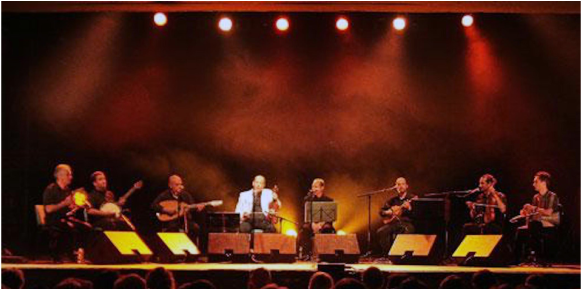
Because of the heterogeneous national and institutional origins of musicians, the repertoire performed in a decontextualized framework such as in France and the United States cannot replicate the same conditions we find in the Arab world. Immigrant musicians are limited economically and materially, and they do not live in the same conditions and with the same standards of Arabic music orchestras as those funded by Arab states, in which an orchestra sometimes has thirty to forty instrumentalist musicians. By contrast, the size of ensembles formed in France and in the United States typically never exceeds six to eight musicians; these are not comparable to the size of institutional orchestras from the Arab world (figs. 9 and 10). In these new conditions, musicians must combine different repertoires related to different schools and institutions of the Arab world in the same ensemble, including pieces from lowbrow popular repertoires. These new patterns dramatically shift the conditions of musical practices compared to those in the original countries.
Figure 9
Tarab Ensemble, Marseille, 2009
Citation: Middle East Journal of Culture and Communication 12, 1 (2019) ; 10.1163/18739865-01201006
© Tarab EnsembleThus, in Marseille, musicians must be able to play, for example, a heterogeneous repertoire of Arab-Andalusian music composed, for instance, of noubas from Algiers or from Tlemcen, of qasidas (a poetic genre sung with mono-rhymes) during the same concert, as well as pieces of hawzi and shaʿabi with lowbrow ‘popular’ repertoires (at least with regard to the Arab-Andalusian music tradition). This Marseille context breaks away from old stylistic and institutional barriers by allowing the introduction of several influences in the same ensemble, depending on the musicians, who each bring their own diverse range of musical repertoire and expertise. In the case of the Tarab Ensemble in Marseille, the revived repertoire is translated throughout the composition of instruments; we can find a violin, a viola, a mandolin, a lute (ʿud), a kwitra, a riqq, a darbouka (percussion), and a banjo in the same ensemble. Compared to the thirty-seven instruments that we find in the National Orchestra of Algeria, this new composition of decontextualized ensembles is not only different because of the decrease in the number of instruments. An Arab-Andalusian music ensemble’s integration with a musician from shaʿabi music, who plays the banjo and sings with a hoarse voice timbre, is in complete contrast with the historical Arab-Andalusian tradition. Indeed, the exhaustive instrument organology Mahmoud Guettat lists for Arab-Andalusian music ensembles does not mention the banjo as a ‘traditional’ instrument (Guettat 2000). Yet, despite the fact that this combination of different instruments and repertoires in the same ensemble would not be feasible in the context of the Maghrib countries, the new context of Marseille allows it to be possible (fig. 11).
There is something unique in what we are doing in Marseilles, in the way we build the program. That is, there is a troupe of Arab-Andalusian music, if you want, that will interpret several pieces of different schools etc., in the same ensemble. It is in this sense very specific to Marseille, as there is no equivalent to what we are doing in Algeria or in the other Maghrib countries. But if we take the pieces independently from their context, we try to interpret them as they would have been interpreted in Algeria. Someone from outside, who comes to listen to us, but who is from Algeria, would say that’s not it! That’s because we try to mix repertoires and so on. But in our way of interpreting the pieces, we try to remain faithful to tradition, I believe. At least, we try to!
Interview with a musician from Tarab Ensemble, Marseille, 2006
Figure 10
Arabesque Music Ensemble, Chicago, 2008
Citation: Middle East Journal of Culture and Communication 12, 1 (2019) ; 10.1163/18739865-01201006
© Arabesque Music EnsembleIn the United States, the combination of different kinds of repertoires is also at the heart of the reshaping of Arabic music ensembles. As in the French case, the transformed repertoires produced in a decontextualized framework contrasts with Middle Eastern orchestral formations, which, as in the West, remain in rigid specialized programs. In most cases, these orchestras are dedicated to national musical repertoires and to classical masterpieces in Arabic music. In contrast to the conditions that prevail in Arab countries, musicians who have assembled in the United States can redefine their own repertoire, independently from institutions; this circumstance is significantly different than their prior situation. The new conditions in which Arabic music ensembles are gathered is a significant break from the former traditional repertoires performed in the countries of origin of the musicians. Indeed, while a great part of the repertoires performed in Arab countries by institutional orchestras may seem to be frozen in time because they emphasize some composers more than others, or impose the repertoire of a certain time period, musicians in the diaspora have unlimited choices of repertoires to interpret. This difference in ‘context’, however, dramatically changes the conditions in which musicians redefine the repertoire. In the diaspora, musicians can not only choose the size of their ensemble and the musicians they wish to work with, but also define the type of repertoires they perform and the period they present, according to circumstances and concerts. Finally, in comparison to the institutional orchestras’ pattern, this new context of production offers musicians substantial freedom: they are able to introduce, when they wish, individual improvised instrumental parts (fig. 12).
Figure 11
Tarab Ensemble, Marseille, 2012. While the banjo on the right is not part of Arab-Andalusian music ensembles in the Maghrib, it reflects the spirit of openness from musicians assembled in Marseille
Citation: Middle East Journal of Culture and Communication 12, 1 (2019) ; 10.1163/18739865-01201006
© Tarab EnsembleParadoxically, these new conditions make decontextualized ensembles in France and the United States appear to be more closely related to nineteenth-century takht ensembles than to the modern, mid twentieth-century firqat orchestras. However, the comparison with nineteenth-century music ensembles does not mean that musicians are necessarily searching for a ‘pure’ model of takht ensemble. In fact, compared to national orchestras in the Arab world, where all melodic parts are written on scores, and musicians are denied the right to make variations or ornamentations, the spirit of the new takht ensemble models assembled in France and the United States seems to favor musical expression much more than institutional orchestras in the Arab world do. Professor Scott Marcus7 explains that these modern institutions seek to preserve a musical heritage by creating and sustaining large national orchestras, and end by modifying the spirit of what they wanted to ‘protect’. Specifically, they eliminated the musical expressions, which, in the traditional takht ensembles, moved from independent solo voices to a single chorus voice in modern orchestras.
Figure 12
Arabesque Music Ensemble, Georgetown University, 2008
Citation: Middle East Journal of Culture and Communication 12, 1 (2019) ; 10.1163/18739865-01201006
© Arabesque Music EnsembleYou know, there are many many things happening across the Arab world, because it’s so huge. But one of the surprising things is that some of the government ensembles, unlike this Arab music ensemble (Arabesque Music Ensemble), have been weeded down. Because of their efforts to preserve it, they’ve made it into—they’ve made the orchestra bigger in size, they used to be smaller, but now it’s bigger, yeah! And it used to be a solo voice, and now it’s a chorus. So, they’ve changed the things that they are preserving. … And so, in order to preserve [it] they’ve changed [it]. So, they have changed what they are trying to preserve. I think that many people would listen to these groups and say they are not very musical. You know, there is a problem; they actually created problems for themselves, in terms of musicality. So this small group with Hicham can actually take time, and be more musical. It’s interesting!
Interview with Scott Marcus, Heartland Seminar on Arabic Music, Racine, Wisconsin, 2007
Paradoxically, although Middle East music scholars have focused on the transformations of musical practices in the Arab world, the redefinition of Arabic music outside its national and institutional borders gives musicians the opportunity to reconnect with some elements that were thought to have disappeared from musical practices. Yet, from the decontextualized framework of the United States, musicians appear to have regained the freedom to create and redefine a repertoire open to the expressiveness of music, without necessarily cutting themselves off from historical traditions and expertise. A violinist from the Arabesque Music Ensemble, who also plays in international symphony orchestras, suggested that these distinctive historical patterns of music are one of the founding principles of classical Arabic music.
When I play Arabic music, you know, there is a lot of freedom there. One person’s interpretation of the quarter tone, I mean, it could be a little bit high, it could be a little bit low, you know! However, when you train for in western classical music, you know, you have certain intonations, there is no playing around, an A is an A! You know 440! You put that tune on a hand and that’s an A! You know! So, I am still very blessed that I can move between two walls right now. It’s great that we are in America because we are away from all these influences that are from the Middle East. I mean, we are reinventing Middle Eastern music away from its hometown.
Interview with a musician from the Arabesque Music Ensemble, Chicago, 2009
In other words, what makes the specificity of Arabic music, according to musicians who have assembled outside the Arab world, is not so much playing the common parts written on score perfectly in tune, rather it is the freedom each musician has to practice micro-intervals, that is, an unlimited exploration of quarter tones.
7 Conclusion
We can draw three main conclusions from this study: First, past studies in Arabic music emphasize differences in traditions and repertoires across the Arab world. Many scholars argue that these cultural patterns were dependent on the national contexts and institutions from which they originated. However, this research shows that, while most Arab countries do not share the same institutional musical traditions or repertoires, musicians can transcend these national and institutional borders when they are decontextualized outside the Arab world. The constraints produced by the experience of decontextualization creates new conditions for musicians redefining the musical repertoire, conditions that, paradoxically were not possible in the context of the Maghrib and Middle East.
Second, since new technologies and social media have grown globally, academic research has shown a new interest in the study of Arabic music. In this regard, many scholars have focused on Arab regions to investigate the change generated by new technologies and its influence on Arabic musical practices. However, this research does not take into consideration the dimension of change in a globalized world; in particular, they neglect the decontextualization processes of Arabic music and culture outside its national borders. Furthermore, this decontextualization does not refer to a simple ‘relocation’ of a musical practice, but rather a complete redefinition of the conditions of the practice. As we see in the cases of musicians from Arabic music institutions who have assembled in France and the United States, the process of decontextualization should not be understand as a ‘generic replica’ of Arabic music played in the original countries of the musicians. Instead, the new conditions in which musicians are performing create opportunities for innovation and the redefinition of musical repertoires.
Third, since the mid twentieth century, the historic scholarly Arabic music tradition (turath) has undergone dramatic changes with the rise of mass media and the integration of instruments based on the western tempered harmonic scale. All these changes have brought about a serious and significant decline in the use of quarter tones in everyday Arabic music. At the same time, the increase in instruments by institutional orchestras in the Arab world and the increase in common parts written on scores for all musicians have not helped to reverse these profound cultural changes. Yet, paradoxically, the decontextualization of musicians outside the Arab world creates contrasting patterns in which musicians have the opportunity to redefine the conditions of their musical practice. By assembling outside their national and institutional borders, musicians can choose the size of their ensemble, the musicians they want to play with, and the type of repertoire they want to perform. Finally, this new production context gives musicians the chance to reintroduce improvised instrumental parts, where quarter tones can again be at the heart of musical practice.
The maqamat is the modal system used in the Arabic music of the Middle East. It is based on melodic modes. In Arabic, the word maqam means ‘location’, or ‘position’. Each maqam is built on a specific mode based on a small quarter tone tetrachord scale. Conversely, the Arab-Andalusian music of the Maghrib does not use the maqamat modal system, but the western tempered harmonic scale. To keep the specific ‘Arabic tune’, Arab-Andalusian musicians must play with ornamental notes, rather than constantly changing modes.
Muwashshaḥ (‘ode’), is an Arabic poetic genre in strophic form developed in Muslim Spain (Andalusia) in the eleventh and twelfth centuries. From the twelfth century onward, its practice spread to North Africa and the Middle East. Nowadays, the muwashshah can be divided into two forms: the waslah of Aleppo and the Andalusian nubah of the western part of the Arab world (Maghrib).
Waslah is a set of pieces in Arabic music. It comprises eight or more movements that can be alternately instrumental and sung; these include muwashshah, taqsim, layali, mawwal, qasida, dawr, samaʾi, bashraf, dulab and popular songs. The term is also used to refer to a segment of Sufi music (poetic and religious music).
Mikhail Mishaqa (1800–1888), also known as ‘Doctor Mishaqa’, was born in Rashmayya, Lebanon, and is considered ‘the first historian of modern Ottoman Syria’ as well as the founder of the ‘24 equal quarter tones scale’. Mishaqa was the first theorist to propose dividing the octave into 24 equal intervals. His quarter tones scale, also called ‘24-tones equal temperament scale’, is the current basis of the modern Arab tone system. Mishaqa’s work, Essay on the Art of Music for the Emir Shihāb (1840), is derived from the work of al-Farabi (d. 950), whose heptatonic scales constructed from seconds used an unequal 25-tone scale based on tetrachords.
The qanun is a wooden trapezoidal cithara with 26 sets of triple strings, plucked with a plectrum. The instrument is played on the knees of the musician.
The concept of ‘decontextualization’ should not be understood as a simple ‘delocalization’ process, but rather as a transformation or adaptation of cultural forms when they are brought into a new cultural context or environment. In other words, the concept of ‘decontextualization’ must be understood in terms of what it means for social groups and individuals to be removed or deterritorialized from their original context to live in another context, to live in a new cultural environment with a new social order.
Scott Marcus is professor and chair of the Department of Music at the University of California, Santa Barbara. Marcus is the founder and director of the UCSB Middle East Ensemble and the Music of India (sitar) Ensemble and also directs the World Music Series. He is a member of UCSB’s Center for Middle East Studies and past board member of the Society for Ethnomusicology and the Society for Asian Music. He also teaches at the annual Middle Eastern Music and Dance Camp, in Mendocino, California and at the annual Heartland Seminar on Arabic Music in Wisconsin.
References
Abdallah, Tarek (2010). L’évolution de l’art du ʿüd égyptien en solo à l’aune du 78 tours. Revue des Traditions Musicales des Mondes Arabe et Méditerranéen 4: 53–66.
Abou Mrad, Nidaa (2007a). Clés musicologiques pour l’approche du legs de Mīhāʾīl Maššāqa (1800–1888). Revue des traditions musicales des mondes arabe et méditerranéen 1:115–180.
Abou Mrad, Nidaa (2007b). Compatibilité des systèmes et syncrétismes musicaux. Filigrane. Musique, esthétique, sciences, société 5: 93–120.
Abou Mrad, Nidaa (2012). Noyaux distinctifs par tierces de l’articulation monodique modale. Musurgia 19(4): 5–32.
Abou Mrad, Nidaa (2016). Congrès de Musique Arabe du Caire 1932. In Cahiers d’ethnomusicologie 29: 255–259.
Abou Mrad, Nidaa and Bouchra Béchéalany (2010). La transmission musicale traditionnelle en contexte arabe oriental face à la partition et à l’archive sonore. Revue des Traditions Musicales des Mondes Arabe et Méditerranéen 4: 25–42.
Appadurai, Arjun (1996). Modernity at Large: Cultural Dimensions of Globalization. Minneapolis: University of Minnesota Press.
Appadurai, Arjun (2001). Globalization. Durham, NC: Duke University Press Books.
Arom, Simha (1985). Polyphonies et polyrythmies instrumentales d’Afrique centrale. 2 vols. Paris: SÉLAF.
Aubert, Laurent (2001). La musique de l’autre, les nouveaux défis de l’ethnomusicologie. Geneva: Georg éditeur.
Bourdieu, Pierre (1958). Sociologie de l’Algérie. Paris: Presses Universitaires de France.
Bourdieu, Pierre (1979). La Distinction: critique sociale du jugement. Paris: Éditions de Minuit.
Bourdieu, Pierre and Jean-Claude Passeron (1970). La Reproduction. Paris: Les Éditions de Minuit.
Bouzar-Kasabdji, Nadya (1992). L’Algérie Musicale, entre Orient et Occident (1920–1939). In Musique Arabe, Le Congrès du Caire de 1932. Cairo: Centre d’Études et de Documentation Économiques, Juridiques et Sociales.
Cestor, Elisabeth (2007). L’enseignement et la pratique de la musique proche-orientale au Liban: évolutions, débats et révisions en cours. In Puig, Nicolas and Franck Mermier (eds.). Itinéraires esthétiques et scènes culturelles au Proche-Orient, pp. 127–146. Beirut: Institut français du Proche-Orient.
Cestor, Elisabeth (2010). Music and Television in Lebanon. In Michael Frishkopf (ed.), Music and Media in the Arab World, pp. 97–110. Cairo: American University in Cairo Press.
Chailley, Jacques (1960). L’imbroglio des Modes. Paris: Alphonse Leduc.
Chailley, Jacques (1967). Expliquer l’Harmonie? (Histoire de la Musique). Lausanne: Éditions Rencontre et la guilde du disque.
Chailley, Jacques (1984). Histoire Musicale Du Moyen Age. Paris: Presses Universitaires De France.
Chailley, Jacques (1996). La musique et son langage. Paris: Zurfluh.
Chailley, Jacques (19??). Les Intervalles de la Musique Anciennes (Erato Recording). Paris: Institut de Musicologie de l’Université de Paris.
Cheyronnaud, Jacques (1997). Ethnologie et musique: L’objet en question. Ethnologie française 27(3): 382–393.
Cheyronnaud, Jacques (2003), Musique, politique, Religion: De quelques menus objets de culture. Paris: Éditions L’Harmattan.
Cheyronnaud, Jacques (2007). L’ethnomusicologie de la France, à quoi ça sert? Sur une activité institutionnelle de conservation et de classement. Online: Ethnographiques.org, Ethnographiques.org: http://www.ethnographiques.org/2007/Cheyronnaud, accessed 11 March 2019.
Clapot, Alex (2002). Éléments pour une approche de la musique arabe. Nîmes: Éditions du Conservatoire de Nîmes.
Cordereix, Pascal, Jean Lambert and Bernard Moussali (2015). The Cairo Congress of Arab Music: 1932. Recordings of 18 CDs from the Cairo Congress of Arab Music. Includes accompanying book in French, English and Arabic. Paris: Bibliothèque nationale de France. (Recording).
D’Erlanger, Rodolphe (2001). La Musique Arabe. 6 vols. Paris: Geuthner/L’Institut du Monde Arabe (Reprint 1949).
Danielson, Virginia, Dwight Reynolds and Scott Marcus (2001) (eds.). Garland Encyclopedia of World Music. Volume 6: The Middle East. New York: Routledge.
Davis, Ruth (2001). Patronage and Policy in Tunisian Art Music. In Virginia Danielson, Scott Marcus, and Dwight Reynolds (eds.), Garland Encyclopedia of World Music. Volume 6: The Middle East, pp. 505–514. New York: Routledge.
During, Jean (1988). Musique et extase. Paris: Albin Michel.
El Mahdi, Salah (1972). La musique arabe: structures, historique, organologie, 39 exemples musicaux extraits du répertoire traditionnel. Paris: A. Leduc.
Elias, Norbert (1991). Mozart, sociologie d’un genie. Paris: Seuil, Librairie du XXI siècle.
Fathallah, Linda (1992). Instruments à cordes et à clavier dans les recommandations du Congrès du Caire. In Musique Arabe, Le Congrès du Caire de 1932. Cairo: Centre d’Études et de Documentation Économiques, Juridiques et Sociales.
Feld, Steven (1996). Pygmy POP: A Genealogy of Schizophonic Mimesis. Yearbook for Traditional Music 28: 1–35.
Feld, Steven (2004). Une si douce berceuse pour la ‘World Music’. L’Homme 171–172 (July–Dec.): 389–408.
Fétis, François-Joseph (2016). Histoire Générale de La Musique, Depuis Les Temps Les Plus Anciens Jusqu’a Nos Jours. Paris: Firmin-Didot (Reprint 1869–1876).
François, Pierre (2002). Production, convention et pouvoir: La construction du son de la musique ancienne. Sociologie du Travail 44(1): 3–19.
Frishkopf, Michael (2010). Music and Media in the Arab World. Cairo: American University in Cairo Press.
Giddens, Anthony (2000). Runaway World: How Globalization Is Reshaping Our Lives. New York: Routledge.
Gilles, Suzanne (2009). Musiques d’Algérie, mondes de l’art et cosmopolitisme. Revue européenne des migrations internationales 25(2): 13–32.
Grignon, Claude and Jean-Claude Passeron (1989). Le Savant et le populaire. Misérabilisme et populisme en sociologie et en littérature. Paris: Gallimard-Le Seuil.
Guettat, Mahmoud (1980). La musique classique du Maghreb. Paris: Sindbad.
Guettat, Mahmoud (1992). La Tunisie dans les documents du Congrès du Caire. In Musique Arabe, Le Congrès du Caire de 1932. Cairo: Centre d’Études et de Documentation Économiques, Juridiques et Sociales.
Guettat, Mahmoud (2000). La musique arabo-andalouse, L’empreinte de Maghreb. Paris: Éditions El-Ouns.
Guettat, Mahmoud (2001). The Andalusian Musical Heritage. Garland Encyclopedia of World Music. Volume 6: The Middle East. New York: Routledge.
Guichard, Pierre (2000). Al-Andalus 711–1492, Une histoire de l’Andalousie arabe. Paris: Hachette Littératures.
Halbwachs, Maurice (1963). Esquisse d’une psychologie des classes sociales. Paris: Marcel Rivière (Reprint 1938).
Hassan Touma, Habib (2001). Andalusian Nūba in Morocco. Garland Encyclopedia of World Music. Volume 6: The Middle East. New York: Routledge.
Hennion, Antoine (1993). La passion musicale. Paris: Métailié.
Hennion, Antoine and Sophie Maisonneuve (2000). Figures de l’amateur. Paris: La Documentation française.
Jargy, Simon (1988). La musique arabe. Paris: Presses Universitaires de France.
Lagrange, Frédéric (2001). Musiques d’Égypte. Paris and Arles: Cité de la Musique/Actes Sud.
Leroi-Cortot, Alexandre (2006). Influences croisées entres les traditions musicales perses et européennes. Les fondements d’une esthétique musicale commune. Droit et cultures 52: 121–138.
Libin, Laurence (2014) (ed.). The Grove Dictionary of Musical Instruments. New York: Oxford University Press.
Loopuyt, Marc (1995). Terrains et terreau d’un musicien. Cahiers d’ethnomusicologie 8: 137–146.
Lortat Jacob, Bernard and Miriam Rovsing Olsen (2004). Musique, Anthropologie: la conjonction nécessaire. In L’Homme 171–172: 7–26.
Maalouf, Shireen (2003). Mīkhāʾīl Mishāqā: Virtual Founder of the Twenty-Four Equal Quartertone Scale. Journal of the American Oriental Society 123(4): 835–840.
al-Mallah, Issâm (1992). Rythmes Arabes: Entre notation et pratique. In Musique Arabe, Le Congrès du Caire de 1932, pp. 161–180. Cairo: Centre d’Études et de Documentation Économiques, Juridiques et Sociales.
Mallet, Julien (2002). ‘World Music’ Une question d’ethnomusicologie? In Cahiers d’études africaines 168: 831–852.
Mallet, Julien (2004). Ethnomusicologie des ‘jeunes musiques’. L’Homme 3(171–172): 477–488.
Marcus, Scott (1993). The Interface between Theory and Practice: Intonation in Arab Music. Asian Music 24(2): 39–58.
Marcus, Scott (2007). Music in Egypt: Experiencing Music, Expressing Culture. New York: Oxford University Press.
Marnold, Jean (1909). Les Fondements Naturels De La Musique Grecque Antique. Sammelbände Der Internationalen Musikgesellschaft 10(3): 323–384.
Mecherri-Saada, Nadia (1992). Les documents algériens du Congrès du Caire: approche analytique et comparative. In Musique Arabe, Le Congrès du Caire de 1932. Cairo: Centre d’Études et de Documentation Économiques, Juridiques et Sociales.
Menocal, María Rosa (2003). L’Andalousie arabe VIIIe–XVe siècle: Une culture de la tolérance. Paris: Autrement.
Mishaqa, Mikhail (1899). Essay on the Art of Music for the Emir Shihāb. (al-Risala al-shihabiyya fi ʿl-sināʿa al-musiqiyya). Ed. Louis Ronzevalle. Beirut: Imprimerie des Pères Jésuites.
Molino, Jean (2008). La sociologie de la musique de Max Weber après un siècle. Revue de Synthèse 129(2): 215–239.
Nassar, Zein (2010). A History of Music and Singing on Egyptian Radio and Television. In Michael Frishkopf (ed.), Music and Media in the Arab World, pp. 67–77. Cairo: American University in Cairo Press.
Nettl, Bruno (1983). The Study of Ethnomusicology. Urbana: University of Illinois Press.
Nettl, Bruno (2004). Une anthropologie de la musique classique occidentale. L’Homme 171–172: 333–351.
O’dea, Micheal (2003). Consonances et dissonances: Rousseau et d’Alembert face à l’œuvre théorique de Jean-Philippe Rameau. Recherches sur Diderot et sur l’Encyclopédie 35: 105–130.
Pedler, Emmanuel (1988). Musique d’emprunt, culture d’exil. La musique chez les immigrés du Maghreb à Marseille. Revue de l’Occident musulman et de la Méditerranée 47: 47–52.
Pedler, Emmanuel (2003). Entendre l’opéra: une sociologie du théatre lyrique. Paris: l’Harmattan.
Pedler, Emmanuel and Jacques Cheyronnaud (2013). Théories Ordinaires. Paris: Éditions de l’École des Hautes Études en Sciences Sociales.
Peter Baumann, Max (1992). Safeguarding of Musical Traditions: Towards the ‘Rehabilitation of the Alien’. In Max-Peter Baumann (ed.), World Music, Musics of the World: Aspects of Documentation, Mass Media, and Acculturation, 3:151–175. Wilhelmshaven: F. Noetzel.
Pieterse, Jan Nederveen (2009). Globalization and Culture: Global Mélange. Lanham, MD: Rowman and Littlefield.
Poche, Christian (1995). La musique arabo-andalouse. Arles: Cité de la Musique/ Acte Sud.
Qassim Hassan, Schéhérazade (2004). Tradition et modernisme: Le cas de la musique arabe au Proche-Orient. L’Homme 3(171–172): 353–369.
Racy, Ali Jihad (1977). Musical Change and Commercial Recording in Egypt, 1904–1932. PhD Dissertation, University of Illinois, Urbana.
Racy, Ali Jihad (1992). Musicologues comparatistes européens et Musique Égyptienne au Congrès du Caire. In Musique Arabe, Le Congrès du Caire de 1932. Cairo: Centre d’Études et de Documentation Économiques, Juridiques et Sociales.
Racy, Ali Jihad (2004). Making Music in the Arab World: The Culture and Artistry of Tarab. Cambridge: Cambridge University Press.
Racy, Ali Jihad (2007). Music and Social Structure: The Takht Tradition of Early-Twentieth Century Cairo. Revue des traditions musicales des mondes arabe et méditerranéen 4: 57–76.
Ritzer, George (2003). The Globalization of Nothing. Thousand Oaks, CA: Sage Publications.
Ritzer, George (2004). The Macdonaldization of Society. Thousand Oaks, CA: Sage Publications.
Rouanet, Jules (1922a). La musique arabe. In Albert Lavignac (ed.), Encyclopédie de la musique et Dictionnaire du Conservatoire, 5:2676–2812. Paris: Librairie Delagrave.
Rouanet, Jules (1922b). La musique arabe dans le Maghreb. In Albert Lavignac (ed.), Encyclopédie de la musique et Dictionnaire du Conservatoire, 5:2813–2939. Paris: Librairie Delagrave.
Rouget, Gilbert (1981). Ethnomusicologie et représentations de la musique. In Le Courrier du CNRS, Hors Série 42: 4–5. (Recording).
Rouget, Gilbert (1990). La musique et la transe, esquisse d’une théorie générale des relations de la musique et de la possession. Paris: Gallimard.
Rousseau, Jean-Jacques (2013). Dictionnaire de musique. Paris: Hachette Livre BNF (Reprint 1768).
Roy, Martha (1992). L’Éducation Musicale en Égypte. In Musique Arabe, Le Congrès du Caire de 1932. Cairo: Centre d’Études et de Documentation Économiques, Juridiques et Sociales.
Russell, Alexander (1756). The Natural History of Aleppo, and Parts Adjacent. London: Printed for A. Millar, West Virginia University Libraries (Reprint London, 1794, 2 vols).
Sadie, Stanley and John Tyrrell (2001). The New Grove Dictionary of Music and Musicians. London and New York: Macmillan.
Said, Edward (2003). Orientalism. London: Penguin Classics.
Salvador Daniel, Fransisco (1879). La musique arabe, ses rapports avec la musique grecque et le chant grégorien. Algiers: Adolphe Jourdan.
Sawa, George Dimitri (2015). An Arabic Musical and Socio-Cultural Glossary of Kitāb al-Aghānī. Leiden: Brill.
Sawa, George Dimitri (2019). Musical and Socio-Cultural Anecdotes from Kitāb al-Aghānī al-Kabīr. Leiden: Brill.
Schaeffner, André (1994). Origine des instruments de musique. Introduction ethnologique à l’histoire de la musique instrumentale. Paris: Editions de l’École des Hautes Études en Sciences Sociales.
Scheindlin, Raymond P. (1992). The Jews in Muslim Spain. In Salma Khadra Jayyusi (ed.), The Legacy of Muslim Spain, 188–201. Leiden: Brill.
Schuyler, Philip (2001). Morocco. In New Grove Dictionary of Music and Musicians 17:135–142. London and New York: Macmillan.
Shannon, Jonathan H. (2007). Performing al-Andalus, Remembering al-Andalus: Mediterranean Soundings from Mashriq to Maghrib. Journal of American Folklore 120(477): 308–334.
al-Shawan Castelo-Branco, Salwa (1992). Mutation dans la musique égyptienne: une question majeure au Congrès de Musique Arabe. In Musique Arabe, Le Congrès du Caire de 1932, Cairo: Centre d’Études et de Documentation Économiques, Juridiques et Sociales.
Sorce Keller, Marcello (1993a). Pop Music from the Mediterranean: Some Remarks Concerning Forms of Culture Contact. Revista de Musicología 16(4): 1953–1959.
Sorce Keller, Marcello (1993b). Popular Music in the Mediterranean: A Case for Reconsidering the Current Definition of Culture. Criticus Musicus: A Journal of Music Criticism 1(2–3): 133–146.
Sorce Keller, Marcello (2007). Why Is Music So Ideological and Why Do Totalitarian States Take It So Seriously? A Personal View from History and Social Sciences. Journal of Musicological Research 26(2–3): 91–122.
Sorce Keller, Marcello (2012). What Makes Music European: Looking Beyond Sound (Europea: Ethnomusicologies and Modernities). Lanham, MD: Scarecrow Press.
Stokes, Martin (2004). Musique, identité et ‘ville-monde’. L’Homme 171–172: 371–388.
Stokes, Martin (2008). Listening to Abd al-Halim Hafiz. In M. Slobin (ed.), Global Soundtracks: Worlds of Film Music, pp. 309–336. Middleton, CT: Wesleyan University Press.
Stokes, Martin (2012a). Globalization and the Politics of World Music. In M. Clayton, T. Herbert and R. Middleton (eds.), The Cultural Study of Music: A Critical Introduction, pp. 106–116. London: Routledge.
Stokes, Martin (2012b). Migrant/Migrating Musics and the Mediterranean. In B. Dueck and J. Toynbee (eds.), Migrating Music, pp. 28–37. London: Routledge, pp. 28–37.
Stokes, Martin (2014). Creativity, Globalization and Music. Volume!10(2): 30–45.
Stokes, Martin (2015). The Politics of Aesthetics in the Muslim Middle East. In S. Altorki (ed.), The Wiley-Blackwell Companion to the Anthropology of the Middle East, pp. 91–106. N.p.: Wiley-Blackwell.
Ulaby, Laith (2010). Mass Media and Music in the Arab Persian Gulf. In Michael Frishkopf (ed.), Music and Media in the Arab World, pp. 111–129. Cairo: American University in Cairo Press.
Vatin, Jean-Claude (1992). Approche politologique d’un Congrès. In Musique Arabe, Le Congrès du Caire de 1932. Cairo: Centre d’Études et de Documentation Économiques, Juridiques et Sociales.
Vigreux, Philippe (1991a). Centralité de la musique égyptienne. Égypte/Monde arabe 7: 55–101.
Vigreux, Philippe (1991b). Esquisse d’une chronologie du réformisme en Égypte. Les Cahiers de l’Orient 24: 190–205.
Vigreux, Philippe (1992). Musique Arabe, Le Congrès du Caire de 1932. Cairo: Centre d’Études et de Documentation Économiques, Juridiques et Sociales.
Villoteau, Guillaume André (1809–1828). De l’état actuel de l’art musical en Égypte, ou relation historique et descriptive des recherches et observations faites sur la musique en ce pays. In Description de l’Égypte, ou, Recueil des observations et des recherches qui ont été faites en Égypte pendant l’expédition de l’armée française. Paris: Imprimerie de C.L.F. Panckoucke. (t.1, 1809—Etat Moderne Text): 607–1018. Online: doi: https://doi.org/10.5962/bhl.title.62506.
al-Wassimi, Mounir (2010). Arab Music and Changes in the Arab Media. In Michael Frishkopf (ed.), Music and Media in the Arab World, pp. 91–97. Cairo: American University in Cairo Press.
Weber, Max (1998). Sociologie de la Musique. Les fondements rationnels et sociaux de la musique (Die rationalen und soziologischen Grundlagen der Musik). Paris: Métailié.
Wright, Owen (2000). Demetrius Cantemir: The Collection of Notations. Volume 2: Commentary. London: Routledge.
Yammine, Habib (1983). Les rythmes chez al-Fârâbî. MA thesis, Université de Paris VIII-Saint-Denis, Département de musique.
Yammine, Habib (1995). Les Hommes des tribus et leur musique (Hauts-plateaux yéménites, vallée d’al-Ahjur). PhD dissertation (2 vol), Université de Paris X-Nanterre.
Yammine, Habib (1999). L’évolution de la notation rythmique dans la musique arabe du ixe à la fin du xxe siècle, Cahiers d’ethnomusicologie 12: 95–121.