Abstract
This paper explores the significance of virginity in medieval Jewish culture, serving as a prism for understanding gender dynamics and a lens for examining Jewish-Christian interreligious tensions. By highlighting virginity as an intersection of diverse sociocultural facets, it offers new perspectives on power dynamics and societal structures in medieval Europe. While extensively studied in Christian contexts, virginity’s role within Jewish tradition has often been overlooked or narrowly understood. To address this gap, the paper offers a close reading of a medieval Hebrew narrative recounting the tragic fate of Sarit, a young bride killed by her father-in-law during the 1096 Crusade massacres. The analysis contends that Sarit’s narrative encapsulates the preservation of communal boundaries through the safeguarding of the virgin female body. This episode sheds light on both internal and external struggles within Jewry and underscores the intricate interplay between Judaism and Christianity. By examining the narrative in the chronicle alongside contemporary Christian exegesis, the study demonstrates how gendered concepts were utilized to define the boundaries of the Jewish faith amid the religious turmoil of twelfth-century Europe.
From antiquity to the present, many religions have attached great importance to female virginity, using it to articulate changing sets of cultural values and social norms, as well as to monitor and control women’s sexuality. Iconic figures such as the biblical Queen Esther, the Pythia of Apollo at Delphi, the Vestal Virgins in Rome, and, of course, the Virgin Mary, whose image inspired countless virgin saints and nuns, exemplify the wide range of positions and cultural roles associated with female virginity. This multiplicity implies that virginity is not a fixed essence but rather a dynamic concept that assumes ever new forms as a function of specific historical, political, religious, and ideological contexts. This dynamic character turns virginity into a useful semiotic key for the historical analysis of changing attitudes toward the body, sexuality, and gender. Furthermore, the coexistence of diverse notions of virginity within a single culture or among neighboring cultures makes it a privileged lens for illuminating social power relations and for studying internal cultural tensions and intercultural encounters.
Recognition of this theoretical fruitfulness has, over the last three decades, led to a rapidly growing body of scholarship on virginity, from antiquity onward, primarily within Greco-Roman and Christian traditions.1 In the Jewish context, however, the concept of virginity has not received comparable scholarly attention. Although female virginity constitutes a distinguished social and legal category in the Hebrew Bible and in rabbinic legal thought, and serves as a notable trope in a wide range of classical and medieval Jewish writings, most scholars of medieval Jewish thought and history have tended to overlook it. When it has been addressed, this has been done almost exclusively through the prism of Jewish reactions to Mary’s virginity and to Christian devotion to the Virgin.2
This paper discerns virginity as a category inherent to medieval Jewish culture and as a determining factor in women’s social and legal status in medieval Ashkenaz, that is, the Jewish communities residing in the realms of Germany and northern France. It explores how the concept of virginity was employed to articulate Jewish communal boundaries and enlisted in the service of intercultural polemics between Jews and Christians amid the religious turmoil of twelfth-century Europe. On a broader theoretical scale, the paper proposes virginity as a productive prism for investigating the nuanced interplay between bodies and meanings in Jewish sources, thereby elucidating the cultural mechanisms through which bodies acquire meaning and meanings are embodied.
To fully appreciate the innovative uses of virginity in medieval Ashkenazi writings, it is necessary to analyze the concept along two dimensions: a diachronic axis, which traces the development of virginity as a cultural and legal concept within Jewish tradition over time, and a synchronic axis, which examines how notions of virginity were articulated and negotiated among Ashkenazi Jews, as a minority group, in interaction with the dominant Christian majority culture. The roots of the Jewish concept of virginity – betulim – can be traced to the Hebrew Bible, both in narrative depictions of virgin figures and in legal provisions that apply exclusively to virgin women, namely laws concerning seduction (Exod. 22:15–16), rape (Deut. 22:23–29), alleged premarital unchastity (Deut. 22:13–22), and marriage and mourning regulations applicable to priests (Lev. 21:3, 13–15).3 In later periods, virginity was further shaped by social and religious rituals, as well as by halakhic exegesis and jurisprudence.
The rabbinic tradition, rooted in the classical texts of the Mishnah and the Talmud, addresses virginity primarily in its exposition of biblical laws that apply exclusively to virgins, as well as within the broader context of matrimony, including the monetary arrangements surrounding marriage, wedding rituals, the consummation of marriage, prenuptial sex, and menstrual purity. The variegated literature of Midrash expands these legal discussions through commentary and narrative, thereby opening an additional avenue of inquiry into cultural assumptions concerning the female body and feminine sexuality. Unlike the English noun “virgin” and the Latin noun “virginitas”, both of which are gender neutral, the Hebrew noun for virginity, betulim (
The classical Jewish texts, namely the Mishnah and the Talmud, articulate three principal senses of virginity, which only partially overlap, each emphasizing different aspects and reflecting distinct cultural concerns: virginity as sexual inexperience, that is, a woman who has never had sexual relations; anatomical virginity, defined as the physical intactness of the hymen; and virginity as a legal status, whereby the presumption denotes a young Jewish-born woman who has never been married or who has not yet reached menarche, regardless of her actual sexual experience. Although all three senses can be traced to the Hebrew Bible, it was the last sense, virginity as a legal status, that was most fully elaborated in rabbinic legal discourse.
Talmudic discussions expand the category of “virgin” (betulah) by abstracting virginity from concrete female bodies and actual sexual experience, transforming it into a general legal presumption based on the conjunction of various parameters, such as age, marital status, physical signs of puberty, social class, ethnicity, religious affiliation, and lineage. As I argue elsewhere, the use of these parameters in a range of social and legal deliberations turned virginity into a symbolic good that was largely detached from its corporeal referents. Thus, for example, in ritual and legal contexts the term “virgin” does not apply a priori to several categories of unmarried women, including redeemed captives, emancipated bondwomen, and women who converted after their third birthday. Women who fall into these categories are considered to bear a blemish in their family or personal history, which deprives them of the status of a virgin, regardless of their anatomy or actual sexual experience (see m. Ketubbot 1:4; 3:2). This suggests that the legal differentiation between virgins and non-virgins served a dual purpose: not only to regulate female sexuality, but also to categorize social membership, indicate class distinctions, and signify cultural boundaries.6
The interplay among these three senses of virginity in Jewish texts creates an elastic concept that oscillates between the real and the symbolic, the physical and the psychological, the social and the religious. The wide range of possible interpretations enabled by the parallel existence of multiple definitions illuminates the discursive nature of virginity in Jewish tradition, thereby highlighting the underlying ideological and political biases inherent in any discussion of this concept. Medieval Jews likewise inherited this definitional multiplicity, as is evident in legal excerpts such as the following short question addressed to a rabbinic authority, which appears in Sefer ha-Assufot, a thirteenth-century Ashkenazi halakhic treatise:7
On the account of a maiden that is married and then widowed, and who says “I was not yet penetrated, and I am still a virgin”: If she collects her Ketubah [i.e., the Jewish marriage contract], [Is it] paid from her first husband’s estate, or [is she treated] in accordance with the law of a betrothed woman?
And [with regard to] the second husband, does he write for her a ketubah of a virgin which is [in the set amount of] two hundred, or a ketubah of a widow which is [in the set amount of] a hundred?8
The inquiry posed here seeks to determine the legal status of a young woman who was widowed shortly after her first marriage and the financial implications of that status for her, for her first husband’s heirs, and for any future marriage.
In terms of Jewish law, this question has a simple and unambiguous answer. In the first chapter of tractate Ketubbot, the Mishnah (Ketubbot 1:4) explicitly states:
In this Mishnah, “virginity” is defined as a formal legal status dissolved by matrimony; accordingly, “a virgin” denotes a woman who has never been married.10 Thus, any woman who has stood under the bridal canopy – huppah – loses her virgin status. Nonetheless, this definition is clearly contrasted in the medieval text cited above by the woman’s own self-definition, for she claims: “I was not yet penetrated, and I am still a virgin”.11 Evidently, this claim defines virginity as a function of sexual experience, regardless of marital status.
Much like other traditional patriarchal societies, medieval Jewish society sought to closely align the ceremonial institution of marriage with its fulfillment through sexual consummation. In the present case, this normative sequence was disrupted by unfortunate circumstances, revealing a tension between two parallel understandings of the foundational act that establishes the marital bond, huppah on the one hand and beʿilah, that is, sexual consummation, on the other. This tension also reflects two complementary senses of female virginity – as marital status and as sexual inexperience. The questioner’s perplexity clearly points to this conflict; otherwise, there would be little reason to ask whether the woman is entitled to the settlement due to a betrothed woman, and whether, should she remarry, she is entitled to the contractual settlement of a virgin, even though she has already stood under the huppah with another man. Hence, the inquiry is not focused on the question “What constitutes virginity?” but rather on “What should be deemed virginity in this specific scenario?” Virginity thus becomes a subject of hermeneutical exploration, an abstract tool through which diverse ideas about gender, sexuality, and marital relations are articulated.
Recognizing the hermeneutical nature of virginity highlights the authority vested in male arbiters, since their decisions carried immediate economic and personal consequences, as well as broader implications for subsequent rabbinic deliberations. These ramifications hinged on verdicts concerning a woman’s classification as either virgin or widow, thereby revealing how gendered marital categories functioned to uphold dominant social norms. This, in turn, underscores the power exercised by those entrusted with the authority to determine legal status and, through it, to shape prevailing conceptions of female sexuality and the female body.12
While Christianity upheld perpetual virginity as an ideal, the Jewish paradigm aligned with the biblical injunction “Be fruitful and multiply,” thereby emphasizing the central role of marriage within society. Nevertheless, among medieval Jews, the finite duration of a bride’s virginity did not diminish its religious significance. Rather, it functioned as a marker of social and religious values and as a means of articulating a Jewish alternative to the Christian ideal of perpetual virginity, especially as embodied in the image of the bride of Christ. The shared investment in virginity as an aspirational category, alongside its polemical deployment between Judaism and Christianity, transformed it into a charged symbol and discourse. Through this symbol, Jewish society negotiated internal tensions and refined its self-definition in relation to the surrounding Christian milieu.13 In both traditions, the virgin bride, whether the Jewish virgin bride or the Christian bride of Christ, martyr or nun, served as a conduit of social meaning. Within Judaism and Christianity alike, the virgin female body thus emerged as a canvas upon which cultural values and social concerns were projected. From this perspective, examining the encounter between these cultures through the prism of virginity can yield new insights into their complex relationship, shaped by shared terminology as well as by fundamental differences.
To demonstrate the analytical value of virginity as a semiotic key to medieval Jewish culture, I turn to a close reading of a medieval Hebrew narrative that recounts the tragic fate of a young virgin bride named Sarit, killed by her father-in-law, Master Judah ben Rabbi Abraham. This incident unfolds at the onset of the First Crusade, amid attacks on Jewish communities in the Rhine Valley during the spring of 1096. The narrative is preserved in the longest of the three Hebrew Chronicles composed in the first half of the twelfth century.14 These chronicles offer vivid accounts of the Crusaders’ assaults and of the responses of Jewish communities to the violence inflicted upon them. Particularly striking is the phenomenon of collective martyrdom, in which individuals chose to die either by their own hands or at the hands of close family members.15 These events marked a turning point in Jewish-Christian relations and initiated a process that would lead, over time, to increasingly violent forms of hostility, including later Crusades, blood libels, and, ultimately, the mass expulsions of Jews from numerous cities, regions, and kingdoms.
While the chronicle purports to depict factual historical events, its literary character, stylized expression, and symbolic language point to deeper mythic layers of meaning. An intricate network of associations links the medieval figures depicted in the chronicles with significant figures from Jewish history.16 By closely examining the interplay between history and literature in the chronicle, together with its representation of gender relations, it becomes possible to discern its social logic and to uncover key conceptual features of the cultural landscape of twelfth-century German Jewry.17
In this reading of Sarit’s brutal death at the hands of her father-in-law, Master Judah, I argue that her identity as a virgin constitutes a crucial key to understanding the symbolic nature of her killing, as well as the significance her death held for the twelfth-century Jewish audiences who transmitted her story. I further suggest that the literary construction of the narrative aligns Sarit the virgin with the figure of the virgin daughter of Jephthah in the Book of Judges, as this figure was understood in medieval Jewish and Christian biblical interpretation. By tracing the interwoven connections between these two virginal figures, I aim to illuminate multiple dimensions of female virginity, physical, spiritual, and symbolic, as they were perceived by the Jewish community of the Rhineland that circulated this narrative.
The Story of Sarit’s Murder: Rereading Gender and Violence
On the fourth day of the Hebrew month of Tammuz in the year 4856 (June 27, 1096), a band of Crusaders reached the town of Ellen. As was the case elsewhere, they offered the Jews, most of whom were refugees from the city of Cologne, two choices: baptism or death. The chronicler recounts an incident that occurred on that day:18
The parnas there, the leader of all, the noblest of the nobles, and first to speak in all deliberations, was Master Judah ben Rabbi Abraham, a wise and distinguished counselor. When all the communities gathered in Cologne for the fairs, three times a year, he would address them all in the synagogue; they would be silent in his presence and pay attention to his words. When the [other] leaders of the communities began to speak, they would all rebuke them and hush them to listen to his words: “It is true; he and his words are true and correct.” He was of the Danite tribe, a man of good faith and the exemplar of his generation and devoted himself fully to alleviate his fellow’s distress. Throughout his life no harm ever came to anyone on his account. He was loved by God and kind to all souls; and all of David’s psalm, “Lord, who may reside in your dwelling?” [after Ps. 15:1], referred to him.
Many women, too, sanctified God’s name in front of everyone.
When Sarit the virgin-bride, who was beautiful and lovely and most pleasant in the eyes of those who beheld her, saw how they killed themselves with their swords and slaughtered one another, she took fright at what she was seeing and wanted to escape through the window to the outside.
But when her father-in-law, the pious Master Judah ben Rabbi Abraham, saw that such was his daughter-in-law’s intention, he called to her, “My daughter, since you will not be married to my son Abraham, you will not marry the Other, the Gentile.”
He caught hold of her, took her out of the window, kissed her on her mouth, and raised his voice, wailing together with the maiden. Bitter of heart, he cried aloud to all those present: “Behold all of you, this is the wedding of my daughter, my kallah [which means both “bride” and “daughter-in-law”], that I am performing today.” They all cried, sobbing and wailing, mourning and moaning.
The pious Master Judah said to her, “Come, my daughter, and lie in the bosom of our father Abraham, for in a single moment you will acquire your place in the next world and enter the company of the righteous and pious.” He took her and laid her on the bosom of his son Abraham, her betrothed, and with his sharp sword cut her in two pieces through the middle; then he slaughtered his son as well.19
Even among the bold imagery and extreme violence that characterize the Hebrew chronicles of 1096, this story stands out for its brutality and ambivalence. The many questions raised by the manner of Sarit’s death, which appears to have no close parallel in the other chronicles, point to the chronicler’s unease. The episode is also exceptional in that it does not conform to modern historians’ generalization that the chroniclers’ portrayal of women in the events of 1096 was largely egalitarian, emphasizing women’s active martyrdom and their inclusion within the communal body.20 These features of the story have led scholars to wonder about several aspects of its content and presentation: the influence of vernacular romance on both theme and plot;21 the erotic dimensions of martyrdom and the eroticization of religious devotion among twelfth-century German Pietists;22 and the ambiguity of Judah’s character and conduct, together with the light this sheds on contemporary ambivalence toward martyrdom.23
In this context, I seek to underscore the central importance of Sarit’s virginity and its far-reaching implications for the ritualized nature of her killing, which are pivotal to understanding the broader social and historical significance of the narrative. I argue that Sarit’s violent bisection, a particularly brutal manifestation of symbolic defloration, calls for a comprehensive cultural analysis in order to elucidate what might otherwise be dismissed as an isolated aberration.
The central premise is that the identity and boundaries of a community, particularly in moments of acute challenge, are often articulated through the delineation of the human body. As Mary Douglas has argued, the primary function of concepts such as separation, purification, demarcation, and punishment is to impose a sense of order on bodily interactions, which are otherwise perceived as prone to disorder. This dynamic is especially visible within minority communities that perceive themselves as threatened; accordingly, “the threatened boundaries of their body politic [are] well mirrored in their concern for the integrity, unity, and purity of the physical body.”24 The boundaries of the physical body itself are thus socially constructed. If the human body operates as a metaphor for society, then forms of bodily penetration deemed inappropriate or unacceptable by the hegemonic order may be construed as sources of pollution and danger.25 The impulse to safeguard particular bodily orifices parallels a society’s effort to defend its cultural, religious, and political cohesion. As Judith Butler has demonstrated, this logic is not confined to a single gender.26 Historically, however, women’s bodies have tended to occupy a central place in the social mechanisms through which communal identity is constructed. The protection of women’s sexual purity thus acquires cardinal social significance, and virginity comes to function as both a marker of communal solidarity and a guardian of its boundaries.27
Narrating Power and Gender
Our narrative establishes a gendered hierarchy through a dual exposition: the first emphasizes the eminence of Master Judah, while the second briefly mentions anonymous women who honored God. This contrast is significant, given the exceptional attention devoted to Master Judah the parnas in the Hebrew chronicle. Such asymmetry calls for explanation.28
Master Judah is presented as a political leader who attained his position of authority by virtue of his personal qualities, which rendered him beloved and accepted by the community. Although he is not a member of the scholarly elite, his morality and righteousness are explicitly emphasized.29 Notably, his lineage from the tribe of Dan, one of the Ten Lost Tribes, carries particular significance in Ashkenazi contexts and would likely have resonated with medieval readers. In biblical tradition, the tribe of Dan is associated with judging the people and with serving as the rearguard of the camp.30
Building on the plain sense of the biblical verses, a rich mythology surrounding the tribe of Dan developed and circulated widely in medieval Ashkenaz. In the narratives concerning the Mosaides, the Danites are depicted as a forceful and militarized group, associated with judgment, boundary keeping, and the use of violence, rather than with passive acceptance of martyrdom.31 Their distinctive profile emphasizes action, authority, and the capacity to resist submission. This constellation of associations informs the depiction of Master Judah’s actions. When the frightened Sarit seeks to flee the camp, Master Judah restrains her and assumes the roles of rearguard, judge, and ultimately executioner.
A less symbolic, more historical perspective on affiliation with the tribe of Dan emerges from David Malkiel’s suggestion that, during the Middle Ages, descendants of the tribe of Dan were associated with Egyptian Jews and identified by their darker skin tone.32 Ephraim Shoham-Steiner’s insightful study of the medieval Jewish community of Cologne, from which Judah originates before arriving in Ellen, opens a distinct and previously overlooked avenue for interpreting the narrative. As he and Elisabeth Hollender have recently argued, the Cologne community possessed deep historical roots. In contrast to other Ashkenazi communities that emerged in the tenth century, Cologne’s prominence was not grounded in rabbinic authority but rather in the economic power of its merchants and landlords. The community enjoyed considerable affluence and maintained ancient traditions and distinctive practices that at times diverged from rabbinic norms. Situating Judah’s actions within this context helps illuminate the pronounced ritualized dimensions of his conduct. Rather than appearing as an isolated or irrational act, his deeds acquire coherence as part of a broader, and possibly distinct, system of values and perspectives.33
The story’s second exposition consists of a single sentence: “Many women, too, sanctified God’s name in front of everyone.” Despite its brevity, this sentence carries significant weight for what follows. It does not refer to specific individuals but rather evokes an abstract collective of women who embody the feminine ideal of 1096, women who, in response to religious, communal, and national imperatives, willingly and publicly embraced martyrdom. Positioned between the depictions of Judah and Sarit, this concise reference stands in sharp contrast to both. Notably, despite the praise accorded to Master Judah, the chronicle never explicitly states that he sanctified the divine name through martyrdom, whereas this is stated unequivocally with regard to these women.34
The martyred women are juxtaposed with Sarit in several respects: they are many, whereas she stands alone; their identities remain anonymous, whereas she is named; they conform to social expectations, whereas she falters in meeting them. Sarit deviates from the path taken by those women who embrace martyrdom and one another, as the narrative records: “She took fright at what she was seeing and wanted to escape through the window to the outside.” Sarit’s impulse is to flee, thereby evading the destiny prescribed for her by her community, embodied by her father-in-law as its leader, namely death as a martyr.
Master Judah’s distress at the prospect of Sarit’s flight does not stem from a desire for her death, but from an entirely different concern, which he states explicitly: “Since you will not be married to my son Abraham, you will not marry the Other, the Gentile.” The dominant social order embodied by Master Judah cannot tolerate the possibility that Sarit’s virginity might be violated by an “Other.” Her attempt to extricate herself from this order and to assert herself as an autonomous subject therefore demands a forceful response. A public and unequivocal act is required in order to restore the threatened order:35
He caught hold of her, took her out of the window, kissed her on her mouth, and … cried aloud to all those present: “Behold all of you, this is the wedding of my daughter, my kallah, that I am performing today.”
He took her and laid her on the bosom of his son Abraham, her betrothed, and with his sharp sword cut her in two pieces through the middle.36
Master Judah thus rejects the alternative envisioned by Sarit and annihilates the subject she seeks to constitute. In the bloody marriage rite, in which he functions at once as priest and as executioner, he returns Sarit to what he perceives as her proper place, the physical bosom of his son Abraham and the symbolic bosom of the patriarch Abraham.37 Sarit’s desire to flee, met by Master Judah’s vehement reaction, encapsulates the fundamental tension between martyrdom and conversion that permeates the Ashkenazi chronicles as competing responses to the physical and theological threat posed by Christianity. In the present narrative, this tension is vividly articulated through gender. The sanctification of God’s name is enacted through Master Judah’s agency, yet it is inscribed upon the chaste body of a young girl.
The specter of the violation of Jewish women’s bodies by men of another faith, whether through coercion or with a woman’s acquiescence, looms large over the chronicles of 1096 and is often discernible between the lines. While the chronicles do not explicitly record cases of rape or consensual relationships between Jewish women and Christian men, they may nevertheless be read as responding to this perceived threat, as reflected in the anxiety articulated by Master Judah.38 Religious and spiritual fears surrounding conversion converge with physical anxieties about sexual violation in the bodies of Jewish women, which emerge as the primary site where these two threats are fused and interpreted.39 The intact body of the virgin intensifies the fear of sexual violation, as vividly demonstrated by Master Judah’s words and actions. This association between virginity and sexual violence, deeply rooted in biblical law and narrative, persisted within Jewish legal discourse and exegetical tradition and eventually entered Christian thought as well.40 Safeguarding Sarit’s virginity, the ultimate marker of her sexual fidelity, comes to signify her religious fidelity as well.
Above all, the narrative portrays a condition of powerlessness and despair. Despite the extremity of Master Judah’s actions, they ultimately fail to restore the disrupted social order. The blade that divides Sarit in a gruesome and symbolic act figures, in a distorted manner, the perceived danger of erasing the boundary between the internal and external spheres of the Jewish community.
The Virgin’s Body as Battleground
Let us turn back to Sarit, a figure that has been somewhat overlooked in scholarly discourse. The chronicle portrays Sarit solely through her bodily presence, either as a source of aesthetic pleasure and sexual allure or as a body subjected to extreme brutality: “beautiful and lovely and most pleasant in the eyes of those who beheld her.” Nevertheless, contemporary readers should not hastily attribute this emphasis solely to the misogyny of medieval male authors. Such an interpretation fails to exhaust the interpretive possibilities at our disposal; Sarit’s body functions as a crucial key to understanding the narrative.
Judah’s evident and fervent desire for Sarit operates beyond the surface level of the narrative, and his violent actions toward her cannot be understood merely as an attempt to uphold communal boundaries. Her killing reflects Judah’s sense of ownership over her. The pretext of safeguarding the community’s external limits enables him to transgress the internal boundary that ought to separate him from his daughter-in-law. The turmoil surrounding the ritualized murder, in which foundational dichotomies such as inside and outside, public and private are exposed, lays bare Judah’s illicit desire for Sarit. This, in turn, allows him to realize that desire both physically, through an intimate kiss on her lips, and symbolically, through the blood-soaked nuptial ritual that he stages. Sarit’s position as an object of desire extends beyond Master Judah to include “those who beheld her.” Her murder thus becomes a public spectacle, an act that stages the yielding to desire not only by Judah himself but by all those present in the room:
Bitter of heart, he cried aloud to all those present: “Behold all of you, this is the wedding of my daughter, my kallah, that I am performing today.” They all cried, sobbing and wailing, mourning and moaning.41
By summoning them to witness her execution, Judah enlists those present as participants in the symbolic act of claiming her virginity.
While the cut inflicted on her body could in principle have been either transverse or longitudinal, the latter, a cut running from head to crotch, is more plausible, as it is the only form that produces a symmetrical division of the body. This mode of cutting also accords with the sword techniques employed by the Crusaders.42 These technical considerations are further reinforced by the Hebrew phrase
The most compelling support for the claim that Sarit was cut lengthwise lies in Judah’s own declaration that he is performing a sacrificial rite. The manner in which a sacrifice is divided and displayed carries symbolic significance. A cut that splits the body and genitalia down the middle may thus be read as a penitential sacrifice for sexual transgression, as suggested by the narrative context.44
The emphasis on Sarit’s virginity and her casting as a sacrificial figure invites comparison with the cultural representation of another prominent virgin who occupies a central place in both Jewish and Christian martyrological traditions, Jephthah’s daughter (Judg. 11). According to the biblical narrative, Jephthah vowed to offer to the Lord whatever would first emerge from his house upon his victorious return from battle against the Ammonites, only to be met by his daughter. In response to her father’s anguished account of his vow, she requests a two-month reprieve to mourn her virginity. Upon her return, the story concludes ambiguously: “He did to her as he had vowed. She had never known a man” (Judg. 11:39). Like Sarit, Jephthah’s daughter becomes the victim of a father’s zeal.45 Her virginity is repeatedly emphasized throughout the biblical account, and in a similar manner, I argue that Sarit’s virginity is essential to understanding the internal logic of the medieval narrative.46
To grasp the force of this comparison, a brief examination of Jewish and Christian interpretations of Jephthah’s daughter is required. I will focus in particular on how these traditions understood the nature of her sacrifice and the relationship between her death and her virginity.47 Considered within their medieval contexts, these interpretations illuminate a shared framework of cultural values and metaphors that reverberates within Sarit’s story. They also clarify how the virgin female body comes to function as an interpretive key for unlocking the narrative’s core meanings.
Across generations, commentators in both Jewish and Christian traditions grappled with the troubling notion of Jephthah offering a human sacrifice. Central to their discussions was the question of whether the sacrifice should be understood as literal or symbolic: whether Jephthah actually killed his daughter, in a manner comparable to Abraham’s near-sacrifice of Isaac, or whether the girl’s “sacrifice” signified her dedication to God through a life of enforced celibacy. The strand of Jewish tradition that was critical of Jephthah generally interpreted the sacrifice as literal.48 By contrast, medieval commentators such as Abraham Ibn Ezra in the first half of the twelfth century and David Kimhi in the early thirteenth century, who were familiar with Christian models of female monasticism, were more inclined to read the episode allegorically.49 However, the thirteenth-century commentator Nahmanides vehemently rejected Ibn Ezra’s suggestion that Jephthah’s daughter was consecrated to a monastic life.50
Christian commentators likewise divided between literal and allegorical readings.51 Those who favored a literal interpretation portrayed Jephthah’s daughter not as a passive victim but as a courageous virgin who willingly embraced death, in a manner reminiscent of female martyrdom. The allegorical reading, by contrast, aligned closely with Christian theological ideals: her “sacrifice” was understood as a vow of perpetual chastity and lifelong devotion to God. Within this framework, Jephthah’s daughter emerged as a prototype for the Christian nun. Some Christian exegetes went further by shifting the narrative focus from Jephthah to his daughter.
This interpretive move appears already in Liber antiquitatum biblicarum (Antiquities of the Bible), attributed to Pseudo-Philo. Its author, who likely lived in the first century CE, offers a version of Jephthah’s daughter that departs significantly from the biblical account. He assigns her a meaningful name, Se’ulah (Hebrew for “loaned”), and expands her response to her father into a lengthy speech that presents her as a wise and courageous young woman who accepts her fate and consciously compares her sacrifice to that of Isaac. The author further places in her mouth an extended lament, in which she mourns her bitter destiny and the fact that she will never experience marriage or have a husband:
Yet I have not been satisfied with my bed of marriage, neither filled with the garlands of my wedding. For I have not been arrayed with brightness. … O my mother, to no purpose hast thou borne thine only begotten, and begotten her upon the earth for the Underworld is become my marriage-chamber.52
By the end of the eleventh century, we encounter a Hebrew chronicle that recounts the story of Jephthah’s daughter in a manner that attests to its author’s familiarity with the earlier version preserved in Liber antiquitatum biblicarum. This chronicle, The Chronicles of Jerahmeel, was composed by an author who lived in southern Italy. In the mid-twelfth century, the text reached Ashkenaz, where it was preserved as part of the Book of Memory compiled by Eleazar bar Asher the Levite of the Rhineland.53 There can be little doubt that elements of Jerahmeel’s account, and especially the young woman’s dirge, draw heavily on Pseudo-Philo’s earlier narrative:
I have not seen anything of my bridal canopy, nor filled in my wedding crown, nor decked myself in the jewels of a virgin bride. … O my mother, you bore me in vain, your only daughter, whose bridal canopy is in the Underworld.54
Another description of Jephthah’s daughter preparing for her death as if for a wedding appears in a hymn by the twelfth-century theologian Peter Abelard, part of a series of prayers he composed for nuns. At its climax, Jephthah’s daughter rises from her bed and pushes away her keening companions: “It is enough for a bride; too much for one who must die. At once, she takes the naked sword and hands it to her father.”55
The replacement of the “wedding bed” with a “death bed,” the virgin bride offered as a sacrifice, and the sword that brings about her death return us to the story of Sarit, the virgin bride, and to Master Judah’s proclamation: “Behold all of you, this is the wedding of my daughter, my kallah, that I am performing today.” In both scenarios, the victim is a virgin whose purity and innocence render her a fitting sacrifice. The connection between eros and martyrdom, as well as between the sanctification of God’s name and the sanctity of the marital bond, is evident in both cases. In both Jewish and Christian traditions, death may represent the ultimate act of devotion to God, with divine love frequently articulated through the language of conjugal love.56
Within Christianity, virginity and perpetual celibacy came to epitomize the highest form of religious devotion. The virgin martyr, and later the virgin nun, was imagined as Christ’s bride. By contrast, the Jewish virgin bride is fulfilled only when she is “redeemed” from her virginity through marriage and the bearing of children. The death of a Jewish virgin before realizing her procreative potential is therefore a tragedy. Yet this logic is inverted in the martyrological ethos of the Hebrew chronicle, as our story demonstrates: Sarit’s death as a virgin secures for her eternal life and the promise of spiritual fulfillment, much like a Christian martyr. As Judah promises her, “for in a single moment you will acquire your place in the next world and enter the company of the righteous and pious.” In this medieval Jewish narrative, the death of the virgin martyr is celebrated in a manner strikingly similar to that of virgin martyrs in Christianity. The story thus appears to reflect a broader paradigm shift in post-Crusade Ashkenaz, in which a woman who died a virgin could be imagined as a “bride of the Lord.”
This shift may help clarify the enigmatic inscription on a tombstone in the Jewish cemetery of Würzburg, dating to 1289, which has long perplexed scholars. The epitaph commemorates “the virgin Rebekah, daughter of R. Hillel,” who was evidently among the victims of that year’s persecutions. It further states that “with this the girl went to the king.” The “king” must here refer to God, yet the biblical verse cited alludes to the virgins who were led, night after night, to the bed of Ahasuerus (Esth. 2:13). This intertextual gesture reinforces a martyrological and erotic imagery, suggesting that the virgin Rebekah was taken to the Lord as His bride. If indeed the Ashkenazi conceptions of virginity have moved closer to the Christian model, the association between the slain girl’s ascent to God and the virgins brought to Ahasuerus becomes easier to understand.57
The analogy between the two virgins, Jephthah’s daughter and Sarit, extends beyond textual parallels and the metaphor of death as marriage. The story of Jephthah’s daughter also gave rise to a limited but conceptually diverse body of iconographic representations, which differ markedly in their moral and theological evaluation of the sacrifice. At one end of the interpretive spectrum, Jephthah and his daughter, much like Abraham and Isaac, are presented as prefigurations of the Crucifixion, with the daughter functioning as an archetype that combines traits of the Virgin Mary and the medieval nun. At the other end, Jephthah’s daughter appears as a symbol of the humiliated congregation of Israel, representing the image of defeated Synagoga.58
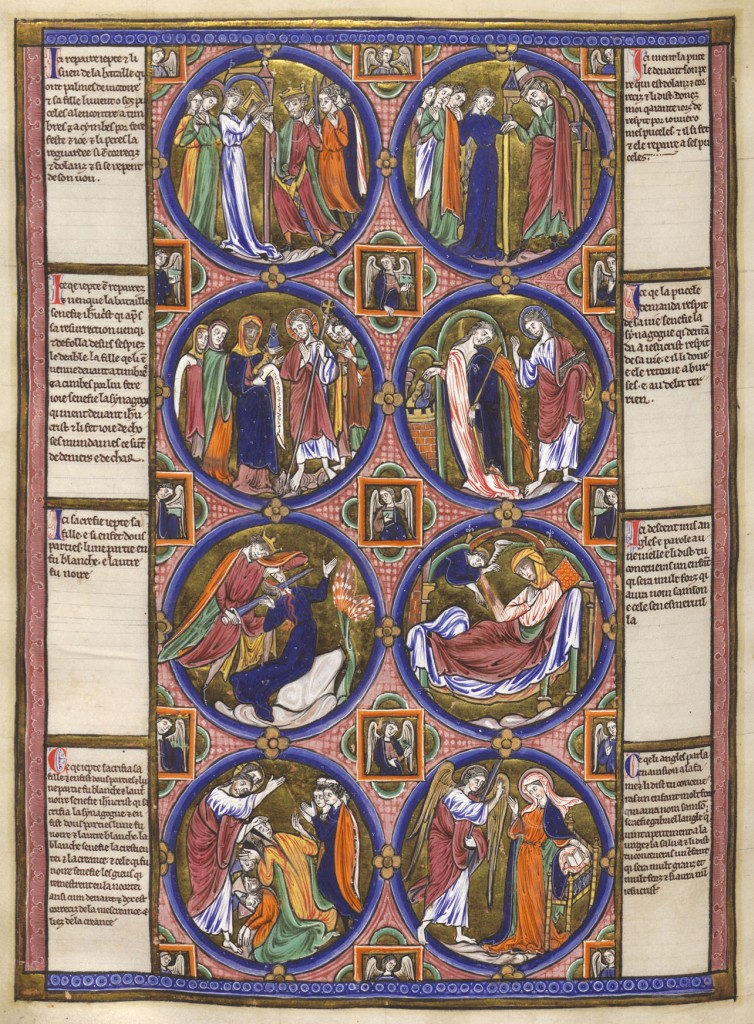
Of particular relevance to the present discussion is a Christological interpretation of Jephthah’s daughter found in one of the earliest extant manuscripts of the Bible moralisée, dating to the first half of the thirteenth century (see Appendix).59 In this medieval genre of illuminated Bibles, biblical narratives are interpreted visually through images accompanied by brief moralizing glosses. Each page is divided into eight illuminated medallions, each with an explanatory caption in Old French.60 On folio 61v, six medallions depict the story of Jephthah’s daughter. Each vertical pair forms a single narrative unit: the upper medallion presents the biblical scene, while the lower reveals its Christological meaning. Within this framework, Jephthah’s daughter is identified as a prefiguration of Synagoga, the personification of errant and vanquished Judaism in medieval iconography, while her father, Jephthah, is aligned with Christ.
In the first medallion on the left, Jephthah’s daughter emerges to greet her victorious father. He is struck with horror as he realizes the implications of his vow. The caption accompanying the lower medallion explains that the two figures in fact represent Synagoga coming out to meet Christ. In contrast to the biblical narrative, what Synagoga holds in her hand is not a timbrel but a bag of money; she is not dancing in honor of her father’s victory but, as the caption informs us, celebrating the pleasures of this world, namely wealth and fleshly desire.
In the next pair of medallions, Jephthah’s daughter appears accompanied by her female companions, speaking with her father and weeping. On the basis of the biblical account, the viewer might assume that she is asking her father for a respite in order to lament her bitter fate. The caption, however, indicates that she is requesting a reprieve of forty days so that she and her companions may depart to enjoy themselves. The caption accompanying the lower medallion clarifies that Jephthah’s daughter, identified typologically as Synagoga, is asking Christ to spare her life. He grants her request, after which she returns to her pursuit of wealth and the pleasures of this world.
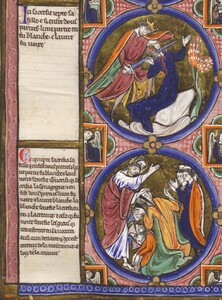
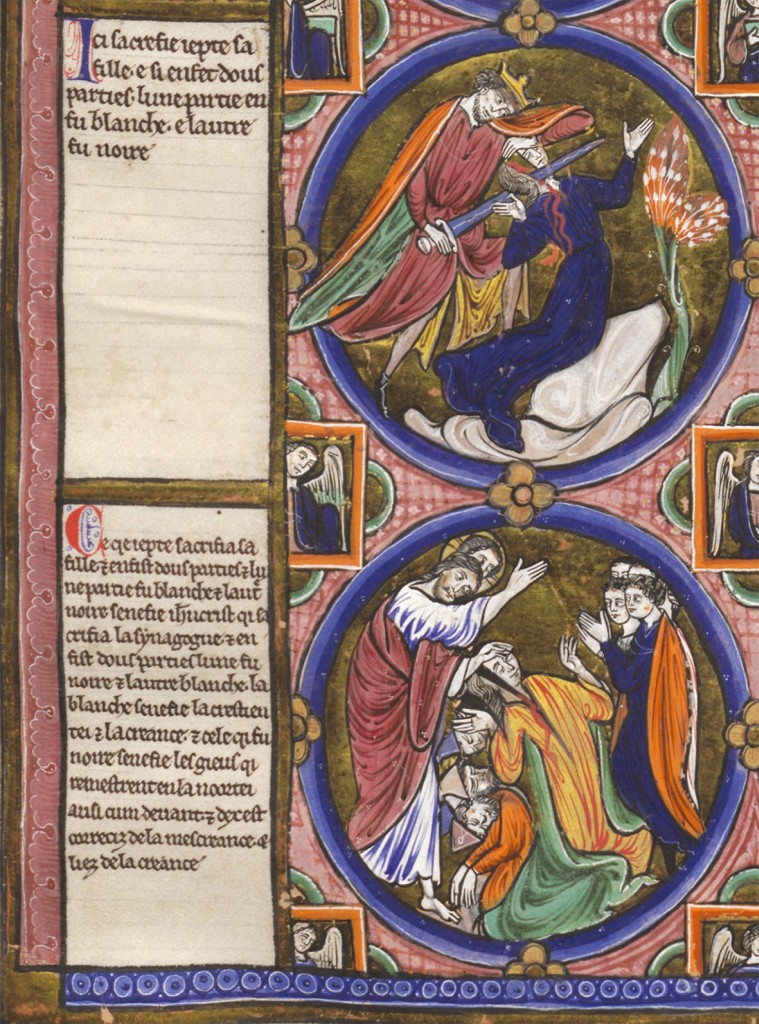
The final pair of medallions depicts the act of sacrifice itself. In the upper medallion, Jephthah is shown using a large sword to cleave his daughter in two, beginning at the head. To ensure that the viewer harbors no doubt regarding the meaning of the image, the caption explains: “Here Jephthah sacrifices his daughter and cuts her into two parts: one part is white and the other is black.”61
In the lower medallion, which concludes the story, the viewer learns that the two halves of the slaughtered girl’s body symbolize Christianity and Judaism. Both the illumination and its accompanying text render the hierarchy between the two religions unmistakable. Jews, wearing the stereotypical Jewish cap, are shown falling from the black side of Synagoga’s body. The caption explains that the white side represents the Church and faith, whereas the black side represents the Jews, who remain in darkness and have been deprived of God’s love.62 Within this interpretive framework, the sacrifice of Jephthah’s daughter is recast as the necessary amputation of an infected limb, with Christianity seeking to excise Judaism from its own body. Judaism’s alleged moral inferiority, already emphasized in the second medallion, is presented as the rationale for this painful separation.
The iconographic interpretation of the story of Jephthah’s daughter found in the Bible moralisée intensifies the familial tragedy of the biblical narrative and transforms it into a theological and historical drama. The use of the female body to signify the total rejection of the other religion reflects the notion that Judaism is conceived as a limb of Christianity. Even when such a limb is perceived as endangering the integrity of the whole body, its excision remains a traumatic act. Amputation or bisection thus appears as a last resort: a rejection of the Other, even though that Other is imagined as an inseparable part of oneself.
But why a female body, and why must it be that of a virgin? The female body is imagined as possessing a dual potential: it can be penetrated and can contain. It is a body with fluid boundaries that allow for entrance, exit, and transformation. The virgin body, by contrast, is perceived as sealed and not yet penetrated. The understanding of the loss of virginity as a violent, transformative, and irreversible act heightens the drama of penetration.
The Bible moralisée’s interpretation thus provides vivid visual support for the claim, articulated earlier, that social hegemony exerts its power, both physical and symbolic, on the human body in general and on the female body in particular. In this reading, the construction of Christian identity depends to a critical extent on separation from Judaism, which is marked as the absolute Other. The logic of division and difference finds tangible expression in the body of Jephthah’s daughter and in what is done to it.
The figurative embodiment of abstract ideas and social institutions, a well-established convention of medieval Christian art, closely corresponds to modern feminist theories that examine how practices of cultural domination are expressed through, and enacted upon, the human body.63 These two processes, abstract ideas given bodily form and concrete bodies made to reflect cultural institutions, are thus revealed as two sides of the same coin.
This imprinting of an abstract ideal onto the concrete female body is likewise realized in the contemporaneous Jewish story of Sarit. The analogies between the two narratives are striking. The father-patriarch, (Jephthah, Christ, or Master Judah), motivated by a paternalistic conception of the collective good, divides the body of his virgin daughter or ward, (Jephthah’s daughter, Synagoga, or Sarit), in two. The woman’s body is thereby reduced to a symbol of social and religious order and becomes the site upon which its internal tensions are discharged. The connection between the two ritual sacrifices, Jephthah’s daughter in the Bible moralisée and Sarit in the Hebrew chronicle, and the symbolic meaning attributed to the longitudinal bisection of the body is reinforced not only by their visual resemblance but also by their anomalous character, both within the Hebrew narratives of the Crusader massacres and within the Christian iconography of the sacrifice of Jephthah’s daughter.64
The social and religious identity of each group is constructed through differentiation between a collective “We” and a constitutive “Them,” or Other. In the story of Sarit as well, the desire for both physical and conceptual separation between Judaism and Christianity, and between what is imagined as pure and what is imagined as profane or polluted, undergoes a figurative transformation. This logic finds expression in the virgin body of Sarit, upon which the only solution deemed possible is enacted, namely the painful excision of the living flesh of the individual in order to preserve the integrity of the whole.
This brutal image of the bisection of a virgin suggests that the story should be read as reflecting medieval Jewish concern for the integrity of the community’s social and religious boundaries in times of turmoil and catastrophe. Here, this concern is concentrated on Sarit’s body, which functions as the site in which the internal and external struggles of medieval Jewish society are negotiated, both in concrete and in symbolic terms. I propose interpreting the severed halves of Sarit’s body as a representation of an inner conflict within Jewish society regarding martyrdom and the extent of communal authority over individual lives. At the same time, the image also encapsulates the external conflict generated by the theological and physical confrontation with Christian culture. There is no need to privilege one of these readings over the other, since both perspectives, and their mutual tension, are integral to the depth and significance of the narrative.
Virginities and Boundaries
The narrative of Sarit, portrayed as a virgin bride in the Hebrew chronicle, is closely intertwined with medieval Jewish and Christian interpretations of Jephthah’s virgin daughter. This interconnection brings the discussion full circle to the initial inquiry into virginity as a powerful tool for cultural and historical analysis. At the same time, it sharpens our understanding of the dynamics of medieval Jewish society as a minority culture negotiating its internal tensions within a Christian-majority environment.
Within Christian thought, the symbolism of virginity was deeply embedded from its formative stages.65 During the Middle Ages, the ideal of sexual abstinence was systematically articulated and critically elaborated through Scholastic theology.66 Christian narratives attributed virginity to virtuous women who embraced celibacy as an expression of religious devotion. Stories of women who transcended conventional social roles through their commitment to chastity circulated widely, reinforced by the veneration of virgin saints and martyrs. The profound devotional transformations of medieval Europe, together with the rise of new religious orders such as the Cistercians and the Franciscans, further intensified the centrality of virginity.67 This development found expression in the cult of the Virgin Mary, the growing prominence of female saints, and the expansion of the female monastic life.68
In contrast, the Jewish understanding of virginity followed a different trajectory. Rather than constituting a lifelong ideal, virginity was valued within the framework of marriage and fertility. The preservation of female virginity until marriage was central to the maintenance of familial continuity and communal lineage, a concern that was particularly pronounced in medieval Ashkenaz. Within this context, female virginity functioned as a prerequisite for safeguarding Israel’s “holy seed,” shaping the virgin bride as a central feminine ideal through legal norms, ritual practices, and textual traditions. The virgin bride thus emerged as an esteemed female archetype and a significant cultural agent. This motif assumed diverse forms across exegetical literature, mystical writings, liturgical compositions, and historiographical narratives. Moreover, the legal categorization of virgins had far-reaching implications for the construction of sexuality and gender relations within Jewish culture. The tension arose from the fact that virginity functioned as a shared ideal in both Judaism and Christianity while simultaneously serving as a site of contestation between the two traditions. This dual role endowed the virgin with a complex symbolic charge, making her a focal point through which Ashkenazi Jewish society negotiated internal tensions and articulated its self-definition within a Christian environment.
With these insights into the cultural significance of virginity in mind, we return to the story of Sarit. Her virginity emerges as a central element in the narrative’s symbolic economy, particularly in relation to martyrdom. This symbolism extends beyond her individual story to the broader corpus of medieval Hebrew chronicles, in which a distinctly Jewish ethos of martyrdom developed in dialogue with, and in tension against, its Christian counterpart. In the chronicles of 1096, accounts of Jewish martyrdom sought to assert their meaning and legitimacy in opposition to Christian narratives. Sarit’s story intensifies this dynamic, not only contesting the paradigm of Christ’s martyrdom but also engaging polemically with the deeply rooted Christian tradition of virgin martyrs.
Virginity, with its connotations of boundary, purity, and vulnerability, plays a central role in demarcating Jewish identity from the Christian Other. This metaphor articulates the self-understanding of Ashkenazi Jews as a “holy community” confronting persistent external threats. Within this complex field of competing narratives, the shared deployment of the figure of the virgin martyr in both Christianity and Judaism introduces a pronounced polemical dimension.69 Sarit’s story illuminates the rivalry between Ecclesia and Synagoga for divine favor, positioning the Jewish virgin martyr as a meaningful counterpart to Christian models. This juxtaposition reflects an ongoing theological struggle to assert religious superiority and to confirm each community’s claim to privileged status in the eyes of God.
In conclusion, the Jewish virgin bride, much like the Christian virgin bride of Christ, functions as an agent of social meaning, embodying shared cultural values as well as collective anxieties. This perspective enables a nuanced examination of the complex dialogue between Judaism and Christianity, illuminating both areas of convergence and points of fundamental divergence. Sarit’s story also highlights the methodological challenges inherent in studying Jewish concepts of virginity, given their dispersed and fragmentary presence across Jewish sources. Unlike Christianity, Judaism did not develop a formal theology of virginity, a fact that calls for innovative interpretive strategies. The analysis of Sarit’s narrative demonstrates how such an approach can disclose new dimensions of medieval texts and deepen our understanding of Jewish society more broadly.
Appendix

Two scenes from the story of Jephthah and his daughter, from the Bible moralisée (MS Codex Vindobonensis 2554, fol. 61v, ÖNB)
Citation: Medieval Encounters 32, 2 (2026) ; 10.1163/15700674-12340241
Reproduced with the gracious permission of the Österreichische Nationalbibliothek, ViennaDetail: The sacrifice of Jephthah’s daughter and the bisection of Synagoga
Citation: Medieval Encounters 32, 2 (2026) ; 10.1163/15700674-12340241
See, for example, Giulia Sissa, Greek Virginity (Cambridge: Harvard University Press, 1990); Kathleen Coyne Kelly, Performing Virginity and Testing Chastity in the Middle Ages (London: Routledge, 2000); Sarah Salih, Versions of Virginity in Late Medieval England (Suffolk & Rochester: D. S. Brewer, 2001); Anke Bernau, Ruth Evans and Sarah Salih eds., Medieval Virginities (Cardiff: University of Wales press, 2003); Bonnie Maclachlan and Judith Fletcher eds., Virginity Revisited: Configurations of the Unpossessed Body (Toronto: University of Toronto Press, 2007); Jonathan A. Allan, Cristina Santo, Adriana Spahr eds., Virgin Envy: The Cultural (in)Significance of the Hymen (Regina: University of Regina Press, 2016); Karen A. Winstead, Virgin Martyrs: Legends of Sainthood in Late Medieval England (Cornell: Cornell University Press, 2018); Julia Kelto Lillis, Virgin Territory: Configuring Female Virginity in Early Christianity (California: University of California Press, 2023).
Rephael Patai, The Hebrew Goddess (Detroit: Wayne State University Press, 1990), 191–192; Peter Schäfer, “Tochter, Schwester, Braut und Mutter: Bilder der Weiblichkeit Gottes in der frühen Kabbala,” Saeculum 49 (1998): 259–279; Arthur Green, “Shekhinah, the Virgin Mary, and the Song of Songs: Reflections on a Kabbalistic Symbol in Its Christian Context,” AJS Review 26, no. 1 (2002): 1–52; Peter Schäfer, Mirror of His Beauty: Feminine Images of God from the Bible to the Early Kabbalah (Princeton: Princeton University Press, 2002), 118 and ff.; Elisheva Baumgarten, Mothers and Children: Jewish Family Life in Medieval Europe (Princeton: Princeton University Press, 2004), 21–55, 92–119; Elisheva Baumgarten, Practicing Piety in Medieval Ashkenaz: Men, Women, and Everyday Religious Observance (Philadelphia: University of Pennsylvania Press, 2016), 203–211; Ephraim Shoham-Steiner, “The Virgin Mary, Miriam, and Jewish Reactions to Marian Devotion in the High Middle Ages,” AJS Review 37 (2013): 75–91; Michael Rosenberg, “Sexual Serpents and Perpetual Virginity: Marian Rejectionism in the Babylonian Talmud,” Jewish Quarterly Review 106, no. 4 (2016): 465–493; Judith Weiss, “Guillaume Postel’s Kabbalistic Notions of Marriage, Sex, and Family,” Marriage, Families and Spirituality 26 (2020): 74–92.
Named and unnamed virgin figures recur throughout the biblical narrative, reflecting the centrality and semantic flexibility of virginity in biblical law and storytelling. Illustrative examples include daughters of Lot (Gen. 19:8), Rebecca (Gen. 24:16), Dinah (Gen. 34), Jephthah’s daughter (Judg. 11), the virgin daughter from Gibeah (Judg. 19:24), women of Jabesh-gilead (Judg. 21:10–12), Tamar (2 Sam. 13:1–22), Avishag (1 Kgs. 1:1–2), and Esther (Esth. 2). For further discussion of virginity in the Hebrew Bible, see Tikva Frymer-Kensky, “Virginity in the Bible,” in Gender and Law in the Hebrew Bible and the Ancient Near East, eds. Bernard M. Levinson, Victor H. Matthews and Tikva Frymer-Kensky (Sheffield: Sheffield Academic Press, 1998), 79–96; Joseph Fleishman, “The Delinquent Daughter and Legal Innovation in Deuteronomy 22:20–21,” Vetus Testamentum 58 (2008): 191–210; Meir Malul, “What Is the Nature of the Crime of the Delinquent Daughter in Deuteronomy 22:13–21? A Rejoinder to J. Fleishman’s Suggestion,” Vetus Testamentum 59 (2009): 446–459.
By contrast, the Mesopotamian batūlu and batultu denote virginity in the sexual sense. See Ignace J. Gelb et al. eds., The Assyrian Dictionary of the Oriental Institute of the University of Chicago, 21 vols. (Chicago, 1956), 1: 173–174. The same is true of other Semitic languages, including Akkadian, Syriac, and Arabic. On the use of betulah in the Bible and a comparison with parallel terms in the ancient Near East, see also Gordon J. Wenham, “Betulah: A Girl of Marriageable Age,” Vetus Testamentum 22 (1972): 326–329; Willem A. VanGemeren ed. New International Dictionary of Old Testament Theology and Exegesis, 5 vols. (Grand Rapids, Mich., 1997), 1:781–784; Jerrold S. Cooper, “Virginity in Ancient Mesopotamia,” CRRAI 47 (2002): 91–94, 103.
It is only in modernity that the masculine form of this noun – batul (
Avital Davidovich-Eshed, “‘These Are Maidens’: Virginity as a Discursive Category in Talmudic Halakhah,” Oqimta: Studies in Talmudic and Rabbinic Literature 5 (2019): 71–99 [in Hebrew]. For further discussion of virginity in Talmudic discourse, see Shulamit Valler, Women and Womanhood in the Talmud (Atlanta: Scholars Press, 1999), 29–50; Joshua Kulp, “Go Enjoy Your Acquisition: Virginity Claims in Rabbinic Literature Reexamined,” Hebrew Union College Annual 77 (2006): 33–65; Michael Rosenberg, Signs of Virginity: Testing Virgins and Making Men in Late Antiquity (New York: Oxford University Press, 2018).
This treatise, found in MS London–Mon. 134, is attributed to Rabbi Elijah of Carcassonne, who was deeply influenced by the teachings of Rabbi Eleazar of Worms. A partial version was published by A. I. Dziubas, Sefer ha-Assufot (London, 1942). Other segments were published over the years in books and articles; see Menahem M. Kasher and Jacob B. Mandelbaum, Sarei ha-Elef: A Millennium of Hebrew Authors (500–1500 CE), 2 vols. (Jerusalem: Beit Torah Shlema, 1978), Vol. 2, unit 6:15 [Hebrew]; Simcha Emanuel, “Additions to Sarei ha-Elef,” JSIJ – Jewish Studies, an Internet Journal 1 (2002): 129–180, at 135 [Hebrew].
Sefer ha-Assufot, MS London-Mon. 134, fol. 105b.
Under levirate law, a ḥaluṣah is a woman released from a levirate bond through the ritual of ḥaliṣah, which permits her to remarry.
This is also the position of the respondent in the responsum preserved in Sefer ha-Assufot. See MS London–Mon. 134, fol. 105b.
“Penetrated” is used here to translate the Hebrew nivʿalti (
The fundamental question concerns the nature of the woman’s marital bond to the deceased husband: whether she is to be regarded as a widow from the stage of betrothal or from that of full marriage. Consequently, the issue bears directly on the pecuniary questions of her right to collect the ketubah from the first union and the amount of the ketubah to which she is entitled in the second marriage.
On the shared symbolic language through which Jewish and Christian communities in medieval Europe articulated rivalry, boundary making, and processes of mutual self-definition, see, for example, the works of Ivan G. Marcus, Jeremy Cohen, and Israel J. Yuval, who have each emphasized, from different perspectives, the polemical and dialogical dimensions of this cultural interplay: Ivan G. Marcus, Rituals of Childhood: Jewish Acculturation in Medieval Europe (New Haven: Yale University Press, 1996); Jeremy Cohen, Sanctifying the Name of God: Jewish Martyrs and Jewish Memories of the First Crusade (Philadelphia: University of Pennsylvania Press, 2004); Israel J. Yuval, Two Nations in Your Womb: Perceptions of Jews and Christians in Late Antiquity and the Middle Ages (Berkeley: University of California Press, 2006).
This chronicle, previously wrongly attributed to Rabbi Shlomo bar Simson, is now referred to as the “Long Hebrew Chronicle.” The other two are the chronicle by Eleazar bar Nathan and an anonymous chronicle also known as the “Acts of the Old Decrees.” The first critical edition of these texts was published in 1892: Adolf Neubauer and Moritz Stern, Hebräische Berichte über die Judenverfolgungen während der Kreuzzüge (Berlin: L. Simion, 1892). For a critical edition that includes a synoptic survey of the three chronicles, see Eva Haverkamp, Hebräische Berichte über die Judenverfolgungen während des Ersten Kreuzzugs (Hannover: Hahnsche Buchhandlung, 2005). The quotations in the present article are based on this edition.
The Hebrew crusade chronicles and unique nature of Jewish martyrdom in 1096 have received extensive scholarly attention from the second half of the twentieth century onward. For selected examples, see Robert Chazan, European Jewry and the First Crusade (Berkeley: University of California Press, 1987); Susan Einbinder, “Jewish Women Martyrs: Changing Models of Representation,” Exemplaria 12, no. 1 (2000): 105–127; Avraham Grossman, “The Cultural and Social Background of Jewish Martyrdom in 1096” in Facing the Cross: The Persecutions of 1096 in History and Historiography, Yom Tov Asis, Jeremy Cohen, Aharon Kedar, Ora Limor and Michael Toch eds. (Jerusalem: Magnes Press, 2001): 55–73 [Hebrew]; Haym Soloveitchik, “Halakhah, Hermeneutics, and Martyrdom in Medieval Ashkenaz,” Jewish Quarterly Review 94 (2004): 77–108, 278–299; Abraham Gross, Struggling With Tradition: Reservations about Active Martyrdom in the Middle Ages (Leiden, Boston: Brill, 2004); Jeremy Cohen, Sanctifying the Name of God; Shmuel Shepkaru, Jewish Martyrs in the Pagan and Christian Worlds (Cambridge: Cambridge University Press, 2006); Lena Roos, God Wants It!: The Ideology of Martyrdom of the Hebrew Crusade Chronicles and Its Jewish Christian Background (Medieval Church Studies 6; Turnhout: Brepols, 2006); Simha Goldin, The Ways of Jewish Martyrdom (Turnhout: Brepols, 2008); Shmuel Shepkaru, “The Preaching of the First Crusade and the Persecutions of the Jews,” Medieval Encounters 18, no. 1 (2012): 93–135.
This reading follows Jeremy Cohen, who has argued that the chronicles reveal more about the values, beliefs, and ideologies of the second generation of survivors who composed them than about the events of 1096 themselves. See Cohen, Sanctifying the Name of God, 55–69.
Gabrielle Spiegel introduced the concept of the “social logic of the text,” arguing that texts are deeply embedded in the specific social, cultural, and historical contexts in which they were produced, and that their meanings emerge from the dialectic between historical circumstances and literary form. See Gabrielle M. Spiegel, “History, Historicism, and the Social Logic of the Text in the Middle Ages,” Speculum 65 (1990): 59–86. A similar approach has been applied to medieval Jewish narrative literature by Eli Yassif, who reads such texts as cultural representations encompassing the beliefs, values, and internal tensions of the societies that produced them. See Eli Yassif, The Hebrew Folktale: History, Genre, Meaning (Bloomington: Indiana University Press, 1999); Eli Yassif, “Legends and History: Historians Read Hebrew Legends of the Middle Ages,” Zion 64, no. 2 (1999): 187–220 [Hebrew]. Building on these frameworks, I extend Spiegel’s and Yassif’s approach by introducing gender as an additional hermeneutic tool, following Joan Scott’s definition of gender as a category that denotes both sexual difference and broader relations of power. See Joan W. Scott, “Gender: A Useful Category for Historical Analysis,” The American Historical Review 91, no. 5 (1986): 1053–1075; Joan W. Scott, “Unanswered Questions,” The American Historical Review 113, no. 5 (2008): 1422–1430.
The title parnas denotes a lay communal office and can be roughly translated as “lay community leader.” On the specific meaning of this title and the high status of those who bore it in medieval Ashkenaz, see Avraham (Rami) Reiner, “An Engraved Stone: The Titles of the Deceased on the Gravestones in the Würzburg Cemetery, 1147–1346,” Tarbiẓ 78, no. 1 (2009): 137–140 [Hebrew].
Haverkamp, Hebräische Berichte, 573 (punctuation added). Translation based on Jeremy Cohen (Sanctifying the Name of God, 143–144), with minor modifications.
For an earlier version of this analysis and for a broader discussion of Sarit’s story within the representation of women and gender in the Hebrew chronicles, see Avital Davidovich-Eshed, “Sanctified God, Desecrated Woman: The Female Body as a Site of Cultural Conflict in the Middle Ages. Rereading the Story of Sarit’s Murder from the 1096 Hebrew Chronicle,” Jerusalem Studies in Hebrew Literature 27 (2014): 37–66 [Hebrew].
Susan Einbinder, “Signs of Romance: Hebrew Prose and the Twelfth-Century Renaissance,” in Jews and Christians in Twelfth-Century Europe, ed. Michael A. Signer and John Van Engen (Notre Dame: University of Notre Dame Press, 2000), 221–233. Einbinder argues that the adoption of romance motifs in Hebrew prose reflects Jewish authors’ participation in the intellectual and cultural currents of the age; the present reading extends this insight.
Elliot R. Wolfson, “Martyrdom, Eroticism, and Asceticism in Twelfth-Century Ashkenazi Piety,” in Jews and Christians in Twelfth-Century Europe, ed. Michael A. Signer and John Van Engen (Notre Dame: University of Notre Dame Press, 2000), 171–220, esp. 183–186.
See Cohen, Sanctifying the Name of God, 142–58. Cohen argues that Judah’s character evokes a complex network of associations with figures from both Jewish and Christian traditions. These associations illuminate the ambivalent construction of Judah the parnas as both religious authority and communal savior, while also casting him in a negative light as a zealot, a false prophet who provokes divine anger, and a man marked by forbidden sexual desire. This multivalence shapes the story’s ambiguity and invites reflection on the nature and aims of the act of martyrdom it depicts, which carries overtones of rape and incest.
See Mary Douglas, Purity and Danger, an Analysis of Concepts of Pollution and Taboo (London: Routledge, 1966), 153. On medieval Christian society as an organic body and the use of bodily metaphors for its various parts, see Jacques Le Goff, “Head or Heart? The Political Use of Body Metaphors in the Middle Ages,” in Fragments for a History of the Human Body, Michel Feher, ed., 3 vols. (New York: Zone, 1989), 3:13–27.
For manifestations of this theoretical point in the historical context of medieval European Jewry, see David Nirenberg, “Conversion, Sex, and Segregation: Jews and Christians in Medieval Spain,” The American Historical Review 107, no. 4 (2002): 1065–1093; Avital Davidovich-Eshed and Moshe Halbertal, “A Threat and Its Annulment: Coping with the Sexuality of the Gentile Man in Medieval Ashkenaz,” Zion 88, no. 3 (2023): 331–370 [Hebrew].
Judith Butler, Gender Trouble: Feminism and the Subversion of Identity (New York: Routledge, 1990), 128–141.
On the central role of women’s sexual purity in shaping communal solidarity and boundary maintenance in medieval Jewish society, see Nirenberg, “Conversion, Sex, and Segregation”; Rachel Furst, “Captivity, Conversion and Communal Identity: Sexual Angst and Religious Crisis in Frankfurt, 1241,” Jewish History 22 (2008): 179–221.
On the questions that arise from this exposition, see Cohen, Sanctifying the Name of God, 144.
The epithet applied to Master Judah, “the first to speak in all deliberations,” alludes to the second-century sage R. Judah bar Ilai, so described in several Babylonian Talmud passages (Berakhot 63b; Shabbat 33b; Menahot 103b). Particularly relevant is the account in tractate Shabbat, where R. Judah praises Roman rule and is subsequently rewarded by the authorities. The Talmud presents this honor ambivalently, suggesting accommodation to power rather than communal distinction, and implicitly casts R. Judah in a dubious light. In view of the ambivalence that marks Sarit’s story, this background may inform the portrayal of Master Judah’s priority in speaking.
This tradition originates in Jacob’s blessing of his sons (Gen. 49), which assigns each tribe a specific role within Israel. Dan is designated as the tribe that “shall judge his people,” and later appears as the rearguard of the Israelite camps during the wilderness wanderings (Num. 10:25). Rashi explains this function as that of gathering and protecting those who lag behind or go astray (see Rashi on Is. 52:12). See also Rashbam’s commentary on Genesis 49 for a broader discussion of the roles assigned to the tribe of Dan.
A version of the story of the Mosaides already appears in the ninth-century account of Eldad the Danite and in Pseudo-Jonathan on the Pentateuch, and was clearly known in medieval Ashkenaz, where it is preserved in Midrash Genesis Rabbati, attributed to R. Moses Hadarshan (eleventh century). On the place of the tribe of Dan in medieval Ashkenaz, see Micha J. Perry, Eldad’s Travels: A Journey from the Lost Tribes to the Present (London and New York: Routledge, 2019), 21–25. On the transmission of these traditions, see Eli Yassif’s discussion in his edition of The Book of Memory, that is, The Chronicles of Jerahme’el (Tel Aviv: Tel Aviv University Press, 2001), 494–495; 221–222, 225. Jeremy Cohen interprets Master Judah’s putative descent from the tribe of Dan, known in Christian tradition as the tribe from which the Antichrist would emerge, as contributing to the text’s deliberately ambiguous portrayal; see Cohen, Sanctifying the Name of God, 154–158.
David Malkiel, “Imagination and History Converge: The Danites in the Middle Ages”, Jewish History 36 (2022): 125–138; Micha J. Perry, Eldad’s Travels, 76–93.
See Ephraim Shoham-Steiner, “The Clash Over Synagogue Decorations in Medieval Cologne”, Jewish History 30 (2016): 129–164; Ephraim Shoham-Steiner and Elisabeth Hollender, “Beyond the Rabbinic Paradigm: Lay Leadership in the Early Medieval Jewish Community in Cologne,” Jewish Quarterly Review 111 (2021): 236–264.
This ambivalence is alluded to, as noted, in the first exposition. See Cohen, Sanctifying the Name of God, 154–158.
Mary Douglas suggested that: “rituals of purity and impurity … are positive contributions to atonement [through which] symbolic patterns are worked out and publicly displayed” Douglas, Purity and Danger, 3.
Haverkamp, Hebräische Berichte, 573.
The bosom of Abraham is a symbol with great significance in medieval Jewish and Christian culture. See the references cited by Cohen, Sanctifying the Name of God, 148 and n. 13–14.
Davidovich-Eshed and Halbertal, “A Threat and Its Annulment”, 331–337.
Thus, the Hebrew chronicle employs terms such as “defilement” and “rape” interchangeably to denote both coerced conversion and coerced intercourse. Avraham Grossman has noted that “the image of women as pious, pure, and holy, and as those who accepted martyrdom, might be impaired were they linked in any way whatsoever with acts of rape or physical abuse” Grossman, “The Cultural and Social Background of Jewish Martyrdom”, 361. There is no evidence that violence against women constituted an intentional or systematic element of anti-Jewish policies pursued by the Church or by Christian rulers. Nevertheless, the chronicles depict Jewish women as threatened by both religious and physical rape. It should also be noted that the halakhic literature of the period tends to conflate a woman’s consent to rape in order to save her life with apostasy. On the link between sexual fidelity and religious fidelity, see Furst, “Captivity, Conversion and Communal Identity”; Davidovich-Eshed and Halbertal, “A Threat and Its Annulment.”
The close connection between virginity and the definitions of rape and seduction underlies the biblical perspective on these offenses. See Exod. 22:15–16 and Deut. 22:23–29. On rape in the Bible, see Bruce Wells, “Sex, Lies, and Virginal Rape: The Slandered Bride and False Accusation in Deuteronomy,” Journal of Biblical Literature 124, no. 1 (2005): 41–72; Tikva Frymer-Kensky, “Virginity in the Bible,” 79–96. The Talmudic sages likewise regarded the violation of virginity as the essence of rape; see Ronit Irshai, “Rape of Unmarried Women: Between Hazal and Maimonides,” Annual of the Institute for Research in Jewish Law 28 (2015–2016): 171–202 [Hebrew]. The link between rape and virginity is also deeply rooted in Christian biblical exegesis; see, for example, Joy A. Schroeder, Dinah’s Lament: The Biblical Legacy of Sexual Violence in Christian Interpretation (Minneapolis: Fortress Press, 2007), esp. 14–24, 57–77.
Haverkamp, Hebräische Berichte, 573.
See for example, in R. Eleazar of Worms’s account of the brutal murder of his wife and children: “They split open the head of my elder daughter, Belette; they split open the head of my daughter Hannah … At once my pious wife stood up and went out and shrieked, “‘They have killed us.’ Then the fiends went out and struck her on the head, down to the throat and shoulder, and from the shoulder down to the belt.” Sefer Gezerot Ashkenaz ve-Tsarfat, ed. Abraham M. Habermann (Jerusalem: Tarshish, 1945), 164. [Hebrew].
We can see the re-enactment of the biblical event as an attempt to compel God to manifest Himself again, as at the original rite. The Jewish exegetical tradition views the Covenant between the Pieces as a prefiguration of the splitting of the Red Sea, where, again, the direction of the split is clearly a vertical line from top to bottom.
A midrashic account of the killing of Agag by the prophet Samuel illustrates how specific modes of cutting were invested with particular symbolic significance. Citing the verse “And Samuel hewed Agag in pieces” (1 Sam. 15:33, RSV), Midrash Shemuel 18:6 describes Agag’s body as being stretched and torn apart along its length. See Midrash Shemuel, ed. Shlomo Buber (Vilna: Raam, 1925): 58 [Hebrew]. The thirteenth century exegete Hezekiah ben Manoah, known as Hizkuni, in his commentary on Lev. 22:24, interprets this act as castration, thereby locating the violence at the site of sexual potency. A similar emphasis appears in the sixteenth-century commentary of Moshe Alshikh on 1 Sam. 15:33, who describes the rending of Agag’s body from between his thighs upward, explicitly linking the manner of the cut to the annihilation of his descendants. These interpretations suggest that a lengthwise division of the body could function as a sacrificial gesture charged with sexual and genealogical symbolism.
On similarities between Jephthah and Judah, see Cohen, Sanctifying the Name of God, 151–152.
Jephthah’s daughter’s virginity is mentioned three times in three successive verses (Judg. 11:37–39).
On Jephthah in medieval Jewish and Christian exegetical literature, see Joshua Berman, “Medieval Monasticism and the Evolution of Jewish Interpretation of the Story of Jephthah’s Daughter,” Jewish Quarterly Review 95 (2005): 228–256; Elisheva Baumgarten, “‘Remember That Glorious Girl’: Jephthah’s Daughter in Medieval Jewish Culture,” Jewish Quarterly Review 97, no. 2 (2007): 180–209.
For example: Genesis Rabbah 60:3; Leviticus Rabbah 37:4; Ecclesiastes Rabbah 10:17.
Joshua Berman (“Medieval Monasticism”) shows that the branch of Jewish and Karaite exegesis that sees the sacrifice of Jephthah’s daughter as metaphorical emerged before the corresponding Christian interpretation. He explains this delay by Christian authors’ total reliance, until the late Middle Ages, on the Vulgate, whose omission of the phrase “it shall be the Lord’s” in verse 31 leaves only the possibility of an actual sacrifice. But which camp first came up with the nonlethal interpretation is irrelevant for our present discussion. What is important is that medieval Jewish commentators were aware of the existence of convents and of the Christian interpretations of the story and related to both explicitly.
See Nahmanides on Lev 27:29 (emphasis added): “Do not be seduced by the vain ideas of R. Abraham who says that the meaning of ‘and I will offer it as a burnt offering’ is: if the first to come out of my house is a man or woman, ‘he will be holy to the Lord’: he will be removed from the ways of the world and stand to serve in the name of the Lord in prayer and thanksgiving to God; and if it is something that is appropriate to be sacrificed I will make it ‘as a burnt offering.’ And he built a house for his daughter outside the city where she lived alone and he provided her needs for her entire life, and no man knew her, so his daughter was cloistered. But this is nonsense. […] If it were so [as Ibn Ezra holds], his daughter lamenting her virginity and her companions with her would be like harlots who spurn their fee [after Ezek. 16:31]. Heaven forbids there should be such a custom in Israel, to lament the daughter of Jephthah four days in the year, because she did not marry and served the Lord in purity. But the meaning is the plain sense, and he was mistaken”. English trans. Charles B. Chavel, Nahmanides: Commentary on the Torah (New York: Shilo Pub. House, 1971–1976). See also Uriel Simon, “Peshat Exegesis of Biblical Historiography: Historicism, Dogmatism, and Medievalism,” in Tehillah le-Moshe: Biblical and Judaic Studies in Honor of Moshe Greenberg, eds. Mordechai Cogan, Barry L. Eichler and Jeffrey H. Tigay (Winona Lake, Ind.: Eisenbrauns, 1997), Hebrew section, 171–203, esp. 197.
For a survey of medieval Jewish and Christian exegesis of the story of Jephthah and his daughter, see John L. Thompson, Writing the Wrongs: Women of the Old Testament among Biblical Commentators from Philo through the Reformation (Oxford: Oxford University Press, 2001), 100–178.
“Ego autem non sum saturata thalamo meo, nec repleta sum coronis nuptiarum mearum. Non enim vestita sum in splendore secundum ingenuam meam … O mater, in vano peperisti unigenitam tuam, quoniam factus est infernus thalamus meus.” Pseudo-Philo, Liber antiquitatum biblicarum, ed. Guido Kisch (Notre Dame: University of Notre Dame, 1949), XL.6, 222 [translation modified by me]. On the evolution of Jephthah’s daughter’s lament in the Latin and Greek traditions, see Margaret Alexiou and Peter Dronke, “The Lament of Jephtha’s Daughter,” Studi Medievali 12 (1971): 819–863.
Yassif, The Book of Memory, 23–31. For that work’s reliance on Latin editions of Liber antiquitatum biblicarum, see Yassif, The Book of Memory, 471–473. On Jewish commentators’ familiarity with the Christian exegesis of the story of Jephthah’s daughter, see Baumgarten, “‘Remember That Glorious Girl,’” 180–209.
Yassif, The Book of Memory, 210:
”
“‘Quae nuptae satis sunt, periturae nimis sunt,’ mox quam patri detulit, ensem nudum arripuit.” Petrus Abaelardus, “Planctus virginum Israelis super filia Jephtae Galaditae” in, Patrologiae cursus completus: Petrus Abaelardus, (Patrologia Latina 178, 1885): col. 1819–1820. For a discussion of this prayer and a full English translation, see Peter Dronke, “Medieval Poetry – I: Abelard,” The Listener 74 (1965): 841–845. On the sword as a phallus and its use as evidence of forced marriage in the ancient Greek tradition, see Cohen, Sanctifying the Name of God, 145.
Wolfson’s “Martyrdom, Eroticism, and Asceticism” emphasizes the links between eroticism and martyrdom and between the love of God and the love of a woman in the teachings of the German Pietists of the twelfth century.
Karlheinz Müller, Simon Schwarzfuchs, and Avraham (Rami) Reiner, Die Grabsteine vom jüdischen Friedhof in Würzburg aus der Zeit vor dem Schwarzen Tod (1147–1346), 3 vols. (Würzburg: Darstellungen aus der fränkischen Geschichte, 2011), 2:552–553, gravestone 345.
Compared to other biblical sacrifice narratives, most notably the Binding of Isaac, the story of Jephthah’s daughter appears relatively infrequently in medieval visual culture. For its representations in medieval Christian art, see Lois Drewer, “Jephthah and His Daughter in Medieval Art: Ambiguities of Heroism and Sacrifice,” in Insights and Interpretations: Studies in Celebration of the Eighty-Fifth Anniversary of the Index of Christian Art, ed. Colum Hourihane (Princeton: Princeton University Press, 2002), 35–59.
Vienna, Österreichische Nationalbibliothek, MS ÖNB Cod. 2554, fol. 61v. My reading of the captions alongside the images follows Gerald B. Guest, Bible Moralisée: Codex Vindobonensis 2554 (London: Harvey Miller, 1995), 99–100. For the depiction of women in this codex, see Gerald B. Guest, “Picturing Women in the First Bible Moralisée,” in Virtue and Vice: The Personifications in the Index of Christian Art, ed. Colum Hourihane, Index of Christian Art Resources 1 (Princeton: Princeton University Press, 2000), 106–130. On negative images of Jews in the Bible moralisée, see Sara Lipton, Images of Intolerance: The Representation of Jews and Judaism in the Bible Moralisée (Berkeley: University of California Press, 1999).
This format was created for the French royal house. Lipton conjectures that the first copy, in Latin, was intended for Louis VIII, while the second copy, in Old French and the one referred to here, was meant for someone close to him, perhaps even his wife. See Sara Lipton, Images of Intolerance, 1–13.
See Guest, Bible moralisée, 100.
On medieval perceptions of skin color and their meanings, see Lynn Tarte Ramey, Black Legacies: Race and the European Middle Ages (Gainesville: University Press of Florida, 2014), esp. 47–48 on Jewish women depicted as black. See also Madeline Caviness, “From the Self-Invention of the Whiteman in the Thirteenth Century to The Good, The Bad, and The Ugly,” Different Visions: A Journal of New Perspectives on Medieval Art 1 (2008): 1–33.
For examples, see the elaborate presentation of virtues and vices in Colum Hourihane, ed. Virtue and Vice: The Personifications in the Index of Christian Art (Princeton: Princeton University Dept. of Art and Archaeology, 2000).
In most depictions of the sacrifice of Jephthah’s daughter, he is shown with his sword raised to strike her neck or decapitate her. See Drewer, “Jephthah and His Daughter,” 37–38, 45–47.
1 Corinthians 7 articulates Paul’s ambivalent attitude toward marriage and its subordination to a life of abstinence, a view widely elaborated by the Church Fathers and foundational to the patristic exaltation of virginity. See Elizabeth A. Clark’s introduction to John Chrysostom, On Virginity; Against Remarriage, trans. Sally Rieger Shore (New York and Toronto: The Edwin Mellen Press, 1983), xi. On early Christian attitudes toward the body, sexuality, and celibacy, see Peter Brown, The Body and Society: Men, Women, and Sexual Renunciation in Early Christianity (New York: Columbia University Press, 1988), 33–64. For medieval developments, see John Bugge, Virginitas: An Essay in the History of a Medieval Ideal (The Hague: M. Nijhoff, 1975); Kelly, Performing Virginity, 1–16.
For an example of a scholastic treatment of virginity, see Thomas Aquinas, Summa Theologiae, XLIII: Temperance, ed. and trans. Thomas Gilby, 2 vols. (London: Blackfriars, 1964–1981), 1:152; 2a–2ae (168). On the broader theological and legal concerns surrounding virginity in the later Middle Ages, see Pierre J. Payer, The Bridling of Desire: Views of Sex in the Later Middle Ages (Toronto: University of Toronto Press, 1993), 161–178.
For background on the growth of the mendicant orders in the thirteenth century and their impact on religious thought, practice, and institutional power in medieval Europe, see Clifford H. Lawrence, The Friars: The Impact of the Early Mendicant Movement on Western Society (London: Longman, 1994); Michael Robson, The Franciscans in the Middle Ages (Woodbridge, UK: The Boydell Press, 2006); Brian P. McGuire, “Monastic and Religious Orders, c. 1100–c. 1350,” in Christianity in Western Europe c. 1100–c. 1500, eds. Miri Rubin and Walter Simons (Cambridge: Cambridge University Press, 2009), 54–72.
On the rapid growth of female monasticism and the emergence of women’s religious orders in the Middle Ages, see Bruce L. Venarde, Women’s Monasticism and Medieval Society: Nunneries in France and England, 890–1215 (Ithaca: Cornell University press, 1997), 89–132. On the expansion of the concept of virginity and the extension of its spiritual meaning to women who had lost their physical virginity, see John W. Baldwin, The Language of Sex: Five Voices from Northern France around 1200 (Chicago: University of Chicago Press, 1994), 86–87; Clarissa W. Atkinson, “Precious Balsam in a Fragile Glass: The Ideology of Virginity in the Later Middle Ages,” Journal of Family History 8 (1983): 131–143.
For the use of the figure of the virgin martyr in Christian writing to mark the boundaries of the Christian community, see Ruth Evans, “The Jew, the Host and the Virgin Martyr: Fantasies of the Sentient Body,” in Anke Bernau, Ruth Evans and Sarah Salih eds. Medieval Virginities (Cardiff: University of Wales press, 2003), 167–185.