Abstract
Beth SheÊ¿arim in Lower Galilee was an important Jewish village in the Roman period, with an extensive necropolis containing lavish tombs that provided burial for Jews from across the Roman East. The necropolis is renowned for its many inscriptions in Greek, Aramaic, Hebrew, and more. Two catacombs previously unknown were discovered recently in the western part of the necropolis. Each contains a few halls shaped as corridors with arcosolium chambers along the walls. Each arcosolium accommodates 3â4 burial places. In one of the caves, two Greek inscriptions painted in red were found; one, written on a slab of stone, mentions a proselyte named Jacob, while the other, inscribed on the wall, mentions Judah, the owner of the tomb. This article deals with the catacombs and the inscriptions in the context of late Roman Palestine.
1 Introduction
Beth SheÊ¿arim is located on the Sheikh Abreik hill in Lower Galilee, a short distance from the Mediterranean coast.1 The siteâs name in Greek, Besara, appears first in Josephusâ Life (118â119), as the place where Queen Berenice of the Herodian dynasty owned an estate, and where Josephus confronted the Romans during the First Jewish Revolt. Later, in the second and third centuries CE, Beth SheÊ¿arim gained renown as a Jewish town, a seat of the Sanhedrin and the home of Rabbi Judah the Prince, who compiled the Mishnah.2 After Rabbi Judahâs death and burial at Beth SheÊ¿arim early in the third century CE, the place became a favored and prestigious cemetery for Jews from the Land of Israel and the eastern diaspora, and thereafter is mentioned primarily in rabbinic sources.
The site was excavated in the 1930s and 1950s by B. Mazar and N. Avigad.3 Their excavations focused mainly on the elaborate necropolis that lies on the slopes of town on Sheikh Abreik hill, with a western and northern cemetery (see Fig. 1). The necropolis consists of over 35 catacombs, some lavishly decorated. Many of the catacombs have inscriptions on their walls and burials, mainly in Greek, Aramaic, and Hebrew.4 The burials are varied in type and size, and include cut-stone graves, arcosolia, loculi, niches, ossuaries, sarcophagi, coffins, and other forms of burial.
The western cemetery lies on the slopes of two hills: The Sheikh Abreik hill with catacombs 1â4 excavated by Mazar, and catacombs 6â10 on the slopes of the western hill and across the valley, that were not excavated and only briefly mentioned in the reports. Another catacomb in that hill, numbered 33, was excavated in 1986.5 The Palestine Exploration Fund Survey also surveyed catacombs on the western hill, some of which are probably hidden today.6

Figure 1
Beth Sheʿarim, location of catacombs 35, 36
Citation: Journal for the Study of Judaism 55, 3 (2024) ; 10.1163/15700631-bja10085
Survey by the Israel Nature and Parks Authority, Slava Pirsky and Sergei AlonIn Spring 2021, two burial caves previously unknown were discovered by Jonathan Orlin, the conservator of the northern branch in the Israel Nature and Parks Authority, on the slopes of the western hill, between catacombs 6 and 8 (Fig. 1; map ref. 211940/734110).7 After their discovery, the catacombs were surveyed and photographed, inscription no. 1 (below) was removed and transferred to the Israel Antiquities Authority, and the opening was sealed to prevent further robbery. The catacombs were numbered 35 and 36.8
Figure 2
Catacombs 35 and 36, plan and section
Citation: Journal for the Study of Judaism 55, 3 (2024) ; 10.1163/15700631-bja10085
Survey by Slava Pirsky and Sergei AlonFigure 3
Hall 35A and its stone door, looking north
Citation: Journal for the Study of Judaism 55, 3 (2024) ; 10.1163/15700631-bja10085
Photo by Ran KaftoryFigure 4
The passage from hall 35A to hall 35B through a breach, looking west
Citation: Journal for the Study of Judaism 55, 3 (2024) ; 10.1163/15700631-bja10085
Photo by Ran KaftoryUpon discovery of the catacombs, we entered catacomb 35 through a hole in the ground that broke into the ceiling and rear side of a burial chamber 35A (Fig. 2-I), leading to two more halls of two different caves: hall 35B and the hall of catacomb 36. The two catacombs are on slightly different levels, catacomb 35 being lower than catacomb 36, allowing hall 35B and 36 to partially overlap (Fig. 2, section). Catacomb 35 was originally entered from a courtyard on the north (Fig. 2-II). The entrance to hall 35A, now blocked by earth, was through a limestone door typical of the Beth Sheʿarim catacombs (Fig. 3).9 The entrance to hall 35B was from that same courtyard, but its opening can hardly be seen and is covered by a heap of debris on its eastern side. The passage between the three halls is currently through two breaches that robbers made in the walls at some point in the past (Fig. 2-III, IV; Fig. 4). We assume that the original plan of catacomb 34 had three halls in a trefoil layout, two of which are accessible, while the third is only presumed, on the assumption that the plan was symmetrical. Of catacomb 36 only one hall is known, entered from the south (Fig. 2-V), and it might have been of similar plan. Thus, the parts of the catacombs that were accessible at the time of its discovery are two halls of catacomb 35 (A, B) and one hall of catacomb 36. In catacomb 36 two Greek inscriptions were found, and they will be the focus of this article.
2 Description of the Catacombs (Fig. 2)
2.1 Catacomb 35
The two halls are shaped as corridors with arcosolium chambers along the walls, separated by arches on pillars (Fig. 5). At the foot of each arcosolium of hall 35B there is a bench which also runs along the western wall of that hall. Each arcosolium accommodates four trough burials, which were covered by slab stones. The two westernmost arcosolia contain fewer burials, and the northern one is unfinished (Fig. 6). In total, hall 35A has four arcosolia with twelve burials, and probably more on the south, behind the debris that forms the current entrance; and hall 35B has eight arcosolia in a symmetrical array, with about thirty burials. There are no remains of decoration or writing, except for one arcosolium in hall 35B that bears remains of red color (Fig. 7), and short lines decorating the side of the arch in hall 35A, facing its entrance (Fig. 8). Signs of robbery are discernible in all the arcosolia, and most of the covering slab stones are broken and not found in situ. Collapse of the walls and damage from the robbery are visible in hall 35B (Fig. 5).
Figure 5
Hall 35B: A. section HâH to the south; B. looking west; C. looking east
Citation: Journal for the Study of Judaism 55, 3 (2024) ; 10.1163/15700631-bja10085
Survey by Slava Pirsky and Sergei Alon, photo by Ran KaftoryFigure 6
Hall 35B, unfinished arcosolium, looking south
Citation: Journal for the Study of Judaism 55, 3 (2024) ; 10.1163/15700631-bja10085
Photo by Ran KaftoryFigure 7
Hall 35B, arcosolium with remains of red paint, looking south
Citation: Journal for the Study of Judaism 55, 3 (2024) ; 10.1163/15700631-bja10085
Photo by Ran KaftoryFigure 8
Decorated arch in Hall 35A, looking south
Citation: Journal for the Study of Judaism 55, 3 (2024) ; 10.1163/15700631-bja10085
Photo by Ran Kaftory2.2 Catacomb 36
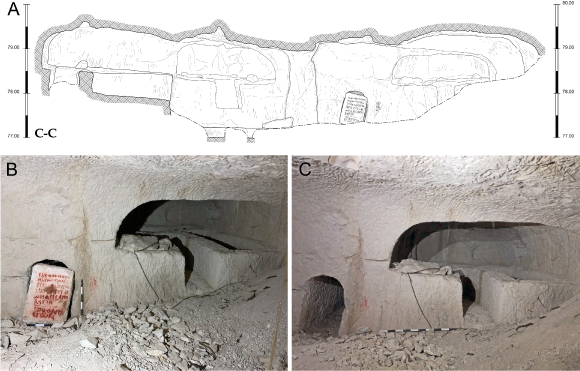
Only one hall of this cave is accessible, from a breach on the upper side of the southwestern arcosolium of hall 35B (Fig. 2). The original entrance was from the south (Fig. 9A). The hall can be divided into two partsâthe northern part comprises three arcosolia in a trefoil layout, similar to those in catacomb 35. The eastern arcosolium, where the breach leading to hall 35B is cut, is unfinished, and the burial troughs were left unquarried (Fig. 9B). The southern chamber, which leads to the catacombâs entrance, is different in plan: its western wall is plain, with no burials, while its eastern wall accommodates a typical arcosolium with four trough burials and an arched loculus (Fig. 10A). At the front of the loculus there was a slab of stone with a Greek inscription in red, and to its right, another yet smaller inscription was painted in red on the wall (Fig. 2-VI; Fig. 10BâC). It appears clear that the slab inscription was not found in situ, but was moved there by robbers, as it is stands freely and slightly diagonally on a fill of about 20â¯cm of debris above the floor level. These inscriptions will be discussed below.
2.3 Plan and Date
Figure 9
Catacomb 36: A. section AâA to the south showing the entrance of the hall (fig. 2-V) covered by a dump; B. Arcosolium with a breach (fig. 2-VI) leading to hall 35B, looking east
Citation: Journal for the Study of Judaism 55, 3 (2024) ; 10.1163/15700631-bja10085
Survey by Slava Pirsky and Sergei Alon, photo by Ran KaftoryThe symmetrical plan of the catacombs (except for the inscriptions chamber) with repetitive features (corridors, pillars carrying arches, the number and arrangement of burials in each arcosolium), testifies to the preplanned and organized nature of the catacombs. The plan of the two catacombs is typical of the Beth SheÊ¿arim cemetery. The catacomb belongs to Weissâ type 1: âCatacombs with a central courtyard surrounded by one to four burial halls of different sizes, in which the burial itself was largely in a simple or complex arcosolium or possibly a kokh,â and to hall type no. 3: âA hall composed of a number of rooms hewn in succession (nos. 2 B, 13 F) and in which passage from one room to the next was marked by an arch or engaged pilasters.â10 The layout of corridors with arcosolia with multiple troughs, called also âexpanded arcosolia,â are generally dated to the thirdâfourth century CE and even the beginning of the fifth.11
Figure 10
Southern hall of catacomb 36 looking east, with the two inscriptions: A. section; B. view before removing the inscribed slab; C. view after removing the inscribed slab, showing the loculus
Citation: Journal for the Study of Judaism 55, 3 (2024) ; 10.1163/15700631-bja10085
Survey by Slava Pirsky and Sergei Alon, photo by Ran Kaftory and Slava PirskyThe necropolis of Beth SheÊ¿arim is generally dated to the third to fifth century CE. There is evidence for its gradual decline in the fifth century CE; the nearby reservoir (cave no. 34) went out of use and filled with debris in the fifth century,12 and also the nearby town on the Sheikh Abreik hill declined at the same time, although it did not disappear completely.13 Evidence for long-term use of the tombs comes from a Palmyrene family in catacomb 4, with five generations mentioned in their inscriptions, the latest probably interred in the early fifth century.14 The unfinished burials of catacombs 35â36 point to a short-term use in these caves, and therefore, if they were hewn in the third or fourth century in general accordance with the Beth SheÊ¿arim cemetery, it is likely that they did not last to the end of the fifth century CE.15 Thus, the inscriptions in the cave could be dated to any time within this span.
Figure 11
Catacomb 36, the Jacob inscription on a slab of stone, looking east
Citation: Journal for the Study of Judaism 55, 3 (2024) ; 10.1163/15700631-bja10085
Survey and photo by Slava Pirsky and Sergei Alon3 The Inscriptions
3.1 Inscription on the Slab of Stone (Fig. 11)
Eight lines of Greek painted in red on a limestone slab.16 The edges of the stone are rough-hewn but the inscription is fully preserved. A horizontal line is drawn between lines 6 and 7, separating the last two lines from the upper text. The first four lines of text are executed by a practiced hand using a relatively thin brush; there is no space between words, and while words are broken across lines, the inscriber (apparently) intentionally fit 12 letters into each of the first three lines, and 11 in line 4; but in line 4, space is given to dots on either side of the head of the iota, for unclear purpose. The inscriber used a lunate sigma and formed most letters with angular strokes; the sizes of the letters vary considerably. The lines are relatively straight, although not perfectly ruled. Lines 5â6 were executed by a different hand from the first four: note the thicker hastae and significant differences in the shapes of alpha, epsilon, xi, etc.; yet these two lines are essential to the syntax and grammar of the entire text, so that lines 1â6 were apparently conceived as a single text. Lines 7â8 were written by yet another hand, with yet thicker hastae and less regularity, possibly at a later date.
Measurements of stone: 75â¯cm high, 50â¯cm wide, ca. 10â¯cm thick.Letter heights: lines 1â6: 3â5.1â¯cm; lines 7â8: 6â7.4â¯cm.
|
Diplomatic text |
Edited text |
Translation |
|---|---|---|
|
_______________ |
_______________ |
Iakobos (Jacob) the proselyte makes an oath to curse those who open this (grave), so that no one will open it (the grave). Sixty years (old). |
The first six lines form a single complex sentence. The grammar and orthography are unproblematic.
Line 2.
Line 3. Orthographic shifts of
Line 4. The iota is set off by two dots, thus separated from
That the last two lines were written by someone other than the main inscriber is not unusual, and it can be guessed that Jacob prepared the main text for his grave before he died, and that someone else added his age after his death. The reason for the different hand in lines 5â6 is harder to explain, especially since
While the syntax of the sentence in the first six lines of the text, as parsed in the first interpretation given above, contains no glaring irregularities, it is redundant: Jacob abjures against opening the tomb so that no one may open the tomb. It may seem odd to devote valuable space on a valuable stone to an obvious explanation. As such, the wording of this imprecation against opening the tomb is unique in such texts, of which there are several other examples in Beth Sheʿarim,20 quite a few in Judea/ Palestina, and indeed dozens throughout Jewish, Christian and pagan epigraphy, especially in the East.21 Usually such imprecations, in contrast to our present text, specify a penalty or an elaboration of the curse.
It should be mentioned, as a final note, that the problem of redundancy could be solved by reading the letters on the stone in a different manner, namely:
|
Text |
Translation |
|---|---|
|
|
Iakobos the proselyte adjures regarding those that are (lying) under this (i.e., who are lying in the tomb) that no one open it (= the tomb). |
While solving one problem, this reading creates others, requires more editorial intervention than the interpretation given above, and assumes that the author made more mistakes; and the
3.2 Wall Inscription (Fig. 12)
Measurements of inscription: 24â¯cm high, ca. 13â¯cm wide.Letter height: 2.3â¯cm.
|
Diplomatic text |
Edited text |
Translation |
|---|---|---|
|
|
|
God will bless Iouda (Judah), the owner of this tomb. |
Figure 12
Catacomb 36, the Judah inscription on the wall, looking east
Citation: Journal for the Study of Judaism 55, 3 (2024) ; 10.1163/15700631-bja10085
Photo by Ran KaftoryThe single sentence should be read as a wish rather than a prediction. The inscription does not mark Judahâs burial place, but is intended rather as a general blessing on the owner of the tomb (and possibly his family buried with him). Ownership inscriptions and general blessings for the deceased are common in Beth SheÊ¿arim, written typically on lintels, on entrances to chambers, on walls between chambers and on walls within chambers. Yet the odd position of this ownerâs blessing, next to one loculus and very low to the ground, makes the exact meaning of
The use of
4 Summary and Conclusions
Previous excavations at Beth SheÊ¿arim have recovered over thirty catacombs, and it is likely that more are still unknown, like the two discussed here that were discovered by chance. Catacombs 35â36 add important information about the Beth SheÊ¿arim necropolis and its extension. The two catacombs resemble their neighbors on the same slope, catacombs 5â10. The two examined here were used in the late Roman period, but for an apparently short period of time, judging by the unfinished arcosolia and troughs that hint that the caves were abandoned earlier than planned. From the stratigraphic point of view, catacomb 36 seems to be later than catacomb 35, as the former was quarried on a higher level by deliberate accommodation to the outline of the latter. Furthermore, the arcosolium of catacomb 36 that overlaps that of no. 35 remained unused and no troughs were hewn in its benches. The users of that tomb may have been aware of the weak point, too close to the arcosolium below, and therefore left that arcosolium unfinished. The way the two catacombs correlate suggests some kind of relation between the families. It could be that an extended family owned a plot encompassing a couple of caves for each nuclear family. Alternatively, the whole cemetery could have been operated, regulated, and allotted by a central authority at Beth SheÊ¿arim.
As for the interred in catacomb 36, the wall inscription mentions Judah, the owner of that tomb, which can refer either to the loculus nearby, or to the entire hall. One of the members of the family buried in catacomb 36, named Jacob, was a proselyte. It is hard to tell where this epitaph originally came from, as it was found detached from the wall and on a debris dump, leaning against the wall.
The inscription on the stone slab mentioning Jacob the proselyte is unique in Beth Sheʿarim,28 but not at all the first in Judea/Palestina, where many proselytes are attested. For example, several ossuaries in first-century Jerusalem attest to proselytes.29 Much fewer are attested in the late Roman period, most come from Rome,30 but there are instances from Asia Minor and other provinces. As for late Roman Palestine, the Beth Sheʿarim proselyte is the second one discovered so far, after an epitaph from Caesarea Maritima;31 and the first to be found in the Galilee.
The concept and reality of conversion to Judaism, as well as the process of becoming a proselyte, developed over time, but such conversion was still done in the period when the text under discussion was written. It is to be noted that Hadrian forbade circumcision (the prohibition affirmed by Antoninus Pius), effectively forbidding conversion of males to Judaism, and Christian emperors in the fourth and fifth centuries imposed increasingly severe penalties on converts to Judaism, especially on Christians who did so, but this did not deter several epigraphically attested Jewish proselytes during this periodâand this number now includes Jacob.32 Scholars troubled by the indisputable evidence of conversion to Judaism in a time when the legal corpus seems to indicate grave danger in doing so, have invented various explanations for these epigraphical proselytes, such as that the converts underwent baptism but not circumcision, that the Jewish converts, their legal status diminished, were forced to indicate their conversion on public documents, or that somehow the conversion was an internal Jewish matter not acknowledged or known by the Roman authorities. Moreover, scholars have assumed and then tried to prove that Jewish converts were marginalized within their Jewish communities.33 Yet neither the present inscription nor any of the other epigraphical proselytes from late antiquity shows any hesitation or embarrassment about their identity in their epitaphs, nor any marginalization or social disabilities. Thus Jacob the proselyte from Beth SheÊ¿arim is a welcome contribution to the scant evidence on proselytes in late Roman Palestine.
The newly found catacombs from Beth Sheʿarim shed new light on the expansion of that necropolis, which went beyond the area known so far, and probably covered a much larger area. The new inscriptions, and especially the one mentioning Jacob the proselyte, add to our limited knowledge about Jewish converts in the late Roman period, and specifically in Roman Palestine. It seems that 86 years after its first discovery, the necropolis of Beth Sheʿarim still provides us with new evidence on the social life of Jews in late antiquity.
This research was supported by the Israel Science Foundation (grant No. 3083/21). The plans were prepared by Slava Pirsky and Sergei Alon, photos by Ran Kaftory, and graphics by Sapir Haad: we have permission to publish Figs. 1â12 in this article. We are grateful to the Israel Nature and Parks Authority, especially to Jonathan Orlin, Tabi Karkom the head of the Beth SheÊ¿arim park, and Dr. Iosi Bordowicz. We extend our gratitude to the Israel Antiquities Authority, especially to the director Eli Escusido, the chief scientist Dr. Gideon Avni and the director of the northern branch, Dr. Kamil Sari and his team.
For the history of Beth SheÊ¿arim, see Mazar, Beth SheÊ¿arim I, 1â12; Avigad, Beth SheÊ¿arim III, 1â17.
Mazar, Beth Sheʿarim I; Avigad, Beth Sheʿarim III.
Schwabe and Lifshitz, Inscriptions; CIIP V, 1876â2362.
Feig, âBeth SheÊ¿arim.â
Conder and Kitchener, Survey of Western Palestine, 343â351.
IAA survey license S-1107/2021.
The last cave that has been numbered is the slik (storage) reservoir numbered 34, excavated in 2014. We are grateful to Tzvika Tsuk for this information.
Mazar, Beth SheÊ¿arim I, 221â222.
Weiss, âBeth SheÊ¿arim,â 219.
Avigad, Beth SheÊ¿arim III, 259â261; Weiss, âBeth SheÊ¿arim,â 210â211.
Tsuk, Bordowicz, and Kohn-Tavor, âLarge Reservoir.â
Mazar and Avigad maintained that Beth SheÊ¿arim declined in the second half of the fourth century CE, see above, note 2. Other scholars have argued that Beth SheÊ¿arim, both settlement and necropolis, operated throughout the Byzantine period, see Vitto, âByzantine Mosaicsâ; Weiss, âBeth SheÊ¿arim.â Recent excavations in the settlement present a more complex picture, of a decline during the fifth century CE, see Erlich, âBeth SheÊ¿arim.â
Weiss, âBeth SheÊ¿arim,â 226â227; CIIP V, 1878â1879.
Recent excavations in catacomb 20 yielded evidence on a second phase of burial in the late fourth century CE. This is currently being studied by A. Erlich.
The author is grateful to Avner Ecker, Walter Ameling, and the anonymous reviewer for helpful and acute suggestions on decipherment of the two texts. Naturally, any mistakes or stubborn refusal to accept advice are solely my responsibility (JJP).
See Gignac, Greek Papyri, 183, 189â191, 197â199.
See the indices in SEG and the PHI database; there is no point in providing the long list. In the CIIP, see I.2, 986, and IV, 3099 (both Christian).
Cf. Ameling, IJO II, 172, 174, 178, 188, 202, 213; there are other Jewish examples in Rome: Noy, JIWE II, 360; and Macedonia: Noy et al., IJO I, Mac7.
CIIP V, 7096, 7100, 7101, 7103, 7104, 7131.
In Jerusalem alone: CIIP I, 93, 287, 359, 375, 385, 451, 460, 466, 507, 602; and for the Jewish practice in general, see Hachlili, Jewish Funerary Customs, 494â506. It is to be noted that the form and content of Jewish maledictions against opening the tomb are different in the diaspora. For the larger Roman world, see Robert, âMalédictions funéraires grecques,â cf. Trebilco, Jewish Communities, 58â74; still relevant is Parrot, Malédictions et violations.
See Price, âJewish Epigraphical Idioms.â
Schwabe and Lifshitz, Inscriptions, no. 51 = CIIP V, 6988.
Schwabe and Lifshitz, Inscriptions, no. 106 = CIIP V, 7059.
Schwabe and Lifshitz, Inscriptions, no. 11 = CIIP V, 6942.
Schwabe and Lifshitz, Inscriptions, no. 200 = CIIP V, 7196. This is not the place to discuss the variety of terms for tomb, such as
E.g., LXX Judg 19:22; Ps 104:21; Mark 13:35; Matt 20:8; 21:40; Mark 12:9; Luke 20:15.
Unless, that is, the epitaph of
CIIP I, 6, 174, 181, 190, 238, 304, 551.
Noy, Jewish Inscriptions, nos. 62, 218, 224, 489, 491 Iudeus proselitus (cf. 489), 577.
CIIP II, 1456.
Note, e.g., the proselytes in Rome mentioned in note 24. See now Price, âJewish Proselytes,â 2023. Linder, Roman Imperial Legislation, 99â102 no. 1; 124â132 no. 8; 138â154 nos. 10â12; 168â174 no. 16; 256â262 no. 39, et al. On the reality, concept, and procedure of conversion, fundamental is Cohen, Beginnings, 107â238, esp. 140â174; see also Feldman, Jew and Gentile, ch. 9; Goodman, Mission and Conversion; Rutgers, Hidden Heritage, 199â234; Miralles Maciá, âConversion and Midrashâ; Lavee, âProselytes.â
E.g., Cohen, 107â238, esp. 140â174; Donaldson, Judaism and the Gentiles, 444; Goodman, 134â136; cf. Price, âJewish Proselytes.â
Bibliography
CIIP I = Cotton, Hannah M., Leah Di Segni, Werner Eck, Benjamin Isaac, Alla Kushnir-Stein, Haggai Misgav, Jonathan Price, Israel Roll, and Ada Yardeni, eds. Corpus Inscriptionum Iudaeae/Palaestinae: A Multi-Lingual Corpus of the Inscriptions from Alexander to Muhammad, vol. 1 Jerusalem (Berlin: De Gruyter, 2010).
CIIP II = Ameling, Walter, Hannah M. Cotton, Werner Eck, Benjamin Isaac, Alla Kushnir-Stein, Haggai Misgav, Jonathan Price, and Ada Yardeni, eds. Corpus Inscriptionum Iudaeae/Palaestinae, vol. 2 Caesarea and the Middle Coast (Berlin: De Gruyter, 2011).
CIIP V = Ameling, Walter, Hannah M. Cotton, Werner Eck, Benjamin Isaac, Alla Kushnir-Stein, Jonathan Price, Peter Weiss, and Ada Yardeni, eds. Corpus Inscriptionum Iudaeae/Palaestinae: A Multi-Lingual Corpus of the Inscriptions from Alexander to Muhammad, vol. 5 Galilee (Berlin: De Gruyter, 2023).
IJO I = Noy, David, Alexander Panayotov, and Hanswulf Bloedhorn, eds. Inscriptiones Judaicae Orientis, vol. 1 Eastern Europe (Tübingen: Mohr Siebeck, 2004).
IJO II = Ameling, Walter, ed. Inscriptiones Judaicae Orientis, vol. 2 Kleinasien (Tübingen: Mohr Siebeck, 2004).
JIWE II = Noy, David, ed. Jewish Inscriptions from Western Europe, vol. 2 The City of Rome (Cambridge: Cambridge University Press, 2005).
Avigad, Nahman. Beth SheÊ¿arim, vol. 3 Report on the Excavations during 1953â1958: Catacombs 12â23 (New Brunswick: Rutgers University Press, 1976).
Cohen, Shaye J.D. The Beginnings of Jewishness: Boundaries, Varieties, Uncertainties (Berkeley: University of California, 1999).
Donaldson, Terence L. Judaism and the Gentiles: Jewish Patterns of Universalism (to 135CE) (Waco: Baylor University Press 2008).
Erlich, Adi. âḤorbat Bet SheÊ¿arim.â Excavations and Surveys in Israel 133 (2021): https://www.hadashot-esi.org.il/report_detail_eng.aspx?id=26041&mag_id=133
Feig, Nurit. âA New Burial-Cave at Beth SheÊ¿arim.â Qadmoniot 79â80 (1988), 102â105 [Hebrew].
Feldman, Louis H. Jew and Gentile in the Ancient World: Attitudes and Interactions from Alexander to Justinian (Princeton: Princeton University Press, 1993).
Gignac, Francis T. A Grammar of the Greek Papyri of the Roman and Byzantine Periods, vol. 2 (Milano: Cisalpino-Goliardica, 1981).
Goodman, Martin. Mission and Conversion: Proselytizing in the Religious History of the Roman Empire (Oxford: Oxford University Press, 1995).
Hachlili, Rachel. Jewish Funerary Customs, Practices, and Rites in the Second Temple Period (Leiden: Brill, 2005).
Lavee, Moshe. ââProselytes Are as Hard to Israel as a Scab is to the Skinâ: A Babylonian Talmudic Concept.â Journal for the Study of Judaism 63 (2012), 22â48.
Linder, Amnon. The Jews in Roman Imperial Legislation (Detroit: Wayne State University Press, 1987).
Mazar, Binyamin. Beth SheÊ¿arim: Report on the Excavations during 1936â1940, vol. 1 Catacombs 1â4 (New Brunswick: Rutgers University Press, 1973).
Miralles Maciá, Lorena. âConversion and Midrash: On Proselytes and Sympathisers with Judaism in Leviticus Rabbah.â Journal for the Study of Judaism 42 (2011), 58â82.
Noy, David. Jewish Inscriptions of Western Europe, vol. 2 (Cambridge: Cambridge University Press, 1995).
Parrot, André. Malédictions et violations de tombes (Paris: Geuthner, 1939).
Price, Jonathan J. âInsights into Jewish Epigraphical Idioms from the CIIP,â In Centre and Periphery: Working with Inscriptions of Iudaea/Palaestina, ed. Walter Ameling (Bonn: Habelt, 2022), 103â124.
Price, Jonathan J. âJewish Proselytes in Inscriptions: An Update and Reassessment.â In Religion und Epigraphik: Kleinasien, der griechische Osten und die Mittelmeerwelt: Festschrift zum 65. Geburtstag von Walter Ameling, ed. Dagmar Hofmann, Andreas Klingenberg, and Klaus Zimmermann (Bonn: Habelt, 2023), 119â135.
Robert L. âMalédictions funéraires grecques.â Comptes rendus des séances de lâAcadémie des inscriptions et belles-lettres (Paris)122 (1978), 241â289.
Rutgers, Leonard Victor. The Hidden Heritage of Diaspora Judaism (Leuven: Peeters, 1998).
Schwabe, Moshe, and Baruch Lifshitz. Beth Sheʿarim, vol. 2 The Greek Inscriptions (New Brunswick: Rutgers University Press, 1974).
Trebilco, Paul R. Jewish Communities in Asia Minor (Cambridge: Cambridge University Press, 1991).
Tsuk, Tsvika, Iosi Bordowicz, and Achia Kohn-Tavor. âA Large Reservoir and Impressive Aqueduct from the Roman Period at Bet SheÊ¿arim National Park.â In Cura Aquarum in Greece: Proceedings of the 16th International Conference on the History of Water Management and Hydraulic Engineering in the Mediterranean Region, ed. Kai Wellbrock (Siegburg: Papierfliegerverlag, 2017), 535â624.
Weiss, Zeev. âBurial Practices in Beth SheÊ¿arim and the Question of Dating the Patriarchal Necropolis.â In âFollow the Wiseâ: Studies in Jewish History and Culture in Honor of Lee I. Levine, ed. Zeev Weiss, Oded Irshai, Jodi Magness, and Seth Schwartz (Winona Lake: Eisenbrauns, 2010), 207â231.
Vitto, Fanny. âByzantine Mosaics at Beth SheÊ¿arim: New Evidence for the History of the Site.â Atiqot 28 (1996), 115â146.