Abstract
Secularization in times of COVID-19 is viewed in different ways. Whereas some researchers predicted increased religious practices due to societal insecurity, others challenge the evidence of change in this direction. Besides actual secularization processes, this article examines the communication strategies of churches in Germany during the COVID-19 crisis, focusing particularly on the presence or absence of explicitly religious language. How did religious groups frame the crisis and its consequences, such as state regulations or vaccinations? How did they position themselves within society in general, in relation to other social systems, and in relation to the state as such? The focus of this article is primarily on Germany and on the comparison between the four religious/worldview groups (Roman Catholic Church, Protestant Church, Muslim umbrella organizations, and the Anthroposophical Society). In the next step, the main findings in Germany are compared with results from Canada, Poland, Ireland/Northern Ireland, and similarities and differences are highlighted. Thus, this article contributes to the knowledge of how religious groups react to and position themselves in a society perceived as secular and how they adapt their communication to align with secular expectations. By that, the article contributes to an understanding of religion’s transforming function in modern society, highlighting how churches themselves actively shape this transformation.
1 Introduction
In May 2020, the former Thuringian Minister President Lieberknecht (CDU) accused the German churches of failing in the corona crisis.1 Once a parish pastor herself, she complained that the churches contributed to abolishing themselves during the crisis by presenting themselves as a pure welfare community and neglecting their actual function:
The crisis touches on very fundamental issues: it reveals what has already been apparent for a long time. We generally need to consider the status the church still holds in our society and in people’s lives, as well as its self-image. I fear that the church is increasingly tending to simply join the ranks of the civil society organizations that we have elsewhere in the charities.2
Reck 2020
Roman Catholic journalist Birgit Kelle criticized the German official churches for willingly submitting to state authority without resistance (cf. Fritz 2020, 25). Her colleague Heribert Prantl argued that this subordination had undermined churches’ societal authority and position by sacrificing their inviolable right to communal religious celebration (26). Similarly, Peter Frey, editor-in-chief of Germany’s national television broadcaster and a committed member of the Central Committee of Catholics, expressed comparable criticism of the Roman Catholic Church,
which closes its doors and even renounces the celebration of its most sacred feasts at Easter, willingly loyal to the state but without any visible grief over the loss. The determination not to demand a special role for itself is so great that it also neglects its core tasks.
Frey 2021
Church members also accused the churches of disappearing in the crisis. This is all the more surprising given that, although there is no state religion in Germany, the state and religious organizations, especially the two mainline churches, are deeply interwoven—most notably in the three areas of taxes, education, and healthcare. Religious education is the only school subject protected by constitutional law and has constitutional status. Regarding healthcare, the two mainline churches are the biggest providers of social and healthcare facilities, with more than one million employees in the health and care sector. So, in fact, in contrast to their position and role in German society, it is striking that religion and the two mainline churches were perceived as invisible during the pandemic period.
This article starts from this observation, examining the communication of religious groups during the pandemic and asking how religious groups communicated during the crisis.3
The perception that German churches somehow missed speaking up for their purpose is also found in the academic discourse. Whereas soon after the outbreak of the pandemic, the hypothesis was put forward that the pandemic could lead to a resurgence of religion in secularized countries and contexts (Hillenbrand 2020), Büssing et al. (2022) stressed that the attitudes of individual actors toward religion changed over the course of the pandemic: While religion gained slightly in importance during the first lockdown, it decreased in later phases. In contrast to a considerable increase in religious and spiritual practice in Great Britain and France, both highly secularized countries, such an increase cannot be confirmed for Germany, though it is categorized as less secularized (Hillenbrand and Pock 2023, 25). Elsner (2020) even concludes that although church practices were missed, due to the ongoing processes of secularization, individualization, and pluralization, they were not seen as vital due to the advanced individualization of faith.
Studies such as the Bertelsmann Foundation’s Religion Monitor stressed that during the COVID-19 pandemic, respondents saw religion less in its role as an institution in coping with the crisis but associated it primarily with community-building aspects, such as local community structures (El-Menouar 2023, 58). Körtner even went one step further and argued that although the churches have generally played an important role in society in coping with the coronavirus pandemic, they were only active in the health sector (2021, 353). While church hospitals or diaconal institutions were seen as relevant for society, congregations or parishes’ activities only played a marginal role. According to him, this selective involvement of the churches was also taken up within society and contributed to their invisibility, as they were not (or were no longer) seen as systemically relevant to the wider society. While in historical pandemics, such as the plague in the fourteenth century, the mainline churches provided an explicit theological explanation of the crisis, for coping with and dealing with the crises, it seems that churches nowadays consider this as no longer necessary. Regarding the health crisis, the prerogative of interpretation no longer lies with churches or religious experts, but with scientists and medical experts (Hillenbrand and Pock 2023, 31). This can also be shown in the social recognition of professions classified as systemically relevant. Stichweh (2020) also declared religion as the system that lost the most during the COVID-19 pandemic. According to him, the pandemic led to a hierarchization of functional systems for the first time in modern history: All systems were subordinated to the healthcare system. In this hierarchy, healthcare is the most important, followed by politics, then science, then the media, while religion, arts, and sports were considered the least important and therefore had to cease all activities. Religion found itself in this subordinate role for the very first time, having been very protected in the past (Stichweh 2022, 386). He also attributes this to the lack of a religious interpretation of the crisis and the dwindling importance of institutionalized religion as a source of meaning in society:
Insofar as our reaction to the corona crisis is determined by the specifically modern “cult of individuality,” this is in any case a form of quasi-religiosity against which traditional, transcendence-oriented religiosity finds it difficult to fight.
Stichweh 2020
But is this explanation of individualization sufficient as the main cause of secularization, and can other influencing factors possibly be identified? Secularization theory based on Luhmann (2000) assumes that certain areas of society are distinguished from one another by codes as leading difference in communication systems. Furthermore, system boundaries are also established, stabilized, and reproduced through communication (Kleine 2016). Yelle distinguished between different forms of secularization: Next to secularization as a decline of organized religion or a growing separation of religion and state, on the communicative level, secularization is also understood as the transfer “of originally theological categories structures, and habits of thought and practice, into apparently non-Christian or religiously neutral versions of the same” (2025, 193).
Wohlrab-Sahr distinguishes between secularization and the concept of secularity, “which describes the cultural, symbolic and institutionally anchored forms of conceptual differentiation between the religious and the non-religious, as well as the institutional arrangements of the difference between religion and other social spheres and areas of activity” (2019, 24). Both are the results of conflict-ridden negotiations. Burchardt and Wohlrab-Sahr (2013) have used the concept of multiple secularities to illustrate that transcendence is recognized in today’s society, but less defined in terms of content. The reason for this is that Christian semantics are no longer seen as compatible in today’s society and are considered outdated.
Furthermore, Wilke pointed out that secularization is at least partly created or influenced by theories of secularization themselves (2013, 32). While Wilke only referred to the academic discourse, this article is interested in the extent to which religious groups also use secularization theories as a basis for interpreting their positions, and adapt their communication accordingly. Using communication in times of the societal COVID-19 crisis as an example, we therefore ask if and to what extent churches have adapted their communication to a society they perceive as secular. In line with Luhmann’s theory of social differentiation and Pierre Bourdieu’s field theory, who stressed that the boundaries of the fields are ultimately negotiated and decided in the fields themselves, the interesting question is, if the churches still truly imbue society with religious meaning by reflecting on it in terms of transcendence and whether they are adapting to competing meanings and worldviews offered by other functional systems.
Building on this research, this article examines the communication strategies of churches in Germany during the COVID-19 crisis, focusing particularly on the presence or absence of explicitly religious language. How did religious groups frame the crisis and its consequences, such as state regulations or vaccinations? How did they position themselves within society in general, in relation to other social systems, and in relation to the state as such?
While the research project covered several countries (Canada, Ireland/Northern Ireland, Poland, and Germany), this article focuses on Germany and on the comparison between the four religious/worldview groups (Roman Catholic Church, Protestant Church, Muslim umbrella organizations, and the Anthroposophical Society; see for the sample selection in detail Radde-Antweiler et al. 2026; and Sander, this issue). However, in the second part, the main findings in Germany are compared with results from Canada, Poland, and Ireland/Northern Ireland, discussing similarities and differences. Thus, this article contributes to the knowledge of how religious groups react to and position themselves in a society perceived as secular and how they adapt their communication to align with secular expectations. By that, the article contributes to an understanding of religion’s transforming function in modern society, highlighting how churches themselves actively shape this transformation.
2 Meaning-Making during the Pandemic: Religious Communication Strategies in Germany
This article investigates how different German religious groups communicated throughout the pandemic period. The religious expert discourse is not taken into account. For the German Christian churches, for example, it can be observed that the role of religion and the role of the church in society, and especially in times of crisis, was discussed quite prominently in theological discourse (for example, Schlag et al. 2023; Mückl 2021; Sander, this issue), however, these debates were neither published in the news and press releases nor in the religious media and were therefore not available for the dominant discourse. Rather, they formed an internal elite discourse.
The analysis differentiates between two media categories in examining communication. The first comprised public documents issued by religious groups, encompassing communications to their constituencies, such as policy directives, open letters, and press releases. While these materials targeted internal audiences—specifically community members—they remained publicly available via official organizational websites. The second media category included religious media, which were produced by religious media outlets such as newspapers or news blogs on websites, and were journalistic in nature. In order to gain insight into communication during the COVID-19 crisis, all documents were collected that were created within the pandemic timeframe (March 2020–February 2023). Document selection relied on pandemic-specific keywords (“Corona,” “Covid,” “Pandemic” in the respective languages), with inclusion contingent upon substantive engagement with the pandemic; materials containing only tangential references, such as health announcements about religious leaders unconnected to pandemic discourse, were omitted. All documents of the two different media categories were analyzed by a deductive content analysis (Mayring 2014; for detailed information, see Radde-Antweiler et al. 2026, 28 ff.).
In the German project, we collected the material from the following religious groups:
-
Roman Catholic Church with 24.8 percent, the largest religious group in Germany;
-
the Protestant Church in Germany (Evangelische Kirche Deutschland), a communion of twenty Lutheran, United and Reformed churches, and the second largest religious group (21.5 percent);
-
denominational Muslims (3.9 percent)—because Muslim organizations do not have public body status, the following umbrella organizations were chosen: Koordinationsrat der Muslime in Deutschland (KRM), Türkisch Islamische Union der Anstalt für Religion (DITIB), Zentralkomitee der Muslime in Deutschland (ZMD), Islamrat für die Bundesrepublik Deutschland (IRD) and the Verband der Islamischen Kulturzentren (VIKZ);
-
the Anthroposophical Society (no official numbers); it is important to note that the Anthroposophical Society self-identifies as a worldview organization rather than a religious group, however although the Anthroposophical Society in Germany is not overly strong in terms of membership, anthroposophical positions are consistently represented in public discourse. There are many anthroposophical institutions in the societal fields of education and medicine. … there were repeated references to Anthroposophists or anthroposophical positions in debates about vaccination, both from within the movement itself and from outside (Radde-Antweiler et al. 2026, 21).
The collection of public documents drew upon materials from overarching national organizations, such as the Conference of Catholic Bishops in Germany. In regard of the Roman Catholic Church, each national research team further incorporated official documents from designated regional Christian denominations—in the German project: the Diocese of Regensburg and the Diocese of Dresden-Meißen, as well as the Evangelisch-Lutherische Landeskirche Sachsens and the Evangelisch-Lutherische Kirche in Bayern (cf. Radde-Antweiler et al. 2026, 22–23). In the case of religious media, we chose the most influential publications for each organization based on metrics such as circulation numbers, subscriber counts, and website traffic. In the German project religious media were collected from the Roman Catholic internet portal katholisch.de, the Protestant magazine Chrismon, the Islamische Zeitung, and the Quarterly Newsletter by the Anthroposophical Society. In sum, 1,377 public documents and 1,926 religious media articles were analyzed.
All documents and religious media that were published between March 2020 and February 2023 were analyzed by deductive content analysis (see the introduction to this special issue; Radde-Antweiler et al. 2026) and reflect the religious groups’ views and communication during this time. For the question of how religious or secular the communication was, we used the code “justification” (cf. Radde-Antweiler et al. 2026) in the main category “Discourses about health, illness, and science.” By justification we are not referring to the Christian (Protestant) doctrine of justification but rather see it as a linguistic tool used to substantiate claims or provide reasons, evidence, or explanations for a particular argument: “For justification, in the grammar of its use, means to provide evidence or support for what is said or what is done” (Vandevelde 2001, 62). We distinguish between three different ways that are used to legitimize the arguments in the documents.:
-
Justification by scientific arguments refers to all legitimizations of arguments that invoke scientific arguments, for example, in the form of references to scientific studies, research results, or medical professionals.
-
Justification by theological arguments refers to all legitimizations of arguments that explicitly use religious language (for example, God, Jesus, names of concrete saints) or refers to theological concepts (salvation, evil, eschatology, or faith), or reference religious scriptures (direct quotes or paraphrases).
-
Justification by moral arguments are all legitimizations of arguments that refer to normative orientations (ideals, values, rules, judgments) that represent ideal behaviors, for example, the right thing to do in specific situations. Morals can be closely linked to religion, but they do not have to be (Antes 1988). Distinguishing between “justification by theological arguments” and “justification by moral arguments” presents certain challenges, given that ethics constitutes a fundamental element of Christian theology, with moral principles and values derived from biblical teachings. However, since our focus was on the use of religious and nonreligious communication, we identified religious language specifically through its explicit and visible references to sacred scriptures and traditions. This does not rule out the possibility that the reasons are theological in nature, but they were given without explicit reference to the religious symbol system.
2.1 Public Documents: Addressing Community Members

Figure 1
Documents of all German groups, frequency of the code “justification”
Citation: Journal of Religion in Europe 19, 1-2 (2026) ; 10.1163/18748929-bja10156
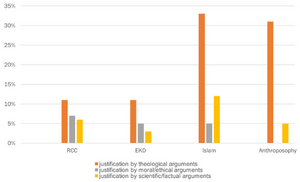
In Germany, all religious groups employed theological justifications in their public documents, utilizing theological arguments more frequently than scientific or moral ones (see Figure 1). However, closer examination reveals that both Christian churches relied less heavily on theological justifications compared to the Muslim and anthroposophical organizations. It is noticeable that the Muslim and anthroposophical documents contain more justifications overall.
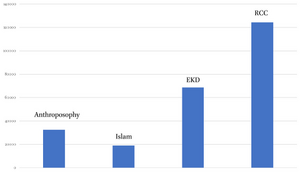
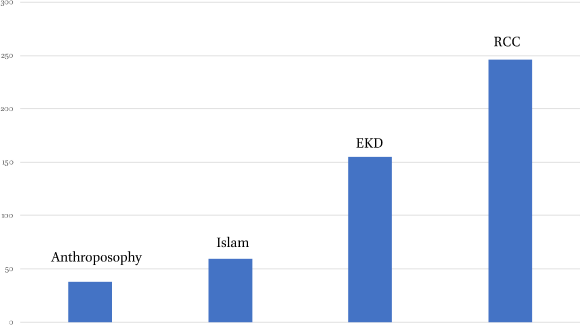
It seems that in the Christian documents, announcements or prescriptions were not so much justified as such, whether by theological, scientific, or moral arguments. This observation is reinforced by the significantly larger number of documents and words analyzed from both churches (see Figures 2 and 3).
In the Protestant as well as in the Catholic documents, the church’s cooperation with the state and compliance with the COVID-19 restrictions are the main focus. It is argued from the position of a societal institution and is thus portrayed as part of the political arena and social debates: “The Evangelical Church declares from the beginning of the pandemic that it is vital to cooperate with the government and to follow the rules. Politicians are mentioned positively, as is the democratic system, in which they act” (Grünenthal 2023, 14).
The arguments why rules should be followed and how the church reacts to them are mainly fact based. Religious arguments for following the rules are found only occasionally, and in those cases are often connected to ethical arguments. Especially around Easter 2020 and Christmas 2020, when church services on high holidays had to be limited or canceled, these “sacrifices” are generally portrayed as part of living charity. Compliance with the rules is regarded as a common will and as the concrete realization of the Christian message. Following the rules is presented as a sign of responsibility and Christian charity, and as a Christian duty. The documents argue that experiencing God’s love empowers individuals to cope with the situation and help others:
Figure 2
Number of documents of all German groups per denominations
Citation: Journal of Religion in Europe 19, 1-2 (2026) ; 10.1163/18748929-bja10156
Figure 3
Number of words of all German groups per denominations
Citation: Journal of Religion in Europe 19, 1-2 (2026) ; 10.1163/18748929-bja10156
Christian faith gives strength to cope with the challenge of the pandemic: The relationship with God and the trust in Christ help to overcome the paralyzing fear. Nothing can separate us from God’s love, not the virus, not even death. The experience of being accepted by God despite one’s own mistakes gives courage to act even in dilemma situations, to do “the relatively best” in the pandemic, and to learn from mistakes. Finally, trust in Christ makes it possible to pass on to loving oneself. “Right now, when we are so preoccupied with ourselves, let us also think of others,” the regional bishop stressed. “Not because we have to be moral champions, but because we feel the love of God within us and it overflows to our neighbor.”
BE 2020
The idea of the pandemic as a punishment is mentioned only once and strictly rejected: “Bedford-Strohm [the Chairman of the Council of the Evangelical Church in Germany] clearly rejects the idea that the coronavirus is a punishment from God. That is ‘not the God who showed himself in Jesus Christ,’ the bishop clarifies. Jesus did not kill, but heal” (EKD 2020).
The Protestant public documents focused primarily on the individuals and how they can cope with the experience of crisis. The social impacts of restrictions were framed as strict, but necessary to protect the weak and vulnerable. The topics of death and illness were addressed, and public prayers and opportunities to mourn were offered. However, these narratives were not prominent in the documents and the leaders’ questionnaire (cf. Radde-Antweiler et al. 2026) paints a similar picture: Asked about the main ways to speak about death with their members during the pandemic, the answer “addressing death spiritually or theologically” was only ticked a few times in contrast to Muslim leaders. Looking back, they identified three primary areas of focus: providing support to those grieving the loss of loved ones, advocating against the unacceptable conditions that led to pandemic-related deaths, and honoring community members who had died from COVID-19.
The Roman Catholic public documents draw a similar picture; cooperation with the state and politics was emphasized: “Health protection must be considered in all upcoming events. This is also our social responsibility as a church in these difficult times” (ELLS 2020). Cooperation was understood in the sense that restrictions must be followed even if they are difficult (while recognizing that they are). There were barely any critical voices regarding restrictions, and there is broad support for politicians and those who bear responsibility, including occasional calls for prayers for people in key positions. The most frequent topic, however, concerned religious practices. A lot of documents addressed questions of how, when, and where religious services can be attended—including both online and broadcast opportunities. Furthermore, there were impulses and guidelines for personal, individual practice, though less than in the Protestant public documents. More frequently than in the Protestant context, there were calls for shared (yet physically separate) practice, like praying the rosary at the same time or a worldwide prayer against the pandemic. There was also reassurance that the bishops and priests are praying for their people, even if there are no public services. Theological arguments, however, did not play an important role in the Roman Catholic public documents.
Also in the Muslim public documents, state restrictions were thoroughly supported. However, compliance with state regulations was presented not only as reasonable (as in the case of the Christian churches) but also as a theological imperative. The most frequently cited theological argument was that it is Allah’s will to protect every life.
It is our duty to support this fight by staying at home. Because our prophet gave us the following recommendation centuries ago: “If an epidemic breaks out somewhere, do not go there. If you are in a place where there is an epidemic, do not leave!” And if we do have to leave, we should be careful and prudent. Saving lives has never been so easy! Stay at home! Follow the guidelines of the authorities and the government.
Türkmen 2020
Not only the Qur’an, but also scholarly expertise was quoted to justify restrictions.
According to some scholars, the night prayers (Ishaa) can also be combined with the evening prayers (Maghrib) in such a situation and thus be prayed together in the mosque. It should be noted that the Tarawih prayers are among the Sunnah prayers and can therefore be performed at home. … This decision is certainly not easy for any of us, but in responsibility before Allah (PBUH) and the protection of people’s lives, but also in the spirit of overall social solidarity, we ask you to seriously consider this recommendation—and Allah (PBUH) knows better.
ZMD 2021
Changes in religious practice were theologically justified, as well as the question whether a vaccination breaks the fast in Ramadan. The pandemic and the individual experiences of it were recognized as a crisis situation that calls on believers to strengthen their faith:
Even if the communal life in the mosques is now restricted, we are still left with the stronger occupation with the holy Qur’an. It is not for nothing that Ramadan is also the month of the Qur’an, because it was given to us humans during this time. We often pay little attention to this gift in our daily lives. Therefore, we can now understand this time as a chance to occupy ourselves with the word of Allah in peace.
Kesici 2020
In the case of the public documents of the Anthropological Society, theological arguments were understood as arguments relating to the specific symbol system, for example, anthroposophical teachings about the world’s inner relations and connections, energies, or the astral body. Theological justifications in the documents emphasized that illness is more than a physical disorder; in fact, physical disorder is seen only as a physical expression of disorders on other levels. The virus, the individual, and society as a whole were viewed as an organism that influences each other. From an anthroposophical perspective, the coronavirus is not only a physical illness but manifests itself on various levels of being.
The physical appearance, which as a bodily correlate is made visible under the electron microscope as a virus.
Schikarski 2021
An etheric organization, which expresses itself in the temporal course of the disease and must make use of the forces of the human etheric body to present itself.
An etheric quality that changes the free-swinging emotional life of the human being in the sense of a typical constriction and bondage. An encounter with one’s own darkness in the inner-soul as a confrontation.
Finally, a spiritual, which has an intentional character and offers obstacles and resistance to the human being.
These ideas were traced back to Rudolf Steiner, and the circumstance that Corona is a deadly illness is not denied, but it is reframed as a natural process.
2.2 Religious Media Communication
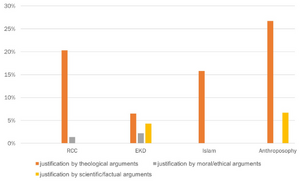
The forms of communication in the religious media showed an ambivalent picture and hints at different modes of communication by the religious groups (see Figure 4).
Figure 4
Media of all groups in Germany, frequency of the code “justification”
Citation: Journal of Religion in Europe 19, 1-2 (2026) ; 10.1163/18748929-bja10156
Similar to the Muslim groups and the Anthroposophical Society, the Roman Catholic media showed a high number of theological arguments in contrast to the Protestant media. Interestingly, the Roman Catholic media didn’t use scientific arguments at all. Instead, it presented the church as a moral institution that urges and reminds society of what is good and right. The focus was thereby on the role of the community in times of the pandemic, on the level of local, neighborly help, and on the level of the state. On the local level, there were reports on concrete initiatives, projects, or actions, such as young people going shopping for elderly neighbors. The authors addressed solidarity on the state level by quoting church authorities—bishops, cardinals, and the pope—with calls for support for poor countries and international solidarity. Germany and other European countries were urged to take responsibility for poorer countries, especially those in the Global South. In this context, reference was made to the good work done by Catholic aid organizations.
Regarding community within German society, the articles advocated for social justice, solidarity with vulnerable populations, and support for business and research initiatives. Neither the necessity of restrictions nor the church’s proactive implementation role faced questioning. The necessity of restrictions was not questioned, nor the proactive role the church took in implementing the rules. Additionally, broader value-based discussions emerged concerning the nature of community as communion. While theological debates, such as interpreting COVID-19 as divine punishment, apocalyptic explanations, and religious fundamentalism were acknowledged, they received firm rejection. In contrast to the documents, the media articles featured more extensive theological reflection on experiencing God’s presence during crisis, exploring how faith provides comfort and how the church can facilitate divine encounter even without traditional Mass services. For example, in an interview, the famous monk Anselm Grün described how believing in God can help cope with the crisis:
It gives me hope that the world is not only in the hands of the virus or not only in the hand of the politicians, but in the hand of God. … And the hope that the Spirit of God will also work on people through the crisis and will kindle new possibilities, new reflections, and new longings in people. In this way, a new togetherness in responsibility is possible. Through the crisis, we feel that we can infect one another, in a negative and in a positive sense. For me, the hope is that people will wake up and infect others with mercy, with love, and with confidence.
Geiger 2020
In the Protestant media, the authors emphasized science as the most important way to overcome the pandemic, in addition to focusing on personal experiences with illness and death. In this context, the relation of science and theology as such was discussed. On the one hand, theologians, church representatives, and journalists referred to scientists to support their arguments for restrictions or vaccination. On the other hand, they explicitly emphasized that, in their view, it would be good for religion if science took on the role of explaining the world, at least the physical world:
Scientists try to give the answers that were expected from priests and prophets in former times. The hardships of the earth were, so to speak, secularized: Corona did not come from heaven, but from Wuhan; it is not an arrow of God but only a dangerous virus. With such explanations, one can—hopefully—better understand catastrophes and take reasonable countermeasures. This epochal progress also had its good for the faith. It relieved it from having to give an explanation for everything that happens.
Claussen 2020
The authors also emphasized that knowledge itself remains limited, even in an age when science, rather than divine authority, is the most important source of guidance. This conception of the relationship between science and religion is profoundly secular.
Connected to the topic of science, but also to the health of the individual as well as the whole society, is the question of vaccination. Being vaccinated was regarded as good and responsible, rational behavior; it was noted that vaccines are very unfairly distributed around the world, and initiatives were mentioned to increase vaccination coverage in regions where vaccination is difficult.
Theological arguments played a prominent role in the articles published in the Muslim media. While the authors didn’t attribute the pandemic to Allah’s creation, they presented it as an opportunity for humanity to reflect on its spiritual foundations and strengthen its faith. The texts emphasized that faith protects Muslims from existential fear by making them aware that ultimate decisions lie with Allah and not with humans. Furthermore, experiences of isolation and vulnerability were compared to the life of the prophet and presented as opportunities for spiritual deepening and renewal of faith:
It occurred to me at that moment that there are countless stories from the Islamic tradition of seclusion. The Prophet himself, may Allah bless him and grant him peace, received the first revelation while in seclusion in the cave of Hira. In a moment without other people and of significant reflection, he was able to begin his journey as the Messenger of Allah.
Zaheen 2021
In the anthroposophical media, the authors stressed that not only the level of the physical body, but also social, individual, and spiritual aspects should be taken into consideration. The article critiqued academic medicine on several grounds. First, scientific medicine is seen as a narrow-minded, monocultural worldview that does not meet human needs. Second, conventional medicine focuses on physical symptoms, while anthroposophic approaches take social, individual, and spiritual factors into account. Third, the authors argued that academic medicine only treats symptoms, not the underlying causes. In contrast, anthroposophic medicine emphasizes holistic interconnectedness. This worldview positions itself as superior to science and Christianity by offering a comprehensive, multiperspective understanding:
Perhaps we need the courage to admit to ourselves that esotericism has not only to do with abstruse “drifting,” that the organism of man and earth forms a holistic symbiosis, that encounters in the social are the germinating forces for the respective new, unique, that the digital world exclusively depicts the past, we humans are future beings, that the vital forces and the health of humans consist of living processes, and finally, that we are indeed largely supersensible beings and carry a consciousness and a responsibility for all other beings on and around the earth organism.
Schmock 2021
While the anthroposophical media did not claim that academic medicine is all wrong, they differ in the interpretation and the claim of validity of results. Unlike all other religious groups, however, the anthroposophical media argued that the reason for the spread of the pandemic was to be found in the failings of society: The virus is not seen as the enemy, but merely as a symptom of a world that has gone off the rails. Responsibility for one’s own health lies with the individual, who should live healthily and in harmony. Vaccination of elderly people and risk groups is advocated, but the freedom to decide for oneself is vehemently defended. Those who do not want to be vaccinated should not be excluded from public life.
Concerning the question whether and how religious groups have used religious communication, it can be said that theological argumentations are indeed more visible and more important than moral or scientific ones. However, in the case of Christian churches, the theological justifications in the documents—and in the case of the religious media, also in the Protestant case—are relatively low in contrast to the other two groups. Especially regarding restrictions, religious language is seldom used, and restrictions are explained and justified mainly by medical/scientific arguments. At first glance, this may not be surprising, given that the COVID-19 pandemic was a medical crisis, but churches could have used more religious communication. In contrast, we can observe similarities between Muslim and anthroposophical groups, where theological explanations dominate moral explanations play a subordinated role.
All of this suggests that the differentiation between societal subfields is recognized by church officials. They see their expertise in their specific religious field (providing mass services, giving spiritual care, asking for solidarity and justice) and leave other fields to other experts. Körtner’s hypothesis that the churches reacted to the crisis by subordinating themselves and thus adapting to the dominant social systems during the pandemic makes sense in the case of communication forms in the public documents and in the Protestant religious media. The public documents targeted their members primarily, even if the documents were publicly available on their websites. So, the lack of religious communication is all the more surprising given that one might assume that communication with their own members tends to take place using Christian semantics, as they are part of the system and are still familiar with it. At the same time, however, we can see that the communication in the Roman Catholic media shows a different picture, with a dominant religious communication and a lack of justification by scientific arguments. This means that journalistic communication by the Roman Catholic Church does not dispense with theological language and thus contradicts Körtner’s thesis, at least at the level of public communication and positioning.
The central question that arises, however, is whether Germany is an exception or whether similar communication patterns occur in other countries.
3 An International Comparison of Communication Strategies during the COVID-19 Crisis
The second part of this article compares exemplary results with the data from the other countries. As only the Roman Catholic Church was examined in all five contexts—Protestants and Muslims were missing in Poland—this part will focus primarily on them. However, in addition, it will briefly discuss some main differences regarding the Muslim communities.
3.1 The Roman Catholic Church’s Framing of the COVID-19 Crisis in a Comparative Perspective
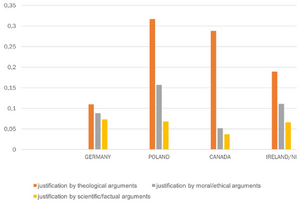
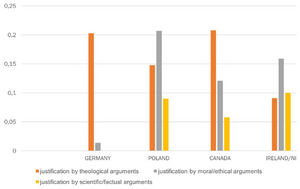
In examining the Roman Catholic Church, communication in public documents shows that Canada, Poland, and Ireland/Northern Ireland used, first, more justification in general, and second, more theological arguments than Germany (see Figure 5). Even though the Roman Catholic Church in Germany also used more theological arguments, the proportion of theological argumentation in other contexts was significantly higher and differed markedly from the moral and scientific justifications.
In the Canadian public documents, justification by theological arguments was often used to make sense of difficult situations or issues raised by the pandemic in order to incorporate it within the Christian narrative. As Colin et al. stressed: “theological justifications, biblical stories and parables are widely used to justify the pandemic and the behavior to adopt from a Christian narrative” (2023, 8). Bible passages and the examples of saints or Christ himself were applied to illustrate social challenges like isolation:
The Gospel writer Mark relates a story of how Jesus responds to a person in this condition, someone who is treated as an outsider or an “outcast.” The person is a leper (Mark 1:40–45). The image of being treated as a leper often means being rejected or excluded. The Old Testament passage from the Book of Leviticus describes the fate of such lepers in the community (Lev. 13:1–2, 45–46). The leper was regarded as a threat, for their disease could infect the community. The response was to drive them out, exclude them from contact with others. How do you like that? Such a person was condemned to isolation, cut off from family, from neighbours, from friends. They were doomed to live “outside the camp” by themselves. … In Mark’s Gospel, Jesus encounters a leper facing such exclusion. The leper asks for healing. Jesus responds with compassion. He reaches out and touches the leper. It is a significant action on Jesus’ part. He crosses the boundary of exclusion, both the physical barrier and the ritual one.
Jennings 2021
In addition, theological rationales were frequently used to contextualize and explain both the intensity of the illness and its quick proliferation:
We know all too well that breath is life. If we cannot breathe, we die. Covid-19 causes a respiratory type of infection in the lungs marked by shortness of breath and difficulty in breathing. In the Bible, breath is a symbol for the Holy Spirit. The Hebrew word for spirit “ruah” occurs over 300 times in the Old Testament, from the very first chapter of Genesis. “Ruah” means “breath.” The beginning of Genesis tells us, God’s Spirit was “sweeping over the waters of chaos and darkness.” God forms the first human from the soil and breathes life into it and the human begins to breathe. We began through the “life-giving” breath of God and each breath we take is an ongoing gift. We breathe in, we breathe out. We are alive because of God’s breath in us.
Kirkpatrick 2021
Figure 5
Roman Catholic documents in Germany, Poland, Canada, and Ireland/Northern Ireland: frequency of the code “justification”
Citation: Journal of Religion in Europe 19, 1-2 (2026) ; 10.1163/18748929-bja10156
In contrast to a theological justification for correct Christian behavior due to the pandemic, the Polish public documents went a step further and emphasized that the vaccination is considered as “a gift from God” and “is rediscovering its mission to proclaim Christ as a source of hope, consolation and strengthening in an age of growing anxiety” (Rabiej-Sienicka and Kołodziejska 2023, 7). In addition, the authors presented religious practices such as prayer and sacraments as effective against the pandemic.
Drawing on papal rhetoric that characterizes the church as both field hospital and sacrament of salvation, the Polish public documents advocated for maintaining access to places of worship. While respecting health protocols, they contended that churches offer irreplaceable spiritual nourishment and peace through unique encounters with divine presence and love, especially via the Eucharist. Similar to the German Muslim documents, they framed suffering through a theological lens; here, through Pope John Paul II’s papacy, marked by personal adversity. When it comes to the meaning of suffering, Christ is portrayed as the source of hope in the midst of pain and mortality. However, the pandemic as caused by God is rejected: “It is incompatible with the biblical image of God to show Him as an unmerciful judge, a heartless controller of human actions, a vengeful tyrant or, on the opposite, an indifferent ruler of the world, a distanced observer of the human theatre of history” (KEP 2020).
Although public documents from Ireland/Northern Ireland employed more theological arguments than their German counterparts, their approach shares notable similarities. Rather than focusing on specific scriptural passages, the theological discourse emphasized the broader Christian vocation, with biblical references appearing only sporadically. Community care and protection of vulnerable populations emerged as simultaneously moral imperatives and theological mandates, with these dimensions often interlinked. This dual responsibility was characterized as fundamental to Christian identity and behavior: “Jesus spoke of the greatest commandment as being the commandment to love—to love God and to love neighbour as yourself; we are learning through this crisis that every single one of us can contribute to spreading that love to help protect the most vulnerable” (Martin 2020).
The communication in the Catholic religious media was also different from that in Germany.
Figure 6
Roman Catholic media in Germany, Poland, Canada, and Ireland/Northern Ireland: frequency of the code “justification”
Citation: Journal of Religion in Europe 19, 1-2 (2026) ; 10.1163/18748929-bja10156
At first glance, it can be seen that theological justifications were very high in both Germany and Canada (see Figure 6). Similar to the documents in the German discourse, however, it is striking that fewer justifications were used overall: Germany stands out with only 20 percent justifications when all three forms are combined, which is significantly below the 34 percent to 45 percent found in other countries. This could indicate that the Roman Catholic Church in Germany did not consider it necessary to legitimize its position during the pandemic, or if so, only with the help of theological justifications. The situation is different in other contexts: Here, the Roman Catholic media also cited scientific justifications and moral justification took on a greater significance.
In Ireland/NI and Poland there was dominance of theological argumentation, in contrast to Germany and Canada; instead, the moral justification was more important. In the case of Ireland/Northern Ireland, this can be explained by the fact that the emphasis was on a provaccination stance and the church saw itself more in an educational role in educating the population about health:
Justification for following governmental guidance and restrictions was given primarily via moral arguments, centering our duty to the most vulnerable, and respecting the work and dedication of health and social care workers. Moral arguments linked to the sacrifice of key workers—the public should follow guidelines as a mark of respect to those who are working to keep all safe.
Ni Dhonaill and Ganiel 2023, 7
And also in Poland, moral arguments were used mainly in connection with the topic of new pandemic regulations and the moral justification of COVID-19 vaccines, usually as a mixture of appeals to unspecific Christian values and general appeals to humanity and civic values. In some cases, the articles cited prominent clergy members who urge people to pass the test for humanity during the trying times of the pandemic.
Interestingly, the other Christian group in Poland, the Polish Autocephalous Orthodox Church (POC) showed a significantly different picture: Here, the authors did not use scientific or moral argumentation, but nearly 90 percent theological justifications. Quite similar to the Anthroposophical Society in Germany and in contrast to all other groups, it framed the pandemic as a man-made atrocity. The pandemic was interpreted as a sign of a sinful lifestyle and the departure from traditional values, and the call was made for a restoration of faith to restore balance. From their perspective, religion should be used as a tool to combat the pandemic. The POC church understood well-being as a holistic combination of mental and physical health, with mental health playing an important role in overcoming difficulties, seeking comfort, and strengthening faith. However, the religious media used fewer theological argumentations (only 30 percent), but more moral argumentations and scientific argumentations, similar to the Catholic media in Poland. Moral arguments were used primarily to address contemporary issues such as sacraments, pandemics, and hope in difficult times. Responsible behavior and mutual understanding were encouraged. In addition, morality is often used in a negative sense, as an expression like “morally disturbed” and interpreted to mean disturbances in the moral behavior of individuals and of societies as such. In contrast, reference is made to Christian teachings, emphasizing the relationship between doctrine and moral principles.
3.2 The Muslim Framing of the COVID-19 Crisis in a Comparative Perspective
Comparing public documents and religious media from Muslim groups, we can see a striking difference between Canada and Germany, as well as Ireland/NI (see Figure 7).
Whereas the Christian groups in Canada used a dominant theological justification and in Germany and Northern Ireland/NI it played a less important role, it is the other way around for Muslim groups. There were dominant theological argumentations in the latter, but not in Canada, where scientific argumentation played a more important role. As in the Christian public documents in Germany, the Muslim groups’ cooperation with the state and the compliance with the COVID-19 restrictions was the main focus:
MAC’s [Muslim Association of Canada] membership, staff and volunteer communities are ready to support government initiatives that help protect vulnerable citizens of our society. We will do this to the best of our capacity, while following the official health and safety standards and directives. We understand the current circumstances are both ambiguous and unlike anything witnessed before and we are committed to ensuring Canada is safe for everyone.
MAC 2020
Figure 7
Muslim documents in Germany, Poland, Canada, and Ireland/Northern Ireland: frequency of the code “justification”
Citation: Journal of Religion in Europe 19, 1-2 (2026) ; 10.1163/18748929-bja10156
Both Muslim organizations in Canada advocated vaccination (some of the groups’ affiliated mosques served as vaccination centers), and there was no discussion or disagreement regarding the nature of the vaccine as such. Instead, both organizations exhorted their members to get vaccinated as soon as possible. Overall, it appears that in Canada, however, Muslims seem to use a much more secularized communication than Christian religions. A hypothesis is that Muslims struggle to appear acceptable in the general secularized Canadian context (cf. Lefebre, this issue). Another explanation could be that Muslims in Canada are highly educated and are mainly active in the health and science sectors. This, in turn, could also explain the results in Germany for the Christian churches, because they also play a strong role in the healthcare and education sectors, which were highly affected by the pandemic.
Similar to the German case, in Ireland/Northern Ireland, the most prevalent type of justifications in Muslim writings were theological ones, specifically grounded in scripture. There were allusions to the virus’s propagation as a particular transgression of Muslim teachings, as well as quotes from the Prophet Muhammad regarding other health-related issues. The Muslim documents reminded their followers that not spreading diseases has Qur’anic justification and follows the words of the Prophet Muhammad:
Adhering to statements issued by the state officials and Fatwas issued by great scholars, we recommend that mosques and Islamic centers remain closed and establish Salahs in congregations and Dhuhr instead of the Friday Salah at home to avert harm and protect people’s lives, a well-established and essential aspect of Islam and one of its mandated duties that preaches protection of life and safeguarding it against any harm. It is worth mentioning here that any step leading to transmitting this virus, taken while being aware, is a wrongdoing and represents a violation of Islamic teachings and the guidance of the Prophet Muhammad, peace be upon him. It could amount to the reason for killing if it leads to someone’s death. Allah says: “if any one slew a person—unless it be for murder or for spreading mischief in the land—it would be as if he slew the whole people: and if anyone saved a life, it would be as if he saved the life of the whole people.”
ICoI 2021
In addition, no moral argumentation was used in the Canadian and Irish/NI documents.
4 Conclusion
To sum up, the Christian groups in the respective countries showed differences: while in Canada and Poland the Catholic Church had a high level of religious communication, communication on the island of Ireland and in Germany was primarily moral in order to engage with secular societies. This adaptation reflected an effort to remain relevant by adapting to the prevailing social norms. However, a divergent picture also emerges among the smaller religious/ideological groups: smaller religious groups in Germany, Canada, the island of Ireland, and Poland maintained a more religious communication compared to larger Christian organizations. Only in Canada did Muslims—similar to the Christian organizations in Germany and Ireland/Northern Ireland—show increased secular communication.
Looking at Germany and Canada as both highly secularized countries reveals interesting differences: In contrast to the lower degree of religious communication by the Christian churches in Germany, the opposite is the case in Canada. This finding also correlates with the churches’ differing criticism of state restrictions. While there was considerable criticism from the churches in Canada, this was hardly the case on the German side, if at all, only toward the end of the pandemic. The lack of criticism can probably be explained by the different positions of churches within society: In contrast to the independence of churches in Canada, churches and the state in Germany are closely intertwined, and churches are more dependent due to their role in education and healthcare, two areas that have been highly affected by the pandemic. In this sense, it is therefore not surprising that the pandemic was not interpreted explicitly from a Christian perspective, but rather in the language of the healthcare system.
However, since they did not develop and communicate any specifically religious interpretations of the COVID-19 crisis, it can be said in agreement with Hillenbrand and Pock (2023), that the churches left the authority to interpret the crisis to health and political systems, which became the leading interpretative systems in society during the crisis. In line with the observations of Stichweh (2022) and Körtner (2021) on the lack of religious interpretation of the crisis, it can be concluded that they responded to the crisis by attempting to adapt their language to a society that is perceived as secular, focusing on moralization instead of using Christian semantics. In doing so, they have adapted to and subordinated themselves to the dominant social systems during the pandemic. It can therefore be assumed that secularization theories are not only referenced by the churches, but influence their actions and communication, prompting them to voluntarily give up rights and claims that previously seemed self-evident. In contrast to the case of Germany, no subordination and adaptation to the prevailing social system can be observed in the other countries—if at all, then at most in the case of Ireland/NI.
Cf. for the political structure of Germany Sander, this issue.
All translations from German sources were translated by the author.
See the introduction of this special issue for details about the project’s rationale, methods, and data sources (Ganiel et al., this issue). A much fuller explanation has also been published (Radde-Antweiler et al. 2026). The research was funded in whole by the Trans-Atlantic Platform RRR Call 2021 and by the Deutsche Forschungsgemeinschaft.
References
Antes, Peter. 1988. “Religiöse Deutungssysteme und Ethik” in Hartmut Zinser (ed.), Religionswissenschaft: Eine Einführung, Berlin: Reimer Verlag, 155–163.
BE. 2020. “Mikroskopisches Virus fordert Glauben heraus.” 30 October. www.bayern-evangelisch.de/pressemitteilung-30-10-20.php.
Burchardt, Marian, and Monika Wohlrab-Sahr. 2013. “Von Multiple Modernities Zu Multiple Secularities: Kulturelle Diversität, Säkularismus Und Toleranz Als Leitidee in Indien.” Österreichische Zeitschrift für Soziologie 38:4, 355–374.
Büssing, Arndt, Klaus Baumann, and Janusz Surzykiewicz. 2022. “Loss of Faith and Decrease in Trust in a Higher Source During COVID-19 in Germany.” Journal of Religion and Health 61:1, 741–766.
Claussen, Johann Hinrich. 2020. “Will Gott uns strafen?” Chrismon, 26 August. https://chrismon.evangelisch.de/artikel/2020/50549/antworten-auf-corona.
Colin, Mathieu, Solange Lefebvre, and Denitsa Tsvetkova. 2023. Research Report: Publications by Religious Organisations During the Covid-19 Pandemic in Canada, Recov-19: Religion Emerging from Covid, https://papyrus.bib.umontreal.ca/xmlui/handle/1866/28528.
EKD. 2020. “Nur der leidende Gott kann helfen: Wort zum Karfreitag vom EKD-Ratsvorsitzenden Bedford-Strohm.” 8 April. www.ekd.de/nur-der-leidende-gott-kann-helfen-54967.htm.
ELLS. 2020. “Kirche als Zentrum.” 20 May. www.evlks.de/aktuelles/alle-nachrichten/nachricht/kirche-als-zentrum/.
El-Menouar, Yasemin. 2023. “Die Bedeutung Von Religion in Zeiten Multipler Krisen” in Carolin Hillenbrand, Detlef Pollack, and Yasemin El-Menouar (eds.), Religion Als Ressource Der Krisenbewältigung? Analysen Am Beispiel Der Coronapandemie, Gütersloh: Bertelsmann Stiftung, 50–64.
Elsner, Regina. 2020. “Kirchen Und Die Corona-Krise in Osteuropa: Nur Der Glaube Hilft?” ZOis Spotlight 12. www.zois-berlin.de/publikationen/2020/kirchen-und-die-corona-krise-in-osteuropa-nur-der-glaube-hilft.
Frey, Regina M. 2021. “‘Wir haben in dieser Zeit keinen Ort.’ Verantwortbare Pastoral in der Pandemie” in Stefan Mückl (ed.), Religionsfreiheit in Seuchenzeiten, Berlin: Duncker & Humblot, 285–297.
Fritz, Martin. 2020. “Zwischen Unvernunft Und Übervernunft: Religöser Enthusiasmus Als Faktor Der Corona-Krise” in Jeannine Kunert (ed.), Corona Und Religionen: Religiöse Praxis in Zeiten Der Pandemie, Berlin: EZW, 13–34.
Geiger, Katharina. 2020. “Anselm Grün: Suche nach neuer Form und Sprache für die Kirche.” katholisch.de, 2 September. https://katholisch.de/artikel/26732-anselm-gruen-suche-nach-neuer-form-und-sprache-fuer-die-kirche.
Grünenthal, Hannah. 2023. Research Report: Publications by Religious Organisations During the Covid-19 Pandemic in Germany, Recov-19: Religion Emerging from Covid. doi.org/10.26092/elib/2277.
Hillenbrand, Carolin. 2020. “Studie Zu Religion Und Gesellschaftlichem Zusammenhalt in Zeiten Der Corona-Pandemie: Factsheet: Ergebnisse Für Den 1. Zeitraum Von Juli Bis Oktober 2020.” Unpublished manuscript, https://www.uni-muenster.de/imperia/md/content/religion_und_politik/aktuelles/2020/11_2020/factsheet__religion_und_gesellschaftlicher_zusammenhalt_in_zeiten_der_corona-pandemie.pdf.
Hillenbrand, Carolin, and Johann Pock. 2023. “Religiöse Und Spirituelle Ressourcen, Deutungsmuster Und Bewältigungsstrategien” in Carolin Hillenbrand, Detlef Pollack, and Yasemin El-Menouar (eds.), Religion Als Ressource Der Krisenbewältigung? Analysen Am Beispiel Der Coronapandemie, Gütersloh: Bertelsmann Stiftung, 15–49.
ICoI. 2021. “Irish Council of Imams: Ramadan 2021 in light of Covid-19.” 12 April. https://islamireland.ie/news/irish-council-of-imams-ramadan-2021-in-light-of-covid-19/.
Jennings, John. 2021. “Reflections from Fr Jennings: Our Sacred Stories—Life in the Reign of God: A Place of Inclusion and Openness.” holyspiritrcparish.ca, 16 February. https://www.holyspiritrcparish.ca/reflections-from-fr-jennings-our-sacred-stories-life-in-the-reign-of-god-a-place-of-inclusion-and-openness/.
KEP. 2020, “Nota Komisji Nauki Wiary Konferencji Episkopatu Polski w związku z pandemią koronawirusa.” Konferencji Episkopatu Polski. https://episkopat.pl/nota-komisji-nauki-wiary-konferencji-episkopatu-polski-w-zwiazku-z-pandemia-koronawirusa/.
Kesici, Burhan. 2020. “Ramadanbotschaft.” Koordinationsrat der Muslime, April 21st. http://koordinationsrat.de/ramadanbotschaft.
Kirkpatrick, Wayne. 2021. “Pentecost Pastoral Letter 2021.” 21 May. https://www.antigonishdiocese.com/the-gifts-of-the-holy-spirit/.
Kleine, Christoph. 2016. “Niklas Luhmann Und Die Religionswissenschaft: Geht Das Zusammen?” Zeitschrift für Religionswissenschaft 24:1.
Körtner, Ulrich H.J. 2021. “Religion, Pandemien und Ethik. Eine diakonisch-ethische Perspektive auf die Corona-Pandemie” in Andreas Reis, Martina Schmidhuber, and Andreas Frewer (eds.), Pandemien und Ethik: Entwicklung—Probleme—Lösungen, Berlin: Springer, 351–366.
Luhmann, Niklas. 2000. Die Religion Der Gesellschaft, Berlin: Suhrkamp.
MAC. 2020. “Urgent Update: MAC Shuts Down All Physical Workplaces & Public Spaces Across the Country and Transferring to Online Programming.” 24 March. www.macnet.ca/2020/official-statements/mac-shuts-down-all-physical-workplaces-public-spaces-across-the-country-and-transferring-to-online-programming.
Martin, Eamon. 2020. “Church is Showing Solidarity and Compassion in a Time of Social Distancing—Archbishop Eamon Martin.” The Way, 23 March. https://catholicnews.ie/church-is-showing-solidarity-and-compassion-in-a-time-of-social-distancing-archbishop-eamon-martin/.
Mayring, P. 2014. Qualitative Content Analysis: Theoretical Foundation, Basic Procedures and Software Solution, Klagfenfurt: n.p. https://nbn-resolving.org/urn:nbn:de:0168-ssoar-395173.
Mückl, Stefan. (ed.). 2021. Religionsfreiheit in Seuchenzeiten. Berlin: Duncker & Humblot.
Ní Dhónaill, Caoimhe, and Gladys Ganiel. 2023. Research Report: Publications by Religious Organisations During the Covid-19 Pandemic in Ireland, Recov-19: Religion Emerging from Covid. https://pureadmin.qub.ac.uk/ws/portalfiles/portal/499939197/TAP_short_report_IRELAND_final.pdf.
Rabiej-Sienicka, Katarzyna, and Marta Kołodziejska. 2023, Research Report: Publications by Religious Organisations During the Covid-19 Pandemic in Poland, Recov-19: Religion Emerging from Covid. doi.org/10.18150/UNSWEH.
Radde-Antweiler, Kerstin, Solange Lefebre, and Glady Ganiel. 2026. “The Changing Role of Religion in Societies Emerging from Covid-19. Research Project Methodology.” ZeMKI Working Papers 55. doi.org/10.26092/elib/5477.
Reck, Julia. 2020. “Lieberknecht Verteidigt Ihren Vorwurf Gegen Die Kirchen: Es Gibt Situationen, in Denen Briefe Und Anrufe Nicht Reichen.” domradio.de, 19 May. www.domradio.de/artikel/es-gibt-situationen-denen-briefe-und-anrufe-nicht-reichen-lieberknecht-verteidigt-ihren.
Schikarski, Christian. 2021. “Pandemie—eine menschheitliche Bedrohung.” Anthroposophy, 5 May. https://www.anthroposophische-gesellschaft.org/blog/pandemie-eine-menschheitliche-bedrohung.
Schlag, Thomas, Ilona Nord, Wolfgang Beck, Arnd Bünker, Georg Lämmlin, Sabrina Müller, Johann Pock, and Martin Rothgangel (eds.) 2023. Churches Online in Times of Corona: Die CONTOC-Studie: Empirische Einsichten, Interpretationen Und Perspektiven, Wiesbaden: Springer VS.
Schmock, Michael. 2021. “Zum Jahreswechsel 2020–2021: Eine Perspektive auf die Herausforderungen im Corona-Jahr.” AGiD Newsletter 2021:1, 2–4.
Stichweh, Rudolf. 2020. “An Diesem Imperativ Kann Die Politik Scheitern.” Frankfurter Allgemeine Zeitung, 6 April.
Stichweh, Rudolf. 2022. “Resonanz Auf Das Virus: Die Coronapandemie Als Die Pandemie Einer Kommunikationsbasierten Weltgesellschaft” in Ulrich Stephani, Konrad Ott, and Claudia Bozzaro (eds.), Die Coronavirus-Pandemie und ihre Folgen, Kiel: Universitätsverlag Kiel, 379–401.
Türkmen, Kazim. 2020. “Ansprache von Kazim Türkmen, DITIB-Bundesvorstandsvorsitzender.” Türkisch-Islamische Union der Anstalt für Religion, 27 March. https://www.ditib.de/detail1.php?id=702&lang=de.
Vandevelde, Pol. 2001. “Communication and Rational Justification: A Phenomenological Stance.” Philosophy & Social Criticism 27:6, 55–79.
Wilke, Annette. 2013. “Säkularisierung Oder Individualisierung Von Religion? Theorien Und Empirische Befunde.” Zeitschrift für Religionswissenschaft 21:1, 29–76.
Wohlrab-Sahr, Monika. 2019. “Umkämpfte Säkularität—Streit Um Die Grenzen Der Religion” in Friedrich W. Graf and Jens-Uwe Hartmann (eds.), Religion Und Gesellschaft: Sinnstiftungssysteme im Konflikt, Berlin: De Gruyter, 21–48.
Yelle, Robert A. 2025. “Secularization: Transformations of Religion and Politics in Western Europe (and the US)” in M. Stausberg and K. Wilkens (eds.), Religionswissenschaft: Aktuelle Annäherungen, Berlin: De Gruyter, 193–203.
Zaheen, Inaya. 2021. “Wie überleben wir in der Isolation?” Islamische Zeitung, 3 March. https://islamische-zeitung.de/wie-ueberleben-wir-in-der-isolation.
ZMD. 2021. “ZMD gibt Eil-Rundbrief wegen des neuen Bundesinfektionsgesetzes (Corona) an die Gemeinden heraus.” Zentralkomitee der Muslime in Deutschland, 23 April. www.zentralrat.de/33148.php.