Abstract
Since the 1990s, mapping religious plurality has become a research staple in the study of religions. Drawing on a sample of some sixty projects from the DACH (Germany [D], Austria [A], and Switzerland [CH]) region, the article uses dispositive analysis to show these mappings as a response to shifts in scholarly and public discourse as well as technological possibilities. The discursive practices, material forms, and institutional underpinnings that constitute the mapping dispositive show these projects as a discursive infrastructure that produces valid knowledge about religion in the contemporary world and the positionality of the study of religions in this discursive formation.
Imagine a mapâprinted or digital. The usual background of muted grays, greens, and blues is dotted with familiar, colorful symbols. They seem to proclaim to the user âLook! Here is, pinned down for your convenience, the notoriously elusive thing we call the local plurality of religions, and all you need to know about it.â During the past three decades, mapping religious plurality in different European local settings has become a staple of empirical research in the study of religions (Kühle and Hoverd 2018, 1; Griera 2018, 45; Stausberg 2009, 106; Hafner, Völkening, and Becci 2018, 14).1
The emergence of this type of project is situated at the interface between research on religious plurality or diversity and spatial research on religion. Both saw a parallel and interrelated increase in interest in scholarly discourse in the 1990s and especially in the 2000s (Knott 2010, 30; Kong 2004, 367). With a reluctant attention to religion developing into a âburstâ in cultural geography literature (Kong 2010, 756; Büttner 1985) and with the influence of the spatial turn placing space âfirmly on the agenda of the study of religionsâ (Knott 2010, 31), a new geography of religion discourse has emerged in these two decades. This discourse was characterized by a greater interdisciplinary openness and new topics (Kong 2001; 2010; Knott 2005b): Geographers of religion took up insights from religious studies on the constructed nature of religion (Ivakhiv 2006), while scholars of religion moved toward a situational understanding of (sacred) space as a product of human praxis (Chidester and Linenthal 2005; Smith 1987). This fueled a mutual interest in current issues of power- and identity-related politics of religious space and place (Kong 2001, 213â218, 222â224).
Religious communities in the sociopolitical context of plural society became topical (Kong 2004, 367; Knott 2010, 30), both in research and in the public eye. Migration (Kong 2010, 760â762; Martikainen 2004), globalization (Knott 2005a, 110â117; Beyer 2011), and locality (Knott 2005a, 118â122) became major themes at the intersection of religion, diversity, and space. The mappings of religion are one specific type of research that emerged at this intersection. They fell squarely within the discussion of âhow migration impacts on religious landscapes of receiving countriesâ (Kong 2010, 760). However, contrary to the overwhelming focus on Islam, criticized by Kong, they deliberately included âother religions, including new religions and those ⦠outside the âworld religionsââ¯â (762), as well as inner-Christian diversity. Among the strengths of these âlocalised studies of religion,â Knott saw their âlocal engagement,â âpedagogical value,â and exploratory potential (2005a, 119â¯f.), but she identified a lack of âattention to theorisation of space and place and the ideological forces at work within themâ (120). While her own work remedied the former (Knott 2005b), the latter has been addressed more recently by a reflexive approach to mapping studies, with contributions such as Griera, Müller, and MarÃnez-Ariño (2023), Griera (2018), Prideaux (2014), and Ahlin et al. (2012).
Building on these critical examinations of selected projects and on efforts to provide a comparative account of mappings in different localitiesâas presented in Stausberg (2009), Kühle and Hoverd (2018), or Monnot and Stolz (2018a)âthis article takes this endeavor a step further: It will provide a systematic analysis of roughly sixty projects conducted in the DACH region in the three decades between 1990 and 2019, giving it an explicit sociology of knowledge twist.2 The paper analyzes the discursive formations that have shaped the disciplineâs knowledge production by looking at the mappings of plural local religious landscapes as a dispositive in which the study of religions is involved.
A dispositive is the constellation of all elements involved in discourse production deployed to address specific discursive problemsâor âurgent needsâ (Foucault 1978, 120)âby generating knowledge that is validated as âtruthâ by the power-imbued rules of said discourse (see below).
The article conducts a dispositive analysis and asks: What does the emergence and development of mappings of religious plurality as a type of research tell us about the material and discursive formations of power and knowledge production, under the influence of which the study of religions has evolved in recent decades? How do the mappings address, model, and represent the idea of the plurality of religions over time? And what âurgent needâ is this responding to?
After introducing the theoretical perspective, its operationalization, and the method, the main section will sketch the mapping dispositive. To show how material and discursive practices interlock (Keller 2011a, 138), the analysis starts by examining how the material forms of representation have changed over time. It then goes on to look at the relationships between what the artifacts display as being diverse, the actors and institutions involved, and the disciplinary and thematic strands of discourse that emerge from these projects.
In this way, the mapping projects are presented as a dispositive by which producers and users of such mappings account for religious plurality and address the perceived societal âurgent needâ that is the changing role and form of religion in contemporary (European) societies. The âurgent needâ for this specific kind of knowledge came out of a sociopolitical context in which religious change that had occurred in the second half of the twentieth century turned into the fiercely contested question of how to practically deal with what was perceived as inexorable pluralization. The general diagnosis of increasing religious plurality was met, on the one hand, with a mix of fascination for pluralism and ânewâ religions as well as fear of extremism and anomie (Beutter and Kühle, forthcoming). On the other hand, pluralism became the object of contempt in populist and nativist politics growing in Europe (Wolfart 2018).
The analysis will show the role and position of the study of religions in this discursive formation producing âtruthâ about local religionâthat is, knowledge that is discursively sanctioned as valid.
1 Mappings as a Dispositive
The term mapping project is often used as a collective term for qualitative, descriptive, and comparative studies that investigate religious plurality in local contexts. The studies document the meso-level of the religious landscape, by surveying and documenting the religious communities of a city or a region. As a collective term, and also as a self-designation, mapping of religions is usually used, regardless of whether or not the projects in question include any cartographic representations (Martikainen 2002; Stolz and Monnot 2020, 135). Indeed, the analysis will show that cartographic maps are not the raison dâêtre of the dispositive; rather, they seem to have emerged as a convenient afterthought. Despite the obvious spatial connotation and framework of the mappings, this aspect is only rarely reflected upon explicitly (Knott 2005b, 166). Rather, it seems they âhave been caught up in the spatial turn, without engaging directly in theoretical debates about spaceâ (Knott 2010, 36) or the implications of spatial representation of religion (Griera, Müller, and MartÃnez-Ariño 2023).
In the study of religions, the emergence of mapping projects is part of a larger trend that saw research being reoriented toward studying religion/s as contemporary localized forms (Seiwert 2021, 60â66; Prideaux 2014, 36â¯f.; Kühle and Hoverd 2018, 2; Stolz and Monnot 2020, 135â¯f.; Knott 2005a, 118). So too in the literature on religion and space: The earlier preoccupation with major âofficially sacredâ (Kong 2001, 226) sites of dominant religious groups was complemented by a new interest in the ordinary, small-scale, and private sites of religion in practice (Knott 2005a, 96â¯f.). Mappings are at a middle distance between these two: They still locate the âofficially sacredâ places of religious groups, but since they focus on the local and on minority religions, they include the less conspicuous sacred placesâthe mundane, makeshift, and often semi-privateâas legitimate parts of the spatial imagination of the religious landscape.
Early mapping projects marking this shift are the Community Religions Project, Leeds (Knott 1984), and the Religious Field in Turku project (Martikainen 2004, 11â16), both of which started in the 1970s. Also of note are two projects which started in the early 1990s: the World Religions in Greater Boston project, which grew into the internationally renowned Pluralism Project (Eck [1997] 2002; Eck, Pierce, and Wagner 2000), and the Religiöse Gemeinschaften in Bremen project (Meier-Hüsing 1990). The heyday of such projects came in the 2000s, a period in which the new approaches consolidated (e.g., Ammerman 2007, or the conceptual outlook of this very journal, established in 2008). And the projects inspired renewed interest in the comparative analysis of the religious group as a sociological object of study (Monnot and Stolz 2018b).
We can now see that the emergence of mapping projects as a specific form of research on religious diversity and space is linked to the confluence of three major developments in (1) research discourse on religion, (2) the social-political discourse on religion, and (3) technological possibilities.
-
In the study of religion, a radical cultural turn has taken place since the 1980s. Scholars turned away both from the phenomenological theories and from predominantly historical and philological methods, and instead increasingly dealt with lived religion and contemporary contexts. Ethnographic and sociological methods were particularly used for this purpose (Gladigow and Kippenberg 1983; Auffarth, Grieser, and Koch 2021; Seiwert 2020, 61; Knibbe and Kupari 2020, 158; Knott 2005b, 166â175). At the same time, in the sociology of religion, the secularization thesis lost its hegemony, and the pluralization thesis gained ground (Stark and Bainbridge 1985; Heelas and Woodhead 2005; Pollack 2003; Liedhegener 2018). Moreover, cultural geography advanced a constructivist critical view of maps as mediums of power against a predominantly positivist understanding of mapping (Ash, Kitchin, and Leszczynski 2018; Pavlovskaya 2016; Pickles 2004; Harley 2001).
-
This concurred with the popular rhetoric of the âreturn of religion,â which notably played out in governance agendas regarding migration, globalization, or multiculturalism (Riesebrodt 2001; Burchardt 2017; Beyer 2011, 186â¯f.; Griera 2018), and in fierce political contestation over them, as discussed above. It equally played out in the popular discourse on âcults,â entailing the development of âcult-watchingâ infrastructures (cf. Wyttenbach 2023; Usarski 1988; Baumann 1998).
-
This happened at a time when the digital revolution was profoundly changing scholarly knowledge production and dissemination: from digital text-processing to dynamic forms of publication through websites and apps, and from new ways of relating information via hypertext and digital databases to the vast array of new options for data-analysis and -visualization developed by digital humanities. In cartography, the digital turn facilitated the evermore far-reaching use of geographical information systems (GIS) with their power to aggregate immense amounts of different geocoded data into multilayered digital representations. What is more, from former expert and military use, these digital mapping technologies became widely popularized (Ash, Kitchin, and Leszczynski 2018; Pickles 2004, 145â175; McQuire 2019; Drakman and Gelfgren 2023). Participatory options of popular map mashup applications such as Google Earth, OpenStreetMap, or Google Maps, made the creation of maps increasingly accessible to nonspecialists. They made it possible to overlay map tiles with different datasets and to embed them in third-party websites such as those of the mapping projects (McQuire 2019, 152).
As we will see in the analysis, these processes were important preconditions that enabled the emergence of a tradition of mapping projects.3 Conversely, mappings of religious plurality are an excellent case for showing how this shifting discourse translated into a persistent, materially based infrastructure of knowledge production and representation that, in turn, contributed to producing the discourse at hand.
As coined by Foucault, and elaborated by Keller and Bührmann, amongst others, the idea of the dispositive embeds the discursive as the said, in its practical, material, and temporal conditions. Dispositive analysis thus counters approaches that reduce discourse analysis to a focus on language and text, and instead foregrounds practice and materiality as an integral part of a broader concept of discourse (Diaz-Bone 2022, 9; Keller 2011b, 31; Bührmann and Schneider 2007).
A dispositive is a historically specific configuration of heterogeneous elements that, together, make up the concrete, materialized patterns that institutionalize a discourse (Keller 2011a, 259). They include discursive (i.e., mediated by text or language) and nondiscursive practices, material artifacts, people, and institutions. Keller, somewhat rephrasing Foucaultâs (1978, 119â¯f.) famous list, describes it as âthe sum total of all the material, practical, personal, cognitive, and normative infrastructures of discourse productionâ and âthe relations between all such elementsâ (Keller 2021, 41â¯f.). As such, the dispositive contains and preconfigures the âpractices of assertion, bound up with techniques of powerâ that determine what counts as âtruth in the sense of valid knowledge of realityâ (Diaz-Bone 2022, 16). The mutual production of knowledge and power finds its practical form in the dispositive. Dispositive analysis thus attempts to unearth how the material and the discursive (as language/text) interlock in a given order of knowledge, practice, and power which produces âtruthâ (Bührmann 2014, 41â46; Diaz-Bone 2022, 16â¯f.).
More specifically, dispositives are âinfrastructure[s] of discourse production and problem-solvingâ (Keller 2021, 41) with the function of intervening in practice (Keller 2011a, 258) and addressing societal issues or social problems that the discourse configures and marks as an âurgent needâ (Foucault 1978, 120; Keller 2011b, 41; Bührmann 2014, 43; Diaz-Bone 2022, 11). They grow out of social change, and have intended as well as unintended consequences, in the way they become realized in practice (Bührmann 2014, 46). Dispositive analysis, therefore, examines âthe strategic functions of power in the (practical) solutions of discursively generated societal/social problemsâ (43). To operationalize the dispositive, I created a sample starting from three pre-existing lists from different projects: One is a bibliography from the mid-2000s found in the archive of the Department for the Study of Religions in Lucerne, one an unpublished pilot study from the study of religions chair in Basel comparing mappings in the mid-2010s (Hoch 2015), and one was published and updated in several iterations (2005â2013) on the website of REMID (Religionswissenschaftlicher Medien und Informationsdienst).
This sample was expanded by further snowballing and by a literature review, to include roughly sixty projects in the DACH region from 1990 onwards. I compiled a database containing the dates and forms of publication, and the institutions responsible for each project. For a selection of projects I conducted a more in-depth document analysis (Davie and Wyatt 2012) to identify further elements of the dispositive that will be discussed here. To do so, I used a standardized data sheet for each project, covering seven categories: (1) precise form of the project, (2) topics and concepts addressed, (3) aims and normative motivations, (4) audience, (5) expertise/discipline of authors, (6) financing bodies, and (7) connections between projects.
The selection process followed the logic of theoretical sampling that dispositive analysis borrows from grounded theory methodology (Keller 2021, 49â¯f.). The projects were selected to cover all three decades, to show differences in the involved actors and their institutional affiliations, and to cover different forms of publication. The source material for this step was the output of the various projects, such as websites, books, brochures, or leaflets. Apart from samples from the content, I specifically analyzed the front and back matter, forewords, introductions, and (where applicable) conclusions and appendices. For the websites, I analyzed the main page and the âabout usâ page, as well as the content and structure of the menu of the site. Unlike project-internal data, these are the intended publicly accessible outcomes, by which the projects address the societal (including the scholarly) discourse from which they emanate and to which they contribute.
2 Material and Discursive Elements
A general idea of the formation of the mapping dispositive can be gleaned from the number of mapping projects over time. After a slow start in the 1990s there is a marked increase from the turn of the millennium onwards, with almost three times as many projects published in the 2000s. This trend died down somewhat in the 2010s, when the number of projects halved. The first mapping project in the DACH region was a handbook on religious communities in Bremen, produced by the study of religions program at Bremen University, and published in 1990. Rather than being the original goal of the project, it seems that this handbook emerged as a welcome by-product of an attempt at basic empirical research on the âintercultural and interreligious situation in Bremenâ (Meier-Hüsing 1990, 9).4 Year by year, more projects followed suit. This rate increased in the 2000s. The database lists eleven projects first published in the 1990s, all of which were located in Germany, thirty new projects in the 2000s, and thirteen new projects in the 2010s, now also located in Switzerland, Austria, and Liechtenstein. This trend remains if we also account for new editions from already existing projects (new projects plus further editions: 1990s: seventeen; 2000s: forty-one; 2010s: twenty-two). The image clearly shows the mid-2000s as the heyday of mapping: 40 percent of all the projects listed for the thirty years under scrutiny were published in the six years between 2003 and 2008 alone; this parallels the general development of research on religion and space, which saw a substantial proliferation during this decade (Kong 2010). In the late 2010s this productivity takes a dip, before resuming with new projects, especially in Switzerland, in the 2020s.
Additionally, it is noteworthy how common long-term projects are in the sample, with one-third of the projects running for ten or more years, and a few for over twenty years (e.g., Basel since 2000; Lucerne and Saxony since 2004/2005). Some are actively updated, others are more latent. However, through the sustained availability of their data, these projects remain part of the discourse, potentially carrying older layers of discourse, and evolving along the way.
Apart from the sheer increase in numbers, in the early 2000s we also see the mapping projects becoming more self-aware of being part of an interlinked discourse. This can be seen in cases such as the second edition of the handbook on religions in Bremen mentioning âa whole series of similar overview studies in other German citiesâ (Meier-Hüsing and Otten 2003, 11), that the first edition had supposedly inspired. A discursive occurrence that aimed to transform individual projects into a more concerted academic effort, or at least to connect local attempts at mapping religious landscapes, was the interdisciplinary conference jointly organized by REMID and the Institute for the Study of Religions in Leipzig in 2003 (REMID 2003). It is no surprise that REMID was instrumental in this, since it articulated this vision of an interlinked discourse early on: its project Marburg-Biedenkopf 1995 was the firstâand, until the early 2000s, the onlyâproject to explicitly situate itself as part of a series of âcity studiesâ (Ruttmann 1995, 8â¯f.), and it is on REMIDâs website that one of the lists used here for sampling was published (REMID 2013).
Following the idea of the material and discursive elements being interlocked in the dispositive, I will now unpack these components step by step, starting with the material artifacts of publication, followed by the actors and institutions, and ending with the textual discursive elements, the aims, themes, and urgent needs.
2.1 Artifacts of Representation and Units of Analysis
A closer look at the material formats of the project outputs over the three decades reveals a clear trend away from print, toward more dynamic forms of publication. This may be read as a direct expression of the changes in available technology, namely the internet, which was made public in 1993, and made its way into general use in Germany over the course of the 2000s. Not surprisingly, in the 1990s, all publications were in print. Notably, though, one of the projects (Hannover 1997) started updating its content on a web page in 1999.5 For reference, in 1999, not even 20 percent of the German population used the internet (Statista 2023), let alone hosted websites and used it for interreligious or science communication. In the 2000s roughly half of the projects used websites as their publication format, or as part thereof; in the 2010s this increased to two-thirds.

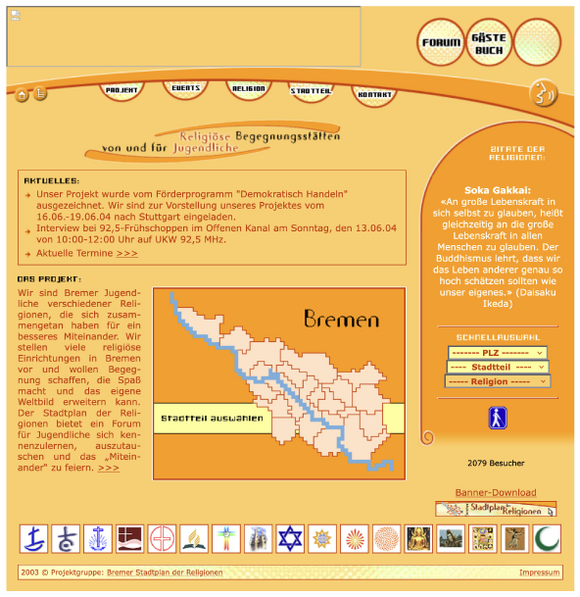
Figure 1
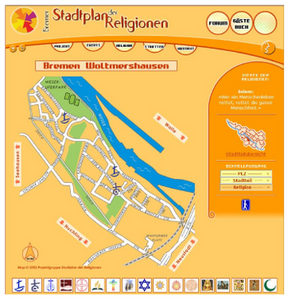
Detail from the home page of Bremen 2003
Citation: Journal of Religion in Europe 18, 4 (2025) ; 10.1163/18748929-bja10131
Bremer Stadtplan der Religionen 2003In most cases, the shift in medium from printed books to websites did not, at first, change the way information was organized. The structure of the websites commonly mirrored the content of the books or brochures, with some added information, such as link lists, illustrations, and maps (e.g., Hannover 1997, Ruhrgebiet 2009). However, in 2003 an interreligious youth projectâagain in the city of Bremenâproduced a web-based âcity map of religionsâ as both a means and a product of âinterreligious collaboration and dialogue amongst youth,â to âcelebrate togethernessâ and foster religious peace (Bremer Stadtplan der Religionen 2003; Figure 1). This first digital-born project in the DACH region used the new means afforded by an internet presence to locate places of various religious traditions spatially in the different city districts (Figure 2), as a means of incentivizing individual interreligious encounter. As such, it became a new, technologically mediated site of online religious spaces (cf. Kong 2001, 226).
Over the course of the 2000s, more digital-born projects followed suit. The Munich Schulprojekt, running from 2008 until 2018, was an extensive endeavor that likewise involved youth as addressees and collaborators, and produced maps as a means to display information, though this project had a different normative agenda. It was initiated and hosted by the chair for the study of religions at Ludwig-Maximilians-Universität München, and focused on training pupils and students in methods of fieldwork to produce systematic descriptive accounts of the local religions under the headings âsociology,â âaesthesis,â and âhistory.â It consisted of interconnected, systematically hyperlinked web pages displaying the results spatially, in maps of the city boroughs, but also in a list, sorted by tradition (Munich 2008; Projekt Religionen in München, n.d). Another study-of-religions-centered project that, from the start, used the online format as part of its output was the project Religionsgeographie im Kanton Luzern (Lucerne 2004, today Religionsvielfalt im Kanton Luzern). It started by documenting non-Christian religious minorities from 2002 onwards and later expanded its scope to include Christian communities too. The results were displayed in the form of leaflets (2004, 2005, 2009, 2016, 2024), video documentation available on DVD, and a public exhibition and a poster exhibition in 2005. Since 2005 it has hosted a website with descriptions of the documented religious communities (Baumann 2005, 62â¯f.). Since 2016 the website has evolved into a multimedia documentation that today includes an interactive map, an audio guide, video features, and photo documentation of religious places (University of Lucerne, Religionswissenschaftliches Seminar 2023).
Figure 2
Screenshot from the Woltershausen district
Citation: Journal of Religion in Europe 18, 4 (2025) ; 10.1163/18748929-bja10131
Bremer Stadtplan der Religionen 2003These examples show how technology affects not only the material format of publication, but the form of representation and structuring of findingsâfrom encyclopedia-type cataloging of descriptions and directory-style lists, to maps, and eventually to new media. Recent approaches use methods such as spatio-temporal data-visualisation (Drakman and Gelfgren 2023) or integrate geographical mapping with the mapping of social media networks, as in Vienna (YouBeOn 2024).
The influence of technology on the dispositive analyzed here is particularly apparent in the use of maps, where a clear trend is identifiable. The use of maps in the projects roughly parallels the uptake of online formats. Only one of the 1990s projects used maps: The Lexikon der Hamburger Religionsgemeinschaften, first published in 1994, and with further editions in 1995 and 1996, included maps (Grünberg, Slabaugh, and Meister 1994). These were placed in the appendix, but with a feature that is highly uncommon: it shows the historical transformation of plurality using several historical maps, as well as a contemporary one. Interestingly, later projects did not take up this approach, and it took almost a decade for the next projects to feature maps. From 2003 onwards we increasingly find maps being used: More than one-third of the projects published in the 2000s used maps, in the 2010s two-thirds of the projects did, as have all five projects observed so far for the 2020s. This parallels directly the development of web-based mapping with increasingly participatory features in the first two decades of the twenty-first century. The use of formerly rarefied satellite imagery and GIS infrastructure became accessible to a wide nonexpert demographic and resulted in the increasingly ubiquitous display of âdynamic, place-aware informationâ (McQuire 2019, here 153)âso too in the mapping dispositive.
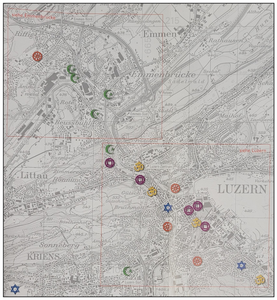
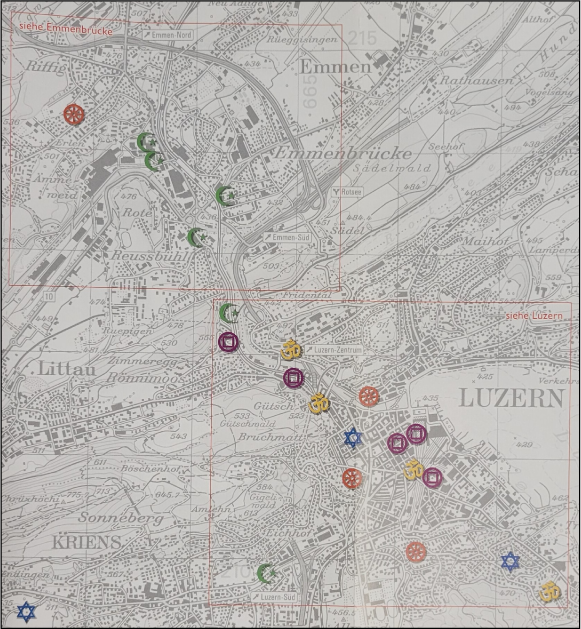
Before maps became prevalent, the generic model was encyclopedia-type cataloging, which, especially in the case of projects closer to the theological portion of the discourse, took inspiration from handbooks such as Eggenbergerâs ([1969] 2003) Kirchen, Sekten, Religionen. In contrast to these handbooks, which had a more general scope, and often an apologetic outlook, the mapping projects reoriented the perspective to the local setting, by giving descriptions of the establishment of the religious groups in the respective locality, complemented with addresses and contact details (Berlin 2003, Zurich 2004, Lucerne 2004). In a few cases these addresses were aggregated into directory-style lists (e.g., Bremen 1990, Hamburg 1994, Bonn 2003). From there, it was only a small step to town maps, albeit one with discursive consequences and technological preconditions (cf. Pavlovskaya 2016; McQuire 2019). Earlier publications that included maps had to work with specialized companies, or project partners such as the municipal mapping division. Later editions used increasingly easily accessible tools such as OpenStreetMap (available from 2004) or Google Maps (available from 2005), to produce their spatial-visual representation either in print or as plug-ins on the websites (e.g., Lucerne 2004, figures 3 and 4). It is not only the technologies used and the material forms of publication that are part of the mapping dispositive, however, but also that which is represented: Different elementsâsuch as buildings, gatherings, events and rituals, ideas or religious beliefs, organizations, as well as the topography and history of the respective city or regionâare linked via the mappings, and synthesized into a representation of the local religious field.
Figure 3
Detail from the Lucerne 2004 brochure
Citation: Journal of Religion in Europe 18, 4 (2025) ; 10.1163/18748929-bja10131
Map by Endoxon AG, using maps of the cantonal department for geoinformation and swisstopoFigure 4
Screenshot from the Lucerne Website (
Citation: Journal of Religion in Europe 18, 4 (2025) ; 10.1163/18748929-bja10131
Map created using the university websiteâs map plug-in based on Google MapsIt is thus important to observe what exactly the various projects identify as being diverse. What do they project as their unit of analysis, and what ordering logic is prevalent in their displays of information? Here, we identify four key forms:
-
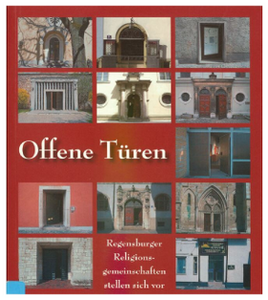
The handbook-style formats, in particular, project religious tradition as a neither spatially nor historically bound idea; with the different communities understood as a local manifestation of the tradition. This logic corresponds closely to how the âworld religion paradigmâ structures representations of religious pluralityâfor example, in childrenâs books, as discussed by Koch (2020). In the mapping projects, this commonly manifests in the structure of the table of contents or site menu, with an introduction to the most important religious teachings and historical trajectories of the âtradition,â followed by the local communities being grouped within the traditions accordingly. This logic also appears in the color-coding or symbols that structure the layout of pages, or that are used as markers on maps.
Figure 5
Cover juxtaposing the âopen doorsâ to religious places
Citation: Journal of Religion in Europe 18, 4 (2025) ; 10.1163/18748929-bja10131
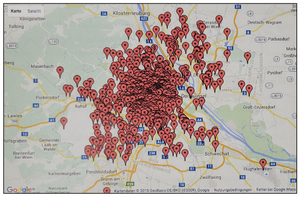
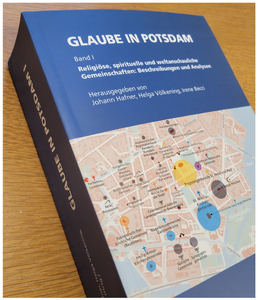
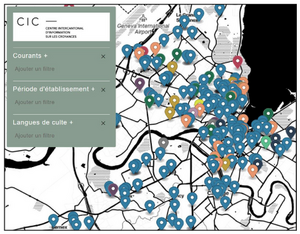
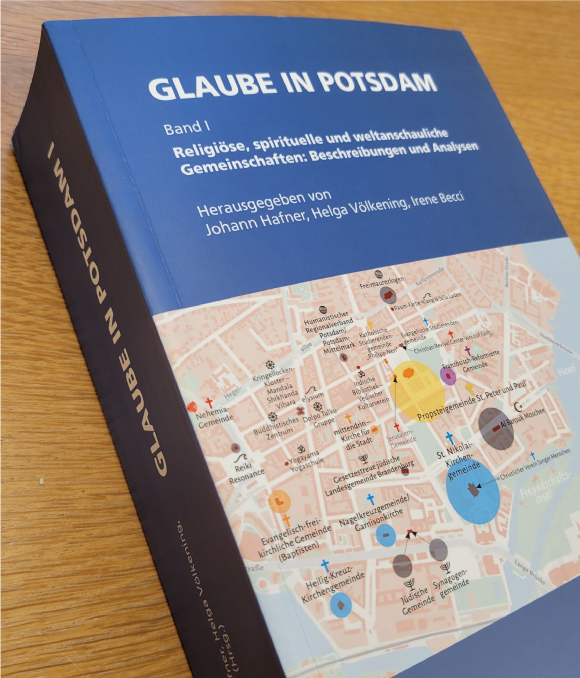
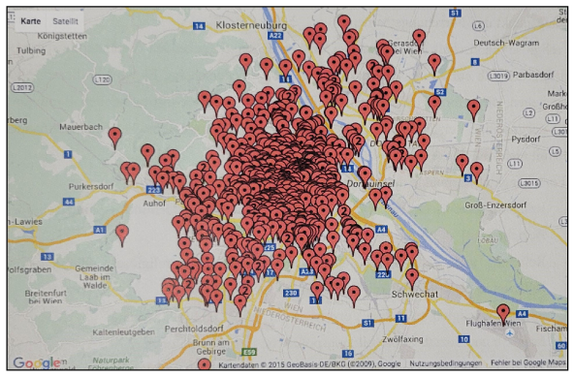
WCRP Regensburg 2008Projects are not always clear in identifying their main unit of analysis. Not least because the different forms of representation combine these aspects. For example, while maps operate with place as the central unit, the position on the map is conventionally marked by a color or symbol representing the tradition. The exception that proves this rule is Vienna 2011, where all places were marked in the same manner (Figure 6), which in turn was perceived as less accessible and convenient by users (Hoch 2015). Sometimes, as in the case of Potsdam 2018, the map includes a rough estimate of the number of adherents, which is displayed by circles of different sizes at a location on the map (Figure 7). The central unit of analysis often differs in different parts of the documentation, especially when a combination of media is usedâthis can be used as a deliberate tool, and thus be addressed explicitly in the analysis (e.g., Geneva 2012, see Figure 8; Munich 2008).
Figure 6
Screenshot of the map on the Vienna 2011 website (printed in Hoch 2015). As is often the case, the map cannot be displayed on the archived web page.
Citation: Journal of Religion in Europe 18, 4 (2025) ; 10.1163/18748929-bja10131
2.2 Infrastructures and Actors
What the projects end up presenting as diverse is the result of an interplay between the unit of analysis, the scheme of classification, and the form of representation.
The scheme of classification, and thus the arrangement of information, depends on the medium used, as does the form of representation. The unit of analysis depends on research pragmatics, such as the decision in the Bremen 1990 project to abandon the initial goal of including non-organization-based forms of religion, as a result of time and resource constraints, while nonetheless acknowledging their importance from a theoretical perspective (Meier-Hüsing 1990, 10). First and foremost, however, the unit of analysis depends on the explicit or implicit heuristics of how âreligionâ is defined and operationalized for analysis and representation (cf. Ahlin et al. 2012, 403).
In their âpractice of engaging with spaces, places, landscapesâ (Ivakhiv 2006, 172), mappings articulate and spatialize their respective meaning of religion by demarcation. In Ivakhivâs deconstructive view, âthe spaces in which the religious domain is clearly articulated as distinct from the secular ⦠appear as products of a very particular activity, a purification involving practices of sacralization and desacralization, with various supporting mechanisms and ongoing maintenance to keep this separation in placeâ (172). Putting the âreligiousâ dots on the âsecularâ gray backdrop and distinguishing them by different colors or symbols, the theoretical and practical decision of which groups to include and how to classify them are acts of such purification. And the mapping dispositive is part of the mechanisms of maintenance as it reifies specific distinctions between the religious and the secular (cf. Griera, Müller, and MartÃnez-Ariño 2023, 174â¯f.), as well as between and within religious traditions. This can turn not only against actors at the âfringesâ of the religious field, but also against dominant players, as Griera, Müller, and MarÃnez-Ariño (2023, 170â171) have shown. Both the definitions of religion and the classification systems depend on theoretical considerations, and ultimately on the normative positions and sociopolitical aims of the authors, organizations, and funding bodies behind the project in question; as the author of Marburg-Biedenkopf 1995 succinctly remarks: âthe structure of [these] books ⦠has a tendency to unwittingly reveal the theological or sociological background of the authorsâ (Ruttmann 1995, 8). However, pragmatic decisions depend not only on such normative aims, but equally on the available resources. These, in turn, depend on the relative position of power the actors hold in the discourse and, concomitantly, what funding providers the projects have access to.
Figure 7
Most of the over 800 pages of the Potsdam 2018 mapping (Hafner, Völkening, and Becci 2018) consists of descriptions of groups, while the map figures prominently on the cover. It displays the religious buildings, religious traditions and estimated membership numbers.
Citation: Journal of Religion in Europe 18, 4 (2025) ; 10.1163/18748929-bja10131
Figure 8
Screenshot of the Geneva 2012 interactive map with filter options âcurrents,â âperiod of establishment,â âlanguage of ritualâ (
Citation: Journal of Religion in Europe 18, 4 (2025) ; 10.1163/18748929-bja10131
Map tiles by Stamen Design, under CC BY 3.0. Data by OpenStreetMap, under CC BY SA).This leads us to the actors and institutions involved in the production of the mappings, and their intended audience. A general overview of the sample shows that the mapping projects were most commonly conducted either at a university or similar research institution, or by different kinds of NGOâ¯sâboth religious and secular. Only a handful were initiated by public authorities, and another handful in educational or journalistic contexts.
Out of the twenty-one university projects in the sample, sixteen were conducted or supervised by researchers connected to chairs for the study of religions, most of them during the 2000s. The rest were produced by various theology departments. The most common NGOâ¯s to engage in mappings of local religion were interreligious initiatives (nine out of the nineteen); six more were conducted by initiatives formed by study of religion students or graduates, and three of the nineteen NGO projects were produced by entities within the Catholic or Evangelical churches.
It is interesting to note that funds for this kind of research only rarely come from classical research foundations. Instead, funding is mainly secured either from local public authorities, such as the Cantonal Office for Culture (Berne 2008) or the Office of Integration (Vienna 2011), or from religious organizations, especially interreligious initiatives and churches. Further avenues of funding are foundations, university-related financial resources, and sponsorships from the private sector. There also seems to be a high prevalence of voluntary or low-paid work being poured into these initiatives, such as student researchers, volunteers within the NGOâ¯s, and, in some of the early German projects (Bremen 1990, Marburg-Biedenkopf 1995), research positions financed through Arbeitsbeschaffungsmassnahmen.6
For a type of research more geared toward the general public than most, the intended audience remains conspicuously vague. Almost half of the projects analyzed in depth either do not refer to the intended audience, or merely gesture broadly toward a general âinterested public.â Most of the projects from an interreligious or confessional background tend to address religious organizations and individuals engaged in interreligious dialogue as their public. By contrast, the projects based in the study of religions focus more on media professionals, public administrators, schoolteachers, and researchers as their intended audience.
Looking at the actors involved, the funding, and the intended users, we see the mapping dispositive being thoroughly positioned at an interface between public discourse and (religious) civic engagement, on the one hand, and the academic study of religions, on the other. The NGOâ¯s formed by study of religions graduates are emblematic of this positioning.
2.3 Aims, Themes, and Urgent Needs
This positioning is also mirrored in the topics the different projects mention, leading us not only to their theoretical concepts; here, we can also uncover the projectsâ overarching aims and thus (hidden) normativities. These constitute the discursive (as language/text) aspect of the mapping dispositive, and lead to the identification of the âurgent needsâ the dispositive responds to.
A first major storyline (Keller 2011a, 235) that emerges from the analysis is the transformations in the âreligious landscape of late modernityâ (Martikainen 2004, 2; Ahlin et al. 2012). Across the three decades and the different discursive positions, the analyzed materials commonly identify a lack of empirical knowledge about the makeup of religion in situâin light of the (dramatic) changes brought about by large-scale societal trendsâas a motivation behind their research endeavor. The topical terminology that discursively flags these trends is that of âsecularizationâ and âpluralization,â âimmigrationâ and âglobalization,â and âindividualizationâ and âalternative forms of religion or spirituality.â Additionally, the qualification of how to approach the plurality of religions that results from these trends ranges from an endeavor to âget a grip on the new complexityâ7 (Ostenrath and Schneemelcher 2003, 6 [Bonn 2003]), to appreciation for the colourful diversity (Hafner, Völkening, and Becci 2018: 9), to the reminder that âreligion is still there, despite it allâ (Halle 2001).
When it comes to how exactly these transformations are addressed in the mappings, the aims that can be attributed to a sociological perspective differ from a more anthropologically minded, study of religions one. The former wants to understand the change, the latter its erstwhile result. Or, more figuratively: Where one wants to âmeasure the congregational landscapeâ (Körs 2018, 120) in order to âdifferentiate between different degreesâ of plurality (Krech 2009, 140 [North Rhine-Westphalia 2006]), the other wants to give insight into religious lifeworlds (Bremen 1990, Bonn 2003, Graz 2010), and paint a âportraitâ (Vaud 2017) of the communities that make up this religious landscape. Vaud 2017 does this quite literally, using artistic photographic portraits, which make up a large part of the printed publication (Marzi 2020).
The approach that is most characteristic of the mapping dispositive is the second of these two. In all three decades investigated here, the projectsâbeing ethnographic and, at times, historical in outlookâset out to âdocumentâ the status quo, and âtake stockâ (Vaud 2017, Vienna 2011, Bremen 1990, Berlin 1992) of âall the participants in the religious fieldâ (Potsdam 2018, Vaud 2017), especially the minorities. They aim to provide evidence of the plurality of religions (Baumann 2005, 61 [Lucerne 2004]), and to make it âtransparentâ (Graz 2010, St. Gallen 2012, Bonn 2003)âto give a âcomprehensive imageâ (Berlin 2003). They see their output as an âaccurate snapshotâ (Regensburg 2000, St. Gallen 2012, Marburg-Biedenkopf 1995), or as the latest âbuilding block of a local contemporary history of religionsâ (Hannover 2013, Geneva 2012, St. Gallen 2012). Interestingly, this approach is shared by both study of religions and interreligious initiatives in the sample.
Where these two approaches differ, however, is in how broad a concept of religion is applied. The latterâinterreligious initiativesâtend to be more narrowly oriented according to the world religion paradigm (Hannover 2013); some projects explicitly exclude âsmall groups of believers and cultsâ (Yonan 1993, 5). The formerâstudy of religions approachesâtend to be broader, as in Vienna 2011 or Potsdam 2018, which deliberately extended the sample to all manner of groupsâhumanists and yoga schools includedâas long as they evinced a âcomprehensive cosmological and moral outlook on the worldâ (Hafner, Völkening, and Becci 2018, 11).
A second major storyline is the idea of knowledge production and education about religions, as a means to counter prejudice and intolerance, and to further social cohesion and community relations. While this is found across all three decades analyzed, there has been a shift in focus, which directly links to the discursive and sociopolitical context. During the 1990s Germany saw a wave of xenophobic hate crimes (Green, McFalls, and Smith 2001), addressed in, for example, Halle 2001, as well as a heated debate on cults and sects (Seiwert 2004; Baumann 1998)8 that was mentioned critically in, for example, Berlin 2003, and in the affirmative, in, for example, Erlangen 1999. After the turn of the millennium, the September 11 attacks, and the bombings in Madrid in 2004 and London in 2005, set the tone of the debate. Accordingly, âcultsâ are mostly a topic in projects from the 1990s, while the contrasting of fanaticism, fundamentalism, intolerance, and violence with ideas of tolerance and respect is addressed in projects in both the 1990s and the 2000s, but not in the 2010s. Going into the 2010s, the topics within this storyline become more diffuse, which may hint at a certain normalization of the experience of the plurality of religions; while the âreduction of social tensionâ (Vienna 2011, Hannover 2013) and prejudice (Graz 2010) are still mentioned, so are encounters in a multicultural society (Geneva 2012). Efforts to encourage the use of mappings as tools in teaching the study of religions, both in schools and universities (Hannover 2005, Munich 2008, Geneva 2012, Lucerne 2016), or as a response to new legislation (Vaud 2017), emerge as topics. Last, the internal plurality of religious traditions becomes a more visible topic (Potsdam 2018, Zurich 2019, St. Gallen 2012).
During the heyday of the mapping projects in the 2000s, the study of religions was confronted with an ambiguous climate, torn between the wish to advocate for recognition and acceptance of religious minorities and immigrant religion, the disavowal of intolerance and violence, and the fear of religious fundamentalism. This is aptly captured in the introduction to the Bonn 2003 project that, taking a study of religions perspective, stresses the importance of approaches to the new religious plurality that neither âcall for the defence of the Christian Westâ nor âidealise intercultural conviviality.â Both of these stances are attributed to the utter lack of âserious information on that which is either mistrusted as âforeignâ or celebrated as âexoticââ¯â (Ostenrath and Schneemelcher 2003, 7).
Producing data on how religion and religious plurality are practiced, to counter and relativize public opinion (Potsdam 2018, Halle 2001, Bonn 2003, Marburg-Biedenkopf 1995), is an aim that has remained relevant across the three decades. It is shared by both the anthropological study of religions and the interreligious actors in the dispositive, albeit with differing sensibilities. The latter group champions interreligious dialogue and encounter (Regensburg 2008, Graz 2010, Hannover 2013), to make visible and impart knowledge on lesser-known communities, to foster interreligious understanding (Halle 2001, Berlin 1992). The former, by contrast, often identify as leveling actors (e.g., Vienna 2011, Potsdam 2018, Halle 2011, Marburg-Biedenkopf 1995, Bonn 2003) entering a discourse stacked against certain minorities, to counter the disproportionately lacking or negative visibility of certain groups (cf. Griera 2013, 230), and the implicit or explicit exclusion following the world religion paradigm (cf. Baumann and Tunger-Zanetti 2018, 202). Hence the calls for nonpartisan knowledge production from both of these discourse coalitions (Keller 2011a, 254)âalthough the very idea of what could constitute ânonpartisanâ knowledge is itself contested. The question of the role of insider vs. outsider descriptions is an illustrative case in point, as the qualifications range from apologetic vs. âneutral and factualâ (e.g., Vienna 2011), on the one hand, to âself-expressions emerging from oneâs faithâ vs. the âcold lexical view from the outsideâ (WCRP Regensburg 2008, 9; or Graz 2010), on the other.
Two central urgent needs can be discerned in the analysis of the aims and themes, as they cut across the different normative and disciplinary positions as well as across the three decades. These urgent needs were flagged by the changing sociopolitical discourse and were reacted to by the various actors discussed here, leading to the formation of the mapping dispositive as a recurring pattern of response. First, the dispositive deals with the perceived challenge of changes in the religious landscape and in the form of religious practice in European late-modern societiesâparticularly the question as to how these changes play out in the local setting, and how they should thus be navigated and governed. Second, the dispositive addresses the perceived challenge of religious minority situations, community relations, societal cohesion, and (religious) conflict. Both urgent needs were supposed to be countered by the production of valid, empirically grounded knowledge, and the mapping dispositive is a recurring pattern for doing exactly that. As such, the mapping dispositive can be considered a precursor to the increasingly large-scale, interdisciplinary, and policy-oriented research programs that started running in the early 2010s (Davie 2013, xiii).
For the study of religions to speak to this growing societal attention toâand problematization ofâthe plurality and diversity of religions became possible because of the reorientation of the discipline toward contemporary issues. To answer to these two urgent needs was a move not only to showcase expertise, but to claim relevance and legitimacy (Beutter and Kühle, forthcoming).
3 Conclusion
When browsing through the projects, one feature caught my eye: the recurring presence of Grusswörter. These welcome addresses are highly visible fragments of discourse, that are uncommon in German-language academic publications. They are most often written by mayors or other political actors, such as representatives of migration and integration departments, or, at times, by university professors or representatives of the established churches. All of these qualify as highly prestigious Sprecherpositionen (Keller 2011a, 234) that flag legitimacy and relevance within the discourse, hinting at the institutionalized infrastructure of power and knowledge that undergirds the individual utterance. They can thus be read as attempts to stabilize a claim to the legitimate form of knowledgeâthe âtruthâ about the matterâand as emblematic of the discursive configuration of power and knowledge that the mapping dispositive responds to. In the case of the mayors, it is an informal act of politically acknowledging the plurality of religions as a given that is relevant for the greater public to know about and is worth engaging with. In addition, the presence of Grusswörter is a testimony to the mapping dispositiveâs position at the interface of public and scientific discourses.
Here, we come full circle, to see how the mapping dispositiveâwith its printed and digital artifacts, the actors involved in their production, the institutions funding and facilitating the research, and the storylines, aims, and themes they propelâforms âdiscourses as institutionalised practices of assertion, bound up with techniques of power that produce truthâtruth in the sense of a valid knowledge of realityâ (Diaz-Bone 2022, 16).
Dispositives are âinfrastructures that emerge out of a discourse (or several discourses) to deal with the real-world phenomena addressed by the discourse in questionâ (Keller 2021, 41).
The relationship between discourse, as language and text (such as the theoretically or value-based themes and goals), and practice, as real-life activity (such as creating representations of the local plurality of religions in books and websites, let alone their use in teaching situations or for interreligious encounters), is neither straightforward nor unidirectional (Keller 2011a, 259). Nevertheless, the analysis has shown how the shifting discourse over the last three decades has translated into a persistent, materially based infrastructure of knowledge production and representation. This infrastructure is enmeshed in sociopolitical, academic, and religious power relations, which, in turn, reproduces the discourse at hand.
Central elements of how the mappings model and represent the idea of the plurality of religions are the local groundings of lived religious practice, generally structured along the lines of the religious communities, their places, and the religious tradition by which the analyses label them. In this, the world religion paradigm remains prevalent, while more dynamic, non-organization-based forms are a challenge not only to the discourse in general, but also for the empirical form of representation that is the mapping. They thus remain invisible and uncharted (cf. Griera, Müller, and MartÃnez-Ariño 2023, 177).
Nevertheless, the mapping dispositive transformed a diffuse feeling of change into an emblematic image of the local religious landscape. âMaps as symbolic representation of the materiality of places of worship, instantiate diversity, a category and a religious reality that is otherwise abstract and disembeddedâ (Griera, Müller, and MartÃnez-Ariño 2023, 175)âwith all the valuation and silences, constructions, and reductions this presupposes and entails. More abstractly, not only is mapâdespite its âontological powerâ (Pavlovskaya 2016, 157)ânot territory; it is meaningful practice that brings place into being (Smith 1987, 26â28, 96â117). Part of this meaningful practice is the creation of mapsâboth in a narrow and a broad senseâand these maps will say as much about the space they make sense of as about the discursive conditions from which this sense emerges. Consequently, as Smith reminded us, âmaps are all we possessâ (1978, 309), meaning that we cannot do away with representation; it is all the more important to understand the infrastructure and its anchoring in knowledge-power relations that our representations grow out of and respond to. Read as a dispositive, this infrastructure is mandated to deal with two âurgent needsâ: (1) the perceived challenges of shifts in the local religious landscape, and, more generally, the changes in the role and form of religion in contemporary society, and (2) the societal tensions and political conflicts arising from and attributed to the religious minority situation related to these shifts.
The study of religions shares these themes with the other actors, and it fights for the visibility of its distinct perspectiveâhence the focus on science communication to the public, to sharpen the profile of the study of religions (e.g., Steinbeiss 2015, 95 [Vienna 2011]) in the broader discourse. In the dispositive, there are a number of different discursive coalitions that we may identify: (1) the more anthropologically informed study of religions, (2) the sociology of religion, (3) professionals in education, (4) professionals in integration work and policy, (5) interreligious initiatives, and (6) âcult-watchingâ actors. These coalitions are interested in: (1) the documentation of religion as it is lived in the locality, (2) the transformations through pluralization and secularization, (3) material for teaching about religion, (4) information for migration, policy, and intercultural work, (5) interreligious peacebuilding and understanding, and (6) theological evaluation and apologetics, respectively. However, these discourse coalitions are not hermetically sealed campsârather, they evolve as coeval initiatives, with selective or locally prestructured alliances.
Thus, the analysis of the mapping dispositive has not only shown these projects to be a discursive infrastructure for producing valid knowledge about religion in the contemporary world; its material forms and institutional underpinnings have had the power to shape what is known to be relevant and true about religions in the local setting. The analysis has also shown the study of religions as a distinct voice and decisive player in this discourse, and, at the same time, it has exemplified how the discipline is intricately entwined with competing and coalescing discursive positions, as well as with technological, institutional, and material conditions, all interlocking in the dispositive.
Acknowledgments
I would like to thank the three anonymous reviewers of this journal for their insightful and inspiring comments and critiques. For their valuable input to earlier versions of this paper, thanks must also go to the discussants at the colloquia of Cultural Studies and the Study of Religions, University of Lucerne, as well as the Centre for Contemporary Religion, Aarhus University. This work was supported by funds from the Fakultäre Forschungs Förderung, Faculty for Humanities and Social Sciences, University of Lucerne.
Appendix
Table A1
List of projects mentioned in the analysis
|
Project |
(Current) title |
Central publication(s) |
|---|---|---|
|
Basel 2000, 2003 |
Inforel |
(Baumann 2000) |
|
Berlin 1992, 1993 |
Weltreligionen in Berlin. Einheit in der Vielheit |
(Yonan 1992) |
|
Berlin 2003 |
Religion in Berlin. Ein Handbuch |
(Grübel 2003) |
|
Berne 2008 |
Religiöse Gemeinschaften im Kanton Bern. Ein Handbuch |
(Rademacher 2008) |
|
Bonn 2003 |
Glaubenssache. Religion in Bonn |
(Ostenrath and Schneemelcher 2003) |
|
Bremen 1990 |
Religiöse Gemeinschaften in Bremen. Ein Handbuch |
(Meier-Hüsing 1990; Meier-Hüsing and Otten 2003) |
|
Bremen 2003 |
Stadtplan der Religionen |
|
|
Erlangen 1994, 1999 |
Sehnsucht nach Heil. Neben den Kirchen: neue Religiosität, Esoterik, Sekten und Psychogruppen in Erlangen |
(Koch 1999) |
|
Essen 1994 |
Religiöse Gemeinschaften in Essen. Die religiöse Landschaft neben den grossen Kirchen |
(Gantzel, Kimmeskamp, and Ventur 1994) |
|
Freiburg (CH) 2000 |
Kirchen, Wohnungen und Garagen |
(Bleisch Bouzar 2005) |
|
Geneva 2012 |
Eâéglise en ashram. Cartographie de la diversité religieuse à Genève |
(Knobel 2014) |
|
Graz 2010 |
Religionen in Graz |
(Strobl 2010) |
|
Halle 2001 |
Inmitten der Stadt. Halle zwischen Säkularisierung und religiöser Vielfalt |
(Cyranka 2001) |
|
Hamburg 1994 |
Lexikon der Hamburger Religionsgemeinschaften. Religionsvielfalt von A bis Z |
(Grünberg, Slabaugh, and Meister 1994) |
|
Hannover 1997, 2013 |
Religionen in Hannover |
(Wirth 1997) |
|
Hannover 2005 |
Fremd und doch vertraut. Eindrücke religiöser Vielfalt in und um Hannover. |
(Franke 2005) |
|
Kiel 2004 |
Interreligiöser Stadtplan |
|
|
Lucerne 2004, 2005, 2016â¯f., 2023 |
Religionsvielfalt im Kanton Luzern |
|
|
Marburg 1993 |
ReligionâKirchenâKonfessionen. Glaubensgemeinschaften in Marburg |
(Ruttmann 1993) |
|
Marburg-Biedenkopf 1995 |
Vielfalt der Religionen. Am Beispiel der Glaubensgemeinschaften im Landkreis Marburg-Biedenkopf |
(Ruttmann 1995) |
|
Munich 2008 |
Schulprojekt |
|
|
Northrhine-Westphalia 2006 |
Religiöse Vielfalt in NRW |
http://religion-plural.org/* (until 2011); (Krech, Hero, and Zander 2008) |
|
Potsdam 2018 |
Glaube in Potsdam. |
(Hafner, Völkening, and Becci 2018) |
|
Regensburg 2000, 2008 |
Offene Türen. Regensburger Religionsgemeinschaften stellen sich vor |
(RfP-Regensburg 2008) |
|
Ruhrgebiet 2009 |
Vielfalt und Wandel. Lexikon der Religionsgemeinschaften im Ruhrgebiet |
(Geldbach 2009) |
|
Saxony 2005 |
Religion vor Ort |
|
|
St. Gallen 2012 |
Mit Gallus den Religionen auf der Spur. Religiöse Gemeinschaften, Kirchen und spirituelle Bewegungen im Kanton St. Gallen. |
(Gässlein 2012) |
|
Vaud 2017 |
Credo. Une cartographie de la diversité religieuse vaudoise; Cartographie de la diversité religieuse et spirituelle du canton de Vaud; |
(Marzi 2020) |
|
Vienna 2011 |
Kartographie der Religionen in Wien |
|
|
Zurich 2004 |
Die 370 Kirchen, religiös/spirituellen Gruppierungen, Zentren und weltanschaulichen Bewegungen der Stadt Zürich |
(Humbert 2004) |
For the full list of projects please contact the author.
* these websites are no longer active but can be accessed through The Internet Archiveâs WaybackMachine (
References to List of Projects
Baumann, Christoph Peter, ed. 2000. Religionen in Basel-Stadt und Basel-Landschaft. Projekt âFührer durch das religiöse Baselâ. Basel: Manava-Verl.
Bleisch Bouzar, Petra. 2005. Eglises, appartements, garages. La diversité des communautés religieuses à Fribourg = Kirchen, Wohnungen, Garagen: die Vielfalt der religiösen Gemeinschaften in Freiburg. Fribourg: Academic Press.
Cyranka, Daniel, ed. 2001. â⦠mitten in der Stadtâ. Halle zwischen Säkularisierung und religiöser Vielfalt. Halle: Verlag der Franckeschen Stiftungen zu Halle.
Franke, Edith, ed. 2005. Fremd und doch vertraut. Eindrücke religiöser Vielfalt in und um Hannover. Marburg: Diagonal-Verlag.
Gantzel, Christine, Wolfgang Kimmeskamp, and Ralf Ventur. 1994. Religiöse Gemeinschaften in Essen. Die religiöse Landschaft neben den grossen Kirchen. Marburg: Diagonal-Verlag.
Gässlein, Ann-Katrin, ed. 2012. Mit Gallus den Religionen auf der Spur. Religiöse Gemeinschaften, Kirchen und spirituelle Bewegungen im Kanton St. Gallen. St. Gallen: Edition SPI.
Geldbach, Erich, ed. 2009. Vielfalt und Wandel. Lexikon der Religionsgemeinschaften im Ruhrgebiet. Essen: Klartext.
Grübel, Nils, ed. 2003. Religion in Berlin. Ein Handbuch; ein Projekt der âBerlin-Forschungâ der Freien Universität Berlin. Berlin: WeiÃensee-Verlag.
Grünberg, Wolfgang, Dennis L. Slabaugh, and Ralf Meister, eds. 1994. Lexikon der Hamburger Religionsgemeinschaften. Religionsvielfalt in der Stadt von AâZ. Hamburg: Dölling und Galitz.
Hafner, Johann, Helga Völkening, and Irene Becci, eds. 2018. Religiöse, spirituelle und weltanschauliche Gemeinschaften: Beschreibungen und Analysen, Würzburg:Ergon.
Humbert, Claude-Alain. 2004. Religionsführer Zürich: 370 Kirchen, religiös-spirituelle Gruppierungen, Zentren und weltanschauliche Bewegungen der Stadt Zürich. Zürich: Orell Füssli.
Knobel, Brigitte. 2014. Dâéglise En Ashram. Cartographie de La Diversité Religieuse à Genève. Genève: CIC Centre intercantonal dâinformation sur les croyances.
Koch, Oliver. 1999. Sehnsucht nach Heil. Neben den Kirchen: neue Religiosität, Esoterik, Sekten und Psychogruppen in Erlangen; eine Publikation in Zusammenarbeit mit dem Evangelischen und Katholischen Bildungswerk Erlangen. Neuausg. Neuendettelsau: Erlanger Verlag für Mission und Ãkumene.
Krech, Volkhard, Markus Hero, and Helmut Zander, eds. 2008. Religiöse Vielfalt inNordrhein-Westfalen: Empirische Befunde, Entwicklungen und Perspektiven der Globalisierung vor Ort, Paderborn: Schöningh.
Marzi, Eva. 2020. Credo. Une cartographie de la diversité religieuse Vaudoise. Lausanne: Ãditions Antipodes.
Meier-Hüsing, Peter. 1990. Religiöse Gemeinschaften in Bremen. Ein Handbuch. Marburg: Diagonal-Verlag.
Meier-Hüsing, Peter, and Dirk Otten. 2003. Handbuch der religiösen Gemeinschaften in Bremen. 2. Aufl. Bremen: Edition Temmen.
Ostenrath, Krischan, and Wilhelm-Peter Schneemelcher, eds. 2003. Glaubenssache. Religion in Bonn. Bonn: Wissenschaftsladen.
Rademacher, Stefan, ed. 2008. Religiöse Gemeinschaften im Kanton Bern. Ein Handbuch. Bern: Ott.
Relsem Luzern. 2004. Religionsvielfalt im Kanton Luzern. Religionswissenschaftliches Seminar, Universität Luzern.
RfP-Regensburg. 2008. Offene Türen. Regensburger Religionsgemeinschaften stellen sich vor. 2., rev. Aufl., 1.500 Ex. Wenzenbach: Schwedhelm.
Ruttmann, Hermann. 1993. ReligionenâKirchenâKonfessionen. Glaubensgemeinschaften in Marburg. Edited by Religionswissenschaftlichen Medien- und Informationsdienstes e.V. REMID. Marburg: REMID.
Ruttmann, Hermann, ed. 1995. Vielfalt der Religionen. Am Beispiel der Glaubensgemeinschaften im Landkreis Marburg-Biedenkopf. Marburg: Diagonal-Verlag.
Strobl, Anna. 2010. Was Graz glaubt. Religion und Spiritualität in der Stadt. Vol. 19. Theologie im kulturellen Dialog. Innsbruck; Wien: Tyrolia-Verlag.
Wirth, Ewald. 1997. Religionen in Hannover. Hannover: hg. vom WCRP und Aktionskreis der Religionen und Kulturen Hannover, Hannover: WCRP.
Yonan, Gabriele. 1992. Weltreligionen in Berlin: Einheit in Der Vielheit. 2. aktualisierte und erg. Aufl. Berlin: Ausländerbeauftragte des Senats.
In this article I distinguish âdiversityâ and âpluralityâ as follows: âDiversityâ is used as an overarching term to designate different models that address and communicate diagnoses and experiences of multitude and difference as it pertains to religion/s. âPluralityâ is used to designate the specific model that is prevalent in the mappings; one where the counting of a number of different but similar entities understood as âreligionsâ is the guiding logic of representation. The empirical data I analyze, however, uses the terms âplurality,â âdiversity,â âpluralism,â their German equivalents, and the German term Vielfalt largely interchangeably.
Germany (D), Austria (A), and Switzerland (CH); here also including Liechtenstein.
They are the subject of three related articles (Beutter and Kühle, forthcoming; a second article currently under review; and a third I am currently finalizing).
For direct quotations, the relevant work is cited. For general reference to a project, a shorthand indicating the place and date of first publication is used (e.g., Bremen 1990); see list of mentioned projects in the digital appendix. All English quotes from German texts are translations by the author.
The web page (WCRP Hannover 1999) ran until early 2013. A reason for the early website use might be its association with the World Expo 2000 in Hannover, for the guests of which it fashioned itself as a âreligious calling cardâ (Wirth 1997, 7).
A scheme for subsidized employment, as a measure to reintegrate jobseekers into the workforce, in times of high unemployment in Germany.
In the original, âneue Unübersichtlichkeit.â
As reflected in the Enquete Commission and its findings (Deutscher Bundestag 1998).
References
Ahlin, Lars, Jørn Borup, Marianne Qvortrup Fibiger, Lene Kühle, Viggo Mortensen, and René Dybdal Pedersen. 2012. âReligious Diversity and Pluralism: Empirical Data and Theoretical Reflections from the Danish Pluralism Project,â Journal of Contemporary Religion 27:3, 403â418.
Ammerman, Nancy Tatom. (ed.). 2007. Everyday Religion: Observing Modern Religious Lives, Oxford: Oxford University Press.
Ash, James, Rob Kitchin, and Agnieszka Leszczynski. 2018. âDigital Turn, Digital Geographies?,â Progress in Human Geography 42:1, 25â43.
Auffarth, Christoph, Alexandra Grieser, and Anne Koch (eds.). 2021. Religion in der KulturâKultur in der Religion: Burkhard Gladigows Beitrag zum Paradigmenwechsel in der Religionswissenschaft, Tübingen: Tübingen University Press.
Baumann, Martin. 1998. âChannelling Information: The Stigmatization of Religious Studies as an Aspect of the Debate About the New Religious Movements in Germany,â in E. Barker and M. Warburg (eds.), New Religions and New Religiosity, Aarhus: Aarhus University Press, 204â221.
Baumann, Martin. 2005. âNew and Unfamiliar: Researching Religious Plurality in Scenic Lucerne,â The Council of Societies for the Study of Religion Bulletin 34:4, 61â64.
Baumann, Martin, and Andreas Tunger-Zanetti. 2018. âConstructing and Representing the New Religious Diversity with Old Classifications: âWorld Religionsâ as an Excluding Category in Interreligious Dialogue in Switzerland,â in Lene Kühle, Jørn Borup, and William Hoverd (eds.), The Critical Analysis of Religious Diversity, Leiden: Brill, 179â207.
Beutter, A., and L. Kühle. Forthcoming. âExpertise on Religion, not Expert Religion: Societal Positionings of the Study of Religions in Two Long-Term Mapping Projects.â Journal of Contemporary Religion.
Beyer, Peter. 2011. âReligious Diversity and Globalization,â in Chad Meister (ed.), The Oxford Handbook of Religious Diversity, Oxford: Oxford University Press, 185â200.
Bremer Stadtplan der Religionen. 2003. âProjekt,â https://web.archive.org/web/20031230100312/http://www.stadtplan-der-religionen.de/projekt.shtml.
Bührmann, Andrea D. 2014. âDie Dispositivanalyse als Forschungsperspektive in der (kritischen) Organisationsforschung: Einige grundlegende Ãberlegungen am Beispiel des Diversity Managements,â in Ronald Hartz and Matthias Rätzer (eds.), Organisationsforschung nach Foucault: MachtâDiskursâWiderstand, Bielefeld: Transcript, 39â60.
Bührmann, Andrea D., and Werner Schneider. 2007. âMehr als nur diskursive Praxis? Konzeptionelle Grundlagen und methodische Aspekte der Dispositivanalyse,â Forum Qualitative Sozialforschung Forum: Qualitative Social Research 8:2, 108â141.
Büttner, Manfred. 1985. Grundfragen der Religionsgeographie, Berlin: Reimer.
Burchardt, Marian. 2017. âDiversity as Neoliberal Governmentality: Towards a New Sociological Genealogy of Religion,â Social Compass 64:2, 180â193.
Chidester, David, and Edward T. Linenthal. 2005. American Sacred Space, Bloomington: Indiana University Press.
Davie, Grace. 2013. The Sociology of Religion: A Critical Agenda, Los Angeles: SAGE.
Davie, Grace, and David Wyatt. 2012. âDocument Analysis,â in Michael Stausberg and Steven Engler (eds.), The Routledge Handbook of Research Methods in the Study of Religion, London: Routledge, 151â160.
Deutscher Bundestag. 1998. âEndbericht: der Enquete-Kommission âSogenannte Sekten und Psychogruppen,ââ 9 June. Drucksache 13/10950. https://dserver.bundestag.de/btd/13/109/1310950.pdf
Diaz-Bone, Rainer. 2022. âEinleitung,â in Rainer Diaz-Bone and Ronald Hartz (eds.) Dispositiv und Ãkonomie: Diskurs- und dispositivanalytische Perspektiven auf Märkte und Organisationen, Wiesbaden: Springer, 1â42.
Drakman, Annelie, and Stefan Gelfgren. 2023. âThe Potential of Combining Distant and Close Reading in the History of Ideas,â Lychnos, 86â108.
Eck, Diana L. (1997) 2002. On Common Ground: World Religions in America, New York: Columbia University Press.
Eck, Diana L., Elinor J. Pierce, and Alan G. Wagner. 2000. World Religions in Boston: A Guide to Communities and Resources, Cambridge, MA: Harvard University.
Eggenberger, Oswald, Georg Schmid, and Georg Otto Schmid (eds.). (1969) 2003. Kirchen, Sekten, Religionen: Religiöse Gemeinschaften, weltanschauliche Gruppierungen und Psycho-Organisationen im deutschen Sprachraum: ein Handbuch, Zurich: Theologischer Verlag.
Foucault, Michel. 1978. âEin Spiel um die Psychoanalyse: Gespräch mit Angehörigen des Departements de Psychanalyse der Universität Paris/Vincennes,â in Michel Foucault, Dispositive der Macht: Ãber Sexualität, Wissen und Wahrheit, Monika Metzger (trans.), Berlin: Merve, 118â175.
Gladigow, Burkhard, and Hans Gerhard Kippenberg (eds.). 1983. Neue Ansätze in der Religionswissenschaft, Munich: Kösel.
Green, Donald P., Laurence H. McFalls, and Jennifer K. Smith. 2001. âHate Crime: An Emergent Research Agenda,â Annual Review of Sociology 27: 479â504.
Griera, Mar. 2013. âNew Christian Geographies: Pentecostalism and Ethnic Minorities in Barcelona,â in Ruy L. Blanes and José Mapril (eds.), Sites and Politics of Religious Diversity in Southern Europe: The Best of All Gods, Leiden: Brill, 225â249.
Griera, Mar. 2018. âCounting and Mapping Religious Diversity: Methodological Challenges, Unintended Consequences, and Political Implications,â in Lene Kühle, Jørn Borup, and William Hoverd (eds.), The Critical Analysis of Religious Diversity, Leiden: Brill, 41â62.
Griera, Mar, Tobias Müller, and Julia MartÃnez-Ariño. 2023. âThe Politics of Mapping Religion: Locating, Counting, and Categorizing Places of Worship in European Cities,â Space and Culture 26: 167â179.
Grünberg, Wolfgang, Dennis L. Slabaugh, and Ralf Meister (eds.). 1994. Lexikon der Hamburger Religionsgemeinschaften: Religionsvielfalt in der Stadt von AâZ, Hamburg: Dölling und Galitz.
Hafner, Johann, Helga Völkening, and Irene Becci (eds.). 2018. Religiöse, spirituelle und weltanschauliche Gemeinschaften: Beschreibungen und Analysen, Würzburg: Ergon.
Harley, John Brian. 2001. The New Nature of Maps: Essays in the History of Cartography, Paul Laxton (ed.), Baltimore: Johns Hopkins University Press.
Heelas, Paul, and Linda Woodhead. 2005. âKendal, Cumbria: A Spiritual Laboratory,â Centre Words 4: 17â26.
Hoch, Tanja. 2015. âVorrecherche zum Projekt âReligiöse Kartographie von Basel,ââ Basel: University of Basel, Forschungsstelle Religion und Recht (unpublished).
Ivakhiv, Adrian. 2006. âToward a Geography of âReligionâ: Mapping the Distribution of an Unstable Signifier,â Annals of the Association of American Geographers 96:1, 169â175.
Keller, Reiner. 2011a. Wissenssoziologische Diskursanalyse: Grundlegung eines Forschungsprogramms, Wiesbaden: Springer.
Keller, Reiner. 2011b. âZur Praxis der wissenssoziologischen Diskursanalyse,â in Reiner Keller and Inga Truschkat (eds.), Methodologie und Praxis der wissenssoziologischen Diskursanalyse: Vol. 1: Interdisziplinäre Perspektiven, Dordrecht: Springer, 27â68.
Keller, Reiner. 2021. âEntering Discourses: A New Agenda for Qualitative Research and the Sociology of Knowledge,â in Jay Johnston and Kocku v. Stuckrad (eds.), Discourse Research and Religion: Disciplinary Use and Interdisciplinary Dialogues, Berlin: De Gruyter, 23â55.
Knibbe, Kim, and Helena Kupari. 2020. âTheorizing Lived Religion: Introduction,â Journal of Contemporary Religion 35:2, 157â176.
Knott, Kim. 1984. ââCommunity Religionsâ at the University of Leeds,â Community Religions Project, https://leeds1.wpengine.com/crp/wp-content/uploads/sites/52/2012/08/knott1984.pdf
Knott, Kim. 2005a. The Location of Religion: A Spatial Analysis, London: Equinox.
Knott, Kim. 2005b. âSpatial Theory and Method for the Study of Religion,â Temenos 41:2, 153â184.
Knott, Kim. 2010. âReligion, Space, and Place: The Spatial Turn in Research on Religion.â Religion and Society 1: 29â43.
Koch, Anne. 2020. âVom Umgang mit religiöser Vielfalt in Kinderbüchern zu âWeltreligionen,ââ Pädagogische Horizonte 4:1, 55â68.
Körs, Anna. 2018. âCongregations in Germany: Mapping of Organizations, Beliefs, Activities, and Relations: The Case Study of Hamburg,â in Christophe Monnot and Jörg Stolz (eds.), Congregations in Europe, Wiesbaden: Springer, 117â138.
Kong, Lily. 2001. âMapping âNewâ Geographies of Religion: Politics and Poetics in Modernity,â Progress in Human Geography 25:2, 211â233.
Kong, Lily. 2004. âReligious Landscapes,â in James Stuart Duncan, Nuala Christina Johnson, and Richard H. Schein (eds.), A Companion to Cultural Geography, Malden, MA: Blackwell, 365â381.
Kong, Lily. 2010. âGlobal Shifts, Theoretical Shifts: Changing Geographies of Religion,â Progress in Human Geography 34:6, 755â776.
Krech, Volkhard. 2009. âWhat Are the Impacts of Religious Diversity? A Review of the Methodological Considerations and Empirical Findings of a Research Project on Religious Pluralisation in North Rhine-Westphalia, Germany,â Religion 39:2, 132â146.
Krech, Volkhard, Markus Hero, and Helmut Zander (eds.). 2008. Religiöse Vielfalt in Nordrhein-Westfalen: Empirische Befunde, Entwicklungen und Perspektiven der Globalisierung vor Ort, Paderborn: Schöningh.
Kühle, Lene, and William Hoverd. 2018. âIntroduction: The Critical Analysis of Religious Diversity,â in Lene Kühle, Jørn Borup, and William Hoverd (eds.), The Critical Analysis of Religious Diversity, Leiden: Brill, 1â13.
Liedhegener, Antonius. 2018. âPluralisierung,â in Detlef Pollack, Volkhard Krech, Olaf Müller, and Markus Hero (eds.), Handbuch Religionssoziologie, Cham: Springer, 347â382.
McQuire, Scott. 2019. âOne Map to Rule Them All? Google Maps as Digital Technical Object,â Communication and the Public 4:2, 150â165.
Martikainen, Tuomas. 2002. âMapping Religions,â in Heikki Pesonen, Tuula Sakaranaho, Tom Sjöblom, and Terhi Utriainen (eds.), Styles and Positions: Ethnographic Perspectives in Comparative Religion, Helsinki: Department of Comparative Religion, 312â325.
Martikainen, Tuomas. 2004. Immigrant Religions in Local Society: Historical and Contemporary Perspectives in the City of Turku, Ã bo: Ã bo Akademi University Press.
Marzi, Eva. 2020. Credo: Une cartographie de la diversité religieuse Vaudoise, Lausanne: Ãditions Antipodes.
Meier-Hüsing, Peter. 1990. Religiöse Gemeinschaften in Bremen: Ein Handbuch, Marburg: Diagonal-Verlag.
Meier-Hüsing, Peter, and Dirk Otten. 2003. Handbuch der religiösen Gemeinschaften in Bremen, Bremen: Edition Temmen.
Monnot, Christophe, and Jörg Stolz (eds.). 2018a. Congregations in Europe, Wiesbaden: Springer.
Monnot, Christophe, and Jörg Stolz. 2018b. âIntroduction,â in Christophe Monnot and Jörg Stolz (eds.), Congregations in Europe, Wiesbaden: Springer, 1â12.
Ostenrath, Krischan, and Wilhelm-Peter Schneemelcher (eds.). 2003. Glaubenssache: Religion in Bonn, Bonn: Wissenschaftsladen.
Pavlovskaya, Marianna. 2016. âDigital Place-Making: Insights From Critical Cartography and GIS,â in Charles B. Travis and Alexander von Lünen (eds.), The Digital Arts and Humanities: Neogeography, Social Media and Big Data Integrations and Applications, Cham: Springer, 153â167.
Pickles, John. 2004. History of Spaces: Cartographic Reason, Mapping and the Geo-Coded World, London: Routledge.
Pollack, Detlef. 2003. Säkularisierungâein moderner Mythos? Studien zum religiösen Wandel in Deutschland, Tübingen: Mohr Siebeck.
Prideaux, Mel. 2014. âWhat the Community Religion Project Can Tell Us About the Study of Religious Diversity in the UK,â DISKUS 16:3, 34â46.
REMID. 2003. âReligionen: Konkret: Lokale Religionsforschung in Deutschland: KonzepteâZieleâPerspektiven: Interdisziplinäre Tagung, Juli 2003,â https://web.archive.org/web/20060517154745/http://www.remid.de/remid_projekte_tagung2003.htm.
REMID. 2013. âReligionen vor Ort: Darstellungen und Untersuchungen,â May, https://web.archive.org/web/20160613062606/http://remid.de/projekte_lokal_orte/.
Riesebrodt, Martin. 2001. Die Rückkehr der Religionen: Fundamentalismus und der âKampf der Kulturen,âMunich: Beck.
Ruttmann, Hermann. (ed.), 1995. Vielfalt der Religionen: Am Beispiel der Glaubensgemeinschaften im Landkreis Marburg-Biedenkopf, Marburg: Diagonal-Verlag.
Projekt Religionen in München. N.d. âSchulprojekt âReligionen in München,ââ https://web.archive.org/web/20171225031017/http://www.schulprojekt.religionswissenschaft.uni-muenchen.de/schul_projekt/index.html.
Seiwert, Hubert. 2004. âThe German Enquete Commission on Sects,â in James T. Richardson (ed.), Regulating Religion: Case Studies from Around the Globe, New York: Springer, 85â101.
Seiwert, Hubert. 2020. âTheory of Religion and Historical Research: A Critical Realist Perspective on the Study of Religion as an Empirical Discipline,â Zeitschrift für Religionswissenschaft 28:2, 207â236.
Seiwert, Hubert. 2021. âProfessionalisierung der Religionswissenschaft: Burkhard Gladigow in der Deutschen Vereinigung Für Religionsgeschichte,â in Christoph Auffarth, Alexandra Grieser, and Anne Koch (eds.), Religion in der KulturâKultur in der Religion: Burkhard Gladigows Beitrag zum Paradigmenwechsel in der Religionswissenschaft, Tübingen: Tübingen University Press, 53â68.
Smith, Jonathan Z. 1978. âMap is not Territory,â in Jonathan Z. Smith, Map is not Territory: Studies in the History of Religions, Leiden: Brill, 289â309.
Smith, Jonathan Z. 1987. To Take Place: Toward Theory in Ritual, Chicago: University of Chicago Press.
Stark, Rodney, and William Sims Bainbridge. 1985. The Future of Religion: Secularization, Revival and Cult Formation, Berkeley: University of California Press.
Statista. 2023. âAnteil der Internetnutzer in Deutschland in den Jahren 1997 bis 2023,â November, https://de.statista.com/statistik/daten/studie/36009/umfrage/anteil-der-internetnutzer-in-deutschland-seit-1997/.
Stausberg, Michael. 2009. âExploring the Meso-Levels of Religious Mappings: European Religion in Regional, Urban, and Local Contexts,â Religion 39:2, 103â108.
Steinbeiss, Simon. 2015. âAn Overview of Religious Places in Vienna: A First Presentation of the Project Results of âMapping Religion in Vienna,ââ in Hans G. Hödl and Lukas Pokorny (eds.), Religion in Austria, Wien: Praesens Verlag, 93â126.
Stolz, Jörg, and Christophe Monnot. 2018. âThe Established and the Newcomers: A Weberian Bourdieusian View of Congregations in the Swiss Religious Field,â in Christophe Monnot and Jörg Stolz (eds.), Congregations in Europe, Wiesbaden: Springer, 91â116.
Stolz, Jörg, and Christophe Monnot. 2020. âThe Diversity of Religious Diversity: Using Census and NCS Methodology in Order to Map and Assess the Religious Diversity of a Whole Country,â in Anna Körs, Wolfram WeiÃe, and Jean-Paul Willaime (eds.), Religious Diversity and Interreligious Dialogue, Cham: Springer, 73â91.
University of Lucerne, Religionswissenschaftliches Seminar. 2023. âReligionsvielfalt im Kanton Luzern,â www.unilu.ch/rel-lu.
Usarski, Frank. 1988. Die Stigmatisierung neuer spiritueller Bewegungen in der Bundesrepublik Deutschland, Cologne: Böhlau.
WCRP Hannover. 1999. âReligionen in Hannover: Internet-Ausgabe der Broschüre,â https://web.archive.org/web/20001018012849/http:/www.religionen-in-hannover.de/.
WCRP Regensburg. 2008. Offene Türen: Regensburger Religionsgemeinschaften stellen sich vor, Wenzenbach: Schwedhelm.
Wirth, Ewald. (ed.). 1997. Religionen in Hannover, Hannover: WCRP.
Wolfart, Johannes. 2018. âIncreasing Religious Diversity.â Nova Religio 21:4, 63â87.
Wyttenbach, Christina. 2023. âExpertise on NRMs in Switzerland: An Interstitial Space Between the Religious and Scientific Fields,â in Andrea Rota (eds.), Religion and Academia Reframed: Connecting Religion, Science, and Society in the Long Sixties, Leiden: Brill, 83â106.
Yonan, Gabriele. 1993. Weltreligionen in Berlin: Einheit in der Vielheit, Berlin: Ausländerbeauftragte des Senats.
YouBeOn. 2024. âYoung Believers Online: Mapping On- and Offline Identifications of Urban Religious Youth,â https://app.youbeon.eu/.